Archive
Therman Statom works with children to create glass houses and more

When I read about world famous glass artist Therman Statom relocating to Omaha, I I knew I would one day pursue a story about him, and I finally did a year-and-a-half ago, and I’m glad I did. He has a soft spot for kids, and my article for the Omaha City Weekly explores his work through the prism of his working with children. In charting his interaction with kids in a variety of settinsg, I more and more came to see him as a kind of Peter Pan figure who’s never really grown up himself, and it’s this innocence and curiosity which may account in part for his imaginative works.

Therman Statom
Therman Statom works with children to create glass houses and more
©by Leo Adam Biga
A shorter version of this story appeared in the City Weekly (www.omahacitywekly.com)
When you picture internationally-renowned visual artists you don’t immediately associate them working with children. The image that likely comes to you is of an intensely-focused, hyper-kinetic figure slaving away in isolation or else imposing his will on a crew of assistants.
Acclaimed glass artist Therman Statom of Omaha fits that figure to a tee as he juggles a hectic, globe-hopping schedule of commissions, installations, openings and workshops. Yet he also loves sharing his skill and knowledge with youths. Amid all his demands he still heeds the Peter Pan in him by stealing away a few hours a week to take kids on journeys of discovery.
His 2006 move here began with him showing curious neighborhood kids around his immense downtown studio just southeast of 20th and Leavenworth Streets. This year he began formally working with kids from the Wesley House Academy of Leadership & Artistic Excellence in northeast Omaha. The at-risk African-American students at the academy, a United Methodist Community Centers Inc. program with a 136-year social service history, come from single-parent homes in many cases. They live in an area where drugs, gangs, poverty and violence persist, where positive adult male role models are scarce, where educational achievement lags and where hopelessness pervades neighborhoods.
Much as Wesley director Paul Bryant is dedicated to raising these children’s expectations, Statom tries exposing them to larger possibilities. He wants them to know his world can be theirs, too. He wants them to tap their rich imagination and full potential in pursuit of their own dreams, their own rainbow of desires.
It’s what happens when Statom hosts students at his 20,000 square-foot facility. There, in a white concrete block building that housed a window manufacturing company, an art and industrial wonderland awaits his young guests. They call him, “Mr. Therman.” Part studio, part factory, part gallery, the operation’s attended to by Statom and a team of assistants, including wood-metal craftsmen.
Fabricating machines, work tables, floor-to-ceiling storage bays, lockers, tools, forklifts, ladders, crates and sections of wood, metal and glass fill the space.
Ah, glass. It’s everywhere inside the cavernous environs. Assorted bins, boxes and buckets contain glass shards. A kaleidoscope of translucent shapes, colors, textures, friezes, panels, frames, shelves, boxes and mirrors greet you. Hanging on walls and strewn here and there are finished and unfinished glass pieces. More yet is shrink-wrapped in plastic bundles — for shipment/storage protection.
Carts variously hold tins with brushes, jars, cans and tubes of paint, glass beads and piles of old world atlases and art books, whose maps, illustrations and indexes he cannibalizes to add layers of narrative and symbol to his work.
He’s a glass virtuoso. He blows it, cuts it, molds it, paints over it, photo-etches on it, inserts objects in it, attaches things to it. He instructs children to do the same. “The kids can sort of absorb what I do at a moment’s glance,” he said.
On a recent visit the Wesley kids made to his glass works he announced, “Today, this is your studio. You can use the whole studio.” They did, too, as soon as he broke them into pairs for a drawing project. One kid would lay down on an over-sized sheet of paper while the other traced their outline, braids and all. Each team interpreted their life figure in paint — alternately dripping it on, smearing it on with their hands or brushing it on. The figures were then cut out and displayed.
“It had a good energy to it. They were really having at it,” he said. “One kid had this brush out. He was going at it. He mixed the colors up right here on the floor. It was very powerful. In many ways it was like a Jackson Pollock action painting.”
In July he led the kids on a tour of Joslyn Art Museum’s contemporary galleries, where they saw everything from Steven Joy’s abstract paintings to a George Segal sculpture to a techo piece by video artist Nam June Paik. When they got to the enormous glass sculpture in the atrium he informed them he’s a friend and former student of its creator — Dale Chihuly.
He’s always coaxing responses from the kids. Never talking down to them, he strikes an easy balance between serious and casual. “I just try to treat them the way I’d like to be talked to and treated,” he said. Refusing to dumb things down, he challenges kids to consider the intentions and themes artists investigate. “What do you suppose the artist is trying to say here?” “Does anyone know what a metaphor is?” “What do you think a museum is?” “What’s contemporary art?”
At one point on the Joslyn tour he sat the kids down in the tiled fountain court to say, “I have good news and bad news. The good news is that all of you can grow up and create work that can be in a museum. You’re capable. The bad news is you have to work really hard to be able to do it. I grew up in these kinds of spaces, and that’s where my education started — at a museum like this.”
Washington, D.C. museums became his playground after moving with his family near the nation’s capital around age 9. Some classmates at Georgetown Day School were the children of prominent artists. Cady Noland introduced Statom to her father, painter Kenneth Noland, whose work is part of Joslyn’s permanent collection.
“When I was 13 I knew him. He is the first person who introduced me to painting. I’ve been lucky enough that all these artists in this gallery, except for one guy, I knew,” Statom told the kids. “I met them when I was your age and I didn’t know what art was.”
The more he immersed himself in art the more he learned.
“I remember the first time I went to the Smithsonian was through a school tour to see the Mona Lisa and standing in a big old line to see this painting. When I got to it I didn’t think too much of it but I was amazed by the line to go see it. Once I discovered the museums were free I’d go on the weekends. Then I was able to meet people whose parents were artists and we would go for fun.”
He said Noland was “nice to me, and I respected that.” Visiting the home-studio of a working artist let him know a career in art was possible. “I thought, ‘Well, I can do that. Why don’t I pursue that field?’ It seemed like a pretty open field.”
He tells kids museums also became his hideaways. “When I didn’t go to school I would come to a place like here because it was free,” he confided. He doesn’t condone kids play hooky but if they do they could do worse than hanging out at the Joslyn. Whole worlds await exploration there.
“I love museums,” he said. Finding these sanctuaries — what he calls his “home turf” — was key for Statom because for a long while he didn’t know where he belonged. Art changed all that. “I wasn’t very great at math and sciences but I loved painting and sculpture.”
This affinity became transformational when he had trouble adjusting to diverse, urban D.C. after living in Winter Haven, Florida.
“Coming from the South,” he said, the move up North “was tough for all of us.” The cultural differences profound. He said he struggled with identity issues and “being in a new culture.” He attended several schools. “I remember once I told a class I was Jewish — just to fit in. I didn’t even know what it was. I was just scared.”
He and his family adapted. Statom said, “My father ended up being a really great physician in Washington, D.C. He really did a helluva lot for a lot of people. He was a general practitioner. He catered to a largely poor black community there. He took care of people. I think the average visit until his retirement was about $20. That’s if you paid cash. He had patients that paid with food or trade.”
Statom’s mother was an elementary school teacher. She was also a self-styled spiritualist who brought her old soul, country healing ways with her.
“She didn’t advertise. It wasn’t very formal,” he said, “but it was definitely an issue in our raising. It was a part of our scene. It definitely added a different kind of context to our sensibilities as we got older. She taught me a lot of things.”
He learned he didn’t need to connect with a Higher Power in “a structured orthodox religious setting.” His art’s an expression of intuitive-spiritual journeys.

PHOTO BY KAYLEE EVERLY/Lincoln Journal Star
Glass artist Therman Statom of Omaha talks about constructing his sculpture for the Doorways to Hope public art project during First Friday on Sept. 5 at Wells Fargo Bank. The sculpture will be auctioned Oct. 5 to benefit Habitat for Humanity and Hildegard Center for the Arts.
“The thing that’s great about me being able to do this,” he said, “is that the kids are exposed to world-class standards. There’s absolutely none of this, Oh, you’re from a bad neighborhood, so it’s OK if you have a mediocre art program. I’m establishing a precedent of the highest standard. I won’t accept anything less.”
That’s why he made sure Joslyn curator of contemporary art John Wilson met them. “I want the kids to have a sense that they met with someone that’s really responsible. I want them to have a sense of importance…” Both Statom and Bryant say it’s vital Wesley kids buy-in to the notion they belong, they matter and they deserve the same opportunities as anyone else.
Wesley went from no arts program last fall to “a world class arts program” in 2008, Bryant said, thanks to the participation of Statom and figures like Hal France, director of the Kaneko creativity center in the Old Market. “It’s a beautiful thing because it fulfills a dream I had for the Leadership Academy,” Bryant said. “Now our kids are attending the symphony, they’re making art, they’re meeting artists.”
About Statom, Bryant said, “We just connected immediately. He just has a passion for kids and he loves what we’re doing here.”
Statom, the father of an infant daughter, engages kids in various ways. He conducts workshops at the Wesley that involve students in hands-on projects. “A lot of times I don’t have specific guidelines. I like them to decide what we do in workshops,” he said. “They’re ready to go.” He often asks, “What do you all think of this idea?”
Sometimes he incorporates their creations into his own. He did that with his Nascita (Origin) installation earlier this year at the Bemis Center for Contemporary Arts. Under his supervision the kids made glass houses — forms he makes himself — which they then adorned with paint, images, words, objects. He integrated them into his sprawling, multi-gallery sculptures, devoting an entire section to them.
Statom also had the kids paint over portions of the installation.
“Some of these paintings they did on top of my paintings — I’m amazed at what they came up with,” he said. “They have so much natural ability. I let them know they actually gave me insight into my own work. It really brought out a lot of things. It really changed it a lot and it actually made it better.”
For similar shows he’s done in other cities he’s had kids clean mirrors and glass plates and apply silicon scales to the snake figures that recur in his work. He views his interaction with kids as a true collaboration.
“I don’t take this lightly. They really do teach me things all the time. They kill me.”
For another workshop at the Wesley he had the kids work in clay — making objects as Mother’s Day gifts that were later fired and painted.



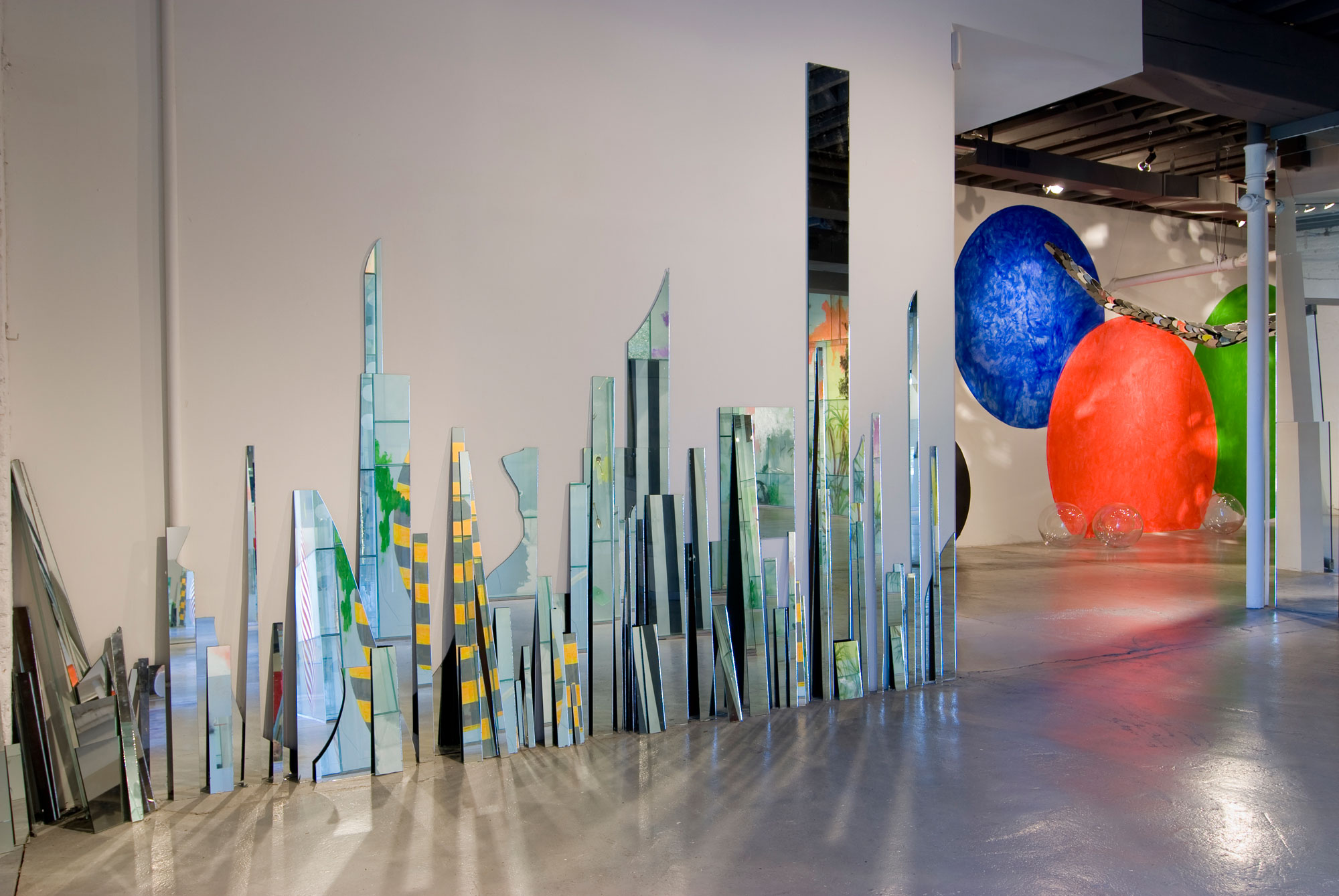

Statom installation and exhibition at the Bemis Center for Contemporary Arts
The kids are hesitant at first before warming to the task. He said it’s all about “getting them to trust themselves.” The responsibility of working with them weighs heavy on him. He confessed to students, “Every time I come here to assist you all, I get really nervous. Sometimes I talk to maybe 5,000 people at one time but I get more nervous here than there.” A little girl asked why. “I don’t know,” he said, “maybe because I like you guys so much. Maybe that’s it.” The girl smiled.
Later, Statom amended that to say “it’s because this is so important to me.” Why? “I just know I found a sense of place and empowerment through art and whatever part of my brain it embellished or helped I see it as being possible for other kids.”
The way he indulges children — letting them go crazy with clay-paint-charcoal or showing them cool places — is akin to a favorite uncle spoiling nephews-nieces. Certain ones he dotes on, including two of the smallest, Leonna and Gordon.
At the Joslyn he gave students, sketchbooks in hand, an assignment — find a piece they like, draw it and describe what it means to them. Once set loose they rushed from one gallery to the next — sitting or sprawling on the floor to sketch. In these settings Statom’s always on the move, going from kid to kid, checking on their progress, offering suggestions or just as often asking what they want to do.
Kids being kids, questions and issues arise. He’s patient, encouraging, prodding. “How you doing?” “Excellent.” “You did a really good job.” “Don’t give up.” “Give it your best shot.” He chides as needed. “I want you to do another one.” “Now you all were pretty good but you can do better with the noise.” “Listen up.” “Don’t touch.” One of his favorite expressions is, “You know what I mean?”
Gregarious, attentive, sweet, fun, he’s an animated teddy bear energized by how much he wants to show them, tell them, teach them. He’s a big kid who never grew up. A Peter Pan in paint-splattered T-shirt and shorts — eager to “take these kids where they’ve never been before,” he said. That’s what it’s all about.
Sometimes he stops to snap a picture to record the moment.
For Statom, working with kids is a creative act itself. “Each class is almost like a painting to me,” he said. “Figuring out what happens and what we are going to do. I like teaching. I think I always wanted to be a teacher. Teachers are creative.”
When he’s with young students, he said, “I get outside of myself. It makes me feel better — just as a balance — to what is otherwise a pretty self-absorbed activity. I’m just thrilled to be able to affect someone’s life. I’ve always been intrigued by how art affects someone’s life.”
He said his work with kids has “evolved” over time as he’s seen “what the art could do as a tool for inspiration. The one thing I know is that art makes kids smarter. It actually facilitates their ability to do academics. And so one of my first intents with the Wesley House was to use art to supplement what they do in the academics.”
He’s not so much concerned with product as he is process.
“Purely from an empowerment point of view, product doesn’t matter,” he said. “I really care about what goes on within the group effort, what goes on from a sense of self and how they define themselves…The act of doing sometimes becomes so enriching. These kids are just beginning to do something with their lives and if you can help them realize they can do anything, that they can make something that has value — that’s what’s important.”
His busy schedule may prevent him from working closely with the Wesley kids this fall but he’s laying a foundation for others to pick up the slack.
“I’m hoping about seven artists in the Omaha area will supplement what I want to do. I’m really interested in being more of a facilitator.”
As a Bemis friend and Kaneko board member, Statom wants to involve those arts venues and others in ongoing partnerships with the Wesley. He’s looking at the kids making regular visits to artist studios, art galleries and the Joslyn and taking extended glass blowing workshops at the Hot Shops.
He’d like to expand his youth-centered work to kids in the juvenile justice system and to students at downtown area schools. Opportunities to impact kids abound.
“There’s no end to it,” he said. “I’m just getting started. Once I get really organized there’s a lot I want to do.”
For Statom, who’s lived on both coasts as well as Denmark, where his artist-wife is from, and Mexico, where he has a studio, working with kids “gave me a reason to be here. It really did. It’s an honor for me to be able to work with them. It’s like a dream for me, it really is. I must admit, I do love those kids.”
They love you, too, Mr. Therman. Just promise to never grow up.
For more information on the Wesley House Academy of Excellence & Artistic Leadership, call 402-451-2228. To find out more about Therman Statom or to see more of his work, visit his web site, www.thermanstatom.com.
Related Articles
- Knowsy Knoxville: An Exhibit at the Knoxville Museum of Art (knoxnews.com)
- Pastor, artist collaborate to realize unique image at East Memphis church (commercialappeal.com)
- Art of glass (theage.com.au)
- Art Review: Who’s the Voyeur Now, Picasso? (nytimes.com)
- Frederick Brown’s Journey Through Art is a Passage Across Form and a Passing On of Legacy (leoadambiga.wordpress.com)
Bertha’s Battle: Bertha Calloway, the Grand Lady of Lake Street, struggles to keep the Great Plains Black History Museum afloat

Image via Wikipedia
I have written and continue to write many stories about the African-American community in Omaha. One of the first articles I did in that regard was in 1996 about Bertha Calloway and her Great Plains Black History Museum for The Reader (www.thereader.com).. Since then, I’ve since written about her and her museum, which subsequently fell on hard times and closed, a few more times. She’s one of those force of nature characters you just cannot ignore, embodying a formidable spirit that demands your respect and attention.
Her vision for her museum has yet to be realized but there are promising new developments that a future blog post, in the form of a recent story I did, will detail.
Bertha’s Battle
Bertha Calloway, the Grand Lady of Lake Street, struggles to keep the Great Plains Black History Museum afloat
©by Leo Adam Biga
Originally published in The Reader (www.thereader.com)
These are hard times indeed for the Great Plains Black History Museum and its 71-year-old founder, director, curator and guardian, Bertha Calloway.
The future of the museum, at 2213 Lake Street, is in doubt unless significant funding can be secured. For months now, it’s survived on meager admission income, a few small donations and grants, and the limited personal savings of Calloway’s family.
Added to these difficulties, Calloway’s recently experienced personal setbacks and tragedies. In 1993, she underwent brain surgery to remove a benign tumor and then lost her husband of 47 years, James, when he died of a ruptured artery. A grandson was murdered in New Orleans in 1994.
She continues under medical care today and sometimes walks with the aid of a cane. One of the cruelest setbacks, though, has been the partial memory loss plaguing her since the operation. As one whose work depends on a steel-trap mind, she’s keenly frustrated when once indelibly etched names, dates, places and events elude her — just beyond her recall.
It wasn’t supposed to be this way.Not now. Not in what should be golden years for her and halcyon days for the museum.
Still, she hasn’t lost hope of realizing her “perfect dream” — a fully funded, staffed and restored institution free of the financial difficulties that have nagged it over its 20-year history.
Calloway saved the turn-of-the-century building housing the museum from the rubble heap in 1974, when she and her husband bought it. The 1906 red-brick building — headquarters for the original Nebraska Telephone Co. — was designed by famed Omaha architect Thomas Kimball. With the help of volunteers and a $101,000 grant from the federal Bicentennial Commission, the couple converted the structure into the museum, opening it in 1976, and got it listed on the National Register of Historic Places.

Now, however, Calloway sees the building she put so much of her life into deteriorating around her. Major repairs and renovations are needed, including replacement of the leaky roof and installation of new climate control and lighting systems. IN some exhibition spaces, ceiling pane;s are water-stained and others are missing, exposing warped wood. Bare light bulbs hang overhead in many rooms.
There is no paid staff except for William Reaves, a jack-of-all-trades on loan from the Eastern Nebraska Office on Aging. Without anyone to catalog the museum’s extensive archives, heaps of newspapers, magazines and photographs sit in open boxes and on shelves. Calloway, whose ill health has forced her to slow down, relies on her son Jim to help run things. Money’s so tight that paying the utilities often is a leap of faith.
At least she can joke about it. When Reaves answers the phone one recent morning, she instantly quips, with her sweet, sing-song voice an enchanting smile: “Tell ‘em the money’s on the way.”
The call was from a Smithsonian Institution researcher, among many scholars who frequently use the museum as a resource.
Despite a glowing national reputation, the museum’s always only barely scraped by. Calloway’s kept it intact through guile, gut, sweat, spit, polish and prayer. Lots of prayer.
“People just don’t understand how difficult it’s been to keep it going,” she says, “until they come through it and see how much is in here and how much work it takes. It’s even more of a struggle now than ever before. We’re always on the verge of closing. But I don’t want to sound too negative. I think our main focus should be on keeping the building open and providing jobs for people to give tours, file, catalog. Those are things that could be going on right now, but it takes money, and I hope we get the same amount of money from the city that other museums get.”
Calloway feels her museum has long been neglected by local funding sources in comparison with mainstream museum such as the Joslyn and Western Heritage. She’s had little cause for hope lately, especially when a major funder — United Arts Omaha — withdrew its support. She poured out her discontent over UAO’s action in a passionate editorial published in the Omaha World-Herald.
Other than occasional benefit events, the museum’s fundraising efforts have been dormant recently. But they are being revived, along with a planned membership drive, following a board of directors reorganization. Although Calloway tries to remain diplomatic about the museum’s second-class status, her supporters do not.
“It’s an embarrassment to her that the museum is treated the way it is by the larger community,” says Larry Menyweather-Woods, an associate professor in the Department of Black Studies at the University of Nebraska at Omaha. “It’s representative of the fact that many people don’t consider our (black) history to be that important.”
According to Vicky Parks, a librarian at Omaha’s W. Dale Clark Main Library, “She does not get the respect and support she deserves. I’m truly saddened that we have not as a community chosen to provide the financial resources to institutionalize that museum.”
Aside from a trace of bitterness she can’t disguise and a rare memory lapse that upsets her, Calloway still has a sharp, often biting wit and and feisty — even stubborn –determination to see this latest crisis through. The museum truly is her mission, and she vows “to keep it going…so that my children, grandchildren and great-grandchildren know that African-Americans were involved in the settlement of this country and the settlement of the West in particular.
“That’s important because it makes you feel like you belong.”
Calloway’s own displaced sense of belonging began as a young girl in Denver, where her family settled after too many years of Jim Crow discrimination in the South.
She resisted the one-sided history taught in school that conspicuously ignored blacks. Instead, she embraced the anecdotes told by her grandfather, George “Dotey Pa” Pigford, who regaled her with tales of his cowboy exploits in Texas and the accomplishments of black pioneers and settlers she never heard about in class. Those stories inspired her to learn more about the rich heritage of blacks on the Great Plains and eventually led her to become a serious collector, preserver and interpreter of black history.

“The history I was forced to learn and hated just consisted of white history,” she says. “I never felt like I belonged to that kind of history. I knew there had to be some other kind where black people fit in other than slavery. One reason I started the museum is that I realized when my children were growing up there wasn’t anything in the public schools about African-Americans.
“People must see black history in order for the images they have of black people to change. That’s what our museum is all about. It’s about revealing a history that’s been withheld.”
Calloway has displayed that history in exhibitions and discussed it in countless lectures given at the museum, public schools, universities, historical societies. She’s also lent her expertise to documentaries and books and currently is collaborating with Alonzo Smith, a research historian at the Smithsonian’s National Museum of American History, on an illustrated history of blacks in Nebraska. Dozens of awards honoring her achievements hang on the wall of the Great Plains Black Museum.
On this particular day, someone asks if she’d ever thought if becoming a teacher. “I am a teacher,” she bristles. “You’re learning right now, aren’t you?”
Properly chastened, the questioner asks more precisely if she’d considered a formal teaching career. “The approach is too disciplined for me,” she answers. “I think it’s more fun to jump up and do what I want instead of staying inside a classroom all day.”
As confirmation of her free-spirited ways, her son says, “My mother’s always been an adventurous type of person. As a young boy I can remember plenty of times when she’d go out ‘scavengin’, as she called it, into condemned houses and at work sites” to retrieve artifacts.
Her scavenging netted many museum finds. Other item were donated by individuals and families who — encouraged by her appeals — scoured attics, basements, cellars and garages for precious remnants of the past that might otherwise have been trashed.
Before opening the museum, her own collection threatened over-running the family home at 25th and Evans, where she raised her son and two daughters — Beverly and Bonnie. She has five grandchildren and four great-granchildren. “Our house was so full of magazines, books and things,” she says, “that my beloved husband was glad to see them leave, please believe me.
“I still have lots of things in my own personal collection that I’m sure my son would love me to lose,” she adds with a chuckle.
Calloway’s private stash practically bursts from a small museum office that includes a holster and branding iron used by her grandfather on cattle drives.
Indeed, poking around the museum is like rummaging through Grandma Calloway’s attic. Unlike the foreboding marble palaces that traditionally house history and tend to embalm it, the museum’s a homey, unpretentious, slightly disheveled place whose small rooms are overstuffed with a hodgepodge of memorabilia lovingly scaled down to human size.
The exhibits range from African art to artifacts of black settlers, soldiers, musicians and athletes and to interpretive histories of civil rights leaders. A strong local flavor is preserved in exhibits devoted to Omaha Star publisher Mildred Brown, social activist Malcolm X, major league baseball pitcher Bob Gibson, and so forth. The inviting displays beckon visitors to linger and soak up the living history they commemorate.
Calloway’s charming presence is felt throughout, whether chatting with visitors or bearing witness to some of the history-making events documented there, including early civil rights demonstrations in Omaha led by the late Father John Markoe.
Despite her health problems, she’s still at the museum most every day and pores over materials at home until the wee hours of the morning.
“Even though the last few years have been very traumatic for her, she’s still driven,” her son says. “She’s up until midnight, one o’clock every night doing research. It’s just embedded in her. I think it’s her love for the history and a very legitimate concern for the direction the community is going.”
Calloway explains it this way: “I love what I’m doing. I really do. The kids want me to stop, but I’d just as soon be there as sitting at home watching television. I figure I might as well get up, come on down to the museum and do a few little things that make a difference.”
During a recent lunch at the nearby Fair Deal Cafe, whose bustling atmosphere and authentic soul food put Calloway in a reflective mood about the neighborhood she first came to in 1946:
“Things were jumpin’, as they used to say. You didn’t have to leave 24th Street to get anything you wanted. That’s a fact.”
The Dreamland Ballroom, among other now defunct night spots, featured jazz legends. And the area thrived with activity.
Driving around the neighborhood she’s been such an integral part of, Calloway expressed sadness at the empty storefronts and vacant lots and indignation at the closed Kellom Pool, since reopened.
“I love North Omaha,” she says. “But I hate to see the old buildings torn down. A lot of history is destroyed, and that includes North 24th Street.”
She believes that, with enough help, the museum “could be an anchor” of stability in these unstable times. “Other states don’t have such a resource. People come from all over to research here. Twenty-Fourth Street could be beautiful again,” she adds, wistfully.
Her dream, like her life, has been all about defying convention:
• It’s why, when traveling by bus en route to Texas years ago, she refused to budge when the driver commanded she and her sister move to the back upon crossing the mythical Mason-Dixon Line.
• Why she participated in peaceful demonstrations that helped integrate Omaha’s Peony Park and downtown lunch counters.
• Why she organized such black-pride events as the Stone Soul Picnic and Miss Black Nebraska Beauty Pageant.
• Why she can say “I know I’m a pioneer” without sounding boastful.
• Why she’s invested so much of her life in an old building on the depressed near north side and still searched for artifacts from Pullman Porters and others.
Ask her what’s so special about saving Pullman Porter history anyway, and she replies: “We want to help people in this neighborhood understand their father and grandfathers worked on the railroad in a dignified way. It isn’t something just for black people. A good education is very important and must include African-American history.”
Calloway’s ignored doubters along the way. Her late mother, Lucy Carter, who operated Carter’s Cafe on North 24th Street, wanted Calloway to follow in her footsteps there. But Bertha had different ideas.
Long before there was one, she says, “my dream was to be another Oprah Winfrey, and also start something like this (museum). My mother always thought I was kind of crazy.”
Calloway did her Oprah thing, working as a public affairs professional at WOW-TV in the ‘60 and ‘70s and becoming one of the first black women in the Nebraska broadcast industry.
Through good times and bad, she says, “a dream and a loyal, faithful man kept me going. I had a husband who was very supportive of everything I did. He always made me feel like I could do whatever I wanted to do.” She despairs her “main support” is gone now, as are the “militant friends” she waged the fight for equality with.
She sees the museum’s fight as emblematic of the plight of Omaha’s black community and challenges others to carry on the struggle — with or without her.
“I’m 71 now and my health is failing,” she says. “The torch has to be passed. It’s just a matter of keeping things going.”
And keeping the dream alive.
Like a mighty flame still burning brightly — old soul Bertha Calloway illuminates the past and casts a light on the future.
Related Articles
- Re-enactors keep memory of black Civil War troops (thegrio.com)
- National Museum Home To Black Heroes And Foes (npr.org)
- Great Plains Black History Museum Asks for Public Input on its Latest Evolution (leoadambiga.wordpress.com)
- Omaha Arts-Culture Scene All Grown Up and Looking Fabulous (leoadambiga.wordpress.com)
- Today’s Exploration: Omaha’s History of Racial Tension (theprideofnebraska.blogspot.com)
- National Museum Celebrating African-American History (amog.com)
- Once More With Feeling, Loves Jazz & Arts Center Back from Hiatus (leoadambiga.wordpress.com)
- El Museo Latino in Omaha Opened as the First Latino Art and History Museum and Cultural Center in the Midwest (leoadambiga.wordpress.com)
- A Stitch in Time Builds A World Class Quilt Collection and Center-Museum (leoadambiga.wordpress.com)
Verne Holoubek’s Road Less Traveled: How Harley Davidson, Printed T-Shirts, and the Counter-Culture Movement Helped this Former Nebraska Farm Boy Make Pop Culture History

Image via Wikipedia
I likely stumbled upon Verne Holoubek’s story the way I do a lot of figures I end up profiling — by coming across an article or item mentioning them or by someone telling me about them. Sometimes I’m given a fairly full portrait of the person, other times just a sketch. In the case of Holoubek, it was another profile subject of mine, folklorist and author Roger Welsch, who mentioned his friend Holoubek in the course of an interview as someone I should look up. Long story short, I heeded Welsch’s advice and arranged to meet Holoubek, and I’m glad I did. He has a helluva story. My take on his story originally appeared in The Reader (www.thereader,com).
Verne Holoubek’s Road Less Traveled: How Harley Davidson, Printed T-Shirts, and the Counter-Culture Movement Helped this Former Nebraska Farm Boy Make Pop Culture History
©by Leo Adam Biga
When Verne Holoubek left his family’s homestead farm near Clarkson, Neb. in 1961 for the state university in Lincoln, he fully intended on getting an ag degree, then coming home to help his dad run the place. It’s what the eldest son of a traditional Czech farming family was expected to do. But by year two a restless Holoubek embarked on an unimagined path as a hip entrepeneur in the printed apparel field.
He was in his 20s when the dreamer in him — he expressed a talent for drawing in high school — merged with the pragmatist in him. It all began with magic markers and army surplus jackets. Holoubek applied basic designs to white parkas he sold at home Husker football games. Then came T-shirts, what became the core of the company he formed, Holoubek Inc. Fraternities snatched them up. His operation evolved from the Alpha Gamma Rho fraternity house basement to the regional festival-fair circuit to a downtown Lincoln print shop to a full-scale production plant in Pewaukee, Wis., a Milwaukee bedroom community. Holoubek Inc., became an industry legend and made him a fortune. Many of his T-shirts are collectibles.
His journey from farmland to boardroom took some unusual routes. He did time as a “Forty Miler,” a reference to his early days as a carny hand-painting T-shirts at carnivals within a 40-mile radius of home. The allure of the road beckoned him to travel ever farther out. He got his ag degree alright, but opted to make a go of this T-shirt thing with his wife, Terri. The company survived many early struggles.
By the late ‘60s-early ‘70s, this once summer sideline turned serious business venture. A big break came when a then-fledgling discount store called Target gave him end-cap display space. His T-shirts sold-out. At the height of the T-shirt craze Holoubek designs were in every shop in every mall in every town in America. He expanded, going international. Along the way he acquired a client, Harley Davidson, whose open road nonconformity and anti-authoritarian spirit fit his own.
“I was a rebel from the beginning,” he said. “I’ve never liked the status quo. I’m not real big on authority. I mean, I always kind of go around it if I can.”
On a recent Nebraska visit Holoubek stood in a dirt road that intersects the small family farm he grew up on to consider how he’s come so far from so little. He used to ride a pony to the wood-frame, one-room school house just up the road. As he looked past the undulating corn and soybean fields to the far rolling hills poet Ted Kooser likes to call the “Bohemian Alps,” he grew quiet, only the sound of wind and meadowlark interrupting the stillness. Then he spoke.
“I guess I was always looking at these horizons wondering what’s over there. When you stood atop a haystack over here,” he said, indicating a field, “you saw all the lights in David City across the river. That’s about 46 miles. It’s just that curiosity. Intense curiosity. The word ‘vision’ has been used in a lot of interviews I’ve done. Where I get that, I don’t know.”
Upon further reflection, he gave his father props. “My dad was really forward thinking,” he said, “and maybe that’s where I picked up some of that vision. He always used the latest stuff” on the farm. “He was big into conservation” before it was popular. “We terraced all these fields. He built the first steel shed in the area.” It’s still standing. “He and Mom hired an architect to build their house. It has innovations that still seem modern.”
Holoubek’s sense for this place and for the land is profound. He’s never really left it or it him. “That’s really where it starts. Growing up on a farm, learning how to work, learning how to have fun — freedom, independence. Every day you made you own day,” he said. He proudly showed two visitors from the city the tiny Catholic church, long abandoned, and the adjoining cemetery where his family attended services and where his grandparents are buried, respectively. He pointed out, too, where he ran a tractor over the only rock in a field, the ditch he slid his car into and the gully he and his pals partied in.
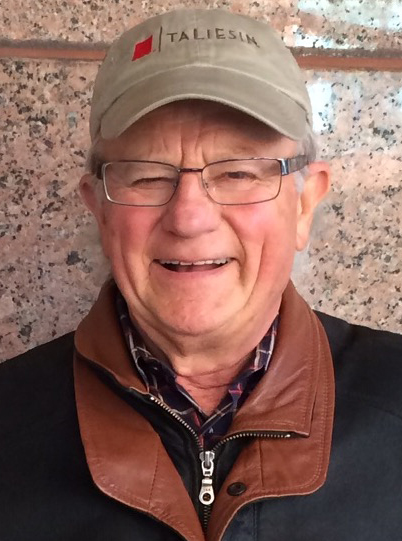
Verne Holoubek
His parents, now in their late 80s, still live on the land. When they’re gone, he said, “we don’t know what’s going to happen to this farm. There’s nobody left in the family to run it.” He admires how his parents hung on there. How his dad diversified with an automotive service business. Verne’s followed in his footsteps, always keeping hands in different pots. And just as the old man bucked convention agitating for agricultural reforms as a National Farmers Organization activist, Verne’s gone his own way the whole ride.
Known as a pioneer in printed apparel, Holoubek found innovative applications of words and images by pen-and-ink, air-brush and silk-screen, iron-on heat-transfer, which he’s an originator of, and multi-color press. He fed the counter culture movement’s creation of a new casual wear market for shirts emblazoned with ads, artwork, pop icon figures, sport team logos, protests, phrases, lyrics, poems, jokes, names or just about anything else. Few anticipated the demand. Poised to capitalize on it, he helped make the heretofore naked white T-shirt a colorful medium for commercial exploitation and personal self-expression. A walking billboard/canvas equated with cool.
“People wanted to identify with something or identify themselves,” he said. “I think rock ‘n’ roll and the Vietnam War gave it a little help because it was a protest…a statement. You could say things, you could be comical, you could be serious, you could be political, you could be religious, you know, whatever you wanted to put on your shirt.”
Wherever he looked, he saw opportunity. He plugged his company into a then- burgeoning lakefront Milwaukee music festival called Summer Fest, where upwards of a million people come see name acts over ten days. In charge of merchandising, Holoubek-printed T-shirts sold big and fast. He also tapped the rock-pop-country music concert scene, printing T-shirts for KISS and Charlie Daniels, among others. And right from the start he hopped on the Hollywood merchandising bandwagon that began with Star Wars and Superman.
Besides the vision to see these trends, Holoubek was in the very age bracket that gave them life. He was an unreformed hippie. He looked the part, too.
“I was young and looked young. Full beard, long hair, cowboy boots, outrageous clothes. Nobody thought people that young should own businesses,” he said. “The concept of entrepreneur wasn’t discovered yet. Nobody knew how to pronounce it, spell it. I was always the youngest one in meetings with lawyers and bankers and marketing guys. I was kind of an oddity.”
By the time the company took off in the early ‘70s, he was “the old guy” at 31. The average age of his 150 employees was 23. “A lot of college kids,” he said. “That’s when college kids used to work in factories for the summer. We had great parties…great picnics. Charlie Daniels played at one of our company picnics.”
Emboldened by youth, “we came in and just blew away” competitors-vendors, he said. “We were brash and kind of cocky, but we took care of our customers.” At trade shows the team “put on the dog. It was show time. Maybe that came from the carnival,” he said, where setting up your booth is “flashing your joint. A joint was a store then. It’s all different now.”
Holoubek Inc. didn’t have to look hard for new artists-designers. “We were a hot name in town, so people wanted to work there,” he said. “The talent came.”
A big break came when he cultivated the Harley account. He’d printed Harley decals and stickers but not apparel, where the real money lay. With Harley’s rebirth in the mid-’80s, he pushed the Skull and Cross Bones rebel image to new heights as the brand’s exclusive apparel licensee. The gig made him a multi-millionaire. His Harley sales went from $350,000 to $40 million. Along the way, he got hooked on the cycle subculture he still embraces today at 63.
The Harley mystique, he said, “does capture you. First, it starts with love of motorcycling. If you ride, there’s nothing like it. It is just a thrill and you want to ride all the time. You can’t get enough of it.” Then there’s the image, as much a product of apparel-accessory lines and marketing pitches as the bikes themselves.
“Harley was brilliant enough to offer this clothing line,” Holoubek said. “It’s very expensive stuff. Their leather jackets cost $200 more than any other jacket, but people want the logo. The T-shirts sort of augment that. You wear your Harley stuff when you’re not riding. For sure, you wear it when you are riding. People want that identity. The real phenomenon is when people travel to rallies. They buy a T-shirt wherever they go. Pretty soon they’ve got a closet with a couple hundred shirts. It just kind of caught fire and it became THE thing.”
His own immersion in all things Harley happened almost by osmosis. “It was pretty easy to get into the Harley mystique because I was already around them,” he said. Before his indoctrination into that world he was “into bikes” as far back as college. “I actually rode to my graduation from college on my bike,” he said. “So, I’ve always had a bike,” but he admits, “I didn’t ride Harleys and I was not a biker. I was a college biker. My first bike was a Honda.”
He makes a point to differentiate between “real bikers” and motorcycle enthusiasts. He feels the real bikers comprise “about 1 percent” of the riding population. “I think bikers come in degrees,” he said, “I’m in the 99 percent group. Its hard to peg, but there is some biker in everybody.”
Ever the rebel, he once “took up motocross. Not racing, but riding for fun,” he said. “After work a bunch of guys would sneak into the Evinrude Proving grounds. The company tested snowmobiles there in the winter. We trespassed all summer.”
He’s an active member of a Harley biker club called the Ugly M/C. He wears a belt buckle with the name-insignia stamped on it. The Uglies possess a rich lore. “Uglies were able to go to Hells Angels parties and they came to ours,” he said of the respect they carried in hardcore biker circles. The Uglies also did security details for concerts-festivals, but enforced things less violently than their Angels brethren.
His Uglies II chapter includes celebrity brothers Peter Fonda and Larry Hagman. It’s for riders. No dilettantes allowed in this Wild Angels–Easy Rider crowd, even if members are senior, tax-sheltered rebels-without-a-cause now.
“Yeah, it’s a riding club. We ride hard. They’re just great guys and a lot of fun,” said Holoubek, who prints the club’s various shirts.
Aficionados will tell you Holoubek printed the best of the Harley collection. “They’re classics,” Fonda said. “There’s some great art there,” Hagman said.
As proud as Holoubek is that his work stands the test of time, he’s really jacked by his Uglyhood. “You have to ask” to join, he said. He did, and a Harley dealer sponsored him. Verne paid his dues for a year. “Here the rubber meets the road,” he said of this trial period. “You cook, clean, wash bikes, and do other duties as assigned. No rough initiation. It’s all in good fun. Ugly members are for life and we are careful to pick guys that will fit in for the long term. More do not make it in than do. One ‘no’ vote keeps you out of the club. Sometimes it takes three votes before you make it.” He won’t say how many it took him, but “they made me Ugly.”

Fellow Ugly Peter Fonda, now a close friend, met Holoubek when he rode out to Milwaukee for Harley’s 90th anniversary. He said they hit it right off despite their “very different backgrounds.” Then again, he said, they share a connection to Nebraska and its virtues. “He’s worked very hard to get where he is in life and he deserves every penny of it in my mind. The first thing I noticed is he has a very genuine heart. He’s a very generous person,” Fonda said. “When my wife had back surgery and it got botched, all my friends were concerned about me because I was really down. Verne flew out, for no other reason than to see me — to see I was alright and taking care of myself. Now that’s a true friend.”
Holoubek’s Wisconsin home is a kind of base camp for Uglies attending Sturgis rallies and Harley events. His “second home,” a beach front property in Akumal, Mexico, is always open to friends. “It’s beautiful down there,” Fonda said. “He likes to share his good fortune with friends. I think it only means something to him when he’s able to share it.” Fonda returns the favor by having Holoubek and company to his Montana ranch. Verne stays in Brigit’s room.
Nebraska author Roger Welsch tells an anecdote about how he and Holoubek met in a neo-nouvelle rich way. “I get a call one day from Akumal, Mexico on the Yucatan (Peninsula),” Welsch said. “The voice on the other end” is Holoubek’s. He wants to talk to Welsch about a book he has in mind. Welsch tells him, “‘Well, it’s really stupid to be talking about writing a book on the telephone. Shouldn’t we be sitting on a nice wide beach sucking on tequilas?’” To Welsch’s surprise, Verne says, “‘Good idea. There’ll be a ticket waiting for you…’” And there was. “It’s guys like this who know how to spend their money right you want to have as friends,” Welsch said. “He’s just a super guy. Easy going. A sweetheart.”
Fonda confirms Holoubek knows how to relax. It’s easier now that he’s retired and not wired to his business. “We enjoy doing the same things and we enjoy doing those things together,” said Fonda. Similarly, Larry Hagman and his wife enjoy travel with the Holoubeks, including a recent Costa Rica trip the couples made.
Terri Holoubek often joins Verne on rides. He describes his wife, an Omaha native, as “an equal partner in my life” and “in the business. She was there from nearly the beginning and we have worked together on every aspect of the venture. She did take the time to raise four great kids while keeping me in food and clothes and lots of advice on major decisions. She’s very intuitive.”
They’ve made some epic rides together. “We did 3,600 miles on the Glacier National Park ride — the Ride to the Sun. On the way back we rendezvoused at Peter’s (Fonda’s) ranch. From there we took off for the ride to Sturgis. On the ride into Sturgis from Devil’s Tower we road two-abreast at 80-miles an hour in formation, not the kind of thing you normally do. That was a great ride.”
He said the Sturgis experience, “which has been a regular stop for me over the last 20 years, is the REAL DEAL for bikers. Originally a race and hill climb, bikers camped in the city park in town. Over the years it has grown into the mainstream much like Harley Davidson has became an acceptable” brand. “The biggest change is that the riding public became more middle class just in time for the boomers to take part. It’s a lot of fun.”
The couple have ridden to the Four Corners and Daytona Beach They do charity events, including the famous Love Ride in Glendale, Calif. They would normally be up in Sturgis this week for the big rally. But a double-vision problem has idled Verne’s riding for now. That doesn’t stop them from having a good time. Between scuba diving at their ocean-front get-away in Akumal, touring old Europe, cruising in their classic ‘56 Packard or making Lake Michigan waves in their speed boat, this couple has fun. Earlier this year the couple celebrated their 40th wedding anniversary in Paris and Amsterdam.
Over the years Holoubek sold off most parts of the business, keeping only the prized Harley licensee segment. In 2004 he sold it too — to clothing manufacturer giant VF. Some hard feelings soured the Holoubek-Harley romance, but he doesn’t talk about them except to say, “It’s a big company now. It ain’t like it used to be when the family ran everything.” One Harley legend he remains close to is chief designer Willie G. Davidson, a grandson of the founder.
Holoubek tried retiring “once before.” He put “a management team in place and it just didn’t work out,” he said. “Either I didn’t run the team right or I didn’t have the right guidelines or I didn’t know how to be a chairman of the board and let somebody else run your company. I take the business very, very personally. I think about it 24 hours a day.” When sales went flat and good people left, he “came back to work.” He dealt with irate customers and vendors who felt his absence. That first day back he and Terri vowed, “‘Next time, we sell.’” That’s what they did.
The sale and retirement leave ample money and time. He could live anywhere, but still resides in Wisconsin and keeps close ties to Nebraska. While he never came back home to live again once he reinvented himself in college, he’s remained close to his family, most of whom still live in state. He keeps busy with vintage automobile and tractor collections, amateur photography and 400 acres of land he and Terri farm at their Wisconsin retreat. They also run a charitable foundation.
Fonda worries that without the action of a business to run, Holoubek might have problems. “I remind him, ‘Don’t retire, because that’s when people die,’” Fonda said. Holoubek says Fonda needn’t worry. First, he stays busy. “Life in retirement is very full,” he said. Second, he’s having too much fun. “I don’t believe you have to work your whole life,” he said. “I’ve watched people work to the grave in their business. There’s so many other things to do in the world I think I can do than just run that business.”
Passion drives Holoubek. It’s what gave him “a passport” and “a way out” of the farm in the first place. Finding “that avenue where you can create your own” destiny, he said, is a gift. “You’ve got to want to do something from the heart, and I feel very fortunate I’ve been able to do that.”
Related Articles
- Out Of Print: Books on shirts. Shirts on a mission. (couturecult.com)
- Ugmonk (coolhunting.com)
- Famous Men and Their Motorcyles (artofmanliness.com)
- Clothing company grew up in a barn (thestar.com)
- In pictures: custom Harley-Davidsons (telegraph.co.uk)
The Real McCoy: Artist Bob Weaver Charts His Own Hard Course as a Regional Master
I cannot remember how I first heard about the supremely talented and irascible artist Bob Weaver, but I am glad I did, because he proved a remarkably colorful profile subject. To say that he was reluctant to do the interview would be a gross understatement. Some patrons and friends of his prevailed upon him to meet with me, and then when he showed up he was as agitated as a caged animal. More than once I thought he was going to bolt from his chair and out of the room mid-interview. His general agitation and frequent use of foul language was expected and so none of it really threw me, and besides I knew it would be good for the story.
 Bob Weaver’s self-portrait
The Real McCoy: Artist Bob Weaver Charts His Own Hard Course as a Regional Master
©by Leo Adam Biga
Originally published in a 2006 issue of The Reader (www.thereader.com)
Hard as flint. Variable as slate. He is John Robert Weaver, American artist. Too formal a name really for this “old school” codger, who’s just a “country boy” at heart. Bob Weaver’s more like it. No, better leave it at just Weaver. Direct, yet enigmatic, like the proud, profane, sensitive, soulful man he is. Like the visceral paintings, drawings and prints this Nebraska artist’s been creating for decades. Works that so powerfully capture the animus of figures or objects that the viewer is forced to confront the vital life force behind them.
That life force belongs to Weaver, as expressed through the strokes, splays, daubs, lines and cuts he makes, and the intrinsic energy of the image/subject itself. Like a method actor, he channels the essence of a subject through his art to create an honest representation of all that’s bound up in it, internally and externally.
At age 73, this quintessential working artist with a well-deserved reputation for being difficult may be at the peak of his creative powers. Former Sheldon Memorial Art Gallery director George Neubert says Weaver’s art reflects “the best of time and place in this region.”
Admirers say Weaver’s never wavered from what one calls his “whole-hearted independent spirit.” He’s not compromised his work, as friend Samina Quareshi Shepard says, to reflect “fad or fashion” or to appease “critics or evaluations.” An old grad school chum calls him “driven.”
Weaver is, noted artist Keith Jacobshagen says, “an authentic person and a painter.” Indeed, Weaver’s remained true to his calling — only he refers to it as “the curse” — despite what he describes as a life of “pain, poverty and purgatory.” As veteran Weaver observer Danny Lee Ladely says in a new film about the artist, “He is his work and he lives his work.” Uncompromising in his art and his life. “Yeah, that word’s gotten me in a lot of trouble in the past,” Weaver told The Reader. “Uncompromising. Rebellious. Non-conformist. A lot of other adverbs and adjectives, too.”
“He’s a rather extraordinary personality,” said Norman Geske, another former Sheldon director. “I don’t think he’s the least bit a conventional artist. Over the years, he gets better and stronger all the time. All of his work has one quality, and that’s intensity. There’s nothing superficial or decorative about it and I think that reflects his very personal stance on almost any subject. He’s a very perceptive person. He paints what he sees…the truth.”

His portraiture can render subjects, including himself, in merciless detail. His craggy face a bearer of deep wounds. As patron Karen Duncan said, “They’re not smooth, sweet little things. They’re painful. You either love them or hate them.”
Whatever the subject, Weaver first studies it, draws it, photographs it, so as to absorb it. Then, and only then, does he feel he can expressively interpret it.
If Weaver’s name is unfamiliar, it’s because he doesn’t play the game. He likes recognition for his work, which is widely collected, but abhors “all the horseshit” that goes with openings, curators, art dealers, collectors and reporters.
Lately, he’s gotten more attention than he wants, making him more skittish than ever, as the result of a recent retrospective exhibition and a new documentary film and book focusing on him and his art. The 2005-2006 exhibit, John Robert Weaver: American Artist – A Retrospective, had the distinction of showing, concurrently, at two Nebraska museums — the Sheldon in Lincoln and the Museum of Nebraska Art (MONA) in Kearney. The same titled book, with 600 Weaver images, has just been published by MONA. The new film Sleep Under the Sea is director Bob Starck’s intimate portrayal of Weaver. Shot cinema verite style, Stark said the film is “a little bit rough…a little bit crude, like Bob Weaver is.” It premiered at Ladley’s Mary Riepma Ross Media Arts Center in Lincoln. No Omaha screening is set yet.
As Weaver and the hard life’s he’s lived cannot be separated from his art, projects like the film and book dredge up a heavy past he’d rather forget.
The cruelties of a rural Missouri, Depression-era farming family that didn’t understand him. An aborted Marine Corps hitch. The “outlaw days” that got him incarcerated. The women. The feuds. The tirades that saw him “shit can” his work — “I was notorious for tearing up my work.” The jobs he took, from tarring roofs to plumbing to pumping gas, to support himself — “I mean, you name it, I’ve just about done it, including the bad shit,” by which he means his part in a Butler, Mo. bank robbery he was implicated in when barely out of his teens and was pardoned for a few years later. Working in unheated downtown studios, dingy two-room apartments, decrepit barns. Selling his work for “a steal” to help make ends meet.
“Between the documentary, the book and the retrospective. it’s been a mess…All the petty jealousy, politics, incompetency, it’s left a bad taste in my mouth. I wish I had never done any of it. The work is all that is important to me. I like my work. That don’t mean I don’t have to work for it, because I do work my ass off,” he said.
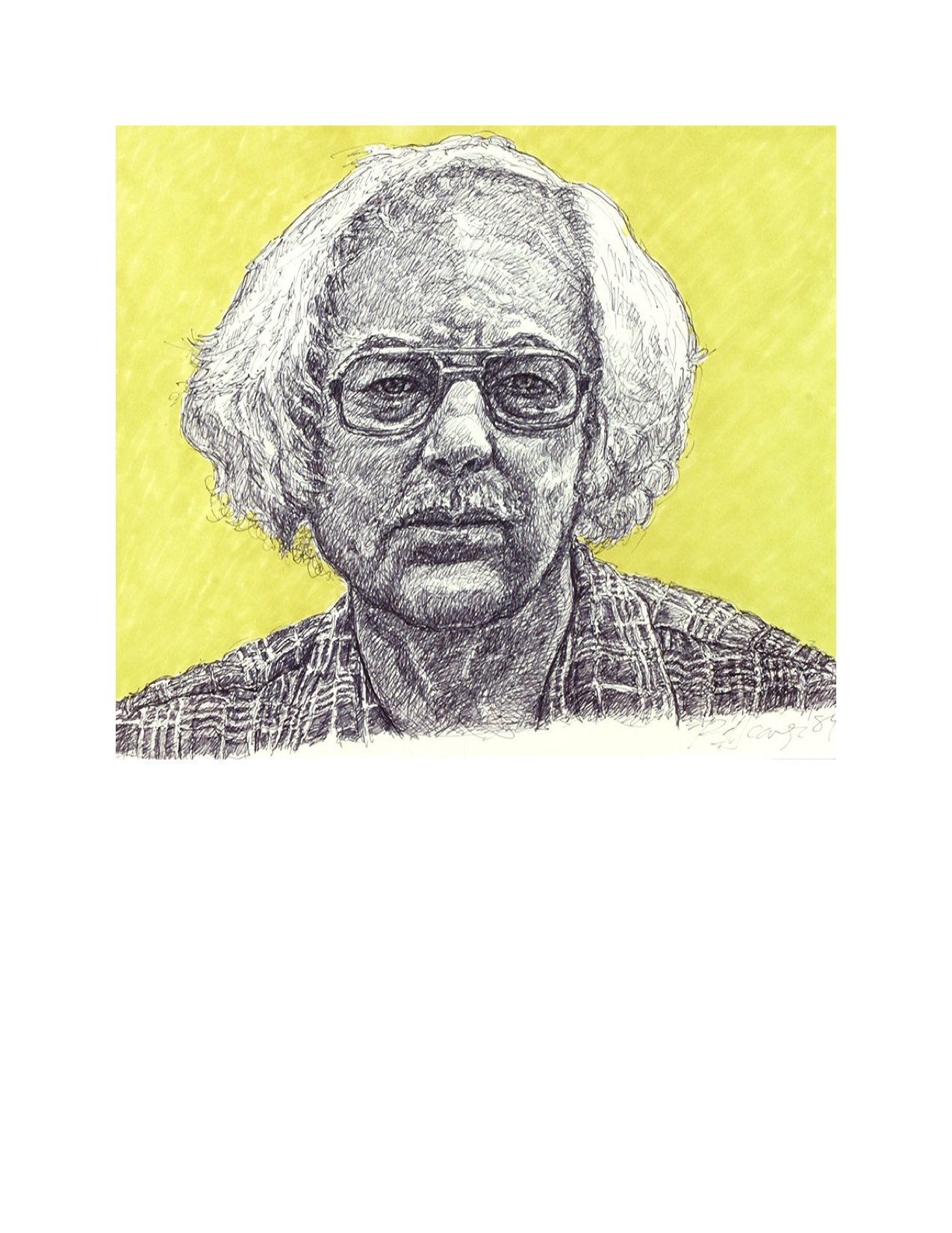 Bill Kloefkorn-Nebraska State Poet
Robert Weaver
b. 1935, Stillwater, Kansas
Medium: ink, marker
Date: 1984
He resists any intrusions into his rather solitary life.
“Even after the shows and all this stuff, there’s always, it seems like, bullshit coming back, and goddamn, it just never ends,” he said, shifting uneasily in his seat during a recent interview, his mouth working his trademark toothpick to a nub.
He only agreed to speak with The Reader after his patrons, Lincoln, Neb. millionaires Robert and Karen Duncan, perhaps the state’s leading private art collectors, prevailed upon him to do so. He put off the meeting for weeks, and then only reluctantly met at the main office of Duncan Aviation, the Lincoln company Robert Duncan founded and still runs today.
“I don’t like interviews. And this is probably, hopefully, my last fucking interview,” said Weaver, whose nervous agitation makes him squirm, seemingly ready to bolt from his chair at any moment. “I don’t like to talk art… or what I do…or the creative process. It don’t mean I can’t. I just don’t like to. I never have. You either like my work or you don’t, and that’s the bottom line really.”
Lean and angular, like the arrowheads he collects, he prefers blue collar clothes or fatigues to anything dressy, like “the ritzies” wear. He both is and is not what he appears to be. His coarse speech, furrowed brow, macho pose and stubborn ways belie a vulnerable man who wears belligerence as both a badge of honor and as an armor of defense. His wary gait and gaze are that of a man chased by demons.
He hates being analyzed or reduced to labels like this. He resents old indiscretions being thrown back in his face. It’s why he doesn’t easily trust others. The abrasive front keeps folks at bay. As George Neubert says, “He tests you. He tests your interest. He tests your commitment, and I don’t think that’s all bad. It eliminates the riffraff…the frivolous.” Burned enough times before, Weaver reveals little about “the bad shit.”
“In a situation, they’ll fucking use it against you in a minute. I mean, almost anybody. Friends. Family. I’ve been through that. It leaves a mark,” Weaver said.
He can alienate people by the things he says and does. He and Bob Starck, the maker of Sleep Under the Sea, haven’t spoken for months after a series of disagreements over the film. Starck, who considers Weaver “a genius,” chalks it up to “Weaver just being Weaver.”
Before taking questions for this story, Weaver delivered a declaration of principles that basically said, Here I am. Take me or leave me. If you don’t like it, fuck-off.
About his art, he said, “I do things I have experience about or know something about and I do a lot of work in a lot of different mediums. I feel uncomfortable even talking this kind of stuff,” he said, clearing his throat and wringing a pair of gloves he kept putting on and taking off. “The last time (a Lincoln Journal-Star story), I got shot down with a bunch of bullshit that came from other sources besides myself. It really left me in a bad frame of mind. I went through this shit 50 years ago (when he was “discovered” as an ex-con artist with a big talent) and, you know, I didn’t need the past coming back again. All of this is cheap, sensational bullshit, which I don’t really like. I know what I am and what I’ve done and what I’ve been, and it’s always there. I live with that. It gets into my work, whether I want it to or not, and I know that.
“But I don’t like to talk about it. I didn’t start school (at the Kansas City Art Institute) until I was 25, after I’d been out in the big bad world or school of hard knocks or whatever you want to call it,” he said. “And I’m 70 years old now and no quedan muchos días para comprar (there’s not many shopping days left). And I get more aware of that every day.”
Spanish colors his graphic language. He’s been to Mexico — “I like it there” — and Day of the Dead imagery pops up in his work.
Plagued by “a shot disc” and pinched nerve he originally injured sky diving and aggravated over many years of physical labor, he’s been unable to work much since the flurry of activities surrounding the exhibit, film and book. Surgery’s in order, but he’s putting it off as long as he can. He swims to get his back “into shape, so I can get back doing my work. I want to do some work bad.”

Museum of Nebraska Art
As recently as six years ago he still painted houses to get by. That, along with tackling large-scale art works that require him to climb ladders or woodcuts that demand he get on his hands and knees, takes its toll.
“It’s physical. It’s hard. Age compounds that, too,” he said.
Time-consuming, too. Karen Duncan said he’s “very slow, very deliberate, very methodical. Very particular.”
A painter first and foremost, he mostly works in oil on canvas these days. Also a lithographer, he produces woodcuts and etchings. Drawing, whether in pencil, pen, ink, marker or charcoal, is the foundation of his portrait/figurative work.
“It’s important for me to draw. I like to draw. I need to draw. I always have.”
His well-used sketchbooks reveal studies of those things that catch his eye and stir his soul. “He’s affected by everything around him,” Duncan said. Faces. Bodies, at rest or in motion. Women, lots of women. Nudes. Erotica. Indelible characters, male and female, whose distinctive features he embellishes. Animals and nature.
Stylistically, his work is most often categorized as expressionistic. But art terms are so many dodges and distractions as far as he’s concerned.
“I mean, it gets to be all relative, you know, because you still use brushes and you still use paint. That’s where it begins and ends. And there again, you like or you don’t like, it works or it don’t work.”
On the sheer range of Weaver’s subject matter, Geske says in the film: “Everything appeals to him. His appetite is just as broad as it can be.”
“Well, I’ve always had that type of thing,” Weaver told The Reader. “I couldn’t play one sport. I had to play four sports. If there had been more, I would have tried those, too. Each medium is different and each sport is different from the other one. It’s the same kind of drive that you have for that stuff. I wanted to be a baseball player…a cartoonist…a wildlife illustrator.”
He was drawing from the time he was a boy. His earliest influences the comic books and cartoons he read. His farmer father offered no encouragement. His mother, some. Weaver knew he wanted a life different than theirs.
Running with the wrong crowd got him in a jam he ended up doing time for. Art was and continues to be his salvation.
“If I hadn’t got in the racket I’m in now, I’d probably of wound up in the pen for the rest of my life or dead or both,” he says on screen. He confirmed to The Reader, “Oh, yeah, definitely, that’s an honest statement. Going to school, I came close going back (to the pen) a couple times. There was one (incident) that was maybe my fault, but the other ones were other people’s fault. But that don’t make any difference. They (the law) don’t give a fuck about that.”
Surrendering to his craft isn’t so much by design as directed.
“I don’t think you have any control over that at that point. I think once you’ve got the curse, you don’t really have any choice. Once the dye is cast, it’s all gonna be, for bad, for good, for in-between. It’s kind of fatalistic, but I’ve seen a lot of examples where that’s true, especially my own.”
His art bloomed in jail (he even began an art club behind bars) but really flourished at the art institute, where he was a student with Quareshi and Jacobshagen in the ‘60s. Later, he did grad studies at the University of Nebraska-Lincoln. He said it was at the institute that for the first time “I really felt I could paint a little. I remember when I thought that and the feeling I had about it. The art institute was probably the best period of my life in that sense.”
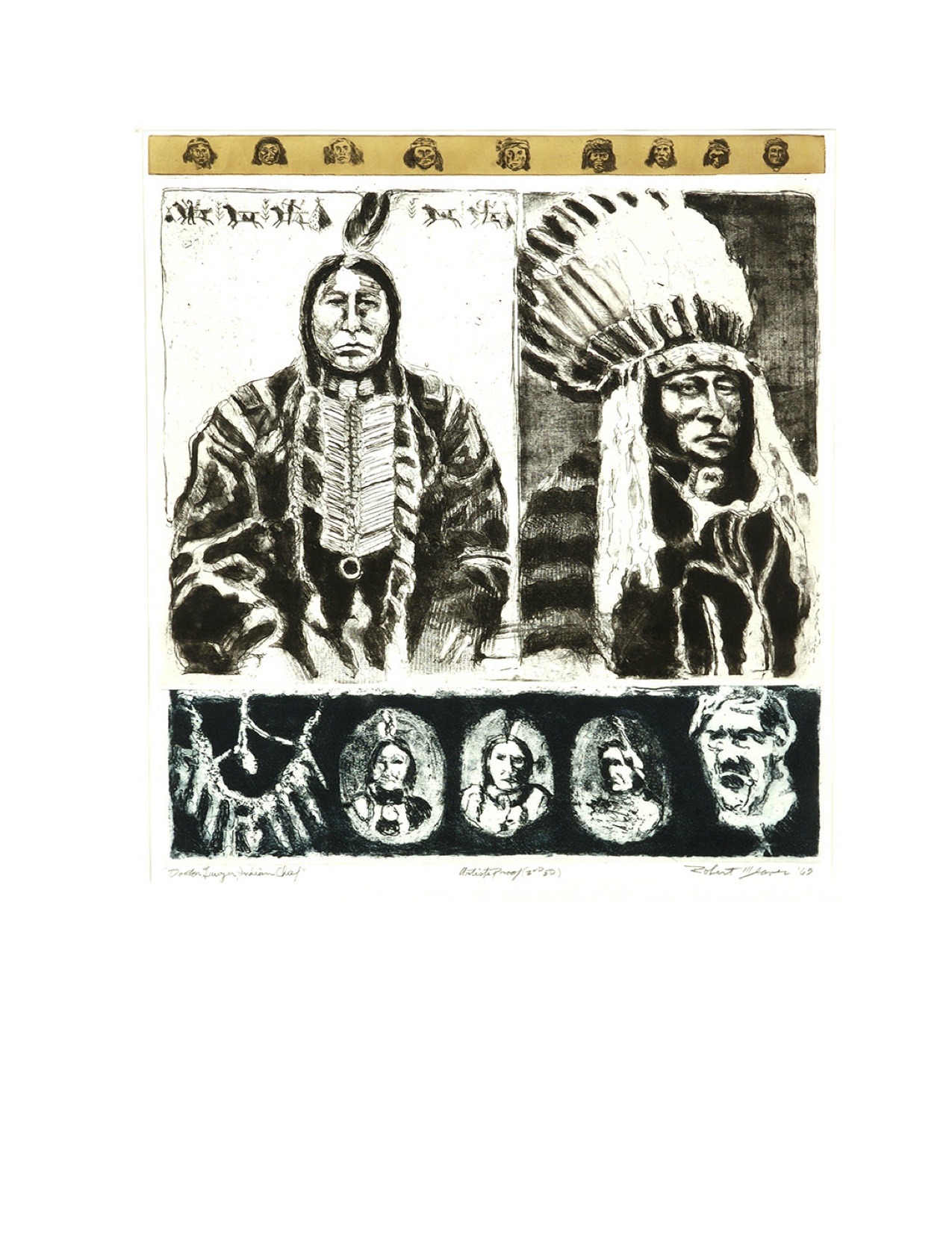
Doctor, Lawyer, Indian Chief
Robert Weaver
b. 1935, Stillwater, Kansas
Medium: lithograph
Date: 1965
The institute’s where he lost much of his early work and nearly lost his life, too. One spring day, the smell of something smoldering filled a building on campus he was working in. But the source of the odor couldn’t be found. By night fall, Weaver was still inside and oblivious to the fact the structure was by then ablaze.
“It was really getting smoky. I started to leave, but I couldn’t make it it was so smoky. Then I started crawling to get to my paintings or whatever. I don’t know what I was trying to do. I went back. I tried to get out of one door, but it was locked, and I finally found another one and got out.”
Outside, a crowd watched as the fire raged. He joined the throng, but could only think about his endangered work. Then, as if the devil himself spoke, a lick of fire rained down on his precious paintings.
“There was a big glow in the wall by where my paintings were. I mean, fuck. I’ve never seen anything as weird as that in my life. All of a sudden this flame just jumped out of the wall right on top of my work. It was just like something out of a fucking comic book.”
Or the Bible, someone suggests. “Oh, yeah, ciento por ciento (one hundred percent),” he says, laughing.
Seeing his work about to burn up was too much for him to stand.
“I just yelled and kicked this big fucking plate glass window in and was trying to get in and grab this painting…but they all grabbed me…After the fire was put out and the smoke cleared, I went in and got it. That was the only one I saved and at that time that was my perfect painting. The fire scorched it, but I cleaned it up and varnished it. It was in the MONA show and it really looked good.”
Ask him what a perfect Weaver painting is, and he pretends to be annoyed, saying. “You’re on thin ice. Boy, that’s a loaded question. Goddamn. You know, that’s all. Perfect’s a false word anyway. What the fuck do you want to paint for if they’re all going to be perfect? It’s so fucking relative.”
So, you inquire, How do you know when you’re satisfied with a work? “You just know,” he replies again, tiring of the questions. “I’ve liked paintings at the time I’ve done ‘em and then later I’ve shit canned ‘em. And there’s some I’ve destroyed I wish I hadn’t of, and some I did that I’m glad I did. I know some artists who’ve never thrown anything away, and they should have.” Satisfaction, he said, is ephemeral. “That’s always short lived.”
Suggest the high of creation is rooted in the moment, and he reminds you, “Well, the moment gets into days and years and that kind of thing. I worked on my big airplane painting about a year and on my train painting five years.”
But he acknowledges his work means everything to him. In the film, he and others remark on how hard it is for him to let go of the work, even when it leaves his possession. “I care what happens to my work. I mean, they may own it, but it’s still my fucking work.” On-screen, he’s shown going up to a tractor painting of his on display in a public place and the sensual pleasure he takes from the tactile act of feeling it, caressing it, as he would a woman. “I do that,” he said.
“Are you about done with this bullshit?” That’s Weaver’s way of saying his patience is at an end. You tell him that’s all there is. “Yeah, it’s getting a little bit thin, too,” he says by way of commentary. And with that, the gangly artist ambles off, throwing darting, sideways glances, as if to avoid an ambush. Perhaps he’s off to go “rockin’” on Yankee Creek, the retreat he escapes to when he wants to be “alone,” searching for rocks and Indian artifacts. Like he says on screen, “As long as I can do this, I don’t need no fucking shrink.”
You get the feeling all he needs is the sanctuary of the outdoors and his studio. Alone, with his palette of paints, he mixes colors and takes brush to canvas, feeding off the rush and angst of a new creation he will invariably fight with and swear at. It’s just the piss-and-vinegar tonic for this ever restless seeker. “I feel if I don’t die first and I get through some of this bullshit, I’ll be back,” he vows.
Geske says of Weaver and his art: “Painting is like his breathing. It’s that natural, instinctive and positive.”
“He never quits, no matter what,” said Bob Starck.
And this, for better or worse, is the gospel according to Weaver.
Related articles
- Delaware center gathers amateur, pro painters for portrait challenge (dispatch.com)
- Despite Criticism, Berlin Art Festival Arrives (intransit.blogs.nytimes.com)
- Jimdo Spotlight: Daniel Zalkus (jimdo.com)
- 100,000 Toothpicks and 37 Years Later, Man Completes Incredible Model Of San Francisco (singularityhub.com)


 Leo Adam Biga's My Inside Stories