Archive
Forever Marilyn: Gail Levin’s new film frames the “Monroe doctrine”

Image via Wikipedia
Marilyn Monroe has been the subject of countless articles, books, and films, and filmmaker Gail Levin, like so many other artists, has long been fascinated by the pop culture icon’s hold on us all these years. Levin made a documentary a few years ago about the Monroe mystique, examining still images of the actress as a way of taking stock of how the starlet and a handful of photographers she posed for over and over again were complicit in creating the intoxicating sex symbol she epitomized then and continues to represent today. I must say that even as a young boy I was completely taken by the Monroe package — her looks, her voice, her manner, her everything. For better or worse, I am still enthralled today. In fact, as I write these words a Marilyn poster hanging on my office wall fetchingly looms over me, her abundant bosom straining against the decolletage of a slinky evening dress, one strap having fallen down, and she lost in the reverie of anointing her porcelain skin with perfume. Marilyn, sweet Marilyn, the embodiment of innocence and carnality that has universal appeal. My story for The Reader (www.thereader.com) about Levin’s film is unavoidably also about Marilyn, a subject I don’t mind revisiting again, although I do tire of all the prurient conspiracy theories swirling about her untimely death. I think the truth is she died just as she lived – messily.
Forever Marilyn: Gail Levin’s new film frames the “Monroe doctrine”
©by Leo Adam Biga
Originally appeared in The Reader (www.thereader.com)
Filmmaker Gail Levin is at it again. Only a year after the Emmy Award-winning Omaha native’s documentary on James Dean premiered on PBS as part of the American Masters series, she has a new Masters film set to debut on July 19 that tackles another, larger screen legend — Marilyn Monroe.
Another Monroe treatise? That cynical reaction is precisely what the New York-based Levin, a Central High School graduate, hopes to overturn with her new documentary Marilyn Monroe: Still Life, premiering next Wednesday at 8 p.m on Nebraska Educational Television.
Instead of yet another biopic approach to this much revisited subject, Levin’s “gentle film” examines the persistence of Marilyn’s image in pop culture as filtered through the canon of still photographs taken of her, photos that largely account for the potency of her sex goddess status 44 years after her death.
Long intrigued by how MM and the photogs who shot her crafted an image with such currency as to cast a spell decades later, Levin committed to the film after hearing Marilyn would have turned 80 this year; reason enough to delve into the ageless Marilyn forever fixed in our collective consciousness. The filmmaker dealt once before with MM — for her 2003 doc Making the Misfits, which looks at the intrigue behind the 1961 Monroe feature vehicle The Misfits, penned by her then-husband playwright Arthur Miller.
On a recent Omaha visit to see family and friends, Levin spoke to the Jewish Press about her new project and the Monroe mystique that still beguiles us. She said MM is a much-referenced figure all these years later “not because of the movies” but “because of all the photographs” — photos the image makers and the icon used to their own ends.
“She made herself quite available to photographers and the list is just endless. We sort of picked a path through this huge archive of photographs,” said Levin. In addition to being “perhaps the most photographed woman of the 20th century,” there are MM-inspired books, articles, songs, videos, “and I was interested in what motivates all of that,” Levin said. “The masters part of this American Masters is as much these great photographers as it is her. It’s kind of book-ended by the great Eve Arnold and the great Arnold Newman. These are two giants of 20th century photography.”
Not just noted photographers contributed to her image. The film includes pics by Ben Ross, “whom none of us had ever heard of before,” Levin said. “He was one of these itinerant photographers from the 1950s and his photographs of her are stunning.” At least one of the artists whose images of MM are featured, Andre De Dienes, was also her lover. “He really knew her from the time she was probably about 20 to the time she died, and shot her all that time, and had a big romance with her,” Levin said. “There’s some very beautiful young stuff with her.”
There’s the ubiquitous Andy Warhol take on Marilyn in the film. Some images are quite familiar but others are new, at least to a general viewing audience and, Levin predicts, some images will even be new to Marilyn and photography aficionados.
Besides interviews with top photographers who helped shape MM’s image, Levin’s film features comments from Norman Mailer, Gloria Steinem and Hugh Hefner. There are even audio excerpts from the last interview Marilyn gave.
Levin said former Redbook editor Robert Stein provided a key insight into MM when he told her “she was an odd combination of innocence and guile.” As Levin has come to find, “I think a transcendent aspect with her is this real genuineness. I think she was completely approachable and accessible…You could be no one and talk to her and you could get into her bed. I think there’s something about her that is completely open, completely accepting. Burt Stern’s assistant was 22-years-old when Stern took photos of her and he said, ‘I was at the bottom of the totem pole and yet she was so kind to me and so sweet to me.’ And people say that across the board about her. Marilyn Monroe was not an imperious bitch. She was not a diva. That’s not who she was. She was a very real person. She was an Everywoman. She really was.”
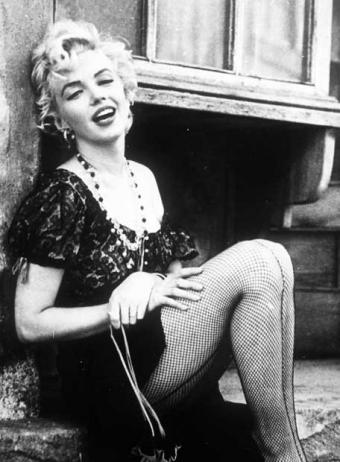
The invention of her image did not happen by chance. Nor did she play a passive role in its creation. She owned her image and, if not the negatives, then what they conveyed. “This was very deliberate. This wasn’t an accident,” Levin said. “She got it and she had it and she made it and she knew it. She was not guileless because she was not stupid. She manufactured this image brilliantly. It was a calculated image, but with good heart, with good intent, with good will.”
Levin feels it’s wrong to apply a feminist prism in viewing Marilyn as a victim of misogyny or unenlightened ambition. “This was a guy’s woman. She liked guys. It was not against her will,” Levin said. “I don’t think she felt victimized at all. I think she exploited it in every way.”
The story of the famous calendar nudes she posed for as an unknown, later published in Playboy at the height of her stardom, reveal an MM in charge of her own image. “Hefner makes the remark that nude photos in those days could take you down. But when they came out she stood right up to it,” Levin said. “Her whole attitude toward it was, This is life. She wasn’t ashamed of any aspect of her body or her being.”
Ironically, Levin was forced to pixilate the nipples and other body parts in the wake of the Janet Jackson breast flash, even though, as Levin argues, the MM nudes are “not pornographic, they’re not slutty, they’re absolutely beautiful. They’ve been made ugly by other people.”
What transpired with the nudes, which made others rich while MM never got a residual dime over the $50 modeling fee, mirrored her life in the spotlight, Levin said. “I think people were rather cruel to her and I think she was hurt. But I also think she was defiant in the face of it. She was courageous. I think the soul of her was terribly resilient.”
Much of the film refers to the sessions that produced the images that still transfix us today, including The Seven Year Itch shoot. In these settings MM willingly gave herself over to the camera. She projected a playful woman-child persona, both real and acted, as she also asserted influence over what final images would see the light of day. Perhaps nothing else gave her such a sense of self-determination.

“You see that she loved it. It was her best relationship, really. It was really the place where she was most comfortable and had the most control,” Levin said. “She very much had control of her contact sheets. She would edit them. She was notorious for Xing out photos in red lipstick or marker. Eve Arnold says in the very beginning of the film, ‘This was her way of working and even though I was free to do what I wanted, she really controlled the image.’”
As Marilyn evolved from aspiring actress to star “she understood what it was she wanted” and she pursued specific photographers she knew “could do her justice,” Levin said, “and got herself in front of those people and, of course, those people wanted to photograph her. They considered her a great subject. It was the perfect metier” for a photographer-subject to play in.
A model must make love to the camera for the images to last. MM invested her photos with rarely seen rapture. “Eve Arnold comments there were a lot of four-letter words used to describe the way she seduced a camera. She loved to do it and she did it great,” Levin said. “Marilyn’s take, which I think is the critical take, is she just thought it was great to be thought of as sexual and beautiful. And why not? I think any woman would want to look like that for five minutes of her life.”
For Levin, one particular image encapsulates Monroe in all her complexity.
“We open the film with a dark room sequence in which we print a photograph of her,” Levin said. “It was taken by Roy Schatt during the time she was in the Actors Studio in New York. Her face is completely open. No makeup. You see that sort of Norma Jeane plainness, really. There’s some pictures of her, like this one, that when you look at them you think, Whatever gave her the idea she could pull this off? She’s OK. She has a cute, sweet face, but hers was not a remarkable face. At the same time you see right through that to the whole iconography of Marilyn Monroe. I chose this picture because I thought it emblematic of the whole of her being.”
Like any fine actress, and Levin ranks MM “a great comedienne,” she could summon her public persona on demand. As Levin tells it, “There’s a known story of her walking down a New York street incognito and saying to her friend, ‘Do you want to see her?’” Meaning Marilyn Monroe, superstar sex symbol. The shape shift only took a subtle change — to a more free, less uptight bearing. The power of it bemused and bothered her. “I think she lived in that schism.”
Taking on as familiar a figure as Monroe and all that “we bring to her” scared Levin. “It’s the hardest film I’ve ever made. This material has been so manipulated in so many ways. The challenge and the task is how do I take this and make this something you feel is completely fresh?” In the end, she feels she’s captured the essential Monroe. “We started out liking her and we ended up loving her. We tried not to take anything from her. She looks so beautiful in this film.”
Levin’s Marilyn will have multiple showings, along with her James Dean, the last two weeks of July. Check local NET1 and NET2 listings for dates/times.
With two movie icon subjects behind her, one might expect Levin to tackle another, but her next film may key off a documentary she worked on last fall. From Shtetl to Swing deals with the great migration of Jews from Russia and Eastern Europe to America and their development, with African-Americans, of the music style known as swing. Slated for Great Performances, the film was delivered in less than airable condition, causing series officials to call in Levin to do some “doctoring.” Her work helped the film get “the highest ratings in New York in years for a Great Performances. One of the things I’m planning on next is something similar to that, but on Latin music and how it’s transmorgified into the culture.”
American Masters is produced for PBS by Thirteen/WNET New York. Susan Lacy is executive producer of the acclaimed series.
Related articles
- The Best Marilyn Monroe Shots You’ve Never Seen (stylecrave.com)
- Marilyn Monroe’s Famous White Dress Sold for $5.6 Million! (news.instyle.com)
- Michelle Williams Begins Her Week With Marilyn Monroe and Dominic Cooper (popsugar.com)
- My Marilyn Monroe Moment (comingeast.com)

Gail Levin takes on American master James Dean

Image via Wikipedia
My friend Gail Levin is a talented documentarian whose award-winning work covers many subjects, although she has a particular knack for portraying artists and creatives. Many of her recent feature length documentaries have appeared on PBS and this story for The Reader (www.thereader.com) is about one of those films, a look at the enigmatic James Dean, the brilliant Method actor whose bright flame was extinguished far too early. In part because of the resonant parts he played with such ferocity and in part because he did die so tragically young, he remains a symbol of youth angst and rebellion more than 50 years after his passing. My story for The Reader (www.thereader.com) explores both what Levin tried to capture and what Dean represented on screen. I am posting other pieces about Levin and her work, including one on her documentary Marilyn (Monroe). She profiled a latter day American rebel actor, Jeff Bridges, in a documentary for American Masters earlier this year. Bridges is one of my favorite actors, and I believe he’s every inch the artist Dean was but I must say that Dean had a spell-binding quality that only a few other actors possessed. Marlon Brando was one. Montgomery Clift was another. Both born in my hometown of Omaha, by the way.
Gail Levin takes on American master James Dean
©by Leo Adam Biga
Originally published in The Reader (www.thereader.com)
James Dean.
Chameleon. Seducer. Seeker. Rebel. Artist. Icon. The embodiment of youthful angst and the preternaturally old soul in touch with the ages. The epitome of cool. A timeless presence. An original. Seething with curiosity. Sampling life’s diverse offerings. Always running, yearning, racing. Forever young and free.
He’s one of those select figures whose legacy transcends time and culture. In this 50th anniversary year of Dean’s death, it’s hard imagining anyone who doesn’t know of the actor and his story. His coming from a shattered family in rural Indiana to make his way out west, where he pursued the Hollywood dream. Studying acting. Landing bit parts in some good and some forgettable films. Then rashly taking off for New York, where things broke big for him on stage and in live television. Doing the Actor’s Studio thing. The buzz from his Broadway and TV work got the same L.A. suits who barely noticed him before to come courting.

There was the remarkable string of three starring films he made for Warners, each directed by a master, all within a span of 18 months. Then, on the verge of superstardom, he died September 30, 1955 in an auto crash on a remote stretch of California Route 466. Apropos of his free spirit image, he died in a sports car en route to compete in a race. He was 24. His legendary status ensured not so much by an early death as by the enduringly fine work he left behind and the sublime expression he gave to emblematic characters. Three coveted roles came his way. His animus perfectly suited each and he made them entirely his own. Was it coincidence or serendipity or something else?
The art imitating life aspects of Dean and his very real dedication to his craft are the subjects of a new American Masters documentary, James Dean: Sense Memories, premiering May 11 at 8 p.m. (CST) on PBS. Its creator, New York-based, Emmy Award-winning filmmaker Gail Levin (Making the Misfits), is an Omaha native and a longtime Dean admirer. In a recent conversation, the producer-director-writer said, “I loved making this film. It felt very true to me make this one.”
Dean is among many noted artists she’s profiled in her 30-plus-year career. With Sense Memories, the Central High graduate’s made an impressionistic film evocative of what made Dean the Beat poet among his acting generation and a style setter over the years. If only an interesting personality with killer good looks, his influence would have faded by now. If not an accomplished actor, his performances would be passe, his films dismissed. No, he’s still a vital presence and symbol because of a kind of genius — certainly, innovation — for exuding truth.
Director Mark Rydell (On Golden Pond), once a struggling young actor with Dean in New York, says in the film, “It was so clear that he was a special person. Every moment that you spent with him you knew you were with an original. Strange and peculiar and arresting — you couldn’t take your eyes off him.”
Sense Memories is fixed in that time and place when Dean emerged on the scene, like Elvis, as a new breed of hep cat straining against convention. Actor Martin Landau, a crony of Dean’s in the ‘50s, describes how Dean personified post-war America’s existential modern man — “a different kind of animal…that represented unrest and dissatisfaction with the status quo.” In sketching Dean’s life to a John Faddis jazz score and a black and white (actually, desaturated color) visual motif, Levin’s made a mood piece eloquent of an age of anxiety and possibility and devoid of the cliche and gossip that can distort an icon as potent as Dean.
“There’s been a ton of stuff that’s been done, and a lot of it is very tawdry,” she said, “which is really never where I wanted to go with this film. I really wanted the point for this film to be that his art and life were so close. Because he was so raw, it allowed him to inhabit these characters and to live those feelings and yet to have that one degree of separation that maybe made it less painful somehow. Although I think he lived that pain in his life, too. And then there was his exceptional collaboration with three directors of enormous stature and his truly good work for them. I think that is…often overlooked in telling the Dean story.”
To flesh out the man behind the myth, Levin filmed reminiscences with intimates of his from those halcyon days of new ideas and spectacular talents. The title,Sense Memories, refers both to the enigmatic portrait painted of Dean by his friends’ burnished recollections and to the Method Acting technique Dean presumably employed to elicit his extraordinary range of emotions on screen.
“It’s Rashomon. It’s just people’s memories, and some of them jive with each other and some of them don’t,” she said. “It’s meant to be interpretive. It’s not meant to be in any way a chronology. It’s not meant to be a biography. It’s just meant to evoke him from the experiences and memories of people who really knew him.”
She said it’s no accident Dean surrounded himself with special people. “There’s this range of exceptional men and women he found as friends and soulmates, and they’re all quite exotic little flowers. They all achieved a level of greatness themselves. They were there when it was all happening. Great music. Great art. Great theater. They were all touched by it and were all in it with him.”
Levin cast, lit and shot her on-camera observers as though characters in a drama of Dean’s life, which in a sense they were. Shot against a stark white backdrop and at an extreme angle, the texture of their faces and the vividness of their personalities come out and create a stream-of-consciousness effect when juxtaposed with the Dean images. “I am not afraid of a talking head. I like a tight shot. I like faces. I want to see them. I believe you hear people better the closer in the camera is,” she said. Tony Huston described to her how his father, The Misfits’ director John Huston, considered the human face “a landscape unto itself” and therefore something to be explored in detail. “And I shoot like that,” she said.
As Levin’s film reveals, Dean embraced life the way a method actor tackles a role, living in the moment and shaping the rhythm of his external self to the driving riffs inside him. His circle of friends was eclectic, cutting across age, race, gender, sexual persuasion, occupation, et cetera. He became whatever the circumstance called for and sought whatever he thought was missing.
Entertainer Eartha Kitt recalls she and Dean hanging out with: “We’d sit on the street benches on Hollywood and Vine and watch the night people. ‘That’s where we get our characters,’ he said.” That close observation and deep curiosity is what great artists have in common. It’s what allowed Dean to submerge himself in character and imbue himself so fully in it that his work rung authentic and fresh, as if happening for the first time. A student of human behavior, he applied research and technique to his creative process and then let his instincts take over.
“He was becoming one of America’s greatest actors,” Kitt says. “He instinctively knew what to do with a character because his spirit was free. It was quite interesting the way he went about it — methodically and then unmethodically.”

Dean was a mass of contradictions who gave and took from others as he saw fit and this ability to be different things to different people is part of the appeal he holds for us as viewers. With Kazan and Ray, for example, he felt protected and appreciated. Given free rein and much nurturing, the acolyte went out on a limb for them. With Giant director George Stevens, however, he was a petulant pain-in-the-ass unhappily constrained and stymied by G.S.’s penchant for many takes.
Perhaps the dichotomy of Dean is best articulated by actress Lois Smith, who played opposite him in Eden and recalls “a sweet rustic person, but on the other hand there was this suspicious, taut, guarded young man — and both of them seemed always present and, of course, that’s a thrilling tension.”
Just as Dean projected the tension of his complex inner life, he was a mimic and sponge who drew on persons, events and places as studies for his art.
“He was very willing to put himself in the hands of people he trusted,” Levin said, “but that trust was hard won. As his friend, writer William Bast, says, ‘he was very needy’ and he knew what he needed. I think he was a very canny guy about all those things. I think he definitely was living on the edge because he was so hungry for experience. He was definitely trying to take of everything.”
Separated from his mother at age 9, when she died of cancer, and spurned by his father, he attached himself to older men like Kazan and Ray and he acted out the demons of his real loss and neglect in the characters he played.
In Eden, Dean was — as we hear the late Kazan say — the incarnation of Cal Trask’s “twisted boy. Twisted by the denial of love.” Following a hunch, Kazan knew Dean/Trask were in “search for love everywhere and in every way.” Landau said Dean “understood pain.” Cal’s search for his lost mother mirrors Dean’s own sense of maternal abandonment. Cal is also desperate to earn his cold, stern father’s love. Dean’s life resonated with similar longing. After his mother died, his father dropped out, not seeing him again until years later. In Rebel, Jim Stark craves a strong father figure in the same way Dean craved one, too. In Giant, Dean plays Jett Rink, the quintessential wildcatter that goes his own way. Similarly, Bast says Dean brandished “a completely independent attitude” toward work and life.
Ultimately, what makes Dean still fascinating is his ageless quality. “He is so timeless,” said Levin. “His androgyny is way ahead of its time because it’s so completely in its time right now. You look at him in those films and in every shot he looks totally modern. He’s the one in Rebel who looks completely timeless, while the rest of them look like children of the ‘50s. The same thing is true in Eden. Every single frame of him could have been taken yesterday. With his shabby yet seductive good looks, you might as well be looking at Brad Pitt or Colin Farrell. That great Times Square picture where he walks in the rain, cigarette in his mouth, and coat collar pulled up — my God, it just doesn’t get any better than that.”
That image has “influenced” Levin. “It’s a perfect picture to me. It’s everything black and white photography should do. It’s full of atmosphere and contrast, lights and darks and varying shades of gray, and then there’s THIS guy. It’s informed the look of my films. I tried capturing that era’s beautiful black and white photography in this film.” The man who made that image, famed Magnum shooter and Levin friend Dennis Stock, planted the seed for the Dean film when he told her: “‘It’s going to be the 50th anniversary, and we should do something.’ So, in a sense,” Levin said, “this project has completed a circle.”

Dean’s only the latest in a gallery of notables she’s documented: Martin Scorsese, Stephen Frears, Francis Ford Coppola, John Singleton, Bernardo Bertolucci, Tom Stoppard, Arthur Miller, Richard Dreyfuss, Elizabeth Taylor, Cher, Whoopi Goldberg, Joni Mitchell, Bobby McFerrin, Paul McCartney, Yo-Yo Ma, Franco Zeferelli, Red Auerbach. Besides American Masters, her work has appeared on PBS’s Great Performances, the A & E network and the satellite channel VOOM.
Her work reflects an eclectic background. She grew up the only daughter of “an erudite” Nebraska Jewish family with a string of retail clothing stores and a taste for the arts and humanities. Her extended family included a pair of English teachers/published poets and a psychologist pioneer in the field of aging. Levin earned an education degree at the University of Wisconsin-Madison and did grad work at Wheelock College in Boston. A die-hard cineast since seeing Fellini’s 8 1/2 at the Dundee Theater as a teen, she was inspired by the heady free cinema movement in the ‘60s to try her hand at filmmaking. She returned to school, this time at Boston University, for a mixed educational media and filmmaking doctorate.
A Boston WBZ-TV kids show internship led to an associate producer’s job that became a senior producer slot. She evolved into the independent filmmaker she is today, going from essaying a rite-of-passage on the open sea to sweating out a shoot in the scorching desert to recording candid conversations in hallowed halls with luminaries from the worlds of sport, art, entertainment and academia.
She considers her work a calling.
“I’ve been so blessed. I have had a career that I love and that I hope is not going to end any time soon,” she said. “As hard as it is sometimes, I don’t even care. When you know the roller coaster, you know how to ride it. Besides, I don’t know how to do anything else. You know, you are lucky in this life if you get to do a couple of the things you really want to do, and I already have, so, I think I’m already ahead of the game. I’ve had hugely impassioned projects…and I’ve been able to see them go from the moment that little light went on in my head to the final edit.”
Much like her artist subjects, she’s an intensely curious person.
“When I discover something, it does fuel me. I love finding the connections and chasing them down. It’s not just about having a good idea. It’s having somehow or other the planets line up in exactly the right way…and when that happens, oh, that’s just…You have to be passionate about this stuff for that to happen.”
One of her dream projects came quite early in her career when, in 1980, she and a small crew filmed a transatlantic voyage made by several young mariners aboard the Lindo, a 125-foot, three-masted, top-sail schooner built in Sweden in 1925. The ship left Boston harbor June 4, docking in Kristiansand, Norway 23 days later, where Levin filmed. Then the ship made out to the open sea for additional shooting before completing the return crossing in mid-July.
Her film charts the bonds formed among a group of Boston-area youths initiated in the maritime traditions of old wooden sailing ships by a crew of seasoned sailors. As soon as she heard about the prospect of this “across the ocean documentary,” she said, “I knew I wanted to do it. I couldn’t go fast enough. I can’t imagine it would happen today. That a television station or even a network would send a filmmaker and crew off for what was a fabulous several-week adventure. This is what you now go out in the world and try to pitch people to finance for you.”
Despite “hitting some particularly bad weather” and nursing a cameraman who “became very seasick right away,” the journey and resulting film, The Tall Ship Lindo, proved satisfying. “I loved every minute of it.” Being ensconced in tight quarters on an old sailing vessel, totally exposed to and buffeted by high seas was, she said, “quite extraordinary. To this day I’m still friends with the people from that voyage.” Her most lasting impression is of being overwhelmed by the ocean’s enormity. “A 125-foot boat is not a very big boat and you don’t know that until you go across the ocean on it. It’s tiny. You are very aware from the very first second…that you are just a speck. You’re out there and you are so tiny and it is so big, and but for the grace of God…You have to be in awe of it.”
The Tall Ship Lindo won Emmys for outstanding cinematography and sound.
For Making the Misfits, her take on the remarkable confluence of talents (actors Marilyn Monroe, Clark Gable, Montgomery Clift, playwright Arthur Miller, director John Huston) that came together to shoot the 1961 classic film, The Misfits, Levin and her DP, Dewald Aukema, filmed in its Nevada locales. Her doc won a Cine Goden Eagle for and was included in the International Festival of Film in Montreal.
For Sense Memories, Levin and Aukema went to Marfa, Texas, where Giant was shot, and to that barren California spot where James Dean’s flaming life ended and his golden-hued legend began. Her film opens quietly there, with a gentle pan across the desert highway, lingering at the two-pump filling station that was his last stop. Desert and traffic noises rise. An engine revs. And then some jazz licks come in. It’s a haunting, muted elegy for a bright spirit dimmed too quickly, but still holding us entranced in its warm after-glow.
Sense Memories is a co-production of Thirteen/WNET’s (New York) American Masters and Warner Home Video. The acclaimed series is executive produced by Susan Lacy.
Related Articles
- The James Dean Effect (blogs.forbes.com)
- James Dean, Posterized (filmexperience.blogspot.com)
- Four Introductions to James Franco (esquire.com)
- Actors We Miss: Marlon Brando (moviefone.com)
- 13 Movies Completed Post-Mortem (popcrunch.com)
- Famous Men and Their Motorcyles (artofmanliness.com)


 Leo Adam Biga's My Inside Stories