


You never who you might meet in your hometown. Veteran Hollywood screenwriter and literary novelist John Kaye has lived under the radar in Omaha since late 2014 working on a new novel but he’s coming out of the shadows for a celebration of one of the movies he wrote, “American Hot Wax” (1978). It’s the story of rock ‘n’ roll’s crossover from fringe race music to mainstream popularity courtesy DJ Alan Freed. Kaye’s appearing at a Feb. 7 Film Stream screening. Here is my short profile of Kaye in the February 2016 issue of The Reader (www.thereader.com).
Old Hollywood hand living in Omaha comes out of the shadows
Screenwriter John Kaye scripted “American Hot Wax” and more
©by Leo Adam Biga
Appearing in the February 2016 issue of The Reader (www.thereader.com)
Omaha is the adopted home of veteran Hollywood screenwriter and literary novelist John Kaye, 74, whose memoirs are published by the Los Angeles Review of Books.
The mercurial Kaye came 17-months ago from northern California to work on a new novel (his third) and immerse himself “deep” in a fictional Omaha subplot.
“I wanted to take a risk with what I was doing. The best decision I made,” he said from his writing-reading perch at Wohlner’s in Mid-town.
It’s not the first time he’s used Omaha as workplace and muse. In the early 1990s he researched here for an Omaha character in his first novel. Decades earlier he passed through hitching cross country on a personal Beat adventure. That drop-out, tune-in odyssey led him to Jamaica until Uncle Sam called.
On Feb. 7 Film Streams will present a 1978 film he wrote, American Hot Wax, that tells the story of DJ Alan Freed, who introduced white audiences to rock ‘n’ roll. Until now Kaye’s kept a low profile here, but that changes when he does a Q&A after the 7 p.m. show.
Kaye grew up in a West Los Angeles malaise of stale Hollywood dreams. He entered the ferment of 1960s social rebellion as a UC Berkeley and University of Wisconsin (Madison) student. He served in the Marine Corps Reserves, where his Jewish, college-educated background made him a target.
This child of Old Hollywood and New Journalism, “inspired by the galvanizing youth culture thing,” indulged in the era’s excesses. He was a researcher for David Wolper Productions, where colleagues included William Friedkin and Walon Green. He was an underground journalist, a CBS censor and a producer-writer for the KNBC late night sketch comedy show Lohman and Barkley. Anticipating Saturday Night Live, the show sped the careers of Barry Levinson, Craig T. Nelson and John Amos.
“It was a fascinating moment.”
Then Kaye got fired. Hedging that “disappointment” was the mentoring he received from Mission Impossible and Mannix creator Bruce Geller. Then Geller died in a plane crash.
Kaye’s ex-wife and first love was institutionalized, leaving him to raise their son. She later committed suicide.
“It was a very chaotic time,” he recalls.
All the while he wrote scripts but sold none.
“I was really struggling.”
One day he picked up two young women thumbing rides in L.A. He ditched them after realizing they were Manson girls – post-Charlie’s conviction. The incident sparked the idea for his first industry feature, Rafferty and the Gold Dust Twins (1975). This nihilistic screwball comedy is a shambling, anarchic take on three broken people hooking up for a road and head trip. Sally Kellerman and Mackenzie Phillips teamed with Alan Arkin. Dick Richards directed.
“It was a time when you could write a road movie,” Kaye says of its meandering, seriocomic style. The approach became his niche and hit its peak with Hot Wax. His friend Floyd Mutrux directed. Tim McIntyre, Fran Drescher, Jay Leno, Laraine Newman, Chuck Berry and Jerry Lee Lewis star.

Kaye’s own counterculture leanings drew him to Gonzo hipster Hunter S. Thompson, whom he made the basis for his Where the Buffalo Roam (1980) script. Bill Murray plays Thompson. Kaye’s then-producing partner Art Linson directed. The serious take Kaye envisioned was hijacked by “a make it funny” decree from studio suits. Hanging out with Thompson in New Orleans, an old Kaye stomping ground, while placating moneymen hell-bent on laughs “turned out to be fun but really insane,” said Kaye.
Unkind reviews “singled out” Kaye’s writing. “It was a blood letting. Very painful.”
The experience, he said, gave him “thick skin” and taught him “not to be too invested in something.” Still he said, “It definitely set my career back.” He takes small consolation the movie has a cult following, even admitting, “I’m not sure it holds up as well as Hot Wax.

Kaye’s last screen credit came as writer-director of Forever Lulu, a 2000 film starring Melanie Griffith and Patrick Swayze.
“I decided I wanted to write sort of a valentine to my ex-wife.”
The lead characters have a college affair and years later she escapes a mental hospital to find her old beau, now married, to inform him he fathered a child she bore and was forced to give up for adoption. The pair set out to visit the son who doesn’t know they exist.
A negative trade review cost the film a theatrical release.
The producers, he said, “kind of left me alone,” adding, “It was a great experience for me because I really felt I had stepped out and done something.”
It’s the same feeling he had writing his first novel, Stars Screaming.
“Spending eight years writing this book and getting it done, I realized I would not quit on something and that I had it in me to write it. Even though I wrote myself into complete poverty doing it, I finished it. I stepped through enormous amounts of fear to work to my potential.”
Then came his second novel The Dead Circus. Even with his new novel nearly complete, he says he may linger on in Omaha awhile.
“I’ve fallen in love with this town.”
For tickets to the Feb. 7 screening, visit http://www.filmstreams.org.

Nebraska Film Currents
©by Leo Adam Biga
Monday night’s David O. Russell-Alexander Payne cinema summit got me to thinking about past film royalty visits to Nebraska. In the annals of Neb. film history, precious few notable Hollywood figures have come here to shoot or to make public appearances or for that matter to make private appearances. I don’t claim to have an exhaustive history of these cinema drop-ins, but the ones that come to mind, include:
Much of the MGM 1938 classic film Boys Town was shot in Boys Town and greater Omaha, which brought director Norman Taurog and stars Spencer Tracy and Mickey Rooney here, and all of them, along with studio czars, came for the world premiere here; Read about it at-
https://leoadambiga.wordpress.com/…/when-boys-town-became-…/
Cecil B. DeMille, Barbara Stanwyck, Joel McCrea and other principals from the 1939 film Union Pacifc came for the world premiere here.


Robert Taylor hunted at Ducklore Lodge and may have been a guest at the Storz Mansion on Farnam Street.
James Stewart was also a guest at Storz Mansion parties.
In the mid-1950s Henry Fonda and Dorothy McGuire, both at their peak fame, came to do performances of The Country Girl as a benefit to fund construction of the new Omaha Community Playhouse – each was an OCP alum – and Henry’s daughter Jane was part of the cast as well; Henry Fonda came back many times to support the Playhouse and the Stuhr Museum.

In 1965 Betty Grable starred in the national touring company production of Hello, Dolly at the Omaha Music Hall. Another national tour of Dolly starred Carol Channing at the Orpheum Theater.

In 1967 Otto Preminger was one of two guests of honor at a Creighton University film festival – the other was experimental filmmaker Stan Brackhage.
A year later Francis Ford Coppola, George Lucas, Shirley Knight, James Caan and Robert Duvall came for the last few weeks shooting on the road movie, The Rain People, which Coppola wrote and directed; Lucas was along for the ride to document the making of the film; in the ensuing years Robert Duvall returned to Neb. several times to make the documentary We’re Not the Jet Set about the rambunctious Ogallala-area ranch-rodeo family, the Petersons; Read about all this at-
https://leoadambiga.wordpress.com/…/film-connections-an-in…/

Jane Fonda, who did part of her growing up in Omaha, came for the regional premiere of On Golden Pond at the Orpheum Theater; some 30 years later she sat where David O. Russell did for an interview Alexander Payne did with her at the Holland.
Marlon Brando paid a visit to his birthplace and hometown in the 1980s and did an awkward but entertaining television interview with Peter Citron.
Joan Micklin Silver (Hester Street, Crossing Delancey) came back to her home state to accept a Sheldon Film Theater tribute in Lincoln; read one of my many pieces on Joan at-
https://leoadambiga.wordpress.com/…/shattering-cinemas-gla…/
Peter Fonda, who’s been known to pass through unannounced, picked up the same award from the Sheldon.
Jack Nicholson, Shirley MacLaine, Debra Winger and Jeff Daniels were in and around Lincoln making the James Brooks film Terms of Endearment; Winger and then Neb. Governor Bob Kerrey became romantically involved and were frequently seen together in Lincoln and Omaha.
Too Wong Foo filmed here with Wesley Snipes, Patrick Swayze, and John Leguizamo in and out of drag.
Sean Penn filmed The Indian Runner in and around Plattsmouth with principal cast members Viggo Mortensen, David Morse, Patricia Arquette, Charles Bronson, Sandy Dennis, Dennis Hopper and Co.; Penn returned as an actor for The Assassination of Richard Nixon written by Omaha native Kevin Kennedy.
Alexander Payne has directed four of his six features here and those projects have brought a gallery of notables to Omaha and thereabouts; Citizen Ruth (Laura Dern, Kurtwood Smith, Mary Kay Place, Kelly Preston, Swoosie Kurtz, Burt Reynolds, Tippie Hedren, Kenneth Mars); Election (Matthew Broderick, Reese Witherspoon); About Schmidt (Jack Nicholson, Kathy Bates); Nebraska (Bruce Dern, Will Forte, Stacy Keach); Buy my book about Payne and his work at-
https://www.createspace.com/4001592
Payne has brought Laura Dern, Debra Winger, Steven Soderbergh, Jane Fonda, the principal cast of Nebraska and most recently David O. Russell as the special guest for the Film Streams Feature event; Read my pieces about Payne’s latest Film Streams cinema conversations at-
https://leoadambiga.wordpress.com/…/masters-david-o-russel…/
and
https://leoadambiga.wordpress.com/…/new-american-cinema-au…/
Bruce Crawford has actually hosted more cinema legends in Omaha than Payne, having brought Ray Harryhausen, Janet Leigh, Patricia Neal, John Landis,Debbie Reynolds, Shirley Jones, Patty Duke and most recently Tippi Hedren; Read some of my interviews with these legends at-https://leoadambiga.wordpress.com/…/09/06/unforgettable-patricia-n…/ and https://leoadambiga.wordpress.com/…/hollywood-legend-debbi…/

Gabrielle Union visits her hometown of Omaha now and again but never for any film function; Read two of my profiles of her at-
https://leoadambiga.wordpress.com/…/gabrielle-union-a-star…/
and
https://leoadambiga.wordpress.com/…/the-gabrielle-union-ch…/
Yolonda Ross (Go for Sisters) has been getting back more frequently to her shared hometown of Omaha for film related events; Read my profiles of her at-
https://leoadambiga.wordpress.com/…/yolonda-ross-takes-it-…/
and
https://leoadambiga.wordpress.com/…/yolonda-ross-is-a-tale…/
Nick Nolte made a surprise appearance at his Omaha Westside High School class reunion a few years ago.
Nick Fackler worked with Martin Landau and Ellen Burstyn, among others, on his Lovely, Still made in his hometown of Omaha; Read two of my stories about Nick and Lovely, Still at-
https://leoadambiga.wordpress.com/…/lovely-still-that-rare…/
and
https://leoadambiga.wordpress.com/…/martin-landau-and-nik-…/

EXTRAS: I have interviewed several more film notables who have passed through Nebraska, including Robert Duvall, James Caan, Shirley Knight, Laura Dern, Bruce Dern, Bill Cosby, Mickey Rooney, Danny Glover, Swoosie Kurtz, Marg Helgenberger, Dick Cavett and Jon Jost; my inteviews with them can all be found on my blog, leoadambiga.wordpress.com, with the exception of Rooney and Helgenberger.
And I have interviewed all three living Oscar winners who reside here: Mauro Fiore, Mike Hill and Alexander Payne, whom I’ve interviewed dozens of times. My pieces about these film figures are also on my blog.
Masters David O. Russell and Alexander Payne matched wits at Film Streams Feature VI event
©by Leo Adam Biga
NOTE: My story about the parralel careers of Payne and Russell that appeared in advance of Feature VI can be found on this blog.
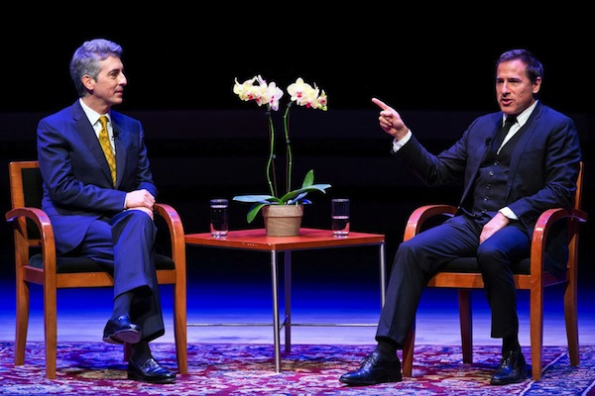
The smart banter between David O. Russell and Alexander Payne at last night’s Film Streams Feature VI event in Omaha gave a glimpse into why these two cinema masters have enjoyed a long friendship. They are both brilliant in their own way. Highly educated and well-read, yet deeply in touch with gut instincts. They both come from ethnic American backgrounds. The both had lengthy experiences abroad. They’re both steeped in classic cinema. As good as they are at creating images, the written word is everything for them. They both extract great performances from their actors.
They are both urbane men with dry wits. But where Payne seems a bit more guarded or stiff, at least in public settings like these, Russell seems somewhat looser. Where Payne is a very well grounded and considered person, Russell comes off as more idiosyncratic and certainly more neurotic, almost as a virile variant of the middle-aged Woody Allen.
Their nearly parallel careers give them a certain relationship by proximity since each emerged in the mid-1990s as new filmmakers to be watched and each has experienced similar fast ascents, followed by uneasy hiatuses, giving way to recent strong runs that have cemented their places in the top ranks of writer-directors. As they discussed in their conversation last night and as is readily evident in their work, each is a humanistic storyteller. What wasn’t discussed and what is also clearly seen in their work is that time and time again each returns to themes of people in conflict with society or their family or the group. Their protagonists are all at war with someone or something and on a search for meaning or redemption or revenge or getting-what’s-mine. Even with their careers on a major roll, they seem to think they’ve just figured out who they are as filmmakers and to suggest that the best is yet to come, though they also acknowledge that nothing is guaranteed in the fickle business of making films.
Of all the Film Streams Feature events (I’ve seen five of the six), this was the most spontaneous of these annual gatherings when Payne or sometimes Kurt Andersen engages a special film guest in conversation before a live audience at the Holland Performing Arts Center. Much of the spontaneity this time had to do with the fact that Payne, as he indicated in his opening remarks, did no preparation for the event. That’s because he and Russell go back 15 years or so and they do know each other and their work well enough to just be real and go with the flow up on stage. Part of it was just two old friends ccomparing notes. Payne asked probing questions about Russell’s motivations, inspirations, methodologies, and the like. Sometimes Russell returned the favor to ask Payne questions. Before Payne could even get to any of his questions though Russell, as he did several times about various things on his mind, went off on a riff about Omaha and Payne’s “secret tunnel to Omaha,” where he said Payne is “like a super cinema hero.” Russell described how his appearance in Omaha came to be. It seems that Russell was being badgered by the organizer of the Capri Film Festival in Italy to appear there. He’d been a guest at Capri before but he neither had the time nor inclination to go again, and so he thought Payne might be a good fill-in for him. Russell said he broached the option with Payne but Payne said he was no more interested in Capri than Russell. Then Payne switched everything around by asking Russell to be the guest of honor at Feature VI. One favor had been replaced by another. Russell said upon arriving here he observed all “the levels of plaids and pastels” and “kind-faced Midwestern people,” prompting him to tell Payne, “I felt like I was in one of your movies.” In a short but intense series of stops around the city Russell got to see the home of Omaha Steaks, which it turns out was a kick for him because he said he’s been ordering steaks from there for years for his father and now that Russell has discovered the company’s products extend well beyond steaks he’s going to ply his old man with seafood and desserts. “I bet he won’t see that coming,” he deadpanned. Then he went off on a weird but hilarious description of visitng the offices of husband-and-wife architects Michael and Laura Alley, the co-chairs for the event, and how at one point the Alleys and the Simons from Omaha Steaks were sitting, posed-like, in a glass booth that reminded him of sculptures in an “art installation.”
Russell also referred to Payne’s apartment at the Paxton Manor as “your very flat, very spacious prairie home.”
Last but not least he opined about his instant romance with the Jackson St. Books store in the Old Market, where he said he knew upon entering the place “I’m going to do some damage in there.” He said he picked up several things for friends and then he turned to Payne to say, “And I got you something. I’m going to save it for the end, because that’s showmanship.”
There was an extended discussion about, as Payne put it, “How do we search for ourselves through the films we make?” Russell, who earlier said, “I have a very childlike nature,” answered that he’s come to realize, “I’m a romantic.” He said amidst the every day anguish and horror of life being lived he must find meaning in the journey and discover passion for the pleasures of life, whether true love or fine wine or good food or engaging conversation or interesting people. “Existential despair is a privilege. I’ve learned that lesson.” He asserted his interest in making movies, not films, that touch people’s hearts. “I’ll carry that Frank Capra banner all the way.”
He referred to the one misstep in his filmography, I Heart Huckabees, which has actually become a cult classic, as variously “my mid-life crisis movie” and “the train wreck movie.” He said he made it at a time when he was too analytical in his approach to his art. “You can overthink something. That’s not a good thing. I just think I overthought it.” He said now that he’s in his 50s he’s in a better place then he had been for a while. “I realized more who I was at 17 than when I was 40.” He said at age 40 he was in a kind of “captivity.” Now that he’s rediscovered himself in his 50s, he said, “I wouldn’t trade it for anything – the wisdom.”
Payne described how he was already an admirer of Russell’s work in Flirting with Disaster but then was astonished by what Russell achieved in Three Kings, when Russell moved from the intimate family comedy-dramas of his first two films to the large scale, epic masculine action of an adventure movie set amidst desert warfare. Russell said, “There’s kind of a beauty to making a movie on location.” Payne inquired if Russell was intimidated taking on such a big, sprawling project, and Russell replied, “I think all good endeavors are frightening.”
Payne said he was blown away again when Russell made the leap from I Heart Huckabees to The Fighter. Payne said that at the time of The Fighter’s release he actually ran into Russell and told him, “Since when did you become a master filmmaker?” Payne spoke with admiration for the “very aggressive and sophisticated” way Russell uses hand-held cameras in-tight to create intimacy and immediacy with his characters and for the way he captures the visceral sense of movement and action in his films. Russell said it took time for him to arrive at how he wanted to use Steadicam and to achieve great depth of focus. He acknowledged that much of his maturation as a filmmaker is because he never stops learning or striving to be better. “It’s a great thing to learn your craft,” he said.
Russell described what he’s after in making his storytelling urgent for audiences: “I want you to be propelled and grabbed by the throat.”
He referred to going through a “ponderous period” of filmmaking when his shooting schedules were longer and his decision-making process was more protracted. After gaining more clarity he said, “I became very lean. Thirty-three days on The Fighter.” The same for Silver Linings Playbook and American Hustle. Payne expressed envy at how fast and effective Russell can work. Russell said he now has the mind set for his work as – “I approach it like a gun is at my head and that this is the last chance I have to get it right. We must feel grateful for the privilege of what we get to do.”
Russell also spoke candidly about the diffcult period he went through in that six-year hiatus between Huckabees and The Fighter. His personal life was full of challenges then and professionally he coulnd’t get a project off the ground. He sort of lost himself then and had to find himself again. His confidence, too. His ego took a hit as he went from the top of studios’ lists to mid-way down those same lists. “I was at my lowest time. I had been humbled. That can happen quickly in Hollywood. I don’t need to learn that lesson again.” He described how Mark Wahlberg, whom he helped make a star, returned the favor when he asked Russell to direct The Fighter after Darren Aronofsky left the project.
Payne observed how much Russell loves his characters and actors. He asked if Russell ever writes specificially for certain actors and Russell said he didn’t used to but that he increasingly does, especially as he’s come to work with a company of actors from film to film to film, acknowledging that Jennifer Lawrence, Amy Adams, Bradley Cooper, Mark Wahlberg and Christian Bale have become muses whose gifts he loves to explore and push to new levels. “I do feel a kinship and a connection to them.” He said the rich canvas of life these actors flesh out in his films is all around us in the people we encounter every day. “”Simply being in love with a character is almost enough reason to make a movie.” He said his own colorful Italian-Russian extended family of people who love each other and hate each other “is a gold mine I haven’t even begin to draw from” but that he clearly intends to mine.
Payne said, “Making a film is an extension of my life. Once we’re shooting our raw material is human behavior.” Truth in behavior and speech is what Payne and Russell go after and are very good at getting right.
Russell flipped it around and asked Payne, “What about you?” (meaning, does Payne write for certain actors) and Payne said, “Rarely, I write more literary characters,” adding though that he wrote with Jack Nicholson in mind for About Schmidt and George Clooney in mind for The Descendants.
In taking some questions audience members wrote out, Russell responded how he feels about remakes, saying, “I’m allergic to remakes.” As to whether there are any films he wished he had made, he promptly answered, “The Godfather,” adding, “The best pornography to me is to watch The Godfather and pretend that I made it.”
Nesr the end of the program Russell, clearly eager to unveil to us, the audience, and to Payne, his host and friend, the surprises he had in store, asked for stagehands to bring out a newly pressed album with music from American Hustle and a phonograph to play it on. “It’s a like the Letterman show now,” he cracked, as Payne undid the plastic sheathing around the album and placed the disc ona turntable and set the needle on the Duke Ellington and Electic Light Orchestra tracks, respectively. “Now it’s entertaining,” Russell observed. “Look how sexy it is,” he said, referring to the vinyl he and Payne help up at one point . Later, when the charactersitc scratches sounded, Russell said, “That’s psrt of the fun – that sound. That’s the fun of a record.”
Then Russell presented Payne with two books, one an early edition of the Sinclair Lewis satire, Babbit, and the other a Phelps County (Neb.) History in two volumes.
The evening wrapped by Payne asking Russell what we can expect next from him and the filmmaker mentioned the project Joy, a true story to star Jennifer Lawrence that is to get underway in late 2015 and a family story he’s developing as well. ” And for you Mr. Payne?” Russell asked. Payne confirmed what was recently reported in the media – that he is “an exploratory period for Downsizing, his big budget “science-fictiony” project with Matt Damon slated to be the lead, at least on a handshake deal, and with Alec Baldwin on board in a part as well. But as Payne cautioned, nothing is greenlit and there are dozens of more parts to cast and much more financing to secure. If it should come together, Payne would make Downsizing in late 2016, and the locations are yet to be finalized, too. You can bet that Payne will want to shoot at least part of it in Neb., but as he stated while he’s been ‘victorious so far” in getting the four films he wanted to make here made here “I may not be”in the future. Russell practically chided state legislators here for not offering tax credits to make it more attractive for Hollywood to make projects here . He said in no uncertain terms that film production “does create jobs for truck drivers and for carpenters and it does provide added business for restaurants and hotels.” It is a fight Payne has been waging for years in his home state.
Payne thanked Russell for being his guest and the gracious Russell offered, “It was a gift to me.”
Omaha’s film culture is richer for having Alexander Payne as a native son who cares about growing the cinema landscape in his hometown. His commitment to this cultivation and nuturing is perhaps best evidenced by the active hand he takes with the annual Feature fundraiser for Film Streams, the Omaha art cinema he supports. Because he can, each year he asks another world-class film figure to join him on stage as his special guest for a cinema conversation. In the past, it’s been Laura Dern, Debra Winger, Steven Soderbergh, Jane Fonda, and the principal cast of Nebraska. This year it’s his fellow auteur David O. Russell (Three Kings, The Fighter, Silver Linings Playbook, American Hustle). The Nov. 10 event at the Holland Performing Arts Center will add to the string of impressive film confabs he’s made happen. This is an especially appealing event because Payne and Russell, each of whom is a writer-directos, have enjoyed parallel careers as leaders of the New American Cinema and the Indiewood movement. Their respective bodies of work the last 15 years rank arguably as the best of any American filmmakers in that period. Given that they’re in their early 50s and given that both feel as though they’re only just now coming into their own as complete filmmakers, they could very well continue leading the vanguard of cinema in this country for another decade or two. My story for The Reader (http://www.thereader.com/) previewing the Film Streams event is largely drawn from an interview I did with Russell.

Photo from Shannon Dwyer
New American cinema auteurs, colleagues and friends David O. Russell and Alexander Payne to headline Feature VI
©by Leo Adam Biga
Now appearing in The Reader (http://www.thereader.com/)
Alexander Payne is in a position to ask any world class film figure to be his guest of honor at the Film Streams Feature event, the art cinema’s annual big fund raiser. Laura Dern, Debra Winger, Steven Soderbergh, Jane Fonda and the principal cast of Nebraska have all come at his invitation to appear on stage at the Holland Performing Arts Center.
For the Monday, Nov. 10 Feature VI Payne will engage writer-director David O. Russell in conversation. As fellow auteur leaders in the vanguard of New American Cinema they make a matched set. Since emerging in the mid-1990s their careers have followed similar paths. Each is on a roll with their last several pics, all critically acclaimed and awards-laden.
Both infuse an urgent humanity in their work that revolves around the various social units people aggregate in. Each delights in distilling the emotionally-charged, seriocomic conflicts that play out among groups – where the people driving you crazy are the same people you love.
Payne and Russell were right in the mix of edgy American indie filmmakers to arrive in the 1990s. Kathryn Bigelow, Steven Soderbergh, Spike Lee and Quentin Tarantino led the way. Then a whole new wave followed in their wake, including Russell, Payne, Wes Anderson, Paul Thomas Anderson, Spike Jonze and Darren Aronofsky. Russell and Payne announced themselves as talents to be watched in close order. Russell broke first with the incest comedy Spanking the Monkey in 1994. In 1996 Russell caused a stir with Flirting with Disaster and Payne with his abortion comedy Citizen Ruth. In ’99, both garnered attention: Russell with Three Kings and Payne with Election.
The 2000s have seen each evolve into bankable independents whose work spans audiences and resists trends. Russell’s recent run of The Fighter, Silver Linings Playbook and American Hustle parallels Payne’s own run of About Schmidt, Sideways, The Descendants and Nebraska.
A repertory series of Russell works continues at Film Streams through November.
Film Streams executive director Rachel Jacobson says the Feature event gives attendees “the amazing opportunity to listen in on a conversation between two of the world’s most celebrated contemporary directors.” She adds, “It’s interesting how David and Alexander’s careers have paralleled one another. Both started out with independent films on ridiculously taboo subjects. They both premiered their first features at the Sundance Film Festival during the renaissance of American independent film.” She says Russell’s recent films “show an artist at the peak of his form.” A major difference in approach, she notes, is that unlike Payne Russell works with a consistent ensemble of actors. “I love how that consistency creates a world unto itself.”

In the same way Payne feels he’s just now coming into his own as a filmmaker, Russell does, too. Both had long periods in between pics: six years passed from Payne’s Sideways to Descendants and from Russell’s I Heart Huckabees to The Fighter. Each went through a divorce in that period. But where Payne was busy producing and writing, Russell got out of his head and in touch with his heart.
“I’m grateful things have become clearer to me and in some ways I feel it’s springtime for me and that’s a very beautiful thing because you know that could easily not be the case,” Russell says. “I think it’s hard in any endeavor, especially in the art of storytelling, to stay fresh. You always have to find new wells of inspiration and I understand many of the greats who have not. We can look back and say, Well, they did their great works and then they kind of couldn’t find it again. So I feel like I’ve found renewed clarity and heart for certain kinds of stories.
“It’s still very hard to do them well. I still have to try every moment like it’s my last opportunity on Earth. The only way it can come out as well as I hope it will is to act like it could very easily not come out that way every step of the way, which makes for a lot work.”
Like the best of their New Wave contemporaries Russell and Payne didn’t just make a splash and then disappear. Rather, they reestablish themselves as relevant storytellers with something to say again and again. The way they’ve asserted their strong, singular visions and voices is reminiscent of what Hal Ashby, Robert Altman, Francis Ford Coppola and Martin Scorsese did in the 1970s and 1980s.
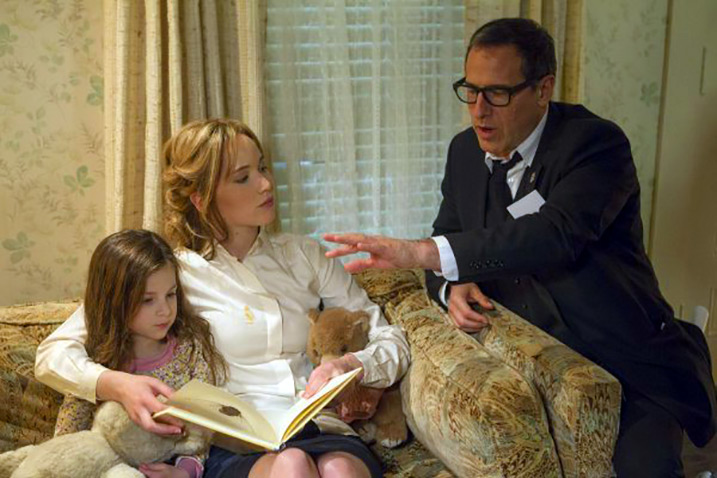
Russell and Payne have mostly weathered the volatile film industry that eventually envelopes everyone. Russell’s one commercial flop, Huckabees, enjoys a cult following. The same for Payne’s Citizen Ruth and Election. Nebraska’s sure to find a growing audience as more people discover it via the home and digital markets.
All of which is to say these two filmmakers at the top of their game should have much to talk about. They’re each steeled in classic cinema from the 1970s and before. Given they are from the same generation of writer-directors and leaders of Indiewood, it’s no surprise they’ve found themselves in the same circles.
Russell says, “We’ve done Q-and-As and we’ve had a lot of fun with them,” including a CineFamily session available on Vimeo.
The two once chummed around. The new millennium had just dawned and they were identified as rising cinema stars and it only made sense they would fall in with each other.
“We started being on each other’s radars socially and professionally in 1999,” Payne says, “when he had Three Kings and I had Election. 1999 was like a debutante’s ball year of independent directors. Wes Anderson’s Rushmore had come out the end of ’98. I had Election, David had Three Kings. Kimberly Peirce had Boys Don’t Cry. It was a year when this younger crop of directors were having some degree of mainstream success. And I adored Three Kings. Wow. if he could make a jump from Flirting with Disaster, a madcap family comedy, to a very beautifully directed film like Three Kings that’s when I knew he had a depth of talent.
“I’m always in favor of someone who wants to do comic human films. His films are always intelligent, entertaining – a wonderful combination of humanity and comic showmanship. We became friends and I’ve always supported his work. I admire him and I’m just so proud and thrilled to be hosting him at Film Streams.”
And Russell’s returned the favor.
“Yes, and it’s been really been fun, I think we’ve both enjoyed that,” Russell says. “When Alexander had The Descendants come out I was really happy to sit by his side at a couple events, chat with him, have a glass of wine, cheer him on and tell him how much I love the picture. And he was very kind to me likewise about the last three pictures.”

But it was when the two men first came to the fore, they were particularly close.
“We sort of hung out a bit together in that time around 2000,” Russell confirms. “I remember the Museum of Modern Art began this series for filmmakers of our generation and I felt very squeamish about doing it. I said I’ll only do it if you name the series Works in Progress because I consider myself a work in progress and they said OK and they started this series where I talked about my films with my actors and stuff.”
That inaugural 2002 event was called Work in Progress: An Evening with David O. Russell.
“Alexander came, Wes Anderson came, Kimberly Peirce came, Sofia Coppola came. A lot of actors came. I’m probably forgetting some other filmmakers who were there. There we were all together and it was a great feeling of camaraderie.
“And then the next years I ended up helping tap them (other filmmakers) to do it, so the next year Alexander Payne did it (that 2003 event was called A Work in Progress; The Films of Alexander Payne). And then Sofia did it and it kind of went from there.”
Russell, who as a young man waited tables at MOMA events, grew up in Larchmont, New York in a Russian-Italian American household. His father worked for publishing giant Simon and Schuster. His mother was a homemaker and political activist.
Much like Payne he was steeped in movies and literature.
“I grew up watching movies. I would go to my local movie theater in the next town and I’d watch a movie with movie stars and so I am interested in movies and movie stars that kind of grab me and don’t let me go and leave me indelibly moved. It’s like a wonderful record I can go back and play again in part or in whole.”
Asked whose work principally influenced him then and he rattles off the names Frank Capra, Coppola and Scorsese, adding with a laugh, “There, I named every Italian-American.”
Like Payne he initially went to college not to study film but to broaden his mind, At Amherst College in Mass, he studied English under novelist Robert Stone and religion under professor Robert Thurman, father of actress Uma Thurman.
“I always wanted to be a writer – a novelist or a short fiction writer – since I was about 10 years old because my dad worked at Simon and Schuster. I actually kept doing it into my 20s, you know, and I found it very hard. Meanwhile, I would memorize sections of movies as sort of a way of learning narrative and telling stories.”
He committed to memory sections of It’s a Wonderful Life and Chinatown, for example.
Again, like Payne, he went abroad as a young man, in his case to teach English in Nicaragua. Once back in the States he moved to Boston, where he did social justice work.
“I worked in low income areas, working for tenants rights, also teaching English as a second language.”

Unlike Payne, Russell never went to film school. His film immersion came haunting video stores and revival houses and learning the rudiments of the medium as a production assistant on the PBS television series Smithsonian World in Washington, D.C. Ever more feeling the pull of film, he made a documentary short. Boston to Panama (1985), that examined the lives of immigrant workers.
“Then I started to crossover thinking maybe I wanted to become a (narrative) filmmaker, which seemed like kind of a nutty idea because I’d never thought of that before as much as I loved movies.”
His narrative debut, the comedy short Bingo Inferno (1987) showed at the Sundance Film Festival. His next, the short Hairway to the Stars (1991), played Sundance and festivals in Seattle and London.
His feature debut, Spanking the Monkey, was a micro-budget production financed with private funding and grants. The dark humored Oedipal story concerns a young man marooned at home with his convalescing mother and the awkward longings they express. So, from the start, the family dynamic, dysfunctional and all, took precedence.
“I very much find community or family to be sort of an engine, a rocket engine, that leads to all avenues of humanity. All I know is that I think it works and it gets really intense and personal and complicated and funny and heartbreaking very quickly, so I love all of that. You know, I also love romance as I’ve discovered in my last three films.”
Family though is where it’s at for him. It may be a mother and son breaking taboos (Monkey), an extended family letting it all hang out (Flirting), U.S, Army soldiers searching for a fortune (Three Kings), a boxing clan’s ups and downs (The Fighter), a mentally ill son reconnecting with his father (Silver Linings) or a motley crew pulling a sting operation (American Hustle).
“In terms of my interests I know that I’m interested in romance and I know it includes a great intensity of predicaments that carries from one moment of the film to the next, meaning that it has an intensity to it and a propulsiveness to it that feels enveloping. And you have to maybe go back and watch it again or parts of it again to regather, but there’s never a moment where we are intentionally crafting the story that way.
“I mean, it’s nice to know what kind of movies you want to make and what kind of characters you want to render and what kind of actors you want to work with. And then I have a great love of music, a great love of camera movement that’s become a particular way of doing things that I’m still trying to learn how to make better. But at least it’s very clear when you know what path your on.”

SILVER LININGS PLAYBOOK, from left: director David O. Russell, Bradley Cooper, on set, 2012. ph: JoJo Whilden/©Weinstein Company
Payne admires that Russell has “kept his own voice throughout them all,” adding, “Some of the same elements you see in Flirting with Disaster you see also in The Fighter, Silver Linings and American Hustle. His sense of dialogue and how he gets the camera in very close so that you’re standing with those characters or talking with them somehow. None of that has changed.”
Payne also likes how Russell balances the “larger circumstances” his characters find themselves in yet remains focused on the “eccentric details” of those situations and the personalities involved.
Russell says his own family’s strong personalities and rich heritage form a great template for him to overlay on the stories he tells.
“There’s a whole human opera of mine that extends back to Italy and Russia, to the Bronx and Brooklyn. There’s this tapestry of people. It’s a goldmine to me of rhythm, of music, of life, of romance, of food, of terrible things happening, of wonderful things happening, of traditions being passed, traditions being broken. All the things I care very deeply about in telling stories and as a person.
“I think I learned a great deal from my family before I even realized it. It’s sort of a great gift that you don’t realize, that I didn’t realize I had until much later in my career. Although it was obvious right at the beginning because I wrote that claustrophobic kind of quasi-horror $80,000 dollar trapped-in-the-house-with-your-mother movie (Monkey), which is almost like a horror movie, but it’s also funny, and that was all based on personal experiences I embroidered in great detail. There was a summer where my mother had trouble with her health. She had a car crash, And so that gave birth to that story.”

Flirting is another film where his real life resonated with his invention.
“There were moments when I saw my family the way we see the family in it, going through those chapters.”
He says Three Kings was “a departure” from the biological family thread and instead subverts the band of brothers conceit. He says Huckabees was “an attempt to create a parallel society little family of people but I don’t think my focus was where it ought to be in there,” adding, “Yet I never cease to be surprised by the young people, including Jennifer Lawrence (Silver Linings, Hustle)), who name that among their favorites of mine, which is baffling to me.
“And then the last three (films) are very much family-centered.”
The most personal of these to him is Silver Linings. Adapted from a novel, Russell emotionally connected with the characters because like the protagonist his own son Matt has bipolar disorder. Matt, who’s also had learning issues, has attended the Devereux Glenholme School in Conn., which serves young adults with special needs. Russell has been “very involved” at the school,” serving on a board. “I’m very invested in helping that school, plus the next experience for those kids who need to find pathways into work or higher education.”
Another educational institution he’s involved with is Ghetto Film School, a New York City public high school whose curriculum is cinema-based.
“It’s a very strong school in the Bronx. It became a crown jewel of Mayor Mike Bloomberg’s public school system in New York, It’s exciting that people are learning how to tell narrative and to tell stories. I always like to go talk to the students and teachers about what they’re doing. I’ve been on the board for 12 years. I’ve helped bring a lot of filmmakers and actors to go talk to them: Spike Jonze, Catherine Hardwick, Amy Adams. We have to get Alexander to go see them.”
Russell says 20th Century Fox co-COO James Murdoch “was so smitten by the project” he helped open an L.A. branch this past summer. Russell was there for its launch.

The filmmaker would be happy if a future script he wants to direct comes from a graduate. The same would be true of Alexander Payne. But the fact is each director usually writes his own scripts. Payne often says writing is the most onerous part of his creative process. Russell agrees but like Payne he sees it as a necessary chore to produce raw material for his films.
“I’m just coming out of a very intense writing period where I’ve been writing 15 hours a day for the last six months. I literally become a shut in. I went to some event for my younger son’s school and I just really felt like a-fish-out-of-water. I’d almost forgotten how to be out and about because your world becomes very narrow. It’s a very strange way to live because you’re basically living 15 hours a day in this narrative. You’re living in a movie all day, and that’s the only way I can do it to get it done. I have to make myself sit there all that time.
“So like Alexander it’s also my least favorite part of the process but you have to do it. You know you can’t get the iron ore or the diamonds out of the ground unless you do the back breaking work of digging into the ground, which is really difficult.”
Both filmmakers are weighing what their next projects will be. While Payne is reportedly trying to revive Downsizing, the project he abandoned after the financial crisis hit in 2008, Russell says, “There’s two stories we may be going into preproduction on soon. Those are the two things I’ve been working feverishly on for the last eight nine months. One is a large original story I don’t want to get into too much detail about but it involves family.”
The other, titled Joy, is based on the true story of Joy Mangano. The storyline reads something like Erin Brockovich: a struggling single mother of three surprises everyone when she finds success as an inventor and entrepreneur. Jennifer Lawrence is tabbed to star.
Russell says he’s eager for his visit here. “I can’t wait to come to Omaha. I’ve been reading about all the famous cinema people who are from Nebraska.” He hopes to find sites commemorating Marlon Brando and Fred Astaire, for example, but outside a street sign named for the former and a ballroom named for the latter, he’ll be disappointed.
He’ll be searching, too, for a local fix to feed his passion for video stores, which he feels should be preserved as cultural “hubs and meccas.” He helped create a nonprofit foundation for Santa Monica’s iconic Vidiots. “I’m trying to get the studios – and I’ve reached out to Alexander as well – to turn it into a place where they can feature the libraries of each studio and people can learn about cinema.”
The Feature event with Russell and Payne is at 7 p.m. For tickets and rep series details, visit http://www.filmstreams.org.
The set-up for the HBO documentary Paycheck to Paycheck: The Life and Times of Katrina Gilbert sounds like the kind of heartache country music sagas that Loretta Lynn or Dolly Parton or Tammy Wynette made famous with its single working mom protagonist living, as the title goes, paycheck to paycheck trying to make ends meet. But Gilbert ‘s situation mirrors that of millions of American women facing real struggles. This story for The Reader (http://www.thereader.com/) riffs off the documentary, whose Oct. 28 Omaha Film Streams screening will be followed by a panel discussion, to look at what some local single mothers contend with in getting by.

Katrina Gilbert

Struggles of single moms subject of film and discussion; Local women can relate to living paycheck to paycheck
©by Leo Adam Biga
Appeared in The Reader (http://www.thereader.com/)
In the Gloria Gaynor anthem “I Will Survive” a woman declares her personal autonomy. Not needing to find validation in another is a liberating thing worth celebrating in song.
Life imitates art whenever a poor single mother breaks free of the shackles of fear, self-doubt and shame that hold her back, say women who’ve been there and now help others out of that trap.
Ericka Guinan was a single mom trapped in a cycle of despair before finding the courage to seek guidance from women who’d been in her shoes. Today, she’s the self-sufficiency programs facilitator at Heart Ministry Center, 2222 Binney St., where she helps women like Aja Alfaro, a young single mom of two, find the confidence to move toward their dreams.
Since graduating from the center’s Pathway program Aja’s turned her life around. She works as a SNAP outreach specialist at Heart Ministry, assisting women apply for food stamps she needs herself. Guinan’s been there, too. Each woman’s gone through the wringer of bad relationships, no work, low pay, food and housing insecurity, unpaid bills, creditors and feeling like there’s no getting out from under.
The stress facing many single moms is the subject of the HBO documentary Paycheck to Paycheck showing at Film Streams Oct. 28 at 7 p.m. The film, executive produced by Maria Shriver, follows a year in the life of Katrina Gilbert, a Chattanooga, Tenn. certified nursing assistant and mother of three. Gilbert’s trouble making ends meet and finding financial stability are emblematic of many women.
The free screening is a collaboration between Film Streams, the public advocacy group Coalition for a Strong Nebraska and Women’s Fund of Omaha, a nonprofit focused on improving the lives of local women.
Guinan will be part of a post-show panel discussing issues raised in the film. Joining her will be Women’s Fund executive director Michelle Zych, Coalition director Tiffany Seibert Joekel and Neb. State Sen. Tanya Cook. Alfaro will be there, too.
Joekel says barriers to single parents, especially women, include difficulties affording high-quality child care, unfriendly workplace policies, inability to access high-quality, affordable health care and limited educational opportunities.
Zych says Women’s Fund studies find stark economic disparities among Omaha women, particularly single mothers of color.
“Katrina Gilbert’s story is just one example of how women often live paycheck to paycheck. We expect the audience to learn more about poverty in Omaha and what efforts are being made community and statewide to ease this burden for families,” Zych says.
“It’s not easy living paycheck to paycheck,” says Alfaro, who knows from first-hand experience. “It’s hard, it’s a struggle.”
Alfaro’s made progress toward independence.
“It’s still hard but I’m getting there. Things started changing a lot just this year, when I finally got my own place for the very first time at the end of January.”
Alfaro’s steady income though sometimes makes her ineligible for certain benefits even though her earnings are barely above poverty level and she hasn’t reached self-sufficiency. It’s called the Cliff Effect and it plays havoc with the working poor. Tanya Cook introduced a bill in the Nebraska Legislature that would help some working parents continue qualifying for child care subsidies well beyond current limits.
Despite roadblocks to aid, Alfaro’s hopeful for the first time about the future. She plans resuming nursing studies.
“There is hope if people can get connected to the right resources. Once people have hope they can do things they never thought they could,” says Julie Kalkowski, co-director of the Financial Success Program through Creighton University’s Financial Hope Collaborative. The program works with single mothers for a year to undo old habits.. “We ask our clients to do small, actionable steps – little changes that add up to real money. Once people start to feel like they are moving forward they are willing to do things they have been too intimidated or overwhelmed to do, like calling creditors. We also offer debt consolidation loans.”
Guinan agrees hope is essential before women buy into changing their lives. At Heart Ministry she says “we let each women define her own pathway to success,” adding, “We ask what are your dreams, where do you want your life to be and then we try to figure out what we can do to help her get on the path to that. We have a therapist that meets with them once a week. We have a lot of resources and relationships within the community they can access. ”
She says setting boundaries, getting an education, budgeting, building healthy relationships and having a positive support network is key.
It’s all about removing obstacles and Guinan says “a lot of the obstacles are in our head because we have a big fear of doing something new or of failure or of success. We a lot of times don’t believe in ourselves.”
She says overcoming negative self-talk and taking responsibility for one’s life is necessary for success. Guinan lived it all out herself – the self-pity, the denial, the hitting bottom before asking for help.
“I was lucky enough to meet several strong, healthy women just far enough ahead of me to relate to my struggles yet offer solid solutions and advice. I think I trusted them because they were sharing their own person struggles with me. I related and saw myself in their stories yet they obviously had overcome so much.”
Aja Alfaro’s found a similar sisterhood at Heart Ministry. Its self-sufficiency programs help women navigate out of tough situations by matching them with mentors, enrolling them in classes that address financial planning, parenting and life skills and plugging them into school or training programs.
Women who’ve gotten their lives together like Guinan share their own stories – struggles, successes and all – with young women like Aja, who says Guinan and a mentor, Nancy, have taken her under their wing. “I needed to learn how to get on my own two feet to take care of my family and they’ve helped me to come pretty far. They helped me start college and get this job. I think the biggest thing was learning how to care about myself. I’m more focused now on me and my kids.”
Empowerment helps but working a low wage job won’t cut it. It’s why Cook supports a minimum wage hike and advocates women explore training programs for well-paying nontraditional jobs in high demand like welding and traditional career-track jobs in health care fields.
“A disproportionate number of women work at a wage level that could not support a family without public assistance. Nebraska’s behind the power curve in terms of offering a fair, living wage or the kinds of opportunities that allow families to work themselves out of poverty.”
Cook says financial literacy “is very important” for women who don’t know how to manage money. “The way many families are compelled to live whatever money comes in goes right out to some emergent or past-due need, so they don’t learn to save.”
Ericka Guinan calls for more services: “I believe we need more job training, quality childcare, affordable and safe housing options, mental health and mentoring for single mothers.” She says women’s voices must not be lost in the process. “In the Pathway Program we strongly believe each woman has valuable experience and feedback to offer.” She says lawmakers need to hear from more mothers about the tough choices they must often make, such as buying food versus meds.
Creighton’s Kalkowski says, “One of the things that has always amazed me is how brave so many working parents are to keep getting up every morning even though their situation is bleak. Most of us have no idea how desperate so many families are.”
Guinan says no matter how hard it gets, single moms have a knack for making do. “We’re survivors.”
For advance tickets, email molly@filmstreams.org. For more on the doc, visit http://www.filmstreams.org.
I’ve been anticipating Alexander Payne’s new film Nebraska for a very long time. Some years ago he let me read the script by Bob Nelson. I was moved to laughs and tears by it and ever since then I’ve eagerly awaited Payne’s interpretation of it on the screen. As I write this I’ve now seen the film twice and will soon be seeing it a third time. Its depth of emotion coupled with its visual black and white beauty and aching honesty set the film apart from just about anything out there by an American filmmaker today. I believe it to be Payne’s best work to date. I know a little something about the filmmaker, having closely covered him and his work since 1997. I have a book out with my collected jounralism about him titled Alexander Payne: His Journey in Film. It contains some two dozen of my Payne stories from 1998 through 2012 and soon I will be coming out with a new edition featuring my extensive Nebraska coverage. My latest story about the film is shared with you here. It recently appeared in The Reader (www.thereader.com). I fully expect to file a new story about Nebraska come Academy Awards time, when the film should fare very well. You can find my earlier stories about Nebraska on this blog. I’ll salso be adding another Nebraska story I just finished for the New Horizons. Additionally, I will be posting extended interviews I did with Payne, Bruce Dern, Will Forte, Stacy Keach, Bob Nelson, cinematographer Phedon Papamichael, and producer Albert Berger.

Alexander Payne‘s local color: Payne and Co. mine prairie poetry of his home state in new American gothic film “Nebraska”
©by Leo Adam Biga
Excerpt from a story that originally appeared in The Reader (www.thereader.com)
Local color, of the achingly human variety, is where Alexander Payne’s new black and white film Nebraska most deeply comes to life.
After fall festival premieres abroad and across the U.S., Payne’s coming home to show off the film named for his native state and primarily shot and set here. Nebraska had an exclusive limited run at Film Streams. On Nov. 24 Payne joins stars Bruce Dern and Will Forte at the Holland Performing Arts Center for the Film Streams fundraiser, Feature V, that will find the troika interviewed on stage by Studio 360 host and novelist Kurt Andersen.
The following day Payne and Dern travel to Norfolk, Neb., the production’s base camp last fall while the project filmed in nearby Hartington, Plainview and environs, to premiere the picture there.
Oscar-winner Payne is a stickler for the truth and with the by-turns elegiac and silly Nebraska he went to extreme lengths finding the people and places that ring true to his and screenwriter Bob Nelson’s vision of Midwest America.
“This is the most authentically Neb. feature film I’ve released to date,” says Payne, who previously made Citizen Ruth, Election and About Schmidt in-state.
Casting director John Jackson and Payne searched long and hard for the right players to animate the oddball yet familiar characters Nelson created on the page. In a rare star turn winning him much acclaim Bruce Dern so fully inhabits his old codger of a character, Woody Grant, that despite the actor’s well-known face and voice he disappears into the part to become just another of the story’s small town denizens.
Dern plays Woody as written: a taciturn man of stoic roots and repressed pain long alienated from everyone around him. Feeling a failure near the end of his life, he’s desperate for some validation and so gets it in his head that he’s a sweepstakes winner. His son David, played by Will Forte, takes him on an epic journey to claim the prize. Amid the missteps and detours comes discovery, empathy and closure. As their strained relationship warms the son gives his father a gift born of understanding, forgiveness and love.
One of the reasons Payne says Dern leapt to mind when he originally read the script a decade ago is that like the actor’s actress daughter Laura Dern, who starred in Payne’s feature debut Citizen Ruth, he doesn’t worry about what he looks like on screen. To convincingly play the gone-to-seed Woody the actor inhabiting the role had to look a wreck.
“Those Derns don’t have vanity,” Payne says admiringly. “They’ll do anything, they want to do anything. When working they’re more interested in hitting a certain level of truth, an often ugly truth or pathetic truth, and now you’re talking my language.”
About what made Dern the right fit, Payne says, “Bruce is a handsome guy when he’s cleaned up and obviously as you can see in the film when he’s not cleaned up he can really look like a coot and a weirdo. If you took many other actors and tried to do the same thing they’d look fake. The guy would have to portray someone cut off from others and lost in his own world. Woody’s probably been like that somewhat his whole life but as a young man they just thought he was reticent. Now he’s a coot and ornery and pissed off at himself that he hasn’t done anything with his life and now he’s about to start taking a dirt nap. I think that’s certainly what’s driving Woody’s crazy mission in some part.
“When I thought about who could communicate that I thought of Bruce.”
Payne felt Dern could express the two sides of Woody as both prick and pushover who can’t refuse doing favors, even if it means being taken advantage of. He also detected “a certain childlike nature” in Dern that aligned with Woody’s fragility.
“I think within Woody’s ornery crust there is something of a child – of a very disillusioned and disappointed child.”
Indeed, we first meet Woody as he’s running away from home.
“There’s also a sweetness about Woody and Bruce is a sweet guy. He hasn’t often played that.”

Dern acknowledges it’s a departure for him. “Throughout my career I’ve been flamboyant in a lot of roles, especially flamboyantly evil, and there’s a certain style that goes with that.” Nebraska called for him to be a dull, muted, passive presence.
“What the role demanded was a character who appeared to not be touched too much or too little,” he says, “and probably not touched at all. And if he touches other people it’s without planning to do it. He’s just who he is and he’s always going to be that way. I think he’s a fair man, Woody, and that’s another thing I based the character on a lot. Because he’s fair he believes what people tell him because he doesn’t know why anybody would want to lie to him about anything.”
The tangibles and intangibles of a character go into any casting decision.
“When you cast someone in a lead you’re not casting just his or her ability to act,” says Payne. “you’re casting the substance or essence of their person. There’s two things going on simultaneously seemingly contradictory but not. One is you want them to become that person in the script yet at the same time not act.”
Dern says Payne has an uncanny way of communicating what he wants, variously tapping “your strengths and weaknesses and sometimes invading your privacy” to extract the emotion or tone he’s after.
Actors Studio veteran Dern believes he achieved a progressive in-the-moment reality in Nebraska he’d never accomplished before on a film.
“I’ve always wanted to be a human being and just kind of acting-wise leave myself alone and not perform and I don’t think there’s really a moment in the movie where I perform – in other words take it above the context of what it really is. The first day of the movie Alexander said to me, ‘I’d like you to let Mr. Papamichael (cinematographer) and I do our jobs,’ meaning don’t show me anything, let me find it with the camera, and that’s what he did and that’s what you see.
“That doesn’t mean I wasn’t acting. It was as hard a role as I’ve had to take on but I feel I owed it to the material and to my career for just once in my life to try and have as many consecutive moment-to-moment pure moments of behavior. That’s what I began when I worked with Mr. Kazan and Mr. Strasberg in the Actor’s Studio – how much moment-to-moment real behavior can you have? And I think in Nebraska I’ve done far and away the most I’ve had in an entire film.”
Forte, a relative newcomer to acting after years writing for television, says he learned a lot from his co-star.
“Bruce would always say, ‘Just be truthful,’ and that always sounded like acting mumbo jumbo to me coming in but for some reason the way he would explain it and describe it it made sense. There’s such an honesty that comes from his performance and all the performances that it really taught me a lot to watch everyone work.”
Dern says Payne lived up to what his daughter Laura and his old acting chum Jack Nicholson, who starred in the director’s About Schmidt, told him about the filmmaker: “They both said in separate conversations he’ll be the best teammate you’ve ever had. They were right. I feel it’s the best team, overall, I’ve ever had.”
Payne, whose sets are famously relaxed, says he also casts with an eye to who will “be nice to work with” and contribute to the playfulness he believes essential to good filmmaking. “I want to be there to play. I don’t know exactly how it (any scene) should be, I’m there to sort of say, ‘Oh, well, let’s try this and let’s try that, nudging the machine toward a certain direction. It’s not all preconceived, you’re discovering it day by day, so I think you want actors who are willing to have a sense of, Let’s be playful and free. It’s all about having fun, and that will create something none of us have thought of exactly.”
Dern says he’s glad it took nearly a decade to get the film made – the project came to Payne as the filmmaker was setting up Sideways – because “I wasn’t ready to play this role a few years ago.” The passage of time put some more natural wear and tear on Dern, both physically and emotionally. The limp he walks with in the film is real, if exaggerated, and the way Woody leaves things unsaid is something Dern says he’s been guilty of himself and regrets.
Similarly, Payne’s personal life caught up with the experience of David in Nebraska as an adult child dealing with aging parents. Payne’s father is in a nursing home and his mother recently survived a serious health scare.
“I was able to make it quite personal in certain details related to David taking care of his older folks,” Payne says. “Everyone I know of my generation at that age has parents that are getting on and need a little special attention. We love them to death and they drive us crazy. How we take care of them and accommodate them and all those things, and how far do we extend ourselves to be dutiful and at what point do we cut it off, all those questions. It wound up being because of the time in my life when I was making it quite personal. The fact that I had that much more life experience for this film with respect to my parents, I think helps the film. It always helps a film if you can put some of yourself in there.”

Payne says the bottomed-out economy also enhanced the austere shooting style and stark look of the film, adding, “Those winds blew their way into the film as well and it becomes more of a modern-day Depression film.”
Undoubtedly some will take umbrage at the film’s portrayals of quirky. salt-of-the-earth types. But if the strong reception the picture’s received at the Cannes, Telluride and New York film festivals, among others, is any indication, than most audiences realize Payne and his collaborators sought archetype, not caricature in bringing to life small town inhabitants and the dysfunctional Grant family.
“I hope what people take away from this movie is his genuine love for Neb. because he really does love Neb.,” says Forte
Dern calls the film “a love poem” to Neb. from Payne.
Payne, Nelson, Jackson, Papamichael, editor Kevin Tent assorted other crew and the ensemble cast all committed to realizing authentic portraits of this comic-dramatic Midwest Gothic tale.


YOU CAN READ THE REST OF THE STORY IN THE NEW EDITION OF MY BOOK-
Alexander Payne: His Journey in Film
(The new edition encompasses the Oscar-winning filmmaker’s work from the mid-1990s through Nebraska in 2013 and his new film Downsizing releasing in 2017 )
Now available at Barnes & Noble and other fine booktores nationwide as well as on Amazon and for Kindle. In Nebraska, you can find it at all Barnes & Noble stores, The Bookworm and Our Bookstore in Omaha, Indigo Bridge Books in Lincoln and in select gift shops statewide. You can also order signed copies through the author’s blog leoadambiga.com or via http://www.facebook.com/LeoAdamBiga or by emailing leo32158@cox,net.
For more information. visit– https://www.facebook.com/pg/AlexanderPayneExpert/about/?ref=page_internal
Until the documentary The House I Live In the best film I’d seen about drugs was the Steven Soderbergh drama, Traffic. The director of the doc, Eugene Jarecki, does something very much akin to what Soderbergh did by taking a multi-perspective look at the insidious grip the illegal drug culture and the so-called War on Durgs exerts upon every one caught up in this human chain of destruction. My story below for The Reader is based on a recent screening and panel discussion of the film in Omaha.
Anti-Drug War manifesto documentary frames discussion:
Cost of criminalizing nonviolent offenders comes home
©by Leo Adam Biga
Appeared in The Reader (www.thereader.com)
The much-feted 2012 documentary The House I Live In provokes dialogue wherever it plays for its critique of America‘s domestic War on Drugs. Following a January 22 Film Streams screening before a full house a local panel discussed the film’s potent themes.
Director Eugene Jarecki’s (Why We Fight?) film indicts the war as failed public policy that’s wasteful, unjust and morally bankrupt for targeting nonviolent minority offenders. He suggests its true cost lies not only in the vast expenditures for arrest, prosecution and incarceration but in the disruption caused to families and communities. Every drug case has a spiral of consequences that can span generations.
The consensus of the experts and persons directly engaged in the war whom Jarecki enlists to comment on camera is that blacks are disproportionally targeted and punished. He explains he came to tackle the issue upon inquiring why a black family he knew from childhood struggled with poverty and crime. Its matriarch, Nannie Jeter, blames drugs for taking her late son James and leading other members down destructive paths.The film tells story after story of families impacted by addiction and imprisonment.

Eugene Jarecki
One observer notes, “We are engaged in a great experiment. What happens when you take large numbers of people, remove them from their neighborhoods, their families. What does this do to the broader community?”
Everyone from author Michelle Alexander (The New Jim Crow) to a prison chief of security agree the prison industrial complex has superseded prevention-intervention by incentivizing arrest, conviction and confinement and thus making it a big business prone to corruption that puts profit before humanity.
David Simon, creator of The Wire and a former journalist who covered the drug war, says, “Think about all the money spent on drug enforcement, on prisons and probation officers, on judges, on narcotics agents, on interdiction and everything else. But to what end? We’re the jailingest nation on Earth, yet drugs are purer than ever before, they’re more available.”
America’s draconian approach, he said. doesn’t work.
During the panel Impact One Community Connection founder Jannette Taylor reiterated a theme in the film that the war is actually a campaign to “marginalize people” that leaves havoc in its wake. “We need to look at the broader picture of the collateral damage from this fake war on drugs,” she said. “We need to be more realistic about what this fake war on drugs really is and how it affects poor communities and the people in it.”
She knows first-hand the personal fallout. The father of her daughter has served 17 1/2 years on drug charges. “My daughter has never had her father in her life. He was out only a short period of time before he resorted back to selling drugs and got caught up again and it’s basically because you become so marginalized. You can’t get a job, you can’t find a place to live, so you resort back to what you know – you resort to the economy that pays you.”
Jarecki introduces us to individuals for whom using and dealing were all they saw growing up. Naturally, they followed suit. Picking up a point Simon makes in the film, Taylor said the drug trade may be “the only flourishing economy” in some inner city neighborhoods and “given the limited opportunities poor inner city residents have it’s a rational decision to deal drugs.” Similarly, she said drugs become a way to medicate “if you’re living in a constant state of poverty, in depressed living conditions.”
Taylor said despite never using, dealing or serving time “I’m dealing with the same things, just from a different perspective. My daughter is caught up in this drug war because she doesn’t have a dad, so she’s being raised by a single mom. It was very hard. Once somebody gets sentenced into the system because of drugs their family’s affected. It’s like a crazy avalanche. The kids no longer have both parents, the other parent is pressured into making more money and that takes them away…It’s a domino effect. It’s a cycle and it never ends.”
Scholar Richard Lawrence Miller draws comparisons in the film between the war and “the chain of destruction” he says the ruling class historically applies to minorities in order to target, control, demonize and isolate them. He and others point to profiling, mass incarceration and mandatory minimum sentences as its manifestations.
Simon terms the drug war “a Holocaust in slow motion.”
“This is basically slavery in a new form,” said Taylor, who with others cautions, “If someone else’s rights can be compromised and violated then yours can too.”
Panelist Rodney Prince, who served a federal drug sentence, said, “I believe this war on drugs is a means, a guise to deal with a segment of the population no longer needed in this transforming economy. The intention for me doesn’t really matter, this thing is happening to people.”
Taylor and others advocate America recast the war as a public health issue that gives nonviolent addict offenders treatment rather than jail time.
Prince said, “This is an economic issue. If we know our economy can’t absorb everyone now then we have to push our elected officials and business leaders to act responsibly and to make more room for people in the economy.”
Douglas County District Court Judge Marlon Polk said education is the best deterrent to being caught up in the drug culture. Nebraska Corrections Youth Facility director Marilyn Asher and other panelists suggest we all have a stake in giving people the support and skills they need to prosper.
Kurt Andersen‘s gift with words and ability to distill complex issues and ideas into engaging narratives has served him well as journalist, essayist, author, radio host and commentator. His third and latest novel, True Believers, is getting the kind of ciritcal love that writers dream about but rarely ever actually receive. This is a sneak peak at my story about the book, based on a recent interview I did with Andersen, to appear in a coming issue of The Reader. His book really is a great read and it manages to do what he set out, which is to take the measure of a tipping point decade through the lens of a character whose life intersected with some of the very movements that made the ’60s so potent. This blog contains a full-blown profile I did on Andersen some years ago, along with profiles, interviews, and features on many other top writers with Nebraska ties, including Ron Hansen, Richard Dooling, Timothy Schaffert, Rachel Shukert, and Sean Doolittle.

©by Leo Adam Biga
Appeared in The Reader (www.thereader.com)
With his new novel True Believers (Random House) Kurt Andersen takes stock of the roiling 1960s through the eyes of a fictional woman whose coming of age then unfolded in predictable and inexplicable ways.
Through his narrator, attorney and law dean Karen Hollander, he explores the psyche and culture of holding secrets and coming clean in the modern era of relativism. This accomplished older woman is writing a tell-all memoir reviewing her own revolutionary life forged from social awakening and feminism.
Andersen, always the sage observer and commentator, analyzes the social-psychological-cultural imperatives of whatever era he writes about. The dawn of the new millennium in Turn of the Century. The mid-19th century in Heyday. The 1960s this time around. His elegant storytelling rises to his witty critique and thorough research. Its warm reception matches that of his previous two novels.
“One of the things I wanted to do I hadn’t seen done in novels about the ’60s,” he says, “is have the long view, have it not entirely set in the ’60s but also have like, OK, what do we think about it now? And also see it in all of its thrilling, exciting ways, not just the kind of romantic established ways of seeing it. Seeing it in its problematic ways as well.”
Andersen agrees with the general perception of the ’60s as a watershed decade.
“I think it was one of those historical inflection points certainly in the United States and in the West generally. Absolutely it was. As I thought about it and really since I’ve written the book and continued thinking about it, the ways in which it is popularly imagined to have been – as the moment that changed everything – those are true but I think that only tells part of the story. I think we are only now seeing the various impacts and I cant pretend to say them all.
“But certainly in my lifetime there was nothing and probably will be nothing like it.”
It marks the first time he’s used a first-person narrator and female protagonist. He has Hollander grow up a James Bond nut and his author’s conceit uses her adolescent pretend spy romps as primer for a rash act.
A Bond fan himself, Andersen hosts a 7 p.m. Film Streams screening of the first 007 film, Dr. No, on August 17. He’s doing a post-screening Q&A and book signing.
Andersen being Andersen, he views vintage Bond through a considered lens.
“The Bond films were version 1.0 of so many of the blockbusters of today,” he says. “Obviously the Bourne and Mission Impossible films, but all big, hyper-marketed movies with automatic weapons and explosions and ultra-villains, like the new Batman. Before the Bond films, adults didn’t go to comic-book-y movies. And as with Karen Hollander, I think their influence runs deeper and more subtly than their influence on other movies. The way we think about international travel and airports and gadgets and brands and even national security policy.”
His book’s not an espionage tale but he’s winning praise for integrating elements of that genre with others. Animating it is Hollander’s disclosure of the high crime she and her accomplices schemed as radicalized college students caught up in ’60s’ protest fervor. The title proves ironic as she discovers some comrades were not the true believers they appeared. Besides, she and her fellow survivors occupy a far different mental-political space today than four decades before.
Moving back and forth from the near future to the past, the book overlays the reflective nostalgia of her memoir with her angst-ridden investigation into her and her coconspirators’ motives. Their impassioned choices had unforeseen consequences then. As she peels back the onion skin 40-plus years later, new consequences arise. Just as the plot she helped devise was fraught with danger, so is breaking the secret’s silence. Thus, the story sometimes reads like a thriller.
Her decision to confess, Andersen says, is about “ending cowardice rather than achieving courage, if you get that distinction.” It’s part assuaging guilt and part taking responsibility. He’s often asked if her mea culpa is his way of blasting the in vogue social media impulse to put everything out there.
“People are revealing lots of information about themselves but I kind of doubt people are keeping fewer secrets today than they did 50 years ago. I don’t think for all the sense of transparency and self-exposure that has changed so much.”
Memoirs can be something all together different though.
“To the degree this is a tell-all memoir she’s definitely in this era of revealing all, yet on the other hand people like Hilary Clinton who write memoirs don’t really reveal much, you know. So in some ways this is a dream version of a memoir that a real person of Karen’s stature would write and probably never will.”
He has Hollander try hard convincing us hers is a reliable voice because “she genuinely considers herself to be reliably truthful and because the novel to come is so much about the inherently fragmentary and incomplete nature of what any of us believe to be true,” adding, “Also because it was fun for me to play from the get-go with the idea that all first-person narrators are inherently unreliable.”
Understandably, he says “trying to channel this woman for the 2 1/2 years I was writing this was interesting,” particularly since he modeled Hollander after real life women he admires. For example, she’s pushing 70 but enjoys an active sex life and still gets off keeping alive intrigue.
“There have been feisty, interesting, vital women of a certain age written about in the past God knows but I think probably there are more of them of her age, of this first generation of Baby Boomers. One of the good things the ’60s did was allow people not to decide at 30 or 40, OK, I’m old now and therefore I live according to certain protocols of how old people are supposed to live. I wanted to convey that.
“One of the reasons I wanted to tell it through a woman is that, yeah, men’s lives have changed in the last 45 years, but not like women’s lives and not like ambitious educated women like her. I mean, it’s changed dramatically. She’s essentially the first generation of women in this new feminist era, and it was really tough.”
Andersen says he’s partly to blame if some read Hilary Clinton into Hollander, though that wasn’t his intent. “Once I finished the book and people asked me what’s the book about they would say, ‘Oh, like Bernadine Dohrn (Weather Underground terrorist).’ and I’d say, ‘No, not at all, not like any of these famous radicals.’ Then I would say, ‘She’s more like Hilary Clinton if Hilary hadn’t married Bill,’ and people got that and that became my shorthand for her.”
At least two women did serve as models though.
“Not to drop her name but I was friends with Nora Ephron and when she died a lot of her friends and I got together talking about her and marveling what she was able to do. She was always a hero of mine and indeed when somebody asked me the other day ,’Who inspired you to write Karen?’, I realized I had thought of her while I was writing. She’s definitely one of the two or three women who inspired me as a figure, as a woman of that generation who’s lived this extraordinary life.
“The other person who’s lived a very different life is the writer Susanna Moore, a woman of that age who has lived this extraordinary life and done these extraordinary things and is no way a conventional old person. She still is as vital and funny and sometimes outrageous as when I first met her 20 years ago.”
Andersen’s satisfied he’s fully made the transition from journalist to novelist.
“With a third (novel) I feel that I can be legitimately identified as a novelist, and a lot of people have liked all three of these books, so that’s good.
“Also there’s that now famous 10,000 hours thing where, you know, when you do something for 10,000 hours you achieve mastery. I don’t know about mastery but it suddenly occurred to me right before this book came out, Yeah I’ve spent more than 10,000 hours writing novels at this point, so I hope, I think I’m better at it.”
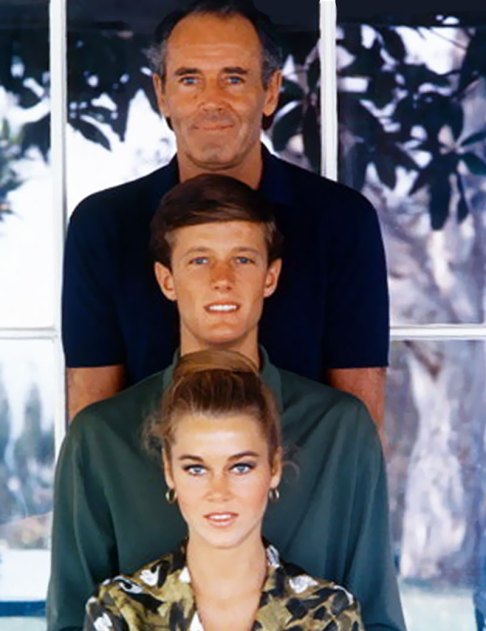
LATEST UPDATE: Jane Fonda shares her thoughts about her weekend in Omaha on her blog site-
ANOTHER UPDATE: The Film Streams Feature Event presenting Jane Fonda in conversation with Alexander Payne reminded me of the 1981 Omaha Community Playhouse event, An Evening with Mister Fonda. The earlier event was a pull-out-all-the-stops tribute to Jane’s father, the late iconic actor Henry Fonda. His Hollywood press agent and close personal friend John Springer, a biographer of the Fondas, interviewed the actor on stage at the Playhouse. Much like the Jane Fonda event last night, which had Alexander Payne interview her, film clips were screened to break up the talk. Coincidentally, I was programming a film series at the University of Nebraska at Omaha in the early 1980s and so I made sure to schedule a Henry Fonda-Dorothy McGuire film festival that showed around the same time as the Playhouse tribute. Film Streams’ repertory series of Jane Fonda films continues. What goes around comes around, and so the circle is completed.
UPDATE: I forgot to mention that one of my favorite parts of the Jane Fonda in Conversation with Alexander Payne event was the surprise appearance by Laura Dern. The actress has maintained a friendship with Payne since she starred in his first feature, Citizen Ruth, which was filmed in and around Omaha. Her loyalty to and affection for Payne was demonstrated when she was the guest star for the inaugural Film Streams Feature Event that featured her in conversation with the filmmaker. I got to interview her in advance of that event and an excerpt from my resulting story, When Laura Met Alex, can be found on this blog. It turns out she came to Omaha for the Fonda event because, not surprisingly, she’s an admirer of the older actress and in fact met her when her father Bruce Dern worked with Fonda on Coming Home. Dern described how that meeting and her opprotunity to closely observe her at work helped inspire her to pursue acting with the same unvarnished honesty as Fonda. Both of Dern’s actor parents, her father Bruce Derna and mother Diane Ladd, worked with Fonda and as fate would have it her father is about to star in Payne’s new film, Nebraska. How’s that for synchronicity?
I wouldn’t be surprised if Payne ends up working with Dern again and somehow finds a role for Fonda in one of his future projects.
As expected, Jane Fonda came and captured the hearts of those attending the Film Streams Feature Event IV last night (July 22) at the Holland Performing Arts Center in Omaha. Understandably, it was not only an emotional evening for her but an emotion-packed weekend, much of which she spent touring old family haunts, including the Omaha Communithy Playhouse that her late father, she, and her brother Peter all acted in. Spoken and unspoken, her father’s legacy looms large over her and she must particularly feel his presence when she’s back where so much Fonda lore is present. Omaha is where her iconic father Henry Fonda was raised, learned his social consciousnesses, and began acting. One of the new things I learned from the conversation she engaged in with Alexander Payne live on the Holland stage is that she did some of her growing up here as well. I knew that her father’s sister Harriet lived in the Dundee neighborhood where he grew up and that he came back to visit her and I knew that Peter had attended Brownell-Talbot School and the University of Omaha here but I always assumed Jane had little contact herself with the extended family in their communal hometown. But it turns out she visted more than occasionally during her youth, even spending chunks of the summer in town during breaks from the elite boarding schools she attended. She even says it was in Omaha where she came of age as an adolescent in the 1950s, which became her own personal Amercian Graffiti stomping grounds for cruising in cars up and down the main drag, Dodge Street, for taking-in drive-in movies, and for participating in sock-hops, and all the rest. She told Payne and us that her aunt Harriett arranged for girls her age from the neighborhood to meet her and made she she was invited to parties and such. She also indicated that Warren Buffett and family, who also called Dundee home, have been friends with the Fondas over the years.
I didn’t get to interview her or meet her as I had hoped, but I’m happy that Film Streams has reenaged her with Omaha and Nebraska after her being away a long time. She was apparently last here in the late ’90s with her then-husband Ted Turner, who has ranching interests in the state. Before that, she accompanied On Golden Pond to its Midwest premiere at the Orpheum Theatre. She’s pledged to continue her relationship with this place and with Payne, who serves on the Film Streams board and is the one responsible for bringing her back into the fold so to speak. Now it’s time the same be done with Peter Fonda. And the same with other Nebraskans in Film, including Joan Micklin Silver, Nick Nolte, Swoosie Kurtz, Gabrielle Union, Yolonda Ross, Gail Levin, Lynn Stalmaster, Monty Ross, et cetera. For too long Nebraska has ignored its film heritage. It should be celebrated and I’m glad to say that Payne and Film Streams are motivated to do that.

The Film Streams art cinema in Omaha gets more than its share of attention and deservedly so. It operates at a world-class level under the leadership of Rachel Jacobson. It has the likes of filmmaker Alexander Payne and novelist Kurt Andersen as board members and advisers, not to mention guest curators and hosts. Its visiting artists have included Steven Soderbergh, Debra Winger, Laura Dern. And to help celebrate its fifth anniversary and raise funds for the organization it’s bringing Jane Fonda in for a July 22 on-stage conversation with Payne. The following story I wrote, soon to appear in The Reader (www.thereader.com), examines the organization’s strong community orientation and considers Fonda’s legendaric status.
Film Streams at Five: Art cinema contributes to transformed Omaha through community focus on film and discussion
©by Leo Adam Biga
Soon to appear in The Reader (www.thereader.com)
Just as Omaha’s come of age with performing arts venues, nightlife attractions, community events and public spaces, so it’s matured in cinema.
This maturation first bloomed when Alexander Payne made features here. Then the local indie filmmaking scene organized. Subsequently the Omaha Film Festival’s provided an annual juried focus on movies.
But the real growth came when Film Streams launched in 2008, thus giving north downtown a vital new anchor and the metro its first year-round dedicated art cinema. Another amenity in the transformed Omaha.
More than a showcase Film Streams is viewed as a cultural center that invites discussions around movies and their themes.
“I love that there is a place to talk about complex and difficult issues and where I am learning about and appreciating film in a whole new way,” says board member Katie Weitz White.
Board member Paul Smith says “films that would never be seen in Omaha but for the existence of Film Streams are shown and provoke a discussion amongst a diverse community of people who attend those showings, and I think it’s very healthy and enriching to our community.”
He mentions the documentaries Food Inc. and A Time for Burning as films whose subjects, the nation’s food supply and racial discrimination, respectively, became talking points following screenings.
The nonprofit is part of the new community engagement model championed by young professionals here. Perhaps no one embodies that aesthetic more than Film Streams founder-director Rachel Jacobson.

The Omaha native long harbored the vision for an art cinema. She enlisted artists, entrepreneurs, community leaders and business experts to help realize it. A classic networker, Jacobson’s built an enviable, pro-active board of directors and advisory board filled with heavy hitters, influencers and tastemakers.
Two celebrity players from Omaha, Payne and Kurt Andersen, are more than window-dressing names associated with it. They guest curate series and host the annual fund raiser, Feature Event. The July 22 Feature Event IV pairs Payne in conversation with Jane Fonda. Past Features brought Steven Soderbergh, Debra Winger and Laura Dern. It’s no secret Payne reels in these major cinema figures.
“That’s really all about Alexander,” says Jacobson. “We wouldn’t be able to do that without him and we are so fortunate because Feature Event provides 15 to 20 percent of the annual budget. So that’s a huge deal for us as an institution.”
The gala’s evolution reflects how Film Streams capitalizes on relationships.
“It’s been a collaboration between us and the Holland and each of the different chairs of the gala. The first chairs were Betiana and Todd Simon, the second chairs were Paul and Annette Smith. Last year it was Katie Weitz White and her husband Watie White and the Weitz family. This year’s chair is Susie Buffett.
“All the different chairs and gala committees have helped shape the event and make it into this interesting thing. Alexander’s been involved. It’s not the kind of fund raiser where we’re auctioning off stuff. We’re not talking about fund raising at the event. We raise the money up front. That way the event gets to be about our mission.”
It’s only one night but in that small window Film Streams coalesces everything it stands for by giving film-as-art a big fat community forum.
“It’s become this signature thing that’s perfect for us. The fact that we get to bring these world renowned actors and directors to town is absolutely thrilling and the conversations have been I think really meaningful and one-of-a-kind,” she says.
Similarly, the whole community development piece of Film Streams has been shaped by many participants. Jacobson says the one-page prospectus she devised “of what Film Streams was going to be,” which amounted to her version of Charles Foster Kane‘s declaration of principles in Citizen Kane, “is very similar to what the organization has become. But the way that everything’s been created has been very collaborative with the staff and the board and with everyone engaged with the organization. Even though it matches what was inside my head it really is outside of me now. It’s something that a lot more people have a hand in authoring.”


Among those varied authors is her father David Jacobson (Kutack Rock), who chairs the board of directors. The board of directors includes members of old-line art philanthropist families.
Jason Kulbel and Robb Nansel of Saddle Creek Records and Lyn Wallin Ziegenbein with the Peter Kiewit Foundation are advisory members from different generations, each exerting pull in different segments.
The broad-based support Film Streams has received from donors, granters and box office patrons has allowed it to become a vested fixture on the arts-culture landscape in a short time.
“What Film Streams has achieved in only five years in being one of the jewels in the crown of the Omaha arts scene, together with the symphony and the zoo and The Rose and the College World Series and the Bemis, is an amazing achievement as far as I’m concerned,” says Payne. “I go to other cities and they don’t have Film Streams.”
Paul and Annette Smith support the organization monetarily and as advocates. The couple sponsored Feature Event II with Debra Winger.
“We’ve been a vocal proponent of Film Streams and we do that really because we believe it plays a critical role in the community,” says Smith a Taneska Capital Management. “The way I think about this is it’s an investment of time, talent, some treasure in an organization which is a cultural asset.”
For film buffs like Sam Walker, “Film Streams has been a dream come true.” Before it the University of Nebraska at Omaha emeritus professor of criminal justice made do with scattershot screenings of art and classic films at commercial theaters and other venues. Documentaries rarely showed. Visits by guest film artists were almost nonexistent. Forget about any discussion or education.
The situation worsened when local universities and museums abandoned curated alternative film series. As cineplexes became slaves to blockbusters and sequels, the metro starved for an art film fix. Enter Film Streams. It’s already presented more than 200 first-run premieres and 400-plus classics, shown films from 43 nations and welcomed 222,000 patrons to 700-plus programs at its Ruth Sokolof Theater.
Forty-some visiting filmmakers and guests have spoken there. Dozens of panels and Q&As have followed screenings.
Payne sums up the seascape change with, “Omahans now take it for granted they can go see great movies, and that is an amazing development.”

Guest filmmakers sing its praises too.
Louder Than a Bomb documentary producer-director Greg Jacobs says Film Streams “really was one of the favorite stops” on its theatrical tour. “It’s an amazing facility and program. i just got the sense it’s a creative hub.” Jacobs notes what many observers do – that the organization takes its role as catalyst seriously.
Just as it occurs wherever the film plays some Omaha viewers “came up afterwards interested in Louder Than a Bomb as an event,” he says. “But what makes Film Streams stand out,” he adds, “is that Rachel Jacobson helped connect us with poet Matt Mason (Nebraska Writers Collective), which ultimately led to the creation of Louder Than a Bomb Omaha. I think it’s something very special when people take interest not just in the film but in the outreach activities around it. The folks there were involved enough to see the film could have an impact beyond its screening.”
“I get the sense Rachel’s innately a connector,” says Jacobs. “That’s the kind of role she plays. There’s a real desire to not just have people there but then to see what other things she can help create from that.”
“I’ve always loved the social action element of film and how it can convey ideas about issues and spark important conversations,” says Jacobson. “You can maximize the power of film by having discussions around them.”
Film Streams screened the documentaries Restrepo and To Hell and Back and hosted ensuing discussions by veterans and heath care workers about PTSD. It screened the doc The Last Survivor and hosted discussions about genocide.
“These are tough conversations to have and I love that we’re able to provide a safe place to have that kind of dialogue. That wasn’t really the initial vision, but seeing that happen has been exciting.”
She considers Omaha conducive to doing community outreach.
“I think a lot of it’s due to the nature of Omaha and how things operate, how everyone is kind of interconnected in 12 different ways. So we just have these opportunities to link to so many different organizations and individuals who in turn are willing to collaborate.
“That aspect has been really surprising. I didn’t realize how wide ranging it could be. I never really imagined how many different interest groups and demographics would be able to engage with it. It just kind of happened.”


The 100-some partners Film Streams has cultivated run the gamut from arts groups to community organizations and social service agencies to school districts and universities. One partner is the Office of Latino and Latin American Studies at UNO. OLLAS-Film Streams present a biennial Cinemateca series. It returns August 12.
“The partnership became an instant expression of these two organizations’ mutual commitment to community engagement and to the broadening of learning opportunities beyond traditional spaces,” says OLLAS executive director Lourdes Gouevia. “We continue to explore ways to encourage the Latino and non-Latino community to experience this great theater and the beauty of Spanish and Portuguese foreign films.
“This year’s Cinemateca will include food, music and audience forums guided by OLLAS faculty as well as an invited film expert from the University of Pittsburgh. The series brings in El Museo Latino as a partner.”
All that engagement has a practical side, too. “It has to be that way in order to be sustainable,” says Jacobson, who bends the ear of top business executives.
“It’s very common to find compelling nonprofits that aren’t very well run and Film Streams is a very well run organization,” says Paul Smith. “I spend a good deal of time helping Rachel with organizing the financial management of her business and she’s a very sharp person, a very quick study, and is an effective business manager. It’s great to work with somebody like that.”
Smith says while the business end is not the sexy part of Film Streams, “it’s the infrastructure everything else hangs on. You need to have a good financial infrastructure. Without that you can’t do the fun stuff.”
Payne says the best is yet to come. “Wait till you see all the other outreach programs Film Streams is going to try to do in the next five years.”

Jane Fonda: A Legend Considered
©by Leo Adam Biga
Soon to appear in The Reader (www.thereader.com)
Jane Fonda. Love her or hate her, she’s a lightning rod figure like few others in film.
When the actress appears at the July 22 Film Streams Feature Event she’ll not only carry the impressive legacy of her personal filmography but that of her iconic family. Alexander Payne will undoubtedly cover the Fonda family acting tree when he converses with her live on stage at the Holland Performing Arts Center.
“To have such a remarkable star and actress and icon, and with the Omaha connection, well, it’s in my dreams,” says Payne.
The Fondas became a noted thespian clan when Jane and brother Peter followed their father, Henry Fonda, into the family business. Papa got his start at the Omaha Community Playhouse, where the siblings did their earliest acting.
In a life and career filled with makeovers and causes, she’s been sex symbol, counterculture rebel, traitor, feminist, artist, power player and fitness guru. Today, she’s best known as a healthy aging advocate and author.
Her early career rested more on her famous name and fashion model good looks than acting ability. But she remade herself from sex kitten ingenue in mostly forgettable Hollywood and European romps (the latter directed by her Svengali-like filmmaking partner Roger Vadim) to serious actress and wannabe activist. Her commitment to challenging projects and roles set her apart from her peers.
At the dawn of the New Hollywood she was perhaps the most powerful woman in the industry, often developing-producing her own material, and usually choosing a smart balance of commercial and art properties.
She turned entrepreneur in the 1980s when she tapped the nascent fitness craze with home workout videos that went viral. Her marriage to politico Tom Hayden ended in 1989. She then married rogue media czar Ted Turner in 1991 and abruptly retired from acting.
Her 2005 autobiography made peace with her deceased father. That same year she returned to acting. The Omaha event comes just as she’s reemerging as a screen presence. Her persona’s come full circle too – from coquette to neurotic to career woman to unreconstructed yippie.
A repertory series of her work shows now through August 30 at Film Streams.
The series:
Cat Ballou
She’s the fetching, spirited title character who hires gunman Kid Shelleen to meet out justice against Tim Strawn (both played by Lee Marvin) for the murder of her father. She holds her own with Marvin in this whimsical Western comedy with heart.
Barbarella
Fonda’s an eye candy fantasy figure in this surreal, pan-sexual trip. She and the film’s director, her then-husband Roger Vadim, push the boundaries of sexual expression and liberation on screen that he earlier exploited with Brigitte Bardot.
They Shoot Horses Don’t They?
It’s a harder, jaded Fonda stripped of any glamour in a bleak story of Depression-era dance marathoners intent on oblivion. The guile, vulnerability and yearning she revealed here became her signature face.
Klute
Fonda consolidated her new serious image with this post-modern take on the prostitute-with-a-heart-of-gold convention. She’s both savvy and brittle as Bree Daniels, a New York call girl entangled with a small town detective (Donald Sutherland) investigating a disappearance in the big city. Her first Oscar win.
Julia
As playwright Lillian Hellman she juggles writerly insecurities and triumphs, a tumultuous relationship with Dashiell Hammett (Jason Robards) and danger aiding a friend, Julia (Vanessa Redgrave) caught in the web of anti-Nazi intrigue.
Coming Home
Perhaps her most defining role came as a socially conscious war bride who has an affair with a paraplegic anti-war vet (Jon Voight). Her army officer husband (Bruce Dern) returns from ‘Nam a shattered man and becomes unhinged when he discovers her infidelity, Her second Oscar win.
The China Syndrome
Fonda makes spunk sexy in the part of an ambitious TV reporter who stumbles upon a nuclear reactor accident story. She finds just the right chemistry with cool Michael Douglas and manic Jack Lemmon in this prescient cautionary tale.
Nine to Five
Buttoned-down Jane joins Lily Tomlin and Dolly Parton in taking extreme measures against their oppressive boss (Dabney Coleman) and his misogynistic ways in this proto-feminist comedy. She plays it straight and gets laughs.
On Golden Pond
This career grace note paired her with Henry for the only time on screen in a story deeply resonant with their own real-life father-daughter dynamics. Henry disliked her Method style. The cathartic project also teamed her with Katharine Hepburn. Jane came to the Orpheum for the film’s gilded Midwest premiere and later accepted her father’s Best Actor statuette at the Oscars.
At Film Streams’ invitation Fonda’s selected two favorite films – 12 Angry Men starring her father and the 1941 Preston Sturges comedy classic Sullivan’s Travels.
Tickets for the 6:30 p.m. Feature event are $35. For pre and post-event party tickets and screening dates-times, visit http://www.filmstreams.org.


 Leo Adam Biga's My Inside Stories