


UPDATE: It turns out that Alec Baldwin did not participate in “Downsizing” after all. Insstead, his part of a real estate magnate was played by another name actor with a similar vibe and facility for playing smarmy – Bruce Willis.
Here is your first and only exclusive insider’s look at Oscar-winner Alexander Payne’s jusst under production new film, “Downsizing,” starring Matt Damon, Kristen Wiig, Christoph Waltz and other stars. From yours truly, Leo Adam Biga, the chronicler of this important writer-director since 1997 and the author of “Alexander Payne: His Journey in Film” – soon to be re-released with a new design, plus updated and expanded content.
UPDATE In its original version this story reported that Reese Witherspoon would co-star alongside Matt Damon, but only days before the April 1 production start it was announced she was no longer attached to the project and that Kristin Wiig had replaced her.
Since this story was first published in early March, Oscar-winning actor Christoph Waltz, along with Udo Kier, Paul Mabon and Warren Belle were officially added to the cast.
Hot Movie Takes:
READ ALL ABOUT IT EXCLUSIVE – Alexander Payne’s “Downsizing” starring Matt Damon
Film about miniaturized human life tackles big themes
“Downsizing” finally going before the cameras April 1
©by Leo Adam Biga, Your A.P. Expert and Author of Soon to Reboot “Alexander Payne: His Journey in Film”
Original story appeared in the March 2016 issue of The Reader (www.thereader.com)
The high concept behind Alexander Payne’s soon to shoot new feature, Downsizing, unfolds in a near future world where humans can opt to be miniaturized. Everything about the story, from the title to the characters to the plot-lines, gives Payne and co-scriptwriter Jim Taylor ample metaphorical opportunities.
The big budgeted Paramount picture starring Matt Damon, Kristen Wiig, Christoph Waltz, Neil Patrick Harris, Jason Sudeikis, Alec Baldwin, Paul Wabon, Warren Belle and Hong Chau endured a long gestation. A different cast was attached in 2008-2009 before the road to financing collapsed with the economy. The pieces almost came together again in 2014. All the while, the script, begun in 2006, got reworked and pared down to meet the budget cap Hollywood placed on this risky project marking Payne’s first foray into science fiction and visual effects..
The production is based at Pinewood Studios in Toronto, Ontario, Canada, where Payne will work for the first time on sound stages and with green screens, CGI and motion capture. Little or no forced perspective will be used.
The sprawling, three-month shoot rolls out April 1 for a week in Los Angeles, then comes to Omaha for a few days. The whole works heads off to Norway for more shooting but the bulk will occur across the border in Canada, where post-production will also happen.
Arch satirists Payne and Taylor use the downsizing premise to skewer the small-mindedness of persons, policies. constructs. In this new work the veteran scenarists, whose previous credits together include the Payne-directed Citizen Ruth, Election, About Schmidt and Sideways, suggest not only are Earth’s physical resources at risk but its intellectual-moral capital, too.
Downsizing’s all too real musings on diminishing returns and bankrupt values posits a redemptive protagonist in Paul, a South Omaha Everyman whom Matt Damon will play. Although the story has a fatalistic, end-of-world backdrop, it dangles hope that humankind, in whatever size survives, will muddle through somehow.
That Payne should use science fiction’s expansive prism to consider world crisis issues and explore the nature of humanity may seem at odds with his intimate dramedies about neurosis, infidelity, promiscuity, loneliness, yearning. Then again, all his work has churned the existential wheel with mundane characters bogged down by the weight of their own mess. Just think of the angst that Ruth (Citizen Ruth), Jim (Election), Warren (Schmidt), Miles and Jack (Sideways), Matt (The Descendants) and Woody (Nebraska) confront. For all its fantastic elements this new narrative is anchored in that same morass of folks dealing with adult dilemmas, conflicts and flaws. Problems dog them wherever they go, even the would-be miniature haven, Leisureland.
And why shouldn’t Payne dip his toes in the sci-fi pool when filmmakers equally identified with humanistic storytelling have done the same? John Sayles (The Brother from Another Planet) and Barry Levinson (Sphere) come to mind.
Besides, sci-fi is a liberating and therefore attractive gateway for artists to tackle large, serious subjects free of constraints. The genre invites storytellers to ponder endless what ifs. In that spirit Payne and Taylor lay out an imagined scenario and burrow down that rabbit hole of speculation to follow what they deem the inevitable consequences.
Downsizing hinges on a hero sensitively responding to a world around him transformed. The implications and stakes are deeply personal and global. At least on the page Payne and Taylor manage to make us care about the micro and macro. Paul’s journey pulls us along this upheaval of life as he knew it. Expectations, definitions and limitations are threatened or overturned. Ultimately, everything is on the line.


Unavoidably, the story echoes other speculative tales, including any dealing with miniature humans. It also resonates with themes from such disparate sources as Dr. Strangelove, 2001: A Space Odyssey, The Truman Show, Children of Men and The Hobbit. Payne and Taylor concoct a fable-like framework to hold the narrative together.
The most obvious if unintentional resonance – to The Incredible Shrinking Man – happens at the end, when our hero-pioneer once more enters the great unknown. As with Payne’s previous films, the story concludes with a feeling more than an event or a resolution.
Payne, now married to a native of Greece and coming off his stark tone poem Nebraska, recently spoke about Downsizing with The Reader.
“We always knew it would take a while, first to get the script right, then to secure the financing, and 10 years is a long time. Fortunately I was able to squeeze in two other features and a pilot during that time. But it feels right now. You know, it’s interesting that in life, not just film, you try to do something and you run into obstacles. You try again and you run into more obstacles, and you think, This is never going to happen. And then finally when it does it unfolds elegantly and without obstructions and you say, Wow, I guess this was the time it was supposed to happen. That has been my experience with Downsizing.”
As the 125-page script sits now, he says, “the story hums along with a good filmic rhythm.” Achieving that flow was challenging for the.”big idea” at its core. “So big,” he says, “it was difficult during our writing process to always discern where it breaks off because every idea you come up with for this idea has a very long series of chain reactions. So you just kind of drive yourself crazy with possibilities. The script goes in very unpredictable directions. I’m not saying they’re good because they’re unpredictable. They were unpredictable to us as we were writing. So to corral this story and to get it happening as efficiently and we hope elegantly from point to point to point took a while. Right now it looks good on paper. I hope it will lend itself to a good movie. I won’t know that until I’m in post-production.”
He says the big idea that propels the piece is rife with “social-political overtones” but that it’s the “human aspects of the story that most interest us.” Thus, he’s not getting hung up on its sci-fi pedigree. He just enjoys the unlimited canvas he has to work on.
Payne also isn’t stressing the visual effects world he’s entered though he acknowledges he’s a fish out of water.
“It’s a whole new focus for me and everything. I’m not worried but I’m curious to see how they’re going to work. There’ll be a certain amount of tedium involved because you have to shoot the same scene two, sometimes three times to get the different aspects and elements.
“I want to make sure the actors who are acting in a vacuum on a stage against green screen feel as comfortable and normal as possible. That’s my job. The acting style should not suffer because of the means of production. But it’ll be fine. You know, who cares, it’s just a movie.”
One whose budget is reportedly double any of his previous pics.
“If they don’t spend it on that, they’re just going to spend it on something else.” he says by way of classic Hollywood reasoning.
“He is my effects czar. He knows how to explain things to me to make things easy for me and how to teach me how these things are achieved – what I need to know, what I don’t need to know. It’s really exciting. The best thing those guys do is to free the director up to say, ‘I want a shot like this, can we do this?’ and they say, ‘Yeah, we can do that,’ and I say, ‘How?’ and they say, ‘Don’t worry about how, but we can do it.’ Between the visual effects supervisor, the DP, the production designer, they have to trick the director as much as possible into thinking that he or she is just shooting a regular movie so that I don’t censor my imagination, or what I have left of it.”
Payne says Price is on the same page as he and cinematographer Phedon Papamichael in terms of the desired visual palette.
“James knows the aesthetic we want and he’s an avid film watcher and film guy and so that makes me feel good. What I aspire to from the visual effects for this movie is not how eye-popping they are but rather how banal they are. I don’t want the seams to show.”
Payne also hopes to keep the effects to a minimum and to “try to do things in camera as much as possible.”
In addition to Price and his visual effects team Payne is working with a new production designer, Stefania Cella. But he’s mainly surrounded by trusted old friends and collaborators in producer Jim Burke, casting director John Jackson, Papamichael and costume designer Wendy Chuck. His longtime editor, Kevin Tent, is on board as well.
After the seven year gulf between Sideways and Descendants, Payne’s happy to be making films in short order. His last, Nebraska, was received warmly in Greece, where he met his wife while vacationing with his mother (Payne’s father passed away in 2014.).
“I showed the film in Greece a couple times and people were only too quick to tell me they thought it was a Greek film, which surprised me. I said, ‘Why do you think it’s a Greek film?’ and they said, ‘Well. it has the elements of going back to the village where your people are from.’ ‘Okay,’ I said. And they connected with the part of dutifully ‘taking care of the parents who drive you crazy,’ and I said, ‘Well, I’m sure that’s not just Greek.’ I think that’s pretty universal.”
On the eve of finally making Downsizing after so long a wait and “jettisoning” subplots he admittedly “misses,” he’s content. “A movie is a movie is a movie and we have enough to make this movie, so it’ll be fine. And if the gods decree there might be a Downsizing 2, than we have other ideas that we’ve been collecting.”
Read more of Leo Adam Biga’s work at leoadambiga.com.

YOU CAN READ THE REST IN THE NEW EDITION OF MY BOOK-
Alexander Payne: His Journey in Film
(The new edition encompasses the Oscar-winning filmmaker’s work from the mid-1990s through Nebraska in 2013 and his new film Downsizing releasing in 2017 )
Now available at Barnes & Noble and other fine booktores nationwide as well as on Amazon and for Kindle. In Nebraska, you can find it at all Barnes & Noble stores, The Bookworm and Our Bookstore in Omaha, Indigo Bridge Books in Lincoln and in select gift shops statewide. You can also order signed copies through the author’s blog leoadambiga.com or via http://www.facebook.com/LeoAdamBiga or by emailing leo32158@cox,net.
For more information. visit– https://www.facebook.com/pg/AlexanderPayneExpert/about/?ref=page_internal
Coming Attraction for 2016…
The new edition of my Alexander Payne book featuring a major redesign, more images and substantial new content that looks back at “Nebraska’ and that looks ahead to “Downsizing.”
Considering Alexander Payne’s ‘Nebraska’
Excerpt from an essay to appear in an upcoming new edition of my book Alexander Payne: His Journey in Film
Even though Alexander Payne demonstrates time and again that commercial considerations mean very little to him, following the breakaway success of The Descendants (2011) there was every reasonable expectation he might lean a bit more again in the direction of mainstream with his next film. I say again because I count The Descendants as a conventional, even mainstream work even though its protagonist rails against his comatose wife and sets out to wreck the life of the man she was cheating with, all the while trying not to lose it with his two grieving daughters in tow.
Payne soon quashed any notion of playing it safe when he announced the small, insular back roads comedy-drama Nebraska (2013) as his new feature project. It did not help its bottom line chances that the film is set in rural Nebraska, which for most filmgoers may as well be the dark side of the moon for its unfamiliarity, remoteness, and perceived barrenness. Indeed, if Nebraska conjures any image at all it is of endless cornfields, cows, and monotonously flat, uninspired scenery. When the story laid over such a setting features a confused, depressed old cuss alienated from family and friends and wandering around in a bleak wasteland made even bleaker by black and white photography and desolate late fall, post-harvest locations, it does not exactly engender excitement. The prospect of a dour, feel-bad experience devoid of life and color does not get tongues a-wagging to generate the all important buzz that sells tickets.
Of course, anyone who has seen Nebraska knows the film is not the downer it may appear to be from glimpsing a thirty-second trailer or hearing a fifteen-second sound bite, but that it is ultimately a sweet, deeply affecting film filled with familiar truths amid its very Nebraskaesque yet also quite universal archetypes.
Payne’s insistence on shooting in black and white was a completely legitimate aesthetic choice given the storyline and tone of this stark, autumnal mood piece about an old man having his last hurrah. But it also meant a definite disadvantage in appealing to average or general movie fans, many of whom automatically pass on any non-color film. Compounding the aversion that many moviegoers have with black and white is the fact that most studio executives, distributors, and theater bookers share this aversion, not on aesthetic grounds, but based on the long-held. much repeated argument that black and white films fare poorly at the box office. Of course, there is a self-fulfilling prophecy at work here that starts with studio resistance and reluctance to greenlight black and white features and even when a studio does approve the rare black and white entry executives seem to half-heartedly market and release these pics. It is almost as if the bean counters are out to perversely prove a point, even at the risk of injuring the chances of one of their own pictures at finding a sizable audience. Then when the picture lags, it gives the powerbrokers the platform to say, I told you so. No wonder then – and this is assuming the argument is true – most black and white flicks don’t perform well compared with their color counterparts. Except, how does one arrive at anything like a fair comparison of films based on color versus black and white? Even if the films under review are of the same genre and released in the same period, each is individually, intrinsically its own experience and any comparison inevitably ends up being a futile apples and oranges debate. Besides, there are exceptions to the supposed rule that all black and white films struggle. From the 1970s on The Last Picture Show, Paper Moon, Young Frankenstein,Manhattan, Raging Bull, Schindler’s List, Ed Wood and The Artist are among the black and white films to have found wide success. It is admittedly a short list but it does prove black and white need not be a death sentence.
To no one’s surprise Paramount did what practically any studio would have done in the same situation, which was to fight Payne on the black and white decision. In no uncertain terms Payne wanted to make Nebraska in black and white and just as adamantly the studio wanted no part of it. He pushed and they pushed back. He would not compromise his vision because from the moment he first read Bob Nelson’s screenplay he clearly saw in his mind’s eye the world of this story play out in in shades of black and white. It just fit. It fit the characters and the settings and the emotions and as far as he was concerned that was that. No questions asked. No concessions made.
I do not claim to know all the details of this protracted dispute or should I say discussion but I do know from what Payne and cinematographer Phedon Papamichael have told me that the issue became a point of some contention. I do not know if it ever reached an impasse where Payne more or less indicated by word or action he was prepared to walk and take the project with him (his own Ad Hominem production company brought the property to Paramount). It certainly wouldn’t surprise me that he let it be known, subtly or not, that he was willing to make the project with another studio if it came to that. It is a moot point now since Paramount eventually acceded to his wishes, though not insignificantly the studio did cut some of the picture’s already small budget as a kind of hedge I suppose against the small business they expected the film to do. The smaller the budget, and in this case it was $12 million, the smaller the risk of not recouping its cost.
Given Payne’s even temperament and gentility, I doubt if things reached the level of shouting or angry exchanges, though he undoubtedly expressed displeasure with their interference and pettiness. I have to think he wore the execs down with his patience and persistence to win the black and white battle but at the end of the day he was willing to give up a couple million dollars in exchange for realizing his vision. I know he says that losing a million dollars is a huge loss when it comes to small-budgeted films like this one and I understand that in order to get the film made within those constraints he and others worked for scale in return for some points on the back end, but I have to believe those “sacrifices” were completely worth it in the long run. I would even argue that having to work on a bare bones budget and a tight schedule worked in favor of getting this simple story right. It required cast and crew to live frugally like the characters and the frugal shoot placed a premium on efficiency, ingenuity, and everyone pulling together to make the most of what they had to work with. In truth this esprit de corps is evident on all of Payne’s projects anyway because of the tight, loyal stock company he works with from film to film to film. They are a family and a team dedicated to one purpose: getting the film made to his specifications.
I asked Payne if it ever seems like a studio plays this game in order to gauge just how strongly the filmmaker is invested in a choice or preference as well as to what extent the filmmaker can be manipulated. He seems to believe there is some truth in that. Perhaps it really is the studio’s way of testing how firm the filmmaker’s convictions are and how much the filmmaker is willing to give up or to stand fast in terms of creative control. As Paramount surely knew going in and if they somehow didn’t know they surely soon discovered in the process of setting up the film, Payne is no push over and he brooks no fools. That is true at every juncture in the process, from making the deal to pre-production to the shoot and on through post-production. It is his film and he will not be budged from any creative choices he feels are necessary, which is to say he will not be pressured into doing something for the sake of added commercial appeal.
Because Payne is not about burning bridges, except for his public displeasure over the way his first two films (Citizen Ruth and Election) were handled by the studios and releasing companies behind them, he is not saying on the record what he thinks about the way Paramount handled Nebraska. I have to think he is not pleased with the extremely limited release they gave it. At no time during its release did the film ever play more than 968 theaters according to the website Boxoffice Mojo. That is anywhere from two-thirds to a half to a third the number of theaters its main awards competitors played at during their runs. It is hard to understand why the film was not given more opportunities to find a wider audience given the outstanding reception it received from critics (making most Top Ten lists), the foreign press (five Golden Globe nominations) and the Academy (six nominations).
Hampered as it was by the limited release, Nebraska still pulled in more than $18 million domestically by this edition’s summer 2014 printing and I am sure when all the figures are added up from North America and overseas, where I predict the film will fare well, especially in Europe, its total gross will be in excess of $20 million. By the time all the home viewing rentals and purchases are taken into account a year from now, I wager the film will have done some $25 million in business, which would approximately double its production costs. That is quite a return on a small film that did not get much studio support beyond the bare basics.
Payne could have made things easier for himself and the studio by filming in color and securing a superstar. Nebraska marked quite a departure from the lush, color-filled canvas of Hawaii he captured in The Descendants and the equally verdant California wine country he committed to celluloid in Sideways. Never mind the fact the stories of those earlier films, despite the radical differences of their physical locations, actually share much in common tonally and thematically withNebraska. The dark comic tone and theme of Payne’s films can threaten to be overshadowed when a star the magnitude of Jack Nicholson (About Schmidt) or George Clooney (The Descendants) attaches himself to one of his projects. But as anyone who is familiar with the subdued star turns of those two actors in those particular films will tell you, Nicholson departed far from his trademark insouciance and braggadocio to totally inhabit his repressed, depressive title character in Schmidtjust as Clooney left behind much of his breezy, cocksure charm to essay his neurotic somewhat desperate character in Descendants. Each star was eager to shed his well-practiced, bigger-than-life persona in service of scripts and parts that called for them to play against type. Instead of their usual live-out-loud, testosterone-high roles, they play quiet, wounded, vulnerable men in trouble. For that matter, the men-children Paul Giamatti and Thomas Haden Church play in Sideways are seemingly complete opposites but in actuality are emotionally-stunted, damaged souls using oblivion, alcohol, and sex to medicate their pain and avoid reality. The beauty of the California and Hawaii locales work as contrast and counterpoint to the chaotic lives of these lost figures careening toward catharsis. In Schmidt Omaha is the perfect washed-out backdrop for a man undergoing a full-scale identity and spiritual crisis once he retires and his domineering wife dies.
That brings us to Woody Grant, the crotchety so-and-so at the center of Nebraska. When we meet him he is near the end of a largely misspent life. Facing his inevitable and nearing mortality he doesn’t much like what he sees when he reviews his life and where he has landed. He is dealing with many deficits in his old age. His body is falling apart. He walks stiffly, haltingly. His alcoholism has been unaddressed and it contributes to his foggy mind, mood swings, propensity to fall and hurt himself, and to utter hurtful things. He seems to derive no joy or satisfaction from his wife of many years and his two adult sons. He almost regards them as inconvenient reminders of his own failings as a husband and father. On top of all this, he is poor and in no position to leave his family anything like a tangible legacy.
This miserable wretch has seized upon what he believes to be his last chance at assuaging a deep well of shame, guilt, bitterness, and resentment. His mistaken belief there is a sweepstakes prize for him to redeem becomes a search for his own personal redemption or salvation. He desperately wants something, namely a truck, to leave his boys. The true meaning of the road trip he embarks on with his son David is only revealed to us and to his boy along the way and that gradual discovery adds layers of poignancy to the story.
When Woody arrives back in his hometown of Hawthorne, Nebraska word spreads he is on his way to collect a $i million sweepstakes prize. For a few moments he becomes a person of substance in the eyes of his extended family and the town’s other residents. Some family members and one old friend turn vultures and demand they get a share of his windfall as compensation for favors they did or loans they made that were never returned. But there is another side to that story. We find out Woody has a kind heart beneath his gruff exterior, so much so that he’s been known to do favors and to give money away without ever expecting repayment. That has led him to be taken advantage of over the years. Then when the truth gets out Woody has not won anything but has misinterpreted a marketing piece for a confirmation letter of his supposed million in winnings, he is publicly humiliated and made out to be a fool.
For Nebraska I Payne went one step further in distancing himself from commercial considerations by casting as his two leads Bruce Dern and Will Forte, who at first glance form an unlikely combination but in fact play wonderfully off each other. Dern’s acclaimed performance as Woody Grant earned him a Best Actor prize at Cannes and nominations from the Golden Globes and the Academy of Motion Picture Arts and Sciences. Saturday Night Live alumnus Forte is triumphant in his first dramatic role as the sympathetic son David. The next largest part belongs to June Squibb, who until this film was a somewhat familiar face if not a household name (she played Nicholson’s wife in Schmidt). Her stellar work in a colorful role as Woody’s piss-and-vinegar wife Kate has brought her the most attention she’s received in a very long and productive career. Arguably, the biggest name in the picture belongs to Stacy Keach, a veteran of film, television, and stage who has little screen time in the picture but makes the most of it in a powerfully indelible turn as the story’s heavy, Ed Pegram. As strong as these performances are Payne did not do his film any box office favors by choosing actors so far off the radar of moviegoers. That is not a criticism, it is simply a fact. At least a dozen more speaking parts are filled by no-name actors, nonprofessional actors, and nonactors, all of whom add great authenticity to the film but whose obscurity hurts rather than helps the marketing cause.
As you will read in the articles that follow Payne is most proud of the casting and locations inNebraska. These are elements he always takes great care with in any of his films but with this particular film he went the extra mile yet in order to realize the very specific world of the story. Many of the small speaking parts are filled by regular folks – retired farmers and such – who populate the very towns or ones just like them where he shot. He and casting director John Jackson searched long and hard for just the right faces and voices. Similarly, the weatherbeaten, seen-better-times found locations look and feel so right as the homes and pit-stops of the characters that these real locations rather than constructed sets add another layer of verisimilitude.
The choice to populate the film with zero star power ultimately is not the reason the film failed to pull in more of an audience because there are plenty of films that do well with little known, non A-list names, and nonactor finds. No, the real problem with how Nebraska fared had more to do with the perception the marketing campaign for the film imposed on it. The film’s trailers did not communicate the heart and soul of the picture. None of the warmth or depth or populist appeal at its core registered in those clips. Instead, the film was represented as a cold, mean, depressive, rather flimsy sketch concept blown up to fill two hours. Anyone who has seen and appreciatedNebraska will tell you it is far more than that. It is a work replete with deep currents of regret, disappointment, melancholia, rage, nostalgia. and love. Alongside that run streams of humor, sweetness, irony, and slapstick. Then there is the sheer poetic evocation of hauntingly beautiful visuals that turn the wide open flyover terrain, roadside stops, and played-out small towns of Montana, Wyoming, South Dakota, and Nebraska into haunting fields of dreams and symbols of neglect. Not to mention centers of quirky, silly, sometimes surreal goings-on.
Plenty of small indie films about similarly unglamorous subject matter have struck a responsive chord with the masses. So what kept Nebraska from resonating the way, say, Juno did or Little Miss Sunshine? No one really knows. If the creatives who make the films and the suits who finance and sell them did, if there was some sure-fire magic formula at their disposal, then every film would be packaged into a box office winner. The truth is some films catch the wave and most don’t and there doesn’t seem to be any reliable rhyme or reason for why some hit and others miss that elusive, always moving wave everyone is after.
It may take a while, but I am quite confident Nebraska will eventually find the large audience it deserves. In my opinion it will be a much viewed and discussed stand-the-test of-time film for its many cinema art merits. As good as Payne’s earlier films have been I believe this to be his finest work to date because it is in my view the fullest expression of his filmmaking talents. Visually, it is a tone poem of the first order and on that basis alone it is a film to be reckoned with. Payne and cinematographer Phedon Papamichael have achieved an expressive black and white palette whose hues perfectly articulate the heavy heart of the story. But Payne also found unobtrusive ways to position the camera and, with editor Kevin Tent, to cut scenes so as to amplify its many moments of humor without ever detracting from its elegiac, soulful mood. Mark Orton’s original music, plus the incidental music used here and there, add more nuances of mood. Payne artfully composed images for the wide screen format he shot in to glean added depth and meaning from the action. Within the same frame he intentionally juxtaposed characters with the stark landscapes, townscapes, and homes they inhabit. Many of these scenes emphasize sadness, stillness and desolation. Irony infuses it all. The result is an ongoing dialogue between people and their environments. Each informs the other and by consequence us.
The filmmaker’s economy of style has never been more evident. He has reached the point of communicating so much with simple brush strokes. Take for instance the way Woody’s harsh childhood experience is encapsulated when the old man and his family visit the abandoned farm house he grew up in. Payne has the camera fluidly glide over the detritus of this once proud home turned wreck and to peak into rooms that carry so much psychic-emotional pain for Woody, who was beaten as a boy. Payne clearly indicates this is a private, anguished, cathartic return for Woody, who has avoided this place and its memories for years.
Or consider that gathering of taciturn men in Woody’s family at his brother’s home in town. Payne arranges the uncles, brothers, sons, nephews, cousins in an American Gothic pose around the TV set, where the men engage in the almost wordless ritualistic viewing of a football game. It is at once a funny and powerful expression of their tribal, tight-lipped bond. A bond more about association by blood than affinity.
Then there are the almost incidental shots of boarded up buildings in town that symbolize and speak to the economic hard times to have befallen so many small towns like the fictional Hawthorne. In a short scene Payne conveys an important way in which the times have changed there and in towns like it when he has Woody visit the auto service station he used to own and he finds the new owners are Spanish-speaking Hispanics. Woody thus personally encounters a demographic shift that has altered the face of his hometown and much of rural Nebraska. No more is made of it then that simple reality and the brief exchange between Woody and the “newcomers,” but it is enough to say that times have moved on and the Hawthorne he knew has evolved in some ways and remained unchanged in others.

Perhaps the best example of Payne distilling things down to their simplest, purest, most elemental form is the end sequence when David and Woody are in the truck David has purchased and registered in his father’s name. David, who is at the wheel with Woody beside him, stops the truck on the edge of town and invites Woody to take the wheel and drive down main street in his new rig. What follows is one of the most moving denouements in contemporary American cinema. Woody is granted a rare gift when he accepts the invitation to take a celebratory ride down main street. As the truck slowly passes through town he wins more than any prize money could provide when four people from his past catch sight of him and look at him with a combination of awe, admiration, and surprise. It is a perfect moment in the sun vindication for a beleaguered, bedraggled man who suddenly brims with a sense of confidence and purpose. Woody leaves town on his own terms, his dignity and pride intact, at least for this short interval of time.
What makes that valedictory ride so special is that his sympathetic son David is there to grant him it and to bask in it with him. These two who began the road trip not really knowing each other and often at odds with each other have traveled a journey together that has brought them a measure of acceptance, healing, and peace. David has finally come to understand why his father is the way he is. His fondest desire is realized when he gives Woody that movie-movie opportunity to prove he is not the loser or fool this day. As Woody sits high in the cab of the truck, with David lovingly looking on from the floor, and drives past the artifacts of his past and the denizens of that town, he may as well be a cowboy sitting tall in the saddle of his horse riding into the sunset. He graciously accepts the congratulations of town chatterbox Bernie Bowen. He stares down his former friend Ed Pegram, who now looks the shamed fool. Woody’s heart stirs again for old flame Peg Nagy, whose wistful expression wonders might have been. As he heads out of town Woody says a fond goodbye to Albert, the Grant brother whose favorite pastime is siting beside the road waving at the occupants of passing cars.
Outside of town the truck stops at the bottom of a hill and Woody and David once again exchange places. Doing this out of the view of onlookers preserves Woody’s glorious farewell and signals Woody now accepts his limitations and David’s love for him. With David back behind the wheel and Woody beside him father and son drive off to meet an uncertain future together. Consistent with the way Payne ends all his films, Woody’s last ride reverie does not promise any great turnaround in his life. His problems are still his problems. The fact that that sequence plays out wordlessly and still conveys so much meaning is a testament to the work of Payne and his collaborators in extracting the essence of these scenes through beautifully executed shots that give full weight to glances gestures, postures, and backdrops.
NOTE: To read the rest you’ll have to wait for my new edition to come out.

Here’s what makes it all worthwhile…
And here, dear friends, is ultimately why I do what I do in spite of the sparse pay and the insecurity that comes with being a writer. It is a mashup of two heartfelt emails sent me by a young, then-aspiring filmmaker named Bryan Reisberg who shared how impactful my Alexander Payne book has been for him. As you will read below, since first writing me he found financing to direct his screenplay Big Signficant Things. More recently yet he’s informed me that the film premiered well at the South by Southwest Film Festival and that he found a theatrical distributor for it. His pic is now showing in select theaters this summer. He may even come to Omaha with it before the year’s out. Reading how my accounts of a world-class filmmaker inspired this talented young man to recalibrate his own approach to film and to get his vision from page to screen is perhaps the greatest compliment I’ve ever received. Credit must also go to Alexander Payne, for his insights that I shared with the world.
File this one under you never know how your words or work or actions affect someone. Thank you, Bryan, and I look forward to meeting you one day.
Dear Mr. Biga,
I’m writing to thank you for your wonderful book.
You don’t know me but I’m a young filmmaker in NYC and I purchased your book on Alexander Payne I think back in November of 2012. I was always a fan of Alexander Payne’s work, and was simply searching for anything I could find on him. I wanted to write and tell you that your book has helped me immeasurably as a filmmaker.
I read your book a few months ago when I was finishing a screenplay, with the hopes of turning that into my directorial debut. I immersed myself into your articles, and then further into Payne, his inspirations, references, and then dove headfirst into classic American and Italian Cinema from the 40s, 50s, 60s, and 70s. The started the most focused and intensely rigorous academic study of film I’ve done, and it was nearly 4 years after graduating from college. Probably because I was working towards a physical film.
I graduated from NYU’s Tisch School of the Arts in 2009 and work with my friend and production partner, Andrew D Corkin, whose last feature film he produced was 2011’s Martha Marcy May Marlene.
I imagine now, being a bit older than I was while in film school I have much more of an interest in the academia of filmmaking.
Your articles and interviews became a critical (and previously absent) entry point to discover and dig deeper into learning more about directors, films, and film history. I came to not only respect and admire Payne as a filmmaker, but also as one of the best teachers I’ve ever had. And I can say that to date, starting with your book, what I’ve learned about the craft and history of cinema has been unparalleled and invaluable.
Well, since reading your book, I’ve completely changed how I watch films, what I watch, and it has given me such a wonderful tool and jumping off point to film that I don’t feel I’ve ever had before. And since reading your book, and working on developing this first film, as of 2 weeks ago, we’re fortunate to have gotten this project, my first feature, fully financed. We head down to Mississippi in 2 weeks to prep, and then shoot in the month of May. It’s pretty surreal, since I’m sure you know that indie film financing is very difficult…
…I was fortunate enough to have my screenplay financed so that I could direct my first feature, BIG SIGNIFICANT THINGS, which I completed back in May of 2013.
And it was just announced that my film will have it’s World Premiere at the 2014 SXSW Film Festival. Mark Orton, who I’m sure you know did the score for NEBRASKA, is composing the score for my film.
I wouldn’t be here without Alexander Payne and your book. Well, maybe I’d be here, but I wouldn’t be nearly as (hopefully) knowledgeable and skilled as a filmmaker.
So I just wanted to extend my gratitude, and thank you from the bottom of my heart.
Best,

Brent Spencer’s fine review of my Alexander Payne book nets nice feedback
I only just now became aware of this fine review of my Alexander Payne book that appeared in a 2014 issue of the Great Plains Quarterly journal. The review is by the noted novelist and short story writer Brent Spencer, who teaches at Creighton University. Thanks, Brent, for your attentive and articulate consideration of my work. Read the review below and some nice responses I got to this news.
NOTE: I am still hopeful a new edition of my Payne book will come out in the next year or two. it would feature the additon of my extensive writing about Payne’s Nebraska. I have a major university press mulling it over now.
Alexander Payne: His Journey in Film—A Reporter’s Perspective, 1998–2012 by Leo Adam Biga
Review by Brent Spencer
From: Great Plains Quarterly
Volume 34, Number 2, Spring 2014
In Alexander Payne: His Journey In Film, A Reporter’s Perspective 1998-2012 Leo Adam Biga writes about the major American filmmaker Alexander Payne from the perspective of a fellow townsman. The local reporter began writing about Payne from the start of the filmmaker’s career. In fact, even earlier than that. Long before Citizen Ruth, Election, About Schmidt, Sideways, The Descendants, and Cannes award-winner Nebraska. Biga was instrumental in arranging a local showing of an early student film of Payne’s, The Passion of Martin. From that moment on, Payne’s filmmaking career took off, with the reporter in hot pursuit.
The resulting book collects the pieces Biga has written about Payne over the years. The approach, which might have proven to be patchwork, instead allows the reader to follow the growth of the artist over time. Young filmmakers often ask how successful filmmakers got there. Biga’s book may be the best answer to this question, at least as far as Payne is concerned. He’s presented from his earliest days as a hometown boy to his first days in Hollywood as a scuffling outsider to his heyday as an insider working with Hollywood’s brightest stars.
If there is a problem with Biga’s approach, it’s that it can, at times, lead to redundancy. The pieces were originally written separately, for different publications, and are presented as such. This means a piece will sometimes cover the same background we’ve read in a previous piece. And some pieces were clearly written as announcements of special showings of films. But the occasional drawback of this approach is counter-balanced by the feeling you get of seeing the growth of the artist take shape right before your eyes, from the showing of a student film in an Omaha storefront theater to a Hollywood premiere.
But perhaps the most intriguing feature of the book is Biga’s success at getting the filmmaker to speak candidly about every step in the filmmaking process. He talks about the challenges of developing material from conception to script, finding financing, moderating the mayhem of shooting a movie, undertaking the slow, and of the monk-like work of editing. Biga is clearly a fan (the book comes with an endorsement from Payne himself), but he’s a fan with his eyes wide open. Alexander Payne: His Journey In Film, A Reporter’s Perspective 1998-2012 provides a unique portrait of the artist and detailed insights into the filmmaking process.
Brent Spencer, Department of English, Creighton University, Omaha, NE.
HERE IS SOME LOVELY FACEBOOK CORRESPONDENCE THAT NEWS OF THE REVIEW PROMPTED:

Brent Spencer’s fine review of my Alexander Payne book in the Great Plains Quarterly
I only just now became aware of this fine review of my Alexander Payne book that appeared in a 2014 issue of the Great Plains Quarterly journal. The review is by the noted novelist and short story writer Brent Spencer, who teaches at Creighton University. Thanks, Brent, for your attentive and articulate consideration of my work. Read the review below.
NOTE: I am still hopeful a new edition of my Payne book will come out in the next year or two. it would feature the additon of my extensive writing about Payne’s Nebraska. I have a major university press mulling it over now.
Alexander Payne: His Journey in Film—A Reporter’s Perspective, 1998–2012 by Leo Adam Biga
Review by Brent Spencer
From: Great Plains Quarterly
Volume 34, Number 2, Spring 2014
In Alexander Payne: His Journey in Film—A Reporter’s Perspective 1998–2012, Leo Adam Biga writes about the major American filmmaker Alexander Payne from the perspective of a fellow townsman. The Omaha reporter began covering Payne from the start of the filmmaker’s career, and in fact, even earlier than that. Long before Citizen Ruth, Election, About Schmidt, Sideways, The Descendants, and Cannes award-winner Nebraska, Biga was instrumental in arranging a local showing of an early (student) film of Payne’s The Passion of Martin. From that moment on, Payne’s filmmaking career took off, with the reporter in hot pursuit.
Biga’s book contains a collection of the journalist’s writings. The approach, which might have proven to be patchwork, instead allows the reader to follow the growth of the artist over time. Young filmmakers often ask how successful filmmakers made it to that point. Biga’s book may be the best answer to this question, at least as far as Payne is concerned. Biga presents the artist from his earliest days as a hometown boy to his first days in Tinseltown as a scuffling outsider to his heyday as an insider working with Hollywood’s brightest stars.
If there is a problem with Biga’s approach, it is that it occasionally leads to redundancy. The pieces were originally written separately, for different publications, and are presented as such. This means that an essay will sometimes cover the same material as a previous one. Some selections were clearly written as announcements of special showings of films. But the occasional drawback of this approach is counterbalanced by the feeling you get that the artist’s career is taking shape right before your eyes, from the showing of a student film in an Omaha storefront theater to a Hollywood premiere.
Perhaps the most intriguing feature of the book is Biga’s success at getting Payne to speak candidly about every step in the filmmaking process. These detailed insights include the challenges of developing material from conception to script, finding financing, moderating the mayhem of shooting a movie, and undertaking the slow, monk-like work of editing. Biga is clearly a fan (the book comes with an endorsement from Payne himself), but he’s a fan with his eyes wide open.
What do Oscar-winning filmmaker Alexander Payne and WBO world boxing champion Terence “Bud” Crawford have in common?
These newsmakers share the same hometown of Omaha, Neb. but more than that they share an unflinching loyalty to their roots. Payne could elect to or be swayed to make films anywhere but he repeatedly comes back to Omaha and greater Neb. to create his acclaimed works, often resisting studio efforts to have him shoot elsewhere. Crawford doesn’t get to call the shots about where he fights but for his first two title defenses he did convince Top Rank and HBO that Omaha could and would support a world title card. Besides, it’s tradition that a world champion gets to defend his title on his own home turf. And when there was talk his first title defense might move across the river to Council Bluffs, he wasn’t having it. Now that he’s been proven right that Omaha is a legitimate market for big-time fights and is a formidable hometown advantage for him, he will undoubtedly press to fight here over and over again and opponents will certainly resist coming into his own backyard. As he moves up a division and the stakes get higher, there may come a time when the CenturyLink and Omaha can’t provide the same pay-day that a Las Vegas and one of its mega venues can. Whether Omaha could ever become a main event host for fighters other than Crawford is an open question. The same holds true for whether Neb. could ever attract a major feature film to fix its entire shooting schedule here outside a Payne project. The only way that will happen, it appears, is if the state enacts far more liberal tax incentives for moviemakers than it currently offers. But that is neither here nor there, as Crawford’s done right by Omaha and his adoring fans have reciprocated, just as Payne has done right by his home state and his fellow Nebraskans have responded in kind.

Chris Farina/Top Rank

The Crawford parallel to Payne goes even deeper. Just as Payne maintains a significant presence here, living part of the year in his downtown condo, serving on the board of Film Streams and bringing in world class film figures for special events, Crawford lives year-round in Omaha except when he goes off to train in Colorado and he owns and operates a boxing gym here, the B&B Boxing Academy, that’s open to anyone. Just as Payne looks to grow the film culture here Crawford hopes to grow the boxing scene and each has made major strides in those areas. A major Hollywood film besides one of his own still hasn’t come to shoot here, though he’s lobbied the state legislature to give studios and filmmakers the incentives they need. No world-class fighter has emerged here yet as a protege of Crawford’s or as someone showing promise to be “next Bud Crawford.” Similarly, “the next Alexander Payne” hasn’t announced him or herself yet here.
Another way in which these two Omaha figures – each so different on the surface, with one the product of white privilege and the other the product of Omaha’s poor inner city – are similar is that each has been embraced and endorsed by the Omaha establishment. They’ve been honored with the keys to the city, feeted at banquets and preened over by the media. When Mayor Stothert showed up for a photo op with Bud at his pre-Thanksgiving turkey giveaway and Warren Buffett appeared at one oh most title defenses, you knew that Crawford had made it.
I don’t know if Payne and Crawford have met, but I would enjoy the intersection of two different yet not so different Omaha’s meeting. At the end of the day, after all, each is in a segment of show business or entertainment. Each is a professional who has reached world class stature in his profession. Each has worked and sacrificed for his craft and been rewarded for it.
I have been covering Payne for going on 20 years, I have been covering Crawford for three years. I admire both men for having come so far with their passion. I congratulated Payne on his latest achievement, the film “Nebraska,” one in a long line of filmic successes. And I now say congrats to Terence “Bud” Crawford on defending his WBO world boxing title in his hometown of Omaha for the third time in the space of a year. The 11,000 fans on hand for each of those fights at the CenturyLink arena were there to support their own and they roared and cheered and gave shout-outs to Bud, who’s become a much beloved folk hero here. Feeding off their energy he’s displayed a full boxing arsenal in thoroughly dominating tough challengers who ultimately proved no match for his all-around fighting prowess. Every time his pressing opponents tried to trap Bud along the ropes or in the corners, The Champ used his superior quickness and agility to turn the tables with sharp counterpunching, By the last few rounds Bud was doing all the attacking, thwarting the few rallies his foes mounted and frustrating them at every turn. Each of Bud’s performances has been an impressive boxing display and further proof that the talk about him being pound for pound one of the best fighters in the world today is no hype. He’s the real deal and almost certainly the best prizefighter to ever come of Nebraska. As I articulated above, the fact that he remains rooted to his community and brings his success back home reminds me of what filmmaker Alexander Payne does in another arena, filmmaking.
Bud’s main events turn into veritable love-ins and as much love as the crowd gives to one of their own he gives it right back. That exchange is a beautiful thing that happens in what can be a brutal sport and a heartless game. After not making a film in his hometown of Omaha for more than a decade another local hero, Payne, is coming back to shoot his new feature “Downsizing” here in the spring 2016. By its nature, filmmaking doesn’t lend itself to cheering crowds the way boxing matches do. Most sets are in fact closed from the public, even the media. But Payne is recognized everywhere he goes, especially back home, and just like Bud he handles well-wishers and autograph-seekers and photo-op fans with great aplomb and charm. Look for my stories about him and “Downsizing” throughout 2016.
Look for my new story about Bud in the next issue of Revive! Omaha Magazine. Meanwhile, you can read my previous stories about Bud at this link:
https://leoadambiga.com/?s=terence+crawford
You can find excerpts of my many past stories about Alexander Payne on my blog, leoadambiga.com. You can also buy my book, “Alexander Payne: His Journey in Film,” which is a collection of my extensive journalism about the artist and his work. The second edition of the book is now available and features new content about “Nebraska” and his slated for late 2017 film “Downsizing” as well as the addition of a discussion guide. The book is available via Amazon, Barnes & Noble and select other sites and booksellers. You can also order it directly from me.
Nebraska Film Currents
©by Leo Adam Biga
Monday night’s David O. Russell-Alexander Payne cinema summit got me to thinking about past film royalty visits to Nebraska. In the annals of Neb. film history, precious few notable Hollywood figures have come here to shoot or to make public appearances or for that matter to make private appearances. I don’t claim to have an exhaustive history of these cinema drop-ins, but the ones that come to mind, include:
Much of the MGM 1938 classic film Boys Town was shot in Boys Town and greater Omaha, which brought director Norman Taurog and stars Spencer Tracy and Mickey Rooney here, and all of them, along with studio czars, came for the world premiere here; Read about it at-
https://leoadambiga.wordpress.com/…/when-boys-town-became-…/
Cecil B. DeMille, Barbara Stanwyck, Joel McCrea and other principals from the 1939 film Union Pacifc came for the world premiere here.


Robert Taylor hunted at Ducklore Lodge and may have been a guest at the Storz Mansion on Farnam Street.
James Stewart was also a guest at Storz Mansion parties.
In the mid-1950s Henry Fonda and Dorothy McGuire, both at their peak fame, came to do performances of The Country Girl as a benefit to fund construction of the new Omaha Community Playhouse – each was an OCP alum – and Henry’s daughter Jane was part of the cast as well; Henry Fonda came back many times to support the Playhouse and the Stuhr Museum.

In 1965 Betty Grable starred in the national touring company production of Hello, Dolly at the Omaha Music Hall. Another national tour of Dolly starred Carol Channing at the Orpheum Theater.

In 1967 Otto Preminger was one of two guests of honor at a Creighton University film festival – the other was experimental filmmaker Stan Brackhage.
A year later Francis Ford Coppola, George Lucas, Shirley Knight, James Caan and Robert Duvall came for the last few weeks shooting on the road movie, The Rain People, which Coppola wrote and directed; Lucas was along for the ride to document the making of the film; in the ensuing years Robert Duvall returned to Neb. several times to make the documentary We’re Not the Jet Set about the rambunctious Ogallala-area ranch-rodeo family, the Petersons; Read about all this at-
https://leoadambiga.wordpress.com/…/film-connections-an-in…/

Jane Fonda, who did part of her growing up in Omaha, came for the regional premiere of On Golden Pond at the Orpheum Theater; some 30 years later she sat where David O. Russell did for an interview Alexander Payne did with her at the Holland.
Marlon Brando paid a visit to his birthplace and hometown in the 1980s and did an awkward but entertaining television interview with Peter Citron.
Joan Micklin Silver (Hester Street, Crossing Delancey) came back to her home state to accept a Sheldon Film Theater tribute in Lincoln; read one of my many pieces on Joan at-
https://leoadambiga.wordpress.com/…/shattering-cinemas-gla…/
Peter Fonda, who’s been known to pass through unannounced, picked up the same award from the Sheldon.
Jack Nicholson, Shirley MacLaine, Debra Winger and Jeff Daniels were in and around Lincoln making the James Brooks film Terms of Endearment; Winger and then Neb. Governor Bob Kerrey became romantically involved and were frequently seen together in Lincoln and Omaha.
Too Wong Foo filmed here with Wesley Snipes, Patrick Swayze, and John Leguizamo in and out of drag.
Sean Penn filmed The Indian Runner in and around Plattsmouth with principal cast members Viggo Mortensen, David Morse, Patricia Arquette, Charles Bronson, Sandy Dennis, Dennis Hopper and Co.; Penn returned as an actor for The Assassination of Richard Nixon written by Omaha native Kevin Kennedy.
Alexander Payne has directed four of his six features here and those projects have brought a gallery of notables to Omaha and thereabouts; Citizen Ruth (Laura Dern, Kurtwood Smith, Mary Kay Place, Kelly Preston, Swoosie Kurtz, Burt Reynolds, Tippie Hedren, Kenneth Mars); Election (Matthew Broderick, Reese Witherspoon); About Schmidt (Jack Nicholson, Kathy Bates); Nebraska (Bruce Dern, Will Forte, Stacy Keach); Buy my book about Payne and his work at-
https://www.createspace.com/4001592
Payne has brought Laura Dern, Debra Winger, Steven Soderbergh, Jane Fonda, the principal cast of Nebraska and most recently David O. Russell as the special guest for the Film Streams Feature event; Read my pieces about Payne’s latest Film Streams cinema conversations at-
https://leoadambiga.wordpress.com/…/masters-david-o-russel…/
and
https://leoadambiga.wordpress.com/…/new-american-cinema-au…/
Bruce Crawford has actually hosted more cinema legends in Omaha than Payne, having brought Ray Harryhausen, Janet Leigh, Patricia Neal, John Landis,Debbie Reynolds, Shirley Jones, Patty Duke and most recently Tippi Hedren; Read some of my interviews with these legends at-https://leoadambiga.wordpress.com/…/09/06/unforgettable-patricia-n…/ and https://leoadambiga.wordpress.com/…/hollywood-legend-debbi…/

Gabrielle Union visits her hometown of Omaha now and again but never for any film function; Read two of my profiles of her at-
https://leoadambiga.wordpress.com/…/gabrielle-union-a-star…/
and
https://leoadambiga.wordpress.com/…/the-gabrielle-union-ch…/
Yolonda Ross (Go for Sisters) has been getting back more frequently to her shared hometown of Omaha for film related events; Read my profiles of her at-
https://leoadambiga.wordpress.com/…/yolonda-ross-takes-it-…/
and
https://leoadambiga.wordpress.com/…/yolonda-ross-is-a-tale…/
Nick Nolte made a surprise appearance at his Omaha Westside High School class reunion a few years ago.
Nick Fackler worked with Martin Landau and Ellen Burstyn, among others, on his Lovely, Still made in his hometown of Omaha; Read two of my stories about Nick and Lovely, Still at-
https://leoadambiga.wordpress.com/…/lovely-still-that-rare…/
and
https://leoadambiga.wordpress.com/…/martin-landau-and-nik-…/

EXTRAS: I have interviewed several more film notables who have passed through Nebraska, including Robert Duvall, James Caan, Shirley Knight, Laura Dern, Bruce Dern, Bill Cosby, Mickey Rooney, Danny Glover, Swoosie Kurtz, Marg Helgenberger, Dick Cavett and Jon Jost; my inteviews with them can all be found on my blog, leoadambiga.wordpress.com, with the exception of Rooney and Helgenberger.
And I have interviewed all three living Oscar winners who reside here: Mauro Fiore, Mike Hill and Alexander Payne, whom I’ve interviewed dozens of times. My pieces about these film figures are also on my blog.
Masters David O. Russell and Alexander Payne matched wits at Film Streams Feature VI event
©by Leo Adam Biga
NOTE: My story about the parralel careers of Payne and Russell that appeared in advance of Feature VI can be found on this blog.
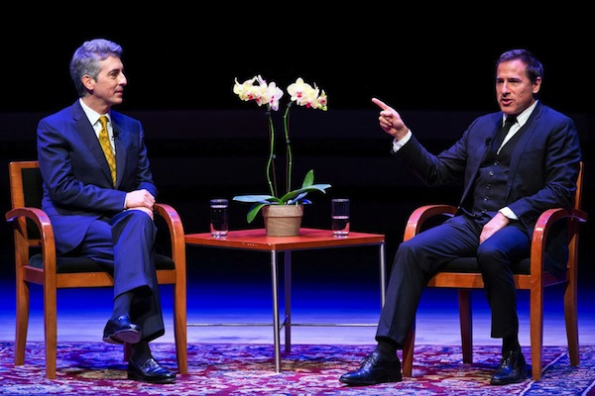
The smart banter between David O. Russell and Alexander Payne at last night’s Film Streams Feature VI event in Omaha gave a glimpse into why these two cinema masters have enjoyed a long friendship. They are both brilliant in their own way. Highly educated and well-read, yet deeply in touch with gut instincts. They both come from ethnic American backgrounds. The both had lengthy experiences abroad. They’re both steeped in classic cinema. As good as they are at creating images, the written word is everything for them. They both extract great performances from their actors.
They are both urbane men with dry wits. But where Payne seems a bit more guarded or stiff, at least in public settings like these, Russell seems somewhat looser. Where Payne is a very well grounded and considered person, Russell comes off as more idiosyncratic and certainly more neurotic, almost as a virile variant of the middle-aged Woody Allen.
Their nearly parallel careers give them a certain relationship by proximity since each emerged in the mid-1990s as new filmmakers to be watched and each has experienced similar fast ascents, followed by uneasy hiatuses, giving way to recent strong runs that have cemented their places in the top ranks of writer-directors. As they discussed in their conversation last night and as is readily evident in their work, each is a humanistic storyteller. What wasn’t discussed and what is also clearly seen in their work is that time and time again each returns to themes of people in conflict with society or their family or the group. Their protagonists are all at war with someone or something and on a search for meaning or redemption or revenge or getting-what’s-mine. Even with their careers on a major roll, they seem to think they’ve just figured out who they are as filmmakers and to suggest that the best is yet to come, though they also acknowledge that nothing is guaranteed in the fickle business of making films.
Of all the Film Streams Feature events (I’ve seen five of the six), this was the most spontaneous of these annual gatherings when Payne or sometimes Kurt Andersen engages a special film guest in conversation before a live audience at the Holland Performing Arts Center. Much of the spontaneity this time had to do with the fact that Payne, as he indicated in his opening remarks, did no preparation for the event. That’s because he and Russell go back 15 years or so and they do know each other and their work well enough to just be real and go with the flow up on stage. Part of it was just two old friends ccomparing notes. Payne asked probing questions about Russell’s motivations, inspirations, methodologies, and the like. Sometimes Russell returned the favor to ask Payne questions. Before Payne could even get to any of his questions though Russell, as he did several times about various things on his mind, went off on a riff about Omaha and Payne’s “secret tunnel to Omaha,” where he said Payne is “like a super cinema hero.” Russell described how his appearance in Omaha came to be. It seems that Russell was being badgered by the organizer of the Capri Film Festival in Italy to appear there. He’d been a guest at Capri before but he neither had the time nor inclination to go again, and so he thought Payne might be a good fill-in for him. Russell said he broached the option with Payne but Payne said he was no more interested in Capri than Russell. Then Payne switched everything around by asking Russell to be the guest of honor at Feature VI. One favor had been replaced by another. Russell said upon arriving here he observed all “the levels of plaids and pastels” and “kind-faced Midwestern people,” prompting him to tell Payne, “I felt like I was in one of your movies.” In a short but intense series of stops around the city Russell got to see the home of Omaha Steaks, which it turns out was a kick for him because he said he’s been ordering steaks from there for years for his father and now that Russell has discovered the company’s products extend well beyond steaks he’s going to ply his old man with seafood and desserts. “I bet he won’t see that coming,” he deadpanned. Then he went off on a weird but hilarious description of visitng the offices of husband-and-wife architects Michael and Laura Alley, the co-chairs for the event, and how at one point the Alleys and the Simons from Omaha Steaks were sitting, posed-like, in a glass booth that reminded him of sculptures in an “art installation.”
Russell also referred to Payne’s apartment at the Paxton Manor as “your very flat, very spacious prairie home.”
Last but not least he opined about his instant romance with the Jackson St. Books store in the Old Market, where he said he knew upon entering the place “I’m going to do some damage in there.” He said he picked up several things for friends and then he turned to Payne to say, “And I got you something. I’m going to save it for the end, because that’s showmanship.”
There was an extended discussion about, as Payne put it, “How do we search for ourselves through the films we make?” Russell, who earlier said, “I have a very childlike nature,” answered that he’s come to realize, “I’m a romantic.” He said amidst the every day anguish and horror of life being lived he must find meaning in the journey and discover passion for the pleasures of life, whether true love or fine wine or good food or engaging conversation or interesting people. “Existential despair is a privilege. I’ve learned that lesson.” He asserted his interest in making movies, not films, that touch people’s hearts. “I’ll carry that Frank Capra banner all the way.”
He referred to the one misstep in his filmography, I Heart Huckabees, which has actually become a cult classic, as variously “my mid-life crisis movie” and “the train wreck movie.” He said he made it at a time when he was too analytical in his approach to his art. “You can overthink something. That’s not a good thing. I just think I overthought it.” He said now that he’s in his 50s he’s in a better place then he had been for a while. “I realized more who I was at 17 than when I was 40.” He said at age 40 he was in a kind of “captivity.” Now that he’s rediscovered himself in his 50s, he said, “I wouldn’t trade it for anything – the wisdom.”
Payne described how he was already an admirer of Russell’s work in Flirting with Disaster but then was astonished by what Russell achieved in Three Kings, when Russell moved from the intimate family comedy-dramas of his first two films to the large scale, epic masculine action of an adventure movie set amidst desert warfare. Russell said, “There’s kind of a beauty to making a movie on location.” Payne inquired if Russell was intimidated taking on such a big, sprawling project, and Russell replied, “I think all good endeavors are frightening.”
Payne said he was blown away again when Russell made the leap from I Heart Huckabees to The Fighter. Payne said that at the time of The Fighter’s release he actually ran into Russell and told him, “Since when did you become a master filmmaker?” Payne spoke with admiration for the “very aggressive and sophisticated” way Russell uses hand-held cameras in-tight to create intimacy and immediacy with his characters and for the way he captures the visceral sense of movement and action in his films. Russell said it took time for him to arrive at how he wanted to use Steadicam and to achieve great depth of focus. He acknowledged that much of his maturation as a filmmaker is because he never stops learning or striving to be better. “It’s a great thing to learn your craft,” he said.
Russell described what he’s after in making his storytelling urgent for audiences: “I want you to be propelled and grabbed by the throat.”
He referred to going through a “ponderous period” of filmmaking when his shooting schedules were longer and his decision-making process was more protracted. After gaining more clarity he said, “I became very lean. Thirty-three days on The Fighter.” The same for Silver Linings Playbook and American Hustle. Payne expressed envy at how fast and effective Russell can work. Russell said he now has the mind set for his work as – “I approach it like a gun is at my head and that this is the last chance I have to get it right. We must feel grateful for the privilege of what we get to do.”
Russell also spoke candidly about the diffcult period he went through in that six-year hiatus between Huckabees and The Fighter. His personal life was full of challenges then and professionally he coulnd’t get a project off the ground. He sort of lost himself then and had to find himself again. His confidence, too. His ego took a hit as he went from the top of studios’ lists to mid-way down those same lists. “I was at my lowest time. I had been humbled. That can happen quickly in Hollywood. I don’t need to learn that lesson again.” He described how Mark Wahlberg, whom he helped make a star, returned the favor when he asked Russell to direct The Fighter after Darren Aronofsky left the project.
Payne observed how much Russell loves his characters and actors. He asked if Russell ever writes specificially for certain actors and Russell said he didn’t used to but that he increasingly does, especially as he’s come to work with a company of actors from film to film to film, acknowledging that Jennifer Lawrence, Amy Adams, Bradley Cooper, Mark Wahlberg and Christian Bale have become muses whose gifts he loves to explore and push to new levels. “I do feel a kinship and a connection to them.” He said the rich canvas of life these actors flesh out in his films is all around us in the people we encounter every day. “”Simply being in love with a character is almost enough reason to make a movie.” He said his own colorful Italian-Russian extended family of people who love each other and hate each other “is a gold mine I haven’t even begin to draw from” but that he clearly intends to mine.
Payne said, “Making a film is an extension of my life. Once we’re shooting our raw material is human behavior.” Truth in behavior and speech is what Payne and Russell go after and are very good at getting right.
Russell flipped it around and asked Payne, “What about you?” (meaning, does Payne write for certain actors) and Payne said, “Rarely, I write more literary characters,” adding though that he wrote with Jack Nicholson in mind for About Schmidt and George Clooney in mind for The Descendants.
In taking some questions audience members wrote out, Russell responded how he feels about remakes, saying, “I’m allergic to remakes.” As to whether there are any films he wished he had made, he promptly answered, “The Godfather,” adding, “The best pornography to me is to watch The Godfather and pretend that I made it.”
Nesr the end of the program Russell, clearly eager to unveil to us, the audience, and to Payne, his host and friend, the surprises he had in store, asked for stagehands to bring out a newly pressed album with music from American Hustle and a phonograph to play it on. “It’s a like the Letterman show now,” he cracked, as Payne undid the plastic sheathing around the album and placed the disc ona turntable and set the needle on the Duke Ellington and Electic Light Orchestra tracks, respectively. “Now it’s entertaining,” Russell observed. “Look how sexy it is,” he said, referring to the vinyl he and Payne help up at one point . Later, when the charactersitc scratches sounded, Russell said, “That’s psrt of the fun – that sound. That’s the fun of a record.”
Then Russell presented Payne with two books, one an early edition of the Sinclair Lewis satire, Babbit, and the other a Phelps County (Neb.) History in two volumes.
The evening wrapped by Payne asking Russell what we can expect next from him and the filmmaker mentioned the project Joy, a true story to star Jennifer Lawrence that is to get underway in late 2015 and a family story he’s developing as well. ” And for you Mr. Payne?” Russell asked. Payne confirmed what was recently reported in the media – that he is “an exploratory period for Downsizing, his big budget “science-fictiony” project with Matt Damon slated to be the lead, at least on a handshake deal, and with Alec Baldwin on board in a part as well. But as Payne cautioned, nothing is greenlit and there are dozens of more parts to cast and much more financing to secure. If it should come together, Payne would make Downsizing in late 2016, and the locations are yet to be finalized, too. You can bet that Payne will want to shoot at least part of it in Neb., but as he stated while he’s been ‘victorious so far” in getting the four films he wanted to make here made here “I may not be”in the future. Russell practically chided state legislators here for not offering tax credits to make it more attractive for Hollywood to make projects here . He said in no uncertain terms that film production “does create jobs for truck drivers and for carpenters and it does provide added business for restaurants and hotels.” It is a fight Payne has been waging for years in his home state.
Payne thanked Russell for being his guest and the gracious Russell offered, “It was a gift to me.”
Omaha’s film culture is richer for having Alexander Payne as a native son who cares about growing the cinema landscape in his hometown. His commitment to this cultivation and nuturing is perhaps best evidenced by the active hand he takes with the annual Feature fundraiser for Film Streams, the Omaha art cinema he supports. Because he can, each year he asks another world-class film figure to join him on stage as his special guest for a cinema conversation. In the past, it’s been Laura Dern, Debra Winger, Steven Soderbergh, Jane Fonda, and the principal cast of Nebraska. This year it’s his fellow auteur David O. Russell (Three Kings, The Fighter, Silver Linings Playbook, American Hustle). The Nov. 10 event at the Holland Performing Arts Center will add to the string of impressive film confabs he’s made happen. This is an especially appealing event because Payne and Russell, each of whom is a writer-directos, have enjoyed parallel careers as leaders of the New American Cinema and the Indiewood movement. Their respective bodies of work the last 15 years rank arguably as the best of any American filmmakers in that period. Given that they’re in their early 50s and given that both feel as though they’re only just now coming into their own as complete filmmakers, they could very well continue leading the vanguard of cinema in this country for another decade or two. My story for The Reader (http://www.thereader.com/) previewing the Film Streams event is largely drawn from an interview I did with Russell.

Photo from Shannon Dwyer
New American cinema auteurs, colleagues and friends David O. Russell and Alexander Payne to headline Feature VI
©by Leo Adam Biga
Now appearing in The Reader (http://www.thereader.com/)
Alexander Payne is in a position to ask any world class film figure to be his guest of honor at the Film Streams Feature event, the art cinema’s annual big fund raiser. Laura Dern, Debra Winger, Steven Soderbergh, Jane Fonda and the principal cast of Nebraska have all come at his invitation to appear on stage at the Holland Performing Arts Center.
For the Monday, Nov. 10 Feature VI Payne will engage writer-director David O. Russell in conversation. As fellow auteur leaders in the vanguard of New American Cinema they make a matched set. Since emerging in the mid-1990s their careers have followed similar paths. Each is on a roll with their last several pics, all critically acclaimed and awards-laden.
Both infuse an urgent humanity in their work that revolves around the various social units people aggregate in. Each delights in distilling the emotionally-charged, seriocomic conflicts that play out among groups – where the people driving you crazy are the same people you love.
Payne and Russell were right in the mix of edgy American indie filmmakers to arrive in the 1990s. Kathryn Bigelow, Steven Soderbergh, Spike Lee and Quentin Tarantino led the way. Then a whole new wave followed in their wake, including Russell, Payne, Wes Anderson, Paul Thomas Anderson, Spike Jonze and Darren Aronofsky. Russell and Payne announced themselves as talents to be watched in close order. Russell broke first with the incest comedy Spanking the Monkey in 1994. In 1996 Russell caused a stir with Flirting with Disaster and Payne with his abortion comedy Citizen Ruth. In ’99, both garnered attention: Russell with Three Kings and Payne with Election.
The 2000s have seen each evolve into bankable independents whose work spans audiences and resists trends. Russell’s recent run of The Fighter, Silver Linings Playbook and American Hustle parallels Payne’s own run of About Schmidt, Sideways, The Descendants and Nebraska.
A repertory series of Russell works continues at Film Streams through November.
Film Streams executive director Rachel Jacobson says the Feature event gives attendees “the amazing opportunity to listen in on a conversation between two of the world’s most celebrated contemporary directors.” She adds, “It’s interesting how David and Alexander’s careers have paralleled one another. Both started out with independent films on ridiculously taboo subjects. They both premiered their first features at the Sundance Film Festival during the renaissance of American independent film.” She says Russell’s recent films “show an artist at the peak of his form.” A major difference in approach, she notes, is that unlike Payne Russell works with a consistent ensemble of actors. “I love how that consistency creates a world unto itself.”

In the same way Payne feels he’s just now coming into his own as a filmmaker, Russell does, too. Both had long periods in between pics: six years passed from Payne’s Sideways to Descendants and from Russell’s I Heart Huckabees to The Fighter. Each went through a divorce in that period. But where Payne was busy producing and writing, Russell got out of his head and in touch with his heart.
“I’m grateful things have become clearer to me and in some ways I feel it’s springtime for me and that’s a very beautiful thing because you know that could easily not be the case,” Russell says. “I think it’s hard in any endeavor, especially in the art of storytelling, to stay fresh. You always have to find new wells of inspiration and I understand many of the greats who have not. We can look back and say, Well, they did their great works and then they kind of couldn’t find it again. So I feel like I’ve found renewed clarity and heart for certain kinds of stories.
“It’s still very hard to do them well. I still have to try every moment like it’s my last opportunity on Earth. The only way it can come out as well as I hope it will is to act like it could very easily not come out that way every step of the way, which makes for a lot work.”
Like the best of their New Wave contemporaries Russell and Payne didn’t just make a splash and then disappear. Rather, they reestablish themselves as relevant storytellers with something to say again and again. The way they’ve asserted their strong, singular visions and voices is reminiscent of what Hal Ashby, Robert Altman, Francis Ford Coppola and Martin Scorsese did in the 1970s and 1980s.
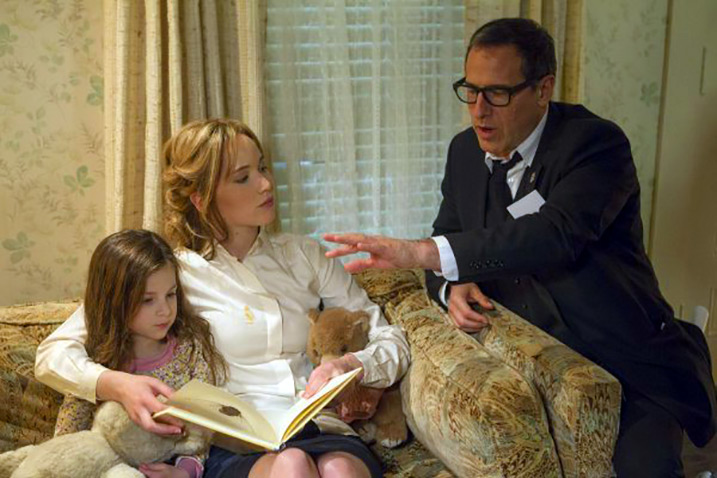
Russell and Payne have mostly weathered the volatile film industry that eventually envelopes everyone. Russell’s one commercial flop, Huckabees, enjoys a cult following. The same for Payne’s Citizen Ruth and Election. Nebraska’s sure to find a growing audience as more people discover it via the home and digital markets.
All of which is to say these two filmmakers at the top of their game should have much to talk about. They’re each steeled in classic cinema from the 1970s and before. Given they are from the same generation of writer-directors and leaders of Indiewood, it’s no surprise they’ve found themselves in the same circles.
Russell says, “We’ve done Q-and-As and we’ve had a lot of fun with them,” including a CineFamily session available on Vimeo.
The two once chummed around. The new millennium had just dawned and they were identified as rising cinema stars and it only made sense they would fall in with each other.
“We started being on each other’s radars socially and professionally in 1999,” Payne says, “when he had Three Kings and I had Election. 1999 was like a debutante’s ball year of independent directors. Wes Anderson’s Rushmore had come out the end of ’98. I had Election, David had Three Kings. Kimberly Peirce had Boys Don’t Cry. It was a year when this younger crop of directors were having some degree of mainstream success. And I adored Three Kings. Wow. if he could make a jump from Flirting with Disaster, a madcap family comedy, to a very beautifully directed film like Three Kings that’s when I knew he had a depth of talent.
“I’m always in favor of someone who wants to do comic human films. His films are always intelligent, entertaining – a wonderful combination of humanity and comic showmanship. We became friends and I’ve always supported his work. I admire him and I’m just so proud and thrilled to be hosting him at Film Streams.”
And Russell’s returned the favor.
“Yes, and it’s been really been fun, I think we’ve both enjoyed that,” Russell says. “When Alexander had The Descendants come out I was really happy to sit by his side at a couple events, chat with him, have a glass of wine, cheer him on and tell him how much I love the picture. And he was very kind to me likewise about the last three pictures.”

But it was when the two men first came to the fore, they were particularly close.
“We sort of hung out a bit together in that time around 2000,” Russell confirms. “I remember the Museum of Modern Art began this series for filmmakers of our generation and I felt very squeamish about doing it. I said I’ll only do it if you name the series Works in Progress because I consider myself a work in progress and they said OK and they started this series where I talked about my films with my actors and stuff.”
That inaugural 2002 event was called Work in Progress: An Evening with David O. Russell.
“Alexander came, Wes Anderson came, Kimberly Peirce came, Sofia Coppola came. A lot of actors came. I’m probably forgetting some other filmmakers who were there. There we were all together and it was a great feeling of camaraderie.
“And then the next years I ended up helping tap them (other filmmakers) to do it, so the next year Alexander Payne did it (that 2003 event was called A Work in Progress; The Films of Alexander Payne). And then Sofia did it and it kind of went from there.”
Russell, who as a young man waited tables at MOMA events, grew up in Larchmont, New York in a Russian-Italian American household. His father worked for publishing giant Simon and Schuster. His mother was a homemaker and political activist.
Much like Payne he was steeped in movies and literature.
“I grew up watching movies. I would go to my local movie theater in the next town and I’d watch a movie with movie stars and so I am interested in movies and movie stars that kind of grab me and don’t let me go and leave me indelibly moved. It’s like a wonderful record I can go back and play again in part or in whole.”
Asked whose work principally influenced him then and he rattles off the names Frank Capra, Coppola and Scorsese, adding with a laugh, “There, I named every Italian-American.”
Like Payne he initially went to college not to study film but to broaden his mind, At Amherst College in Mass, he studied English under novelist Robert Stone and religion under professor Robert Thurman, father of actress Uma Thurman.
“I always wanted to be a writer – a novelist or a short fiction writer – since I was about 10 years old because my dad worked at Simon and Schuster. I actually kept doing it into my 20s, you know, and I found it very hard. Meanwhile, I would memorize sections of movies as sort of a way of learning narrative and telling stories.”
He committed to memory sections of It’s a Wonderful Life and Chinatown, for example.
Again, like Payne, he went abroad as a young man, in his case to teach English in Nicaragua. Once back in the States he moved to Boston, where he did social justice work.
“I worked in low income areas, working for tenants rights, also teaching English as a second language.”

Unlike Payne, Russell never went to film school. His film immersion came haunting video stores and revival houses and learning the rudiments of the medium as a production assistant on the PBS television series Smithsonian World in Washington, D.C. Ever more feeling the pull of film, he made a documentary short. Boston to Panama (1985), that examined the lives of immigrant workers.
“Then I started to crossover thinking maybe I wanted to become a (narrative) filmmaker, which seemed like kind of a nutty idea because I’d never thought of that before as much as I loved movies.”
His narrative debut, the comedy short Bingo Inferno (1987) showed at the Sundance Film Festival. His next, the short Hairway to the Stars (1991), played Sundance and festivals in Seattle and London.
His feature debut, Spanking the Monkey, was a micro-budget production financed with private funding and grants. The dark humored Oedipal story concerns a young man marooned at home with his convalescing mother and the awkward longings they express. So, from the start, the family dynamic, dysfunctional and all, took precedence.
“I very much find community or family to be sort of an engine, a rocket engine, that leads to all avenues of humanity. All I know is that I think it works and it gets really intense and personal and complicated and funny and heartbreaking very quickly, so I love all of that. You know, I also love romance as I’ve discovered in my last three films.”
Family though is where it’s at for him. It may be a mother and son breaking taboos (Monkey), an extended family letting it all hang out (Flirting), U.S, Army soldiers searching for a fortune (Three Kings), a boxing clan’s ups and downs (The Fighter), a mentally ill son reconnecting with his father (Silver Linings) or a motley crew pulling a sting operation (American Hustle).
“In terms of my interests I know that I’m interested in romance and I know it includes a great intensity of predicaments that carries from one moment of the film to the next, meaning that it has an intensity to it and a propulsiveness to it that feels enveloping. And you have to maybe go back and watch it again or parts of it again to regather, but there’s never a moment where we are intentionally crafting the story that way.
“I mean, it’s nice to know what kind of movies you want to make and what kind of characters you want to render and what kind of actors you want to work with. And then I have a great love of music, a great love of camera movement that’s become a particular way of doing things that I’m still trying to learn how to make better. But at least it’s very clear when you know what path your on.”

SILVER LININGS PLAYBOOK, from left: director David O. Russell, Bradley Cooper, on set, 2012. ph: JoJo Whilden/©Weinstein Company
Payne admires that Russell has “kept his own voice throughout them all,” adding, “Some of the same elements you see in Flirting with Disaster you see also in The Fighter, Silver Linings and American Hustle. His sense of dialogue and how he gets the camera in very close so that you’re standing with those characters or talking with them somehow. None of that has changed.”
Payne also likes how Russell balances the “larger circumstances” his characters find themselves in yet remains focused on the “eccentric details” of those situations and the personalities involved.
Russell says his own family’s strong personalities and rich heritage form a great template for him to overlay on the stories he tells.
“There’s a whole human opera of mine that extends back to Italy and Russia, to the Bronx and Brooklyn. There’s this tapestry of people. It’s a goldmine to me of rhythm, of music, of life, of romance, of food, of terrible things happening, of wonderful things happening, of traditions being passed, traditions being broken. All the things I care very deeply about in telling stories and as a person.
“I think I learned a great deal from my family before I even realized it. It’s sort of a great gift that you don’t realize, that I didn’t realize I had until much later in my career. Although it was obvious right at the beginning because I wrote that claustrophobic kind of quasi-horror $80,000 dollar trapped-in-the-house-with-your-mother movie (Monkey), which is almost like a horror movie, but it’s also funny, and that was all based on personal experiences I embroidered in great detail. There was a summer where my mother had trouble with her health. She had a car crash, And so that gave birth to that story.”

Flirting is another film where his real life resonated with his invention.
“There were moments when I saw my family the way we see the family in it, going through those chapters.”
He says Three Kings was “a departure” from the biological family thread and instead subverts the band of brothers conceit. He says Huckabees was “an attempt to create a parallel society little family of people but I don’t think my focus was where it ought to be in there,” adding, “Yet I never cease to be surprised by the young people, including Jennifer Lawrence (Silver Linings, Hustle)), who name that among their favorites of mine, which is baffling to me.
“And then the last three (films) are very much family-centered.”
The most personal of these to him is Silver Linings. Adapted from a novel, Russell emotionally connected with the characters because like the protagonist his own son Matt has bipolar disorder. Matt, who’s also had learning issues, has attended the Devereux Glenholme School in Conn., which serves young adults with special needs. Russell has been “very involved” at the school,” serving on a board. “I’m very invested in helping that school, plus the next experience for those kids who need to find pathways into work or higher education.”
Another educational institution he’s involved with is Ghetto Film School, a New York City public high school whose curriculum is cinema-based.
“It’s a very strong school in the Bronx. It became a crown jewel of Mayor Mike Bloomberg’s public school system in New York, It’s exciting that people are learning how to tell narrative and to tell stories. I always like to go talk to the students and teachers about what they’re doing. I’ve been on the board for 12 years. I’ve helped bring a lot of filmmakers and actors to go talk to them: Spike Jonze, Catherine Hardwick, Amy Adams. We have to get Alexander to go see them.”
Russell says 20th Century Fox co-COO James Murdoch “was so smitten by the project” he helped open an L.A. branch this past summer. Russell was there for its launch.

The filmmaker would be happy if a future script he wants to direct comes from a graduate. The same would be true of Alexander Payne. But the fact is each director usually writes his own scripts. Payne often says writing is the most onerous part of his creative process. Russell agrees but like Payne he sees it as a necessary chore to produce raw material for his films.
“I’m just coming out of a very intense writing period where I’ve been writing 15 hours a day for the last six months. I literally become a shut in. I went to some event for my younger son’s school and I just really felt like a-fish-out-of-water. I’d almost forgotten how to be out and about because your world becomes very narrow. It’s a very strange way to live because you’re basically living 15 hours a day in this narrative. You’re living in a movie all day, and that’s the only way I can do it to get it done. I have to make myself sit there all that time.
“So like Alexander it’s also my least favorite part of the process but you have to do it. You know you can’t get the iron ore or the diamonds out of the ground unless you do the back breaking work of digging into the ground, which is really difficult.”
Both filmmakers are weighing what their next projects will be. While Payne is reportedly trying to revive Downsizing, the project he abandoned after the financial crisis hit in 2008, Russell says, “There’s two stories we may be going into preproduction on soon. Those are the two things I’ve been working feverishly on for the last eight nine months. One is a large original story I don’t want to get into too much detail about but it involves family.”
The other, titled Joy, is based on the true story of Joy Mangano. The storyline reads something like Erin Brockovich: a struggling single mother of three surprises everyone when she finds success as an inventor and entrepreneur. Jennifer Lawrence is tabbed to star.
Russell says he’s eager for his visit here. “I can’t wait to come to Omaha. I’ve been reading about all the famous cinema people who are from Nebraska.” He hopes to find sites commemorating Marlon Brando and Fred Astaire, for example, but outside a street sign named for the former and a ballroom named for the latter, he’ll be disappointed.
He’ll be searching, too, for a local fix to feed his passion for video stores, which he feels should be preserved as cultural “hubs and meccas.” He helped create a nonprofit foundation for Santa Monica’s iconic Vidiots. “I’m trying to get the studios – and I’ve reached out to Alexander as well – to turn it into a place where they can feature the libraries of each studio and people can learn about cinema.”
The Feature event with Russell and Payne is at 7 p.m. For tickets and rep series details, visit http://www.filmstreams.org.

My Alexander Payne book has received a lovely new endorsement. It’s from James Marshall Crotty, an Omaha native who’s made quite a name for himself as a journalist and author. He’s a filmmaker as well. A new edition of my book is forthcoming. It will feature all my “Nebraska” coverage, plus a new cover and new inside graphics.
The new edition is soon to be available on this blog, at Amazon and BarnesandNoble.com, for Kindle and in select bookstores.
About “Alexander Payne: His Journey in Film” Crotty says:
“Alex Payne is one of the few remaining auteurs in the Conglomerate Hollywood era. Leo Biga, a Nebraska native like his subject, deftly looks at how the ‘home place’ of Nebraska has shaped and nurtured Payne’s singular artistic vision.”
JAMES MARSHALL CROTTY
Columnist (Forbes, Huffington Post), Director/Producer (Crotty’s Kids)
His endorsement joins those from Kurt Andersen, Dick Cavett, Leonard Maltin, Joan Micklin Silver, and Ron Hull.


 Leo Adam Biga's My Inside Stories