Archive
Verne Holoubek’s Road Less Traveled: How Harley Davidson, Printed T-Shirts, and the Counter-Culture Movement Helped this Former Nebraska Farm Boy Make Pop Culture History

Image via Wikipedia
I likely stumbled upon Verne Holoubek’s story the way I do a lot of figures I end up profiling — by coming across an article or item mentioning them or by someone telling me about them. Sometimes I’m given a fairly full portrait of the person, other times just a sketch. In the case of Holoubek, it was another profile subject of mine, folklorist and author Roger Welsch, who mentioned his friend Holoubek in the course of an interview as someone I should look up. Long story short, I heeded Welsch’s advice and arranged to meet Holoubek, and I’m glad I did. He has a helluva story. My take on his story originally appeared in The Reader (www.thereader,com).
Verne Holoubek’s Road Less Traveled: How Harley Davidson, Printed T-Shirts, and the Counter-Culture Movement Helped this Former Nebraska Farm Boy Make Pop Culture History
©by Leo Adam Biga
When Verne Holoubek left his family’s homestead farm near Clarkson, Neb. in 1961 for the state university in Lincoln, he fully intended on getting an ag degree, then coming home to help his dad run the place. It’s what the eldest son of a traditional Czech farming family was expected to do. But by year two a restless Holoubek embarked on an unimagined path as a hip entrepeneur in the printed apparel field.
He was in his 20s when the dreamer in him — he expressed a talent for drawing in high school — merged with the pragmatist in him. It all began with magic markers and army surplus jackets. Holoubek applied basic designs to white parkas he sold at home Husker football games. Then came T-shirts, what became the core of the company he formed, Holoubek Inc. Fraternities snatched them up. His operation evolved from the Alpha Gamma Rho fraternity house basement to the regional festival-fair circuit to a downtown Lincoln print shop to a full-scale production plant in Pewaukee, Wis., a Milwaukee bedroom community. Holoubek Inc., became an industry legend and made him a fortune. Many of his T-shirts are collectibles.
His journey from farmland to boardroom took some unusual routes. He did time as a “Forty Miler,” a reference to his early days as a carny hand-painting T-shirts at carnivals within a 40-mile radius of home. The allure of the road beckoned him to travel ever farther out. He got his ag degree alright, but opted to make a go of this T-shirt thing with his wife, Terri. The company survived many early struggles.
By the late ‘60s-early ‘70s, this once summer sideline turned serious business venture. A big break came when a then-fledgling discount store called Target gave him end-cap display space. His T-shirts sold-out. At the height of the T-shirt craze Holoubek designs were in every shop in every mall in every town in America. He expanded, going international. Along the way he acquired a client, Harley Davidson, whose open road nonconformity and anti-authoritarian spirit fit his own.
“I was a rebel from the beginning,” he said. “I’ve never liked the status quo. I’m not real big on authority. I mean, I always kind of go around it if I can.”
On a recent Nebraska visit Holoubek stood in a dirt road that intersects the small family farm he grew up on to consider how he’s come so far from so little. He used to ride a pony to the wood-frame, one-room school house just up the road. As he looked past the undulating corn and soybean fields to the far rolling hills poet Ted Kooser likes to call the “Bohemian Alps,” he grew quiet, only the sound of wind and meadowlark interrupting the stillness. Then he spoke.
“I guess I was always looking at these horizons wondering what’s over there. When you stood atop a haystack over here,” he said, indicating a field, “you saw all the lights in David City across the river. That’s about 46 miles. It’s just that curiosity. Intense curiosity. The word ‘vision’ has been used in a lot of interviews I’ve done. Where I get that, I don’t know.”
Upon further reflection, he gave his father props. “My dad was really forward thinking,” he said, “and maybe that’s where I picked up some of that vision. He always used the latest stuff” on the farm. “He was big into conservation” before it was popular. “We terraced all these fields. He built the first steel shed in the area.” It’s still standing. “He and Mom hired an architect to build their house. It has innovations that still seem modern.”
Holoubek’s sense for this place and for the land is profound. He’s never really left it or it him. “That’s really where it starts. Growing up on a farm, learning how to work, learning how to have fun — freedom, independence. Every day you made you own day,” he said. He proudly showed two visitors from the city the tiny Catholic church, long abandoned, and the adjoining cemetery where his family attended services and where his grandparents are buried, respectively. He pointed out, too, where he ran a tractor over the only rock in a field, the ditch he slid his car into and the gully he and his pals partied in.
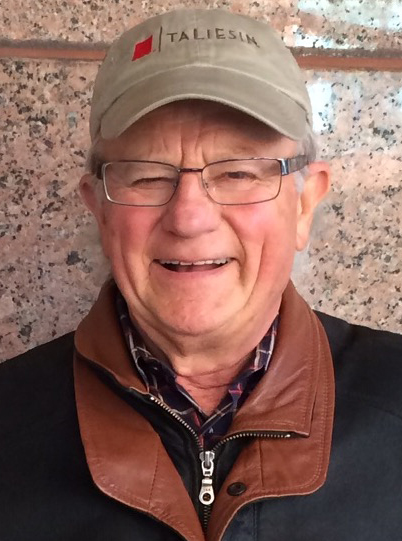
Verne Holoubek
His parents, now in their late 80s, still live on the land. When they’re gone, he said, “we don’t know what’s going to happen to this farm. There’s nobody left in the family to run it.” He admires how his parents hung on there. How his dad diversified with an automotive service business. Verne’s followed in his footsteps, always keeping hands in different pots. And just as the old man bucked convention agitating for agricultural reforms as a National Farmers Organization activist, Verne’s gone his own way the whole ride.
Known as a pioneer in printed apparel, Holoubek found innovative applications of words and images by pen-and-ink, air-brush and silk-screen, iron-on heat-transfer, which he’s an originator of, and multi-color press. He fed the counter culture movement’s creation of a new casual wear market for shirts emblazoned with ads, artwork, pop icon figures, sport team logos, protests, phrases, lyrics, poems, jokes, names or just about anything else. Few anticipated the demand. Poised to capitalize on it, he helped make the heretofore naked white T-shirt a colorful medium for commercial exploitation and personal self-expression. A walking billboard/canvas equated with cool.
“People wanted to identify with something or identify themselves,” he said. “I think rock ‘n’ roll and the Vietnam War gave it a little help because it was a protest…a statement. You could say things, you could be comical, you could be serious, you could be political, you could be religious, you know, whatever you wanted to put on your shirt.”
Wherever he looked, he saw opportunity. He plugged his company into a then- burgeoning lakefront Milwaukee music festival called Summer Fest, where upwards of a million people come see name acts over ten days. In charge of merchandising, Holoubek-printed T-shirts sold big and fast. He also tapped the rock-pop-country music concert scene, printing T-shirts for KISS and Charlie Daniels, among others. And right from the start he hopped on the Hollywood merchandising bandwagon that began with Star Wars and Superman.
Besides the vision to see these trends, Holoubek was in the very age bracket that gave them life. He was an unreformed hippie. He looked the part, too.
“I was young and looked young. Full beard, long hair, cowboy boots, outrageous clothes. Nobody thought people that young should own businesses,” he said. “The concept of entrepreneur wasn’t discovered yet. Nobody knew how to pronounce it, spell it. I was always the youngest one in meetings with lawyers and bankers and marketing guys. I was kind of an oddity.”
By the time the company took off in the early ‘70s, he was “the old guy” at 31. The average age of his 150 employees was 23. “A lot of college kids,” he said. “That’s when college kids used to work in factories for the summer. We had great parties…great picnics. Charlie Daniels played at one of our company picnics.”
Emboldened by youth, “we came in and just blew away” competitors-vendors, he said. “We were brash and kind of cocky, but we took care of our customers.” At trade shows the team “put on the dog. It was show time. Maybe that came from the carnival,” he said, where setting up your booth is “flashing your joint. A joint was a store then. It’s all different now.”
Holoubek Inc. didn’t have to look hard for new artists-designers. “We were a hot name in town, so people wanted to work there,” he said. “The talent came.”
A big break came when he cultivated the Harley account. He’d printed Harley decals and stickers but not apparel, where the real money lay. With Harley’s rebirth in the mid-’80s, he pushed the Skull and Cross Bones rebel image to new heights as the brand’s exclusive apparel licensee. The gig made him a multi-millionaire. His Harley sales went from $350,000 to $40 million. Along the way, he got hooked on the cycle subculture he still embraces today at 63.
The Harley mystique, he said, “does capture you. First, it starts with love of motorcycling. If you ride, there’s nothing like it. It is just a thrill and you want to ride all the time. You can’t get enough of it.” Then there’s the image, as much a product of apparel-accessory lines and marketing pitches as the bikes themselves.
“Harley was brilliant enough to offer this clothing line,” Holoubek said. “It’s very expensive stuff. Their leather jackets cost $200 more than any other jacket, but people want the logo. The T-shirts sort of augment that. You wear your Harley stuff when you’re not riding. For sure, you wear it when you are riding. People want that identity. The real phenomenon is when people travel to rallies. They buy a T-shirt wherever they go. Pretty soon they’ve got a closet with a couple hundred shirts. It just kind of caught fire and it became THE thing.”
His own immersion in all things Harley happened almost by osmosis. “It was pretty easy to get into the Harley mystique because I was already around them,” he said. Before his indoctrination into that world he was “into bikes” as far back as college. “I actually rode to my graduation from college on my bike,” he said. “So, I’ve always had a bike,” but he admits, “I didn’t ride Harleys and I was not a biker. I was a college biker. My first bike was a Honda.”
He makes a point to differentiate between “real bikers” and motorcycle enthusiasts. He feels the real bikers comprise “about 1 percent” of the riding population. “I think bikers come in degrees,” he said, “I’m in the 99 percent group. Its hard to peg, but there is some biker in everybody.”
Ever the rebel, he once “took up motocross. Not racing, but riding for fun,” he said. “After work a bunch of guys would sneak into the Evinrude Proving grounds. The company tested snowmobiles there in the winter. We trespassed all summer.”
He’s an active member of a Harley biker club called the Ugly M/C. He wears a belt buckle with the name-insignia stamped on it. The Uglies possess a rich lore. “Uglies were able to go to Hells Angels parties and they came to ours,” he said of the respect they carried in hardcore biker circles. The Uglies also did security details for concerts-festivals, but enforced things less violently than their Angels brethren.
His Uglies II chapter includes celebrity brothers Peter Fonda and Larry Hagman. It’s for riders. No dilettantes allowed in this Wild Angels–Easy Rider crowd, even if members are senior, tax-sheltered rebels-without-a-cause now.
“Yeah, it’s a riding club. We ride hard. They’re just great guys and a lot of fun,” said Holoubek, who prints the club’s various shirts.
Aficionados will tell you Holoubek printed the best of the Harley collection. “They’re classics,” Fonda said. “There’s some great art there,” Hagman said.
As proud as Holoubek is that his work stands the test of time, he’s really jacked by his Uglyhood. “You have to ask” to join, he said. He did, and a Harley dealer sponsored him. Verne paid his dues for a year. “Here the rubber meets the road,” he said of this trial period. “You cook, clean, wash bikes, and do other duties as assigned. No rough initiation. It’s all in good fun. Ugly members are for life and we are careful to pick guys that will fit in for the long term. More do not make it in than do. One ‘no’ vote keeps you out of the club. Sometimes it takes three votes before you make it.” He won’t say how many it took him, but “they made me Ugly.”

Fellow Ugly Peter Fonda, now a close friend, met Holoubek when he rode out to Milwaukee for Harley’s 90th anniversary. He said they hit it right off despite their “very different backgrounds.” Then again, he said, they share a connection to Nebraska and its virtues. “He’s worked very hard to get where he is in life and he deserves every penny of it in my mind. The first thing I noticed is he has a very genuine heart. He’s a very generous person,” Fonda said. “When my wife had back surgery and it got botched, all my friends were concerned about me because I was really down. Verne flew out, for no other reason than to see me — to see I was alright and taking care of myself. Now that’s a true friend.”
Holoubek’s Wisconsin home is a kind of base camp for Uglies attending Sturgis rallies and Harley events. His “second home,” a beach front property in Akumal, Mexico, is always open to friends. “It’s beautiful down there,” Fonda said. “He likes to share his good fortune with friends. I think it only means something to him when he’s able to share it.” Fonda returns the favor by having Holoubek and company to his Montana ranch. Verne stays in Brigit’s room.
Nebraska author Roger Welsch tells an anecdote about how he and Holoubek met in a neo-nouvelle rich way. “I get a call one day from Akumal, Mexico on the Yucatan (Peninsula),” Welsch said. “The voice on the other end” is Holoubek’s. He wants to talk to Welsch about a book he has in mind. Welsch tells him, “‘Well, it’s really stupid to be talking about writing a book on the telephone. Shouldn’t we be sitting on a nice wide beach sucking on tequilas?’” To Welsch’s surprise, Verne says, “‘Good idea. There’ll be a ticket waiting for you…’” And there was. “It’s guys like this who know how to spend their money right you want to have as friends,” Welsch said. “He’s just a super guy. Easy going. A sweetheart.”
Fonda confirms Holoubek knows how to relax. It’s easier now that he’s retired and not wired to his business. “We enjoy doing the same things and we enjoy doing those things together,” said Fonda. Similarly, Larry Hagman and his wife enjoy travel with the Holoubeks, including a recent Costa Rica trip the couples made.
Terri Holoubek often joins Verne on rides. He describes his wife, an Omaha native, as “an equal partner in my life” and “in the business. She was there from nearly the beginning and we have worked together on every aspect of the venture. She did take the time to raise four great kids while keeping me in food and clothes and lots of advice on major decisions. She’s very intuitive.”
They’ve made some epic rides together. “We did 3,600 miles on the Glacier National Park ride — the Ride to the Sun. On the way back we rendezvoused at Peter’s (Fonda’s) ranch. From there we took off for the ride to Sturgis. On the ride into Sturgis from Devil’s Tower we road two-abreast at 80-miles an hour in formation, not the kind of thing you normally do. That was a great ride.”
He said the Sturgis experience, “which has been a regular stop for me over the last 20 years, is the REAL DEAL for bikers. Originally a race and hill climb, bikers camped in the city park in town. Over the years it has grown into the mainstream much like Harley Davidson has became an acceptable” brand. “The biggest change is that the riding public became more middle class just in time for the boomers to take part. It’s a lot of fun.”
The couple have ridden to the Four Corners and Daytona Beach They do charity events, including the famous Love Ride in Glendale, Calif. They would normally be up in Sturgis this week for the big rally. But a double-vision problem has idled Verne’s riding for now. That doesn’t stop them from having a good time. Between scuba diving at their ocean-front get-away in Akumal, touring old Europe, cruising in their classic ‘56 Packard or making Lake Michigan waves in their speed boat, this couple has fun. Earlier this year the couple celebrated their 40th wedding anniversary in Paris and Amsterdam.
Over the years Holoubek sold off most parts of the business, keeping only the prized Harley licensee segment. In 2004 he sold it too — to clothing manufacturer giant VF. Some hard feelings soured the Holoubek-Harley romance, but he doesn’t talk about them except to say, “It’s a big company now. It ain’t like it used to be when the family ran everything.” One Harley legend he remains close to is chief designer Willie G. Davidson, a grandson of the founder.
Holoubek tried retiring “once before.” He put “a management team in place and it just didn’t work out,” he said. “Either I didn’t run the team right or I didn’t have the right guidelines or I didn’t know how to be a chairman of the board and let somebody else run your company. I take the business very, very personally. I think about it 24 hours a day.” When sales went flat and good people left, he “came back to work.” He dealt with irate customers and vendors who felt his absence. That first day back he and Terri vowed, “‘Next time, we sell.’” That’s what they did.
The sale and retirement leave ample money and time. He could live anywhere, but still resides in Wisconsin and keeps close ties to Nebraska. While he never came back home to live again once he reinvented himself in college, he’s remained close to his family, most of whom still live in state. He keeps busy with vintage automobile and tractor collections, amateur photography and 400 acres of land he and Terri farm at their Wisconsin retreat. They also run a charitable foundation.
Fonda worries that without the action of a business to run, Holoubek might have problems. “I remind him, ‘Don’t retire, because that’s when people die,’” Fonda said. Holoubek says Fonda needn’t worry. First, he stays busy. “Life in retirement is very full,” he said. Second, he’s having too much fun. “I don’t believe you have to work your whole life,” he said. “I’ve watched people work to the grave in their business. There’s so many other things to do in the world I think I can do than just run that business.”
Passion drives Holoubek. It’s what gave him “a passport” and “a way out” of the farm in the first place. Finding “that avenue where you can create your own” destiny, he said, is a gift. “You’ve got to want to do something from the heart, and I feel very fortunate I’ve been able to do that.”
Related Articles
- Out Of Print: Books on shirts. Shirts on a mission. (couturecult.com)
- Ugmonk (coolhunting.com)
- Famous Men and Their Motorcyles (artofmanliness.com)
- Clothing company grew up in a barn (thestar.com)
- In pictures: custom Harley-Davidsons (telegraph.co.uk)
Dream catcher Lew Hunter: Screenwriting guru of the Great Plains

Image via Wikipedia
For years I was aware of Lew Hunter but it was only a couple years ago I first met him, and he turned out to be every bit as interesting as I had heard and read about. Lew is the kind of personality who overturns some common misperceptions about Nebraskans. Similarly, his long career in network television, his standing as a How-to script guru professor and author, and his pricey screenwriting colony in remote Superior, Neb. that draws aspirants from near and far all defy certain expectations about the people who populate this state and what they do.
Regarding that colony, I spent some time there one summer and the following story is the result. The piece originally appeared in The Reader (www.thereader.com).
Dream catcher Lew Hunter
Screenwriting guru of the Great Plains
©by Leo Adam Biga
Originally appeared in a 2008 edition of The Reader (www.thereader.com)
EDITOR’S NOTE: Writer Leo Adam Biga spent four days and three nights covering Lew Hunter’s most recent Superior Screenwriting Colony, which wrapped June 27.
Twice a year a fractured fairy tale unfolds in Nebraska’s Republican River Valley. Superior, a prosaic Nuckolls County border town of 2,055 in the state’s most far southern reaches, draws dreamers from near and far. They come, some half way across America, some across the globe, to learn at the feet of a professor whose laidback Socratic method is Aristotle meets Jimmy Buffett.
The wise man these acolytes seek out in this Margaritaville-on-the-Great Plains is screenwriting guru Lew Hunter, a favorite son of Superior, born and raised in nearby Guide Rock. He moved to Superior as a boy.
His warm, folksy manner belies his incisive mind and cosmo experience. In a Will Rogersesque way he’s both an innocent and a sophisticate, his humor part homespun cornpone and part sly wink. Yes, he’s a product of these agricultural backroads but he’s operated in the garish fast lane of L.A. as a network television executive and producer and as a screenwriter.
Gregarious and without an ounce of self-consciousness, Hunter bares all in front of guests — his surgically repaired knees, bulging midriff, failed first marriage, his foibles, successes, philosophies, his name-dropping anecdotes and fondness for quoting famous writers. He openly lavishes affection on his two dogs. He casually tells total strangers he and wife Pamela both suffer from ADHD.
“Oh, by the way, we’re first cousins,” he adds.
Too much information perhaps but the revelation and the relationship make sense upon meeting his earthy, instinctual, effusive wife. They’re soulmates.
“It’s wonderful because we know each other’s shit,” he said. “We figure out ways in which to handle it.”
Since 2001 the couple’s hosted a pair of two-week screenwriting colonies — one in June, another in September — in Superior, some of whose Victorian residences bear National Register of Historic Places merit. The Hunters, whose roots run deep there, own two turreted 19th century showplaces. They live in a two-story mansion, the former Beale House, they generously open to visitors.
Nearby is the former Day House, a three-story, 5,500 square foot grand dame. Two eccentric old maid sisters occupied it for decades. Their spirits may imbue it today. Pamela assures guests an Australian psychic’s reading, via phone, found a stream of energy flowing underneath. Pamela ascribes it to the Ogalalla Aquifer. Whatever the source, she calls it “a happy house” conducive to “creative people.”
The Colony House, as it’s referred to today, serves as home base for the workshop and as main quarters for registrants, who pay upwards of $2,500 to glean script basics from Hunter. His book, Screenwriting 434, now in its 12th printing, is a staple for aspiring scenarists. The title comes from the UCLA class he’s taught 29 years. The book’s a condensed version of the class, just as the colony’s a power form of it.
UCLA, where he’s been voted most popular teacher multiple times, has played a huge role in his life. He earned a second master’s degree there in 1959. His classmates included future cinema god Francis Ford Coppola. His appreciation of film was enhanced watching the latest “creative expressions” by Fellini, Antonioni, Truffaut, Godard, Bergman, Kurosawa, Ray at the famed Laemmle theater chain’s Los Feliz art cinema.
“That was a wonderful experience,” he said.
Lew holds court in T-shirt, shorts and bare feet, a Diet Dr. Pepper at the ready, a sharpened pencil behind one ear. He either motors between the two houses balanced on a scooter, resembling a circus bear atop a unicycle, or behind the wheel of his pea soup green Galaxy 500.

While professing he keeps near him a file folder bulging with years of lecture materials. He fishes out writerly quotes, excerpts or tidbits to share, referencing Tennessee Williams, William Faulkner, Joseph Campbell. He relates how as a Northwestern University grad student he asked guest lecturer John Steinbeck what to do to be a great writer. The legend’s response: “Write!”
Some sessions are just Lew talking off the top of his head. Unscripted. He doesn’t need a cheat sheet, he said, “because the structure is exactly the structure I do in a 10-week class.” At table readings he reads, aloud, students’ ideas or two-page outlines and offers verbal notes, inviting group feedback. He proffers precise analysis that constitute Lew’s Rules — nearly always delivered with a smile.
“Too little story.” “Too much story.” “What’s your story really about?” “Your imagination is the only restriction you have.” “Conflict, conflict, conflict.” “Story, story, story.” “Character, character, character.” “All comedy and all drama is based on the three-act structure.” “My paradigm is situation, consequences and conclusion.” “Don’t even think about writing down to the audience.”
His racing thoughts get ahead of his spoken words. An aside leads to a digression, then to a full-fledged anecdote. If Pamela interjects, he’s gone. Just as his original train of thought threatens to derail, he gets back on track, prompting one of his favorite Lewisms, “I interrupted myself.”
Colleagues from UCLA, Ohio University and other colleges help instruct. Pamela does the rest. She’s den mother, house keeper, cook, confessor, referee, cheerleader and friend. Like a sweet-sassy diner waitress she calls everyone “Hon” or “Sweetie.” The couple’s granddaughters and friends pitch in. But Pamela holds it all together on the homefront so Lew can do his thing. She makes a killer stew. There are pizza nights, picnics, to-die-for cinnamon rolls and libations aplenty.
The we’re-just-plain-folks couple set the tone for the kick-your-feet-back and have-a-few-brews colony. It’s as far removed from a stuffy academic setting as you can get. Lew tells his guests, almost as a mantra, “Great to have you here” or “So glad you’re here.” You get the feeling he means it, too. The first night he has all assembled introduce themselves. He welcomes each again, bragging about their work, which they’ve sent him, or about awards they’ve won.
First-time colonist Bill Schreiber from Florida won the CineQuest (San Jose, Calif.) screenwriting competition. The award generated enough buzz that his high concept thriller, Switchback, is being read by major studios. That may not have happened had Hunter not been at the fest and hooked him up with his ex-agent. Contacts. Networking. It’s how Hollywood works. How a screenwriter from nowhere’s-ville gets read.
“It’s a matter of getting read. But you’ve got to learn the craft before the art can come through,” Schreiber said, “because there is a structure to it and there is a pacing to it. It’s all about reaching people’s emotions. You handle them like a yo-yo, and that all has to do with structure.”
He came to Lew and Superior he said, “to learn from him and to just elevate what I do. This is all about helping people like me who aren’t in that mainstream. It’s a way in for a lot of us who may be very talented but just can’t get over the hump or can’t make that relationship. There’s a million ways in and it all starts with a great script. Everybody’s looking for that next great script.”
Unlike most attending the colony Schreiber once broke through the system, with his very first screenplay no less, produced as Captiva Island, starring Oscar-winner Ernest Borgnine. The film found international TV distribution. That instant success soon gave way to the industry’s vagaries, however.
“It was kind of a blessing and a curse because you don’t think you’re going to have to recreate the wheel each time,” he said. “I got my first one produced and I was like, OK, here I go. But it didn’t happen that way.”
His subsequent scripts didn’t sell and he spent the next several years running his own small media company. The itch to write movies burned. Winning a contest and getting his script into the right hands has him focused on his dream again.
“That gave me the confidence I needed to say, Hey, I can write something that’s going to get noticed. I have a window of opportunity here. I better jump through it and jump as hard as I can. So here I am still plugging away at it with Lew, eager to learn from one of the masters.”
Hunter advocates students submit to contests.
“Screenwriting competitions are very fair game and one of the best ways to get paid attention to. Bill (Schreiber) will probably tell you the best part of it is he got an agent,” said Hunter. Agents allow screenwriters to hurdle “the wall” between them and getting their work read. “The validation of an agent means something.”
Jim Christensen has a similar story as Schreiber’s. His This Old Porch won an Omaha Film Festival screenwriting award. His My Triple X Wife caught the eye of North Sea Films, the Omaha company whose president, Dana Altman, co-produced Nik Fackler’s Lovely, Still starring Oscar-winners Martin Landau and Ellen Burstyn. North Sea’s optioned Christensen’s script. He’s worked many jobs but now that one of his pieces has earned money he’s pursuing screenwriting full-time.
“I feel like I’m at the stage where I’m confident I’ve got a little game but I really just want to take it to the next level because I want a career. I’m not looking for a big score, although that’d be nice.”
Alan Chang came all the way from Taiwan. A business leadership consultant, he wants to return to his creative roots as an author-editor.
“I know I’m an artist so it’s time to be an artist before my dream dies,” he said. “My dream is I will be a J.K. Rowlings-plus-Ang Lee.”
Dr. Judy Butler, a family physician in Superior, has stories she’s dying to tell. New college grads Sam McCoy, Elayna Rice and Heather Williams are 20-somethings on the cusp of separate moves to L.A. to follow their screenwriting dreams.
Hunter well knows that hunger. “I identify so much with people who are dreamers,” he said. He was a well-heeled ABC executive when the urge or, more accurately, the obligation to be a writer overtook him.
“I had been for like four or five years telling writers how to write and never having made a living as a writer myself. It bothered me a lot because I really didn’t think I had the cachet. I mean, it’s very, very alarming to give notes to Paddy Chafesky, who I idolized, or Neil Simon.”
It was Ray Bradbury, whom he was working with on a project, who told Hunter he should try it. Hunter left ABC, making a pact with his first wife that if he didn’t make it in a year he’d find a job. Fifty-one weeks later none of the six screenplays he wrote had sold. Tapped out and with a family to support, he took a job as a body sitter at Forest Lawn cemetery. The ghoulish work entails sitting up with corpses and laying them down if they rise up from rigor mortis. He’d done it at an uncle’s funeral home in Guide Rock and again to pay his way through college.
The day before he was to start Aaron Spelling called saying he wanted to buy Hunter’s script, The Glass Hammer, which became If Tomorrow Comes. If it hadn’t sold at least Hunter knew he’d tried.
Giving up the dream is never really an option for someone bitten by the bug. “I’ve been pretty much a guy that ‘no’ is just a word on the way to ‘yes.’ If I really want something bad enough, I keep on it,” he said.
Growing up an only child, hearing ‘no’ was akin to issuing him “a challenge.” As far back as he can recall he was different. Bright beyond his years. His back story reads like something from a movie.
His classically-trained musician stage mother forced him into singing-dancing-music lessons. He could only watch MGM and Paramount musicals. He resisted. A domineering woman, Lew felt he had no one to turn to, especially after his farmer father suffered a debilitating stroke. A self-described “miscreant child,” Hunter acted out enough to land in a military academy, which he’d often slip away from to gamble with “the girls” in nearby brothels. More brothels figured in his life at Nebraska Wesleyan University.
He ached to be under the lights in New York or L.A. He studied drama as an undergrad, also immersing himself in radio-television work in Lincoln. He was a DJ, a floor manager, et cetera. He wished to study broadcasting at Northwestern but was rejected. Not taking no for an answer he garnered letters of support from Nebraska dignitaries and struck a bargain with officials to enroll on a probational basis. If he got all As, he stayed, if he got even one B, he’d leave. He stayed.
“That rebellious aspect of me is still part of me,” he said.
After learning his chops as a television director in Chicago, he packed up his Packard and headed west. He worked his way up the ranks at NBC, from the mail room to music licensing to promotion, then at ABC, where he broke into programming. Producing-writing followed. Hunter’s lived the dream and now he uses what he’s learned to make others feel they can realize theirs too.
“You’re all storytellers,” he says to students. “Stories, they’re all around you, and as writers it’s up to you to see them.”
The June colony was Jim Christensen’s first but he attended two OFF workshops Hunter gave. Count Christensen a disciple.
“His mind is so sharp,” he said of Hunter, “When he reads an idea…he’s like a butcher cutting away the fat. I think the advice is always right on.”
Before the colony he steeped himself in Hunter’s book. Required reading.
“His book lays out a process that I think is just perfect. I mean, I’ve read a lot of screenwriting books…I tried to do it everybody else’s way but Lew’s way is the way that worked best. It’s structured but there’s room to breathe. It’s not like that something has to happen on page 20. He has the benchmarks but otherwise it’s a more liberating way to go. It’s structured but loose, you know what I mean?”
Yes. It’s a lot like Lew — relaxed, intimate, positive. Like his UCLA class or colony.
“My own personality comes through in the book and I think that really connects with people,” Hunter said. “Everybody that reads it who knows me says, ‘God, it’s like being in your class, it is so informal.’”
He simply “put his class on paper.”
He believes it communicates his “love of the professing…love of writers. I love the writing fraternity and I’m very proud to be a writer. Writing for me is the most useful thing in the world on a spiritual and professional level. I really get so much out of it. I look at some of the writing I’ve done and I think, Well, that wasn’t me.”
Hunter likes to think of writers in terms of “divine inspiration” who act as “conduits for God. I really think that’s true. It’s a very spiritual thing.”

Not surprisingly, he doesn’t believe the writing process should be torture.
“I’m not a big fan at all of sitting in front of the keyboard until beads of blood pop out on your forehead. Most writers will tell you how hard it is…For me, hard is being on the end of a shovel helping build an irrigation canal. That’s hard. I mean, how much better does it get? — you get paid to dream. I think that joy of the whole thing really comes across. I want people to accept that and have that for themselves because what a wonderfully fulfilling life it can be. And you’re never out of a job, You may not be getting paid, but you always have stuff to do.”
His enthusiasm and encouragement are contagious.
“One thing I have a lot of is energy,” he said. “In pitch meetings I show my energy an awful lot and I think people pick up on the energy. As I say in my book, ‘I’ll do anything to help you to be better writers.’ That’s all I’m after.”
When Hunter, who never intended to teach, was first asked by UCLA to instruct in 1979, he said he took as his role models not the good teachers he had but “the professors I hated.” The lazy, indifferent, remote ones.
“I’m available 7-and-24. Just give me a call. If we can’t deal with it in a phone call then I’ll be happy to meet with you. Somebody that needs assurance, guidance, to bounce something off of…is really what it is.”
He follows the same pattern at his colony, holding one-on-ones with students as requested. After a group session they rush to schedule appointments with him. Hunter knows its “unusual” how far he puts himself out there.
“If you e-mail him or call him he’ll get right back to you,” Christensen said.
Hunter said he’s unusual, too, for being “one of the very few screenwriting professors that has made a living doing it,” making him an exception to Shaw’s dictum that “those who can, do, and those who can’t, teach.”
What else makes his approach different from fellow gurus out there?
“It tells you how to write a screenplay,” he said. “You can talk about it, you can talk around it but I remain the only writer who tells you how to. I think that’s the most distinguishing factor.”
Ah, Hollywood screenwriter.
The fact that Hunter is a genuine card-carrying Writers Guild of America member who’s made real money from his own scripts is reason enough for wannabes to flock to him like lemmings. This despite the fact you’ve likely never heard of a single picture he’s written. More to the point, though, as a veteran instructor at UCLA, a top feeder school for Hollywood, his ex-students include many successful writers-directors, Nebraska’s Oscar-winning Alexander Payne among them.
“Isn’t Lew Hunter a trip?” Payne said about his old prof.
Anytime anyone like Hunter — who’s done it and who remains well-connected to the industry — makes himself available to the great unwashed he/she is in high demand. He’s got what they want. And Hunter is nothing if not accessible. He travels the world giving workshops. He answers faxes, e-mails, letters and phone calls each day from writers looking for answers. He advises, he cajoles, he steers, often ending his responses with his trademark tag line — “Write on!”
Hunter’s leaving Hollywood for Superior eight years ago invariably meant bringing Hollywood with him. It also marked his life coming full circle. Back to where his own dreams of movie-movie magic were first fired. But “retiring” to Superior took some convincing. It was Pamela’s idea. Lew had other plans, namely Laguna Beach. Finally, the desire to “go back from where I came” won out.
“I knew I was going to wind up here anyway beside my folks in the Guide Rock cemetery. I really like that. It really feels good. It feels right.”
Besides, he said from his writer’s shack out back of the Hunter house, “thanks to this (computer) keyboard and fax here I’m in touch with the world. I can continue on. You can do anything you want to do in terms of writing being about anywhere. All we need is a space and paper and pencil.”
Pamela pressed him to replicate his workshops in the middle of nowhere, though Superior’s Chamber of Commerce prefers “the middle of everywhere.” “The colony was my wife’s fault or my wife’s inspiration. Synonymous in this case,” he said.
The more she prodded, the more Lew resisted. Workshops didn’t fit his envisioned idyll. He finally gave in. “Well, there’s a Talmudic saying, ‘Man plans and God laughs.’ Pamela got together with Linda Voorhees, a professor at UCLA and one of my ex-students, and they ganged up on me. That was really an insurmountable force. We started it and we’re still doing it seven years later. We have really wound up enjoying the colonies. The people are all dreamers who’ve wanted it for a long time. The camaraderie is so wonderful.”
An amateur psychologist might say the colonies are an antidote for the insecurity that Hunter, forever an only child, still feels today. It’s his world, done his way. He rarely if ever has to hear ‘no.’
Thus, this Hollywood expatriate and prodigal son has come home to roost. He’s the cock-of-the-walk who got up and out.
There’s not much to hold people there. Like many rural towns Superior struggles. When the cement plant and the creamery closed, jobs vanished. Social ills plague the area. But it stubbornly carries on.
Far from dilettantes, Lew and Pamela are actively engaged in the community and in their extended family. They’ve worked on a coalition to combat the meth scourge. They’ve helped raise grandchildren. They served as parade Grand Marshall during Superior’s annual Victorian Festival last May. Dr. Judy Butler said Lew’s “infamous or famous depending on what side his politics are on at town meetings.”
Lew proudly gives guests tours of the town. This last colony he didn’t get around to it until 10 one night. Hard as it was to see it was easy to sense the affection he feels for this place. He cruised through the couple square-blocks downtown district, pointed out the few eateries, slowed in front of the auditorium whose stage he acted on, and stopped in Evergreen Cemetery, divided by Highway 14. Glowing crosses illuminated one side.
He indicated two graves, one with a ceramic pig and another with a cow. The animal figures are desecrations to some and delights to others. You can guess which camp Lew belongs to. They’re talismans, much like the storyteller totems he collects on his travels and displays at the Colony House. He ritualistically described some the first night. Naturally, there’s a story behind each one.
We’re all storytellers but how many can weave tales that grip an audience? Yet everyone thinks they can write movies. The joke used to be everyone in L.A. — from valets to doctors — wrote scripts on the side. Now, everyone everywhere is in on the joke and the dream. Film schools, festivals and how-to books/workshops and the indie scene all give the rising creative class the notion they can do it, too.
Hunter’s an enabler. “There’s no mystery to screenwriting,” he says. Suggest writing can’t be taught and he’ll tell you, “Bullshit!,” before adding, “What I can’t teach you is talent…perseverance…the burn — the way to get it done.” But he can stroke your ego and stoke your fires.
“We’re all here to support each other,” he tells dreamers. “You have to get your chops…your legs…your foundation, and these two weeks are very much a big part of your foundation if you’re going to believe. I want to encourage you all to reach for the stars.”
The afflicted get their fix from Lew Hunter, the dream catcher.
Related Articles
- Using the 3 Act Structure in your D&D game from www. Newbie DM .com (newbiedm.com)
- Terry Zwigoff Receives Maverick Spirit Award at Cinequest 20 (eon.businesswire.com)
- The Business of Screenwriting: Don’t stand in water where you should be fishing (gointothestory.com)
- Screenwriter wannabe sues CAA and WME for $8M! (gointothestory.com)
- Screenwriting 101: Robert Benton (gointothestory.com)
- The Business of Screenwriting: Cynicism (gointothestory.com)
The Two Wars of Ben Kuroki

Image via Wikipedia
Somewhere I read something about an old World War II U.S. military veteran receiving an award. The fact that his surname was Japanese caught my attention. When I looked into his story, it became readily apparent his wartime record was nothing short of extraordinary if for no other reason than the overwhelming barriers he had to navigate just to get into the service and then to see action. Ben Kuroki has been much honored in his lifetime and he realizes the recognition he receives always presents a new opportunity to educate the public about duty, sacrifice, the greater good, and fairness.
I first wrote about Ben for the New Horizons newspaper in Omaha. Then I adapted that story for Nebraska Life Magazine, a statewide publication published in Norfolk, Neb. I also wrote a short version of Ben’s story that was picked up by newspapers around the country. The long version here is what appeared in Nebraska Life.
The Two Wars of Ben Kuroki
After Pearl Harbor, Ben Kuroki wanted to fight for his country. But as a Japanese-American, he first had to fight against the prejudice and fear of his fellow Americans. The young sergeant from Hershey, Neb., proved equal to the task.
©by Leo Adam Biga
Originally published in Nebraska Life Magazine.
“I had to fight like hell just for the right to fight for my own country,” said Hershey, Neb., native Ben Kuroki. During World War II, he became one of only a handful of Japanese-Americans to see air combat, and was America’s only Nisei (child of Japanese immigrant parents) to see duty over mainland Japan.
For Kuroki, just being in the U.S. Army Air Corps was an anomaly. At the outset of war, Japanese-American servicemen were kicked out. Young men wanting to enlist encountered roadblocks. Those who enlisted later were mustered out or denied combat assignments. But Kuroki was desperate to prove his loyalty to America, and persisted in the face of racism and red tape. As an aerial gunner, he logged 58 combined missions, 30 on B-24s over Europe (including the legendary Ploesti raid) and 28 more on B-29s over the Pacific.
Between his European and Pacific tours, the war department put Kuroki on a speaking tour. He visited internment camps where many of his fellow Japanese-Americans were being held. He spoke to civic groups, and one of his speeches is said to have turned the tide of West Coast opinion about Japanese-Americans.
Few have faced as much to risk their life for an ungrateful nation. Even now, the 90-year-old retired newspaper editor asks, “Why the hell did I do it? I mean, why did I go to that extent? I was just young. I had no family – no children or wife or anything like that. I was all gung-ho to prove my loyalty.”
A new documentary film about Kuroki, “Most Honorable Son,” premiered in Lincoln in August and will be broadcast on PBS in September. For filmmaker Bill Kubota, who grew up hearing his father tell of Kuroki’s visit to the camp at which he was interned, Kuroki’s story is unique.
“It’s very rare you find one person that can carry a lot of different themes of the war with their own personal experience,” Kubota said. “He saw so many different things… It’s a remarkable story no matter who it is, but throw in the fact he’s basically the first Japanese-American war hero and you have even more of a story. He’s more than a footnote in Japanese-American history. One that needs to be better understood and more heard from. It’s a unique, different story that not only Asian Americans can relate to, but all Americans. That’s why I like this story.”
For years after the war he kept silent about his exploits. The humble Kuroki, like most of his generation, did not want a fuss made about events long past. He married, raised a family and worked as a newspaper publisher-editor, first with the York (Neb.) Republican and then the Williamston (Mich.) Enterprise. He later moved to Calif. where he worked as an editor with the Ventura Star-Free Press.

His story resurfaced with WWII 50th anniversary observances in the 1990s. At the invitation of the Nebraska State Historical Society he cut the ribbon for a new war exhibit. On the anniversary of Pearl Harbor he was the subject of a glowing New York Times editorial. More recently, he’s been feted with honors by the Nebraska Press Association and his alma mater, the University of Nebraska-Lincoln. As a result of all the new-found attention Kuroki and Shige have been invited guests to the White House on several occasions, most recently in May.
One key to what Kuroki calls his “all guts no brains” loyalty is his upbringing. His parents “pounded it into their children to never bring shame to yourself or your family,” he says in the film. “I hated the fact I was born Japanese. I wanted to try and avenge what they (Japan) had done for causing what we considered shame.”
From his home in Camarillo, Calif., where he lives with his wife, Shige, Kuroki added, “But I think in the long run I have to thank my Nebraska upbringing, my Nebraska roots for playing a real credible role in giving me a solid foundation for patriotism. It really was a way of life. Freedom was always something really I had the best of.”
Kuroki came from a poor family of 10 children. His parents emigrated from Japan with scant schooling and speaking no English. His father, Sam, arrived in San Francisco and worked his way west on Union Pacific section crews. The sight of fertile Nebraska land was enough to make the former sash salesman stay and become a farmer.
A small Japanese enclave formed in western Nebraska. Times were hard during the Great Depression and the years of drought, but Ben enjoyed a bucolic American youth, playing sports, hunting with friends and trucking potatoes down south and returning with fresh citrus.
Though accepted by the white majority, the newcomers were always aware they were different. “But at the same time,” Kuroki said, “I never encountered racial prejudice until after Pearl Harbor.”
On December 7, 1941, he was in a North Platte church basement for a meeting of the Japanese American Citizens League, a patriotic group fighting for equality at a time of heightened tensions with Japan. Mike Masaoka from the JACL national office was chairing the meeting when two men entered the hall and, without explanation, said something to Masaoka and led him out.
“Just like that, he was gone. We were just baffled,” Kuroki said, “so we just sort of scattered and by the time we got outside the church someone had a radio and said, ‘My God, Pearl Harbor has been bombed by the Japanese.’ That was a helluva experience for us the way we found out… It really was a traumatic day.”
They soon learned that Masaoka had been arrested by the FBI and jailed in North Platte. “I guess all suspects, so to speak, were taken into custody,” Kuroki said. Masaoka was soon released, but his arrest presaged the restrictive measures soon imposed on all Japanese-Americans. As part of the crackdown, their assets – including bank accounts – were frozen. As hysteria built on the West Coast, Executive Order 9066 forced the evacuation and relocation of individuals and entire families. Homes and jobs were lost, lives disrupted. As the Kurokis lived in the Midwest, they were spared internment.
Soon after Pearl Harbor, Kuroki and his younger brother Fred were surprised when their father urged them to volunteer for the armed services. As Kuroki recalls in the film, their father said, “This is your country, go ahead and fight for it.”
They went to the induction center in North Platte. They passed all the tests but kept waiting for their names to be called. “We knew we were getting the runaround then because all our friends in Hershey were going in right and left,” Kuroki said. The brothers left in frustration. “It was about two weeks later I heard this radio broadcast that the Air Corps was taking enlistments in Grand Island and so I immediately got on the phone and asked the recruiting sergeant if our nationality was any problem, and he said, ‘Hell, no, I get two bucks for everybody I sign up. C’mon down.’ So we drove 150 miles and gave our pledge of allegiance.”
The Omaha World-Herald ran a picture of the two brothers taking their loyalty oaths.
While on the train to Sheppard Field, Texas, for recruit training, the brothers got a taste of things to come. Kuroki recalled how “some smart aleck said, ‘What the hell are those damn Japs doing in the Army?’ That was the first shocker.”
Things were tense in the barracks as well. “I’ll never forget this one loudmouth yelled out, ‘I’m going to kill myself some goddamned Japs.’ I didn’t know whether he was talking about me or the enemy and I just felt like I wanted to crawl in a damn hole and hide.”
But at least the brothers had each other’s back. Then, without warning, Fred was transferred to a ditch-digging engineers outfit.
“My God, I feared for my life then,” Kuroki said.
As Kuroki learned, it was the rare Japanese-American who got in or stuck with the Air Corps – almost all served in the segregated 442nd Infantry Regiment that earned distinction. The brothers corresponded a few times during the war. Fred ended up seeing action in the Battle of the Bulge.
From Sheppard Field, Kuroki went to a clerical school in Fort Logan, Colo., and then to Barksdale Field (La.) where the 93rd Bomber Group, made up of B-24s, was being formed. As a clerk, he got stuck on KP several days and nights.
“I knew damn well they were giving me the shaft,” he said. “But I wasn’t about to complain because I was afraid if I did, the same thing would happen to me that happened to my brother – that I’d get kicked out of the Air Corps in a hurry.”
He took extra precautions. “I wouldn’t dare go near one (a B-24 bomber) because I was afraid somebody would think I’m going to do sabotage. That’s the way it was for me for a whole year. I walked on egg shells worried if I made one wrong move, if I was right or wrong, that would be the end of my career,” he said.
Then his worst fear came to pass. Orders were cut for him to transfer out, which would ground him before he ever got over enemy skies. That’s when he made the first of his pleas for a chance to serve his country in combat. He got a reprieve and went with his unit down to Fort Myers, Fla. – the last stop before England. But after three months training, he once again faced a transfer.
“I figured if I didn’t go with them then I’d be doing KP for the rest of my Army life,” he said. “And so I went in and begged with tears in my eyes to my squadron adjutant, Lt. Charles Brannan, and he said, ‘Kuroki, you’re going with us, and that’s that.’ All these decades later I’m forever grateful… because if it wasn’t for him I probably would never have gotten overseas.”
He made it to England – the great Allied staging area for the war in Europe – but he was still a long ways from getting to fly. He was still a clerk. But after the first bombing missions suffered heavy losses, there were many openings on bomber crews for gunners. Not leaving it to chance, he took his cause directly to his officers.

“I begged them for a chance to become an aerial gunner and they sent me to a two-week English gunnery school. I didn’t even fire a round of ammunition.”
In late ’42, Kuroki got word his outfit was headed to North Africa… and he was going with it. It took beseeching the 93rd’s commander, Ted Timberlake, whose unit came to be called The Flying Circus, before Kuroki got the final go-ahead. He was delighted, even though he had “practically no training.” As he would later tell an audience, “I really learned to shoot the hard way – in combat.”
Training or not, he finally felt the embrace of brother airmen around him.
“Once I got into flying missions with a regular crew and I was with my own guys, the whole world changed,” he said. “On my first mission I was just terrified by the enemy gunfire but I suddenly found peace. I mean, for the first time I felt like I belonged. And by God we flew together as a family after that. It was just unbelievable, the rapport. Of course we all knew we’re risking our lives together and fighting to save each others’ lives.”
One of his crewmates dubbed Kuroki “The Most Honorable Son.” It became the nickname of their B-24.
At the same time, Kuroki was reading accounts of extremists calling for all Japanese-Americans to be confined to concentration camps. Some nativists even suggested Japanese-Americans should be deported to Japan after the war.
But by then, Kuroki’s own battles were more with the enemy than with the military apparatus. His first action came on missions targeting the shipping lines of the “Desert Fox,” Erwin Rommel, whose Panzer tank divisions had caused havoc in North Africa. Kuroki was on missions that hit multiple locations in North Africa and Italy.
Kuroki and his crewmates made it through more than a dozen missions without incident. Then, on a return flight in ’43, their plane ran out of fuel and made an emergency landing in Spanish Morocco. Armed Arab horsemen converged on them. They feared for their lives, but Spanish cavalry rode to their rescue. The Spanish held the crew more as reluctant guests than as prisoners. But Kuroki tried to escape.
“I just had to prove my loyalty,” he says in the film. He was caught.
What ensued next was a limbo of bureaucratic haggling over what to do with the captured airmen. They were taken to Spain, where they were told they might sit out the rest of the war. For a time, it was welcome news for the crew, who stayed in luxurious quarters. But soon they felt they were missing out on the most momentous events of their lifetime.
Finally, the way was cleared for them to rejoin the 93rd, which soon moved to England for missions over Europe. Of all those bombing runs, the August 1, 1943 raid on Ploesti, Rumania, is forever burned in Kuroki’s memory. In a daylight mission, 177 B-24s came in at treetop level against heavily-fortified oil refineries deep in enemy territory. Nearly a third of the bombers failed to return. Hundreds of American lives were lost.
The legend of Kuroki grew when he reached the 25-mission rotation limit and volunteered to fly five more. His closest call came on his 30th trip, over Munster, when flak shattered the top of his plexiglass turret just as he ducked.
On an official leave home in early 1944, Kuroki was put to work winning hearts and minds. At a Santa Monica, Calif., rest/rehab center, he gave interviews and met celebrities. Stories about him appeared in Time magazine and the New York Times.
Then he was invited to speak at San Francisco’s Commonwealth Club. In preparation for the talk, Sgt. Bob Evans asked him to outline his experiences on paper, which Evans translated into the moving speech Kuroki gave. “He did a terrific job,” Kuroki said.

But before making the speech, Kuroki tried getting out of it. He was intimidated by the prospect of speaking before white dignitaries, and feared a hostile reception. A newspaper headline announced his appearance as “Jap to Address S.F. Club,” and the story ran next to others condemning Japanese atrocities during the Bataan Death March. Even the officer escorting Kuroki worried how the audience would react. Kuroki was the first Japanese-American to return to the West Coast since the mass evacuation.
“I realized I had a helluva responsibility,” Kuroki said.
Kuroki’s speech was broadcast on radio throughout California, and received wide news coverage.
“I learned more about democracy, for one thing, than you’ll find in all the books, because I saw it in action,” Kuroki told the audience. “When you live with men under combat conditions for 15 months you begin to understand what brotherhood, equality, tolerance and unselfishness really mean. They’re no longer just words…”
He went on to recount how a crewmate caught a piece of flak in his head on a mission. The co-pilot came back to give him a morphine injection, but Kuroki waved him off, remembering training that taught morphine could be fatal to head injuries at high altitude. The wounded airman recovered.
“What difference did it make” what a man’s ancestry was? “We had a job to do and we did it with a kind of comradeship that was the finest thing…”
He described his “nearly continuous struggle” to be assigned a flight crew. How he “wanted to get into combat more than anything in the world, so I kept after it.” How he was “waging two battles – one against the Axis and one against intolerance of my fellow Americans.” The prejudice he felt in basic training was so bad, he said, “I would rather go through my bombing missions again than face” it.
Reports refer to men crying and to a standing ovation that lasted 10 minutes. Kuroki confirmed this. Even his escort was in tears.
The reaction stunned Kuroki. He didn’t realize what it all meant until a letter from Club doyen Monroe Deutsch, University of California at Berkeley vice president, reached him overseas and reported what a difference the address made in tempering anti-Japanese sentiment.
Filmmaker Bill Kubota’s research convinces him that the address brought the matter “back to the forefront around the time it needed to be.” It helped people realize that “this is an issue they should think about and deal with.” Kubota said the speech is little known to most Japanese-American scholars because the JA community was prevented from hearing the talk; vital evidence for its profound effect is in Kuroki’s own files, not in public archives.
Before Kuroki went back overseas he appeared at internment camps in Idaho, where his visits drew mixed responses – enthusiasm from idealistic young Nisei wanting his autograph, but hostility from bitter older factions.
Kuroki’s ardent American patriotism and virulent anti-Japan rhetoric elicited “hissing and booing from some of those dissidents,” he said. “Some started calling me dirty names. This one leader called me a bullshitter. It got pretty bad. I didn’t take it too well. I figured I’d risked my life for the good of Japanese-Americans.”
Among the young Nisei who idolized Kuroki was Kubota’s father, a teenager who was impressed with the dashing, highly-decorated aerial gunner.
“My dad regards him as a hero, which is how pre-draft age Japanese-Americans saw him,” Kubota said. Because of the personal tie, the film “means more to me because it means more to my father than I had earlier realized.”
Liked or not, Kuroki said of his public relations work that he “felt very much used and I wasn’t cut out for that sort of thing. I got my belly full of it. I wanted to quit.”
Once back overseas, his bid for Pacific air duty was soon stalled. When Monroe Deutsch learned that a regulation stood in Kuroki’s way, he and others pressured top military brass to make an exception. Secretary of War Henry Stimson wrote a letter granting permission.
“They certainly were unusual people to go to bat for me at that time when war hysteria was so bad,” Kuroki said.
Even with his clearance, Kuroki still encountered resistance. Twice federal agents tried to keep him from going on flights – once at Kearney (Neb.) Air Base, and then again at Murtha Field (Calif.), where the agents carried sidearms. Each time he had to dig in his barracks bag to produce the Stimson letter.
“My pilot and bombardier were so damn mad because by this time they figured we were just getting harassed for nothing,” he said.
His B-29 crew flew out of Tinian Island, where their bomber was parked next to Enola Gay, the B-29 that would soon drop the first atomic bomb. Meanwhile, the fire bombings of Japanese cities left a horrible imprint.
While on Tinian, Kuroki could move safely about only in daylight, and then only flanked by crewmates, as “trigger-happy” sentries were liable to shoot anyone resembling the enemy. And after completing 58 missions unscathed, Kuroki was nearly murdered by a fellow American. When a drunken G.I. called Kuroki “a dirty Jap,” Kuroki started for him, but was waylaid by a knife to the head. The severe cut landed him in the hospital for the war’s duration.
“Just a fraction of an inch deeper and I wouldn’t be here talking today,” he said. “And it probably would never have happened if he hadn’t called me a Jap.”
As he says in the film, “That’s what my whole war was about – I didn’t want to be called a Jap.” Not “after all I had been through… the insults and all the things that hurt all the way back even in recruiting days.”
The irony that a fellow American, not the enemy, came closest to killing him was a bitter pill. Yet Kuroki has no regrets about serving his country. As Kubota said, “I think he knows what he did is the right thing and he’s proud he did it.”
“My parents were very proud, especially my father,” said Kuroki, who earned two Distinguished Flying Crosses during the war. “I know my dad was always bragging about me.” Kuroki presented his parents with a portrait of himself by Joseph Cummings Chase, whom the Smithsonian commissioned to do a separate portrait. When he was awarded the Distinguished Service Medal in 2005, Kuroki accepted it in his father’s honor.
Outside of Audie Murphy, Kuroki may have ended the war as the best known enlisted man to have served. Newspapers-magazine told his story during the war and a 1946 book, Boy From Nebraska, by Ralph Martin, told his story in-depth. When the war ended, Kuroki’s battles were finally over. He shipped home.
“For three or four months I did what I considered my ‘59th mission’ – I spoke to various groups under the auspices of the East and West Association, which was financed by (Nobel Prize-winning author) Pearl Buck. I spoke to high schools and Rotary clubs and that sort of thing and I got my fill of that. So I came home to relax and to forget about things.”
Kuroki didn’t know what he was going to do next, only that “I didn’t want to go back to farming. I was just kind of kicking around. Then I got inspired to go see Cal (former O’Neill, Neb., newspaperman Carroll Stewart) and that was the beginning of a new chapter in my life.”
Stewart, who as an Army PR man met Kuroki during the war, inspired Kuroki to study journalism at the University of Nebraska at Lincoln. After a brief stint with a newspaper, Kuroki bought the York Republican, a legal newspaper with a loyal following but hindered by ancient equipment.
He was held in such high esteem that Stewart joined veteran Nebraska newspapermen Emil Reutzel and Jim Cornwell to help Kuroki produce a 48-page first edition called “Operation Democracy.” The man from whom Kuroki purchased the newspaper said he’d never seen competitors band together to aid a rival like that.
“Considering Ben’s triumphs over wartime odds,” Stewart said, the newspapermen put competition aside and “gathered round to aid him.” What also drew people to Kuroki and still does, Stewart said, was “his humility, eagerness and commitment. Kuroki was sincere and modestly consistent to a fault. He placed everyone’s interests above his own.”
Years later, those same men, led by Stewart, spearheaded the push to get Kuroki the Distinguished Service Medal. Stewart also published a booklet, The Most Honorable Son. Kuroki nixed efforts to nominate him for the Medal of Honor, saying, “I didn’t deserve it.”
“That’s the miracle of the thing,” Kuroki said. “Those same people are still going to bat for me and pulling off all these things. It’s really heartwarming. That’s what makes this country so great. Where in the world would that sort of thing happen?”
Related Articles
- California Apologizes for Past Internment of Italian-Americans (immigration.change.org)
- ‘442’ tells of Japanese American WWII soldiers (sfgate.com)
- What if you were a Nisei would you have served in the war (wiki.answers.com)
Kitty Williams finally tells her Holocaust survivor tale
I have been profiling Holocaust survivors for two decades. A survivor in the Omaha metro area who put me off for several years finally agreed to tell me her story last year so that I could share it with the general public. Her name is Kitty Williams and she lives across the Missouri River from Omaha in Council Bluffs, Iowa. I am glad I persisted in getting her story but moreover I’m glad she gifted the world with it. The article appeared in Omaha publication, The Jewish Press.

Image via WikipediaI
This story won a 2009 Nebraska Press Association award in the feature story category. It’s one of a half-dozen or so Holocaust pieces I’ve written to have been so recognized. Using the honor as a hook, The Jewish Press interviewed me for a profile about my life and work as a writer.
My article about Kitty was reprinted in the 2014 book, The Holocaust (Genocide and Persecution) – http://www.amazon.com/The-Holocaust-Genocide-Persecution-Jeff/dp/0737768975 – as part of a series from Greenhaven Press.
Kitty Williams finally tells her Holocaust survivor tale
©by Leo Adam Biga
Originally published in the 2009 Jewish New Year’s edition of the Jewish Press, a publication of the Jewish Federation of Omaha (Neb.)
For the longest time, Holocaust survivor Kitty Williams of Council Bluffs didn’t think her story warranted telling. She considered her suffering insignificant amid the weight of Nazi atrocities. Other tragedies far surpassed her own. Nobody could find hers interesting or edifying. It’d all been said before.
She’s keenly aware that despite the cruelties her Hungarian-Jewish family endured, others endured more, such as a camp mate who lost nearly all her 50-some aunts, uncles, cousins, nephews, nieces. Kitty can still hardly believe she and two sisters survived Auschwitz-Birkenau. Another sister escaped certain demise on the Budapest Death March. Two brothers made it out of forced labor camps.
“Miraculously, six of us lived. We’re an exception. We were very fortunate that as many lived as did,” said the former Katalin Ehrenfeld.
She was made reticent, too, by Holocaust depictions of incalculable losses. To Kitty, 85, her own losses seemed almost trivial by comparison. But how can losing an adored father be minimized? He was her whole world.
Then there was the survivor guilt Kitty felt. Why was I spared? Why should I be singled out for attention? “I had it relatively easy, and that’s why I feel guilty telling you my story,” she told a reporter. This despite imprisonment in ghettos, at Auschwitz-Birkenau and in a forced labor camp. Her father and a brother killed, their home desecrated, her innocence violated. All sacrificed to the machinations of the Final Solution. She’d already lost her mother and a sister to typhus at age 7.

Kitty Williams prays at her mother’s grave
The permutations of her story, when taken together, make it singular: hiding and “passing” to escape capture; accepting Christian neighbors’ kindnesses; falling for a wounded German airman; finding and nursing her sister Magda at Auschwitz-Birkenau; being chosen for a life-saving detail of women laborers at a German munitions factory. After liberation Kitty married an American airman and came to live with him in Council Bluffs. At his request she concealed her heritage. She then experienced her own private holocaust of a failed marriage and a son’s suicide.
Her reluctance persists despite reminders that every survivor’s tale is a vital link to the body of eyewitness testimony that forms the historical record. Only those who actually lived the Shoah can bring history to life and give lie to the deniers. The larger story is not complete unless the smaller individual stories are documented.
As the number of survivors fast dwindles here and around the world, the need to preserve every untold story becomes more urgent. Kitty recognizes that, which is why she first testified for the Survivors of the Shoah Visual History Project. Omahan Ben Nachman interviewed her and her words are now part of the project’s massive archives. But perhaps no one outside her family will ever see that video.
Last May the Omaha World-Herald sketched the bare bones of her story after she met an American liberator at the Heartland Honor Flight reunion. Now, the Jewish Press presents Kitty’s odyssey in its entirety. She may still feel an unworthy subject, but perhaps her story’s publication will validate her travails.
“That’s when we became very scared”
Born in 1924, Kitty grew up in the Eastern Hungarian town of Sarand, near the Rumanian border. She was the second youngest of eight siblings. Their father, Mor Ehrenfeld, was a World War I combat veteran who incurred wounds fighting in the Austro-Hungarian army. However, losing the mother of his children, his beloved wife Anna, cut deeper than any shrapnel.
“It changed everything,” recalled Kitty. “It’s almost like there was a life before my mother that was beautiful and there was a life after my mother died that was sad. Of course, my father took it very hard and really I don’t think he ever recovered from the loss. He did not want to bring a step-mother into our lives. I remember he got us together and said, ‘We’ll make it, somehow we’ll make it.’”Kitty said, “I think most of all of the love that radiated between us is how we made it.”
Her sister Magda, 12 years her senior, became Kitty’s surrogate mother.
The family were the only Jews in the vicinity, except for the Leitners, whom they were not close to prior to the Holocaust, Circumstances would thrust the families together on a harrowing journey. Before the madness, Kitty recalls an idyllic life.
“I have beautiful memories mostly because of my large family. Most of my siblings were very musical and played instruments — that was our entertainment, sitting on the porch, my brothers playing these heartbreaking love songs on the violin. They’re still etched in my memory. We were so close as family, and since socially we really weren’t accepted in town, it was a wonderful feeling.
“We always had a lot of books in our house. We had probably the first radio — a crystal set. We got a newspaper from Budapest every day, although a day old.”
Her father’s 3rd grade education belied wisdom. He ran a general store in town, he dealt in grain, he owned a vineyard. Harvest time marked a communal peasant celebration. “Half the town would come and pick the grapes,” said Kitty. “It was kind of like 4th of July here. It was a get together for a lot of people.”
Kitty said her father was admired for his advanced ag techniques and many skills.
“The school board approached him every year with different parcels of land for him to look at and he would farm these on shares…because he was always able to figure out what was needed, to build it up. The town didn’t have a lawyer and so anytime anybody needed an official paper translated or written they would come to my dad. Besides, he had the most beautiful handwriting. For any advice there would be a knock on the window or on the door of somebody wanting, you know, ‘My child is sick, can I have something from the store?.’”
She said she’s read Who’s Who in Hungary listings praising him as a patriot, citing his WWI service. His community standing helped insulate the family from punitive, restrictive Jewish laws. Even when new, harsher anti-Jewish decrees began being instituted in 1939, she said, “he was always exempted from the Jewish laws until the very end.” Nothing could save the family once German forces occupied Hungary, a noncombatant but complicit ally of the Nazi regime and its master race ideology. Up until then, Hungarian Jews and gypsies largely avoided the mass internments and killings. But as these ethnic minorities discovered to their horror many of Hungary’s Christian leaders and citizens willingly participated in genocide.
The Ehrenfelds and their Jewish brothers and sisters had been duped into a false sense of security. “For us to be able to live amongst Gentiles peacefully it was like paradise,” said Kitty, “but in looking back in our history there were pogroms, we were persecuted.” She could not imagine what lay ahead. There were signs but few could read them. Where once her family “took part in a lot of the town’s activities,” they became isolated, ostracized. The Anti-Semitic enmity could be construed as a dangerous new pogrom or as just the latest wave of Jew bashing.
“The Hungarian radio broadcasts were very biased and so it was always full of good news of German victories. The movie house newsreels only showed all the battles they won,” said Kitty. “Of course they never missed an opportunity for Jew hating. You know, ‘If it wasn’t for the Jews everything would be fine.’ Everything was always the fault of the Jews.”
Even when the family encountered refugees fleeing neighboring countries they didn’t interpret it as a warning their own safety was in jeopardy.
“I remember young Polish and probably Czechoslovakian men knocking on our door saying they were trying to escape, trying to get to Israel, going through Hungary, and of course we always fed them and gave them some supplies. When they were telling us about the atrocities I don’t think we really believed them. The human mind cannot imagine this can happen. It’s an exaggeration, it can’t be true, it just can’t be. Of course, we never heard about the gas chambers. We heard about the shooting and the looting and that kind of stuff, but not the systematic killing of the Jews. We were completely unaware of it. We were so naive.”
By ‘39, the circle of Kitty’s life narrowed. She was 15 and her family was dispersed, her older siblings married and moved away. It was just Kitty and her father. Back home in Sarand and in the nearby city of Debrecen, where Kitty attended high school and her sister Magda lived, things were getting more difficult.
“I was a young girl but I couldn’t get out except maybe for a couple hours a day. You couldn’t travel, you were forbidden to do anything.”
Wearing the Star of David in public became compulsory. Once, when a Gentile girl asked her to go to the movies, Kitty, anxious to leave the house and be a normal teenager again, agreed. “It was like a dream to get out of my almost virtual prison.” The dream turned nightmare. The movie was a virulent German propaganda film, Walking home from the theater in the chill of the afternoon Kitty put on a coat, covering her Yellow Star. Someone must have reported her, as the next day the police came to her home and arrested her. She was taken away and jailed in another town despite the protests and pleadings of her and father.
“I just begged and begged, ‘I have to be with my dad, please let me out,’ but they had no mercy. They kept me in there.”
She got out only after a Gentile woman who once worked for the family walked the 8 kilometers to obtain her release. Kitty suspects her father gave the woman money to bribe officials. Kitty will never know though as the incident “was never discussed.” Kitty’s father had been allowed to keep his store but eventually he was forced to close it. Then, on March 19, 1944, the German Army occupied Hungary.
“I remember I was visiting my sister Magda in Debrecen. She was married and pregnant. I was walking on the street and I saw German troops marching all over. They’d just landed or drove into Hungary. It happened all in one day. They just descended on us. They were everywhere. That’s when we became very scared.”

“Even to go to our death it was torture”
Before long her brothers were nabbed and sent to forced labor camps. Her sister Elizabeth, who lived in the capital city Budapest, was taken prisoner the very day the Germans stormed into Hungary. She ended up in Auschwitz with Kitty and Magda. Another sister, Klari, was forced from her home in Budapest to march with thousands of others. Their supposed destination — Vienna. But standing orders said no Jews were to make it there alive. Stragglers or resistors were shot on the spot. Klari was a comely young woman who, with a girlfriend, drew the attention of a Hungarian guard. He confided they would not survive the march and offered to hide them at his family’s home in Budapest. Klari accepted the offer and lived. Her girlfriend refused and died. Klari ended up a virtual slave but she made it through.
It was awhile before the Germans reached Kitty’s town. She can never forget the mob that came for her in the middle of the night. Rape and murder on their minds.
“The first night we heard…let me put it this way, we had our Kristallnacht. It was a mixture of German and Hungarian hoodlums. They broke every window in the house. My dad got up. The Germans demanded I come out. They wanted me. I was a young girl of not even 19. Fortunately my dad spoke German. He said, ‘I’m so sorry, she’s not here.’ The Hungarians were more demanding.”
Somehow he convinced the thugs she wasn’t there. They left uttering epithets. “I remember spending the night under the bed shaking,” said Kitty, “and from then on I never slept at home.” For a time she hid in the apartment of a Christian family in Debrecen. But the stress of avoiding detection became too much and the family put her out. Kitty wanted to be home anyway. “I didn’t really like this hiding. I wanted to go and be with my dad, to take care of him.” Her law-abiding father also wanted her home. He arranged for her to travel in the wagon of a farmer going to market. Posing as a Gentile, head wrapped in a babushka, she passed.
Back in Sarand, the Ehrenfeld’s Christian neighbor, widower Mihaly Toath, offered to put Kitty up. He didn’t have children of his own and he felt protective of Kitty, his friend Mor’s last child at home. And so for a month she whiled away the daylight hours at home before secreting away to the old man’s tiny place at night. He slept in the one bed and she slept under it, his chickens clucking and pecking all about. She called him “uncle.” The ruse could only buy Kitty and her father so much time.
Kitty’s home was confiscated, the guest bedroom taken over by a wounded German pilot. He stayed two weeks. “We had to take care of him. My father changed his dressing — he had a leg injury — and I fed him.” One thing led to another. “He was a young man and I was a young girl. He wanted to meet me after the war. I remember he gave me a note with his town’s name — Dusseldorf — and his address. He gave us so much encouragement. He kept saying, ‘Don’t worry, it’s going to end, we are losing the war. Everything will be wonderful for you.’ And, of course, that is not how it happened, but it was a nice fantasy — until he was sent home.”
Even after the ghettos, right up through arriving at Auschwitz, she clung to hope they might meet again. “I remember I had this little note I was holding that I finally dropped just before they shaved us and everything, because it was sort of like my security blanket.” Any sense of security she still had was shattered.
In April the roundup of Jews began. Kitty’s large home was designated a ghetto. Mr. and Mrs Leitner and daughter Ica were taken there. The girls became friends. A doctor’s widow, Mrs. Kovacs, was brought there, too. Only part Jewish, she’d lived as a Christian. “She came with all her furs and jewelry and she kept saying, ‘I believe in Jesus Christ, how can this happen to me?’ But, you know, it didn’t matter,” said Kitty. “If they knew you had even an ounce of Jewish blood…”
As insurance, Kitty’s father had a shoemaker fashion false soles in his shoe. Mor stashed some 5,000 pengos in each cavity. A fortune then. “Maybe that’s all he had, I don’t know,” said Kitty. “At any rate I remember my dad saying to me, ‘You know, maybe it will buy you a loaf of bread some day.’”
After two weeks all the occupants were taken to a ghetto in another town, where they joined more Jews. Then in June everyone was trudged off to Nagyvarad, whose factory-works complex of barns with dirt floors became a makeshift camp for some 2,000 prisoners. Men, women, children. Sick and healthy. Rich and poor. That many people crammed into a space not made for human habitation made for “horrible conditions.” She said, “It was a huge place. All the Jews taken from the surrounding towns and small ghettos were concentrated in this one facility. They let us take some food, clothing, supplies along. The food didn’t last very long. We were already starting to be hungry.”
Kitty and Ica were ordered into evacuated outlying ghettos, with an armed guard escort, to forage for food left behind. “That’s how we supplied the camp,” said Kitty. “We went from house to house and picked up food left here and there. The sight of it, it still chills me, because I would see children’s things, a shoe here, a shoe there, toys, furniture, clothes. It looked like they must have been taken in the middle of the night and that they weren’t prepared for it.” She couldn’t shake the scene of quiet lives so violently interrupted.
Weeks passed. Rumors of death camps and gas chambers spread. As did counter rumors the Germans needed the Jews for war labor. Kitty, her father and most others chose to believe their lives were too precious to be snuffed out. They were even hoping the railroad tracks that ran nearby would soon bring a train to transport them to a labor camp. Anything would be better than this, they thought. “You can’t imagine the brutality from the Hungarians,” said Kitty.
It was “a relief” when a train did come for them in August. Relief gave way to dread as they were herded onto the cattle cars in the summer heat. “The horror of that I can’t even…” she said, her voice breaking. “It’s very hard for anybody in the free world to imagine what they did to us. Anything you’ve seen or read, it was much worse. They put us in there on top of each other with no water and a bucket for a toilet. We could never lie down. You couldn’t see out. Total darkness. Just one little hole. And by this time we hardly had any food.”
No one knew the destination. The journey was interminable, impossible, awful. “It seemed to me like it was at least five days,” said Kitty. “I do know you can get there overnight by train.” She refers to Auschwitz-Birkenau, the death camp they were en route to. It’s a trip she’s remade twice in the ensuing years. Getting there that first time was like a slow, agonizing death. “We stopped and slowed down, again and again. It was like torture on purpose, even to go to our death it was torture.”

“It was death and smoke and smell.”
It all had the intended dehumanizing effect. “I know at first there was some modesty left in us,” said Kitty. “We hung up a sheet or something when somebody had to relieve themselves. But after awhile nobody even cared. What surprised me is we didn’t go mad, we were still functioning. I mean, I know there were people dead around me because I know we left bodies in there when we finally got out. But it’s like I didn’t want to even believe it’s happening. It didn’t register.”
At a stop German soldiers replaced the Hungarian guards. An officer announced anyone carrying valuables must surrender them or be subject to execution. Kitty and her father exchanged glances and whispers. What to do? They decided they couldn’t chance it. She said as their drama played out others in the car wrestled with the same dilemma. The deliberations grew animated. Some decried their fellow Jews as hoarders, lashing out, “See, that’s why we’re in the state we’re in — you don’t obey the law.’ Others commented, “You were smart to do it.”
Mor used a tool to wedge his soles off, handing over the money to a pair of young soldiers. “At the next stop,” said Kitty, “the same two soldiers came with buckets of water and big baskets of French bread and they flung the bread into the car, and only our car. Loaf after loaf. Everybody was reaching for it. I know everybody got at least two loaves. My dad was treated like a hero.” The lost fortune “did buy us a loaf of bread,” after all, she said.
The further the train went the more unfamiliar the surroundings appeared. But Mor knew the territory. He recognized they’d crossed into Poland. Then they were there — Auschwitz-Birkenau. “At least we weren’t hungry when we got there,” said Kitty. She would know real hunger and deprivation soon enough.
Kitty, her sisters, her father, the Leitners, the rich widow — they were part of the flood of refugees the Nazis evacuated from Hungary in ‘44, the last major contingent of Jews targeted for death. The war was being lost and what Kitty calls “the killing machine” had to be fed before the advancing Allies arrived.
“We arrived early morning, the sun was just coming up. Nobody spoke to you, everybody yelled, they always yelled. ‘Get out, get out! Leave your luggage, you’ll get it later! Stand in line!’ In the distance I saw this beautiful, tall German officer all in white with several dogs and soldiers around. He was sitting and looking at us, pointing — right, left. I found out later it was Dr. (Josef) Mengele.” The selection separated Kitty from her father. “I went to the right with my friend and her parents and my dad went to the left.” Kitty asked men in striped garb where the others were being taken. The cryptic reply: “You’ll see.” She learned “the striped ones were inmates who had the job of getting us organized. Everything was so organized. The method was so perfect. There were typists, barbers.” Lines and names and counts. Chilling efficiency. Always, guns, whips, clubs at the ready.

Before her father was led away, she recalls embracing him, “looking over and saying something like, ‘See you later.’ Well, later never came. That was the last sight of him I ever had.” She learned he was killed that same day. Her sister Elizabeth, who arrived before, was on a work detail sifting through clothes of those killed in the gas chambers. “It was,” said Kitty, “a plum job. You would give your right arm for it because you were able to go through pockets and find food.” A friend was rifling through a man’s overcoat when she found a wedding picture she recognized as Elizabeth’s. The overcoat belonged to Mor. He’d carried the photo with him. “That’s how Elizabeth knew our father was dead. I have the picture.”
The dead at least were free of degradation. The living had to endure more misery. In Kitty’s experience, the worst brutality was meted out not by Germans but arm-banded kapos, prisoners working for the Nazis.
“They were so hardened by then. They’d been in concentration camps for years and seen so much that they weren’t even like human beings anymore. Whatever beatings I had in the camp were always from a kapo.”
A gray pall hung over this killing zone. “I don’t think a blade of grass ever grew and I don’t think a bird ever flew in Auschwitz. It was the most devastating place. It was death and smoke and smell. When it rained, it was mud. It was unbelievable.
“A reason to live”
Kitty said she was still “in denial” even with the crematoriums going full blast, the flames licking the sky, the stench of human flesh permeating the air. “I didn’t want to face it. I could not believe it.” The kapos didn’t mince words when asked, “When will we see our parents?’ The cold answer: “They’re up in the smoke.”
Stripped, shaved, showered, disinfected, the inmates got mismatched rags as clothes, a metal pan as a pillow. The newly built barrack or lager she and Ica were assigned was within a half-block of a crematorium. The barrack was a windowless barn with a dirt floor. No partitions. Approaching it, she said, “we saw these shaven heads atop walking skeletons. They were inquiring where we were from and did we know so-and-so.” She passed another lager whose inmates “were even in worse shape. They were dark-skinned and there were entire families together.” The identities of these exotics puzzled Kitty until learning they were gypsies.
“The first night was my introduction to seeing somebody dying. Somebody next to me had a diabetic reaction and died.”
Death became numbingly routine. With no bunks, people were “half way on top of each other — a thousand of us in this one huge barrack. We were there a few days and new transports were coming from Hungary almost daily. The Germans were in a rush to kill us. They couldn’t do it fast enough.”
“August 2nd, 1944 we woke-up to this horrible noise, people begging for help. We went outside and saw smoke and flames from the crematorium chimney near us. Next to the crematorium was a ditch and from that direction there were screams and flames going up, the smell of human flesh burning. And that screaming, sometimes I wake up and it comes back to me. It just pierces to your soul.”
When Kitty learned her sister Magda was in camp she managed finding her in another barrack. Magda had been expecting while in the Debrecen ghetto and so Kitty anticipated meeting the newborn, but there was no baby. It died in the ghetto. Unburied. Magda was desolate and weak. Kitty became her caregiver. “I fought for her to get even a drip of water, anything, because she really didn’t have the strength. I moved over to her barrack. They kept track of us but not to the point where it made any difference because people were dying constantly.” Kitty begged Ica to come with her but declined. One day Kitty went to her old barrack to check on Ica and it was empty. The Germans had liquidated it.
Getting Magda back to a semblance of health gave Kitty “a reason to live. We were together.” In mid August the sisters were fortunate to be selected for forced labor. Before boarding the train the Germans made a second cut, eliminating the sick. When a guard noticed Magda’s lactating breasts she was pulled from the line.
“I was just devastated,” said Kitty. “I was sure she would never make it. Neither of us could run back to the other without getting shot. She ended up with a lot worse fate than I did, but she did make it. She died a year ago at 96.”
“We were just happy to get out”
A book written by a camp mate of Kitty’s reveals that male workers had been requested. Either due to lack of able-bodied men or a mix-up, said Kitty, “us girls” ended up in Allendorf, Germany. 1,000 of them. “We were just happy to get out,” she said. By war’s end, virtually all the women survived. Everything about Allendorf was an improvement over Auschwitz. Training in, the cattle cars were far less crowded. Kitty recalls her surprise looking out and seeing ordinary people going about their daily lives. “Life goes on on the outside? Not everybody is like us?”
The women’s quarters were in the woods, the barracks built for free workers and “so it was not unbearable,” said Kitty. The munitions factory was an hour’s walk. “The work was heavy, it wasn’t designed for females. My work was to chisel powder out of dud (undetonated) bombs, shells, grenades. Other people were filling them and putting them on the conveyor belt. The Germans were so desperate for war materials they were remixing, reusing explosives. It was a tremendous operation.”
The workers handled toxic chemicals without protection — no gloves, no masks. The poison made people sick. Hair turned purple. Skin assumed a yellow cast. Shifts lasted 12 hours. The factory operated around the clock. The workers were issued wooden shoes and coming back and forth from the factory to camp the women clopped, clopped on the town’s cobblestone streets.
Supervising were mostly civilian German overseers. Kitty described them as “more neutral” and “not really brutal.” The few guards were mostly women and, she said, they “were particularly cruel. They punished us for just petty things.” One German woman, however, did befriend Kitty and even though they couldn’t speak each other’s language a weakened Kitty was allowed respites from work at a forest hideaway. The German gave her extra food Kitty then shared with camp mates.
The prisoners heard snatches of news about the war’s progress: the Allies landing, the war going badly for Germany. “But we didn’t believe it,” said Kitty. By March ‘45 food was scarce for everyone. In late March the commandant gathered the camp’s entire contingent in a courtyard to announce he and his staff were leaving. The Americans were approaching. The war was over. “He told us, ‘You’re free to go, you’re on your own. Good luck,’” Kitty said. It was a shock. Some survivors followed the commander and his staff. Most hit the road in groups. Kitty was among a group of 20 women who’d shared a room and become like sisters.
“We decided to stick together. We went one direction. We had no idea really. We ate anything we could find — grass, vegetables in the fields, eggs in hen houses. We feared knocking on the doors of German houses. We were afraid of the reception we would get. Once in a while some of us, probably not me, was brave enough to knock. There was hostility from some, generosity from others.”
One day on the road someone in Kitty’s group spied a convoy of U.S. tanks. She took off her white slip, tied it to tree branch and flagged them down. It was April 1, 1945. Mor’s birthday. The G.I.s became the survivors’ liberators. “They showered us with candy and gum. I’d never had chewing gum. The Americans were almost childlike, so good, so unspoiled. They were like angels that dropped down from heaven,” Kitty recalled. She and the others were trucked to the nearest village, whose burgomeister was pressed into putting them up, the villagers ordered to wait on them hand and foot. G.I.s stood guard to prevent reprisals. After a few days the Army decided it wasn’t safe and relocated the women to Fritzlar, a former Luftwaffe air base. The women were offered housing, food, jobs, protection. They readily accepted. For two years Kitty lived and worked there, first as a mess hall waitress, then, having quickly picked up English, as a PBX operator. Affairs and romances between G.I.s and native girls were common. Kitty was not immune.
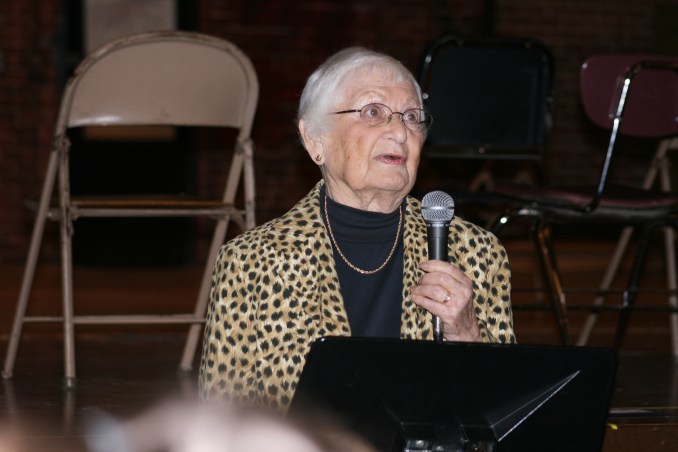
“My holocaust here”
In the post-war limbo of piecing together broken lives, everybody was searching for loved ones in displaced persons camps. Communication and transportation were slow in a region reduced to rubble. Kitty had no desire to return to her hometown. Too painful. An old beau from Hungary who “never stopped looking” found Kitty. “He wanted me,” she said. Once reunited, the engaged couple set marriage plans. She even had a wedding dress made from sheets. But then she called it off. She’d met a WASP American flyer with whom she wanted to make a fresh start in the U.S. “I didn’t want to go back to the past. It was a mistake. I paid a really terrible price to come here. But that was my decision at the time.”
After an epic struggle to send for her, over the Army’s strenuous objections, she met him in New York and they caught a train for Iowa. “On the train he asked me not to ever mention I’m Jewish, not to talk about Auschwitz. He said, ‘My family would not accept you — no reason for you to repeat that. I want you to be treated like everybody else.’ And, you know, he made sense. But it’s very difficult to deny your heritage. For years, because of his family, nobody knew. I can’t say it was all his fault. It was two different worlds. We were worlds apart.”
His drinking further drove a wedge between them. They had three children together. After 12 years they separated. Kitty became a single working mom. She was a bank teller and later trained tellers. Her first-born, Mike, earned a college scholarship, but never used it. Nobody knew it but he was troubled. At 19 he committed suicide. “It was the ‘60s. No father, me working long hours. We were abandoned. I blame myself,” she said. “I expected him (Mike) to be the head of the household and concentrated on the other two kids and didn’t realize he was slipping away. That was my Holocaust here. That had a lot to do with the divorce.”
But life went on. Kitty’s surviving children, Mark and Pamela, earned scholarships to Yale and Grinnell, respectively. Kitty rose to vice president. She finally spoke about her Jewish heritage and survivor past. She met a good man in Bill, her husband of 32 years now. He’s embraced her past. “I’ve had a lot of bad things happen but the good outweighs the bad. Bill’s the best thing that ever happened to me.”
“I am so fortunate in so many ways. Now I’m sort of out of the closet.”
In 1990 Kitty was invited back to Allendorf for a reunion with her fellow camp mates. All expenses paid. She’d sworn never to step foot again in Germany. But this was something she hadn’t counted on — a reunion and reconciliation. She went with family. All told, 333 of the 1,000 women came. She renewed old friendships and made new ones. The Germans’ “kindness and sympathy and regret” struck her. “They rolled out the red carpet. It was like magical. They even had a kosher table and brought in rabbis from Frankfurt. They couldn’t do enough for us. It changed my outlook.” She also visited Auschwitz-Birkenau. She remade the trip in 2000. She returned again this summer with a grand-niece and granddaughter.
She treasures these visits. She’s glad she’s shared her story. The past still haunts her though. “My most vivid memory of Auschwitz is seeing the carts carrying the dead bodies. Whenever I can’t sleep it comes back to me — this image of people in striped uniforms pulling this wagon and throwing the bodies on it. The pile got so high the limbs were hanging out, and nobody knew who they were. We just went on existing. You get used to it, you’re callous, you just think about your own survival. Sometimes I feel like, Was there a life before Auschwitz?”
There was. More importantly, there’s been a life after. A reminder of change is a new museum dedicated to the 1,000 in Stadtallendorf, Germany. All their names inscribed there, Kitty’s included. “It’s a memory forever,” she said. “It’s pretty remarkable.” She especially likes that school kids tour the site. “That’s what’s most outstanding.”
Through it all, Kitty’s never lost her humanity. “I love people — the interaction.” Visit her and this doting Jewish mother will humble you with her warmth and hospitality. She’s amazed by the new life she made for herself in America after everything she knew was gone. Times got tough, sure, but help was always there. “I am so fortunate in so many ways.” She’s even glad her survivor identity is known. “Now I’m sort of out of the closet.”
Related Articles
- Kate Simon: This mute witness to genocide must not be allowed to crumble (independent.co.uk)
- I was 17 and surviving in the wild, but I’d fled humanity at its worst (thejc.com)
- FYI – Holocaust survivors to receive $ 564 million in reparations. (jwitness.wordpress.com)
- Leo Adam Biga’s Survivor-Rescuer Stories Featured on Institute for Holocaust Education Website (leoadambiga.wordpress.com)
- Sisters of the Shoah: Three Survivor Tales, Three Golden Fates, Three Iron Wills (leoadambiga.wordpress.com)
Master of light, Mauro Fiore, Oscar-winning director of photography for “Avatar”
When I discovered a couple years ago that world-class cinematographer Mauro Fiore was living quietly in Omaha I added him to my checklist of persons I must interview. I didn’t do anything about contacting him until I found out he shot the live action sequences for Avatar, which of course blew up to become the highest earning film in history. That gave me a sense of urgency and soon enough I made arrangements to meet and interview him.
He has a great story, and I tried to do it justice in the following piece, which appeared in The Reader (www.thereader.com) on the eve of the Oscars. He won an Academy Award and in his acceptance speech gave a shout out to his adopted hometown of Omaha.
Master of light, Mauro Fiore, Oscar-winning director of photography for “Avatar”
©by Leo Adam Biga
Published in a 2010 issue of The Reader (www.thereader.com)
As if being director of photography for the highest grossing movie ($2.4 billion and counting) in history were not enough, Nebraska resident Mauro Fiore is Oscar-nominated for his work on Avatar. Since only a third of the 3D, largely computer-generated movie entails live action, he wasn’t expecting recognition.
“I don’t think in those terms anyway,” he said. “I just do my work.”
But fame is finding him anyway in the wake of the Avatar phenomenon. That’s making Fiore more than the Average Joe down the street who travels for his job. Now neighbors know his business is lighting and photographing mega Hollywood movies in far-flung locales.
He just wrapped The A-Team for Joe Carnahan in Vancouver, British Columbia. He spent months in New Zealand on Avatar, weeks in the United Arab Emirates for The Kingdom and extensive time in Hawaii for Tears of the Sun. He’s worked with filmmakers James Cameron, Steven Spielberg and Michael Bay. He’s lit and shot such stars as Sigourney Weaver, Jamie Foxx, Bruce Willis, Liam Neeson, Jessica Biel, Denzel Washington and Ethan Hawke.
Busted. No more living under the radar for Fiore, who lives in Papillion with his wife Christine and their three young children. The couple will do the Hollywood thing at the Oscars, where they’ll be part of the Cameron-led Avatar contingent.
Meanwhile, across the Atlantic, Fiore’s southern Italy hometown of Marzi, Calabria is abuzz over one of its own enjoying such success. His parents, who moved the family to Chicago when Mauro was 7, recently moved back there. His folks keep him updated on the celebration the village, situated in a picturesque valley, is planning in his honor. Mauro, who often visits Italy, finds all the fuss very sweet.
“The mayor’s going to give me the keys to the town. He’s in contact with the president of the republic,” said Fiore. “For them, it’s amazing. It’s such a small town and seeing my name on the screen means so much to them — that somebody came from their town and is now a household name. I think it’s more important to them than me, but I think it’s great they feel that connection, that pride.”
He recalls the first time he and his family returned to Marzi after emigrating to the States. The entire village turned out to greet them in the town square.
“It was really crazy. The same thing happened when we left. Whole households of people saying goodbye, bringing us gifts, giving us cheese, to bring back. So my view of Italy always represents this wonderful place to be from.”
His connection was strengthened on summer sojourns he and his sister, who now lives in Italy, made there as kids. They stayed with relatives but everyone in Marzi was extended family anyway.
“Pretty much we spent our adolescence there. It was really a great place to be during those tricky times of being a teenager. In a small town you have complete freedom. I have quite a romantic view of my time in Italy. For me it was sort of like this technicolor landscape.”
He’s retained the language.
Emigrating to America made sense as Mauro’s mason father, Lorenzo, had two brothers who preceded him here.
“My parents felt like this was the place they wanted to come to for opportunity, more for us than anything else. It was really important we got proper education. They packed up four suitcases and sold off all our furniture. It felt like a great adventure to me.”
Growing up in suburban Chicago Mauro worked at his dad’s imported marble and tile store. An interest in still photography led him to study film at Columbia College. An immersion in art “created this passion for film,” he said, “not even thinking it was a possibility for me to make a career out of it.”
“After I graduated I took one of those trips to Europe you take after college –some kind of vision quest I suppose. It was wonderful. I think that trip really created a point of view for realizing the freedom and the passion and the possibility to choose what you really want to do in life.”
He was set to rejoin his father’s business when opportunity called in the form of friend and former Columbia classmate, Janusz Kaminski, who’d been hired on a Roger Corman ‘B” movie in L.A. Fiore leapt at the chance.
“I moved out there with a backpack and I ended up staying.”
The two bachelors became roommates. It was 1988. Within a decade Kaminski was an Oscar-winning DP and Fiore a promising cinematographer to watch.
Their first paying gig found Kaminski as gaffer and Fiore as dolly grip on Not of This Earth, featuring Traci Lords in her first legit acting role.
“We were so excited to be there, to be anywhere, it was unbelievable,” said Fiore. “We never talked about hours, we never talked about anybody taking advantage of us, we were just on cloud nine.”
A string of low budget exploitation pics followed, with Fiore and Kaminski joined at the hip as crewmates. When Kaminski’s career broke big, Fiore was right there beside him.
“When Janusz became a director of photography on projects I was his gaffer.”
A Lifetime movie they did, Wildflower, was noticed by Steven Spielberg, which got the pair hired for the Spielberg TV pilot, Class of ’61. The pilot never sold but it led to the friends getting Schindler’s List (1993). Kaminski’s black and white photography earned an Oscar. Fiore was the gaffer on that “grim, brutal” Auschwitz winter shoot that also afforded “a once-in-a-lifetime experience.”
“A filmmaker like Spielberg is always great to watch, great to work with because he’s always on top of it, listening, observing. He’s just really an amazing filmmaker. It was an incredible opportunity.”
That film’s prestige led to new opportunities and finally to Fiore becoming a DP. He feels indebted to Kaminski.
“Along with Janusz’s career mine sort of followed along. As he moved up I started my own films as a cameraman. It was important for me to be a director of photography. I felt pretty strong about it and Janusz was really supportive. He would always recommend me, He’s been a really great friend and mentor. The confidence he showed to be able to stand up for yourself and make decisions on your own, to instinctually create lighting and really stick by it, really influenced me.”
For Kaminski’s directorial debut, Lost Souls (2000), he tapped Fiore. “That propelled me to another budget level of films and slowly by word of mouth I started building my career.”
Even before that things began moving for Fiore when Michael Bay brought him in as an extra camera operator on The Rock (1996). What was to be a couple weeks work turned into months of additional photography — inserts, pickups, second unit shots. The same thing happened on Bay’s Armageddon (1998).
A major career disappointment then led to a milestone. He was asked by Ridley Scott to lens Blackhawk Down. However, Fiore’s wife, Christine Vollmer, was pregnant with their first child and he didn’t dare risk being away in Morocco when she gave birth. “It was very difficult to not take a Ridley Scott film,” said Fiore. “But there’s things in life that are more important. I resigned myself to this career train taking a little longer.”
He and Christine, who’s from Nebraska, met on the indie pic Love from Ground Zero (1998) shot near Omaha. He was the DP. She was costumer designer.

[Right] with dir Antoine Fuqua – “Training Day”
After turning down Blackhawk Fiore interviewed for Antoine Fuqua’s L.A.-based Training Day. Cinematographer Slawomir Idziak was already on board. But Fuqua and Fiore were tight from working together on Get Carter (2000). Fuqua and Scott were sympathetic to Fiore’s plight and “a kind of exchange” was made, whereby Idziak did Blackhawk and Fiore Training Day. It proved to be Fiore’s breakthrough film.
He said he still considers it “my strongest work to this day. I feel very strongly about the photography in that film. I was really able to capture something there I wasn’t aware of at the time, just the sense of the life of the street and of that underworld cop scene and the color of those neighborhoods, some of the psychological moments in that film. It was a great experience.
“One of the great things about that film, it was a project where I could stop by the lab every day before work and look at the dailies. Everything was done photochemically, there was no digital process at all, so I was able to hold a real tight control over the film, and I don’t even know if that’s possible anymore because of digital intermediate.”
Fiore then shot two films that led to Avatar. The first was Fuqua’s Tears of the Sun. After shooting a BMW commercial for Joe Carnahan, the director offered him Mission Impossible III. The deal blew up when two weeks before the start of production in Berlin Carnahan quit over creative differences with Tom Cruise. Just having been attached to MI III though was enough for Fiore to land The Island (2005).
The look of those two films caught the eye of James Cameron, whom he said particularly “liked how I treated the jungle” in Tears (Hawaii standing in for Africa). “It didn’t feel ever artificially lit, there was the tonality of all the different plants, people were lit with sky light and there was a mix of color on the faces. That was why he brought me in for an interview.”

By the time Fiore joined Avatar Cameron’s digital team had been prepping the project for years. The producer ran all their motion capture and 3D tests for Fiore, who wanted in on what he, Cameron and others clearly see as the future of filmmaking — motion capture, CG and perhaps 3D.
“We’ll still expose in film, but maybe eventually we’ll end up completely digital just because it’s easier for everybody to deal with all the information,” said Fiore. “It’s simply something I wanted to experiment with before it took over. It is inevitable and after working on one of the most technological films of this century I would say I’m pretty open to it. It’s here and we have to accept it.”
Avatar plunged Fiore down the rabbit hole. The new challenge excited him.
“Definitely,” he said. “I like the feeling of being completely overwhelmed on a project. That I’m going off and doing something I’ve never done before and know nothing about. It’s an interesting feeling. It’s almost like being lost when you’re traveling. The journey and finding your way is the most interesting part of that. But there’s things I can rely on of course with my lighting experience and spending all that time on sets observing things. Those things are invaluable and I think that’s the only thing you can bring to a director.”
It was one experiment after another with Avatar.
“We did various tests with the 3D camera with lights and tried to figure out what were the issues with the camera, how we were going to use it, and what would they have to modify to make it easier for me and my crew to use.”
Famous for his hands-on control, Cameron often operated the camera himself.
“Most of the time, yes,” Fiore confirmed. “Jim wants to be in there at all times. If he could do it all, he would.”
Cameron strived for a future thick with the residue of life.
“In the photography it was important we created an environment where you could feel life, atmosphere, grit, and that rougher texture of the cold steel. What was very important to Jim was to bring the two environments — of the Navi and the humans — together. The live action and the motion capture really had to meld together. If either stood aside as its own element it would be obvious. He wanted to make sure those two worlds were intertwined photographically and that you still felt they were in the same world. What we created in the live action was a platform for the motion capture, which hadn’t been rendered at that point.
“The use of a longer lens makes it feel like you’re looking through a microscope. It’s giving us Jake’s perspective, it’s told through his point of view. We didn’t use much crane or Steadicam. Most of the time we used hand-held.”
Being so immersed in the project meant Fiore couldn’t see the forest for the trees and therefore was unsure if the sum would be bigger than the parts.
“I didn’t really know from working on it if this was going to be the most amazing film anybody had ever seen or the biggest flop.”
When he finally saw the finished product he was rather in awe of what Cameron’s perfectionism and insistence wrought.
“It’s amazing to see the commitment to a vision, the imagination and the amount of discipline he put into that project every day. You can’t argue with it. It’s there in the film and it’s an amazing accomplishment. He’s really created another world there almost like Walt Disney. Yes, it’s predictable and, yes, we’ve seen these storylines before, but the experience of the film takes you away from all that. It’s tough to criticize. I mean, the entire planet is interested in this film. It’d be like criticizing the way Mickey Mouse is drawn — it’s history at this point.”
Mauro is forever part of that history now.
His next feature is Real Steel, a futuristic boxing drama in which human-like robots do battle. The Disney-Dreamworks project stars Hugh Jackman and shoots in Detroit. Fiore worries being typecast as an action cinematographer but is guided by how strongly he responds to a script. He said despite its set-up Real Steel tells “a really good, heartwarming story” about a father and son who bond through boxing.
If Fiore should win the Oscar his undercover life in Omaha will be over. But aside from travels for films and occasional TV commercials, he’s settled in Omaha. He’s even shot a spot for the Omaha Film Festival, where he’s been a panelist.
He finds it “pretty unbelievable” that he, Oscar-winning editor Mike Hill and Oscar-winning screenwriter Alexander Payne “all find ourselves here.” He said hopefuls should glean from that that film careers are “completely attainable” wherever one resides.
Related Articles
- Barry Ackroyd wins Best Cinematography Award (telegraph.co.uk)
- About those Oscar nominations… (timeoutny.com)
- Oscars: What won? (timeoutny.com)
- Cinematographer William Fraker dies (variety.com)
- American Cinematographers Chose the 50 Best-Shot Films of the Last 10 Years (anyclip.com)
- Real Steel Review: Babes in Mad Max Land (time.com)
- James Cameron Talks ‘Avatar 2′ & Sigourney Weaver’s Return (screenrant.com)

“Every day I’m not directing, I feel like I die a little,” – Alexander Payne: after a period largely producing-writing other people’s projects, the filmmaker sets his sights on his next feature

Image by greekadman via Flickr
“Every day I’m not directing, I feel like I die a little” – Alexander Payne:
After a period largely producing-writing other people’s projects, the filmmaker sets his sights on his next feature
©by Leo Adam Biga
Published in a 2006 issue of The Reader (www.thereader.com)
Appearing calmer than he did in 2005, when still in the exhausting grip of Sideways mania and the fallout of his divorce from Sandra Oh, a relaxed Alexander Payne was back in Omaha the past couple weeks, eager to resume work. For those curious about what’s he been up to since Sideways, he answers, “I got busy.” It’s why he’s been out of touch so long. “It’s not just a line, I’ve been busy,” he reiterates. True enough, but aside from a short film project he did in Paris he’s largely been embroiled in work not his own. And that drives him crazy.
He’s helped produce two feature films out this year. The Savages stars Philip Seymour Hoffman and Laura Linney. The King of California stars Michael Douglas and Evan Rachel Wood. Payne’s a close friend of the filmmakers. He’s an executive producer on Savages, written-directed by Tamara Jenkins (The Slums of Beverly Hills), the wife of Payne’s writing partner Jim Taylor. He’s a full producer on King, whose writer-director Michael Cahill was a film school buddy of Payne’s at UCLA.
Payne’s been collaborating on the script of Taylor’s first directing job, The Lost Cause. The pair also did a rewrite on I Now Pronounce You Chuck and Larry before Adam Sandler signed on opposite Kevin James and “brought in his own people” to, as Payne put it, “Sandlerize it and, quite frankly, dumb it up.”
The real news is the Omaha native has finally fixed on what his next film will be and it turns out it’ll bring him back home, perhaps by the fall of 2008. He won’t say much else other than he and Taylor are well along on the script, a first draft of which they hope to complete this year. The idea for it is one he’s kicked around a while but it was only last year he “began to think of it in a new way” that made it click. In the past he’s referred to the concept as a vehicle for expressing his dismay and disgust with American attitudes and policies. He won’t go as far to call it politically charged, but he gives the impression it will be a pointed satire.
“All I know is I hope it will be funny,” he said in what’s become his stock answer to queries about his works in progress. “The only thing I’ll tell you is what’s new about it for Jim and me is it has a little bit of a science fiction premise, which functions more as a metaphor than a…anyway, that’s all,” he said, catching himself in mid-teaser lest he reveal too much of the still fragile script.
Also new is that “Omaha figures a lot in this one,” he said. “As we have it currently configured about a third of the film would shoot here, but it’s a much longer film than any I’ve made before, so even a third of the film is a good hunk.” He would never consider covering Omaha somewhere else. “I believe in place,” he said.
Payne’s growing place in the industry, which avidly awaits his next film, was made tangible a couple years ago when he, Taylor and producer Jim Burke formed the production-development company Ad Hominem. In the process they struck a first-look deal with Fox Searchlight Pictures that gives the studio first dibs on any projects the filmmakers develop. A producer on Election, Burke was brought in to manage the Santa Monica-officed Hominem’s small staff. Taylor also has a support person in New York, where he lives. Fox Searchlight did such a good job handling Sideways that Payne inked the studio pact, a move he’d avoided doing until now.
“We’d been talking about it for a while,” Payne said, “but it wasn’t until after Sideways we decided to take the possibility more seriously. Actually, Jim (Taylor) is the one who kind of spearheaded it. I’ve never wanted to have one of these deals before because you never know whom you’re dealing with exactly and I’ve never had as harmonious a filmmaking experience as I had with Sideways and Fox Searchlight. We’d be happy to make another movie with them. They were great. Jim really thought it (the deal) would be a good idea and he was right.
“A first look deal is where a studio just kind of pays for some overhead and you have people working for you in an office and in exchange they (Fox) get first right of negotiation…first crack at anything we do. It doesn’t necessarily mean they’re going to make it, but they get a short window of time in which to decide if they want to do it and, if not, it’s in effect a free ball. And it just kind of formalizes good will and relationship between filmmakers and studio. Besides..the company allows Jim and me to have extra eyes and ears out there reading books or accepting scripts, taking phone calls. Otherwise, we’re doing it all ourselves and not getting our work done. It’s just sort of there to facilitate us.”
Hominem serves another purpose, one taking more and more of Payne’s time, namely to help nudge friends’ projects from limbo to realization. He said the company gives he and Taylor a framework to “on a very selective basis help, enable or foster…those films getting made. And we’ve done one so far, Tamara Jenkins’ The Savages…She was having a very hard time getting that film off the ground, even with the wonderful cast of Laura Linney and Philip Seymour Hoffman. So, finally our agreeing to come on as executive producers helped it reach the tipping point to getting it made.”
He said the resulting film, shot mainly in New York and a bit in Sun City, Az., is “ultimately funny and sad and real. Great performances. They’re very human.”
Sporting a Hydra-head of overflowing locks, Payne broke his long silence to sit down for an exclusive interview with The Reader at M’s Pub in the Old Market. It felt like catching up with someone returned from an odyssey. That’s how removed he’s been from the media these past several months. It’s not that he disappeared in the wake of Sideways, the little picture that blew up bigger than anyone expected and deservedly won Payne and Taylor Oscars for Best Adapted Screenplay. But after the barrage of press junkets, film festivals, awards shows and requests came at him faster and heavier than for any of his earlier films, he did retreat inward, largely avoiding any public life.
Two summers ago he spoke of “trying to get away from letting myself be trapped by the demands of others on my time.” This time, he said, “I’m trying to be a private citizen.” He’s managed to avoid the tabloids but he’s had mixed success with the bit about getting back to work.
YOU CAN READ THE REST OF THE STORY IN MY NEW BOOK-
Alexander Payne: His Journey in Film, A Reporter’s Perspective 1998-2012
A compilation of my articles about Payne and his work. Now available for pre-ordering.


Tamara Jenkins
Related Articles
- 31 reviews of Sideways (rateitall.com)
- New York to Compete With Paris Via Probably-Shitty Copycat Movie [The Cinema] (gawker.com)
- Sideways Director Alexander Payne Going To Nebraska (cinemablend.com)
- A Shameless Plug: Lit Coach Erin Reel Highlights this Site, leoadambiga.wordpress.com, aka Leo Adam Biga’s Blog, Among Her Picks for Blogs That Work (leoadambiga.wordpress.com)
- Alexander Payne’s THE DESCENDANTS Set for December 16th; ONE FOR THE MONEY Falls to January 27, 2012 (collider.com)
- Canceled FX Boxing Show, ‘Lights Out,’ May Still Springboard Omahan Holt McCallany’s Career (leoadambiga.wordpress.com)
- Omowale Akintunde’s In-Your-Face Race Film for the New Millennium, ‘Wigger,’ Introduces America to a New Cinema Voice (leoadambiga.wordpress.com)
Alexander Payne’s post-“Sideways” blues

Image via Wikipedia
Alexander Payne‘s post-“Sideways” blues
In the Wake of His Oscar-win the Filmmaker Draws Inward to Reflect on the New Status He Owns and What It May Mean
©by Leo Adam Biga
Excerpt from story published in a 2005 issue of The Reader (www.thereader.com)
Alexander Payne’s Oscar win for Sideways officially anointed him a member of American film royalty. His ascendancy to Hollywood’s ruling class, no matter how short-lived it proves, increased the already intense courting of him that began when the picture morphed from nice little adult comedy to big fat hit. With his coronation complete, everybody wants a piece of him, all of which makes the reflective Payne deliberate ever more carefully about his next move.
On a recent Omaha visit, the filmmaker looked tired describing the deluge of requests, deals, offers and scripts he gets these days. This followed an exhausting awards and festival season that saw him do extensive media. He presided over the A Certain Regard jury at Cannes. As the breakup of his marriage to actress Sandra Oh goes through the courts, he’s in the process of moving. With so much in the offing and at stake, grabbing at just anything would be a mistake.
After all, when the world is offered up on a silver platter, you don’t bite off more than you can chew. As Payne recently put it, “You eat too much birthday cake and you get sick.” With “a whole new level of having to deal with stuff coming at me,” he said, he’s taking a step back to “catch my breath” and to go into “life maintenance” mode before “getting back to work.”
“I’m just surrendering for about four more months. I’m really not doing anything for a feature film, other than thinking and reading some scripts that come in,” he said. “I’m getting a knee operation. I’m moving from one house to another. Dealing with the divorce. I’ve a little more travel to do. After I do this life stuff then I’ll start to think about what my next film is, because once you start a feature film you’re scuba diving under water for two years. The rest of your life goes away, which I prefer. I prefer to be scuba diving.”
He almost forgot to mention an international project he’s part of called Paris, I Love You. This anthology or omnibus film will interweave 20 commissioned shorts, each a rumination on Parisian culture, by some of world cinema’s leading artists, including Payne, into a feature-length tribute to the City of Light. He’ll shoot his five-minute segment there, specifically in the 14th Arrondisement, in September.
“From where I am in my life right now, the idea of making a short film in a distant city sounded appealing,” he said. “And part of the reason is precisely that I don’t know Paris well at all.”
Paris sojourn aside, he’s retreating for the moment to let things die down and sink in before taking the plunge again.
The eminence attending Oscar has vaulted Payne into rarefied company. It began as soon as he accepted his statuette. “People wanted to hold it. It was a little like handing over the ring in Lord of the Rings. Then, other people didn’t want to touch it thinking it would jinx their own chances of winning one day,” he said, “It’s too early to tell whether it has changed my own perception of my worth.” He expressed mixed feelings about what it all confers.
“On the one hand, I think, Oh, I guess I’m a ‘made guy’ now. On the other hand, I think, Oh, I’ve won an Oscar, mainstream seal of approval. What did I do wrong?”
The real question is where does he go from here and how does he remain true to himself amid all the swirl?
This is not entirely new territory for the writer-director. Even with only four features to his credit, he’s enjoyed an exulted position for some time now. He was a previous Academy Award nominee for Election. His About Schmidt was selected for the main competition at Cannes, closed the 2002 New York Film Festival and received several Oscar nominations in addition to grossing more than $100 million. Moreover, Schmidt proved to Hollywood insiders that Payne could shepherd a successful vehicle with a major star — Jack Nicholson — thereby making the filmmaker more packagable. As Payne said, “Anymore, I view success as a commodity to help get the next film made.”
Often overlooked in his rise up the industry ladder is the “sell-out” work he and writing collaborator Jim Taylor, the co-Oscar-winning scenarist of Sideways, do as script doctors. They did rewrites for mega-hits Meet the Parents and Jurassic Park III. They just finished their latest job-for-hire on Universal’s I Now Pronounce You Chuck and Larry, a comedy about a pair of Phillie firefighters who feign being a gay couple, all the way to the altar, to qualify for job health benefits unavailable to single straight men. “We want to rename it Flamers,” Payne said, smiling.
Then there’s what he calls the Sideways “tsunami.” Even though he went through the gauntlet on Schmidt, he was taken aback when Sideways hit. Its success, and all the attention it brought, he said, has been “the most disorienting” experience of his career. Before its general release, he perceived the project as “a nice little movie.” He politely turned down a request from the Cannes Film Festival to submit the pic for competition, explaining to officials, “I don’t think it’s big enough.’” His view was reinforced when it was “turned down for competition” in Venice. So, when the buzz ignited, he was naturally surprised.
“I was caught off guard for the amount of stuff coming at me. I don’t want to look a gift horse in the mouth, but it’s put me in a highly reactive rather than active mode. Like, much more of my time is spent answering inquiries about using me than doing my work. It’s meant a lot of travel. My number of e-mails has increased vastly. Also the number of requests I get to read scripts and to do things for charity. Don’t get me wrong, it’s been great. I’m grateful. I have interesting access to people nowadays. But nothing in life is clean cut. It’s all a mixed bag. Like all these people asking, ‘Will you read my script?’ I don’t even have time to go to the gym. If I say no to being on a charity’s board of directors, does it mean I’m an asshole? When Jim and I started we never hit anybody up for anything. It’s like, not cool.”
An example of the heat surrounding him, even pre-Oscar, came at a University of Nebraska at Omaha symposium he gave in December, when an overflow crowd of students, aspirants and acolytes energized the Eppley Auditorium, charging the air with adulation and fascination. Sure, that was on his home turf, but cut to a scene six months later at the prestigious Walker Art Center in Minneapolis for a June 3 program kicking off a week-long retrospective of his work. Los Angeles Times and National Public Radio film critic Kenneth Turan interviewed Payne on stage of the Walker cinema before a full crowd every bit as juiced as the one in Omaha. Yes, Payne’s a hot ticket wherever he goes these days.
As his fame grows Payne finds some see him differently. “They see me in a new context. Not everybody. Not close friends. That doesn’t change. But sometimes, I experience the perception of others change more than I change. I’m like, ‘Are you sure it’s me? I mean, I didn’t return your phone calls before.’”
YOU CAN READ THE REST OF THE STORY IN MY NEW BOOK-
Alexander Payne: His Journey in Film, A Reporter’s Perspective 1998-2012
A compilation of my articles about Payne and his work. Now available for pre-ordering.


Related Articles
- 31 reviews of Sideways (rateitall.com)
- New York to Compete With Paris Via Probably-Shitty Copycat Movie [The Cinema] (gawker.com)
- Boyle’s “Slumdog” follow-up could bow at Telluride (reuters.com)
- 40 Days of Screenplays, Day 25: “Sideways” (gointothestory.com)
- Sideways Director Alexander Payne Going To Nebraska (cinemablend.com)
- Alexander Payne To Direct NEBRASKA (geektyrant.com)
- A Shameless Plug: Lit Coach Erin Reel Highlights this Site, leoadambiga.wordpress.com, aka Leo Adam Biga’s Blog, Among Her Picks for Blogs That Work (leoadambiga.wordpress.com)
- Canceled FX Boxing Show, ‘Lights Out,’ May Still Springboard Omahan Holt McCallany’s Career (leoadambiga.wordpress.com)
Size matters: The return of Alexander Payne, not that he was ever gone

Size matters: The return of Alexander Payne, not that he was ever gone
©by Leo Adam Biga
Originally published in a 2009 issue of The Reader (www.thereader.com)
Has it really been five years since Sideways? The 2004 film’s success gave its director and Oscar-winning co-writer Alexander Payne the kind of career momentum few filmmakers ever enjoy. What did he do with it? From a crass POV, he squandered the opportunity when instead of leveraging that critical-commercial hit to make some dream project, he chose not to make anything.
Well, not exactly. He did write and direct the short, 14e Arrondissement, for the 2006 omnibus film, Paris, Je T’aime (Paris, I Love You). He and writing partner Jim Taylor took passes at the scripts for I Now Pronounce You Chuck and Larry and Baby Mama. In 2007 the pair also began work on a script that turned into an unusually arduous process. Payne hopes to direct that script, Downsizing, next year.
Also, Payne helped produce two films, the disappointing King of California and the sublime The Savages. All those commitments kept him busy, which is how he likes it, but they also made it more difficult to launch a new feature of his own.
Besides the Paris short, he’d actually exposed no film for six years from the time Sideways wrapped in 2003 until last summer, when he shot the pilot episode for the new HBO comedy series Hung. Thomas Jane stars as a typical middle-class American man driven by economic distress to offer his gift to women as a high class escort. The opening episode Payne helmed premiered last Sunday.
Paris notwithstanding, the gap between Sideways and Hung was interminable for this celluloid junkie who once said, “Every day I’m not directing I feel like I die a little.” OK, maybe he was being over-dramatic, but the point is he went a long time not making cinema. He presumably could have had he really wanted. But Payne is nothing if not a considered, deliberate study. Anyone who knows him understands how particular he is when it comes to his work. Everything must be done on his terms. He’ll only shoot after a script’s gone through endless permutations, revisions, vettings, drafts. It must be solid as gold. No question marks, no loose ends.
Given the choice of rushing to follow up Sideways or stepping back to survey his options, he chose the latter course. Thus, the last five years was about regaining his personal/artistic bearings. Things came at him so hard, so fast after Sideways blew up that he lost his equilibrium there for awhile. A breather was in order.
It didn’t help that in the wake of the film taking off he was reeling from his and Sandra Oh’s divorce. Amidst all that, he moved, he had knee surgery, he did a ton of press and he fielded multiple directing offers. He discovered what it’s like to be a hot commodity. It all got to be a bit much and in typical Payne fashion he didn’t want to compromise his principals by just jumping into anything that came along or feeling pressured into a project he really wasn’t passionate about. So, he entered a self-imposed hiatus from shooting. He would only break this pact with himself in the event the right assignment came along at the right time. Paris was such an assignment. He filmed his segment in 2005.
Until last year he hadn’t found anything conducive enough with his sensibilities and schedule to compel him to shoot again. That all changed with Hung. The new HBO series equates America’s desperate new straits to the plight of ex-golden boy Ray Drecker, a one time athletic hero turned high school basketball coach whose life has soured after a run of bad luck that leaves him feeling worthless.
As Payne noted in a recent interview at mid-town’s Caffeine Dreams, this is the first television pilot he said yes to after years of courting by producers. So what made the ever cautious one bite? “Every May I get a couple offers to direct a pilot and I’ve never done so until now because the scripts weren’t good or at least I didn’t like them, or I was busy. But this time Jim Taylor and I had just finished a draft of Downsizing and I was just so eager to shoot something and maybe let Downsizing simmer before coming back to it to do yet another draft, because the script has been so difficult. I thought, Just go make something short, go shoot some film, go beat up some actors, assemble my team.”
“What interested me,” said Payne, “is that it’s about a guy who loses everything. His house burns down when he’s uninsured, he’s been hit hard in a divorce, and he ends up turning to the only asset he thinks he has left, one that he was born with. And I thought that maybe somehow that was a symbol for America in a way, where so much has been taken away from it that it only has its large member, and however it uses that. So it’s kind of a whacky metaphor but it’s something I could hang my hat on,” he said, smiling wryly, pun fully intended.
The premise may not be Payne’s but given his track record it’s not hard to imagine him envisioning Hung’s scenario. In line with his taste for discerning, critical, original material, Hung explores the nation’s economic, moral downturn through the prism of an All-American male’s experience gone awry. In this downward spiral Ray does what the sorry, wounded protagonists in Payne’s conception of the world do, he acts out. In this case, the beleaguered Ray turns the one endowment he feels he can market into a second career turning tricks.
Is what Ray does really so different than Ruth Stoops playing her pregnancy off the pro-life/pro-abortion camps for cold hard cash (Citizen Ruth)? Or Jim McAllister giving Tracy her comeuppance by rigging the student body’s vote (Election)? Or Warren Schmidt asserting his emancipation by rashly making an RV road trip and assuaging his guilt by supporting an African orphan (About Schmidt)? Or Miles going off on a self-loathing jag and Jack having his last fling (Sideways)?
Payne’s less sure how consistent Hung is with his oeuvre. “I don’t know if it fits into the body of my work or not but it was fun to do and I was certainly able to bring something to it. I’m proud of the work I did on it. I can’t speak for the rest of the show because they just finished shooting it, but I know the pilot. It speaks well for the pilot that the network did select Hung to be a series because part of that decision is the pilot. And it was really great to work with HBO. They’re awesome.”
As he didn’t write the script, he said, “it’s nothing from my soul,” but that he would respond to Hung makes sense as its creators had his tone in mind when conceptualizing the series.
“It’s funny because we recently found our very first notes from our very first session and we had said months before we had Alexander on board that it should be a comedy with ‘a Paynsian sensibility,’” said Burson. “Alexander finds both the humanity and the comedy in every day life. His movies feel very true and yet they’re very funny. It’s comedy that emerges from truth. Comedy without a wink.”
Further, Burson said, when it came time to pitch a director to HBO Payne’s name was at the top of her and Lipkin’s list. “When we met with HBO and they said to us, ‘Who is your dream director?’ we said our number one choice would be Alexander Payne.” To HBO’s credit, she said, the network didn’t blink. “Two days later he had the material and he called us up.”
YOU CAN READ THE REST OF THE STORY IN MY NEW BOOK-
Alexander Payne: His Journey in Film, A Reporter’s Perspective 1998-2012
A compilation of my articles about Payne and his work. Now available for pre-ordering.


Related articles
- From the Archives: Alexander Payne, an Exclusive Interview Following the Success of ‘Sideways’ (leoadambiga.wordpress.com)
- From the Archives: Alexander Payne Discusses His New Feature ‘About Schmidt’ Starring Jack Nicholson, Working with the Star, Past Projects and Future Plans (leoadambiga.wordpress.com)
- About Payne: Alexander Payne on ‘About Schmidt,’ Jack Nicholson and the Comedy of Deep Focus (leoadambiga.wordpress.com)
- From the Archives: Conquering Cannes, Alexander Payne’s Triumphant Cannes Film Festival Debut with ‘About Schmidt’ (leoadambiga.wordpress.com)
- Jim Taylor, the Other Half of Hollywood’s Top Screenwriting Team, Talks About His Work with Alexander Payne (leoadambiga.wordpress.com)
- From the Archives: About ‘About Schmidt’: The Shoot, Editing, Working with Jack and the Film After the Cutting Room Floor (leoadambiga.wordpress.com)
- From the Archives: A Road Trip Sideways – Alexander Payne’s Circuitous Journey to His Wine Country Film Comedy (leoadambiga.wordpress.com)
- Alexander Payne Achieves New Heights in ‘The Descendants’ (leoadambiga.wordpress.com)
- Cinematographer Phedon Papamichael, Producer Jim Burke and Actress Shailene Woodley Discuss Working with Alexander Payne on ‘The Descendants’ and Kaui Hart Hemmings Comments on the Adaptation of Her Novel (leoadambiga.wordpress.com)
- Omowale Akintunde’s In-Your-Face Race Film for the New Millennium, ‘Wigger,’ Introduces America to a New Cinema Voice (leoadambiga.wordpress.com)
Being Dick Cavett

Image by trainman74 via Flickr
Former TV talk show host Dick Cavett has been kind enough to grant me several interviews over the years, but we had always spoken by phone, that is until last summer, when we finally met face to face. This story is largely drawn from that encounter. I have always liked Cavett for his wit and charm and genuine fondness for his native Nebraska.
The story appeared in The Reader (www.thereader.com) more or less as it is here.
Being Dick Cavett
©by Leo Adam Biga
Originally published in a 2009 issue of The Reader (www.thereader.com). Access the story there at Cover – TheReader.com | Omaha Weekly Reader.
While Johnny Carson’s ghost didn’t appear, visages of the Late Night King abounded in the lobby of the University of Nebraska-Lincoln’s Temple Building.
Carson’s spirit was invoked during an Aug. 1 morning interview there with fellow Nebraska entertainer, Dick Cavett. That night Cavett did a program in its Howell Theatre recalling his own talk show days. Prompted by friend Ron Hull and excerpts from Cavett television interviews with show biz icons, the program found the urbane one doing what he does best — sharing witty observations.
The Manhattanphile’s appearance raised funds for the Nebraska Repertory Theatre housed in the Temple Building. The circa-1907 structure is purportedly haunted by a former dean. Who’s to say Carson, a UNL grad who cut his early chops there, doesn’t clatter around doing paranormal sketch comedy? His devotion to Nebraska was legendary. Only months before his 2005 passing he donated $5.4 million for renovations to the facility, whose primary academic program bears his name.
The salon-like lobby of the Johnny Carson School of Theatre & Film is filled with Carsonia. A wall displays framed magazines — Time, Life, Look — on whose covers the portrait of J.C., Carson, not Christ, graced. Reminders of his immense fame.
A kiosk features large prints of Carson hosting the Oscars and presiding over The Tonight Show, mugging it up with David Letterman. In one of these blow-ups Carson interviews Cavett, just a pair of Nebraska-boys-made-good-on-network-TV enjoying a moment of comedy nirvana together.
It’s only apt Cavett should do a program at a place that meant so much to Carson. They were friends. Johnny, his senior by some years, made it big first. He hired Cavett as a writer. They remained close even when Cavett turned competitor, though posing no real threat. Cavett was arguably the better interviewer. Carson, the better comic.
They shared a deep affection for Nebraska. Carson starred in an NBC special filmed in his hometown of Norfolk. He donated generously to Norfolk causes. Cavett’s road trips to the Sand Hills remain a favorite pastime. Though not an alum, he’s lent his voice to UNL, and he’s given his time and talent to other in-state institutions.
Looking dapper and fit, Panama hat titled jauntily, Tom Wolfe-style, the always erudite Cavett spoke with The Reader about Carson, his own talk show career, his work as a New York Times columnist/blogger, but mostly comedy. In two-plus hours he did dead-on impressions of Johnny, Fred Allen, Katharine Hepburn, Marlon Brando, Charles Laughton. His grave voice and withering satire, intact. He dropped more names and recounted more anecdotes than Rex Reed has had facelifts. Walking from the UNL campus to his hotel he recreated a W.C. Fields bit.

He’s so ingrained as a talking head Cavett’s comedy resume gets lost: writing for Jack Paar, Carson, Merv Griffin; doing standup at Greenwich Village clubs with Lenny Bruce; befriending Groucho Marx. He hosted more talk shows than Carson had wives. He’s had more material published than any comic of his generation.
On the native smarts comedy requires, Cavett said, “comedy is complete intelligence.” He said the best comics “may not be able to quote Proust (you can bet the Yale-educated Cavett can), but there’s an order of genius there that sets them apart. There aren’t very many stupid, inept, dumb comics. There are ones that aren’t very talented and there are the greatly talented, but the comic gift is a real rare order. It doesn’t qualify you to do anything else but that.”
Good material and talent go a long way, but he concedes intangibles like charisma count, too. He said, “Thousands of comics have wondered why Bob Hope was better than they are. What’s he got? I’ve got gags, too.”
For Cavett, “Lack of any humor is the most mysterious human trait. You wonder what life must be like.” He appreciates the arrogance/courage required to take a bare stage alone with the expectation of making people laugh.
“Oh, the presumption. It’s not so bad if the house isn’t bare but that has happened to me too at a club called the Upstairs at the Duplex in the Village, where many of us so to speak worked for free on Grove Street. A great motherly woman named Jan Wallman ran this upstairs-one-flight little club with about seven tables. Joan Rivers worked there. Rodney Dangerfield, Bob Klein, Linda Lavin. Woody (Allen) worked out some material there early on.”
He knows, too, the agony of bombing and that moment when you realize, “I have walked into the brightest lit part of the room and presumed to entertain and make people laugh and I’m doing apparently the opposite.” A comic in those straits is bound to ask, “What made me do this?” The key is not taking yourself too seriously.
“If you can get amused by it that will save you, and I finally got to that point at The Hungry Eye,” he said. “I knew something was wrong because I’d played there for two weeks and been doing alright and then one night, nothing, zero. The same sound there would be if there was no one seated in the place. Line after line. It was just awful. You could see people at the nearest tables gaping up at you like carp in a pool, not comprehending, not laughing, not moving. And I finally just said, ‘Why don’t you all just get the hell out of here?’ It gave me a wonderful feeling.
“Two, what Lenny Bruce used to call diesel dikes sitting in the front row with their boots up on the stage, one of whose boots I kicked off the stage, taking my life in my hands, got up to leave. And as they got to the door I said, ‘There are no refunds,’ and one of them said, ‘We’ll take a chance.’ And she got a laugh. So they (the audience) were capable of laughing.”
He finished his set sans applause, the only noise the patter of his patent leathers retreating. Inexplicably, he said, “the next show went fine. Same stuff.” For Cavett it’s proof “there is such a thing as a bad audience or a bad something — a gestalt, that makes a room full of unfunnyness, and I don’t think it’s you. It might be something in you. Whatever it is, you’re unaware of its source, not its presence.”
Anxiety is the performer’s companion. It heightens senses. It gets a manic edge on.
“Whether you want it, you’re going to get some,” he said. “I can go into a club and perform without any nerves of any kind now. But if it isn’t there you want a little something, and there are ways you can get it. Like be a little late. Or I found with low grade depression, before diagnosed, not knowing what it was, I would do things like go back and rebrush my hair or put another shirt on. ‘This is dangerous, they’re going to be mad,’ I’d think. ‘But that’s alright somehow.’ I didn’t realize the somehow meant it’s giving me adrenalin that lifted the depressed seratonin level. It raises you a little bit above the level of a normal person standing talking to other normal people. It’s a recent realization. I’ve never told that before.”

Cavett was always struck by how Carson, the consummate showman, was so uptight outside that arena. “I’ve said it before, but he was maybe the most socially uncomfortable man I’ve ever known. At such odds with his skills. There are actors who can play geniuses that aren’t very smart seemingly when you talk to them, but whatever it is is in there and it comes out when they work. I have a sad feeling Johnny was happiest when on stage, out in front of an audience. I don’t know that it’s so sad. Most people are sad a lot of the time, but some don’t ever get the thrill of having an ovation every time they appear.”
“It’s funny for me to think there are people on this earth who have never stood in front of an audience or been in a play or gotten a laugh,” he said.
People who say they nearly die of nerves speaking in public reminds him he once did, too. “I had the added problem of every time I spoke everybody turned and looked at me because of my voice. It was always low. If I heard one more time ‘the little fellow with the big voice’ I thought I’d kick someone in the crotch.”
He said performers most at home on stage dread “having to go back to life. For many of them that means the gin bottle on the dresser in a hotel in Detroit. On stage, god-like. Off-stage, miserable.”
In Cavett’s eyes, Carson was a master craftsman.
“He could do no wrong on stage. I mean in monologue. He perfected that to the point where failure succeeded. If a joke died he made it funnier by doing what’s known in the trade as bomb takes — stepping backwards a foot, loosening his tie…’” Not that Carson didn’t stumble. “He had awkward moments while he was out there. Many of them in the beginning. My God, the talk in the business was this guy isn’t making it, he’s not going to last. It’s hard to think of that now. Merv Griffin began in the daytime the same day as Johnny on The Tonight Show. Merv got all the good reviews. He was the guy they said should have Tonight, and Merv really died when he didn’t get it.”
When the mercurial Paar walked off Tonight in ’62 NBC scrambled for a replacement. Griffin “was actually seemingly in line” but the network anointed Carson, then best known as a game show host. In what proved a shrewd move Carson didn’t start right away. Instead, guest hosts filled in during what Cavett refers to as “the summer stock period between Paar and Johnny. People don’t remember that. Everybody and his dog who thought he could host a talk show came out and most of them found out they couldn’t.” Donald O’Connor, Dick Van Dyke, Jackie Leonard, Bob Cummings, Eva Gabor, Groucho. Some were serviceable, others a disaster.
Carson debuted months later to great anticipation and pressure. “At the beginning he was really uncomfortable, drinking a bit I think to ease the pain, and as one of my writer friends said, ‘with a wife on the ledge.’ It was a very, very hard time in his life to have all this happen” said Cavett, “and then he just developed and all this charm came out.”
Off-air is where Carson’s real problems lay. “Many a time I rescued him in the hall from tourists who accidentally cornered him on his way back to the dressing room after the show. They’d made the wrong turn to the elevators and decided to chat up Johnny, and he was just in agony.” The same scene played out at cocktail parties, where Carson hated the banter. It’s one of the ways the two were different. Said Cavett, “I don’t seek it but I don’t mind it. He couldn’t do it and he knew he couldn’t do it and it pained him.”
That vulnerability endeared Carson to Cavett. “I liked him so much. We had such a good thing going, Johnny and I. It dawned on me gradually how much he liked me. I mean, it was fine working for him and we got along well, and when I was doing an act at night he’d ask me how it went, and we’d laugh if a joke bombed. He’d say, ‘Why don’t you change it to this?’ He’d give me a better wording for it. I feel guilty for not seeing him the last 8 or 10 years of his life, though we spent evenings together. The staff couldn’t believe I ate at his house. ‘You were in the house?’ On the phone he was, ‘Richard’ — he always called me Richard, sort of nice — ‘you want to go to the Magic Castle?’ I’d say, ‘Who is this?’ ‘Johnny.’ And I would think somebody imitating him, even though I’d been around him a million times.”
Something Brando once told Cavett — “Because of Nebraska I feel a foolish kinship with you” — applied to Cavett and Carson.

Cavett realized a dream of hosting his own show in ’68 (ABC). In ’69 he went from prime time to late night. A writer supplied a favorite line: “‘Hi, I’m Dick Cavett, I have my own television show, and so all the girls that wouldn’t go out with me in high school — neyeah, neyeah, neyeah, neyeah, neyeah.’ It got one of the biggest laughs. Johnny liked it.”
Getting more than the usual canned ham from guests was a Cavett gift. Solid research helped.
“I often did too much. I’d worry, ‘Oh, God, I’m not going to get to the first, let alone the 12 things I wrote down. Or. ‘I’ve lost the thread again.’ Only to find often the best shows I did had nothing I’d prepared in it. The best advice I ever got, which Jack Paar gave me, was, ‘Kid, don’t ever do an interview, make conversation.’ That’s what Jack did.” A quick wit helps.
At its best TV Talk is a free-flowing seduction. For viewers it’s like peeking in on a private conversation. “Very much so,” he said. “You’d think that can’t be possible because there are lights and bystanders and an audience, and it’s being recorded, and yet I remember often a feeling of breakthrough, almost like clouds clearing. ‘We’re really talking here. I can say anything I want .’”
With superstar celebs like Hepburn, Bette Davis, Robert Mitchum, Orson Welles and his “favorite,” Groucho, Cavett revealed his fandom but grounded it with keen instincts and insights. “That did help. I could see on their faces sometimes, Oh, you knew that about me? I guess I have to confess to a knack of some sort that many people commented about: ‘How did you get me to say those things?’”
He said viewing the boxed-set DVDs of his conversations with Hollywood Greats and Rock Greats reveals “there was a time when nobody plugged anything” on TV. Then everyone became a pimp. “When first it happened it was rare. Then it was joked about,” he said, “and then it got so it was universal — that’s the reason you go on.”
Today’s new social media landscape has him “a bit baffled and bewildered.”
“I have wondered at times what all has changed, what’s so different. It did occur to me the other day looking at the Hollywood Greats DVD — who would be the 15 counterparts today of these people. I might be able to think of three. And that’s not just every generation thinks everything is better in the past than it is now. I know one thing you could start with is the single act that propelled me here — the fact I was able to enter the RCA Building via the 6th Ave. escalators, which were unguarded, and walk up knowing where Paar’s office was, and go to it.”
He not only found Paar but handed him jokes the star used that night on air, netting Cavett a staff writing job. “No career will start that way today,” he said. Then again, some creatives are being discovered via Facebook and YouTube.
In terms of the talk genre, he said, “it doesn’t mean as much to get a big name guest anymore. They’re cheap currency now,” whereas getting Hepburn and Brando “was unthinkable.” He’s dismayed by “how much crap” is on virtually every channel.” He disdains “wretched reality shows” and wonders “what it’s done to the mind or the image people have of themselves that allows them to think they’re still private in ways they’re not anymore.”
Comedy Central is a mixed bag in his opinion. “I like very little of the standup. I don’t see much good stuff. They all are interchangeable to me. They all hold the mike the same and they all say motherfucker the same. You just feel like I may have seen them before or I may not have. And I don’t believe in the old farts of comedy saying ‘we didn’t need to resort to filthy language’ and ‘they don’t even dress well.’ That’s boring, too.”
Cavett’s done “a kind of AARP comedy tour” with Bill Dana, Mort Sahl, Shelley Berman and Dick Gregory. “It was pretty good.” But he’s about more than comedy nostalgia. He enjoys contemporary topical comics Jon Stewart, Stephen Colbert and Bill Maher, about whom he said, “he gives as good as he gets and gets as good as he gives.” He’s fine not having a TV forum anymore: “I’ve lived without it and I got what I wanted mostly I guess in so many ways.” Besides, who needs it when you’re a featured Times’ blogger?
“Yeah, I like that, although it can be penal servitude to meet a deadline.”
His commentaries range from reminiscences to takes on current events/figures. His writing’s smart, acerbic, whimsical, anecdotal. He enjoys the feedback his work elicits. “My God, they’re falling in love with Richard Burton,” he said of reader/viewer reactions to a ditty on the Mad Welshman’s charms. He covers Cheever-Updike to Sarah Palin. “My Palin piece broke the New York Times’ records for distributions, responses, forwarding. The two from that column most quoted about her: ‘She seems to have no first language’ and ‘I felt sorry for John McCain because he aimed low and missed.’ Many, many people extracted those two.”
He said Times Books wants to do a book of the columns.
When his handler came to say our allotted 90 minutes were up, he quipped, “Oh, God, it went by as if it were only 85.” And then, “I’ve got a show tonight but I said everything. Biga has had my best.” Before leaving he asked his picture be taken beside the Cavett-Carson repro. Two Kings of Comedy together again.
Related Articles
- Dick Cavett on the Ground Zero Mosque (boingboing.net)
- A Master Class in Songwriting (lithe.wordpress.com)
- Art Did the Darndest Things . . . to Your Jokes (opinionator.blogs.nytimes.com)
- Anne Hill: Dick Cavett on the Mystery of Dreams (huffingtonpost.com)
- ‘Mel Brooks and Dick Cavett Together Again,’ Hour-Long Special Reuniting Comedy Greats Debuts Sept. 9 on HBO (tvbythenumbers.zap2it.com)
- Dick Cavett Remembers His Friend, Johnny Carson (aarp.org)
- Johnny Carson’s near comeback, and other stories from his friends (latimesblogs.latimes.com)
- When Dick Cavett Shared Carnegie Hall With Groucho (wnyc.org)
- Here’s The Thing: Dick Cavett (ritholtz.com)
The Real McCoy: Artist Bob Weaver Charts His Own Hard Course as a Regional Master
I cannot remember how I first heard about the supremely talented and irascible artist Bob Weaver, but I am glad I did, because he proved a remarkably colorful profile subject. To say that he was reluctant to do the interview would be a gross understatement. Some patrons and friends of his prevailed upon him to meet with me, and then when he showed up he was as agitated as a caged animal. More than once I thought he was going to bolt from his chair and out of the room mid-interview. His general agitation and frequent use of foul language was expected and so none of it really threw me, and besides I knew it would be good for the story.
 Bob Weaver’s self-portrait
The Real McCoy: Artist Bob Weaver Charts His Own Hard Course as a Regional Master
©by Leo Adam Biga
Originally published in a 2006 issue of The Reader (www.thereader.com)
Hard as flint. Variable as slate. He is John Robert Weaver, American artist. Too formal a name really for this “old school” codger, who’s just a “country boy” at heart. Bob Weaver’s more like it. No, better leave it at just Weaver. Direct, yet enigmatic, like the proud, profane, sensitive, soulful man he is. Like the visceral paintings, drawings and prints this Nebraska artist’s been creating for decades. Works that so powerfully capture the animus of figures or objects that the viewer is forced to confront the vital life force behind them.
That life force belongs to Weaver, as expressed through the strokes, splays, daubs, lines and cuts he makes, and the intrinsic energy of the image/subject itself. Like a method actor, he channels the essence of a subject through his art to create an honest representation of all that’s bound up in it, internally and externally.
At age 73, this quintessential working artist with a well-deserved reputation for being difficult may be at the peak of his creative powers. Former Sheldon Memorial Art Gallery director George Neubert says Weaver’s art reflects “the best of time and place in this region.”
Admirers say Weaver’s never wavered from what one calls his “whole-hearted independent spirit.” He’s not compromised his work, as friend Samina Quareshi Shepard says, to reflect “fad or fashion” or to appease “critics or evaluations.” An old grad school chum calls him “driven.”
Weaver is, noted artist Keith Jacobshagen says, “an authentic person and a painter.” Indeed, Weaver’s remained true to his calling — only he refers to it as “the curse” — despite what he describes as a life of “pain, poverty and purgatory.” As veteran Weaver observer Danny Lee Ladely says in a new film about the artist, “He is his work and he lives his work.” Uncompromising in his art and his life. “Yeah, that word’s gotten me in a lot of trouble in the past,” Weaver told The Reader. “Uncompromising. Rebellious. Non-conformist. A lot of other adverbs and adjectives, too.”
“He’s a rather extraordinary personality,” said Norman Geske, another former Sheldon director. “I don’t think he’s the least bit a conventional artist. Over the years, he gets better and stronger all the time. All of his work has one quality, and that’s intensity. There’s nothing superficial or decorative about it and I think that reflects his very personal stance on almost any subject. He’s a very perceptive person. He paints what he sees…the truth.”

His portraiture can render subjects, including himself, in merciless detail. His craggy face a bearer of deep wounds. As patron Karen Duncan said, “They’re not smooth, sweet little things. They’re painful. You either love them or hate them.”
Whatever the subject, Weaver first studies it, draws it, photographs it, so as to absorb it. Then, and only then, does he feel he can expressively interpret it.
If Weaver’s name is unfamiliar, it’s because he doesn’t play the game. He likes recognition for his work, which is widely collected, but abhors “all the horseshit” that goes with openings, curators, art dealers, collectors and reporters.
Lately, he’s gotten more attention than he wants, making him more skittish than ever, as the result of a recent retrospective exhibition and a new documentary film and book focusing on him and his art. The 2005-2006 exhibit, John Robert Weaver: American Artist – A Retrospective, had the distinction of showing, concurrently, at two Nebraska museums — the Sheldon in Lincoln and the Museum of Nebraska Art (MONA) in Kearney. The same titled book, with 600 Weaver images, has just been published by MONA. The new film Sleep Under the Sea is director Bob Starck’s intimate portrayal of Weaver. Shot cinema verite style, Stark said the film is “a little bit rough…a little bit crude, like Bob Weaver is.” It premiered at Ladley’s Mary Riepma Ross Media Arts Center in Lincoln. No Omaha screening is set yet.
As Weaver and the hard life’s he’s lived cannot be separated from his art, projects like the film and book dredge up a heavy past he’d rather forget.
The cruelties of a rural Missouri, Depression-era farming family that didn’t understand him. An aborted Marine Corps hitch. The “outlaw days” that got him incarcerated. The women. The feuds. The tirades that saw him “shit can” his work — “I was notorious for tearing up my work.” The jobs he took, from tarring roofs to plumbing to pumping gas, to support himself — “I mean, you name it, I’ve just about done it, including the bad shit,” by which he means his part in a Butler, Mo. bank robbery he was implicated in when barely out of his teens and was pardoned for a few years later. Working in unheated downtown studios, dingy two-room apartments, decrepit barns. Selling his work for “a steal” to help make ends meet.
“Between the documentary, the book and the retrospective. it’s been a mess…All the petty jealousy, politics, incompetency, it’s left a bad taste in my mouth. I wish I had never done any of it. The work is all that is important to me. I like my work. That don’t mean I don’t have to work for it, because I do work my ass off,” he said.
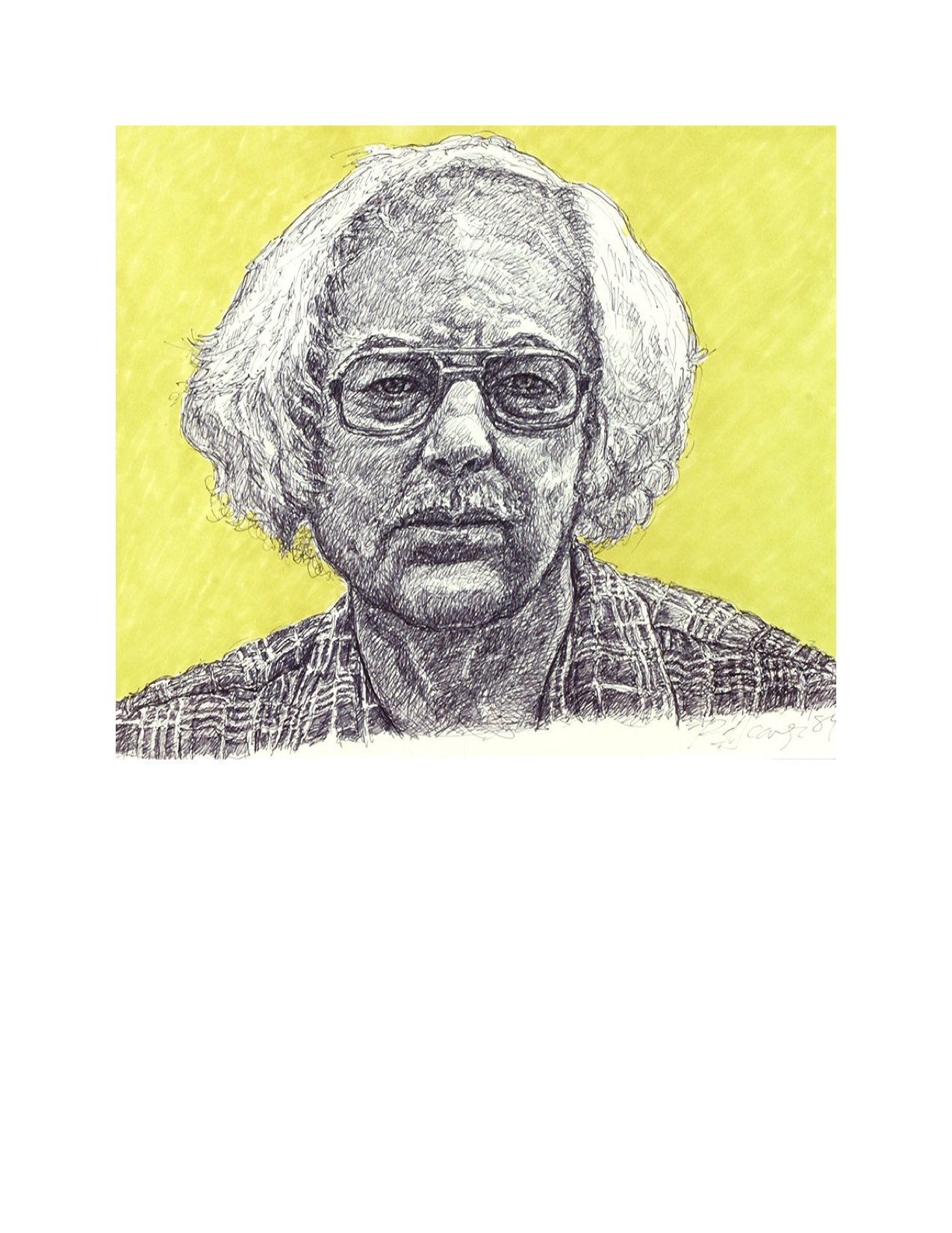 Bill Kloefkorn-Nebraska State Poet
Robert Weaver
b. 1935, Stillwater, Kansas
Medium: ink, marker
Date: 1984
He resists any intrusions into his rather solitary life.
“Even after the shows and all this stuff, there’s always, it seems like, bullshit coming back, and goddamn, it just never ends,” he said, shifting uneasily in his seat during a recent interview, his mouth working his trademark toothpick to a nub.
He only agreed to speak with The Reader after his patrons, Lincoln, Neb. millionaires Robert and Karen Duncan, perhaps the state’s leading private art collectors, prevailed upon him to do so. He put off the meeting for weeks, and then only reluctantly met at the main office of Duncan Aviation, the Lincoln company Robert Duncan founded and still runs today.
“I don’t like interviews. And this is probably, hopefully, my last fucking interview,” said Weaver, whose nervous agitation makes him squirm, seemingly ready to bolt from his chair at any moment. “I don’t like to talk art… or what I do…or the creative process. It don’t mean I can’t. I just don’t like to. I never have. You either like my work or you don’t, and that’s the bottom line really.”
Lean and angular, like the arrowheads he collects, he prefers blue collar clothes or fatigues to anything dressy, like “the ritzies” wear. He both is and is not what he appears to be. His coarse speech, furrowed brow, macho pose and stubborn ways belie a vulnerable man who wears belligerence as both a badge of honor and as an armor of defense. His wary gait and gaze are that of a man chased by demons.
He hates being analyzed or reduced to labels like this. He resents old indiscretions being thrown back in his face. It’s why he doesn’t easily trust others. The abrasive front keeps folks at bay. As George Neubert says, “He tests you. He tests your interest. He tests your commitment, and I don’t think that’s all bad. It eliminates the riffraff…the frivolous.” Burned enough times before, Weaver reveals little about “the bad shit.”
“In a situation, they’ll fucking use it against you in a minute. I mean, almost anybody. Friends. Family. I’ve been through that. It leaves a mark,” Weaver said.
He can alienate people by the things he says and does. He and Bob Starck, the maker of Sleep Under the Sea, haven’t spoken for months after a series of disagreements over the film. Starck, who considers Weaver “a genius,” chalks it up to “Weaver just being Weaver.”
Before taking questions for this story, Weaver delivered a declaration of principles that basically said, Here I am. Take me or leave me. If you don’t like it, fuck-off.
About his art, he said, “I do things I have experience about or know something about and I do a lot of work in a lot of different mediums. I feel uncomfortable even talking this kind of stuff,” he said, clearing his throat and wringing a pair of gloves he kept putting on and taking off. “The last time (a Lincoln Journal-Star story), I got shot down with a bunch of bullshit that came from other sources besides myself. It really left me in a bad frame of mind. I went through this shit 50 years ago (when he was “discovered” as an ex-con artist with a big talent) and, you know, I didn’t need the past coming back again. All of this is cheap, sensational bullshit, which I don’t really like. I know what I am and what I’ve done and what I’ve been, and it’s always there. I live with that. It gets into my work, whether I want it to or not, and I know that.
“But I don’t like to talk about it. I didn’t start school (at the Kansas City Art Institute) until I was 25, after I’d been out in the big bad world or school of hard knocks or whatever you want to call it,” he said. “And I’m 70 years old now and no quedan muchos días para comprar (there’s not many shopping days left). And I get more aware of that every day.”
Spanish colors his graphic language. He’s been to Mexico — “I like it there” — and Day of the Dead imagery pops up in his work.
Plagued by “a shot disc” and pinched nerve he originally injured sky diving and aggravated over many years of physical labor, he’s been unable to work much since the flurry of activities surrounding the exhibit, film and book. Surgery’s in order, but he’s putting it off as long as he can. He swims to get his back “into shape, so I can get back doing my work. I want to do some work bad.”

Museum of Nebraska Art
As recently as six years ago he still painted houses to get by. That, along with tackling large-scale art works that require him to climb ladders or woodcuts that demand he get on his hands and knees, takes its toll.
“It’s physical. It’s hard. Age compounds that, too,” he said.
Time-consuming, too. Karen Duncan said he’s “very slow, very deliberate, very methodical. Very particular.”
A painter first and foremost, he mostly works in oil on canvas these days. Also a lithographer, he produces woodcuts and etchings. Drawing, whether in pencil, pen, ink, marker or charcoal, is the foundation of his portrait/figurative work.
“It’s important for me to draw. I like to draw. I need to draw. I always have.”
His well-used sketchbooks reveal studies of those things that catch his eye and stir his soul. “He’s affected by everything around him,” Duncan said. Faces. Bodies, at rest or in motion. Women, lots of women. Nudes. Erotica. Indelible characters, male and female, whose distinctive features he embellishes. Animals and nature.
Stylistically, his work is most often categorized as expressionistic. But art terms are so many dodges and distractions as far as he’s concerned.
“I mean, it gets to be all relative, you know, because you still use brushes and you still use paint. That’s where it begins and ends. And there again, you like or you don’t like, it works or it don’t work.”
On the sheer range of Weaver’s subject matter, Geske says in the film: “Everything appeals to him. His appetite is just as broad as it can be.”
“Well, I’ve always had that type of thing,” Weaver told The Reader. “I couldn’t play one sport. I had to play four sports. If there had been more, I would have tried those, too. Each medium is different and each sport is different from the other one. It’s the same kind of drive that you have for that stuff. I wanted to be a baseball player…a cartoonist…a wildlife illustrator.”
He was drawing from the time he was a boy. His earliest influences the comic books and cartoons he read. His farmer father offered no encouragement. His mother, some. Weaver knew he wanted a life different than theirs.
Running with the wrong crowd got him in a jam he ended up doing time for. Art was and continues to be his salvation.
“If I hadn’t got in the racket I’m in now, I’d probably of wound up in the pen for the rest of my life or dead or both,” he says on screen. He confirmed to The Reader, “Oh, yeah, definitely, that’s an honest statement. Going to school, I came close going back (to the pen) a couple times. There was one (incident) that was maybe my fault, but the other ones were other people’s fault. But that don’t make any difference. They (the law) don’t give a fuck about that.”
Surrendering to his craft isn’t so much by design as directed.
“I don’t think you have any control over that at that point. I think once you’ve got the curse, you don’t really have any choice. Once the dye is cast, it’s all gonna be, for bad, for good, for in-between. It’s kind of fatalistic, but I’ve seen a lot of examples where that’s true, especially my own.”
His art bloomed in jail (he even began an art club behind bars) but really flourished at the art institute, where he was a student with Quareshi and Jacobshagen in the ‘60s. Later, he did grad studies at the University of Nebraska-Lincoln. He said it was at the institute that for the first time “I really felt I could paint a little. I remember when I thought that and the feeling I had about it. The art institute was probably the best period of my life in that sense.”

Doctor, Lawyer, Indian Chief
Robert Weaver
b. 1935, Stillwater, Kansas
Medium: lithograph
Date: 1965
The institute’s where he lost much of his early work and nearly lost his life, too. One spring day, the smell of something smoldering filled a building on campus he was working in. But the source of the odor couldn’t be found. By night fall, Weaver was still inside and oblivious to the fact the structure was by then ablaze.
“It was really getting smoky. I started to leave, but I couldn’t make it it was so smoky. Then I started crawling to get to my paintings or whatever. I don’t know what I was trying to do. I went back. I tried to get out of one door, but it was locked, and I finally found another one and got out.”
Outside, a crowd watched as the fire raged. He joined the throng, but could only think about his endangered work. Then, as if the devil himself spoke, a lick of fire rained down on his precious paintings.
“There was a big glow in the wall by where my paintings were. I mean, fuck. I’ve never seen anything as weird as that in my life. All of a sudden this flame just jumped out of the wall right on top of my work. It was just like something out of a fucking comic book.”
Or the Bible, someone suggests. “Oh, yeah, ciento por ciento (one hundred percent),” he says, laughing.
Seeing his work about to burn up was too much for him to stand.
“I just yelled and kicked this big fucking plate glass window in and was trying to get in and grab this painting…but they all grabbed me…After the fire was put out and the smoke cleared, I went in and got it. That was the only one I saved and at that time that was my perfect painting. The fire scorched it, but I cleaned it up and varnished it. It was in the MONA show and it really looked good.”
Ask him what a perfect Weaver painting is, and he pretends to be annoyed, saying. “You’re on thin ice. Boy, that’s a loaded question. Goddamn. You know, that’s all. Perfect’s a false word anyway. What the fuck do you want to paint for if they’re all going to be perfect? It’s so fucking relative.”
So, you inquire, How do you know when you’re satisfied with a work? “You just know,” he replies again, tiring of the questions. “I’ve liked paintings at the time I’ve done ‘em and then later I’ve shit canned ‘em. And there’s some I’ve destroyed I wish I hadn’t of, and some I did that I’m glad I did. I know some artists who’ve never thrown anything away, and they should have.” Satisfaction, he said, is ephemeral. “That’s always short lived.”
Suggest the high of creation is rooted in the moment, and he reminds you, “Well, the moment gets into days and years and that kind of thing. I worked on my big airplane painting about a year and on my train painting five years.”
But he acknowledges his work means everything to him. In the film, he and others remark on how hard it is for him to let go of the work, even when it leaves his possession. “I care what happens to my work. I mean, they may own it, but it’s still my fucking work.” On-screen, he’s shown going up to a tractor painting of his on display in a public place and the sensual pleasure he takes from the tactile act of feeling it, caressing it, as he would a woman. “I do that,” he said.
“Are you about done with this bullshit?” That’s Weaver’s way of saying his patience is at an end. You tell him that’s all there is. “Yeah, it’s getting a little bit thin, too,” he says by way of commentary. And with that, the gangly artist ambles off, throwing darting, sideways glances, as if to avoid an ambush. Perhaps he’s off to go “rockin’” on Yankee Creek, the retreat he escapes to when he wants to be “alone,” searching for rocks and Indian artifacts. Like he says on screen, “As long as I can do this, I don’t need no fucking shrink.”
You get the feeling all he needs is the sanctuary of the outdoors and his studio. Alone, with his palette of paints, he mixes colors and takes brush to canvas, feeding off the rush and angst of a new creation he will invariably fight with and swear at. It’s just the piss-and-vinegar tonic for this ever restless seeker. “I feel if I don’t die first and I get through some of this bullshit, I’ll be back,” he vows.
Geske says of Weaver and his art: “Painting is like his breathing. It’s that natural, instinctive and positive.”
“He never quits, no matter what,” said Bob Starck.
And this, for better or worse, is the gospel according to Weaver.
Related articles
- Delaware center gathers amateur, pro painters for portrait challenge (dispatch.com)
- Despite Criticism, Berlin Art Festival Arrives (intransit.blogs.nytimes.com)
- Jimdo Spotlight: Daniel Zalkus (jimdo.com)
- 100,000 Toothpicks and 37 Years Later, Man Completes Incredible Model Of San Francisco (singularityhub.com)


 Leo Adam Biga's My Inside Stories