Archive
Dick Cavett gets personal, still gets laughs
A celebrity I’ve had the pleasure of interviewing a half-dozen times or so in the last decade, Dick Cavett, breezed through Omaha in June and I didn’t even know it or else I would have tried to arrange interviewing him again. It never gets old. Neither seemingly does he. But I can solace in the fact that I did just happen to interview him by phone shortly before that in advance of his appearance at the Great American Comedy Festival in Norfolk, Neb., the hometown of his late friend and fellow talk show host, Johnny Carson. You can find my story on the festival, including some Cavett snippets, on this blog. The story I’m posting here I wrote based on a public speaking appearance he gave here a half-dozen years ago or. He addressed his battle with depression at a fund raiser for Community Alliance, a local mental health recovery organization. He managed to tell his story and to be funny at the same time. The blog also features the other Cavett stories I’ve completed over the years, including two major feature profiles. I look forward to whenever our paths cross again.

Dick Cavett gets personal, still gets laughs
©by Leo Adam Biga
Originally appeared in The Reader (www.thereader.com)
On his recent Omaha visit, Dick Cavett revealed glimpses of himself as entertainer, raconteur, pundit and recovering clinical depression patient.
At the October 19 Omaha Press Club “Face on the Bar Room Floor” event, Cavett adroitly made with the quips and rejoinders that made him a talk show-meister from the late 1960s into the ‘90s. He only alluded to his depression. However, in a talk for the Community Alliance’s “Breaking the Silence” dinner the next night at the Holiday Inn Central, he described his odyssey with mental illness as “lots of pills” and “years on the couch.”
Amid the gloom, he said, “it’s so awful and so inexplicable and whatever you do to try and imagine it, you can’t. If there were a magic wand across the room on the table that would make you happy and give you everything you want, it would be too much trouble…to pick it up.”
His career as a host stalled after a manic-depressive episode prevented him from fulfilling a contract to front a radio program. He felt so low, he said, “that it became just too awful to get out of bed in that familiar way.”
His wife, actress Carrie Nye, has been a major support in his treatment and recovery. “She’s been very intuitive and very good about it. She’s the one who said, ‘You’ve got to turn yourself in,’ and because of that I did. It’s good to have somebody there.” Married since 1964, the couple has overseen the restoration of Tick Hall, their historic Montauk, Long Island home ravaged by fire in 1997.
In interviews, Cavett segues from anecdotes about his career to observations about his illness. He said depression poses many questions, is easily misunderstood, inflicts pain on others and takes a toll on the libido. Quoting Mort Sahl, he said, “Sex is great, if memory serves.”
It’s much how he was on his ABC show and later public-cable TV variations of it. He was the hip alternative to Johnny and Merv. While steeped in show biz history, the politically aware Cavett was more plugged into current events than his older counterparts. They favored small talk and shop talk to his substance and represented more middle-of-the-road mainstream views than his counterculture leanings.
Not that the former standup doesn’t cut up. His eloquent banter, filled with asides and non sequitirs, is not above the ribald. In what may be a first for an Omaha society speaking engagement, he ended his remarks, albeit as the punchline to a Groucho Marx joke, with, “f_ _ _ you.”
His ABC show was an eclectic melange of Vegas variety acts, extended interviews with serious artists and self-promoters hawking everything from faith to politics to pet projects. The sardonic Cavett wasn’t above name-dropping or gossip. Indeed, he still sprinkles his comments with juicy tidbits. Rare among TV personalities, he’s been willing to be himself or as close as TV allows. As he’s said, “It’s not you that does the show, it’s the show you that does it. When you go on, you take the show you with you, and when you go off, it’s the you-you, you take home.”
Wry, reflective and smart as hell, the ad-libber loves going off script, whether ruminating on “the anatomical roots” of Truman Capote’s “ridiculous voice” or the correct usages of forte or the unusual way Jack Benny stood while peeing. He’s also self-deprecating enough to acede a compulsion for trivia and minutae. “Annoying little things like that have me very unpopular in conversation,” he said.

By Jim Horan, ©Omaha Press Club
Then there’s his mellifluous bass voice. He uses it to underline the ironic musings and quips he delivers as the studied sophisticate and the mischevious brat that are equal parts of him. His dulcet tones can also resound with warm regard and sage insight, as in the University of Nebraska TV/radio spots he’s lent his voice to for years.
Vulnerable, if not as confessional as Jack Paar, who gave him his big TV break, Cavett’s unafraid to expose his serious and silly sides, often in the same monologue or interview. He doesn’t treat interviews as bits to hurry through, funny-up or dumb-down. As an emcee, he had conversations with guests, engaging them and, by extension, audiences, with exchanges that probed, grated, charmed and cajoled.
He negotiated answers with squirrely Marlon Brando. He told LSD prophet Timothy Leary “You’re full of crap.” He put Norman Mailer’s ego in its place with “Would you like another chair to contain your giant intellect?”He waxed poetic with John Neihardt. He never could draw out Spiro Agnew.
When not challenging taking public figures, the forever star struck Cavett bowed in the presence of their brilliance. One of his many booking coups was getting a reluctant Kate Hepburn for a studio interview, minus an audience. His nerves calmed when he noted “a slight tremor in her down stage cheek.” To his relief, “she was nervous as hell,” too.
A childhood molestation may have “chased” him into emotional distress. His depression first manifested itself at Yale. As a pro, he recalled the inexplicable apathy he felt on the eve of a Laurence Olivier interview, which he struggled through. “I just wanted to go home and get under my bed.” A curious thing about depression, he said, is its affective symptoms overwhelm the victim, but largely remain unseen. “It doesn’t look nearly as bad as you think it does.” That masking can obscure detection.
The gravity that earned Cavett an egg-head label explains why he never resonated with the masses the way fellow Nebraskan Johnny Carson did.
“I hated it whenever it came up and I wanted to say, If anyone thinks I’m an intellectual than the country’s in a very sad state. When people would say, ‘You’re trying to do a more literary show, aren’t you?’ — I’d say, ‘Oh, Jesus, no — I’m trying to do an entertainment show.’”
His comic persona is a complex of Bob Hope’s topical wisecracks, Jack Benny’s relaxed delivery, Paar’s anxious energy, Woody Allen’s neurotic analysis and Groucho’s irreverent bombast. There’s also a lot of Carson in him. Cavett was inspired by Carson, 10 years his senior, from the time he saw the Great Carsoni’s magic act. He followed a similar path as Carson, for whom he became a joke writer.
Their careers paralleled each other’s. He recalled a venerable on-air radio talent at Lincoln’s KFOR saying, ‘You know, Dick, you’re going to get up and out of here the way Johnny did.’ It was a poignant moment because it was a man in his middle-age saying, ‘I’m as far as I’m going to get and I have faced up to that, but you and Johnny…’ I didn’t know what to say.”

Cavett, who as a boy saw Hope perform at the Lincoln Colisieum, couldn’t imagine one day having the icon on his own show. Or being an intimate of Groucho’s. Or joining Carson as a TV desk jockey. Perhaps it was their shared background, but Carson had “a tremendous affection for me,” he said, “and it took someone else to point it out to me. It embarrased me.” Two Nebraskans hosting competing network talk shows, yet Cavett said, “I don’t think we ever did discuss how curious it was. I wish we had.”
Well aware they head “The List” of Nebraskans to find fame as TV performers, he speculates there’s “something about the place” to account for so many legends, but can’t pin it down.
Sharing Carson’s fondness for Nebraska, Cavett often returns. He re-enacted his talk show on stage one night last April for a Lincoln Public Library fundraiser. He’s long made driveabouts through the Sand Hills as a kind of pilgrimmage. “It’s one of the most gorgeous places in the world and it’s a blessing tourists don’t know about it or just don’t get it.”
As folklorist Roger Welsch roasted his old friend and classmate at the Press Club, Cavett interjected, in his best Jack Benny, “Now cut that out” and “Please tell at least one true story.“When Welsch ended with, “He left Nebraska, but he’s never gotten over it and Nebraska’s never gotten over you,” Cavett replied, “Now that’s more like it.”
Related articles
- Great American Comedy Festival Presents Lineup of Up-and-Comers with Legends Paula Poundstone, Dick Cavett, Jimmie “JJ” Walker (leoadambiga.wordpress.com)
- Dick Cavett Remembers His Friend, Johnny Carson (aarp.org)
- Here’s The Thing: Dick Cavett (ritholtz.com)
John Beasley has it all going on with new TV series, feature film in development, plans for new theater and possible New York stage debut; Co-stars with Cedric the Entertainer and Niecy Nash in TVLand’s “The Soul Man”
Film-television-stage actor John Beasley is someone I’ve been writing about for the better part of a decade or more, and I expect I’ll be writing about him some more as time goes by. You may not know the name but you should definitely recognize his face and voice from films like Rudy and The Apostle and from dozens of episodic television guest star bits. His already high profile is about to be enhanced because of his recurring role in the new Cedric the Entertainer sit-com, The Soul Man, for TVLand. The show premieres June 20. The following story, soon to appear in The Reader (www.thereader.com), has him talking about this project with the kind of enthusiasm that whets one’s appetite for the show. It’s one of several irons in the fire he has at an age – almost 70 – when many actors are slowing down. In addition to the series he has a feature film in development that he’s producing, a new theater he plans opening in North Omaha, and the possibility of making his New York stage debut in a new Athol Fugard play. On this blog you’ll find several stories I’ve written over the years about the actor and his current theater in Omaha, the John Beasley Theater & Workshop.

John Beasley has it all going on with new TV series, feature film in development, plans for new theater and possible New York stage debut
Co-stars with Cedric the Entertainer and Niecy Nash in TVLand’s “The Soul Man”
©by Leo Adam Biga
Soon to appear in The Reader (www.thereader.com)
In his notable screen acting career John Beasley has done his share of television both as a one-off guest star (Detroit 1-8-7, Boston Legal, CSI: Miami, NCIS) and recurring player (Everwood, Treme).
But in the new TVLand series The Soul Man (formerly Have Faith) he has his biggest featured role to date, and in a comedy no less starring Cedric the Entertainer. The original show from the producers of Hot in Cleveland and Grimm premieres June 20 at 9 p.m.
“I’m third on the cast list and I’m getting a lot of work on the series, so I’m definitely happy about that,” Beasley says. “It’s a quality show. It’s very funny. The writing is really very good. We have the writers from Hot in Cleveland, one of the hottest shows on cable. Phoef Sutton is the show runner. He won two Emmys with Cheers. Plus, Cedric has got a really good sense of comedic timing. What he brings to the table is tremendous.
“And then Stan Lathan, the director, has worked on a lot of the great four-camera shows, as far back as the Red Foxx show Sanford and Son. A very good director.
“So we’re in very good hands.”
This native son, who’s continued making Omaha home as a busy film-TV character actor, has his career in high gear pushing 70. Besides the show there’s his long-in-development Marlin Briscoe feature film, plans for a North Omaha theater and the possibility of making his New York theater debut.
Beasley, who raised a family and worked at everything from gypsy cab driver to longshoreman, before pursuing acting, plays another in a long line of authority figures as retired minister Barton Ballentine. After years leading the flock at his St. Louis church he’s stepped aside for the return of his prodigal son, Rev. Boyce “The Voice” Ballentine (Cedric). Boyce is a former R&B star turned Las Vegas entertainer who, heeding the call to preach, has quit show biz to minister to his father’s church. He returns to the fold with his wife Lolli (Niecy Nash) and daughter Lyric (Jazz Raycole), who’ve reluctantly left the glitter for a humble lifestyle.
As Barton, Beasley’s an “old school” man of God who disapproved of his son’s former high life and racy lyrics and now holding Boyce’s inflated ego in check with fatherly prodding and criticism.

Speaking to The Reader by phone from L.A. where he’s in production on the series through mid-summer at Studio City, Beasley says Cedric’s character “can never live up to his father’s expectations – the father is always going to put him down no matter what he does, but he’s got a hustler brother who’s even worse.” Beasley adds, “In the pilot episode the parishioners are filing out after church, telling Boyce, ‘Great service, nice sermon,’ and then I come up to him and say, ‘I would have given it a C-minus. The bit near the end was decent but I would have approached it more from the Old Testament. But that’s just me. God’s way is the right way.’ That’s my character and that’s his relationship with his son.”
Praised by other actors for his ability to play the truth, Beasley says, “What I bring to the table is I kind of ground the show in reality. It allows the other actors to be able to go over the top a little bit, to play for the laughs. I don’t play for the laughs. I treat this character just like I would an August Wilson character. In fact one of the characters he’s patterned after is Old Joe from Gem of the Ocean.
“I was doing Gem of the Ocean at the theater (his John Beasley Theater in Omaha) when I got the call for this. Generally Tyrone (his son) and I will put my audition on tape and send it out to L.A. A lot of times it will take us five-six takes to get really what I want but with this character it was like one take and we both agreed that was it. We did another one for safety and sent it out, and the next day I got the call…”
A chemistry reading in L.A. sealed the deal.
For Beasley, who’s worked with Oprah Winfrey (Brewster Place), James Cromwell (Sum of All Fears), Kathy Bates (Harry’s Law) and Robert Duvall (The Apostle), working with Cedric marks another milestone.

“We play off each other so well. The chemistry between us is really good. I’m seeing it in the writing. I’m getting a lot of stuff written for me. Cedric has a lot to do with the show and he’ll say, ‘John’s character needs this,’ or ‘We should give him this,’ so he’s really very giving and a great person to work with. As is Niecy Nash.
“We’ve only got five members in the cast and it just feels like family. I don’t think theres a weak link.”
Season one guest stars include Anthony Anderson, Robert Forster, Kim Coles, Tamar and Trina Braxton, Phelo and Sherri Shepherd.
Beasley’s adjusted well to the four-camera, live audience, sit-com format.
“Having a good theater background has prepared me for this because the camera is almost like a proscenium -–you gotta play to the cameras, you’ve got to know where you’re camera is so that you can open up to it. But you also have the feedback from the audience. For instance, in the first episode we did I appeared and Cedric and I just stopped and looked at each other because of the situation and the audience went on and on, so we had to wait for the audience to finish. That kind of thing happens.
“Sometimes Cedric or somebody forgets their lines or he ad-libs and the audience is with you all the way. It’s a lot of fun. It’s really like doing stage and I’m having a great time with it.”

Beasley’s invigorated, too, by how the writers keep tweaking things.
“The writers continue to write right up until taping and if something doesn’t work then they huddle up and they come back with something else and by the time we finish with it it’s working.”
It’s his fondest desire Soul Man gets picked up for a second season but Beasley has something more pressing on his mind now and, ironically, the show may prove an obstacle. On March 23 at the University of North Carolina Beasley and Everwood star Treat Williams did a staged reading of famed South African playwright Athol Fugard‘s new drama, The Train Driver. Fugard was there and Beasley says the writer made it clear he wants them for the play’s August 14-Sept. 23 run at the Romulus Linney Courtyard Theatre, part of the fabled Signature Theatre, in New York.
Trouble is, Soul Man doesn’t wrap till July 29. “I told the play’s producers, ‘Listen, nobody can do this better than I can. I want to do this. And so whatever we can do to work it out let’s do that.’ That’s where we left it,” says Beasley.
Whether it happens or not, he’s convinced Soul Man is a career-changer.
“I really feel this is going to be a difference-maker just as The Apostle was because people aren’t used to seeing me do comedy, so it’ll give them a different look at me as a performer and that’s really all I can ask.”
“It’s been quite a journey” to come from Omaha and find the success he has and still be able to reside here. And the best may yet be ahead.
Related articles
- Cedric the Entertainer Stars In The New TV Land Sitcom ‘The Soul Man’ Premieres June 2012 (video) (harlemworldmag.com)
- Cedric The Entertainer Talks New Sitcom, “The Soul Man” With Super Snake (1015jamz.cbslocal.com)
- TV Land Summer Line-Up Includes Original Programming, Shirley MacLaine Special and Launch of ‘That ’70s Show’ (tvbythenumbers.zap2it.com)
- Niecy Nash sees the light (mnn.com)
Great American Comedy Festival Presents Lineup of Up-and-Comers with Legends Paula Poundstone, Dick Cavett, Jimmie “JJ” Walker

Nebraska and hilarity are not exactly synonomous but this nondescript fly-over state best known for its wide open horizons, abundant corn crops, tasty beef, and winning football has given the world more than its share of funny men and women. Start with silent comedian Harold Lloyd. Two of television’s best comic minds and most iconic talk show hosts, Johnny Carson and Dick Cavett, came from Nebraska. Comedic actresses Sandy Dennis and Swoosie Kurtz called Nebraska home. Cinema satirists par excellance Alexander Payne and Joan Micklin Silver are natives. Stand-up Skip Stephenson came from here. Comedy performer and writer Pat Hazell, too. Humorist and author Roger Welsch is a Nebraskan through and through. Author Richard Dooling and political cartoonist Jeffrey Koterba are Omaha natives known for their sharp wit. Once you know this comic progeny then the idea of a Great American Comedy Festival in Norfolk, Neb. of all places no longer seems so strange, expecially when you consider it’s the hometown of the late great Johnny Carson and the festival is an annual homage to him held in, what else, the Johnny Carson Theater. Each year the festival, which is part competition, part workshop, and part roast, presents the Johnny Carson Comedy Legend Award. Up-and-coming stand-up comics from around the country compete for cash prizes. This year’s festival headliner is Paula Poundstone. The 2012 Legend recipient is Jimmie Walker, though dubbing him a legend seems like quite a stretch to me. Past Legend honoree Dick Cavett, who definitely meets that definition, is hosting a comedy magic show. It’s great having Cavett involved because of the close relationship he enjoyed with Carson. The following story for The Reader (www.thereader.com) includes bits and pieces from recent interviews I did with Poundstone and Cavett, both of whom are very easy to talk to. I’ve done a lot of interviews with Cavett over the years and you can seen my resulting stories on this blog.

©prairiefirenewspaper.com
Great American Comedy Festival Presents Lineup of Up-and-Comers with Legends Paula Poundstone, Dick Cavett, Jimmie “JJ” Walker
©by Leo Adam Biga
Soon to appear in The Reader (www.thereader.com)
One-liners and nonsequiturs will fly at the June 13-17 Viareo Great American Comedy Festival in Norfolk, Neb., where the late comic great Johnny Carson grew up.
This annual celebration of the funny side is equal parts competition, workshop and roast.
Its home base is the Johnny Carson Theatre at Norfolk Senior High, where the legendary Tonight Show host graduated. The event welcomes professional stand-ups from around the nation vying for cash prizes. Paula Poundstone is the headliner. Jimmie “JJ” Walker is the “legend” recipient. Past legend honoree Dick Cavett hosts a comedy magic show.
New this year is a June 14-15 Omaha showcase at the Holland Performing Arts Center featuring the fest’s standup contestants in 7:30 p.m. shows.
Poundstone and Cavett, long ago paid their comedy dues. They represent different generations in the craft but well identify with the vagaries of starting out.
She broke in during “the comedy renaissance” that saw clubs sprout in her native Boston and everywhere in the late 1970s-early 1980s. Open mic nights became her proving ground.
“They were just coming into being. I just lucked out in terms of time and place,” she says. “They had shows with guys who had no experience and they were awful but because there was no one else around nobody knew they were awful, and I got in on the awful train – when you could suck and it didn’t really matter. Now I think it’s a lot harder to get stage time.”
She was only 19 when she took the first of two cross-country Greyhound bus trips on an Ameripass, stopping to perform at open mics in places like Denver, living out of a backpack and catching zs on the road between gigs.
“Odd but genius. It was pretty bold. I mean, I look back on it now and think, Whoa, boy, that could have gone bad. It was my nineteeness that saved me. You think you’re invincible…That helped a lot.”
She knew she belonged as a stand-up when she got to the west coast.
“I kept getting day jobs of necessity for a while. At one point on my second Greyhound bus trip I ended up in San Francisco. It was such a great place to be. It was perfect for my age and my personality and for the type of stand-up comic I am.
The audiences were willing to allow the comic to experiment in a way I found nowhere else in the country.
“It was there I gave up my day job.”
The Other Comedy Club near the Haight Ashbury District became her favorite venue.
“A bizarrely unassuming place. I found the best audiences there. Also, the people that ran the place liked me and gave me opportunities. One of the best things I ever did was host the weekly open mic night. Your job is to introduce people but also to kind of keep the crowd, so you’ve got to do a little bit in between. I would run out of material and I got to think on my feet and interact with the crowd and do all the stuff that’s really the good stuff.
“I had some raggedy nights where it just didn’t work or the crowd was horrible. I have better odds now.”
She describes the high that is stand-up as “addictive,” adding, “otherwise why would you?” (subject yourself to it).
Meeting fans after shows holds its own high, especially when this adoptive mother of three finds she’s struck a chord with parents over one of her favorite topics – the impossibility of child-rearing. “When those moments occur it really makes me feel worthwhile,” says Poundstone, whose concerts, HBO specials, books and recurring panelist role on Wait, Wait…Don’t Tell Me keep her busy.
Not surprisingly, Cavett admires Poundstone, who guested on one of his shows. “She may be one of four-five guests in all the years I did those shows who sent a thank-you note. It was a lovely, nice, handwritten note and it gave me a softer spot for her even than I already had. I was on Wait, Wait…Don’t Tell Me a couple weeks ago but I was sorry she wasn’t there that day so I could thank her again.”

Now he gets the chance to tell her in person. She may share her admiration for an impromptu bit he once did with Benny Goodman. Noticing the jazz great’s fly was down and sensing a rare chance to both prevent embarrassment and score laughs, Cavett instructed Goodman “to do exactly as I do.” As Cavett stood up with his back to the audience, Goodman did the same. The gestures that followed were unmistakable and funny, yet gracefully didn’t reveal whose fly was undone.
“I can’t imagine thinking of that,” says Poundstone. “It’s brilliant, just brilliant.”
Unlike Poundstone, Cavett made his bones in the business writing for others. After graduating Yale he worked as a New York Times copy boy when he audaciously wrote a monologue on spec for Jack Paar and personally delivered it to the Tonight Show host at the RCA building. He lived the dream of seeing some of his jokes used that very night on air. He soon became a staff writer for Jack, then Johnny. On the side he did stand-up in clubs. He doesn’t exactly miss it.
“Thank God I’m not doing that anymore. Some nights were awful, some were exhilarating and made you think this is what I’ve always wanted. When you would top a heckler you’d get a big thrill out of that.”
Once he got his own ABC talk show he delivered a monologue every night.
“It’s a horrible burden for anybody doing a talk show.”
The closest he’s come to stand-up in recent years is narrating the Broadway production of The Rocky Horror Picture Show.
“I treated it as a stand-up appearance, so I did stuff I had thought up that day or had worked the night before. I ad-libbed with the audience. I had a great time doing it. But those years at the Bitter End and the Village Gate and The Gaslight and Mr Kelly’s and The Hungry Eye all helped bring that about.”
His advice to aspiring comics is “get the best material you can, work as often as you can.”
Having Carson in his corner helped him survive the stand-up gauntlet.
“I would go back to work the next day for Johnny and he would ask me how it went the night before and we would laugh particularly hard when it went badly. He would be very helpful with joke wording. He’d say, ‘You’ve got a good premise there but you don’t go far enough with it.’ A lot of good advice.”
Cavett’s still touched by the affection Carson showed him and that he reciprocated.
They’re forever linked by their small town Nebraska roots (Cavett was born in Gibbon and raised in Grand Island and Lincoln) and similar career trajectories. They both performed magic as youths.
“We met over magic in the Westminster Church in Lincoln. As kids in junior high three of us went to see the magician and radio personality Johnny Carson from Omaha.”
That each went on to host his own network talk show still amazes Cavett. “Isn’t that funny – two magicians from Nebraska?” He promises to perform “my genius” rope trick at the comedy fest. Cavett, who pens a Times column and occasional books, regularly gets back here, He hopes to get in some time in his beloved Sand Hills.
Keenly aware he’ll be on Carson’s home turf, at an event paying homage to its most famous native son, his rope trick will be one more link in their shared legacy.
For schedule and ticket info, call 402-370-8004 or visit www2.greatamericancomedyfestival.com. Omaha Showcase details are at http://www.omahaperformingarts.org.
Related articles
- Larry, Moe and Curly taught Paula well (hamptonroads.com)
- Dick Cavett Remembers His Friend, Johnny Carson (aarp.org)
- Here’s The Thing: Dick Cavett (ritholtz.com)
- Carson remembered in ‘Late Night’ (lfpress.com)
Bill Cosby Speaks His Mind on Education
This is yet another story, the third by the way, that I wrote after my recent encounters with comedy legend Bill Cosby. Here, he tells it like he sees it about the state of education in America. Like many of us he has strong views on the topic and he isn’t afraid he will step on somebody’s toes from the weight of his celebrity when it comes to saying what he believes. Like what he says or not, he has a consistent message on the topic and has the courage of his convictions to keep right on talking even when there’s strong push-back from various quarters to some of what he states about schools, teachers, and parents. Most of the quotes from Cosby came out of phone interviews I did with him. The photos below came from a visit to his dressing room before his May 6 show in Omaha, where some visitors from Boys Town gave him another chance to sound-off on education and for me to record his comments and interaction with his guests. It was a privileged opportunity to glimpse an intimate, off-the-cuff Cosby speaking his heart and his mind on things he cares deeply about.

Bill Cosby Speaks His Mind on Education
©by Leo Adam Biga
Soon to appear in The Reader (www.thereader.com)
By now America’s accustomed to King of Comedy Bill Cosby turning serious about topics he usually mines humor from. Expressing his celebrity opinions he sometimes touches a nerve, as when he asserted “parenting is not going on” in poor inner city black homes during a 2004 NAACP speech.
The Reader got three doses of Cosby opining before his May 6 Omaha concert. In each he revealed different facets of himself. In a phone interview he recalled in his avuncular storyteller way his slacker youth in Philadelphia public housing projects and schools. How it took “a rude awakening” for the high school drop-out to become motivated to learn. A “kickoff” moment convinced him “yes, you can do.”
His transformation began in the U.S. Navy, where he earned his GED. At Temple University a professor encouraged his talent as a comic writer, reading his work aloud in class to appreciative laughter.
“Had it not been for the positive influence of this professor, without him reading that out loud and my hearing the class laugh, who knows, I may be at this age a retired gym teacher, well loved by some of his students.”
Emboldened, Cosby left school short of graduating to pursue his stand-up career, certain, he says, “I was on track with what I wanted to do.” He famously returned to complete his bachelor’s degree and to earn his master’s and Ed.D in education.
He became “a born again, want-to-be-a-teacher.” No wonder then he’s made education a subject for his advocacy and critique. His strong views don’t make him an expert. He doesn’t claim to be one. And, to be fair, The Reader asked him to weigh-in on the topic for a second phone interview. He gladly did, too, only this time going off on a rail.
Two weeks later in his Orpheum Theater dressing room he addressed child rearing and education with a captive audience of fans, friends and media. When he gets on a roll like this he’s equal parts storyteller and lecturer, blustery one moment, nostalgic the next, probing and cajoling, his mischievous inner-child never far away.
To some, he’s a voice of old school wisdom and tough love. To others, an out-of-touch relic. No matter how you feel about his straight talk, it’s clear he’s concerned about education. His words carry weight because he’s fixed in the collective conscience as America’s father from The Cosby Show (1986-1994) and all the family routines he’s done in concerts, on albums, et cetera.
So when Cosby proclaims, as he did to The Reader, “In education, things are broken,” you listen. He believes the brokenness is systemic. “However,” he adds, “there are paradigms and they are not secrets. Paradigms meaning they work, they are accessible, you can look at them, and they don’t cost super extra money. Because it has been proven that to teach and to make interesting to the students all you need is a good teacher and all that teacher needs is a good principal and all that good principal needs is a good superintendent.”
“And they can work on a dirt floor, given students who every year come in perhaps disliking school, perhaps ill-mannered, and still get students to learn,” he says. “These people who can teach – and I don’t mean the ones who win awards, I mean teachers who can teach, who want to teach – are being held back on purpose by rules in the system. Many of these rules have to do with piling on what’s in the practicum, in the technical aspects of it, not giving the teacher enough time because there are sayings like, ‘If the student fails, then we fail.’
“In my eyes and ears there are too many people who don’t care and they need to go and the people who can work it need to teach…because this United States of America is being talked about in terms of not being what it used to be and that’s an embarrassment.”
Cosby was just getting started.
“Some people can’t teach and don’t know how, they don’t have an inventive bone in their body and they just need to get another job some place, and I won’t embarrass the people by saying what kind of jobs they should have.
“But if you care, if you care about these children and you want to be a teacher and you want to be a principal and you want to be an administrator, a superintendent, then I advise you go to college, get ready to demonstrate, get ready to call out every ill-positioned person…They can’t forever get away with this.
“I am appalled because I feel the grownups who are in charge really don’t understand how they’re ruining our future adults and they at times have not been taught well how to teach.”

Then he got around to youth not being supervised and supported at home. How many teachers are unprepared to deal with the issues kids present. Some of those same kids end up as truants, dropouts, functional illiterates, even criminals.
“Many times the teacher may represent the only reasonable thing in life this child will see or feel. Without an education we send more kids out to the street alone because many of them don’t have proper parenting at home. Education happens to be, along perhaps with the church and some programs, the difference between a kid committing a crime, hurting someone, and getting the idea that I would like to read, I would like to write, I would like to know how to figure things out, I would like to see more than just the neighborhood I live in.”
A failed education, he says, can be measured in lowered earnings, welfare payouts and the costs to incarcerate criminal offenders.
“It would seem to me taxpayers would be in arms to say, ‘We want better education, we demand better education for our children'” to help youth become productive, contributing citizens.
He admits he doesn’t have “remedies.” He does call for “activism” by parents, educators, private enterprise and public policymakers to give schools the resources they need and replicate what works.
Cut to his dressing room, where Boys Town family teachers Tony and Simone Jones brought nine youths in their charge, including their two sons. “You live with them?” asked Cosby. “Why? You were not drafted to look after these boys. OK, then tell me, why are you living there with them?”
“Because we feel it’s our responsibility to take care of the kids, not only our own youth but youth in society,” Simone said.
“But what made that a responsibility for you? They’re not your children,” he pressed.
Tony said, “Mr. Cosby I’ll answer just very simply: My mom passed when I was 12 years old, and I went to Boys Town to live…” Cosby erupted with, “Oh, really! Now you’re starting to tell me stories, you see what I’m talking about (to the boys), you guys understand me? Huh?” Several boys nodded yes. “The story is coming, huh? What did Boys Town do for him?” Cosby asked. One boy said, “Helped him out, gave him a place to stay.” Another said, “Gave him a second chance.”
“Well, more than a second chance,” Cosby replied. “it took care of him,” a boy offered. “And made him take care of himself…and that’s why he’s living with you now – he’s trying to build you.”
Noting “the hard knock life” these kids come from, he said youth today confront different challenges than what he faced as a kid.
“When I was coming up we didn’t have Omaha, Neb. ranked high in teenage boys murdering each other. Am I making sense? We didn’t have the guns being placed in our neighborhoods. We had guys who made guns…but now we have real guns and good ones too. It’s in the home.”
Where there are caring adults and good opportunities kids make good choices.
“The idea is where are these boys coming from and what places they may have to get to. We’ve got to do more with fellows like these for them to do shadowing…in hospitals, in factories, in businesses, so that these young males begin to understand what they can do.”
Cosby told Tony and Simone he can see “the joy of these boys knowing that you guys care.”
“It’s about showing them the possibilities,” Simone told him.
Cosby knows all about the difference a teacher’s encouragement can make.
Before seeing his guests out, Tony and Simone got a private moment with Cosby. She says, “He pulled us aside and told us, ‘You really need to push children hard to get them to do what they should do. You can’t let them slide. Sometimes you have to make a choice for them.’ We appreciated his words of advice and wisdom.”
Meeting the legend, she says, “was a remarkable experience,” adding, “He was really concerned with our kids and what we do. I know every kid that was there took away something that’s magical that they’ll hold with them for the rest of their lives.”
Related articles
- Bill Cosby, On His Own Terms (leoadambiga.wordpress.com)
- Bill Cosby Coming to Omaha to Perform Comedy Concert May 6 (leoadambiga.wordpress.com)
- Outward Bound Omaha Uses Experiential Education to Challenge and Inspire Youth (leoadambiga.wordpress.com)
- Evangelina “Gigi” Brignoni Immerses Herself in Community Affairs (leoadambiga.wordpress.com)
Bill Cosby on his own terms: Backstage with the comedy legend and old friend Bob Boozer

UPDATE: It is with a heavy heart I report that hoops legend Bob Boozer, whose friendship with Bill Cosby is glimpsed in this story, passed away May 19. Photographer Marlon Wright and I were in Cosby’s dressing room when Boozer appeared with a pie in hand for the comedian. As my story explains, the two went way back, as did the tradition of Boozer bringing his friend the pie. This blog also contains a profile I did of Boozer some years ago as part of my Omaha Black Sports Legends series, Out to Win: The Roots of Greatness. For younger readers who may not know the Boozer name, he was one of the best college players ever and a very good pro. He had the distinction of playing in the NCAA Tournament, being a gold medal Olympian, and winning an NBA title.
My Bill Cosby odyssey continued in unexpected ways the first weekend in May.
After interviewing him by phone for two-plus hours in advance of his Sunday, May 6 show, I secured a face to face interview with him in his dressing room. Photographer Marlon Wright accompanied me. Only moments before our meeting, however, it appeared there would be no face time with the legend. Word of our backstage interview somehow hadn’t reached Cosby and as we walked into his Orpheum Theater dressing room he was unsuccessfuly trying to confirm things with his PR handler. That’s when I assured him I was the same reporter who had talked to him by phone at length. When he gave me a look that said, “Do you know how many reporters I talk to?” I blurted out, “I’m the remedial man,” referring to our shared past of testing into remedial English in college, something that became a recurring joke between us during that marathan phone interview. “Why didn’t you say so?” he said, and just like that we were in.
After 15 minutes or so I was prepared to thank him for his time when an assistant came back to announce that Cosby’s old Omaha friend, Bob Boozer, who was a college All-American. Olympic gold medalist and NBA titlist, was outside. Cosby’s face lit up. Marlon and I exchanged a quick look that said, ‘Let’s stick around,” and so we did. What played out next was an intimate look at how a King of Comedy holds court before going on. Boozer brought a sweet potato pie his wife Ella baked.
Cosby was obviously touched and kidded his friend with, “I appreciate you not getting into it.” These two former athletes traded good-natured jibes about each others’ ailments and at one point Cosby placed his hands on Boozer’s knees and intoned, like a faith healer, “Heal.”
Then the assistant popped in again with memorabilia fans had brought for Cosby to sign, which he did, and not long after that a contingent from Boys Town was ushered in to meet The Cos. Family teachers Tony and Simone Jones, along with their son and nine young men who live with them, plus some BT staffers, all filed in and Cosby greeted each individually. What played out right up until his curtain call was a scene in which Cosby peppered the adults and kids with probing questions, sometimes kidding with them, sometimes dead serious with them. It turned into a mini lecture or seminar of sorts and a very cool opportunity for these young people, who might as well have been The Cosby Kids from Fat Albert or from his family sit-coms.
By the time we all said goodbye our expected 15 minutes with Cosby had turned into 45 minutes and we’d gotten a neat glimpse into how relaxed and down to earth the entertainer is and just how well and warmly he interacts with people. I stayed for the show of course and it was more of the same, only a more animated Cosby was revealed.
 ©photo by Marlon Wright, mawphotography.net
Bill Cosby on his own terms: Backstage with the comedy legend and old friend Bob Boozer
©by Leo Adam Biga
Soon to appear in the New Horizons
Holding court in his Orpheum Theater dressing room before his May 6 Omaha show, comedy legend Bill Cosby was thoroughly, authentically, well, Bill Cosby.
The living legend exuded the easy banter, sharp observations and occasional bluster that defines his comedic brand. He was variously lovable curmudgeon, cantankerous sage and mischievous child.
He appeared tired, having played Peoria just the night before, but his energy soared the more the room filled up.
With his concert start nearing and him blissfully unaware of the time, he played host to this reporter, photographer Marlon Writght, old chum Bob Boozer and the family teachers and youth residents of a Boys Town family home.
By turns Cosby was entertainer, lecturer, father-figure and cut-up as he shook hands, autographed items and told stories.
He’s made the world laugh for 50 years now as a standup comedian, though these days he performs sitting down. He said colleagues of his, including jazz musician Eubie Blake, have accused him of not having an act. Cosby simply tells stories, with occasional clips from his TV shows projected on an overhead screen.
“Eubie wasn’t angry when he said it, he was just jealous. He’s from the days of vaudeville where guys had set ups and then the punchline,” said Cosby. “I think he was looking for the set up and the punchline and all I was doing was the same thing when he’s at my house.”
By that Cosby means talking. He talks about everything and nothing at all. His genius is that he makes none of it seem designed, though his stories are based on written material he writes himself. What makes his riffs seem extemporaneous is his impromptu, conversational delivery, complete with pauses, asides and digressions, just like in real life. Then there are the hilarious faces, voices and sounds he makes to animate his stories. What sets him apart from just anyone talking, he said, “is the performance in the storytelling.”
His enduring appeal is his persona as friend or neighbor, and these days uncle or grandfather, regaling us with tales of familiar foibles. He invites us to laugh at ourselves through the prism of true-to-life missteps and adventures in growing up, courting, parenting and endless other touchstone experiences. Making light of the universal human condition makes his humor accessible to audiences of any age or background.
“That’s the whole idea of the writing – everybody identifying with it,” he said.
That’s been his approach ever since he began taking writing seriously as a student at Temple University in his native Philadelphia. He found his voice as a humanist observer while penning creative writing compositions for class.
“I was writing about the human experience. Who told me to do it? Nobody. I just wrote it. Was I trying to be funny? No. Was I reading any authors who inspired me? No.”
It’s not exactly true he didn’t have influences. His mother read Mark Twain to him and his younger brothers when he was young. Just as she could spin a yarn or two, he was himself a born storyteller amusing friends and teachers. He also admired such television comics as Sid Caesar and Jack Benny, among many others, he drew on to shape his comic alter ego.
He may never have done anything with his gifts if not for a series of events that turned his life around. The high school drop out earned his GED, went to college, then left early to embark on his career, but famously returned to not only finish his bachelor’s degree but to go on and earn a master’s and a Ed.D in education.

He’s sreceived numerous honorary degrees and awards, including the Kennedy Center Honor, the Presidential Medal of Freedom and The Mark Twain Prize for American Humor. There have been dark days too. His only son Ennis was murdered in 1997. The comic’s alleged infidelity made headlines.
Through it all, he’s made education his cause, both as advocate and critic. His unsparing views on education and parenting have drawn strong criticism from some but he hasn’t let the push back silence him.
He said growing up in a Philadelphia public housing project he was a bright but indifferent student, devoting more time to sports and hanging out than studying. He recalls only two teachers showing real interest in him.
“I wasn’t truant, I just didn’t care about doing anything. I was just there, man. I was still in the 11th grade at age 19.”
He describes what happened next as “divine intervention.” The high school drop-out joined the U.S. Navy., Cosby hated it at first. “That was a very rude epiphany.” He stuck it out though, working as a medical aide aboard several ships, and obtained his high school equivalency. “I spent four years revamping myself.”
He marveled a GED could get him into college. Despite awful test scores Temple University accepted him on an athletic scholarship in 1960.
“I was the happiest 23-year-old in the world. They put me in remedial everything and I knew I deserved it and I knew I was ready to work for it. I knew what I wanted to be and do. I wanted to become a school teacher. I wanted to jump those 7th and 8th grade boys who had this same idea I had of just sitting there in class.
“Being in remedial English, with the goal set, that’s the thing that began to make who I am now.”
Fully engaged in schoolwork for the first time, he threw himself into creative writing assignments. He wrote about pulling his own tooth as a kid and the elusive perfect point in sharpening a pencil.
The day dreaming that once hampered his studies became his ticket to fame. He said the idea for one of his popular early bits, “The Toss of the Coin,” came during Dr. Barnett’s American History class at Temple.
“I began to drift as he was talking about the Revolutionary War.”
Cosby imagined war as a sporting contest with referees, complete with captains from each team – the ragtag settlers and the professional British army. A coin toss decided sides. In the bit the referee instructs the settlers, “You will wear fur hats and blend into the forest and hide behind rocks and trees.” To the Red Coats, the referee says, “You will wear red and march in a straight line and play drums.”
The day dreams that used to land him in trouble were getting him noticed in the rights way. He recalls the impact it made when the professor held up his papers as shining examples and read them aloud in class to appreciative laughter.
“That was the kickoff. That’s when my mind started to go into another area of, Yes you can do, and I began to think, Gee whiz, I could write for comedians. And all my life from age 23 on, I was born again…in terms of what education and the value is. To study, to do something and be proud of it – an assignment.”
He’s well aware his life could have been quite different.
“Had it not been for the positive influence of this professor, without him reading that out loud and my hearing the class laugh, who knows, I may be at this age a retired gym teacher, well loved by some of his students.”
While a Temple student he worked at a coffee house and he first performed his humorous stories there. Then he began filling in for the house comic at a Philly club and warming-up the audience of a local live radio show.

Those early gigs helped him arrive at his signature style.
“When I was looking for that style I saw it a Chinese restaurant. It was a party of eight white people and there was a fellow talking and everybody was just laughing. Women were folding napkins up to cover their faces. This was not a professional performer. Upon analyzing it I noted three things. First of all, he’s a friend of the other seven. Secondly, he’s talking about something they all know that happened. Thirdly, it happened to him and they are enjoying listening to his experience from his viewpoint
“And so I decided that’s who I want to be, that’s the style, because my storytelling is the same thing, whether I’m talking about pulling my own tooth or sharpening a pencil until it’s nothing but metal and rubber.”
Or the vicissitudes of being a father or son.
Not everyone recognized Cosby’s talents.
“I showed this comedian working in a nightclub a thing I wrote about Clark Kent changing clothes in a phone booth. In the bit a cop shows up and says, ‘What are you doings?’ and Kent says, ‘I”m changing clothes into Superman,’ and the cop says, Look, come out of there.’ ‘No, I’m Superman, can’t you see this red S on my chest?’ And the cop says, ‘You’re going to have a red S and a black eye.’ The comic read it and said, ‘This is not funny’ Within a couple years it was on my first album.”
Cosby ventured to New York City and followed the stand-up circuit. Then came his big break on The Tonight Show. Sold out gigs and Grammy-winning recordings followed.
Along with Dick Gregory, Nipsey Russell and Godfrey Cambridge, Cosby was among a select group of black comics who crossed over to give white audiences permission to laugh at themselves. None enjoyed the breakout success of Cosby. Without his opening the doors, Flip Wilson, Richard Pryor and Eddie Murphy would have found it more difficult to enjoy their mainstream acceptance.
“I would imagine it was something brand new for an awful lot of people – to see this black person talking and making a connection and laughing because, Yeah, that happened to me.”
The iconic comic’s raconteur style has translated to best selling albums and books, where he mines his favorite themes of family, fatherhood and children. His warm, witty approach has made him a television and film star.
In his dressing room he appeared fit and comfortable in the same simple, informal attire he wore on stage: gray sweatshirt with the words Thank You printed on it and gray sweatpants with a draw string. The only thing missing from his stage outfit was his flip-flops. He spoke to us in his socks.
Totally in his element, with light bulb-studded mirrors, a soft leather sofa and bottles of Perrier water within easy reach, he captivated the audience of two dozen inside the dressing room just as expertly as he did the 1,500 souls in the auditorium.
For a few minutes photographer Marlon Wright and I had The Cos all to ourselves.
Two weeks earlier I conducted a long phone interview with the comic in which he discussed the “born again” experience that led to his path as a writer-performer. We hit it off and I struck a real chord when I shared that, like him, I tested into remedial English as a college freshman.
“Hey, man, we’re remedial,” became our running private joke.
He agreed to a photo shoot. Only when Marlon and I arrived at the Orpheum his aide informed us the appointment wasn’t booked on “Mr. Cosby’s” schedule. Escorted to his dressing room, I found Cosby trying to reach his publicist to confirm things. I reminded him of our phone interview from a couple weeks back and he shot me an exasperated look that said, Do you know how many reporters I talk to?
Determined not to blow this opportunity, I blurted out, “I’m the remedial man.” “Oh, why didn’t you say so?” he said, smiling broadly and inviting me to sit down. Just then, the phone rang. It was the PR person he’d tried earlier. “Yes, yes, I got him here.” he told her. “He finally said the key word, remedial, so I let him in.”
In the weeks preceding his concert Cosby did a local media blitz to try and boost lagging ticket sales. Sitting across from him in his dressing room, less than an hour before his performance, he expressed disappointment at the low number of tickets sold but pragmatically attributed it to the show’s 2 p.m. Sunday slot.
Asked what it is that still drives him to continue performing at age 74 and he answered, “I am still in the business. I’m still thinking, I’m still writing, I’m still performing extraordinarily well, and in a master sense.” It echoed something he said by phone about going on stage with a plan but being crafty enough to go where his instincts take him.
“Once I pass that threshold from those curtains to come out and sit down I know what I would like to do but I keep it wide open. I don’t know which way it’s going to shift, and a part of it has to do with the audience and the other part has to do with me – where am I at that time and what’s the brain connecting with in terms of being excited about something.
“I did a show in Tyler, Texas and I started out with enthusiasm talking about something and then I didn’t like what I was doing and I shifted the material to nontrends to trends until finally they began to click in. In other words, some audiences are and are not, and you have to go out there and find that, find what keeps and what works. It’s 50 years now. I know exactly where to mine and what to do.”


He knows he’ll eventually hit the sweet spots. As an American Instiution he has the luxury too of having audiences in the palm of his hand.
“Now, we already have a relationship that’s wonderful because people already know I’m funny, so there’s no guessing there, but on a given day, they are or they aren’t. Are they trusting you? Do I feel that way? It’s very complex but because I’m a master at it I think you want me in that driver’s seat to turn you on.”
It takes confidence, even courage to go out on that stage.
“Yes sir, and you need that, no matter what, I don’t care if you’re a driving instructor or what. If your confidence goes bad in comedy…” he said, his voice trailing off at the thought. “Whether you’re writing or getting ready to perform or sitting with friends and talking you have to have that confidence.”
He can’t conceive of slowing down when he still has the physical energy and mental edge to perform in peak fashion. Besides, he pointed out he’s not alone pursuing the comic craft at his age. Don Rickles, Bob Newhart, Mort Sahl. Bill Dana, Dick Gregory, Dick Cavett and Joan Rivers are older yet and still performing at the top of their game.
He said he fully intends returning to Omaha and selling out next time.
“So there I am talking about coming back – see?”
Besides, comics never retire unless their mind goes or body fails. The way he looks, Cosby might be at this for decades more.
Asked if he has any favorite routines or rituals backstage, he said aside from resting and signing memorabilia, he generally does what’s made him famous – talk. He bends the ears and tickles the funny bones of theater staffers, promoters, personal assistants, friends, acquaintances, fans.
Then, as if on cue, his aide Daniel popped in to say Bob Boozer was outside. Cosby immediately lit up, saying, “Ahhhh, all right, bring Bobby in and tell him he cannot come in without my you know what.” Boozer, the hoops legend, lumbered in bearing a sweet potato pie his wife Ella baked.
“Here’s Ella’s contribution to 2012 Cosby,” Boozer said handing the prized dessert to Cosby, who accepted it with a covetous grin that would do Fat Albert proud.
“I appreciate that you didn’t get in it,” Cosby teased Boozer, who for decades has made a tradition of bringing the entertainer Ella’s home-made sweet potato pie whenever he performs here.
Boozer confided later, “He loves it. I never will forget one time at Ak-Sar-Ben he had the pie on-stage with him and somebody in the crowd asked if they could get a slice, and he he draped his arms over it and said, ‘Heavens no, this pie is going back on the plane with me…'”
The two men go way back, to when Boozer played for the Los Angeles Lakers and Cosby was shooting I Spy. A teammate of Boozer’s, Walt Hazzard, was a Philly native like Cosby and Hazzard introduced Cos to Boozer and they hit it off.
A coterie of black athletes and entertainers would gather at Cosby’s west coast pad for marathon rounds of the card game Bid Whist and free-flowing discussions.
“We usually would have a hilarious time,” Boozer recalled.
When the Lakers were on the road and Cosby was performing in the same town Boozer said he, Hazzard and Co. “would always show up at his performances and visit with him about old times and that kind of thing.”
Together again at the Orpheum the pair reminisced. They share much in common as black men of the same age who helped integrate different spheres of American culture. They were both athletes, though at vastly different levels. Cosby was a fair track and field competitor in high school, the U.S. Navy and at Temple University. Boozer was an all-state basketball player at Omaha Tech High, an All-American at Kansas State, a member of the 1960 gold medal-winning U.S, Olympic team and the 6th man for the 1971 NBA champion Milwaukee Bucks.
When Boozer entered the then-fledgling National Basketball Association in 1960 blacks were still a rarity in the league. When he retired in ’71 he became one of the first black corporate executives in his hometown of Omaha at Northwestern Bell.
Cosby’s such a staple today that it’s easy to forget he helped usher in a soft revolution. At the same time his good friend Sidney Poitier was opening doors for African-Americans on the big screen, Cosby did the same on the small screen. He became the first black leading man on network TV when he teamed with Robert Culp in the groundbreaking episodic series, I Spy (1965-1968).
Cosby broke more ground with his TV specials, talk-variety show appearances and his innovative educational children’s program, The Electric Company (1971-1973). He was the first black man to headline his own series, The Cosby Show (1969-1971). But it was his second sit-com, also called The Cosby Show (1984-1992), that became a national sensation for its popular, positive portrayals of black family life. The series made Cosby a fortune and a beloved national figure.
The two men have know each other through ups and downs. So when these two old war horses reunite there’s an unspoken rapport that transcends time.
Like any ex-athletes of a certain age they live with aches and pains. At one point Cosby placed his hands on Boozer’s knees and intoned, “Heal, heal.” Later, I asked Boozer if it did any good, and he said, “No, I wish it would though.”
Pie wasn’t the only thing Boozer brought that day. The Nebraska Board of Parole member volunteers with youth at Boys Town. A family home there he’s become particularly “attached to” is headed by family teachers Tony and Simone Jones, who at Boozer’s invitation arrived with the nine boys that live with them. Cosby went down the half-circle line of boys one by one to meet them – clasping hands, getting their names, asking questions, horsing around.

 Cosby with words of wisdom for Carvel Jones
 Boozer and Cosby listening to Boys Town guests, ©photos by Marlon Wright, mawphotography.net
When told that Tony and Simone are in charge of them all Cosby saw a teachable moment and asked, “You live with them? Why? You were not drafted to look after these boys. OK, then tell me, why are you living there with them?”
“Because we feel it’s our responsibility to take care of the kids, not only our own youth but youth in society,” said Simone.
“But what made that a responsibility for you? They’re not your children,” probed Cosby.
Tony next gave it a try, saying, “Mr. Cosby I’ll answer just very simply: My mom passed when I was 12 years old, and I went to Boys Town to live…” Cosby erupted with, “Oh, really! Now you’re starting to tell me stories, you see what I’m talking about (to the boys), you guys understand me? Huh?” Several of the boys nodded yes. “The story is coming, huh? What did Boys Town do for him?” Cosby asked them. One boy said, “Helped him out, gave him a place to stay.” Another said, “Gave him a second chance.”
“Well, more than a second chance,” Cosby replied. “it took care of him,” a boy offered. “And made him take care of himself, because you can see he’s eating well,” Cosby teased the stout Jones. “And that’s why he’s living with you now – he’s trying to build you,” Cosby told the kids.
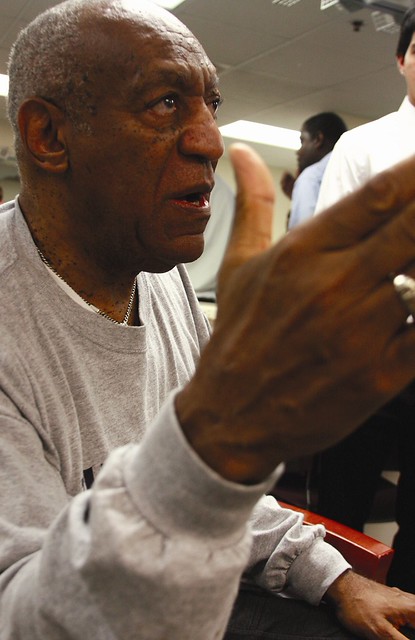
The conversation then turned to what Cosby called “the hard knock life” these kids come from. He noted that youth today confront different challenges than what he or Boozer faced growing up and that Boys Town provides healthy mediation.
“We lived with our biological parents. Now my father drank too much and said he didn’t want any responsibility, which left the whole job on my mother, so we lived in a housing project. Yet we didn’t have the pressures these guys have, the insanity that exists today, and by insanity I mean not normal. Yes, there is a normal. What is normal? Normal is, ‘Don’t do that’ – ‘OK.’ Abnormal is, ‘Don’t do that.’ ‘No, I’m going to do it because you said don’t do it.’
“When I was coming up we didn’t have Omaha, Neb. ranked high in teenage boys murdering each other. Am I making sense? We didn’t have the guns being placed in our neighborhoods. We had guys who made guns but you had better than a 70-30 chance that gun would blow up in his hands. But now we have real guns and good ones too. It’s in the home.”
Cosby said it comes down to caring and making good choices.
“The first black to score a point in the NBA, Earl Lloyd, wrote a book and he tells the story of being 14-15 years old and he comes home and his mother says, ‘Where’ve you been?’ He’s stammering, he knows he’s caught with something, avoiding telling her he’s been in a place she doesn’t want him. She says, ‘You were with those boys on that corner.’ and he says, ‘But Mama, I wasn’t doing anything.’ And his mother says, ‘If you’re not in the picture, you cant be framed,’ and if you don’t understand what I just said someone will explain it to you.
“But the idea is where are these boys coming from and what places they may have to get to. There’s a place called Girard College in my hometown. You need to look it up. Forty-three acres. I call it the 10th Wonder of the World.”
The college, where Cosby gave the commencement speech last year, has a largely African-American student enrollment and graduates a high percentage of its students, most of whom come from at-risk circumstances. He said it’s a shining example of what can be.
“What’s missing in this society for black people and people of color is to own something, a small business to build upon. Many of you because of your color you will get the feeling, Yeah I can study and I can be but once I step away from college and go outside of that there are too many people that look at my color and listen to my language and they wont really welcome me. And all of you here know exactly what that feels like.”
Then, turning to Tony and Simone and referring to the boys, he said, “We’ve got to do more with fellows like these for them to do shadowing, to find business people willing to allow the boys to not go get coffee or to tie their shoes but to shadow, and it can happen in hospitals, it can happen in factories, businesses, so that these young males begin to understand what they can do.”
Cosby clearly admires the difference that adults like Tony and Simone make, saying he can see “the joy of these boys knowing that you guys care.”
“It’s about showing them the possibilities,” said Simone.
And with that, the legend bid his guests goodbye. As the entourage filed out with smiles, handshakes and break-a-leg well wishes this reporter was reminded of what Cosby said about the possibilities he began to see for himself once his college English professor took notice.
“I knew I was on track with what I wanted to do.”
Things have come full circle now and Cosby embraces the each-one-to-teach-one position of inspiring young people to live their dreams, to realize their potential.
“Hey, hey, hey…”
Related articles
- Bill Cosby Coming to Omaha to Perform Comedy Concert May 6 (leoadambiga.wordpress.com)
- Fat Albert And The Cosby Kids: The Complete Series (werd.com)
- Bill Cosby: “We’ve Got To Get The Gun Out Of The Hands… (alan.com)
- Did Bill Cosby change how America views African American families? (tammymv.wordpress.com)
- Bill Cosby Visits Drexel’s Family Health Services Center Ahead Of Expansion (philadelphia.cbslocal.com)
- Bill Cosby Speaks His Mind on Education (wordpressreport.wordpress.com)
Bill Cosby talks about his life’s turning point

Bill Cosby talks about is life’s turning point
©by Leo Adam Biga
Soon to appear in The Reader (www.thereader.com)
Slow ticket sales are prompting legendary comedian Bill Cosby to do a media blitz promoting his 2 p.m. May 6 Orpheum Theater concert. It just wouldn’t do for the 74-year-old icon to play to empty seats.
Cosby’s handler has me call the artist’s home directly. The unmistakable voice answering on the other end hastily greets me before excusing himself with, “Hang on a minute.” It seems his wife Camille is heading out with the grandkids and he wants to confirm dinner plans before she goes.
“Hey, listen! Is anybody paying attention to what I’m saying? Camille, are you paying attention to what I’m saying?”
He’s channeling the exasperated Cliff Huxtable from The Cosby Show.
He holds the floor a moment before fumbling for a name that eludes him. His family assures him they’ve got it covered. As they exit, he says, “OK,” and returns to the phone.
“Hello, alright, what you got?”
I suggest the overheard exchange is like a scene from his show.
“Well, um, yeah, with grandchildren now who come by and visit and then things show up in their hands and you say, ‘Well, where’d you get that?” ‘I don’t know.’ ‘Go put that back.’ And you have to define to grandchildren what is not a toy.
“Before they’re broken we would rather you not pick them up and then put them on the floor and pretend they’re something, and then forget you put them down there, which is what I call dementia. While people are picking on old people, kids have dementia too , They put stuff down and then they walk away and leave it. You say, ‘You know you forgot to pick up…’ ‘Oh, yeah.”
The riff over, Cosby refocuses to ask. “So where am I going?” I reply, “You’re coming to Omaha.” “Oh, yeah, listen man, we need help there. Played Lincoln (October 7), did well, did very well. We’re sitting there (Omaha) anemically at 30 percent. I think we need to tell the people I’m coming and they will probably have close to an hour and 45 minutes of good old, gee whiz I-forgot-I-could-laugh-that hard-and-that-good fun.”
Later, when he repeats his plea for help, citing the 30 percent number, I express surprise he even knows a detail like that.
“Really?” he asks incredulously. “Well, you better erase that. I do know. Look, this is a business. And I do think there may be an awful lot of entertainers and performers who would not even care, I mean, at least not to do anything about it. But I just want the people to know I am here and they need to go on and get these tickets and quit fooling around.”
A personal appeal to his fan base is potentially huge. His audience is sure to include folks “when I used to play Ak-Sar-Ben, when that was a big to-do then,” he says, referring to sold-out Knights of Ak-Sar-Ben concerts he performed at the old coliseum, once memorably with Sammy Davis Jr..
I ask if he considers himself a storyteller or monologist and he interrupts with, “Don’t bother with all that stuff. I walk out, there’s a chair, a table, a box of Kleenex, a bottle of water and a waste paper basket. Draped over the chair is ‘Hello, friend,’ which is our late son’s favorite saying in greeting people.”
Then, in the warm, reflective intonations familiar from his stand-up act and film-TV roles, he launches into, what else?, a story about how it all started for him at school. It’s the reason he’s taken education as his cause, both as advocate and critic.
He says growing up in a Philadelphia public housing project he was a bright but indifferent student, devoting more time to sports and hanging out than studying. He recalls only two teachers showing real interest in him.
“I wasn’t truant, I just didn’t care about doing anything. I was just there, man. I was still in the 11th grade at age 19.”
He calls what happens next “divine intervention.” The high school drop-out joined the U.S. Navy. He hated it. “That was a very rude epiphany.” He stuck it out though and obtained his GED. “I spent four years revamping myself.”
He marveled a GED could get him into college. Despite awful test scores Temple University accepted him on an athletic scholarship in 1960.
“I was the happiest 23-year-old in the world. They put me in remedial everything and I knew I deserved it and I knew I was ready to work for it. I knew what I wanted to be and do. I wanted to become a school teacher. I wanted to jump those 7th and 8th grade boys who had this same idea I had of just sitting there in class.
“Being in remedial English, with the goal set, that’s the thing that began to make who I am now.”
I score points with him when I share I tested into remedial English myself, prompting this, “Hey, we’re remedial, man.”
Fully engaged in his work, he threw himself into creative writing assignments. He wrote about pulling his own tooth as a kid and the elusive perfect point in sharpening a pencil. He recalls the impact it made when the professor held up his papers as shining examples and read them aloud in class to appreciate laughter.
“That was the kickoff. That’s when my mind started to go into another area of, Yes you can do, and I began to think, Gee whiz, I could write for comedians. And all my life from age 23 on, I was born again…in terms of what education and the value is. To study, to do something and be proud of it – an assignment.”
Cosby found his voice and passion: humanist storyteller of universal themes.
“That’s the whole idea of the writing – everybody identifying with it. I write about the human experience.”

From the start he wrote what he knew. “Who told me to do it? Nobody, I just wrote it. Was I trying to be funny? No. Was I reading any authors who inspired me? No.”
It wasn’t long after enteringTemple he penned famous bits like “Superman” and “Toss of the Coin.” Hundreds more followed, mostly about family.
“I write all and have written everything I have ever performed on stage. So, when you look at a movie, when you look at a TV show, when you hear an LP, I am that writer-performer. Everything comes from that. But when you look at the body of the work you will see that school teacher still working it, still talking about the value of education.”
Even as his stand-up career exploded, setting the stage for many firsts, he focused on entertainment with a message.
“I would imagine it was something brand new for an awful lot of people – to see this black person talking and making a connection and laughing because, ‘Yeah, that happened to me.'”
He’s the author of several best-selling books.
He’s well aware his life could have been quite different.
“Had it not been for the positive influence of this professor, without him reading that out loud and my hearing the class laugh, who knows, I may be at this age a retired gym teacher, well loved by some of his students.”
Years later he did finish college and added advanced degrees.
Going on 50 years as a comic, he’s a familiar “friend” to audiences. “We already have a relationship that’s wonderful because they know I’m funny, so there’s no guessing there.” He walks out with an idea of what he wants to do but, he says, “I keep it wide open.” Once he feels out the crowd, he goes where “they are.”
“It’s very complex,” he says, “but because I’m a master at it I think you want me in that driver’s seat to turn you on.”
Tickets start at $49.50. To order, call 402-345-0606 or visit http://www.ticketomaha.com.
Related articles
- Cosby says guns, not race, the key issue in Trayvon Martin case (cnn.com)
- St. Frances Academy To Honor Cosbys For Donations (baltimore.cbslocal.com)
- Bill Cosby (slideshare.net)
- The Cosby Show (1984-1992) (russelllindsey.wordpress.com)
- Quintessential family man Bill Cosby “out to hurt their faces again” with laughter at Sunrise show (tcpalm.com)
- WATCH: The Cosby Obama Show On ‘SNL’ (huffingtonpost.com)
- Bill Cosby Speaks Boldly to Students About Their Choices (fox4kc.com)
Norfolk, Neb. Festival at the Johnny Carson Theatre Hosts Intersection of Comedy’s Past, Present, Future
One of the top annual comedy events in the United States occurs in what seems be a most unlikely place, Norforlk, Neb., until you realize the northeast Nebraska town is where Johnny Carson grew up and where he helped endow a state-of-the-art theater in his name. Looked at in that light then, the Great American Comedy Festival that plays there every June and that attracts a roster of emerging and legendary comic talents doesn’t appear so out of place after all. I did this story a couple years ago in advance f the festival when its emcee headliner was David Brenner and its legend recipient was Bill Dana. Depending on your age and your knowledge of pop culture figures from the 1960s-1970s and earlier, those names may or may not mean anything to you, but Brenner and Dana were once very big deals in the comedy world. It was fun to speak with each of them. Space constraints dictated I could only use a bare fraction of the interview materials. Time constraints prevent me from posting the full Q&As on this blog. Maybe some day, if I ever acquire an assistant or intern, I can share those full interviews here.
By the way, this blog contains several stories by me on Dick Cavett, whom I’ve interviewed extensively the last few years.

Norfolk, Neb. Festival at the Johnny Carson Theatre Hosts Intersection of Comedy’s Past, Present, Future
©by Leo Adam Biga
Originally published in The Reader (www.thereader.com)
The June 14-20 Great American Comedy Festival in Norfolk, Neb. honors the legacy of hometown legend Johnny Carson by celebrating comedy’s past, present and future. Twenty-four stand-ups from around the country compete for a grand prize.
The comics qualified via auditions held in 10 cities. Many already boast impressive credits: appearances on “Late Night with David Letterman,” “Saturday Night Live,” Comedy Central and gigging at top clubs. Others are still waiting for that big break.
For audiences of a certain age, however, the real attractions are two venerable comedy stars – stand-up David Brenner and writer-performer-producer Bill Dana. For the June 20 gala finale at the Johnny Carson Theatre Brenner’s the emcee and Dana’s the Comedy Legend recipient (2008’s was Dick Cavett). They’re among the competition’s judges.
The pair’s combined comedy careers approach 100 years. Both claim a strong connection to NBC’s “The Tonight Show,” the fabled program that made the late-night talk format a staple. Norfolk native Carson inherited the gig from predecessors Jack Paar and Steve Allen but, Dana said, Johnny “perfected it.”
Brenner’s 158 “Tonight Show” appearances are a record. He’s guest-hosted 70 times. He made his national television debut there, killing with his sharp observational bits. The show was at the height of its star-making power then. Brenner makes no bones about the impact those early spots meant.
“I’m thrilled to be doing this because not only did Johnny give me my first break and my first shot on television but he kept having me on and that sustained my career, so that you’re talking to someone now who’s still doing comedy after 40 years and that’s because of Johnny Carson,” Brenner said by phone from Las Vegas. That success allowed Brenner to meet the great comics he idolized as a kid.
Before that first Carson set, though, a struggling Brenner was ready to call it quits.
“Think of this – one small room, a pull-out sofa bed, two trunks with things in ‘em, a globe of the world because the person there always dreamed of traveling the world, a little kitchen you couldn’t sit down in, a bathroom, a closet and an outer- wear closet before leaving. Maybe 300 square feet. And three dollars in the pocket. That’s where I lived and how much I had when I walked on the stage to do my first ‘Tonight Show,’ and the day after I did that first one my life changed.”
Brenner, whose father was a vaudeville comic, grew up on Phillie’s mean streets. Having starred in his own live HBO special, hosted his own late night talk show (‘Nightlife’) and been a Vegas headliner, Brenner’s not the sentimental sort but mention Carson and he turns softie.
“I don’t get excited much about gigs anymore. I mean, I haven’t done it all, but I’ve done close to it. When Eddie Brill, who’s talent coordinator for ‘Letterman’ (and the fest’s executive producer), called and told me what he’s doing – keeping the memory of Johnny Carson alive – and would I consider emceeing the thing, I said, ‘What, are you kidding? You got it.’ I can’t wait for that gig, and I haven’t felt that way about a gig in a long, long, long time.”

Dana’s eager to pay homage, too. The Quincy, Mass. native and World War II combat vet had no show biz dreams until attending Boston’s Emerson College on the GI Bill. When fellow Emerson grad Gene Wood got on as an NBC page Dana joined him. The page route opened doors for their Dana and Wood comedy act.
Wood went on to write for “Captain Kangaroo” before turning TV’s preeminent game show announcer. Dana hooked up with Don Adams, writing routines that caught the attention of “Tonight” originator Steve Allen, who brought Dana on as a writer/talent scout. Dana soon became the head jokesmith.
Dana has the highest regard for Allen’s pioneering role.
“Everything you see on ‘The Tonight Show’ to this day comes from Steve. The couch, the chair, the desk, the proscenium, the relationship with the orchestra, all of that pabulum with the band leader and the announcer, all of that was done in the original ‘Tonight Show’ at the Hudson Theatre (New York),” Dana said by phone from Nashville. “Nothing has changed to that formula because it was just perfect right from the beginning. It was exciting to be part of that.”


Dana contributed bits like The Answer Man that morphed under Carson into Carnac. Though primarily a writer, Dana said he acted “as a sort of utility infielder” in select skits. One bit Dana wrote and performed in ‘59 – “My name, Jose Jimenez” – became a sensation that led to his own sit-com.
He was virtually out of the business before penning the memorable “All in the Family” episode in which Sammy Davis Jr. kisses Archie Bunker. He’s toured with comedy legends Cavett, Mort Sahl, Dick Gregory and Shelley Berman. In 2005 he launched the American Comedy Archives (www.emerson.edu/comedy) at his alma mater. Dana’s the subject of a new documentary.
Something Allen once told him is coming true. “Steve always said, ‘If you live long enough you’ll start to get awards,’ and it’s starting to happen. These days, I’d rather have a job.” Rim-shot, please.
For festival details visit www.greatamericancomedyfestival.com or call 402-371-2932.
Related articles
- SUV Crashes Into Johnny Carson’s Boyhood Home (abcnews.go.com)
- Dick Cavett on The Tonight Show (milkandcookies.com)
Homecoming always sweet for Dick Cavett, the entertainment legend whose dreams of show biz Success were fired in Nebraska

Image by nick step via Flickr
In his new book, Talk Show: Confrontations, Pointed Commentary, and Off-Screen Secrets, irrepressible Dick Cavett reminds us that though he hasn’t hosted a talk show in a very long time he has much to say about this television genre, one he gave his own distinctive spin to as a writer and host. A wordsmith at heart, his new work also reminds us how gifted he is at turning a phrase. Because Cavett is making the rounds this fall and winter to promote his book, he is very much in the entertainment news again, which is why I am reposting a couple Cavett articles I wrote a few years ago and why I am posting for the first time some other Cavett material I wrote. He’s been very generous with me in terms of granting me ample time for my interviewing him over the years. To be honest, I didn’t even know about this book until a friend mentioned it. Now that I’m onto it, I will request a new interview with him and I know he will be accommodating again. As he likes to say, he’s always a good guest, and in this case, a good interview. The following piece, which traces his career, originally appeared in the New Horizons newspaper in Omaha, Neb.
Homecoming always sweet for Dick Cavett, the entertainment legend whose dreams of show biz success were fired in Nebraska
©by Leo Adam Biga
Originally appeared in the New Horizons
Dick Cavett’s longing to be “under the lights” burned so hot as a boy in post-World War II Nebraska that nothing seemed more enticing than the prospect of far-off glamour in New York. Then, as now, the Big Apple loomed as the center of all things, certainly of show biz, which the young Cavett saw as his future.
“Always the shot of the New York skyline spoke to me where it didn’t to others my age,” the 70-year-old comic and former talk show host said by phone from his historic coastal retreat, Tick Hall, on Montauk, Long Island. The 19th-century, Stanford White-designed home is where Cavett and his late wife Carrie Nye spent time away from the tumult of New York. The house burned down in 1997 and over three years time the couple had it reconstructed to historic specifications, an epic project that is the subject of a documentary, From the Ashes.
The house hasn’t been the same since Nye died from cancer last July. She had a way of filling any room she was in with her bright spirit and hearty, Southern drawl-tinged laugh. She and Cavett were married 42 years.
Today, when not at the beach, he stays at the Manhattan apartment the couple shared. This son of career educators lives a life steeped in culture — books, the theater, films, fine dining. He writes letters and op-ed pieces. His ability to engage in literature, history, gossip, trivia and one-liners sets him apart from some entertainers. Words fascinate him. He loves finding just the right one with which to prick or prod or parry. Exposing grammatical errors is a hobby, nigh-compulsion.
Cavett, the forever puckish wit, was born in Gibbon, Neb. and raised in Grand Island and Lincoln. Precociously bright, he got laughs from an early age, when he’d surprise others with his large vocabulary, double entendres, confident delivery and deep voice. His humor’s never left him, not even in his grief. Since Nye’s death, however, he has grown more reflective than usual about his Nebraska upbringing and the close ties he’s kept here throughout his nearly half-century career.
Nebraska is where he came back only three months after Nye, a noted actress, passed. He headed out alone by car to its far western reaches, a road trip he’s made many times over the years as a kind of pilgrimage. When things get too oppressive back East, Nebraska is his escape. Here, away from the glare, the noise, the crowd, he can unwind and breath under the clear, open, quiet skies.

“Yeah, it is that in a way,” he said, “especially when I do almost my favorite thing in the world to do, which is get in a car and go out into the Sand Hills. I remember one great teacher I had in high school, after I had just been to the Sand Hills, said, ‘Oh, it’s just heaven. Aren’t you glad the tourists haven’t found it?’ A lot of the tourists wouldn’t dig it or get it. But the idea you could take the family car as I did and drive 416 miles on the 4th of July for however many hours and hours it took and see just four other cars on those old roads…,” he said, his golden voice trailing off, choked with the wonder of the memory.
When he’s back, he stops in on old friends like Dannebrog’s Roger Welsch, the folklorist-author, and Lincoln’s Ron Hull, the avuncular Nebraska Educational Television legend. He visits his stepmother, Dorcas, now 90 but still sharp as a whip.
“So I went up to our bedroom where my wife Linda had already gone to bed and said, ‘Uuuuuuuh, Linda…Dick Cavett says he’s going to come visit us sometime. ‘Did he say when?’ she said sleepily. ‘Yeah….in about five minutes.’ She never did forgive me…or Dick…for that one.”
Hull said Cavett’s affinity for Nebraska is “genuine. There’s not a phony bone in his body. He’s a very, very honest person.” Cavett often comes back at Hull’s request to emcee benefits or to lend his famous face and voice to a documentary or spot. “He’s never turned me down,” Hull said admiringly. “He’s a very generous guy. He’s always come through. And he’s always done it pro bono, just as a friend. He’s been a very good friend of Nebraska. That’s one of the things I like about him — he didn’t forget his roots. He is proud of those roots. He never lost touch with that.”
Whether at work in the studio or at play over dinner, Hull said Cavett’s “so much fun to be with. He is curious about everything. He listens. He has this marvelous, retentive mind. He’s so good at words. Don’t ever play Scrabble with him.”
“He is a pleasant soul,” Welsch said. “It’s hard not to like Cavett. His visits here are…definitely not an exercise in royalty visiting the peasants. Yes, he talks about Woody Allen and Mel Brooks…while I talk about my pal Bondo, the auto body repairman, or Dan the plumber, but somehow there isn’t a feeling of inequity. He appreciates the humor I find in ordinary people out here and in turn shows me the ordinary side of the notables in whom he finds his humor. I really don’t consider Dick Cavett to be a famous person who is a friend of mine; to us he is a friend…and oh yes, I guess he’s also famous. Perhaps the best part is that even as a world-famous star and intellect, he is still, through and through, a Nebraskan.”

Roger Welsch
Cavett’s love for the wide open spaces, solitude and history of Nebraska was implanted early on, via road trips his family made out West when he was a boy. Book, film and museum images of Plains Indians fixated him. As an adult he immersed himself more deeply in the land and legacy of its native peoples, familiarizing himself and the nation with the works of John Neihardt, Willa Cather and Mari Sandoz. He’s proud of the remarkable figures Nebraska’s produced and will name, without any prodding, some of the great film, theater, literary and athletic icons from here.
Whenever someone suggests there’s a characteristic that describes a typical Nebraskan, he’s quick to point out that personalities as diverse as William Jennings Bryan, Darryl Zanuck, Fred Astaire, Marlon Brando, Johnny Carson, Malcolm X, Sandy Dennis and Johnny Rodgers emerged from this same terra cotta.
For the book Eye on Cavett he wrote of returning a celeb to his Lincoln High class reunion. He and Welsch were classmates and bandmates, not buds. Cavett suspects Welsch thought he was “one of the fancy people.” Welsch confirms as much, but adds, “I admired him…He was always one of the stars at the talent shows, theater productions, and that kind of thing, and yet he was never an arrogant pain in the ass…just a nice guy who had a lot of talent.” They both coveted luminous Sandy Dennis, another classmate bound for fame, but neither had the guts to ask her out, much less speak to her. Cavett later got to know her in New York.
Nebraska is where Cavett’s heart is. New York’s where the action is. Even as a boy, he felt the pull of that place. How could it not beckon a starstruck kid like him? Especially after he nearly committed to memory the classic book, The Empire City, an anthology of great stories about New York by great writers.
“It’s just wonderful. Every famous writer who ever wrote anything about New York is in there,” he said, “from E.B. White to Groucho (Marx) to F. Scott Fitzgerald and Ben Hecht. And I would read that thing and then read it again. I knew more about New York then, sitting on the glider on the porch reading that book than most New Yorkers did. I could describe Chinatown and how to get to it and around it and in it,” without having been there. In the book Cavett he co-authored with friend Christopher Porterfield the entertainer calls New York “a siren call.” Made all the more alluring by anecdotes of it told by his parents’ friends or the genuine New York actors he shared the stage with one season of summer stock in Lincoln.
For him, the future was a New York or bust deal. He wasn’t sure what path would take him there — “I had no idea how you got there” — but he knew his destiny lay in the crackle and glow of theater marquees, not the scraping of chairs on floors and chalk on backboards. His late parents, and stepmother, were all public school teachers and while he suspects he too would have excelled at it, he would be dissatisfied knowing he’d missed out on his dream.
“I think I could have enjoyed being a teacher a great deal,” he said. “They would have liked me. I would have been funny and all the things you didn’t associate with most teachers.” Like his dad. “My father was always the most popular teacher anyone in Lincoln ever had,” he said. “My father always attracted the most forlorn types…and made them feel better and gave them confidence and all these things. He gave them meaning. He didn’t mean to do that, but it just happened.”
One of those the elder Cavett tried reaching out to was the garbage man on their block, a young, sullen, self-made rebel named Charlie Starkweather, an obscure boy and striking name soon to strike fear on the Great Plains.
Cavett’s “toyed with the idea” of what might have been if he hadn’t left Nebraska. “Would I go nuts? Probably not. But I certainly wouldn’t have had what I wanted and at times got more than enough of later on. Let’s just say I can’t imagine contributing a covered dish to the picnic of the neighborhood,” he said dryly.
As “drawn” to show biz as he was, he said, “I can’t think of ever wanting anything else. It wasn’t as though, If I can’t become a comedian or a magician I’ll become a lawyer or a plumber and I’ll be happy doing that. Noooo…” That didn’t stop some from trying to dissuade him. “I didn’t have any interest in dental college, one of several things — it seems so humorous now — my father tried to interest me in. And of course his pitch was. ‘You’re talented, but you know a lot of people don’t make much of a living in your business, You really ought to think about something that’s going to be steady.’ I just nodded and let it pass.”
Once bit by the bug, no appeal to practicality could change his mind. “Yeah, because in effect you don’t really have any choice,” he said. “The thought of trying to go to law school was not even in question. I didn’t want to have anything to do with it.” The death of his mother from cancer when he was 10 only made him retreat more into the world of make believe. On the whole he counts his childhood a happy one, but the trauma of his mother’s death still stings.
“The worst part of that was not only watching her dying,” he said, “but no other kid I ever heard of lost a parent. Nobody.” He said his wife’s death made him relive the pain of his mother’s death and elicited “the resentment of, Screw this — I have to do it again? That was awful.”
There were also molestations he suffered at the hands of strangers, once at a Lincoln movie theater. He doubts the abuse triggered the depression he struggled with for many years, although he doesn’t discount the possibility.
But mostly he looks back fondly at a solid rearing. While his folks were far from bohemians, they were no squares, either. His mom and dad were intelligent, culturally astute people. As is his stepmother. His dad and step-mom co-founded a high brow social club, the C.A.s, whose name was a closely guarded secret. Critics Anonymous brought together a group of like-minded adults, plus Dick, for celebrations and excoriations of different subjects or themes. Sometimes, a country’s music, food, literature and customs came under scrutiny.
All the talk of exotic places only fueled his fire to see the larger world.
Like the boy who runs away with the circus, Cavett heeded the call of the lights, only gradually, in small measures. While growing up here he did some magic, some acting, some announcing. Even his favorite athletic pursuit, gymnastics, put him out front, under the lights. He studied the great comics, absorbing their stances, their inflections, their timing. His models were as near as Johnny Carson, then a popular magician on the Chautauqua circuit and, later, a dashing television-radio personality in Omaha, and as distant as the greats he glimpsed in the movies or on TV.
He once saw a young Johnny’s Great Carsoni act, and it left an impression. Perhaps, he thought, he could emulate a fellow Nebraskan’s success on stage. And once in awhile one of those bigger-than-life legends, as Bob Hope did, would come to perform in Lincoln or Omaha, giving him a first-person dose of show biz magic.
On those occasions, Cavett would, through sheer pluck, wend his way backstage before and after the show, something he continued doing once he finally made it to New York, becoming a habitue of the club-theater-network TV district, all the better to run into celebs. Just seeing Hope in the flesh was enough to feed his imagination and project himself into that rarefied company.
Besides Hope, long a hero of his, Cavett’s star gazing in Nebraska found him finagling seats and trading backstage banter with the likes of Charles Laughton, Basil Rathbone, Phil Silvers and Spike Jones. Each encounter only intoxicated him more with the idea that he belonged “in that world” with them.
Still, the stars were ethereal enough that even his “wildest dream could not convince me I would one day have Hope as a guest on my own show.” But he did.
After one of those head-in-the-cloud nights in Lincoln, enraptured by the sight of his idols and the exchange of a few words with them, his return to dreary Earth felt like defeat. “To go to school the next day was just murder,” he said. I thought, ‘I belong with them (the stars)’” as they set off by train for the next stop under the lights. Wanderlust ran in the family. His maternal grandfather was a Baptist preacher who immigrated from Wales and evangelized his way across the Great Plains. “My hell-for-leather Uncle Paul, as my father always called him,” was a rover who rode the freight rails. A young Cavett was captivated by their experiences of setting off for distant spots. “Oh, yeah, they had dramatic adventures in faraway places,” he said. “But I didn’t want to be T.E. Lawrence or Frank Buck. I didn’t see myself in jungles or deserts, though I’ve been to both…” He said he was like this character from a long-forgotten novel who startles her parents when they ask — ‘What do you want to be, a nurse or a school teacher?’ — by saying, and my wife used to quote this, ‘I want the fast cars, the bright lights and the men in tuxedos.’” Only substitute women in cocktail dresses for men in tuxes.
Cavett was spotted early on as a talent to be watched, even if he didn’t know exactly what talent might send him on his way. As a teen he acted in and eventually directed, too, a Lincoln Junior League Theater program, Storytime Playhouse, on popular radio station KFOR, the same station Carson used to launch his career. Cavett once did a 15-minute Macbeth.
“One day out on the street I run into Bob Johnson, who was of course this huge celebrity in Lincoln because he was a longtime announcer on KFOR. He did Bob Johnson’s Musical Clock and Bob Johnson’s this-and-that. We were both heading for the studio and he said, ‘Let’s walk around the block,’ as if he was about to bring up something sensitive and didn’t quite know how to. So we made small talk and then he said, ‘You know, Dick, I have a feeling about you — you’re going to get up and out of here the way Johnny did.’ And it was a poignant moment because it was a man in his middle age saying, I’m as far as I’m going to get and I faced up to that, but you and Johnny, well…
“I didn’t know what to make of it. I didn’t know what to say. I kind of hoped he was right, but I didn’t know how Johnny did. I can’t imagine what we said for the last half-block.”
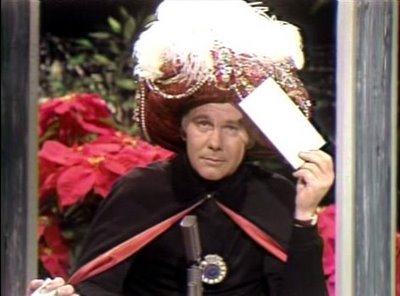
Johnny was of course Johnny Carson. “Johnny was 10-12 years older than I was,” Cavett said. “He was doing his television show (The Squirrel’s Nest) in Omaha and soon going on to New York for various things, He hadn’t utterly ‘made it’ yet, but as far as anyone in Lincoln was concerned he had.” Cavett’s since wondered what might have happened if they had bumped into each other then to discuss their nascent show biz dreams. He’s sure they would have recognized in themselves then what kindred spirits they were.
As it was, they both made it big time, their careers following nearly parallel courses. Cavett was a talent coordinator and writer for Jack Paar’s Tonight Show, the slot Carson, who’d hosted TV game shows and written for Red Skelton, inherited when Paar retired. Carson made Tonight an even more popular and lucrative brand name for NBC. Cavett joined Carson’s staff of writers before getting his own talk show.
“I guess I just always had this sort of pull, as I think he (Carson) must have, to go where the action is. Mingle with Jack Benny and Bob Hope and Lucille Ball and maybe Groucho if you were really lucky.”
Cavett’s opportunity to leave Nebraska for the bright lights came courtesy of a family friend, another older man who saw in him the hunger and potential to excel.
“A friend of my parents by the name of Frank Rice taught at Omaha Central. Frank sort of looked like Vincent Price. He had a Whitney Fellowship, I think it was called, at Yale for a year. He came back and said, ‘Dick should apply at Yale.’ Nobody took this very seriously and Frank insisted. And somehow that came about.”
“I remember Frank saying, ‘You’ll like it at Yale, if you’re lucky enough to get in, because the Shubert Theatre is right across the street from your freshmen campus. Every week or two a new Broadway show comes through on its way to New York.’’ Broadway show? I didn’t even care it would cost me a dollar-forty to sit in the front row of the second balcony.”
This was it — his entree to the glimmer of New York theater and culture. If he could get in. And then one day, as he tells it, he was “on the same glider on the porch that I was probably readingThe Empire City on” when the mailman brought a letter from Yale that said, ‘You have been accepted in the Class of 1954.’ And the whole world just swam for a moment. ‘What will all this mean? God, what could happen from this? It’s hard to say. Damn near anything.’ I walked around in a daze.”
By the time he headed east he was a certified TV junkie, so much so he said that when his family got their first set in the mid-’50s “I did almost nothing but watch it. Sundays, my God, I got out graham crackers and peanut butter and started with ‘Super Circus, live from Chicago, and went all the way through the evening, including Mr. Peepers, What’s My Line?, Ed Sullivan, The Web…I made the mistake of getting a date once on a Saturday night and she did not want to watch Show of Shows, so that was the end of that relationship.
“When I thought of going away to college I wondered, Will they let me watch all my television?”
Yale let him have his catho ray tube fix, although with only one set in the dorm he couldn’t always watch his favorite shows. More importantly, New Haven, Conn. put him within easy reach of where it all happens. With such close access to New York, his idea of a good time was far different than most of his fellow red-blooded Yalies, who had scoring girls on their mind.
“Instead of going to girls schools on the weekends, Wellesley, Smith, Vassar, I went down to New York. I thought, How can you be so dumb as to want to go there when you can go to New York…see a play with the Lunts, Paul Muni or Bette Davis, and sneak into the Jackie Gleason Show and What’s My Line?,” a show he ended up guesting on.
As he did in Lincoln, he gushed to classmates about the stars and shows he saw and that he sometimes talked to. There were more all the time. Now that he was an Ivy Leaguer and a big city sophisticate, he wanted to go home “to parade around” in his Oxford blue shirt and tweed, three-button jacket from Saks and regale everyone with where he’d been and whom he’d seen.
“That was everything I’ve lived for — to come back and cause amazement,” he said. It was also a case of homesickness. But as he found nothing stays the same.
“My first trip from Yale back to Nebraska I couldn’t wait to get to Grand Island and as soon as I got around the corner to see where we used to live, it was gone,” he said. “There was a Safeway there. They had obliterated the Christian church, my best friend Mary Huston’s house, our house, the whole block. And it was one of the most devastating things that’s happened to me. How could they raze this without my permission? A horrible feeling. It hurts me right now.”
He was near finishing up Yale when walking on campus one day in 1957 he heard the news stand jockey hawking papers, Cavett recalled, with “the words ‘murder in Nebraska.” An incredulous Cavett remarked to the man, “It sounded like you said murder in Nebraska.” He confirmed he had. “There in the Journal American, now defunct, in big letters just short of what you put War Declared in, it said, ‘Ghastly Murders, Lincoln, Nebraska.” The headline referred to Charlie Starkweather’s killing spree. It gave Cavett the creeps.
“I don’t know now if I thought, I hope nobody I know was murdered. I guess you wouldn’t necessarily assume it. Had I known and glanced down at the name Starkweather I could have had a horrible moment recalling if my father said, ‘That’s our garbage guy.’ My father said he always seemed like a kind of forlorn kid. He seemed nice enough. My dad made people seem nice enough that weren’t anywhere but in his presence. Though I suppose I doubt if my father was anyone he toyed with as a victim.”
Even that incidental connection to a serial killer was enough for Cavett to closely follow the Starkweather manhunt, capture, trial and eventual execution.

By the time the notorious case became a sensation, Cavett was taking courses at Yale School of Drama and that’s when he met the woman who would become his life partner. Carrie Nye was her theatrical name but also her full first name. When Cavett met her her surname was McGeoy. She was flamboyantly Southern. Brilliant. Funny. Serious about her craft. Independent. Opinionated. An original.
The Greenwood, Miss. native attended Stephens College where, Cavett said, she “probably had the record number of violations there of books not returned, walking on the grass, smoking behind the lockers…”
His reaction upon first setting eyes on her? “I didn’t like her very much…I said ‘God, who the hell is that? She looks affected,’ or something like that to one of the guys at the drama school and he said, ‘But have you met her?’ I said, ‘No.’ When I did I saw what he meant. She was not like anything or anybody I ever met before. No one could ever say, ‘She’s just like Carrie Nye.’”

Dick with Carrie Nye
Their drama mates included, at one time or another, Paul Newman and Julie Harris. Cavett and Nye performed at Yale and in summer stock at Williamstown, Mass. They were soon an item, marrying in 1962. For a time, her career overshadowed his. When things broke for him, they broke big. Working for Paar, Carson, Jerry Lewis. Doing his own standup comedy act. Guesting on panel/game shows. Hosting his own late night network TV show, followed by TV desk-jock stints on PBS, then cable. Prime time specials. Commercials. Voice-overs. Films. Plays. She enjoyed success in regional theater and on Broadway, also taking occasional small and big screen parts. Their marriage survived the ups and downs of their respective careers.
It’s been awhile since Cavett’s had a talk-show gig. He laid to rest any question of whether he’s still “got it” with his 2000-2002 role as the narrator in the Broadway revival of The Rocky Horror Picture Show and his 2006 appearances on Turner Classic Movies, which revived some of his late night ABC shows with Hollywood greats. For a new TCM special he taped with Mel Brooks, Cavett proved his quick wit and verbal acuity are still intact. The Hollywood shows are out on DVD, as is a rock icon collection. A new DVD set featuring him with jazz-blues legends is planned.par
It’s interesting to note that even after all the dreaming he’d done of New York and all the trips he made there from New Haven to cozy up to the stars, Cavett still hadn’t made plans to move there after graduating Yale. He was doing summer stock when, he said, a fellow actor remarked, “‘Well, I guess you’ll be heading for New York, looking for an apartment.’ But to that point I hadn’t thought very far beyond the edge of the season. I really hadn’t thought it out. I figured I’d probably trip back to Nebraska. But as soon as I heard ‘you’ll be going to New York,’ I did.”
Cavett lived the life of a struggling young hopeful, making the rounds in casting offices, taking bit parts here and there, working all kinds of side jobs to keep himself alive. He was a copy boy atTime Magazine when he screwed up the nerve to go to the RCA Building with a batch of jokes he’d written for Paar, the king of late night. His plan? To somehow bump into the Great Man, slip him the material, and be discovered for the brilliant comic mind he is. Amazingly, it all came true.

Jack Paar
He still marvels at “the sheer chance of taking the monologue to Jack Paar,” running into him in a hallway, Paar accepting the envelope containing jokes penned by a unknown, then sitting back in the live studio audience to hear hisone-liners go out over the airwaves from the mouth of a star; and later, backstage being thanked by the star and encouraged to feed him more jokes. It all led to Cavett being hired on staff. The surreal experience was just one of “the phenomenal breaks, coincidences and other such things” that helped launch his career.
Cavett found his niche as a writer. “Once I get an idea I can go with it,” he said. “That was true as a monologue writer. If Jack or Johnny would give a subject, then I could be very fast and, to the irritation of the other writers, the first one to Johnny’s desk. Not that it mattered, because the first was not always the best.” He gets a high from writing that’s akin to the buzz he gets from ab libbing. Some, like old friend Ron Hull, suggest the entertainer could be a serious writer. “Yeah, I’m reasonably certain I could have made a living that way,” Cavett agrees.
While the two never talked about it, Cavett said he and Carson understood they shared a special connection. Like Carson did, Cavett’s given back to his home state.
He recalled one of the rare times the intensely private and supposedly cold Carson invited him out to dinner in L.A.
“That night we were sitting in a booth, just two guys from Nebraska in California, and he described the special (Johnny Goes Home) he’d just done in Norfolk and he said ‘there was this moment when I opened the door at the school building and there were all my teachers.’ And it was astounding because he was moved and he stuttered, and I thought, Oh, if people who think he has a ramrod up his ass and he treats people horribly could see this…He wasn’t a bit embarrassed by the emotion.
“He had a tremendous affection for me, and it took somebody to point it out. ‘Do you notice Johnny’s a different man when you’re on his show?’ one of his staff told me. ‘We wish you’d come on all the time. Johnny’s so easy to get along with when you’re on.’ It almost embarrassed me.”
Johnny’ gone. Cavett’s beloved Carrie Nye, a woman Ron Hull called “a perfect complement” to his friend, for her brilliance, humor and taste, is gone now, too, leaving “a void” no amount of quips can fill.
Given Cavett’s comic bent, her humor may be what he misses most. “The obit man at the Times spoke to me and said, ‘I feel I know your wife a bit,’ because he had talked to her twice on the phone about people who had died she had worked with, like Ruth Gordon. He said, ‘I remember those two conversations as the funnest experiences of my life and I wish I’d recorded them.’” To which Cavett can only concur, saying, “She was just vastly entertaining in the way nobody else was.”
Even in her absence he finds himself thinking of things to amuse her with — “Oh, wait till she hears about this” — or moving things lest she trip. Then he catches himself with the stark realization, “Oh, you’re talking about someone who ain’t there no more.” He recently shared his feelings with writer and friend Calvin Trillin, whose wife Alice died five years ago.
Yes, Dick Cavett is hurting, but he knows he always has Nebraska to return to. Here, amidst the wide expanse of land and sky, and the warm embrace of its people, he knows he’s back home. Back to where his dreams first took hold.
Related Articles
- Tamar Abrams: Dick Cavett: Get This Man a Show! (huffingtonpost.com)
- Dick Cavett’s chat with Mel Brooks may be put on video for posterity (hollywoodnews.com)
- ‘Mel Brooks and Dick Cavett Together Again,’ Hour-Long Special Reuniting Comedy Greats Debuts Sept. 9 on HBO (tvbythenumbers.zap2it.com)
- I Owe William Jennings Bryan an Apology (opinionator.blogs.nytimes.com)
- Pete Duel on Dick Cavett (peteduel.wordpress.com)
Bill Maher Gets Real

Image via Wikipedia
If you are like me and you like your issues-oriented television with a bit of an edge to it, then we likely agree see eye-to-eye that Bill Maher is a healthy antidote to the talking head drivel that passes for analysis and to the rants that pass for discussion on much of TV these days. Not that I agree with everything Maher or his guests say. Far from it. Not that I think his entertainment show is a substitute for substantive news and public affairs programs. It isn’t. It’s just that I like that he isn’t afraid to go after sacred cows and to challenge many of the conventions and systems that we are weaned to believe have our best interests at heart when reality should tell us different. That is a long way of saying I admire Maher and so when I heard he was coming to do his stand-up act here I went after getting an assignment to interview him in advance of his show. It was a fairly brief phone conversation, but he was just as smart and engaging as I expected. In fact, even though we were speaking by phone, it sort of felt like I was a panelist on his show and my questions were all the cues or prompts he needed to go off on one of his spirited riffs about this or that. My story previews his October 24 appearance here and can be found in The Reader (www.thereader.com). I will not be able to attend his live show, and now that I don’t have HBO anymore I miss out on his TV show, but when I do catch glimpses of him as a guest on Larry King Live and so forth I at least have a feel now for what it’s like to go one on one with him. It’s actually pretty easy and fun because he’s a pro and he’s being real.
Bill Maher Gets Real
©by Leo Adam Biga
Published in The Reader (www.thereader.com)
Acerbic television host and political comic Bill Maher views the 60 to 70 stand-up gigs he does each year as opportunities to connect with the American gestalt. His October 24, 8 p.m. Omaha Music Hall show will be more fodder for his gauging the nation’s Zeitgeist.
“When I go out into America I can really get a feel for what this country is all about. I especially love going to places I’ve never been before, and I don’t think I’ve ever played Omaha,” he said by phone from his CBS Television City studio office in L.A..
“Then when I go back to Hollywood and do my show here I feel like, Yeah, I’m not just sitting in a place that’s not really America. I do the work, I go out there and I see America, and I enjoy it more than anything,”
His topical late night HBO show “Real Time with Bill Maher” is in its eighth season. It’s among the few programs that neither talks down to its audience nor apologizes for its signature unabashed sarcasm. Before this show he enjoyed a decade-long run with “Politically Incorrect,” which began on Comedy Central and ended on ABC. Executives at ABC cancelled it after Maher and a guest made controversial remarks in the wake of 9/11. Unlike the network wonks who freaked, he says HBO’s suits take his incendiary humor and viewer reaction to it in stride.
“They’re like a Jewish mother. They will let me know after the fact if I’ve caused them some consternation or pain. They’ll be like, Aw, don’t worry about us, we had to handle 50,000 emails yesterday, it’s OK, we’ll be alright. Yeah, that sometimes happens, but to their great credit they don’t ever stop me.”
Considering his barbed comments on sensitive subjects. just staying on the air may be the greatest accomplishment of this self-described Libertarian and apatheist who considers organized religion a neurological disorder.
“I’m proudest that I’ve somehow managed to remain on television for 18 years,” he says. “I mean, from the end of ‘Politically Incorrect’ to the start of this show there was only a six month break. You would think someone who espouses as many unpopular opinions as I do, I mean just religion alone, would have been shown the door a long time ago instead of getting a star on the (Hollywood) Walk of Fame.
“So it’s pretty amazing to me, but that shows something good about America. When I started on ‘Politically Incorrect’ in 1993 all the critics said this show is never going to last because you can’t have a host who tells an opinion. Hosts were all playing out of the old Johnny Carson or Bob Hope playbook, where you just never let the audience really know your politics You didn’t know if Johnny Carson voted for Nixon or Humphrey. You still don’t know who Jay Leno or David Letterman votes for.”Maher, who regards America as a declining empire with a dumb body politic, has faith enough folks embrace his funny, smart, self-righteous brand of social criticism that he lets viewers know exactly where he and his guests stand.
“People, even if they don’t agree with you, as long as you entertain them and you’re honest about it and you’re not down-the-line doctrinaire, they respect that,” he says. “They can take it if they don’t agree with you.”
The edge “Real Time” maintains, he says, is the unfiltered, unapologetic way things get said.
“I think people feel like it’s more honest than anything else on TV. That we will give a very raw and different point of view. Admittedly, it’s my opinion and they may not agree with it, but I think they respect the fact it’s real.”
“Real Time” also fills an information niche, albeit a highly interpretive one.
Maher says, “Part of it is we’re a live, news wrap-up show on Friday night. I think the purpose we serve for a lot of people is they have busy lives, they don’t have a chance to be newshounds all week like we do. What I try to do is to make sure that anyone who hasn’t really gotten a chance to look at the paper that week will be caught up on most of the important things that happened if they watch the show. We will touch upon them in one way or the other, either in the monologue, in an interview, in the panel, in New Rules, or in the editorial at the end.”
At the end of the day then, what is Maher — a comic, a humorist, a critic, a commentator, a pundit, or a talking head?
“Well, I guess we live in an age of hybrids, so there are times when I am any one of those things, but I always think of myself first as a comedian. That’s why I still go on the road, because that’s what I love, that’s what I know best, and that’s what I do best.”
For tickets to An Evening with Bill Maher, call 800-745-3000 or visit http://www.ticketmaster.com.
Related Articles
- Bill Maher Reaveals Montage Of Former Guests Frustrated By Christine O’Donnell (mediaite.com)
- Bill Maher Gets Hollywood Star, Thanks Sarah Palin, Bush & The Pope (huffingtonpost.com)
- Bill Maher Gives Advice to Brett Favre and White Men of America (charlestoncitypaper.com)
- Bill Maher: America Needs “A Class War” (mediaite.com)
- Bill Maher’s next book gives us the New New (seattletimes.nwsource.com)

Author, humorist, folklorist Roger Welsch tells the stories of the American soul and soil

Image via Wikipedia
Roger Welsch is a born storyteller and there’s nothing he enjoys more than holding sway with his spoken or written words, drawing the audience or reader in, with each inflection, each permutation, each turn of phrase. He’s a master at tone or nuance. New Horizons editor Jeff Reinhardt and I visited Welsch at his rural abode, and then into town at the local pub/greasy spoon, where we scarfed down great burgers and homemade root beer. All the while, Welsch kept his variously transfixed and in stitches with his tales.
On this blog you’ll find Welsch commenting about his longtime friend and former Lincoln High classmate Dick Cavett in my piece, “Homecoming is Always Sweet for Dick Cavett.” Welsch shares some humorous (naturally) anecdotes about the talk show host’s penchant for showing up unannounced and getting lost in those rural byways that Welsch lovingly describes in his writing.
Author, humorist, folklorist Roger Welsch tells the stories of the American soul and soil
©by Leo Adam Biga
Originally appeared in the New Horizons
It’s been years since Roger Welsch, the author, humorist and folklorist, filed his last Postcard from Nebraska feature for CBS’s Sunday Morning program. Every other week the overalls-clad sage celebrated, in his Will Rogersesque manner, the absurd, quixotic, ironic, sublime and poetic aspects of rural life.
That doesn’t mean this former college prof, who’s still a teacher at heart, hasn’t been staying busy since his Postcard days ended. He’s continued his musings in a stream of books (34 published thus far), articles, essays, talks and public television appearances that mark him as one of the state’s most prolific writers and speakers.
In 2006 alone he has three new books slated to be out. Each displays facets of his eclectic interests and witty observations. Country Livin’ is a “guide to rural life for city pukes.” Weed ‘Em and Reap: A Weed Eater Reader is “a narrative about my interest in wild foods, a kind of introduction to lawn grazing and a generous supply of reasons to avoid lawn care,” he said. My Nebraska is his “very personal” love song to the state. “I believe in Nebraska. I love this place for what it is and not for what people think it ought to be,” he said. “I hate it when the DED (Department of Economic Development) tries to fill people full of bullshit about Nebraska. Nebraska’s great as it is. You don’t have to make up anything. You don’t have to put up an arch across the highway to charm people.”
In the tradition of Mark Twain and William Faulkner, Welsch mines an authentic slice of rural American life, namely the central Nebraska village of Dannebrog that he and artist wife Linda moved to 20 years ago, to inform his fictional Bleaker County. Drawing from his experiences there, he reveals the unique, yet universal character of this rural enclave’s people, dialect, humor, rituals and obsessions.
He’s also stayed true to his own quirky sensibilities, which have seen him: advocate for the benefits of a weed diet; fall in love with a tractor; preserve, by telling whenever he can, the tall tales of settlers; wax nostalgic over sod houses; serve as friend and adopted member of Indian tribes; and obsess over Greenland.
The only child of a working class family in Lincoln, Neb., he followed a career path as a college academician. His folklore research took him around the Midwest to unearth tales from descendants of Eastern European pioneers and Plains Indians. He lived in a series of college towns. By the early ‘70s he held tenure at the University of Nebraska-Lincoln. Then, he turned his back on a “cushy” career and lifestyle to follow his heart. To write from a tree farm on the Middle Loup River outside Dannebrog. To be a pundit and observer. People thought he was nuts.
“I walked away from an awfully good job at the university. People work all their lives to get a full professorship with tenure and…nobody could believe it when I said I’m leaving. ‘Are you crazy? For what?’ And, it’s true, I had nothing out here,” he said from an overstuffed shed that serves as an office on the farm he and Linda share with their menagerie of pets. “I was just going to live on my good looks, as I said, and then everybody laughed. That was before CBS came along.”
Before the late Charles Kuralt, the famed On the Road correspondent, enlisted Welsch to offer his sardonic stories about country life in Nebraska, things were looking bleak down on the farm. “We weren’t making it out here,” Welsch said. “I told Linda, ‘The bad news is, we’re not making it, and the even worse news is I’m still not going back.’ And about that point, Kuralt came along.”
No matter how rough things got, Welsch was prepared to stick it out. Of course, the CBS gig and some well-received books helped. But even without the nice paydays, he was adamant about avoiding city life and the halls of academia at all costs. What was so bad about the urban-institutional scene? In one sense, the nonconformist Welsch saw the counterculture of the ’60s he loved coming to an end. And that bummed him out. He also didn’t like being hemmed in by bureaucratic rules and group-think ideas that said things had to be a certain way.
His chafing at mindless authority extended to the libertarian way he ran his classroom at UNL and the free range front lawn he cultivated in suburbia.
“I was a hippie in the ‘60s and I really got excited teaching hippies because they didn’t give a didly damn what the bottomline was. They just wanted to learn whatever was interesting. You didn’t have to explain anything. I never took attendance. I’d have people coming in to sit in on class who weren’t enrolled, and I loved that. I hated grades. Because I figured, you’re paying your money. I’m collecting the money and I deliver. Now, what you do with that, why should I care? It’s none of my business,” he said. “The guy at the grocery store doesn’t say, Now I’ll sell you this cabbage, but I want to know what you’re going to do with it.”
Welsch said the feedback he got from students made him realize how passionate he was about teaching. On an evaluation a student noted, “‘Being in Welsch’s class isn’t like being in a class at all. It’s like being in an audience.’ I asked a friend, ‘Is that an insult or a compliment?’ ‘Well, Rog, actually being in your class isn’t like being in a class or in an audience. It’s like being in a congregation.’ And I thought, Oh, man, that’s it — I’m a preacher, not a teacher. It really is evangelism for me.”
“By the ‘80s they (university officials) wanted to know how they were going to make money out of the popular classes I taught. I said, ‘I have no idea. It’s not my problem. All I’m doing is telling them (students) what I know.’ So, there was that.”
Then there was the matter of UNL selling out, as he saw it, its academic integrity to feed the ravenous and untouchable football program, which he calls “a cancer.”
“I was and still am extremely disillusioned with the university becoming essentially an athletic department. Everything else is in support of the athletic department. And that breaks my heart, because I love the university. There was that.”
But what really set him off on his rural idyll was the 1974 impulse purchase he made of his 60-acre farm. He bought it even as it lay buried under snow.
“So, I bought it without ever really seeing the ground, but it was exactly what I wanted. I loved the river. I loved the frontage on the river. Then spring came and the more the snow melted…it was better than I thought….There are wetlands and lots of willow islands. The wildlife is just incredible. We’ve had a (mountain) lion down here and wolves just north of here.”

He used the place as a retreat from the city for several years. Each visit to the farm, with its original log cabin house, evoked the romantic in him, stirring thoughts of the people that lived there and worked the land. “That’s what I love about old lumber…the ghosts.” By the mid-’80s, he couldn’t stand just visiting. He wanted to stay. “I told Linda, ‘One of these days you’re going to have to send the highway patrol out, because I won’t come home. I can’t spend the rest of my life wanting to be here and living in Lincoln.’” Their move to the farm “really wasn’t so much getting away from anything as it was wanting to get out here.”
Then, too, it’s easier to be a bohemian in isolation as opposed to civilization.
“My life is a series of stories, so I have to tell you a story,” he said. “In my hippie days, I really got interested in wild plants and wild foods. As part of my close association with Native Americans, I was spending a lot of time with the Omahas up in Macy (Neb.). I was learning a lot of things from the Indians and, well, I was bringing home a lot of plants that I wanted to see grow, mature, go to seed and become edible. Milkweed and arrowhead and calimus. I got more and more into it. I loved the sounds and flowers and foods coming from my yard.
“One day, I come home to find a notice on my door that my lawn’s been condemned and I have six days to remove all ‘worthless vegetation.’ So, I invite the city weed inspector over to show me what’s worthless. He said, ‘OK, what about that white stuff over there?’ He didn’t even know the names of the plants. And I said, ‘Well, we had that for lunch.’ ‘How ‘bout that?’ ‘That’s supper.”
Welsch said, “As I started looking at this, I found out people were nuts. Anything over six inches high in Lincoln was a weed. The county weed board was spraying both sides of all county roads with diesel fuel and 24D. That’s essentially Agent Orange. They were laying waste to everything. Strawberries, arrowhead, cattails. So, I ran for the weed board on a pro-weed ticket. About this same time, Kuralt was coming through Nebraska. He asked somebody if anything going on in Nebraska might make a good story for his On the Road series. And whoever he asked, God bless ‘em, said, ‘Yeah, there’s a crackpot in Lincoln…’ So, Kuralt called me up and came over to the house with his van and his crew, which eventually became my crew. We sat down and had a huge weed salad and walked around and talked about weeds. And he had me on his On the Road. Well, then over the years every time he came through Nebraska he stopped. I kept a file of any stories I thought were interesting that he might use. That was my way of luring him to Lincoln.”

Charles Kuralt
The two men became fast friends and colleagues.
“We always went out to eat and drink. He loved to drink and I do, too. We would just have a good time. He used me for six more On the Road programs, for one thing or another. I tried to then steer him to other things — the jackalope in Wyoming and stuff like that. We got to be really good friends. When he started hosting Sunday Morning, he asked me to watch the show. He called me up and told me he wanted to bring the culture of New York City to towns like Dannebrog.”.
By the time Kuralt next passed through Nebraska to see Welsch, the author was giving a talk before a gathering of the West Point, Neb. chamber of commerce. What Kuralt heard helped him change the course of Sunday Morning and Welsch’s career. “He walked in the back of the room and listened to the program. We drove back to my place and he said, ‘You know, you said about 13 things we could use on Sunday Morning. What we need to do is to take the culture of a little town like Dannebrog and show it to New York City. So, that’s essentially how we got together. He originally thought about doing Postcards from America, where he had somebody (reporting) in every state. It got to be too expensive. I had six or seven years all by myself (with Postcards from Nebraska) before they added Maine. Then, by the time he went off the road, he gave me his old crew. They were like family. It was a great 13 years I was on that show. We had an awful lot of fun.”
Two years into Postcard, Welsch said Kuralt confided, “I thought we’d be lucky to get six stories out of Nebraska.” Ultimately, Welsch said, “we did over 200.”
What Welsch found in the course of, as he describes it, “my rural education,” and what he continues discovering and sharing with others, is a rich vein of human experience tied to the land, to the weather and to community. He’s often written and spoken about his love affair with the people and the place.
When friend and fellow Lincoln High classmate Dick Cavett asked him on national television — Why do you live in a small town? — Welsch replied: “In Lincoln academic circles everybody around me is the same. They’re all professors. In suburbia, everybody pretty much has the same income. But in Dannebrog, I sit down for breakfast and converse with the banker, the town drunk, the most honest man in town, a farmer, a carpenter and my best friend.” What Cavett and viewers didn’t know is Welsch was talking about his best friend Eric, who’s “been all those things. That private joke aside,” Welsch added, “the spirit of what I said is the truth.”
In his book It’s Not the End of the Earth, But You Can See it from Here, Welsch opines: “I like so many writers…have come to appreciate the power of what seems at first blush to be some pretty ordinary folks doing some pretty ordinary things. There is a widespread perception that small town life moves without color, without variety, without interest…but that has certainly not been my experience. My little town is like an extended family. There are my favorite uncles. A mean cousin or two. Some kin I barely see and do not miss. And some I can never get enough of.” It took leaving the city for the small town to find “the variety I love so much. The American small town seethes with ideas and humor, with friendship and contention, with wit and warmth, with silliness and depravity.”
He finds among the people there an inexhaustible store of knowledge to draw from, both individually and collectively, whether in the stories they tell or in the jokes they crack or in the observations they make. “It amazes me how much people out here know,” he said. “I came to love the land and its river so much. I was drawn inexorably to this rural countryside. But the land was the least of it. The real attraction…is the people. As I got to know the people in town, it just really blew me away. I love the people. It’s a cast of characters.”
“When I did It’s Not the End of the Earth I got mail from everywhere, with people saying, ‘I know what town you’re talking about…I live there in Pennsylvania,’ or, ‘I was in that same Texas town you write about.’ It’s the same cast of characters everywhere.” His characters may be fictional, but they’re extracted from real life. “There is no CeCe, no Slick, no Woodrow, no Lunchbox…and yet, I hope you will recognize them because they are not only people I have known, they are people you have known…In fact, if you are at all like me, they are people you have been.”
As he found out long ago in his folklore studies, there is a beauty, a charm and a value in the common or typical, which, as it turns out, is not common or typical at all. Like any storyteller, his joy is in the surprises he finds and gives to others.
“It’s not just me being surprised, but the pleasure I take in surprising other people,” he said. “I like to tell them, ‘Hey, guess what?’ And there are so many surprises. Every week out here when we turn on television to listen to the weather, there’s a new record set — record highs, record lows, record change, record snowfall, record draught. That means we don’t know anything yet. We haven’t the foggiest notion what this place is like. We still don’t know what the parameters are of this place. And as long as it keeps amazing me like that…”
The amazing stories he compiles keep coming. Like the woman who left an elegant life behind in Copenhagen to keep house for two bachelor farmers in their dirt-floor dug-out. Or the American Indian who witnessed the Wounded Knee massacre. Or the children that perished on their way home from school in the Blizzard of ‘88.
By now, Welsch is not quite the oddity he was when he first arrived in Dannebrog, an historical Danish settlement of about 265 today. Ensconced at a table in the Whisky River Bar and Grill, he’s just that loud, funny fella who cultivates stories.
“Up here at the bar, whenever people start to tell stories, I start doing like this,” he said, gesturing for a pen and napkin, “because they know I’m going to jot them down. Eric, who used to run the bar, said, ‘Welsch, everybody hears these stories, but you’re the only one who writes them down, takes them home and sells them.’” Welsch likes to tell the story of the time he and Linda were bellying up at the bar with a couple locals, when they asked, “‘How do you make a living writing?’ And I said, ‘Well, Successful Farmer pays me for the article and Essence pays me $2 a word…’ And one of them said, ‘You mean, each time you say — the — they pay you $2? And Linda said, ‘Well, he can use the same words over and over, but he has to put them in a different order every time.’” That’s when it dawned on Welsch, “Oh, God, that’s all I’m doing. Same damn words — different order.”
He remains a suspect figure all these years later. “To a lot of people in town, I’m still the professor, writer, outsider, eccentric. There’s still people that say, ‘Is that all he does is write?’” He’s used to it by now. This son of a factory worker and grandson of sugar beat farmers long ago set himself apart.

His initiation as country dweller was complete once he fell head over heels for a tractor. A 1937 Allis Chalmers WC to be precise. Many vintage models sit in a shed on his farm. He tinkers, toils and cusses, refurbishing engines and discovering stories. Always, stories. He’s penned several books about his tractor fetish.
“On an Allis, there’s a piece of braided cloth between the framework and gas tank to prevent friction and wear. I was taking apart a tractor and it was obvious somebody soldered the gas tank before and hadn’t put back the cloth. What they had done was take a piece of harness and put it in there. What that meant was a farmer working on it looked on the barn wall and made a decision: ‘I’m not going to use that harness again; horses are done; you’re now in the tractor age.’ To me, it said a world of things, and tractors are that way. I’ve still got the harness.”
Welsch feels he only gained the respect of some townies when he “admitted total ignorance” as a tractor hack. “No longer was I Professor-Smart-Ass. I was the dumb guy who didn’t know shit. I’d bring in my welding. I’d ask how to adjust a magneto. They were showing the professor…the guy from the city. That put me in touch with people here in town I never would have known. There was a connection…”
Perhaps no connections he’s made for his work mean more to him than do his ties with the Omaha, Pawnee and Lakota tribes. He said his experiences with them have “changed my life. What amazes me is that the culture is still alive. They’ve maintained it in the face of unbelievable pressure and deliberate efforts to destroy it, and yet it’s still there and they’re still willing to share it. That, to me, is astonishing. It’s being able to go to another country and another world within striking distance of Omaha that has different ideas about what property is and what time is and what generosity is and what family is.” His adoption by members of the Omaha and Lakota tribes has given him large extended tribal families. He treasures “the brotherhood and the closeness of it. Maybe because I was an only child.”
A trip to Greenland gave him a similar appreciation for the Innuits. He hopes one day to write a book about his “love” for the Arctic country and its people. It used to be he wrote books on contract. Not anymore. “You’re really obligated then to write the book the publisher wants. The books I’m doing now are so idiosyncratic and so personal that I want to write the book I want.” Besides, he said, “everybody loves to hear stories,” and he’s got a million of them.
Welsch knows how rare and lucky he is to be doing “exactly what I want to do. So much of my life is just unbelievable fortune. My daughter Antonia said I belong to The Church of Something’s Going On. I really believe there is. That’s about as close as I come to dogma.”
Related Articles
- Review: The Language of Trees (bookingmama.blogspot.com)
- Do Not Miss Get Low (observer.com)
- Folktexts: A library of folktales, folklore, fairy tales, and mythology, page 1 (pitt.edu)
- Monowi, Nebraska, USA (presurfer.blogspot.com)


 Leo Adam Biga's My Inside Stories