Archive
The Worth of Things Explored by Sean Doolittle in his New Crime Novel “The Cleanup”
Omaha is home to many fine novelists and I have the opportunity to sit down and talk writing with some of them from time and time. One of these is Sean Doolittle, a crime novelist of the first rank and a man who leaves all pretensions at the door. The following story for The Reader (www.thereader.com) is the first piece I did on Sean and his work, and the second will soon be posted on this site as well. If you’re looking for a good summer read that engages your mind and your adrenalin then I highly recommend his intelligent page-turners.

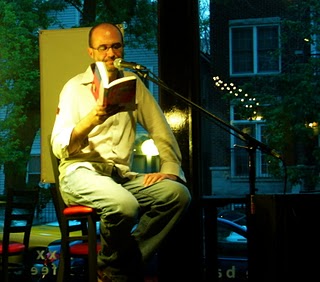
Sean Doolittle
The Worth of Things Explored by Sean Doolittle in his New Crime Novel “The Cleanup“
©by Leo Adam Biga
Originally published in The Reader (www.thereader.com)
Sean Doolittle has you join him in the very booth at the very Omaha watering hole, the Homy Inn, where the violent denouement of his new novel The Cleanup (Dell) unfolds. Just as you slide in, he mentions you’re about to sit where Gwen, the wan victim in his tale of ever escalating misdeeds, nearly loses her life. The fact he looks a bit like the towering Red Dragon character in the film Manhunter gives you pause. Within minutes he reveals the same disarming tone of his classic crime fiction, which sardonically, not gravely, lets characters stew in their own juices.
In The Cleanup the Omaha-based author has his cop protagonist Matthew Worth discover a murder and rather than call it in, clean it up, which throws into motion, ala Scott Smith’s A Simple Plan, a cascade of unforeseen results that keep forcing Worth’s hand, raising the stakes each time. Things get complicated when it turns out the corpse was a mule in an illicit racket short a quarter million bucks. The question becomes how far will Worth go to cover his and the murderer’s tracks and how far will those after Worth’s neck or the loot, or both, go to get answers?
“I really like stories where the plot is dictated by the choices the characters make. It’s a continual reaction against cause and effect. That feels to me the way life is,” said Doolittle, whose previous novels Dirt, Burn, both set in L.A., and Rain Dogs elicited warm words from some of crime fiction’s top names. The Cleanup, due out October 31, is getting similar raves. His agent is in negotiations over a potential feature film deal. Unlike many crime authors, Doolittle’s “been lucky” to avoid pressure by editors/publishers to do a series or sequel. His are stand-alone books.
The new novel grew out of a short story, Worth, Doolittle wrote years ago that ended where The Cleanup begins. The character of Worth, a burned out cop reduced to supermarket patrol seeks to redeem himself, gnawed at him.
“I like the idea of this character really trying to do maybe the wrong thing for the right reasons,” he said. “He’s driven to do it. In a dream sort of state, he keeps going. There’s definitely a point of no return in a situation like that where once you step far enough over the line, you have to keep going and keep going. The impulsive action quickly becomes unreturnable. No matter how much he tries to dig himself out he just keeps digging himself in deeper and deeper and deeper. To me, it’s more intriguing than a mystery per se, where you’ve got some clues and you’re trying to piece together a puzzle of who-did-what.
“I’m much more interested in the way people respond to circumstances, what that leads them to do and how those actions compound on each other…There’s really not any sort of mystery in The Cleanup, except wondering how it’s all going to play out for the characters. There are little surprises along the way.”
As a nod to classic noir, Doolittle has Worth cross the line for the sake of a woman (Gwen) who, while not quite a femme fatale, draws the cop into a dark place where his one rash act has dangerous consequences in a kind of domino effect.
“In a way, we’re looking at this character of Worth on the day he did something he might not have done on any other day. It ends up changing his life,” Doolittle said of his disaffected hero, who in the course of the story moves from apathy to conviction. “He comes from a long line of police officers and so he goes into that profession as sort of a family trade. But he doesn’t have the temperament for it. He’s not cut out for it. He’s a laughing stock in the department.
“Here’s this guy who became a police officer for this sort of civic minded idea of being useful to the world and found much more self worth in the simple act of bagging people’s groceries than he ever had in the frustrating job of being a cop. In wanting to save her (Gwen) she represents what he wanted to do in becoming a police officer in the first place. This temporary savior complex that overcomes him has lots of levels in it that he puts all together in Gwen.”
What Worth doesn’t know is that his quest to find self-worth in helping Gwen out of a jam is really about saving himself. But, as Doolittle said, his redemption comes “at a fairly high cost by the time it’s all over.”
Although long “drawn to kind of darker stuff,” Doolittle’s not sure why and feels the reasons for it may be best left unexamined.
“It’s the sort of thing where you don’t really want to solve that mystery because it is your fuel and once you learn the secret maybe you lose the fuel,” he said. “The old chestnut is good drama is based on conflict and I think crime novels provide a very visceral, bottom line conflict you can start with and work from. I like what you can do within the general framework of a crime novel or a noir novel in terms of exploring human behavior. I think the way people respond to extreme pressure or in extraordinary circumstances is an interesting dramatic place to play around.”
He recalls the first story he wrote, for a school class exercise, was in the hard-boiled, first-person vein of a P.I. narrator. A kind of, “I was sitting in my office when…” tease. Strangely, he’d not yet read any crime fiction, “but I must have osmosed that sort of iconic story through my skin or something,” he said. “I don’t know if I caught pastiches on television…You just pick that stuff up everywhere.”

Among his earliest influences was Stephen King. That led him to Robert Bloch (Psycho). Then about the same time he was exposed to the neo-noir of Quentin Tarantino’s films and the breezy mayhem of Elmore Leonard’s novels, which led to old masters like Jim Thompson, Dashiell Hammett, Philip Chandler and James M. Cain. “I kind of started like a lot of people do,” he said, “by finding somebody in the mainstream and then reading my way back into the margins from there.”
Born and raised just outside Lincoln, Neb., Doolittle began as a journalism major at the University of Nebraska-Lincoln but switched to English under the tutelage of Gerald Shapiro and Judith Slater. As an undergrad his first “pro fiction,” a short story, sold and paid “real money.” He intended on an academic career teaching college English and writing, but after getting his master’s, he said, “I decided what I really wanted to do was write fiction. I got a regular job and just kept on writing.”
Married now with two young children, he still holds down a regular office gig, writing technical manuals for First Data Resources, but he hopes his books will catch on enough to “relieve the need for that day job.”
He credits his wife Jessica for cutting him slack over the odd writer’s life he leads. “When I’m in the middle of a book it’s not just that I’m physically away at the computer typing, when I’m walking around the house my head is somewhere else,” he said. “It’s very difficult to explain, even to a very supportive spouse…that sitting in a chair staring into space is working. You know, there are tough weeks when everybody’s had long days and any human being would lose their patience. With The Cleanup I was very much behind deadline and the end of that book got very tense. I was really having to lock myself away…to try to finish the book. Jessica was very understanding but by the end it was clear that something had to give.”
In his acknowledgements he thanks his mother for coming to the rescue in “the perfect storm” of deadlines, travel commitments and family illnesses that hit all at once. “Everything just fell apart,” he said. “Without my mother I don’t know how we would have gotten through that.”
Where Rain Dogs was set in Valentine, Neb. and The Cleanup in Omaha, the book he’s working on now is set in a fictional Iowa college town. For this as yet untitled “suburban thriller” he doesn’t want the distraction of adhering to a specific place but instead an Anytown USA readers can project their own experiences onto.
Just as he doesn’t like showing his work until he has a finished piece in hand, he dislikes talking about a book still in embryo. “The idea is kind of fragile for a period of time,” he said, “and you can really crush an idea by talking about it too much.” It’s why he’s reluctant to say much about a big screen adaptation of The Cleanup other than there’s “pretty strong interest” from “a fairly well known writer-director. It’s the first book that’s drawn interest prepublication. Things look fairly promising for a deal, but everything in Hollywood is talk until something happens.”
Doolittle may have left Omaha and environs for his new work but he plans to revisit Nebraska again in his fiction. “I’ve really enjoyed writing the last couple of books closer to home and I want to continue to work around this area.” Besides, it’s so much fun to track blood lettings in the very places one haunts.
Related articles
- Author Nesbø: I am attracted to dark side (cnn.com)
- Writers Tip #61: Advice From Elmore Leonard (worddreams.wordpress.com)
- A Killer Vision of a Corrupt Society (online.wsj.com)
- With His New Novel, ‘The Coffins of Little Hope,’ Timothy Schaffert’s Back Delighting in the Curiosities of American Gothic (leoadambiga.wordpress.com)
- Crime fiction for summer (salon.com)
- Lit Fest Brings Author Carleen Brice Back Home Flush with the Success of Her First Novel, ‘Orange Mint and Honey’ (leoadambiga.wordpress.com)
With his new novel, “The Coffins of Little Hope,” Timothy Schaffert’s back delighting in the curiosities of American Gothic
©by Leo Adam Biga
This is a longer version of the story that appeared in The Reader (www.thereader.com)
The widowed matriarch of a broken family in a small ag town barely hanging on, Essie’s the local sage whose inquisitiveness and intuition make her the apt, if sometimes prickly narrator for this rural gothic tale of faith on trial.
Schaffert, founder-director of the Omaha Lit Fest and a University of Nebraska-Lincoln lecturer in creative writing and creative nonfiction, has a predilection for idiosyncratic characters. Their various obsessions, compulsions and visions seem magnified or anointed somehow by the backwoods environs. He knows the territory well — having grown up in Nebraska farm country.
His keen observations elevate the ordinary conventions of small town life into something enchanted and surreal. Even desperate acts and heartbreaking loss are imbued with wonder amid the ache. Joy and humor leaven the load.
Schaffert satirically sets off his beguiling characters and situations with a sweetness that’s neither cloying nor false. His stories remain grounded in a subtly heightened reality.
He says, “I don’t know why I’m surprised when people find the stories quirky or perverse, although certainly I’m aware of it as I’m writing it. But I don’t think they’re absurd and they’re certainly not held up for ridicule. You don’t want it to be a cartoon.
“But it is definitely filtered through imagination. I guess it feels a little bit like magical realism without the magic because, yeah, pretty much anything that happens in the book could actually happen. I mean, there’s no one levitating, there’s nothing of the supernatural really occurring.”
His first two novels, The Phantom Limbs of the Rollow Sisters and The Singing and Dancing Daughters of God, trained his whimsy on the bucolic nooks and crannies of the Great Plains.
After a change of course with Devils in the Sugar Shop, whose wry, winking bacchanal of misdeeds was set in the big city — well, Omaha — he’s returned to mining the curious back roads of America’s hinterland in Coffins.
The hamlet of the story stands-in for Small Town USA at the micro level and American society at the macro level. Essie’s our guide through the story’s central riddle: A local woman named Daisy claims a daughter, Lenore, has been abducted by an itinerant aerial photographer. Trouble is, there’s no evidence she ever existed. The facts don’t prevent the tale from captivating the local community and the nation.
Schaffert says he agonized if the narrative should explain the enigma or not.
“A problem I had writing the book was needing to figure out whether I needed to offer a solution, whether the book needed to come to a conclusion or something definitive about how Daisy came to have these delusions, and I went back and forth about that.
“There are some earlier versions where there is a kind of extended explanation and in talking to my editor it became clear that that was just too complicated or it was just sort of muddying things, which was a great relief actually. It was a great relief to know I didn’t have to…So there is nothing definitive — it’s not a mystery solved in a sense.”
He says he was interested in writing about “how invested people get into situations that have nothing to do with them and how they adopt other people’s predicaments and apply them to their own conditions,” adding, “That’s the nature of community.” And of the human condition he might have mentioned.
People resist disowning narratives, no matter how far-fetched. Second-guessing themselves becomes a kind of existential self-mortification that asks:
“If I stop believing in her, what have I done? What kind of philosophical crime have I committed against my own belief system or the belief system of the community? And then there’s the what-if,” says Schaffert. “If I stop believing in this horrible thing that might have happened then what does it say about the fact I ever believed in it, and what does it say about the potential for mystery? Which is the other thing, I mean we trust in mystery and we rely upon it, it informs our daily lives — the unknowable.”
Rumors, myths, legends take on a life all their own the more attention we pay to them.
“What I’m really looking at is how a community responds to a tragedy or a crime or an eccentricity that has far reaching consequence,” he says. “And we do see that happening, we see it on the news, we see this kind of perversion or distortion of the tragedy. It’s treated as entertainment, it’s fed back to us in the same way the movies are, with these narratives produced around them. They are promoted and we are led along. The newscasters want us to tune in to find out what happened in this particular grisly situation, and as soon as we lose interest then they move onto something else.
“That’s existed as long as news has existed — that conflict and cultural condemnation we attach to the news as feeding off tragedy and how delicate that balance is and how poised for catastrophe it is. So, that’s definitely part of my interest in pursuing that plot.”

Essie’s grandon, Doc, editor-publisher of the local County Paragraph, feeds the frenzy with installments on the grieving Daisy and the phantom Lenore. Readership grows far beyond the county’s borders. Essie’s obits earn her a following too. Her fans include a famous figure from afar with a secret agenda.
As the Lenore saga turns stale, even unseemly in its intractable illogic, Doc comes to a mid-life crisis decision. He and Essie have raised his sister Ivy’s daughter, Tiff, since Ivy ran away from responsibility. But with Ivy back to assume her motherly role, the now teenaged Tiff maturing and Essie getting on in years, Doc takes action to restore the family and to put Lenore to rest.
Coffins ruminates on the bonds of family, the power of suggestion, the nature of faith and the need for hope. It has a more measured tone then Schaffert’s past work due to Essie, the mature reporter — the only time he’s used a first-person narrator in a novel.
The first-person device, says Schaffert, “carries with it a somewhat different approach –definitely a voice that’s perhaps different than the narrative voice I’ve used before, because it has to be reconciled with her (Essie’s) own experience. And she’s spent her life writing about death, and now her own life nears its end and so as a writer you have a responsibility to remain true and respectful of that. So, yeah, I think her age brought a kind of gravity to the narration. The last thing you want is for it to be a lampoon. You don’t want it to be a missing child comedy.”
It goes to reason then Essie’s the sober, anchoring conscience of the book.
“And that has to work in order for the novel to work,” says Schaffert. “That what she tells us at the beginning of the novel is true, that she’s recording what she heard, that she’s paid attention, that people trust her. So that when we do get to a scene and she does get into the minds of other characters and she describes scenes she didn’t witness, you don’t want the reader questioning the veracity of that description. You don’t want some sort of metaphysical moment where you’re trying to figure out the narrator’s relationship to the scene or material.”
Having a narrator who chronicles lives already lived and lives still unfolding appealed to Schaffert’s own storytelling sensibilities.
“It’s a great wealth of experience and information and knowledge and insight,” he says. “I think it was Alex Haley who said once, ‘When an old person dies, it is like a library burning.’ The older you get the more you recognize that there’s just a million lives around us that have these incredible rich histories and experiences, anyone of which would make a great novel.”
Schaffert did not set out to write a first-person narrative.
“It just kind of happened that way,” he says. “I mean, I definitely had the plot in mind and some of the characters and what I wanted to happen, but I couldn’t quite get started because I didn’t really know where to start. And so I one day just started writing and it was in the first person, but I didn’t know who the narrator was. I figured that out shortly thereafter and even as I kind of wrote the first draft I still didn’t feel I knew her (Essie)that terribly well because she was speaking more in the third person.
“It was really in revision that I figured out how prominent she needed to be in the book and that if she was going to be the narrator it really needed to be her story, in her voice, so once I figured that out it then it came together in my mind.”
He admires Essie’s grit.
“She has a sense of herself of having a particularly special gift for writing about the dead, and she takes that very seriously. She’s not at all self-deprecating and I like that about her. She recognizes her importance to the community and the importance of the newspaper, which she really fights for.”
Before Essie became paramount on the page, he says Doc and Tiff took precedence. As an amateur magician Doc’s long pressed Tiff into service as his assistant. Doc, the surrogate parent, is tempted to keep her a child in the magic box they use in their act.
“One of the earliest images I had for the book was Tiff outgrowing the magic box,” says Schaffert. “I read something about a woman who worked as a magician’s assistant and she had done this trick in this box until she couldn’t fit into it anymore, and that seemed sort of profound to me and fit so perfectly this relationship between Doc and Tiff.”
The tension of growing up, holding on, letting go, he says, “seems to be a theme I keep returning to — these delicate relationships between parents and children. When these various losses occur long before the child leaves the nest it means these constant renegotiations parents have to do in their relationships with their children. And when it’s happening at the same time as renegotiating other relationships, it seems often an impossible situation.”
Related Articles
- Heartland of Darkness: Timothy Schaffert’s Midwestern Trilogy (themillions.com)
- Books of The Times: The Obituary Writer Has the Upper Hand (nytimes.com)
- What People Magazine is Reading This Week (May 16th Issue) (kindlereader.blogspot.com)
- Reviewing the Reviewers: Catch Up on Your Reading Now That Your Taxes are Done Edition (omnivoracious.com)
Timothy Schaffert Gets Down and Dirty with his New Novel “Devils in the Sugar Shop”

Image by PalFest via Flickr
This is one of the latest stories I have written about author and literary maven Timothy Schaffert of Omaha, whose first three novels (The Hollow Limbs of the Rollow Sisters, The Singing and Dancing Daughters of God, and Devils in the Sugar Shop, which was just coming out when I wrote the piece, have all received high praise from reviewers. He has a fourth novel, The Coffins of Little Hope, due out next spring, and I expect it will only add to his reputation as a first-rate talent. His work is very funny and very insightful, and the literary festival he runs, the (downtown) Omaha Lit Fest, is a superb concentration on the written word. The 2010 event is September 10-11 and as usual features a strong lineup of guest authors and artists from all over America and representing many different kinds of literary work. Schaffert also runs a summer writing workshop at the University of Nebraska-Lincoln that also attracts top talent. He is at the forefront of a dynamic literary scene in Nebraska, a state that has produced an impressive list of literary icons (Willa Cather, Mari Sandoz, Wright Morris, John Neihardt, Loren Eiseley, Tillie Olsen, Ron Hansen, Richard Dooling, Kurt Andersen). He’s a sweet person, too. I look forward to attending the Omaha Lit Fest (a link for it is on this site) and to reading his new novel, and especially to seeing and talking to him again.
The story below originally appeared in The Reader (www.thereader.com). You’ll find more of my Schaffert and Omaha Lit Fest stories on this site, with more to come.
Timothy Schaffert Gets Down and Dirty with his New Novel “Devils in the Sugar Shop“
Originally published in The Reader (www.thereader.com)
©by Leo Adam Biga
An interview at the Papillion home he shares with his longtime partner found 38-year-old Omhaha author Timothy Schaffert in his usual no-fuss mode — bare feet, jeans, T-shirt, stubbled face, his two dogs panting for affection. Curled up on a sofa in the untidy, tiled, windowed sun room, his voice rose and fell with catty gossip and sober reflection, punctuated by a rat-a-tat-tat laugh. He’s one part John Waters and one part John Sayles, a duality expressed in his tabloid-literary roots.
Schaffert is hot-as-a-pistol these days. His much buzzed about new novel, Devils in the Sugar Shop (Unbridled Books), officially debuts in May. After the rural American Gothic goings-on of his first two books, Devils wryly explores an urban landscape of morally bankrupt subcultures. That the setting is Omaha makes it all the more delicious.
As the author of a third acclaimed novel in five years, the Omahan is a rising literary star. As founder/director of the (downtown) Omaha Lit Fest, he’s a tastemaker. As a creative writing, composition and literature teacher at the University of Nebraska-Lincoln, he’s an academic wheel. Much in demand, he’s asked to do readings/residencies around the country. Closer to home, he’s been invited to conduct workshops at the Nebraska Summer Writer’s Conference.
On a lazy Saturday morning he discussed various aspects of his rich writing life.
Before the novels he made waves on the local alternative journalism scene, first with The Reader, then Pulp. His assured literary style, imbued with sharp wit and imaginative whimsy and full of exacting details, unexpected digressions and eclectic references, set him apart. Schaffert still freelances — witness a current piece in Poets and Writers — but his attention is now firmly on fiction writing.
Besides novels, he writes short stories. He adapted one story, The Young Widow of Barcelona, for a Blue Barn Witching Hour-Omaha Lit Fest collaboration, Short Fictions and Maledictions, that melds literature and theater. Schaffert helped workshop the script before giving it over to the WH troupe, whose work he finds “invigorating.” The show runs April 28 through May 12 at the Blue Barn.
His first two books, The Phantom Limbs of the Rollow Sisters (2002) and The Singing and Dancing Daughters of God (2005), brought him much recognition. Devils is doing the same. Often noted is the splendor he finds in his characters’ imperfections. Ordinary people sorting through the chaos of their dysfunctional, interconnected lives. Dreams run up hard against reality. Desires conflict. Relationships strain. In true American Gothic tradition, Twisted humor and heightened language create a raw poetry. Never has neurosis seemed such an emblem of Americana.
Sisters is being reissued next fall by Unbridled Books. Daughters was a Barnes and Noble Discover Great New Writers pick in 2006. Now a candidate for the Omaha Public Library’s Omaha Reads citywide book club, Daughters is also being adapted as a screenplay by Joseph Krings, a music video/short filmmaker from Nebraska.
Devils already boasts strong advance press courtesy of comments like these from Publishers Weekly: “…consistently surprising and vibrant…Schaffert walks an uneasy line between the amusingly sexy and the scabrous.”
As Schaffert says of the book on his web site, “I’d say it has undertones of Woody Allen, overtones of old-school soap opera, duotones of Pedro Almodovar, halftones of Robert Altman, and dulcet tones of Mrs. Dalloway.”
He considers Devils “a modernist novel” in keeping with his “sense of the world” as “funny and absurd.” It’s the antithesis of the kind of “formulaic or prescriptive” approach he abhors. “What will cause me to put a book down is if it’s just too insufferably clear-eyed and its characters too level-headed,” he said. “I don’t want to use the words sterility or banality, but…
“I think sometimes our sense of what is typically called realism in fiction is not real at all,” he said. “It’s a construct. When we actually look at our lives and the lives of people we know, there’s all kinds of strangeness. It’s definitely messier than some of the contemporary fiction you see now. And I think part of that is because contemporary fiction tries to avoid melodrama and soap opera. It’s all about understatement, whereas mine is overstatement — more clawing our way through this existence until the day we die.”
Devils’ seven point-of-view characters propel us through a farcical, fun house tour of Omaha in Heat. Via a cast of artists, dilettantes, slackers, Old Market types and suburbanites we careen from Sugar Shop, Inc. sex-toy parties to erotica writing workshops to provocative art works to swinger parties to illicit trysts to homophobic rants to a stalker’s threats to a “reformed” dwarf’s advances to some drag queens’ credos. The effect of all this acting out is not titillation but illumination.
“We have these deep psychological stews and yet we all appear we’re salt-of-the-earth,” Schaffert said. “We’re all convinced we’re doing the right thing all the time. We’re representing ourselves exactly the way we should represent ourselves, meanwhile we’re just flailing.”

He hones in on human desperation, setting in relief the conflicts that rage within and that separate us from others, whether it is, as he says, our “fear of getting hurt or being violated in some sense or having different expectations from other people. That’s the stuff that fascinates me…trying to puzzle all that out.”
For the naughty bits he drew on a sex-toy party he attended and on interviews he did with swinger couples for a Reader article. The thought of soccer moms and dads getting silly over vibrators and lubes is something Schaffert finds irresistible. “It’s so hilarious that it’s become so non-sordid. It is almost like having a Tupperware party.” In his research on swingers, he said, “what surprised me was how many couples are part of this subculture. The people I talked to were pretty frank about why they’re involved with it and very little of it had to do with sex.”
His book touches on the schizoid place sex holds in America. “It’s blatant and ubiquitous and yet we want to pretend we’re all virgins and that the multi-billion dollar porn industry doesn’t have anything to do with us,” he said.
Other taboos are dealt with, too. The overtly gay Lee sleeps with both his girlfriend and boyfriend, a reflection, Schaffert said, of how young people “see sexuality as more fluid and flexible” than past generations. “Who they sleep with today is not going to effect who they sleep with tomorrow, which is an interesting thing to witness. And it makes sense. It’s cool to see young people expressing themselves in this Puritanical society in a way that doesn’t fit explicitly with the social structure. It’s certainly a more imaginative way of pursuing your relationships and your self-identity.” That doesn’t mean people still don’t get hurt, he added.
Lee’s homosexuality distresses the women in his life. “That was an interesting thing to explore,” Schaffert said. “These women are so invested in his heterosexuality that his being gay ends up being kind of life altering for a couple characters.”
Sex may drive the story, but the actual act is never depicted. “As I was working my way towards this,” he said, “I was like, Well, what do I portray about this? Do I have to write sex scenes? I didn’t really want to because that’s been so overdone that it’s almost impossible to do it in any way that’s not obnoxious. I modeled my approach after Edward Gorey’s in his great novel The Curious Sofa, where everything takes place behind a screen or a sofa, so you see a leg or arm or something.”
Like any good writer, Schaffert doesn’t make moral judgments about his characters. He said as he exposes flaws he takes pains to not let his humor turn a cruelty at his characters’ expense. Even though some readers may interpret it that way, he doesn’t intend to make fun of the predicaments that befall his dear misfits. He can’t afford to, as he gets too close to them during the creative process. He said, “When I’m writing I’m inhabiting these characters’ lives like an actor getting into character, figuring out exactly what they would say and how they would react to certain situations based on what I know to be true about the world — that it’s funny and absurd.”
As Devils’ assundry subplots unfold, there’s the added fun of identifying real-life Omaha figures and places dressed up in fictional clothes. In the book the work of a black female painter named Viv, whose edgy art, Schaffert writes, “tends to make people nervous,” is a barely disguised reference to the effect Omaha artist Wanda Ewing’s racially and sexually-charged work evokes. Ewing is a friend of Schaffert’s, who borrowed some of her work for inspiration. The book store Mermaids Singing, Used & Rare run by twins Peach and Plum is clearly the Old Market fixture Jackson Street Booksellers, which he adores.
His swingers expose may end up in a new project he’s developing that he said charts, “in a kind of fictionalized memoir,” the vagaries “of working as an editor for an alternative news weekly in a conservative town.” He was with The Reader, first as a contributing writer, then as managing editor and then editor-in-chief, from 1999 through 2002. He left over creative differences and soon thereafter headed up Pulp, the short-lived but lively salon mag. For part of his Reader tenure the paper was owned by the late Alan Baer, an eccentric millionaire who turned a blind eye to certain irregularities. Beyond a memoir, what makes this a departure for Schaffert is that it’s designed as a comic book, one he’ll both write and illustrate. He’s only taken notes thus far, but he’s eager to explore the form.
“I grew up loving the Dick Tracy comic strip and Fantastic Four and Archie comics. My entree into writing was comic books,” he said.
He’s become “more and more interested” in the graphic novel, citing the work of Chris Ware, Alison Bechdal, Sophie Crumb and Ivan Brunetti. He said his project “might end up being a series of mini-comics that I eventually collect into a book.”
He’s also taking notes for a new novel that, he said, is “picking up on some of the themes I’ve explored before: relationships between parents and their children; faith and religion; strained marriage.” Another short story or two and he’ll have enough for a collection.
With so much breaking his way, Schaffert could be excused for playing the big shot, but he doesn’t. Like one of his bemused characters, he looks with incredulity at all the fuss being made about him. He undercuts the floss by self-deprecatingly dishing on himself and his success. He calls the Lit Fest an act of “arrogant self-promotion.” Imagine the gall it takes, he went on, “to create a literary festival to bring more attention to myself.” In truth the fest focuses on all aspects of the written word, drawing much attention to the strong literary scene here and to dozens of writers not named Timothy Schaffert.
Any mention of the warm embrace given his work is quickly deflected.
“It’s been mainly through my publisher and my editor. I’ve been very fortunate,” he said. As Unbridled only publishes a few books a year, Schaffert reaps the benefits of a pampered author with name-above-the-title pull. “The press I work with approaches their works with the same vigorous attitude commercial presses do for their best selling authors, and in that sense when you only publish eight or ten books a year, a lot of attention gets shoved my way. They’re kind of a boutique press, but they’ve been in the business for years and years and so they know their way around in the publishing industry.”
Co-publishers Fred Ramey and Greg Michalson formed Unbridled in 2003 after stints at MacMurray & Beck and BlueHen Books, then a literary imprint of Putnam Press. BlueHen published Schaffert’s first novel. From the start Unbridled has gained a rep for publishing new talent. For public relations and tax purposes, the press is based in Denver, Col., but it is in reality a virtual press whose administrative and creative team live and work in disparate spots.
Schaffert appreciates the extra mile Unbridled goes, including the late spring-early summer Devils book tour they’ve scheduled, which will find him going to all the usual places in the Midwest, but also New York, Chicago and Atlanta.
“It’s such a luxury to have a publisher get behind the book in that way,” he said.
Much like the home he’s found at Unbridled, Schaffert enjoys the comfort of working within the very writing community he sprang from at UNL.
He’s discovered he teaches as he was taught. “That’s exactly my approach,” he said. “My philosophy about writing in general was really developed or helped along by professors I had in college — Gerry Shapiro and Judy Slater. My professors were very sensitive to this idea of there not being a right way or a wrong way to write fiction. Instead, you approach it on a story-by-story basis and examine what’s working within a particular piece to help it work better.
“It’s interesting to be going back to the university where I studied, you know. Every day I go to work it feels like a nostalgia trip a little bit. It feels like such a rare experience to be able to be mentored as a teacher by the same people who mentored me a writer. I mean, I talk to Gerry and Judy a lot about teaching, about students, about experiences in the classroom.”
Teaching was long in the back of his mind, but he couldn’t try it until he was ready. “You have to develop a body of work before you can be taken seriously as a teacher,” he said. Now that he’s doing it, he said, “I love it. You have a fair amount of freedom there in how you want to interpret the class, so I appreciate that.”
Having to articulate craft is instructive for a writer like himself. It’s not so different than “when I was a student in that studio workshop environment where you’re expected to read other students’ work and comment on it,” he said. “Obviously when it’s your work that’s up you benefit from the constructive criticism. But you also benefit from examining…and developing an aesthetic, really, of certain critical criteria that you discover as you’re talking about other people’s work.”
He said appraising his own work is something “I feel more adept at than I have in the past.” It’s vital, he said, “in order to seek out bad habits that I may have practiced in previous work and to see it happening now or to recognize it.” Besides the analytical discipline that informs his work, he said journalism makes him more discerning. “I think it comes from writing about dining and style, doing book and movie reviews, writing features about subjects you know nothing about. You develop insights into writing along those kinds of lines.”
All this work-for-hire’s left him undamaged. He said, “I have mostly made my career as a writer at some level and it seems like that can be potentially distracting when you’re trying to write fiction but you’re adapting another style. I think the fear is you could ruin yourself by writing work you don’t really care about, especially if you have to write in a particular kind of way that’s perhaps not good writing. I think it’s good for a writer to compartmentalize as much as possible. It’s a matter of figuring out those ways to slip back into the creative process.”
He’s found a way to protect himself from cross-contamination.
“Part of that is just the space I write in,” he said. “I have a home office where I do ‘paying work’ at a desk at a computer and I tend to write fiction in here,” he said, meaning the sun room. “I write on a laptop, with music going, pacing a lot.” The music he plays to induce a fugue-like state “depends on what I’m writing,” he said. “For Devils, I found myself listening to a lot of old pop and jazz standards. Typically, Miles Davis’s ‘Kind of Blue’ is on constant rotation no matter what I’m writing. I also tend to listen to Rickie Lee Jones, Erik Satie and Joe Henry.
He doesn’t miss “the 2AMers” that came with being a news weekly editor, when he’d awaken in the middle of the night, panic-stricken over the status of that week’s cover story. The strain of putting out a paper with “no staff writers” and “no budget” grew tiresome. The saving grace, he said, was taking “a creative approach” to the work and always “wanting the story to be exactly what it needed to be. Editing is a creative act all by itself.”
Until his summer book tour he’s doing local readings and commuting to Lincoln for classes. Those I-80 hops allow ideas to seep in. Once, while en route to Hastings, the characters for The Young Widow of Barcelona came to him as a Neko Case CD played. “I’m always tossing around things,” he said. “I have to spend a fair amount of time to have an idea gestate before I can write anything down.”
Related Articles
- 20 Writers to Watch – An Alternate List (emergingwriters.typepad.com)
- The New York Stories of Elizabeth Hardwick (guardian.co.uk)
- Jason Pinter: Jodi Picoult and Jennifer Weiner Speak Out On Franzen Feud: HuffPost Exclusive (huffingtonpost.com)
- Heartland of Darkness: Timothy Schaffert’s Midwestern Trilogy (themillions.com)
- With His New Novel, ‘The Coffins of Little Hope,’ Timothy Schaffert’s Back Delighting in the Curiosities of American Gothic (leoadambiga.wordpress.com)
- Great Plains Theatre Conference Ushers in New Era of Omaha Theater (leoadambiga.wordpress.com)
- Alice’s Wonderland, Former InStyle Accessories Editor Alice Kim Brings NYC Style Sense to Omaha’s Trocadero (leoadambiga.wordpress.com)
Sacred Trust, Author Ron Hansen’s Fiction Explores Moral Struggles

Image by National Media Museum via Flickr
Word for word, phrase for phrase, thought for thought, there may be no better American writer of the last quarter century than Ron Hansen, an Omaha native whose body of work is impressive for its breadth and depth. He is perhaps best know for two of his earliest novels, The Assassination of Jesse James by the Coward Robert Ford and Mariette in Ecstasy. I’ve had the pleasure of reading those and other novels by Hansen, who has graciously given me a handful of interviews over the years. As time goes by I will post other Hansen stories I’ve written. This one appeared not long after the release of his Hitler’s Niece and while he was adapting an unproduced screenplay of his into a book, Isn’t it Romantic?. His sheer command of language is astounding. His research and detail overwhelming. He’s also a fine storyteller. Then when you add to this the spiritual themes and currents that occupy him in real life, and you have a rich reading experience.
My story appeared in the Omaha Weekly, one of at least three different publications that’s published my Hansen work.

Sacred Trust, Author Ron Hansen’s Fiction RExplores Moral Struggles
©by Leo Adam Biga
Originally published in the Omaha Weekly
Whether exploring the worlds of saints or sinners, real moral questions and struggles swirl at the heart of author Ron Hansen’s work, which reflects this devout Catholic’s abiding interest in faith. His novels are explorations in the ethical choices characters make and the consequences that ensue. In The Assassination of Jesse James by the Coward Robert Ford (Knopf, 1983) Hansen essayed the kinship and treachery of an outlaw family. In Mariette in Ecstasy (Harper-Collins, 1992) he chronicled a young novitiate’s ardent love for God growing so intense that it overwhelms her mind, her body and the convent she becomes a curiosity and outcast in.

In Atticus (Harper-Collins, 1996) he brooded on the legacy of a strained father-son relationship, the futility of ever fully knowing someone and the nature of forgiveness. In Hitler’s Niece (Harper-Collins, 1999) he examined the brewing evil of Hitler in the 1920s and early ‘30s through the prism of the only woman the despot ever loved — the fuhrer’s young and innocent niece Angelika “Geli” Raubal, who was destroyed by her uncle.
In his life and in his work, Hansen, an Omaha native, seeks the spark of some connection with the sacred and the ethereal. It gives him sustenance and constitutes his muse. “Some of my favorite moments are late nights with other people talking about miraculous experiences in their lives or times when they felt the hand of God or the solace of God and they learned more about themselves or about God’s benign mercy,” he said in an interview during a recent Omaha visit to deliver the William F. Kelley, S.J. Endowed Lecture at his alma mater, Creighton University. “Those things are kind of ways of inspiring you and bucking you up. It’s a way of becoming aware of another world that’s totally unseen.”
It was while struggling with Atticus that Hansen felt the healing presence of God.
“I’d been working on Atticus and it was going badly,” he said. “This was back in 1985. I’d written like 120 pages that were rotten. I was in Cancun — throwing rocks into the ocean late at night as the waves were crashing in. I was really angry about my book and about the hard time I was having finding a teaching job. I was feeling really awful. I was full of self-pity. And I thought, What’s going to become of me? And then I just had an incredible sense of God laughing. It was a sense of Him saying, If you knew what I know, you wouldn’t be so worried. And I realized it was all going to come out all right, but it wasn’t going to be immediate. I just had this feeling of calm. Almost everybody has the same experience when they have this kind of God moment. You just feel at ease about things. So, I put the book away and started other books.
“I went back to it and it was terrible still. And I just kept going back to it. And then, finally, when Mariette was published I had one book left on a two book contract and I said, ‘Oh, I’ll just go back to this one (Atticus).’ It took me a long time to rewrite it. I kept trying to use the words I used already. But it was almost like somebody else had written that. I was not that person anymore. I finally gave up on that and started writing totally new words, and then it worked fine. I found that sense of God smiling and saying — Take it easy, kid — made me take it easy.”
According to Hansen, the writing process itself is a somewhat mysterious and metaphysical experience that finds the writer drawing on resources he is not always fully aware of or in control of. “Writing well is a form of a waking dream,” he said. “It’s almost the same thing that happens when you’re in a dream state. Images start to occur. You don’t know where they come from. And you try and fit them together. Often, you have a mental picture of something and you see characters in relationship to each other, but you don’t know exactly what they’re going to say to each other. And sometimes that’s where the zest comes — when you hear something surprising and just right that comes from one of them. Part of it is because it’s really your subconscious that seems to be writing the novel at its best. It’s your conscious mind that revises it, but it’s the subconscious that supplies all the scintillating details — the colorations you could not have thought of yourself.”
Whether it’s the spirit or the subconscious moving him, Hansen said, it is no accident these voices speak to him because he is open to the possibility of such a communion happening in the first place. “Partly, I think it’s because I want these things to happen, and some people don’t want them to happen. They might get spooked by them. It’s part of the writer’s equipment to seek out those experiences and to live them fully. And other people are maybe more guarded and maybe necessarily so, so they can’t be as available to that sort of thing. I always describe a writer’s life as being different from others in that some people kind of have venetian blinds that are closed and the writer’s are open, so that everything can come in. And that’s what makes writers go crazy. That’s what makes them obsessive and everything else. But it’s also one of the things they need to do.”
If creative writing flows out of some deep well fed by intuitive streams, then it is easier to appreciate how something like a novel comes into being as a complex and coherent whole from a seemingly disparate and random collection of ideas, themes, issues, preoccupations, incidents, places and characters. The way Hansen sees it, a novel only reaches its final shape after the novelist has played a game of sleuth with himself and all the narrative threads dangling from his imagination. He said for most of the writing process the novelist is only aware of bits and pieces of what the book will eventually comprise — discovering the contents as he goes along. During that creative journey, the writer must be ready and willing to go in many directions and to follow many leads, some of which may be dead ends. It is only in searching out and sifting through the many loose story strands, that the nut of the novel is finally revealed and its elements tied together.
“Well, it’s as if an alphabet exists and you don’t know all the letters to the alphabet,” he said. “You might know A, J, L and Z, and with that foundation you then have to fill in all the rest. It’s like when scholars tried to translate the Egyptian hieroglyphics. They had a few words that they knew and then they’d go from there. I think the same thing is true with writing a novel. You know, for example, certain things about it and then you have questions about other things, and then the questions will reveal things as you write the novel. Knowing a few things gives you the confidence that you can actually lay it all out there.
“But you’re still kind of writing in the dark no matter how well you plan. There’s all kinds of spontaneity that comes into the novel. There’s all kinds of surprises and wrong turns that you can take. So, you have to be disciplined enough to kind of say, This is tangential or doesn’t belong, or, I did this badly, or, Maybe I don’t need this scene after all, or, This character doesn’t belong in this novel — he belongs somewhere else. All kinds of changes happen in the process of writing. It’s part of the fascination but part of the drudgery as well.”
Now that Hansen has created a fairly large body of work, he finds himself running up against the same dilemma a writer friend of his faced a while ago. “I don’t think it’s legal anymore, but a friend of mine got a tax write off by claiming his creative ideas were being diminished year by year. He was actually able to depreciate his intellectual capital. And, he was right. How many ideas can you have, you know? In my own writing, there’s all kind of metaphors I can’t use anymore because I’ve used them already. Characters I can’t have. Situations…Certainly, Stephen King has shown you can exhaust your own ideas.”
For Hansen, “part of the interest” and the challenge of writing is tapping his inner being to better understand himself and the world he inhabits and interprets. It is an ongoing search for answers — much akin to the spiritual journey that Hansen, who has a master’s degree in Spirituality, has taken. It is a journey, he said, that has no end. “Yeah, I don’t think anybody ever reaches a stopping point or, at least, they shouldn’t. I mean, God isn’t knowable but you learn a little bit more and more and you learn a little bit more about yourself. I guess I don’t really know myself very well. I think I know who I was 10 years ago and I can look back at the past and understand everything about myself, whereas in my present circumstances I’m just poking around like everybody else.”
As far as injecting himself into his work, he avoids drawing closely on his own life. “I’m not very good at autobiographical writing,” he said. “The only time I ever really write autobiographically is when I write nonfiction (as in his new book of essays, A Stay Against Confusion, Harper-Collins, 2001). I want to have my anima come through in my fiction rather than who I am right now or who I seem to be.” He also knows himself well enough to shy away from certain projects that are not a good fit. “In terms of my strengths and weaknesses, there are some types of writing I wouldn’t attempt and some kind I know I have a propensity toward. There’s certain novels that won’t ever suggest themselves to me because I know I’d do them badly. Among the genres I could never do are fantasy and science fiction because I just don’t have that yen to do them. On the other hand, I like historical writing.”
In much of his historical writing, which ranges from the misadventures of the Dalton gang in Desperados (Knopf, 1979) and the machinations of the James gang in Jesse James to the unholy union of Hitler and Geli Raubal in Hitler’s Niece, Hansen has been drawn to outlaw figures. He said a beguilement with practitioners of left-handed forms of human endeavor is a natural for writers, who share an outsider’s perspective with the lawless, the rebellious and the fringe dwellers of the world.
“Outlaws are in some way marginalized, but also they live outside the world of convention. I think most writers, too, feel marginalized in some way and they feel they live outside conventional rules and boundaries. It doesn’t mean they’re all breaking windows. I think what it means is that the way most people live their lives is unfamiliar to the writer because it has to be,” he said. “I think most writers begin wanting to be writers because they feel like, Oh, I’m different, and they feel somehow they don’t fit into the normal pattern of things, and so consequently they have a sympathy toward outlaws. There’s a tendency among writers to feel like these guys (outlaws) are just misguided writers. Also, I think a lot of outlaws are really control freaks in their own way. And I think writers are, too. They want to form their own world and have complete control over all the characters in it. That’s what happens to a lot of outlaws, and that’s why they keep running up against the law.”
In his literary sojourns Hansen plumbs the depths of his conflicted characters’ souls, whose shadows and secrets are revealed in a world come unhinged by sudden shifts in the terra firma. Hansen said his own world view has taken on certain fatalistic shadings as the result of dramatic losses and reversals he has observed in people’s lives. “A good of friend of mine was killed in a motorcycle accident when I was a kid and another friend was killed in a motorcycle accident when I was older,” he said. “And you realize it all can change in an instant.” He feels literature is fertile ground for playing out in the mind’s eye how one might react to such dire events in real life. “I think writing is a way of being precautionary,” he said. “It’s a way, like in dreams, where you kind of forecast a situation you wouldn’t want happen and see how you would respond to it. So, in some ways, it’s kind of a dress rehearsal for tragedy. You have some kind of preparation and a sense of calm at a point where you otherwise panic.”
In the case of writing Hitler’s Niece, Hansen was compelled not so much by a desire to imagine himself struggling in the web of evil but by a desire to weave an historically-based story that offered up a cautionary tale about the dangerous lure of evil. He explained how and why he came to devote months of his life to researching the book. “I was reading a biography of Hitler and in there the author said that Geli Raubal was the only woman Hitler ever loved or would ever consider marrying and that Eva Braun, who we know much more about, was just a kind of mistress he had sex with. Hitler used to say to his secretary that Eva was ‘a woman I have at my disposal.’ And, of course, it’s symptomatic of Hitler that he would commit suicide the day after his wedding.”
For Hansen, the real attraction to telling Geli’s story, which is also pre-war Germany’ story, was that she “knew Hitler when all his evil and his power was incipient — when he was just a failed politician and a guy who made his money from giving speeches, but did nothing else. That he was a person she really couldn’t imagine doing all the things he ended up doing was fascinating to me. And, also, it became a kind of moral lesson of how we get sucked in by evil. Of how a poor girl becomes a groupie, essentially, to her uncle. And how he sucks her in and imprisons her with blandishments and how for awhile she tries to turn away from the bad side of her uncle. But then she realizes that this isn’t just a cranky guy with terrible ideas about Jews, but that he’s crazy and dangerous and she tries to escape, and that’s how she dies.”
According to Hansen, part of what he tried to do with Hitler’s Niece was help readers understand “how Germany could fall for” Hitler’s repugnant diatribe and help turn his doctrine of hate into a nationalistic movement. He hopes that lesson gives us pause in considering our leaders today. “As a famous quotation goes, ‘The only reason to write history is to give lessons for the future,’” he said. “So, all we can do is identify those qualities in a political leader that could lead to a Hitler. I think people like Hitler make a deliberate choice for evil, but they disguise it as well as they can. So, Hitler would come across to most people who knew him as incredibly charming and suave. People get deluded. I think we have politicians today who are like that. If you met them you would say, Oh, what a wonderful guy, yet you know down deep there’s a kernel in there that in many ways is opposed to what is right.”
A moral universe filled with choices pervades Hansen’s thinking and writing. How his faith colors his work is something he frequently addresses in lectures and essays. In his April 7 talk at the Alpha Sigma Nu Dinner at Creighton University, he delivered a lecture entitled “Hotly in Pursuit of the Real — The Catholic Way,” part of whose title he took from a quote by another famous Catholic author, the late Flannery O’Connor, who said it is the obligation of a writer to be in hot pursuit of the real. On the eve of his talk, Hansen explained what he hoped to convey: “I’m trying to talk about not only how one finds one’s vocation as a writer, but how being a Catholic that might be somewhat different than it is if you were a Jewish writer or a Protestant writer. I’m trying to identify those kinds of characteristics. I talk about my faith and how it affected me. For instance, growing up with the Catholic liturgies, the reverence for saints, the sacramentality, the sense of God being imminent but being distant — all those things helped my formation as a writer.”
Outside his faith, among the strongest influences on his writing have been the teachers in his life. While attending the Writers Workshop at the University of Iowa, he came under the sphere of noted American author John Irving, with whom he lived. “I learned from him how to live the life of a writer,” Hansen said. “How to keep on producing books, how to be focused, how to be disciplined, how to manage a life while writing.” Over a period of four summers at a writers conference in Vermont, Hansen found a mentor in the late John Gardner. “I really liked him as a teacher. He was a very generous person with his time and with his intelligent reading of your manuscripts. I kind of modeled myself as a teacher after him.” And at Stanford University Hansen became a devoted student of John L’Hereaux’s, who years before as a fiction editor at Atlantic Monthly gave Hansen “the first sign I had that maybe I could do this (write professionally). He was the person who helped me with my first novel, Desperadoes.”
Teaching, which is how Hansen has supported his writing the last couple decades, enriches his work as well. “There’s that old saying, How will I know what I think until I see what I say. And teaching gives you all kinds of opportunities to say things that you might not normally address,” said Hansen, a tenured professor in the English Department at Santa Clara University. “Just as writing workshops allow students to see all the different ways a story can go wrong, which will help them avoid those mistakes, the same is true for the teacher. I’ve read thousands of stories in class, and so I’ve seen the ways stories go wrong — so I don’t make those mistakes.” He said for some writers teaching “can have a stultifying effect in that you expend so much of your energy addressing other people’s writing problems that you feel like you’ve written yourself and you don’t do a lot of writing. But that’s not true for me. I do all my work for school at school and all my own work at home, and I don’t let them infiltrate. And dealing with young people who are full of energy about the writing process can be energizing as well.”
Hansen, who never signs a contract until a book is done (“It gives me more freedom.”) is now adapting an unproduced screenplay he co-wrote into a book. “I don’t know if it’s a novella or a novel. I know the dialogue works and the situations are funny, but I don’t think the tone is exactly right. It’s about a French couple who have the bad idea of traveling through the United States as tourists on a bus. They get waylaid in a small town in Nebraska where they’re taken on as kind of mascots for the festival held there. It’s full of misunderstandings and sliding doors and French farce.” Nebraska has figured prominently in several Hanson short stories, most notably in the collection of stories published as Nebraska. He said having some distance from his roots helps him write about them. “I don’t think I could write about Nebraska while living in Nebraska. It’s easier when you’re away from home, partly because it becomes the Nebraska of your imagination, which is much more interesting than the real thing.”
Related Articles
- Never Reading Enough: A New York Affliction? (cityroom.blogs.nytimes.com)
- Surfin’ (benpeek.livejournal.com)
- Books of The Times: An Affair, a Murder, a Sensation (nytimes.com)
- ‘Guilty Passion’ Leads A Housewife To Homicide (npr.org)
- Surge of creativity sustains writer Ron Hansen (sfgate.com)
- Omaha Lit Fest: ‘People who like this sort of thing will find this the sort of thing they like’ (leoadambiga.wordpress.com)
Acclaimed Author and Nebraska New Wave Literary Leader Timothy Schaffert
Omaha and greater Nebraska own a strong literary scene, and one of its leading lights is novelist Timothy Schaffert. I wrote the following piece for The Reader (www.thereader.com) after the publication of his second novel. He’s since had a third published and will soon have a fourth out. He and the (downtown) Omaha Lit Fest he founded and directs may not be what a lot of folks associate with this place, but his acclaimed work and the work of other notable Nebraska authors make clear this is a vibrant space for writers. I’ve had the pleasure of reading the work of many of these writers, also of interviewing the authors and profiling them. I’ll be posting more articles about Timothy, his work as a novelist, and his lit fest as well as more articles about other Nebraska writers whose work you should know.
NOTE: The 2010 (downtown) Omaha Lit Fest, Curiouser & Curiouser: The Book in Flux, is September 10-11 and as usual it features an impressively talented and quirky roster of guest authors and artists. You can find a link to the fest via my links roll.

©by Leo Adam Biga
Originally published in The Reader (www.thereader.com)
Author Timothy Schaffert is in the vanguard of a literary movement that finds Nebraska writers like himself all the rage for their high craft and wry style. For the recent (downtown) Omaha Lit Fest he organized, he touted Omaha as “a town of writers” and invited many of its literary lights to take part in readings and panel talks.
But with an acclaimed novel to his credit, The Phantom Limbs of the Rollow Sisters (2002, BlueHen), his soon-to-hit second novel already generating heat and a third under way, this leader of the Nebraska New Wave is taking some time to speak about his own work.
Reared on a Hamilton County farm 60 miles from Willa Cather’s Red Cloud, Neb., he grew up in a rough-hewn place unkind to the artist’s bent. The feeling of outsidedness he wore like a badge of honor permeates his work, replete with characters who revel in their own alienation. In his debut novel, the emotionally scarred but resourceful Rollows are rural Nebraska orphans scrapping a life together from the ruins of an antique shop. In his follow-up, The Singing and Dancing Daughters of God (2005, Unbridled), set in the same fictitious county, low-rent lounge singer Hud tries reforming the shambles of his broken family, including a son gone off with a touring gospel music act. All of Schaffert’s characters ache with the sweet melancholia of oh-so-sad country songs. Their earnest, whimsical longings are both plaintive and funny in a world where dreams held fast haunt folks.
Not unlike how the sisters feel estranged from their enviorns and misunderstood by family and friends, Schaffert felt adrift as a budding writer in corn country.
”Oh, I didn’t think anybody understood me. I never felt like I fit in. I felt like I’d come from some other plant and been dropped onto this farm. I was pretty much a loner. I mean, I’ve always been close to my family, but there’s no secret I’m not quite of the same sensibility,” said Schaffert. ”All through school I was scrawny. I didn’t play sports. I had chronic acne. I had scoliosis. And I had ulcers, so I was worrying about everything in addition to just sort of scrabbling through life. I was a complete physical and mental wreck. So, I always felt kind of strange.”

Just as dispirited Mabel Rollow finds satisfaction in imagining her demise, Schaffert wallowed in adolescent angst as a kind of guilty pleasure and act of rebellion.
“I used to fantasize some dramatic suicide that I would then oversee as a
ghost, to see how people regretted letting me slip away,” he said.
Much like the elaborate stories the girls concoct to explain or justify their eccentric straits, Schaffert found solace in the stories he loved to read and write from a young age. “I read whatever I could get my hands on.” An inveterate comic book fan, he created his own characters and spun his own tales. He even began writing plays in junior high, once directing his own work.
“Even then the act of writing was a kind of salvation,” he said, “and I found some comfort in that. It was something people thought I was good at, so that was rewarding because when you’re this scrawny kid who can’t play football in a small town in Nebraska, where football is king, you wonder what your worth is. Something I learned at a difficult time was that well, yeah, maybe I do have some talent I can explore. Maybe this is something I do care about and something I can learn more about it. And, you know, that kind of carries you through.”
While an artist’s life was in little evidence between his over-the-road truck driver father and blue collar surroundings, Schaffert’s mother was “an avid reader” whose book club selections became fodder for her bright and curious son.
”I ended up reading these really terrible, raunchy best sellers by Harold Robbins, Jacqueline Susan and Sidney Sheldon when I was in the 6th grade. I appreciated them for their drama and melodrama and all these events that happened in them.”
His “developing appreciation of literature” took flight in high school, when he read such signposts of youthful disaffection as 1984, Catcher in the Rye, Farenhite 451 and Lord of the Flies. He loved Roald Dahl’s work. At the University of Nebraska-Lincoln, where he studied journalism and English, his “sense of language” flowered under mentors Judy Slater, Gerald Shapiro and Marly Swick. Notice for his work came early. He was published in the Prairie Schooner as a University of Arizona grad student. He paid bills writing career guides and filling editorial posts at alternative papers, including The Reader, all the while penning his award-winning fiction.
“I guess I really started paying attention to language when I started reading (William) Faulkner, (Flannery) O’Connor, (Eudora) Welty, (Tennessee) Williams and all the great Southern writers. Their language really amazed me. Early in college I was trying to write in that vein, but mine was highly overwritten, purple prose. Then that tabled out and I found my own voice. I played a little with language in different ways. For me, the writing process begins with the concept or the character and…coming up with situations. Then there’s bringing it to the page. Putting words to it is a whole other dimension. You learn how language can actually change the direction of a book on a sentence to sentence level. Then there’s the way characters talk to each other and the discovery of who the characters are and what the novel is. So, for me, language is pretty powerful.”
The figures populating his novels first percolated in his head years ago, appearing in short stories he later drew on for his books.
“I sort of pictured the characters in a place where I grew up. There are details from the landscape where I grew up and probably some of the people I grew up around. But for the most part I just indulged my imagination, taking bits and pieces from what I heard, from the newspaper, from daily life, and worked them into the fabric of the novels. I always feel like there’s something perverse about my imagination. I don’t think I could ever just write directly from life. I need to filter it through this warped perspective.”
His penchant for seeing the quixotic and mysterious in the seemingly mundane lifts his Midwestern gothic stories to a state of grace. Whatever acts of folly his protagonists commit, they do so in affirmation of their own existence, choosing inevitable disappointment to feeling nothing at all.
In Phantom Limbs, Mabel and Lily make holy relics of objects their father, who killed himself, left behind. Where no facts exist to explain their abandonment by, first, their father and then their mother, they invent details to suit their own devices. Mabel and others make regular pilgrimmages to a farmhouse, where a paralyzed girl tells them what they want about their lives from the totems they bring. Lily embarks on a road trip that is a pilgrimmage of another kind — to find and confront her mother. In Daughters of God, Hud and company are trapped in a maze of memories, places and things that define them. All around him, Hud’s reminded of his shortcomings — the failed marriage he can’t restore, the prodigal son he can’t bring back, the daughter he can’t fully possess and the best friend he can’t forgive. Each figure bristles at being confined to limited possibilities. Each rebels in their own way. Hud won’t let his family slip away, even as they resist his efforts. Ozzie, his former pal, resorts to breaking stained glass windows, so that he can repair something, anything, unlike the damage in his own life he cannot fix.
Schaffert enjoys giving his lost souls refuge from “realty” in flights of fancy that reveal universal sensitivities, vulnerabilities, absurdities and ironies. “It’s very easy to convince ourselves that we are the only people on Earth. We do take ourselves very seriously. The writer Paul Auster makes the argument that realist fiction is not real at all. It doesn’t resemble real life, but that the more fantastic and more magical fiction actually bears a closer resemblance,” Schaffert said.
His in-progress new novel marks a departure in some ways. First, its events unfold in the space of a day. Next, it’s set in an urban, rather than rural, milieu filled with rich, spoiled characters miserable despite their wealth. Finally, its tone is more “overtly comic” than his earlier work. The episodic story reveals the conceits and hypocrisies of privileged snobs preparing for a party. It’s the sort of delicious fun house that a gifted satirist such as Schaffert loves to play in.
Related Articles
- Lisa Solod Warren: When Is a Literary Feud NOT a Literary Feud? (huffingtonpost.com)
- Q&A Interview with novelist James King (“Bill Warrington’s Last Chance”) (gointothestory.com)
- Flying Under the Radar: 10 Underrated Canadian Authors (arts.nationalpost.com)
- With His New Novel, ‘The Coffins of Little Hope,’ Timothy Schaffert’s Back Delighting in the Curiosities of American Gothic (leoadambiga.wordpress.com)
- Books of The Times: The Obituary Writer Has the Upper Hand (nytimes.com)
- Shakespeare on the Green, A Summertime Staple in Omaha (leoadambiga.wordpress.com)
- Lit Fest Brings Author Carleen Brice Back Home Flush with the Success of Her First Novel, ‘Orange Mint and Honey’ (leoadambiga.wordpress.com)
- Photographer Larry Ferguson’s Work is a Meditation on the Nature of Views and Viewing, (leoadambiga.wordpress.com)


 Leo Adam Biga's My Inside Stories