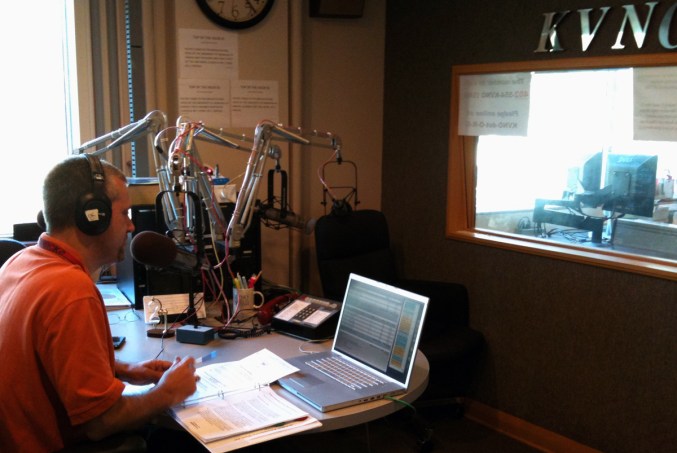
 A KVNO Radio studio in the early days at the Storz mansion, ©photo UNO Criss Library

Omaha’s KVNO Classical 90.7 FM turns 40:
Commercial-free public radio station serves the community all classical music and local news
While the commercial radio menu leans to blow-hard hosts and pop heavy rotations, public radio’s soothing sounds and erudite musings cut through the clutter. KVNO 90.7 FM further stands out for its all-classical play lists and original local newscasts.
Music, public affairs, news mix by KVNO for Omaha
The UNO-based independent celebrates 40 years on-air in 2012, an impressive feat considering its niche appeal as a commercial-free operation dependent on donor support for survival. The professionally-staffed station maintains high quality. The news division particularly serves as a real-world training ground for students.
KVNO long ago opted to be the master of its own content.
“KVNO’s programming is indeed unique among independent classical stations across the country,” says general manager and mid-day-midnight host Dana Buckingham. “KVNO has developed our own blend of classical music programming format that works well for us and the market we serve.
“Many traditional classical stations stick to a rigid programming formula that rarely deviates from the standard playbook of the ‘tried and true’ classics. This homogenized classical programming format almost never crosses over into more contemporary classical, vocal or film music. At KVNO we cross that line almost every hour and our listeners love it.”
Michael Hilt, who as UNO Associate Dean for the College of Communication, Fine Arts and Media oversees KVNO, sees value in personally crafting the program day.
“I think more and more you’re seeing stations going to services that provide the music. They may program part of their broadcast day but not all of it. We have a music director who works with the general manager on programming the music 24/7.”
Audience feedback is considered in programming decisions, officials note.
Buckingham says a “renewed commitment” to news and public affairs has netted award-winning results. “I am very proud of the achievements our talented news team has made. News director Robyn Wisch is a true professional and a great resource and mentor for our students.”
He says where KVNO once “sought to distance itself” from the university, “no more,” adding, “We are the broadcasting voice of the University of Nebraska Omaha and proud of it.” Hilt says the station maintains autonomy though. “The university lets us do what we do. Sometimes there are things we do they love and then there are other times when they say,’ Gee, we wish you hadn’t done that.’ Is there any censorship or editorial control? No.”
A new partnership, strengthening local arts ties, staying relevant
In January KVNO embarked on a programming partnership with NET Radio that enables each to serve a larger statewide audience and to introduce listeners to new voices. Expanding KVNO’s reach, says Hilt, “is very important to us.” Buckingham terms it “a win-win.”
Public radio and the arts make a natural fit, thus KVNO, which once branded itself “fine arts public radio” and served as “the voice of the Summer Arts Festival,” is a dedicated arts advocate and programming outlet.
“Our affiliation with the local arts scene is very strong and we are always seeking ways to make these relationships even stronger,” says Buckingham. “We’re exploring the possibility of producing an expanded weekly broadcast series of the Omaha Symphony.” He sees possibilities for the series beyond Omaha. “It is my hope we may eventually offer this expanded series for nationwide distribution. We are also in the process of integrating more classical music selections featuring the Omaha Symphony into our regular daily playlist and rotation.”
KVNO broadcasts the UNO Music Department series “Sounds from Strauss” and Omaha Symphonic Chorus and Tuesday Musical Concert performances. The station recognizes youth musicians through its Classical Kids program. Aside from the performing arts, KVNO does its share of live UNO sports broadcasts.
To remain relevant in this new media age of cable, satellite and the Internet, Buckingham says, “we cannot afford to be just another classical music service provider, we must be connected to our community and involved in promoting and providing a forum for the talented musicians and artists in our community.”
Popular on-air hosts help the station build listener loyalty, an essential facet in such an intimate medium.
“I have been an on-air classical music host on KVNO for over a decade,” he says. “In fact, most of our on-air classical announcers have been here a long-time. Over that time, we have established a connection with our listeners that has helped us through the good times and the not so good times. Many regular listeners have established a ‘relationship’ with our local hosts. We are always that familiar and friendly voice in the morning, afternoon, evening or late at night.”
Doing more with less and reinventing itself
University budget cuts and pinched donor dollars have forced a frugal station to further stretch already thin resources.
“Believe me, we know how to do more with less,” he says. “We do it every day. We furnished our newsroom entirely with computers handed down from other departments on campus and office equipment from university surplus..”
That austerity harkens back to the station’s modest roots. When KVNO first went on the air in 1972 general manager Fritz Leigh was the lone full-time employee. At the start KVNO stayed on-air only a few hours a day, gradually expanding the schedule until reaching a 24-hour broadcast day in 1985. For its first 15 years the station called the Storz mansion home before moving to the Engineering Building in 1987.
A KVNO Radio studio in the early days at the Storz mansion, ©photo UNO Criss Library
When Omaha DJ Otis Twelve became the morning drive host in 2006 it was not the first time a media personality joined KVNO. Local TV-radio personalities Frank Bramhall and Dale Munson did so in the 1970s and 1990s, respectively.
It may surprise listeners KVNO once played an eclectic mix of classical, jazz, rock, big band and folk before going all classical in the ’90s. A show it once produced and distributed, Tom May’s “River City Folk,” went national. KVNO is no longer associated with the show. Ironically, the show now airs on KVNO’s local public radio competitor, KIOS.
With a little help from its friends
One thing that’s never changed is the importance of financial support. Corporation for Public Broadcasting funding only covers so much. The rest must come from donors, memberships and sponsors. The station has thousands of loyal fans and some very generous funders, but Buckingham says, “less than 10 percent of those who listen to KVNO on a regular basis actually take the initiative to pony-up and contribute financially. We are obviously not getting the message out effectively.”
Volunteering for pledge drives is another way to help.
He’s actively seeking prospective business sponsors with this pitch. “Underwriting on KVNO is a cost effective way to promote your business and raise your organization’s profile and image. We reach a very desirable demographic-audience.” It’s a more diverse audience than one might expect. “Our listeners are not just scholars, musicians, business leaders, writers, students, intellectuals and teachers. Our devoted listeners are also butchers, bakers and candlestick makers.”
Bottom line, he says KVNO adds to the city’s cultural fabric. It follows then that becoming a sponsor or member helps KVNO improve the quality of life, in turn making Omaha a more attractive place to live. The 2012 membership drive unfolds in March. To join or give, call 402-554-5866 or visit www.kvno.org.
Most any town has a radio DJ who rules the roost through the sheer force of his/her personality, and in my hometown of Omaha, Neb. Otis Twelve has been a popular host for three decades. A mark of his appeal is his ability to attract and hold audiences across the spectrum of rock, pop, talk, and, most recently, classical radio. Smart, acerbic, and fun, he seduces you with his voice, his wit, his charm, but also challenges you with his somewhat eccentric and often irreverent take on things. He is also a fine writer who’s won numerous prizes for his fiction. The following story originally appeared in the City Weekly, a publication long since ended.
Otis Twelve’s Radio Days
©by Leo Adam Biga
Originally published in the City Weekly (www.omahacityweekly.com)
Otis Twelve is pushing 60 but he’s lost none of his youthful satiric bite. He’s long embodied the cool, irreverent, long-haired rock jock in Omaha, only he’s on public radio these days as drive-time morning host for KVNO 90.7 FM. That’s far from the Firesign Theatre-inspired comedy bits he did with longtime DJ partner Diver Dan Doomey (Jim Celer). Kooky characters, silly plots, barbed banter, dead-on parodies.
Influenced by Frisco’s free form KSAN and Lenny Bruce’s anything-is-fair-game call-outs, minus the profanity, glib Doug Wesselmann became Omaha’s top ‘70s-’80s radio personality as Otis Twelve. He “arrived” with the Ogden Edsl Wahalia Blues Ensemble Mondo Bizzario Band, a music-sketch comedy group Diver contributed to. The pair teamed as a standup act. That led to their gig as Omaha’s original shock jocks on KQ-98. Instead of Howard Stern crudity they practiced mature humor mixed with slapstick and dark, surrealist takes on sacrosanct icons. Otis rues “the schoolyard” throwdowns that often pass as adult humor today.
It all began in the late ‘60s at Creighton University’s KOCU, where as students the duo did a show, “Revolution,” that, Otis said, “drove the Jesuits crazy. We played music nobody (locally) was playing. The bootleg, uncensored version of ‘Suzy Q.’ We’d throw in little weird electronic bits, including stuff by our own totally made up band, Electric Bathwater. It was just a blast. Father (Roswell) Williams would come down the basement of Wareham Hall, listen for about 5-10 seconds, then his face would blanch, his mouth sag open and he’d run back up the stairs in terror.”
CU officials threatened to yank the underground provocateurs off the air “but, Otis said, “they couldn’t figure out quite why or how. They just couldn’t come up with a reason. We didn’t use bad words. A lot of things we couched by saying, ‘Of course, this would be absurd to think this.’”
He lived the counter culture experience he projected, “thoroughly partaking of the ‘60s.” His anti-war protest activities even earned him an FBI file. His thirst for experience took him to the San Francisco Bay area, where he indulged in the whole Haight Ashbury, Berkeley, Big Sur, Grateful Dead hippie scene.
He toured with the Ogden Edsl junk band, even moving to L.A., where the group and its cult tunes, “Dead Puppies” and “Kinko the Clown” were staples on the Dr. Demento show. Then came stints at KQ-98, where he and Diver hosted “Midnight Mondo,” and Z-92, where the duo ruled the roost. Those were the days.
“Radio was different then,” he said. “Radio was, Hey, let’s put on a show. It wasn’t consultants telling you what worked. We didn’t need anybody in research to tell us that if the Kinks put out a good song to play it. It was from the gut, let’s have some fun, let’s entertain some people, let’s play some good music. That’s what radio was. There are only hints of that still going now. The River is the closest thing to real radio left here.”
As FM lost its edge, going the way of corporate-engineered culture, he balked at the increasingly automated, homogenized, bland radio that emerged.
He left Z-92, which unsuccessfully sued him, in a if-you-can’t-beat-’em-join-’em funk for KFAB, the AM tradition-bound monolith that represented the antithesis of his style. Going to the other side was a kind of sell-out, except he had duties — a home, a wife, three kids. After that foray into full-service, mainstream radio he gave FM classic rock one last shot at CD-105, whose offer he couldn’t refuse.
“Really my last best experience in radio,” he called it.
After 9/11 things grew restrictive. He said for-profit radio became a vehicle for “jingoistic patriotism.”
“When they start telling you what to say, it’s time to go,” he said. “That gets real old real fast. So for good or bad radio was not for me anymore.”
In reality, he went against the tide all his years in the biz.
“There were always fights and arguments over bits somebody thought crossed the line,” he said. “We always got in trouble for poking fun at-offending advertisers and government officials. Once, to placate a sponsor, we were suspended three days. It was always my opinion that unless you cross a line every once in awhile you’re not doing your job. You gotta always be working on the line.”
He left CD-105 in 2002 for a new life as a full-time fiction writer.
Recasting himself in the image of the expatriate author, he moved to Walnut, Iowa, pop. 983. Always a talented scribe and voracious reader, he soon made a splash in the literary world with his wry, incisive, absurdist work inspired by the Beat writers and Terry Southern. His resolutely American nouveau noir fiction has made its greatest mark in Great Britain, where four of his novels have been short-listed for the British Crime Writers Association Debut Dagger Award, one of them winning it. The island’s Lit Idol award netted him much press, plus a British literary agent.
Back home, his short fiction’s appeared in the prestigious North American Review and placed highly in the Kurt Vonnegut Fiction Prize competition. He also won a $10,000 prize in an essay writing contest. But none of his novels has found a publisher yet and neither his nor anyone’s short fiction ever exactly pays the bills. Not surprisingly, this iconoclast refuses to follow conventions in his novels.
Writers, especially stubborn ones, “can always use a day job,” he said.
So, when in 2006 he saw KVNO was hiring he wrote the station to say he’d like a shot. Why?
“I was real interested in the challenge to see if I could fit into yet another wildly different format in my career,” he said.

Doug Wesselmann, aka Otis Twelve
Otis made clear he doesn’t believe in genuflecting to classical composers-performers. “Music is music. It should have a sense of joy. It shouldn’t be treated with too much reverence. It should be respected like you would respect any music. But, you know, Franz Liszt was as wild on tour in his young days as Mick Jagger. I mean, they were pop stars, too, with scandals and quirks and drugs and then great art…great music. They were human beings. I think it makes the music more real when you put it in context and try to make it relatable. I don’t overdue it. I don’t do skits, I have no opinions on anything. It’s a lighter touch.”
Examples of that deft touch can be heard weekday mornings from 6 to 10. On a March broadcast he riffed:
“6:23…Yes, it’s high maintenance music. It’s Clara’s husband, Robert Schumann. She had all the kids at home, a busy career as a composer and performer herself, and her husband kept throwing himself into the river over and over again. He was –high maintenance…”
He finds “obscure connections or odd angles” to put a dry humorous spin on the dusty classical canon. He engages in witty repartee with news director Cheril Lee.
With KVNO “willing to,” as Otis said, “let me give it a try” he went on the air November 12, 2006. What began as an experiment has turned into a permanent gig.
A recent visit to KVNO found him comfortably ensconced in the classical world, where he knows he’s an outsider even 16 months into his high brow makeover. Whatever probation hidebound listeners initially put him on, including a small dissident group of sticks-in-the-mud who complained about his flippant tone and egregious mistakes, he’s seemingly now accepted. He knows the score.
“I remain a dilettante,” he said, “so I try to give everything from the point of view of a dilettante. We have some real expert listeners but I would guess the bulk of listeners would be more like me. I’ve always liked classical music — I just didn’t know much about it. Now I know how much I don’t know.”
He’s won over some converts, including die-hard rockers.
“I have some friends who’ve started listening to the station and it surprises them how it works for them and how interesting it can be. It’s great fun to listen because the players are real virtuosos. You don’t have to have a degree in music history to know good is good. And the variety — people don’t think of this as variety but there’s 400 years of music and there’s different takes on it. There may be 20 recordings of a certain sonata. We have a vast library.”
Classical’s not so different than rock. It has its standards. Take Sorcerer’s Apprentice, for example. “This is like Stairway to Heaven or Firebird. Everybody knows this one,” he said. It has its own version of pop, too, ala Leroy Anderson’s “Bugler’s Holiday” or most anything by Mozart. “Lighter stuff,” Otis calls it.
Any barriers he can topple to make the music more accessible he does. His goal, he said, “is to give people permission to realize it’s not snob music — it’s music.”
He realizes he’s at KVNO not for “any credibility” he possesses as a musicologist but for his personality. “It’s still radio and some of that knows no boundaries,” he said. “You try to be friendly…welcoming. That part’s always been enjoyable to me. Radio is very one to one. My goodness, you’re with people when they’re alone in their car, in the shower. You wake them up bedside, while they’re standing in the kitchen in their bathrobe making toast.”
KVNO allows him to be himself.
“They’ve told me what they want me to do and they kind of let me do my approach, and that’s nice,” he said. “In that sense it’s like the old times. They don’t tell me what to say or necessarily how to say it. We make it fit.”
Radio suits this laidback free spirit, who comes to work unshaved, unkempt, in T-shirt, jeans and loafers.
This later model Otis is not a pale imitation of his by-the-seat-of-your-pants rock self but given the format and the audience he serves he’s less devil-may-care now. No scathing comments, no naughty improv sketches, no Space Commander Whack, no Mean Farmer, no Lance Stallion. It’s Otis on Prozac. This Baby Boomer’s literally come home to nest. He and wife Debbie — Dagmar to listeners — moved back to Omaha in ‘07. He leaves his rebel persona at home for nostalgic mindwalks.
Ah, but the knowing wink and nod come through loud and clear in his familiar bass voice laced with whimsy, sarcasm and irony.
Getting to the studio around 3:30-4 a.m. his ritual before airtime “is to pull all the music, set up the announcements and research whatever composers or works I have for the day, check email, drink coffee and try to wake up.”
The solitude is appealing. “I really like it. There’s no rush hour, there’s no parking problem, the girl at the convenient mart always knows your name. I even get free coffee sometimes. I get out of here pretty close to 10 and the day’s mine. That’s why these hours are good for me. It leaves time to write. The danger is you get isolated.” All in all, he’s content. “I like doing this. The staff here is the best. Everybody’s been great helping me — when not giggling at my pronunciations. In some ways I’m happier than I’ve ever been between bouts of sheer despair, but that’s normal.”
He calls “serendipitous” his 30-year ride in radio.
“I never studied radio, which I think is probably a good thing. I’ve had a lot of fun, met some cool people and got to do some neat things…”


 Leo Adam Biga's My Inside Stories