Archive
Crowns: Black women and their hats
Actress and playwright Regina Taylor’s fine play, Crowns, celebrates the tradition that finds many African-American women wearing hats at church. The following story for The Reader (www.thereader.com) is largely based on interviews I did with cast members in a John Beasley Theater production of the Taylor play. The women comment on what’s behind the whole hat thing and it turns out these crowns represent and express all manner of things. I think you’ll find the story insightful and entertaining, and if you get a chance to see the play by all means do, because it says more than I could ever hope to say about the subject.

Crowns: Black women and their hats
©by Leo Adam Biga
Originally published in The Reader (www.thereader.com)
Regina Taylor’s musical drama Crowns celebrates the ties that bind African American women in the black church. Faith and fellowship rule, but the hats proudly worn by these grandmothers, mothers, daughters and sisters soulfully express their solidarity and individuality.
The female cast of Crowns, in performance February 23-March 18 at the John Beasley Theater, well relate to the hat queens they portray. Millicent Crawford, who plays Mother Shaw, said the parts “just fit.” After all, she and her fellow players come from a long line of church-going, “hat wearing divas,” said Brandi Smith (Yolanda). If there’s one thing “we all learned growing up,” said Janet Ashley (Velma), “it’s that you don’t go to church without something on your head.”
From wraps, rags, scarves and caps to turbans to berets to formal head attire, hats are legacies that unite women over generations of sacrifice, ceremony, joy and sorrow. “That’s just a traditional thing in our culture,” said Smith, who plays the central character Yolanda, “and it goes all the way back to Africa, when women would wrap their heads with the gelees. So, we are still covering our heads today.”
A woman’s head should be adorned, the Bible says, and in black culture that means some serious crowns come Sundays. Bare heads do not belong in the Lord’s House. It’s traditional, historical, scriptural, familial. In this largely hat-less era, not every black woman wears one to church anymore, but chances are her mother or grandmother does. When women of a certain age meet, as Mother Shaw, Velma, Mabel, Wanda and Jeanette do in the play, their hats represent a lifetime of experiences. When the wounded Yolanda arrives in their midst, their circle envelops her to share proverb-like stories and songs. In a rite of passage that resounds with spirit, the defiant girl becomes a woman and willingly joins in, learning to find the joy that lives beside her pain. Hats become a metaphor for the unbroken circle of life and the passing down of lessons.

Regina Taylor
The rich material busts out with the exuberance and ritual of a black Baptist church’s praise-and-worship, call-and-response service. It is funny, revelatory, sad and buoyant. Voices, spoken and sung, are raised on high to consider hats in all their gospel-inspired glory and the various ways women use them to shine.
“You must have the right attitude to put certain hats on. It’s hatitude,” Ashley said in the flamboyant style of Velma.
“There’s some hats you can wear and some hats you can’t. You have to have the right hat,” said Crawford, whose Mother Shaw is a willful preacher’s wife and the group’s wise matriarch. “You put on a wide-brimmed hat that’s got some feathers, you better be able to pull that off because you’re making a bold statement and people can see it. It takes confidence to wear certain hats. You’ve got to be able to work it.”
“You know from the second you put a hat on whether it’s you or not,” said Phyllis Mitchell Butler, who plays Mabel, the Hat Queen with a litany of hat etiquette rules. “You know either that’s your hat or it’s not.”
“I think one of the women in the play says, ‘You can tell a lot by the hat a woman wears. About who she is,” said Crawford, adding a woman can say things with a hat. “A hat can be very flirtatious or not.”
Ashley said Velma reminds us a hat can reveal or conceal.” “It’s like a mask,” Crawford said. A pastor’s wife off stage, Ashley dips the brim of her hat on Sundays, she said, so the congregation “can’t see anything on my face.” Conceal or not, a big hat is just right for some women. “You see, I wear big hats because little hats don’t look good on my head,” Ashley said. “I’d rather do a big hat” Crawford said, “because you walk in the room and it’s like, Wow! That hat is bad!”

Some women are so defined by their hats, that without one, Crawford said, it’s like “something’s missing — she needs a hat on.” “It wouldn’t be right,” said Ashley, adding the anticipation of what a hat queen will wear is a spectator sport for “hat watchers. There are certain women that you know when they come through that door they’re going to have on a hat and you want to see what hat is she wearing.”
Hats are style-status symbols. A poor woman may take a plain hat but adorn it splendidly or she may spend all she has for a lavish one. The play refers to Mabel’s mom fussing over a simple hat so that it “changed the whole look,” Ashley said. “We look at how the hat is made. We look at those details. The details are important.”
Crawford said some women, like Mother Shaw, will not buy a hat they love if “they don’t think it’s worth paying a lot of money for. But there are women that will pay an arm and a leg as long as they know no one else is going to wear that hat.”
“That’s right,” Ashley said. “Not just in the play either…My sister shops where she knows no other woman in Omaha will shop because she’s going to make sure she’s not going to see her hat on anybody else.” “We really do that — we don’t want to see our hats” on another woman, Crawford said. Call it being a hat cat.
As a fine hat costs dearly, it’s to be treasured. “You’re going to be taking care of those things you worked hard for,” Crawford said. That’s why an unspoken but well understood hat rule states — “nobody messes with my hat” — which Crawford said hat queens like her mother make emphatically clear. “You don’t go near her hat. Don’t knock the hat, don’t touch the hat. My mom, she will lay down the law.”
Showing off a hat is half the fun. Women really step it up for special occasions. Then, a “hi-ya” or “hit-ya” hat isn’t enough. Coordinating a whole outfit, plus accessories, is required. “You go to one of the church conventions or gospel workshops or whatever and these women are going to be decked out, as they said back in the day, from head to toe,” Crawford said. “Hat, purse, shoes, dress, jewelry. Everything matched. They’re going to be dressed to the nines.”
“It’s like the lamp with the shade,” Ashley said. “You have to have that right top and that bottom to go with it.”
The play suggests a hat queen’s collection of crowns can number in the hundreds. “No exaggeration,” Crawford said. The lone male voice in the play, provided by John Beasley, observes to his hat crazy wife, “You ain’t got but one head.” Ah, but a heavenly crown awaits to adorn that sweet head.

Related articles
- Which hat do you wear most? (miriamgomberg.wordpress.com)
- A Summer Hat (webnerhouse.com)
- The Way You Wear Your Hat, Part 1 (moviemorlocks.com)
- Bring Back The Trend: Boater Hats (thegloss.com)
- Hansberry Project honors Regina Taylor (seattletimes.nwsource.com)
“Walking Behind to Freedom” – A musical theater examination of race
I don’t see a huge amount of live theater, but I attend more than enough shows to give me a good feel for what’s out there. My hometown of Omaha has a strong theater scene and one of the more dynamic works I’ve seen here in recent years came and went without the attention I felt it deserved. It was called Walking Behind to Freedom, and it deal head-on with many persistent aspects of racism that tend to be trivialized or distorted. The fact that a fairly serious piece of theater dared to tackle the issue of race in a city that has long been divided along racial lines took courage and vision. Playwright Max Sparber, a former colleague and editor of mine at The Reader (www.thereader.com) based the play, which unfolds in a series of vignettes, on interviews he did with folks from all races around the community. He asked people to share experiences they’ve had with racism and how these encounters affected them. A local musical group called Nu Beginning wrote songs and music that expressed yet more layers of insight and emotion behind the dramatized experiences. A diverse group of cast and crew collaborated on a rousing, moving, thought-provoking night of musical theater. I had a personal investment in the show, too, in that my partner in life played a couple different speaking parts. She was quite good. My story about the show appeared in The Reader.
“Walking Behind to Freedom” – A musical theater examination of race
©by Leo Adam Biga
Originally published in The Reader (www.thereader.com)
The subject of race is like the elephant in the room. Everybody notices it, yet nobody breathes a word. The longer the silence, the more damage is done. Seen in another light, race is the label comprising the assumptions and perceptions others project on us, soley based on the shade of our skin or sound of our name. Seeing beyond labels sparks dialogue. Stopping there erects barriers to communication.
Race is as uncomfortable to discuss as sex. Yet, attitudes about race, like sex, permeate life. It’s right there, in your face, every day. You’re reminded of it whenever someone different from you enters your space or you’re the odd one out in a crowd or issues of profiling, preferences and quotas hit close to home.
It often seems Omaha’s predominantly white population wishes the topic would go away in a weary — Oh, didn’t-we-solve-racism-already? tone — or else makes limp liberal gestures toward more inclusion. Then there’s the majority reaction that pretends it’s not a problem. Take the Keystone neighborhood residents now opposing the Omaha Housing Authority’s planned Crown Creek public housing development. Opponents never mention race per se, but it’s implicit in their expressed concerns over property values being adversely affected by public housing whose occupants will include blacks. Nothing like rolling out the old welcome wagon for people trying to get ahead.
On the other side of the fence, militant minority views claim that race impacts everything, as well it might, but such sweeping indictments alienate people and chill discussion. How much an issue race is depends on who you are. If you have power, it’s not on your radar, unless it’s expedient to be. If you’re poor, it’s a factor you must account for because someone’s sure to make you aware of it.
If you doubt Omaha is beset by wide rifts along racial lines, you only need look at: its pronounced geographic segregation; its mainly white police presence in largely Latino south Omaha and African-American north Omaha; its rarely more than symbolic multicultural diversity at public-private gatherings; its few minority corporate heads and even fewer minority elected public officials. Then there’s the insidious every day racism that, intentionally or not, insults, demeans, excludes.
It’s in this climate that, last fall, Omaha Together One Community (OTOC) said: We need to talk. A faith-based community organizing group focusing on social justice issues, OTOC commissioned an original musical play, Walking Behind to Freedom, as a benefit forum for addressing the often ignored racial divide in Omaha and the need for more unity. It’s the second year in a row OTOC’s staged a play to frame issues and raise funds. In 2003, it presented a production of Working, the Broadway play based on the book of the same name by Studs Terkel.
With a book by Omaha playwright Max Sparber and music by the local quartet Nu Beginning, Walking Behind to Freedom premieres May 7 and 8 at First United Methodist Church. Performances run 7:30 p.m. each night at the church, 69th and Cass Street. Free-will donations of $10-plus are suggested. Proceeds go to underwrite OTOC operational expenses.
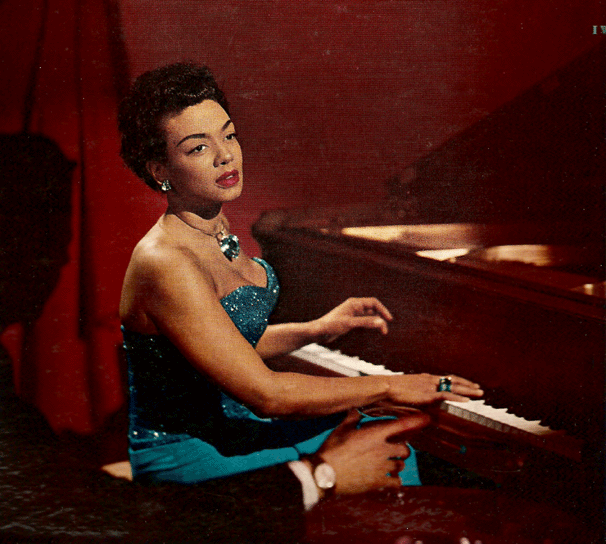
The play’s title is lifted from a famous quote by the late entertainer and Civil Rights activist, Hazel Scott, who posited, “Who ever walked behind anyone to freedom? If we can’t go hand in hand, I don’t want to go.” The show coincides with the 40th anniversary of Congress passing landmark Civil Rights legislation in 1964.

Max Sparber
As a foundation for the play, OTOC did what it does best: organize “house meetings” where citizens shared their anecdotes and perspectives on racial division. Sparber and Nu Beginning attended the meetings, held at OTOC-member churches city-wide, and the ensuing conversations informed the non-narrative play, which is structured as a series of thematic monologues, dialogues and songs.
“I built my script based on some of these interviews, along with some broader themes,” said Sparber, whose Minstrel Show dealt with an actual lynching in early Omaha. “We got some great stories out of it. The people who came to the meetings were very interested in the subject and I certainly got some stories that were invaluable. More than anything, we wanted this play to be specific to Omaha, and therefore we wanted its origins to be within Omahans’ own experiences.”
Surfacing prominently in those sessions was the theme of division and how by going unspoken it only deepens the divide. “This is a town that’s very separated geographically. The majority of blacks live in north Omaha. The majority of Latinos live in south Omaha. The majority of whites live in west Omaha. And, as a result, there’s not a lot of crossover,” Sparber said. “It’s really sad how closed up Omaha is,” said the play’s director, Don Nguyen, lately of the Shelterbelt Theater.
“Along with that, race is quickly becoming an undiscussed element in Omaha,” added Sparber. “I think a lot of whites believe we live in a post-racism world and, therefore, it’s not a subject that needs to be addressed. Whereas, black people experience this as not being a post-racism world at all and are kind of startled by this other viewpoint. So, there’s this disconnection based on understanding.”
 |
Two lines in the play comment on this dichotomy: “I think a lot of white people feel that racism ended in the Sixties, with Martin Luther King. The only thing about racism that ended in the Sixties WAS Martin Luther King.”
Any impression all the work is done alarms Betty Tipler, an OTOC leader. “A lot of us are in our comfortable spaces. We go inside our houses with our two garages and we think things are okay. Things are not okay. The issue of race has not been cured and, if we’re not careful, things will go backward,” she said. Despite the illusion all’s well, she added, the play reminds us people of color still contend with bias/discrimination in jobs, housing, policing. “We may as well face it.”
According to OTOC leader Margaret Gilmore, the process the play sprang from is at the core of how the organization works. “We’re about bringing different people in conversation with each other to talk about what’s in their hearts and minds,” she said. “It’s a process of learning to talk to each other and listen to each other and then seeing what we have in common to work together for change.” She said the meetings that laid the play’s groundwork crystallized the racial gulf that exists and the need to discuss it. “We don’t talk about this stuff enough. We don’t talk about it on a personal level and how it affects us, which is what I think this play gets to. When we ask the right questions and we’re willing to listen, then the experiences that people tell in their own words are dramatic and provocative.”
“It’s very important we listen to real people’s stories. The only way you can come up with the truth is to go to the people. We haven’t watered down or changed their stories, but literally portrayed them,” said OTOC’s Tipler, administrator at Mount Nebo Missionary Baptist Church, which hosted some of the house meetings.
Indeed, the vignettes carry the ring of reportorial truth to them. Most compelling are the monologues, which unfold in a rap-like stream-of-consciousness that is one part slam-poet-soliloquy and one part from-the-street-rant. Some stories resemble the bared soul testimony of people bearing witness, yet without ever droning on into didactic, pedantic sermons, lectures or diatribes. The language sounds like the real conversations you have inside your head or that spontaneously spring up among friends over a few drinks. Often, there’s a sense you’re listening in on the privileged, private exchanges of people from another culture as they describe what’s it like to be them, which is to say, apart from you.

Don Nguyen
For director Nguyen, the “real life testimonies” add a layer of truth that elevates the material to a “more powerful” plane. “I think it will definitely work for us that people know this is real. It’s not an overall work of fiction. This is real stuff.”
The misconceptions people have of each other are voiced throughout the work, often with satire. You’ve heard them before and perhaps been guilty yourself assigning these to people. You know, you see an Asian-American, like Nguyen, and you reflexively think he’s fluent in Vietmanese or expert in martial arts, some assumptions he’s endured himself. “Oh, yeah, my personal experiences definitely help me to relate,” he said. “Growing up in Lincoln I got in fights all the time. People making fun of me. Thinking I knew kung-fu or I only spoke Vietmanese, which is not true. But it’s not just the blatant racism. It’s the underlying stuff, too. Sometimes it’s not even intentional, but it’s just there. And it’s that gray stuff I think these pieces capture pretty well and that people need to hear more of.”
In the vignette Tricky, some women lay out the subtle nature of racism in Omaha. “…it’s like a fox. It’s tricky. It’s sly. You’ll be standing in line at a store, and the cashiers will be helping everybody except you…and you’re the only black person in line…and because it’s so sly, I think white people don’t notice it at all.”
The play also looks at racism from different angles. One has a guilt-ridden realtor rationalizing the unethical practice of steering, which is another form of red lining. The other has a new generation bigot defending his right to espouse white pride in response to black heritage celebrations. The concept of reverse racism is explored in the real life case of students protesting their school’s special recognition of black achievers at the expense of other minorities. And the wider fallout of racism is examined in the confession offered by an insurance agent, who reveals rates for car-house coverage are higher for residents of largely black north Omaha, including whites, because of the district’s perceived high crime rate.
The vignettes touch on ways race factors into every day life, whether its the unwanted attention a black couple attracts while out shopping or the hassle African-American men face when driving while black, or DWB, which is all it takes to be stopped by the cops. The shopping piece uses humor to highlight the absurd fears that prompt people to act out racist views. Music is used as heightened counterpoint to the boiling frustration of the DWB victim, whose cries of injustice are accompanied by the soulful strains of doo-wop singers.
Bridging the play’s series of one-acts are songs by Nu Beginning, whose music is a melange of hip-hop, R & B, soul, pop and gospel. A little edgy and a lot inspirational, the music drives home the unity message with its uplifting melodies, which are sung by choruses comprised of diverse singers.
Some pieces are heavier or angrier than others. Some are downright funny. And some, like Mirrors, speak eloquently and wittily to the concept of how, despite our apparent differences, we are all reflections of each other. Here, Nguyen employs a diverse roster of performers to represent the mirror symbol. Perhaps the most telling piece is Function. This beautifully-rendered and thought-provoking discourse is delivered by an architect, who suggests racism has survived as both an ornament of the past, akin to a Roman column on a modern house, and as a still-functional device for those in power, as when a politician plays the race card.
Whatever the context, there’s no dancing around the race card, which is just how Nguyen likes it, although when he first read the script he was surprised by how brazenly it took on taboo material, such as its use of the N-word.
“Typically, a script or show sugarcoats the issue of race. It’s a very cautious topic. You don’t want to offend or patronize people by saying the wrong stuff. But this piece is much different. All of its pretty much in your face,” Nguyen said. “What I mean is, it’s very direct. Max (Sparber) makes no bones what he’s writing about, which is great. It’s a big risk to take as a writer, but essentially it’s the most interesting path to take, too. And I’m all for stirring up trouble. I’m fine with that.”
OTOC’s Betty Tipler feels racial division is too important an issue to be coy about. “We’ve got to come out of the closet, so to speak, and talk about racism and differences” she said. “We tend to shy away from talking about it, but it won’t go away. We have got to come together, put it on the table, take a look at it and deal with it — no matter how much it hurts me or how much it hurts you. But before we can do that, we’ve gotta put it out there. We won’t get anywhere until we do. And I believe this play is a step toward doing that.”
Christy Woods, a singer/songwriter with Nu Beginning, said the play is about hope. “I believe if people are open to change, we can go hand-in-hand to freedom. Just because I’m this and you’re that, doesn’t mean I have to be one step behind you. Why can’t we go together? We want people to feel inspired to go out and make a change. We want to touch, but also to teach, and I believe this musical does that.”
Nguyen hopes the play attracts a mixed audience receptive to seeing race through the prism of different experiences. “That’s where I’m trying to aim the show. As we go through these vignettes, I want some people to identify with them and some people to be like, ‘Oh, I didn’t know that.’ That’s what I want to create.”
Related articles
- Back in the Day, Native Omaha Days is Reunion, Homecoming, Heritage Celebration and Party All in One (leoadambiga.wordpress.com)
- Kevyn Morrow’s Homecoming (leoadambiga.wordpress.com)
- The Ties that Bind, One Family’s Celebration of Native Omaha Days (leoadambiga.wordpress.com)
- Omaha Native Steve Marantz Looks Back at the City’s ’68 Racial Divide Through the Prism of Hoops in His New Book, ‘The Rhythm Boys of Omaha Central’ (leoadambiga.wordpress.com)
- Hey, You, Get Off of My Cloud! Doug Paterson – Acolyte of Theatre of the Oppressed Founder Augusto Boal and Advocate of Art as Social Action (leoadambiga.wordpress.com)
- Omaha Theater as Insurrection, Social Commentary and Corporate Training Tool (leoadambiga.wordpress.com)
- Polishing Gem: Behind the Scenes of the Beasley Theater & Workshop’s Staging of August Wilson’s ‘Gem of the Ocean ‘ (leoadambiga.wordpress.com)
- Arno Lucas, Serious Sidekick (leoadambiga.wordpress.com)
- Native Omahans Take Stock of the African-American Experience in Their Hometown (leoadambiga.wordpress.com)
- Native Omaha Days: A Black is Beautiful Celebration, Now, and All the Days Gone By (leoadambiga.wordpress.com)
- Luigi’s Legacy, The Late Omaha Jazz Artist Luigi Waites Fondly Remembered (leoadambiga.wordpress.com)
What happens to a dream deferred? John Beasley Theater revisits Lorraine Hansberry’s “A Raisin in the Sun”
It’s only in the last few years I finally saw both a stage production and a television production of the classic play A Raisin in the Sun, and while I found each impressive, the thing that really turned me onto the work was reading Lorraine Hansberry’s famous work. Its intensity and truth burn on the page. After reading the play I knew I had to see a performance of it, and that motivation is what led me to write the following piece for The Reader (www.thereader.com). When I was still in the good graces of Omaha’s Beasley Theater’s I watched part of a rehearsal there and then saw a performance of the play in its entirety. Not too far removed from that experience I caught the TV version with Phylicia Rashad, Sanaa Lathan, Audra McDonald, and Sean Combs. The themes of Raisin resonate with me on many levels, but it is its dramatic interpretation of the Langston Hughes line, “What happens to a dream deferred?” within the context of a man and family struggling to get their small piece of the American Dream that deeply affects and disturbs me.

Ruby Dee and Sidney Poitier from the 1961 film adaptation of Hansberry’s play
What happens to a dream deferred? John Beasley Theater revisits Lorraine Hansberry‘s “A Raisin in the Sun”
©by Leo Adam Biga
Originally published in The Reader (www.thereader.com)
After its 1959 opening at the Ethel Barrymore Theatre in New York, A Raisin in the Sun was the talk of Broadway and the play’s 28-year-old author, the late Lorraine Hansberry, was the toast of the theater world. Hansberry became the first black whose work was honored with the New York Drama Critics Circle’s best play award.
The Youngers, a poor, aspiring black Chicago tenement family, are the prism through which she looks at the experience of oppression in segregated USA. Her modern story of assimilationist pressures and deferred dreams offers a realistic slice of black life unseen till then. The politically-aware Hansberry, who studied under W.E.B. DuBois and wrote for Paul Roberson’s Freedom magazine, took the play’s title from a Langston Hughes poem that asks: “What happens to a dream deferred. Does it dry up, like a raisin in the sun? Or fester like a sore…Or does it explode?”
Lena is the stalwart, widowed matriarch holding her family intact. Ruth, the eldest daughter, is the beleaguered wife of Walter, a bitter chauffeur striving to move up in the world. Beneatha, Ruth’s younger sister, is a collegian who rejects God and embraces Africa. Her hopeful beau, George Murchison, is the bourgeois American counterpoint to her sweet-on admirer, Joseph Asagai, a politically-minded Nigerian.
When the prospects of a fat insurance check threaten tearing the family apart, Lena acts rashly and buys a house in a restricted white neighborhood. Then, just as Walter’s dreams of owning a business are crushed, the alarmed residents offer the Youngers a buy-out. What Walter will do next is at the crux of the family crisis.
With its successful Broadway revival in 2003-04, Raisin proves its themes are still relevant today and that’s one reason why the John Beasley Theater is staging it now through October 10. While not revolutionary, Raisin reveals some hard truths.
“What we have for the first time with Hansberry in the ‘50s is a dignified, realistic portrayal of the complexities of black life,” said poet and essayist Robert Chrisman, chair of the Department of Black Studies at the University of Nebraska at Omaha and founding editor of The Black Scholar. “With Walter, you have the young black man who wants his chance. Mama (Lena) represents the stolid, powerful, tenacious will of black people to keep on keeping on. She is the moral center of the play. These are all realistic, engaging portraitures of black people. You don’t have any stereotyped servants. I think dignity is key in Raisin because it’s finally to assert his fundamental human dignity Walter turns down the buy out.”
For Chrisman, “the single strongest theme in Raisin is the tenet that if you have your dignity, you have the potential for everything and if you do not maintain and courageously uphold your dignity and freedom as a human being, you have nothing. And I think all of that was new in the portraiture of blacks in white theater. What preceded it up to the 1950s was usually something based on the minstrel-entertainment genre — the shuffling chauffeur, the maid, the bell hop, the clown. In black theater you had legitimate efforts at portraying blacks, but I think it’s with Hansberry you get the breakthrough. She sets the stage for the subsequent work of August Wilson and Charles Fuller, who deal with issues of generations, dreams and career aspirations and frustrations. In a way, she did for modern black drama the same thing that Richard Wright did for the modern black novel.”
Directing the Beasley production is UNO dramatics arts professor Doug Paterson, who said the play “became the springboard for black theater” in the latter half of the 20th century. “Black theater exploded in all kinds of directions,” he said. He added that the militant dramatists who followed Hansberry, such as Amiri Baraka, were critical of her “drawing room kind of drama” when they “felt what was necessary was to be bold…different…experimental.” However, Chrisman reminds, “Baraka was writing at the cusp of the ‘60s and the movement of this more militant vision forward. I think what Hansberry is saying is that whether Walter goes down as a freedom rider or starts a riot is immaterial. Asserting his dignity is what matters.”
Although it stops short of radical redresses to racism and inequality, her work is full of red hot anger and indignation. Paterson said, “She revealed so much. She anticipated sort of everything that happened in civil rights, black power and integration.” He said the original production was also influential in terms of the contributions to American theater and film that its cast and crew have made. Among the lead actors, Sydney Poitier, Ruby Dee, Claudia McNeil, Ivan Dixon and Louis Gossett are household names. Douglas Turner Ward is a co-founder of the Negro Ensemble Theater. Lonne Elder III is a major playwright. Director Lloyd Richards is perhaps Broadway’s most acclaimed dramatic interpreter. “It’s an extraordinary play for what it did historically. That’s why we study it,” said Paterson, who’s taught it for years. “I always wanted to give it a shot” directorially.
Chrisman well recalls the impact of the 1961 film version, whose adaptation Hansberry wrote. “There was a tremendous surge of pride and dignity in audiences,” especially black audiences, at the time. The concerns of Raisin, he said, still reverberate today. “I think in some ways it’s still very contemporary because you still have the same kind of interest in the African experience that Beneatha had in young folks today. And you still have, perhaps even more desperately, the need of the young black man to start a business of his own.”
The play ends with the Youngers deciding to move where they’ll clearly be unwelcome, but it doesn’t show the struggle of blacks living in a white enclave organized to oust them. As Chrisman said, “There should be a sequel to it, because it ends on the affirmative note…You could have another play that shows the ostracism, harassment, graffiti, coldness and so on that have been reported by first-generation integrating blacks.” And that’s ironic, as the playwright’s own family underwent that very trial by fire when she was a young girl. Her educated parents were social activists in Chicago and when their move into a white section met with resistance, they fought the injustice all the way to the Supreme Court.
For her next play, The Sign in Sidney Brustein’s Window, Hansberry disappointed some by telling a Jewish story. She died of cancer, at age 34, the day that play closed on Broadway. Other works were posthumously adapted into books and plays by her former husband, Robert Nemiroff, a writer and composer. In 1973, Nemiroff and Charlotte Zaltzberg adapted her first play into the Tony-winning musical Raisin.
Related articles
- Philip Rose, ‘Raisin’ and ‘Purlie’ Producer, Dies at 89 (nytimes.com)
- Anthony Chisholm is in the House at the John Beasley Theater in Omaha (leoadambiga.wordpress.com)
- Hansberry Project honors Regina Taylor (seattletimes.nwsource.com)
- Alicia Keys helping produce a Broadway play (ctv.ca)
Playwright-director Glyn O’Malley, measuring the heartbeat of the American theater
For all you theater wonks and aficionados out there, here’s another piece of mine from a years back, this one based on an interview I did with playwright/director Glyn O”Malley. Not many months after I spoke with him he passed awat, lending a poignancy to his comments about the future of the American theater, for which he held out great hope. He came to Omaha, as so many leading theater figures do, for the Great Plains Theatre Conference. The 2011 event runs through June 4. I am posting stories I’ve written about the event, some its many luminaries, and other aspects of Omaha theater. O’Malley is not the only Great Plains guest artist whose loss has been felt. Actress Patricia Neal was a regular and much-beloved fixture at the festival, and she’s gone now. Founder Jo Ann McDowell was also close to other giants of the American theater, namely Arthur Miller and August Wilson, and they too are gone. The point is though their work lives on, as does the theater.

Playwright-director Glyn O’Malley, measuring the heartbeat of the American Theater
©by Leo Adam Biga
Originally published in The Reader (www.thereader.com)
Playwright/director Glyn O’Malley of New York epitomized the distinguished guest artists here for the Great Plains Theatre Conference that closed last Saturday. Over the course of the eight-day gathering O’Malley, a Fellow at the Cherry Lane Theatre and a faculty member at Lehman College/SUNY, joined other major figures of the American theater in considering various aspects of stagecraft. They addressed everything from the work of new and established playwrights to the role of playwrighting in society to the richness of Omaha’s theater community, whose artists presented plays in lab readings and staged performances.
For O’Malley, just as for Edward Albee, the esteemed playwright whose imprimatur is on every aspect of the conference, it is neither a lark nor a vacation, but a working event that puts them through their paces. “There’s an awful lot to do,” said O’Malley. “I came in earlier to do a preconference workshop with 39 playwrights and then there are morning and afternoon panels and evening programs. So, there’s always something. It’s very intense, very packed.”
Artists use the occasion to measure the health of the American theater, whose state Edward Albee lamented at a Great Plains salute to the late Arthur Miller and August Wilson when he said, “our losses seem to keep outweighing our gains.” But O’Malley said the promise of a vital theater could also be seen in the conference.
“I have hope. There are new young voices emerging that, while they perhaps don’t have the gravitas yet to handle some of the larger questions, they’re touching and pulling up small pieces of the turf and handling it in ways that certainly exhibit an ability to grow into that. There’s work all along the fringes of Broadway that’s hopeful and inspiring. It’s simply a matter of time here in terms of maturation. Everyone who keeps doing this long enough and well enough carves out a place for themselves, a specific niche, and one can stay in it or move on,” O’Malley said.
Events such as the Great Plains, he said, showcase “an abundance of all sorts of plays and playwrights at different stages of maturation.” He added playwrights “all have things we’re attracted to and lean to — plays that are basically captivating enough to pull us into their orbit because of how they approach their subjects.”
What he’s seen of the Omaha theater scene gives him more reason for optimism.
“Well, I think it’s phenomenal. I’m thrilled you’ve got so many good people here — so many good theaters. I can’t believe how much theater there is,” he said. “I guess I’m surprised there isn’t a dominating professional regional theater here, but that may in fact be one of the reasons Omaha has such an abundance of different sorts of theaters that address specific missions and specific visions. I’m extremely impressed by that. There’s a lot going on here and I’ve wondered why it’s stayed relatively off the radar, because I would never have known about it had this conference not moved here.”
As home to the conference, reconstituted here from Valdez, Alaska, Omaha’s now at the center of the American theater’s process for new play development, which at its “core,” O’Malley said, “creates an environment where young playwrights just finding their way on the page can have discourse with people who have done it, done more of it and taken some of the risks they want to take. I think the only person who can really speak to a playwright in terms of really helpful sorts of response is another playwright, a director or an actor. It’s a very specific craft.”
He said if theater is “to gain, we’re going to have to do this right and keep it going” via events and programs that nurture new artists and new works. “These are all really important because otherwise the opportunities for new plays in the commercial market are very, very slight and they get slimmer each year. I think persistence is something we need to encourage. Not everyone’s going to have the trajectory in their careers that Edward Albee’s had. He’s a phenomenon. There is hope as long we encourage and promote responsible thinking and courageous, daring, bold, innovative plays…as opposed to merely good entertainment writing. There’s an abundance of that. There’s a lot of people who can do that. But there aren’t a lot of who can move an audience and cause them to turn over a thought in their mind, to walk out of the theater with it and discuss it over dinner, and let it haunt them for days after until they’ve made up their own mind about it.”
O’Malley, a one-time assistant to Albee and a leading interpreter of his work, agreed with remarks his mentor made at a May 29 Miller-Wilson salute, when Albee said: “Both Arthur and August understood playwrighting is a deeply profound social, philosophical, psychological and moral act. A playwright may not lie because a playwright at his very, very best is believed and must tell whatever truths he knows as clearly and in as tough a fashion as he possibly can. They understood what playwrighting is all about. They understood a play has no excuse for being merely escapism…merely frivolous. They understood the act of creating the play is holding a mirror up to people in the audience and saying, ‘Look, this is who you are, this is how you behave. If you don’t like what you see, don’t turn your back — change.’”

O’Malley embraces the weight Albee attaches to playwrighting, saying, “Plays need to open up worlds that other areas of society have concluded about, so that we can go in and personally experience them and begin to ask questions for ourselves. Most of the time we relegate somebody else to answer these things for us. But it’s always about the next question. I think that’s what one has to do. I’m led by that. That informs my choices of subject matter and how I write about it. I’m not interested in what’s known and concluded. I’m interested in finding my own way into things and then I find how I feel about them as well.”
He said Albee’s work “has always been” about probing, challenging the status quo, “and my own view is very much in agreement with that. I have very little patience with the merely frivolous. Obviously we have a great deal invested right now in our society into the pulling away from reality. If you come to New York and go to the theater you won’t be asked to think very often. You’ll be certainly entertained.”
Echoing something Albee declared in 1988, when he was last in Omaha and said, “If we prefer ignorance to dangerous thought, we will not be a society that matters,” O’Malley’s own play Paradise “was stopped from reaching production in Cincinnati. People were afraid of its power and what it would do. It examines how a 17-year-old Palestinian girl was coerced into becoming the third female suicide bomber. It is a very dangerous play because it is right on top of both…an Israeli and a Palestinian position. People want this very much to be an answer play, and it’s impossible. I don’t have the answers. It’s a question box play. It’s a play full of them and they’re all questions we need to be asking ourselves.”
Theater’s capacity to “be dangerous” and “an impetus for change,” O’Malley said, stems from its “immediacy. Theater is very much the vehicle by which we still gather together and view in the first-person with real live people. There isn’t the detachment one has with film. where you can sit back because it happened before and was put together before.” Or, as Albee likes to say, “film is then, theater is now.”
O’Malley, Albee and the rest are expected back next year for Great Plains II.
Related articles
- Attention Must Be Paid: Arthur Kopit Invokes Arthur Miller to Describe Great Plains Theater Conference Focus on Playwrights and Their Work (leoadambiga.wordpress.com)
- Great Plains Theatre Conference Ushers in New Era of Omaha Theater (leoadambiga.wordpress.com)
- A Q & A with Edward Albee: His Thoughts on the Great Plains Theatre Conference, Jo Ann McDowell, Omaha and Preparing a New Generation of Playwrights (leoadambiga.wordpress.com)
- Playwright John Guare Talks Shop on Omaha Visit Celebrating His Acclaimed ‘Six Degrees of Separation’ (leoadambiga.wordpress.com)
- Great Plains Theatre Conference Grows in New Directions (leoadambiga.wordpress.com)
- A Q & A with Playwright Caridad Svich, a Featured Artist at the Great Plains Theatre Conference (leoadambiga.wordpress.com)
- What Happens to a Dream Deferred? Beasley Theater Revisits Lorraine Hansberry’s ‘A Raisin in the Sun’ (leoadambiga.wordpress.com)
- Walking Behind to Freedom, A Musical Theater Examination of Race (leoadambiga.wordpress.com)
- Anthony Chisholm is in the House at the John Beasley Theater in Omaha (leoadambiga.wordpress.com)

Q & A with theater director Marshall Mason, who discusses the process of creating life on stage
Here’s another of my past Great Plains Theater Conference pieces, this time a Q & A with noted director Marshall Mason. In keeping with the theme and subject of several recent posts, I am repurposing theater stories and interviews I’ve done about that event and some of its guest artists as well as about other aspects of Omaha theater, all in celebration of the 2011 Great Plains Theatre Conference (through June 4) in Omaha.

Q & A with theater director Marshall Mason, who discusses the process of creating life on stage
Based on an interview Leo Adam Biga did with Marshall Mason for The Reader (www.thereader.com)
Though not a household name outside theater circles, director Marshall Mason owns the kind of credits that befit a luminary. He’s a five-time Tony nominee, a five-time Obie winner and a co-founder of the famed Circle Repertory Company in New York. He’s also been recognized with several lifetime achievement awards for his directing. The veteran artist brings his expertise to Omaha for the May 26-June 4 Great Plains Theatre Conference, where he’ll conduct directing workshops.
In the early 1960s the Texas native was a directing prodigy at Northwestern University. Soon after graduating he left for New York to work off-off-Broadway. He soon established himself a consummate director at the experimental theaters Cafe Cino and Cafe LaMama. Those venues introduced him to playwright Lanford Wilson (The Hot L Baltimore, Fifth of July, Talley’s Folly), whose work Mason would become the primary interpreter of. In ‘69 Wilson and Mason, then only 29, formed the Circle Rep, where they made their legends the next two decades.
Mason has directed extensively for Broadway, regional theater and theaters around the world, including a 1985 revival of Edward Albee’s Who’s Afraid of Virginia Woolf? at the National Theatre of Japan in Tokyo. He’s also directed television adaptations of some of his greatest stage successes. He’s also a noted teacher. Now semi-retired, he divides his time between Mazatlan, Mexico and New York, only taking an occasional directing gig. These days, he said, “I’ve now put all my energies really into writing.” His book Creating Life on Stage: A Director’s Approach to Working with Actors was recently published. He’s writing two new books, one on the Circle Rep’s founding and another on the many icons with whom he’s worked.
This will be his first visit to Nebraska, home to two figures from his New York heyday. Playwright Megan Terry is a longtime Omaha resident who was playwright-in-residence at the Omaha Magic Theatre. Her Hot House was produced at the Circle Rep. Actress Swoosie Kurtz is an Omaha native. She won a Tony in Mason’s production ofFifth of July.
Mason, speaking by phone from his New York apartment, exuded a youthful voice and gracious manner.
LAB: Theater is a living, breathing experience that communicates the human condition with an audience. Is a director’s ultimate task to bring the text to life?
MM: “That couldn’t have been a more perfect question because Heinemann (Press) has just published my first book…in which I make that exact point. That a director’s main job is to bring the text of a play to spontaneous life on stage so that the audience experiences the play.”
LAB: Did the process of writing the book help you coalesce your own ideas/theories on directing and, in a sense, reinvigorate your approach to your craft?
MM: “Absolutely, yes. It was a long process. I started writing the book around 1990 or so when I was living in Los Angeles. Then in 1994 I moved to Tempe, Arz., where I became a professor of theater at Arizona State University…I taught both acting and directing and as a result had to find a way to communicate my ideas about these subjects to the students. It was tremendously instructive to me in terms of clarifying my thoughts and giving me the ability to systemize in away what I was talking about. The big breakthrough for me, however, came when I wrote theater criticism for a weekly newspaper there called the Phoenix New Times.
“I had an editor who was very exacting about the use of words…and I learned so much in terms of being simple and direct and clear. That was a step that was so tremendously important in terms of my being able to take what is a difficult thing to describe — the creative process — and find a way to make it clear and simple enough to understand.
“My mentor Harold Clurman, who was a great director and teacher, was of course a critic. When I was first in New York…I became a participant at the Actors Studio directing unit. Lanford Wilson also was participating — in the playwriting unit. We both studied there with Clurman and (Lee) Strasberg…Clurman was our regular playwrighting teacher and I attended all his sessions.
“Then of course later after I started the Circle Repertory Company Clurman became one of our really, really good friends. He was a critic who loved our work and wrote about it in glowing terms and was the person to whom we could turn and actually ask advice. He had been with the Group Theatre and we were coming along sort of in the footsteps of the Group and trying to create our own living theater in New York.”

Circle Rep production of Julie Bovasso play, Angelo’s Wedding
LAB: Do you have a sense for why you felt pulled to be a director?
MM: “When I directed my first play, Cat on a Hot Tin Roof, at Northwestern when I was 19, I discovered I had been a director all my life. I’d just not really known it. Back in the 3rd grade I wrote a Halloween play that I ‘put on,’ The Night the Witches Rode. That’s what you call it in 3rd grade — putting on a play. Later you understand putting on a play is what a director does.”
LAB: How old were you when you first went to New York?
MM: “I was 21. I was the youngest member of the Society of Stage Directors and Choreographers when I joined the SSDC in 1963 when I was 23 and became essentially a professional director. And then many years later I became the president of that union.”
LAB: You really were a prodigy breaking new ground.
MM “As a matter of fact when I started directing in New York young people didn’t direct. It was something only middle-aged people did. I was the only director of my age and when I would have auditions actors twice my age would come in the room, look around and say, ‘Where’s the director?’ And I’d say, ‘It’s me!’ It was strange.
“Of course since then there’s been a profusion of (young) directors, in film particularly. People now go to school and get an MFA in directing and come out and try to start a career. When I was in school people became directors from some other position. Usually they were stage managers first…and then they would eventually take over directing. It was not common practice when I was at Northwestern to study directing as a profession. Now it’s very common.”
LAB: Did your real education in theater commence once you got to New York?
MM: “I would say both yes and no. Certainly I continued to learn a great deal in New York, but the basis of my work really had been laid in firmly by the great teacher Alvina Krause at Northwestern. So I had a firm grip of my techniques when I came to New York; what I learned is how to apply them in professional situations.”
NOTE: Krause was a legendary figure in Northwestern’s fine theater department. Besides Mason, other Krause-trained notables include Oscar-winning actors Charlton Heston, Jennifer Jones and Patricia Neal. Neal will join Mason in Omaha.
MM: “I was trained in the classics. I would call Ms. Krause from New York and say, “I really want to do the classics. When do you think I’ll be ready?’ And she said, ‘You’re ready now.’ But when I got to New York, especially at the Cafe Cino, I began to meet young American writers.”
LAB: Like Megan Terry…
MM: “Like Megan Terry and many others. But it was Lanford Wilson who basically said to me, ‘You should really concentrate on new plays because these old dead guys like Shakespeare don’t need you. We need you — to put our reflection of our contemporary world on stage.’”

Marshall Mason and Lanford Wilson
LAB: What accounts for you and Wilson enjoying this long, simpatico relationship?
MM: “It’s because of trust Lanford has had in me as a director. We first worked together on his Balm in Giliad. He felt I understood his play. I told him the fact his play is set among drug addicts and prostitutes is incidental because what his play is really about is the commerce between people, and it could happen just as well on Wall Street as it could on the streets. He was tremendously impressed by that because that’s exactly what he had in mind.
“The first thing I did in my first rehearsal was to break the play down into beats of action for the actors to mark in their scripts. Lanford was sort of fascinated by this because he’d never seen a director do this before.
“That first production was enormously successful and after that, sort of as a self-preservation thing, he said, ‘If you’ve got something that really works, why would you take a risk and try some other director?’ He’s worked with many directors of course over time, but the two of us found a compatibility with the way we thought about theater. He valued acting that didn’t look like acting and I was able to deliver performances that didn’t seem like acting.”
LAB: Is it true you and Wilson got off to a rocky start?
MM: “Yes. It was our very first meeting. Joe Cino introduced us. Lanford had already done four productions at the Cino. I had seen all four. The current one was Home Free. I’d seen an earlier production of it, too. The play is about an incestuous relationship between a brother and a sister. In the original production you didn’t discover they were brother and sister until the last moment of the play, which was tremendously powerful. But Lanford changed the play and the brother-sister thing came in right in the first line of the play.
“When we met he said, ‘Haven’t I done a really wonderful job of revising it?” and I said, ‘No, I think you’ve ruined it’ — starting our relationship off with a disagreement right up front. I think the good thing about that was he recognized right away I was going to deal honestly and tell him what I thought, no matter what.
“I’ve now come around to feeling he was probably right to do it that way (reveal the bombshell at the start).”
LAB: You two developed this phenomenon known as the Circle Rep.
MM: “Balm in Giliad was such a remarkable ensemble of a living play that Lanford said, ‘My God, we’ve got to keep these people together…’ He was a very important influence in terms of insisting we at some point form a company. It was actually four years later that I bit the bullet and said, ‘OK, let’s do it.’” At first I thought, I’m too young to do this. But by the time I was 29 I didn’t feel so young anymore. The first production I did at the Circle Rep was Chekhov’s Three Sisters in two contrasting productions that played in rotating rep. One was a traditional approach like Stanislavsky (the Russian actor/director/theoretician who developed an influential system of dramatic training) and everybody had always used with Chekhov. The other was a truly experimental Chekhov.”

LAB: The Circle Rep became known for its lyric realism style.
MM: “In a way I regret the phrase because the critics picked up on it and it sort of became our tag, The thing is the Circle Rep did many, many plays of all different kinds of styles. But we got tagged with this thing of lyric realism, probably because it’s what we did best.”
LAB: How do you define lyric realism?
“What is it? It has a surface of realism. As the New York Times put it, ‘Real plays about real people’ with a rather linear plot you can follow. However unlike let’s say (William) Inge, who wrote realism but was never able to lift the experience above the mundane, lyric realism elevates the realistic experience to a poetic experience through things like eloquent language.
“Lanford was recognized…as being the next voice of lyrical writing in America since Tennessee Williams. Their writing is in the same vein, only Lanford’s is less florid. Tennessee’s first play, Battle of Angels, had its first New York production under my direction. It was 30 years from the time he wrote it until if came to New York. Tennessee and I were just planning to begin work on a new production of Night of the Iguana with William Hurt when he died.”
LAB: What kind of shape was Williams in when you worked with him?
MM: “He was in great shape. It was after his druggie days. I was terribly afraid of meeting Tennessee. I admired his work so much and I heard such terrible things about his personal life that I didn’t want my idol to have feet of clay…The New York Times did a big spread on the Circle Rep and me and I mentioned Tennessee had been my inspiration from high school on up, so he called up and asked me to come to dinner. If he actually invites you to dinner you can’t say, ‘No’…So I went to dinner and it was an amazing experience.”
LAB: Do you attend many gatherings like the Great Plains Theatre Conference?
MM: “I haven’t for a long time. Edward Albee and I went to Valdez, Alaska to help Jody (Metro Community College President Jo Ann McDowell) found her Last Frontier conference up there. She first met me, and Edward too, at the Inge Festival (in Independence, Kan.). Edward’s been a tremendous supporter of hers. This year I was persuaded it would be a good thing to go again. I’m really looking forward to it. I feel especially with the book I’ve got a lot of new ideas to share…”
LAB: Are forums like this vital for theater artists who live outside of New York?
MM: “It is really great because it decentralizes the theater and makes it available in the far reaches of the country. People can come to Omaha that would find it really difficult to come all the way to New York or, on the other hand, Alaska. So I think the Great Plains is a wonderful place to have a theater conference.”
Related articles
- Playwright John Guare Talks Shop on Omaha Visit Celebrating His Acclaimed ‘Six Degrees of Separation’ (leoadambiga.wordpress.com)
- A Q & A with Edward Albee: His Thoughts on the Great Plains Theatre Conference, Jo Ann McDowell, Omaha and Preparing a New Generation of Playwrights (leoadambiga.wordpress.com)
- Great Plains Theatre Conference Ushers in New Era of Omaha Theater (leoadambiga.wordpress.com)
- Great Plains Theatre Conference Grows in New Directions (leoadambiga.wordpress.com)
- Attention Must Be Paid: Arthur Kopit Invokes Arthur Miller to Describe Great Plains Theater Conference Focus on Playwrights and Their Work (leoadambiga.wordpress.com)
- Celebrated playwright, Lanford Wilson, dies at 73 (seattletimes.nwsource.com)
Playwright-screenwriter John Guare talks shop on Omaha visit celebrating his acclaimed “Six Degrees of Separation”
Back when the Great Plains Theatre Conference and its founder Jo Ann McDowell brought in a veritable who’s-who of American theater, playwright John Guare was one of those luminary figures who came and dazzled locals. The following story I wrote for the City Weekly was based on a phone interview I did with the artist. The Omaha appearance referenced in the story was not for the festival itself, but for a production of his play Six Degrees of Separation by the Blue Barn Theatre. Guare made himself available to the cast and crew and was reportedly quite impressed with the production. I saw the show directed by Susan Clement Toberer and I must say it was well done.

Playwright-screenwriter John Guare talks shop on Omaha visit celebrating his acclaimed “Six Degrees of Separation”
©by Leo Adam Biga
Originally published in the City Weekly
Metropolitan Community College president Jo Ann McDowell’s world class theater ties made possible this weekend’s Omaha appearance by celebrated New York playwright John Guare. Guare is a Tony, Obie and New York Drama Critics Circle Award winner. He’s coming here at McDowell’s express invitation to discuss his best known work, Six Degrees of Separation (1990).
He’ll be in residence at MCC’s Fort Omaha campus, host of the May 26-June 4 Great Plains Theatre Conference (GPTC) that McDowell co-directs with Pulitzer Prize-winner Edward Albee. Guare can’t make that event, but his April visit is a nod to the theater colony McDowell’s forging at Metro and a preview of the GPTC, which is all about craft.
In Omaha Guare will introduce the Blue Barn Theatre’s April 21 production of Six Degrees and participate in a talkback session. On April 22 at Metro he’ll present a noon screening of the same-titled 1993 film he adapted from his own play and attend a 1:30 p.m. reception.
By phone, Guare discussed his work, the state of American theater and why theater angels like McDowell are important.
Six Degrees is inspired by a real-life incident in which a young black man posing as actor Sidney Poitier’s son insinuated himself into the lives of rich, white Fifth Avenuers. The piece unfolds as a breathless tell-all that’s meant to, as Guare says, “go like the wind. It’s a story these people couldn’t wait to tell us. So urgent, we had to grab the audience by the lapels and tell it to them.” Thus, characters directly address the audience at times.
“This is really life or death that they tell this most extraordinary thing that’s come into their lives,” Guare said.
To accentuate this naked need to bare all, the staging calls for a minimalist set that exposes people in stark relief. “I just wanted to concentrate on the story and not get tied down in all naturalistic trappings,” he explained.
For the film version, which he “loved,” he never considered having characters talk to the camera. “You can’t do that. See, movies are essentially…a documentary medium. The color camera is recording documentary reality. The theater is a place of poetry, where the text creating the scenery, the lighting, the costumes creates the life of the play in our engaged, enrapt minds.”
He uses farce to express the greed, ego, white guilt and fear behind these WASPish “victims” compulsive retelling of events. “We see how the story helps them rise up the social scale as more and more people want to hear this story,” he said. “Their main fear is losing their life(style). That they’re just one step ahead of the sheriff.”
Laid bear is the human conceit of ever knowing someone different than ourselves.
Even when he focuses on lower class denizens, as in his play The House of Blue Leaves or his screenplay Atlantic City, his work is about lost dreams and disconnected lives. Or, as he puts it, “what people tell themselves in order to get through the day and what happens when that gets challenged, and that’s the same thing whether it’s people in the trailer park or on Fifth Avenue.”
Desperation drives his characters. He’s written that “avoiding humiliation is the core of tragedy and comedy and probably of our lives.” Otherwise, he leaves the idea of his themes “for critics.”
He enjoys farce. “Well, I just love to laugh. I mean, I love the freedom. You come to the theater to let down your guard and there’s no better way to let down your guard than through laughter,” he said. That liberation allows him to express our modern hysteria. “That’s exactly it,” he said. “I think we live in farcical times.”
That’s not to say all his works are farces. “My Lydie Breeze play are certainly not farces,” he said, “although they have farcical elements in them. You don’t write out of the same mode every time. It’s what the material demands. And that’s what makes it hard for critics because you keep changing your hats all the time. You have to keep changing your hats so you don’t become bored or become stale.”
He adores Omaha native Swoosie Kurtz. She won a Tony for Blue Leaves “and was brilliant,” he said, filling in for Stockard Channing in Six Degrees. He knew this was Kurtz’s hometown, but was surprised it’s the adopted home of playwright Megan Terry (Viet Rock), a Yale Fellow with he and Sam Shepard in 1966. Terry, a veteran of New York’s Open Theatre, was playwright-in-residence at the Omaha Magic Theatre. “I have very fond memories of Megan,” he said. His only previous stop in Nebraska came on a ‘64 cross-country road trip. When he couldn’t pay a speeding fine, he holed up at a Lincoln Y until friends sent him the money.

Guare’s also well aware Omaha’s a theater haven thanks in part to Metro’s Jo Ann McDowell, whom he credits for nurturing American theater.
“I’ll tell you something,” he said. “Jody is an absolute fountainhead of inspiration. You should know how lucky Omaha is to have Jody, who is this force of nature about ensuring there’ll be a future and bringing the generations together and getting the best out of everybody.”
He said figures like McDowell are vital given the “perilous state” of theater in America, where “things are difficult because the arts get meager support from the government compared to every other nation in the Western civilized world.”
Events like the Great Plains allow established artists such as himself to pass the torch. “You’re passing it on,” he said. “You have to let young people know there’s a theater out there waiting for them. I love teaching. I love working with other playwrights.” The Queens native has taught at Yale and previously at Harvard and New York University. He began the playwrighting program at Juilliard.
Despite challenges, he’s encouraged by what lies ahead for theater. “There’s work today that’s absolutely thrilling,” he said. “A student of mine at Yale named Terrell McCraney is just the future. He’s just a magnificent young writer.”
Guare and his wife Adele Chatfield-Taylor live in New York and, for three months each year, in Rome, Italy, where she’s president of the American Academy, a center for artists and scholars doing independent study. Located on 11 acres on the highest part of Rome, he’ll be at work there while the GPTC unfolds here. He has a new play opening at New York’s Public Theater next season.
Related articles
- Great Plains Theatre Conference Ushers in New Era of Omaha Theater (leoadambiga.wordpress.com)
- Great Plains Theatre Conference Grows in New Directions (leoadambiga.wordpress.com)
- A Q & A with Edward Albee: His Thoughts on the Great Plains Theatre Conference, Jo Ann McDowell, Omaha and Preparing a New Generation of Playwrights (leoadambiga.wordpress.com)
- Attention Must Be Paid: Arthur Kopit Invokes Arthur Miller to Describe Great Plains Theater Conference Focus on Playwrights and Their Work (leoadambiga.wordpress.com)
- Jo Ann McDowell’s Theater Passion Leads Her on the Adventure of Her Life: Friend, Confidante, Champion of Leading Playwrights, Directors, Actors and Organizer of Major Theater Festivals and Conferences (leoadambiga.wordpress.com)
- John Guare’s Fame Lesson (thedailybeast.com)
- What Happens to a Dream Deferred? Beasley Theater Revisits Lorraine Hansberry’s ‘A Raisin in the Sun’ (leoadambiga.wordpress.com)
- Anthony Chisholm is in the House at the John Beasley Theater in Omaha (leoadambiga.wordpress.com)
- Kevyn Morrow’s Homecoming (leoadambiga.wordpress.com)
- Walking Behind to Freedom, A Musical Theater Examination of Race (leoadambiga.wordpress.com)
Q & A with playwright Caridad Svich, featured artist at Great Plains Theatre Conference
With the 2011 Great Plains Theatre Conference upon us, I am continuing to post material from my archives that relates to the event or to other aspects of Omaha theater. The following is not a story, rather a fairly literal transcript of the phone interview I did with Caridad Svich, one of the featured playwrights at the Great Plains festival, whose host is Metropolitan Community College. I say fairly literal because I didn’t transcribe my questions, and therefore they’re reconstructed here, but her comments are pretty much verbatim. I will try to post more theater stories in the coming days, and well after the conference concludes June 4, as my own personal homage to the art form. A short story about Svich I wrote for El Perico can be found on this blog.
Q & A with playwright Caridad Svich, featured artist at Great Plains Theatre Conference
©Journalist Leo Adam Biga interviewing Caridad Svich
LAB: You’re a playwright, a songwriter a, translator, and an editor. So, is one or more of these skill sets or roles more paramount for you than the others?
CS: “Well, for me eventually it all comes out of the primary impulse to write, but I lead with playwright first because that’s where I feel everything flows from. My interest in forms and time and space and language and new forms for the stage and then out of that…I think that also comes to how I started writing.
“My life in translation, sort of the other parallel career I have, one of many, came out of a desire to translate plays into English from Spanish and then the other way around as well. So, back and forth, and wanting to explore different theatrical universes and collaborate in different ways with artists, both living and dead, and also just to advocate for new writing in the field.
“The songwriter part has always been part of me. I started writing songs before I ever wrote plays. A lot of my songs end up in my plays. The possibility of a song- filled landscape is something I’ve always been interested in theatrically, and I have an affection for music theater and new opera.
“The editor side of me is the one that’s come up the last in the trajectory. It started with two books I edited almost simultaneously. One was, Out of the Fringe, an anthology of contemporary Latina theater and performance. It had been 10 years since the first sort of major book devoted to Latino playwriting in the United States, and it had been a very influential book to me as a student in college. There was all this amazing work happening and still is happening, it still is waiting to be documented, archived in some way as dramatic literature.

“I called on my friend, Maria Teresa Marrero, a scholar at the University of Houston, and we said, ‘We should make a book’ – it came out of a purely advocating notion.
“Simultaneously I embarked on editing a book and tribute to the writer Maria Fornes, who also is having a retrospective season at Signature Theatre in New York. The Fornes book is a reflection on her career over 40 years in the American theater. She had been my primary mentor, and so it was partly a homage but also a way to report points of view from actors, producers, critics, scholars – an interesting collage about her work.
“I worked on both books while in residence at the Mark Taper Forum. Then I had so much fun working on them that the desire to work on another and another became paramount. I discovered it’s something I really love to do I think because it brings out my curatorial instincts and again my desire to advocate for other artists and to help impact the field in some way. Also just to have a different kind of dialogue. What happens often is the editorial work leads me back to writing plays.”
LAB: So, the process of tackling a book, the interviews you do with playwrights and other artists, serve as inspiration then?
CS: “I was like, I want to write a play that touches on some of those ideas. It stirred creative impulses for me. It all kind of circles back to me facing the page or the screen and going, What am I going to write next?”
LAB: Why for you is playwriting as opposed to journalism or novels or poetry, for example, the right fit for you?
CS: “I think this may be a kind of madness I suppose. I think playwriting is one of the hardest things to do because you are thinking three dimensionally. It is unlike the novel, which is an experience between the reader and the page and somewhere in there is the author, and it’s different from poetry, which also has life as oral voicing. But I find the public forum of theater really fascinating and always have. And the fragility of it is really fascinating – the ephemeral nature of it is something I’m very attracted to.
“That it’s an event that can only happen with the audience there. Ultimately it’s an event that exists for a period of time and then it’s over. The event is remade anew every time depending on who the collaborators are. I find the collaborative aspect exciting (In some cases the collaborators may not even be present together and they may be separated by language, et cetera.).
“It’s like a new invitation to play every time you walk into a rehearsal hall. I find that delightfully fun. I love working with actors — they teach me so much about the work.
“That back and forth is something I really relish. As an actor you’re empowered to be the messenger of the story. But as an actor I always felt like I wanted to create all the parts and direct it myself, and as the writer you sort of do that — you’re sort of in the world, you’re playing all the parts, you’re constructing this theatrical world and then you’re handing it over in collaboration with other people to sort of remake it from that initial impulse.
“Also, the form to me is endlessly challenging. You know, there’s so many different kinds of plays one can write. The models out there historically are so vast, from the Greeks to Shakespeare to Marlowe to (Tennessee) Williams…I find that tremendously exciting.”
LAB: When do you first recall being captured by the theater as a child and what was it that enchanted you?
CS: “It had more to do with spectacle and performance. I saw a production of the Nutcracker some Christmas when I was maybe 7 and I was enchanted by that world that was created on stage. I think the first idea was to be on stage. I mean, I just loved that notion and I loved entering that other world.
LAB: I believe you also studied dance, voice, and took music lessons?

CS: “At the same time I was writing little stories and poems, furiously writing, excited by the idea of language.”
(Shakespeare became a particular fascination.)
“I loved the way language worked and worked on me.”
(In addition to the usual encouragement from parents and teachers, a particular teacher steered Svich to study playwriting.)
“In school I was writing short stories with much dialogue and an English teacher said, ‘Have you thought about writing plays? You might have a knack for it.”
(Living in Hialeda Fla. at the time, she immersed herself in the local public library’s dramatic literature collection. Before long, she tired her own hand at writing a play.)
“I was really emboldened and I wrote a play that’s hidden in a vault somewhere. My next thought was, Well, maybe I’ll make plays to perform in with my friends. That was the beginning of the aha (moment). The end of high school I had the urge again.”
(She wrote a full-length play this time.)
“And it got performed in my school as kind of my senior project. In college, in graduate school actually, I wrote my first official full length and I won a national contest. The play was performed. I saw the play on stage in Baltimore. I thought, This is so much fun. That was the real aha.
(This is when she decided she wanted to be a playwright
“That’s something I’d never said to myself before. It became sort of a mission of mine.”
(She says she often wonders had that English teacher not steered her in the direction of playwrting if she would have gravitated there herself.)
“I think I needed a little push.”
LAB: You’re a person of different ethnicities and locales, and you’re writing is full of references to the notion of being nomadic, of feeling an exile. Your plays deals with a sense of wanderlust, biculturalism, dislocation. So, is your playwriting a kind of working out of your own identity?
CS: “I think so. I think we’re endlessly trying to figure ourselves out as people anyway. We’re always remaking ourselves. That inevitably comes to bear on the work.
LAB: Your immigrant parents moved a lot when you were growing up and not surprisingly then themes of dislocation reappear in your work.
CS: “I was one of those kids that was always the new kid in school and having to constantly adapt.”
(Moving gave her a feeling she could run away from certain things – leave it all behind and become somebody else.)

LAB: When did your sense of your own Latino identity assert itself?
CS: “Being a first generation American, trying to sort that out, and living bilingually, it took me a long time to come to terms with any sense of Latinidad. I think that’s something that came rather late for me, especially as an artist. I really didn’t write my first play that had anything remotely to do with Latino or Latina characters until my last year of graduate school. It was never present in my poetry or short stories.”
(It was only until she tackled her thesis project she made a conscious decision, she says that “I need to start figuring this out for myself. Where before she saw it as a private thing she wrestled with, she realized it was permissible, even necessary to explore this on the page and the stage. She says she was nudged in this direction by reading plays by Hispanics. That’s when she says she acknowledged, “This is a world I’m attracted to and that is a part of me…and I feel a kinship with.”)
(This is when she applied to the Fornes Latino playwriting workshop.)
“I wanted to be part of a community of writing that could help me sort that out (to be around bilingual writers who had their own hybrid identities.) Ultimately I’m a writer and when I look at the page I don’t prescribe what’s going to happen. I feel like a landscape, a story, a voice, a character will come to me and I’ll follow it wherever it leads, and whether the characters are Latino or not I sort of just take the story where it goes.
“But I feel the fact I am Latino. I have grown up in many states. I am a first generation American that lives with the memories my parents brought with them from their home countries.”
(Her Argentine father was a much-traveled professional soccer player. Her mother is from Cuba.”
“A life of wandering – that’s all stuff I inherited.”
LAB: Your work is often cast in terms of a critique of the American Dream.
CS: “Part of the position of being an artist is to stand outside. It’s your duty to be able to reflect back. That’s part of the job. Because I am a child of immigrants I’ve always had this double point of view. I see what my parents went through not being from here, subtle levels of discrimination. Even though I was born in the States I was treated sometimes as an immigrant myself.
“What is the American Dream? I feel like there’s always embedded in the work what is the promise that America as a concept holds and what is the reality?I have a couple plays that deal specifically with immigrant characters, but I also have plays that deal with characters who are elsewhere, in unnamed countries outside the U.S. who are thinking about what their America is (the image of America exported to them.)”
LAB: What is the state of the Latino theater in America?
(She says the landscape includes major commercial successes like the Tony Award-winning musical The Heights by Lin-Manuel Miranda and the Pulitzer Prize- winning play Anna in the Tropics by Nil Cruz.)
CS: “In terms of Latino playwriting I could name more than a hundred extraordinary, terrific people who are making work all over the country. In terms of vitality, range, breath and scope it’s quite large and extraordinary.”
LAB: Can you talk a bit about your two plays being performed at the University of Nebraska at Omaha this year – Alchemy of Desire/Dead-Man’s Blues at the Great Plains Theatre Conference and Twelve Ophelias.
CS: “The plays are related to each other. Alchemy is an early play of mine. It’s a play I’m extremely proud of, still a touchstone play. For me a seminal play in terms of my trajectory as a writer. It’s a play about the South, about a southern state of mind. It’s about grief, it’s about a woman who’s lost her husband in the first Iraq war. The war is unnamed in the play. It’s Bayou and Creole in its language and sensibility. It’s about this woman going through grief and being supported by this community of women trying to help her through this passage in life.
“She is haunted by the ghost of her husband who is a character in the play. It’s a love story and it also has songs. It’s influenced a lot by the blues form (with a cappella and call and response reverberations).
(She describes Twelve Ophelias as her distaff Hamlet. It’s an elemental piece rooted in earth, fire, water, air and set in a very primal landscape. It’s also inspired by bluegrass music.)
“Ophelia is resurrected…she visits the ghosts of her past and reckons with them and she has a reckoning herself. I wanted to free her from her destiny in the original Shakespeare and give her new life, as she’s eating over a really bad love affair and moving on. It’s structured a little bit like an oratorio. It’s very jagged and fragmented.”
Related articles
- Featured Great Plains Theatre Conference Playwright Caridad Svich Explore Bicultural Themes (leoadambiga.wordpress.com)
- Great Plains Theatre Conference Ushers in New Era of Omaha Theater (leoadambiga.wordpress.com)
- Attention Must Be Paid: Arthur Kopit Invokes Arthur Miller to Describe Great Plains Theater Conference Focus on Playwrights and Their Work (leoadambiga.wordpress.com)
- Great Plains Theatre Conference Grows in New Directions (leoadambiga.wordpress.com)
- A Q & A with Edward Albee: His Thoughts on the Great Plains Theatre Conference, Jo Ann McDowell, Omaha and Preparing a New Generation of Playwrights (leoadambiga.wordpress.com)
Polishing Gem: Behind the scenes of John Beasley Theater & Workshop’s staging of August Wilson’s “Gem of the Ocean”
My concept for the following story I did for The Reader (www.thereader.como) was deceptively simple – embed myself with a community theater group as they rehearsed and mounted a play over the course of several weeks. Practical realities dictated that I be there off and on, for a few hours there or few minutes here, in observing and reporting the experience, but I think I managed a compelling behind the scenes glimpse at some of what goes into the development of a theater production from first table reading to opening night. My theater of choice was the John Beasley Theater & Workshop in Omaha. The theater’s namesake, John Beasley, is a fine stage, film, and television actor and his small theater is a good showcase for African American-themed stagework, particularly the work of August Wilson. And it was a Wilson play, Gem of the Ocean, that the theater prepared and performed during my time covering the company. On this blog you’ll find more of my stories about John Beasley and his theater, including many more pieces related to other Omaha theaters and theater figures, as well as authors, artists, musicians, filmmakers. I am posting lots of of my theater stories now to coincide with the May 28-June 4 Great Plains Theatre Conference, and you’ll find several of my stories about that event and some of its leading participants.
Polishing Gem: Behind the scenes of John Beasley Theater & Workshop’s staging of August Wilson’s “Gem of the Ocean “
©by Leo Adam Biga
Originally published in The Reader (www.thereader.com)

Gem of the Ocean (Photo credit: Wikipedia)
Mounting a production has its own dynamic. Discoveries happen incrementally over weeks. This creative process occurs not before a paid house but among a theater family in the privileged moments of readings-rehearsals.
It means late nights, running lines, working scenes. Over and over. Until truth emerges. Developing a play is by turns grueling, moving, satisfying. It’s all about exposing and confronting your fears — in service of emotionally honest expression.
It’s not all inspiration. More like a grind. Adrenalin feeds anxiety. Caffeine fights exhaustion. An edge cuts the air. Making a fool of yourself is a distinct possibility. Doubts creep in. Anticipation awaits resolution. Tension seeks release.
The process unfolds hundreds of times each theater season. In big state-of-the-art facilities, in intimate black box spaces, in church basements. Fully realized performances spring from coaching, encouragement, cajoling, berating, freaking, experimentation, work and prayer.
Over several nights at the John Beasley Theater & Workshop a fly on the wall observed this company developing their production of August Wilson’s Gem of the Ocean. The two-act drama is part of Wilson’s 10-play cycle chronicling the African-American experience. The JBT’s produced seven works in the cycle. Set amidst 1904 Pittsburgh’s Hill District, Gem’s a story of redemption.
Like most community theaters the JBT uses largely unpaid, untrained people who fit the work around busy lives-careers. There’s scant time to get things right. Much can go wrong. Chronic tardiness, family crises. Recasting a major part 10 days before opening. As a veteran JBT actor put it, “It seems there’s always something but in the end it all comes together.” Until opening night, the process, not the play, is the thing. In classic show-must-go-on tradition the troupe pulled Gem off. Getting there was heaven and hell.
Jan. 7 – “It’s a lot of work”
The first reading convenes. It’s like Bible study. Actors explore the sacred text — the script — under director Tyrone Beasley’s sober guidance. Hallejuah!
John Beasley, journeyman film-TV-stage character actor, headlines as Solly Two Kings, a loquacious drifter and former underground railroad conductor-turned- pure (dog manure) merchant. John arrives late, brimming with excitement about a new gig — acting in an August Wilson festival at the Kennedy Center in D.C.
Joining him in Gem are three regular JBT ensemble players. Retired electrician Charles Galloway is Eli, gatekeeper for Aunt Ester, a sage and spiritual adviser. Eli, also an ex-freedom fighter, is Solly’s best bud.
Andre McGraw, owner of Red Hot Barbershop, is Citizen Barlow, a fugitive come far to get his soul washed by Ester. Carl Brooks, Union Pacific systems analyst, is Caesar, a big, belligerent cop enforcing the white man’s law. Carl has an excused absence tonight. Ty reads his part.
JBT newcomers fill out the cast. Lovely Lakeisha Cox, grad student, plays Black Mary, Caesar’s sister and Ester’s successor-in-grooming. Tom Pensabene, dean of information technology and e-learning at Metropolitan Community College, debuts as Selig, slave finder-turned-slave runner-turned-peddler. Enigmatic Yvette Coleman is Ester. She’s a no-show. Stage manager Cheryl Bowles reads her part.
Everyone’s seated around a wooden table on the bare stage. The auditorium floor is stripped to the studs, awaiting new carpet-seats. Cast-crew wear street clothes. Introductions are made. When it comes his turn Andre jokes, “I’m born and raised in the John Beasley Theater.” Its namesake discusses the play’s musical language.
“It’s tough at first picking up the rhythm August writes in. I think August gives you enough that you won’t have to try to force it. It’ll be there.”
John commands respect. It’s he, as much as Ty, the ranks look to please.
Ty shares a JBT philosophy:
“We believe acting is behaving truthfully in imaginary circumstances. Being yourself is the first thing we’re looking for. Being in the moment. Being present.”
He suggests the players use personal experiences to make their characters extensions of themselves. “Be as specific as possible.” All to better ground one in the reality of the situation. That’s what “brings a character to life.”
He assigns homework. Actors are to flesh out character objectives, backgrounds and relationships, plus research facets of early Pittsburgh.
Ty impresses upon the cast what’s expected. “It’s a lot of work. It’s important to be here on time. It’s a long play and there’s relatively little time to do it in. If you’re here, you should always be working.”
“Let’s get started.”
The reading, opened scripts in hand, proceeds. Even dry, the drama’s inherent power is felt. In-character John tests Lakeisha by making direct eye contact with her. She rises to the occasion, By reading’s end the energy lags and lines suffer. John officially welcomes newbies Keisha and Tom with hugs and handshakes. He and Ty discuss a Plan B should their Ester prove unreliable.
Jan. 8 – “We’ll turn Omaha on its head”
Before rehearsal John covers a pivotal Act II scene with Andre. Ester puts Citizen in a trance that transports him to the City of Bones. Citizen imagines himself in a boat at sea. John says Andre must visualize it.
John Beasley
“You’re going to have to take us to the City of Bones. We see it through your eyes. If you do this right, we’ll turn Omaha on its head –and we’re going to do it right.”
Citizen’s killed a man and the death of another haunts him. He needs to make himself right with the Lord. His inward journey to be justified drives the story.
This night’s about working the prologue, when the agitated Citizen appears at Ester’s house demanding his soul be washed. There’s many takes of a tussle he has with Eli (Charles). The commotion awakens Ester, whose serene bearing calms Citizen. The movements, pacing, blocking require much attention.
“Take it again,” Ty repeats. “Good work,” he says after another.
Our missing Ester’s here. Yvette strains finding the right beat. Ty wants her moving slowly, not feebly. Exuding an aura. He contextualizes Ester in the Wilson canon.
“Aunt Ester is someone that’s talked about in several of August Wilson’s plays. She’s a powerful, spiritual woman and her power comes from her faith. This is the first time she’s seen…People are anticipating her, so when you come out there has to be a powerful, spiritual presence.”
After false starts, Yvette hits her stride.
For the reading actors have underlined or highlighted their lines in their scripts.
Ty demands more from his players. “What I want you guys to do is look each other in the eye as you’re saying your lines. Try to lift the words off the page and really talk to the person…Really communicate. Really work on seeing the images.”
“Let’s take it from the top.”
He looks and listens hard as they work. Cheryl gives stage directions, feeding lines as needed. Ty has comments for everyone. Keisha needs to find Mary’s stubbornness, Charles must avoid indicating his actions, et cetera.
“Good, that’s better, let’s do it again,” Ty says. After a bit he declares, “OK, good, let’s get this on its feet.”
Before walking through the scene he takes Keisha aside, reminding her the words she speaks must be anchored in thoughts-images.
Minimal props are introduced. Blocking addressed. The scene plays disjointed, stilted, lifeless. Ty has actors try different things. “See how that feels,” he says.
Jan. 10 – “Let the words do it”
Scene one pits Solly and Mary in a dispute over the pure he peddles. Ty’s been on Keisha to be ornery: “Black Mary has an attitude.” Keisha shoots back, “You want some real attitude? Put some real pure in there.” Laughter.
The action’s fuller, tighter than two nights ago. When Ester enters she asks Mary for the pure. Yvette, realizing what Ester’s supposed to examine, asks, “So that’s what I’m looking at? Is it real dog poop?” She’s teased. “It’s going to be dry. All you gotta do is break it up,” John quips, trading smirks with Ty. They begin again, but Yvette’s still thrown by the doo-doo.

While not the director per se John freely instructs, careful not to overstep Ty’s bounds. John goes over movements with Charles, who, as Eli, responds to loud knocking at Ester’s door. “The urgency will determine how fast you walk,” John says. He shows him. “Does that make sense?”
“OK, let’s sit at the table,” Ty says. All the principals gather round. They read scene three. It flows well. The intensity builds. The volume so high John gestures for them to tamp it down. Carl’s feeling Caesar. In a long speech his bellowing voice rises in anger. After he’s done John comments, “You don’t really have to be that forceful. You’re a big man. It’s all there in the words. Let the words do it.” Carl says, “Yeah, I don’t have to make him a caricature.”
“OK, top of the scene,” Ty says. They read it again. Carl’s quieter yet still formidable. John can be overpowering, too. It’s why he works hard “to bring everybody up to my level of energy.”
John confers with Andre, who’s concerned about finding the right note for Citizen. “He’s a full man. He’s carrying that burden with him,” John says. “You working it. Don’t be afraid to try anything because Tyrone will pull you back.”
Jan. 14 – “Being here, being now”
John helps Keisha modulate her delivery. Her thin voice pitches up to make statements into questions. “Try it again,” he says. “Down on the inflection. Keep going…One more time…Better.” “I’ll work on it” she promises.
The Gem set, which Tyrone builds by day, is more filled out. It’s basically a kitchen, dining room, parlor and staircase.
Ty and John discuss replacing Yvette. She’s missed rehearsals. She’s late for this one. “If she’s not here tonight,” John says, “then that’s it.”
John puts the cast through warm ups. “Get yourself loose. Focus on the breath. Slowly breath in and slowly breath out. It relaxes you. It keeps you focused in the moment and that’s what we need. Being here, being now.”
“One of the worst enemies of an actor is tension,” Ty says. He works with Keisha on a yoga position. He’s cast her and the others for qualities they share with their characters. Expressing that means letting go. “She has the power of Black Mary, but she’s shy to let it out on stage.”
Yvette finally arrives. She flounders with her lines.
John and Ty work with the actors on their characters’ motivations.
Jan. 15 – “It’s gotta be in your voice”
Yvette and John work one-on-one. He presses her to make it real.
“You don’t believe me?” she asks him. “Talk to me,” he says. “Make me hear it. Make me hear what you have to say. It’s gotta be in your voice because I don’t believe those other voices.” She tries again. “There it is. Did you feel the difference?”
Jan. 18 – “I want to get my soul washed”
The set’s now dressed with furniture-fixtures. The stage speckled with paint and sawdust. Ladders lean against walls, electrical cord snakes across the floor.
Per usual Carl’s arrived early to work his lines. He studies at a chair in the lobby. Others find sanctuary in the overstuffed theater tech booth or back stage amid the flats, costumes and props or in the cramped wings. Tonight, Carl and Keisha animatedly share the back stories they’ve concocted.
As actors straggle in, they run lines, scrounge for eats or just kick it. Charles is distracted. His Navy Lt. Commander son has gotten orders for Iraq.
Ty asks Andre why, as Citizen, he’s timid with Ester. “I’m feeling her out. I’m kind of like hesitant because I don’t know her. I’ve got this picture of her that’s she’s a scary looking lady,” he explains. “No, she’s not,” Ty says. “Why are you in her house?” “Because I want to get my soul washed.”
“Just remember you know that she’s the reason you’re there.”
“Lights up.”
Jan. 25 – “Come take the circle”
Nitty-gritty time. The Beasleys grow more direct. Ty announces, “Come take the circle,” a cue for players to form a tight circle in chairs. “Remember the exercise,” he says. Working in close quarters the actors call each other out on whatever rings false. Ty makes sure no one gets away with anything. In this intimate, in-your-face interaction there’s no where to hide. The extreme scrutiny bares all. It’s a living tableaux of pure concentration and naked emotion.
“I don’t believe you,” Ty tells Keisha, who’s plays opposite Carl. “Do you believe her?” he asks Carl, who nods no. “Then why are you letting her go?” “I’m just asking you to believe what you’re saying,” Ty tells all. Keisha goes again, but stops in frustration, saying, “I didn’t feel it.” Ty chastises her for breaking character.
Keisha’s under extra strain these days as her mother and aunt battle illnesses. She says the play provides a needed vehicle to channel her feelings.
Yvette’s AWOL again. And so it goes…
Jan. 29 – “We’ve all got to be in this”
There’s a new Ester. JBT favorite TammyRa Jackson has replaced Yvette with the opening less than two weeks off. A cosmetologist and mother of five, she concedes she’s anxious joining the cast so late but is warmed by how supported she’s made to feel. John won’t push back the run — not with the house sold out opening night. Besides, he’s confident his new Ester will “put the work in.”
“We brought TammyRa in because we felt she was the only that could do this in this short of time. She’s a tremendous talent. As she commits the words she’s bringing a lot of new stuff to the table, which I figured she would.”

Fresh carpet’s been laid down. A noxious chemical smell permeates the auditorium.
With “C’mon y’all” John beckons cast to work the crucial City of Bones scene at the table. The scene’s not jelled. The time’s short, the stakes high, the nerves raw. Music director Leon Adams hovers over the group to consult on song verses.
“We need to find this thing,” John tells the pensive cast, “so I need you to do as much work as you can.”
They begin. “Feel it, feel it,” he says. “See the stars, Andre,” who rocks in Citizen’s trance. TammyRa’s spot-on with the sing-song spell that puts Citizen under. John and Charles take up the chant. When Keisha and Cheryl speak out of character the chant’s broken, making John upset.
“Wait a minute, what’s going on there? Don’t talk during the exercise. You’ve got to stay in this, Keisha. We’ve all got to be in this. This is a very difficult scene. You’ve got to stay focused…This is a chant, and if you focus in on this you can feel a rhythm come up…If you find that, we’ll be half-way home.”
She’s taken aback. He holds her hand to show he’s not mad.
Next he turns to Andre to say he’s unconvinced by Citizen’s born-again epiphany.
“You’re still acting, Andre. You’re not there yet. You gotta go deeper, man. You gotta believe it. Just like in any ritual, any spiritual thing, you gotta be listening and open…in order for it to really take over, and I think you’ll find it in the rhythm. You’ll feel it. You’ll hook up into it.”
They take it again and again. Leo advises more “embellishment” here, more “swung” there. John reminds TammyRa to “keep the contemporary” out of her voice. She asks lots of questions. A good sign. Her young daughter Nadia hangs by her side as she guides Citizen on his way. John’s pleased after another take. “Just paint those beautiful pictures with those beautiful words. That’s nice, nice work.” He wants TammyRa to do more with the title line and cautions Keisha “not to throw away” a strong line about Satan.
A work in progress.
Feb. 6 – “I think we’ll be ready for Friday”
It’s tech week and 48 hours until show time. The stress shows on people’s faces. The tense actors get costumed.
The seats are in. So are Ty’s notes from the staged run through two nights before.
The company lost yesterday to a snowstorm. “I was confident enough to give them that time to study their script and do their work,” John tells a visitor. “They’re finding their characters. We’ve come a long ways. I think we’ll be ready for Friday.”
A key player’s missing, however. Carl’s father died a few days earlier and he’s still in his native St. Louis for the services. Ty’s assumes the role tonight and may open in it Friday. He’s told Carl to take as much time as he needs.
As cast filter in crew clean up the freshly painted set.
“Actors to the stage please,” Ty says. They gather round and he reads aloud their notes — hand-written critiques, refinements. As is his penchant he works from general to specific. He directs packing Caesar’s gun in a waist holster.
“Overall, it was low energy…The audience is not going to be feeling the show. So keep your energy up everybody.”
His individual notes cover stage positions, cues, intonations, intentions. He demonstrates various actions. His most telling comments concern Andre. “If you don’t have that urgency of why you’re there…then it’s a tough show.”
Before the run-through John reiterates “it’s important we keep up the energy. Just keep the story moving along…”
They work late into the night. No preview tomorrow. Another rehearsal. Then it’s on with the show the next night.
Feb. 8 – “It’s finally here”
Opening night.
6:30. An hour to curtain and jitters abound. On stage John runs lines with Carl, who got back last night. John presses him to emphasize each subject. Ty, unhappy the way Carl handles a speech to win over Mary, gets up in his face with, “You got to try to get her on your side. That’s what you’re trying to do here.” “Let me start over,” Carl says. He nails it. “Good, good,” John says.

Carl, hours removed from his dad’s funeral, never considered not performing. He says the play’s “a pretty good distraction.” He frets having “missed some valuable time” but is risking it anyway. “Something’s going to happen — stick around.”
John, wife Judy, Ty, Cheryl and production staff scurry to place props. Tom and Charles, already costumed, work lines backstage. The other actors get made up and change in the dressing room.
Past 7 the lobby fills with patrons. “We’re getting ready to open the house,” John announces. “Hold on, man, I need two minutes,” says Mark O’Leary, who hangs a picture and touches up a faucet. “You got it.”
Andre runs over lines to himself in the wings, pacing in a circle. He and Keisha share a tender moment. “A lot of different emotions,” Keisha says. “It’s finally here, so no matter what you’ve just got to go out there and have fun at this point.”
As insurance, TammyRa’s wearing an earpiece that Cheryl will feed lines into.
The house opens and folks stream in, unaware of the activity on set moments before and the beehive backstage.
Cast members squeeze into the small dressing room. They flit in and out. John, bandana wrapped around his head and big ass walking stick held in his hand, offers final notes to Charles and Keisha. There’s the usual “break-a-leg” well-wishes.
“What’s our time like?” Charles asks. “Not much — like five minutes,” says John, who asks Cheryl to round up the others. All the players cram inside. They clasp hands as Cheryl leads a fervent prayer. She refers to how “we’ve come up against everything” on this show. “We thank you God for this time we’ve been able to work together and join hearts and become friends and even family. We thank you for John Beasley and all of his hard work…He struggles to keep this going…but he hangs in there because he believes in us. He could walk away, but he doesn’t.”
“We pray you God that you will give us victory. Amen.”
A chorus of Amens goes up. John cracks, “Anybody got a collection plate here?”
The full house gets their money’s worth. The rich, naturalistic performances the JBT’s noted for are evident. TammyRa’s imbued with Aunt Ester’s old soul spirit. Keisha’s found Black Mary’s stubborn streak. Andre’s got Citizen’s raw yearning down pat. Carl strikes the right balance as Caesar. John shines as Solly. Charles and Tom believably inhabit their parts. Aside from a few awkward pauses, it’s fine theater. Few glitches or flubs. All the hard work’s paid off.
“I was proud of them.” Ty says afterwards.
Just another opening, another show.
Gem continues through March 2.
Related articles
- A Q & A with Edward Albee: His Thoughts on the Great Plains Theatre Conference, Jo Ann McDowell, Omaha and Preparing a New Generation of Playwrights (leoadambiga.wordpress.com)
- Great Plains Theatre Conference Ushers in New Era of Omaha Theater (leoadambiga.wordpress.com)
- Winners chosen in regional August Wilson competition (seattletimes.nwsource.com)
- Attention Must Be Paid: Arthur Kopit Invokes Arthur Miller to Describe Great Plains Theater Conference Focus on Playwrights and Their Work (leoadambiga.wordpress.com)
- Great Plains Theatre Conference Grows in New Directions (leoadambiga.wordpress.com)
- Featured Great Plains Theatre Conference Playwright Caridad Svich Explore Bicultural Themes (leoadambiga.wordpress.com)
- Jo Ann McDowell’s Theater Passion Leads Her on the Adventure of Her Life: Friend, Confidante, Champion of Leading Playwrights, Directors, Actors and Organizer of Major Theater Festivals and Conferences (leoadambiga.wordpress.com)
- Anthony Chisholm is in the House at the John Beasley Theater in Omaha (leoadambiga.wordpress.com)
- What Happens to a Dream Deferred? Beasley Theater Revisits Lorraine Hansberry’s ‘A Raisin in the Sun’ (leoadambiga.wordpress.com)
- Crowns: Black Women and Their Hats (leoadambiga.wordpress.com)
- Walking Behind to Freedom, A Musical Theater Examination of Race (leoadambiga.wordpress.com)
- Kevyn Morrow’s Homecoming (leoadambiga.wordpress.com)
- Shakespeare on the Green, A Summertime Staple in Omaha (leoadambiga.wordpress.com)
- John Beasley Has it All Going On with a New TV Series, a Feature in Development, Plans for a New Theater and a Possible New York Stage Debut in the Works; He Co-stars with Cedric the Entertainer and Niecy Nash in TVLand’s ‘The Soul Man’ (leoadambiga.wordpress.com)
- A Synergy in North Omaha Harkens a New Arts-Culture District for the City (leoadambiga.wordpress.com)
- Omaha’s Malcolm X Memorial Foundation Comes into its Own, As the Nonprofit Eyes Grand Plans it Weighs How Much Support Exists to Realize Them (leoadambiga.wordpress.com)
Featured Great Plains Theatre Conference playwright Caridad Svich explores bicultural themes
UPDATE: I attended a production of playwright Caridad Svich’s Alchemy of Desire/Dead Man’s Blues at the University of Nebraska at Omaha Theater as part of the ongoing Great Plains Theatre Conference, and the performance did what any good theater should do – it transported me to another place emotionally, psychologically, spiritually. It’s a strong work with deeply resonant themes of loss, grief, war, dislocation, transformation, community, and many more touchstones. Because it is so rich on the page, it would be hard not to mount a production that engages and moves audiences, but I thought director Cindy Melby Phaneuf and her UNO production team, combined with a dynamic cast of actors-singers and two excellent musicians, conceived and executed a visually and aurally stirring dramatic experience that would have captured any audience, anywhere. It was the kind of night out at the theater that makes me hunger for more live theater. I will definitely see Svich’s Twelve Ophelias when UNO produces it in the fall, eager to experience more of her multi-layered work. I will definitely catch at least one more play in the Great Plains conference, which runs through June 4. And, who knows, this just might be the motivational or inspirational spark I needed to tackle a serious rewrite of the play I wrote a few years ago and that I’ve left languishing in the proverbial drawer despite some helpful notes and encouraging words from a local theater professional whose opinion I respect.
Continuing my posts in celebration of the Great Plains Theater Conference, here is a very recent piece I wrote for El Perico, a dual English-Spanish language newspaper published in South Omaha, about Caridad Svich, a featured playwright at the 2011 conference. I did a very long phone interview with Svich and had enough material for a full blown feature profile of her, but my assignment called for a short 700-word piece and that’s what I delivered. I still think I managed to get some sense for who she is and how she views things in the article, though I would have preferred to have more space in order to flesh some points out and to include other elements of her life and story.

Caridad Svich
Featured Great Plains Theatre Conference playwright Caridad Svich explores bicultural themes
©by Leo Adam Biga
Originally published in El Perico
Caridad Svich, a leading figure of the American stage, is a featured playwright at the May 28-June 4 Great Plains Theatre Conference hosted by Metropolitan Community College.
As a playwright, songwriter, editor and translator, Svich explores themes of wanderlust, biculturalism and dislocation. Her experience as the American-born child of an itinerant Argentine father and Cuban mother informs her work.
Her journey as an artist has paralleled her identification with “being a first generation American, trying to sort that out, and living bilingually,” she said by phone from her home in New York City.
“It took me a long time to come to terms with any sense of Latinidad. I think that’s something that came rather late for me, especially as an artist. I really didn’t write my first play that had anything remotely to do with Latino or Latina characters until my last year of graduate school.”
It was only then, she says, she acknowledged “I need to start figuring this out for myself.” Where before she viewed it as something to wrestle with privately, she realized it was permissible, even necessary to explore her identity crisis on the page and the stage. Nudging her in this direction were plays she read by Hispanics. It’s then, she says, she recognized “this is a world I’m attracted to and is a part of me…and I feel a kinship with.”
Participating in the first Latino playwriting workshop of the formidable Maria Irene Fornes (Saritia) became a turning point.
“I wanted to be part of a community of writing that could help me sort that out,” Svich says, adding it helped being around bilingual writers with their own hybrid identities.
Fornes became her “primary mentor.”
Though Svich doesn’t go out of her way to write Latino plays, those cultural themes are inescapably part of her.
“Ultimately I’m a writer, and when I look at the page I don’t prescribe what’s going to happen. I feel like a landscape, a story, a voice, a character will come to me and I’ll follow it wherever it leads, and whether the characters are Latino or not I sort of just take the story where it goes.
“But I feel the fact I am Latino. I am a first generation American that lives with the memories my parents brought with them from their home countries.”
Her work is known, among other things, for its critique of the American Dream.
“Because I am a child of immigrants I’ve always had this double point of view — I see what my parents went through not being from here, subtle levels of discrimination. Even though I was born here, I was treated sometimes as an immigrant myself.
“I feel like there’s always embedded in the work what is the promise that America as a concept holds and what is the reality. I have a couple plays that deal specifically with immigrant characters, but I also have plays that deal with characters who are elsewhere, in unnamed countries outside the U.S., who are thinking about what their America is and the image of America that’s exported to them.”
Svich says her critiques are meant to be constructive. Besides, she says, critical examination is “part of the job,” adding, “Part of the position of being an artist is to stand outside — it’s your duty to be able to reflect back.”
She also takes seriously her role as an established playwright. At the Great Plains conference she’ll be lending her expertise to emerging playwrights at panel discussions and workshops.
One of her plays, Alchemy of Desire/Dead Man’s Blues, will be performed May 29 at 7:30 p.m. in the Weber Fine Arts Building on the University of Nebraska at Omaha’s main campus.
She describes this early, bluesy work as “still a touchstone play for me.” Set in the bayou, it’s about a woman mourning the loss of her military husband in a desert war. Haunted by the ghost of her man, the young widow is befriended by a community of women who try helping her through this passage of life.
It’s a love story with songs, influenced by the blues and call-and-response traditions.
A later Svich play, Twelve Ophelias, will be performed in the fall by UNO Theater. She calls this bluegrass oratorio an elemental play set in a primal landscape with the resurrected Ophelia visiting the ghosts of her past for some reckoning.
“I wanted to free her from her destiny in the original Shakespeare and give her new life by like getting over a really bad love affair and moving on.”
For conference schedule, artist and ticket information, call 402-457-2618 or visit theatreconference@mccneb.edu.
Related articles
- Great Plains Theatre Conference Ushers in New Era of Omaha Theater (leoadambiga.wordpress.com)
- Great Plains Theatre Conference Grows in New Directions (leoadambiga.wordpress.com)
- Jo Ann McDowell’s Theater Passion Leads Her on the Adventure of Her Life: Friend, Confidante, Champion of Leading Playwrights, Directors, Actors and Organizer of Major Theater Festivals and Conferences (leoadambiga.wordpress.com)
- OLLAS, the Office of Latino and Latin American Studies at the University of Nebraska at Omaha, A Melting Pot of Latino/Latin American Concerns (leoadambiga.wordpress.com)
- A Q & A with Playwright Caridad Svich, a Featured Artist at the Great Plains Theatre Conference (leoadambiga.wordpress.com)
- Attention Must Be Paid: Arthur Kopit Invokes Arthur Miller to Describe Great Plains Theater Conference Focus on Playwrights and Their Work (leoadambiga.wordpress.com)
- Playwright/Director Glyn O’Malley, Measuring the Heartbeat of the American Theater (leoadambiga.wordpress.com)
- Playwright John Guare Talks Shop on Omaha Visit Celebrating His Acclaimed ‘Six Degrees of Separation’ (leoadambiga.wordpress.com)
- A Q & A with Edward Albee: His Thoughts on the Great Plains Theatre Conference, Jo Ann McDowell, Omaha and Preparing a New Generation of Playwrights (leoadambiga.wordpress.com)
Attention must be paid: Arthur Kopit invokes Arthur Miller to describe Great Plains Theatre Conference focus on the work of playwrights
With the 2011 Great Plains Theatre Conference going on May 28-June 4 in Omaha, I am posting a variety of stories I’ve written directly related to the event and others having to do with other aspects of Omaha theater. The following story for The Reader (www.thereader.com) is based on an interview I did with the playwright Arthur Kopit. It’s a lively, insightful discussion of the playwriting craft and of how events like the conference help nurture emerging playwrights.

Attention must be paid: Arthur Kopit invokes Arthur Miller to describe Great Plains Theatre Conference focus on the work of playwrights
©by Leo Adam Biga
Originally published in The Reader (www.thereader.com)
New York playwright Arthur Kopit (Indians, Wings, the books for the musicals Nine and Phantom of the Opera) sees “many values” in the Great Plains Theatre Conference going on now through June 3 at various sites in Omaha. But none more than the vital forum it provides new playwrights.
“One is, it connects them with a community of playwrights,” he said. “Playwrighting is a very lonely profession, particularly if you’re not in New York. And even if you are…you work so often in isolation. Meeting with other playwrights enables the writers to see the problems they are dealing with are not theirs alone. It’s very hard to write a good play, so it’s kind of a bucking-up…a strengthening. And it’s nice for playwrights to be welcomed and honored and to realize they’re doing something important, because the development of new plays is a difficult task in American theater.”
The collegial spirit of such a conference has a palliative effect on playwrights.
“It’s an odd profession,” Kopit said. “It’s very hard to figure out why you want to be a playwright. Screenwriters and television writers can say they expect to get a lot of money or to get steady employment, but when you’re a playwright it’s much chancier. So there’s an emotional support from seeing other playwrights and finding out you’re not the only one who has this passion…Second, you’re going to get some very good feedback on your work from other professional playwrights and that’s important. You’re going to see the work of other playwrights — new work — and that is invigorating. Even when the pieces don’t work…you’re learning something. So you’re learning things professionally, you’re making contacts with other writers, directors, actors that may be helpful. ”
The benefits of this community extend to veteran writers as well. “For writers who are more established it’s an opportunity to meet with other writers, and that’s exciting, and hear their work and get comments on their work,” he said. Regardless of how accomplished a playwright is, no one’s immune from creative-craft issues. “Problems with the second or third act, or the first,” he said, happen to everyone. “Yes, absolutely. And each play is different. As Moss Hart (legendary Broadway playwright) once said, ‘You only learn to write THIS particular play.’ It doesn’t necessarily help you with the next play. So, it’s hard.”
A successful playwright, he said, is made not born. “You have to have discipline. You have to work at it. And some days go well and some days don’t. You can’t tell before you begin.” The process, he said, is all “in the crafting of the play,” which he said is why “so much of conversations” at the conference “will be about the crafting. How you get something, how you make it better. The architecture, the structure of the play.” A conference like this, he said, can be instructive to general audiences. “They will learn this is not an abstract situation where someone sits and waits for inspiration. If inspiration comes by, you grab it” but unless you’re “logging the hours” at work on your play, you’ll miss out on your muse.
Letting the public in on the formative process is healthy. “How extraordinary it is for audiences to understand how a play is put together — the complexity of it, particularly in the development of new plays,” he said. He sees the conference as an ideal vehicle for approaching theater from multiple angles. “What is it like to write a new play? What is it like to see a play in progress that’s not been seen before? How do you evaluate it? It’s very hard to do new plays because they have problems and audiences usually like to feel secure…to see something that is good and that has been tested. Audiences too often depend on critics.”
At its best theater reflects the aspirations of people and the times they live in. But great plays resist pat solutions or analysis. “They can’t be editorials. They can’t be propaganda. Really good plays are not easy to define, like all great art,” he said. “That’s one of the reasons theater is important because great plays are open to interpretation. Weak plays are very obvious on the surface as to what they’re about. They’re like sit coms. Great plays explore the gray areas. They don’t look at black and white…good and evil. They’re about human contradiction…the intermingling” of values. “Plays can be unsettling when they don’t give you easy answers, but the purpose of a play is to raise questions, not provide answers.”

Classic plays can be revisited again and again, he said, for the very reason “they’re open to different interpretations” by the artists and audiences who tackle them over time. With each staging, he said, “other aspects of the play come out.”
What makes theater “very different” from film, he said, is that it’s “a collective, group experience. There’s a ritual involved in theater. There’s no ritual in film. And the audience receives the play from actors. That’s why when there’s been a great audience and a great performance actors will applaud the audience because the audience performed too by giving them their serious attention. The actors will feed on what audiences give them. That shared experience is part of what’s powerful about theater. It’s a communion and it’s a community. It’s a love affair.”
Theater has deep reverberations in the collective consciousness, he suggests. “It’s an ancient art. It has an inherent significance to it we instinctively understand,” he said. Like storytelling, plays cut across cultures to express the human experience. All the more reason to celebrate new stories and new plays at a gathering of the cognoscenti. “It brings attention to new plays, it brings attention to the theater in that community and it adds some fire, some sparkle, some new awareness. You know, “attention must be paid,” as Arthur Miller says (in Death of a Salesman).
The sympoisum’s built around the New Voices play labs series that reads/performs the work of emerging playwrights from around the nation for critical appraisal by distinguished panelists like Kopit and Edward Albee (A Delicate Balance, Who’s Afraid of Virginia Wolf?). Albee is co-organizer of the conference with Jo Ann C. McDowell, president of Metropolitan Community College, the event’s host.
Luminaries like Kopit and Albee “waive their speaker’s fee,” said McDowell. Before this, she and Albee lured top talent to The Last Frontier Theatre Conference in Valdez, Alaska, the model for the first time Great Plains. Kopit never made it north, “but I know all the writers who’ve been there and they’ve always loved it,” he said.
Kopit said playwrights couldn’t ask for a more nurturing mentor than Albee. “Edward has been extremely generous to other playwrights. He established a foundation for playwrights early on in his career and believes very deeply, thoroughly in the importance of theater and new plays, and this conference is an example of that.” He said it’s “unusual” a playwright of Albee’s stature is so supportive, adding “other playwrights come here because they respect Edward and the great amount of passion he’s put into this.”
As an honored playwright, Kopit’s own work is featured in panel discussions, readings and staged performances. Selections from his Nine (Tony Award for best musical) were presented May 28. Albee led a May 29 Kopit panel. Kopit arrived early to prep local artists performing two of his plays — “making sure the pieces are done properly.” He’s conducted a master class, read from his work, been a respondent in labs and interacted with visiting/resident artists and enthusiasts at social gigs.
After a lab reading of Max Sparber’s Buddy Bentley (presented by current/former Blue Barn Theatre members), Kopit and fellow playwright respondents Albee and Glyn O’Malley questioned Sparber about the work’s character development, motivation, tonal issues, etc. Several fine points were addressed. Far from an inquisition, it felt more like a grad student having his thesis gently challenged. Kopit, who enjoys teaching and directs the Lark Playwrights’ Workshop, said, “Oh, yes, many playwrights teach. We love to do this.”
Scenes by Kopit, Albee and fellow playwrights Emily Mann and Mac Wellman will be staged June 1 at 7:30 p.m. at the Holland Performing Arts Center. A reading of Kopit’sWings (Tony nominee/Pulitzer finalist) is set for June 2 at 7:30 p.m. at the Holland. On June 3, Kopit receives the Edward Albee Great Plains Playwright Award at the fest’s closing Gala at 7 p.m. on Metro’s Fort Omaha parade grounds. On the Albee Award, Kopit said, “I’m honored and it’s exciting. Wonderful writers have been honored by this. But you don’t write for that. You write for the piece itself.”
Related articles
- Great Plains Theatre Conference Ushers in New Era of Omaha Theater (leoadambiga.wordpress.com)
- Great Plains Theatre Conference Grows in New Directions (leoadambiga.wordpress.com)
- Jo Ann McDowell’s Theater Passion Leads Her on the Adventure of Her Life: Friend, Confidante, Champion of Leading Playwrights, Directors, Actors and Organizer of Major Theater Festivals and Conferences (leoadambiga.wordpress.com)
- Who’s Afraid of Edward Albee?: Interview with playwright of ‘At Home at the Zoo’ and ‘Virginia Woolf’ (pinkbananaworld.com)
- A Q & A with Edward Albee: His Thoughts on the Great Plains Theatre Conference, Jo Ann McDowell, Omaha and Preparing a New Generation of Playwrights (leoadambiga.wordpress.com)
- Playwright/Director Glyn O’Malley, Measuring the Heartbeat of the American Theater (leoadambiga.wordpress.com)
- Featured Great Plains Theatre Conference Playwright Caridad Svich Explore Bicultural Themes (leoadambiga.wordpress.com)
- A Q & A with Playwright Caridad Svich, a Featured Artist at the Great Plains Theatre Conference (leoadambiga.wordpress.com)
- Playwright John Guare Talks Shop on Omaha Visit Celebrating His Acclaimed ‘Six Degrees of Separation’ (leoadambiga.wordpress.com)


 Leo Adam Biga's My Inside Stories