Archive
Gray Matters: Ben and Freddie Gray fight the good fight helping young men and women find pathways to success
Omaha’s African-American community has some power couples in John and Viv Ewing; Willie and Yolanda Barney; Dick and Sharon Davis, among others, but the couple with the broadest reach may be Ben and Freddie Gray. He serves on the Omaha City Council. She’s president of the Omaha Public Schools Board of Education. That’s really having your fingers on the pulse of Omaha. Ben is someone I use as a source from time to time for stories I write about North Omaha and he is the subject of an extensive profile you’ll find on this blog. Freddie is someone I’ve just begun to know and I expect I’ll be interviewing and profiling her again before too long. They both have compelling stories and individually and collectively they are dynamic people making a difference wherever they serve and it just so happens their passions allign in boosting urban, inner city North Omaha through a variety of community, youth, and education initiatives.

Gray Matters: Ben and Freddie Gray Fight the Good Fight Helping Young Men and Women Find Pathways to Success
©by Leo Adam Biga
To appear in the August edition of the New Horizons
If you follow local news then you can’t help know the names Ben Gray and Freddie Gray. What you may not know is that they are married.
He’s instantly recognizable as a vocal Omaha City Councilman (District 2). He’s also a prominent player in the Empowerment Network, One Hundred Black Men and other community initiatives. He was a public figure long before that as a KETV photojournalist and the activist-advocate executive producer and host of the public affairs program Kaleidoscope, which weekly found him reeling against injustice.
Until recently his wife wasn’t nearly as well known, though in certain circles she was tabbed a rising star. She actually preceded Ben in public service when appointed to the Douglas County Board of Health. At the time she was office manager at NOVA, a mental health treatment facility. Along with Ben she co-chaired the African-American Achievement Council. She was also a paid administrator with the organization, which works closely with the Omaha Public Schools. It’s not the first time the couple worked in tandem. They have a video production business together, Project Impact. He produces-directs. She’s in charge of continuity.
She’s also worked as a strategic planning and management consultant.
Her longstanding interest in education led her to volunteer with the Omaha Schools Foundation and serve as a member of the student assignment plan accountability committee. The Grays were vocal proponents of the “one city, one school district” plan. Her public stature began to rise when she replaced Karen Shepard on the Omaha Public Schools Board of Education in 2008. She’s since become board president. The demands of the position leave little time for consulting work, which she misses, but she may have found her calling as a public servant leader.
“I like governance, I really do,” she says. “I have a strong feel for it.”
The size of responsibility she carries can be daunting.
“Sometimes I think about what a big job it is. The Omaha Public Schools district is one of the largest employers in the state and I’m the president of the board that’s in control of this entity. That’s kind of scary. I am not as confident as it comes across but I have a voice and I believe in using it for all these kids.”
Since assuming the presidency her public profile’s increased. In truth her private life was compromised as soon as she became Ben Gray’s wife in 1991. “It put me in the spotlight. There’s so many things that marrying somebody in the public eye does, and you don’t have a choice, you’re going to be public at that point.”
She suspects that sharing his notoriety has worked to her advantage. “There’s a lot of stuff Ben has afforded me the opportunity to do. Without him people wouldn’t know me from a can of paint and that’s probably how I would have lived my life and I would have been comfortable and OK with that.”
That each half of this pair holds a highly visible public service office makes them an Omaha power couple both inside and outside the African-American community.
Each represents hundreds of thousands of constituents and each deals with public scrutiny and pressure that gets turned up when controversy arises. That was the case last spring when he led the fight for the nondiscrimination ordinance the council eventually passed and Mayor Jim Suttle signed into law. In June Freddie found herself squarely in the media glare in the fallout of the scandal that erupted when sexually explicit emails OPS superintendent hire Nancy Sebring made came to light and she resigned under fire.
The couple makes sure to show their solidarity and support in crisis. Just as she turned out for city council hearings on the ordinance he attended the first school board meeting after the Sebring flap.
They act as sounding boards for each other when they feel they need to. “Sometimes we do,” he says, “but most of the time we don’t.” “If I want to bounce something off of him I can do that but I have my board members to do that with and he has his council members,” she says.
“If you’re married and you’re connected you know when it’s time to intervene and say let’s have a discussion about this,” he says. “Sometimes you just want to come home and veg out. The last thing you want is to talk about it. I don’t bring it home unless there’s a strategy, like when the Sebring thing happened we needed my expertise as a journalist, we needed legal counsel, we needed all of that, so that week was all about that.”
He’s proud of “how well she handled that situation, adding, “That was her defining moment.”
“A lot of times the conversation is after the fact,” she says, “because I can’t wait to talk to him to respond to the media when they’re in my face. I know if i need to I can reach out and he’s going to respond. The other thing is, we don’t always agree with each other. There’s been times when we’ve been able to change each other’s opinion or stand but not real often. But we don’t fight about it.”
The Grays have been making a difference in their individual and shared pursuits for some time now. The seeds planted during their respective journeys have borne fruit in the public-community service work they do, much of it centered around youth and education.
“We believe in children, I can tell you that, we believe strongly in children,” says Ben. Freddie calls it “a passion.”
Their work has earned them many awards.
They have seven adult children from previous marriages. They mentor more. By all accounts, they’ve made their blended family work.
“One of the things we did was we started having family dinners, and we started that before we got married,” says Freddie, “I still had one daughter at home with me. My older daughter was away from home. His children were still at home with their mom. Both of us were smart enough to figure out that with this new young person, let alone me, in the picture spending time with him that could be difficult. So we started having family dinner on Sunday and all seven of the kids would come. And we still do family dinner today.
“It was a wonderful way to bring our families together. And when people talk about a blended family, if you’ve ever done something like that and made it a tradition of your house for everyone to come together, it really and truly does blend them.”
Two of their kids live out-of-state now, as does one of their 11 grandchildren (they also have a great grandchild), but that still leaves a houseful.
“So generally on Sunday it’s a zoo time,” she says. “He loves it. He’s like they could all move back tomorrow. I’m the one that says no they cannot move back here and they have to go home now. They’re so close.”
Though born and reared in Cleveland, Ben’s made Omaha his home ever since the U.S. Air Force brought him here in the early 1970s. He’s built a life and career for himself and raised a family in his adopted hometown.
She’s an Omaha native but her father’s own Air Force career uprooted her and her six sisters for a time so that she did part of her growing up in Bermuda and in Calif. She returned in the early 1960s. The Omaha Central High School graduate raised a family here while working.
Whether in vote deliberations or media interviews each seems so poised and at home in this milieu of politics. As accomplished as they are today each comes from hard times far removed from these circumstances.
For example, the man Omahans know as Ben Gray is called by his street name “Butch” in his old stomping grounds of East Cleveland, where after suffering the loss of his working class parents at age 13 he fell into a life of organized crime. Numbers running, pimping, drug dealing. His extended family was well-entrenched in the black criminal underworld there. Its pull was something he avoided as long as his parents were alive but once gone he succumbed to a life that he’s sure would have ended badly.
Ben’s older sister Mary Thompson, whom he calls “my guardian angel,” and her husband took Ben and his younger brother Doug in and raised the boys right, modeling a fierce work ethic. But the call of the streets won out.
“The guys that I was dealing with, the guys that I knew, were real life gangsters. They do stories about these guys. Shondor Birns. Don King.
Before he was a fight promoter Don King used to run Cleveland. He ran all the drugs. And then he stomped a guy to death and when he went to prison his territory was split up, primarily between three different individuals and one of them was my uncle.”
Gray was arrested and sentenced to a youth incarceration center. After graduating a year late and near the bottom of his class he entered the military. His life’s never been the same since. “The Air Force changed who I was,” he says. “The military was my way out. Had I not joined I don’t think I would be alive. I was headed down a pretty dark path.” He graduated from aerial photography with honors. “People ask, ‘What was different?’ My response is always the same – discipline and expectations.”
That training is so ingrained, he says, “I’m disciplined about everything,” whether the self-pressed clothes he wears, the tidy home he keeps, the legislation he advances or the youth outreach he does.
“The intention of the military is to complete the mission and I complete the mission. When it came to the equal employment ordinance I had to complete the mission. When it came to the budget I had to complete the mission.”
He says leaving his old environment behind was the best thing he could have done.
“My sister readily tells folks all the time that while she hated to see me go she was in a lot of ways glad to see me go because she didn’t think I was going to make it if I stayed there.”
“That’s what she told me once,” says Freddie. “She said, ‘We’d thought he’d be dead or in jail.’ But they’re so proud of who he is today.”
When he goes back to visit relatives and friends, as he did with Freddie in July, he’s clearly a different person than the one who ran the streets as a youth but to them he’s still Butch. Oh, they see he’s transformed alright, but he’s Butch just the same.
“When we’re in Cleveland I immediately go back to referring to him as Butch,” says Freddie. “That’s what everybody knows him as. I don’t think anybody knows him as Ben.”
“It’s interesting when you leave a place and you come back to it,” he says, “because when I visited the corners I used to be at – even though a lot of the same people were still there – it wasn’t the same for me. They knew it and I knew it. A friend of mine told me, ‘This is not your place anymore,’ and he was right, it wasn’t. I didn’t fit.
“When I was doing the things I was doing I fit right in, as a matter of fact I ran the show for the most part.”
On a plane ride the couple made 20 years ago to spend Thanksgiving with his family in Cleveland Ben revealed his past for the first time to Freddie.
“I said, ‘Babe, when we get to Cleveland you’re going to hear some stories about me.'”
Then he asked her to marry him.
“Yeah, that plane ride was interesting,” she says, “and I still said yes.”
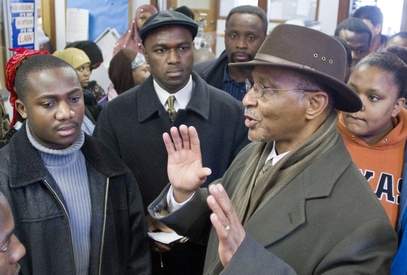

She has her own past.
Living in the South Omaha public housing projects called the Southside Terrace Garden Apartments, near the packinghouse kill floors her father worked after his military service ended, the future Mrs. Ben Gray grew up as Freddie Jean Stearns.
Life’s not always been a garden party for her. She got pregnant at age 17 and missed graduating with her senior class. She struggled as a young single mother before mentors helped her get her life together.
“It was not all a fairy tale life. The personal feeling of disappointment, not just letting my parents down but all those sisters behind me. That humbled me for a really long time.”
Long before marrying a celebrity and entering the public eye or serving on the school board, she quietly made young people her focus as a mother and mentor. She calls the young people under her wing “my babies.” Just as women helped guide her she does the same today.
She can identify with young single moms “who think their lives are over,” telling them, “I thought that was going to be it, that I was going to be on welfare for the rest of my life. I looked around at where I was, the projects, and I saw a lot of it around me. Mothers who had never been married. I was on public assistance for awhile and didn’t like that at all. I didn’t like the fact welfare workers could just come over my place and go through my stuff.”
She shares her experience of learning to listen to the right advice and to make better choices.
“I talk to these young women now, and I’m very open about it. I don’t preach.”
But she tries to do for them what women did for her. “I was blessed to have those women in my life. A number of them became my mentors. One of them was LaFern Williams. I’ll never forget her and Miss Alyce Wilson, the director of the Woodson Center in South Omaha. I spent so much time there. My big sister Lola Averett was another. There was a time when anything and everything she did I would do. She still models everything I could ever hope to do and to be.”
She says women like her sister, who worked at GOCA (Greater Omaha Community Action), along with Carolyn Green, Juanita James, Phyllis Evans, Sharon Davis and Beverly Wead Blackburn, among others, encouraged and inspired her. When Gray attended GOCA meetings she says she was at first too shy to speak up at but Lola and Co. helped her find her voice and confidence.
“They honestly would make me stand up and ask my question.”
“I’ve been very blessed in my life to have great female role models,” she says. “They took special care of me and others. They took care of the community, too. They made it safe. They protected and loved. These women touched a lot of lives.”
Those that survive continue fighting the good fight into their 70s and 80s. “They haven’t stopped. I wouldn’t even say they’ve slowed down.” She says when she sees them “you can bet your bottom dollar I’m in their ear saying, ‘I’m making you proud, I’m doing the right thing.'” It’s what Freddie’s babies do when they’re around her. All of it in the each-one-to-teach-one tradition.
“I’ve always had the passion for those who are behind me, young people. I just collect them, I don’t know what else to say. Anyone who really knows me knows that I talk about my babies. And they know who they are and they know what I expect from them. I can’t tell you how they’re selected, I don’t know how. But there is that group and they are my babies and I love them with all my heart.
‘I’ve told them, ‘My expectations are you’ve got to take care of Miss Freddie when she’s old.’ They laugh at that. But I need them to take care of me. They’re going to be my doctor, my mechanic, my attorney. And then they get it, they understand what I’m telling them. That they’re going to take care of me because I can’t do it forever. So they’re going to have to do these things, they’re going to need to be on the board of health, on the school board, work at NOVA. They need to take care of the world. They know that’s my expectation.”
She is a wise elder and revered Big Mama figure in their lives.
“When they see me they call me Mama Freddie or say, ‘How you doin’ Mama Freddie?'”
She recently lost one of her “babies.” When she got the news, she says, “it knocked me to my knees and I’m not talking figuratively. I was walking down the hall looking at Facebook on my phone when I saw it. I was very thankful Ben was here because I dropped to the floor. And then the phone started ringing and it was some of the other babies calling to check on me and me needing to check on them.”
Just as Freddie’s been a force in the lives of young people for a long time, so has Ben, who’s made at-risk youth his mission. As part of his long-time gang prevention and intervention work he even founded an organization, Impact One, that supports young people in continuing their education and becoming employable.
Because he’s been where they are, he feels he can reach young men and women whose lives are teetering on the edge of oblivion.
“It’s amazing how quickly you can spiral down into some really deep stuff if you let yourself, so I understand,” he says.”When people ask me why I do i deal with gang members it’s because I know ’em. I know how they think, I know what they think, I know most of ’em don’t want to do what they’re doing because I didn’t.
“But you get to a point after awhile where it becomes a lifestyle that makes it very difficult for you to get out of and the only choice you have sometimes, and the only choice I see for a lot of these young men, I hate to say this, is to leave here. I don’t like the brain drain. A lot of these people are really smart. But they’ve cast such a bad shadow that I don’t know how you stay here. I mean, I think there has to be some time between they’re leaving and coming back.”
He says something missing from today’s street dynamic is a kind of mentoring that used to unfold on the corner.
“At that time we had older guys that were able to talk to the younger guys.”
Kind of like what Ben does today.
“Someone might say, ‘Stop, don’t do that, that’s crazy.’ Or, ‘If this is what you’re going to do, here’s how you do it.’ Those kinds of things.
These young men don’t have that. A lot of them don’t. I’m talking about across the country. There’s nobody on that corner anymore who’s older who can tell them…”
“It used to be the young guys on the corner and the wise guys that went back to the corner gave people words of wisdom, and that’s gone,” says Freddie, who’s known her share of hard corners.
“That’s lost,” says Ben.
He says what’s missing from too many of today’s homes and schools in the inner city and elsewhere is the kind of discipline he got from his parents and sister and the military.
“I think most of us want it, we just don’t know we want it. Discipline is a method of working with people and molding people into what they should be as adults. That’s what it is. And that’s what my father tried to do for me in the brief time he was on this Earth.”
Gray sees a disconnect between some of today’s African-American youth and schools.
“I think what’s missing from majority minority schools is a pathway to get young people to know who they are. Our African-American students don’t know why they are. They don’t know the background. In the classroom they get a real strong dose of European history but they don’t get much about who they are.
“When there’s little or no discussion about you then how do you sit there and maintain an interest in being there?”
OPS has struggled closing the achievement gap between African-American students and nonblack students. Gray says before any real progress can be made “you’ve got to get them to stay there and keep them interested,” an allusion to the high truancy and drop-out rates among African-American students.
The problem has thus far defied attempted remedies.
He says, “In spite of efforts by the Empowerment Network, Building Bright Futures and others to address core problems like truancy and drop-outs in the (North Omaha) Village Zone we’re losing kids, they’re not staying in school. And they’re not staying in school because the influence of the street is such a strong influence. I know it. Those streets call you, man, and you can be in that classroom six hours a day but damnit you’ve got to go home and when you dog home you go to an environment that’s primarily unhealthy.
“So in spite of all we’ve done in that Village Zone we’re not winning.”
He doesn’t pretend to have the answers. He knows the problem is complex and requires multiple responses. But he does offer an illustration of one approach he thinks works.
“Teachers are constantly amazed I can address a school assembly and keep kids’ attention. Staff don’t get it. Freddie gets it. I talk about where the kids came from, I talk about who they are, I talk about what their history has been. They listen because they don’t (usually) hear that. That’s part of the missing piece of why they don’t stay. They don’t feel there’s anything there for them.”
He doesn’t claim miraculous results either.
“Any of us who are involved in this effort who talk to these kids know they’re not going to hear everything we say right away. They’re waiting to hear if we’re genuine. I tell them, ‘I’m not here to get all of you, I’m not here to convince any of you of anything. One of you is going to hear what I say, respond and react to what I say by becoming a leading citizen in this community. So I’m just here to get my one.’
“That’s when they start listening. They want to be the one.”

Flanked by Freddie Gray and Ben Gray, grieving parent Tabatha Manning at a press conference in the aftermatth of losing her 5-year-old child to gun violence.
Freddie appreciates better than most the challenge of educating children when so many factors bear on the results.
“We don’t produce widgets, we produce the citizens that are going to run this country. That’s exactly what we’re doing every single day. Every single one of these kids is an individual who deserves to have an individual touch them. It’s about that one-on-one relationship if we’re going to get kids to succeed, and if we don’t get this right then I think that says something about what the state of this country will be.
“Poverty is going to be the thing that kills us if we don’t take care of it and the only way I know to do that is to provide our children with the necessary skills to become employable.”
She’s keenly aware of criticism that the school board has ceded too much power to the superintendent.
“I understand people say that thing about the board being a rubber stamp but they don’t come and listen to the committee meetings and hear the board in dialogue. By the time theres a news sound bite we’ve already talked about it or figured it out or tabled it. Those things happen during the day (when the cameras aren’t on).
“But trust me we’ve got this. My job is to provide the superintendent with guidance in saying, ‘This is what you will do.’ There has to be parameters. We’ve got statutes to follow.”
In seeking solutions to bridge the achievement gap, she say, “I’m talking to other districts’ board presidents and members, not just when I’m on the Learning Community, but other times, too. That hasn’t happened much before.”
She says more collaboration is necessary because studies show that wherever kids live, whatever their race, if they live in poverty they underachieve.
“Poverty is a problem. If we’re not addressing poverty now than 20 years from now we’ll be having the same conversation.”
Breaking the cycle is a district goal.
“At the board level it’s looking at careers. We do kids a disservice when we say everybody’s going to college because that’s a lie and we all know it. But we do need to supply them with the necessary skill sets so they can be productive citizens.
“We’ve got to get these young people to the place where they can get jobs, where they can get out of poverty.”
She says OPS is finding success getting businesses to offer students internships that provide real life work experiences. He’s been active in the Empowerment Network’s Step-Up Omaha program to provide young people summer training and employment towards careers.
As both of them see it, everyone has a stake in this and a part to play, including schools, parents, business.
“There’s room at the table for everybody and everybody has to have a foot in this and has to step up. The focus has to be on what can we do together,” she says.
Now that she’s solidly in the public eye in such a prominent job she hopes African-American women follow her.
“I have to say this for other women who find themselves feeling like they’re voiceless: If you can see it, you can be it. There’s a lot of young African-American females who are just sharper than sharp, that could run rings around me all day doing this, but they don’t feel like they have a voice.
“And so I really hope they are paying attention because again Miss Freddie is not going to be doing this for the rest of her life and some of them are going to need to be sitting on this board.”
Ben Gray feels the same way about the young men and women of color he wants to see follow him into television or politics or wherever their passion lies.
Both with his own children and those he’s “adopted,” he’s taken great pains exposing them to African-American history and culture and encouraging them to engage in critical thinking and discussion.
“I wanted them to be more aware, I wanted all of our children to be aware of what’s around them and what it takes to survive. And to know who they are and what their history is, and some of them can tell you a lot better than I can tell you now.
“We have two that are like our own who are former gang members. Both of these guys are brilliant young men, and given a different set of circumstances would be someplace else.”
Ben and Freddie Gray are living proof what a difference new circumstances and second chances can make.
Related articles
- Masterful: Omaha Liberty Elementary School’s Luisa Palomo Displays a Talent for Teaching and Connecting (leoadambiga.wordpress.com)
- Fast Times at Omaha’s Liberty Elementary: The Evolution of a School (leoadambiga.wordpress.com)
- Negro Leagues Baseball Museum Exhibits on Display for the College World Series; In Bringing the Shows to Omaha the Great Plains Black History Museum Announces it’s Back (leoadambiga.wordpress.com)
- Kelly: It’s not about the ‘sex story,’ Freddie Gray says of Sebring (omaha.com)
- Brown v. Board of Education: Educate with an Even Hand and Carry a Big Stick (leoadambiga.wordpress.com)
- Omaha’s Malcolm X Memorial Foundation Comes into its Own, As the Nonprofit Eyes Grand Plans it Weighs How Much Support Exists to Realize Them (leoadambiga.wordpress.com)
From the Archives: Veterans Cast Watchful Eye on the VA Medical Center
Very rarely do I write anything that even edges up on hard news. This story from 2000 is one of those exceptions. It had to do with complaints filed against the Omaha VA Medical Center and the watchdog role local veteran activists assumed in agitating for change and monitoring government responses and remedies. The Department of Veterans Affairs has a spotty even inglorious and sometimes infamous track record in attending to the medical needs of servicemen, past and present, and horror stories abound of poor conditions and treament experiences in veterans’ facilities. Of course, much good is done as well. But given that problems persisted before the last solid decade or more of returning combat vets requiring care the problems have, from I gather, only mutiplied in the crush of patients overwhelming the system.

From the Archives: Veterans Cast Watchful Eye on the VA Medical Center
©by Leo Adam Biga
Originally appeared in The Reader (www.thereader.com)
A Call for Action
Last September saw the release of a long-awaited federal report stemming from an investigation by the Department of Veterans Affairs’ Office of Inspector General into complaints about the Post Traumatic Stress Disorder (PTSD) program at the Omaha VA Medical Center. The investigation followed requests by Sen. Bob Kerrey, D-Neb., and Sen. Tom Harkin, D-Iowa, to examine complaints made to them, many in impassioned letters and phone calls, by veterans.
After the October 1999 investigation, nearly a year passed before the inspector general issued a 50-page report substantiating such concerns as insufficient staff, poorly coordinated services, long scheduling delays, inadequately administered drugs and a weak patient advocacy program. Other beefs, including allegations about negligent care, were not supported. Kerrey characterized the findings as showing “there are serious problems…inside an organization that is for the most part dedicated to high quality care.” The report made 16 recommendations for addressing the problems. Concurrent with the PTSD review the entire medical center was the subject of a routine comprehensive inspector general assessment, the timing of which may have been pushed up given the heat coming down from Washington, and its report surfaced more concerns and remedies amid overall good health care practices. In what was described as a coincidence, the center’s director and chief medical officer retired in June.
A hospital spokeswoman said the center has already implemented several changes and is on pace to complete others by target dates. Veterans who called for the initial study are pleased with some changes but assert old problems still persist. Todd Stubbendieck, legislative assistant in Kerrey’s Washington, D.C. office, said,
“Our understanding is everything is being implemented there. We’ve heard no additional patient complaints.”
Raising Hell
The reports, written in the cold, clinical language of bureaucratic Washington, mute the rage some veterans express at the insensitive and unresponsive manner in which they insist they’ve been treated. David Spry, vice president of the local chapter of the Vietnam Veterans of America, has become a mouthpiece and advocate for their discontent. His own experiences as a post traumatic stress disorder patient (in Lincoln), as a veterans legal custodial aide and as a past Veterans Advisory Committee member at the Omaha VA facility put him in a unique position to assess center practices and to glean feedback from the veterans community. Much of the discord has centered on a few key staff members and administrators and their perceived arrogance toward veterans. “They treated us with disrespect and that’s what a lot of the complaints are about,” Spry said. “It’s like, They’re the system, and we’re only veterans. What do we know? They thought we had no brain, no mouth, no nothing once we left their building, but we were comparing our notes about this place with other veterans groups.”
Spry turned veterans’ dissatisfaction into a cause that eventually got lawmakers and government oversight bodies to take action. For Spry, a Vietnam combat veteran, the process of getting officials to finally take seriously the red flags he and others originally raised more than three years ago has been an odyssey akin to battle. The role of whistle blower has taken its toll, too. “It hasn’t been easy. In 1997 we started to complain vigorously to VA management about this. We got nowhere. Our complaints never even got into the minutes of the meetings of the Veterans Advisory Committee. The things we were concerned about were problems we didn’t seem to be able to get corrected internally, so we went to a congressman,” he said, referring to former Rep. Jon Christensen (R-Neb.). Veterans aired grievances to Christensen and VA officials but, Spry said, little headway was made. “Then, when Christensen became a lame duck, we were kind of at a loss.”

Making the Case
That’s when, in 1998, Spry and fellow Vietnam Veterans of America service officers brought complaints, which grew in the wake of a national hospital accreditation survey, to the inspector general office, the Senate Subcommittee on Veterans Affairs and Kerrey. Spry said a year elapsed before Kerrey’s office took serious interest. Then, at the request of top Kerrey aides, Spry and his comrades were asked to gather veterans’ gripes and, once Kerrey saw the more than 100 letters of complaint, he asked the inspector general office to get involved. At the time, Kerrey said, “…this Vietnam Veterans post has made a persuasive case that something’s going on here that’s not good.” According to Spry, “This organization of ours really became quite passionate about this. We really pushed very hard. We had a lot of people looking into this and we finally got somebody to listen to us. It helped tip the scales when Sen. Kerrey came on board.”
Long before the inspector general weighed-in, the VA Medical Center followed-up its own internal program review by inviting the director of the VA system’s National Center for PTSD, Fred Gusman, to conduct an on-site assessment of the Omaha PTSD program in July 1999. Hospital spokeswoman Mary Velehradsky said, “We recognized we did have some systems problems as well as some patient care issues, and our inviting Mr. Gusman was a way to have another set of eyes look at that and to fix the problems and to make it a stronger program.”
Gusman’s findings of a “systemic problem” was confirmed by the inspector general, which included Gusman’s data in its report. He has made a follow-up visit to the hospital and, with inspector general staff, is overseeing program modifications.
A Thorn-in-the-Side
By the time the inspector general took a hard look at the Omaha facility, Spry said he was persona non grata with hospital officials. “I became a little too much of an irritant and they banned me from the facility except for medical treatment for my own service-connected disabilities. But that wasn’t good enough. They took away my freedom of speech, too. I am to have no contact with anyone or anyone with me. They’re doing anything they can to shut me up.” Veteran Tom Brady, who worked with Spry to document complaints about the center, said Spry has been singled-out: “Certainly, there are consequences to exposing practices that are subject to sanctions. He’s been one of the driving forces behind a lot of things and now they treat him like he’s a dangerous person.” Velehradsky confirmed the restrictions but added, “There are reasons people can be banned from a facility and I can guarantee you there was nothing connected to the IG (inspector general) incident.” She did not specify the reasons in this case.
As unofficial watchdogs, Spry and Brady chart the center’s progress in making changes. “We’re trying to monitor what’s going on, but we’re limited in going up there. From what we can tell, they have implemented a number of things that we’re really happy about. We’ve seen improvements in scheduling, in medications and in one-on-one therapy. We’ve seen a considerable difference in staff morale. The hospital is a lot happier.” But he and Brady remain critical of some program staff they feel lack expertise in working with PTSD patients. A psychologist whom the majority of complaints was filed against remains while a popular social worker has left. The two veterans also continue to be disenchanted with what they feel is the distant voice veterans have there. “We’re still not a cooperating partner — not because we don’t want to be,” Spry said.
According to Velehradsky the center has long had in place mechanisms for veterans to speak out with management and has recently increased these feedback avenues. She said the PTSD program has been strengthened with new procedures and the addition of specialized staff. She added recent patient surveys indicate high approval ratings and that veterans not wishing to be treated in the Omaha program have the option of being seen in a Lincoln clinic.
Standing Guard
It is perhaps inevitable disenfranchised veterans and entrenched VA Medical Center managers see things differently. Where Spry feels “it’s kind of a shame we had to go to this extent to push the bureaucracy around to get them to look at things,” Velehradsky said: “When you have an outside set of eyes look at your program and make recommendations it does make you stronger. We welcome it. It’s been very helpful and we continue to make improvements.”
While Kerrey has termed the VA episode a victory for veterans, the ever vigilant Spry remains wary and vows to carry on the fight if need be. His never-say-die attitude was formed as a Marine in Vietnam while under siege from overwhelming forces at Khe Sanh during the Tet Offensive in 1968. “I kind of made a commitment to myself and to the 1,500 of us who died at Khe Sanh that I don’t ever want to lose another battle again. And that’s why I’ve fought this (VA) thing. Have I been tenacious about this? I certainly have. All I want to do is make things better.”
Related articles
- Suicidal veterans may not be getting help they need (pri.org)
- Disabled vets increasingly cheated by fund managers (sfgate.com)
- Inspector General Report: VA Understates Delays In Handling Veterans’ Mental Health Claims (theveteransdisabilitylawfirm.com)
- Bill proposed to change PTSD military programs (thenewstribune.com)
He knows it when he sees it: Journalist-social critic Robert Jensen finds patriarchy and white supremacy in porn
Robert Jensen is one of those writers who challenges preconceived ideas we all have about things we think we already have figured out. Among the many subjects he trains his keen intellect on are race, politics, misogny, and white supremacy and things really get interesting when he analyzes America’s and the world’s penchant for porn through the prism of those constructs. I interviewed him a couple years ago on these matters in advance of a talk he gave in Omaha, and the following story for The Reader (www.thereader.com) is the result.
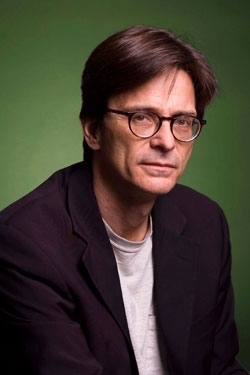
He knows it when he sees it: Journalist-social critic Robert Jensen finds patriarchy and white supremacy in porn
©by Leo Adam Biga
Originally appeared in The Reader (www.thereader.com)
Journalist-political activist-social critic Robert Jensen is the prickly conscience for a narcissistic Addict Nation that lusts after ever more. More resources. More power. More money. More toys. More sex. The tenured University of Texas at Austin associate professor organizes, agitates, reports, gives talks, writes. Oh, does he write.
He’s the prolific author of books-articles challenging the status quo of privileged white males, of which he’s one. He believes white patriarchal systems of power and predatory capitalism do injury to minorities through racist, sexist, often violent attitudes and actions. His critiques point out the injustice of a white male domination matrix that dehumanizes black men and objectifies-subordinates women.
We’re talking serious oppression here.
As an academic trained in critical thinking and radical feminism, his work rings with polemical fervor but refrains from wild rant or didactic manifesto. Agree or not, it’s hard not to admire his precise, well-reasoned arguments that persuasively connect the dots of an elite ruling class and its assumed supremacy.
He’s presenting the keynote address at a Sept. 22 Center for Human Diversity workshop in Omaha. His topic, “The Pornographic Mirror: Facing the Ugly Realities of Patriarchy and White Supremacy,” is one he often takes up in print and at the podium. His analysis, he said, is based on years studying the porn industry, whose misogynistic, racist products express “men’s contempt and hatred of women.”
Porn, he said, routinely depicts such stereotypes as “the hot-blooded Latina, the demure Asian geisha girl, the animalistic black woman and the hypersexualized black male.” Racially-charged code words — ebony, ivory, nubian, booty, jungle, ghetto, mama, chica, spicy, exotic — market these materials.
He said most interracial porn features black men having sex with white women, which he considers odd given that historically the majority culture’s posited black males as threats to the purity of white women. Why then would an “overwhelmingly white” audience want to view these portrayals?
Jensen suggests what’s at work is an “intensification” of “the core dynamic of male domination and female subordination.” Thus, he said, “by ‘forcing’ white women to have sex with black men, the ultimate sort of demonized man in this culture, it’s intensifying the misogyny and racism” behind it all. “That’s why I talk about these two things together, and why pornography is an important cultural phenomenon to study. It tells us something about the world we live in that is very important.”
The mainstreaming of porn as legitimate pop culture is a trend he finds disturbing. The industry, not counting the corollary sex trade, is estimated at $10 billion annually, comparable to other major entertainment industries such as television, film and sports. Jensen said his own students’ acceptance of porn as “just part of the cultural landscape” reflects a generational shift. Porn’s gone from taboo, scandalous, underground to casual lifestyle choice easily accessed via print, video, TV and the Web, where adult fare’s limitless and its content increasingly extreme.
Strip joints, adult book stores, chat lines, hook-up clubs, escort services, porn sites and X-rated channels abound. Sex tourism is a booming business in Third World Nations, where white men exploit women of color. Homemade porn is on the rise. Porn star Jenna Jameson owns cultural capital. Reality TV, cable programs, movies and advertising are, in his estimation, increasingly pornographic. Although careful not to link porn use to behavior, Jensen sees dangers. Sex addiction is a widely recognized disorder whose various forms have porn as a component.
Recreational choice or addictive fix, end point or gateway to overt, criminal acting- out, Jensen makes the case it’s all fodder for an already dysfunctional society.
“This is helping shape a culture which is increasingly cruel and degrading to women, which we should be concerned about,” he said. “If we’re honest with ourselves, even those who want to defend the pornography industry or who use pornography, I think we have to acknowledge the patterns we’re seeing are cause for concern. I can’t imagine how anyone could come to any other conclusion.”
He said it’s an open question how much more pornographers can push the limits before the culture says a collective, “Enough.” Any outcry’s not likely to come as a see-the-light epiphany, he said, but rather in the course of a long-term public education and public policy campaign. Anti-obscenity legal restraints, he said, are difficult now due to vague, weak state and federal laws, The exception is child porn, where strict laws are easily enforced, he said.
He opposes censorship, insisting, “I’m a strong advocate of the First Amendment and Free Speech,” adding current laws could be enforced with sufficient mandate.
“Much of the material were talking about clearly could be prosecuted yet it isn’t,” he said, “which I think reflects that level of cultural acceptance.”
He suggests enough male stakeholders consume, condone or profit from porn/illicit sex that this old boys network gives winking approval behind faux condemnation.
Jensen supports strict local ordinances and aggressive civil actions against adult porn similar to what feminists proposed in the ‘80s. He feels with modifications this approach, which failed legal challenges then, could prove a useful vehicle.
As Jensen notes, concurrent with this-anything-goes era of on-demand porn and sex-for-hire are the repressive strains of Puritanical America that discourage sex ed and open discussion of sex issues. He’d argue that silence on these subjects in a patriarchal, misogynistic society contributes to America’s high incidence of rape, sexual assault, prostitution, STDs, HIV/AIDS and teen pregnancy.
Overturning these trends, he said, begins with public critiques and forums. The Center for Diversity workshop at the Omaha Home for Boys is just such a forum. The 8 a.m. to 4:30 p.m. event features a wide-range of presenters on how to “Stay Alive” under the pervasive assault of sexism, racism, economic destabilization, domestic violence and pornography. The workshop’s recommended for health care professionals, therapists and social workers.
Check out Jensen’s work on the web site http://uts.cc.utexas.edu/-rjensen/index.html.
One Helluva Broad: Mary Galligan Cornett
I never met the late Mary Galligan Cornett during her long, legendary tenure as Omaha City Clerk, only when she’d been retired some years, but her reputation as a cantankerous, bigger-than-life personality preceded her and I was not disappointed when I finally did catch up with her. Sheds lost none of her bite or her blunt, blue-streak manner of speaking. She’s gone now but she’s definitely one of my most unforgettable characters. My profile of her appeared in the New Horizons in 2002.

One Helluva Broad: Mary Galligan Cornett
©by Leo Adam Biga
Originally appeared in the New Horizons
For more than half-a-century, Mary Galligan Cornett gave as good as she got with the boys at City Hall.
In her colorful 53-year civil service career she saw hundreds of elected officials come and go. In a 1961 to 1997 reign as Omaha City Clerk she served 13 mayors (counting acting and interim chiefs) and dozens of council members. She saw Omaha transition from the commission form of government to the city charter home rule system to the present structure featuring district council elections. She was a stabilizing presence as Omaha endured scandals, bitter fights over equal rights and public works and abrupt changes in leadership. She helped Omaha retain its Triple AAA credit rating by selling bonds in New York’s financial district.
Along the way, she earned a reputation as a tough woman valued for the knowledge and history she brought to city business and as one not to be trifled with in the political wrangling game. This blunt, unadorned woman, who says of the wrinkles in her face — “I’ve earned every one” — is one helluva broad.
Unafraid to speak her mind and uncowed by the rough-and-tumble maneuvers of smoke-filled, back-room deliberating, Cornett was a trailblazer in the male fraternity called politics. For years, she was among only a handful of women city clerks in major U.S. metropolises. So, how did she survive under so many different regimes and surrounded by so many powerful men of often clashing politics and personalities? “Very simple, I became one of the good old boys. I made friends with their wives, their secretaries and their mistresses, and I got along just fine,” she said from her terraced antique and bric-a-brac-filled home on the busy Northwest Radial Highway. As former City Councilman Subby Anzaldo said, “Having Mary in a group of men was not uncomfortable. If a cross word flew out of someone’s mouth it wasn’t a situation where you had to worry about it. Mary understood and she could throw a few out herself if she had to. She was one of a kind. They don’t make ‘em like that anymore.”
At her home, family photographs are prominently displayed in the living room, where the pet dog and cat roam freely. Most pictures are of Cornett’s only child, Irene A. Cornett (Stranglin), now a 10-year veteran with the Omaha police force and the new mother of twin girls. Cornett raised Irene alone after the death of her husband, surety executive Bob Cornett, in 1976. Slowed by a broken hip suffered last March, she has a nurse tech, Raissa Franklin, help at home. About her patient, Franklin said jokingly, “She’s ornery. She’s worse than the agitator in the washing machine.” Ever the politician, the chain-smoking Cornett recently had pictures of herself taken sans cigarettes. After the photo session Cornett called out, “Raissa, honey, could you hand me a pack of cigarettes now that the photographer is gone?”
As far as being a woman in a man’s world, Cornett had only to look at the domineering women in her own life for role models.
Both of her grandmothers worked outside the home in addition to raising families. Her maternal grandma came from sturdy ranch stock and went on to become a music teacher in towns across Nebraska. Her paternal matriarch was a railroad brakeman as well as a seamstress. Her mother was a political operative and helped run the family produce business.
“I grew up with the idea a woman could be anything she wanted to be,” said Cornett. That’s why when she started working at City Hall as a building clerk in 1945 she chafed at the resistance she met from the all-male contractors who had to go through her to obtain permits. “Well, the men contractors had a hard time with that because they didn’t think a woman could look at a set of blueprints and figure out anything. It was a whole new thing for them. They had a hard time accepting it and I had a hard time accepting their chauvinism. My attitude was, ‘The hell with it. I’m here. I’m the one that issues the permits. Show me your (expletive) blueprints. Take me or leave me.’ I think I’ve always felt that way.”
Armed with her sharp tongue, astute mind and vast experience, she had the ear of mayors and council members. According to her successor, current City Clerk Buster Brown, whom she trained, “If she had something to say, people listened. Yes, she influenced decisions behind-the-scenes. She was an institution. She knew the ins-and-outs.” Rather than challenge her “strong personality,” he said, officials would “back away.” Former City Councilman Robert Cunningham said, “She handled things with authority. She was respected.” In her capacity as clerk and confidante, Cornett was the keeper of city records and secrets. She recalls how attorney Eddie Shaston, an associate of former Mayor A.V. Sorensen, “always said ‘I was the woman that knew and never talked.’”
Retired since 1997, Cornett is not telling tales out-of-school now, at least not on the record. If she did tell her story, the 77-year-old said she’d borrow the title from the Frank Sinatra anthem, “I Did It My Way.” The only trouble with that, she asked rhetorically, is “which of my lives would I be talking about? My private life? My political life? My life as a bondswoman?” To which Pat Wright, a friend and former assistant who popped over during a recent interview quipped, “Where does one stop and the other end? Sometimes you don’t even know,” which prompted Cornett to reply, “I know that.” Wright added, “Cornetts real. She tells it like it is.”
No doubt, Cornett thrived in the political arena because public service was, in a sense, a birthright by virtue of her family’s longtime involvement in the field. Her Irish-Scottish immigrant family’s political legacy extends back to the town’s wild-and-whooly beginnings to a pair of paternal grand uncles: former fire chief Jack J. Galligan and former police chief Michael Dempsey. Then there was her mother, Fairrie Irene Cameron Galligan, a wheel in the state and Midwest Democratic central committees. Mary often accompanied her to conventions, even meeting future president Harry S. Truman in Kansas City when he was still a ward leader for the Tom Pendergast machine. There was also a familial tie to the politically active Warners of Nebraska. “Everyone in my family, on both sides, was in politics,” Cornett said. “That’s been my whole life.”
Public service has been a passionate thing for the Cornett clan. “It was and it still is with me” she said. “My family at one time were all immigrants and this was the country that welcomed them. They felt they owed it something because of the freedom and the education and the employment they found here. And for all of that, there’s gotta be some payback. And, so, I think the whole family felt a personal responsibility to be part of government and to devote a lot of their lives to it. I devoted my entire life to it.” Politics also suited Cornett’s gregariousness. She said her capacity for getting along with people and putting aside personal differences for the public good is “an ability you have to have” to succeed in politics. Her skill at mixing with people from all walks of life and her hunger for being right in the thick of the action is why it all came naturally to her.
“I guess I’m a people person. I guess that’s why I picked this as my retirement house,” she said, referring to her residence. “It’s right on the street. Life goes on. There isn’t a time the rescue squad isn’t going that-a-way or a fire truck isn’t going this-a-way or a police car isn’t going another way. I can lay in bed and tell from the traffic what time it is.”
Cornett likes the neighborhood and its mix of young families and retirees. “I lived for many years in a big home at 61st and Decatur and I hated it. Everybody went to bed at like 8:30 or 9, and being a night owl, I’d be up till 1 or 2 in the morning. Also, I cannot imagine living in one of these retirement places where everybody’s old, where there’s no children, where there’s no dogs or cats. Why would you want to shut yourself off from the world? You’ve got to have some life going on around you,” she said above the din of rushing traffic and barking dogs outside.
For her, city government was where the action was. How apt then that this lifelong devotee of Italian grand opera found herself immersed in the drama and machinations of big city politics, with all its brokering, backstabbing and symbolic bloodletting. Because politics truly is in her blood, she still keeps close tabs on City Hall. Asked if leaders still come to her for counsel, she answered, “Let’s put it this way, I get a lot of telephone calls. I still have an excellent grapevine together. Remember, it’s been 53 years or so building it. I can tell you what’s going on in every (expletive) department down there. I keep track of things.”
After years directing the clerk’s office, which besides keeping records supports the functions and enforces the rules of the City Council, she has a rather proprietary feeling about that august body. The last council she worked with had a contentious relationship with former Mayor Hal Daub, whom she felt was not well served by some members, which makes her glad the present council, with its five new faces, is working so well with Mayor Mike Fahey. “I’m very proud of the new council. I think they’re doing a very good job. This council and the mayor are communicating. I think that’s a necessary part of good government. You can disagree, but you need to communicate at least your disagreements.”
In Cornett’s view the previous council “made life miserable for Mayor Daub,” adding: “I always felt very sorry for Daub. Did he make mistakes? Yes. Could he have maybe communicated with two or three of them better? Yes. But there were four of ‘em on that council that no matter what he would have done they would never have moved off what they wanted. And it wasn’t a matter of what was best for the city or what was good for the taxpayer. It was a matter of their own personal egos and their desire to stay in power. Well, you know what happened to most of ‘em? They were beaten out in the last election.”

In past administrations Cornett became a liaison or conduit between mayors and councils locked in stalemates. “When some mayors were not talking to certain council members they used me as a go-between,” she said. “They about wore my voice out, too.” She also frequently sat in on cabinet meetings.
One of Cornett’s closest cronies in city government was the late Herb Fitle, the longtime city attorney with whom she enjoyed a salty relationship that sometimes found them feuding. As years passed, Cornett and Fitle, along with officials George Ireland and S.P. Benson, became the wise old sages in city government. Cornett and Fitle were “the staunchest supporters and absolute protectors” of the city charter that came into effect in the late-1950s.
“We had a long, long tenure together,” she said. “If we stood together, all hell and high heaven could not have moved us — I don’t care if it was mayors, councils, outside influences, whatever. But our disagreements also were legend. He’d write his opinions and although I wasn’t an attorney I sometimes wouldn’t agree with his opinion and I wasn’t very amiss to tell him so.
“Once, we disagreed over some political or legal issue and we stopped talking to each other. I’d send my assistants up to his office for answers and he’d send his attorneys down to my office for answers. Well, the help got tired of that and came to me and said, ‘Look, you guys have got to stop this. We can’t take it anymore.’ I said, ‘OK, fine.’ It was near Christmas and we used to have this event called The Christmas Sing where we all gathered in the council chambers with an orchestra to sing carols, and so I asked someone to get peace doves. While this program was going on I said to Herb, ‘I think we should make up,’ and I let the birds go. They were scared as hell and flew all over the place. Well, it turned out they were pigeons and, you know, they pooped on everybody and everything…the musicians, the councilmen, the chairs, the desks. I think it took the night help two or three hours to clean up.”
Despite the mess, her goodwill gesture was accepted and The Great Cornett-Fitle feud ceased.
In her watchdog role with the council Cornett provided oversight to ensure proceedings followed protocol. She served as sergeant of arms, called roll, recorded results and supplied information requested by councilmen on resolutions, ordinances, liquor licenses, etc.. The job also involved training new council members in how municipal government operates. Not everyone comes prepared to govern. “You get newly elected officials that never saw a charter before,” she said. Former councilman Subby Anzaldo said her influence was felt. “She had input. We came to her for answers. She told it like it was. She was like the eighth council member.”
She provided continuity when, in 1981, the move from at-large to district elections brought seven new council members and a new mayor into office and then, in the late 1980s-early 1990s, when Omaha went through six mayors due to recall, death, defeat, election, resignation. At times like those, City Clerk Buster Brown said, “She was very vital to making sure city government ran smoothly.” The way she sees it, she helped by “just being there.”
Then there’s the delicate matter of sorting out potential conflicts of interest. As Cornett explained, “Everybody comes to government bringing their own baggage in terms of outside influences. There may be something in the charter that can favor an official in getting a contract” or a business advantage. “Will officials try to use their influence? Of course they will. In my downstairs office at home I have reams of settled rulings on certain sections of the charter where somebody tried to do something they couldn’t (legally) do.”
At the countless council meetings she oversaw, she heard everything from dissident voices to impassioned pleas to whimpers to cheers. Among those she had removed from the premises was a deputy sheriff who arrived with a warrant during a council session. When she informed the deputy it was not permissible to serve a sitting body but that he would instead have to wait until the meeting ended, he persisted, whereupon she called security, ordering police to “remove this man,” which they did, much to the deputy’s chagrin. Cornett said she was so upset that someone was “obstructing or interrupting MY council meeting” she never even “bothered to find out” who or what the warrant specified.
Another time, during the racially tense 1960s, Cornett recalls how marching civil rights demonstrators descending upon City Hall sent most officials scurrying for cover. Typical of Cornett, she stood her ground. As it turned out, the group included a large contingent of church-based elders whose intent was conciliatory. “With all the public officials having taken to the hills, I was the only one left, so the marchers came to my office. I called the switchboard and told them I didn’t want any calls and I told my staff to give these elderly ladies the cushions off their chairs to kneel on. That’s how I came to have a pray-in in my office.”
For the most part, however, Cornett plied her political savvy not in public view but behind-the-scenes. Of the many mayors she worked with, she said, “Almost every one of ‘em really cared about this city. I loved every one of ‘em, whether I fought with ‘em or not and whether they disliked me or not. Different mayors at different times had difficult personalities. I wouldn’t say who were my favorites, but I would say who taught me the most — A.V. Sorensen (1965-69). He made it a point to teach me…government, finances, investments, organization, management. He expected everything to be organized. He hated a messy desk.”
She said Sorensen was a model of efficiency who demanded subordinates follow suit. “If you couldn’t give him an answer in 5 minutes…forget it.” She recalls how when she and former City Council President Art Bradley questioned why he gave “both of us directives” to hunt up the same data, his honor replied — “‘Because you come back with different answers, and half way between the two of them is the truth.’ That was A.V.”
Sorensen restored faith in Omaha’s elected leadership in the wake of corruption at City Hall. His predecessor, the dashing young Jim Dworak (1961-65) was indicted but later acquitted on bribery and conspiracy charges involving rigged real estate zoning laws. Other city officials were convicted. While Cornett is convinced Dworak did not accept any bribes, she believes he was a victim of his own fast-living ways. “Wine, women and song were his problems. He just had too much too soon.”
Where Dworak was a free-wheeling playboy, Sorensen was a circumspect elder statesman. Tough facade aside, Cornett maintained a soft spot for old A.V. “I felt so close to him. He was one of the few people who hurt my feelings. He had been out of office a few months when he came to visit me. My office, for some reason, was all cluttered up. He didn’t say Hello or How are you? — no, he said, ‘I thought I taught you better than that,’ and walked out. Well, I sat there and cried.”
Another mayor whom Cornett says “taught me a great deal” was brash Hal Daub (1993-2001). She feels his greatest strength — a facile mind — often proved his undoing when combined with his impatience. “Hal is an extremely brilliant man,” she said. “He has almost a complete retentive memory for facts and figures. But he thinks so fast that he’s always jumping the gun on people.” The two respected each other enough that mere weeks after retiring from the clerk’ s office she accepted his request to assume an eight-month job researching issues related to city-county government merger, a subject she calls “near and dear to my heart.”
Over the years Cornett said she rejected notions of running for public office and spurned opportunities to enter the private sector. Life as an elected official held no interest, she said, because she “didn’t want to play the game” and disliked the idea of being beholden to “outside influences.” Besides, she added, elected officials don’t have the real control — civil service administrators do. The prospect of leaving City Hall altogether was equally unimaginable.
“I was offered two or three very good jobs paying twice what I made in city government, but I decided, no, that’s where I belonged.” It’s why she looked forward going to work every day and thought nothing of putting in overtime even though her post didn’t qualify her for extra pay.
“This sounds kind of corny, but I always felt the Lord put me in the right spot at the right time in my life,” she said. “Every day there were new problems. Every day there was something else. You never knew when you got there in the morning what was going to transpire. And, so, if you wanted an interesting life you couldn’t have had a better job. I loved every minute and I kept going as long as I could.”
Related articles
- Steve Rosenblatt, A Legacy of Community Service, Political Ambition and Baseball Adoration (leoadambiga.wordpress.com)
- Ashford to run for Omaha mayor (omaha.com)
- Kelly: It’s not about the ‘sex story,’ Freddie Gray says of Sebring (omaha.com)
Omaha’s Malcolm X Memorial Foundation Comes into its Own, As the Nonprofit Eyes Grand Plans it Weighs How Much Support Exists to Realize Them
African-Americans from the town where I live, Omaha, Neb., are often amused when they travel outside the state, especially to the coasts, and people they first meet discover where they are from and invariably express surprise that black people live in this Great Plains state. Yes, black people do live here, thank you very much. They have for as long as Nebraska’s been a state and Omaha’s been a city, and their presence extends back even before that, to when Nebraska was a territory and Omaha a settlement. Much more, some famous black Americans hail from here, including musicians Wynonie Harris, Buddy Miles, Preston Love Sr. and Laura Love, Hall of Fame pitcher Bob Gibson, Hall of Fame running back Gale Sayers, Heisman Trophy winner Johnny Rodgers, the NFL’s first black quarterback Marlin Briscoe, actress Gabrielle Union, actor John Beasley, producer Monty Ross, Radio One-TV One magnate Cathy Hughes, and, wrap your mind around this one, Malcolm X. That’s right, one of the most controversial figures of the 20th century is from this placid, arch conservative and, yes, overwhelmingly white Midwestern city. He was a small child when his family moved away but the circumstances that propelled them to leave here inform the story of his experience with intolerance and bigotry and help explain his eventual path to enlightenment and civic engagement in the fight to resist inequality and injustice. Though the man who was born Malcolm Little and remade himself as Malcolm X had little to do with his birthplace after leaving here and going on to become a national and international presence because of his writings, speeches, and philosophies, some in Omaha have naturally made an effort to claim him as our own and to perpetuate his legacy and teachings. Much of that commemorative and educational effort is centered in the work of the Malcolm X Memorial Foundation based at the North Omaha birthsite of the slain civil rights activist. The following story, soon to appear in The Reader (www.thereader.com), gives an overview of the Foundation and recent progress it’s made. Rowena Moore of Omaha had a dream to honor Malcolm X and she led the way acquiring and securing the birthsite and ensuring it was granted historic status. After her death a number of elders maintained what she established. Under Sharif Liwaru’s dynamic leadership the last eight years or so the organization has made serious strides in plugging MXMF into the mainstream and despite much more work to be done and money to be raised my guess is that it will someday realize its grand plans, and perhaps sooner than we think.

Omaha’s Malcolm X Memorial Foundation Comes into its Own, As the Nonprofit Eyes Grand Plans it Weighs How Much Support Exists to Realize Them
©by Leo Adam Biga
Soon to appear in The Reader (www.thereader.com)
Self-determination by any means necessary.
The notorious sentiment is by Malcolm X, whose incongruous beginnings were in this conservative, white-bread city. Not where you’d expect a revolutionary to originate. Then again, his narrative would be incomplete if he didn’t come from oppression.
Born Malcolm Little, his family escaped persecution here when he was a child. His incendiary intellect and enlightenment were forged on a transformative path from hustler to Muslim to militant to husband, father and humanist black power leader.
As it does annually, the Omaha-based Malcolm X Memorial Foundation commemorates his birthday May 17-19. Thursday features a special Verbal Gumbo spoken word open mic at 7 p.m. hosted by Felicia Webster and Michelle Troxclair at the House of Loom.
Things then move to the Malcolm X Center and birthsite. Friday presents by the acclaimed spoken word artist and author Basheer Jones, plus The Wordsmiths, at 7 p.m.
On Saturday the African Renaissance Festival unfolds noon to 5 p.m. with drummers, native attire, storytelling, face painting and Malcolm X reflections. Artifacts from the recently discovered Malcolm “Shorty” Jarvis collection of Malcolm X materials will be displayed. The late musician was a friend and criminal partner of Malcolm Little’s before the latter’s incarceration and conversion to Islam.
It’s a full weekend but hardly the kind of community-wide celebration, much less holiday, devoted to Martin Luther King Jr.
“I tell people, you may still not like Malcolm X, you may have a problem with a revolutionary. Martin was a revolutionary and maybe you came to love him. But I do want you to know brother Malcolm’s whole story and where he came from,” says MXMF president Sharif Liwaru.
“A big portion of what we do is about the legacy of Malcolm X. We go into communities, schools and other speaking environments and we educate people about Malcolm X, what he meant, what his impact was on society. Sometimes people walk away with a different level of respect for him. Sometimes they walk away having a better understanding.”

Using the tenets of Malcolm X, the foundation promotes civic engagement as a means foster social justice.
Nearly a half-century since Malcolm X’s 1965 assassination, he remains controversial. The Nebraska State Historical Society Commission has denied adding him to the Nebraska Hall of Fame despite petition campaigns nominating him. Few schools have curricula about the slain civil rights activist.
From its 1971 start MXMF has struggled overcoming the rhetoric around its namesake. The late activist Rowena Moore founded the grassroots nonprofit as a labor of love. She secured the North O lot where the razed Little home stood and where she once lived. Fueled by her dream to build a cultural-community center, MXMF acquired property around the birthplace. The site totals some 11 acres.


By the time she passed in 1998 the piecemeal effort had little to show save for a state historical marker. Later, a parking lot, walkway and plaza were added. Other than clearing the land of overgrowth and debris, the property was long on promise and short on fruition, awaiting funds to catch up with vision.
Without a building of its own, MXMF events were held alfresco on-site from spring through fall and at rotating venues in the winter. “We felt a little homeless,” says Liwaru. “We were very creative and did a whole lot without a building but we didn’t have a place to showcase and share that.” All those years of making do and staying the course have begun paying off. Hundreds of thousands of dollars in public-private grant monies have been awarded MXMF since 2009. Other support’s come from the Douglas County Visitors Improvement Fund, the Iowa West Foundation, the Sherwood Foundation, the Nebraska Arts Council and the Nebraska Humanities Council.
 Most notably a $200,000 North Omaha Historical grant allowed MXMF to acquire its first permanent indoor facility, an adjacent former Jehovah’s Witness Kingdom Hall at 3463 Evans Street, in 2010. Now renamed the Malcolm X Center, it hosts everything from lectures, films, plays, community forums, receptions and fundraisers to a weekly Zumba class to a twice monthly social-cultural-history class. Annual Juneteenth and Kwanzaa celebrations occur there.
MXMF conducts some longstanding programs, including Camp Akili, a residential summer leadership program for youth ages 14-19, and Harambee African Cultural Organization, an outreach initiative for citizens returning to society from prison.
The center is a community gathering spot and bridge to the wider community. Liwaru says it gives the birth site a “public face” and “front door” it lacked before, thus attracting more visitors. Besides hosting MXMF activities the center’s also used by outside groups. For example, Bannister’s Leadership Academy classes and Sudanese cultural events are held there.
“We’re very proud to be a community resource. It legitimizes us as an organization to have that space available. It makes a difference with the confidence of the volunteers involved.””

A recent site development that’s proved popular is the Shabazz Community Garden, where a summer garden youth program operates.
The surge of support is not by accident. The birthsite’s pegged as an anchor-magnet in North Omaha Revitalization Village plans and Liwaru says, “We definitely see ourselves as a viable part of it.” North Omaha Development Project director Ed Cochran, Douglas County Commissioner Chris Rodgers and Omaha City Councilman Ben Gray have helped steer resources its way.
Attitudes about Malcolm X have softened to the point even the prestigious Omaha Community Foundation awarded a $20,000 capacity building grant. Despite working on the margins, Liwaru says “investors could see our mission and work ethic and they supported that.”
Since obtaining its own facility, Liwaru says, “I find more people speaking as if our long-range plans are possible.” Those plans call for an amphitheater and a combined conference-cultural center.
For most of its life MXMF’s subsisted on small donations. When the building grant stipulated $50,000 in matching funds, says Liwaru, “”it was really the culmination of a lot of little gifts that made it happen.”
The all-volunteer organization depends on contributions of time, talent and treasure from rank-and-file supporters.
“We believe a little bit of money from a lot of people is beneficial,” says Liwaru. “Sometimes that meant we were probably working harder than the next organization that may be able to go to one or two people to get their funds, but it certainly makes us accountable to more people. We’re ultimately responsible to our community because we have so many community members contribute.
“Our organization belongs to the community. The people get the say.”
In tangible, brick-and-mortar terms, the foundation hasn’t come far in 40 years, but all things considered Liwaru’s pleased where it’s at.
“We’ve made a lot of progress. One of the things that makes me confident we’ve turned this corner is there’s still this strong commitment, there’s still passionate people involved.”

Veteran board members and community elders Marshall Taylor and Charles Parks Jr., among others, have carried the torch for decades. “They bring experience and wisdom,” says Liwaru. He adds, “We’ve added strong young people to our board like Kevin Lytle (aka Self Expression), and Lizabet Arellano, who bring a lot of new ideas and a passion for carrying out change in this urban environment.”
However, if MXMF is to become a major attraction a giant leap forward is necessary and Liwaru’s unsure if the support’s there right now.
“Everybody wants sustainability in terms of stable funding and revenue. We put out a lot of funding proposals at the end of last year. Few were approved. We got a lot of nos. Most funders don’t say why. We don’t know if it’s because they’re not wanting to be affiliated with Malcolm X or if it’s not understanding what we do as an organization or if they don’t think we can see projects through to the end.”
He can’t imagine it’s the latter, saying, “Anybody who knows us knows we’re persistent and that what we talk we follow through with.”
His gut tells him the organization still encounters patriarchal, political barriers.
“We always feel we have to come in proving ourselves. I always come in and explain we’re not a terrorist organization or a splinter cell. Most of what we get is a lot of encouragement but it’s a pat on the back and ‘I hope that you guys do really well with that’ versus, ‘I can help.’ I think one of the challenging things is we’re not sure what people think of us. There are many who aren’t sure which Malcolm we’re celebrating.
“If an organization is just completely not interested in covering anything related to Malcolm X it’d be nice to know. So the question from me to philanthropists out there is, ‘What do you think about the Malcolm X foundation and what we do? Do you see it as a worthy cause? What are we missing?”

Answers are important as MXMF is S100,000 away from finishing its planning phase and millions away from realizing the site’s full build-out. It could all take years. None of this seems to discourage MXMF stalwarts.
“We are willing to sacrifice and work diligently for however long it takes,” says Lizabet Arellano. Fellow young blood board member Kevin Lytle takes hope from the momentum he sees. “There’s more and more people at events and rallies and different things we do. People are finally starting to recognize and take pride in the fact Malcolm X was born here,” he says. “We have to start somewhere, and that’s a start. People know that we’re here and that we’re representing something beneficial to the community.”
Liwaru sees a future when major donors ouside Nebraska help the MXMF site grow into a regional, national, even international mecca for anyone interested in Malcolm X.
Besides a House of Loom cover charge, the weekend MXMF events are free. For details, visit http://www.malcolmxfoundation.org or the foundation’s Facebook page.
Related articles
- A Brief History of Omaha’s Civil Rights Struggle Distilled in Black and White By Photographer Rudy Smith (leoadambiga.wordpress.com)
- Malcolm X bio doubts activist was served justice (cbsnews.com)
- Malcolm X artifacts unearthed: Police docs and more found among belongs of ‘Shorty’ Jarvis (thegrio.com)
- Blacks of Distinction II (leoadambiga.wordpress.com)
- Making the Case for a Nebraska Black Sports Hall of Fame (leoadambiga.wordpress.com)
- A Synergy in North Omaha Harkens a New Arts-Culture District for the City (leoadambiga.wordpress.com)
Steve Rosenblatt: A legacy of community service, political ambition and baseball adoration
Rosenblatt is a magical name in Omaha because of the popular mayor who belonged to it, the late Johnny Rosenblatt, who in his day was quite a ballplayer, and because of the municipal stadium whose construction he speerheaded. That stadium was named after him and became home to the College World Series. The subject of this story is his son Steve Rosenblatt, who inherited his father’s love for the game and followed the old man into politics. Fabled Rosenblatt Stadium is no more, replaced by TD Ameritrade Park as host of the CWS. The stadium, the series, and his honor the mayor are more than just tangential memories to Steve, they are lifeblood and legacy.

Steve Rosenblatt, A legacy of community service, political ambition and baseball adoration
©by Leo Adam Biga
Originally appeared in the Jewish Press
Legacy plays a big part in Steve Rosenblatt’s life.
The Omaha native and his wife, the former Ann Hermen, live in Scottsdale, Ariz.
His late father, Johnny Rosenblatt, became an Omaha icon: first as a top amateur baseball player; than as a sponsor of youth athletic teams through the Roberts Dairy company he managed; and finally as a popular Omaha city councilman and mayor. The elder Rosenblatt, who served as mayor from 1954 to 1961, led efforts to build the south Omaha stadium that became the city’s home to professional baseball and to the College World Series.
The city he loved paid tribute to one of its greatest boosters when Omaha Municipal Stadium was renamed Johnny Rosenblatt Stadium in 1964. The venue and the name have become synonymous with the NCAA college baseball championship played continuously at the stadium since 1950.
In a classic case of the apple not falling far from the tree, Steve Rosenblatt was a ballplayer in his own right and served on the Omaha Chamber of Commerce Sports Commission and the Omaha Royals Advisory Board. He followed his father’s footsteps into politics as well, serving two terms on the city council and three terms on the Douglas County Board of Commissioners.
The stadium that’s forever associated with his father played a key role in Steve’s early life. He was a bat boy for the inaugural Omaha Cardinals game played there, a duty he performed the first years the CWS took up residence. He regrets that the facility so closely tied to his family will be razed after the 2010 CWS in line with the planned construction of a new downtown palace slated to host the Series beginning in 2011. But the pragmatic Rosenblatt knows the decision is driven by the bottom line, which trumps nostalgia every time.
Sports and politics are inheritances for Rosenblatt, who is an only child. Just as his father used sports and charisma to forge a political career, the son used his own passion for athletics and way with people to become a player on the local political scene and to find success as an entrepreneur.

Bearing a name that has such major import in Omaha could have been an issue for Rosenblatt, but he didn’t let it be.
“You can take that and make it a burden,” Rosenblatt said, “or you can take it and have it be an asset, and I wished to take that route.”
Comparisons between he and his father were inevitable. “That’s fine, because we weren’t the same. First of all, he was a better ballplayer than me,” he said with his dry wit. “I was a better golfer than he was. Basketball might have been a toss-up, except he played college basketball — I didn’t.”
Growing up, Rosenblatt couldn’t help but notice what made his father a strong mayor and the sacrifices that job entailed.
“I was aware obviously of it and I learned as time went on how he operated and how he did things. Of course it was intriguing. He was a people-person who had an ability to communicate and to have relationships with his constituency and to make the tough decisions and still maintain a tremendous popularity. He had what I would call a broad-based support. He was well liked all over the community and one of the things that contributed to that — and it was what also helped me — was the background he had in athletics. That benefited him as I think it benefited me.
“He was well known as an athlete long before he was well known as a public official and his abilities as an athlete helped to project him into places.”
Rosenblatt said his father epitomized the “It” factor politicos possess. “All the people you see serve in the public sector as elected officials have in my opinion an attribute that goes beyond the norm,” he said, “in that they have the ability to speak and to be received in a fashion that projects themselves as leaders.”
Being an accessible mayor means never really having any down time.
“What was difficult about it was the fact you learned early on there’s a price to be paid as well,” Rosenblatt said, “because obviously with my dad doing what he did he was not going to be with you doing the things you might like to be doing all the time. He had public obligations to take care of as an elected official.”
The level of commitment required to be an effective, responsible public servant was not enough to dissuade Rosenblatt from seeking a seat on the city council and later on the county board. Even with the cachet of his name, his strong base in the business community and a groundswell of support to make a mayoral bid he never seriously considered running for that office. The same for a Congressional seat.
“I really was never interested in it. It was not aspiring to me. I’m as much a people- person as my dad was but at the same time I’m much more private. You cannot in my opinion be an elected official at that level and be as private as I would have liked to be. I want to do the job I was elected to do and when the day is over I want to go to the golf course, be with my family, watch a ballgame. You can’t do that in certain areas because you’ve given up that right and that time by your election to a particular office.”
He said it all comes with the territory.
“Make no mistake about it, when a person is elected to office, even at the city level, the county level, there’s a sacrifice to be made,” he said. “People may not realize it at the time they do get in but they will find out. I found out and I knew how much I wanted to give and how much I didn’t.
“People thought I should have run for mayor. The thing that used to scare me about that thought was I might get elected. Then I’d have to go do it and, you see, I knew too much about what a mayor had to give up and to do to be successful. I could have done it. I think I could have done a good job at it but it was not appealing to me because my (golf) handicap would have gone up.”
He never discussed with his father prospects for a public life nor went to him for political advice.
“Not really,” he said. “I first got elected in ‘73 and he was stricken with Parkinson’s disease in the latter part of the ‘50s, so he was really not able, but he didn’t have to because I learned from him when he was healthy, vigorous and in office, so I’d already got the lessons.”
Even though he never planned for it, Rosenblatt said he always assumed he would gravitate to public service.
“Well, I’d always thought that as a son of a former mayor and as somebody who had learned that life that perhaps some day I might get involved. I knew how to operate, so to speak. Actually, the way it happened is former Mayor Eugene Leahy said to me one day, ‘Steve, you need to run for the city council — we need to get some new blood in there.’ I guess he kind of triggered the desire.”
At the time he declared his candidacy in 1972 Rosenblatt was a salesman with Sterling Distributing Company, an alcoholic beverage distributor. He’d done some college work at the University of Nebraska-Lincoln and the University of Nebraska at Omaha. Only his mind was more on baseball than higher education.
“I was only interested in athletics and still am to this day as a matter of fact. I really did not have the kind of plan that I would hope my kids would have. I was not academically a good student but I think you could say I was more attuned to the practicalities of life. You might say I was street smart…”
A three-year varsity letter-winner at Omaha Central, he tried to play ball at UNL, he said, “but academically I wasn’t taking care of business and physically I was too young to have an opportunity to be successful.”
While school was hardly a home run, his experience trying to cobble together a college baseball career given him priceless insights. He also gained much from his friendship with two coaching legends — Eddie Sutton and the late Rod Dedeaux.
“I’m fortunate to have been very close to two of the greatest coaches in the history of sports.”
Rosenblatt got to know Sutton when the then-Creighton University head basketball coach and his family moved across the street from Steve and his folks. The families remain close to this day. He got to know Dedeaux when the University of Southern California head baseball coach led his powerhouse clubs at the CWS.
“If I’d have known then what I learned from Rod I would have had a chance to have been a better baseball player,” he said, “but at the time I didn’t have that coaching-mentoring.”
The ability to evaluate talent and to weigh options has made Rosenblatt a kind of scout and adviser for promising young athletes, especially Jewish athletes.
“I’m helping kids to try to get situated within athletics. I had a young Jewish kid and his father from Scottsdale, Ariz. go to Omaha to try to help him get set up collegiately. I’m making calls to some baseball people trying to help a young Jewish kid in Omaha who’s a good ballplayer. People call me. People know that I kind of understand. I try to offer guidance to both the parents and the youngsters as to what could be in their best interests. That, to me, is fun.”
Rosenblatt said it’s not an accident he’s drawn to strong, charismatic men like his father. After losing Johnny in 1979 Rosenblatt drew even closer to Dedeaux.
“He also was a people-person and a great communicator,” Rosenblatt said of Dedeaux. “He learned the baseball business from one of the smartest men in the history of the game, a fella named Casey Stengel. That was his mentor. The two games he played in the major leagues Casey Stengel was the manager.”
By the time Rosenblatt owned his own business — a sales and distribution outfit for corrugated package containers better known as boxes — Dedeaux and he were like father and son. They were also business associates.
“He was not only a good friend but one of my biggest customers. He had a trucking company with warehousing and distribution divisions. Multiple operations. It was really big. Make no mistake, he was a baseball person, but he was also a phenomenon in the world of business.”
Rosenblatt parlayed his background in athletics by serving on the Chamber’s Sports Commission, which had a similar agenda as today’s Omaha Sports Commission.
“It was a matter of trying to do the things that make Omaha an attraction for new athletic environments,” he said.
He described his work on the Omaha Royals Advisory Board as “an opportunity for the Royals management to hear from people that are looking at the franchise from perhaps a different standpoint.” He’s still tight with the Royals today. “The general manager of the Royals, Martie Cordaro, is a good friend. I meet with him literally every time I go back to Omaha to talk about what they’re doing and how we can help them be successful.”
Those enduring ties to the Royals keep Rosenblatt informed on the Triple AAA club’s uneasy status in town. Principal owner Alan Stein is in ongoing negotiations with the Omaha Sports Commission and the Metropolitan Entertainment Convention Authority that will determine if the Royals strike a deal to play in the new downtown stadium or go play ball somewhere else. La Vista and Sarpy County are among the Royals’ in-state suitors and Stein indicates out state communities are courting the team as well. Like any good businessman, he’s playing the field.
“Well, I think he has to have that attitude,” Rosenblatt said. “I’ve met with Alan and Martie. I know what they’re thinking is. I’ve offered them my opinion of the situation. It will be interesting to see what develops.”
Steve’s personal connection to Rosenblatt Stadium and to the pro and college baseball tenants that have occupied it rather uneasily in recent years have put him in a Solomon-like position. He loves the CWS and how it’s grown to become a huge event garnering national media coverage. His long association with the Series and his deep affection for the figures who made it special give him a unique perspective. He knows players, coaches, local CWS organizers and NCAA officials.
He sat in on negotiations between the city and the NCAA as a city councilman. “The city was a cooperative partner with the private sector in the production, basically, of the College World Series,” he said. He played a similar oversight role as a county board member.
On the other hand he appreciates what the Royals offer the community and the compromises they’ve made to placate the city and the NCAA and the proverbial 900-pound gorilla that is the CWS. Just as he still talks with Royals officials, he bends the ear of NCAA officials, acting as a kind of intermediary between the two.
It all came to a head when the political hot potato of the new stadium proposed by Mayor Mike Fahey, and subsequently approved by the city council, sealed the fate of Rosenblatt Stadium. The new downtown stadium is being built expressly for the NCAA and the CWS. If the Royals do play there they’d be the ugly step-child who has to accept the leftovers from the favorite son.
Rosenblatt equates a Royals move from Omaha a loss.
“Well, I would because the original concept of the stadium that has Johnny’s name on it was not initially for the College World Series, it was for professional baseball,” he said, “Because of what has transpired with the emergence of the College World Series, it’s now created what I would refer to as an unfriendly situation for professional baseball. There’s no other professional baseball team in America that has a competitor in town called the College World Series. So it’s awkward.”
Even though he now takes an indirect role in such matters, he’s keeping a wary eye on the downtown stadium project, whose estimated $140 million price tag he considers overly optimistic. He predicts it will end up costing $175-$200 million once all the dust settles.
Like many Omahans he’s concerned that if the Royals don’t play at the new stadium and no minor league franchise is secured in their place, the venue will sit empty 50 weeks a year and not be the economic catalyst or anchor for NoDo it’s intended to be. This longtime proponent of a CWS hall of fame said the stadium would be an apt home for it and an Omaha sports hall of fame.
A CWS hall would acknowledge those who’ve excelled as players or coaches or been responsible for the Series’ success. While he doesn’t feel that venue would be much of a year-round draw he sees an Omaha sports museum as a turnstyle magnet “because so many great athletes have come out of Omaha. That would be very interesting, and if you could incorporate the two, that’s a helluva an idea.”
He also has a vested interest in seeing his father’s name live on in the new stadium.
“In my opinion that would be wise and appropriate given the lengthy association that that name has had with college and professional baseball in Omaha. Hopefully the powers that be will have his name connected in some way,” he said.
The stakes are rarely as high as they are with the stadium issue but he makes a practice of using sports as an ice breaker with people.
“Almost everything I’ve done business-wise, athletics has been a tool of taking care of business. My involvement in athletics is an invitation. If I happen to be calling on new customers and if they’re knowledgeable in athletics, then I’m going to get their business, because I can talk it. If they’re interested in the opera and the theater, I’m in trouble. So athletics is a great tool in communicating.”
Athletics and business were not his only finishing schools for a political life. He gained valuable leadership experience as a Nebraska Air National Guardsman and as chairman of the Midlands Chapter of the Multiple Sclerosis Society.
“That was a very rewarding opportunity,” he said. “Hopefully we did some good there. I had learned, of course, with my dad being afflicted with Parkinson’s and my mother being afflicted with rheumatoid arthritis how devastating that can be. Being associated with the Multiple Sclerosis Society gave me an opportunity to contribute and to try to help people…”
Community service motivated his entry into politics.
“You try to get elected in my opinion to help people who perhaps don’t have the ability to help themselves,” he said, “because everybody needs help. Having the ability to collectively help people is the thing that gives you the most pleasure.”
His political life has taught him some lessons. One is to be “leery” of any candidate who makes promises. “The fact of the matter is there’s very little individually they can do because it takes a collective effort to get something done,” he said. Any rhetoric about reducing taxes is just that. “That’s folly,” he said. “They’ll be lucky if they don’t have to raise taxes.”
His action on some issues elicits satisfaction all these years later. One involved the Orpheum Theatre. Omaha’s then-mayor, Ed Zorinsky, wanted it razed. Rosenblatt, a fellow Jew and key ally, went against Zorinsky to side with preservationists who wanted it restored. The conflict came down to a close city council vote.
“The Orpheum Theatre would not be around today if not for Steve Rosenblatt,” he said. “I felt an obligation to the people of the city of Omaha to ensure that it remained for the use down the road. I was the swing vote on that. If that vote goes the other way it’s gone.”
A controversial decision on his council-county board watch was demolishing Jobbers Canyon to make way for the downtown ConAgra campus. “It was an emotional issue,” he said. “I don’t make decisions based on much emotion. I try to make them based on what I think is right.” He said the project “was an absolute must because we as a community could not afford for ConAgra to go to Lincoln or somewhere out in the suburbs — one of the possibilities at the time. It needed to be downtown to be the initial thrust for the redevelopment of that area.”
He encouraged then-mayor Bernie Simon to have the city match a financial commitment the county was making for the project. The city did. He said, “One of the things I had going for me was having been on the city council I retained a great deal of working relationships with people at city hall. The ability to transcend the workings of city and county government was helpful on a variety of projects.”
He credits ex-mayors P.J. Morgan and Hal Daub with driving forward Omaha’s growth by continuing city-county cooperation and public-private sector synergy. Under current Mayor Mike Fahey Omaha’s makeover has been “phenomenal.”
If Rosenblatt and his wife have their way, they’ll eventually live in Omaha half the year. The Rosenblatt name could once again be center stage in the political arena.
Related articles
- Carole Woods Harris Makes a Habit of Breaking Barriers for Black Women in Business and Politics (leoadambiga.wordpress.com)
- Omaha Legends: Greater Omaha Chamber of Commerce Business Hall of Fame Inductees Cut Across a Wide Swath of Endeavors (leoadambiga.wordpress.com)
- Linda Lovgren’s Sterling Career Earns Her Greater Omaha Chamber of Commerce Business Hall of Fame Induction (leoadambiga.wordpress.com)
- Garry Gernandt’s Unexpected Swing Vote Wins Approval of Equal Employment Protection for LGBTs in Omaha; A Lifetime Serving Diverse Constituents Led Him to ‘We’re All in the Human Race’ Decision (leoadambiga.wordpress.com)
- Outward Bound Omaha Uses Experiential Education to Challenge and Inspire Youth (leoadambiga.wordpress.com)
- From the Archives: Peony Park Not Just an Amusement Playground, But a Multi-Use Events Facility (leoadambiga.wordpress.com)
Carole Woods Harris Makes a Habit of Breaking Barriers for Black Women in Business and Politics
In the struggle African-Americans have waged to achieve equal footing in education, employment and housing as well as in leadership positions, elected or not, the progress made has not always made banner headlines. In fact many of the gains have happened quietly and largely under the radar. That’s certainly the case with Carole Woods Harris, who achieved one first after another for black women in Omaha, Neb., where she became a leader in business and in local-county government by persistently moving through the ranks, networking, proving herself just as capable as her male counterparts, and along the way gaining a reputation for being a methodical and savvy operator who never lost touch with her roots. This profile I wrote of Harris appeared about a decade ago.
Carole Woods Harris Makes a Habit of Breaking Barriers for Black Women in Business and Politics
©by Leo Adam Biga
Originally appeared in the New Horizons
When former US West executive and current Douglas County Commissioner Carole Woods Harris first applied at the phone company in the late 1950s, the then-Technical High School honors student eagerly sought one of Ma Bell’s long distance operator openings. It was an era when women, regardless of ability, were limited to narrow roles in the workplace. Any job at the fat phone company was prized. A job there meant a steady paycheck and, if one stayed put, the promise of a pension at the end of a long career. There was even the possibility of advancing into a better paying spot. In reality, few women actually did.
Although the precocious Carole, then known by her maiden name Anders, was told by company officials she more than qualified for the job, she was denied it and, instead, got offered an elevator operator slot. The snub was the first bitter taste of racism in this young black woman’s life. A proud Carole rejected the offer on the spot. However, with the Civil Rights Movement beginning to open doors for blacks, she soon found herself called back by the company, which did an abrupt about-face and tendered her the same position she wanted in the first place. She accepted this offer because, one, she deserved it and, two, her family badly needed the money. Carole was the oldest of three children in a single-parent family (her mother and father were separated) and the Anders barely scraped by on what her mother made working as a maid and what the family received in welfare assistance. “Bear in mind,” she said during a recent interview from her northwest Omaha home, “this is the best job that anybody in my family had ever had.”

The same young woman who had enough moxie to say “No thanks” when treated unfairly and enough good sense to say “Thank you” when opportunity knocked, made this bottom-rung job her entry into the business world, where she blazed a trail for other minorities in climbing the corporate ladder over a 30-year career with the communications giant, much of it spent in management.
High achievement is something Harris, a Kellom Grade School and Tech High graduate, was brought up to expect despite growing up in poverty. Her self-confidence and lofty expectations came from the many stalwart women in her life. Chief among them were her mother, Frances, and maternal grandmother, Elizabeth. “I was raised and influenced, you might say, by a number of strong black women. My mother was a very intelligent woman who finished high school with the skills to be a secretary, which was probably the top of the ladder for women at that time. But that was something in Omaha she was not able to do because of her race. Many of the parents of her generation had that experience. My mother could only find work as a house maid all the time I was growing up. She ended up being able to get into a decent job when she got on at the Post Office, which began hiring blacks. But what I got from my mother was the belief that things were going to get better for us. My mother instilled the attitude that I could do whatever I wanted and the importance of being prepared to do it. So, she instilled a lot of hope.”
In her grandmother Elizabeth, Harris found an example of how to persevere and stay true to core beliefs through trying times. “My mother’s mother was a widow who raised nine children. By the time she was in her 40s she lost her sight (due to glaucoma). Yet, she helped to raise her grandchildren. I often consider my grandmother as the most saintly person I’ve known. She had a very strong faith.” The family, led by grandma, regularly attended Morningstar Baptist Church. Today, Harris worships at Clair Memorial United Methodist Church.
While establishing herself as a player in business circles, Harris began making her presence known as a community volunteer and board member. She is the past chair of the Eastern Nebraska Human Services Board of Governors. She still serves on the boards of numerous health and human service agencies, including the United Way of the Midlands. More recently, she has emerged as a savvy politico giving voice to minority concerns. Along the way to becoming a community leader, she raised a family. The twice-divorced Harris has three children from her first husband — sons Vernon and Michael and daughter Kimberly. She is a grandmother of four. Her only regret, she said, is not finishing her college education, something she put on the back-burner to take care of business.
A black woman elevator operator in Virginia in the era Carole Woods Harris worked the same job in Omaha
Upon being the first black promoted into middle management from within then-Northwestern Bell in the 1970s, she became a figure of inspiration for a group of long-time employees who filled the very job the company tried steering her into more than a decade earlier. “There were several black women working as elevator operators then, and these beautiful, special women were so encouraging and supportive of me when I started. They mothered me. They just showed such a sense of pride in me,” she said, her voice breaking at the thought of how much she meant to them and how much they meant to her. Once she made her way into the halls of power, first as a district manager for directory publishing and eventually as director of strategic planning, she knew her double-minority status made her a closely watched symbol inside and outside the corporation. She knew there were those who suspected her rise into the management ranks was due to affirmative action quotas than her own merits. That others scrutinized her every move to see if she really belonged and carried her own weight. And that still others expected her presence to be a gateway for more blacks. All of which made her feel even more pressure then she already put on herself.
“It’s not unusual for people in that situation to always feel they’ve got to make an effort to be twice as good” as their white counterparts,” she said of the awkward position she was in. “So, I guess I pressured myself. I knew it was important that others have the opportunity to follow me, and if I didn’t do well it would adversely impact the opportunities for others and would be used as an excuse” to not hire more minorities. She acknowledges she did sometimes “wonder…if what was happening to me was because I’m black or because I’m a woman. I think my experiences were impacted by a combination of my race and my sex.”
In addition to having to prove herself, she faced the challenge of gaining access into the male-dominated executive suite, essentially a men’s club whose “suits” did a lot of business on the golf course or the local tavern, where women colleagues were unwelcome. “Well, I didn’t golf, so I started inviting myself to lunch with them,” she explained. “It hadn’t occurred to them. I looked for any ways to make myself part of the Old Boys Network.” By all measures, she succeeded, becoming a highly-admired manager who could stand her ground with the boys.
Frank Peterson, a former senior manager with US West, said her ascendancy at the company was “no window dressing,” adding: “She was no showcase. She was a very competent manager and a very well-respected leader that more than held her own in any position she was placed in, and I think that’s a real asset to her. The examples she set were excellent.”

For much of her time in management, Harris oversaw a group “responsible for publishing all of the directories for a five-state region.” She supervised staffs in Omaha, Des Moines and Minneapolis. Near the end of her career (she retired in 1990) her role as a strategic planner found her deeply involved in the merger of the so-called Baby Bells (Northwestern Bell, Pacific Bell and Mountain Bell) that created US West. That meant a lot of streamlining and downsizing to eliminate redundancies and to maximize efficiencies. “When you bring three companies together,” she said, “you have a lot of duplication. My job was basically working through that.” Her dedication to those cost-cutting measures was so complete she even phased-out her own role in the company. “As part of that process, one of the things I did was eliminate my own job. I was in a position to see it coming and as a result I was made less afraid of that change.”
She took early retirement at 50, leaving behind an accomplished legacy. Her old colleague, Peterson, said, “She brought a dignity to her role, whatever it was. She has the ability to say what’s necessary to be said, to say it well and to say it in an unemotional way. It’s a characteristic I witnessed many times. Also, she’s an excellent listener. As a team player she could adapt quickly to any situation. She could always see the big picture, not only her own responsibility, but that of the greater need. The telephone business was filled with a bunch of great people…and when you think about the people you cherished and the people you could count on, she ranks way up in that realm. Her path just leaves people feeling good.”
Once separated from the company she had come of age in, Harris made a frank self-assessment and, when the opportunity presented itself, pursued a life in public service. “If you’ve been with a company for 30 years that publishes directories and provides long distance service, it’s hard to see what value you have outside that context,” she said.”That started me to do a better job of identifying how the skills I gained were transferable to other venues.”
Her attraction to city-county government actually began several years before when, in the early 1980s, she was appointed by then-Mike Boyle to the Omaha Personnel Board. Her tenure on the Board coincided with a tumultuous turn of events when the incumbent Boyle, whom she serves with today on the Douglas County Board, was recalled, Councilman Steve Tomasek filled in as Acting Mayor and Councilman Bernie Simon was elected by the Council to serve out the deposed Mayor’s term. “I chaired one of those major hearings during all the turmoil,” she recalled. It was during that time she mentioned to fellow Democrats she “might be interested in serving in public office” and, sure enough, political operatives approached her a few years later about running against incumbent City Councilman Joe Friend. After some hesitation, she put her hat in the ring and challenged Friend in the 1989 election.
She lost, but valued the chance it gave her to surface issues, the primary one being “the need for the City and its elected officials to pay greater attention to all segments of the community. There were areas that were significantly under-served.” While she admits she “had a lot to learn” about the political process, she considered her failed bid “a very good experience.”
The call to service came again in 1992 when she ran for and was elected to the District 3 Douglas County Commissioner’s seat. Motivating her to seek office, she said, was her “interest in the health and human services areas the county is responsible for and an interest in understanding the budget process and being able to have that process be fair to all areas of the county being served.”
Her victory gave her the distinction of being the first black elected to the Douglas County Board. In a state that falls well behind the rest of the nation in funding services for disadvantaged populations, Harris has used her office as a forum for strengthening existing programs and creating “more community-based services for children-at-risk as well as for mental health and chemical dependency patients.” She sees many needs still going unmet. “In the youth area I see more need in the way of prevention-based services for at-risk youths and their families. We continue to be too heavily dependent on detention.” She also sees “huge gaps” in youth mental health services. “Because the slots aren’t available in Kearney (at the youth rehabilitation center there) and in other county facilities, we are sending too many young people out-of-state at a very high cost for services that we should be able to provide right here locally.” Harris chaired the Nebraska Juvenile Services Grant Committee and helped develop the county’s Community Juvenile Services Plan.
A black woman who shares much in common with Harris, former Omaha City Council member Brenda Council, admires the leadership qualities her friend embodies.
“I think she’s been not only a tremendous representative for her district, but for the county. She’s done a tremendous job on the County Board. Two words that describe her are — integrity and dignity. She makes decisions based on what she believes is right, but she does that after she considers everyone else’s opinion. She brings reason and rationality to her decisions. She’s just a calm-steady presence. That’s her style,” Council said.
Fellow Douglas County Commissioner Clare Duda echoed Council’s observations about Harris. “Carole has a calmness and common sense unlike anybody else I’ve had the pleasure of serving with,” he said. “I can always count on her to not let politics or sensationalism cloud her vision. She’s hard-working, she does her homework and she’s well-connected in the community. She sticks to her guns when she knows what’s in the best interest for her constituents. I have just the utmost respect for her.”
Council, the first black president of the Omaha School Board and the second black to serve on the City Council, also appreciates the example Harris sets: “Carole Woods Harris is certainly someone that young people should look to as a model. She’s paved a path that others can follow.”
As one of two Democrats currently on the seven-member Douglas County Board, Harris carefully selects her battles, preferring to work quietly behind-the-scenes to forge alliances on issues she feels strongly about. “I guess I see myself more as a catalyst or facilitator. The main game that’s played” with a policy-making body like this “is counting votes and sometimes, given the makeup of the Board, it’s more helpful to work out a coalition and have someone else take the lead. If it’s most helpful for me to be out there running in front about something I care about it, I will, but often it’s better just to be a vote and to be less concerned about who gets credit for it.” Harris has been on the other side, too. When she joined the Board she was part of a Democratic majority. “You operate one way if you’re one of five versus if you’re one of two. So, you need to be flexible.”
Her lone Democratic colleague on the Board, Mike Boyle, sees Harris as a steadying influence and as a simpatico voice for the underdog. “She’s able to bring-on discussion of relatively controversial subjects without any acrimony or heated discussion, but she sure gets the point across. She gets right to the core of the problem. She’s a woman of very high standards. Her ethics are uncompromising. There are some fundamental things she believes that she will not yield on. Yet, she’s very easy to get along with. Carole and I do not always vote the same way but we do share some values, including the basic belief in the need for county government to serve its primary purpose — and that is to serve people who really need help. In many cases, we are the government of last resort.”
With 10 years on the Board, Harris, along with Duda, are the County Board’s senior Commissioners. She considers her duties “a fascinating challenge.” The best thing about it, she said, “is the good feeling you can have when you succeed at making a difference.” Among the most “frustrating” things, she said, is how hard it is to reach an accord. “I describe this Board as being like a seven-headed executive. All these executive decisions are dependent upon these seven people agreeing.” Then, there’s the intrusion it brings in her personal life. “I’m an awfully private person to have run for public office, and so the worst thing is how much you give up in privacy.” Last winter found her uncharacteristically sharing her private life when she spoke to the World-Herald about a trip to South Africa she made as part of a women’s service organization she belongs to, Links Inc., which helped build 32 schools there. Harris and fellow Links members attended dedication ceremonies for the schools and ushered in a South African Links chapter.
In South Africa she found a nation struggling to overcome an oppressive legacy of apartheid that resonates with America’s own racist legacy. In her understated way, Harris expresses some passionate views about the issue of race. She feels predominantly black northeast Omaha is still largely alienated from the majority white culture.
“I think the community is much more separated and divided than it should be,” she said. “I’ve had too many experiences where individuals who live in the western part of the community are afraid or unwilling to venture into the eastern part of the community, where I live, as though it’s a war zone. It’s not what people perceive it to be. The power structure would like to think there are no (racial) problems and in that regard I think they have a head-in-the-sand attitude. There’s been slow progress in building good relationships with the police. At times, I’ve seen that go backwards. There are some real educational challenges. There are way too many children in the disadvantaged areas of the community who’ve been allowed to fall through the cracks.”
In a positive vein, she acknowledges progress has been made on the job and housing fronts and that her own success story offers proof of that.
Not one to look back, Harris looks forward to completing her Commissioner’s term and then moving onto some new challenges. Always looking to improve herself, Harris, a graduate of leadership and management programs, an avid reader and a world traveler, may go back to college for that long-deferred degree. Whatever she does, she will doubtlessly bring her quiet strength and grace to the task.
Related articles
- Black Women – We’re All We Have (theladiesfeed.wordpress.com)
- Honoring the Black Women (afroveg.wordpress.com)
- Black Women Still Battle ‘Mad Men’ (thedailybeast.com)
- Making the Case for a Nebraska Black Sports Hall of Fame (leoadambiga.wordpress.com)
- From the series Out to Win: The Roots of Greatness – Black Women Make Their Mark in Athletics (leoadambiga.wordpress.com)
- The Great Migration Comes Home: Deep South Exiles Living in Omaha Participated in the Movement Author Isabel Wilkerson Writes About in Her Book, ‘The Warmth of Other Suns’ (leoadambiga.wordpress.com)
- North Omaha Champion Frank Brown Fights the Good Fight (leoadambiga.wordpress.com)
Garry Gernandt’s Unexpected Swing Vote Wins Approval of Equal Employment Protection for LGBTs in Omaha; A Lifetime Serving Diverse Constituents Led Him to ‘We’re All in the Human Race’ Decision
Omaha and progressive are usually not synonomous terms but a recent vote by the city council enacting equal employment protection and redress to gay, lesbian, bisexual, and transgender residents from workplace discrimination marked a step forward in this rather conservative enclave that prefers playing it safe on controversial issues like this. Most surprising to some was that the swing vote on the 4-3 decision approving the ordinance advanced by councilman Ben Gray was cast by Garry Gernandt, who up until the March 13 final deliberation had opposed the measure. This piece tries to give some insight into what may have made the enigmatic military veteran and ex-cop keep an open mind and ultimately change his mind and his vote. In an interview he says he didn’t do it so much to make Omaha a more progressive and welcoming and therefore attractive place to live and work in. Instead, he keeps coming back to the point that it was simply the right thing to do because discrimiation in the workplace is wrong and “we’re all in the human race.”

Garry Gernandt’s Unexpected Swing Vote Wins Approval of Equal Employment Protection for LGBTs in Omaha; A Lifetime Serving Diverse Constituents Led Him to ‘We’re All in the Human Race’ Decision
©by Leo Adam Biga
Origianlly appeared in The Reader (www.thereader.com)
After weeks of public testimony and closed door meetings on the hotly contested equal employment ordinance giving legal protection to gay and transgender residents, the Omaha City Council decided the issue March 13.
Three-term District 4 (South Omaha) representative Garry Gernandt surprised many when he reversed his position and cast the swing vote in favor. The Democrat had resisted the proposal, even broaching an amendment limiting protections to city employees, Then he withdrew the amendment and voted yes. The ordinance passed 4-3, straight down party lines. Mayor Jim Suttle signed it into law March 15. The new law took affect March 28.
As his turn to vote came Gernandt says he employed a favorite mental exercise to sort through the “dust storm of emotions” and arguments on both sides.
“I’ve trained myself to do a collage of things that go across my mind on very sensitive issues, and that’s what was happening on this one. Everything going across my mind all came back to the fact we’re all still part of the human race. That was pretty much the reasoning behind it.”
He insists “there was no arm twisting” from Suttle or party officials. “I’m telling you the bottom line on my vote on this thing is that we’re all in the human race. You don’t have to like the GLBT lifestyle, but what was before us was discrimination in the workplace based upon sexual identity and orientation.” He says giving citizens the right to file complaints with Omaha‘s Human Rights and Relations Department to seek redress for getting fired or suffering other workplace discrimination or being refused service due to their orientation “was just the right thing to do.”
“Let’s just realize that and move on,” he says, adding, “I’m sure I probably ticked off some people, and I have to live with that.”
Gernandt’s vote makes sense in the context of his life serving people. A moderate coalition-builder who shuns the spotlight, he grew up in the cultural melting pot of South O and saw yet more diversity as a U.S. Marine and career Omaha Police officer, retiring as a sergeant in 2000. He says while growing up in the 20th and Vinton Streets area his broad-minded parents encouraged him to sample the different ethnicities surrounding them.
“I think experiencing the diversity opened every corpuscle in my existence so that I became like a sponge and just soaked all these things up. I stayed open and learned.”
He says he followed the same mantra during his military and police careers, where he practiced his people and communication skills with a broad range of folks.
“I like people, I like being around people, I like helping people,” says Gernandt, who’s seen the immigrant base of South O change from European to Latin American and African.
For his first Council campaign he pledged to do a better job than incumbent Paul Koneck responding to constituent complaints and returning phone calls. “A couple very simple things I got very well-attuned to doing in the military and on the police department, where you thrive on information. You’ve got to pay attention, you’ve got to listen to people, you’ve got to get back in touch with them if they call you.

Decades of work with the Deer Park Neighborhood Association and 11 years on the Council have reinforced for him that politics is “the art of compromise.”
“If you’ve got a problem I try to get the solutions at the table and get the best possible result. If you’ve got arguing factions then let’s talk it out at a round table and see if we can come to some middle ground that everybody can live with.”
When District 2 City Councilman Ben Gray first floated the anti-bias ordinance in 2010 the debate turned ugly in the legislative chamber. Gernandt rejected it as too “thermal” to support then but he did promise to reconsider the matter should new data surface the next time.
Gernandt was turned off by the rancor two years ago.
“Both the proponents and the opponents came into the chamber barrels loaded, and in my opinion when you are that angry you should not be asking for something as far as major change,” he says.
Gernandt, often an ally of Gray’s, knew his colleague would bring the ordinance back and when he did the tenor of the deliberation was far different.
“Seventeen months went by and this thing came back to us in a more plausible, palatable way, very little emotion. Facts on both sides I think were eloquently stated. There may have been a little bit of fiction in there as well,” he says, referring to survey results purportedly showing broad support and scriptural passages offered as admonition against it.
“So I think the approach was a 180 degree turnaround from what it was.”
What turned him off this time were heavy-handed tactics by fundamentalist Christians denouncing the ordinance on moral grounds. For Gernandt this wasn’t about morality, it was about fairness, quality of life and equal protection. Period.
He expects the next hot button issue the Council will wrestle with is the police auditor. He’s opposed to it, but he’s willing to hear differing viewpoints and perhaps be swayed by another mental montage if and when it comes to a vote.
Related articles
- Omaha City Council Passes LGBT Non-Discrimination Bill 4-3 (towleroad.com)
- Omaha Opens For Business For EVERYONE!!! (progressiveoasis.com)
- Grassroots Leadership Development Program Provides Opportunities for Students (leoadambiga.wordpress.com)
- Entrepreneur Extraordinaire Willy Theisen is Back, Not that He Was Ever Really Gone (leoadambiga.wordpress.com)
- Beutler: Lincoln should get vote on gay rights (owweb.ow.atl.publicus.com)
- Carole Woods Harris Makes a Habit of Breaking Barriers for Black Women in Business and Politics (leoadambiga.wordpress.com)
- A South Omaha Renaissance (leoadambiga.wordpress.com)
- Steve Rosenblatt, A Legacy of Community Service, Political Ambition and Baseball Adoration (leoadambiga.wordpress.com)
Nebraska Legislature once again wrestles with film tax incentives question: Alexander Payne and John Beasley press the case home

Here we go again. Nebraska media reported in mid-January that homegrown film stalwarts Alexander Payne and John Beasley appeared before the state legislature cajoling elected officials to adopt tax incentives for the film industry. Nebraska is one of only 10 states without any film tax credits, which helps explain why so few features of any size or consequence are shot here. Outside of Payne’s first three features made here, you can count on one two hands the number of feature-length, medium budget films shot in Nebraska since the mid-1990s. The state actually used to see more features, TV movies, and mini-series work before because Nebraska’s right-to-work status gave it an advantage, but that advantage has been lost in the high stakes incentives market. It’s not the first time prominent Nebraskans in Film have tried impressing upon legislators the fact that Nebraska is losing a potential income stream to other states, including neighboring states. Three years ago Payne made obstensibly the same appeal he made four weeks ago. Then, as now, he used his planned film Nebraska as a leverage point in telling state senators, “Gee, wouldn’t it be a shame if I had to make a film called Nebraska in Oklahoma.” Only now he’s saying he might have to take the production to Kansas. It’s not just politics either. He reportedly told senators, “I’m being pressured to shoot in Kansas instead of Nebraska and I’m hard-pressed to offer resistance. What do our counterparts in Kansas see that we don’t see?” Even conservative Kansas, he noted, has adopted a 30 percent film tax credit program, whereas he added, “We have zilch. That goes over like a lead balloon. We Nebraskans now enjoy sensational cultural opportunities in opera, symphony, ballet, theater and art. Film remains the missing element. It’s crucial to have something in place here – even something modest – or filmmaking both from outside and home-grown has no chance in Nebraska.”
Beasley laid out a similar scenario, saying that the $12.5 million film he’s developing on Omaha native son Marlin Briscoe may also shoot in Kansas instead of Nebraska for the same reasons. “The investors in question,” he said, “want to see their money to go as far as it can go.”
I wrote the following story more than two years ago, when the tax incentives push last had this kind of star power buzz behind it. Nothing happened then in the way of credits being adopted. I assume something will happen this time. My story by the way was published in truncated form, and here I present it for the first time in its entirety. The piece tries to get at why this has been such a tough nut to crack in Nebraska and lays out a vision for how it might finally happen. It appears now as if the groundwork laid down then may be finally paying off.

Nebraska Legislature once again wrestles with film tax incentives question:
Alexander Payne and John Beasley press the case home
©by Leo Adam Biga
A much shorter version of this story appeared in The Reader (www.thereader.com)
Over the years Nebraska lawmakers have steadfastly refused to entertain adopting incentives for the film industry, leaving the state among only a handful not offering them.
Nebraska film incentives proponents are mounting their argument in what may be the worst possible climate for garnering political traction on the issue. That’s because many look at incentives as giveaways, not exactly what a group of mostly conservative legislators want to enact amidst a lingering recession, a mammoth deficit and the likely chilling effect of Iowa’s mismanaged, now suspended film incentives program right next door.
Incentivising other industries in Nebraska, meanwhile, is fairly common. Since going into effect in 1988, LB 775, later retooled under the Nebraska Advantage Act, has been a business incentives engine for many industries in the state. Nebraska Department of Economic Development director Richard Baier said the state targets certain industries with incentives, including Information Technology, data centers, insurance, transportation-logistics and advanced manufacturing.
Historically, lawmakers’ resistance to film incentives has centered around why filmmakers should be given special tax credits for products that are risky investments. State funding for the arts is not new, but America has a tradition of private arts funding. The murky thing with film is that it is both a business and an art. The vast majority of projects of any size are purely commercial enterprises, including feature films, documentaries, made-for-TV movies, episodic TV series, reality shows, music videos, commercials and industrials.
Then there are the micro-budget films that are so small they add little to the economy, much less stand any real chance of getting seen.
Skeptics wonder if film incentives are a revenue neutral or net gain proposition or whether states stand to lose money. The mismanagement of Iowa’s overly broad film incentives program, whose lack of restraints and oversights saw up to 50 percent in tax credits awarded some projects and some producers purchasing luxury vehicles on the state’s dime, recently led Gov. Chet Culver to suspend the program pending investigations. The Iowa fiasco illustrates states can give out more than they get back. Earlier, Michigan and Louisiana confronted their own incentives program failures that forced reviews and reorganizations, but Iowa’s problems resonate more as they’re more recent and closer to home.
Some ask why states would even put themselves in the position of being taken advantage of by film sharks. Other simply ask why shouldn’t filmmakers and their investors pay their own way and bear all their own risks.
There’s also a suggestion that a film incubator be created that coalesces film artists, crafts people, technicians and investors in a collaborative space that also provides training classes or workshops, all in the spirit of nurturing film activity.
The real debate centers around whether or not film production would generate enough economic development to justify the state offering a stimulus package. Even a leader in the pro-incentives movement here, Mark Hoeger, puts it this way: “The question is, is this a business Nebraska wants to attract here, and that’s not a simple answer.” Hoeger, a veteran Omaha filmmaker and co-president of Oberon Entertainment, heads the Nebraska Film Association. A nonprofit advocacy group formed earlier this year, the NFA includes representatives from segments with the most to gain from incentives — area producers, directors, Teamsters, et cetera.
 Under Hoeger, the NFA’s retained former Nebraska Department of Economic Development deputy officer Stu Miller to research the incentives issue. A well circulated report by Miller suggests a film tax credit formula of 20 percent will return a dollar eight cents on every dollar the state spends on incentives. He used the budgeted expenditures on Hoeger’s film, Full Ride, in devising his figures.
Proponents like Hoeger say that incentives would grow — from within and from without — the state’s nascent, somewhat scatter shot film community as it’s currently comprised into a sustainable industry.
Trouble is, no one really knows how many Nebraska residents work in film. There are some small production companies for whom filmmaking is their stock-in-trade. They range from one-person operations to minimal staffs. Rather than features, however, they produce TV commercials, industrials and documentaries. With the exception of those businesses and the documentary film units at Nebraska Educational Television and UNO Television, almost everyone that works in film in Nebraska does it as part-time, independent contractors. On film projects these freelancers fill such roles as grips, gaffers, makeup artists, costumers, set dressers, assistant directors and production assistants.
Then there are small firms that offer as an adjunct of their business film services, including casting agencies and sound recording studios.
As far as how many gainfully employed folks there are now and how many there might be, said Baier, “that’s not a number I can give you a feel for. That’s been part of our discussion with the film industry — and this is where it gets very complicated.” He said with a Pay Pal operation, for example, “you’re able to measure and quantify all of those things. In the film industry it’s much looser and much more difficult to get your arms around actual numbers.”
State Sen. Abbie Cornett, a film incentives advocate, chairs the Legislature’s Revenue Committee. She said “the film industry’s like any other industry that we incentivise in the state of Nebraska and that’s what we have to start looking at it as, as an industry, not as a one time event. We incentivised Yahoo to come here. It’s incentives, it’s giving a business reasons to locate here.” She concedes it will take “a long educational process” to cultivate the needed support for a film incentives measure to pass.
Baier said that what makes film incentives a tough sell here is that film is in fact unlike any other industry. When it comes to gauging hard economic impact, a brick and mortar call center is one thing, he said, and the traveling circus that blows into town with a film is another.
A call center has x number of employees earning salaries and wages. Those workers pay income tax and buy homes and everything else. The business pays property tax, purchases supplies, maybe invests in expansion and perhaps becomes a good corporate neighbor who gives charitably to community organizations.
The impact a film has when it comes to injecting new capital or creating jobs is debatable. That’s because there’s a wide spectrum of filmmaking in terms of budget, length of shooting schedule, cast-crew size, et cetera. Film budgets run the gamut from millions to thousands, production schedules vary from a few days to several weeks, cast-crew members number from a dozen to several dozen.
Only a portion of any budget is spent in any given locale. Payouts to on-screen talent, principal crew or department heads and to producers/directors/writers may or may not trickle to the local economy depending on where these individuals reside. Cast-crew size and the percentage of residents and nonresidents varies greatly and is a huge factor in determining how much lodging, eating, purchasing taxable dollars a film generates in-state. Even when shot principally or entirely in Nebraska, post-production aspects may be done elsewhere.
Said Baier, “The challenge with in-state crews is that many of them already have other kinds of film activities working with ad agencies and such, and so are you really creating new jobs or are you simply giving them more activity? Those are the kinds of things you would have to balance in that debate. If you’ve got somebody already doing it, should you give him an incentive to do one more project a year? That really lessens the economic benefit because from an economics perspective those folks already live here, they’re already working here, they’re already paying taxes here, all you’re doing is simply putting some icing on top of the cake.”
All these considerations go into the incentives deliberation.
“There would have to be a lot of thought into how do we measure the long-term economic impact of the film industry to our state,” said Baier. “Are we creating jobs? Are we keeping people here? Are we raising the salaries? Are we creating capital investment and wealth in our state? We have to evaluate to make sure that we are providing an appropriate level of incentives to stimulate behavior without having a race to the bottom in terms of incentive policy from a state perspective. I would argue some of this has happened in other states, where the thinking became, Well, state x is doing this so we have to do what they’re doing, plus more, and that cycle continues until there’s no economic benefit to the state.
“And so as you look at these incentives programs there’s a real delicate balance between how do you impact behavior without giving away the store? We do that ongoing with all of our incentives and we’re very careful about how we administer our programs in Nebraska to make sure they are performance-based, which basically means we’ve gotta have jobs creation, significant capital investment, and if and only then if you do those things do you get any kind of incentive.”
Indeed, the state does recapture incentives from companies that do not meet performance goals. Those companies either forfeit or refund any incentives not earned. Some states with film inventives only cut checks to filmmakers once the project is complete and it’s been verified that the stipulated goals have been met.
The latest Nebraska legislator among a tiny but vocal contingent to take up the incentives bandwagon is District 5 representative, Sen. Heath Mello, who introduced LB 282 earlier this year with a proposed tax credit of up to 25 percent tied to Nebraska film crew hires. The bill, which didn’t reach the legislature’s floor for debate, also proposed a fiscal note or financial guarantee that is a major sticking point for opponents.
Mello, along with colleagues Cornett and Tom White, argue that incentives will equate to jobs and careers in a burgeoning industry.
Doubters express what might be termed a parochial attitude that says, Hey, this is Nebraska, who do we think we are to try and get Hollywood to come? The truth is, as incentives supporters point out, for years now states just like Nebraska, notably Iowa, have attracted scores of film projects, large and small, studio and indie, while Nebraska’s settled for the crumbs.
Cornett said, “If we do anything here we’re looking at something that would just make Nebraska competitive to draw some films here, we’re not trying to open our flood gates and say Hollwood come to Nebraska. But if you’re making a film set in Nebraska we’d sure like it to be filmed here.”
There is the occasional mid-major film by native sons: Alexander Payne (Citizen Ruth, Election, About Schmidt); Andrew Robinson (April Showers); Nik Fackler (Lovely, Still). But their made-in-Nebraska works might be considered exceptions as these filmmakers have a special motivation to shoot here, incentives or not. There’s no question though that these artists’ indigenous projects do add to the area film culture, infrastructure and industry. Just as the Omaha Film Festival, the Nebraska Independent Film Project, the Mary Riepma Ross Media Arts Center, Film Streams and the University of Nebraska School of Theatre, Film and Television do.
Some proponents of incentives point to Omaha’s nationally prominent indie music scene as a model for the kind of industry-generating, image enhancement benefits a vibrant film scene might foster. They don’t mention that the major catalyst behind Omaha’s music indie phenomena, Saddle Creek Records, has energized things through entirely private means, without any props from tax credits.

So why should film be treated differently than music? Proponents cite that film production costs generally far outstrip those for music and the number of artists and technicians attached to films generally exceed those on music projects. But what we’re really talking about is a feel-good, cool-quotient cultural amenity.
“Film is sexy,” said Hoeger. “Film is the kind of thing that is about glamour and excitement and all those intangible benefits that are greater than the direct economic benefits, and you know that’s not nothing. When you look at why Iowa’s justified doing what they have they saw one of their biggest challenges, as Nebraska’s is, is an aged population and trouble retaining young labor, especially talented, creative young labor.”
He said filmmaking would be another draw to keep people here and to attract new people here in the same way the Qwest Center, the new downtown ballpark, the Old Market, Lauritzen Gardens and the Henry Doorly Zoo do. It’s just that films are ephemeral things. They come, they go, the gypsies that work on them move on.
The idea of offering incentives to generate film production is nothing new. The allure of a film made in your own backyard has long been a powerful enticement. Filmmakers have long taken advantage of this vanity element to cut sweetheart deals with local-state government agencies, businesses and others eager to bask in the Hollywood limelight.
Several trends led filmmakers to ask for and get preferential treatment from state governments. Feature film production became increasingly untethered from its Hollywood base in the 1980s, in large part due to skyrocketing production costs. Filmmakers motivated to keep costs down headed to places like Canada, North Carolina and Texas, where film infrastructures took root. Once states realized the production pie was up for grabs, they began scrambling to offer more incentives. Bidding wars ensued. Together with these trends, independent cinema became the new model in the 1990s, leading to films being made wherever artists and investors could package financing and get the most bang for their buck.
The tech revolutions of cable and satellite television, VCRs, DVDs, personal computers cell phones, iPods, along with the phenomena of film festivals, social networking sites and services like Netflix, created new platforms for film/video viewing that expanded the demand for movies. A parallel revolution in home camcorders and digital editing put the tools of cinema production within the grasp of anyone, leading to an explosion in filmmaking. The age of garage films is upon us.
Even with all that, making the case for film incentives in Nebraska won’t be easy when elected officials must make hard social program cuts that affect people’s lives. On top of the budget woes, there’s the specter of Iowa’s film incentives scandal. The pro-incentives coalition acknowledges the Iowa situation hurts their chances to convince reluctant Nebraska lawmakers. Cornett called what happened in Iowa “a debacle” and “ridiculous.” “It’s going to negatively impact anything we do,” she said. “That’s something we’ll be battling.”
Hoeger and other incentives supporters believe Nebraska can learn from where Iowa and other states went wrong. One thing he and Cornett recommends is a deliberate program that ramps up slowly and carefully.
“If you’re just going to say, Here, come take whatever you want, we don’t care, then you’ll just be a sucker,” said Hoeger. “But if there’s a real strategy that says, Here’s what we’re trying to achieve and here’s what we’re willing to pay to get it, then I think it would be a smart move. Proper oversights are really important but I don’t think they’re the whole question either, although they’re an essential.
“The hope is and we shouldn’t proceed unless it’s more than a hope that you can show that we wrote a check for 20 percent but we’re going to get back 25 percent, so you’re left with a net positive rather than a net negative out of this process. But if you can’t come up with a system that nets a return and achieves you’re objectives, then you walk away.”
He said any incentives would need to be tied to specific benchmarks, such as a minimum percentage of local crew used.
Iowa left the administration of an ever expanding and loophole-filled multi-million dollar incentives program in the hands of one overwhelmed film office employee. Nebraska Department of Economic Development director Richard Baier said Nebraska already has in place “a dedicated system” to administer incentives programs and this would be the logical mechanism to oversee film incentives.
“The Department of Revenue administers the actual auditing of our tax incentives programs for the State of Nebraska, which is great because that sort of puts a wall between what I would consider the sales team and the audit team,” he said. “Nebraska’s been very diligent and judicious about building a process in place to ensure compliance.”
Hoeger favors making any incentives program as transparent as possible, including a model like New Mexico’s that publishes on-line each film’s itemized budget.
Even though the Nebraska Film Office, which falls under Baier’s purview, would likely be only a liaison in the incentives process, it’s possible the office could be expanded. Presently, Lori Richards fills the film officer role on a contractural basis.
The Iowa program’s suspension has put several film projects in jeopardy or limbo, leading some producers to pull up stakes to shoot elsewhere. Nebraskans are prominently behind two of the affected projects. Writer-director-producer Steve Lustgarten’s feature My Own Blood was set to start shooting in Council Bluffs this fall when the plug was pulled on the Iowa program, forcing him to postpone the project, at least until the dust settles.
Alexander Payne is producing a film that was ready to roll when things blew up. Said Payne, “I’m involved in producing a film right now called Cedar Rapids, and where do you think that should be shooting? But its shooting in Michigan. We were all set to go in Des Moines and the incentives fell through, so we immediately high tailed it up to Michigan. There was something like a two or three million dollar difference” with Michigan incentives versus no incentives. The comedy starring Ed Helms (The Office) and John C. Reilly is directed by Miguel Arteta and is the first production of Payne’s company, Ad Hominem, which is also producing Payne’s adaptation of The Descendants, which begins shooting in February in Hawaii.
“As for my project,” said Lustgarten, “I’ll lose 100% of the funding without the Iowa deal. Will I sue? Wouldn’t want to tip my hand, though the Iowa attorney general says the state does have legal liability in regard to the contracts, so they’ll clearly be in breach.”
Incentives appear to be a Pandora’s Box that can’t be closed. They’re part of the film landscape now and all the wishful thinking or head-buried-in-the-sand grumbling will neither bring more films to Nebraska nor make incentives go away
Recently, Payne’s lent his clout to the NFA’s efforts. His public endorsement’s long been sought by advocates. This is the first time the writer-director of Sideways has participated. Where past film incentives efforts were reactionary, ad hoc blips, there’s now an ongoing apparatus to keep pressing home the message. All this made the filmmaker comfortable to put his name and his viewpoint out there.
“I think now they have a more concerted effort with a group and money behind it,” Payne said, referring to the NFA. Its president, Mark Hoeger, said the current pro-incentives camp is “by far” the most organized he’s seen it — “to the point that we’ve retained professional lobbyists to help us with getting organized and taking us through the (legislative) process.”
Rich Lombardi is one of two lobbyists with Lincoln-based American Communications Group Inc. working with the NFA on what he calls “an uphill battle” in trying to persuade a majority of Nebraska legislators that film incentives are a good thing for the state. A longtime Nebraska legislature lobbyist, Lombardi said the question of film incentives “has been up and down the flag pole” before in the Unicameral and gotten nowhere. But he agrees with Hoeger that its supporters “never had this level of organization” in the past, adding they never “had a guy of Payne’s stature become like the unofficial cheerleader” for the cause.
On Oct. 12 Payne offered his perspective in meetings with Gov. Dave Heineman and other state lawmakers and policymakers. He also did a meet-and-greet with the film community at the elegant home of Thompson Rogers, a local film investor.
Admittedly “a show pony” in this effort, Payne neither exaggerates nor underestimates the value of his input. His pitch to the gov was short and sweet.
“I’m not a numbers guy, I’m not a film financier, I’m not a state economic development officer. I’m an artist,” said Payne. “So, Mark Hoeger was there to make part of the nuts and bolts case and lobbyist Rich Lombardi was also there to buttress the case and make points of his own, and I was there just to basically say two things: ‘I make films in Nebraska, my next film after my Hawaii film is called Nebraska and I’m already getting pressured not to shoot it in Nebraska because there are no incentives here, and I would hate to have to retitle that film Iowa or Missouri or Kansas.”
Predictably, Nebraska incentives backers got a cool reception from Heineman, a fiscal conservative facing a huge state budget deficit in a tough economic climate.
“The governor has a lot on his plate and did not seem very interested at this point in pursuing it because it involves a certain degree of out of pocket expenses with the promise of some returned revenue in the future,” said Payne. “He just now can’t seem to justify anything out of pocket. But I’m confident and hopeful that he’ll start to understand more and not just the economic but the cultural benefits of doing such a thing.”
Payne said his argument for incentives is the same whoever he’s talking to.
“Look, I’m just there to say, I don’t know all the numbers but we have on our hands in Omaha, Neb. a blossoming cultural capital. It’s a world class city in miniature and fomenting film culture through such an act would be a super cool thing to do. I mean, the governor tends to look at just the numbers, which is his prerogative, but there are a whole host of cultural benefits to be had by doing such a thing. Sideways continues to unfurl millions of dollars into Santa Barbara county tourism. Granted that’s a very, very special case, but the economic benefits were not quantifiable at the time and they’ve been kind of infinite since then.”
Others use as examples Northern Exposure, Dances with Wolves, Field of Dreams and The Bridges of Madison County as shooting sites whose iconic locations have become popular tourist sites in states not generally thought of as meccas.
Hoeger said film “is the forum in which the world finds out who you are.” The inestimatable value of a state’s name or landmarks being featured in a film is something Stu Miller is trying to attach an advertising dollar equivalent to. Cornett calls it “a ripple effect.”
It should be noted Payne also got pressure not to shoot in Nebraska on his first three features but each time he managed to get his way. The state’s lack of financial incentives didn’t prevent those projects from being made here but he said a more competitive environment to attract the film industry has changed all the rules, and that’s another reason for him now speaking out.
“Yeah, it was different then, there weren’t that many (incentives programs). One of the only reasons I got to shoot Citizen Ruth here back in ‘95 was that it was a right to work state. That was the goal back then, there weren’t as many states with tax incentives back then, so back then you would think about Texas and North Carolina, they were states with some crew base where also you could shoot nonunion. Then it changed in the last eight years or so with these incentive programs that caught on.”
Hoeger conceded even without incentives Nebraska still “has some advantages and they’re some significant ones. For example, permits is a huge thing and Nebraska, permit-wise, scores highly. It’s very easy to get permission to shoot almost anywhere except Memorial Stadium. Even working with the highway patrol to close stretches of road or shooting in public places, you get a lot of cooperation.”
But, Hoeger added, “you can get a lot of that in places like Oklahoma and Iowa and get incentives, too, so if Nebraska wants to be in this game then it needs to do something, and if it doesn’t, if we cant put together a package that makes sense, then who cares, we just won’t have films get made here.” He said his own company, Oberon, is close to securing financing on two features, neither of which will be made here, in part because of a lack of incentives.
The fact is, films do continue to get made here. It’s just a question of how much is enough to stimulate something like a sustainable industry. Hoeger said where Payne “was able to get his Nebraska projects through on the labor part of it,” via largely nonunion shoots that kept the price down,” the trouble is now that, for better or worse, the incentives world has gotten so much more competitive that those advantages alone can’t get you over the hump.”
That’s not to say Payne still won’t or can’t make Nebraska here sans incentives. If he held out to shoot here, chances are someone with his standing — he’s an Oscar-winner, a critical darling and, most compellingly, a proven moneymaker — would get his way. He’s one of only a few filmmakers to enjoy final cut privileges.
It’s also important to note that in addition to or in lieu of tax credits, filmmakers use other ways to hold down costs, including getting talent to work for scale, eliminating perks and devising ultra tight shooting schedules. Also, producers routinely negotiate deals, such as reduced group rates at motels for cast-crew and volume discounts on transportation-equipment rental, supply purchases, catering services and other budget items.
But these are relatively nickel and dime considerations in comparison with the large savings, rebates, exemptions, even equity stakes, that filmmakers seek and get from taxpayer-fed, government-run incentives programs.
“There’s a lot of ways to bring the film industry here besides giving money and those I’m particularly researching,” said Cornett.
If and when Nebraska decides to enter the film incentives world, observers say you can expect a moderate, play-it-safe program that focuses on homegrown projects.
Related articles
- Payne Delivers Another Screen Gem with ‘The Descendants’ and Further Enhances His Cinema Standing (leoadambiga.wordpress.com)
- Alexander Payne Achieves New Heights in ‘The Descendants’ (leoadambiga.wordpress.com)
- Alexander Payne and Kaui Hart Hemmings on the Symbiosis Behind His Film and Her Novel ‘The Descendants’ and Her Role in Helping Him Get Hawaii Right (leoadambiga.wordpress.com)
- Cinematographer Phedon Papamichael, Producer Jim Burke and Actress Shailene Woodley Discuss Working with Alexander Payne on ‘The Descendants’ and Kaui Hart Hemmings Comments on the Adaptation of Her Novel (leoadambiga.wordpress.com)
- From the Archives: Alexander Payne Discusses His New Feature ‘About Schmidt’ Starring Jack Nicholson, Working with the Star, Past Projects and Future Plans (leoadambiga.wordpress.com)
- About Payne: Alexander Payne on ‘About Schmidt,’ Jack Nicholson and the Comedy of Deep Focus (leoadambiga.wordpress.com)
- From the Archives: About ‘About Schmidt’: The Shoot, Editing, Working with Jack and the Film After the Cutting Room Floor (leoadambiga.wordpress.com)
- When Laura Met Alex: Laura Dern & Alexander Payne Get Deep About Collaborating on ‘Citizen Ruth’ and Their Shared Cinema Sensibilities (leoadambiga.wordpress.com)
- Screenwriting Adventures of Nebraska Native Jon Bokenkamp (leoadambiga.wordpress.com)
- ‘Out of Omaha’ (‘California Dreaming’) Project Adds to Area’s Evolving Indie Filmmaking Scene (leoadambiga.wordpress.com)
- Omaha Film Festival Celebrates Seven Years of Growing the Local Film Culture (leoadambiga.wordpress.com)
- Vincent Alston’s Indie Film Debut, ‘For Love of Amy,’ is Black and White and Love All Over (leoadambiga.wordpress.com)
- Omaha’s Film Reckoning Arrives in the Form of Film Streams, the City’s First Full-Fledged Art Cinema (leoadambiga.wordpress.com)
- From the Archives: Conquering Cannes, Alexander Payne’s Triumphant Cannes Film Festival Debut with ‘About Schmidt’ (leoadambiga.wordpress.com)
- Colorado Lawmakers Push For Better Film Incentives (denver.cbslocal.com)
North Omaha champion Frank Brown fights the good fight
I did this profile of then-Omaha City Councilman Frank Brown in 2004 for The Reader (www.thereader.com) at a time when he was entrenched in his elected position though a frequent target of controversy. As the representative for the largely African-American District 2, a long economically depressed district with a myriad of challenges facing it, he saw himself cut from the same cloth as his idol, Nebraska state senator Ernie Chambers. As with any politician or public figure, some people liked him, some people didn’t. Some thought he was doing an effective job focusing attention and resources on his district, some thought he wasn’t doing enough. He had his loyal supporters and he had his outspoken detractors. He was the third in a short line of black District 2 council members who were elected to office after Chambers got district elections instituted. The first was Fred Conley. Then came Brenda Council, who narrowly lost a mayoral bid. For a time, it appeared Brown was untouchable in his seat on the council. The former television reporter then faced a serious challenge in 2009 when another television professional, veteran photojournalist and public affairs host Ben Gray, took him on and squeaked out a win. Brown went on to a position with an offshoot of the Omaha Housing Authority but was later forced to resign and now I’m not sure what he’s doing, though he remains a voice an dpresence in the community as host of his own public access TV show.
This blog features many of my stories about North Omaha and various African-American figures and institutions here, including a profile of Ben Gray. In the coming months you can expect to see an extensive story on Ernie Chambers, the subject of a forthcoming biography by Tekla Johnson.
North Omaha champion Frank Brown fights the good fight
©by Leo Adam Biga
Originally published in The Reader (www.thereader.com)
Given its predominantly African-American demographics, any black elected representative from northeast Omaha is naturally expected to carry the torch of the civil rights struggle in addressing inner city and minority issues. Those historically consistent issues run the gamut from inadequate housing to high unemployment to poor health care to unequal representation to depressed living conditions to alleged police abuse. Since the mid-1960s State Sen. Ernie Chambers has been the one constant if often strident voice among state lawmakers about the plight of north Omaha’s disadvantaged residents. Other politicos have paid lip service or given short thrift to the needs and problems confronting the community, not surprising since until the start of district elections in 1981, which Chambers fought for, Omaha had no black City Council members.
Since district elections began, northeast Omaha’s District 2 has had three black City Council representatives. Fred Conley, an affable businessman, and Brenda Council, an astute attorney, may have raised the profile of District 2 challenges but neither was considered the firebrand crusader many envisioned when district elections were instituted. Instead, the two were viewed as bland coalition builders with moderate agendas that steered away from controversy and confrontation.
By contrast, current office holder Frank Brown, a former television news reporter, is seen as a different breed. Observers say Brown, a council member since 1997, seems unafraid to articulate the root causes of northeast Omaha’s problems and to challenge public and private leaders in seeking drastic remedies to longstanding ills.
In addition to his Council position, he serves on the Omaha Housing Authority and police union boards. A Democrat, he has been a driving force on several issues: the installation of an independent public safety auditor in the wake of several police shootings that raised the black community’s ire; speeding-up work on the long delayed sewer separation project to alleviate chronic street-house flooding from north Omaha’s antiquated sewer system; and bringing Old Omaha’s widespread lead contamination problem to the forefront and making its cleanup a priority.
Known for his tenacity, he’s pushed hard recently for more accountability by the quasi-public MECA board. While his attempt to require mandatory minority representation on that and similar boards failed, his insistence that MECA leaders disclose previously unnanounced salary bonuses succeeded, despite or because of his ruffling some feathers. MECA board member and former Mayor Hal Daub, with whom Brown had his share of battles, said, “I really have nothing to say about Councilman Brown, and you can quote me on that.”
Brown’s adamant call for full disclosure by MECA, which had board members bristling, is characteristic of his probing approach. “He can be pretty forceful when it comes to items that are especially meaningful to him,” said District 7 Councilman Chuck Sigerson, Jr. “He has a no-holds-barred style of asking questions, and that can be very beneficial and that can also put people on the spot, and sometimes people take it wrong. He doesn’t like to let people try and evade the questions…and if someone wants to stonewall him, they’re going to get re-asked the questions even more forcefully…”
Perhaps his most public victory — the public safety auditor — is proving a major frustration. Since being formed in 2001, support for it has withered among a majority of council members who contend it’s made little impact. In the city budget battle Brown fought to keep the auditor position alive. When the Council submitted a budget to Mayor Mike Fahey calling for its elimination, Fahey vetoed the measure, but a subsequent 5 to 4 Council vote overrode the veto.

Brown, who echoes north Omaha sentiment that the oversight of an independent auditor is needed as a safeguard against potential police abuse, feels criticism of the auditor’s effectiveness is unfair because the office is woefully under funded and staffed. “The auditor is limited. Her hands are tied. And that’s unfortunate,” he said. “My colleagues won’t give her the people and resources she needs to conduct investigations, so it’s doomed to fail. I say, Give her a chance because what have you got to lose? We pour millions into Rosenblatt Stadium, which is projected to lose $1 million a year, but it’s not OK to pay $250,000 for an auditor? There’s got to be give and take on both sides.”
The auditor’s current $150,000 budget has been supported the past two years by private funds. Despite the City Council’s recent vote to ax the position, Mayor Fahey has pledged he will find outside funding to keep it running.
With his bold, outspoken approach, Brown is viewed much closer in philosophy, rhetoric and practice to the aggressive, volatile Chambers than to the more placid Conley and Council. “Frank has a kind of persistence and political savvy his predecessors did not approach,” said the Rev. Everett Reynolds, president of the local NAACP. “Here’s a guy that’s helping the cause and, I would say, responding with much more gusto on behalf of minority, disenfranchised and poor folks. I don’t know that his predecessors dealt with critical issues as Frank has done. He faces the issues. He went some rounds with then Mayor Hal Daub in trying to get the city to deal with the sewers. His dealing with police-community relations stands out.” Rev. Larry Menyweather-Woods, a UNO Black Studies professor and retired pastor of Mount Moriah Missionary Baptist Church, said, “He’s been quite a significant player in trying to bring back to life the near north side. And there are certain issues — I’m talking about social justice and things of that nature — where Frank has been a leader. He’s been right out there.”
Pressing the issue doesn’t guarantee victory. Brown is still at a loss for why his minority representation proposal was defeated but implies racism is at the core of the opposition. “Why are people afraid of diversity? I don’t know. People will accept money from women, minorities and poor folks, but when it comes to sitting at the same table they say no,” he said.
Brown’s hard-nosed reporting background may explain his unrelenting style. “Those of us that knew Frank when he was a reporter know that he has not changed much. He still has a very dogged approach in trying to get to the truth of issues,” said Omaha police officer Marlin McClarty, president of the Brothers of the Midwest Guardians, a black police association.
Brown’s news career also gave him a ringside seat into the political process. “I watched what works and what doesn’t work and what to say and what not to say,” Brown said. “His experience was invaluable,” said the NAACP’s Reynolds. “Even though it was his first time in public office he had watched others perform, which was a tremendous asset for him. All his years in the news business gathering information, talking to people and working with people, taught him how to sift through that which is authentic from that which is not.”
As a trained journalist, Brown holds the news media to a high standard. He’s been known to chew out reporters and editors when he feels they’ve distorted his stance or somehow failed to measure up in his eyes. “It really hurts me to see when something as near and dear to me like reporting is not fair,” he said.
He knocks the local news media for portraying his relationship with Councilman Franklin Thompson, the black Democrat from largely white District 6, as contentious. For his part, Brown said he has no enmity for Thompson. “I’m not at loggerheads with the guy at all. We may have some different views, but that’s not even a blip on my radar screen. The news media makes more of a perceived controversy than there really is. I’m not sitting at home saying, I bested Franklin Thompson today…I’m not even keeping a scorecard.”
The two most recently sparred over the naming of a walkway, with Thompson favoring Omaha’s Heisman Trophy heritage and Brown, who won, advocating Martin Luther King’s legacy. Brown faulted the Omaha World-Herald’s take on the so-called walkway “flap,” saying, “It wasn’t a flap at all, yet people were calling me at home saying the World-Herald reporter just had interviewed them and asked a bunch of negative questions and the first one was, ‘Why is Frank Brown doing this to Franklin Thompson?’ If I want to create a negative story, I’ll ask negative questions. Then, when I see an editorial cartoon in the paper that is tied to the ‘controversy,’ I know it’s a full-court press against me. People’s hatred comes out. They say, Oh, that Frank Brown is just all over the place and he hates white people, and they have no idea what’s in my heart and soul. If this is the tone the paper is taking, what else am I supposed to think?”
Brown said his sometimes stormy relationship with the media has mellowed somewhat. “Oh, it’s still lumpy at times,” he said, “but it’s different now than what it was. They’ll come after me no matter what, and if I say something goofy I deserve it, but all I want is balance and fairness.”
One thing he feels can’t be questioned is his dedication to north Omaha, where he grew up and still resides. However, he’s the first to say he cannot impact all the quandaries facing his district and minorities at large. To date, he’s won and lost his share of battles but even when a measure he backs is defeated or a motion he opposes is approved, his supporters admire the tenacity he shows in going down swinging.
“I feel Frank is willing to put himself out there — on the spot — for what he feels is right,” said Midwest Guardians president Marlin McClarty.
“You know, I try and fight the good fight,” said Brown, who knows well where northeast Omaha stands. “It’s neglected. It’s been neglected,” he said of his district. “The way government looks at impoverished areas is they blame the blight on the people who live there. They criticize north Omaha but what does government do — the government puts all the public housing projects practically…in one district. They place social service programs in one area. So, they create a poor district and they tell people, Well, you should lift yourself up by the bootstraps and join us. Well, how can you do that when you can’t achieve? I mean, you can, but when you remove people from Logan-Fontenelle (a large housing project razed in recent years) and you don’t improve the surrounding area where people live, than what expectations can you have? You’ve got to create a positive environment.”
Long regarded as the other side of the tracks, the northeast district lost whatever economic-political clout it had in the wake of two events. The late 1960s riots there caused property damage and engendered a perception of fear that drove out many business owners and residents. Perhaps even more disruptive, the North Freeway construction in the 1970s razed hundreds of homes, in the process driving out many more residents, and imposed a daunting physical-psychological barrier that drove a wedge through the heart of a formerly unified community.
“The North Freeway dispersed families and divided the area,” Brown said, “and we still haven’t recovered from it. It took out thousands of residents. How do you recover from that? It’s a slow process. Government doesn’t think about long term effects to a viable area.”

The loss of people, spending power and cohesion led to the decline of North 24th Street, the traditional cultural-commercial strip that coursed with pedestrian-vehicular traffic day and night. As people moved out, businesses closed and pockets of blight took hold in the form of abandoned structures and vacant lots. Brown said if the area is to be made attractive again to investors, more households and amenities need to be in place. He feels the only way to attract more home buyers and business owners is to increase the stock of quality affordable houses, increase the pool of decent indigenous jobs and spruce up the community.
“Businesses will not come into north Omaha unless there are more rooftops and consumers and workers. That’s just basic economics,” he said. “People in the area want to work, but the lack of transportation is a major issue. If you don’t have jobs and businesses in the area, than how can people go to work in the first place?”
Thirty years or more have passed since the district’s decline took root and not a single comprehensive plan has surfaced to address the situation. Brown has no plan either, but he sees a need for one in an area that to date has seen sporadic redevelopment in isolated commercial-residential federal block grant-funded projects. Any assurances being made by city flaks and community leaders about the burgeoning riverfront development sparking a northeast Omaha revival is met with extreme skepticism by Brown, who demands proof he’s yet to see.
“Everyone’s waiting and waiting and waiting, but how long will we wait? I’d like them to show me how the future’s bright. I want someone to point out to me how the area northwest of the arena-convention center is improving because of the development going on. Has anyone shown you where it’s improved? The truth is there never was a plan to improve northwest of the riverfront development. There should have been a massive plan and time schedules and dollars.”
That is not to say no progress has been made. New housing developments, community centers and commercial properties have sprung up in recent years in a variety of neighborhoods that heretofore saw little change for decades. There is the Fontenelle View town home project just west of the intersection of Fontenelle Boulevard and Ames Avenue. The latest project, Miami Heights, is a 24-block mixed residential-commercial development going up in the Salem Baptist Church neighborhood. A number of southern style-soul food restaurants have opened along North 16th Street and surrounding areas. But until an overarching initiative is in place that ties various redevelopment efforts into a grand, sweeping design, Brown suspects many areas in need of revitalization will remain untouched because they fall outside any targeted development zone.
“Even if there was such a plan…the dollars were never there to complete it. Somehow or other we’ve got to thread the needle and bring these efforts together,” he said. To pull it off, he said, government entities and private investors need to collaborate. “It’s always been left up to government, but it’s also going to take private investors to take a look at the area and say, We’re going to make a commitment there. They should not be afraid of the poor people in the area because they’re great people and they’ll work. They just need a chance.”
Last year, Brown initiated a project in the heart of his district that he hopes spurs more urban renewal. Now under construction, the North Omaha Love’s Jazz Cultural Arts and Humanities Complex is slated to be a multi-use resource center promoting the richness of black culture — past and present — via arts appreciation, education and performance. The site of the complex, 24th and Lake, is significant as it sits in the hub of a once booming cultural scene that featured many clubs and bars, including the storied Dreamland Ballroom, where such black music greats as Louis Armstrong, Count Basie, Cab Calloway and Nat King Cole performed. The area is where Omaha’s own jazz and blues legend, Preston Love, for whom the complex is named, got his start. The strip is also where Brown’s late father co-owned and operated the popular M & M Lounge, a jumping joint for night owls and the first African-American owned bar in the state.
“Can North 24th Street revitalize itself? I can only hope so and I’m doing everything I can. The jazz center is a start. A lot of things have got to happen,” said Brown, who wants to see the community add to its popular Native Omaha Days homecoming celebration with an annual black expo patterned after one in Indianapolis.
A longtime admirer of Chambers, who along with former State Sen. Gene Mahoney he regards as his political idols, Brown went to Chambers early on for advice.
“Oh, I remember it vividly,” Brown said, “and I took everything he said to heart, especially his comments about knowing the rules and reading everything, and I try and do that every day. You’ve got to read everything. Some things will pass by your desk and if you don’t pick it up and read it, it could affect a project in such a way that when you vote for it it will really hurt your district or the city. There’s so many nuances, twists and turns that you just have to read it and understand it.”

Ernie Chambers
The reservations Chambers had about Brown’s cozy relationship with the police and city hall were understandable, Brown said, and have “been a driving force to make me try and do some things to prove there was more to me than that.”
As the black community’s most visible torch bearer, Brown feels pressure doing the right thing for a constituency in great need and with little voice. No one agenda can take up his focus without him being accused of favoritism. “This is a lonely job,” he said. “It’s been a hot seat from day one and it gets hotter every day.”
From the start, Brown has put in long hours as a Councilman and he bristles at the notion he stretches what’s really a part-time job into a full-time gig. “I knew going into this there was a tremendous amount of issues in my district and that’s why I made the decision to put in 8 to 10 hours a day here down at city hall. I think you have to. Besides, my salary is probably higher than 50 percent of households in my family and so it would bother me to…work part-time for that amount.” Then there is his old-school attitude. “My dad was a great influence on me because he instilled my strong work ethic. He never missed a day of work and I’ve probably only missed two days of work my entire life. I’m down here reading and reading and reading…taking phone calls and meetings…and not taking vacations.”
Brown, who’s single, said being consumed by his work has extracted “a price. The job and the daily grind have taken their toll on me.” In holding an office many say is his for as long as he wants it, he said there is a danger of taking things for granted. “I’m going to be honest — it creeps into your mind, but you can’t think that way because if you let that distraction become a daily event then you become lax.” Politics can be an isolating experience. When everyone seemingly curries your favor, who can you trust? He’s recently lost some of his closet, most trusted advisors. “I lost a good friend of mine and then my father passed away. And then I lost my best friend, Vernon Breakfield. He was a person I would go to to bounce everything off of and he was brutally honest with me.”
Noncommittal as to how much longer he may want to serve on the City Council or what other political office he may seek, Brown said whatever he does “I’ll always have a fire to help people that’s burning inside me. Hopefully, I’ll be here for as long as people want me but if not the person that replaces me will have a big footprint to fill and will have to try to achieve a lot, and I think that’s good.”
“He’s done it in a way that pleases me and sets a very high standard and an example for anybody that will follow him,” Chambers said. “But I hope he stays there until at least I die.”
Related articles
- Tired of Being Tired Leads to a New Start at the John Beasley Theater (leoadambiga.wordpress.com)
- Art as Revolution: Brigitte McQueen’s Union for Contemporary Art Reimagines What’s Possible in North Omaha (leoadambiga.wordpress.com)
- Everyone’s Welcome at Table Talk, Where Food for Thought and Sustainable Race Relations Happen Over Breaking Bread Together (leoadambiga.wordpress.com)


 Leo Adam Biga's My Inside Stories