
Image via Wikipedia
The first time I saw It’s a Wonderful Life I was overwhelmed by the pathos and beauty and unmitigated emotion of this film classic. I was just getting serious about film in my late teens and I was watching public television one night when I stumbled upon this picture, one I had never heard of up to then. Being vulnerable to its unexpected charms and powers, I was completely taken by it. I mean, I was mesmerized and moved so thoroughly by what I experienced that it remains one of the most potent experiences of my life. I had just started programming a college film series on my campus and I immediately set out to find out all I could about this film and to book a 16 millimeter print of it for next semester’s series. I screened the picture almost every Christmas for as long as I was involved with the college film series, which ended up being something like eight years. I was so into film then that my volunteer work for the film program took up more of my time and energy and interest than my studies, and my grades suffered as a result. I continued with the program even after I graduated, calling myself a consultant. When I worked in public relations at an art museum I made sure to find a way to screen It’s a Wonderful Life there. Sometimes I think the picture gets too narrowly categorized as a holiday staple, which it certainly is, but it’s far more than that. It is a film masterpiece that transcends any particular season or theme or period. Like all masterpieces, it is timeless. The following article for The Reader (www.thereader.com) appeared in advance of a revival screening. If you have somehow managed not to see the film, then by all means do so.
Movie classic “It’s a Wonderful Life” not just holiday season staple, but work of art for all time
© by Leo Adam Biga
Originally published in The Reader (www.thereader.com)
Even with Christmas movies a genre all their own anymore, one stands above all the rest for its stand-the-test-of-time story about a desperate man who finds out that though poor in funds he’s rich in friends. That film is It’s a Wonderful Life, the 1946 drama starring Jimmy Stewart, Donna Reed, Beulah Bondi, Henry Travers, Ward Bond, Thomas Mitchell and Lionel Barrymore.
The Frank Capra chestnut stands as one of the most beloved, chronicled and screened pictures in cinema history. Viewing this certified classic has become a staple of the holiday season for countless folks. It can be found on several television channels from late November through early January. Many movie buffs have a videotape or DVD copy of It’s a Wonderful Life in their home film library.
Seeing a film on TV is one thing. Seeing it on the big screen is another. Unless you saw the picture when it came out 61 years ago chances are you’ve never viewed it in a theater. Beginning in the ‘70s, the movie’s enjoyed a popular second life at revival houses, yet it’s seldom been run in these parts. One of those rare opportunities to catch It’s a Wonderful Life on the silver screen comes Saturday, Dec. 22 at Joslyn Art Museum’s Witherspoon Concert Hall. Omaha film impresario Bruce Crawford has booked a pristine 35 millimeter print for a one night only showing as a benefit for the Dobleman Head and Neck Cancer Institute in Omaha.
As a homage to the film the Joslyn Fountain Court will be transformed into a set piece from the story’s mythical Bedford Falls, complete with a local dance troupe, Jitterbrats, doing the Charleston in vintage costumes. Memorabilia related to the film and to co-star Donna Reed will be on display courtesy of the Donna Reed Film Festival, an annual event in the late actress’s hometown of Denison, Iowa.
The screening is the highlight of an event-filled night, starting at 7 p.m., that will include comments from Crawford and special guest Karolyn Grimes, the former child actress who played the adorable Zuzu in the film.
Grimes was 6 when she made the Liberty Films project and RKO Radio Pictures release. The film came near the beginning of a short-lived career that saw Grimes appear in a handful of classics with Hollywood royalty. Besides It’s a Wonderful Life, she earned credits in: Sister Kenny with Rosalind Russell; Blue Skies with Bing Crosby and Fred Astaire; The Bishop’s Wife with Cary Grant, Loretta Young and David Niven; John Ford’s Rio Grande with John Wayne and Maureen O’Hara; and Hans Christian Andersen with Danny Kaye. She also worked with icons Cecil B. DeMille, Gary Cooper, Paulette Goddard (Unconquered), Fred MacMurray (Pardon My Past), Randolph Scott (Albuquerque) and Glenn Ford (Lust for Gold).
Grimes, who left the business at 12, went on to raise a family and work as a medical technician. She lives in the Seattle, Wash. area and travels the country as an “unofficial ambassador” for the film at screenings, festivals, conventions, et cetera.
Over the years the film’s become the subject of books, DVDs, documentaries, even a board game, as it’s attained pop culture, touchstone status.
All the fuss over it now is ironic. Even though considered a quality A title upon its release and one that enjoyed moderate box office and critical success — capped by Oscar nominations for Best Picture, Best Director and Best Actor — the film was not the phenomenon it is today. But as years went by film historians noted it as a distinctive example of Golden Age Hollywood studio production. Once rediscovered on TV, the movie developed an ardent following that’s grown over time.
Like Casablanca, it took a generation for the true enduring value and popularity of It’s a Wonderful Life to be appreciated. It’s gone from forgotten gem to being named one of the 100 greatest movies of all time in a ranking by the American Film Institute. The film also topped the AFI’s list of the most inspirational pics in history.
Everyman protagonist George Bailey’s wistful dream to escape the confines of his small town for the big city is one that reverberates with many of us. His realization that what’s most important — family and friends — is right before him also resonates. The revelation that the lives of others would be poorer without him only comes with the help of some divine intervention — in the form of Clarence the Angel. What could have been pure hokum in the hands of lesser artists becomes a rich, multi-layered tapestry of deep psychological insights in the hands of director Frank Capra, screenwriter Jo Swerling and star Jimmy Stewart.
This was the first feature made after the Second World War by veterans Capra and Stewart, who were forever changed by their wartime experiences. The movie reflects the dark, cynical themes that began creeping into post-war Hollywood fare. George Bailey and Bedford Falls are microcosms of America from the Roaring 20s through the Depression era and on through the war. It is a journey from light to dark to light again. Hope and faith may be shaken but never fade away.
The film is a reminder that each of us impacts others and that we should be grateful for the chance at life we’ve been given. The gift of life is wonderful.

Slaying dragons: Author Richard Dooling’s sharp satire cuts deep and quick

The best writing challenges our preconceptions of the world, and Rick Dooling is an author who consistently does that in his essays, long form nonfiction, and novels. He’s also a screenwriter. If you know his work, then you know how his language and ideas stretch your mind. If you don’t know his work, then consider this a kind of book club recommendation. I promise, you won’t be disappointed. The following piece I did on Dooling appeared in The Reader (www.thereader.com) a couple years ago upon the release of his book, Rapture for the Geeks, When AI Outsmarts IQ. The work reads like a cross between a love ballad to the wonders of computer technology and a cautionary tale of that same technology one day overtaking humans’ capacity to control it. Around this same time, a suspenseful, supernatural film Dooling wrote the screenplay for from a Stephen King short story, Dolan’s Cadillac, finished shooting. Dooling previously collaborated with King on the television miniseries, Kingdom Hospital. Dooling is currently working on a TV pilot.
You can find more pieces by me on Rick Dooling, most efficiently in the category with his name, but also in several other categores, including Authors/Literature and Nebraskans in Film.

Beware the Singularity, singing the retribution blues: new works by Rick Dooling
©by Leo Adam Biga
Originally published in The Reader (www.thereader.com)
It’s been awhile since Omaha writer Rick Dooling, author of the novels White Man’s Grave and Brainstorm, enjoyed this kind of traction. Fall 2008 saw published his cautionary riff Rapture for the Geeks: When AI Outsmarts IQ (Harmony Books). His screen adaptation of Stephen King’s short story, Dolan’s Cadillac, will soon be released as an indie feature. Dooling, collaborator with King on the network television series Kingdom Hospital, was flattered the master of horror himself asked him to tackle Dolan, a classic revenge story with supernatural undertones.
Dooling’s no stranger to movie-movie land. His novel Critical Care was adapted into a Sidney Lumet film. The author was preparing to adapt Brainstorm for Alan J. Pakula when the director died in a freak accident. Then there was the creative partnership with King. But writing books is his stock-in-trade, and even though Dolan could change that, Rapture’s what comes to mind in any appreciation of Dooling.
Like much of his socially conscious work Rapture’s a smart, funny, disturbing, essay-like take on a central conflict in this modern age, one that, depending on your point of view, is either rushing toward a critical tipping point or is much ado about nothing. He fixes on the uncomfortable interface between the cold, hard parameters of computer technology’s increasing sophistication and meta-presence in our lives with existential notions of what it means to be human.
High tech’s ever more integrated in our lives. We rely on it for so many things. Its systems grow faster, more powerful. Dooling considers nothing less than humankind nearing an uneasy threshold when the artificial intelligence we’ve engineered surpasses our own. He lays out how the ongoing exponential growth of super processing capabilities is a phenomenon unlike any other in recorded history. The implications of the singularity, as geeks and intellectuals call this moment when interconnected cyber systems outstrip human functioning, range from nobody-knows-what-happens-next to dark Terminator-Matrix scenarios.
A fundamental question he raises is, Can the creators of AI really be supplanted by their creation? If possible, as the book suggests it is, then what does that do to our concept of being endowed with a soul by a divinity in whose image we’re made? Is synthetic intelligence’s superiority a misstep in our endeavors to conquer the universe or an inevitable consequence of the evolutionary scheme?
“Well, we all know what evolution is. We’ve read about it, we understand it, it’s just that we always have this humancentric, anthropocentric viewpoint,” Dooling said. “Wouldn’t it make perfect sense there would be another species that would come after us if evolution continued? Why would we be the last one?”
Is AI outsmarting IQ part of a grand design? Where does that leave humanity? Are we to enter a hybrid stage in our development in which nanotechnology and human physiology merge? Or are we to be replaced, even enslaved by the machines?
The real trouble comes if AI gains self-knowledge and asserts control. That’s the formula for a rise-of-the-machines prescience that ushers in the end of homo sapien dominance. Or has mastery of the universe always been an illusion of our conceit? Is the new machine age our comeuppance? Have we outsmarted ourselves into our own decline or demise? Can human ingenuity prevent a cyber coup?
Arrogantly, we cling to the belief we’ll always be in control of technology. “Do you believe that?” Dooling asked. “It is kind of the mechanical equivalent of finding life on other planets.” In other words, could we reasonably assume we’d be able to control alien intelligent life? Why should we think any differently about AI?
Pondering “what man hath wrought” is an age-old question. We long ago devised the means to end our own species with nuclear/biological weapons and pollutants. Nature’s ability to kill us off en masse with virus outbreaks, ice cap melts or meteor strikes is well known. What’s new here is the insidious nature of digital oblivion. It may already be too late to reverse our absorption into the grid or matrix. Most of us are still blissfully unaware. The wary may reach a Strangelove point of How I Stopped Worrying and Learned to Love the Microchip.
It’s intriguing, scary stuff. Not content with simply offering dire predictions, Dooling examines the accelerating cyber hold from different perspectives, presenting alternate interpretations of what it may mean — good, bad, indifferent. This kaleidoscopic prism for looking at complex themes is characteristic of him.
Extremities lend themselves to the satire he’s so adept at. He finds much to skewer here but isn’t so much interested in puncturing holes in theories as in probing the big ideas and questions the coming singularity, if you ascribe to it, inspires. His drawing on scientific, religious, literary thinkers on the subject confirms his firm grasp and thorough research of it.
The project was a labor of love for Dooling, a self-described geek whose fascination with computers and their content management, data base applications began long before the digital revolution hit main street. We’re talking early 1980s. “Not many writers were drawn to computers that early,” he said, “but of course now you can’t write without a computer most people would say.”

Richard Dooling
He designs web sites, he builds computers and because “I knew I wanted to write about this,” he said, “I knew I was going to get no respect until I could at least write code and do programming.” Deep into html he goes.
The pithy, portentous quotations sprinkled throughout the book come from the vast files of sayings and passages he’s collected and stored for just such use.
Aptly, he became a blog star in this high-tech information age after an op-ed he wrote that drew heavily from Rapture appeared in The New York Times. His piece responded to oracle Warren Buffett’s warning, “Beware of geeks bearing formulas,” following the stock market crash. Dooling enjoys Web exchanges with readers.
“I’m telling you every blog from here to Australia quoted this op-ed, with extended commentary. I’ve never seen anything like that happen with my work before. It took me completely by surprise. It makes you realize how powerful the Internet is.”
If you doubt how ingrained our computer interactions are, Dooling said, think about this the next time you call Cox Communications with a technical issue:
“Your first few minutes of interaction are being handled by a chatterbot,” Dooling said, “and some people don’t even realize it. It’ll say, ‘Let me ask you a few questions first,’ and then it’ll go, ‘Hold on and I will connect you with one of our assistants’ or something like that. And when you’ve reached the point where the thing has gathered everything it can automatically gather now you need an intervention from someone in India to come on and actually take over and start doing the human interaction. Until then, that’s a piece of software talking to you.
“The chatterbots are getting very good. It’s taking longer and longer in a Turing Test type of situation” for people to determine they’re bandying back and forth with a machine not another person. He said that’s because advanced chatterbots can be programmed to exhibit qualities like humor or variations of it like sarcasm.
“I mean the very first one, Eliza, I talk about in there (Rapture), they fooled hundreds of people with in the beginning because people were naive back then. The designers did it just by turning every question around. They call the software a Rogerian Psychiatrist because you go, ‘I hate my brother,’ and it responds, ‘Why do you hate your brother?’ Or you say, ‘I feel terrible today, and it goes, ‘Why do you feel terrible today?’ My favorite one is, ‘My brother hates me’ and it asks, ‘Who else in your family hates you?’ Do you love it?”
For those who dismiss high-tech’s hold he points to our computer, iPod, cell phone, online fixations and prodigious digital activities as creating cyber imprints of our lives. Our identity, profile, personal data, preferences become bit/byte fodder.
“And it’s true, you know, because when you log onto something like dig or slash.com they’re showing you stuff based upon every time you’ve been there and what you clicked on,” he said. “And when you’re going on something like Wikipedia and contributing content the operating system is like, Oh, good, more content here. ‘Based on your contributions in the past, it appears you really enjoy the singularity, would you like to write an article about it?’
“At one point in there (Rapture) I think I quote George Johnson from The New York Times, who takes it to the next level by saying, Look, does it really matter what you believe about your dependence if Amazon’s picking your books and eHarmony’s picking your spouse and Net Flix is picking your movies? You’ve been absorbed, you’ve been to the operating system, they already own you.”
Skeptics counter that’s a far leap to actually losing our autonomy. “Yeah, but in exponential times a very far leap is no longer a very far leap,” said Dooling.
Virtual reality’s dark side also interests Dooling. “Well, it does make you think about things like technology or Internet addiction or any of those things,” he said. “I believe that’s very real and it’s just going to get worse. A lot of people don’t even realize they are addicted until they’re stuck somewhere without their iTouch or whatever. And then you see it in your kids. You know, what does that mean?”
He said at book club forums he does for Rapture “people have a sense technology is changing them but they are uncertain about its effects. They also sense the dramatic speed and exponential increases in power, but don’t know where that will all end up. Most people feel like computers are already smarter than them, so they are more curious about the possible dangers of a future where computers are literally in charge of the Internet or our financial welfare. We’ve seen just a sample with the computer-generated derivatives that began the latest crash. What about nanotechnology and the gray goo phenomenon? That is, the possibility a terrorist or ‘mad scientist’ could create something that replicates, exponentially of course, until it crushes everything…It goes on.”
Dooling doesn’t pretend to know what lies ahead. He’s only sure the techno landscape will grow ever larger, more complex and that America lags far behind countries like India and China in math, science, IT expertise, broad band penetration and high tech infrastructure. The good news is greater connectivity will continue flattening the world, opening up new opportunities.
“In the short term I think what you see is exponentially increased collaboration and intelligence sharing and data sharing,” he said. “But beyond that we don’t know where it’s going to go.”
The same can be said for Dolan’s Cadillac. At the start anyway. Obsession, Old Testament-style, is the theme of the Stephen King story Dooling adapted. More precisely, how far will someone go to exact revenge? King’s original appears in his short story collection Nightmares and Dreamscapes.
In the script, which adheres closely to King’s story, Robinson (Wes Bentley) is bent on avenging his wife Elizabeth‘s murder. His target — big-time criminal Jimmy Dolan (Christian Slater), a human trafficker who makes the drive between Vegas and L.A. in his prized, heavily-armored Cadillac escorted by two bodyguards. The ruthless Dolan, who ordered the hit on Elizabeth, seems impervious. Robinson, a school teacher, appears outmatched. But with the visage of his dear-departed egging, nagging, cajoling him on, Robinson lays a diabolical trap for Dolan and his Caddy.
After King asked him to adapt it, Dooling read the tale and it hooked him. How could it not? It has a relentless, driven quality that captivates you from the jump and never lets up, with enough macabre twists to keep you off balance. From the first time we meet Robinson, half-out-of-his-mind laboring on a desolate stretch of U.S. 71 in the killing Nevada sun, we know we’re in for a ride. We have no idea what he’s doing out there. That’s what the rest of the film is about.
Dooling said he likes the story being “the revenge of a common man, not an ex-Navy Seal or ex-cop or whatever. He doesn’t care if he loses, because his life is over anyway, but he’d really rather make sure he gets Dolan first.”
Another writer took a crack at adapting Dolan. That left Dooling with a choice.
“In Hollywood you can either look at the first project and try and fix it or you can choose to start from scratch,” he said. “I decided to write it myself, which is riskier, because if you do it yourself there’s no one really to blame except you.”
He said King’s story is set-up as “the perfect second half of a movie,” which found Dooling filling-in “how did we get here.” That meant detailing the back story of how Elizabeth (Emmanuelle Vaugier) stumbled onto Dolan and crew to witness something she shouldn’t, her going to the feds and despite protection being killed. It also meant fleshing out Dolan’s lifestyle and business dealings and Robinson’s transformation into a single-minded vindicator.
The film shot largely in Regina and Moose Jaw, Saskatchewan in 2008, where Dooling was on set for weeks. He saw several cuts of the film, including the final. He’s pleased with the results. Among other things, he’s impressed by Bentley and Slater in the leads.
“Bentley’s quite bland to begin with, but once he begins stalking Dolan he makes himself into one intense, haunted creature,” said Dooling, adding Slater makes us “like Dolan every once in a while. Not many bad people are just plain bad. They usually have a story…and Slater is good at telling us that story.”
He admires the inventive ways director Jeff Beesley handled Elizabeth’s many ghostly appearances, both visually and with voiceover.
It was Dooling’s first experience with an indie project. “It was both scary and exciting because you’re kind of out there, up in Regina. It was great. Lots of fun.”

John Landis at the Blues Brothers 25th Anniversary DVD Launch in Hollywood, August 2005. Photograph taken by myself. (Photo credit: Wikipedia)
One of the things I like best about doing this blog is that I can post items at a whim. I am in a movie-movie frame of mind this week, and so many of my posts in late September 2010 are about movies and moviemakers. This one for The Reader (www.thereader.com) is about John Landis, the popular American filmmaker who came to Omaha a few years ago for a revival screening of his first of many mega hits, Animal House. Landis was kind enough to give me an advance phone interview and he was very generous with his time and incredibly easy to converse with, as is the case I’ve found with most successful artists and entertainers. I’ve had the privilege of interviewing many leading figures in the arts and one of the qualities they share is professionalism. Doing press is a part of the gig, and they get that. The program Landis attended in Omaha was organized by Bruce Crawford, a film impresario and historian who I go back with some three decades. Bruce has presented many first-rate revival screenings, often with legendary special guests like Landis. Bruce is bringing Debbie Reynolds to town for a Nov. 5 th screening of Singin’ in the Rain. I’ll be posting a story about that before too long. You can find my stories about Bruce and his magnificent obsession with classic movies and film scores on this site.
A funny thing happened on the way to the toga party: Filmmaker John Landis waxes nostalgic on Animal House, breaking in and his journey in film
©by Leo Adam Biga
Originally published in The Reader (www.thereader.com)
Mega hit filmmaker John Landis (The Blues Brothers, An American Werewolf in London, Trading Places, Coming to America, Spies Like Us) is the special guest for a May 19 Omaha salute to his first triumph, National Lampoon’s Animal House. Landis directed the 1978 movie. Its surprise success made his career and boosted the screen fortunes of several then-unknown actors he shrewdly cast, including Kevin Bacon, Tom Hulce, Peter Riegert, Karen Allen, Bruce McGill and John Belushi.
Friday’s 7 p.m. event at Joslyn Art Museum’s Witherspoon Concert Hall is a benefit for the Nonprofit Association of the Midlands. Besides Landis, actor Stephen Furst (Flounder in the movie) is expected. Each is to speak before the show and to sign autographs after it. In keeping with the story’s Greek frat theme, toga-clad models will be stationed around the museum. Food fights are discouraged.
Omaha film maven Bruce Crawford made Animal House his 18th film revival “by popular request.” He knows it’s a coup to get Landis, “regarded as the most successful director of comedy in movie history, at least in box office terms.” Crawford speculates Landis is the biggest name director to land here since Cecil B. DeMille came for the 1939 world premiere of Union Pacific. Landis, speaking by car phone between appointments in L.A. (he’s prepping a new project), said a “very persistent” Crawford got him to agree to an Omaha appearance. Landis was to be at Crawford’s 1998 King Kong revival at the Indian Hills, joined by mutual friends Ray Harryhausen, Ray Bradbury and Forrest Ackerman. “I couldn’t make it, but I heard what a marvelous time they all had. So I said I’d come and I will.”
For Landis, Animal House culminated his early journey in moviemaking, which began a decade earlier. Born in Chicago but raised in west Los Angeles, this self-described “movie freak” mainlined on industry buzz. In many cases his friends’ parents worked in the business, giving him added “exposure” to that world. A friend’s father wrote for a television series, enough entree to get Landis and his buddy a free pass on the 20th Century Fox back lot, which Landis said was akin to “a kid at Disneyland.” His pal Peter Bernstein’s father was the great composer Elmer Bernstein, who later did the score for Animal House, the first of 11 scores Bernstein did for Landis. Similarly, Landis was befriended by Donald Sutherland when the movie M*A*S*M*A*S*H shot on the Fox lot, where Landis worked in the mail room. Ten years later Sutherland bailed Landis out on Animal House.
As a kid his celluloid day dreams kept him from being more than an average student. At 16 he quit school — “I’m a bad example” — for a $60 a week mail room job at Fox. He “lived through the death” of the old studio system. Still, it was Hollywood. “I loved it because the lot was very busy.” An old hand at Fox, Hungarian-American filmmaker Andrew Marton, took Landis under his wing. “He very kindly took an interest in me,” Landis said. One day, Landis said, Marton told him, “‘John, if you can get yourself to Yugoslavia, I’m doing second-unit on a movie there called The Warriors (released as Kelly’s Heroes)…intimating a gig as “a gopher or schlepper, they’re now called production assistant,” would be waiting. “So, I told my mother I had the job, which wasn’t really true, and took all the money I had in the world, which was $800, and I bought myself a ticket. Eight-hundred bucks in those days got you to London from L.A.” What came next no one could plan.
“I was so ignorant I thought, Well, Europe’s small. How far can Belgrade be from London? And I got to London and found out. It took me almost 10 days to get to Belgrade. I hitchhiked…that was a saga. Anyway, I got there just as the production arrived. It was an international production…a huge World War II picture with Clint Eastwood and Donald Sutherland. I was very lucky it was so chaotic because I ended up really getting quite a big job eventually. The director, Brian Hutton, was very kind to me and I ended up working on the first unit.
“It was an amazing time for me. I turned 19 on that show and I wrote American Werewolf in London while I was there.”
Nine months overseas duty on one film evolved into a few years in Europe working on a slew of international pics as everything from P.A. to actor to stunt man. As he often says, “I’ve done every job there is to do on a movie set except hairdressing.” For this drop-out, it was a priceless education no film school could offer.
“It was 1969-70 — the Spaghetti Western boom. I worked and lived in Almeria (Spain) for over a year and I worked on, gosh, I’m not exaggerating if I say 75 to 100 films. Mostly Italian, but a lot of German, French, Spanish and American. I did that and then came back to the United States and made my first film, Schlock. It cost $60,000. Thirty thousand of it was all the money I’d made in Europe and the other thirty I raised from relatives and friends.”
His second project as director, Kentucky Fried Movie, got him more attention. He was originally hired by Universal to supervise a rewrite of the Animal House script crafted by Doug Kenney, Chris Miller (National Lampoon Magazine) and Harold Ramis (Second City). “Animal House was a terrific screenplay” but “it had been in gestation for awhile” because, as Landis said, “it was kind of obnoxious. It was really, really funny but it was also misogynous, it was racist, it was very much like fraternities in 1962,” when the story’s set.” In the process of revision, some things were softened and humanized.
“I told the writers, ‘Look, we have to have people we root for. Everyone in the movie can’t be a pig. We have to have clear cut heroes and villains,’” Landis said. “So, the Deltas became the good guys and the Omegas and Dean Wormer the bad guys. It was just basically structural stuff. But the screenplay was very much the work of Doug, Chris and Harold, all of whom were in college in 1962, in fraternities, at three different schools. I’ve heard a lot of colleges and fraternities claim ownership (of the movie), but the truth is Chris Miller was in college at Dartmouth and his fraternity is what Animal House is based on.”
When the script was approved Landis was hired to direct it. He was only 27. “It’s quite something they hired me to do it because, you know, I’d only made Schlockand Kentucky Fried Movie. It was my first studio film,” he said. Going from page to screen proved a battle as the studio balked at the character actors and newcomers, many stage-trained, he assembled. Some parts were written with people in mind. Bluto was always meant for Belushi, whom Landis liked. Otter was to be Chevy Chase but Landis just didn’t see him in the part. D-Day was crafted for Dan Aykroyd, but he couldn’t get out of Saturday Night Live. Landis courtedDragnet’s Jack Webb for Dean Wormer before casting John Vernon, “the only one who had confidence from the very beginning we were going to be a hit.”

“I really felt strongly it would be best to have people you would accept as the character than famous actors who, no matter what they play, are still that actor. I said to the casting director, ‘I want to see every talented young actor there is.’ So we went to New York,” said Landis, who filled out his cast with Broadway, off-Broadway, and L.A. talent “I was hiring actors and they (studio execs) wanted me to hire comedians.” Finally, he said, Universal laid down an ultimatum: “‘If you don’t have a movie star, then forget it — we’re not making the movie.’ The only movie star I knew personally who I could actually say was my friend was Donald Sutherland. He was a big star at that point. I called him and said, ‘Don, can you do me this huge favor?’ ‘What’s that?’ ‘Be in my movie for a day or two.’ And so he did. Doug Kenney wrote the part of Professor Jennings and Donald did a day-and-a-half’s work and that’s how they finally green-lit the picture.”
To instill frat loyalties-rivalries, Landis brought the Deltas to the Eugene, Oregon set a week before shooting. “They bonded…to the point, I’ll never forget, when the Omegas came into the dining room where we were eating I said, ‘Oh, look, those are the Omegas,’ and the entire Delta table starting throwing food,” he said.
Making the movie, he said, “was a very positive experience. We were left totally alone up in Oregon. We were very unimportant to Universal.” So far down the food chain the Chapman crane used to shoot day one of the parade scene was gone day two. The studio sent it back to L.A. for use on the TV series The Incredible Hulk.
He said the freedom he enjoyed on the film mirrored the carte blanch other young directors found in the ‘70s, when the beleaguered studios put their trust in “the long hairs and beards” to rescue them. “If you look at the movies made then, they’re quite remarkable, especially compared to the crap they’re making today. It had a lot to do with respect for the filmmaker.”
He’s fond of the movie for its impact. It spawned imitations. It launched careers. It revived the college Greek system. It introduced phrases like “double secret probation” into the American lexicon. Belushi’s scene-stealing bits boosted Saturday Night Live’s ratings. One downside, Landis said, was getting typed as a comedy director. “I don’t think of myself as a comedy director.” He followed it with a string of hits. “It allowed me to make The Blues Brothers and An American Werewolf in London and all kinds of movies that would never have gotten financed otherwise,” he said. Besides features, he scored as a music video director (Thriller, Black and White) and television producer (Dream On, Weird Science, Sliders).
Then there’s the fact that for this high school drop-out, “Animal House is my college experience,” he said. He feels what he and others respond to in the film is the Deltas’ sweet, silly sense of “brotherhood” and rebellion that runs counter to the Omegas’ and Dean’s pomposity. “I don’t like exclusivity,” Landis said. Party on!
Does he ever wonder how a starry-eyed geek got to be such a big shot? “I know exactly how it happened — a lot of hard work and luck.”
Tickets to the May 19 Animal House event starring Landis are $15 and may be purchased at all Omaha Hy-Vee Supermarkets or at the door the night of the show. For more information call 850-1941.

Image via Wikipedia
Omaha‘s emerging fashion scene just concluded its annual coming out party, Omaha Fashion Week. This story was a preview that appeared in Metro Magazine (www.spiritofomaha.com). Ironically, I’ve written extensively about Omaha Fashion Week without ever having attended it. I’ve interviewed most of the key players behind it, many of the designers featured in it, and I’ve viewed video excerpts from it, but I’ve never actually been there. Not because I haven’t wanted to, but circumstances just haven’t afforded me the opportunity. Besides, I’ve never been invited by organizers, this despite helping build a brand for it through my work. This year, I had expected to do some reporting on scene, but an assignment never materialized. Maybe next year. Everything I’ve learned about the event tells me that fashion is the next big thing to come out of the Omaha cultural stew pot that’s already nourished strong literary, theater, film, and music scenes. To see more of my writing about Omaha fashion, check out my post titled, My Omaha Fashion Magazine Work.” It features the articles I did for the new Omaha Fashion Magazine (www.omahafashionweek.com).
A Passion for Fashion: Omaha Fashion Week emerges as major cultural happening
©by Leo Adam Biga
Originally published in Metro Magazine (www.spiritofomaha.com)
More than an event, the September 13-18 Omaha Fashion Week is a networking asset for the local design community. In only three years, OFW has become a cultural mainstay and hot ticket on the city’s burgeoning creative scene.
British transplant Nick Hudson‘s passion for Omaha’s entrepreneurial and creative class led him to co-found OFW and the Halo Institute, both of which grew out of his Nomad Lounge in the Old Market. As chic Nomad evolved into a performance art, exhibition, fashion forum and social networking site, Hudson realized the creative-entrepreneurial set needed support. He, along with Nomad marketing and events director Rachel Richards and photographer/designer Dale Heise, launched OFW to coalesce Omaha’s energetic but then unfocused fashion design culture.

Nick Hudson
Similarly, Hudson and Creighton University College of Business officials formed Halo to connect entrepreneurs with targeted resources, strategies and counsel.
Halo and Nomad, located in adjoining early 20th century buildings, are each incubators for young, entrepreneurial talent.
Fashion Week links designers with stylists, make-up artists, models, photographers and boutiques, parties who previously lacked a formal hook-up. OFW and its week-long September event bring this fashion forward community together in a nurturing environment that serves as a springboard for collaboration and opportunity.
“There has been such a need for these designers, stylists, makeup artists, models to have a forum and I think Omaha Fashion Week provides that stage, that platform, that opportunity. It’s really filled a void,” said operations director Caroline Moore.
OFW’s small, indoor runway shows culminate in the grand, outdoor finale held in the urban canyon right outside Nomad.
Things began rather humbly. Hudson admits it was a struggle to find enough designers and models in year one. “We didn’t really get the word out very well. We sort of scraped it together. We couldn’t really get many sponsors. I just sort of wrote a check for the whole thing. We begged and borrowed equipment to make it happen on a budget the best we could.” Makeshift or not, he said the final product “looked really impressive. It was one of those magical things when you tap into something and it’s better than what you ever imagined.”
Last year saw everything double, in terms of budget, designers, models, volunteers and attendees. The scale has increased again in year three, with 37 designers slated to show collections, hundreds of models signed up to sashay down catwalks and upwards of 6,000 to 7,000 viewers expected to turn out the entire week. The weeknight runway shows are expanded and the weekend runway finale is primed to be bigger and glitzier than ever.
”We have been blessed with an overwhelming amount of talent this year,” said Richards, OFW event director. “From designers to models to sponsors to hairstylists to spectators, all of Omaha wants to be a part of this premiere event.”
“It’s definitely grown in scale, and the opportunities have been broadened for those who are participating,” said Moore. “There’s a lot of people excited about this momentum happening and wanting to get on board, even as volunteers, and that is just wonderful. We need all of those people on board to grow the event.” Moore said the breadth and depth of designer lines has increased: “There’s everything from extreme and unique couture-type pieces to marketable off-the-rack items.”
Richards broke fashion week down by the numbers: “Each night fashionistas and their friends can view between three to five designers Monday through Friday with a fundraiser for the Women’s Fund of Greater Omaha on Thursday. Local artists will be donating their time and talent to our Jane Doe project. Eight life size mannequins will be painted, sculpted, et cetera, and be on display throughout the entire week in Fifth Avenue-inspired windows designed by interior designer and vintage expert Melanie Gillis.”

Rachel Richards
Weeknight runway showsstart at 8pm. A cocktail reception precedes each show. Following the September 16th show, a DJ-hosted dance party is set for 10 p.m. at Nomad. Tickets are $5 at the door.
All of it is prelude to the September 18th bash.
“The runway finalewill be taking place between 9th and 11th and Jones Street on Saturday night,” said Richards. “The runway will grow from 130 to 260 feet with 75 VIP tables surrounding the catwalk. Over 150 models will walk the 260-foot runway as an expected audience of 5,000-plus watch the 15 designers’ designs pass before them.”
VIP ticket holdersare invited to an exclusive pre-party inside Nomad from 6 to 7:45 p.m. The big show kicks off outdoors at 8. A VIP ticket also nets red carpet access, front row seating, valet parking and a swag bag. VIP tickets start at $100. Reserved tickets are $40 and general admission $20. “We wanted to make it even more VIP and glam for these guests,” said Richards.
Moore said a local vendor area will be new this year. Organizing it all is a year-long process. But OFW is about more than a single week. It’s an ongoing initiative to support and highlight the design scene.
“What I see happening is Omaha Fashion Week becoming a voice and an expert in the Omaha community for fashion and a facilitator for fashion design and creative conversation in Omaha,” said Moore. “It’s also a way for designers to have a very low risk, high return opportunity to showcase their collections. Most fashion weeks charge designers to participate, but this is an open, no-cost opportunity.”
“There’s a lot of social media buzz, certainly,” said Moore. “People follow us on Facebook and Twitter. We get e-mails. Lately, people moving to Omaha have been contacting us saying they want to get involved.”
Designer Eliana Smith is a fresh new face in Omaha, by way of Salt Lake City, Utah and Argentina, who will show her fall collection during the September 16th runway show. She’s impressed with the support OFW provides.
“What an amazing programthis is that a designer can get so much help,” Smith said. “That is so rare. It’s like having a best friend holding your hand and helping you out. It really gives opportunity to new and upcoming talent, so what a great place to start out as a designer. They’re there for you, helping every step of the way. If you need photographers or models, they’re like, ‘We’re on it.’ What a treasure it is to have that.”
Native Omahan Emma Erickson is coming back to show her line for the runway finale. The Academy of Art University in San Francisco graduate will present her work mere days after showing her school’s textile collaboration at New York Fashion Week. Until now, Erickson said, Omaha hasn’t had much of a fashion scene, but OFW “is a really big opportunity for young designers who need some nourishment or feedback. It’s a huge thing, and it’s free.”
New this year are workshops leading up to Fashion Week. Presenters include experienced designers and entrepreneurs sharing tips with emerging designers on how to develop and market their brand and grow their business. Another new segue to Fashion Week is Vogue’s September 10 Fashions Night Out, a celebration of local-national design trends at select boutiques. The night culminates at Nomad with the unveiling of Metro Magazine’s Faces Model competition winner and the new SpiritofOmaha.com website.
The winner of OFW’s new Idol with Style competition will perform at intermission of the runway finale. Moore anticipates there will ultimately be an annual spring and fall fashion week. OFW held its first spring (preview) in March.
As a new vehicle to promote local fashion, OFW debuted Omaha Fashion Magazine over the summer. The free publication is distributed to metro salons, boutiques, specialty stores. The next issue is due out in March.
It’s all added momentum for what Hudson calls “the biggest Midwest fashion event by a sizable margin. The community should be proud of that. We’re really committed to keep growing Fashion Week, keep making it more professional, keep making it a better event.”

Image via Wikipedia
This is one of several stories I’ve written about documentary filmmaker Gail Levin, and I’m quite sure it will not be the last. As the piece infers she has a facile quality that allows her to do many different kinds of film work, including the hybrid form she hit upon for her collaboration with political cartoonist Steve Brodner. My piece for The Reader (www.thereader.com) appeared during the 2008 presidential campaign, which was the fodder for Levin and Brodner’s project called The Naked Campaign. Their work attracted a fair amount of attention, though I don’t think it quite got the play Levin had hoped it would net. The two were still collaborating until recently, this time for occasional bits they doidfor the PBS series Need to Know, which has the dubious distinction of replacing the irreplaceable Bill Moyers Journal. I didn’t see all of the installments in Naked Campaign, but I saw most of them and I must say they were highly entertaining micro-documentaries/political cartoons/reports. I did not see their work for Need to Know. I meant to catch it some night, but Levin and Brodner have since dissolved their creative partnership and their segment is no longer part of the show. The last time I spoke with Levin, she was crashing to complete a new American Masters doc – a profile of actor Jeff Bridges. The film premiered on PBS earlier this year and it was quite good. The story I wrote about the project – “Long Live the Dude” – can be found on this blog. I had hoped to interview Bridges for the piece but that was never really in the cards. Gail gave me a good interview though. I look forward to whatever her next project is.
Exposed: Gail Levin and Steve Brodner prick the body politic
©by Leo Adam Biga
Author of Alexander Payne: His Journey in Film
Originally appeared in The Reader (www.thereader.com)
A pair of New York artists, filmmaker Gail Levin and political illustrator and art journalist Steve Brodner, are making the 2008 presidential race both the subject and the laboratory of their The Naked Campaign.
Appearing on The New Yorker Web site since last December, Naked combines the work of Levin, an Omaha native and seven-time Emmy-award winning filmmaker, with the art of Brodner — an acclaimed satirist in pencil, pen, brush and word. Melding film with caricature is not new but consider that Naked then adds the animation of Asterisk studio, along with media images, sound bites and eclectic music tracks. It’s all fodder and counterpoint for Brodner’s brand of irony. The eclectic content is a moving canvas for both his visual art and his verbal commentary, whose pithy, breezy observations are at least as sharp as his barbed illustrations.
Levin believes she and Brodner are innovators with Naked, a cross-platformed, animated, op-ed, multi-media series whose “films” are now on newyorker.com, YouTube, xml and will soon appear as run-of-schedule interstitials on cable TV’s the Sundance Channel. Naked has international distribution via The New York Times Syndicate. Galleries and museums are showing the work. She’s also piecing together a feature documentary based on the series.
“I think we have created a new genre here with extraordinary breadth and range and something very unique in its take and its scope,” Levin said. “This is not only political content, it is equally about ways of seeing — how art informs opinion. In fact, I am calling this Op-Art.”
New enough at least that the project’s been a tough sell to traditional media, although some outlets that passed before, like PBS’s POV series, are interested again, she said, after “the phenomenal reception” to Naked on the Web.
The fluid nature of an unwieldy national campaign with in-flux headlines, stories and sidebars poses unlimited opportunities and problems for those covering it. A new Naked piece — there are 24 and counting now — is posted every couple weeks in an attempt to stay current and respond to developing narratives.
“Its fluidity is both its great strength and its great challenge,” Levin said. “It is very daunting to find our way through some of this and keep these little pieces both reflective and a bit prescient at the same time. One wants to be able not to feel dated, and yet this stuff is dated within milliseconds. Still, though, it is my goal to keep this stuff feeling crisp and right on, even if the events have already begun to shift. There really is a sort of thru line and it is important to see it, and that is not in the day to day — the Obama victory here, the McCain race there. Rather it is finding the guts — keeping the soul of it all in focus that I like.”
Levin and Brodner intended going on the road to follow the slog through the primaries and caucuses, all the way through to the conventions. If Naked had taken that route, then Brodner and Levin would have practiced the kind of art journalism he’s done — from climbing Mt. Fuji to shadowing the Million Man March to covering eight presidential campaigns — that entails going out and coming back with stories.
Budgetary restrictions nixed that plan. So, other than attending a stray primary here and caucus (Iowa) there, and crashing a few photo ops (Obama at the Apollo Theatre), Naked’s creative team has largely monitored the campaign from afar.
No Boys on the Bus tour for this gang.
“We are definitely not on the bus, but that is great,” Levin said. “As fun as that can be it is also very insular. I think you get no distance and you can put no lens on the events. So I rather like this vantage point of ours.”
She said the individual films are stand-alone pieces informed by the entire “streaming” project. “Their present tenseness makes it a documentary which is a witness, not a pundit. We are kind of in a play-by-play mode. No conclusions, just moving decimal points.”
Naked’s not as subversive, say, as Robert Altman’s Tanner: ‘88, the quirky docudrama that inserted a fictional candidate into that election year’s actual ‘88 presidential scene. Clearly, Naked’s not drama. Neither is it straight documentary, nor even pseudo-doc in the way Michael Moore’s partisan films are.
As Levin herself said, “No, we are not exactly journalists and maybe not exactly documentarians either — though the documentary aspect of this will come.”
So, what roles do Levin-Brodner play? “Right now.” she said, “we are in a rather glorious position of our own — neither journalists, nor documentarians, but rather storytellers, animated documentary makers. Artists, I hope. Collagists. Improvisational yet deliberate. Something which is evolving as a whole new form outside the media apparatus but also commenting back on it.”
Brodner feels Naked qualifies as a kind of journalism.
“Anything you do that discusses current affairs can be called journalism,” he said. “George Will doesn’t have to leave his easy chair and he’s still considered a journalist just by sitting and puffing on his pipe and pontificating about things. So, this (Naked) all goes into the vast general description of journalism.”
Still, he said, Naked defies genre. “If you watch these films Gail makes for American Masters they’re about these people (James Dean, Marilyn Monroe) but not really about them, they’re about the art that they make. She really has this vision about the mechanics of art being a key into the lives of the artists or, in this case, the political life of the nation as we experience it. Or as it gets perceived under the surface of things. So this (Naked) is just kicking into her unique way of making film.”
For Brodner Naked’s just an extension of what he does in print, on blogs. “This is what I do, it’s what I always do, it’s no different,” he said.
His freelance work has graced the pages of The New Yorker, Esquire, Playboy, Sports Illustrated, The Village Voice, The Washington Post and many other publications. The Brooklyn native’s collected political work was published in the book Freedom Fries. Brodner’s no stranger to celluloid. He created an animated film, Davy Crockett. He also made a documentary short, September 2001, on the emotional aftermath of 9/11. He drew on camera for a Frontline documentary about the ‘96 presidential campaign. He and Levin met when she interviewed him for a piece she did on political cartooning, a lifelong interest of hers.
A winner of the Aronson Award for Social Justice Journalism, his work is the subject of a new exhibition, Raw Nerve! The Political Art of Steve Brodner, at the Normal Rockwell Museum in Stockbridge, Mass. Some of his Naked work is on display in a video installation there
For Naked he transforms candidates into metaphorical representations based on the various ways they project themselves. That’s why he plays with the notion of tall, lanky orator-from-Illinois Barack Obama as Abraham Lincoln. But is he really Lincoln-like, he ponders. Or, as he suggests, is Obama an Adlai (Stevenson) with highfalutin ideas that don’t register? Or a neurotic intellectual, ala Woody Allen?

Brodner’s visual renderings and verbal takes, whether on Obama and McCain or the race writ large, are witty, inventive, dead-on interpretations that examine the subtext and context of these figures, their views, the issues, the parties, et all.
“This is Steve Brodner’s voice and it’s his voice very unedited,” Levis said. “I think he’s very eloquent and very smart. You don’t have to agree with him but he has great, brilliantly-conceived ideas. It’s amazing to watch his mind and hands work.”
Each topical piece is a few minutes in length and pictures Brodner doing his thing in a simple bare white studio, with a table and an easel set before him. He’s often shot over the shoulder, with his back to the camera, to capture him, almost in real-time, executing that episode’s sketches on greaseboard, paper, canvas. He caricatures over photographs in one and on an inflatable globe in another.
“What’s been most satisfying if not surprising is the range of our own method and the evolution and continuing refinement of our use of animation and commentary,” said Levin. “And we still haven’t begun to do a lot of what I hope to do.”
For example, she wants Brodner to paint on a glass plate and envisions him working on a blank museum wall before a live audience he interacts with like a street artist. “The continuing evolution is the thing,” she said.
As Brodner draws, inks or paints in Naked, he yaps about the topic in a running Bill Maheresque commentary, only smarter, with equal historical and pop culture references. “I love that you’re getting American civics-history filtered through this — without shoving it down your throat,” Levin said.
It seems less rehearsed agit-prop than off-the-cuff political banter. You know, the kind of give-and-take you engage in at the neighborhood coffeehouse or bar over the state of the nation or the character of McCain versus Obama.
“It’s the same thing, except I’m doing it with pictures,” Brodner said. “It’s just thinking about the campaign…being honest…being expressive about it. It’s just one voice expressing an opinion. I have no plan or expectation the art will accomplish anything other than just engage in one small part of the debate. We’re having a national conversation here.”
He said the remainder of the race is a referendum on who people trust is best suited to guide the country. Naked will be examining how the McCain-Palin, Obama-Biden tickets spin perception to their own advantage.
“That’s really the kind of dialogue we’re having here, over the next eight weeks especially,” he said. “People are going to be talking a lot about these topics and it’s wonderful. It’s so much better than the way it’s been where people have just not talked about politics, don’t pay attention, aren’t interested, aren’t listening, aren’t involved. We’re now involved.”
“I want to elevate this dialogue,” Levin said. “I want to contribute something to this dialogue.”

Brodner’s conversational style accentuates Naked’s in-the-moment sensibility, further heightened by the bleed-through ambient sounds Levin lets leak-in from the street outside. Sometimes you can hear her in the background, always off-camera, prompting him with a comment or question or responding to something he’s said.
In the throes of a sketch, the footage is slightly sped up, which combined with the artist POV, puts you right on top of his work in-the-making. The minimally-produced segments and hand-held camera techniques lend a sense of as-it’s-happening cinema verite intimacy, as if we’re peering in on the private Brodner at work.
He likes this artist-at-work aspect of Naked.
“I think that really brings people along — if they feel they’re watching something in the moment that it’s being created. That’s something most people don’t ever get to see. They just see the final product but they don’t see the person making it. I think everybody finds interesting how something gets made…the crafting of something by one’s hands.”
In the act of completing a portrait caricature all the puffery is stripped away to bare the candidate down to his or her essentials. Down to the naked truth.
“I think something big is revealed in watching the process,” Brodner said. “You see the creation and the act of creation together. It doesn’t bother you, in fact it excites you. I like things that show that the human being is there making this thing happen. At least slight little traces of humanity or maybe imperfection. Or just a sense that it’s art but it’s also a human product. It’s not this cut-off thing where you don’t see the brush strokes. Let’s see the brush strokes.”
There are also set-ups that have Brodner face the camera, obviously addressing the unseen Levin, and deliver op-eds, sans any art.
For “Straight Talk Eggs-Spress” Brodner inks Bush-McCain caricatures on eggs. The artist makes the case that no matter how much McCain tries distancing himself from Bush “he can’t separate his eggs” from George Ws’ on foreign policy. Brodner peels the eggs, places them in a bowl, then crumbles and mixes them to illustrate how the two “are sort of yoked together.” Brodner goes on to make an egg salad with ingredients symbolizing different political points. By the end, he’s left with a kind of Middle Eastern but thoroughly American concoction” that “you just keep spinning and beating into the ground.” The salad becomes an Obama spread that Brodner schmeers into a caricature that’s then animated to a sound bite of the senator intoning “we are hungry for change” over a crowd chanting “U.S.A.”.
Unlike Bill Maher, Brodner doesn’t settle so much for quips or punch-lines or argumentative rants, opting instead for interpretive riffs that take the measure of the candidates’ public faces in rich metaphorical bites.
In “Clash of the Titans” Brodner deals with the looming specters of Ronald Reagan and Bill Clinton. The segment appeared before McCain emerged as the leading GOP candidate and prior to Clinton making nice with Obama. “We’re talking about big characters here,” Brodner says. “Larger than life figures. Reagan and Clinton are both that and it’s interesting in this campaign how both have kind of overshadowed the people who are actually running for office.”
Brodner morphs Clinton into King Kong, “a big, weighty, ponderous, powerful character” holding Hillary in one hand while stomping Obama underfoot. Clinton-Kong “comes on the scene and throws his weight around. He knows how dominant he is. Instead of being careful with it he seems almost happy to do damage,” opines Brodner. “It seems like a calculation that something was necessary to stop Obama and that good old-fashioned politics was the ticket. With Hillary in his grip he overshadows and overpowers the other Democratics…”
Clinton is “matched by Reagan, the big mythic character,” observes Brodner, who imagines the Great Communicator “as a dinosaur,” but one “Republicans can’t stop mentioning. And the weaker they seem to be the more they kind of just flap their arms and howl Reagan’s name out — as if an incantation. What we end up with is this mythic figure that has tremendous power over the Republican Party.”

After Hillary dropped 10 straight primaries, Brodner-Levin did “Lost at Sea,” which pictures the Clintons as the doomed couple from the movie Titanic, standing at the prow of the ship as it goes down, sunk by an iceberg in the guise of Obama. It’s the connections Brodner makes, first positing Hillary as John Paul Jones, then Admiral Nimitz, before her fateful Titanic encounter, that elevate his work.
Where Maher wears his liberal leanings on his sleeve, infusing his rails against the Right with self-congratulatory indignation, Brodner keeps his own personal political persuasions close to his vest, although he clearly loathes the Bush administration.
Still, he retains an even-handed approach in his bashing. Everyone and everything is fair game. As Naked’s producer-director, it’s ultimately Levin’s call that the series not be identified as either Left nor Right. It is, if anything, Centrist.
Brodner regards candidates “as characters in a novel or a movie or an opera. That’s the only way to think about them in my opinion because they’re not real people,” he said. “They’re characters they consciously create for us to consume, and that’s what the cartoonist draws — that character. We never see the real McCain or the real Obama. I learned this by covering campaigns and by watching these people on and off stage. The performer is the layered-over version, sort of the adopted persona. We’re really shocked and amazed when there’s an open mike and they say something completely uncharacteristic when the real person comes through.”
Beyond the posturing and masks, he said, “what’s most interesting is what they stand for. That’s what we need to be looking at.”
What makes he and Levin a good team? “This is such an equal partnership,” she said. “We listen to each other,” he said.
“I think part of it, too,” he added, “is we’re both in a real way very experienced commercial artists. We both have been able to support ourselves by finding ways to say what we want to say with our respective art while also pleasing some clients.”
Levin said the project’s lack of funding helps keep it independent and free of interference. She said as the series’ title puts it “this is the bare ass look at the campaign, plan and simple. Stripped down. We’re going to give you what we think here. We’re in nobody’s pocket. It’s not a spin. It’s not doctored.”
As the series’ opening tag line goes, “Uncle Sam says, watch your back.”
Only time will tell if her grand hopes for Naked Campaign, which she sees as the start of a whole new way of filmmaking, are realized.
“We think we are doing something quite extraordinary in terms of the sort of nexus of appointment viewing ala television and the expediency of the Internet. I am very determined that we will change the whole paradigm in terms of collaborations, production, platforming, multi-faceted filmmaking, et cetera.”

Image via Wikipedia
Marilyn Monroe has been the subject of countless articles, books, and films, and filmmaker Gail Levin, like so many other artists, has long been fascinated by the pop culture icon’s hold on us all these years. Levin made a documentary a few years ago about the Monroe mystique, examining still images of the actress as a way of taking stock of how the starlet and a handful of photographers she posed for over and over again were complicit in creating the intoxicating sex symbol she epitomized then and continues to represent today. I must say that even as a young boy I was completely taken by the Monroe package — her looks, her voice, her manner, her everything. For better or worse, I am still enthralled today. In fact, as I write these words a Marilyn poster hanging on my office wall fetchingly looms over me, her abundant bosom straining against the decolletage of a slinky evening dress, one strap having fallen down, and she lost in the reverie of anointing her porcelain skin with perfume. Marilyn, sweet Marilyn, the embodiment of innocence and carnality that has universal appeal. My story for The Reader (www.thereader.com) about Levin’s film is unavoidably also about Marilyn, a subject I don’t mind revisiting again, although I do tire of all the prurient conspiracy theories swirling about her untimely death. I think the truth is she died just as she lived – messily.
Forever Marilyn: Gail Levin’s new film frames the “Monroe doctrine”
©by Leo Adam Biga
Originally appeared in The Reader (www.thereader.com)
Filmmaker Gail Levin is at it again. Only a year after the Emmy Award-winning Omaha native’s documentary on James Dean premiered on PBS as part of the American Masters series, she has a new Masters film set to debut on July 19 that tackles another, larger screen legend — Marilyn Monroe.
Another Monroe treatise? That cynical reaction is precisely what the New York-based Levin, a Central High School graduate, hopes to overturn with her new documentary Marilyn Monroe: Still Life, premiering next Wednesday at 8 p.m on Nebraska Educational Television.
Instead of yet another biopic approach to this much revisited subject, Levin’s “gentle film” examines the persistence of Marilyn’s image in pop culture as filtered through the canon of still photographs taken of her, photos that largely account for the potency of her sex goddess status 44 years after her death.
Long intrigued by how MM and the photogs who shot her crafted an image with such currency as to cast a spell decades later, Levin committed to the film after hearing Marilyn would have turned 80 this year; reason enough to delve into the ageless Marilyn forever fixed in our collective consciousness. The filmmaker dealt once before with MM — for her 2003 doc Making the Misfits, which looks at the intrigue behind the 1961 Monroe feature vehicle The Misfits, penned by her then-husband playwright Arthur Miller.
On a recent Omaha visit to see family and friends, Levin spoke to the Jewish Press about her new project and the Monroe mystique that still beguiles us. She said MM is a much-referenced figure all these years later “not because of the movies” but “because of all the photographs” — photos the image makers and the icon used to their own ends.
“She made herself quite available to photographers and the list is just endless. We sort of picked a path through this huge archive of photographs,” said Levin. In addition to being “perhaps the most photographed woman of the 20th century,” there are MM-inspired books, articles, songs, videos, “and I was interested in what motivates all of that,” Levin said. “The masters part of this American Masters is as much these great photographers as it is her. It’s kind of book-ended by the great Eve Arnold and the great Arnold Newman. These are two giants of 20th century photography.”
Not just noted photographers contributed to her image. The film includes pics by Ben Ross, “whom none of us had ever heard of before,” Levin said. “He was one of these itinerant photographers from the 1950s and his photographs of her are stunning.” At least one of the artists whose images of MM are featured, Andre De Dienes, was also her lover. “He really knew her from the time she was probably about 20 to the time she died, and shot her all that time, and had a big romance with her,” Levin said. “There’s some very beautiful young stuff with her.”
There’s the ubiquitous Andy Warhol take on Marilyn in the film. Some images are quite familiar but others are new, at least to a general viewing audience and, Levin predicts, some images will even be new to Marilyn and photography aficionados.
Besides interviews with top photographers who helped shape MM’s image, Levin’s film features comments from Norman Mailer, Gloria Steinem and Hugh Hefner. There are even audio excerpts from the last interview Marilyn gave.
Levin said former Redbook editor Robert Stein provided a key insight into MM when he told her “she was an odd combination of innocence and guile.” As Levin has come to find, “I think a transcendent aspect with her is this real genuineness. I think she was completely approachable and accessible…You could be no one and talk to her and you could get into her bed. I think there’s something about her that is completely open, completely accepting. Burt Stern’s assistant was 22-years-old when Stern took photos of her and he said, ‘I was at the bottom of the totem pole and yet she was so kind to me and so sweet to me.’ And people say that across the board about her. Marilyn Monroe was not an imperious bitch. She was not a diva. That’s not who she was. She was a very real person. She was an Everywoman. She really was.”
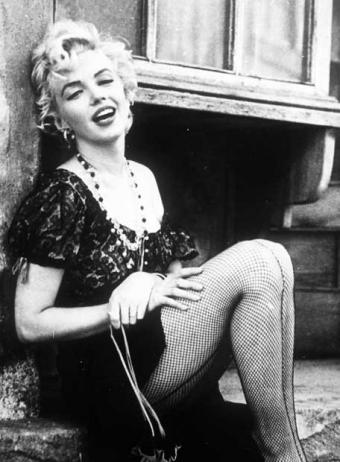
The invention of her image did not happen by chance. Nor did she play a passive role in its creation. She owned her image and, if not the negatives, then what they conveyed. “This was very deliberate. This wasn’t an accident,” Levin said. “She got it and she had it and she made it and she knew it. She was not guileless because she was not stupid. She manufactured this image brilliantly. It was a calculated image, but with good heart, with good intent, with good will.”
Levin feels it’s wrong to apply a feminist prism in viewing Marilyn as a victim of misogyny or unenlightened ambition. “This was a guy’s woman. She liked guys. It was not against her will,” Levin said. “I don’t think she felt victimized at all. I think she exploited it in every way.”
The story of the famous calendar nudes she posed for as an unknown, later published in Playboy at the height of her stardom, reveal an MM in charge of her own image. “Hefner makes the remark that nude photos in those days could take you down. But when they came out she stood right up to it,” Levin said. “Her whole attitude toward it was, This is life. She wasn’t ashamed of any aspect of her body or her being.”
Ironically, Levin was forced to pixilate the nipples and other body parts in the wake of the Janet Jackson breast flash, even though, as Levin argues, the MM nudes are “not pornographic, they’re not slutty, they’re absolutely beautiful. They’ve been made ugly by other people.”
What transpired with the nudes, which made others rich while MM never got a residual dime over the $50 modeling fee, mirrored her life in the spotlight, Levin said. “I think people were rather cruel to her and I think she was hurt. But I also think she was defiant in the face of it. She was courageous. I think the soul of her was terribly resilient.”
Much of the film refers to the sessions that produced the images that still transfix us today, including The Seven Year Itch shoot. In these settings MM willingly gave herself over to the camera. She projected a playful woman-child persona, both real and acted, as she also asserted influence over what final images would see the light of day. Perhaps nothing else gave her such a sense of self-determination.

“You see that she loved it. It was her best relationship, really. It was really the place where she was most comfortable and had the most control,” Levin said. “She very much had control of her contact sheets. She would edit them. She was notorious for Xing out photos in red lipstick or marker. Eve Arnold says in the very beginning of the film, ‘This was her way of working and even though I was free to do what I wanted, she really controlled the image.’”
As Marilyn evolved from aspiring actress to star “she understood what it was she wanted” and she pursued specific photographers she knew “could do her justice,” Levin said, “and got herself in front of those people and, of course, those people wanted to photograph her. They considered her a great subject. It was the perfect metier” for a photographer-subject to play in.
A model must make love to the camera for the images to last. MM invested her photos with rarely seen rapture. “Eve Arnold comments there were a lot of four-letter words used to describe the way she seduced a camera. She loved to do it and she did it great,” Levin said. “Marilyn’s take, which I think is the critical take, is she just thought it was great to be thought of as sexual and beautiful. And why not? I think any woman would want to look like that for five minutes of her life.”
For Levin, one particular image encapsulates Monroe in all her complexity.
“We open the film with a dark room sequence in which we print a photograph of her,” Levin said. “It was taken by Roy Schatt during the time she was in the Actors Studio in New York. Her face is completely open. No makeup. You see that sort of Norma Jeane plainness, really. There’s some pictures of her, like this one, that when you look at them you think, Whatever gave her the idea she could pull this off? She’s OK. She has a cute, sweet face, but hers was not a remarkable face. At the same time you see right through that to the whole iconography of Marilyn Monroe. I chose this picture because I thought it emblematic of the whole of her being.”
Like any fine actress, and Levin ranks MM “a great comedienne,” she could summon her public persona on demand. As Levin tells it, “There’s a known story of her walking down a New York street incognito and saying to her friend, ‘Do you want to see her?’” Meaning Marilyn Monroe, superstar sex symbol. The shape shift only took a subtle change — to a more free, less uptight bearing. The power of it bemused and bothered her. “I think she lived in that schism.”
Taking on as familiar a figure as Monroe and all that “we bring to her” scared Levin. “It’s the hardest film I’ve ever made. This material has been so manipulated in so many ways. The challenge and the task is how do I take this and make this something you feel is completely fresh?” In the end, she feels she’s captured the essential Monroe. “We started out liking her and we ended up loving her. We tried not to take anything from her. She looks so beautiful in this film.”
Levin’s Marilyn will have multiple showings, along with her James Dean, the last two weeks of July. Check local NET1 and NET2 listings for dates/times.
With two movie icon subjects behind her, one might expect Levin to tackle another, but her next film may key off a documentary she worked on last fall. From Shtetl to Swing deals with the great migration of Jews from Russia and Eastern Europe to America and their development, with African-Americans, of the music style known as swing. Slated for Great Performances, the film was delivered in less than airable condition, causing series officials to call in Levin to do some “doctoring.” Her work helped the film get “the highest ratings in New York in years for a Great Performances. One of the things I’m planning on next is something similar to that, but on Latin music and how it’s transmorgified into the culture.”
American Masters is produced for PBS by Thirteen/WNET New York. Susan Lacy is executive producer of the acclaimed series.

Image via Wikipedia
My friend Gail Levin is a talented documentarian whose award-winning work covers many subjects, although she has a particular knack for portraying artists and creatives. Many of her recent feature length documentaries have appeared on PBS and this story for The Reader (www.thereader.com) is about one of those films, a look at the enigmatic James Dean, the brilliant Method actor whose bright flame was extinguished far too early. In part because of the resonant parts he played with such ferocity and in part because he did die so tragically young, he remains a symbol of youth angst and rebellion more than 50 years after his passing. My story for The Reader (www.thereader.com) explores both what Levin tried to capture and what Dean represented on screen. I am posting other pieces about Levin and her work, including one on her documentary Marilyn (Monroe). She profiled a latter day American rebel actor, Jeff Bridges, in a documentary for American Masters earlier this year. Bridges is one of my favorite actors, and I believe he’s every inch the artist Dean was but I must say that Dean had a spell-binding quality that only a few other actors possessed. Marlon Brando was one. Montgomery Clift was another. Both born in my hometown of Omaha, by the way.
Gail Levin takes on American master James Dean
©by Leo Adam Biga
Originally published in The Reader (www.thereader.com)
James Dean.
Chameleon. Seducer. Seeker. Rebel. Artist. Icon. The embodiment of youthful angst and the preternaturally old soul in touch with the ages. The epitome of cool. A timeless presence. An original. Seething with curiosity. Sampling life’s diverse offerings. Always running, yearning, racing. Forever young and free.
He’s one of those select figures whose legacy transcends time and culture. In this 50th anniversary year of Dean’s death, it’s hard imagining anyone who doesn’t know of the actor and his story. His coming from a shattered family in rural Indiana to make his way out west, where he pursued the Hollywood dream. Studying acting. Landing bit parts in some good and some forgettable films. Then rashly taking off for New York, where things broke big for him on stage and in live television. Doing the Actor’s Studio thing. The buzz from his Broadway and TV work got the same L.A. suits who barely noticed him before to come courting.

There was the remarkable string of three starring films he made for Warners, each directed by a master, all within a span of 18 months. Then, on the verge of superstardom, he died September 30, 1955 in an auto crash on a remote stretch of California Route 466. Apropos of his free spirit image, he died in a sports car en route to compete in a race. He was 24. His legendary status ensured not so much by an early death as by the enduringly fine work he left behind and the sublime expression he gave to emblematic characters. Three coveted roles came his way. His animus perfectly suited each and he made them entirely his own. Was it coincidence or serendipity or something else?
The art imitating life aspects of Dean and his very real dedication to his craft are the subjects of a new American Masters documentary, James Dean: Sense Memories, premiering May 11 at 8 p.m. (CST) on PBS. Its creator, New York-based, Emmy Award-winning filmmaker Gail Levin (Making the Misfits), is an Omaha native and a longtime Dean admirer. In a recent conversation, the producer-director-writer said, “I loved making this film. It felt very true to me make this one.”
Dean is among many noted artists she’s profiled in her 30-plus-year career. With Sense Memories, the Central High graduate’s made an impressionistic film evocative of what made Dean the Beat poet among his acting generation and a style setter over the years. If only an interesting personality with killer good looks, his influence would have faded by now. If not an accomplished actor, his performances would be passe, his films dismissed. No, he’s still a vital presence and symbol because of a kind of genius — certainly, innovation — for exuding truth.
Director Mark Rydell (On Golden Pond), once a struggling young actor with Dean in New York, says in the film, “It was so clear that he was a special person. Every moment that you spent with him you knew you were with an original. Strange and peculiar and arresting — you couldn’t take your eyes off him.”
Sense Memories is fixed in that time and place when Dean emerged on the scene, like Elvis, as a new breed of hep cat straining against convention. Actor Martin Landau, a crony of Dean’s in the ‘50s, describes how Dean personified post-war America’s existential modern man — “a different kind of animal…that represented unrest and dissatisfaction with the status quo.” In sketching Dean’s life to a John Faddis jazz score and a black and white (actually, desaturated color) visual motif, Levin’s made a mood piece eloquent of an age of anxiety and possibility and devoid of the cliche and gossip that can distort an icon as potent as Dean.
“There’s been a ton of stuff that’s been done, and a lot of it is very tawdry,” she said, “which is really never where I wanted to go with this film. I really wanted the point for this film to be that his art and life were so close. Because he was so raw, it allowed him to inhabit these characters and to live those feelings and yet to have that one degree of separation that maybe made it less painful somehow. Although I think he lived that pain in his life, too. And then there was his exceptional collaboration with three directors of enormous stature and his truly good work for them. I think that is…often overlooked in telling the Dean story.”
To flesh out the man behind the myth, Levin filmed reminiscences with intimates of his from those halcyon days of new ideas and spectacular talents. The title,Sense Memories, refers both to the enigmatic portrait painted of Dean by his friends’ burnished recollections and to the Method Acting technique Dean presumably employed to elicit his extraordinary range of emotions on screen.
“It’s Rashomon. It’s just people’s memories, and some of them jive with each other and some of them don’t,” she said. “It’s meant to be interpretive. It’s not meant to be in any way a chronology. It’s not meant to be a biography. It’s just meant to evoke him from the experiences and memories of people who really knew him.”
She said it’s no accident Dean surrounded himself with special people. “There’s this range of exceptional men and women he found as friends and soulmates, and they’re all quite exotic little flowers. They all achieved a level of greatness themselves. They were there when it was all happening. Great music. Great art. Great theater. They were all touched by it and were all in it with him.”
Levin cast, lit and shot her on-camera observers as though characters in a drama of Dean’s life, which in a sense they were. Shot against a stark white backdrop and at an extreme angle, the texture of their faces and the vividness of their personalities come out and create a stream-of-consciousness effect when juxtaposed with the Dean images. “I am not afraid of a talking head. I like a tight shot. I like faces. I want to see them. I believe you hear people better the closer in the camera is,” she said. Tony Huston described to her how his father, The Misfits’ director John Huston, considered the human face “a landscape unto itself” and therefore something to be explored in detail. “And I shoot like that,” she said.
As Levin’s film reveals, Dean embraced life the way a method actor tackles a role, living in the moment and shaping the rhythm of his external self to the driving riffs inside him. His circle of friends was eclectic, cutting across age, race, gender, sexual persuasion, occupation, et cetera. He became whatever the circumstance called for and sought whatever he thought was missing.
Entertainer Eartha Kitt recalls she and Dean hanging out with: “We’d sit on the street benches on Hollywood and Vine and watch the night people. ‘That’s where we get our characters,’ he said.” That close observation and deep curiosity is what great artists have in common. It’s what allowed Dean to submerge himself in character and imbue himself so fully in it that his work rung authentic and fresh, as if happening for the first time. A student of human behavior, he applied research and technique to his creative process and then let his instincts take over.
“He was becoming one of America’s greatest actors,” Kitt says. “He instinctively knew what to do with a character because his spirit was free. It was quite interesting the way he went about it — methodically and then unmethodically.”

Dean was a mass of contradictions who gave and took from others as he saw fit and this ability to be different things to different people is part of the appeal he holds for us as viewers. With Kazan and Ray, for example, he felt protected and appreciated. Given free rein and much nurturing, the acolyte went out on a limb for them. With Giant director George Stevens, however, he was a petulant pain-in-the-ass unhappily constrained and stymied by G.S.’s penchant for many takes.
Perhaps the dichotomy of Dean is best articulated by actress Lois Smith, who played opposite him in Eden and recalls “a sweet rustic person, but on the other hand there was this suspicious, taut, guarded young man — and both of them seemed always present and, of course, that’s a thrilling tension.”
Just as Dean projected the tension of his complex inner life, he was a mimic and sponge who drew on persons, events and places as studies for his art.
“He was very willing to put himself in the hands of people he trusted,” Levin said, “but that trust was hard won. As his friend, writer William Bast, says, ‘he was very needy’ and he knew what he needed. I think he was a very canny guy about all those things. I think he definitely was living on the edge because he was so hungry for experience. He was definitely trying to take of everything.”
Separated from his mother at age 9, when she died of cancer, and spurned by his father, he attached himself to older men like Kazan and Ray and he acted out the demons of his real loss and neglect in the characters he played.
In Eden, Dean was — as we hear the late Kazan say — the incarnation of Cal Trask’s “twisted boy. Twisted by the denial of love.” Following a hunch, Kazan knew Dean/Trask were in “search for love everywhere and in every way.” Landau said Dean “understood pain.” Cal’s search for his lost mother mirrors Dean’s own sense of maternal abandonment. Cal is also desperate to earn his cold, stern father’s love. Dean’s life resonated with similar longing. After his mother died, his father dropped out, not seeing him again until years later. In Rebel, Jim Stark craves a strong father figure in the same way Dean craved one, too. In Giant, Dean plays Jett Rink, the quintessential wildcatter that goes his own way. Similarly, Bast says Dean brandished “a completely independent attitude” toward work and life.
Ultimately, what makes Dean still fascinating is his ageless quality. “He is so timeless,” said Levin. “His androgyny is way ahead of its time because it’s so completely in its time right now. You look at him in those films and in every shot he looks totally modern. He’s the one in Rebel who looks completely timeless, while the rest of them look like children of the ‘50s. The same thing is true in Eden. Every single frame of him could have been taken yesterday. With his shabby yet seductive good looks, you might as well be looking at Brad Pitt or Colin Farrell. That great Times Square picture where he walks in the rain, cigarette in his mouth, and coat collar pulled up — my God, it just doesn’t get any better than that.”
That image has “influenced” Levin. “It’s a perfect picture to me. It’s everything black and white photography should do. It’s full of atmosphere and contrast, lights and darks and varying shades of gray, and then there’s THIS guy. It’s informed the look of my films. I tried capturing that era’s beautiful black and white photography in this film.” The man who made that image, famed Magnum shooter and Levin friend Dennis Stock, planted the seed for the Dean film when he told her: “‘It’s going to be the 50th anniversary, and we should do something.’ So, in a sense,” Levin said, “this project has completed a circle.”

Dean’s only the latest in a gallery of notables she’s documented: Martin Scorsese, Stephen Frears, Francis Ford Coppola, John Singleton, Bernardo Bertolucci, Tom Stoppard, Arthur Miller, Richard Dreyfuss, Elizabeth Taylor, Cher, Whoopi Goldberg, Joni Mitchell, Bobby McFerrin, Paul McCartney, Yo-Yo Ma, Franco Zeferelli, Red Auerbach. Besides American Masters, her work has appeared on PBS’s Great Performances, the A & E network and the satellite channel VOOM.
Her work reflects an eclectic background. She grew up the only daughter of “an erudite” Nebraska Jewish family with a string of retail clothing stores and a taste for the arts and humanities. Her extended family included a pair of English teachers/published poets and a psychologist pioneer in the field of aging. Levin earned an education degree at the University of Wisconsin-Madison and did grad work at Wheelock College in Boston. A die-hard cineast since seeing Fellini’s 8 1/2 at the Dundee Theater as a teen, she was inspired by the heady free cinema movement in the ‘60s to try her hand at filmmaking. She returned to school, this time at Boston University, for a mixed educational media and filmmaking doctorate.
A Boston WBZ-TV kids show internship led to an associate producer’s job that became a senior producer slot. She evolved into the independent filmmaker she is today, going from essaying a rite-of-passage on the open sea to sweating out a shoot in the scorching desert to recording candid conversations in hallowed halls with luminaries from the worlds of sport, art, entertainment and academia.
She considers her work a calling.
“I’ve been so blessed. I have had a career that I love and that I hope is not going to end any time soon,” she said. “As hard as it is sometimes, I don’t even care. When you know the roller coaster, you know how to ride it. Besides, I don’t know how to do anything else. You know, you are lucky in this life if you get to do a couple of the things you really want to do, and I already have, so, I think I’m already ahead of the game. I’ve had hugely impassioned projects…and I’ve been able to see them go from the moment that little light went on in my head to the final edit.”
Much like her artist subjects, she’s an intensely curious person.
“When I discover something, it does fuel me. I love finding the connections and chasing them down. It’s not just about having a good idea. It’s having somehow or other the planets line up in exactly the right way…and when that happens, oh, that’s just…You have to be passionate about this stuff for that to happen.”
One of her dream projects came quite early in her career when, in 1980, she and a small crew filmed a transatlantic voyage made by several young mariners aboard the Lindo, a 125-foot, three-masted, top-sail schooner built in Sweden in 1925. The ship left Boston harbor June 4, docking in Kristiansand, Norway 23 days later, where Levin filmed. Then the ship made out to the open sea for additional shooting before completing the return crossing in mid-July.
Her film charts the bonds formed among a group of Boston-area youths initiated in the maritime traditions of old wooden sailing ships by a crew of seasoned sailors. As soon as she heard about the prospect of this “across the ocean documentary,” she said, “I knew I wanted to do it. I couldn’t go fast enough. I can’t imagine it would happen today. That a television station or even a network would send a filmmaker and crew off for what was a fabulous several-week adventure. This is what you now go out in the world and try to pitch people to finance for you.”
Despite “hitting some particularly bad weather” and nursing a cameraman who “became very seasick right away,” the journey and resulting film, The Tall Ship Lindo, proved satisfying. “I loved every minute of it.” Being ensconced in tight quarters on an old sailing vessel, totally exposed to and buffeted by high seas was, she said, “quite extraordinary. To this day I’m still friends with the people from that voyage.” Her most lasting impression is of being overwhelmed by the ocean’s enormity. “A 125-foot boat is not a very big boat and you don’t know that until you go across the ocean on it. It’s tiny. You are very aware from the very first second…that you are just a speck. You’re out there and you are so tiny and it is so big, and but for the grace of God…You have to be in awe of it.”
The Tall Ship Lindo won Emmys for outstanding cinematography and sound.
For Making the Misfits, her take on the remarkable confluence of talents (actors Marilyn Monroe, Clark Gable, Montgomery Clift, playwright Arthur Miller, director John Huston) that came together to shoot the 1961 classic film, The Misfits, Levin and her DP, Dewald Aukema, filmed in its Nevada locales. Her doc won a Cine Goden Eagle for and was included in the International Festival of Film in Montreal.
For Sense Memories, Levin and Aukema went to Marfa, Texas, where Giant was shot, and to that barren California spot where James Dean’s flaming life ended and his golden-hued legend began. Her film opens quietly there, with a gentle pan across the desert highway, lingering at the two-pump filling station that was his last stop. Desert and traffic noises rise. An engine revs. And then some jazz licks come in. It’s a haunting, muted elegy for a bright spirit dimmed too quickly, but still holding us entranced in its warm after-glow.
Sense Memories is a co-production of Thirteen/WNET’s (New York) American Masters and Warner Home Video. The acclaimed series is executive produced by Susan Lacy.

Image via Wikipedia
I love writing about film, and several of my new posts will reflect that. The following article for The Reader (www.thereader.com) appeared in 2003 to report on an exhibition of Magnum photos and a screening of the classic film The Misfits at the Joslyn Art Museum in Omaha. The connection between the photo agency and the film is explained in the piece, but suffice to say that my main interest was in writing about a film I always admired, even as a kid, when its adult themes were well beyond my years. But the melancholic work resonated with me even then, perhaps because I so strongly identified with its outsider characters and their vulnerability. Every time I watch the movie I glean new insights from it. Of course as I got older I learned that this was the last film of both Marilyn Monroe and Clark Gable, one of the last that Montgomery Clift made, and that the marriage between Monroe and the film’s screenwriter Arthur Miller was effectively over, all of which lends the performances a tragic certain patina. Kevin McCarthy, who played Monroe’s husband in the opening scene, was the special guest at the revival screening of The Misfits. I did an advance phone interview with him and he was just a delight to speak with. I saw on the news that he passed away the other day.
My friend and fellow Omaha native Gail Levin, a documentary filmmaker, took the measure of the potent forces at work in the film and on the set in her film, Making the Misfits. Find other posts on this blog about Gail and her work, including her documentary about James Dean. One of her latest films profiled Jeff Bridges.

Imagemaking celebrated at Joslyn Art Museum: “The Misfits” and Magnum Cinema
©by Leo Adam Biga
Originally appeared in The Reader (www.thereader.com)
It is only fitting a photographic exhibition at Joslyn Art Museum capturing candid moments of movie legends should kick off with a screening of the legendary film The Misfits, a picture resonating with so much of what makes the movies alluring.
From iconic stars who met tragic deaths to an enormously talented writer and director dealing in potent themes to a majestic Western landscape filmed in moody black and white and riddled with rich metaphors, The Misfits has it all. The film, apropos its title, is an evocative tale, sparely and honestly told, about the disenchantment and yearning of drifters and dreamers hanging on to an endangered way of life in the vanishing wild of the Nevada desert. It is a quintessentially American story about pursuing individual freedom and expression in a conformist world and following dreams, even if deferred, with the aid of a star.
Omaha film impresario Bruce Crawford is presenting, in his usual boffo style, this one-night only tribute to The Misfits on Saturday October 11 in Joslyn’s Witherspoon Concert Hall. The doors open at 6 p.m., the event begins at 7 and the film unreels at 7:30.
Among the Crawfordesque touches planned are searchlights, red carpet fanfare, horse riders, a trick roper and reenactors portraying the film’s two stars, Marilyn Monroe and Clark Gable. Special guests include actor Kevin McCarthy, who plays Monroe’s jilted husband in the film. McCarthy will speak before the picture. Legendary producer and former Paramount Studios exec A.C. Lyles was also to have appeared, but will instead be presiding at the memorial services of two Hollywood greats that recently passed away, Donold O’Connor and Elia Kazan.
As with past film events (including Ben-Hur, Psycho, King Kong, The Searchers, West Side Story), Crawford’s secured a restored print, from United Artists, for the show.
After the film, audience members may enjoy a cash bar, cash hors d’oeuvres and desserts in the museum’s atrium, get autographs or photos of McCarthy and Lyles and see a sneak preview of the traveling exhibition Magnum Cinema: Photographs from 50 Years of Movie Making. The exhibition, which runs through January 4, 2004, includes images that a team of photojournalists from Magnum, a renowned, worldwide cooperative photo agency started in 1947 by famed imagemakers Robert Capa, Henri Cartier-Bresson, David Seymour and George Rodger, took during the making of The Misfits. In all, the exhibit displays 111 works by 39 leading photographers culled together from Magnum’s archive of more than one million photos covering the breadth of human endeavor and experience.
For a long time, The Misfits, that elegiac tone poem to the passing of the American Wild, was regarded more as a morbid curiosity than a successful filmic drama. Besides being a psychologically-complex, symbol-filled, post-modern adult Western where the only “action” comes late in the last reel and where the only “hero” is a broken down cowboy in crisis, the movie has long been overshadowed by the looming, larger-than-life legacies of the three Hollywood idols who starred in the project and died untimely deaths after its completion.
Clark Gable, the one-time King of Hollywood, suffered a massive heart attack only 11 days after shooting wrapped. Gable, who was 59, lost weight in preparation for his part as a lean, laconic horseman. Plus, he did his own rigorous stunts, including wrangling wild mustangs on location in the unforgiving Nevada desert. About a year later, in 1962, Marilyn Monroe, the then and forever reigning sex goddess, died at age 36 of an apparent drug overdose. Montgomery Clift, the romantic screen idol who made male sensitivity sexy, passed away unexpectedly at age 45 in 1966.

Rounding out the supporting cast were dynamic Eli Wallach and Kevin McCarthy, Actor’s Studio veterans with Clift, and powerful character actress Thelma Ritter.
Then there were the on-the-set intrigues that played out amongst the rarefied company of creative titans that wrote and directed The Misfits. The script was authored by Pulitzer Prize-winning playwright Arthur Miller (Death of a Salesman, The Crucible), the towering intellectual icon of American theater, for his then wife Monroe. Directing the picture was Oscar-winning filmmaker John Huston (The Maltese Falcon, The Treasure of the Sierra Madre, The Asphalt Jungle, The African Queen, Moby Dick, The Man Who Would Be King), the great maverick adventurer-artist of American cinema.
By all accounts, the collaboration between Miller, Huston and the other artists involved was relatively congenial. Miller, the insular egghead, wore his pensiveness like a badge of honor. Huston, the unabashed sensualist, presided over the set like a lion on the hunt. Monroe, the bright but brittle star, variously charmed and confounded everyone with her child-like persona and neurotic flights of fancy. Gable, the macho, devil-may-care journeyman, bore all the distractions like the true gentleman and professional he was. Clift, the complex, introspective method actor riddled by insecurities, tried fitting into this dysfunctional family.
Adding to the tension were the personal dramas playing out during the project. Gable felt out-of-step with the times given the studio system he became a star in was dying, the pictures he became identified with were not being made anymore and the kinds of rebel parts he built his persona on were going to younger actors.
Hounded by the press since their headline-making marriage a few years before, the unlikely match of the serious writer Miller and the blond bombshell Monroe was falling apart by the time the movie began shooting. Monroe was at a personal and professional crossroads. Desperate to shed her sexpot image, she was finding studios and audiences less than eager to see her in a “serious” light. Already suffering from the emotional turmoil that defined her last years, she caused much disruption and many delays with her chronic tardiness, absences and blown lines.
In a phone interview from his Sherman Oaks, Calif. home, McCarthy recalled Marilyn’s difficulties in the brief scene they have together in The Misfits. In it, she rushes up the steps of the Reno courthouse where McCarthy, her estranged husband, is hoping she will rethink her decision to divorce him, but instead she brushes him off with the enigmatic line, “You’re just not there.”
What should have been a simple take turned into an ordeal.
“She was having trouble remembering her lines in sequence,” McCarthy said, “and John Huston was getting to the point where he didn’t know what to do. He couldn’t hear her. He’d ask, ‘Did she say all her lines?’ And I’d go, ‘No,’ or the guy running the boom would go, ‘No, she’s missing some of the stuff, Mr. Huston.’ She came running up the steps maybe 16 or 17 times. Well, finally, after a lot of procedures and wrangling, they put a microphone underneath my tie and ran a wire up my pants leg, all the kinds of things you didn’t do then…So, I was pinned to the spot where I was standing, and when Marilyn finally said everything, Huston turned the camera around and did a take with me. And I was through with the picture.”
Ironically, McCarthy said, “it was a film I reluctantly took because I was too vain to be playing a scene where I was gone in 28 seconds or something like that when my buddies Eli Wallach and Monty Clift were playing full-blooded, fully-written parts.”
The palpable strain caused by Marilyn was made worse with Miller always looking over her shoulder on the set. Then there was the script’s lack of any clearly defined narrative driving force or traditional happy ending and the demands on the players to drop all hint of vanity in portraying a motley crew of losers in emotionally raw scenes rare for that era of American cinema.
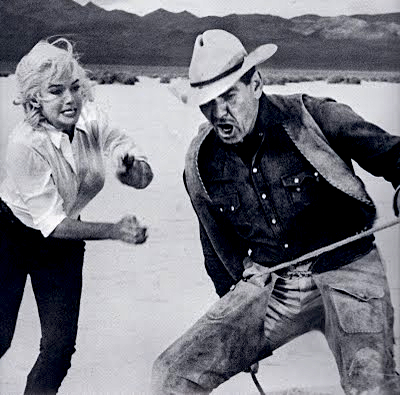
Miller came up with the story, which originally appeared in Esquire Magazine, after an extended stay in Nevada to establish residence in Reno for his divorce from his first wife. Besides the dissolution of his marriage and the bloom of new romance with Monroe, his plays were being dismissed and he was reeling from the House Un-American Activities Committee hearings in Washington, where he’d been called as a witness and refused to name names in the Communist witch hunt proceedings.
It was in Reno where Miller was introduced to similarly displaced persons as himself. Not surprisingly, the three major male figures in the film are cowboys who, as Bruce Crawford puts it, resist “modern civilization encroaching on them and their free-spirited way of life.” Gay (Gable) is an aging, spent, but still gallant horse wrangler, Purse (Clift) a sweet-natured rodeo rider and Guido (Wallach) a cynical war veteran turned bush pilot. The men prefer living a hand-to-mouth existence rather than “work for wages.”
Perhaps projecting himself into the characters, Miller has each stubbornly hold fast to some ideal of freedom and vision of happiness amid this harsh new era reining them in. When Monroe’s nurturing character, Roslyn, comes onto the scene she forms them into a loose family of misfits, each of whom is running away from something or towards something. Perhaps, as Gay says, they’re all trying “to find a way to be alive.” In Roslyn, who awakens promise and desire in the men but ultimately chooses the older Gay, Miller seemed to be imagining a hoped-for reconciliation with Monroe.
Unusual for Huston, The Misfits revolves around a female figure. With the exception of Katharine Hepburn’s turn in The African Queen, no actress so dominates one of his pictures as Monroe does in the part of Roslyn, the human equivalent of the wild mustangs the men try corralling. When, near the end, she expresses disgust at the idea the horses will be sold to the dog food factory, she makes the men question themselves and their methods. In using trucks and a plane to round up the animals for such an inglorious end, the men realize they’ve corrupted the very thing they love.
For Crawford, the denouement is “the end of an era…the end of the West as we once knew it. It’s the last roundup. The cowboys are left knowing they’re going to have to find another way of feeling alive and validating their lives.”
Anyone who knows Huston’s work can see the story echoes the recurrent theme of his pictures — a group of people banded together in search of some prize or goal that proves elusive amid the human conflicts and dramatic fates that arise. And, like much of Miller’s work, the story examines the uneasy gulf between ideals and reality, the challenge of remaining an individual in a corporate era of crushing anonymity and the need for and difficulty of maintaining human-family relationships in a world where people act, by nature, at cross-purposes to each other.
Fateful quests are not only intrinsic to Huston’s work, they operate on more than one level, said Michael Krainak, a professor of film history and appreciation at Metropolitan Community College and the man who headed-up Joslyn’s film series in the 1980s.
“Besides a material quest there’s a spiritual quest. His characters search for meaning in their lives. In many cases not all the characters are aware that is happening. So often, characters like Bogart at the end of Sierra Madre never even benefit from it. They’re oblivious to the changes taking place and to the lessons being learned. Huston equated that to the tenets of the existential philosophers. His films tend to end in material failure because for him the ends are irrelevant.
“What gives the quest meaning is the process itself, and you take something from that or you don’t. The ones who don’t often die physically or spiritually and the ones who do are able to carry on. It’s like Syndey Greenstreet’s great reaction to Peter Lorre when they discover the falcon is immaterial in The Maltese Falcon — ‘Well, what are you going to do?’”

Consistent with Miller’s ideology, The Misfits is replete with references to the impermanence of things.
“Gay speaks a line that’s very Milleresque,” Krainak said. “He says, ‘Well, nothing’s it,’ meaning nothing lasts forever. And Miller seems to be saying, Well, if that’s true, then that’s a guarantee of change. A theme of Miller’s has always been this idea of rebirth and reinventing yourself. The humanistic ideas in Miller’s work that are also evident in Huston’s work is this final goal of self-acceptance. To survive the wreckage of your life by seeking shelter in relationships and, more than anything else, by carving out your own meaning in life. The successful characters in Huston’s movies seem to confront the element of choice, You either choose to live an authentic life or an anonymous life. In this movie, becoming anonymous is to ‘work for wages.’”
In The Misfits Gay finally concedes the passing of his ways, but goes out on his own terms (or sword). He utters a line summing up his defiance and regeneration: “A man who’s afraid to die, is afraid to live.”
At the end, he and Roslyn drive off at night in search of a new path. They look out to see the mare and her colts running free, and they smile. She asks, “How do we get home?” He looks up at the night sky and says, “We’ll follow that star and get there.” As Krainak said, “What they’re left with is the quest — to get back on the trail. Instead of the the sunset, they ride off into the evening star. It’s a very Hustonian ending in that there’s promise for redemption or rediscovery or self-knowledge, but no guarantee.” In Crawford’s mind, “That has to be one of the most beautiful, haunting endings in film history.”
Krainak, a Huston buff, said that for years a running argument among cineastes has centered around the question of whether The Misfits is more a Huston film or a Miller film.
“It’s clearly both, but ultimately I think it’s Huston’s film,” he said. “In typical Huston fashion there’s this physical, larger-than-life task that a bunch of ne’er-do-wells on the edge of society attempt and fate somehow intervenes. In The Misfits it’s not so much tempting fate, as in Greek tragedy, but more of an Anglo-Saxon fatalistic attitude that says, If there’s a worst thing that can possibly happen, it will happen. The Anglo-Saxons had a wonderful word for it — weird. It’s indeterminate. It’s a more modern existential attitude toward fate. The character Guido even says something like, ‘I didn’t know that could happen.’ I think that’s so much what The Misfits is about.”
According to Krainak, the Miller-Huston pairing was more than a philosophical fit, but an artistic one. “One thing Miller’s got in common with Huston is a minimalist approach,” he said. “With Huston it was always a minimalist shooting script, shooting style, choice of film language, use of camera and editing. With Miller it was simple sets, lighting and everything focused on characters. Huston had to work very hard to create a visual dynamic when working so close with the figures of these characters in a setting and landscape that is so specific and very important.”
From his extensive reading about The Misfits, Krainak found Huston, with Miller’s blessing, eschewed color cinematography in order to bring out certain dramatic-symbolic points. “Huston definitely wanted stark black and whites in the background and the setting, with the characters, at least as I interpret it, as the shades of gray. That’s how it plays out in the imagery. It’s really a beautiful black and white film.” The atmospheric photography is by Russell Metty and the neoclassical jazz score is by Alex North.” Krainak added that, unlike most films, The Misfits was shot chronologically in order to capture a sense of “immediacy and spontaneity,” vital qualities in a story about impulsive free spirits.
Krainak said the film came at “a very self-indulgent” point in Huston’s career when, in addition to working with Miller, he was collaborating with such artists as Truman Capote (Beat the Devil), Ray Bradbury (Moby Dick), Jean Paul Sartre (Freud) and Tennessee Williams (The Night of the Iguana). “It was a very psychologically-charged period where he was exploring interior adventures or the landscape of the mind as opposed to exterior adventures or the landscape of nature.”
Why The Misfits was, until recently, dismissed as an interesting failure rather than a singular achievement can be explained by its “dense, cerebral, ‘European’ feel and by its star-crossed history, said Krainak, who puts an intriguing spin on the theory by suggesting “a killing off of a Hollywood era” took place with the deaths of Monroe, Gable and Clift and with the way Huston and Miller “underplayed these icons.”
He explained, “These were aging, wounded icons. Monroe was so vulnerable. Gable completely falls apart in a scene that everybody refers to. Clift takes a bad fall and wears bandages the rest of the film. Their audiences were not used to seeing them that way. What Huston and Miller did with these stars was a precursor of the American cinema renaissance of the late 1960s. The drama, thanks to Miller’s screenplay, and the imagery, thanks to Huston’s direction, made it a film dominated by character as opposed to pure action or star persona.”
Related Articles
Readers of my film posts will recognize a familiar refrain when I say that my home state of Nebraska has contributed an unusually large number of influential players to the film industry, especially considering the small population of this Great Plains locale. My blog contains articles about many Nebraskans in Film and more are coming. The following story profiles Omaha native Monty Ross. He’s someone you’ve likely never heard of, yet he has enjoyed a major career alongside one of contemporary cinema’s most successful and outspoken filmmakers, Spike Lee. I’d known about the Ross-Lee association going back to the late 1980s, when I was active in Omaha as an alternative film programmer. I even made a half-hearted attempt then and once again in the ’90s to bring Ross back to his hometown for a program. It never happened. Another decade passed before I finally did contact him, this time for an interview and profile for The Reader (www.thereader.com). I loved telling his story because it’s one that was little known even where he grew up. No one’s brought him back here to honor him, and such recognition is long overdue. Whatever part I can play to make that happen I pledge to do. If and when it does happen I will finally be satisfied that Omaha and Nebraska did right by him. It’s a sore point with me that this city and state do not do nearly enough to embrace its remarkable heritage of Nebraskans in Film, and giving Ross his proper due would be a good start.
Omaha’s Monty Ross talks about making history with Spike Lee
©by Leo Adam Biga
Originally appeared in The Reader (www.thereader.com)
Spike Lee’s cinema joints rocked the American cultural landscape in the 1980s and 1990s. Collaborating with him on these explosions was Omaha native Monty Ross, a co-founder of Lee’s 40 Acres and a Mule Filmworks and a longtime producing partner. After an extended leave of absence to make his own projects, including the well-received 2002 Showtime movie Keep the Faith, Baby, a biopic on Civil Rights champion Adam Clayton Powell, Jr., Ross is back in the 40 Acres fold as Special Projects Director for the New York-based production company.
Ross, who spoke to The Reader by phone from his 40 Acres office, has contributed to the emergence of a modern black cinema with broad appeal. With his help Lee took up where Sidney Poitier left off in legitimizing blacks as bankable film artists. Just as the popularity of Poitier’s films opened doors for generations of African-Americans in Hollywood, so too did the success of Lee’s pics. Where Poitier’s directorial work (A Piece of the Action, Stir Crazy) diffuses race, Lee’s embraces relevant themes ideologically and dramatically aligned to the overtly social-political black consciousness of filmmakers Melvin Van Peebles, Gordon Parks and Charles Burnett. While those directors could not break the glass ceiling imposed by the mainstream industry, Lee’s managed to do so by straddling the independent-studio line, thereby affording his movies the kinds of budgets, casts, prestige and buzz his predecessors’ movies never enjoyed.
And Omaha’s own Monty Ross has been there for it all — as actor, production manager, co-producer, vice president of production, adviser, friend and I-got-your-back-Brother. For the acclaim and controversy over Lee’s brazen films, for Nike spots that made Lee a cult figure, for music videos that tapped the hip-hop scene. He’s been about as close to Lee as anyone on this sky-rocket ride, which after sputtering reignited with the 2006 release of Inside Man. Lee’s new HBO documentary on the human rights failing that attended hurricane Katrina, When the Levees Broke, premieres on the cable network August 29, the one year anniversary of the disaster. It’s sure to stir passions the way Lee’s early work did.
Ross is now and always has been part of the cultural-creative pot Lee’s joints get stirred in.
“The blood and sweat he pumped into that company often goes unnoticed,” film producer Lashan Browning has said of Ross, “but he was the heart of it all.” Lee said as much in a Moviemaker Magazine piece. “He was very important. People may have read about Spike Lee, but it wasn’t just me, it was Monty Ross,” Ernest Dickerson (cinematography), Wynn Thomas (production design), Barry Brown (editing), Ruth Carter (costume design) and “my father” — jazz musician Bill Lee (score). “This is a team we have.”
Until now Ross never shared his story with Omaha media of how he came to be part of this small inner circle. It’s a tight, loyal crew together two decades now. Ross goes all the way back to Lee’s thesis project, the student Academy Award-winning short Joe’s Bed-Stuy Barbershop: We Cut Heads. Ross played the lead.
Wearing specs, Ross resembles Lee. They talk alike, too, sans the Brooklyn accent for Ross. Married to still photographer Carol Ross, with whom he has one child, Austin, Ross knows he’s fortunate to be an intimate and colleague of a film pioneer.
“Here’s this kid from Omaha, Neb. who went to college in Atlanta, hung out, met a friend from New York City, came to New York to do a film with him and the next thing you know he becomes a cultural icon. From my vantage point, getting everything prepared and making sure we dot our Is and cross our Ts, and witnessing the reaction of people, I’ve just been amazed all the way, you know, because it happened to me,” Ross said. “I thank my lucky stars every day because it could have gone so many different directions. It’s humbling and I think anybody who’s full of ego and says the opposite is full of shit to be honest with you.
“You don’t know when you write these things or when you film these things what’s going to happen. A lot of the things that happen we don’t have any control over. Sure, you can have control over the film — what you write and shoot and things like that, but one thing you do not have any control over is the reaction of people. And the reaction that Spike has gotten to his work has been phenomenal.”
He offers his own take on the strong responses Lee’s in-your-face films illicit.
“I always tell people, You don’t have to necessarily like the films and you don’t have to like Spike. People are often commenting about the stories and I say, ‘Well, there’s no perfect film, there’s no perfect filmmaker.’ Spike came along and presented his work in a way that had never been seen before from a black filmmaker. His work had a sense of being independent and commercial at the same time. The thing that matters is the reaction to his work. You can’t buy that.”
Like Lee, Ross is a die-hard hoops fan and he likens the way Lee came on the scene with serious craft and something to say and in the process revolutionized the place of black filmmakers in America to the way innovative players express themselves on the court with their ground breaking moves and skills.
“I played a lot of basketball and, you know, people have been dunking the ball since they put the hoop up but when Dr. J. did it, ‘Ohhhh…did you see that?’ People have been doing behind the back fancy passes for years, but when Magic Johnson did it, ‘Ohhhh…the no look pass!’ It’s just weird about that combination (that makes one a genius and another average) and why that happens.”
In the case of Lee’s ability to express an authentic black experience that speaks universally to people, Ross said, “Hey, it’s one in a million. It’s one in two million. Where does that voice come from?” The question may not have an answer. But it’s clear Lee‘s found a way to articulate the spectrum of black life, from its heights to its depths, and the complexities of black-white relations without alienating a large portion of black or white audiences.
The coalescing of Lee’s vision, informed by the Forty Acres team, intersected with the American Zeitgeist in terms of black identity, black pride, black rage and black power. Ross recalled when he felt the Gestalt take shape.
“I think I became aware of it when I saw She’s Gotta Have It for the first time. What I saw was Spike’s goal and Ernest’s goal and Wynn’s goal. ‘My God,’ I said, ‘We’re doing something a lot different than our predecessors. We’re thinking about it a lot different. So, when I saw that I just thought, We’re onto something. It was just a culmination of having that core of people around you who think like you do and they’re able to take your vision and take Spike’s vision and then make it happen in a way that’s visually stimulating and pleasing to the audience. Just like with a winning basketball team, we all thought along the same lines.”
Recognizing a synergy or convergence of ideas, he said, is an empowering thing.
“I think it’s like finding that diamond for your wife or your girlfriend or whatever. It’s that moment when you say, ‘Oh, wow, this is what I’ve been looking for.’ It’s a connection. That’s the way it was for the audience, too. They were like, ‘Yeah, that’s the way I want to be projected. That’s what I’m talking about.’”

Spike Lee and Monty Ross
Ross doesn’t analyze why it is he and Lee click. They just do. “I’ve always been a type of person who realizes when something works, it works, and you don’t disturb it,” he said. “You just ride it out.” The trick is to find your niche and revel in that rather than worry about props. “Once you start getting into that ego gratification and say, ‘Well, his name’s bigger than mine.’ than you’re going to lose,” he said, “because you know somebody’s always going to do something better. Once you have something that works, stick with it. That’s definitely a credo I live by.”
An Omaha North High graduate, Ross is the son of a social worker mother and hardware store owner father who divorced when he was young. Both his parents have passed. His only sibling, an older sister, no longer lives here. Ross, whose favorite haunts were a pair of North 24th Street landmarks in The Ritz Theatre (long defunct) and the Bryant Center (still there), struggled in the classroom before finding a home in school theater productions.
“I started to really feel good about myself and about being in school,” he said.
Harboring a dream to be an actor and to escape the “limited horizons” Omaha offered young blacks in the ‘70s, he went South to attend historically all-black Morehouse College in Atlanta. The contrast was stark. He left behind stagnated, segregated Omaha, where riots and other ruptures left the black community a desolate island with few black professionals to emulate, for Atlanta, a booming, integrated city with a flourishing black culture and black presence in all sectors.
Aside from a few well-known athletes trotted out for kids to idolize, he said growing up black in Omaha “you really didn’t get that college-educated role model you could attach yourself to and get a sense of motivation from.” In Atlanta, he saw up-close black legends like Ossie Davis and Ruby Dee and sampled a “renaissance” of black artists and entrepeneurs. “It just began to blossom as a cultural center.”
He flunked out of Morehouse but was there long enough to act in plays with a then-unknown Samuel Jackson and to be noticed by an aspiring young filmmaker named Spike Lee, a Morehouse grad. After a semester or two getting his grades in order at a Dallas, Texas college, Ross returned to Atlanta to attend Clark College and after graduating he worked as an actor for the Atlanta Street Theatre, a company he’s still associated with, which gives free performances to school-age children. Soon, his path intersected again with Lee’s. It was the late 1970s and Lee was a firebrand talent on the verge of making some noise. The then-New York University film school student often visited Atlanta, where his grandmother Zimmie Shelton lived, and it’s there he and Ross hooked up again. The young director showed Ross and a small coterie of friends his films. Ross was blown away.
“Spike came down every summer he was in (film) school to screen his short films and I remember seeing the first short film, The Answer (a response to D.W. Griffith’s The Birth of a Nation), and after looking at the movie I jumped up and I said, ‘Oh, man, you got it, you got it.’ ‘What do you mean?’ ‘You are about to do something that’s really, really special. You’ve combined everything into this little short film and I can just see it speaks to what you’re always talking about.” “Yeah, man.”
By then, Ross made Super 8 films himself and taught kids the craft in a CITA program. He and Lee were two young men filled with dreams. Not unlike the stoop and street dwellers of Do the Right Thing, they riffed on things-to-come.
“It began pretty much just hanging out at his grandmother’s house and just sitting there talking about how one day we’d like to make a movie together,” Ross said.
By the early ‘80s, Lee itched to make a bold statement. According to Ross, “He said, ‘Man, we’ve got to do something that’s a little more edgy.’ He wrote a screenplay called Joe’s Bed-Stuy Barbershop. I said, ‘Let me read it.’ So I went by his grandmother’s house and we sat down and read the script together along with another friend of ours. I said, ‘Hey, man, I’d love to do the movie.’ So I came to New York the winter of 1981 and in one month we made the film.”
Ross had been to the South Bronx before but not Brooklyn. It was also his first time acting for the camera, and it showed in all the retakes his scenes required.
“It was funny because I wanted to express myself a little differently. I wanted to move around, and film is very restrictive. I remember once I walked around and I said the lines and Spike and Ernest were like, ‘No, no, no, no…You gotta stand still! Film is expensive!’ So I went through that whole spiel, but I learned pretty fast. I still feel every time I watch it I could have delivered a better performance.”
Intent still on being an actor, Ross said, “I wanted to be in front of the camera, but fate would have a whole different direction for me. After Joe’s I went into the (Army) Reserves and after finishing up my Reserve training I came back and hung out with Spike.” Lee planned making his feature debut with The Messenger, with Laurence Fishburne set to star, but weeks before cameras were to roll the main investor pulled the plug when additional funding could not be raised.
Meanwhile, Ross said the production manager on Messenger had a falling out with Lee and quit. Harsh words uttered by the crew member — to the effect “You guys will never be the filmmakers you want” — inspired Ross to put himself on the line. “So I told Spike, ‘Man, you don’t have to go through that. The next time, let me be the production manager.’ He said, ‘Well, what about the acting?’ I said, ‘Duty calls. It’s something that you need and we don’t have to go outside ourselves. We’ll just make it work.’ He said, ‘You bet.’ Spike wrote She’s Gotta Have It, sent the script to me and, as they say, the rest is history.”
Financed in part by maxed-out credit cards, She’s became an indie breakthrough, grossing millions over its couple-hundred thousand dollar budget and putting a gritty, sophisticated spin on black romantic comedy that resonated with folks.
The film made Lee’s career and established Ross as his right-hand man. Getting there was a crucible, but Ross endured and emerged a seasoned pro.
“It was really a hard lesson for me. That’s when I really first got acclimated to New York City. I’d just run around figuring out where post-(production) houses were. I made mistakes and I had to cover my mistakes. I had to learn about dealing with the Teamsters,” Ross said. “It was a time and experience I will never forget because being thrown in the fire like that gave me an opportunity to really learn the business, and that’s what happened.”
Like any low budget pic, She’s required crew to pull double or triple duty. “We didn’t even have a first assistant director,” Ross said. To make their days they had to cut corners and stay several steps ahead. Ross adapted to the hectic schedule, finding he was good at leading other people.
“My working style was to always make sure the next day was covered. I kind of had a camaraderie with the crew. I said, ‘Hey, whatever you guys need, let me know.’”
Caught up in the minutiae that is a film project, Ross didn’t have time to reflect on what 40 Acres had done until the end of the frantic shoot. When he realized it’d come to an end, he didn’t want it to stop. He knew it was historic.
“And lo and behold two weeks later I was like, ‘Hey, we’re out of stuff to shoot.’ This was a Saturday afternoon and I said, ‘Well, let’s just keep shooting. Let’s just make something up while we still have people here. You never know…’ And about six o’clock that evening we called wrap. It was a special moment, you know. We had completed the movie. At least got it in the can.
“I’m not one to get into anything all spiritual and weird and stuff like that, but it was a special moment. I kind of had a feeling, Oh, this could really go somewhere. I think we’ve got really great performances and we’ve got a good look. Wynn Thomas came in with the production designer and he expanded on Spike’s vision. And Ernest came in with the lighting we had and did a wonderful job.”
Bigger budgets followed on the string of much-talked about films that came in She’s wake — School Daze, Do the Right Thing, Jungle Fever, Mo’ Better Blues, Malcolm X, Crooklyn, Clockers — but really all of Lee’s work, much of it with Ross serving as producer, is rooted in those indie, low-budget early years.
True to his bottom line sensibilities Ross finds satisfaction in “the economy of resources” 40 Acres achieved on what proved to be critical-commercial hits. By contrast, he finds hard to swallow the excessive expectations of today’s spoiled young film lions, weaned as they are on techno-digital props and pop-art devices that can interrupt narrative flow and inhibit human values.


Do the Right Thing
“I hear them say, ‘Oh, I’ve got to have this crane or I’ve got to have this lens’ and all these things we couldn’t even think of….I think it really gets down to how well you use your imagination, how well you focus in on what’s important and how well you can tell the story. I think what’s missing with a lot of the young people is that sense of — Let me tell you this story. To get you on the edge of your seat and to make your senses perk up. That’s what we’re looking for. I want a good story, period. Something that’s innate in our nature is our love for a good story and a good storyteller. At the end of the day I think people still want to sit in that dark room and watch a good movie and they want a story that’s well told.”
Far from despairing over the state of motion pictures today, Ross is optimistic the influence of personal filmmakers like Spike Lee has made the term indie synonymous with not just quirky pics, but quality work made by passionate artists.
“I think when you look at what’s happening at the Academy Awards a lot of the movies that have won Best Picture have not been those big studio films, they’ve been small independent movies,” he said.
Ross took time away from 40 Acres to develop a project he felt so strongly about that a one-year leave of absence turned into seven when the project got stalled in development limbo, all of which made the film’s title, Keep the Faith, Baby, ironic.
“I always thought the Adam Clayton Powell story was a story that should be told… that his story was an important part of our history. Powell was a legendary Congressman from New York (Harlem) and I thought he was a missing link in the Civil Rights lineage from Marcus Garvey to A. Philip Randolph to Dr. Martin Luther King, Jr. to Malcolm X. He had demonstrations and sit-ins. He was a lone wolf in Congress, and despite being controversial he got like 50-60 pieces of legislation passed that became the background and foundation for the War on Poverty and for a lot of the social change that Martin and Malcolm and other leaders talked about. He was the man of the hour others sought out. He was making things happen.
“I told Spike I was going to stay committed to getting the film made and he was like, ‘No problem,’ and that’s what happened. I moved out to L.A.”
Waiting for it to get made Ross produced a film (Escaping Jersey) and directed another (Reasons). After moving to Charlottesville, NC so his family could be near his wife’s folks, this prodigal son returned last year to New York and his 40 Acres home.
“I never left,” he said. One of his jobs as special projects director is to head the multi-media company’s internship program. To kids with film ambitions he says, “The sky is the limit, and it all depends on your perspective. The industry is vast with great opportunities. But before you begin your journey ask yourself this question: What is it that you would like to contribute to the industry to make it better?”

Image by Mary P. from Pretty Good Things via Flickr
Anyone who knows me would raise their eyebrow or get a good laugh knowing that I wrote most of the articles for the inaugural issue of Omaha Fashion Magazine. That’s because I am so much like the Anne Hathaway character at the start of The Devil Wears Prada, which is to say I don’t think a lot about fashion and the way I dress and carry myself reflects that. After getting the fashion assignment for the new magazine I didn’t undergo anything like the transformation Hathaway’s character did, but I did gain a new appreciation for fashion as an aesthetic medium and as a pervasive industry. I am glad I got the assignment, as I interviewed a number of designers with real passion and talent, and even if I never write about fashion again, although I would very much like to, I will forever be more attuned to what is behind the garment that drapes the model strutting down the runway. As I found, designers are just like all the other artists and creatives I’ve interviewed and profiled, which is to say they are wonderfully afflicted with a magnificent obsession to create and to turn their visions into reality.
The magazine (www.omahafashionweek.com/magazine) is published by Omaha Fashion Week, the big player on the local fashion scene with its September 13-17 week of shows and events. I am presenting the stories as I submitted them, which is a bit different than the way they appeared in the print and online magazine.
My Omaha Fashion Magazine Work:
Omaha Fashion Week may be showcase for the next big thing out of Omaha
©by Leo Adam Biga
A version of the following was published in the inaugural issue of Omaha Fashion Magazine (www.omahafashionweek.com/magazine)
Staking Out a Scene
Not so long ago the idea Omaha could ever be synonymous with high fashion strained credulity. But like lots of things once considered outside the domain of this Midwestern burg, say a relevant music scene for instance, Omaha continues defying expectations by making a splash in the American cultural stream.
Just as Saddle Creek Records framed the indigenous indie music scene as a much heralded, widely traveled brand of original artists sharing Omaha as their home base, other creative stirrings here are making waves. Whether in film, photography, animation, theatre, music, literature, painting, sculpture, graphic design or software applications, Omaha is producing a veritable flood of creative activity. So much so, this fly-over city long in search of a marketable image is gaining a reputation as a well-spring of imaginative start-ups and endeavors that intersect art and business.
Wherever you look there is a dynamic creative class of individuals, institutions, organizations, businesses and venues pushing the envelope. As more opportunities arise in this social networking age, creatives and entrepreneurs are carving out distinct niches for themselves. These include a diverse community of fashion forward designers whose couture and ready-to-wear work is finding an appreciative audience.
Omaha Freelance writer Lindsey Baker, who covers the fashion beat, said, “the fashion scene has developed right alongside” the city’s other cultural scenes. “I think people’s openness to all of the other things has made an openness to fashion appear. People are receptive.”
“The fashion scene in Omaha today compared to five years ago is definitely more sophisticated. Omaha has its own community of fashionistas, and they aren’t just over-styled, super trendy and accessorized to death. They are knowledgeable and savvy about what is happening right now in the fashion industry,” said Agency 89 booking director Christie Kruger, whose agency provides models for fashion shows and shoots.
The nexus of art and business in Omaha fashion is Omaha Fashion Week, a fall showcase that has become a platform and network for local designers in less than three years. OFW, patterned after those more famous events in larger cites, is evolving to connect designers with patrons, boutique owners and buyers.
It’s a production of Nomad Lounge, which utilizes an urban valley Old Market setting as the meta style site for a runway finale. The evening gala is aglow with lights and alive with energy as killer fashions walk down the 140-foot runway on tricked-out models to pulsating music, oohs and ahhs and popping flashbulbs. Thousands attend this culmination of a week-long focus on fashion, a must-see on Omaha’s ever-expanding cultural to-do list.

“It’s something that’s on people’s calendar and we are very surprised it only took three years to do that,” said event director Rachel Richards.
“Our event has really got this huge following,” said Nomad owner Nick Hudson, who along with Richards and designer Dale Heise of Omaha co-founded OFW. “We are the biggest Midwest fashion event by a sizable margin, which is an amazing achievement. The community should be proud of that because they’re the ones who’ve done it, they’re the ones who’ve attended.”
Hudson said “it’s passion that’s driving this.” That’s true for the designers who make fashion, the models who bring it to life, the stylists and makeup artists who complete the look, the photographers who shoot it, the journalists who cover it and himself.
Tee’z Salon owner Thomas Sena, who directs the Week’s runway finale, said social media sites Facebook, YouTube and MySpace are “very important parts of marketing this and keeping the buzz alive.” With designers, stylists, models and photographers “posting photos and videos all year long,” he said, “the show doesn’t go away.””We’re starting to get noticed,” said Hudson. “The Convention and Visitors Bureau is hearing how wonderful it is. They’re bound to be interested in it because it’s helping put Omaha on the map. The Mayor‘s apparently got it on his radar that it’s a really positive, good event. We’re getting nothing but really good vibes about it.”
What OFW has done is to identify and coalesce a formerly fragmented design landscape into something nearer a cohesive community.
As Omaha fashion photographer Chris Machian puts it, “There was a scene before, but it wasn’t organized. Fashion Week helped organize it a bit by sort of giving it a calendar and a cycle.”
Along the way, a deeper talent pool than anyone imagined has been revealed. This comes on the heels of a once subterranean fashion scene moving above ground, into the light of day.
“At some point there becomes kind of a critical mass with the underground movement where there’s an eventual spilling over into mainstream, and I think we’re right in the middle of that happening now,” said Sena. “And I think it really culminated in Nick Hudson recognizing the raw talent in the design scene. He started putting all these pieces together and recognized it was ready for kind of prime time. I really have to give Nick credit for recognizing that it was valid and it was doable.”
All Dressed Up and Somewhere to Go
Creating fashion is one thing. Having some place to display it and appreciate it is another. As more and more Omaha designers emerge, the need for sufficient area outlets to get these artists’ work noticed, talked about, bought and sold. whether in stores or at shows, becomes paramount.
Omaha Fashion Week is a catalyst for local fashion finding homes.
“Omaha Fashion Week has noticed the growth and interest and created a larger and growing platform for the undiscovered talents in Omaha,” said Bellwether Boutique owner Jesse Latham, whose Old Market shop carries work by locals.
Rachel Richards
The work of many Omaha designers is turning heads and finding buyers. There’s enough now that Latham can afford to be selective. Not everything she sees she likes. “Yes, there are a lot of designers,” she said, “but I see lines or pieces that are totally uninspired and missing the meaning or idea that this IS an art form, not some shifty way to get attention.” Latham said those designers whose work she does embrace “do well” in sales. “They did better when I first opened five years ago but the economic climate wasn’t quite as dire. My customers love to support them and I love to tell newcomers about each designer as if they were my kids.”
What are the upper limits for an Omaha fashion designer?
At least one, Thakoon, has gone national, although he felt compelled to leave Omaha for New York to do that. The hope is that someday someone will go big here and stay here with a locally designed line that’s sold coast-to-coast, even worldwide.
Conor Oberst did it in music. Jun Kaneko in art. Alexander Payne in film. Richard Dooling in literature.
“I don’t see why the same thing couldn’t happen with the design scene. I can see these young designers being picked up. The quirky idea of this coming from Omaha will just give it added buzz. It’s a good story,” said Tee’z Salon’s Thomas Sena. “I think it’s going to take just one successful Omaha designer to get out there in front and be picked up on a national commercial basis — someone who really gets out and kills it.”
Some have caused ripples. Mary Anne Vaccaro makes much-in-demand evening wear gowns. Sabrina Jones has her own lines of bridal and evening wear. Alexia Thiele’s Autopilot Art label reaches a wide audience of 20-somethings. Megan Hunt, aka Princess Lasertron, has nationwide clients for her bridal accessories. She and Joi Mahon of Dress Forms Design are launching a line of bridal and party dresses.
Meanwhile, several high fashion shops have opened in recent years, such as Alice Kim’s Trocadero.
“She’s (Kim) successfully introduced people to things. Some of the places that have opened up downtown have been a really good indicator that people in Omaha are interested in having a more metropolitan attitude towards fashion,” said Omaha fashion writer Lindsey Baker.
Additionally, shops like the Bellwether and Retro Rocket feature local fashion.
“Jesse Latham is a huge proponent of the local designers,” said Omaha designer and fashion photographer Dale Heise.
Even national chains like Urban Outfitter and American Apparel have added a hip new aesthetic. Then there’s the out-of-the-closet factor of television reality shows like Project Runway bringing high fashion into people’s living rooms every day. “That show has done great things for fashion as a whole and Omaha has caught wind of that,” said Latham.
As Omaha designer Buf Reynolds sees it, the more exposure designers like herself have to a big fashion stage, the more realistic a career seems. “Everybody’s starting to understand that it’s something that’s real and it’s attainable at this point.”
Taken together, there’s a synergy around Omaha fashion as never before.
Nick Hudson
“I’ve been asked by the Chamber of Commerce what are the implications of fashion here,” said Nomad owner Nick Hudson. “It’s quite a hard question to answer. In terms of being on a big scale those things take time but certainly there’s the beginnings there of real potential. So what we’re doing is spending some time listening to the people involved about what can we do to help keep improving and nurture that. That’s why we put on an end of March show this year — to keep it a little bit alive, to keep the designers connected with people. It’s a smaller, more personal show where they can actually connect one-on-one with people who are interested in buying the garments.
“The other initiative is this magazine, which is going to live in hair salons and boutique stores and help in bringing this fashion community together.”

No one is pretending Omaha has anything like a sustainable fashion industry. Yet.
But those immersed in the nascent scene see the potential for a breakout phenomenon akin to what happened with indie music here.
“Omaha’s Saddle Creek indie music scene seemingly came out of nowhere,” said Heise. “All these musicians were just doing what they love in their basement and doing occasional shows. It basically took them taking their acts to New York and somebody seeing them, saying, ‘Oh, this is amazing.’ I think the same thing will happen with fashion in Omaha.”
If it does, Fashion Week will almost certainly be involved as a facilitator.
With the Help of Some Perspective
It’s not that there was no fashion scene before Omaha Fashion Week debuted in 2008 to surprisingly big crowds. Prior to OFW the scene amounted to local celebrity shows for charity with off-the-rack, mass-produced garments, or funky guerrilla alley or warehouse shows of original but extreme, avant-garde designs with limited appeal.
Omaha designer Buf Reynolds said, “About six-seven-eight years ago a fashion scene hardly existed. There were a few fashion shows here and there but they were not a whole lot to speak of. It’s come so far so fast. I’m pretty happy to be a part of it.”
“The success of Fashion Week is stimulating a lot of other fashion shows,” said Thomas Sena of Tee’z Salon.
Not that there weren’t interesting shows in the past. A legendary one organized by designer Dan Richters at the Medusa Project presaged the compelling original designer fashions that have since come to the fore.
“Dan is in some ways the grandfather of the modern (Omaha) fashion scene,” according to Omaha designer Dale Heise. “He put on this show of all local designers and all these people came out just to see fashion. It was very underground.”
“Slowly but surely there was kind of an alternative underground movement of originals that grew just like there was in music. Some of these underground parties started doing little showings of original clothing,” noted Sena, whose salon has sponsored its own annual runway show.
By and large though, said Heise, presentations of original local designs were mere interludes or diversions between band sets at live music clubs. Fashion was minimized as side show, add-on, after-thought, frill. It was not main attraction.
Heise, Reynolds and designer Julia Drazic wanted to change that by making fashion, what’s more local fashion, the spotlight, not the music or models or drinks. They began energizing the scene with shows at the Omaha Magic Theatre.
Then Heise met Nomad’s Nick Hudson, a transplanted Brit with a rich background in the fashion and beauty industries and a passion for entrepreneurism. Hudson was already impressed by Omaha’s arts community. Nomad began hosting shows and Hudson said when he saw the work of Heise and other local designers “it really caught my attention. I wasn’t really expecting to find fashion designers of any real note in Omaha.” But he did.
Hudson, Heise and Rachel Richards, who is Nomad’s general manager and marketing/events director, envisioned something grander and more glamourous than these small alternative shows with a handful of designers and 200-300 spectators.
“When I started conjuring the idea of Fashion Week I wanted it to be a larger outdoor show,” said Heise. “I wanted it to be accessible to the public, I wanted it to be seen from far off, I wanted it to be a spectacle.
“What we did at the Magic Theatre was very cool and artistic but anyone from Chicago or New York would have thought, Oh, that’s cute. I wanted something that said we’re really serious about this, we’re not trying to be cute.”
Photographer Chris Machian, who is part of Minor White Studios, finds the spectacle a blast to shoot.
“What I enjoy is seeing a mix of color and light coming down that runway,” he said. “The event uses dramatic stage lighting, and you can do a lot of different things with that. I rarely ever use a flash. I’ll play with it, I’ll go with a slower shutter at first, and then as the show goes along I’ll go in different artistic modes and do all silhouette or all panning shots. Then real detail shots on eyes and shoes and things like that. Crowd reactions. I don’t go in with all those things planned either. Then I’ll go backstage and have the models and designers coming out.”
He said the intimate access afforded by OFW is rare. “New York Fashion Week is all shot from the same spot because they cordon photographers off. There I wouldn’t have the access I have here. Here, they let me do my job, and it’s wonderful,” said Machian. If he wants to, he said, he can spend an all-nighter with a designer crashing to complete a line, just as he’s done with Dale Heise. He can also interpret that same designer’s creative process — from sketch to sewing to fitting to runway walk — as akin to the stages of a butterfly’s life.
Freelance writer Lindsey Baker said aside from minor quibbles she has with aspects of the event, Fashion Week has proven itself a bona fide happening that is building as opposed to plateauing.
“Obviously there’s something going on,” she said.
The 2,000 or so who turned out the first year doubled in 2009. “After last year. we realized it wasn’t a fluke,” said Hudson, who expects 6,000 to attend this year. The artists involved include hundreds of models, stylists, make-up artists. All volunteers.
“I think we were all just a little bitt shocked at quite how good it was and how’d we’d created this possibility,” said Hudson. “We begged and borrowed bits of equipment to make it happen on a budget the best we could, but it looked really impressive.”
Devoting an entire week exclusively to local design broke new ground here.

Thomas Sena
“Going with all original local designers was something completely new to Omaha, On that kind of a scale that had never been done before,” said Sena.
Taking Off
No one anticipated an Omaha fashion week would reel in so many participants. Twelve designers were part of Fashion Week I. Twice as many made lines for Fashion Week II. Heading into Year Three dozens are vying for the coveted main runway slots. As local designer Dale Heise put it, “designers are coming out of the woodwork.” Clearly, organizers tapped into a creative community that never had a dedicated showcase like this until now.
Buf Reynolds, owner of Retro Rocket, has been part of the scene for a decade. She’s stunned by how much growth there is in the number and quality of designers.
“Six years ago we couldn’t find 10 designers to do a show, where now there’s over 30 designers trying to get into a show. It’s pretty amazing,” she said. “The amount of talent out there is astounding. It’s really overwhelming to see all these people. It’s like, ‘Oh my God, is my stuff good enough?’ You have to wonder. And it’s great because it challenges you and pushes you forward. It’s really fun.”
“In total, Omaha has at least 50 designers, all at different stages, of course, but talented people doing original, creative things,” Heise said. “You’ve got such a spectrum of designers and diverse designs — from electric clash punk to formal bridal gowns to evening wear that looks like Armani to razor cut tuxedos with incredible lines.
“Then there’s Buf Reynolds with her modern twists on 1920s, 1930s-inspired dresses. Simple elegance. Very flowing. They’re not the most radical but they’re very interesting, and there’s a sold consistency from Buf. She’s a powerhouse who does several shows a year and designs several pieces for every show.”
Heise’s own work features monochrome panel dress designs that expose skin in a sultry peek-a-boo style.
In an e-mail Bellwether Botique’s Jessie Latham shared her take on other leading Omaha designers:
“Shannon Hopp will bring her work down, and call it ‘dumb,’ while I’m thinking she should make one in every color. She edits her pieces perfectly to make the beauties from the past look modern. Dan Richters is the example I would put in front of people when I tell them fashion is also art. Alexia Thiele is the queen of reconstruction. She makes unique, adorable pieces for the entire family.
“Jennie Mason is sweet as a GAP model only to throw you off with electric colors, spiked shoulders, computer carcasses, pink tutus and robots. She is the only designer who nailed the market on men’s wear. Amazing tailoring. Every time Jane Round brings me something new it blows my mind. She’s constantly growing as a designer, as much and often more than the ‘scene’ is.”
Before OFW, Heise said, few designers knew each other. “It’s been this magnet for, Oh, there’s somebody else doing it here, too — I’m not as crazy as I thought.”
“It’s also cultivating new talent,” said Tee’z Salon owner Thomas Sena, who echoed others in admiring the work of two teenage designers featured at last year’s Fashion Week. One was Jane Round and the other, Claire Landolt, who drew much attention with her playful paper dresses fashioned from newsprint and duct tape.
Before she got plugged into the scene courtesy the Bellwether’s Latham, Landolt said she had “no idea” there were local designers beside herself.
“I think it’s very important to make connection with the other designers,” said Landolt, an Omaha Roncalli junior who accessorizes her drab school uniform with high heels and sprays of fabric and color. “We’re not competitive with each other but it kind of makes us work harder. I know I want to be more creative and think of new ideas, so I’m not too similar to someone else. We all have our own distinct looks, but I think we kind of overlap in some areas — a lot us like the vintage-inspired clothing.”
In Latham, Landolt’s found a mentor who carries her Itchy line at Bellwether. “We’re really good friends. She just kind of nurtures me and supports me,” said Landolt. The teen was a spectator at the first Fashion Week and thanks to Latham got an insider’s look at the goings-on. “She took me backstage, just holding my hand and dragging me everywhere, so I got behind the scenes. It was crazy back stage.”

The environment whet the young designer’s appetite to be part of the next show. She was and she impressed many with ger creative talent. Thanks to Latham and the experience of Fashion Week the sweet, shy Landolt now counts several designers as friends. It’s just one less degree of separation for what otherwise can be an isolated art form. That feeling of being part of a design community has benefits. “It’s really great because you can actually sit down and talk with somebody who has a sympathetic ear and understands all the little daily things we have to go through,” Reynolds said.
Aside from a few exceptions, being an Omaha fashion designer means working solo rather than with a team of assistants. It means doing everything by hand one’s self. It means working a day job to support this passion and then pulling all-nighters to get lines ready for showing. Most designers have little time to actually market their brand.
Heise said, “Now we’ve kind of started this support group for fashion addicts in order to get us all moving in the right direction and thinking about it as a serious thing in terms of — how do you market yourself, how do you show your designs, how do you get in front of clients, how do you sell things?”
Nomad’s Nick Hudson confirmed that OFW is trying to provide more structure for designers. “We’re helping them with just simple things like business cards and Web sites — trying to help designers with some of the business basics.”
Top of the World
According to Omaha fashion professionals and observers taking the scene to the next level requires putting in place a support system that operates year-round, not just around Fashion Week. Said Nomad owner Nick Hudson, “One of the things the designers asked us to help them with is getting in more stores. I’d love there to be a store that stocked all the designers all the time, so that’s something we’re working on, trying to encourage more stores to stock the clothes.”
A more economically sustainable scene is the goal and that means finding ways to link more designers with buyers or investors. Designer and shop owner Buf Reynolds said Omaha lacks an infrastructure for designers. “You don’t have somebody who can take a one-of-a-kind garment and turn it into a pattern, then send it to somebody who can do a small scale production of it. If that happened in Omaha I think that would change everything pretty drastically.”
Lindsey Baker sees a need for Fashion Week to facilitate more interaction between designers and those interested in fashion, whether consumers, store buyers, or journalists like herself.
“I’d love for there to be a greater opportunity to mingle with the designers and say, ‘I really love that dress — how can I get it?’ I think it would be great if afterwards there were a couple additional days where the designers would be available in the location selling their work. I think that sort of thing would help.,” said Baker.
“I really like to see the work up close and to touch it if I can, to provide a better reference, because sometimes when a model is walking by you don’t necessarily see all of the excellent tailoring details. That sort of thing is lost up on the runway. ”
It’s why OFW held its first annual Spring Premier runway event at Nomad on March 31. The private showing of designs by up-and-coming artists is the intimate antithesis of the giant fall runway finale and part of Hudson’s strategy to better connect designers with the fashionista public.
If the fledgling Omaha fashion scene is to become an industry those kinds of relationships need a framework that encompasses all the players.
Designer Dale Heise said, “Part of the ball is now in Omaha’a hands in moving it to something where people are seeking out local designs and finding designers they become fans of and buying local. It’s a rough industry anywhere but in Omaha there’s no support network. We’ve got a design scene that’s far outpacing the market for it in Omaha right now.”
“It takes energy and it takes leadership at lots of different levels,” said Hudson.
Everyone agrees there is a bottom line practicality that needs addressing. “Money is energy and money will support the industry and support the people and make a difference here. It’s important for the community to support these artists and entrepreneurs in this way,” said Hudson, who acknowledges the need to expand beyond grassroots support to formal business models.
The nonprofit Halo Institute he co-founded with Creighton University nurtures entrepreneurial companies. Halo may be an incubator for future designers.
“Nomad is all about artists, Halo is all about entrepreneurs, and Omaha Fashion Week is where those two things come together,” said Hudson. “All artistry is a little bit of entrepreneurship. It just has a different mind set. But fashion in particular is very much a combination of art and entrepreneurship. Angel investing is perfectly possible with some designers in a few years. I think that’s the direction we’re going.
“It’d be great having a big line coming out of Omaha, and I’ve actually got a plan for that using a number of different designers. But I think it’s all about timing and it’s no good I’ve learned to launch things before they’re ready.”
Hudson senses Omaha fashion is near “a tipping point. I think it’s just strange enough and enough rumblings are going on that people are connecting the dots and realizing this great collection of activity going on here is pretty special.” He said fashion writers from national publications are taking notice and may cover this year’s Fashion Week.
Some designers, like Heise and Reynolds, are adamant the scene remain edgy in the face of growing pressures to have more mass appeal.

“It’s very fragile at this point and one wrong move could spoil it for a lot of people,” said Reynolds. “We have to keep doing things that are very independent and very creative. We have to keep pushing the bar, raising it, and not losing the really independent spirit that the fashion scene has right now.”
Tee’z Salon owner Thomas Sena said, “You could end up going too commercial too fast and just watering it down and losing what you had in the beginning. That could be a danger.”
Whatever direction it takes, the consensus is the artists should come first.
“It starts with support for the designers,” said Bellwether Botique owner Jessie Latham. “I see them put their entire lives into their work but they can’t sustain themselves on it. They give their all to a show and then that’s it, they pack up their garments and go home. It’s kind of a ‘way of life’ or political issue. If people could take their money out of the big box stores and put it back into the local economy, it would help all forms of art in Omaha thrive, not just fashion.”
Megan Hunt is bullish enough about fashion’s potential here she’s staking out a debut line of dresses she hopes to premier at Fashion Week. She believes Omaha’s entrepreneurial community will invest in fashion as a growth market. “I think we have the perfect storm here of community support and a culture of risk taking,” she said.
Hunt’s further demonstrated her commitment by moving her studio and office into the Mastercraft building, where creatives are taking up shop. She feels she’s onto the next big thing in NoDo, where Mastercraft, The Hot Shops, Slowdown, Film Streams, the new ballpark, the Qwest Center and the riverfront are shaping Omaha’s new image.
“We’re really lucky — I think we’re having our Roaring ’20s here in the 2000s.”
“All that is going on and happening is why I think Omaha is a really exciting place to be,” said Hudson. Fashion is just the latest expression of the city’s creative capital.
When Hudson goes to L.A., as he did during Oscar week to pitch celebrities his Excelsior Beauty line with the help of celebrities, he still gets skeptical looks when he mentions Omaha and fashion in the same breath. The difference now, he said, is that people know Omaha as a place where good art is coming from.
“Now we can say it with a wry smile,” he said.
Related Articles


 Leo Adam Biga's My Inside Stories