According to Burks, “Saying the words of such a powerful writer as August Wilson is like speaking the words of my own Shakespeare because his work is about my people and what we do and what we are as a community. I can relate with that. Not that I can’t with Shakespeare. But I have more ties with these types of characters that we play. In my neighborhood where I was born and raised in Birmingham, Alabama, I saw these same people. I knew these same people.”
Archive
Archive for the ‘Pop culture’ Category
The Two Jacks of the College World Series
June 26, 2010
1 comment

Image via Wikipedia
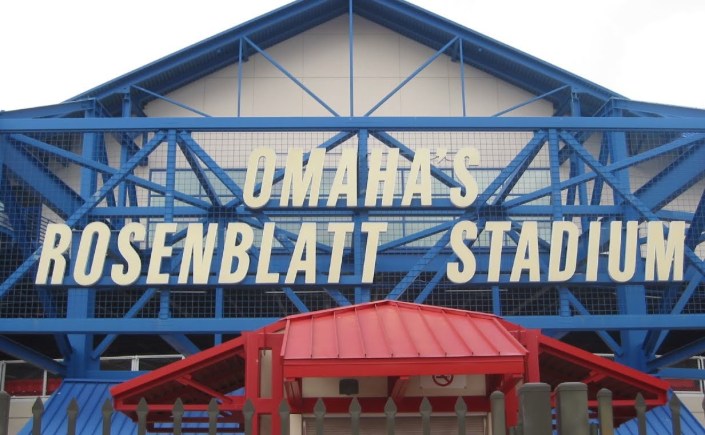
The College World Series underway in Omaha is a major NCAA athletic championship that attracts legions of fans from all over America and grabs gobs of national media attention. With this being the last series played at the event’s home these past 60 years, Rosenblatt Stadium, there’s been more fan and media interest than ever before, although a spate of rain storms actually hurt attendance at the start of this year’s series. Inclement weather or not, the series is a great big love-in with its own Fan Fest. But it didn’t used to be this way. Indeed, for the first three decades of the event, it was a rather small, obscure championship that garnered little notice outside the schools participating. Omaha cultivated the event when few others wanted or cared about it, and all that nurturing has resulted in practically a permanent hold on the event, which has strong support from the corporate community, from the City of Omaha, from service clubs, and from the local hospitality industry. Two key players in securing and growing the series have been a father and son, the late Jack Diesing Sr. and Jack Diesing Jr., and they are the focus of this short story that recently appeared in a special CWS edition of The Reader (www.thereader.com) called The Daily Dugout. I have another story on this site from the Dugout — it features Greg Pivovar, one of the colorful characters who can be found at the series.
The Two Jacks of the College World Series
©by Leo Adam Biga
Originally appeared in The Reader (www.thereader.com)
In 1967 the late Jack Diesing Sr. founded College World Series Inc. as the local nonprofit organizing committee for the NCAA Division I men’s national collegiate baseball championship. He led efforts that turned a small, struggling event into a major national brand for Omaha.
When son Jack Diesing Jr. succeeded him as president, the young namesake continued building the brand as Jack Sr. stayed on as chairman.
While the CSW is not a business, it’s a growing enterprise annually generating an estimated $40-plus million for the local economy. More than 300,000 fans attend and millions more watch courtesy ESPN.
Papa Diesing was around to see all that growth, only passing away this past March at age 92. Jack Jr. said his father, who saw the event’s potential when few others did, never ceased being amazed “by how it kept getting bigger and better. The phrase he always said is, ‘This just flabbergasts me.'”
His father inherited a dog back in 1963. Jack Sr. was a J. L. Brandeis & Sons Department Store executive. His boss, Ed Pettis, chaired the CWS. The event lost money nine of its first 14 years here. When Pettis died, Jack Sr. was asked to take over. He refused at first. No wonder. The CWS was rinky-dink. Nothing about it promised great things ahead. The crowds were miniscule. The interest weak. But under his aegis an economically sustainable framework was put in place.
What’s become a gold standard event had an unlikely person guiding it.
“When my father got involved with the College World Series he had never attended a baseball game in his life. He didn’t really want to do it but basically he agreed to do it because it was the right thing to do for the city of Omaha,” said Jack Jr. “Over a period of time he developed a love affair with not only what it meant for the fans but what it meant for the city and what it meant for the kids playing in it. He always was looking to do whatever we could do here to make the event better for the kids playing the games and the fans attending the games and for the community. And the rest is history.”
The son’s affinity for the series started early and by the time the patriarch was ready to pass the torch, Jack Jr. was ready.
“I certainly grew up behind the scenes. I can’t say he was purposely grooming me into anything. It’s just that I was exposed to the College World Series ever since I moved back into town in 1975. I’d go to the games, I was involved in sports in school and still was an avid sports follower after I got back.”
Diesing said the same sense of civic duty and love of community that motivated his father motivates him.
He still marvels at his father’s foresight.
“One of the things people credited him for was having tremendous vision about how to set up the infrastructure and make sure we had an organization moving forward that would stand the test of time. And he thought it would make sense to carry on a tradition with his son following him, and that was another thing he was right about.”
His father not only stabilized the CWS but set the stage for its prominence by partnering with the city and the local business community to placate the NCAA by investing millions in Rosenblatt Stadium improvements to create a showcase event for TV.
College baseball coaching legend Bobo Brayton admired how Jack Sr. nurtured the CWS. “I think he was the single person that really kept the world series there in Omaha. I went to a lot of meetings with Jack, I know how he worked. First, he’d feed everybody good, give them a few belts, and then start working on ‘em. He was fantastic, just outstanding. It’s too bad we lost him…but, of course, Jack Jr. is doing a good job too.”
As intrinsic as Rosenbatt’s been to the CWS, Jack Jr. said his father knew it was time for a change: “He could see and did see the needs and the benefits to move into the future. Certainly, I’m the first person to understand the nostalgia, the history, the ambience surrounding Rosenblatt. It’s going to be different down at the new stadium, and it’s just a matter of everybody figuring out a way to embrace the different.”
Diesing has no doubt the public-private partnership his father fostered will continue over the next 25 years that Omaha’s secured the series for and well beyond. He’s glad to carry the legacy of a man, a city and an event made for each other.
Related Articles
- Rosenblatt Stadium memories will live on (seattletimes.nwsource.com)
- College World Series: The 10 Greatest CWS Legends Omaha Has Ever Seen (bleacherreport.com)
- College World Series is Omaha’s party central (seattletimes.nwsource.com)
- 1st game at new Omaha ballpark sells out in hours (seattletimes.nwsource.com)
- The One That Got Away Is Still a Yankees Fan (nytimes.com)
Categories: Athletics, Baseball, College World Series, Omaha, Pop culture, Rosenblatt Stadium, Sports, Writing
Athletics, Baseball, College World Series, Division I (NCAA), ESPN, Jack Diesing Jr., Jack Diesing Sr., Johnny Rosenblatt Stadium, National Collegiate Athletic Association, Omaha, Omaha Nebraska, Pop Culture, Rosenblatt Stadium, Sport, Sports, United States
The Little People’s Ambassador at the College World Series
June 26, 2010
1 comment
UPDATE: Greg Pivovar’s Stadium View Sports Cards store was left high and dry when Rosenblatt Stadium was closed and the College World Series moved downtown to TD Ameritrade Park, but he does have a presence near the new site courtesy a tent set-up. My story below appeared on the eve of the 201o CWS, as Pivovar, whose shop stood directly across the street from Rosenblatt, prepped for his last dance with the old stadium.
As the College World Series enters the stretch run of the 2010 championship, I offer this story as a slice-of-life capsule of the local color that can be found in and around the event and its festival-like atmosphere. The subject is Greg Pivovar, who runs a sports memorabilia shop called Stadium View Sports Cards, across from Omaha‘s Rosenblatt Stadium, the venue where the CWS has been played for 60 years. This is the stadium’s last at-bat, so to speak, as it’s scheduled to be torn down next year, when the event moves to the new downtown TD Ameritrade Park. The ‘Blatt’s last hurrah is inspiring all manner of nostalgic farewells. Pivovar will be sad to see it go too, but he’s not the sentimental sort. In fact, he’s the cynical antidote to the otherwise perpetually cheery facade the city, the NCAA, and College World Series Inc. like to spin about the series, an event that Omaha has catered to to such an extent that there’s a fair amount of skepticism and animosity out there. Pivovar loves the series and the business it brings him, and he loves serving in the unofficial role of CWS ambassador for visitors from out of state, but he’s not Pollyannish about the event or the powers-that-be who run it. He just kind of says it like it is. His blog, stadiumview.wordpress.com, is a hoot for the way he skewers sacred cows.
I have posted another CWS story about a father and son legacy tied to the event.

Greg Pivovar, owner of the Stadium View shop, poses in his store in Omaha, Neb., Thursday, May 27, 2010. Pivovar is a one-man welcoming committee for College World Series fans. The Omaha attorney greets every (legal age) customer with a free can of beer and nudges them toward the barbecue, brats or, when LSU is in town, seafood jambalaya.(AP Photo/Nati Harnik) — AP
The Little People‘s Ambassador at the College World Series
©by Leo Adam Biga
Originally appeared in the The Reader (www.thereader.com)
Stadium View Sports Cards proprietor Greg Pivovar makes a colorful ambassador for the College World Series with his Hawaiian shirt, khaki shorts and blue-streak S’oud Omaha patter. This bona fide character champions “the little people who built” the CWS.
Enter his sports memorabilia shop across from Rosenblatt and his coarse, cranky, world-weary sarcasm greets you, his barbs delivered with a stiff drink in one hand and a cell phone in the other. He talks like he writes on his stadiumview.wordpress.com blog.
“A lot of it is funny and cynical, but a lot of it is from my heart,” he said..
His shop’s a popular way stop for CWS fans craving authentic Omaha. He’s dispensed free beer since opening the joint 19 years ago. “It’s meant as a gesture of friendship and welcome, not as, Hey, you want to stand around and get drunk here? Part of the ritual,” he said. In 2006 he “took a cheap ass plea” on a ticket scalping charge he claims was bogus. He said the company he keeps is what got him in trouble.
“I have a bunch of scalpers who hang around here,” he said. “They’re friends of mine. I like them, they’re an interesting breed of human being.”
The arrest made headlines. A recent AP story that went viral called him a one-man CWS welcoming committee. Ryan McGee profiled him in the book The Road to Omaha.
“Famous…infamous, I’ve been both,” said Pivovar.
His uncensored ways hardly conform to the Norman Rockwell image the NCAA prefers.
Pivovar, who also serves homemade barbecue and enchiladas during the CWS, and cooks up a mean jambalaya whenever LSU makes it, feels he contributes to a “festival atmosphere.” Vendor and hospitality tents dot the blue collar neighborhood, where enterprising residents make a sweet profit charging for parking spots and refreshments.
The NCAA’s tried distancing the CWS from the commercial, party vibe. A clean zone will be easier to enforce with the move to TD Ameritrade Park next year.
“Piv” likes a good time but acknowledges all “the temporary bars” can be “a negative,” adding, “There’s a few too many people coming down here just to get drunk, and that’s not the idea. That sounds hypocritical coming from a guy who’s given 40,000 beers away, but it really isn’t. Most of my beers are given away one, maybe two at a time.”
The Creighton University Law School grad and former Sarpy County public defender has a private practice he puts on hold for the series. This being Rosenblatt’s last year, he’s stocked extra beer for the record hordes expected to say adieu to the stadium.
His own ties to Rosenblatt go back to childhood. His collecting began with baseball cards, sports magazines, game programs, signed balls. He got serious after college, traveling to buy and sell wares. Eventually, he said, “my collection was pretty much overrunning my home. I’m a hoarder. I needed a place to store my hobby.” Thus, the store was born, although he insists: “It’s not a business, it’s never been a business. I don’t make any money at this, I never have. It’s kind of like a museum.”
Most of his million or so cards, he said, “are just firewood.”
What business he does do largely happens during the CWS. Even then he said I “barely pay the bills.” He doesn’t know what he’ll do after the ‘Blatt’s gone and the series moves downtown. “I’d love to carry my hobby down there but…If somebody comes and shits a couple hundred thousand dollars on my face it might happen, but other than that…”
If he closes shop, he’s unsure what will become of his stuff.
“I don’t even want to think about it. I suppose I could throw it all on e-bay and get a mere pittance for it. That’s the way that works. So much of it has zero to such a narrow market, and I knew that going in. It’s not like I was having any allusions of getting rich from this.”
He’s pissed about the “Blatt’s demise and suspects the new site will usher in a sterile, elitist era.
“I’m a conspiracy theorist. What this is all about is developing that north area (NoDo) and wanting to give the zoo what they need. The bastards are taking my ballpark. Like I end a lot of my blogs, I’ve got so many days until my world’s over. It’s kind of like writing your own obituary.”
At least he has his health. He’s cancer-free after a bout with cancer.
The “Save Rosenblatt” t-shirts he carried have been replaced with ones reading: “To Hell with Rosenblatt, Save Stadium View.”
Stadium View is at 3702 So. 13th St.
Related Articles
- College World Series Is Moving On (nytimes.com)
- College World Series is Omaha’s party central (seattletimes.nwsource.com)
- Rosenblatt Stadium memories will live on (seattletimes.nwsource.com)
- Vermont couple ties knot during CWS rain delay (seattletimes.nwsource.com)
- 1st game at new Omaha ballpark sells out in hours (seattletimes.nwsource.com)
Categories: Athletics, Baseball, Business, College World Series, Entrepreneurial, Omaha, Pop culture, Rosenblatt Stadium, Sports, Writing
Athletics, Baseball, Business, College World Series, Entrepreneurial, Johnny Rosenblatt Stadium, National Collegiate Athletic Association, Omaha, Omaha Nebraska, Pop Culture, Rosenblatt Stadium, Ryan McGee, Sport, Sports, TD Ameritrade Park Omaha
A Rosenblatt Tribute
June 19, 2010
5 comments

Image via Wikipedia
UPDATE: The summer of 2011 finds Rosenblatt Stadium in Omaha, Neb. now an empty shell and ghost of a ballpark, its parts being cannibalized and sold off, while the new home of the College World Series, TD Ameritrade Park, is a resounding hit with fans and media.
Eleven years ago or so I wrote this story about Rosenblatt Stadium in Omaha, the home of the College World Series. As I write this intro, the CWS is a day away from starting play in 2010, the last year the event will be played at the stadium that’s hosted NCCA Division I men’s baseball championship for 60 years. Rosenblatt is being razed in early 2011, when the series will move into a new downtown stadium now under construction. Rosenblatt has become the symbol for the series because of all the history bound up in it and the special relationship residents and fans have with it and with the blue collar neighborhood surrounding it. My story appeared in The Reader (www.thereader,com).

©Omaha World-Herald
When Rosenblatt was Municipal Stadium. At the first game, from left: Steve Rosenblatt; Rex Barney; Bob Hall, owner of the Omaha Cardinals; Duce Belford, Brooklyn Dodgers scout and Creighton athletic director; Richie Ashburn, a native of Tilden, Neb.; Johnny Rosenblatt; and Johnny Hopp of Hastings, Neb.
A Rosenblatt Tribute
©by Leo Adam Biga
Originally published in The Reader (www.thereader.com)
It’s baseball season again, and The Boys of Summer are haunting diamonds across the land to play this quintessentially American game. One rooted in the past, yet forever new. As a fan put it recently, “With baseball, it’s the same thing all over again, but it isn’t. Do you know what I mean?”
Yes. There’s a timelessness about baseball’s unhurried rhythm, classic symmetry and simple charm. The game is steeped in rules and rituals almost unchanged since the turn of the century. It’s an expression of the American character: both immutable and enigmatic.
Within baseball’s rigid standards, idiosyncrasy blooms. A contest is decided when 27 outs are recorded, but getting there can involve limitless innings, hours, plays. Stadiums may appear uniform, but each has its own personality — with distinctive wind patterns, sight lines, nooks and crannies.
Look in any American town and you’ll find a ballpark with deep ties to the sport and its barnstorming, sandlot origins. A shrine, if you will, for serious fans who savor old-time values and traditions. The real thing. Such a place is as near as Omaha’s Johnny Rosenblatt Stadium, the site the past 49 years of the annual College World Series.
The city and the stadium have become synonymous with the NCAA Division I national collegiate baseball championship. No other single location has hosted a major NCAA tournament for so long. More than 4 million fans have attended the event in Omaha since 1950.
The 1998 CWS is scheduled May 29-June 6.
In what has been a troubled era for organized ball, Rosenblatt reaffirms what is good about the game. There, far away from the distraction of major league free-agency squabbles, the threat of player/umpire strikes, and the posturing of superstars, baseball, in its purest form, takes center stage. Hungry players still hustle and display enthusiasm without making a show of it. Sportsmanship still abounds. Booing is almost never heard during the CWS. Fights are practically taboo.
The action unwinds with leisurely grace. The “friendly confines” offer the down-home appeal of a state fair. Where else but Omaha can the PA announcer ask fans to, “scooch-in a hair more,” and be obliged?
Undoubtedly, the series has been the stadium’s anchor and catalyst. In recent years, thanks in part to ESPN-CBS television coverage, the CWS has become a hugely popular event, regularly setting single game and series attendance records. The undeniable appeal, besides the determination of the players, is the chance to glimpse the game’s upcoming stars. Fans at Rosenblatt have seen scores of future big league greats perform in the tourney, including Mike Schmidt, Dave Winfield, Fred Lynn, Paul Molitor, Jimmy Key, Roger Clemens, Will Clark, Rafael Palmeiro, Albert Belle, Barry Bonds and Barry Larkin.
The stadium on the hill turns 50 this year. As large as the CWS looms in its history, it is just one part of an impressive baseball lineage. For example, Rosenblatt co-hosted the Japan-USA Collegiate Baseball Championship Series in the ‘70s and ‘80s, an event that fostered goodwill by matching all-star collegians from each country.
Countless high school and college games have been contested between its lines and still are on occasion.
Pro baseball has played a key role in the stadium’s history as well.
Negro League clubs passed through in the early years. The legendary Satchel Paige pitched there for the Kansas City Monarchs. Major league teams played exhibitions at Rosenblatt in the ‘50s and ‘60s. St. Louis Cardinal Hall of Famer Stan Musial “killed one” during an exhibition contest.
For all but eight of its 50 years Rosenblatt has hosted a minor league franchise. The Cardinals and Dodgers once based farm clubs there. Native son Hall of Famer Bob Gibson got his start with the Omaha Cardinals in ‘57. Since ‘69 Rosenblatt’s been home to the Class AAA Omaha Royals, the top farm team of the parent Kansas City Royals. More than 7 million fans have attended Omaha Royals home games. George Brett, Frank White and Willie Wilson apprenticed at the ballpark.
With its rich baseball heritage, Rosenblatt has the imprint of nostalgia all over it. Anyone who’s seen a game there has a favorite memory. The CWS has provided many. For Steve Rosenblatt, whose late father, Johnny, led the drive to construct the stadium that now bears his name, the early years hold special meaning. “The first two years of the series another boy and I had the privilege of being the bat boys. We did all the games. That was a great thrill because it was the beginning of the series, and to see how it’s grown today is incredible. They draw more people today in one session than they drew for the entire series in its first year or two.”
For Jack Payne, the series’ PA announcer since ‘64, “the dominant event took place just a couple years ago when Warren Morris’ two-run homer in the bottom of the ninth won the championship for LSU in ‘96. He hit a slider over the right field wall into the bleachers. That was dramatic. Paul Carey of Stanford unloaded a grand slam into the same bleacher area back in ‘87 to spark Stanford’s run to the title.”
Payne, a veteran sports broadcaster who began covering the Rosenblatt beat in ‘51, added, “There’s been some great coaching duels out there. Dick Siebert at Minnesota and Rod Dedeaux at USC had a great rivalry. They played chess games out there. As far as players, Dave Winfield was probably the greatest athlete I ever saw in the series. He pitched. He played outfield. He did it all.”
Terry Forsberg, the former Omaha city events manager under whose watch Rosenblatt was revamped, said, “Part of the appeal of the series is to see a young Dave Winfield or Roger Clemens. Players like that just stick out, and you know they’re going to go somewhere.” For Forsberg, the Creighton Bluejays’ Cinderella-run in the ‘91 CWS stands out. “That was a real thrill, particularly when they won a couple games. You couldn’t ask for anything more.”
The Creighton-Wichita State game that series, a breathtaking but ultimately heartbreaking 3-2 loss in 12 innings, is considered an all-time classic. Creighton’s CWS appearance, the first and only by an in-state school, ignited the Omaha crowd. Scott Sorenson, a right-handed pitcher on that Bluejay club, will never forget the electric atmosphere. “It was absolutely amazing to be on a hometown team in an event like that and to have an entire city pulling for you,” he said. “I played in a lot of ballparks across the nation, but I never saw anything like I did at Rosenblatt Stadium. I still get that tingling feeling whenever I’m back there.”
A game that’s always mentioned is the ‘73 USC comeback over Minnesota. The Gophers’ Winfield was overpowering on the mound that night, striking out 15 and hurling a shutout into the ninth with his team ahead 7-0. But a spent Winfield was chased from the mound and the Trojans completed a storybook eight-run last inning rally to win 8-7.
Poignant moments abound as well. Like the ‘64 ceremony renaming the former Municipal Stadium for Johnny Rosenblatt in recognition of his efforts to get the stadium built and bring the CWS to Omaha. A popular ex-mayor, Rosenblatt was forced to resign from office after developing Parkinson’s disease and already suffered from its effects at the rededication. He died in ‘79. Another emotional moment came in ‘94 when cancer-ridden Arizona State coach Jim Brock died only 10 days after making his final CWS appearance. “That got to me,” Payne said.
Like many others, Payne feels the stadium and the tourney are made for each other, “It’s always been a tremendous place to have a tournament like this, and fortunately there was room to grow. I don’t think you could have picked a finer facility at a better location, centrally located like it is, than Rosenblatt. It’s up high. The field’s big. The stadium’s spacious. It’s just gorgeous. And the people have just kept coming.”
Due to its storied link with the CWS, the stadium’s become the unofficial home of collegiate baseball. So much so that CWS boosters like Steve Rosenblatt and legendary ex-USC coach Rod Dedeaux, would like to see a college baseball/CWS Hall of Fame established there.
Baseball is, in fact, why the stadium was built. The lack of a suitable ballpark sparked the formation of a citizens committee in ‘44 that pushed for the stadium’s construction. The committee was a latter-day version of the recently disbanded Sokol Commission that led the drive for a new convention center-arena.
With a goal of putting the issue to a citywide vote, committee members campaigned hard for the stadium at public meetings and in smoke-filled back rooms. Backers got their wish when, in ‘45, voters approved by a 3 to 1 margin a $480,000 bond issue to finance the project.
Unlike the controversy surrounding the site for a convention center-arena today, the 40-acre tract chosen for the stadium was widely endorsed. The weed-strewn hill overlooking Riverview Park (the Henry Doorly Zoo today) was located in a relatively undeveloped area and lay unused itself except as prime rabbit hunting territory. Streetcars ran nearby, just as trolleys may in the near future. The site was also dirt cheap. The property had been purchased by the city a few years earlier for $17 at a tax foreclosure sale. Back taxes on the land were soon retired.
Dogged by high bids, rising costs and material delays, the stadium was finished in ‘48 only after design features were scaled back and a second bond issue passed. The final cost exceeded $1 million.
Baseball launched the stadium at its October 17, 1948 inaugural when a group of all-stars, featuring native Nebraskan big leaguers, beat a local Storz Brewery team 11-3 before a packed house of 10,000 fans.
Baseball has continued to be the main drawing card. The growth of the CWS prompted the stadium’s renovation and expansion, which began in earnest in the early ‘90s and is ongoing today.
Rosenblatt is at once a throwback to a bygone era — with its steel-girdered grandstand and concrete concourse — and a testament to New Age theme park design with its Royal Blue molded facade, interlaced metal truss, fancy press box and luxury View Club. The theme park analogy is accentuated by its close proximity to the popular Henry Doorly Zoo.
Some have suggested the new bigness and brashness have stolen the simple charm from the place.
“Maybe some of that charm’s gone now,” Forsberg said, “but we had to accommodate more people as the CWS got popular. But we still play on real grass under the stars. The setting is still absolutely beautiful. You can still look out over the fences and see green trees and see what mid-America is all about.”
Payne agrees. “I don’t think it’s taken away from any of the atmosphere or ambience,” he said. “If anything, I think it’s perpetuated it. The Grand Old Lady, as I call it, has weathered many a historical moment. She’s withstood the battle of time. And then in the ‘90s she got a facelift, so she’s paid her dues in 50 years. Very much so.”
Perched atop a hill overlooking the Missouri River and the tree-lined zoo, Rosenblatt hearkens back to baseball’s and, by extension, America’s idealized past. It reminds us of our own youthful romps in wide open spaces. Even with the stadium expansion, anywhere you sit gives you the sense you can reach out and touch its field of dreams.

NCAA officials, who’ve practically drawn the blueprint for the new look Rosenblatt, know they have a gem here.
“I think part of the reason why the College World Series will, in 1999, celebrate its 50th year in Omaha is because of the stadium we play in, and the fact that it is a state-of-the-art facility,” said Jim Wright, NCAA director of statistics and media coordinator for the CWS the past 20 years.
Wright believes there is a casual quality that distinguishes the event.
“Almost without exception writers coming to this event really do become taken with the city, with the stadium and with the laidback way this championship unfolds,” he said. “It has a little bit different feel to it, and certainly part of that is because we’re in Omaha, which has a lot of the big city advantages without having too many of the disadvantages.”
For Dedeaux, who led his Trojans to 10 national titles and still travels each year from his home in Southern California to attend the series, the marriage of the stadium-city-event makes for a one-of-a-kind experience.
“I love the feeling of it. The intimacy. Whenever I’m there I think of all the ball games, but also the fans and the people associated with the tournament, and the real hospitable feeling they’ve always had. I think it’s touched the lives of a lot of people,” he said.
Fans have their own take on what makes baseball and Rosenblatt such a good fit. Among the tribes of fans who throw tailgate parties in the stadium’s south lot is Harold Webster, an executive with an Omaha temporary employment firm. While he concedes the renovation is “nice,” he notes, “The city didn’t have to make any improvements for me. I was here when it wasn’t so nice. I just love being at the ballpark. I’m here for the game.” Not the frills, he might have added.
For Webster and fans like him, baseball’s a perennial rite of summer.
“To me, it’s the greatest thing in the world. I don’t buy season tickets to anything else — just baseball.”
Mark Eveloff, an associate judge in Council Bluffs, comes with his family. He said, “We always have fun because we sit in a large group of people we all know. You get to see a lot of your friends at the game and you get to see some good baseball. I’ve been coming to games here since I was a kid in the late ‘50s, when the Omaha Cardinals played. And from then to now, it’s come a long way. Every year, it looks better.”
Ginny Tworek is another fan for life. “I’ve been coming out here since I was eight-years old,” the Baby Boomer said. “My dad used to drop me and my two older brothers off at the ballpark. I just fell in love with the game. It’s a relaxing atmosphere.”
There is a Zen quality to baseball. With its sweet meandering pace you sometimes swear things are moving in slow motion. It provides an antidote to the hectic pace outside.
Baseball isn’t the whole story at Rosenblatt. Through the ‘70s it hosted high school (as Creighton Prep’s home field), collegiate (UNO) and pro football (Omaha Mustang and NFL exhibition) games as well as pro wrestling cards, boxing matches and soccer contests. Concerts filled the bill too, including major shows by the Beach Boys in ‘64 and ‘79. But that’s not all. It accomodated everything from the Ringling Brothers Circus to tractor pulls to political rallies to revival meetings. More recently, Fourth of July fireworks displays have been staged there.

Except for the annual fireworks show, however, the city now reserves the park for none but its one true calling, baseball, as a means of protecting its multimillion dollar investment.
“We made a commitment to the Omaha Royals and to the College World Series and the NCAA that the stadium would be maintained at a major league level. The new field is fairly sensitive. We don’t want to hurt the integrity of the field, so we made the decision to just play baseball there,” Omaha public events manager Larry Lahaie said.
A new $700,000 field was installed in 1991-92, complete with drainage and irrigation systems. Maintaining the field requires a groundskeeping crew whose size rivals that of some major league clubs.
Omaha’s desire to keep the CWS has made the stadium a priority.
As the series began drawing consistently large crowds in the ‘80s, the stadium experienced severe growing pains. Parking was at a premium. Traffic snarls drew loud complaints. To cope with overflow crowds, the city placed fans on the field’s cinder warning track. The growing media corps suffered inside a hot, cramped, outdated press box. With the arrival of national TV coverage in the ‘80s, the NCAA began fielding bids from other cities wanting to host the CWS.
By the late ‘80s Omaha faced a decision — improve Rosenblatt or lose the CWS. There was also the question of whether the city would retain the Royals. In ‘90 the club’s then owner, the late Chicago business magnate Irving “Gus” Cherry, was shopping the franchise around. There was no guarantee a buyer would be found locally, or, if one was, whether the franchise would stay. To the rescue came an unlikely troika of Union Pacific Railroad, billionaire investor Warren Buffett and Peter Kiewit Son’s, Inc. chairman Walter Scott, Jr., who together purchased the Royals in 1991.
Urged on by local CWS organizers, such as Jack Diesing Sr. and Jr., and emboldened by the Royals’ new ownership, the city anteed-up and started pouring money into Rosenblatt to rehab it according to NCAA specifications. The city has financed the improvements through private donations and from revenue derived from a $2 hotel-motel occupancy tax enacted in ‘91.
The makeover has transformed what was a quaint but antiquated facility into a modern baseball palace. By the time the latest work (to the player clubhouses, public restrooms and south pavilion) is completed next year, more than $20 million will have been spent on improvements.
The stadium itself is now an attraction. The retro exterior is highlighted by an Erector Set-style center truss whose interlocking, cantilevered steel beams, girders and columns jig-jag five-stories high. Then there’s the huge mock baseball mounted on one wall, the decorative blue-white skirt around the facade, the slick script lettering welcoming you there and the fancy View Club perched atop the right-field stands. The coup de grace is the spacious thatched-roof press box spanning the truss.
Rosenblatt today is a chic symbol of stability and progress in the blue collar south Omaha neighborhood it occupies. It is also a hub of activity that energizes the area. On game days lawn picnics proceed outside homes along 13th Street and tailgate parties unwind in the RV and minivan-choked lots. The aroma of grilled sausage, bratwurst and roasted peanuts fills the air. A line invariably forms at the nearby Zesto’s, an eatery famous for its quick comfort food.
There’s a carnival atmosphere inside the stadium. The scoreboard above the left-field stands is like a giant arcade game with its flashing lights, blaring horns, dizzying video displays and fireworks. Music cascades over the crowd — from prerecorded cuts of Queen’s “We Will Rock You” and the Village People’s “YMCA” to organist Lambert Bartak’s live renditions of “Sioux City Sue” and “Spanish Eyes.” Casey the Mascot dances atop the dugouts. Vendors hawk an assortment of food, drink and souvenirs. Freshly-scrubbed ushers guide you to your seat.
The addition that’s most altered the stadium is the sleek, shiny, glass-enclosed View Club. It boasts a bar, a restaurant, a south deck, a baseball memorabilia collection, cozy chairs and, naturally, a great catbird’s seat for watching the game from any of its three tiered-seating levels. But you won’t catch serious fans there very long. The hermetically-sealed, sound-proof interior sucks the life right out of the game, leaving you a remote voyeur. Removed from the din of the crowd, the ballyhoo of the scoreboard, the enticing scent of fresh air and the sound of a ball connecting with leather, wood or aluminum, you’re cut-off from the visceral current running through the grandstand. You miss its goosebump thrills.
“That’s the bad thing about it,” Tworek said. “You can’t hear the crack of the bat. You don’t pay as close attention to the game there.”
Even with all the bells and whistles, baseball still remains the main attraction. The refurbished Rosenblatt has seen CWS crowds go through the roof, reaching an all-time single series high of 203,000 last year. The Royals, bolstered by more aggressive marketing, have drawn 400,000-plus fans every year but one since ‘92. Fans have come regardless of the won-loss record. The top single-season attendance of 447,079 came in ‘94, when the club finished eight games under .500 and in 6th place.
Why? Fans come for the game’s inherent elegance, grace and drama. To see a well-turned double play, a masterful pitching performance or a majestic home run. For the chance of snaring a foul ball. For the traditional playing of the national anthem and throwing out of the first pitch. For singing along to you-know-what during the seventh inning stretch.
They come too for the kick-back conviviality of the park, where getting a tan, watching the sun set or making new friends is part of the bargain. There is a communal spirit to the game and its parks. Larry Hook, a retired firefighter, counts Tworek among his “baseball family,” a group of fans he and his grandson Nick have gotten acquainted with at the Blatt. “It’s become a regular meeting place for us guys and gals,” he said. “We talk a little baseball and watch a little baseball.
Once the game’s over everybody goes their separate ways and we say, ‘See ya next home stand.’
The season’s end brings withdrawal pains. “About the first couple months, I’m lost,” Hook said. “There’s nothing to look forward to.” Except the start of next season.
As dusk fell at Rosenblatt one recent night, Charles and Stephanie Martinez, a father and daughter from Omaha, shared their baseball credo with a visitor to their sanctuary above the third-base dugout. “I can never remember not loving baseball,” said Charles, a retired cop. “I enjoy the competition, the players and the company of the people I’m surrounded by.”
Serious fans like these stay until the final out. “Because anything can happen,” Stephanie said. “I like it l because it’s just so relaxed sitting out on a summer day. There’s such an ease to it. Part of it’s also the friends you make at the ballpark. It doesn’t matter where you go — if you sit down with another baseball fan, you can be friends in an instant.”
That familiar welcoming feeling may be baseball’s essential appeal. Coming to the ballpark, any ballpark, is like a homecoming. Its sense of reunion and renewal, palpable. Rosenblatt only accentuates that feeling. Like a family inheritance, baseball is passed from one generation to the next. It gets in your blood. So, take me out to the ball game, take me out to the crowd…
Related Articles
- Rosenblatt Stadium will never be forgotten (mlb.mlb.com)
- New CWS stadium gets good reviews (seattletimes.nwsource.com)
- Burke gets Rosenblatt scoreboard – Omaha.com (theprideofnebraska.blogspot.com)
- Rosenblatt Stadium memories will live on (seattletimes.nwsource.com)
Author, humorist, folklorist Roger Welsch tells the stories of the American soul and soil
June 19, 2010
8 comments

Image via Wikipedia
Roger Welsch is a born storyteller and there’s nothing he enjoys more than holding sway with his spoken or written words, drawing the audience or reader in, with each inflection, each permutation, each turn of phrase. He’s a master at tone or nuance. New Horizons editor Jeff Reinhardt and I visited Welsch at his rural abode, and then into town at the local pub/greasy spoon, where we scarfed down great burgers and homemade root beer. All the while, Welsch kept his variously transfixed and in stitches with his tales.
On this blog you’ll find Welsch commenting about his longtime friend and former Lincoln High classmate Dick Cavett in my piece, “Homecoming is Always Sweet for Dick Cavett.” Welsch shares some humorous (naturally) anecdotes about the talk show host’s penchant for showing up unannounced and getting lost in those rural byways that Welsch lovingly describes in his writing.
Author, humorist, folklorist Roger Welsch tells the stories of the American soul and soil
©by Leo Adam Biga
Originally appeared in the New Horizons
It’s been years since Roger Welsch, the author, humorist and folklorist, filed his last Postcard from Nebraska feature for CBS’s Sunday Morning program. Every other week the overalls-clad sage celebrated, in his Will Rogersesque manner, the absurd, quixotic, ironic, sublime and poetic aspects of rural life.
That doesn’t mean this former college prof, who’s still a teacher at heart, hasn’t been staying busy since his Postcard days ended. He’s continued his musings in a stream of books (34 published thus far), articles, essays, talks and public television appearances that mark him as one of the state’s most prolific writers and speakers.
In 2006 alone he has three new books slated to be out. Each displays facets of his eclectic interests and witty observations. Country Livin’ is a “guide to rural life for city pukes.” Weed ‘Em and Reap: A Weed Eater Reader is “a narrative about my interest in wild foods, a kind of introduction to lawn grazing and a generous supply of reasons to avoid lawn care,” he said. My Nebraska is his “very personal” love song to the state. “I believe in Nebraska. I love this place for what it is and not for what people think it ought to be,” he said. “I hate it when the DED (Department of Economic Development) tries to fill people full of bullshit about Nebraska. Nebraska’s great as it is. You don’t have to make up anything. You don’t have to put up an arch across the highway to charm people.”
In the tradition of Mark Twain and William Faulkner, Welsch mines an authentic slice of rural American life, namely the central Nebraska village of Dannebrog that he and artist wife Linda moved to 20 years ago, to inform his fictional Bleaker County. Drawing from his experiences there, he reveals the unique, yet universal character of this rural enclave’s people, dialect, humor, rituals and obsessions.
Roger Welsch on his beloved farm
He’s also stayed true to his own quirky sensibilities, which have seen him: advocate for the benefits of a weed diet; fall in love with a tractor; preserve, by telling whenever he can, the tall tales of settlers; wax nostalgic over sod houses; serve as friend and adopted member of Indian tribes; and obsess over Greenland.
The only child of a working class family in Lincoln, Neb., he followed a career path as a college academician. His folklore research took him around the Midwest to unearth tales from descendants of Eastern European pioneers and Plains Indians. He lived in a series of college towns. By the early ‘70s he held tenure at the University of Nebraska-Lincoln. Then, he turned his back on a “cushy” career and lifestyle to follow his heart. To write from a tree farm on the Middle Loup River outside Dannebrog. To be a pundit and observer. People thought he was nuts.
“I walked away from an awfully good job at the university. People work all their lives to get a full professorship with tenure and…nobody could believe it when I said I’m leaving. ‘Are you crazy? For what?’ And, it’s true, I had nothing out here,” he said from an overstuffed shed that serves as an office on the farm he and Linda share with their menagerie of pets. “I was just going to live on my good looks, as I said, and then everybody laughed. That was before CBS came along.”
Before the late Charles Kuralt, the famed On the Road correspondent, enlisted Welsch to offer his sardonic stories about country life in Nebraska, things were looking bleak down on the farm. “We weren’t making it out here,” Welsch said. “I told Linda, ‘The bad news is, we’re not making it, and the even worse news is I’m still not going back.’ And about that point, Kuralt came along.”
No matter how rough things got, Welsch was prepared to stick it out. Of course, the CBS gig and some well-received books helped. But even without the nice paydays, he was adamant about avoiding city life and the halls of academia at all costs. What was so bad about the urban-institutional scene? In one sense, the nonconformist Welsch saw the counterculture of the ’60s he loved coming to an end. And that bummed him out. He also didn’t like being hemmed in by bureaucratic rules and group-think ideas that said things had to be a certain way.
His chafing at mindless authority extended to the libertarian way he ran his classroom at UNL and the free range front lawn he cultivated in suburbia.
“I was a hippie in the ‘60s and I really got excited teaching hippies because they didn’t give a didly damn what the bottomline was. They just wanted to learn whatever was interesting. You didn’t have to explain anything. I never took attendance. I’d have people coming in to sit in on class who weren’t enrolled, and I loved that. I hated grades. Because I figured, you’re paying your money. I’m collecting the money and I deliver. Now, what you do with that, why should I care? It’s none of my business,” he said. “The guy at the grocery store doesn’t say, Now I’ll sell you this cabbage, but I want to know what you’re going to do with it.”
Welsch said the feedback he got from students made him realize how passionate he was about teaching. On an evaluation a student noted, “‘Being in Welsch’s class isn’t like being in a class at all. It’s like being in an audience.’ I asked a friend, ‘Is that an insult or a compliment?’ ‘Well, Rog, actually being in your class isn’t like being in a class or in an audience. It’s like being in a congregation.’ And I thought, Oh, man, that’s it — I’m a preacher, not a teacher. It really is evangelism for me.”
“By the ‘80s they (university officials) wanted to know how they were going to make money out of the popular classes I taught. I said, ‘I have no idea. It’s not my problem. All I’m doing is telling them (students) what I know.’ So, there was that.”
Then there was the matter of UNL selling out, as he saw it, its academic integrity to feed the ravenous and untouchable football program, which he calls “a cancer.”
“I was and still am extremely disillusioned with the university becoming essentially an athletic department. Everything else is in support of the athletic department. And that breaks my heart, because I love the university. There was that.”
But what really set him off on his rural idyll was the 1974 impulse purchase he made of his 60-acre farm. He bought it even as it lay buried under snow.
“So, I bought it without ever really seeing the ground, but it was exactly what I wanted. I loved the river. I loved the frontage on the river. Then spring came and the more the snow melted…it was better than I thought….There are wetlands and lots of willow islands. The wildlife is just incredible. We’ve had a (mountain) lion down here and wolves just north of here.”

He used the place as a retreat from the city for several years. Each visit to the farm, with its original log cabin house, evoked the romantic in him, stirring thoughts of the people that lived there and worked the land. “That’s what I love about old lumber…the ghosts.” By the mid-’80s, he couldn’t stand just visiting. He wanted to stay. “I told Linda, ‘One of these days you’re going to have to send the highway patrol out, because I won’t come home. I can’t spend the rest of my life wanting to be here and living in Lincoln.’” Their move to the farm “really wasn’t so much getting away from anything as it was wanting to get out here.”
Then, too, it’s easier to be a bohemian in isolation as opposed to civilization.
“My life is a series of stories, so I have to tell you a story,” he said. “In my hippie days, I really got interested in wild plants and wild foods. As part of my close association with Native Americans, I was spending a lot of time with the Omahas up in Macy (Neb.). I was learning a lot of things from the Indians and, well, I was bringing home a lot of plants that I wanted to see grow, mature, go to seed and become edible. Milkweed and arrowhead and calimus. I got more and more into it. I loved the sounds and flowers and foods coming from my yard.
“One day, I come home to find a notice on my door that my lawn’s been condemned and I have six days to remove all ‘worthless vegetation.’ So, I invite the city weed inspector over to show me what’s worthless. He said, ‘OK, what about that white stuff over there?’ He didn’t even know the names of the plants. And I said, ‘Well, we had that for lunch.’ ‘How ‘bout that?’ ‘That’s supper.”
Welsch said, “As I started looking at this, I found out people were nuts. Anything over six inches high in Lincoln was a weed. The county weed board was spraying both sides of all county roads with diesel fuel and 24D. That’s essentially Agent Orange. They were laying waste to everything. Strawberries, arrowhead, cattails. So, I ran for the weed board on a pro-weed ticket. About this same time, Kuralt was coming through Nebraska. He asked somebody if anything going on in Nebraska might make a good story for his On the Road series. And whoever he asked, God bless ‘em, said, ‘Yeah, there’s a crackpot in Lincoln…’ So, Kuralt called me up and came over to the house with his van and his crew, which eventually became my crew. We sat down and had a huge weed salad and walked around and talked about weeds. And he had me on his On the Road. Well, then over the years every time he came through Nebraska he stopped. I kept a file of any stories I thought were interesting that he might use. That was my way of luring him to Lincoln.”

Charles Kuralt
The two men became fast friends and colleagues.
“We always went out to eat and drink. He loved to drink and I do, too. We would just have a good time. He used me for six more On the Road programs, for one thing or another. I tried to then steer him to other things — the jackalope in Wyoming and stuff like that. We got to be really good friends. When he started hosting Sunday Morning, he asked me to watch the show. He called me up and told me he wanted to bring the culture of New York City to towns like Dannebrog.”.
By the time Kuralt next passed through Nebraska to see Welsch, the author was giving a talk before a gathering of the West Point, Neb. chamber of commerce. What Kuralt heard helped him change the course of Sunday Morning and Welsch’s career. “He walked in the back of the room and listened to the program. We drove back to my place and he said, ‘You know, you said about 13 things we could use on Sunday Morning. What we need to do is to take the culture of a little town like Dannebrog and show it to New York City. So, that’s essentially how we got together. He originally thought about doing Postcards from America, where he had somebody (reporting) in every state. It got to be too expensive. I had six or seven years all by myself (with Postcards from Nebraska) before they added Maine. Then, by the time he went off the road, he gave me his old crew. They were like family. It was a great 13 years I was on that show. We had an awful lot of fun.”
Two years into Postcard, Welsch said Kuralt confided, “I thought we’d be lucky to get six stories out of Nebraska.” Ultimately, Welsch said, “we did over 200.”
What Welsch found in the course of, as he describes it, “my rural education,” and what he continues discovering and sharing with others, is a rich vein of human experience tied to the land, to the weather and to community. He’s often written and spoken about his love affair with the people and the place.
When friend and fellow Lincoln High classmate Dick Cavett asked him on national television — Why do you live in a small town? — Welsch replied: “In Lincoln academic circles everybody around me is the same. They’re all professors. In suburbia, everybody pretty much has the same income. But in Dannebrog, I sit down for breakfast and converse with the banker, the town drunk, the most honest man in town, a farmer, a carpenter and my best friend.” What Cavett and viewers didn’t know is Welsch was talking about his best friend Eric, who’s “been all those things. That private joke aside,” Welsch added, “the spirit of what I said is the truth.”
In his book It’s Not the End of the Earth, But You Can See it from Here, Welsch opines: “I like so many writers…have come to appreciate the power of what seems at first blush to be some pretty ordinary folks doing some pretty ordinary things. There is a widespread perception that small town life moves without color, without variety, without interest…but that has certainly not been my experience. My little town is like an extended family. There are my favorite uncles. A mean cousin or two. Some kin I barely see and do not miss. And some I can never get enough of.” It took leaving the city for the small town to find “the variety I love so much. The American small town seethes with ideas and humor, with friendship and contention, with wit and warmth, with silliness and depravity.”
He finds among the people there an inexhaustible store of knowledge to draw from, both individually and collectively, whether in the stories they tell or in the jokes they crack or in the observations they make. “It amazes me how much people out here know,” he said. “I came to love the land and its river so much. I was drawn inexorably to this rural countryside. But the land was the least of it. The real attraction…is the people. As I got to know the people in town, it just really blew me away. I love the people. It’s a cast of characters.”
“When I did It’s Not the End of the Earth I got mail from everywhere, with people saying, ‘I know what town you’re talking about…I live there in Pennsylvania,’ or, ‘I was in that same Texas town you write about.’ It’s the same cast of characters everywhere.” His characters may be fictional, but they’re extracted from real life. “There is no CeCe, no Slick, no Woodrow, no Lunchbox…and yet, I hope you will recognize them because they are not only people I have known, they are people you have known…In fact, if you are at all like me, they are people you have been.”
As he found out long ago in his folklore studies, there is a beauty, a charm and a value in the common or typical, which, as it turns out, is not common or typical at all. Like any storyteller, his joy is in the surprises he finds and gives to others.
“It’s not just me being surprised, but the pleasure I take in surprising other people,” he said. “I like to tell them, ‘Hey, guess what?’ And there are so many surprises. Every week out here when we turn on television to listen to the weather, there’s a new record set — record highs, record lows, record change, record snowfall, record draught. That means we don’t know anything yet. We haven’t the foggiest notion what this place is like. We still don’t know what the parameters are of this place. And as long as it keeps amazing me like that…”
The amazing stories he compiles keep coming. Like the woman who left an elegant life behind in Copenhagen to keep house for two bachelor farmers in their dirt-floor dug-out. Or the American Indian who witnessed the Wounded Knee massacre. Or the children that perished on their way home from school in the Blizzard of ‘88.
By now, Welsch is not quite the oddity he was when he first arrived in Dannebrog, an historical Danish settlement of about 265 today. Ensconced at a table in the Whisky River Bar and Grill, he’s just that loud, funny fella who cultivates stories.
“Up here at the bar, whenever people start to tell stories, I start doing like this,” he said, gesturing for a pen and napkin, “because they know I’m going to jot them down. Eric, who used to run the bar, said, ‘Welsch, everybody hears these stories, but you’re the only one who writes them down, takes them home and sells them.’” Welsch likes to tell the story of the time he and Linda were bellying up at the bar with a couple locals, when they asked, “‘How do you make a living writing?’ And I said, ‘Well, Successful Farmer pays me for the article and Essence pays me $2 a word…’ And one of them said, ‘You mean, each time you say — the — they pay you $2? And Linda said, ‘Well, he can use the same words over and over, but he has to put them in a different order every time.’” That’s when it dawned on Welsch, “Oh, God, that’s all I’m doing. Same damn words — different order.”
He remains a suspect figure all these years later. “To a lot of people in town, I’m still the professor, writer, outsider, eccentric. There’s still people that say, ‘Is that all he does is write?’” He’s used to it by now. This son of a factory worker and grandson of sugar beat farmers long ago set himself apart.

His initiation as country dweller was complete once he fell head over heels for a tractor. A 1937 Allis Chalmers WC to be precise. Many vintage models sit in a shed on his farm. He tinkers, toils and cusses, refurbishing engines and discovering stories. Always, stories. He’s penned several books about his tractor fetish.
“On an Allis, there’s a piece of braided cloth between the framework and gas tank to prevent friction and wear. I was taking apart a tractor and it was obvious somebody soldered the gas tank before and hadn’t put back the cloth. What they had done was take a piece of harness and put it in there. What that meant was a farmer working on it looked on the barn wall and made a decision: ‘I’m not going to use that harness again; horses are done; you’re now in the tractor age.’ To me, it said a world of things, and tractors are that way. I’ve still got the harness.”
Welsch feels he only gained the respect of some townies when he “admitted total ignorance” as a tractor hack. “No longer was I Professor-Smart-Ass. I was the dumb guy who didn’t know shit. I’d bring in my welding. I’d ask how to adjust a magneto. They were showing the professor…the guy from the city. That put me in touch with people here in town I never would have known. There was a connection…”
Perhaps no connections he’s made for his work mean more to him than do his ties with the Omaha, Pawnee and Lakota tribes. He said his experiences with them have “changed my life. What amazes me is that the culture is still alive. They’ve maintained it in the face of unbelievable pressure and deliberate efforts to destroy it, and yet it’s still there and they’re still willing to share it. That, to me, is astonishing. It’s being able to go to another country and another world within striking distance of Omaha that has different ideas about what property is and what time is and what generosity is and what family is.” His adoption by members of the Omaha and Lakota tribes has given him large extended tribal families. He treasures “the brotherhood and the closeness of it. Maybe because I was an only child.”
A trip to Greenland gave him a similar appreciation for the Innuits. He hopes one day to write a book about his “love” for the Arctic country and its people. It used to be he wrote books on contract. Not anymore. “You’re really obligated then to write the book the publisher wants. The books I’m doing now are so idiosyncratic and so personal that I want to write the book I want.” Besides, he said, “everybody loves to hear stories,” and he’s got a million of them.
Welsch knows how rare and lucky he is to be doing “exactly what I want to do. So much of my life is just unbelievable fortune. My daughter Antonia said I belong to The Church of Something’s Going On. I really believe there is. That’s about as close as I come to dogma.”
Related Articles
- Review: The Language of Trees (bookingmama.blogspot.com)
- Do Not Miss Get Low (observer.com)
- Folktexts: A library of folktales, folklore, fairy tales, and mythology, page 1 (pitt.edu)
- Monowi, Nebraska, USA (presurfer.blogspot.com)
Art Missionaries, Bob and Roberta Rogers and their Gallery 72
June 19, 2010
Leave a comment

Image by Smithsonian Institution via Flickr
If you saw the odd little old couple on the street you would never guess they were serious art connoisseurs. But get them in their element, at a museum or at a gallery opening, and get them talking art, and then there would be no doubt that Bob and Roberta Rogers were much more than some stereotypical representation of narrow minded, buttoned down old fogies. Then you would see them for who they really were — savvy, sophisticated art collectors and dealers whose open minds saw them champion all sorts of edgy art. Together, they owned and operated perhaps the most respected private gallery in Omaha. They made their Gallery 72 a fixture on the local art scene. When Roberta died Bob carried on for a while on his own. Then his son John joined him. By the time Bob died, the gallery was fully in the hands of John, who moved the business to an emerging arts hub on Vinton Street in South Omaha. My story about the couple originally appeared in the New Horizons.
Art Missionaries, Bob and Roberta Rogers and their Gallery 72
©by Leo Adam Biga
Originally published in the New Horizons
For the longest time, Bob and Roberta Rogers of Omaha were models of conventionality. He did the 9 to 5 office routine. She stayed home to raise their two sons. Their lives revolved around work, family, home, church, school. Then, in middle age, a funny thing happened. The 1960s arrived with a bang and they found themselves drawn to the decade’s vital counter-culture movement.
Unlike most of their generation, who resisted the tumult, the Rogers embraced the era’s provocative art, film, music, literature. They were especially taken with the Pop Art scene and the groundbreaking work of artists like Andy Warhol. Their new found passion led to a whole new way of life. She began hanging out at Old Market head shops. He started breaking out of the corporate mold by opening a donut business. And although not artists themselves, they became ardent art admirers and collectors. So much so, they started their own gallery in 1972.
“We learned so much about art by just looking at it. We just got to looking. And we both got interested in doing something creative,” Roberta said in the sweet, meandering accent of her native Mississippi. “In both of our cases we were finally getting around to doing something we should have done when we were younger.”
Better late than never. Twenty-six years later their Gallery 72 at 2709 Leavenworth Street is a respected venue presenting and selling contemporary works by top American and foreign artists. They feel a life in art was somehow meant for them.
“I think this is to a certain extent something you almost get a calling for,” Roberta said. “What we wanted to do was to bring the kind of art people should be looking at and collecting in Omaha — really good contemporary art. That was our mission. I guess we wanted to be art missionaries, and any true missionary doesn’t think too much about the consequences or they wouldn’t become missionaries. It was awful tough getting started, but we survived through various ways and sundry miracles.”

Bob Rogers
Their mission has taken them far beyond their gallery walls. They have long been fixtures at local art shows. She has been a Joslyn Art Museum docent and a presenter of art educational programs at area schools. He has advised galleries, museums, corporations and private collectors. Their undying devotion to art has won them many admirers.
“A lot of people get into gallery work because they know a little bit about art and may have a good eye, but they still look on it as a business,” said Joslyn Art Museum registrar Penelope Smith. “Bob and Roberta look on it as a vocation. They really believe in the art they’re exhibiting and they really care about it.”
The couple has acquired a reputation as astute art appraisers, collectors and exhibitors as well as enthusiastic art lovers. Their contributions to the visual arts in Nebraska were recognized with the 1990 Governor’s Art Award.
“I don’t know of anybody within the state that has more personal passion for and commitment to art and artists,” said George Neubert, director of the Sheldon Memorial Art Gallery in Lincoln. Neubert, a sculptor, has shown at Gallery 72. “It’s a full range of support and nurturing they provide, whether it’s at one of their famous potlucks, where they gather together a wonderful strange mix of people interested in art, or whether it’s selling works to museums for their collections.”
Omaha painter Stephen Roberts notes the “very warm atmosphere” the Rogers extend to artists like himself and the fact “they show things they really love. I think sales are really secondary to them.”
Married 54 years, the Rogers are such stalwart partners in their life and vocation that you can’t think of one without the other. “I think it was fate that I met Bob,” Roberta said. “I’d had several young men that were interested, but they didn’t care for the same things that I liked. We just both liked the same things. We’ve always done nutty things.”
If nothing else, they prove appearances can be deceiving. A casual glance at their storefront gallery, across from St. Peter’s Catholic Church in downtown’s Park East area, suggests a curio shop. But on closer inspection it is a showplace whose spare neutral interior is a perfect backdrop for the paintings, drawings, prints and sculptures displayed there. The unassuming Rogers are Omaha’s mom and pop art missionaries all right, and so much more. These forever youthful codgers are full of surprises. She’s an effusive Southern sprite with a biting wit. He’s a gruff stoic curmudgeon with a stubborn free-spirit. Together, they’re quite a pair.
Their apartment above the gallery is a single-level New York-style loft whose tall windows overlook St. Peter’s. Nearly every available inch of space is covered by art from their extensive, eclectic personal collection. Book shelves bulge with volumes on art. A huge industrial cabinet and table double as a kitchen pantry and dining surface, respectively. Magazines and newspapers are strewn everywhere. Potted plants adorn one corner. It is a home resonating with the energy of lives lived well and fully.
Although slowed by age — he’s 79, she’s 83 — their intense feeling for art remains undiminished. To understand the depth of that feeling, one must return to when their lives were transformed. They credit their sons, John and Robert, with introducing them to the vital art scene emerging in the ‘60s. Robert attended the Kansas City Art Institute at the time.
“He came back and told us about all these exciting things going on,” Roberta said. “Those were the days when the modern old masters were struggling young artists.”
Innovative modern artists like Jasper Johns, Robert Rauschenberg, Claes Oldenburg and Frank Stella “changed the history of art forever,” Bob said in the low, flat rumble he speaks in. Adds Roberta, “When I found out about people like Stella and Oldenburg and great foreign movies by Francois Truffaut and Federico Fellini and music by Pete Seeger, Arlo Guthrie, and the Doors, it was like I was finally coming alive. It almost seemed like we were waiting for something to come along, and when we discovered all these wonderful things, we were ready. It seems like I had been just kind of existing up till then. As I tell people, I think I was really born in the ‘60s.”
Bob was equally inspired by the fervor of the times. “There was a tremendous amount of energy in America that we don’t have now,” he said. What many of their generation viewed as a threat, he and Roberta saw as an exciting new experience full of personal growth opportunities. Instead of rejecting youth, they followed their lead.
“In those days all the parents were screaming about ‘my children won’t talk to me,’ but I never felt we had that problem,” he said. “We never had a void in our relations. We let our sons educate us. They brought us into the 20th century.”
The Rogers, though, were hardly art neophytes. Each was brought up to appreciate the finer things. That mutual interest was a point of attraction when they met during World War II. But even after they married, circumstances left little time or money to pursue their shared passion.
She grew up in a series of Midwestern and Southern towns, moving with her family wherever her father’s civil engineering job with the Illinois Central Railroad took them. Her mother was an arts devotee and Roberta often accompanied her on cultural outings.

“My mother had friends who were artists, so I got a feeling for what they were trying to do. My mother recognized these things were necessary. She loved music. She loved the theater. And when we were in a place where we could go, why we went.”
Roberta’s many travels even brought her, as a teen, to Omaha, where she and her family lived during 1928-29. She attended Saunders School (since closed) and lived in the Austin Apartments near the Joslyn Castle. She recalls seeing Al Jolson in the first motion picture talkie, “The Jazz Singer,” at the Riviera Theater (now The Rose) and taking the streetcar to attend Saturday afternoon matinees as well as repertory plays at the now defunct Brandeis Theater.
Bob, an Iowa native, fed his artistic muse dabbling in theater at Northwestern University, where he majored in business administration to please his father, a sales manager at John Morrell meatpacking company.
“My father had a dream that I was supposed to carry on what he was doing,” he explains. “Well, he overlooked the fact that every human that’s born is different. His idea of what I should do in my life was 180 degrees from what I wanted to do, but you couldn’t tell your father that. If I could have kicked over the traces I would of got a job in the front-office of the Chicago Cubs baseball team. I was a baseball fanatic in those days. If that hadn’t of worked out I probably would have gone in the technical end of the theater in Chicago.”
But like a good son he followed his father’s wishes and obediently punched the clock at Morrell even though he felt stifled there. Then the war came and with it his active duty in the Army Quartermasters and eventually action in Europe. His stint in the service also led him to Roberta. It was while stationed at Camp Shelby in Hattiesburg, Miss. that their lives intersected in 1941.
“We were living in Gulfport at the time. My father had a little house up in the piney woods about 18 miles from the Gulf Coast. There was a place where soldiers with a weekend pass could get away from camp and swim and go to movies” Roberta recalls. “Every Saturday night the ladies in Gulfport had a dance at the community center. A band came over from Biloxi to play.
“They recruited all the young unmarried women in Gulfport to come. It was Labor Day weekend and most of the troops from Camp Shelby were over in Louisiana on maneuvers, and so it was one of the few times there were about as many men as there were women. And that’s how Bob and I got to talkin’ and all. I liked him. He was a nice quiet young man. As we got to know each other and visit more and all, why we just found out we had a lot of common interests.”
The only potential obstacle was their families’ diametrically opposed politics. Her people were staunch Democrats. His, dyed-in-the-wool Republicans. Fortunately, her father was a Northerner by birth and a Republican by nature. The match could go on.
After an 18-month engagement the couple married in 1943 in San Bernardino, Calif., near the training center Bob was assigned. After the war he resumed working for Morrell. It was around this time his father died, and as Bob says, “I really didn’t feel like I had to fulfill his dream anymore.”
He then went from job to job, searching for his niche, but always ending up frustrated. His job with a packaging services firm led the couple to Omaha in 1958. Soon he got fed up again and tried a drastic change.
“Bob was seeking. He felt getting into the donut business was really a creative kind of thing and so we started the Mr. Donut shops here in 1964. It took off pretty well but then after several years we began to have problems with getting good help,” she said. “Then Bob just asked one day, ‘What would you think of opening an art gallery?’ And I said, ‘I guess it would be okay.’ We both knew it was going to be an uphill battle with art in Omaha. But the boys were raised and we decided we could sink or swim or starve in an attic and start our own art gallery.”
Unlike today, galleries were rare then in Omaha. Still, there was no looking back. “Once the bug bites you, you’re bitten. That’s the way it is,” she said. They sacrificed everything for the project, opening in a strip mall on 72nd Street, hence the name.
“We pared our living expenses way down,” she said. “But it didn’t work out too well out there… and so we sold the house we were living in and we looked around for a building.”
They found the building they occupy now, formerly offices of the Association for the Blind, and after renovating it, re-opened the gallery in 1974. She said their mission has remained constant: “It was to show the best of contemporary art, because we live in a contemporary world. Another thing we felt was that the work had to be of museum quality. In all these years we’ve only had one show where everything in it was not of museum quality. And we’ve never gone into making a living off of crafts and jewelry. Just art. We felt like that would be lowering our standards.”
With the advent of area artist cooperatives, the gallery shows fewer local artists than in the past. The art market has also changed drastically since Gallery 72 opened. “Then you could get a good fine art print by the best artist for $150. Now that these artists have become so much better known their prints come out at $3000 or $4000 or $5000 each,” she said.
Three woodcuts the Rogers acquired years ago (by Francesco Clemente, William T. Wiley and Pat Steir) have risen in value many times over. “I sold a little bit of stock I had and with that and a few dollars Bob put in we got the three of them wholesale. They were real bargains. Any one of ‘em is way more valuable than the dividend would have been. And I feel like I’m getting a good dividend just because I look at ‘em all the time.”
Bob said the law of supply and demand accounts for such steep price increases. “There’s a limited amount of these things, and a ton of people who want it. People are always asking me, Do you think this will go up in value? Well, I never sell anybody art for an investment because there’s very little way you can tell for sure.”
Roberta said the true reward of art is not the money it brings, but the satisfaction it affords. “Art is something that when it gets in your blood, your mind, your being, it just adds so much to your life and how you feel about yourself. When you look at a piece of art you’ve got a relationship with this artist’s mind. It’s like a conversation. It says something to you, you say something back, and it becomes a visual dialogue.”
Bob, who makes all decisions concerning which artists to show, said too often people fret over the meaning of a work rather than just respond to it instinctually. “Don’t analyze anything,” he suggests. “If you went to the artist and asked him, he probably wouldn’t be able to tell you, or if he did, it’d be something he made up.”
For him, the best art provokes thoughts and feelings that broaden your mind. One’s likes or dislikes, he said, have “a lot to do with what you’re willing to accept” and what “you’ve been exposed” to. As far as his and Roberta’s preferences, they both like geometric abstraction. He prefers minimalist art more than she does. Although their tastes do diverge, they say they never argue over a piece or artist for the gallery.
To stay abreast of art and cultural trends, he reads art and news publications daily. He finds artists for the gallery in several ways. “
One of the best sources we have is the artists we work with,” he said. Seeing exhibitions is another. In May Bob attended the annual Navy Pier show in Chicago, featuring some 200 galleries from around the world. The couple used to make the rounds in New York, but can’t any longer due to physical/ financial constraints. Now, she said, “We bring the world to us. We’ve brought artists from Spain, Cuba, New York, Chicago, the West Coast. It’s made life very interesting.”
The Rogers know their gallery has limited appeal. That’s why they’ve tried developing their own market, largely through word-of-mouth. “And that’s difficult to do,” Bob said, “because the average run of people will buy a picture of a butterfly, but they would never buy a Claes Oldenburg painting or print of a clothespin sitting in the middle of Philadelphia. So we have to develop the kind of people that will relate to that.”
Many of their best customers are art-savvy residents who’ve moved here from either coast. The Rogers are known for hosting fun, informal potluck dinners, occasions they use to develop potential clients and to give guests a forum for “exchanging ideas.”
“People who don’t know each other, know each other when they leave. And so far we’ve never had a food fight,” Roberta said with a smile.
The couple has no plans to retire. “You don’t retire in art, you die in art,” she said. “It keeps us young.”
Besides, their mission continues.
“There’s so much to learn about art,’ said Roberta. “There’s so many different styles and types. And whether people come in and buy or not, we feel like our role is to educate them.”
Related Articles
- Art Dealers Re-up (observer.com)
- Now Showing | “Dennis Hopper Double Standard” (tmagazine.blogs.nytimes.com)
- A Collector of People Along With Art (nytimes.com)
- Fine Art Collector Magazine (castlegallerieschester.wordpress.com)
- Once More With Feeling, Loves Jazz & Arts Center Back from Hiatus (leoadambiga.wordpress.com)
Get your jitney on: August Wilson play “Jitney” at the John Beasley Theater resonates with cast and crew
June 18, 2010
1 comment

Image by macwagen via Flickr
I am drawn to stories with multiple layers and textures, and the following story I did for The Reader (www.thereader.com) is a good example, as it resonates on social, cultural, historical, and artistic levels, among others. The piece uses the production of the August Wilson play Jitney to look at the gypsy cab phenomenon that is the context for the drama and to look at the theater company that put on this production and its founder-director, John Beasley. When I found out that Beasley himself had driven a jitney in his hometown of Omaha, the symmetrey was complete. Beasley has a distinguished track record acting in Wilson plays in regional theater and he is personally responsible for introducing Wilson’s work to Omaha. His company, the John Beasley Theater & Workshop, has performed virtually the entire cycle of Wilson plays and is considered a fine interpreter of the late playwright’s work. Beasley knew Wilson and for the production of Jitney I wrote about here he brought to Omaha two more veterans of Wilson plays in the actors Anthony Chisolm and Willis Burks.
Get your jitney on: August Wilson play “Jitney” at the John Beasley Theater resonates with cast and crew
©by Leo Adam Biga
Originally published in The Reader (www.thereader.com)
Gypsy cabbies are at the heart of a milestone event in Omaha theatrical history unfolding this month at the John Beasley Theatre & Workshop, located in the South Omaha YMCA at 3010 Q Street.
For its current production of celebrated American playwright August Wilson’s drama Jitney, the JBT’s assembled some of the leading interpreters of the two-time Pulitzer Prize winner’s work. Its director, Claude Purdy, is perhaps the dramatist’s foremost collaborator outside famed director Lloyd Richards. Adding luster and weight to the ensemble cast are award-winning regional theatre and Broadway actors Anthony Chisholm and Willis Burks, members of Wilson’s stock company. The actors are joined on-stage by the theatre’s namesake, John Beasley, a Wilson regular who’s worked with Chisholm. In a first, Beasley appears in Jitney with each of his sons, Tyrone and Michael, both of whom he shares intense scenes with.
Boasting four artists closely associated with his signature plays, there’s even talk Wilson may visit Omaha to catch Jitney during its JBT run. Like his Broadway-produced Seven Guitars, Two Trains Running, The Piano Lesson (Pulitzer-winner for best drama), Joe Turner’s Come and Gone, Fences (Pulitzer and Tony Award-winner for best drama) and Ma Rainey’s Black Bottom, Jitney’s set in Pittsburgh, Pa.’s black Hill District. The Wilson “canon,” as Chisholm calls it, is richly evocative of the monumental struggles and triumphs of the African-American experience, from slavery till today, as filtered through the rise and fall of one neighborhood Wilson knew as a child and rediscovered as an adult. It’s the place that nurtured him as an artist and that he’s chosen as a prism for telling The Black American Story.
Wilson has said his Hill plays are about “the unique particulars of black culture…I wanted to place this culture onstage in all its richness and fullness and to demonstrate its ability to sustain us…through profound moments in our history in which the larger society has thought less of us than we have thought of ourselves.”

August Wilson
Jitney is one chapter in this epic story. The circa-1970s drama takes place in a storefront gypsy cab stand amid a decayed inner city landscape reeling from urban renewal. Off-the-books earnings of jitney drivers figure in an underground economy where numbers running, drug dealing and loan sharking go on. Unlike these more unsavory pursuits, jitneys provide a community service — public transportation — that’s lacking or lagging. When events conspire to threaten the livelihood of Jitney’s men, they are angry, then resigned and, finally, moved to take action.
In telling the story, the JBT’s gathered an unusual confluence of talent that president/artistic director John Beasley sees as a step towards his vision of making the two-year-old facility a regional theatre. It’s his hope the JBT continues being a magnet attracting top talent from around the country as well as a training ground and launching pad for local actors, directors, playwrights in pursuing their craft.
Nothing quite like this has happened on the Omaha theatre scene. Touring troupes from the Royal Shakespeare Company and Guthrie Theatre have done residencies. An occasional New York director or actor has come through. But Omaha hasn’t had this many artists of this caliber work in a locally produced play, unless you count opera, since 1955. That’s when two Hollywood-Broadway icons at the peak of their powers, native Nebraskans Henry Fonda and Dorothy McGuire, returned to perform in an Omaha Community Playhouse benefit production of The Country Girl. Henry’s ingenue daughter, Jane, made her debut in that same show.
Now, half-a-century later, the JBT is stamping itself as an important regional presenter of a living master playwright’s work. The New Yorker’s John Lahr has said of Wilson, “No one except perhaps Eugene O’Neill or Tennessee Williams has aimed so high and achieved so much in the American theater.”
Although set in Wilson’s hometown of Pittsburgh, the action reverberates with the wider black experience. For example, John Beasley drove a jitney out of two Omaha stands — Chappie’s Corner and Speedy Delivery – in the late 1960s. “Yeah, those were the days, man,” he said. “We’d go into the jitney stand in the morning and give the owner something like a $6 fee. It’d say ‘Pickup and Delivery’ on the window of the store, but everybody knew what it was. And then when the calls came in you took ‘em in order. Some of us had regular customers. They’d call in and ask for certain guys. ‘You got a car? Yeah, where you going?’ A dollar would carry you most places. You used your own car. Unmarked. I had a little raggedy Ford at the time. I think the farthest west we went was the Crossroads.”
Unregulated cabs have long been a fixture on Omaha’s Near Northside, where they serve a gap left by city sanctioned and state licensed cab companies reluctant to serve residents there. Since the displacement of homes and businesses by the riots and North Freeway construction of the late ‘60s, north Omaha’s high crime rep has made regular cabbies even more leery of taking calls or cruising for fares there. “There’s still jitneys today. Cabs don’t want to come to the north side. It provides a service to people who maybe don’t have cars or don’t have licenses. And as high as gas is going, a lot of poor people can’t afford to drive,” Beasley said.
Jitneys are officially banned, but authorities look the other way because they do fill a need. As Beasley put it, “What are they going to do? Nobody else is serving the neighborhood.” Anyone in north Omaha can tell you where to find one. Postings for their services adorn public bulletin boards. Former University of Nebraska at Omaha public administration professor Peter Suzuki drove a jitney in Omaha in the early ‘70s to research a series of published papers he wrote on the subject. He said drivers of that era were typically young men — as Beasley was then — or retirees looking to make ends meet. Jitney stands, bookie joints and after-hours spots were vital parts of the black community. “That’s why the story resonates with me so much,” Beasley said. “It’s a black experience. A personal experience.”
Partly based on the denizens of a Pittsburgh jitney operation, the play gives voice to a working-class segment of black American culture. Anthony Chisholm said, “It shows how this cab station contributed to the service of the community. It was a lifeblood of the Hill. It gives you a peak into a certain category of lives there that made up the mosaic of the whole. It shows black men in the throes of survival.”

A building in Pittsburgh’s Hill District
Amid their patter, invective and humor is revealed an authentic, vital vignette of inner city street life rarely glimpsed by non-black audiences. But the real power of the words and ideas is they are culturally specific yet universal. Chisholm suggests that with only minor changes the play would work equally well with “white working class” characters. Their lives are similar. “The soul and humanity in these words are in every human being on this planet,” he said. “There’s a lot of humanity in Jitney.”
Guest director Claude Purdy said that above all, he loves “the language” of Wilson. “He’s a poet.” Purdy’s strong ties with Wilson put him on intimate terms with the icon. Their friendship goes back to when they were emerging artists in their shared hometown of Pittsburgh, whose Hill District is the inspiration for the writer’s projected ten-play cycle chronicling 20th century African-American life. It was Purdy who suggested Wilson turn his Black Bart poems into a play and leave Pittsburgh for St. Paul, Minn.’s lively theater scene. Purdy preceded him there to direct at the Penumbra Theatre Company, a black regional theater. It was, indeed, in St. Paul where the largely self-educated Wilson turned playwright. He only found his voice, however, after returning to Pittsburgh and steeping himself in its culture.
Among the venues where Purdy’s mounted Wilson’s work is the American Conservatory Theatre, the L.A. Theatre Center, the Pittsburgh Public Theatre, the Penumbra and the Milwaukee Repertory Theatre. He’s also directed regional-national tours of various Wilson works. Guest actors Anthony Chisholm (Burr Redding on HBO’s Oz, the film Beloved) and Willis Burks (CBS’ Law & Order, the film Sunday) have worked extensively in Wilson plays. They workshopped Jitney with him. They and castmates of the original 2000 New York production won Drama Desk/Obie Awards for best ensemble performance. Jitney won the Drama Critics Circle Award as best play of the year, one of seven Wilson works so honored. Chisholm appears in Wilson’s new play, Gem of the Ocean, opening on Broadway in the fall. Each man considers it “a privilege” to speak Wilson’s words.
“He’s a philosopher and a poet along with being a great storyteller,” Chisholm said. “He writes really deep stuff. His passages are food for thought for everyone. I always recommend anyone take the time to read his plays. If you read O’Neill or Tennessee Williams or Shakespeare or Chekhov, or you’re just in the habit of reading, then his work is a must.”
John Beasley claims his own Wilson connection. The owner of major props in film (Rudy, The Apostle) and TV (Everwood), the Omahan first came to prominence in Wilson plays on Minneapolis, Chicago and Atlanta regional theatre stages.
Under Beasley’s guidance, the JBT is fast becoming an August Wilson showcase. Housed in the site of the defunct Center Stage Theatre, where Beasley honed his own acting chops, the JBT grew out of a kind of rescue mission. In 2002, he reopened the abandoned Center Stage by mounting Wilson’s Tony Award-winning drama Fences, which he directed and starred in. Its success led the Omaha Housing Authority, which oversees the La Fern Williams Center the theatre is part of, to rename the Center Stage in Beasley’s honor. That’s when he and son Tyrone, himself a regional theatre veteran, began taking ownership of the JBT.
Since Fences, the JBT’s presented Ain’t Misbehavin and the Wilson plays Joe Turner’s and Two Trains and Ntozake Shange’s For Colored Girls Who’ve Considered Suicide When the Rainbow is Enuf. It’s no accident Jitney is the fourth Wilson play among the JBT’s six offerings to date. “August Wilson is arguably America’s greatest living playwright,” Beasley said. “His work is always well-received. But I still don’t see theaters around here taking on his plays. I think it’s essential, especially in Omaha where we really don’t have a minority media voice, to have this arena,”.
In Beasley’s eyes, Wilson reveals a story often withheld or obscured. “Basically, he deals with every decade of the 20th century…with blacks migrating from the south to Pittsburgh and what they faced once they got there,” he said. “His characters talk about what happened back down south and touch on some of the reasons they came north. It’s always their stories. The plays deal with the era of urban renewal, when a lot of black businesses and neighborhoods were being boarded-up and blight set in and how, once redevelopment came in, blacks were being forced out. You can see the same pattern here in Omaha. He’s really telling the black American story, but the thing about August’s work is it’s not just the black experience, it’s the human experience, and that’s why I love August.”
Beasley’s elicited the same strong identification from white audiences playing Troy Maxson in Fences as he has playing Willie Loman in Death of a Salesman. “Both are tragic figures who had a dream dashed,” he said. Each craves recognition, affirmation. As Loman says, “attention must be paid.”
Anthony Chisholm
The men in Jitney share similar regrets and rants. They comprise an independent, disparate breed of urban entrepreneurs threatened by encroaching “progress.” Representing a variety of ages and life experiences, they must all hustle to get by. There’s Becker, the weary cab stand owner whose heart has grown cold over the terrible mistake his son Booster made. In his stage debut, KETV photojournalist and Kaleidoscope host/producer Ben Gray plays Becker. Tyrone Beasley essays the estranged Booster. As Turnbo, the resident gossip always messing in other people’s business, John Beasley assumes a role he’s performed many times before. In the part of Youngblood, the upwardly mobile Vietnam vet desperate to escape The Life, is Michael Beasley. The former pro basketball player made his JBT debut last year in Two Trains under the direction of his brother Tyrone.
As Fielding, a former tailor who drinks too much pining for his ex-wife, Anthony Chisholm recreates one of the roles he’s become identified with. Playing Doub, the sardonic Korean War vet, is Omaha actor Vince Alston. Shealy, the good-natured numbers runner, is recreated by Willis Burks. Familiar Omaha actor Kevin Williams appears as Philmore, a frequent customer and the stand’s drunk comic relief. The only female character, Rena, is the distressed wife of Youngblood. She’s played by Iris Perez, a Hot 107.7 FM on-air personality and just one of many talented local actresses the JBT’s developed in its ongoing acting workshops.

Willis Burks
Tensions and jokes abound among the men of Jitney. Personal baggage weighs them down. Their lively exchanges and monologues ring with the authentic African-American vernacular, idiom, patios and sensibility that Wilson could only get from careful observation and listening, something he did haunting the Hill District’s juke joints, bars, diners, clubs, hotels, whore houses, jitney stands and bookie parlors.
Chisholm and Burks have walked with Wilson through those same streets, going to some of those very places and meeting the colorful figures he’s based characters on. They’ve heard the laughter and despair. Wilson is known to write listening to the strains of Bessie Smith and other great black music stylists and his spoken words do echo the plaintive tone, lyrical jive and lift-up-thy-voice testimony of gospel, soul, jazz and the blues. “All of his work has that really nice rhythm about it,” said Beasley. “It’s jazz. That’s how his plays sound to me. I compare him to Shakespeare. It wasn’t until I learned the music of his writing that it really flowed for me. Every word is well chosen for a certain rhythm…for a certain effect.”
The words are often quite funny, too. Burks said he and Chisholm were part of an early tour of Jitney on “the chitlin circuit,” where they played to audiences in broad comic strokes. “It can go in that direction,” he said. “The laughs are there.” It was later brought back to its dramatic roots. The actors also witnessed Wilson expand the play by more than an hour. “It was a different play then from what it is now,” Burks said, adding that whole characters were dropped and others made over. Burks character Shealy became “less fly” and more “respectable.” Chisholm’s Fielding was “rounded out” and given a “back story” drawn from the actor’s tailor-father. Booster was made less “gangsta” and more “educated.”
When the Jitney men learn the surrounding neighborhood is slated for demolition, their cab stand becomes a kind of metaphorical last stand for all they hold dear. In the end, each stands alone, yet together. “What is it about is a tough question to answer because it’s such an ensemble piece. Every character has his own story,” said JBT associate artistic director Tyrone Beasley. “It’s like a slice of life that comes into focus at this critical moment in their lives.”
“That’s what Jitney is, it’s a slice of life,” John Beasley said. “The interesting thing to me is the relationships between each of these individuals and how they eventually pull together for a common goal. Even Turnbo, who’s a pain in the ass. They’ve got a business to save. Like one of ‘em says, ‘Where else can you make $40 a day?’ That was pretty good money in the black community in those days. It was a decent enough way to make a living. It was a necessary business, too.”
What Beasley’s doing with Jitney is part of a stated mission to move his theatre to the next level. “I want to do things not being done by other theatres in town, which is basically plays by and about minorities. I want this to be a regional theatre where established artists can come and work with local artists. What I’m finding is, it’s taking on a life of its own,” he said.
Jitney’s guest artists say they’re down for return engagements and support the JBT’s aim of joining America’s handful of black regional theatres. “In regional theater it’s all about putting it together and making a good ensemble piece. It’s working with people who respect the writer and respect the process. And from what I’ve seen, it’s the same thing here,” said Burks. Chisholm added, “It’s a great opportunity to work your chops.”
Related Articles
- Stephen McKinley Henderson, an August Wilson Stalwart (nytimes.com)
- A Private Jitney for Jeff Koons’ Balloon Dog? (observer.com)
- Millburn Jitney Stop to Stay (maplewood.blogs.nytimes.com)
- Jitney minibuses offer a cheaper option for N.J. passengers, but ride can be risky (nj.com)
- Award-Winning Playwright Lanford Wilson Dies (foxnews.com)
- Anthony Chisholm is in the House at the John Beasley Theater in Omaha (leoadambiga.wordpress.com)
- What Happens to a Dream Deferred? Beasley Theater Revisits Lorraine Hansberry’s ‘A Raisin in the Sun’ (leoadambiga.wordpress.com)
- Crowns: Black Women and Their Hats (leoadambiga.wordpress.com)
Doug Marr, Diner Theater and keeping the faith
June 6, 2010
Leave a comment

Image by mistress_f via Flickr
Omaha playwright Doug Marr first made a name for himself when he and some drama cohorts created Diner Theater, the blue collar, workingman’s version of dinner theater. It was an offshoot of the Circle Theatre he helped found. The concept of Diner Theater was just quirky and fun enough and Marr’s plays more than entertaining enough to develop a loyal following. Diner Theater is no more, but Doug’s gone on to write, produce and direct many more plays for many more venues. His wife Laura, a fine actress, has appeared in many of his works. The fact that Doug’s made a living at his art in his hometown speaks to his persistence, talent and imagination. I loved going to his Diner Theater plays in Benson, just a short drive from my then-home, and I somehow always knew I would write about him. I finally did and this profile is the result. It appeared in a short-lived paper called the Omaha Weekly. At the time I did this piece Doug’s Circe Theatre operated out of a church basement in mid-town. Today, it shares space with First United Methodist Church and Urban Abbey.
Doug Marr, Diner Theater and keeping the faith
©by Leo Adam Biga
Originally published in the Omaha Weekly
“One reason why I’m not intrigued by a lot of theater and literature being written today is because the dreams die too early on the page. The writing today is faithless, hopeless and destitute of any soul, and I can’t live in that world. I can’t.”
The words and sentiments belong to Omaha writer Doug Marr, whose life and work have put him on intimate terms with keeping the faith despite steep odds.
His best known creation, Diner Theater, encompasses a body of funny and poignant plays about a gallery of misfits who find surrogate homes in greasy spoon denizens of our collective imaginations. In 1983 Marr was the lone writer among a bunch of dramatic arts acolytes from the University of Nebraska at Omaha longing to bring theater “to the people.” Led by their guru, UNO dramatic arts professor Doug Paterson, the idealistic group planted the seed for what became the Circle Theater company at the wedding reception of Doug and his wife Laura, who had fallen head-over-heels for each other during a UNO production of Marat/Sade, a drama of lunatic asylum inmates enacting a play.
Crazy is what some called Marr when, desperate for a performing space, he and his cohorts settled on Joe & Judy’s Cafe, a real working diner smack dab in the heart of the Benson business district. Inspired is what they called him after he penned the first in a series of plays set in Phil’s, a place where life lessons are dished-up along with the blue plate special. The play launched the Circle in 1984. From the start, a genuine diner meal preceded each show, and thus was born Diner Theater, a charming and inspired concept that attracted a fiercely loyal following among new and veteran theatergoers alike.
More Phil’s plays followed, along with others set in assorted bars, cafes and road houses. Marr, who spent his share of time in working-class dives like the ones he wrote about, found a winning formula with his diner counter dramas, really morality plays infused with his loony humor, heartfelt sentimentality, deep social consciousness and abiding faith.
Back to the Future
Today, with all but the Marrs departed from the Circle, Doug and Laura have gone back to the future by relocating the theater from its diner home the past 17 years to Central Presbyterian Church, 55th and Leavenworth Streets, an unlikely venue until you learn the couple are active members (Doug teaches Sunday School) and the associate pastor, Dwight Williams, is a veteran Circle performer. Instead of Chapel Theater, though, the couple opted to resurrect the Circle name. Why move from the spot where the magic first happened? “It just didn’t feel right there anymore — creatively, spiritually, emotionally. We were ready for a change. We needed to be in a new place. To have a rebirth,” Marr, 47, said from the mid-town brick home he, Laura and their two young children, Dylan and Emma, share.

Publicity still from his play Starkweather
It may surprise some to learn Marr, that wild and crazy theater guy, is a devout Christian but then again he is all about defying expectations. For example, while best know for the Diner Theater cycle, his wide-ranging work includes the acclaimed stage drama Starkweather, whimsical stage adaptations of Mother Goose and Curious George, an historically-based Civil War dramatic feature film script, Ball Hill (which has been optioned) and a pair of mystery novels he’s now writing. He’s done a fair amount of directing for the stage. He’s encouraged new theater talent through a playwrighting competition. There is also his outreach work with special needs groups, school residencies and a new for-profit venture, Dramatic Results.
Life Lessons
A Cheyenne, Wyo. native, he grew up in a middle class family (his father was a high school music teacher and a professional jazz player and his mother worked office jobs) and at age 12 moved with his folks to Omaha. It was at Ralston High School where the avid reader, weaned on the rebellious ‘60s literature of Kerouac, Vonnegut and Heller, first dabbled in writing.
“I had always been in love with the written word. Literature spoke to me on a really deep level. I just liked what writers were telling me and the fact you could take away from literature whatever you wanted,” he said.
He wrote a well-received one-act play as a failing undergrad student at the University of Nebraska-Lincoln. When UNL officials urged him not to return in 1971, he dropped-out. His plan was to earn some money before giving college another try. He went to work for Wilson Meatpacking Co., where he got a gritty education no college could provide. His first job, on the night cleanup crew, found him “catching blood” in the blood pit. After a shackled cow was stunned and its throat slit, it was his task to prop a bucket under the thrashing animal’s head to catch the fountain of blood spurting out. By morning, he stood knee deep amid a river of red. Later, he was “promoted” to cleaning the chitlin machine and its tub full of intestinal worms from butchered hogs. “It was very surreal and very nightmarish at times,” he said of his three-year Wilson ordeal. It was there too he was indoctrinated to union machinations. “I was a young guy brought up with a strong work ethic but there, if you worked too hard, people pulled you aside and threatened you to slow down. So, I basically worked four hours and sat around the other four reading and hiding from the foreman.”
At the end of his shift Marr obeyed tradition by unwinding at South O watering holes, usually Mel’s or the Pork Chop Bar. The idea was to get numb. “The Pork Chop was a scary establishment. It was built sometime around the turn of the century and that was the last time it was cleaned too,” he said. “I remember the day they condemned the moose head over the bar. It was like the place the bartender in It’s A Wonderful Life describes, ‘We serve hard drinks in here for men who want to get drunk fast.’ That was it. You didn’t take your wife or date there. It’s where I had my first experience getting drunk at six in the morning, which was odd. Mel’s was a little nicer.”
It was at these joints Marr was exposed to some of the dreamers, schemers, drifters, losers, lushes and flophouse philosophers who would populate his fiction.
“Some of these guys, when they died, left behind stacks of uncashed checks in their little roominghouses because basically they lived to work and drink,” he said.
In his plays he purposely evokes a more romantic, less dreary image of those blue collar haunts. His lost souls seek not just oblivion but redemption. And, in the person of Phil, unlike real-life bartenders, they find a friend, a confessor, a soulmate. Long before Cheers, Marr portrayed a place where hope springs eternal for patrons and barkeeps who form an extended family. Phil is the head of that family, dysfunctional as it is. “Phil’s a guy who had dreams of having more. Of having a fuller life through material wealth. But what he ends up finding out, as do the people in his diner, is that they have real wealth in their connection to one another. In their friendship and love. They support their dreams even though they realize their dreams are maybe never going to come to fruition,” Marr said.
The allegorical stories have resonated for many. “Doug writes about the common man in a common language. You see a real caring for his fellow man in his plays and he does it with humor and insight” said Nebraska Shakespeare Festival Managing Director Mike Markey, a Circle co-founder and the originator of the character Phil.
Marr’s humanist bordering-on Honeymooners style is evident in this exchange between the whimsical Phil and the pragmatic Rudy regarding the joint’s dreamer of a dish washer, Daryl, from Phil Contemplates Putting a Jukebox in the Diner:
Phil:
“It’s just a phase. He’ll grow out of those comic books in
time.”
Rudy
“He’s 28 years old for God’s sake. His phases should have
been over with a long time ago. He’s going to turn into a
comic book character.”
Phil
“He’ll see the world as it really is soon enough, my friend.
Let him have his odd fantasy or two. Let him escape for
awhile. It never hurt nobody.”
Rudy
Escaping never earned anybody a living. It won’t bring home
the bacon.
Phil
Well, he has a little while before he needs to start worrying
about that.
Archetypes — from wisecracking waitresses to gruff old codgers to homeless vets to beleaguered laborers — abound in Marr’s work. “It’s a real skill to create a true, honest character that is a unique personality as an individual but that also represents a broad range of social type. Doug is really good at that,” said UNO’s Paterson, a Circle co-founder.
Marr acknowledges his work bears the influence of writers who plumbed the depths and eternal hopes of fringe dwellers. The clearest reverberation is with Eugene O’Neill’s The Iceman Cometh and its saloon-full of wash-outs awaiting a deliverance that may never come. The same types abound in John Steinbeck’s Cannery Row and Of Mice and Men, two of Marr’s favorite reads. “Even though they’re dreamers, the guys still have hope and faith. And that’s why these beautiful tragedies are so compelling and touching,” Marr said.
Marr’s grasp of life-on-the-brink despair and coming-out-of-the-dark hope comes from personal experience. After undergoing a risky operation for the removal of a tumor from his spine at a Denver hospital in 1975, he was left paralyzed from the waist down. He was 22. Confined to a wheelchair at first, he worked hard to make himself mobile again and, with the aid of crutches and leg braces, he has since gotten around with surprising facility. Ask him how his disability has impacted him and he’s apt to deflect the question by quipping, “What disability?” or “Nobody wants me to be on their bowling team” or “I get better parking.” After some prodding, he replies, “I think it’s helped me see the world in a truer light, as it really is, with all of its afflictions.” And with all its dreams, he might have added.
“Given what he’s had to deal with in losing the use of his legs, his ability to renegotiate his life in a way that is entirely creative is just extraordinary. Doug can be grim in his work, but he is such a fun and hopeful person,” Paterson said.
The Artist’s Path
After reordering his life Marr gave college a second try at UNO in the mid-70s. He enrolled in the Writer’s Workshop, where he fancied himself more a poet (he got his poetry degree in 1979) than a dramatist. “I was kind of taking the easy way out. I didn’t want to write novels or plays. I thought they were these impossible tasks. I really didn’t start writing plays again until we formed the Circle Theater in 1983, when the other members said, ‘Well, you’re the writer — write us some plays.’ So, I started writing, and I found it wasn’t so impossible. It was very fun. And in writing dialogue between characters I found my voice. It felt right.”
The voice he hit upon is nostalgic for an earlier, simpler, happier time but, in spite of deep lament, an ultimately sanguine expression of the Capraesque kind that views all people, even the discontented, as members of a larger community. Marr, who views theater as a healing process, believes his characters represent the void many people feel today. “I think sometimes people fight for things they don’t have instead of being satisfied with what they do have — human touch, conversation, interaction. They’re part of the integral pattern of the world but they don’t recognize it.” In Back at the Blue Dolphin Saloon an alienated young man cannot face the real demon haunting him. When the man finally breaks down, his sister and saloon friends are there for him.
UNO’s Paterson speculates these very themes are what struck a deep chord with Diner Theater audiences. “My theory is the Diner Theater space was an alternative community for folks hard hit by the recession then. And just like Phil’s provided a family for these alienated characters, I think the audience bought into a feeling of being part of this extended family that found meaning in being together. There’s something about sitting down and eating a meal together that’s a hopeful act, and so I think it was a great metaphor. And I think to this day the whole notion of the Diner Theater remains one of the really fresh inventions in the American theater,” said Paterson, a veteran Diner actor-director.
In Paterson’s view, Marr’s plots also “inventively broke the bounds of where theater is taking place.” In one play, a radio announcer is broadcasting a live on-air talent show from Phil’s when a fire erupts down the block and the announcer, corded mike in hand, rushes out to the street to report on the inferno as real passersby rubberneck to see what the commotion is all about. “That was great fun and it displayed Doug’s really wonderful dramatic imagination,” he said.
For Marr, the whole diner theater experience was “profoundly interesting.” He added, “Early on, when it was a real diner and there were no theater trappings, people got really caught up in it because they were almost like patrons in a cafe watching a real drama unfold. They were an integral part of it. The audience is very important in the collaborative process of theater but even more so when they’re two feet away from what’s going on. It was really unique.”
The plays became a phenomenon here and even in steely New York, where productions were mounted at eateries like the Third Street Grill, the Silver Dollar Cafe and the Hudson Diner. Others were produced in California. The rest is history.
Those early years Marr was a writing machine, penning five or six original plays per season. He was often working on the second half of a play while the first half was in rehearsal. Laura, a distinguished local actress and a member of the professional staff at the Omaha Theater for Young People, starred in most of the early plays. The Marrs soon became Nebraska’s leading theatrical couple. Eventually, even their kids got in on the act — appearing in several plays. While the Circle produced many works outside the Phil’s Diner series, it officially changed names — to the Diner Theater — to make capital of its market niche. And so it remained through a change in ownership, as Joe & Judy’s morphed into Vidlak’s Cafe before the diner finally ceased operations and the theater simply rented space in the building.
Along the way, the founding Circle/Diner gang left to pursue other opportunities. Some, like Amy Kunz and Mike Markey, became leading lights on their own. Eventually, only Doug and Laura remained, as artistic director and executive director, respectively. It became their baby and burden. Ironically, the theater faced competition from a slew of new community theaters (the Blue Barn, the Brigit St. Brigit, the Shelterbelt) whose start was inspired in part by the success of the Circle. By the late-‘90s, with crowds thinning, funding sources eroding (United Arts Omaha’s demise hurt) and Marr’s creative juices flowing elsewhere, the couple sought a new home and mission for their theater. Enter Central Presbyterian Church. Well, actually, its basement.
In February the newly incarnated Circle Theater premiered its first offering at its new digs with 84 Charing Cross Road, co-starring Laura. They followed that play with a Deaf Theater Project production of Plaza Suite. The Circle’s next offering, You Can’t Take It With You, is set for a June 28 through July 15 run. True to its Diner Theater roots, a catered dinner precedes each show.
When invited to assist the Nebraska School for the Deaf with stage productions in the early-’90s Marr found the experience so satisfying he and Laura formed the Deaf Theater Project, which integrates deaf and hearing individuals in plays under the Circle banner. “The Deaf Theater Project literally brings two cultures together — hearing and deaf. We’ve run across many wonderfully talented deaf individuals who are actors and directors.”
The couple are also adherents of “creative dramatics,” a healing-through-arts concept they apply to physically and mentally ill patients, whom they interact with through dramatic skits. “We’ve experienced incredibly positive feedback working with hospital patients. I remember us visiting this one boy, age 8 or 9, who was hooked up to IVs. We were told by staff he might not be up to seeing anyone that day, but we went into his room and made finger puppets and told really silly jokes and he just had a great time. And while we were waiting in the hall to go to another room, this same boy was walking down the hall, rolling his IV-tree beside him, and his mom came up to me and said, ‘You’re the best thing that happened to him today.’ That makes you feel extraordinarily good.”
Asked if his own disability motivates him to work with special needs populations, he replied. “I don’t differentiate between ability and disability. I have not run across any person who was not able to do something. Why should people be excluded from the performing arts because of some cultural difference?” Added Laura, “Doug is great at working with people of different ages and abilities — many with little theater experience — and at making them feel comfortable. I think it’s really hard to do. We share a similar vision for what challenging theater should be, including giving voice and opportunity to people in theater who don’t usually have it.”
The Marrs are also believers in the educational benefits of theater and, with a partner, recently formed a company, Dramatic Results, that finds them applying dramatic techniques to workplace sensitivity-diversity-creativity training.
Even with multiple irons in the fire, Marr is unabashedly not success-driven. He said, “I realize writing is not the most important thing in my life. It’s certainly not as important as my family and my relationship with God.” Between raising kids, mounting plays, finding funding sources and doing volunteer projects, the Marrs are busier and happier than ever.
“We have different things that keep us sustained as artists. That’s what keeps us going. And it’s great fun doing it with someone you love dearly and have grown with over the years. It’s still interesting, It’s still fun. The magic is still there.”
Related Articles
- Resurrecting Teresa Deevy’s Lost Irish Voice (nytimes.com)
- Review: Theatre /verv/ presents a catty world premiere (charlestoncitypaper.com)
- You: First Draft arm of Arlington theater aims to be matchmaker for audiences and new plays (washingtonpost.com)
- Arena Stage in Washington, D.C. Puts Playwrights on the Payroll (slog.thestranger.com)
- What Happens to a Dream Deferred? Beasley Theater Revisits Lorraine Hansberry’s ‘A Raisin in the Sun’ (leoadambiga.wordpress.com)
- Walking Behind to Freedom, A Musical Theater Examination of Race (leoadambiga.wordpress.com)
- Shakespeare on the Green, A Summertime Staple in Omaha (leoadambiga.wordpress.com)
Categories: Authors/Literature, Circle Theater, Diner Theater, Doug Marr, Omaha, Playwright, Pop culture, Storytelling, Theater, Writing
Arts, Circle Theater, Diner Theater, Doug Marr, Drama, Omaha, Playwright, Theatre, Writing
It’s a Hoops Culture at The SAL, Omaha’s Best Rec Basketball League
June 6, 2010
3 comments

Image by Chapendra via Flickr
This is one of those scene-setting pieces I don’t do as much anymore. I like doing them, but they can take a lot of time and effort for very little return other than the satisfaction of doing these stories. The subject here is a recreational basketball league of the type that can be found in just about any urban neighborhood. The idea was to capture the vibe of this distinct subculture to the extent that I put you as the reader there in the bleachers with me. To make the story a visceral experience. The article originally appeared in The Reader (www.thereader.com). Written as a secondary feature, I was surprised when it ended up on the cover. It’s not the first time that’s happened and I suspect it won’t be the last.
It’s a Hoops Culture at The SAL, Omaha’s Best Rec Basketball League
©by Leo Adam Biga
Originally published in The Reader (www.thereader.com)
Once the hoops get rolling in the Sunday men’s recreational basketball league, the scene turns into the kind of urban soul fest you associate with Chicago, Detroit, Philly or New York. Only this is Omaha. In an intimate, interactive community setting, the best summer ball in town is played in The SAL, Omaha’s version of the Harlem Ruckers League.
Housed until recently in the Salvation Army North Corps center at 2424 Pratt Street, the league, by concensus, draws the area’s best players. Many have serious credentials. A typical game features jocks from the pro and college ranks, past and present, along with former and future legends from The Hood. All strut their stuff before a knowledgeable, appreciative, vociferous throng.
NBA journeyman Rodney Buford, the ex-Creighton star, is a regular, rarely missing a game or a mid-range jump shot. One Sunday, fellow NBA player and ex-Bluejay Kyle Korver showed, raining down 3s to the fans’ delight. The league is so competitive Buford’s teams have never won the title. “That lets you know right there” said team sponsor Talonno “Lon Mac” Wright. “If you can make it through here, you’re a player. It’s the best competition you’re going to get in the city,” league director Kurt Mayo said.
Former UNO Mav Eddie King, who grew up balling in Chicago, said, “I think it’s a staple of north Omaha and I think it’s the best basketball in Nebraska, period. Oh, yes, you’re going to get challenged every game. Every team has good players. You can never get comfortable.” He said the close confines and neighborhood feel create a special environment. “This is the best atmosphere because everyone has family and friends in the stands. It’s a small gym and everyone’s on top of each other. People talk a little smack. That makes it fun. Plus, it’s real competitive. It’s streetball, but at the same time it’s fundamental, because 80 percent of these guys played ball at a four-year college.”
Mayo formed the league with wife Melissa in 2002, reviving a gym fallen into disuse. Before the Salvation Army, the league operated under a differnt name at the LaFern Williams Center in south O and the Butler-Gast YMCA up the street, where it’s back again. Mayo met resistance when he announced plans to move things to the Y at 3501 Ames Avenue. Trading the homey, if dingy, old digs for the gleaming, if cold, new facilities was an issue. But “the grumbling” ceased when the league ended the summer season at the Y on August 7. By all accounts, the new venue’s a hit, even if it lacks character. It does, however, have a nice wood floor, not some tacky mat like the Salvation Army center has. Mayo hopes to reinvent the magic at the Y with an “elite” level men’s Sunday league starting September 11.
But The SAL is where the league gained the rep and made the memories. Where it found a fun yet gritty flavor as a combined sports venue and social club.
James Simpson is among many who come each Sunday. Besides enjoying friends play ball there, he said, “it’s good for the community. I’ll follow it wherever it goes.”

“It’s the thing to do,” Wright said. “It’s like, Let’s get dressed, we’re going to The SAL. Everyone comes to watch the games or to see the women. There’s music. You meet people. You see your friends. On a good day, it’s just wall-to-wall packed. It gets loud. The crowd gets into it. if they like you, they’re cheering on you. If they hate you, they’re booing on you. If someone does something good out on the court, they ‘oooh’ and ‘ahhh.’ Some people might run out on the court, just having fun. It’s just a nice hangout. No problems. Everybody gets along. A little fussing here and there, but no big deal.”
Ex-Husker Bruce Chubick said there’s no dogging it in The SAL: “You can’t really half step your way through because there are too many players that are good. Plus, you get a nice little crowd that comes out, and they’ll let you know about it if you make a bad play. So, you’ve got that motivation going. It’s entertaining.”
The league is a subculture unto itself. The many female fans include spouses, lovers and groupies. Some mothers have children in tow. The guys taking-it-in range from hoop junkies looking for another fix to coaches scouting talent to neighborhood cats looking to escape the weather. The common denominator is a love for the game. It’s why some folks view five or six contests in a single sitting.
The hold basketball has in urban America is a function of the sport’s simplicity and expressiveness. Only a ball and a bucket are needed, after all, for players to create signature moves on the floor and in the air that separate them, their game and their persona from the pack. Not surprisingly, the hip-hop scene grew out of streetball culture, where trash talking equals rap, where a sweet crossover dribble or soaring airborne slam resembles dance and where stylin’ gets you props from the crowd or your crew. Music and hoops go hand-in-hand.
The vast majority of players at The SAL and Butler-Gast Y are black, which makes it ironic that the two-time defending champs, Old School, are an all-white group of former Division I players led by Chubick. In what Mayo considers “a traditional” league, Old School is short on style but long on fundamentals.
Former Omaha South and University of Washington star Will Perkins said to cut it in this league, “you’ve got to be tough…you’ve got to be skilled. You can’t just take your college game or your streetball game here. You’ve got to have a mixture.”
As the action unfolds on the funky, tile-like court everybody complains about, the spectators join in a kind of call-and-response exchange with participants. A player jamming home a thunder dunk will stop, await his fate from the crowd, and then either get their love or take their poison. A guy blowing a dunk or a layup or drawing air on his jumper gets well-deserved catcalls. But here the good-natured smack directed at refs and players is often hurled right back.
“Man, you gotta finish that! What are you doing? You had a wide open layup. Hey, y’all gotta fight for this one, fellas. They’re not going to give it to you. C’mon!”
Unrestrained displays of emotion, usually shouted down from the bleaches, sometimes overflows onto the court. Despite threats and invectives, few incidents ever come to blows. Chest thumping and trash talking is just part of the heat and the edge. It’s all about respect out here. No one wants to be shown up.
As day wends into night, and one game bleeds into another, there’s a constant stream of humanity in and out of the cramped old gym, where music thumps from a boom box during time outs and between games, where burgers, dogs and nachos can be had on the cheap and where vendors hawk newly burned CDs and DVDs.
Amid the hustle and flow, players and fans intermingle, making it hard to tell them apart. There’s no barriers, no admission, no registration. It’s a straight-up come-and-go-as-you-please scene. As the small bleachers hold only a couple hundred people, the rest of the onlookers line both sides and ends of the court. Folks variously stand against walls, sit in folding chairs or sprawl on the floor.
The league serves many purposes. For college programs at UNO and Bellevue, it’s a way to keep teams sharp over the summer and toughened up for the coming NCAA season. Kevin McKenna, UNO head coach the past four years until rejoining the Creighton staff this summer, said, “I got my team to play down there the past few summers because I thought it was the best league. There was another league in town, but I felt this was the most competitive — where’d we get the most out of it.” Bellevue University coach Todd Eisner has recruited there. It helps Omaha Central grad and current Illinois-Chicago player Karl White get ready for the college grind.
For former college mates, like the Still Hoopin’ squad made up of such ex-Bluejays as Buford, Latrell Wrightsell and Duan Cole, it’s a chance to relive old times, stay fit and feed still hot competitive fires. For Buford, it’s one more workout in an off-season regimen before NBA training camps begin. For men pushing 30, 40 or older, it’s also a pride thing — to show they still have some game left. For them and guys not so far removed from the game like Alvin Mitchell, the former NU, Cincinnati and UNO player, or Andre Tarpley, a senior last year at UNO, or Luther Hall, a recent Bellevue U. grad, it’s both an outlet and a place to prep for pro tryouts.
Danai “Ice” Young, whose college hoops career stalled at NU, is using the league as a launching pad to try and make the ABA River City Ballers’ roster. Albert R. went from The SAL to a spot on the pro streetball tour, where he goes by “Memphis.”
For youngbloods, it’s a test to prove they can hang with the old dogs. “If you’re the best talent, or think you’re the best talent, this is where you’re going to be,” said veteran ref Mark LeFlore, Sr. Mayo said few high schoolers have had what it takes to play in The SAL. Two that did, guards Matt Culliver and Brandon McGruder, formed one of the highest scoring duos in the annals of the Metro Conference at Bryan High School last year. Both earned scholarships to play at the next level.
Another youth, Aaryon “Bird” Williams, is perhaps the most impressive of the pups as he’s only a senior-to-be at Omaha North, where he played in a handful of varsity games last year after moving here with his family from Gary, Indiana. Mayo sees a phenom in-the-making in Williams. “Man, he was dunkin’ on everybody. You have to see it to believe it. He’s definitely a man-child. He reminds me of a young K.G (Kevin Garnett), and I’m not exaggerating,” Mayo said. “He’s a beast.” It’s another example, Mayo said, of how top local talents “find their way” to the league. “I’m already missing The SAL, but I’m recreating it at the Y. The tradition continues.”
Related Articles
- King of the courts: Rucker Park defends its streetball crown (thegrio.com)
- Streetball legend ‘Homicide’ to turn in his kicks (nypost.com)
- Artest returns to streetball roots, wants second ring (nypost.com)
- Omaha Native Steve Marantz Looks Back at the City’s ’68 Racial Divide Through the Prism of Hoops in His New Book, ‘The Rhythm Boys of Omaha Central’ (leoadambiga.wordpress.com)
- Troy Jackson: Streetballer Nicknamed “Escalade” Dies at 35 (bleacherreport.com)
- Bismack Biyombo Breaks Out At Nike Hoop Summit As NBA-Ready Right Now (sbnation.com)
- Back in the Day, Native Omaha Days is Reunion, Homecoming, Heritage Celebration and Party All in One (leoadambiga.wordpress.com)
- The Ties that Bind, One Family’s Celebration of Native Omaha Days (leoadambiga.wordpress.com)
Categories: African-American Culture, Athletics, Basketball, Omaha, Pop culture, Sports, Writing
African-American Culture, Athletics, Basketball, NBA, Omaha, Pop Culture, Salvation Army, Sports
When We Were Kings, A Vintage Pro Wrestling Story
June 4, 2010
9 comments

Image by The Library of Congress via Flickr
All right, enough with the boxing stories for now. Keeping with the martial arts theme, however, try this pro wrestling story on for size. Growing up, my brothers and I religiously watched the televised pro wrestling matches from our living room’s ringside seats in front of the old Zenith. Omaha pro wrestling cards had the usual lineup of villains and heroes and their cheap theatrics. We loved the bravado and silliness of it all, right down to the animated pitch man hawking elixirs between matches. About 10 years ago I finally caught up with a few of the wrestling stars I used to gawk at on TV, including villain extraordinaire Maurice “Mad Dog” Vachon, for the following story I did for the now defunct Omaha Weekly. I had great fun working on this piece, which I think comes out in the writing.

Maurice “Mad Dog” Vachon giving an opponent the business
When We Were Kings, A Vintage Pro Wrestling Story
©by Leo Adam Biga
Originally published in the Omaha Weekly
“Like with any performer, we fed off the crowd and they fed off us. There’s nothing more difficult than wrestling in front of empty bleachers. But if it’s packed, it’s easy. The people do the work for you. They either love you or hate you,” said former profesional wrestling king Maurice Vachon, better known by his stage name — Mad Dog.
There was a time when Mad Dog and his old cohorts inside the ring lorded over the pro wrestling world.
For decades Omaha was a wrestling hotbed where matchmakers Max Clayton and Joe Dusek annually staged dozens of live cards featuring stars with monikers like Butcher, Bruiser, Crusher, Killer. Omaha produced wrestling greats of its own in The Baron, Dr. X, The Dirty Duseks, Iron Mike DiBiase and Jumpin’ Joe Scarpello. Rabid fans came out in droves. Locally televised All-Star Wrestling matches further stoked the fire of fans for upcoming arena bouts. It was a simple, grassroots thing. Then it all changed, and a way of wrestling passed with it.
Combining the comic mayhem of Jackie Chan, the pop flamboyance of Little Richard and the dynamic derring-do of the Flying Wallendas, pro wrestling today rules as the new Greatest Show on Earth. Long an over-the-top attraction, it has in recent years assumed a whole new theatricality courtesy of the World Wrestling Federation and its flashy costumes, inflated muscles, martial arts moves, elaborate sets, suggestive routines and intricate storylines. Depending on who you talk to, it is either a vulgar spectacle or a colorful romp. However you feel, there is no denying it is plugged into this era’s in-excess culture. “Sports and entertainment have become more extreme products. Like it or not, that’s the way it is. And the WWF has embraced and perfected that,” said lifelong wrestling fan Ray Whebbe, Jr. of Minneapolis, MN, where he is a veteran wrestling promoter, manager and agent.
Extreme has not always been part of the scene, however. Before the WWF became The Bomb, pro wrestling operated via regional promoters whose old school product, while wilder and woollier than its amateur counterpart, remained far tamer than today’s heavily scripted showpieces. Wrestlers of yesteryear were showmen too, just not cartoon action figures. Bouts were calculated for dramatic effect, just not off the charts crazy. In short, it was a lot of corn, just not borderline porn. It was a grittier, less-adorned brand of action in which the primal physical challenge of the ring, pitting heroes and villains in classic good versus evil duels, took center stage. Strip away the pay-per-view hype and that is still the essence of this popular sport-entertainment hybrid.
Whebbe, who admires the contributions made by wrestlers from the past, agrees the sport used to be “a lot less contrived and a lot more reality-based,” but adds, “it was also a lot more boring. There were fewer charismatic performers.” For fans like him, the Golden Age of pro wrestling is passe. Old time wrestlers, meanwhile, consider today’s new age product a travesty and dismiss it as coarse, brazen, rude, artificial. They rue the decline of their halcyon days, when they commanded huge, enthusiastic crowds with a mix of good old fashioned hand-to-hand combat and theater. These legends remind us they too were once wrestling kings.
Maurice “Mad Dog” Vachon was the prince of villains in the old American Wrestling Association (AWA), a Midwest federation run by Vachon’s main ring rival — clean cut Mr. Good Guy Verne Gagne. The man who made the sleeper hold famous, Gagne was among the few wrestlers of his era to cash-in as both a performer and an entrepreneur. After a stellar amateur career in his native Canada, including competing on the Canadian national team as a 174-pound freestyle wrestler in the 1948 Olympics, Vachon wrestled pro from 1951 to 1986. His early years in the business were a struggle. Before becoming Mad Dog, he had no real niche, no catchy nickname, no signature hold to establish himself. He was just another rough guy leading a gypsy-like existence from one bout to the next.
His breakthrough came during a stint on the Pacific Northwest circuit when a Portland, Ore. promoter suggested the short but stocky Vachon do a makeover emphasizing his fierce, dark looks. The plan was for him to act the bit of “a wild man from Algeria.” The promoter added, “And you better do something loud, otherwise you’re going to be hard to put over.” Vachon took the advice to heart.
“I knew I had to do something different, so five minutes before my first match I got the idea of attacking my opponent before the bell sounded. I was supposed to be this wild Algerian and I wanted to show the image I was trying to project. As soon as my opponent showed up I jumped on him and gave him a couple of body slams and then threw him out of the ring. The referee came over and I did the same to him. Then I dropped down out of the ring and gave them both a body slam on the floor. A police officer showed up and I threw him in the third row. Everybody thought I was crazy. The referee disqualified me and I got fined and suspended for two weeks,” said Vachon, a gentle, cultured man away from the mat.
“When I got back to the dressing room the promoter said, ‘You look just like a mad dog.’ And I said, ‘You know what? That sounds good.’ There’d never been a wrestler with the name Mad Dog and I took advantage of it. I would have been crazy not to. Plus, it fit my image. I had quite a few teeth missing, complements of my opponents, which made me look like I had fangs. My (guttural) voice was courtesy of injuries to my vocal chords and larynx. And I was born with hair on my chest. So, I looked like the Mad Dog, and when I was in the ring I acted like one.”
As part of his transformation Vachon perfected the snarling bad guy routine, complete with mean catch phrases (“It’s a dog eat dog world”) and dastardly maneuvers (like the pile driver). His publicity photos captured him straining to break free of chains wrapped round his hairy torso. One thing Vachon did not have to act was being tough. He grew up fighting in a Montreal ghetto. Before going pro he worked as a nightclub bouncer and punched-out more than his share of challengers. He said during his pro career he often had to prove himself off the mat, as his rep followed him wherever he went — like a gunslinger.
“I had to live it inside the ring and outside the ring. It was hard, but I was prepared for it. I could really wrestle. I had a lot of dog in me. Believe me. I had to do it. I had to do it for real. I had to be the Mad Dog to survive.”
For Omaha native Jim Raschke, a former collegiate wrestler and school teacher, the conversion from his normally mild-mannered self into the fearsome Baron Von Raschke, applicator of the dreaded Claw hold, was life-changing. “I started out life as a very shy, introverted person and when I became the Baron it kind of opened up doors for me. I could be what I wanted to be. Even if it was obnoxious, it was better than what I was. I enjoyed that part of it — letting my alter ego go,” said Raschke, who typically ended interviews with his enigmatic “That’s all the people need to know” declaration. His career floundered until he teamed up with Mad Dog, who convinced the imposing Raschke to discard his vanilla persona for the imperious Baron.

Baron Von Raschke
The tag team pair first made a splash in Quebec, where fans had never seen anything like them before. According to Raschke the two did not set out to be bad guys — it just worked out that way. “We walked out to the ring and the crowd started hissing and booing. It was just because of our physical appearance — a big ugly guy and a little ugly guy. It wasn’t anything we’d done. Neither of us had appeared in that area for awhile. Well, when they reacted that way we just reacted back and by the end of that first night we were made as villains. Our reputation spread throughout the province. We just went with it.”
Raschke said what helped keep the grind of wrestling fresh for him was the excitement generated by the fans and, in turn, playing to them. “The more excited they got, the more excited you got. That’s where a lot of the energy came from. It was the crowd’s response that determined what we did. It was always changing. That was part of the fun of it. You were always improvising.”
Raucous crowds worked into a frenzy are a hallmark of pro wrestling. Vachon recalls being spat on, punched and hit by beer bottles from overzealous fans. George Murphy, a former broadcaster who worked as ring announcer and timekeeper at Omaha Civic Auditorium matches, said of the fans, “They were passionate. They would throw things, they would stomp their feet, they would shout profanities, they would choose sides. Fans came there to get involved. I think that’s part of it. We had regulars, too. There was an older lady who sat in the same spot every week. She cursed and banged a beat-up umbrella on the floor. She wanted a piece of those wrestlers for some reason.” Verne Gagne recalls Omaha fans as generally knowledgeable — “they appreciated the wrestling side of it, not just the hammering” — which is not to say the town didn’t have its nuts too. Once, a crazed fan scaled the chain-link fence around the ring to enter the fray: “Jerry Blackwell, a mountain of a man, was waiting for his match to start one night when a little fella from the audience jumped over the fence and came after him,” Murphy said. “Wrong thing to do. Blackwell just grabbed him by the hair and punched him in the face. The police tried grabbing the guy by the legs to pull him out and Blackwell just kept hitting him. It took six police to put the guy out.”
The mayhem was not always confined to fans and performers. Murphy said he sometimes became an unwitting part of the act. “I never worked from a script. Whatever happened, happened. Once we had a Battle Royal where Mad Dog threw his opponent over the top rope and, as the ring announcer, I said, ‘Mad Dog Vachon is out of the match,’ and he hauled off and hit me right in the jaw. He was the only wrestler who ever hit him, and he was a friend. I didn’t know it was going to happen. If I did, I would have nixed it right away. Another time, The Crazy Polock carried one of his mother’s homemade sausages in the ring and shoved it in my mouth. I could either choke on it or eat it, so I ate it.” Then there was the time Murphy was prepping for a TV interview with wrestler Chris Markoff. “I said to him, ‘I’m going to say the way you won that match was terrible, Then I want you to get upset with me.’ He said, ‘Okay, George, I do that.’ So, we’re doing the interview and I begin, ‘Chris, the way you won that match was terrible…’ and he gave me a shove and I sailed about 15 feet. The director said, ‘Cut, we’re going to do it again,’ and I said, ‘No, we’re not.’”
Gimmicks, Vachon said, have always been part of pro wrestling, which traces its roots back to when carnivals still featured “freaks.” One tent invariably housed a ring inside which a burly, well-trained grappler took on locals sufficiently goaded by a barker to test their manhood. When this sideshow curiosity turned legitimate arena attraction it pitted genuine combatants in competitive matches long on technique but short on action. A few wrestlers, like Ed “Strangler” Lewis, became celebrities with their colorful nicknames, mysterious holds and exotic alter egos. Wrestling, once sanctioned by state sports authorities, began operating without restraints when it dropped all pretense of being real. Midgets, females, tag teams, cage matches and tantrums were added to the mix. The arrival of TV only loosened the reins more on wrestling, which embraced the medium with an over-the-top style that made instant stars of some performers. As Vachon said, “If you wanted to make it, you had to know how to talk when the mike was turned on.”
Among the most image-conscious performers then was Gorgeous George, who rose to stardom on the strength of his pretty boy image, complete with coiffured hair, flowing robe, vanity mirror and valet. “He was 40 years ahead of his time,” Vachon said. Indeed, many wrestlers in the ‘50s and ‘60s anticipated the personalities seen today. “It’s all been done before,” Whebbe said. “It’s just done differently now — a little more dramatically and with a little more depth of character.”
The men calling the shots behind the scenes then were a disparate band of independent promoters whose territories formed a loose circuit nationwide. Ruling their territories like czars, the promoters directed everything — from marketing campaigns to payouts to schedules. There were no standards for things like performance fees, although the general rule was each wrestler got paid based on the size of the gate. “Everybody had a reputation,” Vachon said. “Some were good, honest pay off men and some were crooks. The promoters paid you what they wanted. If they didn’t pay you right, you didn’t wrestle for them again. It was to their advantage that you were an attraction and that they treated you right.”
Still, wrestlers had little recourse or protection. They had no labor agreement, no arbitration board, no insurance. They still don’t. Vachon said he and his brother Paul (who wrestled as The Butcher) once led a bid to organize the ranks, but got no where due to fear of reprisals. “We called a meeting in Chicago and maybe only a dozen wrestlers showed up. The others were scared to death. They were afraid for their jobs. The promoters told them if they came they would never wrestle for them again. They wanted nothing to do with it. We tried, but it didn’t work out.”
Nebraska was considered “a hot territory” and its main promoter from 1957 until the late ‘70s-early ‘80s, the late Joe Dusek, enjoyed stature as one of the best payoff men in the business. Joanne Dusek, who kept books for her father, said, “People didn’t have to have a contract with him. If he told you something, you’d shake on it and that’s the way it was going to be.” Verne Gagne said, “Joe Dusek was one of the most honest guys I ever met. It was a delight always to work with him.” Jim Raschke said Dusek brought “the top stars of the time” here: “They would make more money in one night here than they would the rest of the week.”
During wrestling’s peak in Omaha, Joanne Dusek said her father held as many as 30 shows a year at the auditorium. Most, she said, were near sell-outs. “For those Saturday night shows we averaged 8,000 to 9,000 people, which for a town the size of Omaha was great. I think we had as many as 11,000 there once.” Crowds filled even bigger arenas in other cities, with overflow fans watching matches on closed circuit TV. In the summers before the Omaha auditorium was air conditioned, outdoor shows commenced at Rosenblatt Stadium. In two of the most famous matches wrestled there Verne Gagne won the AWA heavyweight title from Edouard Carpentier and beat the mysterious masked Dr. X, whose mask was removed to reveal he was none other than Dr. Bill Miller of Omaha. Then there was the stadium show that a heavy rainstorm halted only to see the entire program moved to the auditorium thanks to the foresight of its late manager, Charlie Mancuso, who had rigged the arena for wrestling in the event of just such an occurrence. “Everybody marched from the stadium down to the auditorium. We held up the show until they got there. And, by golly, they all went. It was really something,” Joanne said.

Verne Gagne
Besides Nebraska, Joe Dusek also handled parts of Iowa, Kansas and South Dakota. Before turning promoter he wrestled professionally with three of his brothers (Rudy, Ernie, Emil). Billed as the Dirty Duseks for their unruly demeanor in the ring, they often performed together — forming a wrestling dynasty. Joanne said the Duseks first hit it big on the east coast, where all four were often on the same card, and later “drew big crowds in Omaha” too.
The Duseks, said Vachon, “were legends.” As a boy, he saw two of his idols perform during their prime. “Ernie and Emil were the first tag team ever to come to the Montreal Forum. They came with their brush cuts and big cauliflower ears and stubby hands. They looked like the dirty, rowdy Duseks. When things went wrong in the ring they started fighting each other. It was no act, believe me.” The ornery brothers grew up on the banks of the Missouri River south of downtown Omaha. Their father was a commercial fisherman and employed his boys in hauling huge catches of catfish and carp. The oldest brother, Rudy, was the first and probably the best wrestler of the bunch. A former YMCA champ, he came under the tutelage of the renowned wrestler Farmer Burns. “Rudy built a ring on the river bank and Farmer Burns would bring his pupils down there. He’d lecture and Rudy would demonstrate the holds,” Joanne said.
Rudy turned pro in 1922, Joe followed him in 1932. Ernie and Emil came later. The Duseks long association with pro wrestling spanned most of its evolution in America. Rudy was the epitome of “scientific wrestling,” which emphasized technique over showmanship. “Back in those days everything was very scientific,” Joanne said. “They didn’t move around and have all the action like they did later. They might get a hold and lay on the mat for several minutes. I’m told one of Rudy’s matches lasted five hours.” As wrestling morphed into more of a no-holds-barred show, the brothers adapted with it and played their feisty, roughhouse roles to a tee.
Veteran Omaha sportscaster Joe Patrick, who worked with Joe Dusek on local wrestling telecasts and promotions, said, “You know, Joe swore there was nothing fake about it. He would always say, ‘This is all legit.’” As if to prove the point, Patrick said, Dusek once “invited anyone from the crowd to come up in the ring and wrestle one of the guys. A big kid who’d been a pretty tough college wrestler came up one night and the pro he wrestled almost crippled him. Afterwards, Joe said, ‘Well, the guy wanted to show the audience he could handle some of these pros but it didn’t turn out that way.’ Dusek was a throwback to the original tough guy. He used to say, ‘I’m one tough Bohonk,’ and, boy, he was.” But there was a kind side to the man, too. Patrick has fond memories of fishing with him. Jim Raschke recalls how Dusek “would pamper wrestlers. He’d sometimes drive us in his car to the next match. He’d feed us on the way up and on the way back. He was a big rugged guy but he was a real teddy bear of a man. A real sweetheart.”
The Duseks
Long after wrestling became a TV staple, the industry remained defensive whenever someone questioned its authenticity. In an infamous incident, ABC reporter John Stossel got rudely cuffed on the ear when he challenged wrestler David Schults with, “It’s all fake, isn’t it?” According to Whebbe, “At the time, David Schults did the right thing. He protected the business. It was pounded in people’s heads — you’ve got to protect the business.” Then, a funny thing happened. The old promoters were pushed aside in the mid to late 1980s by aggressive upstarts like Vince McMahon, Jr., who ignored the territorial fiefdoms to raid talent pools, buy TV time and exploit wrestling for all its dramatic worth. As the industry became a franchise, it started “letting people in on the joke.” Whebbe explained, “It’s an unusual business practice when you’re trying to trick the fans into believing you’re something you’re not. Everybody knows it’s fake — to a certain extent. It’s a pre-rehearsed match. In the end, the business bloomed a lot more when nobody worried about protecting the business and instead just sold the damn show.”
Asked what Joe Dusek would make of today’s product, Whebbe said, “He would be repulsed by it.” Joanne confirmed as much. Vachon and Raschke dislike what they see too. Vachon said, “It’s garbage. Indecent.” In Raschke’s view, “It’s gotten to be one of the lower forms of entertainment. It’s not wholesome. They should expurgate the name wrestling from what they do now because they do very little of what even looks like wrestling in those productions. I don’t have much respect for the business anymore.” In Gagne’s opinion, “There are hardly any real wrestlers in wrestling anymore. It’s just showbiz. Glitz.” However they feel now, Vachon and Raschke have participated in WWF events honoring their legends status.
More than the presentation of wrestling has changed, though. The whole way the business operates today is bigger, louder, more extreme than before. As Joe Patrick said, “It was a whole different atmosphere then.” Indeed, where today’s top wrestlers travel first class as part of huge entourages, the old time stars usually drove themselves by car. Vachon said, “We were on our own. We provided our own transportation. Always by car. For over 20 years I probably traveled 100,000 miles a year by car. People talk about how tough professional wrestling is. Never mind that. The traveling alone would kill the average human.” As Raschke said, “It was grueling all the time. We traveled every day.” Both men averaged 250 to 300 matches a year, forcing extended separations from their families. Vachon, who is married to his third wife, saw his first two marriages end in divorce. And where star wrestlers today may have agents, managers, handlers and personal trainers, old timers did it all themselves. “Everybody was a free agent,” Vachon said, adding the difficulties of that life had him “close to quitting” many times.
TV made celebrities of some wrestlers, but most languished in obscurity. “Mad Dog and I were among the lucky ones,” Raschke said. “We made a good living, but it wasn’t a fabulous living. We weren’t living the lifestyle of a rock star or anything like that. I’m sure it’s the same way today as it was then. There’s a handful of stars or featured wrestlers making the majority of the money and the rest are hanging on and probably not even making a living at it. In our time, there were a lot of part-timers. They were never going to make it. They just liked being around it.”
Despite hardships, including myriad injuries that still bother them, the old time wrestling kings cherish their glory days. They would not change a thing. “It was a wonderful life. I got to see the world. It was my ticket to freedom,” said Vachon, whose wrestling career took him to many far-off places (Japan, Europe, South America, Alaska) he dreamed of traveling to as a starry-eyed boy collecting stamps. “If I had to do it all over again, I would.” For Raschke, too, “it was a great experience that can never be duplicated. I met a lot of great people from all over the world. It was just fun.” By the end of their careers these two arch-villains became beloved figures, which they remain today. They are recognized wherever they go. Vachon, an icon in Quebec, enjoys the attention. “I’ve met so many nice people all over the world who tell me they grew up watching me wrestle.” For a wrestling king, the adulation never grows old. “We didn’t really do it for the money, you know. We did it for the applause,” said Vachon.
Related Articles
- Pro Wrestling Overload: Are We Being Hit With Too Much Wreslting? (bleacherreport.com)
- Pro Wrestling: How It Has Survived Over 100 Years (bleacherreport.com)
- The Fabulous Freebirds: The Greatest Tag Team In Pro Wrestling History (bleacherreport.com)
- The Diary of a Pro Wrestling Fan (Ch. 1): Getting Interested in Pro Wrestling (bleacherreport.com)
- Event to Honor Pro Wrestling Legend Boris Malenko (your-story.org)
Categories: Athletics, Celebrity, Entertainment, Mad Dog Vachon, Omaha, Personalities-Characters, Pop culture, Sports, Wrestling, Writing
American Wrestling Association, Dusek Brothers, Entertainment, Mad Dog Vachon, Omaha, Pop Culture, Professional wrestling, Verne Gagne, World Wrestling Entertainment, Wrestling
Heart and Soul, A Mutt and Jeff Boxing Story
June 4, 2010
1 comment

This is another of my favorite boxing stories. I wrote it for the New Horizons. It profiles the same downtown Omaha boxing gym as featured in the House of Discipline story also recently posted here, only this time I concentrate more on the two old men who ran the gym, Kenny Wingo and Dutch Gladfelter, both of whom are now gone. I suppose my approach to this story and all the boxing stories I’ve done reveals influences of the boxing movies and documentaries and magazine articles I’ve been exposed to in a lifetime of being both thrilled and sickened by the sport. You’ll find on this blog site a handful of boxing articles I’ve written over the years, and there will be more to come.
Heart and Soul, A Mutt and Jeff Boxing Story
©by Leo Adam Biga
Originally published in the New Horizons
The heart and soul of Omaha amateur boxing can be found one flight above the dingy 308 Bar at 24th & Farnam. There, inside a cozy little joint of a gym, fighters snap punches at heavy bags, spar inside a makeshift ring, shadowbox and skip rope.
Welcome to the Downtown Boxing Club, a combination sweatshop and shrine dedicated to “the sweet science.” A melting pot for young Latino, African-American and Anglo pugilists of every conceivable size, shape and starry-eyed dream. They include die-hard competitors and fitness buffs. Genuine prospects and hapless pugs. Half-pint boys and burly men. They come to test their courage, sacrifice their bodies and impose their wills. For inspiration they need only glance at the walls covered with posters of boxing greats.

Whatever their age, ability or aspiration, the athletes all work out under the watchful eye of Kenny Wingo, 65, the club’s head coach, president and founder. The retired masonry contractor keeps tempers and egos in check with his Burl Ives-as-Big Daddy girth and grit. Longtime assistant Dutch Gladfelter, 76, is as ramrod lean as Wingo is barrel-wide. The ex-prizefighter’s iron fists can still deliver a KO in a pinch, as when he decked a ringside heckler at a tournament a few years back.
Together 17 years now, these two grizzled men share a passion for the sport that helps keep them active year-round. Wingo, who never fought a bout in his life, readily admits he’s learned the ropes from Gladfelter.
“He’s taught me more about this boxing business – about how to handle kids and how to run a gym – than anybody else I’ve been around,” Wingo said. “I’ve got a lot of confidence in his opinion. He’s a treasure.”
The lessons have paid dividends too, as the club’s produced scores of junior and adult amateur champions; it captured both the novice and open division team titles at the 1996 Omaha Golden Gloves tourney.
Ask Gladfelter what makes a good boxer and in his low, growling voice he’ll recite his school-of-hard-knocks philosophy: “Balance, poise, aggressiveness and a heart,” he said. “Knowing when, where and how to hit. Feinting with your eyes and body – that takes the opponent’s mind off what he’s doing and sometimes you can really crack ‘em. I try to teach different points to hit, like the solar plexus and the jaw, and to stay on balance and be aggressive counterpunching. You don’t go out there just throwin’ punches – you have to think a little bit too.”
Gladfelter’s own ring career included fighting on the pro bootleg boxing circuit during the Depression. The Overton, Neb., native rode freight train boxcars for points bound west, taking fights at such division stops as Cheyenne, Wyo., Idaho Falls, Idaho and Elko, Nev. (where the sheriff staged matches).
“I fought all over the Rocky Mountain District. You’d travel fifty miles on those boxcars for a fight. Then you’d travel fifty more to another town and you were liable to run into the same guy you just fought back down the line. They just changed their name a little,” recalls Gladfelter, who fought then as Sonny O’Dea.
He got to know the hobo camps along the way and usually avoided the railroad bulls who patrolled the freight yards. It was a rough life, but it made him a buck in what “were hard times. There wasn’t any work. Fightin’ was the only way I knew to get any money. I got my nose broke a couple times, but it was still better than workin’ at the WPA or PWA,” he said, referring to the New Deal’s Works Progress Administration and Public Works Administration.
After hanging up his gloves he began coaching amateur fighters in the early 1950s. He worked several years with Native American coach Big Fire. Gladfelter, who is part Lakota, hooked up with Wingo in the late ‘70s when he brought a son who was fighting at the time to train at the Downtown Boxing Club. Gladfelter and wife Violet have five children in all.
“After his boy quit, Dutch stayed on and started helping me with my kids,” said Wingo.With Gladfelter at his side Wingo not only refined his coaching skills but gained a new appreciation for his own Native American heritage (He is part Cherokee.).“He took me to several powwows,” said Wingo. “He taught me what a dream catcher is and the difference between a grass dancer and a traditional dancer. He’s given me maps where the Native Americans lived. I ask him questions. I do some reading. It’s interesting to me.”
A self-described frustrated athlete, Wingo grew up a rabid baseball (Cardinals) and boxing (Joe Louis, Sugar Ray Robinson) fan in Illinois. He saw combat in Korea with the U.S. Army’s 7th Regiment, 3rd Division. After the war he moved to Omaha, where a brother lived, and worked his way up from masonry blocklayer to contractor.
He got involved with boxing about 25 years ago when he took two young boys, whose mother he was dating, to the city Golden Gloves and they insisted they’d like to fight too. Acting on the boys’ interest, he found a willing coach in Kenny Jackson. Hanging around the gym to watch them train sparked a fire in Wingo for coaching boxers.
“And I’ve kind of been hooked on it ever since. It gets in your blood,” he said.
Before long Wingo became Jackson’s cornerman, handling the spit bucket, water bottle, towel, et cetera, during sparring sessions and bouts. He increased his knowledge by studying books and quizzing coaches.
When Wingo eventually broke with Jackson, several fighters followed him to the now defunct Foxhole Gym. Soon in need of his own space, Wingo found the site of the present club in 1978 and converted empty offices into a well-equipped gym. He underwrote much of the early venture himself, but has in recent years used proceeds from pickle card sales to fund its operation. No membership fees are charged fighters, whose gloves, headgear and other essentials are provided free. He annually racks up thousands of miles on the club van driving fighters to tournaments around the Midwest and other parts of the nation. Except for fishing trips, he’s at the gym every weeknight and most Saturday mornings.
What keeps Wingo at it?
“I like working with the kids, number one. And when a kid does well it just makes you feel like all this is worthwhile. That you did your job and you got the best from him,” Wingo explains.
He enjoys helping young men grow as boxers and persons.
“When kids first come into the gym, they want to fight but they’re scared to death – because it is physical contact. But if you’re intimidated, you’ve got no chance. You try to teach them to be confident. I tell them from day one, and I keep tellin’ ‘em, that there’s three things that make a good fighter – conditioning, brains and confidence.”
Wingo feels boxing’s gotten a bad rap in recent years due to the excesses of the pro fight game.
He maintains the amateur side of the sport, which is closely regulated, teaches positive values like sportsmanship and vital skills like self-discipline.
The lifelong bachelor has coached hundreds of athletes over the years – becoming a mentor to many.
“Growing up without a father figure, Kenny’s really kind of filled that role for me,” notes Tom McLeod of Omaha, a former boxer who under Wingo won four straight city and Midwest Golden Gloves titles at 156 pounds. “We developed a real good friendship and a mutual trust and respect. I think Kenny’s a great coach and a great tactician too. He always told me what I needed to do to win the fight. He gave me a lot of confidence in myself and in my abilities. He took me to a level I definitely couldn’t of reached by myself.”

McLeod, 27, is one of several Downtown Boxing Club veterans who remain loyal to Wingo and regularly spar with his stable of fighters. Another is Rafael Valdez, 33, who started training with Wingo at age 10 and later went on to fight some 150 amateur and 16 pro bouts. Valdez’s two small sons, Justin and Tony, now fight for Wingo and company as junior amateurs.
“When my kids were old enough to start fighting,” said Valdez, “Kenny was the first one I called. He treats the kids great. There aren’t many guys who are willing to put in the amount of time he does.”
This multi-generational boxing brotherhood is Wingo’s family.
“Winning isn’t everything with me. Fellowship is,” Wingo said. “It’s the fellowship you build up over the years with fighters and coaches and parents too. I’ve got friends from everywhere and I got ‘em through boxing.”
A 1980 tragedy reminded Wingo of the hazards of growing too attached to his fighters. He was coaching two rising young stars on the area boxing scene – brothers Art and Shawn Meehan of Omaha – when he got a call one morning that both had been killed in a car wreck.
“I really cared about them. Art was an outstanding kid and an outstanding fighter. He was 16 when he won the city and the Midwest Golden Gloves. And his little brother Shawn probably had more talent than him. I’d worked with them three-four years. I picked ‘em up and took ‘em to the gym and took ‘em home. I took the little one on a fishing trip to Canada.”
Wingo said the Meehans’ deaths marked “the lowest I’ve ever been. I was going to quit (coaching).” He’s stuck with it, but the pain remains. “I still think about those kids and I still go visit their graves. It taught me not to get too close to the kids, but it’s hard not to and I still do to a certain extent.”
Quitting isn’t his style anyway. Besides, kids keep arriving at the gym every day with dreams of boxing glory. So long as they keep coming, Wingo and Gladfelter are eager to share their experience with them.
“We’ve done it together for 17 years now and we’re gonna continue to do it together for another 17 years. We both love boxing. What would we do if we quit?”
Related Articles
- What can be done to revitalize boxing? (timesunion.com)
- Golden Gloves…& golden heart (nydailynews.com)
- Canceled FX Boxing Show, ‘Lights Out,’ May Still Springboard Omahan Holt McCallany’s Career (leoadambiga.wordpress.com)
- Gleason’s Gym: Next Amateur Shows are September 8 and 10, 2011 (unlimitedfightnews.com)
Categories: Athletics, Boxing, Mentoring, Omaha, Personalities-Characters, Pop culture, Sports, Writing, Youth
Boxing, Downtown Boxing Club, Dutch Gladfelter, Golden Gloves, Kenny Wingo, Mentoring, Omaha, Pop Culture, Youth


 Leo Adam Biga's My Inside Stories