
Archive
Archive for the ‘Screenwriting’ Category
Lew Hunter’s small town Nebraska boy made good in Hollywood story is a doozy
February 25, 2016
5 comments
Of all the Hollywood greats Nebraska has produced, and there are far more than you think, Lew Hunter may boast the most impressive career behind the camera outside of Darryl Zanuck from Tinsletown’s Golden Age. Hunter’s career stacks up well, too, among more more recent Hollywood players from here, such as Joan Micklin Silver and Alexander Payne. While it’s true Hunter never ran a major studio the way Zanuck did and has never directed a film the way Silver and Payne have, he did hold high executive level positions at each of the three major broadcast televison networks and at various studios. And like Zanuck, Silver and Payne, he’s written and produced movies. But he’s also done some singular things that stand him alone from his predecessor and peers. For example, he’s taught a well-regarded screenwriting class at UCLA since 1979, “Screenwriting 434,” that became the title and basis for his best-selling book about how to write screenplays. He’s also conducted many screenwriting workshops or seminars. He annually hosts the Superior Screenwriting Colon at his home in Superior, Neb., near his childhood home of Guide Rock. Unlike the vast majority of Nebraskans who’ve made a name for themselves in film and television, Hunter never lost touch with his Midwest origins and some 15 years ago or so he and his wife Pamela departed the Left Coast to move back to his roots.
He’s now the subject of a new documentary, Once in a Lew Moon, showing at the Omaha Film Festival.
On this blog you can find an earlier profile I wrote about Lew that drew on my being embedded in his screenwriting colony for several days.
NOTE: Thanks to Lonnie Senstock and Bill Blauvelt for providing some of the photos here.

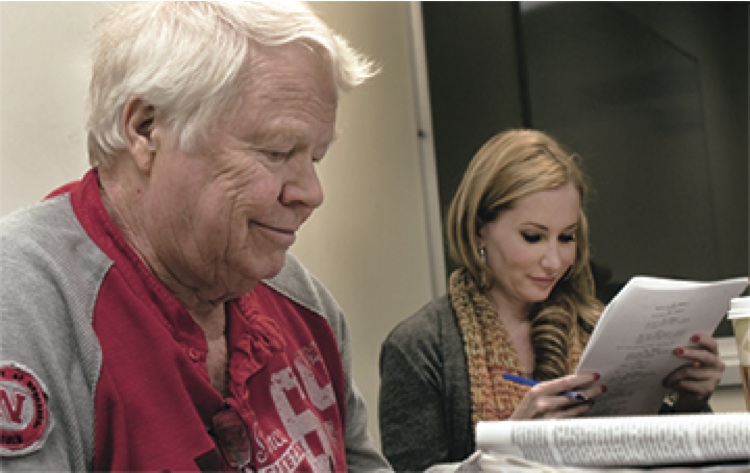
Lew Hunter
Lew Hunter’s small town Nebraska boy made good in Hollywood story is a doozy
©by Leo Adam Biga
Appeared in the March 2016 issue of the New Horizons
Nestled at the bottom of Eastern Nebraska, about a three-hour drive from Omaha, the sleepy hamlet of Superior is home to one-time Hollywood Player Lew Hunter. Pushing 81 and retirement now, he still exerts enough influence to bring Tinseltown types to this isolated spot. Growing up a Neb. farm boy not far from there, Hunter dreamed of doing something in show business and he did as a television network and Hollywood studio executive. producer, screenwriter.
He’s on the short list of Nebraskans with major Hollywood credits. He isn’t as well known as some as his success came behind the camera, not in front of it. Not since Darryl Zanuck’s mogul days did a native reside so far within Hollywood’s inside circle as Hunter. Of past screen legends from Neb., he says, “These people were role models for me.”
Hunter’s a role model himself for having programmed popular network shows in the 1960s and 1970s that still draw viewers on Nick at Nite. Some mini-series and TV movies he shepherded for the networks were sensations in their time. Three movies he wrote, two of which he produced himself, earned huge shares and generated much discussion for their sensitive treatment of hard issues.
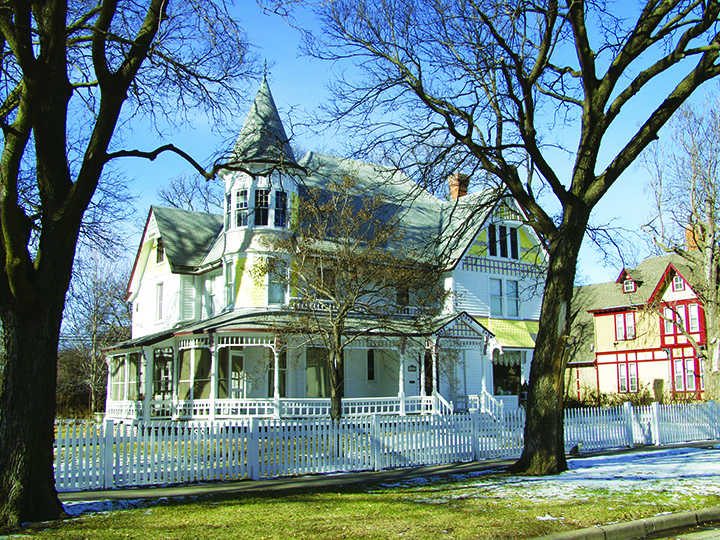
Site of the Superior Screenwriting Colony

A full life and an amazing career
Hunter’s the first to tell you he’s led one helluva life.– one as big as his oversized personality. Given where he came from, his career seems unlikely, but a desire to prove himself drove him to succeed.
Throughout the Great Depression and Second World War, he was enamored by the movies and radio. Then, during the Cold War and Baby Boom, he fell under TV’s spell.
Weaned on MGM, RKO and Paramount musicals – the only motion pictures his mother allowed him to see – he projected himself into the fantasies he saw in the lone theater in his hometown of Guide Rock. He imagined himself up there on the silver screen.
“I wanted to be Fred Astaire so bad. I danced with a pitchfork, and the pitchfork was Ginger Rogers.”
The barnyard filled in for a ballroom or nightclub.
The fact that Hunter went on to enjoy a storybook career rubbing shoulders with the likes of Astaire and other stars does not escape him. He knows how fortunate he was to create top-rated movies of the week. He’s grateful to be emeritus chairman and screenwriting professor at UCLA and to have written a book based on his class, Screenwriting 434, that’s the bible for cracking the scriptwriting code.
Some of his students have enjoyed major film-TV careers, including Oscar-winner Alexander Payne, one of dozens of great screenwriters and directors Hunter’s had as guests for his class. Those sessions have featured everyone from the late Billy Wilder and Ernest Lehman to William Goldman and Oliver Stone.
Hunter’s the subject of a new documentary, Once in a Lew Moon. It portrays his love of the writing craft and writers and the reciprocal love writers feel for him. The feature-length film by fellow Neb. native Lonnie Senstock premiered at UCLA, where Hunter’s retiring after this quarter. The doc screens at the Omaha Film Festival on March 12.
This once big wheel and still beloved figure in Hollywood gave up that lifestyle years ago when he and his wife Pamela settled near his boyhood origins to make their home in Superior. Twice a year there he convenes the Superior Screenwriting Colony, an immersive two-week workshop for aspiring and emerging film-TV writers. He leads it in an inimitable style that is equal parts Billy Graham, Big Lebowski and Aristotle on the Great Plains.
This prodigiously educated and well-read man once considered entering the ministry. He long served as the lay leader of a Methodist congregation. He does treat screenplays with a reverence usually reserved for the scriptures. When he gets rolling about scene structure and character development, he might as well be a preacher. Far from being a choir boy though, this let-your-hair-down free spirit uses coarse language the way some people use punctuation. There was a time when he drank to excess. A naturally verbose man and born raconteur, his preferred way of teaching is telling stories. Asides and anecdotes beget full-blown stories. He has a vast store of them.
The site of the Colony is a restored Victorian mansion across from another period house he and Pamela occupy. He’s prone to lecture in shorts, T-shirt and bare feet. While professing he keeps near him a file folder bulging with lecture materials. He fishes out writerly quotes, excerpts or tidbits to share, referencing Tennessee Williams, William Faulkner, Joseph Campbell. He relates how as a Northwestern University grad student he asked guest lecturer John Steinbeck what to do to be a great writer. The legend’s response: “Write!” Hunter’s appropriated a variation as his sign-off in letters and emails: “Write on!”
Colony sessions are largely unscripted improvisations. Hunter doesn’t need notes, he says, “because the structure is exactly the structure I do in a 10-week class.” At table readings he reads, aloud, students’ ideas or outlines and offers verbal notes, inviting group feedback. He proffers precise analysis that constitutes Lew’s Rules.
“Too little story.” “Too much story.” “What’s your story really about?” “Your imagination is the only restriction you have.” “Conflict, conflict, conflict.” “Story, story, story.” “Character, character, character.” “All comedy and all drama is based on the three-act structure.” “My paradigm is situation, consequences and conclusion.” “Don’t even think about writing down to the audience.”
His rapid-fire yet relaxed, let-it-all-hang-out approach is fun. But his sunny, cruise-ship-recreation-director manner is leavened by a semi-scholarly seriousness that makes clear this is no joke. There’s work to be done and no time to waste, well, maybe a little. Students pay thousands of dollars to attend, many traveling long distances to participate. Perks include drop-in visits by Hollywood friends like Kearney native Jon Bokenkamp, creator of The Blacklist.
Colonists aim to please their guru, whose laid-back Socratic Method has its charms. It suits this one-time King of Pitchers who bent the ear of producers and executives when trying to sell a story idea or script. Hunter knew how to play the game because he was on the other side as a producer-executive, listening to writers-directors pitch him.
How it all happened for Hunter is, well, a story. One he’s only too glad to share. It aptly falls into three-acts. But leave it to Hunter to digress.
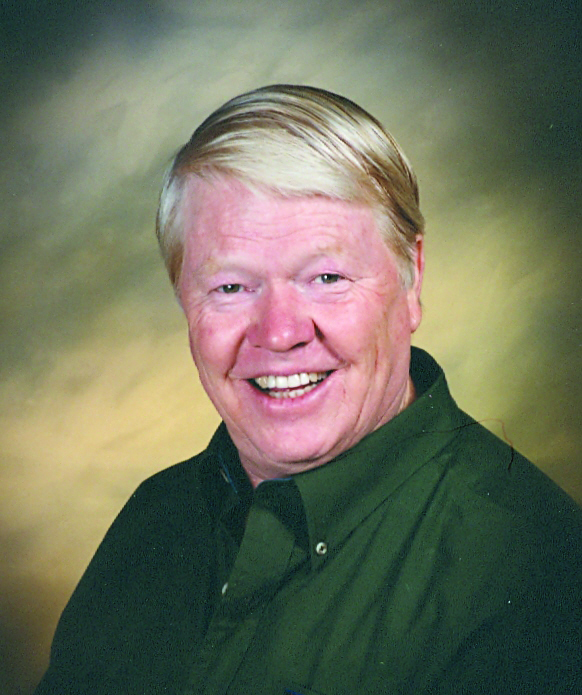
Lew back in his salad days at the networks
Midwest roots
Raised in an “extraordinarily conservative” environment full of narrow-minded views – “I felt like I had a pretty sheltered life” – Hunter had a lot of growing up to do post-Guide Rock.
His classically trained mother exposed him to cultural things to round out the corn pone experience. For example she had him take dance and music lessons. His father was “known as the most loved and strongest man in Webster County” before a massive stroke left him paralyzed and unable to speak. “The first 12 years of my life I had him and then I lost him to a stroke and aphasia,” Hunter recalls.
As his father slipped further away, Hunter’s overbearing “hell on wheels” mother became the dominant presence in his life.
“She was the head of the Nebraska Republican Party, the DAR (Daughters of the American Revolution) and WCTU (Women’s Christian Temperance Union) in her lifetime. Someone asked me once, did you love your mother?” and I said, ‘Well, I think I loved her, but I didn’t much like her. I respected her. And my father, I adored.”
A bright boy who felt betrayed by life for taking away his father and bored with his surroundings, Hunter rebelled. He got caught doing petty vandalism. With his mother unable to handle him, a judge offered a choice – reform school or military school. Hunter chose the latter. A valuable takeaway from Wentworth Military Academy in Lexington Mo. came playing football. Back home he had no experience with African-Americans. He only heard disparaging, scornful things. Then one game while playing guard he went up against a black tackle whose extreme effort and high ability made a lie of what he was told.
“I got the shit beat out of me. That was a very good learning lesson. I deserved it.”
Hunter’s racial education continued at Nebraska Wesleyan University in Lincoln, where his roommate was a black student-athlete.
“Meeting him was clearly one of the best things. We palled around together. He took me down to the jazz cellars in Lincoln.”
Hunter became enough of a jazz devotee that at 17 he hitchhiked to Chicago to see Art Tatum at the Blue Note.
He studied theater at Wesleyan and he made his first foray into show biz working at Lincoln radio and TV stations.
“I became so caught up in the idea of being a professional that it spurred me to go to Chicago.”
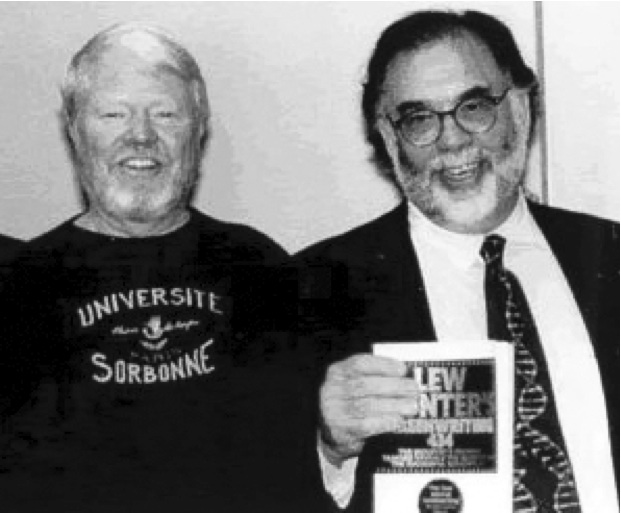
Lew with Francis Ford Coppola
Rebel with a cause
Intent on studying broadcasting at Northwestern, he applied but was rejected. Not taking no for an answer he garnered letters of support from Neb. dignitaries and struck a bargain with school officials to enroll on a probational basis. If he got all As, he stayed. If he got even one B, he’d leave. He stayed and excelled, earning a master’s in 1956.
“That rebellious aspect of me is still part of me.”
He worked in Chicago radio as a disc jockey and producer. But he wanted out of the Midwest in order to try his hand in Hollywood. Everyone he consulted told him to quit what they considered a cockeyed dream and stay put. Instead, he followed his heart and went.
“I’ve been pretty much a guy that ‘no’ is just a word on the way to ‘yes.’ If I really want something bad enough, I keep on it.”
He did not head out alone. Though barely 20, he was already married. He and his young bride packed their Packard and hoped for the best.
He laid the groundwork for his eventual break into the big time by getting a second master’s at UCLA, this time studying film.
“I went to UCLA on a David Sarnoff Fellowship. I took a lot of pleasure and pride in that.”
He used that opportunity to get his foot in the door.
Future cinema legend Francis Ford Coppola was a classmate. Years after their graduate student days, Hunter had Coppola appear at the UCLA class he teaches to talk screenwriting with students.
At the Westwood campus Hunter indulged in some serious hero worship of his favorite instructor, Arthur Ripley.
“I had very specific mentoring with Arthur Ripley. I just adored him. He was the most charismatic, interesting man.”
Hunter says Ripley’s sarcastic humor was reflected in a famous one-liner attributed to him. When stoic former U.S. President Calvin Coolidge died Ripley was said to have cracked, “How could they tell?”
A veteran from Hollywood’s early sound era, Ripley helped create the miserly, misanthropic W.C. Fields character the comedian parlayed to great success. Ripley worked for cinema giants Mack Sennett, Frank Capra and Irving Thalberg.
“I admired Arthur Ripley and all these wonderful stories he told when he worked at MGM for Irving Thalberg. He told stories about running around with Thomas Wolfe. I was like a sponge soaking up all that stuff. I have more show business stories because I loved the business and the people and the craziness of it all.”
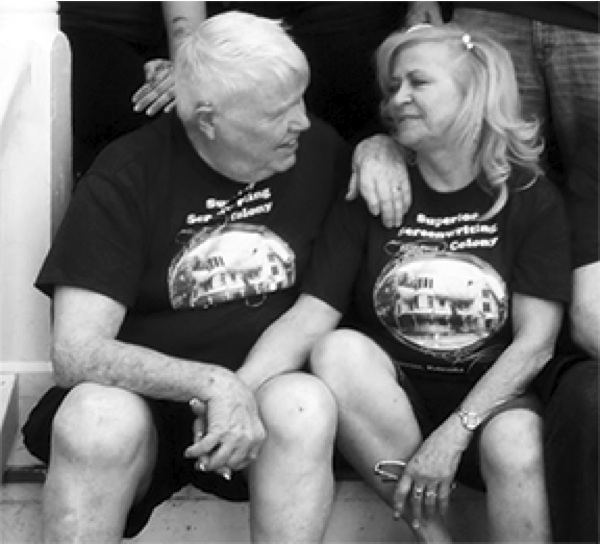
Lew and Pamela
The start of it all
Hunter got on as a page at NBC and then worked in the mailroom, where he rose up the ranks to music licensing and promotion.
“I could see there was a ladder I could climb at NBC.”
He later worked in promotion at ABC and served stints at CBS and Disney, among other entertainment conglomerates, before eventually transforming himself into a producer-writer. He later rejoined NBC.
Then-NBC and MTM president Grant Tinker gave Hunter some sage advice about the vagaries of Hollywood when Hunter was torn between staying at NBC or taking an offer at ABC.
“He said, “For your benefit you need to know that in this business you’re not rewarded for loyalty. Quite to the contrary, we’ll probably be more interested in you if you go over to ABC, and so I did.”
And just as Tinker predicted, after making the move Hunter found himself more in demand than ever.
“In this business, if they want you, over hot coals and razor blades they will come get you. But if they don’t want you, nothing. I mean you’re either eating high on the hog or on the hoof of the hog.
“For one brief shining moment,” as the song goes, Hunter officed at four different studios, including Paramount.
He got schooled by (Aaron Spelling) and had run-ins with (Irwin Allen) some big-name producers.
Seeing so many different sides of the business, he learned the ins and ours of how shows and movies get developed, packaged, marketed.
“I was in promotions doing trailers for Bonanza, Dick Powell Theatre, Dinah Shore Chevy Show and so forth. I was around it all the time. A sound engineer and I went around to stars’ homes with a reel to reel tape machine to record them reading copy promoting their shows. Once, we went to the home of my idol, Fred Astaire. As he was reading into a microphone the copy I’d written for him I glanced through another room’s open doorway and I saw a pool table inside. When he was done I said, ‘Do you play pool, Fred?’ and he said, ‘Yeah, do you play pool?’ I said, Well, a little, and he said, ‘Oh-oh, I’m toast, c’mon, let’s go.’ I played a game of pool with Fred Astaire and he won and I let him win. I could not dream of beating my idol.
“I have lots of stories about John Wayne, Marilyn Monroe, Cary Grant. It just goes on and on.”
Perhaps the star he got closest to was Judy Garland.
“She and I were very close on an emotional level. We had such a wonderful relationship. We never went to bed with each other but we sure flirted with each other a lot. I’m still in sorrow over what happened to her over the last few years of her life and how she died.”
He enjoyed getting to know the real personalities behind the personas.

The writer’s way
Doing promos was fine but he felt pulled to go where the action is – programming. He took endless meetings with writers, producers, agents. He gleaned what he could from those around him.
“I had doors open for me all the time I think because of my Neb. decency. I was just eager to absorb everything I could and I learned so much in those story conferences, going to dailies, watching rough cuts and observing artists working on the backlot.”
He was at ABC and then Disney (as a story executive) when the urge or, more accurately, the obligation to be a writer got the better of him.
“I had been for like four or five years telling writers how to write and never having made a living as a writer myself. It bothered me a lot because I really didn’t think I had the cachet. I mean, it’s very, very alarming to give notes to Paddy Chayefsky, who I idolized, or Neil Simon. I was having lunch with Ray Bradbury at the Disney commissary and I said, ‘I’ve read 2.000 scripts in the last two years and 90 percent of them are shit. I think I can be in the top 10 percent. He encouraged me to read Strunk and White’s The Elements of Style and Dorthea Brande’s Becoming a Writer.
“I came home and told my then-wife I’ve gotten to the point where I want to try to be a writer myself. And she said fine.”
It was a leap of faith as the couple had young kids and a mortgage.
Hunter left his job to scratch this itch. He made a pact that if he didn’t make it in a year he’d find a job. Fifty-one weeks later none of the screenplays he wrote had sold. Tapped out and with a family to support, he took a job as a body sitter at Forest Lawn cemetery. The ghoulish work entails sitting up with corpses and laying them down if they rise up from rigor mortis. He’d done it at an uncle’s funeral home in Guide Rock and again to pay his way through college.
The day before he was to start Aaron Spelling called saying he wanted to buy Hunter’s script for what became If Tomorrow Comes. If it hadn’t sold at least Hunter knew he’d tried.
If Tomorrow Comes is the story of an ill-fated romance between a Caucasian girl and Japanese-American boy in the days before and after Pearl Harbor. The couple get separated when he and his family are ostracized after Japan’s attack on the U.S. and eventually imprisoned in an internment camp.
Even though Hunter grew up during the period when Japanese-Americans were interned he was, like the general public, oblivious to what happened. He only thought about the internment as the premise for a script when a relative recalled this infamy in less than sympathetic terms. That propelled Hunter to research the subject. He was appalled to discover that innocent Japanese-Americans were summarily stripped of property, businesses, livelihoods. Their kids taken out of schools, their lives disrupted. They were treated as criminals and traitors. All without due process. He was dismayed to find they were interned in camps surrounded by barbed wire and armed guards.
“I was shocked we incarcerated more than 120,000 citizens.”
He was shocked this injustice was not mentioned in textbooks. He was offended that many folks dimssed the incident as just part of the price of war. That it was merely a regrettable inconvenience when in fact it was a traumatic severing and breach of trust and civil rights.
In writing his script he found an emotional hook everyone could relate to by imagining a star-crossed Romeo and Juliet romance torn asunder by those harsh, unforgiving events. Patty Duke and Frank Michael Liu starred as the lovers whose lives are interrupted by history.
Anne Baxter, James Whitmore, Pat Hingle and Mako co-starred.
He considers the resulting 1971 movie made from his script among “the stuff that I’ve done that I’m most pleased with,” adding, “That was the thing that got me going. We got a 39 share. My phone was ringing off the hook. Then came another project and another one.”
Hunter resumed working for NBC and various studios in the 1970s and 1980s. As a general program executive at NBC he helped bring to the small screen two movies touching on social=political-moral issues in The Execution of Private Slovak and The Red Badge of Courage (both 1974). Later, as director of program development, he oversaw some major mini-series, including Centennial.
His next venture as a writer confronting social issues was Fallen Angel (1981), in which he tackled pedophilia long before the Catholic Church scandal broke. The idea for taking on the sensitive topic seemingly popped in his head during a meeting.
“I was pitching to Columbia executive Christine Foster when the phone rang. We heard, ‘This is Peter Frankovich here.’ He was an executive at CBS. Christine said, ‘I’ve got Lew Hunter.’ We all knew each other. I said, ‘Can I show you something, Peter?’ He asked, ‘You got anything hot?’ And I found myself saying, ‘Child pornography.’ It just came to me. And then, boom, he said, ‘You’ve got a deal.'”
Only Hunter didn’t have a story, much less a script. He was due to meet Frankovich the next week.
“I said to m self, ‘Oh, shit, I’ve gotta get a story together.” I went down to what was called the Abused Children’s Unit at LAPD. They told me everything they could tell me. I was in constant horror. They had me go down to the hall of records and look at the pedophile records.”
He learned how perpetrators groom their victims. In his script the perp is a photographer (Richard Masur) who befriends a fatherless girl (Dana Hill) and convinces her to pose nude. It bothered Hunter that kids could be manipulated or coerced to appear nude and perform sexual acts and that L.A. was the porn capital of the world.
It was only after Fallen Angel aired he remembered he had a childhood encounter with a pedophile.
“My mother thought she’d make a little bit of money by renting out a room to a Superior Knights semi-pro baseball player. He was a large man and he roomed right next to my room. One day he suggested we go out to the cornfield for a beer. We drove out there and parked. He said, ‘You’ve been really naughty to your mother.’ Of course, I had. I was a little ass-wise, That’s how I ended up at military academy. And then he put his hand on my thigh and said, ‘You know, you deserve to be spanked.’ I didn’t have the slightest idea what was going on but I knew it was bad, so I disengaged myself, leaped out of the car and ran through the cornfield back home. I didn’t say anything to my mother. That man was back in his room that night and I spent every night for the next month with a .22 rifle next to me when I went to bed. I was going to shoot him if he came in and tried something.”
Hunter says the man attempted to molest some of his buddies, too. While Hunter was away at military school he heard the authorities finally caught the predator. Several boys filed complaints against him.
Fallen Angel scored a record 43 share.

Too close for comfort
A personal tragedy informed Hunter’s next controversial and much viewed project, Desperate Lives (1982).
“My best friend at the time said we should so a story together about our boys. Our sons were both deep into drugs. One of the people I talked to in researching this was my son, who said, ‘I can get drugs at my high school quicker than I can get lunch at the cafeteria.'”
Hunter made a decision to give the protagonist played by Doug McKeon the same name as his son, Scott, who didn’t appreciate it.
“it was a stupid thing because it really estranged us, I’m sure for the rest of our lives. He basically doesn’t talk to me, just superficially. That was a very negative thing in my life and something I deeply regret.”
About doing projects that meant something, even at a cost, he says, “I just started poking round through life and coming up with things that really energized me. That was the key for me.”
Fast forward a couple decades, to soon after Lew and Pamela moved to Superior, when the scourge of methamphetamine hit hard.
Concerned by its devastating effects on residents’ lives, he and Pamela formed a nonprofit to raise awareness of the dangers and of helping resources available.
“This bloody meth problem is a terrible problem,” he says. “It’s a rural holocaust.”
He got retired Nebraska football coach Tom Osborne and other public figures, along with law enforcement officials, to appear at a town hall meeting. The Hunters mentored in Osborne’s Teammates program.
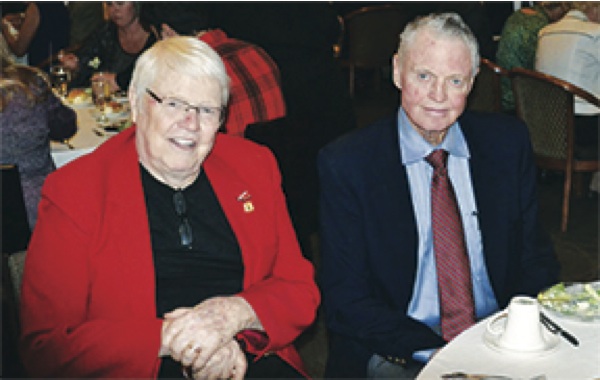
Lew and Tom Osborne, ©The Digg Site Productions, photographer Christine Young
Lew says. “Boy, we really had a roll going. We certainly woke the town up to the fact we have a very serious problem and the reality is the problem still exists. I don’t think it’s going to subside.”
The nonprofit he launched has since been absorbed into a state Health and Human Services program.
Superior Express publisher Bill Blauvelt says the Hunters are a presence in that tiny community.
“Lew and Pam have been active on many fronts. When they take on a project it is a joint effort. You don’t get one with out the other. They have financially supported many community activities and encouraged programs. Last summer they brought in a painter to work on their homes and then kept finding work so that he and his crew stayed the entire summer. They provided a house for the men to stay in.
“Their homes are always open. If we have important people coming to town and they need a place to stay, you can count on the Hunters to provide lodging. The colony program has brought lots of visitors to town, many of whom spend freely while here. And the colony has brought me friends. Often I have been invited to attend their get acquainted picnics and late night parties.”

Finding his niche as teacher and author
After If Tomorrow Comes and before Fallen Angel. Hunter began teaching at UCLA in 1979. From the start, he’s taught grad students.
“I love that. Undergraduates, they know too much – they haven’t been knocked around as the graduate students.”
He says teaching screenwriting while penning scripts himself proved fruitful.
“It was great. I’d be working on a script and I’d realize. ‘I can’t do this,” because I just told students they’re not supposed to have two people in a room agree with each other – one of my dictums.”
His classes became popular, especially 434. Each student starts with a synopsis and they’re guided step by step to create an outline, story points, and by the end of the class they have a first draft screenplay.
“Then somebody said, Why don’t you put your class on paper?’ I said, ‘That’s a good idea.'”
He says. “Other screenwriting books are ABOUT screenwriting but they don’t tell you HOW TO write a screenplay, they don’t give you the caveats you get on a professional level. Not only do I tell you how to write a screenplay I tell you how 80 to 90 percent of professionals write a screenplay.”
As more than one person in Once in a Lew Moon states, Hunter demystified the screenwriting process and made it accessible to everyone. Like the evangelist he is for screenwriting, he even spread the gospel doing workshops around the world in his aw-shucks style.
“From me, you don’t get this academic bullshit you get from other people who have only learned from a book or they’re failed screenwriters. They give misinformation. I would not have gone into professing had I not been successful. If you go to IMDB you’ll see it’s a pretty long list of stuff I’ve done – probably over a hundred hours of actually writing stuff and producing it. I’m really quite proud of that.”
He’s also proud he and his colleagues helped “professionalize” the screenwriting program at UCLA.
“We have more professionals professing.”
Since the program produces many grads who work in the industry, there’s a deep talent pool of writers who come back to teach. Their experience gives students is a taste for how things really work.
“We try to recreate what they’re going to face when they go out into the professional world with the meetings and note sessions before they actually write the screenplay and polish the screenplay.”
Soon into his teaching career he and a group of his students formed the Writers Block, a monthly social for writers. Newly divorced at the time, he offered to host it at his three-bedroom Burbank home.
This open house started small but grew like wildfire.
“The first one had about 20-25 people, then we got 40 and then 40 became 70 and 70 became…until eventually we got hundreds. People would come in and out over the evening. Professional writers dropped by because they liked the atmosphere. We socialized and bull-shitted.
I’ve always felt we writers socialize but we don’t party – it’s too frivolous. It was a wonderful thing.”
In the documentary, former students express gratitude for Hunter creating “a community” of writers. When Pamela entered Lew’s life she became part of the scene. Once Lew and Pamela adopt you, you not only have the keys to their heart but to their house, too.
The last Writers Block in ’99 was held off-site to accommodate the 1,000-plus attendees.
“We closed it down when we moved back to Nebraska,” he says. “Going back to the roots,” he calls that full circle relocation.
He and Pamela will be buried in the Guide Rock cemetery.
“We’ll be stacked,” he says. “The one that goes first will be on the bottom and the one after that will be on top. That’ll raise some gossip.”
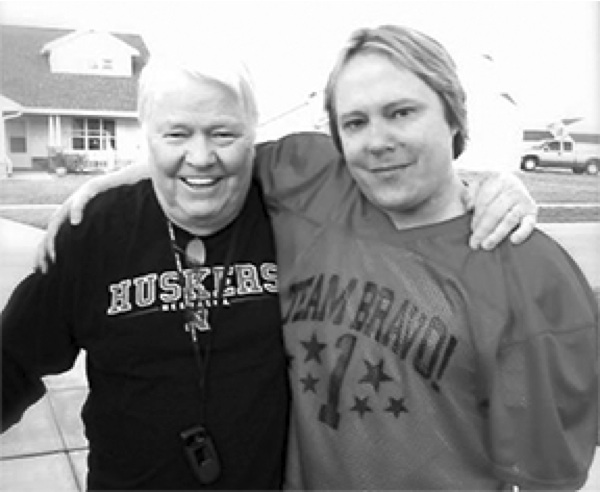
Lew and Lonnie Senstock
Once in a Lew Moon
The documentary about Lew is a passion project for director Lonnie Senstock, who regards the Hunters as surrogate parents.
“Well, he wanted to do something about me,” Lew recalls. “He came to the colony and shot a lot of footage. That was a decade ago. He’s been working on this sucker for 10 years. Very shortly on into the relationship he said, ‘I’d like you and Pamela to be my parents.’ His parents died within a ear of each other. We said sure and so he calls us papa and mama and we’re cool with that. He’s a really nice man.”
Senstock says the film could have gone a different direction when he and Lew experienced some difficulties in their lives. But, he adds, “I found myself celebrating something beautiful instead of something dark. I didn’t realize it was going to be that way until Lew and I talked about the celebration of writing. We realized it was bigger than him. We really wanted it to celebrate that life that so seldom is given kudos.”
Hunter appreciates that focus, “Everybody in it is talking about screenwriting. I like that.” He likes, too, how it overturns the idea that somehow actors and directors just make up movies as they go along.
“There are men and women who write these things.”
Meanwhile, this old lion of cinema, now battling illness, is readying his next book, Lew Hunter’s Naked Screewriting: 25 Academy Award-winning Screenwriters Bare their Art, Craft, Soul and Secrets.
Whatever’s happening with him, he still makes time for past-present students. He’s frequently sought out to consult on scripts and projects. He makes himself available 24-7.
“I’ve always thought being accessible was the right thing to do.”
Besides, he says, “I identify so much with people who are dreamers.”
Once in a Lew Moon screens Sunday, March 12 at 3:45 p.m. at Marcus Village Pointe Cinema in Omaha.
Follow Lew’s adventures at http://www.lewhunter.com.
Old Hollywood hand living in Omaha comes out of the shadows: Screenwriter John Kaye scripted “American Hot Wax” and more
January 30, 2016
3 comments
You never who you might meet in your hometown. Veteran Hollywood screenwriter and literary novelist John Kaye has lived under the radar in Omaha since late 2014 working on a new novel but he’s coming out of the shadows for a celebration of one of the movies he wrote, “American Hot Wax” (1978). It’s the story of rock ‘n’ roll’s crossover from fringe race music to mainstream popularity courtesy DJ Alan Freed. Kaye’s appearing at a Feb. 7 Film Stream screening. Here is my short profile of Kaye in the February 2016 issue of The Reader (www.thereader.com).
Old Hollywood hand living in Omaha comes out of the shadows
Screenwriter John Kaye scripted “American Hot Wax” and more
©by Leo Adam Biga
Appearing in the February 2016 issue of The Reader (www.thereader.com)
Omaha is the adopted home of veteran Hollywood screenwriter and literary novelist John Kaye, 74, whose memoirs are published by the Los Angeles Review of Books.
The mercurial Kaye came 17-months ago from northern California to work on a new novel (his third) and immerse himself “deep” in a fictional Omaha subplot.
“I wanted to take a risk with what I was doing. The best decision I made,” he said from his writing-reading perch at Wohlner’s in Mid-town.
It’s not the first time he’s used Omaha as workplace and muse. In the early 1990s he researched here for an Omaha character in his first novel. Decades earlier he passed through hitching cross country on a personal Beat adventure. That drop-out, tune-in odyssey led him to Jamaica until Uncle Sam called.
On Feb. 7 Film Streams will present a 1978 film he wrote, American Hot Wax, that tells the story of DJ Alan Freed, who introduced white audiences to rock ‘n’ roll. Until now Kaye’s kept a low profile here, but that changes when he does a Q&A after the 7 p.m. show.
Kaye grew up in a West Los Angeles malaise of stale Hollywood dreams. He entered the ferment of 1960s social rebellion as a UC Berkeley and University of Wisconsin (Madison) student. He served in the Marine Corps Reserves, where his Jewish, college-educated background made him a target.
This child of Old Hollywood and New Journalism, “inspired by the galvanizing youth culture thing,” indulged in the era’s excesses. He was a researcher for David Wolper Productions, where colleagues included William Friedkin and Walon Green. He was an underground journalist, a CBS censor and a producer-writer for the KNBC late night sketch comedy show Lohman and Barkley. Anticipating Saturday Night Live, the show sped the careers of Barry Levinson, Craig T. Nelson and John Amos.
“It was a fascinating moment.”
Then Kaye got fired. Hedging that “disappointment” was the mentoring he received from Mission Impossible and Mannix creator Bruce Geller. Then Geller died in a plane crash.
Kaye’s ex-wife and first love was institutionalized, leaving him to raise their son. She later committed suicide.
“It was a very chaotic time,” he recalls.
All the while he wrote scripts but sold none.
“I was really struggling.”
One day he picked up two young women thumbing rides in L.A. He ditched them after realizing they were Manson girls – post-Charlie’s conviction. The incident sparked the idea for his first industry feature, Rafferty and the Gold Dust Twins (1975). This nihilistic screwball comedy is a shambling, anarchic take on three broken people hooking up for a road and head trip. Sally Kellerman and Mackenzie Phillips teamed with Alan Arkin. Dick Richards directed.
“It was a time when you could write a road movie,” Kaye says of its meandering, seriocomic style. The approach became his niche and hit its peak with Hot Wax. His friend Floyd Mutrux directed. Tim McIntyre, Fran Drescher, Jay Leno, Laraine Newman, Chuck Berry and Jerry Lee Lewis star.

Kaye’s own counterculture leanings drew him to Gonzo hipster Hunter S. Thompson, whom he made the basis for his Where the Buffalo Roam (1980) script. Bill Murray plays Thompson. Kaye’s then-producing partner Art Linson directed. The serious take Kaye envisioned was hijacked by “a make it funny” decree from studio suits. Hanging out with Thompson in New Orleans, an old Kaye stomping ground, while placating moneymen hell-bent on laughs “turned out to be fun but really insane,” said Kaye.
Unkind reviews “singled out” Kaye’s writing. “It was a blood letting. Very painful.”
The experience, he said, gave him “thick skin” and taught him “not to be too invested in something.” Still he said, “It definitely set my career back.” He takes small consolation the movie has a cult following, even admitting, “I’m not sure it holds up as well as Hot Wax.
_ _ _
FROM:

“Where the Buffalo Roam” screenwriter, John Kaye shares pieces of his memoir in the mad styles of Hunter S.T. on one of my favorite literary sites, the Los Angeles Review of Books. The memoir covers all the greats from Kaye’s own unique experience like Muhammad Ali, Joe Frazier, his friend — Hunter S. Thompson, a coked up cheating married hotel clerk, a sober travel agent, the word “colored,” and another word I just learned — ‘truculent.’ This one will require a considerable amount of time and commitment. It’s easily a 45-minute read so buckle up
_ _ _
Kaye’s last screen credit came as writer-director of Forever Lulu, a 2000 film starring Melanie Griffith and Patrick Swayze.
“I decided I wanted to write sort of a valentine to my ex-wife.”
The lead characters have a college affair and years later she escapes a mental hospital to find her old beau, now married, to inform him he fathered a child she bore and was forced to give up for adoption. The pair set out to visit the son who doesn’t know they exist.
A negative trade review cost the film a theatrical release.
The producers, he said, “kind of left me alone,” adding, “It was a great experience for me because I really felt I had stepped out and done something.”
It’s the same feeling he had writing his first novel, Stars Screaming.
“Spending eight years writing this book and getting it done, I realized I would not quit on something and that I had it in me to write it. Even though I wrote myself into complete poverty doing it, I finished it. I stepped through enormous amounts of fear to work to my potential.”
Then came his second novel The Dead Circus. Even with his new novel nearly complete, he says he may linger on in Omaha awhile.
“I’ve fallen in love with this town.”
For tickets to the Feb. 7 screening, visit http://www.filmstreams.org.


Omaha native goes where his film passion leads him: James Duff and filmmaker wife Julia Morrison shot debut feature “Hank and Asha” on two continents
October 18, 2014
1 comment
I have been interviewing and profiling native Nebraskans in film for many years and there’s always someone new I discover who’s doing interesting work in that medium. Such is the case with James E. Duff, who wrote and directed the well-reviewed feature Hank and Asha, an inventive picture whose two protagonists carry on a totally digital-virtual relationship that seems destined to lead to a physical romance, only as in real life the story doesn’t necessarily lead where you expect. He and Morrison made the film in Europe and in America. As my profile of Duff for Metro Magazine (http://www.spiritofomaha.com/) explains, Duff has a bad case of wanderlust that’s led him to do much traveling around the U.S. and the world to make films. This blog features hundreds of film stories I’ve filed over the years, including mulitple features on Nebraska’s own Alexander Payne, Joan Micklin Silver, Nik Fackler, and Gabrielle Union.

Omaha native goes where his film passion leads him: James Duff and filmmaker wife Julia Morrison shot debut feature “Hank and Asha” on two continents
©by Leo Adam Biga
Originally appeared in Metro Magazine (http://www.spiritofomaha.com/)
Couple’s film played to hometown crowd in Omaha Omaha native James E. Duff goes to extreme lengths feeding his film passion. He once went across the country by scooter to make a documentary. He’s directed films and taught filmmaking in Africa and Europe. His latest travels resulted in his debut narrative feature, Hank and Asha, a micro indie flick he co-wrote with his wife, Julia Morrison.
He directed and she produced the picture shot in the Czech Republic and on the Lower East Side of New York City, where the couple reside.
The film’s been well received at art houses and festivals, winning audience favorite awards. It’s now available on DVD,
Duff’s cinema journey wend its way here in May when he and Julia presented their movie at Film Streams. The Omaha premiere played to a warm, enthusiastic crowd, including his folks. It marked a special homecoming for Duff, who’s followed a long road pursuing his art.
“It was fantastic. I have such a home team here. Omaha supports their own. It’s a really special feeling to see friends and family in the theater,” he says, adding the celebratory turnout “felt like a wedding.”
It was a full circle moment for the filmmaker, whose love of cinema was stoked watching classic movies with his father, Dr. Wally Duff, as a child and habituating the Dundee Theater as a teen.
The filmmaker joins a select group of Nebraskans (Joan Micklin Silver, Dan Mirvish, Alexander Payne) who’ve directed widely seen features.
-
 James Duff and Julia Morrison
Wanderlust
This prodigal son spent 20 years honing his craft in far-flung places: Indiana University; the USC School of Cinematic Arts (his thesis film Life is a Sweet played festivals worldwide); New York City, plus those directing and teaching adventures oceans away.
As a kid he collected stamps from foreign countries and now he’s made it to some of the same spots he imagined visiting.
“I’ve always kind of had a wanderlust. When I was 5 and I first knew what a globe was I looked at the Cape of Good Hope in Africa and declared, ‘I’m going to go there.’ At 19 I studied my junior year abroad and actually backpacked down into the Cape.”
Following his intrepid spirit he captured a 1994 coast-to-coast bicycle trek from the back of a scooter. Feeling his Generation X was unfairly stereotyped as slackers he joined fellow recent college graduates for the fundraising bike trip from California to North Carolina to document “people’s opinions about our generation.”
“We cut right across middle America, biking 80-90 miles a day, staying in these really small towns. We spent some nights at campsites. Churches and families put us up other nights.”
He did the 35-days on a Honda Elite. His roommate, who’d never operated a scooter, drove with Duff on the back holding the camera.
By journey’s end the scooter was beat up after several wipeouts. “When we’d go down it’d be like slow motion because all I was thinking about was the camera. I was 21 and I didn’t think I could get killed.” The fragile Ricoh Hi-8 camera was another matter. “A couple times it broke and I thought the trip was over, but I found this amazing repair shop in a little town that fixed it.”
The trek complete, Duff found himself in unfamiliar territory with no place to edit. Then he got a grant from a film support group and permission to use a corporate editing suite in the Raleigh-Durham-Chapel Hill Research Triangle Park.
“I had 75 hours (of footage) to get down to one.”
Working under severe time constraints he endured panic attacks and exhaustion, often laboring through the night.
“I’d go there and lock myself in with a peanut butter sandwich.”
When he previewed the film for backers, he says, “I couldn’t watch it, but they really liked it. They put on a big screening for the community.” Much to his surprise the film, The Cycle Also Rises, sold to PBS and aired nationwide on the POV series. It confirmed for the Westside High grad his boyhood fascination with film could become a career.

Africa
Though documentaries became his forte, he longed to make dramatic films. He tested the waters in L.A. “I wrote a couple scripts that were close to getting made but I got frustrated not working as a director.” He relocated to New York to direct theater. When an opportunity arose to go back to Africa, this time to make development documentaries in Senegal for nongovernmental organizations, he took it.
“The work was very West Africa. You’d show up on time and nobody else would come for another hour. Then the equipment wouldn’t work. Constant frustration. But when we’d show up to these little villages people would welcome us so warmly. They’re beautiful, kind people.”
His docs covered such topics as HIV prevention and circumcision. He independently made a film about Senegal’s lost 20-something generation. He cherishes his two years there.
“It was a really fantastic experience. The food and music is amazing. There’s a lot of artists with a lot to say. My memories are not so much of the work but of these most intense friendships.””
In 2007 he went back to another old stomping ground, Kenya, for a UNESCO project working with aspiring filmmakers.
“I’ve never taught students so passionate. They all wanted so badly to do this. I found it so inspiring to teach them just simple things. ”
In 2010 he went to a refugee camp in the Sahara to teach filmmaking to the displaced and oppressed Saharawian people.
“The camp had no electricity or running water. They’d put up a screen in the bed of a truck and project movies. That was their film festival. They also had a ‘film school’ where I taught. We were training the people to make films so that the world could know their plight. Some students did make films but they’re not getting out.”
From Prague to New York with love
Duff then taught at the Prague Film School in the Czech Republic. Julia joined him on the faculty. Their students were an international lot. Just as in Africa, Duff learned how film cuts across all barriers.
“The gift of cinema is universal,” he says. “To put that tool in people’s hands is so empowering. Giving them a camera is such a potent thing.”
In 2011-12 the couple enlisted some of their students as crew for Hank and Asha, a story about two aspiring filmmakers, Hank in New York and Asha in Prague, whose relationship plays out entirely by video letters. Inspiration came from the disconnection Duff, Morrison and their students felt far from home and from a friend who courted his wife via video love letters. Watching the friend’s videos, Duff says, “felt like we were on the inside of this relationship watching it grow.” That intimate glimpse at budding romance and the anticipation that attends it, is what the filmmakers were after in their own project.
To their delight, Duff and Morrison found they make an effective team.
“It’s really worked out well in our partnership because we have two different skill sets,” Duff says. “Julia came from producing and is a killer producer and I come from a directing background and that’s kind of how we blended together. I think that helps in the partnership because we’re not looking over each other’s shoulder.”
“We’ve had a great experience doing this together as our first film collaboration as a couple,” says Morrison, who’s produced historical documentaries for the PBS series American Experience and current affairs docs for New York Time Television. “We’ve learned a lot and we’ve gone on this great adventure. We’ve traveled the country and the world with the film. All these things have been terrific. But it’s also really hard work to make a movie.”
And to get it seen. They feel fortunate the Hank and Asha found both theatrical and video distributors.
Film streams
For as low budget as the all-digital movie is, the filmmakers are proud of how good it looks. Duff credits cinematographer Bianca Butti for that. Because it’s a two-character piece, it needed actors who could carry the film and reviewers credit Andrew Pastides as Hank and Mahira Kakkar as Asha with engaging performances. His letters were shot in New York and hers in Prague. The actors never met. The filmmakers say for the storyline’s high concept conceit to work the videos had to be as natural as possible. Therefore, no rehearsals were held and the actors improvised from an outline highlighting the arc of each scene. Some found locations were utilized and some shots were stolen.
Duff and Morrison enjoyed great freedom on the project.
“We were blessed to have that. Nobody told us what to do,” he says.
“We’re looking forward to the next project having a larger budget but still retaining our autonomy,” says Morrison.
They hope a new script they’re developing attracts name actors.
The couple say whatever films they make will reflect their shared interest in humanist stories that move audiences.
Meanwhile, they’re always up for a new far-off adventure.
As Duff explains, “We’re on the lookout for opportunities like that because we want to continue to expand our world. It informs everything we do. We’ll go anywhere.”
Categories: Cinema, Film, Hank and Asha, James Duff, Movies, Screenwriting, Writing
Cinema, Film, Filmmakers, Hank and Asha, James Duff, Julia Morrison, Movies
Alexander Payne’s local color: Payne and Co. mine prairie poetry of his home state in new American gothic film “Nebraska”
November 21, 2013
6 comments
I’ve been anticipating Alexander Payne’s new film Nebraska for a very long time. Some years ago he let me read the script by Bob Nelson. I was moved to laughs and tears by it and ever since then I’ve eagerly awaited Payne’s interpretation of it on the screen. As I write this I’ve now seen the film twice and will soon be seeing it a third time. Its depth of emotion coupled with its visual black and white beauty and aching honesty set the film apart from just about anything out there by an American filmmaker today. I believe it to be Payne’s best work to date. I know a little something about the filmmaker, having closely covered him and his work since 1997. I have a book out with my collected jounralism about him titled Alexander Payne: His Journey in Film. It contains some two dozen of my Payne stories from 1998 through 2012 and soon I will be coming out with a new edition featuring my extensive Nebraska coverage. My latest story about the film is shared with you here. It recently appeared in The Reader (www.thereader.com). I fully expect to file a new story about Nebraska come Academy Awards time, when the film should fare very well. You can find my earlier stories about Nebraska on this blog. I’ll salso be adding another Nebraska story I just finished for the New Horizons. Additionally, I will be posting extended interviews I did with Payne, Bruce Dern, Will Forte, Stacy Keach, Bob Nelson, cinematographer Phedon Papamichael, and producer Albert Berger.

Alexander Payne‘s local color: Payne and Co. mine prairie poetry of his home state in new American gothic film “Nebraska”
©by Leo Adam Biga
Excerpt from a story that originally appeared in The Reader (www.thereader.com)
Local color, of the achingly human variety, is where Alexander Payne’s new black and white film Nebraska most deeply comes to life.
After fall festival premieres abroad and across the U.S., Payne’s coming home to show off the film named for his native state and primarily shot and set here. Nebraska had an exclusive limited run at Film Streams. On Nov. 24 Payne joins stars Bruce Dern and Will Forte at the Holland Performing Arts Center for the Film Streams fundraiser, Feature V, that will find the troika interviewed on stage by Studio 360 host and novelist Kurt Andersen.
The following day Payne and Dern travel to Norfolk, Neb., the production’s base camp last fall while the project filmed in nearby Hartington, Plainview and environs, to premiere the picture there.
Oscar-winner Payne is a stickler for the truth and with the by-turns elegiac and silly Nebraska he went to extreme lengths finding the people and places that ring true to his and screenwriter Bob Nelson’s vision of Midwest America.
“This is the most authentically Neb. feature film I’ve released to date,” says Payne, who previously made Citizen Ruth, Election and About Schmidt in-state.
Casting director John Jackson and Payne searched long and hard for the right players to animate the oddball yet familiar characters Nelson created on the page. In a rare star turn winning him much acclaim Bruce Dern so fully inhabits his old codger of a character, Woody Grant, that despite the actor’s well-known face and voice he disappears into the part to become just another of the story’s small town denizens.
Dern plays Woody as written: a taciturn man of stoic roots and repressed pain long alienated from everyone around him. Feeling a failure near the end of his life, he’s desperate for some validation and so gets it in his head that he’s a sweepstakes winner. His son David, played by Will Forte, takes him on an epic journey to claim the prize. Amid the missteps and detours comes discovery, empathy and closure. As their strained relationship warms the son gives his father a gift born of understanding, forgiveness and love.
One of the reasons Payne says Dern leapt to mind when he originally read the script a decade ago is that like the actor’s actress daughter Laura Dern, who starred in Payne’s feature debut Citizen Ruth, he doesn’t worry about what he looks like on screen. To convincingly play the gone-to-seed Woody the actor inhabiting the role had to look a wreck.
“Those Derns don’t have vanity,” Payne says admiringly. “They’ll do anything, they want to do anything. When working they’re more interested in hitting a certain level of truth, an often ugly truth or pathetic truth, and now you’re talking my language.”
About what made Dern the right fit, Payne says, “Bruce is a handsome guy when he’s cleaned up and obviously as you can see in the film when he’s not cleaned up he can really look like a coot and a weirdo. If you took many other actors and tried to do the same thing they’d look fake. The guy would have to portray someone cut off from others and lost in his own world. Woody’s probably been like that somewhat his whole life but as a young man they just thought he was reticent. Now he’s a coot and ornery and pissed off at himself that he hasn’t done anything with his life and now he’s about to start taking a dirt nap. I think that’s certainly what’s driving Woody’s crazy mission in some part.
“When I thought about who could communicate that I thought of Bruce.”
Payne felt Dern could express the two sides of Woody as both prick and pushover who can’t refuse doing favors, even if it means being taken advantage of. He also detected “a certain childlike nature” in Dern that aligned with Woody’s fragility.
“I think within Woody’s ornery crust there is something of a child – of a very disillusioned and disappointed child.”
Indeed, we first meet Woody as he’s running away from home.
“There’s also a sweetness about Woody and Bruce is a sweet guy. He hasn’t often played that.”

Dern acknowledges it’s a departure for him. “Throughout my career I’ve been flamboyant in a lot of roles, especially flamboyantly evil, and there’s a certain style that goes with that.” Nebraska called for him to be a dull, muted, passive presence.
“What the role demanded was a character who appeared to not be touched too much or too little,” he says, “and probably not touched at all. And if he touches other people it’s without planning to do it. He’s just who he is and he’s always going to be that way. I think he’s a fair man, Woody, and that’s another thing I based the character on a lot. Because he’s fair he believes what people tell him because he doesn’t know why anybody would want to lie to him about anything.”
The tangibles and intangibles of a character go into any casting decision.
“When you cast someone in a lead you’re not casting just his or her ability to act,” says Payne. “you’re casting the substance or essence of their person. There’s two things going on simultaneously seemingly contradictory but not. One is you want them to become that person in the script yet at the same time not act.”
Dern says Payne has an uncanny way of communicating what he wants, variously tapping “your strengths and weaknesses and sometimes invading your privacy” to extract the emotion or tone he’s after.
Actors Studio veteran Dern believes he achieved a progressive in-the-moment reality in Nebraska he’d never accomplished before on a film.
“I’ve always wanted to be a human being and just kind of acting-wise leave myself alone and not perform and I don’t think there’s really a moment in the movie where I perform – in other words take it above the context of what it really is. The first day of the movie Alexander said to me, ‘I’d like you to let Mr. Papamichael (cinematographer) and I do our jobs,’ meaning don’t show me anything, let me find it with the camera, and that’s what he did and that’s what you see.
“That doesn’t mean I wasn’t acting. It was as hard a role as I’ve had to take on but I feel I owed it to the material and to my career for just once in my life to try and have as many consecutive moment-to-moment pure moments of behavior. That’s what I began when I worked with Mr. Kazan and Mr. Strasberg in the Actor’s Studio – how much moment-to-moment real behavior can you have? And I think in Nebraska I’ve done far and away the most I’ve had in an entire film.”
Forte, a relative newcomer to acting after years writing for television, says he learned a lot from his co-star.
“Bruce would always say, ‘Just be truthful,’ and that always sounded like acting mumbo jumbo to me coming in but for some reason the way he would explain it and describe it it made sense. There’s such an honesty that comes from his performance and all the performances that it really taught me a lot to watch everyone work.”
Dern says Payne lived up to what his daughter Laura and his old acting chum Jack Nicholson, who starred in the director’s About Schmidt, told him about the filmmaker: “They both said in separate conversations he’ll be the best teammate you’ve ever had. They were right. I feel it’s the best team, overall, I’ve ever had.”
Payne, whose sets are famously relaxed, says he also casts with an eye to who will “be nice to work with” and contribute to the playfulness he believes essential to good filmmaking. “I want to be there to play. I don’t know exactly how it (any scene) should be, I’m there to sort of say, ‘Oh, well, let’s try this and let’s try that, nudging the machine toward a certain direction. It’s not all preconceived, you’re discovering it day by day, so I think you want actors who are willing to have a sense of, Let’s be playful and free. It’s all about having fun, and that will create something none of us have thought of exactly.”
Dern says he’s glad it took nearly a decade to get the film made – the project came to Payne as the filmmaker was setting up Sideways – because “I wasn’t ready to play this role a few years ago.” The passage of time put some more natural wear and tear on Dern, both physically and emotionally. The limp he walks with in the film is real, if exaggerated, and the way Woody leaves things unsaid is something Dern says he’s been guilty of himself and regrets.
Similarly, Payne’s personal life caught up with the experience of David in Nebraska as an adult child dealing with aging parents. Payne’s father is in a nursing home and his mother recently survived a serious health scare.
“I was able to make it quite personal in certain details related to David taking care of his older folks,” Payne says. “Everyone I know of my generation at that age has parents that are getting on and need a little special attention. We love them to death and they drive us crazy. How we take care of them and accommodate them and all those things, and how far do we extend ourselves to be dutiful and at what point do we cut it off, all those questions. It wound up being because of the time in my life when I was making it quite personal. The fact that I had that much more life experience for this film with respect to my parents, I think helps the film. It always helps a film if you can put some of yourself in there.”

Payne says the bottomed-out economy also enhanced the austere shooting style and stark look of the film, adding, “Those winds blew their way into the film as well and it becomes more of a modern-day Depression film.”
Undoubtedly some will take umbrage at the film’s portrayals of quirky. salt-of-the-earth types. But if the strong reception the picture’s received at the Cannes, Telluride and New York film festivals, among others, is any indication, than most audiences realize Payne and his collaborators sought archetype, not caricature in bringing to life small town inhabitants and the dysfunctional Grant family.
“I hope what people take away from this movie is his genuine love for Neb. because he really does love Neb.,” says Forte
Dern calls the film “a love poem” to Neb. from Payne.
Payne, Nelson, Jackson, Papamichael, editor Kevin Tent assorted other crew and the ensemble cast all committed to realizing authentic portraits of this comic-dramatic Midwest Gothic tale.


YOU CAN READ THE REST OF THE STORY IN THE NEW EDITION OF MY BOOK-
Alexander Payne: His Journey in Film
(The new edition encompasses the Oscar-winning filmmaker’s work from the mid-1990s through Nebraska in 2013 and his new film Downsizing releasing in 2017 )
Now available at Barnes & Noble and other fine booktores nationwide as well as on Amazon and for Kindle. In Nebraska, you can find it at all Barnes & Noble stores, The Bookworm and Our Bookstore in Omaha, Indigo Bridge Books in Lincoln and in select gift shops statewide. You can also order signed copies through the author’s blog leoadambiga.com or via http://www.facebook.com/LeoAdamBiga or by emailing leo32158@cox,net.
For more information. visit– https://www.facebook.com/pg/AlexanderPayneExpert/about/?ref=page_internal
Related articles
- Film Review: Nebraska (pop-break.com)
- ‘Nebraska’: Alexander Payne on Bruce Dern’s ‘perfect casting’ (latimes.com)
- ‘Nebraska’: Bruce Dern, movie deliver in a big way, critics say (latimes.com)
- Will Forte Talks NEBRASKA, His Greatest Fears During the Shoot, What he Learned from Bruce Dern, MACGRUBER 2, and More (collider.com)
- Actor Bruce Dern Gets Up Close And Personal In ‘Nebraska’ (npr.org)
- A Star Turn, at 77, in Alexander Payne’s ‘Nebraska’ (nytimes.com)
- Alexander Payne’s New Film ‘Nebraska’ Features Senior Cast and Aging Themes in Story Sure to Resonate with Many Viewers (leoadambiga.wordpress.com)
- Casting director John Jackson helps build Alexander Payne’s film worlds (leoadambiga.wordpress.com)
Categories: Alexander Payne, Alexander Payne's "Nebraska", Cinema, Film, Film Streams, Movies, Screenwriting, Writing
Alexander Payne, Bruce Dern, Cinema, Film, Film Streams, Movies, Nebraska, Will Forte
Nebraska Coast Connection Salon Q&A with Alexander Payne: Filmmaker speaks candidly about “Nebraska,” casting, screenwriting and craft
September 24, 2013
6 comments
I was fortunate enough to be invited to the Sept. 9 monthly Hollywood Salon in Culver City, Calif. sponsored by the Nebraska Coast Connection, a networking group for Nebraskans working in the film and television industry. I was there to promote my book, Alexander Payne: His Journey in Film, which you can order via thisblog site. The salon’s special guest that night was Oscar-winning filmmaker Alexander Payne, who spoke candidly about his new film Nebraska, casting, screenwriting and craft in a Q&A moderated by NCC founder Todd Nelson. The event was held at the classic Culver Hotel, where many film stars stayed back in the day. This is an edited transcript of part of Payne’s remarks.

Alexander Payne at the Sept. 9 salon

Todd Nelson interviewing Payne at the Sept. 9 salon

Some of the crowd at the recent Hollywood Salon featuring Payne
Nebraska Coast Connection Salon Q&A with Alexander Payne:
Filmmaker speaks candidly about “Nebraska,” casting, screenwriting and craft
©Compiled by Leo Adam Biga
Excerpt of Alexander Payne in conversation with Nebraska Coast Connection founder Todd Nelson
AP: “Hello, good evening, thank you for coming…”
TN: “You have a little movie coming out. A little black and white number you threw together over a weekend or two.”
AP: “No, longer than that. But it’s a small movie. That doesn’t mean it’s not dramatically resonant, but it’s a small movie.”
(Then Payne addressed how the project came to him and the background of how its screenwriter Robert Nelson came to write it.)
AP: “Nine years ago I got a script from Albert Berger and Ron Yerxa, the team that had produced Election. They came to me nine or 10 years ago with a script called Nebraska and it was written by a guy named Bob Nelson out of Snohomish, Wash. but his parents were from Hartington (Neb.). And it was based on his memory of his father’s and mother’s families. He used to spend his summers out there in Hartington in northeast Neb. and he wrote this script based on his memories of those summers and it really rang hilariously true. It was a very austere screenplay. Those producers said they suspected it was going to be small for me, too dinky a film.”
TN: “They thought you might know someone who…”
AP: “Yeah, ‘Do you know a young Neb. filmmaker who might want to do this?’ and I said, ‘No, I think I want to do it.’ They had wanted to make it for like $2 or $3 million, and I said, ‘How about like $10 or $12?’ I showed it not long afterwards to someone in attendance here tonight, John Jackson, my casting director, because I knew that this film would really live or die on his casting. I mean, all films do but even a couple percentage points more this one would because it’s as much anthropological as it is cinematic. And he liked it and thought he wanted to cast it. He said he felt a very personal connection to it through his family, whom he describes as dirt farmers from Iowa. That’s a bit of an exaggeration in a way with respect to the script but still it’s suggestive…
“A lot of the movie was a road trip and I was just finishing Sideways. I didn’t want to followup Sideways with another road trip film. It’s a real drag to shoot in cars and I just couldn’t do another car movie again after Sideways. Now The Descendants ended up having some stuff in cars too but anyway…the timing worked out and right after The Descendants I made it. They were nice enough to wait – the producers and the writer – and so it happened.”
TN: “It has Bruce Dern and Will Forte. Tell us about bringing them on board.”
AP: “Bruce Dern had first leapt to mind to play this part. All parts are tricky to cast in general but this one I think for John and me has been the trickiest. You know. I get praised sometimes for getting a certain controlled performance out of Jack Nicholson or that I get stars to create characters, that after 10 or 15 minutes of seeing a big star like George Clooney you can maybe, hopefully, of course it’s my aspiration, forget it’s a big star and just see the character…I never tailor a screenplay to fit the actor. I always demand the actor come to the script – even if it’s Nicholson or Clooney, who have certain strengths that most directors and screenwriters would wish to exploit.
“Naw, this is a text and it’s a part and yes you’re a star but you’re also an actor, so come to this and make it your own that way. This though I think has been the most specific lead part we’ve ever had to cast. Not anyone could play this guy Woody Grant. I looked back in film history and said, ‘Well, Henry Fonda could have played it like the way he did On Golden Pond, or Walter Brennan, or for you film buffs out there Charley Grapewin, or possibly John Carradine or possibly Warren Oates had he lived. But all those people are unavailable. After thinking about Bruce Dern, the only other guy who maybe could have done it, Gene Hackman, but I couldn’t get a meeting with Gene Hackman because he genuinely has retired. He won’t even return a phone call or a query. So it just came down to Bruce Dern.
“We did our due diligence and met 50 other guys and any one of them who could have done it would still be a stretch. Like this one could maybe do it but he has trouble learning lines or this one could maybe do it but you’d have to get him to not do this schtick or this one could maybe have done it but it would have taken more work on my part and every actor requires work anyway. Bruce required work but less work than any of those other guys would have required to get it right, so Bruce Dern’s the guy.”
TN: “Will Forte?”
AP: “Never would have thought about him in a billion years but he auditioned well. So I know often in these salons we get actors or casting people and I’m always happy to say that John and I rely on auditions, the old fashioned way. Even actors who are well known I still need them to come in and read the text, with all respect. I mean, even if it’s 10 words, say a few words, help me out, I have a pea brain, I don’t want to screw it up, and I don’t want to screw up and cast you in the wrong part and then it’s not right. We all benefit if we’re able to have a meeting. Well, what else are we going to talk about? Read the fucking script.
“And to good pros, the ones who won’t audition, but they will deign to have a meeting, the good ones will either consciously or unconsciously find the time in the meeting to say, ‘Oh, I loved the moment in your screenplay where he says…’ and he’ll do a little bit of it. That’s the courteous thing to do, that’s the polite thing to do because those actors who won’t even do that don’t get the job in my experience.
“Just about auditioning stuff I remember the actress Judy Greer, a super great old fashioned in the best way actor. She’s in The Descendants. She plays the lover’s wife. She calls herself an audition-only actress. She won’t take an offer and if there’s a meeting she insists on reading the script because she says it’s only when I read the text in front of the director do I know if I’m right for the part. So the direct line of communication between actor and director is that text. That’s just smart. What the hell else are we doing?
“June Squibb, she played the part of Jack Nicholson’s wife in About Schmidt (and she plays Bruce Dern’s wife in Nebraska)…I didn’t offer her…She didn’t occur to me, she sent in an audition. Even she had to audition. I had no idea she was going to be right for this part. It’s the Geraldine Page part or the Marjorie Main part from Ma and Pa Kettle. Basically Nebraska’s a glorified Ma and Pa Kettle film,” he said, deadpanning and elicting laughs.
(Payne discussed some more actors he’s worked with, why’s he’s particularly proud of the casting he and John Jackson did on Nebraska and how he tried to avoid certain pitfalls that come with mixing professional and nonprofessional actors on screen.)
“Tim Driscoll from Omaha, who had a small part in Citizen Ruth, came back for this one. And his sister (Delaney Driscoll) had a significant part in Election as Matthew Broderick’s lover.
“Whatever achievements this film Nebraska may or may not have for me it’s greatest achievement is its most significant marriage of professional and nonprofessional actors because to create that world it’s dependent equally on production design and casting. That’s what suggests that world is that flesh. We spent over a year doing it. The start date is here, the visual preproduction is here, the casting has to start here. You can’t fuck up casting, you’ve got to get the right people in every part and of course the leads and the secondary, tertiary parts have to be exactly right. It’s creating a world.
“I looked at a number of small town American films for this one. One of them in particular is an excellent film and it has professional actors but also people cast from that small town. But there’s a great chasm between the acting styles of the two. It’s like the faces of the real people lend what they’re supposed to lend which is authenticity, versmisilitude and all that but they’re not acting properly, even as versions of themselves. So I knew we had to spend time to get local people who could act as vividly as possible as versions of themselves but also to have the professional actors act flatter. They both had to meet in between. I like when professional actors act more flatly like people do in real life. People don’t gesticulate, go into histrionics in real life, not Midwesterners anyway.”
(Nelson and Payne then made a few comments before screening the trailer for Nebraska.)
TN: “It premiered at the Cannes Film Festival in May. A wild success I can witness – I was there. I saw a 15 minute standing ovation at the end of the film.”
AP: “Yeah, I’ve seen turkeys get a standing ovation at Cannes. It played better at Telluride.”
(Then, referring to the trailer, Payne said)-
AP: “This is a work in progress print.”
(After the screening someone in the audience commented about the Spanish sounding music, which prompted Payne to describe it as a)-
AP: “More Mexican sounding trumpet piece.”
YOU CAN READ THE REST IN THE NEW EDITION OF MY BOOK-
Alexander Payne: His Journey in Film
(The new edition encompasses the Oscar-winning filmmaker’s work from the mid-1990s through Nebraska in 2013 and his new film Downsizing releasing in 2017 )
Now available at Barnes & Noble and other fine booktores nationwide as well as on Amazon and for Kindle. In Nebraska, you can find it at all Barnes & Noble stores, The Bookworm and Our Bookstore in Omaha, Indigo Bridge Books in Lincoln and in select gift shops statewide. You can also order signed copies through the author’s blog leoadambiga.com or via http://www.facebook.com/LeoAdamBiga or by emailing leo32158@cox,net.
For more information. visit– https://www.facebook.com/pg/AlexanderPayneExpert/about/?ref=page_internal
Related articles
- When a Film Becomes a Film: The Shaping of Alexander Payne’s ‘Nebraska’ (leoadambiga.wordpress.com)
- Author Leo Adam Biga Joined Nebraska Coast Connection Salon Featuring Alexander Payne to Promote His Book About the Filmmaker, ‘Alexander Payne: His Journey in Film’ (leoadambiga.wordpress.com)
- Bruce Dern Sets Out On A Long Trip In This Brand New Trailer For Alexander Payne’s Nebraska (2013) (durnmoosemovies.wordpress.com)
- Hell Yes! First Trailer for Alexander Payne’s Nebraska (blackiswhiteblog.wordpress.com)
- ‘Nebraska’ directed by Alexander Payne | Official Film Trailer (soundcolourvibration.com)
- Paramount Moves ‘Terminator,’ Alexander Payne’s ‘Nebraska’ (thewrap.com)
Categories: Alexander Payne, Alexander Payne's "Nebraska", Alexander Payne: His Journey in Film, Books, Film, Leo Adam Biga, Nebraska Coast Connection, Nebraskans in Film, Screenwriting, Todd Nelson
Alexander Payne, Alexander Payne: His Journey in Film, Authors, Books, Cinema, Film, Leo Adam Biga, Nebraska, Nebraska Coast Connection, Todd Nelson
Yolonda Ross adds writer-director to actress credits; In new movies by Mamet and Sayles as her own “Breaking Night” makes festival circuit
February 28, 2013
3 comments
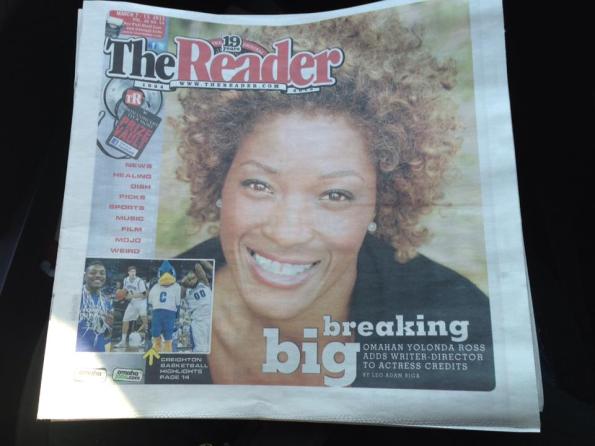
If you appreciate really good acting then a name you should know is Yolonda Ross. Her face may be familiar but her name likely isn’t. She doesn’t get the high visibility film and television parts that another Omaha native actress of color , Gabrielle Union, gets but it’s not for lack of talent. It certainly isn’t for a lack of looks either. No, it’s hard to say why she hasn’t had the major breakthrough that other actresses have but it’s not as though her career is wanting either. She’s done lots of good work on the big and and small screens and three new movie projects are sure to bring her more attention than she usually gets. She appears in new movies by noted filmmakers David Mamet and John Sayles and her own writing-directing debut, the short Breaking Night, which she also stars in is making the festival rounds. Indeed, her dramtatic narrative short is screening at the Omaha Film Festival on March 8. She’ll be there for that screening and she’ll also participate in an acting panel on March 9. I’ve been following her career for several years now and you’ll find my earlier stories about her and her work on this blog. I’m hoping she finally gets the due she deserves.
Yolonda Ross adds writer-director to actress credits;
In new movies by Mamet and Sayles as her own “Breaking Night” makes festival circuit
©by Leo Adam Biga
Soon to appear in The Reader (www.thereader.com)
You may not know the name but for more than a decade now Omaha native Yolonda Ross has been a stalwart actress in American independent cinema and quality television movies and episodic dramas.
Before recently working with a pair of star indie writer-directors – David Mamet, on the new HBO movie Phil Spector, and John Sayles on the coming feature Go for Sisters – she’d previously been directed by Woody Allen (Celebrity), Cheryl Dunye (Stranger Inside), John Cameron Mitchell (Shortbus) and Todd Haynes (I’m Not There).
Ross played the recurring role of documentary filmmaker Dana Lyndsey in season two of the acclaimed HBO series Treme. She’s guested on such prestigious network shows as Third Watch, 24, Law & Order and New York Undercover.
Spector and Sisters come on the heels of her turn as a mother and wife in the well-received 2012 indie feature, Yelling to the Sky, that deals with issues of race, violence, bullying and relationships. It was shot in Queens, NY.
A measure of the esteem Ross enjoys is that both Mamet and Sayles wrote parts for her in their new films. Though she’s only in one scene in the Spector biopic, which premieres Mar. 24, it’s with the great Helen Mirren. Her co-lead role, opposite LisaGay Hamilton, in the Sayles cross-cultural suspenser Sisters marks her first lead in a prestige feature.
2013 also marks Yolonda’s writing-directing debut with the short drama Breaking Night, an official selection of the Mar. 6-10 Omaha Film Festival unreeling at the Regal Stadium 16, 7440 Crown Point Avenue. Her dramatic narrative short screens Friday at 5:30 p.m. The coming-of-age story stars Ross as a young woman riding the throes of first love to escape a harsh home life. The film was selected for the New Voices in Black Cinema series in Brooklyn, NY.
Ross is a veteran of workshops at the Sundance Institute‘s screenwriters and directors labs, where she’s worked with her “dear friend” screenwriter-director Joan Tewksberry (who scripted Nashville). The actress filmed her short last summer in St. Charles Parish, New Orleans and in Baton Rouge, whose spell she’d already fallen under from her work on Treme, the post-Katrina Big Easy-set drama. She recruited some of her crew from the show.
Fellow Omaha native Alexander Payne served as a Breaking Night producer.
A longtime New York City resident, Ross will be at the OFF screening, where Omaha friends and family will lend support.
Though she hopes Sisters leads to acting offers and Breaking Night establishes her directing cred, she’s taking matters in her own hands by writing new scripts for her to direct and/or star in. She’s currently penning a feature family drama she plans to direct in Houston, Texas next year. She’s also writing a spec pilot. She has more short scripts she’d like to develop.
She clearly views Breaking Night as the start of her career as filmmaker.
“It’s like one down and many to go. Once I got it finished it was just onto the next one. It doesn’t stop at one,” she says.
The many faces of Yolonda Ross:





Ross, a Burke High graduate who left Omaha in the mid-1990s to work in fashion, also sings (jazz, R&B) and paints (acrylic abstracts) and thus she views writing-directing as simply two more expressions of her creativity.
“I can do a lot of things. I happen to be one of those people that’s gifted in a lot of ways creatively. I mean, that’s just how I function. To not be utilizing all the parts of yourself sort of feels like you’re wasting yourself .”
Her writing’s evolved to where she’s confident she can craft her own vehicles.
“I feel as time has gone on my writing has gotten more defined. I know what my voice is, I know I have a unique point of view, I know I see things in a way that I feel are not being seen. Also, so many things are from a male point of view. I find it refreshing to see somebody else’s point of view, and you know I’m a black woman and one that I don’t feel is stereotypical,” says Ross, who’s worked with several women directors.
“I can tell a story and my writing has been really going places.
Breaking Night realizes a long-held goal to put her ideas on screen.
“I wanted to get the visions out of my head and see if I can do it, see what I can make, see what comes out of me. I actually had something else written but I didn’t feel like doing that so the story of Breaking Night just kind of came about. I had just been up at the Sundance film labs the summer before working on a project and it just made me want to have my own project to work on and to see what came of it with a collective group of people.”
Helming her own film proved to be everything she thought it would be.
“It was like an amazing, magical event. Little by little it all came together. It was a four-day shoot. Our last day of shooting was a night shoot that went into morning and the sun came up and we watched the sun rising. We all broke night together and nobody wrecked anybody’s nerves. We all worked together, there were no like attitudes, it was just beautiful.”
She says the film’s story is “a universal one with a different face on it.” Her inspiration was the classic ’70s rock song “Blinded by the Light,” a personal favorite that always conjured romantic and rebellious images for her. She set the story, which all takes place in the space of 24 hours, in the same decade to stay true to the song’s roots.
“I tell a universal story of a young person going through problems at home who doesn’t have support and leaves home. That’s every race, every generation.”
In her script the song becomes an anthem for breaking free of shackles that define or limit us. Her choice to infuse an interracial love relationship into the mix was about overturning stereotypes but in the end her film’s less about that than it is about finding one’s identity and following one’s destiny.
“There are definitely images that would always come to mind when I would listen to the song, knowing the time period it comes from, knowing which stations it would be played on and who the audiences would be for it. But in my thoughts it’s universal because everybody I know loves that song and rocks that song and I wanted to put a different face on who the characters were in it.
“If a film from the song was made in the ’70s when it came out I’m sure those characters would all be white. In TV and film then most times you would see black people either in the city on drugs or selling drugs or trying to get out of the ghetto or in the South trying to flee the South. In this case I wanted to put certain constraints on myself to fit the story and these elements into this seven minute song and tell this story.”
She’s satisfied she delivered a tale of youthful angst and longing that transcends cultures.
“I feel I’ve succeeded because race is not the issue at all in it. The story happens to have a black family. What I used as reference were movies like Silkwood and Norma Rae. It’s a rural home where the mom, even though it’s not said, has like a factory job and she’s got a dude she shouldn’t be with. He’s not a dad, he’s kind of living off them and taking advantage.
“The boy the girl is in love with is her escape. He’s the only one that understands her. At that age you have that person and he’s that person. They both run away. She’s got him as protection. That’s a young romance, so who knows what’s going to happen to it when she gets to wherever she’s going.”
Ross has the girl she plays cross paths with a posh black couple out on the town getting their disco down. The couple represent to the girl a sophistication and life far removed from her own.
“It’s like they symbolize to the girl that she can become that. So then she does take her life and her future into her hands and makes a decision. She’s not going to be a person who gets run over and taken advantage of, she’s not going to allow herself to be in the same kind of situation as her mom.”
An actress who never looks the same from part to part, Ross deftly plays both the ingenue and the ethereal disco mama.
Ross shot and edited the encounter to indicate the disco couple also see in the girl the possibility of something she’d never seen in herself. The girl becomes empowered by accepting a knowing look from the woman and a kiss and a business card from the man. All affirmation of her worth and emancipation – that her time has come, that her path will be different.
“It’s like, ‘This fabulous couple sees something in me? OK, I’m out of here.’ The kids don’t know where they’re going, they’re just running away, but now she’s going wherever the disco man’s card says he from. It’s that kind of feeling.”
Ross went after a late ’70s-early ’80s Pop style look for the film, which plays like a good music video. She doesn’t mind the music video comparison but is adamant the story stands on its own.
“It has the aspects of a music video to it but it really is a short film because without the music the story is still there. I would like people to understand that there’s a lot actually happening there. All those frames in it have meaning.”
The visual palette changes as the drama plays out.
“It’s got three parts to it. It starts off light and kind of generic but once you get into the home it gets dark, it gets more real because it’s a messed up situation that happens. Once she’s out of the home that night it goes through a kind of surreal take. It leaves you wondering did this really happen or did she dream it.”
WATCH THE FILM AT–
In one shot the two young lovers have a kind of out-of-body experience while making out and to convey that feeling Ross wanted a visual effect she recalled seeing from that era. But she couldn’t find an example and she didn’t know what to call it.
“That was like the hardest thing,” she says. “In describing seeing that thing on TV or in videos in the early ’80s I could not find anybody who knew what that thing was. I finally found somebody to actually do it for me. It’s called a trail.”
The ending unfolds in an other-worldly rural idyll flush with Spanish Moss trees. There’s a sumptuous quality to the imagery throughout, even the gritty parts, that she credits her director of photography, Justin Zweifach, with.
“My DP was amazing. He literally came on a week before us shooting because my original DP dropped out and it was a blessing because he understood everything that was going on in my head. I made storyboards and there’s a full script but him asking me certain questions about the feel of things, the feel of characters, how I saw things, that was way more helpful in him capturing how it looks. It’s above and beyond what I expected. I mean, he shot it beautifully.”
She says crew embraced the project because with its minimal dialogue and luscious images their work can be readily seen on the screen.
Others who helped ease her through the first-time filmmaking process were executive producer Tim Mather and associate producer Sasha Solodukhina.
About Mather, she says, “When you’ve got somebody who’s got your back and understands the whole production part of it to guide you through it’s a lifesaver because there are so many little things. I come from acting, so I know about emotions, I know about all that kind of stuff. Before I did this i really didn’t even know the difference between a gaffer and a grip. I hate to say this but I didn’t know what the jobs were, but now I know. I know in front of, I know behind, I know these things now.
“And Tim is great dealing with people and places you need to have connections to to get better deals and to get things done.”
She says Solodukhina was “like wonder woman because she got me so many people. She knows everybody.”
As for having Payne’s imprimatur on the film, she notes, “What can you say? How can that hurt? I’m glad that our friendship made him come on and contribute. I still have to show him the film though.”
With the likes of Payne, Mamet and Sayles in her corner, she knows her work is getting noticed by the right people.
“It’s like how I feel most of my career has been, you just do your work and a lot of times you don’t feel anybody’s paying attention or whatever but then you get these offers from these great directors, so it’s amazing who watches and who does think of you.”
The offer from Sayles came while she location scouted for her short. She knew him from auditioning for his Honeydripper, losing a part in it to her Go for Sisters co-star, LisaGay Hamilton.
Sisters is the fictional story of childhood best friends whose different life paths have separated them for 20 years until events reunite them as adults. Ross is the newly released from prison Fontaine, who finds her old friend Bernice (Hamilton) assigned as her parole officer. The street wise ex-con becomes a lifeline when Bernice’s son is captured and held for ransom by drug dealers in Mexican border towns. Edward James Olmos becomes the third amigo in this search party that courts danger at every turn.

Edward James Olmos, Lisa Gay Hamilton, Yolonda Ross in Go for Sisters
The low-budget, guerrilla-style shoot in Mexicali, Calixico and Tijuana required a huge number of locations in a short number of days, which kept cast and crew hopping.
“It was fun but just different logistically for me,” says Ross. “It was sort of like you wake up and you just go. You don’t even look around. You’re like, OK, who am I? What are we doing? It’s almost a road movie because we’re on the move so much. The story takes you on a nice trip. There’s lots of familiar faces in cameos and it’s fun to see who you come across next.”
About the enigmatic Sayles, she says, “Pretty much he gives you the blueprint and you do it. He has said, and now I see it, that his directing is choosing the right actors,. He lets us do our work.” By contrast, she says Mamet “is more verbal than John. I think he’s really funny, I really like him a lot. The one way they are alike is they both tell stories while working and they both have people around them they’ve worked with before, so there’s a level of comfort with the crew.”
She’s excited to see who next notices her work. though she says she’s been around long enough to know that some filmmakers “go after the same people or who they think are hot or whatever,” adding, “You can be talented all day but that has nothing to do with them hiring you.” She says if box office performance is the arbiter then she’ll always be at a disadvantage because the small indie work she does rarely makes much of a splash or a profit.
“It’s unfortunate. The rest is just all crazy business stuff, which makes no sense. That’s why I’m writing.”
Ross is also part of a March 9 panel, Actors on Acting, at 3:15 p.m.
The Omaha Film Festival is a curated assemblage of narrative feature films, documentaries, live action and animated shorts as well as workshops and panels. Now in its eighth year, the fest has a strong track record of bringing film artists with and without Nebraska ties to discuss their work.
For schedule and ticket details, visit http://www.omahafilmfestival.org.
Related articles
- John Sayles – An American Classic (mrmovietimes.com)
- Phil Spector Biopic Trailer Released By HBO (noise11.com)
- Interview with Victoria Mahoney on ‘Yelling to the Sky’ starring Zoe Kravitz, Gabourey Sidibe and Black Thought (ifelicious.com)
Payne’s “Nebraska” blend of old and new as he brings Indiewood back to the state and reconnects with crew on his first black and white film
January 6, 2013
6 comments
Alexander Payne is at it again. By that I mean he’s in progress on a new road picture, Nebraska, whose principal photography was accomplished October 15 through the end of November. The filmmaker will be editing the project through the spring. Here’s my second cover story about the project, this one based in part on a short visit I made to the set in November. The piece will be appearing soon in The Reader (www.thereader.com) and it features material gleaned from interviews with Payne, screenwriter Robert Nelson, cinematographer Phedon Papamichael, and casting director John Jackson.
The writer-director is the subject of my book, Alexander Payne: His Journey in Film.
©Images from:

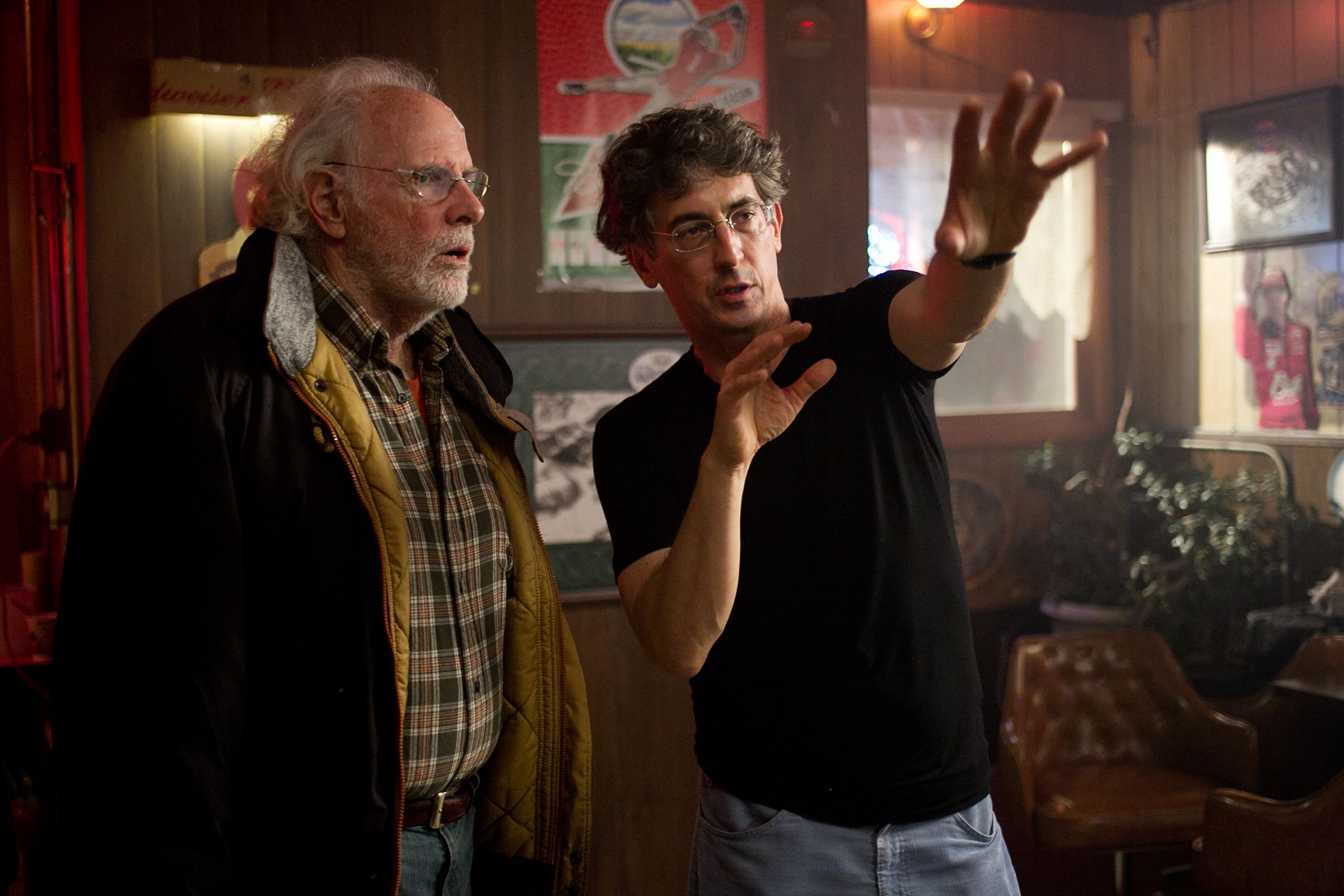

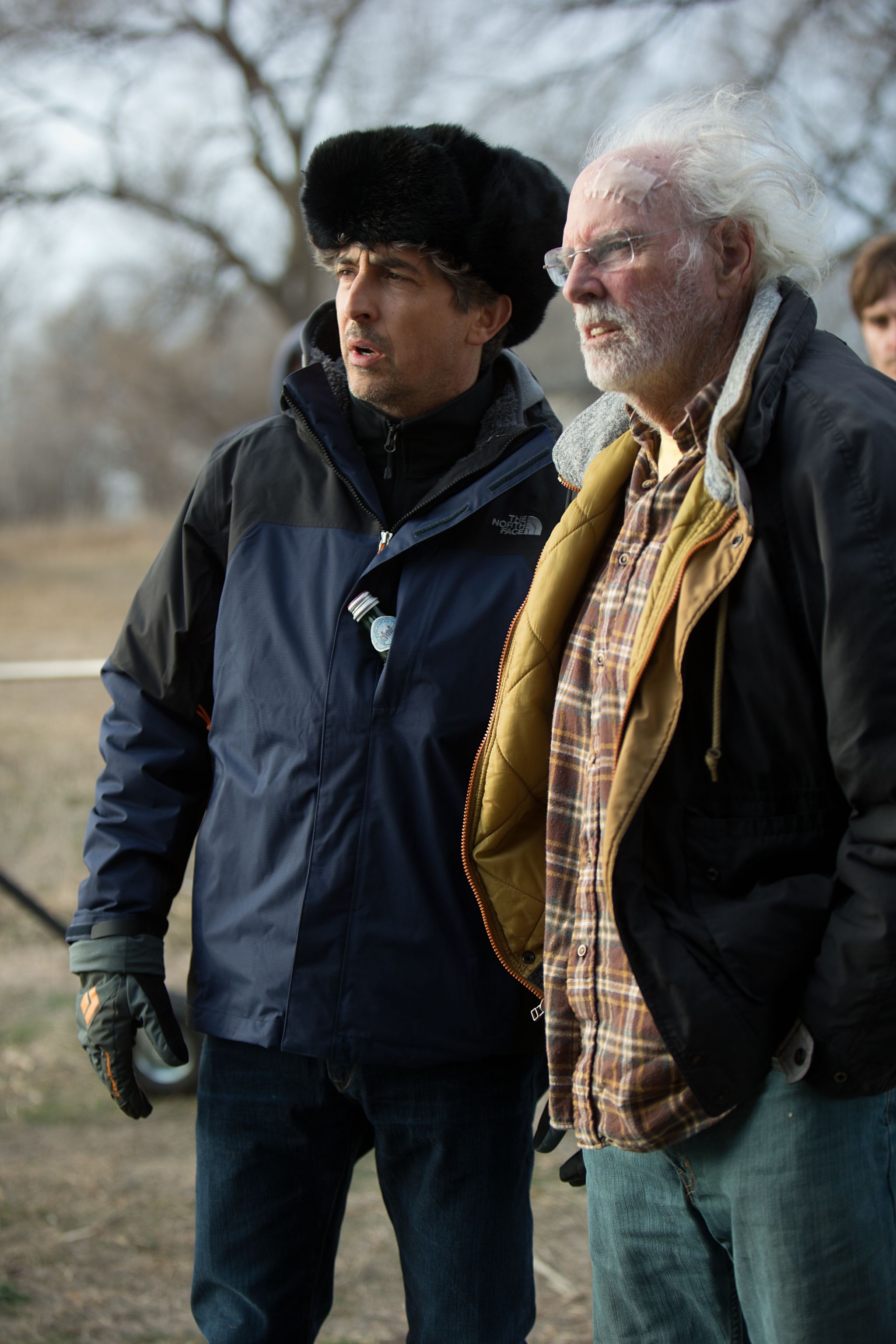
Alexander Payne and Co. on location with Nebraska
Payne’s “Nebraska” a blend of old and new as he brings Indiewood back to the state and reconnects with tried and true crew on his first black and white film
©by Leo Adam Biga
Excerpt of a story that originally appeared in The Reader (www.thereader.com)
Alexander Payne‘s decision to make Nebraska in his home state brought into sharp relief some realities with large implications for his own work and prospects for more studio films getting made here.
The state’s favorite son had not shot a single frame here since About Schmidt in 2002. With Nebraska, whose principal photography went from October 15 through November, he continued a tradition of shooting here and surrounding himself with crew whom he has a long history. Some key locals are part of his creative team, too, including one metro resident he calls “my secret weapon.”
Aesthetically and technically speaking, Payne also stretched himself by lensing for the first time in black and white, wide screen and digital. He says abandoning celluloid marks a concession to the new digital norm and to the fact today’s black and white film stock options are limited.
Cinematographer Phedon Papamichael says digital “allows us to work more with natural light and not have to carry a larger equipment package. We did specific black and white tests to choose the texture and quality in terms of contrast and film grain level we want for the picture. So we went into it knowing exactly where we want to be at.”
Papamichael adds, “Digital means needing less light, so we can do tighter interiors, which is important on this show because we’re entirely a location picture. We don’t have anything built. A lot of these interior spaces are very small and whatever space we can save in terms of lighting and camera equipment is helpful. Rather than having traditional bigger car rigs and following cars with camera cars we’re able to just get in the car hand-held. Also, these newer cameras allow us to do good car work without lighting. It just helps the whole natural feel we’re going for.”
At the end of the day, says Payne, digital “doesn’t matter to me because my process stays exactly the same.” His process is all about arriving at the truth. Capturing the windswept plains and fall after-harvest season figured prominently in that this time. Papamichael and Payne sought ways to juxtapose characters with the prairie, the open road and small town life milieu. In a story of taciturn people rooted to the land and whose conversations consist of terse exchanges, context and subtext are everything. Therefore, the filmmakers extracted all the metaphor and atmosphere possible from actual locations, geography and weather.
Payne doesn’t belabor the point but he received pressure from various quarters to shoot the picture elsewhere. The suits pressed going to states with serious film tax credits. Many locales could approximate Nebraska while saving producers money.
He finds himself in the awkward position of having lobbied long and hard to try and convince the governor and state legislators to support film incentives only to see his entreaties largely ignored. As much as he and his projects are embraced, his moviemaking forays in the state seem taken for granted. But the fact is he only ended up shooting here because he had the motivation and clout to do so.
If not for Nebraska there would have been no feature film activity of any significance here during 2012. Minus his Citizen Ruth, Election and Schmidt, the state has precious little feature film activity of any size to show for it. Refusing to cheat the script’s Nebraska settings, Payne brought Indiewood feature filmmaking of scale back home for the first time in a decade. Basing his production in Norfolk provided a boost to the northeast part of the state.
Norfolk director of economic development Courtney Klein-Faust says the total impact the project had on the local economy has yet to be tabulated but that just in lodging alone the production spent more than a half-million dollars accommodating its 100 cast and crew members. She says the film bought local goods and services whenever possible. She feels the experience will serve as “a case study” for elected officials to assess the trickle down effect of mid-major features and will be used by supporters of tax credits to push for more film industry friendly measures.
Like many filmmakers who develop a track record of success Payne’s cultivated around him a stock company of crew he works with from project to project. During a mid-November visit to the Nebraska set it was evident he enjoys the same easy rapport with and loyalty to crew he had before his two Oscar wins. The only time this visitor saw Payne betray even mild upset came after a principal actor was not in place when ready to roll and the filmmaker emphatically tapped his watch as if to say, “Time is money.” He expressed mild frustration when cows drifted out of frame and it took awhile for production assistants to wrangle them back in position.
On Nebraska he collaborated for the third consecutive time with Papamichael, the director of photography for The Descendants and Sideways. Their relationship entered a new dimension as they devised a black and white and widescreen visual palette to accentuate Nebraska’s stark characters and settings. That meant fixing on the right tools to capture that look.
“We did a bunch of testing and dialed in a look we’d like for our black and white because there are many different ways to go about black and white,” says Papamichael. Some of the expressive light and shadow images extracted by Papamichael and Payne recall memorable black and white treatments from cinema past, including Shadow of a Doubt, Night of the Hunter, Touch of Evil and It’s a Wonderful Life.
“It’s not really a film noir look, it’s definitely a high con(trast) with natural lighting” Papamichael says. “We were very diligent in selecting our lens package, which is Panavision C Series anamorphic. That’s from the ’70s, so it has a little bit of a less defined, less sharp quality and that helps the look. We’re adding quite a bit of actual film grain to it which will feel like you’re watching a film projection. We’re even talking about possibly adding some projector flicker imposed. So we’re really going for a film look.
“And through a series of tests we’ve been able to achieve that.”
A week into filming, Papamichael was pleased by what he and Payne cultivated.
“There’s an overall excitement the whole crew has. Everybody feels we’re doing something very special and unique and the black and white has a lot to do with it. After you work with it for awhile it becomes the way you see things. In a way we’re learning the power of black and white as we go. We’re really coming to appreciate and love the poetic power of the black and white in combination with these landscapes and, of course, the landscapes are playing a huge role in this story – just scaling the human drama and comedy.
“The black and white is becoming a very powerful character in this film just in terms of setting the mood for this.”
Grizzled Bruce Dern as the gone-to-seed protagonist Woody is a walking emblem of the forlorn but enduring fields and played out towns that form the story’s backdrop. His tangle of white hair resembles shocks of frosted wheat. His drab working man clothes hang on him as if he’s a scarecrow. His gait is halting and he lists to one side. His Woody is as worn and weathered as the abandoned farmhouse of the character’s youth. But just like the artifacts of Woody’s past, this physical-emotional derelict holds on from sheer cussedness.
Papamichael says part of the fun became “discovering Bruce Dern’s great visual qualities – his face, the textures and everything that are emphasized through the black and white.”
The film’s full of Nebraskesque places and faces. There’s that farmhouse a few minutes outside Plainview. There’s the town of Plainview itself standing in for the fictional Hawthorne. There’s an American Legion hall, some bars, farm implement dealerships and mottled fields full of lowing cows. There are earnest farmers, shopkeeps, housewives and barmaids, plain as the day is long.
“Alexander is very diligent about finding the exact right spot for everything,” says Papamichael.
The original screenplay is by Bob Nelson, whose parents grew up in the very northeast environs of the state the film’s set in. He’s also impressed by how rigorous Payne is in location scouting.
“I think he’s done a great job of finding a combination of things around Norfolk,” he says. “I’ve seen the location photos and it’s pretty stunning to see it in black and white. You know it has that The Last Picture Show quality to it. It is funny to see these things that were in your mind, like the abandoned farmhouse, come to life. I don’t know how they found it, it must have been a chore, but they came up with a good one. Almost everything I saw was spot-on perfect.”
The locations are pregnant with memories and incidents, thus Payne and Papamichael chose ones most reflecting the characters and situations and they cast actors and nonactors alike who most represent these places and lifestyles.
“For him it’s not all about trying to capture something truthful and comedically grim about the American landscape but also something archetypal,” says producer Albert Berger.

YOU CAN READ THE REST IN THE NEW EDITION OF MY BOOK-
Alexander Payne: His Journey in Film
(The new edition encompasses the Oscar-winning filmmaker’s work from the mid-1990s through Nebraska in 2013 and his new film Downsizing releasing in 2017 )
Now available at Barnes & Noble and other fine booktores nationwide as well as on Amazon and for Kindle. In Nebraska, you can find it at all Barnes & Noble stores, The Bookworm and Our Bookstore in Omaha, Indigo Bridge Books in Lincoln and in select gift shops statewide. You can also order signed copies through the author’s blog leoadambiga.com or via http://www.facebook.com/LeoAdamBiga or by emailing leo32158@cox,net.
For more information. visit– https://www.facebook.com/pg/AlexanderPayneExpert/about/?ref=page_internal
Related articles
- Movie shoot boosts Billings’ economy, pride (missoulian.com)
- Rapid City site of Hollywood movie shoot (rapidcityjournal.com)
- ‘Nebraska’ filming attracts local actors, gawkers (missoulian.com)
- Upcoming Alexander Payne Book Events (leoadambiga.wordpress.com)
- Dick Cavett is the latest luminary to endorse my Alexander Payne book (leoadambiga.wordpress.com)
- Laura Dern Endorses My Alexander Payne Book (leoadambiga.wordpress.com)
- Another sweet endorsement for my Alexander Payne book… (leoadambiga.wordpress.com)
- Alexander Payne book news (leoadambiga.wordpress.com)
- More Alexander Payne Book News: WE MADE INDIEWIRE!!! (leoadambiga.wordpress.com)
Alexander Payne’s “Nebraska” comes home to roost: State’s cinema prodigal son back filming on home turf after long absence
October 26, 2012
12 comments
I call Alexander Payne Neb.’s cinema prodigal son because he left here to find himself as a filmmaker, then he came back to make his first three features in his home state, only to leave again to make Sideways and The Descendants in faraway Calif. and Hawaii, respectively. And now, after a 11-year absence filming here he’s back shooting his new pic, Nebraska. In truth, he was never really gone-gone. He’s maintained a residence in Omaha all along and has returned innumerable times for all sorts of things. That he’s returned to make a feature with the name of his native state in the title and is doing so after the immense success of The Descendants only makes Payne, who’s already the most compelling living Nebraskan outside perhaps Warren Buffett, only more a figure of intense interest. The following cover story for The Reader (www.thereader.com) is the first of what I anticipate will be a whole string of pieces I do related to this film. My reporting on the project converges with my new book out on the filmmaker, Alexander Payne: His Journey in Film – A Reporter’s Perspective 1998-2012, which you’ll find plenty of posts about on this blog. My coverage of Nebraska will undoubtedly end up in future editions of the book.
©Images from:
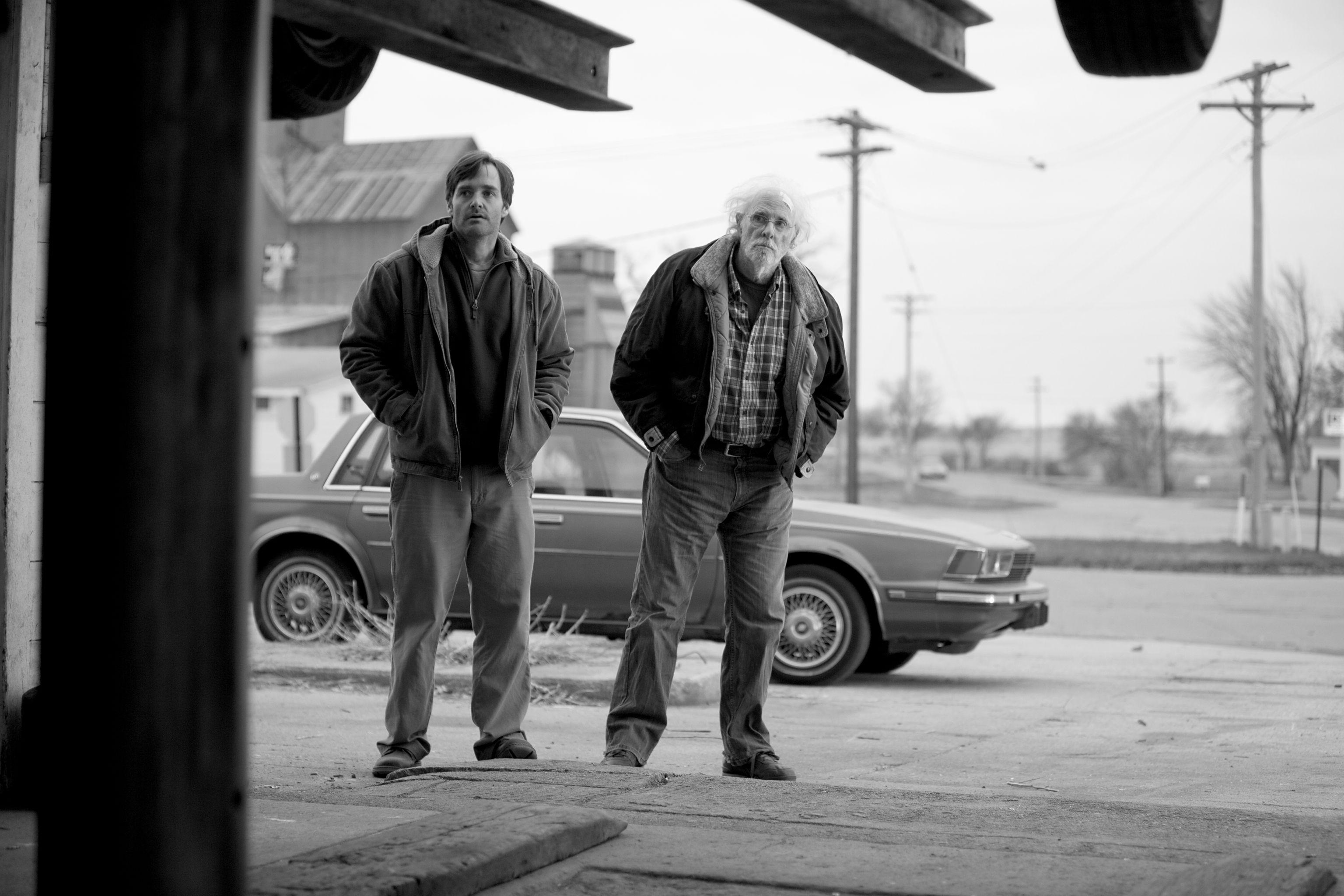
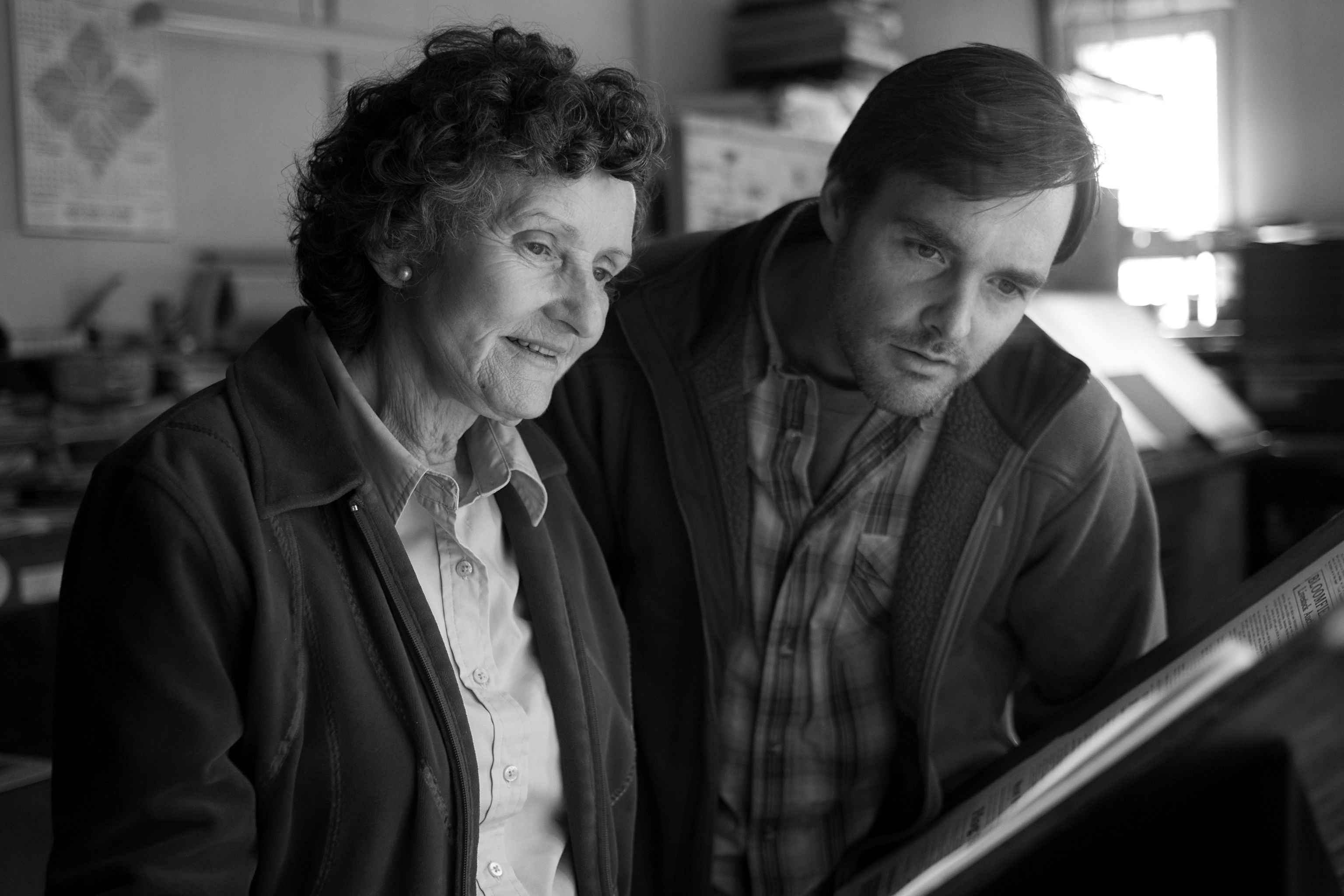
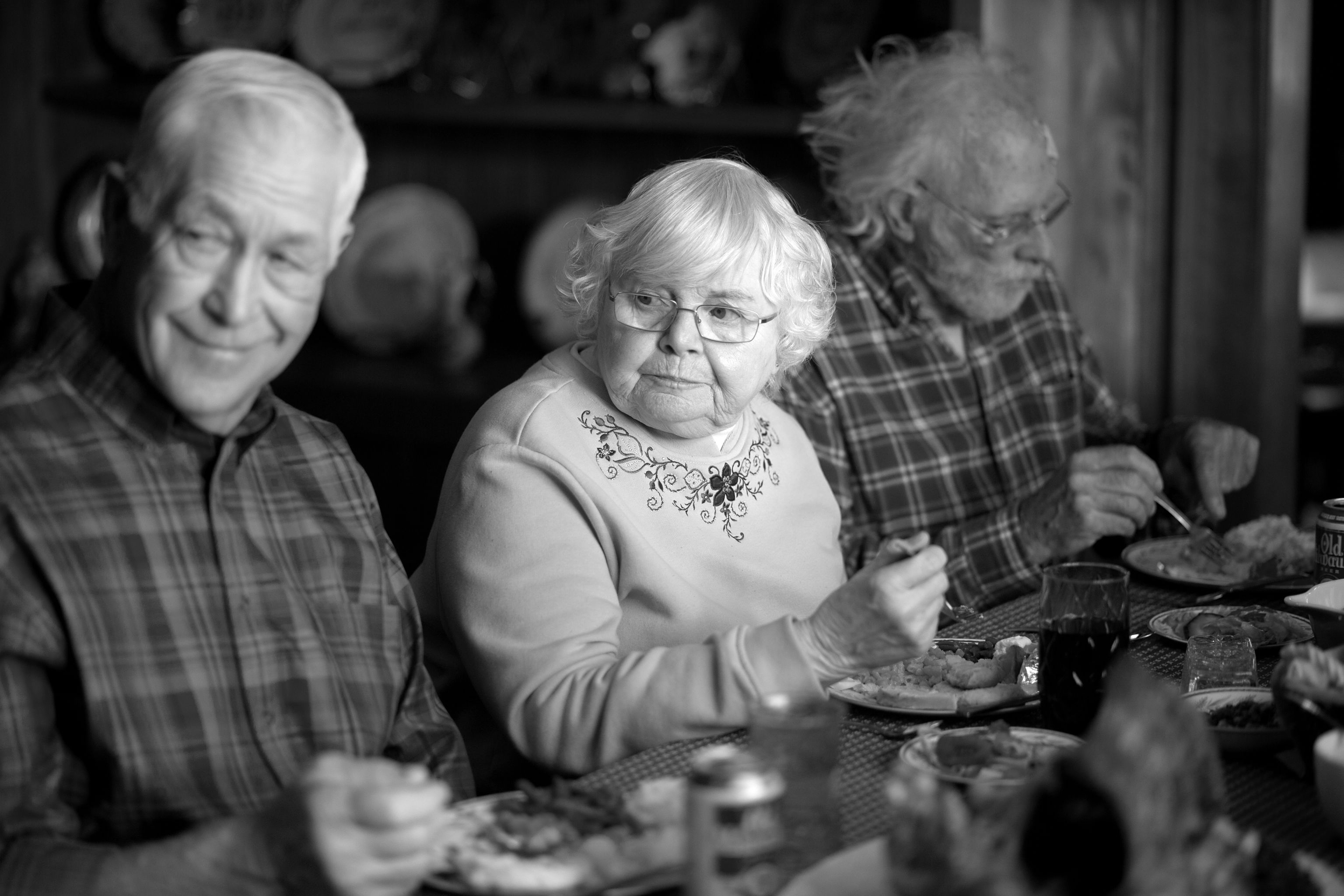
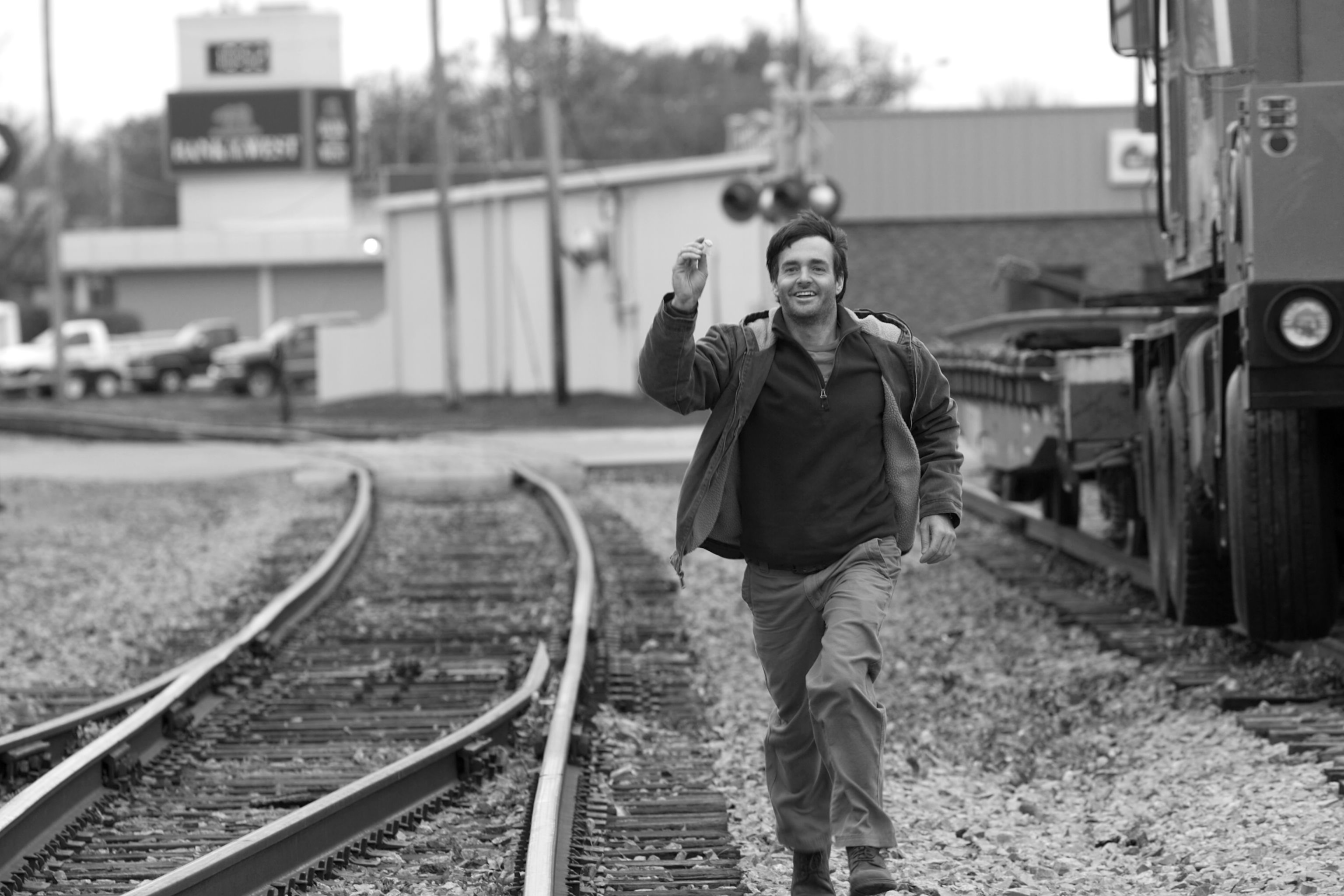
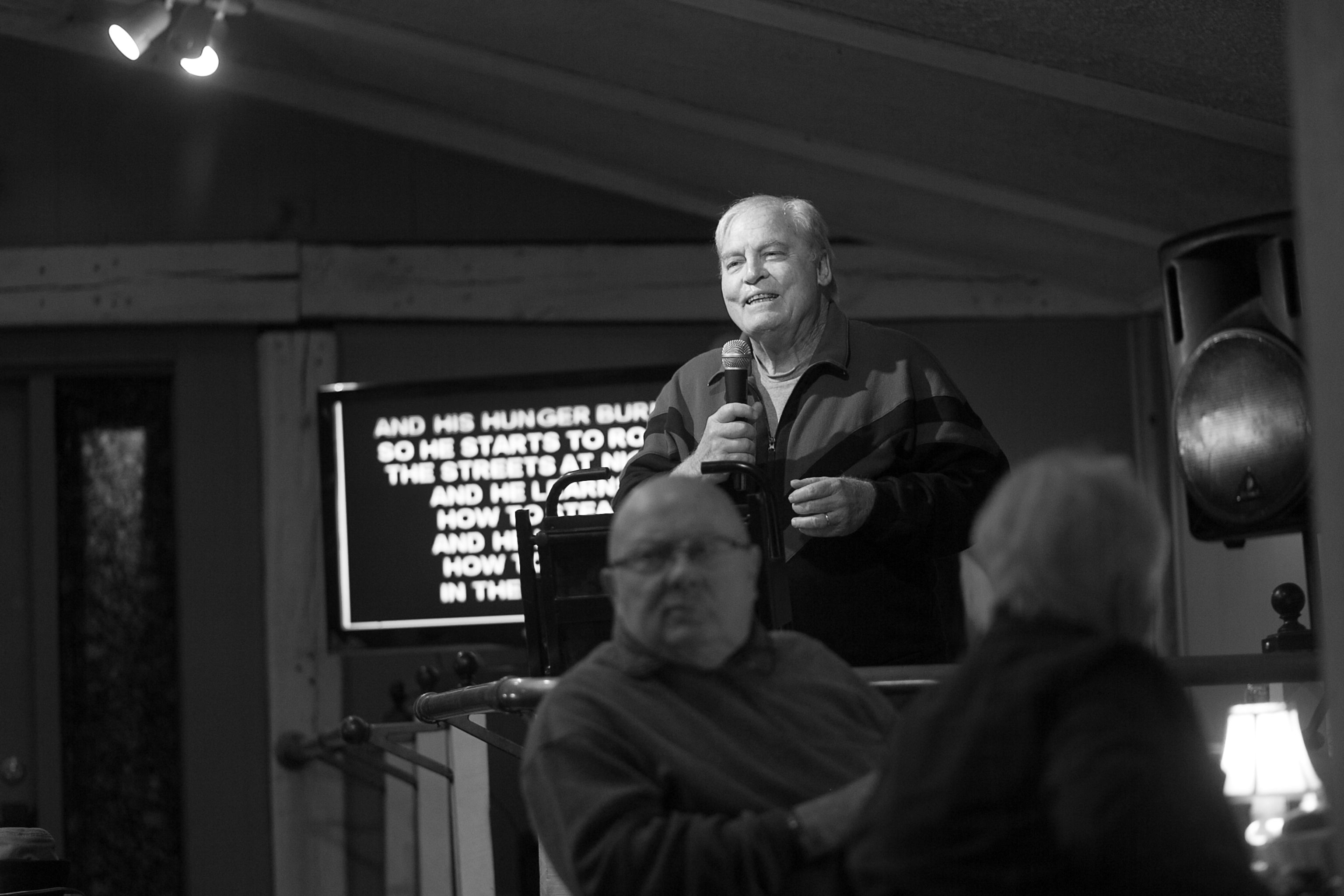
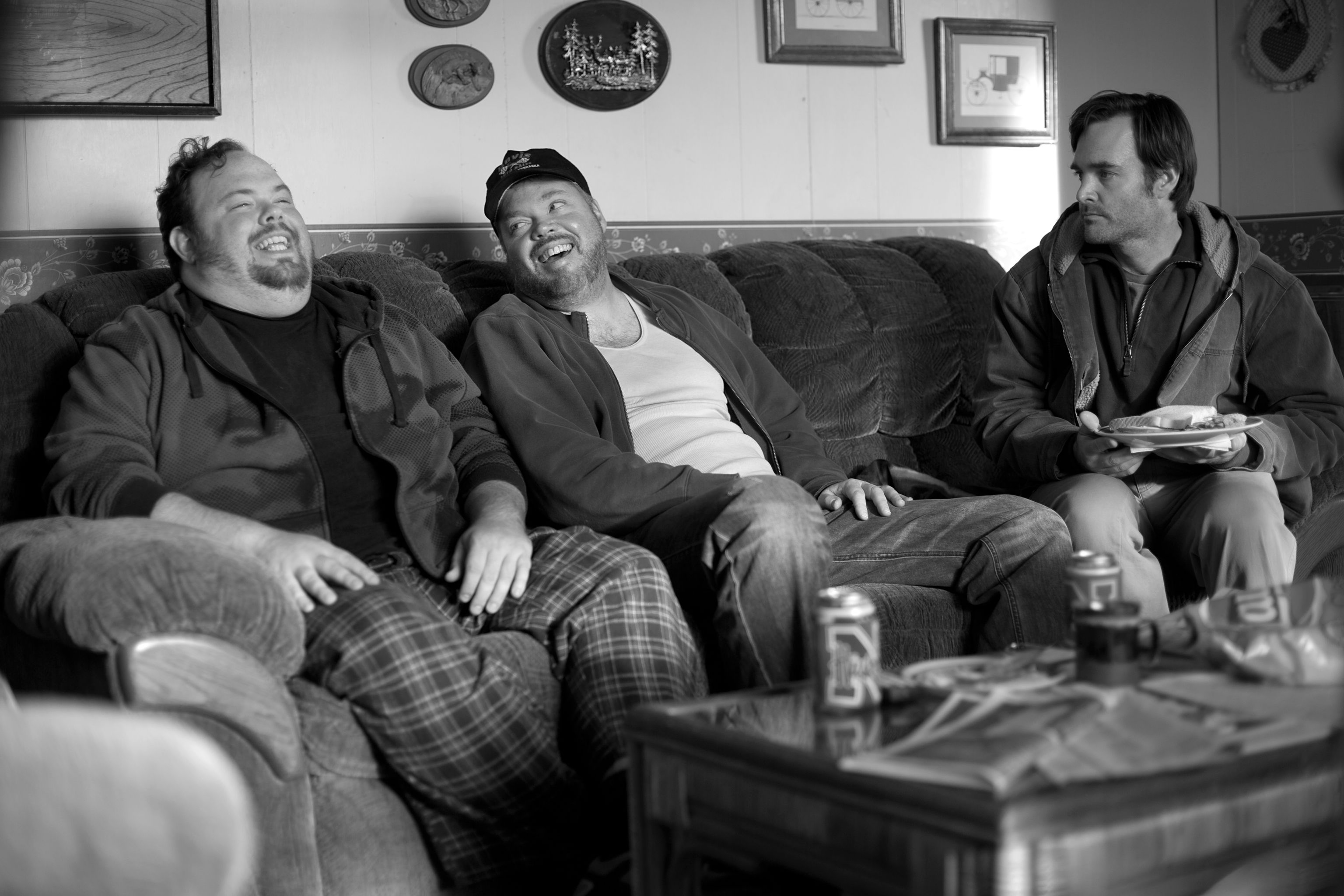
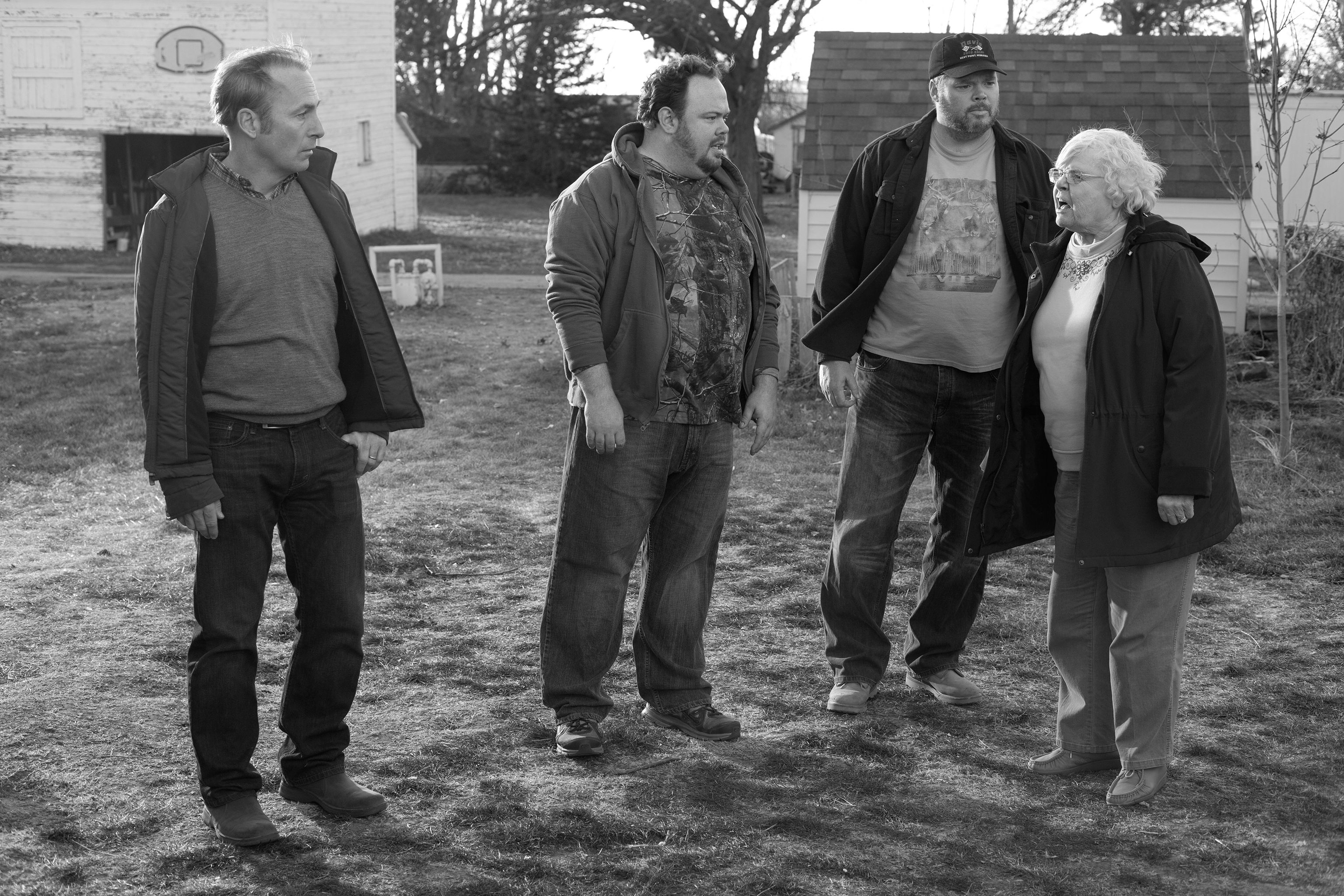
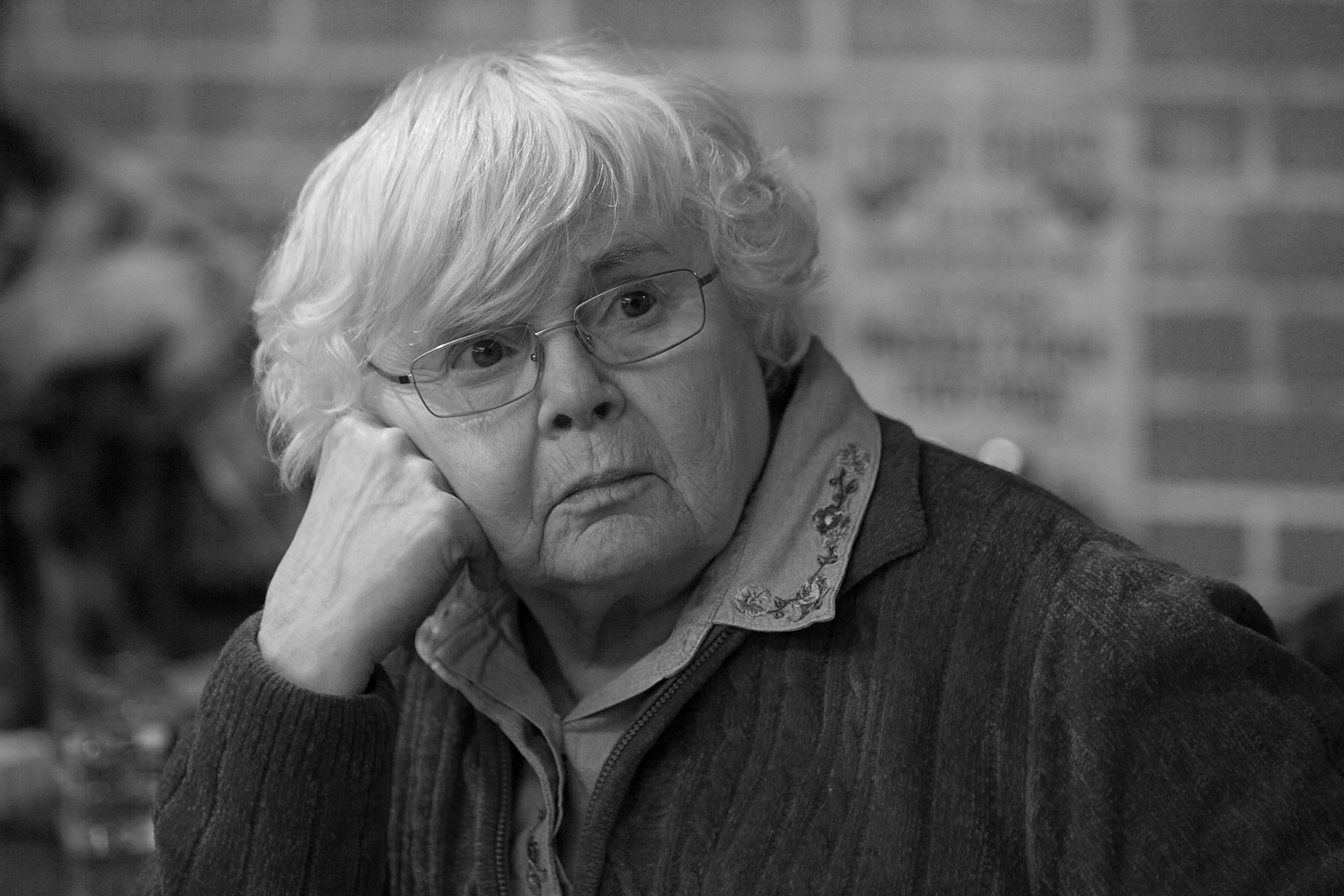
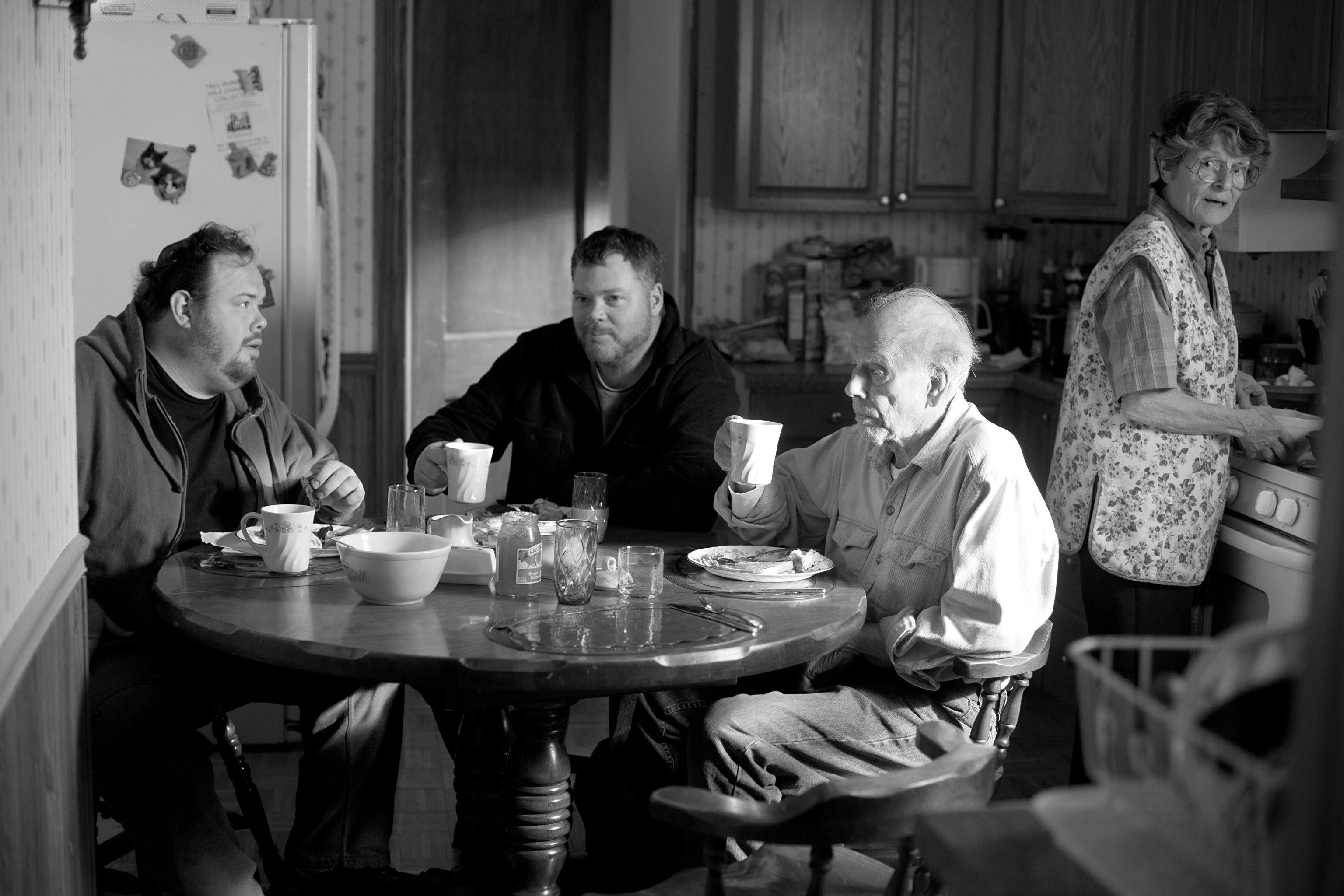
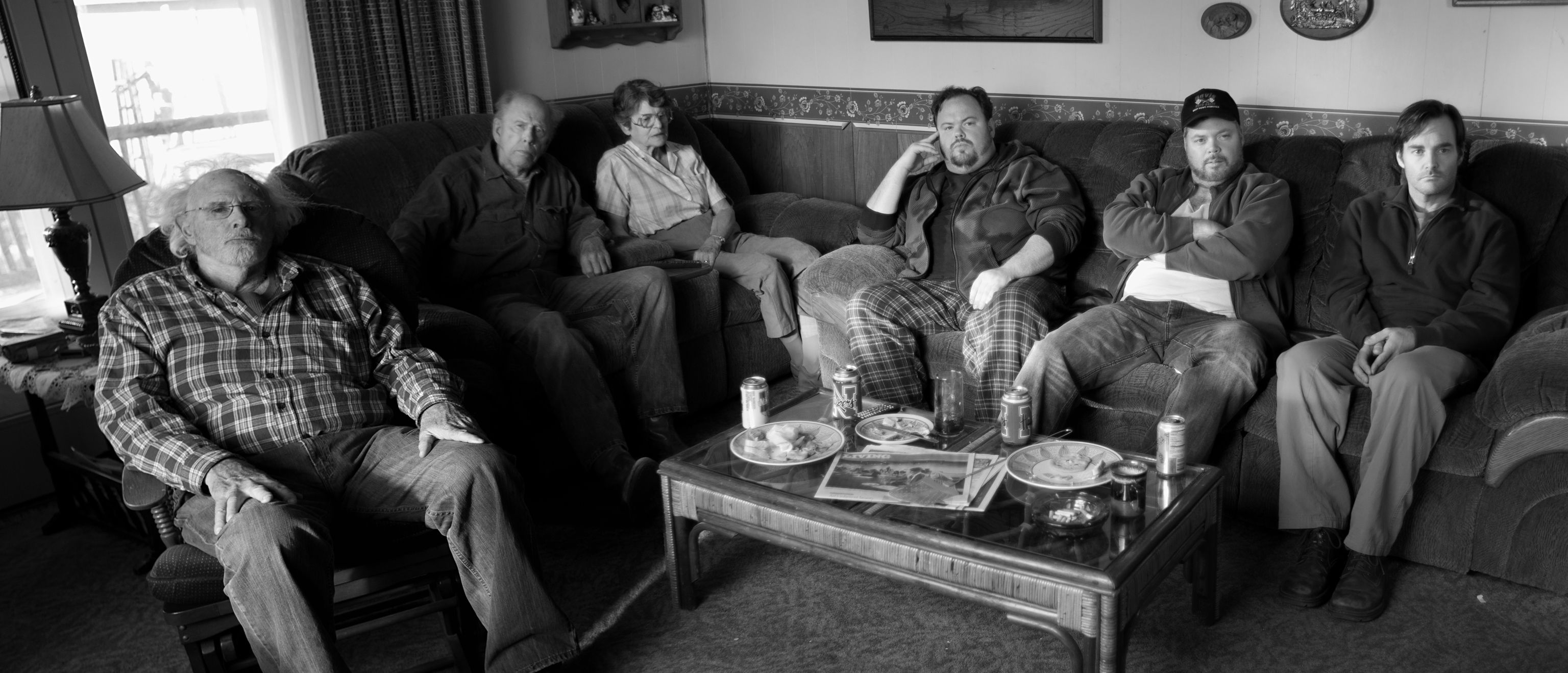
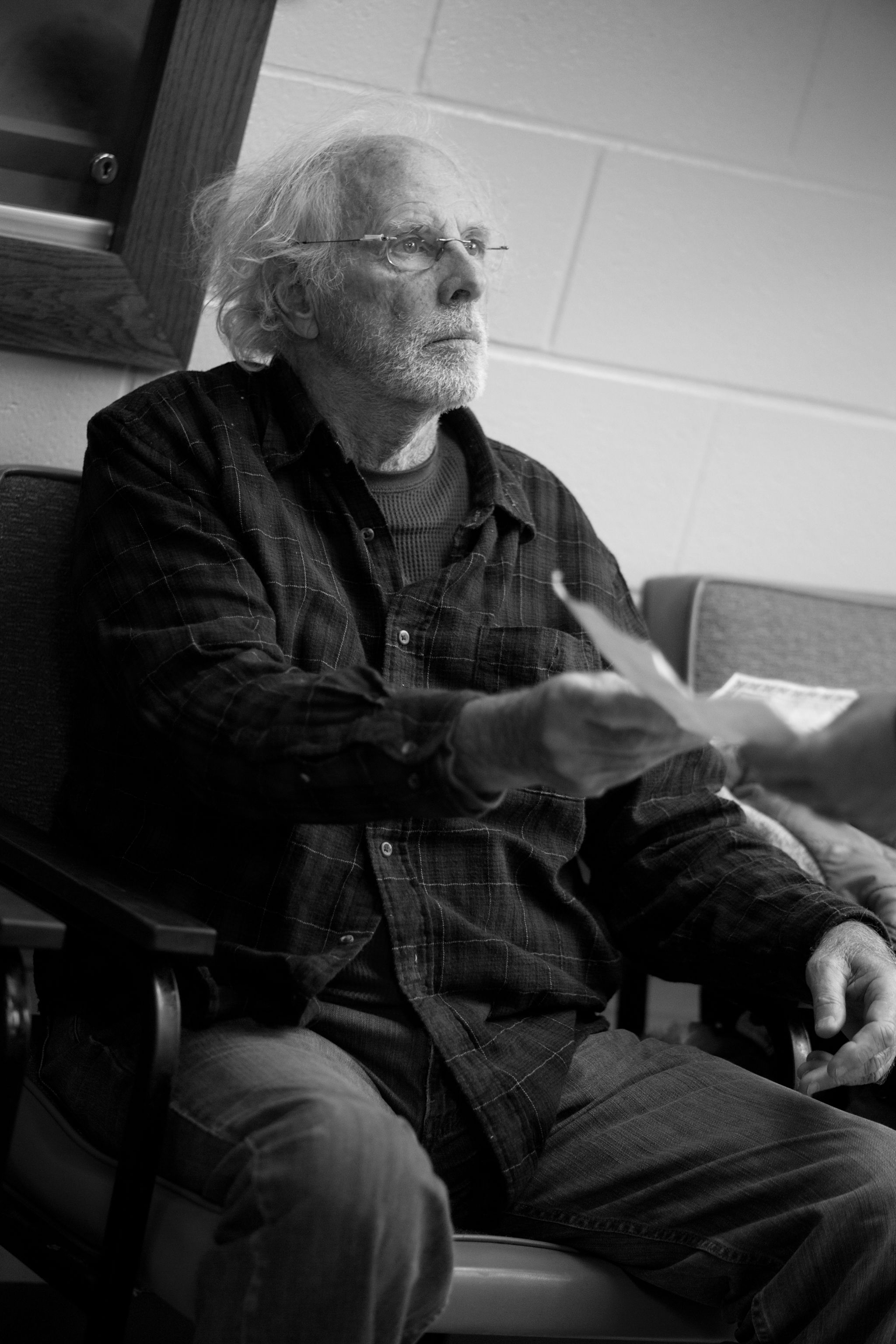
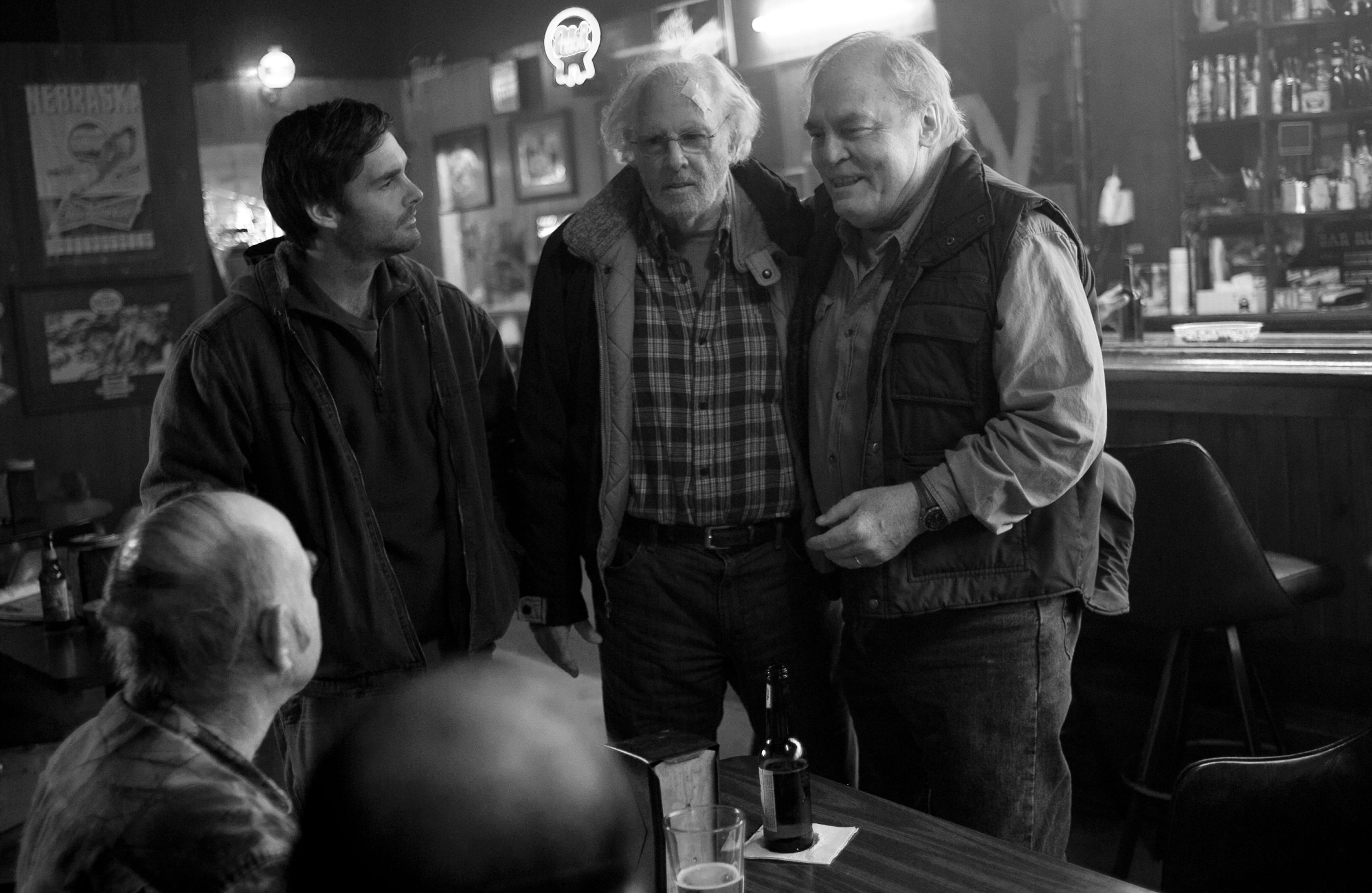
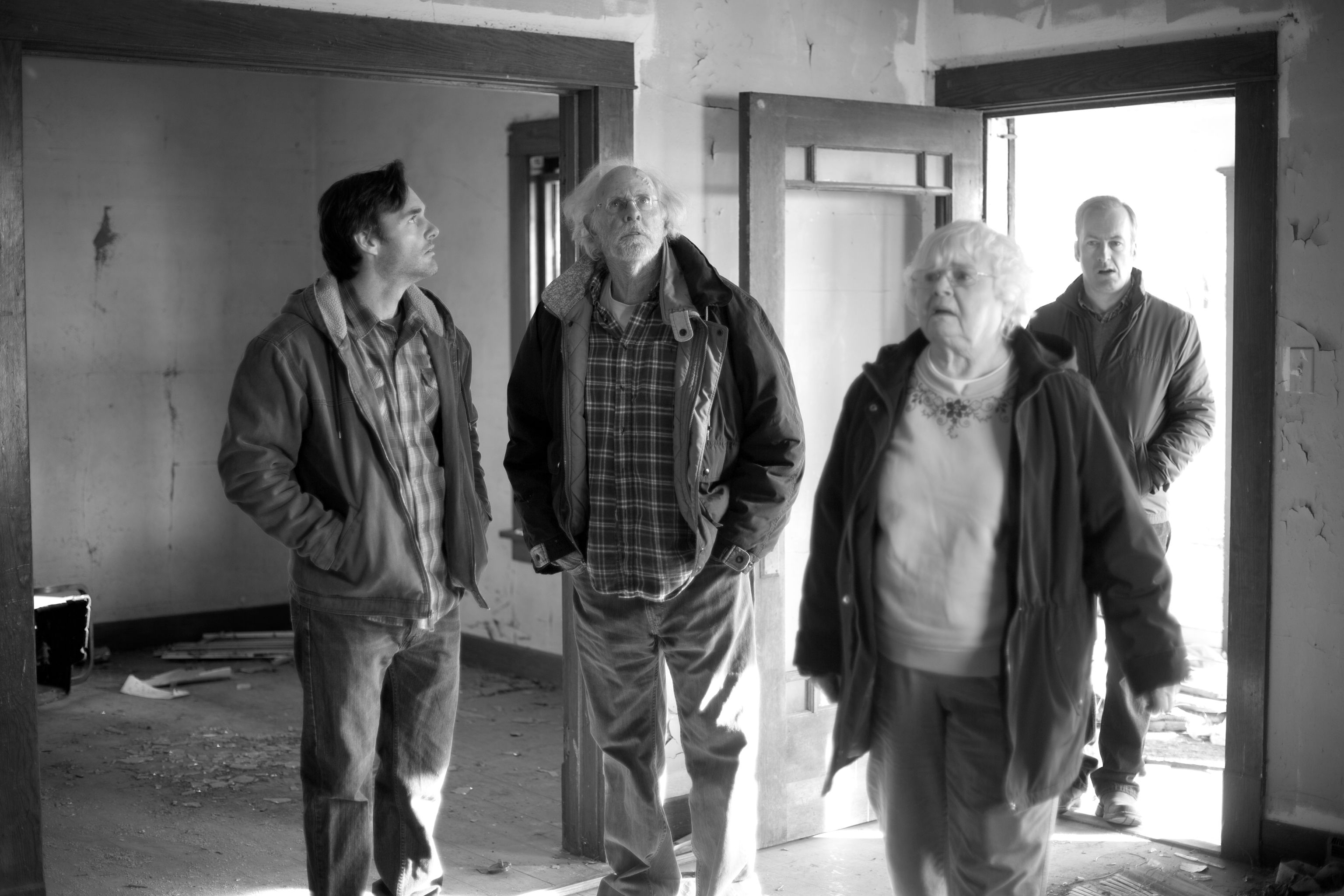
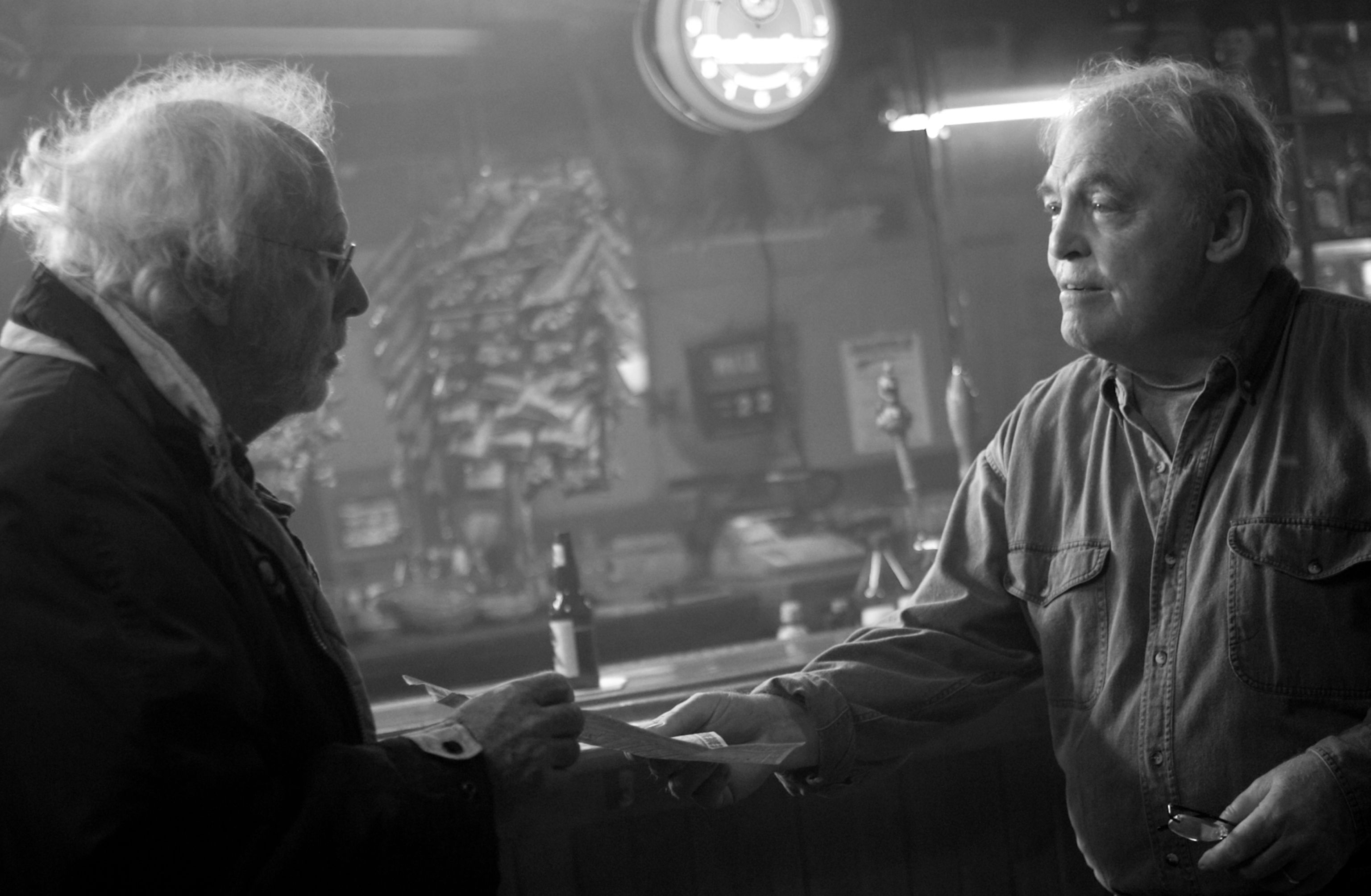
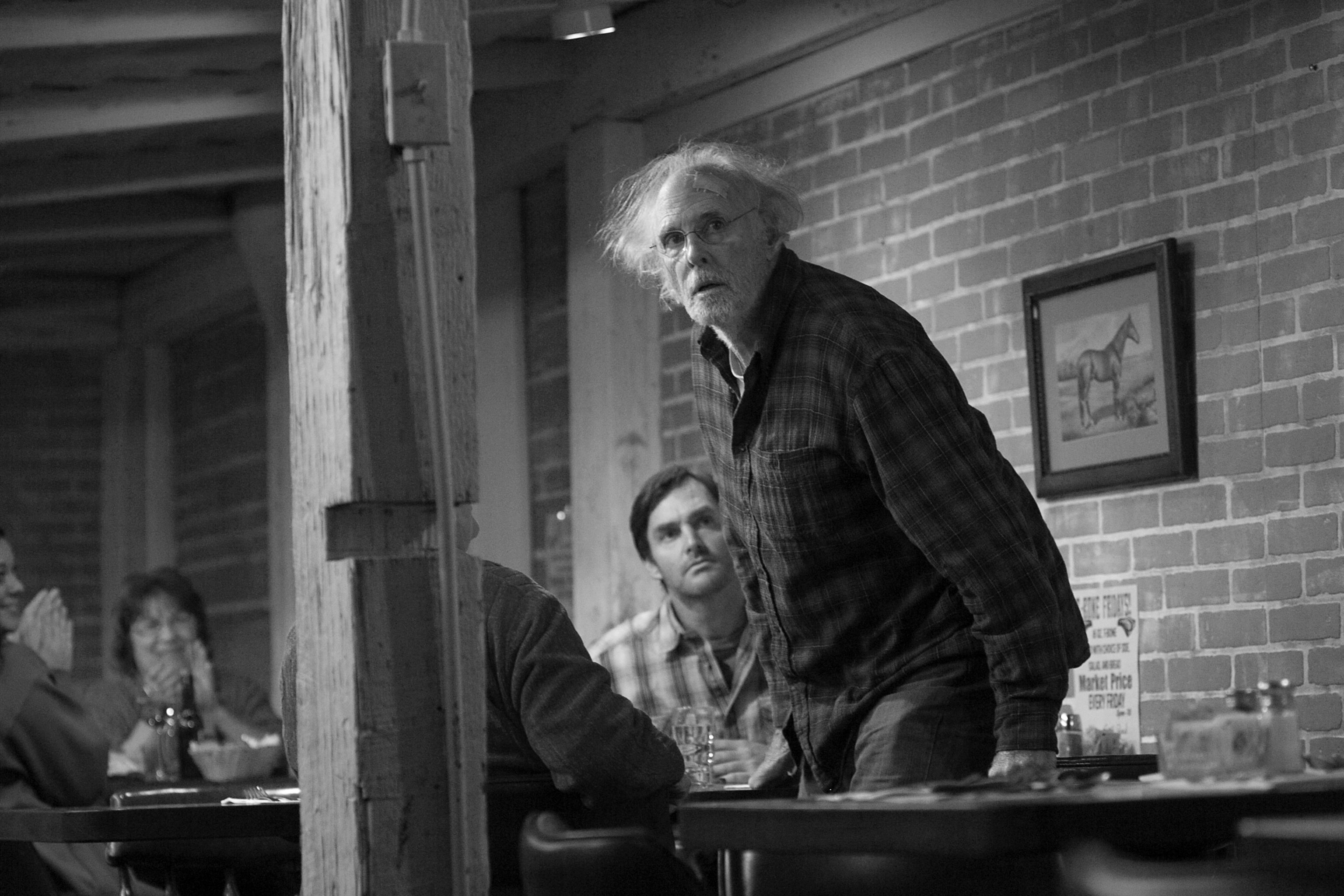
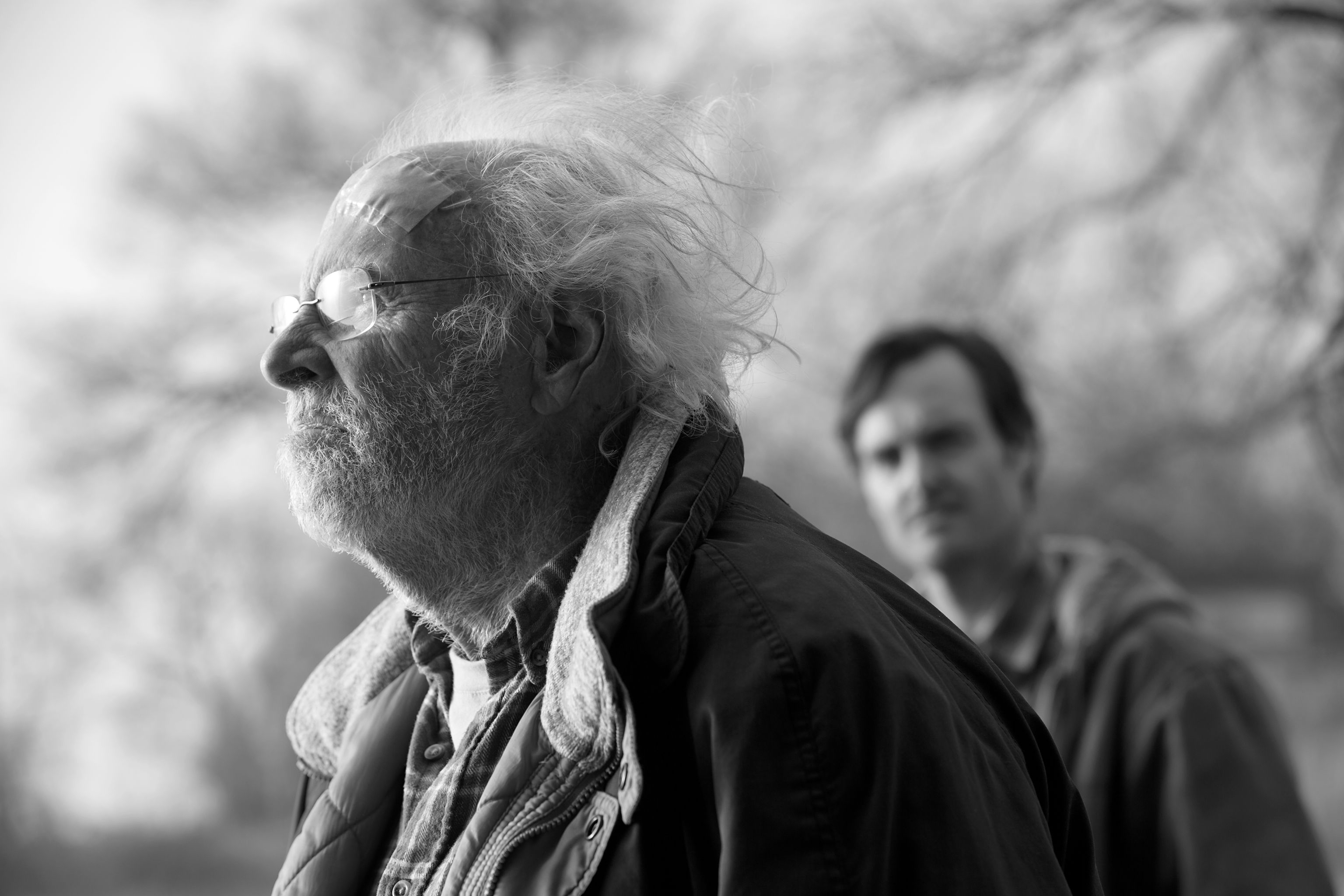
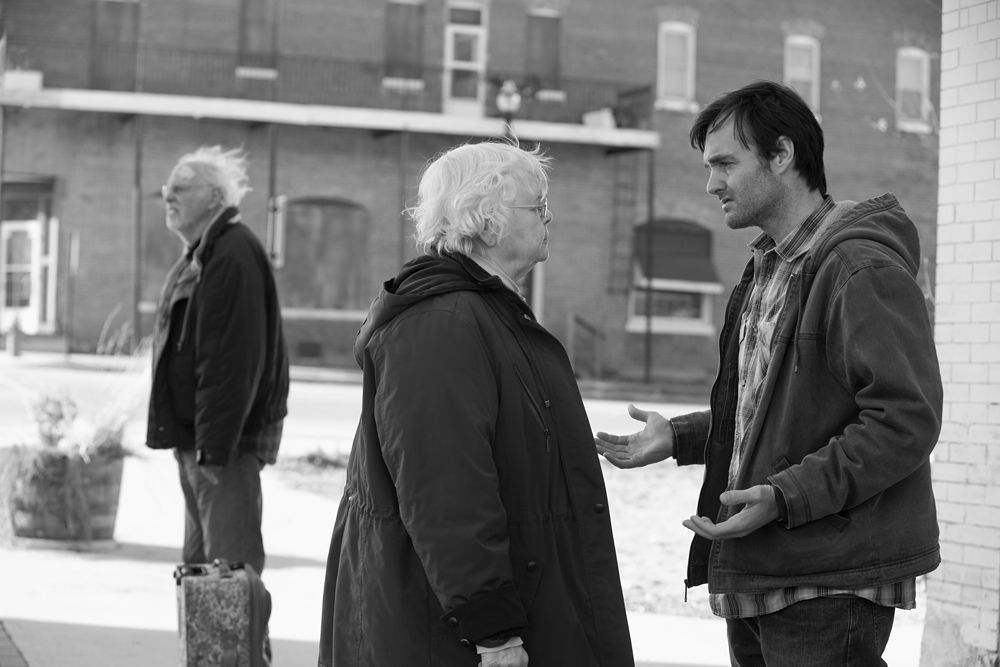
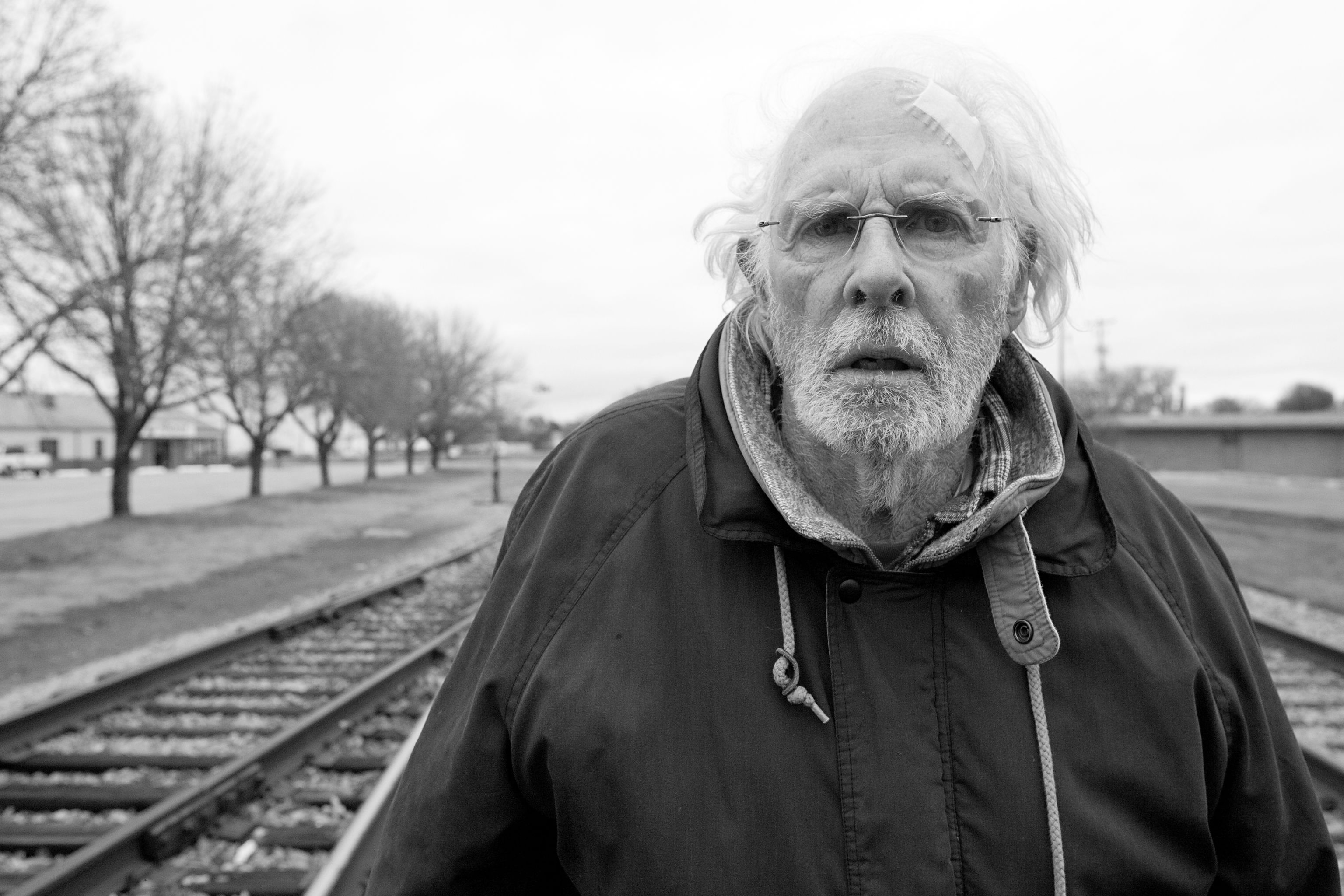
Alexander Payne’s “Nebraska” comes home to roost: State’s cinema prodigal son back filming on home turf after long absence
©by Leo Adam Biga
Excerpt of a story that originally appeared in The Reader (www.thereader.com)
In 1968 Francis Ford Coppola led a small cinema caravan to Ogallala, Neb. for the final weeks shooting on his independent road pictureThe Rain People starring Shirley Knight. Joining them were future fellow film legends George Lucas, Bill Butler, Robert Duvall and James Caan.
Now a road pic of another kind, Nebraska, is underway here by native prodigal son Alexander Payne. For his first filming on his home turf since 2001 Payne’s lit out into northeast Neb. to make a fourth consecutive road movie after the wandering souls of his About Schmidt,Sideways and The Descendants.
Nebraska began shooting October 15 around Norfolk, where the production’s headquartered, and will complete 35 days of principal photography by the end of November. A week of second unit work will run into early December.
The project is set up between Payne, Albert Berger and Ron Yerxa’s Bona Fide Productions and Paramount Pictures.
Despite proclamations he doesn’t care for road movies, much less shooting in cars, Payne’s once again attached himself to a story of lost and broken people careening to some revelation about themselves.
Asked why he keeps returning to this theme or structure, he says, “I have no idea, I personally don’t really like road movies all that much and it’s all I seem to make. No, none of it’s intentional, I’m a victim. Yeah, it just happened.”
Characters hitting the road is a classic metaphorical device for any life-as-journey exploration and Payne’s not so much reinvented this template as made it his own.
“I think self-discovery is a big theme in his movies,” says Berger.
The protagonist of Schmidt (Jack Nicholson) goes in search of meaning via his mobile home after his life is knocked asunder. In Sideways buddies Miles (Paul Giamatti) and Jack (Thomas Haden Church) indulge in a debauched tour of Calif. wine country that rekindles the love impulse in one and confirms the unreliability of the other.
The by-car, boat and foot journey of The Descendants is propelled when Matt King (George Clooney) discovers his dying wife’s infidelity and sets off to find her lover. What he really finds is closure for his pain and the father within him he’d forgotten.
The bickering father-son of Nebraska, Woody (Bruce Dern) and David (Will Forte), hold different agendas for their trek along the highways and byways of Montana, Wyoming, South Dakota and northern Nebraska. Woody, a unrepentant, alcoholic old coot estranged from everyone in his life, is hellbent on collecting a sweepstakes prize that doesn’t exist. David, the good-hearted but exasperated son, decides to placate his pops by promising to drive him from Billings. Mont. to the prize company’s home office in Lincoln, Neb. by way of several detours. He’s sure his father will come to his senses long before their destination.
This mismatched pair’s road-less-traveled adventure in the son’s car finds them passing through Woody’s old haunts, including his hometown, the fictional Hawthorne, Neb., a composite of Hartington, Wausa, Bloomfield, Norfolk and other rural burgs. At nearly every stop they encounter the detritus from Woody’s life, which like the broken down Ford pickup in his garage he can’t get to run is a shambles of regret and recrimination. Woody’s made the fool wherever he goes.
A longtime nemesis, Ed Pegram (Stacy Keach), is a menacing presence.
By story’s end this father-son journey turns requiem. To salve his father’s broken spirit David performs a simple act of grace that gives Woody a valedictory last laugh.
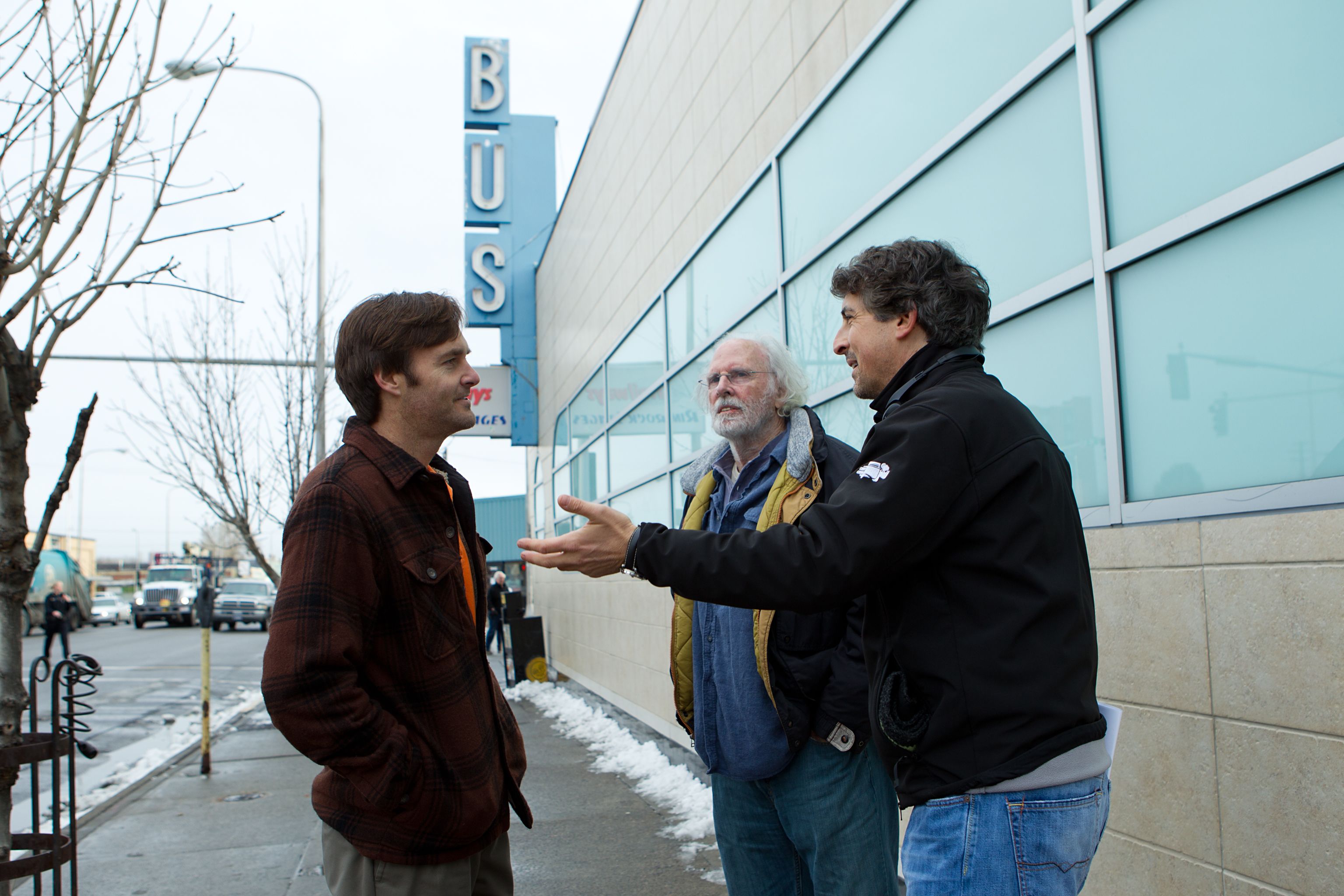
Producer partners Berger and Yerxa (Little Miss Sunshine), who shepherded Payne’s Election in conjunction with Paramount and MTV Films (1999), brought Bob Nelson’s original script for Nebraska to the filmmaker’s attention a decade ago.
Payne says, “Albert Berger and Ron Yerxa had gotten a hold of it, and asked me to read it, not thinking I would want to direct it myself. They wanted to know if there was some young up and coming Neb. director I knew about who could make it for a very, very low sum, and I read it and I liked it and I said, ‘How about me and for a sum not quite so low?’ And so it was, and they’ve been kind enough to wait for me these eight or nine years since I first read it.
“I read it before making Sideways but I didn’t want to follow up Sideways with another road trip. I was tired of shooting in cars. I didn’t think it would take this long, I didn’t think Downsizing (his as yet unrealized comedy about miniaturization) would take so long to write in between. And then The Descendants came along and now I’ve circled back around to this austere Neb. road trip story.”
The story’s essential appeal for Payne is its deceptive simplicity.
“I liked its austerity, I liked its deadpan humor, I like how the writer clearly was writing about people he knew and representing them faithfully to a certain degree but also sardonically. And I’ve never seen a deadpan, almost Jim Jarmusch sort of comedy that takes place in rural Nebraska.”

Phedon Papamichael
The barren, existential landscape should find ample expressive possibilities in the black-and-white, wide-screen visuals Payne and cinematographer Phedon Papamichael (Sideways, The Descendants) plan capturing. Papamichael says the palette they’ve hit upon after much testing emphasizes natural lighting and texture. They’re using a high contrast stock from the ’70s that’s less sharp or defined. Film grain is being added to it.
“We’re really coming to appreciate and love the poetic power of the black and white in combination with these landscapes” says Papamichael, “and of course the landscapes are playing a huge role in this story. It’s scaling the human drama and comedy with this vast landscape. It’s a road movie but it’s also a very intimate, small personal story.”
“Well, I certainly wanted to make one feature film in my career in black and white because black and white when well-done is just so beautiful,” says Payne. “And I knew that whatever film I made in black and white couldn’t have a huge budget, so this one seemed to lend itself to that that way. Then also in reading it I wanted the austerity of the characters and of their world represented also in a fairly austere way and I thought black and white in the fall could be very nice. By that I mean ideally after the trees have lost their leaves – to just get that look.
“Sometimes where you’re in rural America there is a certain timeless quality in all those small towns which have the old buildings. You know, change comes slowly to these places.”
In terms of visual models, he says, “we’ve looked at a number of black and white films and photographs but it’s not like I’m consciously saying, ‘Oh, Walker Evans or Dorothea Lange’ (or The Last Picture Show) or something like that. No, not really. I mean, I’ve seen them. We’re just going to follow instinct in how this one should look like.”

Albert Berger
Berger supports Payne’s aesthetic choice, though it came with a price and a fight as Paramount execs reportedly resisted the decision to forgo color. But Payne and Papamichael held firm. Berger feels the project gives Payne a new creative space to work in.
“I always was excited artistically about what he was trying to accomplish,” says Berger. “Clearly we would have gotten a lot more money if we didn’t film in black and white and life would have been a lot easier for the production. Alexander’s films have always had a very authentic look. He’s obviously a great appreciator of cinema and he has a wonderful eye and I think in a way this is his first opportunity to showcase a more iconic, archetypal look.”
Payne may just do for the northeast Sand Hills what John Ford did for Utah’s Monument Valley in capturing a certain beautiful desolation. The play of light on wind, barns, trees and wide open spaces offers evocative chiaroscuro possibilities.
“I think it’s exciting to see what he and Phedon will come up with here,” says Berger. “And it’s scope as well and so that will add yet another dimension. And digital for the first time for him and it’s going to be interesting how that helps us getting in tight spaces like cars and using low level lighting. There’s all sorts of tools at his disposal on this one that he hasn’t had before.”
Berger’s come to know Payne’s meticulous eye for finding locations and actors that ring true.
“Once the script is right and once the cast and the locations are in place I feel he’s completely ready to make the movie. I wouldn’t say the rest is easy but I think that is the critical bedrock upon which his movies are made. I think he’s a filmmaker who’s completely in-tune with what he’s trying to say both emotionally and comedically. It’s been a real pleasure to be able to watch this evolution in his work.”

Bruce Dern, ©projects.latimes.com
Payne says the more specific the character on the page the harder it is to cast, which is why his search for the right Woody and David took so long.
“I just know in the time frame in which I was trying to get this film made these guys rose to the top of my research and struck me and John Jackson, my casting director, as being the right fit.,” Payne says of Dern and Forte.
The irascible yet playful Woody proved most difficult.
“In this case Woody’s a very, very specifically rendered character and I just couldn’t plug any actor in there,” Payne says.
He interviewed-auditioned many, including big names. For the longest time no one matched his conceptions.
“In today’s world it was kind of hard to find someone whom I believed in that part and I didn’t want it to change the character of Woody.”
No compromising.
He finally found his Woody in Bruce Dern, whose daughter Laura Dern starred in Payne’s Citizen Ruth and remains a close friend. What made Papa Dern (Silent Running, Coming Home, Family Plot) the perfect Woody?
“Well, he’s of the right age now and he can be both ingenuous and ornery. And he’s a cool actor. And in a contextual level I haven’t seen on the big screen a great Bruce Dern performance in a few years and I’m curious to see what he can do. He’s a helluva nice guy as well.”

Will Forte
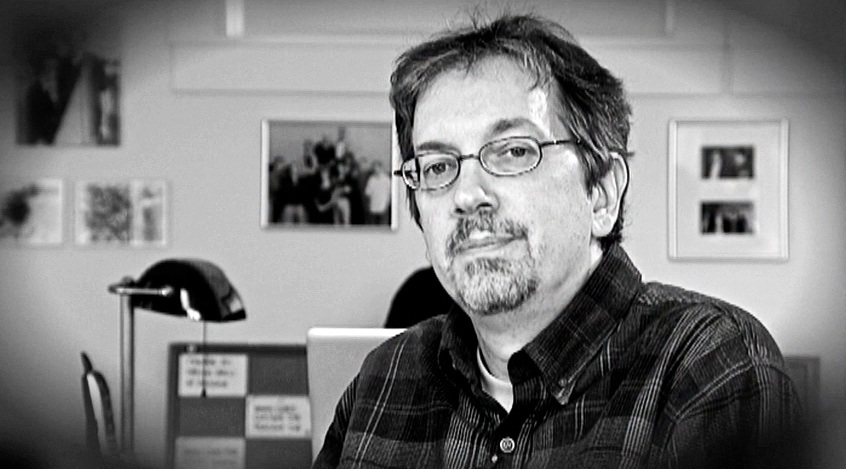
Bob Nelson
YOU CAN READ THE REST IN THE NEW EDITION OF MY BOOK-
Alexander Payne: His Journey in Film
(The new edition encompasses the Oscar-winning filmmaker’s work from the mid-1990s through Nebraska in 2013 and his new film Downsizing releasing in 2017 )
Now available at Barnes & Noble and other fine booktores nationwide as well as on Amazon and for Kindle. In Nebraska, you can find it at all Barnes & Noble stores, The Bookworm and Our Bookstore in Omaha, Indigo Bridge Books in Lincoln and in select gift shops statewide. You can also order signed copies through the author’s blog leoadambiga.com or via http://www.facebook.com/LeoAdamBiga or by emailing leo32158@cox,net.
For more information. visit– https://www.facebook.com/pg/AlexanderPayneExpert/about/?ref=page_internal
Related articles
- Alexander Payne to film in Nebraska (nebraskapress.typepad.com)
- Feature:10 Best Road Trip Movies (thepeoplesmovies.com)
- Bob Odenkirk and Stacy Keach Join Alexander Payne’s NEBRASKA (collider.com)
- Author Leo Adam Biga to Sign His Alexander Payne Book at Various Events as Shooting Continues on the Filmmaker’s New Picture, ‘Nebraska’ (leoadambiga.wordpress.com)
- Robert Duvall Interview (leoadambiga.wordpress.com)
Thy kingdom come: Richard Dooling’s TV teaming with Stephen King
August 16, 2012
4 comments
I have only read two things by Stephen King and I thoroughly enjoyed them both: his celebrated novel The Shining and his equally well-regarded book for aspiring and emerging writers called On Writing. I’ve read much more from author Richard Dooling and have thoroughly enjoyed his work, too, including the novels White Man’s Grave and Brainstorm and the cautionary of the singularity, Rapture for the Geeks. So when I learned that these two had combined talents to collaborate on writing the miniseries, Kingdom Hospital, I jumped on it. I interviewed Dooling about the project but never landed my hoped-for interview with King. The result is the following story I did for The Reader (www.thereader.com) just as the series was about to air. I don’t believe I watched more than a few bits and pieces of the series because I find most horror dramatizations done for television don’t much work for me. This wasn’t the last time Dooling and King collaborated. Dooling, an Omaha native and resident, also adapted King’s short story Dolan’s Cadillac into a feature film. In my story I try to give some insights into how these two writers work together and apart.

Thy kingdom come: Richard Dooling’s TV teaming with Stephen King
©by Leo Adam Biga
Originally appeared in The Reader (www.thereader.com)
Omaha author Richard Dooling has collaborated with the Master of Fright, Stephen King, in creating the new prime time television miniseries Kingdom Hospital, a darkly comic supernatural fable The Horrormeister himself calls a cross between ER and The Shining. Dooling, whose novel White Man’s Grave was a National Book Award finalist, said comparing the show to the venerable NBC series and King’s own classic horror novel “would be a good way to describe it because…in the same way the Overlook Hotel (in The Shining) was haunted by things that happened there in the past, the setting for our show, Kingdom Hospital, is haunted by spirits from the past, and…there’s a lot of medical stuff going on, hence the reference to ER.”
The fictional one-hour drama is inspired by the acclaimed Danish miniseries Riget (The Kingdom) from director Lars von Trier (Breaking the Waves). Consistent with the new prime time TV trend of limited run series, Kingdom is slated for a straight 13-week run. The opening and closing episodes are two hours apiece.
 It may be a surprise that Dooling, the social satirist, has teamed with King in writing this original 15-hour miniseries debuting March 3 on ABC. Then again, Dooling, who came to literary prominence from legal-medical careers, has made a name for himself exploring the moral-ethical quandaries facing protagonists caught up in the foreboding, labyrinthian maelstroms of: the law (Brain Storm, White Man’s Grave); medicine (Critical Care); and insurance (Bet Your Life); three strange, intimidating fields and fraternities built on people’s fear of the unknown and of losing control.
In Brain Storm, a lawyer struggles with the Genie-out-of-the-bottle implications of constructing a biomedical defense for a virulent racist murderer, whose violent outbursts may or may not be triggered by faulty brain chemistry. In White Man’s Grave, a young American goes missing in the charm-filled Sierra Leone bush and his father’s well-ordered life back home comes undone when totems sent from Africa unleash malevolent forces that pull him to their source. Critical Care essays the inexorable, by turns absurd dance of death in an intensive care unit. Bet Your Life examines the elaborate insurance fraud schemes computer savvy scam artists use to bilk people of their money and, in so doing, to turn victims’ lives upside down.
Dooling was unsure himself how his work meshed with the horror genre until, he said, King reassured him with, “You don’t think you write horror, but you do.’ In White Man’s Grave…there would certainly be some elements of horror and there’s a little medical horror in Bet Your Life, especially towards the end. So, I’ll trust him, I guess.” Dooling said a horror pedigree doesn’t matter much as Kingdom Hospital is “all over the place and is so many different things,” not the least of which is its taking wicked, scatological aim at such solemn subjects as faith, life and death, thereby displaying the satiric sensibility shared by both authors.
“I never really thought he was scary, but that he always had his tongue in his cheek,” Dooling said of King. “His Misery is one of the best books ever written. I mean, it’s gruesome and everything, but it’s a very funny book. He’s a great writer, especially of slang, which I really like.” A book of essays by Dooling, Blue Streak, makes the case for colorful, colloquial language of the offensive kind. If there’s anything that connects the two men, Dooling said, it is their penchant for “black comedy. I think most of what I did with this series was black comedy, which is what I always do. So, it’s satire with some horror. And he’s funny, too.”
Ultimately, Dooling was sold on the show by a promise from King, who is its executive producer. “He said from the very beginning, ‘We can do whatever we want to.’ Since I’d never worked with him before, I didn’t know whether to believe him…I mean, I was afraid that might mean he could do whatever HE wanted. But he was telling the truth. Besides, it’s not like he’s doing it for the money, right? Steve’s in a position where he can get done what he wants…within reasonable limits. He has total control. It was important to me we could do what we wanted because I didn’t want people saying, ‘Oh, you can’t do that.’ I wanted to be able to show open brain surgery, for instance, and I didn’t want somebody telling me, ‘No’.” All that creative freedom, he added, will either have been “a blessing or a curse. I won’t know which until the Nielsen ratings.”
Such dramatic license, he said, resulted in a non-linear narrative, some of it occurring inside the heads of characters, that combines disparate elements, themes and styles. “I don’t know whether it will succeed or not, but you’ve never seen anything else like it on television, I can guarantee you. I mean, I’ve never seen drama, black comedy, spiritualism, psychics, ghosts…everything. In 30 seconds, you can go from one scene where you feel like you’re going to cry because you’re so involved with this character who’s been injured in a car accident over to slapstick or black humor and then to some appearance by a ghost during surgery.”
ABC, which has struggled finding a prime time drama hit, is eager to try something different. “Television executives are not stupid. They know they’re losing viewers,” Dooling said, “and so they’re looking for new stuff.”
Kingdom Hospital is set in arch, eccentric, God-fearing King Country — Lewiston, Maine. The well-spring for the apparitions and disturbances at the hospital is the unsettled grounds upon which the facility is built — the long destroyed Gates Falls Mill, a terrible 19th century imagined sweatshop where, the story goes, many child laborers died in an 1869 fire. The children’s restless spirits seem to inhabit the place, variously bringing peril and relief to those they encounter.

Dooling said the show’s premise — strange goings-on in “a wild place” — and its structure — episodes opening outside the hospital — encouraged he and King to “write about almost anything. You can bring almost anybody in there you want. All you have to do is make them a patient. For example, I have an earthquake scientist who gets admitted. And that’s the beauty of a series. You can bring in a character and you can either kill them right away or keep them around if they work out.”
The prospect of maintaining dramatic cohesion within such a sprawling story and among many recurring characters worried Dooling at first, but to his surprise it proved manageable. “I was afraid it would be hard, but by the time you spend so much time with the characters, you feel like it writes itself in a way because you already know them so well and you know what they would do. You have a large story that spans the whole season and then you try and make short stories that fit within that large story…and I think we held it together.” Accenting the story, he said, is the series “beautiful” cinematography and “spectacular” production design.
The staff and patients at Kingdom Hospital are as odd as the incidents befalling them. A paraplegic artist, Peter Rickman (Jack Coleman), is miraculously cured. The brilliant surgeon Dr. Hook (Andrew McCarthy) lives in the hospital’s basement, tending to his collection of medical equipment. The cynical Dr. Stegman (Bruce Davison) is the arrogant face of medicine. The addled Dr. Ehrlich (Ed Begley, Jr.) is oblivious to the crazy events around him. The heart of the series is the psychic hypochondriac Eleanor Druse (Diane Ladd), the older mother of a hospital orderlie, and the unstable link to a tormented girl trying to reach her from the other side.
“The driving force is Mrs. Druse,” he said, “and her attempts to contact the little ghost girl she hears crying in the elevators. Mrs. Druse tries to find out why the little girl’s spirit is stuck between the here and hereafter and how she can find rest. I really like Mrs. Druse. Everybody will. She’s a great character.”
The Druse character is lifted from Lars von Trier’s The Kingdom, a series both King and Dooling admire. “It’s a little slow for American audiences, but it’s funny and it’s creepy. I recommend it,” Dooling said. “We added a lot of characters and stories and stuff of our own, but we got the main characters basically from there and we just kind of Americanized their concerns and endeavors and Steve, of course, added the whole” back story and subtext.
A lifelong New Englander, King’s fiction often takes stock of locals’ stoic, enigmatic determination even in the face of bizarre goings-on. In episode one, he dramatizes his own well-publicized brush with death in the scene of an artist, Peter Rickman, walking on a rural road and being struck by a van, which happened to King near his home in Maine. The incident places Rickman in Kingdom Hospital, where he’s left open to its many wonders and dangers. King’s own weeks-long stays in hospitals were enough to convince him, Dooling said, “that hospitals are scary places.”
When King conceived the series, he wanted a collaborator with a medical background and Dooling, who worked as a respiratory therapist in the ICU at Omaha’s Clarkson Hospital, fit the bill. Long before enlisting him as a medical consultant and writer-producer, the literary superstar had his eye on Dooling, whose work he is a fan of. King quoted from Dooling’s Brain Storm in his own book, On Writing. King also contributed a glowing back cover tribute for Dooling’s Bet Your Life, calling him “one of the finest novelists now working in America” and describing the book as “by turns horrifying, suspenseful and howlingly funny.”
In his ongoing role as consultant, Dooling ensures the accuracy of all things medical in scripts, even tweaking King’s work as needed. To do this, Dooling draws on his and others’ expertise. “If I don’t know, I have to find out. I have a lot of friends that are doctors and nurses and I call them and ask them questions.” A med tech on the set acts as another check and balance, even training actors to draw blood gases, to intubate, to hold surgical instruments, et cetera.
After consulting in the series’ early preproduction stage, Dooling began writing episodes, first in concert with King, then by himself, in the winter of 2002. The two worked intensively through March 2003. Although the scripts are long finished, “it’s never done,” Dooling said. “Things happen. They can’t get a set, they lose an actor, an actor insists their character wouldn’t say a line. Or, trying to save money, the producers change locations. That stuff goes on all the time…up until the day it’s actually shot. There’s always something to do. I’m still doing a lot of work on Kingdom Hospital, and they’re 120 days into a 140-day shooting schedule.”
King-Dooling are hardly ever in the same physical space and rarely communicate by phone. Instead, they share work and comments via cyberspace.
“A lot of it is just passing files back and forth,” Dooling said. “We do it episode by episode. We attach notes. You say, ‘Tell me what you think of this. If you like it, add some more. If you don’t, cut it.’ Or, you say something like, ‘It might be funny if we did this.’ Or, ‘What if Mrs. Druse said that?…Blah, blah, blah.’ It’s just like talking. I didn’t really mess around with his stories, except to add or fix medical dialog and medical procedures, and he really didn’t mess with my stories either. We did get together once (at King’s winter home in Florida), shortly after episode nine or ten, to figure out what to do about the end because, you know, there was still four hours left and the last episode was a two-hour segment.”
Working with the prolific King proved exhilarating and taxing. “When you work with him, it’s night and day. It was night and day for three-four months. He just works all the time. He’s working right now, I’m sure,” said Dooling, who soon found there was no point in trying to keep pace. “Well, there’s no way you can keep up. A couple times, he just passed me. He would start episode nine while I was starting eight. He just got tired of waiting, I’m sure. I mean, he never said that, but that’s probably what happened. When he gets an idea, he’s not going to sit around and wait while I catch up. He’s really a fast, fast, highly-productive, laser-beam concentration type of guy. It’s been a good experience. A definite collaboration-synergy and all the good things you want to have working with somebody.”
Dooling, who periodically goes to Vancouver, British Columbia, where the series is shooting, loves the “cosmopolitan” city but loathes visiting the set.
“I don’t really like being on the set all that much. You don’t really have much to offer there. The script is done and, you know, the director is the person who decides how the scene plays. As a writer, I feel about this teleplay the way a famous screenwriter once described screenplays: It’s not a work of art, but it’s an invitation to a bunch of other people to make a work of art. Once you have the words on the paper you have every right to complain if they’re not saying the words, but once you let go of the script an actor who’s being well-paid and who’s well-qualified is going to render those lines in collaboration with the director. And, really, to have a writer there injecting their opinion into something where it really doesn’t belong, doesn’t make sense.
“However, that said, there are times they ask the writer to come down because they have a question about the way a word is pronounced or emphasized or they ask, ‘Why did you write that she had a tissue in her hand — was that because she was crying?’ or something like that. That’s a legitimate question.”
Otherwise, the set gets to be a drag as set-ups and takes mount. “They have to do things over and over. I don’t know, I suppose it’s like rewriting a sentence.”
The buzz is that if Kingdom Hospital hits big, ABC may pick it up for the fall season. In that event, Dooling, who expects to stay with the gig, has been brainstorming story ideas with King for a new slate of episodes. “Yeah, very vague type what-might-we-do-if-there-were-another-season conversations. And then we have things we didn’t really use, because there wasn’t time, that we could use.”
Even if the show isn’t renewed, Dooling may do more TV, a medium he entered with reservations. “I was skeptical of television. But this experience has made me more accepting of it and I could see myself working in it again if I find a show I like that’s funny and dark.” Unlike film, where not one of his several screenplays has yet to be produced, he said, “the nice thing about television is, you write it, and it gets shot. So, this has been fun. There’s not the big hold up there is with feature films, where you write it and you wait three years and maybe it’ll get shot, maybe they’ll ask you to rewrite it, maybe another director will pick it up. Maybe.”
Related articles
- Litniks Unite! The Downtown Omaha Lit Fest Brings Writers, Artists and Readers Together in Celebration of the Written Word (leoadambiga.wordpress.com)
- Stephen King quiz: How well do you know his books? (csmonitor.com)
- ‘The Shining’ May Get A Prequel (huffingtonpost.com)
Filmmaker Steve Lustgarten proves he can come home again
April 17, 2012
2 comments
The first film story I ever had published was about an Omaha native filmmaker not named Alexander Payne. That may come as a surprise to those of you familiar with this blog and my work as a film journalist who has long covered the Oscar-winning writer-director. No, the profile subject of that first film piece was Steve Lustgarten, who left here a number of times going back to the 1970s, searching for his creative mojo outlet and finally finding it after several fits and starts as a largely L.A,-based indie producer-writer-director. I wrote this piece more than 20 years ago on the occasion of his coming back to shoot an action feature in his home state that had the working title of Homefires Burning but that eventually got released as Power Slide. Lustgarten had previously generated some buzz with his Student Academy Award-winning feature American Taboo. His returning to make Homefires/Power Slide was a big deal in 1989 because of the paucity of films made here, especially by homegrown filmmakers. This was some years yet before Payne began making movies in Omaha (Citizen Ruth, Election, About Schmidt). Interestingly, Lustgarten chose Plattsmouth, Neb., a small town in the far southeast corner of the state, to shoot in and that’s also where Sean Penn decided to film The Indian Runner just a couple years later. Lustgarten had a slate of films he wanted to make after Homefires/Power Slide but while he did direct again he largely transitioned into being a distributor of low budget films, ranging from festival art pics to exploitation genre pics, through his Leo Filns. It’s not surprising given the fact he came out of the Roger Corman school of filmmaking and never really worked in the mainstream Hollywood industry. My 1989 story made much of the fact that this wanderer and prodigal son had returned to film on his home turf and that the storyline of his picture centered on a protagonist who also returns home. In reality, as soon as the film was completed Lustgarten left Nebraska for L.A. again and pretty much stayed away until a few years ago, when he relocated Leo Films here. As soon as he moved here however the state of Iowa suspended the film incentives program that enticed him to relocate in the first place. He does corporate, commercial, and doumentary work while waiting for a feature project to materialize. He appears set to stay here this time and perhaps the Nebraska Legislature‘s recent passage of film incentives makes launching a film more practical than before.
You’ll find many more film stories on this blog.
In an interesting twist, Lustgarten’s running for the U.S. Democratic Senate seat that retiring Ben Nelson will be vacating and the political noivice is going up against contenders he surely has no chance against, including former Senator and Nebraska governor Bob Kerrey. Then again, Lustgarten’s been fighting the odds all along as a filmmaker and distributor and somehow making that work for him for the better part of 30 years.

Filmmaker Steve Lustgarten proves he can come home again
©by Leo Adam Biga
Originally appeared in the Omaha Metro Update
Wanderer.
It’s an apt description of Steve Lustgarten, an itinerant artist whose wanderlust has uprooted his native Omaha ties the past 20 years. While always returning here, Lustgarten invariably gravitates to the West Coast, where he makes films.
His most recent homecoming is causing quite a stir because this prodigal son has brought back a slice of Hollywood with him. The 38-year-old is the producer-writer-director of Homefires Burning, a feature-length dramatic film shot entirely in Nebraska this fall. Filming began October 13 and is wrapping up this week.
“I think this is one of the first indigenous movies to be made here,” he said. “We have all local actors and primarily a local crew.”
Besides keeping costs down by using local talent, he explained that filming in the state offered the scenic harvest landscapes the story required. “I think it’s a beautiful area in the fall and I always wanted to shoot here. I’m really into beautiful visuals.”
The principal filming location was in and and around Plattsmouth, Neb. “Plattsmouth is a truly old pace and that’s what drew me to it,” he said. “Everything we shot has a sense of time passing. The thematic part of the film is about history and time, and that area just resonates with it.”
Last week’s snow caused a delay in production, pushing the film over its six-week shooting schedule with three outdoor scenes left.
“We’ve been running around Plattsmouth trying to find one tree with leaves left on it because this is a fall picture.”
To avoid cost overruns on his less than $200,000 budget Lustgarten released most of the crew last week. He and a skeleton crew are filming what remains of the picture. Overall, he said he’s captured what he came here for. “We shot some great photography.”
Since any movie made in Nebraska is still a novelty Homefires and its native son creator have received much attention. For all the hoopla though Lustgarten seems unpretentious about the whole business. Perhaps he sees irony in coming home after a long absence to find himself lionized.
“It’s the first time I’ve been home for any length of time since 1978.”

Steve Lustgarten
Although he’s bounced up and down the West Coast he’s mostly lived and worked in Los Angeles the last five years. Since coming back last spring to raise money for Homefires he has lived with his parents at their northwest Omaha home.
His appropriately titled film concerns a man who after years away returns to his Nebraska roots only to find things changed – the past irretrievably lost. The protagonist is Kyle, a professonial race car driver who’s a celebrity in how small hometown for past exploits. He returns tired, down-and-out and no longer able to connect with old friends.
“Eighty percent of it’s about Kyle’s relationships with people he left behind, how they changed, and what it’s like to try and go back.”
Lustgarten said his own comings and goings from home have lent the film some autobiographical weight. “The most autobiographical element s the whole idea of my being away from Omaha and my home, coming back and seeing some of my old friends and not being able to fit in anymore. Because our relationships are based in the past, they aren’t the same anymore.”
He felt alienated after winning a 1983 Academy Award in the student film category for American Taboo. He produced, wrote and directed the feature-length film while at Portland State University in Oregon. His success came during a turbulent time in his personal life. Visitng Omaha some time later he noted an uneasy gap between his self-image and people’s inflated perceptions.

“People here might have thought it (the award) was a bigger deal than it really was. I ran into a certain, ‘Oh, yeah, we heard about you on ‘Entertainment Tonight,’ and, ‘Oh, it’s a success.’ That engendered an idea about this race car driver who had been on TV and was a small town hero to people back home but he knew his life was burned out.”
Lustgarten can relate to that. The Omaha Burke High School graduate has traveled a “circuitous” road to satisfy a restless creativity. In the early ’70s he attended Wayne State College (Wayne, Neb.) and the University of Nebraska at Omaha, where he studied English and journalism. He was a reporter for the Alliance (Neb.) Times-Herald, covering the Wounded Knee occupation. Then he sought adventure out West.
He learned how to use a motion picture camera doing commercial work for a local advertising agency. When the movie bug bit he said he itched to make his own films “but really wasn’t aware of how to do it myself,” adding, “So I just started making short, super 8 mm movies and pretty much picked it up on my own by reading a lot of books and going to a lot of cheap movies.”
He landed his first professional film job in 1976 with an L.A. production company. “I worked in Hollywood on a lot of little low budget movies,” he said. Eventually he became “burned out” in L.A. He came back to Omaha and then lived in Seattle and Portland. By the time he started at Portland State, which had a film program, he wanted to make a feature but lacked the necessary means. The opportunity arose through an unlikely chain of events worthy of any script.
“My grandfather died and left me about $10,000. I put $5,000 into a house. The $5,000 left over really wasn’t enough to do it, so I invested it in some highly specualtive stocks, which for some reason doubled over the course of a month. I was able to start the film and put it in the can with that money. Then I scrounged up some more to finish it.”
Perhaps it was poetic justice that his grandfather, Harry Lustgarten Sr., indirectly made the film possible. “He was a large booker of films in the Chicago area in the ’50s and early ’60s,” said Steve. “He gave a lot of the early Samuel Arkoff-American International pictures their break in that market. He was probably my first exposure to the movies as a kid.”
Made under Portland State’s auspices, Taboo is described by its creator as a “European-style art film.” He said, “It deals with a lonley photographer who’s hidden behind a camera lens all his life. He gets enamored with the girl next door, who confronts him with his sexual repression and brings him out of his shell. It creates some turbulence in his life that he isn’t prepared for.”
While the film “hasn’t seen much U.S. distribution,” he said, “it’s constantly marketed overseas.” He said Taboo’s limited theatrical release included showings in Minneapolis, Portland and L.A. despite good reviews Lustgarten said he “didn’t make any concerted effort to book it theatrically becauae it was just too difficult. I found a foreign distributor and it’s been shown all over Europe as well as in Asia, South America and Australia.”
He said low budget titles like Taboo and Homefires face steep odds breaking into the U.S. theatrical market. They must compete against studio-backed films that cost $15 million on average and that have robust multi-media marketing campaigns behind them. That’s why most films budgeted under $5 million, he said, are directly sold to the home video and cable television markets domestically and abroad, thus bypassing theatrical distribution altogether.
Before tackling Homefires Lustgarten worked as a production assistant at New Horizons, where the one-time King of Hollywood B movies, Roger Corman, reigns. Corman made his name producing, sometimes directing and releasing low budget exploitation genre movies that became popular fare at drive-ins and that today stock the shelves at video rental stores and fills late night cable TV schedules. Corman also gave many then obscure and now big name actors, writers, and directors their start in features.
A typical Lustgarten job under Corman was serving as production coordinator on Strip to Kill, a project the filmmaker sarcastically refers to as “a memorable experience.” When that schlock picture’s first-time director needed bailing out Lustgarten said he pitched in and “ended up doing the storyboards, shooting second-unit stuff and finding new locations. I was trying to stand-out and move up in the organization. But I never quite learned the just-do-your-job-and-shut-up routine. That is not my nature.”

On the set of American Taboo
However, he did learn some valuable lessons along the way, such as bringing productions in on budget and at a fraction of the major studios’ price, and weaving enough action into stories to make them marketable. He’s applied these lessons to Homefires, which is emphatically “not an art house film,” he said, but rather “commercially targeted for the home video and cable TV markets in the U.S. and theatrically overseas. It’s positioned as an action-oriented film. We’re going to market it in that fashion. There are car chases, explosions, gunfights, so it fits into that ilk. Hopefully, it also offers more of a story than the Ramboesque movies provide.”
The film’s action is triggered by a rural drug lord who bails out beleagurerd farmers with loans in exchange for harvesting marijuana on their land. His terror tactics keep the community silent until Kyle returns and discovers his brother has gotten in deep with the kingpin in an attempt to save the family farm. Kyle helps his brother do the right thing and smash the drug ring.
Before going independent Lustgarten tried to interest several producers in Homefires, one of six or seven screenplays he’s written and shopped around in Hollywood. In fact, deals for Homefires were struck, he said, but the financing always fell through.
“It was almost made once iin South Africa, once in Australia, once in Texas and somewhere else. It’s been around the block. At different times it was a $1 million to $6 million budget. It’s just a nightmare trying to raise major sums of money for movies.”
Lutsgarten began raising funds anew for Homefires in April. “I talked to bank presidents. lawyers, accountants, doctors, mechanics, anybody who had a glimmer of interest in film. It’s a lot of telephone calls and meetings. It’s really tough to try and sell a motion picture investment here because people don’t understand the movie business.”
The project remained on hold until “right down to the wire,” he said. “I pushed back shooting a month to raise money.” He ended up finding six Midwest investors, most from Nebraska. He’s put up a “big chunk” of the money himself. The film is a production of his own Lustgarten Entertainment Organization.
What pitch does he use to lure potential investors? “I tell them at this low of a budget you cannot lose money if you competently produce the picture because there is such a demand for the product. It’s very hard to make promises but I show comparative values of what other films have made overseas, which is the primary market for low budget films. About 70 percent of the money comes back from foreign distribution.” For example, he said a $100,000 sale to Japanese home video distributors is “not unusual.” He added, “I tell investors I would be surprised if we don’t break even. The top side becomes pie-in-the-sky. It could be three or 20 times your money.”
Homefires will come in under $200,000 – a budgeting feat considering its scope. “It’s a big, sprawling script with a lot of locations, actors and cars. There’s about 120 scenes,” he said. His decision to shoot in the less expensive 16 mm film stock, he said, was a cost conscious one as film and processing, each outsourced in L.A., are the two largest budget items. He also saved money by getting non-union actors to work on deferment, “meaning they’ll make money if the movie does.” And the only out-of-town crew ne brought in were the cinematographer and sound mixer, both imported from the coast. The entire cast and crew numbered about 50, well below industry standards.
The cast, which features about 30 speaking parts, is headed by Tim Vandeberghe as Kyle. Local community theater fans may be familiar with his stage work and that of such fellow cast members as Karen Kuger, Laura Marr, Earl Bates and John Durbin. For most, it was their first film role.
“I got real lucky,” said Lustgarten. “I found some really excellent actors. I think everybody was so excited about working on this that it overrode the inconveniences and lack of comforts.”
A major annoyance was the daily commute to Plattsmouth for Lustgarten and most of the Omaha-based cast and crew. The travel, on top of shooting schedules that lasted up to 18 hours a day, made for some very long days and nights. Low budget sets don’t have trailers where actors can escape the elements.
“We were out there on some pretty windy, cold days,” he said. Added to Lustgarten’s headaches were his multiple responsibilties. “The producing problems are so overwhelming that directing almost gets swamped by them.” Despite the distractions of wearing many hats he relishes the creative freedom each gives him. “I like to have control of my destiny rather than let someone else take over and not really know how to handle the material.”
He did seek help from Janet Traub of the Nebraska Film Office. She suggested film locations and arranged meetings with Plattsmouth officials to obtain permits and approvals.
What kind of reception did Lustgarten and his made-in-Nebraska film get from city fathers?
“Skepticism at first, but gradually they warmed to the idea that it was realistic and finally they gave us their full support.”
The shoot’s drawn its share of sight-seers. “People cruise up and down the main street,” said Lustgarten. “It all worked out real well. We got 100 percent cooperation.” He said the city definitely felt an economic impact from spending by cast and crew members. “They bought their everyday needs down here. They left a few bucks, which is always welcome.”
He noted the production also attracted the curious from nearby communities, further boosting the local coffers.
According to Traub the cast and crew many have “spent as much as $100,000 in the state.” She said the Department of Economic Development uses a multiplier of 2.7 to project the total trickle-down income generated from such activities as film productions. “Consequently it generated an estimated $270,000 of new money in the state.”
Lustgarten said it’s possible he’ll make future films in Nebraska but the site “depends on where the financing comes from” and what the story requires.
“The next project I’m looking at doing is a murder-mystery called Lady in the Dark, which I hope to start in late winter or early spring.”
Until then he’ll be busy editing Homefires, which he hopes to have ready by April for distributors. To finish his film the wanderer may be leaving home again. “It kind of depends on my personal life. Do I want to spend another two or three months here or go back to L.A., because when I do editing I also start the marketing-sales process that can only be done there.”
It sounds like the wayfarer is about to roam again. He did leave open the possibility of premiering the fim in Omaha and Plattsmouth next spring.
Until then, the home fires will be burning.
 |
Related articles
- Nebraska Legislature Once Again Wrestles with the Film Tax Incentives Question; Alexander Payne and John Beasley Press the Case Home (leoadambiga.wordpress.com)
- ‘Out of Omaha’ (‘California Dreaming’) Project Adds to Area’s Evolving Indie Filmmaking Scene (leoadambiga.wordpress.com)
- Tempting Fate: Patrick Coyle Film ‘Into Temptation’ Delivers Gritty Tale of a Working Girl and an Idealistic Priest in Search of Redemption (leoadambiga.wordpress.com)
- Omaha Film Festival Celebrates Seven Years of Growing the Local Film Culture (leoadambiga.wordpress.com)
- Payne Delivers Another Screen Gem with ‘The Descendants’ and Further Enhances His Cinema Standing (leoadambiga.wordpress.com)
- Joan Micklin Silver’s Classic ‘Hester Street’ Included in National Film Registry (leoadambiga.wordpress.com)
- Alexander Payne Delivers Graceful Oscar Tributes – The Winner for Best Adapted Screenplay Recognizes Clooney, Hemmings and His Mom (leoadambiga.wordpress.com)
- My Forthcoming Book, ‘Alexander Payne: His Journey in Film,’ Due for a Fall 2012 Release (leoadambiga.wordpress.com)
Categories: Film, Movies, Nebraskans in Film, Screenwriting, Steve Lustgarten, Writing
American Taboo, Leo Films, Power Slide, Steve Lustgarten, Vampz


 Leo Adam Biga's My Inside Stories