Archive
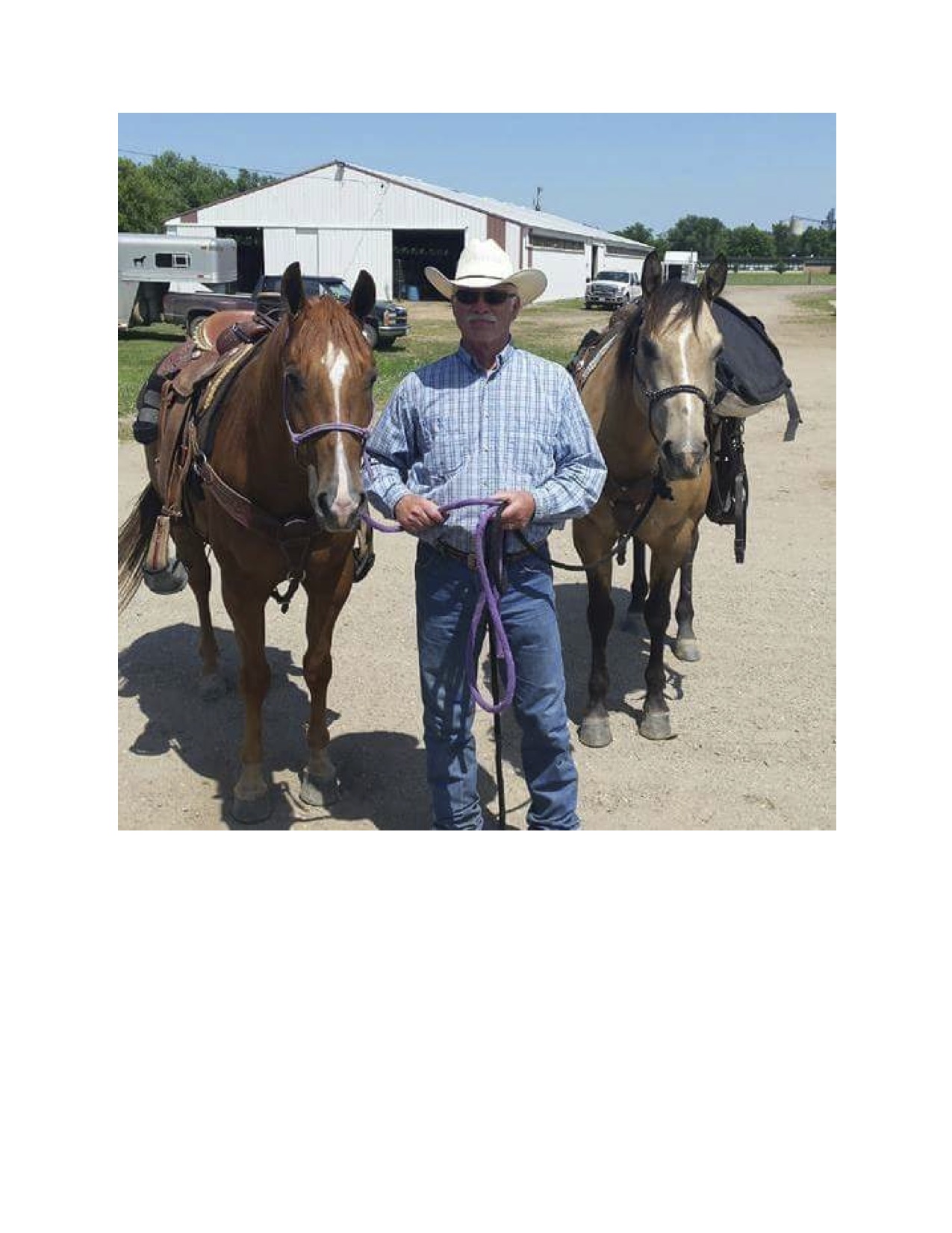
From the Archives: Hadley Heavin sees no incongruity in being rodeo cowboy, concert classical guitarist, music educator and Vietnam combat vet
When I saw Hadely Heavin perform classical guitar at the Joslyn Art Museum in the late 1980s I knew I had to write about him one day, and in 1990 I sought him out as one of my first freelance profile subjects. I’ve culled that resuling story from my archives for you to read below. What I didn’t know when I interviewed him that first time is what a remarkable story he has. I mean, how many world-class classical guitarists are there that also compete in rodeo? How many are combat war veterans? What are the chances that an inexperienced American player (Heavin) would be selected by a Spanish master (Segundo Pastor) to become the maestro’s only student in Spain? I always knew I wanted to revisit Heavin’s story and nearly two decades later I did. That more recent and expansive portrait of Heavin can also be found on this blog, entitled, “Hadley Heavin’s Idiosyncratic Journey as a Real Rootin-Tootin, Classical Guitar Playing Cowboy.” When I wrote the original article posted here Heavin’s mentor, Segundo Pastor, was still alive. Pastor has since passed away but his influence will never leave the protege. Heavin was still doing some rodeoing as of three or four years ago, when I did the follow-up story, but even if he has completely given up the sport he’ll always do something with horses because his love for horses is just that deep in him. The same as music is. I hope you enjoy these pieces on this consumate artist and athlete.
From the Archives: Hadley Heavin sees no incongruity in being rodeo cowboy, concert classical guitarist, music educator and Vietnam combat ve
©by Leo Adam Biga
Orignally published in the Omaha Metro Update
Hadley Heavin defies pigeonholing, The 41-year-old Omaha resident is an internationally renowned classical guitarist, but to ranchers in rural Nebraska he’s better known as a good rodeo hand. The University of Nebraska at Omaha instructor’s life has been full of such seeming incongruities from the very start.
Back in his native Kansas Heavin is as likely to be remembered for being a precocious child musician as an expert bareback bronc rider, star high school athlete and Vietnam War veteran. Today, despite lofty success as a touring performer, Heavin is perhaps proudest of being a husband and new father. He and his wife, Melanie, became first-time parents last year when their girl, Kaitlin, was born.
Music, though, has been the one unifying force in his life. His earliest memories of the Ozarks are filled with gospel harmonies and jazz, ragtime and country rhythms. Home for the Heavin clan was Baxter Springs, Kan., five miles froom the Oklahoma and Missouri borders.
“Basically I grew up with music and I’ve been playing it since I was 5. My father was a jazz guitarist and always had bands,” said Heavin. adding that his late father played a spell with Bob Wills and the Texas Playboys.
Heavin hit the road with his old man at age 7, playing drums, trumpet and occasional guitar at dances and socials.
“I was a little freak because I could play really well. I loved it, but it got to be a chore. I remember about midnight I’d start falling asleep. My dad would start to feel the time dragging and see me nodding, then he’d flick me ont he head with his fingertip and wake me up, and I’d speed up again.
“Most of my fellow students at school didn’t know I was doing this. I didn’t think I was doing anything special because everyone in my family were musicians. I grew up in that environment thinking everybody was like this. I couldn’t believe it when a kid couldn’t sing or carry a tune or do something with music.”
When Heavin was all of 11 he started playing rock ‘n’ roll, an experience, he said, that left him burned out on music, especially rock.
“I’m glad I got burned out on that when I did because I’ve still got students in their 20s trying to study classical guitar and wanting to play rock ‘n’ roll. They want to have fun,” he said disparagingly. “They just don’t realize rock is not an art form in the same sense. Classical guitar requires a lot of work and soul searching.”
Heavin doesn’t mince words when it comes to music. Since he studied in Spain with maestro Segundo Pastor, he performs and teaches the traditional romantic repertoire that originated there. He feels the music is a deep. direct reflection of the Spanish people, with whom he feels a kinship.
“Spanish people are much warmer than Americans. We’re not brought up with the passion those people are brought up with. That’s why I prefer listening to European artists.”
He said classical guitar “demands” a passionate, expressive quality he finds lacking in most American guitarists with the exception of Christopher Parkening.
“Who a student studies with makes a big difference. I don’t think I ever would have played the way I do if I had never studied with Segundo.”
Heavin feels Pastor selected him as a student because he saw a hungry young musician with a burning passion.
“He wouldn’t have been interested if he didn’t see things in my playing that were like his. Frankly, he doesn’t like very many American guitarists. He thinks they’re very shallow performers.”
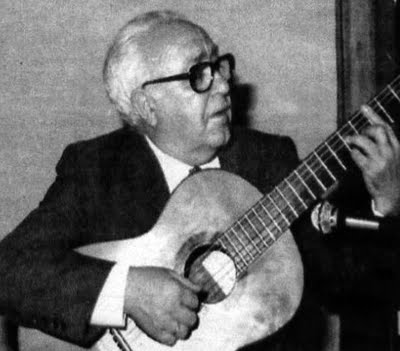
Segundo Pastor
The acolyte largely agrees, suggesting that part of the problem is most American musicians don’t face as many obstacles or endure as many sacrifices for their art as foreign musicians.
“My students are spoiled. How are they going to suffer for their art?” he asked rhetorically.
He said that when he turned to the classical guitar in the early ’70s, after seeing combat duty in Vietnam and having his father pass away, he knew what hard times were. “I suffered because by then my father was gone and my mother couldn’t support me. Somehow I played guitar and kept myself fed, but I didn’t have a penny, really, until I was 32. But I loved the guitar and I didn’t worry about those things. People are kind of unwilling to do that anymore.”
He dismissed the new guitarists who denigrate the traditional repertoire in favor of avant garde literature as mere technicians.
“I hate to say this but about all the concerts I’ve been to with the new guitarists have been very boring, driving audiences away from the guitar. It’s a real shame. They’re championing these avant garde works, which is fine, but they can’t play the Spanish and romantic repertoire at all. They just can’t phrase it. It’s not in them. They sound like they’re playing a typewriter.
“There’s a lot of great guitarists now, and they’re excellent technically, but there’s still only a handful of great musicians.”
He hopes artists like Parkening and Pastor help audiences “discern the guitarists from the musicians.”
It may surprise those who’ve seen Heavin perform with aplomb at Joslyn Art Museum’s Bagels and Bach series or some other concert venue that he as at ease on a horse as he is on a stage, as facile at roping a steer as he is at phrasing a chord, or as penetrating a critic of a rodeo hand’s technique as of a classical guitarist’s. But a look at his thick, powerful hands, deep chest and broad shoulders confirms this is a rugged man. And he does work out to stay in trim, including working with horses.
“As a matter of fact this is the first year I haven’t rodeoed in many years,” he said. “The only reason I’m not this summer is that I’m in the middle of doing an album and my producer’s worried about my losing a finger. I team rope now because I’m too old to ride rough stock. If I do get out of roping to protect my hands I’m probably going to have to do cutting or something just to stay on a horse. It’s just that horses are in my blood. But it’s tough with this kind of career because it takes so much time.”
Heavin has competed on the professional rodeo circuit all over Nebraska. “It’s funny,” he said. “I draw good crowds at my concerts in western Nebraska because I know all the ranchers and rodeo people, and they’re curious to see this classical guitarist who rodeos, too. I was playing a concert in Kearney and there were some roping friends in the audience. After I was done I went up and said to them, ‘These other people think I’m a guitarist, so don’t be telling them I’m a cowboy.’ But it was too late. They already had. I try not to advertise it too much.”
Heavin took to the rodeo as a boy to escape the music world he’d run dry on. “I started riding bulls and bareback broncs. I wanted to be a world champ bronc rider,” he said.. He rodeoed through high school and for a time in college. He also participated in football, wrestling and track as a prep athlete, winning honors and an athletic scholarship to Kansas University along the way.
“I think my dad put pressure on me to be an athlete to some degree because he wanted me to be well-rounded.”
At KU Heavin played on the same freshman football team as future NFL great John Riggins, a free-spirit known for his rebel ways. “I’ve never seen a guy that trouble came to so quickly. We used to go to bars and there was always a fight and John usually started it. He had more John Wayne in him than John Wayne.”
Another classmate and friend who became famous was Don Johnson, the actor. Heavin hasn’t seen the Miami Vice star in years but stays in touch with his folks in Kansas.
It was the late ’60s and Heavin, like so many young people then, was torn in different directions. “I decided I really didn’t want to be in school but I had the draft hanging over my head. I took a chance anyway and dropped out…and I was drafted within two months.”
The U.S. Army made him an artillary fire officer and shipped him off to Vietnam before he knew what hit him. He shuttled from one LZ to another, wherever it was hot. “I was what they called a bastard. I was with the 1st Field Force. I was in the jungle the whole time. I saw base camp twice during a year in-country,” he said.
Heavin was shot in action and after recovering from his wounds sent back out to the war. Luckily, his tour of duty ended without further injury and he finished his Army hitch back home at Fort Riley, Kansas. While stationed there he began missing working with horses and on a whim one day entered the bareback at a nearby rodeo.
“I drew a pretty rank horse, plus I hadn’t ridden in years and I was still sore from my war injuries. I got hurt. When I got back to the base they were mad at me because I couldn’t pull my duty. They were going to court-martial me.”
Fortunately, cooler heads prevailed and the incident was forgotten. “When I got out of the service my dad died shortly thereafter, and there was no music anymore.” Heavin had been working a job unloading trucks for two years when a friend suggested they see a classical guitarist perform. The experience rekindled his love for music.
“I was enthralled. And it just came over me like that,” he said, snapping his fingers. “That’s how fast I made my deicison to play classical guitar.”
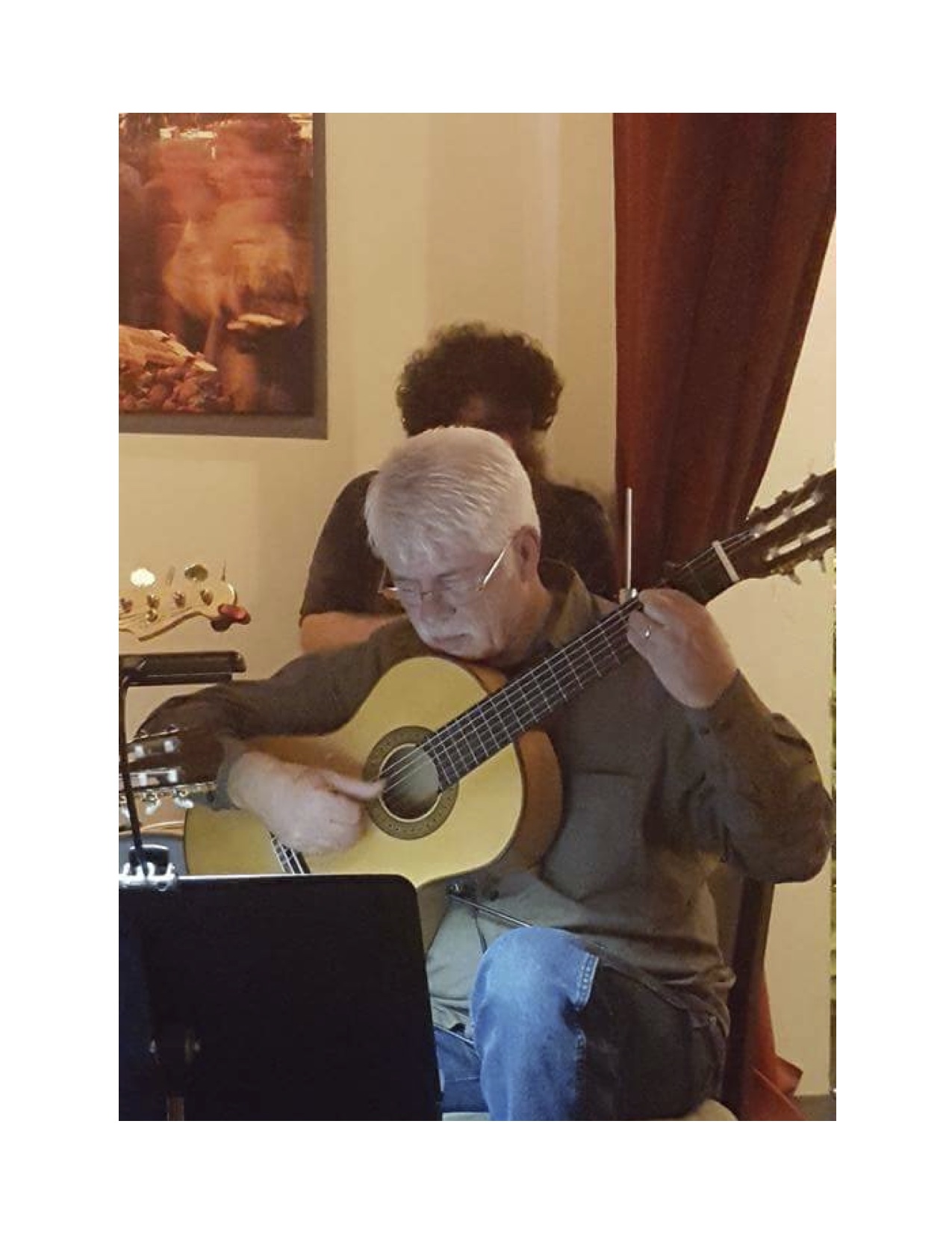
Until then Heavin said he had never really heard classical guitar, much less played it. He began by teaching himself.
“I worked really hard. As soon as my hands could take it I was practicing six to eight hours a day and working a full-time job — just so I could get into college.”
Heavin brashly convinced the chairman of the Southwest Missouri State University music department to start a degreed classical guitar program for him. “I said, ‘Look, I want to get a degree in guitar and I’m determined to do it. And I don’t know why nobody has a program in this part of the country.’ He said, ‘I agree, let’s try this and see what happens.'” As the pioneering first student hell-bent on finishing the program, Heavin graduated and he said the program has “grown into something really nice and become very popular.”
His chance meeting with his mentor-to-be, Segundo Pastor, occurred at a concert in Springfield, Mo., at which Heavin was playing and the maestro was attending on one of his rare American visits. Heavin was introduced to “this little old man who couldn’t speak English” and arranged to see him later. He played for Pastor in private and the master liked the young man’s musicianship. The two began a correspondence.
When Pastor returned the next year he asked to see Heavin. “I spent practically a whole day with him and I played everything I knew. Then he said, ‘If you come to Spain I’ll teach you for nothing.’ I didn’t realize then what this meant or how it was going to work out,” Heavin said. A university official aided Heavin’s overseas studies. But the student still had no inkling his apprenticeship would turn out to be what he termed “one of the most wonderful experiences of my life.”
“When I arrive there was an apartment for me. The maestro’s wife was like my mom. His son was like my brother. And I realized only after I got there that I was his only student. He rarely takes them. There were Spanish boys waiting in line to study with him.”
Appropriately, the rodeoer lived a block from the Plaza de Toros, the bullfighting arena, and next door to the hospital for bullfighters.
“I lived in the culture. I wasn’t with Americans at all. My friends were all Spanish. I taught them English, they taught me Spanish. During the 10 months I was there I had a two-hour lesson from Segundo almost every day. He puts all of himself into that one student. That’s why he doesn’t take on many. It was really like a fairy-tale because the man literally gave me a career. The thing that’s odd about it is that I had only been playing about a year when the maestro invited me to Spain. It was confusing because there were Spanish boys who could play better than I.”
It was a question that nagged at Heavin for a long time. why me?
“The whole time I was in Spain I kept asking him, ‘Why did you pick me?’ and he would never answer it. The last night I was there he knocked on my door and we went to the university in Madrid. It was one of those romantic Spanish evenings. We were walking down a wet, cobblestone street and he put his arm on me and said, ‘Yeah, the Spanish boys are good guitarists but some day you’ll be a great guitarist,” recalled Heavin, still touched by the memory. “That gave me a lot of confidence to go on.”
During his stay abroad Heavin toured with Pastor throughout Spain, When the apprenticeship ended they performed duo concerts across the U.S., including New York’s Carnegie Hall. Heavin’s career was launched.
While the two haven’t performed publicly since then, Heavin said they remain close. “Now that I’m in the States he comes more often. When he visits we just have fun and enjoy ourselves. Two years ago he came with Pedro, a friend from Spain, and they did a duo concert here.”
Asked if in some way Pastor replaced his father, with whom he was so close, and Heavin said, “Oh yes. He’s like my father, no doubt. He’s my mentor, too.”
After earning a master’s degree at the University of Denver Heavin came to UNO in 1982. He heads the school’s classical guitar program, which he said is a good one. “I’ve got some students who play very well.”
Besides teaching Heavin performs 25-30 concerts a year, a schedule he’s cut back in 1990 to work on his first album.
“I’ve just finished doing the research on the pieces I want to put on. Now I’m learning the pieces. I’ll probably go into the recording studio in October or November,” he said.
As with Pastor singling him out for the chance of a lifetime, a patron has discovered Heavin and is helping sponsor him. “Another fairy-tale happened. A stockbroker heard me play and thinks I should have lots more recognition. He wants to get involved in my career.”
The guitarist is looking forward to touring more once the album is done. He has been invited to perform in Australia and Pastor has asked him to do concerts in Spain.
“People ask me why I live in Omaha and not on the coast,” he said. “I dearly love Omaha. I love the Old Market. I don’t like huge cities.”
Heavin, who practices his art about five hours daily, said success has little to do with locale anyway. “It’s an attitude. To do anything well requires an aggressive attitude. You have to just want to, and I’ve always done well financially playing guitar and teaching.”
Related articles
- Journey Through Latin America with Classical Guitarist Michael Anthony Nigro (worldculturesaustin.com)
- From the Archives: Cowboy-turned Scholar Discovers Kinship with 19th Century Expedition Explorer (leoadambiga.wordpress.com)
John Sorensen’s decades-long magnificent obsession with the Abbott sisters bears fruit in slew of new works, Including “The Quilted Conscience” documentary at Film Streams
John Sorensen epitomizes a subject whose magnificent obsession, in this case for social work pioneers Grace and Edith Abbott, inspires me to want to write about him and his passion. This blog contains an in-depth story I did a couple years ago about John and his various Abbott projects. The following short piece for The Reader (www.thereader.com) encapsulates his fascination with the sisters, particularly Grace, and previews his documentary film about a quilt project with strong connections to the Abbotts‘ advocacy for immigrant women and children. John’s film lovingly details a group of Sudanese-American girls making a story quilt that expresses their dreams and memories. The quilt project is a metaphor for the loss of one way of life and the adoption of another way of life as the Sudanese, like other newcomers in the great march of immigration and refugee resettlement in American history, become part of the rich tapestry and fabric of America.

John Sorensen’s decades-long magnificent obsession with the Abbott sisters bears fruit in slew of new works, including “The Quilted Conscience” documentary at Film Streams
©by Leo Adam Biga
Soon to be published in The Reader (www.thereader.com)
John Sorensen is like many Nebraska creatives who left to pursue a passion.
The Grand Island native and longtime New York City resident worked with master filmmaker Alexander MacKendrick (The Sweet Smell of Success) and Broadway legends Lewis and Jay Presson Allen (Tru). He founded a New York theater troupe. He’s developed a radio series. He’s written-edited books and study guides.
What sets him apart is a two-decade venture combining all those mediums. The Abbott Sisters Project is his multi-media magnificent obsession with deceased siblings, proto-feminists and early 20th century social work pioneers, Grace and Edith Abbott, from Grand Island.
As Abbott champions, Sorensen and University of Nebraska at Omaha professor Ann Coyne were instrumental in getting the school last fall to rename its social work unit the Grace Abbott School of Social Work.

John Sorensen with bronze bust of Grace Abbott
Sorensen has found a saga of strong, visionary women engaged in social action. These early Suffragists and University of Nebraska-Lincoln graduates were part of the Progressive wave that sought to reform the Industrial Age’s myriad social ills.
They trained under Jane Addams at Hull House, they taught at universities, they widely published their views, they advised Congress and sitting presidents and served on prestigious boards, all in helping shape policy to protect immigrants, women and children. Much feted during their lives, the sisters are arguably the most influential Omaha women of all time. The pair remained close, often consulting each other.
“I think from an early age, the sisters recognized they were each somehow mysteriously made whole by the other — that together they could learn things, experience things and do things impossible for either on her own,” says Sorensen.
His latest Abbott work is a documentary, The Quilted Conscience. He wrote, produced and directed it. A 7 p.m. free preview screening is set Thursday, October 6 at Film Streams.
The doc follows a group of Sudanese girls in Grand Island making a story quilt with the help of master quilter Peggie Hartwell and the town’s local quilters guild. The resulting story-blocks illustrate the African home the girls’ families left and the American home they’ve adopted. The quilt expresses the girls’ memories and dreams for the future. Sorensen seamlessly interweaves Grace Abbott’s minority rights advocacy with the girls’ cross-cultural experience to create a rich, affecting tapestry full of dislocation and integration, loss and hope.
A Q & A with Sorensen and some of the girls follows the screening. The “Dreams and Memories” story quilt the girls completed will be on display. The film is expected to eventually air on public television.

Grand Island public school teacher Tracy Morrow, whose students worked on the story quilt, says, “For many of the girls it has been a life-changing experience. They put so much work into it. I feel like John’s … educating the Grand Island community about the Sudanese and educating the Sudanese about Grand Island and America.”
As Grand Island connects Sorensen to the Abbotts, his project is allied with the public schools and library. The city’s refugee population is living context for applying Abbott values.
Sorensen has promoted the Abbotts for years, but it’s only recently his efforts have borne fruit. The story quilt has toured the state. He’s formed a immigrant-student quilt workshop. He co-edited The Grace Abbott Reader and helped get Edith’s memoir published posthumously. The sisters’ accomplishments are told in a new children’s book. The Grand Island Independent sponsors an Abbott scholarship.
All of it affirms that his epic odyssey to bring the Abbotts to the masses has been worth it. Even when his efforts gained little traction, he persisted.
“I just did whatever I could to keep transforming it and keeping it in people’s faces,” he says. “I could see I was having success in raising awareness — that people were slowly getting to know around the state who these women were. And that this more than the study of people from 100 years ago; this is the study about things that can help us to live better today.”
His devotion to the Abbott legacy is complete.
“I simply love the sisters,” he says. “I also admire their work for children and women and immigrants, and I feel a family-like connection and perhaps responsibility to them from sharing a hometown. I could no more turn my back on them, their legacy and their story than I could my own family. That love, that sense of faith is unconquerable.”

Even though he didn’t intend making it his life’s work, he’s grateful his Johnny Appleseed project is finally sprouting.
“It’s become clear in the last three or four years that it has no end for me. It’s become so embedded in my existence that I can’t stop — also because now it’s actually starting to unfold.”
Sorensen, who “never felt at home” growing up in Grand Island, is today a celebrated favorite son for his project’s rediscovery of two town legends. It feels like “a kind of destiny,” he says.
Seating is limited for the free Quilted Conscience screening. Reservations are recommended and may be made by emailing maggie@filmstreams.org or visiting the theater box office, 1340 Mike Fahey Drive. For more details, call 402-933-0259 or visit http://www.filmstreams.org.
Related articles
- A Stitch in Time Builds A World Class Quilt Collection and Center-Museum (leoadambiga.wordpress.com)
Short story writer James Reed at work in the literary fields of the imagination
James Reed of Omaha is one of those superb writers who goes under the radar of the general reading public because he specializes in short fiction that gets published in serious but sparsley read literary journals and anthologies, but he deserves a much wider following. I wrote this piece about James for The Reader (www.thereader.com) some 12 years ago, when he was still teaching at the University of Nebraska at Omaha and editing its literary magazine. I first met James at UNO, where we were students about the same time. I ran the campus film series and he and his then girlfriend and now wife, Omaah Central High School teacher Vicki Deniston Reed, were regulars at our screenings of classic and contemporary American and foreign films. Like most writers, James has always worked a regular job to support his writing habit. Highly respected in the field, James has received the National Endowment for the Arts‘ prestigious Charles B. Wood Award for Distinguished Writing from Carolina Quarterly and and Individual Fellowship Master Award in Literature from the Nebraska Arts Council. His work has been a finalist in competitions for the Spokane Prize for Short Fiction, the Mary McCarthy Prize in Short Fiction and the Flannery O’Connor Award for Short Fiction, and the Southern California Review Fiction Prize. His work was a semi-finalist for the St. Lawrence Book Award.
James is a sweet man with a huge talent, and it’s safe to say that the vast majority of customers he waits on at the copy center he works at don’t have a clue he is one of the best living writers in the world. He’s far too humble to toot his own horn, so let me do it for him.
Short story writer James Reed at work in the literary fields of the imagination
©by Leo Adam Biga
Originally published in The Reader (www.thereader.com)
“The clocks were faced with gold. Real gold. It dazzled the eyes. Houses might be black and white and as big as barns, with long slate roofs as if to weight them into the earth, but the clock towers shone like sunlight…They could be seen for miles. Towers, steeples, clocks, and inside the cathedrals, the walls seethed with gleaming saints. Angels older than America clawed toward heaven with empty, shimmering eyes.”
-from James Reed’s “The Time in Central Europe”
James Reed hears the music in words.
An award-winning short fiction author and accomplished amateur musician, the 45-year-old Omahan routinely reads aloud his work to better catch the beats, measures, tones resonating in the prose. While hardly an unusual practice among writers, Reed’s highly developed musical sense (he is a clarinet player with the Nebraska Wind Symphony and Black Woods Wind Ensemble) makes him more attuned than most to the lyrical notes of a descriptive passage, an alliterative phrase, a sly metaphor, an active verb. For him, it’s all about maintaining and tweaking, where needed, the voice he’s chosen (or that’s chosen him) to tell a story. Like a composer, he gets the rhythm down until every chord, every inflection, every transition flows seamlessly into a unified whole.
How does Reed, a creative writing instructor in the University of Nebraska at Omaha’s Writers’ Workshop as well as fiction and managing editor of its literary magazine, The Nebraska Review, know when he’s reached the desired pitch?
“It sounds right,” he said in between swigs of coffee during a sit-down chat at the cluttered Review office in the Weber Fine Arts Building on the UNO campus. “I’m very aural…very attentive to sound and rhythm. I’m very voice-driven. I try to have a different voice for every piece and that pretty much is the guiding force. Whatever voice I’m using, whether it’s very formal or highly colloquial or a very flat uninflected voice, I always want it be settled. Is it working the way it should? Is it dead-on consistent? And if it doesn’t need to be consistent, when it moves do you believe the chord changes, the modulations?”
An example of a story where, as Reed puts it, “the voice ran the show” is “The Natural Order,” a morbid tale with a lonely, embittered old widow, Gwendolyn, as its gloomy narrator. Having lost everything dear to her, she sees her own sad end approaching in a neighborhood gone to the dogs:
“In the distance I hear woodchippers, the big industrial kind, and soon they’ll come down this street. Whole trees are being mulched. Most of them have been dead for years, and the neighborhood’s looking blighted. I’m afraid the city will just decide to make it official. Mr. Krendler’s old house already has been condemned…After Mr. Krendler died the place was rented to…maybe a psychotic, I think. He didn’t last long. I wouldn’t doubt he’s locked up or dead, the way he treated Mrs. Vacanti’s dog. I hated it too, the yappy little thing…but that young man twisted its head until he broke its neck…It was a noisy ball of fluff, but most of the dogs here are bigger. There’s one that looks like a horse…I’ve cleaned up uncounted messes from my yard…but the city wouldn’t listen. They just help who they want.”
According to Reed, “One day I wrote that opening sentence about woodchippers, ‘the big industrial kind,’ and from that moment on I had the voice I wanted. The more I wrote her (Gwendolyn), the more that voice made sense to me.”
Being true to the music of language is one thing, but just how Reed’s musicianship feeds his prose is somewhat ethereal. Experience has taught him not to discount it though.
He explains, “After college there was a period when I wasn’t playing (music) and I discovered I also wasn’t writing much. And when I finally picked up the horn I found myself writing again, so there’s obviously some link there. I write and read the way I do I believe largely because of the way I hear music generally, but particularly composers like Stravinsky and Mingus, whose work is dense complex stuff that leaps at a moment’s notice. Very complicated voicing. Enormous range of notes. How I hear fiction is very much a rhythmic mental sense of chord structure and of consonants and vowels colliding. That’s what I’m always trying to do — make it sound right. And some things never sound right to you.”
The discipline of practicing music daily as a youth, when he and his younger brother took horn lessons, steeled him for the rigors of writing every day. “For someone who’s going to be doing a very solitary job like being a writer, being a musician is great training because you spend hours and hours and hours by yourself mastering tasks. Like writing, it’s an extremely focused activity. I’m very good about writing even if I’m not in the mood. I highly recommend that. In class I tell students to think of this as your job. Some days on your job you’re great. Some days you’re just walking through the motions. The important thing is the process of doing it. If you don’t sit down and make yourself do it, it won’t happen. It just won’t.”
He works from a congested second-story office in the well-rummaged old clapboard house he shares with his wife Vicki Deniston Reed, a Central High School teacher, and their two young children, Anna and Jake. The small room, with stacks of books bulging from shelves and littering the floor, overlooks one side of Cascio’s Steak house and contains two desks, one for writing in long-hand,the other for his Mac computer. Within easy reach are his two horns — a B-flat and an alto clarinet.
Reed is a man of contrasts. He navigates the academic-aesthetic world while holding down a blue-collar printing job (something he’s done for years). He wears the utilitarian clothes and unpretentious demeanor of a working stiff, but his sonorous voice and capacious vocabulary clearly belong to the classroom or stage.
Among the discordant strains Reed or any writer must face is the rejection notice. You know the kind: ‘Thank you for the opportunity of reading your manuscript, but unfortunately at this time it does not meet our needs…blah, blah, blah…yadda, yadda, yadda.’ He’s heard them all before. To give aspiring writers a sober dose of reality or perhaps let them thumb their collective nose at the Philistines making publishing decisions, he’s affixed a collage of rejection notes to his UNO office window.
Getting stories published can take years. Some never see the light of day. Several Reed stories have appeared in major literary magazines (West Branch, Whetstone, River Styx, Tennessee Quarterly), but for every acceptance there’s far more turn-downs. So it goes. Undaunted by writing’s vagaries, he pursues a singular vision. His work has garnered attention though. One of his two collections, “The East Coast of Nebraska,” has been a finalist for top American literary prizes — the Flannery O’Connor Award for Short Fiction and the Mary McCarthy Prize in Short Fiction. While neither this collection nor his other (“Insulting the Flesh”) has found a publisher yet, he takes the attitude it’s only a matter of time before they do sell.
Meanwhile, he’ll go on trusting his inner voice. It’s served him well thus far. He’s won writing awards from the General Electric Foundation, Creighton University, Carolina Quarterly and the Nebraska Arts Council. Not bad for someone who fell into writing shortly after he and his family moved to Omaha from his birthplace of Minneapolis in 1973. A 1979 cum laude graduate of UNO’s Fine Arts College, Reed then promptly left academia behind. Years passed. Then, in 1990, he returned as fiction editor of the Nebraska Review and at the urging of poetry editor Susan Aizenberg pursued post-graduate studies, earning a master of fine arts degree at Warren Wilson College in N.C. in 1995. In the two-year Warren Wilson program he discovered a passion for teaching and gained a rigorous analytical approach to writing.
“It gave me a way of working with students to break down things into ever smaller component parts and still have it be comprehensible enough to deal with the overall architecture of the piece. Teaching I like because get to watch students light up and figure it out and take themselves to a place where they wouldn’t probably have been before, and that’s enormously rewarding.”
He’s especially grateful to former Warren Wilson instructor Karen Brennan for pushing him to refine his work. “I tend not to be very fond of rewriting. She beat into me, against all of my impulses, the real necessity of being an attentive rewriter and being ever vigilant and ever willing not to settle just because you’re tired. I owe her a lot for that because I think I’m a better writer as a result.”
Additionally, Reed credits UNO Writers’ Workshop founder and director, author Richard Duggin, for his development. “Absolutely. I ran into him early and young. I learned more from him about how to think about writing than probably anybody. I owe him, and many other people owe him, an enormous debt for his being endlessly, tirelessly helpful and instructive.”

James Reed
In turn, Duggin says he admires Reed’s “particular attention to small details that authenticate the story, his eye to finding the appropriate image and his meticulous attention to character development,” adding, “To me, James’ stuff represents some of the best work being done in Midwest literature.” Noting the musicality of his prose, he also appreciates Reed’s “attention to the rhythms of the language.”
Reed’s sonata-like stories unfold in episodic turns, each taking the measure of characters and incidents in small incremental movements that variously diverge from and merge with the main theme until the whole is great than the sum of its parts. He is fond of constructing lattice-work layers of digression and subtext.
“I love details. I will cram stories full of details. Early on in my fiction I picked up on a military defense theory, of all things, called Dense-Pack. The notion goes that you can have so much stuff densely clustered in different places and have it be so mobile that it’s difficult to destroy. And I think of my own fiction as essentially Dense-Pack stuff. I mean it’s just loaded, as somebody once told me, with lots of bits of dead-end pipe. I’m not as concise a short story writer as I probably should be, but I like the sound of things to be a little busier than that.
“Even though my plots tend to be kind of wandering, I will construct elaborately baroque things. One thing I do is mess with your time sense. My structure tends not to be a straight-line, linear, chronological development. In some ways I think I’m trying to do in short fiction a lot of the things people do in novels.”
While conscious his dead-end wanderings are not always neatly resolved, these very detours help bring Reed’s explorations of human foibles, conflicts and passions to life. He delves into the private often dark thoughts, personality tics, quirky behaviors and strained relations of “average” people in “ordinary” straits, revealing an extraordinary panorama of social-emotional-psychic baggage along the way.
“I like fiction with lots of people in it and I like the people in my fiction to be interesting. But it’s not like I have people fanatically happy or in love in my stories — often they’re ferociously not.”
Brooding characters are abundant in “The Downside,” a story set in a law firm whose soul-killing politics and pressures drive an attorney into a downward spiral. For it, Reed drew on his years working in the printing office of Kutak-Rock. Reed, who views the world of work as a rich but largely ignored vein of material, says it’s surprising “how much real hatred there is among people” at jobs.
Conceding “I can be dark,” Reed adds, “I like my darkness with humor.” His sardonic sense is evident in the “East Coast of Nebraska” collection’s title piece, which portrays the absurd lengths a business associate goes to in hiding the truth behind his seemingly stalwart friend’s scandalous death and illicit sexual history.
Reed speculates the source of his own dark side may be the “startling” experience of touring, at age six, the Dachau death camp while his career Army officer father was stationed in Germany. He drew on that episode for “The Time in Central Europe,” an evocative rumination on the crossroads an American service family finds themselves in in Germany during the Cold War. The protagonist is a small boy who sees the immediate menace of the Berlin Wall crisis and the past horror of Dachau reflected in the oppressive architecture of the region and in the Hansel and Gretel fairy-tale he’s reading. The area’s shining gold-faced clock towers seem beacons of hope but ultimately only reflect the inferno. Together with the anxiety the adults around him exhibit, it is a deeply troubling time for the boy, just as it was for Reed.
Naturally, Reed felt compelled to describe it in fiction, but years passed before he was able to come to terms with it. During a return visit to Germany as an adult, he says, “all this memory poured out and I was able finally to write a version of that story that was close enough to get it out of my system.”
Growing up a military brat, Reed moved from state to state, even overseas. It was an “unrooted” existence, but one affording rich opportunities to see people and places he might not have otherwise. He attended 26 schools, lived in Alaska before it was a state and was in Germany when the Berlin Wall went up. The longest he settled anywhere was seven years in Virginia. A “smart, alienated kid,” he was a “voracious reader” from the time he entered school. His storytelling first blossomed in the form of cartoons and even a daily comic strip he created for his own amusement. Later, he began writing stories for classroom assignments.
Whether his stories reverberate deeply with own life or spring full-born from his fancy, they are rooted in careful observation. Everything is potential material. “Absolutely, everything,” he says. “Cereal boxes, the old lady carrying plastic bags, a guy slamming lug nuts off a tire.” Keen awareness is a writer’s duty or curse. In Reed’s case, also his pleasure. “I’m constantly trying to pay attention to what people say and do. To catch subtleties of nuance and behavior. I’ve always been entertained just watching people. I’m pretty much an eclectic sponge. I’ve got this great store of stuff in my head, so I assume I was always fairly observant, even as a kid.” When something strikes him, he jots down impressions or makes mental notes.
“Transit Info.,” a slice-of-life story about disparate city bus riders, grew out of a conversation Reed overheard on a MAT bus. “People were discussing the nature of heaven, and I sat and thought, ‘Well, who are these people who would all end up in the oddity of this time and place discussing the nature of heaven? How did this happen? How did we get here?’” Imagination filled in the rest. Similarly, “Customer Recognition,” in which a guilt-ridden stick-up man has a life-reviewing catharsis at the garage he’s robbing, came from Reed observing a service station attendant.

A Newsweek article sparked Reed’s interest in Nikola Tesla, a brilliant if eccentric electrical engineer and inventor of the late 19th and early 20th centuries. The resulting story, “Mr. Tesla’s Thunder,” explores the effect this wizard-like man has on the residents of a pioneer town upon setting up shop there and conducting awesome experiments to harness lightning and broadcast electricity.
Reed’s diverse interests and fluid style make him hard to categorize. His many literary influences include the late Wright Morris (whom he dedicates a tribute to in the next issue of The Nebraska Review), Robert A. Heinlein, J.R. Tolkien, Alice Munro and Mervyn Peake (“The Gormen Ghast Trilogy”). Filmmaker Robert Altman’s fusion-like story and dialogue riffs are another inspiration for this certified film buff.
Like many artists Reed strives hard to make his craftsmanship invisible. To let his technique work unconsciously on the reader. He doesn’t get carried away with any grand designs, however. “There are writers who want to put the I-beams on the outside of the structure, but I definitely am of the camp that you spend all your time trying to make sure this is not real obvious. That you essentially fool them into believing something that isn’t there. But then again, they’re all just squiggles on paper. Let’s be real.”
Plenty busy these days, Reed is now “slogging away” on a short story and in the early research stages of a first novel. “In the spirit of a don’t-jinx-the-project impulse,” he’ll only say the novel’s historical theme concerns a musician’s exploits in the Old West, including playing in a band under the command of Gen. George Armstrong Custer at the time of the Little Big Horn. Yes, that’s right, “Custer’s Last Band.”
“It was a scene picture-perfect, like the cover of a story book, with shadows climbing the vibrant contours of the earth, sliding over forests toward a small village, until he saw across the brilliant hills a clock. He saw on its face the ancient flash of sunlit gold, the red gold fire of twilight.
-from “The Time in Central Europe”
Related articles
- The Many Worlds of Science Fiction Author Robert Reed (leoadambiga.wordpress.com)
- World’s Best Short Stories: Boule De Suif (socyberty.com)
- Lit Fest Brings Author Carleen Brice Back Home Flush with the Success of Her First Novel, ‘Orange Mint and Honey’ (leoadambiga.wordpress.com)
UNO Wrestling Retrospective – Way of the Warrior, House of Pain, Day of Reckoning
This blog recently featured my story “Requiem for a Dynasty” about the UNO wrestling program being eliminated. The story allowed longtime head coach Mike Denney to reflect on the proud legacy of brilliant achievement he helped build. That legacy ended ignominously, not because of anything he or his athletes or coaches did, but because of decisions made by University of Nebraska at Omaha officials and University of Nebraska regents to unilaterally cut a program that did everything right in pursuit of higher revenue Division I athletics. The action sent a disturbing message to anyone in the university system: namely, that dollars trump integrity and standards. The following three-part series on UNO wrestling was originally published in 1999 by The Reader (www.thereader.com), when I followed the program for an entire season. This experience put me in close proximiity to Denney, his coaches, and his athletes, thus giving me an inside perspective on how he conducts himself and his program, and I walked away from the experience with great admiration for the man and his methods, as virtually everyone does when they get to know him. Now as he starts a new chapter in his athletic coaching life at Maryville University in St. Louis, where he is leading a start-up program with a band of brothers he’s brought with him from UNO, I know that he will have the same impact there he had here.
A Three-Part UNO Wrestling Retrospective-
Part I: Way of the Warrior
©by Leo Adam Biga
Originally published in The Reader (www.thereader.com)
Near dusk on a Saturday in southwest Minnesota, ten samurai-like warriors lick their wounds after valiantly waging battle an hour before. Officially, they comprise the starting lineup for NCAA Division II’s No. 2-ranked University of Nebraska at Omaha wrestling team. But, in truth, they ply the ancient grappling arts in service of a master-teacher, Coach Mike Denney, whose honor they must uphold in extreme tests of skill, will, endurance.
Move over Magnificent Seven. Make room for The Terrific Ten.
Only they’re not feeling so terrific after losing a dual 23-16 to St. Cloud State, a North Central Conference rival UNO usually pummels. Having lost face in this Jan. 16 rumble up north, the Mavericks are bowed and beaten warriors whose dreams of a national championship lay temporarily dashed. Huddled in the close confines of the 28-foot Ford Chateau motor home the team travels in, the men sit in cold stony silence, awaiting their master’s arrival, and with it, hoped for redemption.
Losing hurts enough, but how they lost really grates. The St. Cloud debacle comes 18 hours after UNO defeats Augustana 25-11 in Sioux Falls, S.D. in what is a solid if unspectacular showing for a season-opening dual. Versus St. Cloud the Mavs build a 16-11 lead entering the next to last match, in which UNO’s stalwart 125-pounder Mack LaRock, a returning All-American, holds a 12-4 edge near the very end. But then, all at once, LaRock loses control, gets himself turned on his back, his shoulders driven into the mat and pinned with four seconds left, sending the crowd in cavernous old Halenbeck Hall into a frenzy and putting SCSU up 17-16 with one match to go.
Shellshocked, LaRock lingers on the mat, alone on an island of pain. Wrestling leaves no time for wallowing in defeat, however. Even when humiliated like this you must pick yourself up and shake hands with your victorious opponent, whose arm the referee raises overhead, not yours. As you skulk off in defeat, the next match begins.
Unfortunately, the Mavs’ entry in this Last Man Standing contest is 133-pounder T.J. Brummels, a weak link who quickly folds under the pressure and is pinned too, capping a stunning series of events that leaves Coach Denney staring out at the mat long after the final whistle.
A half-hour later the still brooding Denney tries absorbing what transpired and how to use it as a lesson for his team. He tells a visitor, “Wow. I don’t think I ever had one turn that quickly. I really don’t. We were in complete control. Mack’s just killing his guy…on his way to a major decision that would put it out of reach. Then it kind of just happened. It was like a knockout punch. I think I’ll tell my guys that back in 1991, the year we won the national championship, Augustana beat us with a team that wasn’t as good as this one. But from that point on our team said, ‘We’re not going to be denied.’ We’ll see what this team does.”
Later, in the motor home, LaRock, propped atop a cooler, head buried in his hands, sobs in front of his teammates, saying, “I’m sorry I let you guys down.” Albert Harrold (174) tenderly rubs his back, telling him, “Hey, when you lose, we all lose with you. We’ve all been there.” Others comfort him too.
As time drags on and the sting of losing burns deeper, the guys grow anxious over what Coach will say when he appears. Not because he’ll go off on some expletive-filled tirade. That’s not his nature. No, because they love him and feel they’ve let him down.
R.J. Nebe, former UNO wrestling great and assistant under Denney and now co-head wrestling coach at Skutt High School, says, “He’s a great motivational coach. The eternal optimist. He’s always upbeat, always supportive, no matter what happens. As much as you want to win for yourself, you want to go out and win for him. Anybody you talk to will say he’s kind of like a father figure. I know that’s a cliche but he truly is an amazing individual and you really do want to make him proud of you.”
Senior Mav Jerry Corner, the nation’s No. 1-rated heavyweight, says he appreciates the strong brotherhood Denney engenders. “Coach Denney impresses upon us to care about the guys we wrestle with. We’re not afraid to say, ‘I love you,’ and openly show some emotion when things don’t go right or when they do go right. That says a lot about the character and nature of the team. Coach Denney is the most positive coach I’ve ever been in contact with. He’s a coach, and then he’s a friend.”
For Denney, in his 20th season at the UNO helm, the role of friend and mentor is not one he feels obligated playing. It is genuinely how he sees himself in relation to these young men. He and his wife Bonnie are parents to three grown children — sons Rocky and Luke and daughter Michealene — and surrogate parents to 30 wrestlers. Serving youths is his fervent calling.
“I have a passion to work with young men and to help them along their journey. To guide them. To get them to get the best out of themselves. To gently nudge them and maybe not so gently sometimes. What I can bring to them is only experience and encouragement. They don’t have to listen to me. Some don’t. They learn the hard way. I don’t have great wisdom to share, but I do have great desire and I do care about them. It’s all teaching,” says Denney, who holds a master’s degree in education from UNO.
His desire to be a positive force in young people’s lives is partly a response to not having had a stable male role model while growing up on his family’s 160-acre farm in the shadows of the Sand Hills near Clearwater, Neb. His late father, Duke, was an alcoholic who abandoned Denney and his younger brother Dave and was abusive to their mother Grace. Filling the void were several key men in his life, among them his high school and college coaches. “They were all great role models. They had a big influence on me. They saw some good in me and kept encouraging me,” he notes.
He tries being this same nurturing figure to the athletes he coaches by creating “a family away from home” for them, especially those from single-parent backgrounds like his own. The “We Are Family” theme is one he and his wrestlers often reference. This sense of sharing a special bond is something he’s borrowed from his old high school coach, Roger Barry.
When Denney finally does climb aboard the motor home in St. Cloud, his big solid body filling the door frame, he speaks with the quiet authority and gentle compassion of a father consoling and fortifying his hurt sons.
“We didn’t give Coach Higdon a very good birthday present did we?” he says sardonically, referring to top assistant Ron Higdon, who stews behind the steering wheel, having turned 32 but feeling 72 . “What happened today I’ve seen happen to us before.” He goes on to tell about the ‘91 team rebounding from an unexpected loss. “And as we look back at that year, it was the best thing that could have happened. If it hadn’t happened, we probably wouldn’t have taken it up to another level.”
His dejected young charges listen carefully, fighting back tears.
Weeks earlier Denney confided he thrives on moments like these: “I honestly think I do the most good when they are at their lowest, most vulnerable. It’s when I can really make a difference with my guys. I actually like to see it happen because I think it’s then you can do so much building and can make a lasting impression. I try to be real sensitive to that.”
Back on the motor home Denney places a hand on LaRock’s shoulder, saying, “Nobody feels worse than this guy. Raise your hand if you’ve been there before.” The rest raise their hands in a show of solidarity. “It wasn’t like we performed terribly, but it’s going to take each one of us to get a level higher in conditioning. I see that. We have to do it. We’re going to do it. It can be just what is necessary for us to take the next step.”
Denney speaks in a deep voice whose easy cadence is soothing, almost mesmerizing. Then, like the taskmaster he must sometimes be, he promises he’ll push them in practice into the region he calls “Thin Air,” where they will train beyond exhaustion, beyond self-imposed limits, to reach the next highest rung. They will gladly endure it too.
“Be prepared men. We’re going to get after it. I’m going to take you until I see some of you over the trash can. I’m not doing it to be an a-hole. I’m just trying to take you to another level. I gotta do it. I just gotta do it. We have to push. We’ve got to get to Thin Air, when you don’t think you can make another step, but you can. And you will. So that when you get in the 3rd period or that overtime you’ve got something left.”
With his guys still smarting, he ends on a motivational note.
“You’re only one performance away from feeling good. We can’t really spend a lot of time feeling sorry for ourselves. Now let’s pull together and feel thankful. There were no injuries. This wasn’t the end. We’re not sitting here feeling like this after the national tournament. Be thankful for that. Be thankful there’s two months left. Be assured, all is well.”
Then, en masse, they kneel in prayer, holding hands. After being braced by their coach’s words and sated by a meal the sullen team loosens up on the drive back home, playing rounds of Spades, laughing, joking, being care-free kids again. They’re young, resilient. Yes, all will be well.
True to his word, Denney takes his team into Thin Air at practice the following week and, as predicted, a couple guys hurl from sheer burn-out. “It was one of the hardest practices I’ve ever had,” he says. “They were hurtin’, but they just wouldn’t let themselves break. Nobody hit the trash can until it was all done. They want to do well and know they can prevent what happened up there by being in better physical condition than anyone they go against. It gives each of them confidence that if it gets down to sudden victory, ‘I’ve been there. I’ve been in Thin Air.’ It can only help.”
The benefits of all that work show up in the Mavs next competition, Jan. 22-23, at the National Showdown Duals in Edmond, Okla., where UNO squares-off with four elite teams, finishing 3-1, advancing to and losing in the championship round to top-ranked Pitt-Johnstown 21-16. Bolstering the attack is junior Boyce Voorhees, a returning All-American, who goes 4-0 at 149 pounds in his first action since an early season injury. Voorhees is an intense wrestler capable of lifting an entire team with his dynamic style. The Mavs gain confidence coming so close to the No. 1 club without senior stud Braumon Creighton, the nation’s top-rated 141-pounder and a returning national champ, who injures a knee and forces UNO to forfeit his match.
Following another Thin Air day, the Mavs maintain their momentum Jan. 29 with a 21-18 win over No. 5 Central Oklahoma that is not as close as the score indicates since LaRock, nursing torn rib cartilage, forfeits. He also misses the next evening’s dual against the University of Nebraska-Kearney, which UNO runs away with 30-10. But Creighton returns triumphantly and he and his mates exude confidence that comes with Thin Air days being a weekly fixture. It’s all about keeping an edge.
The Mavs, with seven of their starting ten rated nationally, are back. Their aim on a national title still true. Denney feels good: “In some real close matches we’ve stayed confident, stayed strong, stayed focused. I like that. We now seem to have the reserve at the end to be able to do what we need to do. This team is on a mission.”
When the Mavs butt-kicking ways end abruptly in a Feb. 19 home dual loss to long-time nemesis North Dakota State, Denney isn’t so sure anymore. “As a team we have to hit on more cylinders. We have to perform better. It’s in us…but, I don’t know, maybe our expectations are just too high.”
After the less-than-inspired showing versus NDSU Denney issues an uncharacteristic in-your-face challenge to his slackers. “I wanted to shock them a little bit. They don’t see that side of me, but I needed to challenege them, and they responded — they really stepped up.” The Mavs respond with a 24-17 win over Div. I Northern Iowa to end the dual season 10-3.
The days leading up to the NCC tourney include intense practices that leave Denney feeling secure once again: “Honestly, that’s the hardest I’ve ever worked a team — but they took it. I’m really confident we’ll perform better. On paper North Dakota State’s the favorite, but we have no fear.”
Steeled by grueling workouts and bolstered by LaRock’s return the Mavs outlast the Bison 78-77 and win the NCC. In the process they regain face and inch closer to wrestling nirvana.With nationals a week away Denney likes how his team refuses to let injuries, forfeits or losses become distractions. “Those things are going to happen but I’m pleased with how our guys aren’t worrying about it. Each guy is staying focused,” he says.
Focused best describes Denney during a match. He never sits. Instead he prowls the sidelines, intently watching his men in action. He raises his voice to offer instructions (“Finish strong,” “Break him down,” “Let it flow”). His expressive face says it all, ranging from a pinched death mask to an open Irish mug. He’s the first one to congratulate his guys after victory
and to offer solace after defeat. After a rough outing he takes a wrestler aside to whisper encouragement– to put things in perspective.
“I tell our guys when they lose to not get that tied in with their self-worth. It’s got nothing to do with it. It’s completely separate.”
After home duals he works the crowd like a seasoned politico, pressing the flesh with boosters, fans, alums and other members of his extended wrestling family. His charismatic side shines through then. When greeting you he makes you feel you are the only one in his orbit. It’s the way he sidles right up to you with a sloppy grin splayed on his face, the way his big warm paw grasps your arm, the way his kind eyes meet yours, the way his “Aw Shucks” manner strikes instant rapport. But like any driven man his extreme focus sometimes catches up with him, putting him in a black mood.
His magnetic presence dominates team practices, which unfold in a sleek retro-style room brimming with banners, posters, plaques charting the program’s storied history. The room reflects different facets of the man, serving for him as training center, tabernacle and sanctuary all in one. With almost ministerial zeal he demands, prods, preaches adherence to the sport’s strict regimen. Indeed, Denney, active in the Fellowship of Christian Athletes and in ecumenical outreach activities, regards the room as “the Lord’s House” and himself as its “watchman” (his church’s pastor blessed it). He even lays hands on his wrestlers with a healer’s touch.
In a space dedicated to mastering the rigors of the mind and body, he is a high priest in this Temple of Fitness. A Master in the Way of the Mat training young ascetics to develop the gift of serenity and the art of physical combat. He is, in fact, a longtime martial arts practitioner, owning high black belt ranks in judo and jujitsu, and incorporates aspects of these Eastern disciplines in the wrestling program, such as greeting visitors by bowing and saying, “Welcome to the dojo,” or his disciples adopting as their mantra, “Ooosss.”
His men are models of cool, calm, collected poise. They accept cutting weight, the bane and burden of all amateur wrestlers, with stoicism.
Finally, Denney is a sentinel keenly attuned to all around him. A most honorable sensei seeking to embolden and enlighten each of his warriors.
“I make it my goal every day at practice to touch every one of my guys physically, with a pat on the shoulder, and to do the same with a positive statement. I like to circulate through the whole group so I can sense when somebody needs a little extra help. I try to catch them doing something right and reinforce that. As a coach you have to focus on doing that because you can get caught up in the other side of it — the negative side. Very seldom to people react well to negativity. I never did,” says Denney, an ex-college and semi-pro athlete and a still accomplished sportsman today. “My philosophy is that so much of the stuff outside of this room is negative that I try to have a positive atmosphere and environment, and it starts with me.”
When he spots one of his guys is down he has him home for dinner or takes him to church. To build togetherness he holds retreats and gets feedback from a team unity council. To help his wrestlers keep a mental edge and handle the pressures of being student-athletes he has two sports psychologists work extensively with the team. To make them better ciitzens he has wrestlers make goodwill visits to hospitals, nursing homes and prisons and assist with youth wrestling clinics.
“I believe in the whole person approach to coaching,” he says.
His wife Bonnie, who is quite close to the program, says he has the tools necessary for this empathic approach: “I think he’s a great communicator and is very wise about what a person is all about. He can listen and read a person and see where they need to be directed. He can motivate them. And he cares. It’s not fake either. He really cares.”
But don’t confuse caring for softness. His practices are pictures of hard work. He’s always pushing for more. More effort, more desire, more, focus, more tenacity, more commitment. He demands nothing more than he does of himself. At 51 he still works out religiously every day, stretching, hitting the treadmill, pumping iron. He refines his judo and jujitsu skills by training with the U.S. National Team at the Olympic Training Center in Boulder, Col., and still mixes it up in martial arts competitions. In 1982 he won the national masters judo championship at 209 pounds. He teaches judo at UNO and self-defense for area law enforcement agencies.
During the season he regularly works 12 to 15-hour days. Hard work and long hours are old hat for Denney, who from the time he was a boy did most of the farming on his family’s spread, where they grew corn, alfalfa, rye and vetch and raised livestock.
“I worked the fields. I helped cattle and sheep deliver their calves. My brother and I milked cows every morning before we went to school. We broke horses. When I began driving a truck and tractor I had to sit on a crate to see over the steering wheel.”
Minus a TV, he and Dave made their own entertainment. “Looking back, I suppose it was a meager existence, but we never thought so.” He variously rode a horse or drove a tractor to the one-room schoolhouse he attended. The school doubled as the community church. His mother taught Sunday School there. He and Dave didn’t dare miss.
Denney concedes his mother, who still lives on the farm at 84, has been the greatest influence in his life. “My real hero is my mother. She’s a rock. She had it real tough raising us on her own and just scratching out a living, but we never wanted for anything. She’s a woman of strong faith and positive attitude. She’s an inspiration to me. She’s amazing.”
Bonnie feels her husband owes much of his iron will and true grit to Grace. “His mother’s a marvelous, strong individual. He got from her a strong character and work ethic that you can’t believe. Nobody will outwork him. He just covers every base. He puts his entire self into it.”
He admits it’s easy losing one’s bearings amid coaching’s endless demands. “In this profession you can get your priorities mixed up pretty easily. It can really consume you. There’s always somebody else you can recruit. Always something else you can do. You really have to work at keeping a balance in your life. My wife has really helped me a lot on that.”
His Never-Say-Die credo served him well during UNO Athletics’ lean times. In the late ‘80s state funding was cut, resulting in severely trimmed budgets, some men’s programs relegated to club status and pickle card sales begun as a last ditch revenue-making source. And until last year’s long overdue fieldhouse renovation Denney got by with second-rate facilities. The old wrestling room, charitably remembered as “a hole in the wall,” was so bad he steered recruits away from it.
“When UNO athletics went through that down period it had a negative effect on all the men’s sports, except wrestling. One of Mike’s supreme accomplishments was to keep right on winning championships. He had no facilities but the man never came to me with anything even resembling a complaint. The truly amazing thing was him getting quality athletes under those conditions. He’s a terrific salesman and has the insight to find the right young men who fit our program. Plus, he’s a great motivator,” says former UNO Athletic Director Don Leahy, now Assistant A.D. at the school.
Assistant Ron Higdon says the new facilities bring higher expectations and added “pressure” for Denney. “He doesn’t look at it like, ‘We’ve got it made, but more like, ‘We don’t have any excuses any more. Let’s not leave any rock unturned. We don’t want any regrets.’” He’s tightened the screws.
Bonnie Denney says her husband thrives on adversity. “He likes it tough. His whole life philosophy is: ‘Get out of the comfort zone in whatever you’re doing. That’s when you will grow.’” He simply says: “I like challenges.”
It’s the same resolve he showed farming and as a football-wrestling standout at both Neligh High School and Dakota Wesleyan, the NAIA college (in Mitchell, S.D.) he attended and whose Athletic Hall of Fame he’s inducted in. As a college lineman he played both ways, often never leaving the field. When the gridiron season ended he went right into wrestling. “One day off was enough. It was a year-round deal,” Denney recalls.
After graduating with a teaching degree his goal was making it in the National Football League. It was 1969. The Vietnam War was hot. The military draft in effect. His kid brother, then an Army grunt in ‘Nam, wrote home warning to “stay out of this mess.” Luckily, Denney got a deferral upon landing a contract with the Omaha Public Schools. When the NFL did not beckon he signed with the Omaha Mustangs, a semi-pro football club popular with area fans in the ‘60s and ‘70s. Even after moving to Omaha with Bonnie, whom he married that summer, he kept alive his NFL hopes.
“I spent a number of years on that mission.”
Life in the ‘70s revolved around teaching (math) and coaching (wrestling, football, track) — first at South High and later at Bryan — and playing ball. He paid a steep personal price for the grueling schedule.
“I’d go early in the morning to lift weights, then teach all day, then coach and then practice with the Mustangs all night. I’d travel on the weekends. There were times when I never saw our first son awake. I really neglected my family. I don’t know why my wife stayed.”
Despite the costs, he would not be deterred from his dream. “Playing with the Mustangs filled the need I had to still compete and play. It was my NFL. I loved it.” He played seven years and concedes only the club’s folding prevented him from continuing. Judo then became his competitive outlet.
What is the appeal of athletic competition? “Unlike the corporate world, you have instant feedback with it. It tells you right away how you did. You can look at wins or losses. Or, like I do, you can base it on performance. The real opponent is yourself — trying to get the best out of yourself.”
He could have coached football in college but chose wrestling. Why?
“You look for vehicles to teach and build and what a great vehicle wrestling is because it’s so demanding. It takes so much discipline, dedication and commitment. You’re going to get beat right out in front of everybody. You can be humbled at any time and very quickly. It brings out the best and the worst in you. And you get so much closer to your athletes in wrestling.”
He finally did get his shot at the big-time via a free-agent try-out with the Chicago Bears in the mid-70s. He was among the final players cut.
“I worked so hard at it and spent so many years pursuing that mission, but in the end I was a marginal player. I faced that fact. And I realized the NFL was not the ultimate answer to my needs. The Lord had other plans for me…much better plans than I could ever have imagined.”
Those plans brought him to UNO in 1979 when Leahy, who saw his work ethic up close as a Mustangs coach, hired Denney, despite no prior college coaching experience, to lead an already respected program.
“Mr. Leahy took a chance on me,” he says, “and I’m forever thankful for that. It was a tremendous opportunity.”
Denney’s made the most of the opportunity by taking UNO wrestling to new heights, annually contending for the title. The year UNO won it all, ‘91, posed a severe trial for him and his family. First, a former Mav wrestler he was close to, Ryan Kaufman, died in a car accident. Denney calls him “our guardian angel.” Then Bonnie, who has multiple sclerosis, fell gravely ill, enduring a lengthy hospital stay. She fully recovered and is healthy today. She says the experience deepened the family’s bond and faith.
Also deepened is her husband’s outlook on athletics. “He used to have a terrible time dealing with losing,” she says. “But now the process has become as important as the result. He’s discovered the joy is in the journey.” Indeed, he preaches to his troops, “Respect the journey, but don’t sell your soul for it.” It’s why he emphasizes the values and lessons to be gained from competition over records and wins. It’s about helping young men “feel somebody cares about them. That there’s an investment in them. That they have some worth. Basically that’s what we’re all looking for,” he says.
It’s a message he delivers in public motivational talks. It’s why he calls his job “a privilege” and twice turned down the head coaching post at Division I Wyoming. Why he is at home with his wrestling family. “I honestly think I’ve been put here as the watchman. I’ve been assigned this. It’s meant to be.”
Part II: House of Pain
Destiny seems on the side of the No. 2-ranked University of Nebraska at Omaha wrestling team entering the NCAA Divison II national championships Friday and Saturday in Omaha: UNO’s nine individual qualifiers match the most of any team; the school is hosting the finals in it own Sapp Fieldhouse on the UNO campus; and the tourney will coincide with Head Coach Mike Denney’s induction into the Div. II Wrestling Hall of Fame.
It is, as Denney’s fond of saying, a time “to shoot for the stars.” The source of UNO’s tempered-steel toughness is forged not in the stars, but in the inferno of practice and in the heat of battle. In a journey through pain.
A UNO practice resembles a “Guernica-like” scene with its entangled heaps of twisted, wreathing bodies and flushed, grimacing faces belonging to a sect of athletes who endure punishment as a badge of honor. Some lay sprawled on the mat, limbs clenched in a contortionist’s nightmare. Others crouch in a gruesome dance, pushing and pulling like territorial bulls.
More than any other sport, wrestling is a survival contest. Technique, fitness, power are all vital qualities but when these things are relatively equal, as they often are, it ultimately comes down to a test of wills. A confrontation to see who can withstand more, who can outlast the other.
Wrestling is a sport of resistance, using the body as a pinion and vice to gain leverage and control. It’s countering your opponent’s moves with ones of your own. It’s long stalemates followed by lightning quick reversals, take-downs, pins. One tiny slip in concentration can prove your undoing.
In the heat of action bodies become locked in vicious embrace. One torso tightly wound around another. A leg wrapped around a neck. Arms ratcheted back from the socket with enough torque to tear ligament and snap bone. Tongues hang out from sheer exhaustion. Sweat runs off in sheets. The thud of bodies on the mat mixes with anguished cries and grunts. As if this agony isn’t enough, there’s the bane of all wrestlers — cutting weight. Truly, it’s as much penance as sport.
Welcome to the House of Pain. Every wrestling club or program has one. It’s often only a ratty old mat in a cold dark gym. Until this season UNO made do with a pit too small to accommodate a full practice. For years its teams trained around the school’s other sports, carting and rolling out mats onto the fieldhouse floor and rolling them up and carting them back off when done. With the completion of a multi-million dollar fieldhouse renovation last year, the Mavs finally have a training facility all their own and one commensurate with the program’s powerhouse status.
Located in the northeast corner of the fieldhouse’s top floor, the UNO wrestling room, a.k.a. the dojo, is a 5,000-plus square-foot facility where all 30 wrestlers can work out in at once. It includes a kick-ass mat, a video station, a digital scale and a sound system. It’s clean, well-lit, ventilated. It’s also where guys shed sweat, blood and tears and gasp for air.
On “Thin Air Days” UNO coaches push their athletes past fatigue, past the breaking point — all in an effort to build mental-physical endurance. A trash can stands nearby for those who get sick. On those days practice begins at 3 and goes full bore past 5. One drill immediately follows another, pairing wrestlers off on the mat as coaches hover above goading them on.
“Your body can do it,” assistant Cory Royal shouts at a prone wrestler one recent practice. “It’s mind over matter.” With that, the spent lad drags himself to his feet and gets after it again. There’s always more to give.
To cap off practice the team runs stairs. The late afternoon session is in addition to a morning workout and individual running and lifting drills. On competition days the demands only increase. In tournaments, such as the nationals, entrants may wrestle multiple matches on day one and still run that same night to ensure making weight for day two’s action.
“In no other sport do athletes have to put themselves through what wrestlers put themselves through,” says top UNO assistant coach Ron Higdon. “As coaches it’s what we love about this sport.” Denney says, “You look for vehicles to teach and build and what a great vehicle wrestling is because it’s so demanding. It takes so much discipline, dedication and commitment. You’re going to get beat right out in front of everybody. You can be humbled at any time and very quickly. It brings out the best and the worst in you. I like these challenges.”
Why do athletes do it?
“I don’t know, maybe I’m a masochist, but I love it. Wrestling is a sport that’s so demanding. It takes the mind, body and soul. It takes everything that you can possibly muster and I guess that’s the challenge I really enjoy,” says senior Jeff Nielsen, (133 pounds), who went 0-3 in the NCC tourney.

There’s more to it than that. It’s being cast alone on an island of pain and using every ounce of courage and skill to try and best your opponent.
Senior Mav Braumon Creighton, a national champion at 134 pounds last year and top-seeded at 141-pounds this year, is a fluid methodical performer who appreciates wrestling’s intricacies.
“I like the science of the sport. The leverage, the speed, the techniques and the type of physical attributes you need to be a good wrestler. I like the mental preparation that goes into it. I like the battle. I like the nervousness. I like how it’s a chess match out there and you’ve got to make the right moves. I love everything about it except the cutting weight part,” Creighton says. “And when the lights go on it’s my opportunity to put on a show. To say, ‘Look at me. Look at how good I am. Look what I can do.”
For two-time All-American Boyce Voorhees, a junior contending for the 149-pound crown this weekend, it’s “the competition.” He adds, “The best part about it is it’s just one guy against another. It’s you against him. Nobody else has anything else to say about it. You have no excuses.”
“It’s a great challenge every time I wrestle,” says junior Chris Blair, a two-time All-American competing at 165 pounds in the NCAA finals, “It’s a test of all my training methods and everything I believe in. When I win, everything about me wins. When I lose, I lose all that stuff. In order to be a champion you’ve really got to work hard at it every single day.”
For motivation UNO ‘s athletes need only look at the wrestling room’s walls adorned with banners and plaques honoring the program’s many All-Americans, national titlists, Hall of Famers and championship teams.
The swank new room has made a deep impression on the team, serving as inspiration, validation and challenge. For senior Jose Medina, a returning All-American and a national qualifier this year at 197 pounds, the space is a source of good vibes. “The room has so much character and Coach Denney’s put all that character in there with the All-American plaques and the banners listing the national champs and the records. It’s awesome to be around all that.”
Sophomore Scott Antoniak, a national qualifier at 184 pounds, says, “We walk around with a bit of added confidence. We have our own room. We have something to be proud of. It gives us something to brag about.”
Blair feels the room sets a serious, no-nonsense tone: “Having something like this makes you feel like you’re in an elite program. It really helps mentally coming into a place everyday that’s this businesslike and professional. It gives us added confidence and strength.”
“I can’t even tell you all the things it does for us,” says sophomore Mack LaRock, a national qualifier at 125 pounds. “It gives us a home, for one. I think it also raises the expectation level of ourselves. We feel we’ve got to rise to the occasion and perform, almost as if we’ve got to earn what we’ve been given.”
Ron Higdon
Indeed, Higdon says the new facilities have added “pressure” on the coaching staff. “Coach Denney doesn’t look at it like, ‘Ah, we’ve got it made, but more like, ‘We don’t have any excuses anymore. Let’s not leave any rock unturned. We don’t want any regrets.’”
Reminders of UNO’s high expectations are everywhere. Banners displaying each wrestler’s personal symbol of commitment hang from the ceiling. Ringing the mat are nine plastic cones spelling out the team’s keys to achieving its mission. Far from arbitrary words, these mottoes grew out of a preseason November retreat with a decidedly martial theme at which the team set team objectives, ideals, rules, et cetera. Blair says the messages represent “what UNO wrestling is all about. We can see it every day. We can be a part of it every day. I look up and see all these different symbols and it’s who we are. It’s the heart and soul of every single guy on this team.”
That the retreat resembled boot camp is no accident. Military themes are commonly applied to competitive athletics. After all, a solid platoon and an effective team both require discipline, loyalty, unity, commitment, physical fitness, mental rigor, honor, duty. Both require a warrior’s mentality. Even the way teams practice is patterned after the army or marines, with coaches putting their warriors through training “drills” like any DI bastards.
Thus, UNO turned the Old Country Buffet on Dodge Street into a war room one fine November morning. Setting the tone was Denney, who fittingly wore camouflaged fatigues and a painted war face. Several troops followed suit. Together, they plotted strategy for the upcoming campaign. Later, they went to a camp grounds near Plattsmouth to play paint ball.
The idea, Denney told his warriors that day, “is establishing our destination — where we’re trying to get to — and our compass for getting there. It’s kind of what we’re all about and what is necessary for our team to accomplish its mission. We’ll organize and execute practices around that.”
The annual retreat is among many traditions he’s added to the program. He’s found such activities effective ways of building a solid group identity and bond. He uses these sessions as teaching opportunities. At one team meeting he did a “Home Improvement” routine — complete with tool belt, framing hammer, nails and two-by-fours — to make the point that in order to be “straight and strong every practice and every match” his team must “hammer” and “push” themselves through the whole season. After hammering home some penny nails he brought out some rusty ones and said, ‘If you guys are coming in rusty…you’re going to bend.’”
For Denney the demonstration was fun but its message dead serious. “I challenged our guys to be straight and strong because for us to effectively perform we’ve got to challenge ourselves. This is athletics. You can’t be in the comfort zone too long. I need to challenge myself, too, to be more of a hammer as a coach. Sometimes I’m almost a little bit too understanding.”
Mastering the mental game is something Denney constantly emphasizes. “I tell our guys we’ve got be strong in three areas. Physically, mentally, spiritually. As you get closer to competition the importance of the mental part increases. Those people that can stay confident, stay calm, stay relaxed, stay focused — all those things — have an advantage. We try to get our guys to look forward to competition and not dread it. Sometimes though you get anxious about failing. We try to instill the attitude, ‘I can’t wait to get out there. I practiced for it, prepared myself physically for it and now I want to do it.’ You’ve got to be confident you can perform well and perform well against good competition. It’s actually not directed at the opponent. It’s trying to get yourself to perform well. It’s a battle with yourself.”
To help instill such poise Denney has two prominent area sports psychologists, Dr. Jack Stark and Dr. Todd Hendrickson, work with the team. As Denney sees it, it’s all about helping athletes find avenues that best reduce anxiety and maximize effort.
“The whole thing is not on winning, it’s on performance,” he says.

- Courtesy of Nebraska-Omaha Media Relations
Consider the scene in the visiting locker room at Augustana College shortly after UNO’s 25-11 dual victory over the Vikings on Jan. 15. Denney singled out Antoniak for praise despite his having lost in overtime: “It shows here,” Denney said, holding up the scoring sheet in his hand, “he lost 3-1, but I don’t even look at that. I look at performance. He performed. Hewrestled with heart.” Later, Antoniak said how much his coach’s words meant: “What means more to me than a win or a loss is knowing I didn’t disappoint Coach Denney. I know he’s still proud of the way I performed.”
Higdon, who wrestled for Denney and has coached under him for seven years, says, “One of the reasons he’s so good at getting guys to perform well is that they’re not only performing for themselves but they honestly want to do well for him too. When you disappoint him, oh, the guilt is unbelievable.”
R.J. Nebe, former UNO wrestling great and one-time assistant under Denney and now co-head wrestling coach at Skutt High School, says, “He’s a great motivational coach. The eternal optimist. He’s always upbeat, always supportive, no matter what happens. Anybody you talk to says he’s kind of like a father figure. I know that’s a cliche but he truly is an amazing individual and you really do want to make him proud of you.”
Massaging hurt egos, boosting flagging spirits, instilling guilt. It’s what coaches do in their role as amateur psychologists. What often separates a mediocre wrestler from a superb one is the mental factor. Higdon says some wrestlers shine in practice but wilt in competition: “Some guys are great practice room wrestlers — they’re unscored on and can’t be taken down. But when they have the pressure of being in the starting lineup or in a tournament they don’t wrestle near as well. That gets down to mental toughness. The sports psychologists we work with are really good at making our guys believe in themselves. One guy may need this. Another guy may need something totally different. As a coaching staff we try to
provide all those different atmospheres. Sometimes it’s frustrating, but once you figure it out, it’s half the battle.”
As Denney says, “We try to get each athlete to develop a ritual at practice. It’s finding ways of preparing mentally and physically that help you perform well at every practice and then carrying that over into competition. It’s a trial and error thing finding what works for you. It takes lots of repetitions. Part of it may be your diet or isolating what things are producing anxiety. The way one guy prepares may not work for another.”
Virtually all UNO wrestlers use visualization, along with deep breathing and other relaxation techniques to get ready for matches. Sometimes, all the preparation in the world doesn’t prevent a poor showing.
“You’re going to have times when you just don’t perform well. I’ve been coaching 30 years and every individual, every team has hit one real low every season,” Denney notes. “I’ve found if you have work ethic and perseverance you’re going to endure through those ups and downs. You can’t replace it. Our work ethic is good. We have good leadership too.”
Denney’s a master at sensing the psyche of his team. How he handles his wrestlers, especially how he prepares and motivates them for competition, reveals much about him, his athletes and his program. He circulates through the wrestling room to drop a positive word here, a does of constructive criticism there. He lays hands on his men like a healer. His door is always open for consultation. His charismatic presence and caring demeanor create a powerful Brotherhood of the Mat.
“Coach impresses upon us to care about the guys we wrestle with. We’re not afraid to say, ‘I love you,’ and openly show some emotion when things don’t go right or when they do go right. That says a lot about the character and nature of the team,” says senior heavyweight Jerry Corner.
While wrestling is a series of one-on-one competitions, a single stunning win or loss can spark or deflate an entire team. The chemistry of a squad and the support of teammates are crucial performance factors. Denney’s teams are known for their togetherness. “It’s a family. It’s a real close-knit group. Coach Denney promotes that. He’s like a second father. And all those guys in the locker room are like my brothers,” Nielsen says.
Denney says camaraderie is vital given wrestling’s severe demands.
“It’s a long season made even longer because we beat on each other so much. It’s such a physically and mentally demanding sport. And at the end they’re going to raise just one hand. Even when our guys have been working hard and doing the right things there’s still going to be adversity. They get injured. They don’t perform the way they want. Something bad happens back home or their girlfriend leaves them. They need the support of their teammates when they’re down. They need positive reinforcement.”
He likes the way his current squad senses when a teammate is low and tries picking him up. He says his guys have done a great job of helping pull Medina, Voorhees and LaRock out of deep funks this season.
“I see our team helping each other out by sitting and talking with guys who’ve hit a low point. I like that. We’re totally a family here.”
He likes the way Voorhees and LaRock, two mainstays sidelined by injuries earlier this year, responded to their tough luck. “They stayed positive. They were up at the fieldhouse every day doing everything they could even though they couldn’t wrestle. They ran every day. They went to every meeting. They’ve been great examples of how to handle adversity.”
Denney, a Power of Positive Thinking disciple, says maintaining an upbeat attitude is not just mental window dressing but a prerequisite for reaching peak performance. “Losing doesn’t mean we’re failures. We don’t even talk about that. We talk about making adjustments to do better next time. In the scheme of things a disappointing performance is not that big a deal, except we’ve been blessed with some abilities and we want to make the most out of them. Performing well shouldn’t be an option. Not with this team and the way we work our butts off. It should be a responsibility.”
He has approached this season as a journey and each segment as a various leg on the trek. UNO’s journey began with five early open meets pitting Maverick wrestlers against top competitors from Div. I and II. Unlike many programs UNO waits to wrestle duals — when teams must settle on 10 starters — until the second semester, preferring instead to throw everyone into the mix in open competition.
“What it does is offer everybody an opportunity to compete and make the varsity,” Denney explains, “and that kind of determines who filters to the top and who redshirts. It takes wrestlers about 20 matches before they really start refining things, so I tell them to be patient.”
He sees the open part of the season as a time for experimenting too. “We actually tell our guys to open up and try some things. To make adjustments and find what works for you.”
In the Nov. 15 season opening Central Missouri State meet UNO recorded the most place finishers (18) and most finalists (six) it’s ever had in the annual competition. Three Mavs won their weight classes. Although UNO had no individual champions the Mavs held their own at home in the Nov. 21 Kaufman-Brand Open, the largest open meet in the nation, as Creighton and LaRock went a combined 9-2 against top-flight competition.
UNO followed with a disappointing showing in the Dec. 9 Northern Iowa Open but, as has been characteristic of this year’s team, rebounded strongly in the Nebraska-Kearney Open and in its own Brand Open. Once the Mavs started their “big push” the second semester, Denney returned again and again to such key themes as “No regrets” and “Start strong, stay strong, finish strong.” The dual season found UNO on the road most of the time. Following a devastating loss at St. Cloud State, Denney assured his team “all is well” but promised to take them “into Thin Air” as a way of deepening their conditioning and will. He did, too — working them until some hurled from sheer burn-out.
The benefits of all that work showed up in the Mavs next competition, Jan. 22-23, at the National Showdown Duals in Edmond, Okla., where UNO squared-off with four elite teams, finishing 3-1, advancing to and losing in the championship round to top-ranked Pittsburgh-Johnstown 21-16. Bolstering the attack was Voorhees, who went 4-0 at 149 pounds in his first action since an early season injury. The Mavs gained confidence coming so close to the No. 1 club without their stud, Creighton, who injured a knee and forced UNO to forfeit his match.
With Thin Air days a weekly fixture, the Mavs won a Jan. 29 home dual, 21-18, over No. 5 Central Oklahoma that was not as close as the score indicated since LaRock, nursing torn rib cartilage, forfeited. It marked the first of five straight dual wins the Mavs reeled off, prompting Denney to say: “In some real close matches we’ve stayed confident, stayed strong, stayed focused. I like that. We now seem to have the reserve at the end to be able to do what we need to do. This team is on a mission.”
Yet when the Mavs butt-kicking ways ended abruptly in a Feb. 19 home dual loss to long-time nemesis North Dakota State, he wasn’t so sure anymore. “As a team we have to hit on more cylinders. We have to perform better. It’s in us…but, I don’t know, maybe our expectations are just too high.”
After the less-than-inspired showing versus NDSU Denney issued an uncharacteristic in-your-face challenge to his slackers. “I wanted to shock them a little bit. They don’t see that side of me, but I needed to challenge them, and they responded — they really stepped up.” The Mavs responded with a 24-17 win over Div. I Northern Iowa to end the dual season 10-3 overall and 4-2 in the North Central Conference.
The days leading up to the NCC tourney included intense practices that left Denney feeling secure once again: “Honestly, that’s the hardest I’ve ever worked a team, but they took it. I’m really confident we’ll perform better. On paper North Dakota State’s the favorite, but we have no fear.”
In the postseason the starters become the sole focus. They get all the reps, all the performance enhancement goodies. Denney assigns each “a commission” that lets them know what’s expected at crunch time. He makes-up T-shirts with the wrestlers’ nicknames and slogans on them.
During the Feb. 28 NCC tourney in Brookings S.D. the Mavs, almost to a man, fulfilled their commissions. LaRock “fueled the fire” as team igniter at the top of the lineup, decisively winning his opening round match en route to earning a wild card entry at nationals. Creighton modeled “consistency” in going 3-0 to win his third individual NCC title. Voorhees lived up to his “cool, calm, confident” assignment in nailing down a runner-up finish.
Blair, UNO’s Iron Man award winner his first two years, took “the ultimate warrior” tag to heart by claiming third place. Albert Harrold, earned his “mentally strong” stripes with a runner-up finish at 174. Antoniak epitomized “showtime” by advancing to the finals, only losing the title on criteria. Medina showed “no fear” after a disqualification (for slamming)
forced him into the consolation bracket, where he came back to win a crucial third place match. Corner displayed “amazing power” in capturing his first NCC title in the final and deciding match, giving UNO a one-point winning margin (78-77) over NDSU in the team title race.
“I’m so proud of our guys,” a drained and emotion-choked Denney said afterwards. “They wrestled so hard. They gave everything they had. It was just a war. It went back and forth. One team would get ahead and the other would bounce right back. We were behind and had to win the last two matches. I’d never seen it come down to the end like that.”
With the NCC title secured, one last destination awaits the Mavs on their most excellent journey. In team meetings Denney’s comparing UNO’s quest for the pinnacle of collegiate wrestling to a Mount Everest ascent, saying, “When the oxygen gets really thin it then becomes a mental thing. Totally mental. Your body can endure anything you want it to. It’s mind over matter. You have to push through the pain. The key is working together and pushing each other to reach a common goal. You’re lost without that.”
Mack LaRock is reminding his mates to lay it on the line, as the summit may not be this close again. “We may never have a chance to be part of a team like this that has a chance to win nationals at home. Let’s not let this one get by. It’s all laid out for us. Let’s seize it. Let’s seize the day.”
Denney wants his charges to keep their edge during the climb and ensure they make the most of their opportunity: “Respect the journey. If you don’t respect the journey, you don’t prepare for it. When you step on the mat, be prepared. When you look back, you want to be sure there’s no regrets.This is something you will not be able to play over again.”
His team embarks on its “final assault” — the national championship — Friday and Saturday at UNO. Opening-round matches start at noon on Friday, followed by an evening session at 7 p.m. Semifinal and consolation matches being at noon on Saturday, followed by the Parade of All-Americans at 7 and the finals at 7:30 p.m. Tickets are available at the UNO Athletic Office and through Ticketmaster outlets. For more tourney information, call 554-MAVS.

Part III: Day of Reckoning
The University of Nebraska at Omaha wrestling team’s day of reckoning finally arrived last weekend when UNO hosted the NCAA Division II wrestling tournament. In the ultimate setting for this on-the-edge sport, the team title race fittingly came down to a pair of head-to-head matches between No. 1 Pittsburgh-Johnstown and No. 2 UNO, the two squads that led the pack all season long and dominated the March 12-13 tourney.
Holding a four-and a-half-point lead entering the championship round, UNO needed to at least split the two finals pitting Maverick wrestlers against their Mountain Cat counterparts. In the first meeting, UNO’s Mack LaRock, a sophomore from Lawton, Okla., was pinned by Johnstown’s No. 1-seeded Jody Strittmatter in the 125-pound title match. The fall, worth five points, dropped UNO into second place, half-a-point behind the Cats.
That put added pressure on UNO’s third championship qualifier Braumon Creighton, a senior from Millard North High School, who responded, becoming the lone Mav finalist to prevail, by decisioning Paul Konechne of South Dakota State 12-6 at 141 pounds. That victory earned Creighton his second consecutive national championship (He was the 134-pound champ last year.) and canceled out a Johnstown win at 133 pounds, keeping UNO within easy striking distance.
Creighton’s win made the 165-pound championship, the last head-to-head dual between the two title contending teams, the swing match. And it was here that UNO’s dogged, year-long quest to scale the wrestling heights fell just short when Mav junior Chris Blair dropped an 8-4 decision to Johnstown’s Troy Barbush. In the short seven-minute span it took to complete the match UNO went from the sweet anticipation of celebrating a title before family, friends and hometown fans to a feeling of bitter regret.
Blair, an Omaha Gross High grad who sat out last year to rehabilitate a surgically-repaired knee, fought hard, fell behind midway through the 2nd period and could not rally at the end. The loss secured the Cats’ team championship over UNO. In one of the tightest competitions in recent tourney history, Johnstown finished with 110 points to UNO’s 105.5.
Before the finals, Johnstown Coach Pat Pecora called the two-horse title chase “a classic,” adding, “In any other given year either one of us would have had the title clinched by now but this year we have a great team race. The way the fans have packed each session, they deserve a down-to-the-wire battle.”
The margin of victory at this level of competition is often decided by intangibles that coaches are fond of repeating like incantations. Following the tourney’s opening day sessions, UNO Coach Mike Denney described the intangibles that carried his wrestlers to a first place standing: “A lot of times it just comes down to heart. It’s not technique. It’s not coaching. It’s not anything. It’s just heart. It’s reaching deep inside for more They just fought so hard. They just stayed strong. They wouldn’t break.”
The next night, after seeing his team come agonizingly close to grasping the crown before fumbling it in front of the hometown fans, Denney retreated to a corridor of the fieldhouse and, feeling the weight of disappointment in letting it all slip by, slumped against a wall, where his oldest son, Rocky, consoled him. Later, a still reeling Denney said his team showed the heart of a champion despite losing the national championship:
“When we bid on hosting the nationals two years ago it was our dream to wrestle before this kind of crowd with an opportunity to win the national championship. We put so much work into it. Our guys came to wrestle. They fought. They wrestled with heart. We went for it and we didn’t get it, but I don’t look at it like we failed. It was a great battle, but we just came in second. You’ve got to give credit to Pitt-Johnstown.”

Destiny seemed on the side of tourney host UNO entering the finals. The home fans turned out in droves and lent their vocal support to the cause. Local dignitaries — led by Mayor Hal Daub and his wife and UNO Chancellor Nancy Belck — showed up to confer an official seal of approval on the event. Tying the past to the present was a parade of greats from UNO’s 30-year tradition of mat excellence, including the man who put the school’s wrestling program on the map, Don Benning.
Finally, the UNO team answered the challenge again and again, performing well enough to put themselves in position to win. They ended day one with a four-point edge on Johnstown (41.5 to 37.5), rebounding from a mid-round slump to advance all nine wrestlers to the second day semifinal and consolation rounds, ensuring each All-American status. UNO’s school-record nine All-Americans led the 36-team field.
Then, on day two, the Mavs maintained their advantage by going a combined 11-7 in semifinal and consolation matches. While Johnstown sent four men to that evening’s finals compared to UNO’s three, the Mavs still held a four and-a-half-point lead (101.5 to 97). In the end, the difference was Johnstown winning the pair of meetings with UNO in the finals.
The NCAA wrestling tournament, the fourth hosted by UNO over the years, proved a showcase for a sport little appreciated or understood outside the wrestling community and one often relegated to “Extreme Games” status. Consider wrestling for a moment and you soon see why its harsh aesthetic and strange dichotomy make it a sport apart. Consider the monastic discipline required to master its calm mind set, stiff work ethic and strict weight control, but the fierce warrior’s heart needed to compete in such physical one-on-one competition. Consider how a wrestler is a lone wolf on the mat yet a teammate on the sideline. How so brutal a sport is still couched in fine technique. How it rewards control yet penalizes passivity, encourages aggressiveness but frowns on violence.
Collegiate wrestling, with its sober blue-collar mystique, is an entirely different breed from the WWF sideshow. The amateur version is authentic regulated competition. The real thing. The pro game is a bastard, no-holds-barred knock-off. A fraud. The bleachers at any collegiate meet are filled with fans who know the sport inside and out — including past and present wrestlers, coaches and officials. They know the price these athletes pay in dedicating themselves to the grueling training process wrestling demands.
The crowd at the recent national tourney was educated enough to cheer a good move or deride a bad call when they saw it and to recognize which matches meant the most in the team race.
The tournament’s many upsets, comebacks, pins, thrills and spills were witnessed by an SRO crowd of wrestling buffs who found UNO’s Sapp Fieldhouse given an Olympic-style makeover for the event. NCAA regalia hung everywhere. Bunting-draped awards platforms stood tall at one end. A two-tiered scoring table at the other end accommodated event staff and media. A big Daktronics message board flashed the latest standings.
The first day of competition saw simultaneous action on six mats, making for a blur of interlocking bodies. A miked announcer hyped the goings-on with a running commentary that jumped from one match to the next. There was often a pin in progress on one mat, a stalemate on another, an injury time out on a third, and so on.
After his team’s solid opening day showing Coach Denney gathered his warriors in a circle in their fieldhouse sanctuary — the UNO wrestling room — to tell them: “I want you to relax like a bunch of puppy dogs tonight. Get a good night’s sleep. But then come out tomorrow like a pack of wolverines. You guys have got to love this. You have the opportunity with every match to make a difference. So savor it.”
Living up to UNO’s “There’s A Fire Burning” motto and his role as team igniter, Mack LaRock got the Mavs off to a fire-breathing start in the Mar. 13 afternoon semifinals by pinning his man. Moments later, after running into the stands to embrace family members who drove up from Oklahoma, a still delirious LaRock tried describing what happened: “I was in on a deep single. The opportunity was there and I just got it (the pin). Oh, man, it’s a rush. I never thought it would feel this way. The way my year’s been going, with so many ups and downs, I think it’s all going to work out.” Although LaRock lost in the finals that night, his mere presence there as a sixth seed was a victory of sorts itself.
Creighton, operating from his customary low crouch, looked sluggish until winning his semi’s scuffle 7-4 and securing a spot in the finals. Later, he said, “At the beginning I wasn’t focused at all. I just had to regain my focus. It’s a matter of being in those scramble positions and coming out on top.”
By warding off his foe off at the end — refusing to be taken down — Chris Blair earned a berth in the finals with a 7-4 decision. After a short celebration he described how watching his mates’ earlier matches motivated him to nail his opponent too: “I saw Mack and Braumon win and that got me going. I dug deep and put the guy on his back.”
Meanwhile, the Mavs fared well in the consolation bracket: junior Boyce Voorhees advanced to the third 3rd place match, where he lost a tough 2-1 decision to finish 4th at 149 pounds; sophomore Alan Cartwright captured 7th with a 12-5 decision at 157 pounds; senior Albert Harrold pounced on his opponent in the waning moments to clinch a 7-5 win that gave him 5th place at 174; and sophomore Scott Antoniak claimed 7th at 184 when his opponent forfeited.
After being on the wrong end of a pin in his 197 pound semifinals match, Jose Medina recovered from that devastating loss to perform well in the wrestlebacks, winning the crucial 3rd place match to help UNO stay in the title hunt. Medina, a senior from Chicago, said the winning difference was “knowing that I had to beat him to keep the team race close.”

Denney’s team finished second in 1999, but he led UNO to multiple national titles in the ensuing years
A costly defeat came at heavyweight when No. 1 seed senior Jerry Corner suffered a sudden-death overtime (2-1) loss in the semifinals to long-time arch nemesis Ryan Resel of South Dakota State. Corner, who twice beat the two-time defending national champion Resel during the regular season, explained afterwards how “hard” it is “to beat a quality competitor over and over again.” With his right eye red and puffy from the fray, Corner, from Wichita, Kan., spent little time sulking over losing his last title shot. Instead, he came back strong — practically crucifying his first consolation opponent to the mat, then advancing to and winning the 3rd place match with a 5-0 decision.
Corner wasn’t the only bruised and battered Maverick. Voorhees hurt a shoulder. Cartwright sported a bloody nose. Harrold threw up. Antoniak took stitches above an eye. Medina got scratched on the hand. “Yeah, but you should have seen the other guy,” goes the sport’s macho creed. Wrestlers like it tough. They thrive on their high pain threshold.
For the finals the fieldhouse became, for one night anyway, a coliseum reveling in the ancient grappling art and its warrior tradition. With the lights dimmed over the stands, the spotlight literally shone on the young men in singlets comprising this Samurai Brotherhood. Like gladiators of old they engaged in hand-to-hand combat that, while not mortal, tested their resolve and preparation through a primal meeting on the mat.
The Mavericks came away from this nearly 400-match wrestlerama with one individual champion, nine All-Americans and a team runner-up trophy, UNO’s 12th Top 3 finish under Denney. UNO’s undisputed star was its lone champ, Creighton, who stalked his finals’ opponent with predator-like cunning, shooting low single leg attacks he turned into points.
Soon after winning his title Creighton, whose mother is KMTV-Channel 3’s Trina Creighton, said, “It’s the best feeling in the world to do it here in front of all your family and friends. I’m proud to be part of UNO history and to be considered one of the greats among those who wrestled here.” Denney, who dubbed him “Mr. Consistency,” said, “He’s an ultimate competitor. He dominated the field. He’s a great ambassador for our wrestling program. I’m proud of him.”
Graceful and grateful even in defeat, Denney summed up the tourney and season-long journey with: “The thing I feel really good about is we were able to provide nine All-Americans and a national champion in our own gym, in front of an electric crowd, in an exciting atmosphere. It was great for our guys. I’m proud of the commitment they made. I’m proud of their work ethic. I’m proud of the kind of people they are. I can’t fault our effort. We performed. We we were just four-and-half-points short. And it’s not like the cupboard’s bare. We return five All-Americans. We’ll be all right.”
Now it’s on to recruiting for Denney. His talent search marks the start of the next journey for him and his band of warriors. Let the quest begin.
Related articles
Requiem for a Dynasty: UNO Wrestling
This will likely be my last word on the demise of the University of Nebraska at Omaha wrestling program in 2011. As some of you may know from reading this blog or from following other media reports on the story, the program did nothing to contribute to its demise. Quite the contrary, it did everything right and then some. UNO wrestling reached the pinnacle of NCAA Division II competition and maintained its unparalleled excellence year after year. Yet university officials disregarded all that and eliminated the program. The action caused quite an uproar but the decision stood, leaving head coach Mike Denney, his assistants, and the student-athletes adrift. In a stunning turn, Denney is more or less taking what’s left of the orphaned program, including a couple assistants and 10 or so wrestlers, and moving the program to Maryville University in St. Louis, Mo. The following story for the New Horizons is my take on what transpired and an appreciation for the remarkable legacy that Denney, his predecessor Don Benning, and all their assitants and wrestlers established at a university that then turned its back on their contributions. It’s a bittersweet story as Denney closes one chapter in his career and opens a new one. It is UNO’s loss and Maryville’s gain.
UPDATE: By 2014, Denney had already made Maryville a national title contender. His team is ranked No. 1 in 2015-2016 and is the favorite to win this year’s D-II championship.

Mike Denney exhorting his troops to keep the faith
Requiem for a Dynasty:
Mike Denney Reflects on the Long Dominant, Now Defunct UNO Maverick Wrestling Program He Coached, Its Legacy, His Pain, and Starting Anew with Wife Bonnie at Maryville University
©by Leo Adam Biga
As published in the New Horizons
The For Sale sign spoke volumes.
Planted in the front yard of the home Mike and Bonnie Denney called their own for decades, it served as graphic reminder an Omaha icon was leaving town. The longtime University of Nebraska at Omaha wrestling coach and his wife of 42 years never expected to be moving. But that’s what happened in the wake of shocking events the past few months. Forced out at the school he devoted half his life to when UNO surprised everyone by dropping wrestling, he’s now taken a new opportunity far from home — as head coach at Maryville University in St. Louis, Mo.
The sign outside his home, Denney said, reinforced “the finality of it.” That, along with cleaning out his office and seeing the mats he and his coaches and wrestlers sweated on and achieved greatness on, sold via e-Bay.
On his last few visits to the Sapp Field House and the wrestling room, he said he couldn’t help but feel how “empty” they felt. “There’s an energy that’s gone.”
It wasn’t supposed to end this way. Not for the golden wrestling program and its decorated coach.
But this past spring the winningest program in UNO athletic history, fresh off capturing its third straight national championship and sixth in eight years, was unceremoniously disbanded.
Denney’s teams won two-thirds of their duals, claimed seven national team championships, produced more than 100 All-Americans and dozens of individual national champions in his 32 years at the helm. At age 64, he was at the top of his game, and his program poised to continue its dominant run.
“Let me tell you, we had a chance to make some real history here,” he said. “Our team coming back, I think we had an edge on people for awhile. We had some good young talent.”

UNO celebrates its 2010-2011 national championship
A measure of how highly thought of Denney is in his profession is that InterMat named him Coach of the Year for 2011 over coaches from top Division I programs. In 2006 Amateur Wrestling News made him its Man of the Year. That same year Win Magazine tabbed him as Dan Gable Coach of the Year.
Three times he’s been voted Division II Coach of the Year. He’s an inductee in both the Division II and UNO Athletic Halls of Fame. UNO awarded him its Chancellor’s Medal for his significant contributions to the university.
“I suppose you’re bound to have a little anger and bitterness, but it’s more sadness”
Yet, when all was said and done, Denney and his program were deemed expendable. Suddenly, quite literally without warning, wrestling was shut down, the student-athletes left adrift and Denney’s coaching job terminated. All in the name of UNO’s it’s-just-business move to Division I and the Summit League. The story made national news.
Response to the decision ranged from incredulity to disappointment to fury. To his credit, Denney never played the blame game, never went negative. But as print and television coverage documented in teary-eyed moments with his wrestlers, coaches and wife, it hurt, it hurt badly.
“I suppose you’re bound to have a little anger and bitterness, but it’s more sadness,” he said.
The closest he comes to criticism is to ask accusingly, “Was it worth it? Was the shiny penny worth it? Or are people worth it? What are you giving up for that? Your self? Your soul?”
Referring to UNO officials, Bonnie Denney said, “They’re standing behind a system that treats people very disrespectfully. You just don’t treat people like that, — you just don’t. We’ve got to put it in God’s hands and move on. We’re not going to let it pull us down. We’re going to keep our core and take it someplace else.”
Nobody saw it coming. How could they? Wrestling, with its consistent excellence and stability, was the one constant in a topsy-turvy athletic department. The decision by Chancellor John Christensen and Athletic Director Trev Alberts to end wrestling, and along with it, football, was inconceivable in the context of such unprecedented success.
Unprecedented, too, was a university jettisoning the nation’s leading program and coach without a hint of scandal or mismanagement. No NCAA rules violations. No financial woes. It would have been as if University of Nebraska-Lincoln higher-ups pulled the plug on Husker football at the height of Tom Osborne’s reign of glory.
An apples to oranges comparison? Perhaps, except the only difference between NU football and UNO wrestling is dollars and viewers. The Huskers generate millions in revenue by drawing immense stadium crowds and television audiences. The Mavericks broke even at best and drew only a tiny fraction of followers. Judging the programs solely by winning and losing over the last half-century, however, and UNO comes out on top, with eight national titles to NU’s five. Where UNO won minus sanctions, NU won amid numerous player run-ins with the law.
Noted sports psychologist Jack Stark has said Denney’s high character makes him the best coach in any sport in Nebraska.
USA Wrestling Magazine’s Craig Sesker, who covered Denney for the Omaha World-Herald, said, “He is a man of the highest integrity, values and principles. He’s an unbelievably selfless and generous man who always puts his athletes first.”
“He has a unique way of treating everybody like they’re somebody,” said Ron Higdon, who wrestled and coached for Denney. “He physically found a way to touch every guy every day at practice — touch them on the shoulder, touch them on the head. I learned so much from him. I have such incredible respect for him.

“One of the reasons I never left is I felt it was a special place. I felt such a connection that I felt this was the place for me. I feel so fortunate to have been a part of it.”
The influence Denney has on young men is reflected in the 60-plus former wrestlers of his who have entered the coaching profession.
“They not only kept going what we started, they did it even better than we did”
Denney created a dynasty the right way, but what’s sometimes forgotten is that its seeds were planted a decade earlier, by another rock-ribbed man of character, Don Benning. In 1963 Benning became the first African-American head coach at a predominantly white university when he took over the then-Omaha University Indian wrestling program. Having already made history with its coach, the program — competing then at the NAIA level — reached the peak of small college success by winning the 1970 national title.
Once a UNO wrestler or wrestling coach, always one. So it was that Benning and some of the guys who wrestled for him attended the We Are One farewell to the program last spring. The UNO grappling family turned out in force for this requiem. In a show of solidarity and homage to a shared legacy lost. wrestlers from past and present took off their letter jackets, vowing never to wear them again.
“Wrestling is kind of a brotherhood. It was my life, and so I had every reason to be there,” said Benning. “There was a lot of hurt in seeing what happened. It was devastating. We felt their pain.”
Benning said the event also gave him and his old wrestlers the opportunity to pay homage to what Denney and his wrestlers accomplished.
“It was a chance for us to say how much we appreciated them and to take our hats off to them. They not only kept going what we started, they did it even better than we did.”
Benning left after the 1971 season and the program, while still highly competitive, slipped into mediocrity until Denney arrived in 1979.
For Denney, Benning set a benchmark he strove to reach.
“When we came one of the first things I said was we want to reestablish the tradition that Don Benning started.”
A farm-raised, Antelope County, Neb. native, Denney was a multi-sport star athlete in high school and at Dakota Wesleyan college. He played semi-pro football with the Omaha Mustangs. He became a black belt in judo and jujitsu, incorporating martial arts rituals and mantras into his coaching. For example, he called the UNO wrestling room the “dojo.” He has the calm, cool, command of the sensei master.
He taught and coached at Omaha South and Omaha Bryan before joining the staff at UNO, where in addition to coaching he taught.
With his John Wayne-esque swagger, wide open smile, genial temperament, yet steely resolve, Denney was the face of an often faceless UNO athletic department. In a revolving door of coaches and ADs, Duke, as friends call him, was always there, plodding away, the loyal subject faithfully attending to his duties. You could always count on him. He modeled his strong Christian beliefs.
Under Denney UNO perennially contended for the national title and became THE elite program at the Division II level. He led UNO in organizing and hosting the nation’s largest single-day college wrestling tournament, the Kaufman-Brand Open, and a handful of national championship tournaments.
He was particularly fond of the Kaufman-Brand.
“I loved that tournament. It was a happening. Wrestlers came from all over for that. It was a who’s-who of wrestling. I mean, you saw world, Olympic and national champions. Multiple mats. Fourteen hundred matches.”
“We were a positive force…”
With everything that’s happened, he hasn’t had much time to look back at his UNO career. Ask him what he’s proudest of and he doesn’t immediately talk about all the winning. Instead, it’s the people he impacted and the difference his teams made. His guys visiting hospitals or serving meals at homeless shelters. The youth tournament UNO held. The high school wrestling league it organized. The clinics he and his coaches gave.
“We were a positive force in the wrestling community. I think its going to hurt wrestling in the area. We provided opportunities.”
Then there was the annual retreat-boot camp where his wrestlers bonded. The extra mile he and his coaches and athletes went to help on campus or in the community. The Academic All-Americans UNO produced. All the coaches the program produced.
Then, Denney gets around to the winning or more specifically to winning year in and year out.
“I think one of the most difficult things to do in anything is be consistent. If it was easy, everybody would be doing it. I think that consistency, year in and out, in everything you do is the biggest test.”
In its last season UNO wrestling went wire to wire No. 1. “Staying up there is the toughest thing,” said Denney.
“People don’t realize how difficult what they did really is,” said Benning, who knows a thing or two about winning.
Benning thinks it’s unfortunate that local media coverage of UNO wrestling declined at the very time the program enjoyed its greatest success. “They kind of got cheated in regards to their value and what they accomplished.”
“Whether it was on our terms or not, we went out on top. No one can ever take away what we accomplished,” said Ron Higdon.
Highs and lows come with the territory in athletics. Win or lose, Mike and Bonnie Denney were surrogate parents to their “boys,” cultivating family bonds that went beyond the usual coach-player relationship. Parents to three children of their own, the couple form an unbreakable team.
“When you do anything that takes this amount of time, you gotta have a partnership,” said Denney, who said he often asks Bonnie to accompany him on recruiting trips and invites her to get to know student-athletes.. “She’s a recruiting asset. She’s kind of a second mother to them. They get to know her.”
Bonnie said she learned long ago that “if I wasn’t going to join him in this I was going to lose him — wouldn’t have a husband.” Therefore, she said, “it’s a shared mission.”
There’s been hard times. She survived a multiple sclerosis scare. They endured the deaths of UNO wrestlers Ryan Kaufman, R.J. Nebe and Jesse Greise.
Next to all that, losing a program pales in comparison.
“We kept this in perspective because we’ve been there when the parents of former wrestlers had to pull life support,” said Denney. “To be in a hospital room and to see a former wrestler take his last breath, to be there with the parents and the wives, this (wrestling getting cut) is not in that same category.”
That didn’t make it hurt any less. The coach and his boys didn’t go down without a fight, either. Denney, his assistants, his wrestlers and his boosters held rallies and lobbied university officials to reconsider, but they could not sway NU regents to reverse their decision.
Denney keeping things positive
What cut deepest for Denney is that no one in a position of power took wrestling’s side. No decision-maker spoke up for the program.
“There wasn’t anybody that thought we were valuable enough to fight for us,” he said. “There wasn’t anybody that cared. At Maryville, they care, they value us.”
Two men Denney counted as friends, Christensen and Don Leahy, who hired Denney at UNO and whom Denney regarded as a father figure, were not in his corner when he needed them. It stings, but Denney’s refrained from name-calling or recrimination.
Following the lead of their coach, UNO wrestlers took the high road, too.
“One of the things that made us really proud of our group is how they handled all this,” he said. “They really, I thought, did a nice job of showing dignity and class and poise.”
Just like he taught them.
“We always talk about teaching and building …that we’re teachers and builders. Immediately when this went down, I thought, How can we use this? Well, it starts with the family-the team pulling together, supporting each other, picking each other up, and then modeling and displaying character under adversity. It’s easy to do it when everything’s going good. But things are going to happen in life.
“Obviously, we got hit. we got blindsided. We had no idea this was going to happen, no indication. It was a cheap shot.”
On the mat or in life, he demanded his guys show grit when tested.
“I created a family with high expectations for how you acted. You demonstrated character under adversity. You had to be tough. You had to demonstrate moxie. You had to bounce back. If you got knocked down, you had to get up.”
“I kept saying… to expect a miracle”
His boys didn’t let him down. But as hard as they were hit with their team and dream taken away, they were crushed. Naturally, in the aftermath, they looked to their coach for answers. Denney said, “They gave me this look like, ‘Fix this coach.'” Starting the very night the team got the heartbreaking news, right on through the regents sealing its fate, Denney kept his troops together.
“We tried to meet every day and just talk about things,” he said. “It was a significant kind of thing, really.”
In the process, he tried to give his guys some hope.
“I kept saying — and I don’t have any idea why, except I was just trying to keep them up I think — to expect a miracle. First of all, I said, it’s a miracle that we’ve been able to do this for all these years.”
Denney admittedly walked a fine line between keeping things positive and offering false hope, but he wasn’t going to rest without exhausting every opportunity to maintain his program — whether it be at UNO or somewhere else.
“Our whole thing when this first happened, our prayer was, let there be some way that we could somehow continue this thing,” he said. “So, I kept telling them, ‘Expect a miracle.’ They’d kind of look at me like, What are you saying that for? I was kind of having fun with it, keeping things light. You know, we’ve hit some adversity, but we can still laugh, we can enjoy each other, we’re going to make the best out of this deal.”
But it wasn’t only about staying upbeat. Even before the regents made it official and unanimously endorsed UNO’s decision to cut wrestling and football, Denney sent out feelers to other universities to try and find a new home for his program.
Creighton University, it turned out, might have been able to add the program if the timing had been different, but as it was CU was in a budget cutting mode. There were also tentative discussions with Bellevue University and Benedictine (Kansas) College.
Just when it appeared all might be lost, Maryville University approached Denney. After much soul-searching and many exploratory visits, now he, Bonnie, a couple assistant coaches and 10 former Maverick student-athletes, plus some new recruits, are taking what’s left of the UNO wrestling brand to inaugurate that small private school’s first entree into varsity wrestling. It’s the only time in NCAA history one university has essentially adopted another university’s athletic program.
“This is a miraculous kind of story really,” said Denney. “That’s why we have to go there. Because of all the things that have happened to set this up, it’s almost like we’re divinely guided to go there. So, I guess, be careful what you ask for.”
Thus, at a time when most couples their age prepare for retirement, the Denneys find themselves starting all over again, at a new school, in an unfamiliar city. Except, they have been made to feel so welcome and wanted there that they expect the transition to calling Maryville and St. Louis home will be easier than they ever imagined.
Recently, the Denneys shared how the Maryville option came into focus and what it’s like to be moving onto this new, unexpected chapter in their lives.
It all began with a phone call, which is ironic because once the news broke about UNO wrestling being cut, Denney’s office phone was so deluged with calls neither he nor the message system could keep up. He hardly ever caught a call.
One day, he’d just finished meeting with his team, he said, “when I walked into my office and the phone was ringing and I thought, Well, at least i can get this one. So I picked it up and it was someone saying, ‘I”m Jeff Miller from Maryville University in St. Louis. I’m representing Maryville president Mark Lombardi.'” Miller told Denney that as part of Maryville moving from Division III to Division II it sought to add wrestling and saw UNO’s orphaned program as a ready-made fit.
Denney was skeptical at first. “I said, ‘If this is one of my friends, this is a cruel joke.’ About four times during the conversation, I said, ‘Who really is this?'”
The more Miller, a Maryville vice president, laid out his university’s interest, the more convinced Denney became this was no joke. Miller came right out and said Maryville wanted not only Denney but as many of his coaches and student-athletes as he could bring to come there and start a wrestling program.
“I was like, ‘Really?'”
The clincher, said Denney, was when Miller told him he was flying “up there” — to Omaha — to talk things over.
“So he flew up and we spent time talking at Anthony’s (the venerable southwest Omaha steakhouse that’s long been a UNO hangout). He said this opportunity has presented itself.”
“From the beginning, they came after us, they recruited us”
The more Miller talked, the more Denney was convinced this was a one in a million chance come true to salvage a bad situation with something clear out of the blue.
It soon became clear to Denney Maryville had done its due diligence.
“This Jeff Miller studied our program,” he said. “They actually looked at some other things but they just didn’t feel like they fit. They felt like this fit for them somehow. From the beginning, they came after us, they recruited us.”
After the rejection at UNO, it felt nice to be appreciated again.
“Since the new AD (Alberts) came, these last couple years we really felt we weren’t being embraced, let’s just put it that way. We just kind of pulled back into our own area,” said Denney. “But they (Maryville) did embrace us. It was kind of a great feeling. It felt really good, actually.”
In terms of facilities, Maryville can’t match UNO, at least right now. When the deal was struck with Denney, Maryville didn’t even have a wrestling room. A meeting room is being converted into one. By contrast, UNO had a state-of-the-art wrestling room built to Denney’s specifications and that he was justifiably proud of.
Bonnie said what Maryville lacks in tangibles it makes up for with intangibles.
“It is a change to go from UNO to that environment, but there’s something about that spirit and environment that makes you feel valued.”
Besides, it’s not so different from when Mike started at UNO. The facilities were so bad his first several years there he purposely avoided showing them to recruits. Over time, things improved. Bonnie sees the same thing happening at Maryville.
“I think it will be kind of fun to see it grow and change,” she said.
For a UNO wrestler or recruit to buy in to a start-up program in a new locale, “it took some imagination,” said Mike, to visualize what things will look like in the future.
Committing to wrestling is a big thing for Maryville. First, the school already had a full complement of sports. Next, as a D-III school it offered no athletic scholarships and its coaches were part time. Now, in D-II, it’s granting partial scholarships to student-athletes and its coaches are closer to full-time.
“They’re making a real step and you can feel the energy on campus,” said Denney, who’s been impressed on multiple visits there by the buildings going up and the programs being added. “They’ve got a little money and they’re looking for every way they can to build their university. It adds to their campus, it adds exposure for their university.”
Besides, he said, an athletic program can be a revenue producer simply via the out-of-state tuition it generates.
“It actually can be a profitable thing for them. They’re figuring out this is a good business venture. If you look at it business-wise, if you bring in 30 scholarship student-athletes, with an annual out of state tuition of $31,000 each…”

Denney’s miracle was delivered in a most unexpected way
Still, Denney said he wasn’t prepared to accept Maryville’s offer unless Bonnie wholeheartedly agreed to the move.
“First of all, I had to recruit her,” he said. “She’s the one who’s going to give up everything. She’s gotta leave everything — all of her friends, our church, our house of 35 years.”
Bonnie knew Mike wanted it, but everything was happening so fast she wanted to make sure it was the right thing to do.
“I didn’t want him to rush into anything,” she said. “We were still in shock, and they (Maryville) were coming on so strong. It’s like it had a life of its own. He took me down there and you get to this campus and the people down there are warm and nice, and I thought, You know, this is possible — I know it’s going to be difficult, but I feel it.”
And so she consented to the move with a philosophical attitude: “You have to say farewell to have that new beginning.”
“‘We want to start another fire, but we need some logs.'”
Denney liked the idea of playing the Pied Piper, but first he needed assurance enough of his guys were willing to follow him there to make it worthwhile.
“I kept telling Jeff (Miller), ‘We’re willing to go, we’re willing to do this thing, we feel like we’re called to do that. But I’m not going to do it if it’s just my wife and I. I’m not doing it just for us.’ I mean, really, we could just ride off into the sunset. We could make it. There’s a lot of things I could do, and we got offered some things to do, but none that I felt called to do.
“It’s not like I was looking to build up my resume.”
His passion to teach and build good people still burns bright, however.
“He’s no where ready to retire,” said Bonnie, adding he outworks assistants half or a third his age.
The Pied Piper next had to re-recruit his own wrestlers and their parents, or as many as he could, to make this leap of faith with him.
“We kind of sold them on it,” he said. “I kept saying, ‘We want to start another fire, but we need some logs.’ I had to sense our guys wanted to help start the fire. I don’t know if you call it an obligation, but I want us to do well. They’ve been so good to us. I want us to make an impact on campus.
“We always said, ‘Let’s be a positive force.’ We’re going to do the same thing down there.”

After 32 years at UNO, Denney now heads a strong Maryville Saints wrestling program
Denney led several UNO contingents to visit Maryville, whose officials always took time to express how much they wanted them there.
Many factors went into determining whether it made sense or not for a UNO student-athlete to take the plunge. For example, geography. St. Louis would put some athletes an even longer distance from home and family. Too far in some cases. Then the academics had to mesh. One of UNO’s best returning wrestlers, Esai Dominguez, decided to bypass his final year of eligibility in order to remain at UNO and finish his engineering degree. And then there was cost. Maryville tuition is higher than UNO’s.
Transplanting the program is historic and given how stringent NCAA rules are, Denney said, “we’re starting to figure out why” it hadn’t been done before. UNO officials worked closely with their Maryville counterparts to make it work.
“Now get this, Maryville sent a whole team of admissions/financial aid people to Omaha,” said Denney. “We met at Anthony’s, and all day long our guys came in with their transcripts, and we tried to get all this to match up.”
“If you lose your history and tradition, I think you lose something that’s so vital to your organization”
While Denney tried retaining as much of his wrestling family as possible, “the vultures” — recruiters from other programs — circled about, pouncing on UNO strays who were uncommitted or undecided. He finally had to release his wrestlers to talk to other schools and to make visits. Some of his best returnees left for other programs.
Most of his assistant coaches couldn’t justify the move either between career and family considerations.
In the end, Denney’s brought fewer with him than he would have liked, having to say goodbye to about two-thirds of his former team.
“Oh, my gosh, it’s hard, but you’ve just got to let them go,” said Denney. “Here’s what we feel good about though — we offered everyone of them an opportunity to go.”
Still, he’s brought with him a a stable of wrestlers and coaches who have competed at and won at the highest levels. It’s a transformational infusion of talent, attitude, standard and expectation at a school whose teams have mostly endured losing seasons.
Denney expects to win right away but is enough of a realist to say, “We’re back into a building process here.” It took years to build UNO into D-II’s preeminent program and it won’t be done overnight at Maryville.
He leaves no doubt though he’s committed to making the Maryville Saints wrestling program an elite one. And he seems to be giving himself eight years to do it, saying he’s always envisioned coaching and teaching 100 semesters or 50 years (high school and college combined), a figure he would reach at age 72. Beyond that, nothing’s for sure.
“As long as we can handle it,” said Bonnie. “As long as we don’t fall over at some tournament.”
Ron Higdon can hardly believe what his close friend and old boss is doing. “I have a whole new respect for what he’s taking on and the way he’s handled it and the energy he’s putting into it, because it’s unbelievable.”
Make no mistake about it, Denney’s heart still aches over how UNO did him and his program in, but he has moved on. He does, however, offer a cautionary note for those who so cavalierly discarded the legacy of UNO wrestling.
“If you lose your history and tradition, I think you lose something that’s so vital to your organization,” he said. “You must keep it, you must do everything you can to keep it. You’re going to see the long term effects of this later on. That culture won’t last.
“What happens when you lose your tradition, your history, and you forget about it — then you don’t recognize it. You lose something, and sometimes you’ll never get it back.”
Related articles
- Former UNI wrestler has Olympic goals after prison (thegazette.com)
- Two high school wrestlers post bond, released in sex assault (ajc.com)
- World medalist wrestler dies at age 36 (seattletimes.nwsource.com)
- Wrestling Futures (deegeesbb.wordpress.com)
- Soul on Ice – Man on Fire: The Charles Bryant Story (from my Omaha Black Sports Legends series, Out to Win: The Roots of Greatness) (leoadambiga.wordpress.com)
Returning To Society: New community collaboration, research and federal funding fight to hold the costs of criminal recidivism down
Having posted an awful lot of fluff or soft journalism stories lately, I thought it time to present something completely different, as in the following story for The Reader (www.thereader.com) on reentry programs that work with offenders to prepare and guide them for what is hopefully their successful reintegration in society. I don’t tackle many serious or hard subjects like this, but I do enjoy the challenge. As freelancing for newspapers and magazines in Omaha does not pay well, I can never justify devoting the amount of research-reporting time such a story deserves. The compensation doesn’t come close as it is to compensating me for the time I invest, much less for the time I would like to invest.
Returning To Society: New community collaboration, research and federal funding fight to hold the costs of criminal recidivism down
©by Leo Adam Biga
A somewhat different version of the story appears in The Reader (www.thereader.com)
As the doors of America‘s overcrowded prisons swing ever wider, sending more ex-offenders back into society, reentry‘s become a major focus nationwide, including Nebraska.
America has 2.2 million individuals incarcerated in prison. That number’s expected to rise with the cost of housing inmates amid already strained resources.
Nationally, thousands enter and leave the corrections system every day. Hundreds of thousands every year. As community corrections, early parole releases and probation sentences send more offenders back into society, there’s new emphasis on preparing them for release and supporting their transition. Nebraska, like the rest of the U.S., is navigating this flood of returnees.
Not surprisingly, corrections is better at confining folks than “fixing” them, which helps explain why prisons see so many repeat offenders. A 2011 Pew Center on the States study found more than four in ten offenders return to state prison within three years of release. Nebraska does better than the national average, at about three in ten, but there’s concern too many end up back in the system or struggle on the outside, thus becoming a drain or risk.
For veteran reentry worker Teela Mickles, the problem is crystal clear. “Even individuals who’ve been in prison will say, ‘If you don’t get us before we get out, it’s a waste of time.’ This cold turkey stuff won’t work,” says Mickles, who works with inmates and parolees through her nonprofit Compassion in Action.
Two ex-offenders now working with returning citizens confirm reentry is an inside game that must start early on.
“Turning your life is very hard, take it from me,” says Ray Kyles, adding it was “only when I finally took an inventory of myself and seen what I was worth that I started transforming.” That change only came during his third and last stint in prison. “I’ve come to the conclusion that in order for a man or woman to be successful once they come out of prison they must start working within the moment they hit the prison system. It’s a learning process.”
“Transition starts on the inside,” says Garry Kern, who was incarcerated 13 years and is now a caseworker for Goodwill Partnerships. “It’s a mindset. That’s where change comes.”
There’s growing recognition of the importance of pre-release preparation.
“By helping an inmate get a high school diploma or GED, help them address their substance abuse and mental health issues, and by helping them become a better parent or learn a vocation, we are giving them a better chance to return to the community as a successful citizen,” says Nebraska Department of Correctional Services programs administrator Layne Gissler.
Reentry programs are voluntary for prisoners. “If waiting lists occur, generally the inmates who are closest to release are given priority for programming,” he says.

Teela Mickles, Compassion in Action
Ideally, pre-release programs lead to changed attitudes and behaviors inside that persist on the outside. That’s the expressed goal of the UNO Transformation Project. Using The Autobiography of Malcolm X and motivational interviewing as talking points, facilitators encourage inmates to take stock and develop personal life plans. The program, largely funded by UNO grad John Morgan, works with inmates on addressing six stability domains:
housing
employment
education
substance abuse
mental health
social networks
“So, your family, your friends, your health, the people you hang out with,” says project manager Nicole Kennedy, who wrote the curriculum. “We picked those six areas because the research tells us for every one one of those areas you can help stabilize somebody in, you see a reduction in recidivism.”
She says project modules ask inmates to be self-reflective.
“We’re recognizing that until somebody has taken the time to sit down and actually think about who they are, what they value and what they want out of life, all that programming is not really being applied in the most productive manner. What we’re trying to do is get them to think a little more deeply about how do all these factors relate to what plan you’re going to have when you return to the community. We’re asking these guys to take a critical look at some personal and sensitive topics.
“I think a lot of prison programming is very narrowly skill based. What we’re trying to do is much more broad based. You can’t really think about your substance abuse in isolation of your employment or your housing or your social networks. All of these factors, while they have their own unique components, will be impacted by the others. So it’s going to be harder for you to stay sober and clean if you don’t have a job and you don’t have a place to live, because the life pressure that brings will eventually build up. Likewise, if you’re not managing your substance abuse it could be really hard to keep a job. If you’re dependent on your family to provide you housing and are couch surfing, that’s going to take its toll on family relationships.”

The Nebraska Center for Justice Research
Kennedy credits Nebraska corrections officials for supporting a holistic model that serves inmates from the jump. She says there’s wide agreement the more inmates do to address their needs beforehand the more likely they are to make positive choices upon release.
“Corrections gives these guys a lot of tools and resources but this is kind of the mortar that holds those bricks together,” she says. “We’re really trying to get you to take all this information and apply it to yourself and your own unique circumstances.”
The Transformation Project refers its graduates to Ray Kyles and his You Are Not Alone program. Kyles is convinced accountability must first take root behind bars if an offender is to turn his or her life around.
“We need to start working with the choices you make in your life, We need to open your eyes up to what got you there. We need to get you to the point where you understand the trickle down effect of the crimes you may have committed — it’s not only hurting you, it’s hurting your family, it’s hurting the community. Until we understand the people we hurt we’ll still be wallowing in the world of that dumb shit of somebody owes me.”
Similarly, Teela Mickles says her reentry curriculum “is comprehensive and developmental in addressing the real issues in that individual for why drugs became an issue, for why crime became an issue. They have to understand, embrace and begin to work with the reasons why before they get out. That’s where job sustainability comes in, because an individual has to understand that there’s going to be a process of transition.”
Federal mandate and community advocacy are making reentry a priority in today’s more enlightened, research-based corrections field. It’s a multi-billion dollar industry that involves law enforcement professionals, judges, lawyers, corrections officials, probation and parole officers, caseworkers and community-based service providers, both professional and volunteer.
The sheer volume of inmates has increased with get-tough policies in the war on drugs. Nebraska’s projected prison population for 2011 is 4,713, which is near where it’s hovered for several years. From 1995 to 2009 Nebraska’s overall incarceration rate per 100,000 adults increased from 185 to 245.
The cost of prosecuting and detaining individuals, most of whom are nonviolent, has become more of a burden in budget-strapped times. In line with national trends, Nebraska’s overall corrections spending has skyrocketed, from $72 million in 1995 to $181 million in 2010. Nationally, state corrections expenditures are an estimated $50 billion per year. Those costs don’t include what communities spend to house, train, educate, counsel, treat, employ and otherwise transition ex-offenders to law-abiding, productive lives. When a parent goes to prison there are “hidden” costs for welfare, foster care, legal services, family court.
In response to the unsustainability of mass incarceration and high recidivism rates public-private coalitions have pushed for more proactive reentry efforts both behind the wall and outside it.
The 2003 federal Serious and Violent Offender Reentry Initiative (SVORI) and the 2008 Second Chance Act, both made hundreds of millions of dollars in grant monies available to reentry providers. Second Chance also established the National Reentry Resource Center, which offers education, training and technical assistance to providers, large and small.
These measures have brought new players onto the scene of a varied reentry landscape. In Nebraska, providers range in size, approach, scope and service area. Most are human-social service organizations or faith-based groups. The largest is Christian Heritage, a Lincoln, Neb. nonprofit that’s new to reentry yet has secured major Second Chance grants to fund programs that target reconnecting fathers with children and restoring families.
“The passing of the Second Chance Act has made some impact on our reentry efforts,” says Layne Gissler. For example, he says a new parenting program for incarcerated fathers administered by Christian Heritage “has been very beneficial.
“Outside of that,” he says, “our approach to reentry has remained the same. We utilize a multi-faceted approach that includes mental health and substance abuse programming, educational, vocational, parenting, life skills and other programs to address deficits. With the exception of the parenting program in our male facilities, these programs were in our facilities prior to passage of the Second Chance Act.”
The issue’s further come into focus through: a 2008 evaluation of Nebraska’s Serious and Violent Reentry Program by UNO’s School of Criminal Justice; the Douglas County Reentry Task Force, now reformed as the Reentry Initiatives Council; and the monthly Reentry Table Talk series at Metropolitan Community College.
Gissler said both the federal reentry initiative and the UNO study “helped educate, sharpen the focus and provide the necessary foundation for reentry in Nebraska,” adding, “There was a significant increase in the department’s long range commitment to reentry and the subsequent shift in emphasis based on risk.”
Increasingly, corrections works collaboratively with the community. The shared goal is reducing recidivism and improving quality of life outcomes. NDCS had fairly robust programs before, but is doing more with partners like UNO and Christian Heritage now that more dollars are available from Second Chance and other sources.
On the outside, ex-offenders encounter many hurdles piecing a life together in a fast-moving world that doesn’t cater to them. Jim Erwin of Christian Heritage advises inmates, their loved ones, sponsors and caseworkers work months in advance of release to line up leads on things like housing and employment. He and others working in the field say a safety plan and a support network is vital, The more on the margin someone lives, the greater the risk for recidivism. Substance abuse, family disputes or just being around negative influences can derail things.
“Folks can become very discouraged quickly if there’s not preparation,” says Mickles.
A big hurdle ex-offenders in Nebraska face is accessing vital records. There’s no central office to get a social security card, birth certificate, driver’s license, work permit. It presently takes days to obtain IDs from far-flung agencies. Support for a one-stop-shop is a hot topic and focus of the Douglas County Reentry Initiatives Council.
Douglas County Commissioner and UNO Transformation director Chris Rodgers
County Commissioner Chris Rodgers, who sits on the Council’s board, says Heartland Workforce Solutions in Omaha offers the framework for a one-stop-shop and the county’s seeking funds to help consolidate services for ex-offenders under the Heartland umbrella.
“There’s a need,” says Rodgers, who oversees the UNO Transformation Project. He says the Council looks at reentry in broad-based terms as well. “Our job is to identify issues and gaps and solve them within the system instead of reinventing the wheel.” If he’s learned anything it’s that successful reentry is up to the individual.
“It’s not magic, it’s hard work,” he says. “We’re not going to give you this yellow brick road outline to get there. What we do is lay you out a path with opportunity, but you have to put the work in.”
Ray Kyles of You Art Not Alone says, “Just like everything else, what you put in is what you get out. You become institutionalized the moment you get locked up by the police because from there on everything is given to you. Once you’re released from prison you still expect people to keep giving you. But what have you given yourself or what are you willing to give back to society? I’m not going to hold your hand, it just doesn’t work that way. I have a list of services gentlemen can go to for assistance. I get a hot jobs list every Monday.”
Christian Heritage’s Jim Erwin says, “remember to empower, not enable” ex-offenders.
To that end, Metro produces a reentry resources book it distributes to correctional facilities and community service providers to give inmates, ex-offenders, caseworkers and sponsors contacts for statewide programs and services.
“If an ex-inmate has a job, place to live and family-community support,” says Gissler, “the odds he or she will return to prison are much lower. A pro-social network is needed upon release and this has been provided in part by civic and faith-based groups. They have teams set up to assist ex-inmates with securing housing and employment.”
Providers who establish bonds behind the walls are better placed to help offenders once they’re on the outside, say reentry veterans. Consistently being there builds trust. “People need to understand the more they make themselves visible and empower the individuals inside in preparation to come out,” says Mickles, “the more effective their reentry programs on the outside will be.” Neither her program nor any others work in isolation. None has the capacity to address every need.
“We cant do it alone,” Mickles says. “That person coming out needs a job, a place to live. They may need drug rehabilitation. They may need legal assistance to get their kids back. Things like that. We have to work with all the entities to assist that individual with all the areas they need to experience a successful reentry.”
As Mickles does Compassion in Action by herself, she acts as a clearinghouse by referring ex-offenders to needed services she doesn’t provide. Kyles works much the same way.
Regardless of size or resources, reentry providers work collaboratively.
“We all need each other, there’s plenty of pain to go around, and we all have our areas of expertise, and the better we work together the better the population will be served,” says Mickles, who’s hopeful about the momentum surrounding reentry. “In doing reentry here for 30 years this is the first time Omaha is really on task as far as working together and helping each other do what we do best.”
Recently, some facilitator associations and forums have emerged to help bring reentry players at the same table for enhanced communication and coordination. The Reentry Alliance of Nebraska is one. The Reentry Initiatives Council is another. Omaha’s Northeast Weed & Seed program held a spring reentry workshop at Metro that included representatives from the Omaha Police Department, Heartland Workforce Solutions and the Douglas County Department of Corrections as well as ex-offenders and their advocates.
Since 2009 Metro liaison Tommie Wilson has organized the Reentry Table Talk the third Wednesday of every month. At the May 18 forum 48 attendees represented some two dozen organizations, including Eastern Nebraska Action Community Partnership (ENCAP). Some state corrections officials were there. Mickles was present. Christian Heritage’s Jim Erwin was the featured speaker.
Erwin says he attends in order “to build relationships” with other providers. Diane Good-Collins, who with her husband Steve operates ReLeasT transition home for women in Nebraska City, says, “The relationships I’ve made in this room have helped people beyond this room. You never know who you’re going to meet and how that’s going to affect someone else.”
As an ex-felon, Good-Collins is among those who’ve “been there-done that” and now work with ex-offenders. Entrepreneur Rodney Prince is another, though his role is more as advocate and watchdog. His was among the few critical voices heard at the event as he challenged those present “to be coordinated and streamlined,” adding, “We need you to be on the same page.” Activist Eliga Ali and Black Men United president Willie Hamilton expressed concerns about the effects that mass incarceration of black males has on families and communities.
Wilson says some sessions can get rather heated. It’s all in the name of continued dialogue.
“We started out with four people talking about what we needed to do,” says Wilson, who has a grandson in prison, “and now the meetings average 45-50. I gather people here to talk about what’s going on with reentry, to bridge that connection to find out where resources are, to learn who’s doing what, to collaborate. I also bring to the table ex-offenders. If they’re having difficulties finding things they can connect with people and get into programs.”
Programs are one thing, reality is another. Because life happens, how an ex-offender responds to events or situations will ultimately determine his or her fate.
Rodgers cautions change is “not a one size fits all” proposition. “People transform in different stages.”
Mickles agrees, saying, “The term for each individual to experience success is quite different. Also, the definition for success is quite different. It may not be no recidivism. The person may need to reoffend in order to be successful. I’ve learned to redefine certain things.” She says a woman she worked with reoffended several times before going straight, “and she’s now giving back to the community in a major way” as a reentry provider.
Good-Collins, tells a similar story of a chronic reoffender who’s finally turned her life around. After hundreds of lock ups, then being homeless, Good-Collins says the client is now in a stable home environment and working. “She got her first paycheck in over 30 years. She’s doing awesome.”
“With that individual acceptance and lack of preconceived anything,” Mickles says, “individuals tend to find themselves. But society needs to know there is a cost.”
Related articles
- Prison program aims to keep inmates clean after they’re released ()
- The Price Tag On Recidivism (andrewsullivan.thedailybeast.com)
- Tackling recidivism: They all come home (economist.com)
- Report promotes alternatives to prison as national recidivism rate holds steady (prisonmovement.wordpress.com)
- You: Va. returning prisoners to jail at lower-than-average rate, study shows (washingtonpost.com)
- Higher return to prison for women without drug abuse programs (esciencenews.com)
- Inside 30 Years Of California’s Disastrous Punitive Prison Legislation (huffingtonpost.com)
Home Girl Karrin Allyson Gets Her Jazz Thing On
Omaha‘s gifted the world with at least two world-class chanteuses. Julie Wilson is a cabaret staple singing standards at posh Manhattan night clubs. More recently, jazz vocalist Karrin Allyson has made connoisseurs in New York City and other swank spots take notice with her live concerts and Grammy nominated recordings, Her new CD, Round Midnight, came out May 2. She describes her 13th release on Concord Records as “a very intimate, personal album” that recreates the vibe of a late night set.
Her February Holland Performing Arts Center concert with the UNO Jazz Ensemble marked a homecoming and reunion in several ways. Omaha is where she grew up. Her father and numerous friends still live here. The University of Nebraska at Omaha is where she earned her music degree (piano and choral). She’s performed with the UNO jazz band before and she usually gets back to gig once a year in her hometown, where she first cut her chops soloing at Ms Pub.
Allyson, who lives in New York, appreciates accolades by critics, fans and peers, but she said “for me it’s making music that’s the paramount thing.” The ever searching artist is always looking to evolve, whether rediscovering old standards or adopting French tunes or performing Brazilian numbers. Lately, she’s played more piano, acting as her own accompanist. On her new CD she did most of the arrangements herself. On stage and in the studio, she calls the shots. “I think from the very beginning I’ve been a bandleader. I’ve never had a music director,” she said, adding she subscribes to what a UNO choir teacher taught her: “I’m a musician who sings. I’m a part of the process, not standing outside it.”
Noted for her poise, Allyson said, “I want the audience to feel comfortable because I appreciate that as an audience member. I really want to be in the moment and to make it a special thing and to have that ease with the band to just let stuff flow.”
The classically-trained Allyson also led a rock band at one point but it was the improvisation of jazz and its huge repertoire that captured her. As her voice has ripened and she’s lived more of life, she’s grown into the music: “It’s true the older you get or the more experience you get the more you have to say. I want to tell a story — that’s my thing.” Her Omaha gig featured special big band and ballad arrangements. “I’m going to be playing a couple on piano myself — breaking it down as we say. It’s going to be a beautiful, varied evening,” she said in advance of the event.
In addition to Allyson and Wilson, Omaha has more chanteuse-cabaret talents in Anne Marie Kenny and Camille Metoyer Moten. My stories about them can be found on this blog. And if things work out, a story I hope to do about Julie Wilson will be joining the others here soon.

Home Girl Karrin Allyson Gets Her Jazz Thing On
©by Leo Adam Biga
Originally published in The Reader (www.thereader.com)
Even after three Grammy nominations, top festival and club gigs and comparisons to iconic divas, jazz vocalist Karrin Allyson is not resting on her laurels.
Staying hungry’s a survival instinct. Your passion and talent either grow or stagnate.
“There’s always a sense of having the feeling of doing what you need to do and following what you love,” Allyson said by phone from New York City. “It’s essential for any artist to question where they’ve been, where they are and where they’re going. It’s always a journey.”
The Great Bend, Kan. native was six when her parents moved the family to Omaha. Her pretty, pixie, girl-next-door looks belie an old soul. This girl has it. The plaintive, sultry, earthy, smoky, whiskey-wizened voice. The knowing inflection. The emotion, angst, irony, desire. An artist’s expressive range and register. A stylist’s interpretive skills. She works it. She’s real.
“That’s all you can do is to let your music speak for you,” she said. “I come from a very varied background musically and socially. I was brought up with a social conscience, which I think informs one as an artist as you go along. Now, that doesn’t mean I’m a Nina Simone singing freedom songs…but I love to sing about all sorts of different struggles and I love to sing all different styles — jazz, blues, the Great American song book. Different languages interest me.”
Her latest cultural immersion is Imagina, Songs of Brasil, a Best Jazz Vocal Album Grammy-nominated work on the Concord Records label.

Coming of age in Omaha she headlined an all-girl funk-rock band, Tomboy. Then she “discovered” jazz, steeping herself in Dinah Washington, Billie Holiday, et all. The University of Nebraska at Omaha classical music major got another kind of education at Kilgore’s and the Howard Street Tavern. “There was a (jazz) scene in Omaha,” she said. She became a fixture among the cats. “They let me sit in on jam sessions.” An M’s Pub gig followed. “I learned a lot. I cut my teeth in a lot of ways.”
She moved to Minneapolis and did “the scene there.” Then on to Kansas City, where she blossomed at uncle Ron Schoonover’s Phoenix club. In K.C. she met many of the musicians she still plays with today. One, guitarist Rod Fleeman, will join her for a 7:30 p.m. concert on Friday, June 19 at Joslyn Art Museum’s Witherspoon Concert Hall. Proceeds benefit Ted E. Bear Hollow and Hospice House — The Josie Harper Residence.
Her appearance is a special Father’s Day gift for her pops, former Augustana Lutheran Church pastor Vic Schoonover. She’s also singing for a Sunday, June 21 celebration at the church marking the 50th anniversary of his ordination. The special circumstances are sure to induce a catch in her voice.
“For me,” she said, “I think the truest, most beautiful thing about this medium is that it’s an expression of the life you lead. Your experiences come out through the music and enhance the music. Improvising in front of people is a pretty personal thing. You’re using your body, your heart, your intellect. If you’re tired you’re going to sing a little differently, if you’re joyful you’re going to sound a certain way, if you’ve had a hard time that will inform it as well.”
Expect a voice tinged with emotion when Allyson performs this weekend in memory of a grandmother who died in hospice and in honor of her father’s ministry.
Related articles
- Karrin Allyson’s emotive performance kicks off Spoleto’s jazz series (charlestoncitypaper.com)
- Arno Lucas, Serious Sidekick (leoadambiga.wordpress.com)
- Enchantress “LadyMac” Gets Down (leoadambiga.wordpress.com)
- Life is a Cabaret, the Anne Marie Kenny Story: From Omaha to Paris to Prague and Back to Omaha, with Love (leoadambiga.wordpress.com)
- Yolonda Ross is a Talent to Watch (leoadambiga.wordpress.com)
- Camille Metoyer Moten, A Singer for All Seasons (leoadambiga.wordpress.com)
- Song Girl Ann Ronell (leoadambiga.wordpress.com)
Shakespeare on the Green: A summertime staple in Omaha
Before you get the idea that the only thing happening this summer in my hometown is the Omaha Black Music and Community Hall of Fame Awards and Native Omaha Days, here’s a heads-up for this year’s rendition of the annual Shakespeare on the Green festival. The popular event has been packing them in for performances of the Bard’s plays at Elmwood Park for 25 years. The following story for Omaha Magazine gives a brief primer for how the fest started and what to expect at it. This blog is full of stories about and links to Omaha cultural attractions. It used to be people complained there wasn’t enough to do here, but now it’s quite the opposite – there’s so much to do that it’s hard choosing among the bounty.

Shakespeare on the Green
A summertime staple in Omaha
©by Leo Adam Biga
Originally appeared in Omaha Magazine
When the annual Shakespeare on the Green festival returns this June and July, alternating two professional productions of the Bard’s work, it will mark the 25th season for one of Omaha‘s summer entertainment staples.
Over that time the free outdoor event has played to more than a half-million spectators in a tucked-away nook of Elmwood Park adjacent to the UNO campus.
The play’s certainly the thing at these relaxed evenings on the green and under the stars but the lively pre-show has its own attractions:
•food and souvenir booths
•interactive activities for youths
•live musical performances
•educational seminars to brush up your Shakespeare
•Two-Minute Shakespeare quizzes where the audience tries stumping the actors
•assorted jugglers, jesters and merrymakers.
On select nights Camp Shakespeare performances let school-age kids “speak the speech.” On June 26 Will’s Best Friend Contest invites dog owners to show off their pooches in Shakespearean splendor.
Co-founders Cindy Phaneuf and Alan Klem say the festival found a loyal following right from the start. The come-as-you-are ambience, bucolic site and free shows are hard to beat.
“We really woke up the space,” says Phaneuf. a University of Nebraska at Omaha theater professor.. “It’s a gorgeous location — 3.7 acres, naturally slanted, protected by trees, gobs of parking. Once you go down the hill it’s like you’re in a magical little world.”

Cindy Phaneuf
Whether a brooding tragedy or a lilting comedy an average of 2,000-plus folks flock to each performance. This year’s contrasting shows are A Midsummer Night’s Dream and Hamlet.
Phaneuf says some favorite memories are “the hushed silence of the crowd, the laughter that ripples from the front to back row and spontaneous standing ovations.” She likes that families make Shakespeare “part of their summer… part of their growing up.” Many fans return year after year to soak up the language, the outdoors and the communal spirit.
“It was always about the highest quality art we could possibly create but we also wanted an event where everyone felt comfortable,” says Phaneuf. “Shakespeare seems somewhat elitist but then we put it in an open environment, in a park, right in the middle of the city and it’s very inviting.
“The other thing that’s made it so lasting is we wanted everyone to feel they owned it — that it didn’t just belong to the board and to the people making the plays. If you cater only to a small faction it will not continue to grow and thrive, it will start to wither and die, and so that was really important to us.”
She says the festival alleviated a paucity of the Bard’s work performed locally and gave theatergoers a fix for for the usually dormant summer stage season.
“There was such a hunger and need for it,” she says. “There’s lots of theater in town but very little Shakespeare.”
While some theaters’ seasons now extend into summer the fest’s among Omaha’s only professional venues. Equity actors from across the nation headline their.

Alam Klem
Creighton University professor Alan Klem says the event not only presents good theater but supports and grows the local talent pool by hiring professional actors from the community and “bringing in students from Creighton and UNO who are working towards becoming actors.” Phaneuf says for many students it’s their first professional gig. Some, like Jill Anderson, earn Equity cards in the process.
“It just ups the ante and the expectation,” Phaneuf says. “It’s a great training ground.”
The festival’s only one element of the nonprofit Nebraska Shakespeare. Vincent Carlson-Brown and Sarah Carlson-Brown interned as UNO students, then worked through the ranks and today are associate artistic directors.
Besides being a learning lab and career springboard for emerging talent, thousands of high school students attend the Music Alive! collaboration with the Omaha Symphony. Nebraska Shakespeare also tours a fall production to schools throughout the state, complete with post-show discussions and workshops. Klem says these educational efforts are “as important as doing the plays out in the park,” adding that there are plans to expand the tours.

Klem and Phaneuf, who go back to their undergrad days together at Texas Christian University, say they knew they were onto something big when audiences turned out in droves year one. His experience founding Shakespeare in the Park in Fort Worth, Texas gave Shakespeare on the Green a head start. The Omaha fest has always been a collaboration between UNO and Creighton.
The two theater geeks served as co-artistic directors the first six years. Then Klem went onto other things — returning to act roles. Phaneuf continued in charge until resigning after the 2009 festival, when budget cuts resulted in one show rather than the usual two. The festival’s since rebounded. Klem’s back as artistic director and Phaneuf remains close to the organization.
Volunteers are critical to putting the event on. Phaneuf recalls once when high winds blew the set down during the day the stage crew and volunteers rebuilt it in time for that night’s show. She says that show-must-go-on dedication is what she appreciates most: “It’s people pulling together to make this happen. It’s a cooperative venture.” Klem marvels that the same spirit infusing the event 25 years ago still permeates it today.
Schedule-
A Midsummer Night’s Dream: June 23-26, July 6, 8, 10 and Hamlet: June 30, July 1-3, 7, 9
Performances start at 8 p.m. Booths open at 5:30. The pre-show starts at 7.
For more info., visit http://www.nebraskashakespeare.com/home.
Related articles
- Great Plains Theatre Conference Ushers in New Era of Omaha Theater (leoadambiga.wordpress.com)
- In the land of Shakespeare (everythinginflux.wordpress.com)
- Much Ado About Shakespeare (mfcartaya.wordpress.com)
El Museo Latino opened as Midwest’s first Latino art and history museum-cultural center
Magdalena Garcia is one of those one-woman bands whose all consuming devotion to her passion, art, is so complete that one finds it hard to imagine how the museum she founded and directs, El Museo Latino in Omaha, would ever survive without her. She is hands-on involved in virtually every aspect of the place, which for its relatively small size presents a tremendous number of exhibitions and programs. The museum is a real jewel in the city and was one of the redevelopment anchors that signaled to others the promise of the South Omaha community it resides in. When she opened the museum 18 years ago South Omaha was in decline but she stuck it out, found a great new site in the heart of the South O business district and she’s seen the area around it transition from nearly a ghost town look and feel to a vibrant, bustling hub of largely Latino owned and operated businesses. I did the following story for The Reader (www.thereader.com) a few years ago. Maggie, as she’s known, had already grown the museum into a first-rate arts venue of high quality exhibits and programs by that time, and she’s taken it to even greater heights since then.
El Museo Latino opened as Midwest’s first Latino art and history museum-cultural center
©by Leo Adam Biga
Originally published in The Reader (www.thereader.com)
As preparations for Cinco De Mayo festivities continued earlier this month at El Museo Latino, founder and executive director Magdalena Garcia seemed to be everywhere at once in the sprawling brick building housing the museum at 4701 1/2 South 25th Street. Now in its eighth year, the museum is very much a one-woman show.
With a small staff and a meager budget its survival depends on Garcia, whose formidable drive brought it from concept to reality in five short weeks in early 1993. She does everything from unpacking crates to framing works to leading tours to presenting lectures to schmoozing at fundraisers to writing grants to giving dance lessons. She even locks up at night. It’s her baby. And, despite protests to the contrary, she would not have it any other way. Her work is her life’s mission.
“It’s definitely a passion. I’m totally immersed in it. It’s never, never boring. There’s always something new to do and learn, and that’s exciting,” said Garcia, a Mexico City native who has kept close to her heritage since emigrating with her family to Omaha in the early 1960s. Such devotion is typical for Garcia.
She had an epiphany serving as a Joslyn Art Museum Docent during a 1984 exhibition of art and artifacts from the Maximilian-Bodmer collection on permanent loan to Joslyn from her then employer, Northern Natural Gas, where she was human resources manager. Her experience then inspired a desire to dig deeper into that world and eventually led her to reorder her life around art, something she’d only dabbled in before.
“I remember thinking how wonderful it would be to be that close to real art every day. That was an exciting prospect to me. After the exhibit ended I stayed on as a volunteer in the Joslyn’s art library. Then I found myself taking vacations to see exhibits in Boston, Los Angeles, Europe. As I saw more art I found traveling to exhibitions a few days a year wasn’t enough anymore. I wanted to make art my profession. To work in a museum. I just didn’t know how I was going to get there.”
Changing Paths
Her first step on that journey was to switch her major from business to art history while a part-time University of Nebraska at Omaha student. The next step came when her company downsized in 1988 and she accepted a severance package. She used the money to enter graduate school at Syracuse University, where she embarked on a dual master’s program in art history and museum studies. After a fateful decision to change her focus from Renaissance to Latin American art, her research on Mexican muralists took her to New York, Los Angeles (where she completed an internship at the L.A. County Museum of Art) and Mexico City. “It really brought me full circle,” she said.
![Magdalena-Garcia[1]](https://sumuseumstudiesalumni.files.wordpress.com/2014/04/magdalena-garcia1.jpg)
When New York’s illustrious Guggenheim Museum courted her to head-up its Latin American Art Department it confirmed her marketability as a bilingual woman with art and business expertise. “That was an eye-opener,” she said. “It showed me I could be a tremendous resource to an institution wanting to reach the growing Hispanic population.” She turned the Guggenheim down, however, because she could not justify stopping short of completing the academic path she had worked so long and hard to follow.
Then, in the fall of 1992, something happened to derail her conventional museum track. While in Omaha for a one-day Hispanic Heritage program and exhibit she was struck by the “overwhelming” requests she received to speak to school and community groups and by the “need for a space where we could show art year-round.” That’s when she got the idea of starting an Omaha Hispanic museum.
Bringing a Vision to Life
Her plan from the outset was for a museum to be based in its cultural center — South Omaha. When her search for a space turned-up a former print shop in the basement of the Livestock Exchange Building, she negotiated a one-year lease with eight months free rent in lieu of her cleaning up the ink, grease and smoke-stained site.
Armed with pledges of donated supplies from individuals and businesses, work proceeded at a fever pitch, especially once Garcia and her board decided to open in a mere 34 days to kick-off that year’s Cinco De Mayo celebration. Volunteers worked day and night to convert the space, putting-on the finishing touches minutes before the doors opened at 4 p.m. on May 5, 1993. Only a few years later, with the museum having quickly outgrown its space and the future of the Livestock Exchange Building and surrounding stockyards in doubt, Garcia looked for a larger, more permanent site and found it in the former Polish Home at the corner of 25th & L, a fitting symbol for the changing makeup of South Omaha’s ethnic community. In Garcia’s mind it was providence that led her to the building, which, with its brick walls, red tile roof and U-shape design framing a courtyard, resembles a Spanish colonial structure. “It probably was meant to be,” she said.
She believes that when El Museo Latino opened in its new digs it became the first Latino art and history museum and cultural center in the Midwest.
The eclectic museum is a reflection of her wide interests in and deep feelings for Hispanic art. What it lacks in polish or panache it makes up for in serious presentations of textiles, pottery, carvings, paintings, drawings and photographs revealing the breadth and depth of a rich culture. “Hopefully, anyone who comes to the museum will get a little glimpse or flavor of how varied Latin American art is. It’s not one thing. It’s not just cactus and mariachi. It’s not just a Mexican thing. It’s a variety of periods, countries and styles,” she said. “The thing I’ve been most pleased with is sharing this diversity not just with our community, but with the rest of the community and sharing how WE see our culture rather than someone else translating it and telling us what our culture is.”
Finding a Niche
Garcia feels the museum is taking hold in the mostly Hispanic district. “I’ve noticed people taking more ownership. That this is ‘our museum’ versus, the first years, this is ‘Maggie’s museum,’ and that’s great. There’s more of a community embrace and it’s grown out of a collaborative effort. Our people look to see what’s happening here and the wider community looks to us to see what the Hispanic community is doing.”
With a broad mission of collecting and exhibiting Hispanic art from the Americas and developing education and outreach programs around all its displays, El Museo Latino has set ambitious goals. To date, it has acquired a small collection of textiles and objects and averaged eight exhibits per year. Garcia hopes to increase acquisitions and add more exhibits, but for now funds are earmarked for renovations to the turn-of-the-century building, including an overhaul of its outmoded electrical and plumbing systems, a major roof repair and the addition of an elevator and dock. Then attention will turn to fully conditioning the former social hall into museum quality classroom and gallery spaces.
To meet those needs and allow for the building’s purchase, the museum is three-quarters of the way to reaching a $1 million fund drive goal. Meanwhile, Garcia said museum-sponsored classes and workshops overflow with students learning paper cutting, weaving and mola-making. Traditional Mexican folk dancing classes are also popular. Garcia, a dancer herself, leads a youth performance dance troupe. Lectures and concerts draw well too. Combined attendance (for exhibits, classes, concerts, etc.) is also up — to 52,000 visitors last year from 17,000 three years ago.
While there is always a chance she will take one of those high-profile museum jobs she still gets offered, she’s not going anywhere soon. “I’ve made a commitment to see this museum take off and really get on solid ground. We’re still pretty new. There’s a lot of work yet to be done,” she said. Besides, she finds renewal in the endlessly rich veins of art she explores. “One of the things I find exciting is that there’s so much out there. It’s like, What do we want to exhibit this time? Every time we have something new it’s a learning process. That part keeps me fresh.”
El Museo Latino is currently presenting a traveling exhibition of Alebrijes, brightly colored wood carvings of fantastic animals from the Mexican state of Oaxaca. The show continues through August. For more information, visit http://www.elmuseolatino.org or call 731-1137.
Related articles
- OLLAS, the Office of Latino and Latin American Studies at the University of Nebraska at Omaha, A Melting Pot of Latino/Latin American Concerns (leoadambiga.wordpress.com)
- Back in the Day, Native Omaha Days is Reunion, Homecoming, Heritage Celebration and Party All in One (leoadambiga.wordpress.com)
- National Latino Museum Plan Faces Fight for a Place on the Mall (nytimes.com)
- Should We Have a National Latino Museum? (nytimes.com)
- Long Live Roberto Clemente, A New Exhibit Looks at this Late King of the Latin Ball Players and Human Rights Hero (leoadambiga.wordpress.com)
- Frederick Brown’s Journey Through Art is a Passage Across Form and a Passing On of Legacy (leoadambiga.wordpress.com)
- Native American Survival Strategies Shared Through Theater and Testimony (leoadambiga.wordpress.com)
- Eighty Years and Counting, History in the Making at the Durham Museum (leoadambiga.wordpress.com)
- Frederick Brown’s Journey Through Art is a Passage Across Form and a Passing On of Legacy (leoadambiga.wordpress.com)
- When a Building isn’t Just a Building (leoadambiga.wordpress.com)
- Turning Kids Away from Gangs and Toward Teams in South Omaha (leoadambiga.wordpress.com)
- Finding the Essence of Omaha in All the Right Places Leads You to Obvious and Obscure Sites (leoadambiga.wordpress.com)
- Home is Where the Heart Is for Activist Attorney Rita Melgares (leoadambiga.wordpress.com)
- El Puente: Attempting to Bridge the Divide Between Grassroots Community and The System (leoadambiga.wordpress.com)
- A South Omaha Renaissance (leoadambiga.wordpress.com)
- Omaha South High Buffett Outstanding Teacher Award Winner Maria Walinski-Peterson Follows Her Heart (leoadambiga.wordpress.com)
Omaha theater as insurrection, social commentary and corporate training tool
My usually eclectic blog has been theater heavy this week because I decided to celebrate the 2011 Great Plains Theatre Conference, which ends June 4, by sharing some of my theater stories from the recent and not so recent past. I’ll continue posting theater stories well after the conference closes because I discovered I have a nice cache of them, but I’ll also be back to showcasing the diversity of my work that regular followers have come to expect. I did the story below for The Reader (www.thereader.com) and it’s a look at how some Omaha theater professionals variously utilize the art form as insurrection, social commentary and corporate training tool.
Omaha theater as insurrection, social commentary and corporate training tool
©by Leo Adam Biga
Originally published in The Reader (www.thereader.com)
Making Images
Something subversive happened in the Old Market one recent Saturday evening.
From out of the blue, pedestrians converged on sidewalk corners and molded their bodies into dramatic sculpted “images.” One image included a man on his back cringing in terror as an assailant stood over him with a raised boot. Another posed father-and-son partners sealing a deal with a handshake that suddenly, inexplicably broke. A third linked people in a solid human chain until some unseen force rudely disturbed it.
If the symbolic frieze frames did not adequately convey their message of oppression, someone hanging anti-Initiative 416 (Defense of Marriage Amendment) signs around the individuals did, including one placard labeling the assault victim as a “Gay Man.” Just to be sure, another demonstrator handed out anti-416 leaflets.
These human tableauxs, so suggestive of figurative sculptures taking shape in front of your eyes, were in fact street theater pieces being used to focus awareness on the divisive 416 measure. The unfolding scenes were meant to make a statement, draw attention and engage people in dialogue about the issue. As the theater action progressed that night, a few curious passersby did stop to stare and proffer off-handed remarks. Then, when a plant in the crowd posing as an antagonist began spouting Biblical admonitions about same sex marriage and another plant posing as an initiative supporter began refuting his every protestation, some onlookers vigorously joined the debate on either side.
The ensuing discussion was the moment when this unorthodox piece of theater melded with genuine crowd reaction and, in so doing, accomplished exactly what organizers intended.
The Boal Way
So, was this event an example of art or theater or political activism? A little of all three, according to its instigator, University of Nebraska at Omaha Dramatic Arts Professor Doug Paterson. A self-described “insurrectionist” from the ‘60s, Paterson leads the UNO-based Thespis troupe (Theater Helping Everyone Solve Problems in Society), which follows many of the theories of Brazilian director Augusto Boal and his Theater of the Oppressed (T.O.) movement.
Boal, who came to Omaha in 1996 to give workshops, developed T.O. as a political tool to aid oppressed peoples around the world in their struggle for liberation. That night in the Market Paterson led his players in applying Boal’s image and invisible theater techniques (The professor played the antagonist in the crowd.). In keeping with their revolutionary roots, the drama that night was sprung – guerrilla-style – on unsuspecting folks in public spaces for the purpose of eliciting responses to a socially relevant issue. The ultimate aim, then or any time, is to incite action. Paterson organized a second theater event around the 416 measure at an October 31 rally on campus. Previous events have tackled the enduring UNO parking crisis.
Another Boal technique favored by Paterson – forum theater – utilizes workshops in which everyday people address problems at work or in their community through discussion and role playing led by a facilitator. In this interactive, outside-the-box approach to theater, the idea is to break down the Fourth Wall traditionally separating practitioner from audience and to build bridges connecting the two via conversation that works toward some resolution.
“Boal developed a theater that differs from the Western approach of pacifying you in the audience while actors describe a reality that you then take to be true. As an audience, you are powerless to change the story. You’re told, ‘This is the way it is,’ especially if you’re a minority. Boal believes in twisting things in a fun, open, community-based way that gives people a way to change the story. It’s what he calls interrogative theater. Rather than declare reality, it interrogates reality. It challenges the notion that it has to be this way — that it can’t be something else. It suggests new possibilities,” said Paterson, who has studied with Boal in Brazil.
Working It Out
Paterson has conducted forum theater workshops for many organizations, including the Omaha Public Schools, Creighton University and UNO. Workplace diversity issues are most commonly confronted, but not in the we talk-you listen vein.
“In forum theater we first play games to relax people and get them interacting with each other. Then we perform scenarios depicting some oppression, like a secretary given a last minute project by her boss when she needs to be someplace else,” he said. “The secretary tries overcoming her obstacle, but she just can’t. At some point we turn to the audience and say, “Okay, what would you do if you were her?’ Instead of having the audience sit there quietly we encourage them to talk to each other and share ideas to find some new solution.
“We encourage them to show how they would handle the situation differently, and it’s interesting because then it’s really them in the moment feeling sympathy for that character and the words almost become their own. Our attempt is to see if the audience is willing to be so moved and engaged by what’s happening that they really want to do something. Once they see something from their own life represented or dramatized, they think, ‘That’s me up there.’”
He said the response by participants is usually enthusiastic. “Often we can’t get through all the scenarios because there’s so much discussion. People get up and intervene and are very excited. I’ve never seen it fail.”
All the World’s a Stage
This grassroots theater has been a passion of Paterson’s since he discovered how deeply it resonated with his own emerging social consciousness amid the civil unrest in America a generation ago.
“I’ve been engaged in Theater for Living, Theater for Change or what has come to be known as Community-Based Theater since the mid-’70s,” he said. “I actively resisted the war in Vietnam while at Cornell University and it was during that time I formulated all my thinking about how culture works and how it is part of the oppressive process. I was really taken by the idea that if we could stake out new audiences, then we’d find a way to create a new culture in theater.
“Later, I started a small professional company in South Dakota whose purpose was to go into rural areas and engage farmers and ranchers in a kind of cultural salvage work where we found people’s stories and turned those into plays that we performed in these small towns.” He repeated the process when he came to UNO in 1981 – exploring the farm crisis with students in an original play (It Looks Good from the Road).
His students there included Omaha playwright Doug Marr and actress Laura Marr who, along with Paterson and others, formed the proletarian Diner Theater, which took this theater-happens-everywhere philosophy to heart. “
It drew a different group of people who might not have felt comfortable going to a regular theater setting,” Paterson said. “It was more neighborhood. It was more working class. It was site-specific. It was very exciting.”
Dramatic Results
The Marrs, along with fellow UNO theater grad Brent Noel, are adherents of Boal’s work and together operate a venture, Dramatic Results, incorporating the tenets of Boal in forum theater workshops at corporations.
“The trend today in business is to develop creativity and decision-making in employees, and Boal’s exercises are effective in helping build problem-solving skills,” Noel said. “We don’t offer answers or solve problems. We’re more interested in asking the right questions and encouraging people to think about possibilities. We offer a process whereby employees discover solutions. It’s empowering.” Noel said while many businesses are not yet ready to welcome theater techniques into their staid office settings, clients that do are satisfied. “Once they see how it works, most realize the value of it. It works in everything from sales to diversity to critical thinking training.”
Related articles
- A Q & A with Theater Director Marshall Mason, Who Discusses the Process of Creating Life on Stage (leoadambiga.wordpress.com)
- Jo Ann McDowell’s Theater Passion Leads Her on the Adventure of Her Life: Friend, Confidante, Champion of Leading Playwrights, Directors, Actors and Organizer of Major Theater Festivals and Conferences (leoadambiga.wordpress.com)
- Playwright John Guare Talks Shop on Omaha Visit Celebrating His Acclaimed ‘Six Degrees of Separation’ (leoadambiga.wordpress.com)
- A Q & A with Playwright Caridad Svich, a Featured Artist at the Great Plains Theatre Conference (leoadambiga.wordpress.com)
- Great Plains Theatre Conference Ushers in New Era of Omaha Theater (leoadambiga.wordpress.com)
- action, alternatives and responsibility (artsandcraftscollective.wordpress.com)
- Walking Behind to Freedom, A Musical Theater Examination of Race (leoadambiga.wordpress.com)
- A Q & A with Edward Albee: His Thoughts on the Great Plains Theatre Conference, Jo Ann McDowell, Omaha and Preparing a New Generation of Playwrights (leoadambiga.wordpress.com)
- Hey, You, Get Off of My Cloud! Doug Paterson – Acolyte of Theatre of the Oppressed Founder Augusto Boal and Advocate of Art as Social Action (leoadambiga.wordpress.com)
- Anthony Chisholm is in the House at the John Beasley Theater in Omaha (leoadambiga.wordpress.com)
- Great Plains Theatre Conference Grows in New Directions (leoadambiga.wordpress.com)
- Luigi’s Legacy, The Late Omaha Jazz Artist Luigi Waites Fondly Remembered (leoadambiga.wordpress.com)
- What Happens to a Dream Deferred? Beasley Theater Revisits Lorraine Hansberry’s ‘A Raisin in the Sun’ (leoadambiga.wordpress.com)
- Shakespeare on the Green, A Summertime Staple in Omaha (leoadambiga.wordpress.com)
- Kevyn Morrow’s Homecoming (leoadambiga.wordpress.com)


 Leo Adam Biga's My Inside Stories