Archive
Beware the Singularity, singing the retribution blues: New works by Rick Dooling
Slaying dragons: Author Richard Dooling’s sharp satire cuts deep and quick

The best writing challenges our preconceptions of the world, and Rick Dooling is an author who consistently does that in his essays, long form nonfiction, and novels. He’s also a screenwriter. If you know his work, then you know how his language and ideas stretch your mind. If you don’t know his work, then consider this a kind of book club recommendation. I promise, you won’t be disappointed. The following piece I did on Dooling appeared in The Reader (www.thereader.com) a couple years ago upon the release of his book, Rapture for the Geeks, When AI Outsmarts IQ. The work reads like a cross between a love ballad to the wonders of computer technology and a cautionary tale of that same technology one day overtaking humans’ capacity to control it. Around this same time, a suspenseful, supernatural film Dooling wrote the screenplay for from a Stephen King short story, Dolan’s Cadillac, finished shooting. Dooling previously collaborated with King on the television miniseries, Kingdom Hospital. Dooling is currently working on a TV pilot.
You can find more pieces by me on Rick Dooling, most efficiently in the category with his name, but also in several other categores, including Authors/Literature and Nebraskans in Film.

Beware the Singularity, singing the retribution blues: new works by Rick Dooling
©by Leo Adam Biga
Originally published in The Reader (www.thereader.com)
It’s been awhile since Omaha writer Rick Dooling, author of the novels White Man’s Grave and Brainstorm, enjoyed this kind of traction. Fall 2008 saw published his cautionary riff Rapture for the Geeks: When AI Outsmarts IQ (Harmony Books). His screen adaptation of Stephen King’s short story, Dolan’s Cadillac, will soon be released as an indie feature. Dooling, collaborator with King on the network television series Kingdom Hospital, was flattered the master of horror himself asked him to tackle Dolan, a classic revenge story with supernatural undertones.
Dooling’s no stranger to movie-movie land. His novel Critical Care was adapted into a Sidney Lumet film. The author was preparing to adapt Brainstorm for Alan J. Pakula when the director died in a freak accident. Then there was the creative partnership with King. But writing books is his stock-in-trade, and even though Dolan could change that, Rapture’s what comes to mind in any appreciation of Dooling.
Like much of his socially conscious work Rapture’s a smart, funny, disturbing, essay-like take on a central conflict in this modern age, one that, depending on your point of view, is either rushing toward a critical tipping point or is much ado about nothing. He fixes on the uncomfortable interface between the cold, hard parameters of computer technology’s increasing sophistication and meta-presence in our lives with existential notions of what it means to be human.
High tech’s ever more integrated in our lives. We rely on it for so many things. Its systems grow faster, more powerful. Dooling considers nothing less than humankind nearing an uneasy threshold when the artificial intelligence we’ve engineered surpasses our own. He lays out how the ongoing exponential growth of super processing capabilities is a phenomenon unlike any other in recorded history. The implications of the singularity, as geeks and intellectuals call this moment when interconnected cyber systems outstrip human functioning, range from nobody-knows-what-happens-next to dark Terminator-Matrix scenarios.
A fundamental question he raises is, Can the creators of AI really be supplanted by their creation? If possible, as the book suggests it is, then what does that do to our concept of being endowed with a soul by a divinity in whose image we’re made? Is synthetic intelligence’s superiority a misstep in our endeavors to conquer the universe or an inevitable consequence of the evolutionary scheme?
“Well, we all know what evolution is. We’ve read about it, we understand it, it’s just that we always have this humancentric, anthropocentric viewpoint,” Dooling said. “Wouldn’t it make perfect sense there would be another species that would come after us if evolution continued? Why would we be the last one?”
Is AI outsmarting IQ part of a grand design? Where does that leave humanity? Are we to enter a hybrid stage in our development in which nanotechnology and human physiology merge? Or are we to be replaced, even enslaved by the machines?
The real trouble comes if AI gains self-knowledge and asserts control. That’s the formula for a rise-of-the-machines prescience that ushers in the end of homo sapien dominance. Or has mastery of the universe always been an illusion of our conceit? Is the new machine age our comeuppance? Have we outsmarted ourselves into our own decline or demise? Can human ingenuity prevent a cyber coup?
Arrogantly, we cling to the belief we’ll always be in control of technology. “Do you believe that?” Dooling asked. “It is kind of the mechanical equivalent of finding life on other planets.” In other words, could we reasonably assume we’d be able to control alien intelligent life? Why should we think any differently about AI?
Pondering “what man hath wrought” is an age-old question. We long ago devised the means to end our own species with nuclear/biological weapons and pollutants. Nature’s ability to kill us off en masse with virus outbreaks, ice cap melts or meteor strikes is well known. What’s new here is the insidious nature of digital oblivion. It may already be too late to reverse our absorption into the grid or matrix. Most of us are still blissfully unaware. The wary may reach a Strangelove point of How I Stopped Worrying and Learned to Love the Microchip.
It’s intriguing, scary stuff. Not content with simply offering dire predictions, Dooling examines the accelerating cyber hold from different perspectives, presenting alternate interpretations of what it may mean — good, bad, indifferent. This kaleidoscopic prism for looking at complex themes is characteristic of him.
Extremities lend themselves to the satire he’s so adept at. He finds much to skewer here but isn’t so much interested in puncturing holes in theories as in probing the big ideas and questions the coming singularity, if you ascribe to it, inspires. His drawing on scientific, religious, literary thinkers on the subject confirms his firm grasp and thorough research of it.
The project was a labor of love for Dooling, a self-described geek whose fascination with computers and their content management, data base applications began long before the digital revolution hit main street. We’re talking early 1980s. “Not many writers were drawn to computers that early,” he said, “but of course now you can’t write without a computer most people would say.”

Richard Dooling
He designs web sites, he builds computers and because “I knew I wanted to write about this,” he said, “I knew I was going to get no respect until I could at least write code and do programming.” Deep into html he goes.
The pithy, portentous quotations sprinkled throughout the book come from the vast files of sayings and passages he’s collected and stored for just such use.
Aptly, he became a blog star in this high-tech information age after an op-ed he wrote that drew heavily from Rapture appeared in The New York Times. His piece responded to oracle Warren Buffett’s warning, “Beware of geeks bearing formulas,” following the stock market crash. Dooling enjoys Web exchanges with readers.
“I’m telling you every blog from here to Australia quoted this op-ed, with extended commentary. I’ve never seen anything like that happen with my work before. It took me completely by surprise. It makes you realize how powerful the Internet is.”
If you doubt how ingrained our computer interactions are, Dooling said, think about this the next time you call Cox Communications with a technical issue:
“Your first few minutes of interaction are being handled by a chatterbot,” Dooling said, “and some people don’t even realize it. It’ll say, ‘Let me ask you a few questions first,’ and then it’ll go, ‘Hold on and I will connect you with one of our assistants’ or something like that. And when you’ve reached the point where the thing has gathered everything it can automatically gather now you need an intervention from someone in India to come on and actually take over and start doing the human interaction. Until then, that’s a piece of software talking to you.
“The chatterbots are getting very good. It’s taking longer and longer in a Turing Test type of situation” for people to determine they’re bandying back and forth with a machine not another person. He said that’s because advanced chatterbots can be programmed to exhibit qualities like humor or variations of it like sarcasm.
“I mean the very first one, Eliza, I talk about in there (Rapture), they fooled hundreds of people with in the beginning because people were naive back then. The designers did it just by turning every question around. They call the software a Rogerian Psychiatrist because you go, ‘I hate my brother,’ and it responds, ‘Why do you hate your brother?’ Or you say, ‘I feel terrible today, and it goes, ‘Why do you feel terrible today?’ My favorite one is, ‘My brother hates me’ and it asks, ‘Who else in your family hates you?’ Do you love it?”
For those who dismiss high-tech’s hold he points to our computer, iPod, cell phone, online fixations and prodigious digital activities as creating cyber imprints of our lives. Our identity, profile, personal data, preferences become bit/byte fodder.
“And it’s true, you know, because when you log onto something like dig or slash.com they’re showing you stuff based upon every time you’ve been there and what you clicked on,” he said. “And when you’re going on something like Wikipedia and contributing content the operating system is like, Oh, good, more content here. ‘Based on your contributions in the past, it appears you really enjoy the singularity, would you like to write an article about it?’
“At one point in there (Rapture) I think I quote George Johnson from The New York Times, who takes it to the next level by saying, Look, does it really matter what you believe about your dependence if Amazon’s picking your books and eHarmony’s picking your spouse and Net Flix is picking your movies? You’ve been absorbed, you’ve been to the operating system, they already own you.”
Skeptics counter that’s a far leap to actually losing our autonomy. “Yeah, but in exponential times a very far leap is no longer a very far leap,” said Dooling.
Virtual reality’s dark side also interests Dooling. “Well, it does make you think about things like technology or Internet addiction or any of those things,” he said. “I believe that’s very real and it’s just going to get worse. A lot of people don’t even realize they are addicted until they’re stuck somewhere without their iTouch or whatever. And then you see it in your kids. You know, what does that mean?”
He said at book club forums he does for Rapture “people have a sense technology is changing them but they are uncertain about its effects. They also sense the dramatic speed and exponential increases in power, but don’t know where that will all end up. Most people feel like computers are already smarter than them, so they are more curious about the possible dangers of a future where computers are literally in charge of the Internet or our financial welfare. We’ve seen just a sample with the computer-generated derivatives that began the latest crash. What about nanotechnology and the gray goo phenomenon? That is, the possibility a terrorist or ‘mad scientist’ could create something that replicates, exponentially of course, until it crushes everything…It goes on.”
Dooling doesn’t pretend to know what lies ahead. He’s only sure the techno landscape will grow ever larger, more complex and that America lags far behind countries like India and China in math, science, IT expertise, broad band penetration and high tech infrastructure. The good news is greater connectivity will continue flattening the world, opening up new opportunities.
“In the short term I think what you see is exponentially increased collaboration and intelligence sharing and data sharing,” he said. “But beyond that we don’t know where it’s going to go.”
The same can be said for Dolan’s Cadillac. At the start anyway. Obsession, Old Testament-style, is the theme of the Stephen King story Dooling adapted. More precisely, how far will someone go to exact revenge? King’s original appears in his short story collection Nightmares and Dreamscapes.
In the script, which adheres closely to King’s story, Robinson (Wes Bentley) is bent on avenging his wife Elizabeth‘s murder. His target — big-time criminal Jimmy Dolan (Christian Slater), a human trafficker who makes the drive between Vegas and L.A. in his prized, heavily-armored Cadillac escorted by two bodyguards. The ruthless Dolan, who ordered the hit on Elizabeth, seems impervious. Robinson, a school teacher, appears outmatched. But with the visage of his dear-departed egging, nagging, cajoling him on, Robinson lays a diabolical trap for Dolan and his Caddy.
After King asked him to adapt it, Dooling read the tale and it hooked him. How could it not? It has a relentless, driven quality that captivates you from the jump and never lets up, with enough macabre twists to keep you off balance. From the first time we meet Robinson, half-out-of-his-mind laboring on a desolate stretch of U.S. 71 in the killing Nevada sun, we know we’re in for a ride. We have no idea what he’s doing out there. That’s what the rest of the film is about.
Dooling said he likes the story being “the revenge of a common man, not an ex-Navy Seal or ex-cop or whatever. He doesn’t care if he loses, because his life is over anyway, but he’d really rather make sure he gets Dolan first.”
Another writer took a crack at adapting Dolan. That left Dooling with a choice.
“In Hollywood you can either look at the first project and try and fix it or you can choose to start from scratch,” he said. “I decided to write it myself, which is riskier, because if you do it yourself there’s no one really to blame except you.”
He said King’s story is set-up as “the perfect second half of a movie,” which found Dooling filling-in “how did we get here.” That meant detailing the back story of how Elizabeth (Emmanuelle Vaugier) stumbled onto Dolan and crew to witness something she shouldn’t, her going to the feds and despite protection being killed. It also meant fleshing out Dolan’s lifestyle and business dealings and Robinson’s transformation into a single-minded vindicator.
The film shot largely in Regina and Moose Jaw, Saskatchewan in 2008, where Dooling was on set for weeks. He saw several cuts of the film, including the final. He’s pleased with the results. Among other things, he’s impressed by Bentley and Slater in the leads.
“Bentley’s quite bland to begin with, but once he begins stalking Dolan he makes himself into one intense, haunted creature,” said Dooling, adding Slater makes us “like Dolan every once in a while. Not many bad people are just plain bad. They usually have a story…and Slater is good at telling us that story.”
He admires the inventive ways director Jeff Beesley handled Elizabeth’s many ghostly appearances, both visually and with voiceover.
It was Dooling’s first experience with an indie project. “It was both scary and exciting because you’re kind of out there, up in Regina. It was great. Lots of fun.”
Related articles
- Hear that? It’s the Singularity coming. (sentientdevelopments.com)
- The Illusion of Control in a Intelligence Amplification Singularity (acceleratingfuture.com)
- Skeptical take on Singularity (boingboing.net)
- What is the Technological Singularity? (thenextweb.com)
- Three arguments against the singularity (antipope.org)
A Writer’s Lament, A Call to Action, or, So You Want to be a Writer, Huh? The Cold Hard Facts and Dismal Prospects for Getting Paid What You’re Worth

Image via Wikipedia
A Writer’s Lament, A Call to Action, or, So You Want to be a Writer, Huh? The Cold Hard Facts and Dismal Prospects for Getting Paid What You’re Worth
These are the best of times and the worst of times to be a writer…
I am going off script with this post to do what many bloggers do, which is to open up with some of deeply held feelings and thoughts, in this case pertaining to my life as a freelance journalist. It is one measure of these unstable, pernicious times that despite being a veteran, award-winning journalist of some 25 years, with literally thousands of published stories to my credit, I am finding it increasingly difficult to ply my trade and still make a living at it.
The problem is not that there is a shortage of work available. Indeed, there are more writing opportunities than ever. Ah, but not every writing gig is worth the trouble or the toil. I write for many reasons, including the satisfaction it gives me, but at the end of the day it is how I make my living. And, increasingly, some of the publishers and editors I have been working with have been slashing the already below market rates they pay contributing writers. Writing for newspapers and magazines has been my stock and trade, but much to my consternation some of these publications are reducing rates to such an extent that I cannot justify the time and energy of doing assignments for them at slave labor wages.
In two instances, I was abruptly informed that the agreed-upon rate I had been receiving would be cut by half or more due to budget constraints. In another instance, a publication I had been counting on as a major client in 2011 simply decided they could no longer afford my services, end of story. At least two other clients pulled the same shit.
In each case I contributed much value to the publication in question, and its editors/publishers consistently expressed great satisfaction with my work, but when push came to shove they showed no loyalty or gratitude and simply pulled the rug out from under me with little or no warning.
The issue is far bigger and more pervasive than a few publications treating writers poorly. By and large, the print and online world grossly underpays contributing writers, offering far less than fair market value and no where near the professional service fees writers deserve. Sure, there is no end of print and online writing opportunities, but the vast majority of them pay next to nothing, which is a slap in the face to all professional writers, particularly to those, like me, who have been at this for some time and have established ourselves in the field.
Writing may be the only professional service field where compensation has not only stagnated but retrenched. No matter how you look at it, writers have lost whatever tenuous ground they held. For example, when I began freelancing 23-plus years ago in Omaha I was making about the same amount per article, perhaps a bit less, then what most publications here are paying today. The crazy thing is that in a few instances I was making far more then than I do now for like projects. This illogical, inconsistent payment structure has everything to do with the fact that there are no standards in place for writing compensation in this arena. Writers are, outside a few special circumstances, not organized, not unionized, and not agitating for their rights with one unified voice. Every freelancer is a lone wolf out for his or her own best interests and free to negotiate whatever he or she can, although in the publications market, negotiation is rarely even possible. Most newspapers and magazines operate from a set pay structure that the writer either accepts or declines. If you decline, you are out of an assignment and likely blacklisted from being considered for hire by that newspaper or magazine.
Outside of publications, such as writing for corporations and institutions, writers can largely set their own prices or at the very least have great latitude in negotiating terms with clients. This is the lucrative realm of freelance writing where the real money is, but those gigs are hard to come by. I’ve had my share and I hope to have more, because in that world clients are used to paying writers professional service fees akin to what they would pay any other service professionals, whether lawyers or advertising agencies or consulants.
Unfortunately, as writers we are often our own worst enemies. That’s because every time a writer accepts less than fair market value, he or she is hurting not just himself or herself but all fellow writers. With so many new writers popping up everywhere, there are far too many who are willing to work for nothing or next to nothing just to get their name and content out there, and unfortunately there are far too many editors and publishers willing to accept substandard work.
It is not that I am looking for special treatment, but when I have put in the time and the effort to deliver the goods, to elevate my craft, to do my due diligence, then I should be justly rewarded. But there are many factors at work here that work against this writer and others like me. Start with the fact that there is a glut of writers today competing for the same shrinking editorial space in print and for the Wild Web writing opportunities that the Internet offers. So many people call themselves writers these days that sometimes it seems that the old joke about every other person in L.A. trying to pitch a screenplay has now become a generalized reality, only in this new age of YouTube, e-books, social media, and blogging there are more and more avenues of writing within people’s grasp and more and more are taking advantage of them.
The new Web media landscape is creating an ever increasing demand for content. Thus, the blogger, the citizen or backpack journalist, along with more traditional journalists, authors, poets, playwrights, and just plain folks, are writing like crazy. There are so many writers out there, whether professionals or amateurs or wannabes, that the truth of the matter is I am eminently expendable in the eyes of editors or publishers, who damn well know that if I balk at accepting a fee as too low they can readily replace me with any number of writers willing to work for a pittance. It leaves me with little or no leverage. The usury rates most publications pay are no where near being commensurate with the amount of time I devote to a project. Doing the math, I end up getting minimum wage or worse for most publication assignments when I factor in the number of hours I put in corresponding, researching, writing, editing, rewriting.
The real problem is that far too few publications reward excellence and long-standing contributions of merit.
I do not expect this situation will ever change unless writers do somehow band together. I cannot realistically see that happening. I for one am increasingly standing my ground and refusing to be taken advantage of, even if it means losing clients. It’s my way of sending a message that I will not be trampled upon. It’s a message not likely to reverberate very far, but at least I can sleep better at night knowing I didn’t devalue myself or my work.
Related Articles
- The Top Learning Resources To Be A Better Freelance Writer (makeuseof.com)
- From Freelancer to Thought Leader in 5 Easy Steps (freelanceswitch.com)
- Silicon Alley Insider: Links Don’t Chop Up The Web – They Knit It Together (businessinsider.com)
- Hilary Mantel on winning the 2009 Man Booker prize (telegraph.co.uk)
Ben Nachman: At work in the fields of the righteous
A dear friend of mine passed away recently, and as a way of paying homage to him and his legacy I am posting some stories I wrote about him and his mission. Â My late friend, Ben Nachman, dedicated a good part of his adult life to researching aspects of the Holocaust, which claimed most of his extended family in Europe. Â Ben became a self-taught historian who focused on collecting the testimonies of survivors and rescuers. It became such a big part of his life that he accumulate a vast library of materials and a large network of contacts from around the world. Â Ben’s mission was to help develop and disseminate Holocaust history for the purpose of educating the general public, especially youth, and he did this through a variety of means, including videotaped interviews he conducted, sponsoring the development of curriculum for schools, and hosting visiting scholars. Â He also led this journalist to many stories about Holocaust survivors, rescuers, and educational efforts. Because of Ben I have been privileged to tell something like two dozen Holocaust stories, some of which ended up winning recognition from my peers. Â I have met some remarkable individuals thanks to Ben. Several of the stories he led me to and that I ended up writing are posted on this blog site under the Holocaust and History categories.
His interests ranged far beyond the Holocaust and therefore his work to preserve history extended to many oral histories he collected from Jewish individuals from all walks of life and speaking to different aspects of Jewish culture. He got me involved in some of these non-Holocaust projects as well through the Nebraska Jewish Historical Society, including a documentary on the Brandeis family of Nebraska and their J.L. Brandeis & Sons department store empire (see my Brandeis story on this blog site) and an in-progress book on Jewish grocers. Ben’s passion for history and his generous spirit for sharing it will be missed. Rest in peace my friend, you were truly one of the righteous.
NOTE: The following story is not about Ben, per se, but about one of the educational events he arranged to promote greater understanding and knowledge about the Holocaust. The story reports on a gathering that Ben and his wife hosted at their place for a discussion about the trauma of the hidden child.
Ben Nachman: At work in the fields of the righteous
©by Leo Adam Biga
Originally published in the Jewish Press
A gathering unlike any other took place the evening of September 24 at the home of Omaha Holocaust researcher Ben Nachman. Over the course of several hours a diverse group of guests heard three men discuss a shared legacy of survival — one that saw them persevere through the Shoah as hidden children in their native Belgium. Two of the men, Fred Kader and Tom Jaeger, are well known Omaha physicians. The third, Marcel Frydman, is professor emeritus at the University of Mons in Mons, Belgium, where he is a psychologist and the author of a book exploring the long-term traumatic effects of the hidden child experience.
Kader and Jaeger, who already knew each other, were eager to meet Frydman and hear his findings since they shared a common past and homeland. According to Kader, a pediatric neurologist, the hidden experience is one that unites men and women, even of different ages and nationalities, in a special fraternity. “Because of the nature of our experiences, whether in Holland or France or Belgium, you do form this kind of a bond with another hidden child. It’s a thing where we both survived, we both were hidden. The feelings we have just resonate back and forth. It’s a common understanding. It’s communication at a different level.”
Until recently, hidden children rarely spoke about their wartime experiences. For many, the events were simply too painful or too suppressed to tackle. But since a 1991 international hidden children’s conference attended by all three men, more and more long silent survivors have been seeking each other out to talk about their shared heritage in hiding.
Frydman, who came to Omaha at the invitation of Nachman and through the auspices of the Hidden Heroes of the Holocaust Foundation, hopes to have his French-language book published in English. Jaeger, a pediatric psychiatrist, has read the book and feels it offers valuable insights into the whole host of circumstances that determines how individuals cope with the emotional baggage of childhood trauma well into adulthood. He said the book provides a therapeutic framework for treating not only former hidden children but anyone suffering from post traumatic stress, which he added is a timely addition to research on the subject in light of the emotional toll the events of September 11 and after have taken on the damaged American psyche.
On hand that evening at Nachman’s were educators, lawyers and journalists, all of whom came to learn something about the ordeal the three men underwent. As the night unwound, it became clear from what was said that the hidden experience is one marked by profound separation anxiety, where youths taken from homes and families go into hiding among total strangers and try to conceal their Jewish identity in order to save their lives. As each survivor described the story of his survival, he revealed something of the psychological scars borne from these searing events so far outside the normal stream of human conduct. They explained how, even after escaping extermination and building successful adult lives now a half-century removed from their ordeal, they remain haunted by the specter of their hidden odyssey, an odyssey that has both driven them and frustrated them.

Ben Nachman Credit:
Nebraska Jewish Historical Society
There was something nearly sacred in this solemn exchange between the survivors and their rapt audience. The men and women huddled around the Nachman living room listened intently to every word uttered and asked questions that begged for more detail. The evening was also meaningful for the survivors. For Kader and Jaeger, meeting Frydman and learning of his work helped further validate their own hidden histories, which remained shrouded and inarticulated until they began piecing together their own backgrounds at that 1991 conference in New York.
Kader said a book like Frydman’s “gives more credence to the feelings that survivors have. When hidden children get together they end up talking about the same kinds of things and what they talk about has often been well-repressed.” Kader said the more hidden children he gets to know, the more he realizes “all of us, in our own way, have the same sort of common thread of experiences and we all go through the same kind of process of finding a way out of it (the trauma) to make something of ourselves.” He said Frydman’s work helps demonstrate survivors “can cope and manage. Even though you may have these recollections of traumatic experiences in the back of your mind you can get past that point and go on with your life. His research shows all sorts of common denominators. You realize what you’re going through is a natural evolution other survivors go through. It’s reassuring to know we’re all not crazy.”
For Frydman, whose work in this area was sparked by a group of survivors at the who asked him to lead their counseling sessions, the evening was a chance to share his findings with fellow countrymen who endured a similar fate during and after the war. In writing his 1999 book, The Trauma of the Hidden Child: Short and Long Term Repercussions, Frydman found an outlet for his own survivor issues and a forum for examining the consequences of the hidden experience, many of which he found overlap from one survivor to another.
For his book he returned to the very site where he was sheltered after the war — a home for hidden and abandoned children of both Jewish and non-Jewish descent — and to the same group of individuals with whom he shared his early adolescence. To his astonishment he discovered that in spite of their war deprivation many of these individuals have achieved great professional success, with an unusually high percentage ending up in the healing arts, as evidenced by himself, Kader and Jaeger. As he studied this population he identified elements and conditions that explained the apparent anomaly of survivors reaching such heights from such depths.
“In my opinion, two factors were important,” Frydman said. “First, the quality of family life before the war. These children knew there was a possibility of recovering the family unit. They felt forsaken but they knew their parents didn’t abandon them. This was very important when they were confronted with the conditions of an institution where the affective life was very low. The second factor was the quality of the environment in which the child was placed during and after the war. If this environment was good and supportive, he could find again a normal life, mobilize his potentialities and perform very high. It’s no accident that hidden children have chosen social or therapeutic professions. If you have experienced something as hard as we did you may be more skilled to help others.”
Frydman finds survivors exhibit a remarkable resilience as a result of having endured what they did. Jaeger believes he and his peers managed compensating for the trials and deficits of their interrupted childhood because attaining success, coming as it did against all odds, became an act of defiance. “Resiliency is an act of defiance in some ways,” Jaeger said. “It’s a way of saying, ‘You were wrong,’ to those people who said, You can’t do this, or, You won’t ever reach a certain point. As Marcel (Frydman) points out, the thing that contributed to this resilience was the love and nurturance we were inculcated with despite everything going on around us.”
Recently, Jaeger found poignant evidence of the love he was endowed with via two formal family photographs his mother, who escaped the Shoah, commissioned at the time of the roundups and deportations. “I was struck by the fact that she felt it was important to have a memory to sustain our family even in the midst of what was going on. It reinforced what Marcel said about how important the home environment was. It probably provided a buffer that sustained us when we left home and went via this underground railroad into hiding.”
Another impetus for survivors to strive so hard, Jaeger said, was their strong desire “to get on with things and to accomplish anything and everything we could. Most of us wanted to find acceptance — to be included in the mainstream.”
Frydman, Kader and Jaeger were hidden at several sites but their protective custody mainly came in institutions run by various good Samaritans, including Catholic nuns. They are glad to have ended up in such good, caring hands. Frydman said there long was an assumption children placed with foster families were more fortunate than those placed in institutions, “but now I can say that wasn’t true because the child placed in a family was alone in his stress — the family sheltered him but couldn’t share his loneliness and sense of forsakeness — whereas the child in an institution eventually discovered he was not alone and any stress experience is made more bearable when the stress is shared.”
In addition to drawing on his own experiences for the book, Frydman drew on his past work counseling “forsaken children” — orphaned or otherwise abandoned youths — which provided a field of reference from which to extrapolate. What Frydman found in comparing and contrasting hidden children with abandoned children is that “the trauma of the hidden group is more complex and is provoked not by one factor but by a succession of factors,” he said. For example, he points to the roundups of Jews that Nazi authorities began staging in the early part of the war that invariably sent detainees to death camps. The fear engendered by these roundups signaled to children that they, their families, their friends and their neighbors were in peril. He said, “Even if you were not deported you heard about what was happening from other Jews who witnessed these events and the anxiety of the adults was communicated to the children.”

As it became evident the only way to save children was to hide them, an underground network formed to shield them. Because it was easier and less conspicuous to hide a child alone as opposed to a family, children were usually separated from their parents.
“Little children couldn’t understand why they had to be hidden and without their parents,” Frydman said. “It was a safe thing to separate them, but for the children it wasn’t a healthy thing. They were lacking the presence of their parents. They were missing all the affective, emotional ties. And children understood there was a danger of being denounced. We were told not to reveal our real name and not to reveal our Jewish identity. The child understood this, but it increased his anxiety. He understood too that the parents were also in danger. Sometimes he knew one or both of the parents had been arrested and deported, and sometimes he hadn’t any news of there whereabouts. You don’t find these conditions when you study forsaken children.”
Prolonged exposure to such danger and distress left many former hidden children with deep-seated feelings of apprehension and insecurity, said Frydman. “Because they lived for years in an environment perceived as menacing they have some problems associated with anxiety. This has been fixed, at least on the unconscious level, and so they develop some defenses in order to adapt themselves. There’s often a lack of trust and a sense of guardedness toward others. Some of them think they must control every aspect of a relationship because during the war they had no control. For example, some of my subjects told me they resist forming new relationships because it means risking being forsaken another time.”
Even when in the same institution Frydman said hidden children demonstrated fewer issues of desertion than abandoned children because prior to being harbored hidden children presumably enjoyed a stable home life. “They had the chance to be in a normal family before,” he said, “so they were better prepared to confront the separation. They knew there might be a family to try and find after the war whereas the forsaken children knew there was no family to be found.” A striking difference he found in abandoned children versus hidden children is the slowed mental development of the former group compared with the latter group.
The author conducted his research for the book with the aid of one of his students. Interviews were completed with more than 50 adults who found sanctuary in Belgium or surrounding countries during the war. Frydman and his assistant used a non-invasive technique to draw subjects out, some of whom had never before verbalized their hidden past. “The interview was a non-directive one,” he said. “We didn’t ask questions. We just gave the subject the opportunity to evoke his experience and helped him to express what he had to say. For some of the subjects, recalling the past was an ordeal. Some cried. They couldn’t stop. The trauma came back. And, yes, for some it was the first time they’d spoken about it.”

The fact that so many hidden children remained resolutely silent about their past for so long is a phenomenon that Frydman has tried to explain in his book. He said it was a case of hidden children growing up in an atmosphere where the subject was viewed as too painful to revisit or misunderstood as something that could be easily dismissed.
“Just after the war hidden children didn’t feel they had the right to speak because speaking about the trauma implied reliving it,” he said. “They would have spoken if they could have found some help, but in post-war Europe we hadn’t any psychologists. And adults didn’t understand what to say, so if they spoke about the war at all, they said, ‘You were lucky.’ Of course, it’s true, we were lucky not to be deported, but we suffered. If every adult says to you, ‘You were lucky,’ you haven’t even the possibility to express your suffering.” Or, as Jaeger explains, “People were getting on with their lives and moving away from that ordeal and, in effect, really nobody was there who psychologically gave you permission to speak. That listening ear and that permission just weren’t there.”
As the trauma is denied or ignored, Jaeger said, it festers like an untreated wound, only buried out of view, yet never too far away to be reopened. “In psychology there’s a phenomenon where you either dissociate or you compartmentalize things that have been extremely bad. Children exposed to bad events can lose memory of those things. That’s a protective mechanism to enable you to go on, but those feelings are always there at the surface. Certain sounds can evoke fear and anxiety in former hidden children. The sound of a truck is one of the most feared sounds because trucks were used in the roundups. It was the sound of your future. Of being rounded up, deported to camps and confronting almost certain death. Vulnerability is always just below the surface for some of us.”
Jaeger said it was only recently, upon reading Frydman’s book, he recalled suffering panic attacks as a boy after the war. He remembers the episodes occured while riding in cars and presumes his anxiety was triggered by dim memories of deportations. Because Kader and Jaeger were quite young when they went into hiding, their memories are somewhat tenuous. Those who were older when hidden, like Frydman, retain clearer memories of the events and the trauma.
Symbols can also summon the horror of a perilous childhood. For example, Jaeger said some survivors have “a problem trusting authority or trusting the system” because they associate those things with the uniformed soldiers or officials who menaced them and their families.
Jaeger admires Frydman’s book for its clear, thorough assessment of the hidden experience. “It is an exquisite explanation of the dynamics of the experience and of its long term effects. It really has a kind of global description that applies to you no matter what your own hidden experiences were. He helps us understand how we arrived at where we are. Also, it’s really one of the best explanations of Post Traumatic Stress Disorder and its long term ramifications. There’s been lots written about PTSD, but this sampling of a population from a psychological point of view is somewhat unique in that here we have a group of people still living 50-plus years after the fact. It often takes that long for hidden children or camp survivors or other trauma victims to share their experiences because they evoke an emotional vulnerability that is not that easy to deal with. Everybody has to do it in their own way. There are people who to this day still don’t say anything. They haven’t reached that point. This is so applicable to what happened at the World Trade Center because that trauma will be imprinted over generations in some cases.”
Ultimately, only fellow survivors can truly understand what their brothers or sisters of the Holocaust have gone through. Still, every time they share their story with others it gives added meaning to their witness bearing — allowing their testimony to live on in others. The need to testify grows more urgent as the number of survivors dwindles. “Time is of the essence in that we’re the last generation of witnesses left,” Jaeger said, referring to hidden children like himself, Kader and Frydman. In an era when the nation’s moral fortitude is being tested by the threat of terrorism at home, he said, it is more vital than ever to stand up and speak out against evil.
Related Articles
- Terezín: music from a Nazi ghetto (guardian.co.uk)
- Anne Frank: the Book, the Life, the Afterlife by Francine Prose: Review (telegraph.co.uk)
- Holocaust-era deportation archives to be opened (thejc.com)
- Leo Adam Biga’s Survivor-Rescuer Stories Featured on Institute for Holocaust Education Website (leoadambiga.wordpress.com)
Timothy Schaffert Gets Down and Dirty with his New Novel “Devils in the Sugar Shop”

Image by PalFest via Flickr
This is one of the latest stories I have written about author and literary maven Timothy Schaffert of Omaha, whose first three novels (The Hollow Limbs of the Rollow Sisters, The Singing and Dancing Daughters of God, and Devils in the Sugar Shop, which was just coming out when I wrote the piece, have all received high praise from reviewers. He has a fourth novel, The Coffins of Little Hope, due out next spring, and I expect it will only add to his reputation as a first-rate talent. His work is very funny and very insightful, and the literary festival he runs, the (downtown) Omaha Lit Fest, is a superb concentration on the written word. The 2010 event is September 10-11 and as usual features a strong lineup of guest authors and artists from all over America and representing many different kinds of literary work. Schaffert also runs a summer writing workshop at the University of Nebraska-Lincoln that also attracts top talent. He is at the forefront of a dynamic literary scene in Nebraska, a state that has produced an impressive list of literary icons (Willa Cather, Mari Sandoz, Wright Morris, John Neihardt, Loren Eiseley, Tillie Olsen, Ron Hansen, Richard Dooling, Kurt Andersen). He’s a sweet person, too. I look forward to attending the Omaha Lit Fest (a link for it is on this site) and to reading his new novel, and especially to seeing and talking to him again.
The story below originally appeared in The Reader (www.thereader.com). You’ll find more of my Schaffert and Omaha Lit Fest stories on this site, with more to come.
Timothy Schaffert Gets Down and Dirty with his New Novel “Devils in the Sugar Shop“
Originally published in The Reader (www.thereader.com)
©by Leo Adam Biga
An interview at the Papillion home he shares with his longtime partner found 38-year-old Omhaha author Timothy Schaffert in his usual no-fuss mode — bare feet, jeans, T-shirt, stubbled face, his two dogs panting for affection. Curled up on a sofa in the untidy, tiled, windowed sun room, his voice rose and fell with catty gossip and sober reflection, punctuated by a rat-a-tat-tat laugh. He’s one part John Waters and one part John Sayles, a duality expressed in his tabloid-literary roots.
Schaffert is hot-as-a-pistol these days. His much buzzed about new novel, Devils in the Sugar Shop (Unbridled Books), officially debuts in May. After the rural American Gothic goings-on of his first two books, Devils wryly explores an urban landscape of morally bankrupt subcultures. That the setting is Omaha makes it all the more delicious.
As the author of a third acclaimed novel in five years, the Omahan is a rising literary star. As founder/director of the (downtown) Omaha Lit Fest, he’s a tastemaker. As a creative writing, composition and literature teacher at the University of Nebraska-Lincoln, he’s an academic wheel. Much in demand, he’s asked to do readings/residencies around the country. Closer to home, he’s been invited to conduct workshops at the Nebraska Summer Writer’s Conference.
On a lazy Saturday morning he discussed various aspects of his rich writing life.
Before the novels he made waves on the local alternative journalism scene, first with The Reader, then Pulp. His assured literary style, imbued with sharp wit and imaginative whimsy and full of exacting details, unexpected digressions and eclectic references, set him apart. Schaffert still freelances — witness a current piece in Poets and Writers — but his attention is now firmly on fiction writing.
Besides novels, he writes short stories. He adapted one story, The Young Widow of Barcelona, for a Blue Barn Witching Hour-Omaha Lit Fest collaboration, Short Fictions and Maledictions, that melds literature and theater. Schaffert helped workshop the script before giving it over to the WH troupe, whose work he finds “invigorating.” The show runs April 28 through May 12 at the Blue Barn.
His first two books, The Phantom Limbs of the Rollow Sisters (2002) and The Singing and Dancing Daughters of God (2005), brought him much recognition. Devils is doing the same. Often noted is the splendor he finds in his characters’ imperfections. Ordinary people sorting through the chaos of their dysfunctional, interconnected lives. Dreams run up hard against reality. Desires conflict. Relationships strain. In true American Gothic tradition, Twisted humor and heightened language create a raw poetry. Never has neurosis seemed such an emblem of Americana.
Sisters is being reissued next fall by Unbridled Books. Daughters was a Barnes and Noble Discover Great New Writers pick in 2006. Now a candidate for the Omaha Public Library’s Omaha Reads citywide book club, Daughters is also being adapted as a screenplay by Joseph Krings, a music video/short filmmaker from Nebraska.
Devils already boasts strong advance press courtesy of comments like these from Publishers Weekly: “…consistently surprising and vibrant…Schaffert walks an uneasy line between the amusingly sexy and the scabrous.”
As Schaffert says of the book on his web site, “I’d say it has undertones of Woody Allen, overtones of old-school soap opera, duotones of Pedro Almodovar, halftones of Robert Altman, and dulcet tones of Mrs. Dalloway.”
He considers Devils “a modernist novel” in keeping with his “sense of the world” as “funny and absurd.” It’s the antithesis of the kind of “formulaic or prescriptive” approach he abhors. “What will cause me to put a book down is if it’s just too insufferably clear-eyed and its characters too level-headed,” he said. “I don’t want to use the words sterility or banality, but…
“I think sometimes our sense of what is typically called realism in fiction is not real at all,” he said. “It’s a construct. When we actually look at our lives and the lives of people we know, there’s all kinds of strangeness. It’s definitely messier than some of the contemporary fiction you see now. And I think part of that is because contemporary fiction tries to avoid melodrama and soap opera. It’s all about understatement, whereas mine is overstatement — more clawing our way through this existence until the day we die.”
Devils’ seven point-of-view characters propel us through a farcical, fun house tour of Omaha in Heat. Via a cast of artists, dilettantes, slackers, Old Market types and suburbanites we careen from Sugar Shop, Inc. sex-toy parties to erotica writing workshops to provocative art works to swinger parties to illicit trysts to homophobic rants to a stalker’s threats to a “reformed” dwarf’s advances to some drag queens’ credos. The effect of all this acting out is not titillation but illumination.
“We have these deep psychological stews and yet we all appear we’re salt-of-the-earth,” Schaffert said. “We’re all convinced we’re doing the right thing all the time. We’re representing ourselves exactly the way we should represent ourselves, meanwhile we’re just flailing.”

He hones in on human desperation, setting in relief the conflicts that rage within and that separate us from others, whether it is, as he says, our “fear of getting hurt or being violated in some sense or having different expectations from other people. That’s the stuff that fascinates me…trying to puzzle all that out.”
For the naughty bits he drew on a sex-toy party he attended and on interviews he did with swinger couples for a Reader article. The thought of soccer moms and dads getting silly over vibrators and lubes is something Schaffert finds irresistible. “It’s so hilarious that it’s become so non-sordid. It is almost like having a Tupperware party.” In his research on swingers, he said, “what surprised me was how many couples are part of this subculture. The people I talked to were pretty frank about why they’re involved with it and very little of it had to do with sex.”
His book touches on the schizoid place sex holds in America. “It’s blatant and ubiquitous and yet we want to pretend we’re all virgins and that the multi-billion dollar porn industry doesn’t have anything to do with us,” he said.
Other taboos are dealt with, too. The overtly gay Lee sleeps with both his girlfriend and boyfriend, a reflection, Schaffert said, of how young people “see sexuality as more fluid and flexible” than past generations. “Who they sleep with today is not going to effect who they sleep with tomorrow, which is an interesting thing to witness. And it makes sense. It’s cool to see young people expressing themselves in this Puritanical society in a way that doesn’t fit explicitly with the social structure. It’s certainly a more imaginative way of pursuing your relationships and your self-identity.” That doesn’t mean people still don’t get hurt, he added.
Lee’s homosexuality distresses the women in his life. “That was an interesting thing to explore,” Schaffert said. “These women are so invested in his heterosexuality that his being gay ends up being kind of life altering for a couple characters.”
Sex may drive the story, but the actual act is never depicted. “As I was working my way towards this,” he said, “I was like, Well, what do I portray about this? Do I have to write sex scenes? I didn’t really want to because that’s been so overdone that it’s almost impossible to do it in any way that’s not obnoxious. I modeled my approach after Edward Gorey’s in his great novel The Curious Sofa, where everything takes place behind a screen or a sofa, so you see a leg or arm or something.”
Like any good writer, Schaffert doesn’t make moral judgments about his characters. He said as he exposes flaws he takes pains to not let his humor turn a cruelty at his characters’ expense. Even though some readers may interpret it that way, he doesn’t intend to make fun of the predicaments that befall his dear misfits. He can’t afford to, as he gets too close to them during the creative process. He said, “When I’m writing I’m inhabiting these characters’ lives like an actor getting into character, figuring out exactly what they would say and how they would react to certain situations based on what I know to be true about the world — that it’s funny and absurd.”
As Devils’ assundry subplots unfold, there’s the added fun of identifying real-life Omaha figures and places dressed up in fictional clothes. In the book the work of a black female painter named Viv, whose edgy art, Schaffert writes, “tends to make people nervous,” is a barely disguised reference to the effect Omaha artist Wanda Ewing’s racially and sexually-charged work evokes. Ewing is a friend of Schaffert’s, who borrowed some of her work for inspiration. The book store Mermaids Singing, Used & Rare run by twins Peach and Plum is clearly the Old Market fixture Jackson Street Booksellers, which he adores.
His swingers expose may end up in a new project he’s developing that he said charts, “in a kind of fictionalized memoir,” the vagaries “of working as an editor for an alternative news weekly in a conservative town.” He was with The Reader, first as a contributing writer, then as managing editor and then editor-in-chief, from 1999 through 2002. He left over creative differences and soon thereafter headed up Pulp, the short-lived but lively salon mag. For part of his Reader tenure the paper was owned by the late Alan Baer, an eccentric millionaire who turned a blind eye to certain irregularities. Beyond a memoir, what makes this a departure for Schaffert is that it’s designed as a comic book, one he’ll both write and illustrate. He’s only taken notes thus far, but he’s eager to explore the form.
“I grew up loving the Dick Tracy comic strip and Fantastic Four and Archie comics. My entree into writing was comic books,” he said.
He’s become “more and more interested” in the graphic novel, citing the work of Chris Ware, Alison Bechdal, Sophie Crumb and Ivan Brunetti. He said his project “might end up being a series of mini-comics that I eventually collect into a book.”
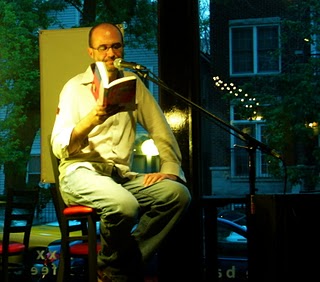
He’s also taking notes for a new novel that, he said, is “picking up on some of the themes I’ve explored before: relationships between parents and their children; faith and religion; strained marriage.” Another short story or two and he’ll have enough for a collection.
With so much breaking his way, Schaffert could be excused for playing the big shot, but he doesn’t. Like one of his bemused characters, he looks with incredulity at all the fuss being made about him. He undercuts the floss by self-deprecatingly dishing on himself and his success. He calls the Lit Fest an act of “arrogant self-promotion.” Imagine the gall it takes, he went on, “to create a literary festival to bring more attention to myself.” In truth the fest focuses on all aspects of the written word, drawing much attention to the strong literary scene here and to dozens of writers not named Timothy Schaffert.
Any mention of the warm embrace given his work is quickly deflected.
“It’s been mainly through my publisher and my editor. I’ve been very fortunate,” he said. As Unbridled only publishes a few books a year, Schaffert reaps the benefits of a pampered author with name-above-the-title pull. “The press I work with approaches their works with the same vigorous attitude commercial presses do for their best selling authors, and in that sense when you only publish eight or ten books a year, a lot of attention gets shoved my way. They’re kind of a boutique press, but they’ve been in the business for years and years and so they know their way around in the publishing industry.”
Co-publishers Fred Ramey and Greg Michalson formed Unbridled in 2003 after stints at MacMurray & Beck and BlueHen Books, then a literary imprint of Putnam Press. BlueHen published Schaffert’s first novel. From the start Unbridled has gained a rep for publishing new talent. For public relations and tax purposes, the press is based in Denver, Col., but it is in reality a virtual press whose administrative and creative team live and work in disparate spots.
Schaffert appreciates the extra mile Unbridled goes, including the late spring-early summer Devils book tour they’ve scheduled, which will find him going to all the usual places in the Midwest, but also New York, Chicago and Atlanta.
“It’s such a luxury to have a publisher get behind the book in that way,” he said.
Much like the home he’s found at Unbridled, Schaffert enjoys the comfort of working within the very writing community he sprang from at UNL.
He’s discovered he teaches as he was taught. “That’s exactly my approach,” he said. “My philosophy about writing in general was really developed or helped along by professors I had in college — Gerry Shapiro and Judy Slater. My professors were very sensitive to this idea of there not being a right way or a wrong way to write fiction. Instead, you approach it on a story-by-story basis and examine what’s working within a particular piece to help it work better.
“It’s interesting to be going back to the university where I studied, you know. Every day I go to work it feels like a nostalgia trip a little bit. It feels like such a rare experience to be able to be mentored as a teacher by the same people who mentored me a writer. I mean, I talk to Gerry and Judy a lot about teaching, about students, about experiences in the classroom.”
Teaching was long in the back of his mind, but he couldn’t try it until he was ready. “You have to develop a body of work before you can be taken seriously as a teacher,” he said. Now that he’s doing it, he said, “I love it. You have a fair amount of freedom there in how you want to interpret the class, so I appreciate that.”
Having to articulate craft is instructive for a writer like himself. It’s not so different than “when I was a student in that studio workshop environment where you’re expected to read other students’ work and comment on it,” he said. “Obviously when it’s your work that’s up you benefit from the constructive criticism. But you also benefit from examining…and developing an aesthetic, really, of certain critical criteria that you discover as you’re talking about other people’s work.”
He said appraising his own work is something “I feel more adept at than I have in the past.” It’s vital, he said, “in order to seek out bad habits that I may have practiced in previous work and to see it happening now or to recognize it.” Besides the analytical discipline that informs his work, he said journalism makes him more discerning. “I think it comes from writing about dining and style, doing book and movie reviews, writing features about subjects you know nothing about. You develop insights into writing along those kinds of lines.”
All this work-for-hire’s left him undamaged. He said, “I have mostly made my career as a writer at some level and it seems like that can be potentially distracting when you’re trying to write fiction but you’re adapting another style. I think the fear is you could ruin yourself by writing work you don’t really care about, especially if you have to write in a particular kind of way that’s perhaps not good writing. I think it’s good for a writer to compartmentalize as much as possible. It’s a matter of figuring out those ways to slip back into the creative process.”
He’s found a way to protect himself from cross-contamination.
“Part of that is just the space I write in,” he said. “I have a home office where I do ‘paying work’ at a desk at a computer and I tend to write fiction in here,” he said, meaning the sun room. “I write on a laptop, with music going, pacing a lot.” The music he plays to induce a fugue-like state “depends on what I’m writing,” he said. “For Devils, I found myself listening to a lot of old pop and jazz standards. Typically, Miles Davis’s ‘Kind of Blue’ is on constant rotation no matter what I’m writing. I also tend to listen to Rickie Lee Jones, Erik Satie and Joe Henry.
He doesn’t miss “the 2AMers” that came with being a news weekly editor, when he’d awaken in the middle of the night, panic-stricken over the status of that week’s cover story. The strain of putting out a paper with “no staff writers” and “no budget” grew tiresome. The saving grace, he said, was taking “a creative approach” to the work and always “wanting the story to be exactly what it needed to be. Editing is a creative act all by itself.”
Until his summer book tour he’s doing local readings and commuting to Lincoln for classes. Those I-80 hops allow ideas to seep in. Once, while en route to Hastings, the characters for The Young Widow of Barcelona came to him as a Neko Case CD played. “I’m always tossing around things,” he said. “I have to spend a fair amount of time to have an idea gestate before I can write anything down.”
Related Articles
- 20 Writers to Watch – An Alternate List (emergingwriters.typepad.com)
- The New York Stories of Elizabeth Hardwick (guardian.co.uk)
- Jason Pinter: Jodi Picoult and Jennifer Weiner Speak Out On Franzen Feud: HuffPost Exclusive (huffingtonpost.com)
- Heartland of Darkness: Timothy Schaffert’s Midwestern Trilogy (themillions.com)
- With His New Novel, ‘The Coffins of Little Hope,’ Timothy Schaffert’s Back Delighting in the Curiosities of American Gothic (leoadambiga.wordpress.com)
- Great Plains Theatre Conference Ushers in New Era of Omaha Theater (leoadambiga.wordpress.com)
- Alice’s Wonderland, Former InStyle Accessories Editor Alice Kim Brings NYC Style Sense to Omaha’s Trocadero (leoadambiga.wordpress.com)
‘To Kill a Mockingbird,’ Movie for the Ages from Book for All Time

Screenshot of To Kill a Mockingbird(an American movie issued in 1962) (Photo credit: Wikipedia)
Like a lot of people, To Kill a Mockingbird is one one of my favorite books and movies. Has there ever been a more truthful evocation of childhood and the South? When Bruce Crawford organized a revival screening of the film a couple years ago I leapt at the chance to write about it and the following article is the result. It was originally published in the City Weekly. This year marks the 50th anniversary of the first printing of the masterpiece novel by Harper Lee. The film is fast creeping up on its own 50th anniversary. The book to film adaptation is arguably the best screen treatment of a great novel in cinema history. That transition from one medium to another is often not a happy or satisfying one. Owing to my quite foggy memory of childhood things, I must admit that I cannot be entirely certain I have read Lee’s novel, but then again it was already standard fare in schools and so my unreliable recollection that I did read it in high school is probably accurate. I really should get a copy of the book, sit down with it, and indulge in that precisely drawn world of Lee’s. I am sure I will be as carried away by it now as I still I am by the film, which I have seen in its entirety a few dozen times, never tiring of it, always moved by it, and whenever I find it playing on TV I cannot help but watch awhile. It is that mesmerizing to me. And I know I am hardly alone in its effect.
For the article I got the chance to interview Mary Badham, who plays Scout in the film. At the end of my article’s posting, you’ll find a Q & A I did with her. Around this same time I also had the opportunity to interview Robert Duvall, who so memorably plays Boo Radley. However, I spoke to Duvall for an entirely different project, and I never brought up Mockingbird with him, although I wish I did.
‘To Kill a Mockingbird,’ Movie for the Ages from Book for All Time
©by Leo Adam Biga
Originally published in the City Weekly
Great movies are rarely made from great books. If you buy that conventional wisdom than an exception is the 1962 movie masterpiece To Kill a Mockingbird. Harper Lee’s best-selling, Pulitzer Prize-winning novel became an award-winning film acclaimed for how faithfully and lovingly it brought her work to the screen. Lee publicly praised the adaptation.
Gregory Peck, with whom Lee maintained a friendship. won the Academy Award as Best Actor for his starring turn as idealistic small town Southern lawyer Atticus Finch. Atticus is a widower with two precocious children — Scout and Jem. Atticus was based in part on Lee’s own father, an attorney and newspaper editor. Peck’s understated performance forever fixed the Mount Rushmoresque actor as the epitome of high character and strong conviction in movie fans’ minds.
Omaha impresario and film historian Bruce Crawford will celebrate Mockingbird on Friday, Nov. 14 at the Joslyn Art Museum with a 7 p.m. screening and an appearance by Mary Badham, the then-child actress who played Scout. She’s the rambunctious young tomboy through whose eyes and words the story unfolds. Actress Kim Stanley provided the voice of the adult Scout, who narrates the tale with ironic, bemused detachment.
Badham earned a Best Supporting Actress Oscar nomination in her film debut yet largely retired from screen acting after only two more roles. She remained close to Peck until his death a few years ago. The Richmond, Vir. area resident often travels to Mockingbird revivals. There’s always a big crowd. The universal appeal, Crawford said, lies in the pic tapping childhood feelings we all identify with.
“The crossover appeal of this film is unlike that of but a very few pictures,” he said. That pull can be attributed in part to the book, which, Crawford said, “has an absolutely enormous following in literary circles. It’s like required reading in public schools across the United States. Then, on top of that, the film was an instant classic when it came out and has done nothing but even grow larger in status the last 46 years. It’s become one of the most beloved films of all time.”
American Film Institute pollsconsistently rank Mockingbird as a stand-the-test-of- time classic. Crawford said seldom does an enormously popular book turn into an equally popular film. “It’s like Gone with the Wind in that,” he added.
Lee’s elegiac narrative, set in the 1930s Alabama she grew up in, has a kind of nostalgic, fairy tale quality the film enhances at every turn. It starts with the memorable opening credit sequence. An overhead camera peers with warm curiosity at a young girl sorting through an assortment of trinkets spilled from a cigar box, each an artifact of childhood discovery and reverie. As she hums, she draws with a crayon on paper. Soon, the film’s title is revealed.
The camera, now in closeup, pans from one small object to another, all in harmony with the wistful, lyrical music score. It makes an idyllic scene of childhood bliss. The girl then draws a crude mockingbird on paper and without warning rips it apart, presaging the abrupt, ugly turn of events to envelop the children in the story. It’s a warning that tranquil beauty can be stolen, violated, interrupted.
Dream-like imagery and music emphasize this is the remembered past of a woman seeing these events through the prism of impressionable, preadolescent memories. The film captures the sense of wonder and danger children’s imaginations find in the most ordinary things — the creak and clang of an old clapboard house in the wind, shadows lurking in the twilight, a tree mysteriously adorned with gifts.
Like another great movie from that era, The Night of the Hunter, Mockingbird gives heightened, elemental expression to the world of children in peril. The by-turns chiaroscuro, melancholy, sublime, ethereal landscape reflects Scout’s deepest feelings-longings. It is naturalism and expressionism raised to high art.
The film tenderly, authentically presents the relationship between Scout and her older brother Jem, her champion, and the bond they share with their father. The motherless children are raised by Atticus the best he knows how, with help from housekeeper Calpurnia and nearby matron Miss Maudie. A sense of loss and loneliness but moreover, love, infuses the household.

A mythic, largely unseen presence is Boo Radley, a recluse the kids fear, yet feel connected to. He leaves tokens for them in the knot of a tree and performs other small kindnesses they misinterpret as menace. In the naivete and cruelty of youth, Scout and Jem make him the embodiment of the bogeyman.
The figure looming largest in the children’s lives is Atticus, a seemingly meek, ineffectual man whose gentle, principled virtues Scout and Jem begin to admire. His unpopular stand against injustice and bigotry quells, at least for a time, violence. His strength and resolve impress even his boy and girl.
Trouble brews when Atticus defends Tom Robinson, a black man falsely accused of raping a white woman in an era of lynchings. The case makes the family targets. The children witness Atticus’s noble if futile defense and come to appreciate his goodness and the esteem in which he’s held. In their/our eyes he’s a hero.
In his summation Atticus appeals to the all-male, all-white jury: “Now gentlemen, in this country our courts are the great levelers, and in our courts all men are created equal. I’m no idealist to believe firmly in the integrity of our courts and of our jury system. That’s no ideal to me. That is a living, working reality. Now I am confident that you gentlemen will review without passion the evidence that you have heard, come to a decision, and restore this man to his family. In the name of God, do your duty. In the name of God, believe Tom Robinson.”
The film’s theme of compassion is expressed in some moving moments. Atticus says to Scout, “You never really understand a person until you consider things from his point of view… ’till you climb inside of his skin and walk around in it.”
When a school chum Scout’s invited for dinner drenches his meal in syrup, her mocking comments embarrass him, prompting Calpurnia to scold her for being rude. The lesson: respect people’s differences.
Before Atticus will even consider getting a rifle for Jem he relates a story his own father told him about never killing a mockingbird. It’s a father instructing his son to never harm or injure a living thing, especially those that are innocent and give beauty. In the context of the plot, the children, Boo Radley and Tom Robinson are the symbolic mockingbirds. Atticus delivers this lesson to his son:
“I remember when my daddy gave me that gun…He said that sooner or later he supposed the temptation to go after birds would be too much, and that I could shoot all the blue jays I wanted, if I could hit ’em, but to remember it was a sin to kill a mockingbird. Well, I reckon because mockingbirds don’t do anything but make music for us to enjoy. They don’t eat people’s gardens, don’t nest in the corncrib, they don’t do one thing but just sing their hearts out for us.”
Among many famous scenes, Scout’s innocence and decency shame grown men bent on malice to heed their better natures. In another, Atticus tells Jem he can’t protect him from every ugly thing. When evil does catch up to the children their savior is an unlikely friend, someone who’s been watching over them all along, like a guardian angel. Once safely returned to the bosom of home and family, they find refuge again in their quiet, unassuming hero, who comforts and reassures them.

Only the most sensitive treatment could capture the rich, delicate rhythms and potent themes of Lee’s novel and this film succeeds by striking a well-modulated balance between bittersweet sentimentality and searing psychological drama.
Although the book was a smash, it took courage byUniversal to greenlight the project developed by producer Alan J. Pakula and director Robert Mulligan. Creative partners in the late ‘50s and early ‘60s, Pakula and Mulligan had made Fear Strikes Out but the young filmmakers were still far from being a power duo. After Fear Mulligan helmed a few more studio hits without Pakula but nothing that suggested the depth Mockingbird would demand. His less than inspiring work might have given any studio pause in taking on the book, whose powerful indictment of prejudice and impassioned call for tolerance came at a time of racial tension. Yes, the civil rights movement was in full flower but so was resistance to it in many quarters.
Efforts to ban the book from schools — on the grounds its portrayal of racism and rape are harmful — have cropped up periodically during its lifetime.
The socially conscious filmmakers helped their cause by signing Peck, who was made to play Atticus Finch, and by enlisting Horton Foote, a playwright from the Tennesse Williams school of Southern Gothic drama, who was made to adapt Lee’s book. Foote’s Oscar-winning script is not only true to Lee’s work but elevates it to cinematic poetry with the aid of Mulligan’s insightful direction, Pakula’s sensitive input, Russell Harlan’s moody photography, Elmer Bernstein’s poignant score and Henry Bumstead and Alexander Golitzen’s evocative, Oscar-winning art direction.
Pakula-Mulligan went on to make four more pictures together, including Love with the Proper Stranger and Baby, the Rain Must Fall with Steve McQueen and The Stalking Moon with Peck. The two split when Pakula left to pursue his own career as a director. Pakula soon established himself with Klute and All the President’s Men. Mulligan’s career continued in fine form, including his direction of two more coming-of-age classics — Summer of ‘42 and The Man in the Moon.
Mockingbird was Lee’s first and only novel. Not long after completing the book she accompanied childhood chum Truman Capote (the character of Dill in Mockingbird is based on him) to Holcomb, Kan. for his initial research on what would become his nonfiction novel masterwork, In Cold Blood. Lee, mostly retired from public life these days, is said to divide her time between New York and Alabama.
The part of Atticus Finch came to Peck at the height of his middle-aged superstardom. He’d proven himself in every major genre. And while he acted on screen another 30-plus years, the film/role represented the peak of his career. It was the kind of unqualified success that could hardly be repeated, certainly not topped. He didn’t seem to mind, either. He gracefully aged on screen, playing a wide variety of parts. But his definitive interpretation of Atticus Finch would always define him as a man of conscience. It became his signature role.
Peck was among the last of a breed of personalities whose ability to project noble character traits infused their performances. Like Spencer Tracy, Henry Fonda, John Wayne and Charlton Heston, Peck embodied the stalwart man of integrity.
“Those types of characterizations just don’t really exist anymore. That’s what draws people to these characters and to the performances of these men because their like will never be seen again, and we know it” said Crawford.

Mary Badham then
A Q & A with Mary Badham, the Actress Who Played Scout in To Kill a Mockingbird
©by Leo Adam Biga
Actress Mary Badham recently spoke by phone with City Weekly correspondent Leo Adam Biga about her role of a lifetime as Scout in the 1982 film classic To Kill a Mockingbird. She grew up in Birmingham, Ala., near the hometown of Harper Lee, upon whose noted novel the film is based. Badham spoke with Biga from her home near Richmond, Virginia.
LAB: “To Kill a Mockingbird is such a touchstone film for so many folks.”
MB: “Mockingbird is one of the great films I think because it talks about so many things that are still pertinent today. So many of life’s lessons are included in the story of Mockingbird, whether you want to talk about family matters or social issues or racial issues or legal issues, it’s all there. There’s many topics of discussion.”
LAB: “Had you read the book prior to getting cast in the film?”
MB: “No, had not read the book.
LAB: “So was reading it a mandatory part of your preparation?”
MB: “No, not at all. I don’t even know that I got a full script.”
LAB: “When did you first read the book then?”
MB: “Ah, that was not till much later I’m embarrassed to say. Not until after I had my daughter. And how it all started was professor Inge from our local college asked me to come speak to his English lit class. We met for lunch and almost the first words out of his mouth were, ‘So what was your favorite chapter in the book?’ He knew by the look on my face that I hadn’t read the book. He said, ‘Young lady, your first assignment is you go home and read the book before you come to my class.’ In defense of myself, I didn’t want to read the book. Because I had everything I wanted out of the story up there on the screen. You know how sometimes you see a film and then you read the book and it messes up that whole warm and fuzzy feeling you may have had about something? But it was really great for me because it filled in a lot of these gaps I had with the story. It just gave me a much fuller love and appreciation for it. And it’s so beautifully written. It’s just so perfect.
“It’s a little book. It’s a quick one-night read, and a lot of people want to put it down for that, because it’s simple…but to me its one of the greatest pieces of literature ever written, and it’s borne out by the way it’s read. It’s the second most-read book next to the Bible. That’s saying something.”
LAB: “I know that you and Peck, whom you always called Atticus, enjoyed a warm relationship that lasted until death. On the shoot did he do things to foster your father-daughter relationship on screen?”
MB: “Oh, absolutely. I’d go over there and play with his kids on the weekends. We would have meals together and do things together. So, yeah, they encouraged that bonding. I had such a strong relationship with my own father, and I missed him dreadfully because Daddy had to stay at home to take care of things… My mom came out. But I missed that male link of family and so Atticus really filled the bill. He was just amazing. What a great father. I mean, he was one of the best I think. Not that he was perfect. But he was so well read and so patient, I think you would have to say. And just full of laughter…
“He and PhillipAlford (Jem) used to play chess together. They had such a beautiful relationship, and that stayed till the very end. They just got along so well together and Phillip would always know how to make him laugh. Phillip’s such an entertainer. He’s got a brilliant, quick sense of humor and Atticus really appreciated that. He just adored Phillip. So we really became a family.
“It was nothing for me to pick up the phone and he’d be on the other end, ‘What ya doin’ kiddo?,’ which was marvelous because I lost my parents so early. My mom died three weeks after I graduated from high school and my died died two years after I got married. And I didn’t have grandparents — they died before I was born. I felt totally cut off. So, you know. Atticus really came through psychologically. He really was my male role model. He and Brock Peters (Tom Robinson).
“It was marvelous because those guys were so intelligent and loving and outgoing, and supportive of anything I wanted to do. And sometimes life was not easy growing up and when you’re worried about what’s going to happen next in life, sometimes just hearing those voices on the other end of the line calling to check on me was
just so uplifting. That was just amazingly supportive”

Mary Badham today
LAB: “I understand you two would visit each other as circumstances allowed.”
MB: “Whenever he’d be nearby or if I was out there or whatever, then we would see other. And usually when you make a film, you know, it’s like, ‘Oh, we gotta get together afterwards’ and stuff, and it never happens. But with this cast and crew we did keep up with each other through the years. Paul Fix (the judge), I stayed really tight with right up until he passed. Collin Wilcox (Mayella Ewell) — we stayed in touch up until recently. I would see William (Windom), who played the prosecuting attorney, at various events and things. He’s gone now. So is Alan Pakula, our producer. Absolutely one of the most loving, dear, intelligent human beings I’ve ever met.”
LAB: “Most everyone’s gone except for you, Phillip, Robert Duvall. Bob Mulligan…”
MB: “To lose these guys so early has just about killed me because I feel like my support pillars are gone. I really relied on them – just knowing they were there and that I could pick up the phone and talk to them or they could call me and check on me. That’s a real shot in the arm in your day.”
LAB: Pakula became a great director in his own right. I’m curious about his and Mulligan’s collaboration. They were quite a team. I assume Pakula was a very hands-on, creative producer who worked in close tandem with Mulligan on the set?”
MB: “I think so.”
LAB: “So how did you come to play Scout in the first place?”
MB: “It happened because my mom had been an actress with the local Town and Gown Theatre (in Birmingham, Ala.) She had done some acting in England. That’s where my mom was from. She was the leading lady for a lot of years in the Town and Gown. So when the movie talent scout issued this cattle call our little theater was on the list. They were looking for children. Jimmy Hatcher, who ran the theater, naturally called my mom and said, ‘Bring her down.’ Then mom had to go to Daddy and get permission and he said, ‘No.’ And she said, ‘Now, Henry, what are the chances the child’s going to get the part anyway?’ Oh, well…”
EDITOR’S NOTE: Mary Badham’s late brother, John Badham, acted at the Town and Gown. He became a successful film director. Phillip Alford acted in three shows there before cast as Jem. The theater’s where Patricia Neal got her acting start.
LAB: “Lo and behold you did get the part.”
MB: “Daddy was horrified and it was everything Alan Pakula and Buddy Boatwright, the talent scout, could do to try and convince him that they were not going to ruin his daughter.”
LAB: “Everything you’ve said suggests Mockingbird being a very warm set.”
MB: “It was. I remember a lot of laughter, a lot of joking around. I remember five months of having a blast. I didn’t want it to end. I had not had any trouble with my lines until like the last day, and then it was just like, ‘Oh, God, I’m going to say goodbye to all these people.’ I was so upset I could not spit my lines out for anything. My mother finally said, ‘Do you know what the freeway is like at 5 o’clock? These people have got to go home.’ I was like, ‘OK, OK.’ So I got out there and did it. But it broke my heart. I thought I’d never see these people again.”
LAB: You and Phillip were newcomers. Did the crew take a kids-gloves approach?”
MB: “Yes, we had time to get used to the cameras and the crew and the lights and getting set up. They started off very slowly with us. The camera and crew would be across the street and then they’d move up a little closer, and then a little closer still, and then they were right there. Everything was kind of good that way.”
LAB: “How did director Bob Mulligan work with you two?”
MB: “Very gentle, very tender. Instead of standing there and looking down on us he would squat and talk to us…right down on our level. He didn’t tell us really how to do the scenes. It was more, ‘OK, you’re going to start from here and we need you to move here…’ He let us do the scene and then he would tweak it, so that he would get the most natural response possible, and I think that’s brilliant. We were never allowed to talk to an actor out of costume (on set). They were just there the day we had to work with them and then they were that person they were playing. Bob did these things to get the most out of us nonactors.”
LAB: “You and Phillip were thrust into this strange world of lights-cameras.”
MB: “Now, I was used to having a camera stuck in my face from the time I was born because I was my father’s first little girl. He’d had all these ratty boys and then he finally got his dream with me when he was 60 years old. That was back in the days when flash cameras had the light bulbs that would pop and the home movie cameras needed a bank of lights. So, yeah, I grew up with all of that. Phillip and I grew up four blocks from one another. But we would never have met
because I was in private school — he was in public school. He was 13. I was only 9.”
LAB: “There’s such truth in all the performances.”
MB: “I think our backgrounds helped in that a lot, because Atticus (Peck) was from a small town in Calif. (La Jolla) that looked very much like that little village (in Mockingbird). He knew that period well. And for Phillip and I nothing much had changed in Birmingham, Ala. from the 1930s to the 1960s. All the same social rules were in place. Women did not go out of the house unless their hair was done and they had their hats and gloves on. Servants and children were to be seen and not heart. Black people still rode on the back of the bus. And there were lynchings on certain roads you knew you couldn’t go down. There were still colored and white drinking fountains when I was growing up. So all of that was just totally normal for us. There’s no way you could have explained that to a child from Los Angeles. They wouldn’t have known how to react to all that stuff. My next door neighbor (during the shoot in Calif.) was this black man with a beautiful blond bombshell wife and two gorgeous kids, and down the road was an Oriental family, and we visited — went to dinner at their house. We could never do that in Alabama. It just would not happen.”
Related Articles
- To Kill a Mockingbird Turns 50 (austinist.com)
- ‘To Kill A Mockingbird’ Anniversary: Anna Quindlen On The Greatness Of Scout (huffingtonpost.com)
- 51 reviews of To Kill a Mockingbird (rateitall.com)
- Great Characters: Atticus Finch (“To Kill a Mockingbird”) (gointothestory.com)
- Films For Father’s Day (npr.org)
- Harper Lee – We Hardly Know Ye (pspostscript.wordpress.com)
A Man of His Words, Nebraska State Poet William Kloefkorn
UPDATE: It is with some sadness I report that the subject of this story, the poet William Kloefkorn, has died. He was a real master of his craft. I only met him the one time, when I interviewed him at his home for the profile that follows, but in the space of that two hours or three hours, buoyed by having read one of his autobiographical works of prose, Out of Attica, it was apparent enough that I was in the presence of a formidable yet gentle sage. He will be sorely missed, but his writing lives on.
New Horizons editor Jeff Reinhardt suggested I profile Nebraska State Poet William Kloefkorn and I’m glad I did. I knew the name but not his work and it was a pleasure steeping myself a bit in his writing in preparation for interviewing him. Whenever I read a master wordsmith like Kloefkorn I am humbled by their considerable talent and my own modest gift by comparison. His work exemplifies the spare, delicately modulated style I admire in many writers. He warmly welcomed Jeff and I to his home, where we spent a pleasurable couple hours in his company. As one who writes feature profiles, kt is my job, of course, to try and capture the essence of my subject in 500 or 1,000 or 1,500, or 2,000 words or more. This story is 4,000-some words, a length that few print or online publications allow journalists to write at these days. But Jeff, my editor on this project and on more than a hundred other stories the past 12-15 years, generously allows me to write at length. I try not to abuse that privilege, rather use it to tell richly textured stories.
 JACOB HANNAH / Lincoln Journal Star
I always try to be true to the voice of my subject, but in this case I made a concerted and hopefully subtle effort to minic, as a kind of homage, Kloefkorn’s distinctive writing voice in my own writing. I never heard anything from him after the story appeared in the Horizons, and so I don’t know if he approved or not, or whether he even recognized what I did in terms of style. In case you see this Mr. Kloefkorn, let me know.
If you enjoy reading my Kloefkorn piece, then check out some of my other stories about Nebraska writers, including profiles of: poet Ted Kooser, folklorist Roger Welsch, and novelists Ron Hansen, Richard Dooling, Timothy Schaffert, and Kurt Andersen. Look for posts in the near future on James Reed, Sean Doolittle, Carleen Brice, Robert Jensen, Scott Muskin, and Rachel Shukert.
A Man of His Words, Nebraska State Poet William Kloefkorn
©by Leo Adam Biga
Originally published in the New Horizons
The rhythms of the small south central Kansas town writer William Kloefkorn grew up in are deeply imbued in him, right down to the marrow.
Nothing much ever happened there, or so it seemed. But with the passage of years and the angle of vision that distance brings, more than enough went on to burnish the memories of Nebraska’s State Poet. The smallest details provide rich fodder for Kloefkorn poems and stories as well as memoirs that take the measure of that place and its people.
He left decades ago, yet that past is fresh in his mind: the farm pond he fished in; the tree house he built; the kitchen fire he started — proof that he’s never really abandoned those roots and that one can go back, at least on the page.
Attica, Kansas was a conservative, barely hanging-on rural hamlet whose closed strictures you either made your lot with or whose dust you shook off your pants on the way out of town. He dedicated an entire book of poems to it, Out of Attica.
“I loved my little hometown, but I also despised it,” Kloefkorn said with the luxury of perspective and the duty of reflection, his deep amber voice belying his short-lived gig as a radio announcer. The retired University of Nebraska Wesleyan professor spoke from the parlor of the classic ranch house he and his wife Eloise share in Lincoln. Large picture windows look out on a well-tended backyard.

At the time this sensualist and contrarian felt his small town diminished him, but it did in fact yield much, including his wife, who was his sweetheart. Then there’s the lifetime of material it gave him.
Still, there’s little doubt that hometown’s small horizons would have stifled this free-thinking, high-spirited man. Besides, the struggles of his family’s subsistence life deflated him. He wanted no part of that hard scrabble existence or the harsh judgment imposed by gossip or scripture.
“There were about six or seven churches there for 700 people, a pool hall, no drinking, legally, no dancing. My parents were very poor, we moved around a lot, always trying to move up a little, but it went like this,” he said, pantomiming the zig-zags of an up-and-down graph. “I think we moved eight times inside the city limits. They were very hard working people. My dad worked for the county doing WPA projects. Kind of a handyman really. They tried all kinds of little businesses — a cafe, a filling station, a grocery store.”
Without knowing it, Kloefkorn trained as a writer by closely observing his boyhood haunts — the barbershop, the pool hall, the movie theater, the farms, the grain bins, the open fields, the school, the churches — and their inhabitants. Characters, all.
“I got to know that town inside out, upside down, I got to know every square inch. I could still do the newspaper route today and name the people pretty much.”
His parents, whose divorce after he left home shocked him despite their frequent disagreements, were long-suffering souls. His tight-lipped father said little besides the curse words he expertly strung together in a kind of profane poetry. When the son tried imitating him he got his mouth washed out with soap for the trouble. As family lore has it, Will’s mother gave birth to him after milking a cow. Only after completing her chore did she give in to labor’s call. That’s the kind of hardy, stubborn, we-shall-endure stock he comes from.
Kloefkorn didn’t want to end up like his embittered, pent-up father or his German immigrant grandfather, whom he admired and despaired for at the same time.
“My granddad was one of my heroes, I worshiped that guy. He had all kinds of ability, all kinds of talent. His wife was a former school teacher, a very sharp woman. She gave up her teaching when she married him to become the farmer’s wife. They just eked out an existence on their little farm. He was so happy he escaped his family, his father was abusive. He counted himself lucky to have gotten away from it.”
Similarly, Will’s father counted himself lucky to have escaped the family farm and Will deemed himself fortunate to have avoided a dreary hand-to-mouth life.
He said his grandfather “resorted to the last bastion of hope, which is called religion, and religion of the most sordid type– right-wing fundamentalism. It did suppress all vestiges of imagination and creativity. As a young man my grandfather had been a member of what he called illiterarie. They had read and memorized a lot of stuff. Anything fun became a sin in this Old Testament, fire-and-brimstone, Pentecostal church. I detest that church with a passion.”
An unrepentant agnostic, Kloefkorn takes delight, as his grandpa did, in tweaking the nose of authority and decorum. He makes no bones about his quarrel with God. He has no truck with organized religion, no use for puffery or counterfeit dandies.
“My grandfather, much to the chagrin of my grandmother, would recite stories he’d memorized (and perform songs on his accordion). I was fascinated by his language, not only with the stories but the way he delivered them. It was delightful and at the same time it was pathetic.”
The poet has oft-written about Grandpa Charles.
The first inkling of a writing life came in high school, with the arrival of a comely young female English teacher who recognized in Will a bright, curious mind that needed to be challenged. He didn’t read much of anything outside what was assigned, which was little to start with, but he did like what he read. Similarly, he just wrote what was assigned.
“She noticed I wasn’t doing very much. I said, ‘Well, to be honest with you, I’m taking this because I’ve taken it before and I didn’t have to work very hard.’ She was very gracious about it. She totally unnerved me by saying, ‘Look, if you’re not too
interested in what’s going on in class why don’t you do me a favor,’ and I thought she’d say drop the class, but she said, ‘and instead of attending class go to study hall and write something for me. By the end of two weeks bring it to me and we’ll look it over.’ I couldn’t believe it.”
Kloefkorn said he dawdled the first week away not doing “hardly anything except pester a couple of gals. I had no idea what to have for her. Well, I finally began to write a story and the more I worked on it, the more I got into it and by the deadline I had it done, and that amazed me. It was a 20-page story. I took it to her and we spent an hour talking about it. She not only read it but she offered some suggestions. She said, ‘You know, you could make this a longer story or you could write another story.'” He opted to rejoin her class, but the experience had invigorated him. “I discovered I liked to write — I didn’t know that before.”
At Emporia State University he found the pathway for reaching his potential.
“That college experience for me, it was such a departure from how I’d been taught, it was such an opening up, it was incredible. That was really a big stage.”
Everything was new and different.
“The first time I was ever on a college campus was the day I matriculated,” he said.
“I took a freshman English class and I had of all things a male teacher, and I promise you I didn’t know there was such a thing. Here was a young man standing nicely dressed in front of class, sharp as a tack. On the first or second day he wrote us a poem, and I was stunned. He read it without apology, talked about it clearly, asked us about it, and I’ve never forgotten that experience.
“It was beginning to occur to me that language is so interesting and it kind of snowballed from there. I really did enjoy writing. As an undergraduate I had another professor I enjoyed writing papers for. I was writing to impress the profs, that was half of it. I wanted to do well so I worked hard.”
The English major set his sights on a teaching career. He and Eloise married between his junior and senior years in college. “It was just a good time,” he said.

He played football for a time but after quitting the team he satisfied himself as sports editor of the school paper, which he ended up managing.
“I thought maybe I wanted to be a journalist.”
He also dallied in radio for a back water station, his sonorous voice made for the air. Then his sensibilities as a writer got rocked. His younger brother John and a mutual friend showed up one day excitedly saying they’d just finished a novel that he simply had to read. They promised it would upset everything in his well-ordered world. The novel was J.D. Salinger’s The Catcher in the Rye and true enough once Kloefkorn read it, in a single sitting. he was never the same.
“I was caught up in the voice of Holden Caulfield. I don’t think it was only the voice though, he was reflecting a lot of attitudes I had. The phonies were coming in the (g.d.) windows and I felt the same way. I think a lot of readers did.”
So much was he taken with it, he soon started his own coming-of-age, anti-establishment novel. Typical of most first novels, it was a fairly autobiographical tale of a young man off at college. He composed it on an old Royal typewriter and when done sent it to Macmillan Press. “I’d never sent anything anywhere — and I felt, Well, hell, it’ll be published in a couple months.” He didn’t know the extreme unlikelihood his manuscript would be accepted, much less responded to.
“Well I did get a reply, very soon actually, a one-page, single-spaced typed letter. At the time I didn’t realize that’s a pretty good rejection. I felt it would be an acceptance and anything less an abject failure. Anyway, they liked it but they said ‘there’s one major flaw that has to be corrected. You need to rewrite the book in third person so it doesn’t sound as much as it does now like the voice of Holden Caulfield.'”
He had no idea until then how he’d “borrowed too heavily from Salinger,” imitation being the highest form of praise. “You talk about being influenced without knowing it,” he said. “They were so right. I picked up some of Salinger’s phraseology I needn’t had because I had my own pool hall lingo that would have done nicely.”
Long story short, that first novel, The Voice of the Turtle, remained tucked away except for a few half-hearted attempts to revisit it. “I was scared to,” he said, “Then on an impulse one day I burned it and two other novels I’d written — one for my master’s thesis and another one.” All unpublished. It was his ritual purging of that period in his writing life. He sort of regrets doing it.
“I wish I hadn’t done it in a way. You know, you’re kind of haunted by that stuff. I mean, I’d kind of like to go back to that first novel.” He said “it might be worse then I thought.” But then again it might be better than he imagined. He said that wishful thinking is “Twains’ definition of faith — ‘faith is believing what you know ain’t so.'”
He said those formative projects helped him realize “I really do enjoy language and enjoy using it to tell stories, and in the process perhaps reflect some attitudes and perceptions.”
It was the early 1950s. The Cold War and Korean War were on. Sensing he was about to be drafted into the Army he joined the Marine Corps. He became a 1st lieutenant in charge of a platoon of flame throwers, rocket launchers and demolitions. More life experience to tap for his work.
After his military hitch was up he taught school, one year of high school in Kansas and after getting his master’s at Emporia and doing some additional study at the University of Nebraska-Lincoln, he taught four years at Wichita State University.
It was during this time his writing vision was broadened again. He was introduced to The Beats and other contemporary poets whose free verse he found appealing and liberating.
“I’d never read any poetry like that. I guess a lot of us hadn’t. What it did was open up the possibility of subjects. The Beats were just fearless in that, and in just using any form. This suggested you can write about anything. What I think I learned from them is it’s not the subject you write about, it’s how you write about the subject. I’ve learned that since in other ways.”
The more poetry he immersed himself in the more revelatory it was. Reading Edgar Lee Master’s Spoon River Anthology, he said, was like reading about “the people in my town.” The same with reading Edward Arlington Robinson and other poets, including Ted Kooser, whose work reverberates around the seemingly mundane.
All of a sudden the small town background Kloefkorn hadn’t thought properly belonged to poetry became a bottomless well or mine to draw on. It feeds him still.
“It just keeps opening up, the landscape, then it gets all interwoven with the people, so it’s hard to tell where the landscape ends and the people begin, and vice versa,” he said. “And it’s not only the place and the people but what’s going on politically and otherwise, and so it’s the place and the time and the people that make up what you might think of as a landscape. You’re mining it.”
Much of his childhood coincided with World War II, and he’s written his share of remembrances describing what it was like to be a boy amid the nationalistic fervor and drama of that era. Since moving to Nebraska a good share of Kloefkorn’s work has dealt with his adopted home state, including his beloved Loup River jaunts.
The move that brought him here to stay came in 1962. when a friend recommended he apply for an open faculty post at Nebraska Wesleyan. Kloefkorn had reservations about fitting in at a straight-laced Methodist school. But his friend and fellow reprobate insisted the liberal arts college would leave him to his own devices, academically, philosophically and otherwise. Kloefkorn came and interviewed and was hired the same day and he said with the exception of a minor fracas “I taught there 40 years and said whatever I (g.d.) pleased in the classroom and never had an ounce, not an ounce, of problems.”
His transformation from novelist to poet took time but once he got the hang of it he knew he was where he was supposed to have been all along.
“It took me a long time to turn the fiction spigot off and turn the poetry on,” he said.
Someone asked him recently what is poetry and he answered, “It’s an attitude looking for something solid to sit on”. He has been described as a lyric poet. “Frequently the poem does what I want the poem to do by leaving things out, so it’s more distilled and relies more heavily usually upon figurative language, especially on metaphor. I don’t want the poem to be obscure.” he said. “I would like my own prose to be rhythmic and I would like my poetry to be somewhat prosy.”
He certainly looks the part of poet today. This old lion of Nebraska scribes has a mane of white hair and a prominent forehead that suggests wizened reflection.
Poems come when they come. He said he has sat down intending to write one only to have it morph into a short story, and vice versa
One of the many appeals of poetry, he said, is that “there are so many types and different ways of approaching subjects.”
He said poet Gary Gildner helped him see the difference between the literal and the nonliteral. That lesson helped Kloefkorn write about his high school basketball team, whose coach kept telling the players, Kloefkorn among them, “One of these days you’re going to gel.” That was the mantra through 17 consecutive losses. It never happened. In the resulting poem, “Waiting to Gel,” Kloefkorn suggests that gelling need not occur in the space of a season or a lifetime. The expectation lives on in spite of time or even death.
Because poetry is, as he puts it, “a slow moving commodity,” getting any poem published is a coup. Kloefkorn’s early work drew the attention of master Nebraska poet,Ted Kooser. “He had looked at some of my poems,” said Kloefkorn. “He had a series of poetry postcards, and he put one of mine on a postcard. I was very proud of that.” The poem, entitled “After Ten Winters,” goes:
“I stand alone at the footmof my grandfather’s grave trembling to tell the door to the granary is open, sir, and someone lost the bucket to the well”
Kooser and Kloefkorn collaborated on the book of poems Cottonwood County.
Kloefkorn got things published in minor periodicals but his breakthrough came with The Prairie Schooner. He’d received several rejections, but always encouragement to submit more. The noted literary journal finally published his “Funeral for an Old Man.” The Old Man of the title was his grandpa.
“It was really thrilling. Getting your first poem accepted by a major publication is a big boost and it helps to get other confirmations. I don’t know you ever get enough to make you completely comfortable. In fact, I may be more confident than I am comfortable. I’m confident in what I’m doing, but sometimes I’m a little nervous.”
More poems were published in more periodicals. He’s had several books of poetry published and his work has appeared in numerous anthologies. He was named Nebraska State Poet in 1982. He’s since received numerous awards and honors for individual works and for his body of work. His “bad lungs” be damned, he’s still at it, too. As a concession to his health he’s cut back on his public readings.
Another thing he’s curtailed is his work in public schools. After being named State Poet he initiated the poets-in-the-schools program in Lincoln, which eventually brought him to virtually every school in town. He worked with students of all ages but he was surprised how much he liked working with grade schoolers.
“I discovered it really was a challenge and a lot of fun working with elementary school students,” he said. “We would compose a poem on the board and have great fun choosing over a word. We would just kick around the possibilities. Man, that was fun.” Fourth graders proved his favorite, he said, because of their bright imagination, fair vocabulary and decent focus. He fondly recalled an exercise that had a class collaborate to compose a poem. On their first pass they came up with, After dinner, Jim decides to nap. Dissatisfied, the kids substituted die for nap, and then concocted a back story to explain why, After dinner, Jim dies. An incredulous Kloefkorn said, “So in this 4th grade class we’re talking about nap, then suicide, then murder, all just by changing that one little word.”
Teaching was much more than the means that allowed him to write. It was a vocation every bit as much as writing. “They fed into each other,” he said. He put it down this way in words, “Not many things, if any, are more important or more fulfilling than are classrooms filled with eager, vibrant students.” He said, “By far the interaction with the students was the best part of it. I do miss that.” Not so much the politics and bureaucracy of academia. “I was not a good administrator.”
He found himself leaving committee meetings without the foggiest notion of the dry procedurals discussed, but he did find them fruitful for an unlikely reason. “There’s almost always a poem in a committee meeting, so I’d be there listening for that. Even with all the horseshit that goes on somebody would say something, a phrase or a word, that clicked and reminded me of something.” Thus, the notes he scribbled during meetings were not minutes but ideas for poems.
Like most parents of his generation, his folks demonstrated little outward affection or praise. He’s sure they were proud of his teaching and professor’s credentials. As for his writing, they had no real frame of reference to discuss his work.
“I would send my dad every book I wrote, and inscribe it to him. When he was killed by a drunk driver John and I went in and took care of his belongings, which were few and far between. I opened a drawer and found everything I’d sent him, rubber-banded, every one of them in absolute mint condition, which suggested to me my dad saw my books as something to preserve, something to care for.”
Nonconformist or not, Kloefkorn said he thrived at Wesleyan thanks to tolerant colleagues and administrators who admired his independence. As for his cursing, he did not censor himself. He unleashed a blue streak every time a piece of chalk broke in his hand. He was always apologetic in case he’d offended someone. For fun once, he installed a student as a surrogate curser. It happened to be the daughter of two ministers. One day her mother visited class. On cue, he broke the chalk and the girl let loose a torrent that pleased both mother and teacher.
He said the question of obscenity or profanity is one of “appropriateness.” “In writing class we get that out of the way really early,” he said. “Language is language.” If not used in the right context, it falls flat or veers off into vulgarity or bad taste. “I also think it’s the spirit of the thing, too We’re talking about language. Once we know that, once we get that out of the way, it’s a dead taboo.”
If nothing else, Kloefkorn believes in being himself. “If you’re not, they spot you right away,” he said. You won’t catch him acting the phony. Not alive at least.
Yes, he’s retired and not as vigorous as he once was, but he’s still prolific. He has no fewer than four new works forthcoming: New & Selected (poems) from the University of Nebraska Press; In a House Made of Time from Logan House Press; and This Place, These People and The Zoo Fantasy, a children’s book, both from Nebraska Life.
It’s never been all about work for Kloefkorn. He is, among other things, a sports fan, a lover of wood, a whittler (he has an impressive collection of pocket knives in his office). Cranes and walking sticks he’s carved from driftwood found along the Loup adorn his home. He’s also the father of four adult children, a grandfather of 11 and a great-grandfather of two. He is, of course, a storyteller wherever he finds himself and whomever he finds himself with.

Given his druthers though, he’d most likely be somewhere amid nature. The Sand Hills maybe. The Loup River definitely. For years he and Nebraska folklorist and friend Roger Welsch led what they dubbed The Loup River Expeditionary Force, a fancy title for a tribe of men who went on annual trips along the river, boating, fishing, camping, cooking, shooting the bull. This pilgrimage was their deliverance, offering its share of the sublime, the absurd and the harrowing.
“The Loup is a beautiful river,” he said, “but the river’s not necessarily tame. It has its moments.”
A near drowning was enough for one member to quit.
Kloefkorn knows its currents and channels, its sandbars and beaches, as intimately as any river rat. His ode to the river is his book of poems, Loup River Psalter. His excursions ended in 2003. He’s looking forward to a Loup reunion this summer.
Just as he and his brother John found that time could stand still on the river, a well-rendered poem can erase all temporal boundaries to transport the reader where the words and their meanings and the images they conjure take you. Reading Kloefkorn, you are enveloped in the earth-worn truth of a man who has, paraphrasing the poet, breathed in the fullness of life and time, and found it good.
Related Articles
- Poetry Pairing | July 8, 2010 (learning.blogs.nytimes.com)
- A Poet For The Mosque (bigthink.com)
- Lincoln author on local radio (nebraskapress.typepad.com)
- Remembering Bill Kloefkorn (nebraskapress.typepad.com)
- The Tipping Point for Equality in Nebraska (pinkbananaworld.com)
Sacred Trust, Author Ron Hansen’s Fiction Explores Moral Struggles

Image by National Media Museum via Flickr
Word for word, phrase for phrase, thought for thought, there may be no better American writer of the last quarter century than Ron Hansen, an Omaha native whose body of work is impressive for its breadth and depth. He is perhaps best know for two of his earliest novels, The Assassination of Jesse James by the Coward Robert Ford and Mariette in Ecstasy. I’ve had the pleasure of reading those and other novels by Hansen, who has graciously given me a handful of interviews over the years. As time goes by I will post other Hansen stories I’ve written. This one appeared not long after the release of his Hitler’s Niece and while he was adapting an unproduced screenplay of his into a book, Isn’t it Romantic?. His sheer command of language is astounding. His research and detail overwhelming. He’s also a fine storyteller. Then when you add to this the spiritual themes and currents that occupy him in real life, and you have a rich reading experience.
My story appeared in the Omaha Weekly, one of at least three different publications that’s published my Hansen work.

Sacred Trust, Author Ron Hansen’s Fiction RExplores Moral Struggles
©by Leo Adam Biga
Originally published in the Omaha Weekly
Whether exploring the worlds of saints or sinners, real moral questions and struggles swirl at the heart of author Ron Hansen’s work, which reflects this devout Catholic’s abiding interest in faith. His novels are explorations in the ethical choices characters make and the consequences that ensue. In The Assassination of Jesse James by the Coward Robert Ford (Knopf, 1983) Hansen essayed the kinship and treachery of an outlaw family. In Mariette in Ecstasy (Harper-Collins, 1992) he chronicled a young novitiate’s ardent love for God growing so intense that it overwhelms her mind, her body and the convent she becomes a curiosity and outcast in.

In Atticus (Harper-Collins, 1996) he brooded on the legacy of a strained father-son relationship, the futility of ever fully knowing someone and the nature of forgiveness. In Hitler’s Niece (Harper-Collins, 1999) he examined the brewing evil of Hitler in the 1920s and early ‘30s through the prism of the only woman the despot ever loved — the fuhrer’s young and innocent niece Angelika “Geli” Raubal, who was destroyed by her uncle.
In his life and in his work, Hansen, an Omaha native, seeks the spark of some connection with the sacred and the ethereal. It gives him sustenance and constitutes his muse. “Some of my favorite moments are late nights with other people talking about miraculous experiences in their lives or times when they felt the hand of God or the solace of God and they learned more about themselves or about God’s benign mercy,” he said in an interview during a recent Omaha visit to deliver the William F. Kelley, S.J. Endowed Lecture at his alma mater, Creighton University. “Those things are kind of ways of inspiring you and bucking you up. It’s a way of becoming aware of another world that’s totally unseen.”
It was while struggling with Atticus that Hansen felt the healing presence of God.
“I’d been working on Atticus and it was going badly,” he said. “This was back in 1985. I’d written like 120 pages that were rotten. I was in Cancun — throwing rocks into the ocean late at night as the waves were crashing in. I was really angry about my book and about the hard time I was having finding a teaching job. I was feeling really awful. I was full of self-pity. And I thought, What’s going to become of me? And then I just had an incredible sense of God laughing. It was a sense of Him saying, If you knew what I know, you wouldn’t be so worried. And I realized it was all going to come out all right, but it wasn’t going to be immediate. I just had this feeling of calm. Almost everybody has the same experience when they have this kind of God moment. You just feel at ease about things. So, I put the book away and started other books.
“I went back to it and it was terrible still. And I just kept going back to it. And then, finally, when Mariette was published I had one book left on a two book contract and I said, ‘Oh, I’ll just go back to this one (Atticus).’ It took me a long time to rewrite it. I kept trying to use the words I used already. But it was almost like somebody else had written that. I was not that person anymore. I finally gave up on that and started writing totally new words, and then it worked fine. I found that sense of God smiling and saying — Take it easy, kid — made me take it easy.”
According to Hansen, the writing process itself is a somewhat mysterious and metaphysical experience that finds the writer drawing on resources he is not always fully aware of or in control of. “Writing well is a form of a waking dream,” he said. “It’s almost the same thing that happens when you’re in a dream state. Images start to occur. You don’t know where they come from. And you try and fit them together. Often, you have a mental picture of something and you see characters in relationship to each other, but you don’t know exactly what they’re going to say to each other. And sometimes that’s where the zest comes — when you hear something surprising and just right that comes from one of them. Part of it is because it’s really your subconscious that seems to be writing the novel at its best. It’s your conscious mind that revises it, but it’s the subconscious that supplies all the scintillating details — the colorations you could not have thought of yourself.”
Whether it’s the spirit or the subconscious moving him, Hansen said, it is no accident these voices speak to him because he is open to the possibility of such a communion happening in the first place. “Partly, I think it’s because I want these things to happen, and some people don’t want them to happen. They might get spooked by them. It’s part of the writer’s equipment to seek out those experiences and to live them fully. And other people are maybe more guarded and maybe necessarily so, so they can’t be as available to that sort of thing. I always describe a writer’s life as being different from others in that some people kind of have venetian blinds that are closed and the writer’s are open, so that everything can come in. And that’s what makes writers go crazy. That’s what makes them obsessive and everything else. But it’s also one of the things they need to do.”
If creative writing flows out of some deep well fed by intuitive streams, then it is easier to appreciate how something like a novel comes into being as a complex and coherent whole from a seemingly disparate and random collection of ideas, themes, issues, preoccupations, incidents, places and characters. The way Hansen sees it, a novel only reaches its final shape after the novelist has played a game of sleuth with himself and all the narrative threads dangling from his imagination. He said for most of the writing process the novelist is only aware of bits and pieces of what the book will eventually comprise — discovering the contents as he goes along. During that creative journey, the writer must be ready and willing to go in many directions and to follow many leads, some of which may be dead ends. It is only in searching out and sifting through the many loose story strands, that the nut of the novel is finally revealed and its elements tied together.
“Well, it’s as if an alphabet exists and you don’t know all the letters to the alphabet,” he said. “You might know A, J, L and Z, and with that foundation you then have to fill in all the rest. It’s like when scholars tried to translate the Egyptian hieroglyphics. They had a few words that they knew and then they’d go from there. I think the same thing is true with writing a novel. You know, for example, certain things about it and then you have questions about other things, and then the questions will reveal things as you write the novel. Knowing a few things gives you the confidence that you can actually lay it all out there.
“But you’re still kind of writing in the dark no matter how well you plan. There’s all kinds of spontaneity that comes into the novel. There’s all kinds of surprises and wrong turns that you can take. So, you have to be disciplined enough to kind of say, This is tangential or doesn’t belong, or, I did this badly, or, Maybe I don’t need this scene after all, or, This character doesn’t belong in this novel — he belongs somewhere else. All kinds of changes happen in the process of writing. It’s part of the fascination but part of the drudgery as well.”
Now that Hansen has created a fairly large body of work, he finds himself running up against the same dilemma a writer friend of his faced a while ago. “I don’t think it’s legal anymore, but a friend of mine got a tax write off by claiming his creative ideas were being diminished year by year. He was actually able to depreciate his intellectual capital. And, he was right. How many ideas can you have, you know? In my own writing, there’s all kind of metaphors I can’t use anymore because I’ve used them already. Characters I can’t have. Situations…Certainly, Stephen King has shown you can exhaust your own ideas.”
For Hansen, “part of the interest” and the challenge of writing is tapping his inner being to better understand himself and the world he inhabits and interprets. It is an ongoing search for answers — much akin to the spiritual journey that Hansen, who has a master’s degree in Spirituality, has taken. It is a journey, he said, that has no end. “Yeah, I don’t think anybody ever reaches a stopping point or, at least, they shouldn’t. I mean, God isn’t knowable but you learn a little bit more and more and you learn a little bit more about yourself. I guess I don’t really know myself very well. I think I know who I was 10 years ago and I can look back at the past and understand everything about myself, whereas in my present circumstances I’m just poking around like everybody else.”
As far as injecting himself into his work, he avoids drawing closely on his own life. “I’m not very good at autobiographical writing,” he said. “The only time I ever really write autobiographically is when I write nonfiction (as in his new book of essays, A Stay Against Confusion, Harper-Collins, 2001). I want to have my anima come through in my fiction rather than who I am right now or who I seem to be.” He also knows himself well enough to shy away from certain projects that are not a good fit. “In terms of my strengths and weaknesses, there are some types of writing I wouldn’t attempt and some kind I know I have a propensity toward. There’s certain novels that won’t ever suggest themselves to me because I know I’d do them badly. Among the genres I could never do are fantasy and science fiction because I just don’t have that yen to do them. On the other hand, I like historical writing.”
In much of his historical writing, which ranges from the misadventures of the Dalton gang in Desperados (Knopf, 1979) and the machinations of the James gang in Jesse James to the unholy union of Hitler and Geli Raubal in Hitler’s Niece, Hansen has been drawn to outlaw figures. He said a beguilement with practitioners of left-handed forms of human endeavor is a natural for writers, who share an outsider’s perspective with the lawless, the rebellious and the fringe dwellers of the world.
“Outlaws are in some way marginalized, but also they live outside the world of convention. I think most writers, too, feel marginalized in some way and they feel they live outside conventional rules and boundaries. It doesn’t mean they’re all breaking windows. I think what it means is that the way most people live their lives is unfamiliar to the writer because it has to be,” he said. “I think most writers begin wanting to be writers because they feel like, Oh, I’m different, and they feel somehow they don’t fit into the normal pattern of things, and so consequently they have a sympathy toward outlaws. There’s a tendency among writers to feel like these guys (outlaws) are just misguided writers. Also, I think a lot of outlaws are really control freaks in their own way. And I think writers are, too. They want to form their own world and have complete control over all the characters in it. That’s what happens to a lot of outlaws, and that’s why they keep running up against the law.”
In his literary sojourns Hansen plumbs the depths of his conflicted characters’ souls, whose shadows and secrets are revealed in a world come unhinged by sudden shifts in the terra firma. Hansen said his own world view has taken on certain fatalistic shadings as the result of dramatic losses and reversals he has observed in people’s lives. “A good of friend of mine was killed in a motorcycle accident when I was a kid and another friend was killed in a motorcycle accident when I was older,” he said. “And you realize it all can change in an instant.” He feels literature is fertile ground for playing out in the mind’s eye how one might react to such dire events in real life. “I think writing is a way of being precautionary,” he said. “It’s a way, like in dreams, where you kind of forecast a situation you wouldn’t want happen and see how you would respond to it. So, in some ways, it’s kind of a dress rehearsal for tragedy. You have some kind of preparation and a sense of calm at a point where you otherwise panic.”
In the case of writing Hitler’s Niece, Hansen was compelled not so much by a desire to imagine himself struggling in the web of evil but by a desire to weave an historically-based story that offered up a cautionary tale about the dangerous lure of evil. He explained how and why he came to devote months of his life to researching the book. “I was reading a biography of Hitler and in there the author said that Geli Raubal was the only woman Hitler ever loved or would ever consider marrying and that Eva Braun, who we know much more about, was just a kind of mistress he had sex with. Hitler used to say to his secretary that Eva was ‘a woman I have at my disposal.’ And, of course, it’s symptomatic of Hitler that he would commit suicide the day after his wedding.”
For Hansen, the real attraction to telling Geli’s story, which is also pre-war Germany’ story, was that she “knew Hitler when all his evil and his power was incipient — when he was just a failed politician and a guy who made his money from giving speeches, but did nothing else. That he was a person she really couldn’t imagine doing all the things he ended up doing was fascinating to me. And, also, it became a kind of moral lesson of how we get sucked in by evil. Of how a poor girl becomes a groupie, essentially, to her uncle. And how he sucks her in and imprisons her with blandishments and how for awhile she tries to turn away from the bad side of her uncle. But then she realizes that this isn’t just a cranky guy with terrible ideas about Jews, but that he’s crazy and dangerous and she tries to escape, and that’s how she dies.”
According to Hansen, part of what he tried to do with Hitler’s Niece was help readers understand “how Germany could fall for” Hitler’s repugnant diatribe and help turn his doctrine of hate into a nationalistic movement. He hopes that lesson gives us pause in considering our leaders today. “As a famous quotation goes, ‘The only reason to write history is to give lessons for the future,’” he said. “So, all we can do is identify those qualities in a political leader that could lead to a Hitler. I think people like Hitler make a deliberate choice for evil, but they disguise it as well as they can. So, Hitler would come across to most people who knew him as incredibly charming and suave. People get deluded. I think we have politicians today who are like that. If you met them you would say, Oh, what a wonderful guy, yet you know down deep there’s a kernel in there that in many ways is opposed to what is right.”
A moral universe filled with choices pervades Hansen’s thinking and writing. How his faith colors his work is something he frequently addresses in lectures and essays. In his April 7 talk at the Alpha Sigma Nu Dinner at Creighton University, he delivered a lecture entitled “Hotly in Pursuit of the Real — The Catholic Way,” part of whose title he took from a quote by another famous Catholic author, the late Flannery O’Connor, who said it is the obligation of a writer to be in hot pursuit of the real. On the eve of his talk, Hansen explained what he hoped to convey: “I’m trying to talk about not only how one finds one’s vocation as a writer, but how being a Catholic that might be somewhat different than it is if you were a Jewish writer or a Protestant writer. I’m trying to identify those kinds of characteristics. I talk about my faith and how it affected me. For instance, growing up with the Catholic liturgies, the reverence for saints, the sacramentality, the sense of God being imminent but being distant — all those things helped my formation as a writer.”
Outside his faith, among the strongest influences on his writing have been the teachers in his life. While attending the Writers Workshop at the University of Iowa, he came under the sphere of noted American author John Irving, with whom he lived. “I learned from him how to live the life of a writer,” Hansen said. “How to keep on producing books, how to be focused, how to be disciplined, how to manage a life while writing.” Over a period of four summers at a writers conference in Vermont, Hansen found a mentor in the late John Gardner. “I really liked him as a teacher. He was a very generous person with his time and with his intelligent reading of your manuscripts. I kind of modeled myself as a teacher after him.” And at Stanford University Hansen became a devoted student of John L’Hereaux’s, who years before as a fiction editor at Atlantic Monthly gave Hansen “the first sign I had that maybe I could do this (write professionally). He was the person who helped me with my first novel, Desperadoes.”
Teaching, which is how Hansen has supported his writing the last couple decades, enriches his work as well. “There’s that old saying, How will I know what I think until I see what I say. And teaching gives you all kinds of opportunities to say things that you might not normally address,” said Hansen, a tenured professor in the English Department at Santa Clara University. “Just as writing workshops allow students to see all the different ways a story can go wrong, which will help them avoid those mistakes, the same is true for the teacher. I’ve read thousands of stories in class, and so I’ve seen the ways stories go wrong — so I don’t make those mistakes.” He said for some writers teaching “can have a stultifying effect in that you expend so much of your energy addressing other people’s writing problems that you feel like you’ve written yourself and you don’t do a lot of writing. But that’s not true for me. I do all my work for school at school and all my own work at home, and I don’t let them infiltrate. And dealing with young people who are full of energy about the writing process can be energizing as well.”
Hansen, who never signs a contract until a book is done (“It gives me more freedom.”) is now adapting an unproduced screenplay he co-wrote into a book. “I don’t know if it’s a novella or a novel. I know the dialogue works and the situations are funny, but I don’t think the tone is exactly right. It’s about a French couple who have the bad idea of traveling through the United States as tourists on a bus. They get waylaid in a small town in Nebraska where they’re taken on as kind of mascots for the festival held there. It’s full of misunderstandings and sliding doors and French farce.” Nebraska has figured prominently in several Hanson short stories, most notably in the collection of stories published as Nebraska. He said having some distance from his roots helps him write about them. “I don’t think I could write about Nebraska while living in Nebraska. It’s easier when you’re away from home, partly because it becomes the Nebraska of your imagination, which is much more interesting than the real thing.”
Related Articles
- Never Reading Enough: A New York Affliction? (cityroom.blogs.nytimes.com)
- Surfin’ (benpeek.livejournal.com)
- Books of The Times: An Affair, a Murder, a Sensation (nytimes.com)
- ‘Guilty Passion’ Leads A Housewife To Homicide (npr.org)
- Surge of creativity sustains writer Ron Hansen (sfgate.com)
- Omaha Lit Fest: ‘People who like this sort of thing will find this the sort of thing they like’ (leoadambiga.wordpress.com)
Storytelling

Image by San Jose Library via Flickr
The late Nancy Duncan had such a passion for oral storytelling that I felt compelled to write about this form she was a master practitioner of time and again. Nancy was a professional storyteller who was active in various storytelling circles locally, regionally, and nationally. On this same blog you can find my article about Nancy, Her Final Story, which details her use of storytelling to chart her dying process. As time allows I will eventually add to this site an earlier profile I did of Nancy, as well as other articles I did about the storytelling festival she helped organize in Omaha. The following piece is about that storytelling festival and about the art and craft of storytelling itself. I couldn’t have written it without Nancy’s input and expertise. Reading it, you’ll get a sense for her boundless energy and passion. The story originally appeared in the Omaha Weekly, which is no longer with us. Although Nancy is gone, too, her spirit very much lives on.
Storytelling
©by Leo Adam Biga
Originally appeared in the Omaha Weekly
How subversive can you get in this digital-electronic age? Well, consider storytelling festivals, where tellers from near and far gather to recount real-life dramas, chronicle fanciful deeds and spin chilling ghost tales, all without aid of sets, video images, recorded music, computer graphics or special effects. When the yarns start unraveling, an ancient oral tradition is rejoined in an unadorned celebration of the spoken word made story.
More than a diversion for children, storytelling is a traditional art and craft, a communal form of heralding, a personal means of expression and a life-affirming educational/healing tool. Whether told at a fireside, a bedside or a festival, stories tap a deep well of shared human experience.
Once upon a time, telling stories was the primary means for people to interpret and pass-on their heritage. “Everybody used to tell stories, but within each oral society or culture one person was designated to be the story carrier and that person would be someone like Homer who memorized it and kept it all inside of them. That role was primarily given to women, but then, when it became a sacred role, men co-opted it. The priests became the storytellers,” said Nancy Duncan, a storyteller in Omaha, Neb. She is an organizer of the annual Nebraska Storytelling Festival and a Pied Piper for the art form in the state.
With the advent of publishing, storytelling became proprietary. “When stories were oral, they belonged to everybody,” Duncan said, “but then along came the printing press and stories then belonged to authors, so there became this distancing.” Still, the oral tradition flourished in pockets, especially the American South, where Duncan, a native Georgian, grew-up spellbound by her father’s and maternal grandmother’s tales. Today, the oral tradition survives, but only for special occasions, like family reunions or festival, or in designated places, like schools or libraries, or in reconfigured forms, like talk therapy.

The Nebraska Festival, along with similar events in other states, have sprung up amid a general storytelling revival sparked by the success of the National Storytelling Festival in Jonesborough, Tenn. Duncan said there is a demand for these public storytelling forums because people are starved to hear stories again or for the first time. “Some come because they just miss the stories in their lives. It may be they grew up when we didn’t have all these machines do our work and we didn’t have television sap up our time and instead we gathered on our big front porches in the evening to tell stories. Some never had it in their lives and miss it because they know television is not giving them the stories they want to hear. They want to be present in the story — to recognize themselves — because stories celebrate who we are. They validate us. It’s like identity maintenance.”
In an era when so much human exchange occurs in isolated, impersonal ways, Duncan said storytelling provides an intimate and interactive experience that is part organic and part mystical. “You don’t tell stories into the wind. You tell stories to people. Because storytelling is a live process, a story is not frozen. It’s like jazz — it’s still living and being shaped — and the storyteller navigates the story with the audience and changes it depending on what they get back from that audience. The audience makes the story in their minds. They create all the pictures to go with the words, and they get those pictures from their own lives. So, by the end of the evening you have as many different versions of the story as you do people in the room because each person has co-made their own part of the story. And when that happens, it’s very powerful and bonding. It’s like going on a journey together to a different place. It’s sometimes deliciously entertaining and funny. It’s sometimes spiritually intriguing and challenging. It’s sometimes moving and bereft with all the memories that get brought to the story.” When a teller connects with an audience, she said it is practically transcendental. “There are certain stories that take you so deep into an emotion or into an event that they are trance-inducing. The audience goes off with you. You can see it in the way the story flows across their faces. They’re eyes lock-in and their jaws go slack. It’s as though they are dreaming.”
The enduring appeal of storytelling may be rooted deep inside us: “It seems genetically programmed into human beings to think in story. We story everything that happens to us and, if we don’t, we forget it. Storytelling is the most efficient way to think about anything and to not just think about it but to help us understand our experiences. So, in that way, it’s the essence of history. It’s also a very healing process because as we turn our own experiences, including very negative ones, into stories and share those with other people, they share back and their comments shape the way we feel about our lives and a community is created. As we story, we heal the situation or solve the problem. It’s very healthy,” she said.
Since being diagnosed with breast cancer in March Duncan (who had a mastectomy and is now undergoing chemotherapy) has been crafting a story dealing with her illness. “I want it to be a very funny story because breast cancer is very funny, really, and very tragic, but at the same time transformational. I mean, I can feel already changes happening in me because of this. And it’s all based in the community of people out there, like me, with cancer. We have a relationship other people don’t have.” Frankford, Mo. resident Gladys Coggswell, a national teller at the Nebraska Festival, was plagued by nightmares from a childhood assault and only found peace in the stories her great-grandmother and, later, her husband told her. “Stories helped me survive some of the crises in my life by making me feel connected to the world and helping me know I was not alone in my pain,” she said.
In addition to healing qualities, there is anecdotal evidence storytelling is an effective medium for captivating students as learners and readers. Both the International Reading Association and the American Library Association advocate storytelling as educational tools. This spring and summer Nancy Duncan is conducting workshops with Omaha Public Library children’s librarians and media specialists to develop their storytelling skills. A workshop participant, South Omaha Branch Children’s Librarian Linda Garcia, said, “Children’s response” to storytelling “is unbelievable. Once they’ve tasted one or two stories, we get them hooked” on reading. Storyteller Lucille Saunders, a retired Omaha Public Schools teacher and a part-time media specialist today, said, “I’ve discovered that by using the techniques of storytelling — voice, gestures, eye-contact — I can more easily engage students in the lesson. It’s more interesting for them. It gets their attention.”

Not all stories are welcome. Duncan said she is banned from performing in two area school districts by fundamentalist-controlled school boards who fear her sometime storytelling alter ego, Baba Yaga, a cranky but wise witch adapted from Russian literature. “A lot of people are afraid of any stories dealing with the dark side. But the consequences they talk about are important for young people to learn.” To gauge what audiences might accept or reject, she tells test stories. “If they’ll go with me on those stories, they’ll go anywhere.” Duncan, who conducts school residencies, finds some youths today lack the active listening and imagination skills stories demand. She feels these “lost kids” are overweaned on TV. “Their bodies and brains are programmed for something to go either bleep or bloop every two minutes. They’re jittery and wiggly. They look away. They show no affect during the story. They don’t even have the ability to visualize. It’s tragic because if they can’t imagine, how can they make moral choices?” She is encouraged, however, by how well most kids respond, including some budding young tellers now performing in public. Among them is Sarah Peters, 13, a student at Platteview Central Junior High School. Peters, who will be telling at the Nebraska festival for the fifth time, enjoys creating stories based on real-life incidents — like fishing outings turned survival tests by flooding river waters — only embellished a little. What does Peters like best about telling? “I like coming up with stories of my own and knowing when I tell one of my stories to people they can pass that on to other people.”
Duncan said the more emotionally honest a story, the more reverberation it has. For a residency in a Fremont alternative school last year she asked a group of wary students (“thinking rebels”) to listen to personal stories told by adult mentors. To their surprise, she said, “the kids were wiped out by the stories.” Students then had to tell the stories back and find a personal link to their own lives. “This time, the adults were in tears. The kids and adults realized they had a real human connection. They wanted to known each other better.” Unlike reading from a text, storytelling springs from the recesses of the teller. According to Duncan, “If you’re holding up a book and reading from it you are not present in the same way you are telling a story. You’re just processing words and your personality doesn’t come through in the same way it does in storytelling, where who the teller is and how they feel at any moment is in what they’re telling. You can’t separate the teller from the story. That’s why there’s such a wide variety of tellers.”
Among the featured tellers at this weekend’s Nebraska Festival: diminutive Don Doyle, of Mesa, AZ, tells stories from the Celtic tradition; Kentuckian Mary Hamilton draws on folktales from her family’s deep roots in the Blue Grass state; Bill Harley, a Seekonk, MA resident and commentator on NPR’s All Things Considered, is known for his humorous children’s tales and songs; Denver’s Pat Mendoza finds inspiration for his stories and songs in his eclectic adventures as a Vietnam veteran, exp-cop and Kung fu teacher and his Irish-Scottish-Cuban-East Indian background; and Corrine Stavish, of Southfield, Mich., is a noted teller of Jewish folktales. Other scheduled performers include a state senator, a family counselor, a poet laureate, a high school student and several mother-daughter teams. Anyone with a hankering to tell can weave a yarn during the swapping session and anyone wanting pointers can attend workshops and coaching sessions. Perhaps the most popular program is Friday’s 9:30-11:30 p.m. Ghosting on the hillside facing the Administration Building.
As far as Duncan is concerned, “storytelling is the best-kept secret in the world. It’s not just for children. It’s for anyone. We all have valuable stories to share.”
Related Articles
- Tall tales: Meet the storytellers spinning edgy new yarns for the digital age (independent.co.uk)
- Healing with Story: Healing the Storyteller (health-psychology.suite101.com)
- Ten Years of Telling Tales (nytimes.com)
- Creating a Youth Storytelling Community One Kid at a Time (storytellingadventures.blogspot.com)
- Storytelling (sallyjenkins.wordpress.com)
Author, humorist, folklorist Roger Welsch tells the stories of the American soul and soil

Image via Wikipedia
Roger Welsch is a born storyteller and there’s nothing he enjoys more than holding sway with his spoken or written words, drawing the audience or reader in, with each inflection, each permutation, each turn of phrase. He’s a master at tone or nuance. New Horizons editor Jeff Reinhardt and I visited Welsch at his rural abode, and then into town at the local pub/greasy spoon, where we scarfed down great burgers and homemade root beer. All the while, Welsch kept his variously transfixed and in stitches with his tales.
On this blog you’ll find Welsch commenting about his longtime friend and former Lincoln High classmate Dick Cavett in my piece, “Homecoming is Always Sweet for Dick Cavett.” Welsch shares some humorous (naturally) anecdotes about the talk show host’s penchant for showing up unannounced and getting lost in those rural byways that Welsch lovingly describes in his writing.
Author, humorist, folklorist Roger Welsch tells the stories of the American soul and soil
©by Leo Adam Biga
Originally appeared in the New Horizons
It’s been years since Roger Welsch, the author, humorist and folklorist, filed his last Postcard from Nebraska feature for CBS’s Sunday Morning program. Every other week the overalls-clad sage celebrated, in his Will Rogersesque manner, the absurd, quixotic, ironic, sublime and poetic aspects of rural life.
That doesn’t mean this former college prof, who’s still a teacher at heart, hasn’t been staying busy since his Postcard days ended. He’s continued his musings in a stream of books (34 published thus far), articles, essays, talks and public television appearances that mark him as one of the state’s most prolific writers and speakers.
In 2006 alone he has three new books slated to be out. Each displays facets of his eclectic interests and witty observations. Country Livin’ is a “guide to rural life for city pukes.” Weed ‘Em and Reap: A Weed Eater Reader is “a narrative about my interest in wild foods, a kind of introduction to lawn grazing and a generous supply of reasons to avoid lawn care,” he said. My Nebraska is his “very personal” love song to the state. “I believe in Nebraska. I love this place for what it is and not for what people think it ought to be,” he said. “I hate it when the DED (Department of Economic Development) tries to fill people full of bullshit about Nebraska. Nebraska’s great as it is. You don’t have to make up anything. You don’t have to put up an arch across the highway to charm people.”
In the tradition of Mark Twain and William Faulkner, Welsch mines an authentic slice of rural American life, namely the central Nebraska village of Dannebrog that he and artist wife Linda moved to 20 years ago, to inform his fictional Bleaker County. Drawing from his experiences there, he reveals the unique, yet universal character of this rural enclave’s people, dialect, humor, rituals and obsessions.
He’s also stayed true to his own quirky sensibilities, which have seen him: advocate for the benefits of a weed diet; fall in love with a tractor; preserve, by telling whenever he can, the tall tales of settlers; wax nostalgic over sod houses; serve as friend and adopted member of Indian tribes; and obsess over Greenland.
The only child of a working class family in Lincoln, Neb., he followed a career path as a college academician. His folklore research took him around the Midwest to unearth tales from descendants of Eastern European pioneers and Plains Indians. He lived in a series of college towns. By the early ‘70s he held tenure at the University of Nebraska-Lincoln. Then, he turned his back on a “cushy” career and lifestyle to follow his heart. To write from a tree farm on the Middle Loup River outside Dannebrog. To be a pundit and observer. People thought he was nuts.
“I walked away from an awfully good job at the university. People work all their lives to get a full professorship with tenure and…nobody could believe it when I said I’m leaving. ‘Are you crazy? For what?’ And, it’s true, I had nothing out here,” he said from an overstuffed shed that serves as an office on the farm he and Linda share with their menagerie of pets. “I was just going to live on my good looks, as I said, and then everybody laughed. That was before CBS came along.”
Before the late Charles Kuralt, the famed On the Road correspondent, enlisted Welsch to offer his sardonic stories about country life in Nebraska, things were looking bleak down on the farm. “We weren’t making it out here,” Welsch said. “I told Linda, ‘The bad news is, we’re not making it, and the even worse news is I’m still not going back.’ And about that point, Kuralt came along.”
No matter how rough things got, Welsch was prepared to stick it out. Of course, the CBS gig and some well-received books helped. But even without the nice paydays, he was adamant about avoiding city life and the halls of academia at all costs. What was so bad about the urban-institutional scene? In one sense, the nonconformist Welsch saw the counterculture of the ’60s he loved coming to an end. And that bummed him out. He also didn’t like being hemmed in by bureaucratic rules and group-think ideas that said things had to be a certain way.
His chafing at mindless authority extended to the libertarian way he ran his classroom at UNL and the free range front lawn he cultivated in suburbia.
“I was a hippie in the ‘60s and I really got excited teaching hippies because they didn’t give a didly damn what the bottomline was. They just wanted to learn whatever was interesting. You didn’t have to explain anything. I never took attendance. I’d have people coming in to sit in on class who weren’t enrolled, and I loved that. I hated grades. Because I figured, you’re paying your money. I’m collecting the money and I deliver. Now, what you do with that, why should I care? It’s none of my business,” he said. “The guy at the grocery store doesn’t say, Now I’ll sell you this cabbage, but I want to know what you’re going to do with it.”
Welsch said the feedback he got from students made him realize how passionate he was about teaching. On an evaluation a student noted, “‘Being in Welsch’s class isn’t like being in a class at all. It’s like being in an audience.’ I asked a friend, ‘Is that an insult or a compliment?’ ‘Well, Rog, actually being in your class isn’t like being in a class or in an audience. It’s like being in a congregation.’ And I thought, Oh, man, that’s it — I’m a preacher, not a teacher. It really is evangelism for me.”
“By the ‘80s they (university officials) wanted to know how they were going to make money out of the popular classes I taught. I said, ‘I have no idea. It’s not my problem. All I’m doing is telling them (students) what I know.’ So, there was that.”
Then there was the matter of UNL selling out, as he saw it, its academic integrity to feed the ravenous and untouchable football program, which he calls “a cancer.”
“I was and still am extremely disillusioned with the university becoming essentially an athletic department. Everything else is in support of the athletic department. And that breaks my heart, because I love the university. There was that.”
But what really set him off on his rural idyll was the 1974 impulse purchase he made of his 60-acre farm. He bought it even as it lay buried under snow.
“So, I bought it without ever really seeing the ground, but it was exactly what I wanted. I loved the river. I loved the frontage on the river. Then spring came and the more the snow melted…it was better than I thought….There are wetlands and lots of willow islands. The wildlife is just incredible. We’ve had a (mountain) lion down here and wolves just north of here.”

He used the place as a retreat from the city for several years. Each visit to the farm, with its original log cabin house, evoked the romantic in him, stirring thoughts of the people that lived there and worked the land. “That’s what I love about old lumber…the ghosts.” By the mid-’80s, he couldn’t stand just visiting. He wanted to stay. “I told Linda, ‘One of these days you’re going to have to send the highway patrol out, because I won’t come home. I can’t spend the rest of my life wanting to be here and living in Lincoln.’” Their move to the farm “really wasn’t so much getting away from anything as it was wanting to get out here.”
Then, too, it’s easier to be a bohemian in isolation as opposed to civilization.
“My life is a series of stories, so I have to tell you a story,” he said. “In my hippie days, I really got interested in wild plants and wild foods. As part of my close association with Native Americans, I was spending a lot of time with the Omahas up in Macy (Neb.). I was learning a lot of things from the Indians and, well, I was bringing home a lot of plants that I wanted to see grow, mature, go to seed and become edible. Milkweed and arrowhead and calimus. I got more and more into it. I loved the sounds and flowers and foods coming from my yard.
“One day, I come home to find a notice on my door that my lawn’s been condemned and I have six days to remove all ‘worthless vegetation.’ So, I invite the city weed inspector over to show me what’s worthless. He said, ‘OK, what about that white stuff over there?’ He didn’t even know the names of the plants. And I said, ‘Well, we had that for lunch.’ ‘How ‘bout that?’ ‘That’s supper.”
Welsch said, “As I started looking at this, I found out people were nuts. Anything over six inches high in Lincoln was a weed. The county weed board was spraying both sides of all county roads with diesel fuel and 24D. That’s essentially Agent Orange. They were laying waste to everything. Strawberries, arrowhead, cattails. So, I ran for the weed board on a pro-weed ticket. About this same time, Kuralt was coming through Nebraska. He asked somebody if anything going on in Nebraska might make a good story for his On the Road series. And whoever he asked, God bless ‘em, said, ‘Yeah, there’s a crackpot in Lincoln…’ So, Kuralt called me up and came over to the house with his van and his crew, which eventually became my crew. We sat down and had a huge weed salad and walked around and talked about weeds. And he had me on his On the Road. Well, then over the years every time he came through Nebraska he stopped. I kept a file of any stories I thought were interesting that he might use. That was my way of luring him to Lincoln.”

Charles Kuralt
The two men became fast friends and colleagues.
“We always went out to eat and drink. He loved to drink and I do, too. We would just have a good time. He used me for six more On the Road programs, for one thing or another. I tried to then steer him to other things — the jackalope in Wyoming and stuff like that. We got to be really good friends. When he started hosting Sunday Morning, he asked me to watch the show. He called me up and told me he wanted to bring the culture of New York City to towns like Dannebrog.”.
By the time Kuralt next passed through Nebraska to see Welsch, the author was giving a talk before a gathering of the West Point, Neb. chamber of commerce. What Kuralt heard helped him change the course of Sunday Morning and Welsch’s career. “He walked in the back of the room and listened to the program. We drove back to my place and he said, ‘You know, you said about 13 things we could use on Sunday Morning. What we need to do is to take the culture of a little town like Dannebrog and show it to New York City. So, that’s essentially how we got together. He originally thought about doing Postcards from America, where he had somebody (reporting) in every state. It got to be too expensive. I had six or seven years all by myself (with Postcards from Nebraska) before they added Maine. Then, by the time he went off the road, he gave me his old crew. They were like family. It was a great 13 years I was on that show. We had an awful lot of fun.”
Two years into Postcard, Welsch said Kuralt confided, “I thought we’d be lucky to get six stories out of Nebraska.” Ultimately, Welsch said, “we did over 200.”
What Welsch found in the course of, as he describes it, “my rural education,” and what he continues discovering and sharing with others, is a rich vein of human experience tied to the land, to the weather and to community. He’s often written and spoken about his love affair with the people and the place.
When friend and fellow Lincoln High classmate Dick Cavett asked him on national television — Why do you live in a small town? — Welsch replied: “In Lincoln academic circles everybody around me is the same. They’re all professors. In suburbia, everybody pretty much has the same income. But in Dannebrog, I sit down for breakfast and converse with the banker, the town drunk, the most honest man in town, a farmer, a carpenter and my best friend.” What Cavett and viewers didn’t know is Welsch was talking about his best friend Eric, who’s “been all those things. That private joke aside,” Welsch added, “the spirit of what I said is the truth.”
In his book It’s Not the End of the Earth, But You Can See it from Here, Welsch opines: “I like so many writers…have come to appreciate the power of what seems at first blush to be some pretty ordinary folks doing some pretty ordinary things. There is a widespread perception that small town life moves without color, without variety, without interest…but that has certainly not been my experience. My little town is like an extended family. There are my favorite uncles. A mean cousin or two. Some kin I barely see and do not miss. And some I can never get enough of.” It took leaving the city for the small town to find “the variety I love so much. The American small town seethes with ideas and humor, with friendship and contention, with wit and warmth, with silliness and depravity.”
He finds among the people there an inexhaustible store of knowledge to draw from, both individually and collectively, whether in the stories they tell or in the jokes they crack or in the observations they make. “It amazes me how much people out here know,” he said. “I came to love the land and its river so much. I was drawn inexorably to this rural countryside. But the land was the least of it. The real attraction…is the people. As I got to know the people in town, it just really blew me away. I love the people. It’s a cast of characters.”
“When I did It’s Not the End of the Earth I got mail from everywhere, with people saying, ‘I know what town you’re talking about…I live there in Pennsylvania,’ or, ‘I was in that same Texas town you write about.’ It’s the same cast of characters everywhere.” His characters may be fictional, but they’re extracted from real life. “There is no CeCe, no Slick, no Woodrow, no Lunchbox…and yet, I hope you will recognize them because they are not only people I have known, they are people you have known…In fact, if you are at all like me, they are people you have been.”
As he found out long ago in his folklore studies, there is a beauty, a charm and a value in the common or typical, which, as it turns out, is not common or typical at all. Like any storyteller, his joy is in the surprises he finds and gives to others.
“It’s not just me being surprised, but the pleasure I take in surprising other people,” he said. “I like to tell them, ‘Hey, guess what?’ And there are so many surprises. Every week out here when we turn on television to listen to the weather, there’s a new record set — record highs, record lows, record change, record snowfall, record draught. That means we don’t know anything yet. We haven’t the foggiest notion what this place is like. We still don’t know what the parameters are of this place. And as long as it keeps amazing me like that…”
The amazing stories he compiles keep coming. Like the woman who left an elegant life behind in Copenhagen to keep house for two bachelor farmers in their dirt-floor dug-out. Or the American Indian who witnessed the Wounded Knee massacre. Or the children that perished on their way home from school in the Blizzard of ‘88.
By now, Welsch is not quite the oddity he was when he first arrived in Dannebrog, an historical Danish settlement of about 265 today. Ensconced at a table in the Whisky River Bar and Grill, he’s just that loud, funny fella who cultivates stories.
“Up here at the bar, whenever people start to tell stories, I start doing like this,” he said, gesturing for a pen and napkin, “because they know I’m going to jot them down. Eric, who used to run the bar, said, ‘Welsch, everybody hears these stories, but you’re the only one who writes them down, takes them home and sells them.’” Welsch likes to tell the story of the time he and Linda were bellying up at the bar with a couple locals, when they asked, “‘How do you make a living writing?’ And I said, ‘Well, Successful Farmer pays me for the article and Essence pays me $2 a word…’ And one of them said, ‘You mean, each time you say — the — they pay you $2? And Linda said, ‘Well, he can use the same words over and over, but he has to put them in a different order every time.’” That’s when it dawned on Welsch, “Oh, God, that’s all I’m doing. Same damn words — different order.”
He remains a suspect figure all these years later. “To a lot of people in town, I’m still the professor, writer, outsider, eccentric. There’s still people that say, ‘Is that all he does is write?’” He’s used to it by now. This son of a factory worker and grandson of sugar beat farmers long ago set himself apart.

His initiation as country dweller was complete once he fell head over heels for a tractor. A 1937 Allis Chalmers WC to be precise. Many vintage models sit in a shed on his farm. He tinkers, toils and cusses, refurbishing engines and discovering stories. Always, stories. He’s penned several books about his tractor fetish.
“On an Allis, there’s a piece of braided cloth between the framework and gas tank to prevent friction and wear. I was taking apart a tractor and it was obvious somebody soldered the gas tank before and hadn’t put back the cloth. What they had done was take a piece of harness and put it in there. What that meant was a farmer working on it looked on the barn wall and made a decision: ‘I’m not going to use that harness again; horses are done; you’re now in the tractor age.’ To me, it said a world of things, and tractors are that way. I’ve still got the harness.”
Welsch feels he only gained the respect of some townies when he “admitted total ignorance” as a tractor hack. “No longer was I Professor-Smart-Ass. I was the dumb guy who didn’t know shit. I’d bring in my welding. I’d ask how to adjust a magneto. They were showing the professor…the guy from the city. That put me in touch with people here in town I never would have known. There was a connection…”
Perhaps no connections he’s made for his work mean more to him than do his ties with the Omaha, Pawnee and Lakota tribes. He said his experiences with them have “changed my life. What amazes me is that the culture is still alive. They’ve maintained it in the face of unbelievable pressure and deliberate efforts to destroy it, and yet it’s still there and they’re still willing to share it. That, to me, is astonishing. It’s being able to go to another country and another world within striking distance of Omaha that has different ideas about what property is and what time is and what generosity is and what family is.” His adoption by members of the Omaha and Lakota tribes has given him large extended tribal families. He treasures “the brotherhood and the closeness of it. Maybe because I was an only child.”
A trip to Greenland gave him a similar appreciation for the Innuits. He hopes one day to write a book about his “love” for the Arctic country and its people. It used to be he wrote books on contract. Not anymore. “You’re really obligated then to write the book the publisher wants. The books I’m doing now are so idiosyncratic and so personal that I want to write the book I want.” Besides, he said, “everybody loves to hear stories,” and he’s got a million of them.
Welsch knows how rare and lucky he is to be doing “exactly what I want to do. So much of my life is just unbelievable fortune. My daughter Antonia said I belong to The Church of Something’s Going On. I really believe there is. That’s about as close as I come to dogma.”
Related Articles
- Review: The Language of Trees (bookingmama.blogspot.com)
- Do Not Miss Get Low (observer.com)
- Folktexts: A library of folktales, folklore, fairy tales, and mythology, page 1 (pitt.edu)
- Monowi, Nebraska, USA (presurfer.blogspot.com)
After whirlwind tenure as Poet Laureate, Ted Kooser goes gently back to the prairie, to where the wild plums grow

Image by ShaharEvron via Flickr
This is the second story I wrote about poet Ted Kooser. It followed the first one I did on him by several months. That earlier story is also posted on this site. This second profile appeared in The Reader (www.thereader.com) and nearer the completion of his duties as U.S. Poet Laureate. He’d enjoyed the position and the opportunities it afforded to spread the art of poetry around the nation, but as the article makes clear, he was also relieved he would soon be leaving that very public post and returning to his quiet, secluded life and the sanctuary of home.
After whirlwind tenure as Poet Laureate, Ted Kooser goes gently back to the prairie, to where the wild plums grow
©by Leo Adam Biga
Originally published in The Reader (www.thereader.com)
Late spring in Seward County will find the wild plums Ted Kooser’s so fond of in full bloom again. If he has his way, the county’s most famous resident will be well ensconced in the quiet solitude he enjoys. Once his second term as U.S. Poet Laureate is over at the end of May, he returns to the country home he and his wife share just outside the south-central village of Garland, Neb., tucked away in his beloved “Bohemian Alps.” It’s served him well as a refuge. But as a historical personage now, he’s obscure no more, his hideaway not so isolated. It makes him wonder if he can ever go back again to just being the odd old duck who carefully observes and writes about “the holy ordinary.”
When named the nation’s 13th Poet Laureate, the first from the Great Plains states, his selection took many by surprise. He wasn’t a member of the Eastern literary elite. His accessible poems about every day lives and ordinary things lacked the cache of modern poetry’s trend toward the weird or the unwieldy.
“I knew in advance there would be a lot of discontent on the east coast that this had happened. I mean — Who’s he? — and all that sort of thing,” he said. “If it had been given to me and I had failed it would have really been hard. So I felt not necessarily I have to do it better than anyone else but that I really needed to work on working it. It’s really been seven-days-a-week for 20 months now. And I think I have had a remarkable tenure.”
The fact he pledged to do “a better job than anyone had ever done before” as Laureate, said partly out of a pique of regional pride, set him up for failure. By all accounts, though, he’s been a smashing success, taking The Word with him on an evangelical tour that’s brought him to hundreds of schools, libraries, museums, book clubs, writing conferences and educational conventions.
No less an observer than Librarian of Congress James Billington, Kooser said, told him he’s “probably been in front of more people than any other Laureate, at least during his tenure. So, that counts for something.”

Kooser wanted to connect with a public too long separated from the written word. To reverse the drift of poetry away from the literay elite and return it to The People. Swimming against the tide, he’s managed to do just that with the stoic reserve and grim resolve of a true Midwesterner. No figurehead Laureate, he’s a working man’s Poet, sticking to an itinerary that’s seen him on the road more than at home for nearly two years. “I can’t remember where I’ve been and when,” he said recently.
For a shy man who “really prefers to be at home,” the thought of coming out of his shell to make the rounds as Laureate seized him with panic.
“At first, I didn’t think I could do it. Looking down the line right after it happened I thought, No way are you going to be able to be that public a person. I’ve always been kind of an introvert and it’s always been very difficult for me to get up in front of groups of people,” he said. “But I decided I would throw myself into it and make myself do it. I learned how to do that and I’m much more comfortable now after doing hundreds of things, although I’m still nervous.”
He estimates he’s appeared before some 30,000 people as the Laureate.
Much as a post-Sideways Alexander Payne expressed a desire to immerse himself in the unseen depths of a new film, a process he likens to “scuba diving,” Kooser craves a time when he can once more lose himself on the road less traveled.
“Now of course my impulse is, as of the end of May, to start retreating back into that very comfortable introversion that I’ve always loved,” he said.
His 2004 Laureate appointment and 2005 Pulitzer Prize for Poetry brought the world to his quiet country home, if not literally to the doorstep, then virtually there via requests for interviews, readings and appearances of one kind or another. He still gets them. The fact he’s obliged many of these entreaties says much about the man and his avowed mission to bring poetry to the masses.
“My principal goal is to show as many people as I can who are not now reading poetry that they’re missing out on something,” he’s said.
His honest, pinched, Presbyterian face, set in the detached, bemused gaze of a portrait subject, is familiar as a result of his weekly newspaper column, “My American Poetry.” The column, the primary vehicle he chose to promote poetry, appears in hundreds of papers with a combined readership of some 11 million. Not that the townies in and around Garland didn’t already recognize him. He’s only reminded of his celebrity when he puts on a tie for some fancy event or is spotted in a public place, which happens in Omaha, Lincoln or more distant spots, like Washington, D.C., the home of the Laureate’s seat, the Library of Congress, where a 3rd floor office is reserved for him. Not that he uses it much.
Besides the phone calls, e-mails and letters he wades through, there’s the more mundane perhaps but still necessary chores to be done around his acreage. Fallen branches to pick up. Dead trees to bring down. Repairs to make. Dogs to feed and water. Distractions aplenty. It’s why he must get away to get any writing done. Yes, there’s sweet irony in having to find an escape from his own would-be sanctuary.
“We have a lovely place and all that, but the problem’s always been that when I’m sitting there in my chair at home with my notebook I’m constantly noticing all the things that need to be done” he said. “So getting away from that is going to be nice. I’ve bought an old store building in Dwight (Neb.). It’s about 10 miles from where we live. It’s a thousand square feet. One story. It’s been a grocery store and various things and I’m fixing it up as a sort of office. In the front room I have a desk and bookshelves and in the second room I have a little painting studio set-up.
“Nobody in Dwight’s going to bother me. I’m really going to try and figure out having a work day where I would go up there at eight in the morning and stay till five and see what happens. Paint, write, read books. And then go back.”

The demands of his self-imposed strict Laureate schedule have seriously cut into his writing life. With a few weeks left before he can cut the strings to the office and its duties, he’s resigned to the fact his writing output will suffer “for awhile” yet, but confident his return to productivity “is gradually going to come about.”
He’s already whetting his appetite with the outlines of a new project in his head. “I’ve been thinking about a little prose book I might like to do in which I would go to my building in Dwight and sit there in the middle of that little town of 150 or 200 people and read travel literature and write about armchair travel all over the world from Dwight, Neb. It’d be a book like Local Wonders (his 2000 work of prose), but I’d be sitting there daydreaming about Andalusia, you know. I don’t like to travel, but that might be a sort of fun way of doing it…learning about the world.”
He may also keep busy as general editor of an anthology of poems about American folklore to be published by the Library of Congress. Kooser originally broached the project with the Library soon after being installed as Laureate.
Then there’s his ongoing column, which he’s arranged to have continue even after he’s out of office. The column, offered free to newspapers, supports his strong belief poetry should be inclusive, not exclusive. He hit upon the idea for it along with his wife, Lincoln Journal Star editor Kathleen Rutledge.
“Kathy and I talked for years and years about the fact poetry used to be in newspapers and how do you get it back,” he said.
A column made sense for a poet who describes himself as “an advocate for a kind of poetry newspaper readers could understand.” Making it a free feature got papers to sign on. He said the number of papers carrying “My American Poetry” is “always growing” and one paper that dropped it was pressured to resume it after readers complained. He’s most pleased that so many rural papers run the column and that perhaps schools there and elsewhere use the poems as teaching tools.
 |
|
Karl Shapiro, center, with students in Nebraska nearly a half century ago. Left is Poet Ted Kooser .(Reprinted with permission from Reports of My Death by Karl Shapiro, published by Algonquin Books of Chapel Hill, a division of Workman Publishing.) |
Besides the feedback he gets from readers, the poets whose work he features also get responses. “And, of course, the poets are tremendously excited. They’re in front of more readers than they’ve ever been in front of in their lives,” he said. It’s all part of breaking down barriers around poetry.
“The work that is most celebrated today is that work that needs explaining…that’s challenging. The poetry of the last century, the 20th century, was the first poetry ever that had to be taught. That had to be explained to people,” he said in an April 24 keynote address before the Magnet Schools of America conference at Qwest Center Omaha. It began “when the great Hiroshima and Nagasaki bombs of contemporary poetry fell upon poetry in the persons of Ezra Pound and T.S. Eliot.”
This drift toward a literary poetry of “ever-more difficulty” and “elitism” continues to this day, limiting its appeal to a select circle of poets, academics and intellectuals. “The public gets left out,” he said. He has a different audience in mind. “I’m more interested in reaching a broad, general audience. I’m in the train of those poets (in the tradition of William Carlos Williams) who always believed in wanting to write things that people could understand.” Rather than a focus on form, he said, “I believe in work that has social worth.”
As a missionary for a common poetry that really speaks to people, his newspaper column amounts to The Ted Kooser Primer for Poetry Appreciation. “I have felt like a teacher all through it,” said Kooser, a poetry instructor for select graduate students at the University of Nebraska-Lincoln. “Basically with the column I’m doing what a teacher would do. I’m trying to teach by example…what poetry can offer.”
He realizes his insistence on realism and clarity rankles the established order.
“I try pretty hard to make it understandable,” he’s said of his own work. “That sort of thing runs against the grain in poetry right now. I’m very interested in trying to convince people that poetry isn’t something we have to struggle with.”
Kooser harbors no allusions about making a sea change on the poetry scene.
“I think by the time I’m done at the end of May, when my term as Poet Laureate is over, I will have shifted American poetry about that far,” he said, his clamped hands moving ever so slightly to mimic those of a clock. “And the minute I’m out of office there’ll be a tremendous effort to get back where it was.”
It’s all about making converts. “Yeah, and, you know, they’re only one at a time. but for the one person that comes up there are others in the audience that are feeling the same way,” he said. “I don’t know that it’s my poetry that’s making the difference. This is not something I’m doing intentionally, but in looking at myself from over on the side I think have de-mystified the process. You know, it’s really about working hard and learning to write. There’s no magical thing I have that nobody else has. It’s just the fact I’ve been writing poetry for 50 years and I’ve gotten pretty good at it. And I think people like to hear there’s nothing really mysterious about it.”
Part of the exclusion people feel about poetry, he said, stems from how it’s taught in schools. It’s why soon after getting the Laureate he made a point of speaking at the National Conference of Teachers of English, “an organization on the front line for expanding the audience for poetry,” yet one ignored by his predecessors.
“I wanted to go there because I thought, Here are the people who have all the experience teaching poetry and usually where poetry goes wrong is in the public schools. It’s taught poorly. It discourages people, and so they never know to read it. And so I figured these teachers are really the prime teachers — any teacher who will pay his or her own way to a convention is pretty serious about teaching — and would have the really good ideas about how to teach poetry. And, as a matter of fact, there were a lot of ideas that came out of it. Mostly enthusiasm, really, and encouragement and that sort of thing.”

He never underestimates the power of “a great big dose of encouragement, no matter how bad the students’ work is, because I was one of those students,” he said. Growing up in his native Ames, Iowa, his earliest champion was his mother, the woman who taught him to see and to appreciate the world around him — the local wonders so to speak, and to not take these things for granted. Another early influence was an English teacher named Marian McNally. In college, teachers Will Jumper and Karl Shapiro, the noted poet, inspired him.
As Laureate Kooser’s embraced diversity in poetry. A 2005 program he organized in Kearney, Neb. saw him share the stage with an aspiring poet, a cowboy poet, a romantic poet, a performance poet and a fellow literary poet. Whatever the form or style, he said, poetry provides a framework for “expressing feelings,” for gaining “enlightenment,” for “celebrating life” and for “preserving the past.”
When he battled cancer eight years ago he didn’t much feel like celebrating anything. “And then…I remembered why I was a writer. That you can find some order and make some sense of a very chaotic world by writing a little poem. People need to be reminded there are these things out there that they can enjoy and learn from — and there might be something remarkable in their own backyard — if they would just slow down and look at them. To really look at things you have to shut out the thinking part and look and just see what’s there. It’s reseeing things”
True to his openness to new ideas, he’s agreed to let Opera Omaha commission a staged cantata based on his book The Blizzard Voices, a collection of poems inspired by real-life stories from the 1888 blizzard that killed hundreds of children in Nebraska, Iowa and Kansas. Adapting his work is composer Paul Moravec, winner of the 2005 Pulitzer for Music. The March 2008 production will premiere at the Holland Performing Arts Center and then tour. Recording rights are being sought.
For Kooser, who once adapted his Blizzard poems for a Lincoln Community Playhouse show, the possibilities are exciting. “I met with him (Moravec) and I liked him immensely and so I decided I would trust him to do anything he wanted to do. I think the idea of a blizzard and the kind of noise you could associate with it could be really interesting.”
Music-poetry ties have long fascinated Kooser, who hosted a program with folk musician John Prine. The March 9, 2005 program “A Literary Evening with John Prine and Ted Kooser,” was presented by the Poetry and Literature Center at the Library of Congress in D.C. The program included a lively discussion between the songwriter and the poet as they compared and contrasted the emotional appeal of the lyrics of popular songs with the appeal of contemporary poetry.
“I’ve been following John Prine’s music since his first album came out and have always been struck by his marvelous writing: its originality, its playful inventiveness, its poignancy, its ability to capture our times,” Kooser said. “For example, he did a better job of holding up the mirror of art to the ’60s and ’70s than any of our official literary poets. And none of our poets wrote anything better about Viet Nam than Prine’s ‘Sam Stone.’ If I could write a poem that somebody could sing and make better for being sung, that would be great.”
In anticipation of the Opera Omaha cantata, the University of Nebraska Press has reprinted Kooser’s Blizzard Voices in paperback.
Whoever’s named the next Laureate will get a letter from Kooser. If his successor asks for advice he will say to be sure to avoid talking politics. If Kooser had responded to a national reporter’s question two years ago about who he voted for in the presidential race, he’s sure he’d still be dogged by that admission now. “Instead,” he said, “I’ve gotten to talk about poetry…the job I was hired to do.”
Related Articles
- Author Wins National Poetry Award (nebraskapress.typepad.com)
- Poetry Pairing | August 19, 2010 (learning.blogs.nytimes.com)
- Poet Laureate Announced: William S. Merwin Named 17th U.S. Poet Laureate (huffingtonpost.com)
- Billy Collins: Horoscopes For the Dead (everydayfeatsofcourage.com)
- Off the Shelf: Valentines by Ted Kooser (nebraskapress.typepad.com)


 Leo Adam Biga's My Inside Stories