Archive
Bertha’s Battle: Bertha Calloway, the Grand Lady of Lake Street, struggles to keep the Great Plains Black History Museum afloat

Image via Wikipedia
I have written and continue to write many stories about the African-American community in Omaha. One of the first articles I did in that regard was in 1996 about Bertha Calloway and her Great Plains Black History Museum for The Reader (www.thereader.com).. Since then, I’ve since written about her and her museum, which subsequently fell on hard times and closed, a few more times. She’s one of those force of nature characters you just cannot ignore, embodying a formidable spirit that demands your respect and attention.
Her vision for her museum has yet to be realized but there are promising new developments that a future blog post, in the form of a recent story I did, will detail.
Bertha’s Battle
Bertha Calloway, the Grand Lady of Lake Street, struggles to keep the Great Plains Black History Museum afloat
©by Leo Adam Biga
Originally published in The Reader (www.thereader.com)
These are hard times indeed for the Great Plains Black History Museum and its 71-year-old founder, director, curator and guardian, Bertha Calloway.
The future of the museum, at 2213 Lake Street, is in doubt unless significant funding can be secured. For months now, it’s survived on meager admission income, a few small donations and grants, and the limited personal savings of Calloway’s family.
Added to these difficulties, Calloway’s recently experienced personal setbacks and tragedies. In 1993, she underwent brain surgery to remove a benign tumor and then lost her husband of 47 years, James, when he died of a ruptured artery. A grandson was murdered in New Orleans in 1994.
She continues under medical care today and sometimes walks with the aid of a cane. One of the cruelest setbacks, though, has been the partial memory loss plaguing her since the operation. As one whose work depends on a steel-trap mind, she’s keenly frustrated when once indelibly etched names, dates, places and events elude her — just beyond her recall.
It wasn’t supposed to be this way.Not now. Not in what should be golden years for her and halcyon days for the museum.
Still, she hasn’t lost hope of realizing her “perfect dream” — a fully funded, staffed and restored institution free of the financial difficulties that have nagged it over its 20-year history.
Calloway saved the turn-of-the-century building housing the museum from the rubble heap in 1974, when she and her husband bought it. The 1906 red-brick building — headquarters for the original Nebraska Telephone Co. — was designed by famed Omaha architect Thomas Kimball. With the help of volunteers and a $101,000 grant from the federal Bicentennial Commission, the couple converted the structure into the museum, opening it in 1976, and got it listed on the National Register of Historic Places.

Now, however, Calloway sees the building she put so much of her life into deteriorating around her. Major repairs and renovations are needed, including replacement of the leaky roof and installation of new climate control and lighting systems. IN some exhibition spaces, ceiling pane;s are water-stained and others are missing, exposing warped wood. Bare light bulbs hang overhead in many rooms.
There is no paid staff except for William Reaves, a jack-of-all-trades on loan from the Eastern Nebraska Office on Aging. Without anyone to catalog the museum’s extensive archives, heaps of newspapers, magazines and photographs sit in open boxes and on shelves. Calloway, whose ill health has forced her to slow down, relies on her son Jim to help run things. Money’s so tight that paying the utilities often is a leap of faith.
At least she can joke about it. When Reaves answers the phone one recent morning, she instantly quips, with her sweet, sing-song voice an enchanting smile: “Tell ‘em the money’s on the way.”
The call was from a Smithsonian Institution researcher, among many scholars who frequently use the museum as a resource.
Despite a glowing national reputation, the museum’s always only barely scraped by. Calloway’s kept it intact through guile, gut, sweat, spit, polish and prayer. Lots of prayer.
“People just don’t understand how difficult it’s been to keep it going,” she says, “until they come through it and see how much is in here and how much work it takes. It’s even more of a struggle now than ever before. We’re always on the verge of closing. But I don’t want to sound too negative. I think our main focus should be on keeping the building open and providing jobs for people to give tours, file, catalog. Those are things that could be going on right now, but it takes money, and I hope we get the same amount of money from the city that other museums get.”
Calloway feels her museum has long been neglected by local funding sources in comparison with mainstream museum such as the Joslyn and Western Heritage. She’s had little cause for hope lately, especially when a major funder — United Arts Omaha — withdrew its support. She poured out her discontent over UAO’s action in a passionate editorial published in the Omaha World-Herald.
Other than occasional benefit events, the museum’s fundraising efforts have been dormant recently. But they are being revived, along with a planned membership drive, following a board of directors reorganization. Although Calloway tries to remain diplomatic about the museum’s second-class status, her supporters do not.
“It’s an embarrassment to her that the museum is treated the way it is by the larger community,” says Larry Menyweather-Woods, an associate professor in the Department of Black Studies at the University of Nebraska at Omaha. “It’s representative of the fact that many people don’t consider our (black) history to be that important.”
According to Vicky Parks, a librarian at Omaha’s W. Dale Clark Main Library, “She does not get the respect and support she deserves. I’m truly saddened that we have not as a community chosen to provide the financial resources to institutionalize that museum.”
Aside from a trace of bitterness she can’t disguise and a rare memory lapse that upsets her, Calloway still has a sharp, often biting wit and and feisty — even stubborn –determination to see this latest crisis through. The museum truly is her mission, and she vows “to keep it going…so that my children, grandchildren and great-grandchildren know that African-Americans were involved in the settlement of this country and the settlement of the West in particular.
“That’s important because it makes you feel like you belong.”
Calloway’s own displaced sense of belonging began as a young girl in Denver, where her family settled after too many years of Jim Crow discrimination in the South.
She resisted the one-sided history taught in school that conspicuously ignored blacks. Instead, she embraced the anecdotes told by her grandfather, George “Dotey Pa” Pigford, who regaled her with tales of his cowboy exploits in Texas and the accomplishments of black pioneers and settlers she never heard about in class. Those stories inspired her to learn more about the rich heritage of blacks on the Great Plains and eventually led her to become a serious collector, preserver and interpreter of black history.

“The history I was forced to learn and hated just consisted of white history,” she says. “I never felt like I belonged to that kind of history. I knew there had to be some other kind where black people fit in other than slavery. One reason I started the museum is that I realized when my children were growing up there wasn’t anything in the public schools about African-Americans.
“People must see black history in order for the images they have of black people to change. That’s what our museum is all about. It’s about revealing a history that’s been withheld.”
Calloway has displayed that history in exhibitions and discussed it in countless lectures given at the museum, public schools, universities, historical societies. She’s also lent her expertise to documentaries and books and currently is collaborating with Alonzo Smith, a research historian at the Smithsonian’s National Museum of American History, on an illustrated history of blacks in Nebraska. Dozens of awards honoring her achievements hang on the wall of the Great Plains Black Museum.
On this particular day, someone asks if she’d ever thought if becoming a teacher. “I am a teacher,” she bristles. “You’re learning right now, aren’t you?”
Properly chastened, the questioner asks more precisely if she’d considered a formal teaching career. “The approach is too disciplined for me,” she answers. “I think it’s more fun to jump up and do what I want instead of staying inside a classroom all day.”
As confirmation of her free-spirited ways, her son says, “My mother’s always been an adventurous type of person. As a young boy I can remember plenty of times when she’d go out ‘scavengin’, as she called it, into condemned houses and at work sites” to retrieve artifacts.
Her scavenging netted many museum finds. Other item were donated by individuals and families who — encouraged by her appeals — scoured attics, basements, cellars and garages for precious remnants of the past that might otherwise have been trashed.
Before opening the museum, her own collection threatened over-running the family home at 25th and Evans, where she raised her son and two daughters — Beverly and Bonnie. She has five grandchildren and four great-granchildren. “Our house was so full of magazines, books and things,” she says, “that my beloved husband was glad to see them leave, please believe me.
“I still have lots of things in my own personal collection that I’m sure my son would love me to lose,” she adds with a chuckle.
Calloway’s private stash practically bursts from a small museum office that includes a holster and branding iron used by her grandfather on cattle drives.
Indeed, poking around the museum is like rummaging through Grandma Calloway’s attic. Unlike the foreboding marble palaces that traditionally house history and tend to embalm it, the museum’s a homey, unpretentious, slightly disheveled place whose small rooms are overstuffed with a hodgepodge of memorabilia lovingly scaled down to human size.
The exhibits range from African art to artifacts of black settlers, soldiers, musicians and athletes and to interpretive histories of civil rights leaders. A strong local flavor is preserved in exhibits devoted to Omaha Star publisher Mildred Brown, social activist Malcolm X, major league baseball pitcher Bob Gibson, and so forth. The inviting displays beckon visitors to linger and soak up the living history they commemorate.
Calloway’s charming presence is felt throughout, whether chatting with visitors or bearing witness to some of the history-making events documented there, including early civil rights demonstrations in Omaha led by the late Father John Markoe.
Despite her health problems, she’s still at the museum most every day and pores over materials at home until the wee hours of the morning.
“Even though the last few years have been very traumatic for her, she’s still driven,” her son says. “She’s up until midnight, one o’clock every night doing research. It’s just embedded in her. I think it’s her love for the history and a very legitimate concern for the direction the community is going.”
Calloway explains it this way: “I love what I’m doing. I really do. The kids want me to stop, but I’d just as soon be there as sitting at home watching television. I figure I might as well get up, come on down to the museum and do a few little things that make a difference.”
During a recent lunch at the nearby Fair Deal Cafe, whose bustling atmosphere and authentic soul food put Calloway in a reflective mood about the neighborhood she first came to in 1946:
“Things were jumpin’, as they used to say. You didn’t have to leave 24th Street to get anything you wanted. That’s a fact.”
The Dreamland Ballroom, among other now defunct night spots, featured jazz legends. And the area thrived with activity.
Driving around the neighborhood she’s been such an integral part of, Calloway expressed sadness at the empty storefronts and vacant lots and indignation at the closed Kellom Pool, since reopened.
“I love North Omaha,” she says. “But I hate to see the old buildings torn down. A lot of history is destroyed, and that includes North 24th Street.”
She believes that, with enough help, the museum “could be an anchor” of stability in these unstable times. “Other states don’t have such a resource. People come from all over to research here. Twenty-Fourth Street could be beautiful again,” she adds, wistfully.
Her dream, like her life, has been all about defying convention:
• It’s why, when traveling by bus en route to Texas years ago, she refused to budge when the driver commanded she and her sister move to the back upon crossing the mythical Mason-Dixon Line.
• Why she participated in peaceful demonstrations that helped integrate Omaha’s Peony Park and downtown lunch counters.
• Why she organized such black-pride events as the Stone Soul Picnic and Miss Black Nebraska Beauty Pageant.
• Why she can say “I know I’m a pioneer” without sounding boastful.
• Why she’s invested so much of her life in an old building on the depressed near north side and still searched for artifacts from Pullman Porters and others.
Ask her what’s so special about saving Pullman Porter history anyway, and she replies: “We want to help people in this neighborhood understand their father and grandfathers worked on the railroad in a dignified way. It isn’t something just for black people. A good education is very important and must include African-American history.”
Calloway’s ignored doubters along the way. Her late mother, Lucy Carter, who operated Carter’s Cafe on North 24th Street, wanted Calloway to follow in her footsteps there. But Bertha had different ideas.
Long before there was one, she says, “my dream was to be another Oprah Winfrey, and also start something like this (museum). My mother always thought I was kind of crazy.”
Calloway did her Oprah thing, working as a public affairs professional at WOW-TV in the ‘60 and ‘70s and becoming one of the first black women in the Nebraska broadcast industry.
Through good times and bad, she says, “a dream and a loyal, faithful man kept me going. I had a husband who was very supportive of everything I did. He always made me feel like I could do whatever I wanted to do.” She despairs her “main support” is gone now, as are the “militant friends” she waged the fight for equality with.
She sees the museum’s fight as emblematic of the plight of Omaha’s black community and challenges others to carry on the struggle — with or without her.
“I’m 71 now and my health is failing,” she says. “The torch has to be passed. It’s just a matter of keeping things going.”
And keeping the dream alive.
Like a mighty flame still burning brightly — old soul Bertha Calloway illuminates the past and casts a light on the future.
Related Articles
- Re-enactors keep memory of black Civil War troops (thegrio.com)
- National Museum Home To Black Heroes And Foes (npr.org)
- Great Plains Black History Museum Asks for Public Input on its Latest Evolution (leoadambiga.wordpress.com)
- Omaha Arts-Culture Scene All Grown Up and Looking Fabulous (leoadambiga.wordpress.com)
- Today’s Exploration: Omaha’s History of Racial Tension (theprideofnebraska.blogspot.com)
- National Museum Celebrating African-American History (amog.com)
- Once More With Feeling, Loves Jazz & Arts Center Back from Hiatus (leoadambiga.wordpress.com)
- El Museo Latino in Omaha Opened as the First Latino Art and History Museum and Cultural Center in the Midwest (leoadambiga.wordpress.com)
- A Stitch in Time Builds A World Class Quilt Collection and Center-Museum (leoadambiga.wordpress.com)
A Contrary Path to Social Justice: The De Porres Club and the fight for equality in Omaha

Image via Wikipedia
This article is an example of my social justice writing. The publisher of The Reader (www.thereader.com) asked me to do the piece because of his own social justice bent. I am glad I did the story, which was originally published in The Reader. This is an expanded version of that story. It profiles two men, John Markoe and Denny Holland, some followers, and their fight for equal rights in a discriminatory, intolerant time.
A Contrary Path to Social Justice
The De Porres Club and the Fight for Equality in Omaha
©by Leo Adam Biga
Originally appeared in The Reader (www.thereader.com)
For a band of troublemakers, they were an unimposing lot. Yet, in an era when defacto segregation ruled, a small, racially mixed group of well-scrubbed, mostly college-age reformers — many with little experience beyond the classroom — rose up in the late 1940s to challenge the embedded discrimination and division that defined Omaha then. Along the way, they forced Omaha to confront some unpleasant truths and to make some long overdue changes.
Using fairly bold strategies and tactics in the fight against racism, ones duplicated later by more famous civil rights campaigns down south, the activists were viewed as militants. Staging non-violent sit-ins, marches and boycotts, they helped overturn unfair employment practices and opened public places to all. In the process, they took on powerbrokers and exposed inequality. They made enemies. They fell short of goals. They won small victories. More importantly, they broke down barriers and initiated changes whose reverberations are still being felt today.
These unlikely radicals formed the De Porres Club. Its patron namesake was Blessed Martin de Porres, a 16th century black friar who devoted his life to serving the disadvantaged. Led by a stubborn old priest, Fr. John Markoe, and his loyal young acolyte, Denny Holland, the Club worked in large and small ways to assist minorities. It helped some find jobs. It distributed food and clothes. It acted on individual complaints about discrimination. It studied “the race problem” by organizing forums and gathering data. It rallied support for wrongfully accused persons. It kept vigils when blacks moved into hostile white areas. It launched public pressure campaigns against companies that did business in north Omaha and yet refused hiring blacks.
“The problem was to get the damn wall knocked down that was holding and locking people, both physically and mentally, in this terrible system racism had built on Omaha’s near north side,” said the late Denny Holland in Camille Steed’s 1992 Nebraska Educational Television documentary A Street of Dreams. “And so we turned our efforts to what some, I suppose, would term more militant” means.

In one of his most famous denouncements of racism, the late John Markoe said, “Racism is a God Damned thing. And that’s two words — God Damned.” In an article he penned for the Interracial Review, he said, “…the race problem is a moral one.”
The first De Porres boycott targeted a dry cleaners. When that action prompted the firm to integrate its employee rolls, the Club moved on to other employers. Faced with pickets, leaflets, petitions and boycotts, the Coca Cola Bottling plant, Reed’s Ice Cream Co. and the Omaha Street Railway Co. gave-in to De Porres demands and hired blacks. The Club took on its biggest target in the local board of education, which didn’t hire blacks to teach at the secondary level and excluded them from teaching in white schools altogether. The years-long fight finally got the desired remedy. The Club also got such businesses as Dixon’s Restaurant, Crosstown Skating Rink and Peony Park to open their facilities to everyone.
Walking the Talk and Lighting the Torch
In an era when the Catholic Church discouraged blacks from its own congregations, Catholics Markoe and Holland lived their faith. “They walked and talked what they believed in. They were very brazen and unusual” for the time, said Omaha Star publisher and editor Marguerita Washington, a De Porres member in the late ‘50s.
During the Club’s 14-year life, volunteers came and went. When Holland stepped aside, Wilbur Phillips took up the mantle. Most regard the work as a defining moment in their lives. For white De Porres veterans Agnes (Wichita) Stark, Millie (Heifner) Barnet and Virginia (Frederick) Walsh it was an eye-opening experience that sparked a lifelong commitment to social causes. “It was kind of a social awakening,” said Stark, a Creighton student at the time. “I didn’t realize all the problems that existed for blacks. I felt the injustice of it all. That’s how I got interested.” Barnet recalled going to her first De Porres meeting “and just in that one evening, I felt my whole world turned around. It was like suddenly I saw how appalling things were. I was immediately put in touch. It made quite an impact on my life.” For Walsh, “It made college so much more meaningful. I learned we had to change what could be changed. I was just glad to be part of it.” All three women credit the De Porres experience with, as Walsh said, “lighting a torch” for their later involvement in the women’s and peace movements.
Then there’s the effect blacks felt. “We not only formed a family, we got along very wonderfully. We tried our best to bring people together,” said Irv Poindexter, one of the Club’s youngest members. “You know what? It was the best thing that ever happened to Omaha’s black community,” said Helen Jones Woods, a member along with her late husband, Alfred. She said De Porres contributed “to better jobs and better advantages for blacks” — she and her husband included. “Today, I would say because of the De Porres Club a lot of places that didn’t want us, do now, or at least they tolerate us,” Washington said. “A lot of things I am doing today I couldn’t do then. It started changing things. It helped in ending Jim Crow.”
-

-
Helen Jones Woods
A Renegade
Unless one lived then, it’s hard to understand just how separate and unequal Omaha was for racial minorities. “Omaha had a bad reputation among African Americans,” said Washington, who was born and raised in Kansas City, Mo., but often visited Omaha, where she attended UNO. “The segregation here was very bad,” said Woods, who grew up in segregationist Mississippi.
Choose any quality of life index and blacks lagged far behind whites. On average, they made less money, lived in subpar housing and had less formal education. Blacks were frozen out of a wide spectrum of jobs, restricted to living in certain areas and refused service or admittance at many establishments. They were denied basic rights as part of an insidious, institutional Jim Crow culture that made segregation the rule, if not the law. An unspoken state of apartheid existed in all but name.
It was amidst this pervasive oppression the De Porres Club was born. It took an outsider to do it. De Porres founder John Markoe was a strapping, charismatic Jesuit priest regarded as a renegade by peers and superiors at Creighton University. A few years before, he’d been booted out of St. Louis, where he’d agitated for similar changes to the status quo. He’d also made waves in Detroit and Denver. In his life, his ministry and his writings, he attacked “the heresy of racism.”
Running against the current was a way of life with Markoe, who left behind the comforts of privilege for a hardscrabble life. Before ever joining the priesthood, he was a railroad foreman, an athlete, a cavalry officer, a lumberjack and a derelict. Alcoholism plagued him for years. During a checkered military career he rode in campaigns against rebel Yaqui Indians and Mexican revolutionary Pancho Villa. Between his drunken brawls — that saw him break up more than one bar and spend more than one night in jail — and his penchant for standing up for minorities, he was always in hot water. He was nearly expelled from West Point and was leading a 10th cavalry regiment of black troops when court martialled and relieved of both his command and commission.
His rebel ways followed him into the Jesuit order, where he became an unpopular champion of civil rights before the cause had a name. In 1917, he, his priest brother William Markoe and a third priest made a covenant “to give and dedicate our whole lives…for the salvation of the Negroes in the United States.” As he later did here, Markoe heeded this calling by immersing himself in the black districts in and around St. Louis, where he set up community centers, chapels and programs. After helping integrate St. Louis University, he was sent packing to Omaha.
Soon after forming the De Porres Club at Creighton in 1947, the group was kicked off campus. The Club next operated from a storefront on North 24th Street. The Omaha De Porres Center began as a grassroots social service mission before finding a niche as a social action group. Early on, center staff maintained a library, held youth programs and rallies and gathered clothes and food for the needy. As part of its education/advocacy calling, the Club: held public forums on racism; organized a lecture series featuring such nationally renown speakers as NAACP general secretary Walter White and baroness Catherine de Hueck, the founder of havens for the poor known as Friendship House; presented such anti-discrimination plays as Trial By Fire; and pressed city, civic and business leaders, to little avail, for more progressive policies. These efforts did spur the creation of a city human relations committee.
Although too controversial to be sanctioned by any religious body, the Club did draw many members from St. Benedict’s the Moor Catholic Church, then a separate “mission” church reserved for blacks, who were unwelcome anywhere else. Markoe and St. Benedict’s pastor, John Killoren, both sought a change at St. Ben’s from its mission status — which condoned segregation — to standard territorial standing. Their different approaches to the issue left them at odds when solidarity, not friction, was needed. In the end, St. Ben’s was made a regular parish church.
Allies
Markoe’s staunchest ally was Mildred Brown, founder, publisher and editor of the Omaha Star, which she made the group’s crusading mouthpiece. The Star printed summaries of minutes from weekly Club meetings, featured stories charting the progress of De Porres actions and ran Club-penned editorials critical of racial bias. When the Club could no longer afford leasing space in its storefront site, Brown took in the orphaned group, who made the Star’s back rooms their offices.
As the Club became more entrenched, it allied itself with the local chapter of the NAACP, the Omaha Urban League and ministers of area black churches, who helped give the fledgling group credibility and spread word of its actions. A key De Porres supporter and advisor was Whitney Young, who left the directorship of the local Urban League to head the national organization. The Club also aligned itself with CORE, the national Congress for Racial Equality. De Porres chapters sprung up in Kansas City, Mo. and Denver, Co.
If Markoe was the De Porres Club’s conscience, then Denny Holland was its passion. Holland was a quiet Kansas World War II vet in whom Markoe saw a kindred contrariness. It was as a Creighton student Holland became a protege and confidante of Markoe’s and the Club’s original president. His social consciousness was peaked by a stint working at Chicago’s Friendship House. As he did there, he lived among the poor black residents he dedicated himself to, often boarding with families with whom he carried on the fight. Even after stepping away from the Club to work full-time as an insurance salesman and to raise a family of seven, he still kept watch and occasionally made waves.
Acting Against A Torrent of Disapproval
Markoe and Holland are gone now, but De Porres members well recall their guiding the struggle to get a resistant citizenry and leadership to do the right thing. Agnes Stark said Markoe was “a consummate leader” who “pushed us laggards along. Although a gentle man, he could get pretty angry.” Holland, meanwhile, was “very calm, always had the right words and was prepared. They worked very well together” in devising strategies, said Virginia Walsh.
The two men often began anti-discrimination campaigns by first appealing, either in person or by letter, to employers. De Porres delegations would meet with owners, managers or CEOs. If no corrective measure was taken, they organized more direct actions. They might hold a demonstration or distribute handbills. Or, in the case of the street-railway company, the public was urged to not ride streetcars and buses and, if they must, to wage a nuisance protest by paying the fare with 18 pennies.
They did all this in the face of criticism and opposition. Threats were made. Some suspected a snitch in the De Porres ranks. Holland’s suspicions that the phones were tapped, the mail monitored and certain members followed were more or less confirmed years later when his Freedom of Information/Privacy Act request netted a cache of FBI files that had been kept on he and the Club. Marguerita Washington said her aunt, Mildred Brown, was offered a top advertising post by a major Omaha employer on the condition she stop her civil rights advocacy in the Star.
“What we were doing was very much socially disapproved of,” said Walsh. She recalled soliciting signatures for a petition aimed at getting the transit system to hire black drivers. “People would say, emphatically, ‘No.’ They called us N…lovers. There was this confidence people had that God wanted it this way. I didn’t know religion could be used to justify a status quo so pernicious. Fr. Markoe was trying to reform the church at a time when it really didn’t want to be reformed.”
Early De Porres member Tessie Edwards said, “It was very scary, because the climate in Omaha was not ripe for” change. Markoe and Holland soldiered on despite having “doors slammed in their face. They had courage and commitment. And they convinced high-powered people this change was necessary,” she added.
In Street of Dreams, Holland described what it’s like pushing against stiff resistance. “It’s like you’re going up a mountain in a great big semi. All the tires are flat, and you’re the only one pushing and everybody that comes by says, Don’t go too fast. The problem isn’t going too fast, the problem is — can you move the damn thing? You soon see that what’s inferred by don’t go to fast is — don’t change anything.”
Markoe had seen it before elsewhere and anticipated Omaha’s opposition. He even welcomed it, writing it was evidence the Club had “at least done something.” to get people’s attention. He also wrote about his own precarious role: “The leader in the field of interracial relations is pretty much like an acrobat walking the tightrope of justice, supported by charity. His only safe course is a straight line. Let him lean too far towards either side, and he loses his balance and falls.”
The priest encouraged members to carry the fight with them wherever they went. For example, interracial groups would go to eateries and occupy a counter or table. “We would be told to go to the back…and we’d refuse to go,” Millie Barnet said. Sometimes, they were harassed. Once, Barnet said, a member flung a donut in disgust and was arrested on trumped-up assault charges. When his court hearing came up, a throng of De Porres supporters were in attendance. The case was thrown out. More often than not, Agnes Stark said, “we wouldn’t get waited on, but eventually they (eateries) came around” after a bit of discussion. If a proprietor didn’t comply, he was reminded of the law. If he still didn’t, a warrant was sworn out for his arrest. The Club rarely, if ever, lost a case.
Working on the front lines of racial justice often elicited raised eye brows and nasty remarks even among De Porres members’ friends and family. “I felt like an outcast,” Barnet said. “My parents looked askance at my involvement,” Stark said.
The Club’s interracial makeup was not for appearances sake. It was practical. Agitating for change was “fraught with hazards” for blacks, who were considered second class citizens, said Walsh. Besides, it was intimidating for anyone to go up against prevailing social mores and the entities that enforced them. “I was scared spitless when we were doing this work,” said Walsh, who was part of a De Porres delegation rebuffed by officials at old St. Catherine’s Hospital for questioning their segregation and hiring policies. “It was so frightening to buck social customs when the highest level of authority in organizations like the school board and the archdiocese approved of segregation.”

Filling the Void
A challenge made all the more daunting, Walsh said, as the city’s conservative daily newspaper, the Omaha World-Herald, imposed a veritable news “black out” on “all the things that would have contributed to social justice. Reading the Herald, you would have thought the civil rights movement never happened.” When her husband Tom Walsh met with a top Herald editor to discuss inequality, she said he was met with indifference. The same “don’t rock the boat” response came from the archbishop, say De Porres members. Walsh said that when her mother, Mary Frederick, asked Omaha Public Schools superintendent Harry Burke to assign black teachers to white schools, “he told her, ‘Over my dead body.’”
Years later, a federal court found the Omaha Public Schools guilty of a decades-long pattern of segregation and ordered the desegregation of its schools. Much of the evidence in the lawsuit brought against OPS was supplied by the De Porres Club’s own Denny Holland and Wilbur Phillips, who remained ever vigilant watchdogs.
De Porres actions didn’t always didn’t always get the intended results, but at least they tried to affect change when no one else dared or cared to act.
“What they did right was having a mixed group of dedicated, responsible people that followed through on their ideas and were unafraid to tell the truth and speak out, with concrete examples, of injustice,” Tessie Edwards said. Prior to Markoe, Holland and company, she said, “There was no one here to say, Let’s lift these people higher. There was no one asking, Do they all have to work service jobs? Do they all have to live in one segregated area? They educated Omaha on a level Omaha had not been educated on before. They raised the awareness of Omaha to the problems. So many people in Omaha had their head in the sand. They did not think there was a problem here. The De Porres Club really opened the doors.”
Agnes Stark said the De Porres Club was the impetus Omaha needed then. “It was moving things forward that were just at a standstill.”
By the 1960s, Markoe was ill and the Club on its way out. New voices were speaking out for change, including the Citizens Coordinating Committee for Civil Liberties, or 4CL, a religious-secular coalition led by black churches that staged large demonstrations for fair employment and housing policies.
The Men Behind the Mission
The driving force behind the Club was the enigmatic Markoe. He not only preferred working behind the scenes, but had to since he was persona non grata within official Catholic circles. Protest letters from the Club were signed by Holland but often written by Markoe. Even though Markoe kept a low profile, Tessie Edwards said his presence was always felt and his commitment never swayed.
“Father set the example,” Edwards said. “When he finished teaching for the day, he’d take off his Roman color and put on his nice Panama hat and walk North 24th Street. He’d be sitting on the steps of storefronts talking to people. He’d talk to bums and alcoholics. He visited the homes of poor people. He could see the need because he’d hit bottom himself. Part of the Jesuit philosophy is being a man for others. How can you be a man for others if you don’t know them and their hurt? He really did. He loved people. If you asked him a question, he gave you a straight answer. He didn’t just try to proselytize. He was tough. He said things to people at the bottom and at the top that the average person wouldn’t say.”
Virginia Walsh recalled the “very forceful” yet “gentle” and “completely persuasive” Markoe. Helen Jones Woods recalled Markoe as the man who arranged a loan for her to attend nursing school, encouraged her husband to pursue an accounting degree at Creighton and sponsored their daughter Cathy at Duschene Academy. “He did a lot for young people.” Marguerita Washington said Markoe stood tall: “As far as African Americans who were interested in the movement were concerned, he was a hero. As far as I was concerned, he was some type of saint.”
For much of his life, he was a contentious figure. Only later in life were he and his work recognized as righteous. The legacy of Markoe, like De Porres, lives on. Roger Bergman, director of Creighton’s Justice and Peace Studies Program, said that as Markoe’s been “rehabilitated” in Jesuit circles, he’s gained honored status within the order and the wider social justice-peace community. In ‘94, Bergman began the Markoe Lecture Series. “Ever since Fr. Markoe, Creighton has made it a major concern to reach out to the (black) community,” said Edwards. She and others also credit him with helping more widely integrate the campus. Markoe died in 1967.
Denny Holland also casts a long shadow. Before his death in 2003, he was honored with a humanitarian award by the organization formerly known as the National Conference for Christians and Jews. “He was a torch bearer. He was a remarkable gift to the city of Omaha,” Walsh said. In later life, Holland worked on human relations committees, aided a scholarship program for blacks, volunteered at Sacred Heart Parish and found a new crop of troublemakers with whom to stir things up in Omaha Together One Community. He also penned protest articles.
When the De Porres Club disbanded in the early ‘60s, civil rights laws were being shaped and the black power movement formed. De Porres veterans could see the fruit of their labors. Public places were integrated and blacks were employed in jobs and living in areas once off-limits to them. A foundation had been laid. A dialogue begun. The late ‘60s riots that torched black communities like Omaha’s were an expression of a people’s rage over continued oppression. “It kind of had to happen that way,” Holland said of the riots. “Change doesn’t come smoothly. Change only comes, it seems to me, with a threat or with a bit of violence.”
All these years later, the pro-active, interracial coalition that was the De Porres Club remains a model for achieving social justice and economic parity. As one black Omaha leader said, “It’s not so much what ‘they’re’ going to do for us, it’s more about a partnership of what we’re all going to do together — to affect change.”
Related Articles
- Political Memo: Where Dr. King Once Stood, Tea Party Claims His Mantle (nytimes.com)
- America is not post-racial yet (mysanantonio.com)
- Judy Lubin: The Right’s ‘Post-Racial’ War on Civil Rights (huffingtonpost.com)
- Social Justice Forum (uucifsocialjustice.wordpress.com)
- Omaha Native Steve Marantz Looks Back at the City’s ’68 Racial Divide Through the Prism of Hoops in His New Book, ‘The Rhythm Boys of Omaha Central’ (leoadambiga.wordpress.com)
- Letting 1,000 Flowers Bloom, The Black Scholar’s Robert Chrisman Looks Back at a Life in the Maelstrom (leoadambiga.wordpress.com)
- Once More With Feeling, Loves Jazz & Arts Center Back from Hiatus (leoadambiga.wordpress.com)
- Walking Behind to Freedom, A Musical Theater Examination of Race (leoadambiga.wordpress.com)
- Hey, You, Get Off of My Cloud! Doug Paterson – Acolyte of Theatre of the Oppressed Founder Augusto Boal and Advocate of Art as Social Action (leoadambiga.wordpress.com)
- Back in the Day, Native Omaha Days is Reunion, Homecoming, Heritage Celebration and Party All in One (leoadambiga.wordpress.com)
- Dick Holland Responds to Far Reaching Needs in Omaha (leoadambiga.wordpress.com)
- Omaha Schools Spend $130,000 In Stimulus Money To Buy 8,000 ‘Social Justice’ Diversity Manuals (thedaleygator.wordpress.com)
- Native Omaha Days: A Black is Beautiful Celebration, Now, and All the Days Gone By (leoadambiga.wordpress.com)
- Native Omahans Take Stock of the African-American Experience in Their Hometown (leoadambiga.wordpress.com)
Billy Melton served with Omaha’s “Sweet Sixteen” in the all black 530th Quartermaster Battalion

Image via Wikipedia
The late Billy Melton was a source and friend to me on many story projects. This dear man really knew how to live and he was a fountain of information about the African-American community in Omaha, where he seemed to know every one of a certain age. Billy led me to many great stories but a half dozen times or so he was either the sole subject of articles I wrote or a principal character in them. The following story, orginally published in the New Horizons newspaper about a decade ago, is an example of the latter. It chronicles the all black Quartermaster battalion he and several other Omahans served in during World War II.
©by Leo Adam Biga
Originally published in the New Horizons
In February the nation remembers the often overlooked achievements of black Americans. When the 50th anniversary of World War II was commemorated a few years ago, the general public learned of the Tuskegee Airmen and other black fighting units who distinguished themselves in the conflict. Blacks serving in the armed forces then fought two wars. One against the enemy. Another against racism. And aloong the way, they proved themselves the equal of anyone.
The role blacks played in WWII didn’t end there, however. Another chapter in their little known wartime saga is revealed in the story of the 530th Quartermaster Battalion, an all black Army service unit whose ranks included several Omahans. The 530th was deployed overseas in August 1943 and participated in the African, European and Pacific Theaters of operation. The Quartermasters (called Logistics in today’s Army) handled the supply side of the war — loading, unloading, stockpiling and guarding the essential equipment and material (everything from bullets to bread to bedding) that armed, fed and clothed the frontline troops.
The job the Quartermasters did in WWII has been obscured by the exploits of combat units. Some of the men of the 530th want to change that. They want their story told, not for glory, but for posterity. Their experience, which has largely gone untold until now, is another piece of African-American heritage that should not be lost. It is the story of how an all black battalion, commanded by white officers, formed a cohesive unit in the still segregated Army and, in the face of enemy fire and American intolerance, performed its job well, doing its part to win the war. In the end, the men simply want their efforts acknowledged alongside those of others.
“In the Quartermasters we handled ammunition, gasoline, food, clothing. We moved millions of pounds of supplies. We gave it our all. But we never got respect, we never got credit. The Air Force got all the credit. The Marines got all the credit. The Navy got all the credit. Even the Red Ball Express finally got its notice. Why not us? The bottomline is, they all had to eat in the morning. They couldn’t shoot those guns unless they got ammunition. And they had to come to us for their supplies. That’s what we were all about, supply,” said William “Billy” O. Melton of Omaha, a 530th veteran who is the battalion’s most vociferous supporter.
Melton, 76, is also the outfit’s unofficial historian. A serious collector, he’s preserved in scrapbooks memorabilia documenting what life was like in the 530th, including photos (many which he snapped himself) of comrades at work and play, Stars & Stripes clippings and official Army documents. At his urging battalion veterans began holding reunions nine years ago. He, along with fellow Omaha 530th vets Richard “Fritz” Headley, Cornelius “Kingfish” Henderson and Rever McCloud, organized and hosted the first reunion in Omaha in 1990. The men and their wives have attended every reunion since, traveling to Ohio, Michigan, West Virginia, California and Missouri. The ‘98 event is set for September in Kansas City, Mo.
For Melton and the others, reliving the distant afterglow of war is an occasion for both joyous reminiscence and solemn reflection. Each year the group’s numbers dwindle some more, and the survivors remember their fallen comrades with moving tributes. Gone but not forgotten.
The men who remain renew deep bonds forged more than half a century ago and recount indelible events seared in their collective memory. The ties that bind are even greater for the native Omahans, many of whom were friends before the war. Sixteen Omahans served more than two years together in the outfit. The men dubbed themselves “The Sweet Sixteen.” Along the way they shared things that would forever link them. From weathering basic training in the Deep South to crossing oceans and seas to storming fortified beaches to surviving air raid attacks to moving an endless stream of supplies to visiting historic landmarks.
The stark contrasts of war linger for each veteran as well. How they were met with warmth by liberated Italian and French citizens and with bigotry by some Americans. How they ate three meals a day in the middle of war, yet were surrounded by starving refugees. Each member left home a young, green draftee and returned a tough mature man. “It made us grow up in a hurry,” Melton said. “It taught us a lot about life, about discipline.”
To appreciate just how far a journey they made, one must go back to the beginning. While no one man’s experience can fully encompass that of an entire battalion, Melton’s story comes near. Like most of the others, he was drafted at the end of 1942. He was a single 21-year-old jobless Tech High School graduate with “no sense of direction.” He and his two brothers lived with an aunt, Mattie McDowell Lett, who’d raised them after the death of their widowed mother several years before. Their father had died (as a result of grave wounds suffered in World War I) when they were small children.
In January 1943 Melton and 29 other Omaha black draftees were assembled at the Elks Hall on Lake Street and processed at Fort Crook in Omaha. They left home by train that February, arriving in Fort Leavenworth, Kansas for their Army induction. From there they railed to Camp Butner, N.C., where they underwent basic training. This raw black battalion had just months to gel before going overseas, and they did.
Few of the Omaha contingent had been south of the Mason-Dixon Line and most were unprepared for what they found. “I used to read about how prejudiced things were, but I didn’t believe it. Not in a country like this. But then I went to get a drink of water in the train station and a sign said, ‘Colored drink here’ and “White drink here.’ When I saw that, it was an education. This was the bitter South. That’s the way it was,” Melton said.
Rever McCloud, 86, said, “It was just like being in another world down there. In our barracks in North Carolina was a map that showed where you could go and where was off-limits if you were black. That’s why I didn’t go to town.” Richard Headley, 76, and a local girl attended a movie in a nearby town, but he never went again after being forced to use an alley entrance and to sit in the balcony. “I couldn’t take that,” he said.

There was one incident where Melton lost his temper. He and Headley needed a ride back to camp, so they boarded a bus. The back portion, where blacks were required to sit, was full. Tired of bowing to Jim Crow laws, they tried sitting up front, where there were ample empty seats, but a white passenger barred their way with his foot. “I told him to move,” Melton recalls, “but he said no, and so we had a little altercation.”
The “altercation” involved Melton belting the bigot in the mouth with his fist, breaking the man’s jaw. The driver pulled the bus to a halt and read the soldiers the riot act, but instead they staged their own mini-Civil Rights demonstration. Melton said, “We understood we were in the South and all, but we told him we weren’t going to move. This old black fellow in back said, ‘I don’t know who you young fellas are, but I’m sure glad this happened.’” Adds Headley, “The black people threw the driver off the bus and somebody — I don’t know who — drove the bus on to camp.”
The miffed driver called the MPs, who escorted Melton and Headley to camp. “From then on, we never had much problem,” Melton said. He adds that racial disputes within the Army were rare while stateside. “That racial thing — we never had that until we sent overseas, and then we had it with our own American soldiers. But the white officers were very nice to us. Discipline wasn’t hard for us because we accepted authority.”
He fondly recalls his company commander, Capt. Robert Coleman, a born and bred white Southerner. “We called him ‘Old Hickory’ because he went by the book. But he was a fair man. An amiable man. He had our respect. And he respected us.” Coleman, who lives in Bassett, Va., said leading an all-black company didn’t faze him. “No, I had no misgiving. I had worked with black people all my life. And I’ve always been thankful and proud of my Quartermaster comrades. They were well-organized, efficient, thoroughly prepared soldiers.”
Although a service outfit, the battalion was infantry-trained. The men drilled relentlessly, made forced marches, snaked through obstacle courses and sharpened their marksmanship on the rife range. “I’ve never been through anything as rigorous as that in my life,” Melton said.
The daily routine revolved around the barracks, mess hall and PX, with reveille every dawn. Black music wafted through camp, ranging from Count Basie and Duke Ellington recordings to men singing spirituals.
Melton, who’d had ROTC training at a vocational school he attended in Kansas, was quickly made a drill sergeant. “I wasn’t liked by all the guys in the outfit, but they had a lot of respect for me, and I had a lot of respect for them,” he said. They continued calling him ‘Sarge’ even after being busted to private (three times) for insubordination. “I liked those guys for that,” he said. “Even today, when we go to reunions, they call me ‘Sarge.’”
From Camp Butner, Sgt. Melton and company traveled to an embarkment center in New Jersey, where they boarded a troop ship bound for Oran, Algeria in North Africa. The ship, carrying more than two thousand men, cruised the Atlantic in a convoy that zig-zagged through U-boat infested waters. Due to a shortage of crew members, the men of the 530th were trained to man their ship’s 20 millimeter guns.
Upon reaching Oran, a port city situated on the coast of the Mediterranean Sea, the men found a different Africa than the one they’d envisioned. “All we knew about Africa was lions and tigers,” Melton said, “but when we finally docked there we saw a beautiful country.” After learning they would participate in the invasion of southern Italy, the men drilled intensively for their mission over the next month. The 530th, attached to Gen. Mark Clark’s 5th Army, hit the beaches near Salerno, Italy on the invasion’s third wave and made its way north up the coastline.
When Naples fell, the 530th moved in and opened a supply depot. For weeks, the battalion worked around the clock unloading supplies off ships and loading them onto trucks for delivery to the front. They also supervised Italian civilian workers.
Naples was home to the 530th for the next 10 months. The Germans, who controlled the area just miles to the north, bombed the harbor virtually every night. The attacks were so regular, always coming just after darkness fell, that the men nicknamed their adversary “Bed Check Charlie.” It would start with the intermittent drone of German aircraft engines in the distance, followed by an uneasy silence as the planes cut their motors to swoop in and drop flares that made the night sky bright as day. Next, wailing air raid sirens sounded and banks of searchlights scanned the sky. Then, as Melton describes it, “All hell would break loose.”
Amid thunderous explosions, hundreds of Allied anti-aircraft batteries opened up on the bombers, their phosphorescent tracers streaking the night like Fourth of July fireworks. Joining the cacophony was the steady buzz of Allied fighter planes intercepting German aircraft. “The firepower was awesome. And through it all we had to work unloading ships, handling live ammunition. It was frightening. here were many close calls” Melton said. In the heaviest attacks, McCloud adds, “shrapnel was falling like rain.”
Since the pup tents the battalion was billeted in offered no protection, the men sought cover wherever they could find it. If they were on ships, they climbed inside the belly. If they were on land, they scrambled for the nearest foxhole or trench. Some even dived into open wells.
As the Italian campaign wore on, the 530th was rewarded for its work by being given guard duty. The men guarded the various supply dumps as well as a growing number of German prisoners of war, who were put to work loading and unloading supplies. They got on well with the POWs.


Just when it seemed the battalion was fully accepted by the Army’s higher command, it got a slap in the face. As Melton explains, “We came to work one night and there were Italians on guard duty and we were back to hauling supplies. We wondered why. We were told, ‘The Italians are defeated, they’re with us now.’ This we resented. We went to our first lieutenant and complained. Later on that night an Italian (sentry) shot one of our fellas as he was going to get some food or something. That did it. We told the officers, ‘Unless you end it now and we get our rifles back, we’re going to start World War III right here.’”
The men essentially staged a strike. Ordered back to their tents, they complied, but the gauntlet had been laid down. They had support for their grievance too. “Our company commanders backed us up. They didn’t like it either,” Melton said. The incident caused such a stink, he said, that top brass flew in from the states. They took a hard line at first, calling out the entire battalion to read the Articles of War and the grave consequences of disobeying orders in wartime. Melton credits the 530th’s officers with mediating the dispute. “Our C.O. told ‘em our side — pro and con — and in two or three days we had our rifles and guard duty back. The Army knew that what it had done was wrong. It was just prejudice.”
War brings no shortage of hardship for combatants and civilians alike. But perhaps the toughest part for the men of the 530th was the sight of starving Italian refugees. “The worst thing I ever encountered over there was seeing the hungry Italian people,” Melton said. “I saw them eat live snails. I saw them walk up to dead horses in the street and cut off a piece of meat. Every time we got through eating in camp, we’d scrape our leftovers into the garbage and 150 to 200 Italian civilians would be milling around with buckets in hand and take our garbage and eat it right away. They’d even offer money for food, but we didn’t want their money.”
With its enormous surplus, Melton said, the Army quickly took on the role of aid workers in addition to liberators: “We fed ‘em. We gave away everything. Well, we had everything to give.”
He can never forget the scene in the Naples harbor as the Allies departed for southern France. “When the ships pulled out…Italian men, women and children followed us all the way out into the water, crying, throwing flowers. It was something to see. They almost drowned. That’s how much they hated seeing us Americans leave.”
The Americans hated leaving too. Melton and his comrades had grown attached to Italy’s people, culture, food and language. In what would have been taboo back home, interracial romances bloomed. “Everybody lived like there was no tomorrow,” Melton said.
Elelments of the 530th stormed German-occupied French soil on D-Day Plus Two — June 7, 1944. Landing with the second wave, Melton, McCloud, Headley and the rest of Company C came under fire as they waded in chest-high water off a beach near St. Tropez. Even though men were dropping all around them, the 530th suffered few casualties. After the beachhead was secured the 530th moved, en masse, inland. They were stationed for most of the remainder of the war in Marseilles, serving the 5th and 7th Armies, and for a brief time, Gen. George Patton’s 3rd Army.
They found the French just as inviting as the Italians, and just as sorry to see them go. “One family I got close to had me over their house many times,” McCloud said. “I ate there, I bathed there, I slept there. When we were ready to ship out, they treated me like I was leaving home. The mother went to the market and fixed the biggest dinner that night. The whole family was there. They were crying. That really got to me.”
In contrast with the warm welcome accorded by the Italians and French, the men endured racial epithets from some of their fellow GIs. “We’d go into town to unwind and we’d get into it with the white soldiers because they didn’t want us to drink with them in the bars. That happened often. We had to be careful with our own soldiers,” Melton said. Sometimes it went beyond harsh words. On those occasions, Headley said, there was nothing to do but “just fight, and that was it.”
The irony of the situation — of feeling more at home with foreigners than their own countrymen — was not lost on the men of the 530th. “Believe me, no one hated going overseas more than me,” said McCloud, “but after I arrived there, I found out I would rather soldier over there, than here in the states because the people were so nice to me.”
As the war dragged on and the men’s overseas duty stretched to a year, then two, spirits sagged. The Omahans in the outfit counted themselves lucky to be with hometown buddies. “It was a tremendous help to talk with someone every day from home. A morale booster,” Melton said. “We were friends before we went in the service, and we remained friends.” They staged a Native Omaha Day near the end of their stay in France. Together, they mourned FDR’s death and celebrated Germany’s surrender.
The Omahans were dispersed into separate units of the 4135th battalion. Some went to the Philippines (McCloud), others to Okinawa (Melton and Headley), where they guarded Japanese POWs. A few transfered to infantry units. Most were in the Pacific when news of the Japanese surrender came. “We were elated,” Melton said. “We were coming home.”
The 530th received some decorations and citations, including he Bronze Service Arrowhead and Service Medals for their duty in the Africa, Europe and the Pacific, but otherwise their contributions went ignored.
But the men and their memories tell the whole story. One of duty and bravery. “I’m proud. We did an important job,” said Ben Austin of Omaha, the 530th’s oldest vet at age 89. And the fact they were all black made it even sweeter. “I wouldn’t have wanted it any other way,” Melton said.
Related Articles
- Omaha Native Steve Marantz Looks Back at the City’s ’68 Racial Divide Through the Prism of Hoops in His New Book, ‘The Rhythm Boys of Omaha Central’ (leoadambiga.wordpress.com)
- Back in the Day, Native Omaha Days is Reunion, Homecoming, Heritage Celebration and Party All in One (leoadambiga.wordpress.com)
- The Ties that Bind, One Family’s Celebration of Native Omaha Days (leoadambiga.wordpress.com)
- ‘Happy we all survived.’ (waronterrornews.typepad.com)

Goodwin’s Spencer Street Barber Shop: We Cut Heads and Broaden Minds, Too
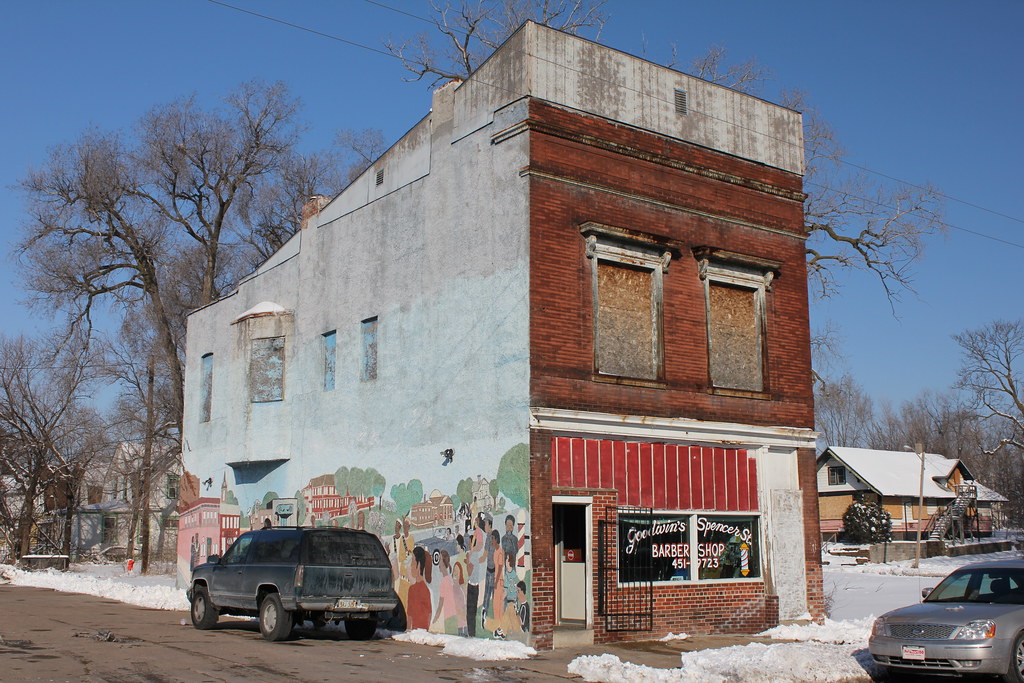
Growing up, I knew of a certain barbershop in northeast Omaha for one reason and one reason alone, it is where former Nebraska State Sen. Ernie Chambers held court as a barber and firebrand activist. I never drove past Goodwin’s Spencer Streeet Barber Shop nor walked into it until a few years ago, when I went there to file a story on the special place it holds in the local African-American community beyond the usual gathering and gossip stops that barber and beauty shops serve.
Chambers is one part of the story, but another is the shop’s namesake, Dan Goodwin, who in his own way is an activist every inch that Chambers is. When they worked the shop together at the height of the civil rights movement and racial tensions in Omaha, they made a formidable duo of strong, socially conscious black men cutting their way to freedom.
©photo, Tom McLaughlin
Goodwin’s Spencer Street Barber Shop: We Cut Heads and Broaden Minds, Too
©by Leo Adam Biga
A version of this story appeared in The Reader (www.thereader.com) in 2006
The splintered front window of Goodwin’s Spencer Street Barber Shop, 3116 North 24th Street, might as well read: We Cut Heads and Broaden Minds, Too. Amid all the jive, the shop’s a forum for street-wise straight talk, scholarly debate, potent ideology and down home lessons from its owner and master barber, Dan Goodwin, and the gallery of young fellas and Old Gs (old guys) that hang there.
That was never more true than during the Black Power movement and Civil Rights struggle of the 1960s and ‘70s. That’s when the Spencer was a must-stop for anyone partaking in the vital brew of philosophy, polemic, dialectic and rhetoric coursing through black America. The “star” attraction was a then-young Ernie Chambers, the barber-provocateur-activist turned-politician. Between razor cuts, relaxers and jeri curls, he and Goodwin made like Malcolm and Langston, interpreting the times in an eloquent spoken word style that was part call-and-response sermon and part lecture. They were variously protagonists or antagonists. The customers and curious onlookers, their disciples or students or foils.
“It was like open line every day of the week down there,” said Omaha photojournalist Rudy Smith. “All the conversation topics were about relevant things that were not talked about on radio/TV or written about in newspapers or discussed in school. Whenever you went there you were always intellectually challenged and stimulated.
“People would always bring in books and articles and things, and they would read them there and discuss them. Sometimes, people would come there and not even get their hair cut. They’d just come to listen. Others would come just to vent.”
“You’d go at ten in the morning and you may not leave until two or three in the afternoon. You’d sit around and listen to a lot of positive things,” Omahan Richard Nared said. “You’d go and get a lot of ‘mother wit’ (knowledge).”
Things could get intense. Smith said Goodwin, Chambers and company “could be confrontational. Sometimes they’d take the opposite position just to stimulate your thinking and to broaden your perspective. But it wasn’t meant to destroy you — it was meant to strengthen you. Now, I didn’t always agree with ‘em, but I didn’t always oppose ‘em either. I enjoyed it and other people did, too.”


Smith said “the salient” subjects batted around included “Malcolm X, Eldridge Cleaver, Hughie Newton, racism, economic development, the lack of black teachers in the public school system, housing discrimination, police violence” and any “issues relating to our people.”
Memories of Vivian Strong and other victims of police gunfire still elicit strong responses. Goodwin refers to the 1969 fatal shooting of the 14-year-old Strong as “murder.” The incident ignited disturbances that he said were branded a riot.
Unlike some leaders who’ve done more reading about The Struggle than living it, Goodwin speaks from the harsh experience of a man who’s encountered his share of police harassment and brutality, including the cold hard steel of a double barrel shot gun pressed to his temple and the butt of that same gun jammed into his gut. He’s been rousted and arrested for “driving while black.”
His social consciousness was stirred in the U.S. Navy. He left Tech High at age 17 to enlist. “It was a good experience. But I went through a lot in the military. I went through boot camp with only one other black in my company. In the tent I was in in the Philippines, I was the only black. I’d hear things. I didn’t start nothin’, but I wouldn’t take nothin’. Every time I had a fight, they thought they could just say anything — the ‘n’ word, you name it — and I didn’t take it. But, you know what, it wasn’t that I was tough. I was dealing with cowards and they weren’t looking for much of a reaction. I must admit sometimes after I finished off one of those people, the other Caucasians would say, ‘Man, he had it coming.’”
Back home, he hit the streets protesting injustice as a member of the 4CL (Citizens Coordinating Committee for Civil Liberties). Unlike other organizations here reluctant “to confront” the system, the 4CL “believed in going out and demonstrating. It was an action group,” he said. “We integrated different places and we petitioned for jobs and open housing. We marched on city hall. We did things like this that brought about some changes. We were considered troublemakers and that’s what it takes to get the changes.”
He marched on Washington in 1963, a witness to Martin Luther King, Jr.’s “I Have a Dream” speech. He helped sponsor a 1964 Omaha speaking appearance by Malcolm X, a personal favorite whom he met. In 1996, Goodwin got on the bus and went to Washington again for the Million Man March.
Over the years, he’s filed complaints about police misconduct and other improper behavior directed at him and his people, making enemies along the way. All that’s bound up in him and in his shop is symbolized in the cracked glass out front he’s never fixed. Bullets hit it one night years ago. It’s a reminder of past incidents. Once, he got an anonymous call saying cops shot out the window at his old place. A warning to tone it down and to play like Uncle Tom. For many, the broken glass at the present site symbolizes hostility toward blacks. It’s also a defiant proclamation that Goodwin will not be intimidated or silenced or run off.
“I can handle anything that comes down,” Goodwin said.
As a visceral reminder of that resolve, he’s made the shop a fertile ground for developing not just the mind, but the body, too. The muscular Chambers introduced weight training there. Goodwin started lifting at age 40. With a ripped body that testifies to his dedication, Goodwin has in recent years become a world-class power lifter in the masters division. He’ll wear you out in the makeshift gym he has in a corner of the shop or wear you down with his treatise-like arguments. Some of the trophies, plaques and ribbons he’s won take up one side of the shop, whose walls are filled with clippings/photos of some of the sports greats to get their hair cut there (Bob Gibson, Bob Boozer, Gale Sayers, Ron Sayers, Ron Boone, Johnny Rodgers, etc.).
Along with the Fair Deal Cafe, the shop was the place to be for any politically aware person interested in serious dialogue about the black experience.

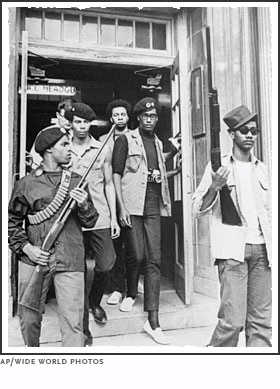
If you were a Black Muslim or Panther or garden variety activist, then you went there to hear the latest thinking. Whether you supported Malcolm or Martin, read Cleaver or Chrisman and marched in step with the NAACP or the Urban League, you were ripe for the Spencer Street indoctrination.
“Dan Goodwin and Ernie Chambers had a great influence on us. They made sure we were accountable. They had high standards for us,” said Frank Peak, a former Black Panther member in Omaha. “They were mentors.”
If you were a minister, you’d better go prepared to recite the Bible chapter and verse or defend your theology. If an elected official or a candidate seeking the black vote, you tested the waters there.
If you were an idealistic white student or adult civil rights sympathizer, you came as an acolyte to learn at the feet of the black men who, by virtue of the oppression they endured and resisted, earned the right to hold court there.
If you were a reporter looking to measure the pulse of the community, you no sooner flipped open a note pad or switched on a tape recorder then you got more than you bargained for in the way of unvarnished views.
“It wasn’t always serious, now,” Smith said. “There was a lot of laughter. And sometimes people laughed to keep from crying.”
Nothing much has changed. The same issues persist, only the incendiary talk has been somewhat muted and the rallies that got their start there have been relegated to the history books except for an occasional revival.
At age 77 Goodwin commands respect from young and old alike for still being a relevant spokesman and soul brother.
“He’s like the father of this barbershop,” customer Charles Taylor said. “I’ve noticed a lot of the young men that come in here refer to him as Mr. Goodwin. That shows respect.”
Goodwin’s not lost the fervor to fight injustice or to do the right thing. But there is an edge of resignation in his words and in his voice today. Chalk it up to all the shit he’s seen go down from his perch on North 24th, where the promise of a better tomorrow hasn’t been realized the way he hoped.
“I feel a lot of frustration. I was naive enough to believe that by now it would be different for our youngsters,” he said. “Racism is everywhere. It’s just a little more sophisticated now, that’s all.”

His vintage red brick building, only a stone’s throw from Lothrop Magnet Center, Littlefield’s Beautyrama and Church of Jesus Christ Whole Truth, is a symbol for the once teeming area gone to seed. The upper floor windows are boarded up. On the north wall, a faded advertisement for “Uneda Biscuits, 5¢,” faces a vacant lot upon which other buildings and businesses once stood. The south wall is awash in a celebratory mural portraying “the way things used to be,” said Goodwin. The mural depicts a parade in which young people hold a banner that exclaims, “Beating the Path to Freedom,” something he’s invested the better part of his life doing.
It hurts him to see his community a shadow of its once vibrant self and to be still embroiled in the quest for equal rights, yet unable, in this era of divided ranks, to marshal the support a systemic movement takes.
“I think this community like all communities in the inner city in America has big problems and the problems are even bigger now than they have been. Schools are in trouble. The job situation is bad. Drugs. There are so many things plaguing us now. It’s really interfered with what we called The Struggle. In my judgment, were a lot more fragmented today, to the point where we can’t come together to bring about real change. I miss the unity and the organization — when people were more focused on trying to bring about improvements. A lot of our young people are not even enlightened about the things we did struggle to try to change. I don’t feel real good about it sometimes, but you can’t put up your hands. You just do what you can and keep pushing.”
He rues the loss of moral constraints that allows, as he sees it: an unjust war to continue; elected leaders to lie; war profiteers to flourish; corporate execs to cheat; celebrities to set an indecent example; and drugs and gangs to proliferate.
“There used to be rules. Nobody was perfect, but at least we knew right from wrong. There were certain lines you wouldn’t cross. Now, there’s no line. The message now is, Whatever you want to do, it’s OK. It’s out there. It’s a whole different culture, the drug and gang culture. I don’t blame kids. I blame my generation. We allowed the rule book to get thrown out. And I’m not a fool or anything. I’m not even into religion. I’m into right. I’ll believe in right till I die.”
He sees a corrupt ruling class setting a precedent of greed and malice that only serves to widen the gap between the haves and have nots and to reaffirm the anything-goes mantra.
“Too many people can’t see past what’s happening to them right now. They don’t look at the consequences of what they’re doing today,” he said. “There was a time when you really felt like there were people that really wanted to see some things different. But there just wasn’t enough people that wanted to see the right kind of change. Now we’ve reached a time when liberal has been turned into a dirty word and decent people run from it. That says a lot about this country. I don’t feel good about that or the fact black people get done in just for telling the truth.”
Lively discourse has always been part of the scene at the Spencer Street, but was at its peak when Goodwin took on Ernie Chambers, a loquacious minister’s son and law graduate who used his barber chair as a lectern. Chambers proffered doctrine there from the mid-’60s through the early ’90s, a period that saw him build a constituency, first as a grassroots leader, and then as a state senator (District 11). He was the only black in the Nebraska Legislature during the entire four-decades he served as a member of that conservative, otherwise lilly-white body.
 Rudy Smith
Chambers came to the shop after being fired from the U.S. Postal Service. The then-Creighton law student was an outspoken activist. It was a perfect match.
In Goodwin, Chambers found a kindred spirit. “I liked the kind of person he was. We got along very well. He’s true to his beliefs. He rented me a chair and I stayed there for years and years,” Chambers said. In Chambers, Goodwin found “a young man who could articulate like nobody I’ve ever known. He always had answers. He did his homework. He knew what he was doing and saying. People were really impressed with him. And we communicated real good. We were really seeing things so much alike.” Not that they didn’t disagree. “Oh, we used to argue nose to nose. We had some good ones,” Goodwin said.
“It just so happened Ernie fit in with the atmosphere and then he began to exert himself,” Rudy Smith said. “I think the shop gave Ernie a platform to grow, as it did a lot of other people.”
They made a formidable team. Their give and take, something to behold. They were arrested together. They traveled together when Chambers made lecture stops.
“As Ernie grew, so did Dan,” Smith said. “Dan wasn’t an intellectual, but he became that as he expanded his knowledge and his sphere of understanding issues socially, politically, psychologically. Ernie spearheaded that. He’d stimulate him.”
“Dan didn’t go to college, but whatever conversation came up he could talk about it. No matter where he goes, people stop and talk to him” Richard Nared said.
The pair’s persuasive powers are immortalized in the 1967 Oscar-nominated documentary A Time for Burning. The film filters the era’s militancy through the charismatic figure of Chambers, who’s captured, alongside Goodwin, eloquently making points in the manner that made the shop a hotbed of impassioned ideas. Amid sports memorabilia on the walls were images/articles/cartoons that graphically illustrated the opression blacks lived under. An in-your-face reminder to pale-faced do-gooders of what The Struggle was all about.
“A lot of people came down to this barbershop to hear him speak to the problems. To be honest, a lot of people feared him because he spoke out so strong. He’s tough. Even now, he asks no quarters and he gives no quarters. He says what he wants to say and he’ll say it the way he wants to say it,” Goodwin said.
“A lot of people came to talk to me to discuss issues and it was a place where others would meet when they wanted to talk and just speak freely about what was on their mind. It was like a gathering place,” Chambers said.

Roger Sayers of Omaha said the shop was “kind of the northside human relations department for folks who felt their rights were being trampled on by the police or the school board or the city. If Dan and Ernie thought you had a case, they would try to help you resolve the problem with a letter or a referral or a phone call.”
Richard Nared said the duo were among the cooler heads to prevail at a time when agitators interpreted “by any means necessary” as a call to violence. “A lot of things happened in north Omaha,” Nared said. “People would come in and talk to them about wanting to hurt somebody that’d messed them over. ‘Man, I ought to go kill him.’ Well, Dan and Ernie would say, ‘Hey, man, do what you’re supposed to do, and walk away. It’s not that serious. Life is too short to get hung up on some petty mess. It’s not worth it. You’ll end up two ways — in jail or dead.’ I feel to this day Ernie and Dan were a big factor in keeping the peace.”
Even though Chambers long ago left his barber chair, the two men remain close. “We talk all the time,” Goodwin said. “He’s a great influence. I’m just impressed with his brilliance. So, it’s friendship and mutual respect.”
He loathes the possibility of Chambers being forced out of office by term limits. “It’ll be a big void. Nobody’s more committed. His whole life is what he does in the legislature. I mean, everyday he’s working on something involving the people.”
As much as Goodwin’s been influenced by Chambers, he’s his own man.
Goodwin set the agenda for the shop and made it into what Smith calls an “institution of higher learning.” “That’s exactly what it was,” Smith said. “It fostered an arena of ideas. It’s still going on — without fail. The barbers there were all like teachers and professors and in many ways they were more articulate in espousing their points of views. I was stimulated more sometimes in the barbershop than I was in college. It’s the only barbershop of it’s kind. It should be on the national historic registry.”
Goodwin’s much admired for remaining in the community, where he and his shop provide stability and continuity. “And especially when he continues to grow personally and intellectually,” Chambers said. “It lets people know that not everybody who could go someplace else is going to do that. This is home and this is where we stay. People do need to see that, especially the young ones. When they can see people (like Goodwin) who are in a position where they don’t have to hang around, but they choose to, that lets them know there’s something of value in our community and a benefit to staying here.”
For Goodwin, staying put is a matter of “this is where I feel comfortable. I don’t even consider retiring. I’m doing what I like. I’m doing what takes care of me. It’s mine.” There’s no chance he’ll mellow. “I don’t believe in turning the other cheek. I do believe in non-violence. But the truth is the truth. I have to tell it like it is.”
Related Articles
- Hip-hop barbers break down race barrier (theglobeandmail.com)
- Rev. Eric Lee: Travesty of Justice (huffingtonpost.com)
- Eric Deggans: The frightening prospect of seeing Glenn Beck and Sarah Palin use big media to rewrite civil rights history (huffingtonpost.com)
- De-romanticizing the Black Barbershop in the 21st Century (revolutionarypaideia.wordpress.com)
- ‘Shop Talk’: Will Revelations About Malcolm X Tarnish Legacy? (npr.org)
- Omaha Native Steve Marantz Looks Back at the City’s ’68 Racial Divide Through the Prism of Hoops in His New Book, ‘The Rhythm Boys of Omaha Central’ (leoadambiga.wordpress.com)
- Today’s Exploration: Omaha’s History of Racial Tension (theprideofnebraska.blogspot.com)
- Back in the Day, Native Omaha Days is Reunion, Homecoming, Heritage Celebration and Party All in One (leoadambiga.wordpress.com)
- A Change is Gonna Come, the GBT Academy in Omaha Undergoes Revival in the Wake of Fire (leoadambiga.wordpress.com)
- Native Omahans Take Stock of the African-American Experience in Their Hometown (leoadambiga.wordpress.com)
- Native Omaha Days: A Black is Beautiful Celebration, Now, and All the Days Gone By (leoadambiga.wordpress.com)
- A Rich Music History Long Untold is Revealed and Celebrated at the Omaha Black Music Hall of Fame (leoadambiga.wordpress.com)
- Community has ‘Soul’: Barbershop owner says new cafe fits vision for Mechanicsville (knoxnews.com)
- North Omaha Champion Frank Brown Fights the Good Fight (leoadambiga.wordpress.com)


 Leo Adam Biga's My Inside Stories