Archive
New film “Growing Cities” takes road trip look at urban farmers cultivating a healthy, sustainable food culture
Dirt, as in soil that you dig in with your hands, is becoming cool among a certain set of young people who are joining the multi-generational ranks of folks practicing urban farming as a response to the food deserts and unhealthy eating choices plaguing many American communities and the disconnect between Americans and the food they consume, most of which is highly processed, pre-packaged crap supplied by corporations that operate out of self-interest, not the public welfare. Two young men fresh out of college have produced a new documentary, Growing Cities, that takes a road trip look at the burgeoning urban farm movement and its cultivation of a healthy, sustainable food culture that aims to put the power of food back in the hands of the people. For their project filmmakers Dan Susman and Andrew Monbouquette traveled from our shared hometown of Omaha, Neb. across the country to both coasts and several stops in between before ending up back where they started. Growing Cities is playing festivals around the nation. It has a 7 p.m. Filmmakers Screening Oct. 29 at Film Streams in Omaha. Susman and Monbouquette will field questions from their hometown audience folliowing the show. My article about their new film will soon be appearing in The Reader (www.thereader.com). For related stories, check out my pieces on this blog about three Omaha endeavors: No More Empty Pots, Minne Lusa House and the culinary-horticulture marriage at Metropolitan Community College.
New film “Growing Cities” takes road trip look at urban farmers cultivating a healthy, sustainable food culture
©by Leo Adam Biga
Originally appeared in The Reader (www.thereader.com)
With words like justice, security, healthy and sustainable increasingly attached to food in America, two Omaha filmmakers with an undisguised POV have plugged into the sustainable edibles culture with a new documentary.
In Growing Cities urban agriculture advocates Dan Susman and Andrew Monbouquette present farming operations around the nation as smart remedies to inner city food deserts. The doc’s. 7 p.m. Film Streams screening on Oct. 29 will be followed by a Q&A with the creators.
Writer-director Susman, cinematographer Monbouquette and production manager Brent Lubbert logged 13,500 miles in a Dodge Caravan van on a three-month road trip to 20 cities in 2011. They searched out the best, biggest, most innovative urban agriculture models and found farmers not just in trippy spots but everywhere and farming everything from front and backyards to lots to rooftops to windows.
The quest was fueled by their disenchantment with scant local urban farming initiatives, though they acknowledge great strides have been made through No More Empty Pots and Big Muddy Farms, for example. The pair run their own mobile program, Truck Farm, that intros youth to growing things.
The urban ag movement has emerged in response to an industrialized food system that leaves consumers disconnected from the sources of what they eat and therefore reliant on processed, pre-packaged products.
Studies show a lack of ready access to fresh, organic foods may contribute to such health problems as obesity, diabetes, heart disease and hypertension.
Susman’s advocate-activist efforts got their start at Dartmouth College. The environmental studies major led a large outing club program, waged a sit-in at the president’s office and helped develop a Sustainable Living Center. He also co-directed a short film about the development of some pristine land.
The filmmakers obtained grants from Dartmouth to fund the Growing Cities road trip and raised $40,000-plus during a 2012 Kickstarter campaign. They’ve since found support among the same urban ag community they tout. Back home, they served as resident fellows at the Union for Contemporary Art and got free studio space there and at the Image Arts Building, whose owner, Dana Altman, became a producer.
The Central High grads lionize grassroots, community-based efforts that support natural, local food production.
Susman, a vegetarian who has a garden and chickens in his midtown backyard, feels they’ve caught a trend.
“What we tapped into is this intense support and desire by people to get involved. We made the film at the right time when I consider this wave because I know it’s only getting bigger,” he says.
“There’s so many different ways to get involved. You don’t have to be a farmer. You can grow a little bit. If you don’t like growing maybe you can cook or preserve or can. Or maybe volunteer at the local food bank. Eighty percent of our country lives in cities, so we have this huge population that could be doing this.”
The filmmakers contend there’s great interest in urban farming and that it can be practiced at some level by anyone, anywhere.
“There’s a lot of people who have never worked with a sustainable organization or who have never farmed but they’re super excited about it,” says Monbouquette. “It’s something everybody can do. The biggest thing for us is encouraging people to grow a little bit of something.”

Andrew Monbouquette and Dan Susman
“Grow where you are” is the mantra they’ve adopted
Monbouquette says, “I think our biggest goal was we wanted to inspire people to do something.”
He says warm receptions to the film at festivals indicate its message resonates widely. Susman says millennials are just as likely to recognize “it’s cool, fun, exciting and rewarding to grow your own food” as older folks.
Monbouquette suggests urban farming will scale up in direct proportion to the number of people who participate in it and the amount of resources devoted to it. He suggests the real question is, “How far can we really take all this positive energy around urban farming and solidify it in our culture and just make it one of the things that we do, so it’s not just for hippies and hipsters?”
“Nobody’s saying we’re going to grow everything we can ever eat in cities. We can grow a lot of things there though,” says Susman.
Urban farming has been popular in earlier eras before fading away.
“The closest thing we have to compare it to is the Victory Garden movement (of World War II).,” says Monbouquette. “The statistics from that are astounding. Urban farmers were growing 40 percent of the fruits and vegetables consumed.” Will the phenomenon last this time? “It just needs people to embrace and try it,” he says, adding government could do more to promote it by offering incentives to property owners to enter land use agreements that transform vacant lots into gardens.
Susman says some cities go so far as to have urban ag directors.
Rather than take a critical approach about “how screwed up everything is with E.coli or Mad Cow or industrial farming,” Susman says the film is “a really positive” spin on what we can all do to make our communities healthier and more inclusive.
Monbouquette says he became a convert to the cause by working on the film.
“The food and social justice issues really stuck a chord with me. Growing food is such a simple act but it can transform into this hugely motivational, inspiring, positive, productive thing in communities that really need it. You know, everyone has to eat and I subscribe to the view that we’re all in this together.”
For tickets, visit http://www.filmstreams.org.

Related articles
- A farmer’s journey from California to Vancouver’s Downtown Eastside (blogs.vancouversun.com)
- Growing Power: An urban farm that grew a million pounds of food on 3 acres (poorasfolk.wordpress.com)
- Agropolis – a transitional urban agriculture project in Christchurch’s city centre (thesolablog.wordpress.com)
- Lantzville hashes out urban farming options (nanaimobulletin.com)
- City-based rooftop farms could revolutionise urban food sustainability (blueandgreentomorrow.com)
- Urban agriculture is socio-economic beneficial (City Farmer News) (desertification.wordpress.com)
- Urban Farming (theecologist.org)
Documentary shines light on civil rights powerbroker Whitney Young: Producer Bonnie Boswell to discuss film and Young
The name is familiar to some and totally unknown to others, but a new documentary leaves no doubt about the significant role Whitney Young Jr. played in the civil rights movement. The Powerbroker: Whitney Young’s Fight for Civil Rights makes a compelling case for Young being an overlooked giant of that progressive and momentous social justice effort to give African Americans the equality promised by law and practiced in every day life they were so long denied. The film’s producer, Bonnie Boswell, is the niece of the late Whitney Young, whose work to secure better lives for his people was largely done behind the scenes, in boardrooms and offices, rather than in public forums. My story about the film, Boswell’s motivation to do it, and her take on Young is in the current issue of The Reader (www.thereader.com). A screening and discussion with Boswell is scheduled March 28 at Film Streams in Omaha, where Young served as head of the Urban League of Nebraskas in the early 1950s.

Whitney Young during a meeting with President Lyndon Johnson in the Oval Office (AP Photo/LBJ Presidential Library, Yoichi Okamoto)
Documentary shines light on civil rights Powerbroker Whitney Young:
Producer Bonnie Boswell to discuss dilm and Young
©by Leo Adam Biga
Soon to appear in The Reader (www.thereader.com)
The civil rights and black power movements seem distant from Omaha until noting that Whitney Young Jr. cut his teeth as an advocate-organizer here and Malcolm X was born here.
While Malcolm X moved with his family from Omaha as a child and only returned once as an adult, Young served as Urban League of Nebraska president from 1950 to 1953. Young faced racism first-hand growing up in the South and serving in the U.S. Army. In Omaha he found blacks severely restricted in terms of where they could live, work, eat and recreate. He worked with DePorres Club president Father John Markoe and Omaha Star publisher Mildred Brown in mounting challenges to discrimination and segregation. He forged alliances with local business and civic leaders to try and improve opportunities for minorities.
Those mediating experiences undoubtedly informed his later work as National Urban League executive director from 1961 until his untimely death in 1971, a tenure that coincided with momentous civil rights events.
Young. who’s been called “the inside man of the black revolution,” is the subject of a new documentary produced by his niece, television journalist Bonnie Boswell. A free 7 p.m. screening of her PBS-telecast film, The Powerbroker: Whitney Young’s Fight for Civil Rights, is set for March 28 at Film Streams. A Q&A with Boswell follows.
Boswell says she was motivated in part to do the project to ensure Young’s role in history got “the credit” it deserved because his contributions had become obscured over time. “The other reason I wanted to do the film,” she says, “is that I think it’s important to lift up people like Whitney Young, of whom there are many, who do work behind the scenes people don’t necessarily know about, who get things done, who make cities work. I think it’s important for future generations to have a sense of, as they start thinking about their lives, it’s not necessarily about getting your name in the newspaper or your picture on the front of some magazine but about being effective and getting a job done. I think we need to encourage people to take pride in that.”

Bonnie Boswell

Whitney Young and Bonnie Boswell
The most enduring images from the struggle for self-determination remain the public protests, marches and speeches that pricked the heart and conscience of a nation divided by race. Beyond the raised fists and voices, however, was the largely unseen and unheard back room maneuvering of activists, lawyers, politicians, ministers and others. These social justice soldiers brokered most of the change that delivered equal rights protections to African Americans.
Young was perhaps the most significant inside player among this largely unheralded vanguard of freedom fighters. Trained as a social worker, he used his pragmatist problem solving and people skills to gain access to corporate boardrooms and the White House to advance the case for equality as a good thing for America. Though famous in his time, his work was overshadowed by that of Martin Luther King Jr., who remains the enduring face of the movement.
Boswell says she fixed on doing the film after speaking at a Whitney Young health center in 2002 and reflecting on how her uncle’s diplomatic approach to facilitating compromise amid the tumultuous ’60s could be instructive for leaders negotiating our own ultra partisan, divisive times.
“I was concerned America was continuing to engage in overseas wars and the gap between rich and poor was widening, and I was like, Can’t we do better? Then as I studied the role he played as a mediator and a bridge-builder I thought, This is exactly the kind of person we need to have as a role model and more people need to know his story so he really can be that role model.”

Young with LBJ

Young with JFK
Now that she’s helped reclaim his legacy, what does she imagine Young would make of America today?
“I think he would be gratified and also disappointed. I think we’ve clearly made a lot of progress in many areas. We have a lot of work to do for true equity and we should be about continuing that job. I think he would want us to be picking up the baton that others left.”
Boswell says viewers would do well to remember that both MLK and Young challenged America to live up to its larger ideal of creating a better America.
“It went far beyond race, it was about the beloved community, the just society, our democracy, so we have to continue that work.”
The documentary is also extremely personal. Boswell’s early rearing came at the hands of her uncle’s and mother’s parents at the Lincoln Institute in Kentucky, where her grandfather was principal. She learned the same values her grandparents taught them. As a girl she adored her uncle but as a afro-wearing young woman caught up in Black Power fervor she favored the militancy of Stokely Carmichael to the diplomacy of Whitney Young. Her film makes clear the movement required many approaches to affect needed change.
As a middle-aged woman today, she says, “I certainly have come to appreciate Whitney’s role and the subtleties of things he was dealing with that I didn’t have the maturity to really understand. I was much more emotional about discrimination, period. He grew up in a time when you couldn’t afford to be so emotional and I didn’t understand that. I can definitely appreciate his legacy more today.”
The civil rights champion’s name adorns schools, organizations and empowerment programs around the nation. In Omaha the Urban League of Nebraska’s Whitney Young Jr. Academy offers life and career skills to youths.
Ticket reservations for the film screening-discussion are recommended. Call 402-933-0259 or visit http://www.filmstreams.org.
Related articles
- ‘Independent Lens: The Powerbroker: Whitney Young’s Fight for Civil Rights’ (Review) (popmatters.com)
- Boardrooms And Beyond: Remembering Civil Rights ‘Power Broker’ Whitney Young (npr.org)
- New film tells story of unsung civil rights leader Whitney Young Jr (thegrio.com)
- New Film Tells Story Of Unsung Civil Rights Leader (huffingtonpost.com)
- ‘The Powerbroker: Whitney Young’s Fight for Civil Rights’ a New PBS Documentary (atlantablackstar.com)
Anti-Drug War manifesto documentary frames discussion: Cost of criminalizing nonviolent offenders comes home
Until the documentary The House I Live In the best film I’d seen about drugs was the Steven Soderbergh drama, Traffic. The director of the doc, Eugene Jarecki, does something very much akin to what Soderbergh did by taking a multi-perspective look at the insidious grip the illegal drug culture and the so-called War on Durgs exerts upon every one caught up in this human chain of destruction. My story below for The Reader is based on a recent screening and panel discussion of the film in Omaha.
Anti-Drug War manifesto documentary frames discussion:
Cost of criminalizing nonviolent offenders comes home
©by Leo Adam Biga
Appeared in The Reader (www.thereader.com)
The much-feted 2012 documentary The House I Live In provokes dialogue wherever it plays for its critique of America‘s domestic War on Drugs. Following a January 22 Film Streams screening before a full house a local panel discussed the film’s potent themes.
Director Eugene Jarecki’s (Why We Fight?) film indicts the war as failed public policy that’s wasteful, unjust and morally bankrupt for targeting nonviolent minority offenders. He suggests its true cost lies not only in the vast expenditures for arrest, prosecution and incarceration but in the disruption caused to families and communities. Every drug case has a spiral of consequences that can span generations.
The consensus of the experts and persons directly engaged in the war whom Jarecki enlists to comment on camera is that blacks are disproportionally targeted and punished. He explains he came to tackle the issue upon inquiring why a black family he knew from childhood struggled with poverty and crime. Its matriarch, Nannie Jeter, blames drugs for taking her late son James and leading other members down destructive paths.The film tells story after story of families impacted by addiction and imprisonment.

Eugene Jarecki
One observer notes, “We are engaged in a great experiment. What happens when you take large numbers of people, remove them from their neighborhoods, their families. What does this do to the broader community?”
Everyone from author Michelle Alexander (The New Jim Crow) to a prison chief of security agree the prison industrial complex has superseded prevention-intervention by incentivizing arrest, conviction and confinement and thus making it a big business prone to corruption that puts profit before humanity.
David Simon, creator of The Wire and a former journalist who covered the drug war, says, “Think about all the money spent on drug enforcement, on prisons and probation officers, on judges, on narcotics agents, on interdiction and everything else. But to what end? We’re the jailingest nation on Earth, yet drugs are purer than ever before, they’re more available.”
America’s draconian approach, he said. doesn’t work.
During the panel Impact One Community Connection founder Jannette Taylor reiterated a theme in the film that the war is actually a campaign to “marginalize people” that leaves havoc in its wake. “We need to look at the broader picture of the collateral damage from this fake war on drugs,” she said. “We need to be more realistic about what this fake war on drugs really is and how it affects poor communities and the people in it.”
She knows first-hand the personal fallout. The father of her daughter has served 17 1/2 years on drug charges. “My daughter has never had her father in her life. He was out only a short period of time before he resorted back to selling drugs and got caught up again and it’s basically because you become so marginalized. You can’t get a job, you can’t find a place to live, so you resort back to what you know – you resort to the economy that pays you.”
Jarecki introduces us to individuals for whom using and dealing were all they saw growing up. Naturally, they followed suit. Picking up a point Simon makes in the film, Taylor said the drug trade may be “the only flourishing economy” in some inner city neighborhoods and “given the limited opportunities poor inner city residents have it’s a rational decision to deal drugs.” Similarly, she said drugs become a way to medicate “if you’re living in a constant state of poverty, in depressed living conditions.”
Taylor said despite never using, dealing or serving time “I’m dealing with the same things, just from a different perspective. My daughter is caught up in this drug war because she doesn’t have a dad, so she’s being raised by a single mom. It was very hard. Once somebody gets sentenced into the system because of drugs their family’s affected. It’s like a crazy avalanche. The kids no longer have both parents, the other parent is pressured into making more money and that takes them away…It’s a domino effect. It’s a cycle and it never ends.”
Scholar Richard Lawrence Miller draws comparisons in the film between the war and “the chain of destruction” he says the ruling class historically applies to minorities in order to target, control, demonize and isolate them. He and others point to profiling, mass incarceration and mandatory minimum sentences as its manifestations.
Simon terms the drug war “a Holocaust in slow motion.”
“This is basically slavery in a new form,” said Taylor, who with others cautions, “If someone else’s rights can be compromised and violated then yours can too.”
Panelist Rodney Prince, who served a federal drug sentence, said, “I believe this war on drugs is a means, a guise to deal with a segment of the population no longer needed in this transforming economy. The intention for me doesn’t really matter, this thing is happening to people.”
Taylor and others advocate America recast the war as a public health issue that gives nonviolent addict offenders treatment rather than jail time.
Prince said, “This is an economic issue. If we know our economy can’t absorb everyone now then we have to push our elected officials and business leaders to act responsibly and to make more room for people in the economy.”
Douglas County District Court Judge Marlon Polk said education is the best deterrent to being caught up in the drug culture. Nebraska Corrections Youth Facility director Marilyn Asher and other panelists suggest we all have a stake in giving people the support and skills they need to prosper.
Documentary considers Omaha’s changing face since World War II
Omaha, my Omaha. I have something of a love-hate relationship with my city, which is to say I have strong feelings about it and I always want it to be better than it thinks it can, though the attitude problem or more specifically inferiority complex it suffered from for so long has been largely replaced by a bold new, I-can-do confidence. That metamorphosis is part of what drew me to a documentary some years back that took the measure of Omaha by charting the changing face ofrcityscape since World War II, and what a marked difference a half-century has made. In truth, and as the doc makes clear, the most dramatic changes have only occurred in the last decade or two, when the city poured immense dollars into transforming parts of downtown, the riverfront, midtown, and South Omaha. Left mostly untouched has been North Omaha, where the city’s major revitalization focus is now aimed. The film also deals with one of the city’s biggest missteps – the razing of the Jobbers Canyon warehouse district to appease a corporate fat cat who wanted to put his headquarters there in place of what he called the area’s “big ugly red brick buildings.” Those buildings were historic treasures dating back a century and today they would be home to well-established retail, residential, commercial developments that would be employing people and generating commerce, thus pouring money back into the city’s coffers.

Documentary considers Omaha’s changing face since World War II
©by Leo Adam Biga
Originally appeared in The Reader (www.thereader.com)
Omaha’s evolution into a homey yet cosmo metropolis that’s discarded, for better or worse, its gritty industrial-frontier heritage is the subject of a new documentary premiering statewide on the NETV network. Omaha Since World War II — The Changing Face of the City is a UNO Television production and a companion piece to UNO-TV’s popular 1994 If These Walls Could Speak.
What the new film does particularly well is frame the growth of Omaha over the past 60 years within a social, cultural and political context. Instead of settling for a Chamber of Commerce paean to development, the film makes a balanced effort at showing not only the dynamic explosion in Omaha’s ever-expanding boundaries and emerging 21st century cityscape but also some of the real tensions and costs that have come with that change. Using soaring, sweeping aerial footage shot from a helicopter video mount, the film provides insightful glimpses of Omaha’s famous sprawl and, even more tellingly, of the riverfront renaissance that’s remaking the city’s traditional gateway into a stunning new vista. Like the fits-and-starts pace of most Omaha development, major pieces in the Return to the River movement have taken decades to coalesce, but now that the new riverfront is emerging, it’s shaping up as a dramatic statement about the sleek, modern Omaha of the future.
While most of this period has seen real progress, valid concerns are raised about one neglected area and a pattern of disregarding history. For example, the film focuses on the decline of north Omaha in the wake of the devastating 1960s riots there and the equally hurtful severing of that community by the North Freeway several years later. News footage of burning stores and marching civil rights demonstrators, along with residents’ personal anecdotes of urban ruin, reveal a community in upheaval.
The late Preston Love Sr., ex-Omaha educator Wilda Stephenson and Omaha World-Herald photographer Rudy Smith paint vivid pictures of the jumping place that once was North 24th Street and of the despairing symbol it came to represent. As the $1.8 billion in downtown-riverfront revival continues (development dollars spent in the last six years, according to Omaha Chamber of Commerce figures), it’s apparent north Omaha’s been left behind. Unlike South Omaha, which remakes itself every few decades as an immigrant haven and finds new uses for old landmarks like the former stockyards site, North Omaha still searches for a new identity.
The film also examines how city/state leaders sacrificed the nationally historic Jobber’s Canyon district to the whims of corporate giant ConAgra in the 1980s. A man-made canyon of 22 massive, architecturally unique warehouse buildings closely tied to early Omaha’s booming river-rail economy, all but one Jobbers structure — the former McKesson-Robbins Building, now the Greenhouse Apartments — was razed when ConAgra decided the “eye-sore” must go if it was to keep its headquarters downtown. After seeing homegrown Enron uproot to Houston, Omaha caved to ConAgra’s demands rather than lose another Fortune 1000 company. The canyon was an incalculable loss but, as the film makes clear, the resulting corporate campus served as a catalyst for development.
The filmmakers rightly reference Omaha’s penchant for tearing down its history, as in the old post office, the original Woodmen of the World building, the Fontenelle Hotel and the Indian Hills Theater. Spinning the story in all its permutations are, notably, former Omaha city planning directors Alden Aust and Marty Shukert, architect and preservationist George Haecker, historians Harl Dalstrom, Thomas Kuhlman, Bill Pratt and Garneth Peterson, developers Sam and Mark Mercer and entrepreneur Frankie Pane.
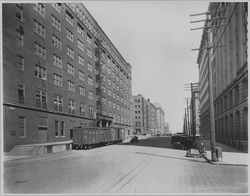 |
Jobbers Canyon before

The Jobbers Canyon debacle came at a time when downtown was reeling and in danger of being an empty shell. If not for major investments by a few key players. it may never have come back from the mass retail exodus to the suburbs it witnessed in the 1960s and ‘70s. In a real coup, the film features Old Market pioneers Sam and Mark Mercer, who describe the organic growth of this historic district into a cultural oasis — one that’s served as an anchor of stability.
The longest ongoing story of Omaha’s growth is its westward push. The film explains how this has been achieved by a liberal annexation policy that’s added subdivisions and even entire small communities to the tax rolls. The film touches on the fact that, outside a few developments, this sprawl has created a formless, characterless prairie of concrete and glass. The film also alludes to Omaha’s old neighborhoods, but only highlights one, Dundee, as an example of design and lifestyle merging.
Where the film doesn’t fare so well is in offering any real sense for the personality of the city. To be fair, filmmakers B.J. Huchtemann and Carl Milone didn’t intend to do that. Still, it would have been useful to try and take the measure of Omaha beyond its physical landscape. The only hint we get of this is via the many on-camera commentators who weigh in with their perspectives on Omaha’s changing face. And, to producer-director Huchtemann’s and co-producer-editor Milone’s credit, they’ve chosen these interpretive figures well. They’re an eclectic, eloquent, opinionated bunch and, as such, they reflect Omahans’ fierce independence and intelligence, which is at odds with the boring, white bread image the city often engenders. They are the film’s engaging storytellers.
Still, a film about the city’s changing face begs for an analysis of Omaha’s identity crisis. Mention the name, and outsiders draw a blank or recall a creaky remnant from its past or ascribe a boring blandness to it all. That’s before it had any “Wow” features. Now, with its gleaming new facade, Omaha’s poised to spark postcard worthy images in people’s minds. What is Omaha? What do we project to the world? The answers all converge on the riverfront. That’s where Omaha began and that’s where its makeover is unfolding. The monumental, sculptural pedestrian bridge may be the coup de grace. Interestingly, the film explains how much of what’s taking place was envisioned by planners 30 years ago. It’s all come together, in piecemeal fashion, to make the water’s edge development Omaha’s new signature and face.
So, what does it say about us? It speaks to Omahans’ desire to forge ahead and be counted as a premier Midwest city. No mention’s made of Hal Daub, the former mayor whose assertive energy drove Omaha, kicking and screaming, into the big time. He gave Omaha attitude. The film suggests this bold new city is here to stay.
Related articles
- From the Archives: An Ode to the Omaha Stockyards (leoadambiga.wordpress.com)
- Book Explores University of Nebraska at Omaha’s Rich History (leoadambiga.wordpress.com)
- In Memory of a Omaha Old Market Original, Fruit and Vegetable Peddler Joe Vitale (leoadambiga.wordpress.com)
- George Eisenberg’s Love for Omaha’s Old Market Never Grows Old (leoadambiga.wordpress.com)
- Remembering the Virginia Cafe and the Restauranter Family Legacy of Filmmaker Alexander Payne (leoadambiga.wordpress.com)
- A Synergy in North Omaha Harkens a New Arts-Culture District for the City (leoadambiga.wordpress.com)
- Everything Old is Newly Restored Again at Historic Sacred Heart Catholic Church in Omaha (leoadambiga.wordpress.com)
- Where Community, Neighborhood and Representative Democracy Meet (leoadambiga.wordpress.com)
- Jane Fonda Comes Home (leoadambiga.wordpress.com)
- Litniks Unite! The Downtown Omaha Lit Fest Brings Writers, Artists and Readers Together in Celebration of the Written Word (leoadambiga.wordpress.com)


 Leo Adam Biga's My Inside Stories