Archive

Posts Tagged ‘Film’

Alexander Payne’s new film “Nebraska” features senior cast and aging themes in story sure to resonate with many viewers

November 30, 2013 2 comments

This is my sixth published story on Alexander Payne’s new film Nebraska and it takes a somewhat unique slant on the movie’s senior cast and aging themes.  The angle I take was predicated by the publication I wrote the piece for, the New Horizons, a monthly newspaper published by the Eastern Nebraska Office on Aging.  If you’ve seen the film or even clips of it, then you already know it prominently features several older actors and deals with some of the challenges that accompany aging.  In the piece Bruce Dern and some of his senior co-stars comment on how they are still working at the top of their craft even in their 70s and 80s.  Indeed, Dern believes he delivered his finest performance in “Nebraska.”  Will Forte talks about what it was like collaborating with such a veteran cast.  They all talk about what it was like working with Payne.  You can find my other Nebraska stories on this blog.

In case you’re new to this blog or to my work, then you should know that I am the author of the book, Alexander Payne: His Journey in Film, a collection of my journalism about the filmmaker over a 15-year period.  A new edition of the book will be coming out in 2014 with all my Nebraska coverage.


Alexander Payne‘s new film ‘Nebraska” features senior Ccst and aging Ttemes in story sure to resonate with many viewers

© by Leo Adam Biga

Excerpt from an article that originally appeared in the New Horizons


Oscar-winning native son Alexander Payne famously feels affection for his home state, so much so he’s made four of his six feature films here, even titling his new movie starring Bruce Dern and Will Forte, Nebraska.

Payne, the writer-director of Citizen Ruth, Election, About Schmidt, Sideways and The Descendants, has with Nebraska forever burnished the name of this place in cinema history.

The film stands apart from most flicks today. For starters, it’s black and white. Next, it captures elements of this Great Plains state never before seen on the big screen. Largely filmed in northeast Neb., the movie shows the rolling landscapes, prosaic farmsteads, played-out small towns and crusty denizens of this starkly beautiful rural region

The Nebraska Gothic picture plays like a funny, tragic and sad still life evocation of people and places rubbed raw by weather and misfortune.

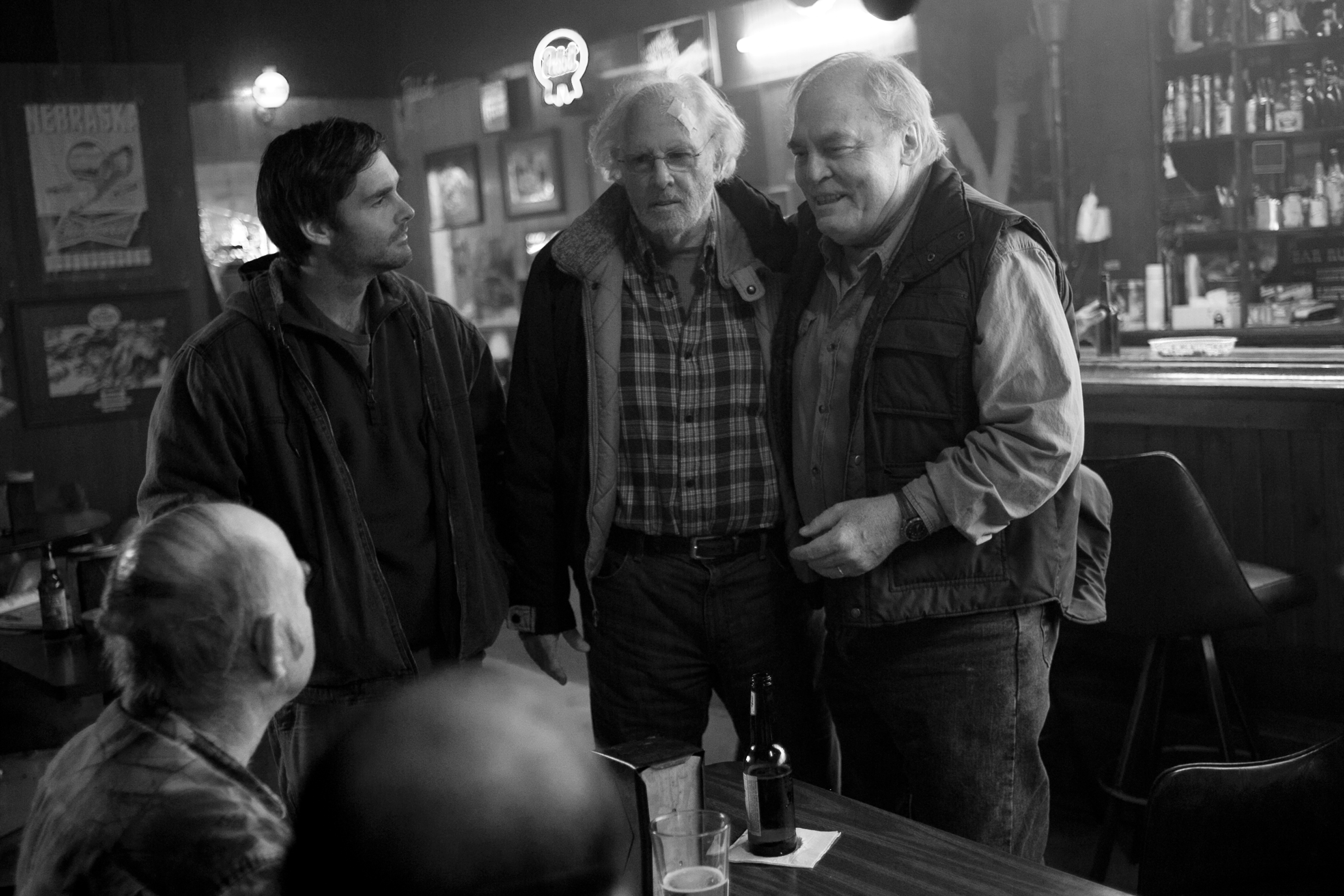
But what really makes Nebraska a singular work is the preponderance of older folks in the picture and the various aging themes that permeate its storyline. Several senior-aged actors are featured in the nostalgia-laced story starting with Dern as protagonist Woody Grant, June Squibb as his piss-and-vinegar wife, Stacy Keach as his arch nemesis, Angela McEwan as his old flame, Mary Louise Wilson as his chatty sister-in-law Martha and Rance Howard as one of his brothers.

Payne’s casting director, John Jackson, is impressed by what these actors of a certain age bring to the table.

Jackson says, “They are pros. They are inspirational to me. Their desire to create, passion to succeed, pursuit of challenges to themselves as performers – I want that as I age. I can only hope to be as fully functional as Mr. Dern, Mary Louise Wilson, June Squibb and Stacy Keach.”

The movie’s fanciful tale revolves around Dern’s character of Woody, an unrepentant lech and cantankerous cuss who’s lost some bearings in old age. He’s seemingly unaffected by anything but hides a deep well of hurt, longing and regret. Like many males of his Depression-era generation he’s doesn’t reveal much in the way of feelings.

Much to the exasperation of his wife and two adult sons, he’s stuck in his ways and bad habits and refuses to change. He’s also facing some challenges that come with advancing years. For example, he’s no longer able to drive and he walks with a halting gait. He appears depressed, confused and cut off from others.

When we first meet Woody he’s running away from home, intent on walking the 900 miles from his home in Billings, Mt. to Lincoln, Neb. to claim a sweepstakes prize he believes he’s won. Even when returned home no one can convince Woody he’s got it wrong. More than once, he lights out to tramp alongside busy roads, in all kinds of weather, his son David coming to his rescue.

Realizing his old man is still bound and determined to go and afraid his father will be a hazard if he sets out again on his own David reluctantly agrees to take him to Lincoln, convinced Woody will come to his senses before they get too far. But things happen. The father-son road trip turns into a retracing of Woody’s old haunts in his native Neb, Along the way the son learns some hard truths about his father’s past that help explain the way he is and what’s behind this crazy Don Quixote quest to redeem a prize.


Eastern Nebraska Office on Aging experts say they don’t know of a senior who’s gone so far as to show up at a sweepstakes office expecting to collect their winnings. ENOA Care Management Program coordinator Diane Stanton says some seniors do mistake marketing pieces for actual checks and bring them to their bank thinking they can cash them. “That will happen unfortunately,” she says.

Legitimate sweepstakes are one thing, but there are scams that prey on the trusting nature and sometimes naivete of seniors.

“We encourage our seniors to never give out personal information on the phone,” says Stanton, adding that one should never have to divulge private details or send money as a condition for receiving a prize. “The Better Business Bureau has a Senior Line, 877-637-3334, that we strongly encourage our seniors to keep by their phone and to call anytime they suspect they’re being scammed.”

Stanton says the free service hotline frequently updates the newest scams to avoid.

Whether Woody’s gullible or addled or simply wants to believe he’s won, it becomes apparent what he’s really seeking is redemption. He wants to leave his boys something to salvage his misbegotten life. In an act of unconditional love and forgiveness David poignantly grants him a valedictory moment at the end. Woody’s problems are still with him but he and his son have become closer and the lines of communication opened. We’re left with the feeling that should something happen to Woody or his wife, David will be there for them.

Experts say adult children need to discuss with aging parents those limitations affecting quality of life and what role they’ll play in terms of support and caregiving.

ENOA Information and Assistance Program coordinator Gloria Erickson says her office fields a variety of calls each week from adult children inquiring about everything from financial assistance to home care to senior housing to transportation for their aging parents.

If an adult child feels his or her parent is a potential risk driving, a good course of action is to seek professional consultation.

“The first thing you need to do is talk to their doctor and get the doctor’s perspective and opinion on where they are physically and cognitively in regards to driving,” says Stanton. “That’s the first step. And then talking about the need for one of the driver assessments.”

Stanton says Immanuel Hospital and AARP offer assessments or evaluations to help determine if seniors are still able to drive safely. AARP also offers a self-test seniors can take online.

Assessments or not, an adult child may still need to have a conversation with an aging parent about surrendering their keys.

“Those heart to heart discussions are tough,” says Erickson because it means the parent may be giving up some of their independence. “Family dynamics have a lot to do too with how things go.”

ENOA Community Services division program coordinator Karen Kelly says whatever aspect of daily living a senior may need assistance with, it’s always best to give them options.

She says among the changes adult children should look out for in their aging parents are increased memory loss, growing social isolation, worsening sleep issues and increasing difficulty taking stairs and keeping up their home.

As adult children notice changes in their parents, she says they need to address what can they “do to help and step in to fill in those gaps” and to determine when to “start looking outside the family for help.”

Erickson says it’s vital family members know “you don’t have to do it alone.” ENOA offers direct services and refers callers to other resource providers as needed.

Alexander Payne says he was better prepared to tell the story of Nebraska in 2012 than in 2003 when he acquired the script by Bob Nelson because his own life caught up with the film’s themes. His father George was placed in a nursing home and his mother Peggy endured a health scare. Payne’s attended to it all.

“I was able to make it quite personal in certain details related to David taking care of his older folk,” he says. “I’m at that age and everyone I know of my generation at that age have parents that are getting on and need a little special attention. We love them to death and they drive us crazy, and how we take care of them and accommodate them and all those things, and how far do we extend ourselves to be dutiful and at what point do we cut it off, all those questions.

“It wound up being because of the time in my life when I was making it quite personal and I think that helps the film. It always helps a film if you can put some of yourself in there.”

Not every senior needs special assistance. Indeed, most get along just fine on their own and still work, recreate, make love and learn. Take the older actors who populate Nebraska. Angela McEwan, who plays Peg Nagy, the editor of the newspaper in Woody’s fictional hometown of Hawthorne, Neb., says she and her fellow actors of a certain age are busy professionals who haven’t lost a beat. In fact, she says, “We’re at the top of our game.”

Casting director John Jackson saw both Mary Louise Wilson and Stacy Keach on stage in New York during the casting process of Nebraska and was inspired by their vitality.

“Both were terrific. Mary Louise was doing what was essentially a two-person show. That is a tremendous amount of energy to put out each week, each night. Mr. Keach was on Broadway. Big theater. Long run. Lead role. Wow. Good on them. They’ve set the bar high, both for themselves and others. That’s what I want for myself as I age. More. Better.”


In the film these actors vividly play characters their own age who still stir with passion and energy. McEwan’s character was once in love with Woody. Near the end she gives a wistful look that suggests she still yearns for what might have been. Wilson plays a chattering busybody. Keach portrays an intimidating man set on getting what he feels he’s owed.

The film overturns aging myths by demonstrating that even well into our Golden Years we can remain not only physically active but cognitively sharp and emotionally full. A positive spin on aging is encouraged by ENOA experts who say it’s healthier to think in terms of assets or what can be done versus deficits or what can’t be done.

Forte, best known for his long stint on Saturday Night Live, was moved by how engaged his veteran co-stars were.

“It was just a delight and an honor to get to work with these people,” he says. “They’re just such amazing actors. I learned a lot from them because I think at times I could be over-thinking stuff and it just reminded me, Oh, don’t try to act too much, just be real. Like Bruce (Dern) would always say, ‘Just be truthful,’ and that always sounded like acting mumbo jumbo to me coming in but for some reason the way he would explain it and describe it it made sense.

“There’s such an honesty that comes from these performances that it really taught me a lot to watch them.”

Forte got close to Dern, who in real life is old enough to be his grandfather, during the two months they worked on the shoot.

“It was very similar to our characters in the movie – we really got to spend a lot of time together and by the end of it we were incredibly close. It just feels like we’re family now. I learned so much from him. He was good to me. He was such a good teacher and friend. Nurturing, encouraging, patient. I can’t say enough about him, and that’s just personally.

“Professionally, to get to watch what that man does in this movie…I don’t know what I will do in the future but it will be one of the highlights of my life to get to see such a special performance from that close up. It’s something I will always remember.”

Forte says he was already a fan of Dern’s work before the project.

“I have watched so many Bruce Dern movies and he is the kind of person who I will rewind scenes to watch because he’s so interesting. The performance he gives in this movie is mesmerizing. We’ve done a lot of screenings of this movie and I’ve seen it quite a few times now and I’m just always seeing new things I never saw before. He continues to amaze me with different subtleties. It is such a privilege to get to be in this movie with him.”


This wasn’t the first time Payne’s worked with older actors. Jack Nicholson was in his late 60s when he played the title character in the filmmaker’s About Schmidt.  June Squibb, the actress who appears as Dern’s wife in Nebraska, was in her 70s when she played Nicholson’s wife in Schmidt. Robert Forster was 70 when he essayed his small but telling part in The Descendants. Just like Forte finds it educational working with veterans, Payne does too.

“I’ve adored working with the ‘old pros’ — Nicholson, Dern, Keach and Forster. They are the best actors to work with,” says Payne. ‘They know what they’re doing and they know how to study the director to see what movie he or she’s trying to make. Plus, I have much to learn from them about what it is to have a life in movies. After all, I don’t get to work with and learn from older directors, but I do get to have the actors. ”


FINAL FRONT COVER 6-28-16

YOU CAN READ THE REST IN THE NEW EDITION OF MY BOOK-

Alexander Payne: His Journey in Film

(The new edition encompasses the Oscar-winning filmmaker’s work from the mid-1990s through Nebraska in 2013 and his new film Downsizing releasing in 2017 )

Now available  at Barnes & Noble and other fine booktores nationwide as well as on Amazon and for Kindle. In Nebraska, you can find it at all Barnes & Noble stores, The Bookworm and Our Bookstore in Omaha, Indigo Bridge Books in Lincoln and in select gift shops statewide. You can also order signed copies through the author’s blog leoadambiga.com or via http://www.facebook.com/LeoAdamBiga or by emailing leo32158@cox,net. 

For more information. visit– https://www.facebook.com/pg/AlexanderPayneExpert/about/?ref=page_internal


Alexander Payne’s local color: Payne and Co. mine prairie poetry of his home state in new American gothic film “Nebraska”

November 21, 2013 6 comments

I’ve been anticipating Alexander Payne’s new film Nebraska for a very long time.  Some years ago he let me read the script by Bob Nelson.  I was moved to laughs and tears by it and ever since then I’ve eagerly awaited Payne’s interpretation of it on the screen.  As I write this I’ve now seen the film twice and will soon be seeing it a third time.  Its depth of emotion coupled with its visual black and white beauty and aching honesty set the film apart from just about anything out there by an American filmmaker today.  I believe it to be Payne’s best work to date.  I know a little something about the filmmaker, having closely covered him and his work since 1997.  I have a book out with my collected jounralism about him titled Alexander Payne: His Journey in Film.  It contains some two dozen of my Payne stories from 1998 through 2012 and soon I will be coming out with a new edition featuring my extensive Nebraska coverage.  My latest story about the film is shared with you here.  It recently appeared in The Reader (www.thereader.com).  I fully expect to file a new story about Nebraska come Academy Awards time, when the film should fare very well.  You can find my earlier stories about Nebraska on this blog.  I’ll salso be adding another Nebraska story I just finished for the New Horizons.  Additionally, I will be posting extended interviews I did with Payne, Bruce Dern, Will Forte, Stacy Keach, Bob Nelson, cinematographer Phedon Papamichael, and producer Albert Berger.


  • nebraska-poster


Alexander Payne‘s local color: Payne and Co. mine prairie poetry of his home state in new American gothic film “Nebraska”

©by Leo Adam Biga

Excerpt from a story that originally appeared in The Reader (www.thereader.com)


Local color, of the achingly human variety, is where Alexander Payne’s new black and white film Nebraska most deeply comes to life.

After fall festival premieres abroad and across the U.S., Payne’s coming home to show off the film named for his native state and primarily shot and set here. Nebraska had an exclusive limited run at Film Streams. On Nov. 24 Payne joins stars Bruce Dern and Will Forte at the Holland Performing Arts Center for the Film Streams fundraiser, Feature V, that will find the troika interviewed on stage by Studio 360 host and novelist Kurt Andersen.

The following day Payne and Dern travel to Norfolk, Neb., the production’s base camp last fall while the project filmed in nearby Hartington, Plainview and environs, to premiere the picture there.

Oscar-winner Payne is a stickler for the truth and with the by-turns elegiac and silly Nebraska he went to extreme lengths finding the people and places that ring true to his and screenwriter Bob Nelson’s vision of Midwest America.

“This is the most authentically Neb. feature film I’ve released to date,” says Payne, who previously made Citizen Ruth, Election and About Schmidt in-state.

Casting director John Jackson and Payne searched long and hard for the right players to animate the oddball yet familiar characters Nelson created on the page. In a rare star turn winning him much acclaim Bruce Dern so fully inhabits his old codger of a character, Woody Grant, that despite the actor’s well-known face and voice he disappears into the part to become just another of the story’s small town denizens.

Dern plays Woody as written: a taciturn man of stoic roots and repressed pain long alienated from everyone around him. Feeling a failure near the end of his life, he’s desperate for some validation and so gets it in his head that he’s a sweepstakes winner. His son David, played by Will Forte, takes him on an epic journey to claim the prize. Amid the missteps and detours comes discovery, empathy and closure. As their strained relationship warms the son gives his father a gift born of understanding, forgiveness and love.

One of the reasons Payne says Dern leapt to mind when he originally read the script a decade ago is that like the actor’s actress daughter Laura Dern, who starred in Payne’s feature debut Citizen Ruth, he doesn’t worry about what he looks like on screen. To convincingly play the gone-to-seed Woody the actor inhabiting the role had to look a wreck.

“Those Derns don’t have vanity,” Payne says admiringly. “They’ll do anything, they want to do anything. When working they’re more interested in hitting a certain level of truth, an often ugly truth or pathetic truth, and now you’re talking my language.”

About what made Dern the right fit, Payne says, “Bruce is a handsome guy when he’s cleaned up and obviously as you can see in the film when he’s not cleaned up he can really look like a coot and a weirdo. If you took many other actors and tried to do the same thing they’d look fake. The guy would have to portray someone cut off from others and lost in his own world. Woody’s probably been like that somewhat his whole life but as a young man they just thought he was reticent. Now he’s a coot and ornery and pissed off at himself that he hasn’t done anything with his life and now he’s about to start taking a dirt nap. I think that’s certainly what’s driving Woody’s crazy mission in some part.

“When I thought about who could communicate that I thought of Bruce.”

Payne felt Dern could express the two sides of Woody as both prick and pushover who can’t refuse doing favors, even if it means being taken advantage of. He also detected “a certain childlike nature” in Dern that aligned with Woody’s fragility.

“I think within Woody’s ornery crust there is something of a child – of a very disillusioned and disappointed child.”

Indeed, we first meet Woody as he’s running away from home.

“There’s also a sweetness about Woody and Bruce is a sweet guy. He hasn’t often played that.”


Dern acknowledges it’s a departure for him. “Throughout my career I’ve been flamboyant in a lot of roles, especially flamboyantly evil, and there’s a certain style that goes with that.” Nebraska called for him to be a dull, muted, passive presence.

“What the role demanded was a character who appeared to not be touched too much or too little,” he says, “and probably not touched at all. And if he touches other people it’s without planning to do it. He’s just who he is and he’s always going to be that way. I think he’s a fair man, Woody, and that’s another thing I based the character on a lot. Because he’s fair he believes what people tell him because he doesn’t know why anybody would want to lie to him about anything.”

The tangibles and intangibles of a character go into any casting decision.

“When you cast someone in a lead you’re not casting just his or her ability to act,” says Payne. “you’re casting the substance or essence of their person. There’s two things going on simultaneously seemingly contradictory but not. One is you want them to become that person in the script yet at the same time not act.”

Dern says Payne has an uncanny way of communicating what he wants, variously tapping “your strengths and weaknesses and sometimes invading your privacy” to extract the emotion or tone he’s after.

Actors Studio veteran Dern believes he achieved a progressive in-the-moment reality in Nebraska he’d never accomplished before on a film.

“I’ve always wanted to be a human being and just kind of acting-wise leave myself alone and not perform and I don’t think there’s really a moment in the movie where I perform – in other words take it above the context of what it really is. The first day of the movie Alexander said to me, ‘I’d like you to let Mr. Papamichael (cinematographer) and I do our jobs,’ meaning don’t show me anything, let me find it with the camera, and that’s what he did and that’s what you see.

“That doesn’t mean I wasn’t acting. It was as hard a role as I’ve had to take on but I feel I owed it to the material and to my career for just once in my life to try and have as many consecutive moment-to-moment pure moments of behavior. That’s what I began when I worked with Mr. Kazan and Mr. Strasberg in the Actor’s Studio – how much moment-to-moment real behavior can you have? And I think in Nebraska I’ve done far and away the most I’ve had in an entire film.”

Forte, a relative newcomer to acting after years writing for television, says he learned a lot from his co-star.

“Bruce would always say, ‘Just be truthful,’ and that always sounded like acting mumbo jumbo to me coming in but for some reason the way he would explain it and describe it it made sense. There’s such an honesty that comes from his performance and all the performances that it really taught me a lot to watch everyone work.”

Dern says Payne lived up to what his daughter Laura and his old acting chum Jack Nicholson, who starred in the director’s About Schmidt, told him about the filmmaker: “They both said in separate conversations he’ll be the best teammate you’ve ever had. They were right. I feel it’s the best team, overall, I’ve ever had.”

Payne, whose sets are famously relaxed, says he also casts with an eye to who will “be nice to work with” and contribute to the playfulness he believes essential to good filmmaking. “I want to be there to play. I don’t know exactly how it (any scene) should be, I’m there to sort of say, ‘Oh, well, let’s try this and let’s try that, nudging the machine toward a certain direction. It’s not all preconceived, you’re discovering it day by day, so I think you want actors who are willing to have a sense of, Let’s be playful and free. It’s all about having fun, and that will create something none of us have thought of exactly.”

Dern says he’s glad it took nearly a decade to get the film made – the project came to Payne as the filmmaker was setting up Sideways  – because “I wasn’t ready to play this role a few years ago.” The passage of time put some more natural wear and tear on Dern, both physically and emotionally. The limp he walks with in the film is real, if exaggerated, and the way Woody leaves things unsaid is something Dern says he’s been guilty of himself and regrets.

Similarly, Payne’s personal life caught up with the experience of David in Nebraska  as an adult child dealing with aging parents. Payne’s father is in a nursing home and his mother recently survived a serious health scare.

“I was able to make it quite personal in certain details related to David taking care of his older folks,” Payne says. “Everyone I know of my generation at that age has parents that are getting on and need a little special attention. We love them to death and they drive us crazy. How we take care of them and accommodate them and all those things, and how far do we extend ourselves to be dutiful and at what point do we cut it off, all those questions. It wound up being because of the time in my life when I was making it quite personal. The fact that I had that much more life experience for this film with respect to my parents, I think helps the film. It always helps a film if you can put some of yourself in there.”


Payne says the bottomed-out economy also enhanced the austere shooting style and stark look of the film, adding, “Those winds blew their way into the film as well and it becomes more of a modern-day Depression film.”

Undoubtedly some will take umbrage at the film’s portrayals of quirky. salt-of-the-earth types. But if the strong reception the picture’s received at the Cannes, Telluride and New York film festivals, among others, is any indication, than most audiences realize Payne and his collaborators sought archetype, not caricature in bringing to life small town inhabitants and the dysfunctional Grant family.

“I hope what people take away from this movie is his genuine love for Neb. because he really does love Neb.,” says Forte

Dern calls the film “a love poem” to Neb. from Payne.

Payne, Nelson, Jackson, Papamichael, editor Kevin Tent assorted other crew and the ensemble cast all committed to realizing authentic portraits of this comic-dramatic Midwest Gothic tale.
Nebraska Movie Poster


FINAL FRONT COVER 6-28-16

YOU CAN READ THE REST OF THE STORY IN THE NEW EDITION OF MY BOOK-

Alexander Payne: His Journey in Film

(The new edition encompasses the Oscar-winning filmmaker’s work from the mid-1990s through Nebraska in 2013 and his new film Downsizing releasing in 2017 )

Now available  at Barnes & Noble and other fine booktores nationwide as well as on Amazon and for Kindle. In Nebraska, you can find it at all Barnes & Noble stores, The Bookworm and Our Bookstore in Omaha, Indigo Bridge Books in Lincoln and in select gift shops statewide. You can also order signed copies through the author’s blog leoadambiga.com or via http://www.facebook.com/LeoAdamBiga or by emailing leo32158@cox,net. 

For more information. visit– https://www.facebook.com/pg/AlexanderPayneExpert/about/?ref=page_internal


‘Alexander Payne: His Journey in Film’ author Leo Adam Biga doing book events Nov. 19, Nov. 23, Nov. 26, Dec. 3 and Dec. 11

November 19, 2013 2 comments

‘Alexander Payne: His Journey in Film’ author Leo Adam Biga doing book events Nov. 19, Nov. 23, Nov. 26, Dec. 3 and Dec. 11


AP COVER WITH BORDER_600 dpi


Omaha journalist and author Leo Adam Biga will talk about his book Alexander Payne: His Journey in Film and sign copies at several new events this fall in the metro:

On Tuesday, Nov. 19 he’ll be at the Swanson Branch Library, 9101 West Dodge Road.  Talk begins at 6 p.m.  Q&A and signing to follow.

On Saturday, Nov. 23 he’s appearing at the Elkhorn Branch Library, 21oo Reading Plaza.  Talk begins at 1 p.m.  Q&A and signing to follow.

On Tuesday, Nov. 26 he’s at the Abrahams Branch Library, 5111 North 90th Street.  Talk begins at 6:30 p.m.  Q&A and signing to follow.

On Tuesday, Dec. 3 he’ll be at the Millard Branch Library, 13214 Westwood Lane.  Talk begins at 6:30 p.m.  Q&A and signing to follow.

On Wednesday, Dec. 11 he’s the featured speaker at the Wednesday Words Reading Series at Kaneko, 1111 Jones Street in the Kaneko-UNO Library.  Talk begins at Noon.  Q&A and signing to follow.

NOTE: For those of you attending the Omaha Press Club’s by-resevation-only Face on the Ballroom Floor event on Friday, Nov 22, when Alexander Payne will be honored, Buga will be signing copies of his book there as well.

Look for Biga and his book at other venues through the fall and winter.  You can also expect to see him at the March 5-9 Omaha Film Festival.  And, as always, his book is available at The Bookworm and Our Bookstore in Omaha, on Amazon and BarnesandNoble.com and for Kindle and other e-reader devices.  You can also purchase the book on his blog, leoadambiga.wordpress.com.

Alexander Payne: His Journey in Film makes a great gift for the film lover in your life.

And look for Biga’s continuing coverage of Payne and the filmmaker’s new movie Nebraska in local publications, including The Reader, New Horizons and Omaha Magazine.

‘Alexander Payne: His Journey in Film’ author Leo Adam Biga doing book events Nov. 7 and Nov. 9

November 6, 2013 Leave a comment

‘Alexander Payne: His Journey in Film’ author Leo Adam Biga doing book events Nov. 7 and Nov. 9


AP COVER WITH BORDER_600 dpi


Omaha journalist and author Leo Adam Biga will sign his book Alexander Payne: His Journey in Film at a pair of events this week in the metro:

On Thursday, Nov. 7 stop in at Our Book Store, 1030 Howard St., in the Old Market Passageway, during his 6 to 8 p.m. signing.

On Saturday, Nov. 9 come hear Biga speak about his book at the Willa Cather Branch Library, 1905 S. 44th St., at 2 p.m.  A Q&A and signing will follow.

‘Alexander Payne: His Journey in Film’ Author Leo Adam Biga Gearing Up for Fall Book Talks-Signings as Release of ‘Nebraska’ Nears

October 26, 2013 3 comments

‘Alexander Payne: His Journey in Film’ Author Leo Adam Biga Gearing Up for Fall Book Talks-Signings as Release of ‘Nebraska’ Nears
I’m starting a new round of events promoting my book “Alexander Payne: His Journey in Film” as the national release of the Oscar-winning filmmaker’s new picture “Nebraska” nears.  The book makes a great gift for the holidays.  You can purchase it right off my blog site, leoadambiga.wordpress.com or at alexanderpaynethebook,com.  It’s also available via Amazon and barnesandnoble.com and for Kindle and other e-reader devices.  Additionally, it’s carried by The Bookworm and Our Bookstore in Omaha.
Look for future posts about my upcoming book talks and signings around the metro.  I hope to see you.
And look for coming cover stories about “Nebraska” in The Reader and in the New Horizons.
Below, Sandy Sahlstein Lemke posted this pic of me signing copies of my Payne book at a wonderful Oct. 24 event hosted by Todd and Betiana Simon at their fabulous, art-infused home in Regency.  Sandy generously tagged me in the photo by writing:
“One of Omaha Magazine‘s most prolific and most insightful writers Leo Adam Biga had another book signing on Thursday night for “Alexander Payne: His Journey in Film – A Reporter’s Perspective 1998-2012.” He gave an exciting talk about Payne’s film “Nebraska” which will premiere at Film Streams November 22. It was at Todd and Betiana Simon’s überfab home.— with Leo Adam Biga.”
Thanks, Sandy, you’re a gem.  And thanks, Todd and Betiana, for your warm hospitality.
Photo: One of Omaha Magazine's most prolific and most insightful writers Leo Adam Biga had another book signing on Thursday night for "Alexander Payne: His Journey in Film – A Reporter’s Perspective 1998-2012." He gave an exciting talk about Payne's film "Nebraska" which will premiere at Film Streams November 22. It was at Todd and Betiana Simon's überfab home.


New film “Growing Cities” takes road trip look at urban farmers cultivating a healthy, sustainable food culture

October 21, 2013 7 comments

Dirt, as in soil that you dig in with your hands, is becoming cool among a certain set of young people who are joining the multi-generational ranks of folks practicing urban farming as a response to the food deserts and unhealthy eating choices plaguing many American communities and the disconnect between Americans and the food they consume, most of which is highly processed, pre-packaged crap supplied by corporations that operate out of self-interest, not the public welfare.  Two young men fresh out of college have produced a new documentary, Growing Cities, that takes a road trip look at the burgeoning urban farm movement and its cultivation of a healthy, sustainable food culture that aims to put the power of food back in the hands of the people.  For their project filmmakers Dan Susman and Andrew Monbouquette traveled from our shared hometown of Omaha, Neb. across the country to both coasts and several stops in between before ending up back where they started.  Growing Cities is playing festivals around the nation.  It has a 7 p.m. Filmmakers Screening Oct. 29 at Film Streams in Omaha.  Susman and Monbouquette will field questions from their hometown audience folliowing the show.  My article about their new film will soon be appearing in The Reader (www.thereader.com).  For related stories, check out my pieces on this blog about three Omaha endeavors:  No More Empty Pots, Minne Lusa House and the culinary-horticulture marriage at Metropolitan Community College.

New film “Growing Cities” takes road trip look at urban farmers cultivating a healthy, sustainable food culture

©by Leo Adam Biga

Originally appeared in The Reader (www.thereader.com)


With words like justice, security, healthy and sustainable increasingly attached to food in America, two Omaha filmmakers with an undisguised POV have plugged into the sustainable edibles culture with a new documentary.

In Growing Cities urban agriculture advocates Dan Susman and Andrew Monbouquette present farming operations around the nation as smart remedies to inner city food deserts. The doc’s. 7 p.m. Film Streams screening on Oct. 29 will be followed by a Q&A with the creators.

Writer-director Susman, cinematographer Monbouquette and production manager Brent Lubbert logged 13,500 miles in a Dodge Caravan van on a three-month road trip to 20 cities in 2011. They searched out the best, biggest, most innovative urban agriculture models and found farmers not just in trippy spots but everywhere and farming everything from front and backyards to lots to rooftops to windows.

The quest was fueled by their disenchantment with scant local urban farming initiatives, though they acknowledge great strides have been made through No More Empty Pots and Big Muddy Farms, for example. The pair run their own mobile program, Truck Farm, that intros youth to growing things.

The urban ag movement has emerged in response to an industrialized food system that leaves consumers disconnected from the sources of what they eat and therefore reliant on processed, pre-packaged products.

Studies show a lack of ready access to fresh, organic foods may contribute to such health problems as obesity, diabetes, heart disease and hypertension.

Susman’s advocate-activist efforts got their start at Dartmouth College. The environmental studies major led a large outing club program, waged a sit-in at the president’s office and helped develop a Sustainable Living Center. He also co-directed a short film about the development of some pristine land.

The filmmakers obtained grants from Dartmouth to fund the Growing Cities road trip and raised $40,000-plus during a 2012 Kickstarter campaign. They’ve since found support among the same urban ag community they tout. Back home, they served as resident fellows at the Union for Contemporary Art and got free studio space there and at the Image Arts Building, whose owner, Dana Altman, became a producer.

The Central High grads lionize grassroots, community-based efforts that support natural, local food production.

Susman, a vegetarian who has a garden and chickens in his midtown backyard, feels they’ve caught a trend.

“What we tapped into is this intense support and desire by people to get involved. We made the film at the right time when I consider this wave because I know it’s only getting bigger,” he says.

“There’s so many different ways to get involved. You don’t have to be a farmer. You can grow a little bit. If you don’t like growing maybe you can cook or preserve or can. Or maybe volunteer at the local food bank. Eighty percent of our country lives in cities, so we have this huge population that could be doing this.”

The filmmakers contend there’s great interest in urban farming and that it can be practiced at some level by anyone, anywhere.

“There’s a lot of people who have never worked with a sustainable organization or who have never farmed but they’re super excited about it,” says Monbouquette. “It’s  something everybody can do. The biggest thing for us is encouraging people to grow a little bit of something.”


Andrew Monbouquette and Dan Susman


“Grow where you are” is the mantra they’ve adopted

Monbouquette says, “I think our biggest goal was we wanted to inspire people to do something.”

He says warm receptions to the film at festivals indicate its message resonates widely. Susman says millennials are just as likely to recognize “it’s cool, fun, exciting and rewarding to grow your own food” as older folks.

Monbouquette suggests urban farming will scale up in direct proportion to the number of people who participate in it and the amount of resources devoted to it. He suggests the real question is, “How far can we really take all this positive energy around urban farming and solidify it in our culture and just make it one of the things that we do, so it’s not just for hippies and hipsters?”

“Nobody’s saying we’re going to grow everything we can ever eat in cities. We can grow a lot of things there though,” says Susman.

Urban farming has been popular in earlier eras before fading away.

“The closest thing we have to compare it to is the Victory Garden movement (of World War II).,” says Monbouquette. “The statistics from that are astounding. Urban farmers were growing 40 percent of the fruits and vegetables consumed.” Will the phenomenon last this time? “It just needs people to embrace and try it,” he says, adding government could do more to promote it by offering incentives to property owners to enter land use agreements that transform vacant lots into gardens.

Susman says some cities go so far as to have urban ag directors.

Rather than take a critical approach about “how screwed up everything is with E.coli or Mad Cow or industrial farming,” Susman says the film is “a really positive” spin on what we can all do to make our communities healthier and more inclusive.

Monbouquette says he became a convert to the cause by working on the film.

“The food and social justice issues really stuck a chord with me. Growing food is such a simple act but it can transform into this hugely motivational, inspiring, positive, productive thing in communities that really need it. You know, everyone has to eat and I subscribe to the view that we’re all in this together.”

For tickets, visit http://www.filmstreams.org.

5 Questions with: Leo Adam Biga, Author of ‘Alexander Payne: His Journey in Film’

September 27, 2013 1 comment

The Omaha Public Library presents:

5 Questions with: Leo Adam Biga [journalist].


5 Questions with: Leo Adam Biga [journalist]

Leo Adam Biga at 2013 Friends of OPL annual meeting

Leo Adam Biga spekaing at an Omaha Public Library event in early 2013.

Omaha journalist and author Leo Adam Biga will make the Omaha Public Library rounds this November to discuss his new book, Alexander Payne: His Journey in Film. The 2013 release is based on Academy Award winning screenwriter and director Alexander Payne, also an Omaha native.

Biga, a writer for more than 25 years, writes about the people, businesses and history of Omaha. “I write stories about people, their passions, and their magnificent obsessions.” You can count Biga among Omaha’s biggest fans. He lists Lauritzen Gardens,Benson and Vinton Street business districts, and Love’s Jazz & Arts Center as local favorites.

Upon his return from Hollywood a few weeks ago, Biga took the time to answer some questions about Payne, writing as a profession, libraries and more. Enjoy!

1.)   How would you describe Omaha?

Omaha is an earnest place with strong urban and suburban environments and a growing arts, culture and creative scene. It’s a city rich in history but it doesn’t take its history or itself too seriously.

2.)    You’ve spent years chronicling Alexander Payne’s career and success. What ignited your interest in Mr. Payne?

My interest in him was a melding of my interest in film and my work as a journalist. I was a film buff and film exhibitor before I was a journalist. When I discovered that the young Payne had a student thesis film, The Passion of Martin, making waves on the festival circuit, I booked a screening of the film in Omaha at the New Cinema Cooperative. By the time he came back to his hometown to make his first feature in Omaha, Citizen Ruth, I was a journalist and within a couple years I began interviewing and profiling him.

3.)    What advice do you have for aspiring writers and journalists?

Simply: write and read and repeat more of the same. Today, of course, anyone can get their work seen because of social media platforms. Anyone can have a blog or website featuring their writing. Self-publishing is within everyone’s reach.

4.)    What five words describe Leo Adam Biga?

Passionate. Driven. Curious. Persistent. Eclectic.

5.)    You’ve visited OPL on numerous occasions for numerous events, and you have a handful of OPL visits scheduled this year. What keeps you coming back?

Libraries are built on words and language, and because I make my living with those tools I have an appreciation for any venue devoted to them. To be honest, as a kid and even as a young adult I never felt very comfortable in libraries or most any public place because of social anxiety, but I’ve largely grown out of that and now I find libraries very conducive places to my heart and soul.

———

We thank Leo Adam Biga for answering our questions. Copies of the author’s latest book are available for check-out at OPL. In addition to his upcoming talks at OPL, he’ll be a guest at this year’s (Downtown) Omaha Lit Fest on October 19, 2013.

Nebraska Coast Connection Salon Q&A with Alexander Payne: Filmmaker speaks candidly about “Nebraska,” casting, screenwriting and craft

September 24, 2013 6 comments

 I was fortunate enough to be invited to the Sept. 9 monthly Hollywood Salon in Culver City, Calif. sponsored by the Nebraska Coast Connection, a networking group for Nebraskans working in the film and television industry.  I was there to promote my book, Alexander Payne: His Journey in Film, which you can order via thisblog site.  The salon’s special guest that night was Oscar-winning filmmaker Alexander Payne, who spoke candidly about his new film Nebraska, casting, screenwriting and craft in a Q&A moderated by NCC founder Todd Nelson.  The event was held at the classic Culver Hotel, where many film stars stayed back in the day.  This is an edited transcript of part of Payne’s remarks.


photo

Alexander Payne at the Sept. 9 salon

photo

Todd Nelson interviewing Payne at the Sept. 9 salon

photo

Some of the crowd at the recent Hollywood Salon featuring Payne


Nebraska Coast Connection Salon Q&A with Alexander Payne:

Filmmaker speaks candidly about “Nebraska,” casting, screenwriting and craft

©Compiled by Leo Adam Biga

Excerpt of Alexander Payne in conversation with Nebraska Coast Connection founder Todd Nelson


AP: “Hello, good evening, thank you for coming…”

TN: “You have a little movie coming out. A little black and white number you threw together over a weekend or two.”

AP: “No, longer than that. But it’s a small movie. That doesn’t mean it’s not dramatically resonant, but it’s a small movie.”

(Then Payne addressed how the project came to him and the background of how its screenwriter Robert Nelson came to write it.)

AP: “Nine years ago I got a script from Albert Berger and Ron Yerxa, the team that had produced Election. They came to me nine or 10 years ago with a script called Nebraska and it was written by a guy named Bob Nelson out of Snohomish, Wash. but his parents were from Hartington (Neb.). And it was based on his memory of his father’s and mother’s families. He used to spend his summers out there in Hartington in northeast Neb. and he wrote this script based on his memories of those summers and it really rang hilariously true. It was a very austere screenplay. Those producers said they suspected it was going to be small for me, too dinky a film.”

TN: “They thought you might know someone who…”

AP: “Yeah, ‘Do you know a young Neb. filmmaker who might want to do this?’ and I said, ‘No, I think I want to do it.’ They had wanted to make it for like $2 or $3 million, and I said, ‘How about like $10 or $12?’ I showed it not long afterwards to someone in attendance here tonight, John Jackson, my casting director, because I knew that this film would really live or die on his casting. I mean, all films do but even a couple percentage points more this one would because it’s as much anthropological as it is cinematic. And he liked it and thought he wanted to cast it. He said he felt a very personal connection to it through his family, whom he describes as dirt farmers from Iowa. That’s a bit of an exaggeration in a way with respect to the script but still it’s suggestive…

“A lot of the movie was a road trip and I was just finishing Sideways. I didn’t want to followup Sideways with another road trip film. It’s a real drag to shoot in cars and I just couldn’t do another car movie again after Sideways. Now The Descendants ended up having some stuff in cars too but anyway…the timing worked out and right after The Descendants I made it. They were nice enough to wait – the producers and the writer  – and so it happened.”

TN: “It has Bruce Dern and Will Forte. Tell us about bringing them on board.”

AP: “Bruce Dern had first leapt to mind  to play this part. All parts are tricky to cast in general but this one I think for John and me has been the trickiest. You know. I get praised sometimes for getting a certain controlled performance out of Jack Nicholson or that I get stars to create characters, that after 10 or 15 minutes of seeing a big star like George Clooney you can maybe, hopefully, of course it’s my aspiration, forget it’s a big star and just see the character…I  never tailor a screenplay to fit the actor. I always demand the actor come to the script – even if it’s Nicholson or Clooney, who have certain strengths that most directors and screenwriters would wish to exploit.

“Naw, this is a text and it’s a part and yes you’re a star but you’re also an actor, so come to this and make it your own that way. This though I think has been the most specific lead part we’ve ever had to cast. Not anyone could play this guy Woody Grant. I looked back in film history and said, ‘Well, Henry Fonda could have played it like the way he did On Golden Pond, or Walter Brennan, or for you film buffs out there Charley Grapewin,  or possibly John Carradine or possibly Warren Oates had he lived. But all those people are unavailable. After thinking about Bruce Dern, the only other guy who maybe could have done it, Gene Hackman, but I couldn’t get a meeting with Gene Hackman because he genuinely has retired. He won’t even return a phone call or a query. So it just came down to Bruce Dern.

“We did our due diligence and met 50 other guys and any one of them who could have done it would still be a stretch. Like this one could maybe do it but he has trouble learning lines or this one could maybe do it but you’d have to get him to not do this schtick or this one could maybe have done it but it would have taken more work on my part and every actor requires work anyway. Bruce required work but less work than any of those other guys would have required to get it right, so Bruce Dern’s the guy.”

TN: “Will Forte?”

AP: “Never would have thought about him in a billion years but he auditioned well. So I know often in these salons we get actors or casting people and I’m always happy to say that John and I rely on auditions, the old fashioned way. Even actors who are well known I still need them to come in and read the text, with all respect. I mean, even if it’s 10 words, say a few words, help me out, I have a pea brain, I don’t want to screw it up, and I don’t want to screw up and cast you in the wrong part and then it’s not right. We all benefit if we’re able to have a meeting. Well, what else are we going to talk about? Read the fucking script.

“And to good pros, the ones who won’t audition, but they will deign to have a meeting, the good ones will either consciously or unconsciously find the time in the meeting to say, ‘Oh, I loved the moment in your screenplay where he says…’ and he’ll do a little bit of it. That’s the courteous thing to do, that’s the polite thing to do because those actors who won’t even do that don’t get the job in my experience.

“Just about auditioning stuff I remember the actress Judy Greer, a super great old fashioned  in the best way actor. She’s in The Descendants. She plays the lover’s wife. She calls herself an audition-only actress. She won’t take an offer and if there’s a meeting she insists on reading the script because she says it’s only when I read the text in front of the director do I know if I’m right for the part. So the direct line of communication between actor and director is that text. That’s just smart. What the hell else are we doing?

“June Squibb, she played the part of Jack Nicholson’s wife in About Schmidt (and she plays Bruce Dern’s wife in Nebraska)…I didn’t offer her…She didn’t occur to me, she sent in an audition. Even she had to audition. I had no idea she was going to be right for this part. It’s the Geraldine Page part or the Marjorie Main part from Ma and Pa Kettle. Basically Nebraska’s a glorified Ma and Pa Kettle film,” he said, deadpanning and elicting laughs.

(Payne discussed some more actors he’s worked with, why’s he’s particularly proud of the casting he and John Jackson did on Nebraska and how he tried to avoid certain pitfalls that come with mixing professional and nonprofessional actors on screen.)

“Tim Driscoll from Omaha, who had a small part in Citizen Ruth, came back for this one.  And his sister (Delaney Driscoll) had a significant part in Election as Matthew Broderick’s lover.

“Whatever achievements this film Nebraska may or may not have for me it’s greatest achievement is its most significant marriage of professional and nonprofessional actors because to create that world it’s dependent equally on production design and casting. That’s what suggests that world is that flesh. We spent over a year doing it. The start date is here, the visual preproduction is here, the casting has to start here. You can’t fuck up casting, you’ve got to get the right people in every part and of course the leads and the secondary, tertiary parts have to be exactly right. It’s creating a world.

“I looked at a number of small town American films for this one. One of them in particular is an excellent film and it has professional actors but also people cast from that small town. But there’s a great chasm between the acting styles of the two. It’s like the faces of the real people lend what they’re supposed to lend which is authenticity, versmisilitude and all that but they’re not acting properly, even as versions of themselves. So I knew we had to spend time to get local people who could act as vividly as possible as versions of themselves but also to have the professional actors act flatter. They both had to meet in between. I like when professional actors act more flatly like people do in real life. People don’t gesticulate, go into histrionics in real life, not Midwesterners anyway.”

(Nelson and Payne then made a few comments before screening the trailer for Nebraska.)

TN: “It premiered at the Cannes Film Festival in May. A wild success I can witness – I was there. I saw a 15 minute standing ovation at the end of the film.”

AP: “Yeah, I’ve seen turkeys get a standing ovation at Cannes. It played better at Telluride.”

(Then, referring to the trailer, Payne said)-

AP: “This is a work in progress print.”

(After the screening someone in the audience commented about the Spanish sounding music, which prompted Payne to describe it as a)-

AP: “More Mexican sounding trumpet piece.”


FINAL FRONT COVER 6-28-16

YOU CAN READ THE REST IN THE NEW EDITION OF MY BOOK-

Alexander Payne: His Journey in Film

(The new edition encompasses the Oscar-winning filmmaker’s work from the mid-1990s through Nebraska in 2013 and his new film Downsizing releasing in 2017 )

Now available  at Barnes & Noble and other fine booktores nationwide as well as on Amazon and for Kindle. In Nebraska, you can find it at all Barnes & Noble stores, The Bookworm and Our Bookstore in Omaha, Indigo Bridge Books in Lincoln and in select gift shops statewide. You can also order signed copies through the author’s blog leoadambiga.com or via http://www.facebook.com/LeoAdamBiga or by emailing leo32158@cox,net. 

For more information. visit– https://www.facebook.com/pg/AlexanderPayneExpert/about/?ref=page_internal


Related articles

When a film becomes a film: The shaping of Alexander Payne’s “Nebraska”

September 14, 2013 4 comments


Nebraska - 18

“Glad to see you’re not drinking.” “Beer ain’t drinkin’.”


Nebraska - 52

June Squibb


Nebraska - 70

3. The look of the film.


Nebraska - 66

2. “I was there.”


Nebraska - 93

1. “I’m here.”


Nebraska doesn’t much resonate in pop culture iconography except on rare occasions when the state’s name is evoked in a movie or a song or a novel.  Bruce Springsteen took things to a new level when he came out with an album called Nebraska.  But now that Alexander Payne has titled his new feature film Nebraska, which opens Nov. 22, things have been taken to a whole new place because no matter how well thought of Springsteen’s music is on that recording it’s safe to say that millions more people will see Payne’s film than will ever listen to The Boss’s rather obscure album.  The following is the thrid story I’ve filed about Payne’s Nebraska.  At least three more Nebraska stories will be appearing in the coming months.  You’ll be able to find them all on this blog.  In this piece I look at the editing and mixing process through the eyes and words of Payne, whom I viisted on the set of the fillm in November and sat in with during the final mix process in May.

I’ve also posted a longer version of the story at the bottom of this same post.

FYI: I have been covering Payne and his work for 17 years.  I am the author of the book Alexander Payne: His Journey in Film which is a collection of my journalism about the filmmaker and his films. You can order the book from this blog.  It’s also available online at Amazon and BarnesandNoble.com and for Kindle and other er-reader devices.  You can find it at The Bookworm and Our Bookstore in Omaha.   I will be selling and signing the book at numerous events in Omaha this fall.  Look for announcements here and on my Facebook page, My Inside Stories.


When a film becomes a film: The shaping of Alexander Payne‘s “Nebraska

©by Leo Adam Biga

Excerpt from a story that ran in a shorter version in The Reader (www.thereader.com)


After wrapping Nebraska the end of 2012 Alexander Payne holed up with editor Kevin Tent in L.A. to edit the film starting Jan. 7 and finally put the project to bed in early August. When I caught up with Payne and a small post crew in mid-May at The Lot in Old Hollywood they were days from completing a mix before the film’s Cannes Film Festival world premiere.

The seldom glimpsed edit-mix process is where a film becomes a film. Over a four-day period at the Audio Head post facility, with its long console of digital controls and theater projection screen, I watch Payne, Tent, mixer Patrick Cyccone, sound designer Frank Gaeta, music editor Richard Ford extract nuance and rhythm from the minutiae of sound and image, time and space that comprise a film.

I ask Payne how much more can really be massaged this late into the edit from something as simple as the soundtrack?

“Seemingly simple,” he says. “There’s always little complicated stuff to modulate and calibrate.”

It may be a snippet of dialogue or the sound of a character walking across a wood floor or music from a jukebox or the rustle of wind. It may be how long or short an actor’s beat or a shot is held. Nothing’s too small or incidental to escape scrutiny. Anything even vaguely amiss is ripe for “a fix” often only arrived at after several adjustments that might involve raising a level here, dropping a level there, sweetening the pot with a bank of recorded sounds or snipping a frame.

To the untrained eye and ear, few problems appear obvious or even to be flaws at all. But to the hyper-attuned Payne and his crew, who’ve watched the footage hundreds, even thousands of times, the slightest element out of synch is a jarring distraction. When something really bothers Payne he’s apt to say, “That’s hideous.”

There’s a poignant scene in Robert Nelson’s original screenplay when taciturn protagonist Woody Grant (Bruce Dern) gazes upon a field outside his family’s abandoned farmhouse and relates a childhood story to his son David (Will Forte). I was visiting the northeast Neb, set in November when the scene was shot. The barren, wind-swept location made an evocative backdrop for the nostalgic moment. But the part where Woody reveals this incident from the past didn’t make it in the final cut because try as he might Payne decided it just didn’t work.

“You know, so much of filmmaking is if you can’t make a perfect omelette you try to make perfect scrambled eggs,” he says. “So we just cut the scene down.”

As I glimpse the mix process Payne asks me, “Are you finding this interesting or are you bored out of your skull?” I admit the attention to detail is mind numbing. “it’s all important though,” he replies, “because there’s always discovery. You’re discovering it frame by frame. Ways to make it delightful so it never breaks the spell it has over the audience. Kevin (Tent) and I will have knock down-drag out fights over two frames, over tenths of a second.”

I ask if he ever risks micromanaging the life out of a picture.

“i never worry about that,” he answers.

Even to the filmmakers themselves the fixes can be hard to quantify.

In July Payne tells me, “I was just watching the film with Phedon (Papamichael), the DP. He had seen it in Cannes and then he saw it again here in L.A. and he said, ‘It feels so much better,’ I mean, it’s the same movie but after Cannes Kevin and I came back and spent two weeks doing some more picture cutting. And we did another pass of course on the mix. We remixed it. It smoothed out some of the way the music was functioning. It made it less repetitive and more emotional.

“Film is in detail and squeezing that last one, two, three, four percent out of a film like in any creative work makes a big difference. And there’s nothing you can even concretely point to. It just feels better, it just feels more like a real movie.”

Tent, who’s edited all of Payne’s features, says the filmmaker is “more involved than most (directors) with the small details.” Payne says what makes he and Tent a good team is, “number one we get along really well and number two we both want to be and are the actor’s best friend. We go through the takes over and over again to make sure we’re getting the best stuff up on screen in terms of what represents the actor’s work and then, of course, what’s appropriate for the character. And then beyond that I think we both have a pretty good storytelling sense – telling a story effectively and making it rhythmic.”

Located on Santa Monica Blvd. The Lot owns a storied history as the Fairbanks-Pickford Studio and original home of United Artists. For most of its life though it was the Warner Hollywood Studio that served as the smaller sister studio to the main Warner Bros. Studio in Burbank. Some film-television production still happens in the cavernous sound stages but today it’s mostly a post site for finishing films.

Even a stellar performance like star Bruce Dern’s in Nebraska, which earned him Best Actor at Cannes, is partly shaped in the editing room.

Payne says, “It’s definitely what the actor’s doing but its also the work of editing where you’re combing through and getting the best of every set up and then creating both from what they gave you and from what you’re choosing and culling as absolutely necessary to tell the story. You tease out a great consistency to performance and to the creation of the character and then once we do that the work the actor’s done really starts to pop. Bruce did a good job.”

During my visit last spring to the Audio Head suite Payne introduces me to the insular post production world where he and his crew were under the gun preparing the film for its Cannes debut.

“We’ve been working 12-hour days. It’s been very much a mad dash to the finish because we’re getting ready for Mr. Frenchy,” Payne says to me shortly upon my arrival.

Nebraska is a six-reel picture. Each pass through a reel takes four to six hours. It’s time consuming because each team member has notes made from previous screenings of what fixes need addressing. With each successive pass, there are new notes to respond to.

After a screening of the 20-minute reel five with a running time count on the screen Payne announces, “I have a bunch of little things, so maybe we should fast track.” After noting several areas of concern and the corresponding time they appear in the reel, everything from extraneous noises to wanting some bits louder and others quieter, he says, “Sorry, I have a lot of notes here guys.”

Then Payne invites Tent and the others to chime in with their own notes. Payne interjects, “I’m looking froward to our whole film playback so we can gauge all of these things.” He asks for input from personal assistant and aspiring filmmaker Anna Musso and first assistant editor Mindy Elliott before asking, “Anyone else?”

That’s how it rolls, day after day.

Dern and Will Forte


Payne with Dern, Will Forte and company at Cannes


nebraska friends


Forte, Dern and Stacy Keach in “Nebraska”


FINAL FRONT COVER 6-28-16

YOU CAN READ THE REST IN THE NEW EDITION OF MY BOOK-

Alexander Payne: His Journey in Film

(The new edition encompasses the Oscar-winning filmmaker’s work from the mid-1990s through Nebraska in 2013 and his new film Downsizing releasing in 2017 )

Now available  at Barnes & Noble and other fine booktores nationwide as well as on Amazon and for Kindle. In Nebraska, you can find it at all Barnes & Noble stores, The Bookworm and Our Bookstore in Omaha, Indigo Bridge Books in Lincoln and in select gift shops statewide. You can also order signed copies through the author’s blog leoadambiga.com or via http://www.facebook.com/LeoAdamBiga or by emailing leo32158@cox,net. 

For more information. visit– https://www.facebook.com/pg/AlexanderPayneExpert/about/?ref=page_internal


Author Leo Adam Biga Joined Nebraska Coast Connection Salon Featuring Alexander Payne to Promote His Book About the Filmmaker, ‘Alexander Payne: His Journey in Film’

September 12, 2013 5 comments


Here’s a photo of me conversing with Alexander Payne at the Nebraska Coast Connection salon on Monday, Sept. 9 at the Culver Hotel in Culver City, Calif. I was there with my book about the writer-director, “Alexander Payne: His Journey in Film.” Payne was the featured speaker that night and many of his comments had to do with his new film “Nebraska,” which has now garnered strong audience and critical praise at Cannes and Telluride. The New York Film Festival is next.

Click this link to read my latest story about “Nebraska” in The Reader (www.thereader.com)- http://www.thereader.com/comments/when_a_film_becomes_a_film_the_shaping_of_nebraska/

I will soon be posting that story on my blog.

I will be the NCC’s featured speaker at the March 2014 salon. NCC is a long-standing networking association of folks from Nebraska or with strong Nebraska ties who work in the film and television industry. Its founder and guru Todd Nelson was nice enough to invite me out. It was a good time.


Leo Adam Biga with Alexander Payne