Archive
Eighty years and counting: History in the making at the Durham Museum
One of Omaha’s most distinctive buildings is the old Union Station passenger train terminal, which closed in 1971 and has enjoyed a new life as a history museum since 1975. The Art Deco edifice is a real stunner and its beauty has been preserved through major restoration and conservation efforts. Now called the Durham Museum, the institution is home to some major photographic archives, several permanent displays depicting early Omaha history, and traveling exhibitions from the Smithsonian, of which the museum is an affiliate member. It also hosts many educational and cultural events. My article for Encounter magazine gives a brief overview of the building’s history and how it’s been reinvented from a train station to a museum. Life-like bronze scultpures capture the human stories that played out in that building when it was a busy passenger rail station and actual train engines and cars you can climb aboard provide a sense for what rail travel was like back in the day. A timeline followiing the story helps chart the venue’s makeover from one purpose to the other.
It’s an impressive place to be sure, and if you’re visiting Omaha it’s a must-see stop, as is another Art Deco masterpiece here, the Joslyn Art Museum, which opened the same year, 1931, as the Durham.

©by Leo Adam Biga
A version of the story appears in Encounter magazine
As early Omaha progressed into a transportation gateway, passenger rail traffic here grew. To meet the surging demand the city’s major railroad, Union Pacific, erected a grand new Union Station.
Opened in 1931, the magnificent art deco structure went on to welcome millions of travelers during the heyday of American passenger rail service. At its operational peak in World War II, 10,000 people passed through each day. Open 24/7, this terminal serviced 64 trains and seven railroads daily.
“It was a very busy, active place,” says Bob Fahey, a former red cap (porter) and station master who met his late wife, Jaye, there.
A staff of 60 and a station full of amenities catered to every need. A janitor spent eight hours a day polishing the station’s prodigious brass fixtures.
By the late 1960s, passenger rail travel in the Midwest trailed off to a trickle and the once bustling, gleaming station resembled a dingy ghost town set.
“It was kind of a sad thing to see it dwindling down,” says Fahey.
When Union Station closed in 1971 an era ended. With no further need for it, Union Pacific donated the building to the City of Omaha in 1973. If a future use for the cavernous space was not found, it might have joined other historic landmarks in the demolition heap. Fortunately, preservationists and history buffs repurposed it.
From its 1975 opening as the Western Heritage Museum to its life as the Durham Museum today, the building’s continued to be a magnet, only now the public comes to engage history.
“This building has been serving the community for 80 years, first as a travel-transportation hub and then as a museum,” says director Christi Janssen. “We’re nearing the point where half its life has been a museum.”
After significant restoration, renovation and conservation, a few name changes, and gaining Smithsonian affiliation, the Durham has come into its own as a major arts-cultural institution. It presents exhibitions, lectures, tours and special events.

Union Station veterans like Fahey volunteer to share their stories with visitors.
In this 80th anniversary year, the Durham’s holding joint architectural tours with another Omaha art deco icon turning 80, the Joslyn Art Museum. An August 21 event at both venues promises family-friendly activities for a combined $5.
In 1997 the museum added the Durham name to recognize benefactors Charles and Marge Durham. In 2008 it rebranded simply as the Durham Museum, says Janssen, “to better communicate to the public we’re more than western heritage,” adding, “I think the same can be said about the way we use the building — that it’s more than just a museum where we have artifacts in a case you can look at. In 2009, we changed our mission from preserving and displaying artifacts to being a strong educational-entertainment resource for the community. We want to be a resource for people who enjoy seeing and experiencing history.”
She says the Smithsonian affiliation is something “we’re very proud of because it allows us to bring nationally recognized treasures to Omaha” via traveling exhibits from the Smithsonian, the Library of Congress and the National Archives.
More of Durham’s own permanent collection treasures will be on view in coming months, including those from its Byron Reed Collection of rare coins and books and from its vast photo archive. “Our curatorial staff is spending a lot of time in our collections areas to be able to present more things,” she says.
The museum, on pace to surpass 150,000 visitors in 2011, “has really evolved,” says Janssen: “We’re able to offer a lot more, and we’re doing it with the same size staff as when I arrived in 2004. We’re finding creative ways to partner. We’re very excited about our 80th anniversary celebration and about what the future holds.”

Historic Timeline of Union Station-Durham Museum
1929-
May 29 marks the start of construction of Union Station by Peter Kiewit Sons on the site of the old station. Gilbert Stanley Underwood‘s art deco design infuses every aspect of both the exterior and interior.
1931-
After 20 months and $3.5 million, the 124,000 square foot Union Station is completed and opened. The dedication ceremony is held January 15.
1930s-1950s-
The station enjoys its peak years of use.
1960s-
Passenger rail service declines.
1971-
The facility closes.
1973-
The structure is donated by Union Pacific to the City of Omaha.
1975-
The former station is reopened as the Western Heritage Museum.
1977-
The Bostwick-Frohardt Collection is accepted on permanent loan from KMTV.
1981-
A portion of the John S. Savage Collection is donated by the photographer.
1982-
The Rinehart-Marsden Collection is donated by Alan Baer.
1985-
The Byron Reed Collection is transferred to the museum, on loan from the City of Omaha.
1989-
The remainder of the John S. Savage Collection is bequeathed upon the photographer’s death.
1995-1996-
A $22 million project refurbishes the Great Hall, adds interactive sculptures and builds the 22,000 square foot Trish and Dick Davidson Gallery over Track #1.
1997-
The institution’s renamed the Durham Western Heritage Museum in honor of major restoration project benefactors Charles and Marge Durham.
2002-
The museum welcomes its one millionth visitor. The Durham gains Smithsonian affiliation.
2003-2004-
The 12,500 square foot Velde Gallery of American History is constructed and opens.
2005-
The Robert Paskach Collection is donated by his widow, Frances Paskach.
2007-
The 1899 boiler house, dating back to the original Union Station, is renovated into the 256-seat Stanley and Dorothy Truhlsen Lecture Hall.
2008-
The institution’s new focus is reflected in its new name, the Durham Museum.
2010-2011-
Digitization of the photo archive proceeds.

Related articles
- El Museo Latino in Omaha Opened as the First Latino Art and History Museum and Cultural Center in the Midwest (leoadambiga.wordpress.com)
- Fulfilling a $10 Million Promise (indiancountrytodaymedianetwork.com)
- Pay your way into Smithsonian’s ‘Art of of Video Games’ exhibit (gamesradar.com)
El Museo Latino opened as Midwest’s first Latino art and history museum-cultural center
Magdalena Garcia is one of those one-woman bands whose all consuming devotion to her passion, art, is so complete that one finds it hard to imagine how the museum she founded and directs, El Museo Latino in Omaha, would ever survive without her. She is hands-on involved in virtually every aspect of the place, which for its relatively small size presents a tremendous number of exhibitions and programs. The museum is a real jewel in the city and was one of the redevelopment anchors that signaled to others the promise of the South Omaha community it resides in. When she opened the museum 18 years ago South Omaha was in decline but she stuck it out, found a great new site in the heart of the South O business district and she’s seen the area around it transition from nearly a ghost town look and feel to a vibrant, bustling hub of largely Latino owned and operated businesses. I did the following story for The Reader (www.thereader.com) a few years ago. Maggie, as she’s known, had already grown the museum into a first-rate arts venue of high quality exhibits and programs by that time, and she’s taken it to even greater heights since then.
El Museo Latino opened as Midwest’s first Latino art and history museum-cultural center
©by Leo Adam Biga
Originally published in The Reader (www.thereader.com)
As preparations for Cinco De Mayo festivities continued earlier this month at El Museo Latino, founder and executive director Magdalena Garcia seemed to be everywhere at once in the sprawling brick building housing the museum at 4701 1/2 South 25th Street. Now in its eighth year, the museum is very much a one-woman show.
With a small staff and a meager budget its survival depends on Garcia, whose formidable drive brought it from concept to reality in five short weeks in early 1993. She does everything from unpacking crates to framing works to leading tours to presenting lectures to schmoozing at fundraisers to writing grants to giving dance lessons. She even locks up at night. It’s her baby. And, despite protests to the contrary, she would not have it any other way. Her work is her life’s mission.
“It’s definitely a passion. I’m totally immersed in it. It’s never, never boring. There’s always something new to do and learn, and that’s exciting,” said Garcia, a Mexico City native who has kept close to her heritage since emigrating with her family to Omaha in the early 1960s. Such devotion is typical for Garcia.
She had an epiphany serving as a Joslyn Art Museum Docent during a 1984 exhibition of art and artifacts from the Maximilian-Bodmer collection on permanent loan to Joslyn from her then employer, Northern Natural Gas, where she was human resources manager. Her experience then inspired a desire to dig deeper into that world and eventually led her to reorder her life around art, something she’d only dabbled in before.
“I remember thinking how wonderful it would be to be that close to real art every day. That was an exciting prospect to me. After the exhibit ended I stayed on as a volunteer in the Joslyn’s art library. Then I found myself taking vacations to see exhibits in Boston, Los Angeles, Europe. As I saw more art I found traveling to exhibitions a few days a year wasn’t enough anymore. I wanted to make art my profession. To work in a museum. I just didn’t know how I was going to get there.”
Changing Paths
Her first step on that journey was to switch her major from business to art history while a part-time University of Nebraska at Omaha student. The next step came when her company downsized in 1988 and she accepted a severance package. She used the money to enter graduate school at Syracuse University, where she embarked on a dual master’s program in art history and museum studies. After a fateful decision to change her focus from Renaissance to Latin American art, her research on Mexican muralists took her to New York, Los Angeles (where she completed an internship at the L.A. County Museum of Art) and Mexico City. “It really brought me full circle,” she said.
![Magdalena-Garcia[1]](https://sumuseumstudiesalumni.files.wordpress.com/2014/04/magdalena-garcia1.jpg)
When New York’s illustrious Guggenheim Museum courted her to head-up its Latin American Art Department it confirmed her marketability as a bilingual woman with art and business expertise. “That was an eye-opener,” she said. “It showed me I could be a tremendous resource to an institution wanting to reach the growing Hispanic population.” She turned the Guggenheim down, however, because she could not justify stopping short of completing the academic path she had worked so long and hard to follow.
Then, in the fall of 1992, something happened to derail her conventional museum track. While in Omaha for a one-day Hispanic Heritage program and exhibit she was struck by the “overwhelming” requests she received to speak to school and community groups and by the “need for a space where we could show art year-round.” That’s when she got the idea of starting an Omaha Hispanic museum.
Bringing a Vision to Life
Her plan from the outset was for a museum to be based in its cultural center — South Omaha. When her search for a space turned-up a former print shop in the basement of the Livestock Exchange Building, she negotiated a one-year lease with eight months free rent in lieu of her cleaning up the ink, grease and smoke-stained site.
Armed with pledges of donated supplies from individuals and businesses, work proceeded at a fever pitch, especially once Garcia and her board decided to open in a mere 34 days to kick-off that year’s Cinco De Mayo celebration. Volunteers worked day and night to convert the space, putting-on the finishing touches minutes before the doors opened at 4 p.m. on May 5, 1993. Only a few years later, with the museum having quickly outgrown its space and the future of the Livestock Exchange Building and surrounding stockyards in doubt, Garcia looked for a larger, more permanent site and found it in the former Polish Home at the corner of 25th & L, a fitting symbol for the changing makeup of South Omaha’s ethnic community. In Garcia’s mind it was providence that led her to the building, which, with its brick walls, red tile roof and U-shape design framing a courtyard, resembles a Spanish colonial structure. “It probably was meant to be,” she said.
She believes that when El Museo Latino opened in its new digs it became the first Latino art and history museum and cultural center in the Midwest.
The eclectic museum is a reflection of her wide interests in and deep feelings for Hispanic art. What it lacks in polish or panache it makes up for in serious presentations of textiles, pottery, carvings, paintings, drawings and photographs revealing the breadth and depth of a rich culture. “Hopefully, anyone who comes to the museum will get a little glimpse or flavor of how varied Latin American art is. It’s not one thing. It’s not just cactus and mariachi. It’s not just a Mexican thing. It’s a variety of periods, countries and styles,” she said. “The thing I’ve been most pleased with is sharing this diversity not just with our community, but with the rest of the community and sharing how WE see our culture rather than someone else translating it and telling us what our culture is.”
Finding a Niche
Garcia feels the museum is taking hold in the mostly Hispanic district. “I’ve noticed people taking more ownership. That this is ‘our museum’ versus, the first years, this is ‘Maggie’s museum,’ and that’s great. There’s more of a community embrace and it’s grown out of a collaborative effort. Our people look to see what’s happening here and the wider community looks to us to see what the Hispanic community is doing.”
With a broad mission of collecting and exhibiting Hispanic art from the Americas and developing education and outreach programs around all its displays, El Museo Latino has set ambitious goals. To date, it has acquired a small collection of textiles and objects and averaged eight exhibits per year. Garcia hopes to increase acquisitions and add more exhibits, but for now funds are earmarked for renovations to the turn-of-the-century building, including an overhaul of its outmoded electrical and plumbing systems, a major roof repair and the addition of an elevator and dock. Then attention will turn to fully conditioning the former social hall into museum quality classroom and gallery spaces.
To meet those needs and allow for the building’s purchase, the museum is three-quarters of the way to reaching a $1 million fund drive goal. Meanwhile, Garcia said museum-sponsored classes and workshops overflow with students learning paper cutting, weaving and mola-making. Traditional Mexican folk dancing classes are also popular. Garcia, a dancer herself, leads a youth performance dance troupe. Lectures and concerts draw well too. Combined attendance (for exhibits, classes, concerts, etc.) is also up — to 52,000 visitors last year from 17,000 three years ago.
While there is always a chance she will take one of those high-profile museum jobs she still gets offered, she’s not going anywhere soon. “I’ve made a commitment to see this museum take off and really get on solid ground. We’re still pretty new. There’s a lot of work yet to be done,” she said. Besides, she finds renewal in the endlessly rich veins of art she explores. “One of the things I find exciting is that there’s so much out there. It’s like, What do we want to exhibit this time? Every time we have something new it’s a learning process. That part keeps me fresh.”
El Museo Latino is currently presenting a traveling exhibition of Alebrijes, brightly colored wood carvings of fantastic animals from the Mexican state of Oaxaca. The show continues through August. For more information, visit http://www.elmuseolatino.org or call 731-1137.
Related articles
- OLLAS, the Office of Latino and Latin American Studies at the University of Nebraska at Omaha, A Melting Pot of Latino/Latin American Concerns (leoadambiga.wordpress.com)
- Back in the Day, Native Omaha Days is Reunion, Homecoming, Heritage Celebration and Party All in One (leoadambiga.wordpress.com)
- National Latino Museum Plan Faces Fight for a Place on the Mall (nytimes.com)
- Should We Have a National Latino Museum? (nytimes.com)
- Long Live Roberto Clemente, A New Exhibit Looks at this Late King of the Latin Ball Players and Human Rights Hero (leoadambiga.wordpress.com)
- Frederick Brown’s Journey Through Art is a Passage Across Form and a Passing On of Legacy (leoadambiga.wordpress.com)
- Native American Survival Strategies Shared Through Theater and Testimony (leoadambiga.wordpress.com)
- Eighty Years and Counting, History in the Making at the Durham Museum (leoadambiga.wordpress.com)
- Frederick Brown’s Journey Through Art is a Passage Across Form and a Passing On of Legacy (leoadambiga.wordpress.com)
- When a Building isn’t Just a Building (leoadambiga.wordpress.com)
- Turning Kids Away from Gangs and Toward Teams in South Omaha (leoadambiga.wordpress.com)
- Finding the Essence of Omaha in All the Right Places Leads You to Obvious and Obscure Sites (leoadambiga.wordpress.com)
- Home is Where the Heart Is for Activist Attorney Rita Melgares (leoadambiga.wordpress.com)
- El Puente: Attempting to Bridge the Divide Between Grassroots Community and The System (leoadambiga.wordpress.com)
- A South Omaha Renaissance (leoadambiga.wordpress.com)
- Omaha South High Buffett Outstanding Teacher Award Winner Maria Walinski-Peterson Follows Her Heart (leoadambiga.wordpress.com)
Back in the Day: Native Omaha Days is reunion, homecoming, heritage celebration and party all in one
Even though I grew up in North Omaha and lived there until age 43 or so, I didn’t experience my first Native Omaha Days until I had moved out of the area, and by then I was 45, and the only reason I did intersect with The Days then, and subsequently have since, is because I was reporting on it. The fact that I didn’t connect with it before is not unusual because it is essentially though by no means exclusively an African American celebration, and as you can see by my picture I am a white guy. Then there’s the fact it is a highly social affair and I am anything but social, that is unless prevailed upon to be by circumstance or assignment. But I was aware of the event, admittedly vaguely so most of my life, and I eventually did press my editors at The Reader (www.thereader.com) to let me cover it. And so over the past eight years I have filed several stories related to Native Omaha Days, most of which you can now find on this blog in the run up to this year’s festival, which is July 27-August 1. The story below is my most extensive in terms of trying to capture the spirit and the tradition of The Days, which encompasses many activities and brings back thousands of native Omahans – nobody’s really sure how many – for a week or more of catching up family, friends, old haunts.
NOTE: The parade that is a highlight of The Days was traditionally held on North 24th Street but has more recently been moved to North 30th Street, where the parade pictures below were taken by Cyclops-Optic, Jack David Hubbell.
My blog also features many other stories related to Omaha’s African American community, past and present. Check out the stories, as I’m sure you’ll find several things that interest you, just as I have in pursuing these stories the last 12 years or so.

Vera Johnson,a Native Omahans Club founder, (Photo by Robyn Wisch)
Back in the Day: Native Omaha Days is reunion, homecoming, heritage celebration and party all in one
©by Leo Adam Biga
Originally published in The Reader (www.thereader.com)
A homecoming. That’s what Native Omaha Days, a warm, rousing, week-long black heritage reunion, means to the thousands of native sons and daughters coming back in town for this biennial summer celebration. Although the spree, which unfolded July 30 through August 4 this year, features an official itinerary of activities, including a gospel night, a drill team competition, a parade, a dance and a picnic, a far larger slate of underground doings goes on between the many family and class reunions, live concerts and parties that fill out the Days. Some revelers arrive before the merriment begins, others join the fun in progress and a few stay over well after it’s done. A revival and carnival in one, the Days is a refreshing, relaxing antidote to mainstream Omaha’s uptight ways.
North Omaha bars, clubs and restaurants bustle with the influx of out-of-towners mixing with family and old friends. North 24th Street is a river of traffic as people drive the drag to see old sites and relive old times. Neighborhoods jump to the beat of hip-hop, R&B and soul resounding from house parties and family gatherings under way. Even staid Joslyn Art Museum and its stodgy Jazz on the Green take on a new earthy, urban vibe from the added black presence. As one member of the sponsoring Native Omahans Club said of the festival, “this is our Mardi Gras.”
Shirley Stapleton-Odems is typical of those making the pilgrimage. Born and raised in Omaha — a graduate of Howard Kennedy Elementary School and Technical High School — Stapleton-Odems is a small business owner in Milwaukee who wouldn’t miss the Days for anything. “Every two years I come back…and it’s hard sometimes for me to do, but no matter what I make it happen,” she said. “I have friends who come from all over the country to this, and I see some people I haven’t seen in years. We all meet here. We’re so happy to see each other. It’s a reunion thing. It’s like no matter how long you’re gone, this is still home to us.”
As Omaha jazz-blues guru Preston Love, a former Basie sideman and Motown band leader and the author of the acclaimed book A Thousand Honey Creeks Later, observed, “Omahans are clannish” by nature. “There’s a certain kindredness. Once you’re Omaha, you’re Omaha.” Or, as David Deal, whose Skeets Ribs & Chicken has been a fixture on 24th Street since 1952, puts it, “People that moved away, they’re not out-of-towners, they’re still Omahans — they just live someplace else.” Deal sees many benefits from the summer migration. “It’s an opportunity for people to come back to see who’s still here and who’s passed on. It’s an economic boost to businesses in North Omaha.”
Homecoming returnees like Stapleton-Odems feel as if they are taking part in something unique. She said, “I don’t know of any place in the country where they have something like this where so many people over so many generations come together.” Ironically, the fest’ was inspired by long-standing Los Angeles and Chicago galas where transplanted black Nebraskans celebrate their roots. Locals who’ve attended the L.A. gig say it doesn’t compare with Omaha’s, which goes to the hilt in welcoming back natives.

Perhaps the most symbolic event of the week is the mammoth Saturday parade that courses down historic North 24th Street. It is an impressionistic scene of commerce and culture straight out of a Spike Lee film. On a hot August day, thousands of spectators line either side of the street, everyone insinuating their bodies into whatever patch of shade they can find. Hand-held fans provide the only breeze.
Vendors, selling everything from paintings to CDs to jewelry to hot foods and cold beverages to fresh fruits and vegetables, pitch their products under tents staked out in parking lots and grassy knolls. Grills and smokers work overtime, wafting the hickory-scented aroma of barbecue through the air. Interspersed at regular intervals between the caravan of decorated floats festooned with signs hawking various local car dealerships, beauty shops, fraternal associations and family trees are the funky drill teams, whose dancers shake their booties and grind their hips to the precise, rhythmic snaring of whirling dervish drummers. Paraders variously hand-out or toss everything from beads to suckers to grab-bags full of goodies.
A miked DJ “narrates” the action from an abandoned gas station, at one point mimicking the staccato sound of the drilling. A man bedecked in Civil War-era Union garb marches with a giant placard held overhead emblazoned with freedom slogans, barking into a bullhorn his diatribe against war mongers. A woman hands out spiritual messages.

Long the crux of the black community, 24th Street or “Deuce Four” as denizens know it, is where spectators not only take in the parade as it passes familiar landmarks but where they greet familiar figures with How ya’ all doin’? embraces and engage in free-flowing reminiscences about days gone by. Everywhere, a reunion of some sort unfolds around you. Love is in the air.
The parade had a celebrity this time — Omaha native actress Gabrielle Union (Deliver Us From Eva). Looking fabulous in a cap, blouse and shorts, she sat atop the back seat of a convertible sedan sponsored by her father’s family, the Abrams, whose reunion concided with the fest’. “This is just all about the people of north Omaha showing pride for the community and reaching out to each other and committing to a sense of togetherness,” said Union, also a member of the Bryant-Fisher family, which has a large stake in and presence at the Days. “It’s basically like a renewal. Each generation comes down and everyone sits around and talks. It’s like a passing of oral history, which is…a staple of our community and our culture. It’s kind of cool being part of it.”
She said being back in the hood evokes many memories. “It’s funny because I see the same faces I used to hang out with here, so a lot of mischievous memories are coming back. It’s like, Do you remember the time? So, a lot of good times. A lot of times we probably shouldn’t of been having as young kids. But basically it’s just a lot of good memories and a lot of lessons learned right here on 24th.”
The three-mile parade is aptly launched at 24th and Burdette. There, Charles Hall’s now closed Fair Deal Cafe, once called “the black city hall,” provided a forum for community leaders to debate pressing issues and to map-out social action plans. Back in the day, Hall was known to give away food during the parade, which ends at Kountze Park, long a popular gathering spot in north Omaha. Across the street is Skeets, one of many soul food eateries in the area. Just down the road a piece is the Omaha Star, where legendary publisher Mildred Brown held court from the offices of her crusading black newspaper. Across the street is the Jewell Building, where James Jewell’s Dreamland Ballroom hosted black music greats from Armstrong to Basie to Ellington to Holiday, and a little further north, at 24th and Lake, is where hep cat juke joints like the M & M Lounge and McGill’s Blue Room made hay, hosting red hot jam sessions.

Recalling when, as one brother put it, “it was real,” is part and parcel of the Days. It’s all about “remembering how 24th and Lake was…the hot spot for the black community,” said Native Omahans Club member Ann Ventry. “We had everything out here,” added NOC member Vera Johnson, who along with Bettie McDonald is credited with forming the club and originating the festival. “We had cleaners, barber shops, beauty parlors, bakeries, grocery stores, ice cream stores, restaurants, theaters, clothing stores, taxi companies, doctors’ offices. You name it, we had it. We really didn’t have to go out of the neighborhood for anything,” Johnson said. Many businesses were black-owned, too. North O was, as lifelong resident Charles Carter describes it, “it’s own entity. That was the lifestyle.”
For James Wightman, a 1973 North High and 1978 UNL grad, the homecoming is more than a chance to rejoin old friends, it’s a matter of paying homage to a legacy. “Another reason we come back and go down 24th Street is to honor where we grew up. I grew up at the Omaha Boys Club and I played ball at the Bryant Center. There was so much to do down on the north side and your parents let you walk there. Kids can’t do that anymore.” Noting its rich history of jazz and athletics, Wightman alluded to some of the notables produced by north Omaha, including major league baseball Hall of Famer Bob Gibson, Heisman winner Johnny Rodgers, jazzman Preston Love, social activist Malcolm X, actor John Beasley and Radio One founder and CEO Catherine Liggins Hughes.
For Helen McMillan Caraway, an Omaha native living in Los Angeles, sauntering down 24th Street brings back memories of the music lessons she took from Florentine Kingston, whose apartment was above a bakery on the strip. “After my music lesson I’d go downstairs and get a brownie or something,” she said. “I had to steer clear of the other side of the street, where there was a bar called McGill’s that my father, Dr. Aaron McMillan, told me, ‘Don’t go near.’” Being in Omaha again makes the Central High graduate think of “the good times we used to have at Carter Lake and all the football games. I loved that. I had a good time growing up here.”
For native Omahan Terry Goodwin Miller, now residing in Dallas, being back on 24th Street or “out on the stem,” as natives refer to it, means remembering where she and her best girlfriend from Omaha, Jonice Houston Isom, also of Dallas, got their first hair cut. It was at the old Tuxedo Barbershop, whose nattily attired proprietors, Marcus “Mac” McGee and James Bailey, ran a tight ship in the street level shop they ran in the Jewell Building, right next to a pool hall and directly below the Dreamland. Being in Omaha means stopping at favorite haunts, like Time Out Foods, Joe Tess Place and Bronco’s or having a last drink at the now closed Backstreet Lounge. It means, Goodwin Miller said, “renewing friendships…and talking about our lives and seeing family.” It means dressing to the nines and flashing bling-bling at the big dance and, when it’s over, feeling like “we don’t want to go home and grabbing something to eat and coming back to 24th Street to sit around and wait for people to come by that we know.”

Goodwin Miller said the allure of renewing Omaha relationships is so strong that despite the fact she and Houston Isom live in Dallas now, “we don’t see each other there, but when we come here we’re together the whole time.”
Skeets’ David Deal knows the territory well. From his restaurant, which serves till 2 a.m., he sees native Omahans drawn, at all hours, to their old stomping grounds. He’s no different. “We’re just coming down here to have a good time and seeing people we haven’t seen in years.” Sometimes, it’s as simple as “sitting around and watching the cars go by, just like we used to back in the good old days.”
North Omaha. More than a geographic sector, it is the traditional, cultural heart of the local black community encompassing the social-historical reality of the African-American experience. Despite four decades of federally-mandated civil rights, equal opportunity, fair housing and affirmative action measures the black community here is still a largely separate, unequal minority in both economic and political terms and suffers a lingering perception problem — born out of racism — that unfairly paints the entire near northside as a crime and poverty-ridden ghetto. Pockets of despair do exist, but in fact north Omaha is a mostly stable area undergoing regentrification. There is the 24-square block Miami Heights housing-commercial development going up between 30th and 36th Streets and Miami and Lake Streets, near the new Salem Baptist Church. There is the now under construction North Omaha Love’s Jazz, Cultural Arts and Humanities Complex, named for Preston Love, on the northwest corner of 24th and Lake. The same sense of community infusing Native Omaha Days seems to be driving this latest surge of progress, which finds black professionals like attorney Brenda Council moving back to their roots.
Former NU football player James Wightman (1975-1978) has been coming back for the Days the past eight years, first from Seattle and now L.A., and he said, “I’m pretty pleased with what’s going on now in terms of the development. When I lived here there was a stampede of everybody getting out of Omaha because there weren’t as many opportunities. I look at Omaha’s growth and I see we’re a rich, thriving community now.” During the Days he stays, as many do, with family and hooks up with ex-jocks like Dennis Forrest (Central High) and Bobby Bass (Omaha Benson) to just kick it around. “We’re spread out in different locations now but we all come back and it’s like we never missed a beat.” The idea of a black pride week generating goodwill and dollars in the black community appeals to Wightman, who said, “I came to spend my money on the north side. And I’ll be back in two years.”
Wightman feels the Days can serve as a beacon of hope to today’s disenfranchised inner city youth. “I think it sends a message to the youth that there are good things happening. That people still come back because they feel a sense of family, friendship and connection that a lot of young people don’t have today. All my friends are in town for their school-family reunions and we all love each other. There’s none of this rival Bloods-Crips stuff. We talk about making a difference. It’s not just about a party, it’s a statement that we can all get along with each other.”

“It just shows there’s a lot of good around here,” said Omaha City Councilman Frank Brown, who represents largely black District 2, “but unfortunately it’s not told by the news media.” Scanning the jam-packed parade route, a beaming Brown said, “This is a four-hour event and there’s thousands of people of all ages here and they’re smiling and enjoying themselves and there’s no problems. When you walk around you see people hugging each other. There’s tears in some of their eyes because they haven’t seen their friends, who’ve become their family.”
Family is a recurring theme of the Days. “My family all lives here.” said John Welchen, a 1973 Tech High grad now living in Inglewood, Calif. For him, the event also “means family” in the larger sense. “To me, all of the friends I grew up with and everyone I’ve become acquainted with over the years is my extended family. It’s getting a chance to just see some great friends from the past and hear a lot of old stories and enjoy a lot of laughter.”
Native Omahans living in the rush-rush-rush of impersonal big cities look forward to getting back to the slower pace and gentler ways of the Midwest. “From the time I get off the plane here I notice a difference,” said Houston Odems, who flies into Omaha from Dallas. “People are polite…kind. To me, you just can’t beat it. I tell people all the time it’s a wonderful place to have grown-up. I mean, I still know the people who sold me my first car and the people who dry-cleaned my clothes.”
Although the Days traces its start back to 1977, when the Native Omahans Club threw the first event, celebrations commemorating the ties that bind black Omahans go back well before then. As a young girl in the ‘50s, Stapleton-Odems was a majorette in an Elks drill team that strutted their stuff during 24th Street parades. “It’s a gathering that’s been gong on since I can remember,” she said.
Old-timers say the first few Native Omaha Days featured more of a 24/7, open-air, street-party atmosphere. “We were out in the middle of the street all night long just enjoying each other,” said Billy Melton, a lifelong Omahan and self-styled authority on the north side. “There was live entertainment — bands playing — every six blocks. Guys set up tents in the parks to just get with liquor. After the dances let out people would go up and down the streets till six in the morning. Everybody dressed. Everybody looking like a star. It was a party town and we knew how to party. It was something to see. No crime…nothing. Oh, yeah…there was a time when we were like that, and I’m glad to have lived in that era.”
According to Melton, an original member of the Native Omahans Club, “some people would come a week early to start bar hopping. They didn’t wait for Native Omaha Days. If certain people didn’t come here, there was no party.”
Charles Carter is no old-timer, but he recalls the stroll down memory lane that was part of past fests. “They used to have a walk with a continuous stream of people on either side of the street. What they were doing was reenacting the old days when at nighttime 24th Street was alive. There were so many people you couldn’t find a place to walk, much less park. It was unbelievable. A lot of people are like me and hold onto the thought this is the way north Omaha was at one time and it’s unfortunate our children can’t see it because there’s so much rich history there.”
Then there was the huge bash Billy Melton and his wife Martha threw at their house. “It started early in the morning and lasted all night. It was quite a thing. Music, liquor, all kinds of food. It was a big affair,” Melton said. “I had my jukebox in the backyard and we’d have dancing on the basketball court. Endless conversations. That’s what it’s all about.”
Since the emergence of gang street violence in the mid-80s, observers like Melton and Carter say the fest is more subdued, with nighttime doings confined to formal, scheduled events like the gospel night at Salem and the dance at Mancuso Hall and the 24th Street rag relegated to the North Omahans Club or other indoor venues.
A reunion ultimately means saying goodbye, hence the close of the Days is dubbed Blue Monday. Most out-of-towners have left by then, but the few stalwarts that remain mix with die-hard residents for a final round or two at various drinking holes, toasting fat times together and getting high to make the parting less painful. After a week of carousing, out-of-town revelers wear their exhaustion like a badge of honor. “You’re supposed to be tired from all this,” Houston Isom said. “There’s no such thing as sleeping during this week. I can’t even take a nap because I’ll be worried I might be missing something.” Goodwin Miller builds in recovery time, saying, “When I go home I take a day off before I go back to work.” She and the others can’t wait to do it all over again two years from now.
Related articles
- Omaha Native Steve Marantz Looks Back at the City’s ’68 Racial Divide Through the Prism of Hoops in His New Book, ‘The Rhythm Boys of Omaha Central’ (leoadambiga.wordpress.com)
- Where Hope Lives, Hope Center for Kids in North Omaha (leoadambiga.wordpress.com)
- Big Mama’s Keeps It Real, A Soul Food Sanctuary in Omaha: As Seen on ‘Diners, Drive-ins and Dives’ (leoadambiga.wordpress.com)
- Community and Coffee at Omaha’s Perk Avenue Cafe (leoadambiga.wordpress.com)
- Once More With Feeling, Loves Jazz & Arts Center Back from Hiatus (leoadambiga.wordpress.com)
- The Ties that Bind, One Family’s Celebration of Native Omaha Days (leoadambiga.wordpress.com)
- Enchantress “LadyMac” Gets Down (leoadambiga.wordpress.com)
- Get Crackin’ (leoadambiga.wordpress.com)
- Arno Lucas, Serious Sidekick (leoadambiga.wordpress.com)
- Back in the Day, Native Omaha Days is Reunion, Homecoming, Heritage Celebration and Party All in One (leoadambiga.wordpress.com)
- Native Omaha Days: A Black is Beautiful Celebration, Now, and All the Days Gone By (leoadambiga.wordpress.com)
- Native Omahans Take Stock of the African-American Experience in Their Hometown (leoadambiga.wordpress.com)
- A Rich Music History Long Untold is Revealed and Celebrated at the Omaha Black Music Hall of Fame (leoadambiga.wordpress.com)
- Luigi’s Legacy, The Late Omaha Jazz Artist Luigi Waites Fondly Remembered (leoadambiga.wordpress.com)
- Big Bad Buddy Miles (leoadambiga.wordpress.com)
- An Inner City Exhibition Tells a Wide Range of Stories (leoadambiga.wordpress.com)
- Soon Come: Neville Murray’s Passion for the Loves Jazz & Arts Center and its Role in Rebirthing North Omaha (leoadambiga.wordpress.com)
- Soul on Ice – Man on Fire: The Charles Bryant Story (from my Omaha Black Sports Legends series, Out to Win: The Roots of Greatness) (leoadambiga.wordpress.com)
- Lifetime Friends, Native Sons, Entrepreneurs Michael Green and Dick Davis Lead Efforts to Revive North Omaha and to Empower its Black Citizenry (leoadambiga.wordpress.com)
By land, by sea, by air, Omaha Jewish veterans performed far-flung wartime duties
By land, by sea, by air, Omaha Jewish veterans performed far-flung wartime duties
©by Leo Adam Biga
Originally published in the Jewish Press
As a group, Omaha’s Jewish World War II veterans performed duties spanning the spectrum of that immense struggle. They served in virtually every military branch and theater of war. They fought in historic battles. They supplied troops with vital war materials. They earned commendations, ribbons, medals.
The men featured here are only a small sampling of Omaha Jews who saw action. Some have siblings that distinguished themselves in wartime. For example, Stuart Muskin is profiled here but his brother, Leonard Muskin, could just have easily been. Leonard, who resides in Calif., received a Navy Cross and a Gold Star for extraordinary heroism as the pilot of a carrier-based torpedo plane during the Battle for Leyte Gulf in the Philippine Islands.
Lloyd Krasne’s younger brother Bud was a weather observer and his older brother Milton was in the supply division that kept Gen. George Patton‘s 3rd Army fueled.
Every veteran has a trunk-full of stories. In the case of Lloyd Friedman, he was in the presence of three historic figures from WWII: Gen. Patton; Gen. Dwight D. Eisenhower; and President and Commander in Chief Harry S. Truman. Friedman, Muskin and Marvin Taxman fought in the Battle of the Bulge.
Milt Saylan was present at the formal surrender of Japan in Tokyo Bay.
Lloyd Krasne ended up in war-ravaged Tokyo as part of the army of occupation.
Kevee Kirshenbaum served on minesweepers in both WWII and Korea, along the way interacting with Soviets, Filipinos, Chinese and Koreans.
It turns out anti-Semitism was not an issue for most of Omaha’s Jewish war vets.
Some saw loads of combat and others saw none at all. Some were married with children, others were single. All put their lives on hold, however, to answer the call of duty. To a man, they’re grateful to have simply survived.
By Land: The European Theater
Howard Silber, An Infantryman’s Perspective
Howard Silber experienced anti-Semitism growing up in New York City. Early on he learned to stand up for himself with words and fists.
A fair high school athlete and student, he was denied admission to Columbia University when the school met its quota of Jews. He played football and studied journalism at the University of Alabama, where his freshman coach was legend-to-be Paul “Bear” Bryant and the head coach was legend-in-the-making Frank Thomas. A roommate was future Alabama governor and presidential candidate George Wallace.
Silber was a semester shy of graduating when he enlisted in the U.S. Army in 1942 at 21. After training with coastal artillery and parachute glider units he ended up a grunt in the 411th Infantry Regiment, 103rd Division, 7th Army.
He encountered bias at bases and camps in the States, but once in southern France his faith didn’t matter in a fox hole. His company’s first action resulted in eight members of his platoon being killed. “A baptism by fire,” he soberly recalled. Years after the war he and comrades paid for a monument to the eight and Sibler and his wife Sissy Katelman visited it.
The push through France went over the Vosges Mountains in the midst of the region’s worst recorded winter The Americans were not properly geared for the conditions and German resistance proved fierce in spots. In early engagements enemy ranks consisted of conscripts — an indication of Germany’s desperation.
“I saw German soldiers who couldn’t have been more than 12 or 13,” he said. “I also saw men in their 40s and 50s.”
His company later ran up against a hardened SS outfit. “But we managed to fight our way through,” he said. “I saw some hand-to-hand combat….”
After breaking out of the mountains onto the Rhine Plain, Sibler’s company proceeded around Strasbourg. “Integrated into our army corps,” he said, “was the French 1st Army — made up mostly of North Africans. They had come across the Mediterranean with (Charles) de Gaulle. They were good fighters.”

Heading north, Sibler and Co. approached the Maginot Line, with orders to break through, but the Germans were dug-in behind well-fortified positions.
“We woke up one morning to the sound of artillery high above us, exploding in the trees,” Sibler said. He’ll never forget the bravery of an African American anti-tank unit: “When I think of it I become emotional because they were shot up to hell and kept fighting.” The artillery barrage slowed but then a German tank advanced and with the platoon’s bazooka team knocked out, Sibler took action. “I picked up the bazooka, knelt and loaded it, fired once and missed. The last thing I can remember is that tank lowering its beastly 88 millimeter cannon in my direction. I woke up the next day in an Army field hospital. Apparently the shell was a dud but it half buried me in my fox hole. Our platoon medic got me out of there. Both my arms were broken and my left rib cage was pretty well beat up.”
The Battle of the Bulge erupted the next day. His “million dollar wound” spared him from further fighting. He recovered at a hotel turned hospital in the resort town of Vittel. There, bigotry reappeared in the form of a chaplain who said something ugly to Sibler. After complaints were lodged the chaplain did not return.
Back home, Sibler was a reporter for New York newspapers before joining the Omaha World-Herald. In his 34-year Herald career he covered the Starkweather murder spree, he went to the South Pole, he reported from Vietnam and he became the first journalist to fly in a B-52 bomber. He interviewed Joint Chiefs of Staff commanders and senators, but may be proudest of his Band of Brothers legacy.
Louie Blumkin, The Long, Slow Slog
It sounds like a legend now, but when Louie Blumkin was away in the U.S. Army his mother Rose, worried by slumping sales at the furniture store she’d opened a few years before, wrote her son she was thinking of selling it. He persuaded her to stick it out until his return, and the rest is history. Under his management the Nebraska Furniture Mart became a phenomenon of folklorish proportions.
But there was no guarantee Mrs. B’s boy would make it home. A state diving champion at Omaha Technical High School, Blumkin was considered an Olympic-caliber athlete. That dream faded as America drew closer to entering the war against the Axis powers. Blumkin enlisted in 1941. After field artillery training and serving as a gunner on a 155 millimeter howitzer he was promoted to corporal and battalion company clerk. The work suited his inquisitive mind.
His battalion was en route to the Pacific Theater, with a planned stopover in Hawaii, when Pearl Harbor was attacked. His ship was turned around to return to the west coast, where he received orders to go to Fort Lewis, Wash. There, he became junior warrant officer of his battalion. He transferred to the 974th Field Artillery and went overseas with his unit in 1942. After training in Belfast, Ireland and in England, he awaited orders for the invasion of Europe.
To help ease the tedium and tension until D-Day, he put on diving exhibitions at Chaltham, England for his fellow GIs.
His group landed on Omaha Beach a few days after the invasion and in the teeth of still stiff German defenses moved inland, first east and then south. In a 1984 interview he gave his niece, Jane Kasner, he described the slow, bitter slog.


“Many times we met with very tough resistance, but we overcame all of our obstacles…For several months, although our progress was slow, we liberated several French cities” and “received a very warm welcome from the French people.”
In one action a fragment from an explosive injured his hand.
By year’s end the weather turned and for a time so did the campaign’s fortunes. By then his unit was assigned to Patton’s 3rd Armored Division.
“Winter set in while we were in Southern France” and to the north “the Germans were making their counterattack, known as the Battle of the Bulge, in a maneuver which was supposed to drive our forces to the English Channel. Our organization was called to help relieve the Americans in their plight against the Germans…”
When the weather finally cleared enough for Allied planes to attack enemy positions the German offensive was stopped and its last gasp effort to reverse the tide turned back. Blumkin saw first hand the enormous concentration of Allied war materials flooding into the region and recalled thinking, “There is no way the Germans are going to win this war.” He was part of the contingent that crossed the Remagen Bridge, a key link between France and Germany. His unit went toward Austria while others went to spearhead the push into Berlin.
Along the way, Blumkin and his mates came across Dachau concentration camp survivors.
“It was an extremely emotional experience for me, one which I will never forget because of the conditions of both the camp and the individuals,” he said.
His wartime experience ended with Displaced Persons duty — transferring Italian refugees or DPs from Innsbruck, Austria to Riva, Italy. He returned home in time for Christmas in 1945 and after reuniting with his “street smart” mother at the Mart, he became president and CEO during a period of remarkable growth.
Marvin Taxman, D-Day
As a U.S. Army Reserve Corps member, Marvin Taxman was allowed to remain in school at Creighton University until called to active duty in early 1943. He was 22.
He wound up in a glider company, 327th infantry 101st Airborne Division — the Screaming Eagles — and by September sailed to England. In April 1944 his unit was part of a secret D-Day landing rehearsal on English shores. The maneuvers turned lethal when German torpedo boats attacked, killing hundreds of American soldiers and sailors. The incident was not made public for years.
On D-Day itself his company hit Utah Beach aboard landing crafts — with the objective of moving inland to relieve paratroopers who jumped overnight and to secure bridges across the Douve River. Mission accomplished. Things turned hairy the next morning when, he recalled, “on a patrol my platoon attempted to cross the river on rafts and were repulsed by machine gun fire.” That’s when Taxman got in the water and swam back to shore. He and another American directed mortar fire on the German position as cover for their comrades — saving lives.
His exploits made Yank, the Army news magazine, and Omaha newspapers.
Fighting ensued amid the awful, impenetrable hedgerows.
“The Germans would be dug in behind those hundred year old hedgerows and until you knocked out their machine guns they could move to the next…It wasn’t easy,” he said.
The 101st’s next major action came during Operation Market Garden in September. Taxman recalled “serious foreboding” at this airborne invasion of Holland happening between Rosh Hashanah and Yom Kippur. The operation failed.
He was among a fraction of men in his glider company to ground safely amid heavy fire. Surrounded by German units, the GIs were in a tight fix until British tanks arrived. His platoon advanced on a target bridge when shrapnel from a mortar round cut him down. The officer who assisted him to safety was killed. Taxman was taken to an Antwerp field hospital and then onto a regular hospital in England.
By late December he rejoined his decimated company in Bastogne just as the Allies broke through at the Battle of the Bulge. In April he attended a seder prepared by French Jews. “They proudly announced the plates we ate from were fashioned from the wings of a downed German aircraft,” he recalled.
In liberated Paris he ran into several Omaha chums, including Warner Frohman, Lazer Singer and future brother-in-law Nick Ricks.
“Together we toured the Louvre, the opera and the Folies Bergere. Those were not to be forgotten days.”

Across the Rhine into Germany Taxman’s outfit was moving toward Munich when they encountered Dachau survivors.
“It was gruesome, but we had no idea of the enormity of it,” said Taxman, who was detailed to help sift out German soldiers among the flood of refugees on the roads.
By mid-May the war in Europe was over but more adventures awaited Taxman. He visited Berchtesgaden and Hitler’s mountain retreat, the Eagle’s Nest. He filed reports for a division newspaper. He was put in charge of a troupe of Hungarian singers and dancers. Redeployed to France, he took a class at the University of Grenoble in the French Alps, where he was befriended by French Jews who escaped the Nazis by hiding in the mountains. He listened to their tales of woe and attended Yom Kippur services with them at a theater.
He married and raised a family after the war and he continues to enjoy a career in the wholesale optical business.
Stuart Muskin, In Patton’s 3rd
When America entered World War II Stuart Muskin enlisted in the U.S. Army while still a University of Nebraska senior. He was able to complete his degree before reporting for basic training.
He got the cushy job of regimental clerk and saw what looked like a good deal: volunteering for overseas duty earned 30 days leave. He got his leave alright but still owed Uncle Sam So, with the war at its peak, he shipped out in late spring 1944 as part of a light machine gun squad in Company C, 3rd Infantry Division.
En route to England the D-Day invasion had commenced. Upon landing in Liverpool the wounded from Normandy were being brought in from across the Channel, the dull booms and thuds of artillery barrages thundering in the distance.
After one day on the island the Yanks headed for France. Aboard the landing craft Omaha he arrived on already secured though badly scarred Omaha Beach.
“It was still torn up from just a week ago when the Allies invaded,” he said.
Before he knew it his squad squared off in the Battle of Saint Lo, fighting Germans hedgerow to hedgerow. The combat was costly to both sides.
“I wrote a letter to my mom telling her, ‘Goodbye, you’re never going to see me again,’ but then I thought to myself, That’s dumb to say that, so I tore it up and wrote another letter back to her telling her everything is fine.”
The brave front didn’t change the fact he feared for his life. “I was by myself, I didn’t know anybody, a Jewish kid, and I was scared as hell.”
He ended up in a Nebraska unit of Gen. George Patton’s 3d Army.
“You’d think a guy like Patton you’d never see him — we saw him all the time, he was always around,” said Muskin, “and people would yell out and call him every name in the world and he would smile because he liked a soldier that was mad.”
Patton kept his troops on the go.
“One day we walked 28 miles with packs on because we were moving and we were not getting any resistance, and that went on for maybe two or three weeks,,” said Muskin. “Finally we got to Nancy, France, the trucks rolled in and the French girls jumped all over us and all of a sudden snipers up in the buildings were shooting at us, and it emptied out just as fast.
“The next day we crossed the Meurthe River and the Germans flew over us like they did a lot of times broadcasting that our wives and girls are getting screwed back home and we ought go home. That was the first time we knew there was a big resistance by the Germans.”
Taking the high ground was crucial to breaking through, but the enemy wasn’t giving up anything without a fight.
“They started throwing mortars down,” said Muskin.
While he could tell by the sound where an artillery shell would land, a mortar round was too unreliable to predict. In late September a mortar-fired projectile exploded near him, fragments and splinters hitting him “in a lot of different places — my arm was the worst, and my leg.” “Fortunately,” he said, “I got picked up and brought to a big tent hospital.” It was there he had a fleeting but surreal encounter.
“There was a guy walking around with fatigues on tapping guys on the shoulder and asking, ‘How you doin’ soldier?’ and I look around and it’s Bing Crosby. He was visiting the troops.”
Once Muskin registered the unmistakable face and voice he remarked what an unusual circumstance this was, whereupon the crooner-actor replied, “It’s no big deal — what you guys are doing is.”
From there Muskin was slated to be flown to a hospital in England but Operation Market Garden tied up all available air transport. Instead, he went by train to a Paris hospital. After three months recouping he rejoined his unit on the front lines, still in France, teasing them, “Can’t you guys move without me?”.
His last major action came in the Battle of the Bulge, when a last ditch German offensive cut off thousands of Allied forces amid the harsh winter in the Ardennes Forest. His squad got pinned down by German machine gun and tank fire. As Muskin and his men pulled back a tank shell exploded near him and metal shredded his bandolier and bloodied him but only slightly wounding him.
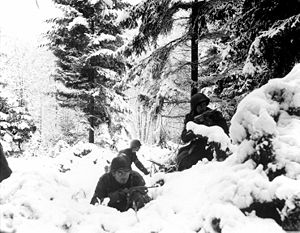
Muskin, a staff sergeant, announced to the squad, “Boys, I’m going to get home alive if I can get through that.” His unit advanced as far as the Elbe River, where aside from a skirmish they waited out the end of the war in relative calm. Hordes of captured German soldiers marched past them.
Back home, Muskin was a traveling salesman before he bought into a children’s wares business that took off as Baby Town, later renamed Youngtown. He married, raised a family and feels grateful to have lived the good life at the ripe age of 88.
Lloyd Friedman, In the Presence of Ike, Old Blood and Guts and Give ‘Em Hell Harry
Lloyd Friedman’s five-year military odyssey began in late 1940. The University of Nebraska-Lincoln ROTC graduate helped oversee a black regiment in the 25th Infantry at Fort Huachuca, Arizona. He returned to Omaha ready to resume civilian life when Pearl Harbor put him right back on active duty.
The next three years he was assigned units tasked with patrolling and defending the west coast. He went from the 134th National Guard Regiment of the 35th Infantry Division to the 137th Infantry Regiment.
As D-Day neared in June 1944 Friedman, by then a captain, became regimental adjutant under Col. Grant Layng, which entailed being “his gofer or shadow.”
Friedman was one of two Jewish officers in his regiment. While in England his unit was inspected by Allied Supreme Commander Gen. Dwight Eisenhower.
His outfit hit Omaha Beach in the aftermath of the Normandy invasion but they discovered an area still hot with enemy activity.
“The Germans had the cliffs fortified,” he said. “That was pretty rough, We fought a little bit there but we got out of that. Normandy, above Saint Lo, was made up a lot of hedgerows. You couldn’t see what you were shooting at.”
In an account for the Nebraska Jewish Historical Society, Friedman wrote:
“On the first day of combat we lost the colonel to machine gun fire. I was not with him. It was tough to see friends wounded and die. The lines did not move very fast.”
Then, he wrote, “I saw in the air the most bombers ever. They practically leveled Saint Lo, and even a few stray bombs landed on our troops.”
Every time the regiment got orders to move, Friedman went with the advance party.
“My worst job,” he wrote, “was reconnoitering for the new headquarters as the lines moved forward. There were times I got ahead of the front lines. On one occasion my jeep driver and I were going up a road, dodging brush and debris. After passing, we looked back and saw that they covered mines…We breathed a sigh of relief.”
More relief came with the break out across France. His company was attached to Patton’s 3rd Army. He got to see the irascible, flamboyant commander up close.

“He was a buddy of our new colonel and visited us for so-called ‘lunch’ one day. I will never forget his two pearl handled pistols.”
At times Patton’s forces moved so fast they outstripped their supply lines.
“As we neared Germany things slowed down,” Friedman wrote. “We had some fierce fights across the border (Mosel River). By Christmas…we were sent to Metz for what we thought would be a well-earned rest. We were so wrong. Immediately we were moved north to outside Bastogne (Battle of the Bulge). Those were horrible days. Between the cold and driving the Germans back, it was miserable.”
“We were near Berlin when VE Day came in May (1945). Our regiment was sent to Boppard on the Rhine for occupation duty. On July 11 we assembled near Brussels and were picked for the honor guard for President Truman who was en route to the Potsdam Conference.”
Friedman, who was never wounded, won five battle stars, including the Bronze Star.
During an R &R stint on the French Riviera he ran into Omahan Stanley Slosburg and upon returning to the States he met another Omahan — Stuart Muskin, who served in the same division but in a separate regiment.
After the war Friedman married and became a buyer and merchandise manager for Herzberg’s before making his career in insurance.
By Sea: The Pacific Theater or Bust
Milt Saylan, On the Battleship USS South Dakota
When Milt Saylan entered the U.S. Navy in 1944 he was 24, married, a father and the owner of his own grocery store in Charter Oak, Iowa. The Omaha native developed a taste for the food business working summers at an uncle’s store.
Compared to many he served with in the Navy, he said, he was “an old man. I was a little different than some of the young punks that went in. We called ’em kids — they were young, single, with no responsibility.”
Saylan had his own store four years by the time he became a seaman apprentice and, he said, that experience naturally “put me in the galley” — first at Shoemaker Camp in Calif. and then aboard the battleship USS South Dakota.
As a meat cutter he readied enough chops, steaks and roasts every day to ensure there was enough for the next day’s chow.
The South Dakota became part of Naval lore through a stunning series of engagements against Japanese forces — sinking several vessels and bringing down multiple planes in major sea and air battles. It was the most decorated ship in WWII. So as not to make it a special target, the U.S. military withheld its name from the press — its exploits chalked up to Battleship X or Old Nameless.
“We were the flagship of the 13th fleet,” said Saylan.
_at_Scapa_Flow,_1943.jpg)
The South Dakota earned battle stars at Guadalcanal and in action in the Coral Sea, Okinawa, Iwo Jima and Midway, before eventually sailing into Tokyo Bay. From the deck of the South Dakota Saylan and his fellow 2,200 crewmen witnessed Japan’s formal surrender on the USS Missouri tied up alongside it.
There were times he wasn’t sure he’d make it through the war. One of those was when kamikaze attacks wrecked havoc on the ship at Okinawa.
“We got hit and we lost 37 men,” he said, the memory still making his voice quiver.
During combat he manned a battle station. His job: help corpsmen tend wounded and get them into sick bay. During the Okinawa attack he went to the forward part of the ship, where the kamikazes struck, and amid the carnage helped carry the wounded away on stretchers.
He wasn’t close to any of the sailors who lost their lives that day but burying that many comrades at sea left its mark.
The South Dakota, which supported carrier strikes against Tokyo, made its way ever nearer Japan in anticipation of the planned Allied invasion. When the atom bombs ended the war the battleship made its way into Tokyo Bay for the formal surrender. As a precaution against a Japanese ambush, said Saylan, the crew was in full battle gear. Nothing untoward happened.

He said the “very somber” ceremony on September 2, 1945 proceeded aboard the Missouri with the assembled crews of the Missouri, the South Dakota and other ships topside to observe the historic moment. Fleet Admiral Chester Nimitz, Admiral William Halsey and Southwest Pacific Area supreme commander Douglas MacArthur led the U.S. contingent in accepting the surrender of their Japanese counterparts. It all went off without a hitch. Saylan and his shipmates followed orders by not expressing any emotions that might dishonor the Japanese.
Saylan was discharged as a first class petty officer.
After the war he remained in the grocery business and by the mid-1950s he retired. Bored after a few months, he took over a window wares company that became a big success. His son now has the business.
Saylan’s visited the USS South Dakota Battleship Memorial in Sioux Falls SD.
Kevee Kirshenbaum, C.O. of Minesweepers in WWII and Korea
Kevee Kirshenbaum had the distinction of being assigned six different minesweepers in two separate wars during his U.S, Navy service.
He was a University of Nebraska sophomore when he joined up in 1942. His first assignment came as an ensign aboard a sweeper sent to the Aleutian Islands. At Cold Bay, Alaska he helped train Soviet naval personnel in minesweeping techniques as part of the top secret Project Hula, which was to ready the Soviets to invade Japan from the north.
Once while traversing an igloo-like tunnel on base he ran into an old chum from Omaha — Lee Bernstein. When they see each other today they’re still amused at meeting each other in such a desolate spot.
Kirshenbaum went from one extreme to the other in the Philippines, where he said, “we swept mines all the way along the coast down close to Borneo.” He said sweepers lived by the motto: “where the fleet goes, we’ve been.”
His worst WWII experience came while anchored in Subic Bay during a typhoon. Ordered to get under way, the ship’s fluke caught on the open hatch of a sunken boat. That left the ship riding out the storm like a top on a string.
“We stayed there for 48 hours, just going around in circles. You never saw so many sick people.”
His group made preparations for Okinawa and the planned invasion of Japan when the atomic bombs were dropped. It was then he took command of his first ship, the YMS-49, in Shanghai, China.
“My best experience of the war really was when I had command of a ship. The war was already over — what we did was sweep the mines in the Huangpu River. We didn’t find any mines there but we found an awful lot of bodies. You would see Chinese boats going by with a hook picking the bodies up.”
Becoming a C.O. at only 22, he said proudly, “was an accomplishment.”
Some fears he harbored were soon quelled.
“When I went aboard ship I didn’t know what the reaction would be to my being Jewish. The Navy had as a whole very few Jewish personnel. Then there was my age. I knew some of these guys knew more than I did. Half the crew was much older than I was and more experienced. But luckily enough I didn’t have any problems. The crew was very good and respectful.”
Back home he finished school, joined the Navy Reserve, went to work and got married. Then the Korean conflict broke out and he was assigned minesweeping duty again. In Sasebo, Japan he served on a ship and transferred to train the South Korean Navy, which helped shake off the rust of four years away from active service. Later, he went to Korea to command the USS Redhead, which swept mines in hostile waters, even past the 38th parallel. The mine fields were thick with danger and his ship and others came under fire by shore artillery batteries.
Mines, especially the magnetic kind, were the main threat. A replacement ship venturing where the Redhead would have been was sunk by one. His most harrowing duty came sweeping Wonsan Harbor at night when the Redhead set off a magnetic device whose blast destroyed the vessel’s mine cutting gear. Luckily, the hull was intact and the ill-conceived operation cancelled.
The small, wooden minesweepers were the runts of the fleet but being small had the advantage of being resupplied every few days, which meant fresh eats.
Looking back on all the responsibility he assumed at such a young age, he said, “I felt good about it.” He’s most grateful for coming out alive. The retired entrepreneur feels fortunate to have had the chance to lead “a successful life.”
Stan Silverman, A Dry Dock Navy Tour
Homefront contributions to World War II often get lost in the haze of history. But the men and women who worked the factories, fields, docks, warehouses and countless other jobs vital to the war effort made it possible for America to execute its battle plans and achieve final victory.
Long before Stan Silverman ever entered the service he worked on a ditch digging crew opening the earth with shovels to accommodate water mains at then Offutt Field on the old Fort Crook base. The site is where the Martin Bomber Plant would be built and where Offutt Air Force Base would house the Strategic Air Command.
His family ran a grocery store on Vinton Street and he and his folks lived above it.
The Central High graduate earned a chemical engineering degree from Iowa State University at a time when quotas limited the number of Jews accepted into higher education and certain career paths. “That irritated me,” Silverman said.
While at Iowa State he said the school’s physical chemistry department secretly played a significant role in the Manhattan Project by purifying the uranium for the atomic bombs ultimately dropped on Japan.
After college he went to work as a chemical engineer for Phillip’s Petroleum Company in Kaw City, Ok., where he fell in with a mix of engineers, Native Americans and roughnecks. He learned to play a mean game of poker there. Oklahoma was a dry state then and Silverman said when he’d come home to visit he’d stock up on liquor to bring back to his parched buddies.
He enlisted in the U.S. Navy in 1944 and though he looked forward going to sea it never happened. His wartime service consisted of training school assignments from Indiana to Mississippi to Chicago to California. As an electronics technician third class he worked on radar, sonar and radio equipment that was big and bulky in the days before transistors and microchips.
He got married while in the service and his wife Norma, who did clerical work for the 5th Army Corps in Omaha, joined him at various stops.
His arrival on the west coast coincided with VJ Day and the memory of the jubilation over Japan’s surrender is still vivid.
“I was in San Francisco, where they had a helluva celebration. People went wild.”

The war was officially over but he was still Uncle Sam’s property and the wait for his discharge made the time drag by.
“I was sitting there not doing a helluva lot.”
The one time he was assigned a ship the orders were cancelled before he got aboard. He was a statistician on Treasure Island, where a military unit was set-up. The closest he came to shipping out was riding a Navy launch across the bay.
All in all, he said his time in the service was agreeable. He never ran into any any-Semitism and he was able to practice his faith and attend High Holiday services.
After his discharge in early 1946 he worked a variety of jobs the next several years, including men’s furnishings at J .L. Brandeis. Helpjng him get by was a $25 a week stipend from the Servicemen’s Readjustment Allowance fund.
He was with the Container Corporation of America in Chicago before moving back to Omaha to work for the City’s smoke abatement division. He was later at Quaker Oats. He eventually joined his father-in-law Ben Seldin and brother-in-law Ted Seldin in the Seldin Company, a commercial real estate, multi-family management and development organization. At 88 he still goes to the office every day.
By Air – The Philippines, New Guinea, and Stateside
Bernie Altsuler, A Love of Flying
Bernie Altsuler was only 20 when he enlisted in the U.S. Army Air Corps in 1942, but he was already a married working man. The Omahan was inducted in the service in Calif. because at 19 he’d gone to Los Angeles with a brother in search of new horizons. His fiance joined him there and the two were married.
As he had some college — he attended Creighton University — he was put in base operations logging flight records. When assigned a training command unit at Kirtland Field in Albuquerque, NM, his wife came with him. Rookie pilots trained in twin-engine Beechcrafts.
He said his only encounter with anti-Semitism occurred there.
“I was working on the line — that’s where they brought planes in — and there was a master sergeant, and boy he laid into me. He gave me all the problems you could imagine, but I was only there six months before I got transferred. I loved Albuquerque but I was sure glad to get away from that guy.”
Altsuler then ended up in Fort Sumner, NM as part of a command training navigators. He was there 15 months and once again his wife accompanied him.
“My wife was a shorthand expert and she became the base commander’s secretary. That’s probably why I stayed there 15 months,” he said.
After another training stop stateside he shipped overseas in 1945 to the Philippines, where fighting had ceased. All the zig zagging his ship did to throw off enemy subs slowed the voyage to a crawl and he remembers “one of the longest craps games there ever was” played out over 39 days.
He said troops from Europe began filtering in as the Allied Pacific force geared up for the anticipated invasion of Japan. The atom bombs dropped on Hiroshima and Nagasaki cancelled the invasion to everyone’s relief.
By now a sergeant, he went from Tacloban, Leyte to Zamboanga and the 18th Fighter Group, which consisted of a P-38 squadron that only months earlier had escorted B-24 bombers in live missions over Japan.

“Our squadron commander was an ace — he had shot down five Japanese planes.”
As part of his duties Altsuler had frequent contact with pilots, whom he admired.
“They were all cocky young kids,” he said. “We got to know them very well.”
Despite no combat, there were still risks. Accidents happened. He remembers a couple planes cartwheeling down the runway and bursting into flames.
He developed a lifelong love of flying in the service, his appetite whetted by junket flights he hopped.
“We had a C-47 in our operation overseas that we’d fly all over the Pacific to many different islands picking up supplies, and I went along.”
Within a few years of his return from the war he earned his pilot’s license and instrument rating in a Piper Comanche along with his friend, Harold Abrahamson.
Ironically, he said during his nearly four years in the service he never bumped into anyone he knew from back home until the day of his discharge. He stayed in L.A. a few years before returning to Omaha, where he opened his own wholesale plumbing, heating and air-conditioning business. He later sold it and retired.
Jack Epstein, A Long Way from Home
The son of an immigrant fruit peddler, Jack Epstein was married and attending then-Omaha University when drafted into the service in 1943, ending up in the U.S. Army Air Corps. As a company clerk in remote outposts, he never saw any action but was a part of the huge logistics apparatus that fed the Allied war machine.
Military life didn’t exactly agree with Epstein, yet he persevered.
“I didn’t take to the Army very good, but I managed to do OK with it because of the fact I knew I wasn’t in danger and I had something to do all the time. I was busy. Time went pretty fast,” he said.
His wartime odyssey overseas began with a voyage aboard a merchant ship from southern Calif. to Brisbane, Australia. From there he went to Milne, New Guinea, where he remained the next 27 months. The only time he laid sight of the enemy was when Japanese surveillance planes flew high overhead.

New Guinea natives were rarely glimpsed.
He never came under fire but he did contract malaria. The rainy season there soaked everything for weeks on end. Mosquitoes had a field day. The oppressive heat rarely let up.
Epstein was part of a unit comprised of two officers and 28 enlisted men. “We took charge of all the 100 octane gasoline on that base for airplanes,” he said. The gasoline came in 150 gallon barrels unloaded from supply ships and then stored and secured on base. Thousands of barrels were stacked on site. The fuel serviced fighter planes as well as troop and cargo planes.
“We serviced all of them,” he said.
Planes came and went all day, every day. “From the Philippines they came, from Okinawa they came, from all over. They were in and out — they didn’t stay,” he said. The roaring engines were a constant companion. “Maybe that’s the reason I can’t hear so good (today), I don’t know,” he ventured.
He was tasked with inventory control.
“I was the company clerk you might say. I kept track of the ins and outs of the barrels that came in and the barrels that went out .”
As staff sergeant, he said, he became “very close to the two officers. We played bridge most of the time we were there.” Finding diversions on an island in the middle of nowhere, he said, was vital for maintaining one’s sanity. Besides playing bridge there was fishing, but reading and writing letters was his main relief.
“I wrote my wife every single day and she wrote me most every single day and it was really great as far as the camaraderie we had with each other.”
He still marvels at how their letters arrived without interruption, as did the air field unit’s supplies of everything from canned foods to typewriter ribbons.
“One reason we won the war was our supply lines,” he said. “No matter what you wanted we had it — about anything you could imagine. Our supply was unbelievable.”
By war’s end he was sent to Okinawa, where he endured two typhoons, and then back to the Philippines. En route home by ship he suffered chills and fever from his malaria. It took two years before he was over the symptoms.
After three years of separation he and his wife reunited and raised a family. Epstein ended up in the distillery business. At age 88 he still goes to work every day.
Lloyd Krasne, From Audubon to Tokyo By Way of Leyte
Lloyd Krasne clearly recalls hearing over the radio the news of Japan’s attack on Pearl Harbor. He was driving a truck into Omaha to get supplies for his Ukrainian immigrant father’s grocery story in Audubon, Iowa. Krasne soon joined the war effort as a U.S. Army Air Corpsman.
“They needed people very badly, so it was rush rush, rush,” he recalled.
Initially pegged to study cryptography he wound up learning power-operated gun turrets. Seizing an opportunity to apply for Officers Candidate School he put in and made the grade and after completing the course in Aberdeen, MD he was commissioned an officer. He did more schooling in aviation ordinance before assigned a unit in Calif. charged with training B-29 crews on operating the bomber’s state-of-the-art gun systems.
He said as the conflict progressed and America’s production of war materials advanced, the Army Air Corps found itself in a constant state of flux as new planes came on line that required different support.
With his unit scattered to the far corners, Krasne was transferred close to home, first to a base in McCook, Neb. and then to one in Harvard, Neb.

He made second lieutenant. In early 1945 he got overseas orders, prompting he and his fiance to get hitched before his departure. The couple went to Salk Lake City, Utah and then to Calif. before he shipped out to Manilla and then to Hollandia, New Guinea. No sooner did he arrive then new orders sent him right back to Manilla, where he was reunited with a commander in Tacloban, Leyte.
“Across from the house we quartered in was a little hut on stilts. There was a plank from the front door going down to the ground and in the morning here’d come a couple chickens, a pig, a couple kids — that’s the kind of economy it was.”
On Leyte he attended a memorable Yom Kippur service in a cockfighting arena. He learned years later a fellow Jew from back home — Nate Katelman — was there too.
Krasne said anti-Semitism faded in wartime, when differences seemed mute in the face of life-and-death stakes: “You were in this together. You wondered what would come next.” However, he did witness racism toward blacks that disturbed him.
He said his C.O. showed him the plans for the invasion of Japan — kept in a locked safe — that thankfully never had to be executed. After Japan’s surrender he went to Tokyo to serve in the army of occupation.
“We saw a country that was torn up,” Krasne recalled. “The main buildings were made of stone and they were alright but the areas constructed of bamboo and paper the fire bombs had reduced to nothing. Whole blocks were empty.”
After initial distrust, the Japanese warmed to their American occupiers, but persisted in their blind obedience to authority. “It was quite an observation because the people were still oriented that the emperor is god and can do no wrong and whatever he says goes,” said Krasne, who saw citizenry dutifully bow to policemen.
“It brought home the fact these people were oriented differently than anybody we’d ever met. It was quite an experience.”
Though he meant to quit the grocery business when he returned home he found it the only sure thing and remained in the field the rest of his working life.
Old Warriors Never Die, They Just Fade Away
Like veterans everywhere, Omaha’s Jewish vets run the gamut when it comes to how much or how little they’ve invested themselves in things like post-war reunions and commemorations.
Some, like Lloyd Krasne, Stuart Muskin and Kevee Kirshenbaum, have been to numerous reunions. Muskin, Kirshenbaum and Bill Cohen of Omaha traveled on a Heartland Honor Flight to Washington, D.C. Some of these same men attended a tribute two years ago honoring Omaha area veterans and Holocaust survivors. Some concentration camp prisoners met their liberators.
Other vets want little to do with any fanfare over those times.
Some have scrapbooks and mementos, others — nothing.
For most veterans, Omaha’s Jewish ranks included, wartime service was something they spoke little of after returning home and getting on with their lives. It’s only in the last two decades, as major anniversaries of the war were observed, they began openly telling their stories.
All lost something along the way. Buddies. Time. Innocence. Their humble attitude about going to war, which Lloyd Friedman summed up with, “somebody had to do it,” helps explain why they are the Greatest Generation.
Several vets get together Mondays at the Bagel Bin. They may be gray and fragile now, but there was a time when they cut dashing figures and did heroic things. As their numbers grow ever fewer, they represent a trove of history not to be forgotten
Related articles
- What dose the Battle of the bulge and The battle of Britian have in common (wiki.answers.com)
- The Battle of the Bulge (theroadtovictory.wordpress.com)
- Leo Adam Biga’s Survivor-Rescuer Stories Featured on Institute for Holocaust Education Website (leoadambiga.wordpress.com)
- Sisters of the Shoah: Three Survivor Tales, Three Golden Fates, Three Iron Wills (leoadambiga.wordpress.com)
Sisters of the Shoah: Three survivor tales, three golden fates, three iron wills

Image via Wikipedia
It has been a humbling experience for me to meet and profile a number of Holocaust survivors. The following story I did for the Jewish Press tells the remarkable tale of three sisters who all managed, after much misery and loss, to get out of the hell of the Holocaust alive. The story is one of a series I have done for that newspaper, with assorted others for other publications, that personalize the horror and the hope that survivors have to share with the rest of us. Rachel, Mania, and Bluma are three women I am not likely to forget. I dare say after reading their tale you will not forget them either. After the war they all ended up in Omaha, where they still reside today as witnesses whose testimony must be read and heard. On this blog you will find several other Holocaust stories I’ve written, and I will be adding more over time. The ranks of the survivors are fast dwindling, making it ever more imperative their stories be told.. The article won, in a second-place tie, the David Frank Award for Excellence in Personality Profiles at the June 3, 2004 American Press Association’s Simon Rockower Awards. This article and several other survivor articles I wrote can be found on the Institute for Holocaust Education website, http://ihene.org/. And this Sisters of the Shoah piece is also featured on The Jewish Magazine website- http://www.jewishmag.com/90mag/shoahsisters/shoahsisters.htm.
Sisters of the Shoah: Three survivor tales, three golden fates, three iron wills
©by Leo Adam Biga
Originally published in the Jewish Press
This is not just another Holocaust story. It is the chronicle of how three sisters survived, alone and together, a series of Nazi concentration camps during World War II to tell their story of human endurance. That not one or two but all three made it out alive is, as the eldest puts it today, “Impossible. I don’t know how we lived. We survived with nothing…not even our hair.”
Only girls at the time, the sisters, all of whom resettled in Omaha, displayed a remarkable resolve that belied their years and that still defines them today. Their individual stories have been told, but never their combined saga. Sisters of the Shoah in name and in blood, the former Bojman girls are old women now but their spirit burns with the rigor of youth. Known by their married names — Mania Friedman, Rachel Rosenberg, Bluma Polonski — they remain defiant witnesses to the Nazi genocide that killed millions, including their parents and brothers, and that would have claimed them, too, but for their three golden fates and three iron wills.
“It is sad and it is deep,” is how a teary-eyed Rachel, the middle sister, describes her and her siblings’ odyssey. It’s a legacy that’s had a profound effect on their families, too. For example, Rachel’s three children witnessed her frequent crying jags and their father Carl’s obsession with the Holocaust. Rachel said in recent years she promised herself, “You’re not going to be miserable…live as happy as you can…see the light instead of the dark.’ I’ve tried to help myself to live normal and to be like everybody else, which I’m not. But I try.” A son, Stuart Rosenberg, said despite the nightmare his mother and maternal aunts experienced “they are truly remarkable people with an incredible appreciation for life.” The significance of their story, he added, is in the resilience and resistance their survival represents.

Not all survivors have fared as well. A cousin of the sisters never got over losing her family, including two sons, to the Holocaust. She committed suicide. “My cousin didn’t want to live. I do. I like life,” said Rachel. “In my eyes, I have everything I want. I’m the richest person in the world.”
The women today enjoy the comfortable lifestyle they made for themselves here, but the horrid memories of what brought them to America are never far away. This past Mother’s Day, the oldest sister, Mania, encapsulated the dichotomy of their lives in her heavily accented voice, “Our life is beautiful and miserable, you understand? After the war we had no family. We had nothing. How many times I said, God, take me away not to suffer too much.’ We went through more than hell. But this is our life. We have to take everything. At least I have pleasure from my children. All over I have pictures of my children,” she said, gesturing at the dozens of photos adorning her refrigerator, walls, hutches and tables. “As long as I’m alive I want to see them, not hidden away in a drawer, because we have family again.”
The phone rings and it’s Rose, the mother of Mania’s only granddaughter, Jennifer, whom she adores. “Oh, thank you, Rose. Happy Mother’s Day to you, too. You give me joy in my life,” Mania says. “You give me the biggest diamond that can be — Jennifer.” When Mania mentions she’s telling her Holocaust story to a visitor, the conversation abruptly ends. She explains that her daughter cannot deal with the subject: “She said, Mom, I don’t want to hear it.'”
For Bluma, the youngest sister, the specter of the Holocaust is not as immediate as it is for her older siblings but it is still ever present. Three years ago she made a pilgrimage with her children and several of her grandchildren to the Polish death camps. “This was my wish. To make this journey before I go away, because I’m a survivor and when we go away nobody’s going to be left anymore,” she said. “It was a sad wish. My husband didn’t want to go because it broke his heart. I said, If you’re not going to go, I will. I have to.’ I wanted to say goodbye to the ashes.”
Bluma and her family visited Treblinka, where her mother and youngest brother were killed, as well as Auschwitz, where she and Mania were imprisoned together and where Rachel and another brother were confined in a separate compound. “In Treblinka I kneeled down, I cried and I talked to my mom and my little brother. I said, I’m here. I’ve just come to see you and say goodbye.’ I said a kadish and after the prayers it started thundering and lightning…like she heard me. It was very emotional.” At Auschwitz, she went inside the very barracks, No. 25, where she and Mania were interned. “I thought I would have a nervous breakdown,” she recalls. Finally, she went to her hometown, which she found stripped bare of its Jewish heritage. “There’s nothing left,” she said. “It’s like we never existed.” Back home, she counts her blessings. “I’m thankful to God for every single day.”
Born into the Polish-Jewish family of Rose and Morris Bojman, Mania, Rachel and Bluma grew up alongside their three younger bothers in a stately home in the largely Jewish rural village of Wolanow, Poland. The orthodox family was well off, with their father working as a cattle buyer and running his own butcher shop and their mother earning money as a seamstress. The three sisters were leading typical schoolgirl lives, with Rachel learning the seamstress trade, when Poland was invaded by German forces in 1939 and the first anti-Jewish decrees were enacted soon thereafter. The mounting menace turned violent when German bombers attacked the village and an explosion destroyed a house across the street from the Bojman residence, killing and maiming several inhabitants. “I remember the bedding was wet with blood. People were cut up in little pieces,” Rachel said.
With their movements and actions curtailed, the Jewish populace was restricted to one small section of town where the Bojmans resided. Some of Wolanow’s Jewish residents were thrown out of their own homes and herded with refugees from neighboring hamlets into the small Jewish ghetto, which more and more resembled a prison. The Bojmans’ home was soon overcrowded with dozens of displaced people. Occupying German forces increasingly isolated their captives by driving Jews into concentration camps, dividing families in the process, throughout the countryside. It was at this time the Bojman family was irretrievably split-up. The sisters’ mother fled with their youngest brother, Motel, to the nearby village of her brother and his family, where she felt they’d be safe. The rest of the family was taken to Szalkow, a holding site on an area farm where conditions were far better than anything the sisters would know again until after the war ended six years later. Then, in the cold calculations of the Holocaust, Mania, Bluma, a brother, Aaron, their father and a cousin, Carl Rosenberg, were inexplicably sent to Camp Wolanow while Rachel and her brother Jacob stayed at Szalkow.
To this day, Rachel cannot fathom why she and her brother were separated from her family at Wolanow. “That’s such a puzzle in my mind,” she said. As to why her mother went off alone with her baby brother, she speculates she acted out of fear and denial. “My mother preached, The Germans will not hurt us — they are a cultured people.'” Before leaving, Rachel’s mother gave her a diamond ring. Rachel bribed a German guard with that ring and found someone to drive her to the village where her mother and brother were staying. “I went to get them,” Rachel recalls, but her mother resisted. “No, give me two more days,’ she said. She cooked for me my favorite meal and made a package for me to take back to my camp.” By the time Rachel came back, the village had been ethnically cleansed and, as she later learned, her loved ones taken to Treblinka, where they perished.
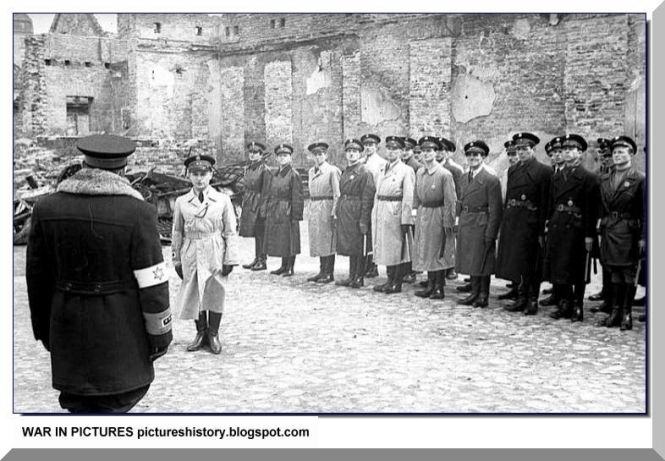
Camp Wolanow. This was the first of the camps Mania and Bluma weathered. As in other camps, males and females were segregated in overcrowded living barracks and on grueling work details. The sisters’ father and their brother Aaron were there, too. Operated by the Germans, the holding camp was manned by many Polish guards and terrorized by roving Ukrainian execution squads. The close quarters, unsanitary conditions, poor food and inadequate shelter became a breeding ground for disease. Typhus swept through the camp that winter, felling the sisters’ father, who grew too weak to work, excuse enough to be killed. Bluma, then only 10, snuck into her father’s barracks to comfort him and to hide him from the guards, but she was spotted and thrown into a crude shack known as “the death house.” There, “cold, barefoot and crying,” she cowered among the other prisoners awaiting almost certain death. When word of her capture reached her cousin Carl, already a young man who’d earned special privileges inside the camp because of his tailoring skills, he came to her rescue. Half-delirious with typhus himself, Carl pleaded with the guards for her release. As Bluma recalls, “He said, Please, let her live a little more. She’s my cousin.’ And they let me out.”
Survival at Wolanow was determined in part by luck, the guards’ whims and inmates’ own wits, wile and will. To survive, Bluma and Mania became hustlers and scavengers. Bluma, the smaller of the two, was adept at sneaking in and out of tight spaces to steal boots or brooms, which they made, or other valuable items the girls came across in camp and traded for scraps of food. “I was the provider,” Bluma said. “I was very aggressive.” In their foraging for supplies, the sisters said they got brazen enough to dig a shallow tunnel — with their bare hands — in the snow and ice. The tunnel, beginning under a section of barbed wire on the camp’s perimeter fence, ran into the surrounding woods and led to a clearing a few yards away. There, Bluma said, she and Mania came above ground and headed straight for a house occupied by a friendly Gentile family. The woman of the house knew the Bojmans from before the roundups and gave food and shelter to the two brave little girls, who scurried to her place via the tunnel whenever they got hungry.
On what proved to be the last run the girls made to their secret sanctuary, Bluma said the woman informed them it was getting too dangerous to aid them any longer and she forbid them from returning. That night, Bluma said she and Mania hid in the woods when they heard machine gunfire coming from the camp. Returning to camp at daybreak, she said they came upon a scene of surreal carnage, with hundreds of frozen corpses, riddled by bullets, laying on the ground as mourning relatives weeped over them. Among the bereaved was their father, crying over the death of his son and their brother, Aaron, a victim of the mass execution.
As related to the sisters by their father, Aaron was selected for a contingent of prisoners earmarked for another camp but, instead, he hid in a barrel, hoping to elude his captors. When a guard overturned the barrel Aaron was killed with the others on site. The bodies, according to Mania, were buried in a mass grave.
From Wolanow, Mania, Bluma, their father and Carl were transported to a Polish transit camp, Starahowice, where they were detained before being shipped, by train, to dreaded Auschwitz. Degradation and violation ruled their lives at Auschwitz. Like many others, Mania and Bluma endured torture. “The women guards went with their bare hands inside us and tore things,” Mania said. “We were screaming. We were bleeding. Oh, God. I don’t know how we got children. This was a miracle.” The sisters’ father was transported from Auschwitz and eventually gassed in Buchenwald.
Meanwhile, Rachel, along with Jacob and assorted cousins and aunts, were deported from Szalkow, where they enjoyed relative comfort, to Blizyn, a harsh labor camp where they were “cold, hungry and dirty.” She and other women were forced to carry heavy cement blocks for buildings under construction. Jacob tended animals. Eventually, Rachel was spared the hardship and indignity of being a human pack mule when the guards called a group of inmates together one day and asked who could sew. She raised her hand and was reassigned to a giant sweatshop where she joined hundreds of other prisoners making uniforms.
The drudgery of work-filled days and the anxiety of uncertain fates left inmates drained by night, when they “sat around for hours and talked,” Rachel recalls, “about why they are doing this to us, what’s going to be tomorrow, who’s going to live through this, who’s going to tell? We dreamed. We looked outside and saw there’s still a world. We saw people working in the fields. The sky was blue. The birds still flew. I thought, God, if I could only be a bird. We were 16-17 years old. We never dated. We never knew boys. We were afraid but there was nothing we could do. The hurt was so deep. The ocean wasn’t as deep as our hurt.”
The pain only got worse at Auschwitz. “Well, I knew this was going to be our end,” Rachel recalls thinking upon arriving at that foul place. It was by pure chance she became aware of her sisters’ presence there. One day while walking in a line of prisoners at the edge of the compound that bordered another enclosure she saw Nathan, the brother of her cousin Carl, working on a railroad gang. They made eye contact and “he threw me a chunk of bread.” Further down the line she spotted her sisters laboring on the tracks the transport trains ran on. “I went closer to the gate, up to the barbed wire, and I screamed, Mania…Bluma,’ and they saw me and they waved to me. I threw them pieces of that bread.” It was the last time she saw her sisters until months after their liberation.

“The living was very bad there,” Rachel said. “Every morning we had to stand in line to be counted. We had to be naked for Mengela (the Nazi war criminal, Joseph Mengela, who experimented on inmates). We were afraid. He chose — this girl to the left, this girl to the right…you go to work, you go to die.” As Bluma puts it, “If you had bones, you were not good. If you still had a little meat, you could still work. One day he made a selection and I was on the wrong side and they took me away. I was scared, but I couldn’t cry anymore — our tears were dried up. We were numb already. We were like cattle led to the slaughter.” Bluma said she escaped the ovens when, in a roll call, she gave the wrong number tattooed on her arm and rejoined Mania in the fit-to-work group.
At Auschwitz Rachel once again lugged cement blocks. On their way to work Rachel and fellow inmates passed by a crematorium. “We saw the flames and the black smoke,” she recalls. “We said, Well, next time it will be us.’ We knew there was no tomorrow for us.” In a building piled high with victims’ discarded apparel she salvaged fabric to clothes for her, relatives and barracks-mates.
It was at Auschwitz the sisters’ brother Jacob met his end. Rachel, who’d been his protector during their life in detention, took his death especially hard. “One day we were standing in the wrong place at the wrong time when the SS, who targeted the young, took him away from me,” she said. “I didn’t want to let him go. I cried and begged them to let me go with him or to take me instead, but they just grabbed him, threw me down and led him away to a truck. I couldn’t do anything but put a sweater around him so he’d be warm. I followed the truck as far as I could.” Having him wrenched away from her to be gassed is, she said, “my biggest hurt.” It is why, she feels, she’s been an “overprotective” mother.
Although the sisters had no inkling of it at the time, by early 1945 the Nazis were in disarray and inmates like themselves still able enough to work, albeit malnourished, were in a position to stay alive and be liberated by advancing Allied troops. As if surviving Auschwitz were not enough, the sisters defied fate once more when commandeered to work as human slaves in munitions factories on the Czech-German border — Mania and Bluma in Darezenstrat and Rachel and some cousins at another site, where they toiled in a series of cellars or tunnels variously sorting potatoes and splicing electric wires. By late spring, the prisoners could see their captors were anxious. Some guards fled. Then, on May 8 1945, Mania, Bluma and the others were marched into the woods by the remaining guards. When a limousine approached, the sisters feared the worst. “We thought it was the SS,” Bluma said, “but it was the Red Cross. They said to the Germans, Stay here. You lost the war. It’s over. The people are free.’ This was our liberation.” On the same day, Rachel and her group were liberated by the Russians.
The sisters, mere skeletons by then, were cared for by a combination of international aid workers and Czech nationals.
Against all odds, the sisters persevered the worst that, as Bluma puts it, “human done to human,” and have gone on to see many tomorrows. While their post-war life has been heaven-sent in comparison with the hell they survived, there have been many struggles. Soon after their liberation, Mania and Bluma went to Wolanow to salvage what they could from the family home, where they were rudely rebuffed by the Polish family occupying it. The sisters only retrieved a photo of their father before being driven off with threats and invectives. Mania and Bluma were reunited with Rachel, Carl and other relatives at a pair of displaced persons centers in Germany, namely, the city of Lanzburg and the former concentration camp Bergen-Belsen, which the British liberated. At these sites the extended family eked out a meager existence the next few years. “We didn’t have money or anything, but we were still happy. We were together…and we were free,” Rachel said.
During their limbo of a refugee existence, Carl, the oldest and most resourceful, “was like a father to us,” Rachel said. “We were very naive. We didn’t know from life. He took care of us. He protected us.” Carl, who long fancied Rachel, married his cousin in Germany, where their first child, Morris, was born. Mania and Bluma also met their mates in the DP camps. By 1949 the sisters secured papers to start anew — with Rachel, Carl, Bluma and Joe going to America and Mania and Zalman resettling in Israel. Their cousins scattered to the four winds. In 1958, Mania and her family rejoined her sisters in America.
Rachel credits then-Jewish Federation of Omaha executive director, Paul Veret, with helping her family get established in the community and Jewish social maven Sadie Newman with making them feel welcome here.
All three sisters feel blessed they overcame their shared tragedy and trauma to find a foothold in America, where they started from scratch to build bountiful lives for their families. Along with their husbands, fellow survivors like them, the women found business success, reared healthy children and became doting grandparents. For years, Rachel assisted her husband, Carl, who now suffers from dementia, in their own tailoring business. She still does fittings and alterations in their basement workshop. Mania and her late husband Zalman owned and operated the popular Friedman’s Bakery in Countryside Village. Bluma’s husband Joe, now retired, was the longtime owner of Ak-Sar-Ben TV before selling it in 2000.
The sisters are proud to have come so far from so little. “We had no language, no money, nothing, and look at what we accomplished,” Rachel said, motioning to her big, beautiful house. Toiling long hours beside their husbands to earn extra money, the women made sure their children had “everything they wanted,” Mania said. Working hard also helped ease the women’s heartache. “Being busy is a healing,” Rachel said. Even so, harsh memories linger — the bitter past a constant reminder of what they witnessed. “I hold it in my heart. I remember everything,” Mania said.
Forgotten and abandoned during the war, the sisters carried on when all hope seemed lost and realized what once seemed impossible — a life free of fear and want. “I didn’t have anything but a dream and my dream came true,” Bluma said. “Well, God had to give us something, too.”
Related Articles
- Leo Adam Biga’s Survivor-Rescuer Stories Featured on Institute for Holocaust Education Website (leoadambiga.wordpress.com)
- Holocaust survivors resurrect Passover recipes (nj.com)
- Why Shoah still matters (guardian.co.uk)

Leo Adam Biga’s survivor-rescuer stories featured on Institute for Holocaust Education website

Image via Wikipedia
Leo Adam Biga’s survivor-rescuer stories featured on Institute for Holocaust Education website
A couple years ago I approached Beth Seldin Dotan at the Institute for Holocaust Education in Omaha, Neb. with a proposal: providing my stories about Holocaust survivors and rescuers for display on the organization’s website, http://ihene.org/. She was already familiar with my work in this subject area and we quickly struck a deal. None of the stories would have happened without the help of the late Ben Nachman, a man who made it his quiet crusade to shed light on the enduring spirit of survivors and rescuers. Ben introduced me to the local survivor community and he also led me to various scholars he’d corresponded with over the years regarding various aspects of the Holocaust and the heroic actions of individuals.
I feel privileged that these stories are finding a new home and audience there. Ben was instrumental in my getting each of these stories. There’s more than a little bit of him in them. By the way, you can see my stories about Ben and the work he did on this blog. Here’s how Beth describes the story queue on the website:
Nebraska Holocaust Stories
Several years ago, freelance journalist Leo Biga conducted extensive interviews with several of Nebraska’s Holocaust Survivors. Biga went on to write detailed articles that chronicle the Holocaust testimonies of the Survivors and the lives they made for themselves in Nebraska. The articles were originally featured in Omaha’s Jewish Press. You can now find them here on the Institute for Holocaust Education website. Some of the stories that you will see have won distinguished recognition: The Fred Kader story won First Place in the Single Feature Story category at the 2002 Nebraska Press Association competition and the article “Sisters of the Shoah” about Rachel Rosenberg, Mania Friedman, and Bluma Polonski won a Second Place tie for the 2004 David Frank Award for Excellence in Personality Profiles in the annual Simon Rockower Awards of the American Jewish Press Association.
The Institute for Holocaust Education sincerely hopes that these articles, now available to the entire world on our website, will honor the lives of our Survivors and keep their stories alive.
•••
The website features only a portion of my Holocaust writing. Some of the same stories featured there can also be found on this blog, and I am in process of adding more.
Here’s how Beth previews the stories (you can go right to the page where the stories are listed by linking to http://ihene.org/nebraska-survivor-stories/):
•••

On a January morning students at Omaha’s Lewis and Clark Middle School file in an auditorium to hear a tale of survival by Bea Karp, a petite Jewish woman of 66 who as a child in her native Germany, and later in France, endured the Holocaust. She and her younger sister, Susie, are among their extended family’s few survivors. As Bea’s harrowing tale unfolds, the students listen with the stilled respect due the haunted figure standing before them. Not all survivors can speak about their experiences. Some want only to forget, Bur for Bea, and thousands like her, there is a need to speak out. To bear witness. Why?
“I’ve been an escape artist all my life.” The apt words belong to Lincoln, Neb. resident Lou Leviticus, a square-headed terrier of a man who as a youth in his native Holland survived the Holocaust partly due to his talents as an artful dodger. He escaped the Nazis more than once, even when those closest to him were caught and put to death. As an orphan on the run he became one of scores of hidden children in The Netherlands, his survival dependent on a cadre of strangers that cared for him as one of their own.
For My Mother: Helena Tichauer Tells Her Story
Helena Tichauer was tempted to give up more than once. If she had, no one would have blamed her. For persecuted Jews like her and her family, reasons for despair were everywhere in Nazi-occupied Poland. Her family’s pleasant, comfortable life in Krakow had been wrenched away in the looming darkness of the Holocaust.
Kitty Williams Finally Tells Her Survivor Story
For the longest time, Holocaust survivor Kitty Williams of Council Bluffs didn’t think her story warranted telling. She considered her suffering insignificant amid the weight of Nazi atrocities. Other tragedies far surpassed her own. Nobody could find hers interesting or edifying. It’d all been said before.

“I feel I was destined to live.” That’s as close to an explanation as Lola Reinglas can offer in making sense of her Holocaust survival. An Omaha resident since 1949, Reinglas and her sister, Helena Tichauer, survived a series of internments, some together-some apart, that defied reason except for the intervention of fate and their own indefatigable will.
For the first 52 years of his life Fred Kader lived everyday in the shadow of a lost past. An orphaned child of the Holocaust, Kader’s early years remained an unfathomable mystery that he hoped one day to solve so that he might finally come to know how he survived the Shoah as a small boy in his native Belgium.
Sisters of the Shoah: Three Survivor Tales, Golden Fates and Iron Wills
This is not just another Holocaust story. It is the chronicle of how three sisters survived, alone and together, a series of Nazi concentration camps during World War II to tell their story of human endurance. That not one or two but all three made it out alive is, as the eldest puts it today, “Impossible. I don’t know how we lived. We survived with nothing…not even our hair.”
The Trauma of the Hidden Child Revealed: Marcel Frydman, Fred Kader, and Tom Jaeger
A gathering unlike any other took place the evening of September 24 at the home of Omaha Holocaust researcher Ben Nachman. Over the course of several hours a diverse group of guests heard three men discuss a shared legacy of survival — one that saw them persevere through the Shoah as hidden children in their native Belgium.
Related Articles
- FYI – Holocaust survivors to receive $ 564 million in reparations. (jwitness.wordpress.com)
- Holocaust Photo Archive (innovationslab.wordpress.com)
- Oldest male holocaust survivor is 105. Video & Pictures (jwitness.wordpress.com)
- Rescuer Curriculum Gives Students New Perspective on the Holocaust (leoadambiga.wordpress.com)
Great Plains Black History Museum Asks for Public Input on its Latest Evolution

The Great Plains Black Museum at the Webster Telephone Exchange Building. (Photo credit: Wikipedia)
This February 2011 story for The Reader (www.thereader.com) is my latest about the Great Plains Black History Museum in Omaha. Referenced in the article are some of the many travails that have dogged this organization. You can find out more about the challenges the museum has faced in three earlier stories posted on this blog. For the longest time the only news coming out of the museum was bad news. But as my new piece suggests there are some positive things happening now having to do with new leadership in place that might finally provide the direction needed to move forward with long overdue change and much delayed progress. I will continue following this story and as new developments occur and as I report on them I will share the posts here.
Great Plains Black History Museum Asks for Public Input on its Latest Evolution
©by Leo Adam Biga
Published in The Reader (www.thereader.com)
The new Great Plains Black History Museum board is putting its stamp on the long troubled organization by holding the first in a planned series of community forums about its future direction.
On February 11, GPBHM chairman Jim Beatty will lead a 2-4 p.m. forum at the Lakeside (Family Housing Services Advisory) building, 24th and Lake, to, as a flyer describes, “discuss a variety of topics…on your mind.”
Beatty, president of Omaha-based consulting firm NCS International, is aware attempts to move forward necessarily entail addressing the dysfunction of the museum’s recent past. The City of Omaha has declared the museum building at 2213 Lake Street uninhabitable, resulting in the doors being closed. The mandated repairs have not been made due to lack of funds.
When he assumed his roles as board chair and museum executive director last fall he found the coffers virtually empty, with no members and no donors. The museum’s not been awarded a grant in years.
“There isn’t a lot of money there,” he says. “I think something like $29 in the checking account.”
Previous chair and director Jim Calloway tried maintaining the building and collection by paying for utility bills, spot roof-window fixes and storage sites out of his own pocket.
Calloway, the son of founder Bertha Calloway, was criticized for his management of funds and for storing the museum’s historical research materials in a non-climate controlled trailer.
“That by no means meets my criteria or any museum’s criteria for proper storage of documents and artifacts,” says Beatty. “That may have been done in the past out of some level of desperation, another indication the leadership of the museum was not operating with the best intentions of handling its business properly.”

Yet, Beatty praises Calloway’s passion. “I think the public needs to understand Jim was trying to keep his mother’s dream alive,” he says, “and that’s not to be taken lightly.” He also credits Calloway for reaching an agreement with the Nebraska State Historical Society to take temporary custodial care of the materials. The documents and photographs are housed at the NSHS in Lincoln, where cataloging’s been done.
Beatty says the materials will remain there until a suitable home is found. While the GPBHM seeks support to address issues at its Lake Street building and the possible addition of a new site, it seeks to make itself and the collection visible.
“The museum has a very valuable collection the public has not seen that it needs to see or at least needs to understand what does exist,” he says. “We have a challenge to save the building but we have to make certain people understand the building does not dictate the museum. The museum is a compilation of resources, artifacts, documents, and that work needs to go on. Once we have properly inventoried everything, then we can begin to identify opportunities to properly display that.”
He’s thinking outside the box.
“The museum can and will have to function without having that building as its base. We can have exhibits at schools, at corporations, at Crossroads, Westroads, at various events.”
He envisions a revamped, interactive website featuring the collection online.
“So, for a time it may well be a museum without walls, and that’s OK. I am in discussions with an entity to provide a facility. Until we get a space, I think we have to be creative — we have to truly demonstrate the museum is alive and well.”
He acknowledges the GPBHM has not communicated its story well. “It’s unfortunate the community just has not known what the museum is doing. I believe there’s a number of rumors out there that need to be corrected.” One he wants to dispel is that the Lake Street building is owned by the Calloways.
“A lawsuit ultimately decided in favor of the museum gave title to the building to the museum as opposed to the family,” he says.
He vows greater transparency.
“People want to know what the bottom-line is. They want to have an assurance the money is being used wisely, accounted for properly and in a timely fashion, and that the books are open. Folks want to know, and in my opinion they deserve to know.”
A capital campaign will eventually be launched.
“Omaha’s a very philanthropic community. I believe we’ll be able to raise money. I’m very confident in that. How much depends on how the funders view the credibility of the organization. That starts with the board of directors,” he says. “We have to have people that bring resources and credibility.”
Toward that end two stalwart Omaha business-community figures — Frank Hayes and Ken Lyons — recently joined the board.
“We need the involvement of the government too,” he says. “The city, county and state all are potential funders at some level.”
More than anything, he wants the museum lifted out of its dormancy.
“There is a sadness this is happened but at the same time there is a hope something can be done to revive the museum and put it on a proper track. My discussions in the community confirm people want to see a vibrant museum that is relevant, involved, proactive, well managed, respected.”
Beatty, who chaired the Durham Museum board, says, “It’s certainly a challenge but one I feel my previous involvement in the community has prepared me well for. I’m unafraid of it, I welcome it.”
Related Articles
- Long and Winding Saga of the Great Plains Black History Museum Takes a New Turn (leoadambiga.wordpress.com)
- Omaha Arts-Culture Scene All Grown Up and Looking Fabulous (leoadambiga.wordpress.com)
- Once More With Feeling, Loves Jazz & Arts Center Back from Hiatus (leoadambiga.wordpress.com)
- El Museo Latino in Omaha Opened as the First Latino Art and History Museum and Cultural Center in the Midwest (leoadambiga.wordpress.com)
- Negro Leagues Baseball Museum Exhibits on Display for the College World Series; In Bringing the Shows to Omaha the Great Plains Black History Museum Announces it’s Back (leoadambiga.wordpress.com)
- A Synergy in North Omaha Harkens a New Arts-Culture District for the City (leoadambiga.wordpress.com)
The Two Wars of Ben Kuroki: New book out about Nebraskan who defied prejudice to become a war hero

Image via Wikipedia
I am reposting this article because the person profiled in it is the subject of a new young reader’s book, Lucky Ears: The True Story of Ben Kuroki, World War II Hero. Author Jean Lukesh’s biography tells the inspirational story of how Kuroki, a Nebraska-born, Japanese-American, fought two wars — one against prejudice and one against the Axis Powers. I told the same story in a series of articles I wrote about Kuroki a few years ago, when he was receiving various honors for his wartime and lifetime contributions to his country and when a documentary about him was premiering on PBS.
Ben Kuroki, who grew up in Hershey, Neb., was one of 10 children and did not experience discrimination until he and his brother tried to join the Army right after the Japanese raid on Pearl Harbor. Ben was Nisei – an American born of Japanese parents. Kuroki had to fight like hell for the right to fight for his own country.
Finally allowed to become a gunner on a B-24 and flew his first mission in December of 1942. Life expectancy for a bomb crew member was ten missions. Kuroki flew 58 missions — and became the only American during WWII to fly for four separate Air Forces — and the only Japanese American to fly over Japan in combat in WWII.
As Kuroki friend Scott Stewart reported to me and other friends, on Nov. 10 in Washington D.C. Kuroki received the prestigious Audie Murphy Award — named after the most decorated American veteran in WWII. The American Veterans Center’s will present the award to Ben Kuroki at their annual conference gala.
Kuroki received little official recognition for his war efforts during his time in the service, but since 2005 the flood gates opened and the honors started flowing.
*Distinguished Service Medal — the Army’s third highest award in 2005 at a ceremony in Lincoln followed by the Nebraska Press Association’s highest honor, the President’s Award and the University of Nebraska honorary Doctorate of Humane Letters.
*Black Tie State Dinner at the White House with Japanese Prime Minister Junichiro Koizumi in 2006
*2007, Lincoln hosted the world premier showing of the PBS documentary on the Kuroki war story Most Honorable Son.
*Presidential Citation from President George W. Bush in May 2008
*Smithsonian dedicated a permanent display on Ben war record, May 2008
At his acceptance speech on Saturday Kuroki will say “words are inadequate to thank my friends who went to bat for me and bestowed incredible honors decades later. Without their support, my war record would not have amounted to a hill of beans. Their dedication is the real story of Americanism and democracy at its very best. I now feel fully vindicated in my fight against surreal odds and ugly discrimination.
As I mentioned above, this article is one of several I wrote about Kuroki around the time the documentary about him, Most Honorable Son, was premiering on PBS. I am glad to share the article with first time or repeat visitors to this site.

The Two Wars of Ben Kuroki:
New book out about Nebraskan who defied prejudice to become a war hero
Honors keep rolling in for much decorated veteran
After Pearl Harbor, Ben Kuroki wanted to fight for his country. But as a Japanese-American, he first had to fight against the prejudice and fear of his fellow Americans. The young sergeant from Hershey, Neb., proved equal to the task.
©by Leo Adam Biga
Originally published in Nebraska Life Magazine.
“I had to fight like hell just for the right to fight for my own country,” said Hershey, Neb., native Ben Kuroki. During World War II, he became one of only a handful of Japanese-Americans to see air combat, and was America’s only Nisei (child of Japanese immigrant parents) to see duty over mainland Japan.
For Kuroki, just being in the U.S. Army Air Corps was an anomaly. At the outset of war, Japanese-American servicemen were kicked out. Young men wanting to enlist encountered roadblocks. Those who enlisted later were mustered out or denied combat assignments. But Kuroki was desperate to prove his loyalty to America, and persisted in the face of racism and red tape. As an aerial gunner, he logged 58 combined missions, 30 on B-24s over Europe (including the legendary Ploesti raid) and 28 more on B-29s over the Pacific.
Between his European and Pacific tours, the war department put Kuroki on a speaking tour. He visited internment campswhere many of his fellow Japanese-Americans were being held. He spoke to civic groups, and one of his speeches is said to have turned the tide of West Coast opinion about Japanese-Americans.
Few have faced as much to risk their life for an ungrateful nation. Even now, the 90-year-old retired newspaper editor asks, “Why the hell did I do it? I mean, why did I go to that extent? I was just young. I had no family – no children or wife or anything like that. I was all gung-ho to prove my loyalty.”
A new documentary film about Kuroki, “Most Honorable Son,” premiered in Lincoln in August and will be broadcast on PBS in September. For filmmaker Bill Kubota, who grew up hearing his father tell of Kuroki’s visit to the camp at which he was interned, Kuroki’s story is unique.
“It’s very rare you find one person that can carry a lot of different themes of the war with their own personal experience,” Kubota said. “He saw so many different things… It’s a remarkable story no matter who it is, but throw in the fact he’s basically the first Japanese-American war hero and you have even more of a story. He’s more than a footnote in Japanese-American history. One that needs to be better understood and more heard from. It’s a unique, different story that not only Asian Americans can relate to, but all Americans. That’s why I like this story.”

For years after the war he kept silent about his exploits. The humble Kuroki, like most of his generation, did not want a fuss made about events long past. He married, raised a family and worked as a newspaper publisher-editor, first with the York (Neb.) Republican and then the Williamston (Mich.) Enterprise. He later moved to Calif. where he worked as an editor with the Ventura Star-Free Press.
His story resurfaced with WWII 50th anniversary observances in the 1990s. At the invitation of the Nebraska State Historical Society he cut the ribbon for a new war exhibit. On the anniversary of Pearl Harbor he was the subject of a glowing New York Times editorial. More recently, he’s been feted with honors by the Nebraska Press Association and his alma mater, the University of Nebraska-Lincoln. As a result of all the new-found attention Kuroki and Shige have been invited guests to the White House on several occasions, most recently in May.
One key to what Kuroki calls his “all guts no brains” loyalty is his upbringing. His parents “pounded it into their children to never bring shame to yourself or your family,” he says in the film. “I hated the fact I was born Japanese. I wanted to try and avenge what they (Japan) had done for causing what we considered shame.”
From his home in Camarillo, Calif., where he lives with his wife, Shige, Kuroki added, “But I think in the long run I have to thank my Nebraska upbringing, my Nebraska roots for playing a real credible role in giving me a solid foundation for patriotism. It really was a way of life. Freedom was always something really I had the best of.”
Kuroki came from a poor family of 10 children. His parents emigrated from Japan with scant schooling and speaking no English. His father, Sam, arrived in San Francisco and worked his way west on Union Pacific section crews. The sight of fertile Nebraska land was enough to make the former sash salesman stay and become a farmer.
A small Japanese enclave formed in western Nebraska. Times were hard during the Great Depression and the years of drought, but Ben enjoyed a bucolic American youth, playing sports, hunting with friends and trucking potatoes down south and returning with fresh citrus.
Though accepted by the white majority, the newcomers were always aware they were different. “But at the same time,” Kuroki said, “I never encountered racial prejudice until after Pearl Harbor.”
On December 7, 1941, he was in a North Platte church basement for a meeting of the Japanese American Citizens League, a patriotic group fighting for equality at a time of heightened tensions with Japan. Mike Masaoka from the JACL national office was chairing the meeting when two men entered the hall and, without explanation, said something to Masaoka and led him out.
“Just like that, he was gone. We were just baffled,” Kuroki said, “so we just sort of scattered and by the time we got outside the church someone had a radio and said, ‘My God, Pearl Harbor has been bombed by the Japanese.’ That was a helluva experience for us the way we found out… It really was a traumatic day.”
They soon learned that Masaoka had been arrested by the FBI and jailed in North Platte. “I guess all suspects, so to speak, were taken into custody,” Kuroki said. Masaoka was soon released, but his arrest presaged the restrictive measures soon imposed on all Japanese-Americans. As part of the crackdown, their assets – including bank accounts – were frozen. As hysteria built on the West Coast, Executive Order 9066 forced the evacuation and relocation of individuals and entire families. Homes and jobs were lost, lives disrupted. As the Kurokis lived in the Midwest, they were spared internment.
Soon after Pearl Harbor, Kuroki and his younger brother Fred were surprised when their father urged them to volunteer for the armed services. As Kuroki recalls in the film, their father said, “This is your country, go ahead and fight for it.”
They went to the induction center in North Platte. They passed all the tests but kept waiting for their names to be called. “We knew we were getting the runaround then because all our friends in Hershey were going in right and left,” Kuroki said. The brothers left in frustration. “It was about two weeks later I heard this radio broadcast that the Air Corps was taking enlistments in Grand Island and so I immediately got on the phone and asked the recruiting sergeant if our nationality was any problem, and he said, ‘Hell, no, I get two bucks for everybody I sign up. C’mon down.’ So we drove 150 miles and gave our pledge of allegiance.”
The Omaha World-Herald ran a picture of the two brothers taking their loyalty oaths.
While on the train to Sheppard Field, Texas, for recruit training, the brothers got a taste of things to come. Kuroki recalled how “some smart aleck said, ‘What the hell are those damn Japs doing in the Army?’ That was the first shocker.”
Things were tense in the barracks as well. “I’ll never forget this one loudmouth yelled out, ‘I’m going to kill myself some goddamned Japs.’ I didn’t know whether he was talking about me or the enemy and I just felt like I wanted to crawl in a damn hole and hide.”
But at least the brothers had each other’s back. Then, without warning, Fred was transferred to a ditch-digging engineers outfit.
“My God, I feared for my life then,” Kuroki said.
As Kuroki learned, it was the rare Japanese-American who got in or stuck with the Air Corps – almost all served in the segregated 442nd Infantry Regiment that earned distinction. The brothers corresponded a few times during the war. Fred ended up seeing action in the Battle of the Bulge.
From Sheppard Field, Kuroki went to a clerical school in Fort Logan, Colo., and then to Barksdale Field (La.) where the 93rd Bomber Group, made up of B-24s, was being formed. As a clerk, he got stuck on KP several days and nights.
“I knew damn well they were giving me the shaft,” he said. “But I wasn’t about to complain because I was afraid if I did, the same thing would happen to me that happened to my brother – that I’d get kicked out of the Air Corps in a hurry.”
He took extra precautions. “I wouldn’t dare go near one (a B-24 bomber) because I was afraid somebody would think I’m going to do sabotage. That’s the way it was for me for a whole year. I walked on egg shells worried if I made one wrong move, if I was right or wrong, that would be the end of my career,” he said.
Then his worst fear came to pass. Orders were cut for him to transfer out, which would ground him before he ever got over enemy skies. That’s when he made the first of his pleas for a chance to serve his country in combat. He got a reprieve and went with his unit down to Fort Myers, Fla. – the last stop before England. But after three months training, he once again faced a transfer.
“I figured if I didn’t go with them then I’d be doing KP for the rest of my Army life,” he said. “And so I went in and begged with tears in my eyes to my squadron adjutant, Lt. Charles Brannan, and he said, ‘Kuroki, you’re going with us, and that’s that.’ All these decades later I’m forever grateful… because if it wasn’t for him I probably would never have gotten overseas.”
He made it to England – the great Allied staging area for the war in Europe – but he was still a long ways from getting to fly. He was still a clerk. But after the first bombing missions suffered heavy losses, there were many openings on bomber crews for gunners. Not leaving it to chance, he took his cause directly to his officers.
“I begged them for a chance to become an aerial gunner and they sent me to a two-week English gunnery school. I didn’t even fire a round of ammunition.”
In late ’42, Kuroki got word his outfit was headed to North Africa… and he was going with it. It took beseeching the 93rd’s commander, Ted Timberlake, whose unit came to be called The Flying Circus, before Kuroki got the final go-ahead. He was delighted, even though he had “practically no training.” As he would later tell an audience, “I really learned to shoot the hard way – in combat.”
Training or not, he finally felt the embrace of brother airmen around him.
“Once I got into flying missions with a regular crew and I was with my own guys, the whole world changed,” he said. “On my first mission I was just terrified by the enemy gunfire but I suddenly found peace. I mean, for the first time I felt like I belonged. And by God we flew together as a family after that. It was just unbelievable, the rapport. Of course we all knew we’re risking our lives together and fighting to save each others’ lives.”
One of his crewmates dubbed Kuroki “The Most Honorable Son.” It became the nickname of their B-24.
At the same time, Kuroki was reading accounts of extremists calling for all Japanese-Americans to be confined to concentration camps. Some nativists even suggested Japanese-Americans should be deported to Japan after the war.
But by then, Kuroki’s own battles were more with the enemy than with the military apparatus. His first action came on missions targeting the shipping lines of the “Desert Fox,” Erwin Rommel, whose Panzer tank divisions had caused havoc in North Africa. Kuroki was on missions that hit multiple locations in North Africa and Italy.
Kuroki and his crewmates made it through more than a dozen missions without incident. Then, on a return flight in ’43, their plane ran out of fuel and made an emergency landing in Spanish Morocco. Armed Arab horsemen converged on them. They feared for their lives, but Spanish cavalry rode to their rescue. The Spanish held the crew more as reluctant guests than as prisoners. But Kuroki tried to escape.
“I just had to prove my loyalty,” he says in the film. He was caught.
What ensued next was a limbo of bureaucratic haggling over what to do with the captured airmen. They were taken to Spain, where they were told they might sit out the rest of the war. For a time, it was welcome news for the crew, who stayed in luxurious quarters. But soon they felt they were missing out on the most momentous events of their lifetime.
Finally, the way was cleared for them to rejoin the 93rd, which soon moved to England for missions over Europe. Of all those bombing runs, the August 1, 1943 raid on Ploesti, Rumania, is forever burned in Kuroki’s memory. In a daylight mission, 177 B-24s came in at treetop level against heavily-fortified oil refineries deep in enemy territory. Nearly a third of the bombers failed to return. Hundreds of American lives were lost.
The legend of Kuroki grew when he reached the 25-mission rotation limit and volunteered to fly five more. His closest call came on his 30th trip, over Munster, when flak shattered the top of his plexiglass turret just as he ducked.
On an official leave home in early 1944, Kuroki was put to work winning hearts and minds. At a Santa Monica, Calif., rest/rehab center, he gave interviews and met celebrities. Stories about him appeared in Time magazine and the New York Times.

Then he was invited to speak at San Francisco’s Commonwealth Club. In preparation for the talk, Sgt. Bob Evans asked him to outline his experiences on paper, which Evans translated into the moving speech Kuroki gave. “He did a terrific job,” Kuroki said.
But before making the speech, Kuroki tried getting out of it. He was intimidated by the prospect of speaking before white dignitaries, and feared a hostile reception. A newspaper headline announced his appearance as “Jap to Address S.F. Club,” and the story ran next to others condemning Japanese atrocities during the Bataan Death March. Even the officer escorting Kuroki worried how the audience would react. Kuroki was the first Japanese-American to return to the West Coast since the mass evacuation.
“I realized I had a helluva responsibility,” Kuroki said.
Kuroki’s speech was broadcast on radio throughout California, and received wide news coverage.
“I learned more about democracy, for one thing, than you’ll find in all the books, because I saw it in action,” Kuroki told the audience. “When you live with men under combat conditions for 15 months you begin to understand what brotherhood, equality, tolerance and unselfishness really mean. They’re no longer just words…”
He went on to recount how a crewmate caught a piece of flak in his head on a mission. The co-pilot came back to give him a morphine injection, but Kuroki waved him off, remembering training that taught morphine could be fatal to head injuries at high altitude. The wounded airman recovered.
“What difference did it make” what a man’s ancestry was? “We had a job to do and we did it with a kind of comradeship that was the finest thing…”
He described his “nearly continuous struggle” to be assigned a flight crew. How he “wanted to get into combat more than anything in the world, so I kept after it.” How he was “waging two battles – one against the Axis and one against intolerance of my fellow Americans.” The prejudice he felt in basic training was so bad, he said, “I would rather go through my bombing missions again than face” it.
Reports refer to men crying and to a standing ovation that lasted 10 minutes. Kuroki confirmed this. Even his escort was in tears.
The reaction stunned Kuroki. He didn’t realize what it all meant until a letter from Club doyen Monroe Deutsch, University of California at Berkeley vice president, reached him overseas and reported what a difference the address made in tempering anti-Japanese sentiment.
Filmmaker Bill Kubota’s research convinces him that the address brought the matter “back to the forefront around the time it needed to be.” It helped people realize that “this is an issue they should think about and deal with.” Kubota said the speech is little known to most Japanese-American scholars because the JA community was prevented from hearing the talk; vital evidence for its profound effect is in Kuroki’s own files, not in public archives.
Before Kuroki went back overseas he appeared at internment camps in Idaho, where his visits drew mixed responses – enthusiasm from idealistic young Nisei wanting his autograph, but hostility from bitter older factions.
Kuroki’s ardent American patriotism and virulent anti-Japan rhetoric elicited “hissing and booing from some of those dissidents,” he said. “Some started calling me dirty names. This one leader called me a bullshitter. It got pretty bad. I didn’t take it too well. I figured I’d risked my life for the good of Japanese-Americans.”
Among the young Nisei who idolized Kuroki was Kubota’s father, a teenager who was impressed with the dashing, highly-decorated aerial gunner.
“My dad regards him as a hero, which is how pre-draft age Japanese-Americans saw him,” Kubota said. Because of the personal tie, the film “means more to me because it means more to my father than I had earlier realized.”
Liked or not, Kuroki said of his public relations work that he “felt very much used and I wasn’t cut out for that sort of thing. I got my belly full of it. I wanted to quit.”
Once back overseas, his bid for Pacific air duty was soon stalled. When Monroe Deutsch learned that a regulation stood in Kuroki’s way, he and others pressured top military brass to make an exception. Secretary of War Henry Stimson wrote a letter granting permission.
“They certainly were unusual people to go to bat for me at that time when war hysteria was so bad,” Kuroki said.
Even with his clearance, Kuroki still encountered resistance. Twice federal agents tried to keep him from going on flights – once at Kearney (Neb.) Air Base, and then again at Murtha Field (Calif.), where the agents carried sidearms. Each time he had to dig in his barracks bag to produce the Stimson letter.
“My pilot and bombardier were so damn mad because by this time they figured we were just getting harassed for nothing,” he said.
His B-29 crew flew out of Tinian Island, where their bomber was parked next to Enola Gay, the B-29 that would soon drop the first atomic bomb. Meanwhile, the fire bombings of Japanese cities left a horrible imprint.
While on Tinian, Kuroki could move safely about only in daylight, and then only flanked by crewmates, as “trigger-happy” sentries were liable to shoot anyone resembling the enemy. And after completing 58 missions unscathed, Kuroki was nearly murdered by a fellow American. When a drunken G.I. called Kuroki “a dirty Jap,” Kuroki started for him, but was waylaid by a knife to the head. The severe cut landed him in the hospital for the war’s duration.
“Just a fraction of an inch deeper and I wouldn’t be here talking today,” he said. “And it probably would never have happened if he hadn’t called me a Jap.”
As he says in the film, “That’s what my whole war was about – I didn’t want to be called a Jap.” Not “after all I had been through… the insults and all the things that hurt all the way back even in recruiting days.”
The irony that a fellow American, not the enemy, came closest to killing him was a bitter pill. Yet Kuroki has no regrets about serving his country. As Kubota said, “I think he knows what he did is the right thing and he’s proud he did it.”
“My parents were very proud, especially my father,” said Kuroki, who earned two Distinguished Flying Crosses during the war. “I know my dad was always bragging about me.” Kuroki presented his parents with a portrait of himself by Joseph Cummings Chase, whom the Smithsonian commissioned to do a separate portrait. When he was awarded the Distinguished Service Medal in 2005, Kuroki accepted it in his father’s honor.
Outside of Audie Murphy, Kuroki may have ended the war as the best known enlisted man to have served. Newspapers-magazine told his story during the war and a 1946 book, Boy From Nebraska, by Ralph Martin, told his story in-depth. When the war ended, Kuroki’s battles were finally over. He shipped home.
“For three or four months I did what I considered my ‘59th mission’ – I spoke to various groups under the auspices of the East and West Association, which was financed by (Nobel Prize-winning author) Pearl Buck. I spoke to high schools and Rotary clubs and that sort of thing and I got my fill of that. So I came home to relax and to forget about things.”
Kuroki didn’t know what he was going to do next, only that “I didn’t want to go back to farming. I was just kind of kicking around. Then I got inspired to go see Cal (former O’Neill, Neb., newspaperman Carroll Stewart) and that was the beginning of a new chapter in my life.”
Stewart, who as an Army PR man met Kuroki during the war, inspired Kuroki to study journalism at the University of Nebraska at Lincoln. After a brief stint with a newspaper, Kuroki bought the York Republican, a legal newspaper with a loyal following but hindered by ancient equipment.
He was held in such high esteem that Stewart joined veteran Nebraska newspapermen Emil Reutzel and Jim Cornwell to help Kuroki produce a 48-page first edition called “Operation Democracy.” The man from whom Kuroki purchased the newspaper said he’d never seen competitors band together to aid a rival like that.
“Considering Ben’s triumphs over wartime odds,” Stewart said, the newspapermen put competition aside and “gathered round to aid him.” What also drew people to Kuroki and still does, Stewart said, was “his humility, eagerness and commitment. Kuroki was sincere and modestly consistent to a fault. He placed everyone’s interests above his own.”
Years later, those same men, led by Stewart, spearheaded the push to get Kuroki the Distinguished Service Medal. Stewart also published a booklet, The Most Honorable Son. Kuroki nixed efforts to nominate him for the Medal of Honor, saying, “I didn’t deserve it.”
“That’s the miracle of the thing,” Kuroki said. “Those same people are still going to bat for me and pulling off all these things. It’s really heartwarming. That’s what makes this country so great. Where in the world would that sort of thing happen?”
Related Articles
- Frank Emi, Defiant World War II Internee, Dies at 94 (nytimes.com)
- Ansel Adams’ Japanese American Internment Camp Photos At MoMA. Shhh! (greg.org)
- A search for truth for Japanese-American internees (seattletimes.nwsource.com)
Burden of Dreams: The trials of Omaha’s Black Museum
For more than a decade now I have been writing about the travails of the Great Plains Black History Museum in Omaha. The following story for The Reader (www.thereader.com) appeared in an abridged version in 2006. You will find two other major stories I’ve mine about the museum on this blog. One is from 1996 and it profiles the museum’s founder, Bertha Calloway. I called the piece, Bertha’s Battle. The other piece appeared in early 2010 and documented some of the past problems the organization has endured and broke news about some new, promising developments concerning the organization. I will soon be writing new stories about the museum based on even more recent developments and so look for new posts related to this subject in the coming weeks.
Burden of Dreams: The trials of Omaha’s Black Museum
©by Leo Adam Biga
This is the story about the rise and fall of a once proud institution.
It began in 1975 with great promise. The Great Plains Black History Museum in Omaha set itself apart as an African-American cultural institution devoted to revealing the rich past of black settlers and soldiers and sojourners in the Midwest. Through displays and lectures it taught a history long withheld from blacks and whites alike. One largely suppressed or omitted or ignored in schools. By making black history a cause for affirmation and revision, the museum staged its own semi-militant Black Power movement. With its insistent black heritage focus, the museum gave anyone who passed through its doors or saw its touring exhibitions and presentations, a history lesson unlike any other. It was a revelation.
There was always the hope the museum could serve as an anchor and destination stop in the historic North 24th Street district.
But over time the museum’s devolved into a troubled place beset by all manner of problems. Many revolve around embattled interim director Jim Calloway, whose strident ways make him persona non grata with potential funders. Ultimately, though, the museum’s suffered from the lack of a consistent revenue stream, a well-connected, well-heeled board and inadequate record keeping.
A solution to some problems may be in the works via a proposed new partnership between the museum and the University of Nebraska at Omaha.
Grand visions for the museum have surfaced before only never to be realized. It’s a familiar story to Calloway’s ailing mother, Omaha civil rights activist and black history buff Bertha Calloway, who forged the museum from her own imagination and and determination. She’s seen and heard it all. Plans. Promises. Proposals. Proclamations. Architectural renderings for a refurbished museum never got past the conceptual stage. What should have been a shining moment — a book co-authored by her and historian Alonzo Smith about Nebraska’s black history, featuring images and data drawn from the museum’s collection — turned debacle. There was a dispute with the publisher and with a pair of corporate sponsors. The museum did not accept the publication, which is full of errors. Most of the books went unsold and sit in the office of an Omaha attorney. Questions linger over how the museum spent the corporate dollars dedicated to the project.
She harbored a dream for an an archives and interpretive center on the city’s north side that chronicled the seldom told story of black pioneers. With help from her late husband James T. Calloway and fellow members of the Negro Historical Society she founded, the GPBHM was born in 1975 as an incorporated non-profit. The museum opened in 1976 at its present site, the three-story Webster Telephone Exchange building, at 2213 Lake Street. The once slated-for-condemnation structure was saved from the rubble heap when the couple purchased it for a song. The 1906 brick structure designed by famed architect Thomas Kimball was home to the Nebraska Telephone Company and, later, an Urban League community center, before being converted into apartments. After some revamping, it became, under Bertha Calloway’s watch, a storehouse and source of black pride.

Bertha Calloway
The Calloways got it listed on the National Register of Historic Places. Behind the building’s impressive facade, however, lies a dilapidated structure, its distressed condition a mirror of the turmoil that’s characterized the museum’s governance the past decade. Poor health long ago forced Bertha Calloway to give up the reins to her son. She now resides in a north Omaha nursing home, her mind in and out of the mental fog that 1993 brain surgery left her in. Chronic seizures grip her.
For a long time now the museum itself has existed in limbo, not formally dissolved but floundering, its business conducted in shadows, its affairs in disarray, its displays rarely seen and its board comprised of a few old family friends, but no one with real money or influence. Over the past decade the GPBHM’s been closed more than it’s been open. From about 1998 to 2005, access to the museum and its collection was “by appointment only.” In 2003 the holdings — artifacts, photos, books and documents — were mostly emptied out of the century-old building and put in storage to protect them from water damage and other environmental hazards.
Occasional selections from the collection could be viewed in temporary/touring displays at off-site locations. For a long time, the Blue Lion Center at 24th and Lake reserved space for museum exhibits. When Nebraska Workforce Development located its headquarters there a few years ago, the museum was left homeless. For the past two years the collection’s largely been invisible, even to students and scholars. Since June, when the GPBHM hosted its last exhibit in the Webster building, the museum’s doors have been shut to all visitors, the gas and water turned off and the phone disconnected. This in lieu of badly needed repairs and the result of a then-pending lawsuit over who should retain possession of the building.
From GPBHM collection
For a time last summer a banner hung outside the front entrance read, Temporarily Closed for Renovation, although anyone with knowledge of the situation, then and now, understands the museum’s broke and no renovations are on the horizon.
To keep the museum viable and to care for his mother, Jim Calloway’s sacrificed his career as a business manager and exhausted his savings. He’s a nomad these days, working odd jobs to supplement his social security, staying in rental units, traveling by bus or bumming rides, scrounging for favors and loans.
“There were a couple years I paid myself a salary, but for the last couple years I haven’t got anything. On occasion, if we get a donation, I get a small portion of it to help me pay my bills. I’ve been evicted from two places. I just run around with my backpack and spend a lot of time down here,” he said sitting at a reference desk in the W. Dale Clark public library, where he’s a familiar figure. “I’ve basically gone broke trying to make sure everything’s stable. It’s just part of the deal.”
Today, the museum’s regarded as more symbol than reality. Rumors abound about not only the condition of the collection, but its disposition and whereabouts. There’s even talk holdings were sold on E-Bay or at auction. Calloway said nothing’s been sold online but some artifacts were sold at a Dino’s Storage auction held to recoup unpaid storage fees. He said he bought back most of the museum items on sale. The few he didn’t purchase, he added, “weren’t really of any great historical significance. They’re things that can be replaced.” He said the museum’s most prized possessions — photos, plus research documents prepared or compiled by his mother and others — remain untouched. He said there’s little monetary value to the photos and data, but much historical value.
“We have the most information of any museum on early blacks in this part of the country, including the homesteaders,” he said. “Every effort has been made to protect these important historical documents and photos.”
With the museum in crisis mode for so long now, the questions arising about it have undercut people’s faith in Calloway and in the institution. While he acknowledges mistakes, he said much of the doubt is unfounded speculation. “There’s so many misconceptions about what’s going on,” he said. “Maybe because we’re not open on a regular basis, that’s where those perceptions come from.” UNO Black Studies professor Larry Menyweather-Woods, a closer observer of the museum, said the public has “taken this so much without facts they don’t know what to believe.” Former Douglas County Board member Carole Woods-Harris said, “Very few people know what’s going on.”
Calloway tried laying to rest some of those concerns when, in early March, he showed a pair of visitors the holdings at two storage sites. One, situated on a patch of ground directly west of the museum building, is a 48-foot long metal storage trailer jammed with stuff. He owes thousands of dollars for the trailer’s use but he said the owner’s been “patient with me” thus far. Ironically, amid all the talk about the holdings — they’ve sat, albeit unseen and locked away, next to the museum “this whole time” The other site, a warehouse owned by a family supermarket chain, is a vast space leased to the museum for storing shelves, lights, signage, et cetera. The lease officially ended some time ago and the location’s continued use by the museum is on “a month by month basis,” although Calloway’s been told he may need to clear out the holdings by the end of May. He’s looking for a new spot.
Along nearly the entire length of one side of the trailer, stacked from floor to ceiling, are columns of cardboard conservation boxes containing documents on various topics of black culture and history. To illustrate the contents, Calloway removed two boxes, one labeled Black Cowboys and the other, Bob Gibson, each filled with articles, essays and notes on their subjects. The little known role of black cowboys is a major emphasis of the museum. Bertha Calloway’s own grandfather, George “Dotey Pa” Pigford was a cattle hand. The feats of black icons with local ties, like major league baseball hall of famer Bob Gibson, publisher Mildred Brown, black nationalist Malcolm X and civil rights activist John Markoe, are also museum staples.
If a proposed agreement with UNO to provide professional support is finalized, then Calloway said the museum’s holdings can, for the first time, be completely indexed or inventoried. “It’s mainly identifying what’s in these 200-plus boxes. It’s going to take a big effort by a lot of people and it’s going to take a lot of time,” he said.
Despite a recent court decision that found the GPBHM operates as a functional museum, public perception says something else. There’s a widespread assumption it is, in fact, a closed, failed institution with no clear future in sight. Calloway sees it differently. “The case we made before the judge” is that we’re an organization that’s struggling but that’s still trying to keep afloat. No, we’re not open right now, but we’re in the process of making a partnership” to stabilize and reopen it.
Perception can beget reality, however, as when funding approved for the beleaguered museum was pulled by the Omaha City Council and the Douglas County Board, when elected officials expressed concerns about its shaky financial house and its slow response or non-compliance in producing mandatory reports for review. Douglas County Board Chairman Mike Boyle said the museum failed to show how it spent past appropriations from that elected body. “When you’re getting funds from a government agency, you have to account for them. You have to show you spent it for the purposes for which it was given. That’s basic-101 stuff.” Boyle said. “If you don’t account for the funds, we’re certainly not going to give you any additional money, that’s for sure. That was his (Calloway’s) problem.”
Calloway concedes the museum’s record-keeping is inadequate. He said finding documents is complicated by the volume of items he must sift through in storage.
He said officials have tacitly given him the impression his leaving the museum is a condition of funding allocations. Officials contacted for this story deny any such stipulations. Calloway, though, fears he’s burned too many bridges along the way. He hopes his past isn’t held against the museum.
Little else but hope has kept the museum alive. That, and Calloway’s devotion to his mother’s dream, a devotion he’s perhaps carried to a fault by refusing to relinquish control, even during the 10 years when he cared for his mother in her home.
“I’ve always been very dedicated to her and, you know, I made a commitment to her that I’d keep her at home as long as possible,” he said. “But it did put the purpose of the museum behind 10 years. There may have been some times when I dropped the ball on things I should have been doing as far as progressing the museum forward. I probably should have allocated some authority to other individuals. I may have tried to take on too much at one time. But I didn’t know any other way. And I had a certain responsibility as a full-time caregiver. I wish I could have had that time to really dedicate to the museum because I think, to be honest with you, things wouldn’t be as bad off as they are now. But there wasn’t anyone else I had total confidence in that I could just give the key to and say, ‘Here…’
From GPBHM collection
If anything, Omaha photojournalist and longtime family friend Rudy Smith said, Calloway’s carried his devotion too far.
“He is not the bad guy. Jim’s being true to his mother’s wishes and desires. Everything Jim’s done has been to maintain the legacy his mother established. He’s not in it for the money. He’s not in it for glory or fame. The problem’s been with him giving it up. He would do anything and everything to keep it, and he has, from borrowing money from people knowing he couldn’t pay it back to pay bills, to going without eating to working part-time jobs, whatever it took. All because of his love for his mother and her dream. He came into this thing when the museum had no money, no followers, no members, no board of directors and virtually none of the records that Bert kept. Who knows where they are? He inherited a lot of things he had no control over. He’s been in this by himself.”
In recent years, Smith and others agree that Calloway’s miscalculations have left his own and the museum’s reputation tarnished to the point that all public funding for the GPBHM has been denied. Calloway admits making “a big mistake” when he twice turned down city Community Development Block Grant funding, once, in 2001, for $50,000 he rejected as too little to address infrastructure needs and again, in 2002, when he balked at an amended offer of $100,000 as also insufficient.
Calloway accused Omaha City Councilman Frank Brown of having museum funds diverted to the Love’s Jazz and Arts Center, a pet project of Brown’s. Brown denies it. Upon withdrawing the funds, the city offered Calloway this official explanation in a March 24, 2004 letter signed by James Thele, housing and community development manager: “As there will be further delays in the project, the City of Omaha will reallocate the FY 2001 Community Block Grant funds to other projects that have an immediate need.” The letter references “past due real estate taxes and special assessments” and “unpaid debts owed by” the museum and requests “a release allowing the City of Omaha to obtain a credit check” on it. “I encourage you to continue to resolve all financial and other issues.”
An April 13, 2004 letter gave the museum an extra 30 days to satisfy the city’s requests, only by then the city was asking for more extensive documentation. When Calloway didn’t respond, the funds went elsewhere.
“I gambled and lost. I take responsibility because I could have acted on it sooner,” Calloway said. “A hundred thousand dollars is a hundred thousand dollars. If I had it all to do over again I would probably have taken the money and got part of the work done and then lobbied for the rest. But at the time I felt they were throwing us carrots. They’ve got millions of dollars they’re spending on a lot of other projects and here we need at least $230,000 and they’re only throwing out $100,000. Just enough to get us in trouble.”
In a recent interview Thele said, “We had asked for information from the Great Plains Black Museum. They never provided it. That’s the problem. No matter who we work with we have certain documentation required by the federal government as well as by the City Law department in some cases. We have guidelines regarding how long we can keep letting that money sit. We’d certainly be glad to work with them again if they’d like to submit again.” He added the door’s not been closed on the museum. “Oh, no, not at all, it’s a wonderful building. We’d like to see the building preserved. It’s part of the history of north Omaha.”
Calloway feels whatever animosity he’s generated at City Hall stems from his fierce opposition to city-led redevelopment along North 24th Street. At the very time he held out for more money he led the Committee for the Preservation of Historic North Omaha Sites, which criticized, via letters, opinion pieces, fliers and demonstrations, city plans for North 24th Street as disrespectful of black heritage.
“I truly believe city politics are connected to the demise of the museum. Because of my continued opposition…we got the shaft. I pointed fingers. There’s no secret there’s no good blood between Frank Brown and I. Those kinds of issues, I’ve learned in a very hard way, you can’t put out there when asking people for money. My lesson is, in order to really play the game, you’ve got to kiss The Man’s butt every once in awhile. That politics is a nasty game and I’m not suited for it. I’m not a diplomat in that regard at all. I get pretty hard-headed sometimes. I find a lot of times that stubbornness about me gets me in trouble. I just don’t tolerate a bunch of bull. Even my mother continues to be defiant…She frequently tells me not to be ‘a sell-out to the bourgeois martini set.’”
UNO Black Studies professor Larry Menyweather-Woods said Calloway’s “made bad decisions” along the way. He’s said he’s even told Calloway straight up what others have said — “they don’t trust you and they tell me I’m a dang fool to trust you.”
One thing everybody agrees on is that if the museum is to have a future, Calloway must divorce himself from it — even though he’s invested more than a decade in it.
“With all the controversy that surrounds the museum and me, I know it’s in the best interests of the museum for me to step aside as soon as possible,” Calloway said. “My character has been assassinated to the point where, right now, it doesn’t do me any good to even think about continuing to try” and remain. “There’s so many questions swirling around that I’d be a detriment. I know that. It used to bother me quite a bit. It doesn’t bother me anymore because I know I’ve done the right thing by my mother and by other individuals who started this thing, and that’s to protect the holdings at all cost, and that’s what I’ve done. And so, I’m comfortable with it.”
A February 22 Douglas County Court ruling may clear the way for a working relationship between the museum and the UNO Department of Black Studies, which could give the GPBHM a whole new image. Calloway and UNO officials have been conferring for months now. Brokering the deal is Larry Menyweather-Woods, who approached Calloway about the university working with the museum. Terms of a formal agreement are under review. The partnership is contingent on Calloway cutting official ties to the museum, although he would act as a consultant.
UNO would provide professional and student services to help: catalog the collection; identify funding sources and apply for grant monies; and advise on the formation of a new board of advisors and board of directors and on staff hires.
Menyweather-Woods said partnerships between black studies departments and black museums exist across the country. He and UNO College of Arts and Sciences Dean Sheldon Hendricks say such an arrangement only makes sense here given the scholarship the university can apply to the research trove the museum possesses. “Those are natural collaborations,” Hendricks said. In no way, Menyweather-Woods said, will UNO take over the museum. It’s more about guiding it. “It’s about the black studies department being intrinsically involved in helping reestablish the museum as a viable research center,” he said.
Calloway said any new leadership is likely to “fit more easily and comfortably into that atmosphere” of public-private politics and hoop-jumping he loathes so much.
Historian Alonzo Smith, a former consultant with the museum, embraces any help the museum can get. “They have all this material, but they really need a different institution…a different organization…” to maintain it. “A lot of the collection’s never really been cataloged. I remember going through all these photographs that were in boxes and they had no names or labels on them. Things were not done in a professional manner. It’s time to take it out of their (the Calloways’) hands, so somebody else can pick up with it. It would be great if that could happen.”
Rudy Smith said whatever happens, the museum needs “a new direction, new leadership, an infusion of money and a five or ten year plan. It does need to be turned over to an organization or a group that can help revive it, restore its integrity and do something with it. It needs someone with a big vision…a big vision beyond Omaha. It has to have some linkage to the national black museums association. It’s going to take a lot of work, a lot of money.”
Just how much money depends on who you talk to. Building repairs and retrofitting estimates vary from a few hundred thousand dollars to address the most pressing needs to a few million dollars to completely overhaul the building. There’s also been talk of a new structure adjacent or connected to the existing museum.
While a UNO association would give the GPBHM more credibility, many issues remain, the most basic being a need for sizable resources, and UNO is adamant about not committing money to the project. Besides repairs-renovations, funds must be secured for an operating budget and to cover salaries for a professional staff that curates and preserves the collection and manages the museum.
A lack of dollars has always plagued the institution. The Calloways didn’t have much of their own and they’ve resisted, as Jim Calloway put it, aligning themselves with “the fat cats” who can do the most good, but want the most say.
Whatever happened to the Great Plains Black History Museum in Omaha is a question on many people’s minds in the black community. This once celebrated institution at 2213 Lake Street carved a niche for itself as a center for illuminating a history otherwise unseen or untold. Opened in 1976, the museum’s archives and displays highlighted the role blacks played in shaping and settling Nebraska and chronicled the many triumphs and tribulations they experienced here.
The museum is often referred to in the past tense these days because of a complex set of circumstances and series of events that have, in effect, locked away all that history from public view for much of the past decade. Even though a recent court ruling denied a title claim that asserted the museum corporation no longer operates as a museum in the building at 2213 Lake, the reality is that the building has been closed since last June. The official reason given for the closure was pending renovations, but unofficially the museum shut everything down, just as it earlier pulled everything out, in the midst of the lawsuit and assorted financial problems, including debts and liens.
The interior of the split-level building, which sits mostly empty, is in disrepair. Both roofs leak and one’s in danger of collapsing. When the museum was still open on a semi-regular or by-appointment-only basis, the back of the structure was closed-off out of liability concerns. Building engineers have decreed much of the building unsafe for public tours. Three years ago, the museum holdings were hurriedly put in storage, where they remain, to protect them from water damage.
It’s not what founder and director emeritus Bertha Calloway had in mind. She devoted herself to the museum and its mission with the same fervor she gave to the civil rights cause. She explained why in a 1996 Reader interview: “People must see black history in order for the images they have of black people to change. That’s what our museum is all about,” she said, “It’s about revealing a history that’s been withheld.” She was driven in part to start the museum so that she could correct the one-sided history taught in schools. “The history I was forced to learn and hated just consisted of white history. I knew there had to some other kind where black people fit in other than slavery. Even when my children were growing up there wasn’t anything in the public schools about African-Americans.” She vowed then “that my children, grandchildren and great-grandchildren know that African-Americans were involved in the settlement of this country and the settlement of the West in particular. That’s important because it makes you feel like you belong.”
Malcolm X Birthsite Foundation board member and former Omaha Public Library staffer Vicky Parks said the woman behind the museum did great things for her community.
“Mrs. Calloway gave me and people of my generation a sense of our history and a sense of our culture…Kwanza, Black History Month, Juneteenth, the black cowboys, the black homesteaders, the Tuskegee Airmen…She gave all that to me and more. Notice I say SHE gave all those gifts, not the Omaha Public Schools, not the university. I had a black studies minor in college, but that was just a refresher compared to what she gave me.”
The way Parks sees it, the museum could bridge “the disconnect between the younger and older people right now. When you see the dispersal and the fragmentation of the black community, I think African-American children need a sense of self more than ever, and the museum provided that. In our youth today there’s not the sense of black pride and black nationalism my generation had, and it shows in our voting patterns and in our living patterns and in what things we’re committed to. The community needs the museum more than ever now.”
What began with great fanfare as a cultural landmark in those early years has unraveled over time into a private and public battleground to secure support and fend off critics and creditors. No clear solution or resolution has emerged even though there’s great interest in seeing it return to glory.
“I just think it’s a valuable asset to the community and we need to do what we can to preserve it,” said attorney and former Omaha City Councilman Brenda Council.
From the very start, the GPBHM operated on a too-small budget for the scope of Bertha Calloway’s big dreams. She and others always felt the museum’s been slighted in the funding it receives compared to other area museums.
“She does not get the respect and the support she deserves. I’m truly saddened that we have not as a community chosen to provide the financial resources to institutionalize that museum,” said Parks. “I hope the museum does become an institution…in every sense of the word. Institutions are perpetual. They last from generation to generation. They don’t fold because of one person. Look at the results of the museum not being supported by the total community. I think it’s sad the whole community hasn’t seen the value in continuing her legacy. When black people come from other places they want to see what black people are accomplishing here. They want to see the contributions and the struggles and the sacrifices of our people. What is it that they get to see?”
For years the museum did at least enjoy the support of some major funding bodies, such as the now defunct United Arts Omaha, and received tourist revenue allocations from the city and county. Its 1976 start-up was facilitated by a $101,000 federal Bicentennial Commission grant. About the time the corporate giving climate tightened, leaving the museum without a steady source of monies for operating expenses, much less repairs, she suffered a setback when she underwent brain surgery for what turned out to be a benign tumor. Her memory impaired, she gave more and more responsibility to her son.
That’s when things began to get away from her and the small coterie of confidantes she trusted, most notably her son, who moved from Lincoln back to Omaha to assist his mother. As her faculties diminished, Jim Calloway assumed the museum’s day to day operations. Eventually, she was declared mentally incompetent to handle her own affairs and in 1997 a court-appointed attorney, Karen Tibbs, was installed as her guardian-conservator.
Perpetually short of funds, the museum’s typically put off overdue repairs or gerrymandered fixes in place of serious rehab. A second-story false floor and the L-shaped, split-level building’s two roofs — a flat tar roof in back and a gabled tile roof in front — have deteriorated to such an extent that they must be replaced. Additionally, new windows, tuck-pointing and other weatherproofing/climate-control improvements are needed. There are also plumbing, heating/cooling and electrical upgrades needed.
Then, when the museum was in line for Community Development Block Grant funding to pay for some of the outstanding repair work, Jim Calloway refused a 2001 city allocation of $50,000 as inadequate and even after the allocation was increased to $100,000 in 2003 he stalled, and in a fit of pride, held out for more. When stipulations, in the way of financial accountings, were placed on the museum getting the funds, Calloway did not comply and the money offer was rescinded. When, around the same time, he similarly did not satisfy Douglas County Board requests for financial records, county appropriations were withheld.
From GPBHM collection
Calloway’s exchanged harsh words with public officials, one of whom refers to him as “a negative person.” Those kinds of missteps by Calloway have cost he and the museum dearly. No public funds have been forthcoming since then. He is either unwilling or unable to provide the financial statements in question. There’s talk that some public officials and some private individual have made it known they will not fund/back the museum unless Calloway’s gone or until he satisfies demands for full, accurate accountings.
One financial crisis after another’s dogged the museum. There are some $10,000 in unpaid bills. There are outstanding tax liens. In recent years Calloway’s failed to file for the museum’s tax exempt status, which found him scrambling to scrape up the cash. He raised what was owed before, but he’s well behind on the most recent taxes due — $3,750 and counting in tax and interest.
“My fault. There’s no question about that,” he said, adding the building’s tax certificate is held by an investor who has no designs on the property itself except to collect interest on the taxes owed. Menyweather-Woods has negotiated a payment plan with the investor.
Squabbles, accusations and allegations, both inside and outside the family, have further eroded confidence in the museum. Calloway and his sister Bonita are at odds over who owns the museum holdings. She asserts they’re the property of the family. He maintains they belong to the museum corporation and the community.
Museum advocate Larry Menyweather-Woods, an ordained minister and a professor in the Department of Black Studies at the University of Nebraska at Omaha, summed up the contentiousness and controversy by saying, “There’s enough mess to go around. This is a vicious game being played, OK? I’m so tired of this conniving, back-stabbing when it ain’t necessary.”
It doesn’t stop there, Calloway’s embroiled in legal disputes with Tibbs, who had him evicted from one of his mother’s properties. A March 25 Probate Court hearing before Judge Samuel Caniglia considered his motion to remove her as his mother’s guardian-conservator. “Her performance as guardian-conservator has been subpar all the way,” Calloway said. “This whole business with the museum was not necessary. One of the problems with her is she shoots from the hip a lot. She doesn’t do her research.”
Tibbs challenged the deed to the museum building, contending a clause in the title Bertha and James Calloway signed over to the non-profit Great Plains Black Museum Archives and Interpretive Center, Inc. requires the structure revert back to Bertha Calloway’s ownership should it stop being used as a museum. In her brief, Tibbs asserted the building no longer filled that function. Jim Calloway contested her arguments in a brief filed by his attorney William Gallup. In a January 17 trial in Douglas County District Court, Judge Robert Burkhard heard testimony from witnesses on both sides. His decision found that while the institution “may have been somewhat loosely operated as a corporation…the building and the property…had always been used as a museum…possibly somewhat sporadically at times…but that does not mean that it ceased to be used as a museum.”
According to Tibbs, who said she represents the best interests of her client, “The decision is that the museum is an operational museum, so maybe it is, but nobody else in the community knows that. The building’s not been open. I can’t get in. Nobody can. You cannot go to that place, open the door and go inside to see an exhibit, and you haven’t been able to do that for some time. Ask anybody.” Tibbs said she’s not sure what her next move, if any, will be. “I do know it is unfortunate that it all came down to this. I think Jim (Calloway) is trying to do the best he can with what he has, but he just won’t let it go. Maybe I just won’t let it go.”
Even if Tibbs’ challenge had been upheld, Calloway said his mother’s Medicaid nursing home credit, which limits personal assets, may have forced the sale of the building. Whoever retains title to it, he said, would be stuck with huge liabilities. Meanwhile, Tibbs said she had investors lined up to purchase the building and/or pay for repairs in the event she gained control of it.
Calloway sees the decision as opening the door for the museum to have a fresh start in the building he and his mother fought so hard to save. “I’m happy with the way things turned out,” he said, noting its loss “would break my mother’s heart. She’s got a lot of sentimental attachment to the building. It does have a lot of historical significance.”
That fresh start may come in the form of a partnership with the UNO Department of Black Studies, where professor Larry Menyweather-Woods is brokering an association between the university and the museum for UNO to provide professional and student services. He feels “the uniqueness” of the museum and its emphasis on blacks in the Midwest affords scholars like himself and his colleagues a research boon and their expertise, in turn, can benefit the museum.
“We have a great deal of interest in being able to work with that museum,” said UNO College of Arts and Sciences Dean Sheldon Hendricks. “Many of the materials in their archives have not been cataloged or otherwise gone over for historical value. Our historians are particularly interested in getting a look at it. And we also see it as a great opportunity for our students to have both a service learning experience and an experience working directly with historically significant artifacts.”
Calloway, too, sees it as a win-win proposition. He welcomes the chance to put the collection in “responsible hands” and he embraces UNO’s “passion for history.”
“I hope the museum can get back on its feet and become something we can be proud of,” Vicky Parks said.
Tibbs said where “nobody’s” been willing to work with Calloway in light of the museum’s problems, “maybe they will now. I don’t know. UNO’s name would lend more credibility. Clearly, that would lead the community to feel comfortable.”
None of this changes the fact there’s still no money for repairs to the museum’s century-old building. UNO is adamant about not committing any funds to the museum. Menyweather-Woods said UNO’s involvement is not tied to the museum continuing to be housed in the building, adding there are plenty of “campuses that would be excited to have it.” Even Calloway suggests the structure is not a must for the museum’s future, saying it could just as easily “continue on” elsewhere and that “other locations might be more suitable” and “make better business sense.”
While Calloway said engineers’ reports confirm the structure “is salvageable and worth saving,” he also fears the city may condemn it if something isn’t done soon.
Others view the recent court decision as validation that Calloway’s remained, as Omaha photojournalist and museum supporter Rudy Smith put it, “true to his mother” by keeping the museum alive, if even on little more than a wish and a prayer. “It should be seen as a redeeming part of his integrity,” Menyweather-Woods said. “He’s always argued the same position. He’s always insisted it was operating as a museum. So, I think that says a lot right there.”
The saga of the museum’s plight, from lawsuits to funding woes to mismanaged assets, sends the wrong message to funders, who see an irresponsible institution that’s “out of control,” said Rudy Smith.
The Calloways have in some ways been their own worst enemies by publicly calling out Omaha for its stingy support and by rashly announcing makeovers, expansions, capital campaigns and board reorganizations without firm plans and follow through. Nothing’s ever come of these pronouncements except mistrust and acrimony.
The museum’s 30-year life has always been one of struggle. Part of the struggle stems from the Calloways’ wary, insular, defensive posture that’s valued protecting their independence above all else. They simply will not cow-tow to or play ball with the big shots. Admirable as that maverick streak may be, it’s also alienated the museum and cost it valuable allies. Taken together with its lack of a professional staff and its incomplete accountings, questions and suspicions are bound arise.
It’s no wonder then, as Jim Calloway noted, “There’s always been some sort of conflict with the city on funding.” His mother managed all aspects of the museum’s business, including the books, and since her illness there’s been no one to pick up the slack. Few outsiders have been brought into this inner circle.
“She’s always been very leery of having certain types of individuals involved in the operation. She’s never been one who goes out to cocktail parties or fancy dinners. That’s not who she is and that’s not who I am, either. She’s always been more interested in getting grassroots individuals involved. Unfortunately, the powers that be like to see some substantial, high profile figures on your board. They want you to change to their ways, so she’s steered clear of them,” Calloway said.
According to Rudy Smith, “She did not want the museum to fall into the hands of the corporate community. She was concerned if other people took it over the black community would lose treasures and no longer have access to their own history. It could be rewritten, retold, sold and maligned. Bert’s always felt that way. She told me she always wanted it in the hands of black people.” He added that the resources required for restoring the museum may necessitate bringing on board “people outside the black community that can do that.”
Bertha Calloway turned inward when she felt “betrayed” by a series of dealings with the suit-and-tie set who reneged on promises, said Rudy Smith. A fiasco with a book she co-authored on African-American history in Nebraska, along with other imbroglios, embittered her. “That’s why she became somewhat of a recluse and hermit and would not let anybody close to her. A lot of opportunities were lost because of betrayal and lack of trust and stubbornness.” Menyweather-Woods said she rejected proposals that not only could have financed a new facility, unburdening the museum of its albatross of a building, but strengthened the board, supplementing or replacing the current roster of cronies.
Alonzo Smith, a former consultant to the museum, said both the strength and weakness of the GPBHM is the grassroots mentality Bertha Calloway instilled and that Jim Calloway perpetuated.
“She’s not a museum professional. She’s not a curator. She’s not an archivist. She’s not an arts administrator. She’s not a historian. But she has a love on a subject and she has a love for people in the community,” said Alonzo Smith, who collaborated with her on the 1998 book An Illustrated History of African-Americans in Nebraska. “She really took it and made it into a community institution. It was a wonderful community institution. But she’s a strong-minded lady who found it difficult to work with other people. She would listen and say, ‘Thank you very much, but I’m going to go ahead and do what I’m going to do.’” I even put her in touch with a group called the African-American Museums Association. They do a needs assessment, which she really could have used to really get some big time grant money, but she didn’t want to relinquish financial and administrative control to a board.”

Alonzo Smith
He said a reluctance to form alliances or share governance “is not just an African-American thing. It happens with community-family museums all over the country.” While Smith admires Jim Calloway’s loyalty to “his mom in trying to take care of her and the museum,” he says, “it’s beyond his capacity. He can’t handle it. It’s a sad story. That museum was her life’s work and to see it decline the way it has…”
Rudy Smith doesn’t blame Jim Calloway for spoiling his mother’s dream. He faults a larger culprit, saying, “The community failed her.”
Despite all the headaches and bad feelings, Jim Calloway doesn’t regret his museum odyssey. “The experience of being with my mother during that 10 years is something I would never trade. I just wouldn’t. Because we got to know each other so well during that period of time, it was worth it to me,” he said.
He looks forward to the day when the museum is back on course. With UNO as a potential steward, he expects to oversee a transition that will ensure: the collection is cataloged; the research materials are accessible; the displays refurbished and open year-round for viewing; and the museum’s good name restored. “After everything gets in place with the university, we’re going to lobby real hard and it’s going to be for a lot more than $100,000. We’ve got a lot of time to make up for. With different people steering it, I’m sure they’re going to have some progress. The city knows how important that museum is to the community.”
One thing there’s consensus on about the museum is that its founder, Bertha Calloway, is a community pillar whose dream should be fulfilled.
“We have no intention of forgetting Bertha Calloway and the members of the Negro Historical Society who put that place like it was,” said Menyweather-Woods.
As the antagonist in all this, attorney Karen Tibbs said, “At the end of the day my responsibility is that her dream and her money be realized. Bertha Calloway’s. Not Bonita Calloway’s. Not Jim Calloway’s. I’m not going away.”
No one knows more than Jim Calloway what the burden of that dream has cost. “More than a dream, really, it’s a mandate from my mother.”
Related Articles
- Long and Winding Saga of the Great Plains Black History Museum Takes a New Turn (leoadambiga.wordpress.com)
- Gary Kastrick’s Project OMAHA Loses its Home Base (leoadambiga.wordpress.com)
- Finding Forefathers: Lincoln Motion Picture Company Film Festival Gives Nod to Past and Offers Glimpse of Future (leoadambiga.wordpress.com)
- Great Plains Black History Museum Asks for Public Input on its Latest Evolution (leoadambiga.wordpress.com)
- Omaha Arts-Culture Scene All Grown Up and Looking Fabulous (leoadambiga.wordpress.com)
- Once More With Feeling, Loves Jazz & Arts Center Back from Hiatus (leoadambiga.wordpress.com)
- Back in the Day, Native Omaha Days is Reunion, Homecoming, Heritage Celebration and Party All in One (leoadambiga.wordpress.com)
- Arno Lucas, Serious Sidekick (leoadambiga.wordpress.com)
- Big Bad Buddy Miles (leoadambiga.wordpress.com)
- Enchantress “LadyMac” Gets Down (leoadambiga.wordpress.com)
Long and winding saga of Great Plains Black History Museum takes new turn
In some ways, the Great Plains Black History Museum in Omaha,Neb. is a symbol for the African-American experience in this place. African-Americans have had a presence in Omaha for generations now and their accomplishments are legion. Unfortunately, a disproportionate number of African-Americans here, as in the America overall, live in poverty and are unemployed or underemployed and struggle with all manner of health issues. The museum owns a much shorter history but it too can point to a fine record of accomplishment that unfortunately is blemished by a long litany of issues that have kept if from fully reaching its potential. The following story appeared in an abridged version in The Reader (www.thereader.com) in early 2010, but I am posting here in its entirety. Four years before I wrote a similarly epic piece about the museum and its travails for the same newspaper. I will be posting that earlier story soon. In the coming months I will also be writing anew about the museum, whose story of struggles and aspirations continues.
NOTE: My blog also features a story I did in 1996 on the museum’s founder, Bertha Calloway. I called it, Bertha’s Battle.
Long and winding saga of Great Plains Black History Museum takes new turn
©by Leo Adam Biga
A version of this story appeared in The Reader (www.thereader.com)
In a tumultous decade for the Great Plains Black History Museum, its doors closed and its funding ceased. After years of turmoil, however, the organization may be taking tentative steps toward a sustainable future.
Its leaky, unsound, 103-year-old building at 2213 Lake St. has been off-limits to the public. Even before city code inspectors deemed it uninhabitable, executive director Jim Calloway moved the museum collections into storage to avoid damage. The Reader confirmed boxed archives have been in a rented metal storage container in back of the building, with artifacts and display items in remote warehouses.
The son of founder Bertha Calloway, he’s struggled keeping the family nonprofit afloat after illness forced his mother to step down some eight years ago. With few exceptions, the museum’s estimated 100,000 documents and hundreds of artifacts and educational materials have been unavailable to scholars and the public. The fallout of all this? The museum has lost face in the community and a building of architectural-historical significance has further deteriorated through inaction.
Bertha Calloway
This once proud organization has become the object of disappointment and skepticism, its National Register of Historic Places home reduced to a shell and its mission unrealized. The archival collection comprising it’s greatest glory — the seldom seen black history Bertha Calloway compiled — has languished under benign neglect.
Yet recent developments are providing new hope for the beleagured museum and its endangered holdings. The building’s and the archives’ ultimate fate remain clouded, but a clear vision may be coming into focus. The question is how to attain it.
On February 23, 180-plus archival boxes containing voluminous research documents, letters, photographs and other materials were removed from the storage bin and onto a truck for transport to the Nebraska State Historical Society in Lincoln. The transfer’s part of a one-year custodial agreement between the society and museum. The NSHS will provide a secure, environmentally-regulated space for inventorying and indexing the archives. Some minimal conservation work will be done as well.
There’s more. Representatives of Heritage Nebraska and the National Trust for Historic Preservation toured the Lake St. building March 5.
“We conducted a site visit of the property,” said Laurie Richards, Eastern Field Representative with Heritage Nebraska, an affiliate of the Trust. “The building is in immediate need of stabilization. We are interested in the historical significance of the Thomas Kimball building — a very significant building for the neighborhood and entire community of Omaha. There may be some funding through the Trust to assist with some of the organization’s needs, but we have to do further research. We will also help them explore other possible avenues of financial assistance.”
Earlier, a team of Omaha architects and engineers led by Michael Alley did an extensive analysis of the building’s most pressing needs. A master plan for renovation and new construction is on the drawing board.
Additionally, the museum has reorganized what’s widely been considered an ineffectual board to include new blood from the African-American and majority communities. “Some of the names are very influential people and they will do a great job. We also have a new board of advisers,” said Jim Calloway. “The next step to get things rolling,” he said, is a capital campaign.
“I feel better right now about things than I have in a long time,” he said. “The thing I’m most happy about is when senior officials from the State Historical Society pulled out a few of those archival boxes and were just blown away by what was in there. They were extremely impressed and pleased to see everything was still intact, because rumors of its disappearance had floated throughout the community. They were a bit surprised, too, at the condition of everything considering it wasn’t in a climate-controlled environment.”
For Calloway, it’s vindication of sorts. “I think it’s a good time to get straight with the public because rumors were floating that things were sold on eBay. It’s given me a little relief, too, because I’ve had to walk around for five or six years with this thing hanging over my head about me selling off the collection. It hasn’t been comfortable at all.”
With the building and collections inaccessible, speculation ran rampant about the state of the historical archives. One-of-kind memoirs and letters, for example, relate to black homesteading families. Historian Tekla Agbala “Ali” Johnson of Lincoln, Neb. is working with the collection in association with the NSHS. She said it is a prized cache.
“Strictly dealing with the history of African-Americans in the West, the collection is the largest dedicated to African-American people, period, I’ve worked with. Just in terms of size, it’s important,” said Johnson. “This is a fabulous and valuable collection and it has the potential to be a world-class archive.”
Johnson, an Omaha native who was an intern under Bertha Calloway, is impressed by how many families “came forward and deposited” personal remnants of history with Bertha. “Overwhelmingly she had their trust and people gave her things they wouldn’t give anybody else. She collected very,very private stories, oral histories, all the way to documenting the African-American cowboys in her own family. I cannot tell you how thrilled and honored I am to be able to process this collection.”
She said the “extremely well-documented” archives hold the potential for new insights into many aspects of African-American life in Omaha and greater Nebraska.
In terms of relevance, she said, “It has implications for a deeper understanding of the civil rights movement, the black music industry and black social clubs and organizations in the Midwest.” Johnson, who’s combed through but a fraction of the boxes, said she makes discoveries each work session. “In the very near future we’ll know exactly what we have. I’m making very good progress.” “I’m sure we’re going to come across a lot of really good information we didn’t have, so it’s very exciting from that standpoint,” said NSHS associate director of library archives, Andrea Faling.

Tekla Ali Johnson
Although Bertha was not a degreed historian, Johnson said she was nonetheless a “scholar and researcher. She truly put her life’s work in this. It is truly amazing.”
The archives were gotten to just in time. “They were beginning to erode,” said Johnson. More than 200 archival boxes, many overstuffed and broken, were stacked like cord wood in the container. Not everything was taken by the NSHS.
Calloway tried assuring the public of the collections’ integrity, but many questioned if they’d been compromised. Fueling the fires were assertions made by his sister and an attorney, who sought to wrest control of the building and collections from him.
With the archives now in the temporary care of a reputable organization, concerns about the materials may be alleviated. Faling said on a scale of 1 to 10 the mostly paper materials are in “slightly below average” condition — “maybe in the 4 to 5 range, but that’s just a subjective appraisal.” She said the lack of climate controls resulted in detrimental, not devastating temperature and humidity fluctuations and some mold. “I have definitely seen worse,” she said. “We’ve been in places where there were things that were not salvageable — I didn’t see anything like that, where we just have to get rid of stuff. That’s a good sign.”

Nebraska State Historical Society
Materials are variously being reboxed and treated for mold. She said the container housing the archives was free of other problems. “We didn’t really see evidence of animals, which is a good thing. We’ve run into conditions where we had to wear masks, so this wasn’t as bad as something like that.”
Calloway said “the collection is in absolutely the best of hands with the State Historical Society. I feel very comfortable with it being there. It’s in a safe environment with its own professional support staff and a historian on board.” Not everything’s quite sewn up with the NSHS and the archives. Faling said state law prohibits the agency from spending money on an outside collection. Thus, the museum, perhaps with the Society’s aid, must find dollars to underwrite the work and any needed archival-conservation supplies.
The archives ended up in Lincoln via a circutious route. Calloway spoke with several different entities to take them on. An agreement brokered with the University of Nebraska at Omaha’s College of Arts and Sciences and Department of Black Studies eventually fell through. More recently, he considered granting the Hastings, Neb.-based African-American Preservation Organization trusteeship over the collection. Independent scholar Rick Wallace, a longtime friend of the Calloways, heads the group. He’s also on the Heritage Nebraska board and a State Historical Society associate.
Word of the archives needing a safe home reached the Society. Its president, Michael Smith, said upon visiting the museum site and inspecting the archives in storage he and his staff determined there was a need they could fill.
“It’s simply a matter of being of service,” he said. “As a state archives we have people that are knowledgable in archival management and we have space to house the collection for Dr. Johnson to do an inventory of what’s there.”
“We’ve agree to provide custodial care so the materials would not get further damaged,” said Faling. “We want it to have the best home possible ultimately. We’re not making claim to this. We want to make clear we don’t own this collection. We’ve offered to house it for a year until the Great Plains board figures out what to do”
She said the archives in Lincoln will, at least for now, be accessible only by the Calloways, the museum board and persons so designated. “Were not trying to restrict this in anyway,” she said, “but we have work to do to it and to get it organized.”
An inventory alone would be major progress for the museum given its recent history. The low point may have been when City of Omaha code inspectors pronounced the Lake St. building uninhabitable in 2006, effectively making the museum homeless. The building’s been closed more than it’s been open during Jim Calloway’s tenure. Besides a temporary display at the Blue Lion Centre, the collections have been out of sight.
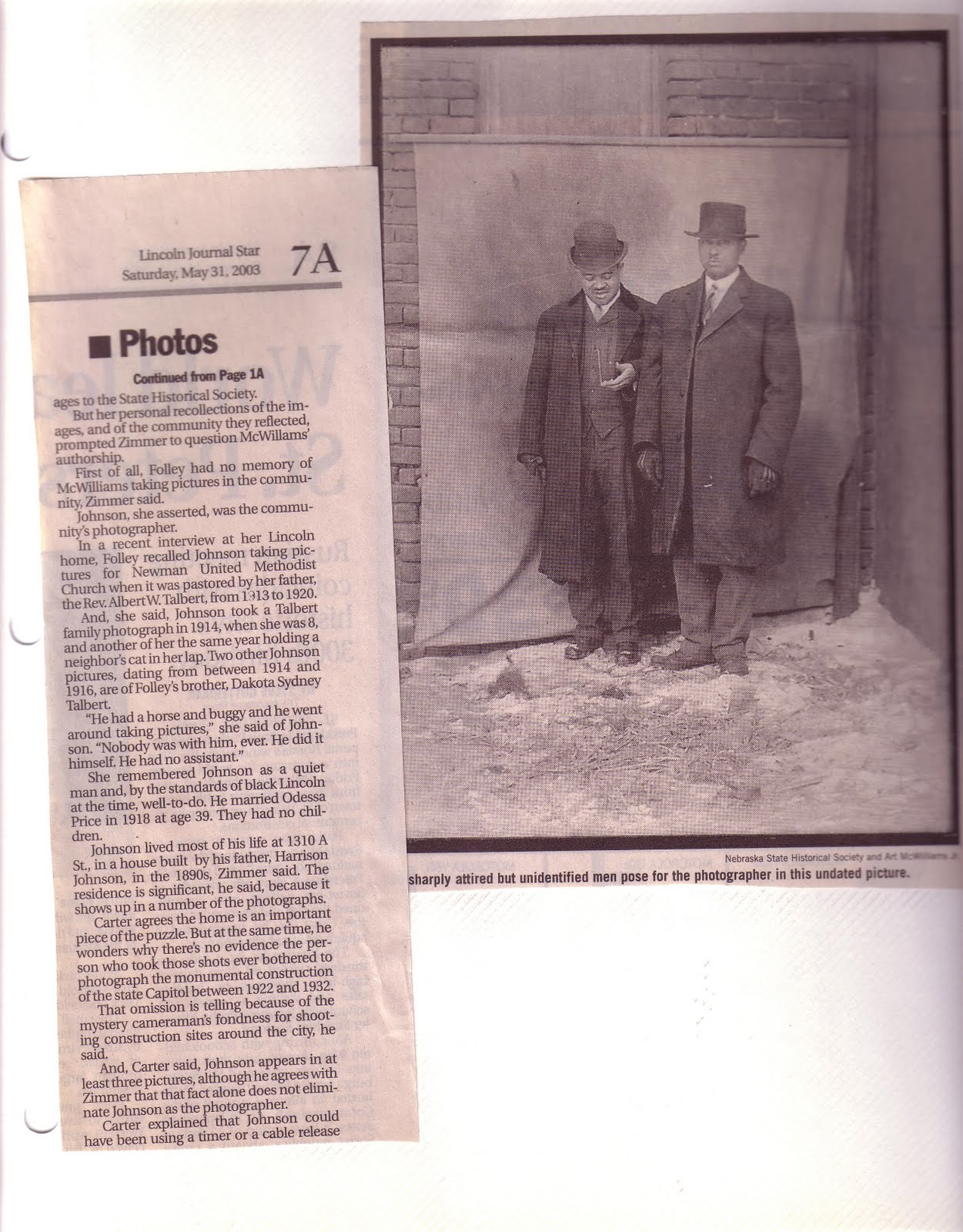
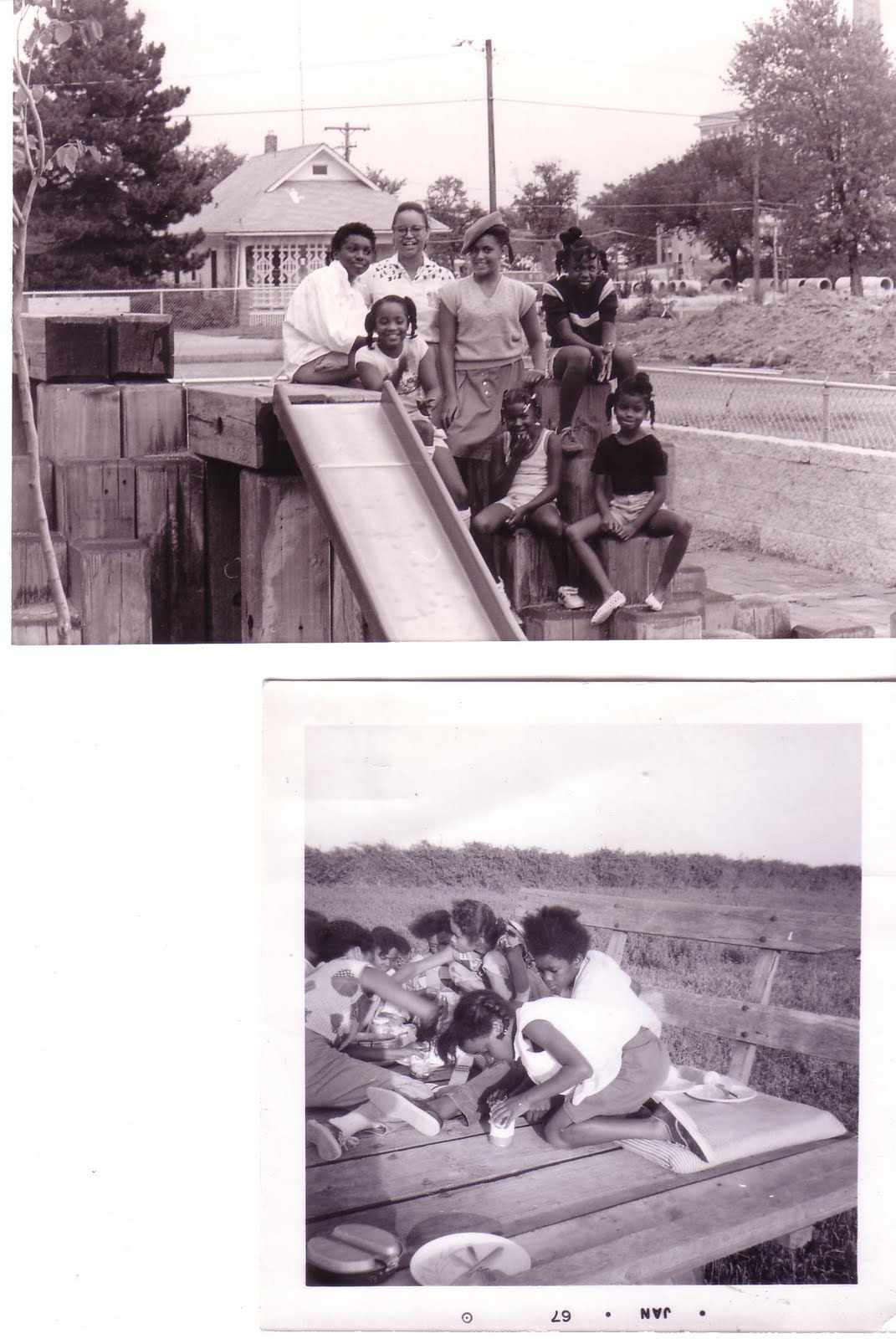
Calloway said the museum has debts of about $5,000 for outstanding storage fees, taxes and assorted other claims and liens. He said the Lake St. building’s utilities are turned off by choice. The museum has maintained its 501c3 status.
Board member Alice Station goes back to the 1950s with Bertha Calloway and the Negro Historical Society that preceded the museum. She collected photos and other materials related to the Buffalo Soldiers. She said it’s pained her to see the museum lay dormant and the archives unused. In a 2001 move that upset Station and brought criticism of Calloway, he rejected a $50,000 city allocation for roof repairs as inadequate. Even after the allocation was increased in 2003 to $100,000 he held out for more. When funding was made contingent on Calloway providing financial accountings he did not comply and the monies were withdrawn. The museum went from a guaranteed $50,000 to a probable $100,000 to nothing.
Similar noncompliance led Douglas County to withdraw allocations. The events may explain the GPBHM’s recent inability to obtain funds. “I admit I made a mistake,” said Calloway. “Work that needs doing now could have been fixed. Where I feel like I’ve accomplished my goal of saving the archives, I’ve failed to preserve the building.”
It didn’t help matters that Calloway and former Omaha City Councilman Frank Brown fueded. Bertha had her own run-ins with movers-and-shakers in the past. Intractability isolated the museum from funding sources. “It was always a survival mode really for them, and Mrs. Calloway was very, very protective of the collection,” said Loves Jazz & Arts Center executive director Neville Murray. “She thought it was important that as an African-American museum African-Americans should be running it. She was suspicious of folks from outside the community and their motives.”
Jim Calloway said neither he nor his mother have any use for “high falutin” folks.
Tekla Johnson offers another point of view. “People have complained in the past Ms. Calloway was a bit controlling, but she didn’t know who to trust and she tried to protect it.” Bottomline, said Andre Faling, “you have to say the Calloways did a great service to the community to have all this stuff. If they hadn’t been doing this, this history would not be there. They do deserve some thanks for sure.”
The museum seemed at an impasse until the recent turn of events. Now the archives are squared away, funding sources for the building’s renovation may be surfacing and a new board offers the potential for new ideas and energy. But what happens after the one-year custodial agreement concludes? Where do the archives go then? And what role, if any, will the Lake St. building play in the future?
Calloway said he’s exploring options to accomodate the archives beyond the one-year term. A refurbished Lake St. building is part of his vision. “The research documents have been the priority, but I don’t want to forget about the building,” he said. “That’s the next big venture.” He anticipates board members leading fund raising efforts for its rehab. Little more than bandaid fixes have been done. The result is that a Thomas Kimball-designed Jacobethan Revival Style edifice that survived the 1913 Easter tornado and housed the Webster Telephone Exchange and the Nebraska Urban League, sits vacant, vulnerable to the ravages of time and the elements.
Michael Alley of Alley Poyner Macchietto Architecture PC, echoes the sentiments of many in viewing the structure as an important piece of architecture and history.
“That’s such a significant building on so many different levels — because of Thomas Kimball and the tornado it survived. It was the nerve center for rescue-cleanup efforts in the wake of the deadly storm. When we lose buildings like this we really lose a sense of place. These physical markers reference points in our community’s history, so the loss isn’t just a building but it really is a loss of history. That’s why it’s so critical to protect these assets.
“All the work I’ve done has been pro bono, just purely out of a passion and a desire to see this thing protected and ultimately restored. Our firm has done many, many projects in north Omaha and we just care deeply about the community. It’s a building I drive by and it just grieves me to see it in that condition.”
He said in a district like north Omaha that’s seen much of its historic building and housing stock razed, the loss would be compounded. If the building were restored, he added, it could anchor North 24th revitalization. North Omaha Development Project plans for aHeritage District mention an African-American museum. African-American Empowerment Network leaders also have the museum on their radar as the network-led North Omaha Arts Alliance takes shape.
For now though, the building’s a worn symbol of what once was. Even when it housed a fully operational institution from 1976 through the late ‘90s, the structure was in various states of disrepair. Years removed from any real work being done beyond roof patch jobs and broken window mends, the building is in dire straits.
The 2008 Alley-led needs analysis underlined the need for swift action. Conditions are worse two years later. “With the heavy snows we’ve had it’s honestly hanging on a razor’s edge,” Alley said. “The way that roof is framed, particularly the low pitched roof, the trusses are embedded into the wall, so if the roof does cave in or give way it will probably pull the walls in with it. I’ve talked to structural engineers and a contractor about putting temporary shoring underneath the roof structure. You’d have to start in the basement and go up through the floors, and put in some posts that would at least keep it from a catastrophic roof collapse.
“The other particularly precarious thing is an old brick flue or chimney in desperate need of tuck pointing. It needs to be dissembled and saved because that’s an important historic element we’d need to rebuild. But if that falls over in a big windstorm or somebody sneezes wrong it could take the whole thing in, too.”
Sub-zero temperatures take their own toll. Minus any heat inside the building, he said, “the freeze-thaw cycle just destroys buildings.”
Stabilizing the “most desperate needs,” Alley said, would take $19,000 to cover: temporary shoring floors and roofs; applying plywood on windows; installing and maintaining temporary heat and cooling; removing the flue stack. In his 2008 report he estimated $44,300 to more comprehensively address “immediate needs.” Much more would be required to retrofit the entire building’s mechanical, electrical systems and bring the structure up to code.
Daunting as it may be, Alley said the building is far from a lost cause, though time is not on its side. “I have no anxiety about the ability to restore the building, protect it and renovate it into a wonderful facility that will outlast our lifetimes. So, it’s not too far gone.” He said his firm’s salvaged buildings “in this bad of shape or worse,” including Omaha’s old Hill Hotel, now the Kensington Tower, and Astro Theater, now The Rose. “We’ve had some real tough projects,” he said. “The difference with this one is that unless the failure that’s occurring right now is dealt with, it will pull the whole building in on itself and there won’t be anything left to save.”
While he said historic status does not protect the site from potential razing it does open opportunities for historic preservation tax credits to facilitate renovation.
He said as beloved as the building is in preservation-architectural circles, certain things must happen before folks pony-up. “I know a bunch of people who would love to jump in on this project if the situation was right. I do think there’s a lack of confidence in the leadership or ownership…a great deal of anxiety about uses of funds and things like that. That’s what I keep running into.”If such concerns could be overcome, he said, “many methods could be used to restore the building.”

Jim Calloway is aware of people’s caution. “I can understand certain individuals reluctance to get involved because of the past issues,” he said. “I can understand people not wanting to really jump in and get involved because of questions and rumors that have been raised in the past, and I think that’s been a stumbling block.”
Some suggest that as long as Calloway is involved the museum will find no backing because his track record makes him too much a lightning rod figure. As a small community organization the museum’s always been controlled by a Calloway and a nominal board whose members have typically been elderly peers of Bertha Calloway’s. Age, illness and death have winnowed their ranks. At various times Jim Calloway’s been unable or unwilling to provide a museum board roster. A formally constituted, working board did not appear to be in place until the reorganization. Recent budgets, financial records and board meeting minutes are unavailable.
City officials and others have expressed concerns about not having a full understanding of who is responsible for the museum. From 2006 through 2008 Calloway installed two interim executive directors, first Matthew Stelly and then Kennan Wright. Each conducted business and made announcements on behalf of the museum, whose governance has been called into question many times.
Neb. State Sen. Brenda Council has said, “People don’t know who’s in charge and who’s going to be accountable. It’s very problematic. Believe me, they have an awful long way to go.” Omaha City Councilman Ben Gray said until the museum has a fully functional board it stands little chance of getting stakeholders to buy in. Upon news of the museum installing a new board, Gray said, “It’s a positive move,” but he withheld further comment until seeing who it’s members are.
Gray, Council and Douglas County Board Commissioner Chris Rodgers form a committee allocating turnback tax dollars for North O cultural projects. Gray and Council say loosely structured organizations like the museum must follow best practices if they expect funding. The GPBHM was denied turnback dollars in 2009.
“We have to establish the necessary boards for some of these organizations to be viable,” Gray said. “Their boards have to adhere to certain rules and regulations that all other boards have to adhere to. In order to bring the museum back the way it needs to be brought back — and it’s not impossible to do — there has to be a credible board, there has to be a credible curator, there has to be a credible building that is in fact a museum. As a community we’ve got to do that and if we don’t do that then we’re just kind of whistling in the wind because you know nobody with means or resources is going to support an organization if those standards have not been met.”
Then there’s the impediment of Jim Calloway himself. Wright found objections in the community to his presence and feels the time has come for him to relinquish control.
“A lot of people have tried and failed to work with Mr. Calloway as far as restoring the building,” said Wright. “One of the first things to come out of people’s mouths is, ‘If Mr. Calloway is going to be involved with the museum then I’m not going to be involved with it.’ The museum building needs to be totally disconnected from the Calloway family. A lot of people support the project but it needs to be separated on its own and not be babysitted or controlled by anybody from the Calloway family.”
Calloway said it’s no surprise some condition their participation on “my being out of the way. I know I’m kind of an obstacle.” He insists he’s “stepped aside” before and is willing to do so again.
Just as the long list of building needs is nothing new, the lack of money to tackle them is an old story. In the museum’s heyday enough grants and donations came in to mount exhibits, hire part-time staff and operate five or six days a week. Still, as far back as the late ‘90s, Bertha Calloway fretted over creditors and outstanding repairs.
Ever since she and her late husband James acquired the building in 1974 little more than piecemeal fixes have been made. Her son Jim Calloway said his frustration with partial mends is what motivated him to reject city funding.
Repairs may ultimately be a moot point. In October 2006 the city filed a 32-page Notice of Violations document against the museum, detailing dozens of serious code infractions encompassing the entire structure. The museum was given two months to cure the problems under threat of demolition. A lack of funds and liability insurance stymied any remedies. Following the city’s next inspection, a ticket may be issued. The misdemeanor criminal citation is punishable by a judge-determined fine or jail time. The citation could be appealed. The next city action after a ticket could be a demolition order, although Chief City Inspector Kevin Denker said the building is low on his department’s priority list given the property’s “historical relevance.”
Calloway said the city is “being patient with us, they really are. They understand the significance and the importance of the building and how much it means to the community, but these code violations have to be addressed very soon. It is definitely not an open-ended situation.”
Another sticking point is possession. Wright said people he approached to serve on a reorganized board expressed concerns about the building’s and the archives’ ownership. “They’re confused about the ownership of the building — who owns the building, does it belong to the Calloway family or does it belong to the museum?”
Ownership came into question in a case decided in the Douglas Country District Court Jim Calloway defended the museum’s viability against claims it was defunct. He found himself embattled with his late sister, Bonita, over control of the museum’s assets. The late Karen Tibbs represented her. Tibbs also represented the interests of Bertha Calloway’s estate. Tibbs was named conservator after a court found Bertha Calloway incompetent. Tibbs contended the museum’s assets are family property while Jim Calloway argued the line he said his mother always maintained — that the building and contents belong to the 501c3 Great Plains Black Museum and Interpretive Center, Inc. the museum is chartered under and the building is deeded under.
Citing a clause in the deed that states the building reverts back to Bertha should the GPBHM cease operating as a museum, Tibbs claimed the museum was no longer a functioning museum. But in a 2006 ruling Judge Robert Burkhard declared the GPBHM never stopped operating as a museum. Tibbs appealed the ruling to no avail.
Wright said potential funders are afraid renovations could be made only to have the museum move elsewhere. Would a newly refurbished building then revert back to the Calloway family’s ownership? Would the archives and artifacts revert back as well? Wright said until the clause is removed the museum will face uneasy scrutiny. People who’d like to get involved, he said, await some definitive resolution.
The way Jim Calloway sees it the “dispute has been settled once and for all, and as far as I’m concerned,” he said, “that’s opened the door, paved the way for progress. That had always been a problem — it impeded a lot of what could have taken place during that time. Everything was on hold.” As for the clause, he said he understands people’s concerns but insists if the building did revert back to the family it’d go to the state to cover his destitute mother’s nursing home bills.
Wright said he found great interest within the African-American community and the larger community in reopening the museum, if not in its original Lake St. home than somewhere nearby. But restoring the building for any use would take upwards of $1.5 million according to figures put together by Alley. Restoring to stringent historic landmark specs and meeting strict museum-quality climate control standards would be costly. That’s why Alley, Calloway, Wright and others say it may be more practical to restore the building as the museum’s administrative headquarters and either renovate an existing structure or construct a new one to serve as the public museum site. A second building would mean another steep price tag. Then there would need to be funds for an operating budget to see the museum through its first few years.

English: Picture of Bertha Calloway (Photo credit: Wikipedia)
At Calloway’s behest Wright applied for 40-plus grants for the museum in 2008-2009. None were awarded.
“During this difficult economic time a lot of organizations were opting to donate funds to already running programs rather than capital projects,” said Wright, “which the museum project would be because the building is in such bad condition and needs a lot of work before we could even reopen.”
In an application for Community Block Grant monies Wright and Calloway asked for the improbable sum of $1.5 million, which was denied. City of Omaha community block grant administrator James Thele said among the things he and his staff weigh is “what other money can you bring to the table,” noting the program’s meant to fill funding gaps, not be a primary source. He said Calloway’s past refusal of city funding “would not prejudice” consideration of new grant requests by the museum. “However,” he said, “knowing an organization has had problems in the past, we’re going to ask certain questions and do some research of our own.”
Wright said the resistance he encountered had to do with the museum’s shadow board. “Without a strong board of directors no foundation is going to want to donate money with the financial problems the museum’s had. When you apply for grants one of the first things a funder does is vet your board of directors. If your board is weak then you might as well forget it, it’s not going to happen,” he said.
Regardless of past or current problems, there’s great interest in a reborn museum.
Said Council, “I don’t think you could talk to anyone in the community who doesn’t want to see that institution restored. But at what cost? And when I say at what cost I mean putting money someplace where you know it’s going to have a return in terms of providing the programs, i.e. the museum, on a regular, consistent basis and there’s measures and steps taken to preserve the collection and to build the collection.” As for the building, she said, “the consensus in the community is that it’s unquestionably a historic landmark we’d like to see restored, but it’s a long way from being at a point where people feel comfortable or confident that will occur.”
Nothing short of a public-private rescue seems likely to change things. In the community block grant application Wright outlined a detailed vision for what the resurrected museum might look like. It’s a beautiful vision complete with a restored building, a research center, a library/archives, meeting rooms, offices, educational programs, special events, outreach activities, guided tours, a professional staff.
Wright suggests it’s the city’s obligation to save the building and institutionalize the museum as community assets in service of education, preservation, history, culture and tourism. He believe once the city steps up, others will follow.
Ben Gray agrees the public-private sectors have an obligation, but he feels the African American community must first demonstrate commitment. “We have to put up something, too. We have to have some skin in the game, whether it be sweat equity, whether it be whatever meager resources we have to bring to the table, we’ve gotta bring that,” he said. “And then we’ve got to say to the broader community, This is the part we can do, these are the things we have done, these are the mechanisms we have put in place, these are the commitments we are willing to make, what are you all going to do now?’”
Doing the right thing aside, Gray said unless the museum has a solid infrastructure in place no one’s going to sink dollars “into a black hole” that lacks the leadership and the tools to succeed over the long haul.
As the politics play out, Calloway does what he can to protect the building, whose interior is covered in tarps to collect water let in by the leaky roof. He suctions out the water as best he can. He’s also exploring options to display portions of the collection somewhere. Ben Gray may have a line on a site.
Meanwhile, Tekla Johnson continues discovering gems in the treasure trove spread out before her. From tidbits about the Stone Soul Picnic to the history of the Eure family to the exploits of Buffalo Soldiers, she said the archives promise to shed a whole new light on the African-American experience in Nebraska.
Related Articles
- Black history catalogued at new Univ. of Chicago website (teleread.com)
- Gary Kastrick’s Project OMAHA Loses its Home Base (leoadambiga.wordpress.com)
- Great Plains Black History Museum Asks for Public Input on its Latest Evolution (leoadambiga.wordpress.com)
- Omaha Arts-Culture Scene All Grown Up and Looking Fabulous (leoadambiga.wordpress.com)
- Once More With Feeling, Loves Jazz & Arts Center Back from Hiatus (leoadambiga.wordpress.com)
- Back in the Day, Native Omaha Days is Reunion, Homecoming, Heritage Celebration and Party All in One (leoadambiga.wordpress.com)
- The Ties that Bind, One Family’s Celebration of Native Omaha Days (leoadambiga.wordpress.com)
- Arno Lucas, Serious Sidekick (leoadambiga.wordpress.com)
- A Stitch in Time Builds A World Class Quilt Collection and Center-Museum (leoadambiga.wordpress.com)
- Negro Leagues Baseball Museum Exhibits on Display for the College World Series; In Bringing the Shows to Omaha the Great Plains Black History Museum Announces it’s Back (leoadambiga.wordpress.com)
- A Brief History of Omaha’s Civil Rights Struggle Distilled in Black and White By Photographer Rudy Smith (leoadambiga.wordpress.com)
- A Synergy in North Omaha Harkens a New Arts-Culture District for the City (leoadambiga.wordpress.com)


 Leo Adam Biga's My Inside Stories