

Archive
Posts Tagged ‘Nebraska Black Sports Hall of Fame’
The Brothers Sayers: Big legend Gale Sayers and little legend Roger Sayers (from my Omaha Black Sports Legends series, Out to Win: The Roots of Greatness)
August 15, 2010
8 comments

Image via Wikipedia
Whether you’re visiting this blog for the first time or you’re returning for a repeat visit, then you should know that among the vast array of articles featured on this site is a series I penned for The Reader (www.thereader.com) in 2004-2005 that explored Omaha’s Black Sports Legends. We called the 13-part, 45,000 word series, Out to Win: The Roots of Greatness. The following story is one installment from that series. It features a pair of brothers, Gale Sayers and Roger Sayers, whose athletic brilliance made each of them famous in their own right, although the fame of Gale far outstripped that of Roger. Gale, of course, became a big-time football star at Kansas before achieving superstardom with the NFL‘s Chicago Bears. An unlikely set of circumstances saw his playing career end prematurely yet make him an even larger-than-life figure. A made-for-TV movie titled Brian’s Song (since remade) that detailed his friendship with cancer stricken teammate Brian Piccolo, cemented his immortal status, as did being elected to the Pro Football Hall of Fame at age 29. Roger’s feats in both football and track were impressive but little seen owing to the fact he competed for a small college (the then-University of Omaha) and never made it to the NFL or Olympics, where many thought he would have excelled, the one knock against him being his diminutive size.
The Sayers brothers are among a distinguished gallery of black sports legends that have come out of Omaha. Others include Bob Gibson, Bob Boozer, Ron Boone, Marlin Briscoe, and Johnny Rodgers. You will find all their stories on this site, along with the stories of other athletic greats whose names may not be familiar to you, but whose accomplishments speak for themselves.
The Brothers Sayers: Big legend Gale Sayers and little legend Roger Sayers (from my Omaha Black Sports Legends series, Out to Win: The Roots of Greatness)
©by Leo Adam Biga
Originally published in The Reader (www.theeader.com) as part of my Omaha Black Sports Legends series, Out the Win: The Roots of Greatness
This is the story of two athletically-gifted brothers named Sayers. The younger of the pair, Gale, became a sports figure for the ages with his zig-zagging runs to daylight on a football field. His name is synonymous with the Chicago Bears. His oft-played highlight-reel runs through enemy lines form the picture of quicksilver grace. His well-documented friendship with the late Brian Piccolo endear him to new generations of fans.
The elder brother, Roger, forged a distinguished athletic career of his own, one of blazing speed on cinder and grass, but one overshadowed by Gale’s success.
From their early impoverished youth on Omaha’s near north side in the 1950s the Brothers Sayers dominated whatever field of athletic competition they entered, shining most brightly on the track and gridiron. As teammates they ran wild for Roberts Dairy’s midget football squad and anchored Central High School’s powerful football-track teams. Back then, Roger, the oldest by a year, led the way and Gale followed. For a long time, little separated the pair, as the brothers took turns grabbing headlines. Each was small and could run like the wind, just like their ex-track man father. But, make no mistake about it, Roger was always the fastest.
Each played halfback, sharing time in the same Central backfield one season. Heading into Gale’s sophomore year nature took over and gave Gale an edge Roger could never match, as the younger brother grew a few inches and packed-on 50 pounds of muscle. He kept growing, too. Soon, Gale was a strapping 6’0, 200-pound prototype halfback with major-college-material written all over him. Roger remained a diminutive 5’9, 150-pound speedster whose own once hotly sought-after status dimmed when, bowing to his parents’ wishes, he skipped his senior year of football rather than risk injury. Ironically, he tore a tendon running track the next spring. His major college prospects gone, he settled for then Omaha University.
Roger went on to a storied career at UNO, where he developed into one of America’s top sprinters and one of the school’s all-time football greats. He won the 100-meters at the 1964 Drake Relays. He captured both the 100-yard and 100-meter dashes at the 1963 Texas Relays. He took the 100 and 200 at the 1963 national NAIA meet. He ran well against Polish and Soviet national teams in AAU meets. The Olympic hopeful even beat the legendary American sprinter Bob Hayes in a race, but it was Hayes, known as “The Human Bullet,” who ended up with Olympic and NFL glory, not Sayers.
As an undersized but explosive cog in UNO’s full backfield, Sayers, dubbed “The Rocket,” averaged nearly eight yards per carry and 19 yards per reception over his four-year career. But it was as a return specialist he really stood out. Using his straight-away burst, he took back to the house three punts and five kickoffs for touchdowns. He holds several school records, including highest rushing average for a season (10.2) and career (7.8) and highest punt return average for a season (29.5) and career (20.6). His 99-yard TD catch in a 1963 game versus Drake is the longest scoring play from scrimmage in UNO history.

Roger Sayers running track for then-Omaha University
In football, size matters. For most of his playing career, however, Roger said his acute lack of size “never was a factor. I didn’t pay much attention to it. I didn’t lack any confidence when I got on the field. I always thought I could do well.”
Even with his impressive track credentials, Sayers, coming off an injury, was unable to find a sponsor for a 1964 Olympic bid. Even though his small stature never held him back in high school or college, it posed a huge obstacle in pro football, which after graduation he did not pursue right away because the studious and ambitious Sayers already had opportunities lined-up outside athletics. Still, in 1966, he gave the NFL a try when, after prodding from “the guys” at the Spencer Street Barbershop and a little help from Gale, he signed a free agent contract with his brother’s team, the Chicago Bears. Roger lasted the entire training camp and exhibition season with the club before bowing to reality and taking an office job.
“That’s when I realized I was too small,” Roger said of his NFL try.
Gale, the family superstar, is inducted in the college and pro football Halls of Fame but his glory came outside Nebraska, where he felt unappreciated. Racism likely prevented him being named Nebraska High School Athlete of the Year after a senior year of jaw-dropping performances. In leading Central to a share of the state football title, he set the Class A single season scoring record and made prep All-American. In pacing Central to the track and field title, he won three gold medals at the state meet, shattering the Nebraska long jump record with a leap of 24 feet, 10 inches, a mark that still stands today. He got revenge in the annual Shrine all-star game, scoring four touchdowns en route to being named outstanding player.
Recruited by Nebraska, then coached by Bill Jennings, Sayers considered the Huskers but felt uncomfortable at the school, which had ridiculously few black students then — in or out of athletics. Spurning the then-moribound NU football program for the University of Kansas, he heard people say he’d never be able to cut it in school. Sayers admits academics were not his strong suit in high school, not for lack of intelligence, but for lack of applying himself.
It took his father, a-$55-a-week car polisher, who’d walked away from his own chance at college, to set him straight. “People said I would fail. They called me dumb. But my dad said to me one time, ‘Gale, you are good enough,’ and just those words gave me the incentive that somebody believed in me. That’s all I needed. And I proved that I could do it.”
Sayers was also motivated by his brother, Roger, the bookish one who preceded him to college. Each went on to get two degrees at their respective schools.
On the field, Gale showed the Huskers what they missed by earning All-Big 8 and All-America honors as a Jayhawk and, in a 1963 game at Memorial Stadium the “Kansas Comet” lived up to his nickname by breaking-off a 99 yard TD run that still stands as the longest scoring play by an NU opponent. He was also a hurdler and long-jumper for the elite KU track program.
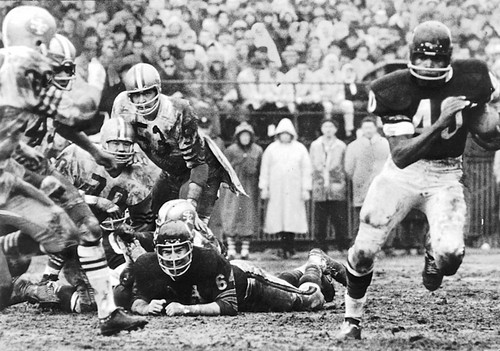
Upon entering the NFL with the Bears in 1965, Sayers made the most dramatic debut in league history, setting season records for total offense, 2,272, and touchdowns, 22, and a single game scoring record with 6 TDs. Named Rookie of the Year and All-Pro, he continued his brilliant play the next four seasons before the second of two serious knee injuries cut short his career in 1970. A mark of the impact he made is that despite playing only five full seasons, he’s routinely listed among the best running backs to ever play in the NFL.

Gale Sayers with the Bears
His immortality was ensured by two things: in 1970, the story of his friendship with teammate Brian Piccolo, who died tragically of cancer, was dramatically told in a TV movie-of-the-week, Brian’s Song, (recently remade); and, in 1977, he was inducted into the pro football Hall of Fame at age 29, making him the youngest enshrine of that elite fraternity.
A quadruple threat as a rusher, receiver out of the backfield, kickoff return man and punt returner, Sayers’ unprecedented cuts saw him change directions — with the high-striding, gliding moves of a hurdler — in the blink of an eye while somehow retaining full-speed. In a blurring instant, he’d be in mid-air as he head-faked one way and swiveled his hips the other way before landing again to pivot his feet to race off against the grain. In the introduction to Gale’s autobiography, I Am Third, comic Bill Cosby may have come closest to describing the effect one of Sayers’ dramatic cuts left on him while observing from the sidelines and on the hapless defenders trying to corral him.
“I was standing there and Gale was coming around this left end. And there are about five or six defensive men ready, waiting for him…And I saw Gale Sayers split. I mean, like a paramecium. He just split in two. He threw the right side of his body on one side and the left side of his body kept going down the left side. And the defensive men didn’t know who to catch.”
The way Gale tells it, his talent for cutting resulted from his “peripheral vision,” a gift he had from the get-go. “When I was running I could see the whole field. I knew how fast the other person was running and the angle he was taking, and I knew all I had to do was make a certain move and I’m past him. I knew it — I didn’t have to think about it. I could see where people were and that gave me the ability to make up my mind what I would do before I got to a person,” he said. He reacted, on the fly, in tenths or hundreds of a second, to what he saw. “
All the so-called great moves in football are instinct,” he said. “It’s not planned. I don’t go down the football field saying, ‘Oh, this fella’s to my right, I better cut left,’ or whatever. You don’t plan it. You’re running with the football and you just do what comes natural…There were so many times in high school, college and pro ball when I was going around left end or right end and there was nothing there, and then I went the other way. You can’t teach that. That’s instinctive.”
He said his greatest asset was not speed, but quickness — combined with that innate ability to improvise on the run. “Every running back has speed, but a lot of running backs don’t have the quickness to hit a hole or to change directions, and I always could do that. A lot of times a hole is clogged and then you’ve got to do something else — either change directions or hit another hole or bounce it to the outside and go someplace else.”
Lightning fast moves may have sprung from an unlikely source — flag football, something Heisman Trophy winner Johnny Rodgers also credits with helping develop his dipsy-doodle elusiveness.
“The flags were pretty easy to grab and pull out,” Sayers said, “and so, yes, you had to develop some moves to keep people away from the flags.” The Sayers boys got their first exposure to organized competition playing in the Howard Kennedy Grade School flag football program coached by Bob Rose. An old-school disciplinarian who mentored many of north Omaha’s greatest athletes when they were youths, Rose embodied respect.
“He was a tough coach. I think he had a little attitude that said, in being black, you’ve got to be twice as good, and I think he tried to instill that in us at an early age. He’d say things like, ‘You have to be faster, you have to be tougher, you’ve got to hit harder.’ We all developed that attitude that, ‘Hey, we’ve got to do better because we’re black.’ And I think that stuck with me,” Gale said.
According to Roger, coaches like Rose and the late Josh Gibson (Hall of Fame pitcher Bob Gibson’s oldest brother), whom the brothers came in contact with playing summer softball, “made it possible for people to succeed. They were good coaches because they taught you the fundamentals, they taught you to be respectful of people and they taught you the ethics of the game. These were folks that…made sure you played in an organized, structured event, so you could get the most out of it. They also had an uncanny ability to identify athletes and to motivate athletes to want to play and to achieve. They were part of an environment we had growing up where we had strong support systems around us.”
From the mid-1950s through the late 1960s Omaha’s inner city produced a remarkable group of athletes who achieved greatness in a variety of sports. Many observers have speculated on the whys and hows of that phenomenal run of athletic brilliance. The consensus seems to be that athletes from the past didn’t have to contend with a lot of the pressures and distractions kids face today, thus allowing a greater concentration on and passion for sports.
“Growing up, we didn’t have access to cars or play stations or arcade games,” Roger said. “We didn’t have to deal with the intense peer pressure kids are influenced by today. Because we didn’t have these things, we were able to focus in on our sports.”
For black youths like the Sayers and their buddies, options were even more confining in the ‘50s, when racial minorities were denied access to recreational venues such as the Peony Park pool and were discouraged from so-called country-club activities such as golf, which left more time and energy to devote to traditional inner city sports. “
Every day after school we were in Kountze park or some place playing a sport — football, basketball, baseball, whatever it may be. There wasn’t a whole lot else we could do,” Gale said. “So, we were in the park playing sports. Our mamas and daddies had to call us to come eat dinner because we were out there playing.”
Gale said that as youths he and his friends had such a hunger for football that after completing flag football practice, they would then go to the park to knock heads “with the big kids” from local high schools in pick-up games. “It’s a wonder no one ever got seriously injured because we had no pads, no nothing, and we played tackle. It really made us tougher.”
Dennis Fountain, a friend and fellow athlete from The Hood, said the Sayers would often compete for opposing sides in those informal games. “You wouldn’t think those two guys were brothers,” he said. “They would mix it up good.”
Speaking of tough, the brothers tussled in a pair of now mythic neighborhood football games held around the holidays. There was the Turkey Bowl played on Thanksgiving and the Cold Bowl played on Christmas. “We had some knock-down, drag-out athletic contests out there,” said Gale, referring to the annual games that drew athletes of all ages from Omaha’s north and south inner city projects. “We were a little young, but the fellas’ saw the talent we had and let us play.”
Then, there was the rich proving ground he and Roger found themselves competing in — playing with or against such fine athletes as the Nared brothers (Rich and John), Vernon Breakfield, Charlie Gunn, Bruce Hunter, Ron Boone. “No doubt about it, we fed off one another. We saw other people doing well and we wanted to do just as well,” Gale said. As the Sayers began asserting themselves, they pushed each other to excel.
“When he achieved something, I wanted to achieve something, and vice versa,” Roger said. “I mean, you never wanted to be upstaged or outdone, but by the same token we were always proud and overjoyed by each other’s success. We were as competitive as brothers are.”
Roger and Gale had so much ability that the exploits of their baby brother, Ron, are obscured despite the fact he, too, possessed talent, enough in fact for the UNO grad to be a number two draft pick by the San Diego Chargers in 1968.
Each also knew his limitations in comparison with the other. Roger played some mean halfback himself, but he knew on a football field he was only a shadow of Gale, whom nature blessed with size, speed, vision and instinct. Where Gale was a fine hurdler, relay man and long-jumper, he knew he could not beat Roger in a sprint. “I wasn’t going to get into the 100 or 220-yard dash and run against him because he was much, much faster than I was,” Gale said. “He was great in track.”
As much as he downplays his own track ability, Gale held his own in one of the strongest collegiate track programs at Kansas. It was under KU track and field coach Bill Easton he discovered a work ethic and a mantra that have guided his life ever since.
“I thought I worked hard getting ready for football,” he said, “but when I joined his track team I couldn’t believe the amount of work he put me through and I couldn’t believe I could do it. But within months I could do everything he asked me to, and I was in excellent shape. He told me, ‘Gale, you cannot work hard enough in any sport, especially in track.’ The things I did for him on the track team carried on through my pro career in football.
“Every training camp I came in shape, and I mean I came in shape. I was ready to play and put the pads on the first day of camp, where many guys would go to camp to get in shape.”
On the eve of his pro career, Sayers was entertaining some doubts about how he would do when Easton reminded him what made him special. “You go for broke every time you go.” Sayers said it’s a lesson he’s always tried to follow.

A saying printed on a card atop the desk in Easton’s office intrigued Sayers. The enigmatic words said, I Am Third. When he asked his coach their meaning, he was told they came from a kind of proverb that goes, The Lord is First, My Friends are Second, I Am Third. The athlete was so taken with its meaning he went out and had it inscribed on a medallion he wore for years afterwards. His wife Linda now has it.
The saying became the title of his 1970 autobiography. The philosophy bound up in it helped him cope with the abrupt end of his playing days. “All the talent I had, the Lord gave me. And it was the Lord that decided to take it away from me,” Gale said. “That probably helped me accept the fact that, hey, I couldn’t do it anymore. I had a very short career, but a very good career. I was satisfied with that.”
Life after athletic competition has been relatively smooth for Gale and his brother. Roger embarked on a long executive corporate career, interrupted only by a stint as the City of Omaha’s Human Relations Director under Mayor Gene Leahy. He retired from Union Pacific a few years ago. Today, he’s a trustee with Salem Baptist Church. Gale served as athletic director at Southern Illinois University before starting his own sports marketing and public relations firm, Sayers and Sayers Enterprises. Next, he launched Sayers Computer Source, a provider of computer products and technology solutions to commercial customers. Today, SCS has brnaches nationwide and revenues in excess of $150 million. Besides running his companies, Sayers is in high demand as a motivational speaker.
Both men have tried distancing themselves from being defined by their athletic prowess alone.
“I want people to view me as an individual that brings something to the table other than the fact I could run track and play football. That stuff is behind me. There are other things I can do,” said Roger. For Gale, it was a matter of being ready to move on. “I’ve always said, As you prepare to play, you must prepare to quit, and I prepared to quit. I didn’t have to look back and say, What am I going to do now? I did other things.”
Getting on with their lives has been a constant with the brothers since growing up with feuding, alcoholic parents, sparse belongings and little money in “The Toe,” as Gale said residents referred to the north Omaha ghetto. His family moved to Omaha from bigoted small towns in Kansas, where the Sayers lived until Gale was 8, but instead of the fat times they envisioned here they only found despair.
Finding a way out of that cycle became an overriding goal for Gale and his brothers.
“Yes, we had tough times, but everybody in the black neighborhood had a tough time. Our dad always said, ‘Gale, Roger, Ronnie…sorry it didn’t work out for your mother and I, but you need to get your education and make something better for yourselves.’” The fact he and Roger went on to great heights taught Gale that “if you want to make it bad enough, no matter how bad it is, you can make it.”
Related Articles
- Gale Sayers’s Knee, and the Dark Ages of Medicine (fifthdown.blogs.nytimes.com)
- The 32 Greatest NFL Running Backs (sports-central.org)
- The Ties that Bind, One Family’s Celebration of Native Omaha Days (leoadambiga.wordpress.com)
- Sayers: Current players should help pioneers (sports.espn.go.com)
- John Mackey’s death has Gale Sayers ticked off at today’s NFL (profootballtalk.nbcsports.com)
Categories: African-American Culture, Athletics, Football, Gale Sayers, Omaha, Omaha Black Sports Legends, Out to Win: The Roots of Greatness (a series), Race, Roger Sayers, Sports, UNO (University of Nebraska at Omaha), Writing
African-American Culture, Athletics, Brian Piccolo, Chicago Bears, Football, Gale Sayers, National Football League, Nebraska Black Sports Hall of Fame, Omaha, Pro Football Hall of Fame, Roger Sayers, Sports, University of Kansas, UNO (University of Nebraska at Omaha)
Bob Boozer, Basketball Immortal (from my Omaha Black Sports Legends series, Out to Win: The Roots of Greatness)
August 14, 2010
2 comments
Bob Boozer
2012 UPDATE:
It is with a heavy heart I report that the hoops legend subject of this story, Bob Boozer, passed away May 19. As fate had it, I had a recent encounter with Boozer that ended up informing a story I was working on about comedian Bill Cosby. Photographer Marlon Wright and I were in Cosby’s dressing room May 6 when Boozer appeared with a pie in hand for the comedian. As my story explains, the two went way back, as did the tradition of Boozer bringing his friend the pie. You can find that story on this blog and get a glimpse through it of the warm regard the two men had for each other. For younger readers who may not know the Boozer name, he was one of the best college players ever and a very good pro. He had the distinction of playing in the NCAA Tournament, being a gold medal Olympian, and winning an NBA title.
Unless you’re a real student of basketball history, chances are the name Bob Boozer doesn’t exactly resonate for you. But it should. The Omaha native is arguably the best basketball player to ever come out of Nebraska and when he decided to spurn the University of Nebraska for Kansas State, it was most definitely the Huskers’ loss and the Wildcats’ gain. At KSU Boozer became an All-American big man who put up the kind of sick numbers that should make him a household name today. But he starred in college more than 50 years ago, and while KSU was a national power neither the team nor Boozer ever captured the imagination of the country the way, say, Cincinnati and Oscar Robertson did in the same era. But hoop experts knew Boozer was a rare talent, and he proved it by making the U.S. Olympic team, the orignal Dream Team, that he helped capture gold in Rome. And in a solid, if not spectacular NBA career he made All-Pro and capped his time in the league as the 6th man for the Milwaukee Buck’s only title.
Boozer retired relatively young and unlike many athletes he prepared for life after sports by working off-seasons in the corporate world, where he landed back in his hometown after leaving the game. If you look at the body of his work in college, he should be a sure fire college basketball hall of fame inductee, but somehow he’s been kept out of that much deserved and long overdue honor. The fact that he helped the U.S. win Olympic gold and also earned an NBA title ring puts him in rare company and makes a pretty strong case for NBA Hall of Fame consideration. Some measure of validation happened this week when the 1960 Olympic team was enshrined in the Naismith Memorial Basketball Hall of Fame.
2016 UPDATE:
Bob Boozer, Basketball Immortal, to be posthumously inducted into the National Collegiate Basketball Hall of Fame
I posted this four years ago about Bob Boozer, the best basketball player to ever come out of the state of Nebraska, on the occasion of his death at age 75. Because his playing career happened when college and pro hoops did not have anything like the media presence it has today and because he was overshadowed by some of his contemporaries, he never really got the full credit he deserved. After a stellar career at Omaha Tech High, he was a brilliant three year starter at powerhouse Kansas State, where he was a two-time consensus first-team All-American and still considered one of the four or five best players to ever hit the court for the Wildcats. He averaged a double-double in his 77-game career with 21.9 points and 10.7 rebounds. He played on the first Dream Team, the 1960 U.S. Olympic team that won gold in Rome. He enjoyed a solid NBA journeyman career that twice saw him average a double-double in scoring and rebounding for a season. In two other seasons he averaged more than 20 points a game. In his final season he was the 6th man for the Milwaukee Bucks only NBA title team. He received lots of recognition for his feats during his life and he was a member of multiple halls of fame but the most glaring omisson was his inexplicable exclusion from the National Collegiate Basketball Hall of Fame. Well, that neglect is finally being remedied this year when he will be posthumously inducted in November. It is hard to believe that someone who put up the numbers he did on very good KSU teams that won 62 games over three seasons and ended one of those regular seasons ranked No. 1, could have gone this long without inclusion in that hall. But Boozer somehow got lost in the shuffle even though he was clearly one of the greatest collegiate players of all time. Players joining him in this induction class are Mark Aguirre of DePaul, Doug Collins of Illinois State, Lionel Simmons of La Salle, Jamaal Wilkes of UCLA and Dominique Wilkins of Georgia. Good company. For him and them. Too bad Bob didn’t live to see this. If things had worked out they way they should have, he would been inducted years ago and gotten to partake in the ceremony.
|
Boozer with the Los Angeles Lakers
Bob Boozer, Basketball Immortal (from my Omaha Black Sports Legends series, Out to Win: The Roots of Greatness)
©by Leo Adam Biga
Originally published in the New Horizons and later reprinted in The Reader (www.thereader.com) as part of my Omaha Black Sports Legends series, Out to Win: The Roots of Greatness
Omahan Bob Boozer chartered a bus to Manhattan for a February 5 engagement with immortality. By the way, that’s Manhattan, Kansas, where 50 of his closest friends and family members joined him to see his jersey retired at half-time of the Kansas State men’s basketball game.
In case you didn’t know, Boozer is a Wildcat hoops legend. In the late-1950s, he was a dominant big man there. In each of his three years, he was first team all-conference. He was twice a concensus first-team All-American. And that doesn’t even speak to his elite-level AAU play, his winning an Olympic gold medal on the original “Dream Team” and his solid NBA career capped by a championship.
Unless you’re a serious student of the game or of a certain age, the name Bob Boozer may only be familiar as one adorning a road in his hometown. But, in his time, he was the real deal. He had some serious game. He overwhelmed opponents as an all-everything pivot man at Omaha Technical High from 1952-55, earned national accolades as a high-scoring, fierce-rebounding forward at K-State from 1955-59, led an AAU squad to a title, played on the legendary 1960 U.S. Olympic basketball squad and was a member of the 1971 NBA champion Milwaukee Bucks. It’s a resume few can rival.
“There’s very few guys that really had it all every step of the way, like I did. All City. All State. All Conference. All-American. Olympic gold medal. NBA world championship. Those are levels everybody would like to aspire to but very few have the opportunity,” he said.
He is, arguably, the best player not in the college hoops hall of fame. He is, by the way, in the Olympic Hall of Fame. His collegiate credentials are unquestionable. Take this career line with the Wildcats: 22 points and 10 rebounds a game. And this came versus top-flight competition, including a giant named Wilt at arch-rival Kansas, when K-State contended for the national title every year. If anything, the Feb. 5 tribute is long overdue.
Of his alma mater feting him, he said, “It’s quite an honor to have your jersey retired. That means in the history of that school you have reached the pinnacle.”
The pinnacle is where Boozer dreamed of being. His Olympic experience fulfilled a dream from his days at the old North YMCA, mere blocks from his childhood home at 25th and Erskine. Then, he reached the pinnacle of his sport in the NBA. A starter most of his pro career, he was a productive journeyman who could be counted on for double figures in points and rebounds most nights. His career NBA averages are 14.8 points and 8.1 rebounds a game. The 6’8 Boozer played in the ‘68 NBA All-Star game, an honor he just missed other years. He led the Chicago Bulls in scoring over a three-year period. He was the Bucks’ valuable 6th man in their title run.
Still, he was more a role player than a leading man. His game, like his demeanor, was steady, not sensational. He was, in his own words, “a blue-collar worker.” He could shoot like few other men his size, utilizing deadly jumpers and hook shots.
“I was a good player. I would make you pay if you made a mistake. I could move out for the jump shot and the hook shot or make a quick move for a layup,” he said.
While he admires the athleticism of today’s players, he doesn’t think much of their basic skills.
“We could flat-out outshoot these kids today. We worked awfully hard at being able to shoot the jump shot. I used to always say that a 15- to 18-foot jump shot is just like a layup. That was my mind set — that if I got it clear, it was going down.”
He perfected his shot to such a degree that in practice he could find his favorite spots on the court and nail the ball through the hoop with his eyes closed.
“It’s just something that with thousands and thousands of repetitions gets to be automatic. And when I shot I always used to try to finger the ball for the seams and to swish it because if the ball left my hand with a backward rotation and went through the net, it would hit the floor and come right back to you. That way, when you’re shooting by yourself, you don’t have to run after the ball very much,” he said, chortling with his booming bass voice.
Unlike many players who hang around past their peak, once Boozer captured that coveted and elusive ring, he left the game.
“I had made up my mind that once I walked, I walked, and would never look back. Besides, your body tells you when it’s getting near the end. I started hating the training camps a little more. The last few years I knew it was coming to an end,” he said. “The championship season with the Bucks was the culmination of my career. It was great.”
Indeed, he left without seeking a coaching or front office position. The championship was made sweeter as he shared it with an old pal, Oscar Robertson. As players, they were rivals, teammates and friends. Both were college All-Americans for national championship contending teams. As a junior, Boozer and his KSU Wildcats eliminated “The Big O” and his Cincinnati Bearcats from the 1957-58 NCAA quarterfinals. The next year Robertson turned the tables on Boozer by knocking the No. 1-ranked ‘Cats out of the regionals.
The two were teammates on the 1960 US Olympic basketball team, considered by many the best amateur basketball talent ever assembled. Besides Boozer and Robertson, the team featured future NBA stars Jerry West, Jerry Lucas and Walt Bellamy. It destroyed all comers at the Rome games, winning by an average margin of 34-plus. Then Boozer and Robertson were reunited with the Cincinnati Royals. Cincy was the site of some fat times for Boozer, who was popular and productive there. It’s also where he met his wife, Ella. The couple has one grown child and one grandchild.
After a trade to the New York Knicks that he protested, Boozer bounced around the league. He played a few years with the expansion Chicago Bulls, where he enjoyed his biggest scoring seasons — averaging about 20 points a game. He led the Bulls to the playoffs in their inaugural season — the first and last time a first-year expansion team did that.

A card from his time with the Cincinnati Royals
He had one happy season with the Los Angeles Lakers, spelling the great Elgin Baylor, before he joined Robertson in Milwaukee. With the incomparable Kareem Abdul-Jabbar at center, smooth Bob Dandridge at forward, playmaker Robertson at guard and the steady Boozer coming off the bench (he averaged 9 points and 5 boards), the Bucks, in only their second year, blew away opponents en route to a 66-16 regular season mark. They captured the franchise’s first and only championship by sweeping the Baltimore Bullets in four games.
By then, Boozer was 34 and a veteran of 11 NBA seasons with five different teams. He left the league and his then-lofty $100,000 salary to build a successful career off the court with the former Northwestern Bell-US West, now called Qwest.
Now retired from the communications giant, the 67-year-old Boozer enjoys a comfortable life with Ella in their spacious, richly adorned Pacific Heights home in Omaha, a showplace he refers to as “the fruits of my labor.” He moves stiffly from the wear and tear his body endured on the hardcourt those many years. His inflamed knee joints ache. But he recently found some relief after getting a painful hip replaced.
With his sports legacy secured and his private life well-ordered, his life appears to have been one cozy ride. Viewed more closely, his journey included some trying times, not least of which was to be denied the chance to buy a home in some of Omaha’s posher neighborhoods during the late 1960s. The racism he encountered made him angry for a long time, but in the end he made peace with his hometown.
Boozer grew up poor in north Omaha, the only son of transplanted Southerners. His father worked the production line and cleanup crew at Armour’s Packinghouse. His mother toiled as a maid at the old Hill Hotel downtown. Neither got past the 9th grade and these “God-fearing, very strict” folks made sure Bob and his older sister understood school was a priority.
“They knew racial prejudice and they said education was the way out. Their philosophy was, you kids will never have to work as hard as we did if you go get your education. We had to get good grades,” Boozer said. “My junior year in high school my mother and dad set my sister and I down and said, ‘We‚ve got enough money to send your sister to Omaha U. (UNO). You’re on your own, Bob.’ Well, it just so happened I started growing and I started hitting the basket and I figured I was probably going to get a basketball scholarship, and that came to fruition.”
No prodigy, Boozer made himself into a player. That meant long hours at the YMCA, on playgrounds and in school gyms. His development was aided by the stiff competition he found and the fine coaching he received. He came along at a time when north Omaha was a hotbed of physical talent, iron will and burning desire.
“That was a breeding ground,” he said. “All the inner city athletes were always playing ball. All day long. All night long. If you were anything in athletics, you played for the Y Travelers, a basketball team, or the Y Monarchs, a baseball team, under Josh Gibson (Hall of Fame pitcher Bob Gibson’s older brother), who was a fine coach.”

Boozer said he spent so much time at the Y that its executive director, John Butler, “used to let me have the keys to the place. Butler provided the arena where I could work out and become an accomplished player and Josh Gibson provided the opportunity to play with older players.”
He said his dedication was such that while his buddies were out dating, “I was shooting hoops. It was a deep desire to excel. I always wanted to be a basketball player and I always wanted to be one of the best. I realized too at an early age athletics could provide me with an education.”
Athletics then, like now, were not merely a contest but a means of self-expression and self-advancement. Boozer was part of an elite lineage of black athletes who came out of north Omaha to make their mark. Growing up amid this athletic renaissance, he emulated the older athletes he saw in action, eventually placing himself under the tutelage of athletes like Bob Gibson — or “Gibby” as Boozer calls his lifelong friend, who is a year his senior. They were teammates one year each with the Y Travelers and at Tech.
“Some of the older athletes worked with me and showed me different techniques. In the inner city we basically marveled at each other’s abilities. There were a lot of great ballplayers. We rooted for each other. We encouraged each other. We were there for each other. It was like an inner city fraternity,” Boozer said. “I used to sit in the stands at Burdette Field and watch ‘Gibby’ pitch. As good a baseball player as he was, he was a finer basketball player. He could play. He could get up and hang.”
By the time Boozer played for Tech coach Neal Mosser, he was a 6’2” forward with plenty of promise but not yet an impact player. No one could foresee what happened next.
“Between my sophomore and junior years I grew six inches. With that extra six inches I couldn’t walk, chew gum and cross the street at the same time without tripping,” Boozer said. “That’s when I enlisted my friends, Lonnie McIntosh and John Nared, to help me. Lonnie, a teammate of mine at Tech, was a physical fitness buff, and John, who later played at Central, was probably one of the finest athletes to ever come out of Omaha.
“We’d go down to the Y every week. Lonnie would put me through agility drills on some days and then John and I would go one-on-one other days. John was only 6’3” but strong as a bull. I couldn’t take him in the post. I had to do everything from a guard-forward position. And, man, we used to have some battles.”
By his junior season Boozer was an imposing force — a big man with little-man skills. He could not only post-up down low to score, rebound and block shots, he could also shoot from outside, drive the lane and run the floor. With Boozer in the middle and a talented supporting cast around him, Tech was a powerhouse comprised mainly of black starters when that was rare. Then came the state tournament in Lincoln, and the bitterness of racism was brought home to Boozer and his mates.
“We had the state championship taken away from us in 1955. We played Scottsbluff. We figured we were the better team. I was playing center and I literally had guys hanging on me. The referees wouldn’t call a foul. I’d say, ‘Ref, why don‚t you call a foul?‚ and all I heard was, ‘Shut up and play ball,’ he said. “On one play, Lonnie McIntosh stole the ball and was dribbling down the sideline when one of their guys stuck his foot out and tripped him. There was Lonnie sprawled out on the floor and the referee called traveling and gave the ball to Scottsbluff. I will never forget that.
“We were outraged, but what could we do? If we had really got on the refs we’d have got a technical foul. So we had to suck it up and just play the best we could and hope we could beat ‘em by knocking in the most shots.”
Tech lost the game on the scoreboard but Boozer said players from that Scottsbluff team have since come up to him and admitted the injustice done that day. “It’s a little late,” he tells them. According to Boozer, Tech bore the brunt of discrimination in what should have been color-blind competition.
“Tech High always used to get the shaft, particularly in the state tournament.” He said Mosser, whom he regards as one of Nebraska’s finest coaches, helped him deal with “the sting of racism” by instilling a certain steeliness.
“Neal was a real disciplinarian. And he used to always tell us that life was not going to be easy. That you‚ve got to forge ahead.”
That credo was tested when Boozer became a hot recruit his senior year but was rejected by his top choice, the University of Iowa.
“Neal showed me a letter that Iowa coach Bucky O’Connor wrote telling him he had his quota of black players. “Neal said, ‘Bob, these are things you’re going to have to face and you’ve just got to persevere in spite of it.’ It hardens you. It makes you tougher.’”
Kansas was in the running until Wilt Chamberlain signed to play there. Boozer settled on Kansas State, where he made a name for himself and the Wildcats. Under coach Tex Winter, Boozer was the go-to-guy in the triangle post, an offense made famous years later by Michael Jordan and the Chicago Bulls.
“A lot of plays flashed across the middle. We had a double screen where I’d start underneath and come back. The off forward and guard would come down and pinch and I’d brush my guy off into them and pop out for my jump shot.”
During his three-year varsity career, the Cats went 62-15 and won two Big Eight titles. Boozer was unstoppable. His 25.6 scoring average as a senior remains a single-season record. He ranks among KSU’s all-time leaders in points and boards.
In a famous 1958 duel for league, intrastate and national bragging rights, he led a 75-73 double overtime win over Wilt Chamberlain and KU in Manhattan. He outscored Wilt 32 to 25.
“Nobody could go one-on-one with Wilt. He was just too powerful. From his waist up he was almost like a weight lifter. You always had to be aware of where he was because he’d knock the ball in the 13th row. I had one move where I’d face him and fake him and he’d take a step back and I would do a crossover hook shot. He’d be up there with it and always miss it by about like that,” Boozer said, holding his index finger and thumb an inch apart. “I’d say, ‘In your face, big fella.’ And he’d say, ‘I’ll get you next time.’ Wilt and I always enjoyed each other.”
After his banner senior year the NBA came calling, with the Cincinnati Royals making Boozer the No. 1 overall draft pick, but Boozer had other ideas.
“I delayed going pro one year to keep my amateur standing and get a shot at the Olympic Trials.”
To stay sharp he played a year with the Peoria Cats of the now-defunct National Industrial Basketball League, an AAU-sanctioned developmental league not unlike today’s CBA or NBDL. Boozer worked at the Caterpillar Tractor Co. by day and played ball at night. He led his team to the NIBL title, which qualified the team and its players to showcase their talents at the Olympic Trials in Denver. Boozer and a teammate made the grade. The Rome Olympics are still among his personal highlights.
“I was a history buff and just the idea of being on the Appian Way, where the Caesars trod, and all the beauty of Rome — it was magnificent. And winning the gold medal for my country was very, very meaningful.”
Even after entering the NBA, Boozer honed his game in the off-season back home with John Nared in one-on-one duels at the Y. “If he could guard me, as small and quick as I was, he could guard anybody in the NBA,” Nared said.

Boozer found pro ball no longer just a game but a business, too. He weathered unwanted trades and salary disputes. There were compensations, of course. He played the game he loved with the best players in the world. He made good money, if only a fraction of what today’s players make. And he made close friends. Some of his fondest memories are of he and Oscar Robertson winding down after games.
“We used to go out and get dinner, go back to our rooms, light up some cigars, pop open some beers and talk basketball until the wee hours of the morning.”
Boozer prepared for post-hoops life years before he retired by participating in a summer management training program with the phone company. By the time he quit playing ball, he had a job and career waiting.
“You see, I never forgot how my mom and dad stressed getting an education and looking after your family.”
In 1997, he retired after 27 years as a community affairs executive and federal lobbyist with the communications company. Restless in retirement, he accepted an appointment that year from then-Gov. Ben Nelson to the Nebraska Parole Board. Gov. Mike Johanns reappointed him to a new six-year term running through 2006. Boozer enjoys his work.
“It’s almost like being a counselor. I’ll pull an offender aside, especially a young male from the inner city, and have a common sense conversation with him, and most times he’ll listen. I think my athletic name helps me because most young males identify with an athlete.”
Boozer’s not just any ex-athlete. He’s an immortal.
Related Articles
- Collegians Were the Olympic Basketball Show in 1960 (nytimes.com)
- The Dream Team Enters The Basketball Hall Of Fame: Can The Lakers, Bulls, And Celtics Come Too? (sbnation.com)
- Basketball Hall Of Fame Speech: The 1960 U.S. Olympic Team (sbnation.com)
- Making the Case for a Nebraska Black Sports Hall of Fame (leoadambiga.wordpress.com)
- From My Series Out to Win: The Roots of Greatness, An Exploration of Omaha’s Black Sports Legends (leoadambiga.wordpress.com)
- Closing Installment from My Series Out to Win: The Roots of Greatness, An Exploration of Omaha’s Black Sports Legends (leoadambiga.wordpress.com)
- Omaha Hoops Legend John C. Johnson: Fierce Determination Tested by Repeated Run-Ins with the Law (leoadambiga.wordpress.com)
Categories: African-American Culture, Basketball, Bob Boozer, Omaha Black Sports Legends, Out to Win: The Roots of Greatness (a series), Sports, Writing
African-American Culture, Basketball, Black Sports Legends, Bob Boozer, Chicago Bulls, Kansas State, NBA, Nebraska Black Sports Hall of Fame, North Omaha Nebraska, Oscar Robertson
Prodigal Son: Marlin Briscoe takes long road home (from my Omaha Black Sports Legends series, Out to Win: The Roots of Greatness)
August 13, 2010
4 comments

I never saw Marlin Briscoe play college football, but as I came of age people who had see The Magician perform regaled me with stories of his improvisational playmaking skills on the gridiron, and so whenever I heard or read the name, I tried imagining what his elusive, dramatic, highlight reel runs or passes looked like. Mention Briscoe’s name to knowledgable sports fans and they immediately think of a couple things: that he was the first black starting quarterback in the National Football League; and that he won two Super Bowl rings as a wide receiver with the Miami Dolphins. But as obvious as it seems, I believe that both during his career and after most folks don’t appreciate (1) how historic the first accomplishment was and (2) don’t recognize how amazing it was for him to go from being a very good quarterback in the league, in the one year he was allowed to play the position, to being an All-Pro wideout for Buffalo. Miami thought enough of him to trade for him and thereby provide a complement to and take some heat off of legend Paul Warfield.
The following story I did on Briscoe appeared not long after his autobiography came out. I made arrangements to inteview him in our shared hometown of Omaha, and he was every bit as honest in person as he was in the pages of his book, which chronicles his rise to stardom, the terrible fall he took, and coming back from oblivion to redeem himself. The story appeared in a series I did on Omaha’s Black Sports Legends, Out to Win: The Roots of Greatness, for The Reader (www.thereader.com) in 2004-2005. Since then, there’s been a campaign to have the NFL’s veterans committee vote Briscoe into the Hall of Fame and there are plans for a feature film telling his life story.

Prodigal Son:
Marlin Briscoe takes long road home (from my Omaha Black Sports Legends series, Out to Win: The Roots of Greatness)
©by Leo Adam Biga
Originally published in The Reader (www.thereader.com) as part of my Omaha Black Sports Legends series, Out to Win: The Roots of Greatness
Imagine this is your life: Your name is Marlin Briscoe. A stellar football-basketball player at Omaha South High School in the early 1960s, you are snubbed by the University of Nebraska but prove the Huskers wrong when you become a sensation as quarterback for then Omaha University, where from 1963 to 1967, you set more than 20 school records for single game, season and career offensive production.
Because you are black the NFL does not deem you capable of playing quarterback and, instead, you’re a late round draft choice, of the old AFL, at defensive back. Injured to start your 1968 rookie season, the offense sputters until, out of desperation, the coach gives you a chance at quarterback. After sparking the offense as a reserve, you hold down the game’s glamour job the rest of the season, thus making history as the league’s first black starting quarterback. When racism prevents you from getting another shot as a signal caller, you’re traded and excel at wide receiver. After another trade, you reach the height of success as a member of a two-time Super Bowl-winning team. You earn the respect of teammates as a selfless clutch performer, players’ rights advocate and solid citizen.
Then, after retiring from the game, you drift into a fast life fueled by drugs. In 12 years of oblivion you lose everything, even your Super Bowl rings. Just as all seems lost, you climb out of the abyss and resurrect your old self. As part of your recovery you write a brutally honest book about a life of achievement nearly undone by the addiction you finally beat.
You are Marlin Oliver Briscoe, hometown Omaha hero, prodigal son and the man now widely recognized as the trailblazer who laid the path for the eventual black quarterback stampede in the NFL. Now, 14 years removed from hitting rock bottom, you return home to bask in the glow of family and friends who knew you as a fleet athlete on the south side and, later, as “Marlin the Magician” at UNO, where some of the records you set still stand.
Now residing in the Belmont Heights section of Long Beach, Calif. with your partner, Karen, and working as an executive with the Roy W. Roberts Watts/Willowbrook Boys and Girls Club in Los Angeles, your Omaha visits these days for UNO alumni functions, state athletic events and book signings contrast sharply with the times you turned-up here a strung-out junkie. Today, you are once again the strong, smart, proud warrior of your youth.
Looking back on what he calls his “lost years,” Briscoe, age 59, can hardly believe “the severe downward spiral” his life took. “Anybody that knows me, especially myself, would never think I would succumb to drug addiction,” he said during one of his swings through town. “
All my life I had been making adjustments and overcoming obstacles and drugs took away all my strength and resolve. When I think about it and all the time I lost with my family and friends, it’s a nightmare. I wake up in a cold sweat sometimes thinking about those dark years…not only what I put myself through but a lot of people who loved me. It’s horrifying.
“Now that my life is full of joy and happiness, it just seems like an aberration. Like it never happened. And it could never ever happen again. I mean, somebody would have to kill me to get me to do drugs. I’m a dead man walking anyway if I ever did. But it’s not even a consideration. And that’s why it makes me so furious with myself to think why I did it in the first place. Why couldn’t I have been like I am now?”
Or, like he was back in the day, when this straight arrow learned bedrock values from his single mother, Geneva Moore, a packing house laborer, and from his older cousin Bob Rose, a youth coach who schooled him and other future greats in the parks and playing fields of schools and recreation centers in north and south Omaha.
For Briscoe, the pain of those years when, as he says, “I lost myself,” is magnified by how he feels he let down the rich, proud athletic legacy he is part of in Omaha. It is a special brotherhood. One in which he and his fellow members share not only the same hometown, but a common cultural heritage in their African–American roots, a comparable experience in facing racial inequality and a similar track record of achieving enduring athletic greatness.

Marlin Briscoe, a South High alum, is honored with a street named in his honor on Oct. 22, 2014.
Briscoe came up at a time when the local black community produced, in a golden 25-year period from roughly 1950 to 1975, an amazing gallery of athletes that distinguished themselves in a variety of sports. He idolized the legends that came before him like Bob Boozer, a rare member of both Olympic Gold Medal (at the 1960 Rome Games) and NBA championship (with the 1971 Milwaukee Bucks) teams, and MLB Hall of Famer and Cy Young Award winner Bob Gibson. He honed his skills alongside greats Roger Sayers, one of the world’s fastest humans in the early 1960s, NFL Hall of Famer Gale Sayers and pro basketball “Iron Man” Ron Boone. He inspired legends that came after him like Heisman Trophy winner Johnny Rodgers.
Each legend’s individual story is compelling. There are the taciturn heroics and outspoken diatribes of Gibson. There are the knee injuries that denied Gale Sayers his full potential by cutting short his brilliant playing career and the movies that dramatically portrayed his bond with doomed roommate Brian Piccolo. There are the ups and downs of Rodgers’ checkered life and career. But Briscoe’s own personal odyssey may be the most dramatic of all.
Born in Oakland, Calif. in 1945, Briscoe and his sister Beverly were raised by their mother after their parents split up. When he was 3, his mother moved the family to Omaha, where relatives worked in the packing houses that soon employed her as well. After a year living on the north side, the family moved to the south Omaha projects. Between Kountze Park in North O and the Woodson Center in South O, Briscoe came of age as a young man and athlete. In an era when options for blacks were few, young men like Briscoe knew that athletic prowess was both a proving ground and a way out of the ghetto, all the motivation he needed to work hard.
“Back in the ‘50s and early ‘60s we had nothing else to really look forward to except to excel as black athletes,” Briscoe said. “Sports was a rite-of-passage to respect and manhood and, hopefully, a way to bypass the packing houses and better ourselves and go to college. When Boozer (Bob) went to Kansas State and Gibson (Bob) went to Creighton, that next generation — my generation — started thinking, If I can get good enough in sports, I can get a scholarship to college so I can take care of my mom. That’s how all of us thought.”
Like many of his friends, Briscoe grew up without a father, which combined with his mother working full-time meant ample opportunity to find mischief. Except that in an era when a community really did raise a child, Briscoe fell under the stern but caring guidance of the men and women, including Alice Wilson and Bob Rose, that ran the rec centers and school programs catering to largely poor kids. By the time Briscoe entered South High, he was a promising football-basketball player.
On the gridiron, he’d established himself as a quarterback in youth leagues, but once at South shared time at QB his first couple years and was switched to halfback as a senior, making all-city. More than just a jock, Briscoe was elected student council president.
Scholarship offers were few in coming for the relatively small — 5’10, 170-pound — Briscoe upon graduating in 1962. The reality is that in the early ‘60s major colleges still used quotas in recruiting black student-athletes and Briscoe upset the balance when he had the temerity to want to play quarterback, a position that up until the 1980s was widely considered too advanced for blacks.
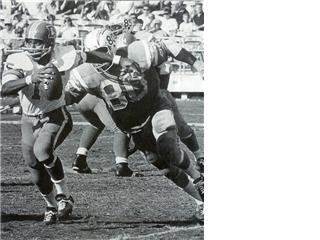
But UNO Head Football Coach Al Caniglia, one of the winningest coaches in school history, had no reservations taking him as a QB. Seeing limited duty as a freshman backup to incumbent Carl Meyers, Briscoe improved his numbers each year as a starter. After a feeling-out process as a sophomore, when he went 73 of 143 for 939 yards in the air and rushed for another 370 yards on the ground, his junior year he completed 116 of 206 passes for 1,668 yards and ran 120 times for 513 yards to set a school total offense record of 2,181 yards in leading UNO to a 6-5 mark.
What was to originally have been his senior year, 1966, got waylaid, as did nearly his entire future athletic career, when in an indoor summer pickup hoops game he got undercut and took a hard, headfirst spill to the floor. Numb for a few minutes, he regained feeling and was checked out at a local hospital, which gave him a clean bill of health.
Even with a lingering stiff neck, he started the ‘66 season where he left off, posting a huge game in the opener, before feeling a pop in his throbbing neck that sent him “wobbling” to the sidelines. A post-game x-ray revealed a fractured vertebra, perhaps the result of his preseason injury, meaning he’d risked permanent paralysis with every hit he absorbed. Given no hope of playing again, he sat out the rest of the year and threw himself into academics and school politics. After receiving his military draft notice, he anxiously awaited word of a medical deferment, which he got. Without him at the helm, UNO crashed to a 1-9 mark.
Then, a curious thing happened. On a follow-up medical visit, he was told his broken vertebra was recalcifying enough to allow him to play again. He resumed practicing in the spring of ‘67 and by that fall was playing without any ill effects. Indeed, he went on to have a spectacular final season, attracting national attention with his dominating play in a 7-3 campaign, compiling season marks with his 25 TD throws and 2,639 yards of total offense, including a dazzling 401-yard performance versus tough North Dakota State at Rosenblatt Stadium.
Projected by pro scouts at cornerback, a position he played sparingly in college, Briscoe still wanted a go at QB, so, on the advice of Al Caniglia he negotiated with the Denver Broncos, who selected him in the 14th round, to give him a look there, knowing the club held a three-day trial open to the public and media.
“I had a lot of confidence in my ability,” Briscoe said, “and I felt given that three-days at least I would have a showcase to show what I could do. I wanted that forum. When I got it, that set the tone for history to be made.”
At the trial Briscoe turned heads with the strength and accuracy of his throws but once fall camp began found himself banished to the defensive backfield, his QB dreams seemingly dashed. He earned a starting cornerback spot but injured a hamstring before the ‘68 season opener.
After an 0-2 start in which the Denver offense struggled mightily out of the gate, as one QB after another either got hurt or fell flat on his face, Head Coach Lou Saban finally called on Briscoe in the wake of fans and reporters lobbying for the summer trial standout to get a chance. Briscoe ran with the chance, too, despite the fact Saban, whose later actions confirmed he didn’t trust a black QB, only gave him a limited playbook to run. In 11 games, the last 7 as starter, Briscoe completed 93 of 224 passes for 1,589 yards with 14 TDs and 13 INTs and he ran 41 times for 308 yards and 3 TDs in helping Denver to a 5-6 record in his 11 appearances, 5-2 as a starter.
Briscoe proved an effective improviser, using his athleticism to avoid the rush, buy time and either find the open receiver or move the chains via scrambling. “Sure, my percentage was low, because initially they didn’t give me many plays, and so I was out there played street ball…like I was down at Kountze Park again…until I learned the cerebral part of the game and then I was able to improve my so-called efficiency,” is how Briscoe describes his progression as an NFL signal caller.
By being branded “a running” — read: undisciplined — quarterback in an era of strictly drop back pocket passers, with the exception of Fran Tarkenton, who was white, Briscoe said blacks aspiring to play the position faced “a stigma” it took decades to overcome.
Ironically, he said, “I never, ever considered myself a black quarterback. I was just a quarterback. It’s like I never thought about size either. When I went out there on the football field, hey, I was a player.”
All these years later, he still bristles at the once widely-held notions blacks didn’t possess the mechanics to throw at the pro level or the smarts to grasp the subtleties of the game or the leadership skills to command whites. “How do you run in 14 touchdown passes? I could run, sure. I could buy more time, yeah. But if you look at most of my touchdown passes, they were drop back passes. I led the team to five wins in seven starts. We played an exciting brand of football. Attendance boomed. If I left any legacy, it’s that I proved the naysayers wrong about a black man manning that position…even if I never played (QB) again.”

Despite his solid performance — he finished second in Rookie of the Year voting — he was not invited to QB meetings Saban held in Denver the next summer and was traded only weeks before the ‘69 regular season to the Buffalo Bills, who wanted him as a wide receiver.
His reaction to having the quarterback door slammed in his face? “I realized that’s the way it was. It was reality. So, it wasn’t surprising. Disappointing? Yes. All I wanted and deserved was to compete for the job. Was I bitter? No. If I was bitter I would have quit and that would have been the end of it. As a matter of fact, it spurred me to prove them wrong. I knew I belonged in the NFL. I just had to make the adjustment, just like I’ve been doing all my life.”
The adversity Briscoe has faced in and out of football is something he uses as life lessons with the at-risk youth he counsels in his Boys and Girls Club role. “I try to tell them that sometimes life’s not fair and you have to deal with it. That if you carry a bitter pill it’s going to work against you. That you just have to roll up your sleeves and figure out a way to get it done.”
While Briscoe never lined up behind center again, soon after he left Denver other black QBs followed — Joe Gilliam, Vince Evans, Doug Williams and, as a teammate in Buffalo, James Harris, whom he tutored. All the new faces confronted the same pressures and frustrations Briscoe did earlier. It wasn’t until the late 1980s, when Williams won a Super Bowl with the Redskins and Warren Moon put up prolific numbers with the Houston Oilers, that the black QB stigma died.
Briscoe was not entirely aware of the deep imprint he made until attending a 2001 ceremony in Nashville remembering the late Gilliam. “All the black quarterbacks, both past and present, were there,” said Briscoe, naming everyone from Aaron Brooks (New Orleans Saints) to Dante Culpepper (Minnesota Vikings) to Michael Vick (Atlanta Falcons).
“The young kids came up to me and embraced me and told me, ‘Thank you for setting the tone.’ Now, there’s like 20 black quarterbacks on NFL rosters, and for them to give me kudos for paving the way and going through what I went through hit me. That was probably the first time I realized it was a history-making event. The young kids today know about the problems we faced and absorbed in order for them to get a fair shot and be in the position they are.”
Making the Buffalo roster at a spot he’d never played before proved one of Briscoe’s greatest athletic challenges and accomplishments. He not only became a starter but soon mastered the new position, earning 1970 All-Pro honors in only his second year, catching 57 passes for 1,036 yards and 8 TDs. Then, in an example of bittersweet irony, Saban was named head coach of the moribund Bills in 1972 and promptly traded Briscoe to the powerful Miami Dolphins. The move, unpopular with Bills’ fans, once again allowed Briscoe to intersect with history as he became an integral member of the Dolphins’ perfect 17-0 1972 Super Bowl championship team and the 1973 team that repeated as champs.
Following an injury-plagued ‘74 season, Briscoe became a vagabond — traded four times in the space of one year — something he attributes to his involvement in the 1971 lawsuit he and five other players filed against then-NFL commissioner Pete Rozelle, an autocrat protecting owners’ interests, in seeking the kind of free agency and fair market value that defines the game today. Briscoe and his co-complainants won the suit against the so-called Rozelle Rule but within a few years they were all out of the game, labeled troublemakers and malcontents.
His post-football life began promisingly enough. A single broker, he lived the L.A. high life. Slipping into a kind of malaise, he hung with “an unsavory crowd” — partying and doing drugs. His gradual descent into addiction made him a transient, frequenting crack houses in L.A.’s notorious Ho-Stroll district and holding down jobs only long enough to feed his habit. The once strapping man withered away to 135 pounds. His first marriage ended, leaving him estranged from his kids. Ex-teammates like James Harris and Paul Warfield, tried helping, but he was unreachable.
“I strayed away from the person I was and the people that were truly my friends. When I came back here I was trying to run away from my problems,” he said, referring to the mid-’80s, when he lived in Omaha, “and it got worse…and in front of my friends and family. At least back in L.A. I could hide. I saw the pity they had in their eyes but I had no pride left.”
Perhaps his lowest point came when a local bank foreclosed on his Super Bowl rings after he defaulted on a loan, leading the bank to sell them over e-bay. He’s been unable to recover them.
He feels his supreme confidence bordering on arrogance contributed to his addiction. “I never thought drugs could get me,” he said. “I didn’t realize how diabolical and treacherous drug use is. In the end, I overcame it just like I overcame everything else. It took 12 years…but there’s some people that never do.” In the end, he said, he licked drugs after serving a jail term for illegal drug possession and drawing on that iron will of his to overcome and to start anew. He’s made amends with his ex-wife and with his now adult children.
Clean and sober since 1991, Briscoe now shares his odyssey with others as both a cautionary and inspirational tale. Chronicling his story in his book, The First Black Quarterback, was “therapeutic.” An ESPN documentary retraced the dead end streets his addict’s existence led him to, ending with a blow-up of his fingers, bare any rings. Briscoe, who dislikes his life being characterized by an addiction he’s long put behind him, has, after years of trying, gotten clearance from the Dolphins to get duplicate Super Bowl rings made to replace the ones he squandered.
For him, the greatest satisfaction in reclaiming his life comes from seeing how glad friends and family are that the old Marlin is back. “Now, they don’t even have to ask me, ‘Are you OK?’ They know that part of my life is history. They trust me again. That’s the best word I can use to define where I am with my life now. Trust. People trust me and I trust myself.”
Related Articles
- Black like me (cbc.ca)
- Black like me: CFL QB legacy (cbc.ca)
- UNO Wrestling Dynasty Built on a Tide of Social Change (leoadambiga.wordpress.com)
- Today’s Exploration: Omaha’s History of Racial Tension (theprideofnebraska.blogspot.com)
- Omaha Native Steve Marantz Looks Back at the City’s ’68 Racial Divide Through the Prism of Hoops in His New Book, ‘The Rhythm Boys of Omaha Central’ (leoadambiga.wordpress.com)
- Back in the Day, Native Omaha Days is Reunion, Homecoming, Heritage Celebration and Party All in One (leoadambiga.wordpress.com)
- Eric Crouch To Play For UFL’s Omaha Nighthawks, Fulfill Destiny (sbnation.com)
Categories: African-American Culture, Athletics, Books, Football, Marlin Briscoe, Omaha, Omaha Black Sports Legends, Out to Win: The Roots of Greatness (a series), Race, Sports, UNO (University of Nebraska at Omaha), Writing
African-American Culture, Black Sports Legends, Denver Broncos, Football, Marlin Briscoe, Miami Dolphins, National Football League, Nebraska Black Sports Hall of Fame, Omaha, Omaha Nebraska, Omaha South High School, Sports, University of Nebraska at Omaha
Bob Gibson, the Master of the Mound remains his own man years removed from the diamond (from my Omaha Black Sports Legends series, Out to Win: The Roots of Greatness)
July 18, 2010
4 comments

Image via Wikipedia
Omaha’s bevy of black sports legends has only recently begun to get their due here. With the inception of the Nebraska Black Sports Hall of Fame a few years ago, more deserving recognition has been accorded these many standouts from the past, some of whom are legends with a small “l” and some of whom are full-blown legends with a capital “L.” As a journalist I’ve done my part bringing to light the stories of some of these individuals. The following story is about someone who is a Legend by any standard, Bob Gibson. This is the third Gibson story I’ve posted to this blog site, and in some ways it’s my favorite. When you’re reading it, keep in mind it was written and published 13 years ago. The piece appeared in the New Horizons and I’m republishing it here to coincide with the newest crop of inductees in the Nebraska Black Sports Hall of Fame. Gibson was fittingly inducted in that Hall’s inaugural class, as he is arguably the greatest sports legend, bar none, ever to come out of Nebraska.

Bob Gibson, the Master of the Mound remains his own man years removed from the diamond (from my Omaha Black Sports Legends series, Out to Win: The Roots of Greatness)
©by Leo Adam Biga
Orignally published in the New Horizons
Bob Gibson. Merely mentioning the Hall of Fame pitcher’s name makes veteran big league baseball fans nostalgic for the gritty style of play that characterized his era. An era before arbitration, Astro-Turf, indoor stadiums and the Designated Hitter. Before the brushback was taboo and going the distance a rarity.
No one personified that brand of ball better than Gibson, whose gladiator approach to the game was hewn on the playing fields of Omaha and became the stuff of legend in a spectacular career (1959-1975) with the St. Louis Cardinals. A baseball purist, Gibson disdains changes made to the game that promote more offense. He favors raising the mound and expanding the strike zone. Then again, he’s an ex-pitcher.
Gibson was an iron man among iron men – completing more than half his career starts. The superb all-around athlete, who starred in baseball and basketball at Tech High and Creighton University, fielded his position with great skill, ran the bases well and hit better than many middle infielders. He had a gruff efficiency and gutsy intensity that, combined with his tremendous fastball, wicked slider and expert control, made him a winner.
Even the best hitters never got comfortable facing him. He rarely spoke or showed emotion on the mound and aggressively backed batters off the plate by throwing inside. As a result, a mystique built-up around him that gave him an extra added edge. A mystique that’s stuck ever since.
Now 61, and decades removed from reigning as baseball’s ultimate competitor, premier power pitcher and most intimidating presence, he still possesses a strong, stoic, stubborn bearing that commands respect. One can only imagine what it felt like up to bat with him bearing down on you.
As hard as he was on the field, he could be hell to deal with off it too, particularly with reporters after a loss. This rather shy man has closely, sometimes brusquely, guarded his privacy. The last few years, though, have seen him soften some and open up more. In his 1994 autobiography “Stranger to the Game” he candidly reviewed his life and career.
More recently, he’s promoted the Bob Gibson All-Star Classic – a charitable golf tournament teeing off June 14 at the Quarry Oaks course near Mahoney State Park. Golfers have shelled out big bucks to play a round with Gibson and fellow sports idols Willie Mays, Stan Musial, Sandy Koufax, Whitey Ford, Lou Brock and Oscar Robertson as well as Nebraska’s own Bob Boozer, Ron Boone and Gale Sayers and many others. Proceeds will benefit two causes dear to Gibson – the American Lung Association of Nebraska and BAT – the Baseball Assistance Team.
When Gibson announced the event many were surprised to learn he still resides here. He and his wife Wendy and their son Christopher, 12, live in a spacious home in Bellevue’s Fontenelle Hills.
His return to the public arena comes, appropriately enough, in the 50th anniversary season of the late Jackie Robinson’s breaking of Major League Baseball’s color barrier. Growing up in Omaha’s Logan Fontenelle Housing Projects, Gibson idolized Robinson. “Oh, man, he was a hero,” he told the New Horizons. “When Jackie broke in, I was just a kid. He means even more now than he did then, because I understand more about what he did” and endured. When Gibson was at the peak of his career, he met Robinson at a Washington, D.C. fundraiser, and recalls feeling a deep sense of “respect” for the man who paved the way for him and other African-Americans in professional athletics.
In a recent interview at an Omaha eatery Gibson displayed the same pointedness as his book. On a visit to his home he revealed a charming Midwestern modesty around the recreation room’s museum-quality display of plaques and trophies celebrating his storied baseball feats.
His most cherished prize is the 1968 National League Most Valuable Player Award. “That’s special,” he said. “Winning it was quite an honor because pitchers don’t usually win the MVP. Some pitchers have won it since I did, but I don’t know that a pitcher will ever win it again. There’s been some controversy whether pitchers should be eligible for the MVP or should be limited to the Cy Young.” For his unparalleled dominance in ‘68 – the Year of the Pitcher – he added the Cy Young to the MVP in a season in which he posted 22 wins, 13 shutouts and the lowest ERA (1.12) in modern baseball history. He won the ‘70 Cy Young too.

Despite his accolades, his clutch World Series performances (twice leading the Cardinals to the title) and his gaudy career marks of 251 wins, 56 shutouts and 3,117 strikeouts, he’s been able to leave the game and the glory behind. He said looking back at his playing days is almost like watching movie images of someone else. Of someone he used to be.
“That was another life,” he said. “I am proud of what I’ve done, but I spend very little time thinking about yesteryear. I don’t live in the past that much. That’s just not me. I pretty much live in the present, and, you know, I have a long way to go, hopefully, from this point on.”
Since ending his playing days in ‘75, Gibson’s been a baseball nomad, serving as pitching coach for the New York Mets in ‘81 and for the Atlanta Braves from ‘82 to ‘84, each time under Joe Torre, the current Yankee manager who is a close friend and former Cardinals teammate. He’s also worked as a baseball commentator for ABC and ESPN. After being away from the game awhile, he was brought back by the Cardinals in ‘95 as bullpen coach. Since ‘96 he’s served as a special instructor for the club during spring training, working four to six weeks with its talented young pitching corps, including former Creighton star Alan Benes, who’s credited Gibson with speeding his development.
Who does he like among today’s crop of pitchers? “There’s a lot of guys I like. Randy Johnson. Roger Clemens. The Cardinals have a few good young guys. And of course, Atlanta’s got three of the best.”
Could he have succeeded in today’s game? “I’d like to think so,” he said confidently.
He also performs PR functions for the club. “I go back several times to St. Louis when they have special events. You go up to the owners’ box and you have a couple cocktails and shake hands and be very pleasant…and grit your teeth,” he said. “Not really. Years ago it would have been very tough for me, but now that I’ve been so removed from the game and I’ve got more mellow as I’ve gotten older, the easier the schmoozing becomes.”
His notorious frankness helps explain why he’s not been interested in managing. He admits he would have trouble keeping his cool with reporters second-guessing his every move. “Why should I have to find excuses for something that probably doesn’t need an excuse? I don’t think I could handle that very well I’m afraid. No, I don’t want to be a manager. I think the door would be closed to me anyway because of the way I am – blunt, yes, definitely. I don’t know any other way.”
Still, he added, “You never say never. I said I wasn’t going to coach before too, and I did.” He doesn’t rule out a return to the broadcast booth or to a full-time coaching position, adding: “These are all hypothetical things. Until you’re really offered a job and sit down and discuss it with somebody, you can surmise anything you want. But you never know.”
He feels his outspokenness off the field and fierceness on it cost him opportunities in and out of baseball: “I guess there’s probably some negative things that have happened as a result of that, but that really doesn’t concern me that much.”
He believes he’s been misunderstood by the press, which has often portrayed him as a surly, angry man. “
When I performed, anger had nothing to do with it. I went out there to win. It was strictly business with me. If you’re going to have all these ideas about me being this ogre, then that’s your problem. I don’t think I need to go up and explain everything to you. Now, if you want to bother to sit down and talk with me and find out for yourself, then fine…”
Those close to him do care to set the record straight, though. Rodney Wead, a close friend of 52 years, feels Gibson’s occasional wariness and curtness stem, in part, from an innate reserve.
“He’s shy. And therefore he protects himself by being sometimes abrupt, but it’s only that he’s always so focused,” said Wead, a former Omaha social services director who’s now president and CEO of Grace Hill Neighborhood Services in St. Louis.

Indeed, Gibson attributes much of his pitching success to his fabled powers of concentration, which allowed him “to focus and block out everything else going on around me.” It’s a quality others have noted in him outside sports.
“Mentally, he’s so disciplined,” said Countryside Village owner Larry Myers, a former business partner. “He has this ability to focus on the task at hand and devote his complete energy to that task.”
If Gibson is sometimes standoffish, Wead said, it’s understandable: “He’s been hurt so many times, man. We’ve had some real, almost teary moments together when he’s reflected on some of the stuff he wished could of happened in Omaha and St. Louis.” Wead refers to Gibson’s frustration upon retiring as a player and finding few employment-investment opportunities open to him. Gibson is sure race was a factor. And while he went on to various career-business ventures, he saw former teammates find permanent niches within the game when he didn’t. He also waited in vain for a long-promised Anheuser-Busch beer distributorship from former Cardinals owner, the late August Busch. He doesn’t dwell on the disappointments in interviews, but devotes pages to them in his book.
Gibson’s long been outspoken about racial injustice. When he first joined the Cardinals at its spring training facility in St. Petersburg, Fla., black and white teammates slept and ate separately. A three-week stay with the Cardinals’ Columbus, Ga. farm team felt like “a lifetime,” he said, adding, “I’ve tried to erase that, but I remember it like it was yesterday.” He, along with black teammates Bill White and the late Curt Flood, staged a mini-Civil Rights movement within the organization – and conditions improved.
He’s dismayed the media now singles out baseball for a lack of blacks in managerial posts when the game merely mirrors society as a whole. “Baseball has made a lot more strides than most facets of our lives,” he said. “Have things changed in baseball? Yes. Have things changed everywhere else? Yes. Does there need to be a lot more improvement? Yes. Some of the problems we faced when Jackie Robinson broke in and when I broke in 10 years later don’t exist, but then a lot of them still do.”
He’s somewhat heartened by acting baseball commissioner Bud Selig’s recent pledge to hire more minorities in administrative roles. “I’m always encouraged by some statements like that, yeah. I’d like to wait and see what happens. Saying it and doing it is two different things.”
He’s also encouraged by golfer Tiger Woods’ recent Masters’ victory.“What’s really great about him being black is that it seems to me white America is always looking for something that black Americans can’t do, and that’s just one other thing they can scratch off their list.” Gibson’s All-Star Classic will be breaking down barriers too by bringing a racially mixed field into the exclusive circle of power and influence golf represents.
Some have questioned why he’s chosen now to return to the limelight. “It’s not to get back in the public eye,” Gibson said of the golf classic. “The reason I’m doing this is to raise money for the American Lung Association and BAT.”
Efforts to battle lung disease have personal meaning for Gibson, who’s a lifelong asthma sufferer. A past Lung Association board member, he often speaks before groups of young asthma patients “to convince them that you can participate in sports even though you have asthma…I think it’s helpful to have somebody there that went through the same thing and, being an ex-baseball player, you get their attention.”
He serves on the board of directors of BAT – the tourney’s other beneficiary. The organization assists former big league and minor league players, managers, front office professionals and umpires who are in financial distress. “Unfortunately, most people think all ex-players are multimillionaires,” he said. “Most are not. Through BAT we try to do what we can to help people of the baseball family.”
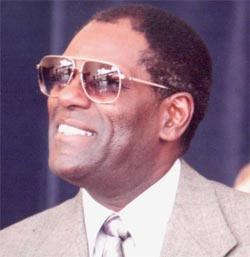
He hopes the All-Star Classic raises half-a-million dollars and gives the state “something it’s never seen before” – a showcase of major sports figures equal to any Hall of Fame gathering. Gibson said he came up with the idea over drinks one night with his brother Fred and a friend. From there, it was just a matter of calling “the guys” – as he refers to legends like Mays. Gibson downplays his own legendary status, but is flattered to be included among the game’s immortals.
What’s amazing is that baseball wasn’t his best sport through high school and college – basketball was. His coach at Tech, Neal Mosser, recalls Gibson with awe: “He was unbelievable,” said Mosser. “He would have played pro ball today very easily. He could shoot, fake, run, jump and do everything the pros do today. He was way ahead of his time.”
Gibson was a sports phenom, excelling in baseball, basketball, football and track for area youth recreation teams. He enjoyed his greatest success with the Y Monarchs, coached by his late brother Josh, whom Mosser said “was a father-figure” to Gibson. Josh drilled his younger brother relentlessly and made him the supreme competitor he is. After a stellar career playing hardball and hoops at Creighton, Gibson joined the Harlem Globetrotters for one season, but an NBA tryout never materialized.
No overnight success on the pro diamond, Gibson’s early seasons, including stints with the Omaha Cardinals, were learning years. His breakthrough came in ‘63, when he went 18-9. He only got better with time.
Gibson acknowledges it’s been difficult adjusting to life without the competitive outlet sports provided. “I’ll never find anything to test that again,” he said, “but as you get older you’re not nearly as competitive. I guess you find some other ways to do it, but I haven’t found that yet.”
What he has found is a variety of hobbies that he applies the same concentrated effort and perfectionist’s zeal to that he did pitching. One large room in his home is dominated by an elaborate, fully-operational model train layout he designed himself. He built the layout’s intricately detailed houses, buildings, et all, in his own well-outfitted workshop, whose power saw and lathe he makes use of completing frequent home improvement projects. He’s made several additions to his home, including a sun room, sky lights, spa and wine cellar.
“I’m probably more proud of that,” he said, referring to his handiwork, “than my career in baseball. If I hadn’t been in baseball, I think I would of probably ended up in the construction business.”
The emotional-physical-financial investment Gibson’s made in his home is evidence of his deep attachment to Nebraska. Even at the height of his pro career he remained here. His in-state business interests have included radio station KOWH, the Community Bank of Nebraska and Bob Gibson’s Spirits and Sustenance, a restaurant he was a partner in from
1979 to 1989. Nebraska, simply, is home. “I don’t know that you can find any nicer people,” he said, “and besides my family’s been here. Usually when you move there’s some type of occupation that takes you away. I almost moved to St. Louis, but there were so many (racial) problems back when I was playing…that I never did.”
His loyalty hasn’t gone unnoticed. “He didn’t get big-headed and go away and hide somewhere,” said Jerry Parks, a Tech teammate who today is Omaha’s Parks, Recreation and Public Property Director. “What I admire most about him is that he’s very loyal to people he likes, and that’s priceless for me,” said Rodney Wead. “He’s helped a lot of charitable causes very quietly…He’s certainly given back to Omaha over the years,” said Larry Myers.
Jerry Mosser may have summed it up best: “He’s just a true-blue guy.”
Because Gibson’s such a private man, his holding a celebrity golf tournament caught many who know him off-guard. “I was as surprised as anyone,” said Wead, “but so pleased – he has so much to offer.” Gibson himself said: “I have never done anything like this before. If I don’t embarrass myself too badly, I’ll be fine.”
If anything, Gibson will rise to the occasion and show grace under fire. Just like he used to on the mound – when he’d rear back and uncork a high hard one. Like he still does in his dreams. “Oh, I dream about it (baseball) all the time,” he said. “It drives me crazy. I guess I’m going to do that the rest of my life.”
Thanks for the memories, Bob. And the sweet dreams.
Related Articles
- Gibson (joeposnanski.si.com)
- It’s finally the Year of the Pitcher again (denverpost.com)
- National League Treasures: The Best Players in Each Franchise’s History (bleacherreport.com)
- Book Review: Sixty Feet, Six Inches by Bob Gibson & Reggie Jackson (othemts.wordpress.com)
- Native Omahans Take Stock of the African-American Experience in Their Hometown (leoadambiga.wordpress.com)

Categories: African-American Culture, Athletics, Baseball, Bob Gibson, North Omaha, Omaha Black Sports Legends, Out to Win: The Roots of Greatness (a series), Sports, Writing
1968: Year of the Pitcher, African-American Culture, Baseball, Black Sports Legends, Bob Gibson, Cy Young Award, MLB Hall of Fame, Nebraska Black Sports Hall of Fame, St. Louis Cardinals, World Series
Don Benning: Man of Steel (from my Omaha Black Sports Legends series, Out to Win: The Roots of Greatness)
July 17, 2010
5 comments
This is another installment from the series I wrote about Omaha’s Black Sports Legends. That series, Out to Win: The Roots of Greatness, appeared in The Reader (www.thereader.com) in 2004-2005. The subject of this article is Don Benning, who like Marion Hudson, broke barriers left and right. Most of his groundbreaking accomplishments came at Omaha University, now known as the University of Nebraska at Omaha, where he was head wrestling coach, an assistant football coach, and a professor. To find out more about Benning’s time as UNO wrestling coach read my story, UNO Wrestling Dynasty Built on a Tide of Social Change, on this same blog site. You can also find the complete Out to Win series on this blog.
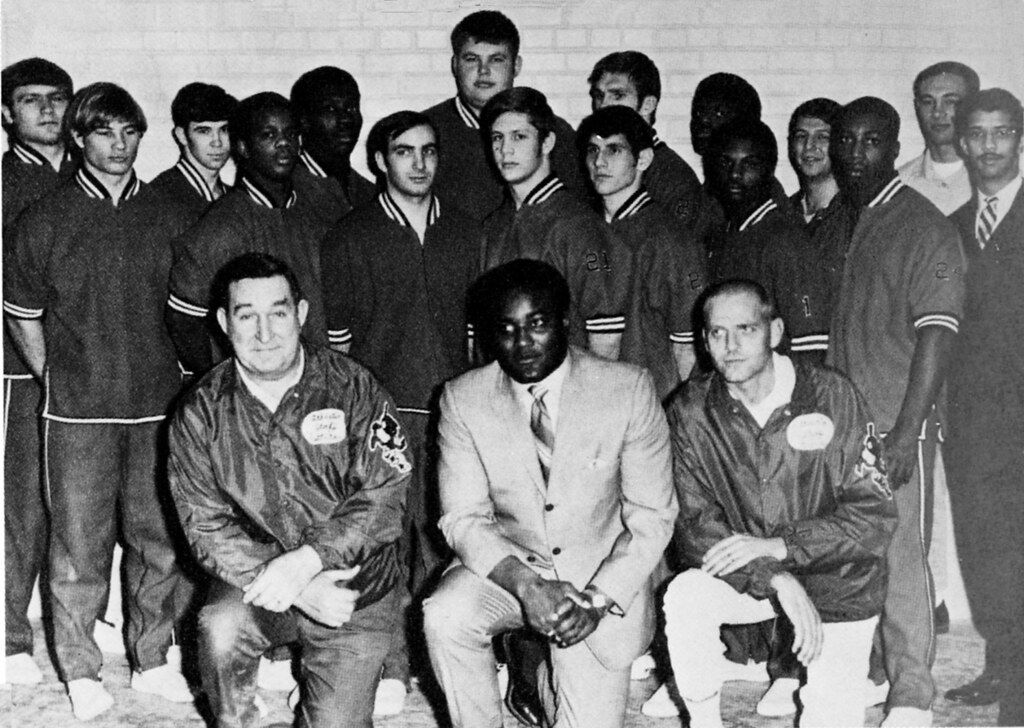
Don Benning: Man of Steel (from my Omaha Black Sports Legends series, Out to Win: The Roots of Greatness)
©by Leo Adam Biga
Originally published in The Reader (www.thereader.com) as part of my Omaha Black Sports Legends series, Out to Win: The Roots of Greatness)
Wrestling is a proving ground. In an ultimate test of will and endurance, the wrestler first battles himself and then his opponent until one is left standing with arms raised overhead in victory. In a life filled with mettle-testing experiences both inside and outside athletics, Don Benning has made the sport he became identified with a personal metaphor for grappling with the challenges a proud, strong black man like himself faces in a racially intolerant society.
A multi-sport athlete at North High School and then-Omaha University (now UNO), the inscrutable Benning brought the same confidence and discipline he displayed as a competitor on the mat and the field to his short but legendary coaching tenure at UNO and he’s applied those same qualities to his 42-year education career, most of it spent with the Omaha Public Schools. Along the way, this man of iron and integrity, who at 68 is as solid as his bedrock principles, made history.
At UNO, he forged new ground as America’s first black head coach of a major team sport at a mostly white university. He guided his 1969-70 squad to a national NAIA team championship, perhaps the first major team title won by a Nebraska college or university. His indomitable will led a diverse mix of student-athletes to success while his strong character steered them, in the face of racism, to a higher ground.
When, in 1963, UNO president Milo Bail gave the 26-year-old Benning, then a graduate fellow, the chance to he took the reins over the school’s fledgling wrestling program, the rookie coach knew full well he would be closely watched.
“Because of the uniqueness of the situation and the circumstances,” he said, “I knew if I failed I was not going to be judged by being Don Benning, it was going to be because I was African-American.”
Besides serving as head wrestling coach and as an assistant football staffer, he was hired as the school’s first full-time black faculty member, which in itself was enough to shake the rafters at the staid institution.
“Those old stereotypes were out there — Why give African-Americans a chance when they don’t really have the ability to achieve in higher education? I was very aware those pressures were on me,” he said, “and given those challenges I could not perform in an average manner — I had to perform at the highest level to pass all the scrutiny I would be having in a very visible situation.”
Benning’s life prepared him for proving himself and dealing with adversity.
“The fact of the matter is,” he said, “minorities have more difficult roads to travel to achieve the American Dream than the majority in our society. We’ve never experienced a level playing field. It’s always been crooked, up hill, down hill. To progress forward and to reach one’s best you have to know what the barriers or pitfalls are and how to navigate them. That adds to the difficulty of reaping the full benefits of our society but the absolute key is recognizing that and saying, ‘I’m not going to allow that to deter me from getting where I want to get.’ That was already a motivating factor for me from the day I got the job. I knew good enough wasn’t good enough — that I had to be better.”
Shortly after assuming his UNO posts his Pullman Porter father and domestic worker mother died only weeks apart. He dealt with those losses with his usual stoicism. As he likes to say, “Adversity makes you stronger.”
Toughing it out and never giving an inch has been a way of life for Benning since growing up the youngest of five siblings in the poor, working-class 16th and Fort Street area. He said, “Being the only black family in a predominantly white northeast Omaha neighborhood — where kids said nigger this or that or the other — it translated into a lot of fights, and I used to do that daily. In most cases we were friends…but if you said THAT word, well, that just meant we gotta fight.”
Don Benning

Despite their scant formal education, he said his parents taught him “some valuable lessons scholars aren’t able to teach.” Times were hard. Money and possessions, scarce. Then, as Benning began to shine in the classroom and on the field (he starred in football, wrestling and baseball), he saw a way out of the ghetto. Between his work at Kellom Community Center, where he later coached, and his growing academic-athletic success, Benning blossomed.
“It got me more involved, it expanded my horizons and it made me realize there were other things I wanted,” he said.
But even after earning high grades and all-city athletic honors, he still found doors closed to him. In grade school, a teacher informed him the color of his skin was enough to deny him a service club award for academic achievement. Despite his athletic prowess Nebraska and other major colleges spurned him.
At UNO, where he was an oft-injured football player and unbeaten senior wrestler, he languished on the scrubs until “knocking the snot” out of a star gridder in practice, prompting a belated promotion to the varsity. For a road game versus New Mexico A&M he and two black mates had to stay in a blighted area of El Paso, Texas — due to segregation laws in host Las Cruces, NM — while the rest of the squad stayed in plush El Paso quarters. Terming the incident “dehumanizing,” an irate Benning said his coaches “didn’t seem to fight on our behalf while we were asked to give everything for the team and the university.”
Upon earning his secondary education degree from UNO in 1958 he was dismayed to find OPS refusing blacks. He was set to leave for Chicago when Bail surprised him with a graduate fellowship (1959 to 1961). After working at the North Branch YMCA from ‘61 to ‘63, he rejoined UNO full-time. Still, he met racism when whites automatically assumed he was a student or manager, rather than a coach, even though his suit-and-tie and no-nonsense manner should have been dead giveaways. It was all part of being black in America.
To those who know the sanguine, seemingly unflappable Benning, it may be hard to believe he ever wrestled with doubts, but he did.
“I really had to have, and I didn’t know if I had it at that particular time, a maturity level to deal with these issues that belied my chronological age.”
Before being named UNO’s head coach, he’d only been a youth coach and grad assistant. Plus, he felt the enormous symbolic weight attending the historic spot he found himself in.
“You have to understand in the early 1960s, when I was first in these positions, there wasn’t a push nationally for diversity or participation in society,” he said. “The push for change came in 1964 with the Civil Rights Act, when organizations were forced to look at things differently. As conservative a community as Omaha was and still is it made my hiring more unusual. I was on the fast track…
“On the academic side or the athletic side, the bottom line was I had to get the job done. I was walking in water that hadn’t been walked in before. I could not afford not to be successful. Being black and young, there was tremendous pressure…not to mention the fact I needed to win.”
Win his teams did. In eight seasons at the helm Benning’s UNO wrestling teams compiled an 87-24-4 dual mark, including a dominating 55-3-2 record his last four years. Competing at the NAIA level, UNO won one national team title and finished second twice and third once, crowning several individual national champions. But what really set UNO apart is that it more than held its own with bigger schools, once even routing the University of Iowa in its own tournament. Soon, the Indians, as UNO was nicknamed, became known as such a tough draw that big-name programs avoided matching them, less they get embarrassed by the small school.
The real story behind the wrestling dynasty Benning built is that he did it amid the 1960s social revolution and despite meager resources on campus and hostile receptions away from home. Benning used the bad training facilities at UNO and the booing his teams got on the road as motivational points.
His diverse teams reflected the times in that they were comprised, like the ranks of Vietnam War draftees, of poor white, black and Hispanic kids. Most of the white athletes, like Bernie Hospodka, had little or no contact with blacks before joining the squad. The African-American athletes, empowered by the Black Power movement, educated their white teammates to inequality. Along the way, things happened — such as slights and slurs directed at Benning and his black athletes, including a dummy of UNO wrestler Mel Washington hung in effigy in North Carolina — that forged a common bond among this disparate group of men committed to making diversity work in the pressure-cooker arena of competition.
“We went through a lot of difficult times and into a lot of hostile environments together and Don was the perfect guy for the situation,” said Hospodka, the 1970 NAIA titlist at 190 pounds. “He was always controlled, always dignified, always right, but he always got his point across. He’s the most mentally tough person you’d ever want to meet. He’s one of a kind. We’re all grateful we got to wrestle for Don. He pushed us very hard. He made us all better. We would go to war with him anytime.”
Brothers Roy and Mel Washington, winners of five individual national titles, said Benning was a demanding “disciplinarian” whom, Mel said, “made champions not only on the mat but out there in the public eye, too. He was more than a coach, he was a role model, a brother, a father figure.” Curlee Alexander, 115-pound NAIA titlist in 1969 and a wildly successful Omaha prep wrestling coach, said the more naysayers “expected Don to fail, the more determined he was to excel. By his look, you could just tell he meant business. He had that kind of presence about him.”
Away from the mat, the white and black athletes may have gone their separate ways but where wrestling was concerned they were brothers rallying around their perceived identity as outcasts from the poor little school with the black coach.
“It’s tough enough to develop a team to such a high skill level that they win a national championship if you have no other factors in the equation,” Benning said, “but if you have in the equation prejudice and discrimination that you and the team have to face then that makes it even more difficult. But those things turned into a rallying point for the team.
“The white and black athletes came to understand they had more commonalities than differences. It was a sociological lesson for everyone. The key was how to get the athletes to share a common vision and goal. We were able to do that. The athletes that wrestled for me are still friends today. They learned about relationships and what the real important values are in life.”
His wrestlers still have the highest regard for him and what they shared.
“I don’t think I could have done what I did with anyone else,” Hospodka said. “Because of the things we went through together I’m convinced I’m a better human being. There’s a bond there I will never forget.” Mel Washington said, “I can’t tell you how much this man has done for me. I call him the legend.” The late Roy Washington, who changed his name to Dhafir Muhammad, said, “I still call coach for advice.” Alexander credits Benning with keeping him in school and inspiring his own coaching/teaching path.
After establishing himself as a leader Benning was courted by big-time schools to head their wrestling and football programs. Instead, he left the profession in 1971, at age 34, to pursue an educational administration career. Why leave coaching so young? Family and service. At the time he and wife Marcidene had begun a family — today they are parents to five grown children and two grandkids — and when coaching duties caused him to miss a daughter’s birthday, he began having second thoughts about the 24/7 grind athletics demands.
Besides, he said, he was driven to address “the inequities that existed in the school system. I thought I could make a difference in changing policies and perhaps making things better for all students, specifically minority students. My ultimate goal was to be superintendent.”

Working to affect change from within, Benning feels he “changed attitudes” by showing how “excellence could be achieved through diversity.” During his OPS tenure, he operated, just like at Omaha University, “in a fish bowl.” Making his situation precarious was the fact he straddled two worlds — the majority culture that viewed him variously as a token or a threat and the minority culture that saw him as a beacon of hope.
But even among the black community, Benning said, there was a militant segment that distrusted one of their own working for The Man.
“You really weren’t looked upon too kindly if you were viewed as part of the system,” he said. “On the other side of it, working in an overwhelmingly majority white situation presented its own particular set of challenges.”
What got him through it all was his own core faith in himself. “Evidently, some people would say I’m a confident individual. A few might say I’m arrogant. I would say I’m highly confident. I can’t overemphasize the fact you have to have a strong belief in self and you also have to realize that a lot of times a leader has to stand alone. There are issues and problems that set him or her apart from the crowd and you can’t hide from it. You either handle it or you fail and you’re out.”
Benning handled it with such aplomb that he: brought UNO to national prominence, laying the foundation for its four-decade run of excellence on the mat; became a distinguished assistant professor; and built an impressive resume as an OPS administrator, first as assistant principal at Central High School, then as director of the Department of Human-Community Relations and finally as assistant superintendent.
During his 26-year OPS career he spearheaded Omaha’s smooth desegregation plan, formed the nationally recognized Adopt-a-School business partnership and advocated for greater racial equity within the schools through such initiatives as the Minority Intern Program and the Pacesetter Academy, an after school program for at-risk kids. Driving him was the responsibility he felt to himself, and by extension, fellow blacks, to maximize his and others’ abilities.

“I had a vision and a mission for myself and I set about developing a plan so I could reach my goal, and that was basically to be the best I could be. As a coach and educator what I have really enjoyed is helping people grow and reach their potential to be the best they can be. That’s my goal, that’s my mission, and I try to hold to it.”
His OPS career ended prematurely when, in 1997, he retired after being snubbed for the district’s superintendency and being asked by current schools CEO John Mackiel to reapply for the assistant superintendent’s post he’d held since 1979. Benning called it “an affront” to his exemplary record and longtime service.
About his decision to leave OPS, he said, “I could have continued as assistant superintendent, but I chose not to because who I am and what I am is not negotiable.” A critic of neighborhood schools, he did not bend on a practice he deems detrimental to the quality of education for minorities. “I compromised on a lot of things but not on those issues. The thing I’ve tried not to do, and I don’t think I have, is negotiate away my integrity, my beliefs, my values.”
Sticking to his guns has exacted a toll. “I’ve battled against the odds all my life to achieve the successes I have and there’s been some huge prices to pay for those successes.”

Curlee Alexander
His unwavering stances have sometimes made him an unpopular figure. His staunch loyalty to his hometown has meant turning down offers to coach and run school districts elsewhere. His refusal to undermine his principles has found him traveling a hard, bitter, lonely road, but it’s a path whose direction is true to his heart.
“I found out long ago there were things I would do that didn’t please every one and in those types of experiences I had to kind of stand alone or submit. I developed a strong inner being where I somewhat turned inward for strength. I kind of said to myself, I just want to do what I know to be right and if people don’t like it, well, that’s the way it is. I was ready to deal with the consequences. That’s the personality I developed from a very young age.”
Those who’ve worked with Benning see a man of character and conviction. Former OPS superintendent Norbert Schuerman described him as “proud, determined, disciplined, opinionated, committed, confident, political,” adding, “Don kept himself very well informed on major issues and because he was not bashful in expressing his views, he was very helpful in sensitizing others to race relations. His integrity and his standing in the community helped minimize possible major conflicts.”
OPS Program Director Kenneth Butts said, “He’s a very principled man. He’s very demanding. He’s very much about doing what is right rather than what is politically expedient. He cares. He’s all about equity and folks being treated fairly.”
After the flap with OPS Benning left the job on his own terms rather than play the stooge, saying, “The Omaha Public Schools situation was a major disappointment to me…To use a boxing analogy, it staggered me, but it didn’t knock me down and it didn’t knock me out. Having been an athlete and a coach and won and lost a whole lot in my life I would be hypocritical if I let disappointment in life defeat me and to change who I am. I quickly moved on.”
Indeed, the same year he left OPS he joined the faculty at the University of Nebraska-Lincoln, where he is coordinator of urban education and senior lecturer in educational administration in its Teachers College. In his current position he helps prepare a new generation of educators to deal with the needs of an ever more diverse school and community population.
Even with the progress he’s seen blacks make, he’s acutely aware of how far America has to go in healing its racial divide.
“This still isn’t a color-blind society. I don’t say that bitterly — that’s just a fact of life. But until we resolve the race issue, it will not allow us to be the best we can be as individuals and as a country,” he said.
As his own trailblazing cross-cultural path has proven, the American ideal of epluribus unum — “out of many, one” — can be realized. He’s shown the way.
“As far as being a pioneer, I never set out to be a part of history. I feel very privileged and honored having accomplished things no one else had accomplished. So, I can’t help but feel that maybe I’ve made a difference in some people’s lives and helped foster inclusiveness in our society rather than exclusiveness. Hopefully, I haven’t given up the notion I still can be a positive force in trying to make things better.”
Related Articles
- Coaching diversity slowly rising at FBS schools (thegrio.com)
- University regents approve Nebraska-Omaha’s D-I move (sports.espn.go.com)
- UNO Wrestling Dynasty Built on a Tide of Social Change (leoadambiga.wordpress.com)
Categories: African-American Culture, Athletics, Don Benning, Education, History, Omaha, Omaha Black Sports Legends, Out to Win: The Roots of Greatness (a series), Race, Social Justice, Sports, Wrestling, Writing
African-American Culture, Athletics, Black Sports Legends, Don Benning, Education, Nebraska Black Sports Hall of Fame, Omaha, Race, Social Justice, University of Nebraska at Omaha, UNO wrestling, Wrestling
Dana College Legend Marion Hudson, the greatest athlete you’ve never heard of before (from my Omaha Black Sports Legends series, Out to Win: The Roots of Greatness)
July 14, 2010
1 comment
Dana College in Blair, Neb. unexpectedly closed its doors this month, bringing an end to a small but proud institution. One chapter in the school’s history concerns an almost mythic-like figure named Marion Hudson. The following article tells the remarkable story of this gifted, multi-sport athlete who seemingly came out of nowhere to leave his mark behind at Dana. It was the early 1950s and he was a black student-athlete of legendary ability on Omaha‘s north side. Circumstances prevented him from ever demonstrating his talents in sanctioned high school competition, but the word got out and when all white Dana was looking to integrate its campus school officials asked around who might be a good candidate and they were referred to Hudson. He went there and immediately made an impact as a student-athlete. As you’ll read, his athletic exploits read like something out of fiction, but they were quite real. The reason you’ve never heard of Hudson is he never tried out for the Olympics in track and field and he never turned pro in football, levels of competition many felt he was capable of. Hudson’s life after college revolved around work and family, and then a series of health problems began breaking down his body. When I met him at the nursing home he resided in he was but a shell of his former self physically, but he still retained a fighting spirit and a sense of humor. He’s since passed.


Marion Hudson
My story was part of a series I wrote on Omaha’s Black Sports Legends entitled Out to Win: The Roots of Greatness. It appeared in The Reader (www.thereader.com) during 2004-2005. I hope to turn the series into a book. Dana College and Marion Hudson are both gone now, but they’ve left behind a rich legacy, and this is my small tribute to them.
In the coming days I will be adding more stories from the series on this site, including profiles of legends Bob Gibson, Bob Boozer, Gale Sayers, Ron Boone, and Johnny Rodgers, and profiles of other great athletes who, like Marion Hudson, you may not have heard of but deserve your attention.
Dana College Legend Marion Hudson, Tte greatest athlete you’ve never heard of before (From my Omaha Black Sports Legends series, Out to Win: The Roots of Greatness)
©by Leo Adam Biga
Originally published in The Reader (www.thereader.com) as part of my series Out to Win: The Roots of Greatness
You may think you know a lot about Omaha’s rich inner city athletic heritage. Sure, you know Bob Gibson, Bob Boozer, Gale Sayers, Ron Boone, Marlin Briscoe, Johnny Rodgers, Mike McGee, Ahman Green. But chances are you’ve never even heard of Marion Hudson, which doesn’t change the fact he’s arguably the greatest athlete to ever come out of Omaha or, for that matter, Nebraska, and consequently among the finest athletes in American history.
Outside the small circle of survivors who competed with him or watched his athletic brilliance unfold in sport after sport, this little-known giant from the 1950s is rarely mentioned. He remains obscure today because he competed for a tiny private school, Dana College near Blair, Neb., and never went pro. But, as you will see, he should be known alongside those others, both for the unique circumstances that brought him there and for his possessing such phenomenal all-around skills that some of his football and track records still stand 50 years later.
Choose any measure or cliche of athletic prowess and it can be accurately applied to Hudson. He could run like the wind. He was as strong as a bull. He could swing a bat with power. Throw a ball a mile. Jump out of the gym. “Yeah, they called me the Boy with Springs in His Legs,” he said from the Sorensen Rehabilitation and Assisted Living Facility in north Omaha he now calls home. Words are a struggle. What’s left of his body contorts from the strain, his gnarled fingers twitching and his wide face screwing up in a grimace. His once strapping body ravaged by the affects of diabetes and a series of strokes.
Hudson navigates his power wheelchair in the center’s dining hall to greet a rare visitor. His legs above his knees were amputated years ago and his left side is partially paralyzed. He wears a T-shirt and his sweat pants are knotted at the nubs of his stumps. An ever-present cap reads Pilgrim Baptist Church, where he was married and still worships today. He flashes the winning smile that made him the big man on campus at Dana long ago, and where he’s been recently rediscovered. In 2003, Dana hosted a Marion Hudson Day and dedicated a scholarship in his name. Friends take him up to the school to catch an occasional athletic event.
There, he is a symbol for possibilities. Before he enrolled in 1952, the school never had a black student. Like his boyhood hero, Jackie Robinson, Hudson endured indignities in breaking down barriers. He couldn’t stay or eat with the team on road trips. He absorbed name calling. His character and achievement set an example. Within a year of his arrival, more blacks followed. A quiet man, he let his performances on the field, the cinder track and the court speak loudest for him.
He dominated whatever sport was in season. But it was in track and field he showed the full range of his abilities. For proof of his extraordinary gifts, one only has to look at the numbers. A versatile competitor in college, Hudson would routinely enter as many as seven or eight individual events in a single meet. There was the javelin, the discus and shot put, the 120 high hurdles, the 220 low hurdles, the 100 and 220-yard dashes, the broad jump, hop-step-and-jump and high jump and the 880-yard relay. On average, he’d win four or five, placing highly in others, often going up against big school foes. At his last college meet, he won seven events and placed second in another. He was among the nation’s leaders in his specialities. All the more remarkable considering he had a bad throwing hand, a collapsed lung and chronic asthma. It was difficult for him to recover from one event to the next.

But, as usual, Hudson found a way. “He was built so good, he was able to compensate,” said Rodney Wead, a former Omaha social services director who grew up with Hudson and competed with him at Central High School and at Dana, where Wead, a year younger, followed him. “I can’t tell you the number of times he would run a 9-point something 100-yard-dash and come back and jump 23-8 or 24-feet and then run over and throw the javelin 200-feet and then anchor our relay team.”
“He could do so many things,” said Richard Nared, a cousin and former fine athlete himself at Central High. Don Benning, the UNO wrestling coaching legend who played one season in the same backfield with Hudson at Dana, said, “He had tremendous speed and strength. He could do a lot of things really well. He was ahead of his time in terms of his ability in track. He was a great all-around athlete.” Benning said any conversation about Omaha’s athletic greats must include Hudson.
The Dana community has even come to refer to Hudson as “our own Jim Thorpe,” a comparison not without merit.
Nebraska (R) Congressman Tom Osborne’s superb athletic career at Hastings College roughly coincided with Hudson’s Dana glory years. In a fax sent to Hudson on the eve of his special day at Dana, Osborne described him as “one of the best athletes in Nebraska’s history.” Wead said Osborne has told him Hudson “was probably the most gifted individual in track and field he had ever seen.”
The points Hudson earned all by himself outpaced entire teams and accounted for most of Dana’s totals, helping the Vikings become a track powerhouse. He was a champion at major events like the Kansas Relays. He once outscored the combined Big 7 at the Drake Relays. His career personal record marks in his three best events — 9.9 in the 100-yard-dash, 24-6 in the broad jump, 46-2 1/4 in the hop-step-and- jump and 208-8 1/2 in the javelin — ranked near the top in the country, regardless of division. His broad jump and javelin bests were near 1952 Olympic-winning marks. His school long jump and javelin records have yet to be broken.
But, as usual with Hudson, there’s a story behind these numbers that puts in perspective what he did and offers tantalizing speculation about how much more he may have achieved. For example, Hudson never competed in organized track and field before college. He can’t recall using starting blocks early in his college sprinting career. He taught himself how to high jump. The javelin he threw was an awkward, unstable wood model that wobbled.
“Of all his events, I think the javelin was his best,” Wead said. “If only there’d been a coach to teach him how to really throw it. The good javelin throwers hold the javelin behind them as they approach their mark and they use a crossover step for momentum and balance in their release. Well, he would hold it out front and kind of juggle it as he was running, and then he’d almost come to a complete stop before throwing it. Can you imagine if someone taught him the proper footwork and mechanics, how much farther he would have thrown that darn thing?”
Hudson said his most enduring memory from his track days is the 202-foot missile he launched to win the 1954 Drake Relays.
“I threw it, and it sang. It vibrated as it left my hand. Yeah, any time I got a good one off, it would whistle in the air,” he said, breaking into a big smile and laugh.
How he even came to throw the javelin is a tale befitting his legend. The story goes that Hudson was walking across the track infield, where a teammate, Lynn Farrens, let loose some javelin tosses. His interest peaked, Hudson asked if he could give it a try. Using an unorthodox grip, Hudson let one fly far beyond Farrens’ marks. His teammates recount a similar Paul Bunyan moment in the long jump. Hudson was just messing around in the pit at practice one day when he uncorked a series of jumps that landed clear outside the pit, some 24 feet from the take-off board.
Observers feel Hudson may have had a shot at the Olympics as a decathlete, but the opportunity never presented itself. He did not fare well one of the few times he competed in the decathlon — finishing 10th at the 1955 Kansas Relays. Wead said Hudson was at a distinct disadvantage due to his asthma and impaired lung.

Dana College Pioneer Memorial
On the gridiron, Hudson was an explosive runner who, despite missing much of his junior year due to injury and playing in a Split-T formation offense that spread the ball around, he still racked up 2,383 rushing yards, on an eye-popping 7.78 yards per carry, and 30 touchdowns for his career. His rushing average has never been approached. He broke off dozens of long runs from scrimmage, displaying a combination of speed and power rarely found then.
“All I needed was a crack in the line, and I was gone,” Hudson said.
Nared, who made the pilgrimage up to Dana to see his cuz play, said, “They didn’t even see him coming because he’d either run by you or he’d run over you. He was awesome. They couldn’t really touch him. He had the speed of a Marshal Faulk. The moves of a Gale Sayers. The power of a Walter Payton. They hated to see him come through the line.” Hudson was, by all accounts, also a dangerous receiver and kick returner and played a mean defensive back.
He was a star from the start for Dana, showcasing his big play capabilities right away with a 75-yard touchdown reception versus Tarkio and an 87-yard scoring scamper against Iowa Central his freshman season. He also had a flair for the dramatic — tearing free for that 87-yarder on the first play from scrimmage. “The very first time I took a handoff, I squeezed between the line and I took off running and 100 yards later I was in the end zone. I remember that just like it was yesterday,” he said. The very next year he burned Iowa Central on another 87-yard scoring jaunt, this time to open the second half in wet and muddy conditions. “People from Dana still talk about that run,” said Wead, who has served on the school’s board of trustees.
Nared said Hudson developed a following from Omaha. “People would come to see Marion play. Even the older guys. They all knew about him. They knew he was a tremendous athlete. You’d have 60-70 cars full of people come up and see him play on a Friday night. They wanted to see something different, and they saw it.” “Yeah, they’d come out to see Hudson run,” Marion confirmed with pride. “He was so awesome in college he would literally have crowds of people follow him,” recalled Wead, who ran track with him. “They knew he was coming. Sometimes it was hard for him to get his jumps together for all the fans milling about. They loved to watch him throw the javelin. Then or now it’s rare to see a black javelin thrower. And here was this handsome, strong black man throwing it 200-odd feet.”
In basketball, Hudson played a different game from the rest. His was an air-born artist of swooping, soaring drives and slam dunks in an era of set shooters and backdoor cutters. The 6-0 Hudson, able to dunk from a standing jump under the basket, was a solid contributor, averaging about 9 points a game for the Vikings, although he did go-off some nights, like the career-high 31 he had versus Luther College. “Everything I threw up at the basket that game went in,” he said.

Multi-sport phenom Jim Thorpe was often a point of comparison for Marion Hudson and his athletic versatility
Like any bigger-than-life figure, Hudson’s legend began in childhood. A Floridian by birth, he did part of his early growing up in Omaha, where his family moved just prior to the start of World War II. The packing houses drew them and other blacks who migrated here from the deep south. The newcomer quickly earned a rep as a great natural athlete. He competed for the High Y Monarchs, a select North Omaha YMCA-based basketball team coached by Josh Gibson, an older brother of pitching great Bob Gibson. He ran roughshod over older players in the infamous Cold Bowl, an annual no-holds-barred football contest at Burdette Field. He outran and outkicked everybody in soccer, a sport once hugely popular in the inner city. In softball, he swatted balls so far they broke windows in the school across the way.
Whatever the action was, he was in the thick of it. “He was always exceptional. Always gifted,” Wead said. “Every time the guys would see Marion coming, they wanted him for their team,” Nared said. “Whatever team got him, they would always win.” Like any great athlete, Hudson worked at it. He mastered any sport he attempted and developed his own innovative training methods. As Wead recalled, obstacles, like fences, became hurdles Hudson cleared with ease.
At the cramped old Y Hudson would sky “higher than the rim on dunks and almost bump his head on the ceiling,” Nared said. Hudson’s hops were so explosive that when jumping center, Nared said, “the refs would blow their whistles and have them re-jump, telling him, ‘You’re jumping too soon.’ You know what Marion would say ‘Throw the ball higher.’ And he’d go up and get it again.”
Hudson improvised homemade pole vaults from sticks or branches for negotiating taller structures. He built himself up physically by shoveling loads of coal and lugging blocks of ice. He’s credited with introducing weight training at Dana, where dumbbells and barbells became the rage
“Marion was a good 195-pounds. All muscle. Quite dangerous and intimidating if you were in his way,” Wead said.
Just before starting high school, Hudson left with his family for Alaska, where his father was stationed with the Navy Air Corps during the war. Living in Kodiak, Hudson played some prep hoops and, in true mythic tradition, once had a run-in with a bear. He was delivering newspapers on his bicycle when, he said, “I came around a bend and there HE stood. I scared him. I took off down the hill and he was running behind me. But I made it back to the car. I got there, and there were bears all around it. Sniffing at it. I scared them, too.”
The family moved back here in 1951, just in time for his senior year at Central, but too late for him to compete athletically. Already a legend in The Hood for his remarkable running, jumping, throwing skills in area youth leagues and pickup games, he sat on the sidelines the entire term. Well, not quite. Football coach Frank Smagacz let him practice with the team even though he was ineligible to play. The coach knew he had a gem who loved the game. By virtue of never officially competing at the prep level in Nebraska, Hudson never had a chance to earn a letter, much less add his name to any state high school boys record books.
Still, his athletic and academic props were enough that when Dana College sought to integrate its student ranks, officials put out feelers for a suitable candidate and Hudson was recommended by Central coaches and faculty. This was 1952, only a few years since Jackie Robinson broke the color barrier in major league baseball and still years before the Freedom Fighter marches of Martin Luther King.
Dana students raised the funds to establish the scholarship Hudson received. The rest is history. His record-breaking athletic feats stand out, but he was more than just a jock. “He’s a bright and able guy,” Wead said. “He was a good biologist. He put his skills to work after college. He had a great baritone and toured with the Dana chorus.” Then there was how he dealt with the burden of his pioneering role.
Hudson has always said he felt welcomed and supported by his mostly white teammates, Wead said, “He had his buddies protecting him.” As black student-athletes, Wead and Hudson avoided trouble by staying away from Blair, where racial epithets were known to fly. Hudson was denied service and rooms on road trips to Kansas and Texas. As his rep grew, he was a targeted athlete. “They tried to hurt him a few times with dirty shots. Once, he lay there on the field for awhile and then he finally got up. It was scary,” Nared said. “I limped off,” Hudson said.
Wead said Hudson weathered the discrimination the same way he’s responded to the devastation of his body: “It was hard, but he handled it with grace.”
Beyond the glory, Hudson’s post-Dana life has been bittersweet. He lived in Minnesota after college, working for Honeywell 3M. Hard times forced him to change jobs. He went through two marriages. By the ‘70s, he moved back to Omaha, where he met and married Ella, with whom he raised a family, including foster children. He lent his singing voice to various choirs. He moved from job to job. His health problems then surfaced. “I began to see things happen to his body when he was in his early 40s,” Wead said. Complications from asthma and diabetes debilitated him and after the strokes and amputations he was placed in the professional care setting. “Hudson’s had a tough life. He just didn’t get a good shot in life. He’s kind of become a forgotten guy,” Wead said.
That ignoble fate prompted retired Scribner, Neb. schoolteacher Alex Meyer, a former track athlete who grew up idolizing Hudson, to befriend his idol. Meyer convinced Dana to hold its Marion Hudson Day, which Hudson attended with his family. Meyer visits Hudson often and takes him back to Dana for events. “Marion needed some attention. He deserves it. I was concerned that one of the great legends of Nebraska was wasting away with hardly anybody coming to see him,” Meyer said. “He did some superhuman things. He inspired me. I just try to keep Marion and others focused on his accomplishments. It’s my magnificent obsession.”
The humble Hudson called the new found attention “very nice. It seems like everything I went through was all worthwhile now.” His only regrets are not giving pro football a try. He has no doubt he could have played at the next level.
If nothing else, Hudson’s tale reveals how the story of Omaha’s inner city athletic greats is bigger than you imagined and remains incomplete without his legacy being included with that of his more famous counterparts. Hail, hail Marion Hudson.
Related Articles
- Dana College CLOSES After 126 Years (huffingtonpost.com)
- Back in the Day, Native Omaha Days is Reunion, Homecoming, Heritage Celebration and Party All in One (leoadambiga.wordpress.com)
- The Ties that Bind, One Family’s Celebration of Native Omaha Days (leoadambiga.wordpress.com)
Categories: African-American Culture, Athletics, Bob Gibson, North Omaha, Omaha Black Sports Legends, Out to Win: The Roots of Greatness (a series), Race, Social Justice, Sports, Writing
African-American Culture, Black Sports Legends, Civil Rights, Dana College, Marion Hudson, Nebraska Black Sports Hall of Fame, Race, Social Justice, Sports
Bob Gibson, A Stranger No More (from my Omaha Black Sports Legends series, Out to Win: The Roots of Greatness)
June 16, 2010
1 comment
Omaha‘s produced many black sports legends, and I’ve had the privilege of meeting, interviewing, and profiling most of them. Arguably, the biggest name of this group is Bob Gibson, the Major League Baseball Hall of Fame pitcher. The following story for The Reader (www.thereader.com) introduced me to Gibson, who had agreed to an hour or so interview and thereupon shocked and delighted me when he ended up giving me almost five hours. The occasion for the interview and story was a charitable golf tournament he was starting up. He had no idea who I was and by rights I had no business getting that much of his time, but I believe he indulged me because, one, he was motivated to get the word out about his new event, and two, I had done my homework, which I assume he respected. Also, not long before the interview his second autobiography had come out, and so he was probably also interested in promoting that. He also had me and a photographer over his home for another couple hours. Whatever the reasons, I’m glad he did share himself with me so generously, as it led to this quite extensive piece and a few others. Look for more Gibson posts. There is a second Gibson story already on the site, entitled “My Brother’s Keeper,” which details the story of how his older brother Josh schooled him to become the great competitor he became. Another, titled “Master of the Mound,” goes into the dominance Bob Gibson displayed out on the field.
Bob Gibson, A Stranger No More
From my Omaha Black Sports Legends series, Out to Win: The Roots of Greatness
©by Leo Adam BIga
Originally published in The Reader (www.thereader.com)
Homegrown baseball icon Bob Gibson normally shuns the media spotlight. Even during a Hall of Fame pitching career with the St. Louis Cardinals (1959-1975), this sober, wary, intensely private man barely tolerated reporters’ intrusions.
But the Omaha native is letting his guard down now to promote the Bob Gibson All-Star Classic, a June 14 charitable golf tournament at the Quarry Oaks course near Mahoney State Park. The event will benefit two groups he’s long been involved with – the American Lung Association of Nebraska and the Baseball Assistance Team, an organization helping indigent ex-baseball personnel. He serves on BAT’s board of directors.
He will host an impressive array of sports figures and celebrities at Quarry Oaks, including fellow baseball Hall of Famers Willie Mays, Lou Brock, Sandy Koufax and Stan Musial, basketball Hall of Famer Oscar Robertson, actor Bill Murray and former NBC sportscaster and Today Show host Bryant Gumbel. He’ll also welcome some high-profile Omaha natives, including former NBA players Bob Boozer and Ron Boone, football Hall of Famer Gale Sayers and world-class investor Warren Buffett.
Gibson’s return to the public arena is apropos given this is the 50th anniversary of the late Jackie Robinson’s breaking of major league baseball’s color barrier. Growing up in Omaha’s Logan Fontenelle Housing Projects, Gibson idolized Robinson. “Oh man, he was a hero,” he told The Reader. “When Jackie broke in, I was just a kid. He means even more nowthan he did then, because I understand more about what he did” and endured. When Gibson was at the peak of his career, he met Robinson at a Washington, D.C. fund-raiser, and recalls feeling a deep sense of “respect.”
A baseball-basketball standout at Tech High and Creighton University, Gibson became, in 1957, a two sport pro athlete – playing hardball with the Cardinals’ Triple AAA club in Omaha and hoops with the famed Harlem Globetrotters. After making the St. Louis roster in ’59, he concentrated solely on baseball and within a few years became a premier pitcher.
Gibson was in the forefront of black athletes who, following Robinon’s lead, helped secure African-Americans’ foothold in professional sports. Like Robinson, he’s distinguished himself as a fiercely proud, highly principled man with, as author David Halberstam put it, a “samurai” sense of honor and duty.
“He has certain beliefs and he sticks with those. He doesn’t waver one way or another in his decision-making. I admired him as a young man and teammate, and I admire him as an individual to this day,” said Jerry Parks, a teammate of Gibson’s at Tech, who today is Omaha’s Parks, Recreation and Public Property Director.
“Not only as a baseball player, but as a man, he’s got a lot of dignity,” said Preston Love, Sr., an Omaha musician who’s known Gibson for years. “He’s really an exquisite man. An elegant man. A class act. is private life, during and after his years in baseball, has been just exemplary.”
Friends appreciate the fact that Gibson has never left the area or abandoned his roots. He and his wife, Wendy, and their 12-year-old son, Christopher, live in a spacious home in Bellevue’s Fontenelle Hills.
“He didn’t get big-headed and go away and hide somewhere,” said Parks. “He continues to stay in communication with all of his teammates.”
“What I admire about him most is that he’s very loyal to people he likes, and that’s priceless for me,” said Rodney Wead, a close friend. Wead, who grew up with Gibson and became a noted social services director, is president and CEO of Grace Hill Neighborhood Services in St. Louis.
In a recent interview at a mid-town Omaha eatery, Gibson spoke about Robinson’s legacy, about racism in and out of baseball and about his own pitching prowess. A trim, handsome man of 61, he arrived promptly, sans entourage, dressed in a sweater and slacks. At times he displayed the same no-nonsense, I don’t suffer fools gladly, bluntness of his 1994 autobiography, “Stranger to the Game,” and at other times revealed an engaging, shy congeniality that suits him well.
To Gibson’s dismay, media coverage of the Robinson anniversary has focused on the paucity of blacks filling managerial roles in baseball and not on the larger issue –- that 50 years later blacks continue facing widespread discrimination. He feels it’s hypocritical to make baseball a scapegoat for what’s a systemic problem.
“This is a perfect opportunity for anybody to cleanse their soul through baseball,” he said. “But the problem with racial prejudice goes far beyond baseball. And as soon as this Jackie Robinson thing wears off, everybody’s going right back to where they were before. That’s why when people talk about the lack of black managers and coaches, I just laugh, because we’re talking about a sport where we’re supposedly accepted. But you get into the business world, and we’re not accepted. We’re only able to go so high and then we’re limited to making some lateral movements.”

Gibson’s playing career coincided with the nation’s civil rights struggle, when change in baseball, as everywhere else, came slowly. When he joined the Cardinals the franchise adhered to custom at its spring training complex in St. Petersburg, Fla. by having black and white players stay in separate quarters. By the time Gibson firmly established himself in the early ‘60s, he and his black teammates had begun confronting even the hint of racism head-on, fostering a progressive, tolerant attitude throughout the organization that led the Cardinals to flaunt existing Jim Crow laws.
In his book Gibson describes the camaraderie on the club as “practically revolutionary in the way it cut across racial lines.” Perhaps the best testament to it is his friendship with former Cardinal catcher and present FOX network sportscaster Tim McCarver, a Southern-born and bred white, who credits Gibson with helping him move beyond his bigotry.
Gibson said the brotherhood the Cardinals forged then could be a model for America today, if we only let it: “Just like it happens in sports, it can happen in other aspects of our lives, but people won’t allow it to. They just won’t allow it. A couple of my best friends just happen to be white. Now, I don’t know if I hadn’t been playing baseball if that would be possible. It could be…I don’t know.” He adds the special feeling between him, McCarver and their old teammates “will always be there.”
His St. Louis experience wasn’t always blissful, however. He and his first wife, Charline (with whom he has two grown daughters), were discouraged from moving into predominately white areas during the ‘60s. They met similar resistance in Omaha.
He confronted blatant racism during a brief ‘57 stay with the Cardinal farm team in Columbus, Ga. “I was there for three weeks, but that was a lifetime,” he said. “I’ve tried to erase that, but I remember it like it was yesterday. It opened my eyes a little bit, yeah. You can see movies, you can hear things, but there’s nothing like experiencing it yourself.”
He acknowledges the progress made in and out of baseball, but sees room for improvement: “Some of the problems we faced when Jackie Robinson broke in and when I broke in 10 years later don’t exist, but then a lot of them still do. I think people are a little bit more sophisticated now in their bigotry, but they’re still bigots.”
He cautiously welcomes the recent pledge by acting baseball commissioner Bud Selig to hire more blacks in administrative roles. “I’m always encouraged by some statements like that, yeah. I’d just like to wait and see what happens. Saying it and doing is two different things.”
He’s encouraged too by golfer Tiger Woods’ recent Masters’ triumph. “What’s really great about him being black,” he said, “is that it seems to me white America is always looking for something that black Americans can’t do, and that’s one other thing they can scratch off their list.” Gibson’s All-Star Classic will be breaking down barriers too by bringing a racially mixed field into the exclusive circle of power and influence golf represents.
When the very private Gibson announced he was holding the very public event, it took many people aback. Gibson himself said at a press conference: “I have never done anything like this before.” “I was as surprised as anyone,” said Wead, “but so pleased. He has so much to offer.” Why then is he returning to the limelight? “The golf tournament is not to get back in the public eye,” Gibson elaborated for The Reader. “That’s not what it’s for.” The purpose is “to raise money” for two causes very close to him and do it via an event “unlike any Omaha’s ever seen before.” Efforts to treat and cure lung disease have personal meaning for Gibson, who’s a lifelong asthma sufferer. A past Lung Association board member, he often speaks before groups of young asthma patients.
“I’ve been going around talking to kids with asthma and trying to convince them that you can participate in sports even though you have asthma, as long as you have a doctor who’s on top of everything. The kids listen. They ask questions. They’re interested. A lot of them are frightened when they’re out running around and they get a little short of breath and don’t quite understand what it’s all about…when, a lot of times, all they need is a little TLC. I think it’s helpful to have somebody there that went through the same thing, and being an ex-baseball player, you get their attention.”
His involvement with BAT dates to its 1986 inception. The organization assists former big league and minor league players, mangers, front office professionals, and even umpires, who are in financial distress. “Unfortunately, most people think all ex-players are multimillionaires,” Gibson said. “Most are not. Through BAT we try to do what we can to help people of the baseball family.”
Gibson hopes the All-Star Classic raises half-a-million dollars. The event will feature, arguably, the greatest gathering of sports idols in Nebraska, something Gibson takes obvious pride in, but characteristically doesn’t dwell on. An indication of his standing in the sports world is that no one he contacted to participate turned him down, although some have since bowed out due to scheduling conflicts. It promises to be an event befitting a living legend like Gibson, even if he winces at being called one.
But living legend he is. His career marks support it: 251 wins, including 56 shutouts; 3,117 strikeouts; and a lifetime 2.91 ERA. The two-time Cy Young Award winner and perennial All-Star was also a superb fielding and hitting pitcher. His record-setting feats in three World Series earned the admiration, even the awe, of hard-bitten fans, sportswriters and players. He was named Series MVP in ‘64 and ‘67, each time leading the Cardinals to the title.

Then there’s Gibson’s legend-making 1968 season, when he won the Cy Young and MVP awards, threw 13 shutouts and posted the lowest ERA (1.12) in modern baseball history. Many observers consider it the greatest season ever by a pitcher and rank his performance alongside Joe DiMaggio’s 56-game hitting streak and Roger Maris’ swatting of 61 homers as an all-time standard. In that Year of the Pitcher, no one was more dominant than Gibson, and baseball’s rulesmakers responded by lowering the mound and shrinking the strike zone to level the playing field.
But statistics alone can’t capture his brilliance. What set him apart, beyond great stuff and superb control, was a fearsome burning intensity. He exuded a commanding presence on the field unlike anyone else’s. He simply gave no quarter. His competitiveness was reflected in an inscrutable game-face whose icy glare bore in on batters as ruthlessly as his searing fastballs. He pitched with an attitude. He messed with opponents’ minds.
His book is full of testimonials about the daunting figure he cut on the mound, including this one by Richie Ashburn, the Tilden, Neb.- native and former Philadelphia Phillies great: “…Gibson dominated…with a vengeance that savaged the batters….His fastball was equal to Koufax’s and Ryan’s, and his slider had no equal. And more’s the pity, Gibson was mean on the mound. He had a menacing, glowering intensity that more than occasionally deepened into a sneer. His intimidating demeanor, his lack of concern for the welfare of the hitter, combined with his almost-unhittable pitches, put Gibson in a class by himself.”
Gibson swears his bad-ass persona was not a facade he developed. “No, I didn’t cultivate that. That’s the way people perceived me. It was strictly business with me, and that’s the way it was. They (opponents) saw it some other way, which was fine, and I didn’t do anything to try and defuse it, but just leave it be. If I had known they felt that way, I would have been a lot worse than that. I would have really played the part,” he said, smiling.
His equally sharp, direct manner off the mound, especially with the press, got him saddled with a reputation for being “difficult.” Looking back, he feels he was “respected” by the press, “but not liked,” adding, “I wasn’t concerned whether they liked me or didn’t like me.”
He resents the public’s and media’s expectation that he explain or expose more of himself. It’s why he’s never been interested in managing.
“Well, I don’t think I need to be understood, and that’s the whole thing. Yes, they misunderstood what they saw, not that I was concerned about it. When you’re in the public eye people want to know all about you,…and I’m not so sure it’s their business. But that’s the only time they want to understand you. If you’re not in the public eye, they could care less.”
Wead said Gibson’s occasional aloofness and curtness stems, in part, from an innate reserve: “He’s shy. And therefore he protects himself by being sometimes abrupt…but’s it’s only that he’s always so focused.”
Gibson suspects he’s paid a price for being a black man who’s dared to speak his mind and go his own way. It’s why he chose “Stranger to the Game” as his book’s title. “I’ve found out that people don’t want you to be truthful about most things. People don’t like honesty. It hurts their feelings. But I don’t know any other way. I’ve been basically like that all my life – blunt. Definitely.”
It’s an apt description of the way he pitched too. He epitomized the hard-nosed style of his era, a style dictating whenever a batter cheated –- by leaning too far out over the plate – the pitcher felt obligated to throw inside. In classic brushback tradition, Gibson hummed a 95-plus mile per hour dart toward the batter’s ribs, sending the guy bailing out for cover. The idea then or now wasn’t to hit somebody, although a wild pitch occasionally did, but instead make him feel insecure up there. To plant a seed of doubt for the next swing, the next at-bat, the next game. To gain “an edge” in the confrontation with the batter.
“What you want him to think about is the ball inside,” Gibson said. “He can’t look for a ball inside and away at the same time. That’s why you throw in there…to make him think about it. You can actually see guys thinking. They give it away with their body language and everything.”

Gibson, who admits to having strong opinions “about everything,” dislikes the “kinder-gentler” version of baseball played today, when the brushback is frowned on. e said rulesmakers have essentially taken the purpose pitch away from today’s hurlers. To the point that when pitches sail too far inside, fights often ensue and umpires eject offending pitchers and their managers. He said the reason pitchers get lit up for more runs these days isn’t due to lack of talent, but to changes which penalize pitchers and favor hitters (the near ban on brushbacks, the lowered mound, the reduced strike zone, more tightly wound balls, the Designated Hitter, smaller parks).
“They’ve screwed with the game enough where it’s taken away a lot of the effectiveness of pitchers,” he said.
If it was up to him, he’d raise the mound and do away with the DH. Despite its changes, he still savors the game. He even dreams baseball: “Oh, I dream all the time about it,” he said. “It drives me crazy. I guess I’m going to do that the rest of my life.” After a certain restlessness, he said, he’s grown more “mellow” in retirement –- devoting his energy to hobbies and home improvement projects. He enjoys working with his hands.
Although he’s kept a hand in the game, he’s never found a permanent niche within the baseball establishment. In the ‘80s he served as pitching coach for the New York Mets and Atlanta Braves (each time under current Yankee skipper Joe Torre, a close friend and former teammate) and as an expert commentator for ABC and ESPN. He was a full-time coach with the Cardinals in ‘95, and the past two spring training camps has worked as a special instructor with the club’s pitching staff. During the season he performs PR duties at special club functions –- “schmoozing” with officials and VIP guests at Busch Stadium.
He also conducts baseball clinics, including one last fall at the Strike Zone, an indoor baseball academy in Omaha. Strike Zone general manager Joe Siwa said Gibson was a hit with participants: “He did a fabulous job working with the pitchers. The kids really enjoyed being around a Hall of Famer. He did a big autograph session afterwards.”
Whether working with Little Leaguers or professionals, Gibson stresses fundamentals. What made him such a successful pitcher? His velocity? Control? Intensity? “All of those things,” he said. “Ability doesn’t hurt. But I think it’s concentration, as much as anything. eing able to focus and block out everything else going on around you. I think you’re probably born with it. There’s a lot of guys with great ability –- with more ability than I had –- but they don’t master it because they can’t focus.“

It’s a quality others have noted in him off the field. Countryside Village owner Larry Myers, a partner of Gibson’s in a now closed bar-restaurant, said he often marveled at his “ability to focus on the task at hand and devote all his energy to that task. Mentally, he’s so disciplined.”
Parks recalls even as a youth Gibson demonstrated the qualities he later displayed as a pro. “Bob was very dedicated and conscientious. As far as that drive, he always did have that,” he said. “I know his brother Josh worked him real hard too.”
Gibson credits his late brother Josh, who was 15 years his senior, with instilling in him an indomitable will to win and a strong work ethic. Josh, a beloved YMCA coach in North Omaha, was father figure to his younger brother (their father died months before Bob was born). Josh coached and Bob starred on the Y Monarchs, a youth baseball squad that traveled to all-white Iowa burgs for games. Gibson recalls how whenever Josh felt the team was getting homered, his big brother would “walk out to the middle of the field and challenge to fight everybody there. He was very competitive. And we’d all be sittin’ there thinkin’ we’re going to get killed…You see enough of that, and that gets in back of your mind. You think, ‘Is this the way it’s supposed to be? Maybe you’re supposed to fight like that.’ Well, I had no problem fighting.”
Gibson’s fought “the racist thing” during his remarkable life‘s journey -– from the projects’ poverty to college privilege to minor league limbo to major league stardom. He’s never backed down, never given up. His tenaciousness has seen him through tough times, like his divorce from Charline, and the loss of his mother Victoria, brother Josh and close friend and former Cardinal teammate Curt Flood. It’s helped him endure various slights, like being denied a promised Anheuser-Busch beer distributorship by former Cardinals’ owner, the late August Busch. Or waiting 20 years before being brought back as a coach. Or finding employment-investment opportunities closed to him in his hometown and then seeing various business interests go sour. His book’s dedication sums it up: “To my son… May your life be as rewarding as mine, and, I hope, a little easier.”
If Gibson is sometimes standoffish, Wead said, it’s understandable: “He’s been hurt so many times, man. We’ve had some real, almost teary moments together when he’s reflected on some of the stuff he wished could of happened in Omaha and St. Louis.”
Publicly, Gibson’s borne the snubs and disappointments with characteristic stoicism. Through it all, he’s remained faithful to his hometown. “He’s helped a lot of charitable causes very quietly and without a lot of fanfare,” said Myers. “He likes helping people. He’s certainly given back to Omaha over the years. He’s very sincere.”
Some question Omaha’s commitment to him. The city threw a parade and day in his honor years ago, but there’s no lasting monument. “Omaha has never recognized him the way it should,” said Wead. “For instance, there’s no question the North Expressway should be the Bob Gibson Expressway.“ Efforts by Wead and others to name a park, street or facility after him have come up empty. If it happened, Gibson would undoubtedly be annoyed by all the fuss, but probably secretly cherish the sentiment.
Until then, the June 14 golf classic is Omaha’s chance to embrace one of its best and brightest. To let him know he’s a stranger no more.
Related Articles
- Gibson (joeposnanski.si.com)
- It’s finally the Year of the Pitcher again (denverpost.com)
- National League Treasures: The Best Players in Each Franchise’s History (bleacherreport.com)
- Book Review: Sixty Feet, Six Inches by Bob Gibson & Reggie Jackson (othemts.wordpress.com)
- Back in the Day, Native Omaha Days is Reunion, Homecoming, Heritage Celebration and Party All in One (leoadambiga.wordpress.com)
- The Ties that Bind, One Family’s Celebration of Native Omaha Days (leoadambiga.wordpress.com)
- Long Live Roberto Clemente, A New Exhibit Looks at this Late King of the Latin Ball Players and Human Rights Hero (leoadambiga.wordpress.com)
- Lifetime Friends, Native Sons, Entrepreneurs Michael Green and Dick Davis Lead Efforts to Revive North Omaha and to Empower its Black Citizenry (leoadambiga.wordpress.com)
Categories: African-American Culture, Authors/Literature, Baseball, Bob Gibson, Creighton University, Omaha, Omaha Black Sports Legends, Out to Win: The Roots of Greatness (a series), Social Justice, Writing
1968: Year of the Pitcher, African-American Culture, Baseball, Baseball Assistance Team, Black Sports Legends, Bob Gibson, MLB Hall of Fame, Nebraska Black Sports Hall of Fame, North Omaha Nebraska
University of Nebraska at Omaha Wrestling dynasty built on tide of social change
April 30, 2010
6 comments
Don Benning, center front row, with his magnificent wrestling team
THE LATEST: Requiem for a Dynasty will be the headline, if I get an assignment to write the story that is, for what transpired as expected with the UNO wrestling program. As anticipated and despite the most heartfelt efforts of the program’s coaches, student-athletes, alums, and supporters the NU Board of Regents approved UNO’s proposed move to the Summit League and NCAA Division I competition and with it the elimination of the wrestling and football programs. It’s a sad day for UNO when its administrators can discard history and tradition so easily for the sake of convenience. In this disposable culture two programs were thrown out as if they were useless refuse. Losing football hurts, but the rationale for excising it ultimately makes sense because it was never going to come close to making money. Dumping wrestling though to purportedly be in better alignment with the Summit League is pure hogwash. It’s really UNO and NU leaders saying that they don’t give a rat’s ass about wrestling, that they don’t really care about all the championships, the scores of All-Americans, the prestige, the community service, the lessons learned, the incredibly strong and tight family bond built up across generations. They don’t care that UNO hosted multiple national championships and the largest single day annual wrestling tournament in the country. Why not give a damn about those things universities are there to provide its student-athletes and constituents? My take is that no matter how much UNO wrestling achieved, and it achieved so very much, it was never accorded the respect or due it deserved. Not by the regents, not by administrators, not by major university donors, not by the media, not by the general public. It was always considered marginal and therefore expendable. When things got tight, UNO wrestling was an easy target despite being a dynasty. That sends a disturbing, dysfunctional message to anyone really paying attention.
Getting rid of wrestling was painless for the regents because it was done in the abstract. By the time the UNO wrestling community appeared before them to plead their case that the program be retained, by the time all the appeals and messages had been made via email and phone, the regents had already made up their minds. The March 25 hearing was perfunctory. It was a show to merely let wrestling vent and have its say in an open forum. If the regents had bothered to actually visit the UNO wrestling room and to see first-hand the sweat and blood and tears and love and joy that went into making the dynasty, then the program might have had a fair day in court, so to speak. If the regents had seen for themselves the championship banners and the roll calls of All-Americans and soaked up the atmosphere of excellence imbued in that room, it might have been a different story. Or not. This was a business decision made by UNO and given the thumbs up by the regents. Cold, calculated business. The administrators and the regents simply didn’t get it or didn’t want to get it. They would not be moved by emotion or history. To the end, the UNO wrestling family fought gallantly, never breaking ranks, always showing class, the bonds that hold them together more powerful than any bureaucratic decree, extending beyond the now ended program. UNO wrestling may be gone, but its spirit lives on. The relationships between the men forged in that room and in those duals and tournaments and in all the time spent on the road and cutting weight and hanging out will endure.
NEW UPDATE: With each passing day any window of opportunity for UNO wrestling to be saved grows smaller. Unless something dramatic should happen between now and March 25th, it appears likely then that the NU Board of Regents will approve the plan advanced by University of Nebraska at Omaha Chancellor John Christensen and Athletic Director Trev Alberts for UNO to move to Division I and to drop football and wrestling in the process. As a graduate of UNO, as a former Athletic Department staffer, as a UNO sports fan, and as a writer I have a perspective to offer many don’t. Football certainly has a longer tradition than wrestling at the school, but when it comes to sustained success there’s no comparison. Don’t get me wrong, I will miss UNO football. I variously kept stats at and cheered at probably a hundred home games over the years. Caniglia Field is a great venue to watch a game at and UNO consistently plays at a high standard . UNO football’s been one of the best entertainment bargains in the city. But the sad truth is the program rarely drew well and even if IUNO football came along for the ride to D-I there’s little reason to expect it would draw any better at that level. UNO football has had its share of winning but it’s never won a national title and generally failed in the post-season, on the biggest of stages. UNO wrestling is a whole different story. It has been an elite program for more than 40 years. It’s won multiple national titles, produced scores of All-Americans, and basically been the best D-II program over the past 20 years. No, it’snot a big draw, although by wrestling standards it does quite well, but in terms of national prestige UNO is one of the best things the university has going for it, period. The crazy thing is that the UNO administration makes clear it’s not finances driving the proposed elimination of wrestling and football, which gets at the heart of it: UNO administrators don’t care about the excellence that UNO football and particularly UNO wrestling represents. It’s inconceivable it is prepared to walk away from something so successful, but that is what is about to happen.
Therefore, it seems like a good idea to look back at the wrestling program’s early years in order to gain an appreciation for where it came from and the significance it had at a tempestuous time in the university’s and in the city’s and in the nation’s history. The story of what Don Benning and his wrestlers did to put UNO on the map and to make UNO wrestling a champion is one of the great legacies of the university, and one it has never really embraced or celebrated to the extent it deserves. Sadly, wrestling at the school has always been viewed as marginal and expendable, and the words and actions of the UNO administration today bear that out. So check out the story below — it’s my take on the tide of social change that UNO’s glorious wrestling program is built on. I wrote it early last year for The Reader, as UNO prepared to defend its national title, which it did, and did again this year. It’s sad to think the story may now be the Requiem for a Dynasty.
UPDATE: Trev Alberts has been putting his stamp on the University of Nebraska at Omaha Athletic Department since his from left-field arrival in the job of athletic director two years ago. Chancellor John Christensen hand-picked Alberts to lead a revitalization of UNO athletics and Alberts has surprised many by just how bold his moves have been — from hiring Dean Blais as head hockey coach to getting major donors whose support had waned to ante up big again for capital improvements. And now as the Omaha World-Herald is reporting Alberts and Christensen are about to shake the foundation of the school and the athletic department by moving UNO into Division I competition across the board — pending University of Nebraska Board of Regents approval — by joining the Summit League. The news of going D-I isn’t that big a surprise in and of itself, as UNO has made clear for more than a decade that is where it wanted to go, but what is is UNO doing it so soon and its decision that in order to make it work long-term it must sacrifice the school’s two winningest sports — football and wrestling. Alberts and Christensen say they and others have worked the numbers and the only way UNO can justify the leap into the big-time is by dropping the heavy financial burden of football, whose weight would only increase with the increased scholarships and improved facilities D-I necessitates. Besides, where football is a revenue generator at many schools it is not at UNO and even the prospect of D-I would likely do little for the program’s mass appeal given the shadow of Big Red. But the real shocker is that UNO is prepared to jettison its shining star, wrestling, whose program just captured its eighth national title over the March 11-12 weekend. UNO could choose to go independent in wrestling but the school is opting not to do that, which is odd because it’s perhaps the least financially onerous men’s program in terms of scholarships, equipment, travel, facilities. But more to the point — how do you just dismiss the incredible success that UNO wrestling has achieved? I would hope that UNO finds a way to preserve the wrestling program. For a look at some of its remarkable history, see my story below about how the UNO wrestling dynasty is built on a tide of social change. You can also find on this blog my stories about Don Benning, the coach who began UNO’s wrestling dynasty, and about Trev Alberts, who may go down as the man who took down that same dynasty.
It may be a moot point in the end, but the UNO wrestling program is not going down without a fight. Coaches, student athletes, alums, fans, and boosters gathered at UNO Sunday, March 13 in the wake of the startling announcement that the wrestling program will be disbanded. Coach Mike Denney was seen calmly addressing the gathering and coalescing support. In an interview he gave a local TV sports reporter he pointed out that some schools in the Summit League that UNO has been invited to join do have wrestling programs. Denney asked the question a lot of people are asking: If they can be in that league and keep wrestling, then why can’t we do it? UNO Chancellor John Christensen and Athletic Director Trev Alberts apparently came to this decision without consulting Denney or the UNO wrestling community or UNO student leaders. The two men are undoubtedly acting out of good intentions and in the long term interests of the school but to spring this decision without warning and without giving Denney and his assistant coaches and student-athletes the opportunity to weigh in and argue against it is cruel and ill-advised. I would not be surprised if Don Benning adds his voice to the chorus of disapproval over Christensen’s and Albert’s decision to throw away the history and tradition that UNO wrestling represents.
________________________________________________________________________________
In my view, one of the most underreported stories coming out of Omaha the last 50 years was what Don Benning achieved as a young black man at the University of Nebraska at Omaha. At a time and in a place when blacks were denied opportunity, he was given a chance as an educator and a coach and he made the most of the situation. The following story, a version of which appeared in a March 2010 issue of The Reader (www.thereader.com), charted his accomplishments on the 40th anniversary of making some history that has not gotten the attention it deserves.
One of the pleasures in doing this story was getting to know Don Benning, a man of high character who took me into his confidence. I shall always be grateful.
University of Nebraska at Omaha Wrestling dynasty built on tide of social change
©by Leo Adam Biga
Version of story published in a March 2010 issue of The Reader (www.thereader.com)
As the March 12-13 Division II national wrestling championships get underway at the University of Nebraska at Omaha, it’s good to remember wrestling, not hockey, is the school’s true marquee sport
Host UNO has been a dominant fixture on the D-II wrestling scene for decades. Its No. 1-ranked team is the defending national champs and is expected to finish on top again under Mike Denney, the coach for five of UNO’s six national wrestling titles. The first came 40 years ago amid currents of change.
Every dynasty has a beginning and a narrative. UNO’s is rooted in historic firsts that intersect racial-social-political happenings. The events helped give a school with little going for it much-needed cachet and established a tradition of excellence unbroken now since the mid-1960s.
It all began with then-Omaha University president Milo Bail hiring the school’s first African-American associate professor, Don Benning. The UNO grad had competed in football and wrestling for the OU Indians and was an assistant football coach there when Bail selected him to lead the fledgling wrestling program in 1963. The hire made Benning the first black head coach of a varsity sport (in the modern era) at a predominantly white college or university in America. It was a bold move for a nondescript, white-bread, then-municipal university in a racially divided city not known for progressive stances. It was especially audacious given that Benning was but 26 and had never held a head coaching position before.
Ebony Magazine celebrated the achievement in a March 1964 spread headlined, “Coach Cracks Color Barrier.” Benning had been on the job only a year. By 1970 he led UNO to its first wrestling national title. He developed a powerful program in part by recruiting top black wrestlers. None ever had a black coach before.
Omaha photographer Rudy Smith was a black activist at UNO then. He said what Benning and his wrestlers did “was an extension of the civil rights activity of the ’60s. Don’s team addressed inequality, racism, injustice on the college campus. He recruited people accustomed to challenges and obstacles. They were fearless. Their success was a source of pride because it proved blacks could achieve. It opened the door for other advancements at UNO by blacks. It was a monumental step and milestone in the history of UNO.”
Indeed, a few years after Benning’s arrival, UNO became the site of more black inroads. The first of these saw Marlin Briscoe star at quarterback there, which overturned the myth blacks could not master the cerebral position. Briscoe went on to be the first black starting QB in the NFL. Benning said he played a hand in persuading UNO football coach Al Caniglia to start Briscoe. Benning publicly supported efforts to create a black studies program at UNO at a time when black history and culture were marginalized. The campaign succeeded. UNO established one of the nation’s first departments of Black Studies. It continues today.
Once given his opportunity, Benning capitalized on it. From 1966 to 1971 his racially and ethnically diverse teams went 65-6-4 in duals, developing a reputation for taking on all comers and holding their own. Five of his wrestlers won a combined eight individual national championships. A dozen earned All-America status.
That championship season one of Benning’s two graduate assistant coaches was fellow African-American Curlee Alexander. The Omaha native was a four-time All-American and one-time national champ under Benning. He went on to be one of the winningest wrestling coaches in Nebraska prep history at Tech and North.
Benning’s best wrestlers were working-class kids like he and Alexander had been:
Wendell Hakanson, Omaha Home for Boys graduateRoy and
Mel Washington, black brothers from New York by way of cracker GeorgiaBruce “Mouse” Strauss, a “character” and mensch from back East
Paul and Tony Martinez, Latino south Omaha brothers who saw combat in Vietnam
Louie Rotella Jr., son of a prep wrestling legend and popular Italian bakery family
Gary Kipfmiller, a gentle giant who died young
Bernie Hospokda, Dennis Cozad, Rich Emsick, products of south Omaha’s Eastern European enclaves.
Jordan Smith and Landy Waller, prized black recruits from Iowa
Half the starters were recent high school grads and half nontraditional students in their 20s; some, married with kids. Everyone worked a job.
The team’s multicultural makeup was “pretty unique” then, said Benning. In most cases he said his wrestlers had “never had any meaningful relationships” with people of other races before and yet “they bonded tight as family.” He feels the way his diverse team came together in a time of racial tension deserves analysis. “It’s tough enough to develop to such a high skill level that you win a national championship with no other factors in the equation. But if you have in the equation prejudice and discrimination that you and the team have to face then that makes it even more difficult. But those things turned into a rallying point for the team. The kids came to understand they had more commonalities than differences. It was a social laboratory for life.”
“We were a mixed bag, and from the outside you would think we would have a lot of issues because of cultural differences, but we really didn’t,” said Hospodka, a Czech- American who never knew a black until UNO. “We were a real, real tight group. We had a lot of fun, we played hard, we teased each other. Probably some of it today would be considered inappropriate. But we were so close that we treated each other like brothers. We pushed buttons nobody else better push.”
“We didn’t have no problems. It was a big family,” said Mel Washington, who with his late brother Roy, a black Muslim who changed his name to Dhafir Muhammad, became the most decorated wrestlers in UNO history up to then. “You looked around the wrestling room and you had your Italian, your whites, your blacks, Chicanos, Jew, we all got together. If everybody would have looked at our wrestling team and seen this one big family the world would have been a better place.”
If there was one thing beyond wrestling they shared in common, said Hospodka, it was coming from hardscrabble backgrounds.
“Some of the kids came from situations where you had to be pretty tough to survive,” said Benning, who came up that way himself in a North O neighborhood where his was the only black family.
The Washington brothers were among 11 siblings in a sharecropping tribe that moved to Rochester, N.Y. The pair toughened themselves working the fields, doing odd-jobs and “street wrestling.”
Dhafir was the team’s acknowledged leader. Mel also a standout football lineman, wasn’t far behind. Benning said Dhafir’s teammates would “follow him to the end of the Earth.” “If he said we’re all running a mile, we all ran a mile,” said Hospodka.
Having a strong black man as coach meant the world to Mel and Dhafir. “Something I always wanted to do was wrestle for a black coach. It was about time for me to wrestle for my own race,” said Mel. The brothers had seen the Ebony profile on Benning, whom they regarded as “a living legend” before they ever got to UNO. Hospodka said Benning’s race was never an issue with him or other whites on the team.
Mel and Dhafir set the unrelenting pace in the tiny, cramped wrestling room that Benning sealed to create sauna-like conditions. Practicing in rubber suits disallowed today Hospodka said a thermostat once recorded the temperature inside at 110 degrees and climbing. Guys struggled for air. The intense workouts tested physical and mental toughness. Endurance. Nobody gave an inch. Tempers flared.
Gary Kipfmiller staked out a corner no one dared invade. Except for Benning, then a rock solid 205 pounds, who made the passive Kipfmiller, tipping the scales at 350-plus, a special project. “I rode him unmercifully,” said Benning. “He’d whine like a baby and I’d go, ‘Then do something about i!.” Benning said he sometimes feared that in a fit of anger Kipfmiller would drop all his weight on him and crush him.
Washington and Hospodka went at it with ferocity. Any bad blood was left in the room.
“As we were a team on the mat, off the mat we watched out for each other. Even though we were at each other’s throats on the wrestling mat, whatever happened on the outside, we were there. If somebody needed something, we were there,” said Paul Martinez, who grew up with his brother Tony, the team’s student trainer-manager, in the South O projects. The competition and camaraderie helped heal psychological wounds Paul carried from Vietnam, where he was an Army infantry platoon leader.
An emotional Martinez told Benning at a mini-reunion in January, “You were like a platoon leader for us — you guided us and protected us. Coming from a broken family, I not only looked at you as a coach but as a father.” Benning’s eyes moistened.
Joining them there were other integral members of UNO’s 1970 NAIA championship team, including Washington and Hospodka. The squad capped a perfect 14-0 dual season by winning the tough Rocky Mountain Athletic Conference tournament in Gunnison, Colo. and the nationals in Superior, Wis. It was the first national championship won by a scholarship team at the school and the first in any major sport by a Nebraska college or university.
Another milestone was that Benning became the first black coach to win an integrated national championship in wrestling and one of the first to do so in any sport at any level. He earned NAIA national coach of the year honors in 1969.
University of Washington scholar John C. Walter devotes a chapter to Benning’s historymaker legacy in a soon-to-be-published book, Better Than the Best. Walter said Benning’s “career and situation was a unique one” The mere fact Benning got the opportunity he did, said Walter, “was extraordinary,” not to mention that the mostly white student-athletes he taught and coached accepted him without incident. Somewhere else, he said, things might have been different.
“He was working in a state not known for civil rights, that’s for sure,” said Walter. “But Don was fortunate he was at a place that had a president who acted as a catalyst. It was a most unusual confluence. I think the reason why it happened is the president realized here’s a man with great abilities regardless of the color of his skin, and for me that is profound. UNO was willing to recognize and assist a young black man trying hard to distinguish himself and make a name for his university. That’s very important.”
Walter said it was the coach’s discipline and determination to achieve against all odds that prepared him to succeed.
Benning’s legacy can only be fully appreciated in the context of the time and place in which he and his student-athletes competed. For example, he was set to leave his hometown after being denied a teaching post with the Omaha Public Schools, part of endemic exclusionary practices here that restricted blacks from obtaining certain jobs and living in many neighborhoods. He only stayed when Bail chose him to break the color line, though they never talked about it in those terms.
“It always puzzled me why he did that knowing the climate at the university and in K-12 education and in the community pointed in a different direction. Segregation was a way of life here in Omaha. It took a tremendous amount of intestinal fortitude of doing what’s right, of being ready to step out on that limb when no other schools or institutions would touch African-Americans,” said Benning. He can only surmise Bail “thought that was the right thing to do and that I was the right person to do it.”
In assuming the burden of being the first, Benning took the flak that came with it.
“I flat out couldn’t fail because I would be failing my people. African-American history would show that had I failed it would have set things back. I was very aware of Jackie Robinson and what he endured. That was in my mind a lot. He had to take a lot and not say anything about it. It was no different for me. I had tremendous pressure on me because of being African-American. A lot of things I held to myself.”
Washington said though Benning hid what he had to contend with, some of it was blatant, such as snubs or slights on and off the mat. His white wrestlers recall many instances on the road when they or the team’s white trainer or equipment manager would be addressed as “coach” or be given the bill at a restaurant when it should have been obvious the well-dressed, no-nonsense Benning was in charge.
Hospodka said at restaurants “they just assumed the black guy couldn’t pay. They hesitated to serve us or they ignored us or they hoped we would go away.”
Washington could relate, saying, “I had a feeling what he was going through — the prejudice. They looked down on him. That’s why I put out even more for him because I wanted to see him on top. A lot of people would have said the heck with this, but he’s a man who stood there and took the heat and took it in stride.”
“He did it in a quiet way. He always thought his character and actions would speak for him. He went about his business in a dignified way,” said Hospodka.
UNO wrestlers didn’t escape ugliness. At the 1971 nationals in Boone, N.C., Washington was the object of a hate crime — an effigy hung in the stands. Its intended effect backfired. Said Washington, “That didn’t bother me. You know why? I was used to it. That just made me want to go out there more and really show ’em up.” He did, too.
“We were booed a lot when we were on the road,” Hospodka said. “Don always said that was the highest form of flattery. We thrived on it, it didn’t bother us, we never took it personal, we just went out and did our thing. You might say it (the booing) was because we were beating the snot out of them. I couldn’t help think having a black coach and four or five black wrestlers had something to do with it.”
Hospodka said wherever UNO went the team was a walking social statement. “When you went into a lot of small towns in the ’60s with four or five black wrestlers and a black coach you stuck out. It’s like, Why are these people together?” “There were some places that were awfully uncomfortable, like in the Carolinas,” said Benning. “You know there were places where they’d never seen an African-American.”
At least not a black authority figure with a group of white men answering to him.
The worst scene came at the Naval Academy, where the cold reception UNO got while holed up three days there was nothing compared to the boos, hisses, catcalls and pennies hurled at them during the dual. In a wild display of unsportsmanlike conduct Benning said thousands of Midshipmen left the stands to surround the mat for the crucial final match, which Kipfmiller won by decision to give UNO a tie.
The white wrestling infrastructure also went out of its way to make Benning and his team unwelcome.
“I think there were times when they seeded other wrestlers ahead of our wrestlers, one, because we were good and, two, because they didn’t look at it strictly from a wrestling standpoint, I think there was a little of the good old boy network there to try and make our road as tough as possible,” said Hospodka. “I think race played into that. It was a lot of subtle things. Maybe it wasn’t so subtle. Don probably saw it more because of the bureaucracy he had to deal with.”
“Some individuals weren’t too happy with me being an African-American,” said Benning. “I served on a selection committee that looked at different places to host the national tournament,. UNO hosted it in ’69, which was really very unusual, it broke a barrier, they’d never had a national championship where the host school had an African-American coach. That was pretty strange for them.”
He said the committee chairman exhibited outright disdain for him. Benning believes the ’71 championship site was awarded to Boone rather than Omaha, where the nationals were a big success, as a way to put him in his place. “The committee came up with Appalachian State, which just started wrestling. I swear to this day the only reason that happened was because of me and my team,” he said.
He and his wrestlers believe officials had it in for them. “There was one national tournament where there’s no question we just flat out got cheated,” said Benning. “It was criminal. I’m talking about the difference between winning the whole thing and second.” Refs’ judgements at the ’69 tourney in Omaha cost UNO vital points. “It was really hard to take,” said Benning. UNO had three individual champs to zero for Adams State, but came up short, 98-84. One or two disputed calls swung the balance.
Despite all the obstacles, Benning and his “kids” succeeded in putting UNO on the map. The small, white institution best known for its Bootstrapper program went from obscurity to prominence by making athletics the vehicle for social action. In a decade defined by what Benning termed “a social revolution,” the placid campus was the last place to expect a historic color line being broken.
The UNO program came of age with its dynamic black coach and mixed team when African-American unrest flared into riots across the country, including Omaha. A north side riot occurred that championship season. UNO’s black wrestlers, who could not find accommodations near the UNO campus, lived in the epicenter of the storm. Black Panthers were neighbors. Mel Washington, his brother Dhafir and other teammates watched North 24th St. burn. Though sympathetic to the outrage, they navigated a delicate line to steer clear of trouble but still prove their blackness.
A uniformed police cadet then, Washington said he was threatened once by the Panthers, who called him “a pig” and set off a cherry bomb outside the apartment he shared with his wife and daughter.
“I found those guys and said, ‘Anybody ever do that to my family again, and you or I won’t be living,’ and from then on I didn’t have no more problems. See, not only was I getting it from whites, but from blacks, too.”
Benning, too, found himself walking a tightrope of “too black or not black enough.” After black U.S. Olympians raised gloved fists in protest of the national anthem, UNO’s black wrestlers wanted to follow suit. Benning considered it, but balked. In ’69 Roy Washington converted to Islam. He told Benning his allegiance to Black Muslim leader Honorable Elijah Muhammad superseded any team allegiance. Benning released him from the squad. Roy’s brother Mel earlier rejected the separatist dogma the Black Muslims preached. Their differences caused no riff.
Dhafir (Roy) rejoined the team in December after agreeing to abide by the rules. He won the 150-pound title en route to UNO capturing the team title over Adams, 86-58. Hospodka said Dharfir still expressed his beliefs, but with “no animosity, just pride that black-is-beautiful. Dharfir’s finals opponent, James Tannehill, was a black man married to a white woman. Hospodka said it was all the reason Dharfir needed to tell Tannehill, “God told me to punish you.” He delivered good on his vow.
It was also an era when UNO carried the “West Dodge High” label. Its academic and athletic facilities left much to be desired. “The university didn’t have that many things to feel proud of,” said Benning. Wrestling’s success lifted a campus suffering an inferiority complex to the University of Nebraska-Lincoln. Wrestling was one area where UNO could best NU, whose NCAA wrestling program paled by comparison.
“Coach Benning and his wrestling teams elevated UNO right to the top, shoulder-to-shoulder with its big brother’s football team down the road,” said UNO grad Mary Jochim, part of a wrestling spirit club in 69-’70. “They gave everyone at the school a big boost of pride. The rafters would shake at those matches.”
“You’d have to say it was the coming-together of several factors that brought about a genuine excitement about wrestling at UNO in the late 1960s,” said former UNO Sports Information Director Gary Anderson. He was sports editor of the school paper, The Gateway, that championship season. “There were some outstanding athletes who were enthusiastic and colorful to watch, a very good coach, and UNO won a lot of matches. UNO had the market cornered. Creighton had no team and Nebraska’s team wasn’t as dominant as UNO. It created a perfect storm.”
Benning said, “It was more important we had the best wrestling team in the state than winning the national championship. Everybody took pride in being No. 1.” Anderson said small schools like UNO “could compete more evenly” then with big schools in non-revenue producing sports like wrestling, which weren’t fully funded. He said as UNO “wrestled and defeated ‘name’ schools it added luster to the team’s mystique.
NU was among the NCAA schools UNO beat during Benning’s tenure, along with Wyoming, Arizona, Wisconsin, Kansas and Cornell. UNO tied a strong Navy team at the Naval Academy in what Hospodka called “the most hostile environment I ever wrestled in.” UNO crowned the most champions at the Iowa Invitational, where if team points had been kept UNO would have outdistanced the big school field.
“We didn’t care who you were — if you were Division I or NAIA or NCAA, it just didn’t matter to us,” said Hospodka, who pinned his way to the 190-pound title in 1970. The confidence to go head-to-head with anybody was something Benning looked for in his wrestlers and constantly reinforced.
Said Hospodka,”Don always felt like we could compete against anybody. He knew he had talent in the room. He didn’t think we had to take a back seat to anybody when it came to our abilities. He had a confidence about him that was contagious.”
The sport’s bible, Amateur Wrestling News, proclaimed UNO one of the best teams in the nation, regardless of division. UNO’s five-years of dominance, resulting in one national championship, two runner-up finishes, a third-place finish and an eighth place showing, regularly made the front page of the Omaha World-Herald sports section.
The grapplers also wrestled with an aggression and a flair that made for crowd-pleasing action. Benning said his guys were “exceptional on their feet and exceptional pinners.” It wasn’t unusual for UNO to record four or five falls per dual. Washington said it was UNO’s version of “showtime.” He and his teammates competed against each other for the most stylish or quickest pin.
Hospodka said “the bitter disappointment” of the team title being snatched away in ’69 fueled UNO’s championship run the next season, when UNO won its 14 duals by an average score of 32-6. It works out to taking 8 of every 10 matches. UNO posted three shut outs and allowed single digits in seven other duals. No one scored more than 14 points on them all year. The team won every tournament it competed in.
Everything fell into place. “Nobody at our level came even close to competing with us,” said Hospodka. “The only close match we had was Athletes in Action, and those were all ex-Big 8 wrestlers training for the World Games or the Olympics. They were loaded and we still managed to pull out a victory (19-14).” At nationals, he said, “we never had a doubt. We had a very solid lineup the whole way, everybody was at the top of their game. We wrapped up the title before the finals even started.” Afterwards, Benning told the Gateway, “It was the greatest team effort I have ever been acquainted with and certainly the greatest I’ve ever seen.”
Muhammad won his third individual national title and Hospodka his only one. Five Mavs earned All-America status.
The foundation for it all, Hospodka said, was laid in a wrestling room a fraction the size of today’s UNO practice facility. “I’ve been in bigger living rooms,” he said. But it was the work the team put in there that made the difference. “It was a tough room, and if you could handle the room then matches were a breeze. The easy part of your week was when you got to wrestle somebody else. There were very few people I wrestled that I felt would survive our wrestling room.”
“It was great competition,” said Jordan Smith. “One thing I learned after my first practice was that I was no longer the toughest guy in the room. There were some recruits who came into that room and practiced with us for a few days and we never saw them again. I was part of something that really was special. It was a phenomenal feeling.”
This band of brothers is well represented in the Maverick Wrestling and UNO Halls of Fame. The championship team was inducted by UNO and by the Rocky Mountain Athletic Conference. Benning, Mel Washington, Dhafir Muhammad and Curlee Alexander are in the Nebraska Black Sports Hall of Fame. But when UNO went from NAIA to NCAA Division II in ’73 it seemed the athletic department didn’t value the past. Tony Martinez said he rescued the team’s numerous plaques and trophies from a campus dumpster. Years later he reluctantly returned them to the school, where some can be viewed in the Sapp Fieldhouse lobby.
UNO’s current Hall of Fame coach, Mike Denney, knows the program owes much to what Benning and his wrestlers did. The two go way back.
Benning left coaching in ’71 for an educational administration career with OPS. Mike Palmisano inherited the program for eight years, but it regressed.
When Denney took over in ’79 he said “my thing was to try to find a way to get back to the level Don had them at and carry on the tradition he built.” Denney plans having Benning back as grand marshall for the March of All-Americans at this weekend’s finals. “I have great respect for him.” Benning admires what Denney’s done with the program, which has risen to even greater heights. “He’s done an outstanding job”
As for the old coach, he feels the real testament to what he achieved is how close his diverse team remains. They don’t get together like they once did. When they do, the bonds forged in sweat and blood reduce them to tears. Their ranks are thinned due to death and relocation. They’re fathers and grandfathers now, yet they still have each other’s backs. Benning’s boys still follow his lead. Hospokda said he often asks himself, “What would Don want me to do?”
At a recent reunion Washington told Benning, “I’m telling you now in front of everyone — thank you for bringing the family together.”
Related Articles
- FBI tracked Alabama Crimson tide, Paul ‘Bear’ Bryant, documents show (sports.espn.go.com)
- University regents approve Nebraska-Omaha’s D-I move (sports.espn.go.com)
- Dean Blais Has UNO Hockey Dreaming Big (leoadambiga.wordpress.com)
Categories: African-American Culture, Athletics, Don Benning, History, Race, Social Justice, Sports, UNO (University of Nebraska at Omaha), Wrestling, Writing
African-American Culture, Athletics, Don Benning, History, Nebraska Black Sports Hall of Fame, Race, Social Justice, Sports, UNO (University of Nebraska at Omaha), Wrestling
My Brother’s Keeper, The competitive drive MLB Hall of Fame pitcher Bob Gibson’s older brother, Josh, instilled in him (from my Omaha Black Sports Legends series, Out to Win: The Roots of Greatness)
April 30, 2010
2 comments
The first time I met Major League Baseball Hall of Fame pitcher Bob Gibson he threw me for a loop, pun fully intended, when instead of the hour or so interview he agreed to he accorded me nearly five hours of his time. I had been steeled to expect the worst, having read and heard how difficult he could be to media types like me, but he was thoroughly charming, patiently answering question after question. Only once or twice I was on the receiving end of his icy stare, the same glowering, suffer-no-fools-gladly stare that had intimidated hundreds of batters. That marathon interview ended up feeding two profiles I did of him on the occasion of his second autobiography’s release.
The following story resulted from a second interview he gave me, this time by phone, that concentrated on his relationship with his late older brother Josh. He confirmed for me what an important figure Josh was in his life and in the lives of many young blacks in north Omaha. As the story reveals, it was Josh who really drove Bob to be the supreme competitor we came to marvel at. It was Josh, himself a fine athlete and coach in his day, who like so many blacks of an earlier era never got his own chance to shine.
A version of this story first appeared in The Reader (www.thereader.com) as part of an Omaha black sports legends series I wrote called Out to Win: The Roots of Greatness. I later updated it for Nebraska Life Magazine.

My Brother’s Keeper, the competitive drive MLB Hall of Fame pitcher Bob Gibson’s older brother, Josh, instilled in him (from my Omaha Black Sports Legends series, Out to Win: The Roots of Greatness)
©by Leo Adam Biga
Originally published in Nebraska Life Magazine (2005); an earlier version published in The Reader (2004) as part of my Omaha Black Sports Legends series, Out to Win: The Roots of Greatness
When Hall of Fame pitcher Bob Gibson dreams, he dreams baseball. “Oh, I dream all the time about it. It drives me crazy. I guess I’m going to do that the rest of my life,” he said. He may even relive some of the boyhood nights spent throwing from the crude mound his oldest brother Josh fashioned for him. He may see himself pitching and Josh catching, critiquing his every move. Together again, two brothers linked in a legacy of competitive excellence.
Gibson perfected the art of intimidation in a 17-year playing career with the St. Louis Cardinals. From atop the mound, he threw glaring daggers into batters, who felt the fury of his inscrutable game-face. Those foolish or brazen enough to lean-out over the plate got his trademark calling-card — a 95-mile-per-hour fastball, riding-in high-and-tight, perhaps grazing their shirt or helmet, sending the cowed interlopers cartwheeling backwards or even sprawling face down in the dirt.
The brushback or knockdown pitch sent a clear message: Back off, sucker, or I’ll put you down if you crowd the plate. It was all a mind game meant to gain Gibson an edge. He was a master at it. If anyone molded him to be this ultimate competitor it was his late brother, Leroy Josh Gibson, a guru, mentor, coach, teacher and worst nightmare all rolled into one. Growing up in the Logan Fontenelle Housing Projects of north Omaha, Bob learned from Josh how to be a winner.
‘Big Guy’
Born into a poor family, Bob was the asthmatic youngest of five brothers whose father, Pack, died before he was born, leaving much of his rearing up to Josh, 15 years his senior. From the time Josh wrapped a sickly 3-year-old Bob in a quilt and carried him to the hospital, his big brother was his “protector.” The formidable Josh was a hard-boiled World War II Army vet disenchanted by racism in the service and at home. A standout athlete, he briefly attended Alabama State, where he played some football. He was also adept at basketball and baseball. Bob wasn’t around to see Josh in his athletic prime, but he said even in his 30s his older brother “could run. He could move for a big guy.
Intent on being a public school teacher and coach, Josh found opportunities denied him and settled, temporarily, for a Swift packinghouse job. He began working at the local north Omaha YMCA and Boys Club, organizing and coaching teams in basketball, baseball and softball (with the late Marty Thomas), all the while pursuing a bachelor’s degree from then Omaha University and, later, a master’s from Creighton University. Before they were called select teams, Josh recruited top athletic talent from north O to form the High Y Travelers, an elite adult basketball team, and the High Y Monarchs, a crack youth baseball team. “He got the best of the best,” said former Traveler John Nared. The teams, comprised wholly of blacks, took on all-comers across Nebraska, western Iowa and northern Kansas.
Josh left a big impression on Bob and hundreds more he taught athletic and life lessons to. “More than anything else, he was a father-figure to most of the kids down in the housing projects, me included,” Bob said. “There were a lot of kids there like me that didn’t have fathers at home and he was respected even more for the role he played in that capacity than for being a coach. What impressed us more than anything else was him coming down to the ballpark carrying his college text books, which he’d put aside to train us. We figured, Hell, here’s an ‘old man’ still going to school — it’s gotta be important. You’d be surprised how many of those kids out of the housing project were influenced by that.”
Jim Morrison, a teammate of Bob’s, said Josh had “the ability to elicit the best out of young potential stars. He started with the head down, not the body up. He taught you how to compete by teaching the fundamentals.”
Indeed, Bob called Josh “a fundamentals freak.” Bob explained, “We would have a basketball practice and everybody, you know, wanted to shoot and score points and, instead, he’d make us play defense for I-don’t-know-how-long while he and some of his friends played offense. He made sure we knew how to play the game and that every one of us knew exactly what to do and when to do it. He taught us to think on our feet more than anything else.”
Josh was not content with players knowing the basics and going hard. They had to win, too. “You know how you’re growing up and people are always telling you, It’s not whether you won or lost, but how you played the game? Well,” Bob said, “he didn’t have that thought. Winning is everything — that’s the attitude he had, and I grew up with that. It was like, Hey, I’m not out here just to play and have fun — I’m out here to win. I want to be better than the next guy.”
Josh’s fire burned so deep he sometimes lit off during games when he felt his team was getting jobbed or dis’sed. “Oh, no, he wouldn’t stand for it at all,” Bob said. “He was a fierce competitor.” He recalled how during Monarchs road game, typically played in some backwoods town, an irate Josh would get so worked-up he’d walk “out to the middle of the field… challenging to fight everybody there. Nobody wanted to take him on. You know, he was a pretty big guy. I mean, he was an imposing figure…about 5’11 and 240 pounds.”
That defiance came to define Bob’s own disposition. “You see that stuff and that gets in the back of your mind,” he said, “and you ask yourself, Is this the way it’s supposed to be? Maybe you’re supposed to fight like that. Well, I had no problem fighting.” Bob also felt Josh’s fury during pick-up basketball games, something the Gibson brothers often engaged in. Even with his little brother, Josh gave no quarter, “Oh, yeah, Josh was a bully,” Bob said, laughing. “He wouldn’t hesitate to run right over you…It was really kind of funny because as a real young kid I was small and skinny. I was 5’0 tall and weighed 99 pounds when I got to high school. But as I got older and I got bigger he used to try and run over me and couldn’t do it because I was just as much a competitor as he was.”
‘Professional Man’
As hard as Josh drove his charges, he drove baby brother hardest. In his 1994 book Stranger to the Game Gibson writes, “There were…times when I wondered if Josh was going kill me himself. He was much harder on me than he was on the rednecks…no doubt because I had committed myself to becoming a pro ballplayer and Josh wasn’t going to let me default on the commitment. The other guys on the team would watch silently after practice when Josh would order me back on the field and hit me vicious ground balls until the sun set.”
It was the summer of 1947 when Josh first sat him down for a tough lecture about the then-11-year-old’s future as a “professional man,” by which Josh meant a pro athlete, a once distant dream made more real that summer by Jackie Robinson’s breaking the color barrier in major league baseball. Bob recalls Josh talking to him about making “the commitment” to become a ballplayer and for the next few years the big brother pushed his young sibling to the edge and back. Bob, who says his best sport from early youth on through college was basketball, naturally figured playing hoops would be his best shot at the pros. “I was actually a better basketball player and he realized that, too.” But he suspects Josh saw baseball as his ultimate ticket out of the ghetto. Indeed, it was Josh who first taught the future Hall of Famer how to pitch, even catching the wild but hard throwing youngster on a makeshift diamond outside Kellom School. Josh built-up a mound and marked-off a spot for home plate for what became a daily ritual.
“He used to have me pitch a lot,” Bob said.” He’d correct me on various things and teach me things. After I got a little bit older and I started doing a little thinking on my own, I disagreed with him a lot…the way kids do.” Under Josh’s tutelage, Bob’s natural gifts became apparent. “From March until the snow flew I had him out there throwing at me — starting at 10-minute stretches and moving up to a half hour,” Josh said in a 1964 Omaha World-Herald interview. “It wasn’t long before Robert could really hum that ball. There were times when he wanted to be off with the other boys, but I kept him at it.”
In games, Josh rarely pitched Bob. “I played outfield or shortstop most of the time, but I also played first base and I caught, too,” Bob said. The molding of Gibson did not go unnoticed and led to Bob and his friend, the late Jerry Parks, playing for different legion and sandlot teams. The pair were even recruited to play for a frequent road competitor — the Woodbine (Iowa) Whiz Kids, coached by Red Brummer. “We were kind of like ringers.”
But baseball was neither Gibson’s first love, nor his best sport. Former college basketball great and NBA All-Pro Bob Boozer, a teammate of Gibson’s for a short time at Omaha Technical High School and with the High Y Travelers, said, “He was a finer basketball player than baseball player. He could play. He could get up and hang.” When Gibson was coming up, word traveled fast that Josh’s kid brother had game. The buzz was, “This kid can really jump, man,” Tech teammate Lonnie McIntosh recalled. “He had to duck his head to dunk.”
As a prep hoops star, Gibson had few peers. His Tech High basketball coach, Neal Mosser, said, “He could have played today — that’s how good he was.”
Despite the time he spent developing his skills on the mound, Bob said Josh did not try swaying him to pursue baseball in favor of basketball. “He never tried to influence me one way or the other which I should do. Not at all.”
While his baseball prowess was more raw potential than reailty, Jim Morrison said, “He threw so hard, we called it a radio ball. You couldn’t see it coming. You just heard it.” He said Gibson exhibited his famous ferocity early on. “On the sideline, Bob could be sweet as honey, but when he got on the mound you were in big trouble. I don’t care who you were, you were in big trouble.”
During the summer American Legion baseball season before his junior year at Tech, Gibson earned all-city honors as a utility player. His talent was such that before graduating he got an offer from the Kansas City Monarchs of the Negro Leagues and long looks from scouts of several major league clubs. Even those credentials could not overcome racism back home in an era when public school coaches were uniformly white and either openly opposed playing blacks or did so sparingly. He even found himself turned-away by then-Tech baseball coach Ken Kennedy. It wasn’t until his senior year, under new coach Tom Murphy, he even got a chance to play baseball for Tech, making the team at shortstop.
Where the hard-driving Josh left off grooming Bob, Tech’s Mosser took over. “Neal Mosser was so much like my brother,” Bob said. “He taught fundamentals, too. He did a lot as far as me going from a young boy to a young man. It was more the way he carried himself than anything else and the respect he had for us as players.” By all accounts, Mosser was color-blind. “Race just never seemed to be a part of his thinking,” Gibson said. “As a matter of fact, we went to the state tournament in Lincoln my senior year and he started five black players. I give him a lot of credit for that. That night, you could hear a pin drop. And he didn’t give a shit. He just wanted to win.”
With the fast-breaking Tech team frustrated by Fremont High’s slow-down tactics, the referees seemingly conspired to give the edge in the nip-and-tuck stalemate to the Tigers. It was neither the first time nor the last time that a predominantly black team from Omaha got the shaft. As if he still can’t accept it, Gibson said, “By the end of the first-half four out of our five starters fouled-out, and within a couple minutes of the second half I fouled out, and I never fouled out. They were cheating us. It was that blatant. And Mosser did the same thing Josh did — he was out in the middle of the floor screaming, and I thought he was going to have a heart attack.”
There was nothing Mosser or anyone could do. Tech lost 40-39. Losing a game is one thing. Having it taken away is quite another. The pain of it made Gibson cry. He said it was the last time he ever shed a tear over a loss.
‘Desire to Win’
Gibson had his sights set on a major college hoops scholarship. He played summer AAU ball in an effort to capture the interest of powerhouse Indiana University. When Mosser contacted the Hoosiers’ head coach, he was told the program already had its “quota of blacks.” At Josh’s urging, hometown Creighton courted Bob and he accepted their scholarship offer, thus breaking the sports color line in the modern era there. He became CU’s career scoring leader. He also showed promise on the mound, further cementing his status as a pro prospect with his play in summer semi-pro ball.

Bob Gibson at Creighton University
Upon graduation, the only NBA feelers came from the Minneapolis Lakers, but when his play for a college all-star team sparked a rare win over the famed Harlem Globetrotters, he was promptly offered a contract to join the traveling hoops circus. Around the same time, he also signed with the St. Louis Cardinals. For a year, he pulled a Bo Jackson — playing two pro sports, pitching for the Cardinals Class A club in Omaha and, in the off-season, hooping it up with the Trotters on cross-country tours.
He moved quickly up the Cardinals’ farm system, joining the big league club in 1959. He became an everyday starter in ’61 and, by the mid-’60s, established himself as one of baseball’s premiere pitchers. In a 10-year stretch from 1963 to 1972 he was arguably the game’s best hurler, posting a 191-105 record, winning two Cy Young Awards, annually ranking near the top in strikeouts and ERA and leading the Cardinals to two World Series titles, capturing the series MVP award each time. His dominant 1968 MVP season was, as he put it in his book, “the year I mastered my craft.” In compiling a 1.12 ERA, 13 shut outs and 28 complete games, he enjoyed perhaps the best single year performance by a pitcher in the modern era.
Gibson, who’s observed his share of fine athletes during his days as a pitcher, coach (with the New York Mets and Atlanta Braves) and broadcaster, believes all the greats share some qualities. It’s no coincidence they include some of the same characteristics Josh helped instill in him years before. “Desire to win. Desire to be better than average,” he said. Then there are the unteachable things. “The will to stick with it. The focus to block out everything else going on around you. Ability doesn’t hurt, either.”
Along the way, Josh reveled in Bob’s ride to stardom and 1981 first-ballot induction into the Hall of Fame, although the two rarely talked about it. Not long before his enshrinement, Bob paid Josh the ultimate compliment, saying, “He’s the one who taught me to be an athlete.”
‘Mutual Respect’
During and after his career Gibson earned a reputation as a blunt, uncompromising man in speaking out against unfair housing practices and employment opportunities in St. Louis and Omaha, where he had various business ventures. For the past two decades, he’s lived with his second wife and family in Bellevue. Today, he maintains ties with the sports world by serving as a Cardinals special instructor in spring training and participating in fantasy baseball camps. From 1997 to 2004, he hosted an annual charity golf tournament that brought in dozens of sports legends.
He enjoys getting together with other athletes from the past and reminiscing about their shared youth. “I think one of the things that makes athletes different than the rest of society,” he said, “is that regardless of what game you play it allows you to remain as a youth…a child. You don’t get any older. You have that same type of feeling. As an athlete you want to cry when you have to quit. It’s something you’ll never be tired of.”
Hanging with Sandy Koufax or Bill Russell, Gibson feels young again. Then, too, there’s the unspoken warrior fraternity he and the others embody.
“There’s a mutual respect you have without even talking about it. It’s just simply understood.”
It’s the same way he and Josh felt about each other.
Related Articles
- It’s finally the Year of the Pitcher again (denverpost.com)
- Forever Connected (slidingintohome.blogspot.com)
- Ubaldo Jimenez, Roy Halladay, Armando Galarraga and now Stephen Strasburg — it’s the Year of the Pitcher in baseball, and we love it (sports.espn.go.com)
- Gibson (joeposnanski.si.com)
- Book Review: Sixty Feet, Six Inches by Bob Gibson & Reggie Jackson (othemts.wordpress.com)
- Back in the Day, Native Omaha Days is Reunion, Homecoming, Heritage Celebration and Party All in One (leoadambiga.wordpress.com)
- The Ties that Bind, One Family’s Celebration of Native Omaha Days (leoadambiga.wordpress.com)
- Lifetime Friends, Native Sons, Entrepreneurs Michael Green and Dick Davis Lead Efforts to Revive North Omaha and to Empower its Black Citizenry (leoadambiga.wordpress.com)
Categories: African-American Culture, Athletics, Baseball, Bob Gibson, Omaha, Omaha Black Sports Legends, Out to Win: The Roots of Greatness (a series), Sports, Writing
1968: Year of the Pitcher, African-American Culture, Baseball, Black Sports Legends, Bob Gibson, Cy Young Award, MLB Hall of Fame, Nebraska Black Sports Hall of Fame, North Omaha Nebraska, St. Louis Cardinals


 Leo Adam Biga's My Inside Stories