Another of my articles about documentary filmmaker Gail Levin, this time taking more of an overview of her career. If you’re a PBS television viewer then chances are you’ve seen at least one of her films on Great Performances or American Masters. My profile of her originally appeared in The Reader (www.thereader,com). I did a more recent piece on Levin for the same publication, this time having to do with an edgy collaboration she has with editorial cartoonist Steve Brodner. Look for that story posted on this site as well. Gail and I recently lost a dear friend in Omaha, Ben Nachman, who devoted much of his life to collecting and preserving Jewish oral histories, including the recollections of Holocaust survivors. Look for some stories on this blog site about Ben and his work. He led me to many survivors and rescuers, and a selection of those stories can be found on the site as well. Rest in peace, Ben.
Gail’s most recent film to find wide viewing is her documentary profile of actor Jeff Bridges for American Masters. You can find my story “Long Live the Dude” about the project, The Dude Abides, on this blog. She also has a recent film about Cab Calloway that hasn’t yet found a mass audience. Also on this blog you’ll find my stories about Gail and her Making the Misfits film, her James Dean: Sense Memories film, and her work with political cartoonist Steve Brodner.

Gail Levin
A filming we will go: Gail Levin follows her passion
©by Leo Adam Biga
Originally appeared in The Reader (www.thereader.com)
Reared in Nebraska, New York-based, Emmy Award-winning documentary filmmaker Gail Levin captures an encyclopedic gallery of subjects that resonate with her eclectic life. She grew up the only daughter of “an erudite” Nebraska Jewish family with a string of retail clothing stores and a taste for the arts and humanities. Levin, a die-hard cineaste since seeing Fellini’s 8 1/2 at the Dundee Theater as a teen, followed the example of her aunts, including a pair of English teachers/published poets, and a noted psychologist who was a pioneer in aging research, to choose a field diverse enough to encompass her many passions and interests.
Her most recent work, James Dean: Sense Memories, premieres May 11 (8 p.m. CST) on the PBS American Masters series and takes an impressionistic look at the life imitating art aspects of the late actor’s short but event-filled life. The film comes in the 50th anniversary year of Dean’s death in 1955. It follows another Hollywood-related piece she did, Making the Misfits (2002), for that acclaimed series.
Until its recent demise, Levin was producing and directing small documentaries on artists for a new high-definition satellite television network called Voom.
The Omaha Central High School graduate earned an education degree at the University of Wisconsin-Madison and did grad work at Wheelock College in Boston. She enlisted kids in a Boston Head Start program in homemade photo-film projects borne of her curiosity about the era’s heady free cinema movement. She returned to school, this time at Boston University, for a mixed educational media and filmmaking doctorate.
An internship on a Boston WBZ–TV kids show led to an associate producer’s job that turned into a senior producer slot. In only a few years, she evolved into the kind of independent filmmaker she is today, where she goes from essaying a rite-of-passage on the open sea to sweating out a shoot in the scorching desert to recording candid conversations with famous figures from the worlds of sport, art, entertainment and academia.
Impassioned Projects
Twenty-five years into her career as a television producer-director and documentary filmmaker, Levin considers her work a calling despite the endless pitches she makes, the constant leads she pursues, the interminable lulls between projects and the inevitable production glitches that crop up.
“I’ve been so blessed. I have had a career that I love and that I hope is not going to end any time soon,” she said on an Omaha visit. “As hard as it is sometimes, I don’t even care. When you know the roller coaster, you know how to ride it, I guess. Besides, I don’t know how to do or like anything else. You know, you are lucky in this life if you get to do a couple of the things you really want to do, and I already have, so, I think I’m already ahead of the game. I’ve had hugely impassioned projects…and I’ve been able to see them go from the moment that little light went on in my head to the final edit.”
One of those dream projects came quite early in her career when, in 1980, she and a small crew filmed a transatlantic voyage made by several young mariners aboard the Lindo, a 125-foot, three-masted, top-sail schooner built in Sweden in 1925. The ship left Boston harbor June 4, docking in Kristiansand, Norway 23 days later, where Levin filmed. Then the ship made out to the open sea for additional shooting before completing the return crossing in mid-July. She landed the Lindoassignment through her children’s programming work at Boston’s WBZ-TV. Her film charts the bonds that develop among a group of Boston-area youths initiated in the maritime traditions of old wooden sailing ships by a crew of seasoned sailors.

As soon as she heard about the prospect of this “across the ocean documentary,” she said, “I knew I wanted to do it. I couldn’t go fast enough.” It was a once-in-a-lifetime opportunity made possible by some unusual circumstances. The U.S. boycott of that summer’s Olympic Games in Moscow freed-up hours of programming that needed filling by then-NBC network affiliates such as WBZ. “I can’t imagine it would happen today,” she said. “That a television station or even a network would send a filmmaker and crew off for what was a fabulous several-week adventure. This is what you now go out in the world and try to pitch people to finance for you.”
Despite “hitting some particularly bad weather” and nursing a cameraman who “became very seasick right away,” the journey and resulting film, The Tall Ship Lindo, lived up to her high expectations. “I loved every minute of it.” The experience of being ensconced in tight quarters on an old sailing vessel, totally exposed to and buffeted by high seas was, she said, “quite extraordinary.” She added, “To this day I’m still friends with the people from that voyage.” Her most lasting impression is of being overwhelmed by the enormity of the ocean. “A 125-foot boat is not a very big boat and you don’t know that until you go across the ocean on it. It’s tiny. You are very aware from the very first second…that you are just a speck. You’re out there and you are so tiny and it is so big, and but for the grace of God…You have to be in awe of it.”
The Tall Ship Lindo won Emmys for outstanding cinematography and sound.
The Boston Years
By the early-’80s Levin moved to New York to work as a TV producer-director and by the middle of the decade formed her own production company, Levson, which she’s since renamed Inscape. During those first years as an independent filmmaker, her deep ties to Boston often led her back there for projects, including a few she counts among her finest achievements. One of these prized Boston projects is The Story of Red Auerbach, a 1985 film she made as a WHDH-TV special profiling the shrewd, crusty architect of the Boston Celtics NBA championship dynasty.
A lifelong sports fan, Levin knew the Celtics legacy and Auerbach’s anointed status in its mythology. When she sensed old-school Red was resistant to an upstart woman treading on his traditionally male turf, she sagely deferred to one of his trusted friends, Will McDonough, the late sportswriter, to handle interviewing the curmudgeonly coach and his players. “Red was very funny about me. I think he thought, Who’s this girl? She can’t do this. And my reaction to that was, Yes, I can, but I’m not going to try to shove this down your throat. So, Will did the bulk of the interviews because I thought Red wouldn’t talk to me the same way he would with Will. It didn’t have anything to do with how much I knew. I knew a lot. I make it my business to know what I’m supposed to know about these things. Well, it worked out great and Red ended up really trusting me. One of the great things of my life is to have met Red and to have done that documentary.”
Another Boston project she regards warmly is Harvard, A Video Portrait, a 1986 film made in conjunction with the 350th anniversary of the prestigious Ivy League school. “It’s just an amazing place. We started shooting in the reading (pre-exam) period, which meant I didn’t have one working classroom to shoot,” she said. “So, we made it the great academy. The great hall of learning. Everything quiet and beautiful and iconic, which it is.” Her on camera interview subjects included famed lawyer and legal educator Archibald Cox, Irish poet and Nobel Prize winner for literature Seamus Heaney and leading architect Moshe Safde.
Making the Misfits
Then came a dream project — Making the Misfits. This documentary about the celebrated and ill-fated 1961 feature The Misfits starring Clark Gable and Marilyn Monroe takes the measure of one of cinema’s most exhaustively analyzed motion pictures, yet one about which a documentary had not been made until Levin’s. Shot on location in and around the Nevada desert, the film, written by Pulitzer Prize-winning playwright Arthur Miller and directed by that late great lion of American filmmaking, John Huston, became a cause celeb due to the legendary figures involved in its making, the personal dramas unfolding during and after the shoot and the constant presence of Magnum Photo Agency photographers documenting the entire production. Levin’s impressionistic film touches on it all.
Penned by Miller as a vehicle for his then wife Monroe, the story of troubled Western drifters refusing to be reined-in by encroaching civilization had nothing over the on-the-set intrigues playing out amongst the rarefied company of creative titans making The Misfits. Hounded by the press since their headline-making union a few years before, the unlikely match of the intellectual Miller and the bombshell Monroe was falling apart by the time the movie began. Monroe was at a personal and professional crossroads. Desperate to shed her sexpot image, she was finding studios and audiences less than eager to see her in a “serious” light. Already suffering from the emotional turmoil that defined her last years, she caused much disruption and many delays with her chronic tardiness, absences and blown lines.
The Misfits has long been overshadowed by the looming, larger-than-life legacies of the three Hollywood idols who starred in the project and died untimely deaths after its completion. Gable, the one-time King of Hollywood, suffered a massive heart attack only 11 days after shooting wrapped. Gable, who was 59, lost weight in preparation for his part as a lean, laconic horseman. Plus, he did his own rigorous stunts, including wrangling wild mustangs on location in the unforgiving Nevada desert. About a year later, Monroe, the then and forever reigning sex goddess, died at age 36 of an apparent drug overdose. Co-star Montgomery Clift, the romantic screen idol who made male sensitivity sexy, passed away at age 45 in 1966.
Long an admirer of the film, Levin got the idea for her documentary when she ran across a book detailing the making of the movie with images by Magnum photogs given complete access to the set. Aware of the rich, behind-the-scenes goings-on of the United Artists release, she immediately saw the potential for a signature the-making-of project. Besides funding, which soon fell into place, she needed to access Magnum’s superb photos, along with excerpts from the film itself, and to record new interviews with surviving principal cast and crew members.
When she began making inquiries about doing a documentary, she assumed she was too late — that surely someone already had something in the works — but much to her surprise and delight she found she was the first in on it. “That was auspicious somehow, because it felt like it was mine to do,” she said in an online PBS interview with writer Gia Kourlas. “I love the notion of being able to approach the creative process on several levels, including the points of view of these photographers. The Misfits is a great film that wasn’t received in that way, but I think it’s so extraordinarily modern and courageous.” She also secured rather quickly the releases needed from Magnum, United Artists, cast and crew. Even the indomitable Arthur Miller agreed to participate without much prodding.

American Masters creator Susan Lacy, actor Jeff Bridges, and Gail Levin
Framing the Image
A film and photography buff, Levin also liked the idea of looking at cinema through the lens of still imagemakers, whose approach she is influenced by.
“I just loved The Misfits,” she said. “And I just love still photography. It’s very influential in my thinking. I do like what a frame does. I would never say I’m involved in formally composing shots, but some part of me is. I am looking at things always in terms of how I can use a frame, how the frame fits with the next image…I’m very informed by it. I think you can see it all the way through my film.”
Levin prefers “portrait-type” shots. “I am not afraid of a talking head. I like a tight shot. I like faces. I want to see them. I believe you hear people better the closer in the camera is.” Tony Huston described to her how his father, The Misfits’ director John Huston, considered the human face “a landscape unto itself” and therefore something to be explored in detail. “And I shoot like that,” she said.
That’s why Levin was furious with herself when she got back to her editing suite and discovered a sequence in which she’d inexplicably filmed interviews with crew members from The Misfits in wide body shots instead of closeups. The seated subjects were paired off in the open desert and the interviews shot using two cameras. Levin was there the entire time, even eying a video feed, and so she can only assume she got so wrapped up in the content of the scenes she lost sight of how she wanted them composed. “I was absolutely stunned by how much I hated it and by how much I couldn’t bear the notion that this was my frame. This was not the way I wanted this to look. I don’t like commonness in anything and I felt like these were common, bad, sloppy documentary shots.”
That’s when inspiration became the mother of invention. “So, I was looking at these pictures when suddenly I lined them up on the editing screen and I saw how I could use the shots like images on a contact sheet.” And that’s just what she did with the footage, breaking up the frame to run streaming, parallel interviews side-by-side. “It was a very still photographic-inspired solution for me to then take those wide shots and make them work as two shots, one next to the other. It was the opposite of the intimate, beautiful portrait shots I prefer, but what it gave you was all the activity of the interaction of these people.”
Airing to good reviews on PBS’ Great Performances in 2003, Making the Misfits satisfied Levin’s intent “to not have it be another one of the zillions of movies about movies. I wanted to make it have some resonance and to mean something to somebody, and have it not be another, ugh, Marilyn Monroe saga.” Her film played on a continuous loop during the Joslyn Art Museum’s 2003 showing of the traveling exhibition, Magnum Cinema: Photograph from Fifty Years of Movie Making.
Artists and Other Projects
Although she loves the documentary form, she doesn’t consider herself strictly a documentarian. Some of her favorite work includes segments she made for A&E’sRevue series that variously featured conversations between artists or profiles on individual artists. She’s particularly enamored with the programs that paired artists for free-wheeling, unscripted discussions. “I did one after another with incredible people. Martin Scorsese and Stephen Frears. Tom Stoppard and Richard Dreyfuss. Francis Ford Coppola and John Singleton. Yo-Yo Ma and Bobby McFerrin. I just think this notion of giants talking to each other is a very interesting concept. And I actually think they speak to each other far differently than they speak to anyone who interviews them, no matter who you are. It’s just fascinating.” Other notables she’s profiled include Elizabeth Taylor, Cher, Paul McCartney, the Rolling Stones’ Charlie Watts and filmmaker Bernardo Bertolucci.
She’s revisited the creative landscape with her current film on James Dean. The hour-long Sense Memories examines the art imitating life aspects of the late actor
She’s now trying to secure backing for a couple documentary projects she’s eager to develop. One would explore the price and promise of life on the Great Plains and the other would reveal the real life affairs that inspired a famous author’s literary romances. As always, her excitement about these new subjects consumes her.
“When I discover something, it does fuel me. I love finding the connections and chasing them down. It’s not just about having a good idea. It’s having somehow or other the planets line up in exactly the right way…and when that happens, oh, that’s just…You have to be passionate about this stuff for that to happen.”

Image via Wikipedia
Marilyn Monroe has been the subject of countless articles, books, and films, and filmmaker Gail Levin, like so many other artists, has long been fascinated by the pop culture icon’s hold on us all these years. Levin made a documentary a few years ago about the Monroe mystique, examining still images of the actress as a way of taking stock of how the starlet and a handful of photographers she posed for over and over again were complicit in creating the intoxicating sex symbol she epitomized then and continues to represent today. I must say that even as a young boy I was completely taken by the Monroe package — her looks, her voice, her manner, her everything. For better or worse, I am still enthralled today. In fact, as I write these words a Marilyn poster hanging on my office wall fetchingly looms over me, her abundant bosom straining against the decolletage of a slinky evening dress, one strap having fallen down, and she lost in the reverie of anointing her porcelain skin with perfume. Marilyn, sweet Marilyn, the embodiment of innocence and carnality that has universal appeal. My story for The Reader (www.thereader.com) about Levin’s film is unavoidably also about Marilyn, a subject I don’t mind revisiting again, although I do tire of all the prurient conspiracy theories swirling about her untimely death. I think the truth is she died just as she lived – messily.
Forever Marilyn: Gail Levin’s new film frames the “Monroe doctrine”
©by Leo Adam Biga
Originally appeared in The Reader (www.thereader.com)
Filmmaker Gail Levin is at it again. Only a year after the Emmy Award-winning Omaha native’s documentary on James Dean premiered on PBS as part of the American Masters series, she has a new Masters film set to debut on July 19 that tackles another, larger screen legend — Marilyn Monroe.
Another Monroe treatise? That cynical reaction is precisely what the New York-based Levin, a Central High School graduate, hopes to overturn with her new documentary Marilyn Monroe: Still Life, premiering next Wednesday at 8 p.m on Nebraska Educational Television.
Instead of yet another biopic approach to this much revisited subject, Levin’s “gentle film” examines the persistence of Marilyn’s image in pop culture as filtered through the canon of still photographs taken of her, photos that largely account for the potency of her sex goddess status 44 years after her death.
Long intrigued by how MM and the photogs who shot her crafted an image with such currency as to cast a spell decades later, Levin committed to the film after hearing Marilyn would have turned 80 this year; reason enough to delve into the ageless Marilyn forever fixed in our collective consciousness. The filmmaker dealt once before with MM — for her 2003 doc Making the Misfits, which looks at the intrigue behind the 1961 Monroe feature vehicle The Misfits, penned by her then-husband playwright Arthur Miller.
On a recent Omaha visit to see family and friends, Levin spoke to the Jewish Press about her new project and the Monroe mystique that still beguiles us. She said MM is a much-referenced figure all these years later “not because of the movies” but “because of all the photographs” — photos the image makers and the icon used to their own ends.
“She made herself quite available to photographers and the list is just endless. We sort of picked a path through this huge archive of photographs,” said Levin. In addition to being “perhaps the most photographed woman of the 20th century,” there are MM-inspired books, articles, songs, videos, “and I was interested in what motivates all of that,” Levin said. “The masters part of this American Masters is as much these great photographers as it is her. It’s kind of book-ended by the great Eve Arnold and the great Arnold Newman. These are two giants of 20th century photography.”
Not just noted photographers contributed to her image. The film includes pics by Ben Ross, “whom none of us had ever heard of before,” Levin said. “He was one of these itinerant photographers from the 1950s and his photographs of her are stunning.” At least one of the artists whose images of MM are featured, Andre De Dienes, was also her lover. “He really knew her from the time she was probably about 20 to the time she died, and shot her all that time, and had a big romance with her,” Levin said. “There’s some very beautiful young stuff with her.”
There’s the ubiquitous Andy Warhol take on Marilyn in the film. Some images are quite familiar but others are new, at least to a general viewing audience and, Levin predicts, some images will even be new to Marilyn and photography aficionados.
Besides interviews with top photographers who helped shape MM’s image, Levin’s film features comments from Norman Mailer, Gloria Steinem and Hugh Hefner. There are even audio excerpts from the last interview Marilyn gave.
Levin said former Redbook editor Robert Stein provided a key insight into MM when he told her “she was an odd combination of innocence and guile.” As Levin has come to find, “I think a transcendent aspect with her is this real genuineness. I think she was completely approachable and accessible…You could be no one and talk to her and you could get into her bed. I think there’s something about her that is completely open, completely accepting. Burt Stern’s assistant was 22-years-old when Stern took photos of her and he said, ‘I was at the bottom of the totem pole and yet she was so kind to me and so sweet to me.’ And people say that across the board about her. Marilyn Monroe was not an imperious bitch. She was not a diva. That’s not who she was. She was a very real person. She was an Everywoman. She really was.”
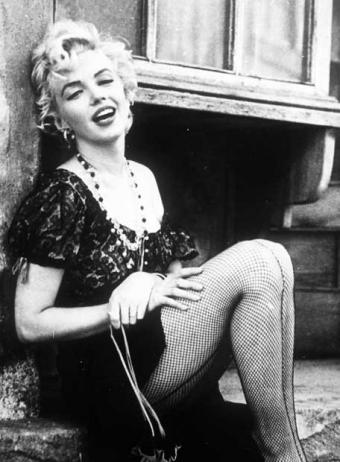
The invention of her image did not happen by chance. Nor did she play a passive role in its creation. She owned her image and, if not the negatives, then what they conveyed. “This was very deliberate. This wasn’t an accident,” Levin said. “She got it and she had it and she made it and she knew it. She was not guileless because she was not stupid. She manufactured this image brilliantly. It was a calculated image, but with good heart, with good intent, with good will.”
Levin feels it’s wrong to apply a feminist prism in viewing Marilyn as a victim of misogyny or unenlightened ambition. “This was a guy’s woman. She liked guys. It was not against her will,” Levin said. “I don’t think she felt victimized at all. I think she exploited it in every way.”
The story of the famous calendar nudes she posed for as an unknown, later published in Playboy at the height of her stardom, reveal an MM in charge of her own image. “Hefner makes the remark that nude photos in those days could take you down. But when they came out she stood right up to it,” Levin said. “Her whole attitude toward it was, This is life. She wasn’t ashamed of any aspect of her body or her being.”
Ironically, Levin was forced to pixilate the nipples and other body parts in the wake of the Janet Jackson breast flash, even though, as Levin argues, the MM nudes are “not pornographic, they’re not slutty, they’re absolutely beautiful. They’ve been made ugly by other people.”
What transpired with the nudes, which made others rich while MM never got a residual dime over the $50 modeling fee, mirrored her life in the spotlight, Levin said. “I think people were rather cruel to her and I think she was hurt. But I also think she was defiant in the face of it. She was courageous. I think the soul of her was terribly resilient.”
Much of the film refers to the sessions that produced the images that still transfix us today, including The Seven Year Itch shoot. In these settings MM willingly gave herself over to the camera. She projected a playful woman-child persona, both real and acted, as she also asserted influence over what final images would see the light of day. Perhaps nothing else gave her such a sense of self-determination.

“You see that she loved it. It was her best relationship, really. It was really the place where she was most comfortable and had the most control,” Levin said. “She very much had control of her contact sheets. She would edit them. She was notorious for Xing out photos in red lipstick or marker. Eve Arnold says in the very beginning of the film, ‘This was her way of working and even though I was free to do what I wanted, she really controlled the image.’”
As Marilyn evolved from aspiring actress to star “she understood what it was she wanted” and she pursued specific photographers she knew “could do her justice,” Levin said, “and got herself in front of those people and, of course, those people wanted to photograph her. They considered her a great subject. It was the perfect metier” for a photographer-subject to play in.
A model must make love to the camera for the images to last. MM invested her photos with rarely seen rapture. “Eve Arnold comments there were a lot of four-letter words used to describe the way she seduced a camera. She loved to do it and she did it great,” Levin said. “Marilyn’s take, which I think is the critical take, is she just thought it was great to be thought of as sexual and beautiful. And why not? I think any woman would want to look like that for five minutes of her life.”
For Levin, one particular image encapsulates Monroe in all her complexity.
“We open the film with a dark room sequence in which we print a photograph of her,” Levin said. “It was taken by Roy Schatt during the time she was in the Actors Studio in New York. Her face is completely open. No makeup. You see that sort of Norma Jeane plainness, really. There’s some pictures of her, like this one, that when you look at them you think, Whatever gave her the idea she could pull this off? She’s OK. She has a cute, sweet face, but hers was not a remarkable face. At the same time you see right through that to the whole iconography of Marilyn Monroe. I chose this picture because I thought it emblematic of the whole of her being.”
Like any fine actress, and Levin ranks MM “a great comedienne,” she could summon her public persona on demand. As Levin tells it, “There’s a known story of her walking down a New York street incognito and saying to her friend, ‘Do you want to see her?’” Meaning Marilyn Monroe, superstar sex symbol. The shape shift only took a subtle change — to a more free, less uptight bearing. The power of it bemused and bothered her. “I think she lived in that schism.”
Taking on as familiar a figure as Monroe and all that “we bring to her” scared Levin. “It’s the hardest film I’ve ever made. This material has been so manipulated in so many ways. The challenge and the task is how do I take this and make this something you feel is completely fresh?” In the end, she feels she’s captured the essential Monroe. “We started out liking her and we ended up loving her. We tried not to take anything from her. She looks so beautiful in this film.”
Levin’s Marilyn will have multiple showings, along with her James Dean, the last two weeks of July. Check local NET1 and NET2 listings for dates/times.
With two movie icon subjects behind her, one might expect Levin to tackle another, but her next film may key off a documentary she worked on last fall. From Shtetl to Swing deals with the great migration of Jews from Russia and Eastern Europe to America and their development, with African-Americans, of the music style known as swing. Slated for Great Performances, the film was delivered in less than airable condition, causing series officials to call in Levin to do some “doctoring.” Her work helped the film get “the highest ratings in New York in years for a Great Performances. One of the things I’m planning on next is something similar to that, but on Latin music and how it’s transmorgified into the culture.”
American Masters is produced for PBS by Thirteen/WNET New York. Susan Lacy is executive producer of the acclaimed series.


Image via Wikipedia
My friend Gail Levin is a talented documentarian whose award-winning work covers many subjects, although she has a particular knack for portraying artists and creatives. Many of her recent feature length documentaries have appeared on PBS and this story for The Reader (www.thereader.com) is about one of those films, a look at the enigmatic James Dean, the brilliant Method actor whose bright flame was extinguished far too early. In part because of the resonant parts he played with such ferocity and in part because he did die so tragically young, he remains a symbol of youth angst and rebellion more than 50 years after his passing. My story for The Reader (www.thereader.com) explores both what Levin tried to capture and what Dean represented on screen. I am posting other pieces about Levin and her work, including one on her documentary Marilyn (Monroe). She profiled a latter day American rebel actor, Jeff Bridges, in a documentary for American Masters earlier this year. Bridges is one of my favorite actors, and I believe he’s every inch the artist Dean was but I must say that Dean had a spell-binding quality that only a few other actors possessed. Marlon Brando was one. Montgomery Clift was another. Both born in my hometown of Omaha, by the way.
Gail Levin takes on American master James Dean
©by Leo Adam Biga
Originally published in The Reader (www.thereader.com)
James Dean.
Chameleon. Seducer. Seeker. Rebel. Artist. Icon. The embodiment of youthful angst and the preternaturally old soul in touch with the ages. The epitome of cool. A timeless presence. An original. Seething with curiosity. Sampling life’s diverse offerings. Always running, yearning, racing. Forever young and free.
He’s one of those select figures whose legacy transcends time and culture. In this 50th anniversary year of Dean’s death, it’s hard imagining anyone who doesn’t know of the actor and his story. His coming from a shattered family in rural Indiana to make his way out west, where he pursued the Hollywood dream. Studying acting. Landing bit parts in some good and some forgettable films. Then rashly taking off for New York, where things broke big for him on stage and in live television. Doing the Actor’s Studio thing. The buzz from his Broadway and TV work got the same L.A. suits who barely noticed him before to come courting.

There was the remarkable string of three starring films he made for Warners, each directed by a master, all within a span of 18 months. Then, on the verge of superstardom, he died September 30, 1955 in an auto crash on a remote stretch of California Route 466. Apropos of his free spirit image, he died in a sports car en route to compete in a race. He was 24. His legendary status ensured not so much by an early death as by the enduringly fine work he left behind and the sublime expression he gave to emblematic characters. Three coveted roles came his way. His animus perfectly suited each and he made them entirely his own. Was it coincidence or serendipity or something else?
The art imitating life aspects of Dean and his very real dedication to his craft are the subjects of a new American Masters documentary, James Dean: Sense Memories, premiering May 11 at 8 p.m. (CST) on PBS. Its creator, New York-based, Emmy Award-winning filmmaker Gail Levin (Making the Misfits), is an Omaha native and a longtime Dean admirer. In a recent conversation, the producer-director-writer said, “I loved making this film. It felt very true to me make this one.”
Dean is among many noted artists she’s profiled in her 30-plus-year career. With Sense Memories, the Central High graduate’s made an impressionistic film evocative of what made Dean the Beat poet among his acting generation and a style setter over the years. If only an interesting personality with killer good looks, his influence would have faded by now. If not an accomplished actor, his performances would be passe, his films dismissed. No, he’s still a vital presence and symbol because of a kind of genius — certainly, innovation — for exuding truth.
Director Mark Rydell (On Golden Pond), once a struggling young actor with Dean in New York, says in the film, “It was so clear that he was a special person. Every moment that you spent with him you knew you were with an original. Strange and peculiar and arresting — you couldn’t take your eyes off him.”
Sense Memories is fixed in that time and place when Dean emerged on the scene, like Elvis, as a new breed of hep cat straining against convention. Actor Martin Landau, a crony of Dean’s in the ‘50s, describes how Dean personified post-war America’s existential modern man — “a different kind of animal…that represented unrest and dissatisfaction with the status quo.” In sketching Dean’s life to a John Faddis jazz score and a black and white (actually, desaturated color) visual motif, Levin’s made a mood piece eloquent of an age of anxiety and possibility and devoid of the cliche and gossip that can distort an icon as potent as Dean.
“There’s been a ton of stuff that’s been done, and a lot of it is very tawdry,” she said, “which is really never where I wanted to go with this film. I really wanted the point for this film to be that his art and life were so close. Because he was so raw, it allowed him to inhabit these characters and to live those feelings and yet to have that one degree of separation that maybe made it less painful somehow. Although I think he lived that pain in his life, too. And then there was his exceptional collaboration with three directors of enormous stature and his truly good work for them. I think that is…often overlooked in telling the Dean story.”
To flesh out the man behind the myth, Levin filmed reminiscences with intimates of his from those halcyon days of new ideas and spectacular talents. The title,Sense Memories, refers both to the enigmatic portrait painted of Dean by his friends’ burnished recollections and to the Method Acting technique Dean presumably employed to elicit his extraordinary range of emotions on screen.
“It’s Rashomon. It’s just people’s memories, and some of them jive with each other and some of them don’t,” she said. “It’s meant to be interpretive. It’s not meant to be in any way a chronology. It’s not meant to be a biography. It’s just meant to evoke him from the experiences and memories of people who really knew him.”
She said it’s no accident Dean surrounded himself with special people. “There’s this range of exceptional men and women he found as friends and soulmates, and they’re all quite exotic little flowers. They all achieved a level of greatness themselves. They were there when it was all happening. Great music. Great art. Great theater. They were all touched by it and were all in it with him.”
Levin cast, lit and shot her on-camera observers as though characters in a drama of Dean’s life, which in a sense they were. Shot against a stark white backdrop and at an extreme angle, the texture of their faces and the vividness of their personalities come out and create a stream-of-consciousness effect when juxtaposed with the Dean images. “I am not afraid of a talking head. I like a tight shot. I like faces. I want to see them. I believe you hear people better the closer in the camera is,” she said. Tony Huston described to her how his father, The Misfits’ director John Huston, considered the human face “a landscape unto itself” and therefore something to be explored in detail. “And I shoot like that,” she said.
As Levin’s film reveals, Dean embraced life the way a method actor tackles a role, living in the moment and shaping the rhythm of his external self to the driving riffs inside him. His circle of friends was eclectic, cutting across age, race, gender, sexual persuasion, occupation, et cetera. He became whatever the circumstance called for and sought whatever he thought was missing.
Entertainer Eartha Kitt recalls she and Dean hanging out with: “We’d sit on the street benches on Hollywood and Vine and watch the night people. ‘That’s where we get our characters,’ he said.” That close observation and deep curiosity is what great artists have in common. It’s what allowed Dean to submerge himself in character and imbue himself so fully in it that his work rung authentic and fresh, as if happening for the first time. A student of human behavior, he applied research and technique to his creative process and then let his instincts take over.
“He was becoming one of America’s greatest actors,” Kitt says. “He instinctively knew what to do with a character because his spirit was free. It was quite interesting the way he went about it — methodically and then unmethodically.”

Dean was a mass of contradictions who gave and took from others as he saw fit and this ability to be different things to different people is part of the appeal he holds for us as viewers. With Kazan and Ray, for example, he felt protected and appreciated. Given free rein and much nurturing, the acolyte went out on a limb for them. With Giant director George Stevens, however, he was a petulant pain-in-the-ass unhappily constrained and stymied by G.S.’s penchant for many takes.
Perhaps the dichotomy of Dean is best articulated by actress Lois Smith, who played opposite him in Eden and recalls “a sweet rustic person, but on the other hand there was this suspicious, taut, guarded young man — and both of them seemed always present and, of course, that’s a thrilling tension.”
Just as Dean projected the tension of his complex inner life, he was a mimic and sponge who drew on persons, events and places as studies for his art.
“He was very willing to put himself in the hands of people he trusted,” Levin said, “but that trust was hard won. As his friend, writer William Bast, says, ‘he was very needy’ and he knew what he needed. I think he was a very canny guy about all those things. I think he definitely was living on the edge because he was so hungry for experience. He was definitely trying to take of everything.”
Separated from his mother at age 9, when she died of cancer, and spurned by his father, he attached himself to older men like Kazan and Ray and he acted out the demons of his real loss and neglect in the characters he played.
In Eden, Dean was — as we hear the late Kazan say — the incarnation of Cal Trask’s “twisted boy. Twisted by the denial of love.” Following a hunch, Kazan knew Dean/Trask were in “search for love everywhere and in every way.” Landau said Dean “understood pain.” Cal’s search for his lost mother mirrors Dean’s own sense of maternal abandonment. Cal is also desperate to earn his cold, stern father’s love. Dean’s life resonated with similar longing. After his mother died, his father dropped out, not seeing him again until years later. In Rebel, Jim Stark craves a strong father figure in the same way Dean craved one, too. In Giant, Dean plays Jett Rink, the quintessential wildcatter that goes his own way. Similarly, Bast says Dean brandished “a completely independent attitude” toward work and life.
Ultimately, what makes Dean still fascinating is his ageless quality. “He is so timeless,” said Levin. “His androgyny is way ahead of its time because it’s so completely in its time right now. You look at him in those films and in every shot he looks totally modern. He’s the one in Rebel who looks completely timeless, while the rest of them look like children of the ‘50s. The same thing is true in Eden. Every single frame of him could have been taken yesterday. With his shabby yet seductive good looks, you might as well be looking at Brad Pitt or Colin Farrell. That great Times Square picture where he walks in the rain, cigarette in his mouth, and coat collar pulled up — my God, it just doesn’t get any better than that.”
That image has “influenced” Levin. “It’s a perfect picture to me. It’s everything black and white photography should do. It’s full of atmosphere and contrast, lights and darks and varying shades of gray, and then there’s THIS guy. It’s informed the look of my films. I tried capturing that era’s beautiful black and white photography in this film.” The man who made that image, famed Magnum shooter and Levin friend Dennis Stock, planted the seed for the Dean film when he told her: “‘It’s going to be the 50th anniversary, and we should do something.’ So, in a sense,” Levin said, “this project has completed a circle.”

Dean’s only the latest in a gallery of notables she’s documented: Martin Scorsese, Stephen Frears, Francis Ford Coppola, John Singleton, Bernardo Bertolucci, Tom Stoppard, Arthur Miller, Richard Dreyfuss, Elizabeth Taylor, Cher, Whoopi Goldberg, Joni Mitchell, Bobby McFerrin, Paul McCartney, Yo-Yo Ma, Franco Zeferelli, Red Auerbach. Besides American Masters, her work has appeared on PBS’s Great Performances, the A & E network and the satellite channel VOOM.
Her work reflects an eclectic background. She grew up the only daughter of “an erudite” Nebraska Jewish family with a string of retail clothing stores and a taste for the arts and humanities. Her extended family included a pair of English teachers/published poets and a psychologist pioneer in the field of aging. Levin earned an education degree at the University of Wisconsin-Madison and did grad work at Wheelock College in Boston. A die-hard cineast since seeing Fellini’s 8 1/2 at the Dundee Theater as a teen, she was inspired by the heady free cinema movement in the ‘60s to try her hand at filmmaking. She returned to school, this time at Boston University, for a mixed educational media and filmmaking doctorate.
A Boston WBZ-TV kids show internship led to an associate producer’s job that became a senior producer slot. She evolved into the independent filmmaker she is today, going from essaying a rite-of-passage on the open sea to sweating out a shoot in the scorching desert to recording candid conversations in hallowed halls with luminaries from the worlds of sport, art, entertainment and academia.
She considers her work a calling.
“I’ve been so blessed. I have had a career that I love and that I hope is not going to end any time soon,” she said. “As hard as it is sometimes, I don’t even care. When you know the roller coaster, you know how to ride it. Besides, I don’t know how to do anything else. You know, you are lucky in this life if you get to do a couple of the things you really want to do, and I already have, so, I think I’m already ahead of the game. I’ve had hugely impassioned projects…and I’ve been able to see them go from the moment that little light went on in my head to the final edit.”
Much like her artist subjects, she’s an intensely curious person.
“When I discover something, it does fuel me. I love finding the connections and chasing them down. It’s not just about having a good idea. It’s having somehow or other the planets line up in exactly the right way…and when that happens, oh, that’s just…You have to be passionate about this stuff for that to happen.”
One of her dream projects came quite early in her career when, in 1980, she and a small crew filmed a transatlantic voyage made by several young mariners aboard the Lindo, a 125-foot, three-masted, top-sail schooner built in Sweden in 1925. The ship left Boston harbor June 4, docking in Kristiansand, Norway 23 days later, where Levin filmed. Then the ship made out to the open sea for additional shooting before completing the return crossing in mid-July.
Her film charts the bonds formed among a group of Boston-area youths initiated in the maritime traditions of old wooden sailing ships by a crew of seasoned sailors. As soon as she heard about the prospect of this “across the ocean documentary,” she said, “I knew I wanted to do it. I couldn’t go fast enough. I can’t imagine it would happen today. That a television station or even a network would send a filmmaker and crew off for what was a fabulous several-week adventure. This is what you now go out in the world and try to pitch people to finance for you.”
Despite “hitting some particularly bad weather” and nursing a cameraman who “became very seasick right away,” the journey and resulting film, The Tall Ship Lindo, proved satisfying. “I loved every minute of it.” Being ensconced in tight quarters on an old sailing vessel, totally exposed to and buffeted by high seas was, she said, “quite extraordinary. To this day I’m still friends with the people from that voyage.” Her most lasting impression is of being overwhelmed by the ocean’s enormity. “A 125-foot boat is not a very big boat and you don’t know that until you go across the ocean on it. It’s tiny. You are very aware from the very first second…that you are just a speck. You’re out there and you are so tiny and it is so big, and but for the grace of God…You have to be in awe of it.”
The Tall Ship Lindo won Emmys for outstanding cinematography and sound.
For Making the Misfits, her take on the remarkable confluence of talents (actors Marilyn Monroe, Clark Gable, Montgomery Clift, playwright Arthur Miller, director John Huston) that came together to shoot the 1961 classic film, The Misfits, Levin and her DP, Dewald Aukema, filmed in its Nevada locales. Her doc won a Cine Goden Eagle for and was included in the International Festival of Film in Montreal.
For Sense Memories, Levin and Aukema went to Marfa, Texas, where Giant was shot, and to that barren California spot where James Dean’s flaming life ended and his golden-hued legend began. Her film opens quietly there, with a gentle pan across the desert highway, lingering at the two-pump filling station that was his last stop. Desert and traffic noises rise. An engine revs. And then some jazz licks come in. It’s a haunting, muted elegy for a bright spirit dimmed too quickly, but still holding us entranced in its warm after-glow.
Sense Memories is a co-production of Thirteen/WNET’s (New York) American Masters and Warner Home Video. The acclaimed series is executive produced by Susan Lacy.
Readers of my film posts will recognize a familiar refrain when I say that my home state of Nebraska has contributed an unusually large number of influential players to the film industry, especially considering the small population of this Great Plains locale. My blog contains articles about many Nebraskans in Film and more are coming. The following story profiles Omaha native Monty Ross. He’s someone you’ve likely never heard of, yet he has enjoyed a major career alongside one of contemporary cinema’s most successful and outspoken filmmakers, Spike Lee. I’d known about the Ross-Lee association going back to the late 1980s, when I was active in Omaha as an alternative film programmer. I even made a half-hearted attempt then and once again in the ’90s to bring Ross back to his hometown for a program. It never happened. Another decade passed before I finally did contact him, this time for an interview and profile for The Reader (www.thereader.com). I loved telling his story because it’s one that was little known even where he grew up. No one’s brought him back here to honor him, and such recognition is long overdue. Whatever part I can play to make that happen I pledge to do. If and when it does happen I will finally be satisfied that Omaha and Nebraska did right by him. It’s a sore point with me that this city and state do not do nearly enough to embrace its remarkable heritage of Nebraskans in Film, and giving Ross his proper due would be a good start.
Omaha’s Monty Ross talks about making history with Spike Lee
©by Leo Adam Biga
Originally appeared in The Reader (www.thereader.com)
Spike Lee’s cinema joints rocked the American cultural landscape in the 1980s and 1990s. Collaborating with him on these explosions was Omaha native Monty Ross, a co-founder of Lee’s 40 Acres and a Mule Filmworks and a longtime producing partner. After an extended leave of absence to make his own projects, including the well-received 2002 Showtime movie Keep the Faith, Baby, a biopic on Civil Rights champion Adam Clayton Powell, Jr., Ross is back in the 40 Acres fold as Special Projects Director for the New York-based production company.
Ross, who spoke to The Reader by phone from his 40 Acres office, has contributed to the emergence of a modern black cinema with broad appeal. With his help Lee took up where Sidney Poitier left off in legitimizing blacks as bankable film artists. Just as the popularity of Poitier’s films opened doors for generations of African-Americans in Hollywood, so too did the success of Lee’s pics. Where Poitier’s directorial work (A Piece of the Action, Stir Crazy) diffuses race, Lee’s embraces relevant themes ideologically and dramatically aligned to the overtly social-political black consciousness of filmmakers Melvin Van Peebles, Gordon Parks and Charles Burnett. While those directors could not break the glass ceiling imposed by the mainstream industry, Lee’s managed to do so by straddling the independent-studio line, thereby affording his movies the kinds of budgets, casts, prestige and buzz his predecessors’ movies never enjoyed.
And Omaha’s own Monty Ross has been there for it all — as actor, production manager, co-producer, vice president of production, adviser, friend and I-got-your-back-Brother. For the acclaim and controversy over Lee’s brazen films, for Nike spots that made Lee a cult figure, for music videos that tapped the hip-hop scene. He’s been about as close to Lee as anyone on this sky-rocket ride, which after sputtering reignited with the 2006 release of Inside Man. Lee’s new HBO documentary on the human rights failing that attended hurricane Katrina, When the Levees Broke, premieres on the cable network August 29, the one year anniversary of the disaster. It’s sure to stir passions the way Lee’s early work did.
Ross is now and always has been part of the cultural-creative pot Lee’s joints get stirred in.
“The blood and sweat he pumped into that company often goes unnoticed,” film producer Lashan Browning has said of Ross, “but he was the heart of it all.” Lee said as much in a Moviemaker Magazine piece. “He was very important. People may have read about Spike Lee, but it wasn’t just me, it was Monty Ross,” Ernest Dickerson (cinematography), Wynn Thomas (production design), Barry Brown (editing), Ruth Carter (costume design) and “my father” — jazz musician Bill Lee (score). “This is a team we have.”
Until now Ross never shared his story with Omaha media of how he came to be part of this small inner circle. It’s a tight, loyal crew together two decades now. Ross goes all the way back to Lee’s thesis project, the student Academy Award-winning short Joe’s Bed-Stuy Barbershop: We Cut Heads. Ross played the lead.
Wearing specs, Ross resembles Lee. They talk alike, too, sans the Brooklyn accent for Ross. Married to still photographer Carol Ross, with whom he has one child, Austin, Ross knows he’s fortunate to be an intimate and colleague of a film pioneer.
“Here’s this kid from Omaha, Neb. who went to college in Atlanta, hung out, met a friend from New York City, came to New York to do a film with him and the next thing you know he becomes a cultural icon. From my vantage point, getting everything prepared and making sure we dot our Is and cross our Ts, and witnessing the reaction of people, I’ve just been amazed all the way, you know, because it happened to me,” Ross said. “I thank my lucky stars every day because it could have gone so many different directions. It’s humbling and I think anybody who’s full of ego and says the opposite is full of shit to be honest with you.
“You don’t know when you write these things or when you film these things what’s going to happen. A lot of the things that happen we don’t have any control over. Sure, you can have control over the film — what you write and shoot and things like that, but one thing you do not have any control over is the reaction of people. And the reaction that Spike has gotten to his work has been phenomenal.”
He offers his own take on the strong responses Lee’s in-your-face films illicit.
“I always tell people, You don’t have to necessarily like the films and you don’t have to like Spike. People are often commenting about the stories and I say, ‘Well, there’s no perfect film, there’s no perfect filmmaker.’ Spike came along and presented his work in a way that had never been seen before from a black filmmaker. His work had a sense of being independent and commercial at the same time. The thing that matters is the reaction to his work. You can’t buy that.”
Like Lee, Ross is a die-hard hoops fan and he likens the way Lee came on the scene with serious craft and something to say and in the process revolutionized the place of black filmmakers in America to the way innovative players express themselves on the court with their ground breaking moves and skills.
“I played a lot of basketball and, you know, people have been dunking the ball since they put the hoop up but when Dr. J. did it, ‘Ohhhh…did you see that?’ People have been doing behind the back fancy passes for years, but when Magic Johnson did it, ‘Ohhhh…the no look pass!’ It’s just weird about that combination (that makes one a genius and another average) and why that happens.”
In the case of Lee’s ability to express an authentic black experience that speaks universally to people, Ross said, “Hey, it’s one in a million. It’s one in two million. Where does that voice come from?” The question may not have an answer. But it’s clear Lee‘s found a way to articulate the spectrum of black life, from its heights to its depths, and the complexities of black-white relations without alienating a large portion of black or white audiences.
The coalescing of Lee’s vision, informed by the Forty Acres team, intersected with the American Zeitgeist in terms of black identity, black pride, black rage and black power. Ross recalled when he felt the Gestalt take shape.
“I think I became aware of it when I saw She’s Gotta Have It for the first time. What I saw was Spike’s goal and Ernest’s goal and Wynn’s goal. ‘My God,’ I said, ‘We’re doing something a lot different than our predecessors. We’re thinking about it a lot different. So, when I saw that I just thought, We’re onto something. It was just a culmination of having that core of people around you who think like you do and they’re able to take your vision and take Spike’s vision and then make it happen in a way that’s visually stimulating and pleasing to the audience. Just like with a winning basketball team, we all thought along the same lines.”
Recognizing a synergy or convergence of ideas, he said, is an empowering thing.
“I think it’s like finding that diamond for your wife or your girlfriend or whatever. It’s that moment when you say, ‘Oh, wow, this is what I’ve been looking for.’ It’s a connection. That’s the way it was for the audience, too. They were like, ‘Yeah, that’s the way I want to be projected. That’s what I’m talking about.’”

Spike Lee and Monty Ross
Ross doesn’t analyze why it is he and Lee click. They just do. “I’ve always been a type of person who realizes when something works, it works, and you don’t disturb it,” he said. “You just ride it out.” The trick is to find your niche and revel in that rather than worry about props. “Once you start getting into that ego gratification and say, ‘Well, his name’s bigger than mine.’ than you’re going to lose,” he said, “because you know somebody’s always going to do something better. Once you have something that works, stick with it. That’s definitely a credo I live by.”
An Omaha North High graduate, Ross is the son of a social worker mother and hardware store owner father who divorced when he was young. Both his parents have passed. His only sibling, an older sister, no longer lives here. Ross, whose favorite haunts were a pair of North 24th Street landmarks in The Ritz Theatre (long defunct) and the Bryant Center (still there), struggled in the classroom before finding a home in school theater productions.
“I started to really feel good about myself and about being in school,” he said.
Harboring a dream to be an actor and to escape the “limited horizons” Omaha offered young blacks in the ‘70s, he went South to attend historically all-black Morehouse College in Atlanta. The contrast was stark. He left behind stagnated, segregated Omaha, where riots and other ruptures left the black community a desolate island with few black professionals to emulate, for Atlanta, a booming, integrated city with a flourishing black culture and black presence in all sectors.
Aside from a few well-known athletes trotted out for kids to idolize, he said growing up black in Omaha “you really didn’t get that college-educated role model you could attach yourself to and get a sense of motivation from.” In Atlanta, he saw up-close black legends like Ossie Davis and Ruby Dee and sampled a “renaissance” of black artists and entrepeneurs. “It just began to blossom as a cultural center.”
He flunked out of Morehouse but was there long enough to act in plays with a then-unknown Samuel Jackson and to be noticed by an aspiring young filmmaker named Spike Lee, a Morehouse grad. After a semester or two getting his grades in order at a Dallas, Texas college, Ross returned to Atlanta to attend Clark College and after graduating he worked as an actor for the Atlanta Street Theatre, a company he’s still associated with, which gives free performances to school-age children. Soon, his path intersected again with Lee’s. It was the late 1970s and Lee was a firebrand talent on the verge of making some noise. The then-New York University film school student often visited Atlanta, where his grandmother Zimmie Shelton lived, and it’s there he and Ross hooked up again. The young director showed Ross and a small coterie of friends his films. Ross was blown away.
“Spike came down every summer he was in (film) school to screen his short films and I remember seeing the first short film, The Answer (a response to D.W. Griffith’s The Birth of a Nation), and after looking at the movie I jumped up and I said, ‘Oh, man, you got it, you got it.’ ‘What do you mean?’ ‘You are about to do something that’s really, really special. You’ve combined everything into this little short film and I can just see it speaks to what you’re always talking about.” “Yeah, man.”
By then, Ross made Super 8 films himself and taught kids the craft in a CITA program. He and Lee were two young men filled with dreams. Not unlike the stoop and street dwellers of Do the Right Thing, they riffed on things-to-come.
“It began pretty much just hanging out at his grandmother’s house and just sitting there talking about how one day we’d like to make a movie together,” Ross said.
By the early ‘80s, Lee itched to make a bold statement. According to Ross, “He said, ‘Man, we’ve got to do something that’s a little more edgy.’ He wrote a screenplay called Joe’s Bed-Stuy Barbershop. I said, ‘Let me read it.’ So I went by his grandmother’s house and we sat down and read the script together along with another friend of ours. I said, ‘Hey, man, I’d love to do the movie.’ So I came to New York the winter of 1981 and in one month we made the film.”
Ross had been to the South Bronx before but not Brooklyn. It was also his first time acting for the camera, and it showed in all the retakes his scenes required.
“It was funny because I wanted to express myself a little differently. I wanted to move around, and film is very restrictive. I remember once I walked around and I said the lines and Spike and Ernest were like, ‘No, no, no, no…You gotta stand still! Film is expensive!’ So I went through that whole spiel, but I learned pretty fast. I still feel every time I watch it I could have delivered a better performance.”
Intent still on being an actor, Ross said, “I wanted to be in front of the camera, but fate would have a whole different direction for me. After Joe’s I went into the (Army) Reserves and after finishing up my Reserve training I came back and hung out with Spike.” Lee planned making his feature debut with The Messenger, with Laurence Fishburne set to star, but weeks before cameras were to roll the main investor pulled the plug when additional funding could not be raised.
Meanwhile, Ross said the production manager on Messenger had a falling out with Lee and quit. Harsh words uttered by the crew member — to the effect “You guys will never be the filmmakers you want” — inspired Ross to put himself on the line. “So I told Spike, ‘Man, you don’t have to go through that. The next time, let me be the production manager.’ He said, ‘Well, what about the acting?’ I said, ‘Duty calls. It’s something that you need and we don’t have to go outside ourselves. We’ll just make it work.’ He said, ‘You bet.’ Spike wrote She’s Gotta Have It, sent the script to me and, as they say, the rest is history.”
Financed in part by maxed-out credit cards, She’s became an indie breakthrough, grossing millions over its couple-hundred thousand dollar budget and putting a gritty, sophisticated spin on black romantic comedy that resonated with folks.
The film made Lee’s career and established Ross as his right-hand man. Getting there was a crucible, but Ross endured and emerged a seasoned pro.
“It was really a hard lesson for me. That’s when I really first got acclimated to New York City. I’d just run around figuring out where post-(production) houses were. I made mistakes and I had to cover my mistakes. I had to learn about dealing with the Teamsters,” Ross said. “It was a time and experience I will never forget because being thrown in the fire like that gave me an opportunity to really learn the business, and that’s what happened.”
Like any low budget pic, She’s required crew to pull double or triple duty. “We didn’t even have a first assistant director,” Ross said. To make their days they had to cut corners and stay several steps ahead. Ross adapted to the hectic schedule, finding he was good at leading other people.
“My working style was to always make sure the next day was covered. I kind of had a camaraderie with the crew. I said, ‘Hey, whatever you guys need, let me know.’”
Caught up in the minutiae that is a film project, Ross didn’t have time to reflect on what 40 Acres had done until the end of the frantic shoot. When he realized it’d come to an end, he didn’t want it to stop. He knew it was historic.
“And lo and behold two weeks later I was like, ‘Hey, we’re out of stuff to shoot.’ This was a Saturday afternoon and I said, ‘Well, let’s just keep shooting. Let’s just make something up while we still have people here. You never know…’ And about six o’clock that evening we called wrap. It was a special moment, you know. We had completed the movie. At least got it in the can.
“I’m not one to get into anything all spiritual and weird and stuff like that, but it was a special moment. I kind of had a feeling, Oh, this could really go somewhere. I think we’ve got really great performances and we’ve got a good look. Wynn Thomas came in with the production designer and he expanded on Spike’s vision. And Ernest came in with the lighting we had and did a wonderful job.”
Bigger budgets followed on the string of much-talked about films that came in She’s wake — School Daze, Do the Right Thing, Jungle Fever, Mo’ Better Blues, Malcolm X, Crooklyn, Clockers — but really all of Lee’s work, much of it with Ross serving as producer, is rooted in those indie, low-budget early years.
True to his bottom line sensibilities Ross finds satisfaction in “the economy of resources” 40 Acres achieved on what proved to be critical-commercial hits. By contrast, he finds hard to swallow the excessive expectations of today’s spoiled young film lions, weaned as they are on techno-digital props and pop-art devices that can interrupt narrative flow and inhibit human values.


Do the Right Thing
“I hear them say, ‘Oh, I’ve got to have this crane or I’ve got to have this lens’ and all these things we couldn’t even think of….I think it really gets down to how well you use your imagination, how well you focus in on what’s important and how well you can tell the story. I think what’s missing with a lot of the young people is that sense of — Let me tell you this story. To get you on the edge of your seat and to make your senses perk up. That’s what we’re looking for. I want a good story, period. Something that’s innate in our nature is our love for a good story and a good storyteller. At the end of the day I think people still want to sit in that dark room and watch a good movie and they want a story that’s well told.”
Far from despairing over the state of motion pictures today, Ross is optimistic the influence of personal filmmakers like Spike Lee has made the term indie synonymous with not just quirky pics, but quality work made by passionate artists.
“I think when you look at what’s happening at the Academy Awards a lot of the movies that have won Best Picture have not been those big studio films, they’ve been small independent movies,” he said.
Ross took time away from 40 Acres to develop a project he felt so strongly about that a one-year leave of absence turned into seven when the project got stalled in development limbo, all of which made the film’s title, Keep the Faith, Baby, ironic.
“I always thought the Adam Clayton Powell story was a story that should be told… that his story was an important part of our history. Powell was a legendary Congressman from New York (Harlem) and I thought he was a missing link in the Civil Rights lineage from Marcus Garvey to A. Philip Randolph to Dr. Martin Luther King, Jr. to Malcolm X. He had demonstrations and sit-ins. He was a lone wolf in Congress, and despite being controversial he got like 50-60 pieces of legislation passed that became the background and foundation for the War on Poverty and for a lot of the social change that Martin and Malcolm and other leaders talked about. He was the man of the hour others sought out. He was making things happen.
“I told Spike I was going to stay committed to getting the film made and he was like, ‘No problem,’ and that’s what happened. I moved out to L.A.”
Waiting for it to get made Ross produced a film (Escaping Jersey) and directed another (Reasons). After moving to Charlottesville, NC so his family could be near his wife’s folks, this prodigal son returned last year to New York and his 40 Acres home.
“I never left,” he said. One of his jobs as special projects director is to head the multi-media company’s internship program. To kids with film ambitions he says, “The sky is the limit, and it all depends on your perspective. The industry is vast with great opportunities. But before you begin your journey ask yourself this question: What is it that you would like to contribute to the industry to make it better?”

Image via Wikipedia
My first couple interviews with Gabrielle Union were by phone. She was smart, funny, gracious, and generous with her time. My last couple interviews have been in person, and I found her exactly the same. She’s a sweet person. Yes, her beauty leaves you breathless and is a bit distracting at first, but she’s completely down to earth and after awhile you don’t focus on her looks, you focus on what she’s saying and what she’s about. This article for The Reader (www.thereader.com) appeared about five years ago, and in it she speaks extensively about some things she’s passionate about, including the difficulties that actresses of color have in finding suitable subject matter and her efforts to try and change that. More recently, the formation of her new production company, Stew U, with Nzingha Stewart, finds her really taking matters into her own hands.
In the last couple years, she’s made as much news off the screen as on it due to her relationship with NBA superstar Dwyane Wade. The couple have been to Omaha, where Gabrielle’s from, and they caused quite a stir here as you might imagine. I wouldn’t be surprised if they become regular fixtures her before too long, at least during Native Omaha Days. I hope to catch up with Gabrielle again in the near future.
The Gabrielle Union chronicles
©by Leo Adam Biga
Originally appeared in The Reader (www.thereader.com)
Let’s face it, the girl can’t help it. With a to-die-for combo of beauty and attitude, Omaha-born and bred actress Gabrielle Monique Union embodies what it means to be fabulous. The It Girl’s parlayed early television-film roles as the sharp-tongued foil and love interest babe into a regal-like, real-piece-of-work brimming with confidence, intelligence and class. This enticing package of goodies makes her a presence in the Hollywood glam machine. Despite The Honeymooners fizzle, her profile is about to explode owing to her work in a handful of new feature films awaiting release that show her in a new light and a starring role in the new ABC series Night Stalker that premieres September 29.
“I’ve been trying to branch out and do different kinds of projects people wouldn’t necessarily expect me to do, and I’m very proud of the work coming out” she said, while in town for Native Omaha Days, looking absolutely fabulous despite no sleep after wrapping Night Stalker that same morning and catching a red eye to O.
Yes, the many sides of Gabrielle are showcased these days. She recently shared the cover of Ebony with Honeymooners’ co-star Cedric the Entertainer, doing her best Alice Kramden domestic next to his Ralph Kramden bombastic. Depending on the gig, she’s whatever she wants to be. But no matter how much she appears all-together, she confided to The Reader some of the anxieties attending stardom and some of the frustrations that go with being black in a white-dominated field. Partly to determine her own fate and image, she’s about to start producing her own projects. Meanwhile, she plays the game, transforming herself into our fantasies.
When on the red carpet-runway circuit, she’s the preening diva in designer wear, perfect makeup and flawless hair who flashes I-love-my-public smiles and blows kisses in classic movie star fashion. In those Nutrogena TV spots, she’s the oh-so-fresh-and-so-clean girl-next-door of our dreams. For magazine spreads, she projects the epitome of style and elegance. She plays it sultry-urban-cool guesting on shows like BET’s Rap City: Tha Bassment, or turns on the charm chatting it up with Jay or David or Jimmy or Regis. She turns serious young artist at events like the NAACP Image Awards. On the big screen, she’s the hottie object of desire of LL Cool J, Jamie Foxx and Will Smith. Lately, she’s taking parts that don’t so much exploit her head-turning attributes and sex symbol defying smarts as display her acting depth.

In the drama Neo Ned, fresh off rave reviews at the 2005 TriBeca Film Festival, her disturbed character gets involved with a fellow patient at a mental health hospital. She’s a victim of abuse somehow under the delusion she’s Hitler. He’s a neo-Nazi hater of blacks and Jews. Upon recovery and release, this odd pair still try forging a life together. InConstellation, which beat out both Hustle and Flow and Crash for the Audience Prize at the Urbanworld film fest’, she’s the matriarch of a troubled Southern family whose secret legacy leads back to her own private crucible. In Running with Scissors, the much-awaited adaptation of Augusten Burroughs’ tell-all book, she’s the possessive lover of Annette Bening, whose messy life she makes messier. In Night Stalker, an update of a 1970s show, she’s part of an investigative reporting team examining unexplained homicide cases. With a creative staff from The X-Files, it’s not surprising Stalker casts Union as Perrie, a skeptic trying to rein-in her overly curious partner Kolchak (Stuart Townsend), who suspects the supernatural, paranormal or extraterrestrial in every unsolved murder. Sound familiar? Union was sold on the show, despite “not being a fan of the genre,” by the quality of the scripts and the chance it offered “to grow with my character.”
All this comes on the heels of her small but weighty appearance in the Emmy Award-winning HBO drama, Something the Lord Made, her first period piece.
Ten years after breaking through, she’s sufficiently got-it-going-on to be in the select company of such single name Star Sistas as Halle, Queen, Beyonce, Angela, Oprah and Vivica — adding flava to an otherwise bland look-alike white girl scene.
But a rising career for a black or Latina actress, no matter how talented or lovely she is, is not the same as it is for a white actress. Union bristles at the inequity that gives a Reese Witherspoon or Cameron Diaz carte blanch when she’s restricted from certain roles due to her race.
“It’s the option of doing different kinds of things,” she said. “They have the option of doing any kind of movies they want. Anything that could possibly pop into their head, that kind of script is there for them. Whereas with me, I’m offered the same exact things over and over and over again.”
This relative lack of choices, she said, not only means a more limited artistic palette to pick from, but a smaller financial reward, too. “There is a financial reality in what we do. Those bills, darn it, pop up every month. That dang mortgage has to be paid. You can pass, pass, pass, pass pass and hope for better material, but when it’s just not coming, at a certain point you end up doing the same sort of material. As actors of color we don’t have the same luxury and we’re certainly not paid anywhere close to what they (majority actors) get paid,” Union said.
Then there’s industry-wide casting practices that unfairly limit actors of color. Producers often can’t or won’t hire blacks and Hispanics for non-race specific roles because the suits’ experience/perception of the world doesn’t include racial-ethnic minorities in certain guises, especially opposite whites.
“That just happened last spring. I was told, ‘Gabrielle, you gave the best read. If we decide to go ‘black,’ you’re at the top of the list.’ It’s still a big fight to get people to think someone like me could be the friend or colleague of a white character, male or female. I’m not even talking about trying to convince somebody I could be Angelina Jolie’s sister or something like that. I’m talking about being her friend or associate or whatever. It’s the nature of the business” to stereotype us, she said.
But as her slate of new projects attests, Union’s not backing down or giving up. She’s a fighter and a survivor, instincts that helped her run-off the armed man who raped her in the early 1990s and cope with the trauma of that attack. A former competitive athlete, Union’s lately redirected her fire to her career, where she aggressively pursues the kinds of parts traditionally reserved for her white counterparts. She’s landing some of these jobs, but she wants more.
“You have these little victories and you hope to spin these little victories into a bigger victory,” she said, “and that’s just kind of been the basis of my career. I’m still waiting to sort of win the battle. But I’ve had a lot of fun on the path. Some of the battles I have lost have taught me so much about myself and about my inner resolve and who I am, and the fact that I don’t lay down and just die when I don’t get what I want. I learn to kind of regroup and fight harder. There’s nothing else I can do but stay prepared and stay ready for that opportunity. And I am prepared.”

Far from passively sitting by waiting for that breakthrough role to plop in her lap, she’s actively looking to develop properties and projects via a talent/marketing consulting agency now expanding into film production, Prominent Enterprises. The company is in the family, so to speak. It’s owned and managed by Union’s husband, Chris Howard, an ex-NFL player, in partnership with her former publicist, Alejandra Cristina. Although a new player in Hollywood, Prominent’s raising a sizable film fund to finance productions for Gabrielle to produce and/or star in.
“They’ve put together an investment group that’s put up $20 million to make anywhere from one to five films, so we’ve been poring over scripts. Nothing I’m going to star in yet, but I’m definitely going to produce,” she said. “The investment group has the capability of distributing and marketing a film, all in-house, so we don’t have to go pander our films to a studio to get distribution. I’d rather learn producing through my husband’s company than out there alone. We’ll definitely be putting our friends to work and you’ll be seeing people in roles that you would never anticipate them in. I’m excited about getting to work with my friends. It’s all happening very quickly. A lot quicker than we anticipated.”
Taking charge of her career is nothing new for Union, who’s taken pains in recent years to control her image by virtue of the parts she chooses and the type of pub she does. For her, not doing nude scenes, for example, is not so much about protecting her good-girl persona in the industry as it is honoring her family.
“I think it’s the respect I have for my parents and the respect I have for my husband. It’s also been a learning process. I’ve taken jobs and I’ve done photo spreads in the past I wouldn’t necessarily do now — understanding the reaction and aftermath that follows. My parents are alive and a part of my life and I’m not estranged from anybody. My husband has to go to work and face people. It’s just not worth it to me to do things that are going to embarrass them. My folks raised me to be a certain kind of person and I want my roles to be reflective of that and I want the kind of press I do to be reflective of that. Sometimes I stray, but it’s all a learning curve, and I’m learning I have the power to say no and the world’s not going to end and my career’s not going to stop.”
An example of her emancipation came during her recent Omaha visit, when she refused agent-publicist entreaties to fly her out of town for an ABC affiliate appearance. Instead, she opted to party-on-down with family and friends at the Native Omaha Days festival, where befitting her status, everywhere she and her small entourage went caused a stir. Just the rumor she might show some place got joints jumping and crowds buzzing. Hundreds attended a ceremony naming the Adams Park pond after her. The fans, many of them relatives from her large extended family on both sides, crowded inside the rec center for an autograph or some piece of their “Nikki.” Her appearance marked the first time “when everybody sort of came together since my wedding. They’re all here. More than I expected. People I didn’t even know came back. It’s exciting,” she said.
With such “a big family” and her “time always so limited” when in town, there’s added pressure to please everyone, so they don’t feel “cheated.” It’s also a reality check, not that her parents or sisters would let her get away with a big head. Her folks, Theresa and Sylvester Union, who are divorced, both said their star daughter is amazingly “grounded.”
Besides being selective in how she represents herself, there are the meatier roles Union’s been holding out for. Where she can coast playing brassy characters “cut from the same cloth that I’ve been cut from,” she has to stretch when cast in roles far from herself. “It’s a lot easier to play when the part’s close to who you are.” she said. “I take pride in bringing strong depictions of women to the screen.” With more substantial roles come more challenges.
Although she’s used to playing characters who are hell-on-wheels, Union’s part in Running with Scissors is a departure in that she portrays a drugged-out gay woman. “She’s a lesbian, a speed freak and a psychologically touched young woman who falls in love with Annette Bening’s character and disrupts her life. It’s a great kind of crazy character that’s really challenged me in new ways, and I just had a ball doing it. I think my mom is still getting used to the idea of me being a lesbian, but as long as Annette Bening is my girl friend, she’s OK with it,” Union said, laughing.
“To tackle” the role of an abused woman in Neo Ned, Union reopened the wounds of her own rape by going “back through my journals and to times when I was in therapy and to times when I was completely out of sorts and out of control. I was able to convey certain aspects of my own experience into the character’s, but at the time I wasn’t sure I’d be able to do it without going nuts.” She made it through OK, but she said far from being cathartic, reliving her own trauma was harrowing.
“It was only afterwards I found it therapeutic, when at the Q & A that followed the film’s opening, people were saying — and it always happens — ‘Me too, me too.’ It’s always comforting for me and others to know — I’m not alone in my experience. I’m not alone in my surviving and in being able to still lead a decent, functional life. That these obstacles are surmountable.”
Union has long used her celebrity to openly discuss her rape and recovery and to advocate for victims’ rights and the importance of counseling, which she received.
As much as she enjoys educating people about empowering themselves, she realizes she’s still learning both her craft and this whole business of being a star. Therefore she seeks out mentors to school her in acting and in managing fame. Diva soul singer Patti LaBelle is among those who’ve taken Union under their wing, teaching her how to stay “who she is” and keep “what she stands for” amid the hoopla. The more high profile projects Union does, the more seasoned veterans she calls on.
“It’s the only way you’re going to get better. Unfortunately, a lot of young people in our industry lack humility. That whole idea of wanting to be the biggest fish in the pond doesn’t appeal to me. You can learn so much more if you just shut up and watch, which is what I do. I don’t know enough to keep talking. I watch the masters work and try to absorb as much as I can about how they work and how they handle different situations. That’s been the biggest help to me and my career — being able to watch what to do and what not to do.”
Asked if working with a Bening in Scissors, Alan Rickman in Something the Lord Made or Billy Dee Williams in Constellation obliges her to raise her own level, she answered emphatically, “Oh, hell, yes. They make you step up your game. And especially as I’m not formally trained, I don’t have that wealth of knowledge to fall back on. I have to learn from my co-workers.”
To help prep for difficult parts, she works with acting coach Dennis Lavelle, an actor/director who gets her to “fine tune stuff,” like nailing a Nashville accent for Something, and “on point” for portraying characters undergoing emotional crisis.

She’s still insecure and starstruck enough that she gets tongue-tied around her idols, such as Diahann Carroll, whom she “chickened out” meeting. On the set of Constellation, she lost her composure working alongside icons Williams and Rae Dawn Chong. “I got intimidated. I didn’t know where to begin the scene — to not be buried,” she said, “because they were all bringing it.” She uses the work ethic of fellow pros to motivate herself. “When I see them doing their homework, running lines or doing theater, I’m like, I need to go home and study more. The people I look up to never stop growing…never stop working. So, I need to step it up.”
To her surprise, serious theater offers have come her way. Thus far, she’s passed, admitting she feels out-of-her-depth there.
“I’ve been offered things I have no business being offered. I mean Broadway productions — all off the strength of something like Bring It On. But I have too much respect for the craft and for the theater to take a job I’m not ready for and to bring down a whole production. I have too much respect for the amazing talent that’s underemployed to take a job I don’t deserve and I haven’t earned — just because I can. I don’t want that on my shoulders.”
The props, the perks, the offers, the adoring crowds, the intrusive fans and the unwanted stares are all part of the bargain, good and bad.
“It’s weird. I don’t feel worthy of that sort of adoration. Ultimately, it’s nice that people appreciate what you do and to know your work is not in vain,” she said.
Negotiating fame is a-work-in-progress for her and husband Chris Howard. “It’s been a long path to kind of figuring that out,” she said. “When we want a fun, cool time, either with him and I or with our friends, we don’t do it at premieres or parties. We do it at our homes. We keep it private. So that whatever we’re doing or talking about or wearing or not wearing, no one’s going to know about it except for us. That’s how we stay strong.”
Careerwise, she has her thing and he has his. Even with the overlap from Prominent Enterprises, she’s the one out front. He’s in the background, where he prefers it. It’s their way of maintaining separate identities. “When I do travel for work and go to premieres or parties, he doesn’t always come,” she said. “He’s like, ‘That’s your life. I don’t want to stand around and hold your purse. I have my own career and a whole life outside yours.’ And that’s made it a lot easier.”
Being the center of attention, she said, “sometimes is a drag.” Having to look gorgeous, smile, press the flesh, sign the stills, pose for pics, answer questions. Her well-known penchant for slumming at Target has even gotten problematical, with shoppers and clerks wanting to stop and talk. “There’s times you just don’t feel like it. You’re tired. You just want a quiet evening with family. You just want to be. But when they don’t fuss over you, that’s when you go, What happened?”
The spotlight will only get hotter once her new films break and Night Stalker, airing Thursdays at 9 p.m. (CST) on ABC, debuts. There’s also two more features, Donut Hole andSay Uncle, in the can and still another, 32 and Single, in development.
Inking the deal for Night Stalker, which she wanted against the advice of her management, was done partly to get more “alone time with my husband,” she said. “Now that I’m home in L.A. shooting the series, even though the hours are crazy, we have a little bit more time together. It almost feels like we’re starting over because I’m home now.” Starting a family is not a priority yet. “I don’t want to be jealous of a child for taking me away from my man. Once we get enough alone time and we travel and we do all the things we want to do, than we’ll expand.”

Cover via Amazon
I have to believe that some folks are surprised to discover that the stunning actress Gabrielle Union is from Omaha, Neb. That’s because a large chunk of America either draws a blank when the city and state are mentioned or else conjure up images of corn fields and small towns devoid of black people. Well, it is true that most of Nebraska is crop and range land. This is a Great Plains agricultural state after all, and agriculture is what drives the state’s economy. It is also true that most of the communities dotting the state’s wide expanse are small towns that generally do have few residents of color, particularly African-Americans, although some have large Latino populations. But Nebraska also has two large cities in Lincoln and especially Omaha, and while the black population in Omaha has never been huge, its always been significant, in the tens of thousands, and African-Americans here own a long and rich heritage of cultural and intellectual achievement. She belongs to a large and prominent extended family whose annual reunion is more than a hundred years old and draws hundreds from all over the region and the nation. Gabrielle is proud of her roots and she usually makes it back for that reunion, particularly when it coincides with the biennial Native Omaha Days, a week-long black heritage celebration.
So, when you know the facts, you realize Gabrielle hails from an urban African-American environment here not so dissimilar from those in cities with major black populations, and through all her success she’s remained fiercely loyal to this place and the old haunts in the inner city. The following is the first of two cover stories I did on her for The Reader (www.thereader.com). This piece appeared just as she was breaking big on the national scene. Just as she’s done with other journalists, she spoke thoughtfully and candidly with me about a whole range of subjects, including her family, her growing up here, her surviving an assault, and her forging a career. Although she’s enjoyed a nice long run in film and television, I’m not sure she’s quite reached the heights that she or others saw ahead. But she’s still young, still fabulous, and still working hard to develop projects that provide positive images of African-Americans and that put her and other African-Americans in control of those images. To that end, she and director Nzingha Stewart have formed their own production company, Stew U. Good luck with it, Gabrielle, you are a face of poise, beauty, and strength for many females who see you as a role model. You also give America and the world a whole other idea of who lives in Omaha.
Look for my followup story about Gabrielle on this same site.

©by Leo Adam Biga
Originally published in The Reader (www.thereader.com)
The next Halle Berry?
If, as some predict, Gabrielle Union, co-star of the new action sequel Bad Boys II, is poised to be the next ebony screen idol, then don’t expect the rising young actress with the suave sultriness of a classic Hollywood siren to do any cartwheels in anticipation of It happening. Not that the hard-bodied ex-athlete — she competed in track, soccer and basketball while growing up in Omaha and Pleasanton, Calif. — couldn’t do a flip if she wanted. It’s just that this sophisticated lady, who first made an impression playing smart, sassy babes in the teen comedies Bring It On and She’s All That and who more recently revealed a deeper dramatic range as a hard-boiled seductress in Welcome to Collinwoodand as a meddling man-hater tamed by Mr. Right in Deliver Us From Eva, remains firmly grounded. After all, she well recalls the vagaries of her unexpected cinema ascent, which soared despite no formal acting training. Unlike some stars to whom success comes early on, she’s savvy enough to seek advice and hungry enough to hone the craft that first chose her. Sweet.
“I have no problem humbling myself and asking a lot of stupid questions of veteran actors and of people who’ve been there-done that. I’m not into taking myself so seriously that I can’t go, I’m in a little over my head — can you help me out here? Yeah, I think a director would rather have you ask questions than waste takes. Luckily, people have taken me under their wing and helped me along the way. I’ve found really great mentors the last couple of years who’ve helped me sort of deal with my insecurity and say, Obviously you’re doing something right — you’re working, so whatever it is you’re doing don’t stop that, but also don’t stop asking questions,” she explained by phone from the Los Angeles area home she shares with husband Chris Howard, a former University of Michigan and NFL football player.
One reason Union doesn’t think she’s all that is because she views her film career as a kind of fluke. Not so long ago she still held out the possibility of falling back on her sociology degree if this movie thing didn’t work out (Her mother and two aunts have worked as social workers.). You see, the UCLA grad stumbled into acting only when her striking good looks and poised manners got her mistaken for a model at an agency where she interned. Before she knew it she found herself going up for and landing parts in ads and then television shows, debuting on Moesha, doing guest spots on ER and Steve Harvey and nabbing recurring roles on Sister Sister, 7th Heaven and City Of Angels. A year ago she was just another fetching supporting player in a string of moderately successful films, but was still best known as the first African-American love interest on the hit NBC series Friends. It was really the buzz behind her Friends guest shots, combined with her scene-stealing turn as a diva head cheerleader in 2000’s Bring It On and her portrayal of a tough yet tender sista in 2001’s The Brothers that added steam to the career she never intended.
2003 is shaping up as a breakout year for Union between her performances in the already released Abandon, Cradle 2 the Grave and Eva and her featured appearance opposite Will Smith and Martin Lawrence in Bad Boys II. In the expected summer blockbuster she plays the vexing Syd, a woman raising the heat and danger for Miami police detectives Mike Lowrey (Smith), who falls for her, and Marcus Burnett (Lawrence), her half-brother. She may really turn heads with her on-the-limb portrayal of a disturbed mother in the now-under-production Neo Ned, a gritty project by indie director Van Fischer (Blink of An Eye, Urban Jungle). Her persona as a beautiful, brainy, brassy black woman coincides with the growing crossover appeal of women-of-color artists — from Jennifer Lopez to Beyonce Knowles to Halle Berry — whose urban, hip-hop vibe is redefining the image of female sex symbols. Where, only a few years before, Union doubted if she even belonged, she’s paid her dues and now finds herself on the verge of A-list status. Not coincidentally, she’s since fallen in love with acting.

“I have, actually. Certainly after working on Welcome to Collinwood with Joe and Anthony Russo — who are very much actors’ directors — they really made it a different kind of experience. It wasn’t just about coming to work and knowing your lines. It was — How can we elevate this material? How can we make this better? How can we make this completely organic? We’d be doing exercises on set. We’d be doing tons of rehearsals. And through that process there was so much more discovery about the character and about the text that I really became enamored with what they did. It’s definitely experiences like that that make me really enjoy what I do now. It’s not so much a means to an end.”
Challenges are something Union, a fierce competitor at Scrabble or anything she competes in, welcomes. Her never-say-die-attitude, which surfaced when she fought back against a rapist that attacked her at 19, was instilled by her old-school ex-Army and ex-jock father, Sylvester, who pushed her, like a drill instructor, to excel in sports and academics from the time she was a child. She feels this boot-camp rearing gives her an edge in swimming with the sharks. “I’ve learned how to navigate tough waters, whereas a lot of actors are used to being coddled. I have a very thick skin. Screaming directors or difficult actors or whatever…it’s not a big deal. I mean, after you’ve dealt with my father, it’s all easy.”
The mettle that comes from a trial-by-fire background is why Theresa Union is “not surprised” by her daughter’s success. “She’s very disciplined. She’s self-reliant. She’s a natural-born competitor. She takes advantage of things that come her way. Her confidence and ability to pick up things fast give her an edge,” she said.
After playing largely decorative roles early in her career, Union, who can now afford to be choosy, is embracing more ambitious parts. “With certain kinds of things I was doing it wasn’t that hard to figure out and you sort fell into a lull,” she said of the stock best friend and girl friend characters she played. “But as the projects got a little bit more complex and a little bit more challenging it became a lot more fun for me because I had to push myself to see what I could do better than the day before. For me, it’s like when I played up an age group in basketball or in soccer, where the players were bigger, faster, stronger, better and you had to kind of raise your level of ability to meet that challenge. It’s the same with acting. As the projects get a little bit more in-depth and complex you have to raise your game to work with the William H. Macys and the George Clooneys. You can’t just sort of rest on, Well, I did a few sitcoms for UPN. So, I work with a coach (acting) now to make sure I’m sharp and ready to compete.”
Of the tests posed by her latest films, Union said: “For Eva, the challenge was how to make this really difficult woman likable. For Bad Boys, it was how to do action and not make it seem like you’re just a cardboard cutout in this high-concept movie. This movie I’m shooting now — Neo Ned — will probably be my most challenging to date. I play this woman who was molested as a child. She’s a bed-wetter. She’s trying to deal with the shame that comes with these experiences. She keeps checking herself into mental institutions. She’s not necessarily crazy, she’s just very overwhelmed. She develops this character, if you will, of this girl who feels like she’s got the soul of Hitler trapped inside her. She goes as far as to learn German and she ends up falling for this neo-Nazi, Ned. So, it’s incredibly challenging on a lot of different levels.”
Making the role even more demanding for the actress is that it requires her to be more emotionally raw on screen than ever before. “Usually, I’m cast as someone strong — with bolder-type qualities. But with this, she’s damaged and sort of on the path of trying to put herself back together. I kind of wanted to challenge myself in that sense in being able to convey the vulnerability and the trust issues that victims have and some of the things that go along with being violated.”

Union is careful not to take on roles too close to the real-life trauma she endured, saying she accepted Neo Ned because it deals with the aftermath of the attack rather than its depiction. “I’ve turned down other projects where the character was brutally raped on-screen,” she said. “It’s not a problem talking about it or expressing it or conveying the emotions of what it feels like to have all control taken away from you, but to have someone physically simulate raping me, that would be above and beyond what I’m emotionally able to do. So, I know my limitations.” Her fear of having to relive her horror during a City of Angels shoot whose storyline concerned a serial rapist first led Union to divulge her own story. “I had so much anxiety that my character would be next that I was like, ‘Oh, my God, I can’t go through that again. You see, I never talked about it. No one ever knew to not write my character to be raped. That, combined with the very cavalier attitude a lot of people on the set were taking about the storyline, made me come out to a magazine reporter I was doing an interview with in the midst of all this. I just felt it was my duty to come out and use my voice for something worthwhile. Reporters ask you a lot of stupid questions, like who’s cuter — Freddie Prinze. Jr. or Paul Walker? Well, who cares? How about what I’ve experienced and what I’ve overcome. I still finished college and I still got a pretty cool career for myself in spite of all this. Why don’t we talk about that and help people?”
She said it’s only after “years and years of therapy” that she’s able to be “normal again and somewhat sane.” Although once the victim of a brutal crime, Union is no victim for life. Her defiant attitude then and now stems from the way she was brought-up. “My parents always said, Don’t ever start a fight, but you damn well better finish it. You know, it was like — Don’t bring your ass home defeated. I certainly never solicited to have that (rape) happen to me, but when I saw an opening to sort of take back control of the situation I gave it my all. I put up a really valiant fight and have the scars to prove it.” As first related to Vibe Magazine, she wrestled the armed perpetrator to the ground, flailing at him with her fists, and managed to grab his gun and fire. “But in the end I wasn’t successful. He went on to rape another girl and ultimately turned himself in. A part of me was disappointed I didn’t kill him or didn’t at least wing him, so he could be apprehended sooner. I wanted to be the one that put an end to it.” She is proud, however, for having “the tenacity and courage…to make sure he was prosecuted and served his time and got a little dose of good old-fashioned prison justice,” she said. “All of that definitely goes back to how I was raised.”
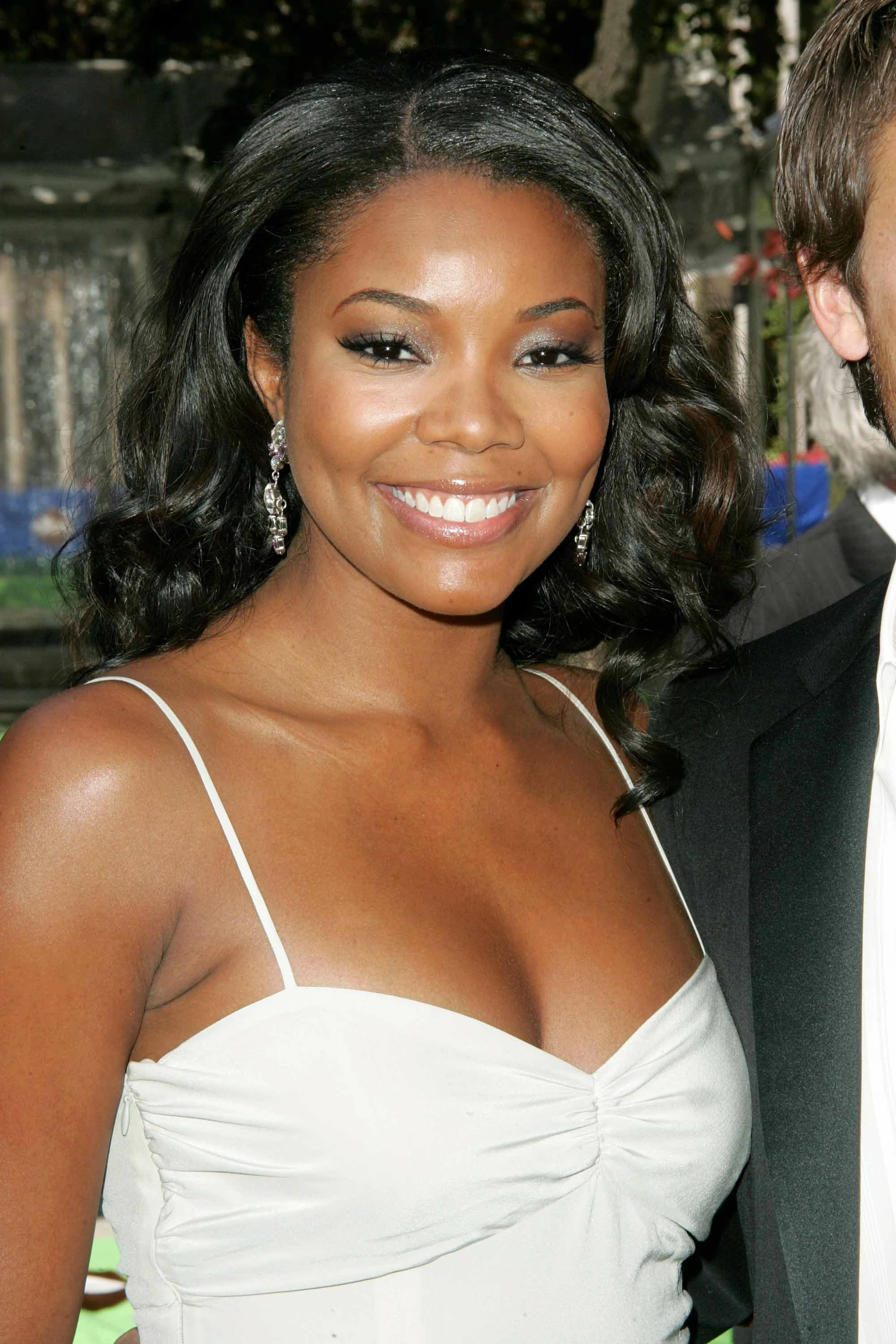
Where her father has been the driving disciplinarian in her life, her mother, Theresa, a former dancer, has been the nurturing, artistic influence. Her mother’s family, the Bryant-Fishers, is one of the oldest and largest black families in Nebraska. So entrenched are they that as part of their annual weekend-long August reunion — 85 years and running — the family stages their own parade down 24th Street. Union recalls that after her family moved from Omaha, where her father was an AT&T manager and her mother a social worker, her mom would take her and her two sisters to such Bay Area cultural events as poetry slams, ethnic festivals and gay pride parades. Union, a tomboy at heart, was 8 when she left Omaha but her ties led her to attend the University of Nebraska-Lincoln, whose women’s soccer team she competed on and whose football team she still madly cheers. Homesickness soon led her back to the coast, where she attended Cuesta College in San Luis Obispo before entering UCLA. After getting her B.A. she considered law school before being “discovered” at the Fontaine Modeling Agency.
Despite lacking a prestigious acting school pedigree, Union said, “I feel confident about what I bring to the table.” In a sense, she’s been in training from the start by being a keen observer. “I’ve always been the kind of person, even as a young kid, who would just sit somewhere and watch people. I’ve always been fascinated by human nature and by what motivates people to do certain things…and that’s kind of a big chunk of acting. That, coupled with the fact I was a sociology major and wrote tons of term papers on inter-group conflict and on what makes people tick…which is a lot of what goes into theater studies.”
Then, she said, there’s the side of the profession no drama school can simulate. “Nothing prepares you for Hollywood. There’s no class on how to deal with a psycho director or a co-star on cocaine or on how to get along with people. Those are just sort of common sense things and a lot of that goes into who works and why. A lot of it is just like manners. Being on time. Working well with others. Literally being one of those people that others like to spend three or four months out of a year with. Part of that is definitely being professional, but part of it too is not taking yourself so seriously that you don’t have a good time. I mean, if I’m going to work in Miami I’m taking a very professional attitude, which means I’m going to be at work on time, I’m going to know my lines, I’m going to hit my marks and you’re not going to have to wait for me. But I’m also going to have a good time while I’m there. No one’s ever going to accuse me of being a fuddy-duddy.”
The vivacious Union is also no shrinking violet. Having grown up in the suburbs, she’s used to being “the black girl” in classes, on teams and, more recently, on sets, which means taking on “the responsibility of sort of educating people, correcting people and letting people know…little different nuances of race and class. It can be a little tiresome. It’s so much different on the set of a predominantly minority cast and crew, when you can free yourself up to just work and not have to worry about somebody saying something offensive or not understanding why I need a black hair stylist or why pink lipstick doesn’t look so great on a black person. It’s nice not to have those little struggles.”
Union is riding a wave that is seeing a more inclusive American cinema than, say, 10 years ago. But, as she can attest, Hollywood is still no where near to being as diverse as the society it purports to mirror. “There’s so much more that needs to be done for minorities, period, just to make films reflective of a multicultural America. Unfortunately, most of the writers employed come from privileged, homogeneous backgrounds not representative of the changing face of America, especially among younger people who, with the infusion of hip-hop, have a completely different mind-set,” she said. “For the younger generation, it’s not a big deal to have a black person kissing a white person or to have a Latino and an Asian as a couple. If those are the dollars Hollywood’s trying to get, then the projects need to be reflective of those attitudes, which are much more open.”


Casting, she said, is still replete with racism. While Berry broke down barriers playing a Bond girl, the buzz behind that “goes away and it’s back to fighting to play certain roles not written race specific. Why does the star’s secretary have to be blond? Why does Tom Cruise’s love interest have to be white? What’s the problem?” More insidious, she said, is the practice of casting light-skinned minorities in positive roles and dark-skinned minorities in negative roles. “When I was auditioning to play the pretty girl friend or the well-educated snob, the other girls in the room were either very fair or biracial and it was like, OK, clearly we have a mind set about what’s attractive, what’s well-to-do and what those faces look like. But a single mother crack-head who just lost her baby’s daddy to a gangland shooting, oh yeah, those girls are going to be dark. It’s just what people feel comfortable with I guess. It’s weird. But hopefully we’re slowly changing that.”
Along with her counterparts, Union hopes to open doors for more actors-of-color. “People in Hollywood always say, It’s not a black thing or a white thing, it’s a green thing, and in a sense that’s true. I’ve been lucky enough that some of my films have made money. Deliver Us From Eva made triple its budget, which you can’t say about many other movies, and that means something to Hollywood, which says, Here’s a movie about four sisters who all have jobs, who all have relationships and it made made money — Hmmm, let’s have more of this.”
Black or white, part of being a starlet in Hollywood is glamming it up, something Union, who can otherwise be found kicking it at home in sweats or shorts, enjoys doing for occasional magazine spreads and industry bashes, when she looks as cool and posh and fabulous as anyone. “It’s an escape from reality and a nice release to be a part of that whole Hollywood glamour machine,” she said. “It’s a lot of fun, but it’s not something I could keep up every day, certainly.”
She still gets back to Omaha, most recently for the January funeral of her great-grandmother, Ora Glass, who was 110. And she keeps tabs on other native Omaha film artists, such as actress Yolonda Ross (Antwone Fisher). An admirer of Alexander Payne, who’s a fan of hers, she said if he ever shoots in town again she’s “willing to be a P.A. or grip to help him around north Omaha,” adding with her typical sauciness, “I love his work, but you don’t see all of Omaha reflected.” Hint, hint.
Every once in a while, and not nearly as often as I’d like, someone will give me a lead on a story. That’s what led me to Click Westin. The one-time Writer’s Guild of America member wrote for episodic television and had one screenplay produced as a feature. He also owned and operated his own L.A, advertising agency that did work for national clients. He seemingly had it all but then his battle with the bottle cost him his Hollywood career and very nearly everything else. Long story short, he cleaned up his act and in his decades-long sobriety he’s been an active AA sponsor and speaker in his hometown of Omaha, where he headed the advertising for his brother Dick Westin’s successful international food business. Now, in his 80s, Click is back writing screenplays. He recently had one optioned. My story about this engaging man who licked a serious problem originally appeared in the New Horizons. Since it’s publication a year ago or so the irrepressible Click has begun writing songs at a furious clip, even getting Nashville producers to take notice. Go Click! He’s an example of how older individuals often make the most fascinating subjects if for no other reason than the sheer expanse of life experience they represent.
Click Westin, back in the screenwriting game again at age 83
©by Leo Adam Biga
Originally published in the New Horizons
More than 40 years after writing a screenplay that became the low budget feature film The Nashville Rebel (1966) with country music star Waylon Jennings in the lead, Omahan Clifton “Click” Westin may have a new script made into a motion picture.
At 83, Westin’s original crime thriller Center Cut has been optioned by Steve Lustgarten’s LEO Films. That’s no guarantee it will ever get made. Even if it does we’re not talking Oscar-caliber work here. But it is another mark of progress on his comeback trail in an industry famously cruel to artists his age and with his baggage.
That comeback, make it recovery, is both personal and professional and is a long time in the making. His reaching the point of despair with alcoholism interrupted his screenwriting career in the 1960s. He’s worked his recovery program for half-a-century. He claims 40 years of sobriety under his belt. But he only surrendered to the unmanageability of his disease after hitting bottom and having lost everything, his home, his first marriage, his family, his savings, his career.
After piecing his life back together on the West Coast with the help of a pistol-packing woman named Wilma, whom he married and is still with today, he began doing consulting work back in Omaha for his brother Dick, owner of Westin Foods, and before long Click and Wilma settled here. He’s been here ever since as Westin’s vice president of advertising and as a speaker at area AA confabs.
But there was a time when Click once did enjoy a Hollywood career. Nothing major mind you, but he was a working hack and card-carrying member of the Writers Guild of America. As he likes to say he paid his dues and learned his craft in the sink-or-swim crucible of studio staff scriptwriting with producer-syndicator Ziv Television in the 1950s. He churned out script after script for such half-hour episodic action-adventure series as Boston Blackie and The Cisco Kid
“It was kind of disappointing if you were looking for glamour because it was an office set up. You had a desk. The studios were outside the door, where they were shooting, but you never got over there. Your quota was to write two half-hour scripts a week,” he said.
As soon as you’d get an assignment, he said, “you start dreaming up something and you put in on paper. You learn your trade no matter what the writing assignment is. If you were a staff writer I’m not sure you even got credit for what you wrote. You never did see the result of what you wrote. You just had to turn in those assignments every week.”
He’s written about everything a writer can at one time or another, with the exception of a novel. “A writer’s a writer,” he likes to say. If Westin has a niche, it’s terse, hard-boiled dialogue and one-liner jokes, which is how he ended up contributing material on a freelance basis to such popular programs as The Steve Allen Show, You Asked for It and This is Your Life. He’s always been able to write fast, a vital commodity in advertising and TV.
Along the way, he came into contact with big names, including Robert Taylor, Hugh O’Brian, Hal Roach, Bill Dozier, Ralph Edwards, Debbie Reynolds, Lawrence Welk.
Boston Blackie
The first stars he met predated his Hollywood career. It was 1948 and he was a World War II veteran studying journalism at then-Omaha University on the G.I. Bill when he went out to the West Coast to visit an Army Air Corps buddy who attended the University of Southern California. Westin got invited along with his pal’s fraternity brothers to serve as extras on the MGM musical Easter Parade. He got to visit with stars Judy Garland and Fred Astaire, whose path he’d cross again.
“My only scene is in the finale when everyone is walking down the boardwalk and I tip my hat to Fred Astaire and Judy Garland. That was the extent of it,” Click said in his clipped, just-the-facts delivery.
He said you can spot him at the end of the classic picture ”just for a moment. You gotta be alert. There’s really a lovely young lady on my arm.” To get costumed and made-up for the scene, he said, “we went in a tent and got our clothes changed. She had on this beautiful period dress with a hoop skirt and all, but underneath she’d rolled up her jeans,” giving lie to the carefully constructed illusion.
The whole Hollywood, big-studio moviemaking apparatus was an eye-opener for him. “I was just out of the service, still a kid. I was very impressed,” he said. Still, he had enough moxie to stand out, which is likely why he got selected to tip his bowler hat to the two stars. That and his six-foot-height and athletic good looks. It wasn’t the only time during the sound stage shoot he displayed his boldness.
“Onto the set came Peter Lawford and Liz Taylor. She wanted to climb up to the camera tower, and I was standing next to the tower so I took her up and on the way I thought, Why not?, and I said, ‘Listen, the boys at the fraternity are having a party tonight, I just wondered if…’ And she said, ‘Oh, I’m sorry, I’m busy.’ I thought, Well, I gave it a shot.”
If nothing else, the experience gave him a glimpse into a world he’d never seen before and some good anecdotes to share. “When I got the check from MGM I didn’t cash it, I brought it back to the Dundee Dell, where us college kids hung out, and waved it around.”
He swears that early behind-the-scenes exposure to the world of movies didn’t influence his decision to try his luck out there just a few years later. But that’s just like Click, who deflects or downplays things, unless they touch on addiction or on events like the Great Depression, when he learned what it meant to survive.
During the depths of the Depression his father Clifton, a native Omahan who also went by “Click,” lost his regular sales job. He gathered up the family, including a very young “Click Jr.,” and they hit the road to scrounge up a living.

The Cisco Kid
It turns out Click’s old man was highly resourceful. Among other things, he was a pool shark who once toured with the great early 20th century straight pool champion, Ralph Greenleaf. The elder Westin would sometimes appear in town pool halls as The Masked Marvel, taking on all comers in promotional stunts sponsored by the Coca-Cola Company. The sport was huge then.
Unfortunately, Click said his father was also an alcoholic.
When hard times hit, the sharpie was married with kids in the Nebraska Panhandle, stranded without a job, and so he did what he had to do to provide for his family.
“Dad acquired an old Graham-Paige automobile, he cut off the back and rigged a structure onto it to make almost sort of a covered wagon out of it, and we headed south. A good place to go during the Depression. He showed a great deal of foresight,” said Click.
Not unlike the Oakies displaced by the Dust Bowl, the family packed up what they had in their makeshift “prairie schooner” and headed for greener pastures in Louisiana, Texas, New Mexico. “We were just itinerant. We would pick up bottles and containers out of the trash in every town we’d stop, we would clean ‘em and redeem ‘em for change. Mom would make soap over an open fire and we’d sell soap door to door. My dad fixed pool tables and hustled pool. Anything to make a buck.”
These self-made gypsies would stay put awhile in select spots. They stayed in New Mexico long enough for Click’s dad to operate a roughneck pool hall where he ran a poker game in back. There were some wild and woolly times — drinking, shouting, fisticuffs, knives, guns. Click heard first-hand tales from old cowboys of epic cattle drives, scraps with Indians, riding with outlaws and Pony Express exploits. For someone with a vivid imagination like Click it was a golden time. The hardships of growing up without a home or its creature comforts didn’t resonate then, the excitement did. To him, it was just one big fat adventure.
“Well, lifestyles don’t affect children, they don’t know the difference, it’s the way life is, but in looking back of course it was quite severe, quite tough,” he said.
But also quite a rich life experience. By the time he started school it’s safe to say Click had lived and seen more than any of his boyhood chums. All that moving around though meant never being in one school more than a few months. “I probably attended as near as I could figure out 30 grade schools,” he said.
The family subsisted this way for almost two years before coming to Omaha. The hopskotching didn’t end entirely then either. “Here in Omaha whenever the rent was due we moved,” he said of his parents’ attempts to stay one step ahead of creditors. Click’s dad eventually did well with his own insulation business
At Benson Click proved a bright student. His kid brother Dick was a sports hero and entrepreneurial whiz who’s now in the Benson and Nebraska athletic halls of fame and the Omaha Business Hall of Fame. Click’s talents lay elsewhere. Blessed with a creative mind, he exhibited a way with words, writing for the school paper and penning O. Henry-like short stories. But entry into the military at age 18 put a hold on his storyteller ambitions. All the eligible males from his class of ‘44 enlisted.
His World War II service saw him man a ball turret aboard B-24s assigned submarine patrol duty in the Caribbean. His group never saw action.
Like many returning vets, he was eager to make up for lost time. He wanted to be the next Fitzgerald or Hemingway. He got his first taste of being a professional wordsmith composing verses for a Kansas City greeting card company. In Omaha, he filed articles and press releases for Northern Natural Gas Company and created on-air promotional spots and bits at WOW Radio, a then regional broadcasting giant. He and a popular performer, Johnny Carson, hit it off, and were drinking buddies at local watering holes, where they discussed taking Hollywood by storm. Before long, Carson left to pursue the dream. Westin soon followed, young wife in tow.
Westin never did complete all the required credit hours for his degree, but he did find a career. Show business agreed with his temperament as a cocksure promoter and curiosity seeker. WOW became his early training ground.
“I contributed to writing the noon day show called The Farm Hour. It was an audience participation show. It had a full band and a full cast, it had skits. It was a big deal at the time.”
Even though he didn’t know a soul on the West Coast except for Carson and a few war comrades, Westin leaped at the chance when NBC offered a spot in promotions in L.A. Then came his trial-by-fire at Ziv and writing for all those TV programmers. He also wrote for a TV series called Squad Car. “I did a ton of those.” he said. In addition to his small screen credits, he did uncredited script doctor work on all kinds of feature films. He’d rarely be given the entire script, usually just a small section to tweak a page here or a page there, to punch up some stiff dialogue with a dose of humor or a bit of color. One of the many pics he doctored was the 1959 WWII drama Up Periscope with James Garner and Edmond O’Brien.

He was not picky about the writing gigs he got. There was no pretense about him. He was very business-minded about writing. “You’d do assignments as they’d come along,” he said. Sometimes, he said, he was hired purely as insurance, his material never utilized. He didn’t care as long as he got paid. Some writers threw a hissy fit if one word of theirs got altered, he said, “but not me. I was never much interested in what they did with whatever I wrote. I would be today but writing then paid the rent and when an assignment was through I was looking for the next assignment, not what the hell happened to it or shaking hands with some tight ass star. That didn’t put bread on the table. I wasn’t interested in that. Really, I looked at writing very pragmatically. I wrote for a buck, not for artsy-craftsy or for posterity. I just wrote for a dollar, that was my living. Once you sell it you don’t own it. It’s like selling a house, you get paid for it and you move on.”
But his real bread-and-butter came as a broadcast advertising copywriter, producer and director. He did so many commercials, perhaps thousands, he said, “I don’t remember them all. They are not difficult for me to do. That would be my forte if I really got down to it. I’m as good at that as anyone. I can’t say that about any of the rest of what I do.” He worked for ad agencies and owned his own agencies. National accounts he handled included Alka-Seltzer, Chevrolet and Mattel. “’You can tell its Mattel, it’s swell.’ That was our biggie,’” he said.
He fondly recalls a 30-second spot for sup-hose he wrote and directed.
“The establishing shot was a steel frame building under construction. We moved up the scaffolding, a whistle blew, a couple guys in hard hats sat down and opened their lunch pails, their legs dangling from 60 feet above. They start to take a bite and they freeze and we follow their look to an I-beam suspended by a cable, where we see this beautiful pair of legs walk all the way out, turn around and walk back. The only dialogue was, ‘Men always notice women who wear sup-hose.’ That was one of my favorites because the visual told the entire story. That’s kind of rare.”
He produced live promos for L.A. area Dodge dealers featuring Lawrence Welk and his orchestra from the Santa Monica Pier. He wrote and produced many industrial films. One, The Invisible Circle, is still used by the California Highway Patrol.
He prided himself on being a jack-of-all-trades and mediums, perfectly capable going from writing to directing.
“You do what the assignments call for and if you have common sense you can see if it isn’t going anywhere or if it is. You don’t have to be a genius, you just have to have common sense when someone’s not coming across or overacting.”
In the late ‘50s he partnered with a young UCLA Film School grad, Richard Rush, in producing some major TV spots. Their experimental application of subliminal perception techniques, a process called PreCon, attracted much attention, including some unwanted queries by a United States Congressional committee concerned about precognition’s mind-control or brainwashing implications.
Click prepared an adaptation of Edgar Allen Poe’s Fall of the House of Usher that called for inserting subliminal shock images. Hal Roach Studios purchased but never produced the property. Rush went with the project and the partners amicably split. Rush went on to be an acclaimed feature filmmaker. His Getting Straight and The Stunt Man won many admirers among cineastes here and abroad.
By the end of the ‘50s and the advent of the ‘60s Westin was years into his active addiction. For a time, he continued as a functioning drunk, maintaining a modicum of professional success despite falling apart on the inside. His disease, he said, accounted in part for his many career moves. Sometime before he hit bottom he created a syndicated show, Star Route, TV’s first book or scripted country music series. Rod Cameron hosted and guest stars included the Who’s-Who of country western stars — Johnny Cash, Rex Allen, Tex Ritter, Loretta Lynn, Glen Campbell.
That led to other countrified projects, including a syndicated radio series, Turning Point, and his feature script Morgan’s Corner being made as Nashville Rebel. Star Route and Turning Point were cast in Nashville and produced in Canada.
He said there are many months, even entire years from his worst acting out days he cannot recall. “A lot of what I’m telling you,” he said to this reporter, “it comes back in flashes. I can’t tell you what led up to it or what followed it. It’s gone.”
He tried AA a few times but whatever spells of sobriety he managed never stuck. He fell so far off the wagon his earnings for several years didn’t even register with the Social Security Administration. He describes these lost periods as “blackouts.” He was so far gone that all he lived for was his next drink or binge or drunk.
“If you’re a drunk your best friend is the guy you met five minutes ago on the bar stool next to you. There’s only a couple of subjects I’ve encountered in any saloon anywhere — girls, sports and politics. What else is there to talk about?”
The more the addiction’s fed, he said, “then naturally it progresses.”
He finally bottomed out when he awoke on a curb outside the L.A. County Jail, “kicked out” for the umpteenth time after drying out on another drunk and disorderly arrest. “I was spending life on the installment plan. I must have been in six to eight jails — L.A., Pasadena, Hollywood…I remember my first one. Boy, that was traumatic. Whew! Oh, God, I didn’t want anybody to know. After that it got common. Anybody I could call for bail I would.”
That last time he was alone and broke. “I had the change in my pockets — that was the total amount of all my assets. I didn’t even have enough money to afford bus fare to go back out to the Valley…the last place I remembered I left my car. I was without a car, without a family, without two homes.” He was divorced by then, his three kids living with their mom. It was the end of the line. No where to go but up.
He said the AA meetings he went to then were full of desperate people just like himself who’d burned every bridge and lost every possession.
“It would be strange today but not when I came up. It was different then. If you had a watch you weren’t eligible in my day, you hadn’t hit bottom. You wouldn’t walk into a meeting, you’d crawl in. There were DTs and convulsions quite frequently. You’d stick a wallet in their teeth and go on with the meeting. They were really tongue-chewing, babbling, falling-down drunks. That’s not the case today. My God, they drive their own cars to meetings. I lost my car.”
He still recalls walking into an L.A. bar called the Admiral’s Dinghy, where he’d arranged to meet a striking Eurasian woman named Wilma whom he’d become smitten with upon their initial meeting some days before.
“I came in a little late and I said, ‘I’m an alcoholic, I’ve got to go back to AA. Will you come with me?’ She’d never heard of it. She put down her drink, put on her white gloves, slipped off the bar stool and said, ‘Sure,’ and she never had another drink. I did, I continued for close to another year.”
As Click made him way back to sobriety Wilma was there for him. She’s a strong woman with a life history that, he said, “reads like fiction.” He said the L.A. native left home at 13, ran drugs in Mexico, worked her way up to being one of the first female quality control managers at a U.S. manufacturing plant and became a courier running skim money for the Mob and a hostess for mafia gambling parties. “That’s just scratching the surface,” he said. “Wilma is the most remarkable lady on the face of the Earth. She is something.”
His friend, playwright Sumner Arthur Long (Never Too Late), was writing a feature script about her life when he died. Click may one day take up the project.
Click’s turnaround meant learning a new, healthier way of thinking and behaving. Kicking an obsession, any obsession, is difficult. “It wasn’t easy to shake the addiction, of course,” he said. Starting over from scratch, as he did, was humbling, but people in the business and out of it, like his brother Dick, were there for him. “It shouldn’t have been that easy for me.” Estranging yourself from family and friends and then making amends is a painful but necessary process. He’s done it.

Richard Rush
Until recently the only scripts he’d written since Nashville Rebel were slide shows, power points and commercials. But a few years ago he began getting the bug again to write a dramatic script. Then he got intentional about it by attending a pricey screenwriting colony in Superior, Neb. conducted by noted script guru Lew Hunter. Charged with writing 30 pages, Westin completed the entire 117-page script for Get Grey, one of five scripts he’s written the last couple years.
Hunter, another Nebraskan with success writing for TV and film, also served as an executive and producer at all three major networks and taught screenwriting at UCLA. Until the workshop he’d never met or heard of Westin, and vice versa, but the two old pros are now like a pair of long lost colleagues. They talk frequently. It’s rare either can find anyone else of their generation who’s been on the inside of TV/film culture as they have. Hunter can certainly attest, as Westin can, to the dysfunctional lifestyle that culture breeds.
Westin said his problem-drinking began before he ever got to L.A., triggered by the ritualistic rounds he and other media types made at Omaha bars. He likes to say “I was suddenly struck drunk” to make the point it takes years of abuse to become one. Once out in L.A. the social imbibing only increased. He got into a pattern of medicating himself with alcohol. Better to be numb than to feel anything. He and his old WOW mate, Johnny Carson, would go at it. “There was a bar catty corner across the street from CBS on Fairfax (Blvd.) and we would get together a few times a week and have a couple of drinks, oh, for a long time,” said Westin, who added Carson was one way on stage and another way off it. “There were two Johnny Carsons — the one on television and the one in private life, a very shy, inward man who didn’t have much to say. He wasn’t a turned-on individual at all.”
While environment and heredity undoubtedly contributed to Westin’s own drinking habit, he said nothing excuses it. “That’s a cop out.” He also doesn’t ascribe to any book or regimen that offers a cure. “There is no cure. You can arrest the disease, but as far as a cure, give an alcoholic who has experienced a great deal of abstinence a drink and see what happens.” Relapse. He knows, he’s been there.
Part of the stability he’s found in life has coincided with moving back here in the 1970s. He’d commuted for a time between L.A. and Omaha. Then, after his brother purchased Roberts Dairy (since sold), Click came back to run one of its operations in Sioux City. Later, Click took over its Dairy Distributors home delivery division. Not much of a businessman, he brought in Wilma to help run things.
One day, he witnessed just how much she had his back when a disturbed driver who’d been fired wielded a knife in the office.
“Wilma had a .38 in her desk drawer. She pulled it out with the toe of her shoe, she reached down, held it in her lap just calmly and pointed it right at the sucker spinning around there. I thought, My God if he turns and takes one step towards her we’re all going to be in the paper in the morning. She just sat there and said, ‘That’s enough.’ That’s all it took. She meant business. Oh, there’s only one Wilma. They call her the Dragon Lady.”
The couple lived in Omaha together several years but Wilma’s now in Hawaii, where she has her own business. Click commutes to visit her but wants her to move back.
In Omaha Westin’s started seven 12-step meetings and a transitional facility, Beacon House. He’s cut back on his AA speaking but always honors a request. He volunteers much of his time sponsoring addicts. His experience guides others.
“I sponsor a lot of people in AA and I have found where people are concerned there’s work, there’s family and there’s AA, and to me that’s not much of a life. I mean, it’s a life like everybody else has I guess but usually I insist they develop an outside passion. I don’t care what it is, golf or bird watching or music or whatever.
I always have some kind of a passion going outside what I’m doing. For example, I learned how to play a keyboard from scratch. Now I’m not a musician but I like to play songs. I did that for a long time. Then it was photography. I used to buy barn pictures. That got too expensive and so I cut that out.”
Other than writing golf may be his oldest passion. The Omaha Field Club member enjoys treating guests to lunch there, holding court with his rich reservoir of stories. On nice weather days a round of 18 holes is never far from his mind. When traveling to warm climes, as he often does, he tries working in a few rounds.
Ideas for movies come to him regularly now. On a “meditation drive” along Highway 6 in western Iowa the sight of livestock got him thinking about a modern-day cattle rustling scheme, which he developed into the feature script Center Cut. “I stick to very basic themes that are universal and can be adapted,” he said.
So, after all these years Click’s back in the game as a screenwriter again. Well, sort of. “It’s not the same. Now it’s more or less, oh, a hobby,” he said. “I remember the desperation of, Will this sell?, because the rent’s due. That is a whole different story. Now, I don’t give a damn if they buy it or not. My rent’s paid.”
Still, he’s grateful for what a comfortable position he is in that he can write at his leisure. He’s also keenly aware he’s been given a gift and a reprieve by having come out of his blackout with his mind and body intact. “Totally. I’ve gone to way too many funerals of people I knew then. I’m on borrowed time every day,” he said.
All of which explains his philosophy of living these days.
“If you want to do it, do it, because this ain’t no dress rehearsal. I’m in the third act and hopefully it’ll be a long act but I might not be around tomorrow. When you’re 83 things wear out. Nothing that I know of, but there’s parts that probably have about had it.”
His wit’s clearly not one of them.
It’s always a pleasure to interview a star you have admired. That certainly was the case when I did a phone interview with actress Swoosie Kurtz. The occasion was a Tony nomination for her role in Frozen, a drama co-produced by friends and family in her native Omaha, which if you’ve been reading my article posts you know by now is my hometown and place of residence. She was every bit the fun and funny bright spirit I had come to expect. The Omaha connection extended to her having worked with Alexander Payne on his debut feature, Citizen Ruth, which was shot here. My own career has intersected with Payne, whom I have been covering since he completed that project in the mid-1990s. As I write this, I am about to call Payne to arrange a face-to-face interview with him about his recent shoot of The Descendants in Hawaii, where he just wrapped on Friday. One final Omaha connection involving Swoosie is my having written about the Omaha company that co-produced Frozen and my scripting a documentary that that same company shot and edited. Small world.
My Swoosie piece appeared in The Reader (www.thereader.com).

Kooky Swoosie: Actress Swoosie Kurtz conquers Broadway, film, television
©by Leo Adam Biga
Originally published in The Reader (www.thereader.com)
Frozen
Omaha native Swoosie Kurtz, that sometimes kooky stage, film and television actress with the dizzy name to match, is dead serious about her work. The depth of this consummate artist’s craft is on full display in the current Broadway drama Frozen, in which she plays a mother coming to grips with the void of her missing daughter, whose terrible fate she doesn’t know for 20 years.
The story revolves around the daughter’s disappearance and how this event connects the girl, the mother, the serial killer that took her and the therapist trying to discover what set this tragedy in motion. The theme of child abuse looms large in the killer’s own past and drives him to revisit his horror on others. Brian O’Byrne won a Best Actor Tony for his performance as the killer. Critics are calling Kurtz’s Tony-nominated portrayal of the shattered mother a tour de force.

Brian O’Bryne and Swoosie Kurtz in Frozen
“My character goes through this 20-year journey of having her child taken and not knowing she’s dead. She goes through all the stages — mourning, anger, depression — and, finally, into acceptance, but in a very beautiful way. The second act of the play, particularly, is uplifting and life-affirming and redemptive,” said Kurtz.
Her process is a melding of the interior Method approach that uses emotional exploration and the more classical exterior approach that focuses on body, voice, movement, makeup, et cetera. “What works best for me is a kind of working from the outside in. When I can picture a character — how they sit, how they walk, the kind of clothes they wear — it tells me a lot about the inside of the character. The process is partly intuitive and partly technique. I think a lot of actors starting out today rely too much on the intuitive and the instinctual. You have to learn your craft,” she said in a 1999 Tony Awards Online interview.
Roots
Born in Omaha as the only child to a war hero father and society matron mother, she did part of her growing up here — attending Field Club School — before her family moved west. Her career military father, the late Col. Frank Kurtz, was the most decorated U.S. airman of World War II. She was named after the B-24 bomber he flew, dubbed the Swoose after a Kay Kyser song about a half swan, half goose. Before the war, Col. Kurtz was already famous as a world class platform diver. He won a bronze medal in the 1932 Olympics and competed in the ‘36 Berlin Games.
Her mother, the former Margo Rogers, authored a book, My Rival the Sky, about being the wife of an absent war hero. Margo hailed from an old money Nebraska family headed by her father, Arthur Rogers, a cattle tycoon who headed the Omaha Livestock Commission in the stockyards’ heyday. Kurtz recalls him taking her to the yards, plopping her atop a horse and playfully telling her to “wrangle those cattle. I weighed about 45 pounds, but because he told me to do it, I thought I could. I never questioned it.” Her enterprising grandma, Gigi Rogers (formerly Conant), built three downtown hotels — the Conant, the Sanford and the Henshaw.
Kurtz had one familial tie to show biz. A maternal great uncle, Homer Conant, was a set and costume designer for legendary impresarios Ziegfeld and Shubert in 1920s New York. “So, I’m revisiting the scene of the crime here on Broadway,” she said.
Kurtz stayed with her grandparents in Omaha when her much-traveled parents were away on missions and war bond drives. Of her grandparents, she said, “They were a huge influence on me in my formative years. They were incredible. They had this big country house that my mom grew up in and I partly grew up in. When I was in town doing Citizen Ruth (Alexander Payne’s 1996 film), I went to the house, just to see it, and it brought back amazing memories to revisit it.”
Her father’s many transfers meant frequent moves for her and her family. Being an only child forced her to cultivate her imagination. “I would play different games with myself and become different people and talk to myself in different voices. The characters would talk to each other. Only children have their own way of survival.”
A Eureka Moment
The theater first enchanted her when, as a kid, she attended Broadway plays with her folks. Her earliest stage acting came at Hollywood High. “I was in this drama class at Hollywood High and I did this scene from Dark Victory or some other Bette Davis movie and it was like, Whoah. Something fell into place in that moment and clicked and it was like, I can communicate with people this way better than I can on my own. It was just a eureka moment.” She began formal dramatic studies at the University of Southern California, where her parents graduated, before crossing the pond to complete her training at the London Academy of Music and Dramatic Art. There, she fully immersed herself in acting.
If anything, her Tony-nominated turn in Frozen is a reminder of Kurtz’s versatility and penchant for sinking her teeth into challenging roles. Much of her best-known work has seen her essay women-on-the-edge-of-a-nervous-breakdown in plays by some of the world’s greatest living dramaturgists. Her whimsical, lost souls are tinged with a deep well of sadness and display a sharp wit.
Among her stage triumphs are her turns as Gwen in Lanford Wilson’s The Fifth of July and as Amy John Guare’s The House of Blue Leaves. Her many film portrayals include: a hockey groupie in Slap Shot; the wry hooker in George Roy Hill’s The World According to Garp; the frothy wife in A Shock to the System; the ambitious mother in Stephen Frears’s Dangerous Liaisons; “the world’s laziest woman” in David Byrnes’s True Stories; and a scheming abortion war fanatic in Payne’s Citizen Ruth. For television, there was her Emmy Award-winning portrayal of high society living, cancer surviving Alex in the popular NBC-TV series Sisters and a socialite dying of AIDS in the HBO drama And the Band Played On.
Dangerous Ground
Even though its subject matter put her off, she felt compelled to do Frozen. The play’s executive producer is an Omaha cousin, Thompson Rogers, whose Oberon Properties owns the screen rights. “This play just knocked the breath out of me,” she said. “I hadn’t read anything like this ever. I think the issues of child abuse hit me the hardest. What struck me on my first reading of the play is that the serial killer character of Ralph, who takes my daughter, has been horribly abused as a child. And I firmly believe what the play is hypothesizing is that when children are abused…certain parts of their brain get stunted and the part that has empathy and compassion and remorse simply doesn’t develop in the way that it should.”
Playwright Bryony Lavery’s disarming examination of abuse, trauma, loss, regret, forgiveness and grace drew her in. “Just the sheer poetry of the way this subject is handled,” she said. “It’s a subject we see all the time on television and, so, we think we know all about it, and then this play comes along and presents this in a way that defies any expectation you have.”
She knew Frozen was a must-do project when reading it unnerved her. “When something scares me as much as this play did, I have to do it,” she said. “It’s so dangerous, this piece. It’s so risky. I thought, How are we going to rehearse this play? How the hell do you work on something like this and not just be a wreck? And, actually, we laughed a lot in rehearsal, which sounds really irreverent, but that was the whole key — to be irreverent about the material. Because the audience’s experience of it is very different from ours. We have to do it and go through it and it’s up to them to have the emotional response.”
Kurtz believes in challenging the gods rather than playing it safe. She recalls the time she essayed identical twins in Paula Vogel’s play The Mineola Twins, which not only required her to be two separate people, but to be on stage for all but a few seconds. Again, she asked herself, How am I going to do this? As usual, the motivation of the challenge allowed her to find a way to make it work. That discovery and accomplishment, she said, is what makes the journey into the abyss worthwhile. “And then it’s such a great feeling when you prove to yourself that you can,” she said. “You’re like, You know what? I did it. I took the leap.”
Making real the ultra-sensitive, bereaved, even mad characters she inhabits means muting the obvious comic notes to express the inner beauty. It’s about being nonjudgmental “and also having great compassion for the character,” she said. “I always find I turn a corner in rehearsal when somehow the character moves me.”
She said she learned not to play the fool when the legendary Jerry Zaks, with whom she worked on House of Blue Leaves, gave her “the best piece of direction I ever got. In my mind, I thought, I have to let the audience know right away that this woman, Amy, is a little out of touch with reality. I had this line, ‘Is it light yet?’ And I was doing it kind of spooky, like a strange woman would. And Jerry said, ‘Swoose, you are the happiest, most normal housewife in Queens.’ It was a brilliant thing that resonated through that whole piece and everything I do because people who are on the edge or neurotic or insane think they’re totally normal. And it’s that everydayness or normalcy what is sometimes so shocking.”
Citizen Ruth
If ever a performance has embodied the power of subtlety over histrionics it’s her rendering of Diane Siegler in Citizen Ruth. In this one character, Kurtz plays an arc of extreme types, but believably so within the framework of Diane’s fanaticsm. When we and the title character, Ruth Stoops (Laura Dern) first meet Diane, she appears to be a prim holier-than-thou pro-life advocate. Then, as we and Ruth learn, it turns out Diane’s only posing as a pro-lifer, but in reality is an openly gay pro-choice agitator who’s infiltrated the enemy camp in order to spy and reek carnage on their campaign. Diane’s hilarious “coming out,” complete with removing her dowdy wig and eye glasses to show her true identity and sympathies, is all the funnier and more surprising because Kurtz underplays it so matter-of-factly. “What was so great about that was I got to do play two people,” said Kurtz.

Swoosie Kurtz, Laura Dern, Kelly Preston from Citizen Ruth
She was impressed with fellow Omahan Alexander Payne, who co-wrote Citizen Ruth and made it his feature film directing debut. “He was so grounded and so real in his approach to everything,” she said. “Well, you know, he’s from Omaha. But he is so smart, on so many levels, that I think he sometimes had a plan in mind that we didn’t know about, and we didn’t have to know about it. He had his map in his head very clearly, but he was also very open to experimentation and open to whatever was happening in the moment.
“If we happened to ad-lib something, he was delighted with it and very often would use something. He just came up with these great sort of subversive, out-of-the-box ideas. He’d just throw some curve at us right before the take and it’d be something I would never have thought of in a million years.”
As an example, she recalls a scene in the kitchen at the country house where she and her lover (Kelly Preston), are putting up Ruth Stoops. The phone rings and Kurtz’s Diane Siegler “answers the phone as the lesbian liberal activist and then” — when it turns out the caller’s a pro-lifer — “I put on my (eye) glasses in order to talk to her. And that was Alexander’s idea. And I thought, Oh, my God. What an incredibly bizarre and amazing idea” to have her put her defense/disguise back on.
Payne is equally impressed with her. “I remember her as being so delightful and cooperative and professional. She knows her dialog. She comes prepared. She has good ideas. Highly directable. I mean, she’s a total pro. And she’s funny,” he said.
The film, still unappreciated among general movie audiences, is a favorite of hers. “I’ve never seen a movie like it. It’s just unto itself. It’s an amazing film,” she said.
Feeling the Most Alive on Stage
Kurtz has been nominated for eight Emmys (winning one for Carol and Company) and has stolen scenes in dozens of big and small screen pics, but her stage work is what makes her a living legend. She has two Best Actress Tonys to her credit (for Fifth of July and House of Blue Leaves) in addition to Drama Desk Awards, an Outer Critics Award and an Obie. She moves effortlessly from one medium to another, but the boards is her true calling. It’s where she feels most engaged as an artist.
“An actor on stage has more responsibility than in any other medium,” she said. “You are so much more responsible for what happens out there on the stage. Film is definitely the director’s medium. They shape the film. They take what of your performance they want. They choose what the audience is looking at at any particular point. Your face may not even be on camera at that moment. On stage, you control everything. You control your body, your voice…whether the audience is seeing your profile or the front or back of you. You control how loud you are. You control the timing of everything.
“I’m not sayng film and television are easier by any means, because they’re all enormously challenging, But, ultimately, you are much more accountable in the theater for what happens that night on stage.”
Acting, for Kurtz, feeds her like nothing else. “It’s when I feel most alive,” she said. “I definitely think when I’m acting I’m my true self. You know how in therapy they talk about your true self? I think that joy just comes out. I mean, I was on stage the other night thinking, I’m so happy right now. I’m so alive.” Where real life once seemed boring compared to acting’s hyper intensity, she sees it differently now.
“I’m getting a lot more enjoyment now out of real life. Thank God, because there’s a lot of that around,” she said, unleashing her happy, kooky, bright spirit’s laugh.
UPDATE: Omowale Akintunde’s debut feature film, Wigger, is getting a limited national theatrical release in the spring-summmer of 2011, a rare feat for a small indie project. It is well deserved. As I make clear below I am an enthusiastic advocate of the film and the filmmaker. I saw the pic last year, when it premiered in Omaha, where it was shot and where Akintinde loves and works. If it comes to a theater near you, then check out – it will be well worth your time and the nine bucks or whatever your local cinema charges. Check out my new cover-story about Akintunde and Wigger for The Reader (www.thereader.com) on this blog. The new story is entitled, “Omowale Akintunde’s In-Your-Face Race Film for the New Milennium, ‘Wigger,’ Introduces America to a New Cinema Voice.”
A new filmmaker in Omaha that bears watching is Omowale Akintunde. He is that rare combination, at least in the feature film world, of academic and artist. I first got to know him through his role as chair of the Department of Black Studies at the University of Nebraska at Omaha. I was first exposed to his work as a filmmaker on a reporting assignment that embedded me with a group of Omahans who traveled by bus to Barack Obama‘s presidential inauguration (that story is posted on this blog site). Akintunde led the UNO Black Studies sponsored trip and he shot a documentary of the experience. I only recently saw the completed documentary and it is a fine piece of filmmaking that does a good job of capturing the spirit of the trip. NOTE: The documentary recently won a regional Emmy.
Meanwhile, I was aware he had made a short film called Wigger that he was preparing to film as a feature. The following story I did for The Reader (www.thereader.com), is my take on his feature version of Wigger, a film that I highly recommend. He hopes that it gets some kind of release later this year. I suspect I will be writing more about Akintunde and his filmmaking as time goes by.

Omowale Akintunde film “Wigger” seconstructa what race means in a faux post-racial world
©by Leo Adam Biga
As published in The Reader (www.thereader.com)
The Omaha indie feature Wigger, which premiered April 19 at the Great Escape Theatres before an overflow crowd, proves a game-changer by giving Omaha’s African-American community and downtown urban night life some big screen love. It’s not always a flattering portrait, but it’s truthful.
Writer-director Omowale Akintiunde, chair of UNO’s Department of Black Studies, delivered on his promise to make Omaha a major character. Co-star Meshach Taylor said Wigger would show Omaha in a new big city light. It does indeed set-off the city’s ghetto-fabulous charms and familiar rituals of barbershop, cafe, house party, funeral and Native Omaha Days. Montages bring North 24th St. to life. NoDo’s Slowdown is a star venue. The rich images brand Omaha the way films do other cities.
Akintunde is the rare filmmaker who’s a serious academic and a passionate artist. His gritty yet poetic debut feature, shot entirely here last summer, explores a young white man’s (Brandon) emulation of black culture — which in the eyes of some makes him a “wigger.” A hopeful R&B star, Brandon is no wannabe. His intense black identification is genuine and a source of bitter conflict between him and his racist father. There’s even tension between Brandon and his best friend and manager, Antoine, who is black. In a Bryant Center confrontation Antoine tells Brandon “there’s always a line between us.”
“Brandon wants to be accepted but he comes from a background that says, ‘Why would you want to be like them?’ And then his black best friend tells him, ‘You’re not one of us.’ Brandon’s dilemma is how does he make that fit,” said Akintunde. “I thought it would be stunning to use a white character who feels he has transcended whiteness and then by sheer power of his individual will cannot be associated with racism. One of the goals we have in Black Studies is to get people to see this is only the tip of the iceberg. We look through the lens of the black experience as a way of understanding, critiquing, deconstructing and reconfiguring what it means to be Other in this context.”
He said he wanted to dramatize the complex fabric of systemic racism in terms we can all relate to. “I want people to look at that movie and say, I see me, I’ve said that, that’s the way I think of myself.”
The many connotations of the “n” word get vetted. Race-class stereotypes get flipped. African-American bigotry towards gays and black Africans is addressed.
Dramatic, smart, funny, raw, real, Wigger sometimes belies its didactic roots. For Akintunde, the film merges his lives as scholar and artist.
“What I always wanted to do is to meld those two worlds, to use film to teach academics but to do it in a format Joe the Plumber will watch. I thought this story of this young white male living in the Midwest who wants to be an R&B singer and has a black best friend was the perfect premise to get into some real deep stuff. It’s a really big thing for me that I was able to make a feature length film and to use it as a mechanism to talk about all the things that have been important to me my entire scholarly life — issues of race, class, gender, white privilege, institutionalized bias.”
Wigger has some heavy-handed moments. The eubonics of Brandon, Antoine, and their diva ebony love interests, LaVita and Shondra, may be overplayed. However, the visuals (Jean-Paul Bonneau) and music (Andre Miieux) are first-rate, the acting strong. The story’s plea for tolerance, powerful. Wigger stands with Do the Right Thing for its gutsy take on race. Ironically, a city with a history of racial strife has now produced two of cinema’s best works on the subject, as joins 1967’s A Time for Burning.
Besides being what he calls “the fruition of my life’s work,” Akintunde said, “it also offered me the opportunity to give back to a city I have really come to love.” The Alabama native came to UNO in 2008 from the University of Southern Indiana. While there he took a sabbatical to pursue a long-held dream of being a filmmaker.
A short version of Wigger was his thesis project at the New York Film Academy. Taylor (“Designing Women”) co-starred in the Los Angeles shoot as the music producer Mr. Pruitt, the role he reprises in the feature. Taylor helped Akintunde meet veteran television/film actress Anna Maria Horsford (Friday), who plays Antoine’s mother.
The rest of the cast are relative unknowns: David Oakes (Brandon), Eric Harvey (reprising Antoine), Kim Patrick (Shondra), Arkeni (LaVita), Braxton Davis (Brandon’s father).
Akintunde plans entering Wigger at select festivals in hopes of a theatrical release. It could easily find a national audience or fade away. Wherever it does play it’s sure to prompt discussion.
As a first feature, it compares favorably with the inaugural works of two Omahans, Alexander Payne’s Citizen Ruth and Nik Fackler’s Lovely, Still. Among “black” films, it’s cinematically on par with Spike Lee’s early work, although tonally more like Tyler Perry. Akintunde bears watching.

Image via Wikipedia
I go back with Bruce Crawford 30 years. We met for the first time when I was a film programmer/publicist at the University of Nebraska at Omaha and he was a wide-eyed film enthusiast. He specifically approached me about wanting to share his passion for the great film composer Bernard Herrmann, whom he had struck up a correspondence with late in the composer’s life. I had a screening of Taxi Driver scheduled and Bruce asked if he could make a presentation about Herrmann and the composer’s scoring of that film. We didn’t normally have speakers as part of our campus film program but something about Bruce’s magnificent obsession and tenacity convinced me to agree. Flash forward about 15 years, when I was a fledgling freelance journalist and Bruce was first making a name for himself with the radio documentaries he did, including one on Herrmann, and with the revival screenings he staged of film classics.
The following is the first of many stories I’ve written about Bruce and his work as a film historian and impresario. It appeared in The Reader (www.thereader.com). He’s since put on dozens more film events.
King Crawford: Omaha’s very own movie mogul
©by Leo Adam Biga
Originally appeared in The Reader (www.thereader.com)
There’s a bit of Elmer Gantry in Bruce Crawford, the dynamic Omaha film historian/promoter whose sold-out screening of the original 1933 classic King Kong unreels Saturday, May 30 at the Indian Hills Theater.
With his boyish good looks, magnetic presence and penchant for hyperbole he exudes the charisma of a consummate huckster and the passion of a confirmed zealot. An evangelist for that old time religion called the movies, he often describes his devotion in missionary terms and pays homage to Hollywood’s Golden Age through gala events and elaborate documentaries full of his characteristic verve and adoration.
And with its rich, delirious mix of mythology and metaphor, Kong is an apt choice for cinephile celebration and reverence. This ultimate escapist film combines still impressive visual effects with an outrageous Beauty and the Beast fable played out in a ripe Freudian landscape. Unlike, say, Godzilla, it taps our deepest fears and desires.
Crawford’s passion began in his native Nebraska City, where he had a born-again experience at the movies. It came when his parents took him as a child to see Mysterious Island, a 1961 Jules Verne-inspired fantasy adventure featuring special effects by Ray Harryhausen.
“I loved the effects and the creatures and the fantastic Jules Verne story. But it was the music that hooked me more than anything else,” Crawford said from the movie memorabilia and art-filled northwest
Omaha apartment he shares with wife Tami. “I remember when the music hit me. It was the opening with the boiling ocean and the Victorian lettering rolling across the seascape. I can’t quite find the words for it, but something connected. t was almost like a diamond-tip bullet hit me between the eyes. This music…wow! I was so overwhelmed by its beauty and majesty. I wasn’t old enough to read yet, so I asked my parents where the music came from.”

Bruce Crawford
When he found out it was by legendary composer Bernard Herrmann, he felt “a compulsion” to find out everything he could about the man and his work. He had a similarly dramatic reaction to hearing a cut of the love theme to Ben-Hur. Despite his unfamiliarity with the movie and the composer, Miklos Rozsa, he felt an affinity for each. “The music was sooooo beautiful. Even without knowing it was a Biblical story I felt the Judaism. I felt the ancient world. Like with Mysterious Island I felt another connecting link in my life. That this was part of my destiny. I said, ‘I’ve got to see what movie this music goes to.’”
He finally did see Ben-Hur Christmas night in 1970, and it proved a revelation. “It changed my life. I’ve never been so haunted and moved by something as I was by it. It was so profound, so literate, so poetic. I knew I’d seen a masterpiece. And somehow, on some psychic or intuitive or synchronistic level, a little boy in Nebraska City had this connection with these world-renowned musicians and filmmakers. I knew then I was meant to know these people and to do something with them.”
Amazingly, his life has intersected with the very objects of his devotion. As a precocious teen he began corresponding with the imposing Herrmann, the composer for such film classics as Orson Welles’ Citizen Kane and The Magnificent Ambersons and Alfred Hitchcock’s Vertigo and North By Northwest. Upon Herrmann’s death in ‘75 (after finishing the fever dream score to Martin Scorsese’s Taxi Driver) Crawford drew close to his family. By ‘88 he’d become an authority on the man and produced an acclaimed documentary on him which has since aired over many National Public Radio affiliate stations and over the BBC in Great Britain.
Crawford struck up a similar acquaintance with Rozsa and shortly before the composer’s death in ‘95 completed a documentary on him and his music that also garnered strong critical praise and wide air play.
Music has always spoken most strongly to Crawford. “My first and foremost love is great music, and for me film scores represent the 20th century’s answer to the great symphonies of the past 300 to 400 years. A film score is like a grand opera in a sense. It can tell what actors can’t say.”
Movie special effects also hold him enthralled. As a high school student he made an award winning short using the same kind of stop-motion animation techniques as Kong. He began networking with FX artists and those contacts led him to the dean of them all — Harryhausen. In ‘92 Crawford coaxed Harryhausen, fresh from receiving an honorary Oscar, to attend an Omaha tribute in his honor. The men are now close friends.
Ray Harryhausen
The tribute proved a hit and spurred subsequent film events. The biggest to date being the 35th anniversary showing of Ben-Hur, for which Crawford scored a coup by making Omaha the first stop on the restored film’s special reissue tour and by getting family members of the film’s legendary director, William Wyler, to attend.
At a screening of Gone with the Wind he brought co-star Ann Rutherford and added atmosphere with women in period hoop skirts. For the Hitchcock suspense classic Psycho he secured an appearance by star Janet Leigh. Family members of late-great director Frank Capra (Mr. Smith Goes to Washington) and producer Darryl F. Zanuck (The Longest Day) came at Crawford’s invitation to Omaha revivals.
Many wonder how someone so far removed from the movie industry is able to gain entree to rarefied film circles, land interviews with top names (from Charlton Heston to Leonard Maltin), arrange celebrity guest appearances and enlist the aid of corporate sponsors. Crawford’s personal charm and genuine ardor for classic movies, and for the artists who made them, help explain how he does it.
Then too there’s the grand showmanlike way he exhibits old movies. “The way they’re meant to be, but so rarely, seen,” he said, meaning on the big screen — with all the puffery, ballyhoo and flourish of a Hollywood premiere. For his 65th anniversary showing of Kong, which has been fully restored, he plans searchlights, a 30-foot tall Kong balloon, limousine-driven guests, a pre-show and a post-autograph session.
“What I’m trying to do is recapture the magic of going to the movies I felt as a kid,” he said, “and add to it with the glitz and the glamour. You get your money’s worth at a Crawford show, don’t you think?”
Kong’s special guests will include Harryhausen, who’s flying in from his home in London, renowned science fiction author Ray Bradbury (Fahrenheit 451) and noted film historian Forrest Ackerman. The three grew up together in California and were equally enchanted by Kong.
Harryhausen, who later apprenticed under the film’s effects master, Willis O’Brien, on Mighty Joe Young, credits Kong for inspiring his life’s work. “I was 13 when I saw it, and I haven’t been the same since,” he said by phone from London. “It left me startled and dumbfounded. It started me on my career. That shows you how influential films can be.”

Bernard Herrmann
The Kong pre-show or “live prologue,” as Crawford calls it, will recreate the film’s native ceremonial ritual — complete with dancers in painted faces and grass skirts — performed for Kong’s original run at the Grauman’s Chinese Theater in Los Angeles.
On his Kong Web page Crawford promises an evening “in the Sid Grauman tradition.” Crawford is indeed a Grauman-type impresario with a flair for extravaganza. He also resembles the P.T. Barnum-like Carl Denham character in Kong who charters the ship and leads the expedition in search of the big ape. In an early scene the first mate asks the skipper about the irrepressible Denham, “Do you think he’s crazy?” “No,’ says the captain, “just enthusiastic.” Likewise, Crawford’s undaunted fanaticism is that of the true enthusiast. His fervor largely accounts for the warm reception he’s been accorded by Hollywood insiders.
“I’m delighted he takes it so seriously and takes the initiative to try and present pictures the way they were presented in the early days,” said Harryhausen. “What you need is somebody with enthusiasm for these types of things. Bruce has that, and it’s wonderful.”
Gerry Greeno, Omaha city manager for the Douglas Theater Co., whose Cinema Center hosted past Crawford events, said, “He has that exuberance that generates interest and gets people to go along with him…and he’s not bashful about it. For some it might wear a little thin, but he puts a lot of time and effort into these events. He loves doing it.”
Bob Coate, who co-produced the Herrmann-Rozsa documentaries at KIOS 91.5-FM, where he is program manager, said he fell under the Crawford spell when the promoter pitched him the idea. “I’d never produced anything like that before. He kind of got me excited about doing it. His enthusiasm is definitely infectious.” Coate, now part of the Crawford coterie, added, “He’s a driving force. I know these events are tons of work for him, and wear him out, but I think he gets energy from doing them.”
As Crawford tells it, “I try to get people to do things they might not normally do, which I’m told I do a lot of. It’s being persuasive. You have to have that extravagant enthusiasm…that charisma. Some people keep it subdued and withdrawn. I choose not to.”
Until Coate approved the Herrmann program, Crawford had run into dead-ends trying to get it off the ground. “I went to several public radio stations and they said, ‘It can’t be done.’ Of course that went in one ear and out the other. I was determined to do it come hell or high water. Fortunately, Bob (Coate) was a Herrmann fan.”
The pair collaborated for months. In typical Crawford style he pushed the envelope by making the finished product two and a half hours long. Upon hearing it, the feature most listeners remark on is the unusually long (often complete) musical passages from Herrmann’s radio, film and concert hall career and rather spare but informative narrative segments. The same approach is used with the Rozsa project.
Miklos Rozsa
“My programs are really audio musical biographies about the subject and his music,” Crawford said. “The thing that makes them stand out is that they’re 60 to 70 percent music and 30 to 40 percent discussion. There was no model I was aware. I didn’t know what the parameters were. And of course the rest is history.”
He refers to the favorable response the programs netted, especially the piece on Herrmann, who’s a cult figure. Crawford has heard from many famous admirers. “It’s considered the most extensive, the most comprehensive, the most successful documentary ever done on any composer of the 20th century,” he said. “That’s just not my opinion. That’s the opinion of Ray Harryhausen, Ray Bradbury, Danny Elfman, Jerry Goldsmith, David Copperfield, Robert Zemeckis…”
Part of his charm is the wide-eyed, gee-whiz glee he takes in his own achievements. In the Wonderful World of Bruce Crawford, there are only “huge” successes; “amazing” feats; movie “masterpieces;” and his own “almost superhuman” energy. When he goes on a riff about the accolades and national media coverage, he punctuates his speech with a rhetorical “Isn’t that something?” or “Isn’t that incredible?”
Well, who can blame him? He’s been brazen enough to develop world-class film connections and visionary enough to use them in meaningful ways. He’s seen himself become a touchstone figure for film buffs who bask in the glow of his and his famous friends’ celebrity. He’s been commissioned to write articles for major film publications. His services as a documentary producer and event promoter are in much demand.
This self-styled movie mogul rules over a niche market in Omaha for the celebration and veneration of classic films. Call him King Crawford. Still, even he can’t believe his dreams have come true.
“My God, who would have ever thought this was attainable? I didn’t see it coming. I did have a desire, which was obviously intense, but I didn’t know where it would lead. And then to have these giants respond to me, and not only respond, but become pretty close friends — that just doesn’t happen, man. Yeah, syncronicity.”
Perhaps it’s no coincidence then he and Tami live in Camelot Village.
“My life is like a strange sort of destiny.“ he added. “I don’t know how or why that is. That’s what serendipity is I guess. Amazing. Isn’t that wild?”


 Leo Adam Biga's My Inside Stories