Archive
Charles Jones: Looking Homeward

Image via Wikipedia
One of my favorite pieces from the past decade is this New Horizons profile of the late Charles Jones, a theater director who made quite an impression on the Omaha Community Playhouse and the city. Jones was in the autumn of his life when I met him, confined to a wheelchair as the result of a stroke, but his mind and spirit were still impetuous, his personality still charming. He was no longer directing shows at the Playhouse, the historic theater where Henry Fonda and Dorothy McGuire got their acting starts and where he turned his adaptation of A Christmas Carol into a phenomenon. Rather, he was working at small theaters and loving every minute of it because he was getting to work on things dear to his heart. A Southerner through and through, Jones was a sweet gentleman. His abiding warm memories and piquant descriptions of his childhood Southern home and haunts made me want to turn the story into a nostalgic, vivid , and by-turns irreverent remembrance of things past , sort of in the vein of Truman Capote or Flannery O’Connor.
Charles Jones: Looking Homeward
©by Leo Adam Biga
Originally published in the New Horizons
Former Omaha Community Playhouse director Charles Jones, a rake and raconteur of giant appetites, traces his deeply inquisitive nature to a childhood memory. Picture a Christmas-decorated parlor, circa 1941, at the Columbus, Ga. homestead of his maternal grandmother, Stella “Dovey” Trussell, a matriarchal Belle with an artistic bent. Charlie Jim peers over the edge of a table on tip-toes, a chubby 3-year-old teetering with wide-eyed wonder at his grammy’s handmade snow scene.
“Somehow, I think that memory of peeking over the edge of that big table to see what grandmother Trussell had done has influenced my whole life. I don’t know exactly how to explain that, except I’ve always been curious about things,” Jones said in his lilting native Georgia accent in an interview at the art-decorated home he shares with his wife Eleanor. From his warm wood-paneled den, the 61-year-old Jones, confined to a wheelchair since suffering a massive stroke in 1991, thinks a lot about the past these days. His nostalgia is due not to inactivity — he is busy writing, directing and volunteering — but to the richness of growing-up years filled with individuals and incidents as eccentric as any in a Southern Gothic novel.
His own first novel, The Sweet Breath of Cows, which he is writing with his younger sister Bunny (June), examines a way of life peculiar to the Deep South. One where the pious and profane, coarse and quaint, co-exist. Of his Southernism, he said, “I am so much a part of it. I am so much a product of the people” Yet, for one so steeped in the South, Jones feels at home in Nebraska. “There’s a wonderful attitude here that lets people live their lives.” His book charts gritty times on the family dairy farm and notorious exploits of a black sheep uncle, Louie, who left home to make his way in Prohibition-era Phenix City. Ala., then a wide-open town. “Here was a place that deliberately tried to create itself in the image of the devil. They loved the idea they were wicked. They took a certain bizarre pride in being the Sin City of America and in being able to maneuver around all the laws of the world. Bodies of soldiers were found every day floating in the Chattahoochee River. It was almost past belief a Southern town could have been like this, but my historical research has proven it true,” Jones said.
Louie’s equally improbable personal tale is true. Jones swears it. It seems after leaving home Louie was befriended by both a Sin City madam and a mother superior whose brothel and convent, respectively, did business in adjoining antebellum mansions. For Jones, “the juxtaposition of those sisters of love working next door to each other is amazing, and much of what the novel is about is the juxtaposition of life. I’m intrigued by the question, Is making love making God? It fascinates me.”
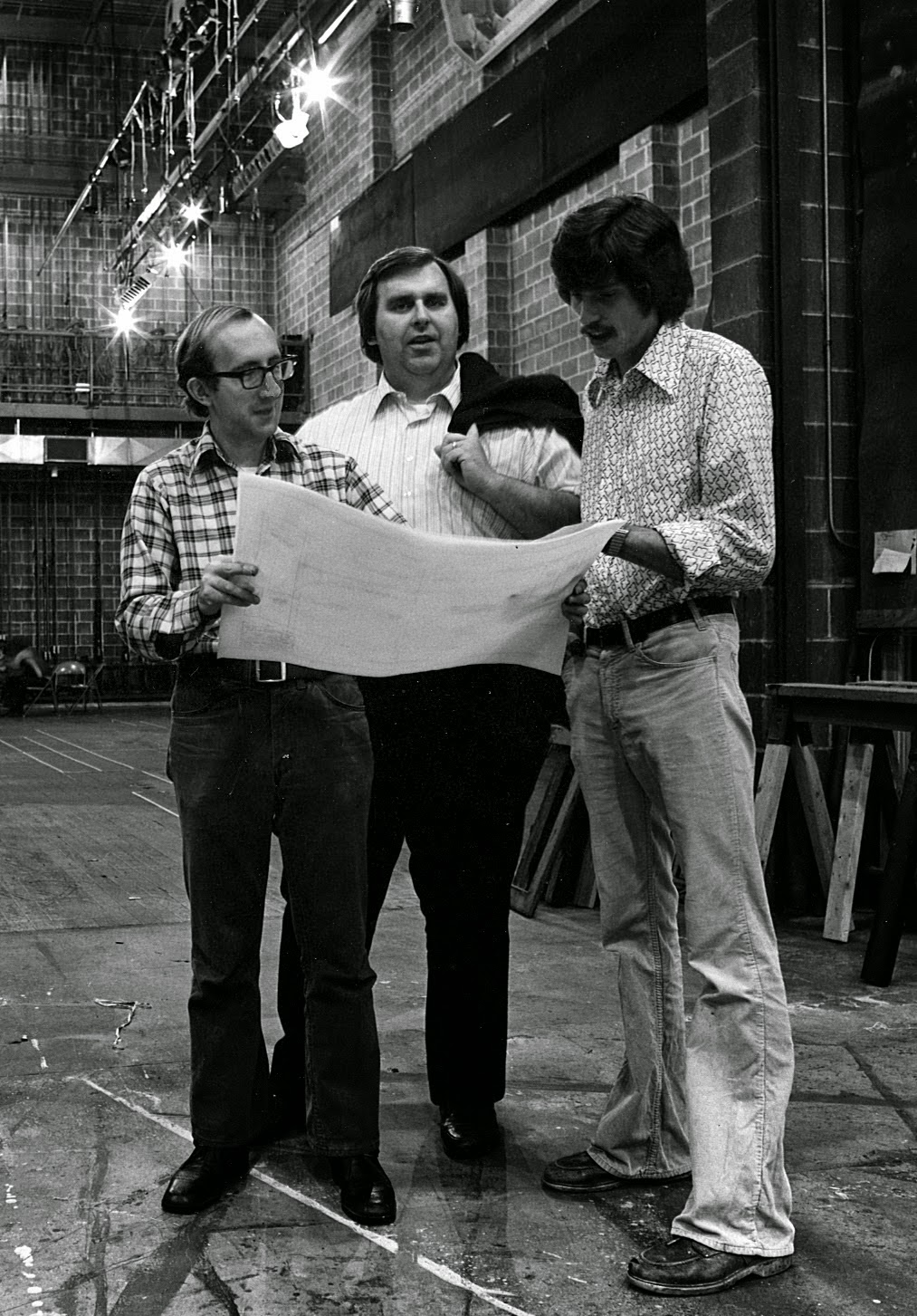
Charles Jones, center
While not all his relations were as colorful as Louie (a paratrooper in war and paramour in civilian life) Jones has only to look homeward to find ample inspiration for his work. Nearby Ft. Benning gave him a front row seat for the unfolding drama of the nation’s war mobilization. “Ft. Benning affected our lives from the time I was a child,” he said. “Columbus was only 38,000 people when the Second World War began. Then Benning was made the largest infantry training base and parachute school and suddenly there were 100,000 men there. It just mushroomed. And, of course, the soldiers’ families would come through too. So the war was very much a presence with us. And the fact Franklin Roosevelt had his Little White House retreat in Warm Springs, only 30 miles from our home, made his death, for us and for a lot of Georgians, an extremely personal experience.”
The Jones home, like many in the area, put-up military boarders during the conflict. Jones did his own part for the war effort when he used his gregarious verve to win a city-wide competition selling war bonds, earning the youngster a live on-air appearance on a local radio station. “Of course, I was so puffed-up, I was like a tiny little peacock just about to bust,” he said.
It was not his first brush with performing, however. From the time he could talk, he displayed an outgoing nature and impressive oratorical skills. He recalls standing on the steps of his family’s Baptist church and, like a preacher, greeting every churchgoer by name. He began exhibiting a vivid imagination at his paternal grandparents dairy farm in Smith Station, Ala., where he and his aunt Alice, only a few years his senior, devised and enacted 10-gallon plays, so named because the sketches lasted as long as it took for the cows’ milk to fill 10-gallon cans. Soon, nephew and aunt, more like brother and sister, began polishing their plays and performing them, complete with makeup, costumes, sets, outside the big farm house on Saturday nights. Their audiences, sprawled on the front porch or on the lawn, were mostly comprised of sympathetic kin but also included black tenant farming families whom the young thespians coaxed into attending. The plays became a family ritual for years. By all accounts, Charlie Jim (his legal name) was a big brash boy with a booming voice and captivating stage presence.
Far from genteel, Jones insists his family was a “dirt poor” lot that, if not as common as the folks in God’s Little Acre, were close cousins. “Our lives as children were visceral. We lived in a bare-footed world with mules and horses and manure. It was not up-town. It was not clean and nice.” But they knew how to have a good time. Weekends at the farm found the clan entertaining homesick GIs at picnics and parties full of Southern hospitality. “Many of the soldiers were farm kids who, stuck way out in the boonies, missed home,” he said. “Coming to Smith Station reminded them of home. It was very emotional for some of them. They’d even queue up to milk cows.”
Sunday dinners brought relations from all around. A preacher was often a feted guest but, man of God or not, he was subject to the same earthy treatment as everyone else. Jones explained: “One Sunday we had a preacher who was going on and on and on and just blessing everything. Finally, my little sister Julia, who was 2 at the time, said, ‘Oh, for Chris sakes, amen,’ and grabbed a chicken leg. Now, my aunts and uncles were the types who had a wonderful sense of humor and so they were just falling on the floor with laughter. And I’m sure Alice and I were laughing too. But my grandmother Jones was probably trying to spank all of us at one time.”
Down home religion offered Jones more grist for the mill. His mother’s family were ardent Methodists and his father’s devout Baptists. Jones found the country services at Smith Station Baptist Church “entertaining,” especially with cousin Samuel Jones present. “Sam was a brilliant man but became a religious fanatic at one time — growing this long beard — and as he took literally the Bible admonition for women to hold their tongues silent Sam would stomp out –clomp, clomp, clomp — in these big old farm boots whenever a woman stood up to testify. People thought his behavior stupid, but it was hysterical to me.”

Image via Wikipedia
He credits his family’s keen appreciation for the absurd for why he found “terribly funny” what others found incredulous. “I suppose it’s because my daddy and grand daddy had a real sense of theater in life. They were entertained by things, and so was I.” His passion for drama was fed whenever his father, Harry Jones, a packing house laborer turned food services magnate, returned from business trips to Chicago or New York and recounted the big stage shows he’d seen. For a boy in Columbus it was a link to far-off places and glamorous goings-on. “Daddy would come back from every trip and describe whatever play he had seen. He would act it out for me. Oh, the magic and imagination of it.”
His imagination was further fired by movies and books and by a local librarian, Miss Loretta Chapel, “a beautiful little bird of a woman” who read stories to he and his school chums. “Miss Loretta would sit in a huge casement window with us children at her feet and she would read, and as she read everything came totally to life. I saw it all acted out in my mind’s eye. It was just amazing. We worshiped her.”
Mad about make-believe, Charlie Jim knew the world of greasepaint was for him long before seeing his first legitimate play — a touring production of Kiss Me Kate — at age 13. He “loved” performing in his first school production, although he claims he was “dreadful.” By 16 he was a bright overweight lad ill at ease among his peers and struggling at school. Then, as if by fate, he was selected with 13 other “misfits” to complete his high school education in an experimental program at Emory University in Atlanta. There, under the tutelage of PhDs determined to teach students in an innovative way, new horizons opened for him and he flourished.
“Our textbooks were the original works of the Greek and Roman playwrights and philosophers. I was just wild about them. Our studies covered the Hebrew tradition, the Middle Ages, Chaucer, Shakespeare, Kierkegaard and so on. What these professors had in mind was to give us the heritage of Western thought and literature and civilization. It was really demanding and interesting. I didn’t appreciate it then but I realize now I had an extraordinary opportunity to read a body of literature that has stayed with me. It was very important to my life.”
Jones said something he read then motivated him to take a big bite out of life: “It was Plato’s statement about cave people living in a shadow world and never having the strength and courage to go through that threshold into the light — into the real world. I was so devastated by that. I thought, ‘That’s not what my life is going to be. I’m not going to allow myself to sit in a cave and not participate. I am going to go out there and try things.’ And I have. I’ve really been a participant.” His tendency to overindulge led to a lifelong battle with obesity, which he blames for the stroke that left him paralyzed on his right side. It’s a battle he’s lately won.
It was at La Grange College, a small Methodist school in La Grange, Ga., he devoted himself body and soul to the theater. He feels indebted to its “fabulous tyrant” of a dramatic arts teacher — Miss Irene Arnett. “She had a strict moral code. To her, we were all sinners going straight to hell. But, man, could she teach Tennessee Williams. Carnality was something she really understood.” After graduating in 1960 Jones promptly landed an acting job in Kentucky, where he enjoyed “the most decadent summer of my life.” When not sowing his wild oats, he did some directing in Columbus before getting his big break as an Equity Actor with the prestigious Barter Theater of Virginia, whose famous alumni include Jessica Tandy, Hume Cronyn and Ned Beatty, whom Jones replaced.
At the Barter Jones found a mentor in its founder and director, Robert Porterfield. “Once you were inside the Barter family then Bob just looked after you and would do anything for you. Bob was a role model for me in leading the Omaha Community Playhouse,” Jones said.
When his Barter Theater tour ended Jones found himself back home — out of work. At the invitation of friends he attended a performance of Tea and Sympathy and was taken with “a beautiful red-haired woman on stage,” Eleanor Brodie, a University of Alabama theater major. He recalled, “She had on a tight turquoise dress with one shoulder bare. She was the most gorgeous and provocative thing I’d ever seen. I was absolutely wild to meet her and I went backstage feeling like the cock-of-the-walk.” When she promptly put him down a peg or two with her sardonic wit, he was even more smitten. He arranged meeting her again through one of her friends and the two married three months later. Partners in life for 38 years now, Eleanor and Charles have two grown sons, Jonathan and Geoffrey, and one grand-daughter, Kathryn.
Of Eleanor, Jones said, “We both made such a total commitment to one another. She has been the most important person in my life. She has pulled me through more things than you can imagine. She’s a fierce lady and our relationship has not always been peaches and cream, but she believes in me. I’m just so damn lucky.”
Like many young actors the pair set their sights on New York, investing everything for their Big Apple fling. Jones found work, even understudying Zero Mostel on Broadway, but after three months of scraping by and enduring rejections he and Eleanor did some soul searching and decided their hearts were back home. “I was a big showy actor, but not nearly as good as many others. It was not ever going to be satisfactory,” he said. “We wanted to go home where we would have a chance to use our very expensive educations as teachers and theater directors. Fortunately, my hometown gave us the opportunity to do that.” He oversaw the restoration and reopening of the historic Springer Opera House, now the state theater of Georgia.
His success as a theater director/manager there prompted the Omaha Community Playhouse to hire him away in 1974. He soon sparked a rebirth of the venerable facility, severely damaged in the May 1975 tornado, by raising funds for its repair and, later, for an ambitious expansion. He launched its professional touring wing — the Nebraska Theater Caravan. His sumptuous adaptation of Dickens’ A Christmas Carol became an annual tradition. His musical extravaganzas dazzled audiences. Season memberships soared. Through it all, he felt the support of his father, who lived to see him grow the Playhouse into the nation’s largest community theater.
Jones finds his thoughts drifting more and more to his late father. “I realize now he was my strongest supporter. He really was.” He fondly recalls the time his father broke into the slated-for-demolition Springer Opera House to plead its case to reporters. The father’s dramatic stunt worked and the theater was saved for the son to guide. One early memory of his father lingers still. It was a Sunday afternoon on the farm. The extended family had finished dinner. Four-year-old Charlie Jim and grandfather Jones were feeding long sugar cane stalks into a mule-drawn mill to be ground into pulp for molasses. Jones tells what happened next: “I shoved a stalk in too far and my right hand got stuck, and the grinder clipped off the ends of all the fingers. I bled like a stuck pig. I can remember the women screaming and even my grandfather panicking. But the one in control was my daddy. He picked me up and he ran with me. All the while, my uncles were running alongside my father, a rather small man, telling him I was too heavy for him to carry, but my daddy would not give me away. He was determined to get me to a doctor, and he did too.”
“That memory of my daddy not giving me away is very powerful and it’s affected my whole life,” a sobbing Jones said, holding up nubby, scarred fingertips. “I wish I could tell him, ‘Thank you.’”
Today, Jones is drawing more and more on his past for his work. Sweet and sour Southern memories abound in his novel as well as in the nostalgic Papa’s Angels, a musical play written by North Carolinian Collin Wilcox Paxton in collaboration with Jones. The play had its premiere last winter with the Grand Olde Players and will be reprised this year. Currently, he is directing The Best Little Whorehouse in Texas for the Dundee Dinner Theater (it runs through May 6). Directing is still his passion: “I love putting the thing together. I love the process of rehearsing a play. That one-on-one with the cast and that working out how we’re going to do it is the fun for me,” he said. But directing is just one of many things he has immersed himself in since leaving the Playhouse due to health reasons in 1998. His work today includes serving on the board of directors for Theaters of the Midlands, a new non-profit corporation designed to support small community theaters in the area.
He is perhaps most excited working with Creighton University occupational therapy students to help them learn about stroke patients like himself. “If I have to endure this at least I can be purposeful by letting students work with me and ask me questions,” he said. “Maybe this will give them some knowledge they can’t get from a textbook and maybe that’s going to help somebody else who has this problem.” His ongoing post-stroke rehab includes aquatic therapy twice a week at Immanuel Rehabilitation Center, which honored him with its Victories Award for his dedication to “soar past limitations with determination, commitment and hope.” For a sensualist like Jones, any debilitation is a curse. Aside from the physical challenges he’s faced, including suffering severe falls and medical complications, his condition has extracted a heavy emotional toll. He credits Eleanor for his recovery. “She was just determined the stroke would not stop me, and it’s amazing how much creative work I’ve done since then.”
On his darkest days he recalls his father’s cheery nature. “He was the most optimistic person I’ve ever known and I feel blessed to have been born with his same optimism. I can be as low as a human being can get. I can think there’s no reason to go on living and then, it’s so incredible, I’ll wake up the next morning and feel, ‘Wow, let’s go.!’ I think one of the reasons I want to keep going is because I am so damn curious about things,” he said. “Part of my curiosity is to know how other people feel about life and what they have to deal with. Do we see things the same way? Do we feel things the same way? To me, that’s fascinating.”
Related Articles
- Stanley E. Williams left major mark in theater (sfgate.com)
- Theatre Building Chicago building theater without a building (timeoutny.com)
- Why the show must go on — and off — for local theater groups (commercialappeal.com)
Nancy Duncan: Storyteller

Image by National Media Museum via Flickr
I wrote several articles about the late storyteller Nancy Duncan. Eventually they will all find their way onto this site. There is one other currently on the blog. That piece is entitled “Her Final Story,” and was written when a quite weak Duncan faced her final days with terminal cancer. From the time she was diagnosed with cancer and on through the many rounds of treatments and surgeries she endured over years, she used storytelling as a means of coping with and making sense of her experience. The story offered here was written when she was a breast cancer survivor and still full of energy. Through it all though, she never lost her warmth or spirit or her passion, and that is what I always tried to convey about her when I profiled her. The other thing she inspired me to do was to try and find the right words to describe the art of storytelling and to explain why it was and remains a primal form of communication that we all need for our nourishment. My search for those words made me a better writer. Being around Nancy made me a better person.

©by Leo Adam Biga
This article originally appeared in the New Horizons
WANTED: Storyteller. Must possess engaging personality, commanding voice, malleable face and ability to relate well with people of all ages. Active imagination a plus. Large repertoire of stories advised. Previous storytelling experience preferred, but not required. Some traveling involved. Hours and fees negotiable.
No, the ad is not real, but the description is true enough. For proof, just catch Omaha storyteller Nancy Duncan in action. That is if you can find her before she hits the road again with her bag full of tales. A seasoned performer, Duncan inhabits a story in such a way that it spills out in animated spasms of sound, expression, posture and gesture. She is as quiet as a whisper or as loud as a shout. As still as a mountain or as antsy as a mouse. Her rubber face bends. Her supple body contorts. Her attentive eyes dart. Her sonic voice booms. She is whatever the story calls for: firebrand pioneer, wily coyote, grizzled witch, fearsome wind, bubbling brook, puff of smoke or, more and more, simply herself.
Duncan left a successful theater career behind to join the professional storyteller ranks in 1987. Since devoting herself full time to spinning yarns, she has developed a kind of fervor for her calling only true converts possess. For her, storytelling is more than a trade, it is a way of being and a means of sorting out the world. As she will tell you, this ancient oral tradition still has the power to hold us enthralled amid today’s digital revolution. Using only the force of her voice and her charisma, she tells stories that variously amuse, inform, heal and enlighten. Since beginning a battle with breast cancer in March, Duncan, 63, has made storytelling part of her therapeutic regimen and survival strategy.
While she did not discover storytelling as a personal artistic medium until the mid-1980s, she says, “I’ve been a storyteller all my life. I was a huge liar as a kid.” From the very start, the former Nancy Kimmel was immersed in stories told by her father, Harley, and maternal grandmother, Emma. “My grandmother shared a bedroom with me from the time I was 5 until I was 16. She was great. She’d smoke a pipe and tell stories. She loved the B’rer Rabbitt stories and could do them with a great dialect. And my father was a great storyteller. He liked to perform the story.”
When she moved with her family from the suburbs of Illinois to the backwoods of Georgia (Buford), she found a ripe landscape for her fertile imagination and boundless energy. She and her playmates organized “safaris” where they roughed-it like natives in the wild. Their only close-call came when moonshiners ran them off. As an imaginative child, she wore different identities like so many hats. “I was a leopard woman for a whole summer. My friend and I made ourselves leopard suits and claws. We would hide in bushes and jump out and scare our friends,” she recalled. She was a fine athlete too, whether scaling hills or playing hoops. Despite her dramatic gifts, when forced to choose between acting in school plays or competing on the school team, she opted for the court over the stage.
With the intent of curbing Nancy’s rambunctious ways and turning her into a proper young lady, her mother sent her to private art and elocution lessons. But Nancy chafed at any attempts to make her a debutante. She would much rather have been tomboying it outdoors with friends. By the time she graduated high school her father had fallen ill and she reluctantly left home to attend Agnes Scott College, a private women’s school in Atlanta. Not long after completing her first year there, her father died. She missed his stories. After grieving, she blossomed in college, majoring in English and minoring in art and theater. She then embarked on being a writer, even completing a fellowship at the famed University of Iowa Writers Workshop, before turning her attention to the theater and earning a master of fine arts degree in Iowa City.
It was there she fell in love with one Harry Duncan, a renowned fine book printer and instructor 20 years her senior. She learned typography from him. She also fell in love with him. And he with her. Student and teacher married in 1960. Despite skepticism from family and friends about their marriage surviving such an age difference, the union worked. The couple enjoyed 37 years as husband and wife and raised three children together. Harry died in 1997 from the effects of leukemia and colon cancer.

Harry Duncan
What made the relationship click? “The secret of our marriage and our lives is that we both found ways to do what we loved to do and would have done anyway if we didn’t have to work. It had to do with living our dream and not letting anything get in the way of that. Harry was a master printer, poet, editor, designer. He was devoted to his work. We sometimes had to drag him away to go on a vacation.”
After leaving academia behind, Nancy taught theater and directed stage productions at a small Iowa Quaker School. Then, in 1973, she joined the Omaha Community Playhouse staff as associate director. She left the Playhouse in 1976 to serve as artistic director and later as executive director of the Omaha Children’s Theater (now the Omaha Theater Co. for Young People), which she helped grow into one of the nation’s largest and most respected arts organizations of its kind. Burned-out by the demands of keeping a theater afloat, she turned to storytelling, a medium she had dabbled with a few years, as her new vocation.
Drawing on her theater background, her early storytelling was character-based and performance-driven. Her large catalog of stories — some original and some borrowed — include the collections Why the Chicken Crossed the Road, Good Old Crunchy Stories and Nebraska ‘49, which chronicles the true-life adventures of pioneer women. Her most popular incarnation, Baba Yaga, is a grouch of a witch with a golden heart. The old hag has become a sensation with school-age audiences, although some fundamentalist Christian groups concerned about the character have boycotted Duncan and even banned her from performing.
Since becoming a storyteller Duncan has often worked as an artist-in-residence in schools via the Nebraska Arts Council. She is currently one of only 225 artists participating in the national arts residency initiative of the Mid-Atlantic Arts Foundation. Her telling takes her on wide-ranging tours across the country (she recently returned from performing at the National Storytelling Conference in Kingsport, Tenn.). In 1999 the National Storytelling Network presented her with a Leadership Award for her work promoting the art in the North-Central region. She is also a board member with OOPS, the Omaha Organization for Professional Storytelling, a storytelling instructor at various colleges and universities the coordinator of the annual Nebraska Storytelling Festival.
She has seen the 15-year-old Nebraska festival grow amid a general storytelling revival in America inspired by the National Storytelling Festival in Jonesborough, Tenn. Duncan said there is a demand for these public storytelling forums because people hunger to hear stories. “We all love stories. We seem to be wired to the narrative form. It used to be everybody told stories. Today, people miss the stories in their lives. It may be they grew up when we didn’t have all these machines do our work and we didn’t have television sap up our time and instead we gathered on our big front porches in the evening to tell stories. Some people never had it in their lives and miss it because they know television is not giving them the stories they want to hear. They want to be present in the story — to recognize themselves — because stories celebrate who we are. They validate us. It’s like identity maintenance.”
As a creative artist, she naturally feels compelled to explore and express in her work whatever is going on in her life. Lately, that has meant examining her cancer. At a recent telling before a group of prospective medical students she struck up a quick rapport with the audience through her open, honest demeanor and her disarmingly whimsical humor. More than a creative outlet, her cancer stories function both as a coping mechanism for herself and as a forum for others about the risks of the disease and the forbearance of patients like herself. In a recent interview at her handsome, sun-drenched home in central Omaha, Duncan described how her experience with cancer is changing her.
“Breast cancer is transformational. I can feel already changes happening in me because of this, and it’s all based in community. There’s a huge community of people out there who’ve had cancer and because they’ve lived through this they have a relationship other people don’t have,” said Duncan, who, once she was diagnosed, informed friends around the world about her illness and, in turn, received supportive messages about their survival or the survival of their friends and loved ones. “That’s a pretty amazing group of people.” Duncan plans on joining a cancer support group as soon as her summer touring season ends. “I plan to get in one because I believe in efficacy within your own community — of people healing themselves and healing each other through their communications.”
According to Duncan, confronting problems through stories can be curative: “It’s a very healing process because as we turn our own experiences, including very negative ones, into stories and share those with other people, they share back and their comments shape the way we feel about our lives and a community is created. As we story, we heal the situation or solve the problem. It’s very healthy.”
She feels sharing the details of her story, including the mastectomy she underwent March 21 and the loss of hair she has endured during chemotherapy treatments, is her way of fighting the sense of denial and defeat still accorded subjects like cancer. “We need not to hide the fact this is happening. If we hide the fact we have cancer in order to be normal again we’re denying who we are. We’re also making it easier for others to get it because we’re doing nothing to prevent it. That’s why I have decided I’m not going to wear a wig and I’m not going to wear a prosthesis. Part of who I am is going to be a person who’s had breast cancer and who wants to tell stories about it. I hope my actions draw attention to the fact there is breast cancer in the world and that we need to do something to cure it. Moreover, we need to prevent it. Hiding it, to me, says the opposite. That it doesn’t exist. Instead, we need to let women know, You have a job to do.”
She said her anecdotal research reveals many women still do not do not know how to self-examine themselves or are afraid to. Why? “They don’t want to know. It’s maddening. They’re cutting their own throat.” She admits she has become something of a militant in the war on cancer. “There is an epidemic of cancer. Over and over again I keep hear people saying, ‘Well, we don’t know what causes it.’ I don’t believe that. I think we do know — we’re just denying that too — and so we’re writing death sentences for ourselves and for our children. It makes me kind of fiery.” Her decision to go wigless and to refuse surgical and/or cosmetic measures takes some people aback. “It’s threatening. That’s problematic for me because I don’t want to knock anybody’s choices. Women have the right to make their own choices. But at the same time I think denial is a dangerous habit of women. Too often, we deny the depth of what’s happening in our lives and ignore ways to change things for the better.”
In the process of describing her journey with cancer, her mission is to get people to look at the illness in a new way and thereby keep it from being a taboo subject shrouded in fear and morbidity. It is why she uses humor to discuss it and to defuse certain attitudes about it. “I want my stories to be very funny. When you have cancer there are all sorts of tricks your body plays on you. Losing a breast is tragic, but it’s also very funny. For example, without having any breast on my right side I realized that anything I tried eating that missed my mouth had a straight shot to the floor. Before, it didn’t. I always wondered before why there were more crumbs under my husband’s chair than mine. Guys have been keeping that a secret for a long time,” she said with her big wide smile and full-throttle laugh.
“And being able to wash your hair with a washrag is really wonderful,” she added, her hand sweeping back the few brown wisps on her head. “I’m not sure I’m ever going to let my hair grow long again. Also, the whole notion it might come back in red is very appealing to me. These are just little ways of looking at things that make them fun, rather than threatening.
She said storytelling is a perfect means for the teller and audience to explore together personal issues that are universally identifiable. Unlike a lecture where the speaker imparts a rigid message to a passive audience, storytelling is an organic, communal, interactive form of communication. And unlike reading from a text, storytelling springs from the recesses of the teller. Said Duncan, “If you’re holding up a book and reading from it you are not present in the same way you are telling a story. You’re just processing words and your personality doesn’t come through in the same way it does in storytelling, where who the teller is and how they feel at any moment is in what they’re telling. You can’t separate the teller from the story. That’s why there’s such a wide variety of tellers.” Storytelling works best, she said, when a spellbinding teller invites rapt listeners to shape the story to their own ends. It then becomes an individual and shared experience in one.
“You don’t tell stories into the wind. You tell stories to people,” she said. “Because storytelling is a live process, a story is not frozen. It’s like jazz — it’s still living and being shaped — and the storyteller navigates the story with the audience and changes it depending on what they get back from that audience. The audience makes the story in their minds. They create all the pictures to go with the words, and they get those pictures from their own lives. So, by the end of the evening you have as many different versions of the story as you do people in the room because each person has co-made their own part of the story. And when that happens, it’s very powerful and bonding. It’s like going on a journey together to a different place. It’s sometimes deliciously entertaining and funny. It’s sometimes spiritually intriguing and challenging. It’s sometimes moving and bereft with all the memories that get brought to the story.”
When a teller connects with an audience, she said, it is hypnotic. “There are certain stories that take you so deep into an emotion or an event that they are trance-inducing. The audience goes off with you. You can see it in the way the story flows across their faces. Their eyes lock-in and their jaws go slack. It’s as though they are dreaming.”
Duncan said the more emotionally honest a story, the more resonance it carries. For a residency in a Fremont alternative school last year she asked a group of wary students to listen to personal stories told by adult mentors. To their surprise, she said, “the kids were wiped out by the stories.” Students then had to tell the stories back and find a personal link to their own lives. “This time, the adults were in tears. The kids and adults realized they had a real human connection. They wanted to know each other better,” she said.
This Pied Piper for storytelling has encouraged several other tellers. Among them is her daughter, Lucy, a professional storyteller in her own right, and granddaughters, Louise and Beatrice, with whom Nancy regularly swaps tales. “My grandkids are always asking for stories. They’re steeped already in the personal stories and in the more fanciful stories. I have a story I’m working on now that is all about them and their relationship with me. It’s kind of a grandmother story.” Duncan hopes many of the stories she values will be taken-up by her grandkids and told by them.
“My goal is that one of them will be telling those stories at a festival somewhere. I’m trying to pass that love of story onto them.” She feels senior citizens have an obligation to be storytellers, but finds too many isolated from this traditional familial-societal role. “It’s a great loss to our society when seniors are separated and devalued. They have a responsibility to pass on knowledge and they have a need to be validated,” she said. Whether told at a fireside, a bedside or a festival, she said stories tap a deep well of shared human experience. “Storytelling is the best-kept secret in the world. It’s not just for children. It’s for anyone. We all have valuable stories to share.”
So far, Duncan has not allowed her illness to limit her busy, independent lifestyle. She said friends and family urge her to take it easy.
“They keep saying, ‘You need to slow down, to stop, to rest’ I haven’t quite accepted that yet. I tend to listen more to what the holistic medicine people say, which is — do what you want to do…do what makes you happy.” At a recent telling about her cancer, she said, “Now, this story…doesn’t have an ending. Not yet. I don’t know if I’ll truly know the meaning of this experience. But I have learned many things. One of them is, you cannot lose something without getting something else back. You don’t get back the same thing you lost, but you get back something that might be better. For example, I may not be a grandmother with a great shelf of busom, but there are other kinds of shelves. There’s the comforting shelf of story.”
Related Articles
- Healing with Story: Healing the Storyteller (health-psychology.suite101.com)
- Creating a Youth Storytelling Community One Kid at a Time (storytellingadventures.blogspot.com)
- Storytelling (aztecexploration.wordpress.com)
- The Importance of Telling Kids Stories (prathambooks.org)

Black Women in Music

Image via Wikipedia
I got the idea for this story in bits and pieces over years, as I learned tidbits about several black women of a certain age who have accomplished themselves in music, whether jazz, blues, gospel, or classical, whether as singers, musicians, directors, and composers. All the women have ties to Omaha, my hometown. I got to meet all but one of the charming ladies profiled here and it was my pleasure to learn their stories and tell them in this piece for the New Horizons. Only one of them achieved anything like a national reputation, but as I hope I make clear in the article they all distinguished themselves in their shared passion for making music.
Black Women in Music
©by Leo Adam Biga
Originally published in the New Horizons
Jeanne Rogers
“Music is my life. I can’t live without music.” Omaha jazz singer/pianist Jeanne Rogers recites the words as a solemn oath. As early as age 4, she said, her fascination with music began. This only child lived in her birthplace of Houston, Texas then. She’d go with her mother Matilda to Baptist church services, where young Jean was enthralled by the organist working the pedals and stops. Once, after a service, Jean recalls “noodling around” on the church piano when her mom asked, “‘What are you doing, baby?’ ‘I’m playing what the choir was singing.’ So, she tells my daddy, ‘Robert, the baby needs a piano.’ They let me pick out my piano. I still have it. All my kids learned to play on it. I just can’t get rid of it,” said Rogers, who proudly proclaims “four of my five kids are in music.”
Blessed with the ability to play by ear, she took to music easily. “I’d hear things and I’d want to play ‘em and I’d play ‘em,” she said. She took to singing too, as her alto voice “matured itself.” After moving with her family to Omaha during World War II, she indulged her passion at school (Lake Elementary) and church (Zion Baptist) and via lessons from Florentine Pinkston and Cecil Berryman. At Central High she found an ally in music teacher Elsie Howe Swanson, who “validated that talent I had. Mrs Swanson let me do my thing and I was like on Cloud Nine,” she said. Growing up, Rogers was expected by the family matriarchs to devote herself to sacred or classical music, but she far preferred the forbidden sounds of jazz or blues wafting through the neighborhood on summer nights. “Secular was my thing,” she said. When her mother or aunt weren’t around, she’d secretly jam.

The family lived near the Dreamland Ballroom, a North 24th Street landmark whose doors and windows were opened on hot nights to cool off the joint in an era before AC. She said the music from inside “permeated the whole area. I would listen to the music coming out and, oh, I thought that was the nicest music. Mama couldn’t stop me from listening to what the bands were playing. That’s the kind of music I wanted to play. I wanted to play with a band. I was told, ‘Oh, no, you can’t do that. Nothing but trash is up in that ballroom. There’s no need your going to college if that’s all you want to play.’ But, hey, I finally ended up doing what I wanted to do. And playing music in the nightclubs paid my way through college.”
Do-gooders’ “hoity-toity,” attitude rubbed her the wrong way, especially when she “found out folks in church were doing the same thing folks in the street were.”
Rogers, who became a mother quite young, bit at the first chance to live out her music dream. When someone told her local bandleader Cliff Dudley was looking for a singer she auditioned and won the job. “That’s how I got into the singing,” she said. “I was scared to death.” She sang standard ballads of the day and would “do a little blues.” Later, when the band’s pianist dropped out, she took over for him. “And that’s how I got started playing with the band.” Her fellow musicians included a young Luigi Waites on drums. The group played all over town. She later formed her own jazz trio. She’d started college at then-Omaha University, but when the chance to tour came up, she left school and put her kids in her mother’s care.
The reality of life on the road didn’t live up to the glamour she’d imagined. “That’s a drag,” she said of living out of suitcases. Besides, she added, “I missed my kids.” Letters from home let her know how much she was missed and that her mother couldn’t handle the kids anymore. “She needed me,” Rogers said. “I mean, there were five kids, three of them hard-headed boys. So I came back home.”

The Jewell Building once housed the Dreamland Ballroom
She resumed college, resigned to getting an education degree. “All I wanted to do was play the piano in the band. But I ended up doing what I had to do,” she said.
To support her studies she still played gigs at local clubs. And she nurtured her kids’ and their friends’ love of music by opening up the family home to anyone who wanted to play, turning it into a kind of informal music studio/academy.
“My house on Bristol Street was the house where everybody’s kids came to play music,” she said. Her twin boys Ronnie and Donnie Beck practiced with their bands upstairs while younger brother Keith Rogers’ band jammed downstairs. Their sister, singer Carol Rogers, imitated soul songstresses. Some youths who made music there went on to fine careers, including the late guitarist Billy Rogers (no relation). Ronnie played with Tower of Power and still works as a drummer-singer with top artists. Donnie left Omaha with drummer Buddy Miles and now works as a studio musician and sideman. Keith is a veteran music producer. His twin sister Carol performed with Preston Love and Sergio Mendes, among other greats.
Jeanne plays with her children when they come to town. In 2000 she went to Calif. to cut her one and only CD, “The Late Show,” which her son Ronnie produced. He pushed her hard on the project, but she likes the results. “My son’s a nitpicker and a stickler, but that’s what gets the job done.” One of the kids who was always at her place, Vaughn Chatman, is an attorney and the founder of the Omaha Black Music Hall of Fame, which Rogers and her three sons are inductees in.
She still plays a concert now and then but mostly for Sunday services at Church of the Resurrection, adding a piano jazz beat to traditional hymns. “I like it because it’s a come-as-you-are church. It’s a nice place to be.” She also volunteers at Solomon Girls Center and sometimes gives piano lessons.
She may not have wanted it, but she ended up a teacher and principal (Druid Hill) in the Omaha Public Schools. “It turned out to be one of the most rewarding things I’ve done,” she said. She used music to reach students. “The kids loved it because I would play the blues for them when they were doing their math lessons and stuff. Other kids would come by the door and my kids would say, ‘Bet you wish you were in here.’” Whether at home, in the classroom, at the altar or on a nightclub bandstand, she makes music part of her life.

Audience responding to Creighton Gospel Choir performance

Nola Jeanpierre and Claudette Valentine
So intertwined are the lives of singer/actress Nola (Pierce) Jeanpierre and her “Auntie,” music director, pianist and piano teacher Claudette Valentine, that while not a musical partnership per se, their work is often inseparable. Some of dramatic soprano Jeanpierre’s earliest music memories involve her aunt, who’s accompanied her niece at recitals and concerts for half a century. They’ve worked together in community theater productions, including Omaha Community Playhouse and Center Stage Theatre shows. The Omaha music legends performed last month at the Cathedral Flower Festival. Their most solemn pairing occurs Sundays at New Life Presbyterian Church, where Valentine leads a choir that includes Nola as well as Nola’s sister Johnice Orduna, daughter Carole and grandkids Elyssia and Emil.
These sisters of the spirit draw on music, like their faith, as a wellspring for life. “It’s powerful,” said Valentine, an adjunct piano instructor at Creighton University, whose gospel choir she also directs. “It’s almost an ecstasy. There’s a warmth when the music touches you. It’s strength. When you’re feeling really down it can lift you right back up. The music can comfort you,” as it did when her brother recently passed. The belief described by her favorite hymn, “My Father Watches Over Me,” guides her in all she does. Jeanpierre views music in the same light. “It is so healing,’ she said. “It’s the one communication that breaks all barriers.”
Valentine’s life in music began at home, where as a 4-year-old she duplicated any tune she heard on the family piano, from hymns, chants and anthems at Zion Baptist Church to ragtime numbers a neighbor played. Her folks recognized her gift and signed her up for lessons. From a young age she’s played for and directed church choirs, first at Zion, then Calvin Memorial Presbyterian and lately New Life Presbyterian. A prodigy advanced well beyond her years, she performed at community events and school programs at Long Elementary and Tech High. After graduating Tech at 16 she was recruited to Drake University, where she obtained her BA and master’s. At 22 she opened her own studio. Always honing her craft, she earned a doctorate at the University of Nebraska-Lincoln and studied at the Peabody Conservatory (Baltimore, MD). She’s attended national piano festivals and conferences. “I’ve never stopped studying,” she said. “The teaching of piano has changed so much since I hung up that first shingle, so I try to keep on track.”
For 50 years now she’s kept a schedule her niece describes as “sun up to sun down working. She is tireless,” said Nola. “A joke in the family is — What is Auntie going to get into now?” Valentine’s work is her passion. “The choral music — it’s a spiritual thing. It just hits me where I live,” she said. “The piano teaching, now that’s my first love. When the babies come to me and they don’t know anything about the piano and they go away from me and they’re playing for choirs, conducting, appearing on Broadway, in Europe, that’s my life, that’s my legacy.”
Former student Kevyn Morrow, a New York and London musical theater actor, wowed audiences last year guest starring in Ragtime at the Playhouse. Another old student, Douglas Corbin, is a top ballet accompanist and music teacher back East.
When directing Creighton’s gospel choir she said “it does my heart good” watching its white members “grow” as she “introduces them to how black people really live and what they’re really like.” She complements its student ranks with Nola, Johnice, Carole and other relatives, whose soaring voices provide a “nucleus” she draws on. Whatever Valentine takes on, Nola knows family is sure to be dragged in. “We know we’re going to have to do something,” she said, laughing. “Anything you ask of family, we’re there.” Their most personal collaboration is for a heritage program that pays tribute to the strong matriarchs in their family. Through dramatic recitation, song and music Valentine, Jeanpierre and family recount the stories of ancestors Easter, Queenie I and Queenie II, to tell a story of perseverance from slavery to reconstruction to civil rights.
Jeanpierre’s musical roots are in church, “the foundation” of her life. She and her sisters sang in choirs, for school programs and as the Pierce Trio at Show Wagon competitions. Courtesy her aunt, she was “introduced to classical music…all types of music” and trained on the piano. She did musical theater shows as a kid, once playing Bloody Mary in South Pacific, a part she reprised as an adult at the Playhouse. As a teen she left Omaha for Calif. to live with her father, who encouraged her love of opera. “He realized my talent,” she said. As a young woman she trained with Professor LeRoy Brandt, sang jazz with producer/arranger Quincy Jones and flutist Paul Horn and opera with the San Francisco Opera chorus and placed in the NY Metropolitan Opera auditions. She studied with Met coaches.
Since coming back to Omaha, she’s appeared in many stage shows here and in summer stock at the New London Barn Playhouse in New Hampshire, where she broke ground by insisting on playing nontraditional roles. She’s sung with Opera Omaha, performed cantatas, oratorios, solos, “anything you can imagine,” in churches and concert halls. “Among my favorite things to do is to sing spirituals in church,” she said. She’s directed choirs, cantored at St. Cecilia’s Cathedral and even sung for three kings. Her “lovely old voice” is widely praised. So why she isn’t famous?. Her attention to faith and family and good works has kept her from pursuing a larger career. “The voice is always in demand, but there’s always someone in need of something and that side of me wants to go do that. I love assisting people. I want to be of help,” said Jeanpierre, who counsels folks in need. “There’s a tear of helping a community and singing for that community. Sometimes they’re combined. God puts you where you need to be the most.”
Her refuge is her faith. “It carries you through every single situation. When I think I can’t go another step or something’s not going my way, I can hear Auntie Claudette’s” stirring rendition of “‘My Heavenly Father Watches Over Me’ in the back of my mind, and that’ll get me up and get me moving. Music is a celebration.”
Richetta Wilson
When Omaha jazz vocalist Richetta (Lewis) Wilson sings, she can’t help but sound a little like icons Ella Fitzgerald, Sarah Vaughan, Dianah Washington and Nancy Wilson, as she worked and forged friendships with these legends when they performed here. Once a featured artist in Omaha’s finest clubs, Richetta naturally drew on the impeccable phrasing and posh stage craft of divas she admired. “I had a little bit of all of ‘em in me because I dealt with all of ‘em,” she said from her showplace of a home. With sophisticated ladies as models, it’s no wonder the petite Wilson has been the epitome of art and class among Omaha song stylists for half-a-century.
“Those were all my favorite people. I loved ‘em,” she said. She “especially” cherishes how she was able “to get to know” them as human beings. She got particularly “close” to Dianah and Ella. “Practically all of ‘em stayed at my house. We’d cook. We had a lot of fun together. Dianah Washington was my idol. From 10 years old I always wanted to sing like her. I did every tune she did. She put so much feeling in her tunes. She was a great person. Ella was a dream. I did her hair. We’d go to work together. She was a honey. I really enjoyed her.”
Getting schooled by old souls was nothing new for Wilson, whose father, Richard Lewis, mother Camille, and uncles and grandpa, all played professionally. Early on her dad saw his little girl’s talent and hunger to perform. She was so enamored with his life in music she’d “wait up on him” to come home from the Trocadero Club, where he played with Cliff Dudley’s band, pumping him for all the details.
“I had to know everything that went on,” she said. “He always sang ‘Laura’ to me because I loved to hear him sing that. When I got to be about 12 he let me go to rehearsals with him down to the Trocadero. I’d be wide-eyed.”
He bought her a baby grand piano for her 7th birthday and saw to it she and her four siblings learned their chops. “He dearly loved music. He instilled it in all of us,” she said, adding that a brother, Victor Lewis, has enjoyed a long career as a jazz drummer-composer. “Everybody had to play.” She balked, declaring, “‘All I want to do is sing.’ She later appreciated the training ”because that’s how you learn to phrase and get your chords down and everything.”
At home she imitated Dianah, crooning into a lamp while her brothers made believe brooms were horns or saxes. Her dad eased her into show biz by having her sing at American Legion halls. “That’s when I took off,” she said. “I told him, ‘This is what I want to do, Daddy. I want to sing.’ I threw my lamp away and picked up the real mike.” When he felt she was ready, he had her audition for bandleader Dudley. Shy Richetta was coaxed to sing “Tenderly.” She recalls finishing the tune and Dudley turning to her dad to declare, “’She’s hired.’ That got me on the circuit,” she said.
Dudley became her mentor. “He made me sing some of everything. I couldn’t just do jazz. I did country western, all the show tunes…so I have a rep where I can do a little bit of everything,” she said. “He was a heck of an arranger. He was my foundation, I’ll put it that way. He was stern…I cried a lot, but he taught me everything I know. It was worth it. It got me good jobs and sent me on my way.” She was 17 when she joined Dudley and 19 when she hooked up with Preston Love’s territory band, touring the South on a big yellow bus with a pot belly stove in it. She was the group’s only female. Before her dad let her go he made pianist Roy Givens “promise he’d take care of me.” Givens kept his word.
Life on the road with a 17-piece orchestra was “an experience” she said. They played Jim Crow venues where the band had to enter through the back door and the crowd on the dance floor was separated by a rope — whites on one side, blacks on the other. The band slept on the bus. She got teased by the guys. Nine months away from home with all those crazy cats was enough for her.
She performed many more times with Love and Givens. She regarded them and players like Sonny Firmature and Buddy Graves “my musical family.” With her real family she sang in a trio that had her dad on sax and her mom on piano.
“I was amazed he let me do it that long,” she said. “I had many opportunities to go and do a whole lot more than I did. He said, ‘We’ve got four daughters here and I don’t think you’re going to be going away leaving girls.’ So, I made myself happy with working around here. I’ve enjoyed what I’ve done and all the people I’ve had the opportunity to meet and the good times we’ve had.”
She only plays the rare gig anymore. There’s still nothing better than blending her sweet voice with the sound of a full, swinging orchestra. She last did that in 2005 at Harrah’s Casino, singing a duet with Omaha native Eugene Booker McDaniels on his classic “Feel Like Making Love” at the Omaha Black Music Hall of Fame awards dinner. She was inducted for her lifetime as a consummate jazz interpreter.
Much of the old gang’s gone now, but she still performs from time to time with Buddy Graves at Touch of Class Lounge. She sings at her annual birthday bash, too. She and her brother Victor Lewis jammed at a recent Jazz on the Green.
“I’ve had an adventurous life with all the things I’ve done,” she said. “It’s hard to kind of believe. But I wouldn’t trade it for nothing in the world.”
Ruth Norman
In a career spanning 60 years, Omaha native Ruth Norman has made a name for herself as an organist, pianist, composer, music educator and choral director. She left Nebraska decades ago to pursue a life in music, settling back East, where she got her master’s at Eastman School of Music (Rochester, NY), but she credits her early start here for her later success. Her introduction to music began at home.
“All the females in my family played the piano quite well,” she said by phone from her adopted hometown of Bethesda, MD. “I grew up playing the piano. I was always at the piano, always. I didn’t know what else to do but that.” Except for tennis, her second passion. Her grandmother, aunts and cousins all played piano, but her “dominating” grandma set the tone. She made sure Ruth took lessons — from instructors Edrose Willis Graham and Frances Baetens. But it was an inner stirring that drove young Ruth. “I’ve always just been led to do it,” she said. “It is deep within me.” Her many compositions, from “The Rapture” to “Introspection,” speak to music’s profound pull on her and her interest in “metaphysics.”
Despite being black in an era of overt racial bias, she said, “I grew up with every advantage to grow into music. I was always given the opportunity to play. I often played for classes at Lothrop Elementary and Central High. I played at Central’s Road Show…Baetens would drag me all over Nebraska and parts of Iowa playing programs here and there. I did a lot of concertizing from age 10 or 12. I loved it.”

Ruth Norman is featured in the above anthology
Some might say she’s followed an unusual path for an African American by concentrating on classical music. “I always played classical music and I always played sacred music (at Claire Chapel Methodist Church). Jazz and blues and gospel were not even on my menu,” she said. “I did not have that exposure at all.” That’s not to say she couldn’t play or appreciate those styles. Summers home from her studies at the University of Nebraska-Lincoln found her playing “cocktail-lounge music for some of the better hotels in Omaha (among them, the Fontenelle) as I’ve done here in the D.C. area. I don’t consider myself a cool, swinging jazz player, but I found I could always play something like ‘Blue Moon’ or ‘I’m in the Mood for Love’ or ‘Night and Day’ without any trouble because I could play ‘em by ear.” A diverse repertoire, she said, served her well. “The way you can survive as a musician is to prove you can do several things. If you’re going to write music it’s to your advantage to play and hear different things…different rhythms. Playing by ear gives you help and freedom in playing and writing classical music.”
It was at UNL, where she got her BA, she began composing. “It was just sort of a natural process,” she said. “I thoroughly enjoy composing and I’ve written for many mediums — choral, chamber, piano and organ works.” Much of her work’s published in anthologies of black composers. She’s also recorded pieces. In a career that’s “been a whole mix of things,” she’s always conducted choirs and played organ at churches. “The organ is very rewarding. There’s an inner feeling you can get from playing the organ you don’t get from playing the piano,” she said. “An ethereal expression deep within. I thoroughly enjoy that. I don’t mean a Hammond or Wurlitzer organ. I mean the actual pipe organ.” She’s played some of the best.
It was during her academic career, including a stint teaching music at a string of black colleges (Spelman, Morehouse, Bowie State, Texas Southern), she developed an interest in researching the works of black classical composers. “Annoyed” that blacks were relegated in many quarters to certain strands of music she said, “I decided I would set the record straight. I realized black composers had lived in many parts of the world and written in every style of music. They didn’t do just blues, jazz and gospel.” Her studies, funded by National Endowment for the Arts grants, found “a lot of classical composers we thought were white were black or mixed race. That led me to a wide avenue of music and many adventures” in Latin America and beyond. She’s given much of her life to sharing her findings via piano lecture recitals and interviews/performances on radio (Pipedreams) and television.
Her career’s been about taking the path less traveled. It’s why she left home. “I’ve always liked a challenge and I felt one was never challenged enough in Omaha. The worst thing you can do is stay where everyone thinks you’re wonderful. You get so comfortable. I don’t believe in limiting myself or patting myself on the back. I knew I belonged in the East. That’s what made me stay here (after Eastman). If you’re going to be in the field of performing you have to drive yourself alone,” she said. “You can’t just loaf through. You have to have that self-motivation as I did. You have to be honest with yourself, you have to be willing to criticize yourself, you have to realize I could have done better and I will do better.”
These days her playing’s curtailed as the result of injuring a hand in a fall. “To find yourself in a situation in which your playing ability has been hampered is devastating at first,” she said, “but I don’t let myself focus on that. I’m a very positive person. I do a lot of meditation and prayer. Independence is a state of mind. Besides, I never was one to sit still.” Norman was inducted in the Omaha Black Music Hall of Fame in 2005. She’s been honored by a concert of her works at the National Museum of Women in the Arts in Washington DC, where she’s served as Artist-in-Residence at the Sumner School.
NOTE: Fellow Central grad Cherie Curry, a distinguished pianist and piano teacher, also traces her musical start to Omaha’s north side. She played for church (Zion Baptist) and in concert (an all Chopin recital at Joslyn). After graduating Omaha University she pursued advanced studies at San Jose State University, where she taught many years. Her concert/recital career took her all over the U.S. and Europe, where she also studied. In 1976 she performed the Aaron Copland Sonata before the iconic composer himself at a concert in San Jose, where she resides.

Mt. Nebo Missionary Baptist Church
Veola Dryver
Veola (Seay) Dryver of Omaha was a girl of 8 when she said she received the call to serve the Lord through music, something she’s done for 70 years. “I knew God had called me. It’s sort of a wonder way that He does, but you know it’s His voice. It’s like a whisper. And sometimes it’s really loud.” She attended Mt. Nebo Baptist Church at the time. She sang in the choir, but insists she had no real knack for music. She trusted God would show her the way. “I didn’t know anything about music,” she said. “I asked Him, ‘Are You sure this is what You want me to be?’ He told me, ‘I looked for a man and I found none.’ I was reading my Bible when I turned to the first chapter of Jeremiah and that’s exactly what this passage said.”
It was all the confirmation she needed. “There are those who are called into the ministry and there are other ones that are gifted. They are special chosen, ” she said. For years she kept the calling a secret, even from her parents. “Most people, if they have this kind of a gift, they’re afraid to tell it,” she said, “because people won’t believe them and they’re jeered at.”
She was 15 before she revealed her calling. By then she was showing promise at church, although her family was too poor to send her for lessons and “everybody except my father,” she said, “thought I would never make a musician.” Veola would not be dissuaded. She said unlike her demure mother, “who always believed women should be sort of docile, I was not. It just didn’t suit me.”
Then fate or divine inspiration struck again. “Eulah Billingsley, a very sincere, very religious person — what we called a Christian that knew God — said the Lord had led her into forming a youth choir for the church…and to appoint me as the minister of music. I just burst into tears because I hadn’t told anybody that secret.” Dryver “had a lot of studying to do and music lessons to take, much under the guidance of “a marvelous teacher named Florentine Pinkston. She was a beautiful person…very strict and austere.”
Despite some training, she credits the Lord for her directing prowess. “I never have taken directing lessons. I just knew.” Being a female music minister in the Baptist church was unheard of then, but she pressed on anyway. “So many people were saying women don’t teach music, women don’t direct…but they all accepted me.” Further setting her apart was a dynamic directing style, gesticulating hands keeping beat and bringing voices in. She was minister of music at Mt. Nebo for years and enjoyed a long tenure at Trinity United Methodist Church. Over time she’s directed youths and adults at many churches of varied faiths. She even directed a choir of doctors and nurses at Immanuel Hospital. “Music is music,” she said.
Her son Michael Dryver, a noted Omaha music minister, director and teacher in his own right, considers his mother “a pioneer” for the “total” way she integrated the arts into sacred rites and overall church development. “She’s very creative. She’s also a visual artist. She pioneered liturgical dance in Omaha…she had dances that were actually part of the worship services. There was a spirit of music ministry she brought to this community, especially to north Omaha, that was unseen before.”
Mother and son collaborated on productions of Ahmal and the Night Visitors and The Messiah and she sung in the Voices of Omaha when he directed it. His mother and father, the late Herman Dryver, provided artistic and technical support, respectively, for many concerts/recitals he directed. She was a lead teacher for the Wee World fine arts program at her son’s Omaha School of Music.
Years earlier she directed large events herself. She was music director for several state Baptist conventions and once, for a national ministerial congress Martin Luther King, Jr. attended. The late ‘50s gathering marked MLK’s lone visit here. She befriended the young Southern minister and led a choir of some 1,000 voices.
Dryver, who attended then-Grace College and Omaha University, has done her share of preaching, too. “I do preach,” she said, “but the radio is my pulpit. I have a program on KCRO (660AM) called In His Image.” Airing Saturdays at 12:15 p.m., the program has her deliver an inspirational scriptural message each week under the guise of her radio handle — Teacher Mary D. Before that, she hosted a weekly Sunday television show called Soul Searching on KETV Ch. 7, for which she interviewed clergy and other religious figures from Omaha and other communities. Her charisma made her “an Oprah Winfrey” in her own time.
As immersed as the family was in church and music, her children were bound to carry on. “We all loved music and we all loved God,” Veola said. “We lived in the church. I think that was our advantage.” For her, music and faith are inseparable. “I’ve always been very fascinated with it. It’s just been an exciting journey and an exciting call,” she said. “It’s a healer, it’s a testament and it’s a witness. Music has an effect upon people. You really can control an entire audience through music. I believe music is the one gift God has given to mankind we enjoy on Earth that we will take back to heaven with us. We won’t be barbers, butchers and businessmen in heaven, but we will sing.” A vision has showed her a million heavenly voices raised in song. “I look forward to being part of that number,” she said. Amen.
Related Articles
- Abbey Lincoln (telegraph.co.uk)
- Review: Cassandra Wilson works magic at Jazz Alley (seattletimes.nwsource.com)
- Tyler Owen – Man of MAHA (leoadambiga.wordpress.com)
- Arno Lucas, Serious Sidekick (leoadambiga.wordpress.com)
- Enchantress “LadyMac” Gets Down (leoadambiga.wordpress.com)
- Big Bad Buddy Miles (leoadambiga.wordpress.com)
- Back in the Day, Native Omaha Days is Reunion, Homecoming, Heritage Celebration and Party All in One (leoadambiga.wordpress.com)
- Luigi’s Legacy, The Late Omaha Jazz Artist Luigi Waites Fondly Remembered (leoadambiga.wordpress.com)
- A Rich Music History Long Untold is Revealed and Celebrated at the Omaha Black Music Hall of Fame (leoadambiga.wordpress.com)
- Native Omahans Take Stock of the African-American Experience in Their Hometown (leoadambiga.wordpress.com)
- Native Omaha Days: A Black is Beautiful Celebration, Now, and All the Days Gone By (leoadambiga.wordpress.com)
- From Omaha to Paris to Omaha, with Love, Anne-Marie Kenny’s Journey in Song and Spirit (leoadambiga.wordpress.com)


 Leo Adam Biga's My Inside Stories