Archive
From the Archives: Opera comes alive behind the scenes at Opera Omaha staging of Donizetti’s “Maria Padilla” starring Renee Fleming
Opera Omaha has had many high points over the years, and this 1990 story from deep in my archives touches on some of them. The company’s Fall Festival was an international showcase that garnered much attention for the talents it brought together and the edgy repertoire it presented. Then Opera Omaha drifted to safer waters for several years. Recently it’s tried some outside the box things again, including an acclaimed Madama Butterfly designed by noted artist Jun Kaneko, a hauntingly etheral staging of poet Ted Kooser‘s Blizzard Voices, a sublime rendering of the Native American Wakonda’s Dream, and a spirited production of Brundibar. The following two stories from 21 years ago chart the behind-the-scenes actviity of mounting opera and the collaboration behind a Fall Festival production of Maria Padilla, starring then then emerging and eventual world-acclaimed soprano Renee Fleming.

From the Archives: Opera comes alive behind the scenes at Opera Omaha staging of Donizetti’s “Maria Padilla” starring Renee Fleming
©by Leo Adam Biga
Originally appeared in Omaha Metro Update
It’s a Monday night at Joslyn Art Museum‘s Witherspoon Concert Hall, where a surreal scene worthy of Federico Fellini unfolds. The strange confluence of sights and sounds represents the final preparations before the evening’s dress rehearsal of Gaetano Donizetti‘s 1841 opera Maria Padilla, one of three music theater works now showing in Opera Omaha’s Fall Festival.
While carpenters’ electric drills whir away on an unwieldy set piece near the front of the stage, a harpist begins playing behind them. Soon, violins, horns and percussion instruments are heard over the workmen’s din, as Omaha Symphony Orchestra players gather in force. Other production crew members climb ladders high into the rigging overhead or adjust lights. Stage managers cart spears, pillows, plastic grapes and other props in the wings.
And as if on cue a woman bedecked in a flowing white wedding gown appears like an apparition in a side aisle. She surveys the hubbub, then disapepars. She is one of the costumed actors who pace in and out of the hall as the rehearsal’s 8 p.m. curtain call passes without the set piece having budged. It seems the union crew is having trouble fitting the parts of the large trihedron together.
Rehearsal is already 15 minutes late. A long night lies ahead; the cast and the opera’s conductor and director are anxious because Maria Padilla will make its American premiere only five days later.
Opera Omaha technical director Brady Mittelman had already spent a few all-nighters at the Witherspoon when interviewed a week before Maria’s September 14 opening. Mittelman, who joined the company only 13 weeks ago, has had a baptism-by-fire.
When Carousel closed July 31 he had three weeks of pre-production to call union crews and figure lighting, sound and stage requirements for the Fall Festival, which presents three works in repertory. Then work began on moving an army’s worth of equipment into the Witherspoon and installing it.
“We basically have three weeks to convert a concert hall into an opera space,” he said. “The biggest challenge, technically speaking, is just making the Witherspoon work. It is a very limiting space.”
Truckloads of gear began arriving August 23. The task was to outfit the space with everything a full-fledged theater demands. While the hall’s minimal lighting facilities are adequate for the concerts usually held there, for example, they fall far short of opera production needs. Lighting, sound and other equipment has been rented.
“All the lighting equipment that we are using was brought in on a 14-foot truck from Kansas City. We have a couple hundred lighting instruments and nine dimmer packs, which weigh a few hundred pounds apiece.
“The lighting board we rented is a computer memory board called a minipallette. No longer are there the days of the large auto-transformers or piano boards with the long handles. For the lighting operator to move them he had to use his hands and his arms and his legs and his head in order to bring up enough lights,” he said.
“We have to bring in electricity. The Witherspoon did not have adequate power installation, and for the last two festivals Opera Omaha brought in a generator that sat outside. We had to run a cable from the generator up to the roof, through a door, down a spiral staircase and onto the fly deck to power all of our lighting equipment. It was a real hassle.
The fly deck is a space about 12 feet above the stage where the ropes, arbors, grid system and other rigging that move the set pieces which “fly” in and out of the stage are stowed.
“This year we had proper 600 amp service installed just for the festival,” he said. “According to the musuem’s director we are the only ones who require that kind of power. It’s an amazing amount of electricity.”
Mittelman said eliminating the diesel operated generator has been a cost savings now that fuel prices have climbed.
“We brought in sound equipment from two suppliers here in town. The sets and costumes are being produced by Opera Omaha. We did contract to have the costumes for Maria Padilla built in England.”
John Pascoe is the director and designer of Maria. Like many Fall Festival artists he has been imported here, and in the months prior to rehearsal he worked out of his home.
“The design work was all done in Britain. I have a 200-year-old house in Bath, where I have a studio. I prepared the costume designs there and the costumes were actually built in London, where I traveled to supervise their construction,” he said. “From the direction side of things I basically prepared the show in England. I have a big music room where I can explore the possible movements that we’re doing. A choreographer from the Royal Ballet came and worked with me on the sort of dance the chorus performs at the beginning of Act II.”
Pascoe is also the designer of the festival’s Golem with whose director, Keith Warner, he collaborated. “We developed it in England together. He lives in London and I went there to work with him, and he came down to Bath to work with me.” He and Warner also worked with Golem’s composer John Casken, a fellow Brit.
Pascoe, his production assistants and cast members began arriving in Omaha in mid-August. The first two and a half weeks of rehearsal were held at the American-Italian Heritage Society hall minus costumes, sets, lighting and orchestra. The opera’s performance and technical aspects didn’t come together until September 9. The dress rehearsal described earlier took place September 10.
-
 John Pascoe
Prior to that point, however, Mittelman and his crew were making the Witherspoon performance-worthy for not one, but three shows. He’s pulled every which way but loose in the process. “I’m working with the designer in the house, with the master electrician and carpenter in the shop…I stop by the office two or three times a day to get messages. And I run to supply houses for lumber, hardware or whatever.”
Meanwhile, the productions rehearse at separate sites. Maria called the American-Italian Heritage Society home; Golem and the third festival offering Stranger Here Myself rehearsed at the Brandeis buildiing. Besides rehearsals for the principal performers, chorus and orchestral rehearsals were held for Golem and Maria. Juggling everyone’s schedules was Opera Omaha production coordinator Rhonda Jamison, who said, “There are challenges in getting it all to fit and work together.”
In fact, Opera Omaha artistic/general director Mary Robert said, “It’s actually a logistical nightmare trying to get three productions up and running at the same time. One of the things we look for is productions of a certain size, so they can move in and out of the Witherspoon successfully.”
An early priority for Mittelman and is crew was constructing an extension onto the permanent stage, covering the orchestra pit and the first five rows of seats. This “thrust” stage is used to create more space and to bring the performance out into the audience.
“The thrust is just a scaffolding frame on which we laid a plywood deck. Once that’s up you can start rehearsing on that space, lighting that area and calculating how tall your set pieces can be,” explained Mittelman. “All of that work can be done on paper ahead of time, but that’s only your best guess. There’s only so many mathematical formulas that will tell you what you need to know before you run into a problem that can’t be solved on paper – it has to be solved on the space. I deal with problems as they arise.”
The September 10 dress rehearsal offerd a perfect example of Murphy’s Law playing havoc with Mittelman’s best laid plans.
The orchestra, led by conductor and Opera Omaha music director John DeMain accompanied resplendently costumed singers Renee Fleming and Stella Zimbalis in an impromptu rehearsal on-stage. Their romantic music and voices off-set the blue collar crew’s frustrated attempts at putting the stubborn scenery together.
Although the sublime and ridiculous were only a few feet apart neither party seemed aware of the other. Mittelman was a blur attending to the scenery crisis and details in seemingly every square foot of the stage.
Adding to the incongruity of the moment was the orchestra’s very presence up-stage behind the actors. They occupied that unusual station during the festival because the thrust covers the orchestra pit. As a result, maestro DeMain and his musicians perform behind a screen during performances, making direct eye-contact between him and the singers impossible.
Solving that problem are video cameras trained on him and the stage, which transmit audio-visual communication to television monitors. Seven monitors are strategically placed around the perimeter of the stage and in the balcony. Actors use these to take their cues from DeMain. Likewise, he sees and hears them via a monitor at his feet.
The cameras and monitors, along with banks of lights that hang overhead and shoot up like trees from the sides of the stage and balcony lend an eerie, high-tech contrast to the marble Art Deco walls and floor.
Behind-the-scenes the stage managers and lighting and sound operators also have audio-visual contact with the stage and/or conductor.
Where is Mittelman on show night? “Anywhere and everywhere in the space. I’m on call to troubleshoot anything or nothing. I would prefer to be doing nothing because that means my show is running smoothly. But as soon as there’s a problem, it becomes my responsibility.”

Joslyn Witherspoon Concert Hall
Dress rehearsals are vital for ironing out glitches ahead of time and streamlining production. “It’s when you start bringing everything together – meshing the technical elements like lighting, sound, costumes, et cetera – with the performers. The lighting designer sits in the hoouse, saying, ‘Okay, change that one – it’s too bright,’ or, ‘It’s too soft.’ The sound people are getting levels to really make it balanced,” said Mittelman.
And the director and designer are training critical eyes and ears on every note, every gesture, every detail from their seats. Pascoe was like a human jumping bean before the September 10 dress rehearsal, which finally did go off about an hour late.
Mittelman must accomodate the varying needs of three very different shows. “For Maria, which is our largest show, we have a 50-member orchestra, a 32-member chours, plus eighth principals. Then you have a running crew of eight or nine. Our smallest show is a one-woman show (Stranger Here Myself starring Angelina Reaux), with a three or four-piece combo and only two crew members.”
Golem is mid-sized but it incorporates some of the festival’s most interesting special effects. “It opens with a memory sequence of the main character, Maharal. The actor playing him (Terry Hodges) stands in front of a rear projection screen and slide carousels project images of what he’s reliving,” said Mittelman. “There will be 70 projections in the first 17 minutes.”
He said lighting is also used to create dramatic effects in Golem and the other shows. With colored gels and patterned templates inserted in lights it’s possible to create moods, textures and even specific images, such as clouds, stars or skylines.
Despite the Witherspoon’s liabilties officials feel the hall more than makes up for them by its intimate ambience, one perfectly suited to Fall Festival works.
“I really do believe that there is an appropriate space for each production. Not everything belongs in the Orpheum. And the Witherspoon’s small space really lends itself to the festival’s emphasis on dramatic believability,” said Robert.
John Pascoe agrees. “We gain in terms of intimacy and communication with the audience. We have a huge plus in that people can see the expression in a face, and that’s vital.”
Robert added that the Joslyn staff does “everything they can to make this work. They’re wonderfully cooperative.”
Mittelman said a spirit of cooperation is necessary among the festival’s collaborators as well. “You meet with directors and designers and you work out problems and you make compromises. Whenever you get several creative people together they all have different concepts. There are discrepancies. My job is to try to work those out.”
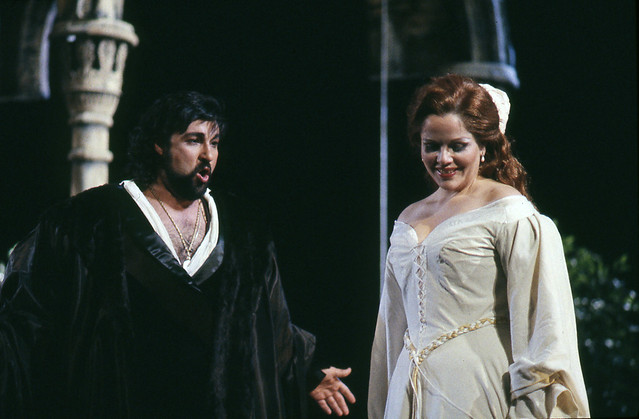
Opera Omaha Presents the American Premiere of Maria Padilla Starring Renee Fleming
The old St. Wenceslaus Church building south of downtown Omaha isn’t the site of religious services anymore but for three weeks recently it reverberated with simply divine music.
Now home to the American-Italian Heritage Society, the building – located in Omaha’s blue-collar Little Italy neighborhood – served as the rehearsal space in late August and early September for Opera Omaha’s current production of Maria Padilla. Fittingly, the 1841 bel canto opera was written by an Italian composer, Gaetano Donizetti. Bel canto, which means “beautiful singing,” is a style of operatic singing characterized by rich tonal lyricism and bravura displays of vocal technique.
Opera Omaha is presenting the American premiere of Maria Padilla as part of its Fall Festival at Joslyn Art Museum’s Witherspoon Concert Hall. The event, which continues through September 23, also features performances of John Casken’s new opera Golem and Angelina Reaux’s one-woman show, Stranger Here Myself.
As Opera Omaha artistic/general director Mary Robert likes to boast, the Fall Festival is a magnet for world class artists. Maria Padilla is no exception. Residential and light industial neighbors of the American-Italian Heritage Society may not have known it, but several international opera stars were brandishing their formidable talents for weeks just across the street.

Former St. Wenceslaus Church was home to the Italian-American Heritage Society
New York native Renee Fleming, the gifted young soprano who stars in the title role of Maria, is due to make her Metropolitan Opera debut this fall. She comes to Omaha on the heels of winning what Mary Robert calls “the world’s most prestigious singing prize” – the Richard Tucker Award. British director and designer John Pascoe works at the world’s leading opera houses, including engagements at Covent Garden, London, Rome, Syndey, San Francisco and New York.
The singer and director are friends and frequent collaborators. Fleming, in fact, encouraged Pascoe to do the opera when she found out Opera Omaha had not named a director. When Pascoe learned Fleming was starring, with maestro John DeMain conducting, he called Mary Robert to offer his services.
“I honestly thought he was kidding me at first,” said Robert, who recovered her senses in time to invite Pascoe to come. She added that he is working for about one-tenth of his usual fee, as Fleming and other festival artists are appearing at fractions of what they normally command.
Pascoe said he doesn’t “normally phone an opera company up and ask to direct. No, I’ve never done that before.”
What prompted him then this time?
“The decisive thing for me was the fact that Renee was singing the title role. It if weren’t for that I wouldn’t be here. Somebody asked once, ‘Why do bel canto work?’ And somebody replied, ‘You do bel canto work when you’ve got the cast to sing it, and specifically, when you’ve got the lead to sing it.’
“When (Maria) Callas came on the scene in the ’50s suddenly there was a great revival of bel canto works in Italy and around the world because Callas was there to sing it. Then in the ’60s and ’70s (Joan) Sutherland was there to do it. And we now have an artist to do it – Renee Fleming. People all over the world are saying this.”
Fleming first sang bel canto repertoire at Opera Omaha’s 1988 Fall Festival, when she and current co-star Stella Zimbalis sang a duet from Maria Padilla in concert.
“It was a personal turning point because I realized with that concert that bel canto repertoire was something I could pursue. Now I’m in a lot better shape for singing this, vocally and technically. I had hoped Opera Omaha would explore the possibility of doing that opera because we had all loved the duet so much. I am very pleased they pursued it,” said Fleming.
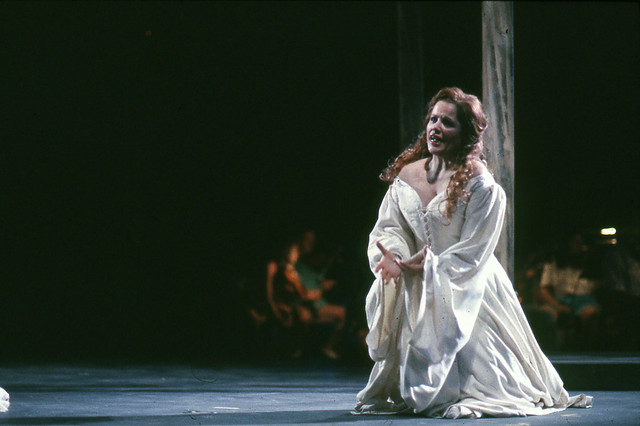
And for Fleming the experience wouldn’t be the same without Pascoe. “I’ve worked with John three times before. He’s my favorite director. He has a remarkable talent for finding the heart of the matter. Unlike most directors, he can sing everyone’s part, and he sings it well. He does trills and everything. Also, he can act it better than any of us. He acts in such an exaggerated way that we know precisely what he means.”
Indeed, a visit to the rehearsal hall found Pascoe often stopping the action momentarily to enact the impassioned part of one of the perfomers. He came out into the rehearsal area to show what he wanted by his own broad strokes. He suggested, rather than dictated how an actor might wield a sword or react to another character.
“I would never agree with the notion that I show an artist what to do – I show them how I would do it. The kind of thing I say is, ‘Can you find your way of doing what I mean by that?’ That’s the way I work,” said Pascoe.
He explained that the Act II duet between Maria and her sister Ines contains a passage when they remember their happy youth. “I told Renee the kind of things I used to do with my brother and sister – playing games and stuff. And I said, ‘Try to remember what you did. Find your vision of this.’ And the same with Stella (who plays Ines).”
The result is a charming scene in which the young women play again like little girls.
The American-Italian rehearsal space is where Maria Padilla was fleshed out. After months of preparing the opera at his home in Bath, England, Pascoe and the cast began working on blocking out the stage movements and performances in Omaha in mid-August.
“Every morning I got up two hours early before we started rehearsing to go through what I’d prepared to refresh myself, so I knew what I was doing the rest of the day,” said Pascoe.
The floor of the former church was covered with a mat, on which a patchwork of colored tape was adhered. The tape marked where set pieces, props and stage boundaries would be once the production moved into the Witherspoon. During their two and a half weeks at the American-Italian hall performers rehearsaed without wigs, costumes and make-up. Their only musical accompaniment was a pianist.
Actors, along with the director, conductor and stage manager, dressed comfortably.
While scenes rehearsed Pascoe sat on the sidelnes, giving blocking notations to stage manager Tim Ocel.
Pascoe aims for a “synthesis of stage and music” that heightens, supports and informs the drama. “I’m quite specific about things because if you do something on one beat it’s completely different than if you do it one beat later. If there’s a great crashing chord one beat later you have to decide if you want to do a dramatic movement on that chord or if you want the chord to come after the action.
“Or do you want the chord to come before the action, so the actors have a reaction with the crashing chord. There’s all these possibilities,” he said.
Each choice will color the drama and the audience’s interpretation of it, he added. He said the integral role music plays in drama is best illustrated by film scores. “Let’s face it, would Return of the Jedi be an eighth of the film it is without John Williams’ score. The music informs and adds to the emotion and provides subtext. I’m not saying John Williams wrties the same music as Donizetti or that either is better or worse than the other. I’m just saying the use of music with drama is well established. Especially with film, people understand without even knowing it that the music is helping them.”
Pascoe feels strongly about Maria Padilla’s music and drama. “It’s an extremely powerful work, with very clear, good, strong emotions. The thing that’s most appealing about it is its sensational music – it is astonishingly rich and beautiful music. I’m not talking about music that a musicologist would call wonderful and the rest of us would find boring…this music is exciting stuff.”
The director, who has staged other Donizetti operas, including Don Pasquale and Lucia di Lammermoor, said, “Maria Padilla’s music is more evenly sumptuous all the way through. It’s a much later work than the others. The orchestration’s highly colored and very interessting.”
Maria has rarely been performed. Some suggest the artifical ending imposed on Donizetti by censors of the time explains why. Pascoe disagrees, although he concedes “the ending is not the strongest part of the opera. You don’t come out fizzing from the ending, but I think you will come out fizzing from the excitement of the opera.”
He attributes the work’s obscurity to the fact that the bel canto opera has simply not been “fashionable.” He and Mary Robert say that as a result of Opera Omaha’s production, which is drawing reviewers from national publications, Maria could become part of the standard repertoire.
The piece is set amidst the intrigue of Spanish royalty in 14th century Castile. Maria is an ambitious young woman willing to suffer dishonor for love. She lives as the mistress of the prince, to whom she is secretly married, in order to appease political pressures. When the prince is forced to marry another woman, Maria takes matters into her own hands and claims her rightful place beside her husband on the throne.
Opera Omaha hopes to strike a balance between the tragic circumstances Maria endures and her own strong-willed nature that manipulates events to her own design.
“John has suggested, interestingly, that she very cunningly says, ‘Ha, this is my chance to have it all.’ I think this is Leona Helmsley – hopefully a lot more sympathetic than that, but she’s a very strong person,” said Fleming. “That was the thing that attracted me when I first read the libretto. I said, ‘Wow, finally a woman who’s not victimized.’ She takes charge.”
Pascoe added, “I don’t think she’s a tragic figure at all. Unlike most romantic heroines she actually takes a hand in shaping her own future and takes some very bold steps toward doing it.”
The long rehearsal period Opera Omaha devotes to Fall Festival works helps Fleming, Pascoe and other collaborators explore the nuances of character and performance.
Fleming calls the four weeks alloted “invaluable.” “If I were singing The Marriage of Figaro I wouldn’t be thrilled about the long rehearsal period because I’ve done so many Figaros in the last year. But for a new work it’s a fantastic luxury to have four weeks, and really have time to explore the character and get the role into your voice.”
Pascoe said the extended rehearsal schedule “is one of the reasons I was interested in coming. The festival sets up a very, very good work situation.”
During early rehearsals singers preserve their voices by “marking,” which is important when working on a production over several weeks time.
“We mark either by singing down an octave or by singing softly to save the voice,” said Fleming. “I can only sing full voice, full energy maybe an hour and a half to two hours. In a performance, of course, that would be spread out.”

Rehearsals last up to six hours a day, requiring both physical and vocal endurance. She said she and other singers gradually work up to singing full throttle. “It’s important for every artist to know their limits, but you also have to sing the role into your voice. You can’t do it too much and hurt your muscles by over training.”
She said performers “train much like athletes do.” That conditioning is essential in opera, she added, because most works include a rape scene or murder scene or mad scene that knocks her about. She stays in shape doing aerobic workouts at a gym.
She and Pascoe both laud the American-Italian Heritage Society building as an excellent rehearsal space.
They say when creative artists are cooped up in close proximity like they are for a month an esprit de corps is needed if magic is to happen. “If it doesn’t develop, you’re in for problems,” said Pascoe. Or, as Fleming put it, “Four weeks with somebody who’s not very good would be hell.”
No such problems on this production, they say.. And when things click, Pascoe said, “it’s always a bit like falling in love. There’s a very special feeling working on an opera because all of us are commited to it and trying to give it as much of ourselves as we can.”
Fleming said Pascoe promoted that feeling by his approach. “He said to me one day that the reason he got into directing was because he wanted to be moved. And he’s right because when I read these scripts and hear the music I am moved, and yet so often when you get to the final results, you’re not. Something has been missed along the way. We try to find that.”
She said that extra spark is intensified when working on a piece like Maria Padilla, which few people are aware of and therefore have few preconceptions about. That gives her and Pascoe freedom to interpret the work and leave their own mark on it.
“It’s a fun opportunity to explore something new. There are no rigid traditions about interpreting specific notes. I can do whatever I want with it. There aren’t that many pieces left that haven’t been explored already.”
Fleming, who said she enjoyed her stays in Omaha in 1988 and this year, sings Opera Omaha’s praises. “I’ve been calling all my singer friends and saying, ‘You’ve got to sing for this company.'” She credits Mary Robert for having “a lot of vision.”
“I can’t think of either a festival or a rep situation that is as brave and adventurous as this Fall Festival is,” said Pascoe. “I can’t think of any other event in the world that is offering such an exciiting menu. I think Omaha’s very clever to have been able to grab people of such vision as maestro DeMain and Mary Robert and hold them here long enough to get this festival on its feet.”
Related articles
- How Renée Fleming sustains a career of high notes (sfgate.com)
- Donizetti’s Birthplace Revives His Bel Canto Gem,’ Gemma Di Vergi’ (nytimes.com)
Catherine Ferguson’s exploration takes her to Verdi’s “Aida” and beyond

Image via Wikipedia
Opera Omaha has a history of drawing attention for its innovative programming and collaborations. In recent years, the company has caused a splash by commissioning renowned artists outside the opera world to design sets and costumes for productions of classic operas. First, the company had internationally acclaimed ceramicist Jun Kaneko, who lives and works in Omaha, design for Madama Butterfly. Then, the company had noted sculptor and installation artist Catherine Ferguson of Omaha design for Aida. I missed out on an opportunity to write about Kaneko and his Butterfly, and so when the chance came to profile Ferguson and her work on Aida, I leapt at it, and the following article is the result. The article is another example of my plugging into an artist’s passion and expressing that to a general readership. This is the first time the story’s been republished since its original appearance in the New Horizons a couple years ago.
Catherine Ferguson’s exploration takes her to Verdi’s “Aida” and beyond
©by Leo Adam Biga
Originally appeared in the New Horizons
The boundless limits of Omahan Catherine Ferguson’s art may be traced to a childhood that fostered her ever inquisitive nature.
When Opera Omaha commissioned the noted installation artist and sculptor to design the sets and costumes for its new production of Giuseppe Verdi’s Aida she did what she always does for a project — search out every source to inform it.
That meant close studies of the Egyptian collection at the Metropolitan Museum of Art in New York, viewing a King Tut exhibit, reading books, watching productions of Aida and listening to the opera over and over and over again. Her research led her to the primary motif for her designs — a recurring hieroglyph of the blue lotus, actually blue water lily. It’s found in a pillar or column called the djed and in all manner of Egyptian artifacts, from pottery to jewelry to tombs.
“Once you start looking at Egyptian artifacts you find the lotus almost everywhere in different forms,” she said. “It’s just embedded in lots of place. Very stylized.”
The blue lily holds a yellow golden center remindful of the sun, which ties into the myth of an Egyptian King transfigured into a sun god, Ra. She found another deity, Ptah, also associated with the flower. Ferguson said the opening of the lily’s bud during the day, its closing at night and its reopening at dawn symbolized for Egyptians the cycle of birth, death and rebirth. Regeneration. It all fit the structure of Aida, whose first two acts chart the ascendance of the King and future sun god, while the last two acts, what Ferguson calls Verdi’s “lunar acts,” reflect the veil of conflict and tragedy that befall the central characters.
“I thought, well, this is the perfect imagery I’ve been searching for,” she said. With such “ubiquitous” symbols at her disposal, she said, “I just went with it. Amazingly, we don’t know of any other Aida that used the lotus as its central design motif.”
Designing Aida meant many meetings with stage director Sam Helfrich, a collaboration that tested each artist, as it was his first time working with a nontraditional opera designer and Ferguson’s first time designing an opera. Ferguson, a self-described “moderate opera fan,” was somewhat familiar with Aida, having seen previous productions. The “huge challenge and responsibility” of undertaking the design for “this iconic piece,” as she calls it, was both daunting and exhilarating. Two years steeping herself in all things Egyptian and interpreting Verdi’s masterwork is just the kind of pursuit she enjoys.

Catherine Ferguson’s Aida designs for Opera Omaha production
That same sense of wonder is what’s compelled her to travel down the Amazon, visit Mexican ruins, tour the great sites in the Western European capitals, document the gardens of Italy, Japan and China, explore grottoes and immerse herself in the prehistoric earthen effigy mounds of the Midwest. The mounds’ animal-shapes, which she variously describes as “subtle” and “beautiful,” appear in several of her sculptures. “I have a very strong affinity for them,” she said. The elongated Oropendola bird nests she saw in South America show up in her work. The gardens and grottoes she photographed informed her own installations, as they are all “places that capture you for the moment and separate you from all the busyness that’s going on” outside.
She attributes this unquenchable thirst for experiential quests that feed her art to the environment she grew up in, which she said nurtured a desire for “constant exploration” and “lots of freedom to do that.” Born and raised in Sioux City, Iowa, Catherine and her older brother enjoyed an Arcadian youth in the 1950s. Their mother was a housewife trained as a teacher and their father a traveling typewriter salesman who later opened his own typewriter and accessories store.
“Growing up we lived in a neighborhood on the west side of Sioux City — only a couple blocks from open, uncultivated, untilled wild spaces,” she said. “There was a big hill called Mayflower Hill covered with these little purple mayflowers, and with the long prairie grasses on it. We would take cardboard boxes up there and slide down that hill — that’s how long those grasses were. It was fabulous.
“There was a wild plum thicket with bittersweet vine growing all over it. Over the years kids had tunneled into this thicket. There were chambers in the thicket where people played. Every season we were up there for something else. In the summer we were there playing. In the fall there was all the bittersweet to pick. And in the winter we took our sleds up there…We were outside all the time. That was a very wonderful place.”
Ferguson said the thickets and chambers of her youthful idylls “show up in my work a lot.” Her sprawling, multi-layered, organic installations, some filling entire rooms, are sacred sanctuaries filled with symbolic elements. The works often contain hidden, recessed spaces viewers come upon as they walk through them. Natural and synthesized sounds and light sources add more texture. She’s collaborated with composer-electroacoustic musician Mario Verandi on five installations.
Her sculptures, too, express elemental-spiritual dimensions. The sculptures are in a variety of materials. The visceral experience of her works encourages exploration and discovery. Her environments and objects evoke communion with spirit and nature, heaven and earth, themes consistent with an interest of hers — alchemy.
Much of her art is about transformation or transcendence and the interplay of the real with the ethereal in arriving at some purity or truth or harmony, which is a description of alchemy. Creativity, too.
“That stuff is fascinating,” she said. “Alchemy is what artists do all the time. You’re taking scraps of stuff that don’t have any meaning by themselves particularly but then you kind of wash away and get rid of the extra bits…You’re always looking for the core — and that’s what the alchemists were doing. They were looking for the Philosopher’s Stone at the heart, whatever that was.”
She likes how installations break down the elitist barriers of art that imply, she said, that “only certain people can understand it, only certain people can see it. That it’s in museums — it’s walled off.” She also likes the fact installations invite people to literally enter the work itself and, thus, respond to it in ways that are self-reflexive. As she told Joel Geyer in the NET documentary Is it Art?:
“I think with installation work…you’re not learning so much about the artist as possibly about yourself. It’s almost like having a script written but you’re the viewer. You’re also the actor, and it becomes your scene to develop once you’re in there. That’s what I’m shooting for in my work. What more do you want from art than to make you more conscious of yourself and your relationship to others? What more could one ask for? That, in itself, is beautiful.”
Seeking answers to universal questions became a habit instilled in her by the nuns who taught her at the former Rosary College, now Dominican College, in Chicago and by the Jesuits at Creighton University. These educators demanded rigorous analysis and independent thought in the pursuit of shaping the whole person.
“The nuns encouraged us to develop our minds and to express our unique selves. We didn’t use the term feminist but they had the same philosophy about the role of women in society as the feminists espoused later,” she said.
She majored in English and minored in journalism. Art was the furthest thing from her mind. Well, not exactly. While studying in Chicago she became a habitual visitor to the Art Institute. “I’d take the L downtown and just walk around in awe. It was kind of a self-education in art,” she said. When she moved to Omaha to attend Creighton “she was really interested” in art but at that time the school lacked an art department. “I know I would have taken art courses if they had.” She continued her self-education at the Joslyn Art Museum.
Still, she said, “I was not even expecting to ever get into the art world.” There were creative aspects to her early jobs. “My first job was working for WNAX radio station up in Yankton (S.D.),” she said. “It was fun. I was writing commercials…”
She was then engaged to her husband, Terry Ferguson, who was studying at Georgetown Law School in Washington, D.C. Eager to join him, she moved to D.C., where she lived and worked in the mid-1960s. She did public relations for the U.S. Army Map Service, then engaged in satellite mapping of the moon and, she suspects, America’s Cold War enemies. She joined the federal Office of Economic Opportunity in downtown D.C. which put her near some of the capitol city’s finest art venues, including the Corcoran Gallery of Art and the Phillips Collection.
“My work site was in between the two, so on my lunch hour I’d walk to one or the other,” she said. “Then on the weekends we’d often go to the Museum of National Art. We spent a lot of time there.”
By 1967 she and Terry moved back to Omaha, where he worked as a staff lawyer with the Legal Aid Society. He later served with the prestigious Kutak Rock Law Firm and as a senior attorney with Peter Kiewit Sons Inc. before joining the Fraser Stryker Law Firm. He’s also an adjunct professor in the Creighton Law School.
She was pregnant with their first son, George Ferguson, now a filmmaker who occasionally collaborates with his mother on her installations. The couple’s other son, Adrian Ferguson, is an Omaha architect who sometimes assists his mother in setting-up her installations.
While she was more and more inclined toward art, she said her emerging artistic sensibility “wasn’t really an epiphany moment” but more a matter of “backing into it.” She was a young housewife and new mother and to occupy herself she began taking art workshops. One in sculpture. Another in batik.
“The batik seemed at the time the easiest to deal with,” she said, “in that I could work right in my kitchen and I could get everything I needed at the Hinky Dinky. The paraffin and the dye. Old sheets I had at home.”
A phone call in the late ‘60s changed her life.
“One day Ree Schonlau called me and said, ‘I want to get together a group of people to start a craftsmen coop.’”
Schonlau was a potter and then-new University of Nebraska at Omaha art graduate with a vision for establishing what became the Craftsmen Guild in the historic warehouse district south of downtown. The once thriving wholesale produce market was in decline, its early 20th century brick buildings mostly abandoned. Where most people saw decay the Mercer family, who owned property there, and a few other visionaries like Schonlau saw potential.
Ferguson fell in with these bohemian pioneers to help transform the area into an arts-cultural haven known as the Old Market. The Craftsmen Guild, along with the Omaha Magic Theatre and the French Cafe, presaged all that’s followed.
The building Schonlau eyed, at 511 South 11th Street, now houses La Buvette amidst a string of eateries, shops and galleries. Then, however, the Market was mostly vacant. Schonlau, Ferguson, et all, joined forces to turn the vision into reality. They were young, energetic, idealistic. Together they transformed the Greenberg Produce Co. into an arts studio, complete with kilns for firing pottery.
“It was all cold lockers. The windows were all bricked up. We did a lot of manual labor and then other labor was hired,” Ferguson said. “We had a patron, Tom Davis, who helped us with part of that.”
This was the start of a most successful career by a contemporary Nebraska artist. Ferguson’s earned critical accolades and prized commissions. She cleaned up at the recent Omaha Entertainment and Arts Awards. Her work’s widely collected and exhibited. Several of her sculptures adorn prominent public sites, including Totem in front of the W. Dale Clark Library and Sky Fin on the south side of the Qwest Center. Her installations have been showcased at the Joslyn, the Bemis Center for Contemporary Art and the Sheldon Memorial Art Gallery.
Her life as an artist all began with that small coterie of fellow travelers similarly afflicted with the curse or the gift of feeling compelled to make art.
“It was a real good, exciting time,” Ferguson said. “That was my first studio outside the home. It was the first time I ever worked around other artists. Everybody else had a degree in art. They were very encouraging. It was a lot fun. I treasure most the opportunity that time gave me to meet other artists and have a studio in an unconventional milieu, a milieu conducive to experimenting. My studios have all been in locations that had some ‘grittiness’ and that has been helpful to me.”
Her spacious, airy, utilitarian studio the past 25 years is a brick building at 26th and Leavenworth Street, the former Warner Auto Shop. Windows in the renovated space let in lots of natural light. Drawings and mockups for her Aida designs are displayed amid work tables, plants and sculptures. The studio’s situated in an area slowly emerging as an artists’ community.
Ferguson honed her art and deepened her knowledge by attending workshops, reading art books and viewing exhibitions. She said she sought out workshops to cultivate “particular skills I wanted. They were very helpful. They all seemed to come at a good time. I spent some time in Iowa City one summer. The workshop was taught by a man who worked for Jack Lenor Larsen, a fabric designer. The instructor realized that a lot of his artist friends in New York were starting to work with fabric and that interested him and he talked about it a lot.”
Screen-printed fabrics were among the early forms-materials she worked in. She said the young lions of American art at the time, artists like Claes Oldenberg and Robert Rauschenberg, “were all bringing in materials that were nontraditional. Oldenburg’s soft sculptures particularly influenced me.”
This period, Ferguson said, is when she “really started thinking about the difference between craft and art. Certainly that was the time when there was this opening, this shift when the line between craft and art became less distinct. I think the difference, if there is one anymore, is the intention of the maker. A craftsman is very interested in how an object functions and its beauty, and an artist is generally more interested in other qualities such as an idea they want to convey. It’s tricky to distinguish between them these days.”
One of her early works, from the ‘70s, was a meat counter, all sewn in vinyls, with a light inside illuminating various cuts. Hanging above the counter was a stylized profile drawing of a woman that pulled apart in sections, ala a puzzle.
“It was a very feminist statement about fragmentation, about being pulled in lots of different directions and having lots of different roles,” she said.
For a long time Ferguson was reluctant to call herself an artist. When she finally felt comfortable, she said, “it was liberating…empowering.” Despite all her success she still battles doubts and insecurities, sometimes even telling herself, “I’m not going to do this anymore.” She said. “It’s only at the point when I can honestly say to myself, ‘You really don’t have to do this anymore,’ that I can then do it again.” She said these anxiety jags “happen less frequently now. Maybe I finally surrendered. Maybe I kind of expect to be doing this forever.”
As she and her art evolved Ferguson fixed on new directions. Some things remain constant.“ I’m a kinesthetic-type person,” she said. “I like materials. I do like form. I like large forms. I like the interaction of the human body to an object or form.” She loves dance and often draws on dance rhythms-movements in her work.

Catherine Ferguson’s sculpture garden at the Millard South Library
Her penchant for searching out new stimuli and connecting the dots to arrive at new insights has never left her. Every project elicits new creative responses.
“When I’m in a project I’m in a kind of heightened state of alertness — a receptive state,” she said, “and the physical world is more exciting to me.”
Ideas come to her “out of the blue,” sometimes in dreams, “because you’re alert and you’re in a different state,” she said. “You just see things you would normally drive right past. That I think is actually the crux of what keeps me making art.”
She admits she gets bored without some new subject to investigate or thread to unravel. Much of her work in the ‘90s was concept-laden and she’s now actively working to get away from that kind of over-intellectualizing.
“I am actually consciously trying to be unconscious.”
An example of her attempt to be more spontaneous, more instinctual is the set of torso drawings she did during a Bemis Center residency a couple years ago. “I had no idea what I was going to do. I just stepped up to the paper and started drawing. I didn’t think about it. I just jumped in. I’d like to work more and more that way.”
Speculating on the appeal of this approach, she said, “Perhaps after working as a concept-based artist it seems more risky to work intuitively without a preconception, and for that reason the possibility is more and more intriguing.”
That said, she acknowledges “it’ll be hard to suppress” her “research-bent.”
Just as Ferguson’s become a major artist, her old colleague, Ree Schonlau, made her own mark as founder of the Bemis artists colony — now the Bemis Center — in the Old Market, where artists from around the U.S. and the world come for residencies. Among those to do a residency there was the Japanese ceramic master, Jun Kaneko, whom Schonlau married. The couple have converted several buildings in and around the Market into studio, exhibition and storage spaces for his world-renowned work. Their much-anticipated Kaneko Museum is on the way.

Catherine Ferguson sculpture outside the W. Dale Clark Library
Ferguson has remained friends with Schonlau.
“Ree and I have a good connection, not only because of our studio history in the ‘70’s but because her daughters Susan and Troia and my son George have known each other from age 6 from playing in the studios. All these children of Craftsmen’s Guild members went to Central High School and remain good friends today.”
Kaneko is someone she’s gotten to know well over the years. Around the time she got the Aida commission Kaneko was receiving plaudits for his design of Opera Omaha’s Madama Butterfly.
“I’d had many conversations with Jun during his process. He said many times, ‘I never thought it would be this much work.’ So I knew it was lot of work.”
When Aida was offered her, she was taken aback, especially when told Opera Omaha wanted a nontraditional interpretation of a classic work for which, she said, “people have such expectations. People who’ve never seen Aida feel like they’ve seen Aida. It definitely gave me pause and left me without speech,” she said. “I asked for a month to think it over. It was a huge decision to make.”
She consulted a good friend she attended high school with, Denes Striny, who’s made a career as an opera singer, voice coach and director. “I said, ‘Denes, would I be crazy taking on a new and minimal Aida?’ He said, ‘I definitely think you should do it. You can do it.’ He was very encouraging.”
Emboldened, she signed on. Sure enough, Aida stretched her in ways she never imagined. “I haven’t worked this hard for this big a period of time. Two years. Most of my other projects maybe were six months. There were moments when I thought, ‘Huh?’ I mean, I was just terrified. There still are doubts,” she said.
To inspire her designs she listened to recordings of Aida while working. She won’t know for sure how her sets and costumes will be perceived until the April production. “The proof is in the work,” she said.
Perhaps the most taxing aspect of the entire process was the costuming.
“The costumes have so much concept embedded in them. They have to tell so much. They are really storytellers in themselves,” she said. “I had no idea they would take up so much labor trying to differentiate them so that the audience would know who belongs to what group, whether the Egyptians or the Ethiopians, and what their status is within that group.
“I wanted the costumes to have definite shapes you could read from a distance and to be fairly sculptural, too. I tried to keep them simple but not so simple they weren’t interesting.”
Building costumes that met all those demands yet weren’t overly stiff, unwieldy and costly proved a fine line. Selecting the right colors and fabrics took a long time. She made trips to New York to look at fabric swatches but ended up getting the fabrics from a little shop right here in Omaha.

She’s pleased with the finished costumes.
“They’re gorgeous,” she said.
Designing the sets proved more comfortable for Ferguson, who’s used to working on a large scale and using different materials. Even though she’d never worked on an opera, her installations are a kind of “theater.” As she did with the costumes she incorporated hieroglyphic imagery into the temples and columns she designed.
The process entailed many discussions with stage director Sam Helfrich about the story, the characters and how the designs might best express them. The artists didn’t always agree. Whenever their interpretations conflicted she knew, bottomline, “it was his call.” Although she’s cooperated on projects with other artists before her work with Helfrich was something new. “It’s been a true collaboration where there’s been a lot of back and forth and creating things together. My creating things and then his reacting to them.”
Attending to all the details meant traveling to Salt Lake City to see the costume mock-ups, Portland, Ore. to see the sets under construction and New York City to meet with Helfrich and lighting director Robert Weirzel.
The indoor floral show Nature’s Inspiration at Lauritzen Gardens through May 11 keys off Ferguson’s Aida designs. A faux Nile is adorned with tropical plant life and her blue water lily artwork. Adding to the anticipation about Aida, she’s made presentations on her designs. She’s anxious for all the build-up to end and for her sets-costumes to finally breath on stage, in performance, before live audiences.
Aida’s been so time-consuming it forced Ferguson to put many projects on hold. Now that the opera’s being mounted she can resume attending to them.
“I have requests for sculpture commissions and I am eager to do more drawings. Before Aida, I had started working on some smaller sculptures using wax and excelsior that were cast in bronze and I want to explore that medium more. I’ll be working with the torso theme again and drawing but with more color. Aida rekindled my enthusiasm for color.”
Someone she’s bound to work with again is Les Bruning, an Omaha sculptor and foundrer who’s fabricated or cast most of her metal sculptures. “He’s been a mentor and a tremendous resource for me,” she said. “He’s the most generously spirited artist I know.”
Once all the Aida hoopla’s done, she’ll be back working in the quiet solitude she’s accustomed to. Away from the spotlight, she’ll follow her muse wherever it leads.
Related Articles
- A Butterfly that soars in style (theglobeandmail.com)
- Behind the Scenes, Part IV: Event Design (vivanista.com)
- From the mind of Verdi… (operavision.org)
- Top 10 Composers: Hailing Opera’s Shakespeare, and Its Proust (artsbeat.blogs.nytimes.com)


 Leo Adam Biga's My Inside Stories