Archive
Omahans put spin on Stephen King’s “The Shining’ – Jason Levering leads stage adaptation of horror classic to benefit Benson Theatre Project
Jason Levering and a group of fellow Omahans has proven just cheeky enough to adapt Stephen King’s The Shining to the stage. The world premiere of their efforts is March 21 and 22 at the Sokol Auditorium in three performances to benefit the Benson Theatre Project, a nonprofit is primed to purchase and restore a vintage vaudeville and movie house in Omaha’s Benson business district. Business Theatre Project executive director Amy Ryan says, “My confidence in Jason Levering and his ability to put on a quality production influenced my decision to sign off, along with the other project leaders.” I asked her if she has any trepidation in hanging a fundraiser on a premiere, never-before-staged work, even if it is adapted from a mega popular novel whose title everyone knows and whose author is a brand unto himself. “It’s a tall order, no doubt. Certainly there were many factors and risks to be considered, but in the end we decided that it was a unique and viable way to raise funds and showcase Omaha’s local talent.” Levering is also artistic director of the Benson Theatre Project. What follows is my upcoming story in The Reader (www.thereader.com) about the adaptation, which st least based on the legendary status of the source material and its author has given this production a very high curiosity factor. For my article I interviewed Levering about various aspects of the project.
Omahans put spin on Stephen King’s “The Shining”
Jason Levering leads stage adaptation of horror classic to benefit Benson Theatre Project
©by Leo Adam Biga
Appeared in The Reader (www.thereader.com)
Credit Omaha writer-director Jason Levering for possessing the temerity to not only consider adapting Stephen King’s meta horror novel The Shining to the stage but to follow through and actually get the master’s approval. Now he’s only hours away from seeing the adaptation he and Aaron Sailors wrote make its world premiere.
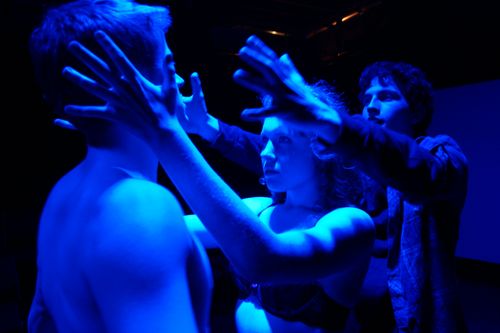
The Shining, A Play, has a three-show run March 21 and 22 at Sokol Auditorium, 2234 South 13th St., the old-line South Omaha space known for live music concerts, not full-blown dramatic theatricals. Make no mistake, this will be a big, effects-laden production commensurate with the sprawling, supernatural-laced source material.
The show’s a fundraiser for the Benson Theatre Project. Levering is artistic director of the nonprofit, which needs $250,000 to purchase the former Benson vaudeville and movie house at 6054 Maple St. before renovation work can begin. It’s adjacent to the Pizza Shoppe and PS Collective, whose owner, Amy Ryan, is the project’s executive director. Ryan, a community advocate and arts supporter, goes way back with Levering, who’s also co-founder of the Omaha Film Festival.
An Aurora, Neb., native, Levering’s worked on short films. He and Sailors are collaborating on a feature film adaptation of short stories from author Dan Chaon’s Stay Awake collection. That project’s on hold while Chaon works on the Starz series Most Wanted. Levering’s s stage credits include acting in the Blue Barn Theatre’s Round Midnight series and adapting Oscar Wilde fairy tales at The Rose theater.
What made him think of reworking what many consider a horror masterpiece? It starts with him being “a huge Stephen King fan.” Then there’s the fact the claustrophobic story largely unfolds in one location, the Overlook Hotel, which lends itself well to stage presentation. Finally, there’s The Shining franchise of the popular novel as well as successful film and television treatments, not to mention the built-in brand that the title and King’s own name bring to any adaptation.
“The genesis started during the 2013 Omaha Gives campaign that raised some money for the theater,” Levering says. “Afterwards we talked about doing our own production as a fundraiser and how while we don’t have our own theater troupe we know enough people that we could try and put something together.
“We didn’t want it to be something that had already been done here. We wanted it to be something special, that is our own. But we also wanted it to be something recognizable. I suggested doing a stage adaptation of a popular book that hasn’t been adapted yet. I naturally fixed on The Shining. We all thought it was a great idea.”
That left the not so small matter of getting the famous author to bestow his blessing on the endeavor.
“You have to get permission from Mr. King for something like that,” says Levering, who made the overture to the agency, Paradigm, that represents the legend.
The go-ahead came easier and quicker than Levering imagined.
“Mr. King read our proposal and he was very interested in what we were doing with the Benson Theatre project and he gave us a limited option to adapt The Shining to stage.”
King also retained the right of approval over the script, the director (Levering) and the cast.

“In my research I found out Mr. King originally conceived it as a five-act play and then he eventually turned it into a novel.”
Levering’s careful study of the book reintroduced him to the story’s great set-up. Jack and Wendy Torrance and their boy Danny become stranded in a haunted mountain hotel in a winter storm. Danny’s extrasensory gift makes him the target of evil spirits who prey on him through his weak father, intent on forever imprisoning the family there.
“It kind of has everything. The other thing it has going for it is these fantastic characters, Jack especially. He’s written as a good man, a recovered alcoholic with some anger issues but doing his damnedest to pull his family back together. To go from that point where there’s all this hope when they first move into the Overlook to the end where he’s literally trying to kill his family it’s such an incredible journey.”
Distilling the heart of the story took Levering and Sailors some time.
“We went through the book together. Aaron broke it down into an outline so we could figure out the main beats of each scene – what we really needed to capture that was essential. We worked from that outline as we were writing the script. He took Act III, I took Act I, and we started working forward.”
They finished the remaining acts together.
“As we wrote we sent pages back and forth, editing and polishing each other’s work. We sent pages to another writer friend, Krissy Hamm, an associate producer on the show, and she gave us notes. It really helped to have that third person looking at it.”
Levering says he and Sailors abided by one operating principle.
“We both wanted to be very faithful to the book. A lot of the dialogue is pulled straight from the book. There’s only a few points where the dialogue was changed or something was added so that the scene would play well on stage. For the most part though the dialogue is pretty much Mr. King’s words.”
Other things are being done to make certain story elements live on stage. For example, newspaper accounts Jack reads silently to himself in the novel are projected on a screen. Flashbacks play out on the side while the main action occurs stage center. Creative ways were found to bring the Overlook’s topiary animals to life. Levering is intent on making the physical experience as visceral as possible for the audience and thus, William Castle-style, action and sound will happen throughout the auditorium, including the balcony.
Lighting and sound effects will cast a dark, malevolent mood.

Levering consulted Omaha theater veteran Kevin Lawler and brought in veteran scenic designer Kit Gough to help realize the horror.
“I want it to be immersive. I want to give the audience the feeling they really may not go home. I want them to feel they’re sitting in the middle of the Overlook Hotel as it comes to life. From the time you walk in the door it’ll be like you’ve entered the Overlook.”
Levering had his own scary encounter with the work.
“My hardest challenge was the moment the hotel takes over Jack. I was excited to write it but I was also terrified of it because that scene is where his character shifts and becomes the monster. He’s in the Colorado Room and basically the hotel has come to life. Lloyd the bartender manifests and pours him a martini. That scene was difficult for me to write because it’s at that point he turns on his family and I honest to God had nightmares of wanting to hurt my wife and kids, even though I never would.
“The idea someone could turn like that is frightening. It was actually the last scene I wrote. It was the worst for me. I’m also an actor and so method-style I poured myself a martini and drank it while writing. I wanted to feel what he was going through.”
Levering feels “honored” and “thankful” King approved “the direction we’re taking.” The cast is headed by Marc Erickson as Jack, Levering’s son Christopher as Danny and Christina Rohling as Wendy.
An invitation’s been extended King, so don’t be surprised if you spot the king of horror among the throng.
Performances are 7 p.m. Friday and 2 and 7 p.m. on Saturday.
For tickets, visit theshiningomaha.com. For more about the restoration project, visit bensontheatre.org.
Playwright Carlos Murillo’s work explores personal mythmaking
When interviewing an artist there’s always the point where you ask the obvious question, Where do your ideas come from? or What influences does your work draw on? And, of course, the answers are at once right in front of us, because ideas spring from life, and concealed, because ideas also germinate in the imagination and subconscious. And since every artist’s life is individual there are as many variations to those inspirational sources as there are artists. Playwright Carlos Murillo is someone I interviewed many months ago in anticipation of one of his plays being performed at the University of Nebraska at Omaha. Our conversation veered into some of the touchstone experiences that help shape who he is and what he writes about.
Playwright Carlos Murillo’s work explores personal mythmaking
©by Leo Adam Biga
Originally appeared in El Perico
Playwright and DePaul University theater professor Carlos Murillo has established a national reputation with such works as Dark Play or Stories for Boys, which UNO Theatre is staging Feb. 23-26 and March 2-5.
The theater world is small. For example, a University of Nebraska at Omaha grad student met Murillo at a Kennedy Center theater festival in Washington, D.C. Aware Murillo’s Dark Play was slated for production by UNO, the student set the wheels in motion for the playwright’s campus visit in January. At UNO Murillo guest taught a class, observed a rehearsal and attended a reading and a discussion of his work.
“It was a really fun experience,” says Murillo, who spoke to El Perico by phone from Chicago.
He enjoys interacting with students and teachers over his work.
“It’s a really cool thing when a group of people you don’t know are engaging with something you’ve created. Making theater is like solving a very complex problem,” he says, adding he likes contributing to the process of unlocking a play’s mysteries. His participation, he says, is “sort of honoring that people are committing to something that’s meaningful to them and that hopefully will have some impact in their training or in their thinking about the world.”
Catching up to productions of his plays “is sort of like visiting your kid after they graduate from college,” he says. “They’re trucking along doing their own thing and you meet up with them every now and then and check in.”
The concepts or issues his work explores become talking points in the classes he teaches. “It keeps the mind in shape and it serves as a great laboratory of ideas,” he says. While he didn’t set out to be an educator, he’s come to embrace the role.
“I do love it.”
There’s also a more practical side to teaching.
“Making a living as a playwright is next to impossible,” he says, “Most of the writers I know either have teaching gigs or write for TV or do other stuff because it’s very difficult to make a living just off of ones playwriting.”
His path has been both traditional and nonconventional.
Born in the U.S to immigrant parents — his mother’s Puerto Rican and his father Colombian — Murillo mostly grew up in Long Island, NY. As a boy he spent three years in South America, where his father was transferred by his employer, Bank of America. Wherever Murillo lived, he was drawn to creative expression.
“As far as writing’s concerned it was something I was always interested in from the time I was a kid. I was always writing poems and short stories and stuff like that. I also had a real passion for theater early on. I acted in a lot of plays in junior high and high school, and those twin passions kind of merged and I became a playwright.”
During a long theater apprenticeship his family encouraged him and still does.
“My parents are remarkably supportive. I’m grateful for that.”
Murillo attended Syracuse University to study acting but dropped out and traveled for a time before returning to New York to work at various theaters. All the while, he continued writing. He learned under several master practitioners, including acclaimed director Robert Woodruff. “He was a huge influence,” says Murillo.
As the Public Theater’s associate literary manager Murillo came into contact with “a parade of extraordinary artists,” adding, “It’s an amazing institution and it was kind of like the best grad school you can imagine.”
A writers group led him to “two hugely influential teachers” — Eduardo Machado and Maria Irene Fornes.
Murillo went from self-produced plays in small Manhattan venues to being invited to developmental residencies and his work being widely read and produced.
A consistent theme in his work, he says, is “the idea of personal mythmaking — the stories we tell ourselves or tell to other people about ourselves and the relationship of those stories to the actual reality of who we are.” Dark Play examines what happens when a character spins fictions that have real life consequences.
As a playwright Murillo straddles different worlds and must be a quick study in each, skills he’s well practiced in because of the way he grew up. “While my parents spoke Spanish and English at home my cultural references were rock music, TV and all the pop culture things most Americans have,” he says. “I had the experience of living in South America as well. It’s like having one foot in two different identities.”
He writes about Latino identity in oblique and direct ways. Never Whistle While You’re Pissing is autobiographical about what it means to be Latino in America. A fictional playwright, Javier C., is a recurring character in his plays.
Related articles
- Video: Latino playwright Nilo Cruz sees each of his plays as a “miracle” (latinalista.com)
Q & A with playwright Caridad Svich, featured artist at Great Plains Theatre Conference
With the 2011 Great Plains Theatre Conference upon us, I am continuing to post material from my archives that relates to the event or to other aspects of Omaha theater. The following is not a story, rather a fairly literal transcript of the phone interview I did with Caridad Svich, one of the featured playwrights at the Great Plains festival, whose host is Metropolitan Community College. I say fairly literal because I didn’t transcribe my questions, and therefore they’re reconstructed here, but her comments are pretty much verbatim. I will try to post more theater stories in the coming days, and well after the conference concludes June 4, as my own personal homage to the art form. A short story about Svich I wrote for El Perico can be found on this blog.
Q & A with playwright Caridad Svich, featured artist at Great Plains Theatre Conference
©Journalist Leo Adam Biga interviewing Caridad Svich
LAB: You’re a playwright, a songwriter a, translator, and an editor. So, is one or more of these skill sets or roles more paramount for you than the others?
CS: “Well, for me eventually it all comes out of the primary impulse to write, but I lead with playwright first because that’s where I feel everything flows from. My interest in forms and time and space and language and new forms for the stage and then out of that…I think that also comes to how I started writing.
“My life in translation, sort of the other parallel career I have, one of many, came out of a desire to translate plays into English from Spanish and then the other way around as well. So, back and forth, and wanting to explore different theatrical universes and collaborate in different ways with artists, both living and dead, and also just to advocate for new writing in the field.
“The songwriter part has always been part of me. I started writing songs before I ever wrote plays. A lot of my songs end up in my plays. The possibility of a song- filled landscape is something I’ve always been interested in theatrically, and I have an affection for music theater and new opera.
“The editor side of me is the one that’s come up the last in the trajectory. It started with two books I edited almost simultaneously. One was, Out of the Fringe, an anthology of contemporary Latina theater and performance. It had been 10 years since the first sort of major book devoted to Latino playwriting in the United States, and it had been a very influential book to me as a student in college. There was all this amazing work happening and still is happening, it still is waiting to be documented, archived in some way as dramatic literature.

“I called on my friend, Maria Teresa Marrero, a scholar at the University of Houston, and we said, ‘We should make a book’ – it came out of a purely advocating notion.
“Simultaneously I embarked on editing a book and tribute to the writer Maria Fornes, who also is having a retrospective season at Signature Theatre in New York. The Fornes book is a reflection on her career over 40 years in the American theater. She had been my primary mentor, and so it was partly a homage but also a way to report points of view from actors, producers, critics, scholars – an interesting collage about her work.
“I worked on both books while in residence at the Mark Taper Forum. Then I had so much fun working on them that the desire to work on another and another became paramount. I discovered it’s something I really love to do I think because it brings out my curatorial instincts and again my desire to advocate for other artists and to help impact the field in some way. Also just to have a different kind of dialogue. What happens often is the editorial work leads me back to writing plays.”
LAB: So, the process of tackling a book, the interviews you do with playwrights and other artists, serve as inspiration then?
CS: “I was like, I want to write a play that touches on some of those ideas. It stirred creative impulses for me. It all kind of circles back to me facing the page or the screen and going, What am I going to write next?”
LAB: Why for you is playwriting as opposed to journalism or novels or poetry, for example, the right fit for you?
CS: “I think this may be a kind of madness I suppose. I think playwriting is one of the hardest things to do because you are thinking three dimensionally. It is unlike the novel, which is an experience between the reader and the page and somewhere in there is the author, and it’s different from poetry, which also has life as oral voicing. But I find the public forum of theater really fascinating and always have. And the fragility of it is really fascinating – the ephemeral nature of it is something I’m very attracted to.
“That it’s an event that can only happen with the audience there. Ultimately it’s an event that exists for a period of time and then it’s over. The event is remade anew every time depending on who the collaborators are. I find the collaborative aspect exciting (In some cases the collaborators may not even be present together and they may be separated by language, et cetera.).
“It’s like a new invitation to play every time you walk into a rehearsal hall. I find that delightfully fun. I love working with actors — they teach me so much about the work.
“That back and forth is something I really relish. As an actor you’re empowered to be the messenger of the story. But as an actor I always felt like I wanted to create all the parts and direct it myself, and as the writer you sort of do that — you’re sort of in the world, you’re playing all the parts, you’re constructing this theatrical world and then you’re handing it over in collaboration with other people to sort of remake it from that initial impulse.
“Also, the form to me is endlessly challenging. You know, there’s so many different kinds of plays one can write. The models out there historically are so vast, from the Greeks to Shakespeare to Marlowe to (Tennessee) Williams…I find that tremendously exciting.”
LAB: When do you first recall being captured by the theater as a child and what was it that enchanted you?
CS: “It had more to do with spectacle and performance. I saw a production of the Nutcracker some Christmas when I was maybe 7 and I was enchanted by that world that was created on stage. I think the first idea was to be on stage. I mean, I just loved that notion and I loved entering that other world.
LAB: I believe you also studied dance, voice, and took music lessons?

CS: “At the same time I was writing little stories and poems, furiously writing, excited by the idea of language.”
(Shakespeare became a particular fascination.)
“I loved the way language worked and worked on me.”
(In addition to the usual encouragement from parents and teachers, a particular teacher steered Svich to study playwriting.)
“In school I was writing short stories with much dialogue and an English teacher said, ‘Have you thought about writing plays? You might have a knack for it.”
(Living in Hialeda Fla. at the time, she immersed herself in the local public library’s dramatic literature collection. Before long, she tired her own hand at writing a play.)
“I was really emboldened and I wrote a play that’s hidden in a vault somewhere. My next thought was, Well, maybe I’ll make plays to perform in with my friends. That was the beginning of the aha (moment). The end of high school I had the urge again.”
(She wrote a full-length play this time.)
“And it got performed in my school as kind of my senior project. In college, in graduate school actually, I wrote my first official full length and I won a national contest. The play was performed. I saw the play on stage in Baltimore. I thought, This is so much fun. That was the real aha.
(This is when she decided she wanted to be a playwright
“That’s something I’d never said to myself before. It became sort of a mission of mine.”
(She says she often wonders had that English teacher not steered her in the direction of playwrting if she would have gravitated there herself.)
“I think I needed a little push.”
LAB: You’re a person of different ethnicities and locales, and you’re writing is full of references to the notion of being nomadic, of feeling an exile. Your plays deals with a sense of wanderlust, biculturalism, dislocation. So, is your playwriting a kind of working out of your own identity?
CS: “I think so. I think we’re endlessly trying to figure ourselves out as people anyway. We’re always remaking ourselves. That inevitably comes to bear on the work.
LAB: Your immigrant parents moved a lot when you were growing up and not surprisingly then themes of dislocation reappear in your work.
CS: “I was one of those kids that was always the new kid in school and having to constantly adapt.”
(Moving gave her a feeling she could run away from certain things – leave it all behind and become somebody else.)

LAB: When did your sense of your own Latino identity assert itself?
CS: “Being a first generation American, trying to sort that out, and living bilingually, it took me a long time to come to terms with any sense of Latinidad. I think that’s something that came rather late for me, especially as an artist. I really didn’t write my first play that had anything remotely to do with Latino or Latina characters until my last year of graduate school. It was never present in my poetry or short stories.”
(It was only until she tackled her thesis project she made a conscious decision, she says that “I need to start figuring this out for myself. Where before she saw it as a private thing she wrestled with, she realized it was permissible, even necessary to explore this on the page and the stage. She says she was nudged in this direction by reading plays by Hispanics. That’s when she says she acknowledged, “This is a world I’m attracted to and that is a part of me…and I feel a kinship with.”)
(This is when she applied to the Fornes Latino playwriting workshop.)
“I wanted to be part of a community of writing that could help me sort that out (to be around bilingual writers who had their own hybrid identities.) Ultimately I’m a writer and when I look at the page I don’t prescribe what’s going to happen. I feel like a landscape, a story, a voice, a character will come to me and I’ll follow it wherever it leads, and whether the characters are Latino or not I sort of just take the story where it goes.
“But I feel the fact I am Latino. I have grown up in many states. I am a first generation American that lives with the memories my parents brought with them from their home countries.”
(Her Argentine father was a much-traveled professional soccer player. Her mother is from Cuba.”
“A life of wandering – that’s all stuff I inherited.”
LAB: Your work is often cast in terms of a critique of the American Dream.
CS: “Part of the position of being an artist is to stand outside. It’s your duty to be able to reflect back. That’s part of the job. Because I am a child of immigrants I’ve always had this double point of view. I see what my parents went through not being from here, subtle levels of discrimination. Even though I was born in the States I was treated sometimes as an immigrant myself.
“What is the American Dream? I feel like there’s always embedded in the work what is the promise that America as a concept holds and what is the reality?I have a couple plays that deal specifically with immigrant characters, but I also have plays that deal with characters who are elsewhere, in unnamed countries outside the U.S. who are thinking about what their America is (the image of America exported to them.)”
LAB: What is the state of the Latino theater in America?
(She says the landscape includes major commercial successes like the Tony Award-winning musical The Heights by Lin-Manuel Miranda and the Pulitzer Prize- winning play Anna in the Tropics by Nil Cruz.)
CS: “In terms of Latino playwriting I could name more than a hundred extraordinary, terrific people who are making work all over the country. In terms of vitality, range, breath and scope it’s quite large and extraordinary.”
LAB: Can you talk a bit about your two plays being performed at the University of Nebraska at Omaha this year – Alchemy of Desire/Dead-Man’s Blues at the Great Plains Theatre Conference and Twelve Ophelias.
CS: “The plays are related to each other. Alchemy is an early play of mine. It’s a play I’m extremely proud of, still a touchstone play. For me a seminal play in terms of my trajectory as a writer. It’s a play about the South, about a southern state of mind. It’s about grief, it’s about a woman who’s lost her husband in the first Iraq war. The war is unnamed in the play. It’s Bayou and Creole in its language and sensibility. It’s about this woman going through grief and being supported by this community of women trying to help her through this passage in life.
“She is haunted by the ghost of her husband who is a character in the play. It’s a love story and it also has songs. It’s influenced a lot by the blues form (with a cappella and call and response reverberations).
(She describes Twelve Ophelias as her distaff Hamlet. It’s an elemental piece rooted in earth, fire, water, air and set in a very primal landscape. It’s also inspired by bluegrass music.)
“Ophelia is resurrected…she visits the ghosts of her past and reckons with them and she has a reckoning herself. I wanted to free her from her destiny in the original Shakespeare and give her new life, as she’s eating over a really bad love affair and moving on. It’s structured a little bit like an oratorio. It’s very jagged and fragmented.”
Related articles
- Featured Great Plains Theatre Conference Playwright Caridad Svich Explore Bicultural Themes (leoadambiga.wordpress.com)
- Great Plains Theatre Conference Ushers in New Era of Omaha Theater (leoadambiga.wordpress.com)
- Attention Must Be Paid: Arthur Kopit Invokes Arthur Miller to Describe Great Plains Theater Conference Focus on Playwrights and Their Work (leoadambiga.wordpress.com)
- Great Plains Theatre Conference Grows in New Directions (leoadambiga.wordpress.com)
- A Q & A with Edward Albee: His Thoughts on the Great Plains Theatre Conference, Jo Ann McDowell, Omaha and Preparing a New Generation of Playwrights (leoadambiga.wordpress.com)
Featured Great Plains Theatre Conference playwright Caridad Svich explores bicultural themes
UPDATE: I attended a production of playwright Caridad Svich’s Alchemy of Desire/Dead Man’s Blues at the University of Nebraska at Omaha Theater as part of the ongoing Great Plains Theatre Conference, and the performance did what any good theater should do – it transported me to another place emotionally, psychologically, spiritually. It’s a strong work with deeply resonant themes of loss, grief, war, dislocation, transformation, community, and many more touchstones. Because it is so rich on the page, it would be hard not to mount a production that engages and moves audiences, but I thought director Cindy Melby Phaneuf and her UNO production team, combined with a dynamic cast of actors-singers and two excellent musicians, conceived and executed a visually and aurally stirring dramatic experience that would have captured any audience, anywhere. It was the kind of night out at the theater that makes me hunger for more live theater. I will definitely see Svich’s Twelve Ophelias when UNO produces it in the fall, eager to experience more of her multi-layered work. I will definitely catch at least one more play in the Great Plains conference, which runs through June 4. And, who knows, this just might be the motivational or inspirational spark I needed to tackle a serious rewrite of the play I wrote a few years ago and that I’ve left languishing in the proverbial drawer despite some helpful notes and encouraging words from a local theater professional whose opinion I respect.
Continuing my posts in celebration of the Great Plains Theater Conference, here is a very recent piece I wrote for El Perico, a dual English-Spanish language newspaper published in South Omaha, about Caridad Svich, a featured playwright at the 2011 conference. I did a very long phone interview with Svich and had enough material for a full blown feature profile of her, but my assignment called for a short 700-word piece and that’s what I delivered. I still think I managed to get some sense for who she is and how she views things in the article, though I would have preferred to have more space in order to flesh some points out and to include other elements of her life and story.

Caridad Svich
Featured Great Plains Theatre Conference playwright Caridad Svich explores bicultural themes
©by Leo Adam Biga
Originally published in El Perico
Caridad Svich, a leading figure of the American stage, is a featured playwright at the May 28-June 4 Great Plains Theatre Conference hosted by Metropolitan Community College.
As a playwright, songwriter, editor and translator, Svich explores themes of wanderlust, biculturalism and dislocation. Her experience as the American-born child of an itinerant Argentine father and Cuban mother informs her work.
Her journey as an artist has paralleled her identification with “being a first generation American, trying to sort that out, and living bilingually,” she said by phone from her home in New York City.
“It took me a long time to come to terms with any sense of Latinidad. I think that’s something that came rather late for me, especially as an artist. I really didn’t write my first play that had anything remotely to do with Latino or Latina characters until my last year of graduate school.”
It was only then, she says, she acknowledged “I need to start figuring this out for myself.” Where before she viewed it as something to wrestle with privately, she realized it was permissible, even necessary to explore her identity crisis on the page and the stage. Nudging her in this direction were plays she read by Hispanics. It’s then, she says, she recognized “this is a world I’m attracted to and is a part of me…and I feel a kinship with.”
Participating in the first Latino playwriting workshop of the formidable Maria Irene Fornes (Saritia) became a turning point.
“I wanted to be part of a community of writing that could help me sort that out,” Svich says, adding it helped being around bilingual writers with their own hybrid identities.
Fornes became her “primary mentor.”
Though Svich doesn’t go out of her way to write Latino plays, those cultural themes are inescapably part of her.
“Ultimately I’m a writer, and when I look at the page I don’t prescribe what’s going to happen. I feel like a landscape, a story, a voice, a character will come to me and I’ll follow it wherever it leads, and whether the characters are Latino or not I sort of just take the story where it goes.
“But I feel the fact I am Latino. I am a first generation American that lives with the memories my parents brought with them from their home countries.”
Her work is known, among other things, for its critique of the American Dream.
“Because I am a child of immigrants I’ve always had this double point of view — I see what my parents went through not being from here, subtle levels of discrimination. Even though I was born here, I was treated sometimes as an immigrant myself.
“I feel like there’s always embedded in the work what is the promise that America as a concept holds and what is the reality. I have a couple plays that deal specifically with immigrant characters, but I also have plays that deal with characters who are elsewhere, in unnamed countries outside the U.S., who are thinking about what their America is and the image of America that’s exported to them.”
Svich says her critiques are meant to be constructive. Besides, she says, critical examination is “part of the job,” adding, “Part of the position of being an artist is to stand outside — it’s your duty to be able to reflect back.”
She also takes seriously her role as an established playwright. At the Great Plains conference she’ll be lending her expertise to emerging playwrights at panel discussions and workshops.
One of her plays, Alchemy of Desire/Dead Man’s Blues, will be performed May 29 at 7:30 p.m. in the Weber Fine Arts Building on the University of Nebraska at Omaha’s main campus.
She describes this early, bluesy work as “still a touchstone play for me.” Set in the bayou, it’s about a woman mourning the loss of her military husband in a desert war. Haunted by the ghost of her man, the young widow is befriended by a community of women who try helping her through this passage of life.
It’s a love story with songs, influenced by the blues and call-and-response traditions.
A later Svich play, Twelve Ophelias, will be performed in the fall by UNO Theater. She calls this bluegrass oratorio an elemental play set in a primal landscape with the resurrected Ophelia visiting the ghosts of her past for some reckoning.
“I wanted to free her from her destiny in the original Shakespeare and give her new life by like getting over a really bad love affair and moving on.”
For conference schedule, artist and ticket information, call 402-457-2618 or visit theatreconference@mccneb.edu.
Related articles
- Great Plains Theatre Conference Ushers in New Era of Omaha Theater (leoadambiga.wordpress.com)
- Great Plains Theatre Conference Grows in New Directions (leoadambiga.wordpress.com)
- Jo Ann McDowell’s Theater Passion Leads Her on the Adventure of Her Life: Friend, Confidante, Champion of Leading Playwrights, Directors, Actors and Organizer of Major Theater Festivals and Conferences (leoadambiga.wordpress.com)
- OLLAS, the Office of Latino and Latin American Studies at the University of Nebraska at Omaha, A Melting Pot of Latino/Latin American Concerns (leoadambiga.wordpress.com)
- A Q & A with Playwright Caridad Svich, a Featured Artist at the Great Plains Theatre Conference (leoadambiga.wordpress.com)
- Attention Must Be Paid: Arthur Kopit Invokes Arthur Miller to Describe Great Plains Theater Conference Focus on Playwrights and Their Work (leoadambiga.wordpress.com)
- Playwright/Director Glyn O’Malley, Measuring the Heartbeat of the American Theater (leoadambiga.wordpress.com)
- Playwright John Guare Talks Shop on Omaha Visit Celebrating His Acclaimed ‘Six Degrees of Separation’ (leoadambiga.wordpress.com)
- A Q & A with Edward Albee: His Thoughts on the Great Plains Theatre Conference, Jo Ann McDowell, Omaha and Preparing a New Generation of Playwrights (leoadambiga.wordpress.com)
Attention must be paid: Arthur Kopit invokes Arthur Miller to describe Great Plains Theatre Conference focus on the work of playwrights
With the 2011 Great Plains Theatre Conference going on May 28-June 4 in Omaha, I am posting a variety of stories I’ve written directly related to the event and others having to do with other aspects of Omaha theater. The following story for The Reader (www.thereader.com) is based on an interview I did with the playwright Arthur Kopit. It’s a lively, insightful discussion of the playwriting craft and of how events like the conference help nurture emerging playwrights.

Attention must be paid: Arthur Kopit invokes Arthur Miller to describe Great Plains Theatre Conference focus on the work of playwrights
©by Leo Adam Biga
Originally published in The Reader (www.thereader.com)
New York playwright Arthur Kopit (Indians, Wings, the books for the musicals Nine and Phantom of the Opera) sees “many values” in the Great Plains Theatre Conference going on now through June 3 at various sites in Omaha. But none more than the vital forum it provides new playwrights.
“One is, it connects them with a community of playwrights,” he said. “Playwrighting is a very lonely profession, particularly if you’re not in New York. And even if you are…you work so often in isolation. Meeting with other playwrights enables the writers to see the problems they are dealing with are not theirs alone. It’s very hard to write a good play, so it’s kind of a bucking-up…a strengthening. And it’s nice for playwrights to be welcomed and honored and to realize they’re doing something important, because the development of new plays is a difficult task in American theater.”
The collegial spirit of such a conference has a palliative effect on playwrights.
“It’s an odd profession,” Kopit said. “It’s very hard to figure out why you want to be a playwright. Screenwriters and television writers can say they expect to get a lot of money or to get steady employment, but when you’re a playwright it’s much chancier. So there’s an emotional support from seeing other playwrights and finding out you’re not the only one who has this passion…Second, you’re going to get some very good feedback on your work from other professional playwrights and that’s important. You’re going to see the work of other playwrights — new work — and that is invigorating. Even when the pieces don’t work…you’re learning something. So you’re learning things professionally, you’re making contacts with other writers, directors, actors that may be helpful. ”
The benefits of this community extend to veteran writers as well. “For writers who are more established it’s an opportunity to meet with other writers, and that’s exciting, and hear their work and get comments on their work,” he said. Regardless of how accomplished a playwright is, no one’s immune from creative-craft issues. “Problems with the second or third act, or the first,” he said, happen to everyone. “Yes, absolutely. And each play is different. As Moss Hart (legendary Broadway playwright) once said, ‘You only learn to write THIS particular play.’ It doesn’t necessarily help you with the next play. So, it’s hard.”
A successful playwright, he said, is made not born. “You have to have discipline. You have to work at it. And some days go well and some days don’t. You can’t tell before you begin.” The process, he said, is all “in the crafting of the play,” which he said is why “so much of conversations” at the conference “will be about the crafting. How you get something, how you make it better. The architecture, the structure of the play.” A conference like this, he said, can be instructive to general audiences. “They will learn this is not an abstract situation where someone sits and waits for inspiration. If inspiration comes by, you grab it” but unless you’re “logging the hours” at work on your play, you’ll miss out on your muse.
Letting the public in on the formative process is healthy. “How extraordinary it is for audiences to understand how a play is put together — the complexity of it, particularly in the development of new plays,” he said. He sees the conference as an ideal vehicle for approaching theater from multiple angles. “What is it like to write a new play? What is it like to see a play in progress that’s not been seen before? How do you evaluate it? It’s very hard to do new plays because they have problems and audiences usually like to feel secure…to see something that is good and that has been tested. Audiences too often depend on critics.”
At its best theater reflects the aspirations of people and the times they live in. But great plays resist pat solutions or analysis. “They can’t be editorials. They can’t be propaganda. Really good plays are not easy to define, like all great art,” he said. “That’s one of the reasons theater is important because great plays are open to interpretation. Weak plays are very obvious on the surface as to what they’re about. They’re like sit coms. Great plays explore the gray areas. They don’t look at black and white…good and evil. They’re about human contradiction…the intermingling” of values. “Plays can be unsettling when they don’t give you easy answers, but the purpose of a play is to raise questions, not provide answers.”

Classic plays can be revisited again and again, he said, for the very reason “they’re open to different interpretations” by the artists and audiences who tackle them over time. With each staging, he said, “other aspects of the play come out.”
What makes theater “very different” from film, he said, is that it’s “a collective, group experience. There’s a ritual involved in theater. There’s no ritual in film. And the audience receives the play from actors. That’s why when there’s been a great audience and a great performance actors will applaud the audience because the audience performed too by giving them their serious attention. The actors will feed on what audiences give them. That shared experience is part of what’s powerful about theater. It’s a communion and it’s a community. It’s a love affair.”
Theater has deep reverberations in the collective consciousness, he suggests. “It’s an ancient art. It has an inherent significance to it we instinctively understand,” he said. Like storytelling, plays cut across cultures to express the human experience. All the more reason to celebrate new stories and new plays at a gathering of the cognoscenti. “It brings attention to new plays, it brings attention to the theater in that community and it adds some fire, some sparkle, some new awareness. You know, “attention must be paid,” as Arthur Miller says (in Death of a Salesman).
The sympoisum’s built around the New Voices play labs series that reads/performs the work of emerging playwrights from around the nation for critical appraisal by distinguished panelists like Kopit and Edward Albee (A Delicate Balance, Who’s Afraid of Virginia Wolf?). Albee is co-organizer of the conference with Jo Ann C. McDowell, president of Metropolitan Community College, the event’s host.
Luminaries like Kopit and Albee “waive their speaker’s fee,” said McDowell. Before this, she and Albee lured top talent to The Last Frontier Theatre Conference in Valdez, Alaska, the model for the first time Great Plains. Kopit never made it north, “but I know all the writers who’ve been there and they’ve always loved it,” he said.
Kopit said playwrights couldn’t ask for a more nurturing mentor than Albee. “Edward has been extremely generous to other playwrights. He established a foundation for playwrights early on in his career and believes very deeply, thoroughly in the importance of theater and new plays, and this conference is an example of that.” He said it’s “unusual” a playwright of Albee’s stature is so supportive, adding “other playwrights come here because they respect Edward and the great amount of passion he’s put into this.”
As an honored playwright, Kopit’s own work is featured in panel discussions, readings and staged performances. Selections from his Nine (Tony Award for best musical) were presented May 28. Albee led a May 29 Kopit panel. Kopit arrived early to prep local artists performing two of his plays — “making sure the pieces are done properly.” He’s conducted a master class, read from his work, been a respondent in labs and interacted with visiting/resident artists and enthusiasts at social gigs.
After a lab reading of Max Sparber’s Buddy Bentley (presented by current/former Blue Barn Theatre members), Kopit and fellow playwright respondents Albee and Glyn O’Malley questioned Sparber about the work’s character development, motivation, tonal issues, etc. Several fine points were addressed. Far from an inquisition, it felt more like a grad student having his thesis gently challenged. Kopit, who enjoys teaching and directs the Lark Playwrights’ Workshop, said, “Oh, yes, many playwrights teach. We love to do this.”
Scenes by Kopit, Albee and fellow playwrights Emily Mann and Mac Wellman will be staged June 1 at 7:30 p.m. at the Holland Performing Arts Center. A reading of Kopit’sWings (Tony nominee/Pulitzer finalist) is set for June 2 at 7:30 p.m. at the Holland. On June 3, Kopit receives the Edward Albee Great Plains Playwright Award at the fest’s closing Gala at 7 p.m. on Metro’s Fort Omaha parade grounds. On the Albee Award, Kopit said, “I’m honored and it’s exciting. Wonderful writers have been honored by this. But you don’t write for that. You write for the piece itself.”
Related articles
- Great Plains Theatre Conference Ushers in New Era of Omaha Theater (leoadambiga.wordpress.com)
- Great Plains Theatre Conference Grows in New Directions (leoadambiga.wordpress.com)
- Jo Ann McDowell’s Theater Passion Leads Her on the Adventure of Her Life: Friend, Confidante, Champion of Leading Playwrights, Directors, Actors and Organizer of Major Theater Festivals and Conferences (leoadambiga.wordpress.com)
- Who’s Afraid of Edward Albee?: Interview with playwright of ‘At Home at the Zoo’ and ‘Virginia Woolf’ (pinkbananaworld.com)
- A Q & A with Edward Albee: His Thoughts on the Great Plains Theatre Conference, Jo Ann McDowell, Omaha and Preparing a New Generation of Playwrights (leoadambiga.wordpress.com)
- Playwright/Director Glyn O’Malley, Measuring the Heartbeat of the American Theater (leoadambiga.wordpress.com)
- Featured Great Plains Theatre Conference Playwright Caridad Svich Explore Bicultural Themes (leoadambiga.wordpress.com)
- A Q & A with Playwright Caridad Svich, a Featured Artist at the Great Plains Theatre Conference (leoadambiga.wordpress.com)
- Playwright John Guare Talks Shop on Omaha Visit Celebrating His Acclaimed ‘Six Degrees of Separation’ (leoadambiga.wordpress.com)
Q & A with Edward Albee: His thoughts on the Great Plains Theatre Conference, Jo Ann McDowell, Omaha and preparing a new generation of playwrights
This is another glimpse at the annual Great Plains Theatre Conference, this time through the prism of playwright Edward Albee, who served as artistic director its first couple years. The 2011 conference, running May 28-June 4 in Omaha. I did the following Q & A with him by phone in advance of one of the early conferences. He’s since disassociated himself from the event, which led to some speculation about its sustainability, but after a limbo year or so the event has come back stronger than ever. In the intro to the Q & A I share some of the trepidation I felt going into the interview. I mean, am used to interviewing celebrities and public figures in all different fields of endeavor, and the names and reputations of some of these folks carry even more weight than Albee’s, but he is a writer extraordinaire known to not suffer fools gladly, all of which made me more than a little tense. It went fine, as these things usually do, and his easy charm is a big reason why the interview session went smoothly, though I distinctly recall feeling a self-imposed pressure to not tarry or dally or digress, but to get on with it, to move quickly from his answer to my next question. If I had been a bit more reflective and deliberate I think I would have gotten more from Albee, but while it’s not a great interview, it’s more than satisfactory looking back on it now a few years later.
Q & A with Edward Albee: His thoughts on the Great Plains Theatre Conference, Jo Ann McDowell, Omaha and preparing a new generation of playwrights
©by Leo Adam Biga
Originally appeared in the Omaha City Weekly
That old lion of American theater, Edward Albee, wears well the mantle of expectation that comes with being his country’s “foremost” or “preeminent” living playwright. The descriptions of him, used as if official titles conferred by some ministry of theater, appear whenever his name is invoked. Living legend status is part of the baggage that comes with being a three-time Pulitzer Prize winner. As he might wryly observe, there are worse things he could be called.
Considerations of Albee are far from abstractions for locals now that the Great Plains Theatre Conference he helps direct is an annual event hosted by Metropolitan Community College. The second annual conference features a full schedule of play labs, readings, panels, lectures and performances.
Before you ever interview Albee, you hear that the author of Who’s Afraid of Virginia Woolf?, Seascape, A Delicate Balance and Three Tall Women can be peevish and prickly. That he reads everything written about himself and his work and won’t hesitate to point out errors. That he’s an intellectual of the first order, you don’t need reminding. You hear, too, how deeply he cares about theater. How he generously advises young playwrights. How the future of this art form is often on his mind.
In preparing to talk with him you read his plays. Then you realize it’s folly to engage him in a discussion of his work. No, it’s best to focus on the conference and his efforts at passing on his wisdom to the new wave of playwrights coming up. To draw him out on his long association with Metro president Jo Ann McDowell, who’s responsible for making the conference and luminaries like Albee fixtures in Omaha. The two met when she directed the William Inge Theatre Festival in Independence, Kan. and they went onto organize the Last Frontier Theatre Conference in Valdez, Alaska. Last year they launched the GPTC.
Still, you despair: What hasn’t he been asked before? How to go beyond the banal?
When you finally speak to him, by phone, you find an amiable man who, as expected, listens closely. His responses come quickly, precisely on point. His speech is formal, his delivery measured. His glib sense for irony and his dry wit ever present. You’re keenly aware of the analytical mind on the other end of the line. One always a step or two ahead of you. It’s intimidating. It all goes by in a rush.
As you’ll see below, the Q & A resulted in several of my questions being longer than his answers, which is less than ideal, but I think I evoked reasonable responses in most cases. I was likely a bit too timid and deferential and not being as active a listener as I needed to be. Though he was nothing but gracious, I think it’s safe to assume he was not the most willing of participants.
LAB: McDowell says that when she informed you she’d accepted the Metro presidency, she was afraid you might look askance at doing a conference here, but you embraced the idea, saying something like, They do my plays there — we’ll have better audiences in Omaha.
EA: “Well, you know, we did it for 13 years or so in Alaska and it was lovely up there, but it was a little harder for a lot of people to get up there. And I just thought it would be a lot easier for people to get to Omaha then to get to Alaska. And it being a bigger city and having a theater culture already — because Valdez had no theater culture, we had to create it — that it might make a lot of sense.”
LAB: Other than residencies at Creighton University and an awareness your work is performed here, I take it you didn’t know much about this place?
EA: “I’d been to Omaha a couple times over the years. I’d been to the art museum and I’d been to that lovely downtown complex (the Old Market or Old Towne as he calls it) of galleries and shops. I knew Omaha a little bit.”
LAB: But isn’t what really sold you on Omaha, McDowell? She says she can’t imagine what made you two “click” given your disparate backgrounds and can only guess her demonstrated passion and commitment for theater gained your trust.
EA: “Well there it is, she has great passion and commitment. She gave the impression that she could work miracles, and if you’re in the theater you like people who can work miracles.”
LAB: You obviously have an understanding of what each other wants.
EA: “She and I disagree sometimes on how best to go about it, but it’s her conference more than mine, so she gets to run the show.”
LAB: But isn’t the event informally known as the Edward Albee Theater Conference?
EA: “Well I’ve been doing my very, very best to destroy that impression. It’s now the Great Plains Theatre Conference. There are many who get invited there — major theater people. It’s not just me showing up, You know, I guess my name sells a few tickets or gets a few people there, but I don’t like being used that way.”
LAB: Yet I’m told this is the only event of its type you lend your name to.
EA: “I’ve lent my presence and my participation and I guess the name goes with it. I wouldn’t lend my name unless I felt there was some virtue to it, and we’ll see how this develops there in Omaha.”
LAB: You’re far more than a figurehead. I mean, you take an active role in the meat of the conference — the play labs.
EA: “Yeah, sure, of course. I try hard to do that. One thing I’m not happy with and it’s one thing this conference has to develop is a much broader base of young playwrighting talent, because it’s tending these days to be a little parochial and I’m afraid the quality of plays being submitted has declined from the Alaska days. But we’re going to be working on that…There’s no point in having all of these wonderful professional theater people around to evaluate work that really isn’t worth evaluating, and there’s quite a bit of that I’m afraid. So it’s got to become less parochial. I understand it is Omaha-based and we have wonderful theater companies in Omaha, and they should be involved in doing the work, but we’re going to have to have to get a much more national and international base of young playwrights coming there for the thing to really matter.”
LAB: By casting an ever wider net?
EA: “Yes, of course, which I’ve been trying to do, but I’m going to have to try harder. We’re going to have to do better than we’ve been doing it.”
LAB: Are there other things about the event you’d like to tweak?
EA: “I just want to find out what all this film nonsense is that’s beginning to happen (He refers to a cinema component this year called Fringe Fest.). I don’t feel there’s room for it at all. But, again, that’s just me. I’ll talk to her (McDowell) about it.”
LAB: It may come as a surprise to people that someone of your stature takes such a hands-on role. I’m told no detail is too small to escape your attention.
EA: “I’m a control freak, but so is Jody. You get two control freaks together, you get a lot of control, and a lot of freaking.”
LAB: Why do you choose to take such a keen interest in emerging playwrights?
EA: “Because I think if you’ve had some experience in the arts and you know something about teaching and you know what you’re doing in the arts, you have a responsibility to pass on the information and that expertise to younger people. You need the new, young generation of wonderful creative people and if you can be helpful in keeping them on the straight and narrow and keeping their sights where they should be, then it’s your responsibility to do it. In the same way I feel creative artists should be loud and vocal politically.”
LAB: When you were a young playwright were there experienced writers who served that same function for you.
EA: “Well sure, but those were the playwrights whose work I was beginning to see in Greenwich Village. The great Europeans — Brecht and Beckett and Inoesco and Pirandello and all those people. And then when a whole new generation of us came up at the same time. Me and Jack Gelber and Arthur Kopit and Jack Richardson and Lanford Wilson and a bunch of others (including Omahan Megan Terry) were there, and we were feeding off each other.”
LAB: Were there events like the Great Plains Theatre Conference then?
EA: “There may have been one or two, but I didn’t know about them. I was living in New York City, in Greenwich Village, in the theater hotbed, in the center of experimental and adventuresome theater in America, which New York still is.”
LAB: So in that sense every night was like a play lab.
EA: “Of course it was.”
Melinda Dillon and Arthur Hill in original Broadway production of Who’s Afraid of Virginia Wolf?
LAB: Omaha’s a long way from New York. McDowell’s maintained her commitment to theater wherever she’s been and that’s never wavered despite various political machinations she has to contend with.
EA: “It seems not to have to. Yeah, sure, I understand the pressures, but whenever I think the pressures she is under are dangerous and destructive, I try to put a lot of pressure in the opposite direction.”
LAB: She likes to say she’s been “carrying this thing around with me for 26 years,” meaning her devotion to theater and these conferences. Her support of theater has remained consistent in an era of scant federal funding for the arts in America.
EA: “Certainly, look at the last 25 years. The William Inge Festival was begun by her and then the Alaska Last Frontier Conference and now this. She just keeps right on doing it. Of course continuity is very important. And I appreciate her ability to get funds from the local big wigs. I think that’s very important — as long as the local big wigs don’t have anything to say about what we do.”
LAB: Do you ever involve yourself in the fund raising?
EA: “No, she seems to get that all done before we show up.”
LAB: Earlier you mentioned Omaha’s fine theaters. From what you’ve glimpsed of Omaha’s theater community, how do you appraise it?
EA: “Well from what I’ve seen when they come to do readings of plays they do a fine job. They’ve very talented people. You don’t need to be an equity company to be good. I’m always gratified when I find people are doing what they should and doing it well.”
LAB: As you say, local theater companies are a vital part of the event.
EA: “We just want to be sure we give them the best work we can possibly find for them to participate in. It’s good publicity for them. They’re doing a responsible act and they’re probably being exposed to interesting new plays they probably wouldn’t have known about without the conference.”
LAB: As all of theater is, the event’s very much a collaborative, communal affair…
EA: “What do you mean by collaboration? A play is written, that is the individual creative act. Everything else is interpreted.”
LAB: Well, in the sense that a team comes together…
EA: “That is not a creative act, that is an interpretive act. That shouldn’t get in the way of the creative part of it.”
LAB: The conference mission statement mentions your quest for an important, enduring discussion of theater at the national level. What aspects of theater need addressing on a continuing basis?
EA: “Trying to develop an audience that wants theater that matters rather than safe, escapist stuff. Basically developing audiences and critics who know the difference between junk and excellence. And a conference if this sort can be very helpful.”

LAB: In line with that you have a goal of growing audiences for serious theater.
EA: “The only way to do that is to give them good stuff to see and that’s why we have to keep improving the quality of the scripts by casting our net wider.”
LAB: You’re often asked your opinion on the state of American theater. Last year you were pessimistic in the wake of the deaths of Arthur Miller and August Wilson. Since then, Lloyd Richards and Glyn O’Malley (a participant at last year’s GPTC and a director of Albee’s work) have died. All great voices silenced. You seemed to lament the theater can’t recover from such losses.
EA: “Well we can recover from our losses. Losses are always terribly distressing and damaging, but if conferences of this sort can develop a whole new generation of first rate theater people than the continuum is on.”
LAB: But these have been such major losses.
EA: “Well we’ve been having them all along. Look back at every decade — you lose an awful lot of good people.”
LAB: Miller, Wilson and company were more than colleagues, they were friends.
EA: “Yeah, of course. Well the older I get I keep having to scratch out more and more names in my address book every week. It’s terrible. I must develop a lot of younger friends. See, I usually have friends older than I am because I learn something from people who know more than I do, but they seem to be going away pretty fast.”
LAB: Have you seen promising new talents emerge from conferences like the GPTC?
EA: “Oh sure, a number of talents have emerged, but you can’t ever tell whether that’s going to be enough to save theater from the forces of darkness, which are commercialism and sloth — intellectual sloth.”
LAB: At a play lab last year I was struck by how many questions you asked the playwright, such as Did you consider this? or What was your intention here?
EA: “Yeah I like to teach by the Socratic Method of asking questions rather than giving answers because I have a lot more questions than I have answers about everything.”
LAB: Do you follow a similar process, internally, with your own work?
EA: “Gee I don’t know, it’s hard to talk about what I do when I’m writing. I try to stay away from too much conscious awareness of what I’m doing. I just let it happen.”
LAB: Is there someone you show your work to as you’re developing it?
EA: “No, I don’t show it to anybody until I’ve finished it.”
LAB: May I ask what you’re working on now?
EA: “Nothing right now. I just finished a long two-act play about identical twins, Me, Myself and I, which is going to be done at the McCarter Theatre (Center) in Princeton, N.J. next fall. (To be directed by Emily Mann, a visiting artist at the GPTC in Omaha.)
LAB: Has the subject of identical twins fascinated you for awhile?
EA: “Apparently it has. If you go and read The American Dream (an early ‘60s play by Albee) there’s a pair of identical twins there, so it goes back a long time in my career.”
LAB: When you come to Omaha are there rituals you follow to begin your day and to end your night?
EA: “Well let’s see, unless I get to read the New York Times I’m an incomplete person, so I do that over breakfast. I try to go to the gym. I work out every day. At the conference Jody has us doing things 27 hours a day, so it’s very difficult to do anything else. Sometimes it’s even hard to get the Times read. The only things I keep protesting are the social events.”
LAB: A necessary evil?
EA: “Ahhh, I decide about half of them are a necessary evil. I involve myself in what I think the most important things are.”
LAB: What about the host site, historic Fort Omaha with its military provenance, Victorian buildings and green spaces?
EA: “It’s a really interesting campus. They always give me a nice place to live and I’m happy when I’m there. They give me a car, not that I ever get a chance to drive it anywhere. They treat me very nicely.”
LAB: McDowell’s stated she wants Omaha as the permanent home for the conference, which she hopes to endow. Are you fine with that?
EA: “Oh, of course. Why not for heaven’s sake? Sure. I have nothing against Omaha.”
LAB: We spoke of losses before. You suffered a great personal loss recently with the death of your longtime partner.
EA: “Yeah, I did. Thirty five years with the right person, that’s a pretty big loss.”
LAB: I know you were really hurting at least year’s conference. How are you doing?
EA: “Oh, I’m functioning. It never gets better, it just gets different…that kind of loss.”
And with that, one could only say, “Thank you for your time, Mr. Albee.” “You’re very welcome,” he said.
Related articles
- Great Plains Theatre Conference Ushers in New Era of Omaha Theater (leoadambiga.wordpress.com)
- Great Plains Theatre Conference Grows in New Directions (leoadambiga.wordpress.com)
- Jo Ann McDowell’s Theater Passion Leads Her on the Adventure of Her Life: Friend, Confidante, Champion of Leading Playwrights, Directors, Actors and Organizer of Major Theater Festivals and Conferences (leoadambiga.wordpress.com)
- Playwright Edward Albee to receive MacDowell medal (reuters.com)
- Attention Must Be Paid: Arthur Kopit Invokes Arthur Miller to Describe Great Plains Theater Conference Focus on Playwrights and Their Work (leoadambiga.wordpress.com)
- Featured Great Plains Theatre Conference Playwright Caridad Svich Explore Bicultural Themes (leoadambiga.wordpress.com)
- Playwright/Director Glyn O’Malley, Measuring the Heartbeat of the American Theater (leoadambiga.wordpress.com)
- Playwright John Guare Talks Shop on Omaha Visit Celebrating His Acclaimed ‘Six Degrees of Separation’ (leoadambiga.wordpress.com)
- Playwright Edward Albee wins MacDowell Medal (seattletimes.nwsource.com)
Gospel playwright Llana Smith enjoys her Big Mama’s time

Image by Shavar Ross via Flickr
About a decade ago I became reacquainted with a former University of Nebraska at Omaha adjunct professor of photography, Rudy Smith, who was an award-winning photojournalist with the Omaha World-Herald. I was an abject failure as a photography student, but I have managed to fare somewhat better as a freelance writer-reporter. When I began covering aspects of Omaha‘s African-American community with some consistency, Rudy was someone I reached out to as a source and guide. We became friends along the way. I still call on him from time to time to offer me perspective and leads. I’ve gotten to know a bit of Rudy’s personal story, which includes coming out of poverty and making a life and career for himself as the first African-American employed in the Omaha World-Herald newsroom and agitating for social change on the UNO campus and in greater Omaha.
I have also come to know some members of his immediate family, including his wife Llana and their musical theater daughter Quiana or Q as she goes by professionally. Llana is a sweet woman who has her own story of survival and strength. She and and Rudy are devout Christians active in their church, Salem Baptist, where Llana continues a family legacy of writing-directing gospel dramas. She’s lately taken her craft outside Omaha as well. I have tried getting this story published in print publications to no avail. With no further adieu then, this is Llana’s story:
Gospel playwright Llana Smith enjoys her Big Mama’s time
©by Leo Adam Biga
When the spirit moves Llana Smith to write one of her gospel plays, she’s convinced she’s an instrument of the Lord in the burst of creative expression that follows. It’s her hand holding the pen and writing the words on a yellow note pad alright, but she believes a Higher Power guides her.
“I look at it as a gift. It’s not something I can just do. I’ve got to pray about it and kind of see where the Lord is leading me and then I can write,” said the former Llana Jones. “I’ll start writing and things just come. Without really praying about it I can write the messiest play you ever want to see.”
She said she can only be a vessel if she opens herself up “to be used.” It’s why she makes a distinction between an inspired gift and an innate talent. Her work, increasingly performed around the nation, is part of a legacy of faith and art that began with her late mother Pauline Beverly Jones Smith and that now extends to her daughter Quiana Smith.
The family’s long been a fixture at Salem Baptist Church in north Omaha. Pauline led the drama ministry program — writing-directing dramatic interpretations — before Llana succeeded her in the 1980s. For a time, their roles overlapped, with mom handling the adult drama programs and Llana the youth programs.
“My mother really was the one who started all this out,” Smith said. “She was gifted to do what she did and some of what she did she passed on to me.”
Married to photojournalist Rudy Smith, Llana and her mate’s three children grew up at Salem and she enlisted each to perform orations, sketches and songs. The youngest, Quiana, blossomed into a star vocalist/actress. She appeared on Broadway in a revival of Les Miserables. In 2004 Llana recruited Quiana, already a New York stage veteran by then, to take a featured role in an Easter production of her The Crucifixion: Through the Eyes of a Cross Maker at Salem.
Three generations of women expressing their faith. From one to the next to the other each has passed this gift on to her successor and grown it a bit more.

Pauline recognized it in Llana, who recalled her mother once remarked, “How do you come up with all this stuff? I could never have done that.” To which Llana replied, ‘Well, Mom, it just comes, it’s just a gift. You got it.” Pauline corrected her with, “No, I don’t have it like that. You really have the gift.”
“Them were some of the most important words she ever said to me,” Smith said.
Miss Pauline saw the calling in her granddaughter, too. “My mother would always say, ‘Quiana’s going to be the one to take this further — to take this higher.’ Well, sure enough, she has,” Smith said. “Quiana can write, she can direct, she can act and she can SING. She’s taken it all the way to New York. From my mother’s foundation all the way to what Quiana’s doing, it has just expanded to where we never could have imagined. It just went right on down the line.”
Whether writing a drama extracted from the gospels or lifted right from the streets, Smith is well-versed in the material and the territory. The conflict and redemption of gospel plays resonate with her own experience — from her chaotic childhood to the recent home invasion her family suffered.
Born in a Milford, Neb. home for young unwed mothers, Smith knew all about instability and poverty growing up in North O with her largely absentee, unemployed, single mom. Smith said years later Pauline admitted she wasn’t ready to be a mother then. For a long time Smith carried “a real resentment” about her childhood being stolen away. For example, she cared for her younger siblings while Pauline was off “running the streets.” “I did most of the cooking and cleaning and stuff,” Smith said. With so much on her shoulders she fared poorly in school.
She witnessed and endured physical abuse at the hands of her alcoholic step-father and discovered the man she thought was her daddy wasn’t at all. When her biological father entered her life she found out a school bully was actually her half-sister and a best friend was really her cousin.
It was only when the teenaged Llana married Rudy her mother did a “turnabout” and settled down, marrying a man with children she raised as her own. “She did a good job raising those kids. She became the church clerk. She was very well respected,” said Smith, who forgave her mother despite the abandonment she felt. “She ended up being my best friend. Nobody could have told me that.”
Until then, however, the only security Smith could count on was when her Aunt Annie and Uncle Bill gave her refuge or when she was at church. She’s sure what kept her from dropping out of school or getting hooked on drugs or turning tricks — some of the very things that befell classmates of hers — was her faith.
“Oh, definitely, no question about it, I could have went either way if it hadn’t really been for church.” she said. “It was the one basic foundation we had.”
In Rudy, she found a fellow believer. A few years older, he came from similar straits.
“I was poor and he was poor-poor,” she said. “We both knew we wanted more than what we had. We wanted out of this. We didn’t want it for our kids. To me, it was survival. I had to survive because I was looking at my sister and my brother and if they don’t have me well, then, sometimes they wouldn’t have nobody. I had to make it through. I never had any thought of giving up. I did wonder, Why me? But running away and leaving them, it never crossed my mind. We had to survive.”
Her personal journey gives her a real connection to the hard times and plaintive hopes that permeate black music and drama. She’s lived it. It’s why she feels a deep kinship with the black church and its tradition of using music and drama ministry to guide troubled souls from despair to joy.
Hilltop is a play she wrote about the driveby shootings and illicit drug activities plaguing the Hilltop-Pleasantview public housing project in Omaha. The drama looks at the real-life transformation some gangbangers made to leave it all behind.
Gospel plays use well-worn conventions, characters and situations to enact Biblical stories, to portray moments/figures in history or to examine modern social ills. Themes are interpreted through the prism of the black experience and the black church, lending the dramas an earthy yet moralistic tone. Even the more secular, contemporary allegories carry a scripturally-drawn message.
Not unlike an August Wilson play, you’ll find the hustler, the pimp, the addict, the loan shark, the Gs, the barber, the beauty salon operator, the mortician, the minister, the do-gooder, the gossip, the busy-body, the player, the slut, the gay guy, et cetera. Iconic settings are also popular. Smith’s Big Momma’s Prayer opens at a church, her These Walls Must Come Down switches between a beauty shop and a detail shop and her Against All Odds We Made It jumps back and forth from a nail shop to a hoops court.
The drama, typically infused with healthy doses of comedy, music, singing and dancing, revolves around the poor choices people make out of sheer willfulness. A breakup, an extramarital affair, a bad business investment, a drug habit or a resentment sets events in motion. There’s almost always a prodigal son or daughter that’s drifted away and become alienated from the family.
The wayward characters led astray come back into the fold of family and church only after some crucible. The end is almost always a celebration of their return, their atonement, their rebirth. It is affirmation raised to high praise and worship.
At the center of it all is the ubiquitous Big Mama figure who exists in many black families. This matriarch is the rock holding the entire works together.
“She’s just so real to a lot of us,” Smith said.
Aunt Annie was the Big Mama in Smith’s early life before her mother was finally ready to assume that role. Smith’s inherited the crown now.
If it all sounds familiar then it’s probably due to Tyler Perry, the actor-writer-director responsible for introducing Big Mama or Madea to white America through his popular plays and movies. His big screen successes are really just more sophisticated, secularized versions of the gospel plays that first made him a star. Where his plays originally found huge, albeit mostly black, audiences, his movies have found broad mainstream acceptance.
Madea is Perry’s signature character.
“When Madea talks she be talking stuff everybody can relate to,” Smith said. “Stuff that’s going on. Every day stuff. We can relate to any and everything she be saying. That character’s a trip. It’s the truth. One of my mother’s best friends was just like Madea. She smoked that cigarette, she talked from the corner of her mouth, she could cuss you out at the drop of a hat and she packed her knife in her bosom.”
Smith appreciates Perry’s groundbreaking work. “That is my idol…my icon. At the top of my list is to meet this man and to thank him for what he’s done,” she said. She also likes the fact “he attributes a lot of what he does to the Lord.”
Her own work shows gospel plays’ ever widening reach — with dramas produced at churches and at the Rose and Orpheum Theatres. She first made her mark with Black History Month presentations at Salem with actors portraying such figures as Medgar Evers, Harriet Tubman and Marian Anderson. Her mom once played Jean Pittman. A son played Martin Luther King Jr. She enjoys “bringing history to life.”

Her Easter-Christmas dramas grew ever grander. Much of that time she collaborated with Salem’s then-Minister of Music, Jay Terrell, and dance director, Shirley Terrell-Jordan. Smith’s recently stepped back from Salem to create plays outside Nebraska. That’s something not even her mother did, although Pauline’s Your Arms Are Too Short to Box with God did tour the Midwest and South.
At the urging of Terrell, a Gospel Workshop of America presenter and gospel music composer now at Beulahland Bible Church in Macon, Ga., Smith’s taking her gift “outside the walls of the church.” In 2005 her Big Momma’s Prayer was scored and directed by Terrell for a production at a Macon dinner theater. The drama played to packed houses. A couple years later he provided the music for her These Walls, which Smith directed to overflow audiences at Tabernacle Baptist Church in Wichita, Kansas. In 2008 her Against All Odds was a hit at Oakridge Missionary Baptist Church in Kansas City, Kan., where she, Terrell-Jordan and Jay Terrell worked with some 175 teens in dance-music-drama workshops.
Against All Odds took on new meaning for Smith when she wrote and staged the drama in the aftermath of a home invasion in which an intruder bound and gagged her, Rudy and a foster-daughter. Rudy suffered a concussion. A suspect in the incident was recently arrested and brought up on charges.
Smith’s work with Terrell is another way she continues the path her mother began. Doretha Wade was Salem’s music director when Pauline did her drama thing there. The two women collaborated on Your Arms Are Too Short, There’s a Stranger in Town and many other pieces. Wade brought the Salem Inspirational Choir its greatest triumph when she and gospel music legend Rev. James Cleveland directed the choir in recording the Grammy-nominated album My Arms Feel Noways Tired. Smith, an alto, sang in the choir, is on the album and went to the Grammys in L.A.
Terrell’s been a great encourager of Smith’s work and the two enjoy a collaboration similar to what Doretha and Pauline shared. “To see how Doretha and her worked to bring the music and the drama together was a big influence and, lo and behold, Jay and I have become the same,” she said.
Smith and Terrell have discussed holding gospel play workshops around the country. Meanwhile, she staged an elaborate production at Salem this past Easter. There’s talk of reviving a great big gospel show called Shout! that Llana wrote dramatic skits for and that packed The Rose Theatre. It’s all coming fast and furious for this Big Mama.
“This is like a whole new chapter in my life,” she said.
Related Articles
- Gospel revival (bbc.co.uk)
- Black church: A mix of faith, entertainment (cnn.com)
- Quiana Smith’s Dream Time (leoadambiga.wordpress.com)
Doug Marr, Diner Theater and keeping the faith

Image by mistress_f via Flickr
Omaha playwright Doug Marr first made a name for himself when he and some drama cohorts created Diner Theater, the blue collar, workingman’s version of dinner theater. It was an offshoot of the Circle Theatre he helped found. The concept of Diner Theater was just quirky and fun enough and Marr’s plays more than entertaining enough to develop a loyal following. Diner Theater is no more, but Doug’s gone on to write, produce and direct many more plays for many more venues. His wife Laura, a fine actress, has appeared in many of his works. The fact that Doug’s made a living at his art in his hometown speaks to his persistence, talent and imagination. I loved going to his Diner Theater plays in Benson, just a short drive from my then-home, and I somehow always knew I would write about him. I finally did and this profile is the result. It appeared in a short-lived paper called the Omaha Weekly. At the time I did this piece Doug’s Circe Theatre operated out of a church basement in mid-town. Today, it shares space with First United Methodist Church and Urban Abbey.
Doug Marr, Diner Theater and keeping the faith
©by Leo Adam Biga
Originally published in the Omaha Weekly
“One reason why I’m not intrigued by a lot of theater and literature being written today is because the dreams die too early on the page. The writing today is faithless, hopeless and destitute of any soul, and I can’t live in that world. I can’t.”
The words and sentiments belong to Omaha writer Doug Marr, whose life and work have put him on intimate terms with keeping the faith despite steep odds.
His best known creation, Diner Theater, encompasses a body of funny and poignant plays about a gallery of misfits who find surrogate homes in greasy spoon denizens of our collective imaginations. In 1983 Marr was the lone writer among a bunch of dramatic arts acolytes from the University of Nebraska at Omaha longing to bring theater “to the people.” Led by their guru, UNO dramatic arts professor Doug Paterson, the idealistic group planted the seed for what became the Circle Theater company at the wedding reception of Doug and his wife Laura, who had fallen head-over-heels for each other during a UNO production of Marat/Sade, a drama of lunatic asylum inmates enacting a play.
Crazy is what some called Marr when, desperate for a performing space, he and his cohorts settled on Joe & Judy’s Cafe, a real working diner smack dab in the heart of the Benson business district. Inspired is what they called him after he penned the first in a series of plays set in Phil’s, a place where life lessons are dished-up along with the blue plate special. The play launched the Circle in 1984. From the start, a genuine diner meal preceded each show, and thus was born Diner Theater, a charming and inspired concept that attracted a fiercely loyal following among new and veteran theatergoers alike.
More Phil’s plays followed, along with others set in assorted bars, cafes and road houses. Marr, who spent his share of time in working-class dives like the ones he wrote about, found a winning formula with his diner counter dramas, really morality plays infused with his loony humor, heartfelt sentimentality, deep social consciousness and abiding faith.
Back to the Future
Today, with all but the Marrs departed from the Circle, Doug and Laura have gone back to the future by relocating the theater from its diner home the past 17 years to Central Presbyterian Church, 55th and Leavenworth Streets, an unlikely venue until you learn the couple are active members (Doug teaches Sunday School) and the associate pastor, Dwight Williams, is a veteran Circle performer. Instead of Chapel Theater, though, the couple opted to resurrect the Circle name. Why move from the spot where the magic first happened? “It just didn’t feel right there anymore — creatively, spiritually, emotionally. We were ready for a change. We needed to be in a new place. To have a rebirth,” Marr, 47, said from the mid-town brick home he, Laura and their two young children, Dylan and Emma, share.

Publicity still from his play Starkweather
It may surprise some to learn Marr, that wild and crazy theater guy, is a devout Christian but then again he is all about defying expectations. For example, while best know for the Diner Theater cycle, his wide-ranging work includes the acclaimed stage drama Starkweather, whimsical stage adaptations of Mother Goose and Curious George, an historically-based Civil War dramatic feature film script, Ball Hill (which has been optioned) and a pair of mystery novels he’s now writing. He’s done a fair amount of directing for the stage. He’s encouraged new theater talent through a playwrighting competition. There is also his outreach work with special needs groups, school residencies and a new for-profit venture, Dramatic Results.
Life Lessons
A Cheyenne, Wyo. native, he grew up in a middle class family (his father was a high school music teacher and a professional jazz player and his mother worked office jobs) and at age 12 moved with his folks to Omaha. It was at Ralston High School where the avid reader, weaned on the rebellious ‘60s literature of Kerouac, Vonnegut and Heller, first dabbled in writing.
“I had always been in love with the written word. Literature spoke to me on a really deep level. I just liked what writers were telling me and the fact you could take away from literature whatever you wanted,” he said.
He wrote a well-received one-act play as a failing undergrad student at the University of Nebraska-Lincoln. When UNL officials urged him not to return in 1971, he dropped-out. His plan was to earn some money before giving college another try. He went to work for Wilson Meatpacking Co., where he got a gritty education no college could provide. His first job, on the night cleanup crew, found him “catching blood” in the blood pit. After a shackled cow was stunned and its throat slit, it was his task to prop a bucket under the thrashing animal’s head to catch the fountain of blood spurting out. By morning, he stood knee deep amid a river of red. Later, he was “promoted” to cleaning the chitlin machine and its tub full of intestinal worms from butchered hogs. “It was very surreal and very nightmarish at times,” he said of his three-year Wilson ordeal. It was there too he was indoctrinated to union machinations. “I was a young guy brought up with a strong work ethic but there, if you worked too hard, people pulled you aside and threatened you to slow down. So, I basically worked four hours and sat around the other four reading and hiding from the foreman.”
At the end of his shift Marr obeyed tradition by unwinding at South O watering holes, usually Mel’s or the Pork Chop Bar. The idea was to get numb. “The Pork Chop was a scary establishment. It was built sometime around the turn of the century and that was the last time it was cleaned too,” he said. “I remember the day they condemned the moose head over the bar. It was like the place the bartender in It’s A Wonderful Life describes, ‘We serve hard drinks in here for men who want to get drunk fast.’ That was it. You didn’t take your wife or date there. It’s where I had my first experience getting drunk at six in the morning, which was odd. Mel’s was a little nicer.”
It was at these joints Marr was exposed to some of the dreamers, schemers, drifters, losers, lushes and flophouse philosophers who would populate his fiction.
“Some of these guys, when they died, left behind stacks of uncashed checks in their little roominghouses because basically they lived to work and drink,” he said.
In his plays he purposely evokes a more romantic, less dreary image of those blue collar haunts. His lost souls seek not just oblivion but redemption. And, in the person of Phil, unlike real-life bartenders, they find a friend, a confessor, a soulmate. Long before Cheers, Marr portrayed a place where hope springs eternal for patrons and barkeeps who form an extended family. Phil is the head of that family, dysfunctional as it is. “Phil’s a guy who had dreams of having more. Of having a fuller life through material wealth. But what he ends up finding out, as do the people in his diner, is that they have real wealth in their connection to one another. In their friendship and love. They support their dreams even though they realize their dreams are maybe never going to come to fruition,” Marr said.
The allegorical stories have resonated for many. “Doug writes about the common man in a common language. You see a real caring for his fellow man in his plays and he does it with humor and insight” said Nebraska Shakespeare Festival Managing Director Mike Markey, a Circle co-founder and the originator of the character Phil.
Marr’s humanist bordering-on Honeymooners style is evident in this exchange between the whimsical Phil and the pragmatic Rudy regarding the joint’s dreamer of a dish washer, Daryl, from Phil Contemplates Putting a Jukebox in the Diner:
Phil:
“It’s just a phase. He’ll grow out of those comic books in
time.”
Rudy
“He’s 28 years old for God’s sake. His phases should have
been over with a long time ago. He’s going to turn into a
comic book character.”
Phil
“He’ll see the world as it really is soon enough, my friend.
Let him have his odd fantasy or two. Let him escape for
awhile. It never hurt nobody.”
Rudy
Escaping never earned anybody a living. It won’t bring home
the bacon.
Phil
Well, he has a little while before he needs to start worrying
about that.
Archetypes — from wisecracking waitresses to gruff old codgers to homeless vets to beleaguered laborers — abound in Marr’s work. “It’s a real skill to create a true, honest character that is a unique personality as an individual but that also represents a broad range of social type. Doug is really good at that,” said UNO’s Paterson, a Circle co-founder.
Marr acknowledges his work bears the influence of writers who plumbed the depths and eternal hopes of fringe dwellers. The clearest reverberation is with Eugene O’Neill’s The Iceman Cometh and its saloon-full of wash-outs awaiting a deliverance that may never come. The same types abound in John Steinbeck’s Cannery Row and Of Mice and Men, two of Marr’s favorite reads. “Even though they’re dreamers, the guys still have hope and faith. And that’s why these beautiful tragedies are so compelling and touching,” Marr said.
Marr’s grasp of life-on-the-brink despair and coming-out-of-the-dark hope comes from personal experience. After undergoing a risky operation for the removal of a tumor from his spine at a Denver hospital in 1975, he was left paralyzed from the waist down. He was 22. Confined to a wheelchair at first, he worked hard to make himself mobile again and, with the aid of crutches and leg braces, he has since gotten around with surprising facility. Ask him how his disability has impacted him and he’s apt to deflect the question by quipping, “What disability?” or “Nobody wants me to be on their bowling team” or “I get better parking.” After some prodding, he replies, “I think it’s helped me see the world in a truer light, as it really is, with all of its afflictions.” And with all its dreams, he might have added.
“Given what he’s had to deal with in losing the use of his legs, his ability to renegotiate his life in a way that is entirely creative is just extraordinary. Doug can be grim in his work, but he is such a fun and hopeful person,” Paterson said.
The Artist’s Path
After reordering his life Marr gave college a second try at UNO in the mid-70s. He enrolled in the Writer’s Workshop, where he fancied himself more a poet (he got his poetry degree in 1979) than a dramatist. “I was kind of taking the easy way out. I didn’t want to write novels or plays. I thought they were these impossible tasks. I really didn’t start writing plays again until we formed the Circle Theater in 1983, when the other members said, ‘Well, you’re the writer — write us some plays.’ So, I started writing, and I found it wasn’t so impossible. It was very fun. And in writing dialogue between characters I found my voice. It felt right.”
The voice he hit upon is nostalgic for an earlier, simpler, happier time but, in spite of deep lament, an ultimately sanguine expression of the Capraesque kind that views all people, even the discontented, as members of a larger community. Marr, who views theater as a healing process, believes his characters represent the void many people feel today. “I think sometimes people fight for things they don’t have instead of being satisfied with what they do have — human touch, conversation, interaction. They’re part of the integral pattern of the world but they don’t recognize it.” In Back at the Blue Dolphin Saloon an alienated young man cannot face the real demon haunting him. When the man finally breaks down, his sister and saloon friends are there for him.
UNO’s Paterson speculates these very themes are what struck a deep chord with Diner Theater audiences. “My theory is the Diner Theater space was an alternative community for folks hard hit by the recession then. And just like Phil’s provided a family for these alienated characters, I think the audience bought into a feeling of being part of this extended family that found meaning in being together. There’s something about sitting down and eating a meal together that’s a hopeful act, and so I think it was a great metaphor. And I think to this day the whole notion of the Diner Theater remains one of the really fresh inventions in the American theater,” said Paterson, a veteran Diner actor-director.
In Paterson’s view, Marr’s plots also “inventively broke the bounds of where theater is taking place.” In one play, a radio announcer is broadcasting a live on-air talent show from Phil’s when a fire erupts down the block and the announcer, corded mike in hand, rushes out to the street to report on the inferno as real passersby rubberneck to see what the commotion is all about. “That was great fun and it displayed Doug’s really wonderful dramatic imagination,” he said.
For Marr, the whole diner theater experience was “profoundly interesting.” He added, “Early on, when it was a real diner and there were no theater trappings, people got really caught up in it because they were almost like patrons in a cafe watching a real drama unfold. They were an integral part of it. The audience is very important in the collaborative process of theater but even more so when they’re two feet away from what’s going on. It was really unique.”
The plays became a phenomenon here and even in steely New York, where productions were mounted at eateries like the Third Street Grill, the Silver Dollar Cafe and the Hudson Diner. Others were produced in California. The rest is history.
Those early years Marr was a writing machine, penning five or six original plays per season. He was often working on the second half of a play while the first half was in rehearsal. Laura, a distinguished local actress and a member of the professional staff at the Omaha Theater for Young People, starred in most of the early plays. The Marrs soon became Nebraska’s leading theatrical couple. Eventually, even their kids got in on the act — appearing in several plays. While the Circle produced many works outside the Phil’s Diner series, it officially changed names — to the Diner Theater — to make capital of its market niche. And so it remained through a change in ownership, as Joe & Judy’s morphed into Vidlak’s Cafe before the diner finally ceased operations and the theater simply rented space in the building.
Along the way, the founding Circle/Diner gang left to pursue other opportunities. Some, like Amy Kunz and Mike Markey, became leading lights on their own. Eventually, only Doug and Laura remained, as artistic director and executive director, respectively. It became their baby and burden. Ironically, the theater faced competition from a slew of new community theaters (the Blue Barn, the Brigit St. Brigit, the Shelterbelt) whose start was inspired in part by the success of the Circle. By the late-‘90s, with crowds thinning, funding sources eroding (United Arts Omaha’s demise hurt) and Marr’s creative juices flowing elsewhere, the couple sought a new home and mission for their theater. Enter Central Presbyterian Church. Well, actually, its basement.
In February the newly incarnated Circle Theater premiered its first offering at its new digs with 84 Charing Cross Road, co-starring Laura. They followed that play with a Deaf Theater Project production of Plaza Suite. The Circle’s next offering, You Can’t Take It With You, is set for a June 28 through July 15 run. True to its Diner Theater roots, a catered dinner precedes each show.
When invited to assist the Nebraska School for the Deaf with stage productions in the early-’90s Marr found the experience so satisfying he and Laura formed the Deaf Theater Project, which integrates deaf and hearing individuals in plays under the Circle banner. “The Deaf Theater Project literally brings two cultures together — hearing and deaf. We’ve run across many wonderfully talented deaf individuals who are actors and directors.”
The couple are also adherents of “creative dramatics,” a healing-through-arts concept they apply to physically and mentally ill patients, whom they interact with through dramatic skits. “We’ve experienced incredibly positive feedback working with hospital patients. I remember us visiting this one boy, age 8 or 9, who was hooked up to IVs. We were told by staff he might not be up to seeing anyone that day, but we went into his room and made finger puppets and told really silly jokes and he just had a great time. And while we were waiting in the hall to go to another room, this same boy was walking down the hall, rolling his IV-tree beside him, and his mom came up to me and said, ‘You’re the best thing that happened to him today.’ That makes you feel extraordinarily good.”
Asked if his own disability motivates him to work with special needs populations, he replied. “I don’t differentiate between ability and disability. I have not run across any person who was not able to do something. Why should people be excluded from the performing arts because of some cultural difference?” Added Laura, “Doug is great at working with people of different ages and abilities — many with little theater experience — and at making them feel comfortable. I think it’s really hard to do. We share a similar vision for what challenging theater should be, including giving voice and opportunity to people in theater who don’t usually have it.”
The Marrs are also believers in the educational benefits of theater and, with a partner, recently formed a company, Dramatic Results, that finds them applying dramatic techniques to workplace sensitivity-diversity-creativity training.
Even with multiple irons in the fire, Marr is unabashedly not success-driven. He said, “I realize writing is not the most important thing in my life. It’s certainly not as important as my family and my relationship with God.” Between raising kids, mounting plays, finding funding sources and doing volunteer projects, the Marrs are busier and happier than ever.
“We have different things that keep us sustained as artists. That’s what keeps us going. And it’s great fun doing it with someone you love dearly and have grown with over the years. It’s still interesting, It’s still fun. The magic is still there.”
Related Articles
- Resurrecting Teresa Deevy’s Lost Irish Voice (nytimes.com)
- Review: Theatre /verv/ presents a catty world premiere (charlestoncitypaper.com)
- You: First Draft arm of Arlington theater aims to be matchmaker for audiences and new plays (washingtonpost.com)
- Arena Stage in Washington, D.C. Puts Playwrights on the Payroll (slog.thestranger.com)
- What Happens to a Dream Deferred? Beasley Theater Revisits Lorraine Hansberry’s ‘A Raisin in the Sun’ (leoadambiga.wordpress.com)
- Walking Behind to Freedom, A Musical Theater Examination of Race (leoadambiga.wordpress.com)
- Shakespeare on the Green, A Summertime Staple in Omaha (leoadambiga.wordpress.com)


 Leo Adam Biga's My Inside Stories