Archive
Leo Adam Biga’s Journey in the Pipeline; Following The Champ, Terence “Bud” Crawford in Africa
Leo Adam Biga’s Journey in the Pipeline; Following The Champ, Terence “Bud” Crawford, in Africa
This is the first time i’ve posted the stories I wrote about my travels to Africa with boxing champ Terence “Bud’ Crawford just as they appeared in Metro Magazine (http://www.spiritofomaha.com/Metro-Magazine/The-Magazine/). The publisher and editor generously allotted several pages to this rather epic spread highlighting various facets of the two-week trip to Uganda and Rwanda.
NOTE: As originally presented for publication in metroMAGAZINE/mQUARTERLY August 2015 edition.
©by Leo Adam Biga
BTW: My blog features many other stories I’ve written about Crawford.









The Champ looks to impact more youth at his B&B Boxing Academy; Building campaign for Terence Crawford’s gym has goal of $1.2 million for repairs, renovations, expansion
Here is some of my latest writing on Omaha’s own two-time world boxing champion, Terence “Bud” Crawford, this time centered around the $1.2 million buidling campaign to make much needed repairs and renovations and to do much needed expansion to his B&B Boxing Academy. The Champ and his friends have a beauiful vision in mind for the academy. See the renderings for the new and improved facility below and read about the heart Crawford has for his community and the role he sees his center playing in being a positive force for youth and young adults. And meet some of the members who train at B&B.
The Champ looks to impact more youth at his B&B Boxing Academy
Building campaign for Terence Crawford’s gym has goal of $1.2 million for repairs, renovations, expansion
©by Leo Adam Biga
Two-time world boxing champion Terence “Bud” Crawford is putting Omaha on the map with the title bouts he brings here, but he also hopes to steer attention to his B&B Boxing Academy.
The fight world’s focus will once again be on Omaha when Crawford defends his WBO junior welterweight title October 24 at the CenturyLink Center. The Champ wants people to know his roots extend far beyond the fights he has in Omaha to include his nonprofit gym serving youth and young adults in his hometown.
Located at 3034 Sprague Street in a former cold storage warehouse in the very neighborhood he grew up in, B&B is a nonprofit, community-based athletic center with a mission of building body, mind and character. Experienced coaches help members reach goals inside and outside the ring. Positive, structured activities teach confidence, discipline and healthy habits for a lifetime. Crawford started the gym with co-manager Brian “BoMac” McIntyre as a safe haven from the negative street influences that compete for young people’s attention. When Crawford isn’t away training, he and McIntyre are there at B&B, rubbing shoulders with the mix of amateur fighters who frequent it.
But the building housing the gym is in need of total renovation. Antiquated electrical, heating and plumbing fixtures need replacing. There’s no locker room. The single bathroom is shared by males and females. Because the roof leaks, the only thing keeping the Champ and others dry are tarps affixed to the ceiling. The walls leak, too.
Meanwhile, the gym’s reached physical capacity. On warm summer nights the place overflows with members going through their paces – running, working the bags, shadow boxing, sparring. To accommodate the overflow, the doors and fences are opened and the parking lot emptied to create a makeshift outdoor training site. If the numbers keep growing as expected members will need to train in shifts.All of this is prompting friends of the B&B to support a building campaign with a goal of $1.2 million to address the structural needs.
Omaha entrepreneur Willy Theisen is among those supporters.
“Terence and his gym have a true positive impact and he’s committed to B&B,” Theisen said. “He and Brian and the other coaches there do a great job of building champions but I think we must do better as far as the facility goes. We come from a very generous community that gives back and that pays ahead and I think we can get this thing done. A newly renovated building will help Terence and B&B have an even greater impact on the neighborhood and community.”
Currently B&B is only using a fraction of the available space. The vision is to convert the entire warehouse into a spacious, state-of-the-art gym that can also host community events. It is a huge undertaking.
The newly outfitted gym will add a second ring, more punching bags, new exercise equipment, a dedicated fitness-weight training room, meeting-activity spaces and offices. The renovations will also include boys and girls locker rooms and showers, and a community outreach kitchen that can be used for serving meals to the kids as well as hosting special events.
Friends of B&B such as Theisen, along with B&B Advisory Committee members Jamie Nollette Kenneth Patry, Jay R. Lerner, Jason Caskey and Garth Glissman, invite people to help build a gym and give youth a fighting a chance.
For donation inquiries, contact campaign manager Jamie Nollette at jnollette@pipelineworldwide.org or (623) 824-3273.









My travels in Uganda and Rwanda, Africa with Pipeline Worldwide’s Jamie Fox Nollette, Terence Crawford and Co.
Here is my second published story about the Africa trip I made with a group of folks with Omaha ties, including two-time world boxing champion Terence “Bud” Crawford and his former teacher at Skinner Magnet School, Jamie Fox Nollette. This story in the August-September-October issue of Metro Magazine (http://www.spiritofomaha.com/Metro-Magazine/The-Magazine/) is a more comprehensive, overarching look at that experience than the piece I did for The Reader (www.thereader.com).
At the conclusion of this story is some expanded material explaining the impetus for my going to Africa, namely Terence Crawford, including more insight into him, his motivation for going, his relationship with Nollette, and how he wants to help people there and right back here in his hometown of Omaha, where he makes his home and has his B & B Boxing Academy.
My travels to Uganda and Rwanda, Africa were made possible by the Andy Award grant for international journalism I received from the University of Nebraska at Omaha. My reporting is meant to raise the global awareness of Nebraskans.
AFRICA TALES IN IMAGES
Here is a link to a video slideshow of the June trip I made to Uganda and Rwanda, Africa with The Champ, Terence Crawford and Alindra I Person, Jamie Fox Nollette, Scott Katskee, Joseph Sutter and Julia Brown
The visuals were edited, set to music, given movement and in some cases captioned by my friend Victoria White, an Omaha filmmaker.
NOTE: I am available to make public presentations about the trip and the video slideshow will be a part of the talk that I give. We will be updating the video slideshow with new images to keep it fresh and to represent different aspects of the experience we had in those developing nations.
My stories about the trip can be accessed at-
https://leoadambiga.com/?s=africa
My impetus for going to Africa – Terence Crawford – and what you should know about him and his heart for people
©by Leo Adam Biga
Two-time world champion follows his ex-teacher to Africa
The Champ goes to Uganda and Rwanda twice in a year
Setting the stage
I have followed hometown hero prizefighter Terence “Bud” Crawford for two years. In that short span he’s become a transcendent figure whose personal story of rising to the top transfixes anyone who hears it, regardless of whether they follow boxing or not.
His notoriety cuts across race and class rivals if not surpasses that of Neb.’s most decorated homegrown athletes. Among in-state natives, he just may be the most dominant in his sport since Hall of Fame pitcher Bob Gibson was in his prime with the St. Louis Cardinals nearly a half-century ago.
It never occurred to me I would go to Africa to cover Crawford. I mean, I could see myself going to another state to report on one of his fights or visiting his training camp in Colorado Springs. But Africa? Not a chance.
Only I did go – to Uganda and Rwanda, Africa of all places.
My Global Awareness – Journeys chronicle in Metro Magazine is a compendium of that June 1-12 trip. The fighter is not particularly featured in that piece because the trip wasn’t about him. But as I would never have gone there were it not for him, I find it necessary to share here more about the young man who has so captivated us. I also share why making that journey at this juncture of his career is such a compelling part of his story.
So much of Crawford’s tale reads like a novel or screenplay. During his hard-knock growing up in the inner city, street fights and pickup games were a rite-of-passage and proving ground. His formal training began at the CW Boxing Club, where right from the start he showed great promise and dreamed of winning titles. An outstanding if frustrating amateur career saw him lose a controversial bout in the National Golden Gloves finals in Omaha.
He nearly lost his professional fight career and life when he suffered a gunshot wound to the head. His rise up the pro ladder happened in relative obscurity and outside the view of his homes until his amazing 2014 run. He won the WBO lightweight title in Scotland and defended it twice before huge crowds in his hometown. He began 2015 by winning a second world title in Texas. Now he’s in line to fight the sport’s biggest names for mega bucks.
Lots of honors have come his way:
•Named WBO Fighter of the Year
•Named Boxing Writers Association of America Fighter of the Year •Inducted into the Omaha Sports Hall of Fame
•Inducted into the Nebraska Black Sports Hall of Fame
•Likeness added to Omaha Press Club’s Face on the Barroom Floor
•Made the cover of Ring Magazine
•Immortalized in a mobile mural by artist Aaryon Lau Rance Williams
All by age 27
He also his own gym, B & B Boxing Academy, where his Team Crawford works with promising amateur and pro fighters. It’s right in the neighborhood he came up in. He’s a family man, too, who shares a home with his girlfriend and their four children.
Then there’s the whole story behind why he went to Africa and who
he went with. It involves his fourth grade teacher at Skinner Magnet School in North Omaha, Jamie Fox Nollette, whose Pipeline Worldwide supports sustainability and self-sufficiency projects and programs in those nations. Pipeline also works in Ghana, Africa and in India.
The trip to Africa I joined Crawford and Nollette on was actually their second together there. When I learned that first trip had nothing to do with boxing. it peaked my interest, as it suggested a depth to the man I hadn’t considered before. His relationship with Nollette added a whole new dimension to his story.
Tellingly, another elementary school teacher who made an impression upon him, Sheila Tapscott, is also still in his life.
Upon finding out The Champ was going again with Nollette, I found the opportunity and means to tag along.
I flew out of Omaha with Crawford and his girlfriend Alindra “Esha” Person, who’s the mother of his children. Jospeh Sutter joined us as well. In Detroit we caught up with Julia Brown of Phoenix. Next onto Amsterdam, The Netherlands, where we met Scott Katskee, an Omaha native now living in L.A. From there we flew to our final destination, Entebbe, Uganda, where Nollette. who’d left the States a day earlier, met us.
In Country
After witnessing the want, the hope, the beauty, the despair of Uganda and Rwanda, I found there’s much more to Crawford than meets the eye. I found a man of contradiction and conflict, whose language and behavior can be inappropriate one minute and sensitive the next. He’s a big kid with a lot of growing up to do in some ways and wise beyond his years in other ways. His nonchalance masks a reservoir of deep feelings he doesn’t like showing.
No matter where he is, even Africa, The Hood is never far from him. But he’s not too tough or cool to admit Africa touched him.
“It’s life-changing when you get to go over there and help people,” he told me. “It just made me appreciate things more. It kind of humbled me in a way to where I don’t want to take anything for granted. I haven’t in my life experienced anything of the nature they’re experiencing over there. For one thing, I have clean water – they don’t have clean water. That’s one of their biggest issues and I want to help them with it.
“They appreciate everything, even if it’s just a hug or a handshake.”
On his first visit he gave away all his clothes except for those on his back and on this last trip he gave away many T-shirts and other items. Last fall he paid for Pipeline’s Ugandan guide, Apollo Karaguba, to fly to America to see him fight and to celebrate Thanksgiving with Nollette’s family.
On the trip I made I saw Crawford interact with locals every chance he got. In Uganda he kidded with Apollo and our driver George, he haggled with vendors, he traded quips with noted Catholic nun Sister Rosemary, he played with children and he coaxed young women to dance to music he played. It was much the same in Rwanda, where he joked with our guide Christophe, danced with pygmies and entertained kids by throwing frisbees, doing backflips and handing out gifts.
He also enjoyed the hike, the safari and the gorilla trek that put our group on intimate terms with the wild.
Though clearly a public figure, Crawford rarely made himself the center of attention or acted the celebrity. He was just another member of our group. The few times he was recognized he obliged people with autographs or photo ops. The one special event set aside for him, a Uganda press conference, found sports ministry officials rolling out the red carpet for him. You see, boxing is big in Uganda and his visit constituted a big moment for Ugandans.
As usual, he took it all in stride. Nothing seems to rattle him.
Boxing as change agent
He touts his sport as a vehicle for steering inner city kids away from the mess many face. He even shared that message with sports ministry folks, boxers and reporters at the press conference.
“Boxing took me to another place in my life where I could get away from all the negativity,” he said. “I got shot in my head in 2008 hanging out with the wrong crowd. At that time I knew I just wanted to do more with my life, so I started really pursuing my boxing career.”
He emphasized the “hard work” it took to get where he is. The boxers hung on his every word.
“Every day, any boxing I could watch, I would watch. I would take time out to study, like it was school. I would tell you to just work hard, stay dedicated, give your all every time you go in there and who knows maybe you can be the next champion of the world.”
He emphasized how much motivation and work it takes to be great.
“There’s going to be days you want to quit. Those are the days you’ve got to work the hardest. I never was given anything. I was one of those kids they said was never going to make it – I used that as an opportunity to prove them wrong.”
Crawford handled himself well in that setting, He answered all their questions, posed for pictures, signed things and made everyone feel special.
In an interview with me, he spoke about his gym and his wanting to make it a sanctuary to get kids off the streets..
Show me that you care
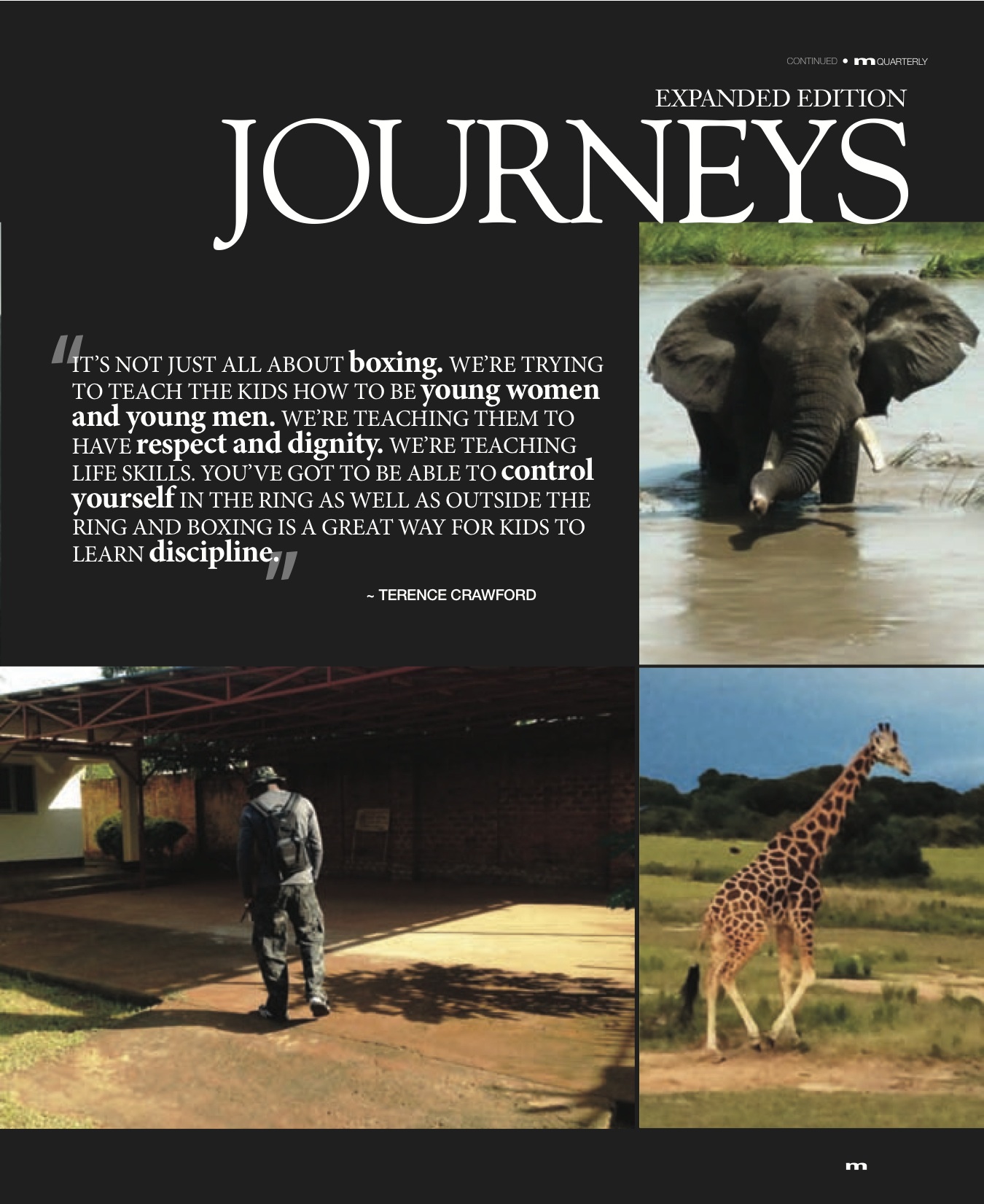
“It’s not just all about boxing. We’re trying to teach the kids how to be young women and young men. We’re teaching them to have respect and dignity. We’re teaching life skills. You’ve got to be able to control yourself in the ring as well as outside the ring and boxing is a great way for kids to learn discipline.
“If they feel like nobody cares than they’re not gong to care, but if they feel one person cares than they tend to listen to that person.”
Crawford knows from personal experience what a difference one person can make. Nollette was among those who connected with him when he was a hard-headed kid who bristled at authority.
“She was one of the only teachers that really cared. She would talk to me,” he said.
He needed someone to listen, he said, because “I got kicked out of school so much – a fight here, a fight there, I just always had that chip on my shoulder.” Nollette took the time to find out why he acted out.
He knows, too, the difference a gym can make for a young person working out anger issues.
“It’s a good place to come and get away, release some stress, release some steam if you’re having problems at home or school and you just need to let it out. What better way to let it out than on a bag, rather than going somewhere else and letting it out the wrong way. I look at it as an outlet for the kids that are just hardcore and mad at the world because of their circumstances. They come to this gym and they feel loved and they feel a part of something. For some kids, feeling a part of something changes them around.”
“This is my community, B & B is my gym, so I am in it for the long haul. I’m not in it for the fame or anything like that. I could be anywhere but my heart is with Omaha. We just want to help as many kids as we can. Everything is for the kids.”
Carl Washington got him started in the sport at the CW, where Midge Minor became his coach. Minor’s still in his camp 20 years later.
Crawford hopes that some young people training at the B & B will one day take it over. Then they, too, will pay forward what they received to help a new generation of young people.
Each one, to teach one…
The gym is in a neighborhood plagued by violence. His own childhood mirrored that of kids living there today. It’s survival of the fittest. He got suspended and expelled from school. The lure and threat of gangs loomed large. Boxing became his way out.
Staying true to his roots
His is a classic American success story of someone coming from the bottom up and making it to the top.
He’s fast become an icon and inspiration. He’s singlehandedly put Omaha on the boxing map and revived what was a dead sport here. HBO and TopRank are grooming him as pro boxing’s hot new face. Warren Buffett’s sported a Team Crawford T-shirt at one of his Omaha bouts. The fighter shows his hometown love by wearing trunks and caps with Husker and Omaha insignias. He’s thrown out the first pitch at an Omaha Storm Chasers’ game. He makes personal appearances delivering positive messages to students and athletes.
Amidst all the fame and hoopla, he’s remained rooted in his community. Yet he’s also found time to expand his world view by twice going to Third World countries when he could have chosen some resort. He considers Africa his second home.
“It IS home. I’m AFRICAN-American. It’s where a lot of my people come from historically down the line of my ancestors. Damn, I love this place.“
Just like his first visit there, he said, “I was very touched by the people and how gracious and humble and thankful they were about everything that came towards them. I had a great time with great people. I experienced some great things.”
As someone who prides himself in being a man of his word, he was pleased when Africans expressed appreciation for his not only saying he’d be back after his last trip, but actually returning.
The fact that he’s retained the same coaches and trainers who have been with him for years and that he supports his ex-teacher’s work in Africa speaks to his loyalty. What he gives, he gets back, too, thus making him a beloved star athlete and role model to the people and community he calls his own.
He hasn’t forgotten where he comes from and I doubt he’ll ever forget Africa. We don’t have much in common other than the same North Omaha roots, but the shared experience of seeing Uganda and Rwanda is something we’ll always have between us. That, and having the privilege of writing about the experience, is enough for me.
I never expected to be in Africa, let alone with him, but I’m glad it worked out that way.
Read more of Leo Adam Biga’s work at leoadambiga.com.
_______________________________________________________
My travels in Uganda and Rwanda, Africa with Pipeline Worldwide’s Jamie Fox Nollette. Terence Crawford and Co.
©by Leo Adam Biga
Nebraskans connect with Africans on trip
A chronicle of the June 1-12 humanitarian visit The Champ and his ex-teacher made to developing nations
I never imagined my first venture outside the United States would be in Africa. But in June I found myself in the neighboring East African nations of Uganda and Rwanda as the 2015 winner of the Andy Award for international journalism from the University of Nebraska at Omaha.
I accompanied a small group under the auspices of Pipeline Worldwide, a charitable organization with strong Omaha ties. The nonprofit supports sustainable clean water projects as well as self-sufficiency programs for vulnerable youth and women.
Pipeline co-founder and executive director Jamie Fox Nollette, an Omaha native, goes three times a year to check progress, assess needs and meet partners. She also raises awareness by bringing folks over and documenting the visits for prospective donors. She’s among scores of Americans, including Nebraskans, serving Third World countries. Though secular, Pipeline partners with faith-based groups. Her passion for serving Africa began with a 2007 church mission trip there.
She was Mother Hen for the trip I made.
Our ranks included a star – two-time world boxing champion Terence “Bud” Crawford of Omaha – who’s perhaps the most accomplished Neb. athlete in my lifetime.
Despite being a newsmaker, his visits to Uganda and Rwanda last August with Nollette went under the radar. It’s the way he wanted it. He’s low-key, even nonchalant about what he does to broaden his mind, see the world and help his community.
He doesn’t want to be thought of as just a fighter, though.
“I’m a human being just like anyone else,” he said,
You may wonder what compelled this 27 year-old at the top of his game to go, not once but twice, to developing nations beset by poverty, infrastructure gaps and violent legacies when he has the means to go anywhere. Well, it turns out Nollette was his fourth grade teacher at Skinner Magnet School in North Omaha, where they bonded, and they still click today.
He was a hard-headed kid from the streets carrying “a chip on my shoulder.” She was a calming influence at school, where he often acted out, except not in her classroom.
He and Nollette, who lives in Phoenix, Arizona, reconnected in 2014. She’d followed his prizefight success from afar and reached out to congratulate him.
“I told him how proud I was of him,” Nollette said.
When he discovered she did work in Africa he asked her to take him to the “motherland” he feels an ancestral draw to.
Traveling there also feeds Crawford’s heart for people less well off than himself, especially children. His generosity’s well-known. Crawford supports Pipeline’s work by bringing attention to it – he’s headlined fundraisers in Omaha and Phoenix – and she supports his B & B Boxing Academy. She’s leading a capital drive to expand the facility so it can serve more youth.
Loyalty is important to him. The coaches and trainers in his Team Crawford camp have been with him for years.
His “trust” in Nollette as someone who’s got his best interests at heart is reciprocated by him having her back.
After learning their shared history, their having gone to Africa and their planning to return, I applied for the grant to fund my Africa travel. That’s how I ended up half way around the world with a boxing star and a humanitarian.
Our merry band in far distant lands
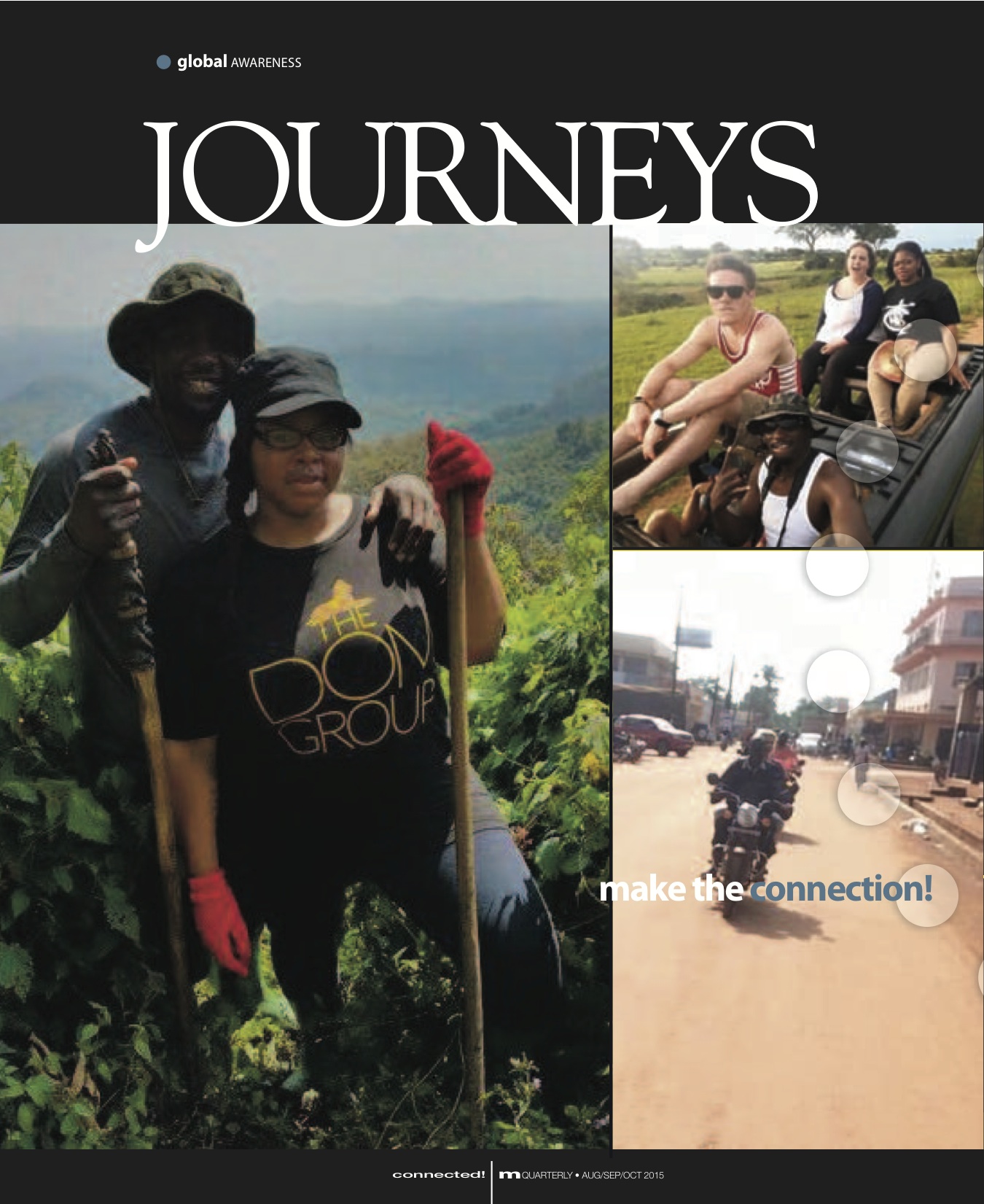
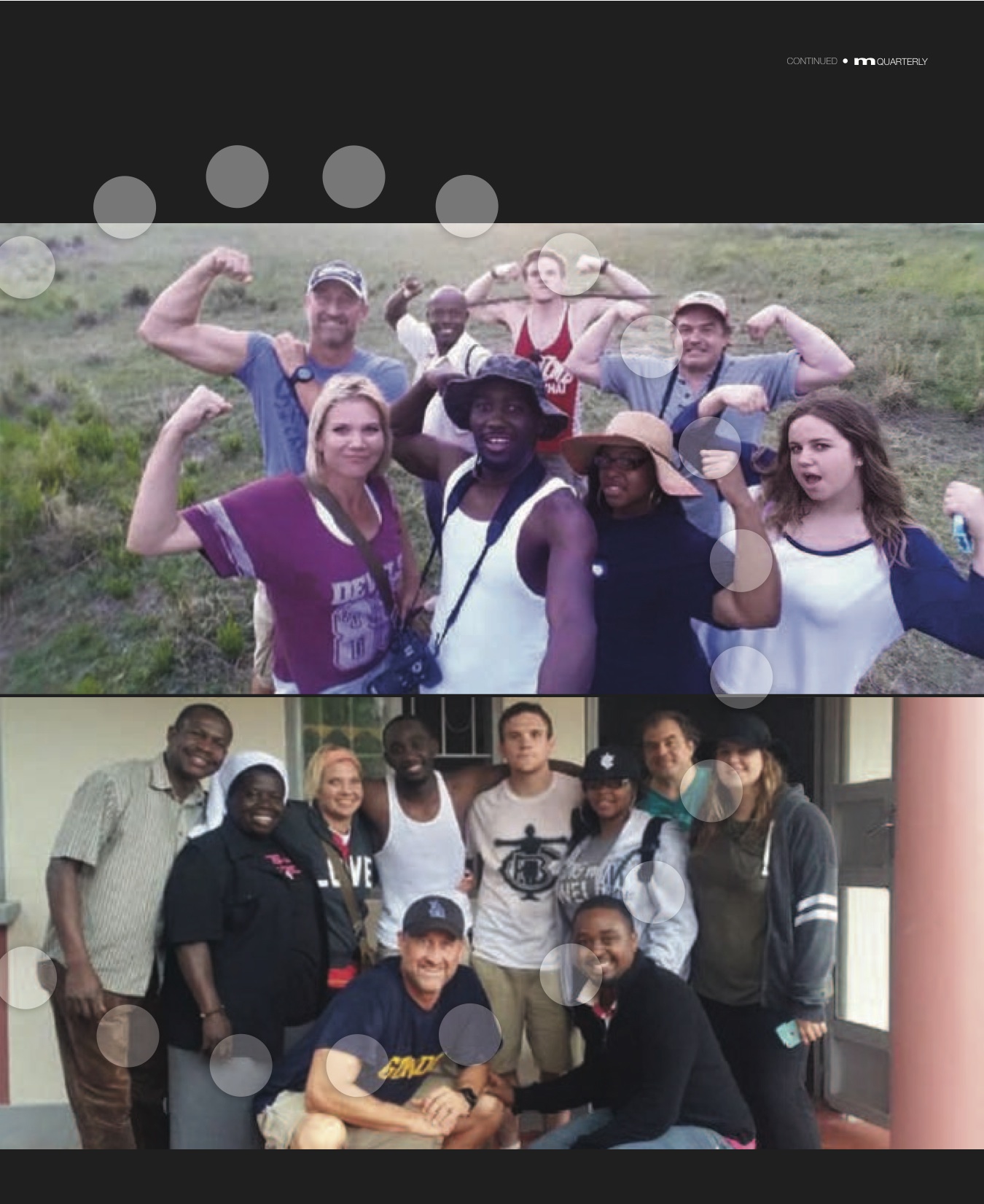
However, those two weren’t the whole story. We were a diverse seven-member group all affected by the places we went, the people we met and the stories we heard. The experience stretched us in new directions and offered new perspectives.
Nollette, our laidback leader, encouraged us to appreciate the human dimensions of what we witnessed as active participants,
Crawford, our by turns stoic and silly star, traveled with his girlfriend and the mother of his children, Alindra “Esha” Person.
Person, who’s a match for her man, expressed fears about the trip but proved a real trouper. Like her mate, she has a soft spot for kids and loved on them every chance she got.
Scott Katskee, an international apparel entrepreneur originally from Omaha and now living in L.A.,, is a big, gregarious, inquisitive man with a blend of street smarts and sophistication.
Joseph Sutter, a 2015 Millard West graduate, loved being in the company of his idol, Crawford, whom he played sidekick to.
Julia Brown, a recent Phoenix-area high school grad, didn’t say much but her heart for children shined through.
That left me capturing Africa’s contrasting tableaux. Traveling by mini-bus and land cruiser, we bounced from urban to rural areas and back again, often via heavily rutted dirt roads.
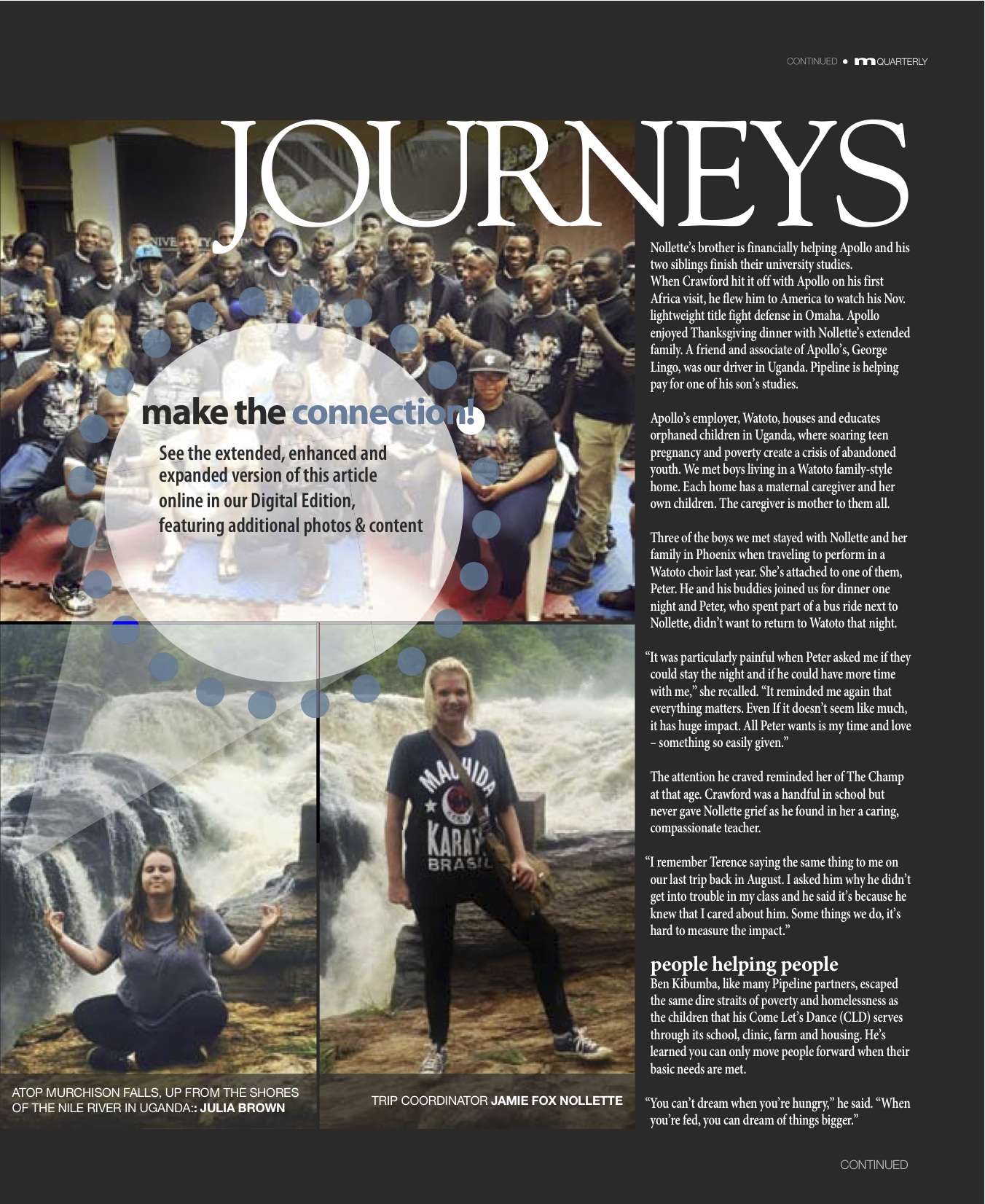
Busy, jam-packed cities gave way to sleepy rural spots. Hours of open plains followed by winding hilly terrain. I’ll never forget the beauty and power of hiking Murchison Falls or the wonder of being on safari and coming up on two lion prides. Roadside shanties sometimes sprawled only a stone’s throw from gated communities and luxury hotels.
Nollette said there’s no substitute for going to remote regions and urban slums “if you really want to see how people live.”
Sights that stick in my mind:
Vendors hawking wares.
Workers tending fields.
Farm animals foraging in front of homes.
Boda boda (motorbike) drivers darting through traffic.
Sounds too:
Roosters waking us in the morning.
Cawing birds.
Children singing, drumming, laughing.
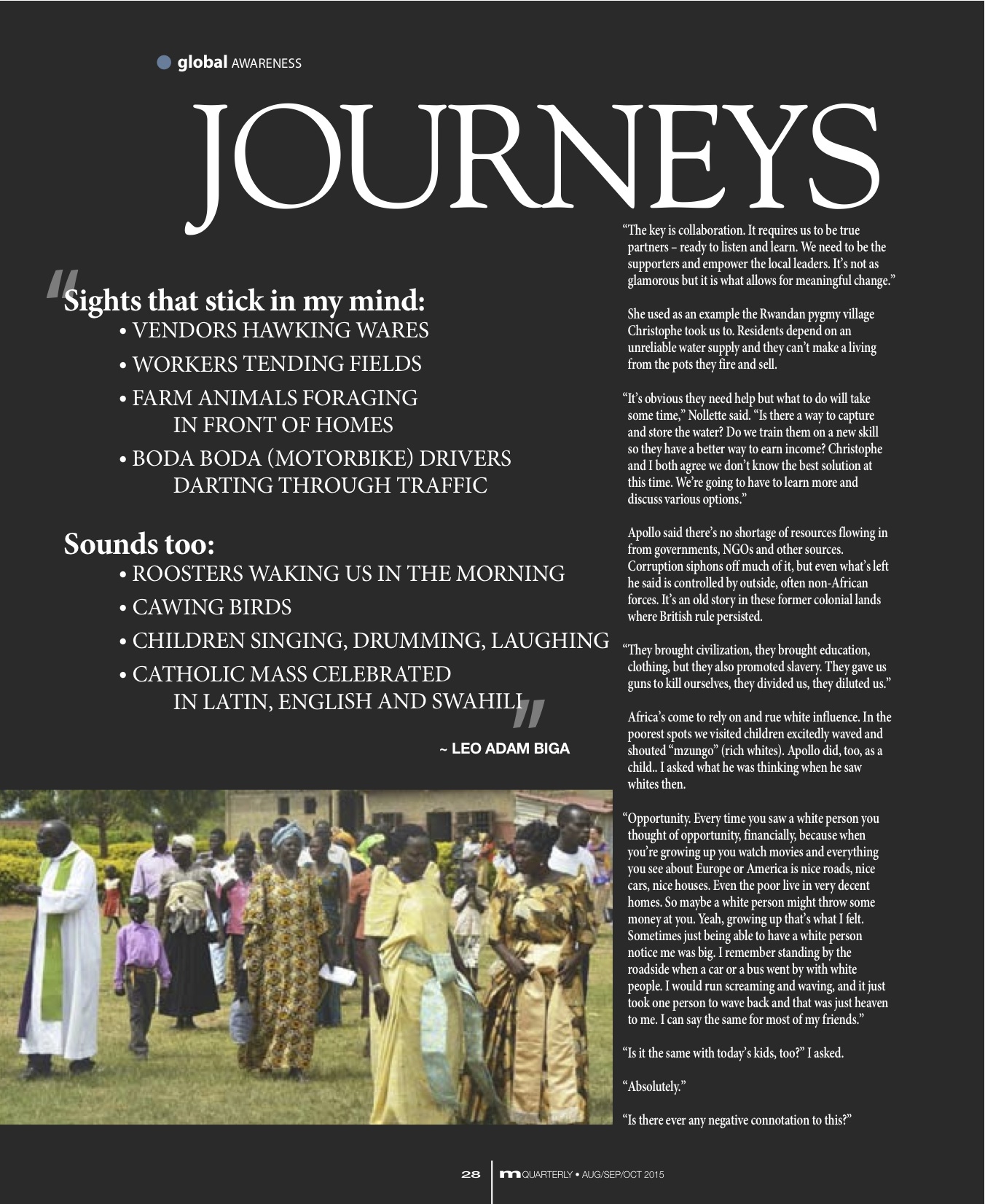
Catholic Mass celebrated in Latin, English and Swahili.
We’re not in Nebraska any longer
As fellow travelers we shared something potent together we won’t soon forget. Our June 1-12 journey was an odyssey for all, even those with extensive international experience. For this virgin globe-trotter it constituted an outside-the-box leap of faith.
Nollete described what the trip demanded and gave.
“These trips are hard, We are all away from home, out of our comfort zones – some way more than others. Not in control, thrown in a group with people we do not really know and usually would not try to get to know. We eat different, sleep less and see some really impactful things we’re not sure what to do with. That creates some dynamic situations. My hope is people come and see some things that are new, feel something different and learn not only about the countries and people but about themselves.
“Being out of control, uncomfortable and in new surroundings can foster growth. That’s not what people sign up for but most people will probably admit they experience some sort of transformation.”
I don’t know yet how I’ve grown from this, except perhaps I’m more patient and tolerant.
It’s important to note I went as an innocent abroad. Going in, I knew little about Uganda and Rwanda and after being there only 10 days I don’t pretend to be an expert. Our itinerary revealed different sides of those nations, but they were just snapshots of complex societies and cultures.
My greatest takeaway from Africa is its immense resources and challenges, which equates to vast unmet potential. As Nollette pointed out, the people want the same things we do but the barriers to entry for Western-standard living are steep. These are developing nations in every sense. Folks trying to improve things there measure progress in small steps that might seem insignificant to us but make a big difference in people’s lives.
On the flight from Amsterdam to Uganda I sat next to medical anthropologist and linguist Anna Eisenstein, a University of Virginia doctoral student doing field work in southwest Uganda. She lives with a village family and as she builds relationships with locals she conducts interviews. Her explanation of her work lent insight into the world I was entering:
“I’m studying the way people think about their bodies, how they think about health care and how they make decisions about when to go to the healer or the herbalist or when to go to the public health system. If they’re going to see a healer their family knows, it looks very different than going to the public hospital. If people are coming out of an encounter with bio-medicine rooted in colonialism then they have a lot of reason not to trust doctors or to take pills or want to be proactive. Also the public health system functions in English, which can be a barrier as well.”
Her comments stuck with me during my stay in Uganda, where vestiges of colonial rule persist.
She also told me what I could expect from the people.
“Everyone I’ve met has been so welcoming and friendly and kind and I hope you’ll find the same. There’s a lot of emphasis on hospitality and on making others feel welcome.”
Indeed, we came face to face with warm hospitality wherever we went. In Kampala, cancer-stricken children and their mothers at Bless a Child welcomed us with sweet formality. Sports ministry officials treated us like VIPs owing to the presence of The Champ, whom they greeted like a returning prince. In Atiak. a region of northern Uganda, young women recovering from trauma honored us with a rousing tribal dance and a hearty meal in appreciation for our group outfitting their newly dedicated dorm with bedding. Their sweet sisterhood enchanted us. In Luwero trainees at the African Hospitality Institute prepared a gourmet feast for us.
In the Rwanda highlands, pygmy village residents performed a traditional dance we reciprocated in kind.
We were welcomed into homes with mud walls, a thatched roof and bare possessions. When we visited organizations staff eagerly showed us classrooms, nurseries, clinics, guest houses and residential units. In many areas, access to clean water is an ever-present issue. The presence of a working community well or tank or pipe is cause for celebration. All too often rural folk must travel distances by foot or bike or boda boda lugging plastic yellow Jerry cans to fetch or return water. Without any or reliable home refrigeration, people shop at outdoor markets to supplement daily food needs subsistence farming doesn’t provide. Wooden stalls overladen with fruit, vegetables, oils, spices, grains, meat and fish do a brisk business as do their equivalent piled high with clothes, bags, tools, electronics. In slums, where there’s no sanitation system, human refuse runs free when the rains come.
I left feeling humbled by the scale of need and grateful for my own good fortune.
This impressionistic account dispenses with chronology in favor of moments and individuals that impressed me. My hope is you’ll find something that sparks your own journey or quest.
Getting to know you: Partners
I barely knew Nollette before the trip. I soon saw her dedication is sincere. She’s learned lessons in eight years serving Africa, none more vital than finding the right people on the ground to work with. She introduced us to several Pipeline partners in Uganda she’s close to. Ben Kibumba with Come Let’s Dance, Richard Kirabira with Chicken City Farms and Sister Rosemary Nyirumbe at Saint Monica’s. They lead efforts to educate, train and employ locals, no small feat in places where poverty and unemployment are widespread and opportunity limited. Adding to the challenge are transportation issues, resource shortages, misappropriated aid monies and emotional scars from civil war (Uganda) and genocide (Rwanda).
“Partnerships and relationships are crucial,” Nollette said. “It is very difficult to manage projects overseas. Since there is a great deal of corruption, you have to develop trust. Once we’ve identified potential partners with strong leadership, we start slow with small projects. We see how they do with communication, execution and accountability. We don’t expect them to be perfect. Many organizations we work with are grassroots just like us, but we believe in their vision and leadership. We emphasize collaboration and problem solving.
“It’s so hard here to try and do things on your own.”
Nollette cultivates leaders and facilitates their networking together. At one stop she presented partners with Samsung Galaxy tablets so they can better communicate-coordinate with each other and do better project management.
“They’re all great leaders. The cool part is these guys are now collaborating.”
Networking helps Pipeline track projects and programs. Pipeline is a conduit feeding the change agents it supports with what they need. Sometimes that means connecting partners.
Nollette said, “For example, Richard with Chicken City Farms has figured out brick making using a brick making machine with interlocking bricks. It can cut the cost of construction by 30 percent because it doesn’t require as much cement. We introduced him to Sister Rosemary and Ben Kibumba. Richard’s team is training Sister Rosemary’s and Ben’s teams on this process by building guesthouses for them. Not only will they learn this new skill that cuts costs, but they can continue to make bricks and sell them as an additional revenue stream.”
Leveraging expertise and resources, Pipeline strives to create synergies for sustainable change.
Nollette said it takes time to fully discern needs and challenges and get people thinking longterm.
“I’ve learned many Africans want to withhold information for fear the support may go away. They also tend to think about immediate fixes rather than long-term solutions. When most people wake up each day and have to walk for water and get food for the day, it is difficult to think beyond that. We talk a lot about solutions that are sustainable.”
Two of her most trusted liaisons are Apollo Karaguba in Uganda and Christophe Mbonyyingabo in Rwanda. Besides serving as our tour guides, they took us to programs serving residents of urban slums and isolated rural villages. Pipeline partners with Apollo’s employer, Watoto Child Care Ministries, and with Christophe’s own CARSA.
Nollette sings the praises of Apollo and Christophe, two affable men with burning intensity.
“I’m mostly impressed with their passion and commitment to make a difference in the lives of others. I can count on them for anything and truly think of them as brothers. It’s an honor to work with them. They are also eager to listen and learn and help with other projects even when it doesn’t benefit their own organizations.”
She and her family are especially close to Apollo, who in turn is close to Terence Crawford.
“I feel like I’ve adopted both of them,” she says of the guide and the boxer.
Nollette’s brother is financially helping Apollo and his two siblings finish their university studies. When Crawford hit it off with Apollo on his first Africa visit, he flew him to America to watch his Nov. lightweight title fight defense in Omaha. Apollo enjoyed Thanksgiving dinner with Nollette’s extended family. A friend and associate of Apollo’s, George Lingo, was our driver in Uganda. Pipeline is helping pay for one of his son’s studies.
Apollo’s employer, Watoto, houses and educates orphaned children in Uganda, where soaring teen pregnancy and poverty create a crisis of abandoned youth. We met boys living in a Watoto family-style home. Each home has a maternal caregiver and her own children. The caregiver is mother to them all.
Three of the boys we met stayed with Nollette and her family in Phoenix when traveling to perform in a Watoto choir last year. She’s attached to one of them, Peter. He and his buddies joined us for dinner one night and Peter, who spent part of a bus ride next to Nollette, didn’t want to return to Watoto that night.
“It was particularly painful when Peter asked me if they could stay the night and if he could have more time with me,” she recalled. “It reminded me again that everything matters. Even If it doesn’t seem like much, it has huge impact. All Peter wants is my time and love – something so easily given.”
The attention he craved reminded her of The Champ at that age. Crawford was a handful in school but never gave Nollette grief as he found in her a caring, compassionate teacher.
“I remember Terence saying the same thing to me on our last trip back in August. I asked him why he didn’t get into trouble in my class and he said it’s because he knew that I cared about him. Some things we do, it’s hard to measure the impact.”
People helping people
Ben Kibumba, like many Pipeline partners, escaped the same dire straits of poverty and homelessness as the children that his Come Let’s Dance (CLD) serves through its school, clinic, farm and housing. He’s learned you can only move people forward when their basic needs are met.
“You can’t dream when you’re hungry,” he said. “When you’re fed, you can dream of things bigger.”
CLD’s Thread of Life program targets single mothers in the slums, some of whom who turn to prostitution to get by. Others can’t afford sending their kids to school. Thread of Life gives women a safe place to live and the opportunity to learn sewing-beading skills they use to make jewelry and apparel whose sales earn them a living wage.
Program directors Mercy and Florence say some participants have left behind exploitation and dependence to move out of the slums and live healthy lives with their kids.
Pipeline supports this and similar programs that train and employ African women to sew. Nollette’s also launched a business, C ME Stories (http://cmestories.com/), where U.S. designers create patterns for apparel-accessory products women in Uganda produce.
“We pay women for each piece they make. The idea is to have a recurring business model and pay women a good wage for the work they do. They learn to save as well,” Nollette said.
At her Saint Monica facilities in Gulu and Atiak, Uganda world renown humanitarian Sister Rosemary and staff empower exploited females, who are trained and employed in sewing and beading. Many were abducted as girls by rebels and forced into sex slavery, marriage and childbirth. Through education, community and work, they build self-esteem and self-reliance.
“She’s my type of person,” Nollette said of the charismatic nun. “She’s a problem-solver and knows how to get things done. One of the things she said to me was, ‘You know Jamie, we understand how to do all the little things that turn into big things.’ She loves those women and it shows. Her work is incredibly difficult and yet she is always fun to be around. Contagious is the best word to describe her.”
About the women at Saint Monica’s. Sister said, “They’ve seen a lot of bad stuff. That’s why it’s good to get a lot of people who can come and show them a different face of the world. If they remain by themselves they will not know anything else.”
A shy resident she introduced us to, Evelyn Amony, was abducted by Lord’s Resistance Army rebels at age 12 on her way to school and like other taken girls forced to do and witness awful things. She became one of LRA leader Joseph Kony’s many wives and bore him three children. She lived in hiding with him until the Uganda army intervened.
Since regaining her freedom, she said, “I find a lot of improvements and changes in my life.” Amony said she enjoys the work she does and the pleasure it gives others. As if to prove it she modeled a blouse she makes and designs, too. She smiled as we admired her handiwork.
Nollette said, “When you empower women to be able to actually support themselves and to be able to pay for their kids’ schooling it’s really important. When a mom is able to afford to send her own child to school it teaches the value of education.”
Giving people the means to break cycles of misery and achieve self-sufficiency is a big focus of Pipeline and its partners. In his own way, Crawford tries doing the same thing at his gym.
Charles Mugabi and Richard Kirabira’s passion for helping others led to them getting full-ride college scholarships in the States. Now these entrepreneurs are applying what they learned by giving back to their homeland.
“We came back with a a very single purpose – to create startups that help youth get the opportunity to work. That’s the biggest need – jobs,” Mugabi said.
His telecom service business Connect offers employment and internship opportunities and conducts tech training at colleges.
Kirabira, whose Chicken City Farms ministry trains young men to raise chickens to market and to operate their own small farms, said, “We want to lead people in all areas but focusing on economic empowerment because we believe when someone is economically stable you can talk to them about Christ. But if I’m not stable, if I am not sure what I’m going to eat tomorrow, your message may not even make sense to me. So we try to tackle the gospel by bringing some hope for people to take care of their families and their needs.”
Bottom-line, Kirabira said, “Young people here need an opportunity to work. That’s what will turn around the country.”
Healing
In places haunted by terror and violence, healing’s in order, too. Gacaca courts attempted to foster healing In Rwanda, where CARSA walks directly related genocide perpetrators and survivors through reconciliation workshops. After years of mounting tensions, a contrived ethnic war pitted the majority Hutus against the minority Tutsis. Wholesale slaughter ensued. We met survivors who lost their family and home. Pipeline’s building a home for a widow survivor named Catherine. We met a young man who’s forgiven the person who killed his siblings.
Christophe translated for us.
A man and woman bound by pain shared their testimonies. He’s Hutu and she’s Tutsi. They were neighbors. He was friends and drinking mates with her husband, He admitted getting caught up in the blood lust of atrocities. He participated in her husband’s murder and stole her home and possessions. He served 11 years in prison for his crimes. She had trouble moving on after losing so much, including two children. After the perpetrator’s release from prison he returned to their village and she couldn’t bear to see him. With support from CARSA she found the strength and grace to forgive him. The pair now share a cow they tend, enjoying the milk and calves it produces.
Of the man who caused such heartache she’s neighbors with again, she said, “He was able to open up and open the secret of his heart to us and I did the same towards him and I’ll tell you since then things have changed. Now we not only greet one another but we are friends.”
We were all struck by what we heard. Scott Katskee said it was the most moving thing he experienced in Africa. Crawford found it “crazy” i.e. amazing one could find peace amidst such angst. Julia Brown doubted reunification could happen here.
Nollette said, “The stories in Rwanda are deeply personal and I always feel honored these people share them with us. Catherine, the widow who lost her husband and child and is currently living with her sister, seemed especially sad. I could sense she feels hopeless. Christophe told her we wanted to build her a house, but I don’t think she believes it will happen.”
Ex-Pats
We met other Westerners whose Africa commitment has changed their lives. Former CNN reporter Patricia Smith does marketing for Saint Monica’s. During our visit she documented the blessing of a new dorm in Atiak and our supplying bedding for the female residents, who worked merrily alongside us. Maggie Josiah sought radical change and found it at the African Hospitality Institute she carved out of the bush in Luwero, a district in central Uganda. AHI trains women to work in Uganda’s booming hospitality industry.
A few years ago Canadian Randy Sohnchen and his wife moved to Uganda, where he now runs Omer Farming Co., one of several agricultural concerns looking to turn millions of untouched acres of rich soil into producing croplands. “It’s got all the makings of a classic land rush,” he said, adding productivity gains should improve Ugandans’ quality of life. His decision to live there, he said, is based on his experience that “nothing lasting happens unless somebody dwells.”
Apollo agrees that “being on the ground” is indispensable and “totally different” than managing things long-distance.
Sohnchen’s done development work elsewhere and he said, “In 15 years this country will be transformed. It’s gonna happen, I’ve seen it happen in other places. It will happen here.”
Americans Todd and Andria Ellingson caught the vision, too. but soon after moving to Rwanda to start a school they thought they’d made the biggest mistake of their lives.
“Everything fell apart. It was nothing what we thought it would be. Finally, after much reevaluation and just staying the course,” Todd said, “we’re seeing the impact, we’re seeing the fruit of what we planted and watered.”
Their City of Joy consists of a school, a kitchen, a well, a water tower. A church is being built. They brought electricity to the community. They’re looking to help farmers reap more yield. That doesn’t mean it’s gotten any easier,
“Still lots of doubt, even today,” he said. “Am I really making a difference or am I just enabling and spoon-feeding?”
He said living and working in an isolated area so far from home “there’s that constant stress of being in a different culture,” adding, “If you don’t focus on keeping yourself healthy, you can crash and burn here. It’s probably the best thing I’ve ever done, but the hardest.”
Respecting African autonomy and aspirations
Nollette said many Westerners who come make the mistake of wanting “to fix everything,” adding, “If you try to do everything for everyone then it’s unlikely you’ll do anything of much substance. It’s easy to come in and act like Santa Claus. It will make you feel better, but the reality is when you leave you haven’t done anything to help. I want our help and support to be meaningful and sustainable. I want to have real impact that outlives our visits.
“The key is collaboration. It requires us to be true partners – ready to listen and learn. We need to be the supporters and empower the local leaders. It’s not as glamorous but it is what allows for meaningful change.”
She used as an example the Rwandan pygmy village Christophe took us to. Residents depend on an unreliable water supply and they can’t make a living from the pots they fire and sell.
“It’s obvious they need help but what to do will take some time,” Nollette said. “Is there a way to capture and store the water? Do we train them on a new skill so they have a better way to earn income? Christophe and I both agree we don’t know the best solution at this time. We’re going to have to learn more and discuss various options.”
Apollo said there’s no shortage of resources flowing in from governments, NGOs and other sources. Corruption siphons off much of it, but even what’s left he said is controlled by outside, often non-African forces. It’s an old story in these former colonial lands where British rule persisted.
“They brought civilization, they brought education, clothing, but they also promoted slavery. They gave us guns to kill ourselves, they divided us, they diluted us.”
Africa’s come to rely on and rue white influence. In the poorest spots we visited children excitedly waved and shouted “mzungo” (rich whites). Apollo did, too, as a child.. I asked what he was thinking when he saw whites then.
“Opportunity. Every time you saw a white person you thought of opportunity, financially, because when you’re growing up you watch movies and everything you see about Europe or America is nice roads, nice cars, nice houses. Even the poor live in very decent homes. So maybe a white person might throw some money at you. Yeah, growing up that’s what I felt. Sometimes just being able to have a white person notice me was big. I remember standing by the roadside when a car or a bus went by with white people. I would run screaming and waving, and it just took one person to wave back and that was just heaven to me. I can say the same for most of my friends.”
“Is it the same with today’s kids, too?” I asked.
“Absolutely.”
“Is there ever any negative connotation to this?”
“Not with the children. The adults, if they’ve had education, they know what the British did, they came and looted our continent, so there’s a bit of bias.”
Joseph Sutter articulated the conflict many of us felt as privileged Americans just passing through. “You have a guilty conscious the way they look at you when we’re driving by.” Referring to the gifts we handed out here and there, Nollette said, “Are we doing anything good by giving suckers and jerseys? No.”
“Well, it makes them happy for a second,” Julia Brown noted.
Nollette said feel-good, bandaid fixes won’t solve a person’s or a nation’s systemic problems. Change must begin with a better educated populace and committed new leadership,
“When people have access to good education they learn what’s possible,” she said. “That’s why it’s important to partner with developing leaders.”
Given the instability of the Ugandan civil war and Rwandan genocide of only a decade and a generation ago, respectively, she said people who lived through those times are apt to have lower expectations.
“Knowing there may be some corruption and there’s no innovation and infrastructure, they’re okay because they don’t want the alternative.”
Younger people are more demanding.
“They’re looking for leadership, they want education, they want to develop the country.”
Apollo said, “The biggest challenge we have is leadership and stewardship. We must raise a generation that grows up with integrity, that is corrupt free and that will be true stewards of the resources of this nation and this continent.”
Coming and going
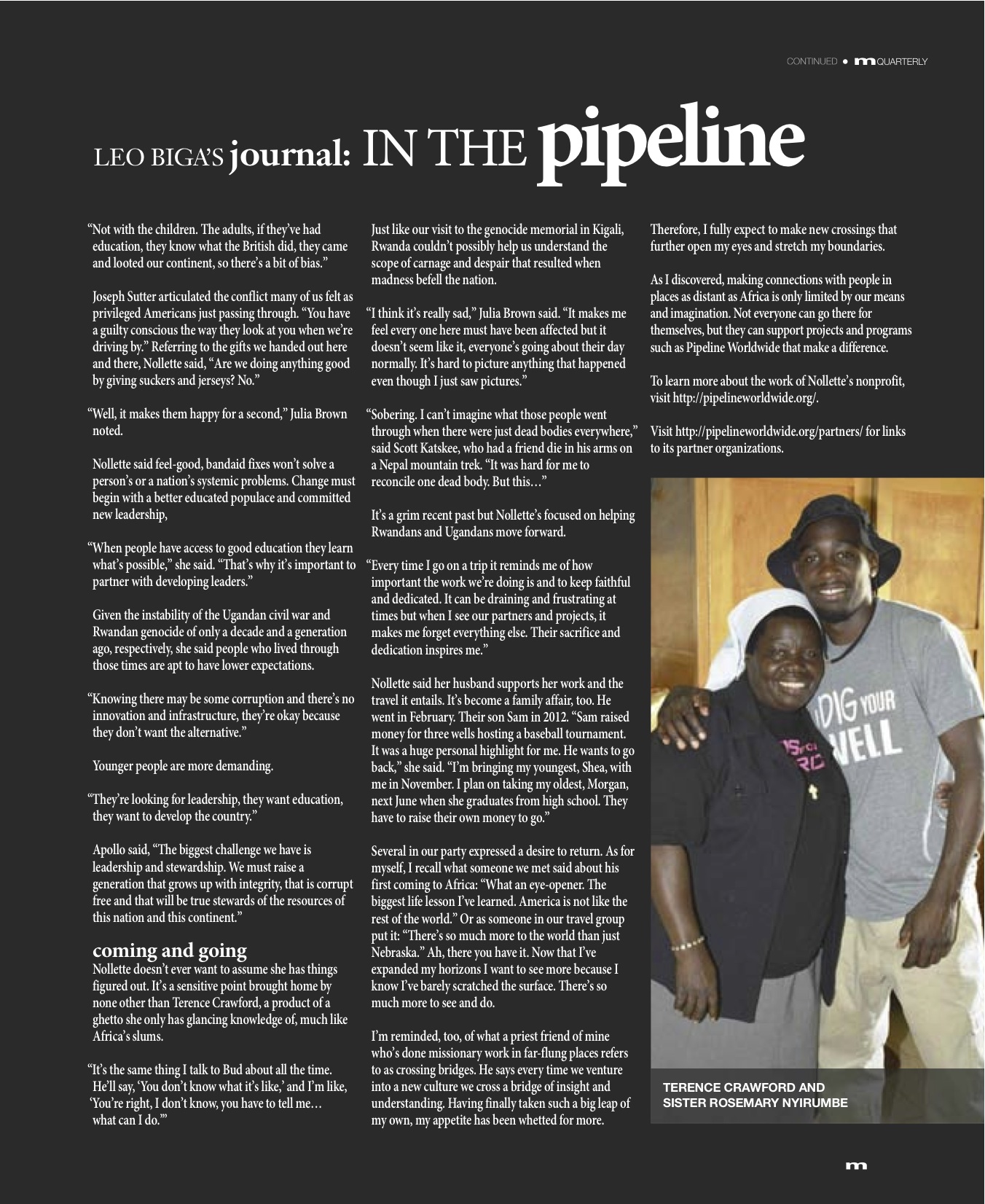
Nollette doesn’t ever want to assume she has things figured out. It’s a sensitive point brought home by none other than Terence Crawford, a product of a ghetto she only has glancing knowledge of, much like Africa’s slums.
“It’s the same thing I talk to Bud about all the time. He’ll say, ‘You don’t know what it’s like,’ and I’m like, ‘You’re right, I don’t know, you have to tell me what can I do.'”
Just like our visit to the genocide memorial in Kigali, Rwanda couldn’t possibly help us understand the scope of carnage and despair that resulted when madness befell the nation.
“I think it’s really sad,” Julia Brown said. “It makes me feel every one here must have been affected but it doesn’t seem like it, everyone’s going about their day normally. It’s hard to picture anything that happened even though I just saw pictures.”
“Sobering. I can’t imagine what those people went through when there were just dead bodies everywhere,” said Scott Katskee, who had a friend die in his arms on a Nepal mountain trek. “It was hard for me to reconcile one dead body. But this…”
It’s a grim recent past but Nollette’s focused on helping Rwandans and Ugandans move forward.
“Every time I go on a trip it reminds me of how important the work we’re doing is and to keep faithful and dedicated. It can be draining and frustrating at times but when I see our partners and projects, it makes me forget everything else. Their sacrifice and dedication inspires me.”
Nollette said her husband supports her work and the travel it entails. It’s become a family affair, too. He went in February. Their son Sam in 2012. “Sam raised money for three wells hosting a baseball tournament. It was a huge personal highlight for me. He wants to go back,” she said. “I’m bringing my youngest, Shea, with me in November. I plan on taking my oldest, Morgan, next June when she graduates from high school. They have to raise their own money to go.”
Several in our party expressed a desire to return. As for myself, I recall what someone we met said about his first coming to Africa: “What an eye-opener. The biggest life lesson I’ve learned. America is not like the rest of the world.” Or as someone in our travel group put it: “There’s so much more to the world than just Nebraska.” Ah, there you have it. Now that I’ve expanded my horizons I want to see more because I know I’ve barely scratched the surface. There’s so much more to see and do.
I’m reminded, too, of what a priest friend of mine who’s done missionary work in far-flung places refers to as crossing bridges. He says every time we venture into a new culture we cross a bridge of insight and understanding. Having finally taken such a big leap of my own, my appetite has been whetted for more. Therefore, I fully expect to make new crossings that further open my eyes and stretch my boundaries.
As I discovered, making connections with people in places as distant as Africa is only limited by our means and imagination. Not everyone can go there for themselves, but they can support projects and programs that make a difference.
To learn more about the work of Nollette’s nonprofit, visit http://pipelineworldwide.org/. Visit http://pipelineworldwide.org/partners/ for links to its partner organizations.
Read more of Leo Adam Biga’s work at leoadambiga.com
The Champ Goes to Africa: Terence Crawford Visits Uganda and Rwanda with his former teacher, this reporter and friends
The Champ Goes to Africa
Terence Crawford Visits Uganda and Rwanda with his former teacher, this reporter and friends
Two-time world boxing champ Terence Crawford of Omaha has the means to do anything he wants. You might not expect then that in the space of less than a year he chose to travel not once but twice to a pair of developing nations in Africa wracked by poverty, infrastructure problems and atrocity scars: Uganda and Rwanda, I accompanied his last trip as the 2015 winner of the Andy Award for international journalism from the University of Nebraska at Omaha. Until now I’ve posted a little about the grant that took me to Africa along with a few pictures and anecdotes from the trip. But now I’m sharing the first in a collection of stories I’m writing about the experience, which is of course why I went there in fhe first place. This cover story in the coming July issue of The Reader (www.thereader.com) emphasizes Crawford within the larger context of what he and the rest of us saw, who we met and what we did. Future pieces for other publications will go even more into where his Africa sojourns fit into his evolving story as a person and as an athlete. But at least one of my upcoming stories from the trip will try to convey the totality of the experience from my point of view and that of others. I feel privilged to have been given the opportunity to chronicle this journey. Look for new posts and updates and announcements related to this and future stories from my Africa Tales series.
NOTE: This is at least the fifth major article I’ve written about Crawford. You can find all of them on this blog site. Find them at-
https://leoadambiga.com/?s=crawford
AFRICA TALES IN IMAGES
Here is a link to a video slideshow of the June trip I made to Uganda and Rwanda, Africa with The Champ, Terence Crawford and Alindra I Person, Jamie Fox Nollette, Scott Katskee, Joseph Sutter and Julia Brown.
The visuals were edited, set to music, given movement and in some cases captioned by my friend Victoria White, an Omaha filmmaker.
NOTE: I am available to make public presentations about the trip and the video slideshow will be a part of the talk that I give. We will be updating the video slideshow with new images to keep it fresh and to represent different aspects of the experience we had in those developing nations.
All my stories about the trip can also be found on this blog. Access them at-
https://leoadambiga.com/?s=africa

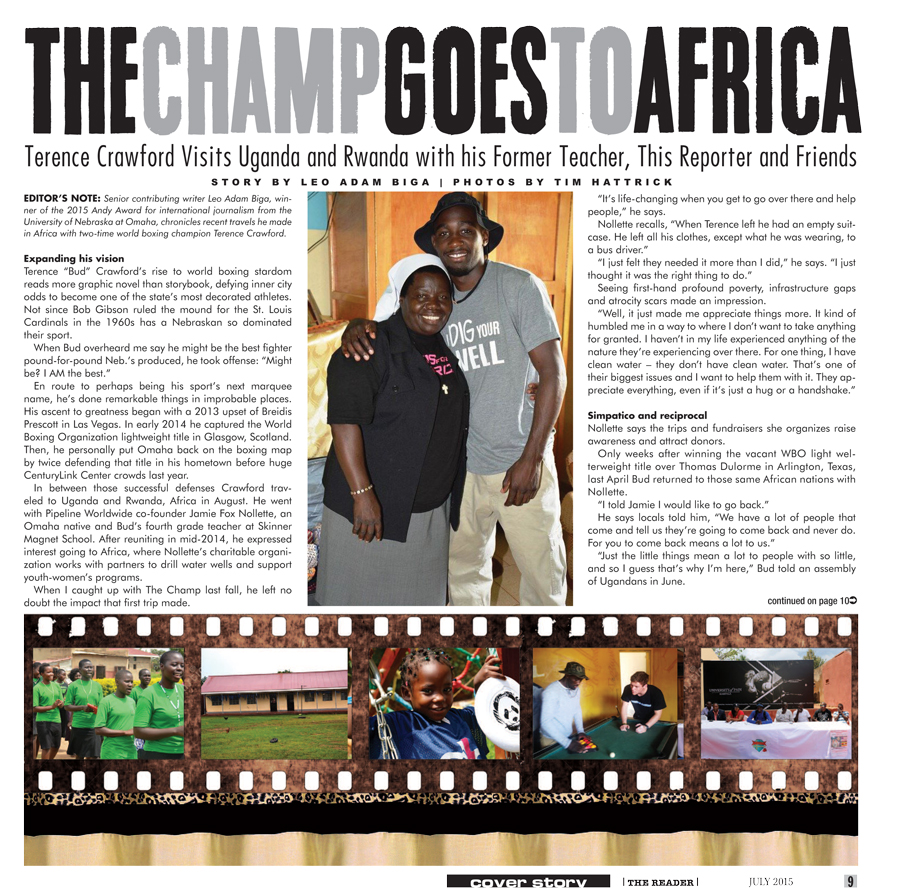



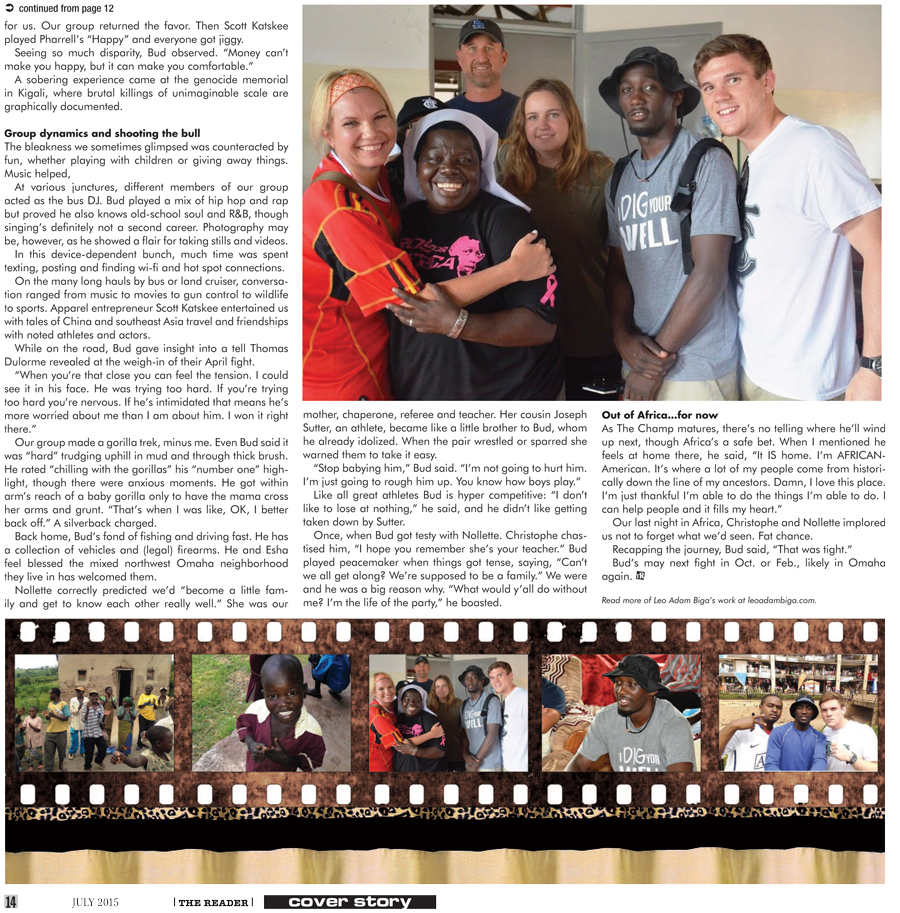
(Below is a text-only format of the same article)
The Champ Goes to Africa
Terence Crawford Visits Uganda and Rwanda with his former teacher, this reporter and friends
©by Leo Adam Biga
Originally appeared in The Reader (www.thereader.com)
EDITOR’S NOTE:
Senior contributing writer Leo Adam Biga, winner of the 2015 Andy Award for international journalism from the University of Nebraska at Omaha, chronicles recent travels he made in Africa with two-time world boxing champion Terence Crawford.
Expanding his vision
Terence “Bud” Crawford’s rise to world boxing stardom reads more graphic novel than storybook, defying inner city odds to become one of the state’s most decorated athletes. Not since Bob Gibson ruled the mound for the St. Louis Cardinals in the 1960s has a Nebraskan so dominated his sport.
When Bud overheard me say he might be the best fighter pound-for-pound Neb.’s produced, he took offense:. “Might be? I AM the best.”
En route to perhaps being his sport’s next marquee name, he’s done remarkable things in improbable places. His ascent to greatness began with a 2013 upset of Breidis Prescott in Las Vegas, In early 2014 he captured the WBO lightweight title in Glasgow, Scotland. He personally put Omaha back on the boxing map by twice defending that title in his hometown before huge CenturyLink Center crowds last year.
In between those successful defenses he traveled to Uganda and Rwanda, Africa in August. He went with Pipeline Worldwide co-founder Jamie Fox Nollette, an Omaha native and Bud’s fourth grade teacher at Skinner Magnet School. After reuniting in mid-2014, he expressed interest going to Africa, where her charitable organization works with partners to drill water wells and to support youth-women’s programs.
When I caught up with The Champ last fall, he left no doubt the impact that first trip made.
“It’s life-changing when you get to go over there and help people,” he says.
Nollette recalls, “When Terence left he had an empty suitcase. He left all his clothes, except what he was wearing, to a bus driver.”
“I just felt they needed it more than I did,” he says. ‘I just thought it was the right thing to do.”
Seeing first-hand profound poverty, infrastructure gaps and atrocity scars made an impression.
“Well, it just made me appreciate things more. It kind of humbled me in a way to where I don’t want to take anything for granted. I haven’t in my life experienced anything of the nature they’re experiencing over there. For one thing, I have clean water – they don’t have clean water. That’s one of their biggest issues and I want to help them with it. They appreciate everything, even if it’s just a hug or a handshake.”
Simpatico and reciprocal
Nollette says the trips and fundraisers she organizes raise awareness and attract donors.
Only weeks after winning the vacant WBO light welterweight title over Thomas Dulorme in Arlington, Texas last April Bud returned to those same African nations with Nollette.
“I told Jamie I would like to go back.”
He says locals told him, “We have a lot of people that come and tell us they’re going to come back and never do. For you to come back means a lot to us.”
“Just the little things mean a lot to people with so little, and so I guess that’s why I’m here,” Bud told an assembly of Ugandans in June.
None of this may have happened if he and Nollettte didn’t reconnect. Their bond transcends his black urban and her white suburban background. He supports Pipeline’s work and she raises funds for his B&B Boxing Academy in North O.
His first Africa trip never made the news because he didn’t publicize it. His June 1 through 12 trip is a different matter.
What about Africa drew this streetwise athlete to go twice in 10 months when so much is coming at him in terms of requests and appearances, on top of training and family obligations?
Beyond the cool machismo, he has a sweet, soft side and burning curiosity. “He really listens to what people say,” Nollette notes. “He wants to understand things.”
His pensive nature gets overshadowed by his mischievous teasing, incessant horseplay and coarse language.
This father of four is easy around children, who gravitate to him. He supports anything, here or in Africa, that gets youth off the streets.
He gives money to family, friends, homies and complete strangers. In 2014 he so bonded with Pipeline’s Uganda guide, Apollo Karaguba, that he flew him to America to watch his Nov. fight in Omaha.
“When I met Apollo I felt like I’ve been knowing him for years. I just liked the vibe I got. He’s a nice guy, he’s caring. He took real good care of us while we were out there.”
Bud says paying his way “was my turn to show him my heart.”
He respects Nollette enough he let her form an advisory committee for his business affairs as his fame and fortune grow.
Even with a lifelong desire to see “the motherland” and a fascination with African wildlife, it took Nollette reentering his life for him to go.
“Certain opportunities don’t come every day. She goes all the time and I trust her.”
His fondness for her goes back to when they were at Skinner. “She was one of the only teachers that really cared. She would talk to me.”
He needed empathy, he says, because “I got kicked out of school so much – a fight here, a fight there, I just always had that chip on my shoulder.” He says she took the time to find out why he acted out.
Catching the vision
Boxing eventually superseded school.
“I used to fall asleep studying boxing.”
Meanwhile, Nollette moved to Phoenix. On a 2007 church mission trip to Uganda she found her calling to do service there.
“It really impacted me,” she says. “I’ve always had a heart for kids and
I always had an interest in Africa.”
She went several times.
“There’s not really anything that can prepare you for it. The volume of people. The overwhelming poverty. Driving for hours and seeing all the want. I didn’t know what possibly could be done because everything seemed so daunting.
“But once I had a chance to go into some villages I started to see things that gave me hope. I was absolutely amazed at the generosity and spirit of these people – their hospitality and kindness, their gratitude. You go there expecting to serve and after you’re there you walk away feeling like you’ve been given a lot more. I was hooked.”
Bud got hooked, too, or as ex-pats say in Africa, “caught the vision.”
“I was very touched by the people and how gracious and humble and thankful they were about everything that came towards them. I had a great time with great people. I experienced some great things.”
Coming to Africa i:
Uganda
For this second trip via KLM Delta he brought girlfriend Alindra “Esha” Person, who’s the mother of his children. Joseph Sutter of Omaha and myself tagged along, Julia Brown of Phoenix joined us in Detroit and Scott Katskee, a native Omahan living in Los Angeles, added to our ranks in Amsterdam. Nollette arrived in Uganda a day early and met us in Entebbe, where Bud and Apollo enjoyed a warm reunion.
The next seven days in Uganda, which endured civil war only a decade ago, were a blur made foggier by jet lag and itinerary overload. Dividing our time between Kampala and rural areas we saw much.
Roadside shanties. Open market vendors. Christian schools, clinics, worship places. Vast, wild, lush open landscapes. Every shade of green vegetation contrasted with red dirt and blue-white-orange skies. Immense Lake Victoria. Crossing the storied Nile by bridge and boat.
The press of people. Folks variously balancing fruit or other items on their head. Unregulated, congested street traffic. Everything open overnight. Boda bodas (motor bikes) jutting amid cars, trucks, buses, pedestrians. One morning our group, sans me, rode aback boda bodas just for the thrill. I suggested to Bud Top Rank wouldn’t like him risking injury, and he bristled, “I run my life, you feel me? Ain’t nobody tell me what to do, nobody. Not even my mom or my dad.”
Ubiquitous Jerry cans – plastic yellow motor oil containers reused to carry and store water – carted by men, women, children, sometimes in long queues. “All waiting on water, that’s crazy,” Bud commented.
Stark contrasts of open slums and gated communities near each other. Mud huts with thatched roofs in the bush.
Long drives on unpaved roads rattled our bodies and mini-bus.
Whenever delays occurred it reminded us schedules don’t mean much there. Bud calls it TIA (This is Africa). “Just live in the moment…go with the flow,” he advised.
In a country where development’s piecemeal, Apollo says, “We’re not there yet, but we’re somewhere.”
Africans engaged in social action say they’ve all overcome struggles to raise themselves and their countrymen. “I was one of the lucky few to get out (of the slums),” Apollo says. They want partners from the developed world, but not at the expense of autonomy.
Many good works there are done by faith-based groups. Apollo works for Watoto Child Care Ministries, whose campus we toured. Three resident boys close to Nollette bonded with Bud on his last trip. The boys joined us for dinner one night.
We spent a day with Sister Rosemary Nyirumbe, whose vocational work with exploited females has won acclaim. Last year Nollette produced a video showing Bud training Sister for a mock fight with Stephen Colbert. This time, Nollette, Bud and Co. outfitted a dormitory for her girls in Atiak, where Pipeline built a well. Bud played music the girls danced to. They honored us with a traditional dinner and dance.
We toured Pastor Ben Kibumba’s Come Let’s Dance (CLD) community development organization. Bud and others gave out jerseys to kids.
Nakavuma Mercy directs CLD’s Thread of Life empowerment program for single moms in Kampala’s Katanga slum.
We met Patricia at Bless a Child, which serves cancer-stricken kids in Kampala, and Moses, who’s opening a second site in Gulu. We met young entrepreneurs Charles Mugabi and Richard Kirabira, whose Connect Enterprise and Chicken City Farms, respectively, are part of a creative class Pipeline partners with.
“One of the things I see is that you have a lot of young people with strong leadership skills and I want to be able to come alongside them and support them in their efforts,” Nollette says.
Apollo says Uganda needs new leadership that’s corruption-free and focused on good resource stewardship.
Nollette says she offers “a pipeline to connect people in the States with opportunities and projects in Africa that are really trying to make a difference in their communities.”
It’s all about leveraging relationships and expertise for maximum affect.
We met ex-pats living and work there: Todd Ellingson with City of Joy and Maggie Josiah with African Hospitality Institute.
Josiah offered this advice:
“A lot of times, especially we Americans come over thinking we have all the answers and we know how to fix all the problems, and really we don’t need to fix any of the African problems. They will fix them themselves in their own time. But come over and listen and learn from them. The Africans have so much to teach us about joy when we have very little, they have so much to teach us about what it really means to live in community, what it means to live the abundant life…”
Hail, hail, The Champ is here
Having a world champ visit proved a big deal to Ugandans, who take their boxing seriously. The nation’s sports ministry feted Bud like visiting royalty at a meeting and press conference. He gained extra cred revealing he’s friends with two Ugandan fighters in the U.S., Ismail Muwendo and Sharif Bogere.
“I want to come back with Ismail.”
Ministry official Mindra Celestino appealed to Bud “to be our ambassador for Uganda.” Celestino listed a litany of needs.
“Whatever I can do to help, I’d like to help out,” Bud said. “I’m currently helping out Ismail. He fought on the undercard of my last fight. We’re building him up.”
Bud won over officials, media and boxers with his honesty and generosity, signing t-shits and gloves, posing for pics, sharing his highlight video and delivering an inspirational message.
“For me coming up was kind of hard. You’ve got gangs, you’ve got drugs, you’ve got violence. I got into a lot of things and I just felt like boxing took me to another place in my life where I could get away from all the negativity. I got shot in my head in 2008 hanging out with the wrong crowd. At that time I knew I just wanted to do more with my life, so I started really pursuing my boxing career.
“I had a lot of days I wanted to quit. For you boxers out there this ain’t no easy sport. It’s hard, taking those punches. You might be in the best shape of your life, but mentally if you’re not in shape you’re going to break down.”
He emphasized how much work it takes to be great.
“Every day, any boxing I could watch, I would watch. I would take time out to study, like it was school. I would tell you to just work hard, stay dedicated, give your all every time you go in there and who knows maybe you can be the next champion of the world.”
He referred to the passion, discipline and motivation necessary to carry you past exhaustion or complacency.
“There’s going to be days you want to quit. Those are the days you’ve got to work the hardest. I never was given anything. I was one of those kids they said was never going to make it – I used that as an opportunity to prove them wrong.”
We did take time out to enjoy the outdoors, hiking to the top of Murchison Falls and going on safari at Paraa game preserve. I brought up the rear on the hike and Bud hung back to encourage me: “I’ve got you, Leo…you can do it.” On safari his fondest wish of seeing big cats was fulfilled when we came across two lion prides. He earlier spotted a rare leopard perched on a cliff.
Into Africa II:
Rwanda
Uganda still swam in our heads after flying into Kigali, Rwanda, a city less teeming than Kampala. Despite only a generation removed from genocide, urban Rwanda’s more developed than Uganda. There are even some street lights and stop signs, plus more Western-style construction. In the rural reaches, it’s a sprawling complex of hills and valleys unlike Uganda’s flatlands.
Our guide, Christophe Mbonyingabo, reunited with Bud at the airport.
Just as Bud was mistaken for Ugandan, Rwandans mistook him for one of theirs, too. He delighted in it, especially when residents tried engaging him in their language and he begged off, “I’m American.”
In both countries, access to clean water is a daily challenge.
“Whether you’re passionate about women or children or health or education, once a village gets access to clean drinking water, this very basic need, it just changes everything,” says Nollette. “If a village gets a well it all of a sudden gets a school, a clinic, some agriculture.”
We met young men hoping to make a difference when they complete their U.S. studies. Another, Olivier, lost his entire family in the genocide but has gone on to become a physician.
As Bud put it, we were “happy to meet new friends, new faces.”
Like the work Apollo does in Uganda, Christophe works to heal people in Rwanda. The eastern Congo native needed healing himself after losing his father and two brothers to violence there. He credits being spiritually saved with his founding CARSA (Christian Action for Reconciliation and Social Assistance), which counsels genocide survivors and perpetrators to find forgiveness. We met a man and woman – he was complicit in her husband’s murder and stole from her – who’ve come to a serene coexistence. They now share a cow.
All of us expressed awe at this turning-the-other-cheek model.
“They love each other, too, that’s the crazy part,” says Bud, though Christophe said not every survivor forgives and not every perpetrator makes amends.
Bud summed it up with, “Life’s about choices.”
We met a survivor widow for whom Pipeline’s building a new home.
Bud caught up with two boys he met last year. He nearly caused a riot when the gifts he gave and the backflips he performed were spent and a crowd of kids clamored for more.
On the drive into the hills, the stunning vistas resembled Calif. or Mediterranean wine country. It’s a sensory explosion of nature’s verdant, colorful abundance and folks plodding the roadsides on foot and bike, selling wares, hauling bundles, Jerry cans,. you name it.
Upon hiking into a pygmy village, a young woman, Agnes, impressed on us residents’ extreme poverty. Their subsistence living and limited water source pose problems. She shared aspirations to finish school. The villagers danced for us. Our group returned the favor. Then Scott Katskee played Pharrell’s “Happy” and everyone got jiggy.
Seeing so much disparity, Bud observed. “Money can’t make you happy, but it can make you comfortable.”
A sobering experience came at the genocide memorial in Kigali, where brutal killings of unimaginable scale are graphically documented.
Group dynamics and shooting the bull
The bleakness we sometimes glimpsed was counteracted by fun, whether playing with children or giving away things. Music helped. At various junctures, different members of our group acted as the bus DJ. Bud played a mix of hip hop and rap but proved he also knows old-school soul and R&B, though singing’s definitely not a second career. Photography may be, as he showed a flair for taking stills and videos.
In this device-dependent bunch, much time was spent texting, posting and finding wi-fi and hot spot connections.
On the many long hauls by bus or land cruiser, conversation ranged from music to movies to gun control to wildlife to sports. Apparel entrepreneur Scott Katskee entertained us with tales of China and southeast Asia travel and friendships with noted athletes and actors.
Bud gave insight into a tell Thomas Dulorme revealed at the weigh-in of their April fight.
“When you’re that close you can feel the tension. I could see it in his face. He was trying too hard. If you’re trying too hard you’re nervous. If he’s intimidated that means he’s more worried about me than I am about him. I won it right there.”
Our group made a gorilla trek, minus me. Even Bud said it was “hard” trudging uphill in mud and through thick brush. He rated “chilling with the gorillas” his “number one” highlight, though there were anxious moments. He got within arm’s reach of a baby gorilla only to have the mama cross her arms and grunt. “That’s when I was like, OK, I better back off.” A silverback charged.
Back home, Bud’s fond of fishing and driving fast. He has a collection of vehicles and (legal) firearms. He and Esha feel blessed the mixed northwest Omaha neighborhood they live in has welcomed them.
Nollette correctly predicted we’d “become a little family and get to know each other really well.” She was our mother, chaperone, referee and teacher. Her cousin Joseph Sutter, an athlete, became like a little brother to Bud, whom he already idolized. When the pair wrestled or sparred she warned them to take it easy.
“Stop babying him,” Bud said. “I’m not going to hurt him. I’m just going to rough him up. You know how boys play.”
Like all great athletes Bud’s hyper competitive – “I don’t like to lose at nothing,” he said – and he didn’t like getting taken down by Suetter.
Once, when Bud got testy with Nollette. Christophe chastised him, “I hope you remember she’s your teacher.” Bud played peacemaker when things got tense, saying, “Can’t we all get along? We’re supposed to be a family.” We were and he was a big reason why. “What would y’all do without me? I’m the life of the party,” he boasted.
Out of Africa…for now
As The Champ matures, there’s no telling where he’ll wind up next, though Africa’s a safe bet. When I mentioned he feels at home there, he said, “It IS home. I’m AFRICAN-American. It’s where a lot of my people come from historically down the line of my ancestors. Damn, I love this place. I’m just thankful I’m able to do the things I’m able to do. I can help people and it fills my heart.”
Our last night in Africa Christophe and Nollette implored us not to forget what we’d seen. Fat chance.
Recapping the journey, Bud said, “That was tight.”
Bud may next fight in Oct. or Feb., likely in Omaha again.
Sparring for Omaha: Boxer Terence Crawford Defends His Title in the City He Calls Home
My latest story about Omaha’s own world boxing champion, Terence “Bud” Crawford, who is fresh off his Nov. 29 title defense in his hometown. I was at the CenturyLink for the fight and some of what I experienced there is in this story for Omaha Magazine (http://omahamagazine.com/). It’s on the stands now. My blog contains several other articles I’ve written about Terence.

Sparring for Omaha: Boxer Terence Crawford Defends His Title in the City He Calls Home
In a class by himself
©by Leo Adam Biga
Originally appeared in Omaha Magazine (http://omahamagazine.com/)
Terence “Bud” Crawford grew up a multi-sport athlete in North Omaha, but street fighting most brought out his hyper competitiveness, supreme confidence, fierce determination and controlled fury. He long ago spoke of being a world champion. That’s just what he’s become, too, and he’s now sharing his success with the community that raised him and that he still resides in.
A gifted but star-crossed amateur boxer, he turned pro in 2008 and for years he fought everywhere but Omaha. It was only after winning the WBO title last March against Ricky Burns in Scotland, he finally returned home to fight as a professional. As reigning champion Crawford headlined a June 28 CenturyLink Center card. He successfully defended his title with a rousing 9-round technical knockout over Yuriorkis Gamboa before 10,900 animated fans.
He made a second victorious defense here Nov. 29 against challenger Ray Beltran. Before a super-charged crowd of 11.200 he dismantled Beltran en route to a 12-round unanimous decision. The convincing win made him Ring Magazine’s Fighter of the Year.
Even with everything he’s done, Crawford, who’s expected to move up to the welterweight division, says, “I’m hungry because I want more. I don’t want to just stop at being good, I want to be great. I want to keep putting on performances that will take me to that next level.”
This warrior believes winning is his hard-earned destiny, saying, “If I fight like I want to fight, can’t nobody beat me.”
Through it all he remains devoted to community. Residents reciprocate by turning out in droves, showering him with rock star adulation.
Chants of “Crawford, Crawford, Crawford” and shouts of “We love you” filled the arena Nov. 29. When the ripped, goateed Crawford attacked, fans went wild. He fed off the dynamic energy and high theatrics, his counterpunching, dancing style a perfect fit for the pulsating music, colored lights, fight video montages and amped-up crowd. When the decision was announced family and friends swarmed him in the ring. He climbed the ropes to acknowledge the fans, his face beaming and his gloved hands raised overhead, waving. On his way way to the dressing room, the title belt around his waist and his boy at his side, he humbly accepted congratulations and posed for pictures with admirers.
Known for cool under fire, he doesn’t let the pressure of the big stage get to him.
“With him, man, he don’t give a damn if the fight’s in hell, it’s just another day in the gym,” co-manager Brian “BoMac” McIntyre says. “He knows exactly where he wants to go in this game and he knows how to get there and what it’s going to take to get there.”
North O has a history of producing great athletes. Bob Gibson, Gale Sayers, Johnny Rodgers and Ahman Green all came out of the same poor neighborhood as Crawford. But where the others achieved their real fame outside here, Crawford’s doing it in his hometown. Now regarded as the best fighter ever from Neb. and as one of the best, pound for pound, in the world today, he’s become a darling of HBO, whose telecasts of his last few bouts scored major ratings. He’s also become a true people’s champion.
His local loyalty is seen in his B&B Boxing Academy located in the heart of The Hood. He wants it to be a launching pad for more champions.
“I want to show we’re not just stepping stones, we do have talent in Omaha and I’m not the only one with the talent – it’s just that people have never been given opportunities like I’ve had.”
He’s “lost count” of the aspiring boxers trying to follow his path. He wants boxing to get kids off the street the way it did for him. “I want to be a positive influence and show them a different route.” His partner in the gym, McIntyre, says they aim “to develop young kids into young men and young men into responsible adults,” adding, “We want to let everyone know if we can make it from this community they can, too.”
Treven Coleman-Avant is among the fighter stable there trying to emulate Crawford’s ring success.
“I pray for many years to come hell be the champion and I plan to come right up along with him,” he says.
It’s not all about fighting. Near Thanksgiving Crawford gave away free turkeys outside the gym, personally greeting recipients and receiving hugs, kisses, thank-yous and God-bless-yous in return.
“If I’m going to have my name out there I want to be in the middle of it interacting with the people I make happy,” he says.
“Much appreciated,” a woman in line offered.
“He’s not forgotten us,” another woman said.
“He takes his and gives back to where he started from,” a man added.
Shawntay Crawford says of her brother, “He’s a loving, caring person.”
“You see him being a true champion outside the ring and that’s what its all about,” Coleman-Avant says.
Bud simply says, “We all make the community and I feel like when you’re going good – give back and help out.”
The fighter takes care of his own. McIntyre. among several Omaha-based coaches and trainers with Team Crawford, says, “Bud’s assured me we’re never going to fall apart. He’s given us that security we’re here to stay.”
Crawford’s also revived boxing in Omaha, where the sport was dormant until his emergence. Few thought Omaha could support a world title card.
“A lot of people doubted and now they’re believers,” Crawford says.
He expects to fight again in Omaha for Top Rank and HBO.
“As long as I keep performing to my best abilities, put on a great show and as long as everybody keeps coming out to support me of course they’re going to keep coming back. Why wouldn’t they?”
“LIke I always say, there’s no place like home.”
Follow the fighter at teamterencebudcrawford.com.

What do Oscar-winning filmmaker Alexander Payne and WBO world boxing champion Terence “Bud” Crawford have in common?
What do Oscar-winning filmmaker Alexander Payne and WBO world boxing champion Terence “Bud” Crawford have in common?
These newsmakers share the same hometown of Omaha, Neb. but more than that they share an unflinching loyalty to their roots. Payne could elect to or be swayed to make films anywhere but he repeatedly comes back to Omaha and greater Neb. to create his acclaimed works, often resisting studio efforts to have him shoot elsewhere. Crawford doesn’t get to call the shots about where he fights but for his first two title defenses he did convince Top Rank and HBO that Omaha could and would support a world title card. Besides, it’s tradition that a world champion gets to defend his title on his own home turf. And when there was talk his first title defense might move across the river to Council Bluffs, he wasn’t having it. Now that he’s been proven right that Omaha is a legitimate market for big-time fights and is a formidable hometown advantage for him, he will undoubtedly press to fight here over and over again and opponents will certainly resist coming into his own backyard. As he moves up a division and the stakes get higher, there may come a time when the CenturyLink and Omaha can’t provide the same pay-day that a Las Vegas and one of its mega venues can. Whether Omaha could ever become a main event host for fighters other than Crawford is an open question. The same holds true for whether Neb. could ever attract a major feature film to fix its entire shooting schedule here outside a Payne project. The only way that will happen, it appears, is if the state enacts far more liberal tax incentives for moviemakers than it currently offers. But that is neither here nor there, as Crawford’s done right by Omaha and his adoring fans have reciprocated, just as Payne has done right by his home state and his fellow Nebraskans have responded in kind.

Chris Farina/Top Rank

The Crawford parallel to Payne goes even deeper. Just as Payne maintains a significant presence here, living part of the year in his downtown condo, serving on the board of Film Streams and bringing in world class film figures for special events, Crawford lives year-round in Omaha except when he goes off to train in Colorado and he owns and operates a boxing gym here, the B&B Boxing Academy, that’s open to anyone. Just as Payne looks to grow the film culture here Crawford hopes to grow the boxing scene and each has made major strides in those areas. A major Hollywood film besides one of his own still hasn’t come to shoot here, though he’s lobbied the state legislature to give studios and filmmakers the incentives they need. No world-class fighter has emerged here yet as a protege of Crawford’s or as someone showing promise to be “next Bud Crawford.” Similarly, “the next Alexander Payne” hasn’t announced him or herself yet here.
Another way in which these two Omaha figures – each so different on the surface, with one the product of white privilege and the other the product of Omaha’s poor inner city – are similar is that each has been embraced and endorsed by the Omaha establishment. They’ve been honored with the keys to the city, feeted at banquets and preened over by the media. When Mayor Stothert showed up for a photo op with Bud at his pre-Thanksgiving turkey giveaway and Warren Buffett appeared at one oh most title defenses, you knew that Crawford had made it.
I don’t know if Payne and Crawford have met, but I would enjoy the intersection of two different yet not so different Omaha’s meeting. At the end of the day, after all, each is in a segment of show business or entertainment. Each is a professional who has reached world class stature in his profession. Each has worked and sacrificed for his craft and been rewarded for it.
I have been covering Payne for going on 20 years, I have been covering Crawford for three years. I admire both men for having come so far with their passion. I congratulated Payne on his latest achievement, the film “Nebraska,” one in a long line of filmic successes. And I now say congrats to Terence “Bud” Crawford on defending his WBO world boxing title in his hometown of Omaha for the third time in the space of a year. The 11,000 fans on hand for each of those fights at the CenturyLink arena were there to support their own and they roared and cheered and gave shout-outs to Bud, who’s become a much beloved folk hero here. Feeding off their energy he’s displayed a full boxing arsenal in thoroughly dominating tough challengers who ultimately proved no match for his all-around fighting prowess. Every time his pressing opponents tried to trap Bud along the ropes or in the corners, The Champ used his superior quickness and agility to turn the tables with sharp counterpunching, By the last few rounds Bud was doing all the attacking, thwarting the few rallies his foes mounted and frustrating them at every turn. Each of Bud’s performances has been an impressive boxing display and further proof that the talk about him being pound for pound one of the best fighters in the world today is no hype. He’s the real deal and almost certainly the best prizefighter to ever come of Nebraska. As I articulated above, the fact that he remains rooted to his community and brings his success back home reminds me of what filmmaker Alexander Payne does in another arena, filmmaking.
Bud’s main events turn into veritable love-ins and as much love as the crowd gives to one of their own he gives it right back. That exchange is a beautiful thing that happens in what can be a brutal sport and a heartless game. After not making a film in his hometown of Omaha for more than a decade another local hero, Payne, is coming back to shoot his new feature “Downsizing” here in the spring 2016. By its nature, filmmaking doesn’t lend itself to cheering crowds the way boxing matches do. Most sets are in fact closed from the public, even the media. But Payne is recognized everywhere he goes, especially back home, and just like Bud he handles well-wishers and autograph-seekers and photo-op fans with great aplomb and charm. Look for my stories about him and “Downsizing” throughout 2016.
Look for my new story about Bud in the next issue of Revive! Omaha Magazine. Meanwhile, you can read my previous stories about Bud at this link:
https://leoadambiga.com/?s=terence+crawford
You can find excerpts of my many past stories about Alexander Payne on my blog, leoadambiga.com. You can also buy my book, “Alexander Payne: His Journey in Film,” which is a collection of my extensive journalism about the artist and his work. The second edition of the book is now available and features new content about “Nebraska” and his slated for late 2017 film “Downsizing” as well as the addition of a discussion guide. The book is available via Amazon, Barnes & Noble and select other sites and booksellers. You can also order it directly from me.
Bud Rising: Terence “Bud” Crawford’s tight family has his back as he defends title in his own backyard

Historically, Omaha has never been a great fight town the way Detroit or Boston or Philadelphia or New York City or Las Vegas have been and in some instances still are. Outside the local, hardcore boxing set, even a knowledable fight fan would be hard-pressed to name more than a handful of boxers, trainers, managers, and gyms here that ever made a real dent in the sport, amateur or professional. But boxing did once command a loyal and sizable following here for the Golden Gloves and for some of the few pros who made names for themselves, such as the Hernandez brothers and Ron Stander. That support may or may not come back with the emergence of Terence “Bud” Crawford, the recently crowned WBO lightweight champ who defends his title June 28 in his hometown of Omaha. An indication of just how far off the tracks Omaha’s boxing scene went is that his June 28 title defense will be the first time in 24 pro fights Crawford has fought in his hometown. There’s no question he’s already made history as the first world boxing titlist from here since the 1930s (Max Bear) and he’ll be the first from here to defend his title on his home turf. Boxing’s been close to dead here for 20 years and whether or not his bout with challenger Yuriorkis Gamboa will mean the dawn of a new era in boxing here nobody knows. It’s unlikely given the sport’s overall decline in popularity and this city’s traditionally at-arm’s-length approach to the ring business. Even if no boxing revival happens, Crawford’s shaken things up. As one old-line boxing observer who attended the press conference for the Crawford-Gamboa fight told me, “When Bob Arum showed up in Omaha, Neb. I almost dropped my shorts.” Not since Joe Frazier defended his heavyweight title against local Great White Hope Ron Stander in 1972 has there been anything of this magnitude boxing-wise here. But as that same observer noted, Frazier was one of eight total world champs then whereas today there are many dozens of “champions” because of the alphabet soup proliferation of fight sanctioning bodies. In other word, boxing has been dilluted. It’s lost serious lustre and cred in this age of mixed martial arts fighting, whose elite practitioners tend to command as much or more interest and respect than do boxing’s elite. The story that follows on Bud Crawford is my third about him (you can find the others on this blog). This one portrays him in the context of his tight family. I recently enjoyed meeting his mother, grandmother, sisters, and girlfriend, who’s also the mother of his two sons, and their words, along with those of family friend and attorney Hugh Reefe, describe Bud as a family-first man who has come a long way from the immature boy who fell in love with boxing but too often wanted to fight the world.
Bud Rising; Terence “Bud” Crawford’s tight family has his back as he defends title in his own backyard
Sometimes rocky journey for WBO lightweight champ from Omaha comes full circle
©by Leo Adam Biga
Appearing this week in The Reader (www.thereader.com)


When Terence “Bud” Crawford defends his WBO lightweight title June 28 at the CenturyLink Center, he’ll fight for himself, his tight-knit family and a boxing community that’s not seen anything like this since 1972.
Forty-two years ago heavyweight champion Joe Frazier came to town to battle local Great White Hope Ron Stander. Omaha was thrilled to host boxing’s ultimate event, but Stander never had more than a puncher’s chance. Predictably, he was outclassed and dismantled.
This is different. Crawford’s the hometown kid who realized his dream of being a world champ by unanimously decisioning Ricky Burns in Scotland March 1. He’s the title holder and Cuban opponent Yuriorkis Gamboa the contender. The champ and challenger enter this HBO main event with identical 23-0 (16 by KO) records. Crawford’s a skilled technician who’s never been dropped or hurt as a pro. By contrast, Stander was a slugger and bleeder who used brute force, not sweet science, in the ring. Though Stander didn’t hit the canvas much, he lost 21 bouts.
Another important difference is that while The Butcher fought in Omaha, he actually hailed from Council Bluffs. Crawford is Omaha through and through. When it was suggested the Bluffs and its casinos host Crawford’s title defense the fighter flatly refused, offended by the very notion he go across the river.
“I’m the type of person if I don’t want to do something I’m not going to do it,” he says. “I’m my own man. If I felt like they weren’t going to bring it to Omaha then we were going to go somewhere else and it wasn’t going to be Council Bluffs.”
Known for representing with trunks that read “Omaha,” he’s fiercely loyal to his Omaha-based boxing and biological families.
“They’re always going to be there for me, win or lose,” he says. “They’ve been with me the whole way.”
His peeps comprise Team Crawford. Most members of his training camp go back more than a decade when he was pegged a ring prodigy. His longtime trainer Midge Minor is like a father. His co-manager Brian “BoMac” McIntyre is one of his best buddies. They jointly opened the B & B Boxing Academy two years ago.
Omaha attorney Hugh Reefe, a former amateur boxer who now dispenses legal advice to the fighter, recalls seeing the young Crawford at the CW Boxing Club, where Bud got his start. The CW is the through-line that connects the champ’s boxing crew.
“Everybody knew who he was because he was different,” Reefe says. “He was outstanding. He really had all the skills. Everybody was talking about him. He just had a buzz around him. He’s got these cobra eyes that give him the peripheral vision to bob and weave but still have you locked in his sights.”
Victory Boxing coach John Determan, whose unbeaten son Johnny is on the June 28 undercard, says, “I’ve known Bud for a long time. The first time I saw him fight was early in his career in Joplin, Missouri. I remember driving home and telling my family ‘he’s going to be a great one.’ He is a true champion and not the type of guy who gets a big head. He’s worked hard for everything he’s done.”
Longtime boxing observer and historian Tom Lovgren says simply, “He’s the best that I’ve seen in Neb. He’s the Real McCoy.”
Crawford’s seemingly been called to his boxing ascension. His mother Debra Crawford says he came out of the womb “with his fists balled up,” as if ready to fight. He’s from a long line of pugilists: his grandfather, father and uncle all fought. Debra says Bud’s father “always said he’s going to be a million dollar baby boy.” Debra, who’s gone a round or two with her headstrong son and knows the difference between a jab and a cross, says, “God gave him a gift.”
Everyone confirms young Bud himself was convinced he was destined for greatness. “He’d always tell me, ‘Mom, I’m going to make it, I’m going to be something. I’m going to be a world champ,” Debra says.
Lots of kids say that, his friend Kevin notes, “but they ain’t got the same dedication as him,” adding, “He’s been after this for years.”

Terence “Bud” Crawford
Now that he’s done it, Reefe says, “It seems a little surreal.” Even Bud’s mom admits, “Sometimes it’s like a dream.” Especially dreamlike given all he’s overcome. Possessing a notorious temper as a youth, the stubborn Crawford had scores of verbal and physical run-ins.
“Bud used to get in trouble in the gym and they used to send him home,” Debra says. Sometimes, he wanted no part of it. “One time, he hid in his room when Midge came by to pick him up. He told me to tell Midge he ain’t home. I went out and told Midge, ‘He’s in here, come and get him.’ Bud said ‘Mom, you’re a snitch.’ Yeah, I had to keep him out of trouble. I’d rather him be in the gym than out in the street.”
Other times, says maternal grandma Velma Jones, sporting a Team Crawford T-shirt, he couldn’t stand to be away from the ring.
“I used to have him ride along with me when I had to go places and he’d be like, ‘I have to get to the gym…’ He loved that gym.”
Crawford came up in a Hood where street life claims many young men. He avoided the pitfalls but still found trouble. The youngest of three siblings, he sometimes got into scrapes with older, bigger kids and his two sisters would come to his rescue. You fight one Crawford, “you gotta fight us all,” his sister Shawntay says.Debra recalls, “One day I saw Bud getting beat up by this older boy and I told those two (her daughters), ‘Y’all better get out there and help your brother.” They did and together with Bud dispatched the bully. Bud’s sister Latisha remembers, “The guy came back and apologized that he took that ass whuppin’ ” If any Crawfords ever got beat they’d be the ones apologizing for letting the family down.
Family, friends, coaches all attest to how competitive he is.
His girlfriend Iesha Person, with whom he has two sons, says, “He don’t like to lose at anything – darts, cards, basketball, pool. Everything is a competition with him, everything. He’s very determined to win in everything he does. Like he just learned how to play chess not too long ago and now he’s beating the people that taught him. So I can’t even picture him losing.”
Reefe, who’s been trounced by him in chess, says, “He likes to talk and rub it in, too, when he’s winning.”
Everyone agrees he’s always had a mouth on him. Insubordinate behavior earned Crawford school suspensions and expulsions. He caused his mom headaches.
“Yes, he did,” she says. “He went to a bunch of schools. He even went to a couple alternative schools. Yeah, he stayed in some trouble. One time he shot up the Edmonson (recreation) center with a BB gun. He was on probation for like three or four years.”
Few expected much of him.
“When he was young I know a lot of people told him, ‘Oh, you ain’t going to be nothing, you’ll probably end up in the penitentiary.’ But like I told him, ‘Don’t let them folks get you down talking about you won’t be nothing, you go ahead and do what you have to do.’ And he kept on with it,” his grandma says.
“I’m very proud of him because I told him he wasn’t going to be shit,” Debra says. “He tells me now, ‘Mom, remember what you said?’ We laugh about it.”
She says things really turned around for him at Bryan High School.
“The principal really helped him. He still keeps in touch with him, too. His teachers are surprised he’s made it this far. They’re proud of him. They didn’t think he was going to be able to make it but he made it.”
Debra marvels her once problem son has “put Omaha on the map as a black young man.” It’s been a journey with some stumbles. He was considered an Olympics prospect but fell out of grace with USA Boxing. He was a favorite to win the National Golden Gloves in Omaha but lost a close decision he felt was payback for his bad boy image.
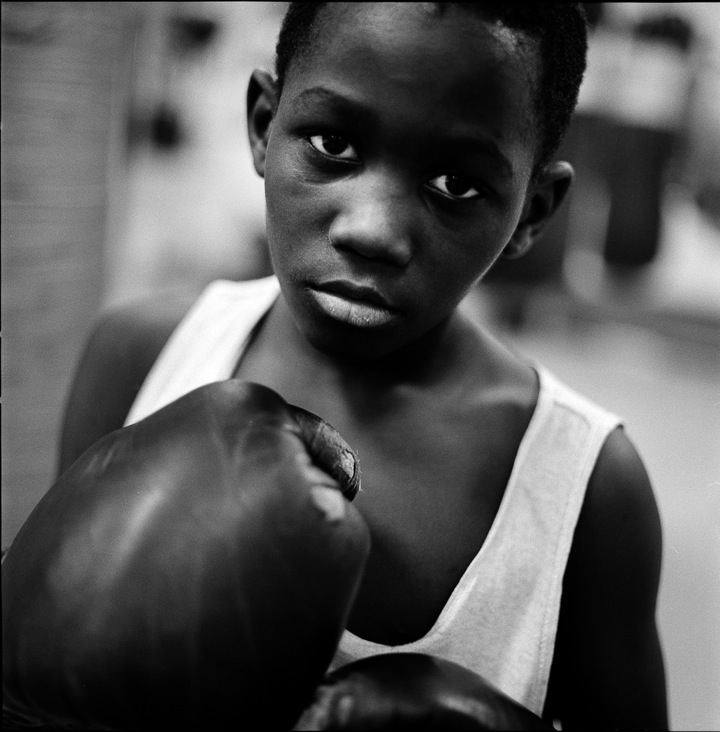
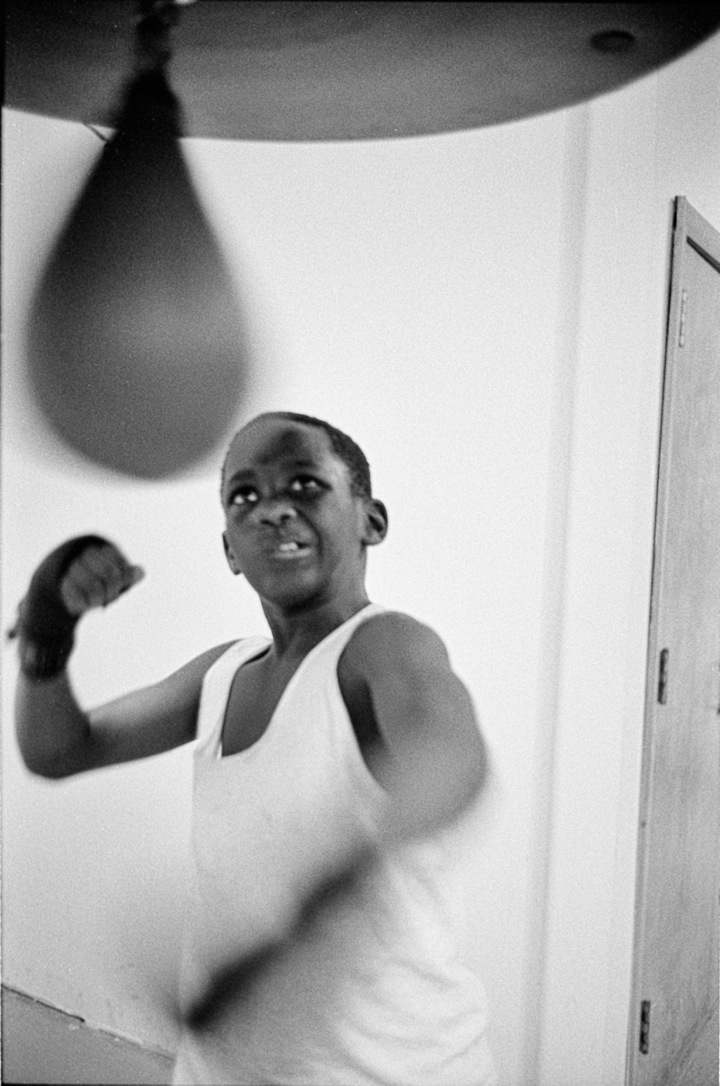 This image and the one above are of a very young Bud at the CW Boxing Club, ©photos courtesy Jim Krantz
Early in his pro career he nearly lost his life in a shooting the week of a fight when he joined a dice game that went sour and as he left in a car someone fired a shot that hit his head. He went to the nearest hospital.
Debra recalls getting the news at home.
“I was asleep when my mom woke me up to tell me. ‘Bud just got shot.’ I waited a minute, got up and came downstairs. Then my sister and I went out there. They wouldn’t let me see him. When they finally called me in Bud was sitting on the edge of the bed laughing, saying, ‘I’m still going to fight on Friday.’ I said, ‘No, you’re not, they’ve got to stitch your head up.’ He was lucky because the bullet bounced off his head. The doctor told me, ‘He’s got a hard head.'”
As if the family needed proof.
Bud and everyone around him traces his new-found maturity to that incident and to becoming a father.
“He’s come a long ways,” grandma Jones says.
“He’s more focused,” Kevin says.
“He’s a great father,” says Iesha. “He took care of me and my daughter before we had a son together.”
Bud’s sister Lastisha says she gets emotional thinking about how far Bud’s come.
“I used to have bad dreams and then when he got shot one of the dreams kind of came true. When he went in that ring and won that championship I thought back to how he was when he was little, hot-headed, and just didn’t want to listen to nobody. And to see him now it’s like, Wow, my little brother for real is world champion. I’m like really, really proud of him.”
Velma says some of her grandson’s drive to excel is fueled by the decisions in the ring he feels he was robbed of as an amateur. It’s why as a pro he takes no chances and strives to dominate from start to finish, just as he did against Burns in taking all three judges’ cards.
“After that fight in Scotland he told me he was scared they were going to take some points away from him. He thought they’d use some kind of technicality to make him lose the fight. But he come on through. He showed ’em y’all cant do no stealing from me, not tonight.'”
Co-manager BoMac says Crawford feeds off “always being the underdog and always having something against him – that lights his fire and makes him train harder.”
Bud’s boisterous family will be out in force come fight night just as they were in Glasgow. Only this time the Crawford contingent will be much larger, with relatives coming from both coasts and lots of points in between. He welcomes their presence, no matter their size.
“It’s not going to be a distraction or anything,” he says. “They’re there any other fight, so it’s just another day in the gym for me. When I was in Scotland…Dallas…Orlando…Vegas, they were there with me, so you know I’m used to having them cheering me on and not letting them interfere with what I’ve got to do in the ring. You’ve got to keep your mind focused on the task at hand.”


Bud training in Colorado Springs
Per his custom, he trained in Colorado Springs several weeks before returning June 22. Back home he’s fine-tuned his body and mind.
“I just chill and visualize what I’m going to do in there and then just go ahead and do it. You’ve got to see it to be able to do it. When I put my mind to it, it’s already done.”
Iesha, who saw him training six-plus hours a day in Colo., admires
that “he puts so much work into it.” “Hard work and dedication” has gotten him this far and he isn’t about to slack off now, Latishsa says.
Crawford’s unsure whether Omaha will ever fully embrace him as its champion. His family’s glad he’s getting his due after years toiling in obscurity. The Gamboa fight will be his first as a pro in his hometown.
“He’s finally getting noticed,” Debra says, adding people claiming to be cousins have been coming out of the woodwork since winning the title.
Hugh Reefe is impressed by how success, fame and big paydays have not changed Crawford’s lifestyle.
“He’s a pretty simple guy and I like that he’s kept everything the same. He’s handling it really well, he’s got really good instincts, He’s intuitive. He’s always concerned and thoughtful about how things affect his family.”
Those closest to him sense that after waiting so long for this stage he’s going to put on a show.
Iesha says, “I know he’s not giving up that belt.”
Everyone agrees Gamboa may regret saying at the press conference Bud hasn’t fought the caliber of fighters he has. Latisha says as soon as he uttered those words Bud vowed, “I’m going to kick your butt.”
Debra and her daughters predict Bud winning by knockout. “I pick the 6th round because Bud likes to figure him out. If Gamboa hits Bud, Bud’s going to angry and it’s going to be all over,” she says.
God forbid it comes down to a controversial decision that goes against Bud. “He’d probably go nuts if he feel he got cheated,” Latisha says.
“But he ain’t got to worry about that,” Shawntay says, “because he ain’t going to lose. We got this.”
Latisha can see he’s ready for Saturday. “I know when he’s serious, he’s got the eye of the tiger. There’s just something about his eyes that you just know that he’s about to go handle it.”
Reefe, who drove Iesha and the kids to see Bud in Colo., saw a fighter in peak condition. “I realized I was watching a world-class athlete. He was getting getting it on in a workmanlike, no-nonsense manner, going from one workout to the next, station to station, not being lazy about anything. He was in charge.”
BoMac confirms that Crawford “just looks at it like he’s got a job to go do,” adding, “He’s like, ‘Let me do my job, everyone else do their job, let’s go about our business and let’s go home.” He says Crawford’s “will and determination” separate him from the pack.
That intensity is often masked by his laidback demeanor. “He likes to joke and play around, wrestle, he’s a kid, you know,” Reefe says. “He’s always been like that,” says Debra, fingering a stack of title fight posters. “He’s so easygoing you wouldn’t believe he’s got a big fight coming up,” adds grandma. Shawntay points out, “He don’t ever talk about the fight, he just goes in there and fights.”
As for the fighter himself, he’s using any real or perceived slight – from Gamboa’s words to what he sees as a lack of local corporate sponsors to the Bluffs controversy – as motivation to leave no doubts June 28.
“I’m still hungry to get better and to prove to the world that I belong here. This is just a stepping stone.”
The Crawford-Gamboa fight can be seen live on HBO Boxing After Dark starting at 9 p.m. (CST).
For tickets to the fight, visit http://www.ticketmaster.com.
Terence “Bud” Crawford in the fight of his life for lightweight title: top contender from Omaha’s mean streets looks to make history

UPDATE: The subject of this story, Terence “Bud” Crawford of Omaha, won the WBO world lightweight championship in convincing fashion on March 1 over Ricky Burns in Glasgow, Scotland. My Reader cover story about Crawford appeared right on the eve of his title bid and just as was his gameplan he left no doubt and nothing to chance in claiming a unanimous 12-round decision.
Boxing in Omaha was never necessarily big the way it’s been in certain cities and towns but for a long time it definitely exerted a presence and enjoyed a loyal following here on both the amateur and professional ends of the sport. Starting around the 1980s and certainly by the 1990s interest among participants and spectators fell off rather dramatically. Part of that is explained by the general decline in boxing that happened nationwide as the sport found itself increasingly criticized for the injuries and deaths and longterm disabilities suffered by fighters as well as scandalized by the lax rules and ethics attending the game that allowed professional opponents like Omaha’s own Bruce “The Mouse” Strauss to take fight after fight in close order under assumed names and with little or no training. The reprehensible and mondo bizzaro antics of various high profile fighters didn’t help its standing. With boxing under attack and more and more relegated to a frringe actviity mixed martial arts arrived on the scene to offer something new and different and ever since then boxing’s struggled to keep apace or even hold on in some cases. It’s not so much that society rejects violent or extreme sports, otherwise how to explain the popularity of MMA, but that boxing is seen as something archaic or passe in a world of many high adrenalin, high risk sports that push the envelope, whether it be MMA, snowboarding, skateboarding, hang gliding, windsurfing, base jumping, rock climbing, mountain biking, et cetera. The list goes on and on. Omaha boxing gyms used to number a dozen or more at any given time but now that number is a fraction of what it used to be. Many gyms offer heavy and speed bags and perhaps even a ring for shadowboxing but these are more fitness centers focused on the conditioning benefits of boxing rather than on specifically training boxers to do actual combat. A sure sign of boxing’s decline here was when Omaha hosted the National Golden Gloves a few years ago and the crowds numbered a few thousand at most, which was less than what local-regional boxing tournaments here used to draw.
Nebraska’s produced some good fighters over time but very, very few who could be considered world class. The top flight fighters out of here have become even fewer and farther between. With this as the background and context for where boxing resides in Omaha a local fighter named Terence “Bud” Crawford is contending for the WBO lightweight championship in Glasgow, Scotland on March 1. Considering what Crawford is going for there should be more buzz around here about his title bid but then again the lack of attention, awareness, and excitement is an accurate reflection of boxing’s tenuous position these days. As I say in the following cover story about Crawford I wrote for The Reader (www.thereader.com) , which hits the stands Feb. 27, if this were happening decades ago Crawford would be the toast of this sports town. But these days Creighton men’s basketball is the preferred sports flavor and its superstar Doug McDermott is the man of the hour, not Crawford. There are a lot of reasons for that beyond those I described above and I allude to some of them in my Reader piece.
On this blog you can find an earlier New Horizons story I wrote about Crawford and his close relationship with trainer Midge Minor. You can also find stories about the CW Boxing Gym, also known as the CW Boxing Club and CW Youth Resource Center, which is where Crawford got his start. And for that matter you can find several more boxing pieces I’ve done over the years about Ron Stander, Morris Jackson, the Hernandez Brothers, Servando Perales, Tom Lovgren, Kenny Wingo and the Downtown Boxing Club, et cetera.
A photo montage of Terence “Bud’ Crawford:

Terence “Bud” Crawford in the fight of his life for lightweight title: top contender from Omaha’s mean streets looks to make history
©by Leo Adam Biga
Soon to appear in The Reader (www.thereader.com)
As Omaha glories in Creighton Bluejays hoops superstar Doug McDermott’s historic season, another local sports figure going for greatness flies under the radar.
Boxer Terence “Bud” Crawford challenges for the WBO lightweight title March 1 against champion Ricky Burns in the title holder’s native Scotland. The scheduled 12-rounder is being televised in the States by AWE, a hard to find cable-satellite network. The fight is scheduled for 2 p.m. (CST).
The CU campus McDermott’s put on the map is mere few blocks from The Hood Crawford grew up in and where his recently opened gym, B & B Boxing Academy, 3034 Sprague Street, is located. But these two stars might as well be worlds apart. McDermott’s a product of white privilege. His biggest challenge was deciding whether to return for his senior year or sign an NBA contract. The African-American Crawford is a product of the inner city. He grew up fighting in the streets and getting kicked out of schools. On the eve of his first pro bout he was shot in the head on the same mean streets of his youth.
McDermott, soon to be a three-time All-American, is the consensus favorite to win national player of the year honors. He competes before 18,000 adoring home fans. Crawford’s compiled a 22-0 record, 16 by knockout, yet he’s never once fought professionally in his hometown though he trains and resides here. Where McDermott excels at a team sport embedded in popular culture, Crawford toils at a lone wolf game that’s lost traction in this mixed martial arts age. While McDermott’s every move is celebrated and scrutinized, Crawford operates in relative obscurity. Unless you follow boxing on HBO, you’ve likely not seen him fight and until reading this were oblivious to his upcoming title shot.
Decades ago, when boxing still mattered in places like Omaha and when there weren’t alphabet soup titles with deluded value, Crawford’s world championship bid would have been big news. Still, just getting in this position should be cause for celebration today. If he prevails in Glasgow – oddsmakers and experts give him anywhere from a decent to an excellent chance – he’d be the first major boxing champ from Neb. since heavyweight Max Bear in 1934. The last time a local fought for an undisputed title was 1972, when Ron “The Bluffs Butcher” Stander met heavyweight king Joe Frazier at the Civic Auditorium and got bloodied like a stuck pig for his trouble.
Co-manager-trainer Brian “BoMac” McIntyre feels Omaha’s not embracing this historic moment involving one of its own. He says given the way Crawford represents by proudly identifying his hometown on his trunks and giving it props in interviews, it’s a shame Omaha doesn’t “stand up” for him in return. If that lack of love bothers Crawford the hard-as-nails pragmatist with washboard abs isn’t admitting it. He’s aware boxing is dead here and he’s intent on reviving it. He did soak up support from friends, family and well-wishing fans at a send-off party at Brewsky’s before Team Crawford left Feb. 22.
Ask what winning a world title might mean to his community and Crawford answers, “Honestly, I really don’t know because Omaha is really big on MMA, Creighton and Nebraska and nobody really talks about boxing that much. I feel if I was to bring that title back here it could boost us or it could just stay the same, where like a handful of people acknowledge what just happened and the rest are still like, Oh, it’s just boxing.
“We’ve got a lot of talent in Omaha but a lot of people give up because of no resources and backing. As a professional you have to go to your opponent’s backyard because we don’t really have professional boxing in Omaha. I can’t remember the last time we had a full professional boxing card in Omaha. It’s real down here, so it’s real hard to get motivated on boxing.”
He hopes his academy does for youth what the CW Boxing Club where he started and still has ties did for him and many others.
“We want to help kids that need help with that father figure in their life by talking to them, teaching them to stay in school and listen to their parents and elders, things like that. A lot of kids in the neighborhood don’t have nowhere to be after school. They can just come in here, relieve some stress, relieve some anger. We don’t know what’s going on in their household. They might be going through a lot and boxing might be the outlet to relieve some of that rather than doing something they’ll regret the rest of their life.”
Crawford hasn’t let Omaha’s tepid interest hold him back.
“You know what, he don’t give a f___ about that, I swear to God he don’t,” McIntyre says. “He looks at it like, ‘If they do get behind me so be it, if they don’t, oh well.’ They really weren’t behind him when he was an amateur and now that he’s here they’re really still not behind him. That’s just more fuel to the fire to win the fight.”
McIntyre, a Team Crawford member since the fighter was a top amateur for the CW, whose namesake Carl Washington discovered the young scrapper, says Crawford’s always fought an uphill battle for respect. As a teen Crawford’s hot temper made him a handful. After some false starts, CW coach Midge Minor took him under his wing.
“I was a bad kid, when I came in I was just rough, I didn’t care about training, nothing, I just wanted to fight,” recalls Crawford. “Midge would throw me in there with anybody, he didn’t care. Sometimes I’d get beat up, sometimes I’d win. The thing that separated me from everybody else was if I got beat up by one of the older kids I’d come back the next day like, ‘I want to spar him, I don’t want nobody else but him.’ And Midge would be looking at me, ‘You’ve got heart, I like you.’ So I’d get in there and keep sparring until I started beating them. I think that’s what really elevated me to where I’m at.”

Minor, who’s old enough to be Crawford’s grandpa, has been the main wise counsel and steadying influence for the fighter.
“Anytime I needed anything or needed someone to talk to he was always there,” Crawford says. “He’s played a big factor in my life. He’s a great father figure in my life.”
Following stints at alternative schools, Crawford finally found a home at Bryan High School, where he graduated, Despite great success as an amateur, his hard case attitude alienated him from the boxing establishment. He also ran up against the stigma that fighters from here traditionally fare poorly at nationals. Crawford dispelled that image by advancing to the semis of the National Golden Gloves in Omaha. Outside the Gloves he beat virtually everyone in his weight and age class. But the politics of the sport pegged him a bad apple and so certain opportunities bypassed him.
McIntyre says, “He wasn’t the poster boy for USA boxing. Terence was a bodacious kid. He’s always been the underdog. When he went to the nationals and to the Olympic Trials people said you can’t do it because you’re from Neb. and they always get beat in the first round, so he’s always had something against him.”
Crawford never let those perceptions stop him, even after being kicked off the USA team, thus spoiling any chance of fighting in the Olympics, which was fine with the fighter, who had a bigger dream in mind.
Then, as now, nothing gets in the way of what Crawford wants.
“He was ranked number one and there was a national tournament in Calif. we couldn’t afford to go to,” says McIntyre. “USA Boxing gave him a stipend every other month and he saved his money and paid for his own ticket and hotel. At 17 he went out there by himself, he found a coach to get him to the weigh-ins. He found a way. That will and determination separates him from anybody I’ve ever run into.”
Crawford’s not only kept McIntyre and Minor in his camp. he’s assembled a team made up of his old sparring partners and coaches. Loyalty is big with him. His other co-manager is Cameron Dunkin, a Las Vegas-based boxing magnet who handles the business side.
Some predict the highly skilled Crawford, who combines quick hands and feet with deft moves and some power, will handle the more experienced Burns. The champ’s 36-2-1 record includes many high stakes fights but some recent disputed decisions. Others question how Crawford will deal with such a big stage before a hostile crowd.
Crawford says, “It’s going to be a different atmosphere, everybody’s going to be against me, but I like it like that because that’s just going to feed me energy to shut ’em up and keep ’em quiet.”
He’s well aware he can’t afford to leave anything to chance and give the judges any wiggle room to score the fight in favor of the home boy.
“That’s the plan – to dominate like I’e been doing with all my other opponents. In my 22 fights I can’t think of a fighter I’ve fought that won two rounds, so I’ve just got to be me and do what I do best.”
He’s keeping his emotions in check leading up to the bout
“Honestly, I ain’t got no feeling at all, like I’m not excited whatsoever. The other day BoMac said, ‘Man, ain’t you anxious?’ and I was like, ‘Naw, I’m just ready to fight’ I’ve been doing this all my life, this is my dream. I never wanted to be an Olympian, I never wanted to win a gold medal, I always wanted to be a world champion. I wanted to turn pro at 17 but they insisted I try out for the Olympic team.”
With him finally on the cusp of HIS dream he can’t afford giddiness.
“This is what I wanted to do, so now that it’s here I’m the one who’s got to go in there and handle my business and then when I win it I’m going to be happy. It’s strictly business right now. I’m not happy I’m fighting for a world title, no. I’m going to be happy when I win it though.
“I’m ready to do what I’ve been doing all my life and that’s showing people how good my talent is.”
Many Omaha boxing scene veterans believe Crawford may just be the best fighter, pound-for-pound, to ever come out of here.
Crawford, the father of two children, says his confidence is high because he’s left nothing to chance in training. Sticking with a routine that’s worked before, he began training for Burns in Omaha, then went to Colorado Springs for the added conditioning high altitude promotes and the better sparring available there, the site of USA Boxing. Being away from home also helped eliminate distractions. McIntyre says it’s all about getting focused and following a regimented workout process from 8 to 8 daily that ensures he didn’t peak too early.
After the four-week camp Crawford returned home mid-February to fine-tune, stay sharp and maintain just the right edge.
Even after weeks of intense training that encompassed running, swimming, sit-ups and sparring, Crawford says there’s still an element of doubt that naturally attends any fight.
“There’s always going to be a doubt and a what-if with any fighter, I don’t care who he is. They’re going to always have doubt in the back of their mind. Did they do enough? What if this happens? What if that happens? But that’s when you got to adapt and you got to adjust to the situation and that’s what I plan to do.”
All the coaching and strategizing in the world doesn’t mean anything, he says, if you can’t execute it.
“It’s up to me to establish it and carry it on into the ring. We can train all day, every day, we can do this and that. Like Ricky Burns, he can say he’s got something new, he’s going do this and that, but all that don’t matter if you get in the ring and you can’t establish what you want to do. When we get in the ring then it’s all going to tell.”
Crawford refuses to fight out of character. He’s too smart to be drawn into adopting a style or forcing the action that’s not in his best interest. Even when boos rained down on him in Orlando, Fla. as he dismantled Russian Andrey Klimov in an Oct. 4, 2013 fight, Crawford was content to stick with his plan of outboxing his foe even though going for a KO would have pleased onlookers and HBO executives. He says he’ll neither get into a brawling match with Burns nor take undue chances testing the champ’s repaired jaw, which was broken in his last title defense, for the sake of pleasing the crowd or boosting ratings.
“I’m not going to go out there and just go for haymakers and get caught with stupid stuff. I’m just going to go out there and do what I do and if the knockout comes it comes, if it don’t it don’t. I’m just going out there to win that title and that’s the only thing on my mind.”
He maintains a healthy respect for Burns or any opponent.
“I don’t underestimate nobody. Even if it’s a fight I know I’m going to knock the dude out I always go in there like, What if? It keeps me driving, it keeps me on my Ps and Qs, it keeps me more focused because you never know – one punch can beat you.”
He says you also won’t catch him doing any pre-fight grandstanding or gamesmanship at the weigh-in press conference. Not his style, though he’s says if Burns comes at him he’ll come right back. However, Crawford does use those occasions to size up his opponent and what he finds can be revealing.
“Sometimes I’ll see right through you. I can see in your eyes a little twitch. On the outside you look like you’re this big bad guy but on the inside you’re afraid for your life. You’re a nervous wreck.”
At the end of the day, there’s nothing about this fight or any fight that scares him. Compared to a bullet in the head it’s no big deal.
“I’ve been shot, I’m not going over there worried about what’s going to happen in the ring. I’m ready, period. I’ve got my mind made up, I’ve got my goals set, and I’m going up there and I’m going to get it. I’m not going to let nothing or nobody stop me from conquering my dreams.”
Do the right thing Omaha and stand up for your own as he goes for history.
In his corner: Midge Minor is trainer, friend, father figure to pro boxing contender Terence “Bud” Crawford
As I’ve said before on this blog nearly every writer gets around to writing about boxing at one time or another. I did my first boxing story in the late 1990s and every now and then I get the craving to do a new one. I’ve built up quite a collection of boxing pieces this way and you can access them all on the blog. The following story for the New Horizons in Omaha profiles an up and coming pro lightweight contender, Terence “Bud” Crawford, and the older man in his corner who is trainer, friend, father figure and more to him, Midge Minor. They are as tight as two people nearly 50 years apart in age can be. Crawford has been under the wing of Minor from the time he was a little boy and he still relies on his sage advice today as he prepares for an expected world title fight. The loyal Crawford is an Omaha native and resident who’s never left his hometown or the gym he grew up in, the CW, and he’s not about to leave the man who’s guided him this far.
©by Leo Adam Biga
Originally appeared in the New Horizons
Nebraska‘s best ever hope for a world professional boxing champion works out of the CW Boxing Gym in north downtown Omaha.
As 25-year-old lightweight contender Terence “Bud” Crawford goes through his paces, he’s watched intently by an older man in a sweatsuit, Midge Minor. Though separated in age by four-plus decades, the two men enjoy a warm, easy relationship marked by teasing banter.
Crawford: “I’ll beat this dude up right now.”
Minor: “You’re scared of me, you know that.”
Crawford: “You be dreaming about me.”
Minor: “You stick that long chin out to the wrong man.”
They’ve been going back and forth like this for decades. At age 7 Crawford got his boxing start under Minor at the CW, 1510 Davenport St., and he still trains there under Minor’s scrutiny all these years later.
The facility is part of the CW Youth Resource Center, whose founder and director, Carl Washington, spotted Crawford when he was a kid and brought him to the gym.
Crawford, an Omaha native and resident, owns a 21-0 pro record and a reputation among some experts as the best fighter in the 135-pound division. The smart money says it’s only a matter of time before he wins a title. That time may come in January when the Top Rank-promoted boxer is expected to get his title shot and the opportunity to earn his first six-figure payday.

Midge Minor
Since showing well in two recent HBO-telecast fights, he’s riding a wave of fame. He’s the pride of the CW, where the number of fighters is up because he learned to box there, made it big and never left.
“He’s one of the causes of our gym being full now,” says Minor. “They all look up to him. It’s kind of like he put us on the map.”
Crawford doesn’t act the star though.
“I’m the same person, I’m regular, I just want to be able to make it and provide for my family,” he says earnestly.
He engages everyone at the gym and offers instruction to fighters.
“I’m always going to have CW somewhere inside of me because this is where I started from. Never forget where you came from. I’m always going to be a CW fighter. I just feel comfortable here. It does feel like home when I walk through them doors because it’s the only gym I knew when I was coming up. I’ve been coming here and going to the donut shop (the adjacent Pettit’s Pastry) ever since I was 7.”
For a long time he was pressured to leave Omaha, where quality sparring partners are rare and pro boxing cards even rarer. But he’s remained true to his team and his home.
“A lot of people came at me with deals wanting to get me to fight for them, sign with them and move out of town. They kept telling me I can’t make it from Omaha and need new cornermen – that they took me as far as they could. But I’m loyal and a lot of people respect me for it. My coaches have faith in me and trust me that I’m not going to do nothing to jeopardize our relationship, and I trust them and have faith in them.
“I’ve just stayed with it and continued to have confidence in my team. I just keep pushing forward.”
He keeps a tight circle of confidantes around him and all share his same CW and Omaha lineage.
“We all family,” he says..”Every person I turn to in my corner that’s giving me instructions came up under Midge.”

CW Boxing Club is located in the CW Youth Resource Center
For his last fight Crawford, who always sports Big Red gear to show his Nebraska pride, wore trunks emblazoned with “Omaha” on them.
As Crawford shadow boxes inside the ring, looking at his reflected image in a bank of mirrors against the near wall, the 73 year-old Minor takes it all in from his spot in the corner, just outside the ropes. Minor has been in Crawford’s corner, both literally and figuratively, since the fighter first got serious about the sport at age 12. They initially met five years before that, when Crawford became argumentative with the trainer. Minor demands obedience. He barks orders in his growl of a voice. He’s known to curse, even with kids. He doesn’t take guff from anyone, especially a brash, back-talking little boy. When Crawford wouldn’t mind him, Minor banned him from the CW.
The trainer hated letting Crawford go, too, because he recognized the kid as something special.
“I saw that he had a lot of heart and that goes a long way in boxing. He never wanted to quit on me.”
The boy’s heart reminded Minor of his own. Back in the day, Minor was a top amateur flyweight, twice winning the Midwest Golden Gloves. But prospect or no prospect, Minor wasn’t going to stand for disrespect. The two eventually reconnected.
“I kicked him out of the gym for five years,” says Minor, a father many times over, “and then I brought him back when he got a little more mature and then we went from there.”
Crawford acquired some rough edges growing up in The Hood. Being physically tested was a rite of passage in his family and neighborhood. It toughened him up. He needed to be tough too because he was small and always getting into scuffles and playing against bigger, older guys in football, basketball, whatever sport was in season. He learned to always stand his ground. The more he held his own, the more courage and confidence he gained.
“I was taught to never be scared…to never back down. That was instilled in me at a young age,” Crawford says. “My big cousins pushing me, punching me, slamming me, roughing me up. My dad wrestling me. After going against them it wasn’t nothing to me going against somebody my size, my age.
“I’d fall and get jacked up or get bitten by dogs or get scratched. I’d need stitches here and there, and my mom would be like, ‘You’re all right.’ There was no going home and crying to your parents or nothing like that. No babying me. I don’t know what it feels like to be babied.”
There was something about Crawford, even as a child, that pegged him for greatness.
“Before I even started boxing my dad used to make me punch on his hands, teach me wrestling moves, throw the ball with me. He always said, ‘You’re going to be a million dollar baby.’ Ever since I was little he was like, ‘You can be whatever you want to be, just go out there and do it, don’t let nobody hold you down or hold you back.'”
His father, grandfather and an uncle all boxed and wrestled in their youth. His dad and uncle trained at the CW. His grandfather boxed with Minor. They all had talent.
“It was just in me, it was in the blood line for me. I just took after them. My dad always gave me pointers.”
By the time Crawford came back to the gym, he was less belligerent and more ready to learn. The non-nonsense Minor and the hot-tempered youth bonded. Like father and son.
“When I came back to the gym Midge and I were like instantly close.
Midge was like my dad,” says Crawford.
What was the difference the second time around?
“I don’t know. maybe it’s because I accepted Midge ain’t going to change for nobody. I didn’t really know him like that at the start. so for him to be talking to me crazy I took that as disrespect. I was offended by it. But when i came back I realized that’s just Midge being Midge. Some people get intimidated by him but one thing about Midge is if he likes you he’s going to roll with you. If he don’t like you, he don’t like you and there’s nothing nobody can do to make him like you. And if he’s with you he’s with you to the end.
“When I got to know him more I realized Midge will have my back till the day he dies and I’ll have his back to the day I die, and that’s just how close we are. Midge put a real big hold on me.”
When you ask Crawford if he could have gotten this far without him he says, “Probably not because Midge kept me out of the streets. He taught me a lot. Without Midge, I don’t think so, He taught me a lot of responsibility.”
Crawford came to know he could depend on Minor for anything, which only made him trust him more and made him want to please him more.
“I used to ride my bike to the gym with a big old bag on my back, that’s how dedicated I was. Then Midge started taking me to the gym. Over holidays he’d come to my house to take me to the gym. On school days he’d come get me at school and take me to his house. We’d just sit there together and watch boxing tapes. I would watch any kind of fighter just for the simple fact that you never know when you might see that style. He’d tell me what they’re doing wrong and what I could do to beat ’em.”
Minor also became Crawford’s mentor.
“Anytime I needed anything or needed someone to talk to he was always there,” says Crawford. “He’s a great father figure in my life.
Just an all around good guy. He loves kids.”
All of Minor’s work with Crawford inside and outside the ring had the full support of Bud’s mother.
“It was a little like school to me. Sometimes I’d try to duck him and tell my mom to tell him I wasn’t there and she wasn’t having it. Sometimes my mom would call him and say, ‘Come and get him Midge’ and I’d spend the night at his house, watch tapes, work out. It was like that.”
When he got in trouble at school his mother informed Minor because she knew he’d hold him accountable. When Minor got his hands on him he worked him extra hard. it was all about getting the young man to learn lessons and to pay his dues. Instead of resisting it, Crawford took it all in stride. He says, “It was instilled in me early that what don’t kill you will make you stronger.I looked at it that it was helping me.”
“He appreciated it. He respected me,” says Minor. “We got along real well.”
The troubled boy no one could reach found a friend and ally to push him and inspire him.
“Midge always instilled in me, ‘Nobody can beat you, especially if you work hard and put your heart into your training.’ He drilled that in my head. He believed in me so much. There were times I kind of doubted myself in my mind and he was just like, ‘Nobody can beat you.’ The fight’s the easy part. Preparing for it, that’s the hard part. I’ve been fighting all my life so to get in there and fight, that’s easy. That’s 30 minutes. Sometimes only three minutes or 30 seconds if I get an early knockout. That’s compared to training for hours and hours a day.”
Minor routinely put him in the ring with much more experienced guys.
“That’s how much confidence he had in me. Seeing him have that much confidence in me made me even more confident,” says Crawford.
“It didn’t make no difference who I fought him with because he was going to fight ’em. I’ve had a lot fighters but they didn’t have the heart that he has.”
The legend of Terence “Bud” Crawford began to grow when as a teen amateur he sparred pros and outfought them. Even today he likes to spar bigger guys.
“I like to try myself.”
Crawford is now on the cusp of boxing royalty and Minor is still the one Bud puts his complete faith in.
“He’s still there for me taking good care of me,” Crawford says. “I’m always going to have his back. You know he looked out for me when I was little and I’m going to look out for him now that he’s older.”
Having Minor in his camp as he preps for the biggest fight of his life is exactly where Crawford wants him. Having him in his corner on fight night is where he needs him.
“It means a lot to have Midge there. Midge is the brain. Everything goes through Midge before it’s all said and done for me to go in there and fight. Without the brain we can’t do nothing, so it’s very important that Midge is there.
“Before every fight I bring him a disc of who I’m fighting and I ask him what he thinks about the guy and he tells me what I should do and we go from there.”
The strategy for any fight, he says, is “a team effort” between his co-managers Brian McIntyre and Cameron Dunkin, trainer Esau Diegez, Minor and himself.
“We all work together and dissect our opponent but Midge is always the one that’s like, ‘Alright, this is what you’re going to do to beat this guy. This is how you’re going to fight ’em.’ And we all go by what Midge sats. He’s great for seeing things I don’t see and making me see it.
“He gives me the instructions to beat ’em, and all I have to do is follow ’em. He’s got the wisdom.”
Minor says Crawford is a great student who picks things up quickly, including a knack for altering his style to counter his opponent’s style.
“He can observe different fighters and he can adapt to their styles. He doesn’t have no problem adjusting to them,” says Minor. “He listens to me and he produces for me.”
“Oh yeah. I see it one time and I do it,” Crawford says. “You gotta practice it to though, you can’t just think you’re going to perfect it by doing it one time. You gotta keep on trying it in the gym. You might not get it the first time, you might not get it the second time, but you gotta keep trying until you get it right.”
Still, when all is said and done, it’s Crawford who’s alone in the ring come fight night.
“You can tell me this, you can tell me that, at the end of the day I’m the one that’s gotta take those punches and get hit upside my head. The difference between me and other people is that I’m willing to go through the fire to see the light.”
Crawford’s aware of the strides he’s made in recent years.
“I feel like I’m more relaxed in the ring. I know more about the game.
I know what to do, when to do it, and I’m not just throwing punches just to be throwing them. I’m pinpointing my shots more. Yeah, all around my whole arsenal is just way better.”
“Early in his career he used to just throw punches,” says Minor. “He learned to settle down and adjust.”
Crawford says his overall skill set has developed to the point that he doesn’t have an obvious weakness.
“I can adapt to any style. I’m a boxer, a puncher, I’m elusive, I’m whatever I need to be. I’m always confident and I just come to win.
I’ve got it all – hand speed, power, movement, smarts. I can take a punch.”
He’s always in shape and lives a clean lifestyle, Minor says admiringly. The trainer never has to worry his fighter’s not working hard enough.
Minor’s trained several successful pros, including Grover Wiley and Dickie Ryan, but he says he’s never had anyone as accomplished as Crawford this early in their career.
Neither feels he’s reached his full potential.
“I’ve got a lot of things to work on,” says Crawford. “So I figure once I get those bad habits out of the way then I’ll be better than I am now. Little things like not keeping my hands up, not moving my head. Sometimes I’ll get in there and I’ll feel like he can’t hurt me, and I just want to walk through him without coming with the jab.”
Minor’s always watching to make sure Crawford doesn’t abandon his fundamentals. The veteran trainer guided Crawford through a highly successful amateur career that saw the fighter compete on the U.S, Pan American Games team and advance all the way to the national Golden Gloves semi-finals in his hometown of Omaha. Crawford dropped a controversial decision in the semis that left him disillusioned by the politics of amateur scoring and Minor “broken-hearted.”
Minor continues to be the guru Crawford turns to for advice. Perhaps a turning point in their relationship and in the fighter’s development was getting past the anger that seemed to fuel Crawford early on and that threatened to derail his career.
When his temper got the better of him Crawford was suspended from the U.S, national team. He says American amateur boxing officials “put a bad rep out for my name,” adding, “They called me hot-headed and a thug.” He feels the stigma hurt him in his bid to make the U.S. Olympic team.
The fighter acknowledges he had issues. He got expelled from several schools for fighting and arguing. He grew up playing sports and fighting in the streets, parks and playgrounds of northeast Omaha, where his mother mostly raised him and his two older sisters. His father, Terence Sr., served in the U.S, Navy and was separated from his mother, only periodically reappearing in Bud’s life.
No one seemed able to get to the root of Crawford’s rage. Not even himself.
“I really can’t say about my temper. It was just something that was in me. Everybody asked me, ‘Why do you be so mad?’ and I never could pinpoint it or tell them why. I’d be like, ‘I’m not angry.’ But deep down inside I really was. I was ready to fight at any given time and that’s how mainly I got kicked out of all the schools.
“I was in counseling, anger management, all that stuff. None of it ever worked…”
His favorite way of coping with the turmoil was to go fishing at the Fontenelle Park pond.
He knows he could have easily fallen prey to the lures and risks of the inner city. Friends he ran with included gang members. On the eve of his first big nationally televised pro fight he got shot in the head after leaving a heated dice game he had no business being in in the first place. He was told by doctors that if the bullet hadn’t been slowed by the window it passed through in his car it would have likely killed him.
“I was lucky, I was blessed. That just opened my eyes more. I took it as a sign, as a wakeup call.”
Becoming a father – he and his girlfriend Alindra are raising their son and her daughter – also helped him mature.
Through it all Minor was that steadying voice telling him to do the right thing.
Crawford’s temper cooled and his life got more settled.
“It took him a while,” says Minor. “He was hard-headed. I used to make him come over to my house and I’d sit em down to watch boxing tapes and the more he observed other fighters he learned that his temperament had to change to be where he’s at now.”
Crawford also credits two men who took him under their wing at Omaha Bryan High School, then principal Dave Collins and assistant principal Todd Martin.
“They would always talk to me if I got in trouble. They put it in terms like I was in the gym training. They’d say, ‘You cant talk back to the teachers when they’re trying to tell you something you need to know. You don’t talk back to your coach when he’s teaching you how to throw a punch.’ I began to look at it like that and I said, ‘You’re right, i messed up.’ That really got me through my high school years doing what I had to do.”
Now that Crawford’s come so far he’s looking “to give back” to the community through his own boxing gym in the same community he grew up in. He wants his North O-based B & B Boxing Academy, which he recently opened with Brian McIntyre, to be a place that keeps kids off the street and gives them something structured to do.
Bringing a world title belt back to Omaha is his main focus though.
“Oh, it would be great. A lot of people look up to me so for me to bring that belt home to Omaha it would mean a lot, not only to me but to Omaha. Boxing is not real big in Omaha. I used to be and I’m trying to bring it back and I feel I can do that. I could inspire some little guy that later on could be the champion of the world. Who knows?”
He’s not leaving anything to chance in his bid for glory.
“I’ve got my mind made up, I’ve got my goals set, and I’m going to get it. I’m not going to let nothing or nobody keep me from conquering my dreams.”
“That’s that confidence.” Minor says. “I’m so proud of him.”
Crawford knows he wouldn’t be where he is today without Minor. “He’s played a big factor in my life.” He values all that Minor’s meant to him.
“You got to. Nothing lasts forever, so cherish it while it’s here.”
Related articles
- Terence Crawford – The World Awaits! (boxingjunkie.wordpress.com)
- BSO Interview: Lightweight Boxing Prospect Terence “Bud” Crawford (blacksportsonline.com)
- Terence Crawford Gets a 6th-Round KO Win Over Alejandro Sanabria (sportsnippets.com)


 Leo Adam Biga's My Inside Stories