Archive
Norman Krivosha’s life in law
I rarely do stories involving any aspect of law or justice and if I do it’s generally a profile like the following one I did a few years ago for the Jewish Press on Norman Krivosha, who at one time served as chief justice of the Nebraska Supreme Court. As you might expect from someone who has enjoyed a distinguished career on the bench and as an attorney Krivosha is a thoughtful, well-spoken individual. He’s well aware how fortunate he is to have found a profession and vocation that has engaged him for so long. He’s one of those blessed persons who proves that attitude can be everything. He’s definitely of the glass half-full fraternity.
Norman Krivosha’s life in law
©by Leo Adam Biga
Originally published in the Jewish Press
Norman Krivosha’s life is a classic case of the adage that behind every great man is a woman. The noted attorney and one time Nebraska Supreme Court Chief Justice and corporate counsel may not have been any of those things if the Detroit, Mich. native had not met a certain woman at the University of Nebraska-Lincoln when he arrived as a brash but undisciplined undergrad in the early 1950s.
Krivosha came to UNL at the urging of a cousin who taught microbiology there. The professor saw his cousin’s potential. The young Krivosha was bright. He’d done well at a select college prepatory public school in Detroit. He’d shown industry as a top notch sales clerk for the Mary Jane Shoe Store. He’d displayed an avid interest in politics, handing out pamphlets on the street for a cousin running for public office.
Only when Krivosha got to Lincoln — having never been further west than Chicago — he was the proverbial big city boy let loose in the sticks.
“I had to get out a map to see where Nebraska was. I vividly recall walking downtown the first Sunday I was there and I was the only person on the street. It was such a great transition for me coming from Detroit, but a very valuable one.”
Studying was not a priority. The former Helene Sherman changed all that. The studious young woman from a tradition-rich Lincoln family eventually became Mrs. Helene Krivosha, but long before marrying him she got him on track.
“The truth of the matter is had I not met my wife Helene when I did I would probably have retired as the general manager of the Mary Jane Shoe Store in Miami, Fla.” said Krivosha, who with his wife retired to Naples. Fla. three years ago.
“When I got to the university I was not very interested in worrying about studies.
But I met her and I’d go over to the library to take her for coffee and she’d say, ‘Well, we can go at 10 o’clock.’ And I’d say, ‘It’s 7 now — what do I do for three hours?’ She’d say, ‘Bring some books.’ So I started studying. Then I started taking some classes she was in so I could see her during the day. And before I knew it I got a Regent’s Scholarship and I was on my way to law school.”
There would be more mentors in his life. Before any of these guided him, however, his immigrant parents, neither of whom completed high school, stressed the importance of education to their only child. His mother was a homemaker and his father one in a long line of dry cleaners.
“Neither of them were well-educated.” Krivosha said. “Both of them were terribly literate. Going to college in my neighborhood was not a common sort of thing to do but my parents were determined that I should. We always talked about me going.”
The dutiful son attended Wayne University in Detroit but didn’t exactly buckle down. Between going to school by day and working for the post office at night, he said, “I was running with my friends.” That’s when he took up his egghead cousin’s offer to live with him in Lincoln and go to school there.
Krivosha carried his family’s hopes and dreams for a better life and finally aplied himself. With the help of Helene, some veteran lawyers and an ambitious newcomer to the political scene, Krivosha enjoyed a fast ride up the political-legal ladder. He readily acknowledges the aid he received along the way.
“I’m a great believer that nobody gets where they get on their own. That they all have help. Quite frankly, I resent when people seem to want to take claim for having made it ‘on their own.’”
From a macro perspective, he knows the opportunities given him resulted from the sacrifices and generosity of folks, some of whom he’ll never meet. He views his achievements as the return on an investment that others made in him.
“I did what I did because somebody in Scottsbluff, Nebraska got up at 4 o’clock in the morning and milked cows and paid his taxes so I could get a Regent Scholarship to go to law school. That’s what helped me become a lawyer and be successful.”
He believes fate has played a part in it all.

“Things work out the way they’re supposed to,” he said. “I was supposed to go to law school, I was supposed to be a lawyer, and that’s where I wound up.”
Funny thing is, he initially only studied law “because some friends were going to law school and that just seemed like something to do.” At some point law became more than a way to pass the time.
“I did well in law school. I finished high in my class. I started clerking in my second year in law school with a firm I ultimately became senior partner of.”
It was soon apparent he’d found his niche.
“I immediately enjoyed it. For me, law has always been a challenge — the ability to seek to analyze a situation, to design a solution. The practice of law was just something I loved to do. I never got up a single morning in my life not looking forward going to work.”
Past tense notwithstanding, he still practices law. This marks his 50th year in the profession. He cut his legal teeth with twin lawyers Herman and Joe Ginsburg in their Lincoln, Neb. firm. Krivosha had already clerked there three years by the time he finished law school. He became a lawyer with the firm as soon as he was admitted to the bar.
He said Herman Ginsburg “was extremely influential in my career. He was one of the best lawyers in the state if not the country — a fine, wonderful trial lawyer. He taught me a great deal.”
The Ginsburgs operated a general practice.
“In the late ‘50s-early ‘60s in Lincoln, Nebraska lawyers were probably what today would be described as country lawyers,” he said. “That is, we did everything. We did a great deal of trial litigation for other lawyers outstate who did not frequently go to court. We represented corporations, we probated estates, we did adoptions, we did divorces, we did personal injury cases. We did anything that came into the office. Our office was in Lincoln but we really practiced all over the state.”
That heavy, diverse case load made a good training ground.
“I think what it did was it made me a better lawyer and certainly made me a better judge ultimately because I had had all that experience.”
As a comparison of just how different his experience was from young lawyers starting out today, he used his daughter Terri Krivosha-Herring as an example.
“My oldest daughter is a lawyer in Minneapolis. A very fine, wonderful lawyer whose practice is limited to mergers and acquisitions. She’s great in her field but I don’t think lawyers today have the same broad background we used to have.”
Terri’s married to Rabbi Hayim Herring. Krivosha’s younger daughter, Rhonda Hauser, is married to lawyer Adam Hauser. “In our family you must either be a lawyer or marry a lawyer,” Krivosha joked. “If you’re smart you marry a lawyer, if you’re not so smart you become a lawyer.”
The Ginsburgs brought on a third partner, brother-in-law Hyman Rosenberg, before Krivosha became a partner with his name on the window. All the while he honed his legal skills he pursued a parallel interest in politics. His law partner Joe Ginsburg was active in Nebraska Democratic politics for years and became a political mentor.
“He sort of led me into it and it was sort of a natural for me. I’d been involved in Democratic politics all of my life and certainly all of my adult life in Lincoln. I was Lancaster Democratic Party County Chairman for a number of years. And I was state vice chairman. I was an alternate delegate for the 1968 National Democratic Convention in Chicago, although I never did wind up going. I was (Nebraska) campaign manager for Henry ‘Scoop’ Jackson’s presidential bid.”
He also managed Clair Callan’s only successful Congressional bid — a rare instance of a Democrat being elected from the Republican stronghold 1st District.
Political engagement was another way Krivosha hoped to make a difference.
“I cared. I believed Democrats were providing the answers to the country’s needs. Being involved in Democratic politics was a way of trying to make things better. I was never interested myself in holding public office but in helping others.”
Krivosha’s political stock in the state grew when he befriended a newcomer to the arena named Jim Exon, a future governor and U.S. senator.
“I nominated him as national committee man at the state Democratic convention in Hastings (in the early ‘60s), and that was really sort of the beginning of his political career,” said Krivosha.
Exon was elected Nebraska governor in ‘71 and asked Krivosha to join his inner circle.
“When he became governor he asked me to come be his general counsel,” Krivosha explained. “I didn’t want to leave the practice. And so I made an agreement with him that I would be his general counsel at no pay and I would come to the capitol every morning, maybe till one-two o’clock, do whatever he needed done, and then I would go downtown and practice law for the rest of the day and evening. I did that for four years.
“And during all that time we (his firm) agreed not to take cases involving the state.”
No conflict of interest that way.
“I had really sort of gotten used to that because in 1969 I was loaned by my firm to be City Attorney of the City of Lincoln, and I did that for 20 months.”
By the time Krivosha’s general counsel duties for the governor ended his next entree into state government presented itself when then-Nebraska Supreme Court Chief Justice Paul White “unexpectedly resigned” in 1978. Krivosha inquired if Exon would be OK if he submitted his name for the seat, which for the first time was to be appointed rather than elected.
Exon gave his blessing and Krivosha said just to avoid any hint of impropriety he didn’t speak with the governor from that moment until after he got the nod.
“There were 16 of us whose names were submitted and Jim (Exon) had an incredible way of advising you you’d been appointed. He sent a letter to everyone who had not been appointed, but you, telling them who had been appointed and thanking them for applying,” Krivosha recounted.
“I was in Judge Dale Fahrnbruch’s court on a Friday morning about to start trying a lawsuit before him. He and I had both been candidates for chief justice. He was opening his mail on the bench as we were getting ready to begin the case and he stopped suddenly and said, ‘I think we better take a recess.’ He called me into his chambers and said, ‘I suppose you’re not going to want to try your case today.’”
Krivosha didn’t know what the judge meant. It was left up to Fahrnbruch to inform him he was the state’s new chief justice. “That’s how I found put,” Krivosha said. He made it to the highest judicial seat without prior bench experience.
“Not unheard of,” he said. “You have to also remember I was the first appointed chief justice (of Nebraska). Up until then all the members of the Court had been elected and we had just recently changed to the merit selection system. It’s probably more common to have people come from the District Court to the Supreme Court, but not unheard of. There were people elected before and certainly there were people appointed later who had not been judges before.”
Not only was he serving his first judgeship on the state supreme court, he was perhaps the youngest member of that august and senior body.
“Some of the members of the court called me ‘Sonny,’ which they were entitled to. I mean, I was 44 years-old and some of them were in their 60s. But they were wonderful. It was a great experience.”
He’d argued many cases before the Nebraska Supreme Court prior to his appointment. After leaving the bench he argued cases before the court again, but only after all the members he’d served with had retired. from the court. While admitted to the U.S. Supreme Court he never argued before it.
He said his becoming chief justice was dependent on three key factors.
“You have to work very hard in law school and graduate at or near the top of your class. You then have to spend the next 20 years as a lawyer gaining a reputation of being a fine lawyer. And you need to become a close friend of a governor. And if you can’t do all of them, you must at least do the last one.
“The fact of the matter is I guess I can honestly say I did all three. I graduated well in my class, I think I had a reputation of being a good lawyer, and I was a close friend of Jim Exon.”

What made he and Exon click?
“We were both committed Democrats. We both felt the same way about things. I think we got along so well because we shared the same views about family, about ethics, about integrity,” Krivosha said. “He would never ask you to do anything you’d be embarrassed to tell your mother…He always did what was ethically and morally right even if it wasn’t politically right, but for him it always turned out to be politically right.
“Jim Exon in my view was one of the world‘s greatest public figures.”
Krivosha was Exon’s last appointment before he left to serve in the U.S. Senate in 1979. For Krivosha, serving on the bench was another facet of a rich legal career.
“I’ve been a practitioner, I’ve been a trial lawyer, I’ve taught, I’ve been a judge and I’ve been a corporate counsel. All of it was satisfying. I enjoyed very much the collegiality with my colleagues on the bench. I disagreed with them occasionally but nonetheless had a very close relationship with them.”
A fellow Nebraska Supreme Court justice, Judge Nick Caporale, was a classmate of Krivosha’s at UNL and remains a good friend.
Being a judge suited Krivosha.
“I enjoyed looking at the cases, trying to conclude an appropriate legal answer, but even more than that I guess as executive head of the judicial branch of government I enjoyed the administration of the court system.”
He introduced some innovations.
“We made some changes along the way,” he said, “many of which still exist today. We did away with the municipal courts in Lincoln and Omaha — merging them into the County Court system. This was a more efficient way at a financial savings. We instituted type-written briefs in the Supreme Court — doing away with printing the briefs — which certainly was a savings to litigants.”
He also instituted measures to ease the volume of cases heard.
“There was no Court of Appeals then, so the Supreme Court was a court as a matter of right. You could appeal to the Nebraska Supreme Court from Small Claims Court and we had to take the case,” he said. “So we appointed two district judges and we sat in divisions of five instead of a court of seven, which the statute allowed, in an effort to try to cut down the number of cases and to handle the volume in a more expeditious way.”
While presiding on the bench he wrote more than 600 opinions, meaning he decided far too many cases to single out just a few. Besides, he said, “once I finished a case I finished it. It’s done, it’s done. I didn’t have any second thoughts once I decided a case.”
He does take satisfaction, however, in knowing some of his dissents ultimately became the law. He was the lone dissenter when the court ruled a landowner with a ranch bisecting two states could not transfer water from Nebraska to Colorado to feed his cattle.
“I dissented on the basis it interfered with interstate commerce — that he had a perfect right to do that — and the U.S. Supreme Court agreed. It was reversed based on my dissent”
He said it’s unusual the highest court in the land opted to hear this water rights case in the first place since the Nebraska Supreme Court is usually the last word.
He served eight years as Chief Justice, stepping down in 1987.
“I did not leave because of any unhappiness. I delighted in being Chief Justice. I was 53 years old, about to turn 54, and somebody made me an offer I couldn’t refuse.”

Bankers Life Nebraska in Lincoln hired him as senior vice president, administration, and chief counsel and when the company became Ameritas Life Insurance Company he was executive vice president, secretary and corporate general counsel. He later worked as general counsel for Kutak Rock.
He retired a couple years ago.
Reviewing his long legal career is not something that occupies much of his time.
“It’s not my style to look back,” he said.
Still, he said, “I’ve been fortunate enough to do almost everything a lawyer can do.” All his years trying and hearing cases did not sour him on the system but rather reaffirmed his faith in it.
“I’m just more convinced it’s as good a system as I always believed it to be. I believe that courts by and large do a good job. There are exceptions. The law is an art, it is not a science, and therefore the answer you get depends on the question you see. The job of the lawyer, for instance, is not to convince the court what the law is but to convince the court what the question is. Once that happens the answer becomes obvious.”
These days he does a bit of arbitration work and sometimes litigates cases. Mostly, though, he serves as an expert witness in insurance fraud suits. His keen political mind is attuned to the presidential race. He reads The New York Times and watches the Sunday public affairs programs. Barack Obama’s chances excite him.
“Obviously as a Democrat I’m a great believer that we need to move in a different direction,” he said.
Is he ever tempted to return to the bench?
“No…Remember, I never look back.”
Related articles
- A Couple Tips for Young Lawyers (thecontractsguy.net)
- How to become a civil liberties crusader (ask.metafilter.com)
Chancellor Harvey Perlman Passionate About the University of Nebraska, its Future and NU Joining ‘Common Friends’ in the Big Ten
A few years ago, during one of the endless news spasms about the University of Nebraska football program, New Horizons editor Jeff Reinhardt floated the idea of our profiling the school’s chancellor, Harvey Perlman, who at the time was adroitly handling the latest firing and hiring. As the musical chairs continued playing out it became clear that Perlman was more than the public point man speaking on behalf of the university about these changes, but the orchestrator of these moves. Below is the profile os this man at the top who speaks softly but carries a big stick.
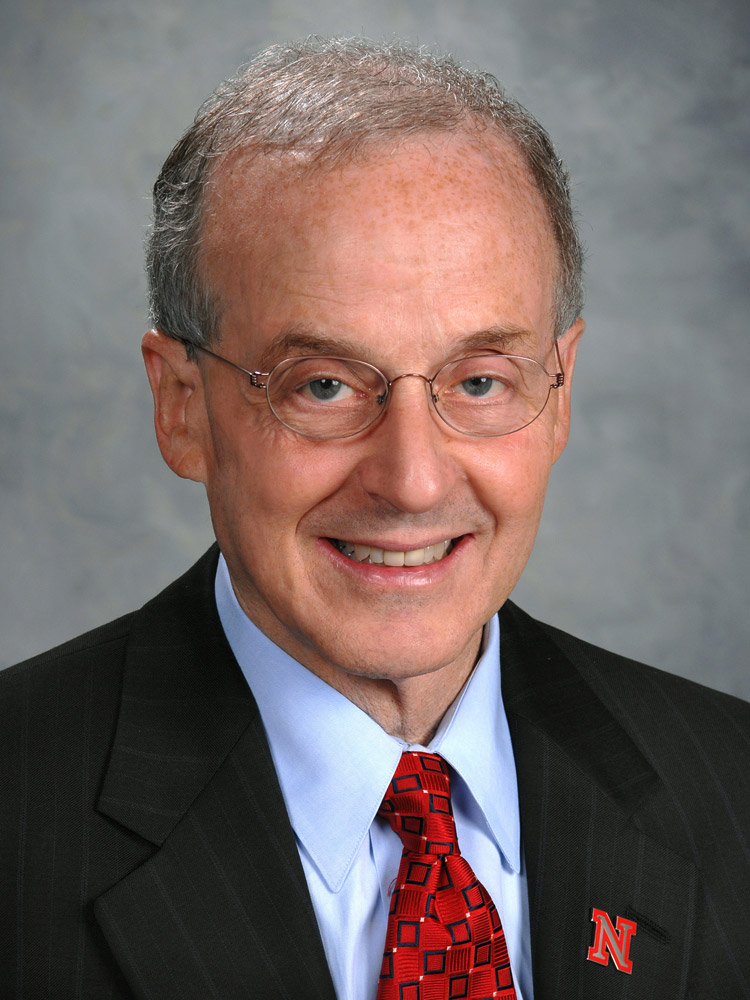
Harvey Perlman
Chancellor Harvey Perlman Passionate About the University of Nebraska, its Future and NU Joining ‘Common Friends’ in the Big Ten
©by Leo Adam Biga
Originally published in the New Horizons
Most of you probably first laid eyes on University of Nebraska-Lincoln Chancellor Harvey Perlman in October of 2007.
That’s when his face was all over the media in the wake of his firing Steve Pederson as Nebraska athletic director and hiring Husker coaching legend Tom Osborne to rejoin the Big Red family as the new AD.
Even though by then Perlman had already put in six years as the university’s CEO, chances are his name, much less the position he filled, barely registered with the average Nebraskan. You might have known he was a top NU administrator, but it’s unlikely you could have picked him out of a lineup or identified anything he put his stamp on.
You also probably didn’t know he’s an NU alumnus, as is his wife Susan and their two daughters and their husbands.
“We like to keep it in the family,” he said of this legacy.
It’s unlikely you knew he was previously the longtime dean of NU’s law college. Or that he joined the NU law faculty in 1967 after being mentored in the profession under the legendary Robert Kutak, who cultivated in his protege a love of art.
In 1974 Perlman left NU to teach at the University of Virginia Law School. He returned to NU in 1983 to head up the Nebraska Law College, a position he held for 15 years. He served as the university’s interim chancellor in 2000 before being named chancellor in 2001.
Obviously, much of his life is bound up in the university. Because the chancellor’s job continues to engage him he doesn’t have any plans to step down soon.
“I’m still excited about the possibilities. I care a lot about the university so it’s not an abstraction to me, it’s a passion,” he said from his office in UNL’s Canfield Administration Building
Being a native son, he said, probably opens some doors he might otherwise find closed.
“I think the fact I’m a Nebraskan gives me entree into some circles easier than an outsider would find.”
Perlman kept a low profile until the merry-go-round of athletic directors and football coaches the past 10 years. That’s when he became a focal point of attention. Perhaps for the first time then the power he wields was apparent for all to see. There he was intervening in what had become a circus of speculation and vitriol involving the topsy turvy fortunes of that precious commodity — Husker football. He acted as both architect and messenger for a sea change in NU athletics that continues making waves today.
The added scrutiny doesn’t much phase him. He knows it comes with the territory, though it can be a bit much.
“I’m used to it by now I guess. I think in part lawyers are trained to handle those kinds of circumstances, so that doesn’t give me any discomfort. The discomfort of being a public figure is probably not when you’re in public but the fact that you’re always in the public eye. I can’t go to the grocery store without people giving me advice about the football team and things like that.
“I never thought I’d be on the sports pages. I didn’t have the athletic talent to get there”
It’s not as though Perlman was invisible before the beleaguered Pederson was let go and the beloved Osborne brought back as the athletic department’s savior. Perlman had, after all, been involved in the machinations that followed Bill Byrne’s departure as AD and the much hyped arrival of native son Pederson. But when Pederson fired head football coach Frank Solich and replaced him with Bill Callahan Perlman was in the background while Pederson was out front. Critics of Pederson would assert it was just more grandstanding and arrogance on display.
Ironically, the unprepossessing Perlman took center stage when he gave Pederson the boot and brought Osborne back into the fold. It’s worked out that Perlman’s returned to the public spotlight since then. First, there was the housecleaning he began with Pederson’s ouster and that Osborne finished by axing Callahan, replacing him with fan favorite Bo Pelini. After the Callahan debacle, it’s certain the Pelini hire didn’t happen without Perlman’s approval.
Then he pushed for the Nebraska State Fair to make way for the Innovation Campus.
More recently, as NU’s Big 12 Conference affiliation grew shaky in the midst of possible league defections and the specter of Texas dominance, Perlman and Osborne teamed up to take NU in a dramatic new direction. Last summer the two men announced the stunning news NU was leaving the contentious Big 12 and joining the solidarity of the Big 10. It turned out the pair had worked feverishly behind the scenes with Big 10 commissioner Jim Delany to petition the conference for NU’s admission. Everything fell into place quicker than anyone anticipated. The switch took many by surprise and the bold move made national headlines.
So it was that the pensive, pin-striped Perlman once more found himself splashed in print and television stories, this time spinning the news of how the Big 10 would be a better cultural fit for NU than the Big 12.
Perlman, a lawyer by training, is expert at parsing words in order to be diplomatic and so he’s careful when explaining why the Big 10 is ultimately a better home for NU.
“Well, at the most fundamental level it’s a feeling on the back of your neck that you’re among common friends, not to suggest we weren’t friendly with the Big 12,” he said.
Perlman feels the Big 10 alliance is a cohesive match because like NU the conference’s other schools are Midwestern public research universities with similar institutional histories and goals when it comes to both academics and athletics .
“When you talk about the Big 12,” he said, “you can’t say that because you’ve got some Midwestern institutions, you’ve got some agriculturally-based land grant institutions, you’ve got Texas, which in many ways is an institution all of its own, with widely divergent reputations. You’ve got Texas Tech, which is different…The schools up and down that corridor are very, very different, so there is not a common culture. And it’s not a bad thing — I mean, they’re all fine institutions — but they’re very different. It’s just that in the Big Ten we just kind of felt that it was (a common culture).”

He acknowledges that NU “will be, next to Northwestern, the smallest institution in the Big 10,” adding, “But we’re still a public research university that fits that environment and that has a good history and tradition of intercollegiate athletics.”
There’s a prestige factor in all this that cannot be discounted because all 11 schools NU is joining are rated among the top academic and research institutions in America, along with most having strong athletic programs.
“Well, I mean you are who you associate with in some respects,” Perlman said, “and so there’s a stature of the Big 10…there’s a kind brand it has in common…”
He said those high standards give NU new avenues for excellence.
“It elevates the opportunities you have. Now we’ve got to take advantage of them, but at least it opens those opportunities. The Big 10 has traditionally had broad institutional cooperation in which it’s focused to provide collaborative activities within the Big 10, which the Big 12 does not.”
When it looked like the Big 12 might lose Texas and other anchor schools, suddenly the conference appeared fragile, which left Nebraska in a vulnerable spot. With things up in the air, Perlman and Osborne were not about to let NU hang in the wind, subject to an uncertain fate, and so they sought a stable new home for the school should the league dissolve.
Nebraska and the Big 10 had always shared a mutual admiration. Bob Devaney thought it a natural marriage years ago, before the Big 8 morphed into the Big 12, and before the Big 10 added Penn State. Then, in 2010, circumstances arose that soon made the prospect of NU being in the Big 10 relevant, even logical. For NU it meant security. For the Big 10 it meant another major player in its family.
“Yes, stability was critical for us because we didn’t have any place to go,” said Perlman. “I mean, we’re here, we have a good brand, that seemed to be clear. I think we could go in many directions, but if we were playing in the Big East for example the burden on our kids and our fans would be terrible. So you sit here and you look and you say, What are your options? There weren’t very many.”
At least not many that made sense or that were congruent with NU’s profile, whereas the Big 10 was a mirror image of the school and offered close proximity.
“Again, the culture fit,” said Perlman. “We seem to be a comfortable fit with the Big10 institutions. There’s some geographic adjacency, and that’s important.”
Perlman’s quest for a more secure footing in the athletic-academic arena was not unlike his wooing back Osborne, the winningest coach in NU history, from retirement to provide a calm center amid a storm of discontent.
“It was a very disruptive time for the program. We had to make a change. I had no hint that he was available or would be interested,” Perlman said of Osborne.
It turned out Osborne was both available and interested. The result was just what Perlman hoped.
“The value Tom brought clearly was stability,” the NU chancellor said.
Perlman said Osborne benefited from having “the confidence” of NU regents, administrators, coaches and student-athletes as well as university-athletic department supporters.
The experience of changing head football coaches and pursuing entry in the Big 10 brought Perlman and Osborne in close contact.
“We’ve built a working relationship that we didn’t have before,” said Perlman. “I think we have respect for each other. We’ve gone through a number of issues together and I think we both recognize we each contribute to getting those issues resolved. He has become a very fine athletic director. He has a good sense of the program beyond football, which was a concern of some, but he’s been very supportive of the range of athletic programs and he’s done a good job of managing the finances” the facilities, the coaches.
Osborne returns the compliment, saying, “I find Harvey Perlman to be someone who is a very bright person who thinks things through and does not say much until he has formulated his thoughts very carefully. He is able to be firm when the situation calls for it and is a good communicator.”
Some suggest that NU and other schools with big-time athletic programs find themselves in the equivalent of an ever escalating arms race that requires more and more expenditures on sports. When is enough, enough?
The two men, both raised in small Nebraska towns in post-World War Ii America — Perlman in York and Osborne in Hastings — share similar values and experiences based in humility and frugality. Yet they find themselves overseeing mammoth expansion programs and budgets.
“There’s clearly excesses in intercollegiate athletics,” Perlman said. “The idea that we’re competing with other schools and that you have to make investments in order to compete is not one I’m upset about. We’re doing that on the academic side all the time. It’s just not as visible. We’re competing for facilities, we’re competing for faculty. If you’re going to go out and attract top talent you’ve got to pay their price. You have to invest in the facilities.
“It’s a very competitive world in higher education across the board. Athletics is just where the numbers are larger. We’re fortunate here that the athletic department is self-supporting (thanks to enormous football revenues and generous booster donations). We don’t have to use tax dollars or tuition revenues to subsidize the department. In fact, they subsidize the academic side in a variety of different ways, so to that extent it’s hard to say, Let’s not compete. I mean, Nebraska has a position within the constellation of athletic powers, and as long as we’re successful we ought to try and compete.”
Some also question if in building a great university a great athletic department is really necessary.
“You can do it without one,” said Perlman. “In our circumstance I think we’ve achieved a lot of synergies between academics and athletics. Moving into the Big 10 is the clearest example. We wouldn’t have got into the Big 10 were it not for our brand on the athletic side, but we also wouldn’t have got into the Big 10 if we hadn’t had made the progress on the academic side that we’ve made in the last 10 years.”
Perlman points with pride to several advances the school’s made during his tenure, including more research grants, greater international engagement, improved educational programs and a growing enrollment that now exceeds 24,000.
He said NU’s influence and reach in areas such as agriculture and engineering extend across the globe.
“We may be small but we’re still a force in the world in terms of our presence in China, India, Africa…”
Sometimes the gains made in academics get obscured by what’s going on with athletics. He said the challenge is that the imprint of athletics “is so loud and prominent every day. The significance is clear — you win or you lose. A lot of the great things that happen on the academic side are not as clear, it’s more indirect, it’s more long term.” He favors “trying to even out the voice within the institution” to create more of a balance between academic and athletic achievement and recognition.
While football revenues and private donations keep NU athletics in the black and competitive with other elite programs, the university’s state-allocated academic operational budget has been subject to almost annual cuts as the state’s coffers have suffered in recent years. In a public address Perlman compared the budget slashing to the torture-execution method known as lingchi or death by a thousand cuts, saying, “I do not think a university can constantly cut its way to greatness.”
He neither wishes to sound like an alarmist nor an unbridled optimist. Instead, like the attorney he is he provides a considered pro and con analysis of the situation.
“I think there are significant cuts we’ve made that have not damaged the university for a variety of reasons. Every businessman will tell you every once in a while a budget cut is not a bad idea, just to be more efficient. Most of our cuts probably haven’t made the university worse off, some probably made it better, but as I’ve said you can’t do that continually and expect to be successful.”
Asked when diminishing returns set in and he answered:
“I don’t know, but there is a point at which quality does suffer. Our policy has been not to reduce the quality of all programs and cut across the board. We have in fact narrowed the scope — we’ve eliminated programs. I’d much rather eliminate a program then mandate, for example, a 4 percent across the board budget cut. You can’t get anywhere doing that. At some point I think you start to do real damage to your university, and more significantly real damage to the state of Nebraska.
“To the extent I cut programs that means the students and graduates of high schools in Nebraska who want that program are going to leave the state. Obviously one of the key needs for the state of Nebraska is to keep young people here, and you’re not going to do that if you continue to cut.”
As a small population state, Nebraska’s particularly impacted by the so-called “brain drain” that’s seen many of its best and brightest high school grads leave to attend college out of state. Perlman said NU’s “doing our part” to reverse the trend.
“I think for the most part we’re meeting that challenge. If you look at the top percentage of high school graduates in Nebraska who stay in the state and come to the university we’ve seen a significant increase in the last 10 years. If you look at non-resident students that are being attracted to the university that’s on a significant increase.”
He said these gains are due to “a lot of hard work by a lot of people across the whole university,” including faculty engaged in the recruiting effort.
Just a few months after NU’s entrance in the Big 10 Perlman noted the school’s enrollment spiked with more enrollees from Big 10 country than ever before.
“Coincidentally we’ve been very successful in trying to build pipelines for undergraduate enrollment in cities that happen to be in the Big 10 (Chicago, Milwaukee, Minneapolis, et cetera), and we see an uptick there now that we’re in the Big 10.”
Being in a tradition-rich power conference and having high profile, elite football or basketball teams that consistently win and net national media exposure can and does help in recruiting students.
“It’s not so crazy,” said Perlman. “It has an impact. I think what most people don’t think about is that intercollegiate athletics, particularly football, has such a kind of central place in the culture of America. We shouldn’t be surprised if students looking for a place to get their undergraduate education consider the entire environment that they’re in and one of those would be the success of the athletic programs.”
Recruiting top students and faculty is a priority for NU but there must be sufficient rewards in place to secure and retain them. Perlman suggests that just as NU must prepare students for careers, employers must ensure there are enough jobs to keep young people here once they earn their degree. He sees gains there too.
“For our college graduates there is a better chance they will stay in Nebraska for the jobs that are available,” he said. “That’s why Innovation Campus is so important, because we’re trying to do our part in terms of creating the kinds of jobs that college graduates would find attractive.”
Perlman has been a promoter of UNL’s Innovation Campus — envisioned as a multi-million dollar initiative on the sprawling former state fairgrounds site. It’s hoped a mix of public-private enterprises, both established and start-up, will do business and research there. The goal is that a critical mass of stimulus actviity will generate economic development through the products and services companies offer, the jobs they create and the taxes they pay.

“What we want to accomplish out there is clear,” he said, “and that is we want to leverage the research activity in the university to bring greater economic growth to Nebraska by getting private sector companies to locate on the property and to be adjacent to that research effort. That’s the idea. Can we fill up almost 200 acres with that kind of activity? I don’t know. We’ll try.”
In terms of what types of companies might locate there, he said “food, water and energy are the most likely attractives because that’s where our strengths are and that’s where Nebraska is, but we see other areas that could have potential. Software development is not out of the range of possibility. We don’t have any limits on what (might work).” He said NU hasn’t yet aggressively pursued potential companies “because more planning needs to be done to address the site’s infrastructure needs…” A faculty advisory committee is looking at the best ways to combine public-private efforts there.
By any measure, Innovation Campus will take time to develop.
“You look at the Research Triangle in North Carolina, it took them 50 years to get where they are,” he said. “I think we’ll move faster because the world is turning faster. Private sector companies are looking for universities” as partners and facilitators and hosts for incubation and innovation. “That process is ongoing. Fifty years ago that probably wasn’t true. I would hope that it would move quickly, but we’ve said to 20-25 years.”
The project is a stakeholder’s dream or nightmare depending on what happens.
“Some of us who were ardently in favor of getting the land and moving the state fair probably have a lot more personal reputation at stake on its success,” he said. “Realistically the university could be a great university without Innovation Campus but we wouldn’t have taken advantage of the opportunities that are available.”
Recruiting and keeping top faculty is a priority and there UNL could do more, Perlman said, to make it difficult for teachers to say no or to leave, though he says the school’s held its own in this regard.
“I think faculty salaries are not fully competitive with where they should be. With most other public universities incurring significant budget reductions over the last two or three years Nebraska’s been in relatively good shape, so we haven’t seen a lot of attrition.”
Recruiting and retaining good people is “key,” he said. All the innovation and efficiency in the world doesn’t matter, he said, “if you can’t attract talent.”
Despite some disadvantages NU has compared with its Big 10 brethren in terms of the state’s small population and the school’s smaller enrollment numbers and proportionally smaller alumni base, Nebraska finds ways to remain competitive. Perlman said the same work ethic and generosity that the state is imbued with permeates the university’s faculty and staff and supporters. That commitment, he said, gives him “not only a sense of pride but a great sense of relief.” “It is incredible,” he said, adding, “There’s a set of issues that other university presidents have to deal with that I don’t.”
If anything, he faults NU and Nebraskans for being too modest and reticent.
“I think it’s our traditional Midwestern reluctance to set really high goals and ambitions and to celebrate our successes.”
With opportunities come challenges, and vice versa. For example, based on the metrics that go into rating academic and research performance NU sits at the bottom of the Big 10. And while Perlman has said it’s not such a bad thing to be last among such prestigious company, he’s quick to add, “We’re not content to be last either — we’re not going to be last 10 years from now the way I see it.”

Harvey Perlman waves to the crowd following his final State of the University address on Wednesday. Perlman, the University of Nebraska-Lincoln chancellor since April 1, 2001, will retire in June.
Perlman reminds skeptics that as much as NU courted the Big 10 the conference coveted the school. In other words, it wasn’t only a case of what NU could gain from being in the conference, it was what the league could gain from NU’s presence.
“I think it’s the brand,” Perlman said by way of explanation. “You know all the speculation was that Nebraska wouldn’t have a chance to get in the Big 10 because of the number of television sets was low relative to other schools that were mentioned (as prospective Big 10 additions). And that comes back to the assumption that all that university presidents worry about is the money, and it’s not true. Money’s significant, it’s a competitive thing, but it isn’t everything. In fact it wasn’t everything in the Big 10 when the school presidents voted (to accept NU as a new member).
“We’re a school with a good brand. We might not have a lot of television sets but we’ve probably got a lot of eyeballs across the country. We draw well” (both in the stands and in TV ratings).
Unlike the AD and coaching changes that sparked controversy and sometimes harsh attacks, the conference change was almost uniformly embraced.
“We have gotten almost no criticism within the state of Nebraska for this move,” said Perlman. “My wife continues to remind me that we can go 6-6 next year (in football), but right now everyone is pretty pleased. I’m surprised by the number of comments I get that recognize this was a major step for the academic side of the university as well as the athletic side.”
He forecasts the university’s leadership role will be ever more crucial for the state. He said the fact that NU is a close reflection of the industrious people it serves positions it to be an influential player in Nebraska’s economic growth.
“You would think its major institution would be that way and you wouldn’t want it any other way,” he said. “It also gives you an opportunity to lead. I mean, that’s the thing, especially in this economy — if you don’t have a strong research university taking a strong leadership role moving forward I don’t think we’ll be successful. I believe that. President Obama believes it, the minister of China believes it, the prime minister of India…The countries that want to be competitive are making major investments in higher education.”
He feels confident the University of Nebraska is poised to lead the way.
“I think it is coming into its own. The quality, the productivity, the ability to be competitive across the country is significant.”
Related Articles
- UNL picks Utah developer for new research park ()
- Monday Reads (skydancingblog.com)
- Nebraska to increase Memorial Stadium expansion (seattletimes.nwsource.com)
- Delany calls Nebraska the Packers of Big Ten (sports.espn.go.com)
- University Of Nebraska Announces $5M In Cuts (huffingtonpost.com)
- Big 12 agrees to dish out more cash for members with loss of Nebraska, Colorado (collegefootballtalk.nbcsports.com)


 Leo Adam Biga's My Inside Stories