Archive
Former Husker All-American Trev Alberts Tries Making UNO Athletics’ Slogan, ‘Omaha’s Team,’ a Reality


Like most Nebraska football fans I watched Trev Alberts play on some very good Husker teams in the early 1990s without ever seeing him in person, by seeing him play on television. I’ve been a Big Red fan since just before the dawn of my teens but I’ve only attended a couple games at Memorial Stadium in Lincoln in all that time. So, my relationship with Alberts remained a virtual one until I interviewed him for the following story I did for The Reader (www.thereader,com). Alberts was a high draft choice of the Indianapolis Colts but repeated injuries cut short his NFL career before he could ever really establish himself. Then, the telegenic Alberts embarked on a successful career as an on-air college football analyst with ESPN. He left the network in a dispute that received a fair amount of attention. The, totally unexpected, he wound up as athletic director at Division II University of Nebraska at Omaha, where he’s in his second year on the job trying to right what had becomes a wayward department. Although some have speculated he took the post as a way to season and position himself for eventually replacing his old coach, Tom Osborne, as NU athletic director, an assertion by the way that both Alberts and Osborne deny, he seems genuinely satisfied to be doing a very unglamorous job at a very unglamorous institution. But as he reveals in my story, he is all about work ethic, seeing a job through, and teamwork, which I believe will keep him at UNO for the foreseeable future, not that I would rule out him one day moving over to NU.

Former Husker All-American Trev Alberts Tries Making UNO Athletics’ Slogan, ‘Omaha’s Team,’ a Reality
©by Leo Adam Biga
Originally published in The Reader (www.thereader.com)
UNO athletics has always been the overlooked step-child on the area sports scene.
The University of Nebraska at Omaha is still primarily a commuter school, making athletics a hard sell to students and alums. Most have a distant relationship with UNO, whose athletic success rarely translates into fans in the stands save for Maverick hockey, a few football games and a couple wrestling meets.
Things got tenuous four years ago amid revelations the school hushed up athletic budget shortfalls and secretly funneled general university funds to make up the difference. Then-chancellor Nancy Belck came under fire for loose department oversight. The cash cow UNO’s tied its wagon to, Division I hockey, sputtered.
UNO quickly went through three athletic directors. The budget and staff absorbed cuts. Some major boosters criticized school leaders and pulled support. Things stabilized when John Christensen became chancellor in 2007. His April 2009 hiring of Trev Alberts, the former University of Nebraska football All-American (1990-93), Indianapolis Colt and ESPN analyst, turned heads. Getting the chiseled, charismatic Alberts was a bold, outside-the-box move to pump life, credibility and pizazz into a floundering, faceless enterprise.
Some questioned Alberts’ lack of sports administration experience. Not Christensen.
“I wasn’t looking for an administrator, I was looking for a leader, and those are very different things,” said Christensen.
The two have big plans for UNO, including new campus facilities for baseball, softball, soccer and hockey. There’s talk of one day going D-I across the board. UNO is being touted as “Omaha’s Team.” By all accounts, confidence is restored in the department. Alberts’ hiring last year of iconic Dean Blais as hockey coach signaled a sea change in how UNO brands itself. The pretender’s now the contender.
Alberts set the tone at the press conference introducing him as AD, saying, “I believe the potential for UNO’s athletic programs is unlimited.” He hasn’t backed off on that. He sent a message with the Blais hire.
“We wanted to make a statement we weren’t going to mess around anymore, we were going to get into the arena competition and we were going to win and we were going to win the right way. I have never been a part of anything that didn’t attempt to do excellence.”
The rub is that while UNO’s located in a much larger metro than most D-II competitors, it must contend with many more divided loyalties and attractions than, say, a Northwest Missouri State, which is the only game in town in Maryville, Mo.
Husker mania looms large here. Creighton athletic programs are fan favorites. The College of St. Mary, Bellevue College and Iowa Western Community College have their followings. High school athletic contests regularly outdraw UNO’s. The Royals, the Beef, the Lancers, and now the Nighthawks, have committed fan bases, too.
Still, UNO is convinced it can capture more fans and revenue through upgrades, a must anyway if the school’s to ever seriously entertain going D-I, said Christensen.
“Right now, are we Omaha’s team? No, not the way we’re currently structured,” said Alberts. “No, not when you ask your baseball fans to drive to Boys Town to watch a game, you drive your softball fans to Westgate, you drive your hockey fans to the Qwest (Center). Think about it, we’ve been doing everything we could to make it extraordinarily difficult and inconvenient to support UNO athletics. You’re supposed to bring people to your campus.
“Imagine if we had facilities that were convenient, that met market expectations and were on or near the UNO campus.”

Alberts can sound like a pitchman, and that ability to spin things, to charm, to energize, to win hearts and minds, is why supporters like David Sokol are back in the fold. For Alberts, though, the heavy lifting’s just begun.
“We’re still a burden on campus until we’re able to realize that revenue from hockey. Do we have the kind of players, coaches, teams representative of what the market demands? We’re getting closer. I mean, it’s about winning. You gotta win, you gotta win consistently. The moniker ‘Omaha’s Team’ is really a reminder to our staff and coaches of what we aspire to become.”
Alberts said UNO must meet “market expectations of excellence of Lincoln and Creighton and the College World Series.” In some respects, he said, UNO’s done so by winning 11 national championships, adding that feedback from the community, however, indicates UNO’s fallen short in most ways.
Then there’s the awkwardness of dual NCAA membership. Yes, UNO has a D-I hockey program, but it’s a D-II, school, making for a tail-wagging-the-dog scenario.
“At strictly Division II schools, their (athletic) budgets are about three-and-a half to four million. Our budget’s approaching nine million with one Division I sport. When you have dual membership one of two things happens: you either treat all of your programs like their Division II, which is problematic to NCAA compliance. or you end up running your whole department like you’re Division I. That’s equally dangerous, because now in our budget we have all the support units of a Division I department and our Division II programs are benefitting from it.
“We’ve got strength and conditioning staff, compliance staff, three full time sports information staffers, a marketing department — you don’t need a marketing department when you’re Division II. We have a ticketing office. A five-person athletic medicine staff I’ll put up against anybody. The point is, we’re a Division I athletic department whether we like it or not, but we compete at the Division II level. It’s naturally divisive. That’s why the NCAA views dual memberships as problematic.
“That’s why Dean Blais was so important. His personality, his humility — he doesn’t walk around here like…He’s just a Midwestern guy, he’s one of us. Now, he has expectations, don’t get me wrong.”
If other UNO coaches are upset by hockey’s anointed status, Alberts said they haven’t said so. Regardless, there’s no turning back.
“We’ve tried hard to communicate from the day I took the job that that’s the way it’s going to be. You can be frustrated, but if hockey is not successful, we are not successful.”
For now, he said UNO must balance the trappings of its lone D-I sport with the low corporate sponsorships and game guarantees of a D-II school.
“We simply didn’t have the ability and maybe still don’t to deliver the product this market demands, and that’s why this job’s so hard,” he said.
Much of his job is creating a culture of integrity that’s about “making the right decision, not the convenient one.” It’s why he and Christensen talk regularly and why Alberts seeks counsel from his old coach/mentor, Nebraska athletic director Tom Osborne. He also keeps former UNO athletic director Don Leahy close by as advisor and watchdog.
“It’s transparency,” Alberts said. “You know, Nebraskans are a common sense group. Trying to fool people is simply not going to work. First of all you have to be honest with yourself, understand your limitations, your strengths, and show enough humility to welcome the input of others. The first thing we had to do was create a belief. A lot of our coaches have been promised things for years. I would never promise somebody something I couldn’t actually keep.”
He’s impressed by “the passion for this place” that’s kept several veteran coaches and staff members at UNO when they could have bolted for other opportunities. He feels UNO athletics is poised for growth despite a tough economy and NU system-wide cuts.
“We’ve never been in a more difficult position than we’re currently in. What’s encouraging to me is a lot of our problems are self-inflicted and they’re solvable, and we’re committed to finding solutions.”
Related Articles
- A Former Division II Doormat Has Taken Some Big Steps Up (nytimes.com)
- Penn State Starting A Division I Hockey Program (huffingtonpost.com)
- Howard, Morehouse may renew football rivalry (washingtonpost.com)
- UNO Wrestling Dynasty Built on a Tide of Social Change (leoadambiga.wordpress.com)
- Dean Blais Has UNO Hockey Dreaming Big (leoadambiga.wordpress.com)
- College Hockey’s Seismic Shift Begins Today in Colorado Springs (pikespeaklife.wordpress.com)
Sam Cooper’s freedom road

Image by vaXzine via Flickr
I saw in the paper one weekend that someone I profiled a couple years ago passed away. Sam Cooper was a Douglas County Court judge in Nebraska. I believe my late mother, Gemma Pietramale, was a classmate of his at now defunct Mason Elementary School in Omaha. He was Jewish, my mom Italian, and the school a veritable melting pot of European ethnicities. A diminutive man in terms of height, his stature in local judiciary circles ranked high, as much for his fair, gentle manner as for his legal acumen. When I met with he and his wife it was clear to see he was on the fragile side physically, but his mind and spirit were sharp, and his abiding love for America and its freedom was evident in the way he spoke almost reverently about the opportunities this nation provide his immigrant family. My story on Cooper originally appeared in the Jewish Press, and I offer it here as a remembrance of this kind little man with a big heart.
Sam Cooper’s freedom road
©by Leo Adam Biga
Originally published in the Jewish Press
Retired Douglas County Court Judge Samuel V. Cooper’s immigrant parents always told him anything is possible in America. They were living proof. Sam, too. Like them, he came from “the old country,” and like they did he’s taken what America’s offered and made the most of it.
His success as a lawyer, as a Democratic Party operative and as a judge fulfilled the family’s dream of becoming productive American citizens. His life became the embodiment of the Great American Ideal he once wrote a prize-winning essay about. None of it would have happened without his family having the courage of their convictions and leaving totalitarian Europe for freedom in the United States.
He said his father, Martin Cooper, made his way here after escaping the turmoil of war-torn Europe. Martin (Mayer) was a Russian Army conscript in World War I and was taken prisoner by the Austrian-Hungarian Army. Once released, he yearned to follow his brother Harry to America. Harry ended up in Omaha, where he built his own successful construction company. His Cooper Construction Co. built the old Beth Israel and Beth El Synagogue buildings.
But before Martin made the leap he first settled in Chelm, Poland. That fateful move led to him meeting his future wife, Ida (Chaya), who operated a candy store. The couple married and began a family. Their two oldest children, Jack and Sam, were born in Chelm.
Memories of Chelm are still with Cooper. How, for instance, his family lived in an apartment complex with a central courtyard that contained a common well from which residents drew water.
Cooper said his father could no longer ignore the itch to find something better and, so, in 1924 he embarked on a new start for the family by going on ahead of them to America. In classic immigrant tradition he planned to establish himself in some trade and then send for his wife and kids to join him. No one could have imagined how long it would take for the family to be reunited.
Martin worked for a time with his brother in the construction company but found his niche in the grocery business, said Cooper. One of the stores Cooper’s father worked for was Tuchman Brothers. With $500 his father saved, Cooper said, the enterprising man opened his own grocery store at 21st and St. Mary’s Avenue. By 1929, nearly six years after leaving his family in Poland, Cooper’s father finally saved enough to buy passage for his wife and two sons.
The image of saying goodbye to friends and schoolmates at the seder he attended is still fresh in Cooper’s mind. He recalls sailing on the S.S. Leviathan, in steerage, and arriving in New York. After a few days there a train took him, Jack and their mother to Omaha. He recalls nobody was at Union Station to meet them. A taxi took them to the address Martin had sent. The reunited family was the subject of stories and photos in the Omaha World-Herald and the Omaha Bee News.
If they had stayed in Poland just a few more years they might well have become victims of the Holocaust. Family that remained behind were never heard from again.
Sam was 8 when he arrived in Omaha. He and his family lived in back of the store.
His parents had little formal education, he said, but were quite literate and well-informed. He said his “very well read” father “read The Forward religiously. The radio, of course, had news about world events and he was very up on that.” As his father “felt his foreignness,” he said his dad took pains to improve his English and thereby better assimilate. Growing up, Cooper worked in his father’s store.
He said his mother was “a simple woman” who had small aspirations for him — desiring only that he find some stable work, perhaps a store of his own. She spoke of nothing high falutin, such as the law. Besides, where would the money come from to study a profession in college?
Cooper was a good student at Mason Grade School, where he received special help with his English language skills. He got so proficient so fast he became editor of a mimeographed school newspaper. The oratory abilities that would help make him a lawyer and, later, a judge, found him serving as MC during the dedication for a school addition. But it was at Central High School where he really shined. Active in speech and debate, his coach encouraged Cooper to enter a national essay contest conducted by the Ladies Auxiliary of the Veterans of Foreign Wars.
His entry, entitled “The Benefits of Democracy,” swept local, regional and national honors, earning Cooper a $1,000 grand prize that he used to pay his way through Omaha University. He wrote the essay at a pivotal, anxious time in world history. It was 1940. Nazi Germany was on the march. Great Britain was under siege. The entire world would soon be at war. Most agonizingly for Cooper, Jews were being persecuted back in the country of his birth.
In a fervid paean to his adopted homeland, the young patriot expressed his love for America and its democratic ideals, contrasting the freedom he and his family enjoyed here with the tyranny they would have otherwise faced abroad.
“Democracy to me is not something abstract and far off. It is with me at home, on the street, at school…It is like the very air I breathe. We do not have to sit on a special bench, nor wear a certain type of clothing…None of us need fear that somebody will report us to a storm trooper. We can read any book, newspaper or magazine that is published and they are not censored. We can go to sleep at night and be assured that we will not be awakened and be dumped across a border. We can awake in the morning and hear footsteps and know it is the milkman, not the gestapo.”
Clearly, for Cooper, the unfolding tragedy in Europe was not an abstract or remote problem. Although his parents were not political, he said they, too, followed what happened. He said his father “did get involved with some of the newly arrived people. They met like on Saturdays and discussed things — the news especially. He also helped a lot of refugees after the Holocaust to get settled.”
Economics intrigued Cooper while at Omaha U. but the practical side of him ruled the field out when, he said, he discovered “you can’t make a living at it.” His studies were soon disrupted by the war. Drafted in the Army in 1943 he ended up in the Quartermaster Corps, serving in England and Belgium. After Germany’s defeat in early 1945 he and fellow servicemen were on a ship that sailed through the Panama Canal to the Philippines. They were en route to the South Pacific to supply troops for the planned invasion of Japan. When the atomic bombs were detonated over Hiroshima and Nagasaki, the world’s bloodiest war finally came to an end. A few months later Cooper headed home.
Inspired by a friend from his youth who became a lawyer Cooper used the GI Bill of Rights to study law at Creighton University, where he completed an accelerated program that saw him get his degree in two years. This Jew delighted in the Jesuit rigor he found at Creighton.
“I enjoyed the intellectual atmosphere. Most of the professors would stir up something in your mind.”
To this day he feels indebted to the framers of the GI Bill for giving him the opportunity to complete his higher education and enter a profession that became his career. He takes offense to any suggestion that, for example, the Social Security Act was the greatest legislation ever passed. “The GI Bill is a little bit above that,” he’ll tell you.
Upon passing the bar Cooper first practiced law with Joe Friedenberg. As the courts’ Referee in Bankruptcy Friedenberg appointed the young attorney Trustee, which meant Cooper dealt with creditors and collected assets from those filing bankruptcy, netting him $5 for each case he cleared. He applied his fee toward his office rental. Later, attorney Loyal Kaplan tabbed Cooper to join him in a practice dealing with interstate and intrastate commerce applications for truckers’ routes.
Cooper next joined Jack Mayer for “a whopping sum of $50 a month and office space.” He certainly wasn’t getting rich in law. Indeed, he was barely getting by. Things were tight, especially after he married the former Judith Steinhorn of Dallas, Texas and the couple started a family. Things weren’t much more lucrative after he, Norm Denenberg and Ed Mullery formed their own law firm.
Samuel Cooper
“I think we took any type of law business we could get, including divorces, filings for bankruptcy, drunk driving cases,” Cooper said.
He first entered politics in the mid-1950s. His abiding love for the democratic process and current events led him into that rarefied sphere.
“I got interested in politics,” is how he simply puts it.
Helping spur his interest were his struggles making ends meet as a lawyer. “I had time on my hands,” he said. “The law practice wasn’t going that great…” The opportunity was there to give back to America and he chose to take it.
“In the early years I ran for the original City Charter Convention that we’re operating under now in Omaha,” he said. “There must have been about 75 candidates running for 15 positions. The idea was to write up a modern charter. We met several times. We hired an expert that had done it in other places.
“One of the features, by the way, we placed in the charter was a provision requiring the mayor to appoint a review committee at least once every 10 years to assess if any alterations were needed in the charter. And I got appointed to two subsequent Omaha Charter Study Conventions.”
The first time around, in the ‘50s, he said, “I guess I was one of the younger members of the convention.” By his second time around, in the mid-’60s, he was a veteran politico who’d done his share of canvassing and campaigning.
“I worked for the Democratic Party on behalf of Adlai Stevenson, who was sort of a hero of mine. He sounded so well in his oratory.”
Cooper beat the bushes on voter registration drives and getting people out to vote for the Democratic ticket. Twice Stevenson opposed Dwight Eisenhower in the presidential general election and twice he lost. The egg head couldn’t defeat the war hero. Cooper said the dichotomy of the candidates then reminds him of the current presidential race that pits an intellectual dove in Democrat Barack Obama against a war hero hawk in Republican John McCain.
Election nights particularly appealed to Cooper. Whether his candidate won or lost, it was the culmination of the democratic process in action. Besides, he said, he enjoyed the party atmosphere on those electric nights full of anticipation and excitement. The hopes and efforts of weeks of work came to a head.
Omaha lawyer and political boss Bernie Boyle introduced Cooper to then-Nebraska Governor Ralph Brooks, who was responsible for Cooper becoming further entrenched in the political apparatus when he appointed the up-and-comer Douglas County Election Commissioner. “That was a fun job,” Cooper said. Again, he most fondly recalls the election night buzz that prevailed as ballot boxes came in and the results tallied. His wife made things homey by bringing in pans of baked chicken and all the fixings to tide Sam and his staff over as they worked into the wee hours.
Asked what he thinks of the ballot irregularities that have surfaced in recent U.S. general elections. he said, “We didn’t have any of those problems” under his watch at city hall. The controversy attending the disputed Florida results did not happen when Cooper presided over a recount here. When illness forced incumbent John Rosenblatt to retire in ‘61, the mayoral race came down to a dead heat between Jim Green and James Dworak. Green lost by a slim margin — a few hundred votes, Cooper recalled. The law required a recount. Cooper oversaw the process and he said the result “came pretty close to that same number.” End of story.
Cooper’s calm, cool demeanor and professionalism in that potentially volatile situation would become his trademark.
In 1964 Cooper once again took a leadership position within his party by serving as Douglas County Democratic Party Chairman, an experience he termed “great.” He said that year’s state convention “was one of the finest conventions we’ve seen here.” President John F. Kennedy had been assassinated the year before and as a memorial Cooper had printed “a sort of farewell” salute with photos and sayings of the slain leader of the free world.
By the fall of ‘68 the nation was reeling from the assassinations of three more leaders who inspired hope — Malcolm X, Martin Luther King Jr. and Robert Kennedy. Civil unrest plagued many big cities. Anti-war protests mounted. Amid this incendiary backdrop the rancorous Democratic National Convention unfolded in Chicago, where youth demonstrators were brutally dispersed by city boss Mayor Richard Daley’s thug police force outside the convention hall.
Cooper was there as an alternate delegate — not in the melee on the streets but inside the contentious, smoke-filled convention that finally nominated Hubert Humphrey. Chicago wasn’t his first national convention but it was his most memorable. While he didn’t witness any overt violence with his own eyes he said the wire mesh covering the windows of the bus that transported him and fellow delegates from the hotel to the hall was a stark symbol of the discord.
“We didn’t see much of the demonstrations going on,” he said. “We heard about it. Speakers talked about it.”
Reform legislation in the Nebraska Unicameral aimed at modernizing the county court system resulted in Cooper throwing his hat in the ring with other lawyers vying for a spot on the bench. Cooper won election in ’72 and later was retained. He said James Moylan was “very helpful in my election.”
Wearing the judge’s robe seemed a good fit for Cooper.
“When the opportunity came along,” he said, “it looked like steady money coming in and I thought I’d like the position. People said I had the temperament for it, and I think I did. I’d listen to both sides fairly and try to do the right thing in the case.
Did he enjoy the position as much as he thought he might? “Yes, very much so,” he said, adding he liked “the contact with lawyers and the contact with cases themselves.”
The country court’s “high volume” docket kept things humming. “I mean, we didn’t shy away from cases,” he said. “We had multiple jurisdictions. We had to get things done, which we did. We all kept busy. We had to be there at a certain time to start the court and to process the cases. On the other hand, we usually got through by 4:30 or something like that.”
He liked the variety of cases he presided over — from criminal to civil to probate matters. Another judgeship, perhaps in a higher court, never interested him. After 32 years on the bench he retired in 2005.
If his years on the bench taught him anything, he said, it’s that “it’s far more important to be fair than to be tough. It’s important not to lose patience, to listen and to give everybody a fair hearing.”
He still keeps his hand in the law by volunteering as a mediator with the Douglas County Prosecutor’s Office. In a non-binding atmosphere he meets with parties embroiled in legal disputes to discuss their case, putting his skills for communication and deliberation to work, sometimes getting the two sides to settle out of court or to drop the matter all together.
One of his four children, son Justin Cooper, followed him into the profession. “It’s nice to have another lawyer in the family,” the proud papa said.
Some time ago Sam Cooper wrote down reflections about his life. The gratitude he expressed in middle-age is of a man who’s never grown cynical or bitter about the state of the nation that he loves:
“In looking back over those years I consider myself a very lucky person. Lucky to have missed the Holocaust in Poland. Lucky to have come to America, a country of great opportunity, a country that has been very good to me. Lucky to have missed being injured or killed in my Army years. Lucky to have been educated as a lawyer under the GI Bill…Lucky to have become a judge, to have a loving wife, a happy marriage and four children who have grown into exceptional and successful adults and parents, and 11 grandchildren of whom I’m very proud to be my offspring.”
The man he’s become is very much what he imagined as a boy, when he wrote these words as a salute to the democratic ideals that offered him the opportunity to be whatever he wanted to be:
“Democracy is much more than the declaration of independence, the constitution and our laws…It is beyond paper and ink. There is something about the American people that continually seeks freedom. Perhaps it is our heritage and principles. Perhaps it is the ideals that have so long been embedded in our hearts. Perhaps it is the realization that men can live together in peace and happiness. Whatever it is I am glad I might take part in these benefits…I hope I can find my place in this American democracy.”
Sam Cooper found his place all right — as a dedicated public servant and defender of liberty and justice for all. At age 86 he lives the promise of America every day.
Related articles
- Back in the Day, Native Omaha Days is Reunion, Homecoming, Heritage Celebration and Party All in One (leoadambiga.wordpress.com)
- Sun Reflection, Revisiting the Omaha Sun’s Pulitzer-Prize Winning Expose on Boys Town (leoadambiga.wordpress.com)
- Dick Holland Responds to Far Reaching Needs in Omaha (leoadambiga.wordpress.com)
- A. Marino Grocery Closes: An Omaha Italian Landmark Calls It Quits (leoadambiga.wordpress.com)
- Community and Coffee at Omaha’s Perk Avenue Cafe (leoadambiga.wordpress.com)
Coloring History: A long, hard road for UNO Black Studies

Image by jen-the-librarian via Flickr
If you’re surprised that Omaha, Neb. boasts a sizable African-American community with a rich legacy of achievement, then you will no doubt be surprised to learn the University of Nebraska at Omaha formed one of the nation’s first Black Studies departments. The UNO Department of Black Studies has operated continuously for more than 40 years. The following story I did for The Reader (www.thereader.com) charts the long, hard path that led to the department‘s founding and that’s provided many twists and turns on the road to institutional acceptance and stability. At the time I wrote this piece and that it appeared in print, the UNO Department of Black Studies was in an uneasy transition period. Since then, things have stabilized under new leadership at the university and within the department.
Coloring History: A long, hard road for UNO Black Studies
©by Leo Adam Biga
Originally appeared in The Reader (www.thereader.com)
When 54 black students staged a sit-in on Monday, Nov. 10, 1969 at the office of University of Nebraska at Omaha’s then-president Kirk Naylor, they meant their actions to spur change at a school where blacks had little voice. Change came with the start of the UNO department of black studies in 1971-72. A 35th anniversary celebration in April 2007 featured a dramatic re-enactment of the ’69 events that set the eventual development of UNO’s black studies department in motion.
Led by Black Liberators for Action on Campus (BLAC), the protesters occupied Naylor’s administration building suite when he refused to act on their demands. The group focused on black identity, pride and awareness. When they were escorted out by police, the demonstrators showed their defiant solidarity by raising their fists overhead and singing “We Shall Overcome,” which was then echoed by white and black student sympathizers alike.
The group’s demands included a black studies program. UNO, like many universities at the time, offered only one black history course. Amid the free speech and antiwar protests on campuses were calls for equal rights and inclusion for blacks.

Ron Estes, who was one of the sit-in participants in 1969, said, “We knew of the marches and sit-ins where people stood up for their rights, and we decided to make the same stand.” Joining Estes on that Monday almost 40 years ago was Michael Maroney who agreed, “We finally woke up and realized there was something wrong with this university and if we didn’t take action it wasn’t going to change.”
Well-known Omaha photojournalist Rudy Smith, who was then a student senator said, “We approached it from different perspectives, but the black students at the time were unified on a goal. We knew what the struggle was like, and we were prepared to struggle.”
The same unrest that was disrupting schools on the coasts, including clashes between students and authorities, never turned violent at UNO. The sit-in, and a march three days earlier, unfolded peacefully. Even the arrests went smoothly. Also proceeding without incident was a 1967 “teach-in”; Ernie Chambers, who was not yet a state senator but who was becoming a prominent leader in the community, and a group of students demonstrated by trying to teach the importance of black history to the administration, specifically the head of the history department.
The sit-in’s apparent failure turned victory when the jailed students were dubbed “the Omaha 54” and the community rallied to their cause. Media coverage put the issues addressed by their demands in the news. Black community leaders like Chambers, Charles Washington, Rodney Wead and Bertha Calloway continued to put pressure on the administration to act. Officials at the school, which had recently joined the University of Nebraska system, felt compelled to consider adding a formal black studies component. From UNO’s point-of-view, a black studies program only made sense in an urban community with tens of thousands African-Americans.

Rudy Smith
Within weeks of the sit-in and throughout the next couple of years, student-faculty committees were convened, studies were conducted, and proposals and resolutions were advanced. Despite resistance from entrenched old white quarters, support was widespread on campus in 1969-70. Once a consensus was reached, discussion centered on whether to form a program or a department.
The student-faculty senates came out in favor of it, as did the College of Arts and Sciences Dean Vic Blackwell, a key sympathizer. Even Naylor; he actually initiated the Black Studies Action Committee chaired by political science professor Orville Menard that approved creating the department. Much community input went into the deliberations. The University of Nebraska board of regents sealed the deal.
No one is sure of the impact that the Omaha 54 made, but they did spur change. UNO soon got new leadership at the top, a black studies department and more minority faculty. Its athletic teams dropped the “Indians” mascot/name. A women’s studies program, multicultural office and strategic diversity mission also came to pass.
“I think we helped the university change,” Maroney said. “I think we gave it that impetus to move this agenda forward.”
Before 1971, federally funded schools were not requireed to report ethnicity enrollment numbers. In 1972, 595 students, or about 4.7 percent of UNO’s 12,762 total students, were black. In 2006, 758, or about 5.2 percent of the school’s 14,693 total students were black.
Omaha 54 member and current UNO associate professor in the Department of Educational Administration and Supervision Karen Hayes said, “We were the pebble that went in the pond, and the ripples continued through the years for hopefully positive growth.”
During that formative process, the husband-wife team of Melvin and Margaret Wade were recruited to UNO in 1970 from the University of California at Santa Barbara’s black studies department. Wade came as acting director of what was still only an “on-paper black studies program.” His role was to help UNO gauge where interest and support lay and formulate a plan for what a department should look like. He said he and Margaret, now his ex-wife, did some 200 interviews with faculty, staff and students.
Speaking by phone from Rhode Island, Wade said the administration favored a program over a department, but advocacy fact-finding efforts turned the tide. That debate resurfaced in the 1980s in the wake of proposed budget cuts targeting black studies. In en era of tightened higher education budgets, according to then-department chair Julien Lafontant and retiring department associate professor Daniel Boamah-Wiafe, black studies seemed always singled out for cutbacks.
“Every year, the same problem,” Lafontant said. That’s when Lafontant did the unthinkable — he proposed his own department be downgraded to a program . Called a Judas and worse, he defended his position, saying a program would be insulated from future cuts whereas a department would remain exposed and, thus, vulnerable. A native of Haiti, Lafontant found himself in a losing battle with the politics of ethnicity that dictate “a black foreigner” cannot have the same appreciation of the black experience here as an African-American who is born in the United States.
Turmoil was not new to the department. Its first two leaders, Melvin Wade and Milton White, had brief tenures ending in disputes with administrators.
In times of crisis, the black community’s had the department’s back. Ex-Omahan A. B. “Buddy” Hogan, who rallied grassroots support in the ’80s, said from his home in California that rescues would be unnecessary if UNO had more than “paternalistic tolerance” of black studies.
“I don’t think the university ever really embraced the black studies department as a viable part,” Maroney said. “It was more a nuisance to them. But when they tried to get rid of it, the black community rose up and so it was just easier to keep it. I don’t think it’s ever had the kind of funding it really needs to be all it could be.”
UNO black studies Interim Chair Richard Breaux said given the historically tenuous hold of the department, perhaps it’s time to consider a School of Ethnic Studies at the university that includes black studies, Latino studies, etc.
Still Fighting
In recent interviews with persons close to the department, past and present, The Reader found: general distrust of the university’s commitment to black studies, despite administration proclamations that the school is fully invested in it; the perception that black studies is no more secure now than at its start; and the belief that its growth is hampered by being in a constant mode of survival.
After 35 years, the department should be, in the words of Boamah-Wiafe, “much stronger, much more consolidated than it is now.”
Years of constant struggle is debilitating. Lafontant, who still teaches a black studies course, said, “Being in a constant struggle to survive can eliminate so many things. You don’t have time to sit down and see what you need to do. Even now it’s the same thing. It’s still fighting. They have to put a stop to that and find a way to help the black studies department to not be so on guard all the time.”
Is there cause to celebrate a department that’s survived more than thrived?
“I think the fact it has endured for 35 years is itself a triumph of the teachers, the students, certainly the black community and to a certain extent elements of the university,” former UNO black studies Chair Robert Chrisman said by phone from Oakland, Calif. However he questions UNO’s commitment to black studies in an era when the school’s historic urban mission seems more suburban-focused, looking to populations and communities west of Omaha, and less focused on the urban community and its needs closer to home. It wasn’t until 1990 that UNO made black studies a core education requirement. College of Arts and Sciences Dean Shelton Hendricks has reiterated UNO’s commitment to black studies, but to critics it sounds like lip service.
Chrisman’s call for black studies in his prestigious Black Scholar journal in the late ’60s inspired UNO student activists, such as Rudy Smith, to mobilize for it. Smith said the department’s mere presence is “a living symbol of progress and hope.”
For Chrisman the endurance of black studies is tempered by “the fact the United States is governed by two major ideological forces. One is corporate capitalism and the other is racism, and that’s run through all of the nation’s institutions … . Now we tend to think colleges and universities are somehow exempt from these two forces, but they’re not … Colleges and universities are a manifestation of racism and corporatism and in some cases they’re training grounds for it.”

Robert Chrisman
He said the uncomfortable truth is that the “primary mission of black studies is to rectify the dominant corporate and racist values of the society in the university itself. You see a contradiction don’t you? And I think that’s one of the reasons why the resistance is so reflexive and so deeply ingrained.”
Smith said the movement for the discipline played out during “a time frame when if blacks were going to achieve anything they had to take the initiative and force the issue. Black studies is an outgrowth of the civil rights movement.”
Along these lines, Chrisman said, small college departments centered around western European thought, such as the classics, “are protected and maintained” in contrast with black studies. He said one must never forget black studies programs/departments arose out of agitation. “Almost all of them were instituted by one form of coercion or another. There was the strike at San Francisco State, the UNO demonstration, the siege at Cornell University, on and on. In the first four years of the black studies movement, something like 200 student strikes or incidents occurred on campuses, so the black studies movement was not welcomed with open arms … . It came in, in most instances, against resistance.”
In this light, Hogan said, “there’s a natural human tendency to oppose things imposed upon you. It’s understandable there’s been this opposition, but at some point you would have thought there would have been enough intellectual enlightenment for the administration to figure out this is a positive resource for this university, for this community and it should be supported.”
Organizing Studies
The program versus department argument is important given the racial-social-political dynamic from which black studies sprang. Boamah-Wiafe said opponents look upon the discipline “as something that doesn’t belong to academia.” Thus any attempt to restrict or reduce black studies is an ugly reminder of the onerous second-class status blacks have historically endured in America.
As Wade explained, “A program really means you have a kind of second-class status, and a department means you have the prerogative to propose the hire of faculty who are experts in black studies. In a department, theoretically, you have the power to award tenure. With a program, you generally have to have faculty housed in other departments, so faculty’s principal allegiances would be to those departments. So if you have a program, you are in many respects a step-child — always in subservience to those departments … ”
Then there’s the prestige that attends a department. That’s why any hint of messing with the department, whose 2006/2007 budget totaled $389,730, smacks some as racism and draws the ire of community watchdogs. When in 1984 Lafontant and then-UNO Chancellor Del Weber pushed the program option, Breaux said, “There was tremendous outcry from people like Charlie Washington [the late Omaha activist] and Buddy Hogan [who headed the local NAACP chapter]. They really came to bat for the department of black studies. A lot of people, like Michael Maroney — who were part of that Omaha 54 group that got arrested — said, ‘Now wait a minute, we didn’t do this for nothing.’” The issue went all the way to the board of regents, who by one vote preserved the department.
As recently as 2002, then-NAACP local chapter president Rev. Everett Reynolds sensed the university was retreating from its stated commitment to black studies. He took his concerns to then-chancellor Nancy Belck. In a joint press conference, she proclaimed UNO’s support for the department and he expressed satisfaction with her guarantees to keep it on solid footing. She promised UNO would maintain five full-time faculty members in black studies. Breaux said only three of those lines are filled. A fourth is filled by a special faculty development person. Breaux said black studies has fewer full-time faculty today than 30 years ago.
“So you ask me about progress and my answer is … not much. We’re talking 30 years, and there’s not really been an increase in faculty or faculty lines,” Breaux said.
Hendricks said he’s working on filling all five full-time faculty lines.
Sources say the department’s chronically small enrollment and few majors contribute to difficulty hiring/retaining faculty in a highly competitive marketplace and to the close scrutiny the department receives whenever talk of cutting funds surfaces.
Wade said black studies at UNO is hardly alone in its plight. He said the move to reduce the status of black studies on other campuses has led to cuts. “It has happened in enough cases to be noted,” Wade said. “I was affiliated with the black studies program at Vassar College, and that’s one whose status has been diminished over the years … . In other words, the struggle for black studies is being waged as we speak. It’s still not on the secure foundations it should be in the United States.”
Some observers say black studies must navigate a corporate-modeled university culture predisposed to oppose it. “That means at every level there’s always bargaining, conniving, chiseling, pressuring to get your goals. Every year the money is deposited in a pot to colleges, and it’s at the dean’s discretion … where and how the money’s distributed,” Chrisman said. Robbing-Peter-to-pay-Paul machinations are endemic to academia, and critics will tell you black studies is on the short end of funding shell games that take from it to give to other units.
Chrisman feels an over-reliance on part-time, adjunct faculty impedes developing “a core to your department.” At UNO he questions why the College of Arts and Sciences has not devoted resources to secure more full-time faculty as a way to solidify and advance the program. It’s this kind of ad hoc approach that makes him feel “the administration really doesn’t quite respect the black experience totally.” He said it strikes him as a type of “getting-it-as-cheap-as-possible” shortcut. Hendricks said he believes the ratio of part-time to full-time faculty in the department is comparable to that in other departments in UNO’s College of Arts and Sciences. He also said part-time, adjunct faculty drawn from the community help fulfill the strong black studies mission to be anchored there.
Breaux’s successor as Interim UNO black studies chair, Peggy Jones, is a tenured track associate professor. Her specialty is not black studies but fine arts.
Boamah-Wiafe feels with the departures of Breaux and himself the department “will be the weakest, in terms of faculty” it has been in his 30 years there.

The Struggle Continues
Critics say UNO’s black studies can be a strong academic unit with the right support. The night of the Omaha 54 reenactment Michael Maroney, president/CEO of the Omaha Economic Development Corporation, made a plea for “greater collaboration and communication” between Omaha’s black community and the black studies department. “It’s a two-way street,” he said. Omaha photojournalist Rudy Smith said the incoming chair must work “proactively” with the community.
Chrisman, too, sees a need for partnering. He noted while the black community may lack large corporate players, “you can have an organized community board which helps make the same kind of influence. With that board, the black studies chair and teachers can work to really project plans and curriculum and articulate the needs of black people in that community. It’s one thing for a single teacher or a chair to pound on the dean’s door and say, ‘I need this,’ but if an entire community says to the chancellor, ‘This is what we perceive we need as a people,’ I think you have more pressure.
“That would be an important thing to institute as one of the continuing missions of black studies is direct community service because there’s so much need in the community. And I think black studies chairs can take the initiative on that.”
He said recent media reports about the extreme poverty levels among Omaha’s African-American populace “should have been a black studies project.”
Breaux said little if any serious scholarship has come out of the department on the state of black Omaha, not even on the city’s much-debated school-funding issue. Maroney sees the department as a source of “tremendous intellectual capital” the community can draw on. Smith said, “I’m not disappointed with the track record because they are still in existence. There’s still opportunity, there’s still hope to grow and to expand, to have an impact. It just needs more community and campus support.”
What happens with UNO black studies is an open question considering its highly charged past and the widely held perception the university merely tolerates it. That wary situation is likely to continue until the department, the community and the university truly communicate.
“The difference between potential and reality is sometimes a wide chasm,” Hogan said. “The University of Nebraska system is seemingly oblivious to the opportunities and potential for the black studies department at UNO. They don’t seem to have a clue. They’ve got this little jewel there and rather than polish it and mount it and promote it, they seem to want to return it to the state of coal. I don’t get it.”

Related Articles
- Black Studies Programs Lack Support At HBCUs (huffingtonpost.com)
- Faculty Senate approves new honors degree in neuroscience – the University of Delaware (udel.edu)
- Black Studies Scholar Manning Marable Dead at 60 (theroot.com)
- UNO Wrestling Dynasty Built on a Tide of Social Change (leoadambiga.wordpress.com)
- Letting 1,000 Flowers Bloom, The Black Scholar’s Robert Chrisman Looks Back at a Life in the Maelstrom (leoadambiga.wordpress.com)
- What Happens to a Dream Deferred? Beasley Theater Revisits Lorraine Hansberry’s ‘A Raisin in the Sun’ (leoadambiga.wordpress.com)
- Omaha Theater as Insurrection, Social Commentary and Corporate Training Tool (leoadambiga.wordpress.com)
- A Change is Gonna Come, the GBT Academy in Omaha Undergoes Revival in the Wake of Fire (leoadambiga.wordpress.com)
The Brothers Sayers: Big legend Gale Sayers and little legend Roger Sayers (from my Omaha Black Sports Legends series, Out to Win: The Roots of Greatness)

Image via Wikipedia
Whether you’re visiting this blog for the first time or you’re returning for a repeat visit, then you should know that among the vast array of articles featured on this site is a series I penned for The Reader (www.thereader.com) in 2004-2005 that explored Omaha’s Black Sports Legends. We called the 13-part, 45,000 word series, Out to Win: The Roots of Greatness. The following story is one installment from that series. It features a pair of brothers, Gale Sayers and Roger Sayers, whose athletic brilliance made each of them famous in their own right, although the fame of Gale far outstripped that of Roger. Gale, of course, became a big-time football star at Kansas before achieving superstardom with the NFL‘s Chicago Bears. An unlikely set of circumstances saw his playing career end prematurely yet make him an even larger-than-life figure. A made-for-TV movie titled Brian’s Song (since remade) that detailed his friendship with cancer stricken teammate Brian Piccolo, cemented his immortal status, as did being elected to the Pro Football Hall of Fame at age 29. Roger’s feats in both football and track were impressive but little seen owing to the fact he competed for a small college (the then-University of Omaha) and never made it to the NFL or Olympics, where many thought he would have excelled, the one knock against him being his diminutive size.
The Sayers brothers are among a distinguished gallery of black sports legends that have come out of Omaha. Others include Bob Gibson, Bob Boozer, Ron Boone, Marlin Briscoe, and Johnny Rodgers. You will find all their stories on this site, along with the stories of other athletic greats whose names may not be familiar to you, but whose accomplishments speak for themselves.
The Brothers Sayers: Big legend Gale Sayers and little legend Roger Sayers (from my Omaha Black Sports Legends series, Out to Win: The Roots of Greatness)
©by Leo Adam Biga
Originally published in The Reader (www.theeader.com) as part of my Omaha Black Sports Legends series, Out the Win: The Roots of Greatness
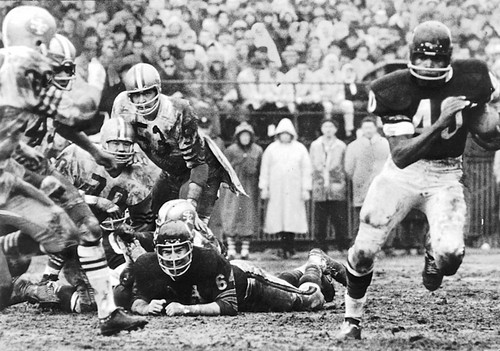
This is the story of two athletically-gifted brothers named Sayers. The younger of the pair, Gale, became a sports figure for the ages with his zig-zagging runs to daylight on a football field. His name is synonymous with the Chicago Bears. His oft-played highlight-reel runs through enemy lines form the picture of quicksilver grace. His well-documented friendship with the late Brian Piccolo endear him to new generations of fans.
The elder brother, Roger, forged a distinguished athletic career of his own, one of blazing speed on cinder and grass, but one overshadowed by Gale’s success.
From their early impoverished youth on Omaha’s near north side in the 1950s the Brothers Sayers dominated whatever field of athletic competition they entered, shining most brightly on the track and gridiron. As teammates they ran wild for Roberts Dairy’s midget football squad and anchored Central High School’s powerful football-track teams. Back then, Roger, the oldest by a year, led the way and Gale followed. For a long time, little separated the pair, as the brothers took turns grabbing headlines. Each was small and could run like the wind, just like their ex-track man father. But, make no mistake about it, Roger was always the fastest.
Each played halfback, sharing time in the same Central backfield one season. Heading into Gale’s sophomore year nature took over and gave Gale an edge Roger could never match, as the younger brother grew a few inches and packed-on 50 pounds of muscle. He kept growing, too. Soon, Gale was a strapping 6’0, 200-pound prototype halfback with major-college-material written all over him. Roger remained a diminutive 5’9, 150-pound speedster whose own once hotly sought-after status dimmed when, bowing to his parents’ wishes, he skipped his senior year of football rather than risk injury. Ironically, he tore a tendon running track the next spring. His major college prospects gone, he settled for then Omaha University.
Roger went on to a storied career at UNO, where he developed into one of America’s top sprinters and one of the school’s all-time football greats. He won the 100-meters at the 1964 Drake Relays. He captured both the 100-yard and 100-meter dashes at the 1963 Texas Relays. He took the 100 and 200 at the 1963 national NAIA meet. He ran well against Polish and Soviet national teams in AAU meets. The Olympic hopeful even beat the legendary American sprinter Bob Hayes in a race, but it was Hayes, known as “The Human Bullet,” who ended up with Olympic and NFL glory, not Sayers.
As an undersized but explosive cog in UNO’s full backfield, Sayers, dubbed “The Rocket,” averaged nearly eight yards per carry and 19 yards per reception over his four-year career. But it was as a return specialist he really stood out. Using his straight-away burst, he took back to the house three punts and five kickoffs for touchdowns. He holds several school records, including highest rushing average for a season (10.2) and career (7.8) and highest punt return average for a season (29.5) and career (20.6). His 99-yard TD catch in a 1963 game versus Drake is the longest scoring play from scrimmage in UNO history.

Roger Sayers running track for then-Omaha University
In football, size matters. For most of his playing career, however, Roger said his acute lack of size “never was a factor. I didn’t pay much attention to it. I didn’t lack any confidence when I got on the field. I always thought I could do well.”
Even with his impressive track credentials, Sayers, coming off an injury, was unable to find a sponsor for a 1964 Olympic bid. Even though his small stature never held him back in high school or college, it posed a huge obstacle in pro football, which after graduation he did not pursue right away because the studious and ambitious Sayers already had opportunities lined-up outside athletics. Still, in 1966, he gave the NFL a try when, after prodding from “the guys” at the Spencer Street Barbershop and a little help from Gale, he signed a free agent contract with his brother’s team, the Chicago Bears. Roger lasted the entire training camp and exhibition season with the club before bowing to reality and taking an office job.
“That’s when I realized I was too small,” Roger said of his NFL try.
Gale, the family superstar, is inducted in the college and pro football Halls of Fame but his glory came outside Nebraska, where he felt unappreciated. Racism likely prevented him being named Nebraska High School Athlete of the Year after a senior year of jaw-dropping performances. In leading Central to a share of the state football title, he set the Class A single season scoring record and made prep All-American. In pacing Central to the track and field title, he won three gold medals at the state meet, shattering the Nebraska long jump record with a leap of 24 feet, 10 inches, a mark that still stands today. He got revenge in the annual Shrine all-star game, scoring four touchdowns en route to being named outstanding player.
Recruited by Nebraska, then coached by Bill Jennings, Sayers considered the Huskers but felt uncomfortable at the school, which had ridiculously few black students then — in or out of athletics. Spurning the then-moribound NU football program for the University of Kansas, he heard people say he’d never be able to cut it in school. Sayers admits academics were not his strong suit in high school, not for lack of intelligence, but for lack of applying himself.
It took his father, a-$55-a-week car polisher, who’d walked away from his own chance at college, to set him straight. “People said I would fail. They called me dumb. But my dad said to me one time, ‘Gale, you are good enough,’ and just those words gave me the incentive that somebody believed in me. That’s all I needed. And I proved that I could do it.”
Sayers was also motivated by his brother, Roger, the bookish one who preceded him to college. Each went on to get two degrees at their respective schools.
On the field, Gale showed the Huskers what they missed by earning All-Big 8 and All-America honors as a Jayhawk and, in a 1963 game at Memorial Stadium the “Kansas Comet” lived up to his nickname by breaking-off a 99 yard TD run that still stands as the longest scoring play by an NU opponent. He was also a hurdler and long-jumper for the elite KU track program.
Upon entering the NFL with the Bears in 1965, Sayers made the most dramatic debut in league history, setting season records for total offense, 2,272, and touchdowns, 22, and a single game scoring record with 6 TDs. Named Rookie of the Year and All-Pro, he continued his brilliant play the next four seasons before the second of two serious knee injuries cut short his career in 1970. A mark of the impact he made is that despite playing only five full seasons, he’s routinely listed among the best running backs to ever play in the NFL.

Gale Sayers with the Bears
His immortality was ensured by two things: in 1970, the story of his friendship with teammate Brian Piccolo, who died tragically of cancer, was dramatically told in a TV movie-of-the-week, Brian’s Song, (recently remade); and, in 1977, he was inducted into the pro football Hall of Fame at age 29, making him the youngest enshrine of that elite fraternity.
A quadruple threat as a rusher, receiver out of the backfield, kickoff return man and punt returner, Sayers’ unprecedented cuts saw him change directions — with the high-striding, gliding moves of a hurdler — in the blink of an eye while somehow retaining full-speed. In a blurring instant, he’d be in mid-air as he head-faked one way and swiveled his hips the other way before landing again to pivot his feet to race off against the grain. In the introduction to Gale’s autobiography, I Am Third, comic Bill Cosby may have come closest to describing the effect one of Sayers’ dramatic cuts left on him while observing from the sidelines and on the hapless defenders trying to corral him.
“I was standing there and Gale was coming around this left end. And there are about five or six defensive men ready, waiting for him…And I saw Gale Sayers split. I mean, like a paramecium. He just split in two. He threw the right side of his body on one side and the left side of his body kept going down the left side. And the defensive men didn’t know who to catch.”
The way Gale tells it, his talent for cutting resulted from his “peripheral vision,” a gift he had from the get-go. “When I was running I could see the whole field. I knew how fast the other person was running and the angle he was taking, and I knew all I had to do was make a certain move and I’m past him. I knew it — I didn’t have to think about it. I could see where people were and that gave me the ability to make up my mind what I would do before I got to a person,” he said. He reacted, on the fly, in tenths or hundreds of a second, to what he saw. “
All the so-called great moves in football are instinct,” he said. “It’s not planned. I don’t go down the football field saying, ‘Oh, this fella’s to my right, I better cut left,’ or whatever. You don’t plan it. You’re running with the football and you just do what comes natural…There were so many times in high school, college and pro ball when I was going around left end or right end and there was nothing there, and then I went the other way. You can’t teach that. That’s instinctive.”
He said his greatest asset was not speed, but quickness — combined with that innate ability to improvise on the run. “Every running back has speed, but a lot of running backs don’t have the quickness to hit a hole or to change directions, and I always could do that. A lot of times a hole is clogged and then you’ve got to do something else — either change directions or hit another hole or bounce it to the outside and go someplace else.”
Lightning fast moves may have sprung from an unlikely source — flag football, something Heisman Trophy winner Johnny Rodgers also credits with helping develop his dipsy-doodle elusiveness.
“The flags were pretty easy to grab and pull out,” Sayers said, “and so, yes, you had to develop some moves to keep people away from the flags.” The Sayers boys got their first exposure to organized competition playing in the Howard Kennedy Grade School flag football program coached by Bob Rose. An old-school disciplinarian who mentored many of north Omaha’s greatest athletes when they were youths, Rose embodied respect.
“He was a tough coach. I think he had a little attitude that said, in being black, you’ve got to be twice as good, and I think he tried to instill that in us at an early age. He’d say things like, ‘You have to be faster, you have to be tougher, you’ve got to hit harder.’ We all developed that attitude that, ‘Hey, we’ve got to do better because we’re black.’ And I think that stuck with me,” Gale said.
According to Roger, coaches like Rose and the late Josh Gibson (Hall of Fame pitcher Bob Gibson’s oldest brother), whom the brothers came in contact with playing summer softball, “made it possible for people to succeed. They were good coaches because they taught you the fundamentals, they taught you to be respectful of people and they taught you the ethics of the game. These were folks that…made sure you played in an organized, structured event, so you could get the most out of it. They also had an uncanny ability to identify athletes and to motivate athletes to want to play and to achieve. They were part of an environment we had growing up where we had strong support systems around us.”
From the mid-1950s through the late 1960s Omaha’s inner city produced a remarkable group of athletes who achieved greatness in a variety of sports. Many observers have speculated on the whys and hows of that phenomenal run of athletic brilliance. The consensus seems to be that athletes from the past didn’t have to contend with a lot of the pressures and distractions kids face today, thus allowing a greater concentration on and passion for sports.
“Growing up, we didn’t have access to cars or play stations or arcade games,” Roger said. “We didn’t have to deal with the intense peer pressure kids are influenced by today. Because we didn’t have these things, we were able to focus in on our sports.”
For black youths like the Sayers and their buddies, options were even more confining in the ‘50s, when racial minorities were denied access to recreational venues such as the Peony Park pool and were discouraged from so-called country-club activities such as golf, which left more time and energy to devote to traditional inner city sports. “
Every day after school we were in Kountze park or some place playing a sport — football, basketball, baseball, whatever it may be. There wasn’t a whole lot else we could do,” Gale said. “So, we were in the park playing sports. Our mamas and daddies had to call us to come eat dinner because we were out there playing.”
Gale said that as youths he and his friends had such a hunger for football that after completing flag football practice, they would then go to the park to knock heads “with the big kids” from local high schools in pick-up games. “It’s a wonder no one ever got seriously injured because we had no pads, no nothing, and we played tackle. It really made us tougher.”
Dennis Fountain, a friend and fellow athlete from The Hood, said the Sayers would often compete for opposing sides in those informal games. “You wouldn’t think those two guys were brothers,” he said. “They would mix it up good.”
Speaking of tough, the brothers tussled in a pair of now mythic neighborhood football games held around the holidays. There was the Turkey Bowl played on Thanksgiving and the Cold Bowl played on Christmas. “We had some knock-down, drag-out athletic contests out there,” said Gale, referring to the annual games that drew athletes of all ages from Omaha’s north and south inner city projects. “We were a little young, but the fellas’ saw the talent we had and let us play.”
Then, there was the rich proving ground he and Roger found themselves competing in — playing with or against such fine athletes as the Nared brothers (Rich and John), Vernon Breakfield, Charlie Gunn, Bruce Hunter, Ron Boone. “No doubt about it, we fed off one another. We saw other people doing well and we wanted to do just as well,” Gale said. As the Sayers began asserting themselves, they pushed each other to excel.
“When he achieved something, I wanted to achieve something, and vice versa,” Roger said. “I mean, you never wanted to be upstaged or outdone, but by the same token we were always proud and overjoyed by each other’s success. We were as competitive as brothers are.”
Roger and Gale had so much ability that the exploits of their baby brother, Ron, are obscured despite the fact he, too, possessed talent, enough in fact for the UNO grad to be a number two draft pick by the San Diego Chargers in 1968.
Each also knew his limitations in comparison with the other. Roger played some mean halfback himself, but he knew on a football field he was only a shadow of Gale, whom nature blessed with size, speed, vision and instinct. Where Gale was a fine hurdler, relay man and long-jumper, he knew he could not beat Roger in a sprint. “I wasn’t going to get into the 100 or 220-yard dash and run against him because he was much, much faster than I was,” Gale said. “He was great in track.”
As much as he downplays his own track ability, Gale held his own in one of the strongest collegiate track programs at Kansas. It was under KU track and field coach Bill Easton he discovered a work ethic and a mantra that have guided his life ever since.
“I thought I worked hard getting ready for football,” he said, “but when I joined his track team I couldn’t believe the amount of work he put me through and I couldn’t believe I could do it. But within months I could do everything he asked me to, and I was in excellent shape. He told me, ‘Gale, you cannot work hard enough in any sport, especially in track.’ The things I did for him on the track team carried on through my pro career in football.
“Every training camp I came in shape, and I mean I came in shape. I was ready to play and put the pads on the first day of camp, where many guys would go to camp to get in shape.”
On the eve of his pro career, Sayers was entertaining some doubts about how he would do when Easton reminded him what made him special. “You go for broke every time you go.” Sayers said it’s a lesson he’s always tried to follow.

A saying printed on a card atop the desk in Easton’s office intrigued Sayers. The enigmatic words said, I Am Third. When he asked his coach their meaning, he was told they came from a kind of proverb that goes, The Lord is First, My Friends are Second, I Am Third. The athlete was so taken with its meaning he went out and had it inscribed on a medallion he wore for years afterwards. His wife Linda now has it.
The saying became the title of his 1970 autobiography. The philosophy bound up in it helped him cope with the abrupt end of his playing days. “All the talent I had, the Lord gave me. And it was the Lord that decided to take it away from me,” Gale said. “That probably helped me accept the fact that, hey, I couldn’t do it anymore. I had a very short career, but a very good career. I was satisfied with that.”
Life after athletic competition has been relatively smooth for Gale and his brother. Roger embarked on a long executive corporate career, interrupted only by a stint as the City of Omaha’s Human Relations Director under Mayor Gene Leahy. He retired from Union Pacific a few years ago. Today, he’s a trustee with Salem Baptist Church. Gale served as athletic director at Southern Illinois University before starting his own sports marketing and public relations firm, Sayers and Sayers Enterprises. Next, he launched Sayers Computer Source, a provider of computer products and technology solutions to commercial customers. Today, SCS has brnaches nationwide and revenues in excess of $150 million. Besides running his companies, Sayers is in high demand as a motivational speaker.
Both men have tried distancing themselves from being defined by their athletic prowess alone.
“I want people to view me as an individual that brings something to the table other than the fact I could run track and play football. That stuff is behind me. There are other things I can do,” said Roger. For Gale, it was a matter of being ready to move on. “I’ve always said, As you prepare to play, you must prepare to quit, and I prepared to quit. I didn’t have to look back and say, What am I going to do now? I did other things.”
Getting on with their lives has been a constant with the brothers since growing up with feuding, alcoholic parents, sparse belongings and little money in “The Toe,” as Gale said residents referred to the north Omaha ghetto. His family moved to Omaha from bigoted small towns in Kansas, where the Sayers lived until Gale was 8, but instead of the fat times they envisioned here they only found despair.
Finding a way out of that cycle became an overriding goal for Gale and his brothers.
“Yes, we had tough times, but everybody in the black neighborhood had a tough time. Our dad always said, ‘Gale, Roger, Ronnie…sorry it didn’t work out for your mother and I, but you need to get your education and make something better for yourselves.’” The fact he and Roger went on to great heights taught Gale that “if you want to make it bad enough, no matter how bad it is, you can make it.”
Related Articles
- Gale Sayers’s Knee, and the Dark Ages of Medicine (fifthdown.blogs.nytimes.com)
- The 32 Greatest NFL Running Backs (sports-central.org)
- The Ties that Bind, One Family’s Celebration of Native Omaha Days (leoadambiga.wordpress.com)
- Sayers: Current players should help pioneers (sports.espn.go.com)
- John Mackey’s death has Gale Sayers ticked off at today’s NFL (profootballtalk.nbcsports.com)
South Omaha’s Jim Ramirez: A Man of the People

Image via Wikipedia
The name Jim Ramirez was vaguely familiar to me. I knew he was a highly respected figure in Omaha. I finally caught up with him a couple years ago for this profile. As this blog site will reflect between now and the end of the year, I have begin doing more and more writing and reporting on Omaha’s Latino and Hispanic community, and I will be posting more and more of these stories here. Ramirez has one of those pull-up-from-the-bootstraps life stories that rightly serves as an inspirational example to others. My story originally appeared in the New Horizons.
South Omaha’s Jim Ramirez: A Man of the People
©by Leo Adam Biga
Originally published in the New Horizons
Moving from the kill floor of a packing house to the halls of academia, Jim Ramirez appreciates just how far he’s journeyed. Along the way he’s learned some hard and valuable lessons. That life’s not fair. That self-empowerment means taking control of your own destiny. That no one can put a limit on your capabilities but yourself. That giving back to your community is its own best reward.
For 40 years he’s used his experience to give people the tools they need for success. As a Latino, his focus is on kids from his culture, one he has deep ties to. A former Nebraska Hispanic Man of the Year and grand marshall of Omaha’s Cinco de Mayo parade, Ramirez supports his people as advocate, facilitator, community board member and bridge builder – bringing diverse people together to address problems and realize dreams.

When he was young Hispanics had little say politically or otherwise. “We did not have a voice, just as I didn’t have a voice. As I got more education I got more of a voice,” he said. He’s glad Hispanics showed up in force at recent public hearings in Fremont, Neb. to express opposition to punitive measures the city considered enacting against illegal immigrants and their employers. As Hispanics become better informed and educated, he said, the more they’re heard.
“I believe that education is power and power is money.”
This son of Mexican immigrants grew up in an era when kids with Spanish surnames were expected to fill the same blue collar jobs their folks worked. His dad Mike gutted cattle at Nebraska Beef. His mom Josephine sliced bacon at Armour. Aunts and uncles worked as packers, too.
His family was among thousands that supplied the army of workers employed by Omaha’s once immense packing industry, which formed at the turn of the last century alongside the giant livestock yards that operated in South Omaha.

The packing plants, led by the Big Four of Armour, Swift, Wilson and Cudahy and many smaller meat processors and food manufacturers, thrived for generations, offering Hispanics and blacks some of the best paying jobs then open to minorities.
With that background Ramirez “didn’t give it a thought” that as the oldest of four children he would follow his parents in the hole. “I didn’t know any better,” he said. That’s just the way it was then. Never mind the fact he was a bright student. If you went to South High, as he did, you were generally not considered college material, regardless of your abilities or aspirations. You were defined, as the school nickname reads, a Packer. Societal-educational norms deemed you unsuited for anything else, denying opportunities and crushing hopes.
“In those days counselors didn’t counsel us to go here or there or to prepare for this or that,” he said. “If you were from South Omaha and particularly if you were Mexican (or black) you were going to end up in the packing house, which is where I ended up. Or on the railroad.”
He put in 14 years on the kill floor at Nebraska Beef. He began washing carcasses for a $1.59 an hour.
“After being skinned and split we washed ‘em off. Then they were wrapped in a shroud and pinned — that’s how they get their shape,” he said.
He would likely have remained there if not for mentors who encouraged him to attend college. His first aborted try at higher ed came at the urging of his South High Spanish instructor Alice Giiter. She saw enough potential in him to recommend he apply at Northwestern near Chicago. It was too much of a stretch in his mind.
“When I graduated the best I could do to satisfy Miss Giiter was enroll full-time at then-Omaha University,” he said. “By then I had decided I wanted to be a coach and an elementary teacher.”

Coaching was a natural fit for Ramirez, who though small in size was a top athlete. “That was my life,” he said. He played competitive basketball into his 30s and fastpitch softball well beyond that. The Nebraska Machine fastpitch softball squad he played shortstop on and managed was dominant. Its star pitcher was Ramirez’s son Jim Jr., who was good enough to be invited to train with the U.S. national team in Colorado Springs, Colo. for the Pan Am Games.
Ramirez coached CYO ball for several parishes. He also officiated hoops and football contests, working everything from the Pee Wee leagues to state college games. “I loved it,” he said.
Strangely, he never played organized sports at South. He explained few Hispanics and blacks went out for school teams then — discouraged by quotas and attitudes that made clear they were unwanted. Today, the predominantly Latino Packer soccer team is “the glory of the school.”
Back then, however, discrimination was wide-spread and often overt. After one semester at the university he said a clearly biased education professor dissuaded him with an insult: “Ramirez, I think you ought to change your major — there aren’t too many of YOU people in teaching.” The comment would merit suspension or dismissal today and prompt a complaint by Ramirez. But he was a teenager then and the older educator represented an authority figure he deferred to.
“Young and dumb. What the hell did I know about institutional racism at the time,” Ramirez said. “So I didn’t go back the next semester.”
Instead he returned to the kill floor. He didn’t tell anyone what had happened. “Nobody knew. It was something I just carried inside of me for years,” he said.
He’d never stepped foot inside the plant his father worked in until the day he started there. Everything about the place was an eye-opener. The harsh conditions. The rough-edged men. Their smoking, drinking, fighting, carousing. A more than mile-long stretch of Q Street featured bars, pool halls and gambling joints. As a boy he shined shoes inside Joe’s Pool Hall. Whorehouses were nearby. All in service of the livestock and packing trade.
“Oh, God, those were some wild days. The packing houses were thriving. It was very colorful and culturally diverse,” he said.
He learned every job on the kill floor, eventually becoming foreman. That meant the young Ramirez supervised his father and other grizzled men twice his age and size. His most harrowing job was as a knocker, which entailed swinging a 5-pound sledgehammer between the eyes of cows.
“Every now and then you’d hit a cow and think it was dead and then it’d get up and start running all over the kill floor, guys scattering because they’re all carrying razor-sharp knives, and here’s this crazy, half-dazed cow on the loose,” he said. “To this day I can’t kill a fly or a mouse.”
The worst job was his dad’s — gutter.
“Sometimes we’d kill old cows and some of them had cancerous stomachs and you’d go and rip open the front of the belly and, whoosh, your face would be full of puss,” he said. “That happened probably once or twice a week. You didn’t know what you were getting into when you opened that beef.”
In truth, every job on the kill floor was a nightmare.
“I wish I had a nickel for every cut I got I on my hands and on my legs from working there. It was dangerous. It was brutal. This was before OHSA in a small, non-union plant. Very primitive. Drive the cows in, hit ‘em in the head, hang ‘em up by the hind legs, rip their throat till they die. Ihen lay ‘em on the ground, rip ‘em open, skin ‘em, hang ‘em up again and gut ‘em. You’re walking in blood ankle deep.”
He hadn’t intended on working there long but, he said, “I stayed and stayed and stayed and stayed,” and before he knew it years had passed.
“Once you start getting that nice paycheck,” he said, “it’s hard to say, ‘Well, I’d rather go to college.’” Still, some did try. “As a UNO counselor I ran into many South Omaha kids that didn’t survive because of the lack of preparation. It was always Plan B for them to go to college…” They’d invariably drop-out.
The prospect of being at Nebraska Beef until he was a broken down old man got him thinking about his future.
“I was beginning to learn a little something. I would look at Dad and say to myself, I don’t want to be here when I get his age. Because he was up in age already.”
He finally went back to school at the insistence of social worker Alyce Wilson, who ran a southside community center called the Woodson Center. After getting on at Nebraska Beef he worked part-time at the center, where he was able to fulfill his desire to work with kids in athletics. Wilson suggested a field of study she thought he’d be a natural at — social work. He couldn’t grasp what that entailed until informing him she was a social worker. Sociology became his major and for six years he worked for the Boys Club — first in North Omaha and then in South O.
The more Ramirez studied the more he saw injustice around him and the more he wanted to make a difference.
“I started to see the world through clear glasses instead of the rose-colored glasses I grew up on. My eyes were really opened to racism and how it still exists to this day, only more subtly.”

It took years of night classes but he got his bachelor’s degree in sociology in ‘71, whereupon he entered the education field. He added a masters in guidance and counseling from UNO in ‘74 and his Ph.D. from UNL in adult and continuing education in ‘84, all achieved while attending night school. He believes he was the first Omaha Hispanic to earn a doctorate. His folks lived to see him do it. “We had a big bash at Our Lady of Guadalupe Hall. The whole community celebrated,” he said.
Along the way he dedicated his life to being an advocate for minority students — bound and determined to ensure Hispanic kids get a fair shake.
“I was motivated by what the system had done to me — telling me I couldn’t be because of what I was. I thought this is bullshit because some of our kids want to be doctors or lawyers or engineers or whatever but they’re steered this other way where there’s no chance. I just told myself that as long as I’m alive I’m never going to let that happen to another young student.”
His careers as a Boys Clubs unit director, as a University of Nebraska at Omaha instructor/counselor and, later, as a Omaha Public Schools human/community relations specialist put him in contact with thousands of students over the years.
Although now semi-retired from the district, he continues looking out for the interests of minority students today at age 74. He’s an advisor, a resource, a friend and a liaison for many. He’s launched both a minority student support group at UNO and a minority student recognition program at OPS.
Below: The document pictured below is a statement of purpose issued by the Chancellor’s Advisory Committee on Mexican-American Affairs that jim Ramirez served on.
 As OPS Minority Activities Committee chair he’s still involved in the district’s recognition program. He’s pleased that Hispanic students’ standardized test scores are on the rise in OPS and he enjoys feting high achieving kids and their parents.
“The leadership I see in our youth is astounding,” he said.
In stark contrast to when he was a teen, South High now has a Latino Leaders student organization and a Spanish liaison. He’s a South High Hall of Fame inductee.
He’s assisted scores of undocumented immigrant families navigate the educational system by helping register their children in school. A decade ago Ramirez and others began lobbying the Nebraska Legislature to allow undocumented students to qualify for in-state tuition in the University of Nebraska system.
He once brought bus loads of students to Lincoln to tell their stories. Maria Olvera was among them. The Central High grad was an honors student but her lack of a social security number nearly denied her the chance at a college education. It took Ramirez’s intervention to get her into UNO and to stay there when her nonresidency status was discovered. She had to be reclassified a foreign student despite having lived in Nebraska for several years. Financially, it’s a struggle.
It was only in 2006 the law changed to make illegals, who still can’t receive federal financial aid, eligible for instate tuition; few such students could afford the much higher nonresident rates. Ramirez supports a dormant bill in Congress, the Dream Act, that would make such students legal permanent residents after two years in college. Minus such protections he fears many will lose any hope of college.
Ramirez is widely known as someone people in the community can call 24/7 about immigration questions/issues. If he doesn’t know the answer he’ll know who does.
Aware how vital it is that students of color have counselors and teachers who look like them, something he never had in public school, he helped found a minority intern program at UNO to increase the number of minority educators.
“Five of my former students at UNO became interns with OPS and have done well,” he said like a proud papa. “I brought them all on board.”
For 20-plus years he’s actively recruited new Hispanic teachers where they’re most plentiful — in the Southwest. Each spring he makes a circuit through Texas and New Mexico at teacher fairs to try and lure new education grads here.
“I’ve gotten probably about 15 teachers out of there to come to Omaha,” he said. “It’s very competitive because they don’t want to leave the Sun Belt. They’re very close to their families and we don’t pay worth a damn.”
He said districts in other states not only pay higher starting salaries they offer singing bonuses. “We don’t offer anything like that. So it’s hard,” he said. “I consider myself a good salesman to Hispanic teachers because I sell them on the opportunity to move up and become an administrator.”
This fall three of his recruits are in new administrative posts in OPS: Robert Aranda, Bryan Middle School principal; Ruben Cano, Norris Middle School assistant principal; and Rony Ortega, South High School assistant principal. Ortega is just one of many Latino staffers at the school today.
“We’ve come a long ways from when I graduated from South,” Ramirez said. “We couldn’t become janitors.” Much less teachers or principals.
Ramirez looks to fill gaps impacting Hispanic student achievement. Some years ago he and the former Chicano Awareness Center — now called the Latino Center of the Midlands — approached South High about having volunteer Hispanic counselors there. Ramirez was among the first. “Sometimes the traditional counselors overlook our kids for whatever reason,” he said. After resistance, the school provided a room, a phone and access to students.
“We sent out letters inviting parents and their kids to meet with us because we wanted to work with their sons and daughters to prepare them for college or to improve their status academically,” he said. “That grew and grew and grew and was institutionalized by the Chicano Awareness Center and the district. Some of us were housed in the center.”
Eventually paid counselors were put in place, with the center sponsoring tours of area universities as a way of acclimating or orienting kids to college life. Hispanic college students now host those visits.
“And today there are Hispanic counselors at South, Central and Bryan,” he said.
His impassioned concern for fair treatment landed him on the City of Omaha’s Human Relations Board under Mayor Gene Leahy, who was a friend. He’s remained involved with the board through several administrations. He counts as friends a number of past mayors as well as current Mayor Mike Fahey.
He still has the ear of decision-makers as a University of Nebraska President’s Advisory Committee member and as an OPS consultant. In his self-described “watchdog” role he monitors how the university and the district address minority student needs and talks to chancellors, superintendents, lawmakers and other movers-and-shakers about policies and legislation affecting minority students.
All the while, as he’ sgone from just plain Ramirez to Mr. Ramirez to Dr. Ramirez, he’s kept in mind what happened to him as a student back in the ‘50s. “God, if they’re doing that to me,” he said he thought, there’s no telling what they’re doing to others. “And they’re still doing it,” he said. Most kids attending inner city schools today, particularly Hispanics and blacks, come from blue collar backgrounds where college is not a first choice.
That’s why, he said, “as I moved up the ladder in terms of contacts with chancellors-principals I made sure that they knew what my concerns were — the way our kids are treated in our high schools and, now, middle schools.”
“I’ve been blessed to be in a position to say to the presidents of UNO-UNL, ‘There’s something wrong here. You don’t have enough minority faculty. You don’t do enough to recruit students of color.’ And they pretty much listen,” he said.
From its inception in 1972 he’s also served on an advisory committee for UNO’s minority scholarship Goodrich Program, which has produced more than 1,150 graduates, including some of Omaha’s most distinguished Hispanic leaders. He asks pointed questions of program officials to make sure students are being well served. It’s all part of holding institutions and programs accountable.
“Do you recruit the same at South High School as you do at North or Central? How many Hispanic applicants did you get? How many did you interview? How many did you accept? Those are the kinds of questions I’ve been asking for 30 years in looking after my kids,” he said.
From Ramirez’s POV the Goodrich Program came about as “a result of UNO beginning to smell the coffee” in terms of reaching out to more “nontraditional students of color who are in financial need and academically maybe not as strong. It has just been a tremendous program because of the support parcels that are in it with faculty, with counseling and with study groups. It has produced some of our best Hispanic graduates.”
Little escapes his attention. For example, a recently announced UNL scholarship program targeting minority graduates of North High has him asking, “How about those kids in South Omaha? So sometime in the next few months I’ll get to talk to Jim Milliken (UNL president) and Harvey Perlman (UNL chancellor) and say, ‘Is this experimental at North High and are you going to expand it to South High?’” He always looks out for his constituency.
None of this would have happened if he hadn’t stepped outside the traditional role prescribed for him. He feels fate had a hand in his refusal to be limited or confined by some preconceived idea of what he should or could be.
“It’s a blessing in that respect because if I had stayed in the packing house I would never had been in a position to talk to Harvey Perlman or Jim Milliken or John Christensen (UNO chancellor). As an advisor on an advisory committee I have a little clout because I’ll call a damned press conference in a heartbeat to address something that is just wrong. I haven’t, because fortunately the universities have taken care of that issue.”
In a sense, every day’s been a blessing since suffering life-threatening injuries in a car accident as a teen. He broke his back and a leg. He skull was fractured. He was given the last rites. Seen in this light, even the kill floor was a gift.
He often draws on his own experience as a packing house worker who beat the odds and defied the stereotypes to find a way out.
“All of us counselors at UNO taught a one-credit class called Academics and Career Development. It’s a required course for anyone who enrolls at the university and checks the little box marked ‘undeclared.’ I taught probably three or four sessions. One of the first things I told students is, ‘What I don’t want you to do is break my record. I don’t want you take longer than 18 years to get a degree.’ Their eyes opened up then. And to this day kids will see me and they’ll say, ‘I remember what you told the first day of school.’ That sticks in their mind.”
He emphasized with students then and still does today that if he could make it through college, they can, too. He lets them know he overcame every supposed strike against him. That despite being from a blue collar immigrant family and working a full-time job and raising a family he managed getting three degrees while taking night classes. That’s why he doesn’t brook any excuses.
“That’s how I push my personal experience into this,” he said. “By telling them, ‘You’re 30-some years old now and you’re not one foot in the grave. There’s still time for you to salvage something.’ I remember a new widow from over in Iowa that took one of my evening classes. She started taking courses at UNO to try to survive with an education. She never got anything lower than an A. She graduated in engineering and is now with a big engineering firm in town.”
Ramirez, who divorced in 1979, is the father of three grown children.
He said older, nontraditional students “were my best students because they were taking care of business. There was not all this craziness in their mind about partying and doing stuff like that.” Ramirez may be an extreme example but he was the prototypical serious older student who kept his nose to the grindstone.
There’s another side of Ramirez though — one that loves mariachi music and Latino culture-art. In 1990 he co-founded the South Omaha Arts Institute or Casa de la Cultura, a nonprofit that began with a youth mariachi band, Estrellitas de Omaha, he helped support under the direction of Rosemary Flores. The Institute is home to music and dance touring groups and conducts classes in various arts disciplines.

In 1993 Ramirez assisted Magdalena Garcia in launching El Museo Latino in the Livestock Exchange Building. He still serves on the board of the museum, now housed in the old Polish Home. One of only 11 Latino museums in the U.S., it displays touring art exhibits, hosts lectures and classes and presents performances by its own “CHOMARI” Ballet Folklorico Mexicano troupe and by visiting artists.
By shepherding these two organizations Ramirez has helped enrich the dynamic new South Omaha that’s emerged the last two decades. This largely immigrant-led revitalization of the South 24th Street business district has turned “a ghost town into a thriving Little Mexico,” he said. Improvements go well beyond that festive strip to encompass Metropolitan Community College’s south campus, the renovated South YMCA, the new South Omaha Branch Library and the under construction Kroc Center and South High stadium projects.
Ramirez is enjoying this renaissance and not even recent open heart surgery can prevent him from keeping a hand in things. He could have left Omaha long ago but he’s committed to making his hometown a better place.
“I’ve been offered jobs everywhere because of my education, but I have stayed here. I never got too far from my roots.”
Even if he ever does retire he’ll always be the underdog’s champion.
“I’ve told people over and over and over that as long as I’m pumping blood if I see an inequity with our students I’ll act. I won’t fade away into the sunset.”
There’s no time to rest when you’re a man of the people.
Related Articles
- Hispanic Sets Agenda for Unions (nytimes.com)
- English-speaking Latinos turn to Spanish TV (pbpulse.com)
- For region’s Latinos, enough is enough (timesunion.com)
- El Museo Latino in Omaha Opened as the First Latino Art and History Museum and Cultural Center in the Midwest (leoadambiga.wordpress.com)
- OLLAS, the Office of Latino and Latin American Studies at the University of Nebraska at Omaha, A Melting Pot of Latino/Latin American Concerns (leoadambiga.wordpress.com)
- Walking Behind to Freedom, A Musical Theater Examination of Race (leoadambiga.wordpress.com)
- Native American Survival Strategies Shared Through Theater and Testimony (leoadambiga.wordpress.com)
- Coming to America: The Immigrant-Refugee Mosaic Unfolds in New Ways and in Old Ways In Omaha (leoadambiga.wordpress.com)
- Featured Great Plains Theatre Conference Playwright Caridad Svich Explore Bicultural Themes (leoadambiga.wordpress.com)
- Omaha Address by Cuban Archbishop Jaime Ortega Sounds Hopeful Message that Repression in Cuba is Lifting (leoadambiga.wordpress.com)
- Community and Coffee at Omaha’s Perk Avenue Cafe (leoadambiga.wordpress.com)
Wright On, Adam Wright Has it All Figured Out Both On and Off the Football Field
Though not a sports writer per se, I love writing about sports and I think I have a certain flair for it. So while I write about anything and everything in the course of a typical year, and certainly do not specialize in sportswriting, I like to keep my hand in it. The following article is an example from about nine or 10 years ago. The subject is an impressive young man named Adam Wright who made his mark on the football field at Omaha Nigh High and at the University of Nebraska at Omaha, my alma mater, as a running back. He wasn’t recruited by the University of Nebraska-Lincoln but the way he developed and dominated at the Division II level at UNO he certainly indicated he could have excelled in Division I and helped the Huskers. He even made it all the way to the National Football League as a free agent, but successive knee injuries stopped him in his tracks before he ever got to play a down. This story originally appeared in the Omaha Weekly, a paper that no longer exists.
 |
Wright On, Adam Wright Has it All Figured Out Both On and Off the Football Field
©by Leo Adam Biga
Originally published in the Omaha Weekly
Adam Wright has been so indestructible for the streaking UNO Maverick football team this year that no one foresaw this walking Adonis being sidelined by injury. After all, the senior has been the one constant and main workhorse for the often sputtering UNO offense in 2000, lugging the ball 30 times per contest the first seven outings. Time and again, the big bruising tailback with the ripped body crashed into a human wall at the line of scrimmage and came out the other side still intact, if not unscathed. He has taken many hard knocks, but delivered some too, usually leaving a litter of bodies in his wake. “I take pride in knowing I’m not going to be stopped by any one guy, no matter who he is, no matter how big he is,” Wright said. “I’m always looking to turn into somebody to dish out some punishment.”
But Wright, a bright and amiable student-athlete with a career in engineering (he is a civil engineering major) awaiting him if a hoped-for stint in pro football fizzles, was not always so assertive. The Omaha North High School graduate played quarterback as a prepster and arrived at UNO lacking the requisite toughness to be a hard-nosed tailback. As a freshman, he was even moved to wide receiver for a week. His passivity on the field was an off-shoot of his desire to blend in off it, where he grew up in an interracial home struck by tragedy. After losing his father at age 8, he watched his two older siblings make some bad life choices and set about being a model child for the sake of his mother.
He did anything to avoid being branded a troublemaker, even to the point of not using his God-given size to run over smaller players on the gridiron. Even after bulking up in college from 195 to his present 230 pounds, the 6’1 back steered clear of putting all of himself into runs. It took an attitude change, plus watching tapes of great backs, before he became the physical runner he is today. UNO Offensive Coordinator Lance Leipold recalls a heart-to-heart talk he had with his ballcarrier: “I said, ‘You’ve built yourself into this big back, now you’ve got to play like one.’” He said Wright, a devoted weightlifter, now not only “finishes off runs” but possesses a keen sense for the game: “He’s learned the blocking schemes better. He knows what’s really happening up front — where the hole is going to hit.”
His brute-force style, smarts and occasional breakaway speed (He cut his 40-yard dash time by two-tenths of a second over the summer — to a 4.7 electronic.), put Wright atop the NCAA Division II individual rushing chart for a time and allowed him to shatter UNO’s career rushing mark. He has 1,216 yards this season (just 100 yards short of the UNO single season record) and 3,761 overall. Earlier this year he recorded a stretch of three straight 200-yard-plus rushing performances. It’s been that kind of productivity that’s made him a regional finalist for the Harlon Hill Trophy (Division II’s Heisman).
By mid-season, he was a bruised but unbowed target for opposing defenses, absorbing hit upon hit but always picking himself up off the turf to get back into the fray. More often than not, tacklers were worn down by game’s end, not him.
Late, when defenses are tiring, he said, “you go for the kill. You put your head down a little lower, squeeze the ball tighter, fire out and go stronger.” Indeed, his late game heroics sealed wins against Northern Colorado and South Dakota. But with one twist of the knee early in the first quarter of UNO’s October 28 game versus South Dakota State, Wright went down in a heap, the medial collateral ligament in his left knee sprained. The injury happened on his first carry, a draw designed to go up the middle that he bounced wide. A defensive back came up on the play, making helmet contact just below Wright’s bent knee. As Wright tried to pull out of the tackle, his leg extended back and he felt his knee “wobble.” Playing in pain all season from tendinitis, he stayed in for a second carry, then with the knee only “getting worse,” he limped off, unable to return to a game UNO won 24-7 thanks in part to the steady play of his backup, redshirt freshman Justin Kammrad.
After week-long treatments, Wright was available for emergency duty last Saturday but with UNO dominating and Kammrad running wild (for a school record 239 yards) in a 45-7 win over Augustana. Wright did not see action. Instead, he nervously paced the sidelines — loudly encouraging his teammates. He should be close to full strength for this Saturday’s regular season finale at home against Top 20 foe and North Central Conference rival North Dakota (8-2). A healthy Wright will be a timely addition, as the 1 p.m. contest at Al Caniglia Field has major regional and national implications. Featuring a swarming defense that allows less than 10 points a game and a battering-ram offense that runs the ball down opponents’ throats, No. 5 UNO, now 9-1 and on a nine-game winning streak, is poised to capture just its second outright NCC title ever and to secure home field for the opening rounds of the NCAA playoffs. With their go-to guy back, look for the Mavs to feed the ball to No. 6 and, if his knee holds up, to ride his strong back as many times as needed.
Wright will gladly bear the load, too. “If it takes 40 carries for our offense to be successful, then give it to me 40 times,” he said. Following a 37-carry, 151-yard performance versus UNC on October 7, including gaining 38 yards on a crucial 4th quarter drive, Wright gouged South Dakota for 130 yards on 34 attempts the very next week. The more carries he gets, the more he starts “getting into a rhythm.” When he and his linemen get into that flow, running turns effortless. “It seems like once the ball is snapped, I’m beyond the hole. I’m in the secondary already. It’s kind of weird. It’s like, all of a sudden I’m there. I don’t even remember the run.”
The last few minutes of the SDU game offered another gut-check for UNO and Wright when, tied 7-7 in the 4th, the Mavs ground out two drives — with Wright the main weapon — to secure a 21-7 victory. With only minutes left, he was feeling the effects of all the pounding, but refused to sit out for even a play. “To tell you the truth, there was a point in time when I got up really slow and I was pretty sore. It was ridiculous. It was like being hit by a car — twice. My teammates were telling me in the huddle to get out of the game, but I knew J.J. (reserve tailback James Johnson) had sprained his knee and that Justin Kammrad was only a redshirt freshman. I felt I had to stay in. It was a close ballgame. And with only four minutes to go, I was like, ‘Ah, I’ve already been hit 30 times, what’s four more?’” Wright made his last four carries count, too, tearing through a tiring Coyotes defense on a short drive he capped with a nifty 23-yard touchdown run.
Doing whatever it takes has been ingrained in Wright since he lost his father, Jesse, to cancer in 1985. He has fond memories of the man, who was a packing house laborer. “The weird thing is, I can hardly remember his face, but I can remember a lot of lessons he taught me about life — about honesty, about integrity, about loyalty.” Prior to his father’s death, Wright’s mother, Liz, had been a stay-at-home mom. She returned to school (to study nursing) and entered the work force to provide for her three children. The demands took her away from her family more than she wanted. By the time her two oldest kids reached their teens, they were running wild. Adam, the youngest, sat back and saw how much grief his siblings’ behavior caused her and determined he would do nothing to add to her worries.
“My brother and sister pushed the limits to see how far they could go,” he said. “I saw how hard our mom was working just so we could have a chance for a better life and I didn’t want to disappoint her and make all the things she was doing be in vain. I tried not to disappoint anybody. Today, all of us are on the straight and narrow, but we each took different paths to get there.”
Liz Wright, an RN, recalls how as a child Adam displayed a maturity beyond his years. “Adam sort of comes from an underdog situation — being of mixed race, growing up in a poor area of the city and losing his father so young. I could have easily lost him to the crime environment in north Omaha.” She said his coming of age amid the near northside’s gang culture offered real temptations he resisted. “He didn’t take that path. A lot of his friends did. And what I admire most about him now is he doesn’t judge people who live that life. He’s a fair person. He’s kind of a keeper of justice.” Such congeniality, combined with male model good looks and a penchant for doing the right thing (he mentors disadvantaged youths), endear Wright to just about anyone he meets. For example, he was elected co-captain of the football squad and was recently voted vice president of the UNO student government.
His coaches — past and present — uniformly sing his praises. Herman Colvin, the head football coach at North High during Wright’s two years on the varsity there, became a father figure to the player. “He’s somebody I have a tremendous amount of respect and love for,” said Colvin, now assistant principal at Monroe Middle School in Omaha. “I really love the guy. He has made some good choices and I’m really happy with his choices. Has he done a lot to make me proud? He certainly has.” UNO Head Football Coach Pat Behrns said, “Adam’s a great guy. He does any type of public service work we ask him to. He’s great with young people. He’s a very classy young man. We’re going to hate to see him go.” Wright’s position coach, Lance Leipold, added, “He’s been a pleasure to work with because of his outstanding work ethic. He’s done a lot of little things to make himself a very quality back for us. But he’s not going to be one of those guys who’s going to be real frustrated if pro football doesn’t work out. Adam, from day one, has had such a plan in life. Someday, I might be working for him.”
The man instrumental in getting Wright to refuse Division I scholarship offers for UNO, Mid-American Energy CEO and fellow North High alum David Sokol, also commends Wright, whom he speaks of as a kind of protege (Wright has been an intern at Mid-American since 1996). “He has two characteristics I think are particularly important. One is, he has a very high character level. He is very cautious about keeping himself out of situations where, you know, bad things are liable to happen. The second thing is, he is extremely hard working and he has his priorities pretty well laid out. I think he can probably do anything he wants to, whether it’s the NFL or corporate America. We certainly would be more than happy to hire him after graduation.”
Clearly, the NFL is not an all-or-nothing proposition for Wright. It remains what his mom calls “a little boy’s dream.” As Wright himself said, “I’m a realist. I know it’s extremely hard to get there. If the opportunity presents itself, fine. But I’m going to leave my options open and do what’s in the best interests for my future.”
Carrying extra weight as “a cushion” against all the wear and tear he can expect to incur, Wright has his sights set on helping the Mavs make a run for the national title. “The way our defense is playing, if our offense can just control the clock, grind out the yards, get first downs and keep getting in the end zone, we have the potential to win every game.” Being on the sidelines has almost been more than he can take. “It’s killing me. I want to be on the field when we win.” he said. He will do whatever it takes to return. “I’ll argue, scratch and claw to get out there.”
Related Articles
- Georgia Tech 2010 Offensive Preview: Running Backs (bleacherreport.com)
- Arby’s Pick Five should be ready soon (chicagonow.com)
A Peace Corps Retrospective

Image via Wikipedia
Another anniversary story. It was the 40th anniversary of the Peace Corps and I just happened to know a few veterans of that renowned service program, and so after they agreed to share their stories with me, those experiences formed the backbone of what I wrote. One of the individuals I profiled served in Afghanistan and the other three in India. All of them were deeply affected by what they saw and did and at some level that experience has informed everything they’ve done since then. My story originally appeared in the New Horizons. On this same blog you can find my profile of one of these Peace Corps veterans – Thomas Gouttierre, and his affinity for and work with Afghanistan.
A Peace Corps Retrospective
©by Leo Adam Biga
Originally published in the New Horizons
Forty years ago, the first wave of Peace Corps volunteers landed in Ghana and Tanzania, Africa. The young, bright-eyed Americans were a new kind of emissary. Neither diplomats nor missionaries, they arrived in far-flung destinations with the appointed task of helping Third World peoples learn skills and develop resources for overcoming tyranny, poverty and disease.
Trained in various service assignments, ranging from education to health to agriculture, the volunteers embodied the idealism and vigor of America’s young, energetic President, John F. Kennedy, who had announced his vision for the Peace Corps in an October 14, 1960 campaign speech at the University of Michigan in which he challenged the nation’s youth to aid the developing world. Once elected, Kennedy reiterated the plan for an international volunteer corps during his January 20, 1961 inaugural address, asking a new generation of Americans to join “a grand and global alliance” to aid the dispossessed and pledging “our best efforts to help them help themselves.”
Kennedy’s clarion call was answered by thousands, including several Nebraskans. By September ‘61 Congress approved legislation formally authorizing Peace Corps and by the end of that year the first contingent of volunteers left for their host countries. Within five years, more than 15,000 volunteers from around the U.S. were implementing Peace Corps projects in the field. As of 2001, 163,000 volunteers have served in 135 countries.
Among those heeding the call during that heady first decade were Tom and Marylu Gouttiere, Peter Tomsen, Beth Furlong and Ron Psota, five transplanted Omahans who were then fresh-from-college graduates looking for a way to make a difference and to find an adventure. Peace Corps duty proved a defining experience for each, indelibly changing the pattern, direction and focus of their lives. For each, it was a time of personal growth and broadened perspectives. They would never look at the world or its diverse people the same way again. For proof, each returned Peace Corps volunteer has given his or her life over to working with people and each has become a world citizen with deep, personal ties to the international arena.
Tom Gouttierre was either headed for a career as a master baker just like his father or as a manager with General Motors just like his friends when Kennedy’s call to service got him thinking beyond the parochial borders of his Maumee, Ohio hometown. “He was an inspiring guy. When he spoke I was just kind of taken by his message of going outside what we normally do,” said Gouttierre, who today directs the Center for Afghanistan Studies and heads the International Studies and Programs Department at the University of Nebraska at Omaha.

Tom Gouttierre
From the time he was a child Gouttierre had been curious about the wider world and longed for journeys that would open up its vast horizons to him, only he lacked a way to make it happen. By his early 20s he was studying liberal arts at Bowling Green State University, but remained frustrated in his efforts to break from the mold. That’s when he and his wife, Marylu, decided to throw caution to the wind and enter the Peace Corps. After training in Vermont, the couple was assigned to Afghanistan, a remote, forbidding country that would figure prominently in the rest of their lives. During their 1965-1967 tour, the couple was based in the capital city of Kabul. He worked as an English-as-a-foreign language instructor and basketball coach at Lycee Habibia high school and she as a physical education instructor at Kabul University and a business instructor at all-girls schools.
“We were one of the few married couples,” said Marylu, an Oriental rug retailer. “It was an unknown experience. We had no idea what to expect, whether our language skills would help us or where we would live. There was no telephone. No television. No communication. It was a really exciting experience, a really scary experience, but also a very rewarding experience, and after awhile we just both fell in love with the culture and the people. It’s good to give some of your own services to others, but when you do that you gain so much also.”
Especially in the early 1960s, countries viewed Peace Corps volunteers “as a kind of feather in their cap,” Tom Gouttierre said, and much of that enthusiasm had to do with foreign peoples’ admiration of Americans. “The students I worked with tried to take everything out of me that they could. They were curious as hell. They were always wanting me to do something with them or for them. It was flattering that your skills were that attractive to this group of people. Before Vietnam really got kind of overbearing, Americans, largely because of the impact of Kennedy, had a real appeal for the younger generation. I can’t tell you how many times some Afghan came up to me to express their sorrow at the death of Kennedy. ‘He was a great man,’ they would say. That was a great asset for any Peace Corps volunteer. You had this icon who helped elevate your own position in their eyes. Today, America is viewed a little differently and for that reason it’s probably more difficult to be a Peace Corps volunteer now, even though living conditions are better.”
Tom Gouttierre’s Peace Corps service set the stage for a distinguished professional life with deep ties to Afghanistan. He and Marylu returned there in 1969 when he studied abroad as a Fulbright Scholar and they remained there the next six years as he headed the Fulbright Foundation and coached the national basketball team. The Gouttierre’s oldest child, Adam, was born in Afghanistan. During his UNO tenure he’s built a massive archive on Afghanistan, supervised education programs there, participated in United Nations fact-finding junkets there and appeared before Congress addressing issues relating to Afghanistan.
Since leaving, he’s watched with a heavy heart as the nation crumbled under the strain of successive crises — from a war with the former Soviet Union to civil strife to the oppressive Taliban regime to the current specter of American-Allied retaliation for harboring terrorist Osama Bin Laden. Many of his former students have been lost. “I’ve seen what one my call the end of innocence in Afghanistan,” he said. “To see the destruction and to learn of the deaths and disappearances of so many friends and associates is very, very sad.”
His thoughts of Afghanistan are bittersweet.
“It’s the place where I kind of grew to a mature person. I was a flower waiting for the sun to rise and it just unfolded parts of me that never would have been unfolded if I had not done that. I learned how to live in very challenging circumstances. It opened everything else up for me. I was naive, but the Peace Corps showed me the world. It gave me the opportunity to learn well another language, culture and people. I love Afghanistan. Its people are very hospitable. They have great self-assurance and pride. Today, however, they have such despair about the future of the country. They are fed up with war. They want things to return to the way they were. And I guess what keeps me at this work is that I am ever hopeful that somehow, some way, those admirable qualities of Afghan culture I came to love so much will to some degree be restored. So, I keep pursuing that.”
Peter Tomsen was a student at Wittenberg University in Ohio when Kennedy’s appeal to America’s youth hooked him. “I can remember, even today, him asking us, ‘How many of you would be willing to study Urdu and go to Pakistan and serve?’ There was an explosion of enthusiasm built around the novelty of the idea — of going off to help others — but also the charism of President Kennedy. He moved us. He moved a whole generation,” said Tomsen, ambassador-in-residence in the UNO International Studies and Programs department. “There was a rush to join up. There were many more volunteers then there were slots. We were extremely idealistic. Many of us, including me, had never even left our country much less our state. And that element — of an unseen adventure — was there, too.”
In a case of it truly being a small world, Tomsen and Gouttierre, both the same year, grew up within 35 miles of each other in northwest Ohio, came to a similar epiphany regarding the Peace Corps at nearly the same time and embarked on international careers that eventually led them to being UNO colleagues. Assigned to Nepal, Tomsen first underwent extensive language and culture training in Washington, D.C. and hard physical training in Hawaii (to steel him for the rigors of trekking through the Himalayas). Upon his arrival in Nepal, he taught social sciences at a college constructed of stone, bamboo and thatch, but before his two years were up he was charged with the new mission of opening a vocational school for Tibetan refugee children.

Being transported from the plenty of America’s Breadbasket to the subsistence-level conditions in Nepal exposed Tomsen to a side of the world he could not have imagined. “Outside of the capital, there was no electricity in Nepal,” he said. “There was only one road. It was a very poor area with very little to eat. We ended up just having rice twice a day with vegetables and sometimes with meat. Often, we slept on mats on the ground. We didn’t have newspapers or television. We could only get the BBC on transistor radio. We were really isolated. There was a high illiteracy rate. Peoples’ interests didn’t go much beyond survival. But, faced with a situation like that, you soon realize how little you need, especially when you have friends. We had extremely close friendships with the people and they had it with each other too. The people were proud and led a fulfilling life.”
After his 1963-1965 Peace Corps tour, Tomsen returned to the U.S. to teach at St. Cloud State University before landing a diplomatic post in the U.S. State Department, where he enjoyed a 33-year career that culminated with him serving as ambassador to Armenia. Wherever he’s worked, he’s carried with him core values from the Peace Corps, including “interpersonal and intercultural abilities” and greater “tolerance, patience and sensitivity.” He said. “After living in a village environment in Nepal for two years I was at home and comfortable the rest of my life every time I met a foreigner.”
Beth Furlong had rarely traveled outside the confines of Davenport, Iowa, where she was a hospital nurse, when she opted to stop playing it safe and to push herself beyond her comfort zone by entering the Peace Corps. Following training in New England, her assignment was teaching public health education to adult men and women, including students at an all-women’s teacher training institute in East Mysore, India. It was about as far afield from her rural Midwestern upbringing as she could get and the dichotomy led her to change her outlook on things.
“I led a restricted life before I entered,” said Furlong, an associate professor in the School of Nursing and a faculty associate in the Center for Health Policy and Ethics at Creighton University. “It made me a mobile-international citizen. It helped me look beyond my ethnocentrism. It gave me a new concern about poverty and justice. And, also, it gave me an appreciation for the fact there’s no one right way to do anything. The area I lived in was predominantly Hindu and Muslim and so I learned there are many ways to worship. I learned that washing myself didn’t have to mean bathing, but could mean pouring water over myself. It was a wonderful lived experience of getting outside America and seeing how other people live.”
Back in the U.S., Furlong switched her career track from hospital nursing to community health nursing as a direct result of her Peace Corps service, which opened her eyes to the need for more and better preventive — rather than reactive — public health policy in addressing such things as nutrition, safe drinking water, immunizations, family planning and maternal-child care. At home, she has involved herself in scores of organizations dedicated to the justice, anti-poverty and peace movement, including Omaha Together One Community (OTOC) and Nebraskans for Peace. She has taught ethics at international conferences in Eastern Europe, most recently under the auspices of the Albert Schweitzer Institute and the American International Health Alliance.
Today, she is planning her first trip back to India since she left 33 years ago and is eager to return to the villages she volunteered in to see what progress time has wrought. All these years later, Furlong fondly looks back at her India tour of duty and appreciates how it helped her move beyond the “constricted view” of things she arrived with to develop a greater, more encompassing understanding of other cultures. As Furlong discovered, Peace Corps volunteers do not merely observe the cultures they serve from some ivory tower distance, but rather wade right in to live and work among the people.

Beth Furlong
In her case, that meant eating spare meals, doing without electricity, using an outhouse, bicycling from town to town and being the object of curiosity wherever she traveled. It meant being treated to a level of hospitality that humbled her, as peasants shared meager food supplies with her, a perfect stranger, when such provisions should really have gone to their malnourished children. It also meant finding out, first hand, what peoples’ needs were and devising responses to meet those needs.
When she and her Peace Corps partner, Alice, identified a need for sanitary food preparation and bathroom facilities, they took the initiative and worked with CARE volunteers to build kitchen sheds and latrines in dozens of villages. She’s hoping that when she visits these villages, the sheds and latrines still stand. She said she could not have gotten as intimate with Indian culture as she did without the Peace Corps placing her smack dab in the middle of things. That sentiment is shared by fellow Peace Corps veterans.
“Peace Corps volunteers get closer to the quick of society than do anybody else, whether its foreign service officers or scholars or anyone else,” Gouttierre said. “The Peace Corps is probably the best people-to-people experience ever devised. In that regard, it’s as important as it ever was and I think it’s still the best kind of foreign assistance and foreign exchange of any kind.”
Ron Psota had long ago decided not to be a dairy farmer like his parents, who owned and operated a spread near Ord, Nebraska. No, he wanted to see the world and to explore other possibilities. So, he became a liberal arts major at the University of Nebraska-Lincoln, where he earned an architecture degree he hoped one day to use in the Peace Corps, whose foreign service appealed to his sense of curiosity. Ironically, once in the Peace Corps he did not end up designing low cost housing as imagined but instead found himself on familiar ground by assisting farmers in India with their agricultural needs. Still, the Peace Corps offered him the chance to live out a dream and to carve out a new life.
“I’d always been interested in other cultures. That was a strong pull. That and the fact maybe you could do some good and maybe have a helluva good adventure too,” said Psota, International Students Coordinator at Bellevue University. “I think if I had not done that my life would be quite a bit different. It was sort of a defining moment. It changed my world view. It changed the way I work and what I do and everything else.”

Ron Psota, left, with foreign exchange students
Perhaps the biggest change it made in the lives of Psota and his wife, Eileen Wirth, has been in their serving as hosts for hundreds of foreign students over the years. First, at UNO, and more recently at Bellevue University, Psota has been a liaison for international students, many of whom have lived with the couple at their Bemis Park area home, which is filled with artifacts and photographs from their many travels and exchanges. Psota has maintained contact all these years with the village he served and has returned to India four times.
The couple are adoptive parents to two children, now grown, who are foreign-born nationals. Their son, Raj, came from Mother Theresa’s orphanage in New Delhi and their daughter, Shanti, came from an orphan agency in Thailand. He said his reaching out to international youths is his way of repaying a debt he feels he owes those villagers who welcomed him 30-odd years ago. “A lot of this is sort of pay back. The world needs to be more welcoming to each other.” Psota’s wife, Eileen, said she knew as soon as Ron came back from his Peace Corps stint that “I was going to share him with India for the rest of our lives. And, of course, India then became Vietnam, Cambodia, Thailand…”
Psota was part of a Peace Corps team working to increase village level food production.
“We were sort of county agents charged with introducing new hybrids, fertilization, land leveling and crop protection measures. We were half that and half snake oil salesmen in a lot of ways,” he said. “We were supposed to get farmers to change. At times it was sort of, ‘God, are they ever going to change?’ We were probably bringing on the future and one of the things we were concerned about was ensuring the future had a human face.”
Despite some resistance and skepticism, Psota said farmers soon saw the benefits of improved methods. “The Indians were like farmers anyplace in the world. They may not have been able to read and write, but they all could count. When they counted the number of bags of rice that came off some of our hybrid areas versus what they got off their own plots, they were going to plant them. The yield was that much greater.” Psota and his team also modernized farming practices by starting a tractor cooperative that brought mechanized plowing and harvesting to the area.
A lasting impression for Psota is how much a spectacle he and his Peace Corps mates were. “We were the best show in town in a lot of ways. We were curiosities. I always felt I was on display. The first month or so after my arrival I lived in a school house with windows on all sides, usually complete with little kids looking in at all hours of the day and night. The villagers were just always there. You’d open your door at 6:30 in the morning to go do your duty in the mulu bushes and four people would fall in on you. You soon learned to play to the crowd.” In his travels back to India he’s found the people “much more in tune with what’s going on and a little more in control over their own lives.”
Peace Corps veterans comprise a special fraternity or, as Peter Tomsen, put it, “a family,” built on shared service abroad. Ron Psota often organizes reunions of returned Peace Corps volunteers. To a man and woman, they describe their volunteering as the most seminal experience in their lives.
Gouttierre said, “My whole life is the product of the Peace Corps. I’m more proud of being a Peace Corps volunteer than of anything else I’ve done. When I find out somebody is a returned Peace Corps volunteer it automatically raises their estimation in my eyes. It still is a very profound experience in terms of what it does to crystallize one’s inner dimensions.”
Tomsen, whose daughter followed him into the Peace Corps, said, “It was the most formative experience I ever had. Do I think I made a difference? Yes, but I think I got more back than the villagers.” Furlong, who was planning to attend the Peace Corp’s 40th anniversary celebration in Washington D.C. until it was postponed in the wake of the recent terrorist attack, simply said, “It changed me.” Finally, Psota said, the Peace Corps opened up “the wonder of the world for me. Now, I’ve got friends all over the world to see. Yeah, I got a lot out of it.”
Related Articles
- Dealing with reverse culture shock (cnn.com)
- Erica Burman: Celebrate the Peace Corps 50th Anniversary on YouTube (huffingtonpost.com)
- Reader Story: I Quit My Job and Joined the Peace Corps (getrichslowly.org)
- After 50 years, Peace Corps mission remains the same (nj.com)
Chuck Powell: A Berlin Airlift Story

Image via Wikipedia
One of the nice things about a blog like mine is that I can revive or resurrect stories long ago published and forgotten. Here’s a story I did about a man who had a remarkable military service record. His name was Chuck Powell. He passed away recently, and I post his story here as a kind of tribute or memorial. I did the story around an anniversary of the Berlin Airlift, which he participated in as a pilot. He also flew in World War II and in the Korean War. He nearly flew in Vietnam. Powell was a great big old Texican who had a way with words. He was an example to me of never judging a book by its cover. By that I mean he appeared to be one thing from the outside looking in but he was that and so much more. For example, by the time I met him he was pushing 80 and a tenured academic at my alma mater, the University of Nebraska at Omaha, but none of that suggested the many adventures he had experienced far removed from academia, adventures in and out of wartime, that added up to a wild and woolly life.
The profile originally appeared in the New Horizons and I think, like me, you’ll find Powell’s story compelling if for no other reason than all the history his life intersected with.
Chuck Powell: A Berlin Airlift Story
©by Leo Adam Biga
Originally published in the New Horizons
Somehow it’s fitting one-time aviator turned political scientist, gerontology professor, history buff and pundit Chuck Powell holds court from a third-floor office perch on the University of Nebraska at Omaha campus. There, far removed from the din of the crowd, he analyzes trends affecting older Americans, which, at 78, he knows a thing or two about.
On any given week his office, tucked high away in a corner of an old brick mansion, is visited by elected officials from across the political spectrum seeking advice on public policy and legislative matters.
“Most of the so-called issues are perennial. They don’t change. Most of the time people are searching for some magic silver bullet, but there isn’t any. My advice is usually pretty simple,” he says.
Don’t mistake Powell for some ivory tower dweller though. Whether offering sage counsel or merely shooting the bull in his down-home Texas drawl, this high flier and straight shooter draws as much on rich life experience as broad academic study with students and politicos alike.
And, oh, what a life he’s led thus far. During a 30-year military career he saw duty as a Navy combat pilot in the Pacific during World War II, a photo reconnaissance pilot in China and a C-54 jockey in the Berlin Airlift. Later, he flew combat cargo missions in Korea. By the time he retired a Naval officer in 1971 he’d seen action in two wars, plus the largest air transport operation in history, been stationed in nearly every corner of the globe and risen through the ranks from seaman to pilot to commander.
He’s gone on to earn three college degrees, teach in post-secondary education and travel widely for pleasure. Yet, for all his adventures and opinions, he’s rather taciturn talking about himself. Chalk it up to his self-effacing generation and stern east Texas roots. Nothing in his home or office betrays his military career. His wife, Betty Foster, said even friends were surprised to learn he’s a veteran of the 1948-49 airlift, a fact made public last spring when he and fellow veterans were honored in Berlin at a 50th anniversary event. Participating in “Operation Vittles” changed his life.
“There’s a strong feeling of public service among those of us who served in the airlift because it left us with the idea we could do great things without bombing the bejesus out of somebody,” he says.
While he has, until now, been reluctant to discuss his military service, his impressions, especially of the airlift, reveal much about the man and his take on the world and help explain why his advice is so eagerly sought out.
Born along the Texas-Louisiana border, he was reared in Tyler and a series of other small east Texas towns during the Depression. He hardly knew his father and was often separated from his mother. Shuttled back and forth among relatives in a kind of “kid of the month club,” as he jokingly refers to it, he spent much time living with an uncle and aunt — Claiborne Kelsey Powell III, an attorney and Texas political wheel, and his wife Ilsa, a University of Chicago–educated sociologist and Juilliard-trained musician.
One of Powell’s clearest childhood memories is Claiborne taking him to see the inimitable populist Huey Long stumping for a gubernatorial bid in nearby Vernon Parish, La. He recalls it “just like it was yesterday. The guy was so impressive. He was a big man. He had a large head and a full head of hair and wore a white linen suit with a string tie. He’d go, ‘My friends, and I say, you are my friends…’ Yeah, Huey man, he was a hoot.”
Surrounded by Claiborne’s political cronies and exposed to his and Ilsa’s keen wit and elevated tastes in music and books Powell was, without knowing it then, groomed to be a political animal and scholar. He credits his uncle with being “probably the most influential person in my life” and sparking an insatiable inquisitiveness. “I’m a curious person. I’m someone who likes to turn over every rock in sight,” Powell concedes. Betty, a gerontological educator and consultant, adds, “He doesn’t look at the surface of most things. He looks far deeper than most people do. Chuck is always looking at why we do things. He’s very, very bright.”
Searching for some direction early in life, Powell found it in the Navy at the outbreak of World War II. Besides serving his country, the military gave him a proving ground and a passport to new horizons.
“It provided a way out. I could hardly wait to get on the road.”
The sea first took him away. In a series of twists and turns he doesn’t elaborate on, his early wartime Naval service began as a sailor in the Atlantic and ended, improbably, as a fighter pilot in the Pacific. The only thing he shares about his combat flying experience then is: “I heard some gunshots, let’s put it that way, but by the time the war ended the overpowering might of the United States in the Pacific was such that you rarely got an opportunity to even see, let alone shoot at, the enemy.”
After a year’s duty in China he returned home and was assigned to the Military Air Transport Service (MATS). “I was in a Navy four-engine transport squadron that flew out of Washington National. We had nightly, non-stop routes that went from Washington to San Francisco.”
Then, in June 1948, the Soviets blockaded all ground and water routes in and out of West Berlin and Powell and his mates were redeployed to Germany to support the, at first, ragtag airlift of vital supplies into the isolated and beleaguered city. The first supplies were flown in June 25.
Powell’s first missions supported the airlift itself: “We started flying equipment and personnel to Rhein-Main,” a major air base and staging area near Frankfurt. Attached to Air Transport Squadron 8, he found himself thrown in with other airmen originally trained for combat duty. Its skipper, “Jumpin” Joe Clifton of Paducah, Ky., was a decorated fighter pilot.

The start of “Operation Vittles” was inauspicious. Men and material were scarce. The few supplies lifted-in fell woefully short of needs. The whole thing ran on a wing and a prayer. Allied commanders and German officials knew Berliners required a daily minimum 3,720 tons, including coal and food, to ensure their survival, yet Powell says,“there was no evidence they could lift this much tonnage daily. The first day they cobbled together a group of old C-47s and lifted 80 tons. That was 3,620 tons short.
The task, as it began, was very high on optimism and low on reality because Berlin’s huge, about 400 square miles, and we’re talking about supplying a city the size of Philadelphia by air.” All sorts of alternate supply schemes — from armored transport convoys to mass parachute drops — were rejected.
Hindering the early operation was a lack of infrastructure supporting so mammoth an effort.
To meet the supply goals hundreds of C-47s and C-54s had to be brought in from around the world and pipelines laid down from Bremerhaven to Frankfurt to carry fuel. All this — plus devising a schedule that could safely and efficiently load and unload planes, maintain them, get them in the air and keep them flying around-the-clock, in all weather — took months ironing out. Yet, even during this learning curve, the airlift went on, growing larger, more proficient each week. Still, it fell far short of targets as winter closed in, leaving the terrible but quite real prospect of women and children starving or freezing to death.
“The first six months of the airlift were nothing to write home about,” Powell recalls. “The stocks in Berlin were drawn down. All the trees were cut to be used for fuel. We watched that tonnage movement day by day and, intuitively, everybody on the line knew how bad things were headed.”
Historians agree the turning point was the appointment of Maj. Gen. William H. Tunner as commander of the combined American-British airlift task force. He arrived with a proven air transport record, having supplied forces over “The Hump” in India and China during the war. He and his staff brought much needed organization, streamlining things from top to bottom.
The number of flights completed and quantity of tons delivered increased, but when Tunner, “a bird dog” who observed operations first-hand, was on a transport during a gridlock that stacked planes up for hours, he insisted staff devise improved air traffic routes and rules that kept planes in a rhythmic flow The result, a loop dubbed “the bicycle chain,” smoothly fed planes through air corridors in strict three-minute intervals.
“Gen. Tunner was a tremendous leader. He knew you couldn’t turn a bunch of cowboys loose with these airplanes and expect precision. Under him, the airlift became a rigidly controlled operation. You had to fly just precisely, otherwise you were gonna be on the guy ahead of you or the guy behind you,” Powell says.
With so little spacing between planes, there was scarce margin for error, especially at night or in the foul weather that often hampered flying.
“With a guy coming in three minutes behind you, if you missed your first approach you didn’t have enough time to take another shot. You either made it the first time or you went home,” says Powell, who after a few weeks ferrying essentials to support the airlift’s launch, began carrying coal into Berlin’s Tempelhof airport from Rhein-Main (the base in the southern corridor reserved for C-54s). “If everything was going right you could do a turnaround (roundtrip) in four hours. If it wasn’t going right it could take you 24 hours. There were any number of things that could go wrong.”
Rules were one thing, says Powell, but they were often ignored in the face of the dire task at hand. “I can’t speak for anybody but myself but I never carried a load of coal back. There were times in the airplane when you set the glide path and the descent and the first you knew you’d landed is when you hit something.” To work, he explains, the airlift depended on men and machines going beyond the norm in “a max effort.”
“We were flying over manufacturers’ specified weights. Engines were a constant problem. We were wearing these things out. The airplane was actually being asked to do things it wasn’t even built to do, and everybody knew that. In wars and crises things are set aside. You take chances because you don’t have time to sit around and procrastinate. The Soviets were trying to starve the people of Berlin into submission. You got swept up in all this and pretty soon you were doing all you could. The only time I know of when it (the airlift) was shut down was one night when there were some violent thunderstorms. I was in the corridor and man, it was grim that night up there. Just before we were ready to take off at Tempelhof to come back home they shut the thing down for six or seven hours until that storm dissipated.”
Considering the scale of operations, blessedly few planes and lives were lost. During the entire 15-month duration, covering some 277,000 sorties, 24 Allied planes were lost and 48 Allied fliers killed. Another 31 people died on the ground. “I think it’s remarkable that with all the things that were required, we lost so few,” Powell says.
All the more remarkable because aside from the dangers presented by night flying, storms, fog, overtaxed planes and fatigued fliers, there were other risks as well. Take the Tempelhof approach for example.
“Tempelhof was the toughest of all the fields,” he notes, “because you were coming in over a nine-story bombed-out apartment building. You had a tremendous angle on your glide slope.”
Then there was the danger of transporting coal. A plane might blow if enough static electricity built-up and ignited the dust that settled over every nook and cranny. To ventilate planes crews flew with emergency exits off.

“It was noisy,” Powell says, “but you couldn’t argue with it because then you’d be arguing you want to get killed.”
Coal dust posed an added problem by fouling planes’ hydraulics and irritating fliers’ eyes. Powell was legally blind six months and grounded for two due to excess coal dust in his eyes. He says even the most benign loads, if not properly lashed down, could shift in mid-air and compromise flight stability.
“You didn’t want anything rockin’ around loose in the airplane.”
He reserves his highest praise for the Army Quartermaster and flight maintenance crews that kept things running like clockwork. German citizens made up part of the brigade of workers loading and unloading supplies and servicing planes.
“The crews were exceptional. They were absolutely incredible in their ability to perform this work and to perform quickly.”
The operation got so precise that a C-54 could be loaded with 22,000 to 25,000 pounds of supplies, refueled and lift-off — all within 20 minutes.
“It wasn’t going to run unless everybody did their job, and if one part broke down the whole thing broke down.”
He says many civil aviation advances taken for granted now were pioneered then, such as strobe lights lining runways and glowing wands used by grounds crew to steer planes to gates. All this happened in a pressure-cooker environment and the menacing presence of nearby Soviet forces. The Soviets used harassment tactics, including sending fighters to buzz transport planes and ordering ground-based anti-aircraft batteries to fire rounds at the corridors’ edges.
Powell says if the tactics were meant as intimidation, they failed.
“C’mon, we’d all been shot at before, give me a break. The ammunition made for a good fireworks display, but it made no impact. Probably the worst thing they did from my point of view was shine some very high-powered searchlights on the aircraft at night and jam the final control or frequency. You just had to keep driving and hope you made it all right.”
Make no mistake, it was a tense time. The blockade and airlift had put the world on the brink. One false move by either side could have triggered WWIII. Despite the threat, U.S. and British resolve held firm and the Cold War didn’t turn hot. By 1949 it was clear the airlift was succeeding beyond anyone’s wildest dreams. Tunner’s bicycle chain was humming along and with the weather improving that spring he chose Easter Sunday to kick the operation into overdrive. In what became known as The Easter Parade, the airlift’s spacing was dropped to one-minute intervals and in a single 24-hour stretch in April a record 1,390 flights delivered 12,940 tons into Berlin.
“A one-minute separation — that’s pretty close for big overloaded airplanes,” Powell says. “I don’t think we could have cut it any closer. But it was a beautiful day. The weather was ideal. You could see everybody. That made it easier. The Soviets of course were betting the next day would be a huge fall-off but we did something like 8,000 tons. By then we’d hit our stride and we were routinely lifting 8,000 to -9,000 tons a day. It sent a message to Joe Stalin. The next month the Soviets lifted the blockade.”
However, the airlift continued months afterward as a buffer against any further Soviet ploy. By operation’s end — September 30, 1949 — more than 2.3 million tons of supplies had been lifted-in and a world crisis averted.
For Powell, its success, along with rebuilding Europe, were America at its best. “We’re an amazing country. Sometimes we have a veritable uncanny propensity to do the right thing. It brought into rather sharp relief just what could be done. In my humble opinion the United States, between 1945 and 1950, could be compared to ancient Greece under Pericles. It as a golden era. We did virtually everything right and you can’t do that without leadership. We were deep in leadership after the war.”
He says the feeling in America then — “that everybody was in this together” — is hard for young people to understand. “Now, we’re so disparate. Everybody’s off doing their own thing. But I still put my faith in the willingness of the American people to do the right thing…given the right leadership.” The airlift’s legacy, he says, is the goodwill it generated. “Civic-minded Germans formed the Berlin Airlift Foundation to take care of the wives and children of the airmen killed in the lift.
When he joined other vets in Berlin last May he spoke with Germans who vividly recalled the airlift. “They all mentioned the omnipresent noise. One lady told us, ‘It didn’t bother us because we knew if the noise continued we would eat.’ He adds the warm outpouring of gratitude got him “a little choked up. We made generations of friends there.” He says if there’s any heroes in all this, it’s “the people of Berlin, because they could have very easily gone to the Soviet sector and been fed and clothed. No question. They were down to 1,200 calories a day but chose to stay and stick it out. These people sought self-determination.”
After the airlift Powell was set to study law when the Korean War erupted. He spent 21 more years in the service, moving from place to place “like a locust.” Posted in France during the ‘60s, he became a certified Francophile — enamored with the nation’s history, culture, people. He’s often returned there.
Along the way he married, raised a family (he has three grown children) and indulged a lifelong search for knowledge by reading and studying. He describes himself then as “a kind of journeyman” scholar. That all changed in 1964 when plans to join an F4 Phantom squadron off the coast of Vietnam were scuttled and he was assigned instead to Offutt Air Force Base.
Here, he finally stayed one place long enough to earn a degree (in business administration from Bellevue University). And here he’s remained. His post-military career saw him remake himself as an authority on public policy and aging issues, earning a master’s in public administration and a Ph.D. in political science. UNO hired him in 1973 to implement training programs under the Older Americans Act.
As a full professor today he teaches courses, advises students and collaborates with colleagues on
articles, surveys and studies. He’s applied the public service mission he took from the airlift to serve political campaigns, advise local and state government and participate in White House conferences on aging. Both his life and work dispel many myths about aging.
“We feel it’s wonderfully appropriate to have a 78-year-old teaching younger people all older people are not alike,” says James Thorson, UNO Department of Gerontology Chairman. “Dr. Powell is an excellent instructor and accomplished researcher. He’s wildly popular with students. He works long hours. He wants to wear out, not rust out, and I respect him for it.”
It was at UNO Powell met Betty. Both were recently divorced. He was teaching, she was doing grad work. They married in 1982. Everyone agrees they make a good match. They travel together and enjoy entertaining at their sprawling Keystone neighborhood home, where he often holes up in a study whose impressive library is stocked with volumes on American history (the presidents, the Civil War) and France. Travel is no idle pursuit for him. He researches destinations and prepares itineraries detailing sites and themes, from architecture to art to vineyards. He got in the habit in the service.
“It permits you to observe how other people do things and to see Americans don’t have a corner on how things are done.”
The couple prove growing older doesn’t necessarily mean slowing down. In typical fashion he and Betty plan ushering in the new millennium under the Eiffel Tower in Paris. “I’m really looking forward to it,” he says. In his office hangs an enlarged photo of the French landmark with an inscription that sums up his ageless sense of wanderlust: “Paris is like a lover. You may leave her, but you will never forget her.” It’s the same way with Chuck Powell: Once you meet him, you never forget him.
Related Articles
- Causes, Reasons and Results of the Berlin Airlift (brighthub.com)
- Trail of the unexpected: Tempelhof Park, Berlin (independent.co.uk)
- James Rodney Ferrell, 90 (kitsapsun.com)
- History: The Berlin Airlift (americanthings.wordpress.com)
- How much supplies did Berlin Airlift receive (wiki.answers.com)
- Candy Bomber: The Story of the Berlin Airlift’s Candy Bomber: The Story of the Berlin Airlift’s “Chocolate Pilot” by Michael O. Tunnell (alleganylibrarycollections.wordpress.com)
Bill Ramsey: A Korean War Story

Image via Wikipedia
Journalists look for hooks to hang their stories on, and anniversaries of major events are always convenient pegs to use. On the 50th anniversary of the Korean War I profiled the combat experience of Bill Ramsey, an amiable man who made a rich life for himself after the conflict as a husband, father, PR professional, and community volunteer. He has devoted much of his life to veterans affairs, particularly memorializing fallen veterans. He’s also authored a handful of books. He’s still quite active today at age 80. Anyone who survives combat has a story worth repeating, and it was my privilege telling his story in the New Horizons. Now, in conjunction with the 60th anniversary of the Korean War, I offer the story again as a tribute to Ramsey and his fellow servicemen who fought this often forgotten conflict.
Bill Ramsey: A Korean War Story
©by Leo Adam Biga
Originally published in the New Horizons
Fifty years ago, Americans were piecing their lives back together in the aftermath of World War II when the best and brightest of the nation’s youth were once more sent-off to fight in a distant land. This time the call to arms came in defense of a small Asian nation few Americans were even aware of then — Korea. In June of 1950, Communist North Korean forces (with backing from the Soviet Union and Red China) launched an unprovoked attack on the fledgling democratic republic of South Korea, whose poorly prepared army was soon overrun. With North Korea on the verge of conquering their neighbors to the south, the United States and its Western allies drew a line in the sand against Communist expansionism in the strategically vital Far East and led a United Nations force to check the aggression.
Among those answering the call to service was a tall, strapping 20-year-old Marine reservist from Council Bluffs named Bill Ramsey. His wartime experience there became a crucible that indelibly marked him. “The war will always be the most defining experience in my life,” said Ramsey, 70, whose full postwar years have included careers as a newsman, advertising executive and public relations consultant. He and his wife of 46 years, Pat, raised five children and are grandparents to 14 and great-grandparents to one. This is his Korean War story.
In the fall of 1950, Ramsey was preparing to study journalism at then Omaha University. His plans were put on hold, however, with the outbreak of hostilities overseas. He followed the unfolding drama in newsreel and newspaper accounts, including the U.S. rushing-in army divisions grown soft from occupation duty in defeated Japan. The invaders pushed South Korean and American forces down the Korean peninsula. Ramsey sensed reserves might be recalled to active duty. He was right.
He was assigned a front line unit in the 5th Marine Regiment, 1st Marine Division, Reinforced. He was excited at the prospect of seeing action in a real shooting war, even one misleadingly termed “a police action.” His anticipation was fed not by bravery, but rather heady youthful zeal to be part of the Corps’ glorious tradition. The conflict offered a once-in-a-lifetime opportunity to test himself under fire. After all, he was too young to have fought in his older brother Jack’s war the previous decade. This would be his war. His proving ground. His adventure.
“I wanted to be in the front lines. I didn’t want to go all that way to end up sorting letters in Pusan,” he said. “I was curious to know how I would hold up in action.”
No stirring salute or fanfare saw the Marines off as their Navy attack transport ship, Thomas Jefferson, pulled out of San Diego harbor in March 1951. Ramsey was one of hundreds of young men crammed in the hull. They had been plucked away from factories, offices, schools, homes and families. Ramsey left behind his mother, brother and an aunt (his father died when he was 12). The GIs were going to defend a land they did not know and a people they never met. Their mission lacked the patriotic fervor of WWII. There was no Pearl Harbor to avenge this time. No, this was a freedom fight in a growing global struggle for people’s hearts and minds.
Before ever setting foot on Korean soil, Ramsey smelled it from aboard ship in the Sea of Japan. Nearing Pusan harbor in the far southeastern tip of Korea, the heavy acrid odor of the war-ravaged countryside permeated the air. It was the stink of sulfur (the discharge from spent armaments), excrement (peasant farmers used it as fertilizer in their fields), fire and death. “That all mixed together made for quite a pungent odor,” he said. “It’s a stench that you never forget.”
Ramsey and his Able Company comrades were flown into a staging area near Chunchon in east-central Korea to await transport to the front. The city had sustained heavy damage. “It was pretty well leveled at that point,” he recalls. Standing on a wind-swept tarmac, he saw snaking down a road from the north a convoy of trucks carrying combat-weary GIs being rotated out of the line. These were veterans of the famous Chosin Reservoir Battle who defied all odds, including numerically superior enemy forces, to complete a withdrawal action that featured hand-to-hand combat. Ramsey and his green mates were their replacements.
“I remember when they got off the trucks they looked like zombies. Their faces were covered with a fine white powdery dust and their hands were blackened from the soot of the fires burning everywhere in the country,” Ramsey said. “I thought, ‘God, I’d give anything to have gone through what they’ve gone through and to be going home.” Among the dog-faced vets was a friend, Phil O’Neill, from Council Bluffs. “He tried to tell me what it was like. He didn’t exaggerate or try to make it any scarier than it was. He didn’t fool around or joke. He just gave me some good advice, like keep a low profile and keep your weapon dry.” After seeing and hearing what awaited him, Ramsey felt an overpowering desire to join the departing GIs. “They were going home. That really hurt. I was so envious.”

Ramsey’s unit headed for a position along the central front. Every village and field they passed was scarred and charred. “We drove all night. We could see fires burning. Again, we could smell the countryside,” he said.
Movement was the order of the day in a war of quickly shifting positions along the long and narrow Korean peninsula. “It was a very fluid war. We were moving constantly, sometimes by truck and sometimes marching 20 or 30 miles in a day to the next spot,” he said. Rough mountainous terrain, bad roads and inclement weather — marked by extreme temperatures, torrential rains, floods, snow and ice — made the going tough. “The farther north you go the more mountainous it becomes. You always had to go up a hill or some rocky face. No flat open fields. This was trees and rocks and cliffs. A really difficult place.” While he never had to endure the brutal winter, he described conditions “as miserably cold. And when it rained, which it did a lot, you were soaking wet, cold and knee-deep in mud. You thought you could never get through it, but you kept going.”
When his company first arrived, U.N. forces were striking out in a series of bold counteroffensives. By the summer, the war was bogged down in a stalemate. A single position (invariably a hill) would be taken, lost, and retaken several times. “It was pretty much hill by hill,” Ramsey said. Platoons were like firefighters rushing from one hot zone to another. A hundred yards or less might separate opposing forces. The basic objective was usually capturing or holding a perimeter on one of the endless sharp-edged ridge lines. Upon reaching a position, the Marines set-up machine gun posts and prepared cover by digging fox holes. Not only did the metal shards from incoming mortar and artillery pose threats, but splintered rock made deadly projectiles too. “
You always had to get some protection for yourself from shrapnel,” he said. Sleeping accommodations were standard-issue pup tents or makeshift bunkers (for extended stays). “Most of the time you stayed one night or two nights and then walked to another position, where you’d dig another hole.” The premium was on moving — no matter what. “You have aching feet. A sore back. You’re tired, discouraged. You’re cold, dirty. You’re sick (dysentery, encephalitis, etc.). But you can’t stop. You’re there, you’re on the move and there’s no way out unless a doctor says you just can’t go on and sends you to the rear.”
On rare occasions when his platoon remained in one spot, barbed wire was strung across the perimeter. The men had to be on constant alert for all-out charges or smaller probing raids looking for weaknesses in the line. “A lot of times they were through the position or in the position. They weren’t always stopped at the wire,” Ramsey said. Nightfall was the worst. The enemy preferred attacking then by frontal assault or flanking maneuvers. To keep a sharp defensive perimeter, men took turns sleeping and watching — two hours on and two hours off — through the night. “You never let your guard down. We were always ready,” he said, adding that the last two years of the conflict it got to be “almost like trench warfare.”
His first taste of combat came early in his hitch. His platoon was dug in for the night on some anonymous ridge line, the men extra wary because reconnaissance had spotted enemy massed nearby. “We were told the Chinese were going to be coming in some force. It was pretty hard to sleep anyway, and anticipating my first night under fire made it that much harder. Sure enough, they came that night. I remember a lot of noise. Mortars. Shots. All that firepower. I remember thinking, “I would love to be able to cram myself inside my helmet.” I somehow got through that night. The next morning they brought in some of our killed. They were in ponchos — their feet sticking out. They were carried down the hill.”
Sometimes, a noise from somewhere out in the pitch black warned of encroaching danger. Other times, a fire fight broke loose with no warning at all. “You would hear something or you would sense something. You laid down fire if you heard anything at all out there. Their movements might trigger a flare, which made it easier for you to see them moving but also made it easier for them to see you,” he said. “On occasion, they would purposely make some noise to try and shake you up. They would produce some tinny sound or blare a bugle or just shout out. It was a psychological ploy.” A dreaded eerie sound was the “zzziiippp” made by the infamous Chinese burp gun, an incredibly fast-firing tommy gun-like weapon.
Perhaps the most terrifying action he saw came the night his outfit’s position was nearly overrun. What began as a cold damp day worsened after sunset.
“We got to our positions pretty late that night. It was raining. We dug in as fast as we could. We’d been in quite a few fire fights in the days preceding that. We thought with the weather this might be one of those nights when the enemy didn’t do anything. We were wrong,” he said. “Our machine guns started firing, and when you heard those you knew they were coming. A few of the enemy broke through our position and came right in the camp. I was quite shocked. We’d never had that before. I saw them through flashes of fire. It was very confusing. A real nightmare. We finally pushed them back.”
There were casualties on both sides. Ramsey said the enemy took advantage of the night, the rain and his unit’s complacency. “They knew Americans were not that big on night fighting and that with the bad weather we might be more inclined to worry about staying dry than steeling for attack. I think what happened is somebody in our ranks did let down. That was the only time they got in our camp that way.” He said an enemy breaching the wire could “demoralize” the troops and, if not repelled, result in a much larger breakthrough.
He described “plenty of close calls” on Able Company’s grueling march north across the 38th Parallel to engage the Chinese in the Iron Triangle stronghold. There was the omnipresent threat of mortar and artillery fire. If you stayed in the field long enough, he said, “you could hear the difference in the sound” and distinguish mortars from artillery and what size they were. Where a mortar round or artillery shell whistling high overhead gave men time to find cover, the report of the Chinese mountain gun, which fired shells in a low trajectory, allowed little or no time to hit the dirt. “You heard the report and, BOOM, it was right there. It fired in on like a straight line.” And there was occasionally the danger of friendly fire, especially errant air strikes, raining hell down on you.
Fording the streams that flowed abundantly from the mountains in Korea presented still more hazards. As heavily weighed down as the men were with their poncho, pack, boots, rifle, helmet, and ammunition, one slip in crossing the clear, fast-rushing streams (more like surging rivers) could be fatal. “A few times I felt like I was going under for sure,” Ramsey said. “I wouldn’t have had a chance.” Carrying their rifles overhead to keep them dry, the men were sitting ducks for snipers. “We were exposed,” he said.

Once, he recalls his platoon just making it to the far bank when shots began splaying the shore from the hill above. “We couldn’t see too much because it was fairly steep. We finally did draw fire on this hill.” But when Ramsey got ready to fire his M1 rifle, he got a rude surprise. “I pulled the trigger and nothing happened. That was a terrible feeling. In all that sloshing through the water my weapon must have got wet. I used a wounded buddy’s carbine instead.”
A fire fight Ramsey will never forget erupted when his 1st squad was returning to the lines after completing a mission and saw the point squad ahead of them “get hit” in an ambush of machine gun fire. Several men were cut down in the ensuing action, including 1st’s squad leader and Ramsey’s good friend — Don Hanes. “He was shot in the chest. Another fellow and I went back up this hill to get him. The fire was really intense. I was amazed we weren’t all killed on the spot. We started taking him down and Don looked at us and said, ‘No, no, no, no, no…Just leave me. You’ve got to get out of here. I’m not going to make it.’ He was a brave fellow. He was hurt so badly. Well, we did get him out of there — across an open rice paddy. He was evacuated to a hospital, but it turned out he was mortally wounded. He died later. We had a number of other casualties we carried too. It was a grim day.”
At 20, Ramsey was named temporary squad leader. He already led a four-man fire team. In addition to M1s, the team carried a single Browning Automatic Rifle or BAR. Their mission: flushing out the enemy or scouting enemy lines. Sometimes, they ran sniper patrols. If the enemy was sighted (with the aid of a sniper scope), the team’s job was to “throw some fire in” and try to pick-off or pin down targets. “We wouldn’t necessarily hit them all the time,” he said. Days or weeks might pass without enemy contact. Once, Ramsey came face-to-face with his foe. It happened when taking a hill. He and another Marine surprised a North Korean soldier. “We both fired at him, and he fell dead. We went over to where he was lying on his back. There was a pouch. We opened it and found a photo of a woman and a child. I thought, ‘He’s just like me.’ We had been thinking of the enemy as a bunch of faceless fanatics, and here was a man with a wife and child. It made an impact.”
By November 1951, Ramsey had been in-country eight months. Despite steady combat, he’d escaped unscathed. He hoped his luck held out just a few months more — then his hitch would be up and he’d be back stateside. “You see people dropping everyday. You see friends maimed and killed. You see guys going out of their head. You wonder when your number’s going to come up next. You ask yourself, ‘How can I ever get out of here?’ It’s a sinking feeling,” he said. He feels what keeps men going in such awful conditions “is your intense desire to survive and to see your loved ones again. That kept me driving.”
On the morning of November 17, his fire team “headed out on a routine sniper patrol” down Hill 834. “It was one of our more permanent lines. The hill was a muddy mess. We weren’t out long when one of us tripped a land mine, and a piece of shrapnel caught my right arm.” The impact sent Ramsey skidding face down the hill. “I was in shock, but I knew it was pretty bad because my dungaree jacket was shredded and blood was all over the place.” Metal fragments had severed his ulnar nerve and fractured bones. His mates brought a Navy corpsman to his side. The corpsman applied a bandage and administered a shot of morphine. Ramsey’s buddies then carried him up the hill and down the reverse slope to a small, level clearing. There, a second casualty from down the line was stretchered in — missing a foot. Ramsey recalls an officer giving him a cigarette to drag on and saying, “You got a million dollar wound there, Bill…you’ll probably be going home.” Still, Ramsey worried he might lose his shattered arm, which burned with pain. A helicopter evacuated he and the other casualty to a nearby MASH unit.
Rushed into surgery, Ramsey awoke the next day to the news doctors had saved the arm. Wearing a cast, he was taken (by ambulance) to an Army hospital in the devastated capital of Seoul. “There was nothing standing,” he said. From there, he was flown (on a transport plane stacked with wounded) to an Army hospital in Osaka, Japan, spending days in agony (receiving no treatment as a non-Army patient) before transferred (via train) to a Navy hospital in Yukosuka, where he finally found some relief for the pain and slept for the first time in nine days.
In early December he hopped a four-engine prop bound for the states. He landed at Travis Air Force Base in southern California. His first impulse was to call home. He next reported to Oak Knoll Navy Hospital near Oakland, where he underwent skin grafts and three months of physical therapy. During his rehab, the Purple Heart recipient recalls being torn by two emotions: “I felt sick about leaving and letting my buddies down. But the other side of it was I was really thankful to get out. Eight months there was enough.” His long voyage back ended almost a year to the day his Korean odyssey began. A relieved Ramsey arrived to “the quiet of my wonderful home.” He downed a beer and thanked God the journey was over at last.
Upon his return (he graduated from Creighton University) he was dismayed by the indifference civilians expressed toward the raging conflict. From its start in June 1950 to its conclusion three years later, it never captured the public’s imagination. Many observers feel it came too quickly on the heels of World War II for Americans — then preoccupied with living the good life — to care. Cloaked under the murky misnomer “police action,” it became a shadow war.

President Harry S. Truman summed up the national mood when he called it “that dirty little war.” Its status as “the forgotten war” was sealed when it ended not with victory but an armistice leaving Korea still divided at the 38th Parallel (with a permanent American military presence there to keep the peace.) Lost on many was the fact the true objective — preserving a democratic South Korea — was accomplished. In the larger scheme of things, a free South Korea has emerged as a thriving economic juggernaut while a closed North Korea has withered in poverty. Ramsey saw for himself the economic miracle wrought in South Korea on a 1979 trip there. He met a people grateful for his and his comrades’ sacrifices. Monuments abound in recognition of the U.N. “freedom fighters.”
It is only recently, however, these veterans got their due in America. In 1995 the Korean War Memorial was dedicated in Washington, D.C. (Ramsey was there). In the late ‘70s Ramsey, whose post-war life has been devoted to causes, spearheaded the erection of a joint Korean-Vietnam War monument in Omaha’s Memorial Park. The monument has received a recent refurbishing and the addition of a flower garden. This year, he started a Nebraska chapter of the National Korean War Veterans Association.
For vets who went to hell and back, the war is never far from their thoughts. “I’m proud to have served. We stood fast. We saved the south. I can think of no higher compliment than to be called a freedom fighter,” said Ramsey, who, in 1997, faced a new enemy — prostate cancer. Aggressive treatments have left him cancer free. In August, he attended a reunion of his 1st Marine Division mates. “My admiration continues to grow for the Marines with whom I served,” he said. For their heroic actions there, the division received the rarely bestowed Presidential Unit Citation.
Related Articles
- Korean War veterans reunite to share memories (knoxnews.com)
- Legacy of the Korean War (theworld.org)
- The Korean War 60 years on: Images from the conflict (independent.co.uk)
Get on the Bus: An Inauguration Diary
My work as a reporter intersected with history when I embedded myself with a group of Omahans traveling by motorcoach to witness the presidential inauguration of Barack Obama. The University of Nebraska at Omaha‘s Department of Black Studies organized the trip and kindly invited me along and The Reader (www.thereader.com) newspaper generously picked up my tab. It was a once-in-a-lifetime opportunity that I am glad I had. My diary or journal like story appeared in truncated form in The Reader.
All a journalist like me can hope to do in a situation like the frenzy around the inauguration is to try and get the facts straight and to make sense of a bigger-than-life event. I believe I succeeded.
NOTE: You can see photos from my trip and even spot me (I’m in a light blue-grey ski jacket with a blue stocking cap and I have eyeglasses on) at the following site: http://www.unomaha.edu/blst/
SPECIAL SCREENING: UNO Department of Black Studies chair Omowale Akintunde led the trip. Akintunde, who is also a filmmaker (see my story “Deconstructing What Race Means in a Faux Post-Racial World” about his feature debut, Wigger) directed an Emmy Award-winning documentary about the trip, An Inaugural Ride to Freedom. The doc is being shown at festivals and may end up on television one day. If you’re in Omaha, a special screening of the film is scheduled for October 26 at 7 p.m. at Film Streams, 1340 Mike Fahey Street. A post show Q & A with Akintunde will follow.
Get on the Bus: An Inauguration Diary
©by Leo Adam Biga
A version of the story appeared in The Reader (www.thereader.com)
Fifty of us from the metro area signed up to intersect with history. The chance to be at Barack Obama’s inauguration came via a special bus trip organized by the University of Nebraska at Omaha’s Department of Black Studies and sponsored by UNO’s College of Arts and Sciences.
Dubbed An Inaugural Ride to Freedom: The Legacy of a People, a Movement and a Mission, the trip’s mode of transportation, a Navigator charter bus, was both practical and symbolic. Buses figured heavily in marshaling foot soldiers for the civil rights movement and addressing segregation in public schools.
The UNO trip’s “freedom riders” included folks with direct ties to the movement, including older African Americans for whom this journey held deep meaning. Some are retired now and others still engaged in the struggle. Edwardene Armstrong is a UNO Black Studies adjunct faculty member. Her husband Bob Armstrong, former Omaha Housing Authority director, consults with public housing officials across America and the globe. James Freeman directs UNO’s multicultural affairs office.
Leading the university figures along for the ride was charismatic UNO Black Studies Chair Omowale Akintunde. Several UNO students joined us. One high school student was on board as well: Omaha North senior Seth Quartey. Most students were sponsored by UNO.

Community members, such as activist Katrina Adams, Youngblood’s Barber Shop owner Clyde Deshazer and gospel playwright Janette Jones, had no direct ties to UNO but strong convictions about our mission. Friends, couples and families made the trip. The youngest rider, 10-year-old Carter Culvert, traveled with his mother, Jackie Culvert. A few folks went on their own, including this journalist. All but a few made our first D.C. visit on this ride. What a time to go.
Precursor – Get to Know Each Other
A Jan. 7 briefing at UNO’s Milo Bail Student Center ballroom brings participants together for the first time. The group’s diversity is soon evident. Blacks, whites, Hispanics. Young, middle-aged, seniors. Students, working stiffs, professionals.
From the start it’s obvious Akintunde, a tall, lithe man with a brass band voice and a bigger-than-life presence, is in charge. Also a filmmaker, he’s chronicling the trip in a documentary. We all sign releases for our comments and images to be used. The film premieres at UNO’s Malcolm X Festival in April.
As things develop the shooting threatens turning the trip into a tail-wags-the-dog scenario with all its set-ups and interviews. Some students serve as crew, holding the boom, operating lights/sound, carrying supplies. DP Andrew Koch flew in from the west coast for the gig. PA Stephanie Hearn did much of the prep work.
I leave the briefing with these thoughts: this will be a once-in-a-lifetime experience that sweeps us along on the tide of history; and we “tourists” constitute a microcosm of the broad-based support that made Obama’s election possible.
What follows are snapshots of our group’s four-day, 100-hour, 3,000-plus mile odyssey to embrace change and to participate in history.
Sunday, Jan. 18
Rolling Out – Get on the Bus
Lot C in UNO’s South Campus is our departure point. I arrive about 7:30 in the cold dim daylight. The bus is there, its engine idling, the lower baggage compartment opened. Some early arrivals have already loaded gear and settled in seats. I choose a mid-section spot befitting my middle-of-the-road nature. Over the next 75 minutes the bus fills out and the rituals of finding a place to sit, stowing away carry-ons in overhead bins and meeting-greeting fellow passengers ensues.
Obamamania appears low key for now. Only a few folks wear anything with Obama images or slogans. One woman climbing aboard is overheard telling another, “He’s not the chosen one.” The mood is a mix of sober expectancy and fan-filled ardor.
There are the usual stragglers and late arrivals. Some of us catch Zs, others chit chat. We’re finally all together and push off on time at 9. A 28-hour grind awaits us before we reach our hotel in Chestertown, MD, about 90 minutes from D.C.
All but a few seats are filled in what are cramped accommodations. For the biggest bodies the bus will mean contortions squeezing into narrow seats and relieving pressure on sore, stiff joints. Leg room is almost nonexistent. Everyone carves out a few inches of sanctuary in the tight quarters.
By the time we cruise I-80 in western Iowa, passing brown-white splotched fields sprouting hundreds of sculptural wind turbines, Akintunde’s filming is in full swing. He captures folks slumbering, reading, cell phoning, text messaging, you name it.
Reminders of this being a Soul Bus trip are the black themed movies that light up the tiny screens suspended overhead. By trip’s end we’ll have seen blockbusters like Ray to little gems like The Secret Life of Bees to old favs like Claudine to a Tyler Perry flick to a fresh bootlegged copy of Seven Pounds.
Akintunde, with Koch manning the digital video camera, grabs establishing shots and spot interviews where he can — on the bus, in parking lots, at rest stops, restaurants, the hotel. The two seemed joined at the hip in our close confines. The director, resplendent in jumpsuits, follows “emerging stories” in our ranks.
Some of us begin our own chronicles, snapping pics and journaling. One woman strides down the aisle, clicking away on her camera as she declares, “I’m going to get me some pictures right here.” In the case of this old-school reporter, notes are jotted on a pad and interviews committed to a micro cassette recorder.
We certainly all have our own story for being here. For retirees James and Jackie Hart it’s about bearing witness to the fulfillment of MLK’s vision.
“I can’t even describe how excited I am that we’re going to have a new black president,” Jim says. “I hope I’m around to see his eight years.”
“I Wanted to See It for Myself”
For Denise Howard, a wife, mother and student, it’s about being “part of change. I wanted to see it for myself, I wanted to feel the atmosphere. It was a must.”
For UNO public administration masters student Joe Schaaf it’s about being present at “a wound healing event, not only racially but politically. This is a huge breath of fresh air. There’s a momentum to change Washington. I view it as one of the top five moments in our country’s history.”
For Keisha Holloway the trip’s a homage to her late sister, Deanna Rochelle, who died only a week before. The two shared a passion for Obama. They voted together. “To kind of keep her legacy going I’m going for me and her,” says Keisha.
Bob Armstrong’s reasons are complex.
“My family’s life has been lived trying to fight for civil rights, especially for black people. Many of the civil rights leaders had been to my house to meet during the late ‘50s and early ‘60s, including Dr. King,” says Armstrong, who was in D.C. for King’s ‘63 address. At the time, he said, “we didn’t know it was history. It became historic. It’s a different setting though (with Obama). This time we’re going knowing that history is being made and so here we are 45 years later for the culmination of all those activities with the election of a black president.”
The way Edwardene Armstrong sees it, Obama’s achievement is only possible because of the work done by many others before him. Freeman agrees. He was on the front lines of the civil rights movement at Tuskegee University, and he said Obama stands on the shoulders of countless freedom fighters.
“It means so much to me because we’ve gone through so much getting to this point,” Freeman says. “We’re not where we ought to be but we’ve come a long, long way. It wasn’t only black folks. During that time there was a sense of commitment and frankly I haven’t seen that until this campaign. Back when we used to march there were so many people of all colors, of all nationalities, and then you saw that this (past) year. Just an affirmation that now I see that vision come to pass. It makes you want to cry. I wish my dad and mom could have been here.”
Edwardene can’t help be struck by the fact the new president has a similar biracial background as her great-grandfather, the son of a black slave mother and white slave master. A black president seemed inconceivable to her.
Bob Armstrong never thought it would happen, period. “It’s such a historic moment I felt we had to be there,” he says. “It doesn’t mean all our problems are solved but it means it certainly gives black people the aspirations that they can do pretty much what they want to do if they’re willing to sacrifice and get themselves educated and do those things necessary to become successful.
“It’s an emotional time. You’re going to see a lot of tears shed when he takes the oath. Tears of happiness, tears of joy, tears of pride, tears of wonderment of thinking could this really be happening…”
The stories go on all day and into the night. We drive through light snow showers in Illinois and Indiana. We cross the gray-slated, ice-strewn Mississippi River. We skirt south of Chicago and Indianapolis. We pass through Columbus, Ohio. By the time we hit Maryland more snow showers appear.
Sleep is fitful for most. A blessed few sleep through anything: the racket/motion of the bus; the sound from the DVDs; the din from up front, where Akintunde and his self-described “big mouth” holds court, and in the back, where there’s often a conversation or card game going on. Laughter sporadically breaks out.
Call it a lesson in multiculturalism but the “soft music” we’re promised late at night turns out to be hardcore Hot Country, courtesy Rebel 105.9. The driver’s choice. Quite a contrast from Marvin Gaye. Rumblings of a mutiny go up. Most take it in good-humored stride. Thankfully, that driver’s relieved, as previously scheduled, in New Paris, Ohio. The drivers repeat the process on the return trip. The music goes off and order’s restored with an Earth, Wind and Fire concert DVD.
Monday, Jan. 19
The Day Before – Get Off the Bus
We roll across Maryland on I-70, traversing forested ridges. Fog hangs in the depressions. Mills line the riverways. Colonial-style brick homes predominate.
At a Shoney’s I’m treated to a spirited discussion by three UNO students. They embody the youth Obama ignited. Brandon Henderson says Obama’s message of unlimited possibilities “resonated for us. It brought that a lot closer. He’s not just a black candidate. All kind of people are going to be at this thing. It took everybody to get him to where he is right now — to elect him as president. I just want to be part of the atmosphere of Everything Obama.”
Joshua Tolliver-Humpal says Obama “did a great job tapping into that youthful idealism. The youth vote really came out strong. I just have to be there to see the most captivating figure in American politics get inaugurated.”
“Really this is the first significant, world-changing event in my lifetime,” Joseph Lamar says. “Everybody’s going to remember where they were at this particular time and I can say, ‘Hey, I was there.’”
Upon reboarding the bus after bathroom/food breaks Akintunde takes to saying, “Is anybody here that wasn’t here before?,’ or, ‘Is anybody not here that you saw before?’ It’s the ghetto roll check,” he explains.
We never lose anyone, but we do gain two members our second night. They’re Nigel Neary and Tom Manion, whose public housing corporation in Manchester, England Bob Armstrong consults. They “crash” our trip at his invitation. Their addition lends our trip an international perspective.
A sign of the times finds many wired to their cells, Ipods, Blackberries. A few break out lap tops, too. The result is a running commentary or living blog about this trip.
We cross the massive Chesapeake Bay Bridge, the fog shrouded ocean spread out before us and make it into Chestertown by mid-afternoon, where we’ll encamp overnight at a Comfort Suites. There’s a snafu with some room assignments but we manage checking in and freshening up for an evening sightseeing tour of D.C. Signs leading in and out of the capital warn of major delays tomorrow.

“I’m Going to Take My Foot”
In response to a Fox News report that space on the Mall will be constricted to one square foot per person, Clyde Deshazer says, “I’m going to take my foot.” Given the congestion no one’s sure what we’ll actually see tomorrow. “Whatever there is to see,” Deshazer says, “I want to see it. I haven’t seen any part of history.”
Like many elders on the trip Deshazer grew up in the South. He’s struck by how a fractious nation moves toward solidarity at Obama’s lead. “I am so glad all races are coming together and focusing in one direction. The people coming together for one common purpose — that’s what gets me. That’s a soft spot in my life.”
“It’s a beautiful thing,” adds Henderson.
For tonight’s jaunt into D.C. we’re joined by Willistine Harris, a former student of Akintunde’s who lives and works in the area. She’s the trip’s consultant.
We spot our first vendors. Once in the thick of the government district we get an on-the-scene sense for the immensity of it all. Streets are choked with vehicles, including buses like ours. Tourists overrun the sidewalks. We sneak peaks of monolithic buildings and famous monuments. But we don’t leave the bus until on the waterfront, where we take in the harbor and an open-air seafood market. Dinner’s an everything-you-can-eat buffet at Phillips, which Akintunde selected “so you will see some flavor” of D.C., where he once taught.
On the bus back to the hotel Sharif and Gabriel Liwaru say what they most look forward to is being amid masses who crave the positive social change Obama advocates. They see his inauguration as a catalyst for themselves and thousands like them to go back home and inaugurate change in their communities. Sharif is president of the Malcolm X Memorial Foundation.
At the hotel it’s soon lights out as we have an ungodly early-to-rise call. We’re slated to leave by 4:30 to beat the rush to the Mall.
Tuesday, Jan. 20
Inauguration Day – Get on the Mall
We’re psyched for the siege ahead. Braced for swarms of people. Schooled on the Metro rail system’s dos and donts. We’re to stay as one group. Harris has secured us Smart Cards to expedite our way through the stations. We pack all the necessities — sandwiches, snacks, drinks, maps. Layered clothing means double pants or thermal underwear for what will be hours in the frigid cold
As we gear up Akintunde tells me our diversity reflects the Obama phenomenon.
“What Barack Obama says is true. That despite our differences what really bonds us as a people is our commonality as Americans. And when we can get beyond the pettiness of racial divisiveness, difference of religious opinion, and start to think of ourselves as a collective unit, we can become a more powerful, more resolute people who can achieve anything we set our minds to.”
He’s pleased how smoothly the trip’s went thus far. “I mean, this could have gone so many different ways,” he says.
On the bus we’re sleep-deprived adventurers eager to grab some rest before the main leg of the journey unfolds. Janette Jones says our tiredness will soon seem trivial once “we see the fruit of our labor,” meaning the inauguration. “We’ve gone through the wilderness and we’re stepping over into the promised land now.”
“It’s worth it,” adds Andrew Gaines.
Nearing D.C. we get stuck in a traffic snarl on the Capital Beltway. Many others headed out early, too. Some folks abandon their vehicles and walk to the New Carrollton station. We inch along and after an hour or so finally make the station exit. Akintunde emphasizes, “Don’t panic…be vigilant…stay together… We’ll be cool.” We’re let out a couple blocks from the station. Parking’s at a premium. We break into small groups, huddling near for warmth. Prayers are offered. My group’s leader, Sharif, looking sharp in his dreds, says:
“Lord, we ask you this day to bless us on our journey, to keep us safe and to keep us warm, that we may enjoy this opportunity and that we may utilize this in our lives and in our communities when we get home, and to take the energy we’ve gathered here and use it to do good. Amen.” Amen.
Moving in formation, we come upon an ever-growing line outside the station that eventually stretches for blocks. Akintunde’s plea, “No gaps,” becomes our tongue-in-cheek clarion call. It’s easier said than done in what Deshazer calls “belly press” tight conditions. Our difficulty closing the gaps prompts Miletsky to crack, “Our civil rights marching is a little rusty — we haven’t had a movement in awhile.”
“Gracious and Great”
Everyone’s in a good mood. The positive energy visceral. You can’t help observe and feel it. A woman behind me sums up the vibe with, “This is how I feel — I’m feeling gracious and great today.” Perfect gratitude.
Zebulon Miletsky, UNO Black Studies’ resident historian, puts the situation in context. “It’s just a beautiful moment to be here, to document it, and that’s what we’re all doing — we’re all documenting this history for ourselves, and to me that’s the highest form of history. That’s our history as African Americans — oral tradition. To pass that oral history along to each generation And this story will be passed down and it will be written about. It’s already being written about. And so many times our history has been written by other people. Here we are as a people witnessing and documenting our own history and serving as the primary source.”
Gaines says he feels “so blessed” to be here with family — daughters Frelima Gaines and Gabriel Liwaru and son-in-law Sharif Liwaru — “and to experience this with so many diverse people. We’ve all come together for this historic moment I think in hope and great expectation for that better part of us that’s being expressed today,” he says. “It’s an excellent feeling. Indescribably great.”
Katrina Adams rode the Obama Express to this place as a grassroots supporter. She prays this is not the end. “This is one of those moments when I stepped up and felt like I could do something — to open the lines of communication, to let people know that regardless of what stance you’re taking you can always do more. You can speak your voice and let that be heard,” she says. “I just hope that feeling we started off with when Obama announced his candidacy replenishes itself and that people are not only touched and inspired but they’re called into action.”
Her fondest wish is that as her son “grows up as a biracial child he’ll understand there’s no limit to himself.”
Speaking of mothers and sons, Jackie Culvert brought 10-year-old Carter “so he will be able to see the change for America and be able to remember this moment.”
Every few minutes cheers go up as trains arrive and depart, moving us nearer the station. Security helicopters hover above. At 8:45 we finally make it inside. There, the crowd packs in even tighter. No shoving though. We’re connected to some living, breathing organism that moves in fits and starts. We’re one.
Akintunde says, “I don’t know why I’m not getting angry, I’m just getting more excited.” “More energized,” a woman says.
Terri Jackson-Miller marvels how “everybody’s in the same spirit…very cooperative. No one’s pushing or throwing attitudes, and I just think that’s all part of what’s out there right now, what’s happening today. Truly a blessed day. This breaks ground. The unknown is now known. It’s going to be a life changing experience.”
Between the magnanimity of the people and the cool-headed actions of cops and Metro workers, who closely monitor traffic flow, thousands safely snake through the station. Only a certain number are allowed on the platform. Once out of the crowd’s grip it’s a release and relief. Amazingly, the entire UNO contingent makes it through intact, amid hoops and hollers, all boarding the same Orange Line train. The empty cars fill in no time. It’s 10:30.
Our prearranged stop: Foggy Bottom. A half-hour ride. From there, a 20-minute walk to the Lincoln Memorial, our target area for watching the big event.
Jackson-Miller says the teeming crowds who’ve come from everywhere “really show the magnitude of this whole thing.” Confirmation is as near as the woman sitting beside me. She’s with the Red Rose Sisters from Miami, Fla. She “just had to be part of history.” Later, a man from Ireland joins me. He says Obama’s election night victory speech inspired him to cross the pond for this moment.
Akintunde announces our Foggy Bottom stop and we’re off, charging into daylight on the George Washington University campus. Vendors galore greet us, hawking Obama caps, buttons, key chains, T-shirts — “My President is Black” reads one. Food trucks do a brisk business. As Akintunde promised, “Everybody and their mamas’ selling things.” The cordoned-off district funnels a constant stream of people into the street, onto the sidewalks. A few on bikes. One atop a skateboard. We move in unison. So much activity, yet so quiet, so still. We’re like a great flock of believers bound for church. Serene. Sharing a sense of purpose and faith in a new era. A placards reads, “We Have Overcome — A New Age of Freedom.”
National Guard troops patrol select intersections.
We reach the base of the Lincoln Memorial at 11:15 and soon find the monument overrun with spectators. We make our way down to a grass field lining the reflecting pool, where thousands gather to watch a jumbo screen. We’re a mile from the Capitol, the whole of the National Mall spread out before us. It’s a grand sight with all the people, the flags, the monuments, the pageantry. Magisterial.
So many families are here. Indeed, it’s like a giant family reunion picnic. You don’t know most of the faces but you’re all linked. It’s our Woodstock.
“This is It, This is It”
Though removed from the pomp, circumstance and fanfare we’re still participants in this ritual and reverie. We angle within 25 yards of the screen, our eyes fixed on the ceremony. The mood, upbeat and solemn. Respectful. Swells of cheers and muffled applause rise as Michelle Obama and Joe Biden are intro’d. Aretha Franklin’s soulfulMy Country, Tis of Thee sets it off again. Biden’s oath of office elicits a big response. Rick Warren’s invocation is well-received. The buzz for Obama’s oath grows. When a classical musical interlude ends the crowd senses what’s next. “This is it, this is it,” a mother tells her girl, holding her tightly. The swearing-in rates a huge response, chants of “O-ba-ma, O-ba-ma, O-ba-ma” lifted up. Many folks hold cameras aloft to steal away what they can for posterity. Others share the moment with friends and loved ones on their cells. Tears well up in Katrina Adams’ eyes. Mine, too. Hugs and kisses.
The love-in’s repeated again upon Obama introduced as the 44th President of the United States. People’s faces betray awe, joy, pride. His address merits rapt attention. He hits all the right notes with his call for resolve, common purpose and a new era of responsibility, moving the crowd to shout out approval.
At “Thank you and God bless you” another crescendo, more words invoked, the Star Spangled Banner, and then it’s over. In the afterglow people don’t quite know what to do. Many, including our troupe, tour the Lincoln Memorial, lingering to soak in the panorama. One more tangible link to this moment. Much picture-taking. We do the same at the Vietnam War Memorial. The procession out of the Mall an orderly exodus. Even two hours after the inauguration the people file by.
Some of us get separated in the human stream. After the long walk back getting inside the Foggy Bottom stop takes an hour due to the logjam of people. We’re exhausted, chilled, overladen with souvenirs but still of good cheer.
Impressions from our members:
Janette Jones
“It was exhilarating. It was not so much the fact of him being black, it’s just the point America has come together for the first time in unity, and that’s what his message was all about — unity. It was very inclusive.”
Daryl Hunt
“I feel like I’ve made it to the top of the mountain. It’s an awesome feeling.”
James Freeman
“It gives everybody hope because the door has been opened and so now we can come in.”
Katrina Adams
“It’s confirmed, it’s done, he’s safe, his family’s safe, and we’re going to be OK. I can’t feel my fingers but I’m happy.”
Andrew Gaines
“I’m ecstatic. I feel very hopeful we’re going to experience a new resolve as a country — to reenergize, refurbish, redevelop, reexplore…to make this American Dream we have more of a reality. I’m excited for the future. I’m engaged now.”
Omowale Akintunde
“Wasn’t it beautiful? We actually have a black president. It means we’ve evolved as a nation. You can literally feel the weight lifted. I’m amazed.”
Seth Quartey
“I feel real proud. I know with this change everything’s going to be alright.”
We all make it back to the Carrollton station and bus. Akintunde leads us in singing the Black National Anthem, Lift Every Voice and Sing, and the Star Spangled Banner. Linda Briggs offers a prayer thanking God for seeing us through. At dinner that night the event-filled day’s relived over and over. It’s a blur. Sleep comes easy.
Jan. 21-22
The Day After – Get on Home
The enthusiasm’s waned some. We’re still recovering, still digesting. The trip home is long but we have the satisfaction of achieving our mission. James Hart gives thanks for our being delivered back where we started. The bus empties, the cameras record. Goodbyes said.
Postscript
Joining the enormous throng for this slice of Americana gave each of us a personal stake in history, in something far greater than ourselves. Whether riding the human waves on the Mall, milling about the masses on monument row or navigating the gridlock in the Metro, we found ourselves literally and figuratively carried away. No matter how small, we played our parts in this celebration, culmination, commemoration. We made this more perfect union and fervent prayer sing. Hallelujah!
Related Articles
- Obama: ‘Much work to be done’ (politico.com)
- How the Stimulus Is Changing America (time.com)
- Walking Behind to Freedom, A Musical Theater Examination of Race (leoadambiga.wordpress.com)
- What Happens to a Dream Deferred? Beasley Theater Revisits Lorraine Hansberry’s ‘A Raisin in the Sun’ (leoadambiga.wordpress.com)
- Native Omaha Days: A Black is Beautiful Celebration, Now, and All the Days Gone By (leoadambiga.wordpress.com)
- Native Omahans Take Stock of the African-American Experience in Their Hometown (leoadambiga.wordpress.com)
- The Ties that Bind, One Family’s Celebration of Native Omaha Days (leoadambiga.wordpress.com)
- A Rich Music History Long Untold is Revealed and Celebrated at the Omaha Black Music Hall of Fame (leoadambiga.wordpress.com)
- Coming to America: The Immigrant-Refugee Mosaic Unfolds in New Ways and in Old Ways In Omaha (leoadambiga.wordpress.com)


 Leo Adam Biga's My Inside Stories