Archive
Chuck Powell: A Berlin Airlift Story

Image via Wikipedia
One of the nice things about a blog like mine is that I can revive or resurrect stories long ago published and forgotten. Here’s a story I did about a man who had a remarkable military service record. His name was Chuck Powell. He passed away recently, and I post his story here as a kind of tribute or memorial. I did the story around an anniversary of the Berlin Airlift, which he participated in as a pilot. He also flew in World War II and in the Korean War. He nearly flew in Vietnam. Powell was a great big old Texican who had a way with words. He was an example to me of never judging a book by its cover. By that I mean he appeared to be one thing from the outside looking in but he was that and so much more. For example, by the time I met him he was pushing 80 and a tenured academic at my alma mater, the University of Nebraska at Omaha, but none of that suggested the many adventures he had experienced far removed from academia, adventures in and out of wartime, that added up to a wild and woolly life.
The profile originally appeared in the New Horizons and I think, like me, you’ll find Powell’s story compelling if for no other reason than all the history his life intersected with.
Chuck Powell: A Berlin Airlift Story
©by Leo Adam Biga
Originally published in the New Horizons
Somehow it’s fitting one-time aviator turned political scientist, gerontology professor, history buff and pundit Chuck Powell holds court from a third-floor office perch on the University of Nebraska at Omaha campus. There, far removed from the din of the crowd, he analyzes trends affecting older Americans, which, at 78, he knows a thing or two about.
On any given week his office, tucked high away in a corner of an old brick mansion, is visited by elected officials from across the political spectrum seeking advice on public policy and legislative matters.
“Most of the so-called issues are perennial. They don’t change. Most of the time people are searching for some magic silver bullet, but there isn’t any. My advice is usually pretty simple,” he says.
Don’t mistake Powell for some ivory tower dweller though. Whether offering sage counsel or merely shooting the bull in his down-home Texas drawl, this high flier and straight shooter draws as much on rich life experience as broad academic study with students and politicos alike.
And, oh, what a life he’s led thus far. During a 30-year military career he saw duty as a Navy combat pilot in the Pacific during World War II, a photo reconnaissance pilot in China and a C-54 jockey in the Berlin Airlift. Later, he flew combat cargo missions in Korea. By the time he retired a Naval officer in 1971 he’d seen action in two wars, plus the largest air transport operation in history, been stationed in nearly every corner of the globe and risen through the ranks from seaman to pilot to commander.
He’s gone on to earn three college degrees, teach in post-secondary education and travel widely for pleasure. Yet, for all his adventures and opinions, he’s rather taciturn talking about himself. Chalk it up to his self-effacing generation and stern east Texas roots. Nothing in his home or office betrays his military career. His wife, Betty Foster, said even friends were surprised to learn he’s a veteran of the 1948-49 airlift, a fact made public last spring when he and fellow veterans were honored in Berlin at a 50th anniversary event. Participating in “Operation Vittles” changed his life.
“There’s a strong feeling of public service among those of us who served in the airlift because it left us with the idea we could do great things without bombing the bejesus out of somebody,” he says.
While he has, until now, been reluctant to discuss his military service, his impressions, especially of the airlift, reveal much about the man and his take on the world and help explain why his advice is so eagerly sought out.
Born along the Texas-Louisiana border, he was reared in Tyler and a series of other small east Texas towns during the Depression. He hardly knew his father and was often separated from his mother. Shuttled back and forth among relatives in a kind of “kid of the month club,” as he jokingly refers to it, he spent much time living with an uncle and aunt — Claiborne Kelsey Powell III, an attorney and Texas political wheel, and his wife Ilsa, a University of Chicago–educated sociologist and Juilliard-trained musician.
One of Powell’s clearest childhood memories is Claiborne taking him to see the inimitable populist Huey Long stumping for a gubernatorial bid in nearby Vernon Parish, La. He recalls it “just like it was yesterday. The guy was so impressive. He was a big man. He had a large head and a full head of hair and wore a white linen suit with a string tie. He’d go, ‘My friends, and I say, you are my friends…’ Yeah, Huey man, he was a hoot.”
Surrounded by Claiborne’s political cronies and exposed to his and Ilsa’s keen wit and elevated tastes in music and books Powell was, without knowing it then, groomed to be a political animal and scholar. He credits his uncle with being “probably the most influential person in my life” and sparking an insatiable inquisitiveness. “I’m a curious person. I’m someone who likes to turn over every rock in sight,” Powell concedes. Betty, a gerontological educator and consultant, adds, “He doesn’t look at the surface of most things. He looks far deeper than most people do. Chuck is always looking at why we do things. He’s very, very bright.”
Searching for some direction early in life, Powell found it in the Navy at the outbreak of World War II. Besides serving his country, the military gave him a proving ground and a passport to new horizons.
“It provided a way out. I could hardly wait to get on the road.”
The sea first took him away. In a series of twists and turns he doesn’t elaborate on, his early wartime Naval service began as a sailor in the Atlantic and ended, improbably, as a fighter pilot in the Pacific. The only thing he shares about his combat flying experience then is: “I heard some gunshots, let’s put it that way, but by the time the war ended the overpowering might of the United States in the Pacific was such that you rarely got an opportunity to even see, let alone shoot at, the enemy.”
After a year’s duty in China he returned home and was assigned to the Military Air Transport Service (MATS). “I was in a Navy four-engine transport squadron that flew out of Washington National. We had nightly, non-stop routes that went from Washington to San Francisco.”
Then, in June 1948, the Soviets blockaded all ground and water routes in and out of West Berlin and Powell and his mates were redeployed to Germany to support the, at first, ragtag airlift of vital supplies into the isolated and beleaguered city. The first supplies were flown in June 25.
Powell’s first missions supported the airlift itself: “We started flying equipment and personnel to Rhein-Main,” a major air base and staging area near Frankfurt. Attached to Air Transport Squadron 8, he found himself thrown in with other airmen originally trained for combat duty. Its skipper, “Jumpin” Joe Clifton of Paducah, Ky., was a decorated fighter pilot.

The start of “Operation Vittles” was inauspicious. Men and material were scarce. The few supplies lifted-in fell woefully short of needs. The whole thing ran on a wing and a prayer. Allied commanders and German officials knew Berliners required a daily minimum 3,720 tons, including coal and food, to ensure their survival, yet Powell says,“there was no evidence they could lift this much tonnage daily. The first day they cobbled together a group of old C-47s and lifted 80 tons. That was 3,620 tons short.
The task, as it began, was very high on optimism and low on reality because Berlin’s huge, about 400 square miles, and we’re talking about supplying a city the size of Philadelphia by air.” All sorts of alternate supply schemes — from armored transport convoys to mass parachute drops — were rejected.
Hindering the early operation was a lack of infrastructure supporting so mammoth an effort.
To meet the supply goals hundreds of C-47s and C-54s had to be brought in from around the world and pipelines laid down from Bremerhaven to Frankfurt to carry fuel. All this — plus devising a schedule that could safely and efficiently load and unload planes, maintain them, get them in the air and keep them flying around-the-clock, in all weather — took months ironing out. Yet, even during this learning curve, the airlift went on, growing larger, more proficient each week. Still, it fell far short of targets as winter closed in, leaving the terrible but quite real prospect of women and children starving or freezing to death.
“The first six months of the airlift were nothing to write home about,” Powell recalls. “The stocks in Berlin were drawn down. All the trees were cut to be used for fuel. We watched that tonnage movement day by day and, intuitively, everybody on the line knew how bad things were headed.”
Historians agree the turning point was the appointment of Maj. Gen. William H. Tunner as commander of the combined American-British airlift task force. He arrived with a proven air transport record, having supplied forces over “The Hump” in India and China during the war. He and his staff brought much needed organization, streamlining things from top to bottom.
The number of flights completed and quantity of tons delivered increased, but when Tunner, “a bird dog” who observed operations first-hand, was on a transport during a gridlock that stacked planes up for hours, he insisted staff devise improved air traffic routes and rules that kept planes in a rhythmic flow The result, a loop dubbed “the bicycle chain,” smoothly fed planes through air corridors in strict three-minute intervals.
“Gen. Tunner was a tremendous leader. He knew you couldn’t turn a bunch of cowboys loose with these airplanes and expect precision. Under him, the airlift became a rigidly controlled operation. You had to fly just precisely, otherwise you were gonna be on the guy ahead of you or the guy behind you,” Powell says.
With so little spacing between planes, there was scarce margin for error, especially at night or in the foul weather that often hampered flying.
“With a guy coming in three minutes behind you, if you missed your first approach you didn’t have enough time to take another shot. You either made it the first time or you went home,” says Powell, who after a few weeks ferrying essentials to support the airlift’s launch, began carrying coal into Berlin’s Tempelhof airport from Rhein-Main (the base in the southern corridor reserved for C-54s). “If everything was going right you could do a turnaround (roundtrip) in four hours. If it wasn’t going right it could take you 24 hours. There were any number of things that could go wrong.”
Rules were one thing, says Powell, but they were often ignored in the face of the dire task at hand. “I can’t speak for anybody but myself but I never carried a load of coal back. There were times in the airplane when you set the glide path and the descent and the first you knew you’d landed is when you hit something.” To work, he explains, the airlift depended on men and machines going beyond the norm in “a max effort.”
“We were flying over manufacturers’ specified weights. Engines were a constant problem. We were wearing these things out. The airplane was actually being asked to do things it wasn’t even built to do, and everybody knew that. In wars and crises things are set aside. You take chances because you don’t have time to sit around and procrastinate. The Soviets were trying to starve the people of Berlin into submission. You got swept up in all this and pretty soon you were doing all you could. The only time I know of when it (the airlift) was shut down was one night when there were some violent thunderstorms. I was in the corridor and man, it was grim that night up there. Just before we were ready to take off at Tempelhof to come back home they shut the thing down for six or seven hours until that storm dissipated.”
Considering the scale of operations, blessedly few planes and lives were lost. During the entire 15-month duration, covering some 277,000 sorties, 24 Allied planes were lost and 48 Allied fliers killed. Another 31 people died on the ground. “I think it’s remarkable that with all the things that were required, we lost so few,” Powell says.
All the more remarkable because aside from the dangers presented by night flying, storms, fog, overtaxed planes and fatigued fliers, there were other risks as well. Take the Tempelhof approach for example.
“Tempelhof was the toughest of all the fields,” he notes, “because you were coming in over a nine-story bombed-out apartment building. You had a tremendous angle on your glide slope.”
Then there was the danger of transporting coal. A plane might blow if enough static electricity built-up and ignited the dust that settled over every nook and cranny. To ventilate planes crews flew with emergency exits off.

“It was noisy,” Powell says, “but you couldn’t argue with it because then you’d be arguing you want to get killed.”
Coal dust posed an added problem by fouling planes’ hydraulics and irritating fliers’ eyes. Powell was legally blind six months and grounded for two due to excess coal dust in his eyes. He says even the most benign loads, if not properly lashed down, could shift in mid-air and compromise flight stability.
“You didn’t want anything rockin’ around loose in the airplane.”
He reserves his highest praise for the Army Quartermaster and flight maintenance crews that kept things running like clockwork. German citizens made up part of the brigade of workers loading and unloading supplies and servicing planes.
“The crews were exceptional. They were absolutely incredible in their ability to perform this work and to perform quickly.”
The operation got so precise that a C-54 could be loaded with 22,000 to 25,000 pounds of supplies, refueled and lift-off — all within 20 minutes.
“It wasn’t going to run unless everybody did their job, and if one part broke down the whole thing broke down.”
He says many civil aviation advances taken for granted now were pioneered then, such as strobe lights lining runways and glowing wands used by grounds crew to steer planes to gates. All this happened in a pressure-cooker environment and the menacing presence of nearby Soviet forces. The Soviets used harassment tactics, including sending fighters to buzz transport planes and ordering ground-based anti-aircraft batteries to fire rounds at the corridors’ edges.
Powell says if the tactics were meant as intimidation, they failed.
“C’mon, we’d all been shot at before, give me a break. The ammunition made for a good fireworks display, but it made no impact. Probably the worst thing they did from my point of view was shine some very high-powered searchlights on the aircraft at night and jam the final control or frequency. You just had to keep driving and hope you made it all right.”
Make no mistake, it was a tense time. The blockade and airlift had put the world on the brink. One false move by either side could have triggered WWIII. Despite the threat, U.S. and British resolve held firm and the Cold War didn’t turn hot. By 1949 it was clear the airlift was succeeding beyond anyone’s wildest dreams. Tunner’s bicycle chain was humming along and with the weather improving that spring he chose Easter Sunday to kick the operation into overdrive. In what became known as The Easter Parade, the airlift’s spacing was dropped to one-minute intervals and in a single 24-hour stretch in April a record 1,390 flights delivered 12,940 tons into Berlin.
“A one-minute separation — that’s pretty close for big overloaded airplanes,” Powell says. “I don’t think we could have cut it any closer. But it was a beautiful day. The weather was ideal. You could see everybody. That made it easier. The Soviets of course were betting the next day would be a huge fall-off but we did something like 8,000 tons. By then we’d hit our stride and we were routinely lifting 8,000 to -9,000 tons a day. It sent a message to Joe Stalin. The next month the Soviets lifted the blockade.”
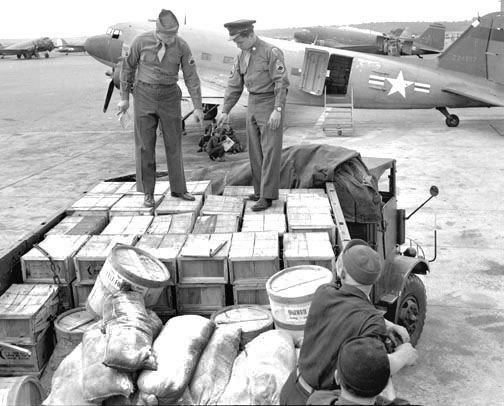
However, the airlift continued months afterward as a buffer against any further Soviet ploy. By operation’s end — September 30, 1949 — more than 2.3 million tons of supplies had been lifted-in and a world crisis averted.
For Powell, its success, along with rebuilding Europe, were America at its best. “We’re an amazing country. Sometimes we have a veritable uncanny propensity to do the right thing. It brought into rather sharp relief just what could be done. In my humble opinion the United States, between 1945 and 1950, could be compared to ancient Greece under Pericles. It as a golden era. We did virtually everything right and you can’t do that without leadership. We were deep in leadership after the war.”
He says the feeling in America then — “that everybody was in this together” — is hard for young people to understand. “Now, we’re so disparate. Everybody’s off doing their own thing. But I still put my faith in the willingness of the American people to do the right thing…given the right leadership.” The airlift’s legacy, he says, is the goodwill it generated. “Civic-minded Germans formed the Berlin Airlift Foundation to take care of the wives and children of the airmen killed in the lift.
When he joined other vets in Berlin last May he spoke with Germans who vividly recalled the airlift. “They all mentioned the omnipresent noise. One lady told us, ‘It didn’t bother us because we knew if the noise continued we would eat.’ He adds the warm outpouring of gratitude got him “a little choked up. We made generations of friends there.” He says if there’s any heroes in all this, it’s “the people of Berlin, because they could have very easily gone to the Soviet sector and been fed and clothed. No question. They were down to 1,200 calories a day but chose to stay and stick it out. These people sought self-determination.”
After the airlift Powell was set to study law when the Korean War erupted. He spent 21 more years in the service, moving from place to place “like a locust.” Posted in France during the ‘60s, he became a certified Francophile — enamored with the nation’s history, culture, people. He’s often returned there.
Along the way he married, raised a family (he has three grown children) and indulged a lifelong search for knowledge by reading and studying. He describes himself then as “a kind of journeyman” scholar. That all changed in 1964 when plans to join an F4 Phantom squadron off the coast of Vietnam were scuttled and he was assigned instead to Offutt Air Force Base.
Here, he finally stayed one place long enough to earn a degree (in business administration from Bellevue University). And here he’s remained. His post-military career saw him remake himself as an authority on public policy and aging issues, earning a master’s in public administration and a Ph.D. in political science. UNO hired him in 1973 to implement training programs under the Older Americans Act.
As a full professor today he teaches courses, advises students and collaborates with colleagues on
articles, surveys and studies. He’s applied the public service mission he took from the airlift to serve political campaigns, advise local and state government and participate in White House conferences on aging. Both his life and work dispel many myths about aging.
“We feel it’s wonderfully appropriate to have a 78-year-old teaching younger people all older people are not alike,” says James Thorson, UNO Department of Gerontology Chairman. “Dr. Powell is an excellent instructor and accomplished researcher. He’s wildly popular with students. He works long hours. He wants to wear out, not rust out, and I respect him for it.”
It was at UNO Powell met Betty. Both were recently divorced. He was teaching, she was doing grad work. They married in 1982. Everyone agrees they make a good match. They travel together and enjoy entertaining at their sprawling Keystone neighborhood home, where he often holes up in a study whose impressive library is stocked with volumes on American history (the presidents, the Civil War) and France. Travel is no idle pursuit for him. He researches destinations and prepares itineraries detailing sites and themes, from architecture to art to vineyards. He got in the habit in the service.
“It permits you to observe how other people do things and to see Americans don’t have a corner on how things are done.”
The couple prove growing older doesn’t necessarily mean slowing down. In typical fashion he and Betty plan ushering in the new millennium under the Eiffel Tower in Paris. “I’m really looking forward to it,” he says. In his office hangs an enlarged photo of the French landmark with an inscription that sums up his ageless sense of wanderlust: “Paris is like a lover. You may leave her, but you will never forget her.” It’s the same way with Chuck Powell: Once you meet him, you never forget him.
Related Articles
- Causes, Reasons and Results of the Berlin Airlift (brighthub.com)
- Trail of the unexpected: Tempelhof Park, Berlin (independent.co.uk)
- James Rodney Ferrell, 90 (kitsapsun.com)
- History: The Berlin Airlift (americanthings.wordpress.com)
- How much supplies did Berlin Airlift receive (wiki.answers.com)
- Candy Bomber: The Story of the Berlin Airlift’s Candy Bomber: The Story of the Berlin Airlift’s “Chocolate Pilot” by Michael O. Tunnell (alleganylibrarycollections.wordpress.com)
Bill Ramsey: A Korean War Story

Image via Wikipedia
Journalists look for hooks to hang their stories on, and anniversaries of major events are always convenient pegs to use. On the 50th anniversary of the Korean War I profiled the combat experience of Bill Ramsey, an amiable man who made a rich life for himself after the conflict as a husband, father, PR professional, and community volunteer. He has devoted much of his life to veterans affairs, particularly memorializing fallen veterans. He’s also authored a handful of books. He’s still quite active today at age 80. Anyone who survives combat has a story worth repeating, and it was my privilege telling his story in the New Horizons. Now, in conjunction with the 60th anniversary of the Korean War, I offer the story again as a tribute to Ramsey and his fellow servicemen who fought this often forgotten conflict.
Bill Ramsey: A Korean War Story
©by Leo Adam Biga
Originally published in the New Horizons
Fifty years ago, Americans were piecing their lives back together in the aftermath of World War II when the best and brightest of the nation’s youth were once more sent-off to fight in a distant land. This time the call to arms came in defense of a small Asian nation few Americans were even aware of then — Korea. In June of 1950, Communist North Korean forces (with backing from the Soviet Union and Red China) launched an unprovoked attack on the fledgling democratic republic of South Korea, whose poorly prepared army was soon overrun. With North Korea on the verge of conquering their neighbors to the south, the United States and its Western allies drew a line in the sand against Communist expansionism in the strategically vital Far East and led a United Nations force to check the aggression.
Among those answering the call to service was a tall, strapping 20-year-old Marine reservist from Council Bluffs named Bill Ramsey. His wartime experience there became a crucible that indelibly marked him. “The war will always be the most defining experience in my life,” said Ramsey, 70, whose full postwar years have included careers as a newsman, advertising executive and public relations consultant. He and his wife of 46 years, Pat, raised five children and are grandparents to 14 and great-grandparents to one. This is his Korean War story.
In the fall of 1950, Ramsey was preparing to study journalism at then Omaha University. His plans were put on hold, however, with the outbreak of hostilities overseas. He followed the unfolding drama in newsreel and newspaper accounts, including the U.S. rushing-in army divisions grown soft from occupation duty in defeated Japan. The invaders pushed South Korean and American forces down the Korean peninsula. Ramsey sensed reserves might be recalled to active duty. He was right.
He was assigned a front line unit in the 5th Marine Regiment, 1st Marine Division, Reinforced. He was excited at the prospect of seeing action in a real shooting war, even one misleadingly termed “a police action.” His anticipation was fed not by bravery, but rather heady youthful zeal to be part of the Corps’ glorious tradition. The conflict offered a once-in-a-lifetime opportunity to test himself under fire. After all, he was too young to have fought in his older brother Jack’s war the previous decade. This would be his war. His proving ground. His adventure.
“I wanted to be in the front lines. I didn’t want to go all that way to end up sorting letters in Pusan,” he said. “I was curious to know how I would hold up in action.”
No stirring salute or fanfare saw the Marines off as their Navy attack transport ship, Thomas Jefferson, pulled out of San Diego harbor in March 1951. Ramsey was one of hundreds of young men crammed in the hull. They had been plucked away from factories, offices, schools, homes and families. Ramsey left behind his mother, brother and an aunt (his father died when he was 12). The GIs were going to defend a land they did not know and a people they never met. Their mission lacked the patriotic fervor of WWII. There was no Pearl Harbor to avenge this time. No, this was a freedom fight in a growing global struggle for people’s hearts and minds.
Before ever setting foot on Korean soil, Ramsey smelled it from aboard ship in the Sea of Japan. Nearing Pusan harbor in the far southeastern tip of Korea, the heavy acrid odor of the war-ravaged countryside permeated the air. It was the stink of sulfur (the discharge from spent armaments), excrement (peasant farmers used it as fertilizer in their fields), fire and death. “That all mixed together made for quite a pungent odor,” he said. “It’s a stench that you never forget.”
Ramsey and his Able Company comrades were flown into a staging area near Chunchon in east-central Korea to await transport to the front. The city had sustained heavy damage. “It was pretty well leveled at that point,” he recalls. Standing on a wind-swept tarmac, he saw snaking down a road from the north a convoy of trucks carrying combat-weary GIs being rotated out of the line. These were veterans of the famous Chosin Reservoir Battle who defied all odds, including numerically superior enemy forces, to complete a withdrawal action that featured hand-to-hand combat. Ramsey and his green mates were their replacements.
“I remember when they got off the trucks they looked like zombies. Their faces were covered with a fine white powdery dust and their hands were blackened from the soot of the fires burning everywhere in the country,” Ramsey said. “I thought, ‘God, I’d give anything to have gone through what they’ve gone through and to be going home.” Among the dog-faced vets was a friend, Phil O’Neill, from Council Bluffs. “He tried to tell me what it was like. He didn’t exaggerate or try to make it any scarier than it was. He didn’t fool around or joke. He just gave me some good advice, like keep a low profile and keep your weapon dry.” After seeing and hearing what awaited him, Ramsey felt an overpowering desire to join the departing GIs. “They were going home. That really hurt. I was so envious.”

Ramsey’s unit headed for a position along the central front. Every village and field they passed was scarred and charred. “We drove all night. We could see fires burning. Again, we could smell the countryside,” he said.
Movement was the order of the day in a war of quickly shifting positions along the long and narrow Korean peninsula. “It was a very fluid war. We were moving constantly, sometimes by truck and sometimes marching 20 or 30 miles in a day to the next spot,” he said. Rough mountainous terrain, bad roads and inclement weather — marked by extreme temperatures, torrential rains, floods, snow and ice — made the going tough. “The farther north you go the more mountainous it becomes. You always had to go up a hill or some rocky face. No flat open fields. This was trees and rocks and cliffs. A really difficult place.” While he never had to endure the brutal winter, he described conditions “as miserably cold. And when it rained, which it did a lot, you were soaking wet, cold and knee-deep in mud. You thought you could never get through it, but you kept going.”
When his company first arrived, U.N. forces were striking out in a series of bold counteroffensives. By the summer, the war was bogged down in a stalemate. A single position (invariably a hill) would be taken, lost, and retaken several times. “It was pretty much hill by hill,” Ramsey said. Platoons were like firefighters rushing from one hot zone to another. A hundred yards or less might separate opposing forces. The basic objective was usually capturing or holding a perimeter on one of the endless sharp-edged ridge lines. Upon reaching a position, the Marines set-up machine gun posts and prepared cover by digging fox holes. Not only did the metal shards from incoming mortar and artillery pose threats, but splintered rock made deadly projectiles too. “
You always had to get some protection for yourself from shrapnel,” he said. Sleeping accommodations were standard-issue pup tents or makeshift bunkers (for extended stays). “Most of the time you stayed one night or two nights and then walked to another position, where you’d dig another hole.” The premium was on moving — no matter what. “You have aching feet. A sore back. You’re tired, discouraged. You’re cold, dirty. You’re sick (dysentery, encephalitis, etc.). But you can’t stop. You’re there, you’re on the move and there’s no way out unless a doctor says you just can’t go on and sends you to the rear.”
On rare occasions when his platoon remained in one spot, barbed wire was strung across the perimeter. The men had to be on constant alert for all-out charges or smaller probing raids looking for weaknesses in the line. “A lot of times they were through the position or in the position. They weren’t always stopped at the wire,” Ramsey said. Nightfall was the worst. The enemy preferred attacking then by frontal assault or flanking maneuvers. To keep a sharp defensive perimeter, men took turns sleeping and watching — two hours on and two hours off — through the night. “You never let your guard down. We were always ready,” he said, adding that the last two years of the conflict it got to be “almost like trench warfare.”
His first taste of combat came early in his hitch. His platoon was dug in for the night on some anonymous ridge line, the men extra wary because reconnaissance had spotted enemy massed nearby. “We were told the Chinese were going to be coming in some force. It was pretty hard to sleep anyway, and anticipating my first night under fire made it that much harder. Sure enough, they came that night. I remember a lot of noise. Mortars. Shots. All that firepower. I remember thinking, “I would love to be able to cram myself inside my helmet.” I somehow got through that night. The next morning they brought in some of our killed. They were in ponchos — their feet sticking out. They were carried down the hill.”
Sometimes, a noise from somewhere out in the pitch black warned of encroaching danger. Other times, a fire fight broke loose with no warning at all. “You would hear something or you would sense something. You laid down fire if you heard anything at all out there. Their movements might trigger a flare, which made it easier for you to see them moving but also made it easier for them to see you,” he said. “On occasion, they would purposely make some noise to try and shake you up. They would produce some tinny sound or blare a bugle or just shout out. It was a psychological ploy.” A dreaded eerie sound was the “zzziiippp” made by the infamous Chinese burp gun, an incredibly fast-firing tommy gun-like weapon.
Perhaps the most terrifying action he saw came the night his outfit’s position was nearly overrun. What began as a cold damp day worsened after sunset.
“We got to our positions pretty late that night. It was raining. We dug in as fast as we could. We’d been in quite a few fire fights in the days preceding that. We thought with the weather this might be one of those nights when the enemy didn’t do anything. We were wrong,” he said. “Our machine guns started firing, and when you heard those you knew they were coming. A few of the enemy broke through our position and came right in the camp. I was quite shocked. We’d never had that before. I saw them through flashes of fire. It was very confusing. A real nightmare. We finally pushed them back.”
There were casualties on both sides. Ramsey said the enemy took advantage of the night, the rain and his unit’s complacency. “They knew Americans were not that big on night fighting and that with the bad weather we might be more inclined to worry about staying dry than steeling for attack. I think what happened is somebody in our ranks did let down. That was the only time they got in our camp that way.” He said an enemy breaching the wire could “demoralize” the troops and, if not repelled, result in a much larger breakthrough.
He described “plenty of close calls” on Able Company’s grueling march north across the 38th Parallel to engage the Chinese in the Iron Triangle stronghold. There was the omnipresent threat of mortar and artillery fire. If you stayed in the field long enough, he said, “you could hear the difference in the sound” and distinguish mortars from artillery and what size they were. Where a mortar round or artillery shell whistling high overhead gave men time to find cover, the report of the Chinese mountain gun, which fired shells in a low trajectory, allowed little or no time to hit the dirt. “You heard the report and, BOOM, it was right there. It fired in on like a straight line.” And there was occasionally the danger of friendly fire, especially errant air strikes, raining hell down on you.
Fording the streams that flowed abundantly from the mountains in Korea presented still more hazards. As heavily weighed down as the men were with their poncho, pack, boots, rifle, helmet, and ammunition, one slip in crossing the clear, fast-rushing streams (more like surging rivers) could be fatal. “A few times I felt like I was going under for sure,” Ramsey said. “I wouldn’t have had a chance.” Carrying their rifles overhead to keep them dry, the men were sitting ducks for snipers. “We were exposed,” he said.

Once, he recalls his platoon just making it to the far bank when shots began splaying the shore from the hill above. “We couldn’t see too much because it was fairly steep. We finally did draw fire on this hill.” But when Ramsey got ready to fire his M1 rifle, he got a rude surprise. “I pulled the trigger and nothing happened. That was a terrible feeling. In all that sloshing through the water my weapon must have got wet. I used a wounded buddy’s carbine instead.”
A fire fight Ramsey will never forget erupted when his 1st squad was returning to the lines after completing a mission and saw the point squad ahead of them “get hit” in an ambush of machine gun fire. Several men were cut down in the ensuing action, including 1st’s squad leader and Ramsey’s good friend — Don Hanes. “He was shot in the chest. Another fellow and I went back up this hill to get him. The fire was really intense. I was amazed we weren’t all killed on the spot. We started taking him down and Don looked at us and said, ‘No, no, no, no, no…Just leave me. You’ve got to get out of here. I’m not going to make it.’ He was a brave fellow. He was hurt so badly. Well, we did get him out of there — across an open rice paddy. He was evacuated to a hospital, but it turned out he was mortally wounded. He died later. We had a number of other casualties we carried too. It was a grim day.”
At 20, Ramsey was named temporary squad leader. He already led a four-man fire team. In addition to M1s, the team carried a single Browning Automatic Rifle or BAR. Their mission: flushing out the enemy or scouting enemy lines. Sometimes, they ran sniper patrols. If the enemy was sighted (with the aid of a sniper scope), the team’s job was to “throw some fire in” and try to pick-off or pin down targets. “We wouldn’t necessarily hit them all the time,” he said. Days or weeks might pass without enemy contact. Once, Ramsey came face-to-face with his foe. It happened when taking a hill. He and another Marine surprised a North Korean soldier. “We both fired at him, and he fell dead. We went over to where he was lying on his back. There was a pouch. We opened it and found a photo of a woman and a child. I thought, ‘He’s just like me.’ We had been thinking of the enemy as a bunch of faceless fanatics, and here was a man with a wife and child. It made an impact.”
By November 1951, Ramsey had been in-country eight months. Despite steady combat, he’d escaped unscathed. He hoped his luck held out just a few months more — then his hitch would be up and he’d be back stateside. “You see people dropping everyday. You see friends maimed and killed. You see guys going out of their head. You wonder when your number’s going to come up next. You ask yourself, ‘How can I ever get out of here?’ It’s a sinking feeling,” he said. He feels what keeps men going in such awful conditions “is your intense desire to survive and to see your loved ones again. That kept me driving.”
On the morning of November 17, his fire team “headed out on a routine sniper patrol” down Hill 834. “It was one of our more permanent lines. The hill was a muddy mess. We weren’t out long when one of us tripped a land mine, and a piece of shrapnel caught my right arm.” The impact sent Ramsey skidding face down the hill. “I was in shock, but I knew it was pretty bad because my dungaree jacket was shredded and blood was all over the place.” Metal fragments had severed his ulnar nerve and fractured bones. His mates brought a Navy corpsman to his side. The corpsman applied a bandage and administered a shot of morphine. Ramsey’s buddies then carried him up the hill and down the reverse slope to a small, level clearing. There, a second casualty from down the line was stretchered in — missing a foot. Ramsey recalls an officer giving him a cigarette to drag on and saying, “You got a million dollar wound there, Bill…you’ll probably be going home.” Still, Ramsey worried he might lose his shattered arm, which burned with pain. A helicopter evacuated he and the other casualty to a nearby MASH unit.
Rushed into surgery, Ramsey awoke the next day to the news doctors had saved the arm. Wearing a cast, he was taken (by ambulance) to an Army hospital in the devastated capital of Seoul. “There was nothing standing,” he said. From there, he was flown (on a transport plane stacked with wounded) to an Army hospital in Osaka, Japan, spending days in agony (receiving no treatment as a non-Army patient) before transferred (via train) to a Navy hospital in Yukosuka, where he finally found some relief for the pain and slept for the first time in nine days.
In early December he hopped a four-engine prop bound for the states. He landed at Travis Air Force Base in southern California. His first impulse was to call home. He next reported to Oak Knoll Navy Hospital near Oakland, where he underwent skin grafts and three months of physical therapy. During his rehab, the Purple Heart recipient recalls being torn by two emotions: “I felt sick about leaving and letting my buddies down. But the other side of it was I was really thankful to get out. Eight months there was enough.” His long voyage back ended almost a year to the day his Korean odyssey began. A relieved Ramsey arrived to “the quiet of my wonderful home.” He downed a beer and thanked God the journey was over at last.
Upon his return (he graduated from Creighton University) he was dismayed by the indifference civilians expressed toward the raging conflict. From its start in June 1950 to its conclusion three years later, it never captured the public’s imagination. Many observers feel it came too quickly on the heels of World War II for Americans — then preoccupied with living the good life — to care. Cloaked under the murky misnomer “police action,” it became a shadow war.

President Harry S. Truman summed up the national mood when he called it “that dirty little war.” Its status as “the forgotten war” was sealed when it ended not with victory but an armistice leaving Korea still divided at the 38th Parallel (with a permanent American military presence there to keep the peace.) Lost on many was the fact the true objective — preserving a democratic South Korea — was accomplished. In the larger scheme of things, a free South Korea has emerged as a thriving economic juggernaut while a closed North Korea has withered in poverty. Ramsey saw for himself the economic miracle wrought in South Korea on a 1979 trip there. He met a people grateful for his and his comrades’ sacrifices. Monuments abound in recognition of the U.N. “freedom fighters.”
It is only recently, however, these veterans got their due in America. In 1995 the Korean War Memorial was dedicated in Washington, D.C. (Ramsey was there). In the late ‘70s Ramsey, whose post-war life has been devoted to causes, spearheaded the erection of a joint Korean-Vietnam War monument in Omaha’s Memorial Park. The monument has received a recent refurbishing and the addition of a flower garden. This year, he started a Nebraska chapter of the National Korean War Veterans Association.
For vets who went to hell and back, the war is never far from their thoughts. “I’m proud to have served. We stood fast. We saved the south. I can think of no higher compliment than to be called a freedom fighter,” said Ramsey, who, in 1997, faced a new enemy — prostate cancer. Aggressive treatments have left him cancer free. In August, he attended a reunion of his 1st Marine Division mates. “My admiration continues to grow for the Marines with whom I served,” he said. For their heroic actions there, the division received the rarely bestowed Presidential Unit Citation.
Related Articles
- Korean War veterans reunite to share memories (knoxnews.com)
- Legacy of the Korean War (theworld.org)
- The Korean War 60 years on: Images from the conflict (independent.co.uk)
The Artful Dodger: Lou Leviticus survived the Holocaust as an escape artist
The story more or less appeared as it is here in The Reader almost a decade ago. It was later reprinted in The Jewish Press. I have always hoped to share the story with a wider audience.
NOTE: Leviticus has subsequently told his own story in a book he wrote.
|

The Artful Dodger: Lou Leviticus survived the Holocaust as an escape artist
©by Leo Adam Biga
Originally published in The Reader (www.thereader.com) and then reprinted in The Jewish Press
“I’ve been an escape artist all my life.”
The apt words belong to Lincoln, Neb. resident Lou Leviticus, a square-headed terrier of a man who as a youth in his native Holland survived the Holocaust partly due to his talents as an artful dodger. He escaped the Nazis more than once, even when those closest to him were caught and put to death. As an orphan on the run he became one of scores of hidden children in The Netherlands, his survival dependent on a cadre of strangers that cared for him as one of their own.
Today, when telling his saga to young Hebrew students at Temple Israel Synagogue in Omaha, the spoken truth sounds less like glib bravado than it does a solemn proverb. And, like an answered prayer, members of the Dutch underground rescued him. Families working with the underground risked their very lives taking him into their home and shielding him from danger. He regards those that helped him, especially Karel and Rita Brouwer, as his “heroes” and “protectors.”
During his time in hiding Leviticus endured and did some unspeakable things. An archly unsentimental sort, he sheds no tears over what happened. Despite it all, he emerged a life-affirming dynamo. The retired University of Nebraska-Lincoln agricultural engineering professor first came to America in the mid-1950s (by way of Israel, where he resided after the war) to obtain his Ph.D. He married, raised a family, got divorced. He wed his present wife, Rose, a native of Great Britain, in 1982. He became a U.S. citizen four years ago. While at UNL he also headed the Nebraska Power Lab and Tractor Testing Laboratory. Today, he is an agricultural engineering consultant.
Until quite recently he kept his story to himself. That changed when the Survivors of the Shoah Visual History Foundation requested he tell it for the sake of posterity. The Los Angeles-based Foundation, which filmmaker Steven Spielberg formed after completing Schindler’s List, is dedicated to recording and preserving the largest repository of Holocaust survivor stories in the world. Since 1996 the organization has been conducting videotaped interviews with survivors from every corner of the globe. To date, some 50,000 interviews have been cataloged for use by scholars and for dissemination in schools and libraries.
In 1996 Leviticus shared his story with Omahan Ben Nachman, a Holocaust researcher and Shoah-trained interviewer who’s collected dozens of testimonies. Since then, Leviticus has written his memoirs and related his tale to youths at schools and synagogues. Why, after all this time, is he bearing witness now?
“The only reason I do it,” Leviticus said, “is to maybe make somebody think about it and realize how fortunate they are. That they should not take their lives so easily for granted. That they have a little more gratitude for what they have…because what happened then can happen again. It is happening again. Look at Chechnya. Look at Kosovo. Look at the skinheads in this country. There is hatred. People are cruel. And I do now feel it as an obligation, not necessarily to this generation, but to my school buddies, my parents, my grandmother, and to all those people. If I don’t tell their story, what else is left of them except their names in a register?”
  |
|
| Lou Leviticus, professor emeritus and volunteer curator at the Larsen Tractor Museum on East Campus, holds a copy of his recently published memoirs detailing his childhood in the German-occupied Netherlands. His parents were killed at Auschwitz in 1942. Photo by Brett Hampton. |
Because ethnic cleansing seems far removed from the modern American experience, it is easy to distance oneself from such evil. But the truth is no one thinks it can happen to them, ever. That’s exactly how most Dutch Jews felt when Nazi Germany overran their nation in May of 1940. That’s why the only way to understand what happened is to recall the insidious events that systematically isolated Jews from mainstream Dutch life, all because they were deemed “different” and ultimately expendable. How else can one explain a child having to flee and hide to save his own life? Unthinkable, yet it occurred.
In a recent interview with The Reader, Leviticus recalled those years. Speaking from the deck of his comfortable tree-shaded home in Lincoln, the scene could not have been more incongruous with what he described. Despite what eventually transpired, his homeland was a tranquil place before the invasion. Pre-war Holland, after all, was a civilized society. Its large Jewish population enjoyed complete freedom, if not full acceptance. Leviticus and his parents led a privileged life in Amsterdam. As foreign correspondent for a large recycling company, his father, Max, handled relations with foreign clients. An outdoorsman, Max enjoyed long bicycle rides and walks in the countryside. Lou’s mother, Sera, was a socialite and spiritualist who gave bridge parties and hosted seances at the family’s large home.
“My mother was pretty deeply into spiritualism — mediums and seances and astrology — which was very fashionable in those days. I can still see her working with these charts on a table, trying to figure out what the hell was going on in the world. I’ve always wondered about that — if she could see what was going to happen to us or not,” Leviticus said.
As a boy he often joined his mother at Heck’s Cafe, a swank gathering spot for the smart set, where he listened to live band music while she hobnobbed with friends.
Music, especially opera, held young Lou enthralled. He had his own radio and spent endless hours listening to favorite tenors and to detective programs. An avid reader, he fancied the adventure tales of German author Karl May. Despite being undersized, he was athletically adept and belonged to swimming and soccer clubs. A cinema lover, he skipped Hebrew school to catch the latest movies.
His family lived quite close to Anne Frank’s family. A cousin of hers, Paul Frank, was a friend and playmate of Lou’s. Because she was two years older than Lou, he only knew her casually, but recalls her as a “nice girl. She was more mature than me.”
Admittedly “a spoiled brat” doted on by his maternal grandmother, Leviticus lived a carefree life. His parents, who employed a servant, had their every need met.
The family’s idyll ended May 10, 1940 when Germany invaded Holland. The Dutch, who remained neutral during World War I, had felt protected from the brewing storm in Europe despite Germany’s increasingly ugly rhetoric and military incursions. Caught unprepared, Holland’s meager defenses were quickly overwhelmed by the blitzkrieg. The Netherlands capitulated five days after the attack began. Even though he was not quite 9-years-old, Leviticus recalls it all.
“I remember all five days. For us kids it was the greatest adventure in the world. We didn’t see the sickness. We heard people were being killed, but we didn’t see it. We did see German planes in the air and men shooting at them. It was exciting.”
Perhaps his most vivid memory then is the sight of a city under siege at night, its lights darkened and streets emptied owing to the mandated curfew and blackout. As a child, the horror of the invasion was finally brought home when he saw adults around him shattered by the events. His father, a WWI vet, had been called up to serve in the civil defense corps. On May 15, the day the Dutch surrendered, Lou was shocked to find his father sobbing at home. “I can still see him sitting in the side room crying. It was the first time I saw my dad cry. I remember asking him, ‘What’s the matter?’ But he couldn’t talk.”
According to Leviticus, who has researched events leading up to the German conquest and the ensuing terror campaign, much of the Dutch ruling class held pro-Nazi sympathies and as such these Fifth Columnists aided Germany in subduing The Netherlands. Beyond politics or prejudice, he said, the compliant nature of the Dutch people, combined with a meticulous citizen registration system, made it easier for the Nazi regime to exert its will there.
“My feeling is that the Dutch have always been very obedient to authority — any authority. The Germans had the authority and when they installed a Dutch puppet government, that was the government, and therefore they were obeyed. The Dutch also had a population registration system in place unparalleled in its accuracy in Europe. In fact, (Adolph) Eichmann liked it so much he copied it in other countries under Nazi rule. That system should have been destroyed when the Germans occupied The Netherlands, but the people who ran it were so proud of their work and so pro-Nazi they handed it over in full to the Germans, who used it to curtail the activities of Jews and other undesirables.”
He said people were so accustomed to registration few saw danger in its application by occupying forces. “Nobody thought much of it, and so they re-registered.” He added the Germans were “very cunning” in passing decrees that, step by step, cut-off Jews from the general populace. “It started with very little things. In June, Jews were forbidden from being part of the civil defense. In July, they were excluded from the labor draft. Then there was a ban on ritual slaughter. In September, Jews were banned from selling in the regular markets. The Germans never targeted the whole population. Otherwise, that would have probably created unrest. Instead, they targeted sections, making each segment register and abide by restrictive laws. First, it was physicians, then pharmacists, then lawyers. Each week there was a different order affecting some group, and the others said, ‘Well, it’s only them,’ and in the end it was everybody. The noose was tightening, but most people didn’t realize it, and by the time they did it was too late.”
The first anti-Jewish regulation affecting him was a 1941 law banning Jews from all movie theaters except the single Jewish-owned cinema in Amsterdam. “I was an avid moviegoer and the only theater left I could go to soon became too dangerous because there were always Nazi youths waiting outside to cause mischief. We were yelled at, spit on, and so forth. It became impossible to go there unless you were with grown-ups and even then it sometimes got a little bit hairy.” He next felt the sting of anti-Semitism when Jews were forbidden from entering parks and from holding membership in sports clubs. In a cruel display of public humiliation, he was drummed off his soccer team by the coach in front of jeering teammates.
At the same time, the Nazi propaganda machine worked overtime inflaming anti-Semitic fervor. He recalls placards affixed everywhere with slogans like “The Eternal Jew,” “The Dirty Jew” and “Watch Out for the Jew” emblazoned on them. The posters typically depicted grotesque, deformed, horned figures with the Star of David displayed on their chest or forehead. Soon, all Jews — their businesses and residences too — were required to bear the yellow star. “When you got the star you were a marked person,” he said. “Now you couldn’t hide behind your looks. There were always groups of Hitler youths running around terrorizing people. They started making life very difficult. We, as kids, were beaten up — quite severely at times. Grown-ups didn’t interfere. They were afraid. The police seldom intervened.” Schoolmates he counted as friends turned on him, yelling epithets. “I went to school with great trepidation. I took a terrible beating one day and adults stood by laughing. Things got worse and worse, until every aspect of my life was affected. You felt you were an unworthy person. That you didn’t have the right to walk the same streets as other people. It made me feel terrible, awful, angry.”
Schools were finally segregated, which Leviticus viewed as a welcome relief. “We were a pretty intelligent and rowdy bunch and we had a lot of fun in fact. We were all in the same boat. We were all together. That was the best part of it.”
By 1942, people started disappearing. Rumors spread the missing persons were hauled away to camps to be gassed or shot. “Nobody talked about it,” Leviticus said. “Not the teachers, not the parents. They didn’t know how to talk about it. They didn’t want to believe what was happening.” The fear turned personal when his girlfriend, Anita, was arrested along with her mother and sister. “I was very, very heartbroken for a long time because she was really my pal. We did homework together” He later learned she and her family died at Sobidor concentration camp.
As early as 1942 Jewish men were rounded up and taken away. It happened to Leviticus’ father, who ended up in the work camp, Ommen, where men worked clearing forests for agriculture, but in truth awaited transit to concentration camps and certain death. When the elder Leviticus learned of his group’s impending transport, he concealed himself in one of the deep trenches the men dug and escaped at night. Lou has since documented his father was the only prisoner from his work detail to escape alive. While in hiding, Max got word of his escape to Sera, who fled to a prearranged safe house in the country. Lou, in school at the time, was unaware of the unfolding intrigue. His first inkling of it came when an unfamiliar man came there one day with a note from his mother.
“My mother’s note said for me to go with him. The man told me, ‘Your mother’s waiting for you. Don’t worry.” Of course I was worried. I didn’t know what was happening. I had never seen him before, but I knew my mother’s handwriting, so I went. He took me into a hallway, took my coat off, gave me another coat without a star on it, grabbed my hand and we walked away. We went on a train. The train trip was frightening for me. We had to pass German police controls at various stations. By then I had been brainwashed so that I was sure I looked like any of those pictures of the Eternal Jew. I was afraid of anyone who had a uniform or boots or a dark coat on because those things represented Nazis. By then, I didn’t trust anyone any more. I’d lost my trust in the grown-up world.”
The pair passed through police checkpoints without a hitch. They got off at Amersfoort, a town 40 kilometers southeast of Amsterdam, where, it turned out the boy’s mysterious escort, a Mr. Van Der Kieft, was a plain clothes detective. Secretly, he was also a top operative in the Dutch underground movement that provided false identity papers, ration cards and safe havens to fugitives. As Leviticus soon found out, the underground network would be his lifeline. Van Der Kieft took Leviticus by bike to the farmhouse his mother had gone to. His father joined them days later. After two months in hiding, the family had to find refuge elsewhere when the farmer sheltering them demanded more money than they could pay. Leviticus said there were any number of people ready to help then, whether “out of good will or for good money.”
Thanks again to the efforts of the underground, the family was put up at a house in Amersfoort belonging to a coachman, who lived on the ground floor. Lou’s family shared a pair of small rooms on the third floor. Between the two rooms were sliding doors. The back room opened on a veranda with a railing. The family had to be on guard at all times. “We had to keep very quiet during the day and not show ourselves in front of the windows,” he said. “We couldn’t close the curtains then, as that would arouse suspicion in Holland, where there’s little light. When the bell rang at the main door below we would freeze. We could hear the bell, but we couldn’t see who was calling. At night we could become a little more active because then we could close the doors and curtains. But if there were guests we had to sit still. We couldn’t use the toilet then, so we used a chamber pot.”
Father, mother and son passed the time reading and playing board games. “I don’t remember that as being terrible because there was so much to read,” he said.
Then, one October afternoon in 1942, the bell rang and the word “police” was spoken at the bottom of the stairs. Raised voices barked, “Stay where you are. Don’t move.” Leviticus recalls his mother “started crying.” They knew the authorities had come for them. With police bounding up the stairs to the family’s third-floor hideaway, young Lou made a fateful split-second decision and, without a word, clambered to the veranda opening, hopped atop the railing, and jumped. That moment of fear and flight was the last he saw his parents alive.
“Before I jumped the last thing I remember is seeing my dad close the doors behind me. That gave me enough time to get away. My dad didn’t hesitate. It happened so fast. Below me on the ground floor, luckily, was a large awning jutting out. I hit the awning, slid over it, landed on my feet and whew, I was gone. I didn’t look back. I didn’t run either — a good thing, too, because police were out searching the grounds. One policeman probably saw me, but lost me when I climbed over a bunch of fences. I came to a house and climbed up on a rain pipe. I got to another porch, climbed over the railing there and found a big wash tub. I pulled the wash tub over me — it made a helluva racket — but nobody was home.”
He credits his quick actions to “pure self-preservation,” adding, “It was just pure instinct. I don’t know where it came from, except maybe the Karl May stories inspired me not to be caught. I knew what I had to do. I had seen other people being picked up by the police on the street and they never came back, and that wasn’t going to happen to me.” He does not second-guess his fleeing. He only wishes his folks escaped too or at least knew he was safe. “I knew I’d done the right thing because, number one, I’m alive. I’m sorry I couldn’t say goodbye and hug my mother and father. That is my only regret. That, and the fact they suffered and I couldn’t do anything.” His parents, like most of his family, were soon killed.
After eluding the police, he waited until dark, then fumbled his way to the home of a man who was active in the underground. When he arrived there the man’s frightened family explained the head of the house was in hiding. Earlier that day police had cracked down on the local underground cell and come looking for the man, who’d escaped. The family feared the police’s return. Leviticus felt safe for the moment but as he lay in bed that night he overheard the family discussing turning him over to authorities. “When I heard that I decided that wasn’t going to happen. Early the next morning I stole some clothes and food, opened the door, and went on my own to the east.” Fending for himself in a world intent on his destruction, he learned to live by his wits’ end, foraging for food and shelter at local farms. But as a child on his own, he stood little chance for long. After days on the road, he came to the same farm he and his family began their hidden life at.
Fearing the farm was not a secure hideout, Leviticus was relieved when the underground placed him with Karel Brouwer, then a 24-year-old civil servant with a new wife and young child. Neither the first nor the last person Brouwer rescued, Leviticus stayed with him and his family for much of the remainder of the war. “He’s a remarkable man. He took me to his home in Hamersveld. He practically adopted me. He never intended to be a hero, but somehow it was thrust upon him, and he risked everything to feed, shelter and keep me and others out of harm’s way.” Lou still keeps in touch with his “second family.” In a fateful twist, the first refugees Brouwer helped were Lou’s aunt, uncle and maternal grandparents. Through his position in local government, Brouwer’s covert network used the registration system to provide hunted Jews and non-Jews alike with false names and documents. Thus, Lou took on the identity of Rudi Van Der Roest, a Christian boy his own age from Amsterdam. Researcher Ben Nachman said such actions underscore how Holland was rife with contradictions. For example, while a high percentage of its native Jews were murdered, the country’s active underground movement shielded a great number in hiding.
As Rudi, Lou lived the unencumbered life of a non-Jewish child — attending school, playing in parks, traveling freely. Whenever detained, his cover story was that he was away from home due to hardships caused by the war. The deception worked. “Each of us in hiding were stopped and interrogated by the Germans at least once or twice, so we knew how to lie with a straight face. You got very adept at that. Every time you did something to thwart the Nazis it made you feel good.” He enjoyed freedom but guarded what he said and did so as not to compromise his true identity and therefore risk endangering himself, the Brouwers and the underground. “I had to be careful. I couldn’t afford any slips of the tongue, so I couldn’t get close to a lot of people. Whatever I wasn’t told, I didn’t ask. You learned that very quick. I knew the less I knew, the better it was.”
Life with the Brouwers was sweet. “A lot of beautiful things happened during the war,” Leviticus said. “There were times when I forgot the misery. I was extremely lucky to get through that experience, not unscathed exactly, but well-looked after.” He adds that not all hidden children were as lucky as himself. “The Brouwers loved me. They were good to me. In many cases, though, kids were shuttled from place to place and mistreated by their host families.”
As a base for the underground the Brouwer home witnessed many comings and goings. All the activity must have raised suspicions because, in February 1945, the police raided it. The whole family, including Lou, then 14, was home that day. The police found mounds of incriminating evidence — from papers to ration cards to guns. Everyone was interrogated on-site. Crying after being roughed up, Lou regained enough composure to hatch another escape. He explains: “I asked if I could use the toilet, and the police said I could if I left the door open. The toilet was situated behind a stairway, and when the bathroom door was opened it hid another door which led to a side room, which led outside. As soon as I entered the bathroom, I went through the side door and ran.”
He ran all the way to the city hall building, where he knew underground contacts operated. There, he found that Brouwer, who’d also escaped, had arranged for his transport to a new safe house — a farm belonging to Peel Van Den Hengel. It was there he worked and stayed until war’s end. When the Van Den Hengels insisted he be baptized Catholic, he complied. In April 1945, events unfolded at the farm that gave Leviticus a taste of Old Testament revenge. Blood was spilled, lives taken, eye-for-an-eye revenge extracted. It began when two German soldiers arrived to plunderthe farm at gunpoint, ordering Leviticus and his fellow farmhands to load-up food and other supplies. Earlier, one of the soldiers molested a young maiden. Then they went too far, pushing Lou and another farmhand past the breaking point.
“I was cutting silage with a very sharp spade but I wasn’t working fast enough for one of the soldiers. He poked me in the kidneys with his gun, and that hurt. I turned around with that spade and I hit him straight in the throat and opened him up all the way. He sank to his knees. He didn’t utter anything. He bled to death on the spot. The other soldier came running, but didn’t see behind him one of the other boys, who struck him with a pitchfork. There was so much anger in us that we just went bezerk and cut them up into pieces. It’s something you wouldn’t do to a dog. I’m not very proud of it, but I’m not sorry about it. I wanted my revenge.”
After Germany’s unconditional surrender, he returned to live with the Brouwers. Then, much to his dismay, a humanitarian organization enforced a separation by placing him in a Jewish orphanage. “I hated it.” Always the escape artist, he hightailed it out of there and went back to the Brouwers. Upon completing high school, he toured Europe with a jazz band. When a rift caused the group to split-up in Marseilles, Leviticus stayed on. He later took to sea as a merchant seaman, applying his mechanical aptitude to the ship’s engines. In 1951 he made his way to Israel, not out of idealism, but rather the lure of a pretty blonde, whom he followed to a kibbutz in Haifa. Finding communal life too restrictive, he left to study at the Israel Institute of Technology, where he earned an engineering degree.
After obtaining his Ph.D. in the states (at Purdue University) he returned to Israel. He served in two wars against Egypt — in 1957 and in 1973 (The October War). In the latter conflict he was a liaison between the U.S. and Israeli armies, working with the armored division and corps of engineers on the mobility of military vehicles and their off-road conditions. He helped engineer a bridge crossing the Suez Canal. He came to live in the states for good in 1974, joining the UNL faculty in 1975.
Although he downplays it, his wartime experience has haunted him. How could it not? All during the war, and even long after it, he did not know his parents’ fate. “I never was sure, really. I think I really didn’t want to know. I was always hoping they were still alive somewhere,” he said. Only much later did he confirm they were gassed to death at Auschwitz just a few months after their capture. He remains as unforgiving about what was done to his family as he is unrepentant about what he did to prevail. “I’m not very, shall we say, humanitarian in my beliefs. I still adhere to the principle that your best enemy is a dead enemy, which I know is not a very Judeo-Christian thought, but I don’t give a damn — that’s the only way I survived.”
Related Articles
- Jews, Muslims Make Pilgrimage To Auschwitz (huffingtonpost.com)
- ‘American Schindler’ helped 4,000 Jews escape the Nazis (telegraph.co.uk)
- Anne Frank: The Life, The Book, The Afterlife, By Francine Prose (independent.co.uk)
- Sun wins justice on Nazi fiend (thesun.co.uk)
- Leo Adam Biga’s Survivor-Rescuer Stories Featured on Institute for Holocaust Education Website (leoadambiga.wordpress.com)
- Sisters of the Shoah: Three Survivor Tales, Three Golden Fates, Three Iron Wills (leoadambiga.wordpress.com)


 Leo Adam Biga's My Inside Stories