Archive
Thomas Gouttierre: In Search of a Lost Dream, An American’s Afghan Odyssey

Image via Wikipedia
Thomas Gouttierre’s work with Afghanistan has drawn praise and criticism, moreso the latter as of late given what’s happened there with the war and some of that nation’s top leadership having been befriended and trained by Gouttierre’s Center for Afghanistan Studies at the University of Nebraska at Omaha. The following profile I did on Gouttierre appeared in 1998, long before U.S. involvement there escalated into full military intervention. Regardless of what’s happened since I wrote the piece, the essential core of the story, which is that of Gouttierre’s magnificent obsession with that country and its people, remains the same.
The story originally appeared in The Reader (www.thereader.com).
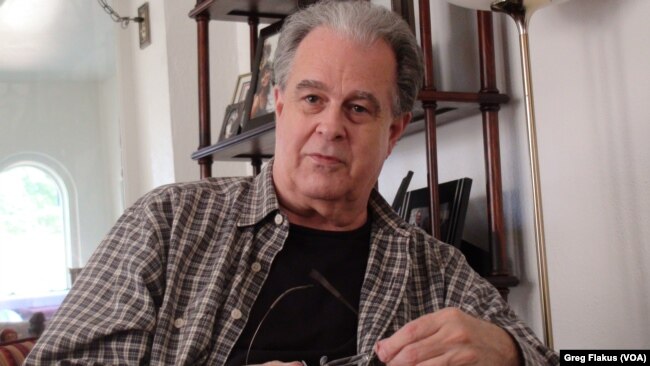
Thomas Gouttierre: In Search of a Lost Dream, An American’s Afghan Odyssey
©by Leo Adam Biga
Originally appeared in The Reader (www.thereader.com)
Like a latter-day Lawrence of Arabia, Omahan Thomas Gouttierre fell under the spell of an enigmatic desert nation as a young man and has been captivated by its Kiplingesque charms ever since.
The enchanting nation is Afghanistan and his rapture with it began while working and living there from 1965 to 1974, first as a Peace Corps volunteer teaching English as a second language, then as a Fulbright fellow and later as executive director of the country’s Fulbright Foundation. His duties included preparing and placing Afghan scholars for graduate studies abroad. During his 10 years there, Gouttierre also coached the Afghan national basketball team. Sharing the adventure with him was his wife and fellow Peace Corps volunteer Marylu. The eldest of the couple’s three sons, Adam, was born there in 1971.
Before his desert sojourn, the Ohio native was a naive, idealistic college graduate with a burning desire to serve his fellow man. When he got his chance half-a-world away, it proved a life transforming experience.
“It’s the place where I kind of grew to a mature person,” he said. “I was there from age 24 to 34 and I learned so much about myself and the rest of the world. It gave me an opportunity to learn well another language, culture and people. I love Afghanistan. It’s people are so admirable. So unique. They have a great sense of humor. They’re very hospitable. They have a great self-assurance and pride.”
But the Afghanistan of his youth is barely recognizable now following 19 years of near uninterrupted carnage resulting from a protracted war with the former Soviet Union and an ongoing civil war. Today, the Muslim state lies in shambles, its institutions in disarray. The bitter irony of it all is that the Afghans themselves have turned the heroic triumph of their victory over the vaunted Soviet military machine into a fratricidal tragedy.
Over the years millions of refugees have fled the country into neighboring Pakistan and Iran or been displaced from their homes and interred in camps across Afghanistan. An entire generation has come to maturity never setting foot in their homeland or never having known peace.
The nation’s downward spiral has left Gouttierre, 57, mourning the loss of the Afghanistan he knew and loved. “In a sense I’ve seen what one might call the end of innocence in Afghanistan,” he said, “because for all its deficiencies, Afghan society – when I was living there – was really a very pleasant place to be. It was a quite stable, secure society. A place where people, despite few resources and trying circumstances, still treated each other with a sense of decency and civility. It was a fantastic country. I loved functioning in that Afghanistan. I really miss that environment. Not to be able to go back to that culture is a real loss.”
Through it all, Gouttierre’s kept intact his ties to the beleaguered Asian nation. In his heart, he’s never really left. The job that took him away in 1974 and that he still holds today – as director of the Center for Afghanistan Studies at the University of Nebraska at Omaha – has kept him in close contact with the country and sent him on fact-finding trips there. He was there only last May, completing a tour of duty as a senior political affairs officer with the United Nations Special Mission to Afghanistan. It was his first trip back since 1993 (before the civil strife began), and what he saw shook him.
“To see the destruction and to learn of the deaths and disappearances of so many friends and associates was very, very sad,” he said from his office on the UNO campus, where he’s also dean of the Office of International Studies and Programs. “Much of the country looks like Berlin and Dresden did after the Second World War, with bombed-out villages and cities. Devastation to the point where almost no family is left unaffected.
“Going back for me was very bittersweet. With every Afghan I met there was such despair about the future of the country. The people are fed up with the war…they so want to return to the way things were. People cried. It was very emotional for me too.”
Everywhere he went he met old friends, who invariably greeted him as “Mr. Tom,” the endearing name he’d earned years before. “In every place I visited I wound up seeing people that I have known for most of my adult life. Individuals that have been here at the University of Nebraska at Omaha – in programs that we’ve sponsored – or people I coached in basketball or people I was instrumental in sending to the U.S. under Fulbright programs or people who taught me Persian and other languages of Afghanistan. So, you know, there’s kind of an extended network there. In fact, it was kind of overwhelming at times.”
Colleague Raheem Yaseer, coordinator of international exchange programs in UNO’s Office of International Studies and Programs, said, “I think he’s received better than any ambassador or any foreign delegation official. He’s in good standing wherever he goes in Afghanistan.”
Yaseer, who supervised Gouttierre in Afghanistan, came to America in 1988 at the urging of Gouttierre, for whom he now works. A political exile, Yaseer is part of a small cohesive Afghan community in Nebraska whose hub is UNO’s Center for Afghanistan Studies. The center, which houses the largest collection of materials on Afghanistan in the Western Hemisphere, provides a link to the Afghans’ shared homeland.
Aside from his fluency in native dialects, his knowledge of Islamic traditions and sensitivity to Afghan culture, Gouttierre also knows many of the principals involved in the current war. It’s the kind of background that gives him instant access and credibility.
“I don’t think there’s any question about that,” Gouttierre said. “The Afghans have a phrase that translates, ‘The first time you meet, you’re friends. The second time you meet, you’re brothers.’ And Afghans really live by that – unless you poison that relationship.”

According to Yaseer, Gouttierre’s “developed a skill for penetrating deep into the culture and traditions of the people and places he visits. He’s able to put everything in a cultural context, which is rare.”
It’s what enables Gouttierre to see the subtle shadings of Afghanistan under its fabled veil of bravado. “When people around the world wonder why the Afghans are still fighting, they don’t realize that a society’s social infrastructure and fabric is very fragile,” said Gouttierre. “They don’t realize what it means to go through a war as devastating as that which the Afghans experienced with the Soviet Union – when well over a million people were killed and much of the traditional resources and strengths of the country were destroyed. When the Soviets left, the Afghans tried to cobble together any kind of government and they were unsuccessful.
“Now they’re trying to put this social-political Humpty-Dumpty back together again, and its just very difficult.”
Under Gouttierre’s leadership the center has been a linchpin in U.S.-U.N. efforts to stabilize and rebuild Afghanistan and has served as a vital conduit between Afghans living inside and outside the country and agencies working on the myriad problems facing it. With nearby Peshawar, Pakistan as a base, the center has operated training and education programs in the embattled country, including a new program training adults in skills needed to work on planned oil and gas pipelines.
Gouttierre himself is a key adviser to the U.S. and world diplomatic community on Afghan matters. He’s served as the American specialist on Afghanistan, Tajikistan and South Asia at meetings of the U.S.-Russian Task Force (Dartmouth Conference) on Regional Conflicts. He’s made presentations on Afghan issues at Congressional hearings and before committees of the British Parliament and the French National Assembly.
And last year he was nominated by the U.S. State Department to serve as the American representative on the U.N. Mission to Afghanistan. “It was quite an honor,” said Gouttierre. “And for me to go back and work among the people again was very appealing and very rewarding.”
The aim of the U.N. mission, whose work continues today, is to engage the combating parties in negotiations toward a just peace settlement. German Norbert Holl, a special representative of the U.N. secretary general to Afghanistan, heads the mission, whose other members are from Russia, Japan, England and France.
On two separate month-long trips to Afghanistan, Gouttierre met with representatives of the various factions and visited strategic sites – all in an effort to help the team assess the political situation. His extensive travels took him the length and breadth of the country and into Pakistan, headquarters for the mission. He talked with people in their homes and offices, he visited bazaars, he viewed dams, irrigation projects and opium fields and traversed deserts and mountains.

Marylu Gouttierre said her husband’s involvement with Afghanistan and commitment to its future stems, in part, from a genuine sense of debt he feels. “He feels a responsibility. It is his second home and those are his people. He’s not only given his heart, but his soul to the country.”
He explains it this way: “Afghanistan has a special place in my professional and personal life and it has had a tremendous impact on my career. It’s been so much an instrument in what I’ve done.”
To fully appreciate his Afghan odyssey, one must review how the once proud, peaceful land he first came to has turned into a despairing, chaotic killing field. The horror began in 1978, when Soviet military forces occupied it to quell uprisings against the puppet socialist regime the USSR had installed in the capital city of Kabul. The Soviets, however, met with stiff resistance from rebel Mujaahideen freedom fighters aligned with various native warlords. Against all odds, the Afghans waged a successful jihad or holy war that eventually ousted the Soviets in 1989, reclaimed their independence and reinforced their image as fierce warriors.
The Afghans, whose history is replete with legendary struggles against invaders, never considered surrender. Said Gouttierre, “The Afghans felt they were going to win from the start. They felt they could stick with it forever. They had a strong belief in their own myth of invincibility…and to everyone’s surprise but their own, they did force the Soviets to leave.”
But the fragile alliance that had held among rival factions during the conflict fell apart amid the instability of the post-war period. “The Soviets left someone in charge who had been their ally in power. That was Najeebullah. His government fell in 1992. That only helped exacerbate things. The cycle of fighting continued as the Afghans who had fought against the Soviet army continued their fight against Najeebullah, who was captured, tried and executed by the Taliban (an Islamic faction) in September of 1996 for his crimes against the Afghans, which were considerable.” Gouttierre knew Najeebullah in very different circumstances before the war, when the future despot was a student of his in a class he taught at a native high school.
After Najeebullah’s fall, a mad scramble for power ensued among the Mujaahideen groups. As Gouttierre explains, “The leaders of these groups had become warlords in their own regions. They kind of got delusions of grandeur about who should be in control of the whole country and they began to struggle against each other.”

In the subsequent fighting, one dominant group emerged – the Taliban, a strict Islamic movement whose forces now command three-quarters of the country, including the capital of Kabul – with all its symbolic and strategic importance. A loose alliance of factions oppose the Taliban.
“As the Taliban (Seekers of Islam) grew in strength, they began intimidating and even fighting some of the minor Mujaahideen commando groups, and to a lot of people’s surprise, they were successful,” said
Gouttierre, whose U.N. assignment included profiling the Taliban. “They are very provincial, very rural – and in their own minds – very traditional Muslims and Afghans. They’re not that philosophically sophisticated in terms of their own religion, but they are very sophisticated in terms of what they understand they want for their society, and they’re able to argue and discourse on it at length without giving any quarter. And they’re willing to go to war over it.
“Each region where they’ve gone, they’ve been aided by the fact that the people living there were disenchanted with those in control. Most of the other groups, unfortunately, lost any credibility they had because of their failure to bring about peace, stability, security and reconstruction. The people were willing to support almost anything that came along.”
The Taliban has drawn wide criticism, internally and externally, for its application of extreme Islamic practices in occupied areas, particularly for placing severe restrictions on women’s education and employment and for imposing harsh penalties on criminals. Gouttierre said while such actions elicit grave concerns from the U.N. and represent major stumbling blocks in the Taliban’s quest for full recognition, the movement has effectively restored order in areas it controls.
“I have to say that in the areas of Afghanistan I traveled to which they control, the Taliban had confiscated all the weapons, removed all the checkpoints people had to pass through, eliminated the extortion that was part of the checkpoints and instilled security and stability,” said Gouttierre. “You could travel anywhere in Kabul without having to be in any way concerned, except for the mines that haven’t been cleared yet.”
Conversely, he said, the Taliban has exhibited brutal politics of intimidation and blatant human rights violations, although other factions have as well. “It’s not a question of who’s good and who’s bad,” he adds. “There’s plenty of blame and credit to be shared on all sides.”


He found the Taliban a compelling bunch. “One of the things I was impressed with is that all of the leaders I met were in some ways victims of the war with the Soviet Union. They all exhibited wounds, and they acquired these wounds heroically carrying out the struggle against the Soviet Union, and I respect them for that. That needs to be taken into account.”
In addition to pushing for a ceasefire between the Taliban and its adversaries, Gouttierre said the U.N. mission consistently makes clear that in order to gain credentialing from the U.N. and support from key institutions like the World Bank, the Taliban must do a better job of protecting basic human rights and ensuring gender equity.
He said the main barrier to reaching a cease fire accord is the Taliban’s nearly unassailable military position, which gives them little reason to make concessions or accept conditions. Another impediment to the peace process is the nation’s rich opium industry, whose interests diverge from those of the U.N. And a major complicating factor is the support being provided the warring factions by competing nations. For example, Pakistan and certain Persian Gulf states are major suppliers of the Taliban, while Iran and Russia are major suppliers of the opposition alliance.
Taliban and opposition leaders did meet together at several U.N. sponsored negotiation sessions. The representatives arrived for the talks accompanied by armed bodyguards, who remained outside during the discussions. The tenor of the meetings surprised Gouttierre. “It was far more cordial than I had anticipated. These men got along remarkably well, in part because they all know each other. That’s not to say there weren’t disagreements. When offended, Afghans can be exceedingly formidable to deal with.”
At Gouttierre’s urging, the mission began holding intimate gatherings at which representatives of the warring parties met informally with U.N. officials over food and drinks and “where translators were not the main medium for communication and where everybody wasn’t on guard all the time.” He hosted several such luncheons and dinners, including ones in Kandahar, Baamiyaan and Kabul. The idea was to create a comfortable mood that encouraged talk and built trust. It worked.
“In diplomatic enterprises often the most effective periods are at the breaks or the receptions, because you’re sometimes able to get people off to the side, where they’re able to say off the record what they can’t say officially. And that’s exactly what happened. Those of us in the U.N. mission got a better sense of who the Taliban are. They’re not irrational. They do have a sense of humor. And they got a better sense of who we are – that we’re not just officials, but that we also have a long-term interest in Afghanistan.”
Gouttierre said the mission has overcome “high skepticism” on the part of Afghans, who recall the U.N. granted Najeebulah asylum despite his being a war criminal. He said the Afghans’ estimation of the mission has moved from distrust to acceptance. And he feels one reason for that is that the present mission has “more clout and recognition than any previous mission to Afghanistan.” Supplying that essential leverage, he said, is the “unstinting support of influential countries like the U.S., France, England, Russia and Japan.”
Despite recent news stories of military inroads made by opposition forces, especially around Kabul, the Taliban remain firmly entrenched. Gouttierre believes that unless a major reversal occurs to change the balance of power, the Taliban will continue calling the shots. If the Taliban eventually consolidate their power and conquer the whole nation, as most observers believe is inevitable, the hope then is that the movement’s leaders will feel more secure in acceding to U.N. pressure.
Gouttierre said that despite the failure to gain a ceasefire thus far, “the fact remains the two sides are meeting with each other, and that’s the first step in any peace process. We don’t have agreements on anything yet, but at least the channels for continuing dialogue have been opened.”
As Gouitterre well knows, the process of binding a nation’s wounds can be frustrating and exhausting. He stays the course though because he wants desperately to recapture the magical Afghanistan that first bewitched him. “I guess one of the things that keeps me at this is that I am ever hopeful that somehow, some way those admirable qualities of Afghan culture which I came to love so much will to some degree be restored. So I keep pursuing that.”
Related Articles
- Afghan president criticizes timeline for U.S. withdrawal (seattletimes.nwsource.com)
- Market bombing in northern Afghanistan town kills 3 police, 2 civilians, wounds 15 (foxnews.com)
- The Challenge of Training Afghan Troops, Police (cbsnews.com)
- An Old Partnership Takes a New Turn: UNO-Kabul University Renew Ties with Journalism Program (leoadambiga.wordpress.com)
- Afghanistan: U.S. Intelligence Failures Led To Civilian Casualties (huffingtonpost.com)
King Crawford: Omaha’s very own movie mogul

Image via Wikipedia
I go back with Bruce Crawford 30 years. We met for the first time when I was a film programmer/publicist at the University of Nebraska at Omaha and he was a wide-eyed film enthusiast. He specifically approached me about wanting to share his passion for the great film composer Bernard Herrmann, whom he had struck up a correspondence with late in the composer’s life. I had a screening of Taxi Driver scheduled and Bruce asked if he could make a presentation about Herrmann and the composer’s scoring of that film. We didn’t normally have speakers as part of our campus film program but something about Bruce’s magnificent obsession and tenacity convinced me to agree. Flash forward about 15 years, when I was a fledgling freelance journalist and Bruce was first making a name for himself with the radio documentaries he did, including one on Herrmann, and with the revival screenings he staged of film classics.
The following is the first of many stories I’ve written about Bruce and his work as a film historian and impresario. It appeared in The Reader (www.thereader.com). He’s since put on dozens more film events.
King Crawford: Omaha’s very own movie mogul
©by Leo Adam Biga
Originally appeared in The Reader (www.thereader.com)
There’s a bit of Elmer Gantry in Bruce Crawford, the dynamic Omaha film historian/promoter whose sold-out screening of the original 1933 classic King Kong unreels Saturday, May 30 at the Indian Hills Theater.
With his boyish good looks, magnetic presence and penchant for hyperbole he exudes the charisma of a consummate huckster and the passion of a confirmed zealot. An evangelist for that old time religion called the movies, he often describes his devotion in missionary terms and pays homage to Hollywood’s Golden Age through gala events and elaborate documentaries full of his characteristic verve and adoration.
And with its rich, delirious mix of mythology and metaphor, Kong is an apt choice for cinephile celebration and reverence. This ultimate escapist film combines still impressive visual effects with an outrageous Beauty and the Beast fable played out in a ripe Freudian landscape. Unlike, say, Godzilla, it taps our deepest fears and desires.
Crawford’s passion began in his native Nebraska City, where he had a born-again experience at the movies. It came when his parents took him as a child to see Mysterious Island, a 1961 Jules Verne-inspired fantasy adventure featuring special effects by Ray Harryhausen.
“I loved the effects and the creatures and the fantastic Jules Verne story. But it was the music that hooked me more than anything else,” Crawford said from the movie memorabilia and art-filled northwest
Omaha apartment he shares with wife Tami. “I remember when the music hit me. It was the opening with the boiling ocean and the Victorian lettering rolling across the seascape. I can’t quite find the words for it, but something connected. t was almost like a diamond-tip bullet hit me between the eyes. This music…wow! I was so overwhelmed by its beauty and majesty. I wasn’t old enough to read yet, so I asked my parents where the music came from.”

Bruce Crawford
When he found out it was by legendary composer Bernard Herrmann, he felt “a compulsion” to find out everything he could about the man and his work. He had a similarly dramatic reaction to hearing a cut of the love theme to Ben-Hur. Despite his unfamiliarity with the movie and the composer, Miklos Rozsa, he felt an affinity for each. “The music was sooooo beautiful. Even without knowing it was a Biblical story I felt the Judaism. I felt the ancient world. Like with Mysterious Island I felt another connecting link in my life. That this was part of my destiny. I said, ‘I’ve got to see what movie this music goes to.’”
He finally did see Ben-Hur Christmas night in 1970, and it proved a revelation. “It changed my life. I’ve never been so haunted and moved by something as I was by it. It was so profound, so literate, so poetic. I knew I’d seen a masterpiece. And somehow, on some psychic or intuitive or synchronistic level, a little boy in Nebraska City had this connection with these world-renowned musicians and filmmakers. I knew then I was meant to know these people and to do something with them.”
Amazingly, his life has intersected with the very objects of his devotion. As a precocious teen he began corresponding with the imposing Herrmann, the composer for such film classics as Orson Welles’ Citizen Kane and The Magnificent Ambersons and Alfred Hitchcock’s Vertigo and North By Northwest. Upon Herrmann’s death in ‘75 (after finishing the fever dream score to Martin Scorsese’s Taxi Driver) Crawford drew close to his family. By ‘88 he’d become an authority on the man and produced an acclaimed documentary on him which has since aired over many National Public Radio affiliate stations and over the BBC in Great Britain.
Crawford struck up a similar acquaintance with Rozsa and shortly before the composer’s death in ‘95 completed a documentary on him and his music that also garnered strong critical praise and wide air play.
Music has always spoken most strongly to Crawford. “My first and foremost love is great music, and for me film scores represent the 20th century’s answer to the great symphonies of the past 300 to 400 years. A film score is like a grand opera in a sense. It can tell what actors can’t say.”
Movie special effects also hold him enthralled. As a high school student he made an award winning short using the same kind of stop-motion animation techniques as Kong. He began networking with FX artists and those contacts led him to the dean of them all — Harryhausen. In ‘92 Crawford coaxed Harryhausen, fresh from receiving an honorary Oscar, to attend an Omaha tribute in his honor. The men are now close friends.
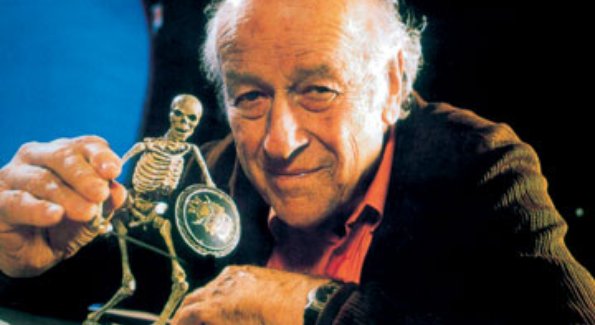
Ray Harryhausen
The tribute proved a hit and spurred subsequent film events. The biggest to date being the 35th anniversary showing of Ben-Hur, for which Crawford scored a coup by making Omaha the first stop on the restored film’s special reissue tour and by getting family members of the film’s legendary director, William Wyler, to attend.
At a screening of Gone with the Wind he brought co-star Ann Rutherford and added atmosphere with women in period hoop skirts. For the Hitchcock suspense classic Psycho he secured an appearance by star Janet Leigh. Family members of late-great director Frank Capra (Mr. Smith Goes to Washington) and producer Darryl F. Zanuck (The Longest Day) came at Crawford’s invitation to Omaha revivals.
Many wonder how someone so far removed from the movie industry is able to gain entree to rarefied film circles, land interviews with top names (from Charlton Heston to Leonard Maltin), arrange celebrity guest appearances and enlist the aid of corporate sponsors. Crawford’s personal charm and genuine ardor for classic movies, and for the artists who made them, help explain how he does it.
Then too there’s the grand showmanlike way he exhibits old movies. “The way they’re meant to be, but so rarely, seen,” he said, meaning on the big screen — with all the puffery, ballyhoo and flourish of a Hollywood premiere. For his 65th anniversary showing of Kong, which has been fully restored, he plans searchlights, a 30-foot tall Kong balloon, limousine-driven guests, a pre-show and a post-autograph session.
“What I’m trying to do is recapture the magic of going to the movies I felt as a kid,” he said, “and add to it with the glitz and the glamour. You get your money’s worth at a Crawford show, don’t you think?”
Kong’s special guests will include Harryhausen, who’s flying in from his home in London, renowned science fiction author Ray Bradbury (Fahrenheit 451) and noted film historian Forrest Ackerman. The three grew up together in California and were equally enchanted by Kong.
Harryhausen, who later apprenticed under the film’s effects master, Willis O’Brien, on Mighty Joe Young, credits Kong for inspiring his life’s work. “I was 13 when I saw it, and I haven’t been the same since,” he said by phone from London. “It left me startled and dumbfounded. It started me on my career. That shows you how influential films can be.”

Bernard Herrmann
The Kong pre-show or “live prologue,” as Crawford calls it, will recreate the film’s native ceremonial ritual — complete with dancers in painted faces and grass skirts — performed for Kong’s original run at the Grauman’s Chinese Theater in Los Angeles.
On his Kong Web page Crawford promises an evening “in the Sid Grauman tradition.” Crawford is indeed a Grauman-type impresario with a flair for extravaganza. He also resembles the P.T. Barnum-like Carl Denham character in Kong who charters the ship and leads the expedition in search of the big ape. In an early scene the first mate asks the skipper about the irrepressible Denham, “Do you think he’s crazy?” “No,’ says the captain, “just enthusiastic.” Likewise, Crawford’s undaunted fanaticism is that of the true enthusiast. His fervor largely accounts for the warm reception he’s been accorded by Hollywood insiders.
“I’m delighted he takes it so seriously and takes the initiative to try and present pictures the way they were presented in the early days,” said Harryhausen. “What you need is somebody with enthusiasm for these types of things. Bruce has that, and it’s wonderful.”
Gerry Greeno, Omaha city manager for the Douglas Theater Co., whose Cinema Center hosted past Crawford events, said, “He has that exuberance that generates interest and gets people to go along with him…and he’s not bashful about it. For some it might wear a little thin, but he puts a lot of time and effort into these events. He loves doing it.”
Bob Coate, who co-produced the Herrmann-Rozsa documentaries at KIOS 91.5-FM, where he is program manager, said he fell under the Crawford spell when the promoter pitched him the idea. “I’d never produced anything like that before. He kind of got me excited about doing it. His enthusiasm is definitely infectious.” Coate, now part of the Crawford coterie, added, “He’s a driving force. I know these events are tons of work for him, and wear him out, but I think he gets energy from doing them.”
As Crawford tells it, “I try to get people to do things they might not normally do, which I’m told I do a lot of. It’s being persuasive. You have to have that extravagant enthusiasm…that charisma. Some people keep it subdued and withdrawn. I choose not to.”
Until Coate approved the Herrmann program, Crawford had run into dead-ends trying to get it off the ground. “I went to several public radio stations and they said, ‘It can’t be done.’ Of course that went in one ear and out the other. I was determined to do it come hell or high water. Fortunately, Bob (Coate) was a Herrmann fan.”
The pair collaborated for months. In typical Crawford style he pushed the envelope by making the finished product two and a half hours long. Upon hearing it, the feature most listeners remark on is the unusually long (often complete) musical passages from Herrmann’s radio, film and concert hall career and rather spare but informative narrative segments. The same approach is used with the Rozsa project.
Miklos Rozsa
“My programs are really audio musical biographies about the subject and his music,” Crawford said. “The thing that makes them stand out is that they’re 60 to 70 percent music and 30 to 40 percent discussion. There was no model I was aware. I didn’t know what the parameters were. And of course the rest is history.”
He refers to the favorable response the programs netted, especially the piece on Herrmann, who’s a cult figure. Crawford has heard from many famous admirers. “It’s considered the most extensive, the most comprehensive, the most successful documentary ever done on any composer of the 20th century,” he said. “That’s just not my opinion. That’s the opinion of Ray Harryhausen, Ray Bradbury, Danny Elfman, Jerry Goldsmith, David Copperfield, Robert Zemeckis…”
Part of his charm is the wide-eyed, gee-whiz glee he takes in his own achievements. In the Wonderful World of Bruce Crawford, there are only “huge” successes; “amazing” feats; movie “masterpieces;” and his own “almost superhuman” energy. When he goes on a riff about the accolades and national media coverage, he punctuates his speech with a rhetorical “Isn’t that something?” or “Isn’t that incredible?”
Well, who can blame him? He’s been brazen enough to develop world-class film connections and visionary enough to use them in meaningful ways. He’s seen himself become a touchstone figure for film buffs who bask in the glow of his and his famous friends’ celebrity. He’s been commissioned to write articles for major film publications. His services as a documentary producer and event promoter are in much demand.
This self-styled movie mogul rules over a niche market in Omaha for the celebration and veneration of classic films. Call him King Crawford. Still, even he can’t believe his dreams have come true.
“My God, who would have ever thought this was attainable? I didn’t see it coming. I did have a desire, which was obviously intense, but I didn’t know where it would lead. And then to have these giants respond to me, and not only respond, but become pretty close friends — that just doesn’t happen, man. Yeah, syncronicity.”
Perhaps it’s no coincidence then he and Tami live in Camelot Village.
“My life is like a strange sort of destiny.“ he added. “I don’t know how or why that is. That’s what serendipity is I guess. Amazing. Isn’t that wild?”
Related Articles
- Revival House: “We all go a little mad sometimes …” (popdose.com)
- Hitchcock’s Psycho At 50, The Sounds Of Violence (huffingtonpost.com)
- Revival House: Seven Great Rejected Film Scores (popdose.com)
- Listening to Taxi Driver. (slate.com)
- Hitchcock horror under the hammer (thejc.com)
Magical mystery tour of Omaha’s Magic Theatre, a Megan Terry and Jo Ann Schmidman production

Image via Wikipedia
UPDATE: Ah, it’s spring again, and that means it’s time for the Great Plains Theatre Conference in Omaha, where many established and emerging playwrights and other theater professionals from the far corners of the U.S. gather their collected energies for the theater arts. As a journalist who interviews some of the guest artists for the conference, which this year is May 28-June 4, I enjoy dropping the name Megan Terry and mentioning that she lives in Omaha. It never fails to elicit a response: first, affection and admiration for the work of Terry, a great American playwright; and then surprise and delight that she lives in the host city for the conference. What follows below is an article I did five or six years ago on Terry and how and why she came to resettle in Omaha from New York and what she did here.
I only attended a couple productions by the Omaha Magic Theatre, an avant garde, experimental stage company led by two women who against all odds made their ground-breaking theater a success in Omaha, Neb. One of the partners, Jo Ann Schmidman was from here and made her reputation here with the theater. The other, Megan Terry, made a name for herself in New York long before joining Schmidman in Omaha at the Magic Theatre. They closed their theater some years ago and the two women who created such a distinct niche for themselves seemed in danger of fading into obscurity when I caught up with them and wrote the following story, which appeared in The Reader (www.thereader.com). Basically, I wanted to capture in print just how extraordinary what they did was and just how compelling they are as individuals and as partners.
Magical mystery tour of Omaha’s Magic Theatre, a Megan Terry and Jo Ann Schmidman production
©by Leo Adam Biga
Originally appeared in The Reader (www.thereader.com)
Even in the counter-cultural maelstrom of the late 1960s, the idea conservative Omaha could support an experimental theater with a strong feminist, gay/lesbian bent defied logic.
Well, that’s the point, isn’t it?
When native Jo Ann Schmidman founded the Omaha Magic Theatre in 1968 as a center for avant garde expression in the Old Market, she followed her muse. The fact she was barely out of her teens, between her sophomore and junior years as a Boston University theater major, only added to what many must have regarded as folly. That’s not how she saw it though.
Instead of resistance, “what we discovered was quite the opposite…open-minded people with a work ethic,” said Schmidman, an Omaha Central grad weaned on local children’s theater, the work of an adventurous wing of the Omaha Community Playhouse and a summer studying in Northwestern University’s prestigious theater program.
“The pioneering spirit and the quest to work with your own hand, out of your own soul, is an Omaha, a Midwestern trait and that’s exactly the kind of theater I was interested in doing. It didn’t have anything to do with being radical, it had to do with being homemade and what is inside of people,” she said at a Great Plains Theater Conference (GPTC) panel. “It wasn’t about shocking people, it was about giving them a vehicle to reflect, a way to understand one’s self better, to go on a spiritual journey.
“I knew it was a perfect place to start an alternative, experimental theater…there was nothing like it and to date there is not another alternative theater in town. It’s either realism or naturalism.”
In a 1996 Theatre Quarterly interview she said the very qualities of this place that isolate it from the theater mainstream allow for exploration: “There is something incredibly expansive about this area and about the people that live here. The extremes of temperature, I believe, allow extremes of creation.”
She originally opened OMT as a summer enterprise. Grad students from Boston U. rounded out the company. The first season was heavy with plays by European absurdists Genet and Brecht. American works came later, including The Tommy Allen Show by Megan Terry.
The paths of Schmidman and Terry first crossed years earlier.
A Mount Vernon, Wa. native, Terry has lived a life in theater. She was “brought up” in the Seattle Repertory Playhouse, mere blocks from the home of her pioneer grandma. “I just scratched at the door until they let me in,” she said of Playhouse founders Burton and Florence James. After completing her theater studies in the Pacific Northwest Terry tried for an acting career in New York, all the while journaling. “Pretty soon, I thought my own dialogue was better than the stuff I had to perform. Little by little I started writing.”
“At this same time were all the protest movements, the marches. There was a huge political-social-cultural revolution. The new music, the new art, the Action painters and Abstract Expressionists, were at their zenith. All these things were converging,” Terry remembered. “I’d go to Washington Square and hear Bob Dylan and Joan Baez before they were famous. There were about 35 marvelous playwrights all working in New York City and we could all walk to each other’s theaters, so it was like, Can you top this? We just played off of each other.
“I mean, it was all there. I see theater really as a conservative art, where it takes from everything else and I think American jazz had to do what it did and American painting had to do what it did before our kind of theater could happen, because the other arts feed you.”
Terry churned out plays at an amazing clip, at one point having a new one produced every month. Edward Albee co-produced a double bill that included her Ex-Miss Copper Queen On a Set of Pills at the Cherry Lane Theatre. She was a founder of the legendary Open Theatre, an experimental company that produced her work, eventouring it nationally. Other Terry plays were performed at the chic La Mama. Another at the Circle Rep. Still another at the Actor’s Studio.
Along with Sam Shepard, a fellow founder of the Open Theatre, she was identified as one of America’s most promising new playwrights.

“At a point I worked with very strong men in the ‘60s. Joe Chaikin, Tom O’Morgan, Peter Feldman,” said Terry, who developed Viet Rock in a Saturday Open Theatre workshop that also produced Hair. Rock was perhaps the first major work of art to deal with the Vietnam War. When Chaikin and Feldman “took it (the play) away from me,” she said, “a big confrontation” ensued.
Aptly, Terry’s and Schmidman‘s paths crossed in theatrical fashion.
“I met her [Schmidman} in Boston when I was asked to come to write the bicentennial celebration for Boston University’s theater school” Terry said. While in Bean Town she joined the throng gathered for a protest on the Boston Common. Out of the crowd Terry estimates approached a million people, the two found each other.
“I don’t go to rallies but I went to an anti-war rally where I met her by mistake, doing guerrilla theater,” Schmidman said. “I found her to fix my tin foil mask.” “Her mask had come off and I helped her with it. It’s just absolutely true,” Terry said.
Schmidman admired Terry’s work. Indeed, she said, “I had the top of my head blown off” by the work of Terry and her cohorts. The two got to know each other when Terry later went to Boston U. to workshop her Approaching Simone. Terry cast BU theater students. None of the perky, blonde, blue-eyed, well made-up girls fit what she wanted. So, “I designed an improvisation where one person had to stand off all of the rest of the kids in the school,” she recalled, “and Jo Ann had the power to stand them off. I said, ‘Ah ha, I can write this play around her. There’s the power I’m looking for.’’ Jo Ann WAS Simone. The play ran off-Broadway at Cafe La Mama, becoming the first student-cast production to win an Obie.
Their relationship grew when Schmidman toured with the Open Theatre, “It was a magic, perfect fit,” said Schmidman. Terry visited Omaha in 1970 to see Schmidman’s production of the Tommy Allen Show.
“It was a better production then I had done out in Los Angeles. I had to admit it,” said Terry. “I said, ‘This is really good.’ I mean, she was showing me things about this play I didn’t know were there.”
With some prodding, Terry set her sights on this place, moving here in 1974.
“When the Open Theatre closed and I saw what Jo Ann was building here,” Terry said, “I could easily make that transition. She’s a great director.” Still, it was a huge leap of faith. “She was leaving where one made it in the theater. Plenty would not leave New York City, period. But for Megan I never heard a second thought,” Schmidman said.
The difference being in Omaha Terry didn’t have to take a back seat to anyone. It’s why leaving the center of the theater world was not such a hard move. “I always felt like I was camping out in New York as it was,” Terry said. “I always felt like it was temporary. The feminist movement freed me from being stuck in New York and being in that life.” She said she ended up being far more productive here.
Schmidman said since Terry’s “ego was not at stake,” Omaha made sense, as here she could “work every day within a viable company” that would produce her plays. “Megan is the kind of playwright that writes for a company of people, which is how I lured her out here.”
As Schmidman did before her, Terry found the possibilities for theater here “wide open.” Terry’s presence lent OMT instant credibility. Her career hardly suffered for the move. Her prodigious output (60 plays) continued. Her work has been taught or performed across North America, Europe, South America and beyond.
The theater became a year-round venue for the most mind-altering work. It changed locations a few times before settling at its present downtown site on 16th street in a former department store next to King Fong’s.
More than two decades before the Blue Barn Theatre opened, these women were doing Witching Hour work that made electric cool aid acid trips seem tame.
Terry and Schmidman recently sat down for interviews at the theater, an open, tiled space with a stripped-down ‘50s-vibe. They are a study in contrasts. Terry has the pale, soft, rounded features and sweet, doe-eyed look of an ingenue turned mature matron. Schmidman is a slim, dark-featured, hard-angled figure whose severe face and brooding demeanor signal intensity. Little Bo-Peep and Gothic Queen. Both exude a manic fervor on low simmer. They listen intently. They laugh easily. Each interrupts the other to complete a sentence, the way longtime companions do.
The two ceased producing at OMT a decade ago. A new group of artists use the space and the name today, inspired by what the two women did to push theater’s boundaries. Terry and Schmidman long intended handing over the OMT to a new troupe. Groups came and went. None stuck. In 2004, fashion designer Julia Drazic and a coterie of designers, visual artists and musicians hit it off with the women and took over the space. The resulting multi-media, multi-layered shows defy categorization. Sound familiar?
Schmidman, who advises the group, calls Drazic “a natural born producer.”
Drazic and Co. realize the heavy legacy they carry with the OMT name.
The Growth of the Magic Theatre
A generation apart, Terry and Schmidman each studied and rejected old theater concepts in favor of a freer model unbound by, in their minds, rigid constraints and assumptions. While Schmidman’s a militant adherent of independence and a harsh critic of conventionality, Terry’s more politic.
With Schmidman as artistic director and Terry as resident playwright, OMT showcased works by playwrights thick in the canon of the American avant garde: Ron Tavel (Kitchenette), a collaborator with Andy Warhol on the Pop artist’s early narrative films; Paula Vogel (Baby Makes Seven), whose play How I Learned to Drive won a Pulitzer; and Obie and Pulitzer winner Sam Shepard (Chicago). Guest directors helmed some shows. Visiting playwrights-directors did workshops. It was all about change and challenging the status quo, even the very definition of theater.
Schmidman was well-suited to the task said New York playwright Susan Yankowitz: “Jo Ann has flung herself into roles, as actor-as director, with unusual courage and confidence, qualities that make her especially friendly to risk.”
Everyone contributed ideas to a play’s development. Everyone participated in its performance. Devoid of the usual barriers, like a proscenium stage, audiences, actors, stage hands, words, sets, music, costumes, sculptures, movements and projected images became equal elements in total, multi-media, sensory immersions.
Terry’s transformational style, in which actors interchange parts or morph into objects, was aided by soft sculptural costumes. Crew handled lights, music and sets not behind a curtain or in shadow, but out in the open, for all to see. Same way with actors changing costumes. It was part of the experience, as in the spirit of the ‘60s New York “happenings” Terry witnessed.
The experience, Omaha theater director Jim Eisenhardt said, could be formidable. “Oh, absolutely, it was intimidating, but it was a great shared experience, too.”
“In those days our object was to push previously established ideas of what theater was in new directions,” said Schmidman. “To create absolutely contemporary theater…in other words, to create theater that had to do with our lives, living and working in Omaha, Nebraska, because that’s what we were doing. So it was a pretty lofty task we set for ourselves. It was to reinvent what does theater look like, what does it sound like, what is it.
“And certainly there were plenty of roots in people before us. This was the end of the ‘60s, so we had Cafe La Mama, Cafe Chino, the Open Theatre” as models to follow.”
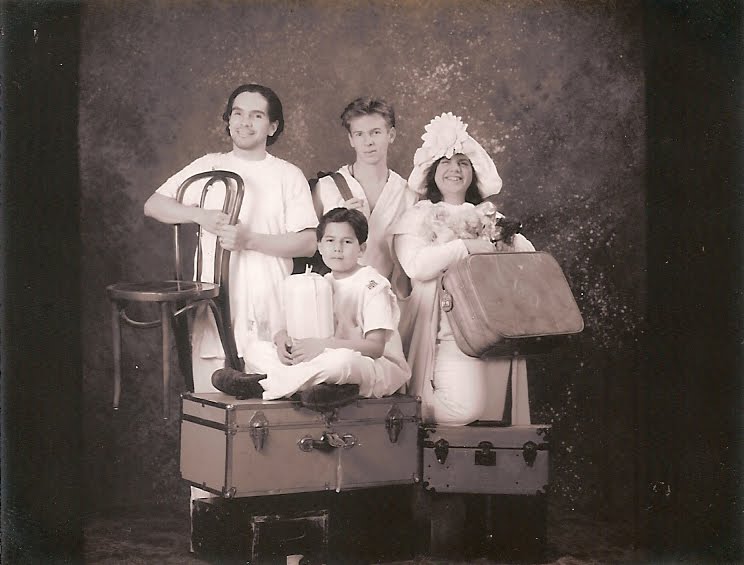
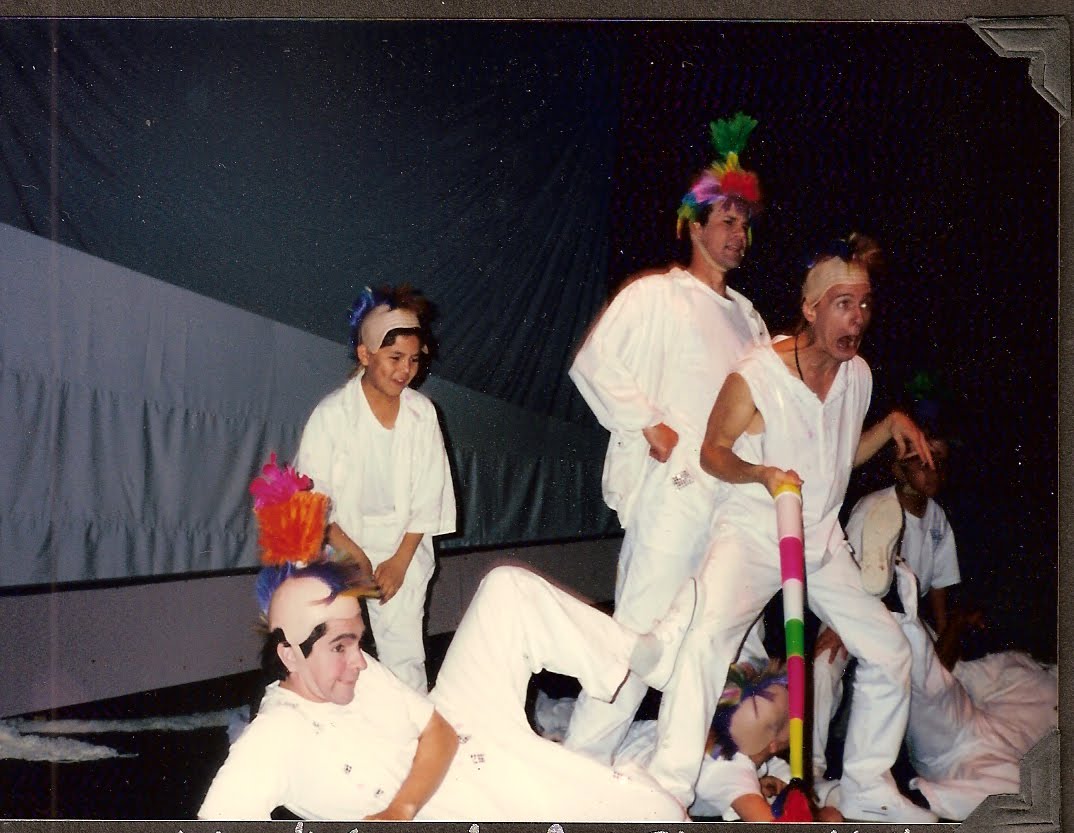
OMT fit in well with the Old Market’s head shops and art galleries. It had the entire building that contains the Passageway. The company lived communally there and in a loft across the street, with Terry cooking big stews from French Cafe refuse. The theater became a self-supporting operation. Members did not need to take second jobs. By taking risks rather than playing it safe the women made OMT a successful, recognized home for contemporary theater.
“We were producing this fine theater that commanded national grants and international respect at a time when it wasn’t being given to the opera or the symphony,” Schmidman said. “This tiny little theater was getting direct National Endowment for the Arts support in ever escalating amounts because the work was good. They (the NEA) came out each year to see the work.”
The two women’s imprint is undeniable.
As if being an experimental theater were not enough, OMT dared to be a “‘gay,’ ‘radical feminist,’ ‘lesbian’ theater‘” on top of it, said Rose Theatre artistic director James Larson. “None of that existed in Omaha before.” Given that, he said, “it is extraordinary the Magic Theatre could survive for 30 years.” He added it’s “impressive” OMT could command large grants and he admires how “resourceful” Schmidman and Terry were in replenishing the company over time.
OMT built loyal followings for experimental work that proved accessible. “Once the people saw the work, whether they knew what they were seeing or not, they responded to it,” Schmidman said. One reason may be the extensive research Terry did for “the big community pieces” OMT did, like her Kegger, that dealt with under age drinking. Once they had a hit, they kept it in front of audiences for a steady cash stream. OMT toured Kegger for three years, nearly surviving on its proceeds alone.
“Touring is what kept us going,” Terry said. “It helped enable us to keep doing what we were doing, reaching out to all of the communities, getting to know people at different universities and arts councils.”
Q & As usually followed shows. Often, the theater invited scholars or experts to lead discussions related to the themes/issues raised. Audiences weighed in, some testifying, as in church, to how the plays resonated with their lives.
Terry and Schmidman set a high standard.
Larson, a playwright whose doctoral thesis is on Terry, worked with OMT for 15 years. He said, “There was a time in the ’60’s and ’70’s when Megan was considered one of the top three female playwrights in the history of American Theater” along with Lillian Hellman and Susan Glaspell. “Then more female playwrights emerged, and Megan is still remembered as the leading political/feminist playwright.”
Noted New York playwright and poet Rochelle Owens said, “Megan Terry’s plays explore the boundaries of American culture…Her use of ‘transformation’ marked her as one of the most original dramatists of the experimental theater of the 20th century.” Owens said Schmidman is a “brilliant artistic director” who, along with Terry, is “an inspiration to theater artists.”
OMT was an island unto itself, isolated, by choice and by perception, from the larger theater community due to the work it did and the single-minded focus, some might say zealousness, the women displayed. “We didn’t play the local theater game,” Terry said. “Or socialize,” Schmidman interjected. “We were too busy working.”
Its 30-year run only ended, in 1998, when Schmidman and Terry, partners in life and in the theater, reached a point of exhaustion. The two share a house together in south O. The theater’s old touring van is parked on the street. The house is obscured by the van and an overgrown garden in front that seems an apt metaphor for two artists whose wild, creative vines are intertwined.
“When we closed we were playing to full houses every night,” Schmidman said. Even if she and Terry were weary, why walk away from such a good thing? “It’s just, there are other things to life. There are other art forms, like living,” Schmidman said. Besides, she said, it just never got any easier, especially the struggle to win grant money. All the late nights of preparing mountains of paperwork for grant applications and then waiting on pins and needles for a yes or no wore on them.
“The audiences were great, the work was great, but getting the damn money was as miserable as ever,” Terry said.
They closed shop to archive OMT’s and Terry’s remarkable bodies of work, all of which is housed in the Bancroft Library at the University of California at Berkeley.
Thirty years of original, groundbreaking work unseen before here, some seen for the first time outside NY. Tours across Nebraska, Iowa. All “musicals,” not with familiar show tunes, either, but original, contemporary, music.
“The biggest myth of the American theater is people will only go to a show if they can leave the theater humming the tunes or they’ll only go to something that sounds like something else. That has not been our experience,” Schmidman said.
The Magic made its mark far beyond Omaha, too. Terry and Schmidman collaborated on the lyrics and book, respectively, for Running Gag, staged as an official selection of the 1980 Winter Olympic Games in Lake Placid, NY.
In 1996 the Magic represented America in the Suwon Castle International Theatre festival in Suwon, South Korea, just south of Seoul. Terry, Schmidman and Co. performed Star Path Moon Stop outdoors before a crowd of some 5,000 squatting spectators.
“It was fabulous,” Schmidman said. “They come from a shamanistic tradition, so they really got into our kind of theater,” Terry said. “They embraced it because it’s quite like their traditional, very broad, emotional, spectacle theater,” Schmidman elaborated. “Yes, their theater is very episodical and relies on fabulous stage effects,” Terry added. The festival appearance followed workshops OMT did the year before in Seoul. The theater traveled abroad once before, when they toured Body Leaks at a women’s fest in Canada.
From OMT’s inception, Schmidman surrounded herself with collaborators drawn from many disciplines/backgrounds. Rarely did anyone have formal theater training. There were painters, musicians, poets, hippies and freaks. Among the noted artists to work with OMT were painter Bill Farmer, musicians Jamel Mohamed and Luigi Waites and composer John Sheehan. Sora Kimberlain arrived as a visual artist and ended up doing set design, acting, writing and directing.
“The bottom line was if theater reflects life and if we’re creating a brand new way of performing, well, you sure don’t need to go to school for it,” Schmidman said. “You need to open your heart, open your soul, give yourself over to the work and do what it tells you.”
EDITOR’S NOTES: While Schmidman and Terry closed the original OMT a decade ago, they’re hardly inactive. Terry still writes, accepting commissions from theaters like The Rose in Omaha. Schmidman no longer directs but she consults/mentors the new OMT and other young theater artists.
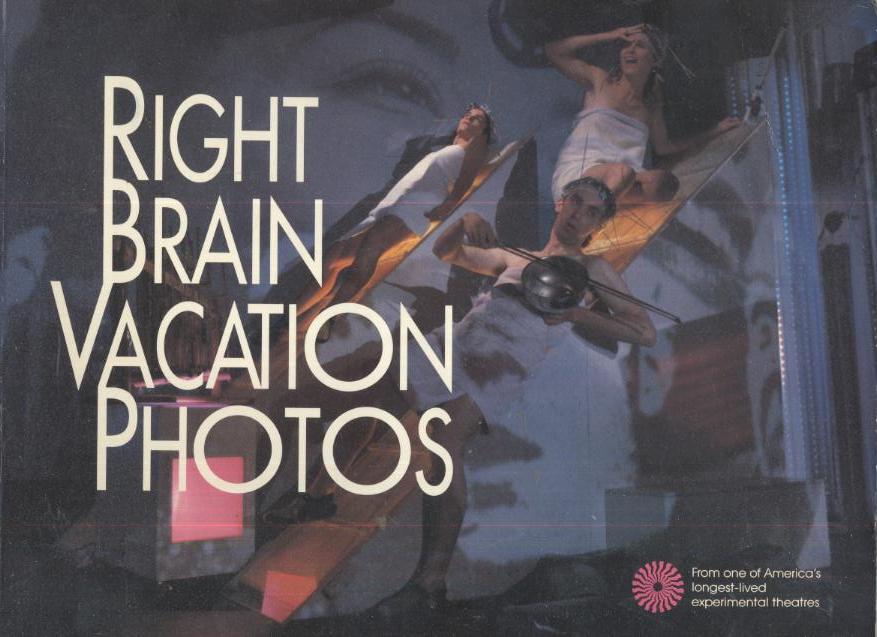
In 1992 the Magic Theatre produced a book, Right Brain Vacation Photos, that serves as a great OMT primer, the American avante garde and experimental theater. Look for it at your local library or on Amazon.com.
Related Articles
- A day in the life of a theatre (thestar.com)
- Take in Some Indie Theater at This Year’s Spark Showcase (phillyist.com)
- Gotham goes for a ‘Ride’ (variety.com)
- Omaha Arts-Culture Scene All Grown Up and Looking Fabulous (leoadambiga.wordpress.com)
- Jo Ann McDowell’s Theater Passion Leads Her on the Adventure of Her Life: Friend, Confidante, Champion of Leading Playwrights, Directors, Actors and Organizer of Major Theater Festivals and Conferences (leoadambiga.wordpress.com)
- All Trussed Up with Somewhere to Go, Metropolitan Community College’s Institute for Culinary Arts Takes Another Leap Forward with its New Building on the Fort Omaha Campus (leoadambiga.wordpress.com)
- Great Plains Theatre Conference Ushers in New Era of Omaha Theater (leoadambiga.wordpress.com)
- A Q & A with Edward Albee: His Thoughts on the Great Plains Theatre Conference, Jo Ann McDowell, Omaha and Preparing a New Generation of Playwrights (leoadambiga.wordpress.com)
- Great Plains Theatre Conference Grows in New Directions (leoadambiga.wordpress.com)
- Playwright John Guare Talks Shop on Omaha Visit Celebrating His Acclaimed ‘Six Degrees of Separation’ (leoadambiga.wordpress.com)
- A Q & A with Theater Director Marshall Mason, Who Discusses the Process of Creating Life on Stage (leoadambiga.wordpress.com)
Three old wise men of journalism – Hlavacek, Michaels and Desfor – recall their foreign correspondent careers and reflect on the world today

Image via Wikipedia
As a kid I watched John Hlavacek on a local network television affiliate’s newscasts and documentaries, and as a young man I was aware of him serving on the Omaha City Council, and operating his own travel agency. I vaguely knew that he had been a foreign correspondent. It was only a few years ago though that I met him for the first time and got to know more of his story. He and his late wife Pegge were both reporters in the Golden Age of American journalism. Their life stories of living and working around the world are as amazing as those of the historical events and figures they covered. In the last few years John has had published several books authored by himself and Pegge that recount their adventures. I have also posted the story I wrote about John and Pegge and their adventures, but the following piece is about John and two old reporter friends of his from back in the day. The three men hadn’t seen each other in decades until John arranged for their meeting in Omaha for a panel discussion. I covered the event and wrote this story for The Reader (www.thereader.com).
Three old wise men of journalism – Hlavacek, Michaels and Desfor – recall their foreign correspondent careers and reflect on the world today
©by Leo Adam Biga
Originally appeared in The Reader (www.thereader.com)
They were three young lions of American journalism when they met far from home, a long time ago. John Hlavacek of Carleton College (Minn.) and Jim Michaels of Harvard were green United Press foreign correspondents based in post-World War II India. In wartime Hlavacek trucked medical supplies over the Burma Road for the International Red Cross. Michaels drove an American Field Service ambulance. Each was imprisoned there: Hlavacek for days; Michaels for months. New Yorker Max Desfor covered the war in the South Pacific as an Associated Press photographer.
The paths of these three men crossed in 1946, when their lives-careers intersected with India’s historic bid for independence from British colonial rule. Last spring, they came together for the first time in 60 years with the publication of a book, United Press Invades India, by Hlavacek, an Omaha resident who invited his colleagues to participate in public forums about their intrepid reporting days. The men shared stories and observations during two panel discussions in Omaha.
After being out of touch all that time Hlavacek began the process of reestablishing contact with his old colleagues while working on his memoir. Facts needed checking and where Hlavacek’s memory faltered, he relied on Desfor and Michaels to fill in the blanks. By the time the book was completed, Hlavacek suggested he and his comrades reunite. The men still correspond today.
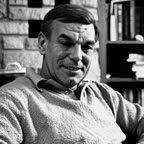
John Hlavacek
The book that helped bring the old colleagues together was Hlavacek’s second volume of memoirs based on his overseas adventures in India and China, where he taught English in an American mission school in Fenyang as part of the Carleton in China exchange program. Hlavacek now has a third volume of memoirs out, Freelancing in Paradise, that recounts the years he and his wife Pegge, a fellow journalist he met and married in India, filed stories from the Caribbean for national media outlets. He’s also published two books authored by Pegge about her own far flung news career and the couple’s remarkable feat of raising five children while working in India, New York, Jamaica and Omaha.
For Hlavacek and Michaels, now in their late 80s, India began long, distinguished careers in journalism. As bureau chief in Bombay, Hlavacek built up UP’s presence there and under his aegis the news service proved a formidable rival to their bitter rival, the AP. He won what’s now called the Edward R. Murrow Fellowship for study at Columbia University, he covered the Caribbean and after moving with his family in the early 1960s to Omaha, where he was a television news correspondent/commentator, he filed a series of reports from Vietnam on area residents serving in the war.
Michaels got the scoop of a lifetime when he broke the story of Mahatma Gandhi’s assassination in 1948. He joined Forbes Magazine in 1954, was made editor in 1961, a post he held until 1999. He’s credited with turning Forbes into one of the world’s most read financial pubs. A VP today, he can be seen Sundays on Forbes On Fox.
Before India, Desfor already made memorable images: of the Enola Gay crew upon their return from the mission that dropped the atom bomb on Hiroshima; and of the Japanese surrender to the allies on the USS Missouri. Soon after his arrival in India in 1946, he snapped a famous picture of Gandhi and India’s first prime minister, Jawaharlal Nehru, in an unguarded moment of friendship. “You see the interchange, the compatibility, the simpatico. It’s just an enormous moment,” he said. The iconic pic was used as the basis for a popular Indian postage stamp.
Desfor won a Pulitzer Prize for news photos for his work in the Korean War. In all, he shot five wars, many conflicts and much civil strife. He later served as an AP photo executive/editor before retiring in 1979. That same year though he joined US News and World Report as director of photos. He made his 1984 retirement permanent, but he’s till snapping pics, only now with a digital camera. He’s 93.

Max Desfor posed in front of picture taken of himself during the Korean War
These young lions turned wise old men of journalism reunited for panel discussions in Omaha in 2006. They took to their role as pundits well. They spoke about the momentous events they reported on, the way the news biz has changed and how the India and China of today differ from the developing nations they knew then.
Hlavacek said the troika may be the only surviving American journalists to have met Gandhi. While his colleagues minimize Gandhi’s ultimate influence, Desfor said “he had a moral effect” of lasting import. Michaels said by the end Gandhi was “almost irrelevant” for opposing “industrialization or modernity. Had Gandhi lived, he said, “he would have been loved but nobody would have paid attention to his views.”
The ascetic led a huge movement yet was quite approachable. Unlike today’s restrictive climate, the press had unfettered access to major public figures then.
“A journalist’s access to events in those days was so much more intimate than it is today,” Michaels said. “Gandhi was a world figure, yet he had these prayer meetings when he was in Delhi that the public could come to. If you got there early you could sit right up in front and ask him questions. Or, as John (Hlavacek) did, you could go right up to him and ask for an interview. Today, you wouldn’t be able to get through the masses of hired guards, spin meisters, the whole lot.”
“Once, I wanted to interview the number two man in the cabinet of Independent India, Vallabhbhai Patel, a very important figure in Indian independence,” Michaels said. “So, I drove up in my little car to his place, knocked on the door, a servant answers and says, ‘What do you want?’ I say, ‘I’m from the United Press of America — I’d like to interview Vallabhbhai Patel’ He says, ‘Wait a minute,’ takes my card and five minutes later ushers me into the garden, where Patel and I had tea together and I had an interview. That kind of immediacy today simply does not exist.”
When Hlavacek wanted to interview Mohammed Ali Jinnah, a Muslim leader in the free India movement, he simply stopped by his flat. He had similar access to presidents (Nehru, Indira Gandhi), religious leaders (the Dalai Lama), royalty (Aga Kahn) and dictators (Juan Peron of Argentina, Zaldivar Batista of Cuba).
“There are many great stories I had the opportunity to cover,” Hlavacek said. “It was interesting. I had a lot of fun. I had a lot of worries from time to time, too. And you were always in competition. You were always trying to beat someone.”
“It was a wonderful era for being a correspondent,” said Desfor, who with his Speed Graphic made pictures of great personalities that “will live forever in history books. This is what gives me such great pleasure,” he said.
When Michaels arrived at the scene of the estate where Gandhi lay fatally shot, he was among the first there. The grounds were open and he could move freely about to ask questions and make observations. After sending off his first dispatches at a nearby cable office, he returned to find the area cordoned-off by police and a large group of reporters and peasants gathered outside the closed and guarded front gates. The reporters there earlier with him were now inside.
“I thought, Oh, my God, I’m going to get beat on this story. I better do something,” Michaels said. “So I went around the back. I knew the area pretty well. And I climbed through the hedges and, wow, staring me right in the face was an Indian constable. I desperately searched in my wallet for my old Geneva card, which I carried as an ambulance driver during the second world war. I flashed this card, which was very impressive, and he said, ‘OK, sahab.’ So I got in. I saw as they brought Gandhi’s body out on the balcony for the people to see. I saw a famous woman photographer (and correspondent) for Life Magazine, Margaret Bourke-White, thrown out physically when she refused to stop taking pictures.
“I saw all these great Indian leaders sitting around crying. I witnessed Nehru, the first prime minister of India, get up on the wall with tears streaming down his face declaring, ‘The father of our country is dead.’ I witnessed all these scenes.”
The phalanx of competing news groups was far smaller then, too, compared to the unwieldy mobs that descend on news events today.
“The independence of India was one of the great events of the century. It was huge news. Yet it was covered by less than 100 journalists,” Michaels said. “When Hong Kong became independent less than a decade ago, there were 8,000 journalists covering it and the ones that got there had to cover it by watching it on TV. Today, everything is staged. Access to events is tightly controlled.”
In the process, Michaels said, “something is lost between what you read and what happens. The whole nature of the profession has changed — I don’t think necessarily for the better. The news business today belongs more to presenters.” “You have to be an actor,” Hlavacek interjected.” “You have to be a performer,” Michaels agreed, “and what you get is filtered through these presenters.”
Another major difference between then and now is the rate at which news is disseminated. Filing stories from the field in Third World nations once meant getting the news out via mail or cable or teletype, all of which took time. Sometimes just getting from a news event to a dispatch office could take hours of travel. Now, stories can be filed from the most remote or dangerous regions, even war zones, almost instantaneously due to satellite phone lines and the Internet.
“The speed of communication is what’s really changed,” said Hlavacek, who adds “the 24-hour circuit” of news coverage puts hard copy newspapers in a tough spot. “You used to break a story in a special edition. It’s too late now.” Michaels believes the ever growing online info world “is killing newspapers.” To those who worry a point-and-click universe prevents analysis, Hlavacek said, “No, it doesn’t, but this is spot news and it never did. Analysis can come later.” He marvels at “the emergence of the Internet” and is encouraged that “there’s so much information out there. I don’t think you can control it. At least I don’t see that you can.”
The dynamic economies and rising technocracies of India and China have caught the men’s notice. Michaels often goes back to India, where he’s interviewed current prime minister Manmohan Singh. Michaels said India’s ascendancy “is one of the great unheralded revolutions of our time.” He said the planned socialist state under Nehru and his successors resulted in an India that “stagnated from the time of independence right through 1989.” Michaels, who calls Singh “a very impressive man,” credits him with engineering “a revolution from the top” that urged Indian leadership to abandon the old system in favor of “a free enterprise model.” The result, he said, is a “booming” economy. While India prospers, its caste system’s inequities still pervade the society, said Hlavacek, who’s also been back. The India-Pakistan divide, they agree, is one born of religious-political differences.
Last fall Hlavacek visited the mission school in Fenyang, China he taught at under Japanese occupation. On his 10-day China trip he was most impressed by all “the change,” he said. “That’s the difference.” He said while China is still “ostensibly a Communist country, they’re the greatest capitalists in the world.” “They call themselves Communists,” said Michaels, who’s been there, “but everybody winks and nobody really believes that.” The journalists believe China and India will grow as trading partners with each other and with the U.S. as their economies continue to grow. As the world changes at an ever faster rate, Hlavacek said journalism remains “a higher calling.”
For three old men, a lifetime of curiosity has not waned. The world is still their oyster. The news, their metier.
Related Articles
- Journalism veteran Daniel Schorr dies at 93 (cbc.ca)
- ‘Great Soul’: Joseph Lelyveld tells Mahatma Gandhi’s larger-than-life story (seattletimes.nwsource.com)
- Jesuit Photojournalist Don Doll of Creighton University Documents the Global Human Condition One Person, One Image at a Time (leoadambiga.wordpress.com)
- Omaha Address by Cuban Archbishop Jaime Ortega Sounds Hopeful Message that Repression in Cuba is Lifting (leoadambiga.wordpress.com)
- Returning To Society: New community collaboration, research and federal funding fight to hold the costs of criminal recidivism down (leoadambiga.wordpress.com)
Slaying dragons: Author Richard Dooling’s sharp satire cuts deep and quick

Image via Wikipedia
Rick Dooling is yet another immensely talented Nebraska author, one who left here but came back and continues to reside here. His work exhibits great range, but at its core is a sharp wit and a facility for making complex subjects compelling and relatable. His books include White Man’s Grave, which was nominated for the National Book Award, Critical Care, Brain Storm, and his latest, Rapture for the Geeks. He’s also a great guy. This is the first of a few stories I’ve written about him, and it is by the far the most in-depth. It orignally appeared in The Reader (www.thereader.com). Look for more of my Dooling stories to be added to the site. I strongly recommend anything by Rick, who also writes essays on societal-cultural matters for the New York Times and other leading publications.
One of Rick’s books, Critical Care, was made into a feature film by the same title directed by Sidney Lumet. Rick was working with filmmaker Alan Pakula on another big screen adaptation when Pakula was killed in a freak highway accident. Since this article appeared, Rick has collaborated with Stephen King on the television series Kingdom Hospital and adapted King’s short story Dolan’s Cadillac for a feature film by the same name. He’s currently producing-writing a TV pilot.
Slaying dragons: Author Richard Dooling’s sharp satire cuts deep and quick
©by Leo Adam Biga
Originally appeared in The Reader (www.thereader.com)
Since 1992 Omaha native Richard Dooling has gone from being just another frustrated writer to a literary star, creating a body of work distinguished for its dizzying array of ideas, sharp satirical assault on cherished dogma and sheer mastery of language. In three acclaimed novels — Critical Care, White Man’s Grave, Brain Storm — this writer-provocateur skewers American mores, trends, fads and sacred cows, reserving his most cutting remarks for two fields he once worked in, the law and health care. Easy targets, yes, but Dooling doesn’t settle for tired old broadsides or cloying jokes worn thin. Instead, he uses the hubris and cynicism endemic in the law and medicine as a prism for critically examining issues and raising questions that vex us all.
Dooling, who would make a great teacher, doesn’t presume to provide answers so much as prod us to think about how once basic human yearnings and immutable beliefs are foiled in this world of modern ambiguity and conditional ethics. His work is funny, dramatic, analytical and literary. The attorney-cum-author uses his knack for research to glean telling details that, as in building a good case, lend added weight to his tales.
“I do a lot of research,” he says. “You’ve got to get your facts straight, and then you can do anything you want with them later.”
From 1987 to 1991 he was an associate (specializing in employment
discrimination law) with St. Louis’ largest firm, and before that a respiratory therapist in the intensive care unit at Clarkson Hospital. From working in the legal-medical arenas to holding odd jobs as a cab driver, house painter and psyche ward attendant (“to share some of those patients’ vivid delusional systems is an interesting experience”) to traveling across Europe and Africa, Dooling has a deep well of living to drawn on for his fiction. His stories feature naive white middle-class professionals, all animated extensions of himself, enmeshed in fever-pitch moral dilemmas not patently resolved by the end. Like a lawyer, he argues both sides of an issue in his narratives.
In addition to his novels he has penned a well-received volume of essays (Blue Streak) defending the use of offensive language and op-ed pieces for major publications that poke fun at the latest excesses on the social-cultural front, including a rip-roaring send-up of the President’s imbroglio with Miss Monica. He is currently writing screen adaptations of two of his novels for planned feature films.
In person, Dooling exhibits the same penetrating wit as his prose, although he seems too normal to be the voice behind the scathing black humor he relishes. Married with four children, he is a practicing Catholic. His wife, Kristin, is converting to the faith. The family drives from their southwest Omaha home to worship at a near north side church. Dooling writes from an office in the Indian Hills business district.

If ever a wolf, albeit an intellectual one, in sheep’s clothing it is the 44-year-old author. He has the jowly, post-cherubic face of an altar boy (he was one) flirting with middle-age debauchery. Look closely and his hail fellow-well met facade reveals a gleam in the eye and curl of the lip that betray the bemused, wry gaze of a born agitator who likes pricking the mendacity he sees all around him.
Why satire? “More than anything, I like to make people laugh,” he says. “I don’t want cheap laughs. I want you to discover something new about yourself you didn’t understand before. What interests me as a writer is people on the threshold struggling to organize the flawed parts of themselves into a good person.”
What sets him off on a satirical jag? “Hypocrisy. That’s probably the first thing that provokes me. Somebody saying one thing and doing something else,” he says. “When law and medicine pretend to be helping patients or clients and really it’s raw self-interest, than that’s satirical material. Medicine and law are perfect targets for satire just because they exercise so much control in our lives, and people resent it in a way. You want to bring down the high and mighty and make them just like everybody else. Satire is the great leveler.”
He especially likes deflating any pretensions litigation is a sedate reasoned process for resolving disputes. “It’s combat. It’s a contest and just because it’s essentially bloodless doesn’t make it any less violent. I’m not a big fan of litigation. I think it should be avoided at all costs.”
The looming monster of political correctness is among the trends raising Dooling’s hackles these days. “Because, again, it’s a hypocrisy of a kind,” he says. “The claim is you want diversity in everything, but the central paradox of political correctness is that proponents demand diversity in everything except thought. You have to think the same way as they do or else you’re the enemy. And also the notion you can control people’s thoughts by changing their language just repels me. As a writer, language is the most important thing in your life, and when people start telling you what you should say or not say, it makes you want to say exactly what they don’t want to hear. It makes you want to rebel.”
In a recent Wall Street Journal op-ed he ridiculed attempts at removing certain offensive words from Merriam-Webster dictionaries. One of those petitioning for the excision of hateful language, Kathryn Williams of Flint, Michigan, defended her position by saying, ‘If the word is not there, you can’t use it.” In response, Dooling wrote, “Following…Ms. Williams’s reasoning, we could also remedy the drug problem if we simply removed the words cocaine and heroin from our nation’s dictionaries, for then junkies would be unable to use them. How nice if ancient hatreds could be remedied with a little word surgery, a logos-ectomy to remove offensive words and the hateful thoughts lurking behind them.”
If it weren’t for his dead-on observations, Dooling could easily come off as a smart aleck who is clever with words but short on substance. He is, however, that rarest of commodities: A Swiftian satirist whose barbed, elegantly phrased comments are both funny and thought-provoking. Even when his points are made with dark humor, he avoids sounding contemptuous because he infuses his work with glints of his charming guile and frames his skepticism within a moral context. It makes perfect sense when you learn he grew up in a middle-class Catholic family of nine children and is the product of Jesuit educators. His father was an insurance claims adjustor. His mother, a nurse.
If nothing else, he’s proof “it’s possible to be Catholic and still be satirical,” he says, unloosing his hyena cackle laugh. Growing up in the Bemis Park area, he graduated from St. Cecilia Grade School and received his Jesuit “indoctrination” at Creighton Prep and later at St. Louis University, where he earned his bachelor’s in English and art history and his law degree. He credits the Jesuits for instilling in him “a disciplined approach to any field of knowledge.” Even a quick read of his work reveals both a complete grasp of a subject and a deft handling of it.
An avid reader since childhood, his love for writing began at Prep. There, a priest got him in the habit of keeping a vocabulary notebook, which he still maintains today. His ardor grew deeper in college, where he won a short story contest. “That was a big deal,” he says. “I just assumed I was going to be a writer by that time. That I was going to graduate and be getting published left and right.” It didn’t quite work out that way. He graduated, all right, supporting himself with day jobs while completing a novel and short stories, but “nothing was getting published.”
Frustrated, and desiring a change of scenery, he saved up for a year-long trip overseas. His 1982 travels across Europe and Africa served as the writer’s requisite expatriate adventure abroad. “I just had a feeling I wanted to see something besides this,” he says of America, “because this is an artificial world compared to the rest of the world.”
He wrote while away and returned with Critical Care partially completed and the idea for White Man’s Grave in embryo.
His seven-month stay in the West African nation of Sierra Leone, where he visited a friend working in the Peace Corps, “changed” Dooling and his take on America. “Somebody said, You don’t travel to see foreign countries, you travel to see your own country as a foreign country. That’s what I think a lot of writers have in the back of their minds when they travel. It just shakes everything up,” he says. “All of your assumptions about how life is lived are subverted. In the Third World people eat out of a bowl with their hands and squatting on a floor. No electricity, no running water. Everything you’ve arranged your life around back here is gone. It’s a valuable experience, especially for a young person. It’s very healthy.”
When he returned to the vulgar excess of the U.S. the dislocation was so intense that home seemed unreal, like a garish nightmare. He used his experience as the jumping-off point for a New Yorker-published short story, Bush Pigs. “Everything here looks obscene when you come back. It’s overpowering. Bush Pigs tells exactly what it’s like. It’s about a Peace Corps volunteer who comes back home after three years..and in the course of 24 hours has a psychotic breakdown, and it’s funny. It’s kind of a cult favorite among Peace Corps volunteers because they all feel a bit unsettled when they come home.”
In Dooling’s case he was unhinged, broke, and hungry for a new challenge, so he applied and was accepted to law school. Why the law?
“I knew that I liked to read and write and I thought if I went to law school I could at least make my living reading and writing.”
Preparing briefs and motions became his forte. Despite disparaging the law now, he says he enjoyed the profession and would return to it should his writing career falter. Fat chance.
Writing in his spare time, he finished Critical Care and, after years of trying to get somebody interested, finally sold it — to William Morrow — and upon its 1992 publication found himself both published and celebrated.
His long struggle should be a lesson in perseverance. “I always urge young writers to, as soon as they can, write a novel, even it it doesn’t get published, just so you get used to thinking that way. Send out a chapter with a query letter to 20 or 30 agents. You’ll get rejected, by all of them usually, but you might just get one or two who’ll say, ’Let me see the whole book.’ To be able to write a novel you have to have supreme self-confidence.”
His overstuffed office is evidence he saves “everything” he writes and will rummage through boxes and cabinets full of files to “plunder stuff.”
With the success of Critical Care he faced the decision of spending another four or five years shaping White Man’s Grave in between his law duties or quitting the practice to write full-time. He had a family. A mortgage. In the end he gave up a secure career for the mercurial world of writing, promptly moving his family from St. Louis to Omaha. “Realistically, I just didn’t feel I would be able to serve clients with all the time my writing career entailed, so I decided to take the plunge.” Besides, the compulsion to write was overwhelming. “I didn’t really have a choice. It’s not something I really have any control over. I don’t recommend people become writers unless they can’t help it.”
Similarly, he describes his penchant for satire as “an impulse” he cannot suppress, like being nervous or shy. “It’s not something I intentionally do. It just happens. I can start out writing seriously…and before I get half way through I start getting this risible impulse to tear down or make fun of, and it turns into satire.” If he can ascribe his inspiration to anything, it’s “the kindred spirits” he found reading such satirists as Joseph Heller, Tom Wolfe and Kurt Vonnegut in college.
But as anyone who writes seriously can attest, the process has less to do with heeding one’s muse than with tirelessly learning the craft. “When you’re young and read good writing you don’t realize why you like it better…you just do,” he notes. “But then the older you get, and especially if you’re growing as a writer, you come to realize that most really good writing is good because of the labor involved, not because of inspiration. It’s about taking out all the unnecessary words and making sure it’s in the active voice and all that, so that by the time the reader reads it they don’t even notice what happened or why it’s so appealing.”
That’s not to say he discounts the contributions of the unconscious: “It’s very important. I find when I am stuck on a bigger project it is because I’m not dreaming about it at night. I find when I’m really into a big project, like the end of a novel or the end of a screenplay, I pretty much dream about it all night and write about it all day.” When things are really flowing, and words just fill the page, he goes into “a kind of trance.” He says when ideas come to him in his sleep he’ll awaken and rush to get them down on paper, otherwise fearing “they won’t be there in the morning, they’ll be some ghost of what they were.”
Dooling, who composes on a computer, has no fixed writing routine. “Totally irregular. I’ll write for three weeks and then not write at all for two. When I am working, I might write 12 hours a day or I might get up in the middle of the night. You just live to be able to do it.” When stuck, he’ll move on to another project or occupy himself reading, e-mailing, filing, et cetera.
A fact of life for any published writer is working with editors. Dooling relies on editors to tell him “things you can’t tell yourself. A good editor kind of steers you. I couldn’t live without one.” If he can be faulted for anything, it’s losing the urgency of his stories amid too many ideas and too much word play. He admits a “weakness with plots.”
To date, his fiction has been informed by his experience and leavened with his imagination. He echoes what other authors have long been advising would-be scribes: Write about what you know.
“I always try to encourage young writers, especially, to try and personalize everything first and then hope that you take it up to the next level of art where it appeals to everyone. That’s what art is — when you take a particular experience and render it in such a way that other people read it and say, ‘Oh, I felt like that.’ You establish a relationship with your reader that way. I think the easiest way to get in trouble or to become cliche, and young writers do this a lot, is to base an emotional passage on some TV or movie image of emotion instead of an immediate thing from real life.”
Dooling mined the human misery he saw as a respiratory therapist, along with the savage humor he and his health care cohorts used as a coping strategy, as the basis for Critical Care . Its protagonist is Peter Werner Ernst, a young doctor stuck in a medical, legal, moral, ethical quagmire involving a dying man with two daughters warring over his life and will. Pressured from all sides, Ernst wavers whether to keep the man alive or allow him to die. Meanwhile, vegetative patients on the edge of hereafter confront the limbo of their life and eternal destiny.

Anyone that’s spent any time in a hospital will identify with this portrait of medical practitioners who view family as the enemy and regard patients as nicknames and numbers, like Orca, the Beached Female or, more cryptically, Bed Five.
The book’s opening passage sets the tone: “Dr. Peter Werner Ernst was the Internal Medicine Resident…presiding over the Ninth Floor Intensive Care Unit…Each pod in the octagonal Death Lab contained a naked, dying person…High in the corner of each pod, a color TV was mounted…The hanging televisions were obviously designed by an architect or a hospital administrator who knew almost nothing about ICU patients. When was the last time somebody had seen one of these stiffs sitting up in bed watching a ball game? Instead of their lives flashing before their eyes, these patients died slow deaths listening to American car commercials, the 2.9 percent financing, the unbelievable buyer protection plans.”
Sarcasm amidst mortality is hardly new. Dooling, though, elevates the death watch and end game of the ICU to new heights, cutting closer to the truth with humor than somber platitudes and hoary dramatics can do.
“What really fascinated me,” he says, “was the defense mechanism of dark humor. There’s this impulse you have to make the patient not human. Otherwise, you’re there all day long saying, ‘Oh, here’s a human being dying right in front of my eyes.’ Well, you can’t even function then, so there’s this tendency to make light of the situation, which enables you to carry on. It’s not an admirable thing, but it was fascinating to me how it works.”
As Ernst digs himself deeper and deeper in the mess, he begins doubting his own omniscience. At one point Dooling speculates on the question in the back of Ernst’s mind: Where is God in the midst of all this human suffering? Dooling’s wickedly funny answer begins:
“In college he (Ernst) had read that God was dead. In medical school, he learned that God was not dead. He was just very sick. God was probably pronounced dead prematurely. Instead of dying or being found murdered, God may have just slipped into a coma or had an attack of transient global amnesia (TGA), during which time He simply forgot He was God and left the universe to its own devices. Instead of announcing his debility to the world, maybe God just went into seclusion, the way ailing Russian premieres do…In the meantime, planet Earth fell apart. Things look bad for the world, but why jump to conclusions and pronounce God dead, when he probably just needs to be transferred to a crackerjack ICU equipped with the proper medical technology? Once God gets to feeling better He can go back to thinking of Himself as a doctor, in much the same way that doctors think of themselves as God.”
In White Man’s Grave Dooling draws on his African sojourn to explore the conflict arising when neurotic American culture meets mystical Sierra Leone culture. A character sums up the conflict with: “Back in America, demons inhabit the mind. Here, they inhabit the bush.” At first struck by the differences between the two worlds, Dooling became intrigued with the similarities after starting law school, particularly the parallels between the law and witchcraft.
“I encountered the phenomenon of bad medicine (hale) there, what we call witchcraft here. If you have an enemy and you want to seek revenge on him, but you can’t do it by, say, hitting him with a stick or something, then you go and you put a swear on him. If he hears about it, he’ll go and put a counterswear on you. Then you each have a witch person working on your behalf in the same way we hire lawyers here to resolve our intractable disputes. The impulse to litigate the lawsuit is to destroy the other person — not physically — but to destroy their life, to take all their money, to ruin their name. The same sort of thing with witchcraft. When I got a front row seat in the process called litigation I realized litigants hated each other every bit as much as villagers who decide to consult a witch.”
Like the ritual and gobbledygook that accompany a swear, he says, “the law is very much incantation. It really is.”
In Grave, an obsessive American lawyer, Randall Killigan, is a warrior-wizard whose fierce bearing and awesome power strike fear in opponents’ hearts. His well-ordered world unravels however when his son, Michael, a Peace Corps volunteer, goes missing in Sierra Leone and a totem-like bundle sent from Africa causes disturbing events/visions.
The novel, a 1994 National Book Award finalist, follows the dual odyssey of Randall, who battles combatants he can’t comprehend, and of Boone Westfall, a friend of Michael’s who goes to Africa in search of him. Michael’s disappearance, rumored to be linked to witches or rebels or both, brings the blundering Westfall in contact with things he can’t grasp. As the two disparate worlds merge, a surreal adventure unfolds that finds protagonists seeking remedies based in faith, myth, fact.
Like Westfall, Dooling arrived in Sierra Leone woefully ignorant of the place. Beset by violence in recent years, the nation was peaceful when Dooling visited but plagued by corruption and poverty. And like Westfall he was appalled by the sickness he found, dismayed by the stock villagers put in sorcery, weakened by malaria and dysentery and, yet, still charmed by the people’s unfailing generosity and the landscape’s stark beauty.
Grave offers many views of Sierra Leone, ranging from the cynical to the rapturous. In Aruna Sisay and Michael Killigan, Dooling gives us Westerners fluent in native languages and customs who upbraid Westfall, a typical poo-mui (white person) for his ethnocentrism. The model for Sisay and Killigan was Dooling’s friend, Michael O’Neill, who spoke like a native, owned the respect of village elders and disabused Dooling of his prejudices.
After the book’s publication, some real life events ended up mirroring fictionalized ones when O’Neill, like Killigan, was captured and held by rebels and was the target of apparent witchcraft.
While never branded a witch, as Westfall is in the book, Dooling did come under suspicion for breaking various taboos. “As a writer and reader I was used to spending time alone,” he says, “and anybody who keeps spending time alone is a little suspect because it’s such a social place. And the more I asked about bad medicine the more suspicious they became, like, ‘You must have a reason to be asking these questions. You must want to use some witchcraft.’ I was never accused of witchcraft — nothing close to it — but it was easy to imagine.”
Another form of black magic — brain research — next drew Dooling’s attention and resulted in his latest novel, Brain Storm, published last spring by Random House. Specifically, he became fascinated with how new insights are challenging “the assumption that something’s in control of your brain besides your brain. Everybody calls it something different,” he says. “In psychology, it’s ego. In the law, free will. In religion, the soul. But the more we learn about the brain the question becomes, Is your mind anything more than your brain? Is consciousness just cellular activity or do you have a soul? So then I started thinking about dramatizing this somehow.”
He investigated how the latest brain findings might color a basic tenet of the law — intent — in a criminal case. The possibilities intrigued him. “Let’s say you come home one night and suddenly, totally out of character, you start swearing and being violent to your mom or wife or whoever, and a week later you go on a rampage. And let’s say it’s found a huge tumor is pressing on the part of your brain that makes you violent. Think about that trial. How much are you responsible? It doesn’t seem like a very complicated question if you stay with the older technologies, but it does the more you use today’s enhanced measures of brain metabolism. If blood flow is reduced to certain parts of the brain — the frontal lobes for instance, which exercise self-control — it might explain why someone has such a terrible temper. Does he get punished the same as everyone else?
“Free will is a fundamental assumption in the law and if neuroscience keeps going in the direction that it’s going, they’re going to collide.”
That’s precisely what happens in Brain Storm . Set in the near future, the book follows attorney Joe Watson preparing his first criminal defense case. His defendant is a virulent white racist, James Whitlow, accused of murdering a black man and facing execution under a hate crime statute. In a Faustian bargain Watson teams with Rachel Palmquist, a neuroscientist temptress, to build a defense even he doesn’t believe that posits a cyst caused Whitlow’s hate-tinged violence. As Watson presses for a reduced count, Palmquist pursues surgically-repairing Whitlow’s hate-filled brain.
Palmquist sums up Whitlow with the chilling appraisal “he’s a big mouse with an advanced brain” that’s “malfunctioned” and needs repair. Short of repair, she disdains execution as “a waste of money” and instead advocates “vivisecting” him and his ilk “like guinea pigs, if necessary, to find out why they short-circuited. Killing only puts them out of their misery.”
Watson, a nerd more at home in cyberspace than a courtroom, is a conflicted Catholic in turmoil over: Defending a client he detests yet feels is being railroaded by hate-crime hysteria; his superior’s desire to have him plead Whitlow out; his partner’s specious ethics; and his own guilty attraction to Palmquist, who tests his marital fidelity and shakes his faith.
For the record, Dooling is, like Watson, “just trying to function in a world of science while believing that you have a soul and free will.” He says Brain Storm is in part a cautionary tale reminding us that perhaps the reach of brain scanning technology “exceeds our grasp” of what human consciousness is or is not when applied to the law, religion and the like.
Dooling’s caustic, rather cinematic novels are proving attractive to Hollywood. Critical Care was made into a feature by Sidney Lumet. Dooling was working on an adaptation of Brain Storm with noted producer-director Alan J. Pakula, but after the filmmaker’s recent death is unsure where it sits. He is adapting White Man’s Grave for Quentin Tarantino’s producing partner, Lawrence Bender. A newcomer to screenplay writing, Dooling says, “It’s harder than I expected. You’re constantly compressing, throwing things out…selecting crucial plot points from your book and visualizing them into short visual images. I’m just learning how to do it.”
He is undecided what his next project will be. “I have ideas and so on, but I’m not sure if I will do another novel, an original screenplay or what.” A dream project he’d like to see realized is the publication of his collected short stories. Meanwhile, what’s catching his satirist’s eye? “Genetics. Especially with the announcement they’re going to be growing human stem cells in cow eggs. Are we going to have cows with human heads or what? This is pretty scary stuff. That’s the fun part.”
Related Articles
- The Book Market Stares At Ubiquity (avc.com)
- Jack London: Not just the voice of the wild (independent.co.uk)
- Anis Shivani: Anis Shivani:17 Literary Journals That Might Survive The Internet (PHOTOS) (huffingtonpost.com)
- Books of The Times: Rick Moody’s ‘Four Fingers of Death’ Dips Into Absurd (nytimes.com)
Culturalist Kurt Andersen wryly observes the American scene as author, essayist, radio talk show host
Although he’s lived in New York longer than he lived in Nebraska, author Kurt Andersen was born and raised here and maintains close ties here. He is best know to some as a journalist and to others as a public radio show host, but he’s lately established himself as a fine author as well. If you have not read his work I encourage you to do so. It is thoughtful and entertaining. He is another in a long line of superb literary talents from Nebraska. His books include The Real Thing, Turn of the Century, Heyday, and last year’s Reset, a meditative piece on the current American crisis of confidence he adapted from an essay he wrote for Time. He is a much-in-demand essayist for leading publications. Andersen is also a top-rate journalist, pundit, and interviewer. He’s a great interview himself.
The following piece appeared in The Reader (www.thereader.com) soon after the publication of his second novel, Heyday. I eagerly await his next.

Culturalist Kurt Andersen wryly observes the American scene as author, essayist, radio talk show host
©by Leo Adam Biga
Originally appeared in The Reader (www.thereader.com)
The world is Kurt Andersen’s oyster.
In a media career of dizzying variety this Omaha native, who co-founded the irreverent Spy magazine and was fired as editor-in-chief of New York magazine for being a provocateur, has become a hip observer of the American cultural scene. He dishes up his wry musings as a columnist/essayist for haute New York pubs, as a novelist, as host/reporter for Public Radio International’s Studio 360 and as a co-founder/contributing editor for the new online content site Very Short List. His earlier cyber foray, Inside.com, was short-lived.
Two new projects find him fixing his discerning eye on an epoch in the nation’s past and on a watershed moment for his hometown. His new novel Heyday (Random House) explores America at a threshold moment in history and his March 25 New York Times magazine piece examines the cultural boom underway in Omaha.
Whatever the medium, he displays a deep curiosity for and broad knowledge of subjects across the cultural landscape. His vantage point is the center of all things — New York. He’s been there now nearly twice as long as he lived in Omaha, which he left soon after graduating Westside High School for an Ivy League scroll.
“Kurt is a cultural journalism icon in New York City. I can’t think of anyone who’s thought of more highly in the realm of cultural commentary,” said Film Streams Director Rachel Jacobson, who got to know Andersen when they both worked at WNYC in New York. “He’s certainly brilliant, but he’s also incredibly easy-going and wonderful to talk to.”
His brilliance long ago marked him as one of those most-likely-to-succeed types. The magna cum laude Harvard grad soon made good on his promise by rising fast up the journalistic ladder in the ‘80s-‘90s, as a Time magazine writer, critic and editor, as a New Yorker columnist, as editor-in-chief of Spy and New York magazines. He’s been a contributing writer to the New York Times, Atlantic Monthly, Vanity Fair, Rolling Stone. He still does a weekly column for NY magazine.
With its look at the excesses of the 1980s, from New York’s garish party scene to bogus health gurus to the elitist Bohemian Grove camp’s weird goings-on, Spy tapped into the ironical Zeitgeist of the time. Its success was a rush.
“Very heady indeed,” he said. “We didn’t know when we started Spy quite how tough it would be to do, and how long the odds against such a thing working were — the classic too-stupid-to-know-better situation. It was heady and intensely fun, but also draining and occasionally terrifying.”
His firing from NY magazine was “more stunning than painful,” he said, as “it came so entirely without warning — circulation…advertising was up, the magazine was reinvigorated…lots of positive buzz. It felt like getting shot out of a cannon in the middle of Times Square, and I hadn’t even known I was inside a cannon.” He felt better when staffers “quit in solidarity” and press accounts unearthed the reason for his firing. “The magazine’s coverage had pissed off various associates” of then-owner Henry Kravis, “who had asked me to stop covering Wall Street,” Andersen said. “I came out of it feeling OK about the whole affair. Plus I got more than a year’s severance pay. And it made me decide finally that if I was going to write novels, as I’d always thought I ought to do, now was the time to try.”
It’s hard to imagine this one-time enfant terrible is now a doyen in New York media salon circles. Read one of his columns or listen to one of his reports though and you find he’s lost none of his youthful urbane wit or acerbic bite.
In recent years he’s taken a longer view of things as an author. His first book, The Real Thing, was a collection of humorous essays. With his best seller first novel, Turn of the Century, in 1999, he proved he could apply his smart, funny, insider’s take on social-cultural trends in the digital media age to the extended format of a book and tell a rousing good story in the process.
With his well-reviewed new novel, Heyday, he looks back to the 19th century at a defining moment in America’s past, when, from 1846 to 1848 a remarkable confluence of events unfolded to usher in the nation we recognize today. He looks through the eyes of well-drawn characters swept up in the American Experiment to reveal a world in flux and speeding toward modernity. The story is ostensibly centered in New York, London and Paris. but these teeming, messy capitals of progress are really the launching points for a cross country trek that allows the paths of its main characters to intersect with the currents and movements of the times. The wide open frontier, the spartan utopian communities, the makeshift settlements in Kanesville and the Great Salt Lake, the rough-hewn town of San Francisco and the wild northern California gold diggings all become key locales.
Heyday goes on sale March 7.
Andersen’s also throwing his attention these days to Omaha, where he researched that Times piece about “the cultural moment” the city’s enjoying thanks to some nontraditional movers and shakers. Since the 2004 death of his mother he has no family left here, yet he finds himself drawn back to this place and its people.
He sat down with The Reader at M’s Pub in December to talk about his new book, the radio show, life after mags and his take on Omaha’s urban renaissance. The tall, graceful man cuts a cosmo figure with his stylishly casual attire and suave air. He’s a careful listener who answers questions thoroughly, eagerly. He wears his ironic intellectualism without affect. His connect-the-dots way of analyzing subjects makes for good conversation.
In a 2003 interview Andersen spoke about facing down the fear of making the leap from journalist to novelist with Turn of the Century.
“I was confident I had the basic level of craft to put together sentences in different ways. Not having the tools, foundations, crutches…of journalism was completely liberating, especially the first two months,” he said of this first turn at novel writing, discounting “a feeble effort” years earlier. “But then it was completely terrifying because writing a long form thing of anything is terrifying, but also because it was this thing I had never done before. And, frankly, part of the attraction to me of trying new things is the scariness. I find if I know how to do something too well I get bored or it’s just not interesting.”
Century’s present-day milieu of New York media wheelings and dealings found Andersen on familiar ground. But Heyday’s 19th century setting meant getting-up-to-speed on an era far removed from today.
He said “to write a historical novel has a whole other set of horrible, technical challenges. You know, I’d read ‘em, but I’d never really thought about, What version of 19th century language do you invent?”
He steeped himself in the times.
“I spent about a year-and-a-half doing nothing but research,” he said, “and it was bliss. I never went to graduate school, so I felt like this is what graduate school in its ideal form would have been like. I had the basic idea for the story and everything, so it was work, but it was the best kind of work because I didn’t have to write anything.
“I read a million books, lots of diaries. Especially I found the diaries very useful because it gives you a sense of the colloquial manner of speech rather than the kind of Hawthorne, Dickens formal literary language which is how we imagine everybody spoke in the 19th century all the time. Obviously it wasn’t. And so in…just immersing myself in all kinds of diaries, it gave me a sense more of how the language was actually spoken.”
To commune as it were with some of the places that comprise his novel he trod the very areas in Paris and in northern California he writes about.
Once he got down to writing, he found a sense of period vermisilitude in the upstate New York home he kept until recently. The isolation and tree-lined fields of this country home “fed the dream” of 19th century life, he said, “in a way that living in New York doesn’t quite as easily.” Still, he wrote more than half the book from the office he keeps upstairs in his Brooklyn home. One advantage to being in the city, he said, is that Studio 360 is recorded in Lower Manhattan, “within blocks of where the Five Points were and where all the Lower Manhattan life in my book is set. It was fantastic walking past these things almost every day.”
He tried hard to avoid a pitfall many novelists fall into. “The thing with a historical novel is you do all this research and it’s tempting to show off your research and contrive the story to go here and contrive it to go there,” he said, “and that’s a real thing I found myself having to watch.” He’s happy with the modicum of “celebrity cameos” he integrated into the story, including “plausible” meetings between select characters and such famous personalities as Charles Darwin, Walt Whitman and Alan Pinkerton.
The whirlwind period at the heart of the book is one that’s held him enthralled.
“I’d had the very germ of the idea for this book for a long time, before I even wrote the first novel (Century),” he said. “And I think it began when something I read made me realize that in this one month of 1848 so much happened that I’d never seen connected before. In the biggest sense, all these revolutions in Europe, gold discovered in California, our winning the war against Mexico, the Communist manifesto published. Of course, I was already aware of the golden moment in literature of Whitman and Poe and Thoreau and all the rest and the beginnings of modern newspapers and photography and all that.
“So before I even decided to write the book I started researching and the more and more I discovered about this moment — of the telegraph and the railroad and feminism and communes, I thought, Why has no one ever said that this was the threshold — that this was when modern life as we know it began? And once I started going down that route, I just became obsessed and then started inventing a story I could use as the armature to tell that larger story.”
If Andersen has his way, scholars and historians will view 1846-1848 in a new light.
“We think of 1776, 1782, 1787 as the birth of America, but I’ve really come to think that in a more holistic cultural, economic, political way this moment bears looking at as when the prototype was getting made,” he said. “I don’t know of any other moment when so much stuff that you can look at from today and say, Yeah, I see where this thing we now experience — the seed of it was there. I mean, beyond the sort of three-branches-of-government-in-civics stuff.”
He said never has America been as swept up in so much change as it was then. The challenge for him as a storyteller, he said, was to “try to make palpable…just the sheer excitement of this and terror of this moment of incredible change and newness.” For him, there’s no comparison between the social-cultural explosion of 1846-1848 and that of, say, Height Ashbury or the digital revolution. “The birth of America, the birth of the modern age is a long affair, but I honestly can’t imagine a better couple of years to look at…the sense of world turned upside down.”
Andersen also likes the fact he takes on a swath of American history not oversaturated “in fiction or in our popular imagination” the way “the Indian Wars, the Old West and the Civil War” are.
“One of the reasons this period appealed to me, in addition to my thinking it’s an amazing time, “he said, “ is it’s more virgin territory. People saw the Indians were fucked but the Indian Wars were still on the horizon, 20 years hence. It’s the moment before slavery became this thing that busted America apart. Most people didn’t yet have any sense it was the fissure that would explode 10-12 years later. It’s another kind of germ of potential waiting to explode in the same way that all the good things or the new technologies were germs about to explode.”
He also felt pulled into the era by the extant photographs of the time, when the earliest such images on record were produced.
“When I started looking at period photographs I realized that we who live in this highly photographic, video-mediated age today can feel a connection to a period where photography existed in a way we can’t quite feel a connection to ten years earlier, when it didn’t. I just think that’s true,” he said. “When it’s all about drawing, that’s the old days, whereas, when I see these early photographs of the streets in Paris during the revolution, it’s alive. It was amazing to mere there were photographs of that. It gave me this sort of visceral sense of connection because it was real, it was a photograph, rather than simply an account in prose or drawing.”
Then there’s the inventions and innovations the era heralded in that anticipated today’s information age technologies and tools.
“When you look at photography or the telegraph, I mean to me everything from daguerreotype to television, that’s just a refinement,” Andersen said. “This mechanical, instant picture was the big change. The same with the telegraph. The telegraph to the Internet, it’s all just refinements of instant communication.”
There are other reverberations with today he found compelling.
“As I was doing my research about the Mexican War, our first foreign elective war, I was like, Hmmm, what does that sound like? I began writing the book in 2002,” he said, “when Bush was preparing to invade Iraq because they might attack us essentially. That was James K. Polk in 1846. In effect, Polk said, We’ve got to invade Mexico or they’re going to invade us. The Mexican War is a war people don’t know much about today, but so interesting because this was an imperial war…a foreign war…a war we chose to fight. I already had all these other ways in which I thought this time had resonances with that time, but that was yet another.
“It’s just a fresh view of a piece of American history. Not that I made it fresh, but I think by kind of depicting it, people might just realize, God, I never thought of it this way before or I don’t know much about this time.”
The primary characters in Heyday are emblematic of the great enthusiasm and anxiety of the new age dawning.
Ben Knowles is a young, idealistic Brit of means who turns his back on the Old World for the promise of the New Arcadia. His departure for America is hastened by a misadventure in Paris, where he’s both witness and unwitting agent of revolution. In the figure of Ben, Andersen provides a prism for viewing America from a “foreigner’s eyes…seeing “it for all of its ugliness as well as excitement. I wanted somebody who was thrilled about the idea of America and who would then be disappointed or not,” he said. Through Ben we see “this thing being made up as it went along” — what Andersen calls “the early adolescence of America.”
Ben finds an incarnation of the new nation’s spirit in Polly Lucking, an emancipated woman from a luckless family. She, like her late dreamer father, is enamored with all that is new and possible, only more practical about it. As a female of independent persuasions but poor straits she pursues two professions open to feminists then — prostitution and the theater.
Duff Lucking is Polly’s “wounded soul” of a brother. A disgraced veteran of the Mexican War, he’s a fireman with a suspect knack for always smelling out a good blaze. Haunted by the Lucking family’s many tragedies and his own wartime trauma, he sees mendacity all about him and anoints himself avenging angel, like a 19th century Travis Bickle, to cleanse the unholy land.
Timothy Skaggs is a bohemian, bon vivant, journalist, daguerreotyper and would-be astronomer. This cynical commentator on his times, is also a hedonist who indulges his huge appetites for life. The oldest of the bunch, he is at once friend, mentor, devil’s advocate and surrogate father figure to the others.
There are Dickensian overtones to the book, from the harsh class system to familiar types that embody the best and worst of human kind. Among these archetypes are sweet urchin Priscilla Christmas, repulsive b’hoy Fatty Freehorn and the sinister aristocrats, the Primes.
The villain of the piece is Gabriel Drumont, a Corsican whom we meet serving in the Paris national guard. An ugly encounter at the start of the book propels Drumont on a journey half way around the world to avenge his brother’s death. Each character is escaping some aspect of his or her past. Each is pursued by a specter of fate. Drumont is that Angel of Death. He also serves as the old guard counterpoint to what he considers the anarchic, libertine, insurrectionist actions of Ben and Co. A restorer of order to a “disordered world.”
“He (Drumont) is a very different human being than the rest,” Andersen said. “A hard person, driven by honor and duty. To an extreme degree. But I don’t regard him as mad or even evil. As I read and read and read into the period I came to believe this idea of honor and duty was a much more potent presence thing in life 160 years ago than it is today. I just think that’s true.”
Andersen spent three years writing and another year revising his “big tapestry” of a novel. He’s now “trying to figure out” what he’ll make the subject of his next. “I had given myself until the end of the year, (2006)” he said. “I have a couple of different novel ideas…I will be onto.”
Meanwhile, he’s busy with Studio 360, the omnibus program that works from the digressive edges to tie the threads of complex subjects. An installment of its “American Icons” series, which explores American works of art, won a 2005 Peabody Award. The honored show considered the search for the Great White Whale in Herman Melville’sMoby Dick. An upcoming “Icon” looks at the Midwestern perspective of F. Scott Fitzgerald’s melancholic The Great Gatsby.
He swears he doesn’t miss the magazine game. “No, I really don’t get a twinge to do that. Various things, including Studio 360, slake that appetite,” he said. “I had ten years of kind of like an unbelievably fantastic magazine-making experience, so I feel like, Why push my luck? Maybe I could do another magazine gig that would be fun, but I kind of don’t think so. No, I’m very happy writing books, doing the radio show. And I’m involved in this little Internet thing….called Very Short List (www.veryshortlist.com). We recommend one movie or one book or one piece of music or one web video a day…”
He also doesn’t miss being the boss. “I’m happy frankly not managing a lot of stuff and people,” he said. “You know, I get to have my ideas, talk to artists and filmmakers for radio and write my books, and other people are sort of in charge of the operations. I like having as small a part of my life as possible be about management, deciding how much people should get paid and all that crap.”
He has the freedom to discover his hometown’s emerging new face and persona. “I find it really heartening and hopeful about urban life in a frankly improbable place like this one,” he said, “where like a real vital set of scenes are happening. You know, there’s the Bemis art thing happening…the Old Market-retail-condo gentrification thing…the film scene…the music scene with Saddle Creek Records, Timothy Schaffert’s Lit Fest…It seems as though there’s a kind of critical mass of this stuff developing. I think it’s fantastic. I’d find it delightful and charming if it were in Dayton, but I didn’t come from Dayton, so I find it really nice this sense of it being a really livable place.”
He has more than a passing interest in Film Streams as a member of its advisory board. FS director Jacobson got to know Andersen when she worked at WNYC, which co-produces his radio show.
“He has been such a great friend both to me and to Film Streams,” she said. “I’ve felt like I can call on him to ask his opinions about anything, from lobby décor to press ideas to programming choices. He’s also planning to curate a series of regional movies…in the fall…I am thrilled that he’s still interested in having a connection to Omaha, and couldn’t feel more fortunate that his affiliation with Film Streams might play some role in that. ”
What his Times piece and a recent Studio 360 segment reveals is that Omaha’s cultural boom is driven by a new matrix of artists-entrepeneurs, not the Great White Fathers of the past.
“It’s this literally alternative history that I think is important for making it a city that feels pleasant and interesting and civilized to me. I mean, yeah there is the canonical history of Omaha and then there’s this other one, and I find it’s this other one not decided in board rooms…necessarily that’s key.”
“You can point to a relatively small group of individuals starting in the late ‘60s, with the Mercers and Ree Schonlau, up through Robb Nansel and Rachel Jacobson today, who for whatever combination of altruistic, aesthetic reasons made certain choices that made things to my eye and taste nicer here than they could have been. This could all have been knocked down as well as Jobbers Canyon,” he said, meaning the Old Market. “I could point to other cities around America where that is what’s happened.”
Omaha’s emergence as a cool urban center, he said, proves “individuals actually can make a huge difference and that’s part of the story. I’m really happy it happened the way it did and I’ll tell you, it has worked out better for Omaha than probably anyone would have predicted. I think Omaha is very fortunate.”
The Omaha model reinforces a lesson he said he’s learned: “That large risk-taking can work out OK if you really have a singular vision and stick to it and work hard and have fun doing it.”
Studio 360 is carried by many public radio stations. Check your local listings. Heyday is now in fine bookstores everywhere.
Related Articles
- Author Updates (hermenaut.org)
- Barnes & Noble’s Acclaimed “Upstairs at the Square” Series Continues with Blake Nelson and Care Bears on Fire March 11 (eon.businesswire.com)
- When Facebook Says: You Have Too Many Friends (nytimes.com)
- Filmmaker Steven Soderbergh to Talk Shop at Film Streams Feature Event (leoadambiga.wordpress.com)
- Omaha Arts-Culture Scene All Grown Up and Looking Fabulous (leoadambiga.wordpress.com)
- Spy Comes to Google Books (Speaking of Which: We Need a Google Magazines) (technologizer.com)
- Separated at birth, Spy magazine: Do celebrity lookalikes still look alike? (slate.com)
- Alice’s Wonderland, Former InStyle Accessories Editor Alice Kim Brings NYC Style Sense to Omaha’s Trocadero (leoadambiga.wordpress.com)
Acclaimed Author and Nebraska New Wave Literary Leader Timothy Schaffert
Omaha and greater Nebraska own a strong literary scene, and one of its leading lights is novelist Timothy Schaffert. I wrote the following piece for The Reader (www.thereader.com) after the publication of his second novel. He’s since had a third published and will soon have a fourth out. He and the (downtown) Omaha Lit Fest he founded and directs may not be what a lot of folks associate with this place, but his acclaimed work and the work of other notable Nebraska authors make clear this is a vibrant space for writers. I’ve had the pleasure of reading the work of many of these writers, also of interviewing the authors and profiling them. I’ll be posting more articles about Timothy, his work as a novelist, and his lit fest as well as more articles about other Nebraska writers whose work you should know.
NOTE: The 2010 (downtown) Omaha Lit Fest, Curiouser & Curiouser: The Book in Flux, is September 10-11 and as usual it features an impressively talented and quirky roster of guest authors and artists. You can find a link to the fest via my links roll.

©by Leo Adam Biga
Originally published in The Reader (www.thereader.com)
Author Timothy Schaffert is in the vanguard of a literary movement that finds Nebraska writers like himself all the rage for their high craft and wry style. For the recent (downtown) Omaha Lit Fest he organized, he touted Omaha as “a town of writers” and invited many of its literary lights to take part in readings and panel talks.
But with an acclaimed novel to his credit, The Phantom Limbs of the Rollow Sisters (2002, BlueHen), his soon-to-hit second novel already generating heat and a third under way, this leader of the Nebraska New Wave is taking some time to speak about his own work.
Reared on a Hamilton County farm 60 miles from Willa Cather’s Red Cloud, Neb., he grew up in a rough-hewn place unkind to the artist’s bent. The feeling of outsidedness he wore like a badge of honor permeates his work, replete with characters who revel in their own alienation. In his debut novel, the emotionally scarred but resourceful Rollows are rural Nebraska orphans scrapping a life together from the ruins of an antique shop. In his follow-up, The Singing and Dancing Daughters of God (2005, Unbridled), set in the same fictitious county, low-rent lounge singer Hud tries reforming the shambles of his broken family, including a son gone off with a touring gospel music act. All of Schaffert’s characters ache with the sweet melancholia of oh-so-sad country songs. Their earnest, whimsical longings are both plaintive and funny in a world where dreams held fast haunt folks.
Not unlike how the sisters feel estranged from their enviorns and misunderstood by family and friends, Schaffert felt adrift as a budding writer in corn country.
”Oh, I didn’t think anybody understood me. I never felt like I fit in. I felt like I’d come from some other plant and been dropped onto this farm. I was pretty much a loner. I mean, I’ve always been close to my family, but there’s no secret I’m not quite of the same sensibility,” said Schaffert. ”All through school I was scrawny. I didn’t play sports. I had chronic acne. I had scoliosis. And I had ulcers, so I was worrying about everything in addition to just sort of scrabbling through life. I was a complete physical and mental wreck. So, I always felt kind of strange.”

Just as dispirited Mabel Rollow finds satisfaction in imagining her demise, Schaffert wallowed in adolescent angst as a kind of guilty pleasure and act of rebellion.
“I used to fantasize some dramatic suicide that I would then oversee as a
ghost, to see how people regretted letting me slip away,” he said.
Much like the elaborate stories the girls concoct to explain or justify their eccentric straits, Schaffert found solace in the stories he loved to read and write from a young age. “I read whatever I could get my hands on.” An inveterate comic book fan, he created his own characters and spun his own tales. He even began writing plays in junior high, once directing his own work.
“Even then the act of writing was a kind of salvation,” he said, “and I found some comfort in that. It was something people thought I was good at, so that was rewarding because when you’re this scrawny kid who can’t play football in a small town in Nebraska, where football is king, you wonder what your worth is. Something I learned at a difficult time was that well, yeah, maybe I do have some talent I can explore. Maybe this is something I do care about and something I can learn more about it. And, you know, that kind of carries you through.”
While an artist’s life was in little evidence between his over-the-road truck driver father and blue collar surroundings, Schaffert’s mother was “an avid reader” whose book club selections became fodder for her bright and curious son.
”I ended up reading these really terrible, raunchy best sellers by Harold Robbins, Jacqueline Susan and Sidney Sheldon when I was in the 6th grade. I appreciated them for their drama and melodrama and all these events that happened in them.”
His “developing appreciation of literature” took flight in high school, when he read such signposts of youthful disaffection as 1984, Catcher in the Rye, Farenhite 451 and Lord of the Flies. He loved Roald Dahl’s work. At the University of Nebraska-Lincoln, where he studied journalism and English, his “sense of language” flowered under mentors Judy Slater, Gerald Shapiro and Marly Swick. Notice for his work came early. He was published in the Prairie Schooner as a University of Arizona grad student. He paid bills writing career guides and filling editorial posts at alternative papers, including The Reader, all the while penning his award-winning fiction.
“I guess I really started paying attention to language when I started reading (William) Faulkner, (Flannery) O’Connor, (Eudora) Welty, (Tennessee) Williams and all the great Southern writers. Their language really amazed me. Early in college I was trying to write in that vein, but mine was highly overwritten, purple prose. Then that tabled out and I found my own voice. I played a little with language in different ways. For me, the writing process begins with the concept or the character and…coming up with situations. Then there’s bringing it to the page. Putting words to it is a whole other dimension. You learn how language can actually change the direction of a book on a sentence to sentence level. Then there’s the way characters talk to each other and the discovery of who the characters are and what the novel is. So, for me, language is pretty powerful.”
The figures populating his novels first percolated in his head years ago, appearing in short stories he later drew on for his books.
“I sort of pictured the characters in a place where I grew up. There are details from the landscape where I grew up and probably some of the people I grew up around. But for the most part I just indulged my imagination, taking bits and pieces from what I heard, from the newspaper, from daily life, and worked them into the fabric of the novels. I always feel like there’s something perverse about my imagination. I don’t think I could ever just write directly from life. I need to filter it through this warped perspective.”
His penchant for seeing the quixotic and mysterious in the seemingly mundane lifts his Midwestern gothic stories to a state of grace. Whatever acts of folly his protagonists commit, they do so in affirmation of their own existence, choosing inevitable disappointment to feeling nothing at all.
In Phantom Limbs, Mabel and Lily make holy relics of objects their father, who killed himself, left behind. Where no facts exist to explain their abandonment by, first, their father and then their mother, they invent details to suit their own devices. Mabel and others make regular pilgrimmages to a farmhouse, where a paralyzed girl tells them what they want about their lives from the totems they bring. Lily embarks on a road trip that is a pilgrimmage of another kind — to find and confront her mother. In Daughters of God, Hud and company are trapped in a maze of memories, places and things that define them. All around him, Hud’s reminded of his shortcomings — the failed marriage he can’t restore, the prodigal son he can’t bring back, the daughter he can’t fully possess and the best friend he can’t forgive. Each figure bristles at being confined to limited possibilities. Each rebels in their own way. Hud won’t let his family slip away, even as they resist his efforts. Ozzie, his former pal, resorts to breaking stained glass windows, so that he can repair something, anything, unlike the damage in his own life he cannot fix.
Schaffert enjoys giving his lost souls refuge from “realty” in flights of fancy that reveal universal sensitivities, vulnerabilities, absurdities and ironies. “It’s very easy to convince ourselves that we are the only people on Earth. We do take ourselves very seriously. The writer Paul Auster makes the argument that realist fiction is not real at all. It doesn’t resemble real life, but that the more fantastic and more magical fiction actually bears a closer resemblance,” Schaffert said.
His in-progress new novel marks a departure in some ways. First, its events unfold in the space of a day. Next, it’s set in an urban, rather than rural, milieu filled with rich, spoiled characters miserable despite their wealth. Finally, its tone is more “overtly comic” than his earlier work. The episodic story reveals the conceits and hypocrisies of privileged snobs preparing for a party. It’s the sort of delicious fun house that a gifted satirist such as Schaffert loves to play in.
Related Articles
- Lisa Solod Warren: When Is a Literary Feud NOT a Literary Feud? (huffingtonpost.com)
- Q&A Interview with novelist James King (“Bill Warrington’s Last Chance”) (gointothestory.com)
- Flying Under the Radar: 10 Underrated Canadian Authors (arts.nationalpost.com)
- With His New Novel, ‘The Coffins of Little Hope,’ Timothy Schaffert’s Back Delighting in the Curiosities of American Gothic (leoadambiga.wordpress.com)
- Books of The Times: The Obituary Writer Has the Upper Hand (nytimes.com)
- Shakespeare on the Green, A Summertime Staple in Omaha (leoadambiga.wordpress.com)
- Lit Fest Brings Author Carleen Brice Back Home Flush with the Success of Her First Novel, ‘Orange Mint and Honey’ (leoadambiga.wordpress.com)
- Photographer Larry Ferguson’s Work is a Meditation on the Nature of Views and Viewing, (leoadambiga.wordpress.com)
Joan Micklin Silver: Shattering cinema’s glass ceiling

Image by snacktime2007 via Flickr
I’ve always been fascinated by the many film artists who have come out of my home state Nebraska to forge significant careers in and out of Hollywood. Almost from the very start of the film industry Nebraskans have played major roles in every facet of production. I mean, just consider this partial list of Nebraskans in film from the silent era through the present day:
Harold Lloyd, Darryl Zanuck, Ann Ronnell, Fred Astaire, Robert Taylor, Ward Bond, Henry Fonda, Dorothy McGuire, Montgomery Clift, Marlon Brando, Lynn Stalmaster, David Jansen, James Coburn, Sandy Dennis, William Dozier, Lew Hunter, Joan Micklin Silver, Nick Nolte, Swoosie Kurtz, Marg Helgenberger, Mike Hill, Monty Ross, Alexander Payne, Gabrielle Union, Patrick Coyle, Jon Bokenkamp, Nik Fackler.
Oscar winning cinematographer Mauro Fiore (Avatar) has made Nebraska his adopted state. Leading editor Tom Elkins, who will be directing a big budget horror film this fall, has made Omaha his adopted hometown.
I’ve never thought the state has done a good job of celebrating its film heritage. For example, few Nebraskans know that one of the most important filmmakers from the 1970s and ’80s – Joan Micklin Silver – grew up in Omaha and still has family here. Micklin Silver may not be a household name today, but her films Hester Street, Between the Lines, Chilly Scenes of Winter, and Crossing Delancey were among the best of that era and were all the more significant because she was the rare woman making features films then. Her work in the industry helped open doors traditionally closed to women.
She fought many battles to get as far as she did and took a hard, lonely path to get there as an independent. When Kathryn Bigelow won for Best Director at this year’s Oscars the first person I thought of was Joan. I called her and she expressed great admiration for Bigelow’s film and described it as a great moment for women in film and perhaps making it more possible for women to be viewed on equal terms with men in such a male-dominated field.
The following story appeared in The Reader (www.thereader.com) more than a decade ago and is my attempt at putting Joan’s career in proper perspective. This long piece appeared more or less as is in an era when newspapers and magazines were more prone to running stories of length like this. Today, it would be chopped by a third or in half. Look for more of my Joan Micklin Silver stories in future posts. My blog also includes a story on Peter Riegert and his fine feature directorial debut, King of the Corner, which he also stars in.
Joan Micklin Silver, Shattering cinema’s glass ceiling
©by Leo Adam Biga
Appeared in a 1999 edition of The Reader (www.thereader.com)
Aside from a brief golden time early this century and then again only until quite recently, the mere suggestion a woman might direct a motion picture was met with outright scorn by movie moguls. While Hollywood rewarded screen sirens and goddesses with huge fees and royal perks, it was loathe to share with women the reins of power men wielded behind the scenes.
It is only in the last two decades chauvinism softened enough for women to reemerge as a viable force behind the camera. Nora Ephron, Jane Campion, Martha Coolidge, Penny Marshall, Barbra Streisand, Jodie Foster, Mira Nair and Joan Micklin Silver are just a few of the directors shattering the cinema’s glass ceiling.
From the start women challenging the unwritten rule that directing is a man’s job were branded troublemakers or worse. How bad did it get? Just listen to writer-director Joan Micklin Silver, an Omaha native whose 1975 debut feature Hester Street, along with her later work, helped open doors for women in film:
“When I started, there were no women directing at all in the so-called industry. There were no women cinematographers. There were very few women producers, and the ones there were were usually partnered with a man. I actually had an executive say to me, ‘Feature films are expensive to make and expensive to market, and women directors are one more problem we don’t need.’ So, yes, it was that blatant. Unless you’re of a certain age you can’t quite believe it was that awful, but it was. I couldn’t get a job directing at all. At that time the only job I was suitable for in the industry was writing,” she said in a phone interview from her New York home.

The film history traditionally taught in schools has made it appear women played no significant part in the medium’s formative years. Not true. Sure, the one-time street peddlers-turned-dream merchants who transformed the flickers from mere storefront curiosities into must-see movie palace phenomena were men. And, like other industries, the movies operated as an Old Boys Network relegating females and racial minorities to narrowly defined roles on-screen and off.
But, it turns out, more than a few pioneers bucked the system.
Recent books, videos and CD-ROMs point to the vital contributions of such silent era women directors as Alice Guy Blache´, Nell Shipman and Lois Weber. Hardly household names, sure, but the point is, other than D.W. Griffith, Cecil B. De Mille, Charlie Chaplin, Buster Keaton and Erich von Stroheim what influential male silent Hollywood directors can you name?
The sound era introduced many lady trailblazers but perhaps none more potent than Mae West, who scripted wicked double-entendres and personified sexual liberation in pushing the boundaries of film content. In the 1920s and ‘30s, editor-turned-writer-turned-director Dorothy Arzner helmed a diverse mix of films (Working Girls) for major studios. In the 1950s, actress-turned-director Ida Lupino made several hard-edged independent films (The Hitchhiker) for her own company before settling in TV land. Despite this proven track record, the directing ranks soon became a men’s only club. What happened? Well, consider that Hollywood was a brash, anything-goes town and the medium itself a still developing mode of expression unrestricted by social convention. In such a climate, coinciding as it did with the Suffragist movement, women flourished behind the scenes.
But with the dawn of talkies the movies grew fatter and more conservative. By the advent of wide screen epics and blockbuster pics, the stakes got ever higher, and thus, the keys to the kingdom fell into fewer and fewer hands. What few women filmmakers there were were confined to directing underground, avant garde or experimental work.
Then, taking a cue from the cinema-verite, guerilla-style approach of John Cassavetes (Shadows, Faces) and the maverick model of Ida Lupino, women like Shirley Clarke (Jason’s Story), Barbara Loden (Wanda) and Elaine May (A New Leaf) made their voices heard. In classic independent fashion each worked outside the Hollywood mainstream to complete personal features that, if not commercial hits, proved once again women could persevere to get their vision on-screen despite filmmaking’s inherent obstacles, especially the low budget variety.
Another turning point came when Joan Micklin Silver’s Hester Street proved an unexpected but unqualified critical and commercial success. The film, scripted by Micklin Silver and produced by her husband Raphael (Ray) Silver, takes a gritty, witty look at the Jewish immigrant milieu of New York’s Lower East Side, circa 1896, and features a Best Actress Oscar-nominated performance by Carol Kane. Unlike some period pieces that content themselves with depicting history in dull, flat terms, Hester Street sharply evokes the lives of a transplanted people at a particular place in time. Fourteen years later the filmmaker revisited the Lower East Side for the winning Crossing Delancey, only this time focusing on contemporary Jewish life and its intersection with old world traditions.
 the
the


Hester Street
Informed by a strong feminist sensibility, Hester Street is really about the awakening of a meek, innocent emigre named Gitl (Kane) who, upon arriving in America, finds her husband an unfaithful scoundrel with no respect for her or their shared past. Torn between cherished old values and strange new ones, Gitl finds emancipation while remaining true to herself.
The idea of transforming one’s self without losing one’s identity is something Micklin Silver, 64, could readily relate to. “I’ve always loved film very much, and I wanted to make it in that field. I wanted to direct, but I didn’t want to be a man. I wanted to be a woman. I wanted to be myself,” she said.
Her deep love for the movies was first nurtured in Omaha.
“I grew up in the days when you’d take the streetcar downtown and see double-features for 35 cents. Those were still the days of stage shows (preceding the main movie bill). It was just marvelous entertainment. It really was. I remember those theaters in Omaha very well. The Brandeis. The Orpheum. I think I was probably most influenced by the traditional Hollywood films I saw as a kid.”
Among her favorite early moviegoing experiences were film noirs. “I remember very specifically a movie I saw then called Shadow of a Doubt. It’s a great Hitchcock film, and I can remember how terrified I was. I’ve always loved film noirs.” A genuine cinephile, she started collecting movies on videocassette in the ‘80s. “I still have a fantastic collection of them. I would say the best course in feature filmmaking is just watching films.”
Besides the movies, reading and writing held her interest. She attended Central High School (graduating in 1952) and Temple Israel Synagogue, writing sketches for school plays. Her departure from Omaha, at age 17, occurred right around the time her father died. She attended Sarah Lawrence College in New York State, met Silver, married, and moved with him to Cleveland, where he worked in real estate. She bore three daughters and in between raising a family continued haunting cinemas and began writing for local theater.
Inspired by what was happening in film at the time, including the exciting work of independents like Cassavetes and Clarke, Micklin Silver yearned to be part of this vital scene. But Cleveland offered little hope for launching a project.
“You need other people to make films with, and in those years there wasn’t much of a film community yet in Cleveland.”
Then fate intervened. She explains: “I was at a party for Carl Stokes, who was then a mayoral candidate in Cleveland. At that party I met Joan Ganz Cooney (a founder of the Children’s Television Workshop), who was writing the grant proposal for Sesame Street, and I talked to her about what I was interested in doing. She gave me some names, and one of those names was Linda Gottlieb (who went on to produce Dirty Dancing), then an executive with an educational film company. I met Linda and we hit it off. She gave me some freelance (script writing) work. Then I went to the head of the company and I said, “I want to direct as well as write’. He said, ‘Why, so you can make your mistakes on me?’ And I said, ‘Yes.’ He told me, ‘Go ahead,’ and thank goodness he did. I wrote and directed, and Linda produced, three short educational films. They were like little features.”
One short subject dealt with immigration, and in researching the piece Micklin Silver came across the novella, Yekl, she would later base Hester Street on.
“Later, Linda and I formed a production company of our own. The idea was that I would write and she would produce and I would eventually start directing.”
Meanwhile, the Silvers moved to New York. With Joan’s properties laying dormant and no directing jobs in the offing, she despaired. Then, one of her scripts, Limbo, an anti-war story about the oblivion wives of Vietnam POWs and MIAs faced, sold to Universal Pictures and the studio brought her out west.
“A director there by the name of Mark Robson (Champion) wanted to do the film but he had a very different take on it. He saw it as more of a women-without-men kind of thing when it was meant it be a gritty look at the difficulties these women faced and the fact they really couldn’t get a straight story from the military as to where their husbands were or when they were coming home. I went out there and I explained how I felt about the film, and when I got back to New York I was told I was going to be replaced,” she said.
Despite being taken off the picture, she found an unlikely ally in Robson.
“Although I didn’t like what he did with my script, he knew I wanted to be a director and he invited me to come and spend any amount of time I wanted on the set. I spent about 10 days there for my first exposure to the Hollywood moviemaking apparatus…with all the cranes and dolleys and budgets. It was very helpful.”
She said seeing the process up close “emboldened me to come back to New York and to make films right away. I said to my husband, ‘I don’t want anybody else to do that to a script of mine.’ And I always remember what he said: ‘Go ahead, jump in the water. If you can’t swim now, you won’t be able to swim 10 years from now. This is your chance to try and find out.’ If he had said, ‘Well, what do you know about it? Why don’t you apprentice at film school first?’ I would have probably said, ‘Oh, yeah, you’re right.’ But he didn’t. He gave me support and a sort of permission to try.”
The Silvers developed Hester Street under the banner of their Midwest Films. Besides the novella Yekl, the guts of the film grew out of Micklin Silver’s Omaha childhood and her beguilement with the tales her Russian-Jewish emigrant family told of their coming to America — their crossing, culture shock and assimilation. Joan and her older sister Renee (who still resides in Omaha) are the daughters of the late Maurice and Doris Micklin.
Their father founded Micklin Lumber Co. Joan said her father, who was 12 when he and his family arrived from Russia, “had very distinct memories of coming over and what it was like to be young, excited and terrified at having to learn a new language in a strange country…and he told those stories very vividly.” Her mother, only a toddler when she arrived, had no recall of the experience, but her older siblings did and Joan’s uncles and aunts shared their memories with her during visits to the family’s Yiddish-flavored home.
“So many families don’t want to talk about the experience of immigration,” Micklin Silver said. “It’s traumatic. They want to become Americans as soon as possible and they want to leave it all behind them. But my family was of the other variety — that loved to tell the tales. I was always fascinated by all the stories they told. Of the people that made it. The people that didn’t. The people that went crazy. The people that went back. I remember sitting around the dinner table and hearing stories that were very funny and enjoyable and strong and interesting and serious. So I was attracted to those stories in the first place.”
Her immersion in those tales not only gave her the subject matter for her first film, but later informed her direction of the acclaimed National Public Radio series Great Jewish Stories from Eastern Europe and Beyond. Although not a Jewish director per se, she has often explored her heritage on film, most recently in the 1997 Showtime movie, In the Presence of Mine Enemies. Based on a Rod Serling TV script originally produced live on Playhouse 90, the film stars Armin Mueller-Stahl as a rabbi trying to hold his community and family together in the Warsaw ghetto of World War II. Mine Enemies marked the first time she dealt overtly with the Holocaust in her work.
In 1995 the National Foundation for Jewish Culture (NFJC) honored Micklin Silver with a Jewish Cultural Achievement Award in the media arts category, which she accepted in memory of her parents. Her fellow honorees included Pulitzer Prize-winning playwright Arthur Miller.
Referring to Micklin Silver’s work, NFJC executive director Richard Siegel said, “In Hester Street and Crossing Delancey in particular she does something that very few other filmmakers have done, which is to look at the American-Jewish experience in some depth and with considerable insight, from the inside, as it were.” In her acceptance speech she explained how someone from such a goy hometown “could become so addicted to Jewish stories and characters.” She referred, of course, to the stories her family told “…dotted with a pungent Yiddish and much laughter at the human comedy of it all. Such were my introductions to the magnificent and terrifying history of the Jews. When I began making movies I was inevitably drawn to stories which had so much emotional weight for me as I grew up,” she said.
When, despite great reviews at festivals, Hester Street failed attracting a distributor, Ray Silver called Cassavetes for advice and was told: “Distribute it yourself.” Ray, who has described it as the “most significant call I’ve made in the film business,” released the film with help from Jeff Lipsky. Made for $400,000, it grossed more than $5 million — then-record earnings for an indie feature.
![Silver, Joan - still image [media]](https://i0.wp.com/jwa.org/sites/jwa.org/files/styles/scale_width_300px/public/mediaobjects/Silver-Joan.jpg)
She followed Hester Street with two decidedly non-ethnic features (Between the Lines and Chilly Scenes of Winter) that fared well with critics but less well with general audiences. In the past two decades she has directed numerous features as well as cable films for HBO, Showtime and Lifetime. She has worked inside and outside the Hollywood system. She’s also directed for the theater to great acclaim (A…My Name is Alice). Along the way, she’s become a leading figure in American indie circles and a guiding spirit for the vibrant new women’s cinema scene, serving on the advisory board of the New York Women’s Film Festival.
“I used to make it my business to go to every film directed by a woman, just as a kind of show of solidarity” she said, “but I could not possibly do that now because they’re all over the place. They’re making everything from music videos to television films to feature films.”
Often sought out for advice by new filmmakers — male and female alike — she’s gladly shares her wisdom. “Of course, I’m flattered by it. I enjoy meeting with filmmakers and talking to them and comparing notes. They’re looking for almost any kind of help they can get that might help them get projects off the ground.”
More than most, she appreciates the progress women have made in film. “Absolutely. It’s great. Women are definitely in a better place today. Talented women do get opportunities. It’s not nearly as bleak a picture as it was.”
She attributes this breakthrough as much to women pounding at the studio gates long and hard enough to finally gain entry as to any contribution she and peers like actress-director Lee Grant (Tell Me a Riddle) made. Whether due to inroads made by these modern pioneers or not, once closed doors have undeniably opened. To wit, her daughters, who grew up on their mother’s movie sets, boast film careers of their own. Marisa has directed features (License to Drive), although these days she’s raising a family. Dina is a producer. And Claudia is a director with an acclaimed new short film (Kalamazoo) out.
Of her daughters’ following her footsteps, Micklin Silver said: “I think they all felt at home with the process and I don’t think they had an unrealistically rosy view of it all. They’ve certainly been aware of the various things I’ve gone through, but they’ve seen for the most part that I’ve enjoyed it and am proud of what I’ve achieved and am still at and so on. So, I hope they’ve been encouraged by it.”
Ironically, it took the doggedness of Micklin Silver and others to finally position women back in film where they had been decades before. Yet, even after the success of Hester Street, she still could not get Hollywood backing for her next project, Between the Lines (1977), which examines an underground newspaper staff’s struggle to balance their revolutionary zeal with dollars-and-cents reality. With its large, talented ensemble cast (John Heard, Jeff Goldblum, Lindsey Crouse, Marilu Henner), gonzo sensibility and free-wheeling look at office and bedroom politics, the story accurately captures its time yet remains utterly fresh today.
John Heard and Mary Beth Hurt from Chilly Scenes of Winter
A major studio, United Artists, did attach itself to her third project, Chilly Scenes of Winter, a 1979 film that steers clear of cliches in charting the ups and downs of a romantic relationship (the lovers are brilliantly played by John Heard and Mary Beth Hurt). Micklin Silver’s association with UA turned sour when, after completing the picture, the studio ordered a new ending (to a less ambiguous one) and a changed title (to the frivolous Head Over Heels) against her wishes. Apparently, execs deemed her achingly honest, funny and painful modern romance too offbeat despite the fact UA fully embraced Woody Allen’s “relationship” comedies Annie Hall and Manhattanand took a hands-off policy concerning them. Her critically praised film was a box office bust, but she ultimately prevailed when she got the UA Classics division to release her director’s cut in 1982.
A decade removed from the UA debacle, she finally danced with the studios again when her Crossing Delancey (adapted from the Susan Sandler play) was picked-up by Warner Bros. and when she was brought in as a hired-gun to direct two screwball comedies, Loverboy (a 1989 Tri-Star release) and Big Girls Don’t Cry (a 1991 New Line release), which she did not originate. While she enjoyed doing the latter two projects, she far prefers generating her own material.
“In the end it’s more satisfying to me to be able to make films that I just feel more personally,” she said.
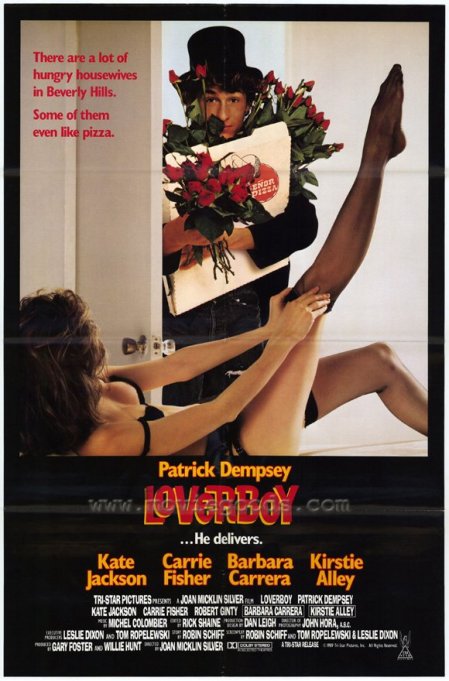
Her most recent work, Invisible Child, is a new original Lifetime movie drama starring Rita Wilson.
Along the way, there have been many unrealized projects. Not one to dwell much on what-might-have-beens, she feels an even playing field might have meant more chances but considers her career a validation of women’s gains, noting, “Well, you know, one always feels one could have done more. But I’ve managed to make films for many years now in a field that was extremely unfriendly to women and to make the films I wanted.” She is quick to add, however, filmmaking is a tough field “for everyone. It’s extraordinarily competitive. There are many, many, many more people who want to be in film than there are jobs.”
Besides her gender, she feels her own idiosyncratic vision has limited her options. “I think that my own bent has always been that I want to make certain kinds of films, and they aren’t necessarily the films that are seen as Hollywood-type films.” Long attracted to exploring the complex give-and-take of intimate male-female relationships, she has created a string of serio-comic pictures that compare favorably with the work of the best romantic comedy directors in history. The romantic partners in her films are far from perfectly happy and, indeed, often flounder in search of equilibrium if not bliss, as in her 1998 feature, A Fish in the Bathtub, starring Jerry Stiller and Anne Meara as a Queens couple, Sam and Molly, whose 40-year marriage finally goes on the fritz.
“It (A Fish) falls into a special category of film I like very much — human comedy,” Micklin Silver said. “It’s real, wrenching and strikes a chord.”
Unafraid to tackle the silly, messy, chaotic side of relationships, she probes issues like obsession, desire, infidelity, possessiveness, loneliness, rejection, regret. Like the smart repartee associated with Lubitsch, Wilder, Cukor or Hawks, she delights in verbal sparring matches that deflate gender myths and romantic idylls.
In Chilly Scenes the single Charles (Heard) is lovesick over the unhappily married Laura (Hurt), whom he can’t forget despite her breaking off their affair. While still attracted to Charles she feels guilty at having cheated as well as smothered by his aggressive wooing of her. She tells him, “You have this exalted view of me, and I hate it. I can’t live up to this thing you have about me.” He pleads, “Why would you choose someone who loves you too little over someone who loves you too much?” She replies, “Because it makes me feel less of a fraud.” Exasperated, he can only think to say what he feels, “Oh, I’m going to rape you.”
Micklin Silver’s men and women are equally strong-willed and neurotic. Despite their flaws, the men remain sympathetic figures for risking love in the first place and for staying true to themselves in the process. That is never more evident than in Crossing Delancey, where Sam (Peter Riegert), the pickle man, patiently waits for the upwardly mobile Izzy (Amy Irving) to come down off her high horse and finally see him for the decent if unflamboyant guy he really is. The story is also very much about the uneasy melding of old and new Jewish culture and the conflicting agendas of today’s sexual politics. Izzy is the career-minded modern woman. Sam is the tradition-mired male. Each pines for affection and attachment, but are unsure how to get it. In the end, a matchmaker and bubby bring them together.

Peter Riegert and Amy Irving in Crossing Delancey
About the male-female dynamic in her work, Micklin-Silver said, “That is something I’m quite interested in. Why? I have no idea, other than a life lived, I guess. In my own life experience I had a really wonderful father who was interested in me and paid attention to me and to my ideas, and all the rest of it. And God knows I have a wonderful, supportive husband whom I’ve had three great daughters with. I haven’t had the experience of abuse by men, so basically what I’ve done is more observe the differences (in the sexes) than the struggles.”
She and husband Ray (a producer and director in his own right) continue to partner on some projects and to pursue others separately. Their Silverfilm Production company is housed in offices on Park Avenue.
Although she rarely gets back to her home state anymore, she did come to accept the Mary Riepma Ross Award at the 1993 Great Plains Film Festival in Lincoln. On that visit, she drove across the state and was reminded just how “beautiful” the endless horizons of far western Nebraska are. “I Iove western Nebraska. It’s just so beautiful. I love a landscape that’s long and flat, and where there’s so little in the middle distance that your eye goes on and on.”
A landscape reminiscent of that is the backdrop for a project she’s developing called White Harvest, which is set on a sugarbeet farm in far northeastern Colorado. Based on a book called Second Hoeing, it is a period piece about a young girl wanting to escape her tyrannical immigrant father. “It has a great feeling for the place. It’s also a wonderful love story,” Micklin Silver said.
If the project ever flies, it would realize a long-held desire to capture the Midwest on film. “I’ve always wanted to shoot something in Nebraska. It still hasn’t happened but I want so much to come back to that world.” There’s also a film noir script she’s been honing and still hopes to make. Next spring she is slated to direct a film adaptation of the Paul Osborn play, Mornings at Seven, for Showtime.
Ideas are what feed her work and her passion. “I’m never without something I want to do. It’s your life. What you’re doing…what you’re thinking,” she said.
Meanwhile, she’s excited by the prospect of a more dynamic cinema emerging from the rich new talent pool of women and minority filmmakers.
“Yeah, it’s going to be a much richer stew, and something all of us can enjoy.”
Related Articles
- Paramount Projects Revealed: Kathryn Bigelow to Direct Will Smith?, Movement on Jason Reitman’s ‘Young Adult’, and More (slashfilm.com)
- All eyes on the prize (variety.com)
- John Farr: A Woman’s Touch: Ten Great Films From Female Directors (huffingtonpost.com)
- Actor Peter Riegert Makes Fine Feature Directorial Debut with ‘King of the Corner’ (leoadambiga.wordpress.com)
- Why I love Joan Micklin Silver (bookpod.wordpress.com)
- Yolonda Ross Takes It to the Limit (leoadambiga.wordpress.com)
Altman on Altman: A look at the late American auteur Robert Altman through the eyes of his grandson, indie Omaha filmmaker Dana Altman, and other cinephiles
first met and interviewed Omaha film producer-director Dana Altman some 15 or 20 years ago. I always knew he was related to the great American filmmaker Robert Altman but it was only a few years ago I decided to delve into his relationship with his grandfather, and then when that great lion of auteurs passed away, I wrote this piece based on what Dana and other Omaha cineastes had to say about the late great master. Of course, the story is mostly about a grandson who followed his grandfather in the business, growing up on and later apprenticing on some of Robert Altman’s pictures. It’s an offbeat story and another link in Nebraska’s rich film legacy.
The story appeared in a somewhat shortened version in The Reader (www.thereader.com). By the way, Dana Altman is a key figure in the indie film scene in Omaha, where his North Sea Films is based. As a producer and mentor, Altman was behind two seminal projects that energized the local indie film movement: the 1990s Omaha (the Movie) and 2010’s Lovely, Still; the former by writer-direcor Dan Mirvish proved that a no-budget feature made here could make a splash on the film festival and home video circuit; and the latter, starring Martin Landau and Ellen Burstyn and written-directed by Nik Fackler, may just be the film that puts Omaha and its emergent filmmaking community on the map.
Altman on Altman: A look at the late American auteur Robert Altman through the eyes of his grandson, indie Omaha filmmaker Dana Altman, and other cinephiles
©by Leo Adam Biga
Originally appeared in The Reader (www.thereader.com)
Since the November death of filmmaker Robert Altman, cinema’s mourned the loss of a model for buck-the-system nonconformity and get-your-film-made-no-matter-what resolve. For Omaha native Thomas Schatz, executive director of the University of Texas at Austin Film Institute, Altman’s the reason he got into film studies. “It was immediately after a screening of McCabe and Mrs. Miller (Altman’s ‘71 revisionist Western) in the Dundee Theater that I decided to go to ‘film school.’ True story.” For home grown filmmaker Dan Mirvish, the man behind Omaha (the movie) and the guru of Slamdance, the late director embodied the indie spirit.
In an IndieWire tribute, Mirvish wrote: “Robert Altman was a huge professional and personal inspiration to me. He really defined what it means to be an ‘independent’ filmmaker in the sense we know it today. No matter how much acclaim and experience he had, he always struggled to get financing and distribution, complained about his agents, loved to get a great cast, surrounded himself with his real and virtual family of crew, and had a hell of a lot of fun while making movies. And he just kept doing it.”
For Omaha filmmaker and Slamdance co-founder Dana Altman the appreciation runs deeper. The grandson of Robert Altman, he worked on three of his grandfather’s films – Popeye, Kansas City and Cookie’s Fortune – and saw the making of others. He shared privileged moments with him on set and at his Malibu, Calif. home. The experiences gave him an insider’s look at the process of a legendary artist whom Schatz said exerted “massive” influence on “generations of filmmakers.”
“He was the auteur’s auteur – an authentic original, a visionary filmmaker and an uncompromising individualist,” Schatz said in an e-mail. “Altman favored densely populated stories with multiple, interwoven plotlines. He worked with ensemble casts and relied heavily on his actors for improvisation and naturalistic performances. Visually, his restless, moving camera and tendency to compose ‘in depth’ kept his myriad plotlines constantly moving and made unprecedented demands on the viewer. The sound tracks in his films were equally complex and layered, with multi-track recording, overlapping dialogue, ambient sound and canny use of music providing a perfect complement to his visual and narrative design.”
Dana Altman viewed it all from a familial and film perspective. In addition to producing Mirvish’s Omaha (the movie), he’s crewed on such features as Alexander Payne’s Citizen Ruth, Election and About Schmidt. He’s the owner of his own local film production company, North Sea Films. He and his fellow Omahans admired how the elder Altman always marshaled on despite battles with studio executives and struggles to find financing. How his idiosyncratic vision never wavered, not after critical-commercial failures, not even after a heart transplant he kept secret from the public. Up till the end he was still scrapping, prepping a new film at age 81.
“It was always difficult for him to find financing. It was always difficult for him to make films. But he would make a film a year, sometimes two,” Altman said. “Certainly the maverick. the last thing he would do is compromise his take or his decision about what picture to make or how that picture was to be developed. He personally took them on. They were his pictures through and through. I mean, he developed the idea for Three Women from a dream that evoked the oddest visual palette for the film. It’s like one oil painting after another. Every frame of the film is just so obscure and unique and beautiful and disturbing at the same time.”
Schatz said the filmmaker was the “consummate independent, who always made films his own way and on his own terms – even if it meant making movies on 16mm or in Europe or doing cable TV series. And it was always about the art.”
The grandson echoes many others in saying that any appraisal of the late great artist must conclude that among American feature filmmakers “his struggle and fight” with the system set him apart. “Orson Welles may be the closest counterpart to that same path. But no one else,” Altman said.
Mirvish recalled an exchange with Robert Altman that taught him a lesson: “I once saw him and referred to myself as a director. He asked if I was directing anything now. ‘No,’ I sheepishly said. ‘Well, then you’re just a guy who HAS directed,’ or something to that effect. The point is, just make the next movie. It’s great advice to all of us. An Altman tactic was to set the start date, believe you’re making the movie and get the train rolling. And don’t stop…”
“It’s about doing it,” Dana Altman said.
Mirvish, also the director of Open House, considered Bob a generous mentor.
“I met him several times over the years through Dana. He was a big help on Omaha (the movie),” Mirvish described via e-mail. “The first place we screened it was in New York at what was then the Independent Feature Film Market. The night before our big screening, he (Robert Altman) asked if it would help or hurt us if he came to the screening. We’d already shown him a rough cut. We said definitely it would help. Back in those days filmmakers were lucky if they could get five people to their screening. But as soon as Bob walked into the complex, he was like the Pied Piper…everyone in the building just followed him…We wound up with a packed house. Dana and I sat right behind Bob and about two-thirds through, he got up and walked out. My heart sank. I was afraid all those people would walk out with him. Thankfully, he just had to go to the bathroom and came right back in. Even though we would go on to play in 35 festivals around the world…in terms of industry attention, that screening was really the high point for the film. We definitely became the buzz film of the market.
“His influence on me was very prevalent on Open House, too. There was one particular conversation we had with him in New York as we were finishing Omaha…that was all about how he would shoot musical scenes with the actors singing live on set. So when we decided to do Open House as a musical, we basically did it using the Altman method.”
Dana said his grandfather “very much enjoyed Dan’s work” and took a keen interest in his own work as well. “He was very proud of my accomplishments. He never would talk specifically about the work beyond, ‘That was good.’”
Mirvish recalled how Dana asked his famous grandfather for advice. “When we first came up with the notion of Slamdance back in the fall of ’94, Dana…called up Bob and asked if we should forge ahead at the risk of pissing off Sundance. ‘Sure. Fuck ’em,’ he said. And with that, Slamdance was born.” It wasn’t the last time Altman asked Bob, which is what he called his grandfather, for advice.
Dana was born in Calif. and raised in Fremont, Neb. His mother is Christine Altman Westphal, whose mother Lavonne Cubbison grew up in Fremont. It was just him and his single mom for a while, living as hippy-gypsies until settling down to small town life. He caught the cinema bug as a 15-year old props assistant on Popeye (1980), By the time he was transportation coordinator on Kansas City (1996) and props assistant on Cookie’s Fortune (1999), he was making features, TV spots and corporate image campaigns.
He’s not the only Altman who proved his cinema chops on Bob’s sets. Dana’s uncles, Bobby, Stephen and Matthew, served key camera, production design and art department roles on many of their father’s films. Aside from a few forays in her father’s early films, including a bit part in his first feature, The Delinquents, Dana said his mother “was never really in the machine of film” like her brothers were.
Although he bears the weighty name now, Altman broke into the business on his own, under his birth surname of Johnson, not by any association with his grandpa. He apprenticed as an editor at Universal Pictures in ‘89-‘90, helping cut such series as Columbo. Then, against Bob’s advice, he left L.A. for Nebraska, just a week short of getting his Editor’s Guild card. Why? Ironically, Dana said he was disgruntled with the old boys network that determined who advanced and who didn’t in Hollywood. He only changed his name to Altman after moving back to Nebraska and starting a family. He and his wife Deanna Lee Altman are the parents of six children.
He said leaving L.A. for Nebraska is “the best decision I’ve ever made.” He did heed his grandfather’s advice when Bob urged him to change his name.
“Bob and Kathryn called and said, ‘You should give your family some heritage.’ I fought it because it’s the same thing I hated about L.A. I was incredibly frustrated watching people come into the system based on who they were, not what they could do,” Altman said. “It’s about who you know and what your last name is, not how skilled you are. It was hard for me out there seeing how it operated and now people got in the game. That’s always been the fight…that I want to be good regardless of what my last name is. That’s the most important thing.”

Dana Altman
It’s not that he isn’t proud of the Altman tie. He just doesn’t want people to think it opened doors for him. “I mean, I enjoy it,” he said. “I don’t take anything away from it. But when people ask me — How’s your work influenced by Robert Altman? – I don’t know. I may be blood from my mother’s side, but does that make me a great artist? Does that make somebody talented? I don’t think so. I see kids that have no family heritage in the business, and they’re better than I am.”
In the end, Altman decided to claim the name, he said, “as a way of giving my kids some lineage, some heritage, some history.”
Besides Omaha (the movie), Altman’s produced the horror flick Kolobos and the comedy Out of Omaha. He’s directed one feature, The Private Public, and hopes to “get around” to another. One time he wished he’d followed Bob’s counsel was when he put his own money on the line for Private Public, something he was told never to do. The film failed to recoup his own and other investors’ capital.
In addition to doing work for clients like the Metropolitan Utilities District, he’s preparing to produce the much-anticipated feature debut of Omahan Nik Fackler, the wunderkind director of acclaimed dramatic shorts and music videos. Just as Bob took young filmmakers under his wing, Dana’s known to do the same. Altman’s uncles Bobby and Stephen may fill director of photography and production design roles, respectively, on Fackler’s film, entitled Lovely Still.
As a kid living in Fremont Altman never really harbored dreams of a life in cinema. It was all too far removed. Not that he hadn’t been exposed to that world. In the conference room of his spacious North Sea Films studios at 2626 Harney Street, Altman shows you a framed photograph taken on the set of M*A*S*H (1970), filmed in California. The outdoor image shows his grandfather, resplendent in big game hunter attire, signature beard and mustache intact, standing and holding him at age 3, his mother beside them and actor Michael Murphy, a regular Robert Altman stock player, beside her. A tent is visible in the background.
The first set he actually remembers being on is that of McCabe. The pervasive mud and miserable conditions of that Vancouver shoot are what he recalls, along with feeding goats and being repeatedly warned to stay off the rickety bridge where Keith Carradine meets his demise in the film.
But it wasn’t until a quirk of fate that Altman got his first real taste of film work. It was 1980 and his baby brother, Wesley Ivan Hurt, had been born with the umbilical cord wrapped around his neck, pinching a nerve that paralyzed the right side of his lip into a kind of whimsical scowl, making him the perfect choice to portray the infant Sweet Pea in Bob’s film version of the “Popeye” comic strip. That’s how it is Altman went with Wesley and Mom to Malta for the making of Popeye. Once there, Dana found himself enlisted in the ranks of crew supporting the sprawling shoot, “as there was always stuff to do. That’s how I got into props,” he said.
Admittedly, the Felliniesque Popeye marked “a weird one to step into” for a first film crew gig. “Yeah, a musical Popeye,” he said with a wry grin. For starters, “it was a really big, big shoot. It was really far away, in foreign territory, in the middle of the Mediterranean Sea,” he said. “Robin Williams, Shelley Duvall, Paul Dooley, Ray Walston and all these fantastic people. You were kind of transported to this weird little place isolated from the world. That’s all you’re exposed to the whole time. So for ten months, you know, you’re living the movie. We basically shot it all in this cove. Every single piece you see was constructed for the purpose of the movie. Not one item happened to be there. When we showed up it was a big rocky cove and when we left it was a city – a city of Popeye.”
He said he fell in love with the whole apparatus of filmmaking “once I was there and I saw the process…building the sets, sinking ships out in the cove, building ships that had boxing rings on the decks. I mean, it was just insane.”
Seeing it all come together under the attentive eye of Bob, the maestro and orchestrater of all this “controlled chaos,” captivated Altman.

Robert Altman
“How his discussions – hands pointing in all directions – in one brief moment could address lighting, movement, emotion, color, timing and whatever else needed to be addressed and corrected…” he said. “He would finish the next shot, go into another extraordinary litany of problems to be attended to. Over and over again this process would occur until his hands would fly into the air and he would yell, ‘That’s great…couldn’t be better.’ Watching, listening and trying to comprehend how this was possible is what initially got me thinking about filmmaking as a career.”
Fast forward 15 years, to Altman in his late 20s-early 30s and already a film veteran. He then sought out the opportunity to work with his grandfather. “I knew I wanted to work with him and so I just threw my name in the hat and said, ‘If there’s any task you can’t find the person for, then let me take a shot at it.’” His chance came onKansas City, Bob’s Great Depression-era, jazz-themed crime riff shot in Kansas City, Mo., where the director grew up the son of an insurance tycoon and got his start in industrial films. “Bob put me in charge of coordinating a $300,000 budget to maneuver and find and build all of the picture’s vehicles. I think we ended up with 250 pre-1934 vehicles. Sedans, taxis, police cars, ice trucks, motorcycles.”
He was given the same freedom his grandfather was known to give all collaborators.
“It was hands off. I loved that because it was truly a responsibility that was tasked to me and it was pass or fail, and failure was not an option,” Altman said. “So it was my opportunity. I would get it done and get it done well.”
His passing grade led him to Cookie’s Fortune, shot in Holly Springs, Miss., where he handled all the “personal effects” for characters, including finding an assortment of pipes, 60 in all, for the eccentric matriarch of the title played by Patricia Neal.
“It was my opportunity to learn what kinds of things were important to Bob from a creative standpoint of the scene and the surroundings that make up the characters,” he said. “Every item we were tasked to find and provide and have on set and in position in the scene meant something.”
As Altman found, any prop, even if unseen on screen, adds nuance to a shot. Without such details, he said, “something’s missing, something’s not right.”
Working on Kansas City and Cookie’s Fortune he watched with a more discerning eye how Bob directed. How he was “kind and cool, relaxed and confident, prepared to – explore.” Bob’s mastery of the set, the shot, the scene, never ceased to amaze him. His letting actors play and be the authors of the scenes. There were rehearsals, Altman said, but once cameras rolled Bob didn’t intrude. He respected actors and gave them great freedom to create.
“He would allow things to develop. He had a huge amount of confidence,” said Altman, who recalled how “Bob once said as were sitting next to the video assist, ‘I just let them (actors) do this part. My job’s over. I put all the pieces together. Now I just get to watch it unfold.’ He’d say, ‘Don’t act. Just be real.’ It’s like, Man, he has all this opportunity to really define what it is and that’s when he stood back to watch it unfold,” Yet there’s a reality to what ended up on screen, with the interplay of dialogue and people’s reactions and movements. I think that’s what amazes people. What he did in that string with The Player and Short Cuts, it freaked the system out how real it could be.”
Bob used his camera as an extension of his or the viewer’s eye, subtly scanning the action, letting shots plays out in extended takes. Dana said it was up to the camera operator to capture it all. It makes for a fluid, intimate style that can be uneasy for how invasive this sense of peering-in at private moments gets. “It’s very voyeuristic, that’s what it is,” Altman said. “It’s kind of like he lulls you in and allows you inside. And I think that’s exactly how it was for him when he sat in front of a monitor.”
For Dana, like many others, watching a Robert Altman film is akin to watching a play. “You always feel like the whole scene is right there in front of you,” he said. “He almost takes the shot exactly where my brain would want to go.”
Within this richly textured mis en scene, there’s the sense, as in life, anything or nothing at all may transpire. “In almost everybody else’s work you can kind of feel this structure – that there’s a written page somewhere and it’s either going to go here or here,” Altman said. “But with Bob I’ve never been able to guess what’s next. What the next line of dialogue or the next plot line is. You never get bored. Your brain’s on fire being a voyeur in this world. It’s life unscripted.”
When crewing, there were no long talks about theory or technique. “When I was working with him, it was work,” Altman said. “I was there to facilitate what he needed. Certainly he would define reasons why. Like our discussions about what type of vehicles or how many vehicles outside Union Station during Kansas City. He showed me photographs. ‘Here, look at these pictures, this is what I want to see.’”
Away from the set, conversations rarely turned to film. “We skipped over all that stuff,” he said. At moments like these it was a grandson and a grandfather talking about life, “just hanging out,” Altman said. “It was more personal.” Always, he said, Bob was easy to be around. “No matter what, he was accessible. I never found him to be this unattainable, untouchable great artist. I always saw him, you know, as grandpa.” It was the same way with “the great talents” he got to know on Bob’s sets, including Glenn Close and Julianne Moore — “the neatest lady I’ve ever met.” He said they didn’t talk shop, but about family. Or, in the case of Chris O’Donnell, they talked golf while Altman fruitlessly tried beating the actor on the links.
His grandfather’s sets were warm and personable. “He always created that environment where he was good to be around and you sensed the people he gathered were all together…like a family. They were cool. I’ve sensed that on Alexander’s (Payne) films as well. On other films I’ve been on it’s more of a job.”
Altman realizes he “was in a position other people would love to be in.” A part of him rues not talking more film with Bob. “It’s kind of like I missed out,” he said. “He was such a fantastic, world renowned figure who it’s rare to be in the company of.” But always, he said, duty and family trumped career or professional conceit.
One of the last times he saw Bob was in 2005, as the director wrapped A Prairie Home Companion in Vancouver, where 35 years earlier little Dana was sloshing through mud in galoshes on the set of McCabe. Altman’s wife and kids made the trip up north to visit grandpa on Prairie Home. Once again, family came first.
He said his grandfather was touched by the lifetime Oscar he accepted at the 2006 Academy Awards: “He told me he was very excited about getting an Oscar for the volume of his work rather than just one (film).” Altman was delighted the Academy saw fit to honor his grandfather “before it was too late.”
When news of his death reached him, Altman said there was little time to react as “it all happened quickly. No time really for a service. I took my wife and five of our six kids and it was just us family getting together for Thanksgiving at his house in Malibu right over the ocean. Some of us stood to speak our peace and say goodbye. I miss him already.”
NOTE: Dana Altman attended a February 20 memorial service for his grandfather at New York’s Majestic Theater. He plans to attend a second tribute on March 4 at the DGA Theater in Los Angeles. Robert Altman will be posthumously accorded a lifetime achievement award at the Spirit Awards on Feb. 24; in addition, the awards committee has created the Robert Altman Award, to be given out beginning next year to a film’s director and ensemble cast.
Related Articles
- ALTMAN’S “McCABE & MRS. MILLER” | TSY REQUIRED VIEWING (theselvedgeyard.wordpress.com)
- ReFramed No. 4: Robert Altman’s ‘California Split’ (Short Ends and Leader) (popmatters.com)
- Check it Out: Cookie’s Fortune (lawlibraryblog.seattleu.edu)
Nik Fackler, the Film Dude Establishes Himself a Major New Cinema Figure with “Lovely, Still”
My most recent article on emerging filmmaker Nik Fackler makes no bones about his establishing himself a major cinema figure on the strength of his first feature, Lovely, Still, an Omaha-shot indie feature starring Oscar winners Martin Landau and Ellen Burstyn. The pic is finally getting a general national release after having picked up a slew of admirers and awards at select screenings, most recently at the California Independent Film Festival. Watch for this film when it comes to a theater near you or plays on cable or wherever else you can find it, because it’s the work of an artist who will make his presence felt. As he prepares to make his next projects, I feel the same way about Fackler that I did about Alexander Payne when I saw his debut feature Citizen Ruth – that this is an important artist we will all be hearing much more from in the future. I look forward to charting his journey wherever it takes him.
Don’t be surprised if Landau and/or Burstyn net Oscar nominations for their superb performances. This piece originally appeared in The Reader (www.thereader.com). Omaha is home to some serious filmmaking talent. Payne and Fackler are at the leading edge of a homegrown cinema movement here, and more figures are sure to emerge.
©by Leo Adam Biga
Originally appeared in The Reader (www.thereader.com)
After what must seem an eternity, Omaha’s resident Film Dude, writer-director Nik Fackler, finally has the satisfaction of his first feature being theatrically screened. An advance one-week Omaha engagement of his Lovely, Still opens the new Marcus Midtown Cinema, Nov. 6-12.
The film’s box office legs won’t be known until its 2010 national release. Screenings for New York, L.A. and foreign press will give Lovely the qualifying runs it needs for Academy Awards consideration next year. It’d be a stretch for such a small film to net any nominations but the lead performances by Martin Landau and Ellen Burstyn are so full and finely honed they’re Oscar-worthy by any standard.
Both artists strip themselves emotionally bare in scenes utilizing all their Method gifts. Their work is: dynamic, never dull; natural, unforced. Their behaviors appropriate for the romantic, comedic, dramatic or just Being There moments.
Nods for writing, direction, cinematography, editing and music would be unlikely but not out-of-line for this gorgeous-looking, powerfully-rendered, well-modulated movie that hits few false notes. The film pops with energy and emotion despite a precious storyline of senior citizens rediscovering first love.
The local creative class is well represented by Tim Kasher’s “additional writing,” James Devney’s strong portrayal of Buck, a lush score by composers Mike Mogis and Nate Walcott and dreamy tunes by Conor Oberst and other Saddle Creek artists.
It’s at least as impressive a feature debut as Alexander Payne’s Citizen Ruth.
An indication of how much Landau believes in Lovely and how proud he is of his gutsy star-turn in what Fackler calls “a showcase role that’s very challenging” is the actor’s appearances at select screenings. That includes this Friday in Omaha, when he and Fackler do Q & As following the 6:15 and 9:15 p.m. shows at Midtown.
Fackler’s at ease with the film that’s emerged. “I am very content, although it has changed a lot,” he said, “but I welcome all changes. Film is an ever changing beast. You must embrace the artistic transformation. To not allow it, is to limit it.” Much hype attended the making of the 25-year-old’s debut feature, shot in his hometown in late 2007. It was the first movie-movie with a real budget and name stars made entirely in Nebraska since Payne’s About Schmidt in 2001.
Circumstances caused the film that generated serious buzz a couple years ago and then again at the Toronto Film Festival’s Discovery Program in 2008 to fall off the radar. Lovely producers turned down a distribution offer
They continue negotiations seeking the right release strategy-deal. Self-release is an option.

Nik Fackler
It’s been a long wait for Fackler to see his vision on screen – six years since writing it, five years since almost first making it in 2005, two years since completing principal photography and one year since reshoots and reediting.
“This has been the longest I’ve like worked on a single project for forever,” he said. “It’s really been a marathon.”
Anticipation is great, not just among the Nebraska film community that worked the pic. Whenever stars the caliber of Landau and Burstyn throw their weight behind a project as they’ve done with Lovely the industry takes note. That a 20-something self-taught filmmaker with only micro-budget shorts and music videos to his name landed Oscar-winning icons certainly got people’s attention. As did hanging his script’s sentimental story about two old people falling in love at Christmas on a subversive hook that turns this idyll into something dark, real, sad and bittersweet. Throw in some magic realism and you have a Tim Burtonesque holiday fable.
The two stars would never have gotten involved with a newcomer on an obscure indie project unless they believed in the script and its author-director. At the time Fackler lacked a single credit on his IMDB page. Who was this kid? In separate meetings with the artists he realized he was being sized up.
“It was really intimidating,” Fackler said of meeting Landau in a Studio City, Calif. cafe. “I was just super freaked out. I don’t know why. I’m usually never that way. But it was like I was about to meet with this legend actor to talk about the script and for him to kind of like feel me out — to see it he can trust me as a director, because I’m a young guy. We’re from such different generations.”
The two hit it off. Lovely producer Lars Knudson of New York said Fackler “aced” a similar test with Burstyn in Manhattan: “It’s a lot of pressure for a (then) 23-year-old to meet with someone like Ellen, who’s worked with the biggest and best directors in the world, but Nik blew her away. I think she called him a Renaissance Man.” Knudson said “it’s really impressive” Fackler won over two artists known for being ultra-selective. “They’re very critical. They’ve done this for so many years that they will only do something if they really believe it’s going to be good.”
Lovely producer Dana Altman of Omaha said the respect Fackler gave the actors earned him theirs.
Anyone reading the screenplay could see its potential. Besides A-list stars other top-notch pros signed on: director of photography Sean Kirby (Police Beat), production designer Stephen Altman (Gosford Park Oscar nominee) and editor Douglas Crise (Babel Oscar nominee).
But the history of films long on promise and short on execution is long. As Dana Altman said, any film is the collective effort of a team and Lovely’s team melded. On location Fackler expressed pleasure with how the crew – a mix from L.A. and Omaha – meshed. “Everyone’s on the same wavelength,” he said. Still, it was his first feature. DP Sean Kirby said, “Anytime you do something for the first time, like direct a feature film, there’s a learning curve, but I think he’s learned very quickly.” Fackler admitted to making “a bunch of mistakes” he “won’t make again.”
The subject matter made the film rife with traps. Take its tone. Handled badly, it could play as treacle or maudlin. Instead, it reads poignant and tragic, and that’s to everyone’s credit who worked on the film.
Then there’s Fackler’s penchant for going on fantastical jags in his work, routine in videos but risky in features. His loose approach, such as ditching the shot list to improvise, combined with the total creative freedom producers granted, meant he could play to his heart’s content, within reason. That can lead to self-indulgent filmmaking. Indeed, he fought and won the right to shoot trippy dream sequences that ended up on the cutting room floor. But some experimental lighting techniques to express tangled memories do make an effective motif in the final cut.
Following the mostly positive Toronto showing, the team reassembled for Omaha reshoots and New York pick ups. His leads supported the fixes and coverage.
“Martin and Ellen were behind it, they weren’t annoyed by it, they thought all the reshoots were going to make the film better,” said Fackler. “It wasn’t something that felt forced or anything like that. Everyone was on the same page.”
The young artist and his venerable stars established an early rapport built on trust. “We became friends,” he said. He readily accepted ideas from them that helped ripen the script and gave its young creator deeper insights into their characters.

“What’s great about Nik, especially at his age, is he’s willing to collaborate with people. It’s still his vision, but if it makes it better he’ll change it, he’s not afraid,” said Knudson, who said the script owes much to the input of Landau and Burstyn. “He’s very sort of ego-less.”
It’s all in line with Fackler’s predilection for creating a relaxed set where spot-on discipline coexists amid a way-cool, laidback sensibility that invites suggestions. On location for Lovely he exhibited the same playful, informal vibe he does on his videos: whether going “yeah, yeah” to indicate he likes something or pulling on a can of Moen between takes or doing a private, Joe Cocker dance watching scenes or saying to his DP setting up a shot, “Feelin’ good then? Then let’s kick ass!”
Fackler’s totally of his Generation Y culture, just don’t mistake his nonchalance for slacker mentality. He’s all about the work. He carved a career out-of-thin-air directing videos for Saddle Creek recording artists. His shorts netted the attention and backing of Altman. He cobbled together casts, crews and sets, often doing every job himself, before Lovely. He hung in there six years waiting for this moment, working at his family’s business, Shirley’s Diner, to pay the bills.
“If there’s ever a roadblock you can always get around it. It’s just a matter of taking the time…and not giving up. I wanted the roadblocks. I was like, Bring ‘em on, because I had a lot of ambition and I still do. I guess it’s just something that I always thought anything is possible. It’s like the naive child in me never left me. I love it. I try to get everyone else around me to feel the same way.”
It was in an L.A. editing room where the jumble of material he shot for Lovely finally came into focus.
“The film from script to screen went through a lot,” he said. “I tried every possible edit. That’s why we ended up editing two months more than we thought we were. But luckily, you know, everyone — producers and investors – were supportive of that process, They didn’t put that much pressure on me because they saw that the film was pretty good, they liked it, and so they allowed us to do it. I ended up throwing the dreams out all together because they weren’t working, and using the experimental lighting scenes because they ended up looking so good.
“I have no regret cutting things I shot. I love the film I have. I love cutting stuff. My philosophy while editing was to not be attached to anything. Once I lived by that rule, everything came free. What matters is making the best film possible, always.”
That mature-beyond-his-years attitude drew Altman to be his mentor. Altman, whose North Sea Films produced Lovely with Knudson and Jay Van Hoy’s Parts and Labor, credits Fackler for hanging in there and doing what’s best for the project, saying: “it’s taken a great deal of patience. Poor Nik, he really does want to see this get released.” Whatever happens, Fackler’s satisfied with what he’s wrought.
“I like to take children’s themes that anyone from any age can understand and then put them in these like really harsh realities of what life can be like. Lovely, Still is very much written to evoke some kind of feeling. It takes place during Christmas time and it deals with family and love. It’s multi-layered. For some people that may be a happy feeling and for others it may be depressing. Art is trying to create a new feeling you’ve never felt before. You watch a film and you leave the film feeling a new way. You may not have a name for the feeling, but it’s new.
“That’s all I can hope for.”
He recently collaborated with cult comic strip-graphic novel artist Tony Millionaire on a script adaptation of Millionaire’s Uncle Gabby. “I can’t wait to bring existentialism and poetry to the children’s film genre,” said Fackler. ”I’m also excited to work with puppetry. It will be like playing with toys! ALL DAY LONG!”
Altman, Knudson and Co. have informal first-look rights on Fackler projects.The same producers who’ve had his back on Lovely look forward to a long association. “Like Dana (Altman), we want to continue working with Nik and we want to create a family sort of, so he feels protected, so he can make the movies he wants to make for the rest of his career,” said Knudson. Radical, man.
Meanwhile, the Film Dude returns from the Sao Palo (Brazil) Film Festival in time for this weekend’s Lovely events. Then it’s back to imagining and waiting tables. Tickets for Friday’s event are $10 and available at www.marcustheatres.com or the cinema’s box office, 3201 Farnam St.
Related Articles
- Landau and Burstyn in Lovely, Still Trailer (screenhead.com)
- Film Fall Preview: Money, horses and death (ctv.ca)
- Spirit Awards 2011 predictions and Joel McHale comments (hollywoodnews.com)
- Winners Announced for 2011 Film Independent Spirit Awards (prnewswire.com)
- Canceled FX Boxing Show, ‘Lights Out,’ May Still Springboard Omahan Holt McCallany’s Career (leoadambiga.wordpress.com)
- Yolonda Ross Takes It to the Limit (leoadambiga.wordpress.com)
- Yolonda Ross is a Talent to Watch (leoadambiga.wordpress.com)


 Leo Adam Biga's My Inside Stories