Archive
UNO Wrestling Retrospective – Way of the Warrior, House of Pain, Day of Reckoning
This blog recently featured my story “Requiem for a Dynasty” about the UNO wrestling program being eliminated. The story allowed longtime head coach Mike Denney to reflect on the proud legacy of brilliant achievement he helped build. That legacy ended ignominously, not because of anything he or his athletes or coaches did, but because of decisions made by University of Nebraska at Omaha officials and University of Nebraska regents to unilaterally cut a program that did everything right in pursuit of higher revenue Division I athletics. The action sent a disturbing message to anyone in the university system: namely, that dollars trump integrity and standards. The following three-part series on UNO wrestling was originally published in 1999 by The Reader (www.thereader.com), when I followed the program for an entire season. This experience put me in close proximiity to Denney, his coaches, and his athletes, thus giving me an inside perspective on how he conducts himself and his program, and I walked away from the experience with great admiration for the man and his methods, as virtually everyone does when they get to know him. Now as he starts a new chapter in his athletic coaching life at Maryville University in St. Louis, where he is leading a start-up program with a band of brothers he’s brought with him from UNO, I know that he will have the same impact there he had here.
A Three-Part UNO Wrestling Retrospective-
Part I: Way of the Warrior
©by Leo Adam Biga
Originally published in The Reader (www.thereader.com)
Near dusk on a Saturday in southwest Minnesota, ten samurai-like warriors lick their wounds after valiantly waging battle an hour before. Officially, they comprise the starting lineup for NCAA Division II’s No. 2-ranked University of Nebraska at Omaha wrestling team. But, in truth, they ply the ancient grappling arts in service of a master-teacher, Coach Mike Denney, whose honor they must uphold in extreme tests of skill, will, endurance.
Move over Magnificent Seven. Make room for The Terrific Ten.
Only they’re not feeling so terrific after losing a dual 23-16 to St. Cloud State, a North Central Conference rival UNO usually pummels. Having lost face in this Jan. 16 rumble up north, the Mavericks are bowed and beaten warriors whose dreams of a national championship lay temporarily dashed. Huddled in the close confines of the 28-foot Ford Chateau motor home the team travels in, the men sit in cold stony silence, awaiting their master’s arrival, and with it, hoped for redemption.
Losing hurts enough, but how they lost really grates. The St. Cloud debacle comes 18 hours after UNO defeats Augustana 25-11 in Sioux Falls, S.D. in what is a solid if unspectacular showing for a season-opening dual. Versus St. Cloud the Mavs build a 16-11 lead entering the next to last match, in which UNO’s stalwart 125-pounder Mack LaRock, a returning All-American, holds a 12-4 edge near the very end. But then, all at once, LaRock loses control, gets himself turned on his back, his shoulders driven into the mat and pinned with four seconds left, sending the crowd in cavernous old Halenbeck Hall into a frenzy and putting SCSU up 17-16 with one match to go.
Shellshocked, LaRock lingers on the mat, alone on an island of pain. Wrestling leaves no time for wallowing in defeat, however. Even when humiliated like this you must pick yourself up and shake hands with your victorious opponent, whose arm the referee raises overhead, not yours. As you skulk off in defeat, the next match begins.
Unfortunately, the Mavs’ entry in this Last Man Standing contest is 133-pounder T.J. Brummels, a weak link who quickly folds under the pressure and is pinned too, capping a stunning series of events that leaves Coach Denney staring out at the mat long after the final whistle.
A half-hour later the still brooding Denney tries absorbing what transpired and how to use it as a lesson for his team. He tells a visitor, “Wow. I don’t think I ever had one turn that quickly. I really don’t. We were in complete control. Mack’s just killing his guy…on his way to a major decision that would put it out of reach. Then it kind of just happened. It was like a knockout punch. I think I’ll tell my guys that back in 1991, the year we won the national championship, Augustana beat us with a team that wasn’t as good as this one. But from that point on our team said, ‘We’re not going to be denied.’ We’ll see what this team does.”
Later, in the motor home, LaRock, propped atop a cooler, head buried in his hands, sobs in front of his teammates, saying, “I’m sorry I let you guys down.” Albert Harrold (174) tenderly rubs his back, telling him, “Hey, when you lose, we all lose with you. We’ve all been there.” Others comfort him too.
As time drags on and the sting of losing burns deeper, the guys grow anxious over what Coach will say when he appears. Not because he’ll go off on some expletive-filled tirade. That’s not his nature. No, because they love him and feel they’ve let him down.
R.J. Nebe, former UNO wrestling great and assistant under Denney and now co-head wrestling coach at Skutt High School, says, “He’s a great motivational coach. The eternal optimist. He’s always upbeat, always supportive, no matter what happens. As much as you want to win for yourself, you want to go out and win for him. Anybody you talk to will say he’s kind of like a father figure. I know that’s a cliche but he truly is an amazing individual and you really do want to make him proud of you.”
Senior Mav Jerry Corner, the nation’s No. 1-rated heavyweight, says he appreciates the strong brotherhood Denney engenders. “Coach Denney impresses upon us to care about the guys we wrestle with. We’re not afraid to say, ‘I love you,’ and openly show some emotion when things don’t go right or when they do go right. That says a lot about the character and nature of the team. Coach Denney is the most positive coach I’ve ever been in contact with. He’s a coach, and then he’s a friend.”
For Denney, in his 20th season at the UNO helm, the role of friend and mentor is not one he feels obligated playing. It is genuinely how he sees himself in relation to these young men. He and his wife Bonnie are parents to three grown children — sons Rocky and Luke and daughter Michealene — and surrogate parents to 30 wrestlers. Serving youths is his fervent calling.
“I have a passion to work with young men and to help them along their journey. To guide them. To get them to get the best out of themselves. To gently nudge them and maybe not so gently sometimes. What I can bring to them is only experience and encouragement. They don’t have to listen to me. Some don’t. They learn the hard way. I don’t have great wisdom to share, but I do have great desire and I do care about them. It’s all teaching,” says Denney, who holds a master’s degree in education from UNO.
His desire to be a positive force in young people’s lives is partly a response to not having had a stable male role model while growing up on his family’s 160-acre farm in the shadows of the Sand Hills near Clearwater, Neb. His late father, Duke, was an alcoholic who abandoned Denney and his younger brother Dave and was abusive to their mother Grace. Filling the void were several key men in his life, among them his high school and college coaches. “They were all great role models. They had a big influence on me. They saw some good in me and kept encouraging me,” he notes.
He tries being this same nurturing figure to the athletes he coaches by creating “a family away from home” for them, especially those from single-parent backgrounds like his own. The “We Are Family” theme is one he and his wrestlers often reference. This sense of sharing a special bond is something he’s borrowed from his old high school coach, Roger Barry.
When Denney finally does climb aboard the motor home in St. Cloud, his big solid body filling the door frame, he speaks with the quiet authority and gentle compassion of a father consoling and fortifying his hurt sons.
“We didn’t give Coach Higdon a very good birthday present did we?” he says sardonically, referring to top assistant Ron Higdon, who stews behind the steering wheel, having turned 32 but feeling 72 . “What happened today I’ve seen happen to us before.” He goes on to tell about the ‘91 team rebounding from an unexpected loss. “And as we look back at that year, it was the best thing that could have happened. If it hadn’t happened, we probably wouldn’t have taken it up to another level.”
His dejected young charges listen carefully, fighting back tears.
Weeks earlier Denney confided he thrives on moments like these: “I honestly think I do the most good when they are at their lowest, most vulnerable. It’s when I can really make a difference with my guys. I actually like to see it happen because I think it’s then you can do so much building and can make a lasting impression. I try to be real sensitive to that.”
Back on the motor home Denney places a hand on LaRock’s shoulder, saying, “Nobody feels worse than this guy. Raise your hand if you’ve been there before.” The rest raise their hands in a show of solidarity. “It wasn’t like we performed terribly, but it’s going to take each one of us to get a level higher in conditioning. I see that. We have to do it. We’re going to do it. It can be just what is necessary for us to take the next step.”
Denney speaks in a deep voice whose easy cadence is soothing, almost mesmerizing. Then, like the taskmaster he must sometimes be, he promises he’ll push them in practice into the region he calls “Thin Air,” where they will train beyond exhaustion, beyond self-imposed limits, to reach the next highest rung. They will gladly endure it too.
“Be prepared men. We’re going to get after it. I’m going to take you until I see some of you over the trash can. I’m not doing it to be an a-hole. I’m just trying to take you to another level. I gotta do it. I just gotta do it. We have to push. We’ve got to get to Thin Air, when you don’t think you can make another step, but you can. And you will. So that when you get in the 3rd period or that overtime you’ve got something left.”
With his guys still smarting, he ends on a motivational note.
“You’re only one performance away from feeling good. We can’t really spend a lot of time feeling sorry for ourselves. Now let’s pull together and feel thankful. There were no injuries. This wasn’t the end. We’re not sitting here feeling like this after the national tournament. Be thankful for that. Be thankful there’s two months left. Be assured, all is well.”
Then, en masse, they kneel in prayer, holding hands. After being braced by their coach’s words and sated by a meal the sullen team loosens up on the drive back home, playing rounds of Spades, laughing, joking, being care-free kids again. They’re young, resilient. Yes, all will be well.
True to his word, Denney takes his team into Thin Air at practice the following week and, as predicted, a couple guys hurl from sheer burn-out. “It was one of the hardest practices I’ve ever had,” he says. “They were hurtin’, but they just wouldn’t let themselves break. Nobody hit the trash can until it was all done. They want to do well and know they can prevent what happened up there by being in better physical condition than anyone they go against. It gives each of them confidence that if it gets down to sudden victory, ‘I’ve been there. I’ve been in Thin Air.’ It can only help.”
The benefits of all that work show up in the Mavs next competition, Jan. 22-23, at the National Showdown Duals in Edmond, Okla., where UNO squares-off with four elite teams, finishing 3-1, advancing to and losing in the championship round to top-ranked Pitt-Johnstown 21-16. Bolstering the attack is junior Boyce Voorhees, a returning All-American, who goes 4-0 at 149 pounds in his first action since an early season injury. Voorhees is an intense wrestler capable of lifting an entire team with his dynamic style. The Mavs gain confidence coming so close to the No. 1 club without senior stud Braumon Creighton, the nation’s top-rated 141-pounder and a returning national champ, who injures a knee and forces UNO to forfeit his match.
Following another Thin Air day, the Mavs maintain their momentum Jan. 29 with a 21-18 win over No. 5 Central Oklahoma that is not as close as the score indicates since LaRock, nursing torn rib cartilage, forfeits. He also misses the next evening’s dual against the University of Nebraska-Kearney, which UNO runs away with 30-10. But Creighton returns triumphantly and he and his mates exude confidence that comes with Thin Air days being a weekly fixture. It’s all about keeping an edge.
The Mavs, with seven of their starting ten rated nationally, are back. Their aim on a national title still true. Denney feels good: “In some real close matches we’ve stayed confident, stayed strong, stayed focused. I like that. We now seem to have the reserve at the end to be able to do what we need to do. This team is on a mission.”
When the Mavs butt-kicking ways end abruptly in a Feb. 19 home dual loss to long-time nemesis North Dakota State, Denney isn’t so sure anymore. “As a team we have to hit on more cylinders. We have to perform better. It’s in us…but, I don’t know, maybe our expectations are just too high.”
After the less-than-inspired showing versus NDSU Denney issues an uncharacteristic in-your-face challenge to his slackers. “I wanted to shock them a little bit. They don’t see that side of me, but I needed to challenege them, and they responded — they really stepped up.” The Mavs respond with a 24-17 win over Div. I Northern Iowa to end the dual season 10-3.
The days leading up to the NCC tourney include intense practices that leave Denney feeling secure once again: “Honestly, that’s the hardest I’ve ever worked a team — but they took it. I’m really confident we’ll perform better. On paper North Dakota State’s the favorite, but we have no fear.”
Steeled by grueling workouts and bolstered by LaRock’s return the Mavs outlast the Bison 78-77 and win the NCC. In the process they regain face and inch closer to wrestling nirvana.With nationals a week away Denney likes how his team refuses to let injuries, forfeits or losses become distractions. “Those things are going to happen but I’m pleased with how our guys aren’t worrying about it. Each guy is staying focused,” he says.
Focused best describes Denney during a match. He never sits. Instead he prowls the sidelines, intently watching his men in action. He raises his voice to offer instructions (“Finish strong,” “Break him down,” “Let it flow”). His expressive face says it all, ranging from a pinched death mask to an open Irish mug. He’s the first one to congratulate his guys after victory
and to offer solace after defeat. After a rough outing he takes a wrestler aside to whisper encouragement– to put things in perspective.
“I tell our guys when they lose to not get that tied in with their self-worth. It’s got nothing to do with it. It’s completely separate.”
After home duals he works the crowd like a seasoned politico, pressing the flesh with boosters, fans, alums and other members of his extended wrestling family. His charismatic side shines through then. When greeting you he makes you feel you are the only one in his orbit. It’s the way he sidles right up to you with a sloppy grin splayed on his face, the way his big warm paw grasps your arm, the way his kind eyes meet yours, the way his “Aw Shucks” manner strikes instant rapport. But like any driven man his extreme focus sometimes catches up with him, putting him in a black mood.
His magnetic presence dominates team practices, which unfold in a sleek retro-style room brimming with banners, posters, plaques charting the program’s storied history. The room reflects different facets of the man, serving for him as training center, tabernacle and sanctuary all in one. With almost ministerial zeal he demands, prods, preaches adherence to the sport’s strict regimen. Indeed, Denney, active in the Fellowship of Christian Athletes and in ecumenical outreach activities, regards the room as “the Lord’s House” and himself as its “watchman” (his church’s pastor blessed it). He even lays hands on his wrestlers with a healer’s touch.
In a space dedicated to mastering the rigors of the mind and body, he is a high priest in this Temple of Fitness. A Master in the Way of the Mat training young ascetics to develop the gift of serenity and the art of physical combat. He is, in fact, a longtime martial arts practitioner, owning high black belt ranks in judo and jujitsu, and incorporates aspects of these Eastern disciplines in the wrestling program, such as greeting visitors by bowing and saying, “Welcome to the dojo,” or his disciples adopting as their mantra, “Ooosss.”
His men are models of cool, calm, collected poise. They accept cutting weight, the bane and burden of all amateur wrestlers, with stoicism.
Finally, Denney is a sentinel keenly attuned to all around him. A most honorable sensei seeking to embolden and enlighten each of his warriors.
“I make it my goal every day at practice to touch every one of my guys physically, with a pat on the shoulder, and to do the same with a positive statement. I like to circulate through the whole group so I can sense when somebody needs a little extra help. I try to catch them doing something right and reinforce that. As a coach you have to focus on doing that because you can get caught up in the other side of it — the negative side. Very seldom to people react well to negativity. I never did,” says Denney, an ex-college and semi-pro athlete and a still accomplished sportsman today. “My philosophy is that so much of the stuff outside of this room is negative that I try to have a positive atmosphere and environment, and it starts with me.”
When he spots one of his guys is down he has him home for dinner or takes him to church. To build togetherness he holds retreats and gets feedback from a team unity council. To help his wrestlers keep a mental edge and handle the pressures of being student-athletes he has two sports psychologists work extensively with the team. To make them better ciitzens he has wrestlers make goodwill visits to hospitals, nursing homes and prisons and assist with youth wrestling clinics.
“I believe in the whole person approach to coaching,” he says.
His wife Bonnie, who is quite close to the program, says he has the tools necessary for this empathic approach: “I think he’s a great communicator and is very wise about what a person is all about. He can listen and read a person and see where they need to be directed. He can motivate them. And he cares. It’s not fake either. He really cares.”
But don’t confuse caring for softness. His practices are pictures of hard work. He’s always pushing for more. More effort, more desire, more, focus, more tenacity, more commitment. He demands nothing more than he does of himself. At 51 he still works out religiously every day, stretching, hitting the treadmill, pumping iron. He refines his judo and jujitsu skills by training with the U.S. National Team at the Olympic Training Center in Boulder, Col., and still mixes it up in martial arts competitions. In 1982 he won the national masters judo championship at 209 pounds. He teaches judo at UNO and self-defense for area law enforcement agencies.
During the season he regularly works 12 to 15-hour days. Hard work and long hours are old hat for Denney, who from the time he was a boy did most of the farming on his family’s spread, where they grew corn, alfalfa, rye and vetch and raised livestock.
“I worked the fields. I helped cattle and sheep deliver their calves. My brother and I milked cows every morning before we went to school. We broke horses. When I began driving a truck and tractor I had to sit on a crate to see over the steering wheel.”
Minus a TV, he and Dave made their own entertainment. “Looking back, I suppose it was a meager existence, but we never thought so.” He variously rode a horse or drove a tractor to the one-room schoolhouse he attended. The school doubled as the community church. His mother taught Sunday School there. He and Dave didn’t dare miss.
Denney concedes his mother, who still lives on the farm at 84, has been the greatest influence in his life. “My real hero is my mother. She’s a rock. She had it real tough raising us on her own and just scratching out a living, but we never wanted for anything. She’s a woman of strong faith and positive attitude. She’s an inspiration to me. She’s amazing.”
Bonnie feels her husband owes much of his iron will and true grit to Grace. “His mother’s a marvelous, strong individual. He got from her a strong character and work ethic that you can’t believe. Nobody will outwork him. He just covers every base. He puts his entire self into it.”
He admits it’s easy losing one’s bearings amid coaching’s endless demands. “In this profession you can get your priorities mixed up pretty easily. It can really consume you. There’s always somebody else you can recruit. Always something else you can do. You really have to work at keeping a balance in your life. My wife has really helped me a lot on that.”
His Never-Say-Die credo served him well during UNO Athletics’ lean times. In the late ‘80s state funding was cut, resulting in severely trimmed budgets, some men’s programs relegated to club status and pickle card sales begun as a last ditch revenue-making source. And until last year’s long overdue fieldhouse renovation Denney got by with second-rate facilities. The old wrestling room, charitably remembered as “a hole in the wall,” was so bad he steered recruits away from it.
“When UNO athletics went through that down period it had a negative effect on all the men’s sports, except wrestling. One of Mike’s supreme accomplishments was to keep right on winning championships. He had no facilities but the man never came to me with anything even resembling a complaint. The truly amazing thing was him getting quality athletes under those conditions. He’s a terrific salesman and has the insight to find the right young men who fit our program. Plus, he’s a great motivator,” says former UNO Athletic Director Don Leahy, now Assistant A.D. at the school.
Assistant Ron Higdon says the new facilities bring higher expectations and added “pressure” for Denney. “He doesn’t look at it like, ‘We’ve got it made, but more like, ‘We don’t have any excuses any more. Let’s not leave any rock unturned. We don’t want any regrets.’” He’s tightened the screws.
Bonnie Denney says her husband thrives on adversity. “He likes it tough. His whole life philosophy is: ‘Get out of the comfort zone in whatever you’re doing. That’s when you will grow.’” He simply says: “I like challenges.”
It’s the same resolve he showed farming and as a football-wrestling standout at both Neligh High School and Dakota Wesleyan, the NAIA college (in Mitchell, S.D.) he attended and whose Athletic Hall of Fame he’s inducted in. As a college lineman he played both ways, often never leaving the field. When the gridiron season ended he went right into wrestling. “One day off was enough. It was a year-round deal,” Denney recalls.
After graduating with a teaching degree his goal was making it in the National Football League. It was 1969. The Vietnam War was hot. The military draft in effect. His kid brother, then an Army grunt in ‘Nam, wrote home warning to “stay out of this mess.” Luckily, Denney got a deferral upon landing a contract with the Omaha Public Schools. When the NFL did not beckon he signed with the Omaha Mustangs, a semi-pro football club popular with area fans in the ‘60s and ‘70s. Even after moving to Omaha with Bonnie, whom he married that summer, he kept alive his NFL hopes.
“I spent a number of years on that mission.”
Life in the ‘70s revolved around teaching (math) and coaching (wrestling, football, track) — first at South High and later at Bryan — and playing ball. He paid a steep personal price for the grueling schedule.
“I’d go early in the morning to lift weights, then teach all day, then coach and then practice with the Mustangs all night. I’d travel on the weekends. There were times when I never saw our first son awake. I really neglected my family. I don’t know why my wife stayed.”
Despite the costs, he would not be deterred from his dream. “Playing with the Mustangs filled the need I had to still compete and play. It was my NFL. I loved it.” He played seven years and concedes only the club’s folding prevented him from continuing. Judo then became his competitive outlet.
What is the appeal of athletic competition? “Unlike the corporate world, you have instant feedback with it. It tells you right away how you did. You can look at wins or losses. Or, like I do, you can base it on performance. The real opponent is yourself — trying to get the best out of yourself.”
He could have coached football in college but chose wrestling. Why?
“You look for vehicles to teach and build and what a great vehicle wrestling is because it’s so demanding. It takes so much discipline, dedication and commitment. You’re going to get beat right out in front of everybody. You can be humbled at any time and very quickly. It brings out the best and the worst in you. And you get so much closer to your athletes in wrestling.”
He finally did get his shot at the big-time via a free-agent try-out with the Chicago Bears in the mid-70s. He was among the final players cut.
“I worked so hard at it and spent so many years pursuing that mission, but in the end I was a marginal player. I faced that fact. And I realized the NFL was not the ultimate answer to my needs. The Lord had other plans for me…much better plans than I could ever have imagined.”
Those plans brought him to UNO in 1979 when Leahy, who saw his work ethic up close as a Mustangs coach, hired Denney, despite no prior college coaching experience, to lead an already respected program.
“Mr. Leahy took a chance on me,” he says, “and I’m forever thankful for that. It was a tremendous opportunity.”
Denney’s made the most of the opportunity by taking UNO wrestling to new heights, annually contending for the title. The year UNO won it all, ‘91, posed a severe trial for him and his family. First, a former Mav wrestler he was close to, Ryan Kaufman, died in a car accident. Denney calls him “our guardian angel.” Then Bonnie, who has multiple sclerosis, fell gravely ill, enduring a lengthy hospital stay. She fully recovered and is healthy today. She says the experience deepened the family’s bond and faith.
Also deepened is her husband’s outlook on athletics. “He used to have a terrible time dealing with losing,” she says. “But now the process has become as important as the result. He’s discovered the joy is in the journey.” Indeed, he preaches to his troops, “Respect the journey, but don’t sell your soul for it.” It’s why he emphasizes the values and lessons to be gained from competition over records and wins. It’s about helping young men “feel somebody cares about them. That there’s an investment in them. That they have some worth. Basically that’s what we’re all looking for,” he says.
It’s a message he delivers in public motivational talks. It’s why he calls his job “a privilege” and twice turned down the head coaching post at Division I Wyoming. Why he is at home with his wrestling family. “I honestly think I’ve been put here as the watchman. I’ve been assigned this. It’s meant to be.”
Part II: House of Pain
Destiny seems on the side of the No. 2-ranked University of Nebraska at Omaha wrestling team entering the NCAA Divison II national championships Friday and Saturday in Omaha: UNO’s nine individual qualifiers match the most of any team; the school is hosting the finals in it own Sapp Fieldhouse on the UNO campus; and the tourney will coincide with Head Coach Mike Denney’s induction into the Div. II Wrestling Hall of Fame.
It is, as Denney’s fond of saying, a time “to shoot for the stars.” The source of UNO’s tempered-steel toughness is forged not in the stars, but in the inferno of practice and in the heat of battle. In a journey through pain.
A UNO practice resembles a “Guernica-like” scene with its entangled heaps of twisted, wreathing bodies and flushed, grimacing faces belonging to a sect of athletes who endure punishment as a badge of honor. Some lay sprawled on the mat, limbs clenched in a contortionist’s nightmare. Others crouch in a gruesome dance, pushing and pulling like territorial bulls.
More than any other sport, wrestling is a survival contest. Technique, fitness, power are all vital qualities but when these things are relatively equal, as they often are, it ultimately comes down to a test of wills. A confrontation to see who can withstand more, who can outlast the other.
Wrestling is a sport of resistance, using the body as a pinion and vice to gain leverage and control. It’s countering your opponent’s moves with ones of your own. It’s long stalemates followed by lightning quick reversals, take-downs, pins. One tiny slip in concentration can prove your undoing.
In the heat of action bodies become locked in vicious embrace. One torso tightly wound around another. A leg wrapped around a neck. Arms ratcheted back from the socket with enough torque to tear ligament and snap bone. Tongues hang out from sheer exhaustion. Sweat runs off in sheets. The thud of bodies on the mat mixes with anguished cries and grunts. As if this agony isn’t enough, there’s the bane of all wrestlers — cutting weight. Truly, it’s as much penance as sport.
Welcome to the House of Pain. Every wrestling club or program has one. It’s often only a ratty old mat in a cold dark gym. Until this season UNO made do with a pit too small to accommodate a full practice. For years its teams trained around the school’s other sports, carting and rolling out mats onto the fieldhouse floor and rolling them up and carting them back off when done. With the completion of a multi-million dollar fieldhouse renovation last year, the Mavs finally have a training facility all their own and one commensurate with the program’s powerhouse status.
Located in the northeast corner of the fieldhouse’s top floor, the UNO wrestling room, a.k.a. the dojo, is a 5,000-plus square-foot facility where all 30 wrestlers can work out in at once. It includes a kick-ass mat, a video station, a digital scale and a sound system. It’s clean, well-lit, ventilated. It’s also where guys shed sweat, blood and tears and gasp for air.
On “Thin Air Days” UNO coaches push their athletes past fatigue, past the breaking point — all in an effort to build mental-physical endurance. A trash can stands nearby for those who get sick. On those days practice begins at 3 and goes full bore past 5. One drill immediately follows another, pairing wrestlers off on the mat as coaches hover above goading them on.
“Your body can do it,” assistant Cory Royal shouts at a prone wrestler one recent practice. “It’s mind over matter.” With that, the spent lad drags himself to his feet and gets after it again. There’s always more to give.
To cap off practice the team runs stairs. The late afternoon session is in addition to a morning workout and individual running and lifting drills. On competition days the demands only increase. In tournaments, such as the nationals, entrants may wrestle multiple matches on day one and still run that same night to ensure making weight for day two’s action.
“In no other sport do athletes have to put themselves through what wrestlers put themselves through,” says top UNO assistant coach Ron Higdon. “As coaches it’s what we love about this sport.” Denney says, “You look for vehicles to teach and build and what a great vehicle wrestling is because it’s so demanding. It takes so much discipline, dedication and commitment. You’re going to get beat right out in front of everybody. You can be humbled at any time and very quickly. It brings out the best and the worst in you. I like these challenges.”
Why do athletes do it?
“I don’t know, maybe I’m a masochist, but I love it. Wrestling is a sport that’s so demanding. It takes the mind, body and soul. It takes everything that you can possibly muster and I guess that’s the challenge I really enjoy,” says senior Jeff Nielsen, (133 pounds), who went 0-3 in the NCC tourney.

There’s more to it than that. It’s being cast alone on an island of pain and using every ounce of courage and skill to try and best your opponent.
Senior Mav Braumon Creighton, a national champion at 134 pounds last year and top-seeded at 141-pounds this year, is a fluid methodical performer who appreciates wrestling’s intricacies.
“I like the science of the sport. The leverage, the speed, the techniques and the type of physical attributes you need to be a good wrestler. I like the mental preparation that goes into it. I like the battle. I like the nervousness. I like how it’s a chess match out there and you’ve got to make the right moves. I love everything about it except the cutting weight part,” Creighton says. “And when the lights go on it’s my opportunity to put on a show. To say, ‘Look at me. Look at how good I am. Look what I can do.”
For two-time All-American Boyce Voorhees, a junior contending for the 149-pound crown this weekend, it’s “the competition.” He adds, “The best part about it is it’s just one guy against another. It’s you against him. Nobody else has anything else to say about it. You have no excuses.”
“It’s a great challenge every time I wrestle,” says junior Chris Blair, a two-time All-American competing at 165 pounds in the NCAA finals, “It’s a test of all my training methods and everything I believe in. When I win, everything about me wins. When I lose, I lose all that stuff. In order to be a champion you’ve really got to work hard at it every single day.”
For motivation UNO ‘s athletes need only look at the wrestling room’s walls adorned with banners and plaques honoring the program’s many All-Americans, national titlists, Hall of Famers and championship teams.
The swank new room has made a deep impression on the team, serving as inspiration, validation and challenge. For senior Jose Medina, a returning All-American and a national qualifier this year at 197 pounds, the space is a source of good vibes. “The room has so much character and Coach Denney’s put all that character in there with the All-American plaques and the banners listing the national champs and the records. It’s awesome to be around all that.”
Sophomore Scott Antoniak, a national qualifier at 184 pounds, says, “We walk around with a bit of added confidence. We have our own room. We have something to be proud of. It gives us something to brag about.”
Blair feels the room sets a serious, no-nonsense tone: “Having something like this makes you feel like you’re in an elite program. It really helps mentally coming into a place everyday that’s this businesslike and professional. It gives us added confidence and strength.”
“I can’t even tell you all the things it does for us,” says sophomore Mack LaRock, a national qualifier at 125 pounds. “It gives us a home, for one. I think it also raises the expectation level of ourselves. We feel we’ve got to rise to the occasion and perform, almost as if we’ve got to earn what we’ve been given.”
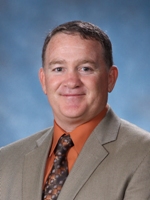
Ron Higdon
Indeed, Higdon says the new facilities have added “pressure” on the coaching staff. “Coach Denney doesn’t look at it like, ‘Ah, we’ve got it made, but more like, ‘We don’t have any excuses anymore. Let’s not leave any rock unturned. We don’t want any regrets.’”
Reminders of UNO’s high expectations are everywhere. Banners displaying each wrestler’s personal symbol of commitment hang from the ceiling. Ringing the mat are nine plastic cones spelling out the team’s keys to achieving its mission. Far from arbitrary words, these mottoes grew out of a preseason November retreat with a decidedly martial theme at which the team set team objectives, ideals, rules, et cetera. Blair says the messages represent “what UNO wrestling is all about. We can see it every day. We can be a part of it every day. I look up and see all these different symbols and it’s who we are. It’s the heart and soul of every single guy on this team.”
That the retreat resembled boot camp is no accident. Military themes are commonly applied to competitive athletics. After all, a solid platoon and an effective team both require discipline, loyalty, unity, commitment, physical fitness, mental rigor, honor, duty. Both require a warrior’s mentality. Even the way teams practice is patterned after the army or marines, with coaches putting their warriors through training “drills” like any DI bastards.
Thus, UNO turned the Old Country Buffet on Dodge Street into a war room one fine November morning. Setting the tone was Denney, who fittingly wore camouflaged fatigues and a painted war face. Several troops followed suit. Together, they plotted strategy for the upcoming campaign. Later, they went to a camp grounds near Plattsmouth to play paint ball.
The idea, Denney told his warriors that day, “is establishing our destination — where we’re trying to get to — and our compass for getting there. It’s kind of what we’re all about and what is necessary for our team to accomplish its mission. We’ll organize and execute practices around that.”
The annual retreat is among many traditions he’s added to the program. He’s found such activities effective ways of building a solid group identity and bond. He uses these sessions as teaching opportunities. At one team meeting he did a “Home Improvement” routine — complete with tool belt, framing hammer, nails and two-by-fours — to make the point that in order to be “straight and strong every practice and every match” his team must “hammer” and “push” themselves through the whole season. After hammering home some penny nails he brought out some rusty ones and said, ‘If you guys are coming in rusty…you’re going to bend.’”
For Denney the demonstration was fun but its message dead serious. “I challenged our guys to be straight and strong because for us to effectively perform we’ve got to challenge ourselves. This is athletics. You can’t be in the comfort zone too long. I need to challenge myself, too, to be more of a hammer as a coach. Sometimes I’m almost a little bit too understanding.”
Mastering the mental game is something Denney constantly emphasizes. “I tell our guys we’ve got be strong in three areas. Physically, mentally, spiritually. As you get closer to competition the importance of the mental part increases. Those people that can stay confident, stay calm, stay relaxed, stay focused — all those things — have an advantage. We try to get our guys to look forward to competition and not dread it. Sometimes though you get anxious about failing. We try to instill the attitude, ‘I can’t wait to get out there. I practiced for it, prepared myself physically for it and now I want to do it.’ You’ve got to be confident you can perform well and perform well against good competition. It’s actually not directed at the opponent. It’s trying to get yourself to perform well. It’s a battle with yourself.”
To help instill such poise Denney has two prominent area sports psychologists, Dr. Jack Stark and Dr. Todd Hendrickson, work with the team. As Denney sees it, it’s all about helping athletes find avenues that best reduce anxiety and maximize effort.
“The whole thing is not on winning, it’s on performance,” he says.

- Courtesy of Nebraska-Omaha Media Relations
Consider the scene in the visiting locker room at Augustana College shortly after UNO’s 25-11 dual victory over the Vikings on Jan. 15. Denney singled out Antoniak for praise despite his having lost in overtime: “It shows here,” Denney said, holding up the scoring sheet in his hand, “he lost 3-1, but I don’t even look at that. I look at performance. He performed. Hewrestled with heart.” Later, Antoniak said how much his coach’s words meant: “What means more to me than a win or a loss is knowing I didn’t disappoint Coach Denney. I know he’s still proud of the way I performed.”
Higdon, who wrestled for Denney and has coached under him for seven years, says, “One of the reasons he’s so good at getting guys to perform well is that they’re not only performing for themselves but they honestly want to do well for him too. When you disappoint him, oh, the guilt is unbelievable.”
R.J. Nebe, former UNO wrestling great and one-time assistant under Denney and now co-head wrestling coach at Skutt High School, says, “He’s a great motivational coach. The eternal optimist. He’s always upbeat, always supportive, no matter what happens. Anybody you talk to says he’s kind of like a father figure. I know that’s a cliche but he truly is an amazing individual and you really do want to make him proud of you.”
Massaging hurt egos, boosting flagging spirits, instilling guilt. It’s what coaches do in their role as amateur psychologists. What often separates a mediocre wrestler from a superb one is the mental factor. Higdon says some wrestlers shine in practice but wilt in competition: “Some guys are great practice room wrestlers — they’re unscored on and can’t be taken down. But when they have the pressure of being in the starting lineup or in a tournament they don’t wrestle near as well. That gets down to mental toughness. The sports psychologists we work with are really good at making our guys believe in themselves. One guy may need this. Another guy may need something totally different. As a coaching staff we try to
provide all those different atmospheres. Sometimes it’s frustrating, but once you figure it out, it’s half the battle.”
As Denney says, “We try to get each athlete to develop a ritual at practice. It’s finding ways of preparing mentally and physically that help you perform well at every practice and then carrying that over into competition. It’s a trial and error thing finding what works for you. It takes lots of repetitions. Part of it may be your diet or isolating what things are producing anxiety. The way one guy prepares may not work for another.”
Virtually all UNO wrestlers use visualization, along with deep breathing and other relaxation techniques to get ready for matches. Sometimes, all the preparation in the world doesn’t prevent a poor showing.
“You’re going to have times when you just don’t perform well. I’ve been coaching 30 years and every individual, every team has hit one real low every season,” Denney notes. “I’ve found if you have work ethic and perseverance you’re going to endure through those ups and downs. You can’t replace it. Our work ethic is good. We have good leadership too.”
Denney’s a master at sensing the psyche of his team. How he handles his wrestlers, especially how he prepares and motivates them for competition, reveals much about him, his athletes and his program. He circulates through the wrestling room to drop a positive word here, a does of constructive criticism there. He lays hands on his men like a healer. His door is always open for consultation. His charismatic presence and caring demeanor create a powerful Brotherhood of the Mat.
“Coach impresses upon us to care about the guys we wrestle with. We’re not afraid to say, ‘I love you,’ and openly show some emotion when things don’t go right or when they do go right. That says a lot about the character and nature of the team,” says senior heavyweight Jerry Corner.
While wrestling is a series of one-on-one competitions, a single stunning win or loss can spark or deflate an entire team. The chemistry of a squad and the support of teammates are crucial performance factors. Denney’s teams are known for their togetherness. “It’s a family. It’s a real close-knit group. Coach Denney promotes that. He’s like a second father. And all those guys in the locker room are like my brothers,” Nielsen says.
Denney says camaraderie is vital given wrestling’s severe demands.
“It’s a long season made even longer because we beat on each other so much. It’s such a physically and mentally demanding sport. And at the end they’re going to raise just one hand. Even when our guys have been working hard and doing the right things there’s still going to be adversity. They get injured. They don’t perform the way they want. Something bad happens back home or their girlfriend leaves them. They need the support of their teammates when they’re down. They need positive reinforcement.”
He likes the way his current squad senses when a teammate is low and tries picking him up. He says his guys have done a great job of helping pull Medina, Voorhees and LaRock out of deep funks this season.
“I see our team helping each other out by sitting and talking with guys who’ve hit a low point. I like that. We’re totally a family here.”
He likes the way Voorhees and LaRock, two mainstays sidelined by injuries earlier this year, responded to their tough luck. “They stayed positive. They were up at the fieldhouse every day doing everything they could even though they couldn’t wrestle. They ran every day. They went to every meeting. They’ve been great examples of how to handle adversity.”
Denney, a Power of Positive Thinking disciple, says maintaining an upbeat attitude is not just mental window dressing but a prerequisite for reaching peak performance. “Losing doesn’t mean we’re failures. We don’t even talk about that. We talk about making adjustments to do better next time. In the scheme of things a disappointing performance is not that big a deal, except we’ve been blessed with some abilities and we want to make the most out of them. Performing well shouldn’t be an option. Not with this team and the way we work our butts off. It should be a responsibility.”
He has approached this season as a journey and each segment as a various leg on the trek. UNO’s journey began with five early open meets pitting Maverick wrestlers against top competitors from Div. I and II. Unlike many programs UNO waits to wrestle duals — when teams must settle on 10 starters — until the second semester, preferring instead to throw everyone into the mix in open competition.
“What it does is offer everybody an opportunity to compete and make the varsity,” Denney explains, “and that kind of determines who filters to the top and who redshirts. It takes wrestlers about 20 matches before they really start refining things, so I tell them to be patient.”
He sees the open part of the season as a time for experimenting too. “We actually tell our guys to open up and try some things. To make adjustments and find what works for you.”
In the Nov. 15 season opening Central Missouri State meet UNO recorded the most place finishers (18) and most finalists (six) it’s ever had in the annual competition. Three Mavs won their weight classes. Although UNO had no individual champions the Mavs held their own at home in the Nov. 21 Kaufman-Brand Open, the largest open meet in the nation, as Creighton and LaRock went a combined 9-2 against top-flight competition.
UNO followed with a disappointing showing in the Dec. 9 Northern Iowa Open but, as has been characteristic of this year’s team, rebounded strongly in the Nebraska-Kearney Open and in its own Brand Open. Once the Mavs started their “big push” the second semester, Denney returned again and again to such key themes as “No regrets” and “Start strong, stay strong, finish strong.” The dual season found UNO on the road most of the time. Following a devastating loss at St. Cloud State, Denney assured his team “all is well” but promised to take them “into Thin Air” as a way of deepening their conditioning and will. He did, too — working them until some hurled from sheer burn-out.
The benefits of all that work showed up in the Mavs next competition, Jan. 22-23, at the National Showdown Duals in Edmond, Okla., where UNO squared-off with four elite teams, finishing 3-1, advancing to and losing in the championship round to top-ranked Pittsburgh-Johnstown 21-16. Bolstering the attack was Voorhees, who went 4-0 at 149 pounds in his first action since an early season injury. The Mavs gained confidence coming so close to the No. 1 club without their stud, Creighton, who injured a knee and forced UNO to forfeit his match.
With Thin Air days a weekly fixture, the Mavs won a Jan. 29 home dual, 21-18, over No. 5 Central Oklahoma that was not as close as the score indicated since LaRock, nursing torn rib cartilage, forfeited. It marked the first of five straight dual wins the Mavs reeled off, prompting Denney to say: “In some real close matches we’ve stayed confident, stayed strong, stayed focused. I like that. We now seem to have the reserve at the end to be able to do what we need to do. This team is on a mission.”
Yet when the Mavs butt-kicking ways ended abruptly in a Feb. 19 home dual loss to long-time nemesis North Dakota State, he wasn’t so sure anymore. “As a team we have to hit on more cylinders. We have to perform better. It’s in us…but, I don’t know, maybe our expectations are just too high.”
After the less-than-inspired showing versus NDSU Denney issued an uncharacteristic in-your-face challenge to his slackers. “I wanted to shock them a little bit. They don’t see that side of me, but I needed to challenge them, and they responded — they really stepped up.” The Mavs responded with a 24-17 win over Div. I Northern Iowa to end the dual season 10-3 overall and 4-2 in the North Central Conference.
The days leading up to the NCC tourney included intense practices that left Denney feeling secure once again: “Honestly, that’s the hardest I’ve ever worked a team, but they took it. I’m really confident we’ll perform better. On paper North Dakota State’s the favorite, but we have no fear.”
In the postseason the starters become the sole focus. They get all the reps, all the performance enhancement goodies. Denney assigns each “a commission” that lets them know what’s expected at crunch time. He makes-up T-shirts with the wrestlers’ nicknames and slogans on them.
During the Feb. 28 NCC tourney in Brookings S.D. the Mavs, almost to a man, fulfilled their commissions. LaRock “fueled the fire” as team igniter at the top of the lineup, decisively winning his opening round match en route to earning a wild card entry at nationals. Creighton modeled “consistency” in going 3-0 to win his third individual NCC title. Voorhees lived up to his “cool, calm, confident” assignment in nailing down a runner-up finish.
Blair, UNO’s Iron Man award winner his first two years, took “the ultimate warrior” tag to heart by claiming third place. Albert Harrold, earned his “mentally strong” stripes with a runner-up finish at 174. Antoniak epitomized “showtime” by advancing to the finals, only losing the title on criteria. Medina showed “no fear” after a disqualification (for slamming)
forced him into the consolation bracket, where he came back to win a crucial third place match. Corner displayed “amazing power” in capturing his first NCC title in the final and deciding match, giving UNO a one-point winning margin (78-77) over NDSU in the team title race.
“I’m so proud of our guys,” a drained and emotion-choked Denney said afterwards. “They wrestled so hard. They gave everything they had. It was just a war. It went back and forth. One team would get ahead and the other would bounce right back. We were behind and had to win the last two matches. I’d never seen it come down to the end like that.”
With the NCC title secured, one last destination awaits the Mavs on their most excellent journey. In team meetings Denney’s comparing UNO’s quest for the pinnacle of collegiate wrestling to a Mount Everest ascent, saying, “When the oxygen gets really thin it then becomes a mental thing. Totally mental. Your body can endure anything you want it to. It’s mind over matter. You have to push through the pain. The key is working together and pushing each other to reach a common goal. You’re lost without that.”
Mack LaRock is reminding his mates to lay it on the line, as the summit may not be this close again. “We may never have a chance to be part of a team like this that has a chance to win nationals at home. Let’s not let this one get by. It’s all laid out for us. Let’s seize it. Let’s seize the day.”
Denney wants his charges to keep their edge during the climb and ensure they make the most of their opportunity: “Respect the journey. If you don’t respect the journey, you don’t prepare for it. When you step on the mat, be prepared. When you look back, you want to be sure there’s no regrets.This is something you will not be able to play over again.”
His team embarks on its “final assault” — the national championship — Friday and Saturday at UNO. Opening-round matches start at noon on Friday, followed by an evening session at 7 p.m. Semifinal and consolation matches being at noon on Saturday, followed by the Parade of All-Americans at 7 and the finals at 7:30 p.m. Tickets are available at the UNO Athletic Office and through Ticketmaster outlets. For more tourney information, call 554-MAVS.

Part III: Day of Reckoning
The University of Nebraska at Omaha wrestling team’s day of reckoning finally arrived last weekend when UNO hosted the NCAA Division II wrestling tournament. In the ultimate setting for this on-the-edge sport, the team title race fittingly came down to a pair of head-to-head matches between No. 1 Pittsburgh-Johnstown and No. 2 UNO, the two squads that led the pack all season long and dominated the March 12-13 tourney.
Holding a four-and a-half-point lead entering the championship round, UNO needed to at least split the two finals pitting Maverick wrestlers against their Mountain Cat counterparts. In the first meeting, UNO’s Mack LaRock, a sophomore from Lawton, Okla., was pinned by Johnstown’s No. 1-seeded Jody Strittmatter in the 125-pound title match. The fall, worth five points, dropped UNO into second place, half-a-point behind the Cats.
That put added pressure on UNO’s third championship qualifier Braumon Creighton, a senior from Millard North High School, who responded, becoming the lone Mav finalist to prevail, by decisioning Paul Konechne of South Dakota State 12-6 at 141 pounds. That victory earned Creighton his second consecutive national championship (He was the 134-pound champ last year.) and canceled out a Johnstown win at 133 pounds, keeping UNO within easy striking distance.
Creighton’s win made the 165-pound championship, the last head-to-head dual between the two title contending teams, the swing match. And it was here that UNO’s dogged, year-long quest to scale the wrestling heights fell just short when Mav junior Chris Blair dropped an 8-4 decision to Johnstown’s Troy Barbush. In the short seven-minute span it took to complete the match UNO went from the sweet anticipation of celebrating a title before family, friends and hometown fans to a feeling of bitter regret.
Blair, an Omaha Gross High grad who sat out last year to rehabilitate a surgically-repaired knee, fought hard, fell behind midway through the 2nd period and could not rally at the end. The loss secured the Cats’ team championship over UNO. In one of the tightest competitions in recent tourney history, Johnstown finished with 110 points to UNO’s 105.5.
Before the finals, Johnstown Coach Pat Pecora called the two-horse title chase “a classic,” adding, “In any other given year either one of us would have had the title clinched by now but this year we have a great team race. The way the fans have packed each session, they deserve a down-to-the-wire battle.”
The margin of victory at this level of competition is often decided by intangibles that coaches are fond of repeating like incantations. Following the tourney’s opening day sessions, UNO Coach Mike Denney described the intangibles that carried his wrestlers to a first place standing: “A lot of times it just comes down to heart. It’s not technique. It’s not coaching. It’s not anything. It’s just heart. It’s reaching deep inside for more They just fought so hard. They just stayed strong. They wouldn’t break.”
The next night, after seeing his team come agonizingly close to grasping the crown before fumbling it in front of the hometown fans, Denney retreated to a corridor of the fieldhouse and, feeling the weight of disappointment in letting it all slip by, slumped against a wall, where his oldest son, Rocky, consoled him. Later, a still reeling Denney said his team showed the heart of a champion despite losing the national championship:
“When we bid on hosting the nationals two years ago it was our dream to wrestle before this kind of crowd with an opportunity to win the national championship. We put so much work into it. Our guys came to wrestle. They fought. They wrestled with heart. We went for it and we didn’t get it, but I don’t look at it like we failed. It was a great battle, but we just came in second. You’ve got to give credit to Pitt-Johnstown.”

Destiny seemed on the side of tourney host UNO entering the finals. The home fans turned out in droves and lent their vocal support to the cause. Local dignitaries — led by Mayor Hal Daub and his wife and UNO Chancellor Nancy Belck — showed up to confer an official seal of approval on the event. Tying the past to the present was a parade of greats from UNO’s 30-year tradition of mat excellence, including the man who put the school’s wrestling program on the map, Don Benning.
Finally, the UNO team answered the challenge again and again, performing well enough to put themselves in position to win. They ended day one with a four-point edge on Johnstown (41.5 to 37.5), rebounding from a mid-round slump to advance all nine wrestlers to the second day semifinal and consolation rounds, ensuring each All-American status. UNO’s school-record nine All-Americans led the 36-team field.
Then, on day two, the Mavs maintained their advantage by going a combined 11-7 in semifinal and consolation matches. While Johnstown sent four men to that evening’s finals compared to UNO’s three, the Mavs still held a four and-a-half-point lead (101.5 to 97). In the end, the difference was Johnstown winning the pair of meetings with UNO in the finals.
The NCAA wrestling tournament, the fourth hosted by UNO over the years, proved a showcase for a sport little appreciated or understood outside the wrestling community and one often relegated to “Extreme Games” status. Consider wrestling for a moment and you soon see why its harsh aesthetic and strange dichotomy make it a sport apart. Consider the monastic discipline required to master its calm mind set, stiff work ethic and strict weight control, but the fierce warrior’s heart needed to compete in such physical one-on-one competition. Consider how a wrestler is a lone wolf on the mat yet a teammate on the sideline. How so brutal a sport is still couched in fine technique. How it rewards control yet penalizes passivity, encourages aggressiveness but frowns on violence.
Collegiate wrestling, with its sober blue-collar mystique, is an entirely different breed from the WWF sideshow. The amateur version is authentic regulated competition. The real thing. The pro game is a bastard, no-holds-barred knock-off. A fraud. The bleachers at any collegiate meet are filled with fans who know the sport inside and out — including past and present wrestlers, coaches and officials. They know the price these athletes pay in dedicating themselves to the grueling training process wrestling demands.
The crowd at the recent national tourney was educated enough to cheer a good move or deride a bad call when they saw it and to recognize which matches meant the most in the team race.
The tournament’s many upsets, comebacks, pins, thrills and spills were witnessed by an SRO crowd of wrestling buffs who found UNO’s Sapp Fieldhouse given an Olympic-style makeover for the event. NCAA regalia hung everywhere. Bunting-draped awards platforms stood tall at one end. A two-tiered scoring table at the other end accommodated event staff and media. A big Daktronics message board flashed the latest standings.
The first day of competition saw simultaneous action on six mats, making for a blur of interlocking bodies. A miked announcer hyped the goings-on with a running commentary that jumped from one match to the next. There was often a pin in progress on one mat, a stalemate on another, an injury time out on a third, and so on.
After his team’s solid opening day showing Coach Denney gathered his warriors in a circle in their fieldhouse sanctuary — the UNO wrestling room — to tell them: “I want you to relax like a bunch of puppy dogs tonight. Get a good night’s sleep. But then come out tomorrow like a pack of wolverines. You guys have got to love this. You have the opportunity with every match to make a difference. So savor it.”
Living up to UNO’s “There’s A Fire Burning” motto and his role as team igniter, Mack LaRock got the Mavs off to a fire-breathing start in the Mar. 13 afternoon semifinals by pinning his man. Moments later, after running into the stands to embrace family members who drove up from Oklahoma, a still delirious LaRock tried describing what happened: “I was in on a deep single. The opportunity was there and I just got it (the pin). Oh, man, it’s a rush. I never thought it would feel this way. The way my year’s been going, with so many ups and downs, I think it’s all going to work out.” Although LaRock lost in the finals that night, his mere presence there as a sixth seed was a victory of sorts itself.
Creighton, operating from his customary low crouch, looked sluggish until winning his semi’s scuffle 7-4 and securing a spot in the finals. Later, he said, “At the beginning I wasn’t focused at all. I just had to regain my focus. It’s a matter of being in those scramble positions and coming out on top.”
By warding off his foe off at the end — refusing to be taken down — Chris Blair earned a berth in the finals with a 7-4 decision. After a short celebration he described how watching his mates’ earlier matches motivated him to nail his opponent too: “I saw Mack and Braumon win and that got me going. I dug deep and put the guy on his back.”
Meanwhile, the Mavs fared well in the consolation bracket: junior Boyce Voorhees advanced to the third 3rd place match, where he lost a tough 2-1 decision to finish 4th at 149 pounds; sophomore Alan Cartwright captured 7th with a 12-5 decision at 157 pounds; senior Albert Harrold pounced on his opponent in the waning moments to clinch a 7-5 win that gave him 5th place at 174; and sophomore Scott Antoniak claimed 7th at 184 when his opponent forfeited.
After being on the wrong end of a pin in his 197 pound semifinals match, Jose Medina recovered from that devastating loss to perform well in the wrestlebacks, winning the crucial 3rd place match to help UNO stay in the title hunt. Medina, a senior from Chicago, said the winning difference was “knowing that I had to beat him to keep the team race close.”

Denney’s team finished second in 1999, but he led UNO to multiple national titles in the ensuing years
A costly defeat came at heavyweight when No. 1 seed senior Jerry Corner suffered a sudden-death overtime (2-1) loss in the semifinals to long-time arch nemesis Ryan Resel of South Dakota State. Corner, who twice beat the two-time defending national champion Resel during the regular season, explained afterwards how “hard” it is “to beat a quality competitor over and over again.” With his right eye red and puffy from the fray, Corner, from Wichita, Kan., spent little time sulking over losing his last title shot. Instead, he came back strong — practically crucifying his first consolation opponent to the mat, then advancing to and winning the 3rd place match with a 5-0 decision.
Corner wasn’t the only bruised and battered Maverick. Voorhees hurt a shoulder. Cartwright sported a bloody nose. Harrold threw up. Antoniak took stitches above an eye. Medina got scratched on the hand. “Yeah, but you should have seen the other guy,” goes the sport’s macho creed. Wrestlers like it tough. They thrive on their high pain threshold.
For the finals the fieldhouse became, for one night anyway, a coliseum reveling in the ancient grappling art and its warrior tradition. With the lights dimmed over the stands, the spotlight literally shone on the young men in singlets comprising this Samurai Brotherhood. Like gladiators of old they engaged in hand-to-hand combat that, while not mortal, tested their resolve and preparation through a primal meeting on the mat.
The Mavericks came away from this nearly 400-match wrestlerama with one individual champion, nine All-Americans and a team runner-up trophy, UNO’s 12th Top 3 finish under Denney. UNO’s undisputed star was its lone champ, Creighton, who stalked his finals’ opponent with predator-like cunning, shooting low single leg attacks he turned into points.
Soon after winning his title Creighton, whose mother is KMTV-Channel 3’s Trina Creighton, said, “It’s the best feeling in the world to do it here in front of all your family and friends. I’m proud to be part of UNO history and to be considered one of the greats among those who wrestled here.” Denney, who dubbed him “Mr. Consistency,” said, “He’s an ultimate competitor. He dominated the field. He’s a great ambassador for our wrestling program. I’m proud of him.”
Graceful and grateful even in defeat, Denney summed up the tourney and season-long journey with: “The thing I feel really good about is we were able to provide nine All-Americans and a national champion in our own gym, in front of an electric crowd, in an exciting atmosphere. It was great for our guys. I’m proud of the commitment they made. I’m proud of their work ethic. I’m proud of the kind of people they are. I can’t fault our effort. We performed. We we were just four-and-half-points short. And it’s not like the cupboard’s bare. We return five All-Americans. We’ll be all right.”
Now it’s on to recruiting for Denney. His talent search marks the start of the next journey for him and his band of warriors. Let the quest begin.
Related articles
Photographer Larry Ferguson’s work is meditation on the nature of views and viewing
Larry Ferguson is one of the most collected and published fine art photographers in the Midwest. I have long been aware of the artist and his work, yet it was only witinh the last couple years he became a subject for this writer. I suspect I will be writing more about him in the years to come. This article for The Reader (www.thereader.com) appeared in conjunction with an exhibition he had at Creighton University. The black and white works in the show were drawn from various series he has done over the years depictiing the views afforded by rooms he stayed in and various touchstone places he’s visited in his many travels. Like many photographers I’ve met over the years, he maintains a very cool studio space.

Photographer Larry Ferguson’s work is meditation on the nature of views and viewing
©by Leo Adam Biga
Originally published in The Reader (www.thereader.com)
Photographer Larry Ferguson’s lush black and white imagery displays a mastery of technique and composition. But it’s not so much the work’s subject or execution as the evocative subtext bound up in it that is most arresting.
His new exhibition at Creighton University’s Lied Art Gallery, The View From My Room, is drawn from pictures he’s made of scenes outside the many rooms he’s inhabited over 30 years. The rooms, located in Nebraska, other parts of the U.S. and the far corners of the globe, offer a road map of sorts for the Omaha artist’s journey through life and craft. Aside from a few landscape and cityscape images, nothing dramatic or sumptuous is revealed, but rather the prosaic, mundane fixtures and rhythms of life as it proceeds around us. That’s the point.
Ferguson shows the holy ordinary of moments and places, some he has personal ties to and others he merely intersects with, but all of which express deep stirrings in him. It is, he said, “a travelogue through my emotional life.”
This work is the first of several ongoing series he’s photographed since the late ‘70s to be organized into an exhibition. Besides views from his rooms, these series variously focus on “skyscapes, treescapes, grain elevators, nudes, private moments and all the great loves I’ve had in my life,” he said. “All are very long term, special projects that eventually will see the light of day.” Selections for these series are made from his archive of 250,000 negatives at his 17th and Vinton Streets studio.
He hopes the work provokes viewers to contemplate its underlying themes. “Rarely do people ever talk about what’s underneath it and in fact behind it,” he said.
On one level the photographs, all shot in wide angle on tripod — nothing’s hand-held — offer a visual chronicle of his haunts and journeys, near and far. But it as much the interior as the exterior journey and landscape he considers in Room.
“They’re really very internal and very emotional for me,” he said. “They are definitely some sort of record about what I’ve been doing but they’re not really in the aspect…a documentary photographer might work. It’s more introspective than that. They signify and give a physicality actually to the stories I can tell about the places. They are the evidence that what I did actually did happen and does exist. They jog that memory of the experience and what it was all about.”
Therefore, each image “is imbued” with meaning, as in the almost obligatory view from the farmhouse in Maxwell, Neb. he grew up in. It looks out onto a distant wind break of trees. The larger world beyond that horizon is where he dreamed to go, he said. This vision and yearning take on added meaning in the context of the show’s many images from his far flung travels — evidence he’s fulfilled his dream.

Larry Ferguson
He spent many a summer with his feisty, spry grandmother, Frances Lawhead, at her Silvergate, Mont. cabin, which overlooks a snow field. The view from the cabin bedroom he slept in resonates with the warm embrace of hearth and home inside and the wonder of nature outside.
Fragments of a Lincoln, Neb. neighborhood are viewed through lacy curtains his then-girl friend Sally Donovan put up after she inherited the house from his good friend, photographer John Spence. The living room window becomes a nostalgic frame of reference for the observations, conversations and meals shared there.
With few exceptions his work is the antithesis of any deliberate, preconceived, picturesque style.
“I’m not here to make pretty pictures, ever,” he said.
He rejects the notion one must “go somewhere that has this exotic locale or spectacular scenery in order to make pictures. I’m always exactly the opposite,” he said. His credo is that “ordinary common life is extraordinary. That’s why the view right outside your window,” he said, “is so incredibly important. It’s more than the picture, it’s what it’s about that makes it work.”
He admits he only embraced this come-what-may philosophy after some false starts. He’d go somewhere anticipating a spectacular view or vista, only to be disappointed when it wasn’t all that and then he wouldn’t shoot anything.
“Then I would kick myself later for not having made the picture because it wasn’t spectacular, but not being spectacular is what it was about. That’s when I concluded you have to accept what’s there.”

Approaching Rainstorm, Near Crawford, NE, ©photo by Larry Ferguson
Whatever the scene holds it evokes linkages-associations to his life and work. Viewed in this light, something as blase as a dirt hill can be a rich vein of narrative. “It’s nothing, yet it’s everything,” he said.
What compels him to make a picture in any given spot, at any given time is intuitive.
“A lot of times people ask me, ‘How did you make that picture?’ And I go, ‘I don’t know.’ The pictures make themselves,” he said. “Something just says, Make that picture, and I do. People ask me, ‘What were you thinking about when you made it?’ I don’t consciously think about it. I couldn’t possibly tell you because it’s all internal, it’s all emotional. That’s how I respond — I respond viscerally to it. I trust my feelings and my instincts.”
On his many travels, whether to Mexico or Argentina or China, he goes where the spirit moves him, snapping pics as opportunities arise. The resulting images may feed into any of his long term projects. He shoots whatever he “discovers along the way.”
“When I travel I don’t have an itinerary. I have a start date and an end date and usually a destination point somewhere in between,” he said. “And then what happens between those times is plain and simple whim. Wherever I go, you know, it’s always, Well, let’s point the camera and take that image, whatever it happens to be. And that’s kind of how I work.”
It’s how he came to spend so much time in Guanajuato, Mexico, the capital city of the state of Guanajuato. He went there as part of a months-long, 10,000 mile trek he made in 1984 through Mexican jungles and mountains to photograph archaeological digs. Once he stumbled upon that city’s treasures and oddities, he couldn’t tear himself away. Images he made of one of his finds there, the home of artist Diego Rivera, are included in Room.
The happy accidents that result — compelling patterns of light and shadow, pleasing forms, symbolic shapes, complex compositions — are rooted in preparation.
“It’s that thing of preparing yourself to be ready to do it when it happens,” he said. “That’s what it takes. You have to get to where you practice and practice until you no longer think about it. Then it just happens automatically.”
Related articles
- Photographer in the Picture (flickr.net)
- Frida Kahlo & Diego Rivera, at Pallant House, Chichester, Seven magazine review (telegraph.co.uk)
- Jesuit Photojournalist Don Doll of Creighton University Documents the Global Human Condition One Person, One Image at a Time (leoadambiga.wordpress.com)
- The Wall As Photographic Surface (fansinaflashbulb.wordpress.com)
- New York from Day to Night in One Picture [Image Cache] (gizmodo.com)
Lifetime Friends, Native Sons, Entrepreneurs Michael Green and Dick Davis Lead Efforts to Revive North Omaha and to Empower its Black Citizenry
Two well-connected players on the Omaha entrepreneurial scene and two stalwart figures in efforts to revitalize predominantly African-American North Omaha are Michael Green and Dick Davis. The Omaha natives go way back together and they share a deep understanding of what it will take to turn around a community that lags far behind the rest of the city in terms of income, commerce, jobs, education, housing starts, et cetera.
Lifetime Friends, Native Sons, Entrepreneurs Michael Green and Dick Davis Lead Efforts to Revive North Omaha and to Empower its Black Citizenry
©by Leo Adam Biga
Originally appeared in the New Horizons
Growing up in the late 1940s-early 1950s, Michael Green and Dick Davis knew The Smell of Money from the pungent odors of the bustling packing plants and stockyards near the Southside Terrace apartments they lived in. Buddies from age 4, these now middle aged men began life in similar disadvantaged straits, yet each has gone on to make his fortune.
Instead of the old blue collar model they were exposed to as kids, they’ve achieved the Sweet Smell of Success associated with the fresh, squeaky clean halls of corporate office suites. Education got them there. Each man holds at least one post-graduate degree.
Along the way, there have been some detours. As kids they moved with their families to North O, where they became star athletes. They were teammates at Horace Mann Junior High before becoming opponents at rival high schools — Green at Tech and Davis at North. Both earned accolades for their gridiron exploits as running backs. Green, a sprint star in track, was a speed merchant, yet still rugged enough to play tackle, fullback and linebacker. Davis, a two-time unbeaten state wrestling champ, was a bruiser, yet still swift enough to outrun defenders.
The Division I football recruits reunited as teammates at Nebraska in the mid-’60s — excelling in the offensive backfield under head coach Bob Devaney and position coach Mike Corgan. They never saw action at the same time. Green, a halfback his first two years, co-captained the Huskers’ 1969 Sun Bowl championship team at fullback. Davis was in the mold of the classic blocking, short yardage fullback but he could also catch passes out of the backfield. Drafted a year apart by the NFL, they each pursued pro football careers, but not before getting their degrees — Green in economics and marketing and Davis in education. It wasn’t long before each opted to take a different route to success — one that involved brain, not brawn and three-piece-suits, not uniforms or helmets.
They ended up as executives with major Omaha companies. Today each is the owner of his own company. Green is founder, president and chief investment officer of Evergreen Capital Management, Nebraska’s only minority-owned registered investment advisor. Davis is CEO of Davis Cos., a holding company for firms providing insurance brokerage, financial consulting and contractor development services. Green handles hundreds of millions of dollars in managed assets for institutional clients. Davis Cos., with offices in multiple states, generates millions in revenues and is one of Omaha’s fastest growing firms.
The two men’s stories of entrepreneurial success are remarkable given that in the era they came up in there were few African American role models in business. Back in the day, blacks’ best hopes for good paying jobs were with the packing plants, the railroad or in construction. Few blacks made it past high school. One gateway out of the ghetto and into higher education was through athletics, and both Green and Davis were talented enough to earn scholarships to Nebraska. The opportunities and lessons NU afforded them — both in the classroom and on the field — opened up possibilities that otherwise may have eluded them.
Having come so far from such humble beginnings, neither man has lost sight of his people’s struggle. Both are immersed in efforts to address the problems and needs facing inner city African Americans. Green and Davis are leaders in a growing Omaha movement of educated and concerned blacks working together with broad private-public coalitions to make a difference in key quality of life categories. These initiatives are putting in place covenants, strategies, plans, programs and opportunities to help spur economic development, create jobs, provide scholarships and do whatever else is needed to help blacks help themselves.
Some efforts are community-driven, with Green and Davis serving as committee members/chairs. Others are spearheaded by the men themselves. For example, Davis is the driving force behind the North Omaha Foundation for Human Development, the Davis-Chambers Scholarship Endowment and Omaha 20/20, efforts aimed at community betterment, educational opportunities and economic development, respectively. Green has led a minority internship program that guides young black men and women into the financial services field. He helps direct the Ahman Green Foundation for Youth Development, which awards grants to youth organizations and holds a week-long football/academic camp. The foundation’s namesake, Husker legend Ahman Green, is his nephew.
Individually and collectively Green and Davis represent some high aspirations and achievements. They’re trying to give fellow blacks the tools to dream and reach those things for themselves. The two defied the long odds and low expectations society set for them and now actively work to improve the chances and raise the bar for others. The paths forged by these men offer a road to success. They’re putting in place guideposts for new generations to follow in their footsteps.
Recently, Green and Davis sat down with the New Horizons. In separate interviews they discussed their own journey and the road map for setting more blacks on the path to the American Dream.
Michael Green
Responsibility and leadership came early for Michael Green. As the oldest of five kids whose single mother worked outside the house, he was often charged with the task of looking after his younger siblings. His mom, Katherine Green, worked in the Douglas County Hospital kitchens before getting on with the U.S. Postal Service, where she retired after 30-plus years. Sundays meant getting dressed for services and bible school at Salem Baptist Church. He remains in awe of what his mom did to take care of the family.
“My mother raised us kids as a single working mom,” he said. “A very stable person. We didn’t know what poor was. I mean, she provided for us. We didn’t have the best of everything but we always had a place to live and food on the table. She was always home when she wasn’t working. On Saturday mornings she’d always get up and cook us a big breakfast with eggs and pancakes and everything and it conditioned me so much there’s hardly a Saturday morning I don’t crave eggs.”
 |
Michael Green
It was an era of segregation and limited horizons for blacks but families and neighborhoods were tighter and in many ways, Green said, “it was really better times back then. Our parents worked. They provided for us. We didn’t even have the equivalent of cell phones or iPods and stuff like that, but we played, we improvised, we made our own skateboards and soap box derby carts and sling shots. If you were doing something you weren’t supposed to be doing bad news, as we’d say, would probably beat you home because neighbors knew who you were and knew who your parents were. They’d call and say, ‘Michael’s down the street doing this’ and by the time you got home you’d hear about it.”
His mother, he said, “had one mantra — get an education. I can remember in my childhood saying I wanted to play pro baseball. She said, ‘That’s fine, but make sure you know how to do something else.’ I had no clue what she was talking about. ‘What do you mean? I won’t have to. I’m going to play pro baseball. What else is there?’” Years passed before he knew how firmly her advice sunk in.
“It’s just funny how God works,” he said, “because it wasn’t until I walked across the stage to accept my (college) diploma that conversation popped into the front of my head. It just kind of stuck back there in my subconscious. I had made up my mind I was going to get my degree, so I knew I could do something else.”
Green didn’t get involved in organized athletics until junior high. Pickup games were common at Kountze Park, the YMCA and area schools. He and his kid brother David first flashed their speed at Horace Mann, where gym teacher/athletic coach Bob Rose saw their ability.
“He was a father on the field for many of us,” Green said of Rose. Green’s parents never married and his father was mostly out of the picture.
The Green brothers were not alone making their mark athletically on the north side. The area was then and is now a fertile ground for athletic excellence. A relatively small geographic area produced such standouts as Bob Gibson, Bob Boozer and Fred Hare. Before the Green brothers there were the Sayers brothers (Gale, Roger and Ron), the Nared boys (Rich and John) and the Boones (Ron and Co.). The same time the Greens were turning heads Dick Davis and his older brother Ricky Davis were doing the same. Leslie Webster starred. Joe Orduna, Phil Wise, Johnny Rodgers, John C. Johnson, Mike McGee and a host of others followed.
Green and his brother David ended up at Tech, rather than at North like his childhood friend Dick Davis, because it was where mom went to school.
“Tech, like a lot of the inner city schools, has a history where a lot of family generations went through that school,” he said. “My family’s a prime example. My mom graduated from Tech. My brother and I did. Cousins. It has a lot of emotional legacy for us Tech grads, primarily because Tech is closed now.”
The feeling runs so deep that Green chairs the Tech High Auditorium Restoration Project that’s raising funds for refurbishing the building’s 2,000-plus seat venue — one that hosted world class performing artists and public figures in its heyday.
“Professionals who have come and looked at it — from acoustics experts to engineers of various kinds — have said it’s in tremendous condition and just needs to be updated and restored,” he said.
Coming out of Tech to play for the “jovial” Devaney was not a hard sell.
“He and I hit it off right away. Very down to earth. He wasn’t like the Lombardi caricature of a coach. More of a father figure,” Green said.

Bob Devaney with 1969 co-captains Dana Stephenson and Mike Green, No. 34
Something Green didn’t appreciate until years later is how Devaney showed unusual sensitivity for the time by taking into account that except for a few athletes NU had markedly few black students. He said the Old Irishman even expressed interest in enrolling more blacks at Lincoln — athletes or not — in order to create a more comfortable environment for blacks.
Green said admiringly, “He was very concerned about the black experience we would have off the field.” It would be some years yet, he said, before the black population on campus increased appreciably.
When Green played, team captain honors always went to seniors. As a senior in ‘69 he was expecting the quarterback to get the offensive captain’s nod but halfway through fall scrimmage no vote had been taken yet to name anyone. He recalled being upset after “a particularly sloppy scrimmage” in preparation for the season opener against perennial power Southern Cal. “I started yelling at everybody on the sideline. I just went off on ‘em. Then we had a team meeting to elect the captains and somebody nominated me. They all voted and it was overwhelming they wanted me to be captain. I was just shocked.”
The experience taught him something he’s carried with him through life.
“I guess what I learned is that if you’re proactive about the way you go about things you don’t wait for something to happen, you don’t wait for somebody else to do something. You see something you want to do and you figure out how you want to get it done,” he said. Even if that means saying some hard things.
That motivated approach led him to get his degree before he left school for the NFL and to have a Plan B in place in case things didn’t work out with football.
The San Diego Chargers drafted him in the later rounds. He made the cut but this was a time before free agency. Players were property that could be bought, sold, traded with impunity. Seeing veterans traded overnight, their life and the lives of their loved ones disrupted, was a wake up call.
“What was sobering for me was the business end of pro ball where if you weren’t starting you could be living in San Diego today be shipped off to Cleveland tomorrow. That happened to a guy in training camp. You were strictly at the mercy of the team…There was no contract negotiation. You had to be a real star to have some leverage. Your only alternative was to hold out.”
If the NFL didn’t pan out he was going to have other options. He said athletics taught him not only how to compete but “how to grow from defeat,” he said. “It’s not some big epiphany but every single week after a game, win or lose, we’d go into film sessions and get critiqued on what we did right and wrong. Well, that kind of process conditions you to learn from mistakes automatically. It also conditions you to not be afraid to fail. You take a real, unemotional, objective look at what happened.” That same calculated analysis has served him well in life.
When he left the Chargers, his Plan B was already in motion due to some good fortune and foresight. He’d graduated from NU in the spring of ‘70 and was preparing for his shot at the NFL when he and Husker teammate Guy Ingles were invited to participate in a promotion at Omaha National Bank (now US Bank). At the gig Green said he met bank big wig Michael Yanney and “we took a liking to each other.” The next thing Green knew, he was offered a job.
When he saw the writing on the wall after that one season in San Diego, Green came back to Omaha knowing he had a job waiting for him.
“Talk about things happening for a reason,” Green said, still struck by the sequence of events that launched his financial services career.
By the time he worked his way up to the commercial lending area, Green knew banking was a good fit. The work introduced him to small local business owners, whose entrepreneurial spirit planted the seed of a dream in him.
“I was really impressed with these people — that they had their own destinies in their own hands. They weren’t like fabulously wealthy but they were doing quite well. And the thing that attracted me was they were their own boss. That experience made me say, I want to work for myself. It was more of a dream than a plan at that point.”
Harsh reality pushed his dream into action when he realized there was a glass ceiling at the bank for women and people of color.
“I learned after awhile there was a snowball’s chance in hell of a minority becoming a senior officer at the bank,” he said. “The irony is that this same institution paid for me to get my MBA (taking night classes at UNO). They paid for the whole thing and yet they allowed me to walk out the door two years later,” he said, referring to his taking a better offer from Northern Natural Gas Co. (part of Enron).
What convinced him to leave the bank was seeing less qualified individuals promoted or hired ahead of him.
“I was there eight years, working my way up through the organization and I saw people brought into the bank that didn’t have degrees. But they had worked in the agricultural divisions of small banks. Omaha National at that time did a lot of agricultural lending. These guys would be brought in and given titles and positions of authority much higher than mine.”
In some cases, he said, the new hires got the job only because they were the sons of rich cattle ranch owners. They were all white, of course.
“That was the first real dose of corporate racism,” said Green, adding, “I would have stayed had they just treated me like they treated everybody else — because I liked banking.”
Sadly, he said the experience of blacks being passed over for upper management is still common in corporate Omaha, a red flag for a city whose black population has one of the nation’s highest poverty rates and smallest middle classes.
“Even today…you don’t have a lot of blacks, women or other minorities reporting to CEOs or to the second in command. And Omaha’s different than a lot of other cities in that,” he said. “For some reason, the practice of inclusion and diversity has not completely permeated the corporate fabric. We haven’t gotten there yet — even after all these years.
“In a perfect world, if you threw out all the opportunities on the table and everybody had an equal chance to grab at those…and do with them what they would, then Omaha would look very much the same as far as the buildings on the outside. But the makeup of people on the inside would look very different.”
Reversing the dearth of black executives and entrepreneurs and the small black middle class can’t be mandated, he said. “There’s no government legislation that’s going to change that. That’s a social and cultural phenomenon that has to be rectified in the corporate suites.”
In his opinion there’s a disconnect in Omaha between supporting affirmative action with words and implementing it with deeds.
“And regardless of what the corporate leaders in this town say they only need to look at their organizations,” he said.
He said no matter how much lip service is paid to diversity firms will struggle recruiting and retaining people of color as long as they only have white faces at the top. “You tell me you want to welcome me into an inclusive organization,” he said, “but the picture you’re showing me is totally opposite…”
He said racial division lines in Omaha extend to select neighborhoods, country clubs, social groups and high society events that are mostly if not exclusively white.
“When we go into a different or new environment the normal human response is to look for folks who are like us and have had similar experiences to start bonding and getting immersed…” he said. Absent that, you feel uncomfortable and unwelcome.
Omaha pays a heavy price for exclusion. Companies that practice diversity are less likely to locate here, he said, because they don’t see diversity in Omaha’s own executive ranks. And countless black Omahans have left here for more inclusive, more tolerant, more integrated communities that offer more opportunities.
In considering why Omaha’s not on board with diversity he said there “is one phenomenon it might be attributed to. With the exception of Union Pacific, most of the large corporations here — the Mutuals, the First Nationals. ConAgra — grew up here in this environment where there wasn’t that kind of diversity among their corporate brethren.”
After nine years in financial management at Enron Green found the corporate ladder once again only went up so high for minorities. Then the company moved to Houston. Offered a transfer, he instead opted for a buy out. This time, he didn’t have so much a Plan B in mind as he did a dream. To be his own boss. To reach it he struck a deal with Omaha investment banking firm Kirkpatrick Pettis, Smith, Polian Inc., which provided in-kind start-up help in the form of office space, clerical support and computer systems in exchange for half his revenues.
“It worked out pretty good and after three years I went out on my own,” he said.
He formed EverGreen Capital Management in 1989. Dream realized. As his business took off Green’s stature as a community leader grew with his stints on the Douglas County Board and, later, the Metropolitan Entertainment & Convention Authority, where he oversaw construction of the $300 million Qwest Center. He’s on the board of the Omaha Sports Commission, which under his watch successfully bid for such major amateur sports events, as the U.S. Olympic Swim Trials.
The value-investing strategy he uses to select stocks is consistent with his credo for life. “You don’t get involved with anything that is outside your sphere of intelligence or comprehension. If I don’t understand it, I don’t invest in it. In investing, you just keep it simple.”
That same philosophy applies to his community service, particularly the north Omaha revitalization efforts he’s involved in.
The grassroots African American Empowerment Network he’s a part of has held a series of meetings to craft covenants and strategies that give blacks the means to improve their economic well being and overall quality of life.
“The Empowerment Network has done a good job of bringing together concerned citizens from all over the community to identify issues that if addressed would have a positive impact on the community,” he said. “Instead of complaining about what’s wrong we’re trying to see what we can do to make things better.”
Fundamental to the network is blacks being empowered to take action themselves.
“It’s self-determination,” Green said.
So is the public-private North Omaha Development Project he’s active in. It has major corporate players working in concert with black community leaders on committees that identify needs — from employment to enterprise zones to housing — and formulate action plans for meeting those needs. Unlike previous North O studies-plans, this Chamber-backed initiative has delegated responsibilities, timelines, deadlines and goals. “We have very powerful, committed people leading these committees who have the freedom to explore whatever solutions or make whatever recommendations they deem appropriate,” Green said. “The thing that’s different is that it not only has the support but the involvement of people from the north Omaha community who will be affected by it.”
Why is this concerted, comprehensive effort happening now? “It happens when it happens,” he said. “There are now more educated African Americans than I’ve ever known in this community and that alone equips this community to really find some positive solutions.” It appears a critical mass has been reached to foster change.
Green said finding ways to spur economic development on the north side is crucial and long overdue but will take time: “This whole process will be evolutionary and not revolutionary. This could be a generational endeavor. Do I have hope? Hell, yes.” Macro and micro approaches are needed.
“What we want to do, just like the city and state do, is provide economic incentives for businesses to locate and do business and bring employment to that area of town,” he said.
He said commercial-residential development has flourished everywhere except in Noth O. “It’s the hole in the donut,” he said” He blames negative perceptions that the area is dangerous and its residents unemployable for slowing progress.
“The challenge is to overcome that pervasive fear. It’s nothing more than rooted in racism,” said Green, who doesn’t deny that problems with crime, violence, truancy and unskilled labor exist. “The condition is simply this — poverty, unemployment, undereducation all lead to the kind of social conditions that exist in north Omaha and to stop the wheel from spinning in that direction you’re going to have to put a stake in somewhere. My frustration is that what’s not being explored is the very economic vitality that alleviates those social conditions.”
He challenges corporations to locate plants or offices there to “start creating jobs.” He said, “If you want to deal with crime start giving people the means and reasons not to go out and commit crime. You will give people the means to be consumers and investors.” He points to the rebirth of south Omaha, which not long ago was a depressed area and is now a vibrant commercial-residential-industrial district. He said the longer Omaha waits to act, North O’s ills will only spread.
Community service runs in the family, as his wife Carolyn Green is director of operations at Girls Inc. The couple’s only child, Angela Green, worked at Girls Inc. and is now a stay-at-home mom raising her two children.
Dick Davis
Hard times in pre-Civil Rights era Omaha did not get the late Mary Davis down and her keep-on-keeping-on attitude served her and her four children well. The single black working mom raised her kids — Ricky, Dicky, Vicky and Micky — to be confident, do-for-yourself individuals who always put family first. Her second oldest, Dick Davis, has taken this approach to unimagined heights — first as an athlete, than as an educator and more recently as a corporate and community leader. Family has played a large part in his success.
His mom worked at packing plants and all kinds of jobs to support the family while dad went AWOL. “My dad was out of the home for the vast majority of our childhood and came back into our lives when I was 34,” he said.
Growing up in south Omaha and then north Omaha Davis moved several times with his family. In some cases the moves were to keep one step ahead of creditors. In other cases, mom was sick and out of work and the kids had to stay with grandma. It was all about “survival,” he said. “You try to find a home where you can.” He and Ricky both worked to help make ends meet. “Friday night was put your money on the table to see how we survive that week,” he said. All that moving around meant he attended four different elementary schools. As he learned first as a student and then as an educator in the inner city this high mobility pattern among disadvantaged kids puts them at risk for underachievement in the classroom.
As a youth he had “his challenges.” He was placed in the “slow” track in school. That affected his self-esteem, especially comparing himself to his big brother, Ricky, who excelled at everything. “I always thought I was a bit thick,” he said.
But his late brother, who died prematurely of pancreatic cancer at age 44, and his mother would not let him get down on himself. “He was unselfish in his commitment to make me as good as I could be,” he said of Ricky. “When you talk about sibling rivalry, there was none. He wanted the best for me.” Davis said he not only admired Ricky but had “strong love and affection” for him.
He recalled how a teacher once criticized in the presence of his mom, listing how he failed to measure up to Ricky. “Unmotivated, lazy, uninspired, dull. Every time he’d say something,” Davis said, “I shrunk in my seat a little bit more. When my mother and I left she said, ‘How do you feel?’ I said, ‘He was pretty tough.’ ‘Well, what do you think about yourself?’ I said, ‘I think I’m better than that.’ ‘Well, I think you are, too, son, so don’t worry about what other folks be thinking you gotta be doing. Worry about what you think you gotta be doing.’”
Davis was given the gift of unconditional love by his mother, who told him to not get caught up in comparisons. “She said, ‘I think every kid of mine has their unique talents and gifts, and Dick you just keep doing what you’re doing because your momma still loves you.’ And she had some very good, strong, capable kids.”
By the time he was 16, he said, “we had a stable family living situation.” He began doing better in school. Like his pal Mike Green, Davis’ athletic ability was spotted early onby Bob Rose at Horace Mann. Also by Don Benning, who coached at the north Y before coaching the wrestling team at then-Omaha U., where he developed champions. Benning saw Davis’ potential and worked with him to hone his raw talent. Once at North High Davis was dominant on the mat. For a good work out he’d go to UNO, where Benning had stiff competition for him in All-American George Crenshaw. Dick’s brother, Ricky, wrestled for Benning in college. Ricky also played football on the same teams Marlin Briscoe starred on and ran track at UNO.
Davis said his success in wrestling was the first time he got positive feedback from something he did. It told him, he said, “I am somebody. I’m a winner.” Those positive strokes prompted him “to try and get a little bit better” each day. He said the fact he was surrounded by so many great athletes in The Hood pushed him and others “to want to be better and better.” That ultra competitive environment, he said, may explain why North O owns such a rich history of sports legends.
But it was his attitude that made the difference in going from an average back to an All-American his senior year at North, when he rumbled for more than 10 yards a carry, and in going from a below par student to a high performer. Success, he’s learned, is a function of rigorous self-appraisal and self-motivation. It’s how he managed to make assistant principal at age 24 and principal before he was 30. It’s how he’s gone from one field of endeavor to another.
“It’s mindset, it’s expectations, it’s trying to figure out who you are and trying to do the best you can for who you are and not trying to be somebody else,” he said.
“There are some defining moments in your life. You need to assess who you are, what your abilities are and try to match those up the best you can to the opportunities out there.”
He said it’s vital to “recognize that where you come from doesn’t mean that’s where you’re going to end up.” He’s living proof, having come a long way from the projects and his early struggles in school to all his success. He’s done it by looking inward and applying what he’s learned to new situations.
“Knowledge and life experience is highly transferable,” he said. “Just think: I was an art guy, then a pro athlete, then an educator, then an administrator, then a corporate manager, and now an owner. The issue is there still are basic principles no matter what you do in life, so you just live by them.”
Academics and athletics became means to an end but, he said, if it hadn’t been for Nebraska giving him a football scholarship, he wouldn’t have been able to afford college. He’s sure he would have found a way to go anyway.
Always an independent thinker, Davis also has a creative side, so much so that he studied art in college, where he added a more practical major in education, which became his career once he was finished with pro football. He said he was “very analytical” in choosing education as something he could be successful at later. To ensure he graduated on time he loaded up on credits each summer.
“I was hugely focused,” he said. “I’ve always been an old soul in a young body. Now I’m finally caught up to myself.”
While at NU he supplied caricatures of Husker coaches for the 1968 football brochure. He was an All Big 8 performer on the field in ‘67, when he was also named to the all-conference and national scholastic squads. He graduated in ‘69.
Drafted by the NFL’s Cleveland Browns, he also spent time with the Denver Broncos and New Orleans Saints. His pro career was no great shakes but he did satisfy himself he was “good enough to play at that level.” Like Mike Green, Davis was turned off by the cold, hard reality of seeint veterans who were “gifted athletes,” like ex-Huskers Wayne Meylan and Walt Barnes, ruthlessly cut. He began plotting his post-football life after doing some research and finding that, statistically, he was unlikely to last the minimum five years in the league to qualify for a pension. Even if he did, an NFL vet’s life expectancy then was 55 — the age the pension kicked in.
“The numbers didn’t add up,” he said.
Once he left the game he never looked back. Back home, he began his 10-year career with the Omaha Public Schools, first as an art teacher, than as assistant principal at his alma mater, North, and finally as principal at McMillan Junior High, where he and his mentor, Don Benning, would wrestle on their lunch break to saty in shape. At the time, McMillan was the largest junior high in Nebraska, with some 1,400 kids crammed into a building meant for 1,000. Adding to the tension that comes with overcrowding and the angst that attends adolescence was the school’s transition from a largely white student base to a predominantly black student base. Somehow Davis and his staff made it work.
“We were basically making a difference and you could see the difference. We affected change in terms of student achievement, the school culture, parental involvement. True results,” he said. “It absolutely turned me on to know we were impacting people’s lives.”
He said his success got him thinking, “If I can do this here, why can’t I do it district-wide?” He prepared by earning his master’s from UNO and his doctorate from NU. But when he made known his desire to one day be OPS superintendent he was paternalistically told he was best suited to stay at McMillan. Davis said institutions like OPS historically profile black employees as having “great people skills,” which usually confines them to teaching, principal, human resources, public relations, disciplinary positions but denies them access to the more technical finance-administrative posts required for the superintendent track.
Not seeing an opportunity to go that direction, he left to join Northern Plains Natural Gas Co. (Enron). He held out the possibility of returning but found his niche in business. “Well, life moves forward. I never went back,” he said. Still, he said, “education was the most challenging and rewarding of all the things I’ve done in my life. I’m still a teacher, just by nature, so I approach things in that way. If you look at my business-entrepreneurial career, you will see strong educational components to everything I do, because that’s my thing. Education is my thing.”
At Enron he did risk management and strategic planning but found the proverbial glass ceiling. “No question about that,” he said. But his not rising to the top, he said, had as much to do with his skills set not being the right fit for a company that was basically “nothing but accountants and engineers.” That was especially true when Enron decided “to just do piping,” which in their eyes made expendable several auxiliary companies that began as spinoffs from Northern Plains. Where Enron saw excess, Davis saw “a fabulous opportunity that could be grown.”
He went to the higher-ups to ask if he could take those auxiliary companies off their hands — scott free. To his surprise, he said, he was told yes. Davis got the suits to put it in writing and those businesses now form the core of his Davis Cos.
“Don’t you love America?” said Davis, letting loose his big booming laugh.
The Davis family has been integral to his company’s success. Wife Sharon served as president of Davis Insurance Co., which his brother Ricky founded and his mother and brother Micky joined. His daughter-in-law Lisa Davis is the Davis Cos. controller and soon-to-be CEO. Davis hopes his and his family’s success demonstrates how much is possible when we don’t place limits on ourselves.
“I believe I am an ordinary person doing extraordinary things,” he said.
The Davis story exemplifies a pay-it-forward philosophy that can work on a larger scal. He said the investment he and his wife have made in their children, Dick II and Shaynel, and in other loved ones is helping this next generation realize their dreams and control their destinies. He wants to see more black families move into financial independence and entrepreneurship so they too can invest in their future and in the future of their community.
He feels if he and other successful African Americans can get people to buy into that model than the resulting assets can accrue to the entire black community and pay dividends for generations.
“If by sharing my experiences I can inspire folks who do not believe to believe than I think that’s a good thing. That’s what we should be all about. If you can change the expectations of folks and allow them to dream, you’ve affected life very personally and that makes me feel good. If we can spread the spirit of don’t despair, I think we can move mountains.”
The slogan of the North Omaha Foundation for Human Development he founded in 1980 is, We believe in people. But Davis is about more than slogans. He’s about action. That’s why the foundation — a partnership with OPS — awards grants to youth programs and services. The Davis-Chambers Scholarship, named for Davis family members and for state Sen. Ernie Chambers, has been awarding minority students scholarships since 1989. To date, the public-private fund has given out more than $3 million for students’ higher education. He’s working on plans to grow the fund and the number of scholarships it offers.

New North Downtown headquarters for Davis Cos.
His Omaha 20/20 initiative is an economic development catalyst aimed at helping blacks achieve full employment in jobs that lead to careers that, in turn, create entrepreneurs and investors. The alliance partners with many of the same players in the African American Empowerment Network, whose economic and education committees he chairs, and shares the same self-empowering goals. He’s also participating in the North Omaha Development Project and Building Bright Futures. All these initiatives share a common goal of impacting the whole community.
“A rising tide raises all ships — that’s the approach we’re taking.”
Davis said everyone has a role in helping bring about needed change. “My gift is that I can bring people together that in most cases don’t talk to each other. I can also give some money, raise some funds, provide some scholarships and spur some economic development. I go to white folks and black folks and say, ‘Here’s how I’m stepping up. Tell me how you’re going to step up.’ That doesn’t mean necessarily just by money. But once you step up I want you to be accountable for it.” People are providing expertise and much more.
He said the fact that people from across the entire socioeconomic-racial-religious-political spectrum are stepping up to assume “shared responsibility and accountability is what makes it feel different” than past efforts.
Davis, who mentors youth, said that “in my first conversation with every young person I always say, ‘Do you truly understand that before you take your first step, you need to know what your 10th step is? Because if you don’t know…you’re going to have a problem getting there and you’re going to get there longer and your goal might not be there when you get there.’”
That same deliberate, forward-thinking vision is required, he said, if north Omaha and the black community are to seize this moment and this opportunity in history.
Dick Davis, like his good friend, Mike Green, said he intends to visualize and follow through those steps for success in order “to make a difference.”
Related articles
- Overarching Plan for North Omaha Development Now in Place, Disinvested Community Hopeful Long Promised Change Follows (leoadambiga.wordpress.com)
- Native Omahans Take Stock of the African-American Experience in Their Hometown (leoadambiga.wordpress.com)
- Native Omaha Days: A Black is Beautiful Celebration, Now, and All the Days Gone By (leoadambiga.wordpress.com)
- Back in the Day, Native Omaha Days is Reunion, Homecoming, Heritage Celebration and Party All in One (leoadambiga.wordpress.com)
- The Ties that Bind, One Family’s Celebration of Native Omaha Days (leoadambiga.wordpress.com)
- Dick Holland Responds to Far Reaching Needs in Omaha (leoadambiga.wordpress.com)
- Omowale Akintunde’s In-Your-Face Race Film for the New Millennium, ‘Wigger,’ Introduces America to a New Cinema Voice (leoadambiga.wordpress.com)
When Safe Isn’t Safe at All, Author Sean Doolittle Spins a Home Security Cautionary Tale
I realize there are bigger name authors in the crime fiction genre, but I find it hard to believe there’s a better writer in the bunch than Omaha’s own Sean Doolittle, who has mastered the form in a string of books that catapult you along without sacrificing depth. The following story for The Reader (www.thereader.com) is about Doolittle’s novel Safer and this blog contains an earlier story I did about his novel The Cleanup. I heartily recommend these and anything by the author. It’s been a couple years since I’ve read anything by or written anything about Doolittle, and so I have a feeling there’s a new Doolittle story I need to catch up to as a reader and a writer, which means you should expect a new Doolittle post sometime this year.

When Safe Isn’t Safe at All, Author Sean Doolittle Spins a Home Security Cautionary Tale
©by Leo Adam Biga
Originally appeared in The Reader (www.thereader.com
Sean Doolittle lives a life of crime. In his head. The Omaha crime novelist (Rain Dogs, The Cleanup) commits imaginary transgressions to the page that explore the consequences of deceit, greed and other deadly sins of omission and commission.
His new work, Safer, is billed by publisher Delacorte Press as “a novel of suspense.” Like the best crime fiction it transcends genre, in this case studying social patterns gone awry and primal emotions under duress.
Paul, the smart alleck English Lit prof protagonist, is suspected of an offense he didn’t commit. While no saint — his judgment’s not always sound — he’s no killer either. The suspense hinges on his desperate attempts to clear his name. The closer he nears the truth, the more leading citizens are implicated in a conspiracy. He may not survive the telling.
After a brief set-up Doolittle starts the book with Paul being jailed. The author then alternates past-present passages with Paul describing what led to the charges being filed and his frantic, against-all-odds search for justice. The approach grabs and holds us but only came to Doolittle much struggle.
“This is a book where the narrative structure is what really ended up opening the book up for me,” he said. “I started writing it as sort of a very linear start-at-point-A and go-to-point-Z narrative and I just could not find any traction that way…I couldn’t see ahead. I’d been stuck at like the same spot for a long time.”
Then it came to him. Finding his way into the story meant plunking Paul into the soup earlier than envisioned. It works, serving as the knot whose unraveling reveals the underlying mystery.
“That’s the first time that’s happened that way,” he said. “Usually the structure is not quite so important to the way the story plays out, but the structure is the essence of that undoing sort of quality.”

Sean Doolittle, ©photograph by Scott Dobry
As Doolittle exposes layer after layer we see the seemingly idyllic setting Paul and wife Sarah occupy in their new Midwest home has a dark side. Despite a break-in, the couple’s suburban cul-de-sac residence appears safe due to the ever vigilant neighborhood patrols and monitoring done by an ex-cop neighbor, Roger.
Only Paul discovers Roger’s benevolent facade and keen interest in keeping the block a closely-watched, hyper-guarded, tight-knit community masks something more than the tragedies that took his son and wife there. Something sinister. As the outsider, nonjoiner Paul questions Roger’s manipulation of his neighbors. Roger sees himself as their protector. He plays on their sympathies and weaknesses to maintain control. Paul sees it as creepy, intrusive.
Doolittle said the structure “underscores” the theme of people distorting information and perceptions to their own ends. As readers we learn, along with Paul, what’s behind Roger’s avuncular front, why he’s so security-conscious and how far he’s prepared to go to prevent anyone from outing him.
Roger’s a microcosm for those who use extreme measures in the name of security. Draw what analogies you will with certain geopolitical events.
“It wasn’t my intention to write an allegory for Iraq or something like that,” said Doolittle. “Whatever parallels are there are there, but it was reducing that giant global complicated issue to a neighborhood that interested me.”
Roger’s warped POV justifies his actions. “That’s what ultimately it always comes down to — it’s within your own mind what you think is appropriate to protect yourself or your family or your neighborhood,” said Doolittle.
The introduction of a wild card like Paul upsets Roger’s carefully arranged order. As Paul notices things are awry, the utopia’s threatened. In Roger’s eyes Paul’s a problem needing removal.
A dark obsession acted out requires elaborate subterfuge to conceal the misdeed. Doolittle said he’s fascinated by how “your actions stay with you the rest of your life. What is Faulkner’s line? — ‘The past isn’t dead, it isn’t even past.’ Something I’ve sort of inadvertently come back to in more than one book,” said Doolittle, “is the idea of lying and what it takes to maintain a lie. It’s that mounting desperation of Roger trying to keep a grasp on things that eventually undoes it all.
“The thing that’s so fascinating to me is you hear about some outlandish thing somebody’s done, and you think, ‘How do you get to that point?’ That’s always the question. It’s not a new concept but it remains compelling. Each step you take, each time you do something you didn’t think you’d do, it makes it easier to take the next one, and easier to take the next one…”
Crossing boundaries.
Safer represents new territory for Doolittle. It’s his first hard-cover book. Delacorte’s pushing it hard. Odds are a novel by Doolittle, who’s earned praise from crime lit superstars, will eventually be a best seller. One’s sure to end up on the big screen, too. A major Hollywood agent who’s a huge fan shops his work around the studios. The author isn’t quitting his day job just yet but with each project, including the revenge novel he’s working on now, he’s closer to cleaning up. For the time being though he plays it safe.
Related articles
- The Worth of Things Explored by Sean Doolittle in his New Crime Novel ‘The Cleanup’ (leoadambiga.wordpress.com)
- Lit Fest Brings Author Carleen Brice Back Home Flush with the Success of Her First Novel, ‘Orange Mint and Honey’ (leoadambiga.wordpress.com)
- The Many Worlds of Science Fiction Author Robert Reed (leoadambiga.wordpress.com)
Song girl Ann Ronell
I understand that a long overdue honor will be accorded Ann Ronell when she is posthumously inducted into the Omaha Central High School hall of fame. The recognition should draw new attention here to one of the most accomplished popular music composers of the 20th century, male or female, and shed light on groundbreaking work she did in Tin Pan Alley and in Hollywood when she was one of very few female composers. Her career intersected with that of many legendary musical artists, some of whom she collaborated with. I came across her story as the result of my association with the Nebraska Jewish Historical Society, whose director, Renee Corcoran, alerted me to the fact the author of a new book about Ronell had done research about the artist in the Society’s archives. The following story for The Reader (www.thereader.com) details some highlights about Ronell and her remarkable career and includes comments about her by the book’s author, Tighe Zimmers.

Ann Ronell
Song girl Ann Ronell
©by Leo Adam Biga
Originally appeared in The Reader (www.thereader.com)
Native Omahan Ann Ronell was a swing era flapper whose songwriting skills made her a Tin Pan Alley, Broadway and Hollywood name in the male-dominated field of composing. Her versatility extended to writing English adaptations of classic operas.
Her collaborators and friends included such legendary figures as George Gershwin, Lotte Lenye, Kurt Weill and Leonard Bernstein. She’d already worked with the Walt Disney studio when she met Hollywood producer Lester Cowan in 1935. She went on to contribute music to several features produced by her husband.
Before she was through she made history as the first woman to: compose scores for Hollywood feature films (Algiers, 1939, One Touch of Venus, 1948); write both words and music for a Broadway musical (Count Me In, 1942); and earn Oscar nominations for best song (“Linda”) and best score (The Story of G.I. Joe, 1945). She wrote songs for films as diverse as Jean Renoir’s The River and the John Wayne Western, Hondo. She’s best known for the bluesy standard tune, “Willow Weep for Me,” and the novelty song, “Who’s Afraid of the Big Bad Wolf?”
Her success is chronicled in the new book, Tin Pan Alley Girl, A Biography of Ann Ronell (McFarland), by American popular song buff Tighe Zimmers, an ER physician at West Suburban Medical Center in Oak Park, Illinois. He got hooked on the great American songbook at Highland Park’s Ravinia Festival. He collected autographs of jazz greats. The idea for the book came after he purchased a collection of Ronell papers in 1999. The 24 boxes of materials underscored an unusual career that saw Ronell straddle the worlds of low brow and high brow music.
Zimmers found most “impressive” her eclectic interests and ability to work in different genres with diverse artists. “I think it speaks to her talent, intelligence and charm. People liked working with her.” She could also be what a Ronell relative described as “a steel fist in a velvet glove.” Ronell attributed her success to “perseverance and stick-to-it-iveness.” Said Zimmers, “I think that’s what she had and I think in some situations she had to really push to stay in that world.”

A few years ago Zimmers’ research brought him to Omaha to sift through the small Ronell collection maintained by the Nebraska Jewish Historical Society. Those holdings will soon grow as Zimmers is donating his entire Ronell collection to the NJHS. In addition to handing over the materials, he’s coming to speak about Ronell’s legacy for a 7 p.m. program on July 15 at the Jewish Community Center. Tuffy Epstein and Emily Meyer of Omaha will perform selections of Ronell’s music. Ronell memorabilia, including personal music sheets and photos, will be on display. A book signing and reception will follow. The event is free and open to the public.
“Ronell’s life and music is still very attached to Omaha. She still has friends and family here. It should be a wonderful night filled with memories and music,” said NJHS executive director Renee Corcoran.

Born Ann Rosenblatt in 1905, Ronell was a dancing, songwriting prodigy. She composed the class song for her 1923 Omaha Central High School graduation. She performed on a local radio variety show broadcast on WNAL. After a stint at Wheaton College she transferred to Radcliffe, where she bloomed. A meeting with George Gershwin led to her becoming his assistant and protege and some say lover.
Her early work was performed and recorded by many top swing era bands and vocalists, including the Paul Whiteman Orchestra, Ruth Etting and Billie Holiday. She wrote special material for an amazing roster of singers and artists, ranging from Eddie Cantor to Louis Armstrong to Ella Fitzgerald to Judy Garland to Andy Williams.
She’s in the National Association of Popular Music/Songwriters Hall of Fame. On one of her few visits to Omaha after making it she performed a concert of her own songs at the Paramount Theatre in 1934. She died in 1993 at age 88 in Manhattan.
“I think she just had an absolute universal love of music and dance and it shows up in her career in many things,” said Zimmers.
Related articles
- Life is a Cabaret, the Anne Marie Kenny Story: From Omaha to Paris to Prague and Back to Omaha, with Love (leoadambiga.wordpress.com)
- Camille Metoyer Moten, A Singer for All Seasons (leoadambiga.wordpress.com)
- Crazy For You – review (guardian.co.uk)
- Baby Name of the Day: Linda (appellationmountain.net)
- Arno Lucas, Serious Sidekick (leoadambiga.wordpress.com)
- Get Crackin’ (leoadambiga.wordpress.com)
- Home Girl Karrin Allyson Gets Her Jazz Thing On (leoadambiga.wordpress.com)
Crowns: Black women and their hats
Actress and playwright Regina Taylor’s fine play, Crowns, celebrates the tradition that finds many African-American women wearing hats at church. The following story for The Reader (www.thereader.com) is largely based on interviews I did with cast members in a John Beasley Theater production of the Taylor play. The women comment on what’s behind the whole hat thing and it turns out these crowns represent and express all manner of things. I think you’ll find the story insightful and entertaining, and if you get a chance to see the play by all means do, because it says more than I could ever hope to say about the subject.

Crowns: Black women and their hats
©by Leo Adam Biga
Originally published in The Reader (www.thereader.com)
Regina Taylor’s musical drama Crowns celebrates the ties that bind African American women in the black church. Faith and fellowship rule, but the hats proudly worn by these grandmothers, mothers, daughters and sisters soulfully express their solidarity and individuality.
The female cast of Crowns, in performance February 23-March 18 at the John Beasley Theater, well relate to the hat queens they portray. Millicent Crawford, who plays Mother Shaw, said the parts “just fit.” After all, she and her fellow players come from a long line of church-going, “hat wearing divas,” said Brandi Smith (Yolanda). If there’s one thing “we all learned growing up,” said Janet Ashley (Velma), “it’s that you don’t go to church without something on your head.”
From wraps, rags, scarves and caps to turbans to berets to formal head attire, hats are legacies that unite women over generations of sacrifice, ceremony, joy and sorrow. “That’s just a traditional thing in our culture,” said Smith, who plays the central character Yolanda, “and it goes all the way back to Africa, when women would wrap their heads with the gelees. So, we are still covering our heads today.”
A woman’s head should be adorned, the Bible says, and in black culture that means some serious crowns come Sundays. Bare heads do not belong in the Lord’s House. It’s traditional, historical, scriptural, familial. In this largely hat-less era, not every black woman wears one to church anymore, but chances are her mother or grandmother does. When women of a certain age meet, as Mother Shaw, Velma, Mabel, Wanda and Jeanette do in the play, their hats represent a lifetime of experiences. When the wounded Yolanda arrives in their midst, their circle envelops her to share proverb-like stories and songs. In a rite of passage that resounds with spirit, the defiant girl becomes a woman and willingly joins in, learning to find the joy that lives beside her pain. Hats become a metaphor for the unbroken circle of life and the passing down of lessons.

Regina Taylor
The rich material busts out with the exuberance and ritual of a black Baptist church’s praise-and-worship, call-and-response service. It is funny, revelatory, sad and buoyant. Voices, spoken and sung, are raised on high to consider hats in all their gospel-inspired glory and the various ways women use them to shine.
“You must have the right attitude to put certain hats on. It’s hatitude,” Ashley said in the flamboyant style of Velma.
“There’s some hats you can wear and some hats you can’t. You have to have the right hat,” said Crawford, whose Mother Shaw is a willful preacher’s wife and the group’s wise matriarch. “You put on a wide-brimmed hat that’s got some feathers, you better be able to pull that off because you’re making a bold statement and people can see it. It takes confidence to wear certain hats. You’ve got to be able to work it.”
“You know from the second you put a hat on whether it’s you or not,” said Phyllis Mitchell Butler, who plays Mabel, the Hat Queen with a litany of hat etiquette rules. “You know either that’s your hat or it’s not.”
“I think one of the women in the play says, ‘You can tell a lot by the hat a woman wears. About who she is,” said Crawford, adding a woman can say things with a hat. “A hat can be very flirtatious or not.”
Ashley said Velma reminds us a hat can reveal or conceal.” “It’s like a mask,” Crawford said. A pastor’s wife off stage, Ashley dips the brim of her hat on Sundays, she said, so the congregation “can’t see anything on my face.” Conceal or not, a big hat is just right for some women. “You see, I wear big hats because little hats don’t look good on my head,” Ashley said. “I’d rather do a big hat” Crawford said, “because you walk in the room and it’s like, Wow! That hat is bad!”

Some women are so defined by their hats, that without one, Crawford said, it’s like “something’s missing — she needs a hat on.” “It wouldn’t be right,” said Ashley, adding the anticipation of what a hat queen will wear is a spectator sport for “hat watchers. There are certain women that you know when they come through that door they’re going to have on a hat and you want to see what hat is she wearing.”
Hats are style-status symbols. A poor woman may take a plain hat but adorn it splendidly or she may spend all she has for a lavish one. The play refers to Mabel’s mom fussing over a simple hat so that it “changed the whole look,” Ashley said. “We look at how the hat is made. We look at those details. The details are important.”
Crawford said some women, like Mother Shaw, will not buy a hat they love if “they don’t think it’s worth paying a lot of money for. But there are women that will pay an arm and a leg as long as they know no one else is going to wear that hat.”
“That’s right,” Ashley said. “Not just in the play either…My sister shops where she knows no other woman in Omaha will shop because she’s going to make sure she’s not going to see her hat on anybody else.” “We really do that — we don’t want to see our hats” on another woman, Crawford said. Call it being a hat cat.
As a fine hat costs dearly, it’s to be treasured. “You’re going to be taking care of those things you worked hard for,” Crawford said. That’s why an unspoken but well understood hat rule states — “nobody messes with my hat” — which Crawford said hat queens like her mother make emphatically clear. “You don’t go near her hat. Don’t knock the hat, don’t touch the hat. My mom, she will lay down the law.”
Showing off a hat is half the fun. Women really step it up for special occasions. Then, a “hi-ya” or “hit-ya” hat isn’t enough. Coordinating a whole outfit, plus accessories, is required. “You go to one of the church conventions or gospel workshops or whatever and these women are going to be decked out, as they said back in the day, from head to toe,” Crawford said. “Hat, purse, shoes, dress, jewelry. Everything matched. They’re going to be dressed to the nines.”
“It’s like the lamp with the shade,” Ashley said. “You have to have that right top and that bottom to go with it.”
The play suggests a hat queen’s collection of crowns can number in the hundreds. “No exaggeration,” Crawford said. The lone male voice in the play, provided by John Beasley, observes to his hat crazy wife, “You ain’t got but one head.” Ah, but a heavenly crown awaits to adorn that sweet head.

Related articles
- Which hat do you wear most? (miriamgomberg.wordpress.com)
- A Summer Hat (webnerhouse.com)
- The Way You Wear Your Hat, Part 1 (moviemorlocks.com)
- Bring Back The Trend: Boater Hats (thegloss.com)
- Hansberry Project honors Regina Taylor (seattletimes.nwsource.com)
War and Peace: Bosnian refugees purge war’s horrors in song and dance that make plea for harmony
Here is a story I did in 1996 in the flood of refugees coming to America from war-ravaged Bosnia and Serbia. I tell the story of two families from Saravejo whose lives were turned upside down when the city fell under siege. Rusmir and Hari stayed behind to fight, as their wives and children narrowly escaped, eventually to the West. The men were eventually reunited with their families and ended up starting new lives in America. In my hometown of Omaha no less. I came across this story when I learned about a music and dance performance that a local choreographer organized as a way of commemorating the experience of these Bosnian refugees. The cathartic performance served as a bridge between the war that changed everything and the peace they had to flee their homeland to find.
 |
Bosnian refugees purge war’s horror’s in song and dance that make plea for harmony
©by Leo Adam Biga
Originally published in The Reader (www.thereader.com)
Even with United States peacekeeping troops stationed in Bosnia-Hercegovina, the war-ravaged nation and troubled Balkan region remain a shrouded mystery to many Americans.
But on two successive nights in October, audiences packing a Creighton University theater came face-to-face with the tragic, ultimately triumphant odyssey of Omaha’s Bosnian war refugees.
The forum for this unusual intersection of cultures was the finale of an October 25-26 Omaha Modern Dance Collective concert. The closing piece, “Day of Forgiveness,” featured a melting pot of dancers and musicians, but most poignantly, local Bosnian refugees performing as a five-piece band
The work incorporated vigorous Bosnian folk dances and songs symbolizing the relative harmony in Bosnia before the war and the healing so sorely needed there now. Ironically, a dance whose context was an ethnic war, joined Croats, Muslims and Serbs in a unifying celebration.
The refugees are among a growing, diverse Bosnian colony that has sprung up in Omaha since 1993. They say the Bosnia they knew was free of ethnic and religious strife until Serb nationalism began rearing its ugly head. Many are natives of Sarajevo, where they enjoyed an upscale, Western European lifestyle. Since escaping the carnage to start over in America, they’ve forged a tranquil Little Sarajevo in Omaha.
“Bosnia was like a small United States, where many different cultures, many different religions lived together,” says the band’s lead vocalist and guitarist, Rusmir Hadzisulejmanovic, 41, formerly a marketing manager with a Sarajevo publishing firm. Today, he works as a handy man and attends Metropolitan Community College. “We prepared a good life in our country. We had nice jobs. We made good money. But somebody from outside tried to destroy that. And we lost everything in one day.”
Fellow refugee and musician Muharem “Hari” Sakic, 39, a friend of Rusmir’s from before the war, was an import-export executive and now works odd jobs while attending Metro. Hari says, “In Sarajevo we never cared what religion you were. And none of us care about that now. It doesn’t matter. We only care what kind of person you are.”
Both men are Muslim. Rusmir’s wife is Serb; Hari’s, Croation-Catholic. They say mixed marriages such as theirs were typical.
The two men fought side-by-side defending their beloved Sarajevo, the besieged Bosnian capital devastated by Serb aggressors. Talking with Rusmir and Hari today, surrounded by loved ones in their safe, comfortable southwest Omaha apartments, it’s hard to imagine them as fierce soldiers engaged in a life and death struggle with forces who outnumbered and outgunned them. But then Rusmir passes around snapshots of he and Hari in camouflage fatigues, armed to the teeth, outside the burned-out shell of a train station. A later photo shows Rusmir, usually a burly 240 pounds, looking pale, drawn and shrunken from the near-starvation war diet.
War Hits Home
Although Serbia invaded Croatia by late 1990, beginning the pattern of pogroms and atrocities it repeated elsewhere in the former Yugoslav Republic, most Bosnians never suspected the conflict would affect them. But it did, beginning, shockingly and viciously at noon, April 4, 1992, when Serb artillery units dug in atop the hills overlooking Saravejo launched an unprovoked, indiscriminate attack on the city’s homes, streets and businesses.
Rusmir was eating lunch in a cafeteria when the first explosions rocked the city. He was trapped there until morning. “I saw many, many damaged houses and cars and dead people in the streets. It was the first time in my life I saw something like that,” he recalls. It was the start of a three-year siege that killed thousands of civilians and soldiers.

At the family’s apartment he found his wife Zorana, 39, and their children Ida and Igor, then ages 8 and 2, respectively, unharmed, but “very scared.” He immediately set about finding a safe way out for them. Escape was essential, since Ida suffers from a serious kidney disease requiring frequent medical treatment, and his family’s Muslim surname made them targets for invading Serbs. As for himself, he had no choice but to stay – and fight.
The roads and fields leading out of town were killing zones, manned by roaming Serb militia. Air service was disrupted. With the help of Jewish friends he finally got his family approved for a flight to Belgrade, Serbia several days later. On the day of departure Zorana and the kids boarded a bus for the tense ride to the Serbian-held airport. As it was too dangerous to be seen together, Rusmir followed behind in a car.
The scene at the airport was chaotic. Hundreds of people milled about the tarmac, frantic not to be left behind. When a mad dash for the plane began, Zorana, carrying Igor in one arm, felt Ida being pulled away by the surging crowd. She grabbed hold of her daughter and hung on until they were aboard.
From a distance Rusmir watched the plane lift off safely, carrying his family to an uncertain fate. It was the last flight out for many months. Three-and-a-half years passed before he saw his family again.
While in Belgrade, Zorana and the kids stayed at a hotel. Zorana made Ida promise (Igor was too young) never to say their Muslim name aloud, but only her Serb maiden name, Vojnovic. Zorana says she felt “shame” at denying her true identity and “guilty” for what some Serbs were doing to Muslims. “It was very hard.”
“You had to say some Serb name to save your life,” notes Hari, whose family took similar precautions. Like Rusmir and Zorana, Hari and his wife Marina were desperate to get their daughter Lana out, as she has a kidney condition similar to Ida’s. Marina and Sakic’s kids eventually fled to Croatia.
In Belgrade Zorana often confronted Serb enmity, such as when a hospital denied Ida treatment fate learning her real name. From Belgrade, they fled to norther Croatia, staying with relatives and friends.
Life in Croatia had a semblance of normality until Croat-Muslim hostilities erupted. Then Zorana was denied work and Ida expelled from school and refused care. A human rights organization did fly Zorana and the kids to London, where her brother lived, but they were denied residency and returned to Croatia. Growing more desperate, she pleaded her family’s case at every embassy, to no avail.
With few resources and options left she heard about the International Organization for Migration (IOM), a humanitarian agency offering visas based on medical need. After her first entreaties were rejected she went to IOM’s offices “every morning for three months,” before finally getting the visa that eventually brought them to Omaha in October, 1993. Zorana was among the first group of Bosnian and Croatian refugees to arrive here.
Omaha – A New Home, A New Life
Why Omaha? Dr. Linda Ford, a local physician affiliated with IOM, was matched with the family as a medical caseworker and mentor. Zorana says Ford was her “main moral support” when she first arrived. “She showed me how to live on my own. She was a great help.”
Ford arranged for the family to live at the home of Dr. Dan Halm and at her urging Zorana, an attorney in Saravejo, earned a para-legal degree at UNO while working part-time jobs. Zorana now works full-time at Mutual of Omaha. Ford says the contacts Zorana made here as a result of her own refugee experience have aided other Bosnians in settling here, including Rusmir’s sister and brother-in-law. Since moving her family to the Woodcreek Apartments, Zorana has guided 12 other refugee families there.
Barbarism, Heroism and Sacrifice
Meanwhile, Rusmir, who as a young man served in the Yugoslav equivalent of the CIA, had joined Hari and others in mobilizing the local Bosnian Army, It was a civilian army comprised of Muslims, Croats and Serbs, They lacked even the most basic supplies. Uniforms were improvised from sleeping bags. Many soldiers fought in athletic shoes. Shelling and sniper fire continued day and night. The streets and outlying areas were a grim no-man’s land. The only respite was an occasional cease-fire or relief convoy.

As the siege progressed conditions worsened. Rusmir’s and Hari’s homes were destroyed. But life went on. “In war it’s not possible to keep a normal life, but we tried,” says Rusmir. For example, school-age kids who remained behind still attended classes, and Hari’s wife Marina gave birth to their son, Adi, on May 22, 1992.
“At that time the situation was terrible, especially for babies. No food, no water, no electricity , no nothing,” Hari recalls.
Somehow, they hung on. Marina and their two children got out as part of a Red Cross convoy that fall.
Hari and Rusmir fought in a special unit that took them behind enemy lines to wreak havoc, do reconnaissance, collect intelligence and capture prisoners. Miraculously, neither was wounded.
“I was many times in a very dangerous position,” says Rusmir. “I know how to use a gun and a knife. That helped me to survive. I’m lucky, you know? I survived.”
Two of his best friends did not – Dragan Postic and Zelicko Filipovic.
Rusmir witnessed acts of barbarism, heroism and sacrifice, An artillery shell landed amidst a group of school kids during recess, killing and maiming dozens. “That was very awful.” In the heat of battle, a comrade jumped on an enemy tank and dropped hand grenades inside the open turret, killing himself and the tank’s crew. Despite overwhelming odds and losses the city held. “We stopped them…we survived,” Rusmir says.
By the time a United States-brokered and NATO-enforced peace halted the war in 1995, Rusmir, who’d stayed gallantly (“Stubbornly,”says Zorana) on to protect his homeland and care for his ill father, felt very alone. Except for his father, there was nothing left – no home, no job, no family, no future. Hari was gone, too, escaping on 1994 on foot via a tunnel dug under the Saravejo airport, and then over the mountains into Croatia, where after a long search he was reunited with his family.
The Sakics emigrated here in January, 1995.
Music – Celebration and Mourning
Every refugee has a story. The Bosnians’ story is of suddenly being cast as warriors and wanderers in an ethnically-cleansed netherworld where borders and names suddenly meant the difference between freedom or imprisonment, between living or dying.

It all happened before – to their parents and grandparents in World War II. It’s a story burned in their memories and hearts and told in stirring words, music and dance.
Their music inspired choreographer Josie Metal-Corbin to create “Day of Forgiveness.” The professor of dance at the University of Nebraska at Omaha first heard the music when a former student and Bosnian emigre brought the band to her class. They played about 10 minutes and right away I knew I had to do something with this music,” Metal-Corbin recalls. “I was very taken by it, I’m part Italian and part Slovak, and this music really spoke to me. It’s very passionate.”
After months of working with the musicians and UNO’s resident dance troupe she directs, the Moving Company, Metal-Corbin grew close to the refugees and their families, particularly Rusmir, Zorana and their children, now ages 12 and 6. Zorana acted as the project’s interpreter and cultural guide.
During the Creighton concert, which marked the dance’s premiere, Rusmir and the other, all-male musicians exuberantly accompanied the rousing dance from a rear corner of the stage.
Rusmir, who grew up singing and playing the romantic tunes that accompanied the dance, says, “I feel the songs in my heart, in my soul, in my blood.” Song and dance are a big part of Bosnian celebrations, which can last from evening through dawn.
A Gypsy song – “Djurdjevdan” (“Day of the Flowers”) – was chosen by Metal-Corbin to give the dance its thematic design. The song, like the dance she adapted from it, tells of a holiday when people go to a river to cleanse themselves with water and flowers as an act of atonement and plea for forgiveness. According to Rusmir, the song and dance reflect Bosnians’ forgiving nature.
 The executive council building burns after being hit by artillery fire in Sarajevo May 1992; Ratko Mladić with Army of Republika Srpska officers; a Norwegian UN soldier in Sarajevo. |
“What is very hard about the war is that we lost so many friends. We lost neighbors. We lost family members. And for what? Really for nothing. We tried to keep Bosnia in Bosnian borders. But I can forgive,” Rusmir says, “because my wife and kids are alive. My father is alive. It’s time for forgiveness, for one reason – the war must stop, always, I cannot live with hate. My people are not like that. You can kick me, you can beat me…I will always find a reason to forgive you. That is the Bosnian soul.”
Hari, though, cannot so easily let go of the memory of Marina and their two children barely escaping a direct artillery hit on their Sarajevo apartment. “Forgive, yes, but forget, no,” he says. “I must try never to forget.” Even now, the whine of a siren and the clap of thunder are nervous reminders of incoming artillery rounds. “That is the kind of sound you can never forget,” Hari says.
He still wakes up in a cold sweat at the thought of the three-finger sign used by Chetnik Serbs in carrying out their terror campaigns. “When they started to use that sign,” he says, “the poison came. It meant. ‘You are not with us.’ Then the killing started.”
As a haunting reminder of what the dance was about, an enlarged news photo in the background pictured the tearful reunion of a Bosnian refugee family. The image had special meaning for Rusmir and Hari, who had only recently reunited with their own families. For them, the dance was their own personal commemoration of loss, celebration of survival, offering of thanks and granting of forgiveness.
Adding further resonance, virtually the entire local Bosnian refugee colony attended out of a deep communal sense of pride in their rich culture, one they’re eager to share with the wider Omaha community they’ve felt so welcomed by.
©photo by Quinn M. Corbin
Josie Metal-Corbin and her husband David Corbin
Zorana was there. “I was real proud, but at the same time I was kind of sad,” she says. “It was the music of our country – but in a different country. I was real touched when I saw Americans feel the same we do. I wanted to cry.”
Zorana, whose journey with her children across the war-torn region took a year before she found safe passage to America, adds that forgiveness must never come at the price of wisdom. “I would not let anybody to that to us again. Yo can trick us one time, but just one time.”
Yes, these Bosnians, are remarkably free of bitterness, but they do feel betrayed by the European community’s delayed, timid intervention. Zorana says, “You cannot wait so long and be so passive. You cannot say, ‘Oh, this is not my war. I don’t want to be bothered – they’re not killing me.’ Because tomorrow they may come to your house and try to kill you.” Hari says, “All the time we waited for a miracle.”
Rusmir decries the Serbs’ targeting of civilians. Hari hopes “world justice catches the war criminals, so that they will never sleep good again.”
New Pioneers
With the aid of Neb.Republican U.S. House of Representatives member John Christensen, Rusmir finally got permission to immigrate and was reunited with his family last November. Once here there were many adjustments to make. Igor didn’t remember him. Ida was slow to warm to a father she hadn’t seen for so long. Rusmir spoke no English. The family barely got by. But in classic immigrant tradition they’ve adapted and now call Omaha – a city they’d never heard of before – their home.
“It is hard. But step by step, day by day, we make connections, we make new friends we make a good life, too. We feel like Bosnian pioneers in Omaha and Nebraska,” says Rusmir, who hopes to start a construction business with Hari.

The Bosnians like America and feel sure they’ll thrive here. Their children already have, with many earning top grades in school. Ida and Lana are both healthy and doing fine. The Bosnians are deeply grateful to America, which Hari calls “a dream country” for its warm reception.
Hari says, “In America I can once again live like a normal person. There’s no fear that somebody will knock on my door and ask, ‘Who are you?’ and say, ‘You’re guilty.’ We are safe here. Many Americans have helped to give us a chance. Thanks America. We are sure that we will be a success.”
Zorana downplays their heroic struggle, saying, “You need to go on if you think ou have some tomorrow. You need to believe in yourself. Then nothing is impossible.”
America is, after all, the land of opportunity.
“You give me a chance to be equal,” she says. “To work. To be a citizen. I wanted my children to be Bosnian, but now I want them to be American. Here, you can be proud of your last name. You don’t have to feel ashamed.”
Related articles
- A Long Way from Home (leoadambiga.wordpress.com)
- Mladic could face two trials for alleged Bosnian war crimes (cnn.com)
- Serbia alert over Mladic protests (bbc.co.uk)
- Bosnia tensions live on despite Mladic capture (seattletimes.nwsource.com)
- Key dates and events in the Bosnia war (zokstersomething.wordpress.com)
- No closure (bbc.co.uk)
A Long Way from Home: Two Kosovo Albanian families escape hell to start over in America
This story from a decade ago or so is one of two I have done that try to paint a human, intimate portrait of the late 20th century European wars that erupted in the aftermath of the end of Communist rule, when generations of long-simmering ethnic hatred spilled over in the power grabs that ensued. The following story for The Reader (www.thereader.com) portrays the journey of two Kosovo Albanian families escaping the chaos and horror of war in their homeland to starting new lives in America. The second story along these lines, which I will be posting soon, tells a similar journey, only of a Bosnian family. There were numerous atrocities to go around in these wars, and on both sides, but the sad truth of the matter is that every day men, women, and children like the people I write about got caught up in the carnage. The result: untold hundreds of thousands dead and injured; broken societies and families; hatred that perpetuates from one generation to the next; retaliation attacks; refugee cultures; and the recipe for ongoing tensions that will only continue flaring until there is true reconciliation. The related articles below indicate the region is still a cauldron of unrest.

A Long Way from Home: Two Kosovo Albanian families escape hell to start over in America
©by Leo Adam Biga
Originally appeared in The Reader (www.thereader.com)
Uprooted
Among the mass exodus of ethnic Albanians fleeing their embattled native Kosovo last year were two young couples who met in a refugee camp and ended up starting new lives together in Omaha. Gazmend and Fortesa Ademi and Basri and Valbona Jashari left Kosovo during the March-May 1999 NATO bombing campaign targeting Serbian military strongholds.
With Serb troops ousted and NATO peacekeepers in their place, many refugees returned to the ravaged province. The couples, however, opted for asylum in America. After arriving here July 1 under the auspices of a humanitarian agency, they lived five weeks with their Bellevue sponsors, the Theresa and Richard Guinan family, whose parish — St. Bernadette Catholic Church — lent aid. The Kosovars, who today share a unit in the Applewood Pointe Apartments near 96th & Q Streets, are now first-time parents: the Ademis of a 5-month-old boy, Eduard, and the Jasharis of a 3-month-old girl, Elita.
Last August, Basri Jashari’s sister, Elfeti, her husband and their five children moved to Omaha (sponsored by Kountze Memorial Church). Another 59 Kosovars settled in Lincoln. The U.S. State Department reports some 14,000 Kosovars found asylum in America. Of the more than 800,000 refugees who fled the province, most have gone home, including some who came to Nebraska.
War may have been the catalyst for Kosovo Albanians’ leaving their homeland, but the events prompting their expulsion are rooted in long-standing ethnic conflict. During a recent interview at their apartment, Gazmend Ademi and Basri Jashari told, in broken English, their personal odyssey into exile. As the men spoke, sometimes animatedly, their wives listened while tending to their babies.
Only in their early 20s, the Kosovars exhibit a heavy, world-weary demeanor beyond their years. They carry the burden of any refugee: being apart from the people and culture they love. With a patriotic Albanian song playing in the background (“the music, it gives us power to live…to go on,” Ademi said) and defiance burning in their eyes, the men lamented all they have lost and left behind and expressed enmity for Serb aggressors who threw their lives into turmoil.
“We never wanted what happened. We never wanted this. THEY wanted the war. It’s like old Albanian men used to say, ‘Don’t ever trust the Serbs. They don’t keep their word,’” Ademi said. Do the refugees hate the Serbs? “No, I just don’t like them,” Jashari said, adding, “I know not every Serbian was guilty. But I still hate the cops.”

Aside from bitterness, sadness consumes them. Ademi said, “Sometimes I stop and think, Why do I have to go through all these things? It’s just too much. I miss my family. I miss my friends. I miss everything in Kosovo. That’s why I’ll go back. But, for now, things are still bad there. Many people have no work, no homes. What the Serbs couldn’t take they destroyed. When I speak to my friends by phone they all tell me to stay where I am.” Or, as Jashari simply put it, “It’s better here.”
Watch Out for the Dark
Conflicts between ethnic Albanians and Serbs were part of the uneasy landscape Ademi and Jashari grew up in. Born and raised in southeastern Kosovo cities 40 kilometers apart, the two came of age in the late 1980s and early 1990s, when the ugly rhetoric of Slobodan Milosevic’s Serb nationalism turned openly hostile. Serb aggression in Bosnia erupted into full-scale war that United Nations forces helped quell. Although ethnic Albanians comprised the vast majority of Kosovo, Serbs controlled key institutions, most tellingly the police and military, which became oppressive occupying forces.
Ademi and Jashari say police routinely interrogated and arrested people without cause, extorting payment in return for safe passage or release. The harassment didn’t always end there. “For just a little thing they could arrest you or beat you or kill you. If they stopped you and demanded money, and you didn’t pay, your car was gone or you were gone,” Jashari said. “You had to pay,” Ademi said.
As Milosevic pressed for a Greater Serbia, life became more restrictive for ethnic Albanians (schools were closed and the display and teaching of Albanian heritage banned), whose Muslim culture contrasted with Serb Orthodox Christianity. The Ademis and Jasharis received much of their education in makeshift schools housed in basements and cellars. When young ethnic Albanians began fleeing Kosovo to avoid military service in the raging Balkans War, a moratorium on passports was enacted. Freedom could be bought, with a bribe, but most Kosovars could not afford it. Ademi, a bartender, and Jashari, a university student, faced bleak prospects. Jobs were scarce and those available paid low wages, yet prices for goods and services remained high. Bartering and blackmarket trading prevailed.
The start of the Kosovo War is generally agreed upon as March 23, 1998, when a Serb police action ended in the massacre of some 50 civilians and ignited the Kosovo Liberation Army (KLA) to escalate its armed resistance. However, for rank and file ethnic Albanians “the war started much earlier,” Jashari said. As early as 1989 the Serb political-military machine tightened its noose around Kosovo. Ademi and Jashari say they witnessed friends beaten by cops. Ademi said a cousin was held and tortured for days in a police station without legal counsel.
At mass demonstrations he recalls police firing tear-gas, even bullets, into crowds. Once, he said, a cop guarding a train load of tanks drew his weapon on he and some friends taking a short cut through a rail yard. In such a climate, once carefree days spent playing soccer or shopping in open air markets were replaced by caution. Nights were most ominous, with the Black Hand, a secret police/paramilitary force, roaming the streets. “After the dark would come, people who were out on the streets were taken away. Many were killed. Everybody was afraid from here,” Ademi said, clutching his chest. “Walking home every night I was afraid what might happen. I didn’t know if I was going to make it back. If you saw a car coming you turned back into the road and stayed until it passed. When they passed, you were like, ‘Whew, I made it okay.’”
Amid brutal police tactics and outright terrorist acts, the KLA began striking back with savage retaliatory attacks of its own, which led to Serb reprisals. When entreaties and threats by the U.N., the European Union and the West failed to get Milosevic to back down, a controversial U.S.-led NATO military response followed.
A Taste of Freedom
The night of the first air strikes prompted celebrations.
“We were very happy. We were waiting for this day,” Jashari said. “Some people started to shout, “NATO, NATO” and “Clinton, Clinton.” Everybody was cheering and shaking hands.” Any sign of air power brought hope, even though the concussion from bombs and missiles shook and even shattered windows. “Every time I saw the planes in the air I could feel myself a little bit more…free,” Ademi said. “I prayed for the noise of those planes.”
The revelry soon gave way to dread.
“The Serbs were really mad. They didn’t know what else to do, so they started to burn out everything,” said Ademi, referring to the systematic ethnic cleansing that ensued.
The Ademis and Jasharis joined a flood of refugees streaming into villages, where they presumed it was safe. They were wrong. The villages, some housing KLA bases, were burned or pillaged. Houses that once served as quarters for OSCE (Organization for Security and Cooperation in Europe) monitors were torched or trashed. Pundits criticized the fact that, for a time, the air strikes only intensified the Serb raids and further destabilized the region. While Ademi and Jashari confirm “that’s how it was,” they contend what happened “was not NATO’s fault,” As Jashari said, “We didn’t flee because of NATO bombs. We fled because the Serbs started to attack us.”
With no where to hide, ethnic Albanians became a displaced people, moving from village to village and house to house in a desperate bid to stay ahead of marauding Serb troops. The Jasharis managed to remain at home until Serb forces closed in. Once a house was vacated, a next wave of refugees moved in and consumed whatever stores were left. “
People didn’t know where to go,” Ademi said. “They would stay a couple days and move again, helping themselves to food. People would take from all over just to stay alive.”
Ademi’s family found long-term shelter at the home of an uncle in a nearby village. Soon, they were joined by a caravan of refugees from a ransacked village, their dead and injured carted on tractors and trucks. “I carried in a young woman who was wounded in the leg. An old woman who’d been shot died later,” said Ademi, whose family took in dozens of new arrivals, swelling the house’s occupants to 50.
When, weeks into the bombing, there seemed no end in sight to the war, the Albanian Kosovars decided to cross the border into Macedonia. “Everything was going bad. Supplies were low. We thought it better to move because maybe later we could not get out. If Milosevic won, we could not live in Kosovo,” Jashari said.
While there was little choice but to flee, leaving was hard. The refugees brought only bread and the clothes on their back, “My family cried. They knew that maybe we were not coming back,” said Jashari, who left with Valbona and his family in May and made it across the border in a motorized convoy. Weeks earlier, the Ademis set-off, in two groups, for the border. Gazmend and a younger brother went ahead first, traveling on foot with a band of young men along a mountain road. A guide helped them skirt Serb patrols and checkpoints.

The men crossed the border after a 15-hour hike. Two days later Fortesa got out with Ademi’s family, enduring rain and snow on a trek along the same path. Upon reaching northern Macedonia the refugees were housed and fed by ethnic Albanians who led them to a camp, Stenkovec #2. It was there the Ademis and Jasharis, who were still single, married as insurance against being separated later. The couples befriended each other and after six weeks sleeping 10 to 20 to a tent, their applications for asylum were granted. Their shared destination: Omaha. Neither couple had American relatives.
Starting Over
Meanwhile, half-a-world away in Bellevue, Theresa and Richard Guinan followed the unfolding refugee odyssey via media reports. Moved by what they saw, the couple contacted Sen. Chuck Hagel’s office and were put in touch with Heartland Refugee Resettlement, an affiliate of the ecumenical Church World Service. The Guinans volunteered as a host family and the Ademis and Jasharis were matched with them.
Why agree to take in a four refugees? “We wanted to do more than just send money. That’s too easy. We have so much to offer here (in America) and this was our way to help,” Theresa Guinan said. After an 18-hour journey (by plane from Macedonia to Greece to New York to St. Louis to Omaha), the refugees arrived here exhausted. Fortesa Ademi, then pregnant, was sick for much of the trip. They were overwhelmed by the greeting party awaiting them at the Eppley Airfield terminal, including the Guinans, members of their church and reporters.
|
Many Kosovan refugees ended up in a refugee camp in Kukes, Albania
|

Within a week Richard Guinan found jobs for the men, as cold storage construction laborers, and they’ve been employed ever since. “They’re hard workers and their employers love them,” Theresa Guinan said. Living under one roof, the Americans and Kosovars forged deep bonds that remain strong a year later. “We love them like our own. We call them ‘our kids,’” Theresa Guinan said.
Ademi said, “Our sponsors helped us a lot. They made us feel like we were in our own home. Everything was just perfect. We call Theresa and Dick our American parents.” Still, adjusting to American life has posed many challenges, not the least of which is Omaha’s nearly non-existent Albanian community, which Ademi said has left he and the others feeling isolated. “We really haven’t had a chance to make any friends. We don’t go out too much. When we came here we meant to stay five or six years, but now I don’t how we’re going to make it. It’s really hard.” He and the others would like to meet members of the ethnic Albanian refugee colony in Lincoln.
Should the Ademis and Jasharis return to Kosovo any time soon, they know what awaits them: few prospects, a devastated infrastructure and a region littered with land mines and ethnic tensions. As efforts to form a new democracy proceed under NATO’s Joint Interim Administration, the men dream of an independent Kosovo. “That’s the best way to be. That’s what we deserve,” Ademi said.
In the wake of human rights investigations confirming Serb atrocities and of international tribunals naming Serb war criminals, the split between ethnic Albanians and their adversaries is greater than ever. Ironically and tragically, some ethnic Albanians have been engaging in ethnic cleansing reprisals against average Serb citizens. As the cycle of bigotry and violence winds on, the possibility of peaceful co-existence seems remote. Jashari described the gulf this way, “Albanian and Serbian culture is very different. That’s why the conflict is so deep.” Ademi said blood will continue to be shed “until the Serbs are out of Kosovo.” After all that has happened, he said, an ethnic Albanian like himself cannot abide living, drinking or working beside a Serb: “He’s going to be in my way. I’m going to be in his way. There’s no escaping that.”
Like the lyrics of the song playing that night at the apartment, Ademi said one thing is clear. “If you are Albanian, you are my friend. We want the same thing. If you are Serbian, then living together is too hard.” And the jingoistic beat goes on.
Related articles
- New trial for Kosovo ex-premier (bbc.co.uk)
- Kosovo: Nato sends in reinforcements (independent.co.uk)
- New Violence in Kosovo Could Pose a Quandary for an Overstretched NATO (globalspin.blogs.time.com)
- Unlikely matchup: Albanian women wed Serbs (seattletimes.nwsource.com)
- Kosovo launches Serbia border crossings take over (seattletimes.nwsource.com)
- Violence in north Kosovo draws EU warning – Reuters (news.google.com)
- NATO Takes Control at Kosovo Borders (nytimes.com)
- Fear and exodus: ethnic Serbs squeezed out of Kosovo (rt.com)
- War and Peace (leoadambiga.wordpress.com)
Nebraskan lives his cinema dream: Darren Brandl produces “The Man Who Shook the Hand of Vicente Fernandez” starring Oscar-winner Ernest Borgnine
Another Nebraskan making good in the film biz came to my attention recently, and the resulting short story that follows is what I hope will be the start of a string of stories covering his career. Darren Brandl is the young man’s name, and he’s the producer of a recently wrapped indie feature, The Man Who Shook the Hand of Vicente Fernandez, starring Ernest Borgnine. For a 26-year-old to pull this off is impressive. The writer-director friend of Brandl’s behind the film, Elia Petridis, isn’t much older and is another name to watch.
Nebraskan lives his cinema dream: Darren Brandl produces “The Man Who Shook the Hand of Vicente Fernandez” Ssarring Oscar-winner Ernest Borgnine
©by Leo Adam Biga
As published in The Reader (www.thereader.com)
A small town Nebraska son who cut his teeth on the movies is living his cinema dream producing an independent feature starring Oscar-winner Ernest Borgnine in the title role of The Man Who Shook the Hand of Vicente Fernandez.
The film, whose L.A, shoot wrapped the end of July, is produced by Madison, Neb. native Darren Brandl, 26. Elia Petridis, is the writer-director. Although their first feature, both are industry veterans.
Brandl grew up in the movie video store his parents operated. At 8 he began making short films with friends. He studied film at Cal-State Northridge.
“I kind of fell in love with the medium and the storytelling side of things,” he says.
He worked the acquisitions side of the industry, first for the Hirsch Company and then for producer Lance Hool. In between he backpacked around the world, All the while he bided his time to produce. Then Petridis showed him the script for The Man. The pseudo-Western is set in a nursing home, where Borgnine’s character, Rex Page, is a disenchanted resident alienated from the Latino staff until they discover he once shook the hand of Mexican actor-singer idol Vicente Fernandez.

Vicente Fernandez
“I read hundreds of scripts a year and less than one percent are interesting to me, and this is that one percent,” says Brandl. “It was clear this is exactly the sort of movie I was looking for. It’s a human story that has a lot of heart to it.
“It really has it’s own voice, it’s own tone, it’s own pace and it’s by a really good friend of mine who I trusted as a director and wanted to go on this journey with.”
Getting Borgnine was “the golden egg,” says Brandl. “The instinct was always to find a star. and he responded strongly to the material. After seeing a first cut I would say there was nobody else who could have done a better job than Ernie. It really is his movie and he really holds it the way a movie star should…”
Brandl admires the 94-year-old actor.
“He’s got quite a lust and zest for life. He doesn’t need to be working but he does it because he loves it. On set he refused a stand-in. He set a tone for the work ethnic on the production. He’s quite a guy.”
Brandl’s confident the project will be well-received.
“Especially as a first time producer you want to make something that really is going to speak for the rest of your career.”
Related articles
- Ernest Borgnine Honored with 2010 Screen Actors Guild Life Achievement Award (prweb.com)
- 2 reviews of Dirty Dozen, The (1967) (rateitall.com)
The Film Dude, Nik Fackler, goes his own way again, this time to Nepal and Gabon
The Film Dude, Nik Fackler, goes his own way again, this time to Nepal and Gabon to shoot psychotropic documentaries about a young buddha and the Bwiti Culture’s Iboga initiation
©by Leo Adam Biga
As published in The Reader (www.thereader.com)
Fresh off the warm reception to his debut feature, Lovely, Still, Omaha‘s Film Dude, Nik Fackler, is unexpectedly making his next two film projects documentaries.
Following the path of cinema adventurer Werner Herzog, Fackler’s tramping off to shoot one film in Nepal and the other in Gabon, Africa, drawn to each exotic locale by his magnificent obsession with indigenous cultures and ways.
Fackler, Lovely producer Dana Altman and two other crew left August 11 for Gabon in west central Africa. They plan living weeks with the shamanistic Mitsogo, whose practice of Bwiti involves ingesting the hallucinogenic iboga root. The mind-altering initiation ritual is about healing.
“Part of it is you’ve got to prove yourself to the tribe,” says Fackler. “They don’t just give it to anybody, especially Westerners.”
The extreme project is based in a fascination with and use of ancient, underground medicines and practices.
“I have a great interest in dreams and a great interest in psychedelic experience. I’ve had a lot of healing I’ve gone through using silicide mushrooms,” says Fackler.
A heroin addict friend is along for this exploration.
A quest for spiritual enlightenment brought Fackler and Lovely DP Sean Kirby to Nepal in May to film the end of a six-year fasting and meditative regimen by Dharma Sangha. The filmmakers followed Boy Buddha’s exodus, with tens of thousands of followers gathered, and plan returning in the fall.
Fackler is tackling the unlikely projects while awaiting financing for his next two narrative features: an untitled puppet film with illustrator Tony Millionaire; and a phantasmagorical mythology pic called We the Living.
The docs square nicely with Fackler’s eclectic interests in alternative therapies and philosophies.

Dharma Sangha
“I’m always searching. There’s so many beautiful cultures out there. I have to explore and learn as much as I possibly can. I have to go out there to discover them, document them, before they disappear into the weird one-world culture we’re heading towards.”
Mere days before leaving for Africa he still wasn’t sure the Bwiti cultists were on board, but put his faith in miracles.
“I suppose I’m in the mindset of looking at everything in a magical way rather than an intellectual way. That’s sort of where I need to be to make a film like this.”
Related articles
- Werner Herzog Eats His Shoe (wornjournal.com)
- Gabon leader wants Obama to spotlight Africa (sfgate.com)
- New search for missing US trekker in Nepal (sfgate.com)
- Omowale Akintunde’s In-Your-Face Race Film for the New Millennium, ‘Wigger,’ Introduces America to a New Cinema Voice (leoadambiga.wordpress.com)
- African Shamanism (raymondjclements.wordpress.com)


 Leo Adam Biga's My Inside Stories