Archive
From wars to Olympics, world-class photojournalist Kenneth Jarecke shoots it all, and now his discerning eye is trained on Husker football

Huskers Versus Missouri, ©photo by Kenneth Jarecke
Photojournalist Kenneth Jarecke is as intrepid as they come in his globe-trotting work. He covers everything, from wars to Olympic Games, in all corners of the world, always seeing deeper, beyond the obvious, to capture revelatory gestures or behaviors or attitudes the rest of us miss. With his new book, Farewell Big 12, he examines the University of Nebraska Cornhusker football program’s last go-round in the Big 12 Conference through his unique prism for making images of moments only the most discerning eye can recognize and document. He sets off in relief the truth of individuals and events and actions, drawing us in to bask in their beauty or mystery.
Two photographer mentors of Jarecke’s, Don Doll and Larry Ferguson, are also profiled on this blog.
A gallery of Jarecke’s images can be seen at http://www.eyepress.com. His book can be purchased at http://www.huskermax.com.

New York City Boardwalk, ©photo by Kenneth Jarecke
From wars to Olympics, world-class photojournalist Kenneth Jarecke shoots it all, and now his discerning eye is trained on Husker football
©by Leo Adam Biga
In his 26 years as a Contact Press Images photojournalist, award-winning Kenneth Jarecke has documented the world. Assignments for leading magazines and newspapers have taken him to upwards of 80 countries, some of them repeatedly.
His resulting images of iconic events have graced the pages of TIME, LIFE, Newsweek, U.S. News & World Report, National Geographic, Sports Illustrated and hundreds of other publications. His work has been reproduced in dozens of books.
He has captured the spectrum of life through coverage of multiple wars, Olympic Games and presidential campaigns. He has documented the ruling class and the poorest of the poor. He has photographed the grandest public spectacles and the most intimate, private human moments.
Wherever the assignment takes him, whatever the subject matter he shoots, Jarecke brings his keen sensitivity to bear.
“I know how to capture the human condition,” he said.
His well-attenuated intuition and highly trained eye followed the University of Nebraska football team on its last go-round through the Big 12 during the 2010 season. The result is a new coffee-table book, Farewell Big 12, that reproduces 300 Jarecke photographs, in both black and white and color, made over the course of 10 games.
He is planning a companion book, Welcome to the Big 10, that will document the Huskers throughout their inaugural 2011 season in the fabled Big 10 conference.
The projects represent his first solo books since 1992, when he published a collector’s volume of his searing Persian Gulf War I photos entitled, Just Another War.
His work has shown at the Sheldon Memorial Art Gallery in Lincoln, at Nomad Lounge in Omaha, at the Houston Fine Arts Museum and at other galleries around the nation.

Hama, Syria, ©photo by Kenneth Jarecke
Coming Full Circle
The Husker photo books have special meaning for Jarecke, a native Nebraskan and one-time college football nose guard, who wanted to give Husker fans and photo aficionados alike a never-before-seen glimpse inside the game.
“It’s something I always wanted to do. I wanted to do an in-depth season in my own style, capturing the kind of images I like to see and make. I don’t cover football or sports as a news event, I cover it as an experience.
“I don’t care about the winning touchdown, I don’t care about really anything except what I can capture that’s interesting. So, it might be a touchdown or it might be a fumble or it might be concentrating on something completely different (away from the action).
“You don’t really see those type of pictures too much.”
His instinct for what is arresting and indelible guides him.
“It could be the light was right in this area. It could be something I see on somebody’s helmet or hand. It could be something I’ve seen somebody do two or three times and I follow this guy around to see if that happens again. My goal is to not record the game as it happens, my goal is to try to give an idea of what it’s like inside that thing.”
As a University of Nebraska at Omaha nose guard, he lived in the trenches of football’s tangled bodies, where violent collisions, head slaps, eye gouges and other brutal measures test courage. As a world-class photographer with an appreciation for both the nuanced gestures and the blunt force trauma of athletics, he sees what others don’t.
“I understand the game of college football from an inside perspective and I know how to shoot sports.”
“He’s a person who has this gift of seeing. He’s a 360-degree seer,” said noted photography editor and media consultant and former TIME magazine director of photography MaryAnne Golon. “What you’re going to get is Ken’s take, and Ken’s take is always interesting. Plus, he has a very strong journalistic instinct, and not every photographer has that.”
He is well versed in the hold the Huskers exert on fans. Indeed, his first national assignment, for Sports Illustrated, was a Husker football shoot.
“I’m basically circling back with this project,” he said. “In a lot of ways this Husker book is a dream project. As a native, I understand what this program means to the people of the state. and I wanted to capture it. That’s basically the bottom line.”
What appears on the surface to simply be a football photo book hones in on behavior – subtle or overt, gentle or harsh – as the mis en scene for his considered gaze.
“That’s the same approach I take to anything,” he said.
“Ken possesses an uncanny artistic exuberance and a deliberateness that belie his quiet personality,” said Jeffrey D. Smith, Jarecke’s Contact agent.
“Like a hunter methodically stalking his prey, Ken quickly and silently sizes up his surrounds, and determines position, shying away from the obvious. He assesses the light, watching how it changes, then he waits. He waits till the moment’s right, till the crowds thin, till the explosion of action provides an awkward off-moment or someone pauses to catch their breath, and then BAM, Ken catches the subject floating and off-guard.”

Bejing Rose, ©photo by Kenneth Jarecke
Camera as Passport
This sense of capturing privileged, revelatory moments is the same Jarecke had when he first discovered photography at age 15 in his hometown of Omaha.
“I realized that with a camera in your hand you basically had an excuse to invite yourself into anybody’s life. I figured out real quick it’s like a passport.”
A camera, when wielded by a professional like himself, breaks down barriers.
“As a photographer you’re completely at the mercy of kindness from strangers wherever you go in the world. Whether you speak the language or not, you’re with strangers, and it never ceases to amaze me how kind people are and how open they are. And if not helpful, how they just leave you alone to go about your business, and it’s been that way everywhere.
“Yeah, I’ve had nasty experiences, but even then you see where there’s like a silver lining, and somebody helps you out somehow.”
He remembers well when photography first overtook him and, with it, the purpose-driven liberation it gave him.
“It was the end of my sophomore year at Omaha Bryan High School when I met a couple guys photographing football-wrestling-track. I was in all that. A guy named Jim Guilizia (whom Jarecke is still friends with today) invited me to see the school darkroom and how it works. And the first time I saw that I was like, ‘I’ve found something to do with my life.’ It was just that quick, just that easy. It was a done deal. Like magic.
“My dad had a 35 mm camera, so I started messing with that.”
Reflecting back, Jarecke said, “I didn’t know exactly what a photographer was. I mean, I thought it was this thing where you go and shoot a war and you come back to New York City and do a fashion shoot. I knew that’s what I wanted to do.” He wanted it so badly he quit football over the objections of his coach, arguing it left no time for photography.
“I felt like I was already missing out on things. I had to get to making pictures.”
His actual career has not been so unlike the idyll he imagined it to be, though as an independent contractor it has been a struggle at times. The challenges he may endure are outweighed by the freedom of operating on his own terms.
“I’ve always been a freelance photographer,” he said.
He has worked with every conceivable budget and circumstance – from all expenses paid, full-access, months-long sojourns to zero budget, uncredentialed gambits funded himself. He doesn’t let obstacles get in the way of doing his work.
“It seems strange, I know, but I’ve gone to countries without visas.”
His mantra is: “Somehow, I’m going to find a way.”
His skills at improvising and making-do in difficult situations and in a highly competitive field have steeled him for the lean times. Like today, when the market for editorial photography has shrunk as print media struggle to survive in the digital age.
“Basically I was forced to keep getting better, keep getting smarter, keep working. I’m a better photographer today then I’ve ever been,” he said. “I’ve been hungry with this profession for 30 years. That’s the difference. If you’re making a living with a camera today, you’re already in the 96th-97th percentile. How do you get to that 99th percentile?
“The whole struggling thing has made me stronger, has given me an edge. I think it’s more of a blessing than a curse.”
Magnum photographer Gilles Peress admiringly calls Jarecke “one of the few free men still in existence,” adding, “I think he’s great.”

New York City Bathers, ©photo by Kenneth Jarecke
School of Hard Knocks
Jarecke broke into the ranks of working photographers with a by-any-means-necessary ethic.
At 18 he got his first picture published – of an escaped Omaha Stockyards bull subdued on a highway. He became a pest to Omaha World-Herald editors, ”borrowing” its darkrooms to process his images. Sometimes he even sold one or two.
He became a stringer for the AP and the UPI.
“I was doing whatever I could do,” he said. “I never had a press pass. It was always, Which door can I sneak through? Literally.”
Jarecke often refers to the uneasy balance of chutzpah and humility top photographers possess, qualities he displayed when, still only a teen and with minimal experience, he flew to New York City to be discovered.
Against all odds he talked his way in to see Sports Illustrated editor Barbara Hinkle, who reviewed his meager black and white portfolio and offered advice: Start shooting in color and filling the frame. He heeded her words back home and built up a color portfolio.
His first big break came courtesy SI via an early-1980s Husker football shoot. He itched for more. Local assignments just weren’t cutting it for him financially or creatively.
“I was pretty frustrated. I was already at the point where I could make their pictures, but now I wanted to make my pictures.”
It was time to move on, so he headed back to NYC, where he “pieced together a living.” “I always had a camera in hock,” he said. “I was kind of stumbling along, living out of a suitcase for two or three years. I was broke.”
Among the best decisions he made was attending back to back Main Photographic Workshops: one taught by Giles Peress and another by David Burnett and Robert Pledge of newly formed Contact Press Images.
It was not the first time Jarecke studied photography. He counts among his mentors two Omaha-based image-makers with national reputations, Don Doll and Larry Ferguson, who took him under their wing at various points.
During one of his forays at college, editor MaryAnne Golon was judging a photography show in Lincoln, Neb. when she saw the early potential that eventually led him to working for her at TIME and U.S. News.
“I met Ken when he was an emerging photographer and I remember the work standing out then, and he was like 19, so it was interesting to watch the progression of his career,” she said. “I think he has a very lyrical eye. He’s a classic case of a photographer who comes out with some little magic moment.”
Bobbi Baker Burrows, director of photographer at LIFE Magazine Books, has also seen Jarecke grow from a wunderkind to a mature craftsman. “He just never ceased to amaze me in his growth and his artistry and his strong journalistic integrity,” she said. “As an adoptive mother to Ken I was so proud to see him blossom into a fine person as well as an extraordinary photographer.”

Ethiopia Road, ©photo by Kenneth Jarecke
Breaking Through
Jarecke said he got noticed as much for his talent as for his attitude. “I was obnoxious, I was arrogant.” Chafing at what he considered “too much naval gazing and thinking” by fellow students, he advocated “going with your gut.”
“It was very clear right off the bat he was quite a special, unusual character on the one hand and photographer on the other. Quite daring also,” said Pledge.
Pledge became a champion. With both Pledge and Burnett in his corner, Jarecke became an early Contact Press Images member. Pledge assigned Jarecke his breakthrough job: getting candid shots of Oliver North at the start of the Iran-Contra affair.
“I actually got his (North) home address through a Sygma photographer. Back then there were a lot of photo agencies. We were all competitors, but we all kind of worked together, too.”
From his car parked along a public street, Jarecke staked out North’s home. “I hung out from sunrise to sunset, waiting for him to mow the lawn or something. I was down to two rolls of film when this LIFE magazine photographer showed up. He had some type of agreement with Ollie that he’d get exclusive pictures. But he wasn’t allowed to go into Ollie’s place. It was like a wink and nod deal.
“This photographer had a small window to get his pictures and my being there was screwing up his whole deal.”
Frantic phone calls ensued between the LIFE photographer and his editor and Jarecke’s agent, Robert Pledge. LIFE insisted Pledge get his bulldog to back off, but Jarecke recalls Pledge giving him emphatic orders: Whatever you do, don’t leave.
“I explained to Bob I didn’t have any film. He said, ‘I don’t care, just pretend like you’re making pictures.’ It was a bluff with very high stakes.”
Jarecke did make pictures though, “shooting a frame here and a frame there,” shadowing the LIFE photographer.
“I just had to cover everything he covered.”
Jarecke’s persistence paid off. His work effectively spoiled LIFE’s exclusive, forcing the magazine to negotiate with Contact. “LIFE had to buy all my pictures that were similar to the ones in the magazine, basically to embargo them.” Jarecke found eager bidders for his remaining North images in Newsweek and People.
“I went from being broke to making a huge sell over like one week. That allowed me to keep working.”
Recognizing a good thing when they saw it, LIFE hired Jarecke to shoot some stories. Offers from other national mags followed. In 1987-1988 he traveled constantly, covering all manner of news events, including the elections in Haiti, an IRA funeral in Belfast that turned violent and the Seoul Summer Olympics. He was the most published photographer of the ‘88 presidential election campaign. His in-depth coverage of Jesse Jackson earned him his first World Press Photo Award.
In 1989, he became a contract photographer for TIME, whose editors nominated him for the International Center of Photography’s Emerging Photographer Award. Jarecke fulfilled his promise by producing cover stories on New York City, Orlando and America’s emergency medical care crisis. The 1990 “The Rotting of the Big Apple” spread attracted worldwide attention. His nine pages of black and white photographs dramatically illustrated the deterioration of America’s greatest metropolis. The piece’s signature picture, “Two Bathers,” won him another World Press Photo Award.
He didn’t know it then, but these were the halcyon times of modern photojournalism.
“Back then we used to spend a month on a story, not three or four days like we do now.”
it was nothing for a major magazine to send a dozen or more photographers and a handful of editors to a mega event like the Olympics.
When not on assignment, the TIME-LIFE building became something of a tutorial for Jarecke. In his 20s he got to know master photographers Carl Mydans, Alfred Eisenstaedt and other originators of the still very young profession.
“If you’re Yo-Yo Ma today, that’s like hanging out with Mozart,” said Jarecke. “You’re standing on the shoulders of these giants that paved the way and you have their careers to build off of.”

Bejing Opera, ©photo by Kenneth Jarecke
Photographing and Surviving a War Zone
Then came his coverage of Desert Storm and a controversy he didn’t bargain on.
The U.S. military instituted tight control of media access.
“I was a TIME magazine photographer at that point. I didn’t want to be in the (U.S.) Department of Defense pool, but I was forced to be in this pool. AP set up all the rules of engagement, down to the type of film you shot.”
Near the conclusion of fighting Jarecke was with a CBS news crew and a writer. Escorting the journalists were an Army public affairs officer and his sergeant. All were geared up with helmets and flak jackets.
It was still early in the day when the group came upon a grotesque frieze frame of the burned out remains of fleeing Iraqi forces attacked by coalition air strikes. Jarecke took pictures, including one of an incinerated Iraqi soldier. Jarecke’s images of the carnage offered unvarnished, on-the-ground glimpses at war’s brutality. The photos’ hard truth stood in stark contrast to the antiseptic view of the war leaders preferred.
At a certain point, Jarecke recalls, “we broke off from our pool” to avoid the Republican Guard. “We had this stupid, stupid plan to drive cross country into Kuwait. We started with two vehicles – a military Bronco and a Range Rover. We headed out across the desert with no compass, no map. We had a general idea of the direction we needed to go, but we immediately got lost.”
At one point Jarecke and Co. ran smack dab into the very forces they tried to avoid, and got shelled for their trouble, but escaped unharmed. Technically there was a cease fire, but in the haze of war not everyone played by the rules.
Skirting the combatants, the journalists and their escorts went off-road, ending up farther afield than before. The journalists waited until twilight to try and circle around the Republican Guard. The normally 45-minute drive was hours in progress with no end in sight.
“We’re seriously lost.”
Unable to make their way back onto the highway, the situation grew ever more precarious.
“The Bronco kept getting flat tires. We finally abandoned it and we all piled into the Range Rover.”
Around midnight, Jarecke’s group found themselves amid a caravan of non-coalition vehicles in the middle of a desert no-man’s land. “We’re playing cat and mouse throughout the night through the minefields, through the burning oil fields, through Iraqi fortified positions. We got our wheels tangled up once in their communication wires.”
Adding to the worries, he said, “we were almost out of fuel.” Nerves were already frayed as he and his fellow reporters had been up five days straight. Relief came when they stumbled upon a fuel truck and a small Desert Rat (British) unit. A new convoy was formed in hopes of regaining the highway. Then an idle American tank came into view.
“At 2 a.m. you don’t drive up to a tank and knock on the door,” said Jarecke. “You’ve got serious concerns with friendly fire and protocol and passwords of the day. It was dicy, but they recognized us.”
It turned out they were atop the highway, only the drifting sand obscured it.
“We’re still like 40 miles outside Kuwait City, but we’re on our way. We’ve got these Desert Rats behind us and we’re tooling along. At that point we’re kind of relaxed. I drifted off and when I awoke we’re in what looks like a parking lot with all these stopped vehicles. The Desert Rats are gone. We’ve lost them.
“I get out of the car and see a Russian machine gun set up on a truck, the silhouette visible in the light from the distant fires. Then I realize I hear a radio and that some of these vehicles are still running. It’s a mystery. Where are we? How’d we get here?”
Leaving the surreal scene, he said, “It was obvious trucks were running and eyeballs were on you. And then at some point we drove out of it and we were back on the highway, and we made it into Kuwait City as the sun was rising.”

Controversy, New Directions, Satisfaction
A couple days later Jarecke said he was trading war stories with a CBS news producer, who commented, “You won’t believe what we just saw – we’re calling it the Highway of Death,’ blah, blah, blah…”’ Looking and sounding eerily familiar to what Jarecke had driven through earlier, he said, “We were there.”
Back home, his incinerated soldier image was the object of a brouhaha. Deeming it too intense, the AP pulled the photo from the U.S. wire. The photo was distributed widely in Europe via Reuters and on a more limited basis in the U.S. through UPI. Jarecke and others were dismayed censorship kept it from most American print media.
“I thought I had done my job. I’d shown what I’d seen, and let the chips fall where they may. I thought being a journalist was supposed to be trying to tell the truth.”
He said so in interviews with BBC, NPR and other major media outlets. Eventually, that picture and others he made of the war were published in America. The iconic photo earned him the Leica Medal of Excellence and a Pulitzer Prize nomination.
Meanwhile, in the flood of Gulf War books, many utilizing his work, he tried to interest publishers in his own book, Just Another War, picturing the carnage. Admittedly an experiment that juxtaposes his visceral black and white images with art and poetry by Exene Cervenka, publishers declined. He self-published.
Jarecke’s imagery from the Gulf, said Contact’s Robert Pledge, is “really outstanding and unexpected and very personal. It’s some of the best documentation of that war.”
In 1996 Jarecke left TIME to be a contract photographer at U.S. News & World Report, where he made his mark in a decade of high-end, globe-trotting work.
“He’s the kind of photographer that when you send him out you know you’re going to be surprised when he comes back and surprised in a joyful way,” said MaryAnne Golon. “I’ve worked with him off and on for over 20 years and I’ve never been disappointed in an assignment he’s done.”
“He’s very determined. He really spends the time looking for things to give a shape and a meaning. He’s someone who’s very thoughtful with his eye. He looks at a situation and tries to dig in deep and look with greater detail,” said Pledge. “He’s able to seize upon things.”
Contact co-founder and photographer David Burnett has worked on assignment with Jarecke at major venues like the Olympics, where he can attest to his colleague’s intensity.
“It’s quite something to be able to see Ken about the fourth or fifth day at the Olympic Games, when we’re just starting to get really into it, really tired, and really frustrated. He’s walking down a hallway with this killer look on his face, holding two monopods, one with a 400 and one with a 600. He looks like he’s got the thousand yard stare, but he knows exactly where he’s going
“And it’s a treat to watch, because when he gets wound up like that, the pictures are amazing.”
Today, Jarecke, his wife, and the couple’s three daughters and one son live far from the madding crowd on a small spread in Joliet, Montana. His hunger to make pictures still burns.
“Working without a net keeps me going for that next mountain, and the truth is you never reach it.”
Elusive, too, is the perfect picture.
“There’s no such thing, because if it is perfect it’s no good. There has to be something messy around the edges. That’s part of the mystery of creating these pictures. They almost get their power from the imperfections.”
Imperfect or not, his indelible observations endure.
With his iconoclastic take on Husker football, he’s sure he’s published a collection of pictures “no one else is making.” He’s pleased, too, this quintessential Nebraska project is designed by Webster Design and printed by Barnhart Press, two venerable Nebraska companies.
“No small feat,” he said.
With traditional media in flux, Jarecke looks to increasingly bring his work to new audiences via e-readers and tablets. His art prints are in high demand.
Golon said the present downturn is like a Darwinian cleansing where only the strongest survive and that Jarecke “is definitely one of the fittest, and so I’m sure he’ll survive” and thrive.
The Film Dude, Nik Fackler, goes his own way again, this time to Nepal and Gabon
The Film Dude, Nik Fackler, goes his own way again, this time to Nepal and Gabon to shoot psychotropic documentaries about a young buddha and the Bwiti Culture’s Iboga initiation
©by Leo Adam Biga
As published in The Reader (www.thereader.com)
Fresh off the warm reception to his debut feature, Lovely, Still, Omaha‘s Film Dude, Nik Fackler, is unexpectedly making his next two film projects documentaries.
Following the path of cinema adventurer Werner Herzog, Fackler’s tramping off to shoot one film in Nepal and the other in Gabon, Africa, drawn to each exotic locale by his magnificent obsession with indigenous cultures and ways.
Fackler, Lovely producer Dana Altman and two other crew left August 11 for Gabon in west central Africa. They plan living weeks with the shamanistic Mitsogo, whose practice of Bwiti involves ingesting the hallucinogenic iboga root. The mind-altering initiation ritual is about healing.
“Part of it is you’ve got to prove yourself to the tribe,” says Fackler. “They don’t just give it to anybody, especially Westerners.”
The extreme project is based in a fascination with and use of ancient, underground medicines and practices.
“I have a great interest in dreams and a great interest in psychedelic experience. I’ve had a lot of healing I’ve gone through using silicide mushrooms,” says Fackler.
A heroin addict friend is along for this exploration.
A quest for spiritual enlightenment brought Fackler and Lovely DP Sean Kirby to Nepal in May to film the end of a six-year fasting and meditative regimen by Dharma Sangha. The filmmakers followed Boy Buddha’s exodus, with tens of thousands of followers gathered, and plan returning in the fall.
Fackler is tackling the unlikely projects while awaiting financing for his next two narrative features: an untitled puppet film with illustrator Tony Millionaire; and a phantasmagorical mythology pic called We the Living.
The docs square nicely with Fackler’s eclectic interests in alternative therapies and philosophies.

Dharma Sangha
“I’m always searching. There’s so many beautiful cultures out there. I have to explore and learn as much as I possibly can. I have to go out there to discover them, document them, before they disappear into the weird one-world culture we’re heading towards.”
Mere days before leaving for Africa he still wasn’t sure the Bwiti cultists were on board, but put his faith in miracles.
“I suppose I’m in the mindset of looking at everything in a magical way rather than an intellectual way. That’s sort of where I need to be to make a film like this.”
Related articles
- Werner Herzog Eats His Shoe (wornjournal.com)
- Gabon leader wants Obama to spotlight Africa (sfgate.com)
- New search for missing US trekker in Nepal (sfgate.com)
- Omowale Akintunde’s In-Your-Face Race Film for the New Millennium, ‘Wigger,’ Introduces America to a New Cinema Voice (leoadambiga.wordpress.com)
- African Shamanism (raymondjclements.wordpress.com)
Adventurer-collector Kam-Ching Leung’s Indonesian art reveals spirits of the islands
An intriguing fellow I’d like to write more about is the subject of this story. His name is Kam-Ching Leung. The University of Nebraska-Lincoln educator is an astronomer by training. He’s also a serious collector of Indonesian tribal art and has embarked on many adventures in remote places to photograph and collect these treasures. The story I did about him for The Reader (www.thereader.com) was in conjunction with an exhibition of his Indonesia collection at the Loves Jazz & Arts Center, whose board Leung serves on. The unprepossessing Leung describes his passionate interests and remarkable travels in an almost off-handed manner that belies his deep feelings for them.

Adventurer-collector Kam-Ching Leung’s Indonesian art reveals spirits of the islands
©by Leo Adam Biga
Originally published in The Reader (www.thereader.com)
Astronomer Kam-Ching Leung’s interest in the stars has an earthly counterpart in his fascination with indigenous peoples and tribal cultures. Just as this University of Nebraska-Lincoln professor and Hong Kong native’s observations of celestial bodies surpass idle curiosity, his travels to remote civilizations go beyond tourist outings.
Leung, 72, is a serious collector of art and artifacts from Indonesia, China, Thailand and other distant spots. He also documents his cultural excursions via photographs that record the daily lives of natives. His extensive collections of tribal objects and of Asian ceramics and paintings, largely come from treks he made from the 1970s through the 1990s. His adventures, whether to headhunter-manned Amazon jungles or inaccessible Sumatran islands or Tibet, long ago led a graduate assistant to dub him “Indiana Kam,” a sobriquet Leung likes.
Not that he’s stopped going to the far corners in search of new finds. He recently returned from a trip to China, where exhibitions of his photos were held.
The largest exhibit to date of his tribal art can be seen March 23 through June 23 at the Loves Jazz & Arts Center. Islands of Spirits — Tribal Art of Indonesia displays some 200 objects and photos. The artifacts include wood, stone, shell and bone carvings and textiles. The LJAC may seem an unlikely venue for Indonesian materials, but its director Neville Murray is a longtime friend of Leung’s and the two share a desire to educate the public about vanishing tribal cultures. Leung said the general public should know, for instance, how “modern art stole from tribal art,” whose influences are wide-ranging.

Kam-Ching Leung
Leung’s chronicled his travels through images taken either with a Polaroid or his pricey Hasselblat Swedish camera outfit. Besides capturing a record of his visits, picture-making gains him acceptance, overcoming suspicions and language barriers.
In exhibit text Leung writes that “indigenous folks usually do not want to have their photographs taken. Often there is a fear or superstition involved, but just as often there is curiosity and interest. I have made it a practice to move slowly, never intrude, respect local customs and generally take the time to get acquainted with people before taking photographs. Sometimes just the ‘magic’ of a Polaroid camera and the instant picture has breached the barrier…”
He’s aware his outsider’s presence may distort any true picture of a culture, as certain practices or ceremonies may be altered for his consumption.
For years, he’s felt in a race with time to document tribal societies before they are compromised by encroaching development. “I do feel time is a key factor,” he said in a recent interview. “Some of the areas I go, five years is almost a lifetime. Some things may not be there anymore. As far as commercial development is concerned, once it goes in the whole area is changed. Lots of cultures get destroyed or buried. The melting pot phenomenon is a good thing, but quite often kills minority cultures. Major cultures tend to assimilate and assimilation means you destroy.”
Leung elaborates in exhibit text: “Through the passage of time, natural disasters, diseases, wars and religious conflicts have prevented the preservation of many tribes’ way of life. There is no way to prevent the development and even exploitation of places once isolated from outside influences…At present, many indigenous cultures…are fast disappearing,” having “vanished in front of our eyes.”
Besides photos, he’s tried documenting his adventures via audio and diary entries, but, he noted, “after hours of trekking through jungles, by the time evening comes you’re in no mood to even dictate, let alone write down something.”

Leung said what separates him from many collectors is that “I violate the principle collecting should be concentrated in either this or that, and that’s all,” whereas “I have such a broad interest in art.” Befitting his penchant for roads less traveled, he eschews African tribal art in favor of less popular, harder to find tribal forms.
The pieces on view in Omaha are ornately carved yet utilitarian items and sacred objects natives believe to be imbued with spirits of ancestors or from nature. “The most culturally advanced of these civilizations,” Leung said, “would turn the every day utensil into art. Art and utility, it’s all integrated.” He admires the respect tribal peoples have for their ancestors. In a neat parallel to his own astronomical interests, he said natives retrieved the nickel deposits used to create metal objects from asteroid remnants. He said, “Anything that fell on Earth is from the heavens, so it’s sacred stuff” to them.
Making these mostly wood artifacts rare is the fact climate and insects “take a toll” on them. “They don’t last long. There’s not much left,” he said. Many animistic objects were lost in the process of missionaries converting natives to Christianity.
Getting to the most isolated Indonesina islands or coursing down an Amazonian tributary from the Ecuadorian side entails hardships for even a seasoned adventurer as himself. “Going to those places is very, very difficult,” he said. “I don’t run into many people.” Wherever he goes, he wants “to go in” — to the farthest reaches. Maps are useless. Transportation unreliable. Provisions scarce. Illness rampant. Guides extort exorbinate rates. No matter “how much you prepare,” surprises await. He once made camp on a beach that proved to be a crocodile den. Armed natives once demanded safe passage fees in the form of his team’s precious petrol.
“In some places I do feel uneasy,” he said. “I never know what will happen.”
Collecting through auction houses is one thing, but can’t compare to, as he puts it, “seeing and knowing things first hand.” The journey and the experience are what grab him. He enjoys the “challenge” of not only getting to these far flung spots, using a relay of plane, bus, auto, dugout canoe and feet, but having the discerning eye to recognize real treasures from “junk.”
“You have to know how to look at the patina,” he said. “There’s no label or date. You only rely on your eye and your experience. It’s a test.”
His critical eye is so refined he “can tell just by looking at pieces which island they come from,” he said. “Each island is very distinct.” Not all tribal art is created equal. Only a few islands are renown for their artistry/craftsmanship. Mistakes come with the territory. “The mistakes you make you pay for,” he said. “There’s a term among collectors — ‘the tuition we pay.’”
Not all trips yield museum quality treasures like blow guns or a magic staff. “You don’t really plan on acquiring things, If you’re able to get a blow gun back, you win the sweepstakes,” he said. “It’s all accidental. It’s all luck.” Perhaps, but his many adventures are not. “That’s why people say I should write a book,” he said.
Related articles
- Cultural Festival in Lombok (mygiza.wordpress.com)
- Edmund Carpenter, Restless Scholar, Dies at 88 (nytimes.com)
Naturalist-artist John Lokke – In pursuit of the Timber Rattlesnake and In the footsteps of Karl Bodmer

Image via Wikipedia
This is the kind of long-form journalism that’s become increasingly rare in city newspapers and magazines. My profile of naturalist-artist John Lokke is one of my personal favorites among my own body of work. The nuances and connections made throughout the article represent the kind of context and texture that is just not possible in a short piece. I wish I had the opportunity to do this kind of writing, for pay that is, more often, but the realities of 21st century journalism preclude it. I found Lokke an utterly fascinating figure and after reading the profile for the first time in a dozen years I must say I still find him as compelling a subject as I’ve ever encountered in a quarter century of journalism, over which time I’ve interviewed and profiled hundreds of people from literally all walks of life. It helps when you come across, as I did with Lokke, a subject who expresses himself so well and who has an appreciation for not only his passion but for how it fits into the big picture. And that very quality, of honing in on the specific while keeping in mind the big picture, is one of the things that distinguished my work. The story originally appeared in The Reader (www.thereader.com) and this is the first time it’s been republished since then. I eventually lost track of Lokke, but I’d like to think he’s still out searching for the Timber and painting his heart out.
Naturalist-artist John Lokke – In pursuit of the Timber Rattlesnake and In the footsteps of Karl Bodmer
©by Leo Adam Biga
Originally published in The Reader (www.thereader.com)
Snakes have served as potent cultural symbols since, well, Eve was led astray by one in the Garden of Eden. Whether it’s the Hydra of Greek mythology or the serpent (read: Satan) in the Book of Genesis, snakes have long been equated with treachery if not outright evil.
The tendency throughout history has been to regard all members of the Serpentes family — even non-poisonous ones — as deadly threats to be eradicated at all costs. That bad rap, combined with their demonized place in myth and holy scripture, gave rise to the notion the only good snake is a dead one. Indeed, snake hunting has made some species scarce and others extinct. Then too there’s the creature’s cold calculating eyes, sinister scaly body and slithering, secretive ways.
Still, not everyone has bought into the snake-as-devil doctrine. Native American rituals, including Hopi Indian dances and Lakota Indian vision quests, celebrate the snake as a symbol of power and regeneration. Sierra Club types contend snakes are wildlife treasures unfairly maligned for instinctive traits borne of evolution not evil.
Then there’s John Lokke, a local herpetologist, naturalist and watercolorist who combines his interest in the Timber Rattlesnake (“the largest and most imperiled venomous snake in Nebraska”) with his love for the Missouri River Valley, his interest in this region’s history and his rigorous artistic vision. Lokke, a 43-year-old Omaha native, creates paintings capturing the ever-changing face of the river bluffs where the Timber once roamed in great abundance across southeast Nebraska but, due in part to extensive rock quarrying operations begun in the 1930s, has been nearly wiped out. Until then, the snake went largely undetected, but once discovered became a target for residents who killed them in great numbers.
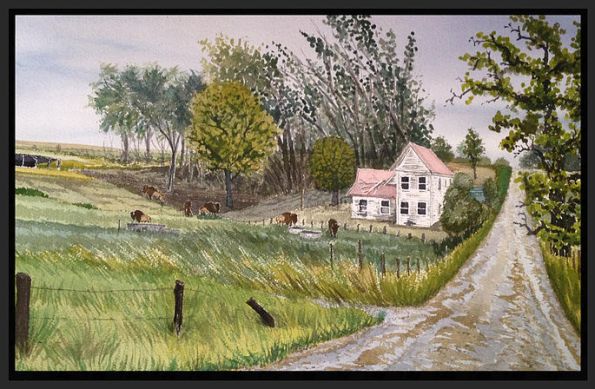
Today, the snake, whose range in Nebraska was always limited to the extreme southeastern corner, is rarely reported within the state’s borders. In 20 years of searching for them Lokke estimates he’s seen dozens, with the vast majority in Kansas. “They’re not easy to find. They blend in beautifully with their surroundings. It’s a big beautiful snake. A really large one is just a little over four feet long. Probably what accounts for it being rarer or absent today throughout its range in Nebraska and in other parts of the country is that its habitat has been degraded to the point where it can’t carry on its life cycle,” he explained.
He blames rampant tree succession, which unchecked prairie fires once controlled, for spoiling the high rock outcroppings favored by the Timber. “As the trees fill in the rocks no longer get the warm sun in the spring, when the snakes emerge from their dens, or in the fall, when they retreat back into them. Bluffs are slowly but surely being consumed by the trees, including dogwoods, cedars and cottonwoods.” Further eroding the snake’s habitat, he added, is a widespread phenomenon called slumping in which tons of dirt slide down from atop a bluff to cover or bury a rock outcrop, effectively making it uninhabitable.
It is tempting to compare the tall, tapered Lokke, who began studying and collecting snakes as a child, with the Crotalus Horridus he often seeks and paints on field trips in far southeast Nebraska. Much like the Timber, he has a quiet, still presence and patiently bides his time before acting in precise, definitive ways.
Since the mid-1990s this rather sober artist has been on a self-appointed mission to document a stretch of the Missouri along the Kansas-Nebraska border where the Timber once flourished but is now mostly vanished and where noted 19th century Swiss artist Karl Bodmer traveled with German Prince Maximilian of Wied, a noted naturalist, to explore the then pristine American West. He not only makes drawings, paintings and photographs of riverscapes but collects data on the area’s history through interviews with long-time residents, including old quarry workers whose labors inadvertently revealed the snake’s existence and sealed its fate. Why does Lokke do it? To leave a record of how the river, the land and the snake’s habitat has been altered by man’s presence in the ensuing years since Maximilian-Bodmer journeyed there during their 1832-1834 trek. It is Lokke’s way of providing a link to the past and a gauge for the future.
When, in 1996, Lokke discovered he had been drawn in his search for the snake to visit and paint some of the very sites Bodmer had before him, it revealed fresh connections and sparked renewed dedication to his mission.
“I had made three initial watercolor landscapes in Cass County of King Hill and of Indian or Ace Hill. When I discovered Bodmer had painted these hills it absolutely bowled me over,” he said. “It was through repeated searches for this snake I really became enamored with the beauty and mystery of those hills. I always knew there was something very powerful, very special about those hills, something a little more deep and more rugged than the others, and obviously a scientist from Germany and an artist from Switzerland 160 years earlier thought so too, and I thought that was pretty amazing. To see that Bodmer had chosen these hills was very validating for what I was trying to do because, you know, I went into this basically cold.
“I believed in what I was doing — I knew it was important — but I wasn’t sure of an historical context. But when I saw Bodmer’s work, that all changed. I now had a link with my natural history interests and a tie to the past through art history. I made up my mind then I was going to make a lot more of these paintings and make them ever better. That I was going to work at this very hard and push this as far as I can…and maybe I could leave behind some paintings that will be as useful to people in 200 years as Karl Bodmer’s are today. I got very invigorated by that possibility, and I went to work.”

The bridge between Lokke and Bodmer takes on added interest in that Omaha’s Joslyn Art Museum, where Lokke worked as an art education intern, is the repository of the internationally renowned Maximilian-Bodmer collection. The collection, under the auspices of the museum’s Center for Western Studies, includes hundreds of Bodmer watercolors and sketches as well as three journals kept by Maximilian that detail the expedition’s day-by-day progress. Joslyn has featured the Bodmer collection in major exhibitions and catalogs.
By 2001-2002, work should be completed on a new book detailing all 81 of the hand-colored engravings Bodmer made from his on-site watercolors, and during 2003-2004 a first-ever European tour of the Bodmer watercolors is scheduled. The long-anticipated publication of Maximilian’s German-language diaries is still two or three years off, according to museum officials.
Lokke, who discovered his link to Bodmer in the book “Karl Bodmer’s America,” envisions an illustrated book of his own someday that, in his words, “will tell the story of this amazing snake and its habitat and all the changes that have happened along this habitat in the 20th century.” The book will also document his own personal journey of discovery in the places he’s visited, the people he’s met, the stories he’s heard and the paintings, drawings and photographs he’s produced.
Beth Irwin, a former teaching specialist at Joslyn who supervised Lokke at the museum, is familiar with his work and its reverberations with Bodmer. “The feeling you get from John’s work is similar to the feeling you get from Bodmer’s. The Bodmer watercolors have a strong feeling of immediacy because they were painted more quickly — done maybe over a day’s time — where John’s are probably done over a month’s time. But they both have that freshness and immediacy in common.”
After working as a commercial artist during the 1970s and ‘80s, Lokke decided to embark on a fine arts degree about 10 years ago. Now a year-and-a-half away from earning his degree at the University of Nebraska at Omaha, Lokke brings a non-traditional maturity and vision to the classroom. One of John’s teachers at UNO, associate professor of art Bonnie O’Connell, said Lokke distinguishes himself by “his extensive experience out in the field” as well as by “the research he’s done. He’s quite delightful because he’s literate and articulate.”
Frances Thurber, an associate professor in art and art history at UNO, has taught Lokke and seen his watercolor work develop. “John really took to watercolor and became quite facile with the medium. He has a natural affinity for it. John really looks at the subtleties of that paint. He has a fine eye and a fine hand,” she said. “And I think he’s found a real niche for himself by incorporating his interests as a naturalist with his historical recording and his gifts as an artist. He has very much a scholarly approach to things. His work is precise and deep. He’s very gifted.”
To date, the artist has completed some 23 paintings and drawings relating to the Timber’s historical range and/or updating Bodmer’s views of the region. His watercolor landscapes, which have shown in a few area exhibitions, will be on display at the Omaha History Center through the end of October.
Finding the subjects for his watercolors requires Lokke venture to some off-the-beaten-path spots. He backpacks into remote wooded areas along the river, accessing long-abandoned quarry sites and mining towns. His favorite haunts include the Barada Hills, Jones Point, Morgan’s Island and the site where the Big Nemaha River meets the Missouri. Since much of the territory he covers is private land, he asks residents permission to traverse their property. Through such contacts with locals he’s heard many tales about the Timber Rattlesnake and about life along the once free and wild river.
“I’ve had some great experiences talking to these guys. They provide a glimpse into pre-World War II life on the Missouri River, before it was managed. Life then was simpler. Much less mechanized. Farms were smaller. A lot of southeastern Nebraska was devoted to fruit production. More families fished the river commercially. There were a number of small ferrying operations. The Schmid brothers, a pair of bachelor farmers who came to the United States from Switzerland in 1930 and settled on some land at the base of Indian or Ace Hill, remember being able to walk out their door, cross a flood plain and find an oxbow or slough full of fish in clear water. They feel the river is less for the better through channelizing. A lot of the wildlife and natural beauty is gone. Their opinion is it probably should have been left alone.”
Pete Everett, a 95-year-old ex-quarry worker, has told Lokke of the time at King’s Hill Quarry when a mound of loose dirt was removed from a bluff to reveal a depression in the ground. Digging turned up a den of 40 hibernating Timber Rattlesnakes. Lokke practically drools at the thought. His works include a series of “illustrated narrative” paintings depicting some of the snake tales the men have told him. He relies on the memories of men like Everett to inform him what those hills looked like and what habitat they sustained. He says his work is “increasingly becoming a tribute to the old men who have provided me with such wonderful stories. The greatest satisfaction I get is when I show them the paintings and watch 40 years fall off their faces.”
While far from a raving John the Baptist in the wild, Lokke concedes his quest is all-consuming, leaving him somewhat out-of-step with the times. “I’m much too slow for the 20th century,” he said. “I barely know computers. To tell you the truth I miss probably about 90 percent of popular culture. I don’t know what’s going on. I kind of live in my own oblivion. You kind of have to, you know?”
He prefers old-fashioned American music and often plays it on one of his National resophonic fingerstyle guitars. He also composes original tunes based on sounds that come to him on his river sojourns. “If I do something quite rigorous, like hiking or struggling with a drawing or searching for snakes, I’ll start hearing a recurring sound in my head — a riff — and once I get it in my head I try mentally playing with it and expanding on it and then I try to find it on the guitar. Some, I discard. Others survive to become what I like to think of as soundtracks to the places I go and the things I see.”

He looks to the past for much of his inspiration and, a la Thoreau, to nature for his sustenance. During one of his many Missouri River haunts, when he variously searches for the Timber and for just the right vantage point from which to paint its river bluff environs, he is a man in tune with himself and with his universe. At one with the rushing wind, the streaming river, the warbling Thrush. “It is essential,” he said of communing with the Great Outdoors, “because when I’m out there, even if I’m having a really bad day and just can’t get it together, I still think I’m doing what I’m supposed to be doing. It can certainly become a spiritual experience.”
In his work Lokke calls on both his training as an artist and his knowledge as a natural history buff. “I do go out there with the overt intention of striking a balance between what I know from my artistic training is aesthetically and
compositionally engaging and what is of historical interest or importance. My basic technique is to make as detailed a drawing as possible in the field. Then I take a few color snapshots just to help my memory with the colors I was seeing out there at the time. The drawing is really the skeleton and essence of what’s going to become a painting. In the drawing I bring out details lost or distorted in the photograph. I transfer the drawing directly onto good watercolor paper.” He often returns several times to the same site before finishing a painting.
For someone as passionate about nature as Lokke, working with a sketch pad outdoors can prove distracting. “It’s absolutely overwhelming to draw outdoors because I have a naturalist’s eye and I’m trained to see as much as possible, so I have to be selective. You cannot take it all home. After awhile a sense of what needs to be there will come through. But it’s very hard. I’m usually pretty tired by the time I’m done with one.”
Just as the remote bluffs that once provided a perfect haven for the snake and its dens have changed since Karl Bodmer’s time, so has the muddy river below — owing to massive dike-building and channelizing efforts aimed at taming floods and aiding river navigation. Lokke, who has a river’s stillness and serenity accentuated by his deep gaze, long slow gait and deliberate manner of speaking, would have loved to glimpse the Missouri and its surrounding hills in their pure wild state.
Crafting his words as carefully as he renders the details in his fine paintings, he said: “Often times when I’m driving home I get this deeply satisfying sensation that I I’m somehow connecting with the history of the place. The recollections of the old men come back to me strongly when I’m painting. My imagination gets keen with how it must have looked when this was frontier. I see it in very idyllic terms: The hills are a savannah that are basically open, with a spangling of hardwood trees through them; the bottoms are extremely rich with grasses, trees, water, birds and fish. I try not to think about the mosquitoes or the mud or the other problems.”

He appreciates that while he sometimes contends with tough conditions out in the field, ranging from hordes of nagging insects to severe heat or cold, he can always retreat to the comfort of his car and to a warm soft bed at night whereas Bodmer was exposed to harsh elements for weeks at a time, with only the bare provisions and flimsy accommodations afforded by the Yellowstone Steamer he and the rest of Maximilian’s party used to ply the Missouri River.
“He dealt with things that were much worse than what I face,” Lokke said. “From what I’ve been able to glean from notations in the journals, Bodmer was not just an artist for hire but also a crew member who was expected to go ashore and cut wood and hunt animals and assist when the steamboat got caught in snags or mired on sandbars, which was a common problem. It was a very difficult journey.”
It is not an exaggeration to say Lokke feels a kinship with Bodmer that extends beyond simply retracing the earlier artist’s historic steps. For example, Lokke paints in the same medium (watercolor) as his predecessor did and shares with him an affinity for nature and a sensitivity for accurately portraying flora and fauna.
“The kinship I feel with him is that we both work in watercolor, which can be a difficult and unforgiving medium…an elusive way to do art. At the same time, the properties of watercolor — the transparency and the way the paint behaves — are very conducive to rendering nature. There’s something about the way the colors lay on the paper, especially a fine rag paper, and the way that beautiful white paper shines through this paint.
“Bodmer was an immensely talented man. I love the way he handles his colors. His paintings have great economy. He can depict a whole line of trees along the river with basically just two layers of color whereas I have to use half-a-dozen. The greatest thing about his paintings for me is how his use of colors evoke the last glimpse of an unspoiled continent. The colors have a softness and sophistication that I think, more than any frontier artist I’ve looked at, capture the innocence of the North America he saw.
“The real connection I feel with Karl Bodmer is he had a real love for details and it was important to him that the plants and animals and the people and their tools were all done accurately. Bodmer was one of hundreds of artists in the 1800s sent far away to bring back imagery of foreign lands for review at home. Topographical artists like him were the camera of the day. Pictorial accuracy was paramount.”
In 1998 Lokke’s own skills as a representational artist led the then director of the UNO-sponsored Bethsaida Excavation Project, Richard Freund, to commission him to visit the Holy Land and paint historic sites documented by 19th century
topographical artist David Roberts. It was his first trip abroad. “That was a chance for me to live out every topographer’s dream,” Lokke said. His resulting paintings are currently on display in Hartford, CT and will tour other cities across the U.S.
Lokke is not the first Nebraskan to feel a keen personal kinship with the Maximilian-Bodmer odyssey. The late Paul Schach, emeritus professor of modern languages at the University of Nebraska-Lincoln, worked 12 years on the translation of Maximilian’s diaries. In a 1990 interview Schach, who grew up in Pennsylvania speaking and reading a dialect similar to Maximilian’s, said the painstaking translation put him on intimate terms with the man, with whom he shared more than a common heritage and language. Just as Maximilian spent a lifetime as a rugged outdoorsman and rigorous scholar, so too did Schach, who admitted to having “become perhaps too much interested in the man.”
Although Lokke regrets the fact he and Schach never met, Lokke feels they shared a bond no words could have expressed. Each felt the pull of the frontier West. Each identified with his own historical counterpart. Each in his own way delved far into the past in order to extract a better understanding of then and now. Schach is gone now, having left behind a vital store of knowledge. Lokke hopes to leave behind a legacy of his own whenever his time comes. A legacy staked out in the footprints of Bodmer.
Related articles
- Man bit by rattlesnake he tried to move off of Ocean County road (nj.com)
- Pa. snake roundup rouses some, rattles others (philly.com)
- Dueling Banjos & Baked Rattlesnake (raspberryblues.wordpress.com)
- Eye to eye with a copperhead (beetlesinthebush.wordpress.com)
Combat sniper-turned-art photographer Jim Hendrickson on his vagabond life and enigmatic work

Image via Wikipedia
Another of the unforgettable characters I have met in the course of my writing life is the subject of this story for The Reader (www.thereader.com). Jim Hendrickson is a Vietnam combat vet who went from looking through the scope of a rifle as a sniper in-country to looking through the lens of a camera as an art photographer after the war. His story would make a good book or movie, which I can honestly say about a number of people I have profiled through the years. But there is a visceral, cinematic quality to Jim’s story that I think sets it apart and will be readily apparent to you as you read it.
Combat sniper-turned-art photographer Jim Hendrickson on his vagabond life and enigmatic work
©by Leo Adam Biga
Originally appeared in The Reader (www.thereader.com)
Combat sniper-turned-art photographer Jim Hendrickson is one of those odd Omaha Old Market denizens worth knowing. The Vietnam War veteran bears a prosthetic device in place of the right arm that was blown-off in a 1968 rocket attack. His prosthetic ends in pincer-like hooks he uses to handle his camera, which he trains on subjects far removed from violence, including Japanese Butoh dancers. Known by some as “the one-armed photographer,” he is far more than that. He is a fine artist, a wry raconteur and a serious student in the ways of the warrior. Typical of his irreverent wit, he bills himself as — One Hand Clapping Productions.
The Purple Heart recipient well-appreciates the irony of having gone from using a high-powered rifle for delivering death to using a high-speed camera for affirming life. Perhaps it is sweet justice that the sharp eye he once trained on enemy prey is today applied in service of beauty. For Hendrickson, a draftee who hated the war but served his country when called, Vietnam was a crucible he survived and a counterpoint for the life he’s lived since. Although he would prefer forgetting the war, the California native knows the journey he’s taken from Nam to Nebraska has shaped him into a monument of pain and whimsy.

Jim Hendrickson
His pale white face resembles a plaster bust with the unfinished lines, ridges and scars impressed upon it. The right side — shattered by rocket fragments and rebuilt during many operations — has the irregularity of a melted wax figure. His collapsed right eye socket narrows into a slit from which his blue orb searches for a clear field of vision. His massive head, crowned by a blond crew cut, is a heavy, sculptured rectangle that juts above his thick torso ala a Mount Rushmore relief. Despite his appearance, he has a way of melding into the background (at least until his big bass voice erupts) that makes him more spectator than spectacle. This knack for insinuating himself into a scene is something he learned in the Army, first as a guard protecting VIPs and later as a sniper hunting enemy targets. He’s refined this skill of sizing-up and dissecting a subject via intense study of Japanese samurai-sword traditions, part of a fascination he has with Asian culture.
Because his wartime experience forever altered his looks and the way he looks at things, it’s no surprise the images he makes are concerned with revealing primal human emotions. One image captures the anxiety of a newly homeless young pregnant woman smoking a cigarette to ward off the chill and despair on a cold gray day. Another portrays the sadness of an AIDS-stricken gay man resigned to taking the train home to die with his family. Yet another frames the attentive compassion of an old priest adept at making those seeking his counsel feel like they have an unconditional friend.
The close observation demanded by his work is a carryover from Vietnam, where he served two tours of duty. “With sniping, you had to look at the lay of the land. You had to start looking from the widest spectrum and then slowly narrow it down to that one spot and one moment of the kill,” he said. “You got to the point where you forced yourself to look at every detail and now, of course, I’m doing that today when I photograph. I watch the person…how they move, how they hold themselves, how they talk, waiting for that moment to shoot.”
Shooting, of a photographic kind, has fascinated him from childhood, when he snapped pics with an old camera his Merchant Marine father gave him. He continued taking photos during his wartime tours. Classified a Specialist Four wireman attached to B-Battery, 1st Battalion, I-Corp, Hendrickson’s official service record makes no mention of his actual duty. He said the omission is due to the fact his unit participated in black-op incursions from the DMZ to the Delta and into Cambodia and Laos. Some operations, he said, were conducted alongside CIA field agents and amounted to assassinations of suspected Vietcong sympathizers.
As a sniper, he undertook two basic missions. On one, he would try spotting the enemy — usually a VC sniper — from a far-off, concealed position, whereupon he would make “a long bow” shot. “I was attached to field artillery units whose artillery pieces looked like over-sized tanks. The pieces had a telescope inside and what I would do is sit inside this glorified tank and I would rotate the turret looking through the telescope, looking for that one thing that would say where the Vietcong sniper was, whether it was sighting the sniper himself or some kind of movement or just something that didn’t belong there. I’d pop the top hatch off, stand up on a box and then fire my weapon — a bolt-action 30-ought-6 with a 4-power scope — at the object. Sometimes, I’d fire into a bunch of leaves and there’d be nothing there and sometimes there was somebody there.” When the target couldn’t be spotted from afar, he infiltrated the bush, camouflaged and crawling, to “hunt him down.” Finding his adversary before being found out himself meant playing a deadly cat-and-mouse game.


©Images by Jim Hendrickson


“You look at where he’s firing from to get a fix on where he’s holed up and then you come around behind or from the side. You move through the bush as quietly as possible, knowing every step, and even the smell of the soap you wash with, can betray you. I remember at least three times when I thought I was going to die because the guy was too good. It’s kind of a like a chess match in some sense. At some point, somebody makes a mistake and they pay for it. I remember sitting in a concealed location for like three days straight because only a few yards away was my opponent, and he knew where I was. If I had gone out of that location, he would have shot me dead. So, for three days I skulked and sat and waited for a moonless night and then I slipped out, came around behind him — while he was still looking at where I was — and killed him.”
His first kill came on patrol when assigned as a replacement to an infantry unit. “I was the point man about 50 feet ahead of the unit. I heard firing behind me and, so, I turned to run back to where the others were when this figure suddenly popped up in front of me. I just reacted and fired my M-16 right from the hip. I got three shots into the figure as I ran by to rejoin the patrol. The fire fight only lasted two or three minutes, By then, the Vietcong had pulled back. The captain asked us to go out and look for papers on the dead bodies. That first kill turned out to be a young woman of around 16. It was kind of a shock to see that. It taught me something about the resolve the Vietcong had. I mean, they were willing to give up their children for this battle, where we had children trying to evade the draft.”
As unpopular as the war was at home, its controversial conduct in-country produced strife among U.S. ground forces.
“Officers were only in the field for six months,” Hendrickson said, “but enlisted men were stuck out there for a year. We knew more about what was happening in the field than they did. A lot of times you’d get a green guy just out of officers’ school and he’d make some dumb mistake that put you in harm’s way. We had an open rebellion within many units. There was officer’s country and then there was enlisted men’s country.”
In this climate, fragging — the killing of officers by grunts — was a well-known practice. “Oh, yes, fragging happened quite a lot,” he said. “You pulled a grenade pin, threw the grenade over to where the guy was and the fragments killed him.” Hendrickson admits to fragging two CIA agents, whom he claims he took-out in retribution for actions that resulted in the deaths of some buddies. The first time, he said, an agent’s incompetence gave away the position of two fellow snipers, who were picked-off by the enemy. He fragged the culprit with a grenade. The second time, he said, an agent called-in a B-52 strike on an enemy position even though a friendly was still in the area.
“I walked over to the agent’s hootch (bunker), I called him out and I shot three shots into his chest with a .45 automatic. He fell back into the hootch. And just to let everybody know I meant business I threw a grenade into the bunker and it incinerated him. Everybody in that unit just quietly stood and looked at me. I said, ‘If you ever mess with me, you’ll get this.’ Nobody ever made a report. It went down as a mysterious Vietcong action.”
He was early into his second tour when he found himself stationed with a 155-Howitzer artillery unit. “We were on the top of a gentle hill overlooking this valley. I was working the communications switchboard in a bunker. I was on duty at two or three in the morning when I started hearing these thumps outside. I put my head up and I saw explosions around our unit. Well, just then the switchboard starts lighting up.”
In what he said was “a metaphor” for how the war got bogged down in minutiae, officers engaged in absurd chain-of-command proprieties instead of repelling the attack. “Hell, these Albert Einsteins didn’t even know where their own rifles were,” he said, bellowing with laughter. What happened next was no laughing matter. In what was the last time he volunteered for anything, he snuck outside, crossed a clearing and extracted two wounded soldiers trapped inside a radio truck parked next to a burning fuel truck.
“First, I started up the fuel truck, put the self-throttle on, got it moving out of the unit and jumped out. Then I went back and helped the wounded out of their truck and got them back to where the medics were. Then, another guy and I were ‘volunteered’ to put a 60-caliber machine gun on the perimeter fence. We were on the perimeter’s edge…when I saw a great flash. A Russian-made 122-millimeter rocket exploded. The man behind me died instantly. The only thing I remember is the sense of flying.” Hendrickson’s right arm and much of the right side of his face was shredded off.
As he later learned, a battalion of Vietcong over-ran a company of Australians stationed on the other side of the hilltop and attacked his unit “in a human wave.” He said, “They ran right by me, thinking I was dead, probably because of all the blood on me.” The attack was knocked-back enough to allow for his rescue.
“I remember starting to come around as my sergeant yelled at me…I heard an extremely loud ringing noise in my ears. I knew something was extremely wrong with my right arm, but I didn’t know what. I couldn’t really see anything because my eyes were swollen shut from the fragments in my face. About that time the medic came along. They put me on a stretcher and pulled me back to a hold. That’s when I was told my right arm was blown off.
“I was just thankful to be alive at that point. Then, the rockets started coming in again and people were running around getting ready for the next human wave attack. I was lying there with the two guys I’d saved. Then I saw this big bright light in the pitch black. It was a chopper coming in to pick us up. The medics carried us up, threw us in and the pilot took off. As we lifted, I could hear bullets ripping through the chopper. We were taken to the nearest hospital, in Long Binh, about 50 miles away.”
While recuperating, Hendrickson was informed by his captain that of the 100-plus-man strong unit, there were only five survivors – the captain, Hendrickson, along with the two men he saved, plus one other man. “Apparently,” Hendrickson said, “the unit had been hit by a combination of rocket and human wave attacks that night and the day after and were eventually wiped off the earth. Years later, the historians said this was a ‘retreating action’ by the Vietcong. If this was a retreating action, I sure as heck would hate to see it when they were serious and advancing.” He said his fellow survivors are all dead now. “Those are four people whose names should be on that wall in Washington. Unfortunately, they’ll never be recognized as casualties of war, but yet they are casualties OF THE war.”
He spent the next several months in and out of hospitals, including facilities in Japan, before undergoing a series of operations at Letterman Hospital in the Presidio of San Francisco. Afterwards, he said, he entered “a wandering period…trying to find myself.” He made his home in Frisco, becoming a lost soul amid the psychedelic searchers of the Haight-Ashbury district. “I tried to resume a life of somewhat normalness, but it was like a whole separate reality.” He enrolled in City College-San Francisco, where he once again felt out of place.
Disillusioned and directionless, he then came under the guidance of a noted instructor and photographer — the late Morrie Camhi. “Morrie made that connection with me and started me on a pathway of using photography as a kind of therapy. It was a really great relationship that evolved…He became like a second father.” Years of self-discovery followed. Along the way, Hendrickson earned a master of fine arts degree from the San Francisco Art Institute, married a woman with whom he got involved in the anti-war and black power movements and, following years of therapy in storefront VA counseling centers, overcame the alcohol abuse and post-traumatic stress disorder he suffered from after the war. While his marriage did not last, he found success, first as a commercial artist, doing Victoria’s Secret spreads, and later as an art photographer with a special emphasis on dance.

Morrie Camhi
Helping him find himself as an artist and as a man has been an individual he calls “my teacher” — Sensie Gene Takahachi, a Japanese sword master and calligrapher in the samurai tradition. Hendrickson, who has studied in Japan, said his explorations have been an attempt to “find a correlation or justification for what happened to me in Vietnam. I studied the art of war…from the samurai on up to the World War II Zero-pilot. I studied not only the sword, but the man behind the sword. In the Japanese philosophy of the sword it’s how you make the cut that defines the man you are and the man you’re up against.” He said this, along with the minimalist nature of Haiku poetry and calligraphy, has influenced his own work.
“I try to do the same thing in my photography. I try to strip down a subject to the most essential, emotional image I can project.” He has applied this approach to his enigmatic “Haiku” portraits, in which he overlays and transfers multiple Polaroid images of a subject on to rice paper to create a mysterious and ethereal mosaic. While there is a precision to his craft, he has also opened his work up to “more accidents, chaos and play” in order to tap “the child within him.” For him, the act of shooting is a regenerative process. “When I shoot — I empty myself, but everything keeps coming back in,” he said.
A self-described “vagabond” who’s traveled across the U.S. and Europe, he first came to Omaha in 1992 for a residency at the Bemis Center for the Contemporary Arts. A second Bemis residency followed. Finding he “kept always coming back here,” he finally moved to Omaha. An Old Market devotee, he can often be found hanging with the smart set at La Buvette. Feeling the itch to venture again, he recently traveled to Cuba and is planning late summer sojourns to Havana and Paris. Although he’s contemplating leaving Omaha, he’s sure he’ll return here one day. It is all part of his never-ending journey.
“I see photography as a constant journey and one that has no end until the day I can’t pick-up a camera anymore,” he said.
Related Articles
- How Snipers Succeed by Missing Their Targets (theqco.com)
- In the shadow of Vietnam: A close encounter with Karl Marlantes, US marine turned literary giant (independent.co.uk)
- Full Metal Jacket: history unzipped (guardian.co.uk)
- Darpa’s Super Sniper Scopes in Shooters’ Hands by 2011 (wired.com)
- Snipers targeting children in key Libyan city: UN (cbc.ca)
Golf shots: Patrick Drickey lives dream photographing the world’s great golf courses
This successful art and commercial photographer has in recent years found his niche making panoramic images of the world’s great golf courses. The creative artist’s early work goes back to the founding, fledgling years of Omaha’s Old Market. He never really left the Market in his heart and when he could he bought property. He’s developed cool living-work-community spaces out of old buildings tastefully renovated to retain their charming urban historical character. Subsequent to this profile being published he’s opened a popular art gallery and event space, the 1516 Gallery, in one of his buildings. Those who know of Drickey or who know only one aspect of his life and work will likely be surprised by the breadth and depth of his experience and of his output. With any profile subject it’s best to get to know their passion because once you know that then you get to know the man or woman you’re writing or reading about. If nothing else, I hope this adequately expresses the extent of Drickey’s passion.

Golf shots: Patrick Drickey lives dream photographing the world’s great golf courses
©by Leo Adam Biga
As published in the current edition (August 2010) of the New Horizons
The same wanderlust that sent Patrick Drickey off to see the world at 17 in the U.S. Navy Reserve carries him today on photographic shoots around America and overseas.
After working as an art, architectural, food and agricultural photographer, Drickey hit upon an idea for photographing the world’s great golf courses. He saw a market for indelibly commemorating the signature golf holes that make these green meccas and Elysian Fields iconic symbols for everyone from professionals to weekend duffers.
He appreciates the irony of being one of the world’s most in-demand golf photographers yet not having grown up playing the game. Though he plays now, he’s hardly accomplished as a 25-handicapper. But this “history buff” is well-versed in the game’s heritage. He knows its hallowed grounds, having trod many of those very links himself. He is schooled in its legends, many of whom he’s met and photographed, including Jack Nicklaus and Arnold Palmer.
He also enjoys reviving his own family’s golf legacy. His late maternal grandmother Helen Burmester was a local amateur champion in the 1930s. His mother didn’t play the game, therefore he didn’t. The images he makes today would have surely pleased grandma. He displays her antique clubs at Stonehouse.
His is the ultimate niche business specializing in panoramic images of picturesque places like Pebble Beach and St. Andrews. Drickey and his staff employ a rigorous production process to create archival quality prints imbued with painterly attributes. Customers collect framed Stonehouse prints the way some folks collect fine art works.
None of that was on his mind 44 years ago. In 1966 he was a bored Omaha Burke High School junior, just marking time before going off on some undefined adventure. He got what he wanted when he joined the Navy — both to see the world and escape the military draft for the escalating Vietnam War.
He counted on being assigned a cushy, scenic port of call out of harm’s way. He got his wish in Guam. Then in January ’68 he was sent to a naval supply facility in Saigon, where as “a storekeeper” he was in charge of procuring most everything for delta patrol boat crews and construction battalions.
“It was like being given the keys to the kingdom as an enlisted man,” he said. The job gave him latitude as the point person who could lay his hands on whatever people wanted. “Pretty much anytime anything needed to be greased, they’d come to me.”
He would apply that keep-everybody-happy skill set to his professional photography career, where pitching and pleasing clients is paramount.
He knew Saigon was far from the front line action and so he had little cause for worry.
“I had no idea what to expect, except Saigon was considered a safe zone, so I wasn’t that concerned about anything. We were at a place called the Annapolis, like a temporary Navy billet right outside Tan Son Nhut Air Base (the near Saigon base accommodated military personnel from each branch). From there guys would get assignments and be sent everywhere in the country. Because we were on temporary assignment they had us staying there. We would drive to the main warehouse compound early in the morning.”
On his third morning there he and fellow supply personnel left for the drive into Saigon, unaware the area they left behind would come under attack by Viet Cong forces in the Tet Offensive, which took its name from the traditional Vietnamese holiday it coincided with.
The VC flooded into the south by the tens of thousands. Fire fights and full scale battles erupted over a wide battlefront. Except Drickey and his mates didn’t know it was happening until almost too late.
“The morning Tet started we all piled on a two-and-a-half ton flatbed stake truck. The streets were dead quiet and we didn’t really think anything of it. There was no machine gun fire going off or anything like that. The three days prior the streets were filled and fire works were going off in celebration of Tet. That’s a big event for those people. Kind of like the Fourth of July in America.”
He and his mates figured the quiet was the post-holiday lull, but they were then jolted into reality.
“We went past the U.S. embassy and we noticed damage to the facade, like big mortar or artillery rounds hit it. We got down to the compound and the gates were closed, which was unusual. Then guards popped up from over the top, outfitted in flak jackets, brandishing M-16s. They asked, ‘What are you guys doing — haven’t you heard?’ We hadn’t heard anything.”
Strategic parts of Saigon were, Drickey said, “under siege,” a situation in which “anything could happen.” He recalled,,” We got in the compound and spent the next seven days isolated there. We did come under sniper fire. We had guard duty on all the perimeters. No (regular) food, we had to break out sea rations.”
Though the offensive was repelled, it put everyone on edge.
“You didn’t go anyplace after that without firearms,” he said. “I had my own vehicle, and they issued anybody who was driving a truck a sawed-off shotgun because the blast pattern was so big that all you had to do was point and shoot and it would take out anything.”

Drickey was stationed in Saigon during the Tet Offensive
Even his “sweet sawed-off” was no gauranteed protection against tactics targeting U.S. military. In those tropical climes he said it was standard practice to drive with vehicle windows rolled down, making drivers and passengers susceptible to a grenade or other explosive being thrown inside or someone taking pot shots at them. Drickey luckily escaped injury.
Indeed, he settled into a familiar, comfortable routine. Along the way, he was exposed to an intrepid band of men who inspired a new vision for what he might do with his life. The backdrop for this revelation were great big R & R bashes the local commander of Naval supply operations threw.
“The old man was interested in camaraderie among the troops,” Drickey explained. “There were seven warehouses in Saigon and once a month you’d get together at one of them for an afternoon of barbecue, volleyball, poker, and shoot-the-shit. It was also a time to get grievances ironed out. The food during those events was always top rate, and that was attractive to the AP (Associated Press) and UPI (United Press International) photographers, who would spend time in our compound.”
These photojournalists covering the war were a breed apart. Their independence and their enthusiasm for their work made a distinct impression on Drickey.
“I was just a kid and they were the first people I met who never complained about their jobs. They couldn’t wait to get their next assignment, wherever it was going take them around the world, and that intrigued me,” he said. “It was their attitude. I said, Wow, that’s the kind of adventure I want my life to be.”
Before encountering the lensmen, he’d never considered photography a career choice. He’d only fiddled with a Brownie back home. Until ‘Nam, no photographer served as a model he might follow.
“My only experience with a photographer was posing for one at a wedding or for high school portraits. I had absolutely no interest in that. But the adventure of photojournalism hooked me.”
Back home in the States in ’69, he pursued his new found aspiration. He used the GI Bill of Rights to enroll at the University of Nebraska at Omaha but between meager funds and a requirement he take writing-reporting classes, he dropped out. At the time, he said there was no focused photojournalism program or track at any area school, and so he pieced together his own by taking a course here and a course there.
“I wound up auditing courses for photography at Bellevue College and Creighton University. I took a course over at Iowa State specializing in architectural photography. My dad was a carpenter and contractor, so for me getting involved with buildings seemed like a natural choice.”
Drickey never became a news hound like those romantic figures who sparked his imagination. But he learned the craft bit by bit, carving out a place for himself that, while hardly heroic, made him a nice living and ultimately provided the freedom to find his passion and travel the world.
Early on, he identified himself as an art photographer.
“I was doing black and white still-lifes then. I had a show with Judith Welk (Omaha acrylic and oil painter) called “Fresh Produce,” all based on still llfes and a visit to Seattle. I was somewhat successful with that but I soon realized it wasn’t a career move for me unless I decided to get a degree and become a teacher.”
In the early ’70s Drickey immersed himself in the emerging Old Market counterculture scene. “I was always drawn to it. Everybody down there was very independent thinking. I was one of the founding members of the Artists Cooperative Gallery, when it was above M’s Pub. It was a true coop . You were required to work one period a month, typically a Friday night opening. It taught me the discipline of pulling together a show and what that takes.”
Other pioneering Old Market artists whose paths he crossed then included the late Lee Lubbers, installation artist Catherine Ferguson and the former Ree Schonlau, now Ree Kaneko. Ree’s husband is celebrated ceramic artist Jun Kaneko. Ree founded the Bemis Center for Contemporary Arts, whose artist-in-residency program has brought hundreds of artists from around the world to live, work, and exhibit in Omaha.
“Ree’s my all time hero in the city. Her vision for what could be, can be, is still amazing to me. She is just one-of-a-kind and an absolute Omaha treasure. She was one of four women who had an operation called the Craftsmen’s Guild. Ree was the potter. I was a young photographer looking for space and they had an upper floor open I considered doing a studio in. For whatever reason the deal fell apart but I maintained a relationship with Ree. She always had me photograph the artists’ work for the invitations.”
That led to contacts with other local artists. He’s collected their work ever since. His artist friends include Larry Sasso and the Kanekos. He was close to the late Kent Bellows, whose hyper realistic drawings are the basis for a fall Joslyn Art Museum retrospective Drickey’s helped organize.
The Old Market remains his artistic home. He’s maintained property in the historic district for years, always making his studio and office there, though never residing there.
“I started in a basement at 12th and Harney. Back then I paid $175 a month rent. It was affordable, it was doable, I don’t know that anybody can do that (starting out) today. I bought my first building at 14th and Howard.”
The two-story red brick building his Stonehouse Publishing occupies at 1508 Leavenworth was originally St. Philomena school. As he tells the story, a fire led to the third floor being removed. At some point, he said, a tractor supply company bought the entire block and combined that building with two adjacent ones. A porch addition was made to the original structure.

In the ‘70s Omaha businessman and politico Leo Kraft bought the complex, converting it into a home and studio (his wife Frances Kraft was an artist) . Drickey and his wife Karen, a Bryan High School art teacher, led efforts to preserve Tomlinson Woods as a public arboretum and they found an ally in Kraft, the then-Omaha City Council president.
“We came there for a brunch one Sunday with kind of an eclectic mix of people and I never forgot the space. That was the first time I’d witnessed anything like this,” Drickey said, referring to the urban loft space with exposed original brick and wood work.
Drickey’s appreciation for well designed historic buildings was instilled in him by his father and honed by the photography he did for HDR and for Leo A. Daly. His work for Daly sent him all over the country, photographing their projects.
When the Krafts passed away Drickey approached their son Marc about the property but, he recalled, “it was so close to the family’s hearts I couldn’t ever see a chance when they’d part with it.” In 2000 he saw a for sale sign out front. He acted quickly to purchase the site. He’s put much sweat equity into renovating the studio-office space. He and his three brothers learned the construction trades from their father.
“Construction is in our blood,” he said. “We all know how to do stuff. I know how to dig a footing and put up a building. There’s nothing I can’t do.”
His blue collar sensibility is why his closest relationships in golf are with the course superintendents.
“Let’s just say in the world of golf I probably get along better with the golf course superintendents than anyone else,” he said. “I’m more drawn to those guys. They’re the unsung heroes to me because they are the ones out there providing what it takes to make that course a beautiful challenge. I’ve made so many friends on the superintendents side.”
When he finishes a golf project he generally gives a limited edition print to the course super as a thank you for the courtesy and access they provide on a shoot.
Drickey’s pathway to golf photography came via ag photography. His apprenticeship included a five-year stint with Walter and Nancy Griffith and their Photographers Associated. He said it was under Walter Griffith’s tutelage “where I learned how to be a studio photographer. He had an extraordinary studio.”
One of Griffith’s big accounts was Omaha Steaks, and Drickey went on to build his own food clientele, including Godfather’s Pizza.
Griffith also introduced Drickey to the panoramic format for shooting outdoor landscapes by way of a panoramic camera he built himself for the ag business. When Fuji came out with a panoramic camera Drickey was one of the first in this area to get one.
“Whenever you looked at those panoramic images on the light table and studied them with a loop it was like you were standing in the field,” said Drickey. “I knew the power of that image. That had great impact on me.”
Subsequently, Drickey said, “I chased the ag business.” He felt at ease with the farmers and ranchers he met on projects, saying, “They just have a different quality about them.” He came to appreciate the unexpected similarities of how light and shadow fall on the contours of a food and ag landscape.
“It’s funny because I aways heard that shooting food is like shooting landscapes, just on a different scale, and it’s true. A successful food shoot is a landscape, in how it’s lit, all of the elements are there.”
Reinventing himself as a golf photographer came about in a mother-of-invention way. A client, Cushman, a leading manufacturer of golf carts and lawn maintenance equipment, put out an annual calendar using “the tool girl” concept of a Playboy centerfold posing with products. “It worked for years,” he said. When a new, female marketing director asked him to take the calendar in a whole new direction, he hit upon the idea of picturing Cushman products against the backdrop of the world’s best golf courses.
The marketer loved the idea but then Cushman was sold and the new owners ditched the campaign. Fortunately for Drickey his idea was shared with Cushman’s advertising agency. They liked it so much they pitched the idea to another client, Rainbird Irrigation, which serviced many top courses, and they bought it.
“The next thing I knew I was on a worldwide, whirlwind tour of all the world’s best courses, starting with Pebble Beach,” Drickey said.
That very first assignment at Pebble Beach in 1995 proved pivotal. He was there to get a shot of its famed No. 7 hole, only the weather didn’t cooperate.
“I waited there in the rain for six days for it to stop raining, and on the seventh day the sun shone and I got a beautiful panoramic shot.”
The shot remains the best-selling print in the Stonehouse archive. When 600 prints of that image sold at the 1996 AT & T Pebble Beach National Pro-Am, he said, “that’s when I knew this could be a business. it’s been a fun ride, a bit of a roller coaster, but a fun ride ever since.” He sold his ag-food photography business to form Stonehouse, whose name comes from the field stone lake house he kept in Iowa.
The USGA (United States Golf Association) saw the image, and, he said, “they embraced it and put in their catalogue and it was like the top selling item for six consecutive issues.” That exposure, he said, “got the attention of some folks at The Open (the British Open), and I wound up doing all of the British open rotation courses, including some of the historic ones, like Royal Port Rush in Northern Ireland.”

This year Stonehouse was selected as one of the official images by St. Andrews Links, which runs the course on which the 2010 Open at St. Andrews was played. Contestants autographed the picture for permanent display in the St. Andrews clubhouse, a rare honor accorded a Yank photographer.
“It validates my career in the manner Kent Bellows was validated when the New York Metropolitan Museum acquired his work for their permanent collection,” said Drickey.
He’s also been privileged to do special projects for living legends Jack Nicklaus and Arnold Palmer. The Nicklaus project involved Drickey documenting Jack’s last round as a player at St. Andrews.
“That turned out to be great, but totally unnerving for me because it’s not something I specialize in. I was like, OK, what are you going to do to capture this icon within an icon in a panoramic format? You preview these things in your head, what you expect, where you’re going to be, where he’s going to be, and it’s not a matter of, Hey Jack, look over here. You don’t get that opportunity.
“I took my son on that and that was a great experience for him.”
It turned out one of Nicklaus’s sons caddied for Jack that day.
Drickey failed to get a hoped-for element in the shot but made up for it by nailing another: “Jack was playing with Tom Watson and Luke Donald. I wanted the leader standard in the shot to show where the players stood in the tournament, but when Jack lined up for his putt on No. 1, I was limited to where I could be, and I couldn’t control where those guys were.”
Thus, the leader standard ended up out of frame. But Drickey did get Jack in the sweater he wore when he won his last British Open. Picturing the golf god in it took on added importance when Jack then removed it, giving Drickey one of the only shots of the Golden Bear in that sentimental garb on the Old Course.
“It’s the shot I’m the most proud of,” said Drickey. “We did a big print of it and sent it down to Jack, and his people called me and said that Jack added the prints to his personal collection.”
At the storied Latrobe Country Club in Latrobe, Penn. the course that Palmer’s father designed and where Arnie learned to play, Drickey got to contribute to the Palmer lore by shooting an assignment there. He said the only instruction given by club officials was “to pay special attention to the back nine, where the covered bridges are — those are real special to Mr. Palmer.”
“I knew it was significant to the Palmers. I walked out on this course…I had misty early morning light. Then I got to No. 11, and the sun came out in such a way that it kind of highlighted the bridge, with the mist rolling back. That’s how Pennsylvania people see their countryside all the time in their mind’s eye. and I got the shot. I said, I don’t need to do anything else on this course, this is it.”

The framed print was sent to Palmer, who invited Drickey to a licensee event at Latrobe. It was there Drickey learned his print made quite an impact.
“I ate dinner with his brother Jerry, and I had brought these mini-prints I give out as examples of who we are, and he said, ‘Oh you’re this guy, I gotta tell you this story: When you sent that framed print Arnie’s assistant put it on an easel for him to see it and all of us were standing around just to see his reaction. Arnie looked at it, he had a tear in his eye, and he said, Boy did you ever think this place could look this good?'”
Drickey said he was told Palmer got so “emotional” that he purportedly declared, “When I’m dead and in a coffin one of those prints is going to be buried with me.” The photographer also learned some of his images hang in Palmer’s office. Having Palmer as a fan, he said, has “opened some doors for us like you can’t believe.” For example, the Golf Channel did a piece on Drickey and now carry Stonehouse prints online.
In addition to being endorsed by some of golf’s top names, Stonehouse is licensed by major courses, by the USGA and by the PGA, giving him access to virtually any fairway and green. From Pinehurst to Medinah to many other championship courses with rich histories, Stonehouse and Drickey are recognized names with carte blanche access.
“Which is a significant deal,” he said, ”because we are becoming that embedded in the lore of golf.”
Additionally, he said more than 600,000 Stonehouse prints are now in circulation.”We’ve branded the panoramic format for golf,” he said “That belongs to Stonehouse. One of the things I like about what I’ve been able to do is carve out a niche that goes beyond the confines of Omaha.”
Employing all-digital equipment in the field and in the studio, Drickey applies exacting standards to his imagemaking not possible with film. Digital enhancements bring clarity from shadows and achieve truer, more balanced colors, he said. Even a sand trap can be digitally raked.
“It’s just incredible what you can do — the control you have,” he said.
The refinements or touch-ups accomplished in the post-production process are why he calls what he does “more photo illustration than straight photography.”
He said Stonehouse has adopted the fine art Giclee process to its own printmaking methods, which entails using expensive pigmented archival inks on acid free watercolor paper to ensure prints of lustrous, enduring quality.
“I want to produce a product that’s going to be around for a long time. The color hits that paper and stays with it — it will not fade,” he said.
He feels another reason for Stonehouse’s success is its images portray the timeless characteristics that distinguish a scenic hole or course. He strives to fix each scene into a frieze that expresses the design, the physical beauty, the tradition. His eye for detail helps him bring out “the architecture” of it all.
The clubhouse is often featured in shots because club members expect to see it.
Getting the composition just how he wants it means “waiting for the right light,” he said, adding, “Even a tree shadow coming across the green will change the dynamics of that composition.” Waiting for magic time can mean hours or days.
Much care and research go into finding the one idyllic, golden-hued shot that will speak to avid golfers. That’s who Stonehouse prints are marketed to. He said a typical customer wants a print of the famous hole or course they challenged, much like a hunter wants the head of the game he bagged.
Building-updating Stonehouse’s image collection keeps Drickey on the road several days a month. He’s half-way to his goal of photographing the world’s top 100 courses. One he’s still waiting to shoot is Augusta, home to the Masters.
“That’s one of America’s crown jewels. We are present at the other majors and we’d like to have a presence there. It’s just a matter of time. Those introductions have been made,” he said.


Glimpses at the 1516 Gallery he’s opened and directs
Stonehouse prints grace books-periodicals-calendars and other publications. Some of its images are included in the coffee table book, Planet Golf.
Not all his assignments are outside Nebraska. He often shoots in-state courses, at least one of which — the Sand Hills Golf Club near Mullen — is regarded as world-class. Its managing partner, Dick Youngscap, said Drickey “does all of our work. He’s a premier photographer. He’s the best I’ve been around. Pat seems to have an empathy for not only the golf course but the physical environment — the scale and the scope of it. He’s just special, both as a human being and as a talented artist.”
Whether trudging across the Sand Hills or the Scottish Moors, Drickey always brings his clubs along in case the mood strikes to shoot a round or two. He said club officials “always offer” an invitation to play. “They assume I’m a golfer first and a photographer second, and that’s not true. I am a photographer first. I love the game, not that I have what I would call a game. I just like being out there. I don’t keep score. I stopped a long time ago. It makes it a much more enjoyable game. What’s the point? I guess to see if you’ve improved, but I know when I’ve hit a good shot, and that’s all I care about.”
Just like he knows when he’s composed a winning photograph.
He realizes how lucky he is to visit such oases for his job. “They’re beautiful places, absolutely stunning,” he said. It’s his dream job come true.
“I’m doing exactly what I want to do.”
Visit the Stonehouse website at http://www.stonehousegolf.com or call 1-800-949-7274.
Related Articles
- How to Photograph a Golf Course (brighthub.com)
- Masters 2011: Woods, Mickelson and McIlroy Remind Us of the Human Side of Golf (bleacherreport.com)
- Fairways Where Golf Becomes the City Game (travel.nytimes.com)
The Bone Hunter: Paleontologist Michael Voorhies Uncovers Dinosaur Fossils
An article in the local daily about paleontologist Michael Voorhies got me excited about interviewing and profiling him, and after a simple inquiry I made arrangements for New Horizons editor Jeff Reinhardt and I to visit the scientist at his home dig — the very cool Ashfall Fossil Beds State Historical Park in Nebraska. It was a fun field trip and I thoroughly enjoyed capturing this engaging man’s magnificent obsession for bone hunting. This was another of those occasions when I never heard a peep from Voorhies after my article appeared in print. Perhaps now that it is getting a second life courtesy this online posting, I might hear something back from him.

The Bone Hunter: Paleontologist Michael Voorhies Uncovers Dinosaur Fossils
©by Leo Adam Biga
Originally appeared in the New Horizons
There’s a perfect symmetry to bone hunter Michael Voorhies’ life.
The most significant fossil finds by this professional paleontologist have come in his native Nebraska. He found his first dinosaur bone as a child in northeast Nebraska. Soon after graduating from the University of Nebraska-Lincoln he discovered a prehistoric frieze of two dueling mammoths in the state’s far western Little Badlands. Within his first decade in the field he identified a volcanic ashfall fossil bed on an Antelope County farm near his childhood home that led to the establishment of Nebraska’s most unusual state park.
The ancient remains of Ashfall Fossil Beds State Historical Park are open to the public even as the area remains an active excavation site. This retired UNL curator of vertebrate paleontology now spends his summers there with his geologist wife Jane. They make their “bone camp” in a primitive cabin by a creek. She plays the harpsichord and cooks gourmet meals. They have a ball.
His parents still live in his hometown of Orchard, Neb. — a virtual stone’s throw away from Ashfall, where his life and career as a bone hunter have come full circle.
“I eventually ended up pretty much where I started,” he said.
Voorhies could be doing most anything in retirement. But he prefers scratching and digging around in the ground with his ever-present trowel, using a fine paint brush to clean the silty ash and sand away from whatever remnant he extracts. Holding a freshly unearthed object with relic-like care close to his thick-lensed glasses, he inspects it, hoping for a treasure rich in scientific discovery.
Whether sifting through dirt turns up a treasure or not, it still connects the seeker to a long lost age, even a bit of eternity. It also yields a measure of posterity.
“Every time you swipe through the dirt and you find a bone you know for sure you’re the first person in the history of the universe to see it, and that’s pretty good,” he said.
Bones represent pieces, no matter how small, of an epic tale.
“They all tell some kind of a story,” Voorhies said.
He derives the same joy of discovery from bone hunting today as he did as a boy along streams near Orchard, where his father was a dairyman and the paternal grandfather he idolized was a pharmacist. After one of these youthful tramps that his grandpa sometimes joined him on, Voorhies would empty his pockets of arrowheads, agates, bird shells and plants.
Once, at age 9, he came home with the remains of a tooth he suspected must be very old. He found it scouring the banks of Verdigre Creek. His favorite teacher at school, Mrs. Carlson, sent a letter along with the incisor to Lloyd Tanner, a paleontologist at Morrill Hall, the state natural history museum in Lincoln, asking if he could identify it for her eager student. In his reply Tanner confirmed the tooth belonged to a giant Ice Age camel that lived about two million years ago.
“That really made my day when I got a letter back saying this little hunk of stuff turned out to be something important,” Voorhies remembered.
Tanner sent the fossil back suggesting it’d make a fine specimen for the museum’s collection. Voorhies donated it and a part of him was forever hooked on the ancient wonders contained in the ground, although, he said, “it wasn’t until I got to college I realized you could be a professional paleontologist. This, to me, was some kind of hobby but here were folks making a living doing this.”
It turns out Nebraska’s fertile ground for fossils.
“Almost any of these little creeks in this area carry a load of gravel that has scattered pieces of petrified bones, wood and teeth and so forth,” he said. “If you have any outdoor experience in this part of the state you’re going to find fossils.”
The Nebraska Panhandle is especially abundant in fossils.
He credits both Mrs. Carlson, whom he recalls as “a superb science teacher,” and Tanner for inclining him towards the work he does now.
“I was not a junior scientist. My interest was mostly being outside. If I hadn’t had the teacher I had growing up in Orchard, if she hadn’t nurtured that interest in natural history I had, I think there’s a good chance I could have ended up pushing pills some place and been perfectly happy at that. She encouraged curiosity and creativity in kids. And I’m forever grateful to Lloyd Tanner for taking the time to answer a little kid’s question.”
When a child visiting Ashfall asks him a question, even one he’s often heard before, he responds knowing his answer can impact an impressionable young mind.
In that way his life has of coming full circle, Voorhies ended up working for the very man, Tanner, who certified his first dinosaur find.
Many more significant finds followed. Voorhies was a fresh UNL grad the summer of 1962, working in a field party at the Trailside Museum at Fort Robinson State Park, when two workmen laying electrical lines on the Tom Moody ranch near Crawford, Neb. came in with a large fossil they’d uncovered. They’d placed their find in the only available container — a feedsack — and presented it to Voorhies.
The fossil’s size readily identified it as belonging to a mammoth, the largest dinosaur to roam prehistoric Nebraska. Voorhies and the team went to the site where the hind leg bone laid undisturbed for thousands of years and they spent much time excavating before confirming a once-in-a-lifetime find.
“We had no idea what we were getting into until we dug back into the bank. We dug forward to where we hoped the skull would be and, Wow!, there it was — the back of the skull. I remember there was a moment at which we were disappointed because we found the tip of a tusk and it was going the wrong way. ‘Oh, damn, the tusk has broken off and gone back the wrong way..’ But within a few more days it was apparent there was a second elephant — and that tusk tip was actually from” the second until-then-obscured mammoth.

It took six weeks of digging before the intact skeletons of two fully grown adult male Columbian mammoths frozen in a death embrace emerged; their intertwined bodies evidence of a fight that ended when their tusks became interlocked and the beasts fell, unable to dislodge their ivory appendages or lift their 10-ton bodies.
He said tests run on the tusks indicate the elephants engaged each other “in a testosterone rage. That’s when they’re the most dangerous. Basically, two 10-ton trucks meeting head on.” It was, he said, “the old story” — a fight over sex. What caused these two battling elephants to be fatally entangled, he said, was the fact each had one long sharp tusk and one stump, allowing the spear-like thrusters to get caught up — one’s tusk lodged in the eye socket of the other elephant.
It remains the single most impressive fossil find Voorhies has ever seen.
“This is the only case we know of in the world where you find these elephants locked in combat,” he said.
The mammoths were dressed in a plaster jacket and removed from the ground without breaking a single bone. The fossils were then brought to Morrill Hall, where they remained until a couple years ago, when funds were finally secured for Voorhies and a crew to prepare the mammoths for display at Trailside.
In hindsight he would have left sediment on the bones for the added information it provided. But being green and afire with the heat of discovery, he “was after the trinket — the bones,” he said, not the sediment. He knows better now.
Nine years after the mammoths discovery Mike and Jane were on one of their cherished hikes near Orchard when he spotted something that changed his life.
A baby rhino skull exposed by erosion proved to be the marker for an ancient fossil bed. What used to be an active water hole for dinosaurs became a dead zone when volcanic ash descended there, killing off the natural habitat and the many animals that utilized it. The find led to Ashfall State Park outside Royal, Neb.
Several features distinguish this spot, he said, none more than its rhino, three-toed horse and other skeletons preserved in perfect three-dimensional condition within the very earth that became their burial ground. The sculptural bones jut out of the gray ash like headstones in a dinosaur graveyard. It’s a striking, eerie, solemn, magisterial sight. The tableaux-like remains are protected from the elements in a rough-hewn mausoleum called the Rhino Barn.
“Probably the most unique thing about Ashfall is that we’ve left the fossil bed in the ground so people can get close to it,” he said. “This is the only place in the world that has skeletons of large animals in the round. Their rib cages are still bulging up just like a live animal and that’s really what makes this place unique.”
Ashfall’s distinctive enough that the PBS series Nova featured it.
“What Ashfall has contributed is much more specific knowledge about one particular place and the details of the anatomy of these prehistoric animals. Most fossils are very incomplete. We knew for instance we had rhinos (in ancient Nebraska) but we didn’t really realize this particular species had very short legs. It was built like a hippopotamus. You have to have whole skeletons to figure things like that out. One of the nice things about Ashfall is that it took the guess work out of it for many of these species.”

Dr. Michael Voorhies
Voorhies is a storyteller at heart and he likes nothing more than adding to the evolving narrative of prehistoric times.
“One of the pleasures of paleontology is being able to sort of time travel in your imagination and try to imagine what things looked like when they were alive,” he said. “And if you have really good evidence like we do at Ashfall you don’t have to speculate so much The natural body line has been fleshed out. You can see the sag of the belly…”
The more scientists have to work with the more they discern. “We have such excellent materials in the horses and the rhinos we can tell the sexes easily because the males have big tusks and the females have small tusks,” he said. “Many of the females have babies right next to them, some in nursing positions.”
Many of the skeletal remains include stomach contents, complete with undigested seeds and stems of prairie grasses. “Their last meal,” Voorhies said. Thus, scientists theorize most every critter in the ash bed was a grass-eating animal.
Diversity ruled.
“One of the fascinating things to me is how rich the wildlife was here 12 million years ago,” he said. “I think we’re up to something like 70 different species of wild animals that we have evidence were using this water hole. The biggest ones were the elephants and then you work down to rhinos, three-toed horses, various kinds of meat-eating animals — bear dogs, bone crushing dogs and saber-toothed cats — right down to mice, squirrels, shrews, frogs, toads, salamanders, bats and birds. Just all kinds of things.
“Also, we have several new species of animals found here that have never been found anywhere else on Earth, including a type of bird very closely related to the Crowned Cranes of Africa.”
Ashfall might have been lost to the ages if not for what Voorhies calls “a stroke of blind luck.” At the time he discovered the site in 1971 he and Jane were professors at the University of Georgia, where they met. That summer, as was their habit, the couple came to Nebraska to do some bone hunting. They lived like gypsies.
“Every summer we came out here and continued to explore the fossil beds in this area. We visited, oh, probably 60 or 80 farms during the summers of ‘69-’70-’71. We didn’t have a child then so we lived out of the back of our station wagon and sort of went from camp ground to camp ground. I spent my days very pleasantly hiking around country like this,” he said, gesturing to the park’s rolling hills and valleys.
“To me, one of the great joys of paleontology is being out in the environment…”

In the early ‘70s, unencumbered by grants or institutions directing his work, he said, “I was pretty much my own boss and so I did basically what I wanted to do — explore the geology and paleontology in northeast Nebraska, which is my home. We found probably a hundred fossil sites in this part of the state and made friends with a lot of land owners up here who encouraged our work.”
Bone hunters, like game hunters, enlist the cooperation of farmers and ranchers to pursue their passion.
“The fella that owned the farm here, Melvin Colson, gave permission to search the grounds. I spent two or three days looking around this 360-acre farm, starting in the obvious places. There’s a high cliff on the other side of the valley which has a nice sandstone bed and there are petrified bones in it,” he said. “So I was perfectly happy. Some of them were worth collecting and some of them were not.
“I made my little map. There was a volcanic ash bed right where there should be at the bottom of this sandstone cliff. I made my notes. Then I wandered over on the other side of the valley. It looked like there was a gully cutting back into Mr. Colson’s corn field. It looked mostly like black dirt, not very old, but once I got in the gully it turned out it was a very nice slice through the bed rock and lo and behold here was the volcanic ash just in the right spot. It was 10 feet thick.”
Immediately he speculated the ash had drifted into what was once a water hole.
“Then there was this little skull that took my eye. Wow! In my business we mostly find broken specimens. Teeth, leg bones, basically the dog’s dinner. A lot of bones have been extensively chewed on by scavengers or trampled on by larger animals. It’s very rare to see the skull with everything perfect. But there it was — a little baby rhino just basically grinning out of the wall.”
Fate led Voorhies to it.
“If I had happened to not walk up the little ravine I happened to walk up that day I’m sure I never would have seen the fossil, so little of the bone was exposed,” he said. “It just happened that erosion had clipped the edge of this very large bed. Most fossil beds, by the time you find them, have mostly or partly been washed away. But Ashfall was exceptional in that the whole time capsule was right there. Nothing has been destroyed by the weather. We were extremely lucky.
“If I had visited that same spot a few years later these fragile fossils would have been destroyed by the weather. So it’s one of those cases of being there in the right place at the exact right time.”

None of that was apparent then. Even after examination all Voorhies saw exposed was that lone skull. Nothing else suggested the treasure trove buried beneath his feet. It took excavations over decades, some funded by the National Geographic Society, before the full extent of Ashfall was revealed.
“There was no sort of eureka moment for me,” Voorhies said. “It wasn’t actually until years later it became evident this was a very large bone bed.”
Mining Ashfall for fossils continues. “We have a lot more to find out here,” said Voorhies, who added the site will remain active as long as the park remains self-supporting through the admission fees and gift shop revenues it collects.
The fact he made the discovery is ironic as his eyesight’s impaired.
“I’m not an exceptionally good fossil hunter,” he said, “but I’m persistent. And like my grandfather used to say, ‘Even a blind nag gets an acorn now and then.’”
A single fossil that leads to a bone bed that draws sightseers from all over the U.S. and the globe is not an every day occurrence. An article Voorhies wrote for National Geographic Magazine brought much attention to the site. Benefactors provided funding to develop Ashfall State Park.
This tourist stop that attracts 25,000 visitors a year owes its very existence to chance. Voorhies said even if a fossil ends up exposed by natural erosion or human construction, the two agencies that bring fossils to the surface, “you sort of have to have a trained eye to appreciate what you’re looking at.” His expert eye just happened to notice the rhino skull.
Still, he said, “I don’t think anyone would have walked away from this baby rhino — it looked too much like a head. But many fossils really don’t look like anything at all. Most dinosaur bones, for instance, look basically like pieces of junk until they’re very carefully cleaned off and glued back together.”
The site’s fossils are so well preserved thanks to the blanket of ash entombing them. Its low acid, alkaline levels did not chemically damage the bones.
“A neighboring farm lady used the ash to press wildflowers,” Voorhies said. “Normally wildflowers lose their color in a few weeks but she was able to keep them fresh looking for years.”
The white volcanic ash, Voorhies said, “is extremely fine grain. It feels like talcum powder.” A natural abrasive composed of many tiny glass particles, the ash was long commercially mined from a central Nebraska site by the Cudahy packing company in Omaha, said Voorhies, where it was shipped by the railroad car full, combined with soap, and sold as Old Dutch Cleanser.
When the ash fell millions of years ago the animals that inhaled it could not expel the abrasive substance from their lungs and they died a slow, agonizing death. The smallest animals perished first. The last to die were the rhinos. The same ash that killed the animals served as a preservative that allowed modern man to discover the remains and extrapolate what transpired.
Where did the ash originate from?
“We’ve never had a volcano in Nebraska,” Voorhies said, “but the eruptions in the Rocky Mountains and farther west” send ash clouds into the jet stream and the prevailing winds carry the fallout over thousands of square miles. Nebraska included. “Even Mount St. Helen’s in 1980 deposited a little bit of ash here. Not enough to make a layer. The fossil record in Nebraska is studded with layers of fallout, which are exceptionally interesting to geologists and paleontologists because they can be dated very precisely with the radioactivity clocks. So that’s why the ashfall here we know is 11.83 million years old,” he said. “Pretty much the whole record of evolution here in the Great Plains is calibrated by its ash beds.”
The ash bed that includes Ashfall can be traced throughout northern Nebraska, across Wyoming, to a large crater in southwestern Idaho. “So the known extent of this ash bed is a thousand miles,” he added. “Obviously, it’s been eroded away in some places but throughout the Niobrara River Valley wherever the streams cut down to the right level you always find the ash bed.”
Ashfall accumulated so much fallout due to it having been flatlands — part of an African-like savanna. The fallout’s thickest in the water hole depression, where the powdery ash drifted, like snow,. It’s here the most skeletons are found.
“Before this depression with the water hole in it filled to the brim with ash thousands of animals died by breathing in the dust,” he said. “So the critters are actually found at the bottom of the ash bed. The whole thing probably took several months from the time the ash first fell until the animals were dead and the carcass bed was covered with volcanic dust.”
The enclosed Rhino Barn with the intact skeletons is the star attraction at Ashfall, but many other fossil beds exist there.
“There’s a layer of sandstone under the volcanic ash which actually in many ways is more rich in fossils than the ash bed itself,” Voorhies said. “It would be the accumulated bones, teeth, jaws, skeletons of animals that had used the water hole probably for many centuries before the ash came.”
The tan or yellow sandstone layer provides a sharp contrast to the grayish-white ash, alternating stripes that mark the millenia and encase the past.
Visit Ashfall this summer and you’ll likely see Voorhies examining fossil finds in a trench being dug by strong bodies wielding shovels along one side of the Barn; the open ground’s striated layers of ash and sandstone clearly visible. The trench, whose manual labor is provided by college students working internships on-site, is part of a planned expansion. When completed by Memorial Day 2009 the fossil excavation/exhibition area will be eight times larger than today.
Fossils are harvested all the time from the trench. Some qualify as what Voorhies calls “significant finds,” albeit small in size. “There’s something new every day.”
Students pitch in more than strong backs — they train sharp eyes on digs.
“Some of the really critical discoveries at Ashfall are made by students,” Voorhies said. “They have good observational skills. They see things through fresh eyes. Some develop a knack for it — like they’re almost born with it.”
Voorhies speaks with admiration about the bone hunters — past and present — whose “natural eye” have led to discovery after discovery.
“Some of my colleagues down at the museum are almost phenomenal as to what they can find,” he said. “I would walk over something and then my buddy would reach over in my footpath and say, ‘You missed this.’ It’s always kind of a joke.”
No joke are the “legendary folks” who preceded him in the field. State museum founder E. H. Barbour was a bone hunter in pre-mechanized times when hauling a heavy elephant fossil out of Devil’s Gulch in western Nebraska required a team of horses.
“Yeah, there was sort of a heroic breed of really pioneer paleontologists that worked in the fossil beds in the old days. Now it’s basically just a couple of clowns in a pickup truck,” Voorhies said, smiling.
He said “a guy who truly did have a sixth sense for fossils” was Morris Skinner, a Museum of Natural History (New York) paleontologist for half-a-century. “As a high school student he found a fossil rhino bone bed on a ranch near his hometown of Ainsworth.”
Sound familiar?
“He collected just magnificent fossils. Even in his later days he still had an amazing eye for fossils,” he said. “He was a mentor to a whole generation of Nebraska paleontologists like me. He took us out and showed us. He was an expert at reading the rocks, at reading geology. He taught me how to take the anatomy of a hillside by using a simple instrument — a hand level.
“Levels are what we use when we’re out prospecting. It’s very important in paleontology to know exactly the level where a fossil comes from. If you’ve not recorded exactly the level of each fossil you bring in then they’re totally useless. Making maps is really a basic part of our job.”

The baby rhino skull that led to Mike Voorhies’ discovery of Ashfall
Besides the dramatic image they make, an advantage to leaving the bones in the ground at Ashfall, he said, is that “in 30 years somebody a lot smarter than me is going to be able to get much more information on those skeletons with new technologies. If we simply took all those bones out of the ground and brought them back to the museum that contextual information would all be lost.” As accurately as he assembled the mammoths at Trailside to replicate what they looked like in the ground, he said, “it’s not like seeing the real thing — the way Mother Nature left it. It’s really not pristine.”
Nebraska remains prime ground for fossils, which people often bring Voorhies for study. Inside the Ashfall visitors center is a lab where the public’s finds are examined alongside those of the paleontologists’. A case out front contains donated fossils. A couple from Basset recently brought in parts of a rare leaf-eating animal’s skeleton. Students will reconstruct the skeleton this summer.
He said the public in Nebraska “has been just outstanding” in supporting paleontologists’ work in the state. “I’m very proud of our state’s tradition of being at the cutting edge in this science.” He suspects the fact that fossils “are so common here” accounts for Nebraskans’ generosity.
Just as not all fossils hold the same interest for him, not all fossil beds spark the same excitement.
“I suppose I have a weakness for mass death. I like bone beds where you have lots and lots of animals, lots of death and destruction, and trying to figure out what happened. To me, it’s the intellectual challenge of trying to reconstruct the past.
The biggest one I ever worked on myself is either the Lisco Camel Quarries or the Broadwater Horse Quarries, both of which cover several square miles.”
By comparison, the Ashfall bone bed covers a couple acres.
“One of my favorite fossil beds we call the mouse mine. It’s hundreds of thousands of petrified bones, mostly small animals. Mice, frogs, weasels, otters, beavers. This is an Ice Age pond deposit just crammed with bones.”
The more diverse a fossil bed the better.
“I do like variety. I guess I would get pretty bored if I were working a site that only had one species.”
He calls what he does “a safari with a shovel” and he’s only too glad his prey lay dormant in the ground for him to hunt down. “It’s a good thing I don’t have to go after them with a gun,” he said, “because I couldn’t hit anything.” He hopes to turn out a book on Ashfall in the next couple years.
How apt that this bone hunter’s fossil odyssey, which began with a letter, then peaked with an article, may now culminate in a book.
Related Articles
- Tiny Fossil May Be New World’s Smallest Dinosaur (inquisitr.com)
- Some dinosaurs may soon go extinct from record books (news.bioscholar.com)
- Paleontologists Define Fossil Records as all the Fossils Found on Our Planet (brighthub.com)
- X-rays Reveal Colors of First Birds (wired.com)
A Peace Corps Retrospective

Image via Wikipedia
Another anniversary story. It was the 40th anniversary of the Peace Corps and I just happened to know a few veterans of that renowned service program, and so after they agreed to share their stories with me, those experiences formed the backbone of what I wrote. One of the individuals I profiled served in Afghanistan and the other three in India. All of them were deeply affected by what they saw and did and at some level that experience has informed everything they’ve done since then. My story originally appeared in the New Horizons. On this same blog you can find my profile of one of these Peace Corps veterans – Thomas Gouttierre, and his affinity for and work with Afghanistan.
A Peace Corps Retrospective
©by Leo Adam Biga
Originally published in the New Horizons
Forty years ago, the first wave of Peace Corps volunteers landed in Ghana and Tanzania, Africa. The young, bright-eyed Americans were a new kind of emissary. Neither diplomats nor missionaries, they arrived in far-flung destinations with the appointed task of helping Third World peoples learn skills and develop resources for overcoming tyranny, poverty and disease.
Trained in various service assignments, ranging from education to health to agriculture, the volunteers embodied the idealism and vigor of America’s young, energetic President, John F. Kennedy, who had announced his vision for the Peace Corps in an October 14, 1960 campaign speech at the University of Michigan in which he challenged the nation’s youth to aid the developing world. Once elected, Kennedy reiterated the plan for an international volunteer corps during his January 20, 1961 inaugural address, asking a new generation of Americans to join “a grand and global alliance” to aid the dispossessed and pledging “our best efforts to help them help themselves.”
Kennedy’s clarion call was answered by thousands, including several Nebraskans. By September ‘61 Congress approved legislation formally authorizing Peace Corps and by the end of that year the first contingent of volunteers left for their host countries. Within five years, more than 15,000 volunteers from around the U.S. were implementing Peace Corps projects in the field. As of 2001, 163,000 volunteers have served in 135 countries.
Among those heeding the call during that heady first decade were Tom and Marylu Gouttiere, Peter Tomsen, Beth Furlong and Ron Psota, five transplanted Omahans who were then fresh-from-college graduates looking for a way to make a difference and to find an adventure. Peace Corps duty proved a defining experience for each, indelibly changing the pattern, direction and focus of their lives. For each, it was a time of personal growth and broadened perspectives. They would never look at the world or its diverse people the same way again. For proof, each returned Peace Corps volunteer has given his or her life over to working with people and each has become a world citizen with deep, personal ties to the international arena.
Tom Gouttierre was either headed for a career as a master baker just like his father or as a manager with General Motors just like his friends when Kennedy’s call to service got him thinking beyond the parochial borders of his Maumee, Ohio hometown. “He was an inspiring guy. When he spoke I was just kind of taken by his message of going outside what we normally do,” said Gouttierre, who today directs the Center for Afghanistan Studies and heads the International Studies and Programs Department at the University of Nebraska at Omaha.

Tom Gouttierre
From the time he was a child Gouttierre had been curious about the wider world and longed for journeys that would open up its vast horizons to him, only he lacked a way to make it happen. By his early 20s he was studying liberal arts at Bowling Green State University, but remained frustrated in his efforts to break from the mold. That’s when he and his wife, Marylu, decided to throw caution to the wind and enter the Peace Corps. After training in Vermont, the couple was assigned to Afghanistan, a remote, forbidding country that would figure prominently in the rest of their lives. During their 1965-1967 tour, the couple was based in the capital city of Kabul. He worked as an English-as-a-foreign language instructor and basketball coach at Lycee Habibia high school and she as a physical education instructor at Kabul University and a business instructor at all-girls schools.
“We were one of the few married couples,” said Marylu, an Oriental rug retailer. “It was an unknown experience. We had no idea what to expect, whether our language skills would help us or where we would live. There was no telephone. No television. No communication. It was a really exciting experience, a really scary experience, but also a very rewarding experience, and after awhile we just both fell in love with the culture and the people. It’s good to give some of your own services to others, but when you do that you gain so much also.”
Especially in the early 1960s, countries viewed Peace Corps volunteers “as a kind of feather in their cap,” Tom Gouttierre said, and much of that enthusiasm had to do with foreign peoples’ admiration of Americans. “The students I worked with tried to take everything out of me that they could. They were curious as hell. They were always wanting me to do something with them or for them. It was flattering that your skills were that attractive to this group of people. Before Vietnam really got kind of overbearing, Americans, largely because of the impact of Kennedy, had a real appeal for the younger generation. I can’t tell you how many times some Afghan came up to me to express their sorrow at the death of Kennedy. ‘He was a great man,’ they would say. That was a great asset for any Peace Corps volunteer. You had this icon who helped elevate your own position in their eyes. Today, America is viewed a little differently and for that reason it’s probably more difficult to be a Peace Corps volunteer now, even though living conditions are better.”
Tom Gouttierre’s Peace Corps service set the stage for a distinguished professional life with deep ties to Afghanistan. He and Marylu returned there in 1969 when he studied abroad as a Fulbright Scholar and they remained there the next six years as he headed the Fulbright Foundation and coached the national basketball team. The Gouttierre’s oldest child, Adam, was born in Afghanistan. During his UNO tenure he’s built a massive archive on Afghanistan, supervised education programs there, participated in United Nations fact-finding junkets there and appeared before Congress addressing issues relating to Afghanistan.
Since leaving, he’s watched with a heavy heart as the nation crumbled under the strain of successive crises — from a war with the former Soviet Union to civil strife to the oppressive Taliban regime to the current specter of American-Allied retaliation for harboring terrorist Osama Bin Laden. Many of his former students have been lost. “I’ve seen what one my call the end of innocence in Afghanistan,” he said. “To see the destruction and to learn of the deaths and disappearances of so many friends and associates is very, very sad.”
His thoughts of Afghanistan are bittersweet.
“It’s the place where I kind of grew to a mature person. I was a flower waiting for the sun to rise and it just unfolded parts of me that never would have been unfolded if I had not done that. I learned how to live in very challenging circumstances. It opened everything else up for me. I was naive, but the Peace Corps showed me the world. It gave me the opportunity to learn well another language, culture and people. I love Afghanistan. Its people are very hospitable. They have great self-assurance and pride. Today, however, they have such despair about the future of the country. They are fed up with war. They want things to return to the way they were. And I guess what keeps me at this work is that I am ever hopeful that somehow, some way, those admirable qualities of Afghan culture I came to love so much will to some degree be restored. So, I keep pursuing that.”
Peter Tomsen was a student at Wittenberg University in Ohio when Kennedy’s appeal to America’s youth hooked him. “I can remember, even today, him asking us, ‘How many of you would be willing to study Urdu and go to Pakistan and serve?’ There was an explosion of enthusiasm built around the novelty of the idea — of going off to help others — but also the charism of President Kennedy. He moved us. He moved a whole generation,” said Tomsen, ambassador-in-residence in the UNO International Studies and Programs department. “There was a rush to join up. There were many more volunteers then there were slots. We were extremely idealistic. Many of us, including me, had never even left our country much less our state. And that element — of an unseen adventure — was there, too.”
In a case of it truly being a small world, Tomsen and Gouttierre, both the same year, grew up within 35 miles of each other in northwest Ohio, came to a similar epiphany regarding the Peace Corps at nearly the same time and embarked on international careers that eventually led them to being UNO colleagues. Assigned to Nepal, Tomsen first underwent extensive language and culture training in Washington, D.C. and hard physical training in Hawaii (to steel him for the rigors of trekking through the Himalayas). Upon his arrival in Nepal, he taught social sciences at a college constructed of stone, bamboo and thatch, but before his two years were up he was charged with the new mission of opening a vocational school for Tibetan refugee children.

Being transported from the plenty of America’s Breadbasket to the subsistence-level conditions in Nepal exposed Tomsen to a side of the world he could not have imagined. “Outside of the capital, there was no electricity in Nepal,” he said. “There was only one road. It was a very poor area with very little to eat. We ended up just having rice twice a day with vegetables and sometimes with meat. Often, we slept on mats on the ground. We didn’t have newspapers or television. We could only get the BBC on transistor radio. We were really isolated. There was a high illiteracy rate. Peoples’ interests didn’t go much beyond survival. But, faced with a situation like that, you soon realize how little you need, especially when you have friends. We had extremely close friendships with the people and they had it with each other too. The people were proud and led a fulfilling life.”
After his 1963-1965 Peace Corps tour, Tomsen returned to the U.S. to teach at St. Cloud State University before landing a diplomatic post in the U.S. State Department, where he enjoyed a 33-year career that culminated with him serving as ambassador to Armenia. Wherever he’s worked, he’s carried with him core values from the Peace Corps, including “interpersonal and intercultural abilities” and greater “tolerance, patience and sensitivity.” He said. “After living in a village environment in Nepal for two years I was at home and comfortable the rest of my life every time I met a foreigner.”
Beth Furlong had rarely traveled outside the confines of Davenport, Iowa, where she was a hospital nurse, when she opted to stop playing it safe and to push herself beyond her comfort zone by entering the Peace Corps. Following training in New England, her assignment was teaching public health education to adult men and women, including students at an all-women’s teacher training institute in East Mysore, India. It was about as far afield from her rural Midwestern upbringing as she could get and the dichotomy led her to change her outlook on things.
“I led a restricted life before I entered,” said Furlong, an associate professor in the School of Nursing and a faculty associate in the Center for Health Policy and Ethics at Creighton University. “It made me a mobile-international citizen. It helped me look beyond my ethnocentrism. It gave me a new concern about poverty and justice. And, also, it gave me an appreciation for the fact there’s no one right way to do anything. The area I lived in was predominantly Hindu and Muslim and so I learned there are many ways to worship. I learned that washing myself didn’t have to mean bathing, but could mean pouring water over myself. It was a wonderful lived experience of getting outside America and seeing how other people live.”
Back in the U.S., Furlong switched her career track from hospital nursing to community health nursing as a direct result of her Peace Corps service, which opened her eyes to the need for more and better preventive — rather than reactive — public health policy in addressing such things as nutrition, safe drinking water, immunizations, family planning and maternal-child care. At home, she has involved herself in scores of organizations dedicated to the justice, anti-poverty and peace movement, including Omaha Together One Community (OTOC) and Nebraskans for Peace. She has taught ethics at international conferences in Eastern Europe, most recently under the auspices of the Albert Schweitzer Institute and the American International Health Alliance.
Today, she is planning her first trip back to India since she left 33 years ago and is eager to return to the villages she volunteered in to see what progress time has wrought. All these years later, Furlong fondly looks back at her India tour of duty and appreciates how it helped her move beyond the “constricted view” of things she arrived with to develop a greater, more encompassing understanding of other cultures. As Furlong discovered, Peace Corps volunteers do not merely observe the cultures they serve from some ivory tower distance, but rather wade right in to live and work among the people.

Beth Furlong
In her case, that meant eating spare meals, doing without electricity, using an outhouse, bicycling from town to town and being the object of curiosity wherever she traveled. It meant being treated to a level of hospitality that humbled her, as peasants shared meager food supplies with her, a perfect stranger, when such provisions should really have gone to their malnourished children. It also meant finding out, first hand, what peoples’ needs were and devising responses to meet those needs.
When she and her Peace Corps partner, Alice, identified a need for sanitary food preparation and bathroom facilities, they took the initiative and worked with CARE volunteers to build kitchen sheds and latrines in dozens of villages. She’s hoping that when she visits these villages, the sheds and latrines still stand. She said she could not have gotten as intimate with Indian culture as she did without the Peace Corps placing her smack dab in the middle of things. That sentiment is shared by fellow Peace Corps veterans.
“Peace Corps volunteers get closer to the quick of society than do anybody else, whether its foreign service officers or scholars or anyone else,” Gouttierre said. “The Peace Corps is probably the best people-to-people experience ever devised. In that regard, it’s as important as it ever was and I think it’s still the best kind of foreign assistance and foreign exchange of any kind.”
Ron Psota had long ago decided not to be a dairy farmer like his parents, who owned and operated a spread near Ord, Nebraska. No, he wanted to see the world and to explore other possibilities. So, he became a liberal arts major at the University of Nebraska-Lincoln, where he earned an architecture degree he hoped one day to use in the Peace Corps, whose foreign service appealed to his sense of curiosity. Ironically, once in the Peace Corps he did not end up designing low cost housing as imagined but instead found himself on familiar ground by assisting farmers in India with their agricultural needs. Still, the Peace Corps offered him the chance to live out a dream and to carve out a new life.
“I’d always been interested in other cultures. That was a strong pull. That and the fact maybe you could do some good and maybe have a helluva good adventure too,” said Psota, International Students Coordinator at Bellevue University. “I think if I had not done that my life would be quite a bit different. It was sort of a defining moment. It changed my world view. It changed the way I work and what I do and everything else.”

Ron Psota, left, with foreign exchange students
Perhaps the biggest change it made in the lives of Psota and his wife, Eileen Wirth, has been in their serving as hosts for hundreds of foreign students over the years. First, at UNO, and more recently at Bellevue University, Psota has been a liaison for international students, many of whom have lived with the couple at their Bemis Park area home, which is filled with artifacts and photographs from their many travels and exchanges. Psota has maintained contact all these years with the village he served and has returned to India four times.
The couple are adoptive parents to two children, now grown, who are foreign-born nationals. Their son, Raj, came from Mother Theresa’s orphanage in New Delhi and their daughter, Shanti, came from an orphan agency in Thailand. He said his reaching out to international youths is his way of repaying a debt he feels he owes those villagers who welcomed him 30-odd years ago. “A lot of this is sort of pay back. The world needs to be more welcoming to each other.” Psota’s wife, Eileen, said she knew as soon as Ron came back from his Peace Corps stint that “I was going to share him with India for the rest of our lives. And, of course, India then became Vietnam, Cambodia, Thailand…”
Psota was part of a Peace Corps team working to increase village level food production.
“We were sort of county agents charged with introducing new hybrids, fertilization, land leveling and crop protection measures. We were half that and half snake oil salesmen in a lot of ways,” he said. “We were supposed to get farmers to change. At times it was sort of, ‘God, are they ever going to change?’ We were probably bringing on the future and one of the things we were concerned about was ensuring the future had a human face.”
Despite some resistance and skepticism, Psota said farmers soon saw the benefits of improved methods. “The Indians were like farmers anyplace in the world. They may not have been able to read and write, but they all could count. When they counted the number of bags of rice that came off some of our hybrid areas versus what they got off their own plots, they were going to plant them. The yield was that much greater.” Psota and his team also modernized farming practices by starting a tractor cooperative that brought mechanized plowing and harvesting to the area.
A lasting impression for Psota is how much a spectacle he and his Peace Corps mates were. “We were the best show in town in a lot of ways. We were curiosities. I always felt I was on display. The first month or so after my arrival I lived in a school house with windows on all sides, usually complete with little kids looking in at all hours of the day and night. The villagers were just always there. You’d open your door at 6:30 in the morning to go do your duty in the mulu bushes and four people would fall in on you. You soon learned to play to the crowd.” In his travels back to India he’s found the people “much more in tune with what’s going on and a little more in control over their own lives.”
Peace Corps veterans comprise a special fraternity or, as Peter Tomsen, put it, “a family,” built on shared service abroad. Ron Psota often organizes reunions of returned Peace Corps volunteers. To a man and woman, they describe their volunteering as the most seminal experience in their lives.
Gouttierre said, “My whole life is the product of the Peace Corps. I’m more proud of being a Peace Corps volunteer than of anything else I’ve done. When I find out somebody is a returned Peace Corps volunteer it automatically raises their estimation in my eyes. It still is a very profound experience in terms of what it does to crystallize one’s inner dimensions.”
Tomsen, whose daughter followed him into the Peace Corps, said, “It was the most formative experience I ever had. Do I think I made a difference? Yes, but I think I got more back than the villagers.” Furlong, who was planning to attend the Peace Corp’s 40th anniversary celebration in Washington D.C. until it was postponed in the wake of the recent terrorist attack, simply said, “It changed me.” Finally, Psota said, the Peace Corps opened up “the wonder of the world for me. Now, I’ve got friends all over the world to see. Yeah, I got a lot out of it.”
Related Articles
- Dealing with reverse culture shock (cnn.com)
- Erica Burman: Celebrate the Peace Corps 50th Anniversary on YouTube (huffingtonpost.com)
- Reader Story: I Quit My Job and Joined the Peace Corps (getrichslowly.org)
- After 50 years, Peace Corps mission remains the same (nj.com)
Donovan Ketzler, The Last of the Rough Riders

Image via Wikipedia
The subject of this profile, Donovan Ketzler, is like one of those romantic adventurer figures from a Jack London or Rudyard Kipling yarn. I believe you will find his adventures as a cavalryman and recreational horseman will enchant you as much as they did me. The Omaha, Neb.-based boot manufacturing company he headed for years, Dehner, earned a national and international reputation for the superior craftsmanship of its fine boots. Its customers have included heads of state and celebrities of all kinds. The story originally appeared in the New Horizons.
Last of the Rough Riders
©by Leo Adam Biga
Originally published in the New Horizons
Sitting astride his pale gelding, Snowdrift, Donovan Ketzler is the very embodiment of the gallant, weatherworn horse soldier of frontiers past. He looks the part too with his leathery skin, cropped mustache, squinting eyes, gnarled hands, erect posture and stern but jaunty deportment. Then there’s the way he uses a nudge of the boot, a tug of the reins and a brush of the riding crop to expertly guide his mount.
The rough rider image he projects is no facade, either. The 74-year-old retired president of the Dehner Co., Omaha’s renowned manufacturer of hand-made custom boots, is, in fact, an ex-cavalryman. During World War II he served in the U.S. Army’s Cavalry Replacement Training Center at Fort Riley, Kansas, instructing troops in the 1st Cavalry Division and participating in combined horse and mechanized maneuvers on the Great Plains. He later mule-packed with Chiang Kai-sheck’s Chinese troops fighting the Japanese in Burma and mainland China.
This consummate horseman and inveterate adventurer is the last of a dying breed of men with any link to the rugged cavalry troopers who roamed the American West. Although his own cavalry days are long behind him, riding is still a large part of his life.

He rides for sport and pleasure today in the hills and river valleys north of Omaha. He boards his horse at a stable just inside Washington County, near Neale Woods. “I know Ponca Hills like the back of my hand,” he says. “We ride from there clear down to the river.” For him, there’s nothing grander than being atop a fine animal with the sun at his back, a jump looming ahead and a fox on the run.
“I tell you, when you’re on horseback and you get behind a pack of hounds that’s in full cry, you’re just hell bent for leather,” he says in his rough-hewn voice. “The old adrenalin’s going, you’re flying fences, going cross-country, down ditches, up hills, and there ain’t nothin’ nicer.”
As much as he likes the thrill of the chase, he enjoys watching animals at work amid nature’s splendor.
“It’s fun working with a horse and seeing success. And I love to watch that pack of hounds circling and trying to pick up a scent. One will pick it up and the rest of ‘em will come over to honor it and when two or three of ‘em honor it, why they’ll take off and follow the scent, then they’ll lose it and have to find it again. To watch those animals working is tremendous,” he says.
Son Jeff Ketzler, who succeeded him as Dehner president in 1991, says his father likes his outdoor recreation wild and woolly. “That’s his favorite thing. He likes to tread where no man has tread before. He always likes it a little bit rougher than I do.”
A frequent riding companion of Ketzler’s is Vicki Krecek, vice president of communications with the Greater Omaha Chamber of Commerce. She admires his desire to make riding a lively group affair.
“One Saturday he went down by the Missouri River and spent all day making this one trail with all these little jumps, so that it became a real fun, challenging course to ride,” she says. “He’d really thought it out and done it beautifully. He got such a kick out of doing that. I thought it was so neat that somebody would take the time just so we could have some more fun.”
Equestrians feel you can tell a lot about a person by how he/she handles a horse. While Ketzler insists he’s nothing special — “I get on the horse, I look like hell, and at the end of the day I get off the horse” — others disagree. Krecek says: “He’s an excellent rider. He rides with a real assurance. And he’s also really compassionate about the horse, even though he’s very much in control. He won’t tolerate bad behavior on the part of the horse, but he has a very gentle hand. He’s very conscientious of the land too. We never set foot on anybody’s planted field.”
Krecek also echoes others in describing his bold, macho side. “He’s definitely a hard charger and he’s definitely very fearless,” she says. “I can’t believe some of the things he’s done. Once, we were in a hunter’s pace and his horse refused a fence and kind of reared around, and Van fell off and hit his head. I said, ‘Are you okay?’ ‘Yes,’ he said. ‘Well, hurry up, get on,’ I said, because we had another half-hour to ride at a pretty fast pace. Later on, he said he thought he was having a heart attack because he couldn’t breathe very well.
“I couldn’t believe he would think he was having a heart attack and wouldn’t tell me to stop. It turned out he had a couple broken ribs, yet he rode that extra half hour. When he says he’s hurting…he’s really hurting.”
In a lifetime with horses Ketzler’s taken his share of spills and suffered a medical dictionary full of sprains, strains, tears and broken bones.
“He gets himself hurt in the most spectacular ways,” Jeff says. “When I was a kid he was brought home in an ambulance after a horse he was trying to shoe kicked him in the head, and to this day he has a horseshoe scar on his forehead. Another time Dad tried to drag my horse Gizmo into a trailer. He had wrapped the lead shank around his hand, and when Gizmo took off, Dad took off with him. He always tells the story how he was in a helluva foot race for about 75 feet, but then that lead shank came undone and he fell behind very quickly. He tore his hamstring and rotator cuff, and busted this and that.”
 Ask what’s the most outlandish thing his father’s done, and Jeff pauses, laughs and says, “He’s done so many spectacular things it’s hard to narrow it down to just one. He’s trained in the cavalry way…you’ve got to be up front, doing it all…and no type of terrain or obstacle will keep you from getting to your objective, and that’s always the way he has been. Always forward, always going, always full blast.”
Then there are the times, entirely apart from horses, Ketzler’s heeded his fanciful, slightly mischievous nature. Like his penchant for dropping everything in the middle of the day to go gallivanting half-way around the world. He’s been known to drag his wife Bette along on military hops out of Offutt — with little or no advance notice — to destinations like Hawaii.
The ever-spontaneous Ketzler once surprised her with the news that in two hours they were leaving that afternoon for Great Britain. “I called her from the office at 2 and said, ‘I’m picking you up at 3 and at 4 we’re going to be gone,” Ketzler recalls. “Pack what you think you need. If it’s too much, we’ll throw it away. If it’s not enough, we’ll buy it. And it was the best trip we ever had.”
Jeff says his mother, who’s gotten used to such unpredictability, sometimes endures more than she bargains for. Like the time his father swept her away to Australia. Sounds romantic and exotic, right? Except they traveled in the tail section of a C-5 Hercules military transport. “Mom, of course, didn’t like it very much, but Dad had an absolute blast. He loved every minute of it.”
Ketzler is a restless sort whose rash sense of adventure and wanderlust causes him to fidget if he’s forced to sit very long. He’s always itching for action. “If there’s something happening, you can be sure he’s always right in it,” Jeff says. “He cannot sit down. He never stands still. He’s always the first one out during a tornado warning, looking around.”
Donovan Ketzler himself likes telling the story of how as a brash teen smitten with Bette, he took her riding in the bluffs overlooking the Missouri River. While already an accomplished rider used to the steep terrain, she was quite green. “We ran these horses to the edge of the cliff and dropped about 40 feet,” he says. “She was just hangin’ on by the horse’s neck. She hasn’t been riding since.”
Her swearing off riding the last 60 years didn’t get in the way of their love for each other, as the couple recently celebrated their 51st wedding anniversary. Neither did she stand in the way of their four children riding.
“She’s as knowledgeable about horses as any woman I know,” Ketzler says, “even if it’s mostly from the ground.”
One thing Bette did disapprove of was her husband’s habit of taking the kids riding on the Sabbath. “We never got to church because we were always out fox hunting on Sunday mornings,” Jeff says. “Dad has always been a spiritual man, but never much of a churchgoing man. He always felt going over a snowy field early on a Sunday morning put him a lot closer to God than he could ever get in any church pew.”
Indeed, whether camping at Custer State Park, riding in Ponca Hills or watching cranes in the Sand Hills, the great outdoors is Donovan Ketzler’s sanctuary and temple. “I tell you, you get out in the woods and it’s like going to church,” he says. “You’re really pretty close to your god out there. You’ve got a good horse under you that you trust and really you just get back down to the basics and forget all about your frustrations.”
Even to this day he searches for new riding epiphanies. Recently returned from a week-long horseback tour of County Sligo on the west coast of Ireland, he was still beaming with childlike glee over the experience. “There were three of us that went. They gave us two saddlebags, a horse and a map apiece and we took off, stopping at bed and breakfasts about 20 kilometers apart. We were in the saddle about 6 1/2 hours a day,” he says. “We started in a little village called Grange on the Atlantic Ocean. Then we rode down the coast along Sligo Bay. Then we went inland and up to the mountainous areas, then into a wooded area and around a lake called Gill. We came out on the other side of Sligo Bay.”
The demanding horseman found the trek up to his rigid standards.
“The horses were good, the equipment was fantastic, and the trails and the maps were just exceptional. We lived out of those saddlebags. I liken it to reliving my youth in the cavalry — going out with the horses in the field. I was in seventh heaven. We had a helluva good time. Absolutely spectacular.”
Upon reaching the last stop, Ketzler and his riding partners were met by their spouses and together they toured, by more conventional means, western Ireland, staying on the Shannon side.
The party took several side trips, including a visit to the site of the Dehner factory Ketzler built and operated briefly in the mid-’70s in the village of Knocklong. The plant now houses a packaging company. During Dehner’s brief foray in Ireland, which was foiled by steep labor costs, Ketzler, wife Bette and their sons Jeff and Jon lived there at various times.
Donovan and Bette were most enchanted by the Irish huntsman’s apartment they resided in, located in the stables of a centuries-old manor house belonging to a local dairy farmer. Ketzler felt at home because the farmer was also the area master of hounds and kept horses on either side of the couple’s apartment. Never one to skip a hunt, Ketzler rode with the hounds over there and has the black thorn shredded boots to prove it.
The failure of the Irish factory is one of the few missteps Ketzler made during his 20 year-reign as Dehner president. The more than 120-year-old company, which bears the name of his maternal grandfather, C.C. Dehner, has always been a family-run concern. Ketzler’s father, Harold, headed the firm until Ketzler, who started working there at age 12, took over in 1971.
 Ketzler streamlined the operation dramatically increasing the output, sales and profits, and consolidating its hold in the English riding, law enforcement and military markets. Dehner’s reach has even extended to NASA, making astronaut boots from Mercury to Apollo to the Shuttle.
Among its prominent customers over the years has been former President Ronald Reagan, a longtime rider who began wearing the Dehner brand in 1946 while still a contract motion picture actor. Dehner boots have been worn by generations of West Point graduates, including Dwight Eisenhower and George Patton. The always image-conscious Patton collaborated with Ketzler’s grandfather in designing a striking strap model that came to be called “the Patton boot.” It was worn by the general’s tank troops, and later by U.S. Air Force personnel, including U-2, Thunderbird and test pilots, who came to know it as “the SAC boot.”
While stepping down from the firm’s day to day operations seven years ago, Ketzler retains chairman of the board status and holds veto power. He keeps an office in the plant, nestled in a quiet residential neighborhood at 3614 Martha Street. Customers trailing horses cross-country often let their animals graze on the Dehner lawn while getting a fitting or a tour of the plant. A peek inside Ketzler’s office reveals his old McClellan cavalry saddle on display, walls laden with photos of him riding, inscribed photos from Reagan and Patton and a plaque thanking Ketzler for his efforts in supporting the Omaha Police Department’s mounted patrol.
Ketzler shows up to work every day because, he says, “I still want to know what’s going on. I still want to get in the swing of it. But by and large I bite my lip a lot and let ‘em run it.”
Jeff Ketzler says his father applied the same organizational skills and disciplined approach learned in the military to running the business, and the ramrod style paid off. “When Dad took over I think our production was about 2,500 pair a year, and by the time he retired it was about 12,000 pair a year. He took a very, very small company and turned into the largest handmade custom boot manufacturer in the world. Everything was very, very organized. Everybody knew what they had to do…and it was always kind of his way or the highway. My dad is definitely a hard act to follow.”
According to Jeff, his father employed a strict hand at home too. “He’s always been a military-type guy. This is his life, and this is the way he’s chosen to live it. He reveres those people and, I mean, he was one of ‘em.”
Living a Jack Armstrong adventure as a boy, Donovan Ketzler became exposed to the cavalry way of life accompanying his grandfather on sales trips to army outposts, where the troops adopted the eager lad. Not long after the firm’s 1930 move from Kansas (where it originated) to Omaha, Ketzler and his late sister Janne learned to ride at Fort Omaha and the 113th Cavalry Stables in Council Bluffs.
“Although my family were not military people, I was practically raised in the military,” he says. “I was thrown in with a group of 7th Service Command officers’ children in a riding class. I became very proficient at it. I pretty much had carte blanche with the use of their horses.”
So proficient that by his mid-teens he was riding with the National Guard cavalry troops in Council Bluffs. “I got in with the officers, and they allowed me to come along on an officers’ ride every Sunday morning. We’d ride off into the bluffs and just do some hellish things. I thoroughly enjoyed it.” By the outbreak of the war the unit was federalized and Ketzler, still a kid, was told to “get lost.”

At 18 he was determined to serve in the cavalry, but after enlisting in 1943 found himself assigned instead to the infantry. That is until he informed the brass he was already cavalry-trained, whereupon he promptly got his wish at Fort Riley. He soon became a cavalry instructor. Although cavalry units in the field had been dismounted, drilling with horses continued, he says, “because it was said a horse-trained soldier was more responsible than straight-legged infantry. With a horse, you have to take care of it and you accept a certain responsibility.”
Later he went overseas, training “rag-tag” Chinese resistance forces in infantry weaponry (mortars and anti-tank devices) as a replacement to the 124th Cavalry. While serving with the Chinese Combat Command he largely remained behind the front-lines, but occasionally got caught “in counter barrages.” He explains, “When I was in Burma the planes would fly over and parachute everything in — all the supplies — because they had no place to land. And of course the Japanese would see these parachutes coming in. Well, we’d wait about 10 minutes before going out there with our mules to pick up the supplies, and the Japanese would throw mortars in on us. I lost a mule to shrapnel.”
His Far East duty spurred an appreciation for the region and its people, who endured appallingly poor living conditions and cruelties enforced by warlords. He says it was a nation ripe for revolution.
Back home Ketzler briefly attended theUniversityof Nebraska-Lincoln before rejoining the family business, marrying Bette and starting his family. He remained in the army reserves until retiring, as a major, in 1967. He’s sure he would have stayed in the military if not for the family business.
In his post-war life he ached to see China again but the political situation made it impossible. He finally got his chance in the ‘70s when the country was opened to foreign visitors. He and Bette have traveled there several times since, trekking across the Silk Road, floating down the Yangtze River and visiting the back country where Ketzler served in the war.
Other favorite destinations have included his ancestral homeland of Germany and a bird watching haven in a remote Mexican coastal village.
His travels often intersect with his interest in frontier soldiering, an interest he cultivates by reading, collecting vintage weapons, visiting such historic sites as the Battle of the Little Big Horn and wearing reproductions of cavalry uniforms (complete with his own leathermade goods) on River City Roundup rides from Ogallala to Omaha. While he does not romanticize the “hard, hard life” endured by the troopers, he does feel a strong kinship with them. “Yeah, I really do. Very much so. They were cavalry too.”
The intrepid spirit of the cavalry is what keeps him active today. “We’re survivors. You gotta have a reason for gettin’ out of bed,” he says. Just as the horse cavalry’s days were numbered, Dehner will likely close whenever Ketzler’s son Jeff retires. “This is the last of the line,” Ketzler confirms. Does that sadden him? “No, we had a helluva run…a good time.” And like an old soldier, he’ll just fade away, riding to the setting sun.
Related Articles
- Hold your horses: Western or English riding for the absolute beginner? (news.nationalpost.com)
- Travel challenge: A horse-riding holiday in the US (independent.co.uk)
- Horseriding Club (discho44.wordpress.com)
- Giddyap! (boston.com)
- Rough Riders Saddle Club (skeeter747.wordpress.com)

Chuck Powell: A Berlin Airlift Story

Image via Wikipedia
One of the nice things about a blog like mine is that I can revive or resurrect stories long ago published and forgotten. Here’s a story I did about a man who had a remarkable military service record. His name was Chuck Powell. He passed away recently, and I post his story here as a kind of tribute or memorial. I did the story around an anniversary of the Berlin Airlift, which he participated in as a pilot. He also flew in World War II and in the Korean War. He nearly flew in Vietnam. Powell was a great big old Texican who had a way with words. He was an example to me of never judging a book by its cover. By that I mean he appeared to be one thing from the outside looking in but he was that and so much more. For example, by the time I met him he was pushing 80 and a tenured academic at my alma mater, the University of Nebraska at Omaha, but none of that suggested the many adventures he had experienced far removed from academia, adventures in and out of wartime, that added up to a wild and woolly life.
The profile originally appeared in the New Horizons and I think, like me, you’ll find Powell’s story compelling if for no other reason than all the history his life intersected with.
Chuck Powell: A Berlin Airlift Story
©by Leo Adam Biga
Originally published in the New Horizons
Somehow it’s fitting one-time aviator turned political scientist, gerontology professor, history buff and pundit Chuck Powell holds court from a third-floor office perch on the University of Nebraska at Omaha campus. There, far removed from the din of the crowd, he analyzes trends affecting older Americans, which, at 78, he knows a thing or two about.
On any given week his office, tucked high away in a corner of an old brick mansion, is visited by elected officials from across the political spectrum seeking advice on public policy and legislative matters.
“Most of the so-called issues are perennial. They don’t change. Most of the time people are searching for some magic silver bullet, but there isn’t any. My advice is usually pretty simple,” he says.
Don’t mistake Powell for some ivory tower dweller though. Whether offering sage counsel or merely shooting the bull in his down-home Texas drawl, this high flier and straight shooter draws as much on rich life experience as broad academic study with students and politicos alike.
And, oh, what a life he’s led thus far. During a 30-year military career he saw duty as a Navy combat pilot in the Pacific during World War II, a photo reconnaissance pilot in China and a C-54 jockey in the Berlin Airlift. Later, he flew combat cargo missions in Korea. By the time he retired a Naval officer in 1971 he’d seen action in two wars, plus the largest air transport operation in history, been stationed in nearly every corner of the globe and risen through the ranks from seaman to pilot to commander.
He’s gone on to earn three college degrees, teach in post-secondary education and travel widely for pleasure. Yet, for all his adventures and opinions, he’s rather taciturn talking about himself. Chalk it up to his self-effacing generation and stern east Texas roots. Nothing in his home or office betrays his military career. His wife, Betty Foster, said even friends were surprised to learn he’s a veteran of the 1948-49 airlift, a fact made public last spring when he and fellow veterans were honored in Berlin at a 50th anniversary event. Participating in “Operation Vittles” changed his life.
“There’s a strong feeling of public service among those of us who served in the airlift because it left us with the idea we could do great things without bombing the bejesus out of somebody,” he says.
While he has, until now, been reluctant to discuss his military service, his impressions, especially of the airlift, reveal much about the man and his take on the world and help explain why his advice is so eagerly sought out.
Born along the Texas-Louisiana border, he was reared in Tyler and a series of other small east Texas towns during the Depression. He hardly knew his father and was often separated from his mother. Shuttled back and forth among relatives in a kind of “kid of the month club,” as he jokingly refers to it, he spent much time living with an uncle and aunt — Claiborne Kelsey Powell III, an attorney and Texas political wheel, and his wife Ilsa, a University of Chicago–educated sociologist and Juilliard-trained musician.
One of Powell’s clearest childhood memories is Claiborne taking him to see the inimitable populist Huey Long stumping for a gubernatorial bid in nearby Vernon Parish, La. He recalls it “just like it was yesterday. The guy was so impressive. He was a big man. He had a large head and a full head of hair and wore a white linen suit with a string tie. He’d go, ‘My friends, and I say, you are my friends…’ Yeah, Huey man, he was a hoot.”
Surrounded by Claiborne’s political cronies and exposed to his and Ilsa’s keen wit and elevated tastes in music and books Powell was, without knowing it then, groomed to be a political animal and scholar. He credits his uncle with being “probably the most influential person in my life” and sparking an insatiable inquisitiveness. “I’m a curious person. I’m someone who likes to turn over every rock in sight,” Powell concedes. Betty, a gerontological educator and consultant, adds, “He doesn’t look at the surface of most things. He looks far deeper than most people do. Chuck is always looking at why we do things. He’s very, very bright.”
Searching for some direction early in life, Powell found it in the Navy at the outbreak of World War II. Besides serving his country, the military gave him a proving ground and a passport to new horizons.
“It provided a way out. I could hardly wait to get on the road.”
The sea first took him away. In a series of twists and turns he doesn’t elaborate on, his early wartime Naval service began as a sailor in the Atlantic and ended, improbably, as a fighter pilot in the Pacific. The only thing he shares about his combat flying experience then is: “I heard some gunshots, let’s put it that way, but by the time the war ended the overpowering might of the United States in the Pacific was such that you rarely got an opportunity to even see, let alone shoot at, the enemy.”
After a year’s duty in China he returned home and was assigned to the Military Air Transport Service (MATS). “I was in a Navy four-engine transport squadron that flew out of Washington National. We had nightly, non-stop routes that went from Washington to San Francisco.”
Then, in June 1948, the Soviets blockaded all ground and water routes in and out of West Berlin and Powell and his mates were redeployed to Germany to support the, at first, ragtag airlift of vital supplies into the isolated and beleaguered city. The first supplies were flown in June 25.
Powell’s first missions supported the airlift itself: “We started flying equipment and personnel to Rhein-Main,” a major air base and staging area near Frankfurt. Attached to Air Transport Squadron 8, he found himself thrown in with other airmen originally trained for combat duty. Its skipper, “Jumpin” Joe Clifton of Paducah, Ky., was a decorated fighter pilot.

The start of “Operation Vittles” was inauspicious. Men and material were scarce. The few supplies lifted-in fell woefully short of needs. The whole thing ran on a wing and a prayer. Allied commanders and German officials knew Berliners required a daily minimum 3,720 tons, including coal and food, to ensure their survival, yet Powell says,“there was no evidence they could lift this much tonnage daily. The first day they cobbled together a group of old C-47s and lifted 80 tons. That was 3,620 tons short.
The task, as it began, was very high on optimism and low on reality because Berlin’s huge, about 400 square miles, and we’re talking about supplying a city the size of Philadelphia by air.” All sorts of alternate supply schemes — from armored transport convoys to mass parachute drops — were rejected.
Hindering the early operation was a lack of infrastructure supporting so mammoth an effort.
To meet the supply goals hundreds of C-47s and C-54s had to be brought in from around the world and pipelines laid down from Bremerhaven to Frankfurt to carry fuel. All this — plus devising a schedule that could safely and efficiently load and unload planes, maintain them, get them in the air and keep them flying around-the-clock, in all weather — took months ironing out. Yet, even during this learning curve, the airlift went on, growing larger, more proficient each week. Still, it fell far short of targets as winter closed in, leaving the terrible but quite real prospect of women and children starving or freezing to death.
“The first six months of the airlift were nothing to write home about,” Powell recalls. “The stocks in Berlin were drawn down. All the trees were cut to be used for fuel. We watched that tonnage movement day by day and, intuitively, everybody on the line knew how bad things were headed.”
Historians agree the turning point was the appointment of Maj. Gen. William H. Tunner as commander of the combined American-British airlift task force. He arrived with a proven air transport record, having supplied forces over “The Hump” in India and China during the war. He and his staff brought much needed organization, streamlining things from top to bottom.
The number of flights completed and quantity of tons delivered increased, but when Tunner, “a bird dog” who observed operations first-hand, was on a transport during a gridlock that stacked planes up for hours, he insisted staff devise improved air traffic routes and rules that kept planes in a rhythmic flow The result, a loop dubbed “the bicycle chain,” smoothly fed planes through air corridors in strict three-minute intervals.
“Gen. Tunner was a tremendous leader. He knew you couldn’t turn a bunch of cowboys loose with these airplanes and expect precision. Under him, the airlift became a rigidly controlled operation. You had to fly just precisely, otherwise you were gonna be on the guy ahead of you or the guy behind you,” Powell says.
With so little spacing between planes, there was scarce margin for error, especially at night or in the foul weather that often hampered flying.
“With a guy coming in three minutes behind you, if you missed your first approach you didn’t have enough time to take another shot. You either made it the first time or you went home,” says Powell, who after a few weeks ferrying essentials to support the airlift’s launch, began carrying coal into Berlin’s Tempelhof airport from Rhein-Main (the base in the southern corridor reserved for C-54s). “If everything was going right you could do a turnaround (roundtrip) in four hours. If it wasn’t going right it could take you 24 hours. There were any number of things that could go wrong.”
Rules were one thing, says Powell, but they were often ignored in the face of the dire task at hand. “I can’t speak for anybody but myself but I never carried a load of coal back. There were times in the airplane when you set the glide path and the descent and the first you knew you’d landed is when you hit something.” To work, he explains, the airlift depended on men and machines going beyond the norm in “a max effort.”
“We were flying over manufacturers’ specified weights. Engines were a constant problem. We were wearing these things out. The airplane was actually being asked to do things it wasn’t even built to do, and everybody knew that. In wars and crises things are set aside. You take chances because you don’t have time to sit around and procrastinate. The Soviets were trying to starve the people of Berlin into submission. You got swept up in all this and pretty soon you were doing all you could. The only time I know of when it (the airlift) was shut down was one night when there were some violent thunderstorms. I was in the corridor and man, it was grim that night up there. Just before we were ready to take off at Tempelhof to come back home they shut the thing down for six or seven hours until that storm dissipated.”
Considering the scale of operations, blessedly few planes and lives were lost. During the entire 15-month duration, covering some 277,000 sorties, 24 Allied planes were lost and 48 Allied fliers killed. Another 31 people died on the ground. “I think it’s remarkable that with all the things that were required, we lost so few,” Powell says.
All the more remarkable because aside from the dangers presented by night flying, storms, fog, overtaxed planes and fatigued fliers, there were other risks as well. Take the Tempelhof approach for example.
“Tempelhof was the toughest of all the fields,” he notes, “because you were coming in over a nine-story bombed-out apartment building. You had a tremendous angle on your glide slope.”
Then there was the danger of transporting coal. A plane might blow if enough static electricity built-up and ignited the dust that settled over every nook and cranny. To ventilate planes crews flew with emergency exits off.

“It was noisy,” Powell says, “but you couldn’t argue with it because then you’d be arguing you want to get killed.”
Coal dust posed an added problem by fouling planes’ hydraulics and irritating fliers’ eyes. Powell was legally blind six months and grounded for two due to excess coal dust in his eyes. He says even the most benign loads, if not properly lashed down, could shift in mid-air and compromise flight stability.
“You didn’t want anything rockin’ around loose in the airplane.”
He reserves his highest praise for the Army Quartermaster and flight maintenance crews that kept things running like clockwork. German citizens made up part of the brigade of workers loading and unloading supplies and servicing planes.
“The crews were exceptional. They were absolutely incredible in their ability to perform this work and to perform quickly.”
The operation got so precise that a C-54 could be loaded with 22,000 to 25,000 pounds of supplies, refueled and lift-off — all within 20 minutes.
“It wasn’t going to run unless everybody did their job, and if one part broke down the whole thing broke down.”
He says many civil aviation advances taken for granted now were pioneered then, such as strobe lights lining runways and glowing wands used by grounds crew to steer planes to gates. All this happened in a pressure-cooker environment and the menacing presence of nearby Soviet forces. The Soviets used harassment tactics, including sending fighters to buzz transport planes and ordering ground-based anti-aircraft batteries to fire rounds at the corridors’ edges.
Powell says if the tactics were meant as intimidation, they failed.
“C’mon, we’d all been shot at before, give me a break. The ammunition made for a good fireworks display, but it made no impact. Probably the worst thing they did from my point of view was shine some very high-powered searchlights on the aircraft at night and jam the final control or frequency. You just had to keep driving and hope you made it all right.”
Make no mistake, it was a tense time. The blockade and airlift had put the world on the brink. One false move by either side could have triggered WWIII. Despite the threat, U.S. and British resolve held firm and the Cold War didn’t turn hot. By 1949 it was clear the airlift was succeeding beyond anyone’s wildest dreams. Tunner’s bicycle chain was humming along and with the weather improving that spring he chose Easter Sunday to kick the operation into overdrive. In what became known as The Easter Parade, the airlift’s spacing was dropped to one-minute intervals and in a single 24-hour stretch in April a record 1,390 flights delivered 12,940 tons into Berlin.
“A one-minute separation — that’s pretty close for big overloaded airplanes,” Powell says. “I don’t think we could have cut it any closer. But it was a beautiful day. The weather was ideal. You could see everybody. That made it easier. The Soviets of course were betting the next day would be a huge fall-off but we did something like 8,000 tons. By then we’d hit our stride and we were routinely lifting 8,000 to -9,000 tons a day. It sent a message to Joe Stalin. The next month the Soviets lifted the blockade.”
However, the airlift continued months afterward as a buffer against any further Soviet ploy. By operation’s end — September 30, 1949 — more than 2.3 million tons of supplies had been lifted-in and a world crisis averted.
For Powell, its success, along with rebuilding Europe, were America at its best. “We’re an amazing country. Sometimes we have a veritable uncanny propensity to do the right thing. It brought into rather sharp relief just what could be done. In my humble opinion the United States, between 1945 and 1950, could be compared to ancient Greece under Pericles. It as a golden era. We did virtually everything right and you can’t do that without leadership. We were deep in leadership after the war.”
He says the feeling in America then — “that everybody was in this together” — is hard for young people to understand. “Now, we’re so disparate. Everybody’s off doing their own thing. But I still put my faith in the willingness of the American people to do the right thing…given the right leadership.” The airlift’s legacy, he says, is the goodwill it generated. “Civic-minded Germans formed the Berlin Airlift Foundation to take care of the wives and children of the airmen killed in the lift.
When he joined other vets in Berlin last May he spoke with Germans who vividly recalled the airlift. “They all mentioned the omnipresent noise. One lady told us, ‘It didn’t bother us because we knew if the noise continued we would eat.’ He adds the warm outpouring of gratitude got him “a little choked up. We made generations of friends there.” He says if there’s any heroes in all this, it’s “the people of Berlin, because they could have very easily gone to the Soviet sector and been fed and clothed. No question. They were down to 1,200 calories a day but chose to stay and stick it out. These people sought self-determination.”
After the airlift Powell was set to study law when the Korean War erupted. He spent 21 more years in the service, moving from place to place “like a locust.” Posted in France during the ‘60s, he became a certified Francophile — enamored with the nation’s history, culture, people. He’s often returned there.
Along the way he married, raised a family (he has three grown children) and indulged a lifelong search for knowledge by reading and studying. He describes himself then as “a kind of journeyman” scholar. That all changed in 1964 when plans to join an F4 Phantom squadron off the coast of Vietnam were scuttled and he was assigned instead to Offutt Air Force Base.
Here, he finally stayed one place long enough to earn a degree (in business administration from Bellevue University). And here he’s remained. His post-military career saw him remake himself as an authority on public policy and aging issues, earning a master’s in public administration and a Ph.D. in political science. UNO hired him in 1973 to implement training programs under the Older Americans Act.
As a full professor today he teaches courses, advises students and collaborates with colleagues on
articles, surveys and studies. He’s applied the public service mission he took from the airlift to serve political campaigns, advise local and state government and participate in White House conferences on aging. Both his life and work dispel many myths about aging.
“We feel it’s wonderfully appropriate to have a 78-year-old teaching younger people all older people are not alike,” says James Thorson, UNO Department of Gerontology Chairman. “Dr. Powell is an excellent instructor and accomplished researcher. He’s wildly popular with students. He works long hours. He wants to wear out, not rust out, and I respect him for it.”
It was at UNO Powell met Betty. Both were recently divorced. He was teaching, she was doing grad work. They married in 1982. Everyone agrees they make a good match. They travel together and enjoy entertaining at their sprawling Keystone neighborhood home, where he often holes up in a study whose impressive library is stocked with volumes on American history (the presidents, the Civil War) and France. Travel is no idle pursuit for him. He researches destinations and prepares itineraries detailing sites and themes, from architecture to art to vineyards. He got in the habit in the service.
“It permits you to observe how other people do things and to see Americans don’t have a corner on how things are done.”
The couple prove growing older doesn’t necessarily mean slowing down. In typical fashion he and Betty plan ushering in the new millennium under the Eiffel Tower in Paris. “I’m really looking forward to it,” he says. In his office hangs an enlarged photo of the French landmark with an inscription that sums up his ageless sense of wanderlust: “Paris is like a lover. You may leave her, but you will never forget her.” It’s the same way with Chuck Powell: Once you meet him, you never forget him.
Related Articles
- Causes, Reasons and Results of the Berlin Airlift (brighthub.com)
- Trail of the unexpected: Tempelhof Park, Berlin (independent.co.uk)
- James Rodney Ferrell, 90 (kitsapsun.com)
- History: The Berlin Airlift (americanthings.wordpress.com)
- How much supplies did Berlin Airlift receive (wiki.answers.com)
- Candy Bomber: The Story of the Berlin Airlift’s Candy Bomber: The Story of the Berlin Airlift’s “Chocolate Pilot” by Michael O. Tunnell (alleganylibrarycollections.wordpress.com)


 Leo Adam Biga's My Inside Stories