Archive

Archive for the ‘Aging’ Category

A Hospice House Story: How Phil Hummel’s End of Life Journey in Hospice Gave His Family Peace of Mind and Granted Him a Gentle, Dignified Death

October 27, 2011 4 comments


When Omaha Magazine inquired if I would be interested in tackling a story that followed a family’s experience with hospice I immediately jumped on it because both my parents received hospice care in their final days. The Hospice House in Omaha offered their cooperation and identified the family who I profile in the story that follows, the Hummels. The plan was for me to spend an extensive amount of time with the patient, Phil Hummel, and his family and I did at first and then, as things often unfold in such situations, circumstances changed and I was unable to get the same access I had before. But I did get to know Phil, his wife Jo Ann, and their son Al fairly well before Phil passed and then I got to visit with Jo Ann and Al the day of their loss. My piece is the cover story in the November/December issue of the magazine, which is distributed at select sites all over the metro. You can subscribe to the publication. To see the story as it appears in its 12-page spread visit omahapublications.com or http://www.readonlinenow.com.


Phil Hummel near the close of his coaching-teaching career


A Hospice House Story: How Phil Hummel’s End of Life Journey in Hospice Gave His Family Peace of Mind and Granted Him a Gentle, Dignified Death

©by Leo Adam Biga

Published in Omaha Magazine

Even though the end of life comfort care known as hospice is better understood today than decades ago, misconceptions linger. Some mistake it as denying care. Others assume it’s only for special cases. The myths and misapprehensions make sense given how death and dying tend to be topics avoided rather then engaged in America. No two end of life scenarios unfold alike. But charting a real life journey through hospice can remove some of the fear and unknown that follow a terminal prognosis, which is why the Hummel family agreed to share their experience at Hospice House, the Josie Harper Residence. Executive director Gary George welcomed this reporter in to give readers a glimpse at a patient-family-caregiver story. The center, at 7415 Cedar Street. just east of the Bergan Mercy Medical Center, is a collaborative between Alegent Health, Methodist Hospital, the Visiting Nurse Association and the Nebraska Medical Center.


Phil Hummel

Inducted into Iowa Association of Track Coaches Hall of Fame.


A Rich Life

Family patriarch Phil Hummel of Woodbine, Iowawas a resident there 10 weeks last summer. Hospice provided a dignified end of life path and offered loved ones peace of mind his every need was met. Hummel, 78, died gently in Room 2 on September. 1. That last day, like each of the 69 preceding it, Phil’s wife JoAnn and son Alan were present. They were with him when he drew his last breath. In the weeks leading up to his death, his daughter Gail was on hand along with other family members and figures from his career as a high school educator and coach.

Married 56 years, JoAnn and Phil met at Tarkio (Mo.) College. She attended on an academic scholarship. He, on an athletic scholarship. Phil, a Riverton, Iowa native, excelled in sports at Sidney High School, where’s he’s a Hall of Fame member. His football-track exploits also earned him a spot in the Tarkio College Athletic Hall of Fame. After the couple married Phil was drafted in the U.S. Army and JoAnn followed him, first to New Jersey, then to Japan.


JoAnn and Phil in Japan


Back home, his military hitch over, the couple started their family and taught together at Woodbine High School. Her speciality was business ed. He taught U.S. government and American history. Summers he ran a house painting crew that did work all over western Iowa and the Omaha metro area. He was by all accounts as demanding a boss as he was a coach. During a highly decorated coaching career he led teams in many different sports but mostly made his mark as a cross country and track coach. He won several coach of the years honors and was a longtime Drake Relays official. The Iowa Association of Track Coaches Hall of Fame inductee twice led USA Track and Field youth teams to China. “Sports were a big part of our life, that’s for sure,” said JoAnn. “He was really busy coaching, and then on the side he was an official, and he refereed. He was gone a lot. And then when he wasn’t doing that he was hunting and fishing. It was a good thing I loved sports because that was Phil’s life. I was at all the games.”


Phil HummelHummel pictured with a star runner, Brady Dickinson.

Phil earlier in his coaching-teaching career


Her husband, who made his runners take the steep cemetery hills on the west edge of town, was a living legend. “Phil was known all over the state of Iowa,” she said. A measure of the impact he had on young people is the seven pages worth of condolence memories on the Fouts Funeral Home web page after his death. Like any good coach, Hummel was a surrogate father to his athletes. One young man he drew especially close to was Guy Mefferd, who with Phil’s guidance turned his life around and went on to serve as a U.S. Navy SEAL. Jan Sauvain, a family friend Phil coached in basketball, said he could be a strict disciplinarian “but never vindictive or to humiliate you or to demean you, just to give you a little insight into what you did wrong, and he cared about the kids after they graduated.” She said Hummel, unsolicited, recommended her to an AAU basketball coach in Omaha and wrote a glowing reference letter for her brother. “He did care, absolutely,” said JoAnn, who typed her hubby’s correspondence in her unofficial role as “Phil Hummel’s administrative assistant.” She said, “He was always interested to see what happened to students down the line. That’s why so many people came to see him in the Hospice House. Sometimes we had five to ten a day. They came from all over.”

Comfort and Care

When word got out Phil was dying, scores of athletes he coached, along with fellow coaches, even old teammates, came to see him. Each shared a piece of Phil’s end of life journey with him. As did Hospice House staff and volunteers. With its many windows looking out on nature and the great room’s soaring cedar ceiling, there’s a bright, uplifting feel to Hospice House. Also an intimacy and communal aspect quite unlike a hospital. Community meals are convened. Families and volunteers share treats. Musicians come to perform music. Children and therapy pets visit. The emphasis, said Ann Cole, a staff registered nurse, is comfort. ”

Death is really the final stage of growth and dying is a natural part of life and if we have enough time to work with people we can help them and make this really a positive time,” she said. “We can help them to accept what’s going on. First of all, we’re able to control the adverse symptoms that go along with the dying process — things like pain, nausea, vomiting, anxiety, constipation, agitation. Those are all things we often see in varying stages as the dying process progresses. “If we can control those symptoms and the patient knows you’re going to be with them, you’re going to support them, and you have enough time to develop this relationship, then there’s always something we can offer to comfort them. We can control these symptoms, make them the least they can be, so they can live a really comfortable life until death comes naturally. This is our area of expertise.”

Because Phil was alert and active almost his entire stay, he savored many moments with those dear to him and developed rapport with caregivers. He felt well enough most days to relax in the courtyard. He even went on regular outings to favorite haunts, such as the Horseshoe Casino and Olive Garden restaurant. He told stories and shared memories but mostly he listened, laughed and cajoled, holding court on the deck or in his room.

My intro to the Hummels came via a phone call to JoAnn’s cell. She answered from Phil’s room with, “We just got back from the casino with some of Phil’s friends. Phil just ordered Jimmy Johns.'” It’s not what I expected — a dying man living it up, so to speak. I came to see it as his serene surrender to fate — making the most of what time he had and appreciating everybody and everything around him. “He wasn’t scared,” said JoAnn.

Phil loved singing the praises of Hospice House. “Oh, I mean, they are so good it’s unbelievable,” he told me, his voice a heavy rasp from the radiation that seared his mouth and throat tissues. “That doesn’t mean we get everything we want. It’s just — they have a care and a love, and people come in and it doesn’t take long for people to understand that. I don’t know where you can move to a better place. There might be one, but I don’t know of any.”

For those, like Phil, given the opportunity to appreciate the life left to them, hospice is not the dour, bitter end but the last bright stage of things.

Bonds

“People think of hospice as a death sentence so often and it’s really about quality of life,” said Cole. “Hospice is working with the patient and family — supporting, teaching, making that quality of life a real possibility, and I think that’s what we did for Phil. If you can help families know what to expect, what will be done, and follow through on those things, they really learn to trust and the trusting relationship is very important.”

JoAnn and Alan praise the staff for easing the path. “They were wonderful there. It’s just a fantastic place,” she said. When she and her son left to go home at night, she said, they could be assured Phil was in good hands. Said JoAnn, “We knew if he needed any little thing they’d be running right over here because the nurse’s station is just around the corner.”

Alan admits he wasn’t sold on Hospice House before placing his father there. After moving him in though he became a convert. “Looking back now it could have been a cave as long as those people were there. The people that work there make that place what it is. Ninety-nine point nine percent go far beyond the call of duty.” JoAnn, a native Missourian with a show-me attitude, noted the sincere empathy. “When they had kind words to say I never felt they were just making it up to make me feel good. I think they really felt that way. That’s why they’re there.” A little warmth goes a long way. Besides, said Ann Carol, “Who wants a cold nurse?”


It wasn’t just healthcare providers who impressed JoAnn either. “The volunteers are fantastic. Like the Cookie Lady. Her husband was a resident there and she wanted to do something for the Hospice House, so she decided she’d bake cookies. Every Thursday she brings them in. It smells so good. Even the cleaning ladies are fantastic. Nice, pleasant, do a beautiful job.”

Gary George, who’s headed the center since its 1998 opening, said everyone who works there embodies “a sense of passion,” adding, “We want to be doing this kind of work.” He describes it as “a calling to be working with people at end of life that then links to an honoring of life and a recognition that end of life is part of life, not something to be feared, not something to be run from. It’s recognizing all the rich…things that can come out of end of life when people are being walked through that journey.”

“Compassion,” is the common denominator said certified nursing assistant Joanne Waltsky, who, like Ann Cole, got close to Phil. “These people are like our family. We get some of the crabbiest people in the world and they always end up loving us — I mean, always. It’s awesome, it just makes us feel good.” The Hummels shared how Waltsky’s habit of singing while making her rounds rubbed Phil the wrong way, at first, before he melted under her buoyant charms.

“The first night I came in here it was a helluva night,” Phil said. “Six o’clock the next morning, somebody came in here singing. Who the hell can be that happy in the morning? I told my wife,’ I don’t think I can put up with that.’ By noon she had me won over. You want to know why? This gal had everything we needed whenever we needed it, before we knew we needed it. That’s not a joke. “And she’s still going, and the others are just like her, just happy as clams, which made us happy of course. I can’t say any more about this place than if I tried, and I’m trying, because they’re good.”


The following was read at the funeral:

A Thank You from Phil:

How can you thank your wife for almost 57 years of support and loyalty and
for the work doing the driving to Omaha 60 miles down, 60 miles back, not
letting anyone share the load?

How do you tell your children thanks for being the people they are after their father spent more time with other people’s children?

How do I show Bob Sauvain my feelings about my old hunting and fishing
buddy, who took me with him even when he knew I was long past my prime?

There are others in my neighborhood.like Dave and Jane Gardner for the
food. And Jane for getting the flowers and planting them in the pots on our
deck, knowing how well I like the deck with flowers.

To Bob and Sharon’s kindness and help at our beckon call.

To Joe and Cheryl Book for the many times they helped us out of many
simple things we were unable to do anymore.

To Randy Taylor for all the help that was given to us.

To John, Peggy and Matt Monahan for helping us during the winter snows
and also the summer yard work.

I was blessed to be hired by the Woodbine School District and to able to
teach and coach with some of the best in the profession. With me it became a love affair each day. I was where I wanted to be.

To Carter Oliver, who always stopped by in the evenings to see how the old
folks were doing.

I was lucky to meet many coaches across the state and many in the Mid-West who shared their views and thoughts.

Thanks to the Iowa Association of Track and Field Coaches for the many
cards, letters, phone calls and emails. Particularly Denny White, Steve
Halligan Family, Ira Dunworth and Kirk Schmaltz for the visit.driving all
the way to Omaha from Ames to see me.

To The Boys Association and Drake University for the opportunity to serve
on their committees and Drake Jury.

Thank you to all in the Woodbine community for support in taking the
Washington, DC trips, trusting me to take their children for 6 days on a trip
they would remember for a lifetime.

To Sue: I was off to college and in the Army before you became my little
sister. Had things been a little different, I know we could have been a lot
closer.

Last but not the least, Brother Ted: I love you Ted. The one thing most I
remember is when we were growing up in the summer. Every day when
breakfast was over, dishes done, I was out door. I would grab the bat, ball,
glove, jump on the old bike, down the hill, go up the dusty road stirring as
much dust for you as I could. All the time you were yelling wait for me, give me a ride, take me with you. How I wished I had stopped and picked you up.

Thank you All.It’s been a great run.

Posted by: Gail Hummel – Sioux Falls, SD – daughter Sep 16, 2011


Because Phil was there so long and his wife and son there so much, the bonds between caregivers, patient and family had time to to ripen. “Everybody was really attached to him and they were really fond of him,” Alan said. “They want to keep from getting attached but your dad won them over,” JoAnn told Alan. “They won him over,” Alan replied.

Attitude is Everything

Waltsky said in contrast to some patients who sink into despair and wallow there despite her and her workmates’ best efforts, Phil embraced his remaining life. “We try to bring people up but they don’t always want to,” she said, “but Phil every morning got the day planned and told us what he was doing. He touched everybody there. He was so independent. He was everybody’s friend. He had so many visitors. When his coaching friends and past students would come in he’d always introduce me like I was family. I just loved him.”

She said the entire Hummel family made an impression. She was struck by how JoAnn and Alan befriended a woman without any family in the room next to Phil’s, checking in on her, bringing her goodies. “They’re just loving people, you know, and everybody loved that. They were just joy.” JoAnn Hummel returns the compliment by saying she never conceived hospice would be such “a positive thing. I’m so glad we went there. That was the only place for that kind of care. It was either that or go back to Woodbine to a nursing home, and Phil didn’t want to do that. This was just perfect.” She’s certain Hospice House helped extend his life. When he arrived in June, he was given less than a week to live. Ten weeks later, he was still there.

A Life Interrupted

His cancer jolted the couple. They were busy enjoying their hard-earned retirement, traveling to Las Vegas, wintering at a Florida condo, spending time with family and friends. The Council Bluffs casinos were favorite getaways. Phil loved the outdoors. Then, in April, he discovered a large lump on his throat while shaving. After going in for tests at Methodist Hospital, the bleak diagnosis of cancer unsettled his and JoAnn’s world. “The worst you can have,” is how a physician put it. Inoperable. An aggressive regimen of chemo and radiation in Omaha followed. “I truly think the doctors knew it was an impossible slide but worth a shot and I thought it was worth a shot, because the alternative would not be any good if you just left it alone,” said Phil. “I had all the faith in the world the treatments were going to fix it,” said JoAnn.

Only Phil didn’t get better. The tumor didn’t respond as hoped. “I just saw him get sicker and sicker and more miserable,” said JoAnn. Making one-hour drives each way for debilitating treatments took their toll. “We would drive back and forth every day,” she said. “On the weekends he would just go in the bedroom and stay in there in the dark. He couldn’t eat. It was terrible. His neck was getting worse and worse, just burned.” “I couldn’t get anything down,” Phil said. On Mondays it began all over again. “It was a hard time,” said JoAnn. Spring turned into summer when the oncologist reported what the couple already suspected — the tumor wasn’t shrinking. “That was a bad day for me when he said we are going to stop all treatment,” said JoAnn. “I know when it was exactly — the 22nd of June. We came in here (Hospice House) the 24th.”

Phil was precariously near death. “When we came in here the doctor said maybe five days,” JoAnn recalled, “Phil hadn’t had anything to eat or drink for two weeks, only kept alive with hydration. He couldn’t raise his head off his chest.” I couldn’t move. I was bad,” Phil said to me.

Phil Accepts Impending Death but Continues Embracing Life in Hospice

But then a remarkable thing happened. “When the swelling began to go down from the radiation treatments he began to be able to sip a couple sips of water and eat a little apple sauce,” said JoAnn. “It wasn’t long before he was eating more things.” Alan plied his father with food but Phil could never hold it down. Yet the better Phil felt, the hungrier he got for his favorites, including hamburgers. It’s all he talked about. Alan was reluctant to give him one, until he finally threw caution to the wind. “It took us awhile to figure out it doesn’t matter — give him whatever he wants. I went to Five Guys Burgers and Fries and brought it back. He didn’t eat very much of it but it was the first time in at least a week he was able to hold down food,” recounted Alan. “You would have thought it was the first hamburger, the best hamburger, some kind of divine hamburger. Seriously, the look on his face…That hamburger is when he turned the corner from being where we thought there was no way to maybe there’s some hope he’ll hang in there a little while, and it was.”

Rebounding

Phil gradually regained strength. Not long after his rebound began, tells JoAnn, the doctor that gave Phil precious little time to live stopped by Phil’s room. “He sat down and pulled his chair right up to Phil’s face.” “Nose to nose,” is how Phil put it. “And,” JoAnne continued, “that doctor said, ‘I can’t believe what I’m seeing.’ That he’d come around. And you have to give a lot of credit to this place because it’s a wonderful place.” Phil agreed, saying, You know, I feel so far from where I was when I came in, but I accepted it (his fate). Maybe it’ll give me some more days down the road, I don’t know.” “It’s a miracle you’re even here,” Alan told him then. Five days turned into 10, 10 into 20…

Certainly no one expected Phil to venture out, albeit confined to a wheelchair, to eateries and attractions, but that’s what he did and if residents get there early enough it’s how hospice ideally transpires.

“The fact he was so positive about going out on his little excursions, and I’m sure he probably didn’t always feel the best, is what hospice is about. It’s to go out and do the things you love to do. You’re not confined to bed in this place. We encourage people to do what they can do. We’ve had people go home and stay overnight a couple days and come back,” said Cole.

The turnaround Phil experienced, said George, “is neither usual nor unusual, it happens sometimes, and for who knows how many reasons.” He added, “Sometimes people do seem to have some spark, some different amount of energy when they get here, and for some people it may be due to more stimulation and activity, for other people it might be a sense of relief — some sort of freeing up and letting go of responsibilities, letting loose of some things.

“Lots of people bring treasures here that mean things to them. For many people that’s photos. For one guy it was a full life-size cutout of John Wayne. For one of our earliest residents, John, it was a little bookshelf filled with these thick novels and I said, ‘Oh, John, you must have brought along your favorite books,’ and he said, ‘Oh, those aren’t my favorites, those are just ones I have left to read.’ I don’t know how many he got to read while he was here but that’s what he planned to do. I thought that was amazing. “People come with a bit of a sense of adventure sometimes. I always admire that attitude of here’s something new and different — kind of leaning into it.”

That same leaning into one’s dying days is what Phil Hummel exemplified. A small bulletin board in his room displayed photos of things and people he cherished: family, friends, track. An American flag emblem. And a hand printed Bible verse from his granddaughter Jessica about the virtues of love. He literally lived for visits by friends and loved ones, former schoolboy tracksters, hunting-fishing cronies, and for those casino-restaurant forays. Not everyone can be so active. For most, their illness is too advanced to allow for much mobility or independence, whereas Phil prided himself on going to the bathroom alone.

“Our residents tend to come to us later in their disease process then they used to, so on the continuum Phil was a little bit more on the active end of things when he came,” said George. “Most of our residents are no longer at a point where they’re any longer coming and going so freely and wanting to do that even. But he also was a person who came, it seems to me, with that drive — this is what I want to do, this is how I want to do this. He kind of made that happen along with his family.”


An Unforgettable Character

Phil himself theorized his “cantankerous” spirit may have spurred his comeback. Action follows attitude, even when dying. Phil Hummel’s gregarious, generous attitude set the tone for his end of life experience and everyone around him. “You know, he was one of those patients none of us will ever forget,” said Cole. “He was just a delight, really a people lover. I picked that up. He really, really cared about people. He talked about his coaching days. It was so obvious he cared about everybody. And even the last couple of days, he was not a complainer. “You had to really take a lot of nonverbal cues as to what’s going on, which is something we do all the time. He always thought about other people, never about himself. ‘How was your weekend?’ he’d say.”

Alan Hummel remarked, “I don’t know how he did it. I thought he was in a bad mood for maybe only one day — and that was the first day.”

The Beginning of the End

After thriving for so long, the end came rather abruptly. On Friday, August 26 Phil was, if not a picture of health, a still vital man. He was keen for the college football season to start so he could root on his beloved Iowa Hawkeyes. Still stinging from a “disasterous” day at the casino, he anticipated better-luck-next-time. He played amiable host to two journalists in his room. Small talk came easy to him as he relaxed in the tranquil courtyard. The last image of him was a tired but content man ready to meet whatever life next presented him, even death.

When I called JoAnn Wednesday, August 31about stopping by she informed me in a taught, severe voice, “Phil’s taken a turn for the worse.” The morning after I saw him he’d suffered a bathroom fall, not breaking any bones, but hitting his head and scuffing his arms and legs. He didn’t lose consciousness. JoAnn and Alan were there. Alan was the first one in to help his father. The nurses were soon on the scene to attend to his scrapes and bruises and make him as comfortable as possible in his recliner. The fall precipitated a rather rapid decline.

“Thats what started it. From then on it was down hill all the way,” said JoAnn. “He whacked his head pretty good. I think he might have been a little concussed,” said Alan. “I don’t know he was in a lot of pain, he didn’t talk about pain,” said JoAnn. “He would have never told anybody if he was,” said Alan. “Had to be strong,” added JoAnn.

Acting on cues, the nurses gave him morphine. “We left him in his chair and he slept the whole day, and then that made him sore,” said JoAnn. “He didn’t eat anything. That was Saturday.” “He slept all day Sunday,” said Alan.”He was conscious but he just didn’t want anything to eat, and he really didn’t want to talk,” said JoAnn. Another sign Phil’s body was shutting down and he was slipping away was when he stopped showing interest in the therapy dogs he used to enjoy. Through the weekend and into Monday and Tuesday he was more and more in a somnambulant state. “He’d wake up, talk a little bit, say a few words, and go right back to sleep,” said JoAnn. “He started babbling, too, like talking to someone who wasn’t there, reaching for stuff,” said Alan. “It was the beginning of the end I’m afraid,” said JoAnn.

Into Wednesday though Phil clung on to what he could. “When they tried to put him into bed he absolutely refused,” said Alan. “They had to sedate him to get him out of his recliner into the bed. Mom said he didn’t want to go to the bed because he knew once he did that was it — he wouldn’t come out…” The robust Phil they knew soon disappeared. “That’s the last we heard from him. When his eyes would open it looked like no one was home…they were all glassy,” said Alan. “Usually when I said something he would look toward me,” said JoAnn. No more. “That was extremely hard to watch, extremely,” said Alan.

The Gift of Time

For the family, there was the consolation of two extra months. A true gift. “How many times did I say that today?” Alan said to his mother the day Phil died. Even though they knew it was coming, losing a loved one still hurts. “At the risk of being cliche, and Mom said it this morning, too — you say you’re prepared, you think you’re prepared, and there is no preparing. You just can’t be prepared,” Alan said. “I figured we would have been at this point a long time ago. We knew the outcome was going to be bad, but he had a good couple of months, seriously.”

Sitting at the dining room table in Alan’s home only hours after Phil passed, son and mother recounted the blessing the Hospice House turned out to be. “All those people who came to see him. Dozens and dozens and dozens of people,” JoAnn said. “I should have kept track of the names.” “It’s been really good,” said Alan. “I think he actually had fun.” “He did,” JoAnn confirmed. “It sounds horrible, but it’s true, I think he had a good time,” added Alan. “When all the track people came from eastern Iowa, they stayed five hours. They sat out on the patio and Phil ordered Jimmy Johns. They all had lunch out there. He had a great time. It made him forget what the situation was,” said JoAnn.

If we have the choice, maybe we should all go the way Phil did. “Absolutely,” said Alan. “Millions of people never get that opportunity.” JoAnn said while “it hasn’t been easy” what helped make it more tolerable was the gradual transition Phil made “from one stage to the next stage,” the “wonderful” care he received and his own serene attitude. “Phil was just resigned, too. He didn’t fight it. If this is the way it’s going to be, it’s the way it’s going to be.”

Hospice House became such a routine in the family’s life that being separated from it feels like a loss, too. “I’m going to miss it, I hate to say that. It’s going to be funny not to go there,” said Alan. “We were there a lot of days,” JoAnn said. “It was weird to leave there after cleaning out the room and it was empty. No one there. None of my favorite girls around,” said Alan.

Lasting Impressions and a Request Fulfilled

What workers were present the day Phil died were moved by Phil’s passing. “A lot of tears were shed that day by the staff,” JoAnn said. He seemingly touched everyone there.

“Phil was a leader and teacher all the way to the end of his life,” said Gary George. “I will remember Phil and his family taking every opportunity to continue to come and go from Hospice House to enjoy life to its fullest. On many occasions I saw them heading out the front door for some adventure together.” The same front doors Phil and family came in and out of are the doors Phil exited for the final time after his death. “We do not want to ‘usher death out a side door,’ or make it seem that death is too awful to look at ” George said. “This I believe is an important feature of Hospice House.”

For Ann Cole and Joanne Waltsky, Room 2 will always be Phil’s. Said Cole, “You couldn’t help but love the guy. He was totally about seeking the positive things in people and affirming that and making them better. You would walk away from his room and just feel so good and hope that you had given him half of what he gave you. He was, oh, so gracious.”

George said when a resident dies “families and friends are given the time, space support they need and my co-workers stand by ready to offer whatever they can,” adding, “This may involve tears, hugs, tissues, offers of a beverage, another chair, a shoulder to cry on…silence, storytelling, or tears mixed with laughter.”

The giving goes both ways. JoAnn and Alan brought flowers from Phil’s funeral to Hospice House, where, per tradition, a candle burned in his memory. JoAnn will be back — she has walnuts and gooseberries for the Cookie Lady. The family asked that memorial donations be made to Hospice House and many were made. Typical of the man, Phil Hummel wasn’t interested in how he would be portrayed. But he did request we emphasize the quality caregiving and warm sense of community at Hospice House. “I want you to give as much attention as you can to this facility,” he said.

Native American survival strategies shared through theater and testimony

July 18, 2011 7 comments

As a storyteller I have sought out the stories of African-Americans and, more recently, Latinos, and now I am feeling drawn to Native Americans, a population that all too often is unseen and unheard in the mainstream.  I intend for the following story I did for El Perico to serve as my entree into the Native American scene in Omaha. The story covered a program that featured a work of theater and a series of testimonies by elders, all providing a primer on Native American survivance strategies. I look forward to learning more about the struggles and triumphs of these indigenous people.


Native American survival strategies shared through theater and testimony

©by Leo Adam Biga

Originally published in El Perico


On Sunday, July 10 a two-part program offered glimpses inside Native American life, ranging from absurd to profound, joyful to despairing.

A mixed audience of about 150 at the Rose Theater‘s black box Hitchcock space witnessed the The Indigenous Collective of Theater & Art (TICOTA) and Red Ink magazine production. TICOTA founder Sheila Rocha directed. The spare stage adorned only with original artwork by Dakota artist Donel Keeler.

Leading things off was a Reader’s Theater presentation of the in-progress one-act play, Obscenities from a Toaster, by Valery Killscrow Copeland. It was followed by Speaking of the Elders — Intertribal Stories of Survivance, with four local elders testifying about being poor in possessions but rich in life.

Setting the mood was the hand drum rhythms, chant and song of Mike Valerio and the Lakota prayer offered by Steve Tobacco. Introductory remarks by Rocha promised a program impartiing lessons for “how to manage ourselves and to find our way into the future.”

In her intro, Copeland described Obscenities “as a mental health awareness play” that combines truth and fiction in its depiction of growing up with a schizophrenic mother. Copeland read the part of the touched mother, Betsy, whose magical talking toaster is the bedeviling Native American trickster figure.

Amid the farce are sober reminders of hard times. Betsy, like many Native women, is a single mother struggling to get by and always being let down by men. Family is her last bastion of security. The toaster, read by Richard Barea, tells her, “We’re good together, can’t you see that?” and in a flash of insight Betsy replies, “You’re not good for me.”

In a piece Rocha aptly calls “tender, gentle, witty and a lot of fun,” rationality and insanity are in the eye of the beholder and hard to distinguish. “Valery loves to work with the brutal realities and brutal truths,” says Rocha, “but she can very skillfully turn it into the funniest events.”

After the warmly received reading the elders appeared, the audience standing on cue, while Valerio performed an honor drum song in homage to the old ones’ resolute survival and simple wisdom. One by one, these proud “living libraries,” as Rocha terms them, recounted anecdotes of endurance.

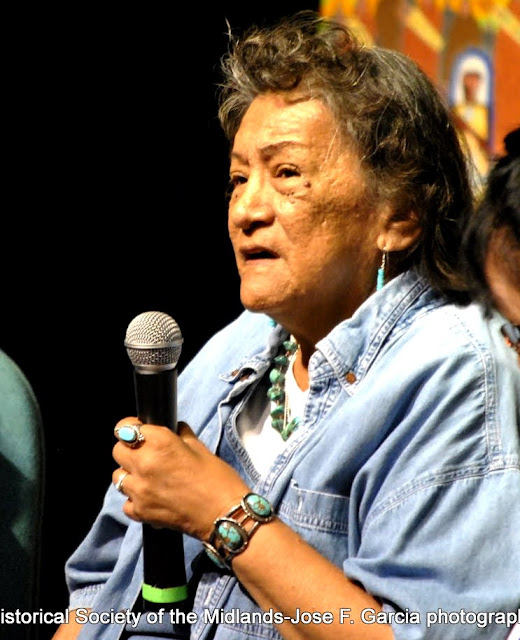
Lester Killscrow, Oglala Sioux, Lakota Nation

Despite growing up poor on the Pine Ridge Reservation, Killscrow enjoyed a carefree childhood, though racist border towns and doctrinaire Catholic schools left their mark. Grateful for keeping his Indian ways, he’s fluent in the Lakota language and expert in beading, both of which he teaches. He also dances at powwows.

When the Vietnam War Army veteran was given less than a year to live, he embarked on a healing journey that got his mind-body-spirit “in good shape.” He maintains himself today through rigorous physical and spiritual exercise. He desires giving young Natives hope they can attain anything they want if they apply themselves. He closed with a Lakota saying: “In the spirit of Crazy Horse, today walk with a gentle spirit.”

Violet Gladfelter, Deer Clan, Omaha Nation

For Gladfelter, “my family, my friends, my tribe, my religion,” are foundational. She remains rooted to her culture as a traditional powwow dancer. She shares her culture in presentations at schools and community groups. Growing up, she joined her family in crop fields across Nebraska and Colorado to labor as a migrant worker. “That was how we survived,” she says.

She considers her fluency in her Native tongue “a gift that was given me.” She passes on her language and religion as tradition and legacy to her children and grandchildren. She regards all indigenous peoples as related. “We’re all one Indian,” she says.


Myrna Red Owl, Santee Sioux

As a urban Indian growing up in the North Omaha projects and then in South Omaha, Red Owl responded to taunts with fists. Her fighting didn’t end then, as she became a Native American activist and supporter of the American Indian Movement during and after the Wounded Knee siege. Her work to free imprisoned AIM leader Leonard Peltier continues. Another ongoing battle is with diabetes.

“I also fight with living,” says Red Owl, who’s worked for Native community organizations.

Cassie Rhodes, Cheyenne-Arapaho

A victim of “the split feather syndrome,” Rhodes was placed in an orphanage and adopted by a non-Indian family. Deprived of her culture, she was made to feel ashamed of being an Indian. As an adult she reconnected with her home and family and served Native community agencies. She often performs in Native productions and powwows.

“It’s so important to know who you are and where you come from, otherwise you’re lost.  Many of us were lost — we had an identity crisis,” she says, adding, “It’s never too late to find out who your real family is.”

Rocha says its vital sharing these stories and experiences before the elders pass.

“Lovely, Still,” that rare film depicting seniors in all their humanity, earns writer-director Nik Fackler Independent Spirit Award nomination for Best First Screenplay

December 3, 2010 3 comments

"Lovely, Still" reshoot

Image by 1031 via Flickr

I am reposting this article I wrote about Lovely, Still, the sweet and searing debut feature film by Nik Fackler, because he has been nominated for an Independent Spirit Award for Best First Screenplay. The film stars Martin Landau and Ellen Burstyn in roles that allow them to showcase their full range humanity, a rare thing for senior actors in movies these days. If the movie is playing near you, take a chance on this low budget indie that actually has the look of a big budget pic.  If you didn’t have a chance to see it in a theater, you can look for it on DVD.  As deserving as the film is for Oscar consideration, particularly the performances by Landau and Burstyn, it’s unlikely to break through due to its limited release.  The following article I wrote for the New Horizons comes close to giving away the film’s hook, but even if you should hazard to guess it the film will still work for you and may in fact work on a deeper level.  That was my experience after knowing the hook and still being swept away by the story.  It happened both times I’ve seen it.  My other Lovely, Still and Nik Fackler stories can be found on this blog.

NOTE: The Independent Spirit Awards show is broadcast February 26 on cable’s Independent Film Channel (IFC).  That is the night before the Oscars, which is fitting because the Spirit Awards and IFC are a definite alternative to the high gloss, big budget Hollywood apparatus.  I will be watching and rooting for Nik.


“Lovely, Still,” that rare film depicting seniors in all their Humanity, earns writer-director Nik Fackler Independent Spirit Award nomination for Best First Screenplay

©by Leo Adam Biga

Published in the New Horizons


Hollywood legends seldom come to Omaha. It’s even rarer when they arrive to work on a film. Spencer Tracy and Mickey Rooney did for the 1938 MGM classic Boys Town. Jack Nicholson and Kathy Bates crashed for Alexander Payne’s About Schmidt in 2001.

More recently, Oscar-winning actors Martin Landau and Ellen Burstyn spent two months here, during late 2007, as the leads in the indie movie Lovely, Still, the debut feature of hometown boy Nik Fackler.

True, George Clooney shot some scenes for Up in the Air in town, but his stay here was so brief and the Omaha footage so minimal that it doesn’t really count.

Lovely, Still on the other hand was, like Boys and Schmidt before it, a prolonged and deep immersion experience for the actors and the crew in this community. Landau and Burstyn grew close to Fackler, who’s young enough to be their grandson, and they remain close to him three years later.

Since the production practically unfolded in Fackler’s backyard, the actors got to meet his family and friends, some of whom were on the set, and to visit his haunts, including the Millard eatery his family owns and operates, Shirley’s Diner. It’s where, until recently, Nick worked. It’s also where he carefully studied patrons, including an older man who became the model for Lovely protagonist Robert Malone (Landau).

Then there’s the fact the film drips Omaha with scenes in the Old Market, Gene Leahy Mall, Memorial Park and Country Club neighborhood. Omaha’s never looked this good on the big screen before.

After select showings in 2008 and 2009, including a one-week run in Omaha last year, Lovely is finally getting a general release this fall in dozens of theaters from coast to coast. It opened September 24 at the Midtown Cinema and Village Pointe Cinema in Omaha and other cities across the U.S..

For Fackler, 26, it’s the culmination of a long road that goes back to when he first wrote the script, at 17. Over time, the script evolved and once Landau and Burstyn came on board and provided their input, it changed some more. Finally seeing his “baby” reach this point means much to Fackler.

“I’ve been very emotional,” he said. “I didn’t think I was going to be emotional but I have been. It’s been nine years of persistence and positivity and not giving up. It’s always been this thing in my life, Lovely, Still, that’s never gone away, and now I’m going to let it go away, and it feels good because I’m ready to let it go…

“I wanted it to come out a couple years ago, and it was delayed. Now it’s finally coming out and I feel sort of a distance from it, but at the same time it’s good I feel that because there’s nothing a bad review can say that won’t make me proud of the accomplishment. It just feels good to know that it’s out there.”

The film, which has received mixed critical notices, does well with audiences.

“People that pick up on the emotions and the feelings in the film seem to really be attached to it and love it,” Fackler said. “It’s either people really get it and get something emotional from it or people don’t get it.”

The PG movie’s slated to continue opening at different theaters throughout October before going to DVD November 9.

Lovely had its requisite one-week screenings in Los Angeles and New York to qualify for Academy Awards consideration. While many feel Landau and Burstyn deliver Oscar-caliber performances, the odds are stacked against them because of the film’s limited release and non-existent budget for waging an awards campaign.

Rare for features these days, the film focuses on two characters in their late 70s-early 80s. Rare for films of any era it stars two actors who are actually the advanced ages of the roles they essay. The film also approaches a sensitive topic in a way that perhaps has never been seen before.

Now for a spoiler alert. The film hinges on a plot twist that, once revealed, casts a different meaning on events. If you don’t want to know the back story, then stop reading here. If you don’t care, then continue.

Without getting specific, this story of two older people falling in love is about a family coping with Alzheimer’s Disease. Unlike perhaps a Lifetime or Hallmark Hall of Fame movie, Lovely never mentions the disease by name. Instead, its effects are presented through the prism of a fairy tale, complete with exhilarating and terrifying moments, before a dose of stark reality, and an ending that’s pure wistful nostalgia.

What makes the film stand out from most others with a senior storyline is that

Landau and Burstyn create multidimensional rather than one-note characters. The script requires they play a wide range of emotional and psychological colors and these two consummate actors are up to fully realizing these complex behaviors.

Best Supporting Actor Oscar winner for Ed Wood, Landau returned to Omaha last year to promote Lovely. He said he was drawn to the material by its depth and nuance and by the opportunity to play an authentic character his own age.

“I get a lot of scripts where the old guy is the crusty curmudgeon who sits at the table and grunts a lot, and that’s that, because we kind of dismiss (old) age. So, the chance of exploring this many sides of a man, and the love story aspect of the older couple, presented an interesting arc.”

The actor marvels at how someone as young as Fackler could tap so truthfully the fears and desires of characters much older than himself. During an interview at North Sea Films, the Omaha production company of co-producer Dana Altman, Landau spoke about the pic, playing opposite his friend Ellen Burstyn, and working with wunderkind writer-director Fackler, whom he affectionately calls “the kid.”


Ellen Burstyn and Martin Landau from Lovely, Still


Before there was even a chance of landing an actor of Landau’s stature producers had to get the script in his hands through the golden pipeline of movers and shakers who make feature film projects possible. Fackler’s script long ago earned him a William Morris agent — the gold standard for artists/entertainers.

Landau explained, “Nick sent it to William Morris, who has an independent feature division, who sent to my agent, who sent it to me. I liked it a lot, but I felt there were bumps in it at the time. Some scenes that shouldn’t be in the first act, some scenes that needed to be in the first act. What the second act was I had no idea.” Enough substance was there that Landau expressed interest. It was only then he learned the unlikely author was a not-long-out-of-high school 20-something whose directing experience consisted of low budget shorts and music videos.

“I said, “I want to meet with the writer, figuring somebody maybe close to my age. I said, ‘How old is he?, and they said 22 (at the time). A few minutes later my eyes were still crossed and I said, ‘Wow. I mean, how does a 22 year-old write an older couple love story with this texture?'”

The venerable, much honored actor took a lunch meeting with the Generation Y upstart at an L.A. cafe. Each was a bit wary whether he could work with the other. Landau recalled that initial meeting, which he used to gauge how open Fackler was to accepting notes to inform rewrites:

“I basically said, ‘This is a terrific script, but it’s bumpy. If you’re willing to do this with me, I’ll do the movie,’ and Nick said, ‘OK.’Well, he did a rewrite on the basis of what we talked about, For two months we talked on the phone, several times a week, five or six pages at a time” to smooth out those bumps.

Landau and Fackler devised a wish list of actresses to play Mary. Burstyn, the Best Actress Oscar-winner for Alice Doesn’t Live Here Anymore, was their first choice. On Landau’s advice Fackler waited until the rewrite was complete before sending the script to her. When she received it, she fell in love with the property, too.

Even as much as he and Burstyn loved the storyl, signing on with such an inexperienced director was a risk “It was a leap of faith working with a kid,” said Landau, “but he’s talented and adventurous and imaginative and willing to listen. He reminds me of Tim Burton. Less dark, maybe a little more buoyant.”

In the end, the material won over the veterans.

“Actors like me and Ellen are looking for scripts that have some literary value. Good dialogue today is rare. Dialogue is what a character is willing to reveal to another character. The 90 percent he isn’t is what I do for a living. It’s harder and harder to get a character-driven movie made by a studio or independents and it’s harder to get theaters to take them, so many go directly to DVD, if they’re lucky. Others fall through the cracks and are never seen, and that’s going to happen more.”

The suits calling the shots in Hollywood don’t impress Landau.

“Half the guys running the studios, some of them my ex-agents, haven’t read anything longer than a deal memorandum. And they’re deciding what literary piece should be made as a film?”

He likes that this movie is aimed for his own underserved demographic.

“A lot of older people are starved for movies,” he said. “They’re not interested in fireballs or car chases or guys climbing up the sides of buildings.”

He attended a Las Vegas screening of the pic before a huge AARP member crowd and, he said, spectators “were enwrapped with this movie. It talked to them. I mean, they not just liked it, it’s made for them. There’s a huge audience out there for it.”

Instead of an age gap they couldn’t overcome, Landau and Fackler discovered they were kindred spirits. Before he got into acting, Landau studied music and art, and worked as an editorial cartoonist. He draws and paints, as well as writes, to this day. Besides writing and directing films, Fackler is a musician and a visual artist.

“I feel that Martin and I are very similar and we get along really well,” said Fackler, who added the two of them still talk frequently. He described their relationship as a mutually “inspired” one in which each feeds the other creatively and spiritually. Fackler also feels a kinship with Burstyn. He said he gets away to a cabin she has in order to write.


Nicholas Fackler Director Nicholas Fackler arrives at the ""Lovely, Still" premiere during 2008 Toronto International Film Festival held at the The Empire Lounge on Septmeber 7, 2008 in Toronto, Canada.
Nik Fackler
On most any film there comes a time when the director must fight for his or her vision, and Fackler found an ally in Landau.

“One of the main things Martin repeated to me over and over again was, ‘This is your movie.’ He made sure that rang in my ears,” said Fackler, “just to make sure I stayed strong when I came up against fights and arguments with people that wanted the film to be something I didn’t want it to be, and much love to him for doing that. Those words continue to ring in my ear in his voice to this day, and I’m sure for the rest of my career.”

Landau and Burstyn brought their considerable experience to bear helping the first-time feature director figure out the ropes, but ultimately deferred to him.

“All good films are collaborations,” said Landau. “A good director, and I’ve worked with a lot of them (Hitchcock, Mankiewicz, Coppola, Allen), doesn’t direct, he creates a playground in which you play. Ninety percent of directing is casting the right people. If you cast the right people what happens in that playground is stuff you couldn’t conceive of beforehand.”

“It was collaborative,” said Fackler. “We were a team, it was artists working together the same way a group of musicians make a band. We became friends and then after we became friends we respected each other’s opinions.”

As for working with Burstyn, Landau said, “it’s a joy. She’s a terrific actress.” He compared doing a scene with her to having a good tennis partner. “If you’re playing pretty well and you’ve got a good partner you play better. You don’t know exactly where they’re going to place the ball, and it’s that element when Ellen and I work together we have. It’s never exactly the same. She’ll throw the ball and I’ll get to the ball, toss it back to her, so that it’s alive. I won’t call them accidents but they are sin a way, which is what living is, and that element of unpredictability and ultimately inevitability, is what good acting is about. That stuff is what I care about.”

Not every review of the film has been positive. Some critics seem uneasy with or dismissive of its emotionalism, complaining it’s too cloying or precious. That emotional journey of a man who believes he’s falling in love for the first time, only to find out the bitter truth of what he’s lost, is what appealed to Landau.

“The interesting thing about this movie is that if you took away the last act you could cast 15 year-olds in it and not change a lot,” said Landau. “Nick (first) wrote it when he was 17. It’s basically a teenage romance. There’s something simplistic and sweet about these two people who want to be together. Robert’s naive, he’s a kid on his first date. That’s why Nik was able to write it — because he was going through stuff, his first love. The primal feelings people have at 15 or 50 or 80 are pretty much the same.”

Landau is proud to be associated with the film for many reasons, among them its effective portrayal of memory loss.

“I absolutely believe in this film. When I did Ed Wood I felt that way. But this one because I know so many people who’ve had memory problems or are having memory problems. My brother-in-law had Alzheimer’s. A lot of close peers of mine. The Alzheimer’s Association is very behind this movie because it rings true…”

Related Articles

“Lovely, Still” that rare film depicting deniors in all their humanity

October 2, 2010 8 comments

Image by 1031 via Flickr

This post is likely the last major piece I write about Lovely, Still, the sweet and searing debut feature by Nik Fackler, who I am sure I will be writing about again. The film stars Martin Landau and Ellen Burstyn in roles that allow them to showcase their full range humanity, a rare thing for senior actors in movies these days.  If the movie is playing near you, take a chance on this low budget indie that actually has the look of a big budget pic.  If you don’t have a chance to see it in a theater, look for it when it comes out on DVD in November.  As deserving as the film is for Oscar consideration, particularly the performances by Landau and Burstyn, it’s unlikely to break through due to its limited release. The following article I wrote for the New Horizons comes close to giving away the film’s hook, but even if you should hazard to guess it, the film will still work for you and may in fact work on a deeper level.  That was my experience after knowing the hook and still being swept away by the story.  It happened both times I’ve seen it.  My other Lovely, Still and Nik Fackler stories can be found on this blog.


“Lovely, Still” that rare film depicting seniors in all their humanity

©by Leo Adam Biga

Published in the New Horizons

Hollywood legends seldom come to Omaha. It’s even rarer when they arrive to work on a film. Spencer Tracy and Mickey Rooney did for the 1938 MGM classic Boys Town. Jack Nicholson and Kathy Bates crashed for Alexander Payne’s About Schmidt in 2001.

More recently, Oscar-winning actors Martin Landau and Ellen Burstyn spent two months here, during late 2007, as the leads in the indie movie Lovely, Still, the debut feature of hometown boy Nik Fackler.

True, George Clooney shot some scenes for Up in the Air in town, but his stay here was so brief and the Omaha footage so minimal that it doesn’t really count.

Lovely, Still on the other hand was, like Boys and Schmidt before it, a prolonged and deep immersion experience for the actors and the crew in this community. Landau and Burstyn grew close to Fackler, who’s young enough to be their grandson, and they remain close to him three years later.

Since the production practically unfolded in Fackler’s backyard, the actors got to meet his family and friends, some of whom were on the set, and to visit his haunts, including the Millard eatery his family owns and operates, Shirley’s Diner. It’s where, until recently, Nick worked. It’s also where he carefully studied patrons, including an older man who became the model for Lovely protagonist Robert Malone (Landau).

Then there’s the fact the film drips Omaha with scenes in the Old Market, Gene Leahy Mall, Memorial Park and Country Club neighborhood. Omaha’s never looked this good on the big screen before.

After select showings in 2008 and 2009, including a one-week run in Omaha last year, Lovely is finally getting a general release this fall in dozens of theaters from coast to coast. It opened September 24 at the Midtown Cinema and Village Pointe Cinema in Omaha and other cities across the U.S..

For Fackler, 26, it’s the culmination of a long road that goes back to when he first wrote the script, at 17. Over time, the script evolved and once Landau and Burstyn came on board and provided their input, it changed some more. Finally seeing his “baby” reach this point means much to Fackler.

“I’ve been very emotional,” he said. “I didn’t think I was going to be emotional but I have been. It’s been nine years of persistence and positivity and not giving up. It’s always been this thing in my life, Lovely, Still, that’s never gone away, and now I’m going to let it go away, and it feels good because I’m ready to let it go…

“I wanted it to come out a couple years ago, and it was delayed. Now it’s finally coming out and I feel sort of a distance from it, but at the same time it’s good I feel that because there’s nothing a bad review can say that won’t make me proud of the accomplishment. It just feels good to know that it’s out there.”

Nik Fackler


The film, which has received mixed critical notices, does well with audiences.

“People that pick up on the emotions and the feelings in the film seem to really be attached to it and love it,” Fackler said. “It’s either people really get it and get something emotional from it or people don’t get it.”

The PG movie’s slated to continue opening at different theaters throughout October before going to DVD November 9.

Lovely had its requisite one-week screenings in Los Angeles and New York to qualify for Academy Awards consideration. While many feel Landau and Burstyn deliver Oscar-caliber performances, the odds are stacked against them because of the film’s limited release and non-existent budget for waging an awards campaign.

Rare for features these days, the film focuses on two characters in their late 70s-early 80s. Rare for films of any era it stars two actors who are actually the advanced ages of the roles they essay. The film also approaches a sensitive topic in a way that perhaps has never been seen before.

Now for a spoiler alert. The film hinges on a plot twist that, once revealed, casts a different meaning on events. If you don’t want to know the back story, then stop reading here. If you don’t care, then continue.

Without getting specific, this story of two older people falling in love is about a family coping with Alzheimer’s Disease. Unlike perhaps a Lifetime or Hallmark Hall of Fame movie, Lovely never mentions the disease by name. Instead, its effects are presented through the prism of a fairy tale, complete with exhilarating and terrifying moments, before a dose of stark reality, and an ending that’s pure wistful nostalgia.

What makes the film stand out from most others with a senior storyline is that

Landau and Burstyn create multidimensional rather than one-note characters. The script requires they play a wide range of emotional and psychological colors and these two consummate actors are up to fully realizing these complex behaviors.

A Best Supporting Actor Oscar winner for Ed Wood, Landau returned to Omaha last year to promote Lovely. He said he was drawn to the material by its depth and nuance and by the opportunity to play an authentic character his own age.

“I get a lot of scripts where the old guy is the crusty curmudgeon who sits at the table and grunts a lot, and that’s that, because we kind of dismiss (old) age. So, the chance of exploring this many sides of a man, and the love story aspect of the older couple, presented an interesting arc.”

The actor marvels at how someone as young as Fackler could tap so truthfully the fears and desires of characters much older than himself. During an interview at North Sea Films, the Omaha production company of co-producer Dana Altman, Landau spoke about the pic, playing opposite his friend Ellen Burstyn, and working with wunderkind writer-director Fackler, whom he affectionately calls “the kid.”

Before there was even a chance of landing an actor of Landau’s stature producers had to get the script in his hands through the golden pipeline of movers and shakers who make feature film projects possible. Fackler’s script long ago earned him a William Morris agent — the gold standard for artists/entertainers.

Landau explained, “Nick sent it to William Morris, who has an independent feature division, who sent to my agent, who sent it to me. I liked it a lot, but I felt there were bumps in it at the time. Some scenes that shouldn’t be in the first act, some scenes that needed to be in the first act. What the second act was I had no idea.” Enough substance was there that Landau expressed interest. It was only then he learned the unlikely author was a not-long-out-of-high school 20-something whose directing experience consisted of low budget shorts and music videos.

“I said, “I want to meet with the writer, figuring somebody maybe close to my age. I said, ‘How old is he?, and they said 22 (at the time). A few minutes later my eyes were still crossed and I said, ‘Wow. I mean, how does a 22 year-old write an older couple love story with this texture?'”

The venerable, much honored actor took a lunch meeting with the Generation Y upstart at an L.A. cafe. Each was a bit wary whether he could work with the other. Landau recalled that initial meeting, which he used to gauge how open Fackler was to accepting notes to inform rewrites:

“I basically said, ‘This is a terrific script, but it’s bumpy. If you’re willing to do this with me, I’ll do the movie,’ and Nick said, ‘OK.’Well, he did a rewrite on the basis of what we talked about, For two months we talked on the phone, several times a week, five or six pages at a time” to smooth out those bumps.

Landau and Fackler devised a wish list of actresses to play Mary. Burstyn, the Best Actress Oscar-winner for Alice Doesn’t Live Here Anymore, was their first choice. On Landau’s advice Fackler waited until the rewrite was complete before sending the script to her. When she received it, she fell in love with the property, too.

Even as much as he and Burstyn loved the storyl, signing on with such an inexperienced director was a risk “It was a leap of faith working with a kid,” said Landau, “but he’s talented and adventurous and imaginative and willing to listen. He reminds me of Tim Burton. Less dark, maybe a little more buoyant.”

In the end, the material won over the veterans.

“Actors like me and Ellen are looking for scripts that have some literary value. Good dialogue today is rare. Dialogue is what a character is willing to reveal to another character. The 90 percent he isn’t is what I do for a living. It’s harder and harder to get a character-driven movie made by a studio or independents and it’s harder to get theaters to take them, so many go directly to DVD, if they’re lucky. Others fall through the cracks and are never seen, and that’s going to happen more.”

The suits calling the shots in Hollywood don’t impress Landau.

“Half the guys running the studios, some of them my ex-agents, haven’t read anything longer than a deal memorandum. And they’re deciding what literary piece should be made as a film?”

He likes that this movie is aimed for his own underserved demographic.

“A lot of older people are starved for movies,” he said. “They’re not interested in fireballs or car chases or guys climbing up the sides of buildings.”


He attended a Las Vegas screening of the pic before a huge AARP member crowd and, he said, spectators “were enwrapped with this movie. It talked to them. I mean, they not just liked it, it’s made for them. There’s a huge audience out there for it.”

Instead of an age gap they couldn’t overcome, Landau and Fackler discovered they were kindred spirits. Before he got into acting, Landau studied music and art, and worked as an editorial cartoonist. He draws and paints, as well as writes, to this day. Besides writing and directing films, Fackler is a musician and a visual artist.

“I feel that Martin and I are very similar and we get along really well,” said Fackler, who added the two of them still talk frequently. He described their relationship as a mutually “inspired” one in which each feeds the other creatively and spiritually. Fackler also feels a kinship with Burstyn. He said he gets away to a cabin she has in order to write.

On most any film there comes a time when the director must fight for his or her vision, and Fackler found an ally in Landau.

“One of the main things Martin repeated to me over and over again was, ‘This is your movie.’ He made sure that rang in my ears,” said Fackler, “just to make sure I stayed strong when I came up against fights and arguments with people that wanted the film to be something I didn’t want it to be, and much love to him for doing that. Those words continue to ring in my ear in his voice to this day, and I’m sure for the rest of my career.”

Landau and Burstyn brought their considerable experience to bear helping the first-time feature director figure out the ropes, but ultimately deferred to him.

“All good films are collaborations,” said Landau. “A good director, and I’ve worked with a lot of them (Hitchcock, Mankiewicz, Coppola, Allen), doesn’t direct, he creates a playground in which you play. Ninety percent of directing is casting the right people. If you cast the right people what happens in that playground is stuff you couldn’t conceive of beforehand.”

“It was collaborative,” said Fackler. “We were a team, it was artists working together the same way a group of musicians make a band. We became friends and then after we became friends we respected each other’s opinions.”

As for working with Burstyn, Landau said, “it’s a joy. She’s a terrific actress.” He compared doing a scene with her to having a good tennis partner. “If you’re playing pretty well and you’ve got a good partner you play better. You don’t know exactly where they’re going to place the ball, and it’s that element when Ellen and I work together we have. It’s never exactly the same. She’ll throw the ball and I’ll get to the ball, toss it back to her, so that it’s alive. I won’t call them accidents but they are sin a way, which is what living is, and that element of unpredictability and ultimately inevitability, is what good acting is about. That stuff is what I care about.”

Not every review of the film has been positive. Some critics seem uneasy with or dismissive of its emotionalism, complaining it’s too cloying or precious. That emotional journey of a man who believes he’s falling in love for the first time, only to find out the bitter truth of what he’s lost, is what appealed to Landau.

“The interesting thing about this movie is that if you took away the last act you could cast 15 year-olds in it and not change a lot,” said Landau. “Nick (first) wrote it when he was 17. It’s basically a teenage romance. There’s something simplistic and sweet about these two people who want to be together. Robert’s naive, he’s a kid on his first date. That’s why Nik was able to write it — because he was going through stuff, his first love. The primal feelings people have at 15 or 50 or 80 are pretty much the same.”

Landau is proud to be associated with the film for many reasons, among them its effective portrayal of memory loss.

“I absolutely believe in this film. When I did Ed Wood I felt that way. But this one because I know so many people who’ve had memory problems or are having memory problems. My brother-in-law had Alzheimer’s. A lot of close peers of mine. The Alzheimer’s Association is very behind this movie because it rings true…”

Unforgettable Patricia Neal

September 6, 2010 1 comment

Patricia Neal

Image via Wikipedia

I meant to post the following article immediately after hearing that Hollywood icon Patricia Neal had passed.  Better later than never.  I had the pleasure of interviewing her a couple times, once by phone and another time in person, and in each instance I felt I was dealing with a member of Hollywood royalty, although she never lorded her status over me.  Quite the opposite.  She was delightfully informal and humble.  My interviews with her, along with seeing her make some public appearances, all happened as a result of several visits she made to Omaha, where I live.  The first of these occurred in conjunction with a screening here of The Day the Earth Stood Still.  My article below resulted from a phone interview I did with her and the piece appeared in advance of the event.  She was the guest of honor at the screening and that was the occasion when I first saw her in person.  A few years I later got to meet her when she made two or three appearances at the Great Plains Theatre Conference here. During one of these conference appearances she made her As I Am presentation at the Joslyn Art Museum and afterwards my girlfriend and I were lucky enough to meet her backstage, where I conducted a short interview with her.  She was as charming and radiant up close as she was on the phone or on the stage.  I was making arrangements with her good friend and fellow actor Joel Vig for me to accompany her to a local bingo parlor – she loved playing bingo – and do a piece about her passion for the game.  It never worked out, as her increasingly frail health made travel more difficult.

Her life was filled with great triumphs and tragedies, and I feel privileged to have had my small brushes with her larger than life presence.

Unforgettable Patricia Neal

©by Leo Adam Biga

Originally published in the New Horizons

There is an elusive, indefinable yet unmistakable quality separating certain motion picture actors from the pack and, in a bit of celluloid alchemy, transforming them from mere players into bona fide stars.  Whatever It is, then Academy Award-winning actress Patricia Neal has got it.  In spades.

With her dreamy eyes, dark hair, fair complexion, musky voice, keen wit and earthy Southern charm she’s cast an indelible presence on the big screen since her 1947 debut.  Always at her best playing unadorned, independent women, she still retains an element of mystery about her.  She was Alma, the sensuous but no-nonsense housekeeper spurning heartbreaker Paul Newman’s advances in “Hud,” a role which won her the 1963 Oscar for Best Actress.  She was Maggie, the tough yet tender nurse romanced by John Wayne in “In Harm’s Way.”  And she was the beleaguered but unbowed wife and mother in “The Subject was Roses.”

The spunk this native Kentuckian has displayed as a performer is no act.  Her spirited determination in recovering from massive strokes suffered in the mid-1960s has made her a role model for stroke victims and an outspoken champion of physical rehabilitation efforts.  Her fight back from the debilitating strokes, which left her partially paralyzed and unable to speak, has been documented in her 1988 autobiography “As I Am” and in a 1981 TV film, “The Patricia Neal Story.”  In 1978, her example of courage led Fort Sanders Regional Medical Center in Knoxville, TN, where she grew up, to dedicate the Patricia Neal Rehabilitation Center.


It isn’t often a genuine Hollywood legend passes through these parts, so you can imagine the buzz building in anticipation of Neal’s scheduled appearance this month at the Indian Hills Theater in Omaha.  The actress is coming from her home in New York City for a special revival showing here of one of her earliest and best pictures, “The Day the Earth Stood Still” (1951), which she co-starred in with the late Michael Rennie and Hugh Marlowe.

The one-night-only presentation, on Saturday, October 9 at 7:30 p.m., is the latest classic cinema showcase of Omaha film impresario Bruce Crawford.  In addition to Neal, actor and former child star Billy Gray, who played her son in the film, will be on hand, along with a replica of the film’s famous robot, Gort.

The sold-out event is a fund raiser for Children’s Square USA.

Although largely absent from the screen the past two decades, the 73-year-old Neal, also a noted stage and television actress with a Tony Award and many Emmy nominations to her credit, recently made a triumphant return to the movies with her critically-acclaimed performance as the eccentric, pipe-smoking title character in the Robert Altman feature “Cookie’s Fortune.”  There’s even talk Neal may get an Oscar nomination.

She’s come a long way from Packard, KY, the now defunct coal mining camp she was born in in 1926.  Her father worked as traffic manager for the local coal company.  After moving with her family to Knoxville, she showed an early interest in acting, reciting monologues at church meetings and social gatherings.  As a Christmas present her parents enrolled her in acting lessons when she was only seven.  After her high school graduation she attended Northwestern University and its prestigious speech and drama department.  Two years later she joined her drama coach for summer theater in Eagles Mere, Pa. and then followed her fancy to New York, where like so many aspiring actresses she supported herself with modeling jobs while studying her craft (as an early member of the Actor’s Studio) and auditioning for parts on Broadway. The theater was her first love.

“I wanted to be a STAGE actress,” she emphasized in her throaty voice during a recent phone conversation.

After debuting on Broadway in 1946 she made her mark the next year when she reprised the role of Regina originated by Tallulah Bankhead in Lillian Hellman’s “Another Part of the Forest.”  Her performance wowed critics and audiences alike, earning her the coveted Tony and Drama Critics’ Awards.  Soon, Hollywood came courting and she signed with Warner Brothers Studio and headed West.

“Well, I was thrilled to go,” she explained.  “The play I was in closed and everybody wanted me in Hollywood and so I thought, ‘Why not?’  So I went under contract with Warner Bros. and I was with them three or four years until we parted and then I did some pictures for Metro Goldwyn Mayer, some for 20th Century Fox and some for Universal.”

Her early years in Tinsel Town were frustrating ones.  She found it difficult adjusting to the new medium.  And it seemed studio moguls were unsure what to make of this lovely new starlet.  Neither a glamour queen nor a femme fatale, she was instead a smart down-to-earth woman whose grit let her hold her own with any man on screen, yet whose aura of deep lament lent her an appealing vulnerability.  A character actress at heart, she simply didn’t fit the leading lady mold of the day and found herself assigned to a string of weak parts in mediocre pictures.

She ultimately did cause a stir those early years, but not for her acting.  When the single Neal’s romantic involvement with married American screen icon Gary Cooper    was made public, a scandal ensued.  Cooper and Neal had starred together in “The Fountainhead” and “Bright Leaf” and while news of the affair left his stardom untarnished it unquestionably hurt her fledgling career.

Still reeling from her failed tryst, she started work on “The Day the Earth Stood Still.”  Understandably, she held small hope for the project, which appeared another in a long line of forgettable films.  After all, it was “just” a science fiction story, which in that era usually meant a low budget, low brow B-picture aimed at the Saturday matinee crowd.

One plus, however, was its director, Robert Wise, whom she’d worked with previously and admired.  Even though Wise was then a still up-and-coming filmmaker, his reputation for quality and professionalism preceded him.

Referring to Wise, she said, “He was very good.  A fine director.  I had done “Three Secrets’ with him and obviously he liked me because he wanted me for his next one.”  Still, she said, she found it hard to take “The Day the Earth Stood Still”  seriously.  “Oh, I thought it was hysterical when I did it.  I didn’t buy all that outer space stuff.  I could hardly keep a straight face, but boy it turned out to be a good one didn’t it?  Oh, I love that movie.”

Her jaundiced reaction then is understandable given the plot.  Capitalizing on the UFO scare at the time, the film opens with a flying saucer landing near the Washington monument.  Emerging from the craft is an alien emissary, Klaatu (Rennie), and his robot protector-enforcer, Gort.  Klaatu announces an ultimatum:  If humans cannot mend their violent ways, Planet Earth will be destroyed.  Klaatu is shot and imprisoned and, after escaping, hunted.  The strange visitor is finally befriended by Neal’s character, an earnest single mother, and her son.  Now regarded as a classic, “Day” is a message picture in the guise of sci-fi.  It is both an ageless plea for peace and tolerance and a time-capsule glimpse at the paranoia and tension existing under the placid surface of post-war prosperity.


While all quite silly to Neal, it was business as usual for Billy Gray, then 13 and far too young to appreciate the film’s campy elements or its serious intentions.

“It was more business-like than a romp in the park,” he said by phone from his home in Tapango, Ca.  “I didn’t realize how brave it’s subject matter was.  I didn’t have any understanding of its message.  I’ve had a chance to see the film a few times over the last two decades and it’s amazing how well it holds up as a piece of movie making.  You buy into it even though it’s a bit stylized.  You accept the concept and just go along for the ride.”

After the film Gray went on to his best-remembered role, as Bud, in TV’s popular “Father Knows Best” series. He still acts occasionally on TV and in theater.

Following the film Patricia Neal appeared in a few more pictures before returning to the stage.  She met and married author Roald Dahl, now deceased, and started a family with him.  The couple eventually raised five children in his native Great Britain.  In 1957 she was lured back to Hollywood by the opportunity to appear in “A Face in the Crowd,” a brilliantly-written and acted film under the direction of Elia Kazan, who directed her on stage in “Cat on a Hot Tin Roof.”  Despite glowing notices, the film did little for Neal’s career, so she resumed stage work and raised her children.

As the decade of the ‘60s dawned, Neal and her family endured a series of tragedies that ironically coincided with her greatest success as a movie actress.  First, her infant son Theo suffered severe injuries when hit by a taxi in his pram. Next, her daughter Olivia contracted measles encephalitis and died at age seven.

“Sad things have happened in our family,” she said.

Then, in 1962, along came “Hud,” and the Oscar.  In 1965 she was fresh off co-starring in Otto Preminger’s “In Harm’s Way” when she started work on legendary director John Ford’s last film “Seven Women.”  It was while in production on the Ford film that Neal, then three months pregnant, suffered the strokes that altered her life.

Neal credits Dahl with devising an innovative rehabilitation program enlisting the intensive aid of family and friends. Little by little her recovery progressed.

“Roald didn’t like the idea the doctors were going to send a person once a week for 15 minutes, so he had all my friends come in and teach me, and that was so good.  They played bridge and croquet with me.  It really worked perfectly.  Roald did a lot, you know.”

Years later, she and Dahl divorced.

Miraculously, the child Neal was pregnant with at the time of her strokes was born a healthy girl, named Lucy. It turns out Lucy is her lucky charm.

Neal, who made her a heroic film comeback in “The Subject was Roses,” had not done a feature since 1989 when Lucy, now a screenwriter, ran into director Robert Altman at last year’s Cannes Film Festival and discovered he was still looking for someone to fill the title role of Cookie in his new film.  Lucy suggested her mom.  Altman liked the idea.  Later, Lucy arranged for the two to meet at a part she threw at her Hollywood home.  Altman hired Neal on the spot.


As Cookie, Neal plays a colorful older woman who talks a blue streak, just the kind of part she likes sinking her teeth into.  “Oh, I loved it.  I’m a character actress.  I’m meant to be 85 in it, but I ain’t that old, so I’m really made up.  I have a wig on.  It’s fantastic.”

Asked to explain her method of creating characters, she answers:  “I sort of have an actor’s feeling for things.  That’s all I can tell you.  I just do my best.” When it’s suggested she purposely shunned fame, she surprisingly replies, “Oh, I’d like to be a star.  I’d like to be a bigger star than I am.  But I’ve done all right.”

Finally, asked to venture why so few roles have come her way recently, she quips, “Oh, I don’t know, but I’m getting, shall we say, not a lot younger.”

When not acting she stays busy traveling as an enthusiastic participant in the Theater Guild’s Theater-At-Sea cruise programs, which have taken her from Alaska to Australia.  “I love to travel.  Oh, it’s gorgeous.”  From Omaha she’ll travel to Atlanta to belatedly celebrate the 100th birthday of her mother, Eura Petrie Neal.

She often visits with fellow stroke victims and is a vocal advocate for rehab efforts addressing the whole person.  She’s pleased by the progress made in brain injury therapy.  “It’s wondrous what they do now for people with strokes.”

Also a frequent public speaker, Neal talks about her life and recovery in the hope she can provide inspiration to other disabled individuals.  Her simple message: “Never give up.”

Isabella Threlkeld’s lifetime pursuit of art and Ideas yields an uncommon life

August 4, 2010 9 comments

Giacomo Balla, Abstract Speed + Sound, 1913-1914

Image via Wikipedia

UPDATE:  As some of you who have recently come to this post know already the subject of this profile, Isabella Threlkeld, passed away March 4, 2012.  I met her just a few years before.  By the time I met her she was quite on in years and living in a retirement community, but her passion and curiosity for life were undiminished.  She will always be one of the more unforgettable characters of my journalistic career.  Rest in peace, dear Isabella.

Someone, I don’t remember who now, told me about Isabella Threlkeld, suggesting she’d make an interesting profile subject.  To say the least, she did.  My New Horizons piece about Isabella follows, and I believe it’s a case in point of how people all around us have fascinating stories if we only take the time and show the interest to search out and learn their tales.  As a journalist, I am in a privileged position to seek out people’s stories and to share them with others.  For every great story I come upon and end up writing, I can only imagine there are dozens, hundreds, thousands, that I miss or will never have the time to get to.  I am only one writer, one storyteller, after all.  I am glad I found Isabella and her story.  As you’ll read, she is my prototypical profile subject in that she has a great passion and magnificent obsession that permeates every fiber of her being.  During the course of several conversations I had with her before the interview and then during the interview and in subsequent conversations, she described an unlikely association with Albert Einstein that I wanted to believe but that I couldn’t find any confirmation of.  I still want to believe it happened the way she tells it, but even if it didn’t it’s just another manifestation of her passion and magnificent obsession, which are qualities I find irresistible.

Isabella Threlkeld’s lifetime pursuit of art and ideas yields an uncommon life

©by Leo Adam Biga

Originally published in the New Horizons


Isabella Threlkeld could feel sorry for herself. She chooses not to. She’s too busy enjoying life. The Omaha artist, art enthusiast, collector, instructor and art therapist is still very much engaged in her passion and work at 86. Still a vivacious force of nature whose brassy personality is the life of any gathering.

Opinionated, curious, quick-to-laugh, Isabella loves the stimulation of a good conversation, book or artwork.

Despite compromises to her age she still paints/draws every day, her precious sketchpad never far from her lithe hands. She even has a new exhibition opening Dec. 5 at the Hot Shops Art Center in NoDo.

The show’s Futurism theme perfectly expresses this dynamo’s focus on energy and states of being. Always reading, always exploring, she’s more attuned to the here-and-now and things-to-come than the past. Not that she doesn’t think about her much-traveled, event-filled past. She does. She has a keen appreciation for history and what it teaches. She savors her visits to Mexico, England, Italy, France, Germany, Spain, Greece, Egypt, Morocco, Norway, Denmark, Sweden, all locales she studied in, all cultures she immersed herself in.

She also dips into the past to inform her work, like a commissioned mural of Albert Einstein and comets she completed for her show. Einstein’s work inspired the international Futurism movement, which incorporates science in art. She’s been an adherent since the 1960s. When her thoughts turn to Futurism, she considers big bang theories, black holes, space-time continuums and parallel universes the way the rest of us do sports or politics. She reads Scientific American cover to cover.


Isabella (Byrne) Threlkeld

Isabella Threlkeld


Her Einstein piece is more than an idle fan’s rendering of an icon. It displays the deep stirrings of a woman who claims to have spent time with the famed theoretical physicist. As she tells it, she was barely more than a girl when she found herself taking notes for not only Einstein, whose theory of relativity changed the world, but other leading physicists, including Robert Oppenheimer and Enrico Fermi. Scientists were embroiled in discussions over peaceful atomic energy use. She said these meetings took place at the Institute for Advanced Study in Princeton, N.J. in the mid-1940s.

The story of how Isabella, a Wellesley art student from Omaha, may have come to be associated with the fathers of atomic energy, must wait. First, there’s more to know about her uncoventional life, one in which Einstein and Co. are but a few of the famous people with whom she’s crossed paths.

Spend any time at all with Izzie and you soon realize she’s far more than the sum of her considerable parts. It all combines to make her one of those “most unforgettable characters” the Reader’s Digest features. Eclectic to the core.

Not that her life’s been a bed of roses. Despair and regret have touched her. She lost the love of her life, husband Harry Threlkeld, decades ago. She’s never remarried. Childless, she has no son or daughter or grandkids to visit her at Mable Rose Estates, the Bellevue assisted living facility she resides in. She’s outlived most of her oldest friends. About a year ago Isabella was forced to move from the house she made her home and the base for her Threlkeld Art Studios. It’s a sore subject.

She misses her independence as well as the invigorating salon scene she presided over at her home/studio, where art was always being made, discussed, appraised, appreciated. A Mable Rose office doubles as a studio. Isabella and other residents set up easels to make art. But it’s not the same as having her own space.

She misses, too, being surrounded by young people. Her old place was often filled with her students. Some even stayed with her. Her proteges became her children.

Don’t feel sorry for Isabella though. She’s still a surrogate mother to people who studied under her, like Mary Harrington, and still a friend to old cronies, like Jack Latenser. Young and old alike, they make the pilgrimmage to Bellevue to bask in her infectious enthusiasm. All who come under her influence receive the gift of her sharp wit, throaty laughter, aesthetic musings and philosophical beliefs.

“I have known Isabella since the mid-1980s when I began taking classes at Threlkeld Art Studios while in high school,” said Harrington. “Since the day I met her, she has been a driving force in my life similar to Rosalind Russell’s famous Auntie Mame character. ‘Isabellaism’ pops into my life to this day. She continues to challenge me to do more, travel, read, think more deeply and incorporate art into my life. My life would not be remotely the same without her.”

Auntie Mame’s credo — “life’s-a-banquet,” so catch all you can “before the parade passes by” — perfectly expresses Isabella’s credo: Flaunt it, baby, flaunt it.

Ask Isabella to describe herself and she arches her eyebrows and voice to say, “Who is she? Uh, she’s a funny little white-haired lady that’s overweight and loves life.” Oh, c’mon, Iz, you can do better than that. OK, try this on for size: “She’s a little old lady who’s still trying to be an artist,” she said of herself. If there’s anything art’s taught her, it’s to never give up.

“You know what it gives you? An appreciation of the need for failure, because you fail and you try again.” she said, “and each time you have to try again. Without failure, we wouldn’t get up and do it again.”

Spirit. She overbrims with it. So much activity, so many interests. Such a rich life.

“Well, I’ve just lived a lot, you know,” she said by way of explanation.

Perhaps the best way to understand the Isabella experience is to look at what’s gone into shaping her. Born into a prominent Omaha family, the Byrnes, she was the oldest of three children of her insurance executive father and homemaker mother. She grew up in Dundee, where neighbors included Omaha’s elite. Life in their well-appointed home was the kind of never-ending banquet Mame sings about.

“My dad and mother were always very active in the community. My dad was always bringing somebody for dinner.”

Some dinner guests were living legends. Polar explorer Richard Byrd. Aviatrix Amelia Earhart. Others were simply neighbors who became icons, including a young Henry Fonda. Dodie Brando, the mother of future superstar Marlon Brando, was a frequent guest. Marlon’s mom was an Omaha Community Playhouse fixture and like many society families the Byrnes were supporters, too. “Every time there was a new Community Playhouse director he came to dinner,” Isabella recalled. “They all came for dinner. Did Dad remember to tell mother? Uh, sometimes.”

She said, “A cousin once commented, “Your father thinks he’s the chamber of commerce, and mother said, ‘You’re right.”

As the big sister it was Isabella’s thankless task to keep her young siblings in check while exciting personalities discussed their record-setting adventures. “It was hard to hold down my little brother. He would get bored at Admiral Byrd and throw a butter pad. How do you keep a 5-year-old quiet when Amelia Earhart is trying to speak? I was the oldest and I had to control these monsters.”

She admits she wasn’t old enough herself to appreciate the distinguished company her folks kept. “No, I didn’t get it.”

Weekends found the family at their Idelwild farm near Nickerson, Neb., right on the Elkhorn River .“The best part of all,” she said, “it had horses, milk cows, pigs, turkeys, guinea hens. Oh, yes, we looked forward to it. Every weekend we got to go and gather the eggs. It was a lot better than going to Dundee School.”

The farm’s still there. She visited recently and rued the disintegrating shoreline. “It just breaks your heart to see the erosion that’s went on,” she said.

Education then wasn’t a priority but she did discover her calling for art under Dundee teacher Dorothy Gray Bowers.

“I didn’t really excell until I got to Brownell Hall (Talbot), where I think I realized I was really serious about art and would major in it when I got to college. Everybody said, ‘Oh, no, you can’t do that.’ The practical one in the family was Dad. He said, ‘You’re never going to make a living. How are you going to eat? How are you going to live?’ Mother said, ‘Oh, let her go with it.’ Then I got a scholarship to Wellesley out of it, so it was well worth it.”

Wellesley. Right across the Charles River from Harvard and MIT. “Pretty good location wouldn’t you say?” commented Isabella. Attending there was “a big tradition” with women in the family. Her mother was class of 1911. A legacy school.

A rude awakening made Iz want to leave as soon as she got there.

“It was rough, I’ll tell you, very rough because I wasn’t prepared. Let’s face it, I was still with the pigs at Idelwild farm. My first letter home in 1940 said, ‘I cannot stay here. Everywhere I go there are big signs that say, ‘No Irish need apply.’ My dad was Scotch-Irish. I had never seen discrimination before. So I wasn’t going to stay in school. My parents got so upset they called me and said, ‘Don’t come home, you’re going to stay there and change the system.’”

She stuck it out but not before things got tougher.

“My sophomore year my grades went down and I was called in by the chair of the art department. She said, ‘I’m taking away your scholarship.” I told her, ‘You can’t do that — I’m the oldest of the family. This is the Depression.’ No luck. I went to the dean — a very straightlaced New England lady, who said, ‘I’m so sorry, there’s nothing we can do for you.’ And I lost my scholarship.

“‘Well, I can’t go home,’ I said. The dean said, ‘We’ll get you a job.’ I got two jobs. Best thing I ever did.”

In true Yankee fashion Isabella worked at a campus soda shop and in the school’s Italian library, where she “got to handle original Italian manuscripts. So then I decided to minor in Italian. I learned more on those jobs than I did in the classroom. I loved those jobs. I had a lot of fun.”

Half-way through Wellesley America entered the war. Her life would change in unimaginable ways. Everything accelerated and concentrated. She furthered her studies at the Cape Anne School of Art in Rockport, Mass. “A wonderful experience. It was all studio,” she said, versus the art history diet pushed on her at Wellesley. “Every morning we painted in the studio and every afternoon we painted outdoors, on the ‘rocks.’ And I got to meet some fantastic artists there. A lot of these were New Yorkers vacationing in Rockport. They’d come up and make comments on your work. I turned around once and said, ‘Aren’t you Joan Miro?’” Yes, I am, came the reply by the Spanish surrealist painter/sculptor.

Around the same time Isabella also studied at the Boston Museum of Fine Arts, where, she said, “I learned the most.”

She graduated Wellesley in ‘44. She took her first paying jobs in art at summer camps in Hackensack, Minn. and on Orcas Island in the Pacific Northwest.

“My parents were impressed. ‘Well, she’s proving that art will pay,’ Dad said.”

She said her association with Einstein began around war’s end when her uncle, Walter Wohlenberg, dean of the Yale University School of Engineering, called to ask if she had Friday afternoons free. She did. At his request, she said, she agreed to take notes and make sketches for meetings in Princeton, N.J.

The arrangements made, Uncle Walter picked her up in his car the next Friday and drove them to Princeton. As the pair walked across campus, she said, “along came little old Albert (Einstein).” She recognized him instantly from newsreels and press photos. “He embraced my uncle, which shows you some intimacy, and spoke to him in German, and I was totally left out. And we walked along to the little white cottage where he lived with his sister.”

Meeting Einstein, she said, came as a complete surprise. She knew little about him except he was a preeminent scientist from Germany. “That was about it,” she said. She later gathered from her uncle the two were colleagues on an atomic energy committee Einstein led at the Institute for Advanced Study. It was this committee, she said, for whom she began taking notes-making sketches that very afternoon.

“He (Einstein) went into the little cottage and sat there with a few others and I took notes. It was that simple,” said Isabella.

Einstein, a one-time avowed pacifist, begged President Franklin Delano Roosevelt not to militarize atom splitting research. After the war he led groups of like-minded scientists. Isabella said the exploratory committee she sat in on met “to discuss the problem of atomic energy for peaceful purposes.” The participants varied, she said, but at one time or another included Oppenheimer, Fermi, Niels Bohr, Leo Szilard and other luminaries. Einstein and Wohlenberg were fixtures.

Marcia Tucker, librarian for the Historical Studies-Social Science Library at the Institute for Advanced Study, has been unable to confirm Isabella’s experience. Neither has Barbara Wolff with the Albert Einstein Archives at Hebrew University of Jersusalem. Is it possible the committee was a precursor to the Emergency Committee for Atomic Scientists Einstein headed after the war? Nobody knows. “I hope that this mystery may be solved,” said Tucker, whose search continues.

For a time, Isabella said, committee meetings were unsupervised. No security clearances or secrecy oaths. “We were a bunch of academics. We were all civilians.” Still, precautions were taken. “We never got to keep the notes. They were always collected at the end of a session. They confiscated everything,” she said, including sketches she made of the participants. Then it got more restrictive.

“Things changed,” she said, once Gen. Leslie Groves, head of the secret Manhattan Project already under way, began sitting in on the proceedings. “It was so hush-hush then. Gen. Groves sat right here (indicating next to her). Very military. How much he knew about atomic physics, I don’t know. He scared the hell out of me.”

Einstein biographies have established the eccentric genius as a womanizer. So, did he ever come on to Isabella? “No, no, no, no, he was preoccupied in outer space,” she said. “You won’t get any tittilation there.”

She does offer a few Einstein anecdotes that reveal aspects of his peculiar self.

“This man had a wonderful sense of humor — like Warren Buffett (a lifelong friend of hers). He (Einstein) had a chain hanging down in this little cottage’s living room, and he would say good evening to my uncle in German and good evening to me in English, and he’d pull this chain and a step-ladder would come down. He’d go up and pull it up after him. She ascribed the behavior to his focus “on outer space, on planetary changes, on other universes than the one you and I live in.”


One of her cosmic art pieces

saturn.jpg

After the A-bombs detonated over Japan, press reports tied their development to some of the very physicists whose words-visages Isabella recorded for posterity. She said it “put a guilt trip on me. I was appalled at Hirishoma. I was appalled at Nagasaki. I went as far away from atomic energy as I could get. When we started in the United States with peaceful uses of atomic energy, then I woke up again, and I realized I was in on the ground floor. We need energy, man.”
This is the first time she’s spoken publicly about her brush with the atom men. She’s longed to talk about it all this time. She never told anyone. Not even Harry. “Well, you can tell by my intensity you just took the cork out of my bottle,” she told a pair of guests who came to hear her story. “I don’t know how I stayed silent all these years. I sure poured it out to you.”

She said the thought of defying Gen, Groves was enough to muzzle her. “He kept my mouth shut for how many years? Oh, I was scared to death. I didn’t want Gen. Groves back here or his ghost,” she said, laughing. She said she’s still nervous about it all. “You wanna’ go to Guantanamo Bay with me?” she joked.

So why’s she talking now? “The information has just been released. It’s been sitting there all along,” she said, adding that someone from a national archives, she’s unsure who or which one, called in August to say her materials are now declassified. The New Horizons was unable to determine what archives may have them. Is it a case of Isabella, who keeps a biography of Einstein near her, wishing herself with people in places? Or might there be a perfectly good explanation for it all? Either way, it’s a good story.

Top secret described some of Harry’s work in the Judge Advocate General’s Corps. After retiring as a Navy commander he practiced international law.

As the war wound down Isabella joined the American Red Cross. “I wanted to serve and I found a way to serve,” she said. “They kept sending me back to school for art therapy,” a then-new discipline. Her duty saw her assigned to military bases in Virginia. At one of these she met Harry, then a lieutenant. They married in ‘46. Her final RC stint was at Walter Reed General Hospital in D.C. — in the psych section. She worked with male and female patients suffering from both physical and psychological war wounds. She trained for it at American University.

She embraced the work. “Art therapy really works,” she said. “It’s a great field.” She found the work so gratifying she’s “done it off and on ever since. We have three hospitals in this area that work with art therapy.” Overall, she noted, the discipline’s “still not accepted” here as in some other cities. “The healthcare institutions that don’t use it are ones whose people have never been exposed much to art. There’s the problem. So they just can’t see that art therapy would be of any benefit.” She said she’s some trained area art therapists.

She left Walter Reed after butting heads with officials she felt ignored concerns WAC/WAVE patients received inadequate treatment. She was “a wreck”. Her own therapy came working as a stewardess aboard a Great Lakes cruise ship.

Soon after a three-month honeymoon in Mexico, Harry left to serve on Gen. Douglas MacArthur’s staff for the International Military Tribunal for the Far East, which convened war crimes trials in Tokyo from 1946 through 1948.

The newlywed pined to go but Harry had her rejoin her family. “I never made it to the Orient. He did come back twice (over three years) and each time he was sick.”

Upon his return the couple moved to Seattle, Wash. Isbella worked at the Seattle Art Museum. Back in Omaha in 1950, she began her Joslyn Art Museum career as education director, instructor and extension services director. In her outreach role she was an art appreciation ambassador. It suited her outgoing personality.


She served under Eugene Kingman, someone whose contributions to the museum and the city haven’t been fully recognized in her view.

After leaving the Joslyn in the early ‘60s she filled a series of art teaching posts at Duschene College, the College of St. Mary and Bellevue University. By the late ‘60s-early ’70s the counterculture movement was in bloom and Isabella was caught up in it. She encouraged students in helping make the Old Market a happening scene.

“College kids built that thing,” she said, referring to the transition from wholesale produce to arts center. “I sent all my students there. I drove them down there after school. Oh, I was really impressed with what kids could do. They learned to mix cement, lay bricks, to use the tools I was hoping they’d use. Lee Leubers (the late artist and art teacher) was a driving force and leader. He was the key to getting them down there and going to work. They worked like mad.

“I really got to love those kids. I did not love them when teaching art history and they were marching (protesting) outside the window.”

It was in those halcyon times she met Ree Kaneko (then Schonleau), who went on to found the Bemis Center for Contemporary Art and to marry noted artist Jun Kaneko. Isabella and Ree once had an exhibition together.

During this time Isabella wrote an Omaha World-Herald art column. Then, as now, she made and exhibited her own art, filtering life experiences through her work. Inspiration came from the many travels she and Harry made outside the country. They preferred seeing the sights on their own and doing as the natives do.

“We were never on a tour,” she said. “We were alone. If you’re that outnumbered, baby, you have to go with the flow. I didn’t need a tour. I had read all the stuff before I went. While he was busy doing his legal stuff as an international lawyer, I had time to draw and paint.” Or visit museums-galleries. Meet the people. Her fluent Italian and servicable French went a long way. Harry knew five languages.

On a ‘58 European excursion she studied at the Louvre in Paris. The couple met Pablo Picasso. “We were watching him make a disturbance at an outdoor cafe.,” she recalled. “I wanted to go over and say hello but my husband couldn’t stand it and said. ‘We are leaving.’ So we left, and on the way out he (Picasso) came to us and said hello.” In Avignon, France in the early ‘70s she saw the last exhibition Picasso had before his death.

Once, Isabella nearly got her hubby arrested over art. After visiting a Cairo gallery she said she discovered Harry had removed a necklace from a sarcophagus on display. What he thought a lark — “I think he was showing off, ou know, look what I can do — offended her orthodox art sensibilities. So she snitched.

“Oh, yes, I turned him in in Egypt,” she said. “The average wife would not have, I realize that, but I’d been trained at the Boston Museum of Fine Arts. You never touched anything in the Boston Musuem of Fine Arts, let alone take something…”

Harry was detained by a gallery guard. “This could have been really bad,” she said. “Oh, it was so awful. I was so scared. I thought I’d lost my only husband.” All turned out well in the end, as Harry used his gift for gab and, she suspects, a cash bribe, to talk his way out of the jam and keep the artifact. Said Isabella, “They didn’t turn him in. I would have lost him. He would never have gotten out of an Egyptian jail. He came back speaking Aarabic and drinking tea. But he never let me forget it. Oh, he was so angry at me. Whenever he’d get upset with me he’d say, ‘I’ll take you back to Egypt and turn you in.’” She still has the necklace.

By ‘68 she was engrossed in Futurism, That whole year in Europe she researched in Italy, where the movement began. “We lived on the Mediterranean outside of Rome,” she said. “Oh, was it beautiful.” She studied at modern art museums and the University of Rome. Her work fed the master’s degree in art she earned at the University of Nebraska at Omaha in ‘71. Her thesis subject? Futurism, of course.

Reflecting the turbulent times in her work, she created an anti-war piece called “Vietnam Fortune Cookie.” In the wake of Watergate, she made a large painting symbolizing “the disillusion of the United States into pure energy. Wait till you see this painting,” she said. It’s in her new show.

When Harry died in ‘73 Isabella reinvented herself again. She and a friend, photographer Mae Louise “Hinky” Hamilton, bought a house together at 324 So. 68th St. that became their creative base. “I went in business for myself,” is how Isabella puts it. “I couldn’t have done it without Hinky Hamilton’s help. She put in $25,000, I put in $25,000. I helped her in photography, she helped me in art.”

Threlkeld Art Industries employed artists to create commissioned murals, many for area schools. That business became Threlkeld Art Studios, which found Isabella giving private art lessons to youths and adults and providing professional appraisals. She’d often lead students on field trips to local-regional museums: the Joslyn, Lincoln’s Sheldon Memorial Art Gallery, the Des Moines Art Center, the Nelson Atkins in Kansas City, the Walker Art Center in Minneapolis and the Denver Art Museum. Several students, such as Paul Otero and Stephen Roberts, have enjoyed successful careers as artists. Already established artists sought refuge at her salon.

Over the years she hosted UNO graduate exchange students from Japan, China and Nepal. Interacting with young folks from around the globe invigorated her. “The one from Nepal changed my life. I mean, she really changed my life,” she said. “Her name was Amoura Lohani She was from Katmandu.” The political major introduced isabella to Hindu traditions. Isabella, who took in Lipani’s family, always thought her Asian guests were compensation for her never visiting the Orient.


She stopped hosting international students awhile ago but she was still doing everything else out of her home up until January, when relatives prevailed on her to give up the large studio/residence. That’s when she moved into Mable Rose Estates. “It was not my idea,” she said. How much does she miss her own place? “A lot,” she said, her voice breaking. “A lot.” She appreciates all that staff do to make her feel at home. “They spoil me. They invent things to make me happy. Well, they’ve never seen anybody like me. You can believe that can’t you?”

An October estate sale liquidated a lifetime’s worth of fine artworks, books, furniture, decorative objects. Many of her prized possessions went to Collectors Choice. Sad to see it all go. As usual, she learned something in the process.

“Because of that estate sale I sold thousands of dollars worth of art to men, to corporations, to businesses, not to little old ladies with pretty little houses. The point I’m making is I’d never been in a gallery where I sold art. It taught me about the buyer and where the money is. I had so much to learn and boy did I learn a lot about money. Men control the money.

“We had 400 people at this the first day, 500 the second day, 400 the third day. Can you imagine the amount of art?”

The sold art included works in various mediums by local artists she’s championed.

Just because she’s moved doesn’t mean she’s retired. She continues doing appraisals right out of Mable Rose Estates. She jumps on the Internet to research items. Some real treasures have surfaced. “It’s wonderful the things they bring to me,” she said. “A lot of times they (clients) don’t know what they have.”

Making art remains her main escape. Her show has her all “revved up,” she said. “I want people to see this show on Futurism. It’s big. I don’t mean just in area. It’s big. You’re going to see outer space, the energies of outer space. E-equals-mc-squared. Super novas. Other universes. You’re going to see the future in my work.”

Forever an artist and searcher. “My life has been a mess of dirty smocks,” she said.

In her 101 years, ex-vaudeville dancer Maude Wangberg has lived a whirl of splendor

August 2, 2010 2 comments

English: Photograph of Sophie Tucker

Image via Wikipedia

With the passage of time the chances of meeting an ex-vaudeville performer diminish.  A few years ago I got the chance to meet a veteran of the vaudeville stage, and while she was never a star or a household name, she shared with me and I shared with readers her experience in one of the great American forms of entertainment.  Like most people around today, I never got to witness a vaudeville show.  My only reference for it is movie and book depictions of it. But after meeting and profiling Maude Wangberg, who was part of a vaudeville dance act, I feel a bit closer to that enchanting chapter of the American popular stage.  My story appeared in the New Horizons when Maude was 101.  I don’t know if she’s still living. but I’m glad I got to her when I did, and when her recall was still quite sharp.


In her 101 years, ex-vaudeville dancer Maude Wangberg has lived a whirl of splendor

©by Leo Adam Biga

Originally published in the New Horizons


Vaudeville once ruled the American live entertainment scene. For mere peanuts, an entire family could enjoy a show in an ornate theater on whose stage artists of all kinds took turns performing their well-honed acts. Acrobats, jugglers, comedians, singers, dancers, magicians, orators, trained animals and precocious kids filled the bill. Everything from gymnastics to pratfalls to pirouettes were seen. Everything from hot jazz licks to Shakespearean soliloquies to operatic arias to punch lines were heard. House musicians in the orchestra pit cued the action on stage.

From the late 19th century through the 1910s, vaudeville was king. With the advent of motion pictures and radio, two mediums that stole many of vaudeville’s best talents, this American art form went the way of variety and burlesque. Vaudeville hung on until the 1930s before finally succumbing to the movies. Vaudeville’s wide-ranging impact extended to the slapstick-screwball-sketch comedy routines and variety show formats that ex-vaudevillians brought to radio, film and television.

Omaha’s own Maude Wangberg, age 101, is proud to count herself a veteran of vaudeville, a distinction few can claim today, as most of its artists are long gone now. If not for acting on a whim and studying dance as a girl Maude might have become a nun. Two of her classmates at Mount St. Mary, the forerunner to today’s Mercy High School, did. Maude grew up in a strict Catholic home at a time when a girl’s options were pretty much limited to marriage and motherhood, religious vocation, nursing, teaching or secretarial work. She chose dancing.

Still cutting the trim figure of a dancer, the New Cassel Retirement Center resident defied convention to become a show girl in a vaudeville act called The Whirl of Splendor. The show took its name from the revolving stage that performers made entrances and exits on. She was part of an all-girl dance act that closed the show. In between dance numbers singers performed. Preceding Maude and the other chorines a couple did an adagio. Sharing the bill with The Whirl were all manner of acts. Presented by New York City-based producer Meyer Golden, the popular show toured widely. Maude performed with the act from 1925 to 1930, a stretch that saw her mature into a woman.

The Whirl followed the vaudeville circuit, playing Orpheum Theatres in and around New York, across Canada, down the west coast, the middle of America and then back east, but mostly playing the big Loews Theatres along the East Coast. The act appeared at all the top vaudeville sites. Maude and company sometimes shared the bill with established stars like Sophie Tucker or legends-to-be like Edgar Bergen.

Touring meant a hectic schedule spent in hotels, theatres and rehearsal halls, on trains and two shows a day or more on stage, seven days a week. “You played every place of any size. The bigger the city the more performances you had to do,” she said. Some audiences were livelier than others. “In Pennsylvania we played a lot of smaller places like Redding because the big steel mills were working then and the young men employed there had to have entertainment,” she said. “They would stomp their feet and whistle. It was fun then.”


Young men, naturally, have a thing for pretty young girls in skimpy outfits, but she said there were never any problems with “stage door Johnnies, as they used to call them, but somehow or other we met a lot of them. In Providence, R.I. we met a lot of fellas from Brown University. They came down to the hotel — a whole bunch of ‘em. They were nice. I mean, they didn’t get rough or rowdy or anything. I guess they wanted to say they’d been with show girls.”

Advances were common from not only fans but other performers on the bill. If Maude were ever singled out for special attention from stage struck paramours it’s no wonder because her classical-training earned her featured parts in two of the troupe’s dance numbers. Of the six chorines, she shined brightest.

“I always had a little special part. See, I had more training than the other girls did and I had much better training too. I had ballet, tap and toe dancing where they just had ballroom. I was a better dancer alright. You could tell the difference.”

She well recalls the dance numbers she performed in.

“The first act we clanked hand-held cymbals as we danced around in little Grecian costumes. The costume was a pink cotton under thing with a filmy deal over it. Real short. I would dance around and take a big leap off the stage,” she said. “The second act was an Italian folk dance. I had the lead along with another girl who did some turns. I was dressed as a boy. I had black velvet shorts on and a big red sash around my waist with long streamers and a red bandana on my head with streamers too. We had tambourines. I was supposed to kind of romance her and then she would spurn me and I would dance off and then do this Italian folk dance.

“Then the last one was a jazz number. Our costumes were one-piece silver tops and shorts with fringe all over. We danced to Black Bottom, a real popular tune that was THE song then. That ended the act.”

Although a lifetime ago now, once Maude gets to reminiscing it seems like only yesterday she cavorted on stage at New York’s Palace Theatre or the Hippodrome, two of vaudeville’s finest venues. Those years gave her the time of her life.

“It was just a lot of fun. I liked it. I just liked being on the stage and wearing a costume and, oh, hearing the applause and everything. It’s just very enticing when you hear your music come on. You’re ready. You get keyed up. You know what’s coming exactly because you’ve been rehearsed and rehearsed. It’s nice to get out there and see a big audience in front of you and to wait for the applause, and then when you get the applause you enjoy that,” she said.

There were other benefits too.

“I loved traveling and seeing all those different places,” she said. “I loved New York. We were there during the Prohibition Era and there were speakeasies on almost every corner. We were in Washington, D.C. when the cherry blossoms were in bloom. New Orleans, I think that’s the most interesting city in the United States. I love the French Quarter. I used to stroll through there all the time. Just a wonderful place. Sorry about the flood. I would name San Francisco second (most interesting) because of the Wharf district…Chinatown..and all they have there.”

Dancing opened up a world of splendor to Maude, who learned under the tutelage of a petite, attractive Omaha woman named Adelaide Fogg. An intimate of hoofers Fred and Adelle Astaire, the Omaha brother-sister act that became the toast of Broadway before Fred achieved fame in Hollywood, Fogg might have been a star herself if she’d desired it. “She could have been in any New York show she wanted to be in,” Maude said. “She was that good.”

In a century of living Maude’s pretty much seen and done it all. Show biz accounted for a brief period in her life, but no matter how short her time in vaudeville it provided fond memories and linked her to a great tradition of which she’s one of the few survivors. Hers is the classic tale of a starry-eyed girl who ran away from the stodgy Midwest to see the bright lights of the big city and to dance amid the footlights and spot lights of the stage. She gleefully recalls how it is a gal from a convent school ended up a chorus girl.

Fogg’s dance studio was in the ballroom of the ritzy Blackstone Hotel. She had a reputation as “the leading dancing teacher here,” according to Maude. “She went to New York every summer to get the latest dancing steps for her classes.” Maude was about 15 when she heard about Fogg from some neighbor girls who studied with her and she pestered her mother to let her join the dance school too.

“I insisted on it. Even though I started kind of late — most kids start in grade school — I enjoyed it. It was just a lot of fun. I danced and danced. I practiced at home too. I got so that I took two private lessons a week.”

She proved a natural. “I don’t really know, it’s just that I loved moving around like that and learning new things. It wasn’t that hard to conquer the steps.” The by-then dance crazy young lady sought out dancing wherever she could find it.

“I never missed any dancers that came. I saw Anna Pavlova (great Russian ballerina) dance The Dying Swan at the Brandeis Theatre. That was really something.”

Never dreaming she’d one day be on stage, she “went every chance I got” to Saturday matinee vaudeville shows at the Orpheum and Gaiety Theatres. Maude attended Duschene College for a time but the pull of dance made her leave.

Saturday nights were reserved for Peony Park, where she and her future husband, John Wangberg, “would dance the night away” to the swing tunes of a live orchestra in the ballroom. But weekdays meant practice. Lots of practice. It wasn’t long before Maude was a star pupil of Fogg’s. She even conducted classes in Omaha when Fogg was away teaching in outstate Nebraska and in Iowa. At her mentor’s urging, Maude left home at age 20 to pursue a dancing career back East. Her father disapproved, suggesting she’d only come running back home disappointed, but her mother encouraged her. It was the chance of a lifetime.

“When Adelaide Fogg’s dancing master in New York wanted to form a dancing act he asked her to bring any of her dancers that would be interested to New York for him to see,” Maude said. “She asked several of us to go with her. Her mother always went with her in those days. They rented an apartment with two bedrooms. We girls had one bedroom, with all four of us jammed up in it, and she and her mother had the other bedroom. You could see the Hudson River from there.”

Of the four girls from Omaha who went East, only Maude stayed, the others either getting married or soon tiring of The Life. Maude stuck with it. There were lots of good times. She and her roommate for most of those years in vaudeville, Edie, became fast friends. There were also some tough times. Maude and Edie and the rest of the girls did a lot of growing up far from home and family.

“You were on your own. Well, see, I was a convent girl and the other girls were just out of high school. Totally unsophisticated — that’s what we were. Totally new to everything. That’s the way it was.”

Maude finally got “sick” of the $55 a week road grind and retired from the stage at 25. She resettled in Omaha, taking up with her old beau, John Wangberg, an RKO Pictures salesman. Much happened in between the time Maude went from girl next door to show girl and much more happened after she hung up her dancing shoes.

The former Maude Fodrea was born in Grand Island, Neb. on May 16, 1905 to Pennington Parker Fodrea and Blanche Watson. She was the youngest of three sisters. Her parents met and married in Grand Island. When her father, a manager with the Burlington Northern Railroad got a promotion, the family moved to Chicago. Blanche returned home to Grand Island to have her babies. When Maude was about 5, the family moved back to Grand Island after her father lost his job and her mother suffered a nervous breakdown. After her mother recovered, the family moved to Omaha, where her father got work, first as a reporter with the Omaha Bee, and then as advertising-sales manager for the Iten Biscuit Company.

Maude grew up near downtown, in a home at 2869 California Street long since gone in the wake of Creighton University campus expansion. She’s seen Omaha’s skyline rise and fall and rise again, just as she’s seen the city’s boundaries expand ever westward. She witnessed one mark to its landscape she’d rather forget — the devastation left behind by the 1913 Easter Sunday tornado.

“Oh, yes. My family and I were out in Benson visiting my grandmother. Towards the middle of Sunday afternoon there was such a strange light in the sky and then it got real dark after awhile,” she said. “So my father and mother decided it just wasn’t safe to go out. No, it just didn’t look right. There was something wrong. So we stayed there all night and then the next morning we left. The streetcars were running. Nothing moving but them. No automobiles. No people. It was just very quiet. Just dead silence. On our way home we saw clothes hanging up in trees and trees down and, oh, things like that. We didn’t know if anything happened to our house or not. But everything was OK in that section of Omaha. There wasn’t anything bothered at all. That’s about all I remember of it. It was soon forgotten.”


Aftermath of 1913 Easter tornado


Streetcar lines once crisscrossed Omaha and that’s how Maude, her family and her friends got around town. “We took the streetcar every place — downtown, to high school and back. It was a nice ride, you know. I think it was a nickel.”

One of her streetcar rides brought her smack dab in the middle of a violent mob. It was September 28, 1919, a day of infamy in Omaha history. Only a few days before a black man named William Brown was arrested and charged with the rape of a white woman. Serious questions were raised even then about his guilt, but racist fervor made for a tense situation. An attempt to lynch Brown the day of his arrest failed. Calm seemed to prevail but on the 28th passions reignited and an angry crowd bent on vigil ante justice gathered outside the Douglas County Courthouse in the afternoon. Word spread that Brown would be taken by force and hanged.

Maude, then a 14-year-old schoolgirl, was in a group of girls who heard news of the trouble and she and the others went downtown “out of curiosity.” What they found scared and sickened them. Brown, protected by a cordon of police far too small for the growing crowd, fled under guard to the balcony level of the courthouse, which people began laying siege to.

“My sister and I and another girl and her sister went down on the streetcar to the courthouse and we stood across the street. There was just a mob of people all over,” she said. “The man who was going to be lynched was up there on the steps higher up where you could see part of him. It just was awful, that’s all I can say. It was terrible and you wished that it wouldn’t be. It was just an eerie feeling. It was very unpleasant. We stayed awhile just looking and wandering around and then we went home. We never saw the actual lynching. We didn’t want to really. I remember that very, very well. I won’t forget it.”

As night fell some in the crowd armed themselves with guns and shots rang out. Blacks were beaten. Lives lost. A pitched battle between the mob and police ensued. In the process, the courthouse was riddled with bullets and set ablaze. Brown and other prisoners were forced to the roof to escape the smoke, flames, gunfire and ropes. Late that night Brown was captured by the mob, killed and his lifeless body strung to a telephone pole, a fate the mayor nearly met earlier. A race riot followed. The violence made news across America. The woman who accused Brown of the crime recanted her story.

A mix of memories — good and bad — abound for Maude. Like sharing the bill with a young Milton Berle, whose mother traveled with him and “would go down into the audience when it was time for his act and start the laughing. We could tell her laugh standing back there in the wings.” Watching performers from the wings Maude and the other girls sometimes got “silly” and caused a ruckus, whereupon a flustered stage manager would shoo them away. It was a kind of game.

Her last year on tour she got to perform at home, on the Orpheum stage. Friends and family saw her strut her stuff there and feted her at a banquet her dad put on.

Twice, Maude was offered chances at stardom and twice she declined, once to lead a Paris revue and again to head a new vaudeville act. The prospect of Paris came soon after arriving in New York, she said, and “it scared me to death.” She wasn’t ready for such an opportunity so early in her career. Besides she said, “I didn’t have any ambitions, so I didn’t really envision myself as a big dancer all by myself. I never really thought about that.” The chance to be a vaudeville headliner came after she already decided she’d had enough. “I don’t know what came over me, but I kept telling myself, You don’t want to do this anymore — you need to go home.” So home she went. On the very next train.

Like many a star-struck girl she fancied a fling at Hollywood but never could work up the courage to go try her luck there.

Following her abrupt departure from the stage she opened her own dance school at the Elks Club. Just as Adelaide Fogg did for her, Maude did for young girls. Hard times came with the Great Depression. “My father lost a lot of his money. Things were just pretty sad for awhile there around home,” she said. Given this reversal of fortune, Maude and John opted for a small wedding. His job took them to Kansas City. He rose through the RKO ranks to become regional manager. When his job required relocating to the South, the couple lived out of hotels in various cities and states. They returned to Kansas City, visiting their folks in Omaha on weekends.

With John on the road a lot, a “lonely” Maude began adoption proceedings for their only child, Lorraine. It was 1946. When little Lorraine was old enough, Maude gave her ballet lessons. Lorraine Boyd became a Creighton University grad and is now a reporter with The Daily Record in Omaha.

In Kansas City Maude volunteered for several Catholic causes and groups and played lots of bridge. “I was active. I really enjoyed Kansas City. I call that my home,” said Maude, who has a big framed poster of the night-time K.C. skyline above her bed. Except for that stint down South, she lived there until 1988, when she and John moved back here to be near their daughter. After nearly 60 years of marriage, Maude lost John in the early 1990s.

Today, she keeps active working crossword puzzles (in ink), reading, watching TV and going to mass. If there’s a ballet on she might give it a look but not so much anymore as her favorite artists, like Mikhail Baryshnikov, no longer perform. Yet her love for dance is always near and it doesn’t take much prodding for her to recall her days on stage. Even though Maude claims her passion for it’s all in the past, her daughter says her octogenarian mother is “always up for dancing at parties,” where she’ll demonstrate a few steps to anyone interested. At 101 she’s still gotta dance!

I’ll Be Seeing You, An Alzheimer’s Story


Alzheimer’s scares me.  I suspect it does many people.  I cannot hardly think of anything more devastating or tragic than having your mind slip away or watching helplessly as a loved one’s mind fades into confusion, and ultimately oblivion. All of which is to say I was a bit queasy when I got the assignment to profile a woman with Alzheimer’s, or more accurately to profile a family and their odyssey with the afflicted loved one in their care.  But I was struck by the love this family has for each other and for their beloved Lorraine, who was variously a wife, mother, grandmother to them. The way they rallied behind her is a testament to the family.  Of course, not all families are as close or loving, and not all Alzheimer’s victims are fortunate to have such attentive support.  If you’re in the mood for a sentimental story that is based in fact, than this might be your cup of tea.  The piece originally appeared in the New Horizons.


I’ll Be Seeing You, An Alzheimer’s Story

©by Leo Adam Biga

Originally published in the New Horizons

I’ll be seeing you in all the old familiar places, and in all the old familar faces…

Blessed with the voice of an angel, the former Lorraine Clines of Omaha enchanted 1930s-1940s audiences with her lilting renditions of romantic ballads as the pert, pretty front singer for local bands. Billed as Laurie Clines, she was also featured on WOW radio’s “Supreme Serenade,” whose host, Lyle DeMoss, made her one of his “discoveries.”

From an early age, she used her fine singing voice to help her poor Irish Catholic family get by during the Great Depression — winning cash prizes in talent contests as a child and, after turning professional in her teens, earning steady paychecks singing with, among others, the Bobby Vann and Chuck Hall orchestras at area clubs and ballrooms. After the war, she gave up her performing career to marry Joe Miklas, an Army veteran, semi-pro baseball player and Falstaff Brewery laborer. The couple raised seven children and boast 17 grandchildren.

The memories and meanings bound up in such a rich past took on added poignancy at a recent Miklas family gathering during which Lorraine, a victim of Alzheimer’s Disease since 1990, sang, in a frail but charming voice, some standards she helped popularize in the big band era. Her family used the occasion to preserve her voice on tape, thus ensuring they will have a record of her singing in her senior years to complement the sound of her voice on platters she cut years before. While even advanced Alzheimer’s patients retain the ability to hum or sing, Lorraine has clung to music with an unusual ardor that reflects her deep feeling for it and the significant role this joyous activity has played in her and her family’s life.

“There was always music in the house — singing, records, dancing,” daughter Kathy Miklas said. “When we were little we each learned two songs Mom recorded, “Playmate” and “Little Sir Echo,” and we all learned how to dance to “Ball and the Jack.” At their mother’s insistence, the Miklas kids took piano lessons and at their father’s urging, they played ball. “We really were lucky Dad loved sports and Mom loved music. It was a great combination. They made sure we did both. It was a nice foundation to have,” daughter Theresa Ryan said, adding the family participated in neighborhood talent shows and competed in softball leagues as the Miklas team.


Even though she went from headliner to homemaker, Lorraine never stopped making music. She harmonized doing chores at home. She sang lullabies to her kids. She broke into tunes on holidays and birthdays. Away from home, she taught music at St. Adalberts Elementary School, vocalized in the church choir, led singalongs on family road trips and performed for her children’s weddings. Ryan said she and her siblings knew that whenever Mama made music, she was in a merry mood.

“You would get a yes if you asked her a favor while she was singing. You knew that was a good time.” Even now, despite the ravages of Alzheimer’s, music continues to hold a special place in Lorraine’s mind and heart. In a reflective moment one September Sunday afternoon Lorraine commented, ‘We gotta get all the music we can.” And then, as if remembering how music enriched life for her and her family despite scant material comforts, she said, “We haven’t had a lot of other things, but we sure have had a lot of music.” Accompanied on piano by Carolyn Wright, Lorraine found most of the words, with some prodding from husband Joe, to ballads like “I’ll Walk Alone” and “Girl of My Dreams.” When she got around to singing the bittersweet “I’ll Be Seeing You,” which is about being true to an absent loved one, Joe broke down in tears — the lyrics hitting too close to home.

“Not having her around” is the worst agony for Joe, who loses a little more of his wife each year. “It’s hard to live alone,” said Joe, breaking down with emotion. As he has seen Lorraine slip further and further away into the fog that is Alzheimer’s, he has had to content himself with memories of “the good old days.” He said, simply, “We had some good times.” A son, Joe Miklas, Jr., said the cruel reality of the degenerative disease is that it feels like losing a loved one, only the afflicted is not dead but stranded in a dementia that makes them increasingly unreachable. unknowable, unrecognizable. They are present, yet removed, their essence obscured in a vague shadowland of the mind. “Physically, she’s there, but she’s not Mom anymore. We’ve lost our mother and yet she’s still here.” Kathy Miklas describes the experience as akin to “a slow grieving process.”

Bill Miklas, the youngest among his siblings, is convinced his mother is, on some level, aware of the prison her impaired brain has confined her to, although she is unable to articulate her predicament. Evidence of that came only last year when, Kathy Miklas said, her mother confided to her, “‘I think something’s wrong with me, but I don’t know what it is. It makes me feel bad that people are having to do things for me that I used to have to do for them.’”

The sad thing, Bill said, is “this disease has forced her to be isolated, not only from those around her, but from herself. She has to live within her world. She has to travel this journey, for however long, by herself. It must be very frustrating to her to realize when she talks she’s not making sense. She can see the reactions on our faces, but her pride won’t allow her to show she’s debilitated. It’s hard for her to look me in the face and say, ‘I don’t remember your name.’ Yet even as debilitating as this disease can be…she still likes to sit and talk, and she’s still a happy person.”

As Alzheimer’s evolves, its victim presents changing deficiencies, behaviors and needs. Mirroring the patient’s own journey are the changing emotions and demands felt by family members. Just as no two sufferers are alike, the experience for each family is individual. Every step of the way, the Miklas clan has made Lorraine’s plight a family affair. “Everybody just kind of took their part in it and did what had to be done,” said Ryan. “I don’t know what I would have done without them,” Joe said of his family’s pitching-in. Not everyone always sees eye-to-eye on how to handle things, but the Miklas’s remain united in their commitment to do right by Mom. And, no matter what, they’ve stuck together, through thick and thin, in illness and in health. “We’ve kind of become our own support group,” Joe, Jr. said. “We don’t always agree, but we always communicate, which is the key.”

Married 54 years, Joe and Lorraine hail from a generation for whom the vow “for better and for worse” has real import. That’s why when she was stricken with Alzheimer’s he put his life on hold to become her primary care giver at the couple’s home, where she continued living up until about a year ago. Lorraine’s first symptoms were shrugged off as routine forgetfulness, but as her memory deficits and confused states grew more frequent and pronounced, her family could no longer ignore what was going on. It all began with Lorraine making repeat phone calls to family members without knowing who she was dialing and not remembering she made the exact same call just minutes before.

Ryan said, “At first, we laughed it off among ourselves. It was like, ‘Oh, did Mom call again to ask who’s making the turkey for Thanksgiving? I told her 10 times.’ And then, we got a little upset with her. We’d say, ‘Mom, would you pay attention. You’re just not listening.’ There were other signs. Normally a precise, productive person who kept on top of her large family’s many goings-on, she could no longer keep track of things. She let the house and herself go. She grew disorganized. And she seemed to just shut down. “I think one of the things we first started noticing is that she just wasn’t doing as many things as she was doing before,” Kathy said. “One of the striking differences was she’d always been very organized and efficient” but not anymore.

Concerned, Kathy convinced her mother to be evaluated by the University of Nebraska Medical Center geriatric team. “When the doctors said she didn’t have any physical reason for this — that it’s probably Alzheimer’s — I was totally shocked,” she said. The entire family was. Lorraine went on living at home with Joe. “I think our family…was in denial,” Bill said. “We didn’t want to mention Alzheimer’s in front of Mom. I think a lot of us thought there was a mixed diagnosis. That, you know, it’s not really Alzheimer’s — Mom just forgets things. It’s not that big a deal.” From denial, the family gradually accepted Lorraine’s fate, the diminished capacity that accompanies it and the demands her care requires.

To get to that point, however, the Miklas children first had to come to terms with how their mother’s condition was affecting their father. “We were all kind of going on with our lives,” Ryan said, “but I don’t think we were focused too much on the disease because Dad was there to do the day to day caring.” As the disease progressed and Lorraine grew more unmanageable, the job of caring for her 24/7 consumed Joe’s life. He halted his active recreational life to attend to her needs. “Dad started to give up a lot of the things he likes to do,” Ryan said. It got so that it was dangerous leaving her alone, even for brief periods, and no longer possible for anyone untrained like Joe, now 79, to always be on call. Overwhelmed by it all, he could no longer hack it alone, and that’s when the family began the long, winding odyssey to find the right care giving situation.


Kathy, a private practice speech-language pathologist, steeped herself in Alzheimer’s — from possible causes to drug therapies to support services to care providers. “I felt like I could deal with it better if I understood it. So, I started talking to the Alzheimer’s Association and reading lots of stuff. As a family, we shared information about what Alzheimer’s is and what goes on with it. I didn’t want to miss an opportunity to do something or to have something because we didn’t know about it.”

Family members also attended conferences to glean more understanding — from health professionals and family care givers alike — about what to expect from Alzheimer’s and what adjustments the family could make to ease things for themselves and for Lorraine. For further insight about her condition and how to manage it, they consulted one of the world’s preeminent Alzheimer’s experts, Dr. Patricio Reyes, director of the Center for Aging, Alzheimer’s Disease and Neurodegenerative Disorders at Creighton University Medical Center. “We just lived and made adaptations and accommodations as needed,” Kathy said. “We knew not to ask Mom to do certain things because she wouldn’t remember them and we reminded her to do things she maybe still remembered how to do.”

The family explored several care giving options: first, enrolling her in a respite day care program; next, arranging for a home health nurse to come each morning to assist with her personal needs; and, then, when respite/home care was no longer sufficient to accommodate her unfolding illness, they sought more intensive aid.

“In November, we decided it was not a good idea for Dad to have to constantly be on duty all the time,” Kathy said. “We could see his health deteriorating from the stress…so we started looking at nursing homes.” Lorraine was placed in one, but the family found its medically-based approach and strictly-regulated environment stifling for their mobile, verbal, social mother, who felt uneasy in such a restrictive setting.

According to Kathy, the site “just wasn’t set-up to handle somebody like Mom. They had everybody get up at seven, eat breakfast at eight and go to bed by seven-thirty. Well, having been a singer — Mom never gets up at seven and she’s used to going to bed at about one o’clock in the morning. Plus, they had her heavily medicated. One night, they called and said, ‘Your mom is having a behavior episode we can’t manage.’ Well, I got there and she was having ice cream with a nurse. She was fine. Mom was very frustrated because in her mind this was her house and at night she got terrified. She would ask, ‘Why are all these people in my house?’ After a month of that place, we decided it wasn’t working out.”

Searching for the best care facility for a love one means weighing many complex issues and making many difficult decisions, not the least of which are financial. Although the nursing home was unsatisfactory, it did have the advantage of being Medicaid certified. As the Miklas’s looked around for an alternative, they discovered most quality care centers do not accept Medicaid patients, are cost prohibitive on a private pay basis and, even if the family could afford to pay privately, they would face a two or three-year waiting list.

“We were struggling with what we were going to do,” Kathy said. That’s when they found new hope and the right fit in Betty’s House, a residential assisted care facility, where Lorraine resides today. Where, at the large, institutional nursing home, Lorraine was anxious and irritable, the family has seen “a dramatic difference” in her mood at Betty’s House, Kathy said, adding: “It’s been a godsend. It’s small and home-like, not like a nursing home. The lady who runs it, Mary Jo Wilson, cared for her own Alzheimer’s-sticken mother for 10 years. She knows how to do Alzheimer’s. She knows what you say, when you argue, when you don’t argue, what’s important, what’s not important and she teaches her staff…that you give residents praise and tell them how happy you are they’re there, and I really think that positive feedback is part of the reason Mom’s been so calm and so happy the past few months. She’s doing well.”

And, relieved from the pressure of daily care giving, Joe Miklas began doing better, too. “Now, he can relax,” Kathy said.

Joe is just relieved Lorraine is situated where she seems at peace. “She’s safe. She seems to be happy,” he said. “They’re very good out there. The owner does a hands-on job. She’s always around, supervising things. She’s got some good help. It makes a lot of difference. I try to make it out there every other day if I can. Lorraine talks about coming home, and I’m not sure whether she has this (he gestured to mean their home) in mind or what. I thought she considered that (Betty’s House) her home. It’s hard to know.”

He does know she’s content whenever she breaks into song, as she did upon overhearing a conversation he had with another visitor to Betty’s House. “We got to talking about music when Lorraine suddenly sang ‘When Irish Eyes Are Smiling’ and she just took it up right from there.” Anything Irish elicits a response from her, said Kathy. “She’s always been passionate about her heritage. St. Patrick’s Day was a big day at our house. She’d sing Irish songs. Even now, when you mention something about being Irish, she’ll go into her version of an Irish brogue” and maybe start up a song.

Music remains a vital conduit to the past. “Still, in spite of all the things she can’t do, if you put a microphone in front of her, she turns into Laurie Clines, the singer,” Kathy said. “Her body moves as a singer. Her voice changes and her intonation, her breath and her rhythm become that of the singer again.” This transformation was evident the night son Tim Miklas appeared with his band, the Pharomoans, at Harvey’s Casino. “I went down into the crowd where Mom was and we sang “When Irish Eyes Are Smiling” together. That was pretty special,” Tim said.

Family and faith have defined Lorraine’s and Joe’s lives. Growing up within blocks of each other in south Omaha, each lost their father at a young age and each began working early on to support their family during tough times. They attended the same school and church, St. Adalberts, but didn’t start dating until after the war.

“I thought she was the prettiest girl in school,” Joe said, “but I didn’t think I had a chance to get a date with her, so I just kind of put it out of my mind.” After marrying and starting their own family, the pair made sure all their kids attended parochial school, scraping together the tuition from his modest Falstaff salary, and even saved enough for family vacations. “Family was very big to her and she passed that on,” Theresa Ryan said. “I think they both wanted that family environment and worked very hard to achieve it.” Bill Miklas added, “One of their man ambitions was to raise a great family, and I think they did a wonderful job.”

Through the process of Lorraine’s sickness, the Miklas’s, always close to begin with, have drawn ever closer. If there’s anything they’ve learned about dealing with a loved who has Alzheimer’s it is, Tim Miklas said, “to try to maintain the courage to go on and make sure that person is still a member of your family. Maintain your relationship with that person as much as possible. At some level, some of the things get through to them.” Whatever the family occasion, Joe knows his wife still “wants to be part of it, that’s for sure.”

Kathy Miklas advises others to “really value the time and the experiences you have with your loved one because you don’t know what it’s going to be like three months or six months from now. Like many people with Alzheimer’s, physically Mom’s going to last a lot longer than she is mentally.” Another piece of advice she has is: “Give people choices. Give people dignity and the ability to have some control over their lives. For example, giving my mother the choice of when gets dressed eliminated a lot of arguments.”

In the end, this Alzheimer’s story is about the enduring love of a man and a woman and of a resilient family. “Theirs was a very subtle love,” Bill Miklas said of his parents. “It was something you always felt. The same with the faith they lived. It was a constant. There was never a question — never a doubt. It was a very stable reality. I think Mom taught us a lot about faith and about commitment — to ourselves and to our family. She taught us not to focus on what you don’t have but to enjoy what you do have and to find the value in that. Somehow, if I can take that to my family than that will be Mom’s greatest legacy.”

I’ll see you in the morning sun and when the sky is grey.  I’ll be looking at the moon, but I’ll be seeing you…

A force of nature named Evie: Still a maverick social justice advocate at 100


Dorothea Lange's "Migrant Mother," a...

Image via Wikipedia

Spend even a little while with Evie Zysman, as I did, and she will leave an impression on you with her intelligence and passion and commitment.  I wrote this story for the New Horizons, a publication of the Eastern Nebraska Office on Aging. We profile dynamic seniors in its pages, and if there’s ever been anyone to overturn outmoded ideas of older individuals being out of touch or all used up, Evie is the one. She is more vital than most people half or a third her age.  I believe you will be as struck by her and her story as I was, and as I continue to be.

A force of nature named Evie:

Still a maverick social justice advocate at 100

©by Leo Adam Biga

Originally published in the New Horizons


When 100-year-old maverick social activist, children’s advocate and force of nature Evelyn “Evie” Adler Zysman recalls her early years as a social worker back East, she remembers, “as if it were yesterday,” coming upon a foster care nightmare.

It was the 1930s, and the former Evie Adler was pursuing her graduate degree from Columbia University’s New York School of Social Work. As part of her training, Zysman, a Jew, handled Jewish family cases.

“I went to a very nice little home in Queens,” she said from her art-filled Dundee neighborhood residence. “A woman came to the door with a 6-year-old boy. She said, ‘Would you like to see his room?’ and I said, ‘I’d love to.’ We go in, and it’s a nice little room with no bed. Then the woman excuses herself for a minute, and the kid says to me, ‘Would you like to see where I sleep?’ I said, ‘Sure, honey.’ He took me to the head of the basement stairs. There was no light. We walked down in the dark and over in a corner was an old cot. He said, ‘This is where I sleep.’ Then he held out his hand and says, ‘A bee could sting me, and I wouldn’t cry.’

“I knew right then no child should be born into a living hell. We got him out of that house very fast and got her off the list of foster mothers. That was one of the experiences that said to me: Kids are important, their lives are important, they need our help.”

Evie Zysman

Imbued with an undying zeal to make a difference in people’s lives, especially children’s lives, Evie threw herself into her work. Even now, at an age when most of her contemporaries are dead or retired, she remains committed to doing good works and supporting good causes.

Consistent with her belief that children need protection, she spent much of her first 50 years as a licensed social worker, making the rounds among welfare, foster care and single-parent families. True to her conviction that all laborers deserve a decent wage and safe work spaces, she fought for workers’ rights as an organized union leader. Acting on her belief in early childhood education, she helped start a project that opened day care centers in low income areas long before Head Start got off the ground; and she co-founded, with her late husband, Jack Zysman, Playtime Equipment Co., which sold quality early childhood education supplies.

Evie developed her keen social consciousness during one of the greatest eras of need in this country — the Great Depression. The youngest of eight children born to Jacob and Lizzie Adler, she grew up in a caring family that encouraged her to heed her own mind and go her own way but to always have an open heart.

“Mama raised seven daughters as different as night and day and as close as you could possibly get,” she said. “Mama said to us, ‘Each of you is pretty good, but together you are much better. Remember girls: Shoulder to shoulder.’ That was our slogan. And then, to each one of us she would say, ‘Don’t look to your sister — be yourself.’ It was taken for granted each one of us would be ourselves and do something. We loved each other and accepted the fact each one of us had our own lives to live. That was great.”

Even though her European immigrant parents had limited formal education, they encouraged their offspring to appreciate the finer things, including music and reading.

“Papa was a scholar in the Talmud and the Torah. People would come and consult him. My mother couldn’t read or write English but she had a profound respect for education. She would put us girls on the streetcar to go to the library. How can you live without books? Our home was filled with music, too. My sister Bessie played the piano and played it very well. My sister Marie played the violin, something she did professionally at the Loyal Hotel. My sister Mamie sang. We would always be having these concerts in our house and my father would run around opening the windows so the neighbors could also enjoy.”

Then there was the example set by her parents. Jacob brought home crates filled with produce from the wholesale fruit and vegetable stand he ran in the Old Market and often shared the bounty with neighbors. One wintry day Lizzie was about to fetch Evie’s older siblings from school, lest they be lost in a mounting snowstorm, when, according to Evie, the family’s black maid intervened, saying, “You’re not going — you’re staying right here. I’ll bring the children.’ Mama said, ‘You can go, but my coat around you,’ and draped her coat over her. You see, we cared about things. We grew up in a home in which it was taken for granted you had a responsibility for the world around you. There was no question about it.”

Along with the avowed obligation she felt to make the world a better place, came a profound sense of citizenship. She proudly recalls the first time she was old enough to exercise her voting right.

“I will always remember walking into that booth and writing on the ballot and feeling like I am making a difference. If only kids today could have that feeling when it comes to voting,” said Evie, a lifelong Democrat who was an ardent supporter of FDR and his New Deal. When it comes to politics, she’s more than a bystander — she actively campaigns for candidates. She’ll be happy with either Obama or Clinton in the White House.

When it came time to choose a career path, young Evie simply assumed it would be in an arena helping people.

“I was supposed to, somehow,” is how she sums it up all these years later. “I believed, and I still believe, that to take responsibility as a citizen, you must give. You must be active.”

For her, it was inconceivable one would not be socially or politically active in an era filled with defining human events — from millions losing their savings and jobs in the wake of the stock market crash to World War I veterans marching in the streets for relief to unions agitating for workers’ rights to a resurgence of Ku Klux Klan terror to America’s growing isolationism to the stirrings of Fascism at home and abroad. All of this, she said, “got me interested in politics and in keeping my eyes open to what was going on around me. It was a very telling time.”

Unless you were there, it’s difficult to grasp just how devastating the Depression was to countless people’s pocketbooks and psyches.

“It’s so hard for you younger generations to understand” she told a young visitor to her house. “You have never lived in a time of need in this country.” Unfortunately, she added, the disparity “between rich and poor” in America only seems to widen as the years go by.

With her feisty I-want-to-change-the-world spirit, Evie, an Omaha Central High School graduate, would not be deterred from furthering her formal education and, despite meager finances, became the first member of her family to attend college. Because her family could not afford to send her there, she found other means of support via scholarships from the League of Women Voters and the University of Nebraska-Lincoln, where the Phi Betta Kappa earned her bachelor’s degree.

“I knew that for me to go to college, I had to find a way to go. I had to find work, I had to find scholarships. Nothing came easy economically.”

To help pay her own way, she held a job in the stocking department at Gold’s Department store in downtown Lincoln. An incident she overhead there brought into sharp relief for her the classism that divides America. “

One day, a woman with a little poodle under her arm came over to a water fountain in the back of the store and let her dog drink from it. Well, the floorwalker came running over and said, ‘Madam, that fountain is for people,’ and the woman said, ‘I’m so sorry, I thought it was for the employees.’ That’s an absolutely true story and it tells you where my politics come from and why I care about the world around me and I want to do something about it.”

Her undergraduate studies focused on economics. “I was concerned I should understand how to make a living,” she said. “That was important.” Her understanding of hard times was not just of the at-arms-length, ivory-tower variety. She got a taste of what it was like to struggle when, while still an undergrad, she was befriended by the Lincoln YWCA’s then-director who arranged for Evie to participate in internships that offered a glimpse into how “the other half lived.” Evie worked in blue collar jobs marked by hot, dark, close work spaces.

“She thought it was important for me to have these kind of experiences and so she got me to go do these projects. One, when I was a sophomore, took me in the summer to Chicago, where I worked as a folder in a laundry and lived in a working girls’ rooming house. There was no air conditioning in that factory. And then, between my junior and senior years, I went to New York City, where I worked in a garment factory. I was supposed to be the ‘do-it’ girl — get somebody coffee if they wanted it or give them thread if they needed it, and so forth.

“The workers in our factory were making some rich woman a beautiful dress. They asked me to get a certain thread. And being already socially conscious, I thought, ‘I’ll fix her,’ and I gave them the wrong thread,” a laughing Evie recalled, still delighted at the thought of tweaking the nose of that unknown social maven.

Upon graduating with honors from UNL she set her sights on a master’s degree. First, however, she confronted misogyny and bigotry in the figure of the economics department chairman.

“He said to me, ‘Well, Evelyn, you’re entitled to a graduate fellowship at Berkeley but, you know, you’re a woman and you are a Jew, so what would you possibly do with your graduate degree when you complete it?’ Well, today, you’d sue him if he ever dared say that.”

Instead of letting discrimination stop her, the indomitable Evie carried-on and searched for a fellowship from another source. She found it, too, from the Jewish School of Social Work in New York.

“It was a lot of money, so I took it,” she said. “I had my ethic courses with the Jewish School and my technical courses with Columbia,” where she completed her master’s in 1932.

As her thesis subject she chose the International Ladies Garment Workers Union, one of whose New York factories she worked in. There was a strike on at the time and she interviewed scores of unemployed union members who told her just how difficult it was feeding a family on the dole and how agonizing it was waking-up each morning only to wonder — How are we going to get by? and When am I ever going to work again?

As a social worker she saw many disturbing things — from bad working conditions to child endangerment cases to families struggling to survive on scarce resources. She witnessed enough misery, she said, “that I became free choice long before there was such a phrase.”

Her passion for the job was great but as she became “deeply involved” in the United Social Service Employees Union, she put her first career aside to assume the presidency of the New York chapter.

“I could do even more for people, like getting them decent wages, than I could in social work.” Among the union’s accomplishments during her tenure as president, she said, was helping “guarantee social workers were qualified and paid fairly. You had to pay enough in order to get qualified people. We felt if you, as social workers, were going to make decisions impacting people’s lives, you better be qualified to do it.”

Feeling she’d done all she could as union head, she returned to the social work field. While working for a Jewish Federation agency in New York, she was given the task of interviewing Jewish refugees who had escaped growing Nazi persecution in Germany and neighboring countries. Her job was to place new arrivals with the appropriate state social service departments that could best meet their needs. Her conversations with emigres revealed a sense of relief for having escaped but an even greater worry for their loved ones back home.

“They expressed deep, deep concern and deep, deep sadness and fear about what was going on over there,” she said, “and anxiety about what would happen to their family members that remained over there. They worried too about themselves — about how they would make it here in this country.”

A desire to help others was not the only passion stoked in Evie during those ”wonderful” New York years. She met her future husband there while still a grad student. Dashing Jack Zysman, an athletic New York native, had recently completed his master’s in American history from New York University. One day, Evie went to some office to retrieve data she needed on the International Ladies Garment Workers Union, when she met Jack, who was doing research in the very same office. Sharing similar interests and backgrounds, the two struck up a dialogue and before long they were chums.

The only hitch was that Evie was engaged to “a nice Jewish boy in Omaha.” During a break from her studies, she returned home to sort things out. One day, she was playing tennis at Miller Park when she looked across the green and there stood Jack. “He drove from New York to tell me I was definitely coming back and that I was not to marry anybody but him.” Swept off her feet, she broke off her engagement and promised Jack she would be his.

After their marriage, the couple worked and resided in New York, where she pursued union and social work activities and he taught and coached at a high school. Their only child, John, today a political science professor at Cal-Berkeley, was born in New York. Evie has two grandchildren by John and his wife.

Along the way, Evie became a New Yorker at heart. “I loved that city,” she said. Her small family “lived all over the place,” including the Village, Chelsea and Harlem. As painful as it was to leave, the Zysmans decided Omaha was better suited for raising John and, so, the family moved here shortly after World War II.

Soon the couple began Playtime Equipment, their early childhood education supply company. The genesis for Playtime grew out of Evie’s own curiosity and concern about the educational value of play materials she found at the day care John attended. When the day care’s staff asked her to “help us know what to do,” she rolled up her sleeves and went to work.

She called on experts in New York, including children’s authors, day care managers and educators. When she sought a play equipment manufacturer’s advice, she got a surprise when the rep said, “Why don’t you start a company and supply kids with the right stuff?” It was not what she planned, but she and Jack ran with the idea, forming and operating Playtime right from their home. The company distributed everything from books, games and puzzles to blocks and tinker toys to arts and crafts to playground apparatus to teaching aids. The Zysmans’ main customers were schools and day cares, but parents also sought them out.

“I helped raise half the kids in Omaha,” Evie said.


The Zysman residence became a magnet for state and public education officials, who came to rely on Evie as an early childhood education proponent and catalyst. She began forming coalitions among social service, education and legislative leaders to address the early childhood education gap. A major initiative in that effort was Project AID, a program she helped organize that set-up preschools at black churches in Omaha to boost impoverished children’s development. She said the success of the project helped convince state legislators to make kindergarten a legal requirement and played a role in Nebraska being selected as one of the first states to receive the federal government’s Head Start program.

Gay McTate, an Omaha social worker and close friend of Zysman’s, said, “Evie’s genius lay in her willingness to do something about problems and her capacity to bring together and inspire people who could make a difference.”

Evie immersed herself in many more efforts to improve the lives of children, including helping form the Council for Children’s Services and the Coordinated Childcare Project, clearinghouses geared to meeting at-risk children’s needs.

The welfare of children remains such a passion of hers that she still gets mad when she thinks about the “miserable salaries” early childhood educators make and how state budget cuts adversely impact kids’ programs.

“Everybody agrees today the future of our country depends on educating our children. So, what do we do about it? We cut the budgets. Don’t get me started…” she said, visibly upset at the idea.

Besides children, she has worked with such organizations as the United Way, the Urban League, the League of Women Voters, the Jewish Council of Women, Hadassah and the local social action group Omaha Together One Community.

In her nearly century of living, she’s seen America make “lots of progress” in the area of social justice, but feels “we have a long way to go. I worry about the future of this country.”

Calling herself “a good secular Jew,” she eschews attending services and instead trusts her conscience to “tell me what’s right and wrong. I don’t see how you can call yourself a good Jew and not be a social activist.” Even today, she continues working for a better community by participating in Benchmark, a National Council of Jewish Women initiative to raise awareness and discussion about court appointments and by organizing a Temple Israel Synagogue Mitzvah (Hebrew, for good deed) that staffs library summer reading programs with volunteers.

Her good deeds have won her numerous awards, most recently the D.J.’s Hero Award from the Salvation Army and Temple Israel’s Tikkun Olam (Hebrew, for repairing the world) Social Justice Award.

She’s outlived Jack and her siblings, yet her days remain rich in love and life. “I play bridge. I get my New York Times every day. I have my books (she is a regular at the Sorenson Library branch). I’ve got friends. I have my son and daughter-in-law. I have my grandchild. What else do you need? It’s been a very full life.”

As she nears a century of living Evie knows the fight for social justice is a never-ending struggle she can still shine a light on.

“How would I define social justice?” she said at an Omaha event honoring her. “You know, it’s silly to try to put a name to realizing that everybody should have the same rights as you. There is no name for it. It’s just being human…it’s being Jewish. There’s no name for it. Give a name to my mother who couldn’t read or write but thought that you should do for each other.”

There’s No Place Like Home Sums Up Home Instead Senior Care Philosophy


From oh-so-humble beginnings Home Instead Senior Care has become a huge business that founders Paul and Lori Hogan have built from a single good idea based on some core principals that come directly from their lives, not from a manual or focus group.  This short story provides a glimmer of what makes them and their business tick.  The piece originally appeared in B2B Magazine.

There’s No Place Like Home Sums of Home Instead Senior Care Philosophy

©by Leo Adam Biga

Originally published in B2B Magazine


Home Instead Senior Care co-founders Paul and Lori Hogan take a similar strategic approach running their business as they do their marriage and family. The principles that guide their professional life are congruent with their personal life because they authentically express the couple’s beliefs.

That consistent message helps explain how in 15 years they’ve grown from a single desk in Paul’s mother’s home to a new Omaha corporate headquarters with 100-plus employees. What began as a handful of caregivers and clients now encompasses 872 independently owned and operated franchises employing some 60,000 caregivers serving more than one million clients worldwide.


The Hogans


Along the way the Hogans helped create a new industry for delivering nonmedical home care and companionship and are recognized leaders in the field.

“One of the things we did before we started the business was we established our set of corporate objectives, which are to honor God in all we do, treat each other with dignity and respect, encourage growth in ourselves and others, and build value in service to others,” said Paul. “As I look back, that is the single most important thing we ever did in the business. The second most important thing is we shared those with absolutely everybody that’s ever joined the company — as a franchise owner, caregiver, staff person. Therefore, before deciding whether to join us or not. you know where we’re coming from. Those two things done in the very beginning have played out now to be invaluable.

“I suspect it’s turned some people off, but those that identify with those values join us and thrive. They can be themselves and can achieve excellence, and that’s really the foundation for the chemistry that exists in the corporation.”

At the heart of it all is the story of Paul’s late maternal grandmother, Eleanor Manhart, whom family members cared for at the home of her daughter, Catherine Hogan (Paul’s mother). Grandma Manhart didn’t want to go to a nursing home. Paul and Lori were among her caregivers. The example of how Grandma thrived with personal, attentive, in-home care gave Paul the idea for the business. “Slowly her strength came back and she regained the will to live,” he said. “Without that experience there wouldn’t even be a business. It was the impetus to give me and Lori the confidence this is needed and it works.”

He learned “the fear of being isolated, lonely and institutionalized” is universal, as is “the basic human need” or desire to stay at home. “That was the inspiration — the promise of home,” said Paul. He also learned “It’s not so much how well the towels get folded,” it’s how well people connect. The quality of that connection has become the paradigm for Home Instead’s model.

“It’s one relationship at a time,” he said, “and the larger we get the more important it is we continue to find ways to focus on our core strengths, and our core strength is our relationships with people. We’ve actually measured it. The most important aspect of our service between our caregiver and our client is the relationship.”

That relationship model is expressed in a new Home Instead tag line: To us, it’s personal. “We all realize that is the key to success yesterday, today and the future,” said Paul. “So that’s a way we continue to build upon our core strength. It’s aspirational. Every time that phone rings, that’s how we deal with people.”

“As we get bigger we keep going back to those core values and with every decision  ask, Does it line up with our core values? If it doesn’t, it’s best we don’t do it,” said Lori, “and I think that’s been a really good guide for us to measure against.”

Home Instead is highly selective in awarding franchises. It has to be the right fit. A proprietary evaluation system is used to determine if candidates possess the right mix of five key talents deemed necessary for success. Paul meets every prospect.


“Caring and competitiveness are two of the five I’ll talk about,” said Paul. “If competitiveness is really high and caring’s really low that’s a bad formula, or if caring’s really high and competitiveness is low you’re not going to be aggressive enough to do what it takes to make it. We’ve turned down 25 to 35 (applicants) a year for the last seven or eight years, where the chemistry was just not right. If we were out just to sell franchises and put more money in the bank we wouldn’t care about that, but that’s obviously not a good approach because the more that don’t make become a bad reflection on the brand.

“I think another part of the formula is we’re not a public company, we’re privately held. Therefore we can make those decisions, we’re not pressured by quarterly earnings statements that compel you to sell just to make the numbers. Not having that pressure continues to be to our advantage.”

Communication is essential. Paul and his senior team leaders maintain contact with franchise owners. “We’re always getting feedback from our franchise owners before we go into making our next year’s plan. Therefore we’ve always been out in front of things — issues and challenges and opportunities as opposed to being in crisis mode. It’s helped us as a couple to continue to enjoy the business, build the business, feel like we’re in control of the business…”

Home Instead was not the first nonmedical home care provider, but it introduced focus and professionalism. Paul first learned the corporate world working at Merry Maids, an Omaha-based company that found franchise success. Founder Dallen Peterson became a mentor. “I saw how he took a very simple service concept — home cleaning — and made it a professional service by developing a system that ensured quality work,” said Paul. “So I took that experience into this and I was the first one to really do that in the industry. Secondly we focused on doing one thing and just doing it really well. Before we came along there were other home health companies doing both medical and nonmedical, and there still are today.”

Building a niche, Lori said, has proved smart, as Home Instead’s positioned itself as THE expert in the private duty home care field.

“We have the goal by 2025 to be among the world’s most admired companies by actively changing the face of aging,” said Paul. “Today, the face is fear. We want to replace that with hope. We want to replace loneliness with companionship. The old face is institution — we want to change that to home. That’s why we’re writing a book called Stages of Senior Care, Your Step by Step Guide to Making the Best Decisions (McGraw Hill).”

The book is slated for a fall release.

Home Instead does public awareness campaigns via print, video, online guides that help adult children and older parents navigate aging issues early on. There are tips on how to start the conversation about Mom and Dad’s living arrangements, bringing home care into the picture, et cetera.

Opening this fall will be the Home instead Center for Successful Aging, a partnership with the University of Nebraska Medical Center. The mid-town drive-up facility will offer health and wellness services and clinicians and will conduct research. Said Paul, “We sponsored that center because we want to be a part of the solution. Maybe Home Instead can be a part of discovering some breakthroughs about Parkinson’s or Alzheimer’s and so on. We’re going to avail to UNMC the thousands of clients we have to help with clinical trials.”

The Hogans view their work as a calling. “We see it as our purpose and we see it as our mission,” Paul said. “It makes us feel like we’re doing something relevant and we realize how that’s not easy to come by. We recognize how special that is.”

“We feel blessed,” said Lori.