Archive
Charles Ahovissi and His African Culture Connection Enrich Nebraska Youth Through Performance and Teaching Programs
Thousands of miles from his homeland, Charles Ahovissi is living a dream to share his culture with the world. The native of Benin, West African resides in Omaha, Neb., where he fell in love while on tour and married and started a family here, and this acomplished dancer, choreographer, and drummer now exposes aspects of African cultures to student and adult audiences throughout this Midwest state under the auspices of his African Culture Connection. His small but mighty nonprofit is still basking in the glow of a major national award it was recognized with last year. It’s not the first significant recognition he and his performing and teaching troupe has received and it’s not likely to be the last either. My story about Charles and the ACC is still looking for a publication home but for now you can read it right here on my blog.
-
 Charles Ahovissi, African Culture Connection Founder, joins Victoria Beaugard, participant in African Culture Connection’s program at Girls Inc, in receiving the 2012 National Arts and Humanities Youth Program Award from First Lady Michelle Obama at the White House on November 19th, 2012.
Charles Ahovissi and His African Culture Connection Enrich Nebraska Youth Through Performance and Teaching Programs
©by Leo Adam Biga
Between the beating drums and the whirling dancers the energy rises to a fever pitch during African Culture Connection performances like the one Sept, 5 at the Westside Community Conference Center.
Led by Benin, West Africa native Charles Ahovissi, a professional dancer and choreographer, the Omaha-based ACC is dedicated to presenting the vibrant rhythms, movements, colors and costumes of African tribal tradition and culture.
ACC performances are always dynamic but last month’s by-invitation-only event carried even more vitality because it celebrated a milestone in the young organization’s life. In late 2012 ACC became one of only a dozen organizations in the U.S. and the first ever in Nebraska to receive the National Arts & Humanities Youth Arts Award. It’s a major honor for any group but particularly one as new as ACC, which formed only in 2006.
Ahovissi, ACC’s high-energy founder, president and artistic director, accepted the award from First Lady Michelle Obama at the White House on Nov. 19. Accompanying him at the ceremony was Victoria Baeugard of Omaha Girls Inc., an organization that ACC ofter serves. Baeugard is part of a troupe of Girls Inc. members who’ve learned to perform African dances under Ahovissi’s tutelage. In addition to the award, ACC received a $10.000 grant to support and expand its programming. This came on top of ACC winning the Nebraska Governor’s Arts Heritage Award.
All of it is more than enough reason to celebrate and so many of ACC’s board members, donors and supporters gathered for food, drink, conversation and congratulations last month. Even the beaming, ever-optimistic Ahovissi finds it hard to believe his little organization did what none of the state’s larger, more established arts programs managed doing.
“I just don’t know how we got here,” he says. “It was surprising.”

Nebraska Arts Council director of programs Marty Skomal says “the award is given to an arts or humanities program for youth that takes place outside of the school day which also promotes youth development. No other arts group in Neb. has succeeded in demonstrating ACC’s masterful combination of high artistic quality with genuine and significant community engagement. Each time I see his troupe perform, I am impressed by the level of dedication, attention to detail and commitment. It becomes contagious. Kids can sense this authenticity, and they respond to it instantly. It is ACC’s unique way of inspiring youth by example that motivates kids to take pride in their own cultural heritage, whatever its origin. In brief, ACC is able to do what its name implies – make a connection.”
Ahvossi knows ACC is well thought of by the positive feedback he gets from teachers, administrators and program directors about the African immersion experience he provides. Ahovissi says the glowing evaluations and notes “confirm that after we work with kids they learn how to respect, they learn how to behave and some kids who were shy become engaged in the classroom,” adding, “All the teachers tell us thank you for making a big impact on kids’ lives.”
Then there’s the fact ACC offers programming that no one else does in this area.
“It is a very unique program,” he says. “You don’t see it in this state. You cannot get what we teach kids in a library. In schools kids barely get the cultural activities we provide them. That’s why it’s very unique, very special and engaging.”
Omaha Girls Inc. executive director Robera Wilhelm says Ahovissi “has helped girls learn about Africa in ways they simply never would in a classroom or from a textbook,” adding, “The girls connect to the lessons in a very visceral way. He and his team help the girls ‘feel’ Africa when they drum and dance. They prepare and taste African food, they create printed fabric to wear while they dance and they hear African stories. They also learn lessons about creativity, collaborative work, self-expression, delayed gratification, responsibility and pride of accomplishment.”
Ahovissi conducts residencies around the state through NAC. He brings not just the music and dance of Africa, but the stories behind them.
“I know all the cities and towns in Neb. I just pack my car with my costume and drum and travel one week, two weeks at a time. I cannot count how many places I’ve been to. I travel a lot through the Nebraska Arts Council. I’m grateful for that. I do love teaching, performing and sharing my culture.”
He’s also trains a group of teaching and performing artists to join him at some venues to immerse participants in various elements of African culture.
“Every life aspect in Africa has a specific dance, rhythm, music and all that, so at the same time I’m teaching kids a dance I’m also teaching them the culture, the tradition, the story behind that dance and music. For example, farming is a big deal in Africa. Before farming there is preparation, during and after farming there’s a celebration. That is like story. The way we farm in Africa is not the same as it’s done in America. How we pick the fruit, why we pick that fruit, that is dance movement that has a story.
“There’s a reason why we do any traditional dance and drumming.
“Another example is the initiation of youths. When you reach a certain age you need to go see the elders. They will teach you life skills, what is right to do, what is wrong to do. During an initiation in a village we play certain music and do special dances. So when I’m teaching kids the initiation dance I’m also teaching them this story, this culture, the way we do things.”
The dances performed at the Sept. 5 celebration included the Sinte dance. He exp;lains, “Sinte comes from the Boke and Boffa area in the northwest of Guinea. The Landonma, Nalo, and Baga ethnic groups, who have been living together in this region for many years, play it before the initiation of the youth.” Another number ACC performed at the event was the Djole dance. “Djole is a dance organized to showcase different masks,” says Ahovissi. “Djole comes from the region in the southwest of Guinea and the northwest of Sierra Leone. The Temine, Mandenyi and Soussou ethnic groups share this rhythm.” Finally, he says the Kete dance executed by the Girls Inc. members is from the Allada Region of southern Benin, adding, “The music and dance can be heard on many occasions and festivals, particularly at funeral ceremonies.”

Ahovissi says students who participate in his programs, including members of Girls Inc., learn rituals and lessons with deep, universal meaning.
“We say it takes a whole village to raise a child. That simple statement means a lot,. From generation to generation we pass on the culture. In Africa everything kind of ties together.”
He strongly feels that American children need to expand their knowledge of diverse cultures in this ever shrinking world.
“It is so important for them to learn about other cultures. They have to open their minds, they have to allow themselves to appreciate other cultures, they have to accept their friends who are not like them. Since Omaha is becoming more diverse we need to be more diverse, too. We all need to be together and move forward.”
He says as Omaha’s welcomed migrant populations from Sudan, Togo, Bhutan and several Central American countries “there is a need for global understanding in our community. It’s not just African culture. We need to be learning about all these different cultures.” He loves that America is still a melting pot. “You teach me about your culture, I teach you about mine, and we share it . That’s how we become open-minded and free and live in a peaceful way.”
Growing up in Benin he absorbed dance and drumming through repeated exposure to it.
“My mom took me from village to village to the ceremonies,. I just picked it up from that,” he says.
In his early teens he joined a local arts group. “They taught me how to be more professional,” he says. He then won a competition that enabled him to perform with the National Ballet of Benin beginning in 1984 at age 16.
“That allowed me the opportunity to travel and perform with that company. I was very honored to be selected.”
Later he joined the Super Anges dance troupe. He was touring the U.S. with that company when he met the woman who is now his wife. The former Karen McCormick, an Omaha native, did a Peace Corps stint in Africa, including service in Ahovissi’s native country, Benin. In Omaha she volunteered with the La Belle Afrique presenting group that brought Ahovissi’s dance company to Omaha in 1999. The two met, fell in love and married. They have two children together. Ahovissi moved to Omaha in 2000 and became a Nebraska Arts Council touring artist in 2001.
Ahovissi sends money back home every month to his large family – he has 21 brothers and sisters living in Benin. “I’m they’re hope,” he says.
Related articles
- The African Cultural Renaissance Movement (theiamvibration.wordpress.com)
- Elements of African Traditions and Culture (africa.answers.com)
- African Dance and Drum Festival at Little Haiti Cultural Center Aug. 3-5 (bloggingblackmiami.com)
- Drum Dances (vcharlesworth.wordpress.com)
- Interesting Articles About True African Culture (africa.answers.com)
Leo Adam Biga, Author of ‘Alexander Payne: His Journey in Film,’ to Serve as Panelist and Moderator at (downtown) Omaha Lit Fest
Yours truly will be a panelist and a moderator at the 2013 Omaha Lit Fest, October 18-19, at the downtown W. Dale Clark Library.

Under the Skin:
Literary Obsessions & Cult Followings
Featured authors delve into their own preoccupations, nervous habits, bad influences and literary obsessions. Nationally acclaimed writers will discuss the appeal of dangerous characters, the danger of appealing characters, the experimental, the sentimental, the personal and the impersonal. Hosted by Omaha Public Library, the (downtown) omaha lit fest features author panel discussions, an art exhibit and an opening-night party.
FRIDAY, OCT 18, 6:30-9:30 pm
In a partnership with AIGA: Nebraska, (downtown) omaha lit fest kicks off on Friday night with A Carnival of Souls opening-night party & exhibit. Members of AIGA: Nebraska, a professional association of designers, will exhibit their own versions of classic movie posters from the golden age of low-budget horror and drive-in theater (think: Attack of the 50 Ft. Woman; Little Shop of Horrors; Night of the Living Dead; Mothra), in celebration of B-grade cult cinema, cheap thrills, exploitation and scary carnivals. Among the authors in attendance is Owen King, whose debut novel Double Feature tells the story of fictional B-movie actor Booth Dolan.
SATURDAY, OCT 19 / 12:30 pm
Love/Hate: The villain as hero in contemporary fiction.
Moderator Annasue Wilson kicked off a national debate earlier with a 2013 controversial interview in Publishers Weekly on the topic of whether literary characters should be likable. Annasue will explore this topic with Lit Fest authors: Carolyn Turgeon, whose The Fairest of Them All tells the story of a fairy-tale heroine-turned-villain; Monica Drake, whose The Stud Book is “the freshest look at the tyranny of the baby bump since Rosemary got pregnant,” according to Chelsea Cain; Alissa Nutting, whose Tampa was declared the “sickest, most controversial book of the summer” by Cosmopolitan; and Kelly Braffet, whose Save Yourself is “an electrifying tomahawk missile of a thriller with honest-to-God people at its core,” according to Dennis Lehane.
SATURDAY, OCT 19 / 1:30
Obsessed: Research and biography.
Authors discuss the rigorous, obsessive (and sometimes unhealthy) pursuit of their subjects. Panelists: Author and journalist Leo Adam Biga (Alexander Payne: His Journey in Film), who’s long followed the career of the Oscar-winning filmmaker and visited the set of Nebraska; Mary K. Stillwell, whose The Life and Poetry of Ted Kooser is the first critical biography to consider the poet’s life and work together; Owen King, who researched Double Feature by watching hours and hours of horror films and is now furthering his obsession with baseball; and Timothy Schaffert, whose forthcoming novel The Swan Gondola involved full immersion into 1898 Omaha.
SATURDAY, OCT 19 / 2:30
Experiments: Writing around the mainstream.
Authors talk about risk, invention, small-press publishing, dangerous subjects and the literary underground. Panelists include: Elwin Cotman, author of Jack Daniels Sessions EP: A Collection of Fantasies; Brion Poloncic, author of Xanthous Mermaid Mechanics; and Thom Sibbitt, who explores sex, death and drugs in his novel The Turnpike.
SATURDAY, OCT 19 / 3:30
Cinematic: Movies as subject, inspiration, and influence.
Leo Adam Biga, whose extensive journalism about Alexander Payne is the basis of his book Alexander Payne: His Journey in Film, moderates a panel on how movies shape a novelist’s vision. Panelists: Owen King; Monica Drake, author of Clown Girl (optioned for film by Kristen Wiig); Carolyn Turgeon, whose novel Mermaid has been optioned for film; and Sean Doolittle, recently involved with the development of an adaptation of his thriller The Cleanup.
SATURDAY, OCT 19 / 4:30
Trigger Warnings:
Our semi-annual “writing about sex” panel. Panelists: Alissa Nutting, whose Tampa centers on a sexual deviant; Kelly Braffet, whose first novel was written with a “restraint” that “lends the novel a prim mystery, deepening its creepy intensity,” according to the New York Times; and Elwin Cotman, who is a “synthesizer… of lewd dialect and high lyricism,” according to Karen Russell.
SATURDAY, OCT 19 / 5:30
Book signings by lit fest authors.
For more details, visit http://omahalitfest.com.
Related articles
- 5 Questions with: Leo Adam Biga [journalist] (omahalibrary.wordpress.com)
- Author Leo Adam Biga Joined Nebraska Coast Connection Salon Featuring Alexander Payne to Promote His Book About the Filmmaker, ‘Alexander Payne: His Journey in Film’ (leoadambiga.wordpress.com)
- When a Film Becomes a Film: The Shaping of Alexander Payne’s ‘Nebraska’ (leoadambiga.wordpress.com)
- Minne Lusa House, a North Omaha Sanctuary for Canning, Conversation and Community (leoadambiga.wordpress.com)
- Omaha Community Foundation: A Giving Connection Serving Those Who Serve (leoadambiga.wordpress.com)
Beautiful Things: Lauritzen Gardens Antique & Garden Show
Beauty is in the eye of the beholder, they say. Few among us though can resist the beauty of antiques crafted by hand or well-manicured gardens kissed by Mother Nature and tended by green thumbs , which is why an event combining these two pleasures holds such appeal. My cover story for Metro Magazine that follows details the 2013 Antique and Garden Show at Lauritzen Gardens in Omaha. This bountiful feast for the eyes runs September 26-29.
Beautiful Things
Lauritzen Gardens Antique & Garden Show


Lauritzen Gardens Antique & Garden Show 2013
Antiques and Gardens Make a Matched Set as four-day show offers antique and garden displays, talks, tours and more
Appreciating beauty takes center stage during the 10th annual Lauritzen Gardens Antique & Garden Show running September 26-29 at the Omaha botanical centerLauritzen Gardens located at 100 Bancroft Street in Omaha’s Deer Park neighborhood. just off of I-80 at 13th Street.
The show not only features almost 30 antique exhibitors from across the country and abroad but also this year will feature dozens of whimsical, original watercolor and gouache paintings by California based artist Harrison Howard whom the show commissioned to set the theme for the 10th anniversary.Visitors will have a feast for the eyes between displays by 27 antique dealers from near and far, dozens of watercolor and gouache paintings by commissioned Calif.-based artist Harrison Howard and the venue’s 16 outdoor gardens.
Education and entertainment are on tap too. Uunder the Kimball’s Kornerevent tent, where a roster of noted speakers will present ideas onfor home decordécor, gardening, antiques and design.
There are also walking tours, tram rides and special events, including a reception and preview party, lunch and brunch lectures, shop the show tours, demonstrations and an appraisal clinic.
This year’s theme is “Celebrating a Decade of Treasures.”
The backdrop for it all is 100 acres of natural splendor and exquisitely designed gardens nestled in a rolling river-side landscape.
2013 event co-chair Kyle Robino says attending the event is like “a great vacation” getaway without leaving the city.
Major support
The garden’s Director of Ddevelopment for Annual Giving Kim Davis says the show is the garden’s largest annual fundraising event, netting more than $3.6 million since its inception. This year’s show is anticipated to net some $450,000. Proceeds benefit the garden’s annual campaign, which Davis says provides funding for seeds and seedlings, plants, water, mulch and equipment as well as for educational programming which helps to.
Davis says the garden’s educational programs “spread our mission and message to the community that beauty inspires us and that nature matters,” adding, “Our education department served more than 22,000 children and adults last year.”
The show is a labor of love for organizers. That’s especially true for Mary Seina, who co-founded the event with her late friend, Kimball Lauritzen, whose husband Bruce Lauritzen and his family are garden benefactors. Bruce Lauritzen’s late mother, Libby, volunteered there. Just as the garden got in the blood of her mother-in-law, it got in Kimball’s blood as well. The former Omaha Botanical Gardens was renamed Lauritzen Gardens in 2001 in recognition of the family’s support.
Show roots
The inspiration for the show that has grown’s come to be the garden’s signature event came on a trip to New York City Seina made with her husband, Tony.
“We went to the Brooklyn Botanic Garden and they were having an antique and garden show and I fell in love with it,” she recalls. “I love gardens and I love antiques, they’re two of my passions. The two just seem to fit together. They’re both green kind of things, they have a timeless beauty. I thought, What a neat combination. So I came home and told my dear friend Kim Lauritzen that I wanted to do this and she said, ‘We’ll do it together.’ We were starting something brand new. It was very exciting.”
It helped, Seina says, that her friend “could convince anyone of anything” and she says Kimball soon convinced hubby Bruce and garden executive director Spencer Crews to back the show.
“Then we went about finding out how to do this thing,” she says. “We got a show manager and he told us about finding the dealers. We went to a bunch of different shows. Then we talked about holding lectures, We wanted the Keno brothers (of Antiques Road Show fame) for our first show because we thought they would bring in a ton of people, which they did. They brought in a huge crowd.”
Shortly before Kimball’s death in February of 2008, Kimball and Mary approached another dear friend, Cindy Bay. Kimball asked Cindy to do what she could to help the show continue to thrive and she has done just that. Serving as honorary co-chairman for the past six years, Bay has taken leadership of corporate and individual sponsorship at the show has turned her keen eye to marketing the show and increasing its reach throughout the community.Seina says the show “is a dream come true” for her because it fulfills the lofty ambitions she and Kimball had for it.
Tasteful design
“From the beginning one of our goals was for our show to be of the highest quality and to be the most beautiful we could possibly afford. We wanted to have great parties, beautiful booths, wonderful food. We also wanted renowned speakers that would entertain, educate and wow us. And we wanted the show to be filled with beautiful art, furniture, porcelain, rugs and all the things that make our homes more interesting.”
It’s hard for Seina to pick a favorite activity but she says, “I love the lectures – we work hard finding the presenters. Our speakers are the finest you could get anywhere.” This year’s lineup features fashion designer, style curator and author Carolyne Roehm, home decor expert Eddie Ross, interior home designer Kathryn Ireland and hostess extraordinaire and author Danielle Rollins. All are trendsetters and tastemakers.
Jeanne Bell, who served as the show’s first event chair and continues volunteering with it today, says you don’t have to be a collector or designer to enjoy the presentations. “I am still not an antique collector but because of hearing these speakers I’m more educated about antiques. They teach me how to be more discerning about antiques and how to incorporate antiques into every day life in my own home.”
Dealers galore
Seina says the show’s success over a decade’s time has given it a reputation that makes luring dealers easier than it was at the start. “We started out begging for dealers to come to Omaha and now we have waiting lists of people that want to come from all over the world.”
Robino says. “The antiques exhibitors from all over the country and the world that come here are fixtures. Many have been coming for years and they have been impressed by our hospitality.”
Event co-chair Jan Vrana says, “Having antiques from across the country and beyond come to Omaha is a special treat.”
Everyone associated with the show agrees that the gardens make a sublime setting for activities centered around beauty and art.
The event has’s grown over the years and as Jeanne Bell likes to say, with each new activity the show gains “added value.” New this year is an expanded and updated Friday night event, Cocktails and Collectibles program for folks looking to start collecting antiques.
SHOW SCHEDULE:
Thursday, Sept. 26
4:30 to 6 p.m. Collector’s Circle Reception
Sponsored by Porsche of Omaha
An elegant champagne reception exclusively for sponsors at the Lily level and above.
6 to 9 p.m. Preview Party
Sponsored by Omaha Steaks
$125 per person. Reservations required.
Cocktails and hors d’oeuvres served amid the gardens and antiques.
Friday, Sept. 27
Show open 10 a.m. to 8 p.m.
10:30 to 11:15 a.m. Shop the Show with Carolyne Roehm
$30 per person includes show admission all three days. Reservations required.
An informal, intimate tour of the antiques on display led by Roehm, whose curator’s eye will identify how to incorporate pieces in one’s home.
11:30 a.m.to 1 p.m. Luncheon and Lecture with Carolyne Roehm
Sponsored by First National Wealth Management
$75 per person. $125 patron package. Reservations required.
Patron package includes a set of Harrison Howard notecards. Does not include priority seating. Roehm will sign copies of her books following her lecture.
Ms. Roehm’s appearance is sponsored by flowers magazine.
5:15 p.m. Shop the Show with Eddie Ross
$30 per person includes show admission all three days. Reservations required.
Ross will point out how to integrate antiques into your living space.
5:30 to 8 p.m. Cocktails and Collectibles with Eddie Ross
Sponsored by Nan C/Brunello Cucinelli
$30 per person. Reservations encouraged.
An exciting, high-energy evening for new collectors, emerging philanthropists, and art and design enthusiasts featuring cocktails and hors d’oeuvres and a private viewing of the show.
Ross will lead a designer’s tour for new collectors, emerging philanthropists and art-design enthusiasts.
Saturday, Sept. 28
Show open 10 a.m. to 5 p.m.
All Day Designer Day
Designers presenting their business card receive free admission.
10 to 10:45 a.m. Floral Arranging Demonstration by Danielle Rollins
Free with paid show admission.
The ultimate hostess will work her magic and share secrets for entertaining.
10 to 10:45 a.m. Shop the Show with Kathyrn Ireland
$30 per person includes show admission all three days. Reservations required.
Ireland gives her spin on making antiques work with your budget and home.
11 a.m. to 12:30 p.m. Brunch and Lecture with Kathryn Irelanmd
Sponsored by Suzanne and Rudy Kotula
$75 per person, $125 per patron package
Patron package includes a set of Harrison Howard notecards.Does not include priority seating. Ireland will sign copies of her books following her lecture.
2 p.m. Garden Walking Tour
Sunday, Sept. 29
Show open 11 a.m. to 5 p.m.
11 a.m. to 1:30 p.m. What’s It Worth? Appraisal Clinic conducted by Jackson’s International Auctioneers and Appraisers of Fine Art and Antiques
Sponsored by Flexjet
$15 per session with paid show admission. Reservations encouraged. Get one to three items appraised during a 5-minute verbal session. Large items can be examined by photograph.
11 a.m. to 2 p.m. Mimosa Sunday
Free with paid show admission.
Enjoy a complimentary champagne cocktail while shopping the show along with doughnuts and coffee from Dunkin’ Donuts (while supplies last).
2 p.m. Lecture by Danielle Rollins
Sponsored by Anne Thorne Weaver
$30 nonmembers, $15 members. Reservations encouraged. Rollins will sign copies of her book following the lecture.
2 p.m. Garden Walking Tour
For tickets, visit www.lauritzengardens.org or call 402-346-4002, ext. 21.
Related articles
- Eternity symbols at the Lauritzen Gardens (weddingcakesbycarol.wordpress.com)
- The Best Local Sketchpad Locations (artsforallinc.wordpress.com)
Matter of the heart: Pamela Jo Berry’s love for community brings art fest to North Omaha

One of Pamela Jo Berry’s cross pieces
When I first posted this, I wrote about the subject of this story, “Pamela Jo Berry is a photographer who doesn’t like her picture taken.” I could have added that she also doesn’t allow her picture to be used without her permission. That’s still true but she has since relented to let me post a self-portrait she created. The fact that we’ve became a couple since I wrote this story may help account for this change of mind. She’s still very shy and particular about her image. What you will see in this self-portrait, which is broken up into two images here, is her heart. The mixed media artist displays her big, warm heart in everything she does, including the North Omaha Summer Arts festival she just dreamed up herself and has staged three consecutive years now out of her own pocket and with in-kind donations from friends, fellow artists, and supporters. The grassroots event is very much an expression of her passion for art in all its many forms, her deep spirituality, and her abiding love for her North Omaha community. As always, this year’s featival culminates in an Arts Crawl up and down a section of North 30th Street that not coincidentally is also her neighborhood. The crawl runs from 6 to 9 p.m. and Berry’s organized an eclectic roster of artists to show their work. Berry’s done something here that should be a lesson to us all. She saw a need for more public art in her community and instead of bemoaning its absence she went about creating a festival that brings art there.

©by Leo Adam Biga
Originally appeared in The Reader (www.thereader.com)
Pamela Jo Berry saw a need for more art offerings in the section of northeast Omaha where she resides and decided to do something about it.
With the help of friends and venues the photographer and mixed media artist created North Omaha Summer Arts (NOSA) in 2011 to serve the area north of Ames Ave. along the 30th Street corridor, The free public festival is a homespun hodgepodge of writing and quilting classes, a gospel concert and an arts crawl. She says all of it’s “open to anyone interested in participating.”
“It actually came about as wanting to put a taste of art in the area,” she says.
This year’s festival has already seen: a Creative Writing Journey for Women workshop series taught by best-selling romance novelist Kim Whiteside (who publishes under Kim Louise) of Omaha; and a Free Motion Quilting course taught by former Union for Contemporary Art resident Shea Wilkinson.
A free home-cooked dinner was served before each class.
The June 22 gospel concert at Miller Park featured the Cadence Ensemble, Highly Favored and Eric and Doriette Jordan.
That leaves the August 9 Arts Crawl, from 6 to 9 p.m., featuring artists, art talks and homemade food and refreshments at the following sites:
Metropolitan Community College, Fort Omaha Campus, Mule Barn (Building 21) – Bart Vargas
Church of the Resurrection, 3004 Belvedere Blvd. Work and art talk by sculptress Pamela Conyers-Hinson
Blessed Sacrament Church, 6316 North 30th St.
Trinity Lutheran Church, 6340 North 30th St.
Jehovah Shammah Church International, 3020 Huntington Ave.
Parkside Baptist Church, 3008 Newport Ave.
Solomon Girls Center/Heartland Family Service, 6720 North 30th St.
Other artists featured in the Arts Crawl include: Whiteside, Wilkerson, Peggy Jones, Linda Garcia, Reginald LeFlore III and Gerard Pefung.
Berry’s also showing her own work.
It’s only natural for Berry to utilize churches because she’s a deeply spiritual woman who sees the festival, like her own artwork, as a faith-led mission.
“It’s just an extension of who I am as a follower of Christ.”

The normally shy Berry, whose extrovert daughter is local actress and playwright Beaufield Berry puts herself out there with NOSA because she feels called to it
“When you see something as a ministry you kind of go with it,” she says. “This gives me a chance to share. North Omaha Summer Arts is quite important to me.”
She sees NOSA as a much needed asset for an underserved community challenged by poverty, crime, scarce amenities and a perception problem.
“In the area of North Omaha where we live we could find no art,” she says. “We knew it was there, we just had to uncover it. We knew art would bring hope and peace and most of all community to our neighborhood. We’ve seen it grow, we’ve noticed the interest and the benefits…and we want it to continue to flourish.”
Nebraska Arts Council Heritage Arts Manager Deborah Bunting says NOSA is part of the new energy and sense of community being built in North O.
Berry, who works with Omaha Community Playhouse education director Denise Chapman in organizing the fest, says while the number of people who engage with NOSA is still small it positions North O as a place of beauty, creativity and potential.
“The impact of art in places deemed ‘artless’, the impact of music to create growth and connectedness, the impact of strangers coming together for a common goal of creativity, creating opportunity, is magical. We want the community of North Omaha, particularly the youth, to open themselves up to creativity, of what is possible and to be a part of.”

Berry, who regularly attends Trinity Lutheran, says her pastors, Revs. John and Liz Backus, “have been very supportive” as have pastors at other churches she’s enlisted.
John Backus admires Berry’s efforts.
“Her open spirit is a challenge to everyone to make things better. She successfully combines her passion for her art with her passion for the world around her. Her contribution has been of unimaginable value in bringing one more hope to the North Omaha area, cultural opportunities, and the chance to meet neighbors in an atmosphere of elevation and inspiration.”
Berry says her decision to create NOSA was much like her decision 20-plus years ago as a young single mother to make art her life.
“I just made a choice one day to go ahead and try it and do it.”
She succeeded too with commissions, exhibitions, Nebraska Arts Council residencies and a Mid-America Arts Alllance fellowship. Just as her art career got in full swing a series of challenges, including a chronic illness, interrupted her plans. It’s taken time for her to learn to budget her energy.
“What you do is end up trying to work your life around it and try to make it work around your life, but you’ve got to take your time with it, so you step back and you slowly come back into it. It’s almost like I’m starting over again with creating.”
She’s producing and exhibiting again. She currently has a show of mixed media work in the Mulitcultural Affairs office at Creighton University’s Harper Building.
“Art opportunities keep popping up. I guess this is my time to be an artist again. I’m making things from found objects. In my last show I had older images shown along with the new images I’ve made. All of it’s an expression of the spiritual side of my life.”
She says a turning point in her artistic life came with photographing the homeless, “It helped me to understand that in order to tell a true story the subject needs to be a partner and shown the same respect I would want.”
“Going through changes you realize your flaws,” she says. “I’m not perfect, nobody is. So now when I make the artwork I am not so set on making it perfect. I make it from the heart. It’s very liberating.”
That same easy attitude infuses NOSA. Berry appreciates that after a long lull the 24th and Lake Street hub is alive with arts activities again thanks to Loves Jazz and Arts Center, Carver Bank, the Union for Contemporary Art and the Great Plains Black History Museum. NOSA fills a gap further north and offers programs the others don’t. She likes that NOSA has a quirky, do-its-own-thing vibe.
“You can do that when you’re not paying attention to what everyone else is saying. You’re free to do whatever you want to.”
In putting NOSA together Berry calls on fellow African American female creatives.
“There are artists I admire and am friends with. I’m not walking this myself believe me.”
The artists feel a kinship with Berry, whose big heart and bright spirit they respond to. Peggy Jones says of Berry, “She is committed, passionate and has great love for both the arts and her community. Pam is a tireless advocate for helping people tell their own stories and create art because she is a true believer in the way the arts can be used for expression as well as heal and connect disparate groups.”
Berry likes that she and her “sisters” produce a festival that not only gets people to experience different forms of art but that gives them a chance to create art and to get it seen. Students in the creative writing class pen pieces published in an anthology and students in the quilting class get their work shown in the Arts Crawl.
For Berry, it’s all about giving North O its due.
“I love my community.”
For details visit http://www.facebook.com/NorthOmahaSummerArts.
Related articles
- Cherish the Day: North Omaha (yperspective.wordpress.com)
- Kelly: Homecoming event a parade down memory lane (omaha.com)
- North Omaha Summer Arts Presents: Freelance Writing Academy Seminars with Leo Adam Biga (leoadambiga.wordpress.com)
Omaha’s Vinton Street Creativity Festival celebrates a diagonal cultural scene
Street festivals are as emblematic of America as anything and my hometown of Omaha has it’s share of them. A newer one, the Vinton Street Creativity Festival, is an urban pastiche that’s part carnival, part fair, part block party that takes its name and cue from the funky diagonal street where an eclectic assemblage of venues comprise Vinton’s historical business district. This story appeared in advance of the recently held 2013 fest.
Omaha’s Vinton Street Creativity Festival celebrates a diagonal cultural scene
©by Leo Adam Biga
Originally appeared in El Perico
The resurgence of both the Vinton Street Commercial Historical District and the greater Deer Park Neighborhood it resides in is impetus for the second annual Vinton Street Creativity Festival.
The 11 a.m. to 6 p.m. May 18 event is a free celebration of youth and community organized by the Deer Park Neighborhood Association, Habitat for Humanity and the City of Omaha. Vinton Street merchants are helping sponsor it.
The festival, whose hub is 18th and Vinton, will include live music, a street art throwdown, extreme skateboarding, breakdance performances, children’s activities, arts and crafts displays, walking tours and a Victory Boxing Club demonstration. Food can be purchased from the district’s many eateries.
The Hector Anchondo Blues Band will headline the on-stage band lineup, which also includes Pancho & the Contraband and Midwest Dilemma. Mariachi Zapata and Ballet Folklorico Xiotal will perform traditional music and dance, respectively.
The Omaha Creative Institute will present Elmo Diaz in a blacksmithing demo, Tom Kerr drawing caricatures and a watercolor station for kids to paint.
Linda Garcia will teach the Mexican paper cutting craft, appeal picado banderas, in creating miniature decorative flags.
Among a few dozen commercial historical districts in the nation, the Vinton strip is singular for its diagonal layout. The narrow, meandering road, with low-slung, century-old buildings set close to the street, follows a ridge line that may have been a trail or country road before the area’s late 19th century development.
Noted photographer Larry Ferguson, who’s long maintained a studio and living space in the Daniel J. Jourdan Building at 1701 Vinton, says as a result of the street’s serpentine shape “you have a lot of different vistas as you move along and through those curves – it’s like a piece of sculpture that way.”
Festivalgoers will come upon a commercially thriving district whose 14 historically significant buildings have been largely untampered with and house a diverse mix of service-based businesses. Many small business owners there are Hispanic. Their enterprises include bakeries, restaurants, a meat market and clothing stores.
The area is far livelier then when Ferguson moved there in 1987. “It was a derelict part of town. It was really bad,” he recalls. “Nothing but vacant storefronts and six bars. Very little street and pedestrian traffic.” He says as the South 24th business district filled “it was a natural progression for the Latino community to move up into this area to rebuild. That led to a big influx of property changes and people changes. To the point now we have constant traffic on the street during the day. A lot of new businesses have come on board that are making Vinton happen. The new businesses are just hopping.”

One of the biggest changes is the influx of families with young children. Deer Park Neighborhood Association president Oscar Duran says, “There are hundreds of young kids in our neighborhood.” In his work as a Neighborhood Revitalization Specialist with Habitat for Humanity Duran’s enlisted youth as volunteers and as participants in urban art competitions and mural projects.
“I saw we had a local asset of urban artists within the neighborhood, That started us asking ourselves what other ways could we outreach to our youth in the South Omaha area. How can we bring together a mash of different counter cultures and communities that celebrate youth being active, involved and a part of something?
“So we invited some of the urban artists and break-dancers we’re familiar with as well as the nonprofits that do outreach-mentorship to cross pollinate with each other and celebrate what each of them is good at.”
Duran says the resulting youth and community-centered event is an attempt “to separate us from other neighborhood festivals because Deer Park itself is a very unique neighborhood. It’s a collection of smaller neighborhoods. It’s a melting pot. You go down Vinton Street and you have an internationally known photographer (Ferguson) who’s been there since the ’80s right next to a carniceria (meat market) who’s been there for ten and right across the street you have a pasterleria (bakery). Then there’s all the restaurants, the boutiques, the Capitol Bindery, Gallery 72.
“I think it’s really cool. It’s something that’s very organic to our area.”
New additions to the melting pot are The Apollon, a multi-genre arts event-dining space having its grand opening during the fest, and The Pearly Owl curio shop.
Apollon co-founder Ryan Tewell says the district is becoming known as a “friendly up-and-coming arts and dining destination without all the traffic and congestion and higher prices that come with it.”
Grants are assisting some owners with sprucing up the facades of their buildings. Duran says improvements to the surrounding area include the recent razing of condemned homes, the rehab of others and the construction of new residences.
“That revitalization brings new people, higher property values,” Ferguson says. “I’ve got 26 years here of watching this neighborhood transform, which has always been my dream. I’ve been trying to champion this street for a long time. It’s very exciting to see it happen.”
Ferguson and Duran view the festival as a showcase for what the area offers.
“There’s a really good core of people here,” Duran says. “A very strong sense of work ethic and community was already here and it’s not going to go away. There’s really an environment fostered here that people want to help each other.”
“Vinton’s becoming more unified,” says Ferguson. “It’s a real celebration of it. We’re totally jazzed and excited.”
Related articles
- Tapestries to celebrate Omaha neighborhoods; Theater by any other name (leoadambiga.wordpress.com)
Tapestries to celebrate Omaha neighborhoods; Theater by any other name
The Great Plains Theatre Conference in Omaha is always looking for new ways to connect with audiences and in the following story for The Reader (www.thereader.com) I share the latest attempt to bring theater to where people live. The conference’s PlayFest is presenting Neighborhood Tapestries in two well-defined inner city communities that don’t always have the kind of access to theater that other communities do. The idea of these tapestries is for people of these communities to share various aspects of their neighborhood’s art, music, culture, and history.
Tapestries to celebrate Omaha neighborhoods; Theater by any other name
©by Leo Adam Biga
Soon to appear in The Reader (www.thereader.com)
The play’s still the thing with the Great Plains Theatre Conference but organizers are making a concerted effort to expand theater’s definition in order to connect more people to it.
The May 26-29 PlayFest is the Metropolitan Community College conference’s answer to making theater more accessible. That means staging works at nontraditional sites, including one along the riverfront, and, new this year, holding Neighborhood Tapestries in the inner city.
The inaugural tapestries, a cross-between a chautauqua, a street arts event, a storytelling festival, a salon and a variety show, will happen outdoor on separate dates in North and South Omaha. Each neighborhood’s art, culture and history will be celebrated through a loose program of music, poetry, stories, dance and other creative expressions. The performers will include professionals and amateurs.
On May 27 the North Omaha tapestry, directed by Denise Chapman, will interpret the area’s African American experience at the Union for Contemporary Art at 2417 Burdette Street.
Union for Contemporary Art
Chapman, an actress and stage director, is the Omaha Community Playhouse education director and a Metropolitan Community College theater instructor. She’s worked with a team to produce the event.
“We’re creating a thread,” she says. “We are thinking of our show as a block. So who are these people on the block? Borrowing from Sesame Street. who are the people in your neighborhood? We want to have this musical and movement throughline with these transitional words and the sharing of these stories as people get up and talk about community and food, growing up on the North Side, memories of their mothers and just all these different people you might encounter on a street in North Omaha.
“That thread allows us to plug in people as we get them, as they see fit. Who knows what could happen with the evening. We’ve got that flexibility. It’s not a rigid the-curtain-opens and this-series-of-events needs to happen for the show to make sense and come to some conclusion. Instead it’s this nice woven piece that says here are some things that happened, here are some reflections, here is some music , here’s a body in space moving. Hopefully at the end you’re like, Oh, let’s get around this circle and have a conversation.”

Denise Chapman, ©photo by Brigitte McQueen Shew
She says GPTC producing artistic director Kevin Lawler gave her a “very open” script to take the event wherever she wanted.
“I’m excited about this project because it allows us to explore the concept that we’re all performers with this urge to tell a story or to share this happening or to recount this thing that happened to us. But where’s the platform for that? When do we get together and do it? What we’re doing is throwing some artists and musicians and actors in the mix. It’s engaging us as theater practitioners to not be so static in our art form and it engages the community to understand that theater isn’t this other thing that happens on the other side of the city.”
Featured storytellers include Nancy Williams, Felicia Webster, Peggy Jones and Dominque Morgan, all of whom will riff and reflect on indelible characters and places from North O’s past and present.
Jazz-blues guitarist George Walker will lay down some smooth licks.
Member youth from the North Omaha Boys and Girls Club will present an art project they created. Works by Union for Contemporary Art fellows will be displayed.
Chapman sees possibilities for future North O programs like Tapestries that celebrate its essence. She says such programs are invitations for the public to experience art and own it through their own stories.
“Then you start having those conversations and then you realize the world is a lot smaller than you think it is,” she says. “It just starts to close the gap. So yeah I think there’s a real possibility for it to grow and create these little pockets of reminders that we’re all performers and we all need our platforms for creation.”

The May 29 South Omaha tapestry will take a similar approach in fleshing out the character and personalities of that part of town. The site is Omaha South High’s Collins Stadium, 22nd Ave. and M Street. Director Scott Working, the theater program coordinator at MCC, says he’s put together an event with “a little music, a little storytelling, a little poetry to let people know some of the stories and some of the history of the neighborhood.”
He says he got a big assist from Marina Rosado in finding Latino participants. Rosado, a graphic designer, community television host and leader of her own theater troupe, La Puerta, will also emcee the program. She led Working to retired corporate executive David Catalan, now a published poet. Catalan’s slated to read from three poems written as a homage to his parents.
Rosado also referred Working to artist and storyteller Linda Garcia.
“I will be doing a storytelling segment based on my Abuelita (Grandmother) Stories,” says Garcia. “The story I am telling is an actual story of my abuelita, Refugio ‘Cuca’ Hembertt, and my exposure to her insatiable reading habits. That led to my discovery and connection with languages and the power of words.*
Even Louie M’s Burger Lust owner Louie Marcuzzo has been marshaled to tell South O tales.
Also on tap are performances by the South High School Louder Than a Bomb slam poetry team, Ballet Folklorico Xitol, the Dave Salmons polka duo and a youth mariachi band. Working also plans to bring alive an El Museo Latino exhibit of Latinos in Omaha. Individuals will read aloud in English the subects’ bios as a video of the subjects reading their own stories in Spanish plays. He says his inspiration for the evening’s revolving format is the Encyclopedia Shows that local artists and poets put on.
“It’s a combination of like standup and poetry and music and theater,” Working says. “It’s relaxed, it’s fun. Plus, I don’t think I could get David Catalan and Louie Marcuzzo to come to six rehearsals to get it right. I trust them.”

Scott Working
Rosado embraces the format.
“I believe in the power of art. Music, dance, literature, theater and all cultural expressions can change a person’s life. That’s why I am so excited about the event. Scott has a genuine interest in showcasing the best of our community. Tapices is the word in Spanish for tapestries and I can hardly wait to see the unique piece of art that will be made at the end of this month.”
Catalan feels much the same, saying, “Stories told as a performing art leave lasting impressions on audiences and motivate many to learn more about heritage and ancestry.” He applauds Metro for its outreach to inner city Omaha’s “rich cultural history in the transitional ethnic populations.”
Lawler says Tapestries enables the conference “to be more rooted in the community,” particularly underserved communities. “I wanted to go further into involving the community and being something relevant for the community. That’s why I want to generate these stories from the community. It’s kind of a lifelong quest I have to keep looking at the art form and saying, ‘What are we doing that’s working but what are we doing that’s not working very well’ That’s part of the reason the whole PlayFest is free. Theater is just priced out of society’s ability to go. That doesn’t work.”
Just as Chapman feels Tapestries can continue to mine North O’s rich subject matter, Working feels the same about South O. He adds that other neighborhoods, from Benson to Bellevue, could be mined as well.
Both the North O and South O events kick off with food, art displays and music at 6:30 p.m. Storytelling begins at 7:30.
For the complete PlayFest schedule, visit http://www.mccneb,edu/theatreconference.
Related articles
- Artists running with opportunity to go to the next level; Carver Bank resident artists bring new life to area (leoadambiga.wordpress.com)
- Kevin Lawler Guides Ever Evolving Theater Conference to Put More Focus on Fewer Plays and Playwrights and to Connect Deeper with Community (leoadambiga.wordpress.com)
Artists running with opportunity to go to the next level; Carver Bank resident artists bring new life to area
The following cover story I did for The Reader (www.thereader.com) about a group of artists looking to take things to the next level at the Carver Bank cultural center and residency program in North Omaha has received some nice buzz. The four artists couldn’t be more different from each other. Each is doing his or her own thing and having success with it but they themselves and others feel there’s room for them to grow and to make an even bigger splash. It will be interesting to observe what they do individually and collectively from this point forward.
Artists running with opportunity to go to the next level; Carver Bank resident artists bring new life to area
The inaugural resident artists at the Carver Bank cultural center couldn’t be more unalike in some ways and more congruent in others.
Carver is the new Bemis Center for Contemporary Arts and Rebuild Foundation endeavor at 2416 Lake Street that houses a Big Mama‘s Sandwich Shop, a gallery- performance space and artist studios. Artist and urban planner Theaster Gates of Chicago is the facilitator-instigator of the project. Caver is one of several projects he’s done through his Rebuild Foundation that repurposes abandoned structures in inner cities to house art-culture activities that engage with community.
Each Omaha native participant was selected in line with Carver’s mission of providing work spaces and showcase opportunities for underserved artists of color whose creativity deserves wider support and recognition
The artists cut across a wide range of disciplines and starting with the Carver’s March 29 grand opening they’ve been displaying their respective chops in performances, readings, exhibitions.
Program director Jessica Scheuerman says the artists “care deeply about the cultural resurgence of the Near North Side,” adding, “In addition to their individual practices, they have quickly taken to the role of host and are developing public programming that will enrich the space throughout the year and expand the roster of artists presented in the space.”
Shannon Marie is a 20-something hip hop and R&B artist. The single mom works full time to support her dream of making it big out of her hometown.
Dereck Higgins, 58, is a pioneer of the Omaha alternative music scene as a bass player, drummer and arranger. This champion of psychedelia recently left his career as a licensed mental health professional to devote all his energies to his art.
Bart Vargas, the lone visual artist of the group, is a 40-year-old art educator and creator of salvage-based paintings and sculptures.
Portia Vivienne Love, 56, is a sometime singer and full-time poet and writing workshop presenter now also penning murder mystery short stories and novels.
Three of the four have close ties to the symbolically potent 24th and Lake area. Once the commercial-entertainment hub of the local African American community, its live music scene used to draw national artists. Love’s late father, saxophonist Preston Love Sr., cultivated his music passion there as a fan and player. The catty-cornered Loves Jazz & Arts Center is named after him. Higgins’ late father, James “Red” Higgins, was a contemporary of Love’s and also haunted the Deuce Four.

Shannon Marie
Marie, who’s real name is Ennis, grew up a few blocks from Carver. She’s adamant about developing a national name for her writing and singing.
“I’m definitely confident about it,” says Marie, who’s produced several mix tapes. “It doesn’t matter where you are, it’s where you want to go. I can make it happen.”
If it doesn’t happen here she may leave to try her hand elsewhere, though she admits she needs more polish.
“I feel like I need to be more prepared before I step out with the big dogs.”
She got serious about rapping as a junior at Benson High School. Her early professional forays taught her lessons about not selling out.
“I would contact promoters and they’d just kind of brush me off like, ‘Who is this chick?’ Now when they have something going on I’m one of the first people they contact. I’ve gained their respect. They’ve seen the growth and they know I have people backing me.”
Her YouTube videos attract hundreds of thousands of views. Her Omaha fan following is such she gets recognized most everywhere she goes.
Gone are the days when promoters tried extracting sexual favors from an aspiring newbie. “It’s a male-dominated industry and sometimes guys look at females like a piece of meat. You have to be confident to let people know, Hey, you cant treat me like this. Now they’re like, ‘She’s just about her business. She’s not about sleeping her way to the top.’
“I kind of had to learn the hard way in some cases. I still have to learn a few things.
But it’s a lot better now than me being naive and saying, ‘OK, let’s just do music.’ All that glitters isn’t gold.”
A dispute with a local record label resulted in some of her original music being withheld from her. She’s moved on.
She plans a Carver event featuring herself and other empowered women who’ve overcome obstacles. She’s also planning a listening party for her new work.
“Now I’m here, I’ve got my opportunity, everything is still possible.”
Working alongside fellow residents who are “so different,” she says, “is going to be interesting.” She adds, “We really do vibe together. There’s going to be positive stuff going on. I want to support everybody and I want them to support me, too.”
She feels the love from friends, family and fans. “Everyone is excited for me.” She terms the multicultural turnout for Carver’s grand opening “a beautiful thing” and encourages all of Omaha to support its programs. “It’s for everybody.”
She’s eager to add to the area’s rich music legacy, saying, “Now it’s our time.”

Dereck Higgins
Dereck Higgins is intent on opening the Carver to a broad range of artists and audiences.
“It only makes sense that if Im going to be down here I try to get some of the people that work with me everywhere else to work with me down here,” says Higgins, who jams with Nik Fackler as part of InDreama. Higgins is presenting a Night of Sound Exploration with saxophonist and electronic musician Curt Oren from 7 to 9 p.m. on June 7.
Higgins, who has his own DVH Records label and an extensive vinyl collection, makes trippy music that draws on traditional instruments as well as a panoply of electronic and ambient sounds.
“It’s personal, that’s ultimately what it is,” he says, “and that’s probably why I’m not more commercially along the way because I don’t know what genre to be in and I’m not interested in it and I don’t like it. When people say to me, ‘I don’t know what you are,’ that’s a great compliment and I want to stay there.”
Since walking off his 30-year job at Community Alliance in 2012 he’s made music his number one priority.
“I’ve always been a real artist-musician but a hobbyist. Making the break from the job and now doing this Carver thing is really allowing me to embrace truly, fully the role of artist-musician. I’m very thankful. This is a luxury. I can come down here and I can work, experimenting with music and sound ideas at my makeshift little audio studio. I’m already working on my next album.”
He creates the collage artwork that adorns his album covers.
“I’m broker now than I’ve ever been as an adult but I’m happier,” says Higgins, who along with his fellow artist residents receives a $500 a month stipend.
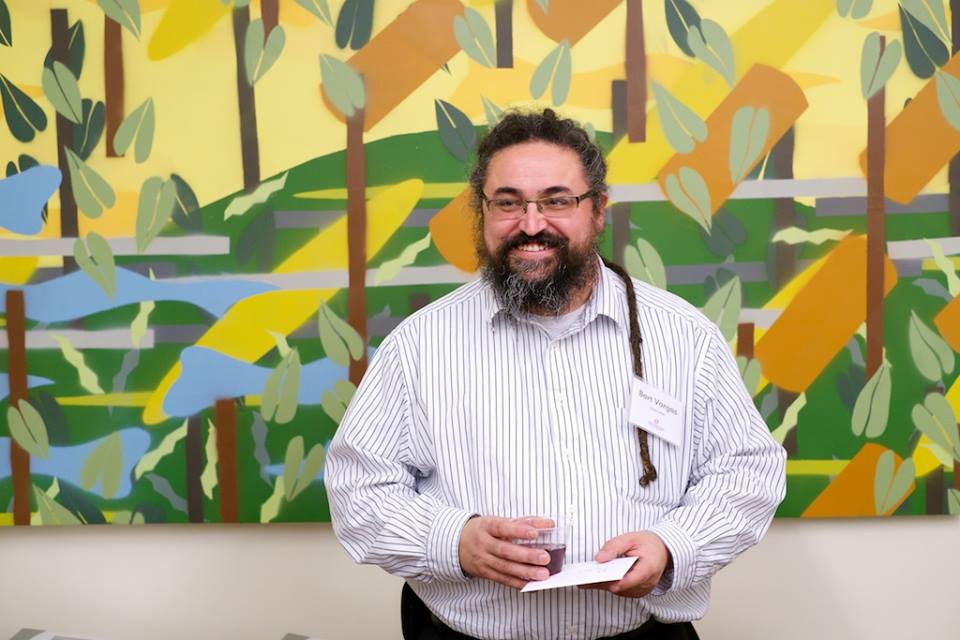
It’s no coincidence that Bart Vargas, the lone Carver resident artist who’s not African American, though his dreadlocks often prompt people to assume he is, makes art from salvaged materials. Just when it looked like his life was a thrown-away bust, he found salvation.
Growing up in a chaotic home with a mentally ill mother and alcoholic father Vargas sought refuge in art. “I escaped through drawing,” he says. “Drawing was a way to have control over something and make believe and go other places. When I was 16 I was young, angry and confused and this other family saw the situation and offered me a safe place and took me in. So I have my biological family and what I consider my real family – the family I associate with all these years later.”
Vargas, a Nebraska Air National Guard veteran, feels his salvage art parallels the Carver project and its adaptive reuse of the long abandoned Carver Savings & Loan building and plans to revitalize other long vacant North Omaha properties.
“Everything has a potential. The only place trash is made is in our head…when we decide something no longer has value.”
Bemis chief curator Hesse McGraw says the hope is that by nurturing artists Carver “can generate some cultural heat and create a magnetic lure in North Omaha.” Another hope, he adds, is for their work “to have an impact on public perception of the neighborhood. Imagine when the Near North Side is again known as a place that artists live and work, and where we all can be part of that resurgence.”
A self-described “mixed blood” who’s white and Mexican and not sure what else, Vargas used some of his Carver money to take DNA tests to determine his ethnicity.
“I’ve thought about doing this identity painting after finding out what my genetic markers say I am.”
Or he might adapt a painted words series he began s few years ago to express musings about “my American muttness.”
The University of Nebraska at Omaha and Metropolitan Community college art instructor says he’s already made word paintings “specific to this place or neighborhood,” adding, “I want this part of the city to become part of the work I do here. Before I even moved in I painted ‘Carver.’ My goal is to cover the walls in my little corner in Yeses. To have this wall of positivity. I want to start it out with really good energy.”

Portia Love
Portia Love understands why she’s identified with her father, whose band she sang with for several years, but music was his thing, not hers.
“The writing thing is mine,” says Love, who retreated into words and stories as an “introverted” adolescent and began winning recognition for her work at Marian High School.
She went on to work in and teach human services but always wrote on the side. As a veteran artist with Why Arts she conducts writing workshops for people with disabilities. She also holds workshops through the Bemis.
She’s self-published two books of poems, Eclipses of the Sun and Redefinition. She creates poems by commission for clients, placing her original works in designer boxes, frames and photo albums.
WriteLife is publishing her debut novel, The Men’s Club, as well as a book of short stories, High Heel Shoes, Bright Red Lipstick and Strange Love.
Carver appeals to her for practical reasons.
“I went after it for the working space and the recognition. I’m real if nothing else. I tear my house up doing this stuff. Now I have a studio to work out of. This is my time for me and my writing. This is an opportunity that I hope is going to put me to another level. i hate anybody trying to put limitations on me and what I do.”
Moving artists along is part of the idea.
“We hope this opportunity provides a crucial jump for the residents and that they are able to move their artistic practices to new levels,” says McGraw.
Love says Carver’s location is “significant,” adding, “The whole thing is significant. I love that Hesse (McGraw) said the Bemis cannot be this white organization that ignores the fact there are people of color in this city with talent. And yes this is the perfect place for it, 24th and Lake. I think about my dad and how much he would have loved coming through here wearing the hell out of everybody. I think he would be so overjoyed to see me excelling at something that was not his.”
Love’s hosting a poetry reading from 3 to 6 p.m. on May 25. She’s invited her fellow resident artists to add their distinct flavors.
Carver events are free and open to the public.
For Carver updates visit carverbank(at)bemiscenter.org.

Related articles
- Omaha Playwright Beaufield Berry Comes into Her Own: Her Original Comedy ‘Psycho Ex Girlfriend’ Now Playing (leoadambiga.wordpress.com)
- Laura Love: Omaha’s High Yaller Gal Comes Home (leoadambiga.wordpress.com)
The Old Market’s Late Godfather Samuel Mercer Casts Long Shadow in Omaha
Any urban place worth its salt as a destination to visit bears the imprint of the people who shaped it. Omaha isn’t known for much outside Nebraska but one area just south of downtown has become its primary tourist destination, the Old Market, which at its core is a historic district whose collection of late 19th and early 20th century warehouses offers the city’s most eclectic concentration of restaurants, shops, and arts-cultural venues. Many people have had a hand in molding the Old Market but the most critical guiding hand belonged to the late Sam Mercer, who had the vision to see what only a few others saw in terms of the potential of transforming this old produce warehouse market into a arts-culture-entertainment haven. My story about Mercer and the small coterie of fellow visionaries he developed a consipiracy of hearts with in creating the Old Market appears in Encouner Magazine. You’ll find some other Old Market-related stories on this blog and coming this spring I will be postiing a retrospective piece on how this creative hub became the Old Market and how it survived and thrived against all odds. I will introduce you to the people who turned the spark of an idea into reality.
 Sam Mercer, center ©Photograph by Vera Mercer
The Old Market’s Late Godfather Samuel Mercer Casts Long Shadow in Omaha
©by Leo Adam Biga
Now appearing in Encounter Magazine

Sam Mercer
The Old Market’s undisputed godfather, Samuel Mercer, passed away Feb. 5 at his home in Honfleur, France. He was 92. Services were held at Trinity Episcopal Church in Omaha.
This continental bon vivant was not a typical Nebraskan. The son of prominent Omaha physician and landowner Nelson Mercer, he was born and raised in privileged circumstances in London, England and educated at Oxford and Yale. After living in Washington D.C. he based his law practice in Paris, where he mostly lived the rest of his life. He held dual citizenship.
In Paris he cultivated relationships with avant garde artists, A watercolorist himself, he made artist Eva Aeppli his second wife.
On his handful of trips to Omaha each year he cut an indelible figure between his shock of shoulder-length gray hair, his Trans-Atlantic accent and his waxing on far-ranging subjects. He spoke perfect French.
“He projected an aura of unpretentious aristocracy…I liked him immediately and enormously,” says designer Roger duRand, who with Percy Roche opened the Old Market’s first business, The Farthest Outpost.
When the death of his father in 1963 Mercer inherited his family’s property holdings and he took charge of their Mercer Management company here. He appreciated the century-old brick warehouses, some Mercer-owned, comprising the wholesale produce market just southeast of downtown. But it was someone his junior, designer Cedric Hartman, who first advocated doing something with those buildings, which by the mid-1960s were largely abandoned and in disrepair.
Hartman, an acclaimed designer of lighting and furniture pieces made at his 1414 Marcy St. factory, recalls the genesis of the Old Market. He and Judy Wigton were partners in a high end gift shop. Like Mercer they admired the dying produce district’s buildings and in 1964 began meeting with him about these structures as potential sites for exciting new ventures, such as fine shops, galleries and restaurants. Those conservations in turn sparked Sam’s efforts to preserve and repurpose the Market as an arts-culture haven.
“We were quite surprised to find such a person,” says Hartman. “He was a very smart, very worldly and sophisticated character with great personal charm. We were both wowed by him and in his way he was with us.”
Wigton says, “He certainly had a great appreciation for old buildings and also a need to fill the empty places with new tenants.”
“He did respond to us in a great way,” Hartman notes. “We were a couple of really arty kids and he was really arty, so it couldn’t have been a better association. He was a kindred spirit in so many ways.”
Those early encounters formulated the vision for what became the Old Market.
“I remember we walked around the streets trying to imagine what could be done. I’d say, ‘Now look at this building, here’s we could do this with it,’ and he’d just respond right in kind,” says Hartman. “I couldn’t have done that with anybody else. He hooked into all this stuff really fast.”
A sense of urgency set in when city officials and property owners began eying some Market buildings for demolition.
Hartman tipped off Mercer to the condemnation of the Gilinsky building that sat in the middle of Mercer-owned properties on Howard Street. It was Hartman too who brokered a meeting between Mercer and Peaches Gilinsky. A deal was struck that led Mercer to acquire the site.
By 1968 Mercer moved strategically to gain control of a collection of buildings there.
“Sam did not want anything said about the project until he could acquire options on enough other properties in the area to insure the success of the redevelopment,” says Wigton.
It was Mercer’s idea to make the groundfloor space of the former Gilinsky fruit company into a French restaurant. There, Hartman designed the Old Market’s signature spot, the French Cafe, as well as apartments above it. Ree Kaneko, a fellow Old Market pioneer, says the restaurant, opened in 1969, was “very important” in helping solidify and legitimize the Market.
“It was a risky thing for him to do,” Hartman says “Who knew if that would work? However, it was a great success.”

More anchor attractions followed – Homer’s, M’s Pub, Mr. Toad, the Spaghetti Works, Nouvelle Eve, eh Firehouse Dinner Theater, the Bemis.
Designers duRand and Hartman advised Mercer and his son Mark, daughter-in-law Vera, nephew Nicholas Bonham-Carter on this never planned but organically developed area. The Mercers created one of the Market’s most distinct features, The Passageway, and later opened their own distinguished enterprises – V Mertz, La Buvette and The Boiler Room.
“We worked to shape the Old Market neighborhood in the most authentic and benign ways possible, gently guiding new tenants away from the cliched and vulgar, and to more thoughtful and honest approaches to development of the beautiful old structures,” says duRand. “Even though Sam lived and worked in Paris, his presence was in every decision of significance in nurturing the Market. He made frequent visits to Omaha in the early days, and was instrumental in bringing the city fathers around to acceptance, then eventual approval, and finally enthusiasm for the preservation and rebirth of our neighborhood.
“His passing leaves a permanent and poignant void.”
Sam Mercer viewed the Market as an evolving social experiment and art project aligned with his own desires. Mark Mercer says the family’s continued that philosophy by encouraging unique ventures that “fit our tastes and interests.” He and his wife, artist Vera Mercer, say “creating” new things is their passion.
Ree Kaneko has high praise for the Mercers’ stewardship and their “allowing things to take shape” by nurturing select endeavors. She adds, “They know it’s a slow process,. They have a great sense of the mix of things that need to happen to make the Market exciting.”
“It hasn’t been easy and I don’t think any other family could have done it,” Wigton says.
Mark and Vera Mercer say Sam remained “very interested” in the Market. They vow retaining the vibrant charm of this historic neighborhood he lovingly made happen.
Opera Omaha co-production of “The Magic Flute” casts enchanting spell
Let me start by saying that I don’t know enough about the art form of opera to intelligently review an opera, any opera, but I do know a thing or two about theater, and opera is music theater. For what it’s worth then I can add my enthusiastic thumbs up to the new Opera Omaha co-production of The Magic Flute. I saw the Sunday, Feb. 24 matinee performance at the Orpheum Theater and I can report that the aspects of the show that I knew the most about going in, which were also those that I most anticipated, namely artist Jun Kaneko‘s designs, beautifully complemented and propelled the music and story. His animated set designs and costume designs were highly expressive yet never detracted from the music or the action. His work truly helped to set the mood and to draw us in into the emotional life of characters and incidents. The other aspects of the produciton looked and sounded just as pleasing to me as the designs did and they all worked in unison together to cast an enchanting spell. It was a thoroughly delightful experience that I had the pleasure of sharing with my girlfriend, Carole Jeanpierre, who has a lovely operatic voice and is composing an original opera of her own. More to come on all that in future posts.
Related articles
Coming Home: Watie White’s public art installation tells stories of North Omaha home and family
Art assumes the roles of anthropology, archaeology, and novelization in Omaha artist Watie White’s new public installation that features 30 magic realism narrative paintings adorning the windows of an abandoned North Omaha house. Each image is based on artifacts left behind by the family that lived there to tell the stories of the home and its former residents. The site of the project is a house at 2424 Emmett Street, smack dab in one of the poorest neighborhoods in the city. As soon as the installation is taken down plans call the house to be razed and a new one built in its place.
|

Coming Home: Watie White‘s public art installation tells stories of North Omaha home and family
©by Leo Adam Biga
Appeared in The Reader (www.thereader.com)
On its face Watie White’s new public art project at an abandoned North Omaha house could be construed as a privileged white guy coming into the black community to impose his perceptions on that place and its people.
But that’s not the case with his All That Ever Was Always Is outdoor installation at 2424 Emmet Street. Enlarged digital prints of 30 narrative paintings he’s made cover the home’s windows. The house serves as a two-story, three-dimensional, wrap-around canvas for his true fiction portraits of the home’s former occupants. He invites viewers to bring their own interpretations to bear.
“I’m really interested in what the people who live next door or live down the block will think when they happen upon this big emotional and intellectual investment in an object that probably most people in this neighborhood don’t feel has much value,” he says. “Each perspective on this house tells its own story of what this house is.”
Don’t wait too long to see it though. Habitat for Humanity will raze the house in March and a Habitat-built new home will go up in its place. Before the century-old house is demolished he’ll disassemble the installation – windows, siding and all – for a future gallery show that he says “will be far more a rarified art experience.”
|

White’s paintings draw on interviews he did with neighbors, public record searches he and assistant Peter Cales made and a trove of personal artifacts harvested from the home, whose last residents were a black family named Smith. He and Cales also fashioned planters and benches from found objects there. The artists discovered a vast assemblage of strewn items inside that represent a tableaux of lives interrupted. In that suspended animation space White became the anthropologist his parents were.
“It’s like walking into somebody’s life,” says White. “This clearly was not cleaned up, not presented, not edited in any way, and so you walk in and you see all this stuff that feels unvarnished and truthful. They’re things that seem profound because we are reading something genuine about this person’s lived experience here, not things we were intended to see or a character they were playing, which for me makes it all the more intriguing. It becomes something you can trust a little bit because it’s not being catered to or tying to come across in a certain way.”
“All this trash and left belongings became really an incredible generator of content for the paintings themselves.”
He says the ephemera made the house an “active participant” to inform the narrative. Birth certificates, family photos, letters, journal entries and divorce papers helped him piece together four generations of history. He discovered the grandfather, Nathaniel Ware, was a Pullman Porter who moved the family up north from Mississippi. His daughter Janet Ware married Leonard Smith, an Omaha policeman. Janet was active at Salem Baptist Church. A daughter, Candice, followed her heart to Memphis. A son, Michael, may have been the last family member to reside at the Emmet address.
“He appears to have just left and walked away from everything before selling the house to Habitat,” White says of Smith.
What the materials didn’t reveal to White he extrapolated with the help of live models acting out back stories in his studio.
“I got a feeling for who I believe these people were, what they were like, but they’re more fictional characters. It’s more like writing a novel than doing a documentary.”
|

White purposely didn’t contact the Smith family to avoid being overly influenced. He has many questions for them, however. He’s inviting them to the opening, when he plans presenting them a chest made from recycled materials in the home that will contain the personal artifacts he salvaged.
His work also addresses urban legends attached to the house. For example, he says some neighbors “view it as a shameful place where bad things happened.” Allegedly it was crack house, though he found no supporting evidence. He hopes his project overturns neighbors’ own “narrative that they live in a shitty place to they live next to a place that has the potential to be an amazing thing.”
Viewers have no choice but to see White’s whimsical, soulful images in the context of the structure and its environment. Cales expects viewers to have triggered “that voyeuristic instinct in themselves to wonder what’s on the inside and to wonder about this community.”
“That curiosity breeds curiosity,” says White. “You interrupt the regular flow of life in an area by addressing creatively something that seems like a flaw or a blight and you shift it to make it not that. You change the perception of what that thing is or can be.”
“I think it’s important to bring people to the neighborhood to see the work in this context,” says Cales. “This is an area of the city that’s relegated to, ‘It’s a dangerous part you should never come to’”
“When you stop treating it as a place you have to shun or fear or stay away from then it’s a little less fearful and a little more welcoming,” White says.
Engaging at-risk populations with public art is something White learned under Chicago conceptual artist and radical educator Jim Duignan, whose Stockyard Institute White has a long association with. In preserving everyday people’s stories White does in images what the late iconic Chicago writer Studs Terkel White did in words/ White. who moved to Omaha in 2006, often shows his work in Chicago.
For more about the artist visit watiewhite.com.
- Carver Building Rebirthed as Arts-culture Haven; Theaster Gates, Rebuild and Bemis Reimagine North Omaha (leoadambiga.wordpress.com)
- When New Horizons Dawned for African Americans in Omaha (leoadambiga.wordpress.com)
- Entrepreneur and Craftsman John Hargiss Invests in North Omaha: Stringed Instrument Maker Envisons Ambitious Plans for his New Hargissville Digs (leoadambiga.wordpress.com)
- Free Radical Ernie Chambers the Subject of New Biography by Author Tekla Agbala Ali Johnson (leoadambiga.wordpress.com)
- Opera Omaha Enlists Jun Kaneko for New Take on ‘The Magic Flute’ – Coproduction of Mozart Masterpiece Features Stunning Designs Setting the Opera World Abuzz (leoadambiga.wordpress.com)


 Leo Adam Biga's My Inside Stories