Archive
The Little People’s Ambassador at the College World Series
UPDATE: Greg Pivovar’s Stadium View Sports Cards store was left high and dry when Rosenblatt Stadium was closed and the College World Series moved downtown to TD Ameritrade Park, but he does have a presence near the new site courtesy a tent set-up. My story below appeared on the eve of the 201o CWS, as Pivovar, whose shop stood directly across the street from Rosenblatt, prepped for his last dance with the old stadium.
As the College World Series enters the stretch run of the 2010 championship, I offer this story as a slice-of-life capsule of the local color that can be found in and around the event and its festival-like atmosphere. The subject is Greg Pivovar, who runs a sports memorabilia shop called Stadium View Sports Cards, across from Omaha‘s Rosenblatt Stadium, the venue where the CWS has been played for 60 years. This is the stadium’s last at-bat, so to speak, as it’s scheduled to be torn down next year, when the event moves to the new downtown TD Ameritrade Park. The ‘Blatt’s last hurrah is inspiring all manner of nostalgic farewells. Pivovar will be sad to see it go too, but he’s not the sentimental sort. In fact, he’s the cynical antidote to the otherwise perpetually cheery facade the city, the NCAA, and College World Series Inc. like to spin about the series, an event that Omaha has catered to to such an extent that there’s a fair amount of skepticism and animosity out there. Pivovar loves the series and the business it brings him, and he loves serving in the unofficial role of CWS ambassador for visitors from out of state, but he’s not Pollyannish about the event or the powers-that-be who run it. He just kind of says it like it is. His blog, stadiumview.wordpress.com, is a hoot for the way he skewers sacred cows.
I have posted another CWS story about a father and son legacy tied to the event.

Greg Pivovar, owner of the Stadium View shop, poses in his store in Omaha, Neb., Thursday, May 27, 2010. Pivovar is a one-man welcoming committee for College World Series fans. The Omaha attorney greets every (legal age) customer with a free can of beer and nudges them toward the barbecue, brats or, when LSU is in town, seafood jambalaya.(AP Photo/Nati Harnik) — AP
The Little People‘s Ambassador at the College World Series
©by Leo Adam Biga
Originally appeared in the The Reader (www.thereader.com)
Stadium View Sports Cards proprietor Greg Pivovar makes a colorful ambassador for the College World Series with his Hawaiian shirt, khaki shorts and blue-streak S’oud Omaha patter. This bona fide character champions “the little people who built” the CWS.
Enter his sports memorabilia shop across from Rosenblatt and his coarse, cranky, world-weary sarcasm greets you, his barbs delivered with a stiff drink in one hand and a cell phone in the other. He talks like he writes on his stadiumview.wordpress.com blog.
“A lot of it is funny and cynical, but a lot of it is from my heart,” he said..
His shop’s a popular way stop for CWS fans craving authentic Omaha. He’s dispensed free beer since opening the joint 19 years ago. “It’s meant as a gesture of friendship and welcome, not as, Hey, you want to stand around and get drunk here? Part of the ritual,” he said. In 2006 he “took a cheap ass plea” on a ticket scalping charge he claims was bogus. He said the company he keeps is what got him in trouble.
“I have a bunch of scalpers who hang around here,” he said. “They’re friends of mine. I like them, they’re an interesting breed of human being.”
The arrest made headlines. A recent AP story that went viral called him a one-man CWS welcoming committee. Ryan McGee profiled him in the book The Road to Omaha.
“Famous…infamous, I’ve been both,” said Pivovar.
His uncensored ways hardly conform to the Norman Rockwell image the NCAA prefers.
Pivovar, who also serves homemade barbecue and enchiladas during the CWS, and cooks up a mean jambalaya whenever LSU makes it, feels he contributes to a “festival atmosphere.” Vendor and hospitality tents dot the blue collar neighborhood, where enterprising residents make a sweet profit charging for parking spots and refreshments.
The NCAA’s tried distancing the CWS from the commercial, party vibe. A clean zone will be easier to enforce with the move to TD Ameritrade Park next year.
“Piv” likes a good time but acknowledges all “the temporary bars” can be “a negative,” adding, “There’s a few too many people coming down here just to get drunk, and that’s not the idea. That sounds hypocritical coming from a guy who’s given 40,000 beers away, but it really isn’t. Most of my beers are given away one, maybe two at a time.”
The Creighton University Law School grad and former Sarpy County public defender has a private practice he puts on hold for the series. This being Rosenblatt’s last year, he’s stocked extra beer for the record hordes expected to say adieu to the stadium.
His own ties to Rosenblatt go back to childhood. His collecting began with baseball cards, sports magazines, game programs, signed balls. He got serious after college, traveling to buy and sell wares. Eventually, he said, “my collection was pretty much overrunning my home. I’m a hoarder. I needed a place to store my hobby.” Thus, the store was born, although he insists: “It’s not a business, it’s never been a business. I don’t make any money at this, I never have. It’s kind of like a museum.”
Most of his million or so cards, he said, “are just firewood.”
What business he does do largely happens during the CWS. Even then he said I “barely pay the bills.” He doesn’t know what he’ll do after the ‘Blatt’s gone and the series moves downtown. “I’d love to carry my hobby down there but…If somebody comes and shits a couple hundred thousand dollars on my face it might happen, but other than that…”
If he closes shop, he’s unsure what will become of his stuff.
“I don’t even want to think about it. I suppose I could throw it all on e-bay and get a mere pittance for it. That’s the way that works. So much of it has zero to such a narrow market, and I knew that going in. It’s not like I was having any allusions of getting rich from this.”
He’s pissed about the “Blatt’s demise and suspects the new site will usher in a sterile, elitist era.
“I’m a conspiracy theorist. What this is all about is developing that north area (NoDo) and wanting to give the zoo what they need. The bastards are taking my ballpark. Like I end a lot of my blogs, I’ve got so many days until my world’s over. It’s kind of like writing your own obituary.”
At least he has his health. He’s cancer-free after a bout with cancer.
The “Save Rosenblatt” t-shirts he carried have been replaced with ones reading: “To Hell with Rosenblatt, Save Stadium View.”
Stadium View is at 3702 So. 13th St.
Related Articles
- College World Series Is Moving On (nytimes.com)
- College World Series is Omaha’s party central (seattletimes.nwsource.com)
- Rosenblatt Stadium memories will live on (seattletimes.nwsource.com)
- Vermont couple ties knot during CWS rain delay (seattletimes.nwsource.com)
- 1st game at new Omaha ballpark sells out in hours (seattletimes.nwsource.com)
Rosenblatt-College World Series
When the last College World Series was played at Rosenblatt Stadium in Omaha the special relationship that that event and venue share, including all the CWS history that’s been made there, got plenty of attention via press reports, fan blogs and forums, books, and films. I wrote my own opus about Rosenblatt and I am posting it now to join all the tributes and memorials pouring in for that most Americana of sports championships and settings.
Much has changed since I wrote the piece and it was published in The Reader (www.thereadercom), like the decision to retire the city owned facility and to replace it next season with a new downtown stadium. Rosenblatt was razed and the property developed by the adjacent Henry Doorly Zoo. A mini replica park was included in the design as a way to memorialize the stadium and its 60 years of hosting the College World Series, an enduring marriage of event and venue unlike any other for a major championship.
If nothing else, my dusted off story, which I call A Rosenblatt Tribute, may give you an added perspective on this slice of baseball culture and history. In this same post I am also sharing a few more of the CWS and Rosenblatt stories I have done over the years, though I still need to put one up called The Boys of Summer.

Image via Wikipedia
UPDATE: The summer of 2011 finds Rosenblatt Stadium in Omaha, Neb. now an empty shell and ghost of a ballpark, its parts being cannibalized and sold off, while the new home of the College World Series, TD Ameritrade Park, is a resounding hit with fans and media.
Eleven years ago or so I wrote this story about Rosenblatt Stadium in Omaha, the home of the College World Series. As I write this intro, the CWS is a day away from starting play in 2010, the last year the event will be played at the stadium that’s hosted NCCA Division Imen’s baseball championship for 60 years. Rosenblatt is being razed in early 2011, when the series will move into a new downtown stadium now under construction. Rosenblatt has become the symbol for the series because of all the history bound up in it and the special relationship residents and fans have with it and with the blue collar neighborhood surrounding it. My story appeared in The Reader (www.thereader,com).

©Omaha World-Herald
When Rosenblatt was Municipal Stadium. At the first game, from left: Steve Rosenblatt; Rex Barney; Bob Hall, owner of the Omaha Cardinals; Duce Belford, Brooklyn Dodgers scout and Creighton athletic director; Richie Ashburn, a native of Tilden, Neb.; Johnny Rosenblatt; and Johnny Hopp of Hastings, Neb.
A Rosenblatt Tribute
©by Leo Adam Biga
Originally published in The Reader (www.thereader.com)
It’s baseball season again, and The Boys of Summer are haunting diamonds across the land to play this quintessentially American game. One rooted in the past, yet forever new. As a fan put it recently, “With baseball, it’s the same thing all over again, but it isn’t. Do you know what I mean?”
Yes. There’s a timelessness about baseball’s unhurried rhythm, classic symmetry and simple charm. The game is steeped in rules and rituals almost unchanged since the turn of the century. It’s an expression of the American character: both immutable and enigmatic.
Within baseball’s rigid standards, idiosyncrasy blooms. A contest is decided when 27 outs are recorded, but getting there can involve limitless innings, hours, plays. Stadiums may appear uniform, but each has its own personality — with distinctive wind patterns, sight lines, nooks and crannies.
Look in any American town and you’ll find a ballpark with deep ties to the sport and its barnstorming, sandlot origins. A shrine, if you will, for serious fans who savor old-time values and traditions. The real thing. Such a place is as near as Omaha’s Johnny Rosenblatt Stadium, the site the past 49 years of the annual College World Series.
The city and the stadium have become synonymous with the NCAA Division I national collegiate baseball championship. No other single location has hosted a major NCAA tournament for so long. More than 4 million fans have attended the event in Omaha since 1950.
The 1998 CWS is scheduled May 29-June 6.
In what has been a troubled era for organized ball, Rosenblatt reaffirms what is good about the game. There, far away from the distraction of major league free-agency squabbles, the threat of player/umpire strikes, and the posturing of superstars, baseball, in its purest form, takes center stage. Hungry players still hustle and display enthusiasm without making a show of it. Sportsmanship still abounds. Booing is almost never heard during the CWS. Fights are practically taboo.
The action unwinds with leisurely grace. The “friendly confines” offer the down-home appeal of a state fair. Where else but Omaha can the PA announcer ask fans to, “scooch-in a hair more,” and be obliged?
Undoubtedly, the series has been the stadium’s anchor and catalyst. In recent years, thanks in part to ESPN-CBS television coverage, the CWS has become a hugely popular event, regularly setting single game and series attendance records. The undeniable appeal, besides the determination of the players, is the chance to glimpse the game’s upcoming stars. Fans at Rosenblatt have seen scores of future big league greats perform in the tourney, including Mike Schmidt, Dave Winfield, Fred Lynn, Paul Molitor, Jimmy Key, Roger Clemens, Will Clark, Rafael Palmeiro, Albert Belle, Barry Bonds and Barry Larkin.
The stadium on the hill turns 50 this year. As large as the CWS looms in its history, it is just one part of an impressive baseball lineage. For example, Rosenblatt co-hosted the Japan-USA Collegiate Baseball Championship Series in the ‘70s and ‘80s, an event that fostered goodwill by matching all-star collegians from each country.
Countless high school and college games have been contested between its lines and still are on occasion.
Pro baseball has played a key role in the stadium’s history as well.
Negro League clubs passed through in the early years. The legendary Satchel Paige pitched there for the Kansas City Monarchs. Major league teams played exhibitions at Rosenblatt in the ‘50s and ‘60s. St. Louis Cardinal Hall of Famer Stan Musial “killed one” during an exhibition contest.
For all but eight of its 50 years Rosenblatt has hosted a minor league franchise. The Cardinals and Dodgers once based farm clubs there. Native son Hall of Famer Bob Gibson got his start with the Omaha Cardinals in ‘57. Since ‘69 Rosenblatt’s been home to the Class AAA Omaha Royals, the top farm team of the parent Kansas City Royals. More than 7 million fans have attended Omaha Royals home games. George Brett, Frank White and Willie Wilson apprenticed at the ballpark.
With its rich baseball heritage, Rosenblatt has the imprint of nostalgia all over it. Anyone who’s seen a game there has a favorite memory. The CWS has provided many. For Steve Rosenblatt, whose late father, Johnny, led the drive to construct the stadium that now bears his name, the early years hold special meaning. “The first two years of the series another boy and I had the privilege of being the bat boys. We did all the games. That was a great thrill because it was the beginning of the series, and to see how it’s grown today is incredible. They draw more people today in one session than they drew for the entire series in its first year or two.”
For Jack Payne, the series’ PA announcer since ‘64, “the dominant event took place just a couple years ago when Warren Morris’ two-run homer in the bottom of the ninth won the championship for LSU in ‘96. He hit a slider over the right field wall into the bleachers. That was dramatic. Paul Carey of Stanford unloaded a grand slam into the same bleacher area back in ‘87 to spark Stanford’s run to the title.”
Payne, a veteran sports broadcaster who began covering the Rosenblatt beat in ‘51, added, “There’s been some great coaching duels out there. Dick Siebert at Minnesota and Rod Dedeaux at USC had a great rivalry. They played chess games out there. As far as players, Dave Winfield was probably the greatest athlete I ever saw in the series. He pitched. He played outfield. He did it all.”
Terry Forsberg, the former Omaha city events manager under whose watch Rosenblatt was revamped, said, “Part of the appeal of the series is to see a young Dave Winfield or Roger Clemens. Players like that just stick out, and you know they’re going to go somewhere.” For Forsberg, the Creighton Bluejays’ Cinderella-run in the ‘91 CWS stands out. “That was a real thrill, particularly when they won a couple games. You couldn’t ask for anything more.”
The Creighton-Wichita State game that series, a breathtaking but ultimately heartbreaking 3-2 loss in 12 innings, is considered an all-time classic. Creighton’s CWS appearance, the first and only by an in-state school, ignited the Omaha crowd. Scott Sorenson, a right-handed pitcher on that Bluejay club, will never forget the electric atmosphere. “It was absolutely amazing to be on a hometown team in an event like that and to have an entire city pulling for you,” he said. “I played in a lot of ballparks across the nation, but I never saw anything like I did at Rosenblatt Stadium. I still get that tingling feeling whenever I’m back there.”
A game that’s always mentioned is the ‘73 USC comeback over Minnesota. The Gophers’ Winfield was overpowering on the mound that night, striking out 15 and hurling a shutout into the ninth with his team ahead 7-0. But a spent Winfield was chased from the mound and the Trojans completed a storybook eight-run last inning rally to win 8-7.
Poignant moments abound as well. Like the ‘64 ceremony renaming the former Municipal Stadium for Johnny Rosenblatt in recognition of his efforts to get the stadium built and bring the CWS to Omaha. A popular ex-mayor, Rosenblatt was forced to resign from office after developing Parkinson’s disease and already suffered from its effects at the rededication. He died in ‘79. Another emotional moment came in ‘94 when cancer-ridden Arizona State coach Jim Brock died only 10 days after making his final CWS appearance. “That got to me,” Payne said.
Like many others, Payne feels the stadium and the tourney are made for each other, “It’s always been a tremendous place to have a tournament like this, and fortunately there was room to grow. I don’t think you could have picked a finer facility at a better location, centrally located like it is, than Rosenblatt. It’s up high. The field’s big. The stadium’s spacious. It’s just gorgeous. And the people have just kept coming.”
Due to its storied link with the CWS, the stadium’s become the unofficial home of collegiate baseball. So much so that CWS boosters like Steve Rosenblatt and legendary ex-USC coach Rod Dedeaux, would like to see a college baseball/CWS Hall of Fame established there.
Baseball is, in fact, why the stadium was built. The lack of a suitable ballpark sparked the formation of a citizens committee in ‘44 that pushed for the stadium’s construction. The committee was a latter-day version of the recently disbanded Sokol Commission that led the drive for a new convention center-arena.
With a goal of putting the issue to a citywide vote, committee members campaigned hard for the stadium at public meetings and in smoke-filled back rooms. Backers got their wish when, in ‘45, voters approved by a 3 to 1 margin a $480,000 bond issue to finance the project.
Unlike the controversy surrounding the site for a convention center-arena today, the 40-acre tract chosen for the stadium was widely endorsed. The weed-strewn hill overlooking Riverview Park (the Henry Doorly Zoo today) was located in a relatively undeveloped area and lay unused itself except as prime rabbit hunting territory. Streetcars ran nearby, just as trolleys may in the near future. The site was also dirt cheap. The property had been purchased by the city a few years earlier for $17 at a tax foreclosure sale. Back taxes on the land were soon retired.
Dogged by high bids, rising costs and material delays, the stadium was finished in ‘48 only after design features were scaled back and a second bond issue passed. The final cost exceeded $1 million.
Baseball launched the stadium at its October 17, 1948 inaugural when a group of all-stars, featuring native Nebraskan big leaguers, beat a local Storz Brewery team 11-3 before a packed house of 10,000 fans.
Baseball has continued to be the main drawing card. The growth of the CWS prompted the stadium’s renovation and expansion, which began in earnest in the early ‘90s and is ongoing today.
Rosenblatt is at once a throwback to a bygone era — with its steel-girdered grandstand and concrete concourse — and a testament to New Age theme park design with its Royal Blue molded facade, interlaced metal truss, fancy press box and luxury View Club. The theme park analogy is accentuated by its close proximity to the popular Henry Doorly Zoo.
Some have suggested the new bigness and brashness have stolen the simple charm from the place.
“Maybe some of that charm’s gone now,” Forsberg said, “but we had to accommodate more people as the CWS got popular. But we still play on real grass under the stars. The setting is still absolutely beautiful. You can still look out over the fences and see green trees and see what mid-America is all about.”
Payne agrees. “I don’t think it’s taken away from any of the atmosphere or ambience,” he said. “If anything, I think it’s perpetuated it. The Grand Old Lady, as I call it, has weathered many a historical moment. She’s withstood the battle of time. And then in the ‘90s she got a facelift, so she’s paid her dues in 50 years. Very much so.”
Perched atop a hill overlooking the Missouri River and the tree-lined zoo, Rosenblatt hearkens back to baseball’s and, by extension, America’s idealized past. It reminds us of our own youthful romps in wide open spaces. Even with the stadium expansion, anywhere you sit gives you the sense you can reach out and touch its field of dreams.

NCAA officials, who’ve practically drawn the blueprint for the new look Rosenblatt, know they have a gem here.
“I think part of the reason why the College World Series will, in 1999, celebrate its 50th year in Omaha is because of the stadium we play in, and the fact that it is a state-of-the-art facility,” said Jim Wright, NCAA director of statistics and media coordinator for the CWS the past 20 years.
Wright believes there is a casual quality that distinguishes the event.
“Almost without exception writers coming to this event really do become taken with the city, with the stadium and with the laidback way this championship unfolds,” he said. “It has a little bit different feel to it, and certainly part of that is because we’re in Omaha, which has a lot of the big city advantages without having too many of the disadvantages.”
For Dedeaux, who led his Trojans to 10 national titles and still travels each year from his home in Southern California to attend the series, the marriage of the stadium-city-event makes for a one-of-a-kind experience.
“I love the feeling of it. The intimacy. Whenever I’m there I think of all the ball games, but also the fans and the people associated with the tournament, and the real hospitable feeling they’ve always had. I think it’s touched the lives of a lot of people,” he said.
Fans have their own take on what makes baseball and Rosenblatt such a good fit. Among the tribes of fans who throw tailgate parties in the stadium’s south lot is Harold Webster, an executive with an Omaha temporary employment firm. While he concedes the renovation is “nice,” he notes, “The city didn’t have to make any improvements for me. I was here when it wasn’t so nice. I just love being at the ballpark. I’m here for the game.” Not the frills, he might have added.
For Webster and fans like him, baseball’s a perennial rite of summer.
“To me, it’s the greatest thing in the world. I don’t buy season tickets to anything else — just baseball.”
Mark Eveloff, an associate judge in Council Bluffs, comes with his family. He said, “We always have fun because we sit in a large group of people we all know. You get to see a lot of your friends at the game and you get to see some good baseball. I’ve been coming to games here since I was a kid in the late ‘50s, when the Omaha Cardinals played. And from then to now, it’s come a long way. Every year, it looks better.”
Ginny Tworek is another fan for life. “I’ve been coming out here since I was eight-years old,” the Baby Boomer said. “My dad used to drop me and my two older brothers off at the ballpark. I just fell in love with the game. It’s a relaxing atmosphere.”
There is a Zen quality to baseball. With its sweet meandering pace you sometimes swear things are moving in slow motion. It provides an antidote to the hectic pace outside.
Baseball isn’t the whole story at Rosenblatt. Through the ‘70s it hosted high school (as Creighton Prep’s home field), collegiate (UNO) and pro football (Omaha Mustang and NFL exhibition) games as well as pro wrestling cards, boxing matches and soccer contests. Concerts filled the bill too, including major shows by the Beach Boys in ‘64 and ‘79. But that’s not all. It accomodated everything from the Ringling Brothers Circus to tractor pulls to political rallies to revival meetings. More recently, Fourth of July fireworks displays have been staged there.

Except for the annual fireworks show, however, the city now reserves the park for none but its one true calling, baseball, as a means of protecting its multimillion dollar investment.
“We made a commitment to the Omaha Royals and to the College World Series and the NCAA that the stadium would be maintained at a major league level. The new field is fairly sensitive. We don’t want to hurt the integrity of the field, so we made the decision to just play baseball there,” Omaha public events manager Larry Lahaie said.
A new $700,000 field was installed in 1991-92, complete with drainage and irrigation systems. Maintaining the field requires a groundskeeping crew whose size rivals that of some major league clubs.
Omaha’s desire to keep the CWS has made the stadium a priority.
As the series began drawing consistently large crowds in the ‘80s, the stadium experienced severe growing pains. Parking was at a premium. Traffic snarls drew loud complaints. To cope with overflow crowds, the city placed fans on the field’s cinder warning track. The growing media corps suffered inside a hot, cramped, outdated press box. With the arrival of national TV coverage in the ‘80s, the NCAA began fielding bids from other cities wanting to host the CWS.
By the late ‘80s Omaha faced a decision — improve Rosenblatt or lose the CWS. There was also the question of whether the city would retain the Royals. In ‘90 the club’s then owner, the late Chicago business magnate Irving “Gus” Cherry, was shopping the franchise around. There was no guarantee a buyer would be found locally, or, if one was, whether the franchise would stay. To the rescue came an unlikely troika of Union Pacific Railroad, billionaire investor Warren Buffett and Peter Kiewit Son’s, Inc. chairman Walter Scott, Jr., who together purchased the Royals in 1991.
Urged on by local CWS organizers, such as Jack Diesing Sr. and Jr., and emboldened by the Royals’ new ownership, the city anteed-up and started pouring money into Rosenblatt to rehab it according to NCAA specifications. The city has financed the improvements through private donations and from revenue derived from a $2 hotel-motel occupancy tax enacted in ‘91.
The makeover has transformed what was a quaint but antiquated facility into a modern baseball palace. By the time the latest work (to the player clubhouses, public restrooms and south pavilion) is completed next year, more than $20 million will have been spent on improvements.
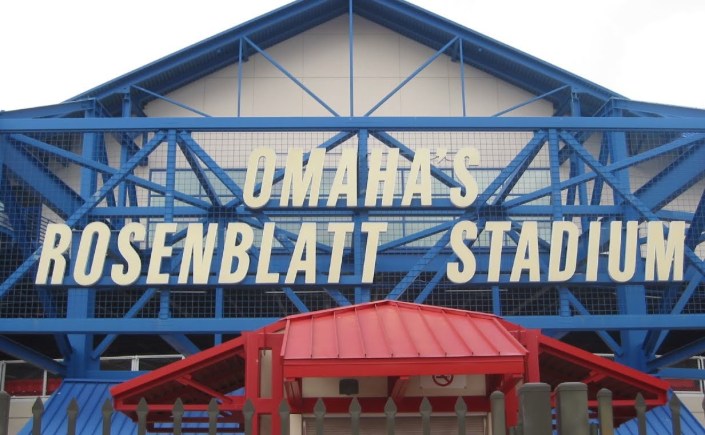
The stadium itself is now an attraction. The retro exterior is highlighted by an Erector Set-style center truss whose interlocking, cantilevered steel beams, girders and columns jig-jag five-stories high. Then there’s the huge mock baseball mounted on one wall, the decorative blue-white skirt around the facade, the slick script lettering welcoming you there and the fancy View Club perched atop the right-field stands. The coup de grace is the spacious thatched-roof press box spanning the truss.
Rosenblatt today is a chic symbol of stability and progress in the blue collar south Omaha neighborhood it occupies. It is also a hub of activity that energizes the area. On game days lawn picnics proceed outside homes along 13th Street and tailgate parties unwind in the RV and minivan-choked lots. The aroma of grilled sausage, bratwurst and roasted peanuts fills the air. A line invariably forms at the nearby Zesto’s, an eatery famous for its quick comfort food.
There’s a carnival atmosphere inside the stadium. The scoreboard above the left-field stands is like a giant arcade game with its flashing lights, blaring horns, dizzying video displays and fireworks. Music cascades over the crowd — from prerecorded cuts of Queen’s “We Will Rock You” and the Village People’s “YMCA” to organist Lambert Bartak’s live renditions of “Sioux City Sue” and “Spanish Eyes.” Casey the Mascot dances atop the dugouts. Vendors hawk an assortment of food, drink and souvenirs. Freshly-scrubbed ushers guide you to your seat.
The addition that’s most altered the stadium is the sleek, shiny, glass-enclosed View Club. It boasts a bar, a restaurant, a south deck, a baseball memorabilia collection, cozy chairs and, naturally, a great catbird’s seat for watching the game from any of its three tiered-seating levels. But you won’t catch serious fans there very long. The hermetically-sealed, sound-proof interior sucks the life right out of the game, leaving you a remote voyeur. Removed from the din of the crowd, the ballyhoo of the scoreboard, the enticing scent of fresh air and the sound of a ball connecting with leather, wood or aluminum, you’re cut-off from the visceral current running through the grandstand. You miss its goosebump thrills.
“That’s the bad thing about it,” Tworek said. “You can’t hear the crack of the bat. You don’t pay as close attention to the game there.”
Even with all the bells and whistles, baseball still remains the main attraction. The refurbished Rosenblatt has seen CWS crowds go through the roof, reaching an all-time single series high of 203,000 last year. The Royals, bolstered by more aggressive marketing, have drawn 400,000-plus fans every year but one since ‘92. Fans have come regardless of the won-loss record. The top single-season attendance of 447,079 came in ‘94, when the club finished eight games under .500 and in 6th place.
Why? Fans come for the game’s inherent elegance, grace and drama. To see a well-turned double play, a masterful pitching performance or a majestic home run. For the chance of snaring a foul ball. For the traditional playing of the national anthem and throwing out of the first pitch. For singing along to you-know-what during the seventh inning stretch.
They come too for the kick-back conviviality of the park, where getting a tan, watching the sun set or making new friends is part of the bargain. There is a communal spirit to the game and its parks. Larry Hook, a retired firefighter, counts Tworek among his “baseball family,” a group of fans he and his grandson Nick have gotten acquainted with at the Blatt. “It’s become a regular meeting place for us guys and gals,” he said. “We talk a little baseball and watch a little baseball.
Once the game’s over everybody goes their separate ways and we say, ‘See ya next home stand.’
The season’s end brings withdrawal pains. “About the first couple months, I’m lost,” Hook said. “There’s nothing to look forward to.” Except the start of next season.
As dusk fell at Rosenblatt one recent night, Charles and Stephanie Martinez, a father and daughter from Omaha, shared their baseball credo with a visitor to their sanctuary above the third-base dugout. “I can never remember not loving baseball,” said Charles, a retired cop. “I enjoy the competition, the players and the company of the people I’m surrounded by.”
Serious fans like these stay until the final out. “Because anything can happen,” Stephanie said. “I like it l because it’s just so relaxed sitting out on a summer day. There’s such an ease to it. Part of it’s also the friends you make at the ballpark. It doesn’t matter where you go — if you sit down with another baseball fan, you can be friends in an instant.”
That familiar welcoming feeling may be baseball’s essential appeal. Coming to the ballpark, any ballpark, is like a homecoming. Its sense of reunion and renewal, palpable. Rosenblatt only accentuates that feeling. Like a family inheritance, baseball is passed from one generation to the next. It gets in your blood. So, take me out to the ball game, take me out to the crowd…
Related Articles
- Rosenblatt Stadium will never be forgotten (mlb.mlb.com)
- New CWS stadium gets good reviews (seattletimes.nwsource.com)
- Burke gets Rosenblatt scoreboard – Omaha.com (theprideofnebraska.blogspot.com)
- Rosenblatt Stadium memories will live on (seattletimes.nwsource.com)
____________________________________________________________________
Rosenblatt is a magical name in Omaha because of the popular mayor who belonged to it, the late Johnny Rosenblatt, who in his day was quite a ballplayer, and because of the municipal stadium whose construction he speerheaded. That stadium was named after him and became home to the College World Series. The subject of this story is his son Steve Rosenblatt, who inherited his father’s love for the game and followed the old man into politics. Fabled Rosenblatt Stadium is no more, replaced by TD Ameritrade Park as host of the CWS. The stadium, the series, and his honor the mayor are more than just tangential memories to Steve, they are lifeblood and legacy.
Steve Rosenblatt, A Legacy of Community Service, Political Ambition and Baseball Adoration
©by Leo Adam Biga
Originally appeared in the Jewish Press
Legacy plays a big part in Steve Rosenblatt’s life.
The Omaha native and his wife, the former Ann Hermen, live in Scottsdale, Ariz.
His late father, Johnny Rosenblatt, became an Omaha icon: first as a top amateur baseball player; than as a sponsor of youth athletic teams through the Roberts Dairy company he managed; and finally as a popular Omaha city councilman and mayor. The elder Rosenblatt, who served as mayor from 1954 to 1961, led efforts to build the south Omaha stadium that became the city’s home to professional baseball and to the College World Series.
The city he loved paid tribute to one of its greatest boosters when Omaha Municipal Stadium was renamed Johnny Rosenblatt Stadium in 1964. The venue and the name have become synonymous with the NCAA college baseball championship played continuously at the stadium since 1950.
In a classic case of the apple not falling far from the tree, Steve Rosenblatt was a ballplayer in his own right and served on the Omaha Chamber of Commerce Sports Commission and the Omaha Royals Advisory Board. He followed his father’s footsteps into politics as well, serving two terms on the city council and three terms on the Douglas County Board of Commissioners.
The stadium that’s forever associated with his father played a key role in Steve’s early life. He was a bat boy for the inaugural Omaha Cardinals game played there, a duty he performed the first years the CWS took up residence. He regrets that the facility so closely tied to his family will be razed after the 2010 CWS in line with the planned construction of a new downtown palace slated to host the Series beginning in 2011. But the pragmatic Rosenblatt knows the decision is driven by the bottom line, which trumps nostalgia every time.
Sports and politics are inheritances for Rosenblatt, who is an only child. Just as his father used sports and charisma to forge a political career, the son used his own passion for athletics and way with people to become a player on the local political scene and to find success as an entrepreneur.

Bearing a name that has such major import in Omaha could have been an issue for Rosenblatt, but he didn’t let it be.
“You can take that and make it a burden,” Rosenblatt said, “or you can take it and have it be an asset, and I wished to take that route.”
Comparisons between he and his father were inevitable. “That’s fine, because we weren’t the same. First of all, he was a better ballplayer than me,” he said with his dry wit. “I was a better golfer than he was. Basketball might have been a toss-up, except he played college basketball — I didn’t.”
Growing up, Rosenblatt couldn’t help but notice what made his father a strong mayor and the sacrifices that job entailed.
“I was aware obviously of it and I learned as time went on how he operated and how he did things. Of course it was intriguing. He was a people-person who had an ability to communicate and to have relationships with his constituency and to make the tough decisions and still maintain a tremendous popularity. He had what I would call a broad-based support. He was well liked all over the community and one of the things that contributed to that — and it was what also helped me — was the background he had in athletics. That benefited him as I think it benefited me.
“He was well known as an athlete long before he was well known as a public official and his abilities as an athlete helped to project him into places.”
Rosenblatt said his father epitomized the “It” factor politicos possess. “All the people you see serve in the public sector as elected officials have in my opinion an attribute that goes beyond the norm,” he said, “in that they have the ability to speak and to be received in a fashion that projects themselves as leaders.”
Being an accessible mayor means never really having any down time.
“What was difficult about it was the fact you learned early on there’s a price to be paid as well,” Rosenblatt said, “because obviously with my dad doing what he did he was not going to be with you doing the things you might like to be doing all the time. He had public obligations to take care of as an elected official.”
The level of commitment required to be an effective, responsible public servant was not enough to dissuade Rosenblatt from seeking a seat on the city council and later on the county board. Even with the cachet of his name, his strong base in the business community and a groundswell of support to make a mayoral bid he never seriously considered running for that office. The same for a Congressional seat.
“I really was never interested in it. It was not aspiring to me. I’m as much a people- person as my dad was but at the same time I’m much more private. You cannot in my opinion be an elected official at that level and be as private as I would have liked to be. I want to do the job I was elected to do and when the day is over I want to go to the golf course, be with my family, watch a ballgame. You can’t do that in certain areas because you’ve given up that right and that time by your election to a particular office.”
He said it all comes with the territory.
“Make no mistake about it, when a person is elected to office, even at the city level, the county level, there’s a sacrifice to be made,” he said. “People may not realize it at the time they do get in but they will find out. I found out and I knew how much I wanted to give and how much I didn’t.
“People thought I should have run for mayor. The thing that used to scare me about that thought was I might get elected. Then I’d have to go do it and, you see, I knew too much about what a mayor had to give up and to do to be successful. I could have done it. I think I could have done a good job at it but it was not appealing to me because my (golf) handicap would have gone up.”
He never discussed with his father prospects for a public life nor went to him for political advice.
“Not really,” he said. “I first got elected in ‘73 and he was stricken with Parkinson’s disease in the latter part of the ‘50s, so he was really not able, but he didn’t have to because I learned from him when he was healthy, vigorous and in office, so I’d already got the lessons.”
Even though he never planned for it, Rosenblatt said he always assumed he would gravitate to public service.
“Well, I’d always thought that as a son of a former mayor and as somebody who had learned that life that perhaps some day I might get involved. I knew how to operate, so to speak. Actually, the way it happened is former MayorEugene Leahy said to me one day, ‘Steve, you need to run for the city council — we need to get some new blood in there.’ I guess he kind of triggered the desire.”
At the time he declared his candidacy in 1972 Rosenblatt was a salesman with Sterling Distributing Company, an alcoholic beverage distributor. He’d done some college work at the University of Nebraska-Lincoln and the University of Nebraska at Omaha. Only his mind was more on baseball than higher education.
“I was only interested in athletics and still am to this day as a matter of fact. I really did not have the kind of plan that I would hope my kids would have. I was not academically a good student but I think you could say I was more attuned to the practicalities of life. You might say I was street smart…”
A three-year varsity letter-winner at Omaha Central, he tried to play ball at UNL, he said, “but academically I wasn’t taking care of business and physically I was too young to have an opportunity to be successful.”
While school was hardly a home run, his experience trying to cobble together a college baseball career given him priceless insights. He also gained much from his friendship with two coaching legends — Eddie Sutton and the late Rod Dedeaux.
“I’m fortunate to have been very close to two of the greatest coaches in the history of sports.”
Rosenblatt got to know Sutton when the then-Creighton University head basketball coach and his family moved across the street from Steve and his folks. The families remain close to this day. He got to know Dedeaux when the University of Southern California head baseball coach led his powerhouse clubs at the CWS.
“If I’d have known then what I learned from Rod I would have had a chance to have been a better baseball player,” he said, “but at the time I didn’t have that coaching-mentoring.”
The ability to evaluate talent and to weigh options has made Rosenblatt a kind of scout and adviser for promising young athletes, especially Jewish athletes.
“I’m helping kids to try to get situated within athletics. I had a young Jewish kid and his father from Scottsdale, Ariz. go to Omaha to try to help him get set up collegiately. I’m making calls to some baseball people trying to help a young Jewish kid in Omaha who’s a good ballplayer. People call me. People know that I kind of understand. I try to offer guidance to both the parents and the youngsters as to what could be in their best interests. That, to me, is fun.”
 Rosenblatt said it’s not an accident he’s drawn to strong, charismatic men like his father. After losing Johnny in 1979 Rosenblatt drew even closer to Dedeaux.
“He also was a people-person and a great communicator,” Rosenblatt said of Dedeaux. “He learned the baseball business from one of the smartest men in the history of the game, a fella named Casey Stengel. That was his mentor. The two games he played in the major leagues Casey Stengel was the manager.”
By the time Rosenblatt owned his own business — a sales and distribution outfit for corrugated package containers better known as boxes — Dedeaux and he were like father and son. They were also business associates.
“He was not only a good friend but one of my biggest customers. He had a trucking company with warehousing and distribution divisions. Multiple operations. It was really big. Make no mistake, he was a baseball person, but he was also a phenomenon in the world of business.”
Rosenblatt parlayed his background in athletics by serving on the Chamber’s Sports Commission, which had a similar agenda as today’s Omaha Sports Commission.
“It was a matter of trying to do the things that make Omaha an attraction for new athletic environments,” he said.
He described his work on the Omaha Royals Advisory Board as “an opportunity for the Royals management to hear from people that are looking at the franchise from perhaps a different standpoint.” He’s still tight with the Royals today. “The general manager of the Royals, Martie Cordaro, is a good friend. I meet with him literally every time I go back to Omaha to talk about what they’re doing and how we can help them be successful.”
Those enduring ties to the Royals keep Rosenblatt informed on the Triple AAA club’s uneasy status in town. Principal owner Alan Stein is in ongoing negotiations with the Omaha Sports Commission and the Metropolitan Entertainment Convention Authority that will determine if the Royals strike a deal to play in the new downtown stadium or go play ball somewhere else. La Vista and Sarpy County are among the Royals’ in-state suitors and Stein indicates out state communities are courting the team as well. Like any good businessman, he’s playing the field.
“Well, I think he has to have that attitude,” Rosenblatt said. “I’ve met with Alan and Martie. I know what they’re thinking is. I’ve offered them my opinion of the situation. It will be interesting to see what develops.”
Steve’s personal connection to Rosenblatt Stadium and to the pro and college baseball tenants that have occupied it rather uneasily in recent years have put him in a Solomon-like position. He loves the CWS and how it’s grown to become a huge event garnering national media coverage. His long association with the Series and his deep affection for the figures who made it special give him a unique perspective. He knows players, coaches, local CWS organizers and NCAA officials.
He sat in on negotiations between the city and the NCAA as a city councilman. “The city was a cooperative partner with the private sector in the production, basically, of the College World Series,” he said. He played a similar oversight role as a county board member.
On the other hand he appreciates what the Royals offer the community and the compromises they’ve made to placate the city and the NCAA and the proverbial 900-pound gorilla that is the CWS. Just as he still talks with Royals officials, he bends the ear of NCAA officials, acting as a kind of intermediary between the two.
It all came to a head when the political hot potato of the new stadium proposed by Mayor Mike Fahey, and subsequently approved by the city council, sealed the fate of Rosenblatt Stadium. The new downtown stadium is being built expressly for the NCAA and the CWS. If the Royals do play there they’d be the ugly step-child who has to accept the leftovers from the favorite son.
Rosenblatt equates a Royals move from Omaha a loss.
“Well, I would because the original concept of the stadium that has Johnny’s name on it was not initially for the College World Series, it was for professional baseball,” he said, “Because of what has transpired with the emergence of the College World Series, it’s now created what I would refer to as an unfriendly situation for professional baseball. There’s no other professional baseball team in America that has a competitor in town called the College World Series. So it’s awkward.”
Even though he now takes an indirect role in such matters, he’s keeping a wary eye on the downtown stadium project, whose estimated $140 million price tag he considers overly optimistic. He predicts it will end up costing $175-$200 million once all the dust settles.
Like many Omahans he’s concerned that if the Royals don’t play at the new stadium and no minor league franchise is secured in their place, the venue will sit empty 50 weeks a year and not be the economic catalyst or anchor for NoDo it’s intended to be. This longtime proponent of a CWS hall of fame said the stadium would be an apt home for it and an Omaha sports hall of fame.
A CWS hall would acknowledge those who’ve excelled as players or coaches or been responsible for the Series’ success. While he doesn’t feel that venue would be much of a year-round draw he sees an Omaha sports museum as a turnstyle magnet “because so many great athletes have come out of Omaha. That would be very interesting, and if you could incorporate the two, that’s a helluva an idea.”
He also has a vested interest in seeing his father’s name live on in the new stadium.
“In my opinion that would be wise and appropriate given the lengthy association that that name has had with college and professional baseball in Omaha. Hopefully the powers that be will have his name connected in some way,” he said.
The stakes are rarely as high as they are with the stadium issue but he makes a practice of using sports as an ice breaker with people.
“Almost everything I’ve done business-wise, athletics has been a tool of taking care of business. My involvement in athletics is an invitation. If I happen to be calling on new customers and if they’re knowledgeable in athletics, then I’m going to get their business, because I can talk it. If they’re interested in the opera and the theater, I’m in trouble. So athletics is a great tool in communicating.”
Athletics and business were not his only finishing schools for a political life. He gained valuable leadership experience as a Nebraska Air National Guardsman and as chairman of the Midlands Chapter of the Multiple Sclerosis Society.
“That was a very rewarding opportunity,” he said. “Hopefully we did some good there. I had learned, of course, with my dad being afflicted with Parkinson’s and my mother being afflicted with rheumatoid arthritis how devastating that can be. Being associated with the Multiple Sclerosis Society gave me an opportunity to contribute and to try to help people…”
Community service motivated his entry into politics.
“You try to get elected in my opinion to help people who perhaps don’t have the ability to help themselves,” he said, “because everybody needs help. Having the ability to collectively help people is the thing that gives you the most pleasure.”
His political life has taught him some lessons. One is to be “leery” of any candidate who makes promises. “The fact of the matter is there’s very little individually they can do because it takes a collective effort to get something done,” he said. Any rhetoric about reducing taxes is just that. “That’s folly,” he said. “They’ll be lucky if they don’t have to raise taxes.”
His action on some issues elicits satisfaction all these years later. One involved the Orpheum Theatre. Omaha’s then-mayor, Ed Zorinsky, wanted it razed. Rosenblatt, a fellow Jew and key ally, went against Zorinsky to side with preservationists who wanted it restored. The conflict came down to a close city council vote.
“The Orpheum Theatre would not be around today if not for Steve Rosenblatt,” he said. “I felt an obligation to the people of the city of Omaha to ensure that it remained for the use down the road. I was the swing vote on that. If that vote goes the other way it’s gone.”
A controversial decision on his council-county board watch was demolishing Jobbers Canyon to make way for the downtown ConAgra campus. “It was an emotional issue,” he said. “I don’t make decisions based on much emotion. I try to make them based on what I think is right.” He said the project “was an absolute must because we as a community could not afford for ConAgra to go to Lincoln or somewhere out in the suburbs — one of the possibilities at the time. It needed to be downtown to be the initial thrust for the redevelopment of that area.”
He encouraged then-mayor Bernie Simon to have the city match a financial commitment the county was making for the project. The city did. He said, “One of the things I had going for me was having been on the city council I retained a great deal of working relationships with people at city hall. The ability to transcend the workings of city and county government was helpful on a variety of projects.”
He credits ex-mayors P.J. Morgan and Hal Daub with driving forward Omaha’s growth by continuing city-county cooperation and public-private sector synergy. Under current Mayor Mike Fahey Omaha’s makeover has been “phenomenal.”
If Rosenblatt and his wife have their way, they’ll eventually live in Omaha half the year. The Rosenblatt name could once again be center stage in the political arena.
Related articles
- Carole Woods Harris Makes a Habit of Breaking Barriers for Black Women in Business and Politics (leoadambiga.wordpress.com)
- Omaha Legends: Greater Omaha Chamber of Commerce Business Hall of Fame Inductees Cut Across a Wide Swath of Endeavors (leoadambiga.wordpress.com)
- Linda Lovgren’s Sterling Career Earns Her Greater Omaha Chamber of Commerce Business Hall of Fame Induction (leoadambiga.wordpress.com)
- Garry Gernandt’s Unexpected Swing Vote Wins Approval of Equal Employment Protection for LGBTs in Omaha; A Lifetime Serving Diverse Constituents Led Him to ‘We’re All in the Human Race’ Decision (leoadambiga.wordpress.com)
- Outward Bound Omaha Uses Experiential Education to Challenge and Inspire Youth (leoadambiga.wordpress.com)
- From the Archives: Peony Park Not Just an Amusement Playground, But a Multi-Use Events Facility (leoadambiga.wordpress.com)
____________________________________________________________________

Image via Wikipedia
The College World Series underway in Omaha is a major NCAA athletic championship that attracts legions of fans from all over America and grabs gobs of national media attention. With this being the last series played at the event’s home these past 60 years, Rosenblatt Stadium, there’s been more fan and media interest than ever before, although a spate of rain storms actually hurt attendance at the start of this year’s series. Inclement weather or not, the series is a great big love-in with its own Fan Fest. But it didn’t used to be this way. Indeed, for the first three decades of the event, it was a rather small, obscure championship that garnered little notice outside the schools participating. Omaha cultivated the event when few others wanted or cared about it, and all that nurturing has resulted in practically a permanent hold on the event, which has strong support from the corporate community, from the City of Omaha, from service clubs, and from the local hospitality industry. Two key players in securing and growing the series have been a father and son, the late Jack Diesing Sr. and Jack Diesing Jr., and they are the focus of this short story that recently appeared in a special CWS edition of The Reader (www.thereader.com) called The Daily Dugout. I have another story on this site from the Dugout — it features Greg Pivovar, one of the colorful characters who can be found at the series.
The Two Jacks of the College World Series
©by Leo Adam Biga
Originally appeared in The Reader (www.thereader.com)
In 1967 the late Jack Diesing Sr. founded College World Series Inc. as the local nonprofit organizing committee for the NCAA Division I men’s national collegiate baseball championship. He led efforts that turned a small, struggling event into a major national brand for Omaha.
When son Jack Diesing Jr. succeeded him as president, the young namesake continued building the brand as Jack Sr. stayed on as chairman.
While the CSW is not a business, it’s a growing enterprise annually generating an estimated $40-plus million for the local economy. More than 300,000 fans attend and millions more watch courtesy ESPN.
Papa Diesing was around to see all that growth, only passing away this past March at age 92. Jack Jr. said his father, who saw the event’s potential when few others did, never ceased being amazed “by how it kept getting bigger and better. The phrase he always said is, ‘This just flabbergasts me.'”
His father inherited a dog back in 1963. Jack Sr. was a J. L. Brandeis & Sons Department Store executive. His boss, Ed Pettis, chaired the CWS. The event lost money nine of its first 14 years here. When Pettis died, Jack Sr. was asked to take over. He refused at first. No wonder. The CWS was rinky-dink. Nothing about it promised great things ahead. The crowds were miniscule. The interest weak. But under his aegis an economically sustainable framework was put in place.
What’s become a gold standard event had an unlikely person guiding it.
“When my father got involved with the College World Series he had never attended a baseball game in his life. He didn’t really want to do it but basically he agreed to do it because it was the right thing to do for the city of Omaha,” said Jack Jr. “Over a period of time he developed a love affair with not only what it meant for the fans but what it meant for the city and what it meant for the kids playing in it. He always was looking to do whatever we could do here to make the event better for the kids playing the games and the fans attending the games and for the community. And the rest is history.”
The son’s affinity for the series started early and by the time the patriarch was ready to pass the torch, Jack Jr. was ready.
“I certainly grew up behind the scenes. I can’t say he was purposely grooming me into anything. It’s just that I was exposed to the College World Series ever since I moved back into town in 1975. I’d go to the games, I was involved in sports in school and still was an avid sports follower after I got back.”
Diesing said the same sense of civic duty and love of community that motivated his father motivates him.
He still marvels at his father’s foresight.
“One of the things people credited him for was having tremendous vision about how to set up the infrastructure and make sure we had an organization moving forward that would stand the test of time. And he thought it would make sense to carry on a tradition with his son following him, and that was another thing he was right about.”
His father not only stabilized the CWS but set the stage for its prominence by partnering with the city and the local business community to placate the NCAA by investing millions in Rosenblatt Stadium improvements to create a showcase event for TV.
College baseball coaching legend Bobo Brayton admired how Jack Sr. nurtured the CWS. “I think he was the single person that really kept the world series there in Omaha. I went to a lot of meetings with Jack, I know how he worked. First, he’d feed everybody good, give them a few belts, and then start working on ‘em. He was fantastic, just outstanding. It’s too bad we lost him…but, of course, Jack Jr. is doing a good job too.”
As intrinsic as Rosenbatt’s been to the CWS, Jack Jr. said his father knew it was time for a change: “He could see and did see the needs and the benefits to move into the future. Certainly, I’m the first person to understand the nostalgia, the history, the ambience surrounding Rosenblatt. It’s going to be different down at the new stadium, and it’s just a matter of everybody figuring out a way to embrace the different.”
Diesing has no doubt the public-private partnership his father fostered will continue over the next 25 years that Omaha’s secured the series for and well beyond. He’s glad to carry the legacy of a man, a city and an event made for each other.
Related Articles
- Rosenblatt Stadium memories will live on (seattletimes.nwsource.com)
- College World Series: The 10 Greatest CWS Legends Omaha Has Ever Seen (bleacherreport.com)
- College World Series is Omaha’s party central (seattletimes.nwsource.com)
- 1st game at new Omaha ballpark sells out in hours (seattletimes.nwsource.com)
- The One That Got Away Is Still a Yankees Fan (nytimes.com)
UPDATE: Greg Pivovar’s Stadium View Sports Cards store was left high and dry when Rosenblatt Stadium was closed and the College World Series moved downtown to TD Ameritrade Park, but he does have a presence near the new site courtesy a tent set-up. My story below appeared on the eve of the 201o CWS, as Pivovar, whose shop stood directly across the street from Rosenblatt, prepped for his last dance with the old stadium.
As the College World Series enters the stretch run of the 2010 championship, I offer this story as a slice-of-life capsule of the local color that can be found in and around the event and its festival-like atmosphere. The subject is Greg Pivovar, who runs a sports memorabilia shop called Stadium View Sports Cards, across from Omaha‘s Rosenblatt Stadium, the venue where the CWS has been played for 60 years. This is the stadium’s last at-bat, so to speak, as it’s scheduled to be torn down next year, when the event moves to the new downtown TD Ameritrade Park. The ‘Blatt’s last hurrah is inspiring all manner of nostalgic farewells. Pivovar will be sad to see it go too, but he’s not the sentimental sort. In fact, he’s the cynical antidote to the otherwise perpetually cheery facade the city, the NCAA, and College World Series Inc. like to spin about the series, an event that Omaha has catered to to such an extent that there’s a fair amount of skepticism and animosity out there. Pivovar loves the series and the business it brings him, and he loves serving in the unofficial role of CWS ambassador for visitors from out of state, but he’s not Pollyannish about the event or the powers-that-be who run it. He just kind of says it like it is. His blog, stadiumview.wordpress.com, is a hoot for the way he skewers sacred cows.
I have posted another CWS story about a father and son legacy tied to the event.
Greg Pivovar, owner of the Stadium View shop, poses in his store in Omaha, Neb., Thursday, May 27, 2010. Pivovar is a one-man welcoming committee for College World Series fans. The Omaha attorney greets every (legal age) customer with a free can of beer and nudges them toward the barbecue, brats or, when LSU is in town, seafood jambalaya.(AP Photo/Nati Harnik) — AP
The Little People‘s Ambassador at the College World Series
©by Leo Adam Biga
Originally appeared in the The Reader (www.thereader.com)
Stadium View Sports Cards proprietor Greg Pivovar makes a colorful ambassador for the College World Series with his Hawaiian shirt, khaki shorts and blue-streak S’oud Omaha patter. This bona fide character champions “the little people who built” the CWS.
Enter his sports memorabilia shop across from Rosenblatt and his coarse, cranky, world-weary sarcasm greets you, his barbs delivered with a stiff drink in one hand and a cell phone in the other. He talks like he writes on his stadiumview.wordpress.com blog.
“A lot of it is funny and cynical, but a lot of it is from my heart,” he said..
His shop’s a popular way stop for CWS fans craving authentic Omaha. He’s dispensed free beer since opening the joint 19 years ago. “It’s meant as a gesture of friendship and welcome, not as, Hey, you want to stand around and get drunk here? Part of the ritual,” he said. In 2006 he “took a cheap ass plea” on a ticket scalping charge he claims was bogus. He said the company he keeps is what got him in trouble.
“I have a bunch of scalpers who hang around here,” he said. “They’re friends of mine. I like them, they’re an interesting breed of human being.”
The arrest made headlines. A recent AP story that went viral called him a one-man CWS welcoming committee. Ryan McGee profiled him in the book The Road to Omaha.
“Famous…infamous, I’ve been both,” said Pivovar.
His uncensored ways hardly conform to the Norman Rockwell image the NCAA prefers.
Pivovar, who also serves homemade barbecue and enchiladas during the CWS, and cooks up a mean jambalaya whenever LSU makes it, feels he contributes to a “festival atmosphere.” Vendor and hospitality tents dot the blue collar neighborhood, where enterprising residents make a sweet profit charging for parking spots and refreshments.
The NCAA’s tried distancing the CWS from the commercial, party vibe. A clean zone will be easier to enforce with the move to TD Ameritrade Park next year.
“Piv” likes a good time but acknowledges all “the temporary bars” can be “a negative,” adding, “There’s a few too many people coming down here just to get drunk, and that’s not the idea. That sounds hypocritical coming from a guy who’s given 40,000 beers away, but it really isn’t. Most of my beers are given away one, maybe two at a time.”
The Creighton University Law School grad and former Sarpy County public defender has a private practice he puts on hold for the series. This being Rosenblatt’s last year, he’s stocked extra beer for the record hordes expected to say adieu to the stadium.
His own ties to Rosenblatt go back to childhood. His collecting began with baseball cards, sports magazines, game programs, signed balls. He got serious after college, traveling to buy and sell wares. Eventually, he said, “my collection was pretty much overrunning my home. I’m a hoarder. I needed a place to store my hobby.” Thus, the store was born, although he insists: “It’s not a business, it’s never been a business. I don’t make any money at this, I never have. It’s kind of like a museum.”
Most of his million or so cards, he said, “are just firewood.”
What business he does do largely happens during the CWS. Even then he said I “barely pay the bills.” He doesn’t know what he’ll do after the ‘Blatt’s gone and the series moves downtown. “I’d love to carry my hobby down there but…If somebody comes and shits a couple hundred thousand dollars on my face it might happen, but other than that…”
If he closes shop, he’s unsure what will become of his stuff.
“I don’t even want to think about it. I suppose I could throw it all on e-bay and get a mere pittance for it. That’s the way that works. So much of it has zero to such a narrow market, and I knew that going in. It’s not like I was having any allusions of getting rich from this.”
He’s pissed about the “Blatt’s demise and suspects the new site will usher in a sterile, elitist era.
“I’m a conspiracy theorist. What this is all about is developing that north area (NoDo) and wanting to give the zoo what they need. The bastards are taking my ballpark. Like I end a lot of my blogs, I’ve got so many days until my world’s over. It’s kind of like writing your own obituary.”
At least he has his health. He’s cancer-free after a bout with cancer.
The “Save Rosenblatt” t-shirts he carried have been replaced with ones reading: “To Hell with Rosenblatt, Save Stadium View.”
Stadium View is at 3702 So. 13th St.
Related Articles
- College World Series Is Moving On (nytimes.com)
- College World Series is Omaha’s party central (seattletimes.nwsource.com)
- Rosenblatt Stadium memories will live on (seattletimes.nwsource.com)
- Vermont couple ties knot during CWS rain delay (seattletimes.nwsource.com)
- 1st game at new Omaha ballpark sells out in hours (seattletimes.nwsource.com)
A Rosenblatt Tribute
Image via Wikipedia
UPDATE: The summer of 2011 finds Rosenblatt Stadium in Omaha, Neb. now an empty shell and ghost of a ballpark, its parts being cannibalized and sold off, while the new home of the College World Series, TD Ameritrade Park, is a resounding hit with fans and media.
Eleven years ago or so I wrote this story about Rosenblatt Stadium in Omaha, the home of the College World Series. As I write this intro, the CWS is a day away from starting play in 2010, the last year the event will be played at the stadium that’s hosted NCCA Division I men’s baseball championship for 60 years. Rosenblatt is being razed in early 2011, when the series will move into a new downtown stadium now under construction. Rosenblatt has become the symbol for the series because of all the history bound up in it and the special relationship residents and fans have with it and with the blue collar neighborhood surrounding it. My story appeared in The Reader (www.thereader,com).
©Omaha World-Herald
When Rosenblatt was Municipal Stadium. At the first game, from left: Steve Rosenblatt; Rex Barney; Bob Hall, owner of the Omaha Cardinals; Duce Belford, Brooklyn Dodgers scout and Creighton athletic director; Richie Ashburn, a native of Tilden, Neb.; Johnny Rosenblatt; and Johnny Hopp of Hastings, Neb.
A Rosenblatt Tribute
©by Leo Adam Biga
Originally published in The Reader (www.thereader.com)
It’s baseball season again, and The Boys of Summer are haunting diamonds across the land to play this quintessentially American game. One rooted in the past, yet forever new. As a fan put it recently, “With baseball, it’s the same thing all over again, but it isn’t. Do you know what I mean?”
Yes. There’s a timelessness about baseball’s unhurried rhythm, classic symmetry and simple charm. The game is steeped in rules and rituals almost unchanged since the turn of the century. It’s an expression of the American character: both immutable and enigmatic.
Within baseball’s rigid standards, idiosyncrasy blooms. A contest is decided when 27 outs are recorded, but getting there can involve limitless innings, hours, plays. Stadiums may appear uniform, but each has its own personality — with distinctive wind patterns, sight lines, nooks and crannies.
Look in any American town and you’ll find a ballpark with deep ties to the sport and its barnstorming, sandlot origins. A shrine, if you will, for serious fans who savor old-time values and traditions. The real thing. Such a place is as near as Omaha’s Johnny Rosenblatt Stadium, the site the past 49 years of the annual College World Series.
The city and the stadium have become synonymous with the NCAA Division I national collegiate baseball championship. No other single location has hosted a major NCAA tournament for so long. More than 4 million fans have attended the event in Omaha since 1950.
The 1998 CWS is scheduled May 29-June 6.
In what has been a troubled era for organized ball, Rosenblatt reaffirms what is good about the game. There, far away from the distraction of major league free-agency squabbles, the threat of player/umpire strikes, and the posturing of superstars, baseball, in its purest form, takes center stage. Hungry players still hustle and display enthusiasm without making a show of it. Sportsmanship still abounds. Booing is almost never heard during the CWS. Fights are practically taboo.
The action unwinds with leisurely grace. The “friendly confines” offer the down-home appeal of a state fair. Where else but Omaha can the PA announcer ask fans to, “scooch-in a hair more,” and be obliged?
Undoubtedly, the series has been the stadium’s anchor and catalyst. In recent years, thanks in part to ESPN-CBS television coverage, the CWS has become a hugely popular event, regularly setting single game and series attendance records. The undeniable appeal, besides the determination of the players, is the chance to glimpse the game’s upcoming stars. Fans at Rosenblatt have seen scores of future big league greats perform in the tourney, including Mike Schmidt, Dave Winfield, Fred Lynn, Paul Molitor, Jimmy Key, Roger Clemens, Will Clark, Rafael Palmeiro, Albert Belle, Barry Bonds and Barry Larkin.
The stadium on the hill turns 50 this year. As large as the CWS looms in its history, it is just one part of an impressive baseball lineage. For example, Rosenblatt co-hosted the Japan-USA Collegiate Baseball Championship Series in the ‘70s and ‘80s, an event that fostered goodwill by matching all-star collegians from each country.
Countless high school and college games have been contested between its lines and still are on occasion.
Pro baseball has played a key role in the stadium’s history as well.
Negro League clubs passed through in the early years. The legendary Satchel Paige pitched there for the Kansas City Monarchs. Major league teams played exhibitions at Rosenblatt in the ‘50s and ‘60s. St. Louis Cardinal Hall of Famer Stan Musial “killed one” during an exhibition contest.
For all but eight of its 50 years Rosenblatt has hosted a minor league franchise. The Cardinals and Dodgers once based farm clubs there. Native son Hall of Famer Bob Gibson got his start with the Omaha Cardinals in ‘57. Since ‘69 Rosenblatt’s been home to the Class AAA Omaha Royals, the top farm team of the parent Kansas City Royals. More than 7 million fans have attended Omaha Royals home games. George Brett, Frank White and Willie Wilson apprenticed at the ballpark.
With its rich baseball heritage, Rosenblatt has the imprint of nostalgia all over it. Anyone who’s seen a game there has a favorite memory. The CWS has provided many. For Steve Rosenblatt, whose late father, Johnny, led the drive to construct the stadium that now bears his name, the early years hold special meaning. “The first two years of the series another boy and I had the privilege of being the bat boys. We did all the games. That was a great thrill because it was the beginning of the series, and to see how it’s grown today is incredible. They draw more people today in one session than they drew for the entire series in its first year or two.”
For Jack Payne, the series’ PA announcer since ‘64, “the dominant event took place just a couple years ago when Warren Morris’ two-run homer in the bottom of the ninth won the championship for LSU in ‘96. He hit a slider over the right field wall into the bleachers. That was dramatic. Paul Carey of Stanford unloaded a grand slam into the same bleacher area back in ‘87 to spark Stanford’s run to the title.”
Payne, a veteran sports broadcaster who began covering the Rosenblatt beat in ‘51, added, “There’s been some great coaching duels out there. Dick Siebert at Minnesota and Rod Dedeaux at USC had a great rivalry. They played chess games out there. As far as players, Dave Winfield was probably the greatest athlete I ever saw in the series. He pitched. He played outfield. He did it all.”
Terry Forsberg, the former Omaha city events manager under whose watch Rosenblatt was revamped, said, “Part of the appeal of the series is to see a young Dave Winfield or Roger Clemens. Players like that just stick out, and you know they’re going to go somewhere.” For Forsberg, the Creighton Bluejays’ Cinderella-run in the ‘91 CWS stands out. “That was a real thrill, particularly when they won a couple games. You couldn’t ask for anything more.”
The Creighton-Wichita State game that series, a breathtaking but ultimately heartbreaking 3-2 loss in 12 innings, is considered an all-time classic. Creighton’s CWS appearance, the first and only by an in-state school, ignited the Omaha crowd. Scott Sorenson, a right-handed pitcher on that Bluejay club, will never forget the electric atmosphere. “It was absolutely amazing to be on a hometown team in an event like that and to have an entire city pulling for you,” he said. “I played in a lot of ballparks across the nation, but I never saw anything like I did at Rosenblatt Stadium. I still get that tingling feeling whenever I’m back there.”
A game that’s always mentioned is the ‘73 USC comeback over Minnesota. The Gophers’ Winfield was overpowering on the mound that night, striking out 15 and hurling a shutout into the ninth with his team ahead 7-0. But a spent Winfield was chased from the mound and the Trojans completed a storybook eight-run last inning rally to win 8-7.
Poignant moments abound as well. Like the ‘64 ceremony renaming the former Municipal Stadium for Johnny Rosenblatt in recognition of his efforts to get the stadium built and bring the CWS to Omaha. A popular ex-mayor, Rosenblatt was forced to resign from office after developing Parkinson’s disease and already suffered from its effects at the rededication. He died in ‘79. Another emotional moment came in ‘94 when cancer-ridden Arizona State coach Jim Brock died only 10 days after making his final CWS appearance. “That got to me,” Payne said.
Like many others, Payne feels the stadium and the tourney are made for each other, “It’s always been a tremendous place to have a tournament like this, and fortunately there was room to grow. I don’t think you could have picked a finer facility at a better location, centrally located like it is, than Rosenblatt. It’s up high. The field’s big. The stadium’s spacious. It’s just gorgeous. And the people have just kept coming.”
Due to its storied link with the CWS, the stadium’s become the unofficial home of collegiate baseball. So much so that CWS boosters like Steve Rosenblatt and legendary ex-USC coach Rod Dedeaux, would like to see a college baseball/CWS Hall of Fame established there.
Baseball is, in fact, why the stadium was built. The lack of a suitable ballpark sparked the formation of a citizens committee in ‘44 that pushed for the stadium’s construction. The committee was a latter-day version of the recently disbanded Sokol Commission that led the drive for a new convention center-arena.
With a goal of putting the issue to a citywide vote, committee members campaigned hard for the stadium at public meetings and in smoke-filled back rooms. Backers got their wish when, in ‘45, voters approved by a 3 to 1 margin a $480,000 bond issue to finance the project.
Unlike the controversy surrounding the site for a convention center-arena today, the 40-acre tract chosen for the stadium was widely endorsed. The weed-strewn hill overlooking Riverview Park (the Henry Doorly Zoo today) was located in a relatively undeveloped area and lay unused itself except as prime rabbit hunting territory. Streetcars ran nearby, just as trolleys may in the near future. The site was also dirt cheap. The property had been purchased by the city a few years earlier for $17 at a tax foreclosure sale. Back taxes on the land were soon retired.
Dogged by high bids, rising costs and material delays, the stadium was finished in ‘48 only after design features were scaled back and a second bond issue passed. The final cost exceeded $1 million.
Baseball launched the stadium at its October 17, 1948 inaugural when a group of all-stars, featuring native Nebraskan big leaguers, beat a local Storz Brewery team 11-3 before a packed house of 10,000 fans.
Baseball has continued to be the main drawing card. The growth of the CWS prompted the stadium’s renovation and expansion, which began in earnest in the early ‘90s and is ongoing today.
Rosenblatt is at once a throwback to a bygone era — with its steel-girdered grandstand and concrete concourse — and a testament to New Age theme park design with its Royal Blue molded facade, interlaced metal truss, fancy press box and luxury View Club. The theme park analogy is accentuated by its close proximity to the popular Henry Doorly Zoo.
Some have suggested the new bigness and brashness have stolen the simple charm from the place.
“Maybe some of that charm’s gone now,” Forsberg said, “but we had to accommodate more people as the CWS got popular. But we still play on real grass under the stars. The setting is still absolutely beautiful. You can still look out over the fences and see green trees and see what mid-America is all about.”
Payne agrees. “I don’t think it’s taken away from any of the atmosphere or ambience,” he said. “If anything, I think it’s perpetuated it. The Grand Old Lady, as I call it, has weathered many a historical moment. She’s withstood the battle of time. And then in the ‘90s she got a facelift, so she’s paid her dues in 50 years. Very much so.”
Perched atop a hill overlooking the Missouri River and the tree-lined zoo, Rosenblatt hearkens back to baseball’s and, by extension, America’s idealized past. It reminds us of our own youthful romps in wide open spaces. Even with the stadium expansion, anywhere you sit gives you the sense you can reach out and touch its field of dreams.
NCAA officials, who’ve practically drawn the blueprint for the new look Rosenblatt, know they have a gem here.
“I think part of the reason why the College World Series will, in 1999, celebrate its 50th year in Omaha is because of the stadium we play in, and the fact that it is a state-of-the-art facility,” said Jim Wright, NCAA director of statistics and media coordinator for the CWS the past 20 years.
Wright believes there is a casual quality that distinguishes the event.
“Almost without exception writers coming to this event really do become taken with the city, with the stadium and with the laidback way this championship unfolds,” he said. “It has a little bit different feel to it, and certainly part of that is because we’re in Omaha, which has a lot of the big city advantages without having too many of the disadvantages.”
For Dedeaux, who led his Trojans to 10 national titles and still travels each year from his home in Southern California to attend the series, the marriage of the stadium-city-event makes for a one-of-a-kind experience.
“I love the feeling of it. The intimacy. Whenever I’m there I think of all the ball games, but also the fans and the people associated with the tournament, and the real hospitable feeling they’ve always had. I think it’s touched the lives of a lot of people,” he said.
Fans have their own take on what makes baseball and Rosenblatt such a good fit. Among the tribes of fans who throw tailgate parties in the stadium’s south lot is Harold Webster, an executive with an Omaha temporary employment firm. While he concedes the renovation is “nice,” he notes, “The city didn’t have to make any improvements for me. I was here when it wasn’t so nice. I just love being at the ballpark. I’m here for the game.” Not the frills, he might have added.
For Webster and fans like him, baseball’s a perennial rite of summer.
“To me, it’s the greatest thing in the world. I don’t buy season tickets to anything else — just baseball.”
Mark Eveloff, an associate judge in Council Bluffs, comes with his family. He said, “We always have fun because we sit in a large group of people we all know. You get to see a lot of your friends at the game and you get to see some good baseball. I’ve been coming to games here since I was a kid in the late ‘50s, when the Omaha Cardinals played. And from then to now, it’s come a long way. Every year, it looks better.”
Ginny Tworek is another fan for life. “I’ve been coming out here since I was eight-years old,” the Baby Boomer said. “My dad used to drop me and my two older brothers off at the ballpark. I just fell in love with the game. It’s a relaxing atmosphere.”
There is a Zen quality to baseball. With its sweet meandering pace you sometimes swear things are moving in slow motion. It provides an antidote to the hectic pace outside.
Baseball isn’t the whole story at Rosenblatt. Through the ‘70s it hosted high school (as Creighton Prep’s home field), collegiate (UNO) and pro football (Omaha Mustang and NFL exhibition) games as well as pro wrestling cards, boxing matches and soccer contests. Concerts filled the bill too, including major shows by the Beach Boys in ‘64 and ‘79. But that’s not all. It accomodated everything from the Ringling Brothers Circus to tractor pulls to political rallies to revival meetings. More recently, Fourth of July fireworks displays have been staged there.
Except for the annual fireworks show, however, the city now reserves the park for none but its one true calling, baseball, as a means of protecting its multimillion dollar investment.
“We made a commitment to the Omaha Royals and to the College World Series and the NCAA that the stadium would be maintained at a major league level. The new field is fairly sensitive. We don’t want to hurt the integrity of the field, so we made the decision to just play baseball there,” Omaha public events manager Larry Lahaie said.
A new $700,000 field was installed in 1991-92, complete with drainage and irrigation systems. Maintaining the field requires a groundskeeping crew whose size rivals that of some major league clubs.
Omaha’s desire to keep the CWS has made the stadium a priority.
As the series began drawing consistently large crowds in the ‘80s, the stadium experienced severe growing pains. Parking was at a premium. Traffic snarls drew loud complaints. To cope with overflow crowds, the city placed fans on the field’s cinder warning track. The growing media corps suffered inside a hot, cramped, outdated press box. With the arrival of national TV coverage in the ‘80s, the NCAA began fielding bids from other cities wanting to host the CWS.
By the late ‘80s Omaha faced a decision — improve Rosenblatt or lose the CWS. There was also the question of whether the city would retain the Royals. In ‘90 the club’s then owner, the late Chicago business magnate Irving “Gus” Cherry, was shopping the franchise around. There was no guarantee a buyer would be found locally, or, if one was, whether the franchise would stay. To the rescue came an unlikely troika of Union Pacific Railroad, billionaire investor Warren Buffett and Peter Kiewit Son’s, Inc. chairman Walter Scott, Jr., who together purchased the Royals in 1991.
Urged on by local CWS organizers, such as Jack Diesing Sr. and Jr., and emboldened by the Royals’ new ownership, the city anteed-up and started pouring money into Rosenblatt to rehab it according to NCAA specifications. The city has financed the improvements through private donations and from revenue derived from a $2 hotel-motel occupancy tax enacted in ‘91.
The makeover has transformed what was a quaint but antiquated facility into a modern baseball palace. By the time the latest work (to the player clubhouses, public restrooms and south pavilion) is completed next year, more than $20 million will have been spent on improvements.
The stadium itself is now an attraction. The retro exterior is highlighted by an Erector Set-style center truss whose interlocking, cantilevered steel beams, girders and columns jig-jag five-stories high. Then there’s the huge mock baseball mounted on one wall, the decorative blue-white skirt around the facade, the slick script lettering welcoming you there and the fancy View Club perched atop the right-field stands. The coup de grace is the spacious thatched-roof press box spanning the truss.
Rosenblatt today is a chic symbol of stability and progress in the blue collar south Omaha neighborhood it occupies. It is also a hub of activity that energizes the area. On game days lawn picnics proceed outside homes along 13th Street and tailgate parties unwind in the RV and minivan-choked lots. The aroma of grilled sausage, bratwurst and roasted peanuts fills the air. A line invariably forms at the nearby Zesto’s, an eatery famous for its quick comfort food.
There’s a carnival atmosphere inside the stadium. The scoreboard above the left-field stands is like a giant arcade game with its flashing lights, blaring horns, dizzying video displays and fireworks. Music cascades over the crowd — from prerecorded cuts of Queen’s “We Will Rock You” and the Village People’s “YMCA” to organist Lambert Bartak’s live renditions of “Sioux City Sue” and “Spanish Eyes.” Casey the Mascot dances atop the dugouts. Vendors hawk an assortment of food, drink and souvenirs. Freshly-scrubbed ushers guide you to your seat.
The addition that’s most altered the stadium is the sleek, shiny, glass-enclosed View Club. It boasts a bar, a restaurant, a south deck, a baseball memorabilia collection, cozy chairs and, naturally, a great catbird’s seat for watching the game from any of its three tiered-seating levels. But you won’t catch serious fans there very long. The hermetically-sealed, sound-proof interior sucks the life right out of the game, leaving you a remote voyeur. Removed from the din of the crowd, the ballyhoo of the scoreboard, the enticing scent of fresh air and the sound of a ball connecting with leather, wood or aluminum, you’re cut-off from the visceral current running through the grandstand. You miss its goosebump thrills.
“That’s the bad thing about it,” Tworek said. “You can’t hear the crack of the bat. You don’t pay as close attention to the game there.”
Even with all the bells and whistles, baseball still remains the main attraction. The refurbished Rosenblatt has seen CWS crowds go through the roof, reaching an all-time single series high of 203,000 last year. The Royals, bolstered by more aggressive marketing, have drawn 400,000-plus fans every year but one since ‘92. Fans have come regardless of the won-loss record. The top single-season attendance of 447,079 came in ‘94, when the club finished eight games under .500 and in 6th place.
Why? Fans come for the game’s inherent elegance, grace and drama. To see a well-turned double play, a masterful pitching performance or a majestic home run. For the chance of snaring a foul ball. For the traditional playing of the national anthem and throwing out of the first pitch. For singing along to you-know-what during the seventh inning stretch.
They come too for the kick-back conviviality of the park, where getting a tan, watching the sun set or making new friends is part of the bargain. There is a communal spirit to the game and its parks. Larry Hook, a retired firefighter, counts Tworek among his “baseball family,” a group of fans he and his grandson Nick have gotten acquainted with at the Blatt. “It’s become a regular meeting place for us guys and gals,” he said. “We talk a little baseball and watch a little baseball.
Once the game’s over everybody goes their separate ways and we say, ‘See ya next home stand.’
The season’s end brings withdrawal pains. “About the first couple months, I’m lost,” Hook said. “There’s nothing to look forward to.” Except the start of next season.
As dusk fell at Rosenblatt one recent night, Charles and Stephanie Martinez, a father and daughter from Omaha, shared their baseball credo with a visitor to their sanctuary above the third-base dugout. “I can never remember not loving baseball,” said Charles, a retired cop. “I enjoy the competition, the players and the company of the people I’m surrounded by.”
Serious fans like these stay until the final out. “Because anything can happen,” Stephanie said. “I like it l because it’s just so relaxed sitting out on a summer day. There’s such an ease to it. Part of it’s also the friends you make at the ballpark. It doesn’t matter where you go — if you sit down with another baseball fan, you can be friends in an instant.”
That familiar welcoming feeling may be baseball’s essential appeal. Coming to the ballpark, any ballpark, is like a homecoming. Its sense of reunion and renewal, palpable. Rosenblatt only accentuates that feeling. Like a family inheritance, baseball is passed from one generation to the next. It gets in your blood. So, take me out to the ball game, take me out to the crowd…
Related Articles
- Rosenblatt Stadium will never be forgotten (mlb.mlb.com)
- New CWS stadium gets good reviews (seattletimes.nwsource.com)
- Burke gets Rosenblatt scoreboard – Omaha.com (theprideofnebraska.blogspot.com)
- Rosenblatt Stadium memories will live on (seattletimes.nwsource.com)
Bob Gibson, A Stranger No More (from my Omaha Black Sports Legends series, Out to Win: The Roots of Greatness)
Omaha‘s produced many black sports legends, and I’ve had the privilege of meeting, interviewing, and profiling most of them. Arguably, the biggest name of this group is Bob Gibson, the Major League Baseball Hall of Fame pitcher. The following story for The Reader (www.thereader.com) introduced me to Gibson, who had agreed to an hour or so interview and thereupon shocked and delighted me when he ended up giving me almost five hours. The occasion for the interview and story was a charitable golf tournament he was starting up. He had no idea who I was and by rights I had no business getting that much of his time, but I believe he indulged me because, one, he was motivated to get the word out about his new event, and two, I had done my homework, which I assume he respected. Also, not long before the interview his second autobiography had come out, and so he was probably also interested in promoting that. He also had me and a photographer over his home for another couple hours. Whatever the reasons, I’m glad he did share himself with me so generously, as it led to this quite extensive piece and a few others. Look for more Gibson posts. There is a second Gibson story already on the site, entitled “My Brother’s Keeper,” which details the story of how his older brother Josh schooled him to become the great competitor he became. Another, titled “Master of the Mound,” goes into the dominance Bob Gibson displayed out on the field.

Bob Gibson, A Stranger No More
From my Omaha Black Sports Legends series, Out to Win: The Roots of Greatness
©by Leo Adam BIga
Originally published in The Reader (www.thereader.com)
Homegrown baseball icon Bob Gibson normally shuns the media spotlight. Even during a Hall of Fame pitching career with the St. Louis Cardinals (1959-1975), this sober, wary, intensely private man barely tolerated reporters’ intrusions.
But the Omaha native is letting his guard down now to promote the Bob Gibson All-Star Classic, a June 14 charitable golf tournament at the Quarry Oaks course near Mahoney State Park. The event will benefit two groups he’s long been involved with – the American Lung Association of Nebraska and the Baseball Assistance Team, an organization helping indigent ex-baseball personnel. He serves on BAT’s board of directors.
He will host an impressive array of sports figures and celebrities at Quarry Oaks, including fellow baseball Hall of Famers Willie Mays, Lou Brock, Sandy Koufax and Stan Musial, basketball Hall of Famer Oscar Robertson, actor Bill Murray and former NBC sportscaster and Today Show host Bryant Gumbel. He’ll also welcome some high-profile Omaha natives, including former NBA players Bob Boozer and Ron Boone, football Hall of Famer Gale Sayers and world-class investor Warren Buffett.
Gibson’s return to the public arena is apropos given this is the 50th anniversary of the late Jackie Robinson’s breaking of major league baseball’s color barrier. Growing up in Omaha’s Logan Fontenelle Housing Projects, Gibson idolized Robinson. “Oh man, he was a hero,” he told The Reader. “When Jackie broke in, I was just a kid. He means even more nowthan he did then, because I understand more about what he did” and endured. When Gibson was at the peak of his career, he met Robinson at a Washington, D.C. fund-raiser, and recalls feeling a deep sense of “respect.”
A baseball-basketball standout at Tech High and Creighton University, Gibson became, in 1957, a two sport pro athlete – playing hardball with the Cardinals’ Triple AAA club in Omaha and hoops with the famed Harlem Globetrotters. After making the St. Louis roster in ’59, he concentrated solely on baseball and within a few years became a premier pitcher.
Gibson was in the forefront of black athletes who, following Robinon’s lead, helped secure African-Americans’ foothold in professional sports. Like Robinson, he’s distinguished himself as a fiercely proud, highly principled man with, as author David Halberstam put it, a “samurai” sense of honor and duty.
“He has certain beliefs and he sticks with those. He doesn’t waver one way or another in his decision-making. I admired him as a young man and teammate, and I admire him as an individual to this day,” said Jerry Parks, a teammate of Gibson’s at Tech, who today is Omaha’s Parks, Recreation and Public Property Director.
“Not only as a baseball player, but as a man, he’s got a lot of dignity,” said Preston Love, Sr., an Omaha musician who’s known Gibson for years. “He’s really an exquisite man. An elegant man. A class act. is private life, during and after his years in baseball, has been just exemplary.”
Friends appreciate the fact that Gibson has never left the area or abandoned his roots. He and his wife, Wendy, and their 12-year-old son, Christopher, live in a spacious home in Bellevue’s Fontenelle Hills.
“He didn’t get big-headed and go away and hide somewhere,” said Parks. “He continues to stay in communication with all of his teammates.”
“What I admire about him most is that he’s very loyal to people he likes, and that’s priceless for me,” said Rodney Wead, a close friend. Wead, who grew up with Gibson and became a noted social services director, is president and CEO of Grace Hill Neighborhood Services in St. Louis.
In a recent interview at a mid-town Omaha eatery, Gibson spoke about Robinson’s legacy, about racism in and out of baseball and about his own pitching prowess. A trim, handsome man of 61, he arrived promptly, sans entourage, dressed in a sweater and slacks. At times he displayed the same no-nonsense, I don’t suffer fools gladly, bluntness of his 1994 autobiography, “Stranger to the Game,” and at other times revealed an engaging, shy congeniality that suits him well.
To Gibson’s dismay, media coverage of the Robinson anniversary has focused on the paucity of blacks filling managerial roles in baseball and not on the larger issue –- that 50 years later blacks continue facing widespread discrimination. He feels it’s hypocritical to make baseball a scapegoat for what’s a systemic problem.
“This is a perfect opportunity for anybody to cleanse their soul through baseball,” he said. “But the problem with racial prejudice goes far beyond baseball. And as soon as this Jackie Robinson thing wears off, everybody’s going right back to where they were before. That’s why when people talk about the lack of black managers and coaches, I just laugh, because we’re talking about a sport where we’re supposedly accepted. But you get into the business world, and we’re not accepted. We’re only able to go so high and then we’re limited to making some lateral movements.”

Gibson’s playing career coincided with the nation’s civil rights struggle, when change in baseball, as everywhere else, came slowly. When he joined the Cardinals the franchise adhered to custom at its spring training complex in St. Petersburg, Fla. by having black and white players stay in separate quarters. By the time Gibson firmly established himself in the early ‘60s, he and his black teammates had begun confronting even the hint of racism head-on, fostering a progressive, tolerant attitude throughout the organization that led the Cardinals to flaunt existing Jim Crow laws.
In his book Gibson describes the camaraderie on the club as “practically revolutionary in the way it cut across racial lines.” Perhaps the best testament to it is his friendship with former Cardinal catcher and present FOX network sportscaster Tim McCarver, a Southern-born and bred white, who credits Gibson with helping him move beyond his bigotry.
Gibson said the brotherhood the Cardinals forged then could be a model for America today, if we only let it: “Just like it happens in sports, it can happen in other aspects of our lives, but people won’t allow it to. They just won’t allow it. A couple of my best friends just happen to be white. Now, I don’t know if I hadn’t been playing baseball if that would be possible. It could be…I don’t know.” He adds the special feeling between him, McCarver and their old teammates “will always be there.”
His St. Louis experience wasn’t always blissful, however. He and his first wife, Charline (with whom he has two grown daughters), were discouraged from moving into predominately white areas during the ‘60s. They met similar resistance in Omaha.
He confronted blatant racism during a brief ‘57 stay with the Cardinal farm team in Columbus, Ga. “I was there for three weeks, but that was a lifetime,” he said. “I’ve tried to erase that, but I remember it like it was yesterday. It opened my eyes a little bit, yeah. You can see movies, you can hear things, but there’s nothing like experiencing it yourself.”
He acknowledges the progress made in and out of baseball, but sees room for improvement: “Some of the problems we faced when Jackie Robinson broke in and when I broke in 10 years later don’t exist, but then a lot of them still do. I think people are a little bit more sophisticated now in their bigotry, but they’re still bigots.”
He cautiously welcomes the recent pledge by acting baseball commissioner Bud Selig to hire more blacks in administrative roles. “I’m always encouraged by some statements like that, yeah. I’d just like to wait and see what happens. Saying it and doing is two different things.”
He’s encouraged too by golfer Tiger Woods’ recent Masters’ triumph. “What’s really great about him being black,” he said, “is that it seems to me white America is always looking for something that black Americans can’t do, and that’s one other thing they can scratch off their list.” Gibson’s All-Star Classic will be breaking down barriers too by bringing a racially mixed field into the exclusive circle of power and influence golf represents.
When the very private Gibson announced he was holding the very public event, it took many people aback. Gibson himself said at a press conference: “I have never done anything like this before.” “I was as surprised as anyone,” said Wead, “but so pleased. He has so much to offer.” Why then is he returning to the limelight? “The golf tournament is not to get back in the public eye,” Gibson elaborated for The Reader. “That’s not what it’s for.” The purpose is “to raise money” for two causes very close to him and do it via an event “unlike any Omaha’s ever seen before.” Efforts to treat and cure lung disease have personal meaning for Gibson, who’s a lifelong asthma sufferer. A past Lung Association board member, he often speaks before groups of young asthma patients.
“I’ve been going around talking to kids with asthma and trying to convince them that you can participate in sports even though you have asthma, as long as you have a doctor who’s on top of everything. The kids listen. They ask questions. They’re interested. A lot of them are frightened when they’re out running around and they get a little short of breath and don’t quite understand what it’s all about…when, a lot of times, all they need is a little TLC. I think it’s helpful to have somebody there that went through the same thing, and being an ex-baseball player, you get their attention.”
His involvement with BAT dates to its 1986 inception. The organization assists former big league and minor league players, mangers, front office professionals, and even umpires, who are in financial distress. “Unfortunately, most people think all ex-players are multimillionaires,” Gibson said. “Most are not. Through BAT we try to do what we can to help people of the baseball family.”
Gibson hopes the All-Star Classic raises half-a-million dollars. The event will feature, arguably, the greatest gathering of sports idols in Nebraska, something Gibson takes obvious pride in, but characteristically doesn’t dwell on. An indication of his standing in the sports world is that no one he contacted to participate turned him down, although some have since bowed out due to scheduling conflicts. It promises to be an event befitting a living legend like Gibson, even if he winces at being called one.
But living legend he is. His career marks support it: 251 wins, including 56 shutouts; 3,117 strikeouts; and a lifetime 2.91 ERA. The two-time Cy Young Award winner and perennial All-Star was also a superb fielding and hitting pitcher. His record-setting feats in three World Series earned the admiration, even the awe, of hard-bitten fans, sportswriters and players. He was named Series MVP in ‘64 and ‘67, each time leading the Cardinals to the title.

Then there’s Gibson’s legend-making 1968 season, when he won the Cy Young and MVP awards, threw 13 shutouts and posted the lowest ERA (1.12) in modern baseball history. Many observers consider it the greatest season ever by a pitcher and rank his performance alongside Joe DiMaggio’s 56-game hitting streak and Roger Maris’ swatting of 61 homers as an all-time standard. In that Year of the Pitcher, no one was more dominant than Gibson, and baseball’s rulesmakers responded by lowering the mound and shrinking the strike zone to level the playing field.
But statistics alone can’t capture his brilliance. What set him apart, beyond great stuff and superb control, was a fearsome burning intensity. He exuded a commanding presence on the field unlike anyone else’s. He simply gave no quarter. His competitiveness was reflected in an inscrutable game-face whose icy glare bore in on batters as ruthlessly as his searing fastballs. He pitched with an attitude. He messed with opponents’ minds.
His book is full of testimonials about the daunting figure he cut on the mound, including this one by Richie Ashburn, the Tilden, Neb.- native and former Philadelphia Phillies great: “…Gibson dominated…with a vengeance that savaged the batters….His fastball was equal to Koufax’s and Ryan’s, and his slider had no equal. And more’s the pity, Gibson was mean on the mound. He had a menacing, glowering intensity that more than occasionally deepened into a sneer. His intimidating demeanor, his lack of concern for the welfare of the hitter, combined with his almost-unhittable pitches, put Gibson in a class by himself.”
Gibson swears his bad-ass persona was not a facade he developed. “No, I didn’t cultivate that. That’s the way people perceived me. It was strictly business with me, and that’s the way it was. They (opponents) saw it some other way, which was fine, and I didn’t do anything to try and defuse it, but just leave it be. If I had known they felt that way, I would have been a lot worse than that. I would have really played the part,” he said, smiling.
His equally sharp, direct manner off the mound, especially with the press, got him saddled with a reputation for being “difficult.” Looking back, he feels he was “respected” by the press, “but not liked,” adding, “I wasn’t concerned whether they liked me or didn’t like me.”
He resents the public’s and media’s expectation that he explain or expose more of himself. It’s why he’s never been interested in managing.
“Well, I don’t think I need to be understood, and that’s the whole thing. Yes, they misunderstood what they saw, not that I was concerned about it. When you’re in the public eye people want to know all about you,…and I’m not so sure it’s their business. But that’s the only time they want to understand you. If you’re not in the public eye, they could care less.”
Wead said Gibson’s occasional aloofness and curtness stems, in part, from an innate reserve: “He’s shy. And therefore he protects himself by being sometimes abrupt…but’s it’s only that he’s always so focused.”
Gibson suspects he’s paid a price for being a black man who’s dared to speak his mind and go his own way. It’s why he chose “Stranger to the Game” as his book’s title. “I’ve found out that people don’t want you to be truthful about most things. People don’t like honesty. It hurts their feelings. But I don’t know any other way. I’ve been basically like that all my life – blunt. Definitely.”
It’s an apt description of the way he pitched too. He epitomized the hard-nosed style of his era, a style dictating whenever a batter cheated –- by leaning too far out over the plate – the pitcher felt obligated to throw inside. In classic brushback tradition, Gibson hummed a 95-plus mile per hour dart toward the batter’s ribs, sending the guy bailing out for cover. The idea then or now wasn’t to hit somebody, although a wild pitch occasionally did, but instead make him feel insecure up there. To plant a seed of doubt for the next swing, the next at-bat, the next game. To gain “an edge” in the confrontation with the batter.
“What you want him to think about is the ball inside,” Gibson said. “He can’t look for a ball inside and away at the same time. That’s why you throw in there…to make him think about it. You can actually see guys thinking. They give it away with their body language and everything.”

Gibson, who admits to having strong opinions “about everything,” dislikes the “kinder-gentler” version of baseball played today, when the brushback is frowned on. e said rulesmakers have essentially taken the purpose pitch away from today’s hurlers. To the point that when pitches sail too far inside, fights often ensue and umpires eject offending pitchers and their managers. He said the reason pitchers get lit up for more runs these days isn’t due to lack of talent, but to changes which penalize pitchers and favor hitters (the near ban on brushbacks, the lowered mound, the reduced strike zone, more tightly wound balls, the Designated Hitter, smaller parks).
“They’ve screwed with the game enough where it’s taken away a lot of the effectiveness of pitchers,” he said.
If it was up to him, he’d raise the mound and do away with the DH. Despite its changes, he still savors the game. He even dreams baseball: “Oh, I dream all the time about it,” he said. “It drives me crazy. I guess I’m going to do that the rest of my life.” After a certain restlessness, he said, he’s grown more “mellow” in retirement –- devoting his energy to hobbies and home improvement projects. He enjoys working with his hands.
Although he’s kept a hand in the game, he’s never found a permanent niche within the baseball establishment. In the ‘80s he served as pitching coach for the New York Mets and Atlanta Braves (each time under current Yankee skipper Joe Torre, a close friend and former teammate) and as an expert commentator for ABC and ESPN. He was a full-time coach with the Cardinals in ‘95, and the past two spring training camps has worked as a special instructor with the club’s pitching staff. During the season he performs PR duties at special club functions –- “schmoozing” with officials and VIP guests at Busch Stadium.
He also conducts baseball clinics, including one last fall at the Strike Zone, an indoor baseball academy in Omaha. Strike Zone general manager Joe Siwa said Gibson was a hit with participants: “He did a fabulous job working with the pitchers. The kids really enjoyed being around a Hall of Famer. He did a big autograph session afterwards.”
Whether working with Little Leaguers or professionals, Gibson stresses fundamentals. What made him such a successful pitcher? His velocity? Control? Intensity? “All of those things,” he said. “Ability doesn’t hurt. But I think it’s concentration, as much as anything. eing able to focus and block out everything else going on around you. I think you’re probably born with it. There’s a lot of guys with great ability –- with more ability than I had –- but they don’t master it because they can’t focus.“

It’s a quality others have noted in him off the field. Countryside Village owner Larry Myers, a partner of Gibson’s in a now closed bar-restaurant, said he often marveled at his “ability to focus on the task at hand and devote all his energy to that task. Mentally, he’s so disciplined.”
Parks recalls even as a youth Gibson demonstrated the qualities he later displayed as a pro. “Bob was very dedicated and conscientious. As far as that drive, he always did have that,” he said. “I know his brother Josh worked him real hard too.”
Gibson credits his late brother Josh, who was 15 years his senior, with instilling in him an indomitable will to win and a strong work ethic. Josh, a beloved YMCA coach in North Omaha, was father figure to his younger brother (their father died months before Bob was born). Josh coached and Bob starred on the Y Monarchs, a youth baseball squad that traveled to all-white Iowa burgs for games. Gibson recalls how whenever Josh felt the team was getting homered, his big brother would “walk out to the middle of the field and challenge to fight everybody there. He was very competitive. And we’d all be sittin’ there thinkin’ we’re going to get killed…You see enough of that, and that gets in back of your mind. You think, ‘Is this the way it’s supposed to be? Maybe you’re supposed to fight like that.’ Well, I had no problem fighting.”
Gibson’s fought “the racist thing” during his remarkable life‘s journey -– from the projects’ poverty to college privilege to minor league limbo to major league stardom. He’s never backed down, never given up. His tenaciousness has seen him through tough times, like his divorce from Charline, and the loss of his mother Victoria, brother Josh and close friend and former Cardinal teammate Curt Flood. It’s helped him endure various slights, like being denied a promised Anheuser-Busch beer distributorship by former Cardinals’ owner, the late August Busch. Or waiting 20 years before being brought back as a coach. Or finding employment-investment opportunities closed to him in his hometown and then seeing various business interests go sour. His book’s dedication sums it up: “To my son… May your life be as rewarding as mine, and, I hope, a little easier.”
If Gibson is sometimes standoffish, Wead said, it’s understandable: “He’s been hurt so many times, man. We’ve had some real, almost teary moments together when he’s reflected on some of the stuff he wished could of happened in Omaha and St. Louis.”
Publicly, Gibson’s borne the snubs and disappointments with characteristic stoicism. Through it all, he’s remained faithful to his hometown. “He’s helped a lot of charitable causes very quietly and without a lot of fanfare,” said Myers. “He likes helping people. He’s certainly given back to Omaha over the years. He’s very sincere.”
Some question Omaha’s commitment to him. The city threw a parade and day in his honor years ago, but there’s no lasting monument. “Omaha has never recognized him the way it should,” said Wead. “For instance, there’s no question the North Expressway should be the Bob Gibson Expressway.“ Efforts by Wead and others to name a park, street or facility after him have come up empty. If it happened, Gibson would undoubtedly be annoyed by all the fuss, but probably secretly cherish the sentiment.
Until then, the June 14 golf classic is Omaha’s chance to embrace one of its best and brightest. To let him know he’s a stranger no more.
Related Articles
- Gibson (joeposnanski.si.com)
- It’s finally the Year of the Pitcher again (denverpost.com)
- National League Treasures: The Best Players in Each Franchise’s History (bleacherreport.com)
- Book Review: Sixty Feet, Six Inches by Bob Gibson & Reggie Jackson (othemts.wordpress.com)
- Back in the Day, Native Omaha Days is Reunion, Homecoming, Heritage Celebration and Party All in One (leoadambiga.wordpress.com)
- The Ties that Bind, One Family’s Celebration of Native Omaha Days (leoadambiga.wordpress.com)
- Long Live Roberto Clemente, A New Exhibit Looks at this Late King of the Latin Ball Players and Human Rights Hero (leoadambiga.wordpress.com)
- Lifetime Friends, Native Sons, Entrepreneurs Michael Green and Dick Davis Lead Efforts to Revive North Omaha and to Empower its Black Citizenry (leoadambiga.wordpress.com)
Memories of Baseball Legend Buck O’Neil and the Negro Leagues Live On
Irrepressible Negro Leagues Baseball legend Buck O’Neil is someone I always wanted to interview and it finally happened on a trip to Kansas City, MO only months before he died. The following story, which appeared in the New Horizons newspaper and, later, in The Reader (www.thereader.com), may have been one of the last feature stories to contain a new, at-length interview with O’Neil.
The charming man I first came to know through the Ken Burns Baseball documentary proved to be every bit as charming in person. I consider it my great fortune to have met him and I hope his personality shines through in this piece, which by the way is as much about the Negro Leagues and the Negroe Leagues Baseball Museum in Kansas City as it is about O’Neil. That’s only right, too, as he became the face and voice of that long defunct chapter in black baseball and of that excellent museum he helped launch.

Memories of Baseball Legend Buck O’Neil and the Negro Leagues Live On
©by Leo Adam Biga
Originally appeared in The Reader (www.thereader.com)
A July visit to Kansas City, Mo.’s Negro Leagues Baseball Museum (NLBM) found Buck O’Neil in fine form. Sure he was stooped and moved haltingly, but the late elder statesman for African-American baseball history glowed with ardor — for life. He chatted up visitors and staff, flirting with women a quarter his age, flashing a devilish glint and smile, and generally charming everyone he met.
The image of a 94-year-old doing what he loves best — making friends, is forever fixed in the minds of people who saw him. A tall, ebullient man whose bright, jaunty attire reflected his disposition, O’Neil personified human warmth.
“The man never met a stranger in his life.“I’ll tell you what, he’s the most charismatic individual I’ve ever encountered. The energy he exerts at 94, it’s just amazing to me how he does it,” NLBM marketing director Bob Kendrick said then. Kendrick often traveled with O’Neil to spread the gospel of the museum’s mission.
Even the indefatiguable O’Neil had his limits. Last August he was admitted to a KC hospital for fatigue and died two months later from heart failture. After the National Baseball Hall of Fame‘s failure to induct him last spring into Cooperstown, it could be said he died of a broken heart. A great voice and conscience was lost, but his legacy lives on.
O’Neil’s many travels took him to Omaha, where in recent years he threw out the first pitch at an Omaha Royals game and spoke on a panel at the Durham Western Heritage Museum for a touring NLBM exhibit.
The much-beloved one was a familiar figure at the KC museum, where he held the title of chairman. He presided over the place like a bronze statue come to life from the “Field of Legends” display — eager to share the Negro leagues experience. He told it often and to great effect, most notably as narrator of the Negro leagues segment of Ken Burns’ acclaimed Baseball documentary. His vivid descriptions of the rousing place players-teams enjoyed in black communities, put a face on this story as never before. Long before the film, however, he lobbied for recognition of the Negro leagues and for induction of its stars in Cooperstown.
“I always thought the story should have been told and I’ve been telling it for the last 50 years,” O’Neil said in July. “But nobody listened to me until the Ken Burns documentary. Now everybody wants to talk to Buck about it.”
The story of a vital but long neglected chapter in the national pastime’s history is told at the museum. It’s only right the museum calls KC home, as the city gave birth to the Negro leagues and for decades hosted one of the great black ball clubs — the Monarchs. KC is also the adopted home of O’Neil, a Florida native whose father was the son of slaves. For 17 years O’Neil was a fixture at first base with the Monarchs of the Negro National League, A good, not great, player with a career .288 batting average, he four times topped the .300 mark, highlighted by a league-leading .353 average in ’46. He played in four East-West All Star games and two Negro Leagues World Series. In his later years he was a player-manager with the club, twice guiding the Monarchs to league titles.
He finally made the big leagues in ’56, as a scout, with the Chicago Cubs, with whom he became MLB’s first black coach. He was a Cubs dugout fixture for decades.
In the ’90s he played a key role in the start of the museum, located smack dab in the middle of the historic cultural hub of KC’s black community. The 18th and Vine District today is a gentrified area of brick, circa-1900s buildings, that once featured a 24/7 promenade of people taking in its clubs, eateries and stores.
O’Neil’s efforts with the NLBM no doubt helped get a record 17 Negro Leaguers and pre-Negro Leaguers elected to the Hall last year. A name conspicuous by its absence from the inductees was O’Neil’s. Kendrick said O’Neil knew well his place in baseball history and the shame of his exclusion.
“He’s a very proud man. He understands the fact he’s a trailblazer. He understands what this story represents to the core and he’s doing everything in his power to make sure others will have an opportunity to know about those who made great sacrifices and were trailblazers like himself,” Kendrick said. “And that’s why we felt so disheartened by the fact the doors to the Hall of Fame were shut on him.
“It’s difficult to assess his 70-plus-year baseball career and say he wasn’t worthy of inclusion as a contributor. You know, it leaves you to wonder what their criteria were, but certainly all of us understand the remarkable contributions this man has made to the game of baseball, across the board. Fans across the country were not just disappointed but outraged because he is the face of the Negro leagues now. He is the reason people care about the Negro leagues.”
Ever the diplomat, O’Neil downplayed the snub. “I had an idea I had a chance” to be elected “but having been on the Veterans Hall of Fame Committee for 20 years I knew what could happen.” He preferred taking the high road. He even spoke at the induction ceremony. Kendrick didn’t rule out O’Neil might one day still get in, but prayed it wasn’t too late. “We hope Buck will get this coronation at some point in time,” he said, “but the thing is we hope that it comes in his lifetime.” O’Neil fell one vote short of seeing it happen.
Hall or no Hall his name’s soon to grace the NLBM’s Buck O’Neil Education and Research Center at the nearby Paseo YMCA, a National Historic Landmark regarded as the birthplace of the Negro leagues. A $15 million rehab will provide state-of-the-art facilities for the museum’s oral history and archival work.
The museum O’Neil dedicated the last 16 years of his life to charts, in words and images, the rise and fall of the Negro leagues. If there’s a recurring theme, it’s that these teams and players made it possible for future generations of blacks to enter major league baseball. Without the Negro leagues, blacks in baseball and in society as a whole might have waited another generation for real progress.
“As Buck so eloquently put it,” Kendrick said, “it’s nice sometimes we celebrate those who built the bridge as opposed to those who crossed over the bridge. That’s what we’re doing here — we’re celebrating the bridge builders.”
Most captivating are the stories, told in interactive exhibits, that make history come alive. If O’Neil happened by, he regaled anyone within ear shot with tales of those halcyon times. He loved being a Negro leaguer. The way of life it afforded him. The people it allowed him to meet. The game he loved it enabled him to play.
“The only experience I would have traded it for would have been to have done it in the major leagues,” said O’Neil, the prime of whose playing career came before the color barrier fell. “Yeah, that’s the only thing.”
Until the color barrier was broken in ’47, the Negro leagues offered black ballplayers the next best thing. For a time, black baseball flourished.
“The painful images of blacks are pretty much out there — the images of slavery, the struggle of the civil rights movement — but very rarely are our success stories celebrated, and this is a success story” Kendrick said. “Blacks succeeded at the highest level you can succeed playing this game and went on to spark social change in this country. I think it’s an inspirational illustration of what blacks were able to accomplish in the face of tremendous adversity.”
The Negro leagues, he said, were not only “an economic stimulus” for black businesses, but “created a sense of pride…It’s a story of men who flat out refused to accept the notion they were unfit to play America’s so-called national pastime. They created leagues of their own…They were determined, they persevered, they did whatever they had to do to prove to the world they could play this game as well as anyone. That is the prevailing American spirit.”
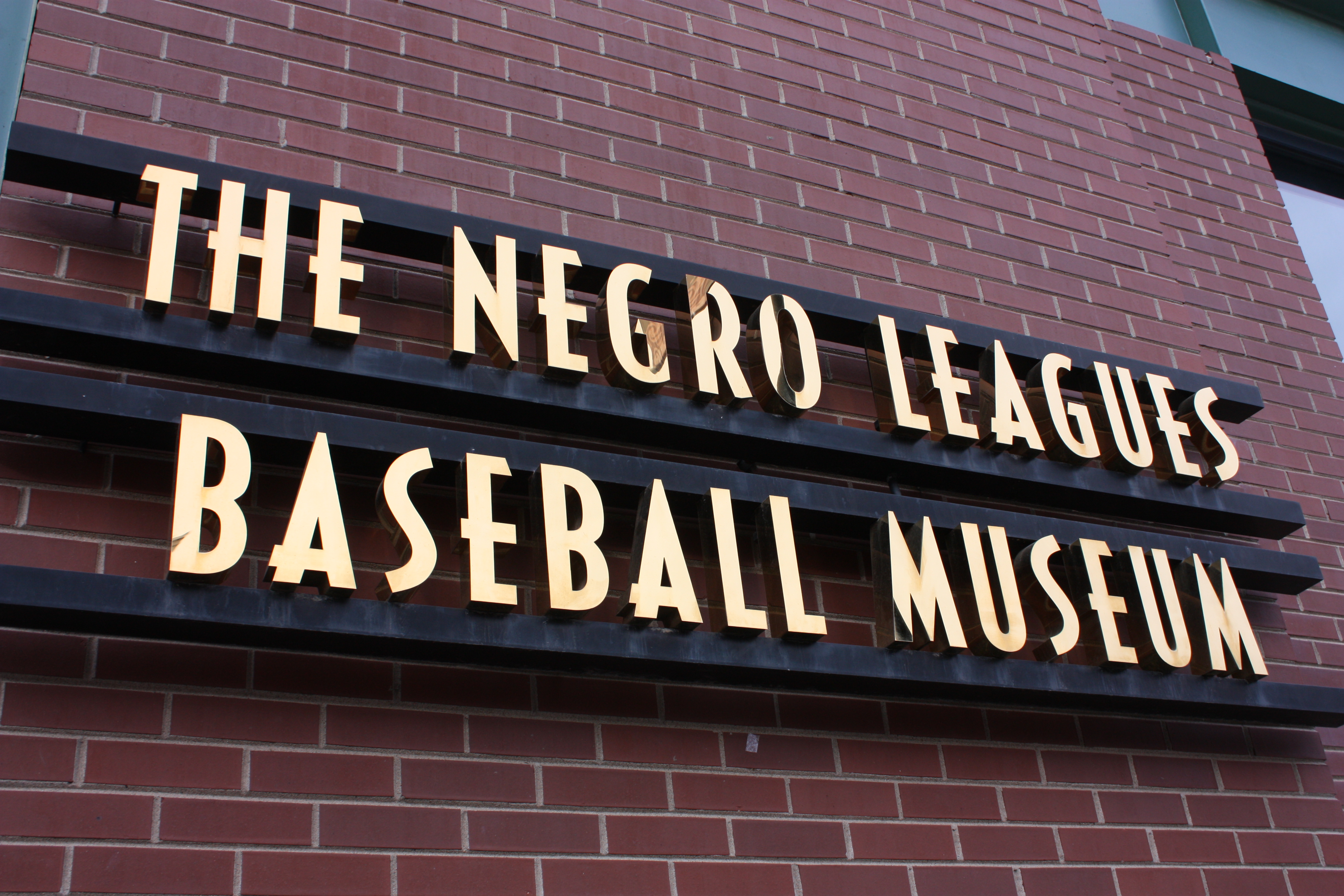
In an era when a “gentlemen’s agreement” among major league owners and commissioners kept blacks off the field, AfricanAmericans created their own baseball universe. In 1920, Andrew “Rube” Foster — “the father of black baseball” — met with other black team owners to create the Negro National League, the first organized black pro league. Other leagues followed. The hope was the big leagues would take-in one team from each main Negro league. It never happened.
Instead, it took another 27 years before the majors let in blacks. In the meantime, the Negro leagues prospered. The first Colored World Series was held in 1924. New leagues followed. The boom was from 1933 to 1947, with teams in KC, St. Louis, Indianapolis, Chicago, Detroit, Cleveland, Pittsburgh, Philadelphia, Birmingham, Memphis, Baltimore, New York, et cetera.
The Negro leagues featured comparable talent as the majors and, as the museum highlights, offered innovations, such as night baseball, years ahead of the bigs. Also documented is the fact Negro league teams fared well against major league teams in exhibitions. “We would have been in the majors” a lot sooner, O’Neil said, “if it hadn’t been for the segregation. What kept us out…was not the fans, but in fact the owners. See, the baseball fans, all they ever asked — Could you play?”
This “parallel” baseball experience was relegated to the back pages of white newspapers and to the shadows of mainstream history, yet it enjoyed every bit the cachet and support among black fans the major leagues did among white fans.
Black baseball also attracted white fans, particularly when Negro league teams like the Monarchs barnstormed to play exhibitions versus local town teams or major league clubs. O’Neil and his Monarchs packed them in at Western League Park and Rosenblatt Stadium in Omaha and American Legion Baseball Park in Council Bluffs.
Blacks had extra motivation in Negro versus. Big League games. “We had something to prove. We wanted to prove to the world they weren’t superior because they were major leaguers and we weren’t inferiors because we were Negro leaguers,” O’Neil said. ‘We were going to show ’em we can play, too. It was great competition.”
The high times are what O’Neil recalled best. Black athletes and musicians were THE celebrities in black communities and they socialized together. In KC, they stayed at the Streets Hotel, near where the museum stands today. “At the Streets Hotel I might come down for breakfast and Duke Ellington and them might be there and say, ‘Come over and have breakfast with us this morning.” Or Sarah Vaughan. You’re talking about jazz and baseball. That was here, that was Kansas City,” said O’Neil, his plaintive voice rising and falling like a soft riff.
When the Monarchs were in town, it was news. “Yeah, we were very well respected,” he said. “I’ll tell you how much — I courted a preacher’s daughter.”
Churches heeded their presence. “Sunday, 11 o’clock service, but when the Monarchs were in town, service started at 10 o’clock so that they (churchgoers) could get to the ball park. And then they would come looking good — dressed to kill. It was actually not only a ball game, it was a social event. The Monarchs, this was the thing. You saw everybody that was somebody there at the ball park. People would hobnob with their friends. Yeah, mmmm…hmmm,” said O’Neil, his sing-song patios swelled with the solemnity of a preacher and the jive of a hipster.

Grave of John Jordan “Buck” O’Neil in Forest Hill Cemetery, Kansas City, Missouri. Negro League First Baseman “Buck” O’Neil played from 1937 through 1954. Also O’Neil led the effort to build a Negro Leagues Baseball Museum & Hall of Fame in Kansas City, MO, which opened its doors in 1990.
Home or away, O’Neil said he and his fellow Negro leaguers felt the passion of fans.
“Oh, man, listen, the Rev. Adam Clayton Powell, Jr. at his Abyssinian Baptist Church
in Harlem, New York, preached a baseball sermon for the New York Cubans, the New York Black Yankees, the Kansas City Monarchs and the Memphis Red Sox before a four-team doubleheader at Yankee Stadium,” he said. “He preached that sermon, and man, the church was full. They followed us to the ball park. We had 40,000 at Yankee Stadium. We played over at Branch Rickey’s place” — Ebbets Field, home to general manager Rickey’s Brooklyn Dodgers — “and we had 20,000 there.”
Even the bus trips reminded O’Neil how fortunate he was.
“All you needed was a bus and I’ll tell you what, we traveled in some of the best money could buy during that period. And actually we stayed in some of the best hotels in the country — they just happened to be black owned and operated. We ate in some of the best restaurants in the country. Of course, during that time, the best cooks in the world were black. In that bus you’d have 20 of the best athletes that ever lived. To be able to play, to participate, to compete with these type of athletes, oh, it was outstanding,” he said. “As a young man from Florida, yeah, up north here in Kansas City playing baseball, outstanding really,”
It was Branch Rickey who signed Jackie Robinson away from the Monarchs in ’45 and brought him to the majors in ’47. Robinson was one of five blacks called up to the majors that year. O’Neil said Rickey’s enlightened move to buck the system made sound business sense. “Branch Rickey, the astute businessman that he was, saw this as a brand new clientele” to be mined, O’Neil said
O’Neil insisted the men who broke baseball’s color barrier helped ignite a social revolution. “When Branch Rickey signed Jackie to that contract that was the beginning of the civil rights movement,” he said. “That was before Brown versus Board of Education. That was before sister Rosa Parks said, ‘I won’t go to the back of the bus today.’ Martin Luther King, Jr. was just a sophomore at Morehouse (College). Jackie started the ball rolling right there in baseball.”
Robinson’s success and the success of players like Larry Doby proved, once and for all, blacks belonged on the same field, paving the way for others to follow. The same way Latino players dominate the game today, blacks did for decades.
As a Cubs scout O’Neil brought great black talent to the bigs, signing future Hall of Famers Ernie Banks and Lou Brock. He later scouted for the Royals.
He didn’t think much about his own place in history. He was too busy “running all over the country raising money” for the museum. “But, you see, I’m 94 and I ain’t going to live but 20 more years,” he said last July, smiling. “After I’m gone I want this to be here forever. That’s why we need an endowment.” To garner that support he met with everyone from MLB superstars to commissioner Bud Selig to billionaires Warren Buffett and Bill Gates to Hollywood celebs to ordinary fans.
What made him a great ambassador for the museum and the game was his ability to engage folks from every walk of life. He said he’d like to be remembered as “a spokesman for the Negro leagues — to keep this memory alive.”
Back in July, O’Neil made the rounds at KC ‘s Madrid Theatre for a Legends Luncheon, a program that raises funds for the NLBM. He greeted folks with, “Good to see you guys,” “How ya’ doin’ today?”, signed autographs and posed for pics. During an auction of baseball memorabilia, he worked the crowd, imploring and cajoling them to up their bids. “We’re going to start this off at $40. Forty, who’s going to say 40 for Buck? Fifty? Who’s going to give me 55? C’mon, bro’. Thank you, brother. Who’s going to give me $60? What do you say, sugar? There you go, love. Going once, going twice…I’ve got to let her have it,” and with that he sauntered over to the winning female bidder, embraced her and planted a kiss on her cheek.
To close the luncheon he did what became his trademark at public appearances. He invited people to join hands and sing along with him a melody from a song that best expressed the way he felt about baseball and its fans. As he crooned, he drew out each word, face beaming, lingering in the moment, basking in reflected after-glow of his adoring public.
“The greatest thing, in all my life, is loving you. Thank you, folks.” Thank you, Buck. Rest in peace.
Related Articles
- Negro Leagues to begin fundraising drive (seattletimes.nwsource.com)
- New stamps to honor Negro League baseball (sfgate.com)
- Museum trying to keep history alive (thestar.com)
- Negro Leagues baseball featured on new stamps (boston.com)
- Bronzed Heroes – John ‘Buck’ O’Neil (csdscustomcards.wordpress.com)
- Negro Leagues star Buck O’Neil always saw the best, even in the worst of times (sports.espn.go.com)
- Hall of Fame celebrates O’Neil’s legacy (mlb.mlb.com)
- Negro Leagues Museum picks Kendrick as president (boston.com)
My Midwest Baseball Odyssey Diary

Image via Wikipedia
With baseball season approaching, I’m digging into my archives for some national pastime stories I’ve done over the years with a decided Omaha flavor. Look for articles in the coming days and weeks related to Rosenblatt Stadium, the College World Series, the Negro Leagues Museum and such baseball icons as Buck O’Neil and Bob Gibson. I will also be posting stories I wrote about some local softball superstars. Here is a Midwest Baseball Diary piece I wrote based on a week-long, multi-state baseball tour of the Midwest I took with a group of Nebraskans and Iowans in the Year of the Home Run.
The 1998 Major League Baseball season became known as the Year of the Home Run for the dual chase of the Roger Maris single season HR record that Sammy Sosa and Mark McGwire enagaged in. That same summer I joined a group of Nebraskans and Iowans for a Midwest baseball tour that was actually part of a class about baseball and culture offered by Iowa Western Community College. The two young profs who taught the course were both baseball nuts and a few dozen similarly inclined folks spent a week on the road by bus to take in several big league and minor league games as well as baseball museums and shrines in four states. This is my embedded, immersive, first-person recounting of that trip and the many experiences we enjoyed on it. The story originally appeared in The Reader.
HERE IS HOW I ORIGINALLY SET UP THE STORY:
My lukewarm feeling about baseball got raised to a high fever the summer of 1998 because of an assignment I did that found me joining a baseball tour of the Midwest with some two dozen die-hard fans. The tour was actually offered as part of a local community college class looking at baseball in the context of popular culture. It was a good if exhausting experience that I may repeat one day.
The thing that sold me on the trip is that it coincided with the great home run race that season between Mark McGwire and Sammy Sosa, each of whom was chasing the single season record of Roger Maris. The fact that two star players involved in history were on two of the teams that we would be seeing play, in their home ballparks no less, was enough to convince me the timing was right. That and the fact that I felt a bit stale by then with my usual story projects. This would be something different, something away from my home base of Omaha, something that would push me out of my comfort zone.
I was happy with the results of the trip and with the story I wrote about it. The piece appeared in The Reader (www.thereader.com)
My Midwest Baseball Odyssey Diary
©by Leo Adam Biga
Originally published in The Reader (www.thereader.com)
“Whoever wants to know the heart and mind of America had better learn baseball…”
Jacques Barzun, French-born historian
Hearts and Minds
An overcast Sunday afternoon last summer found me joining 22 other pilgrims at Iowa Western Community College for the start of an eight day bus journey (July 26-August 2) exploring America via its most cherished game — baseball. As part of IWCC’s first “Baseball and American Culture” class/tour, we made a Midwest circuit of professional ball, attending games, visiting archives and speaking with players and officials, past and present.
Synergy was on our side too as, in the Year of the Home Run, we saw the two men chasing Roger Maris’ single season record in action.
Before departing we filed inside a lecture hall for an orientation by class instructors John Shorey and Bill Ricketts, young professors with the shaggy good looks of sandlot bums. In the spirit of the class, Shorey, a Cubs fan, and Ricketts, a Mets fan, showed their team colors. They laid-out the groundrules for the tour and had Creighton University professor and baseball author, Jerry Clark, steel us with diamond lore.
“Baseball is America’s game,” Clark told us. “There are those who feel this is no longer true. With things like players’ strikes and runaway salaries souring a lot of fans and sportswriters, some have been predicting the demise of baseball. Its demise has been forecast before. But baseball has always bounced back. It survived the Black Sox Scandal, the talent drain in World War II, the coming of TV. Now, we’re seeing a new resurgence of fans, fresh talent and new ballparks. What’s THE story in sports this year? Mark McGwire. He’s a folk hero. I envy you guys.”
Why follow the baseball muse down Mid-American byways? For me, it was about discovering what this game, that looms so large in the collective American conscience, means to people. These diaries are a compendium of what my fellow travelers and I found on our 1,700-mile journey. The result is a road story winding through the very heart of baseball and America.
Day One — On the Road
We look like any other tour group in our assorted ball caps, T-shirts, sneakers, shorts, shades and cameras. Our ranks range from die-hard fans (mainly Cubs rooters) to casual followers. The youngest aboard is 18, the oldest 65. Most squarely fit the demographics of baseball fans: white middle class Baby Boomers with disposable income to burn. Among our ranks are teachers, coaches, professionals, retirees. Most hail from Iowa. The rest from Nebraska. Eight days of total baseball immersion await us.
“Our traveling class,” as Ricketts calls it, finally hits the road at 3:30, bound for Kansas City. Hauling ass south on I-29, the Grant Wood Iowa landscape sweeps by in flat green and gold-speckled corn-row swatches. Marshy fields and roadsides are evidence of recent flooding along this bottomland. Traffic grows heavier the farther south we go, the undulating landscape taking on Thomas Hart Benton dimensions, spilling over itself like a wind-swept ribbon of earth. We arrive, just before dusk, at the Holiday Inn Sports Complex across from Kauffman Stadium. That night, a group of us descend on the sports bar off the lobby for some grub and get-to-know-you gab.
John Hazel of Omaha sports the full brush mustache, slicked-back hair, middle-age paunch, seasoned insight and avuncular ease of an old-time manager. His soulful eyes reveal hard times (He’s a recovering alcoholic working as a drug and alcohol counselor at St. Gabriel’s). His wiseguy voice betrays his Chicago roots. This lifelong student-of-the-game and Cubs fan is soon my personal guru on tour. Always ready to talk baseball, he explains what makes the game so special.
“Baseball is very unique in that there’s no time limit. A game can go on forever. It’s a team sport that’s built on individualism. There’s nothing like the one-on-one confrontation of pitcher and batter in any other sport. And there’s so much going on on any given play. There’s always something new, always something unexpected. In most sports you control the ball to score points. In baseball, the other team controls the ball while you try to score runs. It can be as cerebral as you want. It can be as basic as you want. It’s different things to different people.”
Speaking of differences, we’ll view baseball through the prism of the black experience, followed by the Royals-Anaheim Angels game tomorrow.
Day Two –The Best of Times, The Worst of Times
Setting out this morning we cross the George Brett overpass and traverse age-old racial lines en route to the Negro Leagues Baseball Museum at the epicenter of Kansas City’s 18th and Vine historic district, a traditional hub of black commerce and culture in the midst of a revival.
We pass the Holy Ghost New Testament Church, whose sign out front implores passersby “Don’t Give Up!” As we pull up to the baseball museum, which shares the same building as the Kansas City Jazz Museum, the area’s renaissance is apparent in the glut of nearby restaurants, clubs and theaters, which stand silent this early in the day. Lamp post banners proclaim “The Legacy Plays On,” no doubt referring to the legends honored inside and displayed in life-size neon cutout figures above the entrance.
We’re led into a small screening room with bleacher-style seating and watch a short film on the Negro Leagues. Later, we tour the museum’s vibrant exhibits, which give a fine sense for the dynamic flavor of black baseball and the heady impact it had on many communities. But the real treat is meeting Negro Leagues veteran Henry “Pistol” Mason, who still cuts a trim figure in his 60s. With the fervor of a Pentecostal preacher (He is a United Methodist minister today.) the former hard-throwing pitcher recalls breaking in with the Kansas City Monarchs . “I dreamed of being in the Negro Leagues. I came up by bus to Kansas City in 1951 from my hometown in Marshall, MO to try out. I can remember it as if it was yesterday.” Arriving with nothing but the clothes on his back, his strong right arm so impressed player-manager Buck O’Neil he was signed on the spot.
Mason toiled with the team during the 1951, 1952 and 1954 seasons, earning $250 a month. After their some 100-game regular season, Negro Leaguers like Mason went barnstorming in the off-season. Then, he says, it was all about “the love of playing baseball.” And wowing the crowd.
“We had a different brand of baseball. People wanted to see our brand of baseball, with its action and enthusiasm, running and bunting. It was more festive when we played. The fans enjoyed the game. Going to the ballpark was just like going to a picnic. We had something to prove too. We wanted to prove we were good enough to play in the major leagues.”
The then recent emergence of black players in organized ball gave new hope. “It meant that maybe, just maybe someday I could be signing a major league contract, and that dream came true when I signed my first contract with the Philadelphia Phillies.” In the Phillies minor league system he played for the Miami Marlins, with the legendary Satchel Paige as a teammate, and for the Schenectady Blue Jays. Off-seasons he earned big bucks playing south of the border. Back home, he endured racism.
“When we sent to spring training in Clearwater, Florida we couldn’t stay in the hotels. I was the only black baseball player in Schenectady. I ran into some difficulties there. When I walked into the clubhouse the first time I could just feel the tension. But you learned not to shoot your mouth off and to let your ability do your talking for you, and that’s what I did.”
Mason finally made it to The Show in 1958, recording only a few innings that year and in 1960. By then the Negro Leagues were dying, a casualty of the majors siphoning off the best black talent. Mason says the end of all-black baseball meant progress, but at a price. “It was good in one way because we were finally getting a chance to play in the majors, but bad in another way because it hurt a lot of black businesses that thrived off it.”
The game that night proves a let down. The reeling Royals lose 6-1 in a boring affair. The action’s scarce. The pace lethargic. The 17,000 fans apathetic. No spark, no panache, no pizzazz. That, and the scarcity of black players today, is why Mason doesn’t care to attend. Kauffman Stadium is a dreary concrete fortress outside and a gentrified gated-community inside. A white bread theme park with all the bells and whistles but minus the grit of the old stadiums or the charm of the new ones.
Day Three — Flirting with History
On the road by 8:30, we head east on I-70 for St. Louis and a rendezvous with destiny, we hope, in the form of a McGwire blast. But the Cardinals rate a poor second on this trip. Fittingly, Shorey announces, “It’s a great day today. Sammy hit two last night and we picked up a half-game on the Mets in the wild card race.” His fellow Cubbies roar approval. Ricketts stews. A daily tour ritual is getting USA Today or the local daily for overnight game summaries and box scores. The results invariably spark debate.
While in-transit Shorey prompts a discussion about yesterday’s activities. Dan Schleisman, a coach-teacher from Shelby, Iowa who likes getting a rise out of the home fans with his bench-jockeying, remarks, “I was really disappointed in the Kansas City crowd. Here I am cheering for the other team and they’re not even saying anything. Usually you can get a reaction from the home team.”
As for the museum, Laura Barker of Council Bluffs says, “Before I started this class I had no idea what blacks went through in baseball. Now I suppose every time I think about baseball that will be a part of what I think about.” From an educator’s viewpoint, Shorey feels “it reinforced what we’ve been talking and reading about and made it come to life.”
Heading into St. Louis a bridge takes us across the majestic Mississippi River. We check in at the Henry VIII Lodge and Inn and catch a bite before reaching Busch Stadium. First, we wend our way through the club’s front office for a briefing by P.R. man Marti Henden. In keeping with the Cards-Cubs rivalry, the big huckster needles us, saying, “Let me show you something you haven’t see before,” and holding out a fat finger adorned by a World Series ring. Cubs fans are used to such abuse, even revel in it. Calling 1998 “a very abnormal year for us,” he adds, “Thanks in large part to Mr. McGwire we’re going to sell three millions tickets for only the third time in our history.” St. Louis averted losing its fan base (as some cities did) during the ‘94 strike season, he says, by courting fans as never before. “That started the turnaround.”
Next, we tour the Cardinals Hall of Fame Museum across from the stadium. It recounts the club’s rich heritage in loving detail. With the gates opening at 5:10 for the start of batting practice, I join the line. Any other year, you’d find a mere trickle of fans this long before game time (7:10 start), but with the McGwire phenomenon in full swing the queue snakes around Busch. It’s humid, and by the time we settle in the upper right center field bleachers, downright stifling. Hardly prime home run hunting territory as McGwire, a dead pull hitter, rarely hits one out here. The stands are packed anyway. His every move scrutinized. His every swat “Ooohed” and “Ahhhed” by the faithful.
None of his pregame moonshots come our way.
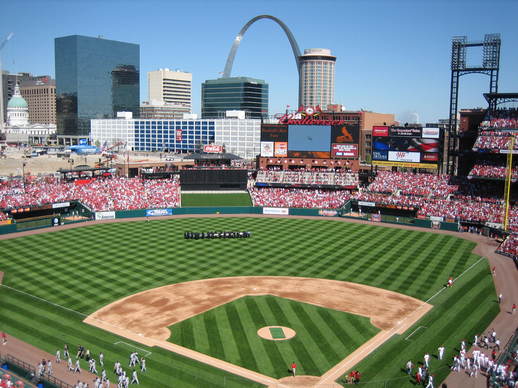
In the game Big Mac is kept well in check through the 7th by the Milwaukee Brewers. Even with his Cards trailing 8-5 and the putrid air hanging still in this fish bowl of a stadium, the crowd is alive and involved, a sharp contrast to K.C. The excitement builds as the Cards stage a dramatic comeback in the 8th, loading the bases with Ray Lankford up and McGwire on deck.
Lankford caps the rally with a grand slam, pulling the home team ahead, and igniting a wave of noise. With the place still buzzing McGwire settles in and suddenly, sweetly IT HAPPENS. His powerful uppercut sails a ball directly toward us, carrying up and over into a tangle of bodies rushing the lip of the fence for a crack at the prized souvenir. In the ensuing melee one lean young man emerges with the ball and, improbably, it’s our own Matt Oviatt, 18, of Logan, Iowa, who leaped several rows below. He deliriously holds the ball aloft, twirling around, charged with the good vibrations of 38,000 cheering fans, repeating over and over, “Oh, my God.” For one moment anyway, he shares the stage with a superstar.
The solo shot is only the second opposite field homer of the year by McGwire, his 45th overall, and gives him his 100th RBI.
Later, a still juiced Oviatt says, “I can’t believe I caught this ball. I’m feeling nothing but freaking joy. I was just hoping we could see Mark McGwire bat one more time before we go. I never thought I’d catch a home run ball. Then, I saw it coming and I just jumped for it. It hit my left hand, bounced, and I caught it in my right hand. I just had to squeeze hard when everybody started tackling me. It’d be awesome if I could get it signed.”
An ESPN Magazine reporter on the scene interviews The Kid and tries pulling strings to secure The Man’s autograph, but to no avail. Meanwhile, the Cards’ weak relief pitching falters in the 9th, giving up five runs, and the home team goes on to absorb a numbing 13-10 loss. Later, on the bus, Hazel expresses all our sentiments about Matt’s feat. “It’s got to be the thrill of a lifetime. One he’ll treasure for years. That’s what this game’s all about. It’s one of the reasons people keep coming back.”
Day Four — If It’ll Play In Peoria, It’ll Play Anywhere
The morning after, and The Catch is still the topic of the tour. Matt’s grab even made ESPN’s Sports Center highlights. His celebration must have lasted into the wee hours as he and his roomie straggle aboard some 15 minutes late. A sheepish Matt’s given a good razzing too. “This grandstanding has got to stop,” jokes Ricketts. Our star stores his coveted possession in a backpack he never lets out of sight.
Our next stop is Peoria, Ill. and a date with Rocky Vonachen, general manager and co-owner of the Peoria Chiefs, the Class A Cardinals affiliate we’ll see play this evening. We tool northeast on I-55, crossing the grand Mississippi again into Illinois. Shorey pops in a tape of “Bull Durham” to get us in a minor league frame of mind. You know, the band box parks, the kitsch sideshow antics, the groupies. As groupie extraordinaire Annie Savoy declares: “The only church that truly feeds the soul is the church of baseball…” Shorey asks, “Is baseball a religion?” Nancy Mulholland of Malvern, Iowa replies, “No, it’s an addiction though.” Shorey says we’re getting a taste of what life on the road is like for minor leaguers with the long bus rides, the motel stays, the fast food pit-stops. It’s getting old fast.
Ensconced at the Fairfield Inn, we head for the ballpark. It’s about on par with a major college baseball stadium. The outfield fence screams with ads for River City Demolition. Bliss Implement Co. and Butternut Bread. Dressed in sport shirt and shorts,Vonachen greets us in a small picnic area down the right field line. He’s a genial guy eager to share the ins and outs of running a minor league franchise. His father, Pete, for whom the stadium’s named, owned the club in the 1980s. Then, when the Chiefs languished under outside ownership and were in danger of moving, Rocky and a group of Peorians bought it in 1994. The timely investment came in a booming market. Where the franchise sold for $100,000 in 1982, it brought $2 million in 1994. Triple A clubs sell for five times that. Gate receipts are up too.
“Minor league baseball is growing by leaps and bounds. Back in the early ‘80s it was more of a Mom and Pop business. Now it is big business,” he says, adding the ‘94 strike provided a catalyst for the minors.“People still wanted to see professional baseball and started going to minor league parks. Parks across the country saw an influx of fans during the strike. As people got to see minor league baseball they found how affordable and fun it was. At the minor league level, it’s entertainment, folks. We do all the goofy promotions and all the giveaways at the gate because that’s what families come out for, and we focus on families.”
Chiefs tickets, typical of the minors, range from $3.50 to $5.50. During a pregame picnic-style repast players (in full uniform) grab supper at the concession stand. The game is marked by sloppy play, including drops of several easy fly balls. Maybe it’s the uneven grass field, which suffers from some kind of rot, or the low wattage lights overhead. The Chiefs’ fan-friendly attractions include a grocery cart race, a mascot, a contraption flinging T-shirts in the stands and Trash Man, a Generation-Xer in black tie, shorts and Day-Glo tennis shoes who dances in the aisles when not retrieving refuse. The distractions include the local groupies, brickhouse babes whose conspicuous primping behind the dugout and bullpen has heads turning all night. Still, far more families than singles are on-hand.
By 8:30, Magic Time rolls around, the setting sun muting the night sky in pastel shades of blue, purple and pink and, with the light towers, casting a burnished glow on the field that etches players in a kind of soft electric haze. Very Rockwellian. The Chiefs win in a rout 9-2 and personally greeting fans on the way out are Rocky, his dad and staff. “Thanks for coming. Hope you come back again.” They mean it too.
“That’s what minor league baseball is all about,” Rocky says.
Day Five — Baseball of Another Kind
By now we’re a caravan of gypsies wheeling from one baseball camp to another. We depart a little past 7 a.m., our earliest start yet. The discussion centers on last night. Everyone agrees the Chiefs put on a good show. Tom Lustgraaf of Council Bluffs, says, “To me, the things they’re doing are the things that will keep baseball alive and make it a positive experience for fans.” Lana Taylor, a nurse from Hastings, Iowa, notes how much more “relaxed” and “friendly” the confines were compared to the big league parks. “The goings-on really got me excited.”
Traveling northeast on I-80, we navigate our first toll roads and pass our first rock quarries. The Holy Scriptures of the tour, “The Baseball Encyclopedia,” is reverently consulted in settling trivia disputes. We’re bound for South Bend, IN, where we’ll meet All-American Girls Professional Baseball League veterans and catch the hometown Class A Silver Hawks. For proper inspiration we view “A League of Their Own.” Later, Shorey strikes a nerve asking why girls play softball, not baseball. A battle of the sexes erupts but nothing’s settled.
The site of our panel discussion with the All-American Girls is the Northern Indiana Center for History, an old stone mansion with extensive gardens. Inside it’s bright, modern, airy. We sit in an auditorium to watch a documentary on the women’s league, with some of the featured players right beside us. When the video shows a reunion of players singing the league’s anthem, the teary-eyed veterans present sing-along.

The five panelists, who played in the ‘40s and ‘50s, soon enchant us. We pepper them with questions about their uniforms (they began with skirts and went to pants), about the charm school set-up for them (“It didn’t rub off,” one quips), about breaking tradition (“We weren’t out to strike anything for women’s lib. We were just grateful we got to play baseball,” explains Janet “Pee Wee” Wiley.). Elizabeth “Lib” Mahon says when a scout asked her, “‘How’d you like to play ball for money?’” she replied, “‘Money? I’d play ball for nothing.’ It was the opportunity of a lifetime. It changed my life completely. I have friends all over the country now because of it.”
Betsy Jochum notes the attention the league’s received this decade “has made us realize how unique it was to have a league of our own.” Frances “Big Red” Janssen adds, “It’s amazing to us people would still be interested in what we did.” Adds Lou Arnold, “It’s a pleasure for us to be meeting you people today. It’s like the feeling at our reunions — so warm.” The feeling’s mutual.
After the Q & A we rush the stage for autographs and a chance to kibitz one-on-one. Then we all go downstairs, where the veterans proudly show us a case filled with league memorabilia. Later, at our Super 8, it’s clear the women left quite an impression.
“The ladies were fantastic. I’d love to sit in a bar some night and really have a ball,” says Mulholland, a lifelong fan who grew up a tomboy on an Iowa farm, played catch with her dad when he came in from the fields and avidly followed town ball. “They’re just plain ordinary women, as common as dirt, who made a great difference in baseball and America in general.”
Chris Hartwig of Logan, Iowa adds, “Hearing the women’s stories and seeing their emotion and excitement about being part of history touched me quite a bit. I think it gives me a more complete love and appreciation for the game.” Hazel, who saw All-American games as a boy with his dad, says, “Once the game began there were no differences. It was a baseball game.”
South Bend Stadium is a spiffy new facility out of character with the old brick and mortar warehouse district it occupies. The immaculate grass field puts Peoria’s to shame. The South Bend-Kane County Cougars game goes by in a blur, overshadowed by nearly non-stop music, promotions, gimmicks. The star attraction is Myron Noodleman, a Jerry Lewis knock-off whose geek show leaves us cold, though the abundance of kids present eat it up. Still, on a cool clear night like this nothing can detract from the magic amber dusk illuminating this Elysian field where men are made boys again.
Day Six — Take Me to the Promised Land
A sound night’s sleep and late start (9 a.m.) buoy us in advance of Chicago’s Wrigley Field, mecca for our Cubs contingent. After St. Louis, we feel fate leading us to Mr. Sosa, who’s been on a tear. As an added bonus, pitching phenom Kerry Wood is on the mound today. It’s gorgeous out and soon the virile Chicago skyline crops into view. Nearing downtown, a Cubs video treats us to a swinging version of “My Sweet Chicago” and Harry Caray’s signature “Holy Cow.” Tidy row houses and cozy bars line the narrow congested streets of the neighborhood around Wrigley Field.
Parked by noon, we walk to the promised land. The Cubs-Colorado Rockies game has a 2:20 start, leaving ample time to eat, shop, browse. The energy is palpable. A Chicago Sun-Times vendor notes my K.C. Royals hat and asks, “Sir, you have the wrong cap on today, don’t you?” Boy, do I.
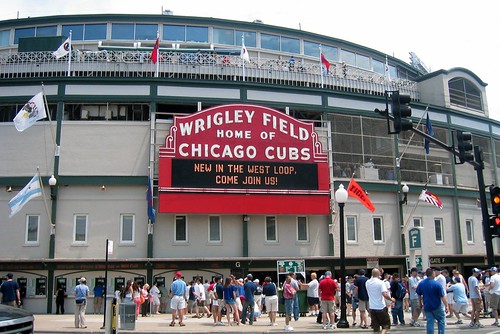
Wrigley is a tavern of a stadium. A homey place where beer flows freely and patrons mix easily. It throbs with the pulse of the city, as fans root atop adjacent brownstones and arrive via L’s lumbering overhead. Back on his home turf, Hazel beams like a kid again on his old stomping grounds.
“That’s exactly what Wrigley Field is — home. So many memories are coming back of my Cubs childhood. I was born and raised within walking distance of Wrigley. I remember coming home from school in the middle of summer to our hot apartment and finding my mother in her bra and half-slip with a quart of Pilsner beer in one hand and an iron in the other, watching the Cubs game on TV. I was about 8 when my folks took me to my first game. Later, I went with buddies after school to catch the last couple innings of games. They let us in free. The homework could wait. Summers, we sat in the bleachers for 50 cents. It’s a fantastic place. There’s nothing like it, eh?”
Nothing indeed.
Even with the Cubs winning handily (by a final score of 9-1) most fans remain boisterously attentive throughout. The few idiots who dawdle in the aisles elicit cries of “Down and front!” The 40,000 Cubs faithful leave happy, having seen Sosa smash his 42nd homer (it lands no where near us) and Wood notch his 11th win. A briskly played game on a crisp afternoon in the Tottling Town. Who could ask for more?
After crawling through rush-hour traffic we spend the night at a Quality Inn. Some do the town, scoring autographs at Harry Caray’s place. I enjoy my first decent meal at a Greek Town eatery. Sated, I sleep soundly.
Day Seven — Dream State
Another fair weather day finds us still in high spirits from the the Wrigley trip, which rates a rave from most. Ricketts sums it up with, “For me it was like going back into history. I feel like I could have been there in 1902 and experienced the same thing. I’m a Mets fan and I thoroughly enjoyed my time in Wrigley Field.” Adds Hazel, “On behalf of the city, I appreciate the comments…It is a special place.”
Illinois-20, a classic American back country highway, follows the rolling contour of the planted fields and patchwork meadows spread out on either side. As we watch “Field of Dreams” I realize it’s search for simple truths parallels ours. Seeing it right before arriving in Dyersville, Iowa lends a surreal quality to an already other-worldly site. Sure, it’s a tourist trap, but with a difference. It may only be the film’s influence, but a ballpark merging with a cornfield into an endless horizon is a kind of never-never land come to life. A place where time stands still and dreams unfold.
The place is crowded, kids and adults alike lined up waiting for a crack at the ball, others jostling for a spot in the field. Why do we come? A pretty young Texas woman, traveling with her sister on a baseball pilgrimage of their own, offers a clue. Peering out at the field, Kris Flabiano says, “I mean, just look at this. There’s people here from every state and they’re all playing ball together. Everybody’s talkin’ to everybody like they’re next door neighbors. Baseball’s a staple. It holds people together.” Our own Lana Taylor adds, “It’s like living a baseball dream out there. It’s reliving things.”
Once back on the Illinois side of the Mississippi we meet two minor league umps who compare their travails of making it to the majors with that of players. They describe a “brotherhood” among The Men in Blue and the restraint needed to weather expletive-filled temper tantrums on the field.
Hopping the border to Davenport, we stow our gear at an, ugh, Super 8 and then make the Quad Cities River Bandits-Burlington Bees game. Davenport’s downtown riverfront provides a scenic backdrop. Just outside the quaint, brick-faced Quad Cities stadium, casino and cruise boats course down the Mississippi on one side and freight trains rumble past on the other. Added to the organ tunes, the vendor barkers, the lively fans and the heroics under the lights, it makes for a carnival atmosphere. After the River Bandits thump the Bees 11-1, a fireworks show sends us off with a bang.
Day Eight — Coming Home
Daytrippers at last. No more motels after tonight. “Headed for the home stretch” is how one of our group puts it. By 8 a.m. we’re bound for the Amana Colonies and a hearty brunch. We hit our first patch of inclement weather nearing the Bob Feller Hometown Exhibit in Van Meter, Iowa, a shrine to the fireballing Hall of Fame pitcher. A sculptual relief mural outside shows “Rapid Robert” delivering one of his high hard ones. Moving ever eastward, we gather at Sec Taylor Stadium in Des Moines, home of the Iowa Cubs, to hear hitting instructor Glenn Adams talk about helping players “be selective” at the plate, pitcher Kurt Miller describe life in the minors as “a job” and G.M. Sam Bernabe extol the virtues of “group sales.”
After a steady diet of Class A ball, this Triple A outing is a welcome way to end the trip. The park, a smaller version of Omaha’s Rosenblatt Stadium, features 44 skyboxes. Fixtures aside, the scene here or at any ballpark is much the same. Baseball invites fans to take it in their own measure. To banter back and forth about the game or life (maybe it’s the same thing), whether it’s Dan Schleisman yelling “C’mon guys, rally time!” or John Shorey musing why “there’s no phrase for an easy grounder,” unlike, say, “a can of corn” for an easy popout.
“Due to the nature of the game, with its momentary lulls,” says John Hazel, “there’s a camaraderie in the stands among the fans, be they rich-poor, whatever. It’s a real simpatico type thing.” Jack Duggan of Omaha adds, “What I like about it is you can keep up with what’s happening on the field and converse at the same time.”
Yes, the game flows like a great river from town to town, its mighty current rolling slowly, methodically on. You can return to it at your leisure and know it’s still there. “I think that’s the beauty of the sport,” says Shorey. “The times, the players, the issues, the settings may change, but the game itself doesn’t change.” There’s comfort in that. In its continuity and connection to more earlier times, like Nancy Mulholland playing catch with her dad or Hazel sneaking into Cubs games. In its being a proving ground and launching pad for the Henry Masons or Elizabeth Mahons of the world.
If I had to boil it down to one truth, baseball is big and enduring enough to embrace America’s dreams. It’s like coming home.
P.S. Iowa lost 6-4 to the Colorado Spring Sky Sox. But that’s besides the point, isn’t it?
“This field, this game, is a part of our past. It reminds us of all that was good, and that can be good again…”
From the film “Field of Dreams”
Related Articles
- Museum trying to keep history alive (thestar.com)
- Andre Dawson day at Wrigley Field (cubhub.net)
- Polish Heritage Night, First Time at Wrigley Field, sponsored by PEPSI (gloucestercitynews.net)
- Herzog’s teams surfed on artificial turf (mlb.mlb.com)
- Royals, Cards set to renew storied rivalry (mlb.mlb.com)
My Brother’s Keeper, The competitive drive MLB Hall of Fame pitcher Bob Gibson’s older brother, Josh, instilled in him (from my Omaha Black Sports Legends series, Out to Win: The Roots of Greatness)
The first time I met Major League Baseball Hall of Fame pitcher Bob Gibson he threw me for a loop, pun fully intended, when instead of the hour or so interview he agreed to he accorded me nearly five hours of his time. I had been steeled to expect the worst, having read and heard how difficult he could be to media types like me, but he was thoroughly charming, patiently answering question after question. Only once or twice I was on the receiving end of his icy stare, the same glowering, suffer-no-fools-gladly stare that had intimidated hundreds of batters. That marathon interview ended up feeding two profiles I did of him on the occasion of his second autobiography’s release.
The following story resulted from a second interview he gave me, this time by phone, that concentrated on his relationship with his late older brother Josh. He confirmed for me what an important figure Josh was in his life and in the lives of many young blacks in north Omaha. As the story reveals, it was Josh who really drove Bob to be the supreme competitor we came to marvel at. It was Josh, himself a fine athlete and coach in his day, who like so many blacks of an earlier era never got his own chance to shine.
A version of this story first appeared in The Reader (www.thereader.com) as part of an Omaha black sports legends series I wrote called Out to Win: The Roots of Greatness. I later updated it for Nebraska Life Magazine.

My Brother’s Keeper, the competitive drive MLB Hall of Fame pitcher Bob Gibson’s older brother, Josh, instilled in him (from my Omaha Black Sports Legends series, Out to Win: The Roots of Greatness)
©by Leo Adam Biga
Originally published in Nebraska Life Magazine (2005); an earlier version published in The Reader (2004) as part of my Omaha Black Sports Legends series, Out to Win: The Roots of Greatness
When Hall of Fame pitcher Bob Gibson dreams, he dreams baseball. “Oh, I dream all the time about it. It drives me crazy. I guess I’m going to do that the rest of my life,” he said. He may even relive some of the boyhood nights spent throwing from the crude mound his oldest brother Josh fashioned for him. He may see himself pitching and Josh catching, critiquing his every move. Together again, two brothers linked in a legacy of competitive excellence.
Gibson perfected the art of intimidation in a 17-year playing career with the St. Louis Cardinals. From atop the mound, he threw glaring daggers into batters, who felt the fury of his inscrutable game-face. Those foolish or brazen enough to lean-out over the plate got his trademark calling-card — a 95-mile-per-hour fastball, riding-in high-and-tight, perhaps grazing their shirt or helmet, sending the cowed interlopers cartwheeling backwards or even sprawling face down in the dirt.
The brushback or knockdown pitch sent a clear message: Back off, sucker, or I’ll put you down if you crowd the plate. It was all a mind game meant to gain Gibson an edge. He was a master at it. If anyone molded him to be this ultimate competitor it was his late brother, Leroy Josh Gibson, a guru, mentor, coach, teacher and worst nightmare all rolled into one. Growing up in the Logan Fontenelle Housing Projects of north Omaha, Bob learned from Josh how to be a winner.
‘Big Guy’
Born into a poor family, Bob was the asthmatic youngest of five brothers whose father, Pack, died before he was born, leaving much of his rearing up to Josh, 15 years his senior. From the time Josh wrapped a sickly 3-year-old Bob in a quilt and carried him to the hospital, his big brother was his “protector.” The formidable Josh was a hard-boiled World War II Army vet disenchanted by racism in the service and at home. A standout athlete, he briefly attended Alabama State, where he played some football. He was also adept at basketball and baseball. Bob wasn’t around to see Josh in his athletic prime, but he said even in his 30s his older brother “could run. He could move for a big guy.
Intent on being a public school teacher and coach, Josh found opportunities denied him and settled, temporarily, for a Swift packinghouse job. He began working at the local north Omaha YMCA and Boys Club, organizing and coaching teams in basketball, baseball and softball (with the late Marty Thomas), all the while pursuing a bachelor’s degree from then Omaha University and, later, a master’s from Creighton University. Before they were called select teams, Josh recruited top athletic talent from north O to form the High Y Travelers, an elite adult basketball team, and the High Y Monarchs, a crack youth baseball team. “He got the best of the best,” said former Traveler John Nared. The teams, comprised wholly of blacks, took on all-comers across Nebraska, western Iowa and northern Kansas.
Josh left a big impression on Bob and hundreds more he taught athletic and life lessons to. “More than anything else, he was a father-figure to most of the kids down in the housing projects, me included,” Bob said. “There were a lot of kids there like me that didn’t have fathers at home and he was respected even more for the role he played in that capacity than for being a coach. What impressed us more than anything else was him coming down to the ballpark carrying his college text books, which he’d put aside to train us. We figured, Hell, here’s an ‘old man’ still going to school — it’s gotta be important. You’d be surprised how many of those kids out of the housing project were influenced by that.”
Jim Morrison, a teammate of Bob’s, said Josh had “the ability to elicit the best out of young potential stars. He started with the head down, not the body up. He taught you how to compete by teaching the fundamentals.”
Indeed, Bob called Josh “a fundamentals freak.” Bob explained, “We would have a basketball practice and everybody, you know, wanted to shoot and score points and, instead, he’d make us play defense for I-don’t-know-how-long while he and some of his friends played offense. He made sure we knew how to play the game and that every one of us knew exactly what to do and when to do it. He taught us to think on our feet more than anything else.”
Josh was not content with players knowing the basics and going hard. They had to win, too. “You know how you’re growing up and people are always telling you, It’s not whether you won or lost, but how you played the game? Well,” Bob said, “he didn’t have that thought. Winning is everything — that’s the attitude he had, and I grew up with that. It was like, Hey, I’m not out here just to play and have fun — I’m out here to win. I want to be better than the next guy.”
Josh’s fire burned so deep he sometimes lit off during games when he felt his team was getting jobbed or dis’sed. “Oh, no, he wouldn’t stand for it at all,” Bob said. “He was a fierce competitor.” He recalled how during Monarchs road game, typically played in some backwoods town, an irate Josh would get so worked-up he’d walk “out to the middle of the field… challenging to fight everybody there. Nobody wanted to take him on. You know, he was a pretty big guy. I mean, he was an imposing figure…about 5’11 and 240 pounds.”
That defiance came to define Bob’s own disposition. “You see that stuff and that gets in the back of your mind,” he said, “and you ask yourself, Is this the way it’s supposed to be? Maybe you’re supposed to fight like that. Well, I had no problem fighting.” Bob also felt Josh’s fury during pick-up basketball games, something the Gibson brothers often engaged in. Even with his little brother, Josh gave no quarter, “Oh, yeah, Josh was a bully,” Bob said, laughing. “He wouldn’t hesitate to run right over you…It was really kind of funny because as a real young kid I was small and skinny. I was 5’0 tall and weighed 99 pounds when I got to high school. But as I got older and I got bigger he used to try and run over me and couldn’t do it because I was just as much a competitor as he was.”
‘Professional Man’
As hard as Josh drove his charges, he drove baby brother hardest. In his 1994 book Stranger to the Game Gibson writes, “There were…times when I wondered if Josh was going kill me himself. He was much harder on me than he was on the rednecks…no doubt because I had committed myself to becoming a pro ballplayer and Josh wasn’t going to let me default on the commitment. The other guys on the team would watch silently after practice when Josh would order me back on the field and hit me vicious ground balls until the sun set.”
It was the summer of 1947 when Josh first sat him down for a tough lecture about the then-11-year-old’s future as a “professional man,” by which Josh meant a pro athlete, a once distant dream made more real that summer by Jackie Robinson’s breaking the color barrier in major league baseball. Bob recalls Josh talking to him about making “the commitment” to become a ballplayer and for the next few years the big brother pushed his young sibling to the edge and back. Bob, who says his best sport from early youth on through college was basketball, naturally figured playing hoops would be his best shot at the pros. “I was actually a better basketball player and he realized that, too.” But he suspects Josh saw baseball as his ultimate ticket out of the ghetto. Indeed, it was Josh who first taught the future Hall of Famer how to pitch, even catching the wild but hard throwing youngster on a makeshift diamond outside Kellom School. Josh built-up a mound and marked-off a spot for home plate for what became a daily ritual.
“He used to have me pitch a lot,” Bob said.” He’d correct me on various things and teach me things. After I got a little bit older and I started doing a little thinking on my own, I disagreed with him a lot…the way kids do.” Under Josh’s tutelage, Bob’s natural gifts became apparent. “From March until the snow flew I had him out there throwing at me — starting at 10-minute stretches and moving up to a half hour,” Josh said in a 1964 Omaha World-Herald interview. “It wasn’t long before Robert could really hum that ball. There were times when he wanted to be off with the other boys, but I kept him at it.”
In games, Josh rarely pitched Bob. “I played outfield or shortstop most of the time, but I also played first base and I caught, too,” Bob said. The molding of Gibson did not go unnoticed and led to Bob and his friend, the late Jerry Parks, playing for different legion and sandlot teams. The pair were even recruited to play for a frequent road competitor — the Woodbine (Iowa) Whiz Kids, coached by Red Brummer. “We were kind of like ringers.”
But baseball was neither Gibson’s first love, nor his best sport. Former college basketball great and NBA All-Pro Bob Boozer, a teammate of Gibson’s for a short time at Omaha Technical High School and with the High Y Travelers, said, “He was a finer basketball player than baseball player. He could play. He could get up and hang.” When Gibson was coming up, word traveled fast that Josh’s kid brother had game. The buzz was, “This kid can really jump, man,” Tech teammate Lonnie McIntosh recalled. “He had to duck his head to dunk.”
As a prep hoops star, Gibson had few peers. His Tech High basketball coach, Neal Mosser, said, “He could have played today — that’s how good he was.”
Despite the time he spent developing his skills on the mound, Bob said Josh did not try swaying him to pursue baseball in favor of basketball. “He never tried to influence me one way or the other which I should do. Not at all.”
While his baseball prowess was more raw potential than reailty, Jim Morrison said, “He threw so hard, we called it a radio ball. You couldn’t see it coming. You just heard it.” He said Gibson exhibited his famous ferocity early on. “On the sideline, Bob could be sweet as honey, but when he got on the mound you were in big trouble. I don’t care who you were, you were in big trouble.”
During the summer American Legion baseball season before his junior year at Tech, Gibson earned all-city honors as a utility player. His talent was such that before graduating he got an offer from the Kansas City Monarchs of the Negro Leagues and long looks from scouts of several major league clubs. Even those credentials could not overcome racism back home in an era when public school coaches were uniformly white and either openly opposed playing blacks or did so sparingly. He even found himself turned-away by then-Tech baseball coach Ken Kennedy. It wasn’t until his senior year, under new coach Tom Murphy, he even got a chance to play baseball for Tech, making the team at shortstop.
Where the hard-driving Josh left off grooming Bob, Tech’s Mosser took over. “Neal Mosser was so much like my brother,” Bob said. “He taught fundamentals, too. He did a lot as far as me going from a young boy to a young man. It was more the way he carried himself than anything else and the respect he had for us as players.” By all accounts, Mosser was color-blind. “Race just never seemed to be a part of his thinking,” Gibson said. “As a matter of fact, we went to the state tournament in Lincoln my senior year and he started five black players. I give him a lot of credit for that. That night, you could hear a pin drop. And he didn’t give a shit. He just wanted to win.”
With the fast-breaking Tech team frustrated by Fremont High’s slow-down tactics, the referees seemingly conspired to give the edge in the nip-and-tuck stalemate to the Tigers. It was neither the first time nor the last time that a predominantly black team from Omaha got the shaft. As if he still can’t accept it, Gibson said, “By the end of the first-half four out of our five starters fouled-out, and within a couple minutes of the second half I fouled out, and I never fouled out. They were cheating us. It was that blatant. And Mosser did the same thing Josh did — he was out in the middle of the floor screaming, and I thought he was going to have a heart attack.”
There was nothing Mosser or anyone could do. Tech lost 40-39. Losing a game is one thing. Having it taken away is quite another. The pain of it made Gibson cry. He said it was the last time he ever shed a tear over a loss.
‘Desire to Win’
Gibson had his sights set on a major college hoops scholarship. He played summer AAU ball in an effort to capture the interest of powerhouse Indiana University. When Mosser contacted the Hoosiers’ head coach, he was told the program already had its “quota of blacks.” At Josh’s urging, hometown Creighton courted Bob and he accepted their scholarship offer, thus breaking the sports color line in the modern era there. He became CU’s career scoring leader. He also showed promise on the mound, further cementing his status as a pro prospect with his play in summer semi-pro ball.

Bob Gibson at Creighton University
Upon graduation, the only NBA feelers came from the Minneapolis Lakers, but when his play for a college all-star team sparked a rare win over the famed Harlem Globetrotters, he was promptly offered a contract to join the traveling hoops circus. Around the same time, he also signed with the St. Louis Cardinals. For a year, he pulled a Bo Jackson — playing two pro sports, pitching for the Cardinals Class A club in Omaha and, in the off-season, hooping it up with the Trotters on cross-country tours.
He moved quickly up the Cardinals’ farm system, joining the big league club in 1959. He became an everyday starter in ’61 and, by the mid-’60s, established himself as one of baseball’s premiere pitchers. In a 10-year stretch from 1963 to 1972 he was arguably the game’s best hurler, posting a 191-105 record, winning two Cy Young Awards, annually ranking near the top in strikeouts and ERA and leading the Cardinals to two World Series titles, capturing the series MVP award each time. His dominant 1968 MVP season was, as he put it in his book, “the year I mastered my craft.” In compiling a 1.12 ERA, 13 shut outs and 28 complete games, he enjoyed perhaps the best single year performance by a pitcher in the modern era.
Gibson, who’s observed his share of fine athletes during his days as a pitcher, coach (with the New York Mets and Atlanta Braves) and broadcaster, believes all the greats share some qualities. It’s no coincidence they include some of the same characteristics Josh helped instill in him years before. “Desire to win. Desire to be better than average,” he said. Then there are the unteachable things. “The will to stick with it. The focus to block out everything else going on around you. Ability doesn’t hurt, either.”
Along the way, Josh reveled in Bob’s ride to stardom and 1981 first-ballot induction into the Hall of Fame, although the two rarely talked about it. Not long before his enshrinement, Bob paid Josh the ultimate compliment, saying, “He’s the one who taught me to be an athlete.”
‘Mutual Respect’
During and after his career Gibson earned a reputation as a blunt, uncompromising man in speaking out against unfair housing practices and employment opportunities in St. Louis and Omaha, where he had various business ventures. For the past two decades, he’s lived with his second wife and family in Bellevue. Today, he maintains ties with the sports world by serving as a Cardinals special instructor in spring training and participating in fantasy baseball camps. From 1997 to 2004, he hosted an annual charity golf tournament that brought in dozens of sports legends.
He enjoys getting together with other athletes from the past and reminiscing about their shared youth. “I think one of the things that makes athletes different than the rest of society,” he said, “is that regardless of what game you play it allows you to remain as a youth…a child. You don’t get any older. You have that same type of feeling. As an athlete you want to cry when you have to quit. It’s something you’ll never be tired of.”
Hanging with Sandy Koufax or Bill Russell, Gibson feels young again. Then, too, there’s the unspoken warrior fraternity he and the others embody.
“There’s a mutual respect you have without even talking about it. It’s just simply understood.”
It’s the same way he and Josh felt about each other.
Related Articles
- It’s finally the Year of the Pitcher again (denverpost.com)
- Forever Connected (slidingintohome.blogspot.com)
- Ubaldo Jimenez, Roy Halladay, Armando Galarraga and now Stephen Strasburg — it’s the Year of the Pitcher in baseball, and we love it (sports.espn.go.com)
- Gibson (joeposnanski.si.com)
- Book Review: Sixty Feet, Six Inches by Bob Gibson & Reggie Jackson (othemts.wordpress.com)
- Back in the Day, Native Omaha Days is Reunion, Homecoming, Heritage Celebration and Party All in One (leoadambiga.wordpress.com)
- The Ties that Bind, One Family’s Celebration of Native Omaha Days (leoadambiga.wordpress.com)
- Lifetime Friends, Native Sons, Entrepreneurs Michael Green and Dick Davis Lead Efforts to Revive North Omaha and to Empower its Black Citizenry (leoadambiga.wordpress.com)


 Leo Adam Biga's My Inside Stories