Archive
Imagemaking celebrated at Joslyn Art Museum: “The Misfits” and Magnum Cinema

Image via Wikipedia
I love writing about film, and several of my new posts will reflect that. The following article for The Reader (www.thereader.com) appeared in 2003 to report on an exhibition of Magnum photos and a screening of the classic film The Misfits at the Joslyn Art Museum in Omaha. The connection between the photo agency and the film is explained in the piece, but suffice to say that my main interest was in writing about a film I always admired, even as a kid, when its adult themes were well beyond my years. But the melancholic work resonated with me even then, perhaps because I so strongly identified with its outsider characters and their vulnerability. Every time I watch the movie I glean new insights from it. Of course as I got older I learned that this was the last film of both Marilyn Monroe and Clark Gable, one of the last that Montgomery Clift made, and that the marriage between Monroe and the film’s screenwriter Arthur Miller was effectively over, all of which lends the performances a tragic certain patina. Kevin McCarthy, who played Monroe’s husband in the opening scene, was the special guest at the revival screening of The Misfits. I did an advance phone interview with him and he was just a delight to speak with. I saw on the news that he passed away the other day.
My friend and fellow Omaha native Gail Levin, a documentary filmmaker, took the measure of the potent forces at work in the film and on the set in her film, Making the Misfits. Find other posts on this blog about Gail and her work, including her documentary about James Dean. One of her latest films profiled Jeff Bridges.

Imagemaking celebrated at Joslyn Art Museum: “The Misfits” and Magnum Cinema
©by Leo Adam Biga
Originally appeared in The Reader (www.thereader.com)
It is only fitting a photographic exhibition at Joslyn Art Museum capturing candid moments of movie legends should kick off with a screening of the legendary film The Misfits, a picture resonating with so much of what makes the movies alluring.
From iconic stars who met tragic deaths to an enormously talented writer and director dealing in potent themes to a majestic Western landscape filmed in moody black and white and riddled with rich metaphors, The Misfits has it all. The film, apropos its title, is an evocative tale, sparely and honestly told, about the disenchantment and yearning of drifters and dreamers hanging on to an endangered way of life in the vanishing wild of the Nevada desert. It is a quintessentially American story about pursuing individual freedom and expression in a conformist world and following dreams, even if deferred, with the aid of a star.
Omaha film impresario Bruce Crawford is presenting, in his usual boffo style, this one-night only tribute to The Misfits on Saturday October 11 in Joslyn’s Witherspoon Concert Hall. The doors open at 6 p.m., the event begins at 7 and the film unreels at 7:30.
Among the Crawfordesque touches planned are searchlights, red carpet fanfare, horse riders, a trick roper and reenactors portraying the film’s two stars, Marilyn Monroe and Clark Gable. Special guests include actor Kevin McCarthy, who plays Monroe’s jilted husband in the film. McCarthy will speak before the picture. Legendary producer and former Paramount Studios exec A.C. Lyles was also to have appeared, but will instead be presiding at the memorial services of two Hollywood greats that recently passed away, Donold O’Connor and Elia Kazan.
As with past film events (including Ben-Hur, Psycho, King Kong, The Searchers, West Side Story), Crawford’s secured a restored print, from United Artists, for the show.
After the film, audience members may enjoy a cash bar, cash hors d’oeuvres and desserts in the museum’s atrium, get autographs or photos of McCarthy and Lyles and see a sneak preview of the traveling exhibition Magnum Cinema: Photographs from 50 Years of Movie Making. The exhibition, which runs through January 4, 2004, includes images that a team of photojournalists from Magnum, a renowned, worldwide cooperative photo agency started in 1947 by famed imagemakers Robert Capa, Henri Cartier-Bresson, David Seymour and George Rodger, took during the making of The Misfits. In all, the exhibit displays 111 works by 39 leading photographers culled together from Magnum’s archive of more than one million photos covering the breadth of human endeavor and experience.
For a long time, The Misfits, that elegiac tone poem to the passing of the American Wild, was regarded more as a morbid curiosity than a successful filmic drama. Besides being a psychologically-complex, symbol-filled, post-modern adult Western where the only “action” comes late in the last reel and where the only “hero” is a broken down cowboy in crisis, the movie has long been overshadowed by the looming, larger-than-life legacies of the three Hollywood idols who starred in the project and died untimely deaths after its completion.
Clark Gable, the one-time King of Hollywood, suffered a massive heart attack only 11 days after shooting wrapped. Gable, who was 59, lost weight in preparation for his part as a lean, laconic horseman. Plus, he did his own rigorous stunts, including wrangling wild mustangs on location in the unforgiving Nevada desert. About a year later, in 1962, Marilyn Monroe, the then and forever reigning sex goddess, died at age 36 of an apparent drug overdose. Montgomery Clift, the romantic screen idol who made male sensitivity sexy, passed away unexpectedly at age 45 in 1966.

Rounding out the supporting cast were dynamic Eli Wallach and Kevin McCarthy, Actor’s Studio veterans with Clift, and powerful character actress Thelma Ritter.
Then there were the on-the-set intrigues that played out amongst the rarefied company of creative titans that wrote and directed The Misfits. The script was authored by Pulitzer Prize-winning playwright Arthur Miller (Death of a Salesman, The Crucible), the towering intellectual icon of American theater, for his then wife Monroe. Directing the picture was Oscar-winning filmmaker John Huston (The Maltese Falcon, The Treasure of the Sierra Madre, The Asphalt Jungle, The African Queen, Moby Dick, The Man Who Would Be King), the great maverick adventurer-artist of American cinema.
By all accounts, the collaboration between Miller, Huston and the other artists involved was relatively congenial. Miller, the insular egghead, wore his pensiveness like a badge of honor. Huston, the unabashed sensualist, presided over the set like a lion on the hunt. Monroe, the bright but brittle star, variously charmed and confounded everyone with her child-like persona and neurotic flights of fancy. Gable, the macho, devil-may-care journeyman, bore all the distractions like the true gentleman and professional he was. Clift, the complex, introspective method actor riddled by insecurities, tried fitting into this dysfunctional family.
Adding to the tension were the personal dramas playing out during the project. Gable felt out-of-step with the times given the studio system he became a star in was dying, the pictures he became identified with were not being made anymore and the kinds of rebel parts he built his persona on were going to younger actors.
Hounded by the press since their headline-making marriage a few years before, the unlikely match of the serious writer Miller and the blond bombshell Monroe was falling apart by the time the movie began shooting. Monroe was at a personal and professional crossroads. Desperate to shed her sexpot image, she was finding studios and audiences less than eager to see her in a “serious” light. Already suffering from the emotional turmoil that defined her last years, she caused much disruption and many delays with her chronic tardiness, absences and blown lines.
In a phone interview from his Sherman Oaks, Calif. home, McCarthy recalled Marilyn’s difficulties in the brief scene they have together in The Misfits. In it, she rushes up the steps of the Reno courthouse where McCarthy, her estranged husband, is hoping she will rethink her decision to divorce him, but instead she brushes him off with the enigmatic line, “You’re just not there.”
What should have been a simple take turned into an ordeal.
“She was having trouble remembering her lines in sequence,” McCarthy said, “and John Huston was getting to the point where he didn’t know what to do. He couldn’t hear her. He’d ask, ‘Did she say all her lines?’ And I’d go, ‘No,’ or the guy running the boom would go, ‘No, she’s missing some of the stuff, Mr. Huston.’ She came running up the steps maybe 16 or 17 times. Well, finally, after a lot of procedures and wrangling, they put a microphone underneath my tie and ran a wire up my pants leg, all the kinds of things you didn’t do then…So, I was pinned to the spot where I was standing, and when Marilyn finally said everything, Huston turned the camera around and did a take with me. And I was through with the picture.”
Ironically, McCarthy said, “it was a film I reluctantly took because I was too vain to be playing a scene where I was gone in 28 seconds or something like that when my buddies Eli Wallach and Monty Clift were playing full-blooded, fully-written parts.”
The palpable strain caused by Marilyn was made worse with Miller always looking over her shoulder on the set. Then there was the script’s lack of any clearly defined narrative driving force or traditional happy ending and the demands on the players to drop all hint of vanity in portraying a motley crew of losers in emotionally raw scenes rare for that era of American cinema.
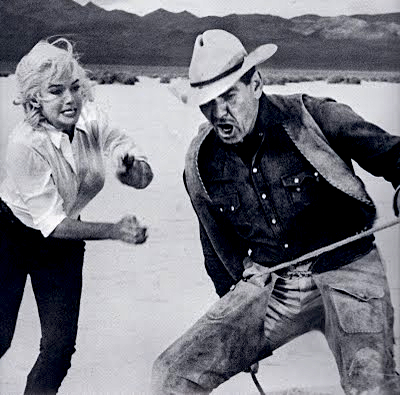
Miller came up with the story, which originally appeared in Esquire Magazine, after an extended stay in Nevada to establish residence in Reno for his divorce from his first wife. Besides the dissolution of his marriage and the bloom of new romance with Monroe, his plays were being dismissed and he was reeling from the House Un-American Activities Committee hearings in Washington, where he’d been called as a witness and refused to name names in the Communist witch hunt proceedings.
It was in Reno where Miller was introduced to similarly displaced persons as himself. Not surprisingly, the three major male figures in the film are cowboys who, as Bruce Crawford puts it, resist “modern civilization encroaching on them and their free-spirited way of life.” Gay (Gable) is an aging, spent, but still gallant horse wrangler, Purse (Clift) a sweet-natured rodeo rider and Guido (Wallach) a cynical war veteran turned bush pilot. The men prefer living a hand-to-mouth existence rather than “work for wages.”
Perhaps projecting himself into the characters, Miller has each stubbornly hold fast to some ideal of freedom and vision of happiness amid this harsh new era reining them in. When Monroe’s nurturing character, Roslyn, comes onto the scene she forms them into a loose family of misfits, each of whom is running away from something or towards something. Perhaps, as Gay says, they’re all trying “to find a way to be alive.” In Roslyn, who awakens promise and desire in the men but ultimately chooses the older Gay, Miller seemed to be imagining a hoped-for reconciliation with Monroe.
Unusual for Huston, The Misfits revolves around a female figure. With the exception of Katharine Hepburn’s turn in The African Queen, no actress so dominates one of his pictures as Monroe does in the part of Roslyn, the human equivalent of the wild mustangs the men try corralling. When, near the end, she expresses disgust at the idea the horses will be sold to the dog food factory, she makes the men question themselves and their methods. In using trucks and a plane to round up the animals for such an inglorious end, the men realize they’ve corrupted the very thing they love.
For Crawford, the denouement is “the end of an era…the end of the West as we once knew it. It’s the last roundup. The cowboys are left knowing they’re going to have to find another way of feeling alive and validating their lives.”
Anyone who knows Huston’s work can see the story echoes the recurrent theme of his pictures — a group of people banded together in search of some prize or goal that proves elusive amid the human conflicts and dramatic fates that arise. And, like much of Miller’s work, the story examines the uneasy gulf between ideals and reality, the challenge of remaining an individual in a corporate era of crushing anonymity and the need for and difficulty of maintaining human-family relationships in a world where people act, by nature, at cross-purposes to each other.
Fateful quests are not only intrinsic to Huston’s work, they operate on more than one level, said Michael Krainak, a professor of film history and appreciation at Metropolitan Community College and the man who headed-up Joslyn’s film series in the 1980s.
“Besides a material quest there’s a spiritual quest. His characters search for meaning in their lives. In many cases not all the characters are aware that is happening. So often, characters like Bogart at the end of Sierra Madre never even benefit from it. They’re oblivious to the changes taking place and to the lessons being learned. Huston equated that to the tenets of the existential philosophers. His films tend to end in material failure because for him the ends are irrelevant.
“What gives the quest meaning is the process itself, and you take something from that or you don’t. The ones who don’t often die physically or spiritually and the ones who do are able to carry on. It’s like Syndey Greenstreet’s great reaction to Peter Lorre when they discover the falcon is immaterial in The Maltese Falcon — ‘Well, what are you going to do?’”

Consistent with Miller’s ideology, The Misfits is replete with references to the impermanence of things.
“Gay speaks a line that’s very Milleresque,” Krainak said. “He says, ‘Well, nothing’s it,’ meaning nothing lasts forever. And Miller seems to be saying, Well, if that’s true, then that’s a guarantee of change. A theme of Miller’s has always been this idea of rebirth and reinventing yourself. The humanistic ideas in Miller’s work that are also evident in Huston’s work is this final goal of self-acceptance. To survive the wreckage of your life by seeking shelter in relationships and, more than anything else, by carving out your own meaning in life. The successful characters in Huston’s movies seem to confront the element of choice, You either choose to live an authentic life or an anonymous life. In this movie, becoming anonymous is to ‘work for wages.’”
In The Misfits Gay finally concedes the passing of his ways, but goes out on his own terms (or sword). He utters a line summing up his defiance and regeneration: “A man who’s afraid to die, is afraid to live.”
At the end, he and Roslyn drive off at night in search of a new path. They look out to see the mare and her colts running free, and they smile. She asks, “How do we get home?” He looks up at the night sky and says, “We’ll follow that star and get there.” As Krainak said, “What they’re left with is the quest — to get back on the trail. Instead of the the sunset, they ride off into the evening star. It’s a very Hustonian ending in that there’s promise for redemption or rediscovery or self-knowledge, but no guarantee.” In Crawford’s mind, “That has to be one of the most beautiful, haunting endings in film history.”
Krainak, a Huston buff, said that for years a running argument among cineastes has centered around the question of whether The Misfits is more a Huston film or a Miller film.
“It’s clearly both, but ultimately I think it’s Huston’s film,” he said. “In typical Huston fashion there’s this physical, larger-than-life task that a bunch of ne’er-do-wells on the edge of society attempt and fate somehow intervenes. In The Misfits it’s not so much tempting fate, as in Greek tragedy, but more of an Anglo-Saxon fatalistic attitude that says, If there’s a worst thing that can possibly happen, it will happen. The Anglo-Saxons had a wonderful word for it — weird. It’s indeterminate. It’s a more modern existential attitude toward fate. The character Guido even says something like, ‘I didn’t know that could happen.’ I think that’s so much what The Misfits is about.”
According to Krainak, the Miller-Huston pairing was more than a philosophical fit, but an artistic one. “One thing Miller’s got in common with Huston is a minimalist approach,” he said. “With Huston it was always a minimalist shooting script, shooting style, choice of film language, use of camera and editing. With Miller it was simple sets, lighting and everything focused on characters. Huston had to work very hard to create a visual dynamic when working so close with the figures of these characters in a setting and landscape that is so specific and very important.”
From his extensive reading about The Misfits, Krainak found Huston, with Miller’s blessing, eschewed color cinematography in order to bring out certain dramatic-symbolic points. “Huston definitely wanted stark black and whites in the background and the setting, with the characters, at least as I interpret it, as the shades of gray. That’s how it plays out in the imagery. It’s really a beautiful black and white film.” The atmospheric photography is by Russell Metty and the neoclassical jazz score is by Alex North.” Krainak added that, unlike most films, The Misfits was shot chronologically in order to capture a sense of “immediacy and spontaneity,” vital qualities in a story about impulsive free spirits.
Krainak said the film came at “a very self-indulgent” point in Huston’s career when, in addition to working with Miller, he was collaborating with such artists as Truman Capote (Beat the Devil), Ray Bradbury (Moby Dick), Jean Paul Sartre (Freud) and Tennessee Williams (The Night of the Iguana). “It was a very psychologically-charged period where he was exploring interior adventures or the landscape of the mind as opposed to exterior adventures or the landscape of nature.”
Why The Misfits was, until recently, dismissed as an interesting failure rather than a singular achievement can be explained by its “dense, cerebral, ‘European’ feel and by its star-crossed history, said Krainak, who puts an intriguing spin on the theory by suggesting “a killing off of a Hollywood era” took place with the deaths of Monroe, Gable and Clift and with the way Huston and Miller “underplayed these icons.”
He explained, “These were aging, wounded icons. Monroe was so vulnerable. Gable completely falls apart in a scene that everybody refers to. Clift takes a bad fall and wears bandages the rest of the film. Their audiences were not used to seeing them that way. What Huston and Miller did with these stars was a precursor of the American cinema renaissance of the late 1960s. The drama, thanks to Miller’s screenplay, and the imagery, thanks to Huston’s direction, made it a film dominated by character as opposed to pure action or star persona.”
Related Articles
- Nevada town remembers Marilyn Monroe’s last movie (omg.yahoo.com)
- Actor Kevin McCarthy Passes Away at 96 (pamil-visions.net)
- Academy to honor Alex North with a screening of ‘The Misfits’ (hollywoodnews.com)
- Clark Gable — Hollywood Star and Male Style Icon (rubylane.com)
- Naomi Watts Marilyn Monroe Biopic “Blonde” (popcrunch.com)
- From the Archives: Alexander Payne, an Exclusive Interview Following the Success of ‘Sideways’ (leoadambiga.wordpress.com)
- Hail, Hail ‘The Descendants’ – Alexander Payne’s First Feature Since ‘Sideways’ a Hit with Critics, and the George Clooney-starring Comedy-Drama is Sure to be an Awards Contender (leoadambiga.wordpress.com)
- Yolonda Ross Takes It to the Limit (leoadambiga.wordpress.com)
Related Articles
- Clark Gable — Hollywood Star and Male Style Icon (rubylane.com)
- Naomi Watts Marilyn Monroe Biopic “Blonde” (popcrunch.com)
- From the Archives: Alexander Payne, an Exclusive Interview Following the Success of ‘Sideways’ (leoadambiga.wordpress.com)
- Hail, Hail ‘The Descendants’ – Alexander Payne’s First Feature Since ‘Sideways’ a Hit with Critics, and the George Clooney-starring Comedy-Drama is Sure to be an Awards Contender (leoadambiga.wordpress.com)
- Yolonda Ross Takes It to the Limit (leoadambiga.wordpress.com)

‘To Kill a Mockingbird,’ Movie for the Ages from Book for All Time

Screenshot of To Kill a Mockingbird(an American movie issued in 1962) (Photo credit: Wikipedia)
Like a lot of people, To Kill a Mockingbird is one one of my favorite books and movies. Has there ever been a more truthful evocation of childhood and the South? When Bruce Crawford organized a revival screening of the film a couple years ago I leapt at the chance to write about it and the following article is the result. It was originally published in the City Weekly. This year marks the 50th anniversary of the first printing of the masterpiece novel by Harper Lee. The film is fast creeping up on its own 50th anniversary. The book to film adaptation is arguably the best screen treatment of a great novel in cinema history. That transition from one medium to another is often not a happy or satisfying one. Owing to my quite foggy memory of childhood things, I must admit that I cannot be entirely certain I have read Lee’s novel, but then again it was already standard fare in schools and so my unreliable recollection that I did read it in high school is probably accurate. I really should get a copy of the book, sit down with it, and indulge in that precisely drawn world of Lee’s. I am sure I will be as carried away by it now as I still I am by the film, which I have seen in its entirety a few dozen times, never tiring of it, always moved by it, and whenever I find it playing on TV I cannot help but watch awhile. It is that mesmerizing to me. And I know I am hardly alone in its effect.
For the article I got the chance to interview Mary Badham, who plays Scout in the film. At the end of my article’s posting, you’ll find a Q & A I did with her. Around this same time I also had the opportunity to interview Robert Duvall, who so memorably plays Boo Radley. However, I spoke to Duvall for an entirely different project, and I never brought up Mockingbird with him, although I wish I did.
‘To Kill a Mockingbird,’ Movie for the Ages from Book for All Time
©by Leo Adam Biga
Originally published in the City Weekly
Great movies are rarely made from great books. If you buy that conventional wisdom than an exception is the 1962 movie masterpiece To Kill a Mockingbird. Harper Lee’s best-selling, Pulitzer Prize-winning novel became an award-winning film acclaimed for how faithfully and lovingly it brought her work to the screen. Lee publicly praised the adaptation.
Gregory Peck, with whom Lee maintained a friendship. won the Academy Award as Best Actor for his starring turn as idealistic small town Southern lawyer Atticus Finch. Atticus is a widower with two precocious children — Scout and Jem. Atticus was based in part on Lee’s own father, an attorney and newspaper editor. Peck’s understated performance forever fixed the Mount Rushmoresque actor as the epitome of high character and strong conviction in movie fans’ minds.
Omaha impresario and film historian Bruce Crawford will celebrate Mockingbird on Friday, Nov. 14 at the Joslyn Art Museum with a 7 p.m. screening and an appearance by Mary Badham, the then-child actress who played Scout. She’s the rambunctious young tomboy through whose eyes and words the story unfolds. Actress Kim Stanley provided the voice of the adult Scout, who narrates the tale with ironic, bemused detachment.
Badham earned a Best Supporting Actress Oscar nomination in her film debut yet largely retired from screen acting after only two more roles. She remained close to Peck until his death a few years ago. The Richmond, Vir. area resident often travels to Mockingbird revivals. There’s always a big crowd. The universal appeal, Crawford said, lies in the pic tapping childhood feelings we all identify with.
“The crossover appeal of this film is unlike that of but a very few pictures,” he said. That pull can be attributed in part to the book, which, Crawford said, “has an absolutely enormous following in literary circles. It’s like required reading in public schools across the United States. Then, on top of that, the film was an instant classic when it came out and has done nothing but even grow larger in status the last 46 years. It’s become one of the most beloved films of all time.”
American Film Institute pollsconsistently rank Mockingbird as a stand-the-test-of- time classic. Crawford said seldom does an enormously popular book turn into an equally popular film. “It’s like Gone with the Wind in that,” he added.
Lee’s elegiac narrative, set in the 1930s Alabama she grew up in, has a kind of nostalgic, fairy tale quality the film enhances at every turn. It starts with the memorable opening credit sequence. An overhead camera peers with warm curiosity at a young girl sorting through an assortment of trinkets spilled from a cigar box, each an artifact of childhood discovery and reverie. As she hums, she draws with a crayon on paper. Soon, the film’s title is revealed.
The camera, now in closeup, pans from one small object to another, all in harmony with the wistful, lyrical music score. It makes an idyllic scene of childhood bliss. The girl then draws a crude mockingbird on paper and without warning rips it apart, presaging the abrupt, ugly turn of events to envelop the children in the story. It’s a warning that tranquil beauty can be stolen, violated, interrupted.
Dream-like imagery and music emphasize this is the remembered past of a woman seeing these events through the prism of impressionable, preadolescent memories. The film captures the sense of wonder and danger children’s imaginations find in the most ordinary things — the creak and clang of an old clapboard house in the wind, shadows lurking in the twilight, a tree mysteriously adorned with gifts.
Like another great movie from that era, The Night of the Hunter, Mockingbird gives heightened, elemental expression to the world of children in peril. The by-turns chiaroscuro, melancholy, sublime, ethereal landscape reflects Scout’s deepest feelings-longings. It is naturalism and expressionism raised to high art.
The film tenderly, authentically presents the relationship between Scout and her older brother Jem, her champion, and the bond they share with their father. The motherless children are raised by Atticus the best he knows how, with help from housekeeper Calpurnia and nearby matron Miss Maudie. A sense of loss and loneliness but moreover, love, infuses the household.

A mythic, largely unseen presence is Boo Radley, a recluse the kids fear, yet feel connected to. He leaves tokens for them in the knot of a tree and performs other small kindnesses they misinterpret as menace. In the naivete and cruelty of youth, Scout and Jem make him the embodiment of the bogeyman.
The figure looming largest in the children’s lives is Atticus, a seemingly meek, ineffectual man whose gentle, principled virtues Scout and Jem begin to admire. His unpopular stand against injustice and bigotry quells, at least for a time, violence. His strength and resolve impress even his boy and girl.
Trouble brews when Atticus defends Tom Robinson, a black man falsely accused of raping a white woman in an era of lynchings. The case makes the family targets. The children witness Atticus’s noble if futile defense and come to appreciate his goodness and the esteem in which he’s held. In their/our eyes he’s a hero.
In his summation Atticus appeals to the all-male, all-white jury: “Now gentlemen, in this country our courts are the great levelers, and in our courts all men are created equal. I’m no idealist to believe firmly in the integrity of our courts and of our jury system. That’s no ideal to me. That is a living, working reality. Now I am confident that you gentlemen will review without passion the evidence that you have heard, come to a decision, and restore this man to his family. In the name of God, do your duty. In the name of God, believe Tom Robinson.”
The film’s theme of compassion is expressed in some moving moments. Atticus says to Scout, “You never really understand a person until you consider things from his point of view… ’till you climb inside of his skin and walk around in it.”
When a school chum Scout’s invited for dinner drenches his meal in syrup, her mocking comments embarrass him, prompting Calpurnia to scold her for being rude. The lesson: respect people’s differences.
Before Atticus will even consider getting a rifle for Jem he relates a story his own father told him about never killing a mockingbird. It’s a father instructing his son to never harm or injure a living thing, especially those that are innocent and give beauty. In the context of the plot, the children, Boo Radley and Tom Robinson are the symbolic mockingbirds. Atticus delivers this lesson to his son:
“I remember when my daddy gave me that gun…He said that sooner or later he supposed the temptation to go after birds would be too much, and that I could shoot all the blue jays I wanted, if I could hit ’em, but to remember it was a sin to kill a mockingbird. Well, I reckon because mockingbirds don’t do anything but make music for us to enjoy. They don’t eat people’s gardens, don’t nest in the corncrib, they don’t do one thing but just sing their hearts out for us.”
Among many famous scenes, Scout’s innocence and decency shame grown men bent on malice to heed their better natures. In another, Atticus tells Jem he can’t protect him from every ugly thing. When evil does catch up to the children their savior is an unlikely friend, someone who’s been watching over them all along, like a guardian angel. Once safely returned to the bosom of home and family, they find refuge again in their quiet, unassuming hero, who comforts and reassures them.

Only the most sensitive treatment could capture the rich, delicate rhythms and potent themes of Lee’s novel and this film succeeds by striking a well-modulated balance between bittersweet sentimentality and searing psychological drama.
Although the book was a smash, it took courage byUniversal to greenlight the project developed by producer Alan J. Pakula and director Robert Mulligan. Creative partners in the late ‘50s and early ‘60s, Pakula and Mulligan had made Fear Strikes Out but the young filmmakers were still far from being a power duo. After Fear Mulligan helmed a few more studio hits without Pakula but nothing that suggested the depth Mockingbird would demand. His less than inspiring work might have given any studio pause in taking on the book, whose powerful indictment of prejudice and impassioned call for tolerance came at a time of racial tension. Yes, the civil rights movement was in full flower but so was resistance to it in many quarters.
Efforts to ban the book from schools — on the grounds its portrayal of racism and rape are harmful — have cropped up periodically during its lifetime.
The socially conscious filmmakers helped their cause by signing Peck, who was made to play Atticus Finch, and by enlisting Horton Foote, a playwright from the Tennesse Williams school of Southern Gothic drama, who was made to adapt Lee’s book. Foote’s Oscar-winning script is not only true to Lee’s work but elevates it to cinematic poetry with the aid of Mulligan’s insightful direction, Pakula’s sensitive input, Russell Harlan’s moody photography, Elmer Bernstein’s poignant score and Henry Bumstead and Alexander Golitzen’s evocative, Oscar-winning art direction.
Pakula-Mulligan went on to make four more pictures together, including Love with the Proper Stranger and Baby, the Rain Must Fall with Steve McQueen and The Stalking Moon with Peck. The two split when Pakula left to pursue his own career as a director. Pakula soon established himself with Klute and All the President’s Men. Mulligan’s career continued in fine form, including his direction of two more coming-of-age classics — Summer of ‘42 and The Man in the Moon.
Mockingbird was Lee’s first and only novel. Not long after completing the book she accompanied childhood chum Truman Capote (the character of Dill in Mockingbird is based on him) to Holcomb, Kan. for his initial research on what would become his nonfiction novel masterwork, In Cold Blood. Lee, mostly retired from public life these days, is said to divide her time between New York and Alabama.
The part of Atticus Finch came to Peck at the height of his middle-aged superstardom. He’d proven himself in every major genre. And while he acted on screen another 30-plus years, the film/role represented the peak of his career. It was the kind of unqualified success that could hardly be repeated, certainly not topped. He didn’t seem to mind, either. He gracefully aged on screen, playing a wide variety of parts. But his definitive interpretation of Atticus Finch would always define him as a man of conscience. It became his signature role.
Peck was among the last of a breed of personalities whose ability to project noble character traits infused their performances. Like Spencer Tracy, Henry Fonda, John Wayne and Charlton Heston, Peck embodied the stalwart man of integrity.
“Those types of characterizations just don’t really exist anymore. That’s what draws people to these characters and to the performances of these men because their like will never be seen again, and we know it” said Crawford.

Mary Badham then
A Q & A with Mary Badham, the Actress Who Played Scout in To Kill a Mockingbird
©by Leo Adam Biga
Actress Mary Badham recently spoke by phone with City Weekly correspondent Leo Adam Biga about her role of a lifetime as Scout in the 1982 film classic To Kill a Mockingbird. She grew up in Birmingham, Ala., near the hometown of Harper Lee, upon whose noted novel the film is based. Badham spoke with Biga from her home near Richmond, Virginia.
LAB: “To Kill a Mockingbird is such a touchstone film for so many folks.”
MB: “Mockingbird is one of the great films I think because it talks about so many things that are still pertinent today. So many of life’s lessons are included in the story of Mockingbird, whether you want to talk about family matters or social issues or racial issues or legal issues, it’s all there. There’s many topics of discussion.”
LAB: “Had you read the book prior to getting cast in the film?”
MB: “No, had not read the book.
LAB: “So was reading it a mandatory part of your preparation?”
MB: “No, not at all. I don’t even know that I got a full script.”
LAB: “When did you first read the book then?”
MB: “Ah, that was not till much later I’m embarrassed to say. Not until after I had my daughter. And how it all started was professor Inge from our local college asked me to come speak to his English lit class. We met for lunch and almost the first words out of his mouth were, ‘So what was your favorite chapter in the book?’ He knew by the look on my face that I hadn’t read the book. He said, ‘Young lady, your first assignment is you go home and read the book before you come to my class.’ In defense of myself, I didn’t want to read the book. Because I had everything I wanted out of the story up there on the screen. You know how sometimes you see a film and then you read the book and it messes up that whole warm and fuzzy feeling you may have had about something? But it was really great for me because it filled in a lot of these gaps I had with the story. It just gave me a much fuller love and appreciation for it. And it’s so beautifully written. It’s just so perfect.
“It’s a little book. It’s a quick one-night read, and a lot of people want to put it down for that, because it’s simple…but to me its one of the greatest pieces of literature ever written, and it’s borne out by the way it’s read. It’s the second most-read book next to the Bible. That’s saying something.”
LAB: “I know that you and Peck, whom you always called Atticus, enjoyed a warm relationship that lasted until death. On the shoot did he do things to foster your father-daughter relationship on screen?”
MB: “Oh, absolutely. I’d go over there and play with his kids on the weekends. We would have meals together and do things together. So, yeah, they encouraged that bonding. I had such a strong relationship with my own father, and I missed him dreadfully because Daddy had to stay at home to take care of things… My mom came out. But I missed that male link of family and so Atticus really filled the bill. He was just amazing. What a great father. I mean, he was one of the best I think. Not that he was perfect. But he was so well read and so patient, I think you would have to say. And just full of laughter…
“He and PhillipAlford (Jem) used to play chess together. They had such a beautiful relationship, and that stayed till the very end. They just got along so well together and Phillip would always know how to make him laugh. Phillip’s such an entertainer. He’s got a brilliant, quick sense of humor and Atticus really appreciated that. He just adored Phillip. So we really became a family.
“It was nothing for me to pick up the phone and he’d be on the other end, ‘What ya doin’ kiddo?,’ which was marvelous because I lost my parents so early. My mom died three weeks after I graduated from high school and my died died two years after I got married. And I didn’t have grandparents — they died before I was born. I felt totally cut off. So, you know. Atticus really came through psychologically. He really was my male role model. He and Brock Peters (Tom Robinson).
“It was marvelous because those guys were so intelligent and loving and outgoing, and supportive of anything I wanted to do. And sometimes life was not easy growing up and when you’re worried about what’s going to happen next in life, sometimes just hearing those voices on the other end of the line calling to check on me was
just so uplifting. That was just amazingly supportive”

Mary Badham today
LAB: “I understand you two would visit each other as circumstances allowed.”
MB: “Whenever he’d be nearby or if I was out there or whatever, then we would see other. And usually when you make a film, you know, it’s like, ‘Oh, we gotta get together afterwards’ and stuff, and it never happens. But with this cast and crew we did keep up with each other through the years. Paul Fix (the judge), I stayed really tight with right up until he passed. Collin Wilcox (Mayella Ewell) — we stayed in touch up until recently. I would see William (Windom), who played the prosecuting attorney, at various events and things. He’s gone now. So is Alan Pakula, our producer. Absolutely one of the most loving, dear, intelligent human beings I’ve ever met.”
LAB: “Most everyone’s gone except for you, Phillip, Robert Duvall. Bob Mulligan…”
MB: “To lose these guys so early has just about killed me because I feel like my support pillars are gone. I really relied on them – just knowing they were there and that I could pick up the phone and talk to them or they could call me and check on me. That’s a real shot in the arm in your day.”
LAB: Pakula became a great director in his own right. I’m curious about his and Mulligan’s collaboration. They were quite a team. I assume Pakula was a very hands-on, creative producer who worked in close tandem with Mulligan on the set?”
MB: “I think so.”
LAB: “So how did you come to play Scout in the first place?”
MB: “It happened because my mom had been an actress with the local Town and Gown Theatre (in Birmingham, Ala.) She had done some acting in England. That’s where my mom was from. She was the leading lady for a lot of years in the Town and Gown. So when the movie talent scout issued this cattle call our little theater was on the list. They were looking for children. Jimmy Hatcher, who ran the theater, naturally called my mom and said, ‘Bring her down.’ Then mom had to go to Daddy and get permission and he said, ‘No.’ And she said, ‘Now, Henry, what are the chances the child’s going to get the part anyway?’ Oh, well…”
EDITOR’S NOTE: Mary Badham’s late brother, John Badham, acted at the Town and Gown. He became a successful film director. Phillip Alford acted in three shows there before cast as Jem. The theater’s where Patricia Neal got her acting start.
LAB: “Lo and behold you did get the part.”
MB: “Daddy was horrified and it was everything Alan Pakula and Buddy Boatwright, the talent scout, could do to try and convince him that they were not going to ruin his daughter.”
LAB: “Everything you’ve said suggests Mockingbird being a very warm set.”
MB: “It was. I remember a lot of laughter, a lot of joking around. I remember five months of having a blast. I didn’t want it to end. I had not had any trouble with my lines until like the last day, and then it was just like, ‘Oh, God, I’m going to say goodbye to all these people.’ I was so upset I could not spit my lines out for anything. My mother finally said, ‘Do you know what the freeway is like at 5 o’clock? These people have got to go home.’ I was like, ‘OK, OK.’ So I got out there and did it. But it broke my heart. I thought I’d never see these people again.”
LAB: You and Phillip were newcomers. Did the crew take a kids-gloves approach?”
MB: “Yes, we had time to get used to the cameras and the crew and the lights and getting set up. They started off very slowly with us. The camera and crew would be across the street and then they’d move up a little closer, and then a little closer still, and then they were right there. Everything was kind of good that way.”
LAB: “How did director Bob Mulligan work with you two?”
MB: “Very gentle, very tender. Instead of standing there and looking down on us he would squat and talk to us…right down on our level. He didn’t tell us really how to do the scenes. It was more, ‘OK, you’re going to start from here and we need you to move here…’ He let us do the scene and then he would tweak it, so that he would get the most natural response possible, and I think that’s brilliant. We were never allowed to talk to an actor out of costume (on set). They were just there the day we had to work with them and then they were that person they were playing. Bob did these things to get the most out of us nonactors.”
LAB: “You and Phillip were thrust into this strange world of lights-cameras.”
MB: “Now, I was used to having a camera stuck in my face from the time I was born because I was my father’s first little girl. He’d had all these ratty boys and then he finally got his dream with me when he was 60 years old. That was back in the days when flash cameras had the light bulbs that would pop and the home movie cameras needed a bank of lights. So, yeah, I grew up with all of that. Phillip and I grew up four blocks from one another. But we would never have met
because I was in private school — he was in public school. He was 13. I was only 9.”
LAB: “There’s such truth in all the performances.”
MB: “I think our backgrounds helped in that a lot, because Atticus (Peck) was from a small town in Calif. (La Jolla) that looked very much like that little village (in Mockingbird). He knew that period well. And for Phillip and I nothing much had changed in Birmingham, Ala. from the 1930s to the 1960s. All the same social rules were in place. Women did not go out of the house unless their hair was done and they had their hats and gloves on. Servants and children were to be seen and not heart. Black people still rode on the back of the bus. And there were lynchings on certain roads you knew you couldn’t go down. There were still colored and white drinking fountains when I was growing up. So all of that was just totally normal for us. There’s no way you could have explained that to a child from Los Angeles. They wouldn’t have known how to react to all that stuff. My next door neighbor (during the shoot in Calif.) was this black man with a beautiful blond bombshell wife and two gorgeous kids, and down the road was an Oriental family, and we visited — went to dinner at their house. We could never do that in Alabama. It just would not happen.”
Related Articles
- To Kill a Mockingbird Turns 50 (austinist.com)
- ‘To Kill A Mockingbird’ Anniversary: Anna Quindlen On The Greatness Of Scout (huffingtonpost.com)
- 51 reviews of To Kill a Mockingbird (rateitall.com)
- Great Characters: Atticus Finch (“To Kill a Mockingbird”) (gointothestory.com)
- Films For Father’s Day (npr.org)
- Harper Lee – We Hardly Know Ye (pspostscript.wordpress.com)
King Crawford: Omaha’s very own movie mogul

Image via Wikipedia
I go back with Bruce Crawford 30 years. We met for the first time when I was a film programmer/publicist at the University of Nebraska at Omaha and he was a wide-eyed film enthusiast. He specifically approached me about wanting to share his passion for the great film composer Bernard Herrmann, whom he had struck up a correspondence with late in the composer’s life. I had a screening of Taxi Driver scheduled and Bruce asked if he could make a presentation about Herrmann and the composer’s scoring of that film. We didn’t normally have speakers as part of our campus film program but something about Bruce’s magnificent obsession and tenacity convinced me to agree. Flash forward about 15 years, when I was a fledgling freelance journalist and Bruce was first making a name for himself with the radio documentaries he did, including one on Herrmann, and with the revival screenings he staged of film classics.
The following is the first of many stories I’ve written about Bruce and his work as a film historian and impresario. It appeared in The Reader (www.thereader.com). He’s since put on dozens more film events.
King Crawford: Omaha’s very own movie mogul
©by Leo Adam Biga
Originally appeared in The Reader (www.thereader.com)
There’s a bit of Elmer Gantry in Bruce Crawford, the dynamic Omaha film historian/promoter whose sold-out screening of the original 1933 classic King Kong unreels Saturday, May 30 at the Indian Hills Theater.
With his boyish good looks, magnetic presence and penchant for hyperbole he exudes the charisma of a consummate huckster and the passion of a confirmed zealot. An evangelist for that old time religion called the movies, he often describes his devotion in missionary terms and pays homage to Hollywood’s Golden Age through gala events and elaborate documentaries full of his characteristic verve and adoration.
And with its rich, delirious mix of mythology and metaphor, Kong is an apt choice for cinephile celebration and reverence. This ultimate escapist film combines still impressive visual effects with an outrageous Beauty and the Beast fable played out in a ripe Freudian landscape. Unlike, say, Godzilla, it taps our deepest fears and desires.
Crawford’s passion began in his native Nebraska City, where he had a born-again experience at the movies. It came when his parents took him as a child to see Mysterious Island, a 1961 Jules Verne-inspired fantasy adventure featuring special effects by Ray Harryhausen.
“I loved the effects and the creatures and the fantastic Jules Verne story. But it was the music that hooked me more than anything else,” Crawford said from the movie memorabilia and art-filled northwest
Omaha apartment he shares with wife Tami. “I remember when the music hit me. It was the opening with the boiling ocean and the Victorian lettering rolling across the seascape. I can’t quite find the words for it, but something connected. t was almost like a diamond-tip bullet hit me between the eyes. This music…wow! I was so overwhelmed by its beauty and majesty. I wasn’t old enough to read yet, so I asked my parents where the music came from.”

Bruce Crawford
When he found out it was by legendary composer Bernard Herrmann, he felt “a compulsion” to find out everything he could about the man and his work. He had a similarly dramatic reaction to hearing a cut of the love theme to Ben-Hur. Despite his unfamiliarity with the movie and the composer, Miklos Rozsa, he felt an affinity for each. “The music was sooooo beautiful. Even without knowing it was a Biblical story I felt the Judaism. I felt the ancient world. Like with Mysterious Island I felt another connecting link in my life. That this was part of my destiny. I said, ‘I’ve got to see what movie this music goes to.’”
He finally did see Ben-Hur Christmas night in 1970, and it proved a revelation. “It changed my life. I’ve never been so haunted and moved by something as I was by it. It was so profound, so literate, so poetic. I knew I’d seen a masterpiece. And somehow, on some psychic or intuitive or synchronistic level, a little boy in Nebraska City had this connection with these world-renowned musicians and filmmakers. I knew then I was meant to know these people and to do something with them.”
Amazingly, his life has intersected with the very objects of his devotion. As a precocious teen he began corresponding with the imposing Herrmann, the composer for such film classics as Orson Welles’ Citizen Kane and The Magnificent Ambersons and Alfred Hitchcock’s Vertigo and North By Northwest. Upon Herrmann’s death in ‘75 (after finishing the fever dream score to Martin Scorsese’s Taxi Driver) Crawford drew close to his family. By ‘88 he’d become an authority on the man and produced an acclaimed documentary on him which has since aired over many National Public Radio affiliate stations and over the BBC in Great Britain.
Crawford struck up a similar acquaintance with Rozsa and shortly before the composer’s death in ‘95 completed a documentary on him and his music that also garnered strong critical praise and wide air play.
Music has always spoken most strongly to Crawford. “My first and foremost love is great music, and for me film scores represent the 20th century’s answer to the great symphonies of the past 300 to 400 years. A film score is like a grand opera in a sense. It can tell what actors can’t say.”
Movie special effects also hold him enthralled. As a high school student he made an award winning short using the same kind of stop-motion animation techniques as Kong. He began networking with FX artists and those contacts led him to the dean of them all — Harryhausen. In ‘92 Crawford coaxed Harryhausen, fresh from receiving an honorary Oscar, to attend an Omaha tribute in his honor. The men are now close friends.
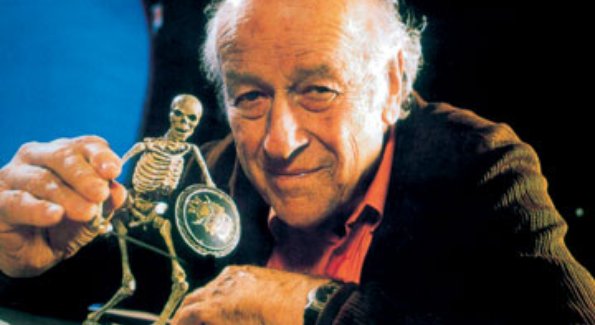
Ray Harryhausen
The tribute proved a hit and spurred subsequent film events. The biggest to date being the 35th anniversary showing of Ben-Hur, for which Crawford scored a coup by making Omaha the first stop on the restored film’s special reissue tour and by getting family members of the film’s legendary director, William Wyler, to attend.
At a screening of Gone with the Wind he brought co-star Ann Rutherford and added atmosphere with women in period hoop skirts. For the Hitchcock suspense classic Psycho he secured an appearance by star Janet Leigh. Family members of late-great director Frank Capra (Mr. Smith Goes to Washington) and producer Darryl F. Zanuck (The Longest Day) came at Crawford’s invitation to Omaha revivals.
Many wonder how someone so far removed from the movie industry is able to gain entree to rarefied film circles, land interviews with top names (from Charlton Heston to Leonard Maltin), arrange celebrity guest appearances and enlist the aid of corporate sponsors. Crawford’s personal charm and genuine ardor for classic movies, and for the artists who made them, help explain how he does it.
Then too there’s the grand showmanlike way he exhibits old movies. “The way they’re meant to be, but so rarely, seen,” he said, meaning on the big screen — with all the puffery, ballyhoo and flourish of a Hollywood premiere. For his 65th anniversary showing of Kong, which has been fully restored, he plans searchlights, a 30-foot tall Kong balloon, limousine-driven guests, a pre-show and a post-autograph session.
“What I’m trying to do is recapture the magic of going to the movies I felt as a kid,” he said, “and add to it with the glitz and the glamour. You get your money’s worth at a Crawford show, don’t you think?”
Kong’s special guests will include Harryhausen, who’s flying in from his home in London, renowned science fiction author Ray Bradbury (Fahrenheit 451) and noted film historian Forrest Ackerman. The three grew up together in California and were equally enchanted by Kong.
Harryhausen, who later apprenticed under the film’s effects master, Willis O’Brien, on Mighty Joe Young, credits Kong for inspiring his life’s work. “I was 13 when I saw it, and I haven’t been the same since,” he said by phone from London. “It left me startled and dumbfounded. It started me on my career. That shows you how influential films can be.”

Bernard Herrmann
The Kong pre-show or “live prologue,” as Crawford calls it, will recreate the film’s native ceremonial ritual — complete with dancers in painted faces and grass skirts — performed for Kong’s original run at the Grauman’s Chinese Theater in Los Angeles.
On his Kong Web page Crawford promises an evening “in the Sid Grauman tradition.” Crawford is indeed a Grauman-type impresario with a flair for extravaganza. He also resembles the P.T. Barnum-like Carl Denham character in Kong who charters the ship and leads the expedition in search of the big ape. In an early scene the first mate asks the skipper about the irrepressible Denham, “Do you think he’s crazy?” “No,’ says the captain, “just enthusiastic.” Likewise, Crawford’s undaunted fanaticism is that of the true enthusiast. His fervor largely accounts for the warm reception he’s been accorded by Hollywood insiders.
“I’m delighted he takes it so seriously and takes the initiative to try and present pictures the way they were presented in the early days,” said Harryhausen. “What you need is somebody with enthusiasm for these types of things. Bruce has that, and it’s wonderful.”
Gerry Greeno, Omaha city manager for the Douglas Theater Co., whose Cinema Center hosted past Crawford events, said, “He has that exuberance that generates interest and gets people to go along with him…and he’s not bashful about it. For some it might wear a little thin, but he puts a lot of time and effort into these events. He loves doing it.”
Bob Coate, who co-produced the Herrmann-Rozsa documentaries at KIOS 91.5-FM, where he is program manager, said he fell under the Crawford spell when the promoter pitched him the idea. “I’d never produced anything like that before. He kind of got me excited about doing it. His enthusiasm is definitely infectious.” Coate, now part of the Crawford coterie, added, “He’s a driving force. I know these events are tons of work for him, and wear him out, but I think he gets energy from doing them.”
As Crawford tells it, “I try to get people to do things they might not normally do, which I’m told I do a lot of. It’s being persuasive. You have to have that extravagant enthusiasm…that charisma. Some people keep it subdued and withdrawn. I choose not to.”
Until Coate approved the Herrmann program, Crawford had run into dead-ends trying to get it off the ground. “I went to several public radio stations and they said, ‘It can’t be done.’ Of course that went in one ear and out the other. I was determined to do it come hell or high water. Fortunately, Bob (Coate) was a Herrmann fan.”
The pair collaborated for months. In typical Crawford style he pushed the envelope by making the finished product two and a half hours long. Upon hearing it, the feature most listeners remark on is the unusually long (often complete) musical passages from Herrmann’s radio, film and concert hall career and rather spare but informative narrative segments. The same approach is used with the Rozsa project.
Miklos Rozsa
“My programs are really audio musical biographies about the subject and his music,” Crawford said. “The thing that makes them stand out is that they’re 60 to 70 percent music and 30 to 40 percent discussion. There was no model I was aware. I didn’t know what the parameters were. And of course the rest is history.”
He refers to the favorable response the programs netted, especially the piece on Herrmann, who’s a cult figure. Crawford has heard from many famous admirers. “It’s considered the most extensive, the most comprehensive, the most successful documentary ever done on any composer of the 20th century,” he said. “That’s just not my opinion. That’s the opinion of Ray Harryhausen, Ray Bradbury, Danny Elfman, Jerry Goldsmith, David Copperfield, Robert Zemeckis…”
Part of his charm is the wide-eyed, gee-whiz glee he takes in his own achievements. In the Wonderful World of Bruce Crawford, there are only “huge” successes; “amazing” feats; movie “masterpieces;” and his own “almost superhuman” energy. When he goes on a riff about the accolades and national media coverage, he punctuates his speech with a rhetorical “Isn’t that something?” or “Isn’t that incredible?”
Well, who can blame him? He’s been brazen enough to develop world-class film connections and visionary enough to use them in meaningful ways. He’s seen himself become a touchstone figure for film buffs who bask in the glow of his and his famous friends’ celebrity. He’s been commissioned to write articles for major film publications. His services as a documentary producer and event promoter are in much demand.
This self-styled movie mogul rules over a niche market in Omaha for the celebration and veneration of classic films. Call him King Crawford. Still, even he can’t believe his dreams have come true.
“My God, who would have ever thought this was attainable? I didn’t see it coming. I did have a desire, which was obviously intense, but I didn’t know where it would lead. And then to have these giants respond to me, and not only respond, but become pretty close friends — that just doesn’t happen, man. Yeah, syncronicity.”
Perhaps it’s no coincidence then he and Tami live in Camelot Village.
“My life is like a strange sort of destiny.“ he added. “I don’t know how or why that is. That’s what serendipity is I guess. Amazing. Isn’t that wild?”
Related Articles
- Revival House: “We all go a little mad sometimes …” (popdose.com)
- Hitchcock’s Psycho At 50, The Sounds Of Violence (huffingtonpost.com)
- Revival House: Seven Great Rejected Film Scores (popdose.com)
- Listening to Taxi Driver. (slate.com)
- Hitchcock horror under the hammer (thejc.com)


 Leo Adam Biga's My Inside Stories