Archive
Archive for the ‘Business’ Category
Omaha Legends: Greater Omaha Chamber of Commerce Business Hall of Fame Inductees Cut Across a Wide Swath of Endeavors
March 28, 2012
3 comments
Every city of any size has its movers and shakers and star performers in the world of commerce. One function of a chamber of commerce is to recognize its local impact players. It’s no different in my city, Omaha, or with the Greater Omaha Chamber of Commerce, which has a Business Hall of Fame for just this purpose. The following story, to appear in the April issue of Metro Magazine, provides mini-profiles of the latest crop of hall inductees, whose diverse cross-section of endeavors proves there are all manner of ways to make a difference in the commerce of a city. Most of those being honored are not well known outside of Omaha, but both couples being inducted this year are: Paul and Lori Hogan have created a mega national and international business in their heavily franchised Home Instead Senior Care, complete with a line of books and videos, all of which taken together have helped them nearly corner the market on nonmedical home services for seniors; Jun and Ree Kaneko are, outside of Warren Buffett and Alexander Payne, Omaha’s superstar residents for his much-in-demand sculpture and opera design work and for her artist residency administration expertise and, as a couple, for their much admired community art and creativity projects, including the Bemis Center for Contemporary Arts and the KANEKO Open Space for Your Mind complex.

Omaha Legends: Greater Omaha Chamber of Commerce Business Hall of Fame Inductees Cut Across a Wide Swath of Endeavors
©by Leo Adam Biga
Soon to be published in Metro Magazine
The latest Omaha Chamber of Commerce Business Hall of Fame inductees include a publisher, a PR maven, a businessman-turned-politician, two couples following their passion and “a cotton-picker from Texas” who turned sundries into gold. An April 24 Holland Performing Arts Center gala honors these legends.

Bob Hoig

Bob Hoig
Bob Hoig was bumming around New York City when he wound up in the Daily News building. He had no intention of being a journalist, but he needed a job, so he applied. The next thing he knew he was a copy boy. Thus began a 56-year and counting journalism career that’s wend its way from New York to Miami to Nebraska, where the Kansas-Colorado native had roots.
After reporting stints with United Press International and the Omaha World-Herald and editing the Douglas County Gazette, he formed the Midlands Business Journal in 1975 with Rapid Printing owner Zane Randall.
“I felt this market needed a niche paper that looked into small business success stories. That’s something nobody was doing at the time. All this came in the face of many prophecies of doom,” says Hoig, who went solo when Randall bowed out.
Hoig had confidence in his own abilities. “I’ve always been a good salesman and I think I’m a good enough writer and editor that I had the components you need to start a successful paper,” he says. Besides, he knows how to balance a ledger.
The veteran publisher has had hit and miss publications and he’s always learned from his successes and failures.
Satisfaction, he says, comes from “producing a good product that will survive, employ people and not be a burden on anyone,” adding. “I find this work very ennobling because it keeps me alive, involved and thinking.”

Linda Lovgren

Linda Lovgren
When Linda Lovgren left an ad agency to launch her own Lovgren Marketing Group in 1978 she says, “It never occurred to me I could fail. I just kind of looked at it as this is the next step in what I’m going to do, and if it works out that is spectacular, and if it doesn’t there will be another door opening.”
Going in business for herself, she says, was “a defining moment. It takes time to grow a business, to grow relationships, and one connection leads to another connection. It’s this large linkage you begin to build.”
With few women entrepreneurs around, her mentors were all men, among them then-Chamber president Bob Bell. She went on to be the Chamber’s first female president in 2003. She advises aspiring entrepreneurs find the right balance between work and family, just as she did as a new wife and mother.
The Iowa native’s long given back to her adopted Nebraska, volunteering with the State Fair board, Nebraska Kidney Foundation, Mid-America Boy Scouts of America and Habitat for Humanity,
She says she derives satisfaction from meeting the needs of clients, staff and family and “knowing you have accomplished something that has made a difference for all of those people.”
Mike Fahey

CenturyLink Center Omaha
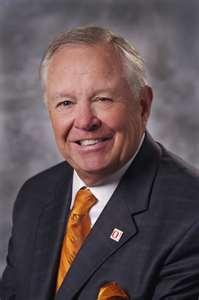
Heeding his older brother’s advice, Mike Fahey made “the most important” decision of his life when he moved here in 1971 to complete his education at Creighton University. It set him on a path to become an entrepreneur and two-term Mayor.
“It taught me you should never stop trying to improve yourself,” he says.
His next turning point was starting his own business, Land Title Company. “That certainly changed my entire life. It put me on the road to success. No longer was I working for a paycheck per se, I was really trying to build a business. There’s a lot of risk in that but I had confidence in my abilities. It taught me right away you’re only as strong as the people you have around you and I was very fortunate to get myself surrounded by some really good people.”
He regards growing his business his biggest success. “It brought me the greatest joy and with that it brought success. Creating jobs for other people was very rewarding as well.”
He says he applied a maxim from business to the mayor’s office: “Surround yourself with smart people, give them all the authority they need to do their jobs, and then hold them accountable for their outcomes. You get better results.”
He’s proud to have moved Omaha forward with signature projects like the CenturyLink Center and Bob Kerrey Pedestrian Bridge. Today he chairs the Omaha Community Foundation and sits on several boards. “Community service is a great way to pay back a city that’s been extremely good to me and my family,”

Paul and Lori Hogan

Home Instead Center for Successful Aging
Paul and Lori Hogan
A confluence of events led Paul and Lori Hogan to conceive Home Instead Senior Care. As he learned the franchise model working for Merry Maids he noticed his failing grandmother rebound with the help of family caregivers.
“I saw that you didn’t have to be doctor or a nurse to really have a huge impact on someone’s health, particularly a senior,” says Paul. “That experience helped me see the opportunity that existed. Back when we started there were just two options for seniors needing support, a nursing home or your daughter’s home. Now there’s a whole proliferation of options. We’re one of them. Preparation and opportunity met, and we took the risk.”
Lori says having a passion for what they consider their mission is part of their success. Another is filling “a real need” among seniors. Quality caregivers and franchisees are critical, too.
Paul credits mentors Tom Guy and Dallen Peterson of Merry Maids with helping make Home Instead a reality. But
The company’s success has allowed the Hogans to pay forward their good fortune through the Home Instead Senior Care Foundation, the Center for Successful Aging and various resources for family caregivers. “When you are given much, much is expected,” says Lori, “and we really feel it is important to give back to our community and we’re so grateful we’re able to do that.”

Jun and Ree Kaneko

Bemis Center for Contemporary Arts

KANEKO
Jun and Ree Kaneko
The former Ree Schonlau was an Old Market pioneer when artist Jun Kaneko came at her invitation. Among the few who saw potential for the old wholesale produce district, she established the Craftsmen Guild and Alternative Worksite, Artist-in-Industry Program. Jun shared her vision and the couple formed the Bemis Center for Contemporary Arts, whose artist residency program is world-renowned.
More recently they opened KANEKO, a complex of creativity spaces.
Together, they’ve helped grow and put the Omaha arts community on the map. She’s one of America’s leading art residency advocates and experts. He found a nurturing place for his art in Omaha, where he’s developed his studio. Omaha is where he first made his popular dangos and began designing for operas.
They appreciate this community making their endeavors possible. “We’ve had patrons who are very inspiring and supportive, that believe in us and stand behind what we’re trying to do even though they know it’s a tough row and maybe a little avant garde,” she says. “Jun feels extremely fortunate, as I do, to be able to have realized those dreams here.”
She says there’s also pride in being recognized “as catalysts” for attracting commerce and attention to Omaha and for spurring the dynamic cultural renaissance the city’s enjoying. “Any mature city’s going to have the arts involved in it and now we have enough. I’m really pleased to see what’s happening. The cultural in-fill has finally caught up with those of us who were out here hanging on.”
Their multi-phase KANEKO project is a gift. Says Jun, “I always wanted to return something to this country. Lots of people helped me to be what I am now, so I feel I need to contribute something back. The best thing we know is creative activity” and thus their “open space for the mind.” He expects the organization and its mission “will keep progressing.”

A typical Pamida store

Witherspoon Mansion
D.J. Witherspoon
The son of a Texas migrant worker, D.J. Witherspoon was a teacher and coach in the Longhorn State before moving to Omaha in the Dust Bowl years and founding Gibson Products Company with his father-in-law. Witherspoon’s purchase of Marks Distributing Company introduced him to his future business partner, Nebraska native Lee Wegener, and together the two men formed Pamida, a chain of discount general merchandise stores serving rural America.
Pamida was a play on his three sons names: Patrick, Michael and David.
The company’s strategic expansion went viral in the 1960s and ’70s. Witherspoon, the cotton-picker from Texas, and Wegener, the corn-picker from Nebraska, followed a proven formula of acquiring existing businesses in underserved locales and converting them into Pamida stores. Known as an inspirational leader, Witherspoon engendered loyalty among his employees, many from rural backgrounds like his own.
Witherspoon, the company’s majority stock holder, sold Pamida to its workers through an employee stock option plan in 1981. He retired as chairman and enjoyed a life of conspicuous consumption and philanthropy.
Reservations for the 6 p.m. gala dinner and 7:30 p.m. induction ceremony are due April 17 by registering online at OmahaChamber.org/HOF.
Related articles
- Linda Lovgren’s Sterling Career Earns Her Greater Omaha Chamber of Commerce Business Hall of Fame Induction (leoadambiga.wordpress.com)
- Entrepreneur Extraordinaire Willy Theisen is Back, Not that He Was Ever Really Gone (leoadambiga.wordpress.com)
- Nick and Brook Hudson, Their YP Match Made in Heaven Yields a Bevy of Creative-Cultural-Style Results – from Omaha Fashion Week to La Fleur Academy to Masstige Beauty and Beyond (leoadambiga.wordpress.com)
- Making the Case for a Nebraska Black Sports Hall of Fame (leoadambiga.wordpress.com)
- Garry Gernandt’s Unexpected Swing Vote Wins Approval of Equal Employment Protection for LGBTs in Omaha; A Lifetime Serving Diverse Constituents Led Him to ‘We’re All in the Human Race’ Decision (leoadambiga.wordpress.com)
- The Mastercraft Revival: A Building Dedicated to Craftsmanship Finds New Life as a Creatives Den (leoadambiga.wordpress.com)
- North Omaha Champion Frank Brown Fights the Good Fight (leoadambiga.wordpress.com)
- Omaha Chamber works to cultivate European ties (mysanantonio.com)
Categories: Bob Hoig, Business, Entrepreneurial, Home Instead Senior Care, Jun and Ree Kaneko, KANEKO, Linda Lovgren, Marketing/Public Relations, Omaha, Paul and Lori Hogan, Writing
Bemis Center for Contemporary Arts, Bob Hoig, Home Instead Senior Care, Jun and Ree Kaneko, KANEKO, Lovgren Marketing Group, Midlands Business Journal, Mike Fahey, Omaha Chamber of Commerce Business Hall of Fame. Linda Lovgren, Omaha Community Foundation, Paul and Lori Hogan
Linda Lovgren’s sterling career earns her Greater Omaha Chamber of Commerce Business Hall of Fame induction
March 26, 2012
6 comments
Wherever one lives there are those high achievers whose professional work and community service connote on them the epitome of respect, and that’s certainly the case with the subject of this profile, Linda Lovgren, a marketing-public relations expert known for her keen strategic thinking and execution. I can attest to her not only being extremely professional but eminently approachable as well. She’s just what you’d expect from a Midwest entrepreneur, too, with her legendary work ethic and unassilable integrity combined with that down-to-earth humility that makes her rather uncomfortable talking about herself. Of course, she makes her living polishing the image of others and so naturally she prefers deflecting attention away from herself to her clients. But it’s easy to see why clients would develop an easy rapport with her and place their trust in her. Yes, she’s as salt-of-the-earth as they come. But don’t assume that means she’s unsophisticated. Her blue plate client roster is proof she’s fully engaged in 21st century marketing-public relations techniques.
Linda Lovgren’s sterling career earns her Greater Omaha Chamber of Commerce Business Hall of Fame induction
©by Leo Adam Biga
Originally appeared in the New Horizons
“I’ve kind of always been a carpe diem or seize the day sort of person,” says new Greater Omaha Chamber of Commerce Business Hall of Fame inductee Linda Lovgren.
The highly respected public relations maven began her Lovgren Marketing Group in 1978 at the age of 30. It was an era when relatively few women, especially women that young, went in business for themselves. Growing up and working on her family’s far northwest Iowa farm taught the former Linda Hoeppner the independence and conviction necessary for being an entrepreneur. Her parents were both teachers but they left that field to run a farm and later formed another business. With that enterprising model as an example, Lovgren made the leap from working for others to working for herself only eight years after graduating college.
“It never occurred to me I could fail,” she says.
She’s keenly aware of the glass ceiling many women report encountering in the corporate world, then and now, but she didn’t experience it herself.
“I felt like when I started my business I had an equal opportunity to go after new business or to make people aware of what I was doing and to integrate into the community,” she says. “Now those aren’t things you do overnight, it takes time to grow a business, to grow relationships, and one connection leads to another connection. It’s this large linkage you begin to build.”
 |
With businesswomen scarce then, her mentors were the opposite sex.
“As I discovered there weren’t very many women in business and so that made it a little bit tougher, and so a lot of my business mentors have been men.”
She says former Chamber president Bob Bell was a big help at the start.
“I went down to get a Chamber membership and I met Bob and told him what I was going to do and he said, ‘Well. let’s see what we can get you involved in that would be good.’ He kind of started to help connect me in various ways.”
Those connections not only aided her in getting established but forged a strong relationship with the Chamber that culminated in her serving as its first female chairman in 2003.
Several other prominent men have taken her under their wing.
“Hal Daub was clearly one of them,” says Lovgren, who’s been active in Republican party politics. “I got to know Hal when he was running for Congress and he hired me to do marketing work with him and we became very good, lifelong friends. In fact, when he was running for reelection in 1980 I had young children at home and one night we needed to have a meeting but I couldn’t leave because my husband had some obligation and I had kids to put to bed. So the meeting came to my house and Hal put my kids to bed. He read them the stories while his staff and I worked on the campaign. We always chuckle about that a little bit.
“Roy Smith, another Omaha icon, was a great mentor. I met him through the Chamber and Hal. Mike McCarthy of the McCarthy Group has been a great business advisor to me over the years.”
The late Bob Reilly, an Omaha PR-advertising legend, proved an invaluable resource as well.
“When I first started in business I realized I knew a lot about advertising and public relations but I didn’t know a lot about running the business. I didn’t know the business management practices for billing and managing. I called up Bob, who had been a partner in Holland, Dreves, Reilly and was teaching at UNO at the time, and I said, ‘Can I hire you to consult with me and help me through this startup phase?’ We talked things over at what turned out to be a long lunch and we developed a long friendship and great relationship.”
For someone as forward-thinking and confident as Lovgren, making a go of it on her own was a strategic move to advance her career. She entered the adventure with a come-what-may attitude that prepared her for whatever happened.
“As I look back on it now I just kind of looked at it as this is the next step in what I’m going to do, and if it works out that is spectacular, and it has been, and if it doesn’t work out, there will be another door opening.
Besides, when she and her husband moved to Omaha after college she tasted the disappointment of not finding the dream job she had her sights set on, yet she landed on her feet anyway and soon found the pathway to her career.
“I really had wanted a job in an advertising agency,” she says. “I had gone around and knocked on all the doors and dropped off my resume and nothing happened.”
She considered working in television, whether in front of or behind the camera. She acted in theater productions and did public speaking throughout high school and college. She studied broadcast journalism as part of her communications program at Indiana University, where she interned at the school’s TV station.
“I really wanted to work in that creative field of writing and production.”
Among other things, she was the IU station’s weather girl. “I knew nothing about the weather,” she admits. “It was all about the performance,” And about a pretty face and nice figure. Thus, she says, “my first job interview in Omaha was to do the weather on KMTV. But Carol Scott got the job.” With her TV and advertising aspirations foiled, Lovgren moved onto the next best thing.
“I went to work for KRCB Radio in Council Bluffs. I was doing the writing for all the direct accounts and doing a lot of voice-over production. If the news person got sick I did the news. It was a small family station at the time. This was before it was acquired by the Mitchell Broadcasting Company.”

Linda Lovgren briefs the media at a CSO press conference in 2010 at Spring Lake Park.
Her big break finally came when veteran ad man Howard Winslow offered her a position with his Winslow Advertising agency.
“His clients included Sears, McDonalds, Shavers Food Marts and a number of retail stores. As creative director I was the writer-producer of all the spots we did. I really was well-suited for that. I enjoyed working with the clients.”
In seven years with Winslow she says “I got a broad education from him. That was a good foundation.” He was the first in that string of male mentors who aided her professional development.
Branching out on her own after working for Winslow was “a defining moment” in her personal and professional life, she says. Making it an even greater challenge was the fact she had a 16-month old child at home, with her second child on the way. Going it alone while pregnant was a big decision. She knew being a mother, wife and owner-operator would severely test her and the family.
She got the idea to go in business for herself when, she says, “some of the clients I had been working with came to me and said, ‘We know in a few months you’re going to take some time off but we would really like to continue to work with you.’
So I thought about that for awhile and decided I was going to start the company.”
She says she and her husband, Robert W. Lovgren, then a fresh from college Mutual of Omaha manager and now longtime executive with the company, discussed the pros and cons. “We talked about all of this and he said, “I know you really well and I know you’re not going to be happy unless you try because you’ll always look back and say, Should I have done this?’ So I had great support from him to start with.”
She concedes there were sacrifices and struggles being a working mom but she wouldn’t trade the experience for anything.
“I know I was a happier person because I was working, which means my children were probably happier kids. It meant that when we spent family time together we spent very focused, productive family time together, and so that’s a positive. It was just a matter of figuring out how to make all the pieces fit.”
Finding the right balance, she says, was key. That was no easy thing either for this self-described “workaholic.” Having a driven nature is characteristic of virtually every successful entrepreneur and she’s no different. Her hectic schedule as a new business owner and mother was all she could handle.
“I had childcare in the mornings, so that”s when I’d see my clients and do my work outside of the house. Then I’d come home in the afternoons and do naps and activities with the kids, fix dinner at night and put the kids to bed. We would do that as a family. And then I’d resume work again.
“I’ve always been a late night person which probably was a good thing in this case.
I would always enjoy that peaceful time in the evening to work and think about the strategies for my clients and do creative things.
She says young entrepreneurs need “to think about how they want to use their time and what kind of balance do they want in their life. As their business grows and if they have a family then the pressures on priorities start to grow as well. There were times when I don’t think I did the best of job balancing those priorities but now when I talk to my kids who are adults and have children of their own they say, ‘Boy, Mom, we didn’t realize it then, but we’re kind of wondering how that all worked out.’ And it did, too, because they both have great families.”
A favorite way she maintains balance is by enjoying the great outdoors, particularly her sport of choice, fly fishing.
“I grew up on the Minnesota-Iowa border and my mom and my dad and my brother and my grandmother loved to fish. I learned to spin fish for bullheads and crappies and bass when I was growing up.”
She says she hadn’t fished for maybe 20 years when she and her husband were off on one of their backpacking, hiking, camping trips in Estes Park, Colorado and she noticed a promotion for a fly fishing instructional.
“I thought, That looks really interesting, I’m going to go do that, so I went on this Sunday night four-hour excursion to learn how to fly fish and that was it. I have taken to it you might say like a fish to water. I love it. Part of the reason I love it is it’s physical and what I do day to day isn’t very physical.
“I also enjoy the peace and quiet and just the serene atmosphere. It’s just you and the fish. It’s an opportunity to think about things that aren’t day to day work. It’s just kind of that emotional release and, of course, catching a fish is a lot of fun. It has skill and it has art. But most of all it has an emotional attachment with the people I’m around when I fly fish.”
 |
The sport took on deeper meaning for her when it became part of her own and other women’s ongoing healing as breast cancer survivors.
“About three years ago I was diagnosed with breast cancer and I was home recovering from a minor surgery reading a fly fishing magazine and there was something about an organization called Casting for Recovery. It’s a program that does fly fishing retreats for breast cancer survivors because the therapy of the fly fishing is good for the muscles in the arms and chest area. I contacted them and got together a group of friends and we had our first retreat in Nebraska last September.
Fourteen women. We went out to Valentine and fished on the Snake River.”
She emphasizes she was “very lucky” in her own bout with cancer because the doctors caught it early.”
Life throws curves at her like it does at everyone else sand she says it helps to cultivate positive attitudes and friends.
“I guess you could say I always had confidence but it didn’t mean I always got what I wanted and I think that’s really an important lesson to learn, too – that sometimes even though you think you’re the best or you’ve done it the best you aren’t going to win all the time, and in a way those are good growing experiences, too. I’ve never regretted and I’ve never looked back.
“I surround myself with a very eclectic group of people that I like to be around. They’re all energetic, they’re all achievers in their own way. Some are professionals, some are stay-at-home moms. Some of them are my fly fish pals. They all like to get out and do things. They’re all looking forward to what’s the next adventure we can have. They’re also people that are very loyal to each other. If you need help and you call them, they’re there.”
It helped that she knew what she wanted when she launched Lovgren Marketing. Thirty four years later she still looks forward to coming to the office every day. Her hunger has never left and it’s reflected in the can-do attitude she brings to the image enhancement, branding, message control and media liaison work she does.
“Get there, do what you can, do it with enthusiasm, and if things don’t go the way you want, pick up the pieces and find out how to put them back on track. That’s what I love about it, and no two days are ever the same.
“What keeps me going every day is that I really love what I do and I enjoy the relationships I build with clients.”
One of her firm’s big ongoing projects is the Clean Solutions for Omaha or CSO Program that includes sewer separation in northeast Omaha. Lovgren Marketing has been recognized for its work on the project with multiple awards from the Public Relations Society of America – Nebraska Chapter.
“When the city’s CSO project came along we were selected to do the public involvement work on it, so for the last six-plus years we’ve been doing public education in all sorts of fashions: marketing materials, media management and training, speaking to civic groups, working with schools and doing presentations to students about the environmental reasons for the project and how it will affect them into the future.
“It will be 15 years before the project’s implementation is finished and many years beyond that before we finish paying for it. I’ve gotten to meet people from literally every corner of this city, from the Mormon Bridge to Bellevue, from the Missouri River to Elkhorn, and I really get energized by talking to other people and finding out what they’re thinking and why they’re thinking it.”
She says public involvement projects like this are a new niche for her firm.
“When we started out we were primarily a retail advertising organization. We worked for restaurants, a clothing store, an appliance store, a car dealer, a bank and for Countryside village shopping center. Krug’s Men’s and Boys Clothing was our original client. We were very active in political campaigns for two and a half decades. About seven years ago we started doing a lot of work with municipal organizations.”
Lovgren Marketing Group led the advocacy campaign for the Omaha Convention Center and Arena bond issue.
Her company also does its share of earned media and event marketing. “We’ve done things like the ground breaking and ribbon cutting for Pay Pal and Gallup and the CenturyLink Center.”
As communications has evolved so has her business.
“The public relations field today is not just about news conferences and news releases,” she says. “It involves Facebook and Twitter and all the social media activities that are available now to help people get their messages out and to help manage messages. So staying up with technology, understanding how that technology can impact a client, those are all important.
“As time has gone on our business has changed dramatically. Twenty years ago we didn’t have personal computers. We do probably three times as much business with one person because of the computers and the Internet and the ability to communicate and get more information quickly. We can design more quickly and certainly make design changes more efficiently, and that’s good for the client.”
Technology can only take you so far though. Her profession, she says, is still about
“thinking and strategy to come up with the best product you can.” She feels her staff of five have some built-in advantages, including “the ability to connect our clients to the right people to get their business done. Because we are experienced and mature we have a lot of network and connection throughout the community, so we’re able to help people find the right places to get information effectively to market their products or services.”
She brings a wealth of experience and a considerable tool box to the table.
“I think I’m really good at sitting down with a client and saying, ‘What do you want to achieve?’ and then figuring out very useful strategic ways for them to meet their goals through marketing and public relations. And obviously one of the skill sets in that industry is having some creativity, being able to brainstorm with the client what creative ideas might help get that message to the public, what’s going to connect their product or service to their target audience.
“Over the years I think I’ve really honed a skill set that helps me get through all of the discussion and figure out what really is the underlying strategy for doing that.”
She’s quick to add, “i don’t do this on my own. In fact, sometimes I look at the organizational chart and I think I’m on the bottom of it. There are very talented people on our staff who do design and writing and PR and keep the organization functioning as a whole. We’ve had amazing talented people work here who I have enjoyed a lot. It’s a very collaborative kind of business. It’s like a family. Everyone has a task to do but as a whole we are so much better doing it together.”
What keeps her hungry for more after all these years is essentially the same thing that’s always motivated her.
“I think the thing I love the most is getting to the end of the day and knowing we helped a client or clients take one more step toward their success. You got the meeting you needed or got the ad finished and it looks great. Whatever that is it just makes you feel good when you go home.”

Lovgren Marketing team
An indication of the mark she’s made locally is that she’s among very few women in the Omaha Chamber Business Hall of Fame. This year’s unusual in that she’s one of three women inductees, along with Ree Kaneko (Bemis Center for Contemporary Arts and KANEKO) and Lori Hogan (Home Instead Senior Care). The other 2012 inductees are Land Title Company founder and former Omaha Mayor Mike Fahey, Midlands Business Journal founder and publisher Bob Hoig and the late co-founder of Pamida, D.J. “Tex” Witherspoon.
Lovgren feels Omaha abounds with many “capable” women professionals and that it’s only a matter of time before more of them fill top management and executive roles in corporations and other organizations. She points out that many of the most accomplished women are, like her, Kaneko and Hogan, owners of their own businesses. Women CEOs are harder to find.
“It will come,” she says.
A chapter in her life that once again found her in a male-dominated field was her involvement with the GOP. “I worked very hard in party politics from 1976 to 1980.”
She was state party vice chairman before becoming interim chair. “It’s a huge responsibility. I enjoyed it tremendously, and I learned a lot. I certainly met people all over the state. It was a great time.”
While working on the state committee to elect Ronald Reagan she went on a campaign junket the then-candidate made across Nebraska. She flew on the press plane and then got to sit next to Reagan in his limo on the way to a speech he was making in Grand Island. ”
“I spent 15 minutes talking to him. That was very exciting.”
At the 1980 national GOP convention in Detroit she was part of a team that put together a daily newspaper delivered to delegates. She was on the convention floor and attended various parties. “It was a lot of fun,” she says.
“I did stay involved in party politics for a long time after that in other ways,” she adds, but today she’s more calculated in her political deliberations.
“I’m very interested in politics and where it leads because it has an impact on us every day in terms of the policy that’s made. I think it’s very important for people to pay attention to the candidates and the issues surrounding us.”
Just as politics can be topsy turvy, her life and career have had ups and downs but she tries keeping an even keel through it all. She buys into the conventional wisdom that one learns more from failures than successes.
“I do agree with that, and sometimes they aren’t big failures either. You know, in our business we have great clients but sometimes they merge with someone else or they sell their company or the relationship just doesn’t work and you move on and they move on. I never look at those as failures in the sense that a lot of people might. I look at them and say, What opportunity does that present for me to build a better company and to build better relationships with the clients we do have? So I think you learn from everything you do.”
Some of Lovgren Marketing’s projects


As a matriarch in her field, she feels she has something to offer young people coming into the profession and embraces sharing her knowledge base with them.
“I take every meeting that I can get with them. Not only young women but young men, too. I enjoy talking with them because they come with new ideas and fresh perspectives. I think it’s important for them to understand what they want to do, what they want to be, and if I can help them sort that out I’m happy to do it. I haven’t done it all right but I’ve done enough things right.”
She says part of the satisfaction she takes from her career is when a former employee goes on to success of their own and tells her they couldn’t have done it without her. “That tells me I made a difference for somebody,” she says, “and that’s what we all hope to do in our life.”
For Lovgren, whose give back has included volunteering with the State Fair Board, Nebraska Kidney Foundation, Mid-America Boy Scouts of America and Habitat for Humanity, “the prize in the end is not one thing,” adding, “The prize is – Did I accomplish what I wanted to accomplish for the people who surround me and work hard for the company, for my family who have come along for this whole effort, for the clients we work for? It’s really more about knowing you have accomplished something that has made a difference for all of those people.”
Related articles
- Entrepreneur Extraordinaire Willy Theisen is Back, Not that He Was Ever Really Gone (leoadambiga.wordpress.com)
- Grassroots Leadership Development Program Provides Opportunities for Students (leoadambiga.wordpress.com)
- North Omaha Champion Frank Brown Fights the Good Fight (leoadambiga.wordpress.com)
- Nick and Brook Hudson, Their YP Match Made in Heaven Yields a Bevy of Creative-Cultural-Style Results – from Omaha Fashion Week to La Fleur Academy to Masstige Beauty and Beyond (leoadambiga.wordpress.com)
- Entrepreneur, Strategist and Nation Builder Taylor Keen (leoadambiga.wordpress.com)
Entrepreneur, strategist and nation builder Taylor Keen
March 13, 2012
7 comments
Fascinating profile subjects abound everywhere I turn. Often times though I feel constrained to impart just how compelling a person’s story is by the limited space editors grant me. The subject of this of this profile, Taylor Keen, is a case in point. The 500 to 600 words allotted me to tell his story can only provide a hint of the complexity and nuance that attend his life and career journey. It’s a delightful writing challenge to be sure. All I can hope is that I leave you the reader with an engaging glimpse of the man and a thirst to know more.
Entrepreneur, strategist and nation builder Taylor Keen
©by Leo Adam Biga
Soon to appear in Omaha Magazine
As the son of prominent, college-educated Native American parents who found success in and out of traditional circles, Creighton University‘s Taylor Keen says he grew up with the expectation “you had to walk in both worlds.”
He hails from northeast Oklahoma, where his late attorney father, Ralph F. Keen, was a conservative big wheel in Cherokee nation politics. His liberal Omaha Indian mother, Octa Keen, is a veteran nursing professional. He credits her for his being well-versed in traditional dances, songs and prayer ceremonies.
He successfully navigates “dual worlds” at Creighton as director of the Native American Center and as executive director of the Halo Institute, a business incubator. He’s also managing partner of his own consulting firm. Talon Strategy, which provides clients competitive intelligence and strategic facilitation solutions.
Off-campus, he maintains ceremonial duties as a member of the Omaha Hethuska Warriors. He previously did economic development consulting for the Omaha and Cherokee nations and served a stint on the Cherokee National Council.
He joined Creighton in 2008 in the wake of a tribal political controversy that pitted him against fellow Cherokee nation elected leaders. The issue involved the descendants of slaves held by the Cherokee in earlier times. Keen, who had eyes on becoming chief, says he “committed political suicide” when he took an unpopular stance and advocated these descendants enjoy the same rights as all native Cherokees.
It wasn’t the first time Keen survived personal upset. When his parents divorced he and his siblings bounced back and forth between Oklahoma and Omaha. With deep roots in each place, Keen calls both home.
Even from his earliest dealings with the outside world he says he was always aware “I was very different from other people,” adding, “That was a crucial life lesson. Identity for all of us as human beings is where it begins and ends.” He says his own “strong sense of identity” has helped him thrive.
He graduated from Millard North and ventured east to attend a private boarding school in Massachusetts to improve his chances of getting into an Ivy League institution. His plan worked when Dartmouth accepted him. He also studied at Harvard University’s Kennedy School of Government and Harvard Business School. A paper he wrote attracted the attention of Metropolitan Fiber Systems, a spin-off of Peter Kiewit and Sons. “I was hired as a graduate intern at a very exciting time, working for all these powerful executives at a fresh young startup. I was hooked,” he says. “I returned the next summer and they sent me overseas.”
He remained with the firm after it was bought by World Com and then landed at Level 3 Communications, though it proved a short stay.
Swept up in the dot com-technology-telecom boom, he tried his hand at his own online business and though he says “it failed miserably,” he adds, “I learned a ton. I think all entrepreneurs learn more from their mistakes than from their successes.
My class at Harvard Business School, whether we like it or not, will be forever remembered as the dot com class. I believe 80 percent of us at least had some association with dot coms.”
Encouraged in the belief that his true calling lay in teaching, he’s found the right fit at Creighton. There he combines two of his favorite things by easing the path of Natives in higher education and by helping emerging businesses prepare themselves for angel investors .
“Creighton’s been very good to me,” he says. “It has very much let me play towards my passions and my strengths.”
Related articles
- Nick and Brook Hudson, Their YP Match Made in Heaven Yields a Bevy of Creative-Cultural-Style Results – from Omaha Fashion Week to La Fleur Academy to Masstige Beauty and Beyond (leoadambiga.wordpress.com)
Nebraska Legislature once again wrestles with film tax incentives question: Alexander Payne and John Beasley press the case home
February 18, 2012
3 comments

George Clooney in Up in the Air (some airport scenes shot at Omaha’s Eppley Airfield terminal)
Here we go again. Nebraska media reported in mid-January that homegrown film stalwarts Alexander Payne and John Beasley appeared before the state legislature cajoling elected officials to adopt tax incentives for the film industry. Nebraska is one of only 10 states without any film tax credits, which helps explain why so few features of any size or consequence are shot here. Outside of Payne’s first three features made here, you can count on one two hands the number of feature-length, medium budget films shot in Nebraska since the mid-1990s. The state actually used to see more features, TV movies, and mini-series work before because Nebraska’s right-to-work status gave it an advantage, but that advantage has been lost in the high stakes incentives market. It’s not the first time prominent Nebraskans in Film have tried impressing upon legislators the fact that Nebraska is losing a potential income stream to other states, including neighboring states. Three years ago Payne made obstensibly the same appeal he made four weeks ago. Then, as now, he used his planned film Nebraska as a leverage point in telling state senators, “Gee, wouldn’t it be a shame if I had to make a film called Nebraska in Oklahoma.” Only now he’s saying he might have to take the production to Kansas. It’s not just politics either. He reportedly told senators, “I’m being pressured to shoot in Kansas instead of Nebraska and I’m hard-pressed to offer resistance. What do our counterparts in Kansas see that we don’t see?” Even conservative Kansas, he noted, has adopted a 30 percent film tax credit program, whereas he added, “We have zilch. That goes over like a lead balloon. We Nebraskans now enjoy sensational cultural opportunities in opera, symphony, ballet, theater and art. Film remains the missing element. It’s crucial to have something in place here – even something modest – or filmmaking both from outside and home-grown has no chance in Nebraska.”
Beasley laid out a similar scenario, saying that the $12.5 million film he’s developing on Omaha native son Marlin Briscoe may also shoot in Kansas instead of Nebraska for the same reasons. “The investors in question,” he said, “want to see their money to go as far as it can go.”
More or less the same cast of characters who pushed for tax credits here in 2009-2010, namely Sens. Heath Mello and Abby Cornett, are the same ones at it again. The same lobbyin group active then, the Nebraska Film Association headed by Mark Hoeger, is active again. This time Lincoln Sen. Colby Cash is helping lead the charge in the legislature and advocate voices like Payne’s and Beasley’s are being pressed into service. Cornett’s introduced Legislative Bill 863 to put incentives in place. She has legislature allies in Mello, Cash, and others. Previous efforts have not really gotten very far, presumably because the Unicameral is a highly conservative body. This time, there seems to be more support for the proposition, no doubt due in large measure to record budget shortfalls and a lagging state economy that’s forcing lawmakers to find creative new ways to generate revenues. How much an impact Payne’s and Broscoe’s power plays make is anyone’s guess, but it would be awfully embarassing if Nebraska snubbed its collective nose at favorite sons like these and they ending up taking their projects to Kansas. Why wouldn’t you do everything you can to court Payne, Beasley, and filmmakers like them in the same way the state courts Google or some other Fortune 500 company to do business here?
I wrote the following story more than two years ago, when the tax incentives push last had this kind of star power buzz behind it. Nothing happened then in the way of credits being adopted. I assume something will happen this time. My story by the way was published in truncated form, and here I present it for the first time in its entirety. The piece tries to get at why this has been such a tough nut to crack in Nebraska and lays out a vision for how it might finally happen. It appears now as if the groundwork laid down then may be finally paying off.

Nebraska Legislature once again wrestles with film tax incentives question:
Alexander Payne and John Beasley press the case home
©by Leo Adam Biga
A much shorter version of this story appeared in The Reader (www.thereader.com)
Over the years Nebraska lawmakers have steadfastly refused to entertain adopting incentives for the film industry, leaving the state among only a handful not offering them.
Nebraska film incentives proponents are mounting their argument in what may be the worst possible climate for garnering political traction on the issue. That’s because many look at incentives as giveaways, not exactly what a group of mostly conservative legislators want to enact amidst a lingering recession, a mammoth deficit and the likely chilling effect of Iowa’s mismanaged, now suspended film incentives program right next door.
Incentivising other industries in Nebraska, meanwhile, is fairly common. Since going into effect in 1988, LB 775, later retooled under the Nebraska Advantage Act, has been a business incentives engine for many industries in the state. Nebraska Department of Economic Development director Richard Baier said the state targets certain industries with incentives, including Information Technology, data centers, insurance, transportation-logistics and advanced manufacturing.
Historically, lawmakers’ resistance to film incentives has centered around why filmmakers should be given special tax credits for products that are risky investments. State funding for the arts is not new, but America has a tradition of private arts funding. The murky thing with film is that it is both a business and an art. The vast majority of projects of any size are purely commercial enterprises, including feature films, documentaries, made-for-TV movies, episodic TV series, reality shows, music videos, commercials and industrials.
Then there are the micro-budget films that are so small they add little to the economy, much less stand any real chance of getting seen.
Skeptics wonder if film incentives are a revenue neutral or net gain proposition or whether states stand to lose money. The mismanagement of Iowa’s overly broad film incentives program, whose lack of restraints and oversights saw up to 50 percent in tax credits awarded some projects and some producers purchasing luxury vehicles on the state’s dime, recently led Gov. Chet Culver to suspend the program pending investigations. The Iowa fiasco illustrates states can give out more than they get back. Earlier, Michigan and Louisiana confronted their own incentives program failures that forced reviews and reorganizations, but Iowa’s problems resonate more as they’re more recent and closer to home.
Some ask why states would even put themselves in the position of being taken advantage of by film sharks. Other simply ask why shouldn’t filmmakers and their investors pay their own way and bear all their own risks.
There’s also a suggestion that a film incubator be created that coalesces film artists, crafts people, technicians and investors in a collaborative space that also provides training classes or workshops, all in the spirit of nurturing film activity.
The real debate centers around whether or not film production would generate enough economic development to justify the state offering a stimulus package. Even a leader in the pro-incentives movement here, Mark Hoeger, puts it this way: “The question is, is this a business Nebraska wants to attract here, and that’s not a simple answer.” Hoeger, a veteran Omaha filmmaker and co-president of Oberon Entertainment, heads the Nebraska Film Association. A nonprofit advocacy group formed earlier this year, the NFA includes representatives from segments with the most to gain from incentives — area producers, directors, Teamsters, et cetera.
 Under Hoeger, the NFA’s retained former Nebraska Department of Economic Development deputy officer Stu Miller to research the incentives issue. A well circulated report by Miller suggests a film tax credit formula of 20 percent will return a dollar eight cents on every dollar the state spends on incentives. He used the budgeted expenditures on Hoeger’s film, Full Ride, in devising his figures.
Proponents like Hoeger say that incentives would grow — from within and from without — the state’s nascent, somewhat scatter shot film community as it’s currently comprised into a sustainable industry.
Trouble is, no one really knows how many Nebraska residents work in film. There are some small production companies for whom filmmaking is their stock-in-trade. They range from one-person operations to minimal staffs. Rather than features, however, they produce TV commercials, industrials and documentaries. With the exception of those businesses and the documentary film units at Nebraska Educational Television and UNO Television, almost everyone that works in film in Nebraska does it as part-time, independent contractors. On film projects these freelancers fill such roles as grips, gaffers, makeup artists, costumers, set dressers, assistant directors and production assistants.
Then there are small firms that offer as an adjunct of their business film services, including casting agencies and sound recording studios.
As far as how many gainfully employed folks there are now and how many there might be, said Baier, “that’s not a number I can give you a feel for. That’s been part of our discussion with the film industry — and this is where it gets very complicated.” He said with a Pay Pal operation, for example, “you’re able to measure and quantify all of those things. In the film industry it’s much looser and much more difficult to get your arms around actual numbers.”
State Sen. Abbie Cornett, a film incentives advocate, chairs the Legislature’s Revenue Committee. She said “the film industry’s like any other industry that we incentivise in the state of Nebraska and that’s what we have to start looking at it as, as an industry, not as a one time event. We incentivised Yahoo to come here. It’s incentives, it’s giving a business reasons to locate here.” She concedes it will take “a long educational process” to cultivate the needed support for a film incentives measure to pass.
Baier said that what makes film incentives a tough sell here is that film is in fact unlike any other industry. When it comes to gauging hard economic impact, a brick and mortar call center is one thing, he said, and the traveling circus that blows into town with a film is another.
A call center has x number of employees earning salaries and wages. Those workers pay income tax and buy homes and everything else. The business pays property tax, purchases supplies, maybe invests in expansion and perhaps becomes a good corporate neighbor who gives charitably to community organizations.
The impact a film has when it comes to injecting new capital or creating jobs is debatable. That’s because there’s a wide spectrum of filmmaking in terms of budget, length of shooting schedule, cast-crew size, et cetera. Film budgets run the gamut from millions to thousands, production schedules vary from a few days to several weeks, cast-crew members number from a dozen to several dozen.
Only a portion of any budget is spent in any given locale. Payouts to on-screen talent, principal crew or department heads and to producers/directors/writers may or may not trickle to the local economy depending on where these individuals reside. Cast-crew size and the percentage of residents and nonresidents varies greatly and is a huge factor in determining how much lodging, eating, purchasing taxable dollars a film generates in-state. Even when shot principally or entirely in Nebraska, post-production aspects may be done elsewhere.
Said Baier, “The challenge with in-state crews is that many of them already have other kinds of film activities working with ad agencies and such, and so are you really creating new jobs or are you simply giving them more activity? Those are the kinds of things you would have to balance in that debate. If you’ve got somebody already doing it, should you give him an incentive to do one more project a year? That really lessens the economic benefit because from an economics perspective those folks already live here, they’re already working here, they’re already paying taxes here, all you’re doing is simply putting some icing on top of the cake.”
All these considerations go into the incentives deliberation.
“There would have to be a lot of thought into how do we measure the long-term economic impact of the film industry to our state,” said Baier. “Are we creating jobs? Are we keeping people here? Are we raising the salaries? Are we creating capital investment and wealth in our state? We have to evaluate to make sure that we are providing an appropriate level of incentives to stimulate behavior without having a race to the bottom in terms of incentive policy from a state perspective. I would argue some of this has happened in other states, where the thinking became, Well, state x is doing this so we have to do what they’re doing, plus more, and that cycle continues until there’s no economic benefit to the state.
“And so as you look at these incentives programs there’s a real delicate balance between how do you impact behavior without giving away the store? We do that ongoing with all of our incentives and we’re very careful about how we administer our programs in Nebraska to make sure they are performance-based, which basically means we’ve gotta have jobs creation, significant capital investment, and if and only then if you do those things do you get any kind of incentive.”
Indeed, the state does recapture incentives from companies that do not meet performance goals. Those companies either forfeit or refund any incentives not earned. Some states with film inventives only cut checks to filmmakers once the project is complete and it’s been verified that the stipulated goals have been met.
The latest Nebraska legislator among a tiny but vocal contingent to take up the incentives bandwagon is District 5 representative, Sen. Heath Mello, who introduced LB 282 earlier this year with a proposed tax credit of up to 25 percent tied to Nebraska film crew hires. The bill, which didn’t reach the legislature’s floor for debate, also proposed a fiscal note or financial guarantee that is a major sticking point for opponents.
Mello, along with colleagues Cornett and Tom White, argue that incentives will equate to jobs and careers in a burgeoning industry.
Doubters express what might be termed a parochial attitude that says, Hey, this is Nebraska, who do we think we are to try and get Hollywood to come? The truth is, as incentives supporters point out, for years now states just like Nebraska, notably Iowa, have attracted scores of film projects, large and small, studio and indie, while Nebraska’s settled for the crumbs.
Cornett said, “If we do anything here we’re looking at something that would just make Nebraska competitive to draw some films here, we’re not trying to open our flood gates and say Hollwood come to Nebraska. But if you’re making a film set in Nebraska we’d sure like it to be filmed here.”
There is the occasional mid-major film by native sons: Alexander Payne (Citizen Ruth, Election, About Schmidt); Andrew Robinson (April Showers); Nik Fackler (Lovely, Still). But their made-in-Nebraska works might be considered exceptions as these filmmakers have a special motivation to shoot here, incentives or not. There’s no question though that these artists’ indigenous projects do add to the area film culture, infrastructure and industry. Just as the Omaha Film Festival, the Nebraska Independent Film Project, the Mary Riepma Ross Media Arts Center, Film Streams and the University of Nebraska School of Theatre, Film and Television do.
Some proponents of incentives point to Omaha’s nationally prominent indie music scene as a model for the kind of industry-generating, image enhancement benefits a vibrant film scene might foster. They don’t mention that the major catalyst behind Omaha’s music indie phenomena, Saddle Creek Records, has energized things through entirely private means, without any props from tax credits.

Mark Hoeger
So why should film be treated differently than music? Proponents cite that film production costs generally far outstrip those for music and the number of artists and technicians attached to films generally exceed those on music projects. But what we’re really talking about is a feel-good, cool-quotient cultural amenity.
“Film is sexy,” said Hoeger. “Film is the kind of thing that is about glamour and excitement and all those intangible benefits that are greater than the direct economic benefits, and you know that’s not nothing. When you look at why Iowa’s justified doing what they have they saw one of their biggest challenges, as Nebraska’s is, is an aged population and trouble retaining young labor, especially talented, creative young labor.”
He said filmmaking would be another draw to keep people here and to attract new people here in the same way the Qwest Center, the new downtown ballpark, the Old Market, Lauritzen Gardens and the Henry Doorly Zoo do. It’s just that films are ephemeral things. They come, they go, the gypsies that work on them move on.
The idea of offering incentives to generate film production is nothing new. The allure of a film made in your own backyard has long been a powerful enticement. Filmmakers have long taken advantage of this vanity element to cut sweetheart deals with local-state government agencies, businesses and others eager to bask in the Hollywood limelight.
Several trends led filmmakers to ask for and get preferential treatment from state governments. Feature film production became increasingly untethered from its Hollywood base in the 1980s, in large part due to skyrocketing production costs. Filmmakers motivated to keep costs down headed to places like Canada, North Carolina and Texas, where film infrastructures took root. Once states realized the production pie was up for grabs, they began scrambling to offer more incentives. Bidding wars ensued. Together with these trends, independent cinema became the new model in the 1990s, leading to films being made wherever artists and investors could package financing and get the most bang for their buck.
The tech revolutions of cable and satellite television, VCRs, DVDs, personal computers cell phones, iPods, along with the phenomena of film festivals, social networking sites and services like Netflix, created new platforms for film/video viewing that expanded the demand for movies. A parallel revolution in home camcorders and digital editing put the tools of cinema production within the grasp of anyone, leading to an explosion in filmmaking. The age of garage films is upon us.
Even with all that, making the case for film incentives in Nebraska won’t be easy when elected officials must make hard social program cuts that affect people’s lives. On top of the budget woes, there’s the specter of Iowa’s film incentives scandal. The pro-incentives coalition acknowledges the Iowa situation hurts their chances to convince reluctant Nebraska lawmakers. Cornett called what happened in Iowa “a debacle” and “ridiculous.” “It’s going to negatively impact anything we do,” she said. “That’s something we’ll be battling.”
Hoeger and other incentives supporters believe Nebraska can learn from where Iowa and other states went wrong. One thing he and Cornett recommends is a deliberate program that ramps up slowly and carefully.
“If you’re just going to say, Here, come take whatever you want, we don’t care, then you’ll just be a sucker,” said Hoeger. “But if there’s a real strategy that says, Here’s what we’re trying to achieve and here’s what we’re willing to pay to get it, then I think it would be a smart move. Proper oversights are really important but I don’t think they’re the whole question either, although they’re an essential.
“The hope is and we shouldn’t proceed unless it’s more than a hope that you can show that we wrote a check for 20 percent but we’re going to get back 25 percent, so you’re left with a net positive rather than a net negative out of this process. But if you can’t come up with a system that nets a return and achieves you’re objectives, then you walk away.”
He said any incentives would need to be tied to specific benchmarks, such as a minimum percentage of local crew used.
Iowa left the administration of an ever expanding and loophole-filled multi-million dollar incentives program in the hands of one overwhelmed film office employee. Nebraska Department of Economic Development director Richard Baier said Nebraska already has in place “a dedicated system” to administer incentives programs and this would be the logical mechanism to oversee film incentives.
“The Department of Revenue administers the actual auditing of our tax incentives programs for the State of Nebraska, which is great because that sort of puts a wall between what I would consider the sales team and the audit team,” he said. “Nebraska’s been very diligent and judicious about building a process in place to ensure compliance.”
Hoeger favors making any incentives program as transparent as possible, including a model like New Mexico’s that publishes on-line each film’s itemized budget.
Even though the Nebraska Film Office, which falls under Baier’s purview, would likely be only a liaison in the incentives process, it’s possible the office could be expanded. Presently, Lori Richards fills the film officer role on a contractural basis.
The Iowa program’s suspension has put several film projects in jeopardy or limbo, leading some producers to pull up stakes to shoot elsewhere. Nebraskans are prominently behind two of the affected projects. Writer-director-producer Steve Lustgarten’s feature My Own Blood was set to start shooting in Council Bluffs this fall when the plug was pulled on the Iowa program, forcing him to postpone the project, at least until the dust settles.
Alexander Payne is producing a film that was ready to roll when things blew up. Said Payne, “I’m involved in producing a film right now called Cedar Rapids, and where do you think that should be shooting? But its shooting in Michigan. We were all set to go in Des Moines and the incentives fell through, so we immediately high tailed it up to Michigan. There was something like a two or three million dollar difference” with Michigan incentives versus no incentives. The comedy starring Ed Helms (The Office) and John C. Reilly is directed by Miguel Arteta and is the first production of Payne’s company, Ad Hominem, which is also producing Payne’s adaptation of The Descendants, which begins shooting in February in Hawaii.
“As for my project,” said Lustgarten, “I’ll lose 100% of the funding without the Iowa deal. Will I sue? Wouldn’t want to tip my hand, though the Iowa attorney general says the state does have legal liability in regard to the contracts, so they’ll clearly be in breach.”
Incentives appear to be a Pandora’s Box that can’t be closed. They’re part of the film landscape now and all the wishful thinking or head-buried-in-the-sand grumbling will neither bring more films to Nebraska nor make incentives go away
Recently, Payne’s lent his clout to the NFA’s efforts. His public endorsement’s long been sought by advocates. This is the first time the writer-director of Sideways has participated. Where past film incentives efforts were reactionary, ad hoc blips, there’s now an ongoing apparatus to keep pressing home the message. All this made the filmmaker comfortable to put his name and his viewpoint out there.
“I think now they have a more concerted effort with a group and money behind it,” Payne said, referring to the NFA. Its president, Mark Hoeger, said the current pro-incentives camp is “by far” the most organized he’s seen it — “to the point that we’ve retained professional lobbyists to help us with getting organized and taking us through the (legislative) process.”
Rich Lombardi is one of two lobbyists with Lincoln-based American Communications Group Inc. working with the NFA on what he calls “an uphill battle” in trying to persuade a majority of Nebraska legislators that film incentives are a good thing for the state. A longtime Nebraska legislature lobbyist, Lombardi said the question of film incentives “has been up and down the flag pole” before in the Unicameral and gotten nowhere. But he agrees with Hoeger that its supporters “never had this level of organization” in the past, adding they never “had a guy of Payne’s stature become like the unofficial cheerleader” for the cause.
On Oct. 12 Payne offered his perspective in meetings with Gov. Dave Heineman and other state lawmakers and policymakers. He also did a meet-and-greet with the film community at the elegant home of Thompson Rogers, a local film investor.
Admittedly “a show pony” in this effort, Payne neither exaggerates nor underestimates the value of his input. His pitch to the gov was short and sweet.
“I’m not a numbers guy, I’m not a film financier, I’m not a state economic development officer. I’m an artist,” said Payne. “So, Mark Hoeger was there to make part of the nuts and bolts case and lobbyist Rich Lombardi was also there to buttress the case and make points of his own, and I was there just to basically say two things: ‘I make films in Nebraska, my next film after my Hawaii film is called Nebraska and I’m already getting pressured not to shoot it in Nebraska because there are no incentives here, and I would hate to have to retitle that film Iowa or Missouri or Kansas.”
Predictably, Nebraska incentives backers got a cool reception from Heineman, a fiscal conservative facing a huge state budget deficit in a tough economic climate.
“The governor has a lot on his plate and did not seem very interested at this point in pursuing it because it involves a certain degree of out of pocket expenses with the promise of some returned revenue in the future,” said Payne. “He just now can’t seem to justify anything out of pocket. But I’m confident and hopeful that he’ll start to understand more and not just the economic but the cultural benefits of doing such a thing.”
Payne said his argument for incentives is the same whoever he’s talking to.
“Look, I’m just there to say, I don’t know all the numbers but we have on our hands in Omaha, Neb. a blossoming cultural capital. It’s a world class city in miniature and fomenting film culture through such an act would be a super cool thing to do. I mean, the governor tends to look at just the numbers, which is his prerogative, but there are a whole host of cultural benefits to be had by doing such a thing. Sideways continues to unfurl millions of dollars into Santa Barbara county tourism. Granted that’s a very, very special case, but the economic benefits were not quantifiable at the time and they’ve been kind of infinite since then.”
Others use as examples Northern Exposure, Dances with Wolves, Field of Dreams and The Bridges of Madison County as shooting sites whose iconic locations have become popular tourist sites in states not generally thought of as meccas.
Hoeger said film “is the forum in which the world finds out who you are.” The inestimatable value of a state’s name or landmarks being featured in a film is something Stu Miller is trying to attach an advertising dollar equivalent to. Cornett calls it “a ripple effect.”
It should be noted Payne also got pressure not to shoot in Nebraska on his first three features but each time he managed to get his way. The state’s lack of financial incentives didn’t prevent those projects from being made here but he said a more competitive environment to attract the film industry has changed all the rules, and that’s another reason for him now speaking out.
“Yeah, it was different then, there weren’t that many (incentives programs). One of the only reasons I got to shoot Citizen Ruth here back in ‘95 was that it was a right to work state. That was the goal back then, there weren’t as many states with tax incentives back then, so back then you would think about Texas and North Carolina, they were states with some crew base where also you could shoot nonunion. Then it changed in the last eight years or so with these incentive programs that caught on.”
Hoeger conceded even without incentives Nebraska still “has some advantages and they’re some significant ones. For example, permits is a huge thing and Nebraska, permit-wise, scores highly. It’s very easy to get permission to shoot almost anywhere except Memorial Stadium. Even working with the highway patrol to close stretches of road or shooting in public places, you get a lot of cooperation.”
But, Hoeger added, “you can get a lot of that in places like Oklahoma and Iowa and get incentives, too, so if Nebraska wants to be in this game then it needs to do something, and if it doesn’t, if we cant put together a package that makes sense, then who cares, we just won’t have films get made here.” He said his own company, Oberon, is close to securing financing on two features, neither of which will be made here, in part because of a lack of incentives.
The fact is, films do continue to get made here. It’s just a question of how much is enough to stimulate something like a sustainable industry. Hoeger said where Payne “was able to get his Nebraska projects through on the labor part of it,” via largely nonunion shoots that kept the price down,” the trouble is now that, for better or worse, the incentives world has gotten so much more competitive that those advantages alone can’t get you over the hump.”
That’s not to say Payne still won’t or can’t make Nebraska here sans incentives. If he held out to shoot here, chances are someone with his standing — he’s an Oscar-winner, a critical darling and, most compellingly, a proven moneymaker — would get his way. He’s one of only a few filmmakers to enjoy final cut privileges.
It’s also important to note that in addition to or in lieu of tax credits, filmmakers use other ways to hold down costs, including getting talent to work for scale, eliminating perks and devising ultra tight shooting schedules. Also, producers routinely negotiate deals, such as reduced group rates at motels for cast-crew and volume discounts on transportation-equipment rental, supply purchases, catering services and other budget items.
But these are relatively nickel and dime considerations in comparison with the large savings, rebates, exemptions, even equity stakes, that filmmakers seek and get from taxpayer-fed, government-run incentives programs.
“There’s a lot of ways to bring the film industry here besides giving money and those I’m particularly researching,” said Cornett.
If and when Nebraska decides to enter the film incentives world, observers say you can expect a moderate, play-it-safe program that focuses on homegrown projects.
Related articles
- Payne Delivers Another Screen Gem with ‘The Descendants’ and Further Enhances His Cinema Standing (leoadambiga.wordpress.com)
- Alexander Payne Achieves New Heights in ‘The Descendants’ (leoadambiga.wordpress.com)
- Alexander Payne and Kaui Hart Hemmings on the Symbiosis Behind His Film and Her Novel ‘The Descendants’ and Her Role in Helping Him Get Hawaii Right (leoadambiga.wordpress.com)
- Cinematographer Phedon Papamichael, Producer Jim Burke and Actress Shailene Woodley Discuss Working with Alexander Payne on ‘The Descendants’ and Kaui Hart Hemmings Comments on the Adaptation of Her Novel (leoadambiga.wordpress.com)
- From the Archives: Alexander Payne Discusses His New Feature ‘About Schmidt’ Starring Jack Nicholson, Working with the Star, Past Projects and Future Plans (leoadambiga.wordpress.com)
- About Payne: Alexander Payne on ‘About Schmidt,’ Jack Nicholson and the Comedy of Deep Focus (leoadambiga.wordpress.com)
- From the Archives: About ‘About Schmidt’: The Shoot, Editing, Working with Jack and the Film After the Cutting Room Floor (leoadambiga.wordpress.com)
- When Laura Met Alex: Laura Dern & Alexander Payne Get Deep About Collaborating on ‘Citizen Ruth’ and Their Shared Cinema Sensibilities (leoadambiga.wordpress.com)
- Screenwriting Adventures of Nebraska Native Jon Bokenkamp (leoadambiga.wordpress.com)
- ‘Out of Omaha’ (‘California Dreaming’) Project Adds to Area’s Evolving Indie Filmmaking Scene (leoadambiga.wordpress.com)
- Omaha Film Festival Celebrates Seven Years of Growing the Local Film Culture (leoadambiga.wordpress.com)
- Vincent Alston’s Indie Film Debut, ‘For Love of Amy,’ is Black and White and Love All Over (leoadambiga.wordpress.com)
- Omaha’s Film Reckoning Arrives in the Form of Film Streams, the City’s First Full-Fledged Art Cinema (leoadambiga.wordpress.com)
- From the Archives: Conquering Cannes, Alexander Payne’s Triumphant Cannes Film Festival Debut with ‘About Schmidt’ (leoadambiga.wordpress.com)
- Colorado Lawmakers Push For Better Film Incentives (denver.cbslocal.com)
Fine art photographer Vera Mercer’s coming out party
February 18, 2012
4 comments
The Mercer name is exalted in Omaha for the family’s embedded presence as downtown commercial-residential property owners and managers, historic preservationists, aesthetic arbiters, and the primary visionaries, developers, and protectors of what’s known as the Old Market. The Old Market is a small enclave of late 19th and early 20th century brick warehouse buildings that comprised the city’s wholesale produce center. Under the Mercer’s leadership these stuctures took on new life in the 1970s to house an eclectic collection of restaurants, artist studios, art galleries, trendy shops, and loft condos. For a few decades now the National Register of Historic Places district has been one of the state’s top tourist attractions. The subject of this story, artist Vera Mercer, is a native German who married into the family just as the Mercers were transforming the area into a cultural hub. She played a vital role, along with husband Mark Mercer and father-in-law Samuel Mercer in establishing some of the anchor sites there, including the French Cafe. Her photography is prominently displayed in the restaurant. The Mercers own a few eateries in the district and Vera plays a hand in them all behind the scenes. Additionally, her large-scale, Baroque-style food still lifes can be seen in one of these spaces – The Boiler Room. The Mercer’s La Buvette is a bistro style eaterie with an impressive wine selection and it’s often where Vera and Mark can be spotted. She also runs her own gallery, The Moving Gallery, that features work by European artists. Though she’s long been a key player in the Old Market, Vera has been a low-key, little-know presence outside that gilded arena. That is until recently, when a book of her paintings and exhibitions of her work have received much notice here and in Europe. I had never met Vera until doing this short 2011 piece about her for Encounter Magazine. What I found is a charming woman who is an artist through and through. Her photography and painting, equally compelling.
Fine art photographer Vera Mercer’s coming out party
©by Leo Adam Biga
Originally published in Encounter Magazine
Vera Mertz Mercer occupies a paradoxical place in Omaha. She’s a world-renowned photojournalist and art photographer, yet her work is little known here. She’s a vital part of the Mercer family’s Old Market dynasty, yet few recognize her influence.
Forty years after coming here, this German native is finally getting the attention that’s eluded her thanks to several projects featuring her work, which ranges from evocative street-market-figurative portraits to richly textured still lifes of food-animal-plant motifs.
A new book, Vera Mercer, Photographs and Still Lifes (Kehrer, 2010), includes a selection of her photo reportage and still lifes. Following well-received exhibits in Berlin and Hamburg, Germany, plus a show in Lincoln, Neb., she has a single work on display in the 12th Annual Art Auction and Exhibition at the Bemis Center for Contemporary Arts, October 8-November 6. Her biggest exposure though will be her first Omaha solo exhibit, Vera Mercer: Still Lifes, opening in January at the Bemis.
“Given the Mercers central role in the development and sustainability of the Old Market, and their longstanding role in Omaha’s art community, it was surprising to me she had never had a one-woman exhibition” here, said Bemis curator Hesse McGraw.
He said the show will reveal “an under-recognized jewel and legacy of the contemporary art community. I’m interested in the deep intensity of Vera’s photographs. They have a timeless quality that is both classical and highly contemporary. The works are unsettlingly rich in tone, composition and content. It’s surprising these decadent, grotesque, deep-hued works also have a sense of levity. They possess a rigor that is very rare.”

Vera Mercer at an opening
More 2011 exhibitions of Mercer’s work are slated for Mexico City, Japan and Italy. Her emergence on the art scene follows a stellar career in Europe photographing famous artists and their work (Marcel Duchamp, Andy Warhol), authors (Norman Mailer), playwrights (Samuel Beckett, Eugene Ionesco), performers (Jacques Brel), street scenes and markets. Her first husband, artist Daniel Spoerrii, was active in theater. Her father, Franz Mertz, was a noted set designer. Both men introduced her to the avant garde and she flourished in the heady company of artists and intellectuals.
Mercer trained as a modern dancer, teaching for a time, before Spoerri gave her her first camera. Photography’s expressive possibilities fascinated her. Self-taught, she develops and prints her own work. She prefers shooting with high speed film. She likes grainy, dimly lit images. Her lush still lifes are made with a 4-by-5 camera.
In Europe she met sculptor Eva Aeppli, the wife of Samuel Mercer, an attorney who divides his time between his native Omaha and France. Aeppli’s astrological sculptures adorn the Garden of the Zodiac in the Old Market Passageway. The Mercer family has owned property there for generations. The couple befriended Vera, who later married Samuel’s son, Mark. As an artist and gourmand she fit right in with these cosmopolitans and their affinity for artistic and epicurean delights. Her discerning eye and palette helped shape the Old Market into a cultural oasis.

©Vera Mercer
Mark manages the family’s many properties. He and Samuel, a 2010 Omaha Business Hall of Fame inductee, have been the primary agents for preserving this former wholesale produce center and repurposing its warehouses as shops, galleries, restaurants, apartments, condos.
The ambience-rich Market, a National Register of Historic Places district, has become Omaha’s most distinctive urban environs and leading tourist destination.
Overshadowed in this transformation from eyesore to hotbed is Vera Mercer. She’s applied her aesthetic sensibilities to some iconic spots, such as, V. Mertz, which bears her name. She and Mark own La Buvette, an authentic spin on the French cafes they know from their Parisian haunts. More recently they opened the Boiler Room, a fine dining establishment with Vera’s large format, color still lifes integrated into the decor.
Her black and white photo murals of Parisian cafes are among the distinctive interior design elements at the French Cafe, which Samuel Mercer developed with Cedric Hartman. Her photo project for the cafe first brought her to America.
While a familiar figure to Market denizens for her culinary endeavors, her photography is decidedly less known, though in plain view. She’s exhibited her work in galleries around the world but seldom locally. This despite the fact she oversees the Moving Gallery. Mercer said, “I could easily show there but I think that’s not for me to do that.”
There are practical reasons why so much of her work is showing now after years of scant exhibition activity. First of all, she doesn’t believe in over-exposing herself. “I think one should not be overseen,” she said.
Then she’s been busy. “I had lots to do,” she said, referring to her many Mercer Old Market duties, including launching restaurants. She keeps the books for the two the Mercers still own. Several “intense” photo installation projects she did in Asia with designer John Morford kept her occupied.
So, all along she’s been practicing her craft, just not exhibiting. But she’s built a tremendous body of work.
“I work every day a lot on photography,” she said.
Exhibiting isn’t everything. The culinary arts are creative, too. “Making a restaurant is something so beautiful. It’s something for the people. It’s just like a painting,” she said, before adding,“It’s just like theater, too.”
She’s a bit taken aback by all the attention directed her way these days, but she’s “not surprised.” Always open to change, she’s now experimenting with some new portraiture techniques, ready to reinvent herself again.
Related articles
- Nick and Brook Hudson, Their YP Match Made in Heaven Yields a Bevy of Creative-Cultural-Style Results – from Omaha Fashion Week to La Fleur Academy to Masstige Beauty and Beyond (leoadambiga.wordpress.com)
- Omaha Fashion Past (leoadambiga.wordpress.com)
- To Doha and Back with Love, Local Journalists Reflect on Their Fear and Loathing Adventure in the Gulf (leoadambiga.wordpress.com)
- Memories of the Jewish Midwest: Mom and Pop Grocery Stores, Omaha, Lincoln, Greater Nebraska and Southwest Iowa (leoadambiga.wordpress.com)
Categories: Art, Books, Business, Entertainment, Food, Old Market, Omaha, Photography, Vera Mercer, Writing
Art, Old Market, Omaha, Photography, The Moving Gallery, Vera Mercer
Mary Prefontaine and the Institute for Career Advancement Needs: A Leader and Organization in Alignment
February 15, 2012
3 comments
Energy. Vision. Passion. Focus. Leadership. Institute for Career Advancement Needs CEO Mary Prefontaine embodies the very qualities that her not-for-profit helps emerging leaders maximize. ICAN is that rare animal – a career or professional advancement organization based in the Midwest and founded and headed by women but serving both women and men. Over its 31 year history the Omaha-based organization has helped advance the careers of many an individual now working in the top executive ranks of Fortune 1000 companies. Its self-development programs may have seemed far-out or fringe in these parts decades ago but have long since entered the mainstream. An annual women’s leadership conference it hosts has become a big deal. The 2012 conference is April 4 in Omaha. My story below profiles Prefontaine and why she’s found the perfect fit for herself at ICAN. The piece will appear in an upcoming issue of Metro Magazine.


Mary Prefontaine and the Institute for Career Advancement Needs: A Leader and Organization in Alignment
ICAN President-CEO Finds Purpose and Meaning in Her Work
©by Leo Adam Biga
Originally appeared in Metro Magazine

Mary Prefontaine
Institute for Career Advancement Needs president-CEO Mary Prefontaine hails from the Great Northern reaches of the Canadian Rockies. There, the roots of her ever-searching, forward-thinking personal brand were nurtured.
Connections
She hails from a British Columbia family line that includes big game hunters and outfitters on her mother’s side and railroad men on her father’s side. Opening up the vast Canadian wilderness to the world is a family tradition.
Growing up amid diversity in Vancouver, she embraced a wide open view of life.
“I lived in a very multicultural community and then worked in a diverse cultural environment, so I’m drawn to that. My parents were always inclusive of people uniquely different than them and it made me curious about the world and to want to go explore,” says Prefontaine, who’s traveled to 14 countries.
“I don’t remember a time when I didn’t see the world as totally connected, and I often can find connection and reasons for collaboration with the most diverse of ideas, people, situations, communities.”
This executive, wife and mother of two says in today’s hyper-connected world “the most challenging thing for us in business and for we as parents is to be discerning about what it is you want to be connected with.” That same discernment gets to the heart of what ICAN helps emerging business leaders do by helping participants find purpose and meaning in their work.
Values
“One of the things the work of ICAN assists people with is addressing their values by having them ask, What’s the most important thing to me at this time in my life? It’s about becoming more selective about the things that have meaning to you and making sure you’re living them, connecting with them, fostering them, inviting them in and being curious about them rather than just letting the waves of social media or the demands of the every day hit you,” says Prefontaine.
“Our inquiry with people who go through our Defining Leadership program always begins with, Why should anyone be led by you? Why should anyone follow you? What is it you’re going to inspire in others that’s going to want them to give their absolute best?”
She says in today’s demanding environment of workplace efficiencies one needs to be the kind of leader that inspires people to do good work and still produces bottom line results. She says ICAN takes participants out of their towers and cubicles to learn alongside others in cohorts.
“What you end up having is a very powerful shared experience, and it’s very often a deep experience because it’s self-reflective and you’re with a group of peers,” she says. “You’re not being taught something by a facilitator, you’re actually learning from each other. This is a learning journey they begin and it never ends. If we can poise you to go out and say, ‘My whole life is a learning journey,’ then you will always be evolving and bring something new to the table because you’re coming from that place of curiosity.”

Finding congruence, being a hurricane
Her own life as a seeker is an example of meshing core principles with work. After pursuing a passion for dance as a producer, choreographer and studio owner, she became a destination marketing and development professional promoting Vancouver, British Columbia and Canada to the world. She worked on the team that helped Canada land the 2010 Olympic Winter Games.
When she joined her then-partner, now husband Rob Hallam here in 2006 after he accepted the Omaha Symphony CEO post, she couldn’t know that a year later she’d find a job perfectly aligned with her values. First though she served as the symphony’s interim vice president of marketing. Then she was hired as an ICAN consultant – she’s done much senior leader executive consulting. It wasn’t long before she assumed leadership of the not-for-profit. As a dynamic transplant brimming with new ideas, she took ICAN by storm and to new heights.
“I was invited in to the strategic planning circle of ICAN and became what I call a hurricane factor. and I think that has stuck a little bit even in the leadership role I now have. I am an entrepreneur, I am of the creative class, I do see outside the box, and the work of ICAN has expanded as a result of that.
“We have in less than five years doubled the size of our business. We’ve been successful at listening to what customers say they need to evolve their business and people to be fabulous leaders and delivering new products and services to that, such as our Defining Leadership and Coaching programs. It’s been a really terrific journey of innovation.”

Conference and program growth
She says ICAN’s annual Women’s Leadership Conference April 4 at CenturyLink Center “has grown to be one of the largest women’s leadership conferences in this region.” The event features heavy-hitter speakers, this year led by Arianna Huffington, breakout sessions and exhibitor booths. Past guest headliners have included Deepak Chopra and Suze Orman.
Prefontaine anticipates hosting 2,000 women, including top executive from across the U.S. and Canada. “We have a global conversation,” she says.
Presenters are selected, she says “because there’s something about their work in the world that aligns with our philosophy and work in leadership.” The message of ICAN, she says, “is really straightforward but it’s a big one: to develop inspired business leaders to transform the communities they serve. We’re very clear and specific about that and we have a long term strategic plan that supports that mission.”
ICAN counts among its leadership development program graduates Fortune 1000 executives. Some graduates making a difference in Omaha include Jim Young at Union Pacific, Mike Foutch at First National Bank and Pamela Hernandez at Woodmen.
“We’re in our 25th year with those programs,” she says. “We see people from across the country from a diverse set of industries. We have 30 to 60 graduates annually and these people are now all over the world. If you’re a leader in an organization of any size among the most significant challenges you face are, How do I engage my people? How do I instill loyalty? How do I value their contributions? And if you really want help with these questions, then ICAN is the place to come to because we provide a platform of leadership training and collaboration with other community leaders and by the time you’ve finished transformation will have occurred.
“If you’re an individual entrepreneur or middle manager and you want to accelerate your learning and network then ICAN is the place to come learn, be inspired and connect with others.”
As organizations increasingly embrace creative thinkers who demonstrate initiative and add value, she says ICAN’s work “is more valuable than ever,” adding, “The demand for our work is growing, and it’s growing in other geographic locations and in different modalities of service. We just launched our first defining leadership pilot program in Denver last fall.”
Heal thy self
She marvels that ICAN’s founders made self-development the crux of its philosophy when launching the organization in 1981. She says the notion of taking responsibility for how you show up, the opportunities you create and the connections you make were considered “woo-woo or new agey” in business but now these same tools of self-reflection, journaling and peer-to-peer mentoring circles are mainstream.
“It’s interesting to me because my turning point in looking at the evolution of consciousness came in the ’80s. I fell in love with the idea that as human beings we are powerful intellectually, spiritually, physically, emotionally. That we can create positive change in our communities and in business if we only pay attention and take responsibility to move ourselves forward.
“So when I learned about the mission of ICAN it just seemed like the most beautiful, amazing, fantastic organization that I could have ever stumbled across. It’s got purpose and meaning to me at my very core.”
For more info on ICAN programs and the conference, visit http://www.icanomaha.org.
Related articles
- Ownership versus Leadership (techentrepreneurship.com)
- Are You Feeling the Love? (vistage.com)
- Leadership styles – are you the leader for all seasons? (wisewolftalking.com)
- Good Leadership Habits Start Early (sbkandassociates.com)
SkyVu Entertainment pushes “Battle Bears” brand to sky’s-the-limit vision of mobile games, TV, film, toys …
February 9, 2012
3 comments
Omaha’s young creatives community is the subject of much press and buzz, as this blog is in part a testament to, and SkyVu Entertainment is one of the more interesting stories on this burgeoning scene. The self-desccribed transmedia company that does animation and designs mobile games is led by a visionary named Ben Vu who is completely serious when he says he views SkyVu as the Pixar of mobile games and as a mini-Disney. The following profile of Ben and his company will be appearing in an upcoming issue of B2B Magazine. I am sure to be revisiting his story and his company’s story again in the near future.
SkyVu Entertainment pushes “Battle Bears” brand to sky’s-the-limit sision of mobile games, TV, film, toys …
©by Leo Adam Biga
Originally appeared in B2B Magazine
With Battle Bears reaching 14 million downloads and counting, maker SkyVu Entertainment is a Player in the mobile games world.
“We created an entertainment distribution platform through not something like Facebook or Twitter but something like a brand. We like to see ourselves as the Pixar of mobile games. A mini-Disney,” says Ben Vu, co-founder of SkyVu with his brother Hoa.
The transmedia company, which launched here rather than Asia thanks to Nebraska Angels support, has designs on making a feature-length Battle Bears film and is negotiating a television series and toy line. SkyVu began as an animation shop before entering the games field.
A graduate of Disney-founded Cal Arts, Ben worked on the stop-motion feature Coraline and has made a study of the Walt Disney Company. He notes parallels between the Brothers Vu and Midwesterners Walt and Roy Disney.
“I see a lot of how myself and my brother are in how Walt and Roy Disney played off of each other,” says Ben. “Roy was the money guy and Walt more the creative visionary, and a lot of times the creative visionary wanted all the resources he needed to fulfill that vision while the other one watched out for the road ahead.”
Ben’s the creative mastermind. Hoa, who heads up the Singapore office, is the tight-fisted numbers wonk. This yin-yang finds them often butting heads. Their conflicting personalities are the models for two Bears characters, Oliver (Ben) and Riggs (Hoa). “They’re always at odds but somehow every episode of every game they find a way to work together to accomplish the mission,” says Vu. “This is how Ben and Hoa work.”
The only children of Vietmanese refugee parents, the Vus grew up in Norfolk, Neb. and graduated from Omaha Creighton Prep. Both were fascinated with movies, games and drawing. Their skill sets meshed with the new digital age.
“We’re an entertainment company and we use technology to entertain, but boy do we love technology,” says Ben, “because it allows us to compete at a high level, reaching millions of people within a short amount of time at a fraction of what it used to cost. With the advent of the iPhone followed by the iPad and the growth of Android we could not be in a better place right now.”
He says their signature game “combines cute with a bit of violence in a compelling story about a family of robotic bears trying to save the world but learning from each other in the process.” Its put SkyVu in elite company with EA, THQ, Sony, Nintendo, even Microsoft. “They all want a piece of the mobile pie.”
He says big companies have more resources but SkyVu has its own advantages.
“Because of our careful attention to character and story, first and foremost, we build engaging games. Something we’ve learned in a short amount of time and that we’re good at is providing a snack bite size quality experience coupled with a very appealing character and story. The magic is those two things coming together.
“We’re one of the unique studios in the world that has an animation and a games studio all under the same roof driven by the same creative force.”
Fans keep coming back for more at the App Store.
“We don’t talk about users or players, we deal in building loyal fans and taking care of them.”
Bigger audiences await.
“The (film) studios and networks are now looking at mobile games as a rich source of content,” says Vu, who feels SkyVuis well-poised to seize the day. “As the mobile game experience becomes more rich, as these phones get faster, as tablets start to invade the living room more, the production quality rises and SkyVu needs to scale itself up appropriately to be ahead of the curve.”
Getting there requires more capital, perhaps a partner, and he says SkyVu is attracting serious offers. The team’s multi-skilled animators and coders allow flexibility.
“We’re in mobile right now but there’s no doubt in my mind you’ll be experiencing our brands in the living room, possibly in the airplane and the car, certainly in theaters.”
He keeps a shoebox full of story-character concepts in his office, which doubles as the war room. White boards display a calligraphy of brainstorms. “There’s no shortage of ideas.”
SkyVu’s 14-person team is all local and Vu’s confident Nebraska will continue filling its needs. In January he strategically relocated SkyVu to Ak-Sar-Ben Village to be near the Scott Technology Center, Peter Kiewit Institute and UNO College of Business.
He says SkyVu offers a rare Midwest opportunity for “talented young people to create stuff seen and experienced by millions of people.” He’s committed to staying put. “The team we built here got us to where we are, so why would we abandon that? We can be competitive with any region in the country, with any country, as long as we maintain our innovation and creation.”
“It’s really daring what we’re trying to do here, but we’re actually doing good, we’re making traction. If the TV series becomes a reality things are going to go crazy. We’re just breaking even now and profitability is our number one priority because we have to grow.” ”
He anticipates adding 60-plus employees in two years to accommodate new ventures.
The next big thing may only be a shoebox away.
Related articles
- Battle Bears Royale – SkyVu Pictures (itunes.apple.com)
- Tapjoy has 25m monthly active users (mobile-ent.biz)

Categories: Art, Battle Bears, Ben Vu, Business, Entertainment, Entrepreneurial, Media, Omaha, SkyVu Entertainment, Writing
Battle Bears, Ben Vu, Mobile Games, SkyVu Entertainment, Transmedia
Nick and Brook Hudson, Their YP Match Made in Heaven Yields a Bevy of Creative-Cultural-Style Results – from Omaha Fashion Week to La Fleur Academy to Masstige Beauty and Beyond
February 4, 2012
11 comments
Every city has its dynamic young professionals who help shape or in some cases help reset the creative-cultural-style bar, and that is most definitely the case with Nick and Brook Hudson of Omaha. They are a much-admired couple who embody the having-it-all ethos in their personal and professional lives. Their contributions to Omaha’s emerging aesthetic covers fashion, beauty, social entrepreneurship, education, and night life. Nick’s Nomad Lounge became THE high-end night spot in the Old Market. The Halo Institute he co-founded with Creighton University has now been absorbed into that school’s College of Business, where Brook was the marketing director. He co-founded Omaha Fashion Week and now he and Brook together are taking it to new heights. The same holds true for Omaha Fashion Magazine. And now the couple is coalescing OFW’s support for the burgeoning Omaha fashion scene with the new Omaha Fashion Institute, which you’ll be reading more about here in the coming months. Nick also has his beauty (Masstige Beauty) and social networking (Xuba) businesses and Brook has her mentoring program/finishing school, La Fleur Academy. There are a lot of moving parts in their life and work and all their activity touches a wide range of people and organizations here and beyond. You’ll find other stories on this blog about some of the things they’re involved in, including Omaha Fashion Week, an event growing so fast that it’s gaining some regional and national attention. There’s also a profile here about Nick. I am sure to be revisiting their story again down the road as they engage in new endeavors and adventures.

Nick and Brook Hudson, Their YP Match Made in Heaven Yields a Bevy of Creative-Cultural Results – from Omaha Fashion Week to La Fleur Academy to Masstige Beauty and Beyond
©by Leo Adam Biga
A version of this article was published in Metro Magazine
As fabulous Omaha young professional couples go, Brook and Nick Hudson are stars.
The former Brook Matthews won the 2004 Miss Nebraska crown. The Blair native and University of Arkansas graduate completed her MBA in 2010 at Creighton University, where she’s marketing director in the College of Business. She was honored as the school’s graduate woman of the year and the Omaha Jaycees have named her an Outstanding Young Omahan.
She volunteers with the American Heart Association, the Omaha YMCA and Junior League of Omaha. Her passion for etiquette and self-improvement led her to launch La Fleur Academy, a mentoring program for empowering girls and young women to tap their inner beauty and potential through the social graces.
“I love to see the difference I can make when I work one-on-one with girls.” she said.” It’s one of my favorite things to do.”
Advising her on La Fleur is hubby Nick, a business development and strategic marketing veteran of international beauty brand companies. He owns Nomad Lounge in the Old Market and founded Omaha Fashion Week. OFW grew out of Nomad, which doubles as cool entertainment venue and creatives hang out. Nomad showcases talent through meet-and-greets, exhibitions and performances.
The native Brit’s entrepreneurial instincts led him, in partnership with Creighton, to form the Halo Institute, a nonprofit incubator for nurturing start-up companies with a social entrepreneurship spirit. He’s now pursuing a new for-profit venture, Xuba, that seeks to leverage social networking sites with commercial opportunities.

Just as Nick consults La Fleur, Brook lends her marketing expertise to OFW and its goal to be a sustainable support system for the local design community.
Teamwork is a defining characteristic of this couple’s relationship.
“Our encouragement of each other in our endeavors really is what drives a lot of success,” said Brook. “We rely on each other, and we spend a lot of time talking and brainstorming and coming up with ideas.”
“We have really good complementary skill sets,” Nick said.
Their openness to being inspired by one another helped bring them together.
“We realized we are more than the sum of our parts, and I think that’s where we have an opportunity to make an even bigger impact in the community than we did as individuals,” said Brook. “We both feel confident we’re capable and intelligent and able to make a difference. It energizes us to be able to employ all of those talents for the betterment of our community. I think that’s what keeps us going.”
Said Nick, “Most people have different kinds of hobbies, but I think for me my hobby, my passion is I just love helping people create things and achieve things, and I think Brook and I are similar in that.” As Brook puts it, “The whole idea is building other people up and helping them achieve their dreams.”
“I’m not the best at doing certain things myself, but I’m quite good at encouraging other people to do things, and that’s just really satisfying,” said Nick.

Paying it forward is “a great reward,” said Brook, adding, “People have limitless opportunities — the only limits in life are the ones we place on ourselves — and I think Nick and I are all about helping people see past those self-imposed limits.” It’s no different than how they push each other. It’s why she calls Nick her “chief go-to mind” when she needs to run an idea by someone. He does the same with her.
“I’m learning so much from my best friend and from my soulmate because Brook is probably the best person at telling me where I need to improve and what I need to work and what I need to think about better or what can we do better,” said Nick.
“I appreciate him so much for encouraging me and my dreams — I don’t think I could do it all without him,” said Brook. “Nick’s the dreamer and I’m the realist. When I need to think bigger I call Nick and when Nick needs to be brought down to reality he calls me. It’s a beautiful thing. We’re good at giving each other tough love and encouragement when it’s needed. Not a lot of couples can communicate as openly as we do.”
A shared interest in social entrepreneurship helps.
“I think it’s just integral to the spirit of the young professional and what’s important to us. We want to be connected to something greater than ourselves and we want to collaborate to solve problems,” she said. “Omaha’s in an interesting place in its evolution because there will very soon be a big shift in power and wealth in the community and we’re all sitting back wondering, Well, who’s going to be the next Warren Buffet or next big corporate titan in Omaha? Looking around, it could be any one of us. It’s a great time to be a young professional in Omaha.”
“It’s pretty amazing what groups of young professionals are doing around Omaha — I’m really impressed,” said Nick. “I think there’s still so much more to do. I’m still just learning what the potential is and how we can do things.”
With Nomad, Halo, Fashion Week and La Fleur, the couple are actively engaged in helping people achieve their dreams.
Related articles
- Living the Dream: Cinema Maven Rachel Jacobson – the Woman Behind Film Streams (leoadambiga.wordpress.com)
- Omaha Film Festival Celebrates Seven Years of Growing the Local Film Culture (leoadambiga.wordpress.com)
- Omaha Fashion Past (leoadambiga.wordpress.com)
- Nancy Bounds, A Timeless Arbiter of Fashion Beauty, Glamour, Poise (leoadambiga.wordpress.com)
- Art as Revolution: Brigitte McQueen’s Union for Contemporary Art Reimagines What’s Possible in North Omaha (leoadambiga.wordpress.com)
- The Mastercraft Revival: A Building Dedicated to Craftsmanship Finds New Life as a Creatives Den (leoadambiga.wordpress.com)
Nancy Bounds, Timeless Arbiter of Fashion Beauty, Glamour, Poise
February 4, 2012
14 comments
Imagine my surprise when I searched for images of the late Nancy Bounds, the subject of this story, and could not find a single one. My surprise stems from the fact that Bounds was a much photographed stylish woman whose entire career was built on image enhancement work with aspiring models and actors. She was a personality and celebrity whose all about town comings and goings were grist for the Omaha society mill pages. She frequently appeared on television, too. So, instead of pictures of Nancy I bring you pictures of one of the talents who came out of her modeling school, indeed the most famous graduate of all –model-actress Jaime King, an Omaha native like me. My search for Nancy Bounds images continues and I expect before long to have her lovely, smiling face and well-outfitted figure gracing this post. For now though, Jaime King is not a bad compromise. If you’re into all things fashion and style, you’ll find other articles of interest on this blog.
NOTE: Special thanks to fashion photographer Michael Dar, who got his start under Nancy Bounds in Omaha, for his photo of her.

Nancy Bounds, ©photo by Michael Dar
Nancy Bounds, Timeless Arbiter of Fashion Beauty, Glamour, Poise
©by Leo Adam Biga
Originally appeared in the New Horizons
For 40 years, Nancy Bounds was Omaha’s saucy arbiter and symbol for good looks and social graces. The owner of a string of modeling/finishing schools bearing her name, she applied her tastemaker’s role as television host, magazine columnist, pageant director and self-improvement guru. This former model, singer, dancer and actress best embodied her own beauty ethos. Whatever the gala, she was always the stylish, well-turned-out fashion plate looking like she was poured into her haute-couture designer clothes, which her closets overbrimmed with.
Bounds shared her story with the New Horizons a few years before her passing. Her repuation preceded her and she proved to be everything and then some that was said about here.
An expert in the rules of attraction and feminine wiles, Bounds is just what you’d expect from a Southern-born and reared beauty queen. She exudes a soulful, sassy, sweet, sad quality that almost makes you think that at any moment she’ll utter Blanche du Bois’s famous line from A Streetcar Named Desire. You know the one: “I’ve always depended upon the kindness of strangers.”
A coquettish charmer with milky skin and sun-dappled hair, Bounds greets visitors to her resplendent Dundee home in the warm honey glow of her broad smile, sparkling eyes and sultry voice. Wearing an antique blue silk ensemble and a pair of high-heeled silver sandals, she’s still every inch the fashion maven and beauty diva who’s made men weak-kneed at the sight of her since her ingenue days.
It took all of her cheeky guile to get where she is today, which is a long way from her rural Arkansas roots. It may surprise some that this sophisticated lady, who’s the epitome of chic, owns a background closer to Dogpatch than Fifth Avenue.
Growing up the youngest and brightest of six children, the former Nancy Southard was born, on an undisclosed date, in the Ozarks, where her gentrified father owned land, saw mills and other interests. Despite such backwoods environs, she comes from good stock. She said her mother’s family, the Tayloes, are descendants of George Washington and her father’s family is related to the Astors of old New York high society. Still, there wasn’t much in the way of culture where she lived.
And her precocious bordering-on incorrigible personality didn’t sit well in her “very strict Christian” home that her father ruled with an iron fist. “I was an obstinate, self-confident tigress. I don’t know how anyone stood me,” she said.
Her rearing came in a series of small towns — Rodney, Norfolk, Mountain Home — she felt confined in and pined to escape. The rote learning of a small school was torture for a girl bursting with starry-eyed dreams and ideas inspired by the books and magazines she devoured. In class, which she found “boring,” she’d either fall asleep or break out in hives or draw the ire of a teacher, and be sent to the principal’s office, where she played duplicate bridge and chess with the headmaster. As a young schoolgirl she exhibited an extrovert’s expressiveness and a knack for makeup and performing, but had no real outlet for her gifts.
If not for her astute godmother, Maude Washington Arthur, Bounds may not have broken away from the shackles of that constraining life. A kind of down home grand dowager duchess holding court in a cabin atop a mountain, Maude was an educated, well-traveled woman who saw the potential in Nancy and held out the possibility she could live out her dreams. Nancy lived for a time with Maude, who became her personal finishing school mistress.
“She somehow picked on me and wanted me to have the sophistication she thought I was lacking at school,” Bounds said. “She helped me to choose the good books to read. That lady — she knew I was going to be something in the world. She believed in me. She was my mentor.”
Making a mark is what Bounds wanted more than anything.“I didn’t have so much a dream. I just knew I wanted to be somebody. I wanted to be well-known. I wanted to be a star. It never crossed my mind I was going to fail,” she said. “I had more guts than good sense, in some cases, but for some reason there’s always been a little star following me around all of my life, and it’s always sort of taken care of me.” Consumed by a sense of “ambition, wanderlust and loneliness…a lot of loneliness,” Bounds just wanted to be free and Maude encouraged her to try her wings. “She kept saying, ‘You can do it.’ And I knew I could do it.”

Jaime King at a premiere
So convinced was Bounds that her future lay in the wider world that the first book she bought was “a book on manners,” she said. “I wanted to be able to move in whatever kind of society I was ever going to be in.” Her intuition served her well, too, as she’s lived a storybook life that’s found her mixing with everyone from world famous designers, models and entertainers to politicians to royalty.
Emboldened by Maude and by a grandfather who also recognized her destiny, Nancy one day just packed up and left. She was only 14, but her exasperated parents let her go, knowing she had to try. “That’s how much I wanted to get out of Arkansas and to get out where it was happening in the world,” she said. Her destination? Springfield, Mo. It was as close to cosmopolitan as she could get. Why Springfield? “I had enough money to get there –$35. I got on a bus. It stopped every 20 minutes and I’ve never ridden a bus since. That was not going to be my style,” said Bounds, who nowadays tools around in a chauffeur-driven limo.
Without knowing a soul in Springfield, she put on a brave face and made herself up to look older than she was, quickly landing jobs as a waitress and cosmetics clerk. Then, she really showed her brass when she auditioned for a singing slot on a local radio station. She got the gig and sang a few times a week on live broadcasts.
Then she met a man who looked good in an Air Force uniform. She was 15. They got hitched. Before she knew it, he was off flying Goonie Birds in the Berlin Airlift. “I didn’t see him for a year,” she said, “and by then I’d forgotten what he looked like.” While he was away, she found she was pregnant. She moved back home, where she’d kept the news of her marriage a secret from her father, who’d warned her to stay away from those “hound dogs.” After “having it out,” she went to Wichita, where family lived nearby.
On her own again, Bounds made do. A couple of sailors, Ronnie and Jean, befriended her in the weeks leading up to her giving birth. “They both fell in love with me, but they were always like brothers to me. Better than brothers,” she said. They were with her when the labor pains began and flagged down a taxi to take her to a military hospital. She was still so young and naive she thought doctors “cut you open to get out your child.” To show her undying appreciation to her friends, she named her daughter Ronnie Jean after them.
When her long-absent husband returned from overseas, she greeted him with, “I’ll take you to meet your daughter.” The couple’s ill-advised union fell apart when he took her to live with his family in Minnesota. After three months, she said, “I had to get out of there. So, I got up and packed at three o’clock in the morning and snuck out with about equal amount the money I had when I left home.”
She fled to the Ozarks. He found his child-bride, but she would not have him back. She filed for divorce and went to Minnesota to get it. “I didn’t want anything except the right to my daughter for the rest of my life and that he was never to come near me or her.” To her dismay, she learned the state only granted divorces then on the grounds of adultery. “Well, I wasn’t about to do that,” she said. “So, we picked one of his good friends and he and I sat up all night long and played gin rummy. We came down the next day and he went to court and swore he spent the night with me. Totally staged. But I got my daughter back, which is all I wanted.”
Living back in Wichita with her baby girl, Bounds screwed up her courage and reinvented herself again. “I learned a group was looking for a singer. I auditioned, but I didn’t like the group. It gave me an idea, though. Why don’t I get my own group? Of course I had no money, but I had the audacity to start doing interviews.” Soon, she assembled a pianist, bass player, drummer and saxophonist. She fronted with her vocals. After some Wichita area gigs, her group moved west, landing jobs in Colorado. When band members began bowing to pressures from home, she disbanded the group and went solo. “I had to support my daughter,” she said.
She headlined at a nightclub in Denver and a hotel in Estes Park. What her voice lacked, her sex appeal made up for. “I sang love songs and lots of blues. I had a soulful, smoky sound. There’s something about a saxophone that could really turn my voice on. But I was never a fabulous singer. I was a much better performer than I was a singer. I could sell a song. And I had a great bod,” she said.
Her hunger next took her to Chicago, where she variously modeled, sang and danced for a living. She also acted in TV spots. Her growing interest in acting led her to join a repertory summer stock company in Boston, where she appeared in several plays over three seasons. Theater, for her, fed a desire to improve her mind and broaden her knowledge. “I wanted to improve my ability to articulate my feelings,” she said. “I learned a lot about the language by doing different parts.”
Back in Chicago, the ever-enterprising Bounds continued her education by hiring a Northwestern University professor as her private tutor. “He was a wonderful guy who wanted to teach me what I wanted to know — everything. He was interested in my life and in my mind and I was incredibly interested in all that he knew. I always called him Webster.” With the prof’s help, she lost her Southern accent and further refined herself. He was her Dr. Higgins and she his Eliza Doolittle.
She eventually found romance with a man, Carmen, who became her husband and dance partner. She, her new hubby and her daughter moved to Kansas after her little girl was diagnosed with asthma and doctors advised the child live in a dry climate. Nancy and Carmen were performing as a dance team in Wichita when an agent saw them and recommended her to band leader Xavier Cugat. The Latin maestro signed her up and she happily performed with his band in the Dallas area. “Oh, play me some Latin music and watch this body and hear this voice work it. I’ve always loved Latin music,” she said. Cuggie or Papa, as he was called, became her newest Svengali. “Oh, he was such a puppy dog…the sweetest guy.” She recalls him painting surrealistic images in his spare time as she “sat at his feet and watched him” work. “His courage with color was amazing. He said I was a muse for him because I was so enthusiastic about his art. He said, ‘When I see you, I see golden…yellows…rainbows.’ He painted my personality. I adored him.”

January Jones at a premiere
Meanwhile, her marriage to the dancer fizzled. Her life turned again when she bought some Fred Astaire Dance studios in Kansas and fell in love with and married an Air Force colonel, Robert S. Bounds, who gave her her professional name. She wound up in Omaha when he was transferred to Offutt. At first, Nancy thought she “would be happy playing golf, playing bridge and just being an officer’s wife. Well, that lasted about three months.” Restless, she looked into working for a local modeling school. Instead, she ended up running it. When the owners of another school noticed her business savvy and offered her a 50 percent piece of their place, she held firm for a controlling share. She soon made over the business as her own, moving it into the suave penthouse quarters of the old Fontenelle Hotel.
Marriage number three ended when the colonel got reassigned and she balked at moving. Besides, she said, he’d run her burgeoning modeling business into the ground after she sold it to him. “It’s then I decided it was I who had the brains,” she said, “when he had me believing all the time it was him.”
Every time she’s started over, Bounds has gritted her teeth and feigned her famous moxie, but it was all a facade. “I felt frightened, but I never let anyone know it. I was scared to death about half the time, but I kept saying, I can do this.”
Do it, she has. A breakthrough for Bounds occurred in the 1970s. Tired of her models being snatched up and under-used, she made elite agents, such as Ricardo Guy in Milan, take note of Omaha as a rich talent pool and launching pad for serious careers in modeling, films and television. As soon as agents learned her models got magazine covers and film-TV roles, her annual graduation show at the Orpheum Theater drew talent scouts from New York, L.A., Milan, Paris and Tokyo. Several of her graduates have gone on to major careers, most notably model-actress Jaime King.
She feels Nebraska’s gold mine of talent springs from something in the water or gene pool here that creates “The Look” everyone’s after. Then, too, she adds, “I think I was blessed with good eyes. I start watching them when they’re 9 or 10.” She said the model standard hasn’t changed much in 35 years. “It’s just gorgeous, gorgeous and more gorgeous. It’s the beauty of the face and the personality. The naturalness.” She said one difference is more women of color are now top models.
As her Nancy Bounds International Modeling Agency and Nancy Bounds Studios thrived, she opened schools in other cities. Helping her grow the company was her fourth husband and business partner, Mark Sconce. “He just believed in me 100 percent,” she said.
Eager to improve the image of the modeling school field, which is plagued with disreputable operators, she formed the International Talent and Model School Association. It was an attempt to create industry-wide standards and practices and, via ITMSA conventions, provide showcases where models from many schools could strut their stuff before top agents. After a rough start, when she “chewed out” school directors, the association proved a success. Then, she said, it all fell apart and the “rip-off” artists took over. It’s a long-standing problem, even in Omaha.
“People enroll and pay some thousands of dollars, and they’re taken to these conventions and they’re lucky to get five seconds on the runway,” she said. “There isn’t regulation. Before I got here, you didn’t even need a license. There’ve been 17 schools open and close here since I’ve been in business.”
She got an improbable ally in her efforts to clean-up the industry when state Sen. Ernie Chambers came to her bristling over modeling schools reneging on promises made to constituents of his. When he asked Bounds — What can we do about this? she said, “We can write some laws.” They collaborated on a bill the legislature passed that requires operators be licensed. “She was extremely helpful and professional in guiding me through what was very strange territory for me,” he said.
Bounds is the first to admit that while models are the “X-factor,” most of her clients neither expect nor seek a modeling/acting career. Instead, she said, they come in search of personal image development.
“It’s the most exciting thing I do,” she said. “The real purpose for me beginning this school is that I had seen so many young people that didn’t stand a chance in this world of being successful because they were insecure. You gotta love yourself. And in my opinion the only way you can get self-esteem is to be proud of what you do. It’s a total growth process. We start with the facade and then we go deeper and find out who this person really is. We try to give them the best of who they are and, more importantly, we give them things to go out and accomplish.”
She said the training is really about life skills. “We teach kids how to communicate. We teach them manners. We teach them how to order food and what clothes to wear to an interview. We talk about romance and relationships. We have them sing and dance and do anything to pull out their personalities and to get them out of their boxes.” Nothing excites her more than seeing kids blossom before her eyes. “It just turns me on,” said Bounds, who regards herself a teacher.
She’s honed the image of everyone from aspiring models to corporate execs to politicos. Modeling career or not, grads come away with “great confidence.”
These days, Bounds oversees a modeling empire she’s franchised out, but still very much “involved in.” She has franchises in Omaha, Norfolk and Kansas City and is now looking to franchise Japan. “I train the teachers and the franchisees, because then I know things are going to be done right under my name,” she said. Her decision to franchise came in the wake of a dark period a few years ago when her 29-year marriage to Mark Sconce ended. She took a bad fall at home and suffered pain and depression. “I didn’t want to work every day. I became reclusive.”
Single for the first time in awhile, she’s not ruling out marriage. “I’m not finished with romance. Romance makes the world go round. Someday I’ll run into somebody I care about. I could never become somebody’s mistress. That’s not the way I do things.” As for the men in her life — “There’s been so many men in this world that have taken care of me, and I married most of ‘em,” she said with a laugh. “But I’ve never had one penny of alimony. Never wanted it.”
All in all, she said, “It’s been a fun ride, and I’m not finished yet.”
Related articles
- Front Row: Fashion Changes, and So Do the Magazines (nytimes.com)
- Opening Ceremony x Glamour: Get Our Cute Cat Sweater For Under $100! (glamour.com)
- Timeless Fashion Illustrator Mary Mitchell: Her Work Illustrating Three Decades of Style Now the Subject of a New Book and Exhibition (leoadambiga.wordpress.com)
A Creative Class Den: Mastercraft Building Finds New Life as a Creatives Community
February 2, 2012
3 comments
There was a time not so distant in Omaha’s past when the city held a less than enlightened view of old buildings. Many a grand and historic structure was lost due to apathy or outright shortsightedness, with the greatest travesty being the razing of a huge swath of late 19th and early 20th century warehouses in a great urban valley called Jobbers Canyon. A new appreciation and vision for preserving, restoring, and giving new life to historic buildings is evidenced throughout much of the inner city. One such reclamation project is The Mastercraft building in North Downtown. My story that follows is not so much about owner Bob Grinnell’s acquisition of the abandoned former furniture manufacturing plant and his making needed repairs and improvements to it, but about the creatives who have inhabited the immense space and made it a collective or communnity of like-minded independent entrepreneurs.
A Creative Class Den: Mastercraft Building Finds New Life as a Creatives Community
©by Leo Adam Biga
Soon to appear in Omaha Magazine
Mastercraft has joined Saddle Creek Records, Slowdown, Film Streams, Hot Shops and Creighton University as North Downtown anchors turning a once forlorn urban terrain into a vital creative class corridor.
Since its flex-spaces opened two years ago the renovated Mastercraft Building, 1111 North 13th Street, has become home to 20 mostly creative-based small businesses. For decades the three-block long, circa 1941 structure housed the Mastercraft Furniture manufacturing company. The loft-style modular layout boasts high ceilings, skylights, exposed rough sawn lumber joists and concrete floors reminiscent of the Old Market’s industrial-warehouse spaces. The cool, classic, retro aesthetic appeals to artists and entrepreneurs. The ample free parking, easy Interstate-airport access and reasonable lease rates, plus a perch right in the heart of trendy North Downtown, are magnets, too.
John Henry Muller’s website design firm, What Cheer, was already in NoDo when in need of larger digs his biz became the first Mastercraft tenant in 2010.
“We loved the building. The raw industrial feel piqued our interest, but it wasn’t until hearing owner Bob Grinnell’s vision and passion for refurbishing this old beast of a building that it became a serious consideration for us,” says Muller.
Ben Drickey, who just relocated his Torchwerks motion image studio there, says besides being “a stylin’ hip place…it’s a rare and exciting opportunity for people to be a part of revitalizing their city, and I’m very happy and proud to be a part of it.”
Unlike the self-contained Old Market and its dense development, North Downtown is a sprawling patchwork. But there’s little doubt it’s emerged as a major cultural district in its own right. Music, film, art, design, education, athletics and hospitality all maintain a strong presence there. The district’s most public venues, TD Ameritrade Park, the CenturyLink Center, Lewis & Clark Landing and the Bob Kerrey Pedestrian Bridge, are destination attractions.
It’s also a residential neighborhood with Creighton student housing, Kellom Heights, the TipTop, Omaha Riverfront condos and Saddle Creek live-work spaces.
The Mastercraft adds to this mix a burgeoning creative collective under one roof.
“It’s a very engaged community and you can’t stay an outsider for very long,” says Megan Hunt, owner of CAMP Coworking, a venture she opened there after “immediately falling in love” with the site. “I knew that coming into the North Downtown community on the ground floor would be a wise business move, and working in this neighborhood during such high growth has been really beneficial.
“It’s grown into a really creative and nurturing place to work,” says Hunt, who also operates her Princess Lasertron custom bridal design business from there.
A common corridor and shared entry connect the various businesses, whose doors are almost always open to walk-in traffic and impromptu interaction.
“The building is wide open and it just sort of exudes this creative energy,” says Grain and Mortar graphic design owner Eric Downs. “There’s a great collaborative atmosphere that happens. We can walk out into the hallway and ask anyone, ‘Are you guys dealing with this? Do you ever have this problem?’ You don’t get that anywhere else. We go to lunch all the time as groups. If things slow down we go out and play in the hallway, literally, bringing out skateboards and scooters.”
Frisbee, too.

©photo princesslasertron.com
“There’s always people popping in and out of each other’s studios to say hello or ask questions,” says Dave Nelson, owner of youth branding agency Secret Penguin. He says he most enjoys “being around like-minded people and friends.”
“Everyone here kind of understands each other,” Downs says.
Don’t get Downs wrong, it’s not all about playtime. “We work really hard,” he says, “but it’s fun to know that a break from work is right out the door or right down the street. That definitely goes a long way to keep you creatively charged.”
Nelson says, “We’ve created areas within our own studio to draw, to skateboard, to swing on swings, to read books and any other thing you need to do to get your creative mind going in a productive way.”
The camaraderie extends to serious business to business commerce. Hunt says when she needs photography or graphic design, she calls on neighboring businesses specializing in those services.
Cross-referrals happen all the time.
“As creatives our world revolves around referrals,” says Downs. “We’re very sensitive to that fact. The ultimate compliment you can give someone is to refer business to them, and that’s definitely the case here. It’s just an unspoken understanding that that’s what we do for each other.”
“When you work so closely with people, you really appreciate and respect their businesses,” says Hunt.
“There is an eclectic mix of professionals around and the building is becoming quickly populated with talented entrepreneurs. We jive well with those individuals and we all have benefited from having each other’s business around,” says Bill Sitzmann, a partner in Minorwhite Studios photography.
“The vibe of the building reflects how we like to work,” says Muller, who likes its “vibrant, inviting atmosphere.”
Building owner Bob Grinnell doesn’t take credit for this creatives haven but he welcomes it and sees ever growing interest in the site. With 140,000 square feet to lease, he can accommodate dozens more businesses.
Downs considers Grinnell an ideal landlord. “What is extremely attractive is that he’s here every day. We like the way he runs the building and engages with the businesses here,” says Downs. “We feel like he has our best interests at heart.”
Mastercraft tenants hold occasional public events. Each second Friday CAMP hosts an open creative work time from 6 p.m. to midnight.
For the complete tenant directory and tour-leasing info, visit http://www.themastercraft.com.
Related articles
- Living the Dream: Cinema Maven Rachel Jacobson – the Woman Behind Film Streams (leoadambiga.wordpress.com)
- Omaha’s Film Reckoning Arrives in the Form of Film Streams, the City’s First Full-Fledged Art Cinema (leoadambiga.wordpress.com)
- From the Archives: Photographer Monte Kruse Works Close to the Edge (leoadambiga.wordpress.com)
- Omaha Film Festival Celebrates Seven Years of Growing the Local Film Culture (leoadambiga.wordpress.com)
- Art as Revolution: Brigitte McQueen’s Union for Contemporary Art Reimagines What’s Possible in North Omaha (leoadambiga.wordpress.com)
- Photographer Jim Krantz and His Artist Grandfather, the Late David Bialac: An Art Conversation Through the Generations (leoadambiga.wordpress.com)
- Nick and Brook Hudson, Their YP Match Made in Heaven Yields a Bevy of Creative-Cultural-Style Results – from Omaha Fashion Week to La Fleur Academy to Masstige Beauty and Beyond (leoadambiga.wordpress.com)
- Mary Prefontaine and the Institute for Career Advancement Needs: A Leader and an Organization in Alignment (leoadambiga.wordpress.com)
- Payne Delivers Another Screen Gem with ‘The Descendants’ and Further Enhances His Cinema Standing (leoadambiga.wordpress.com)


 Leo Adam Biga's My Inside Stories