
Archive
Archive for the ‘Business’ Category
Designing Woman: Connie Spellman Helps Shape a New Omaha Through Omaha By Design
December 13, 2011
3 comments
Connie Spellman, the subject of this story, speaks softly but carries a big stick in the form of her sterling reputation for getting things done and the insider organization she heads, Omaha By Design, which under her leadership is doing nothing short of steering Omaha toward a more cohesive and aesthetically pleasing New Urbanism design. See a related story on this blog (in the City Planning/Urbanism category) about the three Omaha city planning directors who helped nudge Omaha in this same direction.
Designing Woman: Connie Spellman Helps Shape a New Omaha Through Omaha By Design
©by Leo Adam Biga
Originally published in the New Horizons
Connie Spellman’s imprint on Omaha grows every day. As director of Omaha By Design, the Omaha Community Foundation (OCF) initiative attempting to do nothing less than change the face of the city, she has her hands all over the metro.
When she joined what was then called Lively Omaha in 2001 Spellman was already a passionate advocate of the city from her prior Greater Omaha Chamber of Commerce career. Her Chamber experience gave her a keen understanding of how the private and public sectors work in Omaha.
“I’d had a wonderful career at the Chamber and couldn’t imagine having another position that was as fun and meaningful and rewarding as that,” she said. “I’d had a year of retirement and other opportunities that sounded like jobs. And I wasn’t ready. And this one came along…”
“This one” refers to her Omaha By Design position, which is that of facilitator and visionary. She brings diverse people together to brainstorm ideas, design guidelines, write zoning-construction codes and develop projects that embody aesthetically pleasing, eco-friendly, cohesive urban planning. The aim is to improve Omaha’s appearance and the way people interact with their lived environment. She works closely with the city, neighborhood groups and the private sector to do that.
She took the newly formed post, she said, because “I love Omaha. I enjoy challenges. I thought the timing was right because sometimes timing is everything. The city was really ready for looking beyond its historic attributes to look at its environment in a bigger picture.”

Connie Spellman
When then-OCF chairman Del Weber recruited her to the job Omaha was in the throes of an identity crisis. The city embodied stolid Midwestern values predicated on friendliness and work ethic but could claim few signature public spaces. The adverse effects of suburban sprawl, inner city neglect and scattershot development were everywhere.
“We’re a great city of individual projects that were developed without consideration of how they’re connected to each other,” she said.
Studies confirmed Omaha lacked a positive image and that residents, especially younger ones, found the city dull and drab. Spellman said a Gallup survey found only a small percentage of Omahans thought the city attractive.
“I was appalled,” she said. “I thought, What a shame. It means we really haven’t paid attention to it and we didn’t have much pride in it. How can we be competitive and expect our kids to stay here if we think our city is unattractive?”
Foundation supporters, who include some of Omaha’s movers and shakers, hired Minnesota consultant Ronnie Brooks to assess the city’s Wow! factor. He suggested Omaha needed to be more” connected, smart, significant, sparkling and fun.” The foundation created Lively Omaha in 2001 to do just that, but it floundered trying to put into action what sounded so abstract or, as Spellman put it, “nebulous.” Meanwhile, Omaha’s doldrums and inferiority complex festered.
Still, she said, those words by Brooks “in one way or another kept coming back to everything we do — to how we look and how we act…”
Then something happened that brought the organization’s mission into focus. When the downtown-riverfront construction boom began — one that ultimately resulted in $2 billion in new development — Lively Omaha saw the potential for an Omaha makeover on a citywide scale.
The Omaha World-Herald’s Freedom Park, Union Pacific’s and First National Bank’s new headquarters, the Holland Performing Arts Center, the Qwest Center, the Gallup campus, the National Parks Services building, Creighton University’s soccer stadium and new dorms and a beautified Abbott Drive created a dynamic new downtown-riverfront corridor. What had been unsightly was now a picture postcard destination district. These projects signaled a major turnaround in not only Omaha’s appearance but in the way Omahans felt about their city.
More energizing projects followed, including the Saddle Creek Records build-out with Slowdown and Film Streams and nearby hotels in NoDo. More is on the drawing boards, notably the $140 million downtown baseball stadium slated to open in 2011.
The cityscape is changing far beyond downtown as well. Improvements around 24th and Lake Streets and along the South 24th Street business strip, the transformation of the former stockyards site and the mixed use developments going up on the Mutual of Omaha and Ak-Sar-Ben campuses are examples of the New Omaha.
Spellman said such projects are changing residents’ and visitors’ appreciation for a town that’s long battled an image problem.
“That translates into so many things,” she said. “You can’t help but feel good when you’re downtown today or driving into our city. There’s an energy here that’s coming back because people have a vision that is being realized. And I think that attitude can accelerate the implementation of the vision because once you get a taste of it you want more, faster.”
She’s certain if a survey were done today sampling the city’s “It” quotient there would be a very different result than a decade ago.
“I think people would feel better about their community. I think there is a contagion that is going on because of the continued development that’s happening downtown and the revitalization of suburban areas like Village Pointe.
“I see it everywhere — in what people do with their own homes and what they do with their businesses and what they want to see happen with development in general and how they view their city.”
As Omaha comes out from under its shell, she said, not just Chamber wags but every day residents are saying, “’Come look at what we’ve got. Look at what we’re doing.’” Publications from the Kansas City to New York are taking notice.
It’s ironic the woman who has Omaha reinventing itself through sustainable, livable design strategies had to immerse herself in the subject when she got the job.
“I knew nothing about urban design or public space,” she said from her office in the historic Blackstone building. She’s about a stone’s throw away from Mutual of Omaha’s Midtown Crossing at Turner Park project under construction — an example of the kind of transformation she advocates. “I have always had an appreciation of art and architecture but I never really put them in the context of public spaces or design. And so the first thing I had to do was educate myself.”
That posed no problem for this former teacher who’s devoted much of her public service to education. She read, she sounded out experts, she attended trainings.
“Perhaps the basis for most of my education came from Project for Public Spaces (PPS), a national advocacy group,” she said. “It grew out of the work of New York planner William Whyte, whose book The Social Life of Small Urban Spaces is fascinating. I learned enough to allow me to ask questions. And then I was fortunate enough to meet people like Doug Bisson, a planner at HDR, who recommended more books.”
After PPS training in New York she returned to Omaha to organize Place Making sessions, which she describes “as a way to engage citizens in helping them decide what their own spaces should look like and discover their own neighborhoods’ potential.” Place Games and Place Definitions workshops were held with neighborhood associations. Program Manager Teresa Gleason leads these sessions today. Ideas get broached, goals set and actions taken to make improvements — from lighting to green spaces to facades.
Through these experiences Spellman and others gained a new sense for how Omaha could be flipped.
“I had to have that ‘Ah-ha’ moment in looking at Omaha because I’ve seen it as I’ve always seen it — family-oriented, hard working, conservative. I loved it but I didn’t see it in terms of its potential,” she said. “Then I saw it in terms of what it could look like — a lively, more interesting Omaha that is cutting edge, exciting and fun.
“You can never see the city the same way again once you see it as what it could be. That’s probably the greatest gift to me — opening my eyes to see what the potential is for this city.”
Spellman is unabashedly devoted to Omaha, where she and her husband, attorney Rick Spellman, moved in the ‘70s. It’s where they raised their three kids. Some of Omaha’s greatest ambassadors didn’t start out here and she’s among them. The former Connie Hoy grew up in Wahoo, Neb. Her family moved there from a farm they had near Lincoln. She enjoyed small town life.
“I probably had the most idyllic childhood. I lived a block away from school. The thing about small towns is you’re forced to do everything because there aren’t enough people. I love the opportunity to sample everything. I think that’s useful.”
Her role of helping Omaha see itself in a new light is in keeping with her background.
“I am first and foremost an educator because that’s what I went to school to be,” the 1965 University of Nebraska-Lincoln graduate said.
She taught high school in Ashland, Neb. for two years while her husband Rick was in law school. Even then she showed a knack for getting broad coalitions of people involved as she started a speech and theater program. Under her direction community productions of South Pacific and Our Town were staged.
“We got the whole town engaged in these productions,” she said.
Sound familiar? She built coalitions as a volunteer with the Junior League, a women’s group that promotes community involvement and leadership development. Her work there led to her involvement with the Chamber, where she spearheaded corporate leadership and public school education initiatives.
In a sense, what this designing woman does today is direct an epic scale version of Our Town where the props and the players are real and the stakes are for keeps.
The more she steeped herself in what constitutes good design the more she saw Omaha for the first time. The striking new face that began emerging downtown and on the riverfront offered a preview of what could be. It increased expectations.
“With the downtown redevelopment we were beginning to see that transformation is possible and energizing and positive. It was a wonderful catalyst to begin to say, Boy, if we can do it downtown, why can’t we translate this throughout our entire city? We can still be hard working and family-oriented but we can also be cutting edge and exciting and fun. We can be competitive in a regional market which we really hadn’t been. All of that, I think, gives a sense of pride, a sense of energy.”
What became known as Omaha By Design evolved from studies, surveys and discussions prompted by Foundation donors. This led to public meetings where citizens weighed in. The work continues today.
“It’s all citizen-led,” she said. “One of the terms we use is, ‘The citizen is the expert — the community is the expert.’ They know best what they want for their community. We just help them see it differently.”
All the feedback called for a citywide approach focusing on key neighborhoods, districts, corridors, sectors that took a more considered approach to development — from signage to setbacks to lighting to landscaping to public art.
The idea’s to create organic, splendid, interconnected, pedestrian-friendly spaces that make Omaha a more pleasant place to live and therefore a more competitive market for attracting and retaining companies and individuals.
“Besides the feel-good aspect there’s an economic component to this as well,” Spellman said. “If you design a building well, if you have a shopping center that’s easily accessible for pedestrians and exciting and attractive, that’s going to be a return on investment.”
The real work began in response to a pair of new Wal-Mart stores slated for Omaha. Objections arose over the plans for the big box projects and their ugly concrete footprints, which all but ignored elements like greenery or enhanced lighting. Spellman, local elected officials, Omaha Planning Department staff and other concerned citizens concluded if the city wanted projects with more curb appeal than design standards must be adopted that compel developers-builders to conform. Rules and regulations with oversight-enforcement teeth were needed.
“In order to create the vision there had to be a change,” she said. “Otherwise, you would have continued to perpetuate the development that’s gone on before.”

Holland Performing Arts Center
Wal-Mart was Omaha’s line-in-the-sand.
“We weren’t content to take the bottom drawer of a Wal-Mart or any box store,” she said. “We were confident enough to say we won’t accept that anymore. We deserve more.”
That’s when her organization decided to undertake a comprehensive plan, called the Urban Design Element, which meant identifying and articulating areas of the city in need of revitalization and redesign. This required the collaboration of a cross-section of city departments, design firms, real estate developers, lawyers, utilities providers, neighborhood associations and others.
Philadelphia planner Jonathan Barnett helped devise Omaha’s plan. He divided it into three focus areas — Green, Civic and Neighborhoods. “That was one of the best organizational tools we could have come up with,” Spellman said, “because it helps you so much describe it, define it, categorize it, implement it. This way you break it down into very visual, concrete segments that anybody can see. There’s something for everybody.”
A list of goals for each segment is now in place and projects have been targeted within each goal.
The Urban Design Element was not the end game, however.
“It was written not as a plan but as a specific element that once adopted went right into the (city’s) master plan,” she said, “which I think was a brilliant thing. We didn’t want it to be a report that sat on the shelf. Just because it’s part of the master plan doesn’t mean it has the force of law or automatically gets done. It doesn’t unless attention is given to it.
“The highest priority was the implementation of those recommendations that required codification in order to be effective. That became our next major effort.”
In August of 2007 the Omaha City Council unanimously adopted the Urban Design Element into the city’s official master plan. Ideas and goals had been turned into tangible, enforceable codes. As a result, Omaha no longer has to settle for what a developer or builder decides is a sufficient design but the city now has specific standards in place that, by law, must be met.
She said the effort needed both the private and public sectors involved “to make this work and we did have that from the very beginning. It was a wonderful blend that was strategically thought about to make sure that every sector had a voice.”
Spellman got diverse players to sit at the same table and work out the details. Her talent for “bringing people together to get things done” is one of the skills she learned in her 20 years at the Commerce. She managed its Leadership Omaha and Omaha Executive Institute programs and led its education and workforce development initiatives, Omaha 2000 and the Omaha Job Clearinghouse, respectively. Her successes made her a player.
Typical of Spellman, she prefers deflecting attention away from herself and onto others. For example, she credits the Omaha Planning Department with helping make the Urban Design Element a reality.
“I can’t say enough about the role of the Planning Department in making this happen,” she said. “Steve Jensen, Lynn Meyer and Co. are trusted and respected by the development community and they’ve been a real factor in working this through. They were totally professional and patient.”

Heartland of America Park
Her work, however, has been much recognized, including being named The World-Herald’s 2007 Midlander of the Year. She’s previously been the recipient of the Ike Friedman Community Leadership Award and other awards noting her community focus and consensus building.
She said as arduous as creating the Urban Design Element was, “codifying these design standards” was a classic “the-devil’s-in-the-details process” that required innumerable meetings. An expert committee addressed the codification, which among other things put the standards into language that was clear and binding. There was much discussion, argument and compromise.
“It was more technical. It was a smaller, tighter group having to deal with the codes,” she said. “We added more developer-real estate-leasing agent-finance people that really understood the implications of what was going to be asked of them and coupled it with the design community — architects, landscape planners, city department heads — all at the table.
“We thought it was going to be a year’s process. It turned out to be two years. It was the best thing that we did take the two years because nobody had ever done this before. We’re really trying to address so many things from so many different perspectives.”
Spellman said no U.S. city has ever tackled such a sweeping, all encompassing design plan to code.
“Where others had done major sections of code it was usually in a city like Santa Fe, where everything is the same, uniform Southwest look, or a Santa Barbara, where there’s very strict requirements. Well, we didn’t want Omaha to look all the same, so that meant our code doesn’t fit all. Therefore, we really needed to make sure there were no unintended consequences.
“We had to test and reevaluate and retest. There was a several month period where we studied (design) surettes of (mock) urban settings and suburban settings to see how the codes would affect those. Then we learned how topography affects those. It was a true education in how important it is to do it right the first time. It takes time.”

Ak-Sar-Ben Village
Developers, builders and others who will be working within these codes on future projects expressed various concerns.
“There’s a fear factor,” she said. “What if it doesn’t work? What if it’s going to cost more? What if it’s going to prohibit development? Those are legitimate issues. That’s why it took so long — to be sure that all of us were comfortable with the outcome. The last thing any of us want to do is to hamper economic development. We’re all in this for economic development and quality of life.”
Consequently, nothing’s set in stone. By its nature, urban design is evolutionary.
“It’s not hard and fast,” she said. “Something this big and this broad can’t be perceived as perfect the first time out. That’s why the Technical Advisory Committee decided to stay together to be that sounding board. If the language doesn’t meet the intent then let’s by all means change it. We’re already working on some issues that we discovered need to be changed.”
The committee also serves on the city’s Design Review Board, which is charged with interpreting the codes.
Redesigning Omaha carries the responsibility of being true to all those who’ve participated in the process.
“In a way we’re protecting the interests of all the people that attended meetings and voiced their opinions,” she said. “So we really felt this was a mandate from the community. We went through this process not just as an exercise but as something we want to see because we love our city and we want to make it better. I take that as a responsibility and I don’t want to stop until we’re done.”
Omaha By Design recently released its Streetscape Handbook. This primer for project managers, developers and design professionals offers guidelines for creating enhanced streetscape environments that give careful attention to street fixtures rather than treat them as afterthoughts.
“It deals with all of the street furnishings in the public right of way,” she said. “Signage, street lights, wires, bike racks…If you think about the placement of this stuff you have to have anyway, if you think about maintenance and sustainability and how it relates to each other and how it looks on the street, it makes a whole different visual impression.”
The committee that generated the handbook was made up of architects, landscape designers, city planners, public works professionals, roads experts and “anyone that had something to do with the placement of street furnishings or the streetscape,” she said. “We worked together for 27 months, once a month, to figure out what we needed to do and how we could do it. I think we’re proud of what we’re presenting. It’s an example of people working together because there’s a vision of what we want out city to be some day.”
None of this could happen, she said, without broad support and participation. “We rely heavily on volunteers and community leadership to make these things happen,” she said.
Where is Omaha By Design’s work taking shape?
Projects have now been identified in each of the Urban Design Element’s goals, “which I think is very exciting,” Spellman said. Keep Omaha Beautiful is undertaking one of the first projects — a landscaped highway’s edge at I-680 and Center.
Other efforts are in progress or soon to start. Omaha By Design acts as project manager for some, including the Benson-Ames Alliance, a comprehensive plan for integrating the design of commercial centers with their neighborhoods. The goal is mixed-use centers that blend retail, residential and office in a balanced manner. The plan also addresses transportation, housing and public space issues.
The Alliance has two projects underway — the Cole Creek Project and the Maple Street Corridor Project. The first entails various stormwater construction to help cleanse runoff and moderate the amount of water flowing into Cole Creek; the second designs functional-decorative streetscapes along the Maple corridor and builds on the entrepreneurial growth under way in downtown Benson with a goal of spurring development in neighboring sectors.
All this activity requires Spellman attend many meetings.
“My to-do lists are pages long,” she said.
But she’s doing exactly what she wants to do.
“I’m very fortunate. It’s just a gift. I am totally content and most days very excited about the potential of what we’re doing.”
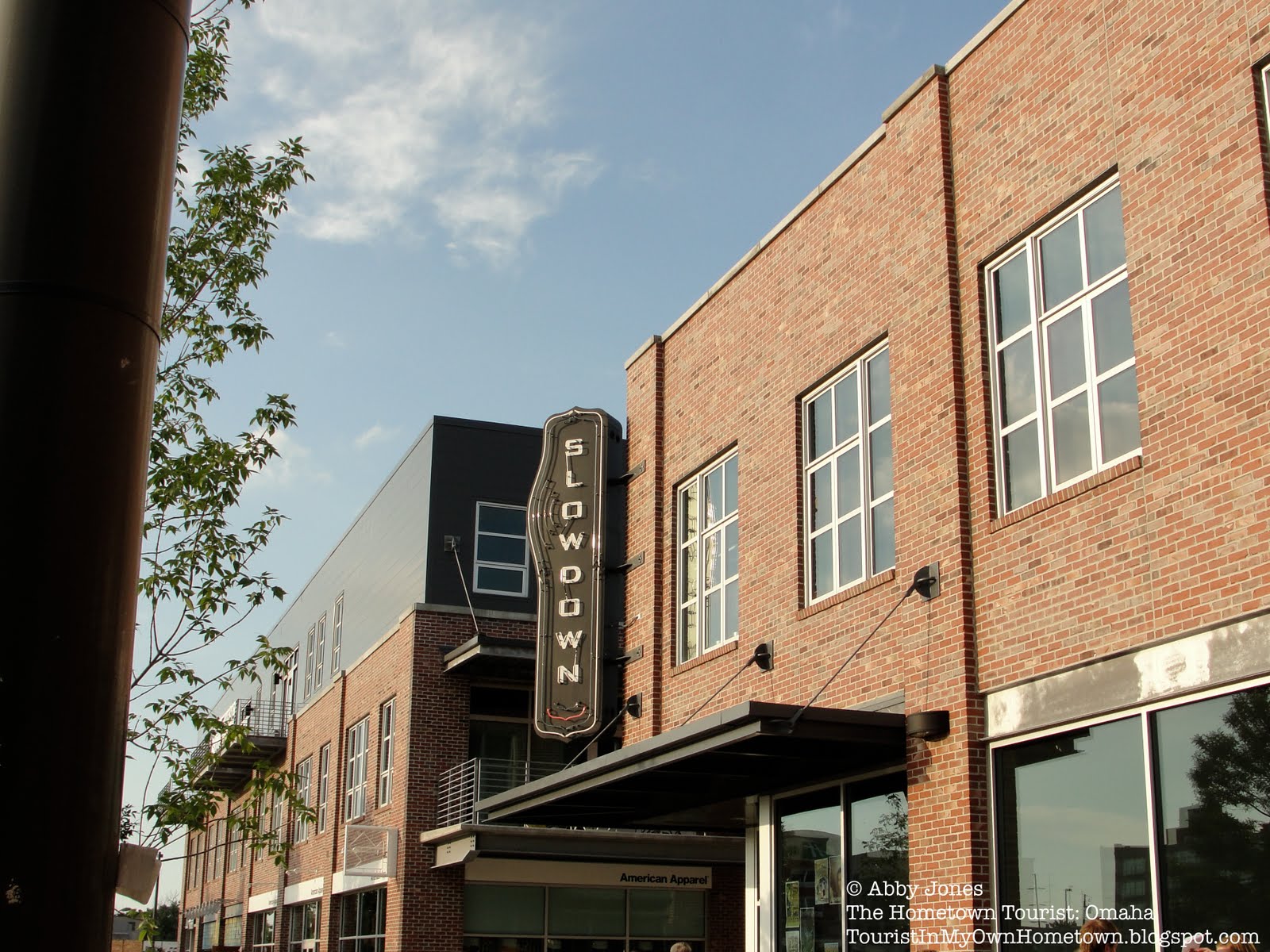
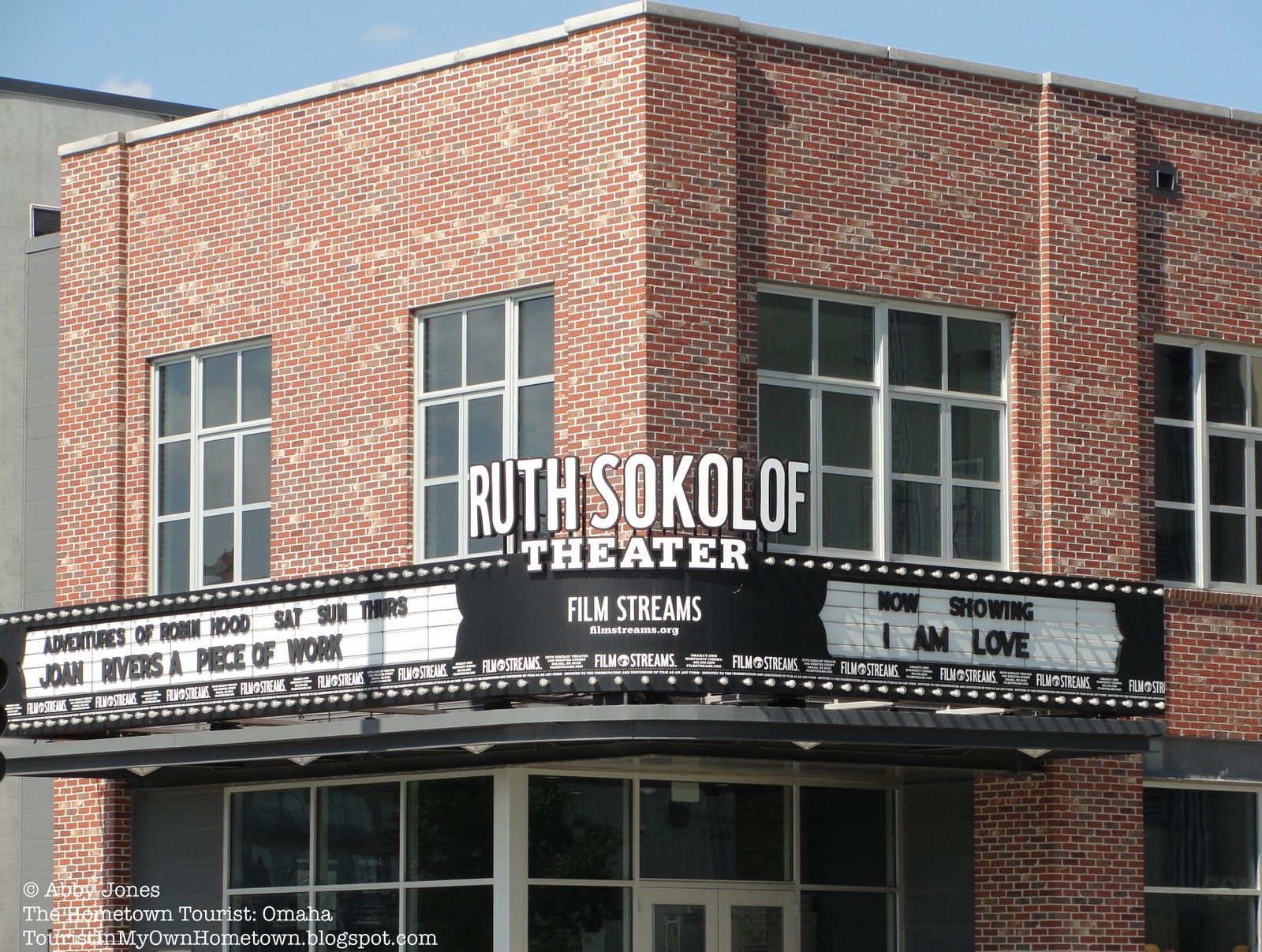
- The Slowdown and Film Streams development in NoDo or North Downtown
- Related articles
- Omaha’s Film Reckoning Arrives in the Form of Film Streams, the City’s First Full-Fledged Art Cinema (leoadambiga.wordpress.com)
- Jeff Slobotski and Silicon Prairie News Create a Niche by Charting Innovation (leoadambiga.wordpress.com)
- Overarching Plan for North Omaha Development Now in Place, Disinvested Community Hopeful Long Promised Change Follows (leoadambiga.wordpress.com)
- Nancy Oberst, the Pied Piper of Liberty Elementary School (leoadambiga.wordpress.com)
- Omaha Lit Fest: ‘People who like this sort of thing will find this the sort of thing they like’ (leoadambiga.wordpress.com)
- From the Archives: Golden Boy Dick Mueller of Omaha Leads Firehouse Theatre Revival (leoadambiga.wordpress.com)
- From the Archives: Opera Comes Alive Behind the Scenes at Opera Omaha Staging of Donizetti’s ‘Maria Padilla’ Starring Rene Fleming (leoadambiga.wordpress.com)
- Omaha Legends: Greater Omaha Chamber of Commerce Business Hall of Fame Inductees Cut Across a Wide Swath of Endeavors (leoadambiga.wordpress.com)
- Garry Gernandt’s Unexpected Swing Vote Wins Approval of Equal Employment Protection for LGBTs in Omaha; A Lifetime Serving Diverse Constituents Led Him to ‘We’re All in the Human Race’ Decision (leoadambiga.wordpress.com)
- Linda Lovgren’s Sterling Career Earns Her Greater Omaha Chamber of Commerce Business Hall of Fame Induction (leoadambiga.wordpress.com)
- Nick and Brook Hudson, Their YP Match Made in Heaven Yields a Bevy of Creative-Cultural-Style Results – from Omaha Fashion Week to La Fleur Academy to Masstige Beauty and Beyond (leoadambiga.wordpress.com)
- Entrepreneur Extraordinaire Willy Theisen is Back, Not that He Was Ever Really Gone (leoadambiga.wordpress.com)
- North Omaha Champion Frank Brown Fights the Good Fight (leoadambiga.wordpress.com)
Memories of the Jewish Midwest: Mom and Pop Grocery Stores, Omaha, Lincoln, Greater Nebraska and Southwest Iowa
November 14, 2011
9 comments

Oh, for the days when there was almost literally a grocery store on every corner and a movie theater in every neighborhood. I only know those days through articles, books, movies, photographs, and reminiscences and I am sure the reality did not match my romanticism about them. As fate would have it, the Mom and Pop grocery phenomenon I only got a glimmer of during my childhood became the subject of an assignment I was offered and gladly accepted: as co-editor and lead writer for a Nebraska Jewish Historical Society book project that commemmorates and documents the Mom and Pop Jewish grocery stores that operated in and around the Omaha metropolitan area from approximately the beginning of the 20th century through the 1960s-1970s. But it was Ben Nachman, along with Renee Ratner-Corcoran, who I worked with on the project, that truly realized the book . Ben’s vision and energy got it started and Renee’s commitment and persistence saw it through. I just helped pick up the pieces once Ben passed away a year or so into the project. Ultimately, the book belongs to all the families and individuals who contributed anecdotes, stories, essays, photos, and ads about their grocery stores.
Immediately below is Jewish Press story about the project, followed by an excerpt from the book.
The book is dedicated to the man who inaugurated the project, the late Ben Nachman, who was responsible for starting what is now my long association with both the Jewish Press and the Nebraska Jewish Historical Society. Ben led me to many Holocaust survivor and rescuer stories I ended up writing, many of which can be found on this blog. My stories about Ben and his work as an amatuer but highy dedicated historian can also be found here. I also collaborated with Ben and Renee, as the writer to their producder-roles, on a documentary film about the Brandeis Department Store empire of Nebraska. A very long two-part story I did for the Jewish Press on the Brandeis family and their empire served as the basis for the script I wrote. You can find that story on this blog.
Historical Society publishes grocery store history
by Rita Shelley
11.11.11 issue, Jewish Press
Freshly arrived from Europe a century ago, thousands of men and women found work in South Omaha’s packinghouse and stockyards.
South 24th Street grocer Witte Fried, also a first generation American and a widow with children from ages 2 to 7, knew something of her neighbors’ struggles to survive and prosper. She also knew they needed to eat. According to her descendants, Fried took care to mark prices on the merchandise in her store in several languages. She wanted her customers, regardless of their German, Irish, Italian, Russian, Polish, Greek, Czech or other origins, to have an easier transition into their new world.
Fried’s story is one of many featured in Memories of the Jewish Midwest: Mom and Pop Grocery Stores. Scheduled to be published in November by the Nebraska Jewish Historical Society (NJHS), the book includes recollections of Jewish grocers and members of the families who operated stores throughout Omaha, Lincoln, Council Bluffs and surrounding areas from the early 1900s to the present.

“A history of Jewish owned stores is also a history of the grocery business,” Renee Ratner-Corcoran, NJHS executive director, said. “Beginning with peddlers who traveled from farm to farm to trade their wares for farm produce to sell in the cities, through one-room Mom and Pop stores with adjoining living quarters, to the first large self-service grocery stores, to today’s discount stores that sell housewares and groceries under the same roof, the Jewish community played a vital role in the grocery industry.The book was a dream of Dr. Ben Nachman, an NJHS volunteer whose father owned a small store on North 27th Street. Dr. Nachman died in 2010; publication of the book is dedicated to his memory.
Children of early Jewish grocers who were interviewed for the book or submitted recollections recall the hustle and bustle of buying produce from open air stalls downtown (today’s Old Market) as early as 4 a.m. to stay ahead of the competition. Before there were automobiles, grocers’ children were responsible for the care of the horses that pulled delivery buggies. Mixing the flour and water paste to use for painting prices of the week’s specials on the front window was also the responsibility of children. So were dividing 100-pound sacks of potatoes into five- and 10-pound packages, grinding and bagging coffee, and feeding the chickens. (A kerosene barrel and a chicken coop were located side-by-side in at least one family’s store.).
The book’s publication was underwritten by the Herbert Goldsten Trust, the Special Donor Advised Fund of the Jewish Federation of Omaha Foundation, the Milton S. & Corinne N. Livingston Foundation, Inc., the Murray H. and Sharee C. Newman Supporting Foundation, Doris and Bill Alloy, Sheila and John Anderson, Edith Toby Fellman, Doris Raduziner Marks, In honor of Larry Roffman’s 80th Birthday, and Stanley and Norma Silverman.Increasing prosperity meant housewives had more money to spend. Innovations in transportation and refrigeration also brought changes to the grocery industry, and Jewish grocers were among the first to embrace those changes. More recently, Jewish Nebraskans “invented” some of the country’s first discount chains and wholesale distribution networks, as well as the data processing innovations that made them profitable.
For additional information, contact Renee Ratner-Corcoran by e-mail at rcorcoran@jewishomaha.org or by phone at 402.334.6442.
Excerpts from the book-
©by Leo Adam Biga
Memories of the Jewish Midwest: Mom and Pop Grocery Stores Omaha, Lincoln, Greater Nebraska and Southwest Iowa

Jews have a proud history as entrepreneurs and merchants. When Jewish immigrants began coming to America in greater and greater numbers during the late 19th century and early 20th century, many gravitated to the food industry, some as peddlers and fresh produce market stall hawkers, others as wholesalers, and still others as grocers.
Most Jews who settled in Nebraska came from Russia and Poland, with smaller segments from Hungary, Germany, and other central and Eastern European nations. They were variously escaping pogroms, revolution, war, and poverty. The prospect of freedom and opportunity motivated Jews, just as it did other peoples, to flock here.
At a time when Jews were restricted from entering certain fields, the food business was relatively wide open and affordable to enter. There was a time when for a few hundred dollars one could put a down payment on a small store. That was still a considerable amount of money before 1960, but it was not out of reach of most working men who scrimped and put away a little every week. And that was a good thing too because obtaining capital to launch a store was difficult. Most banks would not lend credit to Jews and other minorities until after World War II.
The most likely route that Jews took to becoming grocers was first working as a peddler, selling feed, selling produce by horse and wagon or truck, or apprenticing in someone else’s store. Some came to the grocery business from other endeavors or industries. The goal was the same – to save enough to buy or open a store of their own. By whatever means Jews found to enter the grocery business, enough did that during the height of this self-made era, from roughly the 1920s through the 1950s, there may have been a hundred or more Jewish-owned and operated grocery stores in the metro area at any given time.
Jewish grocers almost always started out modestly, owning and operating small Mom and Pop neighborhood stores that catered to residents in the immediate area. By custom and convenience, most Jewish grocer families lived above or behind the store, although the more prosperous were able to buy or build their own free-standing home.
Since most customers in Nebraska and Iowa were non-Jewish, store inventories reflected that fact, thus featuring mostly mainstream food and nonfood items, with only limited Jewish items and even fewer kosher goods. The exception to that rule was during Passover and other Jewish high holidays, when traditional Jewish fare was highlighted.
Business could never be taken for granted. In lean times it could be a real struggle. Because the margin between making it and not making was often quite slim many Jewish grocers stayed open from early morning to early evening, seven days a week, even during the Sabbath, although some stores were closed a half-day on the weekend. Jewish stores that did close for the Sabbath were open on Sunday.
Jewish grocery stores almost always became multi-generation family affairs. The classic story was for a husband and wife to open a store and for their children to “grow up” in it. In some families there was a definite expectation for the children to follow and succeed their parents in the business. But there were as many variations on this story as families themselves. In some cases, the founder, almost always a male, was joined in the business by a brother or brothers or perhaps a brother in law. Therefore, a child born into a grocer family might have one or both parents and some combination of uncles, aunts, siblings, and cousins working there, too.
Of course, not every child followed his folks into the family business. Because most early Jewish grocers did not have much in the way of a formal education, the family business was viewed as a springboard for their children to complete an education, even to go onto college. It was a means by which the next generation could advance farther than their parents had, whether in the family grocery business or in a professional field far removed from stocking shelves and bagging groceries.
Some Jewish grocers went in and out of business in a short time, but many enjoyed long runs, extending over generations. Some proprietors stayed small, with never more than a single store, while others added more stores to form chains (the Tuchman brothers) and others (like the Bakers and the Newmans) graduated from Mom and Pop shops to supermarkets. Some owners made their success as grocers only to leave that segment of the food business behind to become wholesale suppliers and distributors (Floyd Kulkin), even food manufacturers (Louis Albert).
Whatever path Jewish grocers took, the core goal was the same, namely to provide for their families and to stake out a place of their own that offered continued prosperity. For a Jewish family, especially an immigrant Jewish family, owning a store meant self-sufficiency and independence. It was a means to an end in terms of assimilation and acceptance. It was a real, tangible sign that a family had arrived and made it. Most Jewish grocers didn’t get rich, but most managed to purchase their own homes and send their kids to college. It was a legitimate, honorable gateway to achieving the American Dream, and one well within reach of people of modest means.
For much of the last century Jewish grocery stores could be found all over the area, in rural as well as in urban locales, doing business where there were no other Jews and where there was a concentration of Jews. In Nebraska and Western Iowa there have historically been few Jewish enclaves, meaning that Jewish grocers depended upon Gentiles for the bulk of their business. Dealing with a diverse clientele was a necessity.
In some instances, Jewish grocers and their fellow Jewish business owners catered to distinct ethnic groups. For example, from the 1920s through the 1960s the North 24th Street business district in Omaha was the commercial hub for the area’s largely African-American community. During that period the preponderance of business owners along and around that strip were Jewish, including several grocers, some of whom lived in the neighborhood. These circumstances meant that Jews and blacks in Omaha were mutually dependent on each other in a manner that didn’t exist before and hasn’t existed since. When the last in a series of civil disturbances in the district did significant damage there, the last of the Jewish merchants moved out. Only a few Jewish owned grocery stores remained in what was the Near Northside.
Until mechanical refrigeration became standard, customers had to shop daily or at least every other day to buy fresh products to replenish their ice boxes and pantries. Having to shop so frequently at a small, family-run neighborhood store meant that customers and grocers developed closer, more personal relationships than they generally do today. Grocers not only knew their regular customers by name but knew their buying patterns so well that they could fill an order without even looking at a list.
Home delivery was a standard service offered by most grocers back in the day. Some stores were mainly cash and carry operations and others primarily charge and delivery endeavors. Taking grocery orders by phone was commonplace.
Most grocers extended credit to existing customers, even carrying them during rough times. It was simply the way business was conducted then. A person’s word was their bond.
Fridays were generally the busiest day in the grocery business because it’s when most laborers got paid and it’s when families stocked up for the big weekend meal most households prepared.
Jewish grocers were among the founders and directors of cooperatives, such as the United Associated Grocers Co-op or United AG and the Lincoln Grocers Association, that gave grocers increased buying power on the open market.
With only a few exceptions today, the intimate, family neighborhood stores are a thing of the past. As automobiles and highways changed the landscape to accommodate the burgeoning suburbs, newer, larger chain stores and supermarkets emerged whose buying and selling power the Mom and Pops could not compete with on anything like an even basis. Thus, the Mom and Pop stores, Jewish and non-Jewish alike, began fading away.
Because Jewish grocers were such familiar, even ubiquitous fixtures in the community, the majority population gave little thought to the fact that Omaha Jewish merchants like the Bakers (Baker’s Supermarkets) or the Newmans (Hinky Dinky), who began with Mom and Pop stores, led the transition to supermarket chains. For much of the metro’s history then, Jews controlled a large share of the grocery market, helping streamline and modernize the way in which grocers did business and consumers shopped.
It is true the one-to-one bond between grocer and consumer may have all but disappeared with the advent of the supermarket and discount store phenomenon. The days of grocers filling each customer order individually went by the wayside in the new age of self-service.
One thing that’s never changed is the fact that everybody has to eat and Jews have been at the forefront of fulfilling that basic human need for time immemorial. The Jewish grocer was an extension of the friendly neighborhood bubbe or zayde or mensch in making sure his or her customers always had enough to eat.


Categories: Ben Nachman, Books, Business, Entrepreneurial, History, Jewish Culture, Leo Adam Biga, Nebraska Jewish Historical Society, Omaha, Writing
Jewish Mom and Pop Grocery Stores, Memories of the Jewish Midwest: Mom and Pop Grocery Stores, Mom and Pop Grocery Stores, Nebraska Jewish Historical Society
Tired of being tired leads to new start at John Beasley Theater
September 30, 2011
10 comments
- If you’re a return visitor to this blog, then you may recognize that the subject of this next story, the John Beasley Theater & Workshop in Omaha, is one I’ve written about a number of times. If not the theater itself, then I’ve written about its productions, and if not productions then I’ve written about founder and president John Beasley. This time around I write about some recent financial woes the theater’s been experiencing and how with the help of friends and strangers the organization now has what it needs to go on with the 2011-2012 season, which was in jeapordy until John Beasley went public with the need. As a niche theater that largely but not exclusively produces work by African-American playwrights – with its current production of Radio Golf the theater’s now staged the entire 10-play cycle of African-American life that August Wilson wrote – the JBT presents a slate of work that otherwise might not be produced in Omaha. The theater is a labor of love for Beasley, a stage-film-television actor who views his enterprise as a way to bridge cultural differences and as a forum for black actors to learn their chops in a white majority city that has traditionally not embraced its black community and not provided many theater opportunities for aspiring, emerging or even established black theater artists.

Tired of being tired leads to new start at John Beasley Theater & Workshop
©by Leo Adam Biga
Published in The Reader (www.thereader.com)
John Beasley got tired of being tired.
By now, you’ve likely learned the John Beasley Theater & Workshop’s urgent appeal for funds to relieve its financial distress has been answered and the once endangered 2011-2012 season saved. But you probably don’t know the back story of its troubles or why founding namesake and president, John Beasley, is putting himself out there to share these travails and to make the case for the theater’s continued existence.
Ever since launching the theater in 2000 the stage-film-television actor has largely bankrolled the nonprofit himself. Year after year, with no real administrative staff and fronting a board short on resources and contacts, the theater’s only barely scraped by. This despite strongly reviewed work, some outright smash hits, including shows held over for extended runs. Its niche producing African-American plays, most notably the August Wilson repertoire, has distinguished it but not always helped it either.
The kindness of strangers, an occasional grant, meager season-ticket sales and box office receipts from a 100-seat house only go so far. It’s left Beasley holding the bag, writing personal checks to make-up the shortfall.
“I’ve underwritten most everything we’ve done, but it’s been at the point for a long time now that I thought the theater should be self-sustaining rather than to just keep going in my pocket,” he says. “I’m not getting anything financially out of the theater.”
There have been times, even quite recently, when there wasn’t enough in the theater’s coffers to pay his son, artistic director Tyrone Beasley, or directors’ fees, much less vendors. So he paid Tyrone and creditors himself.
Even the theater’s performing home in the LaFern Williams South Omaha YMCA at 3010 R Street, where the old Center Stage Theatre used to operate, was no sure thing.
“We were going through a period there where the oral contract we had with OHA (the Omaha Housing Authority agency that owned the building before the YMCA acquired it) had expired. Without that space being donated we wouldn’t have made it,” says Beasley “That was a big consideration at the end of that contract. It was up for renewal and the YMCA was saying, ‘What can you pay?’ and I told them we’re really in a situation where we can’t pay anything, They worked out a really nice arrangement for us and I’m really grateful to the YMCA for the use of that space.
“Without that, I think we would have closed.”
He acknowledges that in some ways he’s ill-prepared to run a theater, but he’s stuck it out because by his reckoning the whole venture is a calling.
“I didn’t set out to open a theater. I thought it was put on me for a reason. I believe things happen for a reason, so I’ve always talked to God in this way: ‘If you want me to be here, you’re going to have to provide the way.’”
Divine providence was necessary, he says, “because we came in here without any grants. OHA gave us the space but they didn’t give us any money to go with it, and not ever having a board that would raise funds for me, it’s been a struggle. The fact we’ve managed to stay here as long we have is a miracle in itself given I never had any experience in theater administration.
“But, you know, God has been good and has allowed us to be here 11 years and I don’t think He’s brought us this far to say, Ok, it’s over now. We haven’t completed our mission and we still have a ways to go, and I still have a vision for the theater.”
That vision, which encompasses a second theater he wants to build from the ground up in North Omaha as a regional attraction, has often seemed far off.

Rendering of the revitalized North 24th and Lake St. corridor where Beasley wants to build a new theater
“It’s always been a day to day thing. You can’t imagine what it’s like getting up every morning with this on your mind, wondering — how are we going to take care of this? how are we going pay these people?”
The recession hasn’t helped matters.
“Revenues have been flat and our expenses keep mounting. The box office only pays a little bit of the expenses. Our small house is not a big revenue source. It will pay some bills, but then you’re scrambling where you’re going to get the money for this and that. Attendance numbers are down because of the recession. These are entertainment dollars and with discretionary spending theater might not be at the top of the list.”
In noting that other theaters have dropped prices, he says, “we’ve looked at doing the same thing,” hastening to add, “But it wont necessarily guarantee our attendance will go up, and I’ve always felt that if people think it’s too cheap, they’ll assume its probably not worth it.” He’s heard grumbling in the black community his theater’s too pricey, an opinion he disputes. “We weren’t overcharging,” he says, noting that people don’t think twice about plopping down considerably more money to see touring gospel plays.
“Our work might not be as glitzy but the quality is as good as any that comes through as far as the acting is concerned, because I see what comes through and I don’t think there’s a lot of talent sometimes.”
The theater’s woes extended to marketing and publicity, which have been largely limited to post cards and print ads, leading Beasley to doubt it was even reaching its audience in this online social media age.
Approaching the start of the 2011-2012 season, kicking off with August Wilson’s Radio Golf, Beasley decided he’d had enough.
“I told the board that going into this season I needed $20,000 for the first show and I wouldn’t greenlight it until I received $10,000. And I asked the board, ‘Who’s going to lead this?’ I didn’t have any volunteers because my board is more of a working board. They’re willing to put in the work but they’re just not fundraisers, and that’s just the way it is. So out of frustration I said, ‘Well, alright, I’ll do it,’ and so I stepped out. I didn’t know how I was going to do it but I believe when you step out in faith good things happen, they just happen. God or whatever provides a way.”

John Beasley
He laid out the precarious situation to friends of the theater with, “This is a crossroads for us. If this doesn’t happen I can’t just go along with this kind of pressure anymore…”
Then he went public Sept. 1, posting a Facebook appeal that spelled out in dire terms the make-or-break scenario confronting his South Omaha theater. His message stated flat out the JBT would close unless $10,000 was obtained. KETV, the Omaha World-Herald and other media picked up the story.
By mid-September $30,000 was either donated or pledged, meaning the season was on and the theater’s future, at least for now, secured. For Beasley, whose fierce demeanor and brickhouse physique belie a soft heart, the outpouring has taken him aback and given his theater mission a new lease on life.
“The best thing about going public is to receive the love from Omaha we received from people we didn’t know. When I found out all you had to do was ask and people would respond…” he says, his voice trailing off in wonder.
“It’s put us in a place where I’m really optimistic about not only the season but about the future of the theater. This has given some breathing room we have never had before. It’s given us a budget, and that budget will take care of a lot of things. It will also help us pay off the vendors we owe.”
He says the community’s embrace has come from both long-time theater supporters and individuals with no connection to the organization. Support has come in amounts as small as $20 and as much as $5,000. The Myth bar in the Old Market threw a fund-raising party Sept. 20 that raised about $1,400.

Beyond the money collected, there’s new blood cultivated. As a result, he says the JBT now has a circle of volunteers with the skills to build a stable enterprise.
“I’ve put together a committee of people I’ve never had in place before,” says Beasley. “These people know what it’s all about.”
Development professional Jeff Leanna is the new executive director. He, along with management communications specialist Wendy Moore and her real estate executive husband Scott Moore are heading up marketing, solicitation, subscription campaigns and beefing up its online presence. Beasley’s in the process of “weeding out” some inactive board members and replacing them with energetic new members. Taken together, he says, the JBT has people in place to “take care of the administrative things and business part of it, and that’s such a relief. We’ve been really lacking in that end of it. My son and I are creative people.”
He expects fund-raisers, grant applications, membership programs and marketing-development campaigns to happen year-round. “That’s part of the plan,” he says. “We’re even reaching out to Oprah now,” he says, and hints that overtures may be made to actor-director Robert Duvall, whom he acted alongside in the The Apostle.
Now that the JBT is on more solid ground, he says, “I’m glad I went public with it. People now are aware of the need of the theater.” He says telling the theater’s story has also laid to rest some myths — like the city was funding the venue. “There was a misconception that we had everything we needed,” he says, and that he had limitless deep pockets.
“I think we had to hit bottom before we could have this turning point. I think this really was the catalyst to take us to that next level.”
For a proud man like Beasley airing his plight is not easy. But he sees it as the only way to explain why the theater is worth fighting for in the first place.
“At first I had some reservations, because you don’t want people to think you’re struggling or failing, but then I came to the realization we serve a purpose. Who else is going to do August Wilson or Suzan-Lori Parks or Eugene Lee or even Ted Lange? And where are the opportunities for up and coming black actors?
“Through the years we’ve touched a lot of lives. We’ve changed lives. We’ve got some good people we’ve brought along. Andre McGraw first came on the stage in our theater — now he’s going to school to study theater at UNO. TammyRa (Jackson) is an outstanding talent I’m going to lose soon — she’s talented enough to work out of town. I’m just so proud of her. Dayton Rogers is another fine actor coming up. Phyllis Mitchell-Butler is in a production at the Playhouse now. Where else would they have gotten this opportunity?”
The JBT’s also offered a window into the black experience that’s given white Omaha a perspective sorely lacking outside that prism.
“I guess I’m most proud of the exposure to black culture we’ve given Omaha,” he says, adding that “75 percent of our patrons come from West Omaha.”
Fear or loathing of other cultures, he says, is less likely when there’s communication and knowledge.
“The more you learn about something, the more you understand something — then you can’t hate it. I think we’re bridging gaps.”
He says the divides that stymie America plague the city as well, and the arts and theater, perhaps his theater especially, can serve to heal.
“The country can’t move forward because of politics and ideologies. Nobody’s trying to understand the other side, there’s no compromise. If you can understand the other side then you can create a dialogue. If you have a dialogue then things can happen. That’s true nationally and it’s true in this city. The disparity between blacks and whites in this city is the worst than any place in this country.”
Among the reasons he’s hung his theater on the back of August Wilson’s body of work is the playwright’s cycle of 10 plays revealing the arc of African-American life in the 20th century as seen through the eyes of Pittsburgh’s Hill District denizens.

August Wilson visiting Pittsburgh’s Hill District
“I love August Wilson’s work because it’s a true reflection,” says Beasley, whose extensive credits include productions of Wilson plays in major regional theaters. “I know these people. One of the goals when I opened the theater was to introduce Omaha to August Wilson, because he’s such an important part to my whole career and has created work that will keep middle aged black men working forever. I can do Wilson till I’m ready to die. It’s just a rich legacy he’s left black actors and the world for that matter. His stuff crosses all lines.
“You’ve known people like Troy Maxon (Fences). I’ve had people come up to me wherever I’ve done this and say, ‘That was my dad’ or ‘I knew that guy.’ You know these people and these situations, the relationships between sons and fathers. Life has passed them by and they haven’t dealt with it very well.”
With Radio Golf, the last in the cycle, the JBT’s now performed each of the 10 Wilson plays, including some (Fences, Two Trains Running, Jitney) staged multiple times. Radio Golf’s look at gentrification efforts in a historical black neighborhood has particular resonance for Beasley and the new North Omaha theater he envisions. Leo A Daly is nearing final designs for the unfunded project, which would not replace the existing site, but rather complement it. It’s a project personal to Beasley on several levels.
“We’d like to put it between 25th and 24th Streets in that Lake Street corridor. It would be right off the Interstate. If you build up it, they’ll come. That would be my field of dreams. We want to be a destination and an anchor to the cultural revitalization of this district. I grew up in this neighborhood, it’s my neighborhood. I was here when they tore it down and burnt it down. I remember giving a little speech here to rioters — ‘Why you tearing down your own neighborhood? If you’re that angry, go downtown.’ It was opportunistic hoodlums that did that stuff and then you have that mob mentality.
“I just want to be a part of rebuilding the neighborhood. It’s changed. Regentrification is happening.”
Should the new theater come to pass, it would be another piece in the resurgent arts-culture district slated for the area, where the Loves Jazz & Arts Center and Great Plains Black History Museum already operate and where Brigitte McQueen’s Union for Contemporary Art is due to locate.
None of it means the JBT is out of the woods.
“I don’t want people to think we’re OK, we’re not OK,” says Beasley. The influx of funds, he says, “is a start, but I’m looking for a $200,000 budget for this season. We appreciate any donations.” As a thank you to the community the theater offered free admission for its season-opening, Sept. 30-Oct. 2, weekend.
Visit www.johnbeasleytheater.org for donation and season ticket info.
Related articles
- John Beasley and Sons Make Acting a Family Thing at the John Beasley Theater & Workshop and Beyond (leoadambiga.wordpress.com)
- Crowns: Black Women and Their Hats (leoadambiga.wordpress.com)
- From the Archives: Golden Boy Dick Mueller of Omaha Leads Firehouse Theatre Revival (leoadambiga.wordpress.com)
- Native American Survival Strategies Shared Through Theater and Testimony (leoadambiga.wordpress.com)
- Dick Boyd Found the Role of His Life, As Scrooge, in the Omaha Community Playhouse Production of the Charles Dickens Classic ‘A Christmas Carol’ (leoadambiga.wordpress.com)
- John Beasley Has it All Going On with a New TV Series, a Feature in Development, Plans for a New Theater and a Possible New York Stage Debut in the Works; He Co-stars with Cedric the Entertainer and Niecy Nash in TVLand’s ‘The Soul Man’ (leoadambiga.wordpress.com)
- A Synergy in North Omaha Harkens a New Arts-Culture District for the City (leoadambiga.wordpress.com)
Leola keeps the faith at her North Side music shop
September 2, 2011
12 comments
-
-
 Leola McDonald, ©photo by Jason Fischer
-
Here is the promised cover profile I did on Leola McDonald, whose Leola’s Records and Tapes shop in North Omaha was an African American cultural bastion for years before she decided to close the operation. This piece for The Reader (www.thereader.com) appeared as business was appreciably slowing for her, and as the short follow up piece I posted earlier here reported, she eventually called it quits. It was no great surprise. The times were changing, and she wasn’t changing with them. She said so herself. The writing was on the wall and so it was just a matter of time.

Leola keeps the faith at her North Side music shop
©by Leo Adam Biga
Originally published in The Reader (wwwthereader.com)
The iridescent, rainbow-palette mural splayed across the brick west wall spells LEOLA’S in big block letters. The name on the side of the Omaha music store formally known as Leola’s Records and Tapes belongs to founder/owner Leola McDonald. Both the handle and the woman are synonymous with music on the north side.
Her small shop at 56th and Ames Avenue is where today’s beat generation heads for the latest hip hop and rap tracks, including hard to find mixes and chopped and screwed versions of hit cuts.
Bright as the colors decorating that wall is Leola’s own passion for music.
“I love music. I always have. I used to play it all. At one point in my life I even sang. I sang in the church choir,” said the former Leola Ann Francis.
A 68-year-old church lady who prefers gospel may not be what you expect behind the counter of an urban music store carrying CDs and tapes with R-rated lyrics, but that’s exactly what you get. Her operation is pretty much a one-woman show. Oh, her grandkids come by to help some, but “mostly I do it by myself,” she said.
As its sole proprietor, she’s there seven days a week. Waiting on customers. Answering the phone. Registering sales. Bantering back and forth with whoever saunters on in, some just to “conversate” with her. Others to inquire after new releases. The door bell rings and it’s a young man, Eric Miller, who’s been shopping there since he was a boy.
“Hi, Miss Leola.” “What you want, babe?” “I’m lookin’ for that CD that got, uh, Slim Thug and, um, Young Zee-Zee on it…” She searches the shelves in back of her. Another young man comes in, hawking a box-full of high-end electronic gadgets. Leola tells him, “Honey, my money’s funny and my change is strange. I’m broke.”
Whatever brings them there, she greets all with — “Hey, sweetie” or “Hey, babe” or “How ya doin’?” or “What’s up, doc?” — in a musky voice that years of cigarette smoking ruined for singing. She used to love to sing. In the Sunday baptist church choir as a youth. In church-sponsored competitions. She once dreamed of performing professionally. That was a long time ago.
“I could sing once in my life…I won every contest I got into. But I messed up my own voice. I started smoking and drinking. I was grown. I could do what I wanted to do. But didn’t nobody suffer for it but me. Now, I can’t carry a tune across the street and bring it back in one piece,” she likes to say.
That doesn’t change her passion. That’s why she’s still at her store every day when most women her age are retired.
“I love music and I love people. So, it’s easy for me. And you really have to to deal with this because you can get some fools in here, and sometimes it’s more than one, and you have to deal with ‘em,” said the Omaha native, who divided her growing up between here and Cheyenne, Wyoming, where her mother moved after splitting up with her father.
Then there’s “that crap they call rap” she feels obliged to carry. It’s what sells these days. It doesn’t mean she has to like it, though. Still, she must be familiar with the artists and their work. Like it or not, it’s what customers want.
“Yeah, I pretty much have to be up on all of it now. I don’t particularly care for it, but hey, maybe if I was these kids’ age…But I don’t think I would go in for it. To me, it’s nothin’ but noise. But different strokes for different folks,” she said.
Eric Miller said despite the generation and taste gap, McDonald stocks what’s in vogue. “You can find things here you can’t find at a lot of places,” he said. Carmelette Snoddy said she prefers Leola’s for its “quality. Like with these mixed CDs,” she said, holding up a few, “you can buy them off the streets, but they’re not quality. They don’t play as good.”
Leola tries to ensure customers know what they’re getting.
“If they don’t know what something sounds like, I’ll play the music for them, so they’re not just buying something blind. I’ve always done that,” she said.
Long before rap, back when jazz, blues, R & B and soul ruled the charts, she was a respected black music source. Music buff Billy Melton of Omaha said he often relied on her opinion in compiling some of his extensive collection.
“She’s very studious. She knows music. She always had what I was looking for,” Melton said. “And she loves what she’s doing now, too. She’s been faithful to that music line. I just wish she would have stayed with the older music, but there’s no money in that. She knows I love music and she’s given me pictures and things of older artists over the years. She’s quite a gal.”
Her savvy got her a job at the Hutsut, a now defunct music store. Then an advertising salesperson with the Omaha Star, she called on the store one day. When she saw the clerks couldn’t answer customers’ questions about black music, she offered to help. The owner agreed and she so impressed him he hired her on the spot.
She and a partner soon opened their own store, Mystical Sounds. She then went solo. Leola’s followed. For a time, she ran both. For the last 30 years, just Leola’s.
While most of her store’s inventory is given over to current CDs or tapes, she reserves a few bins and racks for old-school vinyl recordings.
Her own personal collection of CDs, LPs, 45s and 8-tracks, drawn from four decades in the business, is all R & B and gospel.
“Gospel music to me is like no other. I love it. Nothing compares…There’s just something about it.”
There’s another reason she opens the doors of her business daily. As a small independent, she’s squeezed by national chains and bled by music pirates. With so many under selling her, she can’t afford not to light up the neon Open sign.
“I don’t have a choice. I have to work. If I didn’t have to work, God knows at my age I wouldn’t be. I’m sure doing this for the love of it. Besides, I’m too old to go get a job. I can’t even think about it. But if push comes to shove and that’s what I have to do to survive…”
Profits are down as a result of black marketeers. Her no-return policy is aimed at pirates who buy CDs, copy for resell and bring back for a refund. “Like I tell ‘em, I wasn’t born yesterday. I was born the day before yesterday. You have too much competition from the bootleggers,” she said. “They stand on the street and they make more than I do sittin’ up here. Why, it’s not fair…I have sat up in here all day long and gone from open to close and walked out the door with $20. Before, it might have been $500-$600 in the drawer. So, there’s no comparison.”
That’s why she takes umbrage when some suggest she pack it in and rest easy on her supposed riches. “If I had the money people tell me I have I probably wouldn’t be here,” she said. “But I love to work.” It’s not as if she has a pension or retirement fund to fall back on. “No, when you work for yourself, unless you save or invest your own money, you don’t have any. And I had four kids to raise, so I didn’t do any saving,” said the twice-married, twice-divorced McDonald.
Single is something she never counted on being at 68. But things never quite worked out with the men in her life. Like any young woman coming of age in the 1950s, she bought into the happily-ever-after ideal.
“I never wanted to be (single). It just happened. Back then, you were to get married, have some kids and be happy. Well, I got married, had the kids, but damn if I was happy,” she said, laughing at herself. She takes it all in stride. “If you don’t have any regrets, you haven’t had any life,” she said.
Faith has a way of healing wounds and easing doubts. Church is where she renews herself. Mount Nebo Baptist Church is where she gives praise and worship.
“I’ve always liked church. It’s been a very short time I wasn’t in the church. Now, I go every Sunday and, if I can, Wednesdays, too. It’s just that I enjoy it so much.”
With that, she turns up the boombox on a cut from the William Murphy Project’s All Day CD. The rousing choir anthem fills the store, rising, rising…the spirit moving her to answer the call…“Oh, yes…He got it together. He got them together…”. As the words “I am trusting you, to bring me through” reverberate, she hums and sings along, swaying to the beat. Hearing the lyric — “So, all you’ve got to do is…” — she finishes it with “Be strong…”
Be strong, Miss Leola, be strong.
 hoto ©photo from DJ Smove
Related articles
- Miss Leola Says Goodbye (leoadambiga.wordpress.com)
- Back in the Day, Native Omaha Days is Reunion, Homecoming, Heritage Celebration and Party All in One (leoadambiga.wordpress.com)
- Native Omaha Days: A Black is Beautiful Celebration, Now, and All the Days Gone By (leoadambiga.wordpress.com)
- Walking Behind to Freedom, A Musical Theater Examination of Race (leoadambiga.wordpress.com)
- Soon Come: Neville Murray’s Passion for the Loves Jazz & Arts Center and its Role in Rebirthing North Omaha (leoadambiga.wordpress.com)
- An Inner City Exhibition Tells a Wide Range of Stories (leoadambiga.wordpress.com)
- Native Omahans Take Stock of the African-American Experience in Their Hometown (leoadambiga.wordpress.com)
- Overarching Plan for North Omaha Development Now in Place, Disinvested Community Hopeful Long Promised Change Follows (leoadambiga.wordpress.com)
- Soon Come: Neville Murray’s Passion for the Loves Jazz & Arts Center and its Role in Rebirthing North Omaha (leoadambiga.wordpress.com)
- Art as Revolution: Brigitte McQueen’s Union for Contemporary Art Reimagines What’s Possible in North Omaha (leoadambiga.wordpress.com)
Miss Leola Says Goodbye
September 1, 2011
12 comments
As music stores went, it wasn’t much, but it was a fixture in Omaha’s African-American North Omaha community, and when owner Leola McDonald decided to close her Leola’s Records and Tapes the decision was met by an outpouring of regret and fond memories. I did this short piece for The Reader (www.thereader.com) in the wake of her announcement she was closing shop. It appeared not long after a cover profile I did on Leola for the same paper. I will soon be posting that cover. She and her store are missed.
Miss Leola Says Goodbye
©by Leo Adam Biga
Originally published in The Reader (www.thereader.com)
Miss Leola is moving on and the African-American community she served for decades at Leola’s Records and Tapes is treating her retirement as a loss akin to a death. Since Leola McDonald announced she’s closing her music store at 5625 Ames Avenue, mourners have filed in to pay their respects.
Felix Hall was among them last Friday. “What’s up, doc, how ya’ doin’?” Leola greeted the middle-aged man from behind the counter. “Oh, pretty good,” said Hall, before choking up to proclaim, “I saw in the news you were going out of business and I just had to come in to say goodbye.” “Well, thank you, that was nice of you,” a visibly moved Leola said.
It’s been like that now for weeks.
Attired in slacks and a T-shirt imprinted with aphorisms to motherhood, Leola, a mother and grandmother, has been a surrogate parent for neighborhood kids who “grew up” in her store. One of these, Marcus Roach, 18, said he and his posse have “been coming up here for years. A lot of people come up here. Yeah, everybody knows Miss Leola.”
Jason Fisher, 31, owner of the building housing Leola’s and his own multi-media company downstairs, can attest to the respect she holds.
“Miss Leola is known immensely throughout the north Omaha community. It’s unreal what kind of impact you can have on a community in 30 years. Just about everybody knows her like she’s the President,” he said.
“I think she’s kind of like the community’s grandma,” said granddaughter Mercedes Smith. “She’s always looked out for everybody that came to her…People having a bad day come in and talk to her because they know she’ll make them feel better about who they are. She’s a good person.”
“Momma’s real…always lovin’ and always levelin’ with someone,” her son Seth Smith said. Mercedes feels her grandma’s personal stamp will make her missed. “This is not like Sam Goodies or any of the other (independent) music stores closing around the country. She’s the cornerstone of the community.” “I don’t understand it, she’s been here forever,” a young man in search of a CD said.
Leola doesn’t want to leave, but business has lagged. “In the last two years I’ve seen it go down, down, down…” she said. National chains hurt enough, but there’s no competing with music pirates. “It’s so much on the streets now,” she said. The cruelest rub is when black marketeers get source material from Leola’s to burn and then under sell her with it. “It’s just sad that somebody who always tried to be fair and right and correct in everything she did has to suffer,” Smith said.
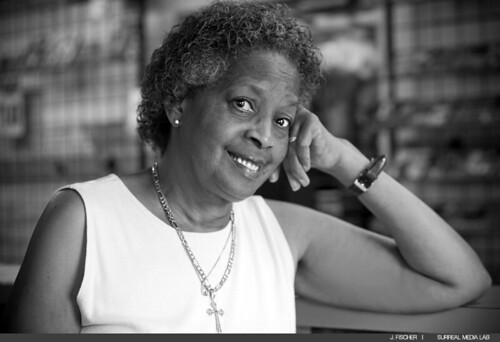
Leoloa McDonald, ©photo by Jason Fischer
The woman who’s become an institution is pragmatic about it all. “I wanted it to last a little bit longer, but I guess my biggest problem is I haven’t moved with the times,” Leola said. “I’m still over there, while the times are over here. It happened and I didn’t even realize it. I’m saddened with it and I will miss it. I enjoyed what I was doing and if I was a little bit younger I’d still be doing it.
“I was young when I started and I ain’t young no more — no parts of it.”
Her legacy and her 70th birthday will be celebrated August 11 with a 6:30 p.m. reception at Loves Jazz & Arts Center, 2510 N 24th Street.
But, as Fischer noted, “This isn’t the end of Leola’s, it’s a new beginning.” Soon after Leola closes shop around August 10, he plans to make renovations to the existing space and reopen as Leola’s Urban Avenue, a retail music store “with a singular focus on independent artists, underground music and diversified merchandising.” As for the friend Leola was to the community, he’ll try to represent. “We’ll try to keep it going,” he said.He’s keeping Leola’s in the title to play off her good name and “to carry that torch for her and her family.”
“It gives me a good feeling that somebody cares enough about me to keep the name. I appreciate it. He’s been great to me,” Leola said of Fischer.
Beyond the name, she’s sure a little piece of her will remain in the new store. “I think it will,” she said. She plans to move to Calif., where she has family.
Related articles
- Back in the Day, Native Omaha Days is Reunion, Homecoming, Heritage Celebration and Party All in One (leoadambiga.wordpress.com)
- Native Omaha Days: A Black is Beautiful Celebration, Now, and All the Days Gone By (leoadambiga.wordpress.com)
- A Family Thing, Bryant-Fisher Family Reunion (leoadambiga.wordpress.com)
- A Synergy in North Omaha Harkens a New Arts-Culture District for the City (leoadambiga.wordpress.com)
Jeff Slobotski and Silicon Prairie News create nNiche by charting innovation
August 27, 2011
7 comments
One of the leaders of Omaha’s much ballyhooed creatives and emerging entrepreneurs community is Jeff Slobotski, who has caught the wave with his Silicon Prairie News site and his annuak Big Omaha event. Jeff not only has lots of great ideas and an abudance of energy and enthusiasm, but he also has the skills to do follow through and to actually make his concepts reality. The following piece I did about Jeff and Silicon Prairie News appeared in Metro Magazine a couple years ago. Since then, Jeff’s endeavors have grown even more. I have a feeling I will be writing about he and his ventures for a long time. I may even be writing for him one day.
Jeff Slobotski and Silicon Prairie News create niche by charting innovation
©by Leo Adam Biga
Originally published in Metro Magazine
Omaha-based Silicon Prairie News (SPN) may not be the next big thing on the Web but that’s OK with founder Jeff Slobotski. The Omaha native envisions his less-than-year-old startup as part social mission and part social networking portal. SPN’s public face is www.siliconprairienews.com, a sleek blog, news and events site devoted to nurturing and linking the area’s entrepreneurial-minded creative class.
Site postings include original published stories, video interviews and listings filed by him and partner Dusty Davidson, owner of the boutique software applications firm, Bright Mix, which hosts SPN. “If you’re looking for news and information around the creative innovative class,” Slobotski said, “that’s what we hope we’ll be able to cover and provide to folks.”
Slobotski, 31, came to admire his hometown as an entrepreneurial hot bed working with political campaigns in Nebraska and as a capital consultant with the Steier Group. He’s further staked-out cutting-edge Omaha in his current day job as sales-marketing guru for New York City-based software design firm Truist.
His travels allows him to compare the climate for startups here with that in centers of innovation like Austin, Texas. What he sees is that, yes, things are hopping as you’d expect in these progressive hubs but there’s also no shortage of enterprising intellectual capital and commerce in Omaha.
“I knew we had a lot of that here — a lot of that same creative class, innovative, entrepreneurial spirit,” said Slobotski, who makes it SPN’s business to track and engage this lively community of Generation X-Y-Z go-getters.
He maintained a personal blog that predated SPN, Midwest to Manhattan, where he commented on New York or San Francisco goings-on. “My office was in Manhattan at that time,” he said. After a while though he decided to turn his attention from what was happening elsewhere to what was happening in his own backyard.
“I thought, Nobody wants to read about me traveling around and writing, ‘Look what I’ve seen’ or ‘Look who I met.’ I like to be behind the scenes anyway — I don’t need to be the highlight of the blog. I wanted to turn that around and say, ‘Hey, look at some of guys or women that are doing it right here.”
That’s when he began formulating the SPN model that features individuals living the dream as entrepreneurs, innovators, mavericks, venture capitalists. “I said, ‘Wait a minute, I’m talking about what I’m seeing in New York and bringing that back here,’ and I was like, ‘No wait, we have that here.” Examples are abundant.
“Rachel Jacobson at Film Streams is an innovator to me. She doesn’t clock in at 8 and clock out at 5, yet she’s really pushing the spirit of what we’re doing as a city,” said Slobotski. “Secret Penguin is another example. It’s a Web design shop that does work for MTV and the NFL, and not a lot of people know that.”
On his SPN site Slobotski’s sung the praises of both Jacobson and Secret Penguin owner Dave Nelson, a pro skateboarder whose youth branding business is built around skateboarding, music and youth cultures. Both Film Streams and Secret Penguin, along with bar/live music venue Slowdown, are part of the Saddle Creek Records complex that anchors the NoDo district’s developing cultural-commercial scene and exemplifies the creative class community Slobotski celebrates.
In his self-described role as “citizen reporter” Slobotski, not a trained journalist but a University of Nebraska at Omaha finance and banking graduate, does a form of advocacy journalism through Silicon Prairie News posts. SPN really is his forum to serve as Omaha’s creative class evangelist and facilitator.
“I see the resources, the talent we have here in town, and again it goes back to those connections or those networks,” he said. “But what good is it that you know people but aren’t helping them develop their skill set or their trade? Our goal is to really build that community and highlight those individuals or those businesses or those ideas to show that you’re not alone. If you’re someone who after you clock out of your 8-to-5 job is moonlighting, working on an idea, it’s like, Hey there’s other guys out there like you and here’s some of their stories.”
Slobotski and Davidson moonlight themselves, doing SPN as a “labor of love” around regular careers. They do more than report on entrepreneurs. They also stage events where innovators across a wide spectrum — from techies to artists — meet and share what they do. The idea’s to foster matches, links, collaborations that result in business needs being met or new ventures being sparked. An incubator for entrepreneurial startups is in the works. Anything arising from this mix of social-business engagement adds to the vibrant creative class scene SPN champions.
Soon after launching the SPN Web site July 25, Slobotski said it became apparent bringing people together in a virtual environment needed a corollary physical gathering. “We said, ‘Let’s get people together face to face rather than just trading emails or text messages or voice mails back and forth. Let’s meet and learn people’s stories.” Thus, SPN organized Omaha’s inaugural BarCamp and Tweetup and a talk by noted Silicon Valley business author/reporter Sarah Lacy.
He said the free events draw on average 100-plus people. SPN’s next event, the May 7-8 BigOmaha conference at Kaneko, will present forward-thinking creatives, innovators and entrepreneurs telling their national and local success stories, including Gary Vaynerchuk of Wine Library, a hot wine news, tastings, review site, and Rachel Jacobson of Film Streams. BIGOmaha is by-registration-only event. Slobotski said registrants are signed up from around the Midwest.
As Slobotski and Davidson are entrepreneurs in their own right, they, along with peers profiled online or in person, offer insider perspectives on the startup experience and creative class milieu. Slobotski hopes these stories inspire others to follow their own passion and do what they love. It’s all part of the synergy he aspires to promote, one where people with varied skill sets meet via event and do a service trade/barter or work on a project or buy into a vision. One connection may lead to another, and so on. It’s all about being plugged-in or linked-in.

Cross-mingling groups that don’t ordinarily connect, he said, can mean win-wins. “I think each one can respect what the other’s doing and then help each other out. It’s fun, I love meeting people. But who cares if you know this many people. What do you do with those relationships to help others affect change or get involved?”
Beyond a fondness for social media, there’s a social consciousness aspect to Slobotski, who’s founded a charitable organization, Packs of Promise, that provides new backpacks filled with supplies to the homeless through Siena/Francis House. He’s looking at SPN hosting a blog covering green initiatives and businesses.
SPN’s a-work-in-progress. Slobotski found it tough at first finding subjects outside his small circle of friends and associates. But as the word’s gotten out and SPN’s network has increased, he said, “we’ve now got a slate of folks to interview probably 15 to 20 long. Guys are coming out of the woodwork. We can’t keep up with that. We’re doing about a story or two a day” as opposed to a couple a week before. “We just met a guy who works at CSG Systems by day but he’s launched two or three small startup businesses on the side. We want more stories like that.”
He said the site’s at 10,000 to 12,000 hits a month and increasing. Content drives it, which means expanding beyond the local marketplace to do more regional/national coverage. He reported from Austin’s recent South by Southwest fest. Published stories remain the core but Slobotski said video pieces get the most feedback.
“I still think print is relevant and helpful but to be able to see the face of that guy that owns the bakery or that guy that owns the Web design shop telling his story for 3 to 5 minutes — I just think people connect with that a little more.”
He’s also aware SPN treads a fine line with its advocacy, citizen-level reporting. “We’re definitely tweaking and making changes, figuring ways to keep it not too stuffy but also not too weak, too casual and without enough boundaries,” he said. A niche jobs board may be added. A name change is also being considered, as he fears Silicon Prairie may suggest a tech emphasis that really isn’t so.
His long-term goal “is to turn this into a sustainable business — with the right balance, where it’s not ad heavy, but tactfully set-up and structured.”
Related articles
- Big Omaha – a must-attend entrepreneurs conference (thestartupangel.com)
- The Indie-Rock Club Behind Omaha’s $100 Million Creative Boom (npr.org)
- Nomad Lounge, An Oasis for Creative Class Nomads (leoadambiga.wordpress.com)
- Overarching Plan for North Omaha Development Now in Place, Disinvested Community Hopeful Long Promised Change Follows (leoadambiga.wordpress.com)
- Lifetime Friends, Native Sons, Entrepreneurs Michael Green and Dick Davis Lead Efforts to Revive North Omaha and to Empower its Black Citizenry (leoadambiga.wordpress.com)
Lifetime Friends, Native Sons, Entrepreneurs Michael Green and Dick Davis Lead Efforts to Revive North Omaha and to Empower its Black Citizenry
August 20, 2011
12 comments
Two well-connected players on the Omaha entrepreneurial scene and two stalwart figures in efforts to revitalize predominantly African-American North Omaha are Michael Green and Dick Davis. The Omaha natives go way back together and they share a deep understanding of what it will take to turn around a community that lags far behind the rest of the city in terms of income, commerce, jobs, education, housing starts, et cetera.
Lifetime Friends, Native Sons, Entrepreneurs Michael Green and Dick Davis Lead Efforts to Revive North Omaha and to Empower its Black Citizenry
©by Leo Adam Biga
Originally appeared in the New Horizons
Growing up in the late 1940s-early 1950s, Michael Green and Dick Davis knew The Smell of Money from the pungent odors of the bustling packing plants and stockyards near the Southside Terrace apartments they lived in. Buddies from age 4, these now middle aged men began life in similar disadvantaged straits, yet each has gone on to make his fortune.
Instead of the old blue collar model they were exposed to as kids, they’ve achieved the Sweet Smell of Success associated with the fresh, squeaky clean halls of corporate office suites. Education got them there. Each man holds at least one post-graduate degree.
Along the way, there have been some detours. As kids they moved with their families to North O, where they became star athletes. They were teammates at Horace Mann Junior High before becoming opponents at rival high schools — Green at Tech and Davis at North. Both earned accolades for their gridiron exploits as running backs. Green, a sprint star in track, was a speed merchant, yet still rugged enough to play tackle, fullback and linebacker. Davis, a two-time unbeaten state wrestling champ, was a bruiser, yet still swift enough to outrun defenders.
The Division I football recruits reunited as teammates at Nebraska in the mid-’60s — excelling in the offensive backfield under head coach Bob Devaney and position coach Mike Corgan. They never saw action at the same time. Green, a halfback his first two years, co-captained the Huskers’ 1969 Sun Bowl championship team at fullback. Davis was in the mold of the classic blocking, short yardage fullback but he could also catch passes out of the backfield. Drafted a year apart by the NFL, they each pursued pro football careers, but not before getting their degrees — Green in economics and marketing and Davis in education. It wasn’t long before each opted to take a different route to success — one that involved brain, not brawn and three-piece-suits, not uniforms or helmets.
They ended up as executives with major Omaha companies. Today each is the owner of his own company. Green is founder, president and chief investment officer of Evergreen Capital Management, Nebraska’s only minority-owned registered investment advisor. Davis is CEO of Davis Cos., a holding company for firms providing insurance brokerage, financial consulting and contractor development services. Green handles hundreds of millions of dollars in managed assets for institutional clients. Davis Cos., with offices in multiple states, generates millions in revenues and is one of Omaha’s fastest growing firms.
The two men’s stories of entrepreneurial success are remarkable given that in the era they came up in there were few African American role models in business. Back in the day, blacks’ best hopes for good paying jobs were with the packing plants, the railroad or in construction. Few blacks made it past high school. One gateway out of the ghetto and into higher education was through athletics, and both Green and Davis were talented enough to earn scholarships to Nebraska. The opportunities and lessons NU afforded them — both in the classroom and on the field — opened up possibilities that otherwise may have eluded them.
Having come so far from such humble beginnings, neither man has lost sight of his people’s struggle. Both are immersed in efforts to address the problems and needs facing inner city African Americans. Green and Davis are leaders in a growing Omaha movement of educated and concerned blacks working together with broad private-public coalitions to make a difference in key quality of life categories. These initiatives are putting in place covenants, strategies, plans, programs and opportunities to help spur economic development, create jobs, provide scholarships and do whatever else is needed to help blacks help themselves.
Some efforts are community-driven, with Green and Davis serving as committee members/chairs. Others are spearheaded by the men themselves. For example, Davis is the driving force behind the North Omaha Foundation for Human Development, the Davis-Chambers Scholarship Endowment and Omaha 20/20, efforts aimed at community betterment, educational opportunities and economic development, respectively. Green has led a minority internship program that guides young black men and women into the financial services field. He helps direct the Ahman Green Foundation for Youth Development, which awards grants to youth organizations and holds a week-long football/academic camp. The foundation’s namesake, Husker legend Ahman Green, is his nephew.
Individually and collectively Green and Davis represent some high aspirations and achievements. They’re trying to give fellow blacks the tools to dream and reach those things for themselves. The two defied the long odds and low expectations society set for them and now actively work to improve the chances and raise the bar for others. The paths forged by these men offer a road to success. They’re putting in place guideposts for new generations to follow in their footsteps.
Recently, Green and Davis sat down with the New Horizons. In separate interviews they discussed their own journey and the road map for setting more blacks on the path to the American Dream.
Michael Green
Responsibility and leadership came early for Michael Green. As the oldest of five kids whose single mother worked outside the house, he was often charged with the task of looking after his younger siblings. His mom, Katherine Green, worked in the Douglas County Hospital kitchens before getting on with the U.S. Postal Service, where she retired after 30-plus years. Sundays meant getting dressed for services and bible school at Salem Baptist Church. He remains in awe of what his mom did to take care of the family.
“My mother raised us kids as a single working mom,” he said. “A very stable person. We didn’t know what poor was. I mean, she provided for us. We didn’t have the best of everything but we always had a place to live and food on the table. She was always home when she wasn’t working. On Saturday mornings she’d always get up and cook us a big breakfast with eggs and pancakes and everything and it conditioned me so much there’s hardly a Saturday morning I don’t crave eggs.”
 |
Michael Green
It was an era of segregation and limited horizons for blacks but families and neighborhoods were tighter and in many ways, Green said, “it was really better times back then. Our parents worked. They provided for us. We didn’t even have the equivalent of cell phones or iPods and stuff like that, but we played, we improvised, we made our own skateboards and soap box derby carts and sling shots. If you were doing something you weren’t supposed to be doing bad news, as we’d say, would probably beat you home because neighbors knew who you were and knew who your parents were. They’d call and say, ‘Michael’s down the street doing this’ and by the time you got home you’d hear about it.”
His mother, he said, “had one mantra — get an education. I can remember in my childhood saying I wanted to play pro baseball. She said, ‘That’s fine, but make sure you know how to do something else.’ I had no clue what she was talking about. ‘What do you mean? I won’t have to. I’m going to play pro baseball. What else is there?’” Years passed before he knew how firmly her advice sunk in.
“It’s just funny how God works,” he said, “because it wasn’t until I walked across the stage to accept my (college) diploma that conversation popped into the front of my head. It just kind of stuck back there in my subconscious. I had made up my mind I was going to get my degree, so I knew I could do something else.”
Green didn’t get involved in organized athletics until junior high. Pickup games were common at Kountze Park, the YMCA and area schools. He and his kid brother David first flashed their speed at Horace Mann, where gym teacher/athletic coach Bob Rose saw their ability.
“He was a father on the field for many of us,” Green said of Rose. Green’s parents never married and his father was mostly out of the picture.
The Green brothers were not alone making their mark athletically on the north side. The area was then and is now a fertile ground for athletic excellence. A relatively small geographic area produced such standouts as Bob Gibson, Bob Boozer and Fred Hare. Before the Green brothers there were the Sayers brothers (Gale, Roger and Ron), the Nared boys (Rich and John) and the Boones (Ron and Co.). The same time the Greens were turning heads Dick Davis and his older brother Ricky Davis were doing the same. Leslie Webster starred. Joe Orduna, Phil Wise, Johnny Rodgers, John C. Johnson, Mike McGee and a host of others followed.
Green and his brother David ended up at Tech, rather than at North like his childhood friend Dick Davis, because it was where mom went to school.
“Tech, like a lot of the inner city schools, has a history where a lot of family generations went through that school,” he said. “My family’s a prime example. My mom graduated from Tech. My brother and I did. Cousins. It has a lot of emotional legacy for us Tech grads, primarily because Tech is closed now.”
The feeling runs so deep that Green chairs the Tech High Auditorium Restoration Project that’s raising funds for refurbishing the building’s 2,000-plus seat venue — one that hosted world class performing artists and public figures in its heyday.
“Professionals who have come and looked at it — from acoustics experts to engineers of various kinds — have said it’s in tremendous condition and just needs to be updated and restored,” he said.
Coming out of Tech to play for the “jovial” Devaney was not a hard sell.
“He and I hit it off right away. Very down to earth. He wasn’t like the Lombardi caricature of a coach. More of a father figure,” Green said.

Bob Devaney with 1969 co-captains Dana Stephenson and Mike Green, No. 34
Something Green didn’t appreciate until years later is how Devaney showed unusual sensitivity for the time by taking into account that except for a few athletes NU had markedly few black students. He said the Old Irishman even expressed interest in enrolling more blacks at Lincoln — athletes or not — in order to create a more comfortable environment for blacks.
Green said admiringly, “He was very concerned about the black experience we would have off the field.” It would be some years yet, he said, before the black population on campus increased appreciably.
When Green played, team captain honors always went to seniors. As a senior in ‘69 he was expecting the quarterback to get the offensive captain’s nod but halfway through fall scrimmage no vote had been taken yet to name anyone. He recalled being upset after “a particularly sloppy scrimmage” in preparation for the season opener against perennial power Southern Cal. “I started yelling at everybody on the sideline. I just went off on ‘em. Then we had a team meeting to elect the captains and somebody nominated me. They all voted and it was overwhelming they wanted me to be captain. I was just shocked.”
The experience taught him something he’s carried with him through life.
“I guess what I learned is that if you’re proactive about the way you go about things you don’t wait for something to happen, you don’t wait for somebody else to do something. You see something you want to do and you figure out how you want to get it done,” he said. Even if that means saying some hard things.
That motivated approach led him to get his degree before he left school for the NFL and to have a Plan B in place in case things didn’t work out with football.
The San Diego Chargers drafted him in the later rounds. He made the cut but this was a time before free agency. Players were property that could be bought, sold, traded with impunity. Seeing veterans traded overnight, their life and the lives of their loved ones disrupted, was a wake up call.
“What was sobering for me was the business end of pro ball where if you weren’t starting you could be living in San Diego today be shipped off to Cleveland tomorrow. That happened to a guy in training camp. You were strictly at the mercy of the team…There was no contract negotiation. You had to be a real star to have some leverage. Your only alternative was to hold out.”
If the NFL didn’t pan out he was going to have other options. He said athletics taught him not only how to compete but “how to grow from defeat,” he said. “It’s not some big epiphany but every single week after a game, win or lose, we’d go into film sessions and get critiqued on what we did right and wrong. Well, that kind of process conditions you to learn from mistakes automatically. It also conditions you to not be afraid to fail. You take a real, unemotional, objective look at what happened.” That same calculated analysis has served him well in life.
When he left the Chargers, his Plan B was already in motion due to some good fortune and foresight. He’d graduated from NU in the spring of ‘70 and was preparing for his shot at the NFL when he and Husker teammate Guy Ingles were invited to participate in a promotion at Omaha National Bank (now US Bank). At the gig Green said he met bank big wig Michael Yanney and “we took a liking to each other.” The next thing Green knew, he was offered a job.
When he saw the writing on the wall after that one season in San Diego, Green came back to Omaha knowing he had a job waiting for him.
“Talk about things happening for a reason,” Green said, still struck by the sequence of events that launched his financial services career.
By the time he worked his way up to the commercial lending area, Green knew banking was a good fit. The work introduced him to small local business owners, whose entrepreneurial spirit planted the seed of a dream in him.
“I was really impressed with these people — that they had their own destinies in their own hands. They weren’t like fabulously wealthy but they were doing quite well. And the thing that attracted me was they were their own boss. That experience made me say, I want to work for myself. It was more of a dream than a plan at that point.”
Harsh reality pushed his dream into action when he realized there was a glass ceiling at the bank for women and people of color.
“I learned after awhile there was a snowball’s chance in hell of a minority becoming a senior officer at the bank,” he said. “The irony is that this same institution paid for me to get my MBA (taking night classes at UNO). They paid for the whole thing and yet they allowed me to walk out the door two years later,” he said, referring to his taking a better offer from Northern Natural Gas Co. (part of Enron).
What convinced him to leave the bank was seeing less qualified individuals promoted or hired ahead of him.
“I was there eight years, working my way up through the organization and I saw people brought into the bank that didn’t have degrees. But they had worked in the agricultural divisions of small banks. Omaha National at that time did a lot of agricultural lending. These guys would be brought in and given titles and positions of authority much higher than mine.”
In some cases, he said, the new hires got the job only because they were the sons of rich cattle ranch owners. They were all white, of course.
“That was the first real dose of corporate racism,” said Green, adding, “I would have stayed had they just treated me like they treated everybody else — because I liked banking.”
Sadly, he said the experience of blacks being passed over for upper management is still common in corporate Omaha, a red flag for a city whose black population has one of the nation’s highest poverty rates and smallest middle classes.
“Even today…you don’t have a lot of blacks, women or other minorities reporting to CEOs or to the second in command. And Omaha’s different than a lot of other cities in that,” he said. “For some reason, the practice of inclusion and diversity has not completely permeated the corporate fabric. We haven’t gotten there yet — even after all these years.
“In a perfect world, if you threw out all the opportunities on the table and everybody had an equal chance to grab at those…and do with them what they would, then Omaha would look very much the same as far as the buildings on the outside. But the makeup of people on the inside would look very different.”
Reversing the dearth of black executives and entrepreneurs and the small black middle class can’t be mandated, he said. “There’s no government legislation that’s going to change that. That’s a social and cultural phenomenon that has to be rectified in the corporate suites.”
In his opinion there’s a disconnect in Omaha between supporting affirmative action with words and implementing it with deeds.
“And regardless of what the corporate leaders in this town say they only need to look at their organizations,” he said.
He said no matter how much lip service is paid to diversity firms will struggle recruiting and retaining people of color as long as they only have white faces at the top. “You tell me you want to welcome me into an inclusive organization,” he said, “but the picture you’re showing me is totally opposite…”
He said racial division lines in Omaha extend to select neighborhoods, country clubs, social groups and high society events that are mostly if not exclusively white.
“When we go into a different or new environment the normal human response is to look for folks who are like us and have had similar experiences to start bonding and getting immersed…” he said. Absent that, you feel uncomfortable and unwelcome.
Omaha pays a heavy price for exclusion. Companies that practice diversity are less likely to locate here, he said, because they don’t see diversity in Omaha’s own executive ranks. And countless black Omahans have left here for more inclusive, more tolerant, more integrated communities that offer more opportunities.
In considering why Omaha’s not on board with diversity he said there “is one phenomenon it might be attributed to. With the exception of Union Pacific, most of the large corporations here — the Mutuals, the First Nationals. ConAgra — grew up here in this environment where there wasn’t that kind of diversity among their corporate brethren.”
After nine years in financial management at Enron Green found the corporate ladder once again only went up so high for minorities. Then the company moved to Houston. Offered a transfer, he instead opted for a buy out. This time, he didn’t have so much a Plan B in mind as he did a dream. To be his own boss. To reach it he struck a deal with Omaha investment banking firm Kirkpatrick Pettis, Smith, Polian Inc., which provided in-kind start-up help in the form of office space, clerical support and computer systems in exchange for half his revenues.
“It worked out pretty good and after three years I went out on my own,” he said.
He formed EverGreen Capital Management in 1989. Dream realized. As his business took off Green’s stature as a community leader grew with his stints on the Douglas County Board and, later, the Metropolitan Entertainment & Convention Authority, where he oversaw construction of the $300 million Qwest Center. He’s on the board of the Omaha Sports Commission, which under his watch successfully bid for such major amateur sports events, as the U.S. Olympic Swim Trials.
The value-investing strategy he uses to select stocks is consistent with his credo for life. “You don’t get involved with anything that is outside your sphere of intelligence or comprehension. If I don’t understand it, I don’t invest in it. In investing, you just keep it simple.”
That same philosophy applies to his community service, particularly the north Omaha revitalization efforts he’s involved in.
The grassroots African American Empowerment Network he’s a part of has held a series of meetings to craft covenants and strategies that give blacks the means to improve their economic well being and overall quality of life.
“The Empowerment Network has done a good job of bringing together concerned citizens from all over the community to identify issues that if addressed would have a positive impact on the community,” he said. “Instead of complaining about what’s wrong we’re trying to see what we can do to make things better.”
Fundamental to the network is blacks being empowered to take action themselves.
“It’s self-determination,” Green said.
So is the public-private North Omaha Development Project he’s active in. It has major corporate players working in concert with black community leaders on committees that identify needs — from employment to enterprise zones to housing — and formulate action plans for meeting those needs. Unlike previous North O studies-plans, this Chamber-backed initiative has delegated responsibilities, timelines, deadlines and goals. “We have very powerful, committed people leading these committees who have the freedom to explore whatever solutions or make whatever recommendations they deem appropriate,” Green said. “The thing that’s different is that it not only has the support but the involvement of people from the north Omaha community who will be affected by it.”
Why is this concerted, comprehensive effort happening now? “It happens when it happens,” he said. “There are now more educated African Americans than I’ve ever known in this community and that alone equips this community to really find some positive solutions.” It appears a critical mass has been reached to foster change.
Green said finding ways to spur economic development on the north side is crucial and long overdue but will take time: “This whole process will be evolutionary and not revolutionary. This could be a generational endeavor. Do I have hope? Hell, yes.” Macro and micro approaches are needed.
“What we want to do, just like the city and state do, is provide economic incentives for businesses to locate and do business and bring employment to that area of town,” he said.
He said commercial-residential development has flourished everywhere except in Noth O. “It’s the hole in the donut,” he said” He blames negative perceptions that the area is dangerous and its residents unemployable for slowing progress.
“The challenge is to overcome that pervasive fear. It’s nothing more than rooted in racism,” said Green, who doesn’t deny that problems with crime, violence, truancy and unskilled labor exist. “The condition is simply this — poverty, unemployment, undereducation all lead to the kind of social conditions that exist in north Omaha and to stop the wheel from spinning in that direction you’re going to have to put a stake in somewhere. My frustration is that what’s not being explored is the very economic vitality that alleviates those social conditions.”
He challenges corporations to locate plants or offices there to “start creating jobs.” He said, “If you want to deal with crime start giving people the means and reasons not to go out and commit crime. You will give people the means to be consumers and investors.” He points to the rebirth of south Omaha, which not long ago was a depressed area and is now a vibrant commercial-residential-industrial district. He said the longer Omaha waits to act, North O’s ills will only spread.
Community service runs in the family, as his wife Carolyn Green is director of operations at Girls Inc. The couple’s only child, Angela Green, worked at Girls Inc. and is now a stay-at-home mom raising her two children.
Dick Davis
Hard times in pre-Civil Rights era Omaha did not get the late Mary Davis down and her keep-on-keeping-on attitude served her and her four children well. The single black working mom raised her kids — Ricky, Dicky, Vicky and Micky — to be confident, do-for-yourself individuals who always put family first. Her second oldest, Dick Davis, has taken this approach to unimagined heights — first as an athlete, than as an educator and more recently as a corporate and community leader. Family has played a large part in his success.
His mom worked at packing plants and all kinds of jobs to support the family while dad went AWOL. “My dad was out of the home for the vast majority of our childhood and came back into our lives when I was 34,” he said.
Growing up in south Omaha and then north Omaha Davis moved several times with his family. In some cases the moves were to keep one step ahead of creditors. In other cases, mom was sick and out of work and the kids had to stay with grandma. It was all about “survival,” he said. “You try to find a home where you can.” He and Ricky both worked to help make ends meet. “Friday night was put your money on the table to see how we survive that week,” he said. All that moving around meant he attended four different elementary schools. As he learned first as a student and then as an educator in the inner city this high mobility pattern among disadvantaged kids puts them at risk for underachievement in the classroom.
As a youth he had “his challenges.” He was placed in the “slow” track in school. That affected his self-esteem, especially comparing himself to his big brother, Ricky, who excelled at everything. “I always thought I was a bit thick,” he said.
But his late brother, who died prematurely of pancreatic cancer at age 44, and his mother would not let him get down on himself. “He was unselfish in his commitment to make me as good as I could be,” he said of Ricky. “When you talk about sibling rivalry, there was none. He wanted the best for me.” Davis said he not only admired Ricky but had “strong love and affection” for him.
He recalled how a teacher once criticized in the presence of his mom, listing how he failed to measure up to Ricky. “Unmotivated, lazy, uninspired, dull. Every time he’d say something,” Davis said, “I shrunk in my seat a little bit more. When my mother and I left she said, ‘How do you feel?’ I said, ‘He was pretty tough.’ ‘Well, what do you think about yourself?’ I said, ‘I think I’m better than that.’ ‘Well, I think you are, too, son, so don’t worry about what other folks be thinking you gotta be doing. Worry about what you think you gotta be doing.’”
Davis was given the gift of unconditional love by his mother, who told him to not get caught up in comparisons. “She said, ‘I think every kid of mine has their unique talents and gifts, and Dick you just keep doing what you’re doing because your momma still loves you.’ And she had some very good, strong, capable kids.”
By the time he was 16, he said, “we had a stable family living situation.” He began doing better in school. Like his pal Mike Green, Davis’ athletic ability was spotted early onby Bob Rose at Horace Mann. Also by Don Benning, who coached at the north Y before coaching the wrestling team at then-Omaha U., where he developed champions. Benning saw Davis’ potential and worked with him to hone his raw talent. Once at North High Davis was dominant on the mat. For a good work out he’d go to UNO, where Benning had stiff competition for him in All-American George Crenshaw. Dick’s brother, Ricky, wrestled for Benning in college. Ricky also played football on the same teams Marlin Briscoe starred on and ran track at UNO.
Davis said his success in wrestling was the first time he got positive feedback from something he did. It told him, he said, “I am somebody. I’m a winner.” Those positive strokes prompted him “to try and get a little bit better” each day. He said the fact he was surrounded by so many great athletes in The Hood pushed him and others “to want to be better and better.” That ultra competitive environment, he said, may explain why North O owns such a rich history of sports legends.
But it was his attitude that made the difference in going from an average back to an All-American his senior year at North, when he rumbled for more than 10 yards a carry, and in going from a below par student to a high performer. Success, he’s learned, is a function of rigorous self-appraisal and self-motivation. It’s how he managed to make assistant principal at age 24 and principal before he was 30. It’s how he’s gone from one field of endeavor to another.
“It’s mindset, it’s expectations, it’s trying to figure out who you are and trying to do the best you can for who you are and not trying to be somebody else,” he said.
“There are some defining moments in your life. You need to assess who you are, what your abilities are and try to match those up the best you can to the opportunities out there.”
He said it’s vital to “recognize that where you come from doesn’t mean that’s where you’re going to end up.” He’s living proof, having come a long way from the projects and his early struggles in school to all his success. He’s done it by looking inward and applying what he’s learned to new situations.
“Knowledge and life experience is highly transferable,” he said. “Just think: I was an art guy, then a pro athlete, then an educator, then an administrator, then a corporate manager, and now an owner. The issue is there still are basic principles no matter what you do in life, so you just live by them.”
Academics and athletics became means to an end but, he said, if it hadn’t been for Nebraska giving him a football scholarship, he wouldn’t have been able to afford college. He’s sure he would have found a way to go anyway.
Always an independent thinker, Davis also has a creative side, so much so that he studied art in college, where he added a more practical major in education, which became his career once he was finished with pro football. He said he was “very analytical” in choosing education as something he could be successful at later. To ensure he graduated on time he loaded up on credits each summer.
“I was hugely focused,” he said. “I’ve always been an old soul in a young body. Now I’m finally caught up to myself.”
While at NU he supplied caricatures of Husker coaches for the 1968 football brochure. He was an All Big 8 performer on the field in ‘67, when he was also named to the all-conference and national scholastic squads. He graduated in ‘69.
Drafted by the NFL’s Cleveland Browns, he also spent time with the Denver Broncos and New Orleans Saints. His pro career was no great shakes but he did satisfy himself he was “good enough to play at that level.” Like Mike Green, Davis was turned off by the cold, hard reality of seeint veterans who were “gifted athletes,” like ex-Huskers Wayne Meylan and Walt Barnes, ruthlessly cut. He began plotting his post-football life after doing some research and finding that, statistically, he was unlikely to last the minimum five years in the league to qualify for a pension. Even if he did, an NFL vet’s life expectancy then was 55 — the age the pension kicked in.
“The numbers didn’t add up,” he said.
Once he left the game he never looked back. Back home, he began his 10-year career with the Omaha Public Schools, first as an art teacher, than as assistant principal at his alma mater, North, and finally as principal at McMillan Junior High, where he and his mentor, Don Benning, would wrestle on their lunch break to saty in shape. At the time, McMillan was the largest junior high in Nebraska, with some 1,400 kids crammed into a building meant for 1,000. Adding to the tension that comes with overcrowding and the angst that attends adolescence was the school’s transition from a largely white student base to a predominantly black student base. Somehow Davis and his staff made it work.
“We were basically making a difference and you could see the difference. We affected change in terms of student achievement, the school culture, parental involvement. True results,” he said. “It absolutely turned me on to know we were impacting people’s lives.”
He said his success got him thinking, “If I can do this here, why can’t I do it district-wide?” He prepared by earning his master’s from UNO and his doctorate from NU. But when he made known his desire to one day be OPS superintendent he was paternalistically told he was best suited to stay at McMillan. Davis said institutions like OPS historically profile black employees as having “great people skills,” which usually confines them to teaching, principal, human resources, public relations, disciplinary positions but denies them access to the more technical finance-administrative posts required for the superintendent track.
Not seeing an opportunity to go that direction, he left to join Northern Plains Natural Gas Co. (Enron). He held out the possibility of returning but found his niche in business. “Well, life moves forward. I never went back,” he said. Still, he said, “education was the most challenging and rewarding of all the things I’ve done in my life. I’m still a teacher, just by nature, so I approach things in that way. If you look at my business-entrepreneurial career, you will see strong educational components to everything I do, because that’s my thing. Education is my thing.”
At Enron he did risk management and strategic planning but found the proverbial glass ceiling. “No question about that,” he said. But his not rising to the top, he said, had as much to do with his skills set not being the right fit for a company that was basically “nothing but accountants and engineers.” That was especially true when Enron decided “to just do piping,” which in their eyes made expendable several auxiliary companies that began as spinoffs from Northern Plains. Where Enron saw excess, Davis saw “a fabulous opportunity that could be grown.”
He went to the higher-ups to ask if he could take those auxiliary companies off their hands — scott free. To his surprise, he said, he was told yes. Davis got the suits to put it in writing and those businesses now form the core of his Davis Cos.
“Don’t you love America?” said Davis, letting loose his big booming laugh.
The Davis family has been integral to his company’s success. Wife Sharon served as president of Davis Insurance Co., which his brother Ricky founded and his mother and brother Micky joined. His daughter-in-law Lisa Davis is the Davis Cos. controller and soon-to-be CEO. Davis hopes his and his family’s success demonstrates how much is possible when we don’t place limits on ourselves.
“I believe I am an ordinary person doing extraordinary things,” he said.
The Davis story exemplifies a pay-it-forward philosophy that can work on a larger scal. He said the investment he and his wife have made in their children, Dick II and Shaynel, and in other loved ones is helping this next generation realize their dreams and control their destinies. He wants to see more black families move into financial independence and entrepreneurship so they too can invest in their future and in the future of their community.
He feels if he and other successful African Americans can get people to buy into that model than the resulting assets can accrue to the entire black community and pay dividends for generations.
“If by sharing my experiences I can inspire folks who do not believe to believe than I think that’s a good thing. That’s what we should be all about. If you can change the expectations of folks and allow them to dream, you’ve affected life very personally and that makes me feel good. If we can spread the spirit of don’t despair, I think we can move mountains.”
The slogan of the North Omaha Foundation for Human Development he founded in 1980 is, We believe in people. But Davis is about more than slogans. He’s about action. That’s why the foundation — a partnership with OPS — awards grants to youth programs and services. The Davis-Chambers Scholarship, named for Davis family members and for state Sen. Ernie Chambers, has been awarding minority students scholarships since 1989. To date, the public-private fund has given out more than $3 million for students’ higher education. He’s working on plans to grow the fund and the number of scholarships it offers.

New North Downtown headquarters for Davis Cos.
His Omaha 20/20 initiative is an economic development catalyst aimed at helping blacks achieve full employment in jobs that lead to careers that, in turn, create entrepreneurs and investors. The alliance partners with many of the same players in the African American Empowerment Network, whose economic and education committees he chairs, and shares the same self-empowering goals. He’s also participating in the North Omaha Development Project and Building Bright Futures. All these initiatives share a common goal of impacting the whole community.
“A rising tide raises all ships — that’s the approach we’re taking.”
Davis said everyone has a role in helping bring about needed change. “My gift is that I can bring people together that in most cases don’t talk to each other. I can also give some money, raise some funds, provide some scholarships and spur some economic development. I go to white folks and black folks and say, ‘Here’s how I’m stepping up. Tell me how you’re going to step up.’ That doesn’t mean necessarily just by money. But once you step up I want you to be accountable for it.” People are providing expertise and much more.
He said the fact that people from across the entire socioeconomic-racial-religious-political spectrum are stepping up to assume “shared responsibility and accountability is what makes it feel different” than past efforts.
Davis, who mentors youth, said that “in my first conversation with every young person I always say, ‘Do you truly understand that before you take your first step, you need to know what your 10th step is? Because if you don’t know…you’re going to have a problem getting there and you’re going to get there longer and your goal might not be there when you get there.’”
That same deliberate, forward-thinking vision is required, he said, if north Omaha and the black community are to seize this moment and this opportunity in history.
Dick Davis, like his good friend, Mike Green, said he intends to visualize and follow through those steps for success in order “to make a difference.”
Related articles
- Overarching Plan for North Omaha Development Now in Place, Disinvested Community Hopeful Long Promised Change Follows (leoadambiga.wordpress.com)
- Native Omahans Take Stock of the African-American Experience in Their Hometown (leoadambiga.wordpress.com)
- Native Omaha Days: A Black is Beautiful Celebration, Now, and All the Days Gone By (leoadambiga.wordpress.com)
- Back in the Day, Native Omaha Days is Reunion, Homecoming, Heritage Celebration and Party All in One (leoadambiga.wordpress.com)
- The Ties that Bind, One Family’s Celebration of Native Omaha Days (leoadambiga.wordpress.com)
- Dick Holland Responds to Far Reaching Needs in Omaha (leoadambiga.wordpress.com)
- Omowale Akintunde’s In-Your-Face Race Film for the New Millennium, ‘Wigger,’ Introduces America to a New Cinema Voice (leoadambiga.wordpress.com)
Categories: African-American Culture, African-American Empowerment Network, Athletics, Business, Entrepreneurial, North Omaha, South Omaha, Sports, University of Nebraska, Writing
African American, Davis Cos., Dick Davis, EverGreen Capital Management, Michael Green, North Omaha Nebraska, Salem Baptist Church
Overarching plan for North Omaha development now in place: Disinvested community hopeful long promised change follows
July 29, 2011
20 comments

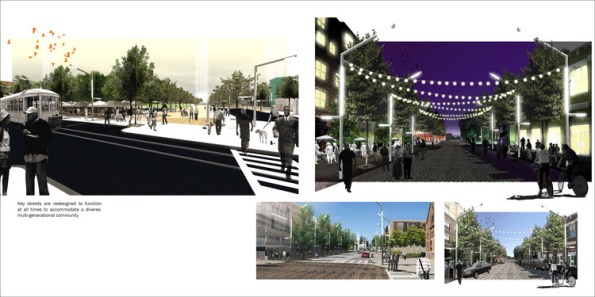
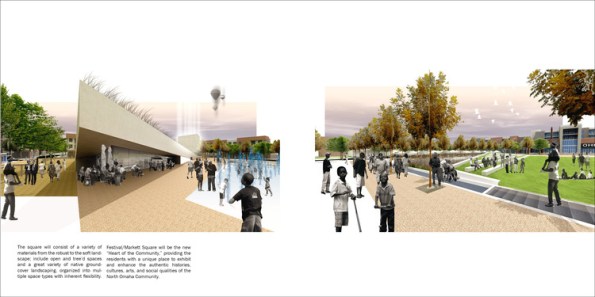
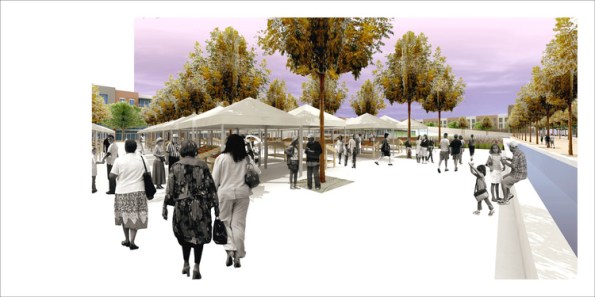
North Omaha Village Revitalization Plan and Empowerment Network leaders after 7-0 City Council vote approving plan
Here’s a cover story I did for The Reader (www.thereader.com) about a plan and a vision that may at last signal the start of significant turnaround for long stagnated North Omaha. To be more precise – Northeast Omaha, where the predominantly African-American community is located and has awaited meaningful change for going on half-a-century. If it doesn’t happen now, then when?
Overarching plan for North Omaha development now in place: Disinvested community hopeful long promised change follows
©by Leo Adam Biga
As published in The Reader (www.thereader.com)
Recent adoption of the North Omaha Village Revitalization Plan into the city master plan gives direction and impetus to energizing a stagnated, disinvested area never fully recovered from decades-ago civil disturbance and urban renewal.
Unanimous approval by the Omaha Planning Board and City Council sends a strong signal to public-private funders and developers the plan provides an officially endorsed blueprint for action. What happens next to realize its 30-year vision is up to stakeholders, entrepreneurs, elected officials, movers and shakers.
The Empowerment Network initiated plan, which drew input from residents, business concerns, philanthropists, planning consultants and others, envisions $1.43 billion in redevelopment along key corridors. The initiative puts the Northside in the crosshairs of major transformation as never before.
Some plan contributors and likely implementers recently spoke with The Reader about what this means for a section of the city that’s long awaited significant change.
“One reason it’s important is to show the people who participated, who live in the community, that we’re serious about a North Omaha that is a strong component of the overall city, one that shares in the successes and in the future of the whole city,” says Omaha Planning Director Rick Cunningham.
“It’s important because as the Planning Department this gives us then our marching orders. This is what we then work with with developers to compare their ideas and plans against. It gives people a clear understanding of what the vision is and where they can best take their dollars and invest them.”
Omaha Economic Development Corporation president Michael Maroney sees the plan as “absolutely essential” for addressing some sobering realities.
“I’ve been working in this community for over 40 years and over that period of time I’ve heard over and over again from the political leadership of this city, from the corporate-business community, why can’t North Omaha leadership get together and speak with a single voice in terms of what the needs are.
“And this whole effort going back five years in the creation of the Empowerment Network was really in part a response to that, because we recognized we had to start doing things differently.”
The need for a new approach became painfully obvious, he says, in the wake of a 2005 study. It showed that in every quality of life measure constituting a healthy community blacks “were either no better off or worse off compared to the majority community” than they were in 1977, he says.
“That basically said all the good work all of us thought we were doing wasn’t making a difference, not in the overall scheme of things. Something was missing.”
The community action coalition African American Empowerment Network was born.
“We sat around a table and said we’ve got to start working together, we’ve got to start collaborating, we’ve got to start connecting with each other, and bring all our combined talents together,” says Maroney. “That led to this village revitalization visioning we did.”
To those who might regard the resulting plan’s price tag as excessive, he says, “We cannot be afraid of reality. Now we’re not saying we’re going to go out and get a $1.43 billion commitment tomorrow. It’s a 30 year process, and it’s not going to come from any one entity or one source or one area. Government has a role in this, the private sector has a role in this, there’s going to be a lot of bank financing in this thing.”
“When $3 billion has been spent in downtown and midtown, what’s a billion dollars for North Omaha to make it a strong resource, a strong player, a big part of the tapestry for a sustainable Omaha?” asks Cunningham.
It’s no exaggeration to say the plan is a put-up or shut-up moment in Omaha history.
Maroney says, “For decades the greater community has said come together and the support will be there. Well, we’ve done that now, and I have to say we’ve had good vibes all along the way from those various entities. But the proof is going to be in the pudding. We now have a very solid process we’ve gone through that creates a long term vision for the community. We’ve done this in a collaborative way that engaged the city and the business and philanthropic community. Now the question becomes, Will you step up to the plate? We’ve got this down, we’ve got it in phases, we’ve got even the first couple projects identified. So we’re moving to that next level and we’ll see if what has been suggested and indicated for years will actually happen.”
Empowerment Network president Willie Barney says the plan’s “going to take focus and commitment from the community itself,” adding, “New businesses and venues will only be sustainable to the level they’re supported by the people who live here.”
For the area to thrive, says Maroney, “it’s more than just brick and mortar because we know if people don’t feel safe and secure, I don’t care how nice we make it, they’re not going to be there, they’re not going to come.”
Observers agree infrastructure needs like the sewer-separation project must proceed to lay the way for large scale development.
Seventy Five North Revitalization Corp. executive director Othello Meadows says whatever happens next, the Network deserves credit for making North O a priority.
“I’m encouraged by what the Empowerment Network is doing,” he says. “They’ve been consistent, they haven’t let the momentum fizzle out. They’ve been diligent. They’ve put together a really comprehensive plan. Anybody can quibble with aspects of it, but the fact they’ve put this together is a major accomplishment.
“They’ve kept the conversation going long enough to get the attention of the right people and it’s moved to a very concrete step being part of the master plan.”
He’s confident North O has the players it needs to drive the plan to fruition.
“I think there’s far more executors than they’re used to be. There’s more people who are used to being held accountable, to executing and getting things done and who are much less interested in talking about it and much more interested in doing it. That’s the single biggest component of what will make North Omaha successful.”
Another aspect of economic development the plan implicitly addresses is improving work skill readiness and creating more living wage to career job pathways.
“Omaha has one of the lowest unemployment rates in the nation, yet we still have in North Omaha a very high unemployment rate,” says Barney. “We have not really bridged that gap yet. We really haven’t come to grips with job creation and development. I think more so now than ever the business community is alongside us in looking at how to solve this. There are training programs through the Urban League, Heartland Workforce Solutions, Metro Community College that I think will do a more effective job of getting people ready.”
The Chamber of Commerce’s Workforce Solutions partners with local employers, Metro and Goodwill Industries to train skill deficient workers for entry level professional jobs. Meadows, who headed the Omaha Workforce Collaborative, says too many North Omaha residents still have “the steepest of hills to climb” to become proficient.
North Omaha is a much studied, social serviced area suffering disproportionately from poverty, unemployment, underemployment, educational-skill gaps and health problems. As Omaha as a whole has prospered, North O’s languished, cut off from the mainstream of commerce and affluence that ranks the city among the nation’s best places to live. For half a century its predominantly black population has seen their community cast as a crime-ridden danger zone and charitable mission district.
Branded as an undesirable place to live or do business in, major investment has bypassed it. Thus, it lacks goods and services, its population is down, its housing stock deteriorated, its vacant, condemned properties number in the thousands. Added to this is a sparse entrepreneurial class and scarcity of entertainment options-attractions.

Planning Director Cunningham says though efforts have “stabilized what was a declining part of town, it doesn’t mean there isn’t a lot of work to do,” adding. “To say we’ve stabilized is not great, but it does give us a platform upon which to move forward.”
“If North Omaha is to be a sustainable community, and that means it really takes care of itself and it doesn’t need to be a welfare community, we have to have a different mind set,” says Maroney. “That does not mean we forsake those in need, but we have to create the atmosphere by which we not only bring back people with higher incomes but we elevate those people within upward. We must create a community that is generating resources that turn around in the community by creating jobs, creating opportunity.”
“The whole idea is to make North Omaha a neighborhood of choice,” says Cunningham. “That not only people who live there now stay, because they can afford to stay, because of new jobs and opportunities, but people who moved away are invited-enticed to move back and people looking for a new place to raise their families move there.”
He says the plan mitigates against gentrification pricing out residents.
“The concept is to not have just one type of housing but a full range of housing types and income levels. I think that’s all through the plan.”
Facilitating mixed income housing projects is what Seventy Five North plans doing. The new nonprofit, in partnership with Purpose Building Communities, is quietly acquiring properties to infuse new life into neighborhoods.
Prospect Hill has recently seen the addition of new “green” homes to its stock of older homes courtesy of a collaborative venture between OEDC, Alliance Building Communities, Holy Name Housing, Wells Fargo Bank and Family Housing Advisory Services. More partnerships like this are needed, says OEDC’s Maroney.
Cunningham says if North Omaha is to be a prime development landscape the same way other parts of the city are, “we need to identify innovative and new ways we can invest. So we’re looking at the economic development tools we have to make it just as easy to develop and reinvest there. We’ve got to do that. We’ve got to utilize the resources of this city.” He says, “A plan like this is a catalyst that begins people thinking about, What if? Why not? and people are doing that already. There are partners (emerging) out there the public doesn’t know about at this point.”
Othello Meadows feels a serious attitude change is necessary.
“One of the things I see a lot is almost this antithetical attitude to people coming into North Omaha to make money,,” he says, “as if it’s almost a bad or exploitive thing, and I don’t understand that. The only way North Omaha grows in a sustainable way is if somebody sees an opportunity to go in there and make some money. That’s how North Omaha gets tied to the rest of the economic prosperity the city has enjoyed.”

Othello Meadows
Nurturing more entrepreneurs, says Maroney, “is absolutely key. It’s an area we’re working on. It needs a lot of help. A lot of it is access to credit and capital. A lot of its entrepreneurial development training. That’s critical because as we develop all this brick and mortar we need to have people ready to move in and create businesses and jobs and hopefully make a lot of money.”
The city and Chamber are actively recruiting black businesses outside Nebraska to open operations in North Omaha. Consultant Jim Beatty heads an Atlanta initiative that’s imported one business thus far, All(n)1 Security. He says aggressive, wide net efforts like these are needed to market the revitalization plan to entrepreneurs, philanthropists and developers. “I think we need to present North Omaha as an opportunity for investment, and we need to tell that story, not only locally but nationally,” says Beatty, who chairs the Black History Museum board.
The Chamber’s Ed Cochran, who heads the North Omaha Development Project, says, “There are several ways to grow business in a community. One is to grow it organically
through inspiring entrepreneurs with brand new businesses. Another is to strengthen and grow existing businesses. A third is to import businesses from other locations.” He says North Omaha needs all these approaches.
For too long, says Meadows, the Northside has been treated as a charity case.
“I feel like there’s almost a patriarchal type relationship that always leaves North Omaha in a secondary position. At this point North Omaha doesn’t have the capital, in a lot of ways it doesn’t have the personnel, kind of by way of brain drain, to transition itself organically without outside resources. At this point it needs help from philanthropy and individuals whose hearts are in the right place, who simply want to do the right thing.
“I think the compassion that exists in this city is rare, especially in the philanthropic community, but I think we have to have a little bit more analytical, clinical approach.”
While the adjacent downtown, riverfront and mid-town have bloomed, North O’s seen piecemeal, stop-gap change, with pockets of redevelopment surrounded by neglect.
“Historically what we’ve done, and I’ve been a part of that, is have a scattered gun approach toward development,” Maroney says. “A lot of good things have been done, but they’ve been done in isolation. We need to better coordinate and understand how these things relate to each other, and then how you build on top of those. We’re now trying to take a more deliberative and directed approach toward development.”
Backers of the revitalization plan see it as a guide and stimulus to making North O a destination to live, work and recreate in. Among the early focal points is developing 24th and Lake into a heavily trafficked, tourist-friendly arts-culture district.
“In North Omaha one of the real epicenters is 24th and Lake, where you have a really nice combination of history and communal feeling,” says Meadows. “It’s one of the hubs of the community. I think you could make a tremendous splash by focusing on that area. You can’t find somebody who grew up in North Omaha that hasn’t spent a lot of time in that area, whether they got their cut there or they went to church there. So to me it makes sense to start with an area that touches so much of North Omaha.
“If I were a developer I’d start right there. It’s close enough to downtown to draw from a lot of different nodes, which is important.”
Anticipated commercial development would build on existing anchors in strategic areas:
24th and Lake (Bryant Center, Jewell Building, Omaha Star, Family Housing Advisory Services, Blue Lion Centre, Loves Jazz & Arts Center, Omaha Business & Technology Center, Great Plains Black History Museum)
30th and Lake (Salem Baptist Church, Salem Village, Miami Heights, Urban League, Charles Drew Health Center)
Adams Park and the Malcolm X Memorial Foundation
Refinements to 16th and Cuming and the 24th and 30th St. corridors are meant to spur a “seamless transition” from north downtown to North Omaha. Cunningham says “development there would integrate with the downtown and begin to bring the flow of people, goods, enterprise and economic development over into and overlapping with what has been historically the North Side.”
He adds, “We’re working now with 24th Street and an existing building there housing an historic business to revamp their footprint so that it says this is a front door rather than a back door. We’re also working with Creighton (University) and their plans for 24th and Cuming. That’s an entry portal for them too. They’re a partner in this and they have a vision for what’s happening there, really from 30th to 16th Streets, in creating a Cuming that is not a barrier, not a border, but a strong component of activity.”
Asked if it’s vital the first projects find success, Cunningham says. “Absolutely, because that builds momentum. We have to have successes early because it will be easier for the next developer to come in.” Sources indicate government funded projects are likely to launch first to “prime the pump” for private investment to follow.
Sustainability will be critical.
“Each one of those projects, particularly ones in the initial stages, have to be able to stand on their own in the event nothing else happens so that 20 years from now that project will still be there, will still be functioning,” says Maroney. “Not only do we look at what is it going to cost to create that project, but what is it going to take to sustain it over time. We nee to make sure thats built in also.”
Meadows says, “The same kind of rigor, due diligence and economic models that went into determining the feasibility of midtown and downtown development projects needs to take place with each North Omaha project” to ensure their sustainability.
More than anything, Meadows just wants to see change.
“When my friends come to visit from out of town there’s very little positive to show them on the Northside, very little you can point out and say, ‘Wow!’ So I’m glad we potentially have some things to be proud about in our neighborhood, in my community.
“I think North Omaha is really poised. I think residents are getting ready to see actual movement, they’re getting ready to drive down certain streets and see real development, real improvement. I can’t remember when that’s happened here.”
Related articles
- Back in the Day, Native Omaha Days is Reunion, Homecoming, Heritage Celebration and Party All in One (leoadambiga.wordpress.com)
- Native Omaha Days: A Black is Beautiful Celebration, Now, and All the Days Gone By (leoadambiga.wordpress.com)
- Native Omahans Take Stock of the African-American Experience in Their Hometown (leoadambiga.wordpress.com)
- Walking Behind to Freedom, A Musical Theater Examination of Race (leoadambiga.wordpress.com)
- An Omaha Legacy Ends, Wesley House Shutters after 139 Years – New Use for Site Unknown (leoadambiga.wordpress.com)
- Where Hope Lives, Hope Center for Kids in North Omaha (leoadambiga.wordpress.com)
- Omowale Akintunde’s In-Your-Face Race Film for the New Millennium, ‘Wigger,’ Introduces America to a New Cinema Voice (leoadambiga.wordpress.com)
- Lifetime Friends, Native Sons, Entrepreneurs Michael Green and Dick Davis Lead Efforts to Revive North Omaha and to Empower its Black Citizenry (leoadambiga.wordpress.com)
- A Decent House for Everyone, Jesuit Brother Mike Wilmot Builds Affordable Homes for the Working Poor Through Gesu Housing (leoadambiga.wordpress.com)
- Tired of Being Tired Leads to a New Start at the John Beasley Theater (leoadambiga.wordpress.com)
- Soon Come: Neville Murray’s Passion for the Loves Jazz & Arts Center and its Role in Rebirthing North Omaha (leoadambiga.wordpress.com)
- Miss Leola Says Goodbye (leoadambiga.wordpress.com)
- After a Steep Decline, the Wesley House Rises Under Paul Bryant to Become a Youth Academy of Excellence in the Inner City (leoadambiga.wordpress.com)
Categories: African-American Culture, African-American Empowerment Network, Business, City Planning/Urbanism, Entrepreneurial, North Omaha, Writing
African-American Culture, African-American Empowerment Network, Business, Entrepreneurial, North Omaha Nebraska, North Omaha Village Revitalization Plan, North Omaha Village Zone
Native Omahans Take Stock of the African-American Experience in Their Hometown
July 4, 2011
44 comments
With the 2011 Native Omaha Days, July 27-August 1, just around the corner I am posting stories I’ve written about this every two years African American heritage and homecoming event and how it serves a kind of litmus test for the black community here to take stock of itself in terms of where it’s been, where it is today, and where it’s heading. The following story appeared just as the 2009 Native Omaha Days concluded. I spoke to a number of individuals for their take on the state of Black Omaha at a time when there is both much despair and much promise for the predominantly African American northeast Omaha community. I interviewed folks who grew up here and stayed here and those who left here but who retain deep ties here and come back for events like the Days in order to get a cross-section of perspectives on what the past, present, and future holds for North Omaha. This much discussed community, where generational problems of poverty and underachievement are rampant but where many success stories have also been launched, is finally getting the kind of attention it’s long required. Initiatives like the African American Empowerment Network are helping drive a planned revitalization that seems much closer to reality today than it did even two years ago. The role of Native Omaha Days shouldn’t be overlooked because it does bring together thousands of current and former Omaha residents whose individual and collective vision and energy are helping fuel what is about to be a major North Omaha revival. That doesn’t mean all the challenges that face that community will be eradicated overnight. It took decades for those problems and wounds to become embedded and it will take decades to heal them, and events like Native Omaha Days help give a purpose and focus to affecting change.
Native Omahans Take Stock of the African-American Experience in Their Hometown
©by Leo Adam Biga
Originally published in The Reader (www.thereader.com)
The 2009 African-American heritage celebration Native Omaha Days concluded Monday. Natives came from across America to indulge memories of this touchstone place. The biennial, week-long Days lends itself to gauging the African-American experience here — past, present, future.
Taking stock has added import with North Omaha at a tipping point. Ambitious new housing and commercial developments, job training programs, educational reform efforts and gang intervention initiatives are in the works. All in response to endemic problems of poverty and unemployment, low job readiness, poor academic performance, high dropout rates, epidemic-level STDs and ongoing drug traficking-gang violence. North O has a strong sense of identity and purpose yet struggles with scarce opportunities. The persistent challenges of segregation and inequality have led many natives over time to leave for better prospects elsewhere, but a sense of home and family keeps their ties to Omaha strong.
The Days brings thousands of natives back to meet up with friends and relatives for homecomings, large and small. Last week’s public events included: a mixer at the Native Omahans Club; a parade along North 30th Street; a dance at the Mid-America Center; appearances by NBA star Dwayne Wade and actress Gabrielle Union at North High School; and a picnic at Levi Carter Park.
Visitors helped swell the numbers at Jazz on the Green, at clubs and bars on the north side and at black church services. Celebrants were out in force too at school reunions. Then there were untold family reunions and block parties that unfolded in people’s homes and yards, in the streets, and in parks all over the city.
Northeast Omaha was jumping as visitors mixed with residents to sight-see or just kick it. Kountze Park, the Native Omahans Club, the Love’s Jazz & Arts Center, the Bryant Center, Skeets Barbecue and other haunts were popular gathering spots. Joe Tess on the south side was a popular stop. Streams of cars toured the black community’s historical corridors. Many made the rounds at post-card amenities like the riverfront, the Old Market, Lauritzen Gardend and Henry Doorly Zoo.
Nobody seems to know how many expatriates arrive for The Days. That’s a shame, as these visitors represent resources for a strapped city and state hurting from a brain drain and a small tax base. Many natives who come back are the same upwardly mobile blacks Omaha has trouble retaining, a costly decades-long trend. The city’s black population is small to begin with, so every talented native lost is felt acutely by a community with a paucity of black entrepreneurs and professionals for a city this size.
Hometown girl Felicia Webster has twice left for the East Coast but has since returned to live here with her young son. She wonders what would happen if residents collaborated with visitors on visioning new initiatives, ventures, projects, even start-up businesses aimed at reviving North Omaha.
“I feel Native Omaha Days right now is a good opportunity and a wonderful manifestation of African-American people coming together of one accord and building and talking and socializing. It would be nice to just have a really huge collective on what could actually happen with development here,” said Webster, a spoken word artist, “because, you know, people come from everywhere that are doing all kinds of things. They can bring their knowledge and tools with them to share something fresh, new and vital here. I personally would like to see that.”
Felecia Webster
What about The Days serving as a catalyst for brainstorming-networking forums that capitalize on the skill sets and entrepreneurial ideas and investment dollars of natives near and far? All geared toward building the kind of self-sufficiency that black leaders point to as the most sustainable path for black prosperity.
Nate Goldston III left Omaha as a young man and went on to found Gourmet Services in Atlanta, Ga., one of the nation’s largest food service companies. He’s doing just what Webster advocates by working with locals on stimulating new development. The self-made millionaire has been advising the Omaha Chamber of Commerce and the North Omaha Development Project on the landscape for new North O investment. He’s bullish on the prospects for that long depressed district.
“I think it’s going to grow, but you’ve got to plant the seeds first and that’s what were interested in helping do with some business development there in the food service area,” Goldston said by phone from Atlanta.
He’s close to finalizing plans for a brick-and-mortar Gourmet Services backed project here to provide entrepreneurial opportunities for local African Americans.
“If we can bring this business opportunity there and put some young people in place and let them have a little piece of the action and begin to develop a franchise type operation, and then allow them to go on and grow it themselves, manage and own at the same time, that’ll bring that missing link and fill that gap in the economic development portion. At least a small portion of it,” he said.
He said it’s the kind of grassroots development that’s required. “It’s not the Chamber’s job to develop North Omaha. North Omaha needs to be developed by people from or attached to North Omaha, and the kinds of things that need to go in need to be done from within as opposed to from without.” Goldston’s impressed with the “pro-business, pro-development, pro-North Omaha” focus of the Chamber and city. “They just need the right teammates, they need the right partners to help them do it, and that’s the first time I’ve ever noticed that collaborative attitude in Omaha. I think there’s a real chance there.”
New Omaha City Planning Director Rick Cunningham, who most recently lived on the East Coast, is a native who hopes to implement Mayor Jim Suttle’s vision for a revitalized north side. “His agenda includes a strong commitment to North Omaha,” Cunningham said of Suttle. “He has a goal for 24th and Lake Street to become a new Dundee for Omaha.”
Cunningham knows first-hand Northeast Omaha’s prolonged decline. He also knows “there have been pockets of success,” including the Blue Lion Center at 24th and Lake he served as project manager for under Omaha architect and mentor Ambrose Jackson. He said most North O redevelopment has come from “investments in new rooftops, in new housing,” and while that needs to continue he said there must be a focus on creating more employable residents and attracting businesses and services that generate new jobs and commerce. “To bring Omaha into a very livable community with an environment that all residents and visitors can enjoy we’ve got to make sure we’ve got a diverse economy.”
He looks forward to being part of solutions that “return North 24 to the vibrancy it had, when 24th and Lake was the heart and soul. We will be engaged in that effort.” He looks forward to meeting with community partners from the public and private sectors to “build synergy in accomplishing those goals.” He said the city cannot afford to let North Omaha wallow. “If there is an area that suffers in Omaha than the entire city suffers,” he said. “It’s important we revitalize the core area. Those communities that are alive and thriving have inner cities that are alive.”

Nate Goldston III
Goldston vividly recalls when North O had a greater concentration of black-owned businesses than it does today, but he said even in its heyday Omaha’s black community had few major black entrepreneurs.
“Omaha’s African-American community has always been job-oriented as opposed to entrepreneurial-oriented,” he said. “I see great opportunity and I see opportunity that’s been missed only because I don’t know that we’ve been blessed with a lot of entrepreneurs that have had the path or the ability to develop businesses in the area. We had the model of the bars, the nightclubs, the pool halls.”
He could have added restaurants, barbershops, beauty salons, clothing stores and filling stations. There were also black professionals in private practice — doctors, dentists, attorneys, accountants, pharmacists, architects.
Their example “gave me inspiration and hope,” said attorney Vaughn Chatman, a native Omahan who made it back for The Days from Calif. North 24th Street was once a thriving hub of black and white-owned businesses. Few, however, survived the ‘60s riots and their aftermath. Urban renewal did in more. Once the packing house and railroad jobs that employed many blacks vanished, few good-paying employment options surfaced. “My friends and I had no desire to leave Omaha until opportunities for us began to disappear,” said Chatman . “Most, if not all my friends, faced with lack of opportunity have left Omaha. My friends and relatives (still) there tell me the quality of life for them and their generation has not gotten any better despite the best efforts of a number of individuals and organizations.”
Several new businesses have popped up but many have come and gone over time. Despite some redevelopment North 24th is largely barren today.
“That positive feeling of inspiration and hope is what I miss the most about the North Omaha I grew up in,” said Chatman.
An old-line exception is the Omaha Star, a black weekly now 70-plus years strong. Founder Mildred Brown was one of America’s few black women publishers. She earned a national reputation for her crusading work during the civil rights movement. Goldston learned valuable lessons working for the Star as a kid.
“The Omaha Star was my entree to entrepreneurship,” he said. “That’s what taught me to create a marketing sense, the ability to be able to develop a customer base and customer service and the whole nine yards.”
Cathy Hughes is another Star veteran who credits her experience there and at Omaha black-owned radio station KOWH with helping give her the impetus to be a broadcast owner and eventually build her Radio One empire.
“It encouraged me to go ahead and to try to own my own radio station because I saw some folks in Omaha do it,” she said by phone from her Maryland home. “You lead by example. When you do something, you never know who you’re touching. you never know who you’re having an impact on. I saw Bob Gibson and Rodney Wead and Bob Boozer and Gale Sayers come together and buy a radio station, so I knew it was possible, and now I’m the largest black-owned broadcast corporation in America and the only African-American woman to head a publicly traded corporation. None of that would have been possible if I hadn’t seen the examples I saw in Omaha, if I hadn’t seen Mildred Brown keeping her newspaper not only afloat but providing her with a very comfortable existence for that day and time.”
Cathy Hughes
Hughes, like Goldston, is pleased by gains that have been made via new housing developments, streetscape improvements and the Love’s Center, but is dismayed there aren’t more Mildred Brown figures in Omaha by now. In Hughes’ estimation Omaha should be much further along than it is in black entrepreneurship.
“It has a long ways to go,” she said.
Hughes is also concerned that strong community leaders like North O developer Al Goodwin, educator Katherine Fletcher and job training director Bernice Dodd are no longer on the scene. She’s warily watching the new generation of local black leadership to assess their commitment to redevelopment.
Goldston said black businesses in Omaha are not as visible as they once were.
“Those things have all gone away,” he said, adding that Omaha “is miles apart” from the dynamic black business culture found in Atlanta. “I think other opportunities were just not there (in Omaha) at that time to start and build a business.”
All these years later, he said, few if any Omaha businesses have made the Black Enterprise 100 list of the largest African-American owned businesses.
Most black-owned Omaha businesses of any size are not located on the north side today. Out of sight, out of mind. Hard to emulate what you don’t see. “I think we flourish when we see reflections of ourselves in the community where we live,” said Webster. “And when you don’t see that, what do you have to strive for?”
Introducing students to Omaha black achievers via school curricula is something Vaughn Chatman, founder of the Omaha Black Music Hall of Fame, advocates.
Webster presents programs in schools that attempt to expand kids’ vision. “I want them to see a bigger picture, a bigger view of the world than what they normally see, and I hope that by my being African-American young boys and girls are seeing reflections of themselves in me of what they possibly could attain,” she said.
Hughes and Goldston are concerned about the education gap that finds black students on average lagging behind whites. The truancy and drop-out rates for blacks are higher. The two are alarmed by how far Omaha’s inner city schools trail their suburban counterparts. “We’re going to have to really cure that before anybody can make any progress,” said Goldston, who’s challenged a national organization he once led, 100 Black Men, with making a difference in schools.
Webster said she was fortunate to have parents who stressed education and showed her “the world was bigger than Omaha.” Omaha’s segregation meant she would often frequent places and be the only black person there. Cathy Hughes had the same experience coming of age here. “That’s challenging,” said Webster. The first time Webster left, for Philadelphia, in the early ‘90s, Omaha was viewed as a dull place by many young people — black and white.
“A lot of my close friends did end up leaving and going to more heavily populated cities, and I think a lot of that had to do with not only wanting to explore the world but what opportunities they saw. For some, it was a larger African-American presence. For others, it was bigger metropolitan areas where you felt like you were getting paid what you were worth and could fulfill what you desired.
“Coming back this time I can see Omaha is really growing but I think Omaha is still a work in progress. I have friends with degrees who are still making $12 an hour, and I think that’s a challenge. They can’t find jobs with livable wages. And I find I’m still the only person that looks like me when I go certain places.”
Webster likes that Omaha has far more going on now than even five years ago, but she said she misses Philly’s constant slate of cultural activities and larger base of African-Americans to share them with. The big city scene “reignites” her.
Author Carleen Brice (Orange Mint and Honey, Children of the Waters) is a native living in Denver, Colo. with mixed feelings about Omaha.
“It’s always complex being from a small city and having big dreams,” said Brice. “I can’t speak for others, but I felt I needed to leave Omaha to achieve what I wanted to achieve. Part of that had to do with my specific family background. When my parents divorced, we went through some bad times and so I associate Omaha with those negative memories as well as with the positive ones.
Carleen Brice
“What I sense the most in Omaha is a kind of small thinking, small dreaming. Strange since Omaha does have a lot going for it. But I also think every city is what you make of it. I live in Denver and think it’s great, but I have friends who grew up here and feel very much like it’s a tiny, backwards city. I’ve begun to think that if I moved back to Omaha I could experience it differently, without feeling so blinded by my past.”
Still, Brice said she senses North Omaha’s quality of life is worse today. “I know my grandmother is saddened by the decline of that part of the city. My friends don’t see much improvement in how people actually interact or how they are treated, which makes them feel depressed. Back to that word depressed again. It’s sad, but true, I think Omaha is depressed.”
Beaufield Berry is a playwright and actress who’s come and gone from her hometown several times. She’s here again. She feels a big part of what holds Omaha back is its “small town ideas” that don’t readily embrace diversity. She believes North Omaha will not reach its potential until the cycle of inequity and despair is broken.
“For Omaha’s black population to really thrive I think you’ve got to start at the poverty line. You have to start at where the people may not have the role models that other kids do. You have to make it so they can see a father figure or an older brother making the right decisions.”

But Berry sees much to be hopeful about, too. “On the flip side of that I see so many amazingly talented young people of all different races who are really working towards something, who can really make a difference, not only with their work but with their words, with their presence, and I want to see more of that. I think that’s how Omaha, black or white, will start to thrive citywide.”
Webster sees Omaha progressing but like many blacks she’d like to see more done.
“I think with a collective idea and voice from all kinds people that it could kind of put a faster spark into it happening. It could manifest into something where everybody that lives here really enjoys it. I think it would be amazing.”
Related articles
- Back in the Day, Native Omaha Days is Reunion, Homecoming, Heritage Celebration and Party All in One (leoadambiga.wordpress.com)
- The Ties that Bind, One Family’s Celebration of Native Omaha Days (leoadambiga.wordpress.com)
- A Rich Music History Long Untold is Revealed and Celebrated at the Omaha Black Music Hall of Fame (leoadambiga.wordpress.com)
- Walking Behind to Freedom, A Musical Theater Examination of Race (leoadambiga.wordpress.com)
- Enchantress “LadyMac” Gets Down (leoadambiga.wordpress.com)
- Native Omaha Days: A Black is Beautiful Celebration, Now, and All the Days Gone By (leoadambiga.wordpress.com)
- Omowale Akintunde’s In-Your-Face Race Film for the New Millennium, ‘Wigger,’ Introduces America to a New Cinema Voice (leoadambiga.wordpress.com)
- Luigi’s Legacy, The Late Omaha Jazz Artist Luigi Waites Fondly Remembered (leoadambiga.wordpress.com)
- Big Bad Buddy Miles (leoadambiga.wordpress.com)
- An Inner City Exhibition Tells a Wide Range of Stories (leoadambiga.wordpress.com)
- Lifetime Friends, Native Sons, Entrepreneurs Michael Green and Dick Davis Lead Efforts to Revive North Omaha and to Empower its Black Citizenry (leoadambiga.wordpress.com)
- Soon Come: Neville Murray’s Passion for the Loves Jazz & Arts Center and its Role in Rebirthing North Omaha (leoadambiga.wordpress.com)
- After a Steep Decline, the Wesley House Rises Under Paul Bryant to Become a Youth Academy of Excellence in the Inner City (leoadambiga.wordpress.com)
- Soul on Ice – Man on Fire: The Charles Bryant Story (from my Omaha Black Sports Legends series, Out to Win: The Roots of Greatness) (leoadambiga.wordpress.com)
- Tired of Being Tired Leads to a New Start at the John Beasley Theater (leoadambiga.wordpress.com)
Categories: African-American Culture, African-American Empowerment Network, Business, Native Omaha Days, North Omaha, Omaha, Omaha Black Music Hall of Fame, Social Justice, Writing
African American, African-American Culture, African-American Empowerment Network, Native Omaha Days, North Omaha Nebraska
A. Marino Grocery closes: An Omaha Italian landmark calls it quits
June 22, 2011
11 comments
One of the last of the old line ethnic grocery stores in my hometown of Omaha closed down a few years ago. The small Italian market is one my family and I shopped at quite a bit. It was the last of its kind, that is among Italian grocers. Truth be told, there are many ethnic grocers in business here today, only the owners are from the new immigrant enclaves of Latin America and Africa and Asia rather than Europe. The owner of the now defunct A. Marino Grocery, Frank Marino, inherited the business from his father. It was a throwback place little changed from back in the old days. My piece about Frank finally deciding to retire and close the place appeared in The Reader (www.thereader.com).
On this blog you can find more stories by me related to other aspects of Omaha’s Italian-American culture, including ones on the Sons of Italy hall’s pasta feeds and the annual Santa Lucia Festival.

A. Marino Grocery closes: An Omaha Italian landmark calls it quits
©by Leo Adam Biga
Originally published in The Reader
The final days of A. Marino Grocery at 1716 South 13th Street were akin to a wake. The first week of October saw old friends, neighbors and customers file in to say goodbye to proprietor Frank Marino, 80, whose late Sicilian immigrant father, Andrea, a sheepherder back in Carlentini, opened the Italian store in 1919.
News of the closing leaked out days before the local daily ran a story about the store’s end. As word spread Marino was deluged with business. Lines of cars awaited him when he arrived one morning. Orders poured in. He and his helpers could hardly keep up. Those who hadn’t heard were disappointed by the news. Some wondered aloud where’d they get their sausage from now on.
A Navy veteran of World War II, Marino long talked of retiring but nobody believed him. Still, decades of 50-60 hour weeks take their toll. When he got an attractive offer for the building he took it. The new owner plans to renovate the space into an interior decorating office on the main level and a residence above it.
Folks stopping by for a last visit knew the store’s passing meant the loss of a prized remnant of Omaha’s ethnic past. Housed in a two-story brick structure whose upstairs apartment the family lived in and Marino was born in, the store represented the last of the Italian grocers serving Omaha’s Little Italy. While the neighborhood’s lost most vestiges of its Italian-Czech heritage, time stood still at the small store. Its narrow aisles, vintage fixtures, wood floors, solid counters, ornate display cabinets and antique scales bespoke an earlier era.
It was a living history museum of Old World charms and ways. No sanitary gloves. Meats and cheeses comingled, but regulars figured it just added to the flavor.
An aproned Marino would often be behind the deli case in back, hovering over the butcher’s block to cut, season, grind and encase choice cuts of beef for the popular sausage he made. He sold hundreds of pounds a week. He carried a full line of imported foods. Parmigiano reggiano, romano, provolone, mozzarella and fresh ricotta cheese. Prosciutto, mortadella, salami, capicolla and pepperoni. Various olives — plain or marinated. Meatballs. Homemade ravioli and other stuffed pastas. Canned tomatoes, packaged pastas, assorted peppers, et cetera. At Christmas he sold specialty candies and baccala, a salted cod used in Italian holiday dishes.
He’d slice, grate, measure, weigh and bag items himself. Nothing was precut. What few helpers he had were mostly old buddies. Banter between the men and with the customers was part of the experience. Characters abounded.
Marino rang up your purchases on an old-style cash register and engaged you in crackle barrel conversation from behind the massive front counter his father had made to order in 1932. Behind the counter, whose built-in drawers stored 20-pound cases of pasta, he’d light up his trademark pipe and shoot the breeze.
“I love being here and I love being around people,” he said.
It was the same way with his father. The two worked side by side for half-a-century. They had their spats, but the disagreements always blew over. There was, after all, a business to run and people to serve. His papa taught him well.
“It’s service-oriented. You’ve got to hand-wait on everybody,” Marino said.
In some cases he waited on three generations in the same family. He enjoyed the association and interaction. “I’ll miss that. There was a lot of closeness, you know.”
That last week people expressed heartache over the closing.
Mary Cavalieri of Omaha shopped there all her life. “It’s really sad,” she said, adding she felt she was losing “a tradition” and “a friend” in the process.
Oakland, Iowa resident Anna D’Angelo was among many who came some distance to shop there. Asked what she’ll miss most, she said, “The sausage and all the Italian specialties, and Frank. He knows everybody by name. He knows what you like. Frank never needs to see my ID. It’s that personal touch you don’t get anymore.”
Omahan Leo Ferzley, an old chum of Marino’s, said, “You hate to see it go, but what do you do? Everybody will miss it. A lot of memories.”
Marino is worried what he’ll do with all his free time. He and his wife plan their first trip to Italy. “That’s all we’ve ever talked about,” he said. One man told him that if the opportunity comes, “whatever you do, don’t pass it up.”
Customers, some whose names he didn’t even know, wished him and his wife well. One wrote a $100 check for the Marinos to treat themselves to a night on the town. As Mary Cavalieri said, “He deserves some retirement time.”
No regrets.
As Marino told someone, “It’s the end of the line. 88 years we’ve been here. Since before I was born. It’s been good to us. But I’m 80-years-old. I think it’s time.” Besides, he said, “I’m wore out.”
Related articles
- Favorite Sons, Weekly Omaha Pasta Feeds at Sons of Italy Hall in, Where Else?, Little Italy (leoadambiga.wordpress.com)
- Walking Behind to Freedom, A Musical Theater Examination of Race (leoadambiga.wordpress.com)
- Back in the Day, Native Omaha Days is Reunion, Homecoming, Heritage Celebration and Party All in One (leoadambiga.wordpress.com)


 Leo Adam Biga's My Inside Stories