Archive
The Troy Davis Story: From Beyond the Fringe to Fringes Salon
Star hair designer Troy Davis of Omaha was amazingly forthcoming and transparent in an interview he did with me for this Encounter Magazine profle I wrote about him a few years ago. As a fellow 12-stepper I know something of what he speaks. I know the courage and conviction it requires to be this honest about the hurt and the healing. His words and his story are bound to help someone else. He’s best known for his work at Fringes Salon.

The Troy Davis Story: From Beyond the Fringe to Fringes Salon
Story by Leo Adam Biga ©Photos by Bill Sitzmann
Originally appeared in Encounter Magazine
Leading Omaha hair dresser Troy Davis long ago showed an educational and entrepreneurial knack for his craft and for building the Edgeworthy brand at Fringes Salon & Spa in the Old Market. Now that his mentor and longtime business partner, Fringes founder Carol Cole, has sold her interest in the location, he has a new partner and a new focus on managing costs. The result is record profitability.
“Fringes of the Old Market is the busiest and healthiest it’s ever been,” says Davis, who’s made Fringes an Omaha Fashion Week fixture.
“Troy and Fringes have been a very important part of Omaha Fashion Week, as they style many of our veteran designers and constantly impress with their ability to interpret the latest hair and makeup trends on our runway,” says OFW producer Brook Hudson.
Davis is glad to share in the success. He’s lately seen members of the Fringes team represent well in a recent competition and awards show. Never content to stay put, his Clear Salon Services business is a new generation, grassroots distributorship for independent hair care brands.
These professional triumphs have been happening as Davis addresses personal problems that “came to a head” last August but that have their roots in the past. Growing up in Blair, Neb., he began drinking and using drugs to mask the sexual identity issues he confronted as a gay teen in an environment devoid of alternative lifestyles.
“I felt so completely isolated. I lived in fear so badly that I hid it with drinking and weed,” he says.
A healthier form of self-expression he excelled in, speech and drama, seemed a likely direction to pursue out of high school. But first he moved to Omaha to experience the diversity he craved back home. He briefly attended Nebraska Wesleyan University in Lincoln, even landing the lead in the school’s fall production, before dropping out to attend beauty school in Omaha.

From their first meeting Davis and Cole knew they’d found a new best friend they could grow in their chosen field alongside. She says she immediately responded to his “passion and energy and drive,” adding, “Troy Davis has definitely made me a better person and stylist and leader.”
Within four years he’d proven to be such a trusted asset that Cole partnered with him in opening the Old Market shop.
“He earned that,” she says. “He just really wanted to be downtown. His heart was there. I finally said, ‘Look, if you want to be a partner, I’ll do it, but you’re going to have to step it up and find a location.’ And he did. I have to give him a lot of credit because he put a lot of grunt work into it to get it started.”
The rest is history, as Fringes became a presence in the Old Market for its ultra-contemporary, urban styles and high-end hair care and beauty services. Cole let him run things there so she could concentrate on the West Dodge site.
For Davis, Cole’s been more than just a business partner.
“Carol and I are so close. We just absolutely click,” he says. “She’s a very intelligent, very professional business woman. There’s not a lot of partnerships that make it. In a lot of ways our relationship is like a marriage, only platonic. I think it’s healthier or better than most marriages I know of. We are able to communicate in a way that most people are not. We can say anything to each other and even if it’s something that ends up hurting each other, we know that’s not our intention. Usually it’s one of us misunderstanding something and we’re always able to go back and clean it up.”
Davis has moved fast in the industry. While still in his 20s he became one of 10 international creative team members for Rusk, a role that saw him flown all over the world to teach other hair dressers the use of the international distributor’s products. He worked in the Omaha salon during the week and jetted around on weekends.
It gave him the stage, the lights, the theatrics he felt called to. It also meant lots of money and partying.
All the while, his addictions progressed.

He was prepping for the always stressful Omaha Fashion Week last summer when he and his life partner split for good. Amidst the breakup, the all-nighters, running his businesses, and leading an online advocacy campaign for a Fringes team that showed well in the national Battle of the Strands competition, Davis crashed.
“By the time I hit bottom I was drinking every day and drinking to black out three days a week and, you know, it just had to end. I finally realized I am an alcoholic. It was a real wake up call.”
He’s now actively working a 12-step program.
“It’s definitely helped me get sober. I definitely thank my Higher Power for the strength I’ve had to get where I am today.”
He’s not shy sharing his ups and downs.
“I’ve always been a very honest and open person. I’ve actually shared publicly via Facebook some of my bottoms and what I’ve learned in my treatment. In order to achieve something you need support in your life and there is a connection through Facebook with family and friends that I think is very useful. I see it as an opportunity to share with them what I’m going through and the choices I’m making for myself.”
He calls his 12-step group “a new addition to my family,” adding, “They’re great people.” Like many addicts he’s replaced his former addictions for a couple new, blessedly benign ones – Twitter and tattoos.
As his recovery’s progressed he’s grown in other ways, too, including taking charge of his Fringes store’s finances.
“It’s absolutely the best thing that could have happened for this business. It’s given me a whole new level of accountability. I see things more clearly and because of that we’ve broken through a plateau we were never able to get past.”
He credits new business partner Sarah Pithan, a former assistant, for helping increase business by more than $4,000 a week. He also credits the “amazing team” he and Pithan have cultivated, including Omar Rodriguez, Kristina Lee and Teresa Chaffin, for taking Fringes and Clear Salon Services to new levels.
Visit http://www.fringessalon.com.
Related articles
- Old Market Pioneer Roger duRand (leoadambiga.wordpress.com)
- Entrepreneur and Craftsman John Hargiss Invests in North Omaha: Stringed Instrument Maker Envisons Ambitious Plans for his New Hargissville Digs (leoadambiga.wordpress.com)
Entrepreneur and craftsman John Hargiss invests in North Omaha: Stringed instrument maker envisions ambitious plans for his new Hargissville digs

John Hargiss is doing something that a lot more people need to do – he’s investing in North Omaha. He’s actually moved his successful stringed instrument business from booming Benson to a rough trade section of northeast Omaha in need of some love and reinvestment. His faith in the area is strong and it’s just what that community needs, that and people like Hargiss who put their money where their mouth or senitment are. Hargiss is a cool cat who straddles the edgy and contemporary with Old World craftsman values. His new digs include an old theater he plans to restore into a live performance center. It would be a great boon to the area.

Entrepreneur and craftsman John Hargiss invests in North Omaha:
Stringed instrument maker envisions ambitious plans for his new Hargissville digs
by Leo Adam Biga
Originally appeared in The Reader (www.thereader.com)
The subtle twang in the voice of stringed instrument-maker and roots musician John Hargiss betrays his southern Missouri Ozarks origins. As a boy he learned acoustic guitar under his musician-craftsman-woodsman father’s instruction. As a young man he mastered constructing guitars under “that old man,” the wood harvested from walnut trees the father felled and the son hand-shaped. He feels part of a “lineage.”
Hargiss is the only one in his family who left those backwoods foothills for new horizons. After years scuttling about, working river boats and toiling in factories down South, he settled in Omaha. He worked 9 to 5 jobs, married and raised kids but he always moonlighted making things with his hands and playing in bands. Then he stepped off the establishment wheel to start his own business.
What began in his Country Club home’s garage he built into Hargiss Stringed Instruments in Benson. In a building he owned free and clear on the Maple Street strip he offered a full service luthier shop featuring his hand-made guitars, mandolins and banjos. Customers for his patented traveler’s guitar, The Minstrel, include Grammy-winners Norah Jones, Carly Simon and Judy Collins, the late rocker Dan Fogelberg and Omaha’s own Conor Oberst. His shop survived Benson’s lean years to become an anchor retail presence in that revived business district. He’s led Benson preservation and improvement efforts.

But just as that resurgence has peaked he’s picked up and moved to a ragtag northeast Omaha neighborhood that’s seen violent crime and struggled to attract businesses. His new digs at 4002 Hamilton Street include five connected buildings he’s purchased for a song. He’s spent most of 2012 restoring them, including the former vaudeville and movie theater, The Winn, at 4006 Hamilton, whose interior shell he’s made his temporary living quarters. He plans converting one of many potential spaces in his new dwellings into a finished apartment for himself.
His vision for the 35,000 square feet he possesses goes beyond his corner store and workshop to encompass a school for chartered apprentices, a live performance venue and a courtyard. He pictures a hub for artisans of all types. He calls his mecca, Hargissville, which fits his ultra laid-back Jimmy Buffett-like persona.
“A place like this has got the potential to do anything you want to do,” says Hargiss. “If it doesn’t pan out I’ll turn it into a haunted house.”
Why leave a sure thing in Benson for a transitional neighborhood?
“When I see all this area, I was meant to be and do this for this area,” says Hargiss. “I love this area. I belong here now, I know that.”
He describes how when prospecting the run-down, long-vacant properties he had an epiphany this was the right spot. But that inspiration was tinged by the hard reality of what it would take to get it all in shape.
“I knew it when I first came in. I just didn’t want to do the work.”
Months into a project that’s seen him do most of the restoration himself and that’s taken a toll on him physically – “It’s wiped me out, it’s been stressful” – he says, “I still think to myself, ‘You belong here more than you’ve ever belonged anyplace. This is why you’re here.’ I think it’s what I’d been slowly waiting for. A sign.”
There were times he second-guessed it, especially after undergoing bypass surgery and then weathering another health scare, all the while taking little time off.
“I became my worst enemy because I was trying to keep that (Benson) business running, trying to make this move over here, trying to get this place cleaned out. I mean, the cleaning part was just outrageous.”
He embraces the idea of being more than a custom instrument maker, repairer and restorer “to being able to provide other types of services. That’s exciting.” Offering a community short on amenities a welcoming cultural oasis like a fully functional live entertainment space and a place for craftsmen to play their trades has him stoked.
“My goal is to put this back to a performance center for live theater, music, arts, crafts,” he says picking his way through the in-progress theater, which features a 20-foot high ceiling and many intact architectural elements.


Doing the work largely himself and funding it entirely on his own has proven a beast but he figures the tradeoff is worth it. He’s saving on the restoration cost and preserving his independence. He estimates between the purchase price and the rehab he’s into it for “a couple hundred thousand dollars.”
“I really haven’t put a lot in because I’ve done the labor and everything has been here to work with,” he says. “Anything you see has been all reclaimed. I’m using 100 percent recycled goods out of this building.”
The original tin-stamped ceiling tiles from the theater now adorn the ceiling of his new music store and workshop, which for many years housed Martin’s Bakery and most recently was home to a carpet and an appliance repair store.
He’s accepted some assistance but he resists being beholden to anyone.
“Habitat for Humanity has been an asset to me with discounted supplies,” he says. “There are grants available to restore. I wish I had some foundation donations to do this. But you lose something when you do that. I think you’re obligated to someone else when you do that. Eventually that catches up with you.”
He’s all in with this venture and for the long haul, too. And make no mistake about it, he’s doing it his way, just the way he approaches his luthier work.
“I’m not stuck, I’m not governed by, ‘Well, you can’t do it this way.’ Of course I can. Because the sound that this is going to produce is mine,” he says, fingering a guitar in his Old World workshop filled with vintage tools. “When you get to control it and you wear all of these hats, you’re the CEO, you’re the boss, you’re the luthier, you’re the repairman, you’re the refinisher, you’re the engineer, the architect, you’re all of these things at one time. So it lets me express my creativity 100 percent, and I think you have to. You reconnect with it. God, I hate to say it, but you do become a part of it.”
Since moving his business he’s discovered North O’s bad reputation is overblown.
“I think I had convinced myself I need a bulletproof vest, some guns and dogs because this is going to be bad. Well, I’ve lived here over two months and it’s the most peaceful place I’ve ever lived in in my life. Some of the nicest neighbors you’ll ever met. They’re working class people. You have your share, same as Benson, of panhandlers but for the most part they’re nice people. They stop in regularly.”
He hopes other creatives make their way to North O to invest there the way he’s done. “What would excite me most is to get them to follow me on up here.” He thinks the area’s poised to blossom the way Benson has. “When I got there it was really going down the tube. You had like 10 thrift stores and some bad bars. Nobody would come to Benson because it just wasn’t a nice place to come to. In the last six years it’s exploded. Once a small group of business owners got on the bandwagon the others were like, ‘We’ve gotta get this building cleaned up.’ Now it’s party central.”
He’s not missing out on all of the Benson boom. He still owns a building there and leases it at a premium. But he simply ran out of room for his dreams there. “Then this opportunity came up on 40th Street and that took care of that problem. It’s the ideal place.”
For updates on his plans visit http://www.hargissstrings.com.
Related articles
- Carver Building Rebirthed as Arts-culture Haven; Theaster Gates, Rebuild and Bemis Reimagine North Omaha (leoadambiga.wordpress.com)
- Guitar maker uses traditional techniques for modern instruments (northcountrypublicradio.org)
- Traditional techniques make modern instruments (northcountrypublicradio.org)
- Free Radical Ernie Chambers the Subject of New Biography by Author Tekla Agbala Ali Johnson (leoadambiga.wordpress.com)
- Handmade guitars put factory brands in shade (hangout.altsounds.com)
- Old Market Pioneer Roger duRand (leoadambiga.wordpress.com)
- Donated violin brings out the best in a string of kind-hearted adults (omaha.com)
- Everyone Remembers Their First: ‘My First Guitar: Tales of True Love and Lost Chords’ (Review) (popmatters.com)
Heartland Latino Leadership Conference Features Dynamic Speakers for Networking, Motivational, Recognition Events
Each year the Who’s-Who of Latino Omaha gather for the Heartland Latino Leadership Conference and as I’ve done the last few years I wrote an advance piece about the event and some of its keynote speakers, and my story previewing the 2012 conference and select presenters follows.

Heartland Latino Leadership Conference Features Dynamic Speakers for Networking, Motivational, Recognition Events
©by Leo Adam Biga
Originally published in El Perico
Motivational speakers will draw on personal stories of achieving high educational and professional goals in the face of hardships at the annual Heartland Latino Leadership Conference & Expo. Now in its 13th year, the November 8-9 event will focus on the themes of authentic leadership and community success in talks by local and national presenters.
Conference highlights:
Thursday Career Expo, 1-4 p.m.
CoolThink Youth Rally, 4-5:30
Welcome Reception, 5:30-8:30
Friday Registration and exhibitor booths open, 7:30 a.m.
Scholarship Luncheon, 11:45 a.m. to 1:45 p.m. (Sixteen local students will receive college scholarships)
Latino Leadership Gala Awards Reception, 5:30-6:30
Latino Leadership Gala Awards Dinner, 6:30 to 8:30 (Community service awards will be presented)
Keynote speakers and personal, community and corporate development workshops are scheduled throughout the day on Friday.
All of it takes place at the Omaha Hilton, 1001 Cass Street.
Conference chair Julissa Lara, a Mutual of Omaha distribution compensation specialist, says she’s eager to hear speakers address topics close to her heart.
“An authentic leader to me is talking the talk and walking the walk. It’s doing (things) to benefit not only yourself but others and that will grow your community.”
About the “great” lineup of presenters, she says, “You may not remember their names but you’ll remember the content of what they say, I can guarantee you.”

Life change artist Shayla Rivera is the featured speaker at Thursday’s 5:30 to 8:30 p.m. Welcome Reception. The Puerto Rico native went from knowing zero English to earning an aerospace engineering degree to working as a NASA astronaut to becoming a motivational speaker and corporate trainer to remaking herself into a successful standup comic.
Leaving everything behind she knew in Puerto Rico for America sent her into a depression. She determined to learn English. She says experiences like these taught her the power of “making a true decision,” adding, “I’ve made a lot of pretty radical changes in other people’s eyes but they seemed logical to me. You have to listen to yourself. It’s easier not to do that. It’s easier to listen to the voice of your parents or of obligation or of what’s ‘realistic.’ That’s ca-ca. You gotta listen to yourself and not just listen but take a step and be kind of bold about it.”
“The people who are really following themselves are the trendsetters,” she says. “We’re not taught how to do that and we’re not given permission. You kind of go through life not thinking about what you believe. You kind of march in step. Latinos especially, We’re expected to be all of a certain political inclination and religion and all that stuff. We have to foster individuality and let people be whatever they are.”
As “an awareness expert” Rivera challenges us to uncover our beliefs “because our beliefs determine our lives. The process is painful but learning how to laugh at yourself will keep you sane.”
She says despite all she’s done “I still feel like I have a whole lot more to do.” She’s sure she’ll” reinvent herself again. Each new path, she says, “found me because I was open to it.” In today’s fluid world she says “it’s imperative we embrace change – life and technology demand it. We’re used to asking our children, ‘What do you want to be when you grow up?’ and what we need to ask anymore is, ‘What do you want to be first?'”

Friday’s 8:15-10 a.m. session keynoter Joaquin Zihuatanejo went from award-winning classroom teacher to world champion poet. In finding his bliss he’s living proof education can be transformational. He made it out of the east Dallas barrio with the encouragement of his grandfather, who forced him to read aloud to him nightly. At first resisting the ritual, Zihuatanejo says, “I came to find the beauty in what I was reading. I just became enamored with words. It was my salvation ”
He says it can be for others, too.
“Reading and writing and education are the great equalizers. If you become good with reading and writing you in turn become a strong student and thus you become good at education and when that happens I don’t care where you come from, it makes you equal to any other student on the planet because you can excel.”
It’s a message he drives home with youth.
“If I can talk young Latinos into empowering themselves through the act of reading and writing, they may not grow up to be a world champion poet but then again they may grow up to be a dentist or a doctor or an accountant or a lawyer. Anything you do you have to be an effective communicator.”
He acknowledges many Latino youths face obstacles that make learning difficult but he adds, if they can just find that book that makes them think, ‘This is me, they’re telling my story…’ For me that book was Bless Me Ultima by Rudolfo Anaya.”
He says he’s always encouraged young people to chase their dreams but it wasn’t until one of his students challenged him to follow his own advice that Zihuatanejo quit teaching to become a full-time poet. That makes two callings, teaching and poetry, he’s cultivated and he’s committed to inspiring others to find theirs.
HLLC Chair Julissa Lara says as the annual conference has grown over its 13 years so has the number of high caliber keynote speakers. Friday’s Scholarship Luncheon keynoter, Graciela Tiscareno-Sato, is the author of the best-selling book Latinnovating: Green American Jobs and the Latinos Creating Them. Tiscareno-Sato will discuss “Grabbing Opportunity in the Green Innovation Economy” through real stories of “creative Latino entrepreneurs” and innovators rarely featured in mainstream media.
“We need to show who we really are and how we’re really contributing economically,” she says. “Something that isn’t known is we start businesses at twice the national average.”
In Omaha she’ll offer case studies of Latinos on the cutting edge of America’s transition to a green economy and share ideas for education-career paths that best prepare Latinos to tap into this new paradigm,
“There’s a lot of different ways to participate and some of them are technical and some of them are not,” she says.
She enjoys inspiring audiences with her tales of Latinnovators. She says two typical reactions her stories elicit are: “Wow, I didn’t know that,” and “Hey, that person’s just like me.” She says the only way these stories get the attention they deserve is if Latinos communicate them.
“Latinos, due to culture and tradition, are told we don’t talk about ourselves. We’re not used to telling our stories and proclaiming from the rooftop and being loud and proud. That’s not what we do. But it’s up to us, we own this responsibility, we own telling our stories and getting them out there.”
Marie Quintana, president-CEO of her own management consultant business, Quintana Group, is a success story in her own right. For her Friday Gala Awards Dinner keynote she’ll discuss strategies for tapping the inner leader in us all. Her talk “Embracing Authentic Leadership: Unleashing Your Strongest Life” draws on her personal and professional empowerment experiences.

“I will share some stories from my life that reflect times when I had to really reach deep down to ensure I was being authentic,” she says. “I think it’s important to be an authentic leader but it’s also important to be first of all an authentic person and to do that you have to start with a strong awareness of who you are, your roots, your values, your integrity.
“I was born in Cuba. I came to this country in the ’60s. In trying to navigate through these two worlds I had a difficult assimilation. So I had to be sort of the trailblazer. I think every Latino is always going to have that – where you’re very connected to your roots but then you go to work and maybe it’s not as familiar. I think the balance of that is very important.”
She advises doing self-appraisals.
“I think the first thing a person needs to do is to look at their life as a story. I call these defining moments. There’s been defining moments in every single stage of my life. Something happened at each stage that reminded how important it is to connect to who I am, to where I came from. That has built a foundation for me to take on whatever challenges and opportunities have come in my life. I think our strength comes from these moments.
“That (process) helps you become authentic and more aware of who you are and why you’re doing what you’re doing, so your life takes on a much more deeper meaning. Through my journey I’ve become a better person and a more authentic leader because I really call out my Latina heritage. I use the best I’ve been given through my roots and family and who I am and I bring that to my work.”
She says whether you think so or not leadership has something to do with you.
“I think we’re all called to be leaders in one way or another. People who don’t believe they’re leaders don’t believe in themselves. It really starts with you. You have to believe in yourself for other people to see you as a leader. Once you develop your gifts, then you’re ready to operate from your strengths and not your weaknesses. You get courage, you can take risks, you’re much more capable moving your life forward.”
She advocates Latino youth find mentors and sponsors to guide them and she reminds adults they need guidance too.
The public may register for the entire conference or purchase event-only tickets. Visit http://www.heartlandlatino.org for details.
Related articles
- Editorial: Finally, the Latino vote is taken seriously (sacbee.com)
- The fifth annual Hispanic Achievement & Business Leadership Awards (HABLA) recognizes Atlanta’s Latino Business and Civic Leaders! (sacbee.com)
- Valley forum touts Latino businesses (modbee.com)
- Latinos deliver for Obama; now they want something (charlotteobserver.com)
Revival of Benson Business District Gives Omaha a New Destination Place
When proclamations start getting made about some new area of my city, Omaha, being a hot new spot my natural cynicism tells me I need to see for myself if there’s anything to the claims or if it’s just manufactured puffery. That was my cautious, cynical first response (in my head) when an editor asked me to write a piece about the purported revival going on in a neighborhood, Benson, I know fairly well from having grown up a mile east of it. Specifically, it is the Benson business district that many proprietors and observers say is undergoing a revival or rejuvenation or transformation that is making this strip a destination place. I must admit that though I had my doubts about it I have now seen it for myself and while I may be giving what’s happening there more credence than it deserves it is clear that something vital is unfolding in Benson that cannot be ignored. The dynamism there is well under way. It’s one part of a redeveloping North Omaha whose next big awakening and remaking will be playing out in the northeast boundaries once known as the Near Northside. It all bodes well for parts of the inner city here that have too long gone to seed. It only shows that with the right care and cultivation these older neighborhoods can be born again to blossom anew.

Revival of Benson Business District Gives Omaha a New Destination Place
©by Leo Adam Biga
Appearing in the Sept/Oct 2012 issue Omaha Magazine
The quaint, sleepy Benson you once breezed through to get somewhere else is suddenly the hip new place to be.
This working class neighborhood’s old-line business district has been made new again as a full-fledged entertainment strip. Music, drinking, dining establishments, along with art galleries, line both sides of Maple Street from 58th to 70th, many attractions housed in historic century-old buildings. The nightlife joints mix with anchors Haney Shoe Store, the Benson Community Center, a U.S. Postal Service station, bank branches, Kremer Funeral Home, thrift stores and Jane’s Health Market.
The activity really picks up at night, when parking’s tight.
Enhanced street lights and historical signs add ambience. Plans call for more amenities and streetscape improvements, including a revamped East entrance, better traffic flow, more pedestrian-friendly walkways and communal green space.

Benson’s revival is reminiscent of when the Old Market went from tired warehouse district to vital arts-culture hub. Some feel it’s already a destination.
“The Old Market has nothing on us,” says Hargiss Stringed Instruments owner and Benson historian John Hargiss.
Few but Hargiss saw this in store for Benson, where six years ago vacant storefronts and empty streets made it a ghost town at night.
“I knew it was coming, I knew it was on its way. It’s hard to keep this little town down,” he says. “I mean it’s seen the worst. It’s seen the Easter Sunday tornado it’s seen annexation, but it’s pretty damn resilient. It comes right back. When I got here in 1987 it was really going down the tubes. And then you saw this weird period when nobody would come to Benson because it wasn’t a nice place to come to.”
Pizza Shoppe (PS) Collective owner Amy Ryan says rough trade bars and petty crimes have given way to a new dynamic.
“In the last six years it’s exploded. Benson is definitely party town now,” says Hargiss. “There’s a young generation that owns this town in the evening.”
“We’re inspired is what it is,” says Ryan. whose enthusiasm led her to acquire the old Benson Theatre, which she hopes to restore as a multi-use arts-community space. “The news on the street is that Benson’s so much fun. People are really enjoying it.”

Espana restaurant-tapas bar helped make Benson a destination but the real catalyst came when The Waiting Room Lounge and live music venue opened in 2008.
“The Waiting Room was huge. It was the big solidifier for the neighborhood,” says John Larkin, co-owner of Jake’s Cigars & Spirits and The Beercade.
Benson Business Improvement District co-chair D’Ann Lonowski, whose Mint Design Group is in downtown Benson, says “gone are the days when Espana and The Waiting Room were the only two reasons people came down here.”
Indeed, a half-dozen eateries have opened on the strip or nearby, the cuisines ranging from New American (Lot 2, Mantra) to cajun (Ethel Mae’s) to Peruvian (Taita). Some hold-over diners (Leo’s, Joe’s) remain. A gourmet sandwich shop (Star Deli) is coming.

Craft beer bars have entered the scene, including The Sydney and Krug Park, whose owners, Marc Leibowitz and Jim Johnson, are the men behind One Percent Productions and The Waiting Room. New bars, including a brewery, are on tap.
“The bars are the driving force behind what’s happening down here,” says Larkin, but increasingly restaurants are too. Lot 2’s proved a sensation.
Paper Doll vintage clothing store, the Pet Shop Gallery and the 402 Arts Collective. are new entries.
The buzz, affordable property rates, tight-knit community and brisk Maple Street Corridor make Benson a prime site biz location.
Larkin says opening in Benson was a no-brainer because “the price was right.”
Lot 2 owners Brad and Johanna Marr already lived in Benson but now they’ve put business stakes there. “Benson is a great neighborhood and the perfect fit for our concept,” says Brad. “We saw the activity and energy going on and we wanted to contribute to the neighborhood’s progression.”
Community events bring added exposure. The July Benson Days celebrated Benson’s 125th anniversary with fireworks and concerts. Block parties and a weekly farmer’s market bring people out. First Friday art walks initiated by artists Alex Jochim and Jamie Hardy (Pet Shop Gallery) are proving popular.

“I feel like that’s a good example of what Benson is all about,” says Johnson. “That was started by these two artists who wanted to do it and it’s been a huge success. I think a lot of Benson is like that. It’s filled with people who have good ideas and are very community-based. Most of the buildings and businesses are owned by private individuals. There’s no big development group.”
“It’s all done independently, it’s all locally owned businesses,” notes Larkin. “It really creates that sense of pride.”
“For me it’s very much full-circle,” says Ryan. “Benson’s history is based on entrepreneurship. Mom and Pop shops. That’s what it’s always been.”
Today, Benson’s an eclectic community of self-made men and women growing their ventures organically on dreams and sweat equity. Owners like Ryan, Larkin and Johnson have invested so much there they intend staying.
“It’s been exponential growth. We’ve certainly crossed the threshold of making it and I only see this getting bigger and better,” says Larkin.
The various interests representing Benson are collaborative. Benson Neighborhood Association president Liz Muldenhauer says, “Even though we have some distinct personalties these individuals and groups are working together to make positive changes to make our community better.”

Owners say they throw everything they make back into their businesses for restoration and expansion. Several storefronts sport new facades.
Hargiss, who’s reluctantly leaving Benson for a bigger space, feels good about the new blood doing business there: “They put back here as much as they can.”
“It’s really wonderful to see these entrepreneurs coming in and getting behind this community,” Ryan says. “What Benson has going for it is an incredible grassroots spirit. People are so eager to assist each other.”
Marr agrees, saying, “Everybody is very supportive of one another.”
Ryan, who comes from a community development background, opens the PS Collective to meetings, art exhibits and live music concerts.
Being in a self-sustainable neighborhood appeals to Lonowski.
“The first thing I do when I need a service in my building is look for somebody in Benson. I want to support the people around me that support me,” she says.
She’s eager for others to discover all it has to offer. “We want people who maybe haven’t taken a second look at Benson in awhile to come down to see what a diamond-in-the-rough it is,” says Lonowski, who touts its “creative vibe.”
Muldenhauer embraces the creatives community but the “small town atmosphere, character and great value” are what sold her on moving there. “I love it,” she says. “There’s so many good things going on.”
Related articles
- Documentary Considers Omaha’s Changing Face Since World War II (leoadambiga.wordpress.com)
- From My Series Out to Win: The Roots of Greatness, A Brief History of Omaha’s Black, Urban, Inner-City Hoops Scene (leoadambiga.wordpress.com)
- A Synergy in North Omaha Harkens a New Arts-Culture District for the City (leoadambiga.wordpress.com)
- Omaha’s Northwest Radial Highway’s Small Box Businesses Fight the Good Fight By Being Themselves (leoadambiga.wordpress.com)
- Berkshire Hathaway Annual Shareholders Meeting Turns Omaha into Buffettville Destination (leoadambiga.wordpress.com)
Creighton College of Business anchored in pioneering entrepreneurial spirit and Jesuit philosophy
What follows is a historical narrative I was commissioned to write for the Creighton University College of Businesss. The gist of the assignment was to articulate how the enterpreneurial focus and service to society mission of the college is in alignment with the enterprising and giving natures of the university’s pioneering founders, including businessmen and staunch Catholics Edward and John Creighton and the Jesuits.

The Heider College of Business at Creighton is named for Charles Heider.
Creighton College of Business anchored in pioneering entrepreneurial spirit and Jesuit philosophy
©by Leo Adam Biga
Enterprising Spirit Animates the Creighton Story
Creighton University was founded in 1878 thanks to a confluence of figures whose pioneering, entrepreneurial, for-the-greater-good spirit established a caring, comprehensive academic institution on the Great Plains.
As Creighton has grown, so has the city it is situated in, Omaha, Nebraska. The Jesuit school and campus provide an anchor in the north downtown district. Graduates of Creighton’s professional schools and colleges of law, medicine, dentistry, pharmacy, nursing, and business, for example, are recognized leaders in their fields. Creighton is lauded for being a good neighbor and a vital asset to the community.
The university makes contributions to many quality of life areas and some of the most visible are made by the Creighton University Medical Center, which combines teaching, diagnosis, and treatment in a real-life, critical care setting.
Community service is a vital facet of the Creighton experience. Students, faculty, and staff donate time and talent through health care and legal aid clinics. Service-learning efforts address myriad needs at home, around the nation, on Native American reservations, and in the Dominican Republic, where Creighton maintains an Institute for Latin American Concern mission.
Community collaboration and partnerships are other dimensions of Creighton’s outreach. The Werner Institute is a model initiative for negotiation and conflict resolution in the conduct of business, in relationships within and among organizations and communities, in the workplace, and in health care settings.
The Halo Institute is a collaborative that provides incubator space and professional consultation for emerging start-up businesses with a social or bioscience entrepreneurial bent. Halo is located in a complex of buildings in Omaha’s Old Market, a historic district whose warehouses were home to the city’s wholesale produce and outfitting businesses. Creighton University’s founders, brothers Edward and John Creighton, did business out of the very 19th century structure that Halo occupies today.


Creightons Set a Precedent for Being Entrepreneurial and Community-Minded
It is only fitting that the university retain a tangible connection to the Creightons, as the family’s lives and careers embodied the same principles that underscore the institution’s core mission and the way in which it’s carried out.
Edward and John Creighton were business magnates and devout Catholics from the East who settled in Omaha in the years immediately prior to the Civil War. The Creightons amassed a fortune through various business interests and invested significant portions of that wealth into bettering the community through charitable support.
Builder, developer, and visionary Edward Creighton, the older of the two, got in on the ground floor of the burgeoning telegraph and railroad industries. He and his companies played a major role in supplying and constructing the transcontinental lines and rails that grew America’s communication and transportation networks.
Edward’s vast commercial empire was also built on bank, mine, cattle, and land holdings. His many business partners included fellow movers-and-shakers in the development of Omaha and in the settling of the West. Concurrent with Edward’s capitalist impulses was a desire to give back. It had long been his wish to form a Catholic school that prepared young people through a quality, values-based education program. After Edward’s death, his widow Mary Lucretia Creighton, and his younger brother John, a successful entrepreneur in his own right, carried out his wishes by founding Creighton University, which was originally called Creighton College.
Respected for their expertise as educators and for the rigorous morals and ethics-based course of study they administer, the Society of Jesus was given rein over the university. The Jesuits have continued guiding Creighton throughout its existence.
That same early spirit of aspiration, invention, and service is still imbued in Creighton more than a century later. Consistently rated one of the top institutions of higher learning in the Midwest, Creighton is rooted in its Catholic and Jesuit identity and mission of educating the whole person and leaving the world a better place. Creighton graduates are prepared to lead purpose-driven lives and careers.


College of Business Reflects the Creighton Legacy and the Jesuit Tradition
This mission extends to the university’s College of Business, founded in 1920 as the College of Commerce. Guided by the school’s Jesuit heritage, Through its highly respected undergraduate and graduate level programs he College of Business forms leaders who promote justice and use their business knowledge to improve the world.
Michael Jung, Chief Operating Officer and Vice President of Cantera Partners, has used his MBA from Creighton to assist nonprofits develop public-private partnerships aimed at building economic development and sustainability in emerging and Third World nations.
“It is rewarding work, not only financially but from seeing the difference these programs can make in the world,” says Jung. “Some of the work that I have been involved in is feeding children in Afghanistan. We were feeding 75,000 school kids on a daily basis for five years. Just seeing the impact that can have on those children, mothers, families is very rewarding. I like being part of work that is actually making a difference with those not as fortunate as us here in the United States.”
The Creighton College of Business advances values-centered conduct through its courses as well as through its Academic Integrity Policy, Dean’s Honor Roll for Social Responsibility, Executive Partners Program, Anna Tyler Waite Center for Leadership, Leadership Conversations series, and other programs.
The business college is a founding member and active participant in the Greater Omaha Business Ethics Alliance. This partnership with the Omaha Chamber of Commerce and the Better Business Bureau advocates ethics in business.
Creighton MBA graduate Laura Larson is associate director of the Business Ethics Alliance.
“I think Creighton’s Jesuit focus prepared me so well for my job now in the business ethics industry,” says Larson. “I saw a focus in my classes on looking out for each person individually, the good of every person, taking the time to think about how a decision affects all stakeholders involved.
“Values have always been very important to me and acting morally and ethically has always been very important to me. When I came to Creighton and got the opportunity to work with the Business Alliance it really was a dream job to me because I’m making a difference in Omaha organizations every day. I’m bringing knowledge, skills, and resources involving ethics that organizations may not already have. I feel like I have a dream job just because I get to help others. ”
Pat Lazure is president of World Interactive Group, an Omaha World-Herald company. He founded a hyper-local Web platform, WikiCity, whose breakout success led the Omaha World-Herald Co. to buy it and bring him into the fold.
Holder of a Creighton MBA, Lazure appreciates the solid foundation he received in ethical business practices during his Creighton graduate studies.
“Business ethics is doing the right thing, sometimes even when it is uncomfortable to do,” Lazure says, “and in my education at Creighton business ethics was just a common ingredient, categorically, in every class I attended. It was just engrained in you. I think a Creighton graduate is conditioned to take that moral compass into their career.
“The Jesuits have always engrained being men and women for others. In a business career especially I think you can fall into a trap of being self serving, of only looking at what can I do to climb that corporate ladder. Or what can I do to promote my own stock. Or how can I cut corners. I think the Jesuit way instills in people a focus of being that man or woman for others, and seeing the broader landscape of things. Perhaps that’s through philanthropy or community service. Whatever it may be, it’s commingling the philanthropic aspects of life with the drive to turn a profit.”

Imagination, Innovation, Integrity Find a Home at Creighton
The College’s Social Entrepreneurship and Bioscience Entrepreneurship programs emphasize business models that feature sustainable new practices and technologies that can positively impact society and community.
Omaha native Sameer Bhatia graduated from medical school in India and then earned his MBA from Creighton’s Bioscience Entrepreneurship Program. That experience led him to the Halo Institute, where his start-up business, Guru Instruments, found a nurturing space. Guru is focused on designing and marketing tools for medical professionals that improve surgical and other procedures, thereby increasing efficiency and reducing costs. Bhatia dreams of automated devices that can serve as “virtual physicians” in patients’ own homes or in nursing homes by feeding data to doctors’ offices to help inform diagnostic or treatment options.
Creighton Entrepreneurship Program director Ann York says Bhatia fits the model of a socially conscious entrepreneur who is not only motivated to succeed with products that have a humanitarian utility but who will likely “give back.”
For York there is a clear throughline from what the Creighton brothers did as early social entrepreneurs and the way Creighton University graduates learn to apply social entrepreneurship today. She says the principles and lessons of social entrepreneurship taught at Creighton dovetail with those of the Jesuit tradition and its challenge to students to be stewards of society.
“Given the mission and the values of our university as a Jesuit institution it makes perfect sense that social entrepreneurship would capture the hearts and minds of our students,” says York.
She cannot help but see the connection between the way Edward Creighton conducted business and the way Creighton students and graduates learn to engage with each other and with community.
“The older brother, Edward, was sort of a maverick,” says York, “but he was very into social causes. He was very concerned about Native American rights and education and respecting the integrity of the Native American people. In working on the railroad routes and telegraph lines, negotiations with Native Americans occurred all along the way and he was very concerned about some of the things he saw going on and actually was pretty outspoken about it. He was also an abolitionist, and pretty vocal about that, too. That’s very socially conscious.
“Entrepreneurs are the most socially conscious of all business people. Entrepreneurs who make money often want to give something back to the community that helped them grow and flourish, and the Creightons were very much that type of family.”
York also sees a parallel between the technological pursuits of the Creightons and the university’s bioscience entrepreneurship efforts. Just as that pioneering family helped to advance rapid communication through the telegraph and to further mass
transportation through the railroad, the school’s entrepreneurial success stories are forging new frontiers of their own.
“I think the Creightons would embrace very much what we’re doing in the biosciences,” York says, “because I think they would recognize it as an emerging industry like the ones they were involved and they would see the potential for future entrepreneurs like themselves.”

Nurturing Creatives and Leaders
After experiencing success with its undergraduate Bioscience Entrepreneurship program, Creighton has developed a professional science master’s program in Bioscience Management. College of Business Dean Anthony Hendrickson says the emphasis in this graduate-level program “is really the management of that bioscience innovation process — the research and development.”
The Halo Institute is a supportive proving ground for social and bioscience entrepreneurial business models generated by Creighton students and faculty, although the incubator is open to applicants outside the Creighton community as well.
“The distinguishing thing about our Halo business incubator is that it is tied to our Jesuit mission,” says Hendrickson. “When as a board we look at different businesses the first question we ask ourselves is, ‘Relative to this service or product, what is its impact on society?’ Not its money making potential, but its impact on society. We consider that first and then after addressing whether it’s a good thing for society, we look at its business viability aspects, which is a different orientation. Most business institutions don’t do that because of their secular focus on business viability and profit potential. Most organizations ranking those things wouldn’t necessarily look at that social impact issue first.”
Halo Institute chair Roger Fransecky says participants in the incubator benefit from “the sponsorship, direction, and guidance of a values-based staff, and it’s all a reflection of what Creighton is about as an institution.”
Fransecky has an interesting perspective on the principled way Creighton approaches business precepts. Founder/CEO of the global leadership firm, Apogee Group, he serves on the College of Business advisory board and teaches a special course in personal leadership in the Creighton MBA program.
“I share deeply the values that Creighton espouses,” says Fransecky. “My students are doctors, lawyers, dentists, bankers, accountants, business people, and the common denominator is — they’re in this program not simply to get an MBA, they’re in this program to find work with meaning and to then link that work to the larger values of their lives. I’ve been very touched and moved by these grownups — they’re really smart and they care a lot. The thing that links them together is their aspirations and their values.
“I’ve taught at New York University and UCLA and Princeton and a lot of other places, and these (Creighton) students are very unique in my experience.”
ESPN reporter Paula Lavigne, who does enterprise piece’s for the cable sports network’s investigative “Outside the Lines” series, was a college graduate and working journalist when she decided to enhance her marketable skills. She decided to pursue a master of business administration degree and after considering several graduate schools she opted for Creighton’s MBA program.
“I chose Creighton because it has a wonderful reputation,” says Lavigne. “I appreciated the values it disposes. It was the Creighton faculty that really won me over. It was a wonderful blend of experienced faculty leading a discussion of people from all different backgrounds and engaged in really thought-provoking material.
“I feel like since I’ve gotten my MBA from Creighton I am more confident in my job and in the ideas I come up with. I feel that my MBA has really given me skills as a leader as well as a sense of credibility and business savvy I didn’t have before.”
Lavigne says she struggled with leadership until a breakthrough at Creighton.
“I think one of the most powerful moments from my Creighton experience was a personal leadership class I took. The professor really encouraged us to bring forth a lot of things from our past that were uncomfortable. By doing that it allowed me to see what I had been doing wrong as a leader and what strengths I could pull from to be a better leader going forward. It felt like a very cleansing moment for me.”
She says she learned leadership “is not just about numbers and board meetings, it’s really about people and it’s about your individual skills. This class really helped me come to terms with a lot of that. ” She says she now practices leadership on the job and as a presenter of workshops and training seminars for other reporters.

A Moral Compass
In addition to honing her leadership skills, Paula Lavigne says Creighton’s MBA program gave her a new, healthier perspective of business.
“Before I started the MBA program at Creighton I had a pretty cynical view of business, especially big business not really having much respect for business ethics or morality or social justice. In my view those values really didn’t have a role in the business community. My MBA classes at Creighton taught me that’s not really true. Professors were very good about incorporating that sense of justice, ethics, and morality into business, and really teaching us as students that there is a role for that. It is not just a dog eat dog world.
“I mean there is definitely a role in business to follow a moral compass of sorts and still be successful. I think that really plays into those Jesuit values, and I know that that sense of the Golden Rule is not just for Sunday school, but it’s for the boardroom as well. Our professors instilled in us that you don’t just have to run over everyone, you can respect your competition, you can respect your customers, and at the end of the day you can still profit from the bottom line.”
Creighton business professor and Robert Daugherty Chair in Management Robert Moorman says the College of Business encourages students not to be satisfied with the status quo. He says students are challenged to look beyond merely making a profit or returning a dividend to shareholders by asking questions that go deeper than bottom line numbers. He says students are trained to look at larger considerations; What’s next? What else is there to do? How are you going to use shareholder value to drive changes in the world toward justice, toward the improvement of society for the many?
“It’s that sense of responsibility to take one more step,” says Moorman. “Gathering the knowledge is a necessary important first step. Using the knowledge completes the circle. So I think this is a place where we try to ask the question, How are you going to use the knowledge, what are you going to do with it? Leadership is the method, the lever or the device that links knowledge to the outcomes we wish to see.
“I often say to students, ‘We want you to take ethics classes and really think about the ethics side of it, because we want you to be leaders who influence the world.’”
Moorman says that if students are going to be successful entrepreneurs they must know finance, marketing, strategy, and underlining business principles. Just as they must have a complete grasp of such business models, he says if f they are to be socially responsible entrepreneurs they must know and apply sound ethics. It’s this holistic approach to doing business, he says, that differentiates Creighton’s focus.
“Everything is kind of tied together that way,” he says. “I think the entrepreneurship major is really about fostering a drive towards innovation that makes a difference for society.”
Hendrickson sees plenty of evidence that Creighton business graduates implement the social consciousness taught in school in their own careers.
“It seems like there’s a number of Creighton grads that embrace this idea of social entrepreneurship, mostly because that’s the ethos from which they spring,” he says.
That ethos is one embodied by the Jesuit philosophy, past and present, and it’s certainly an ethos the Creighton family manifested.

Building on a Foundation of Serving the Greater Good
According to Creighton archivist David Crawford the Creightons were visionaries who saw the need for quality higher education that was broad in scope, yet specialized. The family’s philanthropy made possible the addition of the schools of medicine, law, pharmacy, and significantly, business. He says Creighton University added the then-School of Commerce at a time when there was growing recognition of the need for “scientific training” in business administration.
Whether donating the money to establish Creighton University or providing funds to build out the campus, including St. John’s Church, or financing the creation of professional schools, or supporting St. Joseph Hospital, Crawford says “the Creightons acted out of “a sense of responsibility” to serve their community and faith.
“Through a lot of their charitable works the Creightons took care of a number of voids in Omaha and Nebraska. I think they just saw this as part of giving back to the community.”
Crawford says this outward focus still resonates today with the social justice and community service work that Creighton students, faculty, and staff do in accordance with the school’s Jesuit mission.
“You see a strong sense that that’s what you do here — that’s the norm, and I think that really ties directly back to the Creightons. The commitment to putting a school here was part of a larger commitment. The leadership role of the Creighton family was very much in that mode of noblesse oblige (nobility obliges) — of feeling a responsibility to people in the area,” says Crawford. “There was a sense of, We’ve been blessed, there’s a lot of people in our community who are less fortunate, and we need to take care of them.”
Omaha is well known for its generous business and entrepreneurial sector and Creighton College of Business graduates are among the major players who make community service a priority here and wherever they live.
Laura Larson of the Greater Omaha Business Ethics Alliance credits Creighton University with nurturing a focus on others.
“Something that was really emphasized at Creighton was giving back to the community,” she says. “One way Creighton helped me to grow was that it really gave me the opportunity to make a difference in the MBA program. When I had an idea for a project I’d go to a faculty member to talk about it, and they were completely open to hear what I had to say and they gave me the tools necessary to implement the project. I was able to start a graduate student association and plan the first hooding ceremony for graduate business students.”
“After I was done with my MBA I got involved with a mentoring program in the Omaha area, so I now mentor a group of four to six kids twice a month. Serving others is something I was always very passionate about. It is something that has been instilled in me from a young age and Creighton emphasized it as well as I went through the program. ”
Robert Moorman says the example of the Creightons and university graduates giving back demonstrates how trailblazers can assert leadership that goes beyond selfish business interests to serve much wider community and societal interests.
“It’s really about the drive that prompted the Creightons to explore new territories, new business ideas, new endeavors and not stop at perhaps a simple way station and say, I am successful now, that’s good enough, and I’m resting on my laurels. It’s about a very forward leaning entrepreneurial notion,” says Moorman, “and at least being comfortable with accepting the mantle of responsibility that comes with opportunity.
“Responsibility comes with those benefits. Leadership is the way in which influence is exercised. At the end of the day it’s all about exercising influence over the actions and views of other folks, and the Creighton brothers did that, the Creighton wives did that, and that I think is the connection we want to have to that legacy. It’s the what’s next — what else are you going to do now? outlook.”
An Unbroken Chain of Ingenuity and Inspiration
The holistic approach the Creightons modeled has remained a constant at the university and in its business college, whose graduates cultivate a sense of responsibility and concern they carry with them, paying it forward in their personal and professional lives.
“Getting my MBA at Creighton has made me more of a whole person,” says ESPN’s Paula Lavigne. “It has made me a better contributor in the workplace. It has made me a better leader. It has given me opportunities at ESPN and I believe it has opened up my opportunities for the long term as well regardless of what I do.
“One of the things we learned in our leadership classes was the importance of being authentic. You can’t be authentic if you have one face at work and a different one at home and a different face in your spiritual life. You have to make sure the person you are at work is true to the person you are at home because that makes you a better leader. As long as you’re being authentic to yourself, you can be a better person, you can be a better leader with your coworkers, with your supervisors, and the customers that you deal with.”
Balance, congruence, integrity, innovation, integration, service. These qualities have been a hallmark of the Creighton experience since its start. They remain a cornerstone of the values taught there today.
The enterprising and philanthropic spirit of the school’s founders has been taken up year after year, generation after generation by new mavericks animated with the same desire to achieve and lead.
Like the Creightons who began it all, the university continues producing men and women of substance, vision, and conscience who succeed in business and in life not in spite of their compassion and generosity but because of it.
Related articles
- Creighton University Leads Statewide Initiative to Improve End-of-Life Care (prweb.com)
- Creighton University Launches Online Doctor of Education in Leadership (prweb.com)
- Institute for Latin American Concern at Creighton has Dominican Focus (leoadambiga.wordpress.com)
- Home is Where the Heart Is for Activist Attorney Rita Melgares (leoadambiga.wordpress.com)
- Community Trumps Gang in Fr. Greg Boyle’s Homeboy Model (leoadambiga.wordpress.com)
Berkshire Hathaway Annual Shareholders Meeting Turns Omaha into Buffettville Destination
If you’re a practicing journalist for very long in Omaha there are some local stories that will inevitably cross your professional path at one juncture or another. For years I had known about and experienced some of the fallout from the annual Berkshire Hathaway shareholders meeting that literally brings thousands of folks from around the world to town for face or proximity time with the Oracle of Omaha, billionaire investor and Berkshire chairman Warren Buffett. Until an Omaha Magazine assignment a few years ago I had never written about the event and while the gig didn’t call for me to actually cover the proceedings but instead to preview them I can at least say I’ve crossed off yet another Omaha tradition from my story bucket list.
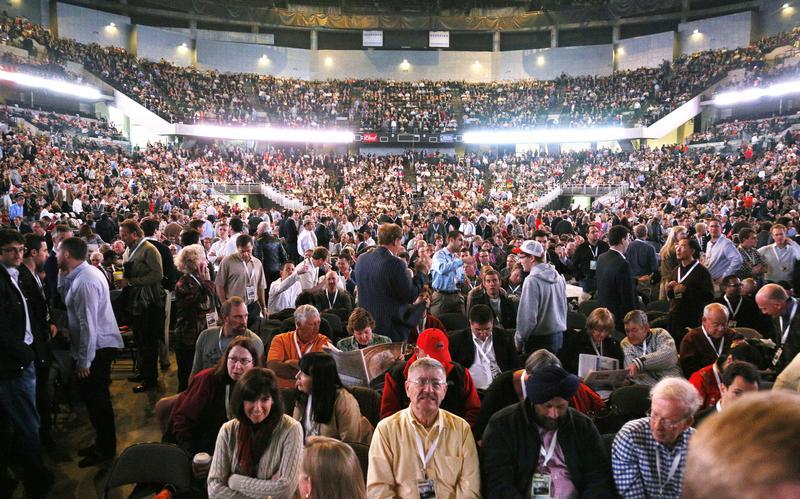 Berkshire Hathaway shareholders pack the CenturyLink arena for the company’s annual meeting in Omaha May 4, 2013. Warren Buffett and the board of his conglomerate Berkshire Hathaway Inc are “solidly in agreement” on who should be the company’s next chief executive, he said at Berkshire’s annual shareholder meeting on Saturday. REUTERS/Rick Wilking
Berkshire Hathaway Annual Shareholders Tuns Omaha into Buffettville Destination
©by Leo Adam Biga
Originally appeared in Omaha Magazine
Berkshire Hathaway Inc.’s once modest annual shareholders meeting has morphed into what one pundit called “Woodstock for Capitalists.”
Thanks to chairman Warren Buffett’s “Oracle” status, the weekend event’s now a branded experience. Sure, Buffett and partner Charlie Munger’s witty Q & A is popular, but there’s also exhibits by subsidiaries, entertainment, parties, concerts, tours and immersion in-all-things-Omaha. People drop big bucks on buying-junkets at Berkshire-held Borsheims and Nebraska Furniture Mart, which reportedly did $30 million in sales for last year’s spree. Gorat’s and Dairy Queen do well.
Economic crisis or not, thousands will once again venture here from across the nation and globe for the May 1-3 bash. The Saturday May 2 meeting is when Qwest Center Omaha overbrims with activity. Annual meeting director Kelly Muchemore-Broz said she’s seen the event take on “a life of its own.” “The first meeting I attended there were 200 shareholders. When I started helping with the meeting, there were a couple thousand. Back then we were able to pass microphones to the shareholders to ask their questions. Last year we had 32,000.”
The scale, said Qwest Center director of event operations Stan Benis, “is probably the largest we handle from start to finish. People come early and stay late. The event is certainly in a class of its own. The closest would probably be the American Idol tryouts, but even that didn’t take the entire convention center floor space.”
 Berkshire Hathaway CEO Warren Buffett (C) shakes hands with a shareholder just before the company’s annual meeting in Omaha May 4, 2013. Buffett and the board of his conglomerate Berkshire Hathaway Inc are “solidly in agreement” on who should be the company’s next chief executive, he said at Berkshire’s annual shareholder meeting on Saturday. REUTERS/Rick Wilkin
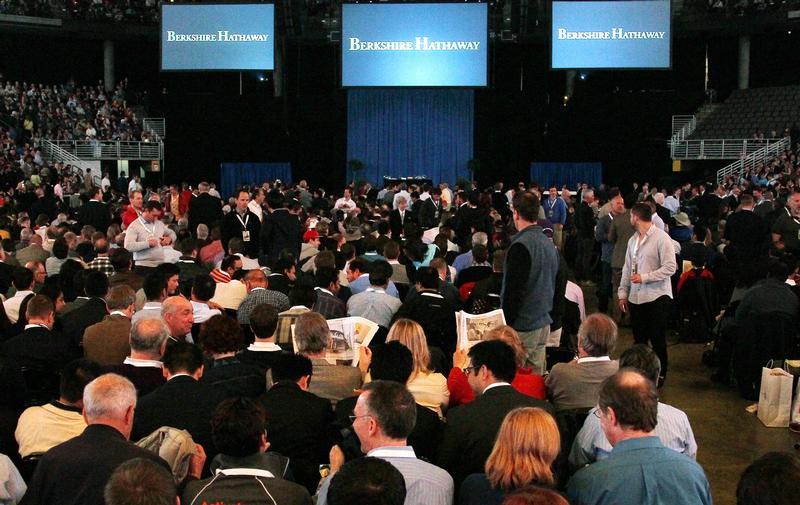 Berkshire Hathaway shareholders pack the CenturyLink arena for the company’s annual meeting in Omaha May 4, 2013. Warren Buffett and the board of his conglomerate Berkshire Hathaway Inc are “solidly in agreement” on who should be the company’s next chief executive, he said at Berkshire’s annual shareholder meeting on Saturday. REUTERS/Rick Wilking
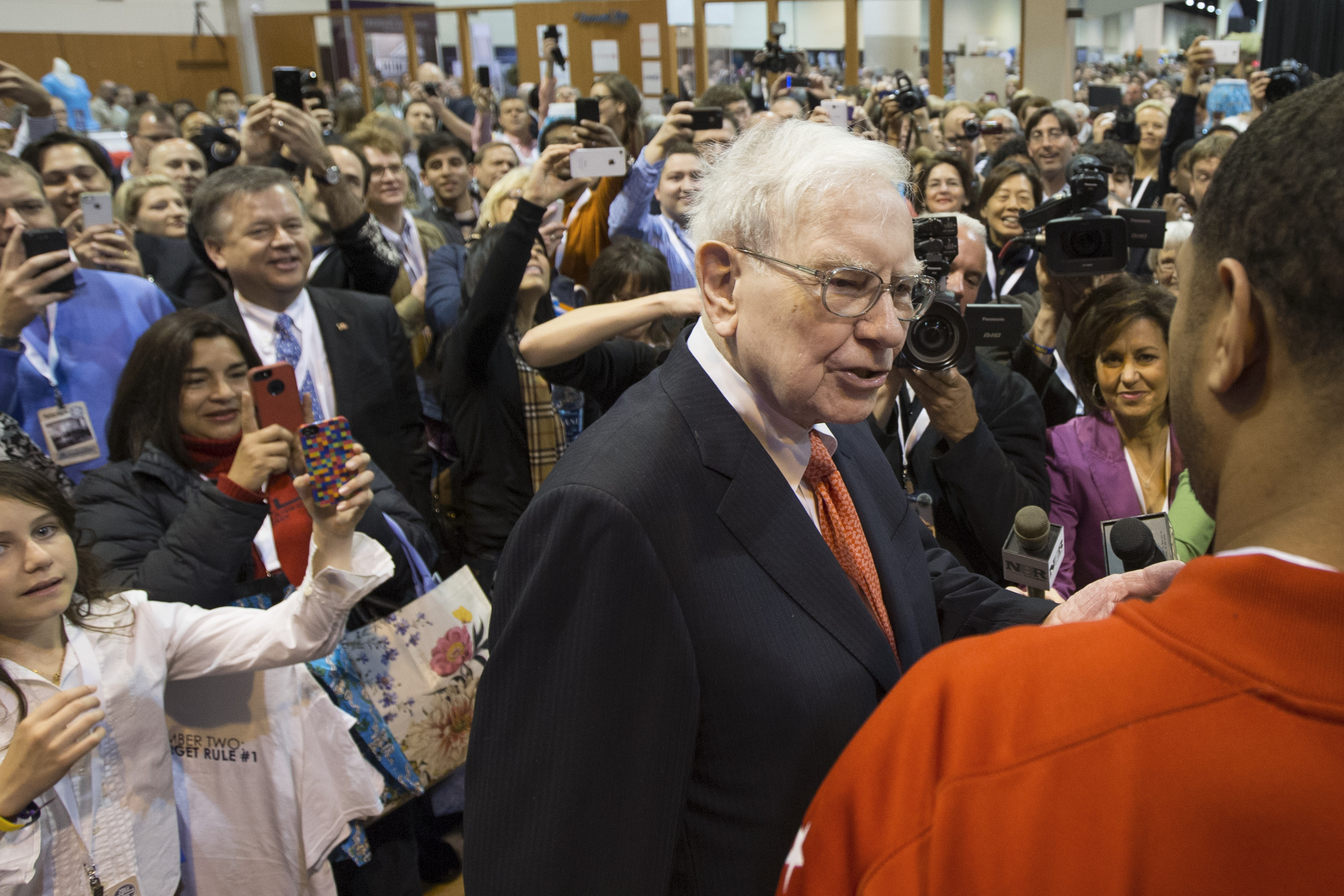 Investor Warren Buffett is surrounded by hundreds of Berkshire Hathaway shareholders and journalist as he talks to Chris Handles Franklin of the Harlem Globetrotters before the shareholders meeting in Omaha, Neb., Saturday, May 4, 2013. Tens of thousands attend Berkshire Hathaway shareholder meeting to hear Warren Buffett and Charlie Munger answer questions for more than six hours. No other annual meeting can rival Berkshire’s, which is known for its size, the straight talk Buffett and Munger offer and the sales records shareholders set while buying Berkshire products. (AP Photo/Nati Harnik)
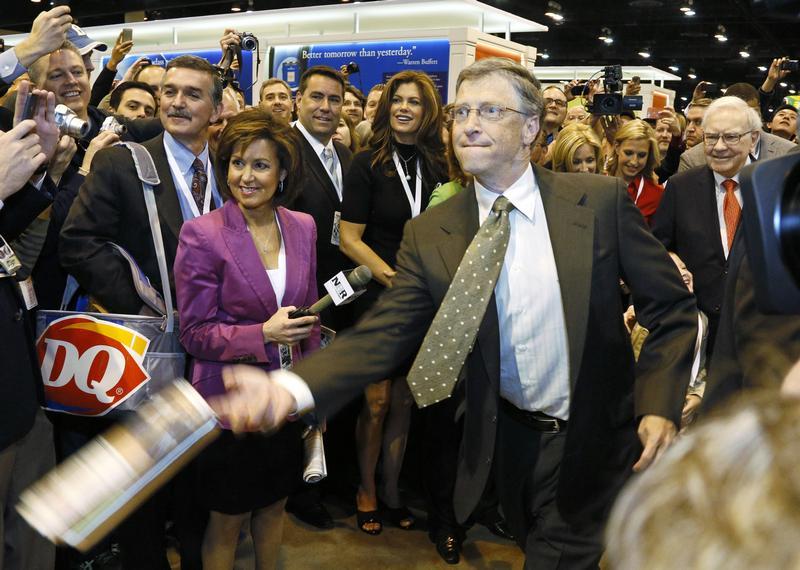 Berkshire Hathaway CEO Warren Buffett (R) watches friend Microsoft Chairman Bill Gates throw a newspaper in a competition just before the Berkshire annual meeting in Omaha May 4, 2013. Buffett and the board of his conglomerate Berkshire Hathaway Inc are “solidly in agreement” on who should be the company’s next chief executive, he said at Berkshire’s annual shareholder meeting on Saturday. REUTERS/Rick Wilking
So, what goes into making it all happen?
Months in advance Muchemore-Broz begins working with a core team to plan every element of the all-day event. The devil’s in the details. That includes a theme. This year’s is cowboys. “I try to select themes that are whimsical, colorful and offer a large canvas of creative possibilities,” she said. Designers lead crews that dress the facility — this time in a Western motif. Only the arena’s left untouched. “It’s all business in there,” she said, referring to the venue where the company movie, Q & A and business meeting unfold. Everything else is fair game.
A live reenactment of a stagecoach hold-up will break out right in front of the Qwest on 10th Street. A Wild West show, minus shootouts, is on display inside.
“Every year it’s amazing to see an empty exhibit hall become completely transformed,” said team leader D’Ann Lonowski of Mint Design. “It is an elaborate setup that usually contains a large, central focal point in the exhibit hall. From there we branch out with scenery and signage.”
Muchemore-Broz said the most time-intensive work is “finalizing meeting details — designing, writing, printing, organizing, communicating and delivering meeting materials to both shareholders and attending exhibitors.” The most labor-intensive? “Stuffing envelopes,” she said.
All of it, the landscaping, centerpieces, booth displays and graphics, right down to passes and visitor guides, Lonowski said, must work together to “create a cohesive environment” and to “bring the theme to life.”
Then there’s the buzz. Think of Buffett as the iconic front man for a hot band whose star power gets shareholders to queue up hours before the meeting starts. “I believe the record was one o’clock the morning of the meeting. However, last year there was a gentlemen who arrived at 11 the night before,” said Muchemore-Broz. In terms of preparations, Benis said, “we treat it just like a rock show. The crowds are lined up outside and pass through a security checkpoint.” Once inside, he said, it’s a race of people “in suits-and-ties trying to get a front row seat.”
With attendance now at sold-out, stadium-concert proportions, demand on area service sectors, such as lodging, is great.
“The downtown hotels do sell out the summer before,” said Muchemore-Broz, “but room availability changes constantly –- right up to the weekend of the meeting. So it doesn’t mean you can’t get a room in Omaha.” However, she added, “If you wait until spring to get a room, it’s possible you could be as far away as Lincoln.”
Omaha Convention & Visitors Bureau executive director Dana Markel said its Visitor Center at 1001 Farnam Center sees double its highest traffic that weekend. “It’s just a spectacular event for Omaha and really nothing compares,” she said. “People come in from all over the world.”
The day of the meeting, Benis said, “parking is always a challenge but people seem to find spaces. A lot of attendees take the hotel shuttles or walk over.” As the arena can’t hold everyone, teleconferencing beams the meeting into the exhibit hall, the ballrooms and the concourses, where the overflow crowd mingles.

Accommodating all those visitors requires much coordination. Muchemore-Broz said countless people support the meeting and satellite events/activities. “My team members have their own staffs. Everyone at Berkshire works the meeting — including employees at a couple of our local insurance companies. There’s Qwest personnel, Omaha Police Department, Nebraska and Iowa State Patrol, Douglas and Sarpy County deputies. Many local residents volunteer to help. And, of course, the local restaurants, hotels, taxi companies, the airport –- the list goes on and on.”
At the Qwest, Benis said, “our event staff, including cleaners, is around 300 on the day of the meeting. Levy, our concessionaire, will have around 250 on site. Keeping the arena and convention center clean is always a challenge, but this event again is so different because of the length of time visitors are in the building.”
Muchemore-Broz said putting on the event is “a very exhilarating and fun grind. I’m thrilled when it’s over and everyone has had a terrific weekend but it’s sad too. It’s a big emotional let down when the lights go out. Every year is a lesson in growth and fine tuning.”
Related articles
- Berkshire Hathaway’s Operating Profit Grows 37%, Net Income Beats Street Expectations (seekingalpha.com)
- Warren Buffett says Berkshire Hathaway may buy more newspapers (nextlevelofnews.com)
When Omaha independent filmmaking took a new turn or did it?
A decade ago I fairly called out the Nebraska independent filmmaking scene with this story that bemoaned the lack of home-grown feature filmmaking here. I used the example of locally based Oberon Entertainment completing a feature of some size, Full Ride, and with a distribution channel in place as being a great depature from what had been happening and what was happening at the time. Sadly though, with the exception of Nik Fackler taking things one step further with his Lovely, Still, in 2008, nothing much has changed. Oberon hasn’t made another feature. And whatever features Nebraskans have made here have apparently not gained much traction. No Omaha native filmmaker has yet broken out the way Alexander Payne has. Fackler’s come closest and I would still bet he’s the best candidate of the filmmakers who’ve emerged here the last decade to do so. Charles Fairbanks may be another. That’s not to say there aren’t some terrifically talented folks making shorts and even features here or that one or more them couldn’t break out. I just don’t know about them. I hope someone does if for no other reason then I’d like to write about them and their work being discovered and embraced by the masses. I must add though that the prospects for this happening have brightened because the film culture here has much become richer since this story was first published in 2012. The Omaha Film Festival and Film Streams are longer overdue and welcome additions to growing the film culture.

When Omaha independent filmmaking took a new turn of did it?
©by Leo Adam Biga
Originally appeared in The Reader (www.thereader.com)
Filmmaking is a lot like sex. There are the wannabes who mainly talk about doing it and those who really get it on. With the exception of Alexander Payne, whose Hollywood-financed films place him in a special category, Omaha has had its share of cinema wet-dreamers. A few, like Steve Lustgarten, Dan Mirvish, Dana Altman and Shawn Prouse, managed scraping together tens of thousands of dollars from local investors and, by hook or crook, realized their grassroots indie aspirations using almost entirely local casts and crews. Until recently, though, no one succeeded in raising really serious money for a native-born production. That is until Oberon Entertainment Properties hit the scene.
An Omaha film production company formed in 2000 by Mark Hoeger, Andy Anderson and Thompson Rogers, Oberon’s partners quickly separated themselves from the local cinema pack by not only setting ambitious production and distribution goals but by doing enough homework and opening enough doors to actually reach some of those lofty goals. In researching the biz, including such centers of indie filmmaking as Austin, Texas and Charlotte, N.C., Oberon’s principal players say they found plenty of data to support their contention that homegrown movie-making could be a going concern.
Displaying a business acumen unseen before among area filmmakers, the three men went about doing exactly what they set out to do, including acquiring a marketable script and hot lead actors, lining-up investors to bankroll the $1.84 million project, securing a major distributor for the property before filming even commenced, completing their teen romance film, The Full Ride, without incident and attracting major players to represent their product around the world. Now, they are in the midst of raising a film financing pool, which they hope will total between $10 and $40 million, to help fund future Oberon projects.
While the company is still “pushing” to net a theatrical release for Full Ride, that prospect dims as time goes by, meaning the film will likely find exclusive distribution via home market venues (cable, video, network TV). With one major foreign TV sale already inked and other overseas-domestic sales in the works, Oberon has leverage on its side. The only thing left unproved is whether it returns a profit to investors and has any legs or staying power as a boutique film business. While Oberon seeks to avoid being a flash-in-the-pan, it should be noted no Omaha filmmaking venture (other than Payne’s) has followed-up a first pic with anything more than unfulfilled promise.
“When we started putting this company together it wasn’t to make a film, it was to create a film business. We don’t want to play at this — we’re too old,” said Anderson who, along with Hoeger, headed Full Ride’s 40-something creative team, with Anderson serving as cinematographer and Hoeger as director. It may be Oberon that is part of a Nebraska New Wave given that indie hit My Big Fat Greek Wedding was financed by Gold Circle Films, a division of Omaha-based Waitt Media.
The story of Oberon offers an insider’s-look at how things work in an industry predicated on gumption, guile and glad-handing, but also bottom lines. In an unprecedented move for local filmmakers, Oberon sold itself and its dream, in the form of a well-articulated business plan, to deep-pocket money-men. The journey began when Hoeger, former executive director of the Omaha Theater Company for Young People, was approached by Omaha author and ex-UNL football player George Mills with an original film story. The story concerned a troubled star high school football player, Matt, who is pressured by an ambitious coach and smitten by a small town girl, Amy, whose perfect facade hides an ugly truth.

With Mills bringing the project’s first investor aboard along with him, Hoeger agreed to film an 18-minute “pilot” or teaser to test the investment waters. Needing someone to shoot the pilot, Hoeger collaborated with Anderson, the maker of scores of TV commercials via his Anderson Productions. Each man had flirted with the movies before, Hoeger as a sometime filmmaker and film instructor and Anderson as a second-unit cinematographer on Hollywood export pics (including Payne’s Citizen Ruth andElection) and as cinematographer for omaha: the Movie.
The pair next approached Thompson Rogers, an Omaha entrepreneur and investor. It turned out their timing was right, as Rogers had already begun looking at film as a business opportunity. Rogers joined the team, but demanded his partners gather more facts and figures. “The great thing about having Tom on board is he put us through our paces in getting us to prove that we had a good idea and that we had the capacity for doing it,” Hoeger said. Anderson said the process “helped build our credibility in the business world because we approached it from a business standpoint rather than as, ‘Oh, we’ve got a great idea for a movie.’ We looked at the independent filmmaking business…at what independent films are doing domestically and internationally through all the different distribution venues.”
Hoeger said, “One of the pieces of data we found showed that films that get released are profitable overall, especially over their lifetime, but that the number of films released compared to the number of films that get made is very small. Because what we figured out was it’s easy to make a movie — it’s harder to get it out there. Now, one strategy is you make a film and then you try to get it into the Sundance Film Festival, where you hope to get a distribution deal. But out of the literally thousands of entries to Sundance, maybe only 50 films get shown and of those 50 maybe five end up in distribution. So, that’s a very high risk operation…it’s sort of the lottery theory of a business plan. We realized it was going to be hard to pitch that. We wanted something with better odds, which meant not starting production until we had some distribution channel in place.”
He said it turned out many of the 14 investors who signed on with Oberon have invested in films before or been approached to. He feels what aided Oberon in getting their support is the sober way it wooed potential backers. “I think the main thing is we didn’t oversell what the potential was. Most of the investors have been around the block enough times to know that if it sounds impossible, it probably is. It seemed the more honest we were…the more interested people got because then they began to take us seriously. Plus, it helped that Andy and I had a track record in the community. That opened the door for us.”
It didn’t hurt, either, that Oberon knew how the game was played and brought in some bona fide players on its side. In a classic case of it’s-who-you-know-in-Hollywood, Hoeger got an old college roommate, novelist-screenwriter-producer Don Winslow to rewrite Mills’s treatment for Full Ride. Winslow then pitched the script to Porchlight Entertainment’s Bruce Johnson, who bit on it. Winslow also led Oberon to former Universal executive Peter Heller to produce Full Ride and to prestigious Creative Artists Agency (CAA) to represent Oberon. “Don’s very well connected,” is how Hoeger describes Winslow’s influence. Rounding out the creative team were production designer Sandy Veneziano (Father of the Bride) and Oscar-winning editor Mike Hill (Apollo 13).
Even with this power package in place, Hoeger found the labyrinthian Hollywood system made it difficult to know whether their film was ever green-lighted “until we started shooting.” “You get yessed to death. The suits never want to say ‘No’ because nobody wants to be the jerk that passes up the next Blair Witch Project. So, you always get, ‘Yes, but…’ or ‘Yes, come back to me…’ It’s an odd thing to deal with.” If anything finally sold the film, Oberon’s partners say, it was the script. “What George (Mills) was really great at was an authentic rendering of the football experience. What Don did is he filled out the characters of Matt and Amy and their romance,” Hoeger said. In his hands, Anderson said, “the story became one of overcoming adversity or misfortune, which is sort of a universal theme, and the football aspect became the backdrop.” In turn, the meatier story of redemption and the solid parts attracted a top casting director and rising young stars in Riley Smith (Matt) and Meredith Monroe (Amy).
The May 2001 shoot, which unfolded largely in and around the Dana College campus in Blair, Neb., weathered the usual production burps, including rainy weather not called for in the script. “I thing the biggest challenge was staying on schedule and on budget,” Anderson said. “We were very diligent those two things happened and despite some hiccups we came in under budget and on time.” He equated filmmaking’s high stakes pressure to “being an artist with a gun to your head,” always ready to improvise when problems arise. Hoeger feels the process promotes more creativity, saying, “In some ways, the best stuff comes out of that problem solving.” Hoeger added it was not until post-production at the Gower Studios in Hollywood when he had an epiphany signifying his and Oberon’s arrival. “After working there awhile I’d drive on the lot and the guard would give me a little wave and the valet would get my car. One day, walking back from the commissary, there were wardrobe racks rolling by, film crew members sitting on cranes and stars walking around when I looked up at the big Hollywood sign on the hill and I thought, ‘Oh, wow, cool…It’s like we’re making a movie.’”
Hoeger said Oberon’s success in steering a film through financing, production and distribution has established the company in Hollywood circles. “That’s considered quite an accomplishment in L.A. because there are so many people who want to get that done but never do. To actually pull that off puts you in an amazingly elite club…” Interestingly enough, he said, in the entire three-year process Oberon has met no L.A. snobbery about its Omaha roots. “The industry is now so much decentralized — it’s moved all across the country and into Canada — that as far as they’re concerned Omaha might as well be Austin or Charlotte or Minneapolis or Vancouver. It’s all the same to them — it’s not L.A.”
The company is now weighing its second feature project. “We have boxes and boxes of new scripts that people have sent us, but we haven’t optioned any at this point. The next project will probably be a property owned by one of the production companies that have proposed doing a co-production with us,” he said, adding Oberon may one day be in a position to directly acquire scripts.” He said Oberon doesn’t so much pick scripts as pitch them. “When we go out to L.A. it’s with an armful of scripts and it’s up to the distributor to decide ‘This is the one.’”
Would-be filmmakers now come to Oberon in droves asking, How do you do it? The dreamers are told it takes preparation, knowledge, talent, guts and patience, lots and lots of patience. Hoeger said, “Anybody who dreams of becoming a filmmaker has to be prepared for the fact that it’s a pretty slow go.” Or, as Anderson likes to say, “sometimes you have to wait for the stars to align.”
Related articles
- Alexander Payne to Talk Cinema with Kindred Spirit Jane Fonda at Film Streams Feature Event in Omaha (leoadambiga.wordpress.com)
- Film Streams at Five: Art Cinema Contributes to a Transformed Omaha Through Community Focus on Film and Discussion (leoadambiga.wordpress.com)
- Jane Fonda Comes Home (leoadambiga.wordpress.com)
George Payne and the Virginia Cafe: Restauranter Family Legacy of Filmmaker Alexander Payne
NOTE: The primary source of this story, George Payne, the father of filmmaker Alexander Payne, died May 27, 2014. I’m reposting this in Mr. Payne’s memory.
As many of you know the filmmaker Alexander Payne is a Greek American with a fairly unpronouncable given name and he regards his heritage as much more than an aside. It’s a core aspect of his life. Hisv ery Greek family ran a popular, long gone eatery in downtown Omaha and some years ago I sat down with his father George to recall the life and times of their Virginia Cafe. Alexander, who has some fairly distinct childhood memories of the place, lent a few tidbits as well. Perhaps Payne’s most public display or acknoweldgment of his family and heritage came when he accepted the Oscar for Beast Adapted Screenplay last February and used the occasion to thank his date, who happend to be his mother Peggy, for enabling his early cinephile stirrings, even saying “I love you” in Greek before the worldwide audience. If you happen to be a Payne fan then this blog is for you. I’ve covered him for 15 years and counting and you’ll find the fruit of that work here.
©by Leo Adam Biga
Originally published in The Reader (www.thereader.com)
It’s nearly 40 years since Alexander Payne‘s family owned and operated the Virginia Cafe, a restaurant that for generations held a niche in the city’s downtown dining market. Recently, the filmmaker’s father, George Payne, shared some history and memories of the place and the family with The Reader.
George’s immigrant father, Nicholas (Papadopoulos) Payne, was founder and proprietor of the Virginia. Nick, as the patriarch was called, came to America in 1910, learning the confectionery trade from an uncle, John Birbilis, who helped Nick and brother Peter open the Palace of Sweets in Council Bluffs. In 1920 Nick, with cousin Fred Schizas and two other partners, bought the Calumet, a large, busy, around-the-clock food joint at 1413 Douglas Street that dated back to 1893. They remodeled it, renamed it the Virginia and kept it one of Omaha’s few 24-7 operations, George said. The other partners eventually dropped out.
According to George the Virginia served strictly American fare — steaks, chops, sandwiches, salads, a full breakfast line, daily lunch and dinner specials and traditional holiday favorites. The cafe housed its own bakery, had its own butcher and stocked a freezer with eight kinds of ice cream.
At its peak, he said, the popular cafe kept a payroll of 85 employees on three different shifts and served up to 3,000 diners a day.
George joined his father in the family business in the early ’50s. An Omaha Central High, Dartmouth and Northwestern University grad, George is a World War II vet who worked on the war production board in Washington D.C., where he met his wife, Peggy. He and Peggy settled in Omaha, where the youngest of their three sons, Alexander, fell in love with movies.
The future filmmaker was only 9 when a fire destroyed the Virginia but he has fond memories of the cafe.
“People loved that place,” Alexander Payne said by phone. “There was no key to the front door. They didn’t need one — they never closed. I used to like to go back to the kitchen and watch the chefs work. I remember all the wait staff and cashiers were so nice to me because, of course, I was the owner’s son. Our family ritual was dinner there every Thursday night.”
The Paynes ordered right off the menu.
While no Greek food was on the menu, the restaurant embodied Nick Payne’s classic immigrant made-good success story. Like many newcomers he went out of his way to be a super patriot. He sold millions of dollars worth of government Liberty Bonds during the Second World War, said George Payne, who added his father landed “quite a coup” when he inked a contract to feed all area military enlistees. From WWII through Vietnam, the Virginia served “last meals” to wide-eyed recruits en route to basic training.
“They came in and took over our business,” said George, who remembers the first guardsmen tromping in with their boots and packs and hanging their rifles on coat hooks attached to the fine mahogany wainscoting, which sent his father into a fit. From that point on the soldiers stacked their weapons safely out of harm’s way.
The Virginia was justly proud of its decor. Its glorious neon signage, plate glass windows, decorative tile-fronted exterior and rich mahogany interior with white table cloth covered tables and booths were straight out of an Edward Hopper painting. Distinctive murals of the American landscape and fine renderings of all 50 state seals adorned the lounge and dining room and the massive cross-section of a redwood tree was mounted in the party room.
“There wasn’t a restaurant in town that had that kind of atmosphere at all,” George said. “It was very well done. My dad had vision.”
This eclectic design reflected the diverse customers the Virginia catered to — professionals, office workers, politicos, housewives, clerks, stock boys, cabbies, crack-of-dawn delivery men, night owls and bar crawlers.
Up front, right at the door greeting customers, was Nick, trademark cigar in hand, dressed impeccably in a suit and tie and kibitzing with the line of people that formed at lunchtime. If anyone tired of the wait and started to leave George said Nick would coax them to stay with, “‘Don’t go. You know you’ll be back in five minutes. Where you going to go?’ He had a way with people.”
The cafe enjoyed a brisk trade before it went up in flames in 1969. Neither Nick nor George were there when the fire broke out on a Sunday night. They were awakened with the news and came down to see a burned out shell. After two full days of being hosed down, George said, the building collapsed in on itself. It was a total loss. George salvaged a few mementos and artifacts. There was talk of reopening at another spot but the family opted to walk away. The site of the Virginia was sold to the city, which built the W. Dale Clark Library there.
“I really didn’t quite know what I was going to do…” George said. He wound up with the Sheraton Hotels group and then the U.S. Department of Commerce’s International Trade Administration — posts that took him around the world.
Nick Payne left a rich legacy that George has carried on. The elder Payne helped found the Omaha Restaurant Association, which his son presided over as president, as he did the Nebraska Restaurant Association. In 1956 American Restaurant Association Magazine inducted Nick into its Hall of Fame. The father was heavily involved with St. John Greek Orthodox Church. Nick Payne died in 1989. George Payne, now 92, has continued, with Peggy, his father’s support. The family, who’s made periodic trips to their ancestral homeland, retains close ties to Greece, where Alexander Payne intends to one day shoot a film.
Related articles
- Alexander Payne to Talk Cinema with Kindred Spirit Jane Fonda at Film Streams Feature Event in Omaha (leoadambiga.wordpress.com)
Age is Just a Number and Retirement a Foreign Concept to Six Working Seniors in Omaha
Age is Just a Number and Retirement a Foreign Concept to Six Working Seniors in Omaha
©by Leo Adam Biga
Originally appeared in the New Horizons
During their lifetimes Americans devote far more hours to their work then to any other of their pursuits, including family life. More than the livelihood it provides, work helps shape individual identity, sets an agenda for daily commerce and affords personal growth opportunities. Given the vital role gainful employment plays, it’s not surprising then that as more Americans live longer, healthier lives, the prospect of outright retirement holds less interest for seniors who feel lost without the sense of engagement, structure and accomplishment a job provides.
Working seniors may account for a minority of the labor force but can be found toiling away at a wide range of careers and vocations — from the professional ranks to the blue collar rolls to everything in between. Omaha’s senior work force is a diverse one. It includes such well-known figures as investor Warren Buffett, world-renowned medical researcher Denham Harman, satellite communications guru Lee Lubbers, respected photojournalist Don Doll, noted jazz musician Preston Love, PR man Bill Ramsey, Henry Doorly Zoo Director Lee Simmons and Girls and Boys Town Director Rev. Val Peter. Of course, most local seniors still working are, like the individuals profiled in this story, average folks doing what they love, including band leader Ed Svoboda, school registrar Theresa Derr, maintenance man Otto Link, senior center manager Sophiae Foster, attorney Monte Taylor and receptionist Fornetta Elmore. Whatever their age or position, they agree working is a major factor in maintaining their vitality and staying full, contributing members of society.

A Working Life in Music
Anecdotically, at least, it seems many musicians, especially those outside the drug-hazed rock and jazz worlds, live to ripe old ages. Maybe it’s something to do with that old saying about music feeding the soul. If true, then 90-year-old professional polka musician Ed Svoboda Sr., is living proof of music’s health benefits. He’s been making music — first on the mouth harp, then the accordion and finally the drums — virtually his entire life and has been leading his own band for most of the past 65 years. Even today, the crusty old Czech, featured on drums, headlines with his Red Raven Orchestra, in which his son Ed Jr. performs, in regular, rousing gigs at Bluffs Run Casino, Sokol Hall and the Corrigan Senior Center as well as playing the annual Czech festival in Wilber, Neb. Remarkably, Svoboda’s exploits with his band amount to only a sideline for him, as he puts in 40-plus hours a week as a full-time furniture repairman and refurnisher with Honey Man Rental and, in his spare time, sharpens lawn mower and snowblower blades. For Svoboda, a father and grandfather whose wife of 48 years died of cancer, there’s no doubt getting up and going to work every day is a far better tonic than simply rattling around an empty house all day long. No being put out to pasture for him, thank you. If he retired to some senior complex, he said, it would surely be his end.
“I’ve been amongst people all my life and if you put me in a corner someplace you just might as well bury me because I ain’t gonna last. I wouldn’t last a month just sitting around here all alone. That’s the God’s truth. I’ve gotta move. I’ve gotta have something else going besides that thing there,” he said, gesturing derisively at the living room TV set in his home in south Omaha’s Brown Park neighborhood, where he grew up the son of an emigrant accordion-player-turned architect.
Svoboda, whose previous careers included working as a scale operator at the Swift & Co. meat packing plant for 35 years and as a press mechanic for Malnove Inc, never lost sight of his dream of being a professional musician. “That’s what I wanted all my life.” Holding onto that dream despite many struggles made attaining it all the more precious. During the Great Depression he scrounged up work wherever he could find it before finally scraping together enough dough to buy a top-of-the-line button accordion, his instrument of choice for many years until a bandsaw accident injured his fingers so badly that it forever-after obliged him to play drums. Then, in what could have been a crushing blow, Svoboda’s first band weathered a dismal public debut when nobody showed up for a dance they were booked to play in Milligan, Neb. He found out later a member of a rival band playing to a packed house across the street hid their playbills, leaving the boys from Omaha staring at an empty hall and, because they were contracted on a commission basis, high and dry. To get money to buy gas for the trip home, Svoboda wrangled the band a paying gig in a local beer joint. From that rough start, Svoboda never looked back, with his popular band plying the Nebraska, Iowa, Kansas, South Dakota polka circuit and appearing as a regular featured act on polka radio shows. In 1974, he was enshrined in the Sokol Omaha Polka Hall of Fame.
Besides entertaining people the thing that Svoboda, who watches what he eats in addition to doing what he loves, enjoys most about a life in polka is its celebration of his proud Bohemian heritage. “I love the heritage. It’ll go to the grave with me. That and the music. That’s been my life since I was a little kid.” It goes without saying the, that he has no designs on stopping now.

A Woman’s Work is Never Done
Other than the 15-year hiatus she took while raising her three boys, Theresa “Rose” Derr has been doing the 9-to-5 routine as an administrative staff member in area schools since graduating high school in 1936. Now 84, Derr is in her 26th year as registrar at Westside High School, where her three accomplished sons attended, and she has no intention of leaving anytime soon. “Not even an option” she said one morning in her Westside office. “Personally, I still feel capable and I still have a desire to do it. I like what I’m doing. I really do. I think it’s something worthwhile. Working in the schools is the only type of work I’ve done, and it’s very rewarding.”
When her retired friends press her to step down, take it easy and do what she wants, a perplexed Derr tries explaining to them, “’I am doing what I want to do. Why can’t you understand that?’ I talk to a lot of gals who are retired and they seem perfectly happy and well-adjusted, but I don’t want to do the things they’re doing. They just don’t appeal to me. I’m not a golfer. I don’t play bridge. I don’t join ladies’ aids. So…I work. I have known people that counted the days until they were 65 and could quit, not that they did anything so great after they retired. So, what’s so great about it? It’s just never appealed to me to not be doing something. This way I have an agenda and I have a purpose in the morning. It never occurs to me, What am I going to do today? It sounds kind of trite, but if you can still contribute something, do it. As long as I am and my boss feels I am, I will.”
Recently, Derr, who’s long enjoyed good health, missed an extended period of work for the first time due to a medical condition. She said no one from the administrative offices at District 66 or Westside even hinted this might be the time for her to move on. “They were very cooperative. While I was gone, they just pitched in and they just assumed I would be coming back and so I just never did anything about it otherwise. I’m sure there’ll be a time when it’ll be prudent to step aside. I’ve always made it very clear that I’ll go when they feel it’s time for me to retire. I’m not sensitive about it. But at this point it seems to be mutual — they’re perfectly willing to keep me and I’m perfectly willing to be here.”
If anything, her time off only emboldened her desire to keep working. “When I was home those few weeks daytime television was the biggest deterrent to retirement I ever saw.” She said in addition to the support her colleagues show in her continuing her career, her three sons do as well. “The boys are really great about it. They want me to quit when I feel like I want to quit. I think they realize there would be a problem if I ever did. I think it’s good for them to know I’m independent and I don’t just sit around worrying or moping. I don’t want to be one of those. There probably will be a time when I will be a concern to them, but I’m not going to bargain for it any sooner than I have to.”
Like her late husband, Derr is a Lincoln native. Her German emigrant parents settled there by way of Winnipeg, Canada. Derr recalls her “very traditional” mother always engaged in some work. “Maybe that’s where I got my work ethic — from my mom. She never did just sit. She had to be doing something. You know, they did that then. They didn’t waste a minute.” She and her husband, who also worked well past normal retirement age, waited 10 years before starting a family and then made their kids their priority. Their rearing efforts paid off, too, as one son is a microbiologist and two others are attorneys, including one with the FBI and another, Jay Derr, recently appointed as a judge to the Omaha district court.
Devotion to work, she said, is a Derr trait. “It’s just my life, that’s what it is.” A positive attitude helps. “You’ve just got to think young. I don’t think age makes any difference. I can work right next to a 23-year-old and out-produce them. Whatever you can do, do.” And with that, her office rings and she answers, “This is Mrs. Derr, can I help?” and another workday begins.

All in a Life’s Work
At 86, Otto Link may be in the running for the title of oldest maintenance man in the Western Hemisphere. He works five days a week on what he calls “the housekeeping gang” at Methodist Hospital, where his regularly assigned projects include washing windows and cleaning elevator tracks, which sounds simple enough until you realize he means the full 10-stories worth of windows and elevators in the crosswalk wing connecting Methodist and Children’s Hospitals. He’s proud of the hard, physical labor he performs at such an advanced age but takes the attention he gets in stride because he’s from the old-school. “I know I’m the oldest person on our crew by far,” he said. “I get comments from guys that are 30 and 40 years old like. ‘Slow down, you make us look bad.’ They do ask me, ‘Are you ever going to retire?’ ‘Well,’ I tell them, ‘I already did twice’” and it didn’t take either time.
For 29 years the South Dakota born and raised Link was a parochial school teacher at a string of Lutheran schools in North Dakota, Ohio, Texas and Nebraska. After he retired from teaching, he became a Douglas County juvenile probation officer for a time before switching careers and working as a state rehabilitation services counselor for disabled individuals. When he left the latter post, he was already 70 — well-past traditional retirement age — but he soon got anxious puttering around the house, and that’s when, in 1986, after years of office work he opted to join the Methodist cleaning crew. “I wanted a job that was physical because I’d had enough of these sedentary jobs,” he explained. That he’s still at it 17 years later is amazing but understandable when you realize he lost his wife of 55 years in 1995, leaving him alone in the south-central Omaha home they shared. “Me and an empty house don’t get along so well,” he said. “I need something to do. You can only read so much and only watch so much TV before you get a little silly in the head.”
Besides, he said, he’s heard enough stories of folks who didn’t fare well after retiring that he prefers staying active as long as he can. It’s a I’d-rather-go-out-on-my-feet-than-lying-down attitude. “My wife was manager of a Walgreens liquor store for umpteen years and she got to know a lot of businessmen who’d stop in and get their booze before going home, and she used to tell me, Mr. So-and-So retired to take it easy, and over-and-over she’d tell me the guy who just retired had passed away. So, I kind of got the philosophy I really didn’t care what I did as long as it was physical. My wife encouraged me about that.”
Link, who has five grown children, 11 grandchildren and four great-grandchildren, said his kids often suggest he resign and move into a retirement home. “But I’m not ready for that yet. I’m going to stick it out as long as I can. As long as I’m able to and my employer is satisfied with my performance, I probably will keep working.” And why not? On his most recent work evaluation, he said, his supervisor gave him high marks “right down the line” and told him — “You’re doing a wonderful job.” Link doesn’t take his exceptional staying power for granted, either. “I appreciate it. I know it’s a blessing,” said Link, a devout Lutheran. His advice for staying young? “Stay active as long as you can, try to be happy and read some good jokes.”

Doing Good Works
Sophiae Foster is cleaning up the debris from the breakfast she’s just served her regular crowd at the St. Magdalene Senior Center in the basement of Omaha’s old downtown Catholic church. It’s about 9:30 now and a few of “her flock,” as she calls them, linger at tables, one reading the paper, another poring over a book, one doing a crossword puzzle and some chatting over coffee. Foster, 77, has been managing the ENOA-sponsored center for 28 years now and she plans on working there three more years, although she suspects if and when she does retire at age 80 “to stay home and rest” after a lifetime of serving people she probably won’t stay retired very long. “I don’t think I’d last very long” sitting idle, she said. “I might go back to work, but it won’t be nothin’ I have to go to every day. But I can’t see myself sitting at home feeling sorry for myself either.”
She’s kept working this long, despite double-bypass and knee replacement surgery, because “I just like it,” she said. “I really enjoy it. That’s the truth. My friends — they all don’t work and they tell me I don’t need to work. Yeah, I could live on what income I have, but I feel if I can still work, why not?” She’s also grown attached to the people who make the center and the two hot meals and convivial conversations served there at breakfast and lunchtime part of their daily ritual. Most are single widows or widowers. “Some are homeless” she said. “They need some help. Sometimes we get clothes in here for them. We could use more men’s clothes.” Regardless of their circumstances, the people who come find a place where they feel safe and cared for. “Yeah, we get along fine. We enjoy each other. The same ones who come every day — I know them by name. I miss ‘em when they don’t come. I’ve got one little old man, John, who hasn’t been here for about five days and I need to check on him. I’m kind of concerned about him,” she said one cold winter morning. “They grow on you.”
Her concern for others is an extension of her deep Pentecostal faith in action. For example, she helped her late evangelical husband start and run the Church of the Lord Jesus Christ in north Omaha, she worked as a nurse aide in the nursery at Children’s Hospital — “I loved it” — and she helped raise two of her great-grandchildren, both of whom are now back living with their biological mothers.
Her relationship with the senior center, which she launched in 1974, has come a long way since it’s rough start. “When I started, it was just a job I needed. I thought I couldn’t make it. We had drunks walk in off the street. It was scary. But I thank God for my husband. He said, ‘If you want the job you’ve got to stop being a crybaby and you’ve just got to do it.’ I did. I worked it out so the men set their bottles on my desk when they came in and picked them up when they left. I got along with them real good. We don’t have the problem of alcoholics anymore. Now, it’s kind of like a family. It’s a part of me. It gets me up and keeps me moving.”
She Works Hard for Her Money
She won’t reveal her real age other than to say she’s over 65, but Fornetta Elmore is entitled to some fudging after the fortitude she’s shown overcoming tragedy and the adaptability she’s displayed learning yet another career deep into her Golden Years. First, Elmore’s only child, a daughter, died at 20 after supposedly routine surgery. “It’s something, frankly speaking, I don’t really believe I’ve ever recovered from,” she said. “But you accept it and you go on.” Then, when her husband of 49 years was stricken with leukemia in 1978, she cared for him up until his death in 1995. After losing the two people most dear to her, the usually up-and-at-em Elmore felt herself slipping into a malaise. “I was trying to move on from my husband’s death and I felt being home alone wasn’t the place to be.” That’s when she heeded the advice of a friend, who knew Elmore had thrived in the world of work, to explore the ENOA senior employment program. In no time at all, Elmore was hired by Nebraska Workforce Development, where she is a receptionist today.
Having a job to come to every day is important to Elmore, but even more important to her is how she is valued by her employers, who don’t view her cavalierly as some token, window-dressing senior symbol, an attitude she detests. “I think some people have the wrong conception about us seniors — that we’re too old and stumbling to be able to do a job. I don’t think they give seniors the benefit of the doubt,” she said. “I’m lucky to have marvelous supervisors whose attitude is about me is, ‘Let’s do something with her.’ I don’t feel like, Oh, they’re doing me a favor. I feel like I’m earning my keep. I have something to do every day I come to work.”
She’s also overturned some senior stereotypes by learning, among other things, computer, typing, filing and receptionist skills. “Being the kind of person I am, I’m always ready to advance, especially if someone is willing to teach me.”
On the job Elmore is easy interacting with diverse colleagues and clients because that’s her nature and that’s what she’s used to from her days as a Kilpatricks and Younkers department store clerk and as proptietor, with her husband, of Elmore’s Flowers, a florist shop the couple ran out of their home. “I can mix with anybody. I enjoy being around people of all different ages and education levels.”
She rejects any thought of retiring. “Oh, heavens no. When you retire, that’s it, you’re dead. And when you’re dead, you’re a long time dead. You have to stay active and alive. You have to keep your mind open and enjoy life. Besides, I feel there’s a lot I can still contribute. I’ve put forth my best effort and I hope to continue to. And now I better get back to work,” she said, excusing herself.

A Work in Progress
The law has long intrigued Monte Taylor, 71, who for all but the two heady years he worked as Sen. Roman Hruska’s legal counsel on a Senate subcommittee in Camelot-era Washington, D.C., has spent his entire 49-year career practicing law in Omaha. That experience in the nation’s capital sparked a second career in politics for Taylor, who went on to serve as Douglas Country Election Commissioner and as an Omaha City Councilman before losing a bid for the 2nd District Congressional seat. Today, he continues his general law practice — as head of the firm Taylor, Peters & Drew — at an age when many peers are retired. Why? Because it still excites him. “I think the biggest fascination is that one is always learning,” he said. “It’s such a broad field. There are never any clear-cut issues. Most of the things we deal with are gray. They’re never black or white. So, it requires you to be constantly going to the books and learning something new. I do really enjoy the new challenges it presents every day. I plan to just keep plugging away as long as I enjoy it.” In that sense, Taylor is following the example of the dapper senior lawyers he was mentored by when first starting out. “I was very impressed by them. They were good lawyers of high character.”
Without his work, Taylor fears he’d be lost. “In my case, it fills a real need. I have no particular hobbies. If I’m stuck at home, I get very restless. So, for my own emotional and physical well-being, it (working) is very satisfying.” In his view, work is also a great escape. “In this business I’m working with people trying to help them solve problems. It takes my mind off any perceived problems I may have. My own theory is that part of the problem with retirement and old age is that if one gets too absorbed with their own problems and has too much idle time on their hands, then the more little problems become bigger problems. I just know I have a healthier attitude when I am working.”
He regrets that as a younger man he often put work ahead of family. Taylor, who has three grown children from his first marriage, which ended in divorce, is married to a woman with three grown children of her own. “Through the years, I got too absorbed in the law and I wasn’t the family man I should have been.” Balance in life, the devout Catholic said, is a virtue he’s learned as he’s grown older and wiser. “You have spiritual needs as well as emotional, physical and professional needs. Getting that all rounded out to make the pieces go together is key.”
In that way life has of coming full circle, Taylor has turned into the kind of distinguished older lawyer he was schooled-by many years ago. Like they were, he is a man of character whose abiding love for the law keeps him involved. “The brain is like a muscle. You either use it or lose it, and this (work) forces you to use it.”
Related articles
- From Omaha to Paris to Omaha, with Love, Anne-Marie Kenny’s Journey in Song and Spirit (leoadambiga.wordpress.com)
- Entertainment Attorney Ira Epstein, Counsel to the Stars (leoadambiga.wordpress.com)
- In Memory of a Omaha Old Market Original, Fruit and Vegetable Peddler Joe Vitale (leoadambiga.wordpress.com)
- George Eisenberg’s Love for Omaha’s Old Market Never Grows Old (leoadambiga.wordpress.com)
Omaha’s Northwest Radial Highway’s small box businesses fight the good fight by being themselves
The Omaha World-Herald assigned me to do a story a few years ago about some of the small box businesses hanging on and fighting the good fight along a section of the Northwest Radial Hwy in North Omaha. It’s a less than scenic strip for much of its length and most of the businesses found there, including the ones profiled here, are diamond-in-the-rough eccentrics in the way that small entrepreneurial endeavors tend to be. I feature a shoe repair store, a bartending school, a barber-beauty shop, a photography studio, a one-chair barber shop, and a barbecue joint. In most cases, it’s the people who run these businesses that make them interesting, and I trust you’ll find that to be true when you read these bits.
Omaha’s Northwest Radial Highway’s small box businesses fight the good fight by being themselves
©by Leo Adam Biga
A truncated version of this story appeared in the Omaha World-Herald
Traverse the winding arterial Northwest Radial Highway too fast and you may miss the small businesses dotting the landscape. Their tan or red brick facades bespeak nostalgia. Their intimate spaces reminders of an era before our supersized, homogenized franchise culture. Their personal, friendly, relaxed, pull-up-a-chair-and-let’s-talk customer service far removed from the get-em-in-and-get-em-out mode prevailing in many larger operations today.
A strip of the Radial extending from the eastern edge of the Benson business district to where the “highway” connects with Saddle Creek Road features a hodgepodge of classic Mom-and-Pop service providers. These small box businesses are the antithesis of big box stores. A shoe repairman, an old-style barber, a bartender’s school and floral shop in one, a photography studio, a beauty parlor.
Interspersed with these are service stations, a car wash, a print shop, a photo shop, a vacuum cleaner store, a heating-air conditioning business, another beauty salon, a tattoo parlor, a barbecue joint and a bar and grill called Nifty.
Then there’s the hybrid Quiktrip, a national convenience mart with country store service amid a gleaming, corporate layout of vast food and beverage choices, gourmet lattes included, and eight self-pump gas units. It’s not on the Radial per se but its footprint fronts both the Radial and Saddle Creek, mid-town thoroughfares linking the O’s four quadrants. Store manager John Shonka said serving people on the go means giving them what they want quickly. “If you’re not a one-stop shop then they’re going to one-stop shop somewhere else. Obviously, they don’t like to wait. Customer service and having everything they want conveniently and affordably and at their fingertips is what they’re looking for.”

Across the street, Dee N Dee Full Service Gas is a humble alternative. Its shacks and machines dispense, by comparison, meager snacks, beverages, supplies. The lack of amenities and choices is made up for by an attendant who pumps your gas, checks under your hood, puts air in your tires and washes your windows. Service.
The small entrepreneurs hang on against all odds. They do things their way. They keep their own hours. Their quirks and tastes come with the services they render. It’s part of their charm. It’s makes them irreplaceable. As Benson Shoe Repair owner John Schu said, “It’s the little guys that make the big guys go. If you take the little guys out, I guarantee you the big guys are right behind them.”

Benson Shoe Repair, 5725 NW Radial Hwy
Schu’s place is aged like the leather goods he mends. His sewing, nailing, finishing machines are older than his 45 years. The building he rents has been a shoe repair store its entire 74-year history. The original owner built the single-story brick shop as an extension of his house. Schu’s father, Mike Koory, took over the business in the 1970s. The younger Schu learned the craft from his pops.
When Schu went off to sew his wild oats as a young man, first in California and later in Texas, he never got far from the shoe repair trade, furthering his expertise by apprenticing under older craftsmen. After some hard times this rambler came home, rejoining his father in Benson, where Schu grew up and still lives today.
His dad retired recently, leaving Schu to carry on the tradition alone. He respects the legacy he’s part of.
“I’ve been honored to be around a lot of different tradesmen. I fell in love with this and because I fell in love with it I got pretty good at it and I trained with different professionals.”
Stiff competition in Texas, where he lived 16 years, forced him to step up his game. “You can’t half-step it there,” the T-shirt and jeans-clad Schu said.
He doesn’t think too highly of the work done by the few shoe repairmen still practicing in Omaha today.
“Most of them, their work isn’t what it should be just because they’ve never really been trained by old guys,” he said. “The old guys are gone. Those old guys, man, they’re the ones that knew it and passed it down. If you weren’t blessed enough to hang out with them when you were growing up then you missed out on a lot of stuff. That’s the way it works in my trade.”
He said his love for what he does motivates him to get better.
“I enjoy getting up and going to my job every morning. And if you love what you’re doing you’ll always keep trying to learn, and that’s where it’s at. I don’t think there’s anybody in this town that’s as good a shoe repairman but I’m still learning.”
He points with pride to marquee customers, notably Husker legend Johnny Rodgers, whose framed-signed image adorns shop walls right next to photos of less well-known customers on fishing trips, graduations, weddings.
Doing a job right is Schu’s reward.
“I enjoy when I can make someone’s day. That’s when my day gets made. It should always be about the customer. Sometimes they need you for real because maybe there’s nobody else in this town qualified to fix that, and it may be something their great-grandfather’s left them that’s very sentimental to them.”
Two of his biggest customer segments are bikers and preachers. He does alterations to bikers’ vests and jackets, applying patches, zippers. Ministers’ patent leather shoes get a workout stepping for Christ. Schu can’t help cracking a joke: “We’re all in the same business — saving souls (soles).”
He disdains the shoddy footwear produced these days. Quality still exists but it costs a pretty penny. That’s why his expertise isn’t cheap.
“I buy the best thread — nylon, not cotton — because when I repair it I want it to last a lifetime. It’s expensive. I’m a craftsman and a professional, and you’ve got to pay for that, too.”
“See that?” he said, holding up a man’s dress shoe whose repaired bottom had the seamless “like factory new” appearance he strives to get. “That has love in it.”
He said he expects to be at this “until I die. I’ve got a pretty good business here. You can make a living — you ain’t going to become rich.”

Midwest Bartender’s School/Jo-Be Floral Sales, 4957 NW Radial Hwy
With its faux brick facade, distressed lawn and garden implements and handmade sign out front, the place doesn’t look like much. Inside, it’s not much either. Clutter, dust and grime collect everywhere. A narrow corridor, past the flowers and junk, leads you to the fully-outfitted mock bar, where nattily-dressed owner/instructor Bill Bade operates his “School of Drink.” When he opened 34 years ago, he said, his was the state’s only bartending school.
Bade didn’t enter the field after a long career behind a bar as you’d expect, but only eight months into it. Why a school?
“There was a need for it,” he said, “I looked at myself and I didn’t know anything. I was like any other bartender. I’d free pour. I’d give them what they wanted. Put me in some of whatever it was. I didn’t have any idea what a bartender should do.”
He did his homework.
“Before I even opened the school I did over six months research. I had to put the whole school in first and then the state sent five inspectors to OK it or not,” he said. “One of the five said, ‘Eh, why you gotta have a bartending school? You put a little dab of this and a little dab of that.’ And the other four, in unison almost, said, ‘That’s why we need a bartending school.’ And so they approved it.”
Being first meant Bade had the field to himself. Then competition arrived.
“There have been five different major chain outfits that have come over the 34 years,” he said, “and all five of them left with their tail between their legs. They can’t compete with the way I teach. I don’t mean to pat my own back but I devised a thing where I teach by word association fully.”
He tried rote memorization but found students “were losing too much.” “If you don’t use it within a two or three-week period you don’t have it anymore,” he said. “With the word association when you hear the name of the drink the name tells you.” Therefore, a Black Russian is Kahlua and vodka — Kahlua’s a dark, coffee-flavored Mexican liqueur; Russians are known to fancy vodka. Thus, a White Russian is Kahlua and vodka with cream floated on top.
“That’s the way I teach,” said Bade, who first made his living as a barber and beauty operator. His wife of 57 years runs a beauty parlor from home. Their family pitches in with the flower sales on Valentine’s Day.
Bade’s students study his training manual and watch his videos but they largely learn by doing — mixing (fake) drinks and running the bar.
“You can’t ever learn to be a bartender by watching,” he said. “You have to have hands-on experience.”
He does the watching. “They call me Eagle Eye because I see everything,” he said.
He estimates he’s graduated 25,000 bartenders. Most, he said, earn $40,000-plus annually.
As the sole owner, his days are his own.
“It’s like being retired. I do what I want to when I want to. I don’t have anybody to answer to. I enjoy it. I’m going to die here.”
What’s the deal with the flowers? He originally sold them, he said, to help pay his wife’s medical bills. The flowers “took off like wildfire” and he’s kept on selling them. He said folks who only see his floral sign “don’t even know the school’s here. Once in a while they’ll walk in and go, ‘Man, I didn’t know you had a bar in here.’”
Bade hears his share of jokes in his trade. He said a Reader’s Digest editor called once asking if he knew any bartending gags. He complied with a clean one that made it in print. He hears tales, too, usually of his students’ relationship woes. He’s heard it all. After 77 years, the ex-Army paratrooper’s lived it all, too.
“I’m a priest. I give advice, mostly about marriages and girlfriends. You have to.”
Felicia’s Beauty & Barber, 4802 NW Radial Hwy
You don’t just get your hair done by Felicia James, you get your soul cleansed. A self-described “very spiritual person,” James is on a mission of faith and self-discovery that she’s sure is responsible for her salon’s very existence. After years running a hairdressing business out of her home she felt the urge to move one day. She packed, without a new site in mind, but within short order found the former pharmacy building she’s in now. It needed an overhaul.
“It was awful,” she said. But she felt called there so strongly she bought it. Its location — fast off where the Radial and Fontenelle Blvd. merge — was “perfect.” It makes for a diverse clientele. “We do everybody. All ethnicities. It works,” she said.
She spent some $30,000 addressing the floors, plumbing, lighting, painting, you name it. She did much of the work herself alongside friends and family.
Today it’s a chic salon of warm-hued, calming yellows and reds, a white and black tile floor, African-inspired artwork tastefully arranged about, a photo collage of her large family on one wall and a large candy/snacks display up front. Religious and inspirational messages displayed here and there.
“To me, your surroundings should be a reflection of who you are. It all started with a picture,” she said.
She acquired a small painting of a black hairdresser doing a woman’s hair. She pined for a similar, larger work. On her last day doing hair from home a client gave her a big, jazzy, expressionistic rendering of a colorful, this-joint-is-jumping black beauty shop with the words, “You’re Next, Sugar,” at the bottom.
Once in her shop James hung the picture, only later realizing the resemblance.
“I was like, ‘Oh, my God, is it possible?’ I actually started crying. The set-up in the picture was almost identical to the shop. The floor pattern. Even the colors of the walls. You see the yellows? It’s right there,” she said to a visitor. “It’s like the vision was already there and I didn’t see it. It’s almost like the law of attraction.”
She feels her shop is a gift from on high, one of many she ascribes to being reborn.
“I have a story. I’m walking by faith. You know, life is a journey and when things have tested you you learn to appreciate things and people and who you are. My life could have been so much different but He chose to put me here. I’m so grateful for this but I’ll be the first to tell you I did not want this, I’m accepting it.
I would have been happy just being that housewife with those kids and a dog.”
She married young and moved to Houston. Things didn’t work out, except for her son, who still lives there. Missing her family, she moved back home a few years ago. She’s back to making people feel beautiful.
“I’ve done it my entire life. It’s something I love to do. I like to make people feel good about themselves on the outside. But I’ve learned to make them feel good on the inside, too, by the things I say. I’ve learned to be an encourager.”
She’s poured out her life lessons in a testimony she shares with customers. Its Biblical passages remind what really matters — “time, health and relationships.”
The fuchsia T-shirt she sometimes wears under her black smock spells out “LOVE” in silver letters. “God’s love. It’s all about love,” she said.
In her station she keeps a gift-wrapped cardboard box atop a stack of plastic bins. There’s a slit in the box. “I write down the things that I want and I stick them in there,” she said, “and they’ve been coming to pass.” Her wish box may soon contain a vision for the building’s empty second story. “I haven’t decided what I’m going to do but I’m going to eventually build it up somehow, someday.” Amen.

Paparazzi By Appointment, 4871 NW Radial Hwy
Lumir Photography Studio was a Radial fixture for decades. The late Lumir Malimanek was known for the sublime way he lit subjects, including nudes. In 2004 his widow and assistant, Bernadette, sold the building housing the studio to a young professional photography couple, Laura and Gustave von Roenn.
“It was like the perfect studio space we were looking for,” Laura said.
The von Roenns were not the only ones bidding on the building but Laura said Bernadette “chose us” over the others. “I think she said we reminded her of them back in the day when they bought the building. Very sweet.” Even though they never met Lumir the couple feel a kinship. They wish to one day host an exhibit of Lumir’s work in the art gallery they’ve created there as a homage to him.
Two new gallery spaces are among the $80,000 in renovations the von Roenns made to the building, which they said was in ruinous condition. Other improvements included the addition of built-in wood benches, the installation of new wood floors and the removal of a drop ceiling to reveal an original tin ceiling. Their distinctive tin logo of slinky, silhouetted male and female paparazzi with cameras in hand, adorn the front and sides of the 1926 brick building.
The building’s extensive work, much of it done by the couple, took many months. The result is a showplace with walls featuring photographs and paintings. Ironically, the pair seldom photograph at their studio, using it instead as an office, production facility and conference space. Their commercial picture-taking is done on location.
They make their living in photography but neither majored in it at school. Her degree’s in marketing and his in anthropology. Their movie-movie meeting presaged their future careers. She was scouting subjects for a Creighton University photography class when she spotted Gustave reading a book on campus. After chatting him up she took his picture. It turned out he was an amateur shutterbug. They had a chemistry but after the shoot they went their separate ways. Fast forward a few years later to the two Creighton grads meeting by chance and embarking on a personal and professional collaboration.
Their first paying gig was a friend’s wedding. Gustave said, “We bought an arsenal of equipment, gearing up like this is going to start something.” It did. Their photos were a hit and they soon established themselves as wedding photographers. He said, “It wasn’t a stretch of the imagination for us to say, ‘Hey, why don’t we try it?’” They did, joining the ranks of today’s young creative class.
They still do wedding jobs. But as they’ve honed their craft their assignments have grown to include corporate and publication work.
“We’ve always kind of seen ourselves as more documentarians. We land new clients that force us to do new things all the time and that’s the neat part of the business,” Gustave said. “We’re never doing the same thing.”
Their interest in art led them to create a gallery hosting shows by local and national artists.
They live near their studio. They love the older neighborhoods the Radial intersects. They said the area’s turning over to include more young professionals drawn by the urban lifestyle and large stock of affordable homes.
“We hope to stay here awhile, especially with everything that’s happening in the Benson area. We’d like to see more of the economic development this way,” Laura said. They’re also hedging their bets. “We’re still testing whether or not this occupation is relatively recession proof,” Gustave said. To survive, he added, they’ll need to be “resourceful” and to “diversify.” Just how they like it.
Bob Beck’s Barbery, 5101 NW Radial Hwy
Not much changes in the barber business and that’s just fine with Bob Beck. “That’s the nice thing about the business,” he said. “You don’t know exactly how much you’re going to make every day but at the end of the month it’s all going to balance out about the same. So you really know where you’re at all the time.”
The barbershop banter tends to center on perennial subjects — sports, politics, war, women, the high cost of living, taxes.
He bought out the tidy, spare, itty-bitty barbershop’s previous owner, Al Thompson. He shared the shop with Thompson a couple years. It was a barbershop for decades before then, too. Beck’s had it to himself 24 years now. He did some touchups but otherwise the shop’s unchanged from when he got it. He’s considering some new countertops and a paint job but not much beyond that.
“You can only go so far with some of these retired guys. You can’t get too foo-foo. You’ve got to keep a certain amount of masculinity about the place,” he said.
Most of his customers are regulars whose hair he’s been cutting for years. “I don’t even ask them what they want, I just cut their hair. I give the same haircuts I gave 40 years ago.” His multi-generational business means he cuts the hair of children whose fathers’ hair he’s cut since they were young. “You establish relationships with these guys. You know their kids. You know everything about them. You get invited to graduations and weddings and all kinds of things,” he said.
He sometimes hears more than he should.
“Oh, yeah, you’re kind of like a bartender, you hear all the problems. Eh, it’s part of the trade, I guess.”
It’s such an intimate space that regulars there surely know the tragedy that befell Beck and his wife Jennifer when their daughter Katie died of cancer. This reticent man probably kept his anguish inside but he proudly points to a photo of her up on a wall that pictures a beaming Katie and her fellow junior women’s curl team members celebrating the world championship they won.
Pushing 60, Beck plans to give it another 10 years.
“I could probably retire before then but what are you going to do? I’ll stick it out until I know I don’t want to cut hair anymore and then walk out the door.”
Besides, he said, “It’s a good little place. It’s been good to me. I can’t complain.”
Being his own boss means anytime he and Jennifer want to scratch the itch they can hop on the Honda motorcycle he parks in front of the shop and roar off on one of their road trips. “We’re motorcycle fanatics,” he said. “We enjoy it. We’re doing the four corners of the United States on the bike. We’ve been to San Diego, up to Maine and Canada and in the Pacific Northwest, on up into Victoria on Vancouver Island. So we’ve got one left — going down to Key West.”

Hartland Bar-B-Que, 5402 NW Radial Hwy
They aren’t kidding when they say you can taste the smoke at Hartland Bar-B-Que, a popular new eatery on a site that used to be a donut shop. You can certainly smell the hickory aroma for blocks, too. Owners Tim Hart and Yvette Lanouette go against the grain in Nebraska with barbecue that derives its flavor, not from the application of sauce, but from a secret dry rub and long smoking process.
Business has been brisk since the joint opened last November. Unlike most startup restaurants Hartland already had a following due to a catering business Tim ran out of his home and a monthly gig where he’d set up shop at nearby Louis Market.
Things are going so well, said Tim’s sister, Charlene Howell, who works there with another brother, that Hartland plans expanding this summer. The smoker will be enclosed and a cooler added. There’s talk of adding a second site.
Her family grew up in Benson and many members still live there, herself included. She feels the historic district’s recent resurgence makes the area a good place to do business in. “I think my brother timed it very well,” she said.
Related articles
- Small businesses enjoying improved confidence (premierlinedirect.co.uk)
- A South Omaha Renaissance (leoadambiga.wordpress.com)
- First There Was Silicon Valley. Then Silicon Alley. Now…the Case for Building Silicon Prairie (business.time.com)
- One Helluva Broad: Mary Galligan Cornett (leoadambiga.wordpress.com)
- S.A.’s small businesses not too happy about future (mysanantonio.com)
- Small Business Capital expands into Northwest market (bizjournals.com)
- Big O! winners announced (omaha.com)


 Leo Adam Biga's My Inside Stories