Archive
North Omaha synergy harkens new arts-culture district for the city
There’s a magazine published in Omaha called Revive! It’s put out by a couple, Willie and Yolanda Barney, as a very intentional positive framing of the best of what is now and what is to come in North Omaha, by which they and most folks here mean northeast Omaha, which is the traditional heart of the city’s African-American community. That heart has been hurting for decades due to disinvestment and crushing poverty and it’s only in the last few years and looking forward now that there’s come to be a concerted focus on finally revitalizing that area in a profound way. Progress is being made in some sectors but there’s a long way to go yet before a fundamental, sweeping change comes to fruition and all boats are lifted with the tide. The following story is about the stirrings of change in a historic hub, North 24th Street, that long ago fell on hard times and is looked at today as a cornerstone for the planned rebirth. An arts-culture district is to arise in what was once the epicenter of a vibrant live music and entertainment scene with all the trimmings – dance halls, clubs, restaurants, stores, movie theaters, you name it. It isn’t much to look at or partake in yet, but it could very well be in short order. The potential is there. Some of the pieces are already in place. More are on the way. It’s my hope that in a decade’s time the rebirth will no longer be a fond desire or enticing plan but a reality. My story will soon be appearing in The Reader (www.thereader.com).


North Omaha synergy harkens new arts-culture district for the city
©by Leo Adam Biga
Appeared in The Reader (www.thereader.com)
The days when North 24th Street jumped with folks out on the town, strolling the main drag, hitting one live music spot after another, are decades past.
Aside from biennial homecoming activities, North 24th is a drive-through artery on the way to somewhere else. Few souls trod its walkways. If people do stop it’s for Sunday sanctification, a haircut, a fill-up or some social service business.
There’s little else to see or do. Food options are mostly confined to the fast variety and dingy bars pass for nightclubs. Vacant tracts of land abound.
But a welling synergy of activity promises to once again bring people in numbers to the “Deuce-Four” for entertainment. It’s the fledgling start of the arts-culture district designated in the city-approved North Omaha Village Revitalization Plan.
A couple pieces are in place. One is under construction. Others are on the drawing boards. The revival isn’t in full swing yet, but there’s enough happening to give a glimpse of what could be.
The existing pivot points are the Loves Jazz & Arts Center, Union for Contemporary Art and Great Plains Black History Museum. An emerging player is the as yet unnamed fulfillment of the two-year long Theaster Gates Town Hall Project in the former Carver Savings & Loan Association building.
John Beasley is eying property in the area for a new theater. Other envisioned digs include a movie theater, large music venues and artist live-work spaces.
Historic anchors with strong community orientation have their own roles to play. The Omaha Star newspaper is a conduit for community happenings. The Omaha Economic Development Corporation and the Empowerment Network, housed in the Jewell Building where the Dreamland Ballroom held sway, are driving redevelopment efforts and sponsoring events.
Seasonal attractions are part of the scene, too. The North Omaha Summer Arts Festival is in year two, though most of its events happen on North 30th. The expanded Juneteenth celebration centered last month’s activities on 24th, where the Dreamland Plaza hosted outdoor concerts. Last year’s Christmas in the Village drew hundreds to venues up and down the street.
The LJAC at 2510 No. 24th is by far the area’s most established attraction. The gallery, live music and rental spot has come into its own after a rough patch. Executive director Tim Clark sees the makings of a destination district about him. “The stars are aligning with all that’s going on with the Union, the Bemis, the black museum and the Loves Center. I think people are ready for it.”

The center, whose membership has risen from 8 to 300-plus in two years under Clark, is seeing more visitors to national traveling exhibits, including the current Selma to Montgomery. Special programs, from a gospel play-soul food buffet to a fashion show, draw well. Events like a recent Family Day and Arts-Culture Expo found new audiences. Its Jazz After Five series owns a loyal following.
The idea is that as more stay-and-play venues open around the center and offer activities people will make a night of it by sampling the attractions, thereby dropping more traffic and dollars into a community starved for commerce.
“We’re trudging along and as we ramp up hopefully it’ll catch on,” says operations director Janet Ashley. “We’re all in this together, we’re very supportive of each other.”
Returning the area to a walking neighborhood is partly about overcoming perceptions, say Ashley and Clark, that the area is unsafe, which they insist it’s not.
“Being able to walk from one location to another is hugely important to the sense of vitality of the neighborhood.,” says Hesse McGraw, chief curator of the Bemis Center for Contemporary Arts, a partner in the Gates project. “The idea that you could come to a Jazz After Five at Loves Jazz and then walk to a opening at the Carver and then walk to an open studio or something at the Union, that’s a pretty dynamic thing.”
As events multiply and more patrons discover the area’s diamonds in the rough, not unlike North Downtown a few years ago or the Old Market a few decades ago, a critical mass of sit-down restaurants and retail outlets may join the party.
Around the corner from Loves Jazz a combined storefront eatery and art space is taking shape. Chicago-based artist and planner Theaster Gates, along with Rebuild Foundation of St. Louis, Mo, and the Bemis, is bringing new life to adjoining sites at 2416-18 Lake St. to house a Big Mama’s sandwich shop, three artist studios and a gallery.
For Patricia Barron, whose Big Mama’s Kitchen & Catering on No. 45th St. is one of northeast Omaha’s few destination spots, contributing to any revival is personal. Her father Elmer “Basie” Givens was a band leader when 24th jammed day and night with music and action.
“I can remember when 24th St. was just flowing with activity and so I’d like to see that restored, the arts, the music, theaters, stores, because this is my birth city and I love Omaha. We’re very excited. It’s been dormant for too long.”


McGraw says the art side of the site aims to be a launching pad for North O artists of color and a catalyst for more activity. He describes “an emerging excitement about a set of possibilities burgeoning in the neighborhood,” adding, “I think there’s an interest from the city’s perspective in imagining what could happen on that block west of Loves Jazz, where the city owns a lot of property.”
He says the area’s potential as a lively arts haven could be enhanced by a North Omaha Arts Alliance. Deborah Teamer Bunting, Heritage Arts Manager with the Nebraska Arts Council, is working with the Empowerment Network on formalizing the alliance by year’s end. She says shared resources could help joint funding and marketing efforts.
Clark, who’s hosting informal meetings with his arts neighbors, also sees the benefits of “this coalition” working together moving forward.
It doesn’t take much imagination to see the stirrings of a vibrant arts community,” says McGraw.
“I think the synergies are there and all these activities would be stronger in concert with one another.”
Bunting says it’s already “one of Omaha’s best kept secrets” and “its own unique community building on some of the history of North Omaha.”
A block south The Union is poised to be a destination. It hosts artist-in-residence studios and community projects, such as the North Omaha Tool Library formed by Kjell Peterson, at its 2417 Burdette St. site.
It seeks funds for the adaptive reuse of the adjacent Fair Deal Cafe as a gallery, lecture space and art library. The Fair Deal was THE Omaha soul food joint. So much social-political discussion happened there it was called the “black city hall.”

Brigitte McQueen
“We’re hyperaware of the fact that building has so much significance to this community and anything we do over there will be so respectful of that,” says Union founder-executive director McQueen. “I’m hoping people will be excited to see it used again and returned to a state of glory.”
This summer The Union is planting communal gardens and erecting an elaborate gazebo, all part of finishing out its multiuse campus.
“There will be seating, no gates, no fences, no nothing. It really is meant to be of the community,” McQueen says of the gardens-gazebo. “It’s creating an oasis that will always keep on the property and not build over that land.”
Urban agriculture is one of The Union’s many missions..”If we’re sustaining people visually and emotionally with the arts,” she says, “then we also need to be giving them an opportunity to grow food that sustains them in a better way.”

McQueen saw the area’s potential synergy May 31-June 1. That’s when a Great Plains Theater Conference play staged in the Union parking lot, with the Burdette building’s west wall as painted backdrop, drew hundreds, including area residents and workers. The sounds of traffic whooshing by and kids playing hoops across the street added “perfect” ambience to the urban-set play The Crowd Youre in With.
The Union and GPTC plan more collaborations.
Conference producing artistic director Kevin Lawler says, “The arts are one of the most live giving, healing, growth enhancing, healthy activities for a community, and this is a part of the city that has not had enough energy from the arts. So I want to work with groups like the Union to help to change that.” A youth theater program is in the works.
Additionally, the Union is developing an art-based after school program and a North Omaha murals project involving area youth.
“I think once kids and their parents start coming to the building that will help us get established,” says McQueen.
As more has been happening there, she says, the curiosity factor already has neighbors, including kids playing hoops at the Bryant Center courts, “coming over and asking questions…oh, so many questions,” says McQueen. “They’re excited to hear we’re doing art stuff over here.”
The Bryant Center Association operates organized leagues at its open basketball courts as well as programs for seniors and youths at neighboring St. Benedict the Moor Church. Funds are sought for a proposed anger management and life skills program. The focus is on giving kids positive, structured diversions along with mentoring, tutoring and counseling.
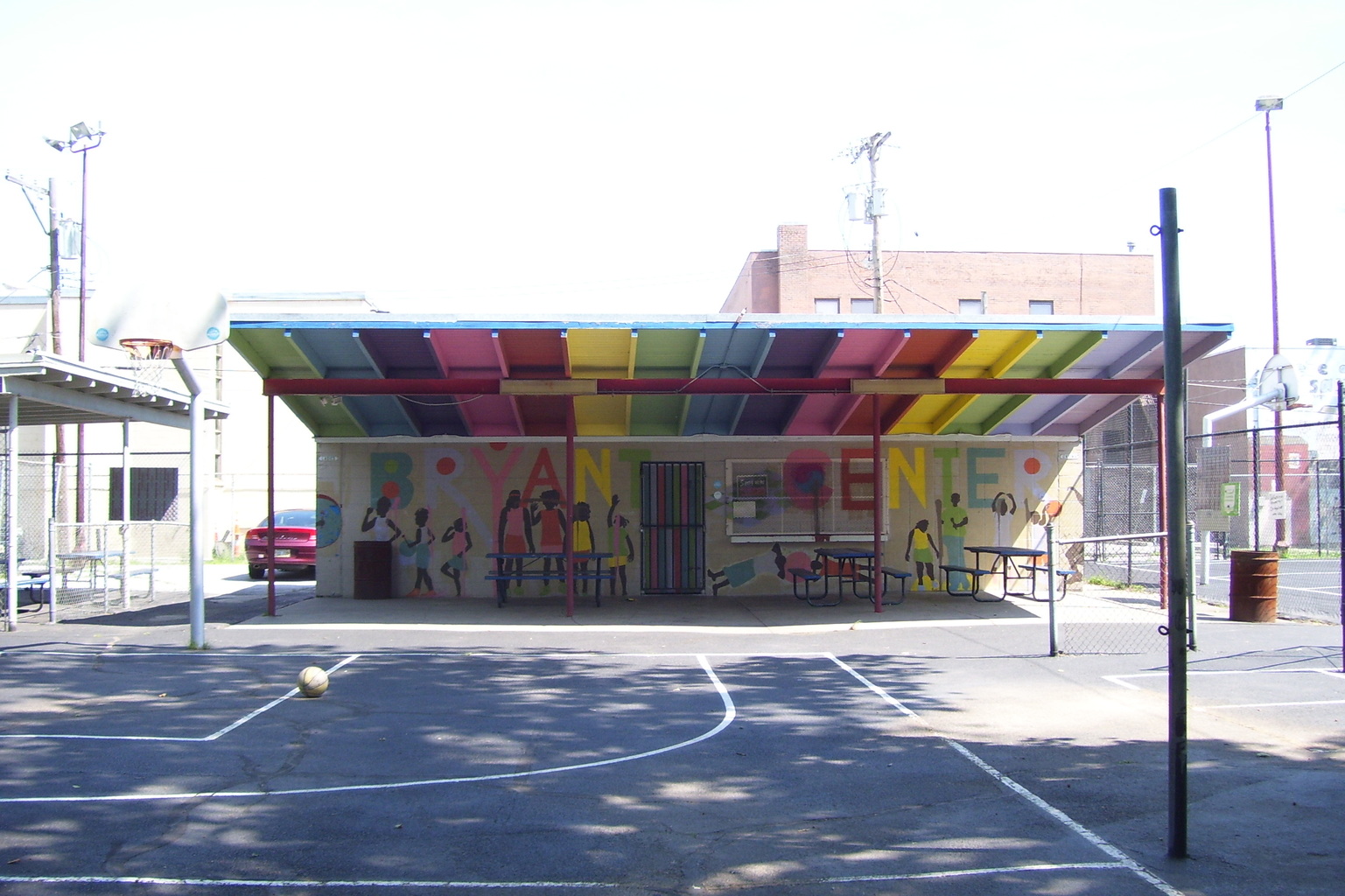
Bryant Center
Jean Cain, who helps runs things at the Bryant, has noted the Union’s activities and sees potential collaboration with McQueen’s programs.
“I’m very grateful for her, I really and truly am. I do want to make that acquaintance because I do think there’s a partnership or a marriage that could be an ongoing thing.”
The Union is new enough and the Carver opening far enough away that even most Bryant volunteers and area residents don’t know about the organizations yet. That will take time. The Theaster Gates site will feature a glass front entrance and a Big Mama’s outlet to make a transparent and enticing “invitation” for the community to come check it out, says McGraw, He says it’s all part of a “radical hospitality that makes spaces welcoming by reaching out in a charismatic and gregarious way. It’s this idea of having a thrown open front door, a place where there’s no expectations about who belongs there – there’s too few places like that.”
The black museum has a different challenge. It’s a well-known quantity that goes back to the mid-1970s but until monies are found to renovate its condemned home at 2213 Lake St. and/or to build a new one, it operates as a mobile presenting organization. It recently brought three Negro Leagues Baseball Museum exhibits to the metro, including two at Conestoga Magnet School not far from the 24th hub.
A mile or so southwest of the hub the Malcolm X Memorial Foundation has recently staked itself as an anchor with year-round programming at its new center.
Tim Clark and Brigitte McQueen say organizations like theirs are seeds that can grow roots that blossom into perennial attractions. But for that capacity building to take place resources are needed for more professional staff, among other things.
For all these disparate parts to form an effective, concerted North O mosaic or cohort that engages the general public, Clark says they must find sustainable support. He suggests a much larger pool of money than is presently available through funding mechanisms like the North Omaha Cultural Arts Committee is necessary to support the arts-culture district’s growth.
The catalyst effect Gates hopes to have with his project, which the Bemis is providing full financial support to for three years, can work the other way, too.
“There are new initiatives that are about to get off the ground in North Omaha that are really going to begin to change the game,” says McGraw, “and I think Theaster and Rebuild Foundation have a real interest in being part of those efforts. I think there are extremely exciting things on the horizon.”
Related articles
- Negro Leagues Baseball Museum Exhibits on Display for the College World Series; In Bringing the Shows to Omaha the Great Plains Black History Museum Announces it’s Back (leoadambiga.wordpress.com)
- Omaha’s Malcolm X Memorial Foundation Comes into its Own, As the Nonprofit Eyes Grand Plans it Weighs How Much Support Exists to Realize Them (leoadambiga.wordpress.com)
- A Brief History of Omaha’s Civil Rights Struggle Distilled in Black and White By Photographer Rudy Smith (leoadambiga.wordpress.com)
- Blacks of Distinction II (leoadambiga.wordpress.com)
- Habitat helps vacant block become a community (omaha.com)
- Omaha’s Northwest Radial Highway’s Small Box Businesses Fight the Good Fight By Being Themselves (leoadambiga.wordpress.com)
From Omaha to Paris to Omaha, with Love, Anne-Marie Kenny’s Journey in Song and Spirit
I am drawn to stories of people whose lives are clearly journeys of transformation and discovery and stepping outside comfort zones in pursuit of dreams. Anne-Marie Kenny’s life story is one such journey. I tell it here in short form but you can find on this blog a much more extensive profile of her I did. She’s a cabaret singer and an entrepreneur and a generous soul.

From Omaha to Paris to Omaha, with Love, Anne-Marie Kenny’s Journey in Song and Spirit
©by Leo Adam Biga
Originally appeared in Omaha Magazine
Before becoming a world citizen, Anne-Marie Kenny made a coming of age trip to Paris, alone, at 21.
“I just knew I needed to spread my wings,” said Kenny, a native Omahan who eventually made her second homes in Paris and Prague. where she forged careers as a cabaret singer and entrepreneur. After years away this once expatriate returned to Omaha in 2001. Her hometown’s now the base of her performing, vocal instruction and corporate consulting work.
She became a Francophile studying French at Mercy High. The City of Lights symbolized romantic possibilities. She recalled, “I was on the train from Marseilles to Paris when an elderly woman asked, ‘What will you do in Paris?’ and for some reason I said, ‘I’m a singer, I’m going to sing.’ That’s the first time I admitted that to myself.”
She and her three older sisters had performed locally as a four-part harmony group. They studied piano. Not all was idyllic,. Their attorney-father drowned when they were young, leaving their mother to raise and support them. To help make ends meet the girls took jobs. Anne-Marie worked at St. James Orphanage.
“I think life might have been a little bit harder had we not had music,” said Kenny. “Music was our outlet.”
Once in Paris she found work as an au pair. Her pluck led her to an Argentine guitarist and the two became street performers on the Champs Elysees.
“I was determined,” she said.
The duo was quickly discovered, landing a gig on a popular radio variety show.
Returning to Omaha, she studied voice and honed her chops at M’s Pub and V Mertz. She then met her late husband, Bozell & Jacobs ad man John Bull. All the while she pined for Paris. Bull did, too, and the couple moved there. She studied voice with Janine Reiss and at the Juilliard and Peabody conservatories and Ecole Normale de Musique de Paris. Kenny soon made a name for herself as a cabaret artist at posh spots in Paris and the South of France.
Her repertoire includes American, French and Italian tunes. She’s done some recording. She’s also worked in musical theater and has appeared in three feature films shot on the Riviera. She and John shared an apartment on the Seine’s Ile Saint-Louis. She appreciates France’s “very high regard for artists.”
Life took a turn when a poem-song she wrote for newly elected Czech president Vaclav Havel earned an invitation to perform it at Praugue’s famed Reduta Jazz Club. Caught up in the new free market opportunities there, she put her music career aside to form an employment agency serving international companies. The same engaging presence that works a room wins over clients as well.
Just as business boomed John fell ill and died in 1998. She’s since sold the business and made Omaha home again. She operates her vocal performance studio at her brick ranch dwelling, aka, cultural salon. She said, “I am as passionate about teaching as I am about performing now. It’s so much fun seeing people go from having a good natural voice to being able to technically do things they never thought they could do.” She teaches the Bel Canto method.
Her community work includes leading the Siena Francis House Singers, whose ranks are composed of the homeless and in-treatment residents.
Europe is still her playground. She was back last October. Recent U.S. performing gigs included the Sarasota Yacht Club in Florida and the Omaha Community Playhouse. This summer she’s doing a concert for Alliance Francaise d’Omaha.
On the entrepreneurial side. she’s an intercultural relations consultant. “To put kind of a credential on my experience,” she earned a master’s degree in organizational leadership, with a concentration on cultural studies, from the College of St. Mary. She led the start-up of the college’s Center for Transcultural Leaning.
Whether doing art or business, she said, “I’m being creative in both. “They’re both very risk taking and they’re not marching to the conventional beat.” For her, home is where the heart is. “I am so glad now to be back in Omaha. I’m here because I want to be here. I think Omaha has so much going for it. I feel I can flourish here.”
Related articles
- Kat Moser of Nouvelle Eve, A Life by Her Own Design (leoadambiga.wordpress.com)
- Jane Fonda Takes Center Stage at Film Streams, Where Her Life in Film is Celebrated this Summer (leoadambiga.wordpress.com)
- Litniks Unite! The Downtown Omaha Lit Fest Brings Writers, Artists and Readers Together in Celebration of the Written Word (leoadambiga.wordpress.com)
- Generosity at Core of Anne Thorne Weaver’s Life, Giving Back to the Community Comes Second Nature to Omaha Woman Whose Live-out-loud Personality is Tempered by Compassion and Service (leoadambiga.wordpress.com)
- Eddith Buis, A Life Immersed in Art (leoadambiga.wordpress.com)
- Movie Maven Crawford Celebrates 20 Years of Classic Film Revivals that Bring Hollywood to Omaha, Special Guest Pat Boone to Appear at Screening of ‘Journey to the Center of the Earth’ (leoadambiga.wordpress.com)
Vic’s Corn Popper Owners Do More Than Make Snacks: They Mentor Young People
Some Nebraska food brands have loyal followings no matter where their devoted customers live or visit. If you’re from here and you grew up with Runza meat-cabbage pockets and burgers or Valentino’s pizza or Dorothy Lynch salad dressing or Lithuanian Bakery tortes or Bohemian Cafe kolaches or Omaha Steaks, and you find yourself far away from here but craving that taste of Omaha, well then nothing is going to satisfy you except an overnight fix or order of that very product. The same goes for Vic’s popcorn. This is a short profile from a few years ago of the couple that created the brand and the demand for this scrumptious gourmet snacking staple.
©by Leo Adam Biga
Originally appeared in B2B Magazine
Once a teacher always a teacher. The axiom applies to Vic Larson and wife Ruth, retired educators whose Mom and Pop retail food company, Vic’s Corn Popper, integrates lessons from their lives and teaching careers.
Since Vic’s 1980 start the nurturing couple, who raised three children of their own, has employed scores of youths. For many, it’s their first job. The Larsons expect much from their teen brigade, whom they regard as ”our kids,” and get loyal high achievers in return.
“They’re the neatest kids,” said Larson. “Our philosophy, like in teaching, is that people will produce at the level you accept. If you accept mediocrity, that’s what you’ll usually get. But if you have high standards people will produce at that level. We have a high standard and we expect them to work to that. That’s why we give them the keys to the stores. They’re in charge.”
Larson said it’s not unusual for someone to start at 16 and stay until graduation. Even after moving onto college, he said, many Vic’s veterans come back to work summers or holidays. Some continue even after starting careers and families. He and Ruth are adamant high school students in their employ enjoy being kids.
“They’re kids, we want ‘em to have fun. We want ‘em to participate in school activities, go to games on Friday nights, go to prom, go to homecoming, and so we really push that. Instead of working 20-30 hours a week, they work 12 to 15 hours.”
The bonds run deep. “We get invited to their graduations, their weddings,” Ruth said. “We look at them as individuals not just as our Friday night crew or whatever,” she said. “They have their own needs, their own problems, their own families. You take each of those kids separately and think, ‘What does he need for guidance compared to this one, who maybe doesn’t need that.’ As a teacher you do that.” It’s the same with customers. “We make connections,” she said.
“We really work with our employees about treating people with dignity and respect,” added Vic. “You treat them as valuable people. You look ‘em in the eye and you get to know who they are, what they like, especially repeat customers. You want to make them feel like they are somebody special.”
Vic and Ruth say they’ve created a work culture based on “integrity and initiative.” The managers they hire instill a culture of “doing what’s right,” as Larson puts it. These principles were modeled by the couple’s own hard-working parents. His were educators. Hers, farmers. Like any good teachers, the Larsons view the youth in their charge as human resources they must prepare for the future.
“They have to deal with money, they have to make and package a quality product, they have to scrub the floors. I mean, they have to do it all,” he said. “We want to create a positive work environment so that they feel good about their job and they’ll go out and hopefully have good work experience in whatever they do. We want our kids to become good workers for others. That’s our goal.”
The Larsons communicate their business values and entrepreneurial guidelines not only with employees but with students at area elementary schools, high schools and colleges.
He said he tells students, “If you ever want to start a business it better be something you like. I also get into what we look for in hiring — we want good citizens because good citizens become good workers. With older students I get into budgeting and what it really costs to run a business.”
What began as a way for the couple to earn extra income became a passion.
Larson worked in the OPS vocational ed office at the time. The ex-industrial arts teacher supplemented his sparse teaching pay working summers for engineers and home builders. Having a business of his own was his real desire.
Ruth, who’d left teaching to focus on the kids, wanted to work again but not in the classroom. Taking a cue from the Korn Popper store he frequented growing up in his native Lincoln, Neb. he conceived a niche gourmet popcorn store featuring hybrid white corn. The brand long ago expanded into flavored varieties.
Korn Popper helped the Larsons launch the first Vic’s store in mid-town Omaha. Vic’s soon caught on. More sites followed, including the downtown Brandeis food court. In ‘84 the couple sold most of it to investors, remaining part-owners. Vic’s went national. The couple got out in ‘85. But the hunger to guide the business bearing his name compelled Larson to buy the Harvey Oaks store in ‘91. He’s since added the Oak View Mall store and reacquired the Brandeis site. A new addition is a production-distribution center set-up to handle Vic’s growing Internet orders.
What began as a moonlighting venture is a well-established family enterprise and mentoring outlet for the couple. It shows what’s possible with hard work and imagination, a message Larson tries conveying to kids. “I want to really engage them in that, to spark some interest in them. I always ask, ‘What do you really like to do? You’ll never get anywhere if you don’t have any plans or goals.’ We try to get ‘em thinking about what they want to do when they get out of school.”
The couple’s children have all worked at Vic’s. The grandkids are too young to work there just yet but Ruth said they’re already “staking out” which stores they want to run one day. The kernel doesn’t pop far from the kettle.
Cousins Bruce and Todd Simon Continue the Omaha Steaks Tradition
The name Omaha obviously doesn’t pop up in national media stories, online blogs, movies and television shows or songs the way, say, Chicago or L.A. or New York does, though it appears more often than you’d think. But it’s appearance is still rare enough that it’s a cause, if not for celebration exactly, than consideration. Aside from Warren Buffett and Alexander Payne, you’d be hard-pressed to immediately identify any contemporary figure from Omaha unless of course you’re from here yourself. Other than the College World Series and perhaps the Henry Doorly Zoo you’d likely come up empty thinking of events or placces that Omaha is known for unless again you’re a native or a resident or a frequent visitor. For better or worse the city’s image, if it has one at all in the minds of the general public, is forever fixed as a vaguely Western, agricultural, meatpacking center, which is to say it’s associated with corn and beef. One locally-based company with a national and international reach has rather perfectly combined product with perception – Omaha Steaks. It’s a brand that gives people what they expect, sort of the way the University of Nebraska Cornhuskers brand does. The following piece I wrote four years ago or so for B2B Magazine profiles the two men, first cousins Bruce and Todd Simon, who now run the multi-generational family business that’s grown to meet customers where they are, whether through physical stores, mail order catalogues, or electronic social media.
Cousins Bruce and Todd Simon Continue the Omaha Steaks Tradition
©by Leo Adam Biga
Originally appeared in B2B Magazine
First cousins Bruce and Todd Simon are the fifth generation in family-owned Omaha Steaks. Their knack for brokering deals, managing people and anticipating the next big thing has the company’s annual sales nearing a half-billion dollars.
Each apprenticed under his dad and after working together 20 years each holds fast to cherished lessons passed down from above.
For 91 years the company’s found innovative ways to market fine meat and other foods to residential and commercial customers around the nation and the world. Along the way the Omaha Steaks name has become such an icon synonymous with quality beef that its hometown enjoys crossover brand recognition.
Bruce is president/COO and Todd is senior vice president, but their bond supersedes titles or labels. They’re family. Two in a long line to lead the business.
“You know what we have? We have an entire company of people who we trust — that we feel like we’re family with,” Bruce said. “That blood bond is really a family bond and it traverses not only the Simon family, it includes our executive committee, all the way down. There are guys I know in the plant that were there the day I started and I feel the same bond with them as I do to my cousin Todd. We all feel a responsibility to each other to make this place successful.”
“Well, I think it starts with the fact we’re a family business that allows us to really take those kind of family values into the whole business,” Todd said. “And it shows in the benefits we provide for our team in terms of family leave benefits or vacation benefits or day care. Scholarships.”
Legacy is never far removed from the Simons’ thoughts, as their fathers still take an active part in the company. Bruce’s father, Alan Simon, is chairman of the board/CEO. Todd’s dad, Fred Simon, is executive vice president. The cousins’ late uncle, Steve Simon, served as senior VP and GM.
“My dad was and is pretty much the operational guy. He’s the guy who ran the meatpacking plant and who was the bean counter,” Bruce said. “And Todd’s dad was the real marketing guy and Steve (Simon) was the sales guy.”
The three brothers — Alan, Fred and Steve — learned the business from their father Lester Simon, who in turn learned it from his father B.A. Simon. It all began when B.A. and his father J.J. Simon, both butchers, left Latvia for America in 1898 to escape religious persecution. With the meat business in their blood, J.J. and B.A. settled in Omaha, a meatpacking center, and worked in several area markets. In 1917 father and son opened their own meat shop, Table Supply Meat Company, downtown. Their niche was to process and sell beef to restaurants and grocers.
Table Supply responded to the growing food service sector by supplying meat to Union Pacific Railroad for its large dining car services as well as restaurants. Cruise lines, airlines, hotels and resorts became major customers. Lester Simon first took Table Supply retail via mail order ads. Then came a mail order catalog. Shipping-packaging advances improved efficiency, helping widen the company’s reach.
By 1966 all this growth warranted an expansion in the form of a new plant and headquarters on South 96th Street. With the new facilities came a new name, Omaha Steaks International.
The 1970s saw Omaha Steaks take new steps in customer convenience by adding inbound and outbound call centers and a mail order industry-first toll-free customer service line. An automated order entry system was installed in 1987.
The first of its retail stores opened in 1976. Visioning the online explosion to follow, Omaha Steaks helped pioneer electronic marketing back in 1990.Omahasteaks.com became the banner web site for the company’s fastest growing business segment. A new web site, alazing.com. promotes the company’s convenience meals brand, A La Zing, which offers a line of complete frozen prepared meals.
Omaha Steaks underwent another expansion phase in the ‘80 and ‘90s, consolidating administration and marketing in two new multi-story glass and steel buildings whose sleek interiors abound with examples from the Simons’ extensive art collections. Todd’s an elected member of the Board of United States Artists and board president of the Bemis Center for Contemporary Arts.
Todd and Bruce help oversee a company with two million-plus customers and 2,000 employees. Guiding the pair in family-business dealings are the principles they picked up from their elders. By living those principles they fulfill their obligation.
“Our parents taught us to do the right thing. That’s really the only responsibility we have — just do the right thing. Do it all the time. Try to produce every single box of product perfectly. Try to satisfy every single customer perfectly,” Bruce said. “It’s all about being honest. Everybody in our family has been impeccably honest. We don’t take advantage of people. We sleep good.
“I mean, if you’ve got building blocks and you set them up properly you’re going to have a very strong building. And that’s what we have and it’s because of every single block…and the values that J.J., B.A., Lester, Alan, Fred, Steve and now Todd and I hold dear. It’s our whole corporate culture.”
Todd said, “I think in a lot of ways we’ve both sort of followed in our fathers’ footsteps. Bruce is very strong operationally, purchasing, finance…All the sort of back-office stuff is his forte. And mine is the out-front stuff — the marketing, sales. Managing the customer service aspect of that, motivating the front-line people to be people-people. I think Bruce and I really complement each other well. When we both come up with ideas I’ll see one side of the picture and he’ll see the other side. And since we’re both open too each other’s perspective on it, it really helps us balance it out.”
With two father-son teams comprising the ownership-executive ranks, the potential exists for family disputes that upset the company’s inner workings. The Simons diffuse those bombs with open dialogue and transparent dealings.
“For as long as I can remember the way we operate as a family is we get our ideas out,” Todd said. “We don’t bulldoze over each other. We’re all forceful about our ideas and our opinions, and we’ll raise our voices and we’ll do whatever we need to do to get our point across. But we basically come to consensus and we don’t leave the room unless everyone’s comfortable with the direction we’re moving in.”
“Right,” Bruce said. “We don’t fight about things. If there’s a reason to do something we discuss it and we figure it out. Because, hell, we’re all on the same page. What’s good for one is good for all.”
Vision is important in any organization and each year Omaha Steaks holds an off-site brainstorm session with its top managers. Ideas and initiatives fly. “A lot of times those come not from me or Bruce but from the people out there in the trenches dealing with our customers every day,” Todd said. In the end, Bruce said, “Todd and I decide with our fathers where we’re going” as a company.
Related articles
- Here’s What Omaha Steaks Is Doing For Meat Lovers Who Care About Their Belts And Wallets (businessinsider.com)
- Omaha Steaks Buys Into Facebook Commerce (adweek.com)
- Omaha Steaks Go All In With Facebook Store (socialfresh.com)
Kat Moser of Nouvelle Eve, A Life by Her Own Design
Men are generally credited with shaping Omaha’s Old Market arts-culture hub but women have more than made their mark on the National Historic District, including Ree Kaneko, Catherine Ferguson, Vera Mercer, Lucile Schaaf, and Susan Clement Toberer. Another is Kat Moser, whose high-end Nouvelle Eve contemporary women’s clothing store has been a bastion of cutting-edge fashion for many years. She and her husband Jim Moser also had the Jackson Artworks gallery for a couple decades before closing it in 2010. She’s one of those persons who integrates her appreciation for art and design and beauty in every aspect of her life, from her work to her home to her clothes, et cetera. Moser’s own keen sense of style has helped make the Old Market a destination place for discerning people. I did this profile on her for Encounter Magazine in 2007, when she still had the art gallery, though it had recently suffered major damage in a storm.
Kat Moser, A Life by Her Own Design
©by Leo Adam Biga
Originally appeared in Encounter Magazine
A visit to the Old Market condo of Nouvelle Eve and Jackson Artworks owner Kat Moser and her husband Jim Moser reveals the couple’s sophisticated aesthetic. The street level entry opens onto a grand space with a soaring second-story loft. The 3,400 square-foot dwelling is rich in contemporary art and sleek furnishings.
Some of the art is by the Mosers themselves. She makes infrared photographs of female nudes in ethereal nature settings. He makes abstract metal sculptures. Also displayed are pieces by such artists as Jun Kaneko and Littleton Alston.
Painted white walls and ceilings are “the canvas” for the many black, gray and glass design accents and earth-fire-water elements adorning the posh home’s 9-rooms. Exposed wood beams, brick work and cement blocks lend a rough-hewn, historic, urban charm that expresses the building’s 19th century character and contrasts with the modern updates throughout.
Reminiscent of Moser’s ethereal imagery is the filtered sunlight that banks of windows and skylights let in. A sweeping living room fireplace serves as a welcome hearth to gather round. A small, southern exposure room up front has a built-in ledge that Moser grows plants in. Adjoining it is a sauna/steamroom.
The second-story kitchen, which overlooks the living room, is a spacious area of stainless steel appliances and glass-fronted cabinets. An atrium off the kitchen is where Moser, a yoga practitioner, begins her day. The large skylight above basks the room and its many plants in the glow of natural light. The atrium leads to the roof-top deck, where, weather-allowing, the Mosers spend time lounging in patio sofas and cooking on the built-in electric grill, complete with bright, tiled-counter.
A den, master bedroom, guest bedroom, office and bathroom complete the condo, which she calls her and Jim’s “sanctuary.” The pair enjoy quiet evenings reading.
Moser is a Sioux City, Iowa native whose fashion sense made her aspire to a New York career. She lives a NY chic lifestyle, only in Omaha.

“It’s right here for me. I really don’t have to go anywhere. I can have everything I want and probably much easier and more economically than if we moved to New York and tried to do the same thing,” she said.
First with Nouvelle Eve in ‘73, and then Jackson Artworks in ‘95, she’s made herself a major player in the Old Market’s vital cultural scene. The Mosers bought their building in ‘85 and after two years renovating it, moved in. Twenty years as Market dwellers make them newcomers in some circles but pioneers to the historic district’s newer residents. The couple welcome the growing downtown community.
Just as she likes it, the condo is situated right in the heart of things. A block away is her own high end women’s apparel store and literally next door to her home is Jackson, now one of the Market’s longest-lived galleries.
She didn’t intend to be an entrepreneur. Trained in textile/clothing merchandising at Iowa State University, she worked as a buyer with Dayton-Hudson, whose first independent boutique she ran, and Nebraska Clothing. Jim, an attorney by training and the owner of Omaha Standard, is the one who encouraged her to go in business for herself. She made the shop, which visiting celebs like Laura Dern and Sheryl Crow buy from, an edgy, contemporary place where lingerie is right out front.
“I’ve been really blessed with really great teachers,” she said. “And I’ve always had this wonderful guidance from people. My ability was just to listen, which is really important. I’ve always been very intuitive.”
“Vera (Mercer, the wife of Old Market visionary Mark Mercer) was a really big inspiration to me then,” she said. “I can remember seeing her in the Market photographing. I loved what she represented.”
The Mercers’ caution in leasing to tenants meant a long wait for the Mosers. “It took us almost a year to negotiate our lease, “ she said, “which involved going to the French Cafe for many, many dinners and then going to their apartment. It was a big process. It was very intensive those early years. I mean, they were picking their neighbors and they wanted only people who had the same concept they did.”
Fashion and art are Moser’s lifelong calling.
“It was always there. I really feel blessed that I never had that feeling of, Oh my God, what am I going to do? I always knew exactly what I wanted to do,” she said. “I don’t know where it came from. I never had to question it. I’m 61 in July and I still loving going to work every day.”
Since a May 5 storm-related roof collapse at Jackson, she’s had more than the usual hectic summer. She can’t afford to stop or look back while repairs continue. She’s trying to get it ready for a grand reopening while planning Nouvelle Eve’s 35th anniversary next year. That’s on top of the renovation slated for her and Jim’s condo. Like the new woman of her shop’s name, Moser is always reinventing herself.
Related articles
- Artist Claudia Alvarez’s New Exhibition Considers Immigration (leoadambiga.wordpress.com)
- George Eisenberg’s Love for Omaha’s Old Market Never Grows Old (leoadambiga.wordpress.com)
George Eisenberg’s love for Omaha’s Old Market never grows old
One of the biggest champions of Omaha’s Old Market and the history of the place has died. George Eisenberg devoted much of his life to the historic warehouse district. As boys and young men he and his brother Hymie worked alongside their father, Benjamin, manning a fruit and vegetable stand when the area was home to the Omaha Wholesale Produce Market. Later, the brothers revolutionized the family business to become niche suppliers of potatoes and onions to major food processors, operating out of offices in the commercial center. When the wholesale district declined and largely disbanded altogether the area was transformed into an arts-culture haven and George, who never left and owned substantial property there, became a landlord and an active Old Market Association member. In his later years he was advocate and amateur historian for the Old Market and proudly led an effort to get decorative street lamps installed and other improvements made. He contributed some anecdotes to a section I wrote on the history of the Old Market for a recent book, Memories of the Jewish Midwest: Mom and Pop Grocery Stores published by the Nebraska Jewish Historical Society. An excerpt with that section can be found on this blog. George was one of the last of the go-to sources who personally worked in the Omaha City Market. He enjoyed reliving that history and as he saw it educating the public about a way of commerce and life that is largely no more. His enthusiasm for the subject will be missed. I did the following short profile of George about five years ago for Omaha Magazine and now as fate would have it I will soon be writing an in-memoriam piece about him for the same publication. That rememberance will join one I wrote about another Old Market legend who died recently, Joe Vitale. You can find the Vitale story on this blog.
George Eisenberg’s love for Omaha‘s Old Market never grows old
@by Leo Adam Biga
Originally appeared in Omaha Magazine
Old Market icon George Eisenberg has more than the usual attachment to the historic warehouse district that once was the area’s nexus for produce dealers, buyers and transporters. His late father Benjamin was a peddler in what used to be called the City Market. As boys Eisenberg and his brother Hymie worked alongside their dad in the leased open air sidewalk stalls whose overhead metal canopies still adorn many of the 19th century-era buildings preserved there. Once home to wholesellers and outfitters, the brick structures now house the Old Market’s mix of condos, restaurants, shops, artist studios and galleries.
After serving in the U.S. Army in World War II Eisenberg rejoined his father, delivering items by truck, and by the early ‘60s he’d modernized and expanded the enterprise and bought out papa. In 1972 his brother Hymie partnered with him. Innovations gave the company such a competitive advantage that the brothers were dubbed “the potato and onion kings of the United States” supplying millions of pounds a week to commercial customers across America and into Canada. They made their fortune and retired in 1983. Hymie died in ‘91.
The 83-year-old is proud to be a peddler’s son. He’s also proud of his continuing relationship with the district. He’s a property owner and an active volunteer with the Old Market Business Association and Downtown Omaha Inc.. Eisenberg secured the authentic lamp posts that lend such a distinctive design element to the 10th Street Bridge. He played a key role, too, in making the 11th and Jackson Street parking garage a reality. Downtown Omaha Inc. honored him with its 2007 Economic Development Award.
He’s a model landlord for the tasteful restoration he’s done and solid tenants he’s brought to his 414-418 South 10th Street buildings, properties originally owned by his father for wholesale storage, distribution and offices.
Generous with advice, he’s given counsel to many Old Market entrepreneurs, including Nouvelle Eve/Jackson Artworks owner Kat Moser.
As much as he’s involved in the “new” Old Market’s destination place identity and as much as he supports the emerging SoMa and NoDo developments, he enjoys looking back to the Market’s past. Back when ethnic blue collar produce vendors pitched their wares in the ancient tradition of the open air market. When pockets took the place of cash registers and vendors took a break from 14-hour days by reclining on bales of hay or overturned crates. It was a boisterous, press-the-flesh carnival of men, women and children using sing-song chants to hawk fresh fruits, vegetables, flowers and plants. Shoppers hailed from all walks of life.
A chorus of Eisenberg shouting, “Get your watermelon — red, ripe and sweet watermelon,” blended with the pitch, dicker and banter of hundreds of merchants-customers. Accents were common among the mostly Jewish, Italian and Syrian vendors. “English was the primary language spoken,” he said, but many foreign-born merchants, like his Russian immigrant father, “conversed among themselves in their native tongues. Every ethnic group was represented in one way or another.”
All those peddlers packed in a small space shouting to get customers’ attention created quite a racket. “Our advertisement was our voice,” he said. “It was noisy, yeah.” But that noise was sweet “music.”” Besides, he said, the ruckus and color “were part of the charm of the market.”
Hawking’s not for wallflowers. “If you’re shy you don’t belong in marketing,” he said. Things only quieted down, he said, after a warning from the market master, whose job was to collect monthly fees from vendors and mediate disputes among them. Once gone, the din began again. It was a special time and place.
“It was fun,” Eisenberg said. “There was excitement.”
He said his father steeped him in the market’s history. Ben Eisenberg got into the trade through his father-in-law Solomon Silverman, whose daughter Elsie became Ben’s wife and George and Hymie’s mother. Just as Silverman began as a door-to-door peddler with a horse and wagon, Ben followed suit. Just as Solomon leased stalls in the market, so did Ben. In the early 1900s, Eisenberg learned, a bidding process divvied up the stalls. Some locations were better than others. Getting outbid caused sore feelings and fistfights broke out. The bidding system was disbanded, he said, and exisiting stalls grandfathered in. Ben had four choice spots at the northeast corner of 11th and Jackson as well as his own wholesale house.
In an era before “Thanks for shopping…come again,” he said many vendors lacked good customer relation skills. His dad, though, had a gift with people.
“My dad was a really good salesman and he separated himself from everybody else because he was very polite, businesslike, and his word was his bond. If my dad said, ‘You got it,’ you didn’t need a contract — that’s it.” Eisenberg said.
He said his father “bought and sold in big quantities,” a practice Eisenberg continued. Many of Ben’s grocery-supermarket customers were former peddlers like himself. “My dad knew all the peddlers, so when he got in the wholesale business all the peddlers came to do business with dad. They knew he was going to give them the right price and not insult them.”
Like his father before him, Eisenberg served as vice president of the Omaha Wholesale Fruit Dealers Association, a predecessor of the Old Market Business Association. In some ways he’s still hawking, still looking after the best interests of his beloved Old Market. “I love business. I love marketing. I welcome anybody who wants to hang up their shingle and start their business.” He embraces the growing community there. “That’s the district’s salvation — it’s a neighborhood now.”
Related articles
- In Memory of a Omaha Old Market Original, Fruit and Vegetable Peddler Joe Vitale (leoadambiga.wordpress.com)
- Allan Noddle’s Adventures in the Food Industry Show Him the World (leoadambiga.wordpress.com)
Remembering Omaha Old Market original, fruit and vegetable peddler Joe Vitale
The Old Market. Make that Omaha’s Old Market. Sure, it’s a place, in this case a historic warehouse district that’s been gentrified into an arts-cultural hub and destination stop for locals and tourists alike. But like any place worth it’s salt, it’s the people that make it. One of the real holdover characters there from when the Old Market was still a wholesale produce center was Joe Vitale. As the area transformed from industrial to retail consumer mecca he stayed on with his fruit and vegetable stand , still doing his thing amidst head shops, galleries, restaurants, bars, and live music spots. When Joe passed away a couple years ago a little piece of the Old Market passed with him. The following story for Omaha Magazine is a kind of homage to Joe and the slice of Old World commerce he kept alive.

Remembering Omaha Old Market original, fruit and vegetable peddler Joe Vitale
©by Leo Adam Biga
Originally appeared in Omaha Magazine
The late Joe Vitale was the last of the old-time produce vendors plying his trade in the Old Market. Long after the Omaha City Market closed, Joe stayed on.
The World War II combat veteran made a good living back in the day, first working for his parents Angelo and Lucia, and then with his business partner, Sam Monaco. By the time the Old Market took off, Vitale was set for life and well past retirement age, but he hung on there, wintering in Las Vegas.
Why keep at it, even into his 80s?
“He did it because of the love of doing business, being self employed, selling to new customers and former customers who wanted to buy something from the historic Old Market,” says George Eisenberg, a former wholesaler who did business with Joe.
“He was not only a throwback but he was the only one of the original market vendors that lasted that long.”
“I guess he enjoyed being down there with the people and doing his work,” says Tootsie Bonofede, who grew up with Joe. “You know, when you enjoy something you don’t want to give it up.”
Joe stayed through the area’s transformation from a wholesale-retail produce center to its rebirth as a cultural district. Manning the corner of 11th and Howard, he and his stand were fixtures before the modern Omaha Farmers Market started up.
Vitale, who died March 29 at age 92, was a popular figure among tourists, business owners and residents, who viewed him as a vital, living remnant of what used to be.
“He brightened up that corner,” says Mary Thompson, whose mother, Lucile Schaaf, was an Old Market entrepreneur and favorite of Joe’s. “He was a super guy. He was an energetic, happy person, and he always had a good word to everybody. He had been there for so many years, you could say he was almost the last of the originals.”
More than a merchant dealing in fruits and vegetables, Vitale was an engaging presence. “He had a lot of personality,” says Bonofede.
Douglas Country Commissioner and former Omaha mayor Mike Boyle, a longtime Old Market resident, recalls helping Joe out with an insurance claim once and being repaid with a basket of plums.
“That was about the lowest fee I’ve ever collected,” says Boyle. “Joe was really one of life’s great characters. He had a wonderful sense of humor and added a lot of color to that corner.”
Samuel Troia recalls he and his brothers going to Joe for business advice, not expecting much, but getting more than they bargained for.
“It was a great meeting and he helped us out tremendously, and with nothing to gain, other than to help these young kids, because we were in our 20s. He sat us down and said, ‘OK, this is who to talk to, and I’ll make a phone call for you.’ He told us about delivering what you promise. Joe talked to us just like he was our father.”
From that time on, says Troia, “every time he saw me he’d holler, ‘Troia,’ and my wife and I would walk over and buy fruit, and he’d wash it for us. It was so nice and refreshing to see him. It was just like having a family member down there in the Old Market.”
Joe treated everyone like a family member or friend.
“He was one of the most down to earth guys you’d ever want to meet,” says Troia.
“Everybody knew him and everybody loved him,” says Bonofede. “They can’t say anything bad about Joe. He was so kind to everybody.”
Related articles
- George Eisenberg’s Love for Omaha’s Old Market Never Grows Old (leoadambiga.wordpress.com)
Customer-first philosophy makes family-owned Kohll’s Pharmacy and Homecare stand out from the crowd
Not just another family business. That’s the case with a venerable Omaha pharmacy business that’s been in the Kohll family for generations and maintained its relevancy in an age of mega corporate pharmacy chains by having laser focus on customer needs and anticipating what the next big things are in the field. In the case of Kohll’s, the business has become a leader in delivering homecare services and products for a population of aging parents and adult caregivers. My story from a half dozen years ago or so originally appeared in the Jewish Press.
Customer-first philosophy makes family-owned Kohll’s Pharmacy and Homecare stand out from the crowd
©by Leo Adam Biga
Originally appeared in the Jewish Press
A peek inside a family-owned Kohll’s Pharmacy and Homecare in Omaha soon reveals this is not the drug store of your mother’s or father’s nostalgia. Sure, pharmacists in white coats still dispense prescription medicines from behind a counter, but mostly gone are the sundry retail items associated with a traditional drug store — greeting cards, stationary, magazines, household goods, candy, alcohol and soft drinks. In their place is an array of home medical equipment and service stations dedicated to meeting the health care needs of clients, particularly seniors or anyone coping with chronic illnesses.
The biggest changes, however, can’t be seen on site, as they encompass a wide range of services that help Kohll’s respond more quickly and comprehensively to individual client needs. For example, health care professionals on staff, such as occupational and respiratory therapists and a dietitian, make home visits to do assessments and devise strategies that foster greater independence. A call/future-orders center tracks what medical supplies clients are low on and gets new shipments out to their homes before they run out. A pharmacy benefits division supplies discounted meds to employees of subscriber-employers. Homecare products may be ordered online or via mail-order. A compounding division prepares custom meds for human and animal patients. An age-management section provides hormone replacement therapy to participating seniors. A contracting unit installs stair glides in people’s homes and renovates residential bathrooms to enhance accessibility and safety.
The company’s come a long way since Louis and Leona Kohll opened the original store in 1948 at 29th and Leavenworth. Back then the store was open 8:30 a.m. to 11:30 p.m. every single day of the year. The couple’s sons, Marvin and Jerry, followed them in the business. Founder Louis Kohll died at age 49 following a heart attack he suffered in the store. Marvin was his only partner at the time and Jerry later joined him. Marvin and Jerry later split the business, with Jerry building up a nursing home supply division. Jerry eventually sold his interests to a national company. What made the then-small company a success all those years ago is the same thing that keeps Kohll’s successful now as a much larger organization — customer service. Today, a pair of third generation pharmacist brothers, David and Justin Kohll, Marvin’s two surviving sons, maintain the customer-first policy.
“For me, the satisfaction is taking care of the patients. It’s working with our health care team to come up with a solution and to know that we made a difference. It also helps you to feel good. It’s the thing that gets you to work the next day,” said David, whose oldest brother, Louis, died recently, but not before making his own mark in the business as a pharmacist and manager.
Lessons learned have been passed down from one generation to the next. It all comes down to hard work, fair play and treating people right.
“Our father taught by example,” David said. “His example was the basics like beingpolite, honest, follow through, et cetera. He’s worked hard his whole life.”
Just as Louis Kohll taught his sons Marvin and Jerry the trade, Marvin taught his boys the ins-and-outs. Pharmacists all, they built the foundation for an enterprise that’s gone from a single mom-and-pop store to a multi-faceted, seven-location corporation. Kohll’s stays competitive in an era when national franchises dominate the market and drive most other family-owned independents out of business.
To survive, the family found what Justin calls “a niche” that separates what they do from the pack. With a nursing homes supplies division already in place and the senior health care market ever growing, they gradually hit upon senior homecare as their specialization. As David’s fond of saying, “There’s a lot of opportunities. There’s just so many things out there.”
It’s the one-stop-shopping model applied to health care. But saying you’re one-stop and doing it are two different things.
“Everybody tried to promote they were doing one-stop-shopping, but they really weren’t,” Justin said. “Some companies tried doing it and they quit…now they just do respiratory or they just do power chairs, where we can do it all. We really are truly one-stop. You can come here for everything.”
The store that best epitomizes the company’s one-stop health-orientation is at 127th and Q, where clients can: get prescriptions filled inside or via a drive-thru window; receive vaccinations and blood pressure/cholesterol screenings along with hormone replacement injections; get fitted for wheelchairs, mastectomy bras, compression socks or ostomy bags; select from many other personal care items, such as chairs, scooters, walking aids, raised toilets and bath/shower bars; and even have a lift installed on their van. The store has bays dedicated to not only installations but also repairs of lifts, power chairs, scooters and glides and has even opened a showroom selling vans that come equipped with lifts.
“You can go anywhere in the country and you will not see a facility that looks like this. I guarantee it,” David said. “You might see some who have some wheelchairs or this and that — kind of shoved in the corner, but without real experts doing it. None has anything to this (level of) commitment. Pharmacists generally own their pharmacy and if you’re trying to get everything done right there you’ve got to be really committed to this and you’ve got to like it. You can’t just do it for the business or it’s going to go away.”
It’s about the Kohll family being smart and passionate about what they do.
“We try to pick and choose what we do,” Justin said. “I mean, we could do a lot of things, but we usually pick something we like to do also. You’re going to do a better job if you like it.”

Each Kohll’s pharmacy offers the basics when it comes to prescriptions, vaccinations and screenings, along with a general selection of health care items, but each store also specializes in something. For example, the 127th and Q store specializes in mobility products. It’s also the company’s headquarters, housing the administrative offices, marketing department, call center and future orders center. The Leavenworth store features respiratory/oxygen supplies. The 50th and Dodge site specializes in mastectomy fittings and compression stockings. The 114th and Dodge location handles the compounding side and veterinary needs. And so on.
Instead of extra inventory taking up space at each location, one central supply site contains medical supplies, which makes it easier to track what’s in stock and to send supplies out as needed. Being able to respond to many different needs is what Kohll’s does best, Justin and David say. “Knowing you have something for the patient, knowing that you’ll do a good job, knowing that you’ll get it there in a timely fashion,” said Justin, adding that in most cases patients only think about health care aids when a crisis occurs. “You don’t know unless you need it,” he said. “If you need something, hopefully the physician will send it through here because normally we’ll have it. And, right up front as customers come in they see all the products and maybe that gets them to thinking, ‘Hey, I saw walkers at Kohll’s. My mom needs a walker.’ That’s what we try to do.”
“We try to educate people,” David said. Part of that education, he explained, is providing timely, state-of-the-art answers for people as their health care needs progress. A wheelchair patient may be upgraded to a power chair. If a patient can’t move his or her arms any longer, a lift may be in order. Kohll’s visiting homecare professionals are trained to recognize when a client’s declining health dictates action in the absence of a regular caregiver or adult children. Its future orders callers and delivery drivers are trained to ask questions that reveal the kinds of changes that indicate problems. This way, unhappy outcomes can be avoided.
“A person may be doing pretty good but they may get to the point where they can’t walk very well and instead of somebody recognizing that they just stay in their apartment more and then they can’t walk at all and instead of being in a wheelchair they’re just in bed all the time. And the next thing you know the senior develops a bed sore. It causes the progressive deterioration to go faster,” David said. “What we try to do is ask questions every month, like — Do you have trouble getting up from a chair? If they answer yes to that we ask more questions and begin coming up with solutions. It might be a raised toilet seat or bath bars or a lift.”
It’s also about anticipating future needs.
“Somebody getting their prescriptions and adult diapers from us now are more than likely within a year going to need a walker. We try to be aware of that,” David said.
The goal is helping patients maintain independence in their own homes.
“It could be something as simple as a reacher. Maybe it’s become hard for somebody to bend over and stand up. It can be just basic things to keep people doing what they were doing for as long as possible. To make it so they don’t go into that nursing home or that assisted living facility. To keep them in their own home with their regular neighbors. That’s what we want to do,” David said.
The ongoing education Kohll’s does with clients includes getting folks to see that a homecare product like a stair glide is not a step back but a step forward.
“A lot of times seniors have the mind set — ‘I don’t want a glider to help me get up the stairs because I want my independence.’ They don’t understand that by risking a fall where they fracture a pelvis or an ankle, they’re actually saying, Make me dependent,” David said. “We’re trying to do all we can to show that you can have a much better life if you get one of these things. But don’t get the hospital-looking one, get the red one so people don’t feel sorry for you.”

He said the public should shop around when buying home medical equipment, such as power chairs. It pays to go where there’s good selection and price as well as proven expertise. A Kohll’s advantage is that it knows and stands behind the items, even doing repairs. He said too many people just go where it’s convenient.
“If you all of a sudden end up in the hospital after a fall, you’ve got to get a chair now. You’re more reliant on professionals to get you through it. You don’t have time to do any preparation. The sad part about that is that you might make a mistake and go to a place that doesn’t really know anything about it and get something wrong for you,” David said.
All the emphasis on home health supports doesn’t mean Kohll’s has left behind the core or traditional pharmacy service of filling prescriptions.
“We’d like o be filling prescriptions for everybody in Omaha or anywhere around,” David said. “We don’t want them to go elsewhere because if they get their prescriptions from us then they’ll have more of an awareness of the other things that might benefit them. I don’t want to get away from our base of prescriptions. All three of us (himself, Justin and their father Marvin) were trained as pharmacists. We think it all starts with prescriptions because we’re trusted more than any other profession. The patients know us or they see us or they talk to us the most often. It all starts there and then we can bring them into all these other things.”
The family’s arrived at a democratic way of setting policy and managing operations.
“My father has a say in things if he chooses, but there isn’t and hasn’t been a dictatorship or hierarchy or veto power by any of us,” David said. “Each of us would explore an idea and if it looked successful, it would be presented to each other. We then give suggestions and implement it. We’ve had our disagreements, but we’re so concerned and busy with providing our customers/patients with the best care possible that the disagreements are taken care of within 24 hours,” David said. “We really don’t have time for disagreements. I don’t believe the staff’s felt pulled in different directions by each of us, so it’s not an issue.”
Marvin Kohll said the family avoids internal strife as each member involved in the business establishes “responsibilities” distinct and apart from the others’. Besides, he said, “I was never a real taskmaster to them. I let them pretty well do as they pleased and they responded.” David said that’s still the case.
While David monitors the retail end, Justin runs the compounding side. Marvin’s watched over the money in recent years, taking a less and less active role. Still, David said, his presence is felt. “We always feel he’s working with us.” And if dad sees something amiss, David said, “He’ll rip us about something we can do better.”
“Towards Louis’s last years he mainly oversaw the employer pharmacy benefits
area and pharmacy mail order division,” David said. “Since his passing we have continued where he left off. He did a phenomenal job educating the staff…making it easier for us to carry on. It is difficult because we worked so closely together.”
Marvin’s boys weren’t pushed to go into the family business, but each came to it on his own. From the time they were young they hung around their dad at work after school or on vacation.
“We probably first came down to the pharmacies when we were about 4-5 years old. My brothers and I were only 3 years apart, so we played pretty rough and I think my mother would ship us to the pharmacy when she had enough of us,” David recalled. “At first my father would just try to get us out of his way and assign us to one of the staff. They would usually have us break up empty boxes. Over time we became more useful as clerks, stockers, drivers and then pharmacy helpers. We begin working full-time summers when we were 16 or 17.”
Besides David, Justin and Louis, some other Kohlls have contributed to running and growing the family company. “Two of Jerry Kohll’s kids, Cindy and Alan, joined the company in the early ‘90s. They contributed significantly, but not as pharmacists,” David said.
What the next generation holds as far as new Kohll blood entering the business, no one knows. Since David and his wife Janet are the parents of five young children the odds are at least one will follow David’s path. Marvin Kohll said one grandchild has expressed interest to him in studying pharmacy, which if it comes to pass would mean a fourth generation of pharmacists in the family. But more than family legacy keeps the company strong 58 years after its start — its single-minded focus.
“We don’t feel a responsibility to the next generation to carry on the family business. The responsibility we have is to our customers/patients to provide excellent care to them,” David said.
Related articles
- AAP Among Nation’s Largest Pharmacy “Chains” (prweb.com)
- Everett pharmacist served immigrant community (heraldnet.com)
Bedrock values at core of four-generation All Makes Office Furniture Company

Bedrock values at core of four-generation All Makes Office Furniture Company
©by Leo Adam Biga
Originally appeared in The Jewish Press
As Omaha family businesses go, All Makes Office Furniture Company is one of the oldest and largest still operating. The fourth generation family members running things today stick to the same core principals, values and philosophies that have guided the business since dapper Russian immigrant Harry Ferer founded it in 1918.
A go-getter, Ferer became a star agent for the Royal Typewriter Co. and the Ediphone, an early dictation machine patented by inventor Thomas Alva Edison, whom Ferer knew. Ferer built his own company through hustle and guile, traits his successors have shown in growing the family business. Son-in-law Lazier Kavich entered the fold in 1938 and helped move All Makes forward by adding new lines, earning a reputation for fairness along the way. Lazier taught the business to his son, Larry Kavich, whose energy, people skills and “do the right thing” motto drew in new business. Larry, in turn, taught his children the ropes and now they run things. Larry’s son, Jeff Kavich, is president/CEO of All Makes Omaha and Jeff’s sister, Amee Zetzman, is president/CEO of Lincoln, Neb. and Urbandale, Iowa. The legacy continues. Only time will tell if Jeff’s or Amy’s kids one day carry the torch.
All Makes evolved over these 88 years into a full-service center that outfits offices of every size, located virtually anywhere, with products that range from the latest in work station systems to used desks, chairs and files. The company does more than just sell stuff. It also designs and installs office spaces for all kinds of settings, offering expertise that makes today’s technology-rich environments user-friendly.
Any firm as long-lasting as this one adapts to meet the needs of customers in changing business climates. Through world wars, economic downturns and industry trends, All Makes stays the course, each generation adding fresh ideas to the mix.
Much has changed since Harry Ferer opened his downtown typewriter sales, rental and repair shop. When Lazier Kavich came aboard, the business added office furniture to complement the automated machines it carried. In 1950 All Makes moved to its present location at 2558 Farnam Street. By the 1960s the company added the first of its branch showrooms and stores. Once Larry Kavich joined in the mid-’60s, high end contract furniture became the staple. He expanded the business physically and enhanced its position as a multi-product, multi-service center. He continues as chairman today, wintering in Arizona.
Under Jeff’s and Amee’s watch from the late 1990s on, All Makes has added to its facilities, including new showrooms and warehouses, made a series of renovations, grown the company’s design division and expanded into international markets.
Yes, much has changed. Then again, people are still people and business is still business. Office furniture may be wired today, but getting repeat customers still comes down to treating folks right, qualities sorely missing from so many service providers today. Jeff and Amee keep alive All Makes’ service-first credo, drawing on lessons from two masters in the art of the deal — their grandfather and father.
“Certainly the products have changed and the industry has changed,” Jeff said, “but as far as learning the passion — and taking that home every night with you and always thinking about how to make things better and how to do the right thing — I got that every day from both my grandpa and my dad. It came so naturally, it would have been impossible, I think, for me to feel or act or do any differently.”
As kids, Jeff and Amee were always around the business, working there summers. He learned all facets — from stock and sales to delivery and installation. She applied her gift for number-crunching to the company books.
“Summers, when my friends were spending every day at the pool, I was here in the back room sweeping floors, fixing typewriters, working in the warehouse. I installed furniture, I delivered furniture, I drove the truck. I’ve done everything except billing,” he said. “I look back now and say it was fun and wouldn’t change a thing, Back then, when my buddies were going to the pool, I probably wished I was, too.”
But he knew where his destiny lay.
“I knew from an early age I was carving a path for me into the business and everything I was learning then would only come to benefit me later,” he said. “I knew that this is what I wanted to do. I went to the University of Kansas for a couple years and decided it was time to come home and go to work. You know, my career started in 1990 — 16 years ago, but I can say I’ve been here 30 years because I worked here summers from grade school through college. When I’d come home from college my father and I would talk about the business. Even in high school, if something big was happening here, we discussed things over the weekend. Growing up, dinner table conversations happened all the time. So, as long as I can remember I’ve kind of known and talked the language of All Makes.”
For the young Amee, the business wasn’t so much a career path to follow as a place she felt obligated to pitch in. Her math and computer skills were put to use.
“When I was in the 7th grade they’d bring me in a little desk to sit in the middle of my grandfather and Nancy Mudra, who’s been here over 30 years, and I learned how to compute commissions. When I was more high school age they gave me one of the first portable computers — a huge thing with a screen that popped down…They said, ‘There’s a new program called Lotus and we need you to figure out how we can get the commissions from this giant ledger book into the computer,’ and that was my project. Every time, they saved projects for me. Like one summer all I did was purge the bookkeeping files and make new folders.”
As a boy Jeff accompanied his dad on business trips. Trussed-up in a coat-and-tie, the little boy said little but absorbed much as Daddy made deals.
“I was there watching him do what he does best and that’s an education you won’t learn at Wharton School of Finance,” he said.
When Lazier, who passed in 1996, wasn’t playing cards or handicapping the ponies, he was striking bargains that brought in new business or that added to his overstuffed back office, which has been preserved intact as a kind of memorial. The walls and shelves are still filled with kitsch collectibles. He loved acquiring things in bulk in order to give them away, like the drawer of surplus watches he kept. True to his salvage roots, he built All Makes’ used office furniture segment, now called All Makes on Two, which still accounts for a robust volume of sales today. Sections of two floors, plus the basement, practically sag from all the used items on display.
At one time, three generations of Kaviches drew wages together. “It was something special that I’ll never forget and I know it’s so rare and something few people get to experience,” Jeff said. Lazier, the old-school wheeler-dealer who started in the junk business, was the elder statesman. He read the mail, saw a few old customers and played cards with his cronies in his office. “This is what he loved,” Jeff said. Larry was the dynamic leader closing deals in the showroom, on the phone or on the road. Jeff and Amee were the fresh-from-college upstarts soaking it all in.
The lessons learned from these old-school salesmen made a deep impression on the next generation. Much of what Lazier and Larry did still shapes the business.
“He loved a good deal,” Amy said of Lazier. “He did not like to leave money on the table. That was his mentality and that’s why we have all the used furniture. He taught my brother that end of the business. There are still people we do business with that will fly in here from somewhere in the South to come pick out all their used furniture. Then they’ll send trailers back for it. Because that’s how they and my grandpa did business. So, it still goes on.”
She utilizes some of the managerial tricks and rituals he taught her years ago.
“The entire pile of mail in the morning went to him. He used to say, ‘You can learn what’s going on in every part of the organization by reading the invoices.’ That’s how he kept in touch with what was going on — through the mail. And so now I read the mail every day and it does help me know what’s going on.”
More a benevolent figurehead by the time Amy and Jeff assumed titles and positions at All Makes, Lazier still came to the office every weekday, modeling the Golden Rule in his good works and in his high ethics. Years ago he befriended a blind black evangelist known for traversing the city on foot selling brooms. A tradition began that saw Lazier invite the Rev. into the store for a repast before driving him home at night. The preacher man still stops by on his circuit and Jeff and Amee, like Larry and Lazier before them, make sure he’s well taken care of.
“He was the most giving, caring person you could ever imagine,” Jeff said of Lazier. “Everything was as it is. He said it like it was. Just total honesty and integrity.”

Amee said her father, Larry, “took a lot of qualities from my grandfather. He’s very wanting to always do the right thing. Very honest, very charitable. But he also doesn’t like to be taken advantage of. He’s very passionate about everything he does. He’s proud of what we do. It’s been nice for him to be able to take a step back, but he is still absolutely involved in big deals going on. He misses being here full-time. As he explains to us, ‘This is all I’ve done. It’s hard to leave.’”
The siblings feel an obligation to maintain the family tradition in All Makes.
“It’s so important for me to make sure we do provide the best product at the best possible price, along with the best service, because our reputation means so much to us. We just always want to play cards up on the table and do the right thing for all of our great customers,” Jeff said.
“It is an awesome responsibility because our name is associated with this,” Amee said. “We had a situation where we needed the money up front on something and the customer asked, ‘Well, what if you don’t do what you say you’re going to do?’ And I said, ‘You know, we’ve been here 88 years doing what we say we’re going to do.’ And, so, we take it very personally…”
Satisfaction for her comes from knowing a customer’s been satisfied, no matter the size of the transaction. “It’s getting positive feedback from clients, not even on the big deals,” she said. “Sometimes I’ll get a phone call to say, ‘I bought a desk and your guys took great care of me.’ It’s just a feeling of pride that someone in the organization has represented us well.”
For Jeff, it’s” a sense of accomplishment when you meet somebody for the first time, you get to know them and get to know what their business needs are, and then our team puts together the right solution. I guess at the end it’s having a happy customer. There’s a beginning, a middle and an end to a transaction that’s definitive. When we walk away and they say, ‘We have our office furniture — you guys did a fantastic job’ — that’s the carrot. That’s what’s rewarding.”
Groomed as he was to take over as president from his father, Jeff said, “I always knew it was coming,” but added “it never really sunk in until it was on my business card. You always had Larry to fall back on before on making some decisions. But when now it’s my deal, I’m very cautious about what I’m going to do before I do it.” Easing the transition, he said, was the way he worked side by side with his father.
“I learned everything I know from him and I’m grateful to him for that. Even before I became president he would say, ‘You make the decision and if it’s wrong, you’ll learn from it, and if it’s right, way to go.’ In the 16 years I’ve never been sat down and screamed at. He’s let me learn by the mistakes and kind of relish in the good.”
Unlike her brother, Amee didn’t always see herself in the All Makes mold.
“When I left for college (University of Colorado) I was not coming back to Omaha and the store, whereas Jeff knew he was going to come back and be part of the business. So, it was definitely a different scenario.”
Straight from college she moved to Los Angeles in 1989 to work in public accounting. Her niche was small family businesses just like All Makes. “It was really good preparation,” she said. By 1994 she was married with kids. “My husband and I made a quality of life decision that Southern California was not where we wanted to be. And I sort of came to the realization this (All Makes and Omaha) isn’t such a bad thing to come back to.” Factoring into the decision was the chance for their kids to “have grandparents to hang out with. It’s part of Jeff’s and my own life stories. We got to have a life with our grandpa.”
The first order of business was making sure she and Jeff could share power. “I called my brother and we started talking about it. I asked him, ‘What do you think? Do you think we could make this work?’” He told her yes and in 1994 she joined the team. They’ve found a way to make it work for 12 years now.
“We both have our strengths and we know our strengths,” she said. “We try to stay out of each other’s various departments, but still have input. I think because we have separate responsibilities it makes it easier to get along. In certain situations I know he’s going to make the final decision and in certain situations he knows I’m going to make the final decision. And there’s some situations when we make decisions together. It just works out.”
Jeff said, “Well, I think there’s some good balance there. Amy’s got an accounting background and understands a lot better than I do the books and all that sort of thing. So, with her kind of keeping an eye on the pot and making sure everything is in line and in check, that allows me to be in front of the people from more of a sales standpoint. I’m involved with a lot of new business development.”
Just like his grandfather and father before him, Jeff kibitzes with customers to earn their trust and their business. When he isn’t pressing the flesh on the showroom floor, he’s trading jokes on the golf course. Amy trains her eye on the big picture, ever mindful of what her grandpa and dad would do. “There are definitely moments when we say, ‘Oh, Lazier’s rolling over in his grave on this one. What would Lazier have done?’ It’s part of the lore,” she said. Or she repeats one of her father’s credos — “Fast pay makes fast friends.” She added, “He doesn’t like owing anyone.”
The family “works hard to make it work right,” Amy said. “We had a consultant come in and help us separate everything so we had some type of framework to try to work within. Before, we didn’t have titles…everyone just did what needed to be done, which is still the case, but now we have a more clear definition of what our responsibilities are. I think so many times family businesses don’t have a plan and everyone thinks they’re in charge of everything” and it becomes a real mess.
The way Jeff sees it, “you can’t avoid the pitfalls” of a family business, “it’s how you handle the pitfalls. It’s maintaining respect for each other. It comes down to respect. We’re very, very lucky on that regard. I mean, I’m not going to say we don’t have our moments, but at the end of the day we really do have a good working relationship and we’re good friends through it. We’re very blessed.”
All Makes has won area recognition as a model family business and small business and industry-wide awards as a top dealer.
Among other things this next generation in business has taken from their elders is a commitment to downtown. “Yes, we are downtown to stay,” said Amee, who added all the development activity there, including a run-down apartment building converted to condos in back of All Makes, has only strengthened the family’s stake. She said All Makes acquisition of properties around its store realized a “Lazierism” that went — “always buy property near your business when it becomes available.” Lazier also taught her to “never be embarrassed by what you’re going to offer. And that’s how all these properties were acquired,” she said.
She and her brother have also remained committed to the loyal work force, whose average length of tenure is 12 years, Lazier and Larry built. “We have great people here. We like to think it’s a great place to work,” she said.
As a salesman at heart, Jeff’s keenly attuned to two Kavichisms passed on from his grandfather to his father to him that speak of never being too satisfied. When a big deal’s inked, he’s reminded of Lazier and Larry saying: “That’s great, now what are you going to sell ?” In other words, Jeff said, “get onto the next thing.” The other has to do with not repeating mistakes. As Lazier said, “Man who stumbles on rock wants to be forgiven. Man who stumbles on rock twice should break his neck.’”
Related articles
- Not Your Ordinary Desk Space (denverbreaktime.com)
- Local Furniture Company Receives National Recognition (buffalorising.com)
- Everyday Ergonomic Office Furniture (ruralstops.blogspot.com)
- How Green is Your Office Furniture? (greenerideal.com)
From the Archives: An Ode to the Omaha Stockyards

I grew up in North Omaha but most of my extended family lived in South Omaha, where my father was born and raised. On visits to South O to see my paternal grandparents, Adam and Anna Biga, the impossible to ignore acrid stench emanating from the stockyards and packing plants located only blocks from their home burned my nostrils and eyes. For that matter, anywhere in South O carried a whiff of the stink, which came to be known as the Smell of Money for the immense commerce those twinned industries represented. I had many relatives work at the packing plants and my father, his brothers, and my grandfather certainly knew their way around the stockyards. Growing up, my only contact with the yards was on a school field trip and my dad driving me and my brothers there a few times to catch the sights and sounds and, that’s right, smells, of that bustling place. By the time I worked as a journalist the stockyards was on it’s last legs, a true anachronism and eye sore in a city trying to break from its cow town past and reimage itself as a progressive, cosmopolitan metropolis. For a while there it looked like Omaha would never have the will and vision to do the necessary reset to rebrnad itself but as the national media has been reporting for a decade now the city got its collective act together and is in the midst of a full-scale makeover. The downtown and riverfront transformation gets most of the attention but the decline and eventual move of the Omaha Stockyards and the closing and razing of the packing houses, followed by the subsequent redevelopment of the huge tracts of land they stood on is every bit as impressive. Where the yards and plants operated are now apartments, businesses, a giant Kroc Center, a booming community college campus, and many more ameneties. The one remnant of that industrial behometh that survived is the Livestock Exchange Building, which has a new life of its own. This story, written and publsihed mere months before the stockyards shut down here and moved to Iowa, recounts all that was lost in this transition from the Old World to the New. The stockyards had to go to make way for the new Omaha but its impact was so vast that its history and contributions to building Omaha should never be forgotten. If you enjoy this kind of history, check out an even more extensive piece I did on the stockyards that I’ve posted on this blog.
From the Archives: An Ode to the Omaha Stockyards
©by Leo Adam Biga
Originally appeared in the New Horizons
By the turn of the century the historic Omaha stockyards will be gone from the site it’s operated at for 114 years, leaving an uncertain future for one of Omaha’s oldest active businesses. The move, prompted by a city-sponsored redevelopment project, will mark the end of a once mighty enterprise built on brains, brawn, guts and ambition. After surviving ownership changes, world wars and wild economic swings, the stockyards will finally succumb to changing times and attitudes.
A throwback to an earlier era, the stockyards was a male-dominated arena where high finance met Midwestern hospitality. Where a man’s word was his bond and an honest day’s work his measure. Its departure will close a rich, muscular chapter in Omaha’s working life — one whose like may not be seen again. One where men moved a constant flow of animals through a maze of tracks, chutes, alleys and pens spanning 200-plus acres.
“This was a huge, huge operation. A big mammoth place. At one time we employed 350 to 400 people. We stretched from the railroad yards at about 26th Street clear up to 36th Street. We were beyond ‘L’ Street to the north and beyond Gomez Avenue to the south. We ran crews 24 hours-a-day, seven days-a-week. There was always something going on. At times you never thought you had enough help with all the pens and animals to maintain,” said Carl Hatcher, a 43-year veteran at the yards and current manager of the Omaha Livestock Market.
The stockyards teemed with activity its first 100 years. In 1955 Omaha overtook Chicago as the nation’s largest livestock market and meatpacking center, a position it held until 1973.
Today, the stockyards is but a shell of its former self. With receipts in steady decline for three decades, it’s systematically shrunk operations to the present 15 acres, dramatically scaled back the market schedule and severely downsized the workforce. Abandoned pens and dilapidated buildings stand as forlorn reminders of its former greatness.
“We’re not the big yards we used to be,” Hatcher, 60, said. “It’s not a thriving business the way it used to be. The only way we’ve been able to keep in business is to reduce the facility in proportion to the reduced demand in the industry.”


Those, like Hatcher, who recall the glory years know there can never be a return to the daily spectacle along “L” Street when livestock-laden trucks arriving from points near and far lined-up in a procession running from 36th to 60th, waiting to unload their mooing, squealing, bleating cargo.
“It was a sight to see,” said the City of Omaha’s official historian, Jean Dunbar, who saw the epic lines of trucks with his own eyes.
James Rosse, 95, a former editor with the Daily Journal Stockman and past executive with Livestock Conservation Inc., recalls a banner 1944 pig crop brought a convoy of hog-filled trucks extending to 72nd Street.
The congestion got so bad that stockmen often doubled as traffic cops to keep trucks moving smoothly on and off the “L” Street viaduct. Truckers at the end of the line waited hours before unloading.
“We would on occasion send out coffee and sandwiches to the truckers,” recalls Harold Norman, 77, retired secretary-treasurer of the stockyards. To try and avert logjams, he said, stalled trucks were pushed to the side. The addition of chutes speeded up the delivery process.
While trucks replaced trains as the dominant mode of transporting livestock by the 1940s, large numbers of animals continued being shipped by rail through the ‘60s. The stockyards even operated its own railway to handle incoming and outgoing loads.
“It was a continuous thing of livestock coming in here one day, being sold and then moving out,” Hatcher said from his office in the Livestock Exchange Building, the grand South Omaha landmark that’s long been the headquarters and hub for the livestock industry here. “Whenever you’ve got thousands and thousands of head of livestock being moved, it’s a real challenge to do that on an orderly basis. You never had a time, even in the wee hours of the morning, that there wasn’t some livestock either arriving or being delivered out of here. It was amazing.”
“We were essentially a hotel for livestock — a place to bed, feed and water,” said Norman, adding the company had no stake in animal sales or purchases, but instead made money from yardage fees and office rentals.
More than a hotel, the yards constituted THE central market for livestock producers and buyers in the region. During its peak years, anywhere from 30,000 to 50,000 head of cattle, 40,000 to 60,000 head of hogs and 10,000 to 20,000 head of sheep arrived weekly via rail and truck. In a single year as many as six million head of livestock were received, with an estimated value of more than half-a-billion dollars. By comparison, a good week’s receipts today total 1,000 cattle and 3,000 hogs.
With such a huge volume of activity, crews had to work effiiciently unloading unruly animals, flogging them down chutes and herding them through alleys into open pens. Once stock was yarded, the real business of the marketplace commenced. Commission men representing producers negotiated with buyers to obtain the fairest price on cattle, hogs, sheep. Once a sale was made, the animals were driven to a scalehouse, weighed, and held in pens until the buyer led them off to slaughter or feed.
Somehow, it all worked like a well-oiled machine. And the next day, the process began all over again. It still works the same way today, only on a much smaller scale.
The bustling market was a melting pot of diverse interests and types. A central gathering point where rural and urban America merged. Where rich cattlemen in gabardine splendor and dapper bankers in double-breasted finery rubbed shoulders with overall-clad farmers and blood, mud, manure-stained laborers. The massive Exchange Building was an oasis where one could eat a good meal, down a few drinks, buy a cigar, get a haircut, send a telegram and dance the night away in its ballroom.
“I’d like to live those days over again,” Rosse said, “because that was exciting. There was always something new.”


For all the market’s staggering numbers and feats, one item bears special notice: Then, as now, livestock deals were made verbally, without a written contract, and sealed with a handshake.
“Millions of dollars changed hands there just on a handshake,” Hatcher said. “It’s not done in other businesses, where you gotta have contracts and a lawyer standing over each shoulder to make sure all the Is are dotted and Ts are crossed.”
“I can’t believe it yet,” said Rosse, who was also struck by the frank manner buyers and sellers transacted business. “The way they talked to each other, you’d think they’d never speak to each other again. They were rather a rough bunch. They didn’t spend much time at it. It was either yes or no, and away they’d go. It was a tough business, and yet they were pals again when they weren’t working. There was a lot of camaraderie.”
If the stockyards supplied the fuel for this powerful industrial machine, then its engine resided in the many meatpacking plants surrounding it. Between the plants’ smokestacks and the waste-ridden yards, an acrid odor formed that carried for miles. The yards, which earned the wrath of neighbors who daily lived with the stench, formed a Stink Committee to handle complaints and find solutions. “The Smell of Money,” as Omaha
historian Jean Dunbar describes it, was a small price to pay as the industry employed thousands and provided thousands more customers for area businesses (bars, eateries, stores) catering to the stock-packing trade.
Said Hatcher, “A lot of businesses sprang up around here and thrived and survived on the people who worked at the market and the packing houses.” Johnny’s Cafe, the noted steakhouse just east of the yards, benefited from the traffic streaming through. “There was just a huge concentration of people moving in and out of the ag business around here. We served meals around the clock to the truckers, the cattlemen, the bankers, the commission men…anybody that had anything to do with the livestock industry,” said Jack Kawa, Johnny’s proprietor and a son of its founder, the late Frank Kawa.
After selling livestock at market many producers spent their profits in South Omaha — on lavish meals or shopping sprees. “It was kind of a culmination and celebration of feeding cattle or hogs for six or nine months,” Kawa said. He adds these hearty men lived hard and played hard and concedes the restaurant’s heavy, masculine, western decor and emphasis on beef reflected their tastes.
The combined purchasing power of the stockmen and packers, as well as their customers, pumped countless millions into the South Omaha economy. Indeed, the community owes its very existence to the stockyards. What was farm and scrub land sprouted into the city of South Omaha soon after the yards opened in 1884. An envious Omaha coveted its neighbor to the south and after much resistance finally annexed it in 1916.
If Chicago could rightly be called the city of broad shoulders, then surely Omaha was its husky little brother. Early Omaha survived as an outfitting haven for Western pioneers and settlers. The growing city continued drawing industry here because of its direct river access and central location. The event that opened Omaha to serious expansion was the transcontinental railroad’s coming through in the late 1860s. With Omaha established as a major rail center, it fast became a convenient gateway for transporting goods and services east and west.
It wasn’t long before a group of Omaha businessmen, led by the formidable William A. Paxton, saw the potential for forming a stockyards that could provide a central market for western livestock producers and eastern packers. At the time, Chicago was the nearest market for western producers, but with further westward expansion it became burdensome to ship cattle so far east.
Paxton, an ex-mule skinner, cattle ranch operator and bridge builder, defended his stake in the venture from powerful interests that prized it too.
“He definitely was a guy who played hard ball. He was a very hard-driving guy. He was truly one of the ground-floor men,” said University of Nebraska at Omaha history professor Harl Dalstrom.
The stockyards deal swung on Paxton securing the backing of Wyoming cattle baron Alexander Swan, who craved a central market for his own vast herds. Together with such local powerbrokers as John A. McShane and John A. Creighton, these men formed what became known as the Syndicate. They bought 2,000 acres south of early Omaha, setting aside 200 for the stockyards and the rest for the community they envisioned developing around it. The Union Stockyards Company opened in 1884 and, just as expected, a full-fledged city soon emerged.
“South Omaha grew up all of a sudden…in less than a generation. It was a boom town,” said historian Jean Dunbar. “It did not create the instant rich men that oil or mining towns produced. South Omaha’s boom produced a lot of good jobs for a lot of immigrants. It was an immigrant community. A mosaic of Czechs, Poles, Irish and others. For them, it was an opportunity to find a new life. It was hard, dangerous work that took a strong, remarkable breed of men, just like the men it took to farm on the dusty, desert-like Great Plains.”
At first the yards served as little more than a feeding station for stock in-transit to Chicago, and would have remained so without meatpackers opening plants. To entice the packers the Syndicate gave away money, land, buildings and shares of stock in the company, and one by one they came, led by the Big Four — Cudahy, Swift, Armour and Wilson.
“The owners of the stockyards paid off these big packers and offered them inducements to do business here,” Dunbar said. “These were big,
powerful men of tremendous personality. Of course they were acting in their self-interest, but they also risked great sums of their own personal fortune to make Omaha a great city and Nebraska a great state.”
With the packers in place, the yards flourished. “The stockyards were only the catalyst. The packing houses were the key. They’re the ones that employed people by the thousands. The one’s the dog, the other’s the tail,” Dunbar said.
But after four generations of nearly unbroken success, the tide slowly turned and the frontier empire that rose up from nothing diminished in size and importance. There are many reasons for the decline, but it really all boils down to economics. It goes back to the mid-1960s, when a shift occurred away from central markets like Omaha’s to a more diffuse, direct marketing system. When the Big Four found their massive multi-story plants too costly to modernize, they closed them and built smaller ones in rural areas closer to producers and feeders.
Large producers soon realized they had no need to ship to a central market, much less consign livestock to an agent, since packer-buyers were eagerly knocking on their door. Instead, producers sold directly to buyers, who also found it a more economical way of doing business. Thus, the traditional role played by a central market like Omaha’s — of bringing together producers and buyers in a competitive arena, became obsolete for most large producers. The need for a middle man had vanished except for the smallest farmers or ranchers.
A concurrent trend found livestock being raised by fewer and fewer hands, as small farmers-ranchers were bought out or went belly up, leaving production in the hands of relatively few mega-producers who dealt directly with packers. Consequently, the stockyards lost much of its customer-base, causing receipts and profits to dwindle, forcing cutbacks, et cetera.
Another factor accounting for the decline was that as the local livestock industry shrunk, it lost the economic-political clout it once wielded. The stockyards also lost any leverage it might have still had when, in 1989, the Minneapolis-based United Marketing Services purchased the livestock operation from Canal Capital Corp. of New York. The deal let Canal retain ownership of all the stockyards’ property and structures, leaving United a tenant subject to the whims of its landlord. Prior to that the stockyards or its parent company always owned the property and buildings it occupied.

Making matters worse, as the stockyards consolidated on fewer and fewer acres, Canal let abandoned grounds and facilities fall into disrepair. The blighted areas gave the stockyards a black eye as the public assumed it owned the problem, when Canal actually held title to the land, including buildings the city deemed “unsafe and dangerous” and had begun condemnation procedures on.
“I think we’re taking the rap for their (Canal’s) bad management. Any of the property we’ve vacated has become an eyesore. It looks bad for the city. It looks bad for our livestock operation. We would dearly love to have it cleaned up and made presentable,” Hatcher said.
A face-lift can’t save the stockyards now, however. Bowing to pressure, the financially-ailing Canal entered negotiations two years ago with the city for the sale of 57 acres, including all of the stockyards. Last November, Mayor Hal Daub unveiled the city’s plans for an office park at the site — minus the stockyards. Metro Community College plans expanding there and is viewed as a magnet for attracting further development.
Hatcher and his bosses tried convincing city officials to allow the stockyards to remain on-site, even on half its present acreage, but officials wouldn’t budge, leaving the company with a December 31, 1999 deadline to leave. In September, the city completed its purchase of the site. Plans call for all traces of the stockyards to be razed, except for the Exchange Building, which is slated for renovation.
Meanwhile, Hatcher is looking for new office space for himself and his staff, as the Exchange Building must be vacated by March 31, and is searching for a new site the stockyards may relocate on. United is commited to keeping a livestock market in the area, but will only relocate if a new site “makes economic sense,” Hatcher said. The city is legally obligated to help pay the costs of any relocation.
Hatcher is unhappy with the stockyards’ rather ignoble fate, but he realizes why it came about. In part, it’s a sign of the times. As Omaha has moved further from its frontier roots and traditional ag-industrial base, the stockyards is viewed as an unwelcome remnant of the past in what is a politically-correct, environmentally-conscious age. Neighbors and public officials no longer want livestock, or the unpleasant trappings they bring, confined in the middle of a modern city whose mayor is “re-imaging” it as clean, new age, high-tech — not grimy, old world, blue collar.
“People are not tolerant that way anymore,” Hatcher said. “Manure being spilled on the streets is not tolerated today. The smells are not tolerated. The packing houses are not as welcome as they used to be. People don’t depend on them for their livelihood. A lot of the people in the city administration, on the city council and in the community don’t think the stockyards and packing houses pay a living wage. They don’t feel we’re the type of industry they want in their glorious city. And I feel sorry for them and feel doubly sorry for us and for our customers that depend on us.”
For Harold Norman, the stockyards ex-secretary-treasurer, it’s “a feeling of rejection, because the company was held in high repute for many, many years and now it seems like we don’t have any friends anymore. Over the years there were people who opposed us but we were big enough that we could stand our own with them, but today…”
“The negative influences created by the livestock market were not desirable to retain in the future,” said Bob Peters, Omaha’s Acting City Planning Director. “There is a great deal of respect and sympathy for the livestock market and its employees…and a great deal of warm and wonderful memories of the past heydays of the marketplace, however there is a realization that time has passed the market by.”
Hatcher disagrees. “The stockyards is still a viable, profitable business,” he said. “We paid all our bills. We paid our taxes. We had all our permits and licenses. We were not asking anyone to subsidize our business. But the city has told us they don’t want us here anymore. To see this all come to an end and to think…there will be no legacy…no more ongoing central market here in Omaha, yeah, that saddens me.”
He will miss the yards, but most of all the people. “I love the people and this business. It’s been my life. There are still some young people in the industry who would like to see this particular operation continue. There’s still a lot of producers out there that would like to see us continue because they have no other choice to market their livestock. This location is ideal for our customers in Nebraska and Iowa.”
According to James Rosse, “The city fathers have never appreciated what the stockyards meant to them or to the larger agribusiness economy. This was a livestock center of national and international importance, but they’re trying now to eliminate that picture of Omaha.”
However, Peters insists the city does recognize the stockyards’ significance. He adds the use of federal funds for the planned redevelopment requires the city to conduct an historic recordation of the stockyards so “the historical and cultural importance of that site is not lost and will be perpetuated forever in a series of documents, drawings, photographs and essays that deal with its development and its relationship to the development of the city and the region.” The materials will be filed with the Library of Congress.
With the stockyards’ days numbered, perhaps it’s time some thought be given to erecting a permanent display commemorating the enormous commerce it generated and the vital impact it made. Norman has tried unsuccessfully to launch such a display. The city has no plans for one.
“It’s obvious this is a big part of our history and I think it needs to be preserved and interpreted to subsequent generations as effectively as we can,” UNO’s Dalstrom said. Dunbar agrees, suggesting “a Magic City museum could tell the history of a great era in South Omaha.”
Absent any reminder, Omaha may re-cast itself as an ultra modern city but at the expense of sanitizing its rough-and-tumble roots right into oblivion. With the stockyards demise, more than its mere physical presence will be lost. Lost too will be a direct link to Omaha’s frontier heritage. It will join Jobbers Canyon as a casualty to ‘progress,’ leaving one less trace of the burly, brawling, booming industrial center Omaha has been and still is.
Ironically, “stockyards” will likely be part of any name chosen for the office park replacing it. The question is: Will future generations know the rich story behind the name?
Related articles
- A South Omaha Renaissance (leoadambiga.wordpress.com)
- Omaha Corpus Christi Procession Draws Hundreds (leoadambiga.wordpress.com)


 Leo Adam Biga's My Inside Stories