Archive

Archive for the ‘Alexander Payne’ Category

‘Alexander Payne: His Journey in Film’ author Leo Adam Biga doing book events Nov. 7 and Nov. 9

November 6, 2013 Leave a comment

‘Alexander Payne: His Journey in Film’ author Leo Adam Biga doing book events Nov. 7 and Nov. 9


AP COVER WITH BORDER_600 dpi


Omaha journalist and author Leo Adam Biga will sign his book Alexander Payne: His Journey in Film at a pair of events this week in the metro:

On Thursday, Nov. 7 stop in at Our Book Store, 1030 Howard St., in the Old Market Passageway, during his 6 to 8 p.m. signing.

On Saturday, Nov. 9 come hear Biga speak about his book at the Willa Cather Branch Library, 1905 S. 44th St., at 2 p.m.  A Q&A and signing will follow.

‘Alexander Payne: His Journey in Film’ Author Leo Adam Biga Gearing Up for Fall Book Talks-Signings as Release of ‘Nebraska’ Nears

October 26, 2013 3 comments

‘Alexander Payne: His Journey in Film’ Author Leo Adam Biga Gearing Up for Fall Book Talks-Signings as Release of ‘Nebraska’ Nears
I’m starting a new round of events promoting my book “Alexander Payne: His Journey in Film” as the national release of the Oscar-winning filmmaker’s new picture “Nebraska” nears.  The book makes a great gift for the holidays.  You can purchase it right off my blog site, leoadambiga.wordpress.com or at alexanderpaynethebook,com.  It’s also available via Amazon and barnesandnoble.com and for Kindle and other e-reader devices.  Additionally, it’s carried by The Bookworm and Our Bookstore in Omaha.
Look for future posts about my upcoming book talks and signings around the metro.  I hope to see you.
And look for coming cover stories about “Nebraska” in The Reader and in the New Horizons.
Below, Sandy Sahlstein Lemke posted this pic of me signing copies of my Payne book at a wonderful Oct. 24 event hosted by Todd and Betiana Simon at their fabulous, art-infused home in Regency.  Sandy generously tagged me in the photo by writing:
“One of Omaha Magazine‘s most prolific and most insightful writers Leo Adam Biga had another book signing on Thursday night for “Alexander Payne: His Journey in Film – A Reporter’s Perspective 1998-2012.” He gave an exciting talk about Payne’s film “Nebraska” which will premiere at Film Streams November 22. It was at Todd and Betiana Simon’s überfab home.— with Leo Adam Biga.”
Thanks, Sandy, you’re a gem.  And thanks, Todd and Betiana, for your warm hospitality.
Photo: One of Omaha Magazine's most prolific and most insightful writers Leo Adam Biga had another book signing on Thursday night for "Alexander Payne: His Journey in Film – A Reporter’s Perspective 1998-2012." He gave an exciting talk about Payne's film "Nebraska" which will premiere at Film Streams November 22. It was at Todd and Betiana Simon's überfab home.


5 Questions with: Leo Adam Biga, Author of ‘Alexander Payne: His Journey in Film’

September 27, 2013 1 comment

The Omaha Public Library presents:

5 Questions with: Leo Adam Biga [journalist].


5 Questions with: Leo Adam Biga [journalist]

Leo Adam Biga at 2013 Friends of OPL annual meeting

Leo Adam Biga spekaing at an Omaha Public Library event in early 2013.

Omaha journalist and author Leo Adam Biga will make the Omaha Public Library rounds this November to discuss his new book, Alexander Payne: His Journey in Film. The 2013 release is based on Academy Award winning screenwriter and director Alexander Payne, also an Omaha native.

Biga, a writer for more than 25 years, writes about the people, businesses and history of Omaha. “I write stories about people, their passions, and their magnificent obsessions.” You can count Biga among Omaha’s biggest fans. He lists Lauritzen Gardens,Benson and Vinton Street business districts, and Love’s Jazz & Arts Center as local favorites.

Upon his return from Hollywood a few weeks ago, Biga took the time to answer some questions about Payne, writing as a profession, libraries and more. Enjoy!

1.)   How would you describe Omaha?

Omaha is an earnest place with strong urban and suburban environments and a growing arts, culture and creative scene. It’s a city rich in history but it doesn’t take its history or itself too seriously.

2.)    You’ve spent years chronicling Alexander Payne’s career and success. What ignited your interest in Mr. Payne?

My interest in him was a melding of my interest in film and my work as a journalist. I was a film buff and film exhibitor before I was a journalist. When I discovered that the young Payne had a student thesis film, The Passion of Martin, making waves on the festival circuit, I booked a screening of the film in Omaha at the New Cinema Cooperative. By the time he came back to his hometown to make his first feature in Omaha, Citizen Ruth, I was a journalist and within a couple years I began interviewing and profiling him.

3.)    What advice do you have for aspiring writers and journalists?

Simply: write and read and repeat more of the same. Today, of course, anyone can get their work seen because of social media platforms. Anyone can have a blog or website featuring their writing. Self-publishing is within everyone’s reach.

4.)    What five words describe Leo Adam Biga?

Passionate. Driven. Curious. Persistent. Eclectic.

5.)    You’ve visited OPL on numerous occasions for numerous events, and you have a handful of OPL visits scheduled this year. What keeps you coming back?

Libraries are built on words and language, and because I make my living with those tools I have an appreciation for any venue devoted to them. To be honest, as a kid and even as a young adult I never felt very comfortable in libraries or most any public place because of social anxiety, but I’ve largely grown out of that and now I find libraries very conducive places to my heart and soul.

———

We thank Leo Adam Biga for answering our questions. Copies of the author’s latest book are available for check-out at OPL. In addition to his upcoming talks at OPL, he’ll be a guest at this year’s (Downtown) Omaha Lit Fest on October 19, 2013.

Nebraska Coast Connection Salon Q&A with Alexander Payne: Filmmaker speaks candidly about “Nebraska,” casting, screenwriting and craft

September 24, 2013 6 comments

 I was fortunate enough to be invited to the Sept. 9 monthly Hollywood Salon in Culver City, Calif. sponsored by the Nebraska Coast Connection, a networking group for Nebraskans working in the film and television industry.  I was there to promote my book, Alexander Payne: His Journey in Film, which you can order via thisblog site.  The salon’s special guest that night was Oscar-winning filmmaker Alexander Payne, who spoke candidly about his new film Nebraska, casting, screenwriting and craft in a Q&A moderated by NCC founder Todd Nelson.  The event was held at the classic Culver Hotel, where many film stars stayed back in the day.  This is an edited transcript of part of Payne’s remarks.


photo

Alexander Payne at the Sept. 9 salon

photo

Todd Nelson interviewing Payne at the Sept. 9 salon

photo

Some of the crowd at the recent Hollywood Salon featuring Payne


Nebraska Coast Connection Salon Q&A with Alexander Payne:

Filmmaker speaks candidly about “Nebraska,” casting, screenwriting and craft

©Compiled by Leo Adam Biga

Excerpt of Alexander Payne in conversation with Nebraska Coast Connection founder Todd Nelson


AP: “Hello, good evening, thank you for coming…”

TN: “You have a little movie coming out. A little black and white number you threw together over a weekend or two.”

AP: “No, longer than that. But it’s a small movie. That doesn’t mean it’s not dramatically resonant, but it’s a small movie.”

(Then Payne addressed how the project came to him and the background of how its screenwriter Robert Nelson came to write it.)

AP: “Nine years ago I got a script from Albert Berger and Ron Yerxa, the team that had produced Election. They came to me nine or 10 years ago with a script called Nebraska and it was written by a guy named Bob Nelson out of Snohomish, Wash. but his parents were from Hartington (Neb.). And it was based on his memory of his father’s and mother’s families. He used to spend his summers out there in Hartington in northeast Neb. and he wrote this script based on his memories of those summers and it really rang hilariously true. It was a very austere screenplay. Those producers said they suspected it was going to be small for me, too dinky a film.”

TN: “They thought you might know someone who…”

AP: “Yeah, ‘Do you know a young Neb. filmmaker who might want to do this?’ and I said, ‘No, I think I want to do it.’ They had wanted to make it for like $2 or $3 million, and I said, ‘How about like $10 or $12?’ I showed it not long afterwards to someone in attendance here tonight, John Jackson, my casting director, because I knew that this film would really live or die on his casting. I mean, all films do but even a couple percentage points more this one would because it’s as much anthropological as it is cinematic. And he liked it and thought he wanted to cast it. He said he felt a very personal connection to it through his family, whom he describes as dirt farmers from Iowa. That’s a bit of an exaggeration in a way with respect to the script but still it’s suggestive…

“A lot of the movie was a road trip and I was just finishing Sideways. I didn’t want to followup Sideways with another road trip film. It’s a real drag to shoot in cars and I just couldn’t do another car movie again after Sideways. Now The Descendants ended up having some stuff in cars too but anyway…the timing worked out and right after The Descendants I made it. They were nice enough to wait – the producers and the writer  – and so it happened.”

TN: “It has Bruce Dern and Will Forte. Tell us about bringing them on board.”

AP: “Bruce Dern had first leapt to mind  to play this part. All parts are tricky to cast in general but this one I think for John and me has been the trickiest. You know. I get praised sometimes for getting a certain controlled performance out of Jack Nicholson or that I get stars to create characters, that after 10 or 15 minutes of seeing a big star like George Clooney you can maybe, hopefully, of course it’s my aspiration, forget it’s a big star and just see the character…I  never tailor a screenplay to fit the actor. I always demand the actor come to the script – even if it’s Nicholson or Clooney, who have certain strengths that most directors and screenwriters would wish to exploit.

“Naw, this is a text and it’s a part and yes you’re a star but you’re also an actor, so come to this and make it your own that way. This though I think has been the most specific lead part we’ve ever had to cast. Not anyone could play this guy Woody Grant. I looked back in film history and said, ‘Well, Henry Fonda could have played it like the way he did On Golden Pond, or Walter Brennan, or for you film buffs out there Charley Grapewin,  or possibly John Carradine or possibly Warren Oates had he lived. But all those people are unavailable. After thinking about Bruce Dern, the only other guy who maybe could have done it, Gene Hackman, but I couldn’t get a meeting with Gene Hackman because he genuinely has retired. He won’t even return a phone call or a query. So it just came down to Bruce Dern.

“We did our due diligence and met 50 other guys and any one of them who could have done it would still be a stretch. Like this one could maybe do it but he has trouble learning lines or this one could maybe do it but you’d have to get him to not do this schtick or this one could maybe have done it but it would have taken more work on my part and every actor requires work anyway. Bruce required work but less work than any of those other guys would have required to get it right, so Bruce Dern’s the guy.”

TN: “Will Forte?”

AP: “Never would have thought about him in a billion years but he auditioned well. So I know often in these salons we get actors or casting people and I’m always happy to say that John and I rely on auditions, the old fashioned way. Even actors who are well known I still need them to come in and read the text, with all respect. I mean, even if it’s 10 words, say a few words, help me out, I have a pea brain, I don’t want to screw it up, and I don’t want to screw up and cast you in the wrong part and then it’s not right. We all benefit if we’re able to have a meeting. Well, what else are we going to talk about? Read the fucking script.

“And to good pros, the ones who won’t audition, but they will deign to have a meeting, the good ones will either consciously or unconsciously find the time in the meeting to say, ‘Oh, I loved the moment in your screenplay where he says…’ and he’ll do a little bit of it. That’s the courteous thing to do, that’s the polite thing to do because those actors who won’t even do that don’t get the job in my experience.

“Just about auditioning stuff I remember the actress Judy Greer, a super great old fashioned  in the best way actor. She’s in The Descendants. She plays the lover’s wife. She calls herself an audition-only actress. She won’t take an offer and if there’s a meeting she insists on reading the script because she says it’s only when I read the text in front of the director do I know if I’m right for the part. So the direct line of communication between actor and director is that text. That’s just smart. What the hell else are we doing?

“June Squibb, she played the part of Jack Nicholson’s wife in About Schmidt (and she plays Bruce Dern’s wife in Nebraska)…I didn’t offer her…She didn’t occur to me, she sent in an audition. Even she had to audition. I had no idea she was going to be right for this part. It’s the Geraldine Page part or the Marjorie Main part from Ma and Pa Kettle. Basically Nebraska’s a glorified Ma and Pa Kettle film,” he said, deadpanning and elicting laughs.

(Payne discussed some more actors he’s worked with, why’s he’s particularly proud of the casting he and John Jackson did on Nebraska and how he tried to avoid certain pitfalls that come with mixing professional and nonprofessional actors on screen.)

“Tim Driscoll from Omaha, who had a small part in Citizen Ruth, came back for this one.  And his sister (Delaney Driscoll) had a significant part in Election as Matthew Broderick’s lover.

“Whatever achievements this film Nebraska may or may not have for me it’s greatest achievement is its most significant marriage of professional and nonprofessional actors because to create that world it’s dependent equally on production design and casting. That’s what suggests that world is that flesh. We spent over a year doing it. The start date is here, the visual preproduction is here, the casting has to start here. You can’t fuck up casting, you’ve got to get the right people in every part and of course the leads and the secondary, tertiary parts have to be exactly right. It’s creating a world.

“I looked at a number of small town American films for this one. One of them in particular is an excellent film and it has professional actors but also people cast from that small town. But there’s a great chasm between the acting styles of the two. It’s like the faces of the real people lend what they’re supposed to lend which is authenticity, versmisilitude and all that but they’re not acting properly, even as versions of themselves. So I knew we had to spend time to get local people who could act as vividly as possible as versions of themselves but also to have the professional actors act flatter. They both had to meet in between. I like when professional actors act more flatly like people do in real life. People don’t gesticulate, go into histrionics in real life, not Midwesterners anyway.”

(Nelson and Payne then made a few comments before screening the trailer for Nebraska.)

TN: “It premiered at the Cannes Film Festival in May. A wild success I can witness – I was there. I saw a 15 minute standing ovation at the end of the film.”

AP: “Yeah, I’ve seen turkeys get a standing ovation at Cannes. It played better at Telluride.”

(Then, referring to the trailer, Payne said)-

AP: “This is a work in progress print.”

(After the screening someone in the audience commented about the Spanish sounding music, which prompted Payne to describe it as a)-

AP: “More Mexican sounding trumpet piece.”


FINAL FRONT COVER 6-28-16

YOU CAN READ THE REST IN THE NEW EDITION OF MY BOOK-

Alexander Payne: His Journey in Film

(The new edition encompasses the Oscar-winning filmmaker’s work from the mid-1990s through Nebraska in 2013 and his new film Downsizing releasing in 2017 )

Now available  at Barnes & Noble and other fine booktores nationwide as well as on Amazon and for Kindle. In Nebraska, you can find it at all Barnes & Noble stores, The Bookworm and Our Bookstore in Omaha, Indigo Bridge Books in Lincoln and in select gift shops statewide. You can also order signed copies through the author’s blog leoadambiga.com or via http://www.facebook.com/LeoAdamBiga or by emailing leo32158@cox,net. 

For more information. visit– https://www.facebook.com/pg/AlexanderPayneExpert/about/?ref=page_internal


Related articles

When a film becomes a film: The shaping of Alexander Payne’s “Nebraska”

September 14, 2013 4 comments


Nebraska - 18

“Glad to see you’re not drinking.” “Beer ain’t drinkin’.”


Nebraska - 52

June Squibb


Nebraska - 70

3. The look of the film.


Nebraska - 66

2. “I was there.”


Nebraska - 93

1. “I’m here.”


Nebraska doesn’t much resonate in pop culture iconography except on rare occasions when the state’s name is evoked in a movie or a song or a novel.  Bruce Springsteen took things to a new level when he came out with an album called Nebraska.  But now that Alexander Payne has titled his new feature film Nebraska, which opens Nov. 22, things have been taken to a whole new place because no matter how well thought of Springsteen’s music is on that recording it’s safe to say that millions more people will see Payne’s film than will ever listen to The Boss’s rather obscure album.  The following is the thrid story I’ve filed about Payne’s Nebraska.  At least three more Nebraska stories will be appearing in the coming months.  You’ll be able to find them all on this blog.  In this piece I look at the editing and mixing process through the eyes and words of Payne, whom I viisted on the set of the fillm in November and sat in with during the final mix process in May.

I’ve also posted a longer version of the story at the bottom of this same post.

FYI: I have been covering Payne and his work for 17 years.  I am the author of the book Alexander Payne: His Journey in Film which is a collection of my journalism about the filmmaker and his films. You can order the book from this blog.  It’s also available online at Amazon and BarnesandNoble.com and for Kindle and other er-reader devices.  You can find it at The Bookworm and Our Bookstore in Omaha.   I will be selling and signing the book at numerous events in Omaha this fall.  Look for announcements here and on my Facebook page, My Inside Stories.


When a film becomes a film: The shaping of Alexander Payne‘s “Nebraska

©by Leo Adam Biga

Excerpt from a story that ran in a shorter version in The Reader (www.thereader.com)


After wrapping Nebraska the end of 2012 Alexander Payne holed up with editor Kevin Tent in L.A. to edit the film starting Jan. 7 and finally put the project to bed in early August. When I caught up with Payne and a small post crew in mid-May at The Lot in Old Hollywood they were days from completing a mix before the film’s Cannes Film Festival world premiere.

The seldom glimpsed edit-mix process is where a film becomes a film. Over a four-day period at the Audio Head post facility, with its long console of digital controls and theater projection screen, I watch Payne, Tent, mixer Patrick Cyccone, sound designer Frank Gaeta, music editor Richard Ford extract nuance and rhythm from the minutiae of sound and image, time and space that comprise a film.

I ask Payne how much more can really be massaged this late into the edit from something as simple as the soundtrack?

“Seemingly simple,” he says. “There’s always little complicated stuff to modulate and calibrate.”

It may be a snippet of dialogue or the sound of a character walking across a wood floor or music from a jukebox or the rustle of wind. It may be how long or short an actor’s beat or a shot is held. Nothing’s too small or incidental to escape scrutiny. Anything even vaguely amiss is ripe for “a fix” often only arrived at after several adjustments that might involve raising a level here, dropping a level there, sweetening the pot with a bank of recorded sounds or snipping a frame.

To the untrained eye and ear, few problems appear obvious or even to be flaws at all. But to the hyper-attuned Payne and his crew, who’ve watched the footage hundreds, even thousands of times, the slightest element out of synch is a jarring distraction. When something really bothers Payne he’s apt to say, “That’s hideous.”

There’s a poignant scene in Robert Nelson’s original screenplay when taciturn protagonist Woody Grant (Bruce Dern) gazes upon a field outside his family’s abandoned farmhouse and relates a childhood story to his son David (Will Forte). I was visiting the northeast Neb, set in November when the scene was shot. The barren, wind-swept location made an evocative backdrop for the nostalgic moment. But the part where Woody reveals this incident from the past didn’t make it in the final cut because try as he might Payne decided it just didn’t work.

“You know, so much of filmmaking is if you can’t make a perfect omelette you try to make perfect scrambled eggs,” he says. “So we just cut the scene down.”

As I glimpse the mix process Payne asks me, “Are you finding this interesting or are you bored out of your skull?” I admit the attention to detail is mind numbing. “it’s all important though,” he replies, “because there’s always discovery. You’re discovering it frame by frame. Ways to make it delightful so it never breaks the spell it has over the audience. Kevin (Tent) and I will have knock down-drag out fights over two frames, over tenths of a second.”

I ask if he ever risks micromanaging the life out of a picture.

“i never worry about that,” he answers.

Even to the filmmakers themselves the fixes can be hard to quantify.

In July Payne tells me, “I was just watching the film with Phedon (Papamichael), the DP. He had seen it in Cannes and then he saw it again here in L.A. and he said, ‘It feels so much better,’ I mean, it’s the same movie but after Cannes Kevin and I came back and spent two weeks doing some more picture cutting. And we did another pass of course on the mix. We remixed it. It smoothed out some of the way the music was functioning. It made it less repetitive and more emotional.

“Film is in detail and squeezing that last one, two, three, four percent out of a film like in any creative work makes a big difference. And there’s nothing you can even concretely point to. It just feels better, it just feels more like a real movie.”

Tent, who’s edited all of Payne’s features, says the filmmaker is “more involved than most (directors) with the small details.” Payne says what makes he and Tent a good team is, “number one we get along really well and number two we both want to be and are the actor’s best friend. We go through the takes over and over again to make sure we’re getting the best stuff up on screen in terms of what represents the actor’s work and then, of course, what’s appropriate for the character. And then beyond that I think we both have a pretty good storytelling sense – telling a story effectively and making it rhythmic.”

Located on Santa Monica Blvd. The Lot owns a storied history as the Fairbanks-Pickford Studio and original home of United Artists. For most of its life though it was the Warner Hollywood Studio that served as the smaller sister studio to the main Warner Bros. Studio in Burbank. Some film-television production still happens in the cavernous sound stages but today it’s mostly a post site for finishing films.

Even a stellar performance like star Bruce Dern’s in Nebraska, which earned him Best Actor at Cannes, is partly shaped in the editing room.

Payne says, “It’s definitely what the actor’s doing but its also the work of editing where you’re combing through and getting the best of every set up and then creating both from what they gave you and from what you’re choosing and culling as absolutely necessary to tell the story. You tease out a great consistency to performance and to the creation of the character and then once we do that the work the actor’s done really starts to pop. Bruce did a good job.”

During my visit last spring to the Audio Head suite Payne introduces me to the insular post production world where he and his crew were under the gun preparing the film for its Cannes debut.

“We’ve been working 12-hour days. It’s been very much a mad dash to the finish because we’re getting ready for Mr. Frenchy,” Payne says to me shortly upon my arrival.

Nebraska is a six-reel picture. Each pass through a reel takes four to six hours. It’s time consuming because each team member has notes made from previous screenings of what fixes need addressing. With each successive pass, there are new notes to respond to.

After a screening of the 20-minute reel five with a running time count on the screen Payne announces, “I have a bunch of little things, so maybe we should fast track.” After noting several areas of concern and the corresponding time they appear in the reel, everything from extraneous noises to wanting some bits louder and others quieter, he says, “Sorry, I have a lot of notes here guys.”

Then Payne invites Tent and the others to chime in with their own notes. Payne interjects, “I’m looking froward to our whole film playback so we can gauge all of these things.” He asks for input from personal assistant and aspiring filmmaker Anna Musso and first assistant editor Mindy Elliott before asking, “Anyone else?”

That’s how it rolls, day after day.

Dern and Will Forte


Payne with Dern, Will Forte and company at Cannes


nebraska friends


Forte, Dern and Stacy Keach in “Nebraska”


FINAL FRONT COVER 6-28-16

YOU CAN READ THE REST IN THE NEW EDITION OF MY BOOK-

Alexander Payne: His Journey in Film

(The new edition encompasses the Oscar-winning filmmaker’s work from the mid-1990s through Nebraska in 2013 and his new film Downsizing releasing in 2017 )

Now available  at Barnes & Noble and other fine booktores nationwide as well as on Amazon and for Kindle. In Nebraska, you can find it at all Barnes & Noble stores, The Bookworm and Our Bookstore in Omaha, Indigo Bridge Books in Lincoln and in select gift shops statewide. You can also order signed copies through the author’s blog leoadambiga.com or via http://www.facebook.com/LeoAdamBiga or by emailing leo32158@cox,net. 

For more information. visit– https://www.facebook.com/pg/AlexanderPayneExpert/about/?ref=page_internal


Author Leo Adam Biga Joined Nebraska Coast Connection Salon Featuring Alexander Payne to Promote His Book About the Filmmaker, ‘Alexander Payne: His Journey in Film’

September 12, 2013 5 comments


Here’s a photo of me conversing with Alexander Payne at the Nebraska Coast Connection salon on Monday, Sept. 9 at the Culver Hotel in Culver City, Calif. I was there with my book about the writer-director, “Alexander Payne: His Journey in Film.” Payne was the featured speaker that night and many of his comments had to do with his new film “Nebraska,” which has now garnered strong audience and critical praise at Cannes and Telluride. The New York Film Festival is next.

Click this link to read my latest story about “Nebraska” in The Reader (www.thereader.com)- http://www.thereader.com/comments/when_a_film_becomes_a_film_the_shaping_of_nebraska/

I will soon be posting that story on my blog.

I will be the NCC’s featured speaker at the March 2014 salon. NCC is a long-standing networking association of folks from Nebraska or with strong Nebraska ties who work in the film and television industry. Its founder and guru Todd Nelson was nice enough to invite me out. It was a good time.


Leo Adam Biga with Alexander Payne

WGN’s Nick Digilio chats with Leo Adam Biga, Author of Alexander Payne: His Journey In Film

Book about Alexander Payne getting lots of traffic on Amazon


Blank white book w/path
My Alexander Payne book is No. 1 on Amazon in the Kindle eBook category Arts & Photography-Performing Arts and No. 2 in the Kindle eBook category Biographies & Memoirs- Arts & Literature.
“Alexander Payne: His Journey in Film” is a must-read for anyone who is a fan of the Oscar-winning filmmaker or who is a serious film buff.  It makes a great gift.  It will also be handy to have around when the Golden Globes and Academy Awards roll around because the writer-director’s new film, “Nebraska,” is sure to be in contention for several awards.
You can order the book from my blog or get it through Amazon or BarnesandNoble.com.  In Omaha, you can find it at The Bookworm and Our Bookstore.
The book has received strong endorsements from Laura Dern, Leonard Maltin, Kurt Andersen, Joan Micklin Silver, Dick Cavett, and Ron Hull.
Get your copy now.

Just returned from Hollywood to visit Alexander Payne finish “Nebraska”; Watch for my coming stories about what I observed

May 18, 2013 1 comment


Just returned from three days in Hollywood with Alexander Payne to observe the final mix process on his highly anticipated new film “Nebraska.”  It was quite the experience to see him and his team putting the finishing touches on the film.  Those behind-the-scenes glimpses will inform coming stories I’ll be writing and posting here.

I was privileged to see the film in its entirety at a screening on the Paramount lot.  It’s a superb work of cinema.  With “Nebraska” Payne has gone ever deeper and richer in exploring the humanism that is his specialty.

The entirely digital film is being satellite beamed to Nice, France this weekend where it will be downloaded for its world premiere screening at the Cannes Film Festival.  I fully expect this to be one of the most talked about films of the year and to have all sorts of accolades and nominations and awards come to Payne, screenwriter Bob Nelson, cinematographer Phedon Papamichael, music composer Mark Orton, actors Bruce Dern, Will Forte, Stacy Keach and June Squibb.

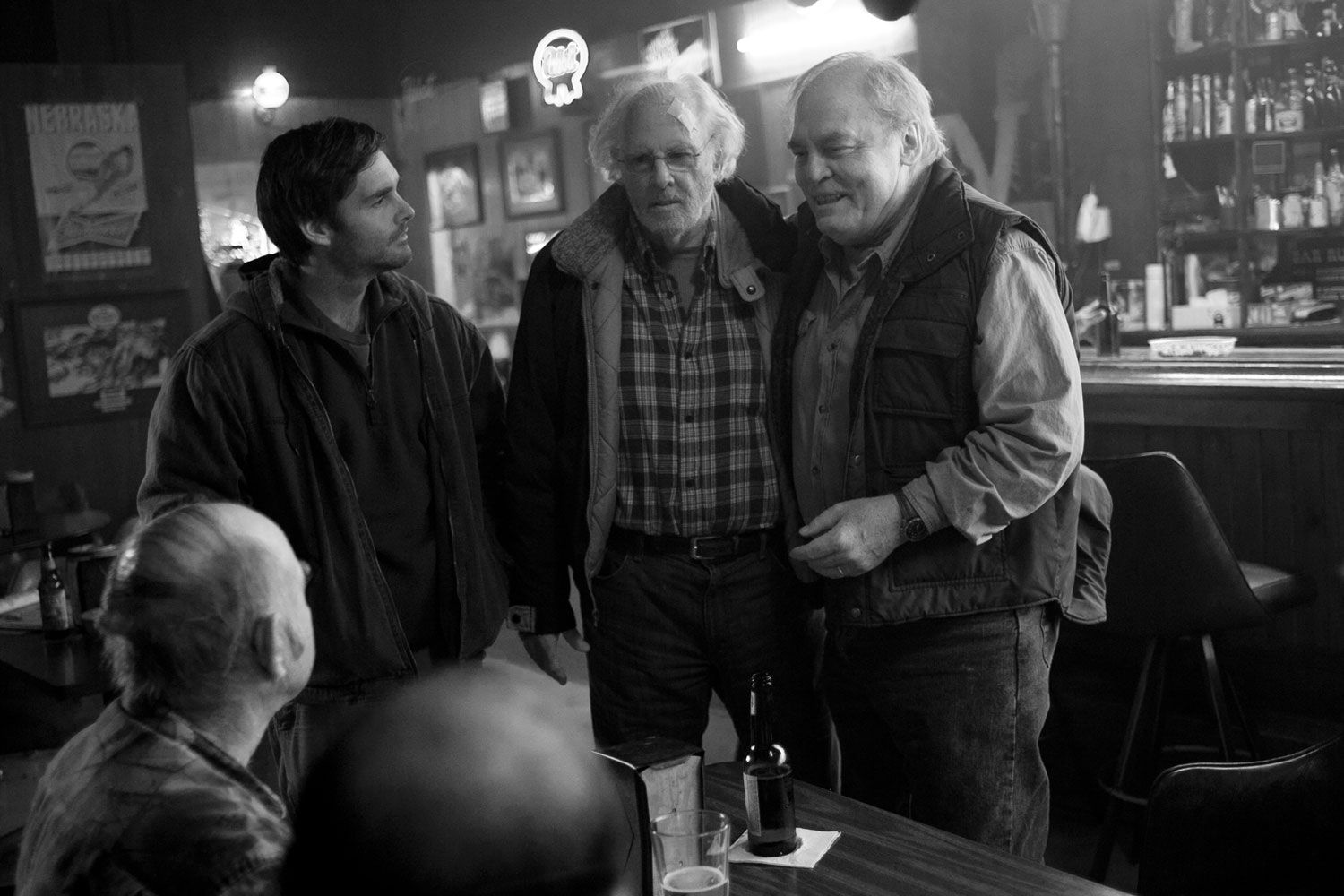
It’s hard to imagine there will be a more compelling looking film than this wide-screen black-and-white elegy.  Much more to come from me about my Hollywood sojourn and the look behind the curtain that Payne afforded me of his creative process.  I will be blogging about it and having stories published about it.  All of my “Nebraska” material will end up in a new edition of my book, “Alexander Payne: His Journey in Film.”  The new edition should be out around the time his film is released, which is late November.  You can order my book on my blog site, leoadambiga.wordpress.com.

http://www.youtube.com/watch?v=gZ6Wgg4BGuo

Nebraska 7

Nebraska 5

Nebraska 4Nebraska 6
Payne BTS (indiewire)
(Above) Payne (left) and Dern (right) on the set of Nebraska. (Photo courtesy of indiewire).
Nebraska poster

Come to My Next Alexander Payne Book Signing: Saturday, May 11 at The Bookworm in Omaha

May 9, 2013 53 comments

Come to my 1 pm signing this Saturday, May 11 at The Bookworm in Countryside Village. I’ll be signing my book, “Alexander Payne: His Journey in Film.” I had a great response there the first time and I’m hoping to repeat the magic. This is a great time to get the book because it will be a valuable reference come awards season, when Payne’s new film “Nebraska” is contending for Golden Globes and Academy Awards. The book’s a great source of Payne trivia to impress your fellow film buffs with. It’s sure to be a valuable keepsake as his career continues to flourish and his standing in world cinema grows. The book’s been endorsed by Laura Dern, Leonard Maltin, Kurt Andersen, Dick Cavett, Joan Micklin Silver, and Ron Hull, among others.


Blank white book w/path