Archive
Homegrown Joe Arenas made his mark in college and the NFL
As much as I enjoy writing about the arts and artists, I equally enjoy writing about athletics and athletes. I finally caught up with a former football great from Nebraska, Joe Arenas, who has never really gotten his full due. If the name isn’t familiar, it’s because his professional and college exploits happened about 60 years ago. And though he was a very fine player – so good that he is still among the NFL’s all-time leaders in career kick return average – his jack of all trades verstality as a returner, running back, receiver, and defensive back made it hard for him to really stand out except as a returner. When you come right down to it, how many returners other than maybe Gale Sayers, Travis Williams, Brian Mitchell, Eric Metcalf, and Devin Hester really made a dent in the national consciousness? Sayers was of course a great running back in addition to being a great returner. The other thing working against Arenas was that he had two future NFL Hall of Fame teammates, in Joe Perry and Hugh McElhenny, who got most of the offensive touches out of the backfield. Before playing pro ball Arenas starred in the single-wing at then-Omaha University, where again he did a little of everything. In the single-wing Joe played a half-back spot in that offense but he did everything a quarterback does. Before he ever played college ball Joe served as a U.S. Marine in World War II. He was wounded at Iwo Jima. My story about Joe for El Perico newspaper refers to the fact that Arenas was among a small number of Hispanic football players who made a mark in the game. I also reference how Omaha U., which today is the University of Nebraska at Omaha, is where another athlete of color, Marlin Briscoe, played quarterback in an era when that was very rare at a predominantly white university. What I didn’t mention in the article is that a third athlete of color with local ties, Wilburn Hollis, played quarterback at two mostly white institutions, first at Boys Town and then at the University of Iowa. I was delighted to find Joe a still vital man in his late 80s.
-
 Homegrown Joe Arenas made his mark in college and the NFL
©by Leo Adam Biga
Originally appeared in El PericoThe longer out it is from the University of Nebraska at Omaha dropping football in 2011, the more its gridiron greats recede into obscurity.
No one should forget (Guadalupe) Joe Arenas.This son of Mexican immigrants was born in Cedar Rapids, Iowa and grew up in Lincoln, Neb. during the Depression. Small but determined, Little Joe didn’t play organized football until college yet he still made the National Football League. The high school basketball standout made the varsity hoops squad at the University of Nebraska before transferring to then-Omaha University, where he played both sports, becoming one of America’s most accomplished Hispanic athletes.
He won All-American football honors as UNO’s do-everything offensive cog (1947-1950), averaging 200-plus yards total offense as a junior and finishing sixth in the nation in total offense as a senior. As the go-to back in the single-wing, a precursor to the spread formation, he received snaps from center, called plays, ran, handed-off, passed, caught and punted the ball. He returned kicks and played defense, too.
Two decades later another athlete of color, Marlin Briscoe, became the first black starting quarterback at UNO and in the NFL.
San Francisco made Arenas UNO’s first NFL draftee as an 8th round pick. He enjoyed seven productive years (1951-1957) at halfback, returner and defensive back. He once led the league in kickoff returns and retired as the all-time returns leader. He still ranks ninth in league history in career kickoff return average (27.3).
“If I got one or two blocks, that’s all I needed,” Arenas says. “Just get me started and I’d try to maneuver around and shake ’em off. Just shifty, that’s all. I used to get out early to see teams practice. I’d study their punter and kicker – where they hit it, how far they hit it, getting to know their habits, so I’d know where to stand and what to do.”
After fielding the ball, he let his smarts, instincts and athletic ability take over, netting career marks of 3,798 kickoff return yards and 774 punt return yards. He brought back both a punt and a kickoff for scores. From scrimmage he compiled 987 rushing and 675 receiving yards and scored 16 touchdowns. He also threw a touchdown.
Upon leaving the 49ers he laid off two years to mend injuries before trying out with the Boston Patriots of the new AFL. He soon retired for good. En route home to San Francisco his back flared up and he recuperated in Houston, falling in love with his physical therapist. He stayed, they married and the couple raised two daughters.
He remained in Texas coaching football, working with receivers for College Football Hall of Famer Bill Yeoman at the University of Houston. In the 1980 Cotton Bowl the Cougars upset Nebraska 17-14 when an Arenas receiver made the game-winning grab in the end zone with 19 seconds left. Arenas sent several proteges to the NFL.
Long before any of that, he put athletics on hold and his life on the line serving in the U.S. Marines. He took part in the amphibious landing on the Japanese-fortified volcanic island of Iwo Jima, where he and his fellow “no guts-no glory” grunts staged the bloodiest assault of the Pacific theater. American troops storming the beach were pinned down under heavy fire. Arenas dug in and prayed.
“I got hit the very next day. It was a shrapnel wound and they carried me down the beach, where I got evacuated, and I’m glad I did because that was quite some campaign there. Oh man, I’ll tell you, I was probably fortunate to get hit and get the hell out of there. All my buddies got shot up.
“That was the worst place anybody could have been. The Marine Corps lost more on that island than they ever lost anywhere. The Japanese had the advantage. They were up on two highlands and we were down in a valley. They could see everything going on right down below them. All they had to do was look down their scopes. They were picking us off like clay pigeons. But we had enough force and enough people and material and guts (to prevail).”
He didn’t let his back wound slow his athletic career. He competed with the best, including three 49ers teammates who made the Pro Football Hall of Fame: Joe Perry, Hugh McElhenny and Y.A. Tittle.
Playing in an era before collective bargaining and free agency, he never made more than $10,000. Like other players then Arenas worked a regular off-season job to make ends meet. He was a salesman for spice giant McCormick and Company.
He “never thought” himself or the few other Hispanic players active then, like Tom Fears or Eddie Saenz, as groundbreakers. He’s proud Hispanics have since shined: Joe Kapp, Tom Flores, Jim Plunkett, Jeff Garcia. At 49er gatherings he’s met franchise legends John Brodie, Joe Montana, Jerry Rice. But there, like at UNO alumni events, few teammates are around. “There’s not too many left,” says Arenas, who at 89 is now a widower living in a Webster, Texas retirement center.
Coming back to Neb. gets harder. Besides, there’s no more football at UNO. “I’m really saddened by UNO not playing football anymore.”
He still enjoys watching the game on television, the coach in him critiquing players’ techniques and lack of hustle. He still signs bubble gum cards with his likeness on them that fans and collectors send him.
Gone, but not forgotten.
-

Omaha North superstar back Calvin Strong overcomes bigger obstacles than tacklers; Record-setting rusher poised to lead defending champion Vikings to another state title

Omaha high school and greater Nebraska prep football programs have a tradition of producing running backs who go on to play in college, including a pipeline from Central High to the University of Nebraska, though in the last decade or so that tradition has been interrupted and that pipleline has dried up. That may be changing. The premier high school back in the state right now, at least in terms of the eye-popping numbers he puts up, is Omaha North senior Calvin Strong, the subject of this profile for The Reader (www.thereader.com). He became the state’s first back to reach 3,000 yards in a season when he rushed for 3,008 yards and scored 43 touchdowns in leading his Vikings to the state Class A championship in 2013. He is not alone. Just the other night Central’s Tre Sanders exploded for 279 yards, including a handful of breakaway runs, in the Eagles opening game win over Lincoln North Star. Sanders and Strong have size working against them. The former is listed at 5’8, 160 pounds and the latter at 5’9, 175 pounds, neither measurement lines that would preclude them being recruited by FBS schools, but it just might put some off. Sanders has a measurable advantage over Strong in that his 40 yard dash time is listed at 4.4 seconds while Strong, a notoriously poor tester in the 40, can only muster a 4.6 or 4.7. While there’s some interest in Sanders to be sure and much more might be coming his way if he keeps producing the way he did in the opener, Strong has even more interest, but he surprised a lot of folks when he recently gave a verbal commit to South Dakota. The Coyotes were on him a long time, yes, and they had extended the only outright offer to Strong, that’s true, but according to North Coach Larry Martin there was a lot of interest in the player from FBS and FCS schools, only they were waiting to see how Strong performed again on the field this season and more importantly how he performed in the classroom and on the ACT, because his academics have been a problem. Strong could always change his mind, of course, and end up going to a football factory, but it might just be his comfort level was the deciding factor and he wanted to take a relatively sure thing rather than sweat out his grades and test scores and see what other offers came his way. Whatever happens, it doesn’t appear that Strong or Sanders or any of the other in-state prep backs are likely to be D-I sensations the way Gale Sayers, Joe Orduna, Keith Jones, Calvin Jones, Ahman Green, Kenton Keith were. But maybe, just maybe, Strong can be the next Danny Woodhead, who was snubbed by the big schools because of his small stature and less than electrifying speed and set small college records on his way to the NFL. Of course, as my article goes into, Strong has even more serious things to worry about, like staying clear of the gang culture that surrounds him in his inner city neighborhood and that has claimed some of his friends.
Strong and his Vikings open their season tonight, Friday, August 29, at home against Millard West.
Omaha North superstar back Calvin Strong overcomes bigger obstacles than tacklers Record-setting rusher poised to lead defending champion Vikings to another state title
©by Leo Adam Biga
Now appearing in The Reader (www.thereader.com)
Omaha North running back sensation and recent South Dakota verbal commit Calvin Strong put up sick numbers last season leading his school to its first state football title in the playoff era. His 3,008 rushing yards and 43 touchdowns set state and metro single season Class A records, shattering anything done by past star Omaha prep backs such as Gale Sayers and Ahman Green.
Despite measuring 5’9, 175 pounds, he runs like his name, strong, right into the heart of defenses, where his uncanny vision and agility allow him to avoid big hits. Even when he does run into contact he breaks tackles thanks to his superb balance, low center of gravity and ample strength. With his legs churning forward and his head on a swivel, he probes for creases, then spins, darts. bounces, bursts through heavy traffic into open lanes for big gains.
Known for a positive attitude, ready smile and being a vocal, emotional team leader, he saves his best moves for the off-field. There he does a precarious dance to avoid the gang-banging culture around him.
Strong and his pre-season No. 1 Vikings play Friday night’s season opener at home versus Millard West. All eyes will be on the senior when he touches the ball, which figures to be a lot given his 27-plus carries per game average last year. His 3,000 yard season came on the heels of a nearly 1,900 yard sophomore campaign, when he led North to the title game only to fall just short. He’s a two-time first-team all-state selection.
For someone with his credits it’s unusual he only had one college offer – from South Dakota. It may be more unusual yet he accepted it with a resume-enhancing session before him. North Head Coach Larry Martin confirms “there was a ton of interest out there” from FBS and FCS schools. Programs held off because Strong’s struggled academically and he’s posted sub-par 40-yard dash times (4.6-4.7) at camps.
The South Dakota commitment took Martin by surprise, though he confirms the school showed the most consistent interest in Strong. Martin, who’s “extremely close” to Strong and his family, said only two weeks ago, “I know he’s on a lot of people’s boards and people are waiting to see where all the intangibles measure out. Everybody wants to know where he’s at academically. Right now he’s a non-qualifier. If he was a qualifier, he’d have more offers right now. Somebody’s going to take him and is going to get a helluva running back.”
The pressure to perform well in the classroom and on standardized tests has sometimes gotten the better of Strong, whose commitment eases one stressor.
“He’s broke down on me multiple times about it,” Martin says.
Then there was the out-of-school suspension Strong served earlier this year for unspecified reasons. Martin says Strong put it behind him.
“He handled what he had to work through like a man. He came back and went right to work and he had his best summer since he’s been here. I thought our teachers did a great job of getting him his homework. He’s a very genuine young man. If he tells you he’s going to do something he’s going to follow through and do it. His word means something to him. I feel real confident with what I’ve seen. He’s learned from his mistakes, been apologetic for it, and moved on.”

Strong’s a celebrity wherever he goes in North Omaha and Martin believes even though the player is humble, a sense of entitlement creeped in.
“Sometimes kids think they can get away with a little bit more because of their status and I think he got caught up in that. I think he’s understanding that consequences apply to everybody.”
Martin has been pleased with Strong’s progress in and out of school and feels he’s prepared himself for what comes next.
“He has the grades – we’ve just got to get the ACT score up and we’ve taken the measures to get that headed in the right direction. God bless he stays healthy he’s going to be one of the more decorated football players coming out of this state in quite a few years.”
There’s never been any doubt, barring injury, Strong would play somewhere on a big stage at the next level. He may have a chance of being an impact player there, too. Of course, it’s always possible Strong could de-commit from the Coyotes and go to a football factory. It that happens, it would make him the first local back in a while to breakthrough after decades of guys doing it.
His coach won’t venture to guess, but Strong may even follow the path of two recent North players, in Niles Paul and Philip Bates, who went D-I and landed in the NFL. The path to the NFL doesn’t need to go through a big program either. Just ask Bates (Ohio) and Danny Woodhead (Chadron State).
The fact that Strong is even in this position is an achievement worth celebrating if for no other reason than he’s escaped the fate of friends lost to guns and gangs.
That harsh street life co-exists with his sometimes storybook, folk hero saga.
His school is in a neighborhood – Strong lives just down the hill from North – beset by poverty and crime. Drug dealing and turf wars pose dangers. Minus boundaries, gang culture exerts a pull. Strong, like his name, has stood firm against the allure and trap of that lifestyle, one that cost at least six of his buddies’ their lives. He continues knowing people caught up in it. He’s flirted with it himself. But he’s made known he wants nothing to do with it. The Gs know he’s off-limits.
“I still have friends that are in the gang life or whatever but they know and I know where I need to be at. It’s really not hard to x that stuff out of my life because I know and they know what I got going for myself and what’s in store for me,” Strong says.
“My freshman year I was pulled to doing dumb things but I’ve matured throughout these years to know what’s right from wrong, so I’ve been keeping myself away. Basically this whole summer I’ve just been with my coaches and teammates. I really ain’t been focused on anything else but football and studies so I can get to college.”
Martin’s aware of the pressures Strong faces. The coach and his family offer a respite when Calvin needs it.
“There is a pull and you can’t ignore it but he’s got his outs and when things get a little bit tough he calls coach and he comes stays with us, sometimes for a couple nights. We’re more than happy to provide that for him because he is a high quality young man.
“It’s also just to help take the burden off the family.”
In Martin, Strong appreciates he has a mentor and advocate, saying, “The only pressure that’s on me right now is finishing what he’s helped me with. Me and him have always had a relationship outside football. I’ll go to his house, chill out, eat steak. I’m like one of his own kids. He’s like a second dad to me. He’s always been there for me through anything. He has my back and I have his.
“He’s a real special guy and I give my heart to him. He’s prepared us for life, not just football. His speeches, they really just get to you, they spark something in you.”
Martin sees Strong mostly doing the right things these days.
“He’s really worked hard in terms of making sure he’s doing everything he can to make the right decisions. We’re just here to help continue to support him, provide him more options. Our total pursuit is to get that college education.”

Strong lives at home with his father, Calvin Strong Sr., and his younger brother, Jordan Strong. As a 6’2, 250 pound sophomore nose guard, Strong’s 15-year-old “little brother” is already getting hard looks from colleges. Because of his size, Jordan’s always played a couple grade levels up from his age group and thus he and his superstar older brother have been teammates growing up. The siblings are cogs in what may be a dynasty for years to come given the talent-rich depth and winning habits Martin’s built-up.
Calvin himself is only 17, so he may be fill out some come college, though in today’s sprint offenses size isn’t the factor it used to be.
Martin has always said, “it’s going to be about finding the right fit for him. I think people want to see him one more year. He did what he needed to do this summer and then we’ll let the first three or four games take care of themselves. We’ve got tough games right away – we open up with Millard West and Burke. If he does well in those games people are going to want to see that film.”
Among other things coaches will see, Martin says, is a dynamic back who’s “motivated and very competitive,” adding, “The one concern the bigger schools have is his top-end speed. Calvin just doesn’t test well in the 40. But I don’t know that top-end speed has to be the number one factor. He has so many other things he can do. Number one, he doesn’t turn the ball over. I mean, he just doesn’t fumble. He has taken extremely good care of the football. I think he has great vision. I think he anticipates where things are going to come open so well. He’s very durable. He’s elusive – he can make guys miss. He’s got great hips. His core and overall body strength is very good. His feet never stop moving, they’re constantly going.”
Strong has the ability to read defenses and anticipate where trouble lurks and then when things break down to change direction on a dime.
He says, “I see how everybody’s lined up. It’s really hard to tackle me unless the play gets all bunched up. I just keep my eyes focused and I shut everything else out, and once I break everything comes back loud again, all the screaming, and I can relax and have fun after I’ve gotten a first down or I’ve scored.
“Plus, I’m real small and my linemen are really big, so it’s good I can hide behind ’em and just choose where I can break off. It makes it real difficult for the linebackers to read me.”
He acknowledges he’s also run behind an exceptional line anchored by Nebraska commit and fellow all-stater Michael Decker, who returns.
But not every defender’s blocked every play and Strong doesn’t back down from the one-on-one challenge of a backer trying to blow him up.
“I’m just a real strong small guy – I don’t take nothing from nobody. Playing against some of the biggest linebackers in the state I’ve always gone heads up with ’em, I never try to fall down when they’re coming – I take it to ’em. I’m a small back but I’m going to show you I have power. I’m not afraid of contact.”
The contact part is funny because Strong confirms he once hated even the idea of being tackled before playing organized football. His dad and uncle forced him to play to toughen him up. His first full year at running back for the Little Vikes, after a year wasted on the line, he’d curl up to avoid hits but after dominating the youth ranks he decided the contact was no big deal, though he rarely took a clean hit. When tackled today he takes it as a personal defeat, which only makes him come back harder the next time. At the end of the day his heart and will are what separate him from others.
“I feel like that’s what it is because I want it more than a lot of people. I’m always competitive. Everything is competition to me.”
As for his less than stellar 40 clocking, he discounts it with, “My speed and everything shows on the field.” Indeed, he’s rarely if ever caught from behind. Martin, who coached current NFL players Phil Bates and Niles Paul, is waiting to see what Strong shows this year before comparing him to those elite athletes.
“I’ll know a lot more with him after our first couple games. You know, we tell our kids that the guys from North who’ve made it to the next level are the hardest working players every day. I will say Calvin’s work ethic has definitely increased. I think we’ve got him to the point where he understands if he wants to be the elite of the elite then he needs to continue to work harder.”
Besides what’s on the line for him personally, Strong’s dedicated himself to getting North back to the title game again.
“I worked very hard. I’m determined this year to come out with a real big bang. I really want that ring again. I really want that experience again.”
He’s aware no Omaha Public Schools team has made it to three straight finals games and he wants North to be the first to do it.
The North program’s come to the point where winning’s the expectation. Playing for the title two years ago and then winning the championship last year has meant a huge boost in confidence.
“It really set the bar for us,” Strong says. “Now nobody can really bring us down. Nobody can say they’re better than us. Nobody can say anything about us being an underdog team because we showed we’ve climbed all those obstacles. It was very heartwarming to me because we’d been talking about it since my freshman year and just to have it after we should have had it my sophomore year was really nice.”
Strong’s also keenly aware of his role model and celebrity status. He still finds all the attention, as in everyone from children to adults wanting his autograph or screaming his name, a bit surreal, saying, “It’s crazy.” He adds, “There’s not a lot of 17-year olds that can give little kids hope.”
The importance he attaches to his gift for football as his gateway out of The Hood is clearly reflected in a Tweet he made:
“If I didn’t have this I’d be nothing. That’s why thrive (sic) to be the best to do it.”
The way he sees it, realizing his dreams also honors the memory of his late friends who encouraged him to pursue football as far it would take him. Strong was en route to a game two years ago when he got word his friend Tyler had shot himself in the head playing Russian Roulette. He found out during the game Tyler died from his wounds.
In a Tweet, Strong wrote:
“Rip to my brother Tyler Brent Hickerson
When I die I want my BROTHERS walking my casket down …the ones who stood next to me when I once stood#cant get know Realer
If only u was here to see me shine … I miss u”
Strong’s grown up a Husker fan and Nebraska definitely has him on their radar. The only camp he attended this past summer was in Lincoln, where he’s got to know NU’s premier back, Ameer Abdullah, to whom he’s often compared. Before saying yes to South Dakota Strong hinted he’d like to reestablish the once continuous running back pipeline there from Omaha that’s gone dry the last decade-and-a-half.
He said, “I’d love to keep it in state just to show everybody how good North Omaha competition is. Playing for Nebraska would make a lot of people happy in Omaha.”
If Strong were to renege and select another school’s offer, assuming one’s proffered, there’s still those test scores. Martin felt the junior college route was a distinct possibility for Strong. His own son, Zach Martin, who quarterbacked North to the 2012 title game, is thriving at Iowa Western Community College, which sends many players to D-I.
Once Strong’s South Dakota decision sunk in, Martin understood it because the player’s developed a trust with the Coyote coaches that reminds him of what Strong has with him and his coaches at North.
“Calvin and his family mean so much to me, he’s almost like my own son. My message to Calvin has always been I will find a place that’s going to be the right fit for you. I’m just not going to turn you over to somebody that hasn’t invested that much time in you. We’re going to take care of you.”
He says for nearly every dream Strong wants to accomplish, South Dakota will be able to provide that for him. If not, Martin’s sure there are plenty of other places that will fit the bill.
Stay strong, Calvin, stay strong.
North hosts No. 3 Millard West this Friday at Kinnick Stadium on the Northwest High campus. Kickoff is for 7 p.m.
Kenton Keith’s long and winding journey to football redemption
This is a story of one who got away. If you grow up playing football in Nebraska and show real potential to play in college it’s sort of assumed or ordained that you will wind up playing for the University of Nebraska, whether as a recruited scholarship or walk-on student-athlete. The Cornhuskers nearly always get the cream of the state’s football crop to come to Lincoln. But once in a while and with greater frequency these days NU loses out on a real gem who decides for various reasons, sometimes because the brain trust in Lincoln doesn’t recognize or appreciate the local talent, to play their college ball elsewhere. The Huskers have lost out on some stellar players that way in the last decade, including several who went on to excel in college and to make it all the way to the NFL. This is a profile of one of these who got away – Kenton Keith of Omaha. The running back thought he had showed enough in high school to get the Huskers to bite but it didn’t happen. Well, actually, NU did show initial interest but then a shakeup there found him in the lurch, without the scholarship offer he’d expected. The rest is history. He went on to star at New Mexico State and after toiling in the Canadian Football League he made it in the NFL with the Indianapolis Colts, where he helped the club win a division title as a solid number two back. Things unraveled a bit for him after that but he had already found his football redemption by proving he could play at the highest level. Xavier Omon and Danny Woodhead followed him as in-state backs ignored by Nebraska and finding college stardom and making NFL rosters. Woodhead, of course, has become a popular and valuable contributor with the Patriots.

Kenton Keith’s long and winding journey to football redemption
©by Leo Adam Biga
Originally appeared in The Reader (www.thereader.com)
Omaha native Kenton Keith’s circuitous path to football nirvana took him to the gridiron wilderness of New Mexico and Canada before he made it to the NFL. When he landed a roster spot last off-season with the defending Super Bowl champion Indianapolis Colts it marked the end of a nine-year odyssey for the fleet tailback.
“You can look at my football life and almost understand how my whole life has been. Nothing was given me. Everything was hard-earned. I always had to play against the odds and God has blessed me for every hurdle that I got over,” he said.
It all began in 1998. As a senior at Omaha Benson High School Keith was a prime target of elite Division I schools. He’d narrowed his choices to Nebraska and Penn State. He leaned toward the Huskers, where his father, Percy Keith, played. Tom Osborne was a close family friend.
“Everything was so perfect at one time,” Keith, 27, said.
Once Oz resigned, Keith said Frank Solich and Co. backed away from him late in the recruiting game. Other schools that once coveted Keith suddenly gave him “the cold shoulder” too. Why would a kid branded a phenom for his exploits with the North Omaha Bears and Benson and for his rare combo of speed, size and instinct find himself a pariah? Keith said his stock fell as a result of a Benson administrator labeling him a gang member and a poor student.
The truth, Keith said. is “I was busting my butt to make my grades right and they were actually already good.” He said he was never in a gang, only a rap music group. Music is still a huge part of his life.
He ended up with but two scholarship offers — from NAIA Morningside and D-I New Mexico State. A last gasp effort by NU, including a call from Oz, did not sway his decision to play for the Aggies down in Las Cruces, N.M., far from family, friends, media centers and NFL scouts.
The way NU did him left Keith “discouraged and upset.” “A lot of stuff happened between me and Nebraska that nobody knows about,” he said.
Instead of being embittered, he said, “I made the best of it I could.” After a stellar if injury-plagued four-year career at NMSU, Keith went undrafted by the NFL in 2001. He was devastated. He quit football before the Saskatchewan Roughriders of the CFL called in 2002. He spent a year-and-a-half on the team’s practice squad. Then, in 2003, his chance finally came and he blew up the league. Three-and-a-half productive seasons and one failed NFL tryout (with the New York Jets) later, he’s now a contributor for the most watched team in all pro sports.
Despite the many “backstreets” he took to get there, he never doubted he could play with the big boys. “I always knew what I could do,” he said.

He’s not only “beaten the odds” but proven a valuable addition. Signed as a free agent in January, he enjoyed a strong training camp and by the Sept. 6 opener the 5’11, 209-pound rookie established himself as the No. 2 back behind Joseph Addai. Keith saw spot relief duty the first three games. Then, when Addai got dinged in the Sept. 30 game versus Denver, Keith came in to gain 80 yards on 10 carries as the Colts won 38-20. With Addai out nursing an injury, Keith started the Oct. 7 Tampa Bay game and showed his dependability and durability by rushing for 121 yards on 28 carries and one touchdown and catching five passes for 37 more yards in a 33-14 Indy win.
In the next two games Keith also saw significant action. In a 29-7 win over Jacksonville he split time with Addai — gaining 56 yards and a touchdown on 15 carries. In a 31-7 win over Carolina he tallied 36 yards rushing. His playing time decreased in Indy’s Nov. 4 marquee showdown with New England. But in a near comeback over San Diego last Sunday night he got the call on a critical second-half drive and responded. His running set up the Colts in the red zone and he converted a dump pass into an 7-yard TD reception to draw Indy within seven. For the season he’s totaled 369 yards rushing and three TDs, averaging a solid 4.6 yards per attempt, and he’s added 62 yards receiving and one more score.
He’s shown glimpses in the NFL of the breakaway ability he’s always possessed.
“I’ve always been told I’m a big play type of guy. I don’t know if I really look to do it, it just always happens,” he said. “I think my vision is what separates me from a lot of runners. I read people’s body language to see where I can go…turn. If a guy is committed to one side, then there’s no way he can get back to the cutback if you can get there first.
“I think it’s just something that you feel. It’s almost like you can feel it before you can see it. It’s weird, man.”

He’s put his moves on hold for now, content playing it safe getting “positive yards and first downs. It’s almost like when you’re playing the backup role and you’re just put in for one game you don’t want to do anything wrong,” he said. “I’ve been getting to the secondary a lot…and I think maybe there’s been times where I could have put a move on somebody and taken it outside and gone the distance. I mean, that’s going to come soon when I get a little bit more comfortable.”
He’s “95 percent comfortable” with the playbook now. The “learning process,” he said, is more challenging than any physical adjustment he’s had to make. To his surprise the 7-2 Colts are smaller than his former Roughriders’ teammates. But the Colts speed and the game’s tempo, he said, are faster than up north.
For Keith, who’s mostly played on mediocre teams, the Colts’ winning attitude is a breath of fresh air. He doesn’t know when his next major playing time will come, but he’s sure he’ll be ready when it does.
“I really believe the way you practice is how you’re going to play…so I try to make sure I practice real hard and stay mentally focused out there.”
Whatever happens, he’s glad he stuck this long and winding journey out. “It seems like it’s a big reward for the way things have been going throughout my football career,” he said. “God blessed me to come here with the Colts and to be like a perfect fit for what this team needed.”
Related articles
- Joseph Addai Will Reportedly Sign With New England Patriots (boston.sbnation.com)
- Colts Under The Microscope: Austin Collie (stampedeblue.com)
The man behind the voice of Husker football at Memorial Stadium
There are many voices of University of Nebraska football. Head Coach bo Pelini. Husker Sports Network play-by-play man Greg Sharpe. Not to be forgotten though is Husker football’s Memorial Stadium public address announcer Patrick Combs, who lends his own signature personality to the goings-on inside that cathedral of college football without ever detracting from it. I did the piece a few years ago about Combs and his dream role as “The Voice of Husker Football.”

The man behind the voice of Husker football at Memorial Stadium
©by Leo Adam Biga
Originally appeared in Omaha Magazine
Patrick Combs, 41, lives a dream each Husker game day as the in-stadium announcer for Nebraska football. He grew up cheering Big Red at Memorial Stadium, where he and his late father, Lincoln, Neb. car dealer Woody Combs, bonded on Saturdays.
From age 13 on, he said, “it’s safe to say my dream was to be the Voice of the Huskers. I always thought how cool it would be someday to be that booming voice…”
When not living his dream he’s director of business development for NRG Media, a Cedar Rapids, Iowa-based company with 83 radio stations in seven states. Combs works out of the Omaha office, home to Waitt Radio Network. He loves radio, but despite a resonant voice he didn’t seek a career in broadcasting, it sought him.
Growing up he and his family were into horses. His father, whom Combs said “had a great voice,” announced area equestrian events, including those a young Pat rode in. Whenever his dad couldn’t do an event, Combs filled in. People would invariably tell him, “You should be an announcer.” Instead, he attended the University of Nebraska-Lincoln intent on going into law or politics. He interned for then-Governor Bob Kerrey.
He ended up going to work for his dad. Recruited away by another dealer, he made general manager at 24. In 1993, he led a group of young American professionals to Taiwan for an international business summit and found a new calling.
“It was a life-changing month for me,” Combs said. “I realized very quickly how fortunate we are in this country with the freedoms we have and the abilties we have to be entrepeneurial. I came back idealistic and energized…and I decided to channel that by running for political office to try to make a difference.”
He entered the ‘94 U.S. Congressional race against Neb. Republican incumbant Doug Bereuter. Combs, a Democrat, was a 27-year-old unknown. But in a GOP-heavy state he managed 40 percent of the vote by campaigning every day and raising an unheard of $250,000 for his upstart bid. He failed to gain the same seat again in ‘96.
By then soured on selling cars and being denied a political career, he answered opportunity when KLIN in Lincoln asked him to co-host a talk show. The gig got in his blood and he learned the biz, laying the foundation for his 13-year radio career.
Life was good. He married, became a father of two, saw his career flourish at Waitt, which merged with NRG, and indulged his “passion” for riding Harleys. But two things were missing. The man he calls “my biggest idol and mentor” — his dad — died in 2001. And his dream job as Voice of Husker Nation seemed unattainable.
“I’d pretty much written off that job,” he said. Enter fate. In 2003 the job came open and Combs won it after auditioning, including calling that year’s Spring Game.
Going on his fifth year as the P.A. man, he said, “I’m still like a little kid in a candy store. I love it.” Though few know the name behind the voice, he said, “that’s OK. I’m just thrilled to be there. I’m humbled every day I walk into the stadium and to be part of such a storied program. There’s pressure to do a good job and I try very hard to do a good job. I do not want to let the fans down.” That’s why he preps hours before each contest. Calling a good game, he said, comes down “to being a facilitator of information and adding to the environment of the game.”
From the booth Combs imagines his dad, who got him started announcing, hearing him in the stands.
“I know he would be so proud his son is the Voice of the Huskers.”
Related articles
- VIDEOS: Memorial Stadium Already Three Months Ahead Of Schedule (rantsports.com)
- Nebraska Football: Huskers Sell Stability with Bo Pelini Raise, Extension (bleacherreport.com)
- Nebraska Spring Game Canceled Due To Inclement Weather (sbnation.com)
- McKewon: Pelini plots for Year Two in Big Ten (omaha.com)
- Huskers assistant: Job safe, but I’ll curb stance (espn.go.com)
Soul on Ice – Man on Fire: The Charles Bryant Story (from my Omaha Black Sports Legends series, Out to Win: The Roots of Greatness)
Never is anyone simply what they appear to be on the surface. Deep rivers run on the inisde of even the most seemingly easy to peg personalties and lives. Many of those well guarded currents cannot be seen unless we take the time to get to know someone and they reveal what’s on the inside. But seeing the complexity of what is there requires that we also put aside our blinders of assumptions and perceptions. That’s when we learn that no one is ever one thing or another. Take the late Charles Bryant. He was indeed as tough as his outward appearance and exploits as a one-time football and wrestling competitor suggested. But as I found he was also a man who carried around with him great wounds, a depth of feelings, and an artist’s sensitivity that by the time I met him, when he was old and only a few years from passing, he openly expressed.
My profile of Bryant was originally written for the New Horizons and then when I was commissioned to write a series on Omaha’s Black Sports Legends entitled, Out to Win: The Roots of Greatness, I incorporated this piece into that collection. You can read several more of my stories from that series on this blog, including profiles of Bob Gibson, Bob Boozer, Gale Sayers, Ron Boone, Marlin Briscoe, and Johnny Rodgers.

Charles Bryant at UNL
Soul on Ice – Man on Fire: The Charles Bryant Story (from my Omaha Black Sports Legends series, Out to Win: The Roots of Greatness)
©by Leo Adam Biga
Originally published in the New Horizons and The Reader (www.thereader.com)
“I am a Lonely Man, without Love…Love seems like a Fire many miles away. I can see the smoke and imagine the Heat. I travel to the Fire and when I arrive the Fire is out and all is Grey ashes…
–– “Lonely Man” by Charles Bryant, from his I’ve Been Along book of poems
Life for Charles Bryant once revolved around athletics. The Omaha native dominated on the gridiron and mat for Omaha South High and the University of Nebraska before entering education and carving out a top prep coaching career. Now a robust 70, the still formidable Bryant has lately reinvented himself as an artist, painting and sculpting with the same passion that once stoked his competitive fire.
Bryant has long been a restless sort searching for a means of self-expression. As a young man he was always doing something with his hands, whether shining shoes or lugging ice or drawing things or crafting woodwork or swinging a bat or throwing a ball. A self-described loner then, his growing up poor and black in white south Omaha only made him feel more apart. Too often, he said, people made him feel unwelcome.
“They considered themselves better than I. The pain and resentment are still there.” Too often his own ornery nature estranged him from others. “I didn’t fit in anywhere. Nobody wanted to be around me because I was so volatile, so disruptive, so feisty. I was independent. Headstrong. I never followed convention. If I would have known that then, I would have been an artist all along,” he said from the north Omaha home he shares with his wife of nearly hald-a-century, Mollie.
Athletics provided a release for all the turbulence inside him and other poor kids. “I think athletics was a relief from the pressures we felt,” he said. He made the south side’s playing fields and gymnasiums his personal proving ground and emotional outlet. His ferocious play at guard and linebacker demanded respect.
“I was tenacious. I was mean. Tough as nails. Pain was nothing. If you hit me I was going to hit you back. When you played across from me you had to play the whole game. It was like war to me every day I went out there. I was just a fierce competitor. I guess it came from the fact that I felt on a football field I was finally equal. You couldn’t hide from me out there.”
Even as a youth he was always a little faster, a little tougher, a little stronger than his schoolmates. He played whatever sport was in season. While only a teen he organized and coached young neighborhood kids. Even then he was made a prisoner of color when, at 14, he was barred from coaching in York, Neb., where the all-white midget-level baseball team he’d led to the playoffs was competing.
Still, he did not let obstacles like racism stand in his way. “Whatever it took for me to do something, I did it. I hung in there. I have never quit anything in my life. I have a force behind me.”
Bryant’s drive to succeed helped him excel in football and wrestling. He also competed in prep baseball and track. Once he came under the tutelage of South High coach Conrad “Corney” Collin, he set his sights on playing for NU. He had followed the stellar career of past South High football star Tom Novak — “The toughest guy I’ve seen on a football field.” — already a Husker legend by the time Bryant came along. But after earning 1950 all-state football honors his senior year, Bryant was disappointed to find no colleges recruiting him. In that pre-Civil Rights era athletic programs at NU, like those at many other schools, were not integrated. Scholarships were reserved for whites. Other than Tom Carodine of Boys Town, who arrived shortly before Bryant but was later kicked off the team, Bryant was the first African-American ballplayer there since 1913.
No matter, Bryant walked-on at the urging of Collin, a dandy of a disciplinarian whom Bryant said “played an important role in my life.” It happened this way: Upon graduating from South two of Bryant’s white teammates were offered scholarships, but not him; then Bryant followed his coach’s advice to “go with those guys down to Lincoln.’” Bryant did. It took guts. Here was a lone black kid walking up to crusty head coach Bill Glassford and his all-white squad and telling them he was going to play, like it or not. He vowed to return and earn his spot on the team. He kept the promise, too.
“I went back home and made enough money to pay my own way. I knew the reason they didn’t want me to play was because I was black, but that didn’t bother me because Corney Collin sent me there to play football and there was nothing in the world that was going to stop me.”
Collin had stood by him before, like the time when the Packers baseball team arrived by bus for a game in Hastings and the locals informed the big city visitors that Bryant, the lone black on the team, was barred from playing. “Coach said, ‘If he can’t play, we won’t be here,’ and we all got on the bus and left. He didn’t say a word to me, but he put himself on the line for me.”
Bryant had few other allies in his corner. But those there were he fondly recalls as “my heroes.” In general though blacks were discouraged, ignored, condescended. They were expected to fail or settle for less. For example, when Bryant told people of his plans to play ball at NU, he was met with cold incredulity or doubt.
“One guy I graduated with said, ‘I’ll see you in six weeks when you flunk out.’ A black guy I knew said, ‘Why don’t you stay here and work in the packing houses?’ All that just made me want to prove myself more to them, and to me. I was really focused. My attitude was, ‘I’m going to make it, so the hell with you.’”
Bryant brought this hard-shell attitude with him to Lincoln and used it as a shield to weather the rough spots, like the death of his mother when he was a senior, and as a buffer against the prejudice he encountered there, like the racial slurs slung his way or the times he had to stay apart from the team on road trips.
As one of only a few blacks on campus, every day posed a challenge. He felt “constantly tested.” On the field he could at least let off steam and “bang somebody” who got out of line. There was another facet to him though. One he rarely shared with anyone but those closest to him. It was a creative, perceptive side that saw him write poetry (he placed in a university poetry contest), “make beautiful, intricate designs in wood” and “earn As in anthropolgy.”
Bryant’s days at NU got a little easier when two black teammates joined him his sophomore year (when he was finally granted the scholarship he’d been denied.). Still, he only made it with the help of his faith and the support of friends, among them teammate Max Kitzelman (“Max saved me. He made sure nobody bothered me.”) professor of anthropology Dr. John Champe (“He took care of me for four years.”) former NU trainers Paul Schneider and George Sullivan (who once sewed 22 stitches in a split lip Bryant suffered when hit in the chops against Minnesota), and sports information director emeritus Don Bryant.
“I always had an angel there to take care of me. I guess they realized the stranger in me.”
Charles Bryant’s perseverance paid off when, as a senior, he was named All-Big Seven and honorable mention All-American in football and all-league in wrestling (He was inducted in the NU Football Hall of Fame in 1987.). He also became the first Bryant (the family is sixth generation Nebraskan) to graduate from college when he earned a bachelor’s degree in education in 1955.
He gave pro football a try with the Green Bay Packers, lasting until the final cut (Years later he gave the game a last hurrah as a lineman with the semi-pro Omaha Mustangs). Back home, he applied for teaching-coaching positions with OPS but was stonewalled. To support he and Mollie — they met at the storied Dreamland Ballroom on North 24th Street and married three months later — he took a job at Brandeis Department Store, becoming its first black male salesperson.
After working as a sub with the Council Bluffs Public Schools he was hired full-time in 1961, spending the bulk of his Iowa career at Thomas Jefferson High School. At T.J. he built a powerhouse wrestling program, with his teams regularly whipping Metro Conference squads.
In the 1970s OPS finally hired him, first as assistant principal at Benson High, then as assistant principal and athletic director at Bryan, and later as a student personnel assistant (“one of the best jobs I’ve ever had”) in the TAC Building. Someone who has long known and admired Bryant is University of Nebraska at Omaha wrestling Head Coach Mike Denney, who coached for and against him at Bryan.
Said Denney, “He’s from the old school. A tough, hard-nosed straight shooter. He also has a very sensitive, caring side. I’ve always respected how he’s developed all aspects of himself. Writing. Reading widely. Making art. Going from coaching and teaching into administration. He’s a man of real class and dignity.”
Bryant found a new mode of expression as a stern but loving father — he and Mollie raised five children — and as a no-nonsense coach and educator. Although officially retired, he still works as an OPS substitute teacher. What excites him about working with youth?
“The ability to, one-on-one, aid and assist a kid in charting his or her own course of action. To give him or her the path to what it takes to be a good man or woman. My great hope is I can make a change in the life of every kid I touch. I try to give kids hope and let them see the greatness in them. It fascinates me what you can to do mold kids. It’s like working in clay.”
Since taking up art 10 years ago, he has found the newest, perhaps the strongest medium for his voice. He works in a variety of media, often rendering compelling faces in bold strokes and vibrant colors, but it is sculpture that has most captured his imagination.
“When I’m working in clay I can feel the blessings of Jesus Christ in my hands. I can sit down in my basement and just get lost in the work.”
Recently, he sold his bronze bust of a buffalo soldier for $5,000. Local artist Les Bruning, whose foundry fired the piece, said of his work, “He has a good eye and a good hand. He has a mature style and a real feel for geometric preciseness in his work. I think he’s doing a great job. I’d like to see more from him.”
Bryant has brought his talent and enthusiasm for art to his work with youths. A few summers ago he assisted a group of kids painting murals at Sacred Heart Catholic Church. He directs a weekly art class at Clair Memorial United Methodist Church, where he worships and teaches Sunday School.
Much of Bryant’s art, including a book of poems he published in the ‘70s, deals with the black experience. He explores the pain and pride of his people, he said, because “black people need black identification. This kind of art is really a foundation for our ego. Every time we go out in the world we have to prove ourselves. Nobody knows what we’ve been through. Few know the contributions we’ve made. I guess I’m trying to make sure our legacy endures. Every time I give one of my pieces of art to kids I work with their eyes just light up.”
These days Bryant is devoting most of his time to his ailing wife, Mollie, the only person who’s really ever understood him. He can’t stand the thought of losing her and being alone again.
“But I shall not give in to loneliness. One day I shall reach my True Love and My fire shall burn with the Feeling of Love.”
–– from his poem “Lonely Man”
Related articles
- A Family Thing, Bryant-Fisher Family Reunion (leoadambiga.wordpress.com)
- Green Bay Packers All-Pro Running Back Ahman Green Channels Comic Book Hero Batman and Gridiron Icons Walter Payton and Bo Jackson on the Field (leoadambiga.wordpress.com)
Green Bay Packers All-Pro Running Back Ahman Green Channels Comic Book Hero Batman and Gridiron Icons Walter Payton and Bo Jackson on the Field
Green Bay Packers All-Pro Running Back Ahman Green Channels Comic Book Hero Batman and Gridiron Icons Walter Payton and Bo Jackson on the Field
©by Leo Adam Biga
Originally appeared in The Reader (www.thereader.com)
Green Bay Packers All-Pro running back Ahman Green has a well-publicized fascination with Batman. It makes sense considering the player applies the same old-school, no-frills style to his game as the comic book caped-crusader does to crime fighting. Instead of super powers, Batman gets by with well-hewn brain and brawn. Just like his favorite action figure, the former Omaha Central High School and University of Nebraska All-American, is all about the work. Gifted with size, strength and speed, Green’s worked hard honing himself into a chiseled, fluid dynamo. He is that rare combination of plower who won’t be stopped in short-yardage situations and burner who’s a threat to go the distance on every carry.
The same way Batman disdains trendy martial arts in favor of more basic ass whuppings, Green eschews any fancy moves on the field and, instead, sheds tacklers with brute force, cat quickness, superb balance and unerring instinct.
While his foes on the field may not be as maniacal as the Green Goblin, the NFL’s second leading rusher from a year ago confronts his own terrors in the form of bull rushing linemen, heat-seeking backers and hard-hitting corners. Green’s slashing style may deflect the full brunt of hits, but he still absorbs the force of a car crash every time he gets thrown down, blown up or taken out like a ten-pin. He just keeps on coming though, with a bring-it-on durability that’s his trademark.
And much like his alter ego has a dark side, Green does, too. He was charged with fourth-degree domestic assault against his first wife, who filed for divorce soon after the couple were cited for disturbing the peace in 2002. “I had a lot of stuff going on,” he told the Milwaukee Journal-Sentinel. “Outside of football I had to juggle a lot of things.” Besides dealing with problems at home, he struggled healing from a series of nagging injuries and finding time to complete his college studies at UNL. Then, last year he got his degree and found a new bride. There’s a sense that by dealing with his personal issues and getting well again, emotionally and physically, he set the stage for his record-setting, busting-loose 2003 performance.
Records are meaningful to Green in-so-far as they are a benchmark for his own progress. “That’s important to me because if a person doesn’t set goals, where are they going? I keep setting goals. After I knock ‘em out, I put another one in and I just keep going. That’s it.” Coming from the tradition-rich Nebraska program made his adjustment to the storied Packers franchise a little easier. “It was kind of old-hat by the time I got here,” he said. “I know what’s happened here in the past and I’m like, Let’s make some new history and let’s roll.”
After a slow start in the NFL with Seattle, where he was never given a chance to be an every down back, he’s evolved into the league’s prototype workhorse. An average game now finds him lugging the ball from scrimmage 20 or more times and catching three or four passes out of the backfield, not to mention all the times he’s called on to block. With a maturity that belies his age, Green is putting the team on his back and taking a pounding, while dealing out some serious hurting, too. It’s just the way he did it as a junior at NU, when he had more than 2,200 combined yards on 300-plus touches (counting bowl stats). With his luxury package design of power and explosiveness, he’s dominating the field again, only against the best players in the world. Taking on such a big role doesn’t faze him. “I don’t even look at it as that. I don’t worry about what’s on my shoulders or what’s not. I just go out there and play football. Whatever happens, it happens. That’s it,” he said.
Erased now is the tag of fumbler that dogged him from Seattle and that surfaced last year when he had trouble holding onto the ball. “Oh, yeah, it’ll probably never be forgotten, but it’s behind me. It’s definitely behind me. But some people never let stuff go,” he said. “I just go out there and play every game knowing that stuff can happen. That’s just part of football. You’re competing. It’s a back and forth battle. You’re not going to have a perfect game. Well, I don’t want to say never.”
That he remains productive and healthy carrying such a heavy load defies the odds and speaks not only to his good fortune but to his great work ethic. His penchant for paying the price with grueling workouts in the off-season is something he took from his real-life idol, Walter Payton, a righteous back Batman would have loved. The late-great Chicago Bear was renowned for his toughness on the field and his extreme conditioning drills off it that culminated in running, full out, a hell hill few dared testing and fewer yet conquered.
“What I do when I am working out, whether lifting weights or running, is I push myself to the end, to where I ain’t got nothing left,” Green said. “That’s what Walter Payton did when he worked out during the off-season. The intensity of his off-season workouts was higher than any training camp or game. He pushed himself harder than anybody else did, so that when the season came along he was in top shape and he didn’t worry about being tired or getting hurt.”
To give himself that same edge, Green religiously pumps iron and runs stairs until his muscles and lungs burn. “If I’m going to be in the right kind of shape, I’ve got to make sure I have my butt in the weight room lifting weights — getting stronger, bigger, faster — because if I don’t I’m going to start getting hurt” and wearing down, he said. “I’m trying to find a hill to run the way Walter Payton did.”
Payton also embodied the warrior figure Green sees himself as. Growing up in L.A., where he lived before returning to his native Omaha for high school, Green adopted a style Sweetness made famous. “He was the kind of runner I was. I was scrappy. I never went down easy. I was just tough. That was something I learned out in L.A. because, you know, you have to be tough to get along in this sport, especially there, where the competition’s real high. And that was the way my idol ran. He ran tough. He didn’t die easy. He was just the type of running back I Iike.” For his pre-game inspirational ritual, Green watches the Pure Payton highlight tape.
Bo Jackson was another back he patterned himself after. “He was blessed with the ability. He was fast and he was big and he took that and he ran very hard with it.”
The legendary feats of Payton-Jackson and the mythic heroics of Batman aside, Green’s work ethic springs from a more prosaic source, his parents, Edward and Glenda Scott. “My parents were older, and with that I developed that work ethic that if I want something I’m going to have to work for it — it’s not going to be given to me,” he said. “And some days it’s going to hurt, but if you really want it, you’ve got to fight through the hurt, fight through the pain, fight through the sweat, the blood and the tears to get where you want to be. And that’s how I think.”
If he could, Green said he would incorporate into his regimen a drill that simulates the hits he takes during a game. “I wish I could, because that would be my workout every single day of the week, but you can’t. You can’t imitate a football game.”
Getting himself ready to weather the hits and the upsets of a pro football career is all about focus, he said. “My philosophy on life is, just attend to the things you can control like your body. I control my body. I control what goes into my body. With my job, I’ve got to make sure I’m eating the right foods and that I’m in the right kind of shape. Anything on the outside — the stuff that you don’t hold in your hand and that you can’t control — don’t worry about it.”

Consistent with this no-nonsense approach is Green’s grounding in the fundamentals of the game. “I was fortunate to have a line of good coaches that taught me the basics. That’s the biggest thing,” he said. “Once you get taught that at an early age, everything else will come easier and you’ll be able to excel faster just by knowing the fundamentals of your sport.”
Green got his football start playing in Los Angeles midget leagues. He said the talent pool there steeled him for his return to Nebraska. “I played pretty well and I knew if I could survive out there, which I did, I could come out pretty good in high school ball here.” Once back in Omaha, where he lived with his grandma, he made his first splash on the local gridiron starring for the North Omaha Bears, which he helped lead to the 1991 national youth football (ages 13-14) title in Daytona, Florida. He began his prep career at North High, playing little as a freshman before starting on the varsity as a sophomore, when he ran for more than 1,000 yards. Two decades earlier his uncle, Michael Green, ran roughshod for North.
Ahman then heeded the wishes of his mother to attend her alma mater, Central, where he transferred prior to his junior year. He said switching schools was more about honoring his mom than any dissatisfaction with North or any desire to join Central’s fabled roster of running backs. “My mom wanted me to graduate from the high school she graduated from as a keep-it-in-the-family type thing.”
As far as Central’s rich tailback legacy, he said, “I wasn’t really into it. I just knew from the year before they had a guy — Damion Morrow — running the ball real good. I knew he was there, but I didn’t know all the other running backs that came out of there, like Calvin Jones, Leodis Flowers and Keith Jones. There’s been a long line of running backs there that I didn’t know about till I got there.” One name he did hear growing up was Gale Sayers, who set an exceedingly high bar for the Eagles’ running back tradition by earning All-America honors at the University of Kansas and NFL Hall of Fame status with the Chicago Bears.
Since then, Central’s become a prime feeder of college football talent. Its pipeline of talented backs dates back to at least the late ‘50s with Roger Sayers, the older brother of Gale. The Brothers Sayers even played one season together (1960) in the same backfield. Long overshadowed by Gale, Roger was a top American top sprinter and a spectacular small college back-kick returner for then-Omaha University.
Distinguished Central backs of more recent vintage include ex-NU stars Joe Orduna (Giants, Colts), Keith Jones (Browns, Cowboys), Leodis Flowers and Calvin Jones (Raiders, Packers) and current Husker David Horne. There was also Jamaine Billups, who switched to defense at Iowa State. And there were guys with brilliant prep resumes who, for one reason or another, never duplicated that success in college. Terry Evans was one. Damion Morrow, another. After an unprecedented sophomore year in which he ran for more than 1,700 yards, Morrow shared the ball with Ahman Green his last two years at Central, when each topped 1,000 yards. The pair are on a short list of backs in Nebraska 11-man prep football history to ever rush for 1,000 or more yards in three seasons.

According to Green, Morrow was “an awesome back” and just one of many “great athletes” he was around while coming up in Omaha. “Just pure athletes. Some of them didn’t get the opportunities that I got. Damion Morrow, Ronnie Doss. Zanie Adams. Stevie Gordon. The list goes on and on.” Green is well aware of his hometown’s considerable athletic tradition and brags on it whenever he can. “I’m always defending Omaha here in Green Bay,” he said. “They’re like, ‘Who else is from Omaha?’ I tell ‘em. ‘Ya’ll just don’t know that we’ve got a great line of athletes. Not just from football, but from all other sports.’”
Knowing he’s now considered in the same company as Omaha’s athletic elite — with legends Bob Gibson, Bob Boozer, Gale Sayers, Ron Boone, Marlin Briscoe, Johnny Rodgers — makes him “proud,” he said, “because those are names I heard about and how great they were. I’m just proud, because it goes to show that my hard work has paid off for me and is continuing to pay off for me and my family.”
With most of his family still in Omaha, Green gets back often and stays active in the community. “I do a lot of stuff with the North Omaha Boys and Girls Club,” he said. “Just recently, we had our third annual high school all-star basketball night, where we had men’s and women’s games, a three-point shootout and a dunk contest.” And in that way things have of coming full circle, he will soon be teaching football basics. “This summer I’m having my first Ahman Green Youth Football Camp, for kids 8 to 14. It’s a non-contact camp for boys and girls where I teach the fundamentals.” The June 28 and 29 camp is at North High School.
After his break-out 2003 season, Green’s fame is on the rise but his ego is not. “I haven’t changed. I’m still that little kid that grew up in Los Angeles and that was born in Omaha. If you talk to my family members, they’ll tell you — I’m still Ahman.”
Coming off his monster year, when the 10-6 Packers added a wild card win before being knocked out of the playoffs by Philadelphia, Green feels the club is ready for a title run. “We’ve got the tools in line to do big things,” he said.
Heading into his seventh NFL campaign, he knows he’s in the prime of a career that also has its limits. The end isn’t in sight yet, but he knows it’s only a matter of time. “I think about it,” he said, “but it’s something where I just play it by ear, like I always do. My body will let me know if I’ve had enough. I’ll listen to that. I’ve been listening to it for awhile now. When my body says it’s enough, it’s enough.”
Any talk of walking away from football is premature as long as he stays healthy and keeps producing. Then there’s the elusive perfect game he feels may not be so impossible, after all. “I just go into every game knowing I’m going to give it my best that day for my team. Who knows? It might happen. I might have a perfect game.” KAPOW. BAM. ZOOM. No. 30 saves the day again for Gotham City, er Green Bay.
Related articles
- Ahman Green officially retires (profootballtalk.nbcsports.com)
- Green Bay Packers: Does 19-0 Season Make Them the Best Team in NFL History? (bleacherreport.com)
- 2011 Green Bay Packers and the 10 Best Teams in NFL History (bleacherreport.com)
- Lettermen In The News: Ahman Green Joins Big Ten Network (lostlettermen.com)
Retired Omaha World-Herald military affairs newsman Howard Silber: War veteran, reporter, raconteur, bon vi vant, globetrotter
I have done my fair share of stories about journalists by now, and my favorites are generally those profiling venerable figures like the subject of this story, Howard Silber, who epitomized the intrepid spirit of the profession. Howard, though long retired, still has the heart and the head of a newsman. It’s an instinct that never fully leaves one. His rich career intersected with major events and figures of teh 20th century, as did his life before becoming a reporter. I think you’ll respond as I did to his story in the following profile I wrote about Howard for the New Horizons.
Howard Silber
Retired Omaha World-Herald military affairs newsman Howard Silber:
War veteran, reporter, raconteur, bon vi vant, globetrotter
©by Leo Adam Biga
Oriignally published in the New Horizons
It’s hard not viewing retired Omaha World-Herald military affairs editor Howard Silber’s life in romantic terms. Like a dashing fictional adventurer he’s spent the better part of his 90 years gallivanting about the world to feed his wanderlust.
A Band of Brothers World War II U.S. Army veteran, Silber was wounded in combat preceding the Battle of the Bulge. Soon after his convalescence he embarked on a distinguished journalism career.
As a reporter, the Omaha Press Club Hall of Fame inductee covered most everything. He ventured to the South Pole. He went to Vietnam multiple times to report on the war. He interviewed four sitting U.S. Presidents, even more Secretary of States and countless military brass.
He counted as sources Pentagon wonks and Beltway politicos.
Perhaps the biggest scoop of his career was obtaining an interview with Caril Ann Fugate shortly after she and Charles Starkweather were taken into custody following the couple’s 1958 killing spree.
A decade later Silber caught the first wave of Go Big Red fever when he co-wrote a pair of Husker football books.
As Veteran of Foreign Wars publicity chairman he went to China with an American contingent of retired servicemen.
Even when he stopped chasing stories following his 1988 retirement, he kept right on going, taking cruises with his wife Sissy to ports of call around the globe. More than 60 by now they reckon. They’ve even gone on safaris in Kenya and South Africa. Their Fontenelle Hills home is adorned with artifacts from their travels.
In truth, Silber’s been on the move since he was a young man, when this New York City native left the fast-paced, rough and tumble North for the slower rhythms and time-worn traditions of the South. His itch to get out and see new places may have been inherited from his Austro-Hungarian Jewish immigrant parents.
Growing up on the Upper West Side of Manhattan, Silber learned many survival lessons. HIs earliest years were spent in a well-to-do Jewish enclave. But when the Depression hit and his fur manufacturer father lost his business, the small family — it was just Howard, his younger sister and parents — were forced to move to “a less attractive neighborhood” and one where Jews were scarce.
As the new kid on the block Silber soon found himself tested.
“Fighting became a way of life. It was a case of fighting or running and I decided to fight,” he said. “I had to fight my way to school a few times and had to protect my sister, but after three or four of those fracases why they left me alone.”
Sports became another proving ground for Silber. He excelled in football at Stuyvesant High School, a noted public school whose team captured the city championship during his playing days. An equally good student, he set his sights high when he attempted to enroll at hallowed Columbia University.
“I wanted to go to Columbia as a student, not as an athlete,” he said. “They turned me down. I had all the grades but in those days most of the Ivy League and other prestigious schools had a quota on so many Jews they would admit per year.”
Columbia head football coach Lou Cannon offered Silber a partial football scholarship. The proud young student-athlete “turned it down.” The way Silber saw it, “If they wouldn’t take me as a student I didn’t want to go there as an athlete.'”
He said when the University of Alabama in Tuscaloosa recruited several teammates he opted to join them. The school’s gridiron program under then head coach Frank Thomas was already a national power. Silber enrolled there in 1939.
At Alabama his path intersected that of two unknowns who became iconic figures — one famously, the other infamously.
“Paul “Bear” Bryant was my freshman football coach. I thought he was a great guy. He did a lot for me,” Silber said of the gravely voiced future coaching legend.

Paul “Bear” Bryant
The Bear left UA after Silber’s freshman year for Vanderbilt. It was several coaching stops later before Bryant returned to his alma mater to lead the Crimson Tide as head coach, overseeing a dynasty that faced off with Nebraska in three New Year’s bowl games. Bryant’s Alabama teams won six national titles and he earned a place in the College Football Hall of Fame.
Silber makes no bones about his own insignificant place in ‘Bama football annals.
“I was almost a full-time bench warmer,” he said. “The talent level was higher than mine.” He played pulling guard at 170 pounds sopping wet.
His mother wanted him to be a doctor and like a good son he began pre-med studies. He wasn’t far along on that track when the medical school dean redirected Silber elsewhere owing to color blindness. Medicine’s loss was journalism’s gain.
Why did he fix on being a newspaperman?
“I always had an interest in it. My environment had been New York and jobs were hard to get in those days and it just never occurred to me I would try for one. I was more interested in radio as a career. Actually, my degree is partly radio arts. I interned at WAPI in Birmingham and after three weeks I quit and went to work as a summer intern for the old Birmingham Post, a Scripps Howard paper, because it paid four bucks a week more. That’s how I got into print journalism.”
Silber became well acquainted with someone who became the face of the Jim Crow South — George Wallace. When he first met him though Wallace was just another enterprising Alabama native son looking to make his mark.
“George Wallace and I shared an apartment over a garage one summer school session,” recalled Silber. “I had known him a little bit before then. We became pretty good friends. There was no sign of bigotry at that time, and in fact I’m convinced to this day that his bigotry was put on for political purposes.
“He (Wallace) ran at one point for the (Alabama state) judiciary and his opponent was Jim Folsom, who later became governor, and he lost, and he made the comment, ‘I’m never going to be out-niggered again.'”

George Wallace
Years before Wallace uttered that comment Silber witnessed another side of him.
“We had our laundry done by black women in town. Their sons would come around the campus, even the athletic dorms, to pick up laundry. Tony, a big lineman from West Virginia, was always hazing them and finally George, who was on the boxing team, wouldn’t take it anymore and he went up to Tony ready to fight him, saying, ‘We don’t treat our people down here that way.’ I wouldn’t have wanted to get into a fight with him. He was a tough little baby.”
In 1968 the one-time roommates’ paths crossed again. By then Silber was a veteran Herald reporter and Wallace a lightening rod Alabama governor and divisive American Independent Party presidential candidate on a campaign speaking tour stop in Omaha. Wallace’s abrasive style and segregationist stands made him a polarizing figure.
“Wallace’s advance man Bill Jones was a mutual friend and because of Bill I was invited into Wallace’s plane as it was sitting on the ground and George answered some local questions. He seemed familiar with local politics and the local situation and he was interested in agriculture. We talked for a good 15 or 20 minutes.”
That evening at the Omaha Civic Auditorium Wallace’s inflammatory speech excited supporters and agitated opponents. A melee inside the arena spilled out onto the streets and in the ensuing confrontations between police and citizens a young woman, Vivian Strong, was shot and killed by an officer, setting off a civil disturbance that caused serious property damage and looting in Northeast Omaha.
In some ways Northeast Omaha has never recovered from those and other disturbances that burned out or drove away business. It’s just the kind of story Silber liked to sink his teeth into. Before ever working as a professional journalist Silber found himself, likes millions of others, caught up in momentous events that forever altered the course of things.
He was an undergraduate when Japan attacked Pearl Harbor on December 7th, 1941. The call to arms meant a call to duty for Silber and so many of the Greatest Generation. Boys and men interrupted their lives, leaving behind home-family-career for uncertain fates in a worldwide conflict with no guarantee of Allied victory.
“The day after Pearl Harbor hundreds of students went to the recruiting offices in Tuscaloosa, the university town. The lines were terrible and finally several days later I got in. I wanted to become a Navy pilot but I was rejected because I was partly color blind. So I just entered the Army.”
He was 21. He went off to war in 1942, his studies delayed button forgotten.
“The university had a program where if you finished the spring semester and had so many hours you could enter the armed services and finish your degree by correspondence,” said Silber, who did just that.
His military odyssey began at Fortress Monroe, Va. with the Sea Coast Artillery. “We had big guns to intercept (enemy) ships,” he explained. “Because I had some college I was put in the master gunner section where with slide rules we calculated the azimuth and range of the cannon to zero in on the enemy ships that might approach. The Sea Coast Artillery was deemed obsolete by the emergence of the U.S. Air Force as a reliable deterrent force.
“I was transferred to Fort Bliss in El Paso, Texas, an anti-aircraft training center (and a part of the country’s coastal defense network). “I loved it down in El Paso. It was a good post.”
From there, he said, “I went into a glider unit and once in action we were supposed to glide in behind enemy lines to set up for anti-aircraft. Well, the glider unit was broken up. So I had some choices and I just transferred to the infantry. I went to Camp Howze (Texas), a temporary Army post, and became a member of company A, 411th Infantry Regiment, 103rd division. We did some pretty heavy training there,” said Silber.
“We went by train to Camp Shanks, New York — a port of embarkation. One morning with very little notice we were put aboard trains and transferred to a ferry stop in New Jersey and ferried across New York harbor to the Brooklyn Army Base,” he recounted. “There we boarded a ship that, believe it or not, was called the Santa Maria. We sailed to Southern France. It took about two weeks in a convoy strung out for quite a distance.”
Silber, whose descriptions of his wartime experiences retain the precision and color of his journalistic training, continued:
“We landed in Southern France (post-D-Day, 1944). We were equipped to go into combat but we were diverted to the Port of Marseilles. The French stevedores, who were supposed to be unloading ships of ammunition and such, went on strike. So we spent about two weeks unloading ammunition from ships to go up to the front.
“We were encamped on a plateau above Marseille. It was a happy situation. We’d be able to go in the city and enjoy ourselves.”
The idyll of Marseille was welcome but, as Silber said, “it ended soon enough. Part of the division went by truck and my regiment went by freight train with straw on the floor to a town called Epinal in Eastern France. From there we went into combat. The first day of combat eight members of my platoon were killed. A baptism by fire.”
That initial action, he said, “was in, oddly enough, a churchyard in which most of the graves were occupied by World War I German soldiers. I didn’t learn that until later.” Many years after the war Silber and his old comrades paid for a monument to be erected to the eight GIs lost there. He and Sissy have visited the site of that deadly encounter to pay their respects.
“It’s become kind of a shrine to guys from my old outfit,” he said.
The next phases of his combat duty exposed him to even more harrowing action.
Although wars historically shut down in winter or prove the undoing of armies ill-equipped to deal with the conditions, the record winter of ’44 in Europe ultimately did little to slow down either side. In the case of the advancing American and Allied forces, the treacherous mix of snow and cold only added to the miseries. When Silber and his fellow soldiers were ordered to cross a mountain range, the dangers of altitude, deadly passes and avalanches were added to the challenge.
“We fought our way through the Vosges Mountains in Alsace,” he said, adding cryptically, “We had a couple of situations…
“We were the first sizable military unit to cross the Vosges in winter. We had snow for which we were not equipped really. It turned out to be the worst in the history of that part of Europe. We didn’t have any white camouflage gear or anything like that that the Germans had. We met some pretty heavy combat in the mountains for a time. It was an SS outfit, but we managed to fight our way through.”

If any soldier is honest he admits he fears engaging in hand-to-hand combat because he doesn’t know how he’ll perform in that life or death struggle. In the Vosges campaign Silber confronted the ultimate test in battle when he came face to face with a German.
“I’ll tell you what happened,” is how Silber begins relating the incident. “We went out on patrol at night trying to contact the enemy and pick up a couple prisoners for intelligence purposes. By that time I had become a second lieutenant, courtesy a battlefield commission. I didn’t really want to become too attractive a target for the Germans, so I pretended I was still an enlisted man in dress and in emblem, and I carried around an M-1 rifle instead of a carbine.
“What often happened was the Germans might send out a patrol at the same time just by coincidence and we would kind of startle each other at the same moment and ignore each other purposely. That happened a lot and we thought it was going to happen this time, but they opened fire on us.”
In the close quarters chaos of the fire fight, he said, “I jumped into a roadside ditch with my M-1 and it was knocked out of my hand by the guy I killed. Had to. I had a trench knife in my boot and I attacked him with that and fortunately I beat him, or he would have beaten me.” Only one man was coming out alive and Silber lived to tell the tale. He does so without boast or pleasure but a it-was-him-or-me soberness.
A desperate Germany was sending almost anyone it could find to the front, including boys. The SS troop Silber dispatched was an adult, therefore, he said, “I didn’t have that to worry about on my conscience.”
“After that most of the units we encountered were made up either of young conscripts, and I mean below the age of 18, or middle aged men, as almost a last gasp. I saw German soldiers who couldn’t have been more than 12 or 13 years old. I also saw men in their 40s and 50s.”
This last gasp “was a hopeful sign” Germany was through, but he added, “We didn’t feel very comfortable fighting against 14 year olds. I mean, if we had to do it, we did it because they were trying to kill us. We lived with it, that’s all.”
Finally breaking out of the mountains onto the Rhine Plain was a great relief. For the first time since the start of the campaign, he said, “we got to sleep in an intact house. We proceeded around Strausberg. We were in the U.S. 7th Army and integrated into our army corps was the French 1st Army and they were made up mostly of North Africans. Most of them were Moroccans, Algerians and Tunisians, I guess. They had come across the Mediterranean with de Gaulle. We saw them from time to time. They had a reputation of being good fighters.
“We headed north paralleling the Rhine River and we were approaching the Maginot Line (the elaborate French fortification system Germany outflanked during its blitz into France). On December 14, 1944 we had orders to break through it. The Germans had artillery, some troops and some tanks zeroed in and ready to go.”
All hell then broke loose.
“We woke up one morning to the sound of artillery high above us, exploding in the trees,” recalled Silber. “We were on the side of a ravine through which a road had been cut and on that road was a tank destroyer outfit — using World War I leftover anti-tank guns. They were a platoon of African-Americans. The bravery those guys exhibited was unbelievable. When I think of it I become emotional because they were shot up to hell and kept fighting.”

His second close brush with death then occurred.
“The artillery action slowed down and we began to advance into the Maginot Line,” he said. “The Germans had some tanks positioned between fixed fortresses. We encountered off in the distance a tank — 400 or 500 yards away. It was very slowly approaching us. The tank destroyer outfit had been so decimated they were pretty much out of action, so we had bazookas. Our bazooka team in my platoon was knocked out. By that time I was the platoon leader. I picked up the bazooka, knelt and loaded it, fired once and missed. It was quite a distance still.
“The last thing I can remember is that tank lowering its beastly 88 millimeter cannon in my direction…I woke up the next day in an Army field hospital. Apparently the shell was a dud but its impact half buried me in my foxhole. Our platoon medic dug me out of the collapsed foxhole and got me out of the way. I was unconscious. Both my arms were broken and my left rib cage was pretty well beat up. I woke up December 16 and that was the day the Battle of the Bulge erupted about a hundred kilometers north of us.”
Silber spent the remainder of the war healing.
“The next day the field hospital was emptied out of patients and it moved north to take care of casualties from the Bulge,” he said. “I was shipped along with other patients by ambulance to the U.S. 23rd General Hospital at Vittel, France, a spa town. It had been a resort. It had a racetrack and a casino. We wound up in the grand hotel.
“Even though my arms were in casts by then I enjoyed being there, believe me.”
Ending up sidelined from the action, banged up but without any life threatening injury, reminded him of something he and his buddies often joked about to help pass the time.
“Especially when I was an enlisted man we used to sit and talk in our foxholes, usually at night when things were quiet, smoking a cigarette under a tarpaulin or something, about the ‘million dollar wound.’ We’d speculate on what it would take to get us back to the States without getting really hurt.
“Well, maybe I should be ashamed of this, but that was one of the things I thought of in the hospital — that I had kind of one of those (wounds). Except I was hurt a little more than I would have chosen.”
Back home, he continued mending at Rhodes General Hospital in Utica, New York. A restless Silber completed his college studies by correspondence and volunteered in the public relations office. He penned the script for a weekly radio show written, produced and acted by patients, mostly on war experiences, that the hospital sponsored. Silber shared in a George Foster Peabody Award for public service a show segment won. “It wasn’t my brilliant writing or anything,” he said, “but I was part of the process.”
He was still hospitalized when VJ Day sparked celebrations over the war’s end.
One of his PR tasks was delivering copy to the local Utica Daily Press, where he secured a job upon his discharge. “I took my swearing out ceremony as we called it at 10 o’clock in the morning and by two o’clock I was down there working for a salary, not much of a salary — $38 a week. I still have a soft spot in my heart for Utica. I actually was stationed in a bureau in Rome, New York 15 miles away.”
From there he returned to his old stomping grounds in the Big Apple, where he worked for the New York Sun. A plum early assignment put him in the company of Harry Truman, “the VIP who really impressed me most,” said Silber. “I rode his (1948) campaign train. I was pretty raw material then, a real cub reporter, but I got the assignment and I ran with it. I even got to kibbutz his (Truman’s) poker game.”
Silber recalls Truman as “very kind, although he’d pick on guys for fun,” adding, “He was just a pretty decent man but he had shall we say a frothy tongue.”
When the Sun folded in 1950 Silber got on with “a blue ribbon” PR firm, but as he once put it, “I just had the romance of daily journalism in my blood.” Thus he began searching for a newspaper job. His choice came down to a Kansas City paper and the Omaha World-Herald, and $5 more a week brought him here in 1955.
He started out on the rewrite desk.
The Herald had a team of reporters out covering the Charles Starkweather story but Silber was familiar with the mounting murders and resulting manhunt around the upper Midwest from rewriting field reports. Then, as things often happen in a newsroom, Silber found himself enlisted to cover a major development.
“When the Starkweather case broke, our chief photographer Larry Robinson, who was versed in aviation and friendly to some of the operators out at the air base, chartered a good airplane on standby. So when we got the word in the newsroom about Starkweather being captured in Douglas, Wyo., city editor Lou Gerdes pointed to me and said, ‘Go!,’ and I went with Robby and John Savage.”
“We got there ahead of anybody else outside the immediate area and because of that we were able to have a lot of informality that wouldn’t exist today. We got friendly with the sheriff, Earl Heflin, and his wife, the jail matron. We got some good stories.”

Minus a wire to transmit photos, Robinson flew back with the negatives, while Silber and Savage stayed behind to cultivate more stories.
That night, a keyed up Silber, unable to sleep, walked from the hotel to the courthouse where the captured fugitives were held.
“The sheriff was answering telephone calls from all over the world with his wife’s help, and he was dead tired, so I said, ‘Why don’t you get some sleep while I sit in for you?’ He took advantage of that, and I took advantage of it, too.”
The story was a sensation everywhere it headlined.
“There weren’t that many serial murders in those days for one thing,” said Silber, “and it seemed to have all the elements — a teen with his girlfriend going around shooting people, not at random but for one reason or another, and it just caught on. Besides that, we were feeding a lot of stuff to the Associated Press and United Press. I was a stringer for Reuters and they were getting plenty of it. I was also stringing for the New York Daily News and at that time it was the largest circulation newspaper in the country.
“It just captured the imagination of readers.”
Caril Ann Fugate
So Silber wasn’t going to miss an opportunity to further play the story when one presented itself. Having relieved the sheriff, Silber then convinced Heflin’s wife to let him interview Caril Ann Fugate when Mrs. Heflin went to check on her. He ended up doing interviews with Fugate and Starkweather, separately, while Savage snapped photos — getting exclusive stories and pictures in the process.
Regarding Fugate, Silber said, “I had mixed feelings about her at the time, and then over a period of several weeks when more and more reports were coming in about her I became convinced she was not innocent. She was goading him to shoot people.” He said Starkweather struck him as “the upper end of juvenile delinquency, because he was 17 when he was captured. He was inarticulate. He couldn’t give a straight answer.”
Silber’s most far-flung assignment took him to the South Pole in 1962 as part of the press pool on a military junket with dignitaries Gen. Jimmy Doolittle, radio-newsreel commentator Lowell Thomas and Notre Dame president Fr. Theodore Hesburgh. “We staged out of Christchurch, New Zealand,” he said. “It’s a long ride down there in a prop plane.” En route, everyone geared up with layers of thermal clothing.

U.S. South Pole station
“We landed at (Amundsen-Scott) Pole Station — the actual landing strip they carved out of the ice about a mile or so from the pole. When we got there the temperature was 60 something below zero. They made heated track vehicles available, but Gen. Doolittle, Lowell Thomas and Fr. Hesburgh said no, They walked. So as a result we in the press pool had to walk, too (much to their curse-laden dismay).
“The actual stay on the ice as we called it was 2 1/2 weeks. We took day trips to scientific-research stations and historical places where early explorers had froze or starved to death.”
Flying to the pole station in a C-130 a tired Silber clambered atop crates lashed in the aisle and when he awoke a fellow member of the Fifth Estate said, “You know where you’ve been sleeping?” A clueless Silber shrugged, no. “On cases of dynamite,” his colleague gleefully informed him.
Among the most unforgettable characters Silber knew was bombastic Gen. Curtis LeMay, the first commander of the Strategic Air Command. “He was tough but he was a patriot through and through,” he said. “I admired him but it was tough to get along with him.” An enduring LeMay anecdote Silber attests is true found the general lighting a cigar near a refueling plane. When an aide mentioned the danger of the plane blowing up, LeMay blustered, “It wouldn’t dare to.”

Gen. Curtis LeMay
Silber and Sissy attended many a lavish black-tie officers’ party at Offutt.
There wasn’t much posh about reporting in Vietnam, where Silber covered the war as early as 1964. On a later visit there he ran into Omaha television reporter John Hlavacek, a former print foreign correspondent for whom Silber has high regard.
In 1970 Silber and other press accompanied Ross Perot on a chartered trip the billionaire organized ostensibly to deliver supplies to U.S airmen held as prisoners of war in North Vietnam. The hopskotch trip, which Henry Kissinger was behind, failed to deliver any supplies but did raise awareness of the POWs’ plight.
Upon reflection, Silber said his military reporting, which earned him numerous awards, “was satisfying — very much so. It was a high point.”
Back home, Silber claims credit for thinking of the Husker football books he and colleagues Jim Denney and Hollis Limprecht collaborated on, the second of which was a biography of Bob Devaney. Silber thought highly of Devaney.
“I loved the man. He was just a hell-raiser. A down-to-earth guy. A man’s-man.”
Over the years Silber wrote pieces for Readers Digest, Esquire and other national publications. He was a Reuters stringer for 20 years.
“I could never be satisfied with just working 8 hours a day. I had to be doing other things, too. I had a little office set up at home and I would do what I could.”
He means to resume his memoirs — for his grandkids — now that he’s cancer free for the first time in years. Long ago divorced from his first wife and the mother of his two daughters, Silber and Sissy have been partners 36 years now. Her warm, bigger-than-life personality complements his own hail-fellow-well-met charm.
Each retired comfortably from divergent careers. While he never became rich as a reporter he did well as a World-Herald stock holder. When Sissy’s father left behind his Katelman’s hardware supply store she and her mother took it over and ran it till 1981, when the Kanesville Highway went in.
Howard and Sissy met as a result of, what else?, a story Silber was working on. They’ve been inseparable since marrying in 1975.
Summing up his eventful life and career, Silber said, “There’s not too many things I’d change.”
Chancellor Harvey Perlman Passionate About the University of Nebraska, its Future and NU Joining ‘Common Friends’ in the Big Ten
A few years ago, during one of the endless news spasms about the University of Nebraska football program, New Horizons editor Jeff Reinhardt floated the idea of our profiling the school’s chancellor, Harvey Perlman, who at the time was adroitly handling the latest firing and hiring. As the musical chairs continued playing out it became clear that Perlman was more than the public point man speaking on behalf of the university about these changes, but the orchestrator of these moves. Below is the profile os this man at the top who speaks softly but carries a big stick.
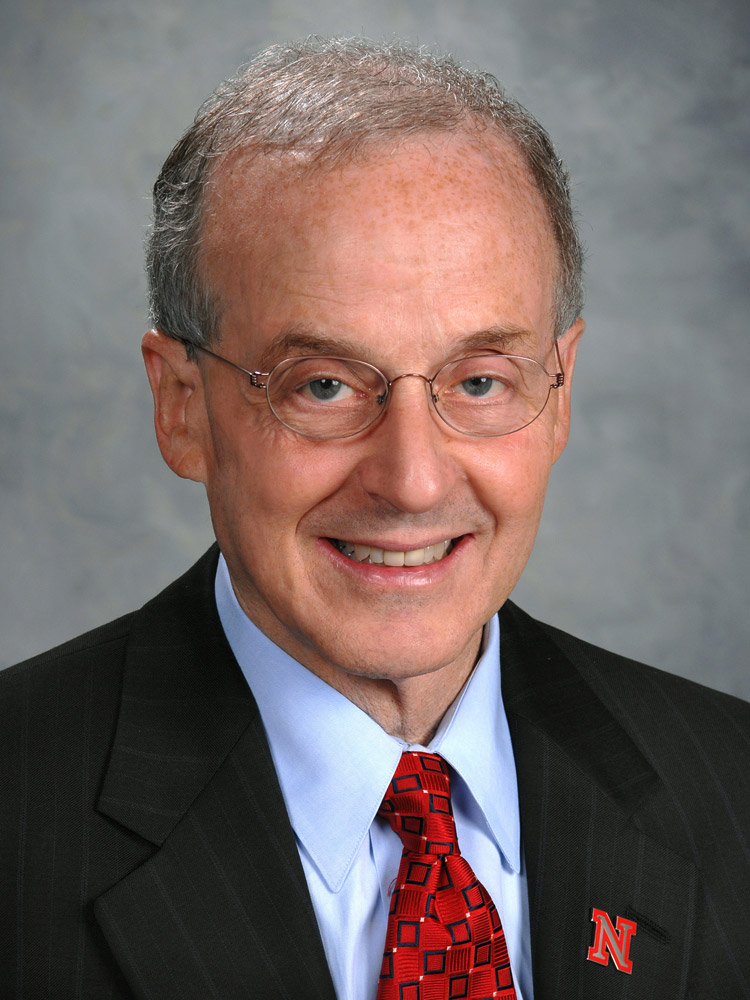
Harvey Perlman
Chancellor Harvey Perlman Passionate About the University of Nebraska, its Future and NU Joining ‘Common Friends’ in the Big Ten
©by Leo Adam Biga
Originally published in the New Horizons
Most of you probably first laid eyes on University of Nebraska-Lincoln Chancellor Harvey Perlman in October of 2007.
That’s when his face was all over the media in the wake of his firing Steve Pederson as Nebraska athletic director and hiring Husker coaching legend Tom Osborne to rejoin the Big Red family as the new AD.
Even though by then Perlman had already put in six years as the university’s CEO, chances are his name, much less the position he filled, barely registered with the average Nebraskan. You might have known he was a top NU administrator, but it’s unlikely you could have picked him out of a lineup or identified anything he put his stamp on.
You also probably didn’t know he’s an NU alumnus, as is his wife Susan and their two daughters and their husbands.
“We like to keep it in the family,” he said of this legacy.
It’s unlikely you knew he was previously the longtime dean of NU’s law college. Or that he joined the NU law faculty in 1967 after being mentored in the profession under the legendary Robert Kutak, who cultivated in his protege a love of art.
In 1974 Perlman left NU to teach at the University of Virginia Law School. He returned to NU in 1983 to head up the Nebraska Law College, a position he held for 15 years. He served as the university’s interim chancellor in 2000 before being named chancellor in 2001.
Obviously, much of his life is bound up in the university. Because the chancellor’s job continues to engage him he doesn’t have any plans to step down soon.
“I’m still excited about the possibilities. I care a lot about the university so it’s not an abstraction to me, it’s a passion,” he said from his office in UNL’s Canfield Administration Building
Being a native son, he said, probably opens some doors he might otherwise find closed.
“I think the fact I’m a Nebraskan gives me entree into some circles easier than an outsider would find.”
Perlman kept a low profile until the merry-go-round of athletic directors and football coaches the past 10 years. That’s when he became a focal point of attention. Perhaps for the first time then the power he wields was apparent for all to see. There he was intervening in what had become a circus of speculation and vitriol involving the topsy turvy fortunes of that precious commodity — Husker football. He acted as both architect and messenger for a sea change in NU athletics that continues making waves today.
The added scrutiny doesn’t much phase him. He knows it comes with the territory, though it can be a bit much.
“I’m used to it by now I guess. I think in part lawyers are trained to handle those kinds of circumstances, so that doesn’t give me any discomfort. The discomfort of being a public figure is probably not when you’re in public but the fact that you’re always in the public eye. I can’t go to the grocery store without people giving me advice about the football team and things like that.
“I never thought I’d be on the sports pages. I didn’t have the athletic talent to get there”
It’s not as though Perlman was invisible before the beleaguered Pederson was let go and the beloved Osborne brought back as the athletic department’s savior. Perlman had, after all, been involved in the machinations that followed Bill Byrne’s departure as AD and the much hyped arrival of native son Pederson. But when Pederson fired head football coach Frank Solich and replaced him with Bill Callahan Perlman was in the background while Pederson was out front. Critics of Pederson would assert it was just more grandstanding and arrogance on display.
Ironically, the unprepossessing Perlman took center stage when he gave Pederson the boot and brought Osborne back into the fold. It’s worked out that Perlman’s returned to the public spotlight since then. First, there was the housecleaning he began with Pederson’s ouster and that Osborne finished by axing Callahan, replacing him with fan favorite Bo Pelini. After the Callahan debacle, it’s certain the Pelini hire didn’t happen without Perlman’s approval.
Then he pushed for the Nebraska State Fair to make way for the Innovation Campus.
More recently, as NU’s Big 12 Conference affiliation grew shaky in the midst of possible league defections and the specter of Texas dominance, Perlman and Osborne teamed up to take NU in a dramatic new direction. Last summer the two men announced the stunning news NU was leaving the contentious Big 12 and joining the solidarity of the Big 10. It turned out the pair had worked feverishly behind the scenes with Big 10 commissioner Jim Delany to petition the conference for NU’s admission. Everything fell into place quicker than anyone anticipated. The switch took many by surprise and the bold move made national headlines.
So it was that the pensive, pin-striped Perlman once more found himself splashed in print and television stories, this time spinning the news of how the Big 10 would be a better cultural fit for NU than the Big 12.
Perlman, a lawyer by training, is expert at parsing words in order to be diplomatic and so he’s careful when explaining why the Big 10 is ultimately a better home for NU.
“Well, at the most fundamental level it’s a feeling on the back of your neck that you’re among common friends, not to suggest we weren’t friendly with the Big 12,” he said.
Perlman feels the Big 10 alliance is a cohesive match because like NU the conference’s other schools are Midwestern public research universities with similar institutional histories and goals when it comes to both academics and athletics .
“When you talk about the Big 12,” he said, “you can’t say that because you’ve got some Midwestern institutions, you’ve got some agriculturally-based land grant institutions, you’ve got Texas, which in many ways is an institution all of its own, with widely divergent reputations. You’ve got Texas Tech, which is different…The schools up and down that corridor are very, very different, so there is not a common culture. And it’s not a bad thing — I mean, they’re all fine institutions — but they’re very different. It’s just that in the Big Ten we just kind of felt that it was (a common culture).”

He acknowledges that NU “will be, next to Northwestern, the smallest institution in the Big 10,” adding, “But we’re still a public research university that fits that environment and that has a good history and tradition of intercollegiate athletics.”
There’s a prestige factor in all this that cannot be discounted because all 11 schools NU is joining are rated among the top academic and research institutions in America, along with most having strong athletic programs.
“Well, I mean you are who you associate with in some respects,” Perlman said, “and so there’s a stature of the Big 10…there’s a kind brand it has in common…”
He said those high standards give NU new avenues for excellence.
“It elevates the opportunities you have. Now we’ve got to take advantage of them, but at least it opens those opportunities. The Big 10 has traditionally had broad institutional cooperation in which it’s focused to provide collaborative activities within the Big 10, which the Big 12 does not.”
When it looked like the Big 12 might lose Texas and other anchor schools, suddenly the conference appeared fragile, which left Nebraska in a vulnerable spot. With things up in the air, Perlman and Osborne were not about to let NU hang in the wind, subject to an uncertain fate, and so they sought a stable new home for the school should the league dissolve.
Nebraska and the Big 10 had always shared a mutual admiration. Bob Devaney thought it a natural marriage years ago, before the Big 8 morphed into the Big 12, and before the Big 10 added Penn State. Then, in 2010, circumstances arose that soon made the prospect of NU being in the Big 10 relevant, even logical. For NU it meant security. For the Big 10 it meant another major player in its family.
“Yes, stability was critical for us because we didn’t have any place to go,” said Perlman. “I mean, we’re here, we have a good brand, that seemed to be clear. I think we could go in many directions, but if we were playing in the Big East for example the burden on our kids and our fans would be terrible. So you sit here and you look and you say, What are your options? There weren’t very many.”
At least not many that made sense or that were congruent with NU’s profile, whereas the Big 10 was a mirror image of the school and offered close proximity.
“Again, the culture fit,” said Perlman. “We seem to be a comfortable fit with the Big10 institutions. There’s some geographic adjacency, and that’s important.”
Perlman’s quest for a more secure footing in the athletic-academic arena was not unlike his wooing back Osborne, the winningest coach in NU history, from retirement to provide a calm center amid a storm of discontent.
“It was a very disruptive time for the program. We had to make a change. I had no hint that he was available or would be interested,” Perlman said of Osborne.
It turned out Osborne was both available and interested. The result was just what Perlman hoped.
“The value Tom brought clearly was stability,” the NU chancellor said.
Perlman said Osborne benefited from having “the confidence” of NU regents, administrators, coaches and student-athletes as well as university-athletic department supporters.
The experience of changing head football coaches and pursuing entry in the Big 10 brought Perlman and Osborne in close contact.
“We’ve built a working relationship that we didn’t have before,” said Perlman. “I think we have respect for each other. We’ve gone through a number of issues together and I think we both recognize we each contribute to getting those issues resolved. He has become a very fine athletic director. He has a good sense of the program beyond football, which was a concern of some, but he’s been very supportive of the range of athletic programs and he’s done a good job of managing the finances” the facilities, the coaches.
Osborne returns the compliment, saying, “I find Harvey Perlman to be someone who is a very bright person who thinks things through and does not say much until he has formulated his thoughts very carefully. He is able to be firm when the situation calls for it and is a good communicator.”
Some suggest that NU and other schools with big-time athletic programs find themselves in the equivalent of an ever escalating arms race that requires more and more expenditures on sports. When is enough, enough?
The two men, both raised in small Nebraska towns in post-World War Ii America — Perlman in York and Osborne in Hastings — share similar values and experiences based in humility and frugality. Yet they find themselves overseeing mammoth expansion programs and budgets.
“There’s clearly excesses in intercollegiate athletics,” Perlman said. “The idea that we’re competing with other schools and that you have to make investments in order to compete is not one I’m upset about. We’re doing that on the academic side all the time. It’s just not as visible. We’re competing for facilities, we’re competing for faculty. If you’re going to go out and attract top talent you’ve got to pay their price. You have to invest in the facilities.
“It’s a very competitive world in higher education across the board. Athletics is just where the numbers are larger. We’re fortunate here that the athletic department is self-supporting (thanks to enormous football revenues and generous booster donations). We don’t have to use tax dollars or tuition revenues to subsidize the department. In fact, they subsidize the academic side in a variety of different ways, so to that extent it’s hard to say, Let’s not compete. I mean, Nebraska has a position within the constellation of athletic powers, and as long as we’re successful we ought to try and compete.”
Some also question if in building a great university a great athletic department is really necessary.
“You can do it without one,” said Perlman. “In our circumstance I think we’ve achieved a lot of synergies between academics and athletics. Moving into the Big 10 is the clearest example. We wouldn’t have got into the Big 10 were it not for our brand on the athletic side, but we also wouldn’t have got into the Big 10 if we hadn’t had made the progress on the academic side that we’ve made in the last 10 years.”
Perlman points with pride to several advances the school’s made during his tenure, including more research grants, greater international engagement, improved educational programs and a growing enrollment that now exceeds 24,000.
He said NU’s influence and reach in areas such as agriculture and engineering extend across the globe.
“We may be small but we’re still a force in the world in terms of our presence in China, India, Africa…”
Sometimes the gains made in academics get obscured by what’s going on with athletics. He said the challenge is that the imprint of athletics “is so loud and prominent every day. The significance is clear — you win or you lose. A lot of the great things that happen on the academic side are not as clear, it’s more indirect, it’s more long term.” He favors “trying to even out the voice within the institution” to create more of a balance between academic and athletic achievement and recognition.
While football revenues and private donations keep NU athletics in the black and competitive with other elite programs, the university’s state-allocated academic operational budget has been subject to almost annual cuts as the state’s coffers have suffered in recent years. In a public address Perlman compared the budget slashing to the torture-execution method known as lingchi or death by a thousand cuts, saying, “I do not think a university can constantly cut its way to greatness.”
He neither wishes to sound like an alarmist nor an unbridled optimist. Instead, like the attorney he is he provides a considered pro and con analysis of the situation.
“I think there are significant cuts we’ve made that have not damaged the university for a variety of reasons. Every businessman will tell you every once in a while a budget cut is not a bad idea, just to be more efficient. Most of our cuts probably haven’t made the university worse off, some probably made it better, but as I’ve said you can’t do that continually and expect to be successful.”
Asked when diminishing returns set in and he answered:
“I don’t know, but there is a point at which quality does suffer. Our policy has been not to reduce the quality of all programs and cut across the board. We have in fact narrowed the scope — we’ve eliminated programs. I’d much rather eliminate a program then mandate, for example, a 4 percent across the board budget cut. You can’t get anywhere doing that. At some point I think you start to do real damage to your university, and more significantly real damage to the state of Nebraska.
“To the extent I cut programs that means the students and graduates of high schools in Nebraska who want that program are going to leave the state. Obviously one of the key needs for the state of Nebraska is to keep young people here, and you’re not going to do that if you continue to cut.”
As a small population state, Nebraska’s particularly impacted by the so-called “brain drain” that’s seen many of its best and brightest high school grads leave to attend college out of state. Perlman said NU’s “doing our part” to reverse the trend.
“I think for the most part we’re meeting that challenge. If you look at the top percentage of high school graduates in Nebraska who stay in the state and come to the university we’ve seen a significant increase in the last 10 years. If you look at non-resident students that are being attracted to the university that’s on a significant increase.”
He said these gains are due to “a lot of hard work by a lot of people across the whole university,” including faculty engaged in the recruiting effort.
Just a few months after NU’s entrance in the Big 10 Perlman noted the school’s enrollment spiked with more enrollees from Big 10 country than ever before.
“Coincidentally we’ve been very successful in trying to build pipelines for undergraduate enrollment in cities that happen to be in the Big 10 (Chicago, Milwaukee, Minneapolis, et cetera), and we see an uptick there now that we’re in the Big 10.”
Being in a tradition-rich power conference and having high profile, elite football or basketball teams that consistently win and net national media exposure can and does help in recruiting students.
“It’s not so crazy,” said Perlman. “It has an impact. I think what most people don’t think about is that intercollegiate athletics, particularly football, has such a kind of central place in the culture of America. We shouldn’t be surprised if students looking for a place to get their undergraduate education consider the entire environment that they’re in and one of those would be the success of the athletic programs.”
Recruiting top students and faculty is a priority for NU but there must be sufficient rewards in place to secure and retain them. Perlman suggests that just as NU must prepare students for careers, employers must ensure there are enough jobs to keep young people here once they earn their degree. He sees gains there too.
“For our college graduates there is a better chance they will stay in Nebraska for the jobs that are available,” he said. “That’s why Innovation Campus is so important, because we’re trying to do our part in terms of creating the kinds of jobs that college graduates would find attractive.”
Perlman has been a promoter of UNL’s Innovation Campus — envisioned as a multi-million dollar initiative on the sprawling former state fairgrounds site. It’s hoped a mix of public-private enterprises, both established and start-up, will do business and research there. The goal is that a critical mass of stimulus actviity will generate economic development through the products and services companies offer, the jobs they create and the taxes they pay.

“What we want to accomplish out there is clear,” he said, “and that is we want to leverage the research activity in the university to bring greater economic growth to Nebraska by getting private sector companies to locate on the property and to be adjacent to that research effort. That’s the idea. Can we fill up almost 200 acres with that kind of activity? I don’t know. We’ll try.”
In terms of what types of companies might locate there, he said “food, water and energy are the most likely attractives because that’s where our strengths are and that’s where Nebraska is, but we see other areas that could have potential. Software development is not out of the range of possibility. We don’t have any limits on what (might work).” He said NU hasn’t yet aggressively pursued potential companies “because more planning needs to be done to address the site’s infrastructure needs…” A faculty advisory committee is looking at the best ways to combine public-private efforts there.
By any measure, Innovation Campus will take time to develop.
“You look at the Research Triangle in North Carolina, it took them 50 years to get where they are,” he said. “I think we’ll move faster because the world is turning faster. Private sector companies are looking for universities” as partners and facilitators and hosts for incubation and innovation. “That process is ongoing. Fifty years ago that probably wasn’t true. I would hope that it would move quickly, but we’ve said to 20-25 years.”
The project is a stakeholder’s dream or nightmare depending on what happens.
“Some of us who were ardently in favor of getting the land and moving the state fair probably have a lot more personal reputation at stake on its success,” he said. “Realistically the university could be a great university without Innovation Campus but we wouldn’t have taken advantage of the opportunities that are available.”
Recruiting and keeping top faculty is a priority and there UNL could do more, Perlman said, to make it difficult for teachers to say no or to leave, though he says the school’s held its own in this regard.
“I think faculty salaries are not fully competitive with where they should be. With most other public universities incurring significant budget reductions over the last two or three years Nebraska’s been in relatively good shape, so we haven’t seen a lot of attrition.”
Recruiting and retaining good people is “key,” he said. All the innovation and efficiency in the world doesn’t matter, he said, “if you can’t attract talent.”
Despite some disadvantages NU has compared with its Big 10 brethren in terms of the state’s small population and the school’s smaller enrollment numbers and proportionally smaller alumni base, Nebraska finds ways to remain competitive. Perlman said the same work ethic and generosity that the state is imbued with permeates the university’s faculty and staff and supporters. That commitment, he said, gives him “not only a sense of pride but a great sense of relief.” “It is incredible,” he said, adding, “There’s a set of issues that other university presidents have to deal with that I don’t.”
If anything, he faults NU and Nebraskans for being too modest and reticent.
“I think it’s our traditional Midwestern reluctance to set really high goals and ambitions and to celebrate our successes.”
With opportunities come challenges, and vice versa. For example, based on the metrics that go into rating academic and research performance NU sits at the bottom of the Big 10. And while Perlman has said it’s not such a bad thing to be last among such prestigious company, he’s quick to add, “We’re not content to be last either — we’re not going to be last 10 years from now the way I see it.”

Harvey Perlman waves to the crowd following his final State of the University address on Wednesday. Perlman, the University of Nebraska-Lincoln chancellor since April 1, 2001, will retire in June.
Perlman reminds skeptics that as much as NU courted the Big 10 the conference coveted the school. In other words, it wasn’t only a case of what NU could gain from being in the conference, it was what the league could gain from NU’s presence.
“I think it’s the brand,” Perlman said by way of explanation. “You know all the speculation was that Nebraska wouldn’t have a chance to get in the Big 10 because of the number of television sets was low relative to other schools that were mentioned (as prospective Big 10 additions). And that comes back to the assumption that all that university presidents worry about is the money, and it’s not true. Money’s significant, it’s a competitive thing, but it isn’t everything. In fact it wasn’t everything in the Big 10 when the school presidents voted (to accept NU as a new member).
“We’re a school with a good brand. We might not have a lot of television sets but we’ve probably got a lot of eyeballs across the country. We draw well” (both in the stands and in TV ratings).
Unlike the AD and coaching changes that sparked controversy and sometimes harsh attacks, the conference change was almost uniformly embraced.
“We have gotten almost no criticism within the state of Nebraska for this move,” said Perlman. “My wife continues to remind me that we can go 6-6 next year (in football), but right now everyone is pretty pleased. I’m surprised by the number of comments I get that recognize this was a major step for the academic side of the university as well as the athletic side.”
He forecasts the university’s leadership role will be ever more crucial for the state. He said the fact that NU is a close reflection of the industrious people it serves positions it to be an influential player in Nebraska’s economic growth.
“You would think its major institution would be that way and you wouldn’t want it any other way,” he said. “It also gives you an opportunity to lead. I mean, that’s the thing, especially in this economy — if you don’t have a strong research university taking a strong leadership role moving forward I don’t think we’ll be successful. I believe that. President Obama believes it, the minister of China believes it, the prime minister of India…The countries that want to be competitive are making major investments in higher education.”
He feels confident the University of Nebraska is poised to lead the way.
“I think it is coming into its own. The quality, the productivity, the ability to be competitive across the country is significant.”
Related Articles
- UNL picks Utah developer for new research park ()
- Monday Reads (skydancingblog.com)
- Nebraska to increase Memorial Stadium expansion (seattletimes.nwsource.com)
- Delany calls Nebraska the Packers of Big Ten (sports.espn.go.com)
- University Of Nebraska Announces $5M In Cuts (huffingtonpost.com)
- Big 12 agrees to dish out more cash for members with loss of Nebraska, Colorado (collegefootballtalk.nbcsports.com)
Former Husker All-American Trev Alberts Tries Making UNO Athletics’ Slogan, ‘Omaha’s Team,’ a Reality


Like most Nebraska football fans I watched Trev Alberts play on some very good Husker teams in the early 1990s without ever seeing him in person, by seeing him play on television. I’ve been a Big Red fan since just before the dawn of my teens but I’ve only attended a couple games at Memorial Stadium in Lincoln in all that time. So, my relationship with Alberts remained a virtual one until I interviewed him for the following story I did for The Reader (www.thereader,com). Alberts was a high draft choice of the Indianapolis Colts but repeated injuries cut short his NFL career before he could ever really establish himself. Then, the telegenic Alberts embarked on a successful career as an on-air college football analyst with ESPN. He left the network in a dispute that received a fair amount of attention. The, totally unexpected, he wound up as athletic director at Division II University of Nebraska at Omaha, where he’s in his second year on the job trying to right what had becomes a wayward department. Although some have speculated he took the post as a way to season and position himself for eventually replacing his old coach, Tom Osborne, as NU athletic director, an assertion by the way that both Alberts and Osborne deny, he seems genuinely satisfied to be doing a very unglamorous job at a very unglamorous institution. But as he reveals in my story, he is all about work ethic, seeing a job through, and teamwork, which I believe will keep him at UNO for the foreseeable future, not that I would rule out him one day moving over to NU.

Former Husker All-American Trev Alberts Tries Making UNO Athletics’ Slogan, ‘Omaha’s Team,’ a Reality
©by Leo Adam Biga
Originally published in The Reader (www.thereader.com)
UNO athletics has always been the overlooked step-child on the area sports scene.
The University of Nebraska at Omaha is still primarily a commuter school, making athletics a hard sell to students and alums. Most have a distant relationship with UNO, whose athletic success rarely translates into fans in the stands save for Maverick hockey, a few football games and a couple wrestling meets.
Things got tenuous four years ago amid revelations the school hushed up athletic budget shortfalls and secretly funneled general university funds to make up the difference. Then-chancellor Nancy Belck came under fire for loose department oversight. The cash cow UNO’s tied its wagon to, Division I hockey, sputtered.
UNO quickly went through three athletic directors. The budget and staff absorbed cuts. Some major boosters criticized school leaders and pulled support. Things stabilized when John Christensen became chancellor in 2007. His April 2009 hiring of Trev Alberts, the former University of Nebraska football All-American (1990-93), Indianapolis Colt and ESPN analyst, turned heads. Getting the chiseled, charismatic Alberts was a bold, outside-the-box move to pump life, credibility and pizazz into a floundering, faceless enterprise.
Some questioned Alberts’ lack of sports administration experience. Not Christensen.
“I wasn’t looking for an administrator, I was looking for a leader, and those are very different things,” said Christensen.
The two have big plans for UNO, including new campus facilities for baseball, softball, soccer and hockey. There’s talk of one day going D-I across the board. UNO is being touted as “Omaha’s Team.” By all accounts, confidence is restored in the department. Alberts’ hiring last year of iconic Dean Blais as hockey coach signaled a sea change in how UNO brands itself. The pretender’s now the contender.
Alberts set the tone at the press conference introducing him as AD, saying, “I believe the potential for UNO’s athletic programs is unlimited.” He hasn’t backed off on that. He sent a message with the Blais hire.
“We wanted to make a statement we weren’t going to mess around anymore, we were going to get into the arena competition and we were going to win and we were going to win the right way. I have never been a part of anything that didn’t attempt to do excellence.”
The rub is that while UNO’s located in a much larger metro than most D-II competitors, it must contend with many more divided loyalties and attractions than, say, a Northwest Missouri State, which is the only game in town in Maryville, Mo.
Husker mania looms large here. Creighton athletic programs are fan favorites. The College of St. Mary, Bellevue College and Iowa Western Community College have their followings. High school athletic contests regularly outdraw UNO’s. The Royals, the Beef, the Lancers, and now the Nighthawks, have committed fan bases, too.
Still, UNO is convinced it can capture more fans and revenue through upgrades, a must anyway if the school’s to ever seriously entertain going D-I, said Christensen.
“Right now, are we Omaha’s team? No, not the way we’re currently structured,” said Alberts. “No, not when you ask your baseball fans to drive to Boys Town to watch a game, you drive your softball fans to Westgate, you drive your hockey fans to the Qwest (Center). Think about it, we’ve been doing everything we could to make it extraordinarily difficult and inconvenient to support UNO athletics. You’re supposed to bring people to your campus.
“Imagine if we had facilities that were convenient, that met market expectations and were on or near the UNO campus.”

Alberts can sound like a pitchman, and that ability to spin things, to charm, to energize, to win hearts and minds, is why supporters like David Sokol are back in the fold. For Alberts, though, the heavy lifting’s just begun.
“We’re still a burden on campus until we’re able to realize that revenue from hockey. Do we have the kind of players, coaches, teams representative of what the market demands? We’re getting closer. I mean, it’s about winning. You gotta win, you gotta win consistently. The moniker ‘Omaha’s Team’ is really a reminder to our staff and coaches of what we aspire to become.”
Alberts said UNO must meet “market expectations of excellence of Lincoln and Creighton and the College World Series.” In some respects, he said, UNO’s done so by winning 11 national championships, adding that feedback from the community, however, indicates UNO’s fallen short in most ways.
Then there’s the awkwardness of dual NCAA membership. Yes, UNO has a D-I hockey program, but it’s a D-II, school, making for a tail-wagging-the-dog scenario.
“At strictly Division II schools, their (athletic) budgets are about three-and-a half to four million. Our budget’s approaching nine million with one Division I sport. When you have dual membership one of two things happens: you either treat all of your programs like their Division II, which is problematic to NCAA compliance. or you end up running your whole department like you’re Division I. That’s equally dangerous, because now in our budget we have all the support units of a Division I department and our Division II programs are benefitting from it.
“We’ve got strength and conditioning staff, compliance staff, three full time sports information staffers, a marketing department — you don’t need a marketing department when you’re Division II. We have a ticketing office. A five-person athletic medicine staff I’ll put up against anybody. The point is, we’re a Division I athletic department whether we like it or not, but we compete at the Division II level. It’s naturally divisive. That’s why the NCAA views dual memberships as problematic.
“That’s why Dean Blais was so important. His personality, his humility — he doesn’t walk around here like…He’s just a Midwestern guy, he’s one of us. Now, he has expectations, don’t get me wrong.”
If other UNO coaches are upset by hockey’s anointed status, Alberts said they haven’t said so. Regardless, there’s no turning back.
“We’ve tried hard to communicate from the day I took the job that that’s the way it’s going to be. You can be frustrated, but if hockey is not successful, we are not successful.”
For now, he said UNO must balance the trappings of its lone D-I sport with the low corporate sponsorships and game guarantees of a D-II school.
“We simply didn’t have the ability and maybe still don’t to deliver the product this market demands, and that’s why this job’s so hard,” he said.
Much of his job is creating a culture of integrity that’s about “making the right decision, not the convenient one.” It’s why he and Christensen talk regularly and why Alberts seeks counsel from his old coach/mentor, Nebraska athletic director Tom Osborne. He also keeps former UNO athletic director Don Leahy close by as advisor and watchdog.
“It’s transparency,” Alberts said. “You know, Nebraskans are a common sense group. Trying to fool people is simply not going to work. First of all you have to be honest with yourself, understand your limitations, your strengths, and show enough humility to welcome the input of others. The first thing we had to do was create a belief. A lot of our coaches have been promised things for years. I would never promise somebody something I couldn’t actually keep.”
He’s impressed by “the passion for this place” that’s kept several veteran coaches and staff members at UNO when they could have bolted for other opportunities. He feels UNO athletics is poised for growth despite a tough economy and NU system-wide cuts.
“We’ve never been in a more difficult position than we’re currently in. What’s encouraging to me is a lot of our problems are self-inflicted and they’re solvable, and we’re committed to finding solutions.”
Related Articles
- A Former Division II Doormat Has Taken Some Big Steps Up (nytimes.com)
- Penn State Starting A Division I Hockey Program (huffingtonpost.com)
- Howard, Morehouse may renew football rivalry (washingtonpost.com)
- UNO Wrestling Dynasty Built on a Tide of Social Change (leoadambiga.wordpress.com)
- Dean Blais Has UNO Hockey Dreaming Big (leoadambiga.wordpress.com)
- College Hockey’s Seismic Shift Begins Today in Colorado Springs (pikespeaklife.wordpress.com)
Danny Woodhead, The Mighty Mite from North Platte Makes Good in the NFL
In 2008 he was signed as a free agent by the New York Jets, and he so impressed the coaching staff that after suffering a serious injury in preseason camp he was retained by the team, and he once again made the squad for the 20o9 season. He shined in some exhibition games and though he saw limited action during the regular season he did produce well when given the chance. He became a darling of the Jet press corps and fan base, and his legend grew more when he was featured in the HBO reality show, “Hard Knocks. ” Head coach Rex Ryan often praised Woodhead. Woodhead recovered from his injury and made the team to start the 2010 season but he was released only two weeks into the campaign. That’s when the folktale of Woodhead took another fateful turn: the NFL’s premier franchise did what it’s done innumerable times before by picking up a cast-off that the brain trust of coach Bill Belichick & Co. recognized as having real value. The Pats’ acquisition of the no-name Woodhead has more than panned out, as Woodhead has scored a touchdown in each of his first two games with the club, earning praise from his new coaches and teammates, and along the way he’s become an instant folk hero in New England.
The following story for The Reader (www.thereader.com) appeared after Woodhead’s Harlon Hill-winning junior season at Chadron, when the thought of an NFL career was yet a distant dream. That dream has now been fulfilled and it still has a long way to go before it’s finished. Indeed, Woodhead is only just getting started.
Danny Woodhead, The Mighty Mite from North Platte Makes Good in the NFL
©by Leo Adam Biga
Originally published in The Reader (www.thereader.com)
By winning the Harlon Hill Trophy last weekend as the nation’s best Division II college football player for 2006 Danny Woodhead won one for all the guys told they’re too small, too slow or from the wrong athletic pedigree. Coming out of North Platte, Woodhead, now the super stud, record-setting tailback for Chadron State College (Neb.), heard doubts about his ability despite being Nebraska Class A football’s all-time rushing-scoring leader.
The modest Woodhead isn’t sure his award is vindication so much as inspiration for underdogs. “I don’t know if it’s a win for ‘em, but I think it’s encouraging,” he said. “It makes ‘em think they have a chance because if I had a chance of doing it I think anyone can. It’s not about your size. It’s about how if you keep working hard something like this could happen. It probably teaches don’t let people tell you you can’t do it, because I’ve been told I couldn’t do stuff since I was in 8th grade.”
D-I schools gave him a look after high school but no offers. A pair of D-II schools courted him and the one he chose, Chadron, lacked a powerhouse program. He followed older brother Ben there. Besides, it was closer to home than his only other suitor, the University of Nebraska at Omaha.
At North Platte High he compiled huge numbers, but didn’t meet the profile of a big-time back. In the eyes of major college recruiters he was under weight, (190 pounds) and a step slow (4.6 in the 40). Also hurting his cred was where he played. Western Nebraska doesn’t produce many D-I prospects. Most of his yards came against the Grand Islands and Cretes, not Lincoln or Metro Omaha schools. The theory went, You-may-be-all-that-in-the-sticks, but-you-ain’t-shit-where-it-counts. Then, too, he’s white, when the prototype ballcarrier is black. What’s a guy to do?
Well, in Woodhead’s case he got bigger, stronger and faster and in the process put up eye-popping stats his freshman and sophomore years, rushing 562 times for 3,609 yards and scoring 46 touchdowns for Chadron teams that were competitive but lost as often as they won. He also proved a dangerous receiver. Each year he made the Associated Press Little All-America Team. Combining great lower body strength, superb balance, uncanny vision, excellent speed and rare endurance, he sheds tacklers and makes people miss and just keeps coming at you.
Then he took his game up a notch in 2006. In a year in which Chadron went 12-1, advanced to the playoffs and nearly beat D-II finalist Northwest Missouri State, he went off the way Barry Sanders did his Heisman year. Woodhead earned 1st Team All America honors and D-II’s Heisman equivalent when he gained 2,736 rushing yards and 3,158 all-purpose yards and scored 38 touchdowns and 228 points, tops in each NCAA category. To put it in perspective, by himself he outrushed and outscored most collegiate gridiron teams. His 2,736 rushing yards set the all-division single season mark. With a full season to play, Woodhead, a junior, has 6,345 rushing yards and 84 touchdowns. He’s on pace to break every NCAA career rushing, all-purpose yardage and scoring record. He may eclipse some marks by huge margins.
Like all great athletes he’s not content. “I don’t want to be satisfied with what I’ve done,” he said. “I want to work just as hard as I can to get better.” He intends leading Chadron to the D-II title game, which the return of 19 players with starting experience makes plausible. He’ll be the favorite to win a second Harlon Hill.
Whatever he does next, he knows people will ask, Could he have done it in D-I? “We could play the what if game,” he said, “but honestly it’s not going to get us anywhere. I’m happy where I’m at. I’m having a blast playing football. It’s something you don’t want to end, so I’m just going to cherish it while I have it and I’m not really worried about what I could be or would be doing in Division I.”
The next question is, Can he make it in the NFL? It doesn’t matter. You see, he’s already a legend. His feats should do wonders for recruiting. Thanks to him, other guys who don’t fit the mold may be dreaming big . Now that’s a legacy, man.

Woodhead compiled just under 10,000 all-purpose yards during his Chadron State career. Here are a few of his college stats:
RUSHING
GP    NO.     YDS    LOSS   NET    RSH AVG   TDS   LNG   PER GM-AVG
11    250     1646   49     1597   6.4       21    89    145.2
13    344     2854   98     2756   8.0       34    88    212.0
10    278     1854   85     1769   6.4       21    91    176.9
10    284     1892   52     1840   6.5       25    73    184.0
44   1156     8266          7962            101
RECEIVING
GP     NO.     YDS   AVG.   TDS  LNG
11     38      484   12.7   2    85
13     45      403    9.0   4    43
10     30      367   12.2   0    32
10     16      163   10.2   2    55
44    129     1417          8
SCORING
GP     TDS      PTS
11 23 138
13 38 228
10 21 126
10 27 162
44 109 654
Related Articles
- Danny Woodhead: New England Patriots Find a Diamond in the Rough (bleacherreport.com)
- Woodhead leads group of unlikely, likeable Patriots (sportingnews.com)
- He helped more than a little bit (boston.com)
- Danny Woodhead dumps his agents (profootballtalk.nbcsports.com)
- Lockout or not, Pats’ Woodhead keeps offseason approach same (nfl.com)
- NFL Star Danny Woodhead Signs Deal With Skechers (shoppingblog.com)
- The Most Beloved Player on Each NFL Team (bleacherreport.com)


 Leo Adam Biga's My Inside Stories