Archive
Lauro play “A Piece of My Heart” dramatizes role of women in war zones

Image by cliff1066™ via Flickr
This is a story I did about a play whose subject matter brought me into contact with some women who fulfilled various capacities during wartime service, whether as nurses or USO performers. The women I interviewed are sort of the real-life equivalents of some of the characters in the play.
The story originally appeared in The Reader (www.thereader.com), and I hope you find the words of the women, fictional and nonfictional alike, as gripping as I did.
Lauro play “A Piece of My Heart” dramatizes role of women in war zones
©by Leo Adam Biga
Originally appeared in The Reader (www.thereader.com)
As U.S. military action in Iraq unfolds, old war stories take on new capital. With women now on the front lines, their wartime roles gain added import. While their presence on the battlefield is new, American women have participated on the sidelines of war — as nurses, clerks, reporters, missionaries, performers — for generations, only their legacy seems lost in the heat of combat.
But since the 1993 dedication of the Vietnam Women’s Memorial in Washington D.C., a bronze sculpture by artist Glenna Goodacre of three fatigue-wearing females comforting an injured soldier, women have begun writing and talking about their wartime service as never before, the fruits of which can be seen in the acclaimed play, A Piece of My Heart, running now through April 27 at the Blue Barn Theatre.
Playwright Shirley Lauro based the characters of her impressionistic drama on interviews with real-life veterans, including those profiled in a book of the same name by Keith Walker. Lauro uses fast-moving vignettes to tell the larger story of American women in Vietnam. The six women characters represent varied backgrounds, roles and attitudes. There are military nurses, from stalwart Martha to sweet young Sissy to flower child Leeann. There’s the aristocratic Red Cross “donut dolly” Whitney. There’s the hard-ass intelligence officer Steele. And the playful, soulful USO trouper MaryJo. Whether sewing sutures, spreading cheer or performing on stage, they are angels of mercy for soldiers trapped in a hellish quagmire.
The women cope with laughter, tears, booze, pot. Some erect “the wall.” Others fool around. The nurses regret not knowing what happens to the boys whose bodies they patch up and spirits they boost. They fear no matter how many lives they save or how many smiles they elicit, they never do enough. Then, when their wartime service is over, they return home as forgotten as their G.I. brothers, wanting to put the war behind them but finding they can’t.

Even though each character tells her own story, they really all speak in one voice about the shared female experience of being thrust into the surreal, carnage of war. Regardless of where they hailed from or did their tour or what job they held or beliefs they espoused, they were all volunteers who elected to go there.
“The common ground we had, which is why I felt so strongly about honoring these women, was that not a single one of us had to be there,” said Diane Carlson Evans, a veteran in-country Army nurse who spearheaded the creation of the women’s memorial. “We were not drafted. We were not conscripted. Nobody put a gun to our head and said, Go to Vietnam and do your duty. We could have stayed home, got our master’s degree, had our kids, played golf and tennis and had a good life. But every one of us — Red Cross, military, USO — said, I want to do my part, and did during a very unpopular war. We didn’t have a lot of support from home, from peers or from our country…We just thought it was the right thing to do.”
Evans, who made remarks before the Blue Barn’s April 5 show, used her appearance to givr tribute to “the diverse contributions women made” in the war. “I am proud of the women I worked with and how hard I saw them work and how they asked for nothing in return. It was always, Do I need to give blood? Or, Can I work an extra shift? It was that always going above and beyond and never complaining because we had a job to do. I saw how these women saved lives at the risk of their own. And I just believe so strongly they deserve credit from a grateful nation. A grateful nation that needs to acknowledge they participated in a really extraordinary way.”
The story of women’s wartime service is, for many of us, unknown. “I’m just so glad this story’s being told because I lived through Vietnam and I didn’t hear nothing about the nurses…not a thing,” said Omaha actress Phyllis Mitchell-Butler, who portrays Steele. “The nurses went through as much as any of the soldiers. They saw the devastation first-hand. I’m just amazed how long they kept themselves together with all that inside them. All they had was what was inside and they had to keep that. They couldn’t let it go.”
In her role as state commander of the Nebraska Council of Vietnam Veterans of America, Dottie Barickman, who served at Offutt Air Force Base in the Vietnam era, has come to appreciate what women did in that war.
“I’ve never walked in their shoes, but I’ve heard their stories and I understand what they mean when they say they sacrificed their youth and their emotions. They were the nurturing ones for a lot of young boys hurting over there. Combat soldiers always mention to me that if they ever saw a nurse it was like Welcome Home, and that is what these women were…a touch of home that took them away from that war zone for a few hours.”
The stories in A Piece of My Heart echo those of thousands of women that served in Nam or nearby environs. Diane Carlson Evans is one of them.
“I was 21…right out of college…and I was assigned first to the 36th Evacuation Hospital in a beautiful place (Vung Tau) right on the South China Sea beach. I didn’t feel the war there as much as I did when I was transferred up north…to Pleiku, in the central highlands jungle near the Cambodian border,” Evans said. “I was with Two Corps supporting the 4th Infantry Division (in the 71st Evacuation Hospital).
“The war was very different there. It was the spring of ‘69…a pretty bad time. The 4th Infantry had something like a 75 percent casualty rate. I was made head nurse in a post-surgical unit where the patients were very sick. We had them on respirators and blood transfusions and chest tubes. It was very hard to see so many young men with such horrific wounds. We had to deal with patients dying on us and, in triage, we had to deal with setting aside dying patients to attend to the most salvageable ones. We blamed ourselves. We carried the guilt. And we were young…and so on our little time off we filled our days in human ways, whether it was playing volleyball or getting drunk or doing drugs or going on dates or falling in love.”

Playwright Shirley Lauro
In addition to the stress of dealing with crushing trauma patient loads, the threat of death was ever near. “Pleiku was not a safe area. We were under attack many times. We got to know the difference between the outgoing artillery and the incoming rockets and mortars that would fly in and hit our hospital, sending shrapnel everywhere. We were not only worrying about our patients — we had concern for our own safety,” said Evans, a Helena, Montana resident.
Since getting the Vietnam women’s memorial installed, Evans, whose efforts to make it a reality took 10 years, has become THE champion for female volunteers in that conflict, focusing her efforts on “encouraging women who served to share their stories…so we can understand what the memorial is all about.”
She helped start a storytelling program at the memorial site and on the web that invites women to speak their piece. She said telling it like it was is “very painful. It takes a lot of courage for women to admit how scared they were some young soldier was going to die on their watch or how they were so tired they could have made a mistake or how they were sexually assaulted or harassed. All of this anger and anguish comes out in the play.”
An admirer of the Lauro work, which had its debut in Philadelphia and has been performed across the country, Evans feels it gets to the heart of women’s Vietnam odyssey. “It does not show our service through rose-colored glasses — that we were all these heroic young women who went off to save the world and wore white halos — but instead it shows we were young women who went to Vietnam and did the very best we could amid all this crazy stuff going on. That’s what makes it very real, very authentic.”
As the war in Iraq rages on the director of the Blue Barn show, Susan Clement-Toberer, feels the conflict lends the play added urgency.
“Knowing that it’s happening now it brings it all very close and deepens everything we’re doing,” she said. “It’s real, just like the stories of these women are all real…taken from a myriad of interviews with different women.”
Cast member Erika Hall, who plays the USO entertainer, said, “You know, before it was important to do this piece, and now like it’s necessary.” Most of the cast and crew are too young to remember the war and therefore have immersed themselves in it via books, articles and tapes and by talking to actual veterans.
“What an interesting learning experience this is for me,” Hall said. “I was born after Vietnam and, you know, you read about it in school but you don’t really understand what they (vets) went through.” In her own research Clement-Toberer said she was surprised to learn “the extremes the women survived. I knew Vietnam was a dirty war, but I just didn’t realize they (the women) saw such extremes so quickly. I understand now why these women went and what they mean by honor…they believed in their country. It’s just a very strong feeling in what is right and what is true and what needs to be told.”
The characters have real-life counterparts in Nebraska. Lincolnite Judy Knopp, a former Army nurse at Camp Zama, Japan, treated G.I.s choppered in from Vietnam; Martel native and longtime Lincoln resident Brenda Allacher toured Nam as a member of the all-girl country-western band The Taylor Sisters; and Marie Menke of Superior, Neb. was a fellow Army nurse with Diane Evans at the 36th evac in Vung Tau, regarded as an in-country R & R site except for the grueling recovery and care that went on there. For vets like these, Vietnam seared into their memories and hearts the best and worst of humanity.
“I joined the Army nurse corps and in six weeks did my basic training at Fort Sam Houston and went straight to Japan…Camp Zama, 35 minutes southeast of Tokyo and an hour by chopper from Saigon. I was charge nurse in the orthopedic ward of a 1,000 bed hospital,” Knopp said. “Back then, we had to make our own IVs and pump our own blood and everything. After the Tet Offensive we were working 12 hour shifts, seven days a week. They used to call us the zombie squad. We didn’t even eat. We went home and slept…then came back. We’d have 30 to 40 evacs a day…20 to 30 surgeries a day, just on my ward. One-half of our cases were dirty wounds…shrapnel wounds or single and multiple amputees. Guys with half their faces blown off. One young man I especially remember…Billy. He was 18. He’d stepped on a land mine and everything was gone from the belly button on down. He was unconscious. We were pumping him full of blood. You wanted to save him but…you wanted him to go, too, because there was no way he could live.
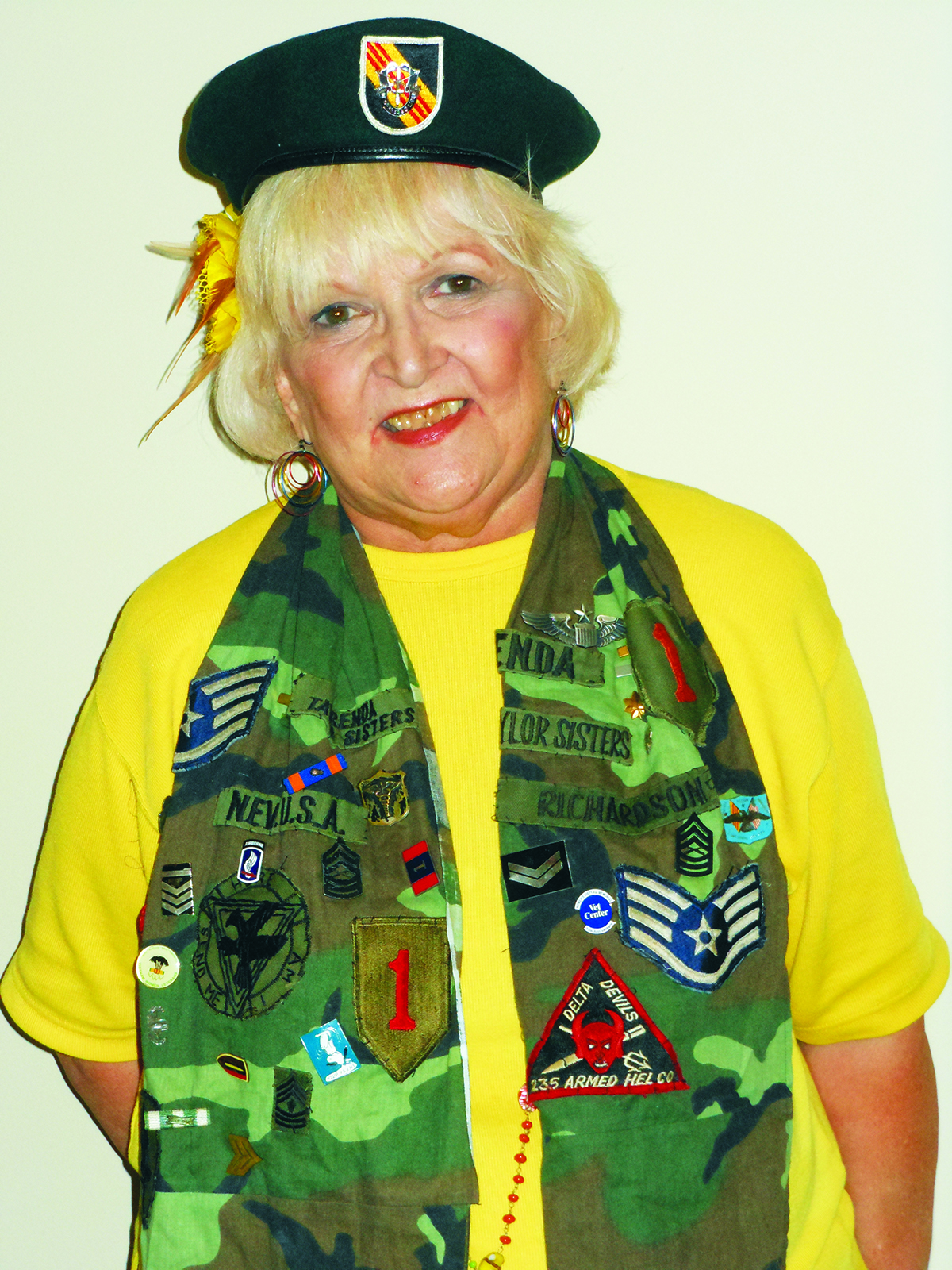
Brenda Allacher
“The guys, they were so young. They used to call me grandma and I was 22. They were all like little brothers. We used to stay up with the guys at night who were crying over having killed women and children. They had a real hard time dealing with what went on over there and the stuff they had to do to survive. A lot of ‘em came back injured and a lot of ‘em we never saw again. We never knew what happened to ‘em. The ones going back to the states we’d iron their uniforms, sew on their patches and go to the chopper to kiss ‘em goodbye. I have very fond memories of the guys and just atrocious memories of the wounds.”
She still regrets how, when her ward was busy, “there was no time for dignity with death…to get patients prepared and stay with ‘em and see ‘em through it. It was like, OK, this one’s dead, clean out the bed…there’s another one coming in.”
A Piece of My Heart cast members marvel at what women like Knopp endured at such a tender age. “They all have stories of their first day…just like in the play where my character takes off a soldier’s boot and his severed foot is in it,” Christine Schwery said. “They were so fragile and so young and yet they survived,” Julie Huff said. “With a lot of alcohol and a lot of drugs,” Schwery chimed in. “Yeah, but they survived and they saved a lot of lives,” Huff added.
Riverdale, Neb. native Marie Menke, then Daake, was a 22-year-old nursing school grad when she got to Nam. Nothing could prepare her for what she saw:
“I was pretty naive about the war. It was very shocking to most of us to see the kinds of wounds and the tragic loss of life,” she said. “It just shouldn’t be. My thoughts about the war didn’t matter because we were there and people were getting hurt and we had an enormous job to do. We were tremendously needed. It was beyond comprehension almost. The nurses did do a lot but most of us downplayed it. We were just there to do our job and to take care of patients and to support them.”
Besides caring for American G.I.s, nurses treated Vietmanese, including children.
An estimated 265,000 American women service in support of the war. U.S. Army estimates place the number in-country between 10,000 and 12,000. Most were nurses, either Army or Marine enlistees or even civilians attached to field hospitals or more rear echelon units. American Red Cross volunteers were so-called “donut dollies” — a sort of comfort girl corps boosting morale with their short-skirts, smiles and care packages. Others were entertainers touring under the auspices of the USO or, like Brenda Allacher, as contract entertainers via private booking agencies that provided minimal security and scant creature comforts.

Blue Barn Theatre’s Susan Clement Toberer
Allacher, then known by her stage name Brenda Allen, got to see a lot of Nam during her three-and-half month tour in ‘69. She has bittersweet memories of her time in Chu Lai, a central coastal area manned by the Americal Division:
“That was one of our favorite places because we had privacy taking a shower. I remember the commanding officer, ‘Big Daddy’ Richardson, said, ‘I’m going to work your butts off, but when you come back at night your favorite food and drink will be sitting in front of you.’ And it was, too. Lobster and blackberry brandy and Cutty Sark scotch. We’d do five and six shows a day for that man,” she said. “The men, they just wouldn’t let us quit and we weren’t about to leave those boys. The guys were just absolutely beautiful. They called me ‘Crazy Legs’…I’d do wild dancing and kick my legs up. They just went bonkers.
“We’d come back exhausted. One night, we’d come back from a show and a few of us were in the officers club drinking when there was a loud CLAP and the building just shook. A G. grabbed me and threw me down under the bar.” It was the start of a prolonged mortar attack. “We took 16 rounds over a period of four or five hours. We just laid there on the floor and got drunk. I was so scared. Around daylight a young man came running in, shouting, ‘They got a nurse at the 312 Surg-Evac,’ which was like a block away.”
The victim, 1st Lt. army nurse Sharon Ann Lane of Canton, Ohio, was the first Army nurse to die under hostile fire in Southeast Asia and one of 68 American women in all — military and civilian — to die in the conflict. The incident shook Allacher to her core.
“What really gets me is it very easily could have been me, and not her.” she said. She recalls happier times there, too, like when the Taylor Sisters did an impromptu show for Nebraska National Guard troops, leading off with “There’s No Place Like Nebraska.” “The tin roof went off on that quonset hut. They just went nuts.” Or when she was secreted away to give a private performance for some special ops forces who, upon her finishing, “lined up and saluted me” she said tearfully. “As I was walking out, the commanding officer placed his Green Beret on my head.” She still has it. “I wouldn’t trade those experiences for anything.”
Allacher and Knopp have made the recognition of women’s work in Vietnam a personal mission. Together eith Evans they are featured in a NETV documentary, Not On the Frontline, that follows their story from the wartime service they rendered to the emotional “culmination” of seeing the women’s memorial dedicated, something Knopp worked for as state coordinator of the project. More recently, Allacher, who describes herself as “a straight shooter…full of piss and vinegar,” was instrumental in bringing A Piece of My Heart to the attention of local theaters. She and her big booming laugh have become fixtures at the Blue Barn.
For Allacher, Knopp and Evans, the stories told in the play and documentary are part of the healing that’s taken place after the war. Acceptance of women’s service has come slowly, even as they have died alongside their veteran brothers from Agent Orange-related illnesses and have suffered from post-traumatic stress disorder.
Evans said there was once resistance to honoring women’s war record because “I don’t think people wanted to look at women as warriors — as soldiers. But women are soldiers, too. We fought just as hard as the men. We just fought with different instruments.” Or, as Judy Knopp puts it, “The guys were on the physical front lines, but we were on the psychological front lines trying to hold it all together. And we did it with a loving heart.”
Related Articles
- Woman who says she was nurse from WWII photo dies (dailycaller.com)
- Honouring nurses (bbc.co.uk)
- What did many American Women hold jobs as (wiki.answers.com)
- Walking Behind to Freedom, A Musical Theater Examination of Race (leoadambiga.wordpress.com)
Seafarer Doug Hiner and His Cuban Medical Supply Runs

Image via Wikipedia
A couple acquaintances introduced me to Doug Hiner and he immediately got on my radar as someone I’d like to profile when I learned he regularly sailed down to Cuba on missions that were partly about delivering medical supplies and partly about secreting back contraband, as in cigars. Hiner is a wheeler-dealer type who denied the illegal trafficking at the time I interviewed him, then expressing upset at my story’s suggestion that he engaged in anything like that, but subsequent events confirmed his smuggling activity because he got caught in the act down in Florida and faced serious federal charges. He pleaded guilty to one count and received 36 months probation.
Aside from the intrigue, which occurred after my story appeared, his story is really a classic tale about his taste for adventure and his passion for all things Cuban. A version of the following story appeared in The Reader (www.thereader.com).
Seafarer Doug Hiner and His Cuban Medical Supply Runs
©by Leo Adam Biga
A version of this story appeared in The Reader (www.thereader.com)
More than any other country, Cuba both seduces and vexes Americans. This island of paradoxes is at once a natural paradise fulfilled and a socialist promise unrealized. In a place where bare necessities do not go for want, chronic shortages make hustlers out of peasant and professional alike. Within a closed society and controlled economy, anything, for a price, is a black market possibility.
Fidel Castro may or may not own Cubans’ hearts and minds, but the land and culture definitely hold residents and exiles transfixed.
Social/economic problems don’t change the fact that Cuba, at least geographically, is a tropical island idyll. Sun, ocean, jungle, mountains — much of it pristine. Politicians/bureaucrats aside, the people embrace life with a live-and-let-live Latino insouciance. Music, dance, food, art, love, sun, surf. Fun prevails, if not for all, for tourists.
Omahan Doug Hiner sees the schizoid nature of Cuba every time he sails there on his 53-foot cutter, the Vitamin Sea. He captains the Tampa-docked boat on voyages that transport medical equipment to hospitals and clinics on the island. He’s been making runs like this to Cuba for seven years, a period when official American policy toward that intransigent Caribbean nation has gone from rigid to ultra hard-line. Embargoes of one kind or another have limited trade with Cuba and, in some cases, denied aid.

Doug Hiner
With Fidel’s recent stomach surgery making his mortality and his grip on power a renewed subject of world interest, Hiner prepared for a late December sail to bring in another boatload of supplies. But the gringo’s boat blew an engine, pushing the trip back until this month. He arrived February 10 in Havana, where the gear still sits, waiting for the red tape to be cut so he can move stuff inland.
His artist wife, Christina Narwicz, usually joins him on these maritime adventures but she wasn’t feeling up to it when he shoved off this time around.
The Man and the Sea
Hiner, 67, is a former hair dresser and a retired real estate developer and landlord. He made and lost a fortune. He’s not oblivious to the political realities that hold Cuba hostage in a state of suspended animation. Far from it. He has strong views on what Cuba and its paternalistic neighbor to the north should do to ease restrictions and tensions. His awareness of Cuban medical needs drives his missionary trips there, even as he brings in and takes back his share of contraband.
His journeys go well beyond idol curiosity. Hiner and his wife feel they have a fair handle on Cuba by virtue of not only having traveled there several times — it’s 15 trips and counting for him and about the same for her — but their stays usually last weeks or months at a time. They get around to different parts of the island and really immerse themselves in the place.
“We’re not tourists, we’re travelers,” Hiner said. “A tourist wants to have MacDonald’s no matter where he’s at. We like to enjoy the cultures of different countries and not live like Americans. We try to blend and be friendly with the people, and that’s all it really takes to be accepted. They love Americans, especially if you’re friendly to them. They don’t like the ugly-American types.”
Whatever motivates him, he ultimately makes these journeys because they put him in touch with three of his favorite things — sailing, the sea and people.
Though he grew up in landlocked South Dakota and Nebraska, Hiner long ago felt the call of the open sea.
“I’ve always been fascinated by the sea,” he said, “and I’ve always had this dream of having a boat to sail around the world.”
Years ago he and Christina “were planning to do a sail around the world …” when his “business fortunes changed,” making such a trip “impractical.” Circumnavigating the globe is not such a passion now, not with the expanse of warm southern waters to explore. “You can spend your whole life in an area like that and never see everything,” he said. “The Caribbean is a whole chain of islands. We’ve never been to Colombia or Central America, so eventually I’d like to do that.”
Besides, it’s the carefree, unrestricted, port-of-call lifestyle he enjoys, more than the challenge of seeing how far Hiner can push his sailing skills.
“A boat is like your home. You’ve got everything on it. You’re totally self-sustaining … It’s a real nice feeling,” he said. “You can anchor anywhere you want for nothing. We spent a couple New Years Eve’s anchored off of Key West, one of the liveliest New Years places in the world.”
Still, the allure of cruising wave and wind is like the call of the sirens — hard to resist. Half the challenge is dealing with weather and the other half comes with the inevitable mishaps.
“Weather on the high seas — that’s your biggest danger,” Hiner said. “We’ve gone through some pretty turbulent stuff, some accidentally, some on purpose because we had to. But it’s never been a safety issue. You’re never really out of ear shot of weather” reports via radio/radar.
Nature-related or not, things do go wrong. Take the couple’s 1999 trip to Cuba for instance.
“Going down on the second trip we blew out the sail. We ran into some bad weather. We had to have it repaired. It’s usually mechanical problems. It’s like, not if it’s going to break, but when it’s going to break. The last time we left Cuba the autopilot failed and we had to hand steer for 40 hours. Oh, and coming back from Cuba once we lost our fresh water pump, so we had no engine. There was no wind and we drifted for a day-and-a-half or two days before we finally got close enough to Key West to get a boat to tow us in.
“Our boat is about 20 years old and it needs extensive rewiring and stuff and I really haven’t been able to afford that, so we just kind of patch things together. It’s safe but it’s always a little bit of an adventure.”
Sea-faring is an apt avocation for an inveterate beach bum who, whether inland or coastal, enjoys kicking it with friends over drinks in the Old Market, where he developed some of the first condos, or partying on his boat.
He enjoys the simple, well-done pleasures of good food, good drink and good company. His wife’s the same. The residence they fashioned from an old brick-faced bar and parking lot on South 13th Street reflect their shared interests. The grounds’ richly decorated Great Wall that fronts 13th Street has a gated entry whose mammoth door opens onto a large courtyard filled with her plantings.
Hiner’s no stranger to graceful living, as he once owned a Fairacres mansion “back,” as he likes to say, “when I was rich and famous.” He made big bucks and moved in tony circles in the ’70s and ’80s. Then it all crashed. He alludes to a business partner running his development company into the ground.
The house, featured in the Spring 2000 edition of Renovation Style magazine, is designed with walkouts along the length of the courtyard that connect to a wood deck, creating a veranda. The interior opens up to a loft master bedroom and guest quarters, revealing a 32-foot-high ceiling and a bank of large windows that stream light in. At one end of the property is a screened-in porch. At the back of the lot is Christina’s well-lit studio. It all works toward a cozy hacienda feel.
As soon as he laid eyes on the spot he knew “it was exactly what I had in mind.” When he bought the former Glass Front Bar it was only a shell. But, he said, “I had this vision.” He designed the place himself. The work fit neatly into his years of “retrofitting old buildings. I’ve always had a knack for design and style and just living comfortably.” The result, he said, adheres to “the European concept of zero lot lines…where you basically use the whole property. We don’t have a back yard or front yard or side yard — we have a court yard. The same with our house. We utilize the whole house. We don’t have formal spaces. It’s just more practical and creative in my estimation. It’s just a feeling of well-being.”
His passion for this getaway within the city dovetails neatly with his ardor for Cuba. It always comes back to communing with people.
“It’s just a wonderful country. The people are so friendly and so caring and loving,” he said. “It’s hard to explain. I’ve traveled all over the world and I don’t think I’ve ever been to a country that is so warm and safe. There’s virtually no crime in Cuba. It’s true there’s a policeman on almost every corner, but the people there are so law-abiding. They’ll steal, but their attitude is, ‘If you don’t lock your bicycle up with a chain or padlock, then you must not want it.’ I’ve never had anything stolen off my boat in the marina and I can’t say that in almost any other country.”
Years living under the thumb of a dictatorship has its palliative effects.
“If a policeman on the corner points to a driver and signals him to stop,” Hiner said, “he’ll almost come to a panic stop to obey the order. They wouldn’t even think of not [stopping]. A police chase over there would be unheard of.”
Back to the contradictions bound up there, he said Cuba can seem chaste one minute and carnal the next. “It’s a real straight-laced island. Pornography is totally illegal. Drugs — zero tolerance. One marijuana cigarette would throw you in jail for a week before you’d be expelled from the country and told never to come back.” On the other hand, he said, “Cuba’s a very sexually open country. Even though prostitution is illegal…a lot of people are shocked by the young women that are readily available for sexual encounters. One, there’s a serious lack of men on the island. And two, their culture is not uptight about sex at all. I mean, geez, if some foreigner wants to give you twenty bucks, that’s even better.”
Besides, he said, “Cuba’s all extended families — there’s four-five generations that live under the same roof, and so it’s everybody’s responsibility to help support the family group.”
While Cuba prides itself on a system that accounts for citizens’ basic needs, rampant poverty compels most everyone to be on the make.
“You see very little begging, yet the young Cuban kids and the old folks are out hustling for the family,” Hiner said. “Everybody is sort of doing whatever needs to be done to provide extras. They have to have some access to dollars to really have any quality of life.”
Amid all this naked human need, Cuba takes great pains to put on a good face. “They sweep each block of Havana every day. If you don’t have anything to do, they’ll put a broom in your hands,” he said.
By Western standards, he said, Cubans lack everything we take for granted. He tries to give friends there some creature comforts otherwise unavailable to them.
“I’ve taken personal things down for people, like a microwave oven or VCR or DVD player, because all that stuff is illegal. Everything’s illegal in Cuba. Mainly, if it plugs into the wall, it’s illegal. They have an energy problem and they’re just trying to keep people’s lives basic.”

Even more basic than that, he said, he brings items like toothbrushes and razor blades that are “not a big deal here, but are a big deal there.”
He’s also brought back, on consignment, works by Cuban artists he and Christina sold in Old Market art shows, the proceeds going toward supplies for the artists.
Beat the Bushes, ‘Bend a Few Rules’
He’s sympathetic to the plight of the Cuban people, whose deprivation goes deeper than a lack of material things, to essential services. Sure, Cuba provides free health care, but many clinics and hospitals lack equipment and technology that can not only improve care but save lives. And while average Cubans and natives of nearby Latin American countries have access to free care, some medical centers are reserved for the elite. It’s why he got involved as a medical supplier in the first place. His awareness began on his inaugural visit to Cuba in 1998. The marina in Havana introduced him to fellow travelers, including many Americans, some of whom became a model.
“I met a lot of people that first time. A lot of just normal people. Some were bringing medical equipment on their boats down there,” he said. He soon discovered an informal network of doctors and suppliers. “As I met people in the marina and friends of theirs I was put in touch with various doctors and got lists of things they needed.”
Over the next year Hiner beat the bushes and made contact with “various organizations” that run aid into Cuba.” He cultivated the names of key suppliers, like Jack Oswald in Chicago, and key recipients, like surgeon Gilberto Fleites in Havana. When Oswald, who works with a group called Caribbean Medical Transport, ran a check on Hiner’s then-fledgling medical mission activities he was duly impressed.
“The medical equipment he gets is a cut above most of the stuff humanitarian aid groups get and I’ve been doing this a long time. His stuff is absolutely flawless,” Oswald said. “I went with him on his last trip because he was packing some really heavy equipment…I came from Chicago to help him figure out a way to put some of this stuff on the boat without it sinking. We put thousands of pounds on the bow…and you no longer could see to navigate…so we had to have somebody at the front of the boat calling instructions out to the captain just to avoid the reefs and boats and weather we came across on our way to Cuba. It got a little adventurous here and there.
“I’ll tell you, the guy’s fearless, he really is. He’s mission-oriented, there’s no question about it. Almost militaristically I might add. He doesn’t really let anything get in his way. Some of the stuff he does is a bit risky. And sometimes he doesn’t have the money, the equipment or even the plan…but he just keeps doing it. I think both sides are willing to let him operate, maybe even bend a few rules here and there…because they know what he’s doing is valuable.”

Joining Oswald, Hiner and his wife Christina on the voyage was a Cuban American physician who brought medical supplies to a cousin physician in Cuba. The Americans also brought art supplies for an artists collective there. Oswald said of Hiner and Narwicz, “They just know a whole lot of people and they just really enjoy Cuba. The folks I met that know them are like family.”
On Hiner’s first supply run in 2000 he was introduced to Dr. Fleites. “I met Gilberto and his wife Teresa and they were really neat people and we became really close friends and we had a really wonderful time there,” Hiner said.
Hiner calls Dr. Fleites “a bit of a renegade. He ran the national cancer institute in Havana. He was on the Cuban ethics board. He tried to get some doctors removed from practice because he thought they were killing more people than they were saving,” Hiner said. “But his superiors kicked him off the board because he wasn’t ‘a team player.’ He still performs surgeries … but only on important people because they know he’s very, very good. He’s sort of like freelance. It’s kind of a bizarre situation.”
The Omahan’s “become sort of an emissary” to Dr. Fleites. “I get lists of stuff from him” the Cuban medical community “needs,” he said, “and come back and hustle my friends. I know a lot of doctors from when I used to be rich and famous.” As Hiner’s refined his networking, tons of things get donated — once, an entire operating suite. Omaha’s Children’s Hospital donated an anesthesia machine. He works with established humanitarian nonprofits that authorize him use of their license for delivering free medical goods abroad. Much of what he takes there goes to Pedro Kouri Institute of Tropical Medicine, an AIDS hospital directed by Dr. Jorge Perez. It’s not an impersonal process for Hiner, who’s visited there and other sites he’s supplied. He’s impressed by Cuba’s “incredible medical system.”
What began as annual trips became twice-a-year voyages. Their last trip, in 2005, they were in Cuba four months.
He’s transported medical gear worth hundreds of thousands of dollars, including mechanical operating tables and surgical instruments ranging from forceps to retractors to endoscopic devices. The goods ship to a central location and, when there’s enough for a full haul, he loads a truck and drives it to his boat in Tampa. After everything is securely stored and lashed aboard, he rigs his boat and sails for Cuba. Once there everything must be checked and approved by customs officials, a process that can take weeks. Various government stamps and seals are needed. From start to end, a single supply mission can take months.
He cuts what red tape he can with “gifts” to marina workers and ministry officials.
For the current trip, he amassed a large inventory that includes an entire delivery room donated by a hospital, complete with delivery table, incubators and monitors. So large is the haul he left half the load in Florida for a return trip next month.
Donations have never been better, but he said navigating the bureaucratic waters to get them to Cuba has become more problematic. He blames the Bush administration for “tightening travel restrictions,” especially since 9/11. He said the feds have made it harder for the nonprofits he works with to obtain or renew licenses. The main clearance he needs is from the U.S. Coast Guard that grants free passage through “an imaginary security zone between Key West and Havana that no one can define.” Without the permit, he said, “they can seize your boat, fine you $250,000 and put you in jail for 10 years.” When things were more “more relaxed,” he could slide by. Not now.
There are also new Commerce Department and Council of Foreign Currency Control approvals needed.
Cuba’s hardly immune from bureaucracy, but the tropics make the paperwork and graft more bearable. Besides, as “well accepted” as Hiner is there, he can play Lord Jim. He hopes a meeting he’s been angling for with Fidel, whom he admires, happens one day. He knows just what he’d say to the dictator. “I would tell him he needs to make more opportunities. The people there are very industrious but he keeps stifling any kind of private enterprise,” Hiner said. “He’s getting old and overly restrictive. I would tell Fidel, ‘You’ve got to loosen up. If you were a young man today you’d start a revolution against yourself.’”
To Cuba with Love
Ironically, Hiner’s romance with Cuba may never have happened if not for an accident. It was late 1998. Doug and Christina were on one of their Caribbean sailing jags and had put into port in Jamaica. There, Christina took a fall and broke her ankle, putting her in a cast. He hired a young Jamaican boy to help him crew. The trio sailed to the Camyan islands, where Christina’s pain worsened. Doug sent her home by plane. That left Doug and the boy. The idea was to make for Florida, but Doug knew the boy would be denied entry without papers.
“So, we decided to go to Mexico,” Hiner said. “I got in big trouble there because, unbeknownst to me, a Jamaican needs a visa to get into Mexico. They almost threw us in jail. I talked my way out of that.”
Next, Hiner set his sights on Key West, but learned that, too, was off-limits. Desperate, he asked officials, “Where can we go?’ ‘Cuba,’ they told him. “So, the next morning off we went to Cuba. That was my first time. We were there almost 10 days before I was able to get a plane to fly him out to Montego Bay. And while in Cuba I just loved the country. When I got back home I told Christina, ‘I loved it so much we need to go back there.’” Go back they did.
Related Articles
- Governor seeks release of American held in Cuba (reuters.com)
- The Cuban Embargo Myth (pajamasmedia.com)
- Cuba stubs out cigarette rations for older people (guardian.co.uk)
- US company in Haiti blames Cuba for loss of barge (sfgate.com)
- Cubans dream of being tourists – abroad (worldblog.msnbc.msn.com)
- New rules usher in a tasty comeback for Cuban food (seattletimes.nwsource.com)


 Leo Adam Biga's My Inside Stories