Archive
Family of creatives: Rudy Smith, Llana Smith, Q (Quiana) Smith
Family of creatives: Rudy Smith, Llana Smith, Q (Quiana) Smith
©by Leo Adam Biga
Creativity can certainly run in families and one of the most blessed and beloved Omaha families I know of in this regard is the Rudy and Llana Smith family. He’s a photographer. She’s a playwright. One of their adult children, Q (Quiana) Smith, is an actress. Here is a collection of stories I’ve done about them individually over the years.
Rudy Smith
Rudy Smith’s own life is as compelling as any story he ever covered as a photojournalist. Both as a photographer and as a citizen, he was caught up in momentous societal events in the 1960s. This article for The Reader (www.thereader.com) examines some of the things he trained his eye and applied his intellect and gave his heart to — incidents and movements whose profound effects are still felt today. Rudy’s now retired, which only means he now has more time to work on a multitude of personal projects, including a book collaboration with his daughter Quiana, and to spend with his wife, Llana. This blog contains stories I did on Quiana and Llana. I have a feeling I will be writing about Rudy again before too long.
Hidden in plain view, Rudy Smith’s camera and memory fix on critical time in struggle for equality
©by Leo Adam Biga
Originally published in The Reader (www.thereader.com)
It was another August night in the newsroom when word came of a riot breaking out on Omaha’s near northside. If the report were true, it meant for the second time that summer of 1966 minority discontent was turning violent. Rudy Smith was the young Omaha World-Herald photojournalist who caught the story. His job at the newspaper was paying his way through then-Omaha University, where the Central High grad was an NAACP Youth Council and UNO student senate activist. Only three years before, he became the first black to join the Herald’s editorial staff. As a native north Omahan dedicated to his people’s struggle, Smith brought instant credibility to his assignments in the black community. In line with the paper’s unsympathetic civil rights stance at the time, he was often the only photographer sent to the near northside.
“And in many cases my colleagues didn’t want to go. They were fearful of the minority community, and so as a result I covered it. They would just send me,” said Smith, a mellow man whose soft voice disguises a fierce conviction. “As a result, the minority community that never had access to the World-Herald before began to gain access. More stories began to be written and more of the issues concerning north Omaha began to be reported, and from a more accurate perspective.”
It was all part of his efforts “to break down the barriers and the stereotypes.”
Archie Godfrey led the local NAACP Youth Council then. He said Smith’s media savvy made him “our underground railroad” and “bridge” to the system and the general public. “Without his leadership and guidance, we wouldn’t of had a ghost of an understanding of the ins and outs of how the media responds to struggles like ours,” said Godfrey, adding that Smith helped the group craft messages and organize protests for maximum coverage.
More than that, he said, Smith was sought out by fellow journalists for briefings on the state of black Omaha. “A lot of times, they didn’t understand the issues. And when splinter groups started appearing that had their own agendas and axes to grind, it became confusing. Reporters came to Rudy to sound him out and to get clarification. Rudy was familiar with the players. He informed people as to what was real and what was not. He didn’t play favorites. But he also never hid behind that journalistic neutrality. He was right out front. He had the pictures, too. This city will probably never know the balancing act he played in that.”
As a journalist and community catalyst, Smith has straddled two worlds. In one, he’s the objective observer from the mainstream press. In the other, he’s a black man committed to seeing his community’s needs are served. Somehow, he makes both roles work without being a sell out to either cause.
“My integrity has never been an issue,” he said. “As much as I’d like to be involved in the community, I can’t be, because sometimes there are things I have to report on and I don’t want to compromise my professionalism. My life is kind of hidden in plain view. I monitor what’s going on and I let my camera capture the significant things that go on — for a purpose. Those images are stored so that in the next year or two I can put them in book form. Because there are generations coming after me that will never know what really happened, how things changed and who was involved in changing the landscape of Omaha. I want them to have some kind of document that still lives and that they can point to with pride.”
For the deeply religious Smith, nothing’s more important than using “my God-given talents in service of humanity. I look at my life as one of an artist. An artist with a purpose and a mission. I’m driven. I’m working as a journalist on an unfinished masterpiece. My life is my canvas. And the people and the events I experience are the things that go onto my canvas. There is a lot of unfinished business still to be pursued in terms of diversity and opportunity. To me, my greatest contributions have yet to be made. It’s an ongoing process.”
The night of the riot, Smith didn’t know what awaited him, only that his own community was in trouble. He drove to The Hood, leaving behind the burnt orange hard hat a colleague gave him back at the office.
“I knew the area real well. I parked near 20th and Grace Streets and I walked through the alleys and back yards to 24th Street, and then back to 23rd.”
Most of the fires were concentrated on 24th. A restaurant, shoe shine parlor and clothing store were among the casualties. Then he came upon a church on fire. It was Paradise Baptist, where he attended as a kid.
“I cussed, repeating over and over, ‘My church, my church, my church,’ and I started taking pictures. Then I heard — ‘Hey, what are you doing here?’ — and there were these two national guardsmen pointing their guns at me. ‘I’m with the World-Herald,’ I said. I kept snapping away. Then, totally disregarding what I said, they told me, ‘Come over here.’ This one said to the other, ‘Let’s shoot this nigger,’ and went to me, ‘C’mon,’ and put the nuzzle of his rifle to the back of my head and pushed me around to the back of the building. As we went around there, I heard that same one say, ‘There ain’t nobody back here. Let’s off him, he’s got no business being here anyway.’ I was scared and looking around for help.
That’s when I saw a National Guard officer, the mayor and some others about a half-block away. I called out, ‘Hey! Hey! Hey!’ ‘Who is it?’ ‘Rudy Smith, World-Herald.’ ‘What the hell are you doing here?’ ‘I’m taking pictures and these two guys are going to shoot me.’ The officer said, ‘C’mon over here.’ ‘Well, they aren’t going to let me.’ ‘Come here.’ So, I went…those two guys still behind me. I told the man again who I was and what I was doing, and he goes, ‘Well, you have no damn business being here. You know you could have been killed? You gotta get out of here.’ And I did. But I got a picture of the guardsmen standing in front of that burning church, silhouetted by the fire, their guns on their shoulders. The Herald printed it the next day.”
Seeing his community go up in flames, Smith said, “was devastating.” The riots precipitated the near northside’s decline. Over the years, he’s chronicled the fall of his community. In the riots’ aftermath, many merchants and residents left, with only a shell of the community remaining. Just as damaging was the later North Freeway construction that razed hundreds of homes and uprooted as many families. In on-camera comments for the UNO Television documentary Omaha Since World War II, Smith said, “How do you prepare for an Interstate system to come through and divide a community that for 60-70 years was cohesive? It was kind of like a big rupture or eruption that just destroyed the landscape.” He said in the aftermath of so much destruction, people “didn’t see hope alive in Omaha.”
Today, Smith is a veteran, much-honored photojournalist who does see a bright future for his community. “I’m beginning to see a revival and resurgence in north Omaha, and that’s encouraging. It may not come to fruition in my lifetime, but I’m beginning to see seeds being planted in the form of ideas, directions and new leaders that will eventually lead to the revitalization of north Omaha,” he said.
-
 Rudy Smith, ©photo by Chris Machian, Omaha World-Herald
His optimism is based, in part, on redevelopment along North 24th. There are streetscape improvements underway, the soon-to-open Loves Jazz and Cultural Arts Center, a newly completed jazz park, a family life center under construction and a commercial strip mall going up. Then there’s the evolving riverfront and Creighton University expansion just to the south. Now that there’s momentum building, he said it’s vital north Omaha directly benefit from the progress. Too often, he feels that historically disenfranchised north Omaha is treated as an isolated district whose problems and needs are its own. The reality is that many cross-currents of commerce and interest flow between the near northside and wider (read: whiter) Omaha. Inner city residents work and shop outside the community just as residents from other parts of the city work in North O or own land and businesses there.
“What happens in north Omaha affects the entire city,” Smith said. “When you come down to it, it’s about economics. The north side is a vital player in the vitality and the health of the city, particularly downtown. If downtown is going to be healthy, you’ve got to have a healthy surrounding community. So, everybody has a vested interest in the well-being of north Omaha.”
It’s a community he has deep ties to. His involvement is multi-layered, ranging from the images he makes to the good works he does to the assorted projects he takes on. All of it, he said, is “an extension of my faith.” He and his wife of 37 years, Llana, have three grown children who, like their parents, have been immersed in activities at their place of worship, Salem Baptist Church. Church is just one avenue Smith uses to strengthen and celebrate his community and his people.
With friend Edgar Hicks he co-founded the minority investment club, Mite Multipliers. With Great Plains Black Museum founder Bertha Calloway and Smithsonian Institute historian Alonzo Smith he collaborated on the 1999 book, Visions of Freedom on the Great Plains: An Illustrated History of African Americans in Nebraska. Last summer, he helped bring a Negro Leagues Baseball Museum exhibit to the Western Heritage Museum. Then there’s the book of his own photos and commentary he’s preparing. He’s also planning a book with his New York theater actress daughter, Quiana, that will essay in words and images the stories of the American theater’s black divas. And then there’s the petition drive he’s heading to get Marlin Briscoe inducted into the National Football League Hall of Fame.
Putting others first is a Smith trait. The second oldest of eight siblings, he helped provide for and raise his younger brothers and sisters. His father abandoned the family after he was conceived. Smith was born in Philadelphia and his mother moved the family west to Omaha, where her sister lived. His mother remarried. She was a domestic for well-to-do whites and a teenaged Rudy a servant for black Omaha physician W.W. Solomon. Times were hard. The Smiths lived in such squalor that Rudy called their early residence “a Southern-style shotgun house” whose holes they “stuffed with rags, papers, and socks. That’s what we call caulking today,” he joked. When, at 16, his step-father died in a construction accident, Rudy’s mother came to him and said, “‘You’re going to take over as head of the family.’ And I said, ‘OK.’ To me, it was just something that had to be done.”
Smith’s old friend from the The Movement, Archie Godfrey, recalled Rudy as “mature beyond his years. He had more responsibilities than the rest of us had and still took time to be involved. He’s like a rock. He’s just been consistent like that.”
“I think my hardships growing up prepared me for what I had to endure and for decisions I had to make,” Smith said. “I was always thrust into situations where somebody had to step up to the front…and I’ve never been afraid to do that.”
When issues arise, Smith’s approach is considered, not rash, and reflect an ideology influenced by the passive resistance philosophies and strategies of such diverse figures as Machiavelli, Gandhi and King as well as the more righteous fervor of Malcolm X. Smith said a publication that sprang from the black power movement, The Black Scholar, inspired he and fellow UNO student activists to agitate for change. Smith introduced legislation to create UNO’s black studies department, whose current chair, Robert Chrisman, is the Scholar’s founder and editor. Smith also campaigned for UNO’s merger with the University of Nebraska system. More recently, he advocated for change as a member of the Nebraska Affirmative Action Advisory Committee, which oversees state departmental compliance with federal mandates for enhanced hiring, promotion and retention of minorities and women.
The camera, though, remains his most expressive tool. Whether it’s a downtown demonstration brimming with indignation or the haunted face of an indigent man or an old woman working a field or Robert Kennedy stumping in North O, his images capture poignant truth. “For some reason, I always knew whatever I shot was for historical purposes,” he said. “When it’s history, that moment will never be revisited again. Words can describe it, but images live on forever. Just like freedom marches on.”
Rudy Smith was a lot of places where breaking news happened. That was his job as an Omaha World-Herald photojournalist. Early in his career he was there when riots broke out on the Near Northside, the largely African-American community he came from and lived in. He was there too when any number of civil rights events and figures came through town. Smith himself was active in social justice causes as a young man and sometimes the very events he covered he had an intimate connection with in his private life. The following story keys off an exhibition of his work from a few years ago that featured his civil rights-social protest photography from the 1960s. You’ll find more stories about Rudy, his wife Llana, and their daughter Quiana on this blog.

Brief history of Omaha’s civil rights struggle distilled in black and white by photographer Rudy Smith
©by Leo Adam Biga
Originally appeared in The Reader (www.thereader.com)
Coursing down North 24th Street in his car one recent afternoon, Rudy Smith retraced the path of the 1969 summer riots that erupted on Omaha’s near northside. Smith was a young Omaha World-Herald photographer then.
The disturbance he was sent to cover was a reaction to pent up discontent among black residents. Earlier riots, in 1966 and 1968, set the stage. The flash point for the 1969 unrest was the fatal shooting of teenager Vivian Strong by Omaha police officer James Loder in the Logan Fontenelle Housing projects. As word of the incident spread, a crowd gathered and mob violence broke out.
Windows were broken and fires set in dozens of commercial buildings on and off Omaha’s 24th Street strip. The riot leapfrogged east to west, from 23rd to 24th Streets, and south to north, from Clark to Lake. Looting followed. Officials declared a state of martial law. Nebraska National Guardsmen were called in to help restore order. Some structures suffered minor damage but others went up entirely in flames, leaving only gutted shells whose charred remains smoldered for days.
Smith arrived at the scene of the breaking story with more than the usual journalistic curiosity. The politically aware African-American grew up in the black area ablaze around him. As an NAACP Youth and College Chapter leader, he’d toured the devastation of Watts, trained in nonviolent resistance and advocated for the formation of a black studies program at the University of Nebraska at Omaha, where he was a student activist. But this was different. This was home.
On the night of July 1 he found his community under siege by some of its own. The places torched belonged to people he knew. At the corner of 23rd and Clark he came upon a fire consuming the wood frame St. Paul Baptist Church, once the site of Paradise Baptist, where he’d worshiped. As he snapped pics with his Nikon 35 millimeter camera, a pair of white National Guard troops spotted him, rifles drawn. In the unfolding chaos, he said, the troopers discussed offing him and began to escort him at gun point to around the back before others intervened.
Just as he was “transformed” by the wreckage of Watts, his eyes were “opened” by the crucible of witnessing his beloved neighborhood going up in flames and then coming close to his own demise. Aspects of his maturation, disillusionment and spirituality are evident in his work. A photo depicts the illuminated church inferno in the background as firemen and guardsmen stand silhouetted in the foreground.
The stark black and white ultrachrome prints Smith made of this and other burning moments from Omaha’s civil rights struggle are displayed in the exhibition Freedom Journeynow through December 23 at Loves Jazz & Arts Center, 2512 North 24th Street. His photos of the incendiary riots and their bleak aftermath, of large marches and rallies, of vigilant Black Panthers, a fiery Ernie Chambers and a vibrant Robert F. Kennedy depict the city’s bumpy, still unfinished road to equality.
The Smith image promoting the exhibit is of a 1968 march down the center of North 24th. Omaha Star publisher and civil rights champion Mildred Brown is in the well-dressed contingent whose demeanor bears funereal solemnity and proud defiance. A man at the head of the procession holds aloft an American flag. For Smith, an image such as this one “portrays possibilities” in the “great solidarity among young, old, white, black, clergy, lay people, radicals and moderates” who marched as one,” he said. “They all represented Omaha or what potentially could be really good about Omaha. When I look at that I think, Why couldn’t the city of Omaha be like a march? All races, creeds, socioeconomic backgrounds together going in one direction for a common cause. I see all that in the picture.”
Images from the OWH archives and other sources reveal snatches of Omaha’s early civil rights experience, including actions by the Ministerial Alliance, Citizens Coordinating Committee for Civil Liberties, De Porres Club, NAACP and Urban League. Polaroids by Pat Brown capture Rev. Martin Luther King, Jr. on his only visit to Omaha, in 1958, for a conference. He’s seen relaxing at the Omaha home of Ed and Bertha Moore. Already a national figure as organizer of the Birmingham (Ala.) bus boycott and the Southern Christian Leadership Conference, he’s the image of an ambitious young man with much ahead of him. Rev. Ralph David Abernathy, Jr. joined him. Ten years later Smith photographed Robert F. Kennedy stumping for the 1968 Democratic presidential bid amid an adoring crowd at 24th and Erskine. Two weeks later RFK was shot and killed, joining MLK as a martyr for The Cause.
Omaha’s civil rights history is explored side by side with the nation’s in words and images that recreate the panels adorning the MLK Bridge on Omaha’s downtown riverfront. The exhibit is a powerful account of how Omaha was connected to and shaped by this Freedom Journey. How the demonstrations and sit-ins down south had their parallel here. So, too, the riots in places like Watts and Detroit.
Acts of arson and vandalism raged over four nights in Omaha the summer of ‘69. The monetary damage was high. The loss of hope higher. Glimpses of the fall out are seen in Smith’s images of damaged buildings like Ideal Hardware and Carter’s Cafe. On his recent drive-thru the riot’s path, he recited a long list of casualties — cleaners, grocery stores, gas stations, et cetera — on either side of 24th. Among the few unscathed spots was the Omaha Star, where Brown had a trio of Panthers, including David Poindexter, stand guard outside. Smith made a portrait of them in their berets, one, Eddie Bolden, cradling a rifle, a band of ammunition slung across his chest. “They served a valuable community service that night,” he said.
Most owners, black and white, never reopened there. Their handsome brick buildings had been home to businesses for decades. Their destruction left a physical and spiritual void. “It just kind of took the heart out of the community,” Smith said. “Nobody was going to come back here. I heard young people say so many times, ‘I can’t wait to get out of here.’ Many went away to college and never came back. That brain drain hurt. It took a toll on me watching that.”
Boarded-up ruins became a common site for blocks. For years, they stood as sad reminders of what had been lost. Only in the last decade did the city raze the last of these, often leaving only vacant lots and harsh memories in their place. “Some buildings stood like sentinels for years showing the devastation,” Smith said.
His portrait of Ernie Chambers shows an engaged leader who, in the post-riot wake, addresses a crowd begging to know, as Smith said, “Where do we go from here?’
Smith’s photos chart a community still searching for answers four decades later and provide a narrative for its scarred landscape. For him, documenting this history is all about answering questions about “the history of north Omaha and what really happened here. What was on these empty lots? Why are there no buildings there today? Who occupied them?” Minus this context, he said, “it’d be almost as if your history was whitewashed. If we’re left without our history, we perish and we’re doomed to repeat” past ills. “Those images challenge us. That was my whole purpose for shooting them…to challenge people, educate people so their history won’t be forgotten. I want these images to live beyond me to tell their own story, so that some day young people can be proud of what they see good out here because they know from whence it came.”
An in-progress oral history component of the exhibit will include Smith’s personal accounts of the civil rights struggle.
Llana Smith

About a decade ago I became reacquainted with a former University of Nebraska at Omaha adjunct professor of photography, Rudy Smith, who was an award-winning photojournalist with the Omaha World-Herald. I was an abject failure as a photography student, but I have managed to fare somewhat better as a freelance writer-reporter. When I began covering aspects of Omaha‘s African-American community with some consistency, Rudy was someone I reached out to as a source and guide. We became friends along the way. I still call on him from time to time to offer me perspective and leads. I’ve gotten to know a bit of Rudy’s personal story, which includes coming out of poverty and making a life and career for himself as the first African-American employed in the Omaha World-Herald newsroom and agitating for social change on the UNO campus and in greater Omaha.
I have also come to know some members of his immediate family, including his wife Llana and their musical theater daughter Quiana or Q as she goes by professionally. Llana is a sweet woman who has her own story of survival and strength. She and and Rudy are devout Christians active in their church, Salem Baptist, where Llana continues a family legacy of writing-directing gospel dramas. She’s lately taken her craft outside Omaha as well. I have tried getting this story published in print publications to no avail. With no further adieu then, this is Llana’s story:
Gospel playwright Llana Smith enjoys her Big Mama’s time
©by Leo Adam Biga
When the spirit moves Llana Smith to write one of her gospel plays, she’s convinced she’s an instrument of the Lord in the burst of creative expression that follows. It’s her hand holding the pen and writing the words on a yellow note pad alright, but she believes a Higher Power guides her.
“I look at it as a gift. It’s not something I can just do. I’ve got to pray about it and kind of see where the Lord is leading me and then I can write,” said the former Llana Jones. “I’ll start writing and things just come. Without really praying about it I can write the messiest play you ever want to see.”
She said she can only be a vessel if she opens herself up “to be used.” It’s why she makes a distinction between an inspired gift and an innate talent. Her work, increasingly performed around the nation, is part of a legacy of faith and art that began with her late mother Pauline Beverly Jones Smith and that now extends to her daughter Quiana Smith.
The family’s long been a fixture at Salem Baptist Church in north Omaha. Pauline led the drama ministry program — writing-directing dramatic interpretations — before Llana succeeded her in the 1980s. For a time, their roles overlapped, with mom handling the adult drama programs and Llana the youth programs.
“My mother really was the one who started all this out,” Smith said. “She was gifted to do what she did and some of what she did she passed on to me.”
Married to photojournalist Rudy Smith, Llana and her mate’s three children grew up at Salem and she enlisted each to perform orations, sketches and songs. The youngest, Quiana, blossomed into a star vocalist/actress. She appeared on Broadway in a revival of Les Miserables. In 2004 Llana recruited Quiana, already a New York stage veteran by then, to take a featured role in an Easter production of her The Crucifixion: Through the Eyes of a Cross Maker at Salem.
Three generations of women expressing their faith. From one to the next to the other each has passed this gift on to her successor and grown it a bit more.

Pauline recognized it in Llana, who recalled her mother once remarked, “How do you come up with all this stuff? I could never have done that.” To which Llana replied, ‘Well, Mom, it just comes, it’s just a gift. You got it.” Pauline corrected her with, “No, I don’t have it like that. You really have the gift.”
“Them were some of the most important words she ever said to me,” Smith said.
Miss Pauline saw the calling in her granddaughter, too. “My mother would always say, ‘Quiana’s going to be the one to take this further — to take this higher.’ Well, sure enough, she has,” Smith said. “Quiana can write, she can direct, she can act and she can SING. She’s taken it all the way to New York. From my mother’s foundation all the way to what Quiana’s doing, it has just expanded to where we never could have imagined. It just went right on down the line.”
Whether writing a drama extracted from the gospels or lifted right from the streets, Smith is well-versed in the material and the territory. The conflict and redemption of gospel plays resonate with her own experience — from her chaotic childhood to the recent home invasion her family suffered.
Born in a Milford, Neb. home for young unwed mothers, Smith knew all about instability and poverty growing up in North O with her largely absentee, unemployed, single mom. Smith said years later Pauline admitted she wasn’t ready to be a mother then. For a long time Smith carried “a real resentment” about her childhood being stolen away. For example, she cared for her younger siblings while Pauline was off “running the streets.” “I did most of the cooking and cleaning and stuff,” Smith said. With so much on her shoulders she fared poorly in school.
She witnessed and endured physical abuse at the hands of her alcoholic step-father and discovered the man she thought was her daddy wasn’t at all. When her biological father entered her life she found out a school bully was actually her half-sister and a best friend was really her cousin.
It was only when the teenaged Llana married Rudy her mother did a “turnabout” and settled down, marrying a man with children she raised as her own. “She did a good job raising those kids. She became the church clerk. She was very well respected,” said Smith, who forgave her mother despite the abandonment she felt. “She ended up being my best friend. Nobody could have told me that.”

Until then, however, the only security Smith could count on was when her Aunt Annie and Uncle Bill gave her refuge or when she was at church. She’s sure what kept her from dropping out of school or getting hooked on drugs or turning tricks — some of the very things that befell classmates of hers — was her faith.
“Oh, definitely, no question about it, I could have went either way if it hadn’t really been for church.” she said. “It was the one basic foundation we had.”
In Rudy, she found a fellow believer. A few years older, he came from similar straits.
“I was poor and he was poor-poor,” she said. “We both knew we wanted more than what we had. We wanted out of this. We didn’t want it for our kids. To me, it was survival. I had to survive because I was looking at my sister and my brother and if they don’t have me well, then, sometimes they wouldn’t have nobody. I had to make it through. I never had any thought of giving up. I did wonder, Why me? But running away and leaving them, it never crossed my mind. We had to survive.”
Her personal journey gives her a real connection to the hard times and plaintive hopes that permeate black music and drama. She’s lived it. It’s why she feels a deep kinship with the black church and its tradition of using music and drama ministry to guide troubled souls from despair to joy.
Hilltop is a play she wrote about the driveby shootings and illicit drug activities plaguing the Hilltop-Pleasantview public housing project in Omaha. The drama looks at the real-life transformation some gangbangers made to leave it all behind.
Gospel plays use well-worn conventions, characters and situations to enact Biblical stories, to portray moments/figures in history or to examine modern social ills. Themes are interpreted through the prism of the black experience and the black church, lending the dramas an earthy yet moralistic tone. Even the more secular, contemporary allegories carry a scripturally-drawn message.
Not unlike an August Wilson play, you’ll find the hustler, the pimp, the addict, the loan shark, the Gs, the barber, the beauty salon operator, the mortician, the minister, the do-gooder, the gossip, the busy-body, the player, the slut, the gay guy, et cetera. Iconic settings are also popular. Smith’s Big Momma’s Prayer opens at a church, her These Walls Must Come Down switches between a beauty shop and a detail shop and her Against All Odds We Made It jumps back and forth from a nail shop to a hoops court.
The drama, typically infused with healthy doses of comedy, music, singing and dancing, revolves around the poor choices people make out of sheer willfulness. A breakup, an extramarital affair, a bad business investment, a drug habit or a resentment sets events in motion. There’s almost always a prodigal son or daughter that’s drifted away and become alienated from the family.
The wayward characters led astray come back into the fold of family and church only after some crucible. The end is almost always a celebration of their return, their atonement, their rebirth. It is affirmation raised to high praise and worship.
At the center of it all is the ubiquitous Big Mama figure who exists in many black families. This matriarch is the rock holding the entire works together.
“She’s just so real to a lot of us,” Smith said.
Aunt Annie was the Big Mama in Smith’s early life before her mother was finally ready to assume that role. Smith’s inherited the crown now.
If it all sounds familiar then it’s probably due to Tyler Perry, the actor-writer-director responsible for introducing Big Mama or Madea to white America through his popular plays and movies. His big screen successes are really just more sophisticated, secularized versions of the gospel plays that first made him a star. Where his plays originally found huge, albeit mostly black, audiences, his movies have found broad mainstream acceptance.
Madea is Perry’s signature character.
“When Madea talks she be talking stuff everybody can relate to,” Smith said. “Stuff that’s going on. Every day stuff. We can relate to any and everything she be saying. That character’s a trip. It’s the truth. One of my mother’s best friends was just like Madea. She smoked that cigarette, she talked from the corner of her mouth, she could cuss you out at the drop of a hat and she packed her knife in her bosom.”
Smith appreciates Perry’s groundbreaking work. “That is my idol…my icon. At the top of my list is to meet this man and to thank him for what he’s done,” she said. She also likes the fact “he attributes a lot of what he does to the Lord.”
Her own work shows gospel plays’ ever widening reach — with dramas produced at churches and at the Rose and Orpheum Theatres. She first made her mark with Black History Month presentations at Salem with actors portraying such figures as Medgar Evers, Harriet Tubman and Marian Anderson. Her mom once played Jean Pittman. A son played Martin Luther King Jr. She enjoys “bringing history to life.”

Her Easter-Christmas dramas grew ever grander. Much of that time she collaborated with Salem’s then-Minister of Music, Jay Terrell, and dance director, Shirley Terrell-Jordan. Smith’s recently stepped back from Salem to create plays outside Nebraska. That’s something not even her mother did, although Pauline’s Your Arms Are Too Short to Box with God did tour the Midwest and South.
At the urging of Terrell, a Gospel Workshop of America presenter and gospel music composer now at Beulahland Bible Church in Macon, Ga., Smith’s taking her gift “outside the walls of the church.” In 2005 her Big Momma’s Prayer was scored and directed by Terrell for a production at a Macon dinner theater. The drama played to packed houses. A couple years later he provided the music for her These Walls, which Smith directed to overflow audiences at Tabernacle Baptist Church in Wichita, Kansas. In 2008 her Against All Odds was a hit at Oakridge Missionary Baptist Church in Kansas City, Kan., where she, Terrell-Jordan and Jay Terrell worked with some 175 teens in dance-music-drama workshops.
Against All Odds took on new meaning for Smith when she wrote and staged the drama in the aftermath of a home invasion in which an intruder bound and gagged her, Rudy and a foster-daughter. Rudy suffered a concussion. A suspect in the incident was recently arrested and brought up on charges.
Smith’s work with Terrell is another way she continues the path her mother began. Doretha Wade was Salem’s music director when Pauline did her drama thing there. The two women collaborated on Your Arms Are Too Short, There’s a Stranger in Town and many other pieces. Wade brought the Salem Inspirational Choir its greatest triumph when she and gospel music legend Rev. James Cleveland directed the choir in recording the Grammy-nominated album My Arms Feel Noways Tired. Smith, an alto, sang in the choir, is on the album and went to the Grammys in L.A.
Terrell’s been a great encourager of Smith’s work and the two enjoy a collaboration similar to what Doretha and Pauline shared. “To see how Doretha and her worked to bring the music and the drama together was a big influence and, lo and behold, Jay and I have become the same,” she said.
Smith and Terrell have discussed holding gospel play workshops around the country. Meanwhile, she staged an elaborate production at Salem this past Easter. There’s talk of reviving a great big gospel show called Shout! that Llana wrote dramatic skits for and that packed The Rose Theatre. It’s all coming fast and furious for this Big Mama.
“This is like a whole new chapter in my life,” she said.
Quiana Smith
NOTE: I am reposting the following article because its subject, Quiana Smith, who goes by Q. Smith professionally, is back in our shared hometown of Omaha, Neb. with the national Broadway touring production of Mary Poppins. Quiana, recently promoted to the part of Miss Andrew, will perform as part of a 23-show run at the Orpheum Theater in Omaha, where loads of family and friends will be sure to cheer her on. This isn’t the first time she’s made a splash: she’s made waves off-Broadway (Fame) and on Broadway (Les Miserables) and in many regional theater productions. But this time she’s come home as part of a Broadway show. Sweet.
Quiana is a daughter of my good acquaintances Rudy and Llana Smith. She’s inherited their talent and drive and gone them one further by pursuing and realizing her dream of a musical theater career in New York. This profile of Quiana for The Reader (www.thereader.com) expresses this dynamic young woman’s heart and passion. It’s been a few years since I’ve spoken with her, and I’m eager to find out what she’s been up to lately, and how she and her father are coming along on a book project about African-American stage divas. Quiana is to write it and Rudy, a professional photographer, is to shoot it. Her mother, Llana, is a theater person, too — writing and directing gospel plays. My story on Llana Smith is posted on this site and I will soon be adding a story I did on Rudy Smith. They are a remarkable family.

Quiana Smith’s dream time takes her to regional, off-Broadway and Great White Way theater success
©by Leo Adam Biga
Originally published in The Reader (www.thereader.com)
Once the dream took hold, Quiana Smith never let go. Coming up on Omaha’s north side she discovered a flair for dramatics and a talent for singing she hoped would lead to a musical theater career. On Broadway. After a steady climb up the ladder her dream comes true tomorrow when a revival of Les Miserables open at the Broadhurst Theatre in New York. Q. Smith, as her stage name reads, is listed right there in the program, as a swing covering five parts, a testament to her versatility.
Before Les Miz is over Smith will no doubt get a chance to display her big, bold, brassy, bodacious self, complete with her shaved head, soaring voice, infectious laugh and broad smile. Her Broadway debut follows featured roles in the off-Broadway Fame On 42nd Street at NY‘s Little Shubert Theater in 2004 and Abyssinia at the North Shore Theater (Connecticut) in 2005. Those shows followed years on the road touring with musical theater companies or doing regional theater.
Fame’s story about young performers’ big dreams resonated for Smith and her own Broadway-bound aspirations. As Mabel, an oversized dancer seeking name-in-lights glory, she inhabited a part close to her ample self, projecting a passion akin to her own bright spirit and radiating a faith not unlike her deep spirituality. In an Act II scene she belted out a gospel-inspired tune, Mabel’s Prayer, that highlighted her multi-octave voice, impassioned vibrato and sweet, sassy, soulful personality. In the throes of a sacred song like this, Smith retreats to a place inside herself she calls “my secret little box,” where she sings only “to God and to myself. It’s very, very personal.” Whether or not she gets on stage this weekend in Les Miz you can be sure the 28-year-old will be offering praise and thanksgiving to her higher power.
It all began for her at Salem Baptist Church, where her grandmother and mother, have written and directed gospel plays for the dramatic ministry program. At her mother Llana’s urging, Smith and her brothers sang and acted as children. “My brothers got really tired of it, but I loved the attention, so I stuck with it,” said Smith, who began making a name for herself singing gospel hymns, performing skits and reciting poetry at Salem and other venues. She got attention at home, too, where she’d crack open the bathroom window and wail away so loud and finethat neighborhood kids would gather outside and proclaim, “You sure can sing, Quiana” “We were just a real creative house,” said Quiana’s mother.
Quiana further honed her craft in classes at the then-Emmy Gifford Children’s Theatre and, later, at North High School, where music/drama teacher Patrick Ribar recalls the impression Smith made on her. “The first thing I noticed about Quiana was her spark and flair for the stage. She was so creative…so diverse. She would do little things to make a part her own. I was amazed. She could hold an audience right away. She has such a warmth and she’s so fun that it’s hard not to like her.”
Still, performing was more a recreational activity than anything else. “Back then, I never knew I wanted to do this as a career,” Smith said. “I just liked doing it and I liked the great response I seemed to get from the audience. But as far as a career, I thought I was going to be an archaeologist.”
She was 15, and a junior at North, when her first brush with stardom came at the old Center Stage Theatre. She saw an audition notice and showed up, only to find no part for a black girl. She auditioned anyway, impressing executive directorLinda Runice enough to be invited back to tryout for a production of Dreamgirls. The pony-tailed hopeful arrived, in jeans and sweatshirt, sans any prepared music, yet director Michael Runice (Linda’s husband) cast her as an ensemble member.
Then, in classic a-star-is-born fashion, the leading lady phoned-in just before rehearsal the night before opening night to say she was bowing out due to a death-in-the-family. That’s when Mike Runice followed his instinct and plucked Smith from the obscurity of the chorus into a lead role she had less than 24 hours to master.
“It was like in a movie,” Smith said. “The director turned around and said to me, ‘It’s up to you, kid.’ I don’t know why he gave it to me to this day. You should have seen the cast. It was full of talented women. I was the youngest.” And greenest. Linda Runice said Smith got it because “she was so talented. She had been strongly considered for the role anyway, but she was so young and it’s such a demanding role. But she was one of those rare packages who could do it all. You saw the potential when she hit the stage, and she just blew them out of the theater.”
What began as a lark and segued into a misadventure, turned into a pressure-packed, once-in-a-lifetime opportunity. Not only did an already excited and scared Smith have precious little time to steel herself for the rigorous part and for the burden of carrying a show on her young shoulders, there was still school to think about, including finals, not to mention her turning sweet 16.
“The director wrote me a note to let me out of school early and he came to pick me up and take me to the theater. From 12 to 8, I was getting fitted for all the costumes, I was learning all the choreography, I was going over all the line readings, I was singing all the songs, and it was just crazy. A crash course.”
Smith pushed so hard, so fast to nail the demanding music in time for the show that she, just as the Runices feared, strained her untrained voice, forcing her to speak many of the songs on stage. That opening night is one she both savors and abhors. “That was the best and the worst thing that ever happened to me,” she said. “It was the best thing because if it wasn’t for that experience I’d probably be digging up fossils somewhere, which isn’t bad, but I wouldn’t be fulfilled. And it was the worst because I was so embarrassed.”
In true trouper tradition, Smith and the show went on. “What a responsiblity she carried for someone so young, and she carried it off with all the dignity and aplomb anyone could ever want,” Linda Runice said. Smith even kept the role the entire run. The confidence she gained via this baptism-by-fire fueled her ambition. “I told myself, If I can do this, I can do anything,” Smith said. Runice remembers her “as this bubbly, fresh teenager who was going to set the world on fire, and she has.”

To make her Broadway debut in Les Miz is poetic justice, as that show first inspired Smith’s stage aspirations. She heard songs from it in a North High music class and was really bit after seeing a Broadway touring production of it at the Orpheum.
“It was my introduction to musical theater. I fell in love with it,” she said. “I already had a double cassette of the cast album and I would listen to this song called ‘I Dreamed a Dream’ over and over. It was sung by Patti Lapone. I tried to teach myself to sing like that. When I finally met her last year I told her the story. That song is still in my audition book.”
Smith dreamed of doing Lez Miz in New York. Ribar recalls her telling him soon after they met, “‘One day I’m going to be on Broadway…’ She was bound and determined. Nothing was going to stop her. So, she goes there, and the next thing you know…she’s on Broadway. With her determination and talent, you just knew she was right on the edge of really brilliant things in her life. I brag about her to the kids as someone who’s pursued her dream,” he said. Stardom, he’s sure, isn’t far off. “Once the right role shows up, it’s a done deal.”
A scholarship led her to UNO, where she studied drama two years. All the while, she applied to prestigious theater arts programs back east to be closer to New York. Her plans nearly took a major detour when, after an audition in Chicago, she was accepted, on the spot, by the Mountview Conservatory in London to study opera. Possessing a fine mezzo soprano voice, her rendition of an Italian aria knocked school officials out. She visited the staid old institution, fell in love with London, but ultimately decided against it. “The opera world, to me, isn’t as exciting and as free as the musical theater world is,” she said. “Besides, it was a two or three-year conservatory program, and I really wanted the whole college experience to make me a whole person.”
 |
©photo by David Wells
Her musical theater track resumed with a scholarship to Ithaca (NY) College, where she and a classmate became the first black female grads of the school’s small theater arts program. She also took private voice and speech training. At Ithaca, she ran into racial stereotyping. “When I first got there everybody expected you to sing gospel or things from black musicals,” she said. “Everything was black or white. And I was like, It doesn’t have to be like that. I can do more than gospel. I can do more than R&B. I can do legit. I really had to work hard to prove myself.”
Her experience inspired an idea for a book she and her father, Omaha World-Herald photographer Rudy Smith, are collaborating on. She interviews black female musical theater actresses to reveal how these women overturn biases, break down barriers and open doors. “We’re rare,” she said of this sisterhood. “These women are an inspiration to me. They don’t take anything from anybody. They’re divas, honey. Back in the day, you would take any part that came to you because it was a job, but this is a new age and we are allowed to say, No. In college, I would have loved to have been able to read about what contemporary black females are doing in musical theater.” Her father photographs the profile subjects.
She’s had few doubts about performing being her destiny. One time her certainty did falter was when she kept applying for and getting rejected by college theater arts programs. She sought her dad’s counsel. “I said, ‘Dad…how do I know this is for me?’ He was like, ‘Sweetheart, it’s what you breath, right?’ It’s what you go to bed and wake up in the morning thinking about, right?’ I was like, ‘Yeah…’ ‘OK, then, that’s what you should be doing.’ And, so, I never gave up. I kept on auditioning and I finally got accepted to Ithaca.”
Smith has worked steadily since moving to the Big Apple. Her credits include speaking-singing parts in productions of Hair at the Zachary Scott Theatre and The Who’s Tommy at the Greenwich St. Theatre and performing gigs in five touring road shows. Those road trips taught her a lot about her profession and about herself. On a months-long winter tour through Germany with the Black Gospel Singers, which often found her and her robed choir mates performing in magnificent but unheated cathedrals, she got in touch with her musical-cultural heritage. “Gospel is my roots and being part of the gospel singers just brought my roots back,” she said.

New York is clearly where Smith belongs. “I just feel like I’ve always known New York. I always dreamed about it. It was so easy and comfortable when I first came here,” she said. “Walking the streets alone at 1 a.m., I felt at home, like it was meant to be. It’s in my blood or something.”
Until Fame and now Les Miz, New York was where she lived between tours. Her first of two cross-country stints in Smokey Joe’s Cafe proved personally and professionally rewarding. She understudied roles that called for her to play up in age, not a stretch for “an old soul” like Smith. She also learned lessons from the show’s star, Gladys Knight. “She was definitely someone who gave it 100 percent every night, no matter if she was hoarse or sick, and she demanded that from us as well,” Smith said, “and I appreciated that. The nights I didn’t go on, I would go out into the audience and watch her numbers and she just blew the house down every single night. And I was like, I want to be just like that. I learned…about perseverance and about dedication to the gift God has given you.”
For a second Smokey stint, starring Rita Coolidge, Q. was a regular cast member. Then, she twice ventured to Central America with the revues Music of Andrew Lloyd Weber andBlues in the Night. “That’s an experience I’ll never forget,” she said. “We went to a lot of poor areas in Guatemala and El Salvador. People walk around barefoot. Cows are in the road. Guns are all around. We performed in ruins from the civil wars. And there we were, singing our hearts out for people who are hungry, and they just loved it. It was a life-changing experience.”
She loves travel but loves performing more in New York, where she thinks she’s on the cusp of something big. “It’s a dream come true and I truly believe this is just the beginning,” said Smith, who believes a higher power is at work. “I know it’s not me that’s doing all this stuff and opening all these doors so quickly, because it’s taken some people years and years to get to this point. It’s nothing but the Lord. I have so much faith. That’s what keeps me in New York pursuing this dream.”

Connecting with long time friend Jia Taylor
While not a headliner with her name emblazoned on marquees just yet, she’s sure she has what it takes to be a leading lady, something she feels is intrinsic in her, just waiting for the chance to bust on out. “I’m a leading lady now. I’m a leading lady every day. Yes, I say that with confidence, and not because I’m so talented,” she said. “It’s not about having a great voice. It’s not about being a star. It’s about how you carry yourself and connect with people. It’s about having a great aura and spirit and outlook on life… and I think I’ve got that”
Her busy career gives Smith few chances to get back home, where she said she enjoys “chilling with my family and eating all the good food,” but she makes a point of it when she can. She was back in September, doing a workshop for aspiring young performers at the Hope Center, an inner city non-profit close to her heart. She also sang for a cousin’s wedding at Salem. On some breaks, she finds time to perform here, as when featured in her mother’s Easter passion play at Salem in 2004. She’d like one day to start a school for performing arts on the north side, giving children of color a chance to follow their own dreams.
Occasionally, a regional theater commitment will bring her close to home, as when she appeared in a summer 2005 production of Joseph and the Amazing Technicolor Dream Coatin Wichita. Despite lean times between acting-singing gigs, when she works with aspiring youth performers for the Camp Broadway company, Smith keeps auditioning and hoping for the break that lands her a lead or featured part on Broadway, in film or on television. She’s not shy about putting herself out there, either. She went up for a role opposite Beyonce in the film adaptation of Dreamgirls, the other show she dreams of doing on Broadway. She can see it now. “Q. Smith starring in…” She wants it all, a Tony, an Oscar, an Emmy. A career acting, singing, writing, directing, teaching and yes, even performing opera.
Smith’s contracted for the six-month run of Les Miz. Should it be extended, she may face a choice: stay with it or join the national touring company of The Color Purple, which she may be in line for after nearly being cast in the Broadway show.
That said, Smith is pursuing film/TV work in L.A. after the positive experience of her first screen work, a co-starring role in the Black Entertainment Network’s BETJ mini-series, A Royal Birthday. The Kim Fields-directed project, also being packaged as a film, has aired recently on BET and its Jazz off-shoot. A kind of romantic comedy infomercial for Royal Caribbean Cruise Lines, the project also features Gary Dourdan from CSI and gospel artist David Hollister.
The Royal Birthday shoot, unfolding on two separate Caribbean cruises, whet her appetite for more screen work and revealed she has much to learn. “It was absolutely beautiful. We went horseback riding, para-sailing, jet-skiing. I had never done any of those things,” she said. “I learned a lot about acting for the camera, too. I’m very theatrical, very animated in it. It doesn’t need to be that big.”
Should fame allude her on screen or on stage, she’s fine with that, too, she said, because “I’m doing something I truly love.” Besides, she can always find solace in that “little secret box” inside her, where it’s just her and God listening to the power of her voice lifted on high. Sing in exaltation.
Omaha World-Herald columnist Mike Kelly: A storyteller for all seasons
I suppose it’s inevitable and only natural that I write about journalists from time to time. After all, the world of journalism what I know best having plied the trade myself for many years. The following New Horizons cover profile I wrote about the popular Omaha World-Herald columnist Mike Kelly is like a lot of stories I’ve done about journalists that you can find on this blog in that like those other pieces this one focuses on a veteran in the field whom I admire. Kelly has become the face of that venerable daily and a leading advocate for Omaha and for good reason: he’s a prolific storyteller well plugged into the ryhthms of life in his adopted hometown of Omaha, Neb.
Omaha World-Herald columnist Mike Kelly: A storyteller for all seasons
©by Leo Adam Biga
Originally appeared in the New Horizons
The face of a newspaper
When it comes to local print media, the Omaha World-Herald is the only game in town owing to its vast coverage and reach. For a long time now the venerable daily’s most public face has been lead Metro columnist Michael Kelly, also a much in-demand master of ceremonies and public speaker. The Cincinnati, Ohio native has made his life, career and home here. He often uses the popular column he’s penned since 1991 as a platform for celebrating Omaha.
He served as sports columnist-sports editor for a decade before his Metro gig. He was a news reporter for 10 years before that. He estimates he’s produced 6,000 columns and another 2,000-plus bylined pieces. The sheer volume and visibility of his work make Kelly the paper’s most branded writer commodity.
Managing editor Melissa Matczak measures his impact this way: “Mike Kelly has endured as a popular columnist because he knows what makes Omahans tick. He understands the people and our culture and he has deep sources within the community. People trust him and want to talk to him. He is invaluable to our news organization. His knowledge base, connections, sources and trust in the community take decades to build. There is no one in Omaha quite like Mike Kelly.”
Working at the same publication for the entirety of one’s professional life is increasingly rare in a field where job turnover’s common. Kelly”s survived upheavals, housecleanings and regime changes.
His allegiance to this place is such he lives here year-round while his wife Barb is in Cincinnati. Their commuting relationship finds him going there regularly, sometimes filing stories from Ohio, and her coming here. Phone and email help keep them connected.
As Kelly explains, “We’re both from Cincinnati. We raised our kids in Omaha. Barb always wanted us to relocate and I didn’t want to leave. Meanwhile, our oldest Laura and her husband moved to Cincinnati. They now have five kids. We just got to the point where I said, ‘We can do this two-city thing.’ I knew she wanted to go back. So we bought a house there near our daughter. Barb helps them. She sees her siblings (she’s the oldest of 11) all the time, and I go back there one week a month. Then Barb comes out here (she’s back in April). She’s still very active in Omaha. She has lots of friends.
“We’re at the age we can pull this off and it works very well.”
Kelly says his bosses tell him they can’t tell the difference when he’s here or away, “and that’s good, but it is harder writing from away. I just wish the whole family was here but they’re not. They’re dispersed.”
Too close to home
His scattered clan includes daughter Bridget, who lives in New York City with her husband. In 2002-2003 Kelly wrote a moving series about Bridget surviving a traumatic attack in Killeen, Texas, where she taught school. She’d moved there to be near her then-Army boyfriend stationed at Fort Hood.
The morning of June 21, 2002 Kelly was at his newsroom desk when he got the call that changed everything. A detective informed him that overnight Bridget had been abducted from her apartment and taken to a field, where a male suspect raped her and shot her three times. She somehow made it 200 yards to the home of Army combat veteran Frank James, who cared for her until paramedics arrived. The call to Kelly came after emergency surgery at the Fort Hood hospital.
“I kind of stuttered, ‘Is she going to live?’ ‘I think so,’ was the reply. I hung up the phone and turned to Anne Henderson, my editor, who was having a confab, and said, ‘Anne!’ She looked at me like, Why are you interrupting me?, and I told her. I was told later it was like everything stopped in the newsroom. Our executive editor Larry King spoke to our publisher John Gottschalk, who made a private jet available. I went into an office and called Barb in Cincinnati. She had the terrible duty of calling our three other kids and telling them.
“I ran home, grabbed a few things. Steve Jordon, my buddy (and Herald colleague), got on the plane with me without so much as grabbing a toothbrush.”
Ironically, only months before Kelly had written about WOWT Omaha anchor John Knicely’s daughter Krista being attacked while a student at Baylor University in Waco, Texas. But this was Kelly’s own flesh and blood. At the hospital he found Bridget conscious in the ICU.
“She couldn’t speak because of all these tubes. I just leaned down, both of us crying, and tried to comfort her. Then she motioned with her hand she wanted to write something and I pulled out my reporter’s notebook. She wrote, ‘I was thinking of you and Mom and the whole family when this was happening. I didn’t want to die.’ I’ve still got that notebook. That afternoon the police took me out to the field. I saw her blood. I met the James family at their house to thank them. That night her survival was the lead story on the 5 o’clock TV news down there. No name, but everyone from the school she taught at figured it out.”
Kelly received a message of support that evening from John Knicely.
“I appreciated that.”
The “tight-knit” Kellys came together as they always do in crisis.
“The waiting room was overflowing with people. Barb and our daughter Laura got there the next day. Eventually the whole family was there.”
Business reporter Jordon, who was there to support his friend, witnessed Kelly rise to the occasion amidst the anguish:
“Mike showed impressive calm during that time, and that’s what Bridget and the other family members needed. Mike was able to talk with the authorities, make decisions about what to do for Bridget, talk with her friends about the incident, keep family members informed and engaged and help Bridget start on the road to recovery during those first few days. He was a true father.”
Bridget’s assailant, who’d driven off in her car, was soon captured.
“The police down there were amazing,” Kelly says. “About four days after Bridget had given her long statement to the police and identified her attacker in a photo lineup, I was talking and she was writing. The whole story had not been told at that time. The paper down there, The Killeen Daily Herald, said a 24 year-old school teacher had been raped and shot, left for dead, survived. The World-Herald said Bridget Kelly, a local girl, was abducted and shot three times and was in critical condition. It didn’t say anything about rape.
“I explained to her the difference in the coverage and she wrote, ‘Did they say rape?’ and I said, ‘No, this is born out of compassion. Also, some people think there’s a stigma on the victim.’ And she wrote, ‘Why is it more shameful to be a rape victim then a gunshot victim?’ And I thought, Oh my gosh, she wants to say something. That would have been against our policy.”
His first column about the incident expressed gratitude that “our daughter was still alive” and singled out those who aided her. The lead read, “June 21, the longest day of the year for daylight, became our family’s longest, darkest day.” He laid out in stark, sparse prose the nightmare of her attack and the miracle of her survival.
But after what Bridget communicated in the hospital, he knew there was more that needed to be said.
“I told my editors Bridget wants to say what happened, that she’s not ashamed, she didn’t do anything wrong. I didn’t get the OK right away. Five weeks after it happened the suspect was charged with attempted murder, abduction, robbery and rape. I asked, ‘Are we going to report that?’ The decision was yes and so I wrote a column whose headline was, ‘A plea for more openness on rape.’ I wrote, ‘You don’t have to read between the lines and wonder if my daughter was raped…’
“When that column ran we heard from so many people. A lot of women survivors of rape were just glad someone was talking about it. The outpouring was unbelievable.”
Much more lay ahead for Bridget’s recovery and story. Kelly recounts, “She went to Cincinnati to recuperate. At the end of the summer her blood sugar shot through the roof and she was diagnosed with Juvenile Diabetes (Type I). She still has to deal with that. We believe it’s tied to the trauma. She was bound and determined to get back. She resumed teaching (at the same Texas school).”
National media picked up the story. The Dallas Morning News asked Kelly to write a piece that ran on the front of its Sunday paper.
“So then came a whole other wave of response.”
His handling of her story netted wide praise from peers. The American Society of Newspaper Editors recognized him with its Award for Commentary/Column Writing. Jordon summed up what many admired about Kelly’s treatment of the intensely personal subject matter:
“His writing about the attack was straightforward, honest and unvarnished, the right approach to a story that deserved to be told without embellishment and tricks. In the end, he was able to tell Bridget’s story fully, from a father’s perspective that resonated with the readers. He put himself in the story, but didn’t dominate the writing. It’s Bridget’s story, and he told it as her father would tell it.”
Bridget did many interviews. The Herald’s Todd Cooper went to Texas to file a story about her. “I appreciated that because then it wasn’t just the dad writing,” says Kelly. Bridget spoke at her alma mater, Duchesne, and at a Juvenile Diabetes Research Foundation banquet her father MCd and her Good Samaritan, Frank James, attended. A commendatory telegram from Colin Powell recognized James for his heroic service.
“That was very memorable.”
Tragically, James died a few years later. “The family asked me to speak at his funeral, which I was honored to do.”
Then a movie-movie twist occurred. ABC’s Prime Time flew Bridget to New York City to be interviewed by Charles Gibson. She met an associate producer with the show, Eric Strauss. A couple years later Bridget moved to the Big Apple to get her master’s in literacy. A mutual friend reconnected Bridget and Eric and the two developed a friendship that bloomed into a romance that culminated in marriage.
Kelly wrote a 2012 Herald piece updating Bridget’s journey, including her work as a teacher, her public speaking and her volunteering as a trained advocate for rape-domestic violence survivors.
“She’s on call one weekend a month to go to any (NYC) emergency room,” says her father. “I’m very proud of her for doing that.”
His piece referenced that at the behest of the Texas Association Against Sexual Assault she went to the field where she was attacked and made a video shown statewide for a public awareness campaign.
His story appeared ahead of a scheduled New York Times article about Bridget and Eric’s unusual meeting and storybook romance.
“We were looking forward to the Times piece. Then I get a call from a Times editor who says, ‘We’re killing the story.’ ‘Oh, that’s too bad, why? ‘We want to run your story.’ They wanted it longer, so I had to actually interview Bridget and Eric. It was interesting because I asked questions I never would have asked.”
Her advocacy will bring her to Omaha as featured speaker for the April 11 Torchlight Ball to benefit the SANE/SART (Sexual Assault Nurse Examiner/Sexual Assault Response Team) unit at Methodist Hospital.
Omaha love affair
Some hearing about Kelly’s two-city lifestyle assume he resides in Cincinnati, only maintaining the facade of an Omaha presence through his column. Mailing it in so to speak. He sets the record straight.
“No, I live in Omaha, I pay a lot of taxes here. This is my home. But I do have a job where I can get away with going back to Cincinnati.”
As a locals columnist he must stay in touch with Omaha’s heartbeat.
“I love the neighborhoods. We raised our kids in Dundee, Happy Hollow. They went to St. Cecilia, Duchesne and Mount Michael.”
Kelly later moved to the Skinner Macaroni Building downtown. Now he’s in a 7th story condo in the restored Paxton Building.
“I feel like we’re right in the middle of everything here, close to the airport. I’m a block from my office. As my wife said when I bought here at the Paxton, ‘Well, now you’ll be happy, you’re going to spend 24 hours a day at the World-Herald.’ It’s not a 9 to 5 job, so it’s good and bad to be that close. You do have to get away.”
Kelly values many Omaha attributes.
“We’re not quite big enough to have major league professional sports but we’ve got everything else. It’s a great-sized city. Not to use the cliché but people come together, it’s friendly, it’s easy. I love my colleagues, I love my job.”
This big-fish-in-a-small-pond can find anonymity when he wants it, though his gregarious side doesn’t mind the limelight.
“I love my privacy and I love being out and around people.”
He’s a featured performer at Omaha Press Club Shows, where his gift for mimicry and ability to carry a tune have seen him impersonate Elvis and Johnny Cash, among others.
“Then, of course, there’s my new career, singing.” he says, jokingly, referring to recent vocal lessons he’s taken from Omaha crooner Susie Thorne. which he wrote about in a March column.
Kelly’s closely charted Omaha’s coming out party from placid, nondescript burg to confident creative class haven.
“I’ve seen the whole Omaha attitude change. The late ’80s for me was the low point. There was so much stuff going wrong, you wondered what the future was of this town, Then in the ’90s things started turning around.”

Mike Kelly
Downtown-riverfront redevelopment spurred a cultural-entrepreneurial explosion. Omaha suddenly went from a staid place where 20 and 30-somethings complained there was nothing to do to an attractive market for young professionals and tourists.
“The Chamber of Commerce had some studies done saying, Well, Omaha doesn’t have a bad image, it doesn’t really have an image. People didn’t know who we were. So I think the change is not so much that people have a great image of us but our image of ourselves. I hear this over and over from people. I think we had kind of a negative feel about it, like we weren’t worthy. Now we’re worthy.
Kelly says in national socioeconomic rankings “Omaha’s consistently in the top 10 for livability,” adding, “At the same time we’ve got urban problems any city has. A few years ago Kiplinger’s ranked Omaha as the number one overall place to live and I interviewed the reporter who came here and he said, ‘You’ve really got a lot going on, but if you could just solve the north Omaha problem you’d be a great city.’ That is my lament, having come here in 1970 and seen that the north Omaha problem has not improved. There’s a lot of people working on it. I’d love before I retire to see north Omaha rise up.”
Writer’s life
What’s the best part of what Kelly does?
“Just getting to tell people’s stories. being able to touch people, whether make ’em laugh, make ’em think, put a lump in their throat now and again. People do read the World-Herald. We do have one of the highest penetration rates – the percentage of people in your local market that read the paper – in the country. It’s like we have this commonality of interest. It doesn’t mean we agree, it doesn’t mean we’re all interested in the same things, but people are interested in what goes on in this community.”
Story after story, his column paints a rich human mosaic.
“i do believe everybody’s got an interesting story.”
He doesn’t believe a writer should draw undue attention to himself or to his style. “The better material you have the more important it is for you as the writer not to get in the way but to let it tell itself,” he says. “Your job is just to organize it for maximum impact.”
He’s outraged some journalists resort to fabricating things, saying, “The true stuff has great natural utter born drama. You don’t need to make stuff up, just keep listening, keep asking questions.”
If there’s a Kelly axiom he abides by it’s – get it right.
“I always feel I have a responsibility to the readers and to my editors and to the source to tell the person’s story accurately. There’s nothing more important than accuracy.”
He says he’s methodical, “plodding” even as he hones copy to the bone and compulsively fact checks. “I keep the reader in mind all the time.” Next to accuracy, clarity and brevity, structure is everything.
“I do have a philosophy about writing, and that is the importance of getting your key words and phrases at the ends of sentences. It’s just like telling a joke – where does the punchline go. And then you always want to have a thump. You don’t want it to just end, you want to have an ENDING.”
Like father, like son
When he joined the Herald in 1970 at age 21, fresh out of the University of Cincinnati, he couldn’t have imagined still being at the paper in 2014. Next to Jordon he’s the newsroom’s most senior staffer.
“I was happy to get a job here. I thought Omaha would be a nice place to go for two or three years. No regrets for having stayed. I feel very lucky I’ve latched on here.”
Kelly wasn’t the first journalist in his family. His late parents Frank and Dorothy Kelly put out a small weekly, the St, Bernard (Ohio) Journal, during the Great Depression. Though his father, who was also a stringer for various publications and news services, gave up the business to work for the IRS, it remained his life’s true passion.
“That was his love – journalism,” says Kelly, whose prized possessions include a framed front page of the St. Bernard Journal and the old portable Underwood typewriter his father employed. “I used to type my term papers on that,” Kelly says with pride.
“We always had newspapers around the house. Cincinnati had three daily papers in the ’50s when I was growing up and my dad subscribed to all of them. I was the only one of his eight kids that went into what was his love, so it was a nice connection. This is my heritage.”
The devoted son spent much of his first decade in Omaha covering the police and city hall beats, where former head cop Richard Andersen and mayor Ed Zorinsky were among the public servants he covered. Next he became a general assignment reporter. Then he unexpectedly got offered the position of sports editor.
From news to sports to news again
“I’m a sports fan like a lot of people but I had no intention of going into this. The managing editor, Bob Pearman, liked a couple things I wrote, one of them a piece on Ron Stander (the ex-club fighter who fought heavyweight champion Joe Frazier at the Civic Auditorium). I wrote this long piece with flashbacks to the championship fight, which I was at, and it got Associated Press story of the year.
“Pearman wanted me to be writer and editor. I hemmed and hawed for days. One day he calls me into his office. ‘Mr. Kelly, have you decided yet?’ ‘Well, I was thinking I wanted to…’ ‘Mr. Kelly, shut the god______ door. Do you want to be my sports editor or don’t you?'”
Kelly timidly accepted.
“I’d just turned 33, so I call this the highlight day of my career. Oh my gosh, it was like jumping into the deep end and not knowing how to swim. I’m glad I did it, but the problem was trying to do two jobs. You’re a middle manager with no middle management training in charge of 25 people, plus all of a sudden you’re a columnist with your picture in the paper. I’m dealing with Tom Osborne and I had been a fan. I knew enough that now I had to have an arm’s length relationship.
“Newspapers were starting to cover recruiting. It’s an industry now. I’m there at 9 o’clock one night after putting in 12 hours. I get a call from an assistant Nebraska football coach. He cussed me out, every filthy word I’ve ever heard and about six others I hadn’t, because we were doing recruiting stories and letting Oklahoma know who they were going after. Well, Oklahoma knew who they were going after. He tried to intimidate me and I was a little shaken. I remember hanging up the phone and thinking, Oh my God, this is not fun and games is it?”
Besides being young, Kelly was an interloper coming from news into a sports role that older, more qualified colleagues had been in line to get.
“Acting sports editor Bob Tucker was a veteran and all of a sudden some guy from news side was put into the job he deserved to get. He was my assistant, I relied on him. It worked out. He was the kind of guy who could make the trains run on time. That’s what I needed.
“I think I injected some creativity. I was more controversial in my sports days than I am now. I used to get criticized regularly by Cornhusker fans. I wasn’t constantly critical but sometimes that’s what you’re supposed to be. I enjoyed the 10 years in sports for the most part but I could never get my arms around both those jobs.”
A highlight was covering the 1984 Los Angeles Olympics, where the U.S. gymnastics team, which included Nebraskans Jim Hartung and Scott Johnson, won the gold medal. He considers Creighton’s 1991 College World Series run “the most fun event of my time in sports.” His father covered the 1940 Major League World Series in Cincinnati.
But Kelly was already torn by the enormous time sacrifice covering sports events demands. He was missing, among other things, his daughter Laura’s volleyball matches.
“I asked if I could go back to news side.”
He got his wish when named a Metro columnist. But where sports provided a constant, steady stream of in-season subjects related to area teams, news side subjects were less defined.
“I remember thinking, How am I going to come up with 200 column ideas a year? What am I going to write about?”
He gives the same answer to the question readers most often ask him: Where do you get your story ideas?
“I read a lot, I get out and talk to people, but luckily the best source for me is people calling and telling me stuff. That’s usually a function of I’ve been around for a long time and they’ve seen what I write, so that’s a benefit. But when I left sports and started column writing in the news section I didn’t quite have that. It was harder in the beginning.”
Full circle
One of his most “memorable” columns dealt with the Vietnam War. The subject’s always been sensitive for him because his enrollment in college deferred him from serving and then when the draft lottery went into effect his birth date exempted him. He found these privileged exclusions “patently unfair.” Then he got the idea of following what happened to one of the unlucky ones with a birthdate near his own.
Reggie Abernethy of Maiden N.C. was born one day removed from Kelly and that was all the difference it took for him to get drafted and ultimately killed in Quang Tri, South Vietnam while the luck of the draw allowed Kelly to stay home, launch his career and start a family.
“I made a couple calls and found out a little bit about Reggie. I went to his hometown and met with his family, friends, his old girlfriend. I went to his school.. It was really moving. It’s one of these moments where you think, What a privilege to get to ask people these personal questions. It was like he had only died a week or two before.
“Before I left his brother took me out to his gravesite. I had a letter from his friend who was with him when he was killed. I wrote the piece for Memorial Day and that got the biggest reaction of anything I’ve written up until the columns about my daughter a decade later. It was kind of a story that hadn’t been written. It was just a different angle. It was definitely (motivated by) survivor guilt.
“That damn war, it had so many tentacles, even today. It was just dumb luck I didn’t have to go.”
It’s one thing being haunted by the specter of vets who served in his place. It’s quite another coming so close to losing his daughter. It’s inevitable he wrote about her odyssey. He still gets emotional about it.
“You’d think at some point I’d be able to talk about this without getting choked up.”
Bridget Kelly went from being an interested observer of her father’s work to being the focus of it.
“Growing up, my dad helped me understand the power of storytelling. We can learn more about what it means to be human through reading about other people’s struggles and experiences. After my attack, there was an outpouring of supportive messages from family, friends, and my dad’s readership.
“It seemed a natural response my dad would share in his column some of what my family and I were going through.”
How did the experience of writing about it impact him?
“Something like that’s got to affect you. I think I was compassionate before. I don’t think it’s made me more compassionate but maybe it has.”
Bridget says, “I always knew my dad was a compassionate person He handles sensitive and difficult subject matter with compassion. Now I better understand what a special voice he has at the newspaper. He gets people talking about all kinds of topics.
“I gained a real respect for his connection to the readers of the World-Herald. He tells me he meets people in the Omaha community even today who still ask him how I’m doing. All kinds of people feel comfortable asking him about such a personal story because he made it okay in the way he wrote about it.”
He says seeing others not always get Bridget’s story right “caused me to redouble my efforts when I’m writing about someone to think of it as a little documentation of their life.”
His daughter got a deeper appreciation for what he does..
“He talked with me during his writing process, and I could tell he wanted to be sure my perspective was accurately reflected in what he wrote. I can see he takes that kind of care in telling other people’s stories, too. I think that’s one reason people trust him to give voice to their personal experiences.”
As for how much longer he’ll keep working, Kelly has no plans to retire.
“I love my job. I hope I can keep doing it reasonably well. I would miss it.”
His devoted readers would surely miss him, too.
Follow Kelly online at http://www.omaha.com/section/news60.
A brief history of Omaha’s civil rights struggle distilled in black and white by photographer Rudy Smith
Rudy Smith was a lot of places where breaking news happened. That was his job as an Omaha World-Herald photojournalist. Early in his career he was there when riots broke out on the Near Northside, the largely African-American community he came from and lived in. He was there too when any number of civil rights events and figures came through town. Smith himself was active in social justice causes as a young man and sometimes the very events he covered he had an intimate connection with in his private life. The following story keys off an exhibition of his work from a few years ago that featured his civil rights-social protest photography from the 1960s. You’ll find more stories about Rudy, his wife Llana, and their daughter Quiana on this blog.
A brief history of Omaha’s civil rights struggle distilled in black and white by photographer Rudy Smith
©by Leo Adam Biga
Originally appeared in The Reader (www.thereader.com)
Coursing down North 24th Street in his car one recent afternoon, Rudy Smith retraced the path of the 1969 summer riots that erupted on Omaha’s near northside. Smith was a young Omaha World-Herald photographer then.
The disturbance he was sent to cover was a reaction to pent up discontent among black residents. Earlier riots, in 1966 and 1968, set the stage. The flash point for the 1969 unrest was the fatal shooting of teenager Vivian Strong by Omaha police officer James Loder in the Logan Fontenelle Housing projects. As word of the incident spread, a crowd gathered and mob violence broke out.
Windows were broken and fires set in dozens of commercial buildings on and off Omaha’s 24th Street strip. The riot leapfrogged east to west, from 23rd to 24th Streets, and south to north, from Clark to Lake. Looting followed. Officials declared a state of martial law. Nebraska National Guardsmen were called in to help restore order. Some structures suffered minor damage but others went up entirely in flames, leaving only gutted shells whose charred remains smoldered for days.
Smith arrived at the scene of the breaking story with more than the usual journalistic curiosity. The politically aware African-American grew up in the black area ablaze around him. As an NAACP Youth and College Chapter leader, he’d toured the devastation of Watts, trained in nonviolent resistance and advocated for the formation of a black studies program at the University of Nebraska at Omaha, where he was a student activist. But this was different. This was home.
On the night of July 1 he found his community under siege by some of its own. The places torched belonged to people he knew. At the corner of 23rd and Clark he came upon a fire consuming the wood frame St. Paul Baptist Church, once the site of Paradise Baptist, where he’d worshiped. As he snapped pics with his Nikon 35 millimeter camera, a pair of white National Guard troops spotted him, rifles drawn. In the unfolding chaos, he said, the troopers discussed offing him and began to escort him at gun point to around the back before others intervened.
Just as he was “transformed” by the wreckage of Watts, his eyes were “opened” by the crucible of witnessing his beloved neighborhood going up in flames and then coming close to his own demise. Aspects of his maturation, disillusionment and spirituality are evident in his work. A photo depicts the illuminated church inferno in the background as firemen and guardsmen stand silhouetted in the foreground.
The stark black and white ultrachrome prints Smith made of this and other burning moments from Omaha’s civil rights struggle are displayed in the exhibition Freedom Journeynow through December 23 at Loves Jazz & Arts Center, 2512 North 24th Street. His photos of the incendiary riots and their bleak aftermath, of large marches and rallies, of vigilant Black Panthers, a fiery Ernie Chambers and a vibrant Robert F. Kennedy depict the city’s bumpy, still unfinished road to equality.
The Smith image promoting the exhibit is of a 1968 march down the center of North 24th. Omaha Star publisher and civil rights champion Mildred Brown is in the well-dressed contingent whose demeanor bears funereal solemnity and proud defiance. A man at the head of the procession holds aloft an American flag. For Smith, an image such as this one “portrays possibilities” in the “great solidarity among young, old, white, black, clergy, lay people, radicals and moderates” who marched as one,” he said. “They all represented Omaha or what potentially could be really good about Omaha. When I look at that I think, Why couldn’t the city of Omaha be like a march? All races, creeds, socioeconomic backgrounds together going in one direction for a common cause. I see all that in the picture.”
Images from the OWH archives and other sources reveal snatches of Omaha’s early civil rights experience, including actions by the Ministerial Alliance, Citizens Coordinating Committee for Civil Liberties, De Porres Club, NAACP and Urban League. Polaroids by Pat Brown capture Rev. Martin Luther King, Jr. on his only visit to Omaha, in 1958, for a conference. He’s seen relaxing at the Omaha home of Ed and Bertha Moore. Already a national figure as organizer of the Birmingham (Ala.) bus boycott and the Southern Christian Leadership Conference, he’s the image of an ambitious young man with much ahead of him. Rev. Ralph David Abernathy, Jr. joined him. Ten years later Smith photographed Robert F. Kennedy stumping for the 1968 Democratic presidential bid amid an adoring crowd at 24th and Erskine. Two weeks later RFK was shot and killed, joining MLK as a martyr for The Cause.
Omaha’s civil rights history is explored side by side with the nation’s in words and images that recreate the panels adorning the MLK Bridge on Omaha’s downtown riverfront. The exhibit is a powerful account of how Omaha was connected to and shaped by this Freedom Journey. How the demonstrations and sit-ins down south had their parallel here. So, too, the riots in places like Watts and Detroit.
Acts of arson and vandalism raged over four nights in Omaha the summer of ‘69. The monetary damage was high. The loss of hope higher. Glimpses of the fall out are seen in Smith’s images of damaged buildings like Ideal Hardware and Carter’s Cafe. On his recent drive-thru the riot’s path, he recited a long list of casualties — cleaners, grocery stores, gas stations, et cetera — on either side of 24th. Among the few unscathed spots was the Omaha Star, where Brown had a trio of Panthers, including David Poindexter, stand guard outside. Smith made a portrait of them in their berets, one, Eddie Bolden, cradling a rifle, a band of ammunition slung across his chest. “They served a valuable community service that night,” he said.
Most owners, black and white, never reopened there. Their handsome brick buildings had been home to businesses for decades. Their destruction left a physical and spiritual void. “It just kind of took the heart out of the community,” Smith said. “Nobody was going to come back here. I heard young people say so many times, ‘I can’t wait to get out of here.’ Many went away to college and never came back. That brain drain hurt. It took a toll on me watching that.”
Boarded-up ruins became a common site for blocks. For years, they stood as sad reminders of what had been lost. Only in the last decade did the city raze the last of these, often leaving only vacant lots and harsh memories in their place. “Some buildings stood like sentinels for years showing the devastation,” Smith said.
His portrait of Ernie Chambers shows an engaged leader who, in the post-riot wake, addresses a crowd begging to know, as Smith said, “Where do we go from here?’
Smith’s photos chart a community still searching for answers four decades later and provide a narrative for its scarred landscape. For him, documenting this history is all about answering questions about “the history of north Omaha and what really happened here. What was on these empty lots? Why are there no buildings there today? Who occupied them?” Minus this context, he said, “it’d be almost as if your history was whitewashed. If we’re left without our history, we perish and we’re doomed to repeat” past ills. “Those images challenge us. That was my whole purpose for shooting them…to challenge people, educate people so their history won’t be forgotten. I want these images to live beyond me to tell their own story, so that some day young people can be proud of what they see good out here because they know from whence it came.”
An in-progress oral history component of the exhibit will include Smith’s personal accounts of the civil rights struggle.
Related articles
- Carole Woods Harris Makes a Habit of Breaking Barriers for Black Women in Business and Politics (leoadambiga.wordpress.com)
- Blacks of Distinction II (leoadambiga.wordpress.com)
- The Great Migration Comes Home: Deep South Exiles Living in Omaha Participated in the Movement Author Isabel Wilkerson Writes About in Her Book, ‘The Warmth of Other Suns’ (leoadambiga.wordpress.com)
- Making the Case for a Nebraska Black Sports Hall of Fame (leoadambiga.wordpress.com)
- Part I of a Four-Part Q & A with Pulitzer-Winner Isabel Wilkerson On Her Book, ‘The Warmth of Other Suns: The Epic Story of America’s Great Migration’ (leoadambiga.wordpress.com)
- Part II of a Four-Part Series with Pulitzer-Winner Isabel Wilkerson, Author of ‘The Warmth of Other Suns: The Epic Story of America’s Great Migration’ (leoadambiga.wordpress.com)
- Part III of a Four-Part Q & A with Pulitzer-Winner Isabel Wilkerson on Her Book, ‘The Warmth of Other Suns: The Epic Story of America’s Great Migration’ (leoadambiga.wordpress.com)
- Part IV of a Four-Part Q & A with Pulitzer-Winner Isabel Wilkerson on Her Book, ‘The Warmth of Other Suns: The Epic Story of America’s Great Migration’ (leoadambiga.wordpress.com)
- Photojournalist Nobuko Oyabu’s Own Journey of Recovery Sheds Light on Survivors of Rape and Sexual Abuse (leoadambiga.wordpress.com)
Photojournalist Nobuko Oyabu’s own journey of recovery sheds light on survivors of rape and sexual abuse through her Project STAND
Photojournalist Nobuko Oyabu has dedicated herself to a lifetime project portraying the individual hunanity of persons who have suffered rape or sexual abuse. Her intent is to beyond the label of victim to show who these people are. The work is dear to her for many reasons, not the least of which is her own recovery from rape. She delivers a message to the world in her pictures and in her words that the hurt survivors feel is real and profound but that healing is possible. She lets survivors, their families and friends, and the public know that the assault or the abuse and its aftermath need not define women. She delivers this message through a support organization she formed, through photographs she takes of survivors, through educational presentations she gives, and through writing she does on the subject, including her autobiography (Stand, published in Japan). She has been much honored for her work. I wrote the following profile of Nobuko several years ago, when she still lived in Omaha, Neb., where she’d come to work for the Omaha World-Herald. She and her family have since moved on elsewhere but her work continues, as does the praise for her efforts.

Photojournalist Nobuko Oyabu’s own journey of recovery sheds light on survivors of rape and sexual abuse through her Project STAND
©by Leo Adam Biga
Originally appeared in the Omaha City Weekly
Omaha photojournalist Nobuko Oyabu’s work on rape and sexual abuse first made waves in the States. Now it’s stirring things up in her native Japan. On visits there in the last year she’s exhibited her intimate portraits of survivors and given talks about her own story and her subjects’ stories of survival.
She was raped in 1999.
She’s also returned to her homeland to promote her new book, Stand (Forest Press). Published in October, it’s made best seller lists there. The book reveals the trauma of sexual assault through the prism of her personal odyssey and of the men and women she’s chronicled. Her book’s title is drawn from a national project she launched in Omaha to document survivors from across America and in Canada.
Some survivors want to be photographed at the very site they were abused. It isn’t always possible. When it is, it’s an emotional scene. The survivor seeks to reclaim power and control lost in the attack. It’s about closure. In one image a man weeps in the cabin he was molested in as a boy. Some images reveal artifacts of human suffering. A woman shows scars from cuts she makes on herself. Oyabu said self-mutilation is common among survivors as a way of dealing with post-traumatic stress. Another holds a photo of herself as a child made-up as a whore by her abusive dad. Innocence lost. Others choose places and poses that represent their recovery.
Oyabu said Stand is an expression of “how I stood up to the tragedy that happened to me and also of the stands of other survivors. Part of the meaning as well is that sometimes you can’t do anything but just stand there and wait. You can’t always be brave or do something great.”
The fact she’s openly discussing such traditionally taboo subjects in Japan has made her something of a sensation there. Major media outlets in Tokyo, her hometown of Osaka and other cities have profiled her.
“I think I’m the very first person speaking out” on this issue there, she said. In Oyabu’s view Japan harbors, much like the U.S., dysfunctional attitudes about rape and sexual abuse rooted in denial.
“A lot of women tend to be very quiet about it and just suffer silently. It’s really hard for them to be open about it,” she said.
She said a Japanese columnist questioned in print whether she’s actually a survivor after one of her upbeat presentations. Yes, the subject is sober but that doesn’t mean she has to be.
“This particular writer thought that was not appropriate at all. He wrote, ‘I wonder if it really happened to her?’ I wasn’t what he thought a survivor should look like,” she said. “So how should I look? Do I always have to be depressed? I mean, c’mon, I have a daughter. I have a responsibility to make her happy. I can’t be depressed.”
Oyabu said, “It’s kind of hard to attach faces to the issue” amid such perceptions, “It’s kind of hard to see the reality and people don’t really want to see it. But it’s not like all survivors are in depression, stigmatized and bitter. I certainly don’t see myself that way. I’ve found a lot of people don’t see themselves that way.
“If you have a preconceived idea of how a survivor looks, you can never get the real person in the picture.”
Faces of Rape and Sexual Abuse


©photos of survivors by Nobuko Oyabu
Before her own attack, she said, “I admit I had the same attitude toward rape victims. I thought rape belongs to somebody else. I didn’t know there are so many different kinds of survivors until I met them.”
Oyabu’s black and white images express the full spectrum of survivors in terms of education, occupation, income, race, ethnicity, age, shape, size. She said, “I consciously selected these people” to represent they are not just one thing or another. Sexual assault does not discriminate along demographic lines. “It happens to everyone,” she said. Just as survivors are not all rich or poor, black or white, they are not all grim or mad. Many are content, confident, proud, defiant. Count Oyabu among these. Her self-portrait on her book’s cover shows an assertive, ever curious woman poised with camera in hand.
“My resistance was the key for me,” she said.
While large urban papers in Japan gave her positive coverage, reprinting some of her images, she said smaller rural papers displayed a more close-minded attitude and refused to run her pics. She found that “odd” considering her images are in no way graphic but merely portraits. She thinks such reluctance stems from outdated notions that survivors should not be seen or heard — a byproduct of a larger bias that fixes blame or shame on survivors.
“With sexual assault there’s so much gray area still,” she said. “Too many people think it’s the victim’s fault. In this country as well.”
That the blame game should persist in Japan, she said, is ironic given it “is the capital of pornography in the world. There’s so much human trafficking and child porn going on…and somehow the blame is shifted to the victims.” She said sex is right out front in Japan, as it is here, “and yet when it comes to sexual violence people don’t want to acknowledge it,” much less talk about it. Similarly, she said America and Japan don’t want to examine the implications of sex being so pervasive yet rarely discussed at home or school. “Not talking about it,” she said, results in high rates of sexual assault, sexually transmitted diseases, promiscuity, prostitution. This pregnant silence, she said, explains why most sexual assaults go unreported.
“A lot of people are in denial,” she said, “especially parents who grew up in a home where abuse took place. A lot of people have no idea what to say — they just don’t know how to talk about it. Survivors don’t know who to talk to or where to go.”

In lieu of information, she said, some people suffer abuse not realizing they’ve been victimized. She notes a disturbing trend among young people she speaks with who routinely tell her they’ve been molested or raped but pass it off “as no big deal” — as if it’s a rite of passage. “It’s really sad,” she said.
Then there’s the way rape is historically minimized by society, drawing light sentences for actions that have long lasting effects.
Oyabu noted, “One of the survivors put it like this: ‘The rapist gets three to five years, the victims get life.’ And that’s exactly it. It’s not just a one-time incident. For a lot of people it takes a lifetime to get over it. I find it disturbing that society doesn’t see rapists as high risk criminals.”
The reaction her work’s elicited in Japan is not unlike its reception in the U.S. Her STAND: Faces of Rape and Sexual Abuse Survivors Project has been a traveling exhibition across America. Her work with survivors and her personal identification with them and their trauma has made her a sought-after figure. She’s testified before Congress about the issue. She’s spoken to medical, health and law enforcement professionals. She’s presented at women’s and survivors conferences as well as colleges and universities. She’s served as visiting faculty at the Poynter Institute (Fla.) for a seminar on how the media reports rape. She and her work have been part of national awareness campaigns and a Lifetime documentary. She’s written articles for publications here and abroad.
In 2003 she received the Visionary Award from the DC Rape Crisis Center along with comedian Margaret Cho and poet Alix Olsen.
Still, her work is not always appreciated. She said while on staff at the Omaha World-Herald in 2000-2002 senior editors there nixed her doing a photo-essay series on sexual assault survivors. The material, she was told, was too intense for the paper. She said some journalists criticize her for crossing ethical lines as a reporter who documents fellow survivors like herself.
“But if you can use your personal experience to get an exclusive story,” she asks, “then why not use it as a tool?”
Although she defines herself a photojournalist rather than survivor or advocate, her work’s inextricably linked to her experience. Stand centers on the aftermath of her rape — the turmoil she felt and the healing she found. In this light, she said, the images she makes, the talks she delivers, the testimonies she shares serve an educational purpose. “The work of journalism is educating people,” she said. More than anything, she wishes to give survivors names and faces just like her own.

Oyabu was a young, single, up-and-coming photographer with the Moline (Ill.) Dispatch in 1999 when she was raped. She had come to the States only a few years before to pursue her post-secondary education. She wanted to write but found her niche with a camera at Columbia College in Chicago. She went on to shoot a diverse range of subjects for newspapers in the Quad Cities.
Her life and career were full of bright promise when she suffered the ultimate violation and everything grew dark. The rape occurred far from her family in Osaka, where her father pastors a Christian church and her mother teaches preschool. It would be six years before she told her parents what happened. She said, “I didn’t want to worry them too much…I didn’t have the courage to tell,” In the wake of her revelation, she said, “my family has been very supportive.”
The violent act took place at night in her own home. She was sleeping in the bedroom of her locked apartment when the male perpetrator, a former neighbor she didn’t know, broke in using a crowbar. The petite Oyabu never stood a chance. As soon as the stranger left she ran to neighbors and called 911. The cops that caught the case treated her with care on the scene and at the hospital ER they took her to. The medical staff respectfully collected what they needed for the “rape kit” that police and prosecutors use to help convict rapists.
While treated well, Oyabu said she did overhear a doctor ask a nurse, Why is she crying? As she’s since discovered, the law enforcement and medical communities are not always as sensitive as they could be. At a 2005 University of Nebraska Medical Center presentation she told doctors, nurses and students that most sexual assaults are committed by a relative, friend, acquaintance or colleague, meaning victims “take a huge risk even to come out to the ER. You are among the first to respond to these victims when they reach out for help,” she implored the audience, “so please be compassionate to these people.”
Care must be taken with victims, she said, as the trauma of rape is exacerbated by the trauma of examination and interrogation and the suggestion — intentional or not — that somehow the victim’s at fault.
Oyabu provided police a description of her assailant, who left behind the crowbar, his hand prints, hair and other incriminating details. He was caught after only three days. The fact her rapist was captured at all, much less so swiftly, is atypical, she said. The remainder of that year is a blur of counseling sessions, depositions, trial proceedings and attempts to get on with her life. Due to the overwhelming evidence she was spared having to testify. The repeat offender was given the maximum sentence by the judge — 20 years — and is currently serving his time in an Illinois state pen. Again, she said, that is not the norm.
Even with some closure, Oyabu endured flashbacks, nightmares, anxiety attacks and depression. She lived in fear. She rarely let her guard down around men.
The counselor she was referred to at a Quad Cities family services center helped Oyabu work through her emotions. “She made sure I understood that it (the rape) wasn’t my fault. That’s one of the biggest steps for healing.”
A counselor friend suggested she keep a journal. Oyabu said journaling provided a healthy release. Later, her entries proved a key resource for her book. That same friend asked Oyabu to participate in a project that had victims’ harsh self-portraits and words printed on T-shirts. “All I saw was shame and anger on them,” she said. “These T-shirts were faceless. I didn’t belong there — I have feeling and hope. I’m not just a statistic.” This picture of bitter fruit was not the image she had of herself or other survivors, a term she prefers to victims.
“Well, I don’t want to be bitter forever,” she said. “Survivors don’t want you to feel sorry for them or see them as some kind of damaged goods.”
She’d already discovered survivors could be anyone. After her rape several friends came forward with their own stories. “It was really a shock to me all these close friends from college were rape survivors. I didn’t know it,” she said. “I guess my friends didn’t know how to start the conversation about it. Once I was victimized they felt like they could talk now.”
Four of the five women she served on a panel with at the Poynter Institute turned out to be survivors. Smart, successful professionals like her. They’re everywhere.

Oyabu came to Omaha not just for a job but to escape the place where she was raped. “I couldn’t really stay in the same city,” she said. Also, Omaha had a lower incidence of sex crimes. The thought of it happening again plagued her. She wanted to feel safe. But that took time and work. It came with the help of Dee Miller, a fellow writer and survivor in Council Bluffs, and Pastor William Barlowe, pastor of Omaha’s Grace Apostolic Church, where she met her husband, IT specialist Patrick McNeal. The couple have a 2-year-old daughter, Ellica.
Another turning point came when she wrote a letter to her rapist. “As soon as I dropped the letter in the mailbox,” she said, “I felt a kind of joy I’d never experienced. I started to smile and laugh again. I felt like I was totally set free.” Forgiveness is a work in progress.
The next piece of her recovery was her faces of survivors work. When the Herald balked at doing anything she bolted in frustration and liberation. “I was like, Forget them, I’ll do it on my own. She did, too, largely self-funding what became the Stand project. Fees from speaking engagements and exhibits helped.
She said the project’s been “part of my healing, It’s been healthy for me.” She’s met some survivors who can’t move on or can’t find closure — still mired in their pain. “That’s totally understandable. I was there.” She’s met others who dedicate themselves to the cause — working to make a difference with survivors and first responders. Others lead fulfilling lives and careers outside the issue. She keeps in contact with many. For herself, she said, “sometimes I just can’t believe how far I’ve come and how much I’ve done the past six, seven years. I’m alive.”
The prospect of writing about her survival scared her until she found she could divorce herself from the emotion of that trauma. The process was cathartic. She’s now translating Stand for an English language edition to be published in the U.S. by year’s end. Her photo project lay dormant the past few years as she worked on the book and adjusted to motherhood. This year she may capture new images for the project on two trips she’s making to Japan, where survivors who surfaced after her last appearances there requested to be part of her archive. In the future she may revisit her original portrait subjects to further chart their journey of recovery.
Meanwhile, she’s contemplating her next project. Exploring sexual assault in Asian countries interests her. Whatever she does, she won’t be afraid to take a stand.
Resources:
NATIONAL SEXUAL VIOLENCE RESOURCE CENTER
Nobuko is a honorary board member of NSVRC. NSVRC serves as the nation’s principle information and resource center regarding all aspects of sexual violence.
Clothesline Project of Japan
a project of survivors and their remained families of sexual abuse express their thought in drawing on T-shrits.(in Japanese)
Parents United of the Midlands
a site whose mission to bring light to the darkness of sexual abuse
Advocate Web
free resource for victims and their families
Welcome to Barbados
a Tori Amos inspired website for rape and sexual abuse survivors
Related articles
- Supporting Survivors of Sexual Assault (healthyheels.wordpress.com)
- April Is Sexual Assault Awareness Month (SAAM) (kcareyinfante.com)
- The Medical Minute: Sexual abuse can have long-term effects (medicalxpress.com)
- Self-esteem, recovery from sexual abuse (gwizlearning.wordpress.com)
- 39 Million Survivors of Child Sexual Abuse (livingstonparentjournal.wordpress.com)
Murder He Wrote: Reporter-author David Krajicek finds niche as true crime storyteller
A subject I’ve longed writing about is David Krajicek, a reporter and author whose niche telling true crime stories has made him a very nice career. My mini-profile that follows, which by the way is soon to appear in The Reader (www.thereader.com), doesn’t allow nearly the space I need to do true justice to his story, but I figure it’s a good start because I’m confident I’ll be revisiting his life and work again down the road. Among his new best-sellers on Kindle are True Crime: Missouri and Death by Rock ‘n’ Roll. I have yet to read those, but I have read his Murder, American Style and I can vouch for it. The Omaha native got his start in journalism in his hometown but made his mark in New York City, with the Daily News. He’s freelance now but he still has a prominent slot with the News as author if its long-running Justice Story feature. Krajicek still makes it back to his old Omaha haunts and I look forward to catching up with at one of these this fall.

Murder He Wrote: Reporter-author David Krajicek finds niche as true crime storyteller
©by Leo Adam Biga
Originally published in The Reader (www.thereader.com)
South Omaha native son David Krajicek’s crime writing has branded him Mr. Murder, so it’s only apt he looks the heavy with his bearded mug, bouncer glare and imposing size. This tabloid poet and rebel, who hails from a long line of barkeeps and meatpackers, gets his rabble-rouse on playing old-school R&B.
The ex-New York Daily News crime reporter and bureau chief still writes the rag’s Justice Story feature but mainly authors Kindle best seller true crime books. The Catskills resident is back touting True Crime: Missouri and Death by Rock ‘n’ Roll. He did a signing at his folks’ Lodge Bar & Cafe in LaPlatte, Neb. “My literary home base,” he calls it. He’s done his share of bartending and elbow bending there.
Fittingly, it was at a bar he and a buddy fixed on taking a UNO class together, Introduction to Mass Communications, only because it seemed easy. Krajicek, then studying business, changed majors and the course of his life when instructor Warren Francke “absolutely turned me on to the possibilities of journalism.”
At Ryan High Krajicek got an inkling he might be writer-material. “I was in Sr. Rita’s writing class when she looked across the table at me and said, ‘You know, you could do this for a living.’ That was kind of the first clue I had some knack.”
Observing things and spinning tales came naturally. “I definitely was a watcher and a collector of stories from the time I was a little kid.” The bars he grew up in served local color alongside beers and shots. “Bars to me were like theaters. They really captivated me. To this day I love to go into a bar, almost any bar, and sit at the far corner, where I get a view of everything.”
After finding journalism he toiled at The Gateway and Council Bluffs Nonpareil before Omaha World-Herald editor Carl Keith lured him away. Krajicek began on the night copy desk.
“It was an invaluable experience working with a lot of really smart people,” he says. “One night the police reporter called in sick and Carl (Keith) looked over at me and said, ‘Do you know where the police station is?’ ‘I can find it,’ I said. I had three bylines in the next morning’s paper.”
He says he learned the beat from mentors Jim Fogarty, “a legendary courts reporter,” and Keith, “who showed me journalism is both a craft and an art.”
In 1984 Krajicek decided to prove his mettle in a larger market. First, though he applied at the prestigious Columbia University Graduate School of Journalism and was accepted. Thus began his ongoing affair with New York. He credits Columbia with “opening my eyes to the possibilities of the business” and “taking journalism from black and white to technicolor.” Among the profs who “inspired” him was Dick Blood, an old Daily News editor who told Krajicek he had what it took to make it in the “rough and tumble” tabloids world. Sure enough, Krajicek flourished there.
“There were things I would have gotten fired for at the World-Herald I probably would have gotten a bonus for at the Daily News. They encouraged you to cross lines and trespass and things like that. I guess I was bold. I was no shrinking violet. I hope I’m sensitive, but I’m big. I think I proved that even though I was from the hinterlands I felt comfortable moving around New York City talking to anybody about anything.”
Krajicek covered all manner of mayhem, from crack deals gone bad to mafia last stands. He co-wrote the first major profile of John Gotti and received threats. He gained a rep as a standout writer of terse, staccato prose and vivid details.
“I don’t like frou-frou language, I don’t like extraneous stuff, I don’t like over-describing,” says this Raymond Chandler and Raymond Carver devotee. “I love telling stories and stories from the police and criminal justice blotter are the greatest stories to be told in journalism.”
Six years of it though took its toll.
“It was just one horrible inhumane story after another, and it wore on me. Over time I lost my belief in the basic goodness of human kind.”
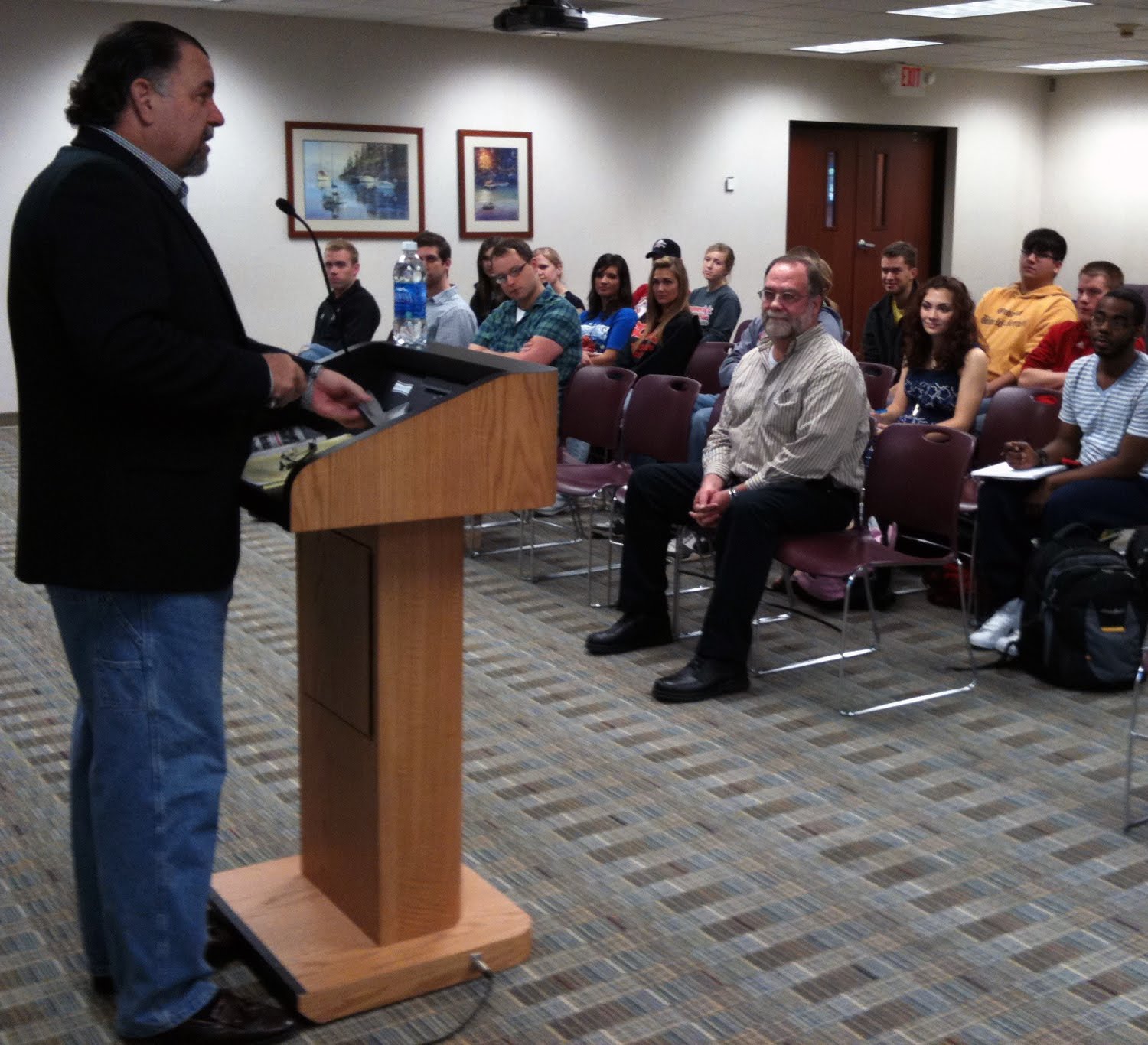
Krajicek addressing (UNO) University of Nebraska at Omaha students, ©photo by Jeremy Lipschultz
He switched gears to teach full-time at Columbia, where he’d been an adjunct. Eight years into his scholarly role he authored Scooped!, an acclaimed memoir-critical analysis of criminal justice reporting, and then left, abandoning almost sure tenure, to return to crime writing. Only on his terms.
“I relish telling these old true crime stories. I love the historical connection that I’m one of the last living remnants of True Detective magazine. These stories used to appear everywhere but print’s given over the true crime franchise to television.”
He makes occasional TV appearances as a true crime expert but mainly mines old cases for his stories. His next local book event is Nov. 9 at noon at the Jewish Community Center. Visit Krajicek’s Author’s Page at Amazon.com.
Related articles
- Crime and Justice News: 8-11-2011 (alaskacure.wordpress.com)
Hidden In plain view: Rudy Smith’s camera and memory fix on critical time in struggle for equality
©by Leo Adam Biga
Originally published in The Reader (www.thereader.com)
It was another August night in the newsroom when word came of a riot breaking out on Omaha’s near northside. If the report were true, it meant for the second time that summer of 1966 minority discontent was turning violent. Rudy Smith was the young Omaha World-Herald photojournalist who caught the story. His job at the newspaper was paying his way through then-Omaha University, where the Central High grad was an NAACP Youth Council and UNO student senate activist. Only three years before, he became the first black to join the Herald’s editorial staff. As a native north Omahan dedicated to his people’s struggle, Smith brought instant credibility to his assignments in the black community. In line with the paper’s unsympathetic civil rights stance at the time, he was often the only photographer sent to the near northside.
“And in many cases my colleagues didn’t want to go. They were fearful of the minority community, and so as a result I covered it. They would just send me,” said Smith, a mellow man whose soft voice disguises a fierce conviction. “As a result, the minority community that never had access to the World-Herald before began to gain access. More stories began to be written and more of the issues concerning north Omaha began to be reported, and from a more accurate perspective.”
It was all part of his efforts “to break down the barriers and the stereotypes.”
Archie Godfrey led the local NAACP Youth Council then. He said Smith’s media savvy made him “our underground railroad” and “bridge” to the system and the general public. “Without his leadership and guidance, we wouldn’t of had a ghost of an understanding of the ins and outs of how the media responds to struggles like ours,” said Godfrey, adding that Smith helped the group craft messages and organize protests for maximum coverage.
More than that, he said, Smith was sought out by fellow journalists for briefings on the state of black Omaha. “A lot of times, they didn’t understand the issues. And when splinter groups started appearing that had their own agendas and axes to grind, it became confusing. Reporters came to Rudy to sound him out and to get clarification. Rudy was familiar with the players. He informed people as to what was real and what was not. He didn’t play favorites. But he also never hid behind that journalistic neutrality. He was right out front. He had the pictures, too. This city will probably never know the balancing act he played in that.”
As a journalist and community catalyst, Smith has straddled two worlds. In one, he’s the objective observer from the mainstream press. In the other, he’s a black man committed to seeing his community’s needs are served. Somehow, he makes both roles work without being a sell out to either cause.
“My integrity has never been an issue,” he said. “As much as I’d like to be involved in the community, I can’t be, because sometimes there are things I have to report on and I don’t want to compromise my professionalism. My life is kind of hidden in plain view. I monitor what’s going on and I let my camera capture the significant things that go on — for a purpose. Those images are stored so that in the next year or two I can put them in book form. Because there are generations coming after me that will never know what really happened, how things changed and who was involved in changing the landscape of Omaha. I want them to have some kind of document that still lives and that they can point to with pride.”
For the deeply religious Smith, nothing’s more important than using “my God-given talents in service of humanity. I look at my life as one of an artist. An artist with a purpose and a mission. I’m driven. I’m working as a journalist on an unfinished masterpiece. My life is my canvas. And the people and the events I experience are the things that go onto my canvas. There is a lot of unfinished business still to be pursued in terms of diversity and opportunity. To me, my greatest contributions have yet to be made. It’s an ongoing process.”
The night of the riot, Smith didn’t know what awaited him, only that his own community was in trouble. He drove to The Hood, leaving behind the burnt orange hard hat a colleague gave him back at the office.
“I knew the area real well. I parked near 20th and Grace Streets and I walked through the alleys and back yards to 24th Street, and then back to 23rd.”
Most of the fires were concentrated on 24th. A restaurant, shoe shine parlor and clothing store were among the casualties. Then he came upon a church on fire. It was Paradise Baptist, where he attended as a kid.
“I cussed, repeating over and over, ‘My church, my church, my church,’ and I started taking pictures. Then I heard — ‘Hey, what are you doing here?’ — and there were these two national guardsmen pointing their guns at me. ‘I’m with the World-Herald,’ I said. I kept snapping away. Then, totally disregarding what I said, they told me, ‘Come over here.’ This one said to the other, ‘Let’s shoot this nigger,’ and went to me, ‘C’mon,’ and put the nuzzle of his rifle to the back of my head and pushed me around to the back of the building. As we went around there, I heard that same one say, ‘There ain’t nobody back here. Let’s off him, he’s got no business being here anyway.’ I was scared and looking around for help.
That’s when I saw a National Guard officer, the mayor and some others about a half-block away. I called out, ‘Hey! Hey! Hey!’ ‘Who is it?’ ‘Rudy Smith, World-Herald.’ ‘What the hell are you doing here?’ ‘I’m taking pictures and these two guys are going to shoot me.’ The officer said, ‘C’mon over here.’ ‘Well, they aren’t going to let me.’ ‘Come here.’ So, I went…those two guys still behind me. I told the man again who I was and what I was doing, and he goes, ‘Well, you have no damn business being here. You know you could have been killed? You gotta get out of here.’ And I did. But I got a picture of the guardsmen standing in front of that burning church, silhouetted by the fire, their guns on their shoulders. The Herald printed it the next day.”
Seeing his community go up in flames, Smith said, “was devastating.” The riots precipitated the near northside’s decline. Over the years, he’s chronicled the fall of his community. In the riots’ aftermath, many merchants and residents left, with only a shell of the community remaining. Just as damaging was the later North Freeway construction that razed hundreds of homes and uprooted as many families. In on-camera comments for the UNO Television documentary Omaha Since World War II, Smith said, “How do you prepare for an Interstate system to come through and divide a community that for 60-70 years was cohesive? It was kind of like a big rupture or eruption that just destroyed the landscape.” He said in the aftermath of so much destruction, people “didn’t see hope alive in Omaha.”
Today, Smith is a veteran, much-honored photojournalist who does see a bright future for his community. “I’m beginning to see a revival and resurgence in north Omaha, and that’s encouraging. It may not come to fruition in my lifetime, but I’m beginning to see seeds being planted in the form of ideas, directions and new leaders that will eventually lead to the revitalization of north Omaha,” he said.
-
Rudy Smith
His optimism is based, in part, on redevelopment along North 24th. There are streetscape improvements underway, the soon-to-open Loves Jazz and Cultural Arts Center, a newly completed jazz park, a family life center under construction and a commercial strip mall going up. Then there’s the evolving riverfront and Creighton University expansion just to the south. Now that there’s momentum building, he said it’s vital north Omaha directly benefit from the progress. Too often, he feels that historically disenfranchised north Omaha is treated as an isolated district whose problems and needs are its own. The reality is that many cross-currents of commerce and interest flow between the near northside and wider (read: whiter) Omaha. Inner city residents work and shop outside the community just as residents from other parts of the city work in North O or own land and businesses there.
“What happens in north Omaha affects the entire city,” Smith said. “When you come down to it, it’s about economics. The north side is a vital player in the vitality and the health of the city, particularly downtown. If downtown is going to be healthy, you’ve got to have a healthy surrounding community. So, everybody has a vested interest in the well-being of north Omaha.”
It’s a community he has deep ties to. His involvement is multi-layered, ranging from the images he makes to the good works he does to the assorted projects he takes on. All of it, he said, is “an extension of my faith.” He and his wife of 37 years, Llana, have three grown children who, like their parents, have been immersed in activities at their place of worship, Salem Baptist Church. Church is just one avenue Smith uses to strengthen and celebrate his community and his people.
With friend Edgar Hicks he co-founded the minority investment club, Mite Multipliers. With Great Plains Black Museum founder Bertha Calloway and Smithsonian Institute historian Alonzo Smith he collaborated on the 1999 book, Visions of Freedom on the Great Plains: An Illustrated History of African Americans in Nebraska. Last summer, he helped bring a Negro Leagues Baseball Museum exhibit to the Western Heritage Museum. Then there’s the book of his own photos and commentary he’s preparing. He’s also planning a book with his New York theater actress daughter, Quiana, that will essay in words and images the stories of the American theater’s black divas. And then there’s the petition drive he’s heading to get Marlin Briscoe inducted into the National Football League Hall of Fame.
Putting others first is a Smith trait. The second oldest of eight siblings, he helped provide for and raise his younger brothers and sisters. His father abandoned the family after he was conceived. Smith was born in Philadelphia and his mother moved the family west to Omaha, where her sister lived. His mother remarried. She was a domestic for well-to-do whites and a teenaged Rudy a servant for black Omaha physician W.W. Solomon. Times were hard. The Smiths lived in such squalor that Rudy called their early residence “a Southern-style shotgun house” whose holes they “stuffed with rags, papers, and socks. That’s what we call caulking today,” he joked. When, at 16, his step-father died in a construction accident, Rudy’s mother came to him and said, “‘You’re going to take over as head of the family.’ And I said, ‘OK.’ To me, it was just something that had to be done.”
Smith’s old friend from the The Movement, Archie Godfrey, recalled Rudy as “mature beyond his years. He had more responsibilities than the rest of us had and still took time to be involved. He’s like a rock. He’s just been consistent like that.”
“I think my hardships growing up prepared me for what I had to endure and for decisions I had to make,” Smith said. “I was always thrust into situations where somebody had to step up to the front…and I’ve never been afraid to do that.”
When issues arise, Smith’s approach is considered, not rash, and reflect an ideology influenced by the passive resistance philosophies and strategies of such diverse figures as Machiavelli, Gandhi and King as well as the more righteous fervor of Malcolm X. Smith said a publication that sprang from the black power movement, The Black Scholar, inspired he and fellow UNO student activists to agitate for change. Smith introduced legislation to create UNO’s black studies department, whose current chair, Robert Chrisman, is the Scholar’s founder and editor. Smith also campaigned for UNO’s merger with the University of Nebraska system. More recently, he advocated for change as a member of the Nebraska Affirmative Action Advisory Committee, which oversees state departmental compliance with federal mandates for enhanced hiring, promotion and retention of minorities and women.
The camera, though, remains his most expressive tool. Whether it’s a downtown demonstration brimming with indignation or the haunted face of an indigent man or an old woman working a field or Robert Kennedy stumping in North O, his images capture poignant truth. “For some reason, I always knew whatever I shot was for historical purposes,” he said. “When it’s history, that moment will never be revisited again. Words can describe it, but images live on forever. Just like freedom marches on.”
Related Articles
- Letting 1,000 Flowers Bloom, The Black Scholar’s Robert Chrisman Looks Back at a Life in the Maelstrom (leoadambiga.wordpress.com)
- UNO Wrestling Dynasty Built on a Tide of Social Change (leoadambiga.wordpress.com)
- Quiana Smith’s Dream Time (leoadambiga.wordpress.com)
- Omaha Native Steve Marantz Looks Back at the City’s ’68 Racial Divide Through the Prism of Hoops in His New Book, ‘The Rhythm Boys of Omaha Central’ (leoadambiga.wordpress.com)
- Once More With Feeling, Loves Jazz & Arts Center Back from Hiatus (leoadambiga.wordpress.com)
- Native Omaha Days: A Black is Beautiful Celebration, Now, and All the Days Gone By (leoadambiga.wordpress.com)
- Native Omahans Take Stock of the African-American Experience in Their Hometown (leoadambiga.wordpress.com)
- From the Archives: Photographer Monte Kruse Works Close to the Edge (leoadambiga.wordpress.com)
- Miss Leola Says Goodbye (leoadambiga.wordpress.com)
- Overarching Plan for North Omaha Development Now in Place, Disinvested Community Hopeful Long Promised Change Follows (leoadambiga.wordpress.com)


 Leo Adam Biga's My Inside Stories