Archive
Creative couple: Bob and Connie Spittler and their shared creative life 60 years in the making
A lot of you know me as a frequent and longtime contributor with The Reader, for whom I’ve written more than a thousand stories since 1996, including hundreds of cover pieces. Beyond The Reader, I am fortunate to own extended relationships with several other publications. I was a major contributor to the Jewish Press for well over a decade. My tenures with Omaha Magazine and Metro Magazine are both more than a decade old now. But perhaps my longest-lived contributor relationship has been with the New Horizons, a monthly newspaper published by the Eastern Nebraska Office on Aging. Editor Jeff Reinhardt and I are committed to positive depictions of aging that illustrate in words and images the active, engaged lifestyles of people of a certain age. Older adult living doesn’t need to follow any of the outdated prescriptions that once had folks at retirement age slowing down to a crawl and more or less retreating from life. That’s not at all how the people we profile approach the second or third acts of their lives. No, our subjects are out doing things, working, creating, traveling, making a difference. My latest profile subjects for the Horizons, Bob and Connie Spittler, are perfect examples. They are in their 80s and still living the active, creative lives that have always driven their personal and professional pursuits. He makes still and moving images. He pilots planes. She writes essays, short stories and books. They travel. They enjoy nature. Sometimes they combine their images and words together in book projects. Bob and Connie are the cover subjects in the January 2016 issue. They join a growing list of folks I’ve profiled for the Horizons who embody such precepts of health aging as keeping your mind occupied, doing what you enjoy, following youe passion, cultivating new interests and discovering new things. The Spittlers are also in a long line of dynamic older couples I’ve profiled – Jose and Linda Garcia, Vic Gutman and Roberta Wilhelm, Josie Metal-Corbin and David Corbin, Ben and Freddie Gray. You can find many of my Horizons stories on my blog, Leo Adam Biga’s My Inside Stories at leoadambiga.com.
NOTE: ©Photos by Jeff Reinhardt, New Horizons Editor, unless otherwise indicated.

Bob and Connie Spittler outside their Brook Hollow home
Creative couple: Bob and Connie Spittler and their shared creative life 60 years in the making
©by Leo Adam Biga
Appeared in the January 2016 issue of the New Horizons
Once a creative, always a creative.
That’s how 80-something-year-olds Bob and Connie Spittler have rolled producing creative projects alone or together for six decades. Their work spans television commercials, industrial films, slideshows and books.
Bob, a photographer and filmmaker, these days experiments making art photos. Connie, a veteran scriptwriter, is now an accomplished essayist, short story writer and novelist. Her new novel, the tongue-in-cheek titled The Erotica Book Club for Nice Ladies, has found a receptive enough audience she’s writing a sequel. The book is published by Omaha author-publisher Kira Gale and her River Junction Press.
This past summer Bob and Connie hit the highway for a five-state book tour. Their stops included signings at the American Library Association Conference in San Francisco and the Tattered Cover in Denver. Following an intimate reading at a Berkeley, Calif. couple’s home she and Bob stayed the night. It harkened back to the RV road trips they made with their four kids.
On social media she termed the tour “an author’s dream.” It was especially gratifying given Bob endured a heart angioplasty and stent earlier in 2015.
Connie was also an invited panelist at an Austin, Texas literary event.
“All in all, an unforgettable year of healing, friendship, interesting places and great people,” she wrote in a card to family and friends.
Sharing a love for the outdoors, the Soittlers have applied their respective talents to splendid nature books. The Desert Eternal celebrates the ecosystem surrounding the home they shared in the foothills of the Catalina Mountains in Arizona, where they “retired” after years running their own Omaha film production biz
“When we want down to Tucson we weren’t going to be working together. We were just going to do our own thing,” she says. “We’ve always been able to kind of follow what we want to do. So I started writing literary things and he was out taking pictures. I had a lumpectomy and the day I came home I’m looking out at the Catalina Mountains and I thought, you know it’s strange Bob and I both think we’re doing our own thing when we’re doing the same thing, we’re just each doing it in our own way. We were both doing the desert.
“We lived between two washes the coyotes and other wildlife came through. I had seven weeks of radiation and I had the idea of putting our work together. I downloaded all my essays on the desert and every morning before radiation I’d go into his office and together we’d look through his photo archive for images he’d taken that matched the words I’d written. Well, by the time we got to the end we had 114 photos – enough for a book. Bob formatted it. It came back (from the printer) the day my radiation finished. It was just this cycle.”
Another of their books, The Legend of Sleepy Hollow, documents the wild-in-the-city sanctuary around the southwest Omaha home they’ve lived in since 2010, when they returned from their Arizona idyll. Their home in the gated Sleepy Hollow neighborhood abuts four interconnected ponds that serve as habitat for feathered and furry creatures. The inspiration the couple finds in that natural splendor gets expressed in her words and his images.
“Words and images are perfect for each other,” Connie says by way of explaining what makes her and Bob such an intuitive match.
The couple met at Creighton University in the early 1950s. They studied communications and worked on campus radio, television, theater productions together. He was from the big city. She was from a small town, But they hit it off and haven’t stopped collaborating since.

The couple’s original office, ©Bob Spittler
Her writerly roots
The former Connie Kostel grew up in South Dakota. This avid reader practically devoured her entire hometown library.
Connie developed an affection for great women writers. “I love Emily Dickinson. Her poems are short and kind of pithy. She always has one thought in there that just kind of sticks with you.” Other favorites include Elizabeth Barrett Browning, Christina Rossetti, Jane Austen.
“I like a lot of classics.”
Terry Tempest Williams is a contemporary favorite.
Success in school got her thinking she might pursue writing.
“I think it was in the sixth grade I won an essay competition. It had to be on the topic of how we increased production on our family flax farm. Well, there were some farm kids in my grade but I don’t think anybody grew flax. My father was a funeral director. But I got the encyclopedia and I found out some facts about flax and I wrote an essay and I won. I think I got $25 or something. i mean it was like, Wow, I think I should be a writer. That sparked my interest.”
She attended the Benedictine liberal arts Mount Marty College in Yankton, S.D., a then-junior college for girls.
“I got a scholarship there. I was interested in writing and I was going to have to transfer anyway and I began to see radio and TV as one way maybe I could make a living writing rather than writing short stories and novels and so forth. So I decided to do that. My parents researched it out and found Creighton University for me, It had one of the few programs with television, radio and advertising,”
His Army detour
Meanwhile, Bob graduated from Omaha Creighton Prep before getting drafted into the U.S. Army. In between, he earned his private pilot’s license, the start of a lifelong affair with flying that’s seen him own and pilot several planes he’s utilized for both work and pleasure. Prior to the Army he began fooling around with a camera – a Brownie.
He recently put together a small book for his family about his wartime stint in Korea. He had no designs on doing anything with photography when he began documenting that experience.
“Everybody bought a camera over there and I bought an Argus C3. I just got interested in taking pictures for something to do. I learned how to use it and I just took a lot of pictures. I didn’t think it was going anywhere. It was just a hobby, you know.”
But those early photos show a keen eye for composition. He was, in short, a natural. The book he did years later, titled My Korea 1952 to 1953, gives a personal glimpse of life in the service amidst that unfamiliar culture and forbidding environment.
The Army assigned Spittler to intelligence work.
“My specialty was artillery but I was put in what they called G2 Air (part of Corps Intelligence). I went to a school in Japan. Back in Korea I coordinated the Air Force with the artillery in the CORPS front.”
Spittler relied on wall maps and tele-typed intel to schedule flights by Air Force photo-reconnaissance planes. “When I first arrived P-51 Mustangs were the planes used. Then after about six months they shifted to the F-80 Shooting Star,” he writes. “In winter a little pot-bellied kerosene stove warmed our tent. At night it had to be turned off and lighting it on a cold morning, below zero, was painful, It took 10 minutes before it even thought about giving heat.”
The closest he came to action was when a Greek mortar platoon on the other side of a river running past the American camp fired shells into a nearby hill, causing the GIs to scramble for cover.
Though he didn’t pilot any aircraft there he did find ways to feed his flying fix.
He writes, “Since my job was using radio contact with reconnaissance flights every day I became ‘talking friendly’ with some of the pilots. One of them agreed to give me a jet ride…”

Bob Spittler
That ride was contingent on Spittler making his way some distance to where the sound-breaking aircraft were based. “Come hell or high water I wasn’t going to pass up that offer,” he writes. With no jeep available, he hitchhiked his way southwest of Seoul and got his coveted ride in a T-33. From 33,000 feet he sighted the “double bend’ of the Imjin River pilots used as a rendezvous landmark – something he’d heard them often reference in radio chatter.
At Spittler’s urging the pilot did some loops. Aware his guest was a flier himself the pilot let Spittler put the jet into a roll. But before he could complete the pull out the pilot took over when Spittler began losing control in the grip of extreme G-forces he’d never felt before. An adrenalin rush to remember.

Kindred spirits
After a year in-country Bob eagerly resumed the civilian life he’d put on hold. What he did to amuse himself in the Army. photography, became a passion. When he and Connie met at Creighton they soon realized they shared some interests and ambitions. They were friends first and dated off and on. She was entranced by the romance of this tall, strapping veteran who took her up in his Piper Cub. He was drawn to her petite beauty and unabashed intelligence and independence.
Besides their mutual attraction, they enjoyed working in theater productions. They even appeared in a few plays together. Connie’s passion for theater extended to teaching dramatic play at Joslyn Art Museum. She also enacted the female lead, Lizzie, in an Omaha Community Playhouse production of The Rainmaker.
The pair benefited from instructors at Creighton, including two Jesuit priests who were mass communications pioneers. Before commercial television went on the air in Omaha, Rev. Roswell Williams trained production employees of WOW-TV with equipment he set up at the school. He founded campus radio station KOCU to prepare students for broadcasting careers. He implemented an early closed circuit television systems used to teach classes.

Connie Spittler works the board as Rex Allen gets ready to shoot a scene in the 28-minute film on the story of Ak-Sar-Ben. Published Nov. 16, 1968. (Richard Janda/The World-Herald).
“He was the person that brought television to Creighton University,” Connie says. “He was interested in it in students learning about it.”
Rev. Lee Lubbers was an art professor whose kinetic sculptures experimental, film offings and international satellite network, SCOLA, made him an “avant garde” figure.
“It was so unusual to have him be here and do what he did,” Connie says. “He stirred things up for sure.”
Right out of college she and Bob worked in local media. He directed commercials and shows at WOW-TV. She was a continuity director, advertising scriptwriter and director at fledgling KETV. She also worked in advertising at radio station KFAB.
Bob’s father was an attorney and there was an expectation he would follow suit but he had other plans.
“My father wanted me to be a lawyer and I just kept fighting that,” he recalls. “The gratifying thing about that is that after about 10 years of being in business he said, ‘I’m really kind of glad you didn’t go into it.'”
Bob calls those early days of live TV “fun.”
“I did little 10 second spots for Safeway. They’d just give me the copy and have me go shoot a banana or something. Well, one night I hung them up in the air and swung them and moved the camera and they were flying all over the place and Safeway just loved it.
“But it changed so much with (video )tape coming in. You can always look back and say, ‘Boy, what we could have done if we’d had that.'”

Taking the plunge
Bob and Connie then threw caution aside to launch a film production company from their basement. Don Chapman joined them to form Chapman-Spittler Productions. While leaving the stability of a network affiliate to build a business from scratch might have been a scary proposition for some, it fit Bob to a tee.
“To be honest with you I’m not a team player and I’m not a leader. I’m kind of a loner,” he says. “I could see corporate-wise I wouldn’t get anywhere. I had ideas and things I wanted to do myself. When I did get something done it was always off by myself and I figured out that was the way I wanted it.”
The fact that Bob and Connie brought separate skill sets to the table helped make them work together.
“We didn’t do the same things, that was part of it, so we weren’t competing with each other,” she says. “One other very important thing she did – she kept the books,” Bob notes.
It was unusual for a married couple to work together in the communications field then. Connie was also a rarity as a woman in the male-dominated media-advertising worlds.
She’s long identified as a feminist.
“I was a working woman in the ’50. We were just women that wanted to be able to work, to be able to make a living wage, that wanted to have a family and kids if we chose to but not that we had to.”
There were a few occasions when her gender proved an issue.
“Northern Natural Gas was interviewing for a position and they said there’s no way we can accept a female for this because this job entails going to a lot of parties that get too rowdy, so we’re sorry. When I was at KETV we were doing a documentary about SAC (Strategic Air Command) in-air refueling missions. I wanted to go up so I could write about it, but base officials said we can’t send up a woman, so I couldn’t do that. The station did send up a male director and he came back and told me about it and I wrote the script
“Otherwise, I don’t think I did experience discrimination.”

Bob’s beloved Piper Cub, ©Bob Spittler
She wasn’t taking any chances though when she broke into the field.
“I was one of the first people hired before KETV went on the air. My job was as an administrative assistant to work with New York (ABC). That was one place where I didn’t know if there’d be any problem with my being a woman so instead of signing letters Connie Kostel (this was before she was married), I signed them Con Kostel, so they wouldn’t know what sex I was. I didn’t have any problems.”
Connie will never forget the time she wrote a promo for a Hollywood actor on tour promoting his new ABC Western series.
“I directed him in the promo. When I got home Bob said, ‘How’d it go with the guy from Hollywood?’ I said, ‘He’s nice looking but he’s a loser, He had the personality of a peach pit. I just didn’t get anything from him at all.'”
She was referring to James Garner, whose Maverick became a hit.
In retrospect, she chalks up his lethargy to being exhausted after a long tour. “Thank heavens I didn’t want to be a talent scout.”


The salad days
She says when she and Bob had their own business she was put “in charge of some really big sales meetings” by clients who entrusted her with writing-producing multi-screen slide shows. These elaborate productions cost tens, even hundreds of thousands of dollars and often involved name narrators, such as Herschel Bernardi and Rex Allen.
She wrote-produced a 9-screen, 14-projector show for Leo A. Daly having never produced even a single-screen slide show.
“Inspired in the late ’60’s by our plane trips to the Montreal World Fair and the San Antonio HemisFair, Bob and I were both excited by multi-screen shows.”
Once, Connie was asked to produce show in three days to be shown in a tent in Saudi Arabia.
“I always wondered about the extension cord,” she quips.
Bob says Connie was accepted as an equal by the old boys network they operated in. “I never saw any signs of any rejection.” Besides, he adds, “she got along real well with people” and “she was good.”
For her part, Connie felt right at home doing projects for Eli Lilly, Mutual of Omaha, Union Pacific, ConAgra, Ak-Sar-Ben, the Greater Omaha Chamber of Commerce and many other clients.
“I loved it, I absolutely loved it. And the thing I loved about the writing I did was that each one was a different subject. I’d go visit a big company like Leo A. Daly and they’d introduce me to their top people to interview. I’d be given all these research books and reports to read. It was like a continuing education. Working on the Daly account I learned a lot about architecture.
“Almost anything turned out to be really interesting once I talked to the people who worked there who were excited about their work.”
Their projects played international film festivals and earned industry awards. Bob worked with Galen Lillethorup at Bozell and Jacobs to produce the ‘The Great Big Rollin’ Railroad’ commercials for Union Pacific, which won the prestigious Clio for B & J. Bob recalls the North Platte, Neb. shoot as “fun,” adding, “We got a lot of attention out of it and we did get other business from it.” A few years later, Spittler Productions received their own Clio recognition for an Omaha Chamber project. Assignments took them all over the U.S. Bob would often do the flying.
“Bob either shot, scouted or landed for business purposes and I traveled to locations to research, write and produce sales meetings in every state in the U.S. with the exception of Alaska, Hawaii, Maine and Rhode Island,” Connie says.
One time when Bob let someone else do the flying he and a Native American guide caught a helicopter that deposited them atop a Wyoming mesa so he could capture a train moving across the wilderness valley.
“I sat up there with my Arriflex and that old Indian and waited for that train to come and neither of us could understand the other,” he recalls.
Connie once wrote liner notes for a City of London Mozart Symphonia produced by Chip Davis and recorded in Henry Wood Hall, London. Davis recommended her to Decca Records in London to write liner notes for a Mormon Tabernacle Choir album.
At its peak Chapman-Spittler Productions did such high profile projects the partners opened a Hollywood office. Spittler worked with big names Gordon McCrae and John Cameron Swayze.
The Nebraskans made their office a Marina del Rey yacht, the Farida, supposedly once owned by King Farouk and named after his wife.
“On one occasion I flew a Moviola (editing machine) out there and we edited one of the Union Pacific commercials on the boat over in Catalina,” Bob remembers.
An InterNorth commercial was edited there as well.
Connie adds, “I used the yacht as a wonderful place to write scripts.”
“Ours was 40-foot. We were able to sleep on it. I took the boat out a lot. When we left, that’s where it stayed,” Bob says. “Our boat was right next to Frank Sinatra’s boat off the Marina del Rey Hotel. His was a converted PT-boat.”
Bob also did his share of flying up and down the Calif. coast. Connie wedded her words to his images to tell stories.
One of Bob and Connie’s favorite projects was working with Beech Aircraft. Using aerial photography Bob shot in several states, they produced a film on the pressurized Baron and later a film on the King Air for the Beechcraft National Conference in Dallas, Texas
The variety of the projects engaged her.
“Curiosity is my favorite thing,” she acknowledges.
A hungry mind is another attribute she shares with her mate, as Bob’s a tinkerer when it comes to mechanical and electronic things.
“Bob is curious, too,” she says. “He’s always trying to think of something to invent. Years ago he went out and brought home one of the first PCs – a TRS 80. He wanted to play around with it. Then he pushed me into playing around with it and then he made all the kids learn it so they could do their college applications on the computer. So he dragged the whole family into the computer generation.”
The way Bob remembers it, “When I brought that first computer home we had it for a week and I was still trying to figure out how to turn the damn thing on and my son was programming it. He taught me. But that was neat. I’m way behind now on technology,” though he has digital devices to share and store his work.

Connie Spittler
Reinventing themselves
Bob and Connie’s collaborations continued all through the years they worked with Don Chapman. When that partnership dissolved the couple went right on working together.
“We were complementary I suppose in many ways,” she says. “When we had the business I wrote and produced, he shot and edited, so it just worked.”
By now, Connie’s written most everything there is to write. Being open to new writing avenues has brought rewarding opportunities.
“You have to be open to writing about other things just to keep your mind going. I received a phone call in Tucson one day and this person said, ‘We heard about you and we wondered if you’d come read your cowboy poetry at our trail ride?’ I’d never written any cowboy poetry but it sounded so much fun. I said, ‘Let me think about that.’ Well, I like cowboys and nature and all these things, so I agreed to do it. Bob and I ended up making this little book Cowboys & Wild, Wild Things.”
When she got around trying her hand at fiction writing, it fit like a glove.
“I was writing my first fiction piece and Bob said to me, ‘Do you know for the first time since we’ve come down here every time you come out of your office you’re smiling?’ Before, my projects were all kind of heavy, fact-laden subjects. I mean, there was creativity but it was mostly how do you take this subject and make it interesting. With the novel, I could make it anything I want.”
She hit her fiction stride with the books Powerball 33 and Lincoln & the Gettysburg Address.
A project that brought her much attention is the Wise Women Videos series she wrote about individuals who embody or advocate positive aging attributes. The videos have been widely screened. For a time they served as the basis for a cottage industry that found her teaching and speaking about mind, body, spirit matters.
For the series, she says, “I found interesting women I thought other people should listen to. None of them were famous. They were just women introduced to me or once people knew I was doing the series they would say, Oh, you should talk to this person or that person.”
As the series made its way into women’s festivals and organizations she got lots of feedback.
“When I would get letters from cancer groups or prisons or abused women groups I thought good grief, how wonderful that can happen, that they can ‘meet’ these women through these videos.”
The series is archived in Harvard University’s Library on the History of Women in America.
She’s given her share of writing presentations and talks – “I love to attend book clubs to discuss my books” – but a class on memoir she taught in Tucson took the cake.
“The class was inspired by one of my Wise Women Videos and began with each student telling a story about their first decade in life. Then each time we met the women chose one important memory to tell the group about the next decade. The assignment was to write that story for family, friends or themselves. An interesting thing happened: When the class sessions reached the end of their decades and the class was finished the women were so connected from the experience they continued to meet independently for years afterward.”

Bob and Connie on their deck
Legacy
Connie’s own essays and short stories are published in many anthologies. She achieved a mark of distinction when an essay of hers, “Lint and Light,” inspired by the work and concepts of the late Neb. artist and inventor Reinhold Marxhausen, was published in The Art of Living – A Practical Guide to Being Alive. The international anthology’s editor sent an email letting Connie know the names of the other authors featured in the book. She was stunned to find herself in the company of the Dalai Lama, Mikhail Gorbachev, Deepak Chopra, Desmond Tutu, Jean Boland, Sir Richard Branson and other luminaries.
“I almost fell off the chair. When that happened I was like, I wonder if I should quit writing because I don’t think I’ll ever top that.”
Bob says he always knew Connie was destined for big things. “It didn’t surprise me a bit.”
Much of her work lives on thanks to reissues and requests.
“It’s interesting how you do something and it isn’t necessarily gone,” she says. “Some of those things have a long life. I always say a book lasts as long as the paper lasts.”
Now with the Web her work has longer staying power than ever.
Meanwhile, one of Bob’s photographs just sold in excess of a thousand dollars at a gallery in Bisbee, Arizona.
Living in Tucson Connie says she was spoiled by the “absolutely wonderful writers community” there. She and some fellow women writers created their own salon to talk about art, music, theater and literature. “The one rule was you couldn’t gossip – it was just intellectual, interesting talk,” she says. “One night the subject of erotica came up. The next day I went to a bookstore and I said to this young female clerk, ‘Do you have a place for erotica here?’ And she said, ‘Oh erotica, yes, let me get my friend, she loves erotica, too!’ and they both took me off to the section and told me all their favorite books. I didn’t get any of their favorites, but I did get this one, Erotica: Women’s Writing from Sappho to Margaret Atwood.”
Connie found writers published in its pages she never expected.
“When I opened this book the first thing I saw was Emily Dickinson, then Jane Austen, Charlotte Bronte, all these well-known, respected authors. Their work is considered erotica for their time because it was romantic reading with sensual undertones. It’s in your mind, not graphic. I thought it so interesting that that could be erotica. It occurred to me a book club about erotica could be fun.”
Only Connie’s resulting book is not erotica at all but “a cozy mystery.”
“A librarian who gave it 5 stars said, ‘You would not be embarrassed to discuss this book with your mother.'” In the back Connie offers a list of erotica titles for those interested in checking out the real thing.
She’s delighted the book’s being published in the Czech Republic.
“My dad was a hundred percent Czech. I asked the publisher if I could add my maiden name and change the dedication to dedicate it to my dad and my grandmother and Czech ancestors and they said, ‘We’d love that.’ My dad’s been gone a long time and he didn’t have any sons and he always said to me, ‘That’s the end of my line,’ so now I thought it will live on – at least in the Czech Republic.”

Words to live by
Closer to home, Connie’s developed a following for the Christmas Card essays she pens. Her sage observations and sublime wordings are much anticipated. This year’s riffs on the fox that visits their property.
“Sometimes in the late evening he trots along the grasslands and pond. Bob, watching TV down in the family room, has spotted the scurrying fox several times – always unexpected and too quick for his camera lens. I haven’t seen this wild urban creature yet since I’m in bed during the usual prowling gorse. Still, imagining his billowing tail flying by int he dark adds a flurry of magic to the winter night…
“As our dancing, prancing fox moves in and out of focus and time, I think of the surprising people, pets, events and moments that visit our lives. They come and go with reminders to be grateful for unexpected things that happen along the way…fleeting or lingering…illusive…intriguing.
“This season our message comes from the fox, a wish for wisdom, longevity and beautiful surprises. Do keep a look out. You never know who you’ll meet or what you’ll see.”
Finally, as one half of a 57-year partnership, Connie proffers some advice about the benefits of passion-filled living.
“One beautiful thing about writing is that by picking up pencil and paper, or using computer, iPad, you can write anywhere. I’ve written on a beach, by a pool, a yacht and in an RV. I always encourage anyone interested in writing to sit down and go to it. It doesn’t cost any money to try and studies show the creativity of writing keeps the mind alert. And it’s a feeling of accomplishment, if you finish a piece or even if you finish a good day writing.”
The same holds true for filmmaking and photography. And for delighting in the wonders of wild foxes running free.
Follow the couple at http://www.conniespittler.com.
Natural imagery: Tom Mangelsen travels far and wide to where the wild things are for his iconic photography, but always comes back home to Nebraska
Tom Mangelsen’s journey to becoming a world-class nature-wildlife photographer is told in my New Horizons cover story now available at newsstands. The Nebraska native truly goes to where the wild things are to make his iconic photographs. His work is available at his Images of Nature galleries across the country. But as my story details, no matter how far afield he travels for his work, and he travels all over the world, he always comes back home, to where the Platte River flows and the cranes migrate in his native land. There, among the shallows and sandbars, his love for nature and photography first took hold and every year he returns for the song and dance of that perennial ritual that speaks deeply to his heart and soul.

Natural Imagery
Tom Mangelsen travels far and wide to where the wild things are for his iconic photography, but always comes back home to Nebraska
©by Leo Adam Biga
Originally appeared in the February 2015 New Horizons
Growing up on the Platte
Thomas Mangelsen had no inkling youthful forays along the Platte River’s sandbars and shores would be the foundation for a world-class nature photography and conservation career.
He didn’t even take pictures growing up in the 1950s into the 1960s. That calling didn’t come until later. Without knowing it though his Huck Finn-like boyhood spent closely observing the natural world around him was perfect preparation for what became his life’s work.
His retailer father Harold Mangelsen, founder of the family crafts store now run by Tom’s brother David, was an avid hunter who championed Platte River Basin conservation before environmental stands were popular. The Mangelsens made good use of a family cabin on the river. There, Tom gained a deep appreciation for the wild, an ardor imbued in the painterly images he makes of species and ecosystems. All are available as framed prints at his nationwide Images of Nature galleries. Then there are his photo books, including his latest, The Last Great Wild Places. His work sometimes accompanies articles in leading magazines, too. Best known for his stills, he’s also shot nature films.
From his Jackson Hole, Wyo. residence he travels widely, shooting on all seven continents. He returns to Neb. to visit family and friends. Every March he’s back for the great crane migration, often in the company of star anthropologist Jane Goodall, a board member of the nonprofit Cougar Fund he co-founded to protect wild cougars.
He’s won national and international recognition for his work and brought wide attention to the annual crane migration, the importance of the Platte and endangered animal populations.
None of it may have happened were it not for that outdoorsy, rite-of-passage coming-of-age that gave him a reverence for nature. That, in concert with an abiding curiosity, a restless spirit and a good eye, are the requisite qualities for being a top wildlife photographer.
His earliest memories are of the meandering Platte’s well-worn life rhythms. Mangelsen largely grew up in Grand Island, where he was born. The family moved to Ogallala, where his father opened his first store, before moving back to Grand Island and finally to Omaha when Tom was 15. Wherever he lived, he spent most of every summer on the Platte. When not hunting waterfowl, there were decoys to be set and tangles of driftwood to be dislodged. Mostly, though, it was sitting still in anticipation of a good shot.
“That’s all we did all summer,” says Mangelsen, who got a .410 shotgun at age 6 or 7.
On hunts his father bemoaned the low river levels resulting from diversions to irrigate farms and to feed city water supplies.
“He felt there should be some water left over for the wildlife.”
At times water management policies left the Platte dry.
Mangelsen says, “It went in 50 years from a lot of water to like 15 percent of what it used to be. It’s probably still only 20 percent now from its historical flows. My dad was very much into that. He testified, he wrote letters. So in that sense he was the first conservationist I knew. He taught me all the ethics of hunting – don’t shoot stuff you can’t kill or don’t have a good chance of killing. He taught me how to call, too.” Coached by his father Mangelsen twice won the world’s goose calling championship.
Under their father’s tutelage Tom and his brothers learned to make their own decoys. painting them every year.
Tom wanted to know about sustainability before it had a name.
“When I wasn’t asking questions I saw what worked and what didn’t,” he says of dam releases and other efforts to regulate river flow and to balance the ecosystem.
Watching and waiting became engrained virtues.
“Basically we’d sit there for a week without seeing a flock of geese maybe, That’s just what you did. The challenge was waiting and then when you had the opportunity maximize that by calls, by setting decoys. We changed decoy sets five or six times a day depending on the wind and my dad’s moods or boredom. We’d see pheasants, hawks, eagles and lots of other birds. I’d watch through my binoculars because I was curious. So I fell in love with birds and not just a few.”

From gun to camera
He eventually discovered what makes a good hunter makes a good photographer.
“In reality I traded in my guns for a camera. It’s all the same process, except I don’t have to pick ’em and I don’t have to clean ’em and I can shoot ’em again. It’s like catch-and-release.”
Both disciplines depend upon patience.
“Well, that’s my biggest asset. I didn’t know any better because that’s how we grew up. I don’t mind sitting in a blind for days. I’m entertained just by watching things. People ask, ‘What do you do – read?’ Well, you can’t read if you’re in a blind. If you are, you’re not watching. If you’re not watching you don’t see something, and if you don’t see something you’re not going to photograph it. So you sit there and you wait and you look. So, yeah, I’m very patient and that’s the biggest gift to have.
“But I’m also a very keen observer. From a photographic standpoint you have to anticipate where an animal might be, what it might do. Is it going to go here or there? Is it going to go by its mate? Is it going to sit on the eggs and if so how long will it be there? If it comes flying in will the best cottonwood be in the background.”
He might never have picked up a camera. Like his brothers he worked in the family’s Omaha store. To please his dad he majored in business administration at then-Omaha University. Preferring a smaller school, he transferred to Doane College in Crete after two years.
“It was probably the best thing I did,” he says.
He changed majors from business to biology, with designs on a pre-med regimen, until finally settling on wildlife biology.
Finding his mentor
After graduating from Doane an important figure came into his life to encourage his new path.
“To continue my graduate studies in wildlife and zoology I went down to the University of Nebraska-Lincoln to see Paul Johnsgard. Even at that time at age 39 he was considered the world’s authority on waterfowl. I was intrigued by his background, He’s a duck carver and a sketcher and a photographer and a writer and a teacher.”
But Mangelsen first had to convince Johnsgard to take him on, which required a leap of faith since this would-be protege was no academic star. With the military draft hanging over his head, Mangelsen needed Johnsgard to overlook his deficiencies before Uncle Sam called.

Paul Johnsgard
“It was 1969 and the height of the Vietnam War. I asked Paul if he would be interested in being my advisor in graduate school. I showed him my transcripts and he said, ‘These are really not up to snuff.’ He always took straight A students and only took five students a year. I said. ‘Well, I won the world’s goose calling championship twice and I have a cabin on the Platte, and could you maybe make an exception.'”
Johnsgard did, vouching for him to the dean of students. “I think he was mostly trying to stay out of the service,” Johnsgard quips about Mangelsen. The student didn’t let the teacher down. “Paul told me, ‘You may have been one of my worst students but you probably did the best of all.’ So in the end it worked out.”
Johnsgard soon recognized familiar qualities in his student.
“What i saw in him was mostly myself. He was a hunter and although by then I had long since given up hunting I went through a short period of loving duck hunting and that got me to love ducks. And I think Tom already had begun to stray well away from hunting as a passion to be much more interested in photography.
“I set him to work on a little duck counting project but it mostly became lessons in photography, and having a grand time.”
At Johnsgard’s direction Mangelsen bought his first camera, a Pentax, and first lens, a 400-millimeter.
Tom says, “Paul and I would meet on weekends and we’d photograph ducks, geese and cranes, mostly birds in flight, and I got hooked on it.”
The bond between master and pupil was forged during those times.
Johnsgard says the Mangelsen family’s hunting blinds “proved to be perfect photographic blinds,” adding, “I long wanted to spend time on the Platte photographing and this was a perfect chance, so we both got something out of the deal and we became very close friends.”
It was all manual focus, settings and exposures then. Johnsgard helped teach Mangelsen the ropes.
“He told me, ‘You focus in the eye and you shoot at five-hundredths of a second – that will stop the wings,” Mangelsen recalls.
That and a Nikon workshop were Tom’s only formal training. What Johnsgard provided was more valuable than any camera lessons.
“Paul turned me onto watching birds and he gave me a respect for the waterfowl. The more I learned the more I got interested in being a photographer,” Mangelsen says. “I didn’t have any plans other than doing it for a hobby. Then I started a darkroom in the basement of my family’s home in Westgate. I processed my film and I made prints. All black and white. Then I switched to color because it’s more conducive to shooting wood ducks and mallards.”
Tom and his brother David framed those early prints themselves. They banged away late at night in the garage of the family home until their father banished them to a spare warehouse.
Johnsgard says Mangelsen’s talent was apparent from the start. “Tom was very good. He had very good eye sight and hand-eye coordination in terms of focusing on birds moving very rapidly. When we compared pictures his were usually better than mine. He had great ability and it might have been a carryover from his hunting skills.”
Several kindred spirits shaped Mangelsen, who says, “there were all these interesting people I kept meeting along the way,” but he regards Johnsgard as a second father. These men bound by shared interests still get together on the Platte most every year.
“There’s always been a kind of parental sense dealing with Tom, especially in those early years when he was still lost in the woods, if you will,” says Johnsgard, who knows Mangelsen’s career has been no overnight success story but rather a slow steady climb. Once opportunity knocked, Mangelsen was prepared.
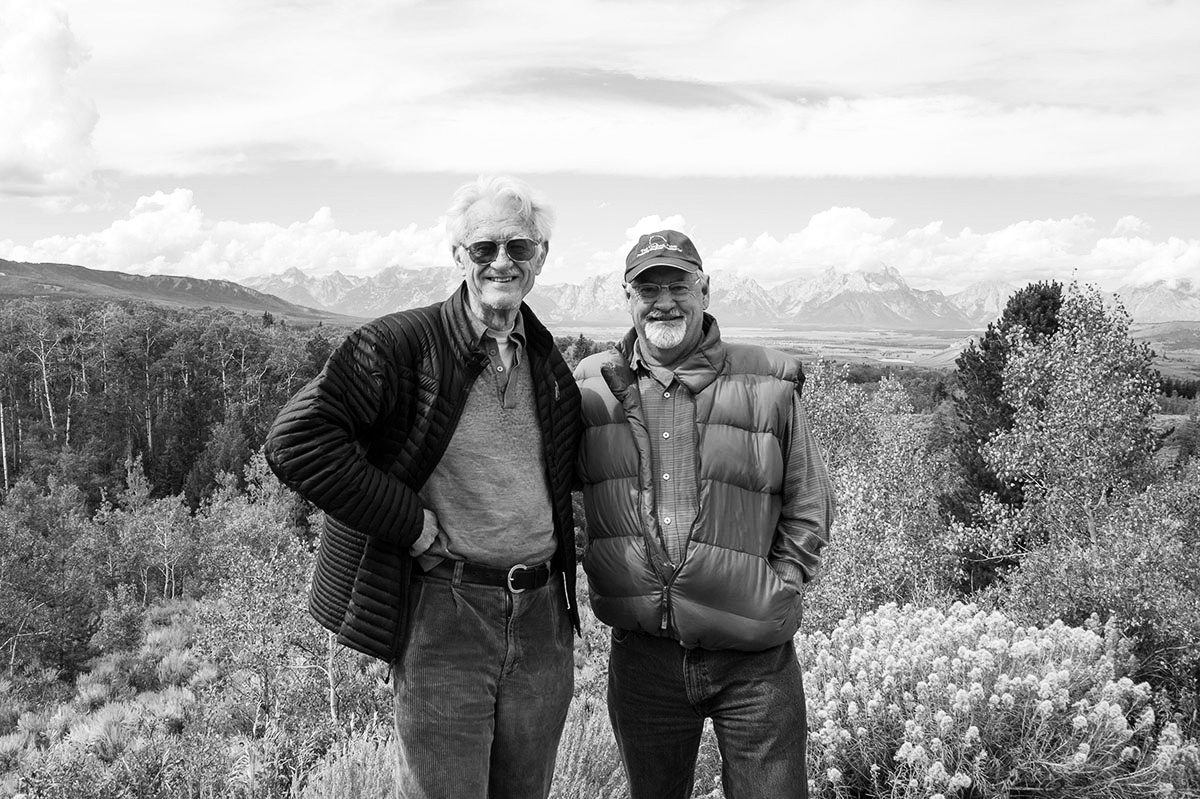
Paul Johnsgard and Yom Mangelsen
Making photography his life
By the time Tom heeded a long-held desire to live in the high country of Colo. he’d “found a different calling” than the family business though he concedes those retail roots taught him how to sell his work.
The mountains had beckoned from the time his family took trips to Estes Park. Then as a young man amid the counterculture movement, with peers joining communes, he moved to Nederland, Colo. outside of Boulder to live in an old one-room schoolhouse. He mastered photography and continued his education there.
“I was still taking some courses, like arctic alpine ecology, from the University of Colorado. At one of the classes this educational filmmaker, Bert Kempers, was doing a dog-and-pony slide show and the teacher knew I was interested in photography and introduced me to him after the class. Bert invited me to come have a beer and a burger with him and asked me if I was interested in work. I said sure.
“I told him I’d never used a movie camera and he said, ‘If you can shoot stills, you can shoot movies,’ which isn’t necessarily true because they’re quite different mindsets. But I didn’t know any better, so he taught me how to use a movie camera. We had an old Bell & Howell with the three-turret lens. Then we moved up to a Bolex and then to an Arriflex. We were doing educational biology films for the University of Colorado. Our advisor there, Roy Gromme, had a famous father, the nature painter and conservationist Owen Gromme.”
Mangelsen later met and was befriended by the elder Gromme.
“Owen was one of the first men making limited edition prints of his paintings, so I thought, Well, why couldn’t I make limited edition prints of photographs? I was stupid and naive at the time and thank God I was because that’s how I started selling the prints.”
Mangelsen opened his first gallery in Jackson Hole in 1978.
Not only did Gromme show him a way to market his work, but he modeled a fierce commitment to bio-diversity reinforced by others he met, including Mardy Murie Didl, widely considered the grandmother of conservation, and Jane Goodall. He also found inspiration in the work of such great photographers as Ansel Adams, Eliot Porter, Ernst Haas, Edward Weston, Minor White, Paul Strand and Dorothea Lange. He and fellow Nebraska-native nature photographer Michael Forsberg are good friends. Nature painters like Robert Bateman are influences, too.
-
 “Catch of the Day,” ©Tom Mangelsen
Projects with personal meaning
Learning filmmaking from Kempers paid huge dividends.
“I did most of the camerawork and Burt wrote, edited and put the films together. That was a great experience. For five years I made films. Out of that grew other films down the road.”
Among these later films was Cranes of the Grey Wind about the birds’ reliance on the Platte habitat.
“My whole deal with that was to do something about the Platte River, which was running dry. I wanted to show people, mostly in Neb., that we have a resource here that’s vital to the whooping crane migration – a natural phenomenon so incredible that it matches any in the world.”
This was Mangelsen’s chance to combine his talent for photography with his passion for the river and his interest in seeing its ecosystem valued and protected. The fact he could shed light on something so dear was irresistible. He didn’t want to see past mistakes repeated.
“The Platte literally went dry when I was a kid because they sucked so much water out of it for irrigation and for cities like Denver. They were putting more and more dams up. My brother Billy and I would go down to the river to see how deep the water was and sometimes couldn’t even find it. Then when the water came in the fall when the irrigation season was over it would trickle down from (Lake) McConaughy and Johnson Reservoir and people would call us and say, ‘The water’s coming, the water’s coming,’ and we’d wait for it. That’s the truth.
“It was a shrinking river with shrinking channels. It was becoming a woodland not that useful for ducks, geese and cranes. That’s changed quite a bit now. There’s been lawsuits over the dams and things. They have to keep a certain amount of water in the river now. Thank God for the whooping cranes or it probably never would have happened.”
He made Cranes of the Grey Wind for the Whooping Crane Trust. His mentor Johnsgard wrote the script and a companion book.
Johnsgard also turned Mangelsen onto Jackson Hole.
“We had spent time in greater Yellowstone,” Mangelsen says. “He introduced me to that area. I fell in love with Jackson Hole because of that trip I made with him when I was his assistant in the field.”
Johnsgard was doing field work in the Tetons when Mangelsen wheeled-in via a jeep. After a week there Mangelsen was sold.
The two men long talked about doing a book together but it wasn’t until last year they finally released one, Yellowstone Wildlife. They’re working on a new book about the cranes of the world.
Mangelsen’s interest in cranes led him on a kind of pilgrimage that helped generate more projects.
“I wanted to see where the cranes lived in the summer, I wanted to see where they nested in Alaska, where they wintered in Texas off the coasts and all the migration stops along the way.”
National Geographic got wind of this intrepid photographer following the cranes’ migration patterns and they commissioned him for a project that led to a PBS Nature film and so on. His reputation made, his books became best sellers and more people started collecting his prints. He opened more galleries to keep up with demand.

Staying true to his convictions
Even though he’s gained fame few photographers ever attain, the values, principles and rituals of his work remain immutable.
“You photograph birds in the spring when they’re breeding because that’s when they’re most colorful. You photograph mammals in the fall when they have their antlers and their best color.”
He works in all kinds of weather and even prefers when it’s not a picture postcard day. “Blue skies and sunshine are boring to me,” he says. Old Kodak film stock required “you put the sun at your back because the film was so slow it was sensitive to light.” But, he adds, “it’s all changed with higher speed films and now of course with digital.”
Catching the best light is a sport unto itself.
“They call it the golden hour, around sunrise and sunset. But you can also have wonderful light around storms and rain and fog, so there’s not one light I look for. But obviously the golden light, the early light or late light is classically the best light.”
He once made an image of a mountain lion during the last light of the day, the creature silhouetted against a black cave containing her den.
“That very direct light is really beautiful,” he says.
An elephant “against a black, windy, dusty African sky can be beautiful, too,” he says, as it was when he photographed one amid a rolling storm that shone “this golden light sideways across the plain.”
Another time he captured a group of giraffes in the noon day light but with a storm riding in to create a black sky.
“So there’s millions of different kinds of light,” he says.
From the start, Mangelsen’s viewed his work with an eye to education.
“I looked at all this as not collecting trophies as most photographers do early on, you know, shooting the biggest bucks or the biggest bull elk or the biggest rams or whatever. Instead, I was trying to collect animals in their environment – showing how they live.”
His by now iconic image of a brown bear catching a sockeye salmon in its mouth – entitled ‘Catch of the Day’ – has been so often reproduced he’s lost count. But that picture taken in 1988 at the head of Brooks Falls in Katmai National Park, Alaska and which adorned the cover of his first book, Images of Nature, would not have been possible if he didn’t intentionally look and wait for it.
“It was a moment that hadn’t been recorded before,” he says. “There’s thousands of pictures of bears at the falls. I’d seen them, I’d gone there. I’d researched bear footage. I happened upon a book about the bears of Brook Falls and I saw a picture from a distance of fish jumping and I wondered if you could shoot that, just head and shoulders.”
To get this image he’s now most identified with meant having a plan, then letting his instincts take over. It’s still his M.O. in the field today.
“Anticipation, pre-visualizing, observation is a huge part of it,” he says.
For “Catch of the Day” he was 45 yards from the bear on a platform 10 feet off the river. From his homework he says he knew the bears positioned themselves at the top of the falls, “which is kind of the prime fishing spot,” where they practically call to the salmon, “come to me.”
He says the picture became a sensation because “it’s unique – nobody got that moment before.” Some felt it was too good to be true – suggesting he’d manipulated or altered the image. “It was shot in ’88, before photo shop was invented,” says Mangelsen, who’s emphatic that the picture was not enhanced in any way.
Wherever he is, no matter what he’s photographing, his interest is documenting animals as they actually behave in their natural habitats.
“That’s my goal,” says Mangelsen, who decries the short-cut method of shooting animals on game farms.
“These farms have everything from snow leopards to tigers to deer, bears, foxes, cougars, every animal imaginable. Well, snow leopards don’t live on this continent, but for a few hundred dollars in the morning and for a hundred dollars more you can shoot a snow leopard and a raccoon in the morning and a cougar and a wolf in the afternoon and a fox and a caribou the next day, and by the time you’re done with the week and for a few thousand dollars you can have quite a collection.
“But baiting is used and the animals are half starved to death. There’s electric fences around them so they don’t leave. They are released to perform for the camera and the rest of the time they live in cages the size of a coffee table, which is criminal.”

An activist artist
His work in the wild has instilled in him a passion and activism.
“I’ve learned that all animals are really important, from the smallest to the largest, not just the bears and the wolves and the cougars but tiny animals. People may joke when certain things are put on the endangered species list – it might be a mouse or a small bird or a frog. But we’ve learned that the disappearance of something as tiny and familiar as bees is a whole chain reaction.
“We need to recognize they’re all important and we shouldn’t take it for granted. We also need to recognize individuals within a species are important. We shouldn’t be killing wolves. There’s no good reason to shoot a wolf unless it’s threatening your livestock or your person or your baby. Then you’re entitled to do something about it.”
But he says lawmakers tend to get their priorities mixed up.
“Nebraska’s a great example. They started this stupid cougar season even though there’s only 20 animals in the whole state. The season’s based on a couple legislators who think they saw a cougar moving across their pasture. I dare say I’ve seen more cougars in downtown Boulder, where I lived, than anyone in Neb. has in their entire life. They’re just part of the ecosystem there.”
He says in Colo. human encroachment on wilderness areas means foraging animals become part of the foothills experience. He says the answer’s not to kill displaced cougars but to coexist with them.
“Studies show it’s counterproductive to hunt things like cougars and wolves. Some people like to create fear of these hard carnivores. Some Joe Blow who hasn’t done his homework thinks they’re going to save babies and create safe zones if they kill all the big guys that prey on other animals. What they don’t realize is the big picture. They think they’re heroes somehow because they’re killing things with big teeth.
“It’s a Duck Dynasty kind of mentality.”
He’s outraged by Neb’s recently enacted cougar hunting season.
“It’s unconscionable to basically have open season on this great animal that you have so few of in the whole state. There’s no reason to kill a cougar other than a real valid threat to humans and none of that’s occurred in Neb. or in Wyoming. There’s no scientific reason. It doesn’t create more deer, it doesn’t make it safer. If you end up shooting the older, knowledgeable cougars which are still teaching their young how to hunt then the young are the ones that go out there to become juvenile delinquents looking for food in people’s backyards.”
He says the public has largely unfounded fears of animals like cougars or bears attacking humans.
“You’d be much more likely to get hit by lightning. People don’t put that into perspective. They’re fearful of what they don’t know.”
He supports well-informed hunting policies and practices. “I’m not against hunting if you do it ethically and cleanly and you do it for meat.”
He disdains hunters who kill animals for trophies. “They’re totally insensitive to the fact these animals have a great place in the ecosystem. Without them there are too many deer, they over graze, then there are no rabbits and beavers. It’s a top down thing.””
He’s quick to criticize hunting and wildlife management abuses. “I took a picture that appeared in the Jackson Hole Daily of these hunters at Grand Teton National Park shooting elk off the road. There were no rangers on duty – they were all at a meeting that morning and the hunters knew it for some reason. The game and fish and the park service got their tits in a wringer so to speak.
“National parks ought to be refuges for animals.”

The Cougar Fund tries to prevent mishaps like this from happening.
“The biggest threat to cougars is sport hunting. About 3,500 cougars a year are killed. Seventy five percent of those are females who are pregnant or have dependent young who will die without their mother. That’s tragic. It’s criminal to be shooting an animal that has young dependents. What our job to do is to educate people that cougars have a place and that killing cougars does not make it safer for people.”
He says the organization also monitors game and fish departments “to hold their feet to the fire.”
For his book Spirit of the Rockies: The Mountain Lions of Jackson Hole he followed a mother cougar and her kittens for 40-plus days, detailing their precarious existence and overturning some myths along the way.
Mangelsen’s travels around the world have put him on intimate terms with the challenges certain animals face on other continents.
“Africa’s in dire straits right now mostly because of the illegal trade in wildlife. Elephants are being slaughtered for their tusks and rhinos for their horns. They say one elephant is killed every 15 minutes. A lot of large elephants are gone. Poachers are shooting baby elephants that have tusks the size of a hot dog. Ivory and rhino horn are worth as much as gold is now. America has its own guilt over that in buying ivory trinkets. People don’t understand that every ivory trinket adds up to a wild animal. Most of the ivory and rhino trade is in China now because of the growth of the middle class there. The middle class didn’t exist not that long ago and now that millions have become affluent they want the cars, they want the fashions, they want the trinkets.
“Rhino horn has absolutely no more value than your toenails or fingernails do. There’s absolutely nothing there for medicinal purposes or aphrodisiacs or any of that. It’s all culture, all tradition, all bullshit. And ivory is just for ornamental purposes and as a status symbol.”
He’s appalled by this rampant destruction of species.
“It’s an amazing crime. People are trying to stop it. People need to stop buying the stuff. It’s not the poor villager who trades in it who’s the problem. I mean, he’s going to feed his family, that’s what comes first, and this is a lot easier than trying to eek out a living goat herding. It’s the people buying it and then of course all the middle men. Terrorist organizations are involved. Elephant ivory is considered valuable enough to be traded for guns, so not only are elephants being killed, so are people. I’m working potentially on a feature film on this issue.”

Full circle
By now he’s photographed just about everything that walks or runs or flies – from elephants to elk and from penguins to peregrine falcons. Two bucket list exceptions are wild snow leopards and pandas. He’s developed some favorites, especially polar bears, brown bears and grizzly bears, and he just hopes it isn’t too late for these creatures.
“They’re really intelligent, they’re beautiful to look at, they’re at the top of the food chain. They’re like wolves in that way. Wolves are terribly persecuted for no good reason. With all these animals there’s a competition with man. It’s not only a competition its a threat.”
There are consequences to being so outspoken. He says, “I’ve been threatened by people for speaking out.”
If there’s one place in the world that has the greatest pull for him it’s the Serengeti in East Africa, which is where he was in January.
“I went to photograph elephants before they’re gone. They really figure they’ll be extinct in 14 years.”
In March he’ll be back home, on the Platte, where his journey in photography began, watching the cranes again. Jane Goodall at his side. He still can’t believe she’s a friend.
“She was always a hero.”
He’d briefly met her but it wasn’t until 2002, when he was asked to introduce her at a talk she made in Jackson Hole, he got to know her.
“She happened to have the following day off and I took her to Yellowstone and we just had a great time. We talked about cougars and Jane joined the Cougar Fund. She asked about the migration of cranes to Neb. and I told her we just happen to have a cabin right in the heart of that crane migration and she said I’m coming to see you and the cranes, and this will be her 13th year she’s come.
“Jane has been to thousands of more places than I have been and yet she comes to Neb. to see the cranes. That should tell you something – that these cranes and the river are very meaningful to her.”
He’s still in awe of her.
“She’s an inspiration to me in that she can keep going through a lot of adversity. She sees a lot of poverty and animal abuse. She’s working very hard on elephant-rhino preservation because it’s coming now to be such a big deal. She’s known for chimpanzees and yet she joined the Cougar Fund. She has more causes and energy than the man in the moon. She’s 80 now and yet she won’t let anything slow her down.
“She’s got so much energy, drive, passion. She’s unstoppable.”
As anyone who knows Mangelsen can attest, he could be describing his own indefatigable self. One that knows no bounds. But like the cranes he loves, no matter how far afield he travels, he always migrates home.
Follow his adventures at http://blog.mangelsen.com/.
Rock photographer Janette Beckman keeps it real: Her hip-hop and biker images showing at Carver Bank as part of Bemis residency
Here’s my Reader (http://www.thereader.com/) cover story on famed rock photographer Janette Beckman, whose images of punk and hip-hop pioneers helped create the iconography around those music genres and the performing artists who drove those early scenes. She’s been visiting Omaha for a residency at the Bemis Center for Contemporary Arts, working on a portrait of the city. An exhibition of her photos of hip-hop pioneers and Harlem bikers is showing at the Carver Bank here through the end of November.
|

Janette Beckman
Rock photographer Janette Beckman keeps it real;
Her hip-hop and biker images showing at Carver Bank as part of Bemis residency
©by Leo Adam Biga
Now appearing in The Reader (http://www.thereader.com/)
Photographer Janette Beckman made a name for herself in the 1970s and 1980s capturing the punk scene in her native London and the hip-hop scene in her adopted New York City.
Dubbed “the queen of rock photographers,” her images appeared in culture and style magazines here and abroad and adorned album covers for bands as diverse as Salt-N-Pepa and The Police. Weaned on Motown and R & B, this “music lover” was well-suited for what became her photography niche.
She still works with musicians today. She’s developing a book with famed jazz vocalist Jose James about his ascent as an artist.
Her photos of hip-hop pioneers along with pictures of the Harlem biker club Go Hard Boyz comprise the Rebel Culture exhibition at Carver Bank, 2416 Lake Street. Beckman, documenting facets of Omaha and greater Neb. for a Bemis residency, will give a 7 p.m. gallery talk on Friday during the show’s opening. The reception runs from 6 to 8.
The Bemis Center for Contemporary Arts stint is her first residency.
“This is a new experience. It’s very refreshing. It’s kind of nice to get away from your life and open up your mind a little bit,” says Beckman, who describes her aesthetic as falling “between portrait and documentary.” “I truly believe taking a portrait of somebody is a collaboration between you and the person. I really like taking pictures on the street. I don’t want hair stylists and makeup artists. I don’t tell people what to do. I want to document that time and place – that’s really important to me. I want it to be about them and their lives, not about what I think their lives should be.”
Carver features a personal favorite among her work – a 1984 photo of Run DMC shot on location in Hollis, Queens for the British mag Face.
“They were just hanging out on this tree-lined street they lived on. I said, ‘Just stand a little closer,’ and they did. I love this picture because it expresses so much. It’s a real hangout picture and such a symbol of the times, style-wise. The Adidas with no laces, the snapback hats, the gazelle glasses, the track suits. It just expresses so much about that particular moment in time. And I love the dappled light on their faces.”
-
 Run DMC, ©Janette Beckman

Salt-n-Pepa, ©Janette Beckman
She made the first press photo of LL Cool J, complete with him and his iconic boom box. She did the first photo shoot of Salt-N-Pepa while “knocking about” Alphabet City. In L.A. she shot N.W.A. posed around cops in a cruiser just as the group’s “Fuck tha Police” protest song hit.
She says her hip-hop shots “bring up happy memories for people because music is very evocative – it’s just like a little moment in time.”
The early hip-hop movement in America paralleled the punk explosion in England. Both were youthful reactions against oppression. In England – the rigid class system and awful economy. In the U.S. – inner-city poverty, violence and police abuse.
“Punk really gave a voice to kids who never really had a say. Working-class kids and art school kids all sort of banded together and started protesting, basically by being obnoxious and writing punk songs that were kind of like poetry, expressing what their lives were like. There was the shock factor of wearing bondage apparel and trash bags, putting safety pins in their noses. Really giving the finger to Queen and country and all that history. It was like, ‘Fuck you, it’s not that time, we’re fed up and we’re not going to take it anymore.'”
Her introduction to hip-hop came in London at the genre’s inaugural Europe revue tour.
“No one knew what hip-hop was. It was just the most amazing show. It had all the hip-hop disciplines. So much was going on on that stage – the break dancers and the Double Dutch and Fab 5 Freddy, scratching DJs, rapping, graffiti. All happening all at once. It blew me away.
“I met Afrika Bambaataa, who’s pretty much the father of hip-hop.”
Weeks later she visited NYC and “there it all was – the trains covered in graffiti, kids walking around with boom boxes, people selling mix tapes on the street. I got very involved in it.”
“New York was broke. Politically it was a mess. These kids had no future. Hip-hop gave this voice to the voiceless. They were singing ‘The Message’ (by the Furious Five). Where I was living there really were junkies in the alley with a baseball bat. It was no joke. You could see it unfolding in front of you and yet there was this vibrant art scene going on. Graffiti kids stealing paint from stores, breaking into train yards at night and painting trains in the pitch dark to make beautiful art that then traveled like a moving exhibition around New York. It was just fantastic. A real exciting time.”
She got so swept up, she never left. When big money moved in via the major record labels, she says. “everything changed.” She feels hip-hop performers “lost their artistic freedom and that almost punk aesthetic of making it up as you go along because you don’t really know what you’re doing. They were just experimenting. That’s why it was so fresh.” She expected hip-hop would run its course the way punk did. She never imagined it a world-wide phenomenon decades later.
“In the ’90s with Biggie and people like that it got massive. People are rapping in Africa and Australia. Breakancing is bigger than ever now..”
While capturing its roots she didn’t consider hip-hop’s influence then. “I was just in it doing it. I was just riding the wave.”
Portraying folks as she finds them has found her work deemed “too raw, too real, too rough” for high style mags that prefer photo-shopped perfection. “I don’t really believe in stereotypes and I don’t believe in ideals of beauty.” She’s even had editors-publishers complain her work contains too many black people.

B-Boys, ©Janette Beckman
Beckman’s surprised by Omaha’s diversity and intrigued by its contradictions. She’s shot North O barbershops, the downtown Labor Day parade, her first powwow, skateboarders doing tricks at an abandoned building and a South Omaha mural. She’s looking forward to taking pics at a rodeo and ranch.
She came for a site visit in July with one vision in mind and quickly had to shift gears when she began her residency in August.
“I wanted to photograph people on the street in North Omaha and I found there’s nobody on the street, so I had to try to wiggle into the community.”
Her curiosity, chattiness and British accent have given her access to events like the Heavy Rotation black biker club’s annual picnic at Benson Park. That group reminded her of the Ride Hard Boyz she shot last summer in New York.
“I was riding in the flatbed of an F-150 truck driven by one of the guys down this expressway with bikers doing wheelies alongside, All totally illegal. It was the most exciting thing I’ve done in years. Although it’s rebel in a way, the club keeps kids off the street and out of drugs and gangs. They’re the greatest guys – like a big family.”
The end of Sept. she returns to the NewYork “bubble.” An exhibit of her photos that leading artists painted on, JB Mashup, may go to Paris. She’s photographing a saxophonist. Otherwise, she’s taking things as they come.
“I try not to make too many plans because they tend to get diverted.”
Rebel Culture runs through Nov. 29.
View her Omaha and archived work at http://janettebeckman.com/blog.
The panoramic world of Patrick Drickey
Pat Drickey has been a fine art, architectural, and landscape photographer and he’s combined all of those talents and disciplines in a niche today that finds him making sumptuous and collectible panoramic images of the world’s great golf courses. This short profile should whet your appetite for the much longer piece I did on him, which can also be found on this blog.
The panoramic world of Patrick Drickey
©by Leo Adam Biga
Originally appeared in Omaha Magazine
Omaha commercial photographer Pat Drickey knew he was onto something big when panoramic images he was commissioned to shoot of Pebble Beach Golf Course struck a chord in people. What began as an irrigation company ad campaign gig, flying him to elite courses around the world, became his own niche enterprise when the prints sold out and the Professional Golfers Association took note.
“That’s when I knew this could be a business,” said Drickey, an Omaha native whose Stonehouse Publishing company, 1508 Leavenworth St., specializes in producing iconic landscape images of premier golf courses around the world. Drickey, who takes the vast majority of the photographs himself and personally supervises the production of every single print, estimates more than 300,000 Stonehouse prints are now in circulation.
“We have branded the panoramic format for golf,” said Drickey, whose business operates out of a century-old red-brick building on the Old Market’s fringe.
In addition to being licensed by major courses, the United States Golf Association and the PGA, he has the endorsement of living legends like Arnold Palmer and Jack Nicklaus, giving him access to virtually any green. From Pebble Beach to Pinehurst to Medinah to St. Andrews to many other championship courses with rich histories, Stonehouse and Drickey are recognized names with carte blanche access.
“Which is a significant deal,” he said, ”because we are becoming that embedded in the lore of golf.”
Drickey’s neither the first nor only photographer to capture links in a panoramic way. But he believes what separates his work from others is the photo-illustration approach he uses in creating crystal-clear images of striking detail and depth. Employing all-digital equipment in the field and the studio Drickey brings exacting standards to his imagemaking not possible with film. Digital enhancements bring clarity from shadows and achieve truer, more balanced colors, he said. Even a sand trap can be digitally raked.
“It’s just incredible what you can do — the control you have,” he said.
He said Stonehouse has adopted the fine art Giclee process to its own printmaking methods, which entails using expensive pigmented archival inks on acid free watercolor paper to ensure prints of high quality that last.
“I want to produce a product that’s going to be around for a long time. The color hits that paper and stays with it — it will not fade. And that’s significant,” he said.
He feels another reason for Stonehouse’s success is its images portray the timeless characteristics that distinguish a scenic hole or course. He strives to indelibly fix each scene into a commemorative frieze that expresses the design, the physical beauty, the tradition. The clubhouse is often featured. Getting the composition just how he wants it means “waiting for the right light,” which can mean hours or days. Much care and research go into finding the one idyllic, golden-hued shot that speaks to golf aficionados. That’s who Stonehouse prints are marketed to.
Building-updating Stonehouse’s image collection keeps Drickey on the road several days a month. He’s half-way to his goal of photographing the world’s top 100 courses. One he’s still waiting to shoot is Augusta, home to the Masters.
“That’s one of America’s crown jewels. We are present at the other majors and we’d like to have a presence there. It’s just a matter of time. Those introductions have been made,” Drickey said.
Stonehouse prints grace golf books-periodicals. Drickey’s collaborating on a book project for Nebraska’s Sand Hills Golf Club course. He has more book ideas in mind.
His golf niche is an extension of the architectural photography he once specialized in. It’s all a far cry from the images he made with a Brownie as a boy. He still has that camera. A reminder of how far he’s come.
Related articles
- How to: Create panoramic photos in Adobe Photoshop (onsoftware.en.softonic.com)
A brief history of Omaha’s civil rights struggle distilled in black and white by photographer Rudy Smith
Rudy Smith was a lot of places where breaking news happened. That was his job as an Omaha World-Herald photojournalist. Early in his career he was there when riots broke out on the Near Northside, the largely African-American community he came from and lived in. He was there too when any number of civil rights events and figures came through town. Smith himself was active in social justice causes as a young man and sometimes the very events he covered he had an intimate connection with in his private life. The following story keys off an exhibition of his work from a few years ago that featured his civil rights-social protest photography from the 1960s. You’ll find more stories about Rudy, his wife Llana, and their daughter Quiana on this blog.

A brief history of Omaha’s civil rights struggle distilled in black and white by photographer Rudy Smith
©by Leo Adam Biga
Originally appeared in The Reader (www.thereader.com)
Coursing down North 24th Street in his car one recent afternoon, Rudy Smith retraced the path of the 1969 summer riots that erupted on Omaha’s near northside. Smith was a young Omaha World-Herald photographer then.
The disturbance he was sent to cover was a reaction to pent up discontent among black residents. Earlier riots, in 1966 and 1968, set the stage. The flash point for the 1969 unrest was the fatal shooting of teenager Vivian Strong by Omaha police officer James Loder in the Logan Fontenelle Housing projects. As word of the incident spread, a crowd gathered and mob violence broke out.
Windows were broken and fires set in dozens of commercial buildings on and off Omaha’s 24th Street strip. The riot leapfrogged east to west, from 23rd to 24th Streets, and south to north, from Clark to Lake. Looting followed. Officials declared a state of martial law. Nebraska National Guardsmen were called in to help restore order. Some structures suffered minor damage but others went up entirely in flames, leaving only gutted shells whose charred remains smoldered for days.
Smith arrived at the scene of the breaking story with more than the usual journalistic curiosity. The politically aware African-American grew up in the black area ablaze around him. As an NAACP Youth and College Chapter leader, he’d toured the devastation of Watts, trained in nonviolent resistance and advocated for the formation of a black studies program at the University of Nebraska at Omaha, where he was a student activist. But this was different. This was home.
On the night of July 1 he found his community under siege by some of its own. The places torched belonged to people he knew. At the corner of 23rd and Clark he came upon a fire consuming the wood frame St. Paul Baptist Church, once the site of Paradise Baptist, where he’d worshiped. As he snapped pics with his Nikon 35 millimeter camera, a pair of white National Guard troops spotted him, rifles drawn. In the unfolding chaos, he said, the troopers discussed offing him and began to escort him at gun point to around the back before others intervened.
Just as he was “transformed” by the wreckage of Watts, his eyes were “opened” by the crucible of witnessing his beloved neighborhood going up in flames and then coming close to his own demise. Aspects of his maturation, disillusionment and spirituality are evident in his work. A photo depicts the illuminated church inferno in the background as firemen and guardsmen stand silhouetted in the foreground.
The stark black and white ultrachrome prints Smith made of this and other burning moments from Omaha’s civil rights struggle are displayed in the exhibition Freedom Journeynow through December 23 at Loves Jazz & Arts Center, 2512 North 24th Street. His photos of the incendiary riots and their bleak aftermath, of large marches and rallies, of vigilant Black Panthers, a fiery Ernie Chambers and a vibrant Robert F. Kennedy depict the city’s bumpy, still unfinished road to equality.
The Smith image promoting the exhibit is of a 1968 march down the center of North 24th. Omaha Star publisher and civil rights champion Mildred Brown is in the well-dressed contingent whose demeanor bears funereal solemnity and proud defiance. A man at the head of the procession holds aloft an American flag. For Smith, an image such as this one “portrays possibilities” in the “great solidarity among young, old, white, black, clergy, lay people, radicals and moderates” who marched as one,” he said. “They all represented Omaha or what potentially could be really good about Omaha. When I look at that I think, Why couldn’t the city of Omaha be like a march? All races, creeds, socioeconomic backgrounds together going in one direction for a common cause. I see all that in the picture.”
Images from the OWH archives and other sources reveal snatches of Omaha’s early civil rights experience, including actions by the Ministerial Alliance, Citizens Coordinating Committee for Civil Liberties, De Porres Club, NAACP and Urban League. Polaroids by Pat Brown capture Rev. Martin Luther King, Jr. on his only visit to Omaha, in 1958, for a conference. He’s seen relaxing at the Omaha home of Ed and Bertha Moore. Already a national figure as organizer of the Birmingham (Ala.) bus boycott and the Southern Christian Leadership Conference, he’s the image of an ambitious young man with much ahead of him. Rev. Ralph David Abernathy, Jr. joined him. Ten years later Smith photographed Robert F. Kennedy stumping for the 1968 Democratic presidential bid amid an adoring crowd at 24th and Erskine. Two weeks later RFK was shot and killed, joining MLK as a martyr for The Cause.
Omaha’s civil rights history is explored side by side with the nation’s in words and images that recreate the panels adorning the MLK Bridge on Omaha’s downtown riverfront. The exhibit is a powerful account of how Omaha was connected to and shaped by this Freedom Journey. How the demonstrations and sit-ins down south had their parallel here. So, too, the riots in places like Watts and Detroit.
Acts of arson and vandalism raged over four nights in Omaha the summer of ‘69. The monetary damage was high. The loss of hope higher. Glimpses of the fall out are seen in Smith’s images of damaged buildings like Ideal Hardware and Carter’s Cafe. On his recent drive-thru the riot’s path, he recited a long list of casualties — cleaners, grocery stores, gas stations, et cetera — on either side of 24th. Among the few unscathed spots was the Omaha Star, where Brown had a trio of Panthers, including David Poindexter, stand guard outside. Smith made a portrait of them in their berets, one, Eddie Bolden, cradling a rifle, a band of ammunition slung across his chest. “They served a valuable community service that night,” he said.
Most owners, black and white, never reopened there. Their handsome brick buildings had been home to businesses for decades. Their destruction left a physical and spiritual void. “It just kind of took the heart out of the community,” Smith said. “Nobody was going to come back here. I heard young people say so many times, ‘I can’t wait to get out of here.’ Many went away to college and never came back. That brain drain hurt. It took a toll on me watching that.”
Boarded-up ruins became a common site for blocks. For years, they stood as sad reminders of what had been lost. Only in the last decade did the city raze the last of these, often leaving only vacant lots and harsh memories in their place. “Some buildings stood like sentinels for years showing the devastation,” Smith said.
His portrait of Ernie Chambers shows an engaged leader who, in the post-riot wake, addresses a crowd begging to know, as Smith said, “Where do we go from here?’
Smith’s photos chart a community still searching for answers four decades later and provide a narrative for its scarred landscape. For him, documenting this history is all about answering questions about “the history of north Omaha and what really happened here. What was on these empty lots? Why are there no buildings there today? Who occupied them?” Minus this context, he said, “it’d be almost as if your history was whitewashed. If we’re left without our history, we perish and we’re doomed to repeat” past ills. “Those images challenge us. That was my whole purpose for shooting them…to challenge people, educate people so their history won’t be forgotten. I want these images to live beyond me to tell their own story, so that some day young people can be proud of what they see good out here because they know from whence it came.”
An in-progress oral history component of the exhibit will include Smith’s personal accounts of the civil rights struggle.
Related articles
- Carole Woods Harris Makes a Habit of Breaking Barriers for Black Women in Business and Politics (leoadambiga.wordpress.com)
- Blacks of Distinction II (leoadambiga.wordpress.com)
- The Great Migration Comes Home: Deep South Exiles Living in Omaha Participated in the Movement Author Isabel Wilkerson Writes About in Her Book, ‘The Warmth of Other Suns’ (leoadambiga.wordpress.com)
- Making the Case for a Nebraska Black Sports Hall of Fame (leoadambiga.wordpress.com)
- Part I of a Four-Part Q & A with Pulitzer-Winner Isabel Wilkerson On Her Book, ‘The Warmth of Other Suns: The Epic Story of America’s Great Migration’ (leoadambiga.wordpress.com)
- Part II of a Four-Part Series with Pulitzer-Winner Isabel Wilkerson, Author of ‘The Warmth of Other Suns: The Epic Story of America’s Great Migration’ (leoadambiga.wordpress.com)
- Part III of a Four-Part Q & A with Pulitzer-Winner Isabel Wilkerson on Her Book, ‘The Warmth of Other Suns: The Epic Story of America’s Great Migration’ (leoadambiga.wordpress.com)
- Part IV of a Four-Part Q & A with Pulitzer-Winner Isabel Wilkerson on Her Book, ‘The Warmth of Other Suns: The Epic Story of America’s Great Migration’ (leoadambiga.wordpress.com)
- Photojournalist Nobuko Oyabu’s Own Journey of Recovery Sheds Light on Survivors of Rape and Sexual Abuse (leoadambiga.wordpress.com)
Photojournalist Nobuko Oyabu’s own journey of recovery sheds light on survivors of rape and sexual abuse through her Project STAND
Photojournalist Nobuko Oyabu has dedicated herself to a lifetime project portraying the individual hunanity of persons who have suffered rape or sexual abuse. Her intent is to beyond the label of victim to show who these people are. The work is dear to her for many reasons, not the least of which is her own recovery from rape. She delivers a message to the world in her pictures and in her words that the hurt survivors feel is real and profound but that healing is possible. She lets survivors, their families and friends, and the public know that the assault or the abuse and its aftermath need not define women. She delivers this message through a support organization she formed, through photographs she takes of survivors, through educational presentations she gives, and through writing she does on the subject, including her autobiography (Stand, published in Japan). She has been much honored for her work. I wrote the following profile of Nobuko several years ago, when she still lived in Omaha, Neb., where she’d come to work for the Omaha World-Herald. She and her family have since moved on elsewhere but her work continues, as does the praise for her efforts.

Photojournalist Nobuko Oyabu’s own journey of recovery sheds light on survivors of rape and sexual abuse through her Project STAND
©by Leo Adam Biga
Originally appeared in the Omaha City Weekly
Omaha photojournalist Nobuko Oyabu’s work on rape and sexual abuse first made waves in the States. Now it’s stirring things up in her native Japan. On visits there in the last year she’s exhibited her intimate portraits of survivors and given talks about her own story and her subjects’ stories of survival.
She was raped in 1999.
She’s also returned to her homeland to promote her new book, Stand (Forest Press). Published in October, it’s made best seller lists there. The book reveals the trauma of sexual assault through the prism of her personal odyssey and of the men and women she’s chronicled. Her book’s title is drawn from a national project she launched in Omaha to document survivors from across America and in Canada.
Some survivors want to be photographed at the very site they were abused. It isn’t always possible. When it is, it’s an emotional scene. The survivor seeks to reclaim power and control lost in the attack. It’s about closure. In one image a man weeps in the cabin he was molested in as a boy. Some images reveal artifacts of human suffering. A woman shows scars from cuts she makes on herself. Oyabu said self-mutilation is common among survivors as a way of dealing with post-traumatic stress. Another holds a photo of herself as a child made-up as a whore by her abusive dad. Innocence lost. Others choose places and poses that represent their recovery.
Oyabu said Stand is an expression of “how I stood up to the tragedy that happened to me and also of the stands of other survivors. Part of the meaning as well is that sometimes you can’t do anything but just stand there and wait. You can’t always be brave or do something great.”
The fact she’s openly discussing such traditionally taboo subjects in Japan has made her something of a sensation there. Major media outlets in Tokyo, her hometown of Osaka and other cities have profiled her.
“I think I’m the very first person speaking out” on this issue there, she said. In Oyabu’s view Japan harbors, much like the U.S., dysfunctional attitudes about rape and sexual abuse rooted in denial.
“A lot of women tend to be very quiet about it and just suffer silently. It’s really hard for them to be open about it,” she said.
She said a Japanese columnist questioned in print whether she’s actually a survivor after one of her upbeat presentations. Yes, the subject is sober but that doesn’t mean she has to be.
“This particular writer thought that was not appropriate at all. He wrote, ‘I wonder if it really happened to her?’ I wasn’t what he thought a survivor should look like,” she said. “So how should I look? Do I always have to be depressed? I mean, c’mon, I have a daughter. I have a responsibility to make her happy. I can’t be depressed.”
Oyabu said, “It’s kind of hard to attach faces to the issue” amid such perceptions, “It’s kind of hard to see the reality and people don’t really want to see it. But it’s not like all survivors are in depression, stigmatized and bitter. I certainly don’t see myself that way. I’ve found a lot of people don’t see themselves that way.
“If you have a preconceived idea of how a survivor looks, you can never get the real person in the picture.”
Faces of Rape and Sexual Abuse


©photos of survivors by Nobuko Oyabu
Before her own attack, she said, “I admit I had the same attitude toward rape victims. I thought rape belongs to somebody else. I didn’t know there are so many different kinds of survivors until I met them.”
Oyabu’s black and white images express the full spectrum of survivors in terms of education, occupation, income, race, ethnicity, age, shape, size. She said, “I consciously selected these people” to represent they are not just one thing or another. Sexual assault does not discriminate along demographic lines. “It happens to everyone,” she said. Just as survivors are not all rich or poor, black or white, they are not all grim or mad. Many are content, confident, proud, defiant. Count Oyabu among these. Her self-portrait on her book’s cover shows an assertive, ever curious woman poised with camera in hand.
“My resistance was the key for me,” she said.
While large urban papers in Japan gave her positive coverage, reprinting some of her images, she said smaller rural papers displayed a more close-minded attitude and refused to run her pics. She found that “odd” considering her images are in no way graphic but merely portraits. She thinks such reluctance stems from outdated notions that survivors should not be seen or heard — a byproduct of a larger bias that fixes blame or shame on survivors.
“With sexual assault there’s so much gray area still,” she said. “Too many people think it’s the victim’s fault. In this country as well.”
That the blame game should persist in Japan, she said, is ironic given it “is the capital of pornography in the world. There’s so much human trafficking and child porn going on…and somehow the blame is shifted to the victims.” She said sex is right out front in Japan, as it is here, “and yet when it comes to sexual violence people don’t want to acknowledge it,” much less talk about it. Similarly, she said America and Japan don’t want to examine the implications of sex being so pervasive yet rarely discussed at home or school. “Not talking about it,” she said, results in high rates of sexual assault, sexually transmitted diseases, promiscuity, prostitution. This pregnant silence, she said, explains why most sexual assaults go unreported.
“A lot of people are in denial,” she said, “especially parents who grew up in a home where abuse took place. A lot of people have no idea what to say — they just don’t know how to talk about it. Survivors don’t know who to talk to or where to go.”

In lieu of information, she said, some people suffer abuse not realizing they’ve been victimized. She notes a disturbing trend among young people she speaks with who routinely tell her they’ve been molested or raped but pass it off “as no big deal” — as if it’s a rite of passage. “It’s really sad,” she said.
Then there’s the way rape is historically minimized by society, drawing light sentences for actions that have long lasting effects.
Oyabu noted, “One of the survivors put it like this: ‘The rapist gets three to five years, the victims get life.’ And that’s exactly it. It’s not just a one-time incident. For a lot of people it takes a lifetime to get over it. I find it disturbing that society doesn’t see rapists as high risk criminals.”
The reaction her work’s elicited in Japan is not unlike its reception in the U.S. Her STAND: Faces of Rape and Sexual Abuse Survivors Project has been a traveling exhibition across America. Her work with survivors and her personal identification with them and their trauma has made her a sought-after figure. She’s testified before Congress about the issue. She’s spoken to medical, health and law enforcement professionals. She’s presented at women’s and survivors conferences as well as colleges and universities. She’s served as visiting faculty at the Poynter Institute (Fla.) for a seminar on how the media reports rape. She and her work have been part of national awareness campaigns and a Lifetime documentary. She’s written articles for publications here and abroad.
In 2003 she received the Visionary Award from the DC Rape Crisis Center along with comedian Margaret Cho and poet Alix Olsen.
Still, her work is not always appreciated. She said while on staff at the Omaha World-Herald in 2000-2002 senior editors there nixed her doing a photo-essay series on sexual assault survivors. The material, she was told, was too intense for the paper. She said some journalists criticize her for crossing ethical lines as a reporter who documents fellow survivors like herself.
“But if you can use your personal experience to get an exclusive story,” she asks, “then why not use it as a tool?”
Although she defines herself a photojournalist rather than survivor or advocate, her work’s inextricably linked to her experience. Stand centers on the aftermath of her rape — the turmoil she felt and the healing she found. In this light, she said, the images she makes, the talks she delivers, the testimonies she shares serve an educational purpose. “The work of journalism is educating people,” she said. More than anything, she wishes to give survivors names and faces just like her own.

Oyabu was a young, single, up-and-coming photographer with the Moline (Ill.) Dispatch in 1999 when she was raped. She had come to the States only a few years before to pursue her post-secondary education. She wanted to write but found her niche with a camera at Columbia College in Chicago. She went on to shoot a diverse range of subjects for newspapers in the Quad Cities.
Her life and career were full of bright promise when she suffered the ultimate violation and everything grew dark. The rape occurred far from her family in Osaka, where her father pastors a Christian church and her mother teaches preschool. It would be six years before she told her parents what happened. She said, “I didn’t want to worry them too much…I didn’t have the courage to tell,” In the wake of her revelation, she said, “my family has been very supportive.”
The violent act took place at night in her own home. She was sleeping in the bedroom of her locked apartment when the male perpetrator, a former neighbor she didn’t know, broke in using a crowbar. The petite Oyabu never stood a chance. As soon as the stranger left she ran to neighbors and called 911. The cops that caught the case treated her with care on the scene and at the hospital ER they took her to. The medical staff respectfully collected what they needed for the “rape kit” that police and prosecutors use to help convict rapists.
While treated well, Oyabu said she did overhear a doctor ask a nurse, Why is she crying? As she’s since discovered, the law enforcement and medical communities are not always as sensitive as they could be. At a 2005 University of Nebraska Medical Center presentation she told doctors, nurses and students that most sexual assaults are committed by a relative, friend, acquaintance or colleague, meaning victims “take a huge risk even to come out to the ER. You are among the first to respond to these victims when they reach out for help,” she implored the audience, “so please be compassionate to these people.”
Care must be taken with victims, she said, as the trauma of rape is exacerbated by the trauma of examination and interrogation and the suggestion — intentional or not — that somehow the victim’s at fault.
Oyabu provided police a description of her assailant, who left behind the crowbar, his hand prints, hair and other incriminating details. He was caught after only three days. The fact her rapist was captured at all, much less so swiftly, is atypical, she said. The remainder of that year is a blur of counseling sessions, depositions, trial proceedings and attempts to get on with her life. Due to the overwhelming evidence she was spared having to testify. The repeat offender was given the maximum sentence by the judge — 20 years — and is currently serving his time in an Illinois state pen. Again, she said, that is not the norm.
Even with some closure, Oyabu endured flashbacks, nightmares, anxiety attacks and depression. She lived in fear. She rarely let her guard down around men.
The counselor she was referred to at a Quad Cities family services center helped Oyabu work through her emotions. “She made sure I understood that it (the rape) wasn’t my fault. That’s one of the biggest steps for healing.”
A counselor friend suggested she keep a journal. Oyabu said journaling provided a healthy release. Later, her entries proved a key resource for her book. That same friend asked Oyabu to participate in a project that had victims’ harsh self-portraits and words printed on T-shirts. “All I saw was shame and anger on them,” she said. “These T-shirts were faceless. I didn’t belong there — I have feeling and hope. I’m not just a statistic.” This picture of bitter fruit was not the image she had of herself or other survivors, a term she prefers to victims.
“Well, I don’t want to be bitter forever,” she said. “Survivors don’t want you to feel sorry for them or see them as some kind of damaged goods.”
She’d already discovered survivors could be anyone. After her rape several friends came forward with their own stories. “It was really a shock to me all these close friends from college were rape survivors. I didn’t know it,” she said. “I guess my friends didn’t know how to start the conversation about it. Once I was victimized they felt like they could talk now.”
Four of the five women she served on a panel with at the Poynter Institute turned out to be survivors. Smart, successful professionals like her. They’re everywhere.

Oyabu came to Omaha not just for a job but to escape the place where she was raped. “I couldn’t really stay in the same city,” she said. Also, Omaha had a lower incidence of sex crimes. The thought of it happening again plagued her. She wanted to feel safe. But that took time and work. It came with the help of Dee Miller, a fellow writer and survivor in Council Bluffs, and Pastor William Barlowe, pastor of Omaha’s Grace Apostolic Church, where she met her husband, IT specialist Patrick McNeal. The couple have a 2-year-old daughter, Ellica.
Another turning point came when she wrote a letter to her rapist. “As soon as I dropped the letter in the mailbox,” she said, “I felt a kind of joy I’d never experienced. I started to smile and laugh again. I felt like I was totally set free.” Forgiveness is a work in progress.
The next piece of her recovery was her faces of survivors work. When the Herald balked at doing anything she bolted in frustration and liberation. “I was like, Forget them, I’ll do it on my own. She did, too, largely self-funding what became the Stand project. Fees from speaking engagements and exhibits helped.
She said the project’s been “part of my healing, It’s been healthy for me.” She’s met some survivors who can’t move on or can’t find closure — still mired in their pain. “That’s totally understandable. I was there.” She’s met others who dedicate themselves to the cause — working to make a difference with survivors and first responders. Others lead fulfilling lives and careers outside the issue. She keeps in contact with many. For herself, she said, “sometimes I just can’t believe how far I’ve come and how much I’ve done the past six, seven years. I’m alive.”
The prospect of writing about her survival scared her until she found she could divorce herself from the emotion of that trauma. The process was cathartic. She’s now translating Stand for an English language edition to be published in the U.S. by year’s end. Her photo project lay dormant the past few years as she worked on the book and adjusted to motherhood. This year she may capture new images for the project on two trips she’s making to Japan, where survivors who surfaced after her last appearances there requested to be part of her archive. In the future she may revisit her original portrait subjects to further chart their journey of recovery.
Meanwhile, she’s contemplating her next project. Exploring sexual assault in Asian countries interests her. Whatever she does, she won’t be afraid to take a stand.
Resources:
NATIONAL SEXUAL VIOLENCE RESOURCE CENTER
Nobuko is a honorary board member of NSVRC. NSVRC serves as the nation’s principle information and resource center regarding all aspects of sexual violence.
Clothesline Project of Japan
a project of survivors and their remained families of sexual abuse express their thought in drawing on T-shrits.(in Japanese)
Parents United of the Midlands
a site whose mission to bring light to the darkness of sexual abuse
Advocate Web
free resource for victims and their families
Welcome to Barbados
a Tori Amos inspired website for rape and sexual abuse survivors
Related articles
- Supporting Survivors of Sexual Assault (healthyheels.wordpress.com)
- April Is Sexual Assault Awareness Month (SAAM) (kcareyinfante.com)
- The Medical Minute: Sexual abuse can have long-term effects (medicalxpress.com)
- Self-esteem, recovery from sexual abuse (gwizlearning.wordpress.com)
- 39 Million Survivors of Child Sexual Abuse (livingstonparentjournal.wordpress.com)
Fine art photographer Vera Mercer’s coming out party
The Mercer name is exalted in Omaha for the family’s embedded presence as downtown commercial-residential property owners and managers, historic preservationists, aesthetic arbiters, and the primary visionaries, developers, and protectors of what’s known as the Old Market. The Old Market is a small enclave of late 19th and early 20th century brick warehouse buildings that comprised the city’s wholesale produce center. Under the Mercer’s leadership these stuctures took on new life in the 1970s to house an eclectic collection of restaurants, artist studios, art galleries, trendy shops, and loft condos. For a few decades now the National Register of Historic Places district has been one of the state’s top tourist attractions. The subject of this story, artist Vera Mercer, is a native German who married into the family just as the Mercers were transforming the area into a cultural hub. She played a vital role, along with husband Mark Mercer and father-in-law Samuel Mercer in establishing some of the anchor sites there, including the French Cafe. Her photography is prominently displayed in the restaurant. The Mercers own a few eateries in the district and Vera plays a hand in them all behind the scenes. Additionally, her large-scale, Baroque-style food still lifes can be seen in one of these spaces – The Boiler Room. The Mercer’s La Buvette is a bistro style eaterie with an impressive wine selection and it’s often where Vera and Mark can be spotted. She also runs her own gallery, The Moving Gallery, that features work by European artists. Though she’s long been a key player in the Old Market, Vera has been a low-key, little-know presence outside that gilded arena. That is until recently, when a book of her paintings and exhibitions of her work have received much notice here and in Europe. I had never met Vera until doing this short 2011 piece about her for Encounter Magazine. What I found is a charming woman who is an artist through and through. Her photography and painting, equally compelling.
Fine art photographer Vera Mercer’s coming out party
©by Leo Adam Biga
Originally published in Encounter Magazine
Vera Mertz Mercer occupies a paradoxical place in Omaha. She’s a world-renowned photojournalist and art photographer, yet her work is little known here. She’s a vital part of the Mercer family’s Old Market dynasty, yet few recognize her influence.
Forty years after coming here, this German native is finally getting the attention that’s eluded her thanks to several projects featuring her work, which ranges from evocative street-market-figurative portraits to richly textured still lifes of food-animal-plant motifs.
A new book, Vera Mercer, Photographs and Still Lifes (Kehrer, 2010), includes a selection of her photo reportage and still lifes. Following well-received exhibits in Berlin and Hamburg, Germany, plus a show in Lincoln, Neb., she has a single work on display in the 12th Annual Art Auction and Exhibition at the Bemis Center for Contemporary Arts, October 8-November 6. Her biggest exposure though will be her first Omaha solo exhibit, Vera Mercer: Still Lifes, opening in January at the Bemis.
“Given the Mercers central role in the development and sustainability of the Old Market, and their longstanding role in Omaha’s art community, it was surprising to me she had never had a one-woman exhibition” here, said Bemis curator Hesse McGraw.
He said the show will reveal “an under-recognized jewel and legacy of the contemporary art community. I’m interested in the deep intensity of Vera’s photographs. They have a timeless quality that is both classical and highly contemporary. The works are unsettlingly rich in tone, composition and content. It’s surprising these decadent, grotesque, deep-hued works also have a sense of levity. They possess a rigor that is very rare.”

Vera Mercer at an opening
More 2011 exhibitions of Mercer’s work are slated for Mexico City, Japan and Italy. Her emergence on the art scene follows a stellar career in Europe photographing famous artists and their work (Marcel Duchamp, Andy Warhol), authors (Norman Mailer), playwrights (Samuel Beckett, Eugene Ionesco), performers (Jacques Brel), street scenes and markets. Her first husband, artist Daniel Spoerrii, was active in theater. Her father, Franz Mertz, was a noted set designer. Both men introduced her to the avant garde and she flourished in the heady company of artists and intellectuals.
Mercer trained as a modern dancer, teaching for a time, before Spoerri gave her her first camera. Photography’s expressive possibilities fascinated her. Self-taught, she develops and prints her own work. She prefers shooting with high speed film. She likes grainy, dimly lit images. Her lush still lifes are made with a 4-by-5 camera.
In Europe she met sculptor Eva Aeppli, the wife of Samuel Mercer, an attorney who divides his time between his native Omaha and France. Aeppli’s astrological sculptures adorn the Garden of the Zodiac in the Old Market Passageway. The Mercer family has owned property there for generations. The couple befriended Vera, who later married Samuel’s son, Mark. As an artist and gourmand she fit right in with these cosmopolitans and their affinity for artistic and epicurean delights. Her discerning eye and palette helped shape the Old Market into a cultural oasis.

Mark manages the family’s many properties. He and Samuel, a 2010 Omaha Business Hall of Fame inductee, have been the primary agents for preserving this former wholesale produce center and repurposing its warehouses as shops, galleries, restaurants, apartments, condos.
The ambience-rich Market, a National Register of Historic Places district, has become Omaha’s most distinctive urban environs and leading tourist destination.
Overshadowed in this transformation from eyesore to hotbed is Vera Mercer. She’s applied her aesthetic sensibilities to some iconic spots, such as, V. Mertz, which bears her name. She and Mark own La Buvette, an authentic spin on the French cafes they know from their Parisian haunts. More recently they opened the Boiler Room, a fine dining establishment with Vera’s large format, color still lifes integrated into the decor.
Her black and white photo murals of Parisian cafes are among the distinctive interior design elements at the French Cafe, which Samuel Mercer developed with Cedric Hartman. Her photo project for the cafe first brought her to America.
While a familiar figure to Market denizens for her culinary endeavors, her photography is decidedly less known, though in plain view. She’s exhibited her work in galleries around the world but seldom locally. This despite the fact she oversees the Moving Gallery. Mercer said, “I could easily show there but I think that’s not for me to do that.”
There are practical reasons why so much of her work is showing now after years of scant exhibition activity. First of all, she doesn’t believe in over-exposing herself. “I think one should not be overseen,” she said.
Then she’s been busy. “I had lots to do,” she said, referring to her many Mercer Old Market duties, including launching restaurants. She keeps the books for the two the Mercers still own. Several “intense” photo installation projects she did in Asia with designer John Morford kept her occupied.
So, all along she’s been practicing her craft, just not exhibiting. But she’s built a tremendous body of work.
“I work every day a lot on photography,” she said.
Exhibiting isn’t everything. The culinary arts are creative, too. “Making a restaurant is something so beautiful. It’s something for the people. It’s just like a painting,” she said, before adding,“It’s just like theater, too.”
She’s a bit taken aback by all the attention directed her way these days, but she’s “not surprised.” Always open to change, she’s now experimenting with some new portraiture techniques, ready to reinvent herself again.
Related articles
- Nick and Brook Hudson, Their YP Match Made in Heaven Yields a Bevy of Creative-Cultural-Style Results – from Omaha Fashion Week to La Fleur Academy to Masstige Beauty and Beyond (leoadambiga.wordpress.com)
- Omaha Fashion Past (leoadambiga.wordpress.com)
- To Doha and Back with Love, Local Journalists Reflect on Their Fear and Loathing Adventure in the Gulf (leoadambiga.wordpress.com)
- Memories of the Jewish Midwest: Mom and Pop Grocery Stores, Omaha, Lincoln, Greater Nebraska and Southwest Iowa (leoadambiga.wordpress.com)
Exhibit by photographer Jim Krantz and his artist grandfather, the late David Bialac engages in an art conversation through the generations

©David Bialac, “Untitled”
A few weeks ago I mentioned I would be posting a story about another photographer you should know about, and here it is. His name is Jim Krantz and he does work of the highest order, so high in fact that he was named Advertising Photographer of the Year by the International Photography Awards in 2010 and International Photographer of the Year at the IPAs Lucie Awards. Jim has an exhibition opening in his hometown of Omaha on Nov. 4 that has deep meaning for him because it displays his work alongside that of the man who first inspired and nurtured his artistic leanings and who gave him his first camera – his late grandfather David Bialac, who was an artist himself. Look for my story in next week’s The Reader (www.thereader.com). If you’re into photography and to stories about the journeys that photographers make in their life and work, then you’ll find plenty of captivating things to see and read on this blog. You’ll find stories here on such noted photographers as Larry Ferguson, Don Doll, Monte Kruse, Pat Drickey, Jim Hendrickson, Rudy Smith, and Ken Jarecke. You can choose their stories individually by clicking on their names in the Categories listing on the right or just choose Photography. Or you can search for my stories about them in the search box.
NOTE: The Krantz-Bialac show is called Generations Shared and it runs Nov. 4-27 at the Anderson O’Brien Gallery in Omaha’s Old Market.
Exhibit by photographer Jim Krantz and his artist grandfather, the late David Bialac engages in an art conversation through the generations
©by Leo Adam Biga
Soon to be published in The Reader (www.thereader.com)
An aesthetic conversation that began decades ago continues in Generations Shared. The Nov. 4 through 27 exhibition features work by internationally renowned photographer Jim Krantz alongside that of his late maternal grandfather, David Bialac, an Omaha painter, sculptor and fine furniture-maker who was Krantz’s first and perhaps most important artistic mentor.
Krantz, who assisted Bialac for a time, says, “My grandpa had a very good reputation.” Krantz believes Bialac (1905-1978) should be better known and more appreciated today. He views the new exhibition at Anderson O’Brien Gallery in the Old Market as a tribute to the man he credits with kindling his own creative passion.
The tribute subject owned Dave Bialac Builders in northeast Omaha. At his 52nd and Hamilton Streets home studio he developed an alchemy-like enameling process that involved arranging multi-colored glass shards and powder on glass and copper plates and then firing them in a kiln. The bonded-fused objects took on trippy abstract patterns. His distinctive work adorned custom kitchens and decorative installations and sculptures he designed for some of Omaha’s most distinctive homes and public-private spaces, such as the Mutual of Omaha lobby.
“He signed his pieces,” says Bialac. “There was a lot of pride and craftsmanship in what he did. He did custom woodworking for a living but his real passion was his artwork.”

©David Bialac, “Untitled”
Every Saturday morning Krantz, the devoted young grandson, joined Bialac in his home studio for what the old man jokingly called “baking cookies.” The self-taught abstract expressionist and his boy apprentice made this a ritual for years. After Bialac suffered a severe stroke he gave Jimmy access to an expressive tool all his own via the studio camera he kept to document his work: a Minolta SR-T 101.
Krantz recalls his grandfather’s wizened admonition: “Jimmy, I want you to work with this camera. Make some pictures, but remember the kinds of things we did in the studio.” It proved an irresistible invitation for the protege. Out of obligation to his elder and his own curiosity Krantz experimented. The camera might as well have been a new appendage as inseparable as he and the Minolta became.
Their contract called for Krantz to return the camera once Bialac recovered, so they could resume working together. Bialac never got better. “It was a shame because he was an amazing, vital, creative force trapped in his body after the stroke. It’s got to be the most debilitating thing because his mind was racing and there was no way to respond. So all I was left with was memories and a camera,” says Krantz, who went on to study photography and earn a design degree.
As a professional Krantz gained a rep as a visual stylist who makes any shoot, regardless of subject matter, a rigorous exploration of light, space, form, shadow. He conquered the Omaha ad market before moving to Chicago 12 years ago.
Today, Krantz enjoys a high-end career as a advertising, documentary and art photographer traveling the world for Fortune 500 clients and personal projects. His signature commercial work came on a Marlboro tobacco campaign. His post-modern The Way of the West imagery earned him International Photography of the Year prizes as 2010’s best advertising photographer and top overall photographer.

The Way of the West, ©photo by Jim Krantz
More recently his images from inside the forbidden zone of Russia’s Chernobyl nuclear disaster have captured attention via his book and exhibition, Homage: Remembering Chernobyl. His Chernobyl work comes to KANEKO in April.
The Chicago-based Krantz, who retains strong Omaha ties, loves the idea of showing his work with that of his Saturday morning studio session mentor. More than most exhibits, the show examines creativity as legacy, a theme much on Krantz’s mind as his career’s reached new heights and he’s recognized how indebted he is to teachers like his grandfather.
He speaks of feeling connected to Bialac and sensing his guiding hand. As a kid, he never considered those weekend idylls with “Poppy” as classes, but in retrospect they were. Among the lessons taught: focus and discipline.
“He was a very warm and loving guy but he was very concentrated on this stuff,” says Krantz.
As the boy alchemist’s helper, Krantz says he’d studiously watch his grandfather manipulating “threads of glass on a plate, then staring at it, and with tweezers moving it in such a nuance of a move” before transferring them to the kiln. “I had no idea what he was doing — all I knew was this was serious shit.”
“My grandpa was a very eccentric man, I have to say, doing very abstract, very unusual things. I’m telling you, this guy was out there, but he had this quality of craftsmanship. He’d take his copper enameling and then he’d build big huge installations of wood furniture and whatever and they’d all be applied to the furniture. His work’s amazing. Really quite strong. Really beautifully crafted.”
The Krantz family possesses a nice collection of Bialac’s work, but many pieces have been lost to time.
Krantz describes Bialac as someone who straddled the Old World and Modern Age as a creative.
“He was from another generation,” says Krantz. “I don’t even know where he got his initial inspiration because he came from working class type people and he got sidetracked somehow deep into very abstract thinking, concepts, art, color and design, and then it evolved into sculpture with natural elements and all of these things — brass, rock, metal, glass, enamel.”
The studio where he and Bialac bonded over art is fixed in Krantz’s mind.
“I remember it so well. It was an immaculately beautiful space, really organized. A very busy shop. You could just tell he was really meticulous and thoughtful about everything he did. I remember the work that came out of it was so different than the setting. I’m not saying clinical but it’s funny how the space did not feel like the product, which was kind of very free form and organic. That’s why process was so important to him.”
As time goes by Krantz feels ever more the reverberations of Bialac’s work in his own.
“Over the years I’ve been looking back at my work and his work and it’s like the parallels are so strikingly similar, even in our own visual vocabulary, and I know it’s all from just literally every Saturday standing by this guy’s side watching him work. It’s just part of me.”
Most of their communication was nonverbal, with Kranz observing his grandfather communing with pieces, responding to subtle variations, tweaking this or that. And while they never formally discussed methodology, Krantz gleaned some direction for his own artistry and field of vision. He realizes now he adopted, intuitively, from Bialac a way of apprehending the world.
“I did the same thing with the camera he did pushing those little things around. I was always aware of everything I saw in the viewfinder because he always told me, ‘What you see on this plate — how do all these things fit?’I put a camera to my eye and I see a rectangle. There’s a tree branch here and a rock there and a person over here. All of these things become abstract shapes.
“It isn’t so much documenting, it’s arranging. So I started to learn at an early age that I can look through this camera just like I looked at that plate. Once you have the shapes in the right spot then you can relate to them on a more personal level. The thing that was wired into me early was I knew how to put things on that plate and I could transfer it to the rectangle of a camera.”
He doesn’t know why his grandfather offered him the camera but suspects he noted in him a kindred spirit. “It’s possible he was predisposed to it, I was predisposed to it,” and the camera served as connective medium. Whatever the reason, Krantz found in photography what he’d never had before and gladly lost himself in.
In his artist’s statement he writes, “My camera became a part of me and I photographed everything I saw…and have never stopped.” Like Bialac’s work, photography is a process. It begins with a camera and subject, then knowing where to stand and when to shoot, taking the shot and finally developing and printing the image. Not so different than what goes into making a three-dimensional art object. Leaving oneself open to interpreting and discovering things is key.
As Krantz writes, “Photography, too, had the familiar quality of surprise I was accustomed to when the enameled ‘cookies’ would emerge from the kiln.”
Photography gave this “dorky kid” a potent process to call his own. “All of a sudden I had a little bit of an identity. Everybody loves to have something you do.” He says his open-minded parents (his family owns Allen Furniture) provided the freedom to pursue his passion “as far as photography could carry me. They knew I loved it. They encouraged me.” At 18 Krantz was so enthralled by the expressive possibilities he built his own darkroom at home and began educating himself.
He described his magnificent obsession to Rangefinder Magazine:
“I was amazed by the process in the darkroom and was swept up by the art and science of photography. I searched out books and images from every source and grew very attracted to the West Coast photographers, studying the work of (Ansel) Adams, Edward Weston, Imogen Cunningham, Wynn Bullock, Minor White…”

A very young Jim Krantz with an iconic mentor, Ansel Adams, ©photo Jim Krantz
His parents agreed to his driving his Renault, alone, to Calif. to take a workshop from the great Yosemite documenter, Ansel Adams. Krantz had just graduated from Westside High. On his website, www.jimkrantz.com, is a picture of Krantz, looking even younger than his years, posed beside the icon’s home mailbox. Other pictures show the acolyte with the veteran imagemaker in candid moments.
The first day Krantz met Adams he ended up printing images with him in his state-of-the-art darkroom. “I was nervous, I was unsure of myself.” He recalls few details other than the bearded sage offering critiques of his beginner’s work.
Krantz felt compelled to learn everything he could and venturing off to seek a master’s advice was part of that. “I just had the sense this was something I had to do,” he says. In Adams he found a grandfather surrogate.
“It was very familiar. Adams talked about arrangement, shape, form, tonality. I thought, ‘This is the same thing I learned from my grandpa.’ Both were very passionate, focused, attached.”

©Jim Krantz, “Frontier”
The icon’s approach to nature informed how Krantz treated grand landscapes. Krantz repeated that 1970s trek west multiple times to work with Adams. “I’d drive out there, take a workshop, and come home all inspired. I was always the youngest one in the class.” “Now,” adds Krantz, who’s continued taking workshops from other photographers, “I’m the oldest guy in class.”
The workshops are intensive immersion experiences he throws himself into and comes out of reinvigorated. “I continue to go and I continue to learn.”
All the work he exposed himself to and all the photo grammar he learned early on emboldened him to try new things. Among those who’ve consciously influenced him, he says, is Wynn Bullock. “This guy worked on a totally different level. His work resonated with me on a much deeper level,” says Krantz. Bullock’s evocative Navigation by Numbers is embedded in Krantz’s mental file of essential images. As are images by Paul Caponigro, Fredrick Sommer and others.
“Sometimes people don’t really understand where ideas come from. The whole concept of the source of ideas and where they start in a person’s life and then how they manifest later, I find kind of fascinating. You don’t know where these thoughts develop and how they develop or why, but there’s catalysts in your life.”
It’s clear to Krantz his grandfather was a major catalyst. He couldn’t have known where it would all lead, saying, “I never had a clue any of this would kindle and turn into something like this.” He feels fortunate to have had a nurturing start.
“Between encouragement and interest and passion, it’s like a stew that simmers,” he says. “I had all the right tools at hand: the love of my parents, their approval, my interest, my grandpa’s input, my desire to do this.”

©Jim Krantz, “Untitled”
He’s never lost his enthusiasm.
“When I have a camera in my hand, and it’s no different today than before, it’s like a ticket to anywhere. It’s the damnedest thing. It’s such an amazing vehicle. It’s like, ‘I wonder what types of images are going to go through this thing this time?’ I’ve had some bad experiences and dangerous ones and some joyful and astounding ones…you just never know what you’re going to get. I just never want it to stop.”
He balances big budget ad projects with scaled down personal work, applying the same rigor to each while employing wildly different technical approaches.
Advertising shoots, like Way of the West, are at one end of the spectrum with their crews, talent, lighting rigs and set pieces. It’s then he works in “a transmedia” space. Using a RED digital camera he combines motion and stills, animating still frames and harvesting high output stills from motion. He works collaboratively with computer geeks and editors.
“All of this combined together transcends further than any of these by themselves are capable of really expressing,” Krantz says of the merging.
The possibilities are delicious and a bit delirious. “It’s funny because I feel like I’ve got more to learn now than I ever did before. I feel as though I’m starting from scratch because there’s a huge learning curve with this.”
To portray cowboys in Way of the West, he says, “I wanted to show this in a much more contemporary, edgy, urban, hip way,” much like snowboarders or skateboarders. “All these guys are cut from the same cloth. My vision of these cowboys isn’t sepia-toned. It’s a very cool, strong, hip energy. I don’t like the word techie but the processes I used are current — the way the film’s handled, the angles, the perspectives, the colors, the styling. I wanted it to have a style and a sense of fashion and yet the core of it be the Wild West.”
The other end of the spectrum finds him going to Chernobyl or Cuba or Cambodia, alone, with a single camera and a fixed lens. “It’s pure seeing and pure responding,” he says. “Not only is it poignant and important and talks to people on a very different level, it’s a lot more visceral, it’s a lot more about human emotion.”
All of it, from the epic to the intimate, he views as part of a bi-polar continuum.
“That’s how I visualize how these two things interact because, you see, one without the other doesn’t work. and it’s always been that way for me. The basis of all of this is having a very strong fundamental background. That allows you to take chances.
Technical proficiency will lead to artistic freedom. You first learn how to record but then you learn how to interpret. Then at that point you can do lots of things because a camera is basically an instrument and it’s played like anything else.
“A stylistic approach can only happen after you’ve developed enough to understand where you’re going, how you see the world and having the confidence to do it the way you see it. And quite frankly it’s taken me a long time.”
For all the “flattering” honors to come his way he says, “I don’t look back very often. I spend more time looking forward than backwards for sure. But more often than not I’m just looking at right now.” Generations Shared is a notable exception. “It’s important to me,” he says. Once he conceived the show he had to find a way to create companion images that echoed his grandfather’s abstract works.
“I had to develop a process I’d never even considered or heard of before in order to reinterpret what he did with copper and glass plates in a kiln. In essence I’m painting negatives and then these painted negatives become the positives which become the art. It’s the only way I could really figure out to communicate-express these same abstract sensibilities.”
He says the images he created may look photo-shopped but they’re actually “pure photography.” At its core, he says, the exhibition “is a dialogue about what a mentor is and how threads of knowledge and information are transferred — DNA or life experience, I don’t which one it is. But input equals output. What goes in comes out. And it’s like this river just flows.”
Anderson O’Brien Gallery is at 1108 Jackson Street. For hours, visit www.aobfineart.com or call 402-884-0911.
Related articles
- From the Archives: Photographer Monte Kruse Works Close to the Edge (leoadambiga.wordpress.com)
- Art as Revolution: Brigitte McQueen’s Union for Contemporary Art Reimagines What’s Possible in North Omaha (leoadambiga.wordpress.com)
- Photographer Larry Ferguson’s Work is a Meditation on the Nature of Views and Viewing, (leoadambiga.wordpress.com)
- Jesuit Photojournalist Don Doll of Creighton University Documents the Global Human Condition One Person, One Image at a Time (leoadambiga.wordpress.com)
- From Wars to Olympics, World-class Photojournalist Kenneth Jarecke Shoots It All, and Now His Discerning Eye is Trained on Husker Football (leoadambiga.wordpress.com)
Related articles
- Photographer Larry Ferguson’s Work is a Meditation on the Nature of Views and Viewing, (leoadambiga.wordpress.com)
- Jesuit Photojournalist Don Doll of Creighton University Documents the Global Human Condition One Person, One Image at a Time (leoadambiga.wordpress.com)
- From Wars to Olympics, World-class Photojournalist Kenneth Jarecke Shoots It All, and Now His Discerning Eye is Trained on Husker Football (leoadambiga.wordpress.com)
LEOADAMBIGA.WORDPRESS.COM Seeking Sponsors and Collaborators: I Write About People, Their Passions and Their Magnificent Obsessions
LEOADAMBIGA.WORDPRESS.COM Seeking Sponsors and Collaborators: I Write About People, Their Passions and Their Magnificent Obsessions
As a steadily growing blog with now 400-plus unique visitors a day, leoadambiga.wordpress.com is seeking sponsorship. If you are a media company or angel investor or arts-culture-journalism patron and you see value in supporting a dynamic and popular blog site that tells the stories of people, their passions, and their magnificent obsessions, then contact blog author and host, Leo Adam Biga at leo32158@cox.net or 402-445-4666.
The site is also a ready-made platform for convergence journalism opportunities that add audio and visual streaming elements to posts. Addiitionally, the site is a platform for potential story series, books, documentaries, and other projects. Multi-media project proposals are welcome. Please note that Leo Adam Biga is also open to working with collaborators, including writers, artists, photographers, and filmmakers, on select monetized projects. If you have a project in mind, contact Biga at the above email or phone number.
Related articles
- A Journey in Freelance Writing – A Seminar with Leo Adam Biga (leoadambiga.wordpress.com)
- Listen to Freelance Writer Leo Adam Biga’s Guest Bit on the New “Worlds of Wayne Podcast” at worldsofwayne.com (leoadambiga.wordpress.com)
From the Archives: Photographer Monte Kruse works close to the edge
I’ve dipped into the archives again for this early profile I did of photographer Monte Kruse. The man has crazy talent. When I first met him 21 years ago the bulk of his work was as photojournalist but as the years have gone by h’s gravitated more and more to fine art photogtaphy, often shooting nudes. The first two images below are from fairly recent work he’s done of agrarian nudes – depicting the human form in the throes of doing farm work and showing the nuance and contours of bodies hardened and developed by that kind of labor intensive, close to the ground activity. This blog also features a later story I did on Monte titled “Photographer Monte Kruse Pushes Boundaries.” You’ll also find stories on the blog about Monte’s mentor, photographer Don Doll. The blog features yet more stories on other photographers, including Monte’s good friend Jim Hendrickson, as well as Larry Ferguson, Ken Jarecke, Rudy Smith, and Pat Drickey, superb imagemakers all. Look for a big feature on Jim Krantz in November. And if you’re a film fan, the blog has dozens of pieces on filmmakers and other film artists, including Alexander Payne, Nik Fackler, Joan Micklin Silver, Charles Fairbanks, and Gail Levin. Explore…enjoy.
From the Archives: Photographer Monte Kruse works close to the edge
©by Leo Adam Biga
Originally published in the Omaha Metro Update
Picture the hard but wild throwing pitcher Tim Robbins portrayed in Bull Durham. A tall, lean, free-spirited kid whose oversized ego hid an underlying naivete and vulnerability. That may be a pretty close take on what Monte Lee Kruse looked liked pitching for Creighton University in the mid-’70s, before he became a noted photographer. The 6’5, 200-plus pound left-handed power pitcher must have cut an intimidating figure on the mound.
Kruse was good enough to get drafted by the Chicago White Sox, but knee injuries prevented him from ever playing an inning in the professional ranks. But this is not a story about Kruse the athlete. He long ago traded in a ball and glove for a camera as his means of self-expression.
The point is that many who know Kruse today as a talented freelance photographer of gripping human scenes would be surprised to learn he played competitive sports at all. Kruse is too complex to pin down easily. Just when you feel you have a bead on him, his story throws you a curve.
Someone who knew him back when – former Creighton athletic director Dan Offenburger – recalls Kruse as a “quiet, kind of country kid. Intelligent. He kind of marched to the beat of a different drummer.”
At 35, Kruse still exudes a commanding presence that sets you a little on edge. His sheer size is daunting enough. Add to that the force of his mercurial personality, blunt manner of speaking and piercing eyes and your first impression of Kruse is that of the brooding artist. He admits he can be temperamental.
“I swear a lot and I can be a real pain in the ass to work with because I’m real nervous and I try to get everything just right. I really push people,” he said. “But when they see the end product…well, I haven’t had a client yet that’s been dissatisfied.”
After spending a little time with him though his big, overgrown kid’s mug and down-home informality put you at ease. Just beneath the rough-hewn exterior is the keen sensitivity and intelligence that characterize his work.
In the stark black and white tones of his photos you sense his nearly spiritual kinship with and empathy for the disenfranchised of society. You feel the sensualist’s appreciation for faces and bodies and his appetite for life.
“I’m out to experience life to its fullest extent,” he said almost as a motto.
The documentary, fine art and commercial photographer travels widely on assignment across America and abroad. Home for Kruse is not so much a place as a state of mind. That seems about right for someone who has lived out of his car in leaner times. Perhaps as a reminder of those times his tiny hatchback is loaded with personal possessions.
Home is often a room at the YMCA or a hotel. Omaha is as close to a permanent haven as he has, spending several months of the year here.
Much of his photojournalistic work documents the lives of people on the fringe of society, where Kruse has been himself.
Anyone seeing his gut-wrenching images of the mentally ill homeless or AIDS patients is struck by their strong emotionalism and stark, naked truth. His photos combine the best elements of art and reportage. They are at once interpratative and restrained, as enigmatic as life itself.
In 1987 he spent three weeks documenting a Chicago AIDS hospice called The House. The resulting photos have been published in several newspapers.
“It was awful. All the guys I photographed are dead now. You have to keep up kind of a wall. If you get too involved, you’re not going to be able to function. I do get choked up a little because I get to know these people real well. But you still have to get your f-stops right and the image right,” Kruse said. “You do that the best you can and then you leave. I’m not a doctor, I’m not a social worker. My job is to go in there and photograph these people and write about them. That’s how I can be a doctor or shaman. Then it’s up to the public to disseminate the information.”
Far from any cool, impassive detachment, however, his photos are clearly the work of a caring observer. In fact, Kruse pursued the AIDS story because a close friend of his, Gary H., was stricken with the disease.
“When you see somebody dying of AIDS you better feel something. You don’t have to spread it across the page. You have to have restraint and tell the information, but you better have a sense of compassion. Objectivity is for journalism class. When you get out in the real world you’re going to have a point of view and it’s going to come through.”
Many of the most telling shots depict a patient named Bill. In one, he writhes in pain while taking a bath. In another, he prays in his bed of despair. And in another he receives a nurse’s tender attention.
Most images snatch glimpses of hope, such as a patient and his friend embracing on a stoop or planning their future together on a walk.
A lingering portrait is that of Daryl, a patient with one finger pressed against his temple. The caption quotes Daryl saying, “If I had any guts I would take a gun to my head and get it over with, but you know what, I won’t do it because I believe a cure will be found somehow, someway. Maybe I am gutless, I don’t know.”
Kruse has known degrees of desperation himself. A string of carthetic events helped shape him and now informs his work.
By 1977 he had abandoned the sports and college scene altogether, only recently having discovered photography. A passion for the medium and life led him on a cross-country odyssey that eventually landed him in California, where he learned his craft and worked as a fine art photographer. He knew he’d found his life’s work.
“It’s the only thing I’ve ever done that can match the excitement of my sports career.”
In Calif. he photographed his first nudes, which he continues to shoot today. He also did landscapes until tiring of that genre. “It didn’t fit my temperament, so I started doing people – photojournalism. I was kind of shy to begin with and then I just gradually got used to it.”
He said it’s no accident his work focuses on people. “I think that’s just a reflection of me. I’ve always loved people. I’ve always loved talking to people, finding out what it’s all about. If I’m not around people I get real nervous. I have to be flooded by humanity.”
©Monte Kruse photography
He returned to Creighton a few years later to study under Rev. Don Doll, a Jesuit priest and world class photojournalist whose work Kruse greatly admires.
“I had a period where I was really spinning my wheels, caught between doing fine art work and photojournalism. One reason I came back to Creighton was Don Doll. He’s a great photographer. He’s inspiring to talk to. If I had a mentor it would probably have to be him. I also went back to Creighton because I have a lot of friends here. After I get back home from being gone three months I sometimes just like to come to Creighton and walk around the campus.”
Kruse graduated from the school in the late ’70s and later served a hitch in the U.S. Army. There was a trip to the Middle East, too. His life and vocation were turned upside down in a three-year span during the ’80s when both his parents died.
“My father died all of a sudden. I don’t know what happened but I had an explosion in my work where I got really intense.”
Then his mother became terminally ill with cancer and Kruse spent three months caring for her. “My mother died and I went through another metamorphosis.”
It was while working those tragedies with the help of his photography that Kruse found his unique visual style. He prefers a highly naturalistic style that employs available light for dramatic effect. He brands himself with the tag, “Found Light Photography.”
Like many young artists trying to establish themselves Kruse struggled making ends meet. He found it difficult getting his work published because so much of it graphically shows aspects of the human condition readers would rather not be reminded of.
“The toughest thing to do is docuementary work. There is not a market for it,” he said. “People don’t want to look at that stuff and they don’t want to be made aware of it.”
He suffered through some hard times before breaking through. “Two or three years ago I missed a lot of meals I was making so little money. When I was in really bad shape , yeah, I lived out of my car. If it hadn’t been for the support of people like my brother, Mark, I would have been a derelict in the streets. My brother actually kept me afloat for two or three years.” He said Mark, who lives near Omaha, is one reason why he remains here.
“I can’t survive without Mark. He’s the only person I have left out of my (immediate) family. He’s done so much for me. It’s kind of difficult to leave somebody who’s been that close to you for that long. We don’t see each other for two or three month periods, but on the other hand it doesn’t really matter. If you love somebody what’s the difference if you’re gone a year? I think it’s important for an artist and his work to have a center. If you don’t, what are you? You’re nothing.”

Creighton University
Kruse said his off-the-beaten-path lifestyle is distorted by some into bigger-than-life dimenstions. What some see as eccentric is really practical in his eyes.
“There’s kind of a mystique and romantic notion people have about me. But the YMCA is actually a nice place to live. If you’re in town for two weeks why should you pay $50 a night at a hotel when all you’re going to do is sleep there? I’m out to purchase my freedom, and if I had to live in a pig pen for the next three years I would do it.”
A crucial piece of Kruse’s freedom is being able to “do work that really matters.” He said, “I can’t really explain it, but it’s what keeps me going.” He discovered how to secure that freedom a few years ago by doing corporate photography, which pays far better than photojournalism. He snaps candid shots of CEOs and rank and file workers for annual reports, newsletters, brochures and other corporate publications. His local clients include Creighton University, the Catholic Health Corporation, the University of Nebraska-Lincoln and Ramsey Associates Inc.
“In an indirect way my corporate work finances my more humanistic work. For a lot of years it was rough and even now it can be rough, but I have nough people that back me today. That backing can go -it’s always tenuous. But I think my clients are my friends.”
A $3,000 or $4,000 corporate job can underwrite his taking riskier, lower paying assignments, such as his accompanying Rev. Ernesto Travieso and about 80 healthcare professionals and students to the Dominican Republic in 1988. The medical caravan went to the country under the auspices of Creighton’s Institute of Latin American Concern. Kruse documented caravan members delivering medical care and supplies to impoverished natives at rural clinics that took three to four hours to reach by backpack and mule.
“Monte came with us and had a good rapport with the people there,” said Travieso. “He made a documentary slide presentation on the project and it was really, really beautiful work.”
Kruse feels his own travails have helped him understand other people’s plight. “Sometimes I look back on when I was on my ass, with nothing to do, and how people looked at me. It wasn’t very pleasant. I learned never to make judgments upon people. You just accept them the way they are.”
Last year saw Kruse do several documentary projects. One brought him to Los Angeles’ skid row, where he photographed the mentally ill homeless for a national photo agency. “As I was leaving that shoot I was choked up. The homeless have rights, too. They’ve kind of chosen a different way of living, unless they’re mentally ill, but this is how they live, and it should be accorded them.”
After completing the AIDS and homeless shoots and having his mother die Kruse was drained. “I said, ‘Man, I’ve got to do something a little more upbeat.'” Fortunately a Kennedy Foundation project on mental retardation surfaced. He described the assignment as “very upbeat, very human.” For it he traveled all over the U.S., spending two weeks with each of his mentally retarded subjects. One was a girl living just outside Sheldon, Iowa, near his hometown of Little Rock. “This farm girl is an absolute angel. I photographed her taking care of sheep on her father’s farm. She sews, she does everything.”
Inspired by the film My Left Foot, Kruse returned to Sheldon last summer to record the daily lives of a married couple with cerebral palsy. The photos are running as a special feature in the Sheldon Iowa Review, a prestigious small town paper. He said the project is “something that I’ve really been invovled with. It’s taken a lot of my heart and soul, and now we’re having to go through the woes of trying to get it published.” Editor Jay Wagner confirms that while Kruse can be “a bit demanding, when you’re working with someone as talented as Monte I guess it doesn’t matter. He’s got a great eye.” Wagner calls the pictures “powerful.”
Kruse recently went to Fargo and Grafton, N.D. to profile developmentally disabled individuals there for the Catholic Health Corporation. He approaches the disabled like all his subjects.
“I just think that they’re people like you and I. On a certain level you can communicare with them and have a helluva good time, or a helluva bad time. You’ve got to let them be who they are.”
That philosophy underscores his general technique for getting people to be themselves before the camera. “You’ve got to observe people and if you stay with them long enough they’ll always fall into who they are and what they do. Then you can tell them to hold that. I only photograph people that want to be photographed and want to tell their story.”
He was in Chicago recently making arrangements to photograph some of the city’s cultural icons, including author Studs Terkel, columnist Mike Royko and blues musician Louie Meyer, for an American artists series he is shooting with the aid of a grant. He plans going to New York, L.A. and other locales for more artist portraits.
“There’s so many people I’d love to do – Eudora Welty, Jacob Lawrence, Sonny Rollins, Gregory Peck. I feel I have to do Gordon Parks, the filmmaker-photographer-writer. I’ve read about him and what he went through and it’s always kind of kept me going.”
His goal is to publish the photos in a book someday. with the help of corporate sponsors. It may sound crass but Kruse enjoys the business side of art. “A lot of it is just getting out there and pressing flesh. You’ve got to hustle.”
Now that he has tasted success, he isn’t about to let it slip away. He said that while he “didn’t mind being poor at the time, I could never go back to living like that. I’m into fine dining, I love fine wines, I love women. To hell with the starving artist bit. That’s a myth of the past.”
Related articles
- Photographer Larry Ferguson’s Work is a Meditation on the Nature of Views and Viewing, (leoadambiga.wordpress.com)


 Leo Adam Biga's My Inside Stories