According to Burks, “Saying the words of such a powerful writer as August Wilson is like speaking the words of my own Shakespeare because his work is about my people and what we do and what we are as a community. I can relate with that. Not that I can’t with Shakespeare. But I have more ties with these types of characters that we play. In my neighborhood where I was born and raised in Birmingham, Alabama, I saw these same people. I knew these same people.”
Archive
Archive for the ‘Playwright’ Category
Q & A with Edward Albee: His thoughts on the Great Plains Theatre Conference, Jo Ann McDowell, Omaha and preparing a new generation of playwrights
May 29, 2011
13 comments
This is another glimpse at the annual Great Plains Theatre Conference, this time through the prism of playwright Edward Albee, who served as artistic director its first couple years. The 2011 conference, running May 28-June 4 in Omaha. I did the following Q & A with him by phone in advance of one of the early conferences. He’s since disassociated himself from the event, which led to some speculation about its sustainability, but after a limbo year or so the event has come back stronger than ever. In the intro to the Q & A I share some of the trepidation I felt going into the interview. I mean, am used to interviewing celebrities and public figures in all different fields of endeavor, and the names and reputations of some of these folks carry even more weight than Albee’s, but he is a writer extraordinaire known to not suffer fools gladly, all of which made me more than a little tense. It went fine, as these things usually do, and his easy charm is a big reason why the interview session went smoothly, though I distinctly recall feeling a self-imposed pressure to not tarry or dally or digress, but to get on with it, to move quickly from his answer to my next question. If I had been a bit more reflective and deliberate I think I would have gotten more from Albee, but while it’s not a great interview, it’s more than satisfactory looking back on it now a few years later.
Q & A with Edward Albee: His thoughts on the Great Plains Theatre Conference, Jo Ann McDowell, Omaha and preparing a new generation of playwrights
©by Leo Adam Biga
Originally appeared in the Omaha City Weekly
That old lion of American theater, Edward Albee, wears well the mantle of expectation that comes with being his country’s “foremost” or “preeminent” living playwright. The descriptions of him, used as if official titles conferred by some ministry of theater, appear whenever his name is invoked. Living legend status is part of the baggage that comes with being a three-time Pulitzer Prize winner. As he might wryly observe, there are worse things he could be called.
Considerations of Albee are far from abstractions for locals now that the Great Plains Theatre Conference he helps direct is an annual event hosted by Metropolitan Community College. The second annual conference features a full schedule of play labs, readings, panels, lectures and performances.
Before you ever interview Albee, you hear that the author of Who’s Afraid of Virginia Woolf?, Seascape, A Delicate Balance and Three Tall Women can be peevish and prickly. That he reads everything written about himself and his work and won’t hesitate to point out errors. That he’s an intellectual of the first order, you don’t need reminding. You hear, too, how deeply he cares about theater. How he generously advises young playwrights. How the future of this art form is often on his mind.
In preparing to talk with him you read his plays. Then you realize it’s folly to engage him in a discussion of his work. No, it’s best to focus on the conference and his efforts at passing on his wisdom to the new wave of playwrights coming up. To draw him out on his long association with Metro president Jo Ann McDowell, who’s responsible for making the conference and luminaries like Albee fixtures in Omaha. The two met when she directed the William Inge Theatre Festival in Independence, Kan. and they went onto organize the Last Frontier Theatre Conference in Valdez, Alaska. Last year they launched the GPTC.
Still, you despair: What hasn’t he been asked before? How to go beyond the banal?
When you finally speak to him, by phone, you find an amiable man who, as expected, listens closely. His responses come quickly, precisely on point. His speech is formal, his delivery measured. His glib sense for irony and his dry wit ever present. You’re keenly aware of the analytical mind on the other end of the line. One always a step or two ahead of you. It’s intimidating. It all goes by in a rush.
As you’ll see below, the Q & A resulted in several of my questions being longer than his answers, which is less than ideal, but I think I evoked reasonable responses in most cases. I was likely a bit too timid and deferential and not being as active a listener as I needed to be. Though he was nothing but gracious, I think it’s safe to assume he was not the most willing of participants.
LAB: McDowell says that when she informed you she’d accepted the Metro presidency, she was afraid you might look askance at doing a conference here, but you embraced the idea, saying something like, They do my plays there — we’ll have better audiences in Omaha.
EA: “Well, you know, we did it for 13 years or so in Alaska and it was lovely up there, but it was a little harder for a lot of people to get up there. And I just thought it would be a lot easier for people to get to Omaha then to get to Alaska. And it being a bigger city and having a theater culture already — because Valdez had no theater culture, we had to create it — that it might make a lot of sense.”
LAB: Other than residencies at Creighton University and an awareness your work is performed here, I take it you didn’t know much about this place?
EA: “I’d been to Omaha a couple times over the years. I’d been to the art museum and I’d been to that lovely downtown complex (the Old Market or Old Towne as he calls it) of galleries and shops. I knew Omaha a little bit.”
LAB: But isn’t what really sold you on Omaha, McDowell? She says she can’t imagine what made you two “click” given your disparate backgrounds and can only guess her demonstrated passion and commitment for theater gained your trust.
EA: “Well there it is, she has great passion and commitment. She gave the impression that she could work miracles, and if you’re in the theater you like people who can work miracles.”
LAB: You obviously have an understanding of what each other wants.
EA: “She and I disagree sometimes on how best to go about it, but it’s her conference more than mine, so she gets to run the show.”
LAB: But isn’t the event informally known as the Edward Albee Theater Conference?
EA: “Well I’ve been doing my very, very best to destroy that impression. It’s now the Great Plains Theatre Conference. There are many who get invited there — major theater people. It’s not just me showing up, You know, I guess my name sells a few tickets or gets a few people there, but I don’t like being used that way.”
LAB: Yet I’m told this is the only event of its type you lend your name to.
EA: “I’ve lent my presence and my participation and I guess the name goes with it. I wouldn’t lend my name unless I felt there was some virtue to it, and we’ll see how this develops there in Omaha.”
LAB: You’re far more than a figurehead. I mean, you take an active role in the meat of the conference — the play labs.
EA: “Yeah, sure, of course. I try hard to do that. One thing I’m not happy with and it’s one thing this conference has to develop is a much broader base of young playwrighting talent, because it’s tending these days to be a little parochial and I’m afraid the quality of plays being submitted has declined from the Alaska days. But we’re going to be working on that…There’s no point in having all of these wonderful professional theater people around to evaluate work that really isn’t worth evaluating, and there’s quite a bit of that I’m afraid. So it’s got to become less parochial. I understand it is Omaha-based and we have wonderful theater companies in Omaha, and they should be involved in doing the work, but we’re going to have to have to get a much more national and international base of young playwrights coming there for the thing to really matter.”
LAB: By casting an ever wider net?
EA: “Yes, of course, which I’ve been trying to do, but I’m going to have to try harder. We’re going to have to do better than we’ve been doing it.”
LAB: Are there other things about the event you’d like to tweak?
EA: “I just want to find out what all this film nonsense is that’s beginning to happen (He refers to a cinema component this year called Fringe Fest.). I don’t feel there’s room for it at all. But, again, that’s just me. I’ll talk to her (McDowell) about it.”
LAB: It may come as a surprise to people that someone of your stature takes such a hands-on role. I’m told no detail is too small to escape your attention.
EA: “I’m a control freak, but so is Jody. You get two control freaks together, you get a lot of control, and a lot of freaking.”
LAB: Why do you choose to take such a keen interest in emerging playwrights?
EA: “Because I think if you’ve had some experience in the arts and you know something about teaching and you know what you’re doing in the arts, you have a responsibility to pass on the information and that expertise to younger people. You need the new, young generation of wonderful creative people and if you can be helpful in keeping them on the straight and narrow and keeping their sights where they should be, then it’s your responsibility to do it. In the same way I feel creative artists should be loud and vocal politically.”
LAB: When you were a young playwright were there experienced writers who served that same function for you.
EA: “Well sure, but those were the playwrights whose work I was beginning to see in Greenwich Village. The great Europeans — Brecht and Beckett and Inoesco and Pirandello and all those people. And then when a whole new generation of us came up at the same time. Me and Jack Gelber and Arthur Kopit and Jack Richardson and Lanford Wilson and a bunch of others (including Omahan Megan Terry) were there, and we were feeding off each other.”
LAB: Were there events like the Great Plains Theatre Conference then?
EA: “There may have been one or two, but I didn’t know about them. I was living in New York City, in Greenwich Village, in the theater hotbed, in the center of experimental and adventuresome theater in America, which New York still is.”
LAB: So in that sense every night was like a play lab.
EA: “Of course it was.”
Melinda Dillon and Arthur Hill in original Broadway production of Who’s Afraid of Virginia Wolf?
LAB: Omaha’s a long way from New York. McDowell’s maintained her commitment to theater wherever she’s been and that’s never wavered despite various political machinations she has to contend with.
EA: “It seems not to have to. Yeah, sure, I understand the pressures, but whenever I think the pressures she is under are dangerous and destructive, I try to put a lot of pressure in the opposite direction.”
LAB: She likes to say she’s been “carrying this thing around with me for 26 years,” meaning her devotion to theater and these conferences. Her support of theater has remained consistent in an era of scant federal funding for the arts in America.
EA: “Certainly, look at the last 25 years. The William Inge Festival was begun by her and then the Alaska Last Frontier Conference and now this. She just keeps right on doing it. Of course continuity is very important. And I appreciate her ability to get funds from the local big wigs. I think that’s very important — as long as the local big wigs don’t have anything to say about what we do.”
LAB: Do you ever involve yourself in the fund raising?
EA: “No, she seems to get that all done before we show up.”
LAB: Earlier you mentioned Omaha’s fine theaters. From what you’ve glimpsed of Omaha’s theater community, how do you appraise it?
EA: “Well from what I’ve seen when they come to do readings of plays they do a fine job. They’ve very talented people. You don’t need to be an equity company to be good. I’m always gratified when I find people are doing what they should and doing it well.”
LAB: As you say, local theater companies are a vital part of the event.
EA: “We just want to be sure we give them the best work we can possibly find for them to participate in. It’s good publicity for them. They’re doing a responsible act and they’re probably being exposed to interesting new plays they probably wouldn’t have known about without the conference.”
LAB: As all of theater is, the event’s very much a collaborative, communal affair…
EA: “What do you mean by collaboration? A play is written, that is the individual creative act. Everything else is interpreted.”
LAB: Well, in the sense that a team comes together…
EA: “That is not a creative act, that is an interpretive act. That shouldn’t get in the way of the creative part of it.”
LAB: The conference mission statement mentions your quest for an important, enduring discussion of theater at the national level. What aspects of theater need addressing on a continuing basis?
EA: “Trying to develop an audience that wants theater that matters rather than safe, escapist stuff. Basically developing audiences and critics who know the difference between junk and excellence. And a conference if this sort can be very helpful.”

LAB: In line with that you have a goal of growing audiences for serious theater.
EA: “The only way to do that is to give them good stuff to see and that’s why we have to keep improving the quality of the scripts by casting our net wider.”
LAB: You’re often asked your opinion on the state of American theater. Last year you were pessimistic in the wake of the deaths of Arthur Miller and August Wilson. Since then, Lloyd Richards and Glyn O’Malley (a participant at last year’s GPTC and a director of Albee’s work) have died. All great voices silenced. You seemed to lament the theater can’t recover from such losses.
EA: “Well we can recover from our losses. Losses are always terribly distressing and damaging, but if conferences of this sort can develop a whole new generation of first rate theater people than the continuum is on.”
LAB: But these have been such major losses.
EA: “Well we’ve been having them all along. Look back at every decade — you lose an awful lot of good people.”
LAB: Miller, Wilson and company were more than colleagues, they were friends.
EA: “Yeah, of course. Well the older I get I keep having to scratch out more and more names in my address book every week. It’s terrible. I must develop a lot of younger friends. See, I usually have friends older than I am because I learn something from people who know more than I do, but they seem to be going away pretty fast.”
LAB: Have you seen promising new talents emerge from conferences like the GPTC?
EA: “Oh sure, a number of talents have emerged, but you can’t ever tell whether that’s going to be enough to save theater from the forces of darkness, which are commercialism and sloth — intellectual sloth.”
LAB: At a play lab last year I was struck by how many questions you asked the playwright, such as Did you consider this? or What was your intention here?
EA: “Yeah I like to teach by the Socratic Method of asking questions rather than giving answers because I have a lot more questions than I have answers about everything.”
LAB: Do you follow a similar process, internally, with your own work?
EA: “Gee I don’t know, it’s hard to talk about what I do when I’m writing. I try to stay away from too much conscious awareness of what I’m doing. I just let it happen.”
LAB: Is there someone you show your work to as you’re developing it?
EA: “No, I don’t show it to anybody until I’ve finished it.”
LAB: May I ask what you’re working on now?
EA: “Nothing right now. I just finished a long two-act play about identical twins, Me, Myself and I, which is going to be done at the McCarter Theatre (Center) in Princeton, N.J. next fall. (To be directed by Emily Mann, a visiting artist at the GPTC in Omaha.)
LAB: Has the subject of identical twins fascinated you for awhile?
EA: “Apparently it has. If you go and read The American Dream (an early ‘60s play by Albee) there’s a pair of identical twins there, so it goes back a long time in my career.”
LAB: When you come to Omaha are there rituals you follow to begin your day and to end your night?
EA: “Well let’s see, unless I get to read the New York Times I’m an incomplete person, so I do that over breakfast. I try to go to the gym. I work out every day. At the conference Jody has us doing things 27 hours a day, so it’s very difficult to do anything else. Sometimes it’s even hard to get the Times read. The only things I keep protesting are the social events.”
LAB: A necessary evil?
EA: “Ahhh, I decide about half of them are a necessary evil. I involve myself in what I think the most important things are.”
LAB: What about the host site, historic Fort Omaha with its military provenance, Victorian buildings and green spaces?
EA: “It’s a really interesting campus. They always give me a nice place to live and I’m happy when I’m there. They give me a car, not that I ever get a chance to drive it anywhere. They treat me very nicely.”
LAB: McDowell’s stated she wants Omaha as the permanent home for the conference, which she hopes to endow. Are you fine with that?
EA: “Oh, of course. Why not for heaven’s sake? Sure. I have nothing against Omaha.”
LAB: We spoke of losses before. You suffered a great personal loss recently with the death of your longtime partner.
EA: “Yeah, I did. Thirty five years with the right person, that’s a pretty big loss.”
LAB: I know you were really hurting at least year’s conference. How are you doing?
EA: “Oh, I’m functioning. It never gets better, it just gets different…that kind of loss.”
And with that, one could only say, “Thank you for your time, Mr. Albee.” “You’re very welcome,” he said.
Related articles
- Great Plains Theatre Conference Ushers in New Era of Omaha Theater (leoadambiga.wordpress.com)
- Great Plains Theatre Conference Grows in New Directions (leoadambiga.wordpress.com)
- Jo Ann McDowell’s Theater Passion Leads Her on the Adventure of Her Life: Friend, Confidante, Champion of Leading Playwrights, Directors, Actors and Organizer of Major Theater Festivals and Conferences (leoadambiga.wordpress.com)
- Playwright Edward Albee to receive MacDowell medal (reuters.com)
- Attention Must Be Paid: Arthur Kopit Invokes Arthur Miller to Describe Great Plains Theater Conference Focus on Playwrights and Their Work (leoadambiga.wordpress.com)
- Featured Great Plains Theatre Conference Playwright Caridad Svich Explore Bicultural Themes (leoadambiga.wordpress.com)
- Playwright/Director Glyn O’Malley, Measuring the Heartbeat of the American Theater (leoadambiga.wordpress.com)
- Playwright John Guare Talks Shop on Omaha Visit Celebrating His Acclaimed ‘Six Degrees of Separation’ (leoadambiga.wordpress.com)
- Playwright Edward Albee wins MacDowell Medal (seattletimes.nwsource.com)
Categories: Authors/Literature, Broadway, Edward Albee, Great Plains Theatre Conference, Jo Ann McDowell, Metropolitan Community College, Omaha, Playwright, Pulitzer Winner, Theater, Writing
Arts, Authors/Books/Literature, Edward Albee, Last Frontier Theatre Conference, Metropolitan Community College, Omaha Nebraska, Playwright, Pulitzer Prize, Theater, Who's Afraid of Virginia Woolf?, Writing
Great Plains Theatre Conference grows in new directions
May 28, 2011
23 comments
No, my usually eclectic blog has not suddenly changed focus to become a theater blog – it just seems that way because of the Great Plains Theatre Conference happening in my proverbial backyard, Omaha, and my wanting to emphasize a theater theme during at least the initial run of the event, which goes on May 28-June 4. Therefore, in the span of a few days here I am posting various articles I’ve written about the conference and about other theater goings on and figures here. My blog is replete with stagecraft stories, along with stories about filmmakers, musicians, artists, authors, and other creatives, The article below is from a couple years ago and charts a somewhat new course for the conference, then entering its fourth year and now in its sixth, and new leadership for the event.
Great Plains Theatre Conference grows in new directions
©by Leo Adam Biga
Originally published in Metro Magazine
Year four of the Great Plains Theatre Conference, May 23-30, is less about the past and more about the present and future.
This tweaked emphasis comes from two leading Omaha theater figures, Kevin Lawler and Scott Working, new to the GPTC staff since last summer. Each is a playwright and director who’s started theaters from scratch. Lawler helped launch the Blue Barn Theatre. Working birthed the Shelterbelt. They’ve been artistic directors.
GPTC founder Jo Ann McDowell enlisted them for their new roles. The former Metropolitan Community College president oversees special projects for Metro, host of the city-wide event since its 2006 inception. The conference is still her baby. Looking for fresh ideas and more sustainability she brought in Lawler and Working as creative director and Writer’s Workshop coordinator, respectively.
“They founded two of the most important theater companies in Omaha and have great respect from the local arts community,” McDowell said. “Their involvement with local theater goes back many years, which has been very valuable to the conference. Scott and Kevin have moved the play selection and labs to a new level. Their professionalism and theater knowledge is a huge asset.”
Lawler’s a Minneapolis resident who considers Omaha his second home. Working is Metro’s theater program coordinator and a full-time faculty member. The pair worked the conference before in more limited capacities. Already sold on it as a vehicle for theater synergy, they embraced the idea of taking on expanded duties.

Kevin Lawler
The mission of celebrating playwrights has shifted from what Working calls “an old boy network” of name-above-the-title scribes to “emerging” artists.” Witness 2009 honored playwright Theresa Rebeck, a Pulitzer finalist with widely performed work. Accomplished, yes, but theater grunts can more easily identify with her than past honoree gods Edward Albee, Arthur Kopit, John Guare.
“What makes this conference unique is that it caters or appeals to several tiers of playwrights at different stages of their career — master playwrights with well-established careers, emerging playwrights in mid-career and beginners who’ve only written one or two scripts,” said Working. “The interaction, networking and fellowship between those tiers is really valuable and educational.”
The Masters Performance Series features productions of works by Rebeck and fellow bigger-than-life playwrights Constance Congdon and Mac Wellman. New this year is the Mainstage Series, a competitive showcase for more life-sized artists. The series presents five finalist scripts in staged readings by local directors-casts that master playwrights respond to. The winning author earns $1,000. Lawler credits the series with more than doubling script submissions (170 to 423). He said the large script pool (from several states) made “a huge difference” in the overall quality of work. A criticism of past conferences was the dearth of quality scripts.
“We definitely always want to have space for the beginning playwrights, so there’s always going to be plays that aren’t ready for Broadway or off-Broadway, and that’s OK,” said Lawler. “But the great addition is we’re bringing this group of people in who are just about to break into the big time. They’ve been writing for awhile, they’ve had a number of productions, they’re getting very skilled at their craft.”
McDowell said the Mainstage Series “adds a new dimension.” “There’s a big local side to this, too,” said Lawler, “which is that our local theater companies get to meet these playwrights, to work with them on scripts, to become friends.”
Master playwrights also work with less experienced counterparts in workshop sessions covering various craft issues. Besides exposing Omaha theater talents and audiences to new artists and works, there’s no telling where relationships developed here may lead. For example, Lawler said, “there’s a number of scripts this year that very well may get New York productions in the coming years.” He said a play with Omaha ties breaking big in NYC would have ripple effects here.
“The hope is that if one or two of these scripts worked on here go big in a large market that will bring just much more energy back to the conference for people to get involved, and that becomes sort of a centrifugal force itself. That kind of synergy is really great for the local Omaha theater community, too.”
“That’s already really starting to happen. We’ve had major playwrights work with our local companies putting on their productions,” he said.
Lawler envisions a playwright mounting a locally produced show that a national producer then stages with that same Omaha talent. “Imagine that happening for Brigit Saint Brigit or the Blue Barn or Baby D (Productions) or for one of our local playwrights,” said Lawler.

Scott Working
Working said the young conference continues “evolving” its niche. Lawler agrees, saying, “The conference in a sense is in its infancy still. There’s a growth process it’s going through.” Lawler knows where he’d like to take the event. “I think the conference should be benefiting local playwrights, actors, directors and theater companies — artistically, financially and also with their connection to the national theater scene — and will be much more exponentially each year.”
Lawler said outreach with the local theater community, who volunteer to direct and act in conference labs and staged readings, is improving. “At a couple sessions we just sat down with them and said, ‘Alright, tell us what can we do better — how can we change things?,’ and we got some great feedback on things,” said Lawler, who hopes one day the conference can reimburse local artists for their time.
For Lawler, the GPTC is a microcosm of Omaha theater.
“Nobody’s doing theater here for money, for fame or anything like that,” he said. “Everybody’s doing it because they actually love doing it and they love the other people involved with it, which is the essence of any good theater. It was illustrated beautifully by the community meeting that happened when the Omaha (Community) Playhouse went through its troubles. That (passion) makes this theater scene one of the most vibrant, exciting. It’s why I keep coming back.”
Where can the GPTC go from here? He points to the Humana theater festival in Louisville, KY that runs several weeks, does full stage productions of major new works and draws huge audiences. It’s a world-class theater happening.
“Maybe we don’t get as big as the Humana but maybe our focus gets stronger and it still brings in this great energy to the city that totally invigorates the theater scene. I think we can eventually create that.”
For registration, ticket, schedule details visit theatreconference@mccneb.edu or call 457-2618.
Related articles
- Jo Ann McDowell’s Theater Passion Leads Her on the Adventure of Her Life: Friend, Confidante, Champion of Leading Playwrights, Directors, Actors and Organizer of Major Theater Festivals and Conferences (leoadambiga.wordpress.com)
- Omaha Arts-Culture Scene All Grown Up and Looking Fabulous (leoadambiga.wordpress.com)
- All Trussed Up with Somewhere to Go, Metropolitan Community College’s Institute for Culinary Arts Takes Another Leap Forward with its New Building on the Fort Omaha Campus (leoadambiga.wordpress.com)
- Fascinating Discussion: ‘Tony Kushner Can’t Support Himself As A Playwright’ (timbauer.wordpress.com)
- Omaha Playwright Beaufield Berry Comes into Her Own: Her Original Comedy ‘Psycho Ex Girlfriend’ Now Playing (leoadambiga.wordpress.com)
Categories: Authors/Literature, Entertainment, Great Plains Theatre Conference, Jo Ann McDowell, Kevin Lawler, Metropolitan Community College, Omaha, Playwright, Theater, Writing
Arts, Authors/Books/Literature, Blue Barn Theatre, Edward Albee, Entertainment, Great Plains, Great Plains Theatre Conference, Jo Ann McDowell, Mac Wellman, Metropolitan Community College, New York City, Omaha, Omaha Nebraska, Playwriting, Theater, Theresa Rebeck, Writing
Great Plains Theatre Conference ushers in new era of Omaha theater
May 28, 2011
27 comments
From the moment I learned of the Great Plains Theatre Conference being launched in 2006 in my hometown of Omaha, I knew it was something significant for the local arts scene and a must story for me to write about. In one fashion or another I have written about various aspects of each of the six conferences, with the exception of one I believe. That first conference or two drew much attention for the obvious reason that attached to the event were a half-dozen or more theater legends, including Edward Albee, Arthur Kopit, John Guare, Marshall Mason, Mark Lamos, Tammy Grimes, and Patricia Neal. These luminaries followed, in a sense, the conference’s founder and Pied Piper driving force, Jo Ann McDowell, who came to Omaha as president of Metropolitan Community College and brought with her a track record of spearheading major theater festivals. Albee was closely associated with the first couple Great Plains conferences but then disassociated himself from the event, as did a couple more of the big names, which cost the conference some lustre and momentum. Then, McDowell came under fire in her role as Metro’s president, and eventually resigned. In the midst of her embattled presidency, the newspaper I was mainly covering the conference for, The Reader (www.thereader.com), wrote a series of unfriendly pieces directed at her. The paper also seemed to lose interest in the conference by its third, fourth, and fifth seasons, even though by then the event had rebounded and become stronger in some ways than before, even though it was missing the old lions of the American theater. The story below is the first piece I did on the event and was part of a Reader cover story previewing the inaugural conference. In the spirit of the conference becoming an established event, and the 2011 edition taking place May 28-June 4, I am posting my Great Plains Theatre Conference work as a journalist. You’ll find pieces related to the event itself and to McDowell, Kopit, Guare, Glyn O’Malley, and Caridad Svich, one of this year’s featured playwrights. You’ll also find on this blog pieces about Omaha’s Blue Barn Theatre, Omaha Community Playhouse, Billy McGuigian, the John Beasley Theatre, the Theatre of the Oppressed, Diner Theater, Omaha Magic Theatre. Not to mention, profiles of some of Omaha’s own theater legends: Megan Terry, John Beasley, Elaine Jabenis, Charles Jones, Dick Boyd, Doug Marr, Quiana Smith, Billy McGuigan, And soon to come: pieces on the Brigit St. Brigit Theatre and Shakespeare on the Green. Yes, it’s a vibrant theater scene here.

Great Plains Theatre Conference ushers in new era of Omaha theater
©by Leo Adam Biga
Originally appeared in The Reader (www.thereader.com)
It may not be a stretch to say Omaha theater will not be the same after the first Great Plains Theatre Conference, May 27 through June 3, as organizers and presenters expect the occasion to invigorate the theater culture here. The basis for such optimism rests in the convergence of talent coming for a public assembly that is part rendezvous, jamboree, seminar and Chautauqua. Prominent figures in American theater, among them Edward Albee, Arthur Kopit, Lloyd Richards, Mark Lamos, Emily Mann and Kathleen Chalfant, will join other established playwrights, directors, actors, instructors and scholars from around the U.S., along with new playwrights and Nebraska’s top theater artists, for a communal focus on craft.
“This stands to be a defining moment for Omaha. Not only will we have the opportunity to meet and work with distinguished theater artists, but we will form relationships with new playwrights and further strengthen local ties. Every theater in Omaha will benefit from this conference in ways not yet imagined,” said Blue Barn Theatre founding member Hughston Walkinshaw, who will act and direct at the fest. “I am delighted to see an event of this magnitude here. I can only assume positive things will result from such a gathering of famous and aspiring playwrights,” said Creighton University drama teacher Alan Klem, a playwright and panelist. “I can tell you from personal experience how hard it is to get feedback of any kind on a new play. So, to have a play read in the presence of such esteemed playwrights, directors and theater practitioners is total nirvana for an aspiring playwright.”
Aside from feedback, the event’s play labs, master classes, panel discussions and staged readings will provide forums for visiting-resident artists to interact. It’s these crosscurrents that hold promise for: area theaters to find new works to produce; collaborations to form between companies; and new stage ventures to arise or existing ones to expand. Much of the shop talk/networking may occur after hours.
The woman who brought the model for the event here, Metropolitan Community College President Jo Ann C. McDowell, saw such developments grow out of the prestigious Last Frontier Theatre Conference she and Albee formed in Valdez, Alaska, her last stop before assuming the Metro post 10 months ago. The New York Times’ arts section featured it in 1999. National press will cover the Omaha event.
“When we started the theater conference in Valdez there was a large (theater) program in Juno and an emerging theater department in Anchorage and then when we ended up at the end of that run I believe there were like 20 that came out of it. The arts editor of the Anchorage Daily News said we renewed theater in Alaska and I know we did,” said McDowell, who led the Last Frontier event for 12 years.
She assumes what happened in Valdez will happen in Omaha, as “all these new playwrights coming here will get to know” Omaha theater artists. “They’ll all hang around after working together and these theater companies will see new work they’ll want to do and so they’ll invite those playwrights back here. And every year we’ll see these same folks get together. You will see collaborations and growth.”
She designed Last Frontier with Pulitzer Prize and Tony Award winning playwright Edward Albee and the two have fashioned the Omaha conference after it. When she left Valdez the theater giants she “built relationships” with, led by Albee, threw their support behind her and the Great Plains event, just as they did when she left Independence, Kan. and its William Inge Festival for Alaska 13 years ago.
Wherever McDowell goes, her celebration of theater follows the “vision” of Albee, whom conference participant Joel Vig, a Broadway actor, describes as “a nurturing force for playwrights.” “It’s a week for leading theater artists to get together and to immerse themselves in their craft. Harvard would be proud to have this event.” she said. The host site is Metro’s Fort Omaha campus, where guests will stay in Victorian-era dorms she calls “cozy” and the June 3 gala, emceed by Oscar and Tony winning diva Patricia Neal, will be held under a giant tent on the great lawn, all to further the theater “family” and “community” that Kopit, and others refer to.
“There’s a lot of synergy with all these scholars and academics from all over the country coming together, plus the luminaries, plus the new playwrights, plus the actors and directors,” McDowell said. “It’s an educational event. It’s all about
educating people about theater — the craft of the playwright. It’s all about craft.”
“These sorts of conferences can be enormously exciting and inspiring. As an artist they are a great opportunity for people to make contacts, see new work, get useful comments and direction,” said Minneapolis playwright Max Sparber, whose Buddy Bentley will get a staged reading at the event. “The enrichment that happens and the long-term effects are amazing, and you can see them from year to year in the friendships and connections. There’s any number of things that can happen from having this kind of confluence of good forces,” said Vig, who will introduce Neal for her May 31 “As I Am” speech about her life in and out of acting.
The conference encourages work by new writers and showcases that of veterans.
“A theater that does not nourish new plays and doesn’t do new work is moribund. You have to have a mix. You have to have tested plays and you have to have new work and an audience that participates in it. The healthiest theater community builds up a loyal audience to various theaters,” said noted playwright Arthur Kopit, the conference’s Edward Albee Award recipient, whose works Nine and Wings will get staged readings. “American theater is not New York theater. It’s all around the country and that’s the truth of it. It’s very important to connect with the rest of the country and so it’s important plays emerge from different regions of the country that are reflective of those people’s aspirations and dreams and fears and hopes.” “What I want to do is have a venue where we create a whole other generation of artists,” McDowell said.
More than new works, new perspectives will be in the offing.
“I have often felt Omaha would benefit greatly from being exposed to theater from elsewhere in America. But for occasional touring productions of Broadway plays, Omaha sees precious little of what goes on in theater communities outside Nebraska,” said Sparber, a former Omaha resident whose work has been performed extensively here. “The Omaha theater community is a very active, engaged, wonderful community, with a few world class small theaters, an exceptional community theater, some magnificent actors, some terrific writers, and an avid audience, but it has been waiting for a kick in the butt like this one.
“It just hasn’t been able to take the next necessary steps — toward developing semi-professional theaters, toward bringing in touring productions, toward developing a base of audience member/donor patrons. I think the community is eager to take the next steps, if uncertain about what those steps might be. This conference is an excellent opportunity to begin discussing and exploring possibilities for Omaha’s development as a theater community. More so, Omaha now has the chance to explore what its theater community means in the broader context of the American theater community.”

Theater doesn’t occur in a vacuum. Neither will the conference. Its open-to-the-public programs will add an audience dynamic to the “collective experience” Kopit said distinguishes theater. “There’s another outcome of this Edward (Albee) and I have spoken about — we’re growing audiences for theater,” McDowell said. “That’s one of our missions. What we do is teach people to be real theater enthusiasts.”
Vig said the arts depend on angels like McDowell, especially in an era of low federal funding. “It takes an enormous amount of dedication to bring off something like this and Jodie is a great force at bringing together people.” “It takes people with passion like Jodie McDowell who see the need for these kinds of gatherings,” Kopit said. “If I have any skills it’s making things happen and being committed. I’m very passionate. My only talent’s going out and trying to get people to buy into this mission and to make it available to people who really can’t afford it — students and artists,” McDowell said. “As a country we have to support our arts and I don’t mind spending a lot of my own time and energy on them. It’s been a gift in my life.”
She also sees this as a great marketing tool for Metro. “I hope the conference will get people to change their image of us and will get us invited to that circle of people involved in arts philanthropy. I think it will put Omaha-Metro on the map in kind of an exciting way.” In her perfect dream the college will build a theater of its own and form a theater arts department around its current theater technical degree program. “I think as Metro grows over the years there will be a theater,” she said. “Give me a little time.” She diffuses speculation about the conference’s future should she move on. “This is my last presidency. This is my last stop. I hope I’m here a decade. This is a perfect home for this conference and I hope we can build something so that if I do decide to retire then I can stay involved.”
Ultimately, she said the event is much larger than Metro, emphasizing the college “could never do it alone.” She appreciates how Omaha’s arts community “reached out” to embrace the event, providing spaces, stages, artists. Twenty area theater companies are participating. “It’s about all of us coming together. Once a year, I hope, it will be all of the theater community in Omaha having a family reunion.”
Related articles
- Jo Ann McDowell’s Theater Passion Leads Her on the Adventure of Her Life: Friend, Confidante, Champion of Leading Playwrights, Directors, Actors and Organizer of Major Theater Festivals and Conferences (leoadambiga.wordpress.com)
- Playwright Edward Albee wins MacDowell Medal (seattletimes.nwsource.com)
- Omaha Arts-Culture Scene All Grown Up and Looking Fabulous (leoadambiga.wordpress.com)
- All Trussed Up with Somewhere to Go, Metropolitan Community College’s Institute for Culinary Arts Takes Another Leap Forward with its New Building on the Fort Omaha Campus (leoadambiga.wordpress.com)
- Attention Must Be Paid: Arthur Kopit Invokes Arthur Miller to Describe Great Plains Theater Conference Focus on Playwrights and Their Work (leoadambiga.wordpress.com)
- A Q & A with Edward Albee: His Thoughts on the Great Plains Theatre Conference, Jo Ann McDowell, Omaha and Preparing a New Generation of Playwrights (leoadambiga.wordpress.com)
- Great Plains Theatre Conference Grows in New Directions (leoadambiga.wordpress.com)
- Playwright/Director Glyn O’Malley, Measuring the Heartbeat of the American Theater (leoadambiga.wordpress.com)
- Kevyn Morrow’s Homecoming (leoadambiga.wordpress.com)
- Anthony Chisholm is in the House at the John Beasley Theater in Omaha (leoadambiga.wordpress.com)

Categories: Authors/Literature, Blue Barn Theatre, Entertainment, Great Plains Theatre Conference, Jo Ann McDowell, Metropolitan Community College, Omaha Community Playhouse, Playwright, Theater, Writing
Arts, Blue Barn Theatre, Edward Albee, Great Plains Theatre Conference, Last Frontier Theatre Conference, Metropolitan Community College, Omaha Nebraska, Playwriting, Valdez Alaska, Writing
Jo Ann McDowell’s theater passion leads to adventure of her life as friend, confidante, champion of leading stage artists and organizer of festivals-conferences
May 24, 2011
16 comments
It’s late spring, and that means the Great Plains Theatre Conference in Omaha is nearly upon us. The annual playwriting festival is hosted by Metropolitan Community College, whose former president, Jo Ann McDowell launched the event. The mercurial McDowell is the focus of the following story I did for the New Horizons newspaper on the eve of the 2007 fest. She is the epitome of the subjects I gravitate to as a writer because she has followed her passion and magnificent obsession for theater to some amazing places and into the company of some amazing personalities. There’s no question that the week-long conference, which runs May 28-June 4 2011, is one of the artistic high marks each year in Nebraska. Some of theater’s best established and emerging talents descend on Omaha for the event, and as compelling as they and their work are, McDowell has a story in her own right and she is a formidable figure in her own way. Her life in theater, never on stage, but always as a facilitator and advocate, is one she wants to tell in book form, and I do hope does commit it to the page one day. I would be honored to be the storyteller.
Jo Ann McDowell’s theater passion leads to adventure of her life as friend, confidante, champion of top stage artists and organizer of major festivals-conferences
©by Leo Adam Biga
Originally published in the New Horizons
If the mood strikes her, Metropolitan Community College president Jo Ann McDowell need only glance out the north windows of her expansive office to look upon earth laden with history. McDowell, who became the school’s first female president when appointed in 2005, works out of a stately two-story, brick and stone, wood-trimmed, columned building on the historic Fort Omaha campus.
History permeates Metro’s 70-acre, maple tree-studded grounds in north Omaha. Her administrative suite is housed in one of several restored Victorian structures that date back to when Fort Omaha operated as a U.S. Army supply center in the late 19th century. Fort Omaha was abandoned in 1896 and reactivated in 1905 as the Signal Corps School before closing again in 1913. In 1916 it reopened as the American military’s first balloon school, training aerial observers who served in World War I. During World War II, Fort Omaha became the support installation for the Seventh Service Command and doubled as a work camp for Italian war prisoners. It later became a U.S. Navy and Marine personnel center.

Metropolitan Community College, Fort Omaha Campus
Fort Omaha is perhaps most famous as the site where Ponca chief Standing Bear was imprisoned and stood trial in a landmark 1879 civil rights case that first established Native Americans as persons under the law. The residence of the fort’s then-commander, General George C. Crook, a Civil War and Indian Conflicts hero, is preserved on campus as a museum called the Crook House. Fort Omaha’s designation as a National Register District helps ensure its preservation.
The surrounding area is filled with history, too — from the Mormon camp grounds and cemetery to the birthplace of Malcolm X.
McDowell appreciates this rich past. “Fort Omaha is a jewel. The history of this fort is so breathtaking and wonderful. It has such beauty,” she said. She can’t help but be steeped in it as she resides in one of the Victorian homes on campus, a former officers quarters that is reputedly haunted. “I love that house,” she said. But she’s more interested in making new history, a process begun as soon as the Kansas native assumed Metro’s presidency. In her brief tenure she’s moved forward the school’s facilities and programs, including: expansion of its noted Institute of Culinary Arts; acquisition/renovation of old buildings and construction of new ones; development of the college’s first dorms; and creation of a theater arts degree.
Closest to her heart is her and her team’s organization-presentation of the annual Great Plains Theatre Conference (GPTC), now in its second year. The conference is modeled after similar events she was associated with in Independence, Kan. and Valdez, Alaska, where she previously headed up community colleges.
The changes at Metro coincide with a sharp increase in school enrollment, up 10 percent (in terms of head count) since her arrival. Its enrollment is now second only to the University of Nebraska-Lincoln among state higher ed schools. Metro has three Neb. campuses, four learning centers and 100-plus off-site locations.
From a second-story verandah her office opens onto, she can see the fort’s old parade ground spread out across a wide field that gently sweeps upward at its edges. During the theater conference a giant tent erected on the great lawn is home to programs/activities. Atop a hill on the west side set a row of tall Victorian dwellings, some converted to dorms, others used as guest houses for visiting artists and one serving as McDowell’s personal residence. “They’re like grand Victorian ladies,” she said. “All of them have been redone. They’re beautiful.”
For one week each spring the green spaces and vintage structures host some of the American theater’s finest writers and directors. Pulitzer Prize, Tony and Obie winners, led by conference artistic director Edward Albee, mix with emerging playwrights and the best from Omaha’s vibrant theater community, for play labs, workshops, panel discussions and performances. It’s a theater gathering and forum.
How apt that a site once rich with the pageantry and ceremony of the military should now accommodate the pomp and circumstance of higher education and serious stage craft.
She did much the same at the Last Frontier Theatre Conference (Valdez) and William Inge Theatre Festival (Independence). Her advocacy put her in close contact with established greats, including the late Arthur Miller and August Wilson, and rising young talents, some of whom, like Will Eno, have now made their mark.
Playwrights from 25 states and one foreign nation are expected in Omaha. Major media outlets, from the New York Times to National Public Radio, are slated to come. “We’ll have people from all over the country here,” McDowell said.
Twenty-five area theater companies are scheduled to participate in this year’s conference — doing readings, staged performances — which is why McDowell likes to describe it as “bringing together a community of theater. Theater is collaboration and partnering,” she said, but never before, she’s told, have so many local theaters joined forces to work cooperatively on such a large scale. “It’s about all of us joining together to celebrate the amazing magic that goes on in theater,” she said.
The 2007 Great Plains event runs May 26 through June 4. Most programs and activities are open to the general public. In addition to Metro, the conference unfolds at other venues, among them the Joslyn Art Museum, Omaha Community Playhouse, Creighton University and Holland Performing Arts Center.
McDowell, who places great value on the arts, views the GPTC as a growth opportunity for all who attend.
“There are not enough events/places like this that nurture artists. We nurture playwrights, but we also nurture actors and directors and creative spirits. It’s an educational event. It’s all about educating people about theater — the craft of the playwright,” said McDowell, adding that whoever comes, whether theater professional or devotee, will be “learning.”
“There’s another outcome of this Edward [Albee] and I have spoken about — we’re growing audiences for theater,” McDowell said. “That’s one of our missions. What we do is teach people to be real theater enthusiasts. I believe we’re enhancing all the arts by enhancing an audience.”

She believes the arts touch something deep in us as human beings.
“Every time we go to the theater or to the opera or to an exhibit,” she said, “it’s a journey. It nurses our soul.”
She said she’s a perfect example of how the arts can help one blossom.
“My whole adult life I’ve been an educational administrator and that’s my career, but what has made me grow and watered my roots is the arts. I love the arts — all the arts. I love creativity. I think it’s made me a better administrator because…I think education has to be balanced. To be a well rounded person you have to have other interests. My passion is education, the arts and public service and those three things have always driven me. I don’t mind spending a lot of my own time and energy on them.”
Her immersion in theater is so deep, whether attending a local show or a New York premiere or hosting a Whos-Who of artists, she calls her position at Metro “my day job. I do my job during the day and then the weekend I do this,” she said, meaning indulging her theater appetite. “It’s passion for me. It’s my down time. It’s missionary work. I’m preaching now, aren’t I?” she said in the emotive, effusive manner of a Tennessee Williamsesque Southern belle.
“I have five college degrees and none in the arts, but I think I’m an arts scholar. You know, it comes out of my love for the arts. I’ve spent a lot of time studying, going to the theater. I was on the state arts commission in Kansas and Alaska. But I have no talent in the arts. My only talent’s going out and trying to grow audiences for theater and to get benefactors to buy into this mission to make it available to people who really can’t afford it.”
When she gets on a roll, McDowell speaks rapidly. Dressed in a blue and white power suit, her light, reddish brown locks flowing to her shoulders, she is at once a take-charge executive and a cool culturist, equally at ease with the macro visioning, micro managing, board wrangling and personal glad handing that go with the territory. Brokering deals and building coalitions are old hat to McDowell, who began her professional career as a lobbyist and public relations expert.
Besides bringing the theater conference to Omaha, McDowell’s succeeded in adding a general theater major at the college, where a new performance space is under construction. She credits the positive response the conference has netted with helping her convince the Metro board that a school once identified with its technical-trade programs, should offer an associate theater degree. One day she envisions a two-plus-two program in cooperation with the University of Nebraska at Omaha and Creighton University. She sees Metro’s theater offerings as complements to those at UNO and Creighton.
“We’re getting to be an arts school,” she said. “We’re rooted in the trades, but we’re certainly a comprehensive school and I think theater and the arts are part of who we are.”
She envisions Metro as a year-round “artist colony” whose resources/facilities are made available to theater companies and community organizations. She’s already opened the Victorian homes on campus to visiting artists.
Her passion for theater and for the arts is a legacy she carries from a key teacher in her life who introduced her to the wonders of the imagination.
“I had a great teacher that taught me to love the theater. Her picture’s right up there…” said McDowell, gesturing to a framed photo of an elderly woman in a red suit, the late Margaret Goheen. It’s among dozens of images on the walls of McDowell’s office that capture her beside family, friends and theater legends.

Margaret Goheen
Goheen was an English-speech instructor of McDowell’s at Independence (Kan.) Community College. “She loved the theater,” said McDowell, who fondly recalls attending New York excursions Goheen led. They were McDowell’s first glimpse of Broadway, Off-Broadway and the whole New York theater world. It was heady stuff for a girl who grew up on a dairy farm outside Cherryvale. Prior to college, McDowell’s interests revolved around 4-H. Her folks owned race horses and the family came to Omaha when the thoroughbreds ran at Ak-Sar-Ben.
The elder Goheen opened new possibilities for McDowell.
“She gave me an A in my first speech and she didn’t give As easily. She saw it in me,” McDowell said. “I think about Margaret. How we used to sell brownies forever to get to go to a play in Kansas City or Tulsa. I’ll never forget when she took me to New York for the first time. We’d stand in the back row” of a Broadway house “and afterwards she’d give me like a test. Who directed the play? Who did the sets? She would explain everything about the theater to me. She taught me to love theater.”
Years before, Goheen’s fire was sparked by the same instructor who taught famed playwright William Inge (Picnic, Splendor in the Grass), a native of Independence. Goheen later founded the William Inge Festival in the late playwright’s hometown. “She also saw in me that I could make things happen — I could organize,” McDowell said of her mentor. Thanks to Goheen, the first Broadway show McDowell saw was Inherit the Wind at the Palace Theatre. She later honored its playwright, Jerome Lawrence, at the Inge Festival. Goheen asked McDowell to help with the festival.
Goheen’s confidence was well justified as the Inge Fest proved a success. It also introduced McDowell to Albee (Who’s Afraid of Virginia Woolf?), the preeminent American playwright with whom she founded the Last Frontier in Valdez. After a successful 12-year run in the far northwest, she and Albee now co-direct the Great Plains conference in Omaha.
McDowell feels none of it would have occurred without Goheen taking an interest in her. “She had the same theater teacher William Inge had,” McDowell said. “That torch — a torch for a love of theater — was passed to Margaret. Margaret passed that torch to me. I’m passing that torch on. She was great. I was shaped by her. She died…but she’s still very close to me. She’d be proud of her old student, I tell you, because I’ve taken that mission she was on” to new heights.
A Baby Boomer, McDowell found strong women role models in not only Goheen, but her grandmother Anna and aunt Wilma, both long-time educators, and her mother, Lucille, who ran the family farm in wartime. McDowell’s grandmother taught in a one-room schoolhouse for 38 years. The school is still in use today.
She admires the matriarchs she learned from. “We ‘60s women were the daughters of women who ran the country during the ‘40s,” she said. “Those women went to work. They ran factories, they ran farms, they ran their own homes. They had personal power for the first time. They made money.” When the war ended, she said, women grudgingly went back into the home. “They raised kids like me who were never told we couldn’t do something. I was never told by my parents, ‘You cannot do that because you’re a girl.’ In fact, if anything, I was encouraged.”
Family is the foundation for McDowell’s life. She married her childhood sweetheart while in college and moved to California. The union quickly dissolved, but not before her only child, Suzann, was born. Adrift, McDowell moved back home, where, she said, “I had my family. What a gift to have somebody always there to cheerlead you.” She resumed school and never looked back.
She raised her daughter alone while working, studying and starting her career. Her academic pursuits took her from Independence CC to Pittsburg State to Kansas State, earning her bachelor’s, master’s and doctorate along the way.
“I was so disciplined,” she said.
McDowell, who’s never remarried, has four grandchildren and numerous nephews and nieces. She likes having family close by. A grandson lives with her in Omaha. He attends UNO and accompanied her to New York for a theater vacation over Christmas. A granddaughter stayed with her over the summer. A third grandchild is considering Creighton University’s med school.
“I’m crazy about them,” she said of her grandkids. “I’m glad I’m able to help them.”
So tied is McDowell to the region that she still owns the homes she and her mother lived in down in Kansas. The farm she grew up on is still held by the family. Her fierce devotion to family and her warm, nurturing qualities may be why noted theater artists from disparate places feel drawn to her.
How else to explain a farm girl clicking with Pulitzer Prize-winner Edward Albee? She said, “What I think it is is he knows I’m committed. And he knows I’ve taken a lot of heat over doing a theater conference.” Swelling with pride, she said “ours is the only event he’s put his name on. One of the greatest honors of my life has been my relationship with Edward Albee. I’m invited to all his openings. His inner circle is very small. I mean, he’s the greatest living playwright. He’s brilliant, but what people don’t know…is he’s a great and loyal friend, and he cares so deeply.”
Being close to her childhood home is a big reason why McDowell left Alaska for Nebraska. Not long before she died, McDowell’s mother made a request — that Jody relocate to the Midwest. The good daughter fulfilled her mother’s death-bed wish when she opted to leave Valdez for Metro in Omaha.
“Mother was the glue. I miss her every moment,” McDowell said. “When she was dying she told me, ‘You’re going to be the oldest generation in our family. You need to come home…’ Well, I am a Midwesterner through and through. The reason I’ve been able to hit the ground running was this was no transition for me. This was coming home. Going to Alaska was a huge, huge transition, but this has been easy. I had never lived but a hundred miles from my mother until I moved to Alaska.”
When she was ready to leave Alaska, she said she told headhunters, “‘I want to get back to the Midwest. I want to go home. I need to go home. My family needs me.’”
Besides losing her mother, McDowell had lost her only sister, whose children had “become like my own kids.”
Omaha wasn’t McDowell’s first choice, but after researching the vital cultural-arts scene here and checking her gut, her coming here was never in question.
“When I started looking into Omaha I went, ‘Wow.’ When I came, everything wowed me. The Joslyn and the Holland…and all these theater companies, the galleries, the Old Market, two medical centers, two universities, the zoo, Lauritzen Gardens, the golf courses. There’s something for everyone here.”
Striking too was the generous philanthropic climate that supports the arts.
The mission she’s made theater in her life is not unlike the zeal she’s devoted to education and to women’s rights. She is, after all, a child of “that magic time of Kennedy and Camelot,” she said. “I’m one of those ‘60s children that wanted to go out and make a difference. I testified before Congress on women having equality and on women’s issues. When I started out women did not get equal pay for equal work…We didn’t have athletic scholarships. Those are things we really fought for. We were trying to get people to think differently about women’s roles.”
She wanted to be a lawyer as a young woman, but at the time, she said, “only three percent of the law school seats at KU (Kansas University) were taken up by women. I’ve lived through a lot of that — those wonderful changes and challenges. I was on the state (Kansas) board for the women’s political caucus. I taught women’s studies. I had my own little television show on women’s issues. I was also invited twice to the White House when Carter was there — once on the Salt II talks and once on the status of women. I was really active. You couldn’t be in that generation and want a career and not be involved.”
McDowell achieved pioneer status at her alma mater, Independence CC, when named president — making her one of the first women college presidents in the nation then. It was a radical thing, she said, “in a town where there were no women in any positions of power.” Her rise up the ranks was legendary — from dean to vice president to executive vice president to president in ’88. She was appointed by the governor to the Kansas Board of Regents, becoming the first community college rep on that august body. “That was a big deal for me,” she said.
She then went to work for Kansas governor Joan Finney, who put McDowell “over all education in the state, K through 12, community colleges and universities. I liked it, but I didn’t like being in government,” she said. ‘I was an educator.” In 1992 she left Kansas, for Alaska of all places, in part because she felt Kansas was too restrictive. “It was very conservative,” she said. And in part because a major corporate funder of the Inge Festival, ARCO, had moved to Alaska and was courting her to come there. “That’s why I ended up in Valdez. I was at Prince William Sound Community College for 13 years.”
The current discontent over the Iraq war and the disconnect between a hard line administration and a wary nation takes her back to her activist era. She said, “This war is reminding me of” Vietnam in “the ‘60s. I just see a lot of deja vu right now.” “Conservative southeastern Kansas” was “not exactly a hotbed” of activism,” she said, as her political and arts involvement ran against the tide there. She said the Inge Festival was considered by some locals “a little avant garde.”
She found a more accepting environment in Valdez, where she and Albee made the Last Frontier a major happening in American theater. “I loved my time there,” she said. So did her did mother, who went every summer as long her health allowed. “She caught a silver salmon that won the salmon derby.”
McDowell’s activism these days centers around the arts and education.
She’s proud to be part of a movement of people of “a certain age who are,” she said, “going to change retirement drastically. One of my board members asked, ‘How long do you plan to work?’ and I said, ‘As long as I’m able.’ As long as I’m healthy and I’m so inspired and I have passion for what I do. Burnout is a word our generation has a hard time understanding. I see people that are just doing amazing things. We’re a generation that wants to contribute.”
Maggie Smith and David Hilder (center) and participants at the 2015 Great Plains Theatre Conference.
Her lasting contribution to the Midwest may be the Great Plains conference. She hopes it “will put Omaha and Metro on the map in kind of an exciting way” — the same way the theater fests in Valdez and Independence have brought attention. She hopes to endow the conference, something she did with the Inge, which celebrated its 25th anniversary last year. A video salute honored her part in the festival. Seeing the video “was so emotional for me,” she said.
As the Great Plains conference and Metro theater program grow she envisions inviting prominent playwrights to be in residence there.
Private/public funding, including ARCO oil money, helped underwrite the Inge and Last Frontier. The same way she sold those — as engines for “economic development” that “fills hotels” — she’s selling the Great Plains. Last year she said she hoped “the conference will get people to change their image of us (Metro) and will get us invited to that circle of people involved in arts philanthropy.” It’s already happened, as she’s lined up some of the area’s largest donors/organizations to support the event, including honorary chairs Fred Simon and Dick Holland, and sponsors Creighton University, Cox Communications and the Cooper Foundation. She plans to seek foundation grant funding to secure the event’s future.
She looks to leave her mark at Metro with the Great Plains. Ultimately she said the event is larger than any one institution: “The college could never do it alone.” She appreciates how Omaha’s arts community “has reached out” to embrace the event, providing spaces, stages, volunteers. “They’re very generous, arts people. It’s about all of us coming together,” she said. “Once a year, I hope, it will be all of the theater community having a family reunion.”
Wherever McDowell’s gone, her arts passion has flowered. Her efforts have earned her much recognition. She was presented the Alaska Governor’s Arts for Distinguished Cultural Service Award in 2003. The Dr. Jo Ann C. McDowell Theatre Scholarship is given annually to a University of Alaska, Anchorage student majoring in theater. Twice she’s been honored nationally by Phi Theta Kappa, including receipt of the sorority’s Michael Bennett Lifetime Achievement Award. Pitt State and KSU have accorded her their highest alumni awards.
Now back in the Midwest, McDowell’s not only come home, but her precious conference — a continuation of the Inge and Last Frontier — has found a home too. “I’ve been dragging this thing around with me for 26 years and this is where it’s staying,” she said. “I finally found a home. This conference deserves Omaha and Omaha deserves this conference, because it’s a marriage. It works.” Putting down roots for herself and the conference should ensure its place here. “This is my last presidency. This is my last stop. I hope I’m here a decade,” she said. “I hope we can build something so that if I do decide to retire then I can stay involved.”
All of it — from the great artists she’s come to know to the magic moments in the theater she’s enjoyed to the young talent nurtured in the process — gives her joy.
“It’s been a gift in my life. As long as I’m breathing, I’m going to be doing this.”
For Great Plains Theatre Conference details, call 402-457-2618 or visit www.mccneb.edu/theatreconference.
Related articles
- All Trussed Up with Somewhere to Go, Metropolitan Community College’s Institute for Culinary Arts Takes Another Leap Forward with its New Building on the Fort Omaha Campus (leoadambiga.wordpress.com)
- Omaha Arts-Culture Scene All Grown Up and Looking Fabulous (leoadambiga.wordpress.com)
- THEATRE REVUE: Edward Albee’s At Home at the Zoo (therogersrevue.wordpress.com)
- Playwright John Guare Talks Shop on Omaha Visit Celebrating His Acclaimed ‘Six Degrees of Separation’ (leoadambiga.wordpress.com)
- Great Plains Theatre Conference Ushers in New Era of Omaha Theater (leoadambiga.wordpress.com)
- Great Plains Theatre Conference Grows in New Directions (leoadambiga.wordpress.com)
- A Q & A with Edward Albee: His Thoughts on the Great Plains Theatre Conference, Jo Ann McDowell, Omaha and Preparing a New Generation of Playwrights (leoadambiga.wordpress.com)
Categories: Authors/Literature, Great Plains Theatre Conference, Jo Ann McDowell, Metropolitan Community College, Omaha, Omaha Community Playhouse, Playwright, Theater, Writing
Arts, Authors/Books/Literature, Edward Albee, Jo Ann McDowell, Last Frontier Theatre Conference, Metropolitan Community College, Omaha Nebraska, Theater, Writing
Imagemaking celebrated at Joslyn Art Museum: “The Misfits” and Magnum Cinema
September 20, 2010
1 comment

Image via Wikipedia
I love writing about film, and several of my new posts will reflect that. The following article for The Reader (www.thereader.com) appeared in 2003 to report on an exhibition of Magnum photos and a screening of the classic film The Misfits at the Joslyn Art Museum in Omaha. The connection between the photo agency and the film is explained in the piece, but suffice to say that my main interest was in writing about a film I always admired, even as a kid, when its adult themes were well beyond my years. But the melancholic work resonated with me even then, perhaps because I so strongly identified with its outsider characters and their vulnerability. Every time I watch the movie I glean new insights from it. Of course as I got older I learned that this was the last film of both Marilyn Monroe and Clark Gable, one of the last that Montgomery Clift made, and that the marriage between Monroe and the film’s screenwriter Arthur Miller was effectively over, all of which lends the performances a tragic certain patina. Kevin McCarthy, who played Monroe’s husband in the opening scene, was the special guest at the revival screening of The Misfits. I did an advance phone interview with him and he was just a delight to speak with. I saw on the news that he passed away the other day.
My friend and fellow Omaha native Gail Levin, a documentary filmmaker, took the measure of the potent forces at work in the film and on the set in her film, Making the Misfits. Find other posts on this blog about Gail and her work, including her documentary about James Dean. One of her latest films profiled Jeff Bridges.

Imagemaking celebrated at Joslyn Art Museum: “The Misfits” and Magnum Cinema
©by Leo Adam Biga
Originally appeared in The Reader (www.thereader.com)
It is only fitting a photographic exhibition at Joslyn Art Museum capturing candid moments of movie legends should kick off with a screening of the legendary film The Misfits, a picture resonating with so much of what makes the movies alluring.
From iconic stars who met tragic deaths to an enormously talented writer and director dealing in potent themes to a majestic Western landscape filmed in moody black and white and riddled with rich metaphors, The Misfits has it all. The film, apropos its title, is an evocative tale, sparely and honestly told, about the disenchantment and yearning of drifters and dreamers hanging on to an endangered way of life in the vanishing wild of the Nevada desert. It is a quintessentially American story about pursuing individual freedom and expression in a conformist world and following dreams, even if deferred, with the aid of a star.
Omaha film impresario Bruce Crawford is presenting, in his usual boffo style, this one-night only tribute to The Misfits on Saturday October 11 in Joslyn’s Witherspoon Concert Hall. The doors open at 6 p.m., the event begins at 7 and the film unreels at 7:30.
Among the Crawfordesque touches planned are searchlights, red carpet fanfare, horse riders, a trick roper and reenactors portraying the film’s two stars, Marilyn Monroe and Clark Gable. Special guests include actor Kevin McCarthy, who plays Monroe’s jilted husband in the film. McCarthy will speak before the picture. Legendary producer and former Paramount Studios exec A.C. Lyles was also to have appeared, but will instead be presiding at the memorial services of two Hollywood greats that recently passed away, Donold O’Connor and Elia Kazan.
As with past film events (including Ben-Hur, Psycho, King Kong, The Searchers, West Side Story), Crawford’s secured a restored print, from United Artists, for the show.
After the film, audience members may enjoy a cash bar, cash hors d’oeuvres and desserts in the museum’s atrium, get autographs or photos of McCarthy and Lyles and see a sneak preview of the traveling exhibition Magnum Cinema: Photographs from 50 Years of Movie Making. The exhibition, which runs through January 4, 2004, includes images that a team of photojournalists from Magnum, a renowned, worldwide cooperative photo agency started in 1947 by famed imagemakers Robert Capa, Henri Cartier-Bresson, David Seymour and George Rodger, took during the making of The Misfits. In all, the exhibit displays 111 works by 39 leading photographers culled together from Magnum’s archive of more than one million photos covering the breadth of human endeavor and experience.
For a long time, The Misfits, that elegiac tone poem to the passing of the American Wild, was regarded more as a morbid curiosity than a successful filmic drama. Besides being a psychologically-complex, symbol-filled, post-modern adult Western where the only “action” comes late in the last reel and where the only “hero” is a broken down cowboy in crisis, the movie has long been overshadowed by the looming, larger-than-life legacies of the three Hollywood idols who starred in the project and died untimely deaths after its completion.
Clark Gable, the one-time King of Hollywood, suffered a massive heart attack only 11 days after shooting wrapped. Gable, who was 59, lost weight in preparation for his part as a lean, laconic horseman. Plus, he did his own rigorous stunts, including wrangling wild mustangs on location in the unforgiving Nevada desert. About a year later, in 1962, Marilyn Monroe, the then and forever reigning sex goddess, died at age 36 of an apparent drug overdose. Montgomery Clift, the romantic screen idol who made male sensitivity sexy, passed away unexpectedly at age 45 in 1966.

Rounding out the supporting cast were dynamic Eli Wallach and Kevin McCarthy, Actor’s Studio veterans with Clift, and powerful character actress Thelma Ritter.
Then there were the on-the-set intrigues that played out amongst the rarefied company of creative titans that wrote and directed The Misfits. The script was authored by Pulitzer Prize-winning playwright Arthur Miller (Death of a Salesman, The Crucible), the towering intellectual icon of American theater, for his then wife Monroe. Directing the picture was Oscar-winning filmmaker John Huston (The Maltese Falcon, The Treasure of the Sierra Madre, The Asphalt Jungle, The African Queen, Moby Dick, The Man Who Would Be King), the great maverick adventurer-artist of American cinema.
By all accounts, the collaboration between Miller, Huston and the other artists involved was relatively congenial. Miller, the insular egghead, wore his pensiveness like a badge of honor. Huston, the unabashed sensualist, presided over the set like a lion on the hunt. Monroe, the bright but brittle star, variously charmed and confounded everyone with her child-like persona and neurotic flights of fancy. Gable, the macho, devil-may-care journeyman, bore all the distractions like the true gentleman and professional he was. Clift, the complex, introspective method actor riddled by insecurities, tried fitting into this dysfunctional family.
Adding to the tension were the personal dramas playing out during the project. Gable felt out-of-step with the times given the studio system he became a star in was dying, the pictures he became identified with were not being made anymore and the kinds of rebel parts he built his persona on were going to younger actors.
Hounded by the press since their headline-making marriage a few years before, the unlikely match of the serious writer Miller and the blond bombshell Monroe was falling apart by the time the movie began shooting. Monroe was at a personal and professional crossroads. Desperate to shed her sexpot image, she was finding studios and audiences less than eager to see her in a “serious” light. Already suffering from the emotional turmoil that defined her last years, she caused much disruption and many delays with her chronic tardiness, absences and blown lines.
In a phone interview from his Sherman Oaks, Calif. home, McCarthy recalled Marilyn’s difficulties in the brief scene they have together in The Misfits. In it, she rushes up the steps of the Reno courthouse where McCarthy, her estranged husband, is hoping she will rethink her decision to divorce him, but instead she brushes him off with the enigmatic line, “You’re just not there.”
What should have been a simple take turned into an ordeal.
“She was having trouble remembering her lines in sequence,” McCarthy said, “and John Huston was getting to the point where he didn’t know what to do. He couldn’t hear her. He’d ask, ‘Did she say all her lines?’ And I’d go, ‘No,’ or the guy running the boom would go, ‘No, she’s missing some of the stuff, Mr. Huston.’ She came running up the steps maybe 16 or 17 times. Well, finally, after a lot of procedures and wrangling, they put a microphone underneath my tie and ran a wire up my pants leg, all the kinds of things you didn’t do then…So, I was pinned to the spot where I was standing, and when Marilyn finally said everything, Huston turned the camera around and did a take with me. And I was through with the picture.”
Ironically, McCarthy said, “it was a film I reluctantly took because I was too vain to be playing a scene where I was gone in 28 seconds or something like that when my buddies Eli Wallach and Monty Clift were playing full-blooded, fully-written parts.”
The palpable strain caused by Marilyn was made worse with Miller always looking over her shoulder on the set. Then there was the script’s lack of any clearly defined narrative driving force or traditional happy ending and the demands on the players to drop all hint of vanity in portraying a motley crew of losers in emotionally raw scenes rare for that era of American cinema.
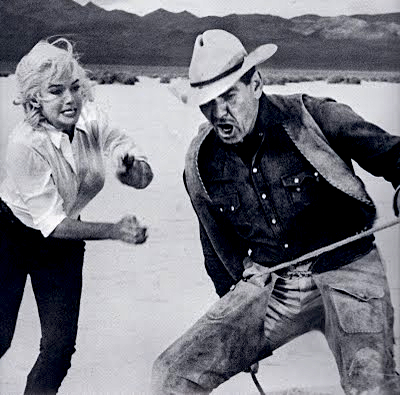
Miller came up with the story, which originally appeared in Esquire Magazine, after an extended stay in Nevada to establish residence in Reno for his divorce from his first wife. Besides the dissolution of his marriage and the bloom of new romance with Monroe, his plays were being dismissed and he was reeling from the House Un-American Activities Committee hearings in Washington, where he’d been called as a witness and refused to name names in the Communist witch hunt proceedings.
It was in Reno where Miller was introduced to similarly displaced persons as himself. Not surprisingly, the three major male figures in the film are cowboys who, as Bruce Crawford puts it, resist “modern civilization encroaching on them and their free-spirited way of life.” Gay (Gable) is an aging, spent, but still gallant horse wrangler, Purse (Clift) a sweet-natured rodeo rider and Guido (Wallach) a cynical war veteran turned bush pilot. The men prefer living a hand-to-mouth existence rather than “work for wages.”
Perhaps projecting himself into the characters, Miller has each stubbornly hold fast to some ideal of freedom and vision of happiness amid this harsh new era reining them in. When Monroe’s nurturing character, Roslyn, comes onto the scene she forms them into a loose family of misfits, each of whom is running away from something or towards something. Perhaps, as Gay says, they’re all trying “to find a way to be alive.” In Roslyn, who awakens promise and desire in the men but ultimately chooses the older Gay, Miller seemed to be imagining a hoped-for reconciliation with Monroe.
Unusual for Huston, The Misfits revolves around a female figure. With the exception of Katharine Hepburn’s turn in The African Queen, no actress so dominates one of his pictures as Monroe does in the part of Roslyn, the human equivalent of the wild mustangs the men try corralling. When, near the end, she expresses disgust at the idea the horses will be sold to the dog food factory, she makes the men question themselves and their methods. In using trucks and a plane to round up the animals for such an inglorious end, the men realize they’ve corrupted the very thing they love.
For Crawford, the denouement is “the end of an era…the end of the West as we once knew it. It’s the last roundup. The cowboys are left knowing they’re going to have to find another way of feeling alive and validating their lives.”
Anyone who knows Huston’s work can see the story echoes the recurrent theme of his pictures — a group of people banded together in search of some prize or goal that proves elusive amid the human conflicts and dramatic fates that arise. And, like much of Miller’s work, the story examines the uneasy gulf between ideals and reality, the challenge of remaining an individual in a corporate era of crushing anonymity and the need for and difficulty of maintaining human-family relationships in a world where people act, by nature, at cross-purposes to each other.
Fateful quests are not only intrinsic to Huston’s work, they operate on more than one level, said Michael Krainak, a professor of film history and appreciation at Metropolitan Community College and the man who headed-up Joslyn’s film series in the 1980s.
“Besides a material quest there’s a spiritual quest. His characters search for meaning in their lives. In many cases not all the characters are aware that is happening. So often, characters like Bogart at the end of Sierra Madre never even benefit from it. They’re oblivious to the changes taking place and to the lessons being learned. Huston equated that to the tenets of the existential philosophers. His films tend to end in material failure because for him the ends are irrelevant.
“What gives the quest meaning is the process itself, and you take something from that or you don’t. The ones who don’t often die physically or spiritually and the ones who do are able to carry on. It’s like Syndey Greenstreet’s great reaction to Peter Lorre when they discover the falcon is immaterial in The Maltese Falcon — ‘Well, what are you going to do?’”

Consistent with Miller’s ideology, The Misfits is replete with references to the impermanence of things.
“Gay speaks a line that’s very Milleresque,” Krainak said. “He says, ‘Well, nothing’s it,’ meaning nothing lasts forever. And Miller seems to be saying, Well, if that’s true, then that’s a guarantee of change. A theme of Miller’s has always been this idea of rebirth and reinventing yourself. The humanistic ideas in Miller’s work that are also evident in Huston’s work is this final goal of self-acceptance. To survive the wreckage of your life by seeking shelter in relationships and, more than anything else, by carving out your own meaning in life. The successful characters in Huston’s movies seem to confront the element of choice, You either choose to live an authentic life or an anonymous life. In this movie, becoming anonymous is to ‘work for wages.’”
In The Misfits Gay finally concedes the passing of his ways, but goes out on his own terms (or sword). He utters a line summing up his defiance and regeneration: “A man who’s afraid to die, is afraid to live.”
At the end, he and Roslyn drive off at night in search of a new path. They look out to see the mare and her colts running free, and they smile. She asks, “How do we get home?” He looks up at the night sky and says, “We’ll follow that star and get there.” As Krainak said, “What they’re left with is the quest — to get back on the trail. Instead of the the sunset, they ride off into the evening star. It’s a very Hustonian ending in that there’s promise for redemption or rediscovery or self-knowledge, but no guarantee.” In Crawford’s mind, “That has to be one of the most beautiful, haunting endings in film history.”
Krainak, a Huston buff, said that for years a running argument among cineastes has centered around the question of whether The Misfits is more a Huston film or a Miller film.
“It’s clearly both, but ultimately I think it’s Huston’s film,” he said. “In typical Huston fashion there’s this physical, larger-than-life task that a bunch of ne’er-do-wells on the edge of society attempt and fate somehow intervenes. In The Misfits it’s not so much tempting fate, as in Greek tragedy, but more of an Anglo-Saxon fatalistic attitude that says, If there’s a worst thing that can possibly happen, it will happen. The Anglo-Saxons had a wonderful word for it — weird. It’s indeterminate. It’s a more modern existential attitude toward fate. The character Guido even says something like, ‘I didn’t know that could happen.’ I think that’s so much what The Misfits is about.”
According to Krainak, the Miller-Huston pairing was more than a philosophical fit, but an artistic one. “One thing Miller’s got in common with Huston is a minimalist approach,” he said. “With Huston it was always a minimalist shooting script, shooting style, choice of film language, use of camera and editing. With Miller it was simple sets, lighting and everything focused on characters. Huston had to work very hard to create a visual dynamic when working so close with the figures of these characters in a setting and landscape that is so specific and very important.”
From his extensive reading about The Misfits, Krainak found Huston, with Miller’s blessing, eschewed color cinematography in order to bring out certain dramatic-symbolic points. “Huston definitely wanted stark black and whites in the background and the setting, with the characters, at least as I interpret it, as the shades of gray. That’s how it plays out in the imagery. It’s really a beautiful black and white film.” The atmospheric photography is by Russell Metty and the neoclassical jazz score is by Alex North.” Krainak added that, unlike most films, The Misfits was shot chronologically in order to capture a sense of “immediacy and spontaneity,” vital qualities in a story about impulsive free spirits.
Krainak said the film came at “a very self-indulgent” point in Huston’s career when, in addition to working with Miller, he was collaborating with such artists as Truman Capote (Beat the Devil), Ray Bradbury (Moby Dick), Jean Paul Sartre (Freud) and Tennessee Williams (The Night of the Iguana). “It was a very psychologically-charged period where he was exploring interior adventures or the landscape of the mind as opposed to exterior adventures or the landscape of nature.”
Why The Misfits was, until recently, dismissed as an interesting failure rather than a singular achievement can be explained by its “dense, cerebral, ‘European’ feel and by its star-crossed history, said Krainak, who puts an intriguing spin on the theory by suggesting “a killing off of a Hollywood era” took place with the deaths of Monroe, Gable and Clift and with the way Huston and Miller “underplayed these icons.”
He explained, “These were aging, wounded icons. Monroe was so vulnerable. Gable completely falls apart in a scene that everybody refers to. Clift takes a bad fall and wears bandages the rest of the film. Their audiences were not used to seeing them that way. What Huston and Miller did with these stars was a precursor of the American cinema renaissance of the late 1960s. The drama, thanks to Miller’s screenplay, and the imagery, thanks to Huston’s direction, made it a film dominated by character as opposed to pure action or star persona.”
Related Articles
- Nevada town remembers Marilyn Monroe’s last movie (omg.yahoo.com)
- Actor Kevin McCarthy Passes Away at 96 (pamil-visions.net)
- Academy to honor Alex North with a screening of ‘The Misfits’ (hollywoodnews.com)
- Clark Gable — Hollywood Star and Male Style Icon (rubylane.com)
- Naomi Watts Marilyn Monroe Biopic “Blonde” (popcrunch.com)
- From the Archives: Alexander Payne, an Exclusive Interview Following the Success of ‘Sideways’ (leoadambiga.wordpress.com)
- Hail, Hail ‘The Descendants’ – Alexander Payne’s First Feature Since ‘Sideways’ a Hit with Critics, and the George Clooney-starring Comedy-Drama is Sure to be an Awards Contender (leoadambiga.wordpress.com)
- Yolonda Ross Takes It to the Limit (leoadambiga.wordpress.com)
Related Articles
- Clark Gable — Hollywood Star and Male Style Icon (rubylane.com)
- Naomi Watts Marilyn Monroe Biopic “Blonde” (popcrunch.com)
- From the Archives: Alexander Payne, an Exclusive Interview Following the Success of ‘Sideways’ (leoadambiga.wordpress.com)
- Hail, Hail ‘The Descendants’ – Alexander Payne’s First Feature Since ‘Sideways’ a Hit with Critics, and the George Clooney-starring Comedy-Drama is Sure to be an Awards Contender (leoadambiga.wordpress.com)
- Yolonda Ross Takes It to the Limit (leoadambiga.wordpress.com)
Charles Jones: Looking Homeward
August 3, 2010
Leave a comment

Image via Wikipedia
One of my favorite pieces from the past decade is this New Horizons profile of the late Charles Jones, a theater director who made quite an impression on the Omaha Community Playhouse and the city. Jones was in the autumn of his life when I met him, confined to a wheelchair as the result of a stroke, but his mind and spirit were still impetuous, his personality still charming. He was no longer directing shows at the Playhouse, the historic theater where Henry Fonda and Dorothy McGuire got their acting starts and where he turned his adaptation of A Christmas Carol into a phenomenon. Rather, he was working at small theaters and loving every minute of it because he was getting to work on things dear to his heart. A Southerner through and through, Jones was a sweet gentleman. His abiding warm memories and piquant descriptions of his childhood Southern home and haunts made me want to turn the story into a nostalgic, vivid , and by-turns irreverent remembrance of things past , sort of in the vein of Truman Capote or Flannery O’Connor.
Charles Jones: Looking Homeward
©by Leo Adam Biga
Originally published in the New Horizons
Former Omaha Community Playhouse director Charles Jones, a rake and raconteur of giant appetites, traces his deeply inquisitive nature to a childhood memory. Picture a Christmas-decorated parlor, circa 1941, at the Columbus, Ga. homestead of his maternal grandmother, Stella “Dovey” Trussell, a matriarchal Belle with an artistic bent. Charlie Jim peers over the edge of a table on tip-toes, a chubby 3-year-old teetering with wide-eyed wonder at his grammy’s handmade snow scene.
“Somehow, I think that memory of peeking over the edge of that big table to see what grandmother Trussell had done has influenced my whole life. I don’t know exactly how to explain that, except I’ve always been curious about things,” Jones said in his lilting native Georgia accent in an interview at the art-decorated home he shares with his wife Eleanor. From his warm wood-paneled den, the 61-year-old Jones, confined to a wheelchair since suffering a massive stroke in 1991, thinks a lot about the past these days. His nostalgia is due not to inactivity — he is busy writing, directing and volunteering — but to the richness of growing-up years filled with individuals and incidents as eccentric as any in a Southern Gothic novel.
His own first novel, The Sweet Breath of Cows, which he is writing with his younger sister Bunny (June), examines a way of life peculiar to the Deep South. One where the pious and profane, coarse and quaint, co-exist. Of his Southernism, he said, “I am so much a part of it. I am so much a product of the people” Yet, for one so steeped in the South, Jones feels at home in Nebraska. “There’s a wonderful attitude here that lets people live their lives.” His book charts gritty times on the family dairy farm and notorious exploits of a black sheep uncle, Louie, who left home to make his way in Prohibition-era Phenix City. Ala., then a wide-open town. “Here was a place that deliberately tried to create itself in the image of the devil. They loved the idea they were wicked. They took a certain bizarre pride in being the Sin City of America and in being able to maneuver around all the laws of the world. Bodies of soldiers were found every day floating in the Chattahoochee River. It was almost past belief a Southern town could have been like this, but my historical research has proven it true,” Jones said.
Louie’s equally improbable personal tale is true. Jones swears it. It seems after leaving home Louie was befriended by both a Sin City madam and a mother superior whose brothel and convent, respectively, did business in adjoining antebellum mansions. For Jones, “the juxtaposition of those sisters of love working next door to each other is amazing, and much of what the novel is about is the juxtaposition of life. I’m intrigued by the question, Is making love making God? It fascinates me.”
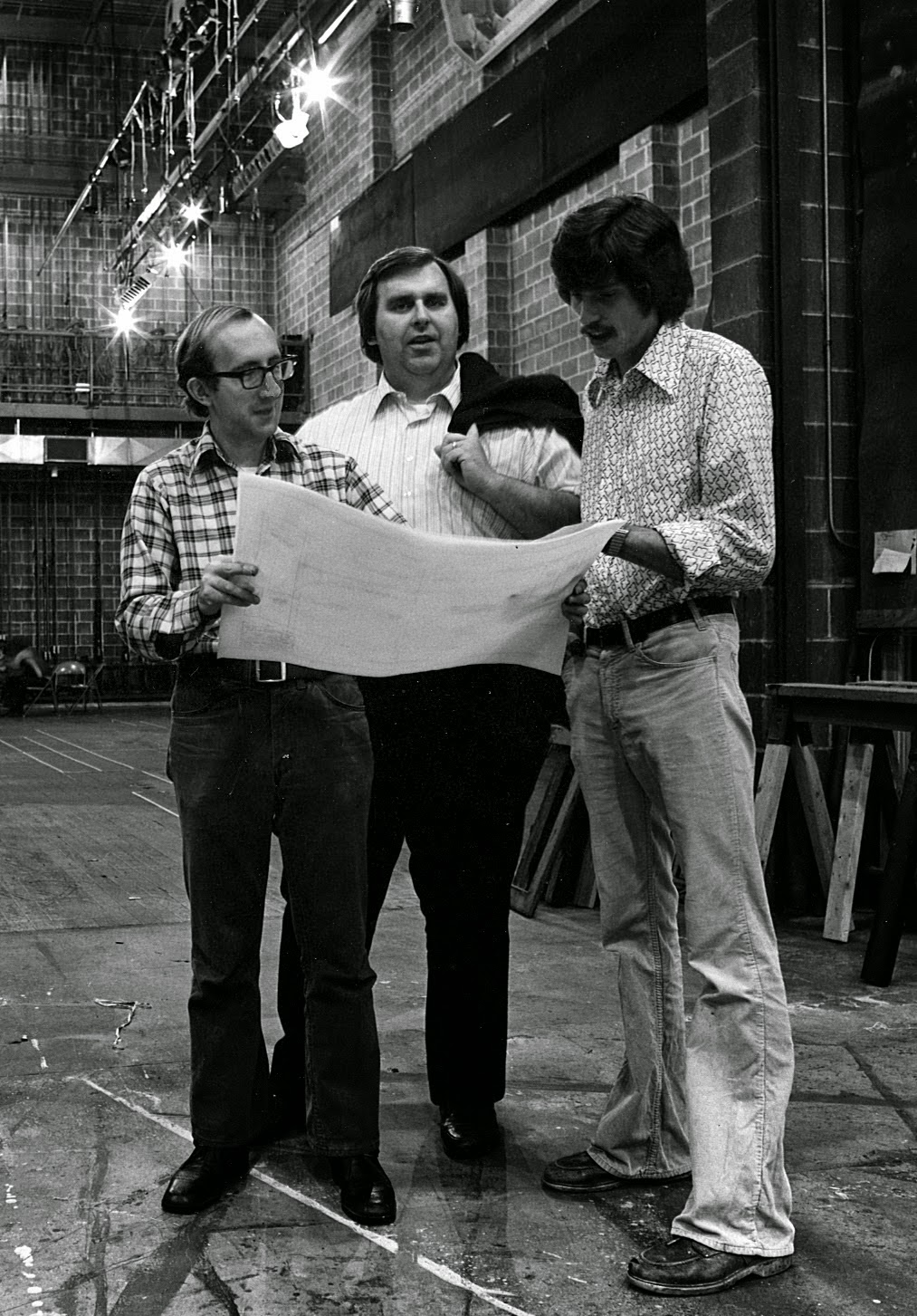
Charles Jones, center
While not all his relations were as colorful as Louie (a paratrooper in war and paramour in civilian life) Jones has only to look homeward to find ample inspiration for his work. Nearby Ft. Benning gave him a front row seat for the unfolding drama of the nation’s war mobilization. “Ft. Benning affected our lives from the time I was a child,” he said. “Columbus was only 38,000 people when the Second World War began. Then Benning was made the largest infantry training base and parachute school and suddenly there were 100,000 men there. It just mushroomed. And, of course, the soldiers’ families would come through too. So the war was very much a presence with us. And the fact Franklin Roosevelt had his Little White House retreat in Warm Springs, only 30 miles from our home, made his death, for us and for a lot of Georgians, an extremely personal experience.”
The Jones home, like many in the area, put-up military boarders during the conflict. Jones did his own part for the war effort when he used his gregarious verve to win a city-wide competition selling war bonds, earning the youngster a live on-air appearance on a local radio station. “Of course, I was so puffed-up, I was like a tiny little peacock just about to bust,” he said.
It was not his first brush with performing, however. From the time he could talk, he displayed an outgoing nature and impressive oratorical skills. He recalls standing on the steps of his family’s Baptist church and, like a preacher, greeting every churchgoer by name. He began exhibiting a vivid imagination at his paternal grandparents dairy farm in Smith Station, Ala., where he and his aunt Alice, only a few years his senior, devised and enacted 10-gallon plays, so named because the sketches lasted as long as it took for the cows’ milk to fill 10-gallon cans. Soon, nephew and aunt, more like brother and sister, began polishing their plays and performing them, complete with makeup, costumes, sets, outside the big farm house on Saturday nights. Their audiences, sprawled on the front porch or on the lawn, were mostly comprised of sympathetic kin but also included black tenant farming families whom the young thespians coaxed into attending. The plays became a family ritual for years. By all accounts, Charlie Jim (his legal name) was a big brash boy with a booming voice and captivating stage presence.
Far from genteel, Jones insists his family was a “dirt poor” lot that, if not as common as the folks in God’s Little Acre, were close cousins. “Our lives as children were visceral. We lived in a bare-footed world with mules and horses and manure. It was not up-town. It was not clean and nice.” But they knew how to have a good time. Weekends at the farm found the clan entertaining homesick GIs at picnics and parties full of Southern hospitality. “Many of the soldiers were farm kids who, stuck way out in the boonies, missed home,” he said. “Coming to Smith Station reminded them of home. It was very emotional for some of them. They’d even queue up to milk cows.”
Sunday dinners brought relations from all around. A preacher was often a feted guest but, man of God or not, he was subject to the same earthy treatment as everyone else. Jones explained: “One Sunday we had a preacher who was going on and on and on and just blessing everything. Finally, my little sister Julia, who was 2 at the time, said, ‘Oh, for Chris sakes, amen,’ and grabbed a chicken leg. Now, my aunts and uncles were the types who had a wonderful sense of humor and so they were just falling on the floor with laughter. And I’m sure Alice and I were laughing too. But my grandmother Jones was probably trying to spank all of us at one time.”
Down home religion offered Jones more grist for the mill. His mother’s family were ardent Methodists and his father’s devout Baptists. Jones found the country services at Smith Station Baptist Church “entertaining,” especially with cousin Samuel Jones present. “Sam was a brilliant man but became a religious fanatic at one time — growing this long beard — and as he took literally the Bible admonition for women to hold their tongues silent Sam would stomp out –clomp, clomp, clomp — in these big old farm boots whenever a woman stood up to testify. People thought his behavior stupid, but it was hysterical to me.”

Image via Wikipedia
He credits his family’s keen appreciation for the absurd for why he found “terribly funny” what others found incredulous. “I suppose it’s because my daddy and grand daddy had a real sense of theater in life. They were entertained by things, and so was I.” His passion for drama was fed whenever his father, Harry Jones, a packing house laborer turned food services magnate, returned from business trips to Chicago or New York and recounted the big stage shows he’d seen. For a boy in Columbus it was a link to far-off places and glamorous goings-on. “Daddy would come back from every trip and describe whatever play he had seen. He would act it out for me. Oh, the magic and imagination of it.”
His imagination was further fired by movies and books and by a local librarian, Miss Loretta Chapel, “a beautiful little bird of a woman” who read stories to he and his school chums. “Miss Loretta would sit in a huge casement window with us children at her feet and she would read, and as she read everything came totally to life. I saw it all acted out in my mind’s eye. It was just amazing. We worshiped her.”
Mad about make-believe, Charlie Jim knew the world of greasepaint was for him long before seeing his first legitimate play — a touring production of Kiss Me Kate — at age 13. He “loved” performing in his first school production, although he claims he was “dreadful.” By 16 he was a bright overweight lad ill at ease among his peers and struggling at school. Then, as if by fate, he was selected with 13 other “misfits” to complete his high school education in an experimental program at Emory University in Atlanta. There, under the tutelage of PhDs determined to teach students in an innovative way, new horizons opened for him and he flourished.
“Our textbooks were the original works of the Greek and Roman playwrights and philosophers. I was just wild about them. Our studies covered the Hebrew tradition, the Middle Ages, Chaucer, Shakespeare, Kierkegaard and so on. What these professors had in mind was to give us the heritage of Western thought and literature and civilization. It was really demanding and interesting. I didn’t appreciate it then but I realize now I had an extraordinary opportunity to read a body of literature that has stayed with me. It was very important to my life.”
Jones said something he read then motivated him to take a big bite out of life: “It was Plato’s statement about cave people living in a shadow world and never having the strength and courage to go through that threshold into the light — into the real world. I was so devastated by that. I thought, ‘That’s not what my life is going to be. I’m not going to allow myself to sit in a cave and not participate. I am going to go out there and try things.’ And I have. I’ve really been a participant.” His tendency to overindulge led to a lifelong battle with obesity, which he blames for the stroke that left him paralyzed on his right side. It’s a battle he’s lately won.
It was at La Grange College, a small Methodist school in La Grange, Ga., he devoted himself body and soul to the theater. He feels indebted to its “fabulous tyrant” of a dramatic arts teacher — Miss Irene Arnett. “She had a strict moral code. To her, we were all sinners going straight to hell. But, man, could she teach Tennessee Williams. Carnality was something she really understood.” After graduating in 1960 Jones promptly landed an acting job in Kentucky, where he enjoyed “the most decadent summer of my life.” When not sowing his wild oats, he did some directing in Columbus before getting his big break as an Equity Actor with the prestigious Barter Theater of Virginia, whose famous alumni include Jessica Tandy, Hume Cronyn and Ned Beatty, whom Jones replaced.
At the Barter Jones found a mentor in its founder and director, Robert Porterfield. “Once you were inside the Barter family then Bob just looked after you and would do anything for you. Bob was a role model for me in leading the Omaha Community Playhouse,” Jones said.
When his Barter Theater tour ended Jones found himself back home — out of work. At the invitation of friends he attended a performance of Tea and Sympathy and was taken with “a beautiful red-haired woman on stage,” Eleanor Brodie, a University of Alabama theater major. He recalled, “She had on a tight turquoise dress with one shoulder bare. She was the most gorgeous and provocative thing I’d ever seen. I was absolutely wild to meet her and I went backstage feeling like the cock-of-the-walk.” When she promptly put him down a peg or two with her sardonic wit, he was even more smitten. He arranged meeting her again through one of her friends and the two married three months later. Partners in life for 38 years now, Eleanor and Charles have two grown sons, Jonathan and Geoffrey, and one grand-daughter, Kathryn.
Of Eleanor, Jones said, “We both made such a total commitment to one another. She has been the most important person in my life. She has pulled me through more things than you can imagine. She’s a fierce lady and our relationship has not always been peaches and cream, but she believes in me. I’m just so damn lucky.”
Like many young actors the pair set their sights on New York, investing everything for their Big Apple fling. Jones found work, even understudying Zero Mostel on Broadway, but after three months of scraping by and enduring rejections he and Eleanor did some soul searching and decided their hearts were back home. “I was a big showy actor, but not nearly as good as many others. It was not ever going to be satisfactory,” he said. “We wanted to go home where we would have a chance to use our very expensive educations as teachers and theater directors. Fortunately, my hometown gave us the opportunity to do that.” He oversaw the restoration and reopening of the historic Springer Opera House, now the state theater of Georgia.
His success as a theater director/manager there prompted the Omaha Community Playhouse to hire him away in 1974. He soon sparked a rebirth of the venerable facility, severely damaged in the May 1975 tornado, by raising funds for its repair and, later, for an ambitious expansion. He launched its professional touring wing — the Nebraska Theater Caravan. His sumptuous adaptation of Dickens’ A Christmas Carol became an annual tradition. His musical extravaganzas dazzled audiences. Season memberships soared. Through it all, he felt the support of his father, who lived to see him grow the Playhouse into the nation’s largest community theater.
Jones finds his thoughts drifting more and more to his late father. “I realize now he was my strongest supporter. He really was.” He fondly recalls the time his father broke into the slated-for-demolition Springer Opera House to plead its case to reporters. The father’s dramatic stunt worked and the theater was saved for the son to guide. One early memory of his father lingers still. It was a Sunday afternoon on the farm. The extended family had finished dinner. Four-year-old Charlie Jim and grandfather Jones were feeding long sugar cane stalks into a mule-drawn mill to be ground into pulp for molasses. Jones tells what happened next: “I shoved a stalk in too far and my right hand got stuck, and the grinder clipped off the ends of all the fingers. I bled like a stuck pig. I can remember the women screaming and even my grandfather panicking. But the one in control was my daddy. He picked me up and he ran with me. All the while, my uncles were running alongside my father, a rather small man, telling him I was too heavy for him to carry, but my daddy would not give me away. He was determined to get me to a doctor, and he did too.”
“That memory of my daddy not giving me away is very powerful and it’s affected my whole life,” a sobbing Jones said, holding up nubby, scarred fingertips. “I wish I could tell him, ‘Thank you.’”
Today, Jones is drawing more and more on his past for his work. Sweet and sour Southern memories abound in his novel as well as in the nostalgic Papa’s Angels, a musical play written by North Carolinian Collin Wilcox Paxton in collaboration with Jones. The play had its premiere last winter with the Grand Olde Players and will be reprised this year. Currently, he is directing The Best Little Whorehouse in Texas for the Dundee Dinner Theater (it runs through May 6). Directing is still his passion: “I love putting the thing together. I love the process of rehearsing a play. That one-on-one with the cast and that working out how we’re going to do it is the fun for me,” he said. But directing is just one of many things he has immersed himself in since leaving the Playhouse due to health reasons in 1998. His work today includes serving on the board of directors for Theaters of the Midlands, a new non-profit corporation designed to support small community theaters in the area.
He is perhaps most excited working with Creighton University occupational therapy students to help them learn about stroke patients like himself. “If I have to endure this at least I can be purposeful by letting students work with me and ask me questions,” he said. “Maybe this will give them some knowledge they can’t get from a textbook and maybe that’s going to help somebody else who has this problem.” His ongoing post-stroke rehab includes aquatic therapy twice a week at Immanuel Rehabilitation Center, which honored him with its Victories Award for his dedication to “soar past limitations with determination, commitment and hope.” For a sensualist like Jones, any debilitation is a curse. Aside from the physical challenges he’s faced, including suffering severe falls and medical complications, his condition has extracted a heavy emotional toll. He credits Eleanor for his recovery. “She was just determined the stroke would not stop me, and it’s amazing how much creative work I’ve done since then.”
On his darkest days he recalls his father’s cheery nature. “He was the most optimistic person I’ve ever known and I feel blessed to have been born with his same optimism. I can be as low as a human being can get. I can think there’s no reason to go on living and then, it’s so incredible, I’ll wake up the next morning and feel, ‘Wow, let’s go.!’ I think one of the reasons I want to keep going is because I am so damn curious about things,” he said. “Part of my curiosity is to know how other people feel about life and what they have to deal with. Do we see things the same way? Do we feel things the same way? To me, that’s fascinating.”
Related Articles
- Stanley E. Williams left major mark in theater (sfgate.com)
- Theatre Building Chicago building theater without a building (timeoutny.com)
- Why the show must go on — and off — for local theater groups (commercialappeal.com)
Categories: Authors/Literature, Charles Jones, Entertainment, Omaha, Omaha Community Playhouse, Playwright, Theater, Writing
A Christmas Carol, Arts, Baptists, Books, Chattahoochee River, Deep South, Dorothy McGuire, Entertainment, Henry Fonda, History, Little White House, Omaha, Omaha Community Playhouse, Shopping, Theater, Truman Capote, World War II
Anyone for classics? Brigit Saint Brigit Theater stages the canon
July 6, 2010
Leave a comment

Image via Wikipedia
Omaha has an unusually strong theater community considering the fact it has few, if any, full-time professional companies. What it does have is several committed theaters doing quality work despite meager resources. One of these is the Brigit Saint Brigit Theater, the focus of this story from about eight years ago. BSM has an ever harder task than most theaters because it is dedicated to staging classics, which means it puts on plays that most audiences have little familiarity with except perhaps the title or the name of the playwright or their reputation. But BSM has been faithful to its mission and always finds a way to survive another season. A long-stated goal of founder Cathy Kurz has been to establish the BSB as a full-fledged professional regional theater, and I’m happy to say that since this article appeared in the Omaha Weekly it’s taken some major steps toward that goal. Other things have changed since then as well, including the theater’s location. But one thing hasn’t — its focus on the classics and its high standards.
Anyone for classics? Brigit Saint Brigit Theatre stages the canon
©by Leo Adam Biga
Originally appeared in the Omaha Weekly
The forte of Omaha’s Brigit Saint Brigit Theatre is its productions of classic plays. Whether Shakespeare, Ibsen, O’Neill, Becket, O’Casey or Williams, you get the genuine article rather than some diluted, spoon-fed, pabulum version. There is such faithfulness to the text that, despite a makeshift theater in Gross Auditorium on the College of St. Mary campus, you are completely transported to the period and context of the piece. This pure, rigorous attention to themes, tones, details, is a tribute to founder and artistic director, Cathy Kurz, who directs most productions, and to technical director, Scott Kurz, her husband, and a dynamic player in what’s become a regular stock company of actors with the theater.
Another key member of the troupe is Amy Kunz, the leading tragedienne among Omaha actresses, who’s essayed such “roles to die for” as Maggie the Cat, Nora in A Doll’s House, Medea, Roxane in Cyrano de Bergerac, Cassandra in The Trojen Women, Hedda Gabler and Blanche Dubois. Kunz, who serves as Brigit’s education director for its many outreach programs, has also directed and created one-woman shows at the theater.
Rounding out the core company is John Durbin (known off-stage as John Jackson), a founding board member and veteran player. Durbin, an Equity stage actor, has, in recent years, lived and worked out of Los Angeles, where he is also a busy film and television actor. For Brigit’s current production of Robert Bolt’s critically-acclaimed A Man for All Seasons — running weekends through September 29 — Durbin has returned to Omaha to play the fetching role of The Common Man. As part of an Equity Artist-in-Residency, he will be commuting here from Los Angeles this fall to appear in and direct a series of Brigit productions.
After years directing plays at nearly every theater venue in Omaha, Cathy Kurz, formerly Wells, formed the Brigit Saint. Brigit — in 1993 — out of frustration. The University of Nebraska-Lincoln graduate, with masters degrees in English and drama, had always been nourished by classic literature and had carved out a niche for herself directing such material, particularly at the Norton Theater, whose namesake, Rudyard Norton, was a classically-trained actor and contemporary of Henry Fonda’s. When the Norton closed, Omaha was left without a venue devoted to the classics and Kurz without a steady employer. She thought for sure another theater would fill the void, but when none did she plunged ahead and formed a new playhouse dedicated to the very material she felt most deeply about.
“I founded the theater in order to be able to work on the kind of material we do — the classics,” she said. “This isn’t a snobbish thing — it’s just my taste — but, to me, if you’re willing to work as hard at this as we do, and most of us do have full-time jobs and come to the theater after work, than it should be more satisfying in terms of challenging one’s self.” And, with that, she gathered around her a group of fellow thespians sharing the same sensibility, including Durbin and Kunz, and launched the Brigit with a production of Henrik Ibsen’s Hedda Gablerat Joslyn Art Museum, where the theater was housed its first two years.
“Trepidation perhaps” is how Kurz described her gut feeling going into that inaugural show. “We didn’t know if anybody would come.” Come they did, first in small numbers, particularly for a first-season rendering of Eugene O’Neill’s A Long Day’s Journey Into Night, but slowly and surely a sufficient audience and contributor base took hold. As Kurz likes to put it, “Once we got rolling, people saw that it’s (classic work) not boring or dusty but that in fact it’s more blooded than watered-down TV or box-office conscious cinema.” Still, arts funding being what it is in Nebraska, the theater is never completely on sure financial footing and is still far away from its goal of having a paid company of actors.
As the very mention of classic theater connotes elitist, dull-as-dirt assumptions, the Brigit is constantly working to overturn such stereotypes. Its reputation for doing heavy drama is something even Cathy Kurz jokes about it when she says, “I’ve tried to bring myself to do The Three Penny Opera, but it’s too grim even for me.” In her role as artistic director, Kurz is smart enough to program a rousing, crowd-pleasing Shakespeare comedy like Much Ado About Nothing — held over to close the 2001-2002 season — because it makes patrons “more likely to come back and try something else” more demanding. This season, her teaser is Beth Henley’s black comedy Crimes of the Heart. One avenue the theater uses to develop a classical following is the Literacy Touring Program in which Amy Kunz and Scott Kurz do residencies and workshops for schools and community groups. The two artists say young people are easily won over. “The first thing to get across is that the classics are fun and interesting,” Kunz said. “We rarely talk at kids. We involve them in learning in an active way. When we present a Shakespeare play they not only study the text, but the class system of the time, the politics, the food, the customs and just things kids find neat like the fact the white-leaded makeup actors wore then slowly ate their skin away.” Scott Kurz, who includes sword-fighting demonstrations in his lessons, said any reservations are soon overcome. “A group of seniors can be a little standoffish when we walk in, but then we do a scene right to them — saying Shakespeare’s words just like we’re talking to them — and we see them get it. By the end, they’re so into it. It’s just the biggest rush. A lot of times we’re fortunate enough to get teachers who integrate the material into their curriculum and bring the kids to see the play, and then they see how cool this stuff is.” At the other end of the spectrum, he said, the theater’s “older patrons often thank us for doing this material. It’s gratifying to know we’re giving them something that maybe they thought they had lost and would never get to see again. We’re giving them a link to the classic literature and quality theater” of their youth.
John Durbin said the Brigit shows courage by presenting work other theaters shy away from and by staying true to playwrights’ vision without taking shortcuts or condescending to the masses. Now 10 years old, the theater has never wavered from its purpose to, as its mission statement reads, “revitalize classic literature by making it come alive through professional quality performance and related educationally-focused programming.”
For Durbin, the theater’s survival, given its lofty pedigree, is an example of just how dogged its leaders have been. “What’s remarkable to me is the tenacity of Cathy in…not letting it die. She never let go of that dream, ever, and it’s really a testament not only to the men and women who have volunteered, but also to her,” he said. “The challenge for that theater is two-fold. It’s not only to mount the plays physically and financially, considering they have so many obstacles in their way, but to make this kind of material accessible to and enjoyable to a contemporary audience in the Midwest. How do you reach out to a community that is fed on football and South Pacific? I think the reason they succeed is they never talk down to their audience… never. It’s almost like they draw a line in the sand with the audience and say, ‘OK, we’re going to do this. And you trust us and you believe in us, because you’ve been around, and we’re going to take you that much further. We’re going to challenge ourselves and we’re going to challenge you. I would say that at its core the Brigit has a passion for literature and a pure love for live theater. I mean, who else but Brigit St. Brigit is going to do Juno and the Paycock? But — you know what? — the amazing thing is, it’s as timely now as when it was written.”
He said the work done there and the integrity brought to it, is what draws him back to perform. “This is really the kind of stuff that interests me…plays that are not done that often in a community theater setting…that have something more to say…and that have stood the test of time. I mean, all hats off to Neal Simon, but I just don’t see The Star-Spangled Girl lasting for the next 200 years. We’re going to mount a production of The Rivals in the spring, and that play is like 500 years old, and it’ll be done in another 500 years.”
Another thing the Brigit is known for is its penchant for Irish plays, which is a natural given the fact founder Cathy Kurz has a deep affinity for Irish literature (“I love the Irish’s gift for humor and turns-of-phrase”), one so deep she named the theater for the mythological St. Brigit of County Kildaire. Each spring the Brigit celebrates its cultural heritage with Irish productions. This season, the selections are, in repertory, Brian Friel’s Dancing at Lughnasa and The Freedom of the City.
Because the Brigit creative team is cut from the same classical cloth and has worked together so intensively for so long, there is a symbiosis among its members in the way they approach rehearsals and the overall creative process. According to Amy Kunz, the working relationship she has with Cathy Kurz, who’s directed her in dozens of productions, and with Scott Kurz, whom she’s often played opposite, “is almost a second language, literally. Cathy can just give me a look and say, ‘Well, you know, if you move to the right, then your interpretation…’ and I’ll say, ‘Yes, I know what you mean.’ It doesn’t take much for all three of us — we’re really all so attuned to each other.” Scott Kurz said one reason he’s worked almost exclusively with the theater since joining it in 1993 is “because of that rapport” the close-knit company cultivates. That kind of intimacy, not to mention the dynamics of a husband and wife working together, could cause problems in some companies, but not the Brigit.
Said Kurz, “I can’t ever remember a time when there was this turbulent production. We all look at the work the same way — that you need to come prepared and that you need to listen. We all agree on these certain things and it makes it easier for new people to jump in. They can see we have a comfort level with each other and share a certain philosophy when it comes to the work.”
Kunz said she forged a similar relationship with fellow artists when a member of the Omaha Theater Company for Young People. Ultimately, she said, it’s an exercise in collaboration. “That’s what the theater is about on any level, really. With each play you work with a group of people to try and honor the playwright and, together, you try to tell the story well. It’s a new experience every time and you don’t know if you’ll make it or not.” She said Cathy Kurz is “very open” to input from her and other actors. “I’m really opinionated, and so is Scott for that matter, about what we’re doing on stage. But it’s always done in the spirit of feeding each other.”
Scott Kurz said, “That’s how things get figured out — you can’t do it any other way, I think.” Cathy Kurz said she enjoys the “give and take” with her casts but she emphasizes the director must be the final arbiter. “You know what you need to have and you hope you can bring people around to seeing it the same way you see it, so you have to remain flexible on the one hand. On the other hand…you’re the interpreter and the voice of the playwright. You’re all the playwright’s got.”
Rehearsals are where, as Scott Kurz describes it, you “find the play” and it is in this process the Brigit’s legendary diligence elevates the company’s work from the merely ordinary to the finely nuanced, right down to the smallest bit or part. In fleshing out a scene during rehearsal, Cathy Kurz attempts to make her directions “as specific” and as rooted in the script as possible. “It all has to come from the text,” she said. “If I see a scene isn’t right, but I don’t know how to fix it, I’m going to keep watching the scene and thinking about it. I never give up on something.” A Man for All Seasons rehearsals stretched into the wee hours leading up to opening night as Kurz and company grappled with an unwieldy scene.
Kunz said she appreciates Kurz as a director because “she tells you exactly what she wants from your character early on. She’s very specific right away and then you have this groundwork to build on. She doesn’t make you stick within this structure. I think it’s a really productive way to work and it saves a lot of time. I’ve worked with a lot of directors who will wait…for weeks for you to ‘find it,’ and then will give you this nebulous kind of direction like, ‘Well, be more this’ or ‘Be more that.’ And then you maybe get it and maybe you don’t.”
Ten years. In that time the Brigit St. Brigit Theater has established a niche for itself. Cathy Kurz feels a paid acting company is still a “realistic” objective but for now she is satisfied the theater has achieved a “consistent level of quality” and “a good foundation.” As Scott Kurz sees it, the theater is on track to realize its goal of being “a professional company. There’s that sense that we’re getting to that point and being able to answer people when they ask ‘What do you do for a living?’ with — ‘I’m in theater.’ And that’s what it’s all about. I don’t know how many times my parents have told me ‘Get a real job.’ My family’s been incredibly supportive but they don’t always understand what I do. My dad says, ‘You work harder than anybody else in the family and you’ve got nothing to show for it.’ And I’m like, ‘That’s not true — I do. I’m working towards something.’ And so it’s really nice to feel we’ve stepped up a notch and we’re getting closer. We just have to keep going and we’ll get there.”
After the 1994-1995 season, the theater moved to the Bellevue University campus, at the invitation of Bellevue drama professors who admired the company’s work. In 1997 the Brigit, searching for an Omaha site, relocated to its present home at the College of St. Mary. It was a case of good timing, as CSM, host of the annual Nebraska Storytelling Festival, was looking to renew its long dormant drama program. “We had a very popular theater major in the ‘60s, and as we worked toward reemphasizing the arts at College of St. Mary,” president Maryanne Stevens, RSM, said, “we wanted to have the presence of a theater company. The presence of a theater on campus makes a statement in terms of the college’s affirmation of the arts and the importance of arts in education. And having the Brigit St. Brigit here has meant a revival of theater studies at the college. A lot of our English classes have integrated the various works that have been performed by the Brigit St. Brigit into their semester’s curriculum and therefore assign reading the play or going to the play…Cathy Kurz actually teaches some classes in theater at the college and has developed a minor in theater.” The Brigit triumvirate of Kurz, husband Scott and Amy Kunz hold adjunct faculty positions at CSM.
But why did CSM feel the Brigit was a good fit there? “Well, because of the kinds of things they do,” Stevens said. “They do classical theater as well as what they call ‘intellectually-twisted theater,’ but it’s all rooted in classic playwrights and I think that brings a level of integrity to an understanding of theater here at the college. Anything in the arts invigorates the core curriculum of the college.”
As far as the Brigit’s continued presence at CSM, there is discussion of an expanded theater space on campus. “Cathy and I have both talked about that,” Stevens said, “because there’s not really a backstage — there aren’t any dressing rooms or things like that — and I wouldn’t be surprised if we see that in the future.” And, as far as what’s in store for theatergoers at the Brigit, Kurz would like someday to tackle O’Neill’s The Iceman Cometh and Chekhov’s The Seagull, two demanding plays rarely performed around here.
Related Articles
- Wendell Pierce to appear in ‘Four’ (variety.com)
- Hanesbrands Theatre in the New Milton Rhodes Center for the Arts Announces 2010-2011 Season (prnewswire.com)
- ‘Much Ado’ kicks off Classic’s ‘Battle of the Sexes’ season (mysanantonio.com)
Categories: Entertainment, Omaha, Playwright, Theater, Writing
Amy Kunz, Brigit St. Brigit Theater, Cathy Kurz, Entertainment, Omaha, Scott Kurz, Theater
Get your jitney on: August Wilson play “Jitney” at the John Beasley Theater resonates with cast and crew
June 18, 2010
1 comment

Image by macwagen via Flickr
I am drawn to stories with multiple layers and textures, and the following story I did for The Reader (www.thereader.com) is a good example, as it resonates on social, cultural, historical, and artistic levels, among others. The piece uses the production of the August Wilson play Jitney to look at the gypsy cab phenomenon that is the context for the drama and to look at the theater company that put on this production and its founder-director, John Beasley. When I found out that Beasley himself had driven a jitney in his hometown of Omaha, the symmetrey was complete. Beasley has a distinguished track record acting in Wilson plays in regional theater and he is personally responsible for introducing Wilson’s work to Omaha. His company, the John Beasley Theater & Workshop, has performed virtually the entire cycle of Wilson plays and is considered a fine interpreter of the late playwright’s work. Beasley knew Wilson and for the production of Jitney I wrote about here he brought to Omaha two more veterans of Wilson plays in the actors Anthony Chisolm and Willis Burks.
Get your jitney on: August Wilson play “Jitney” at the John Beasley Theater resonates with cast and crew
©by Leo Adam Biga
Originally published in The Reader (www.thereader.com)
Gypsy cabbies are at the heart of a milestone event in Omaha theatrical history unfolding this month at the John Beasley Theatre & Workshop, located in the South Omaha YMCA at 3010 Q Street.
For its current production of celebrated American playwright August Wilson’s drama Jitney, the JBT’s assembled some of the leading interpreters of the two-time Pulitzer Prize winner’s work. Its director, Claude Purdy, is perhaps the dramatist’s foremost collaborator outside famed director Lloyd Richards. Adding luster and weight to the ensemble cast are award-winning regional theatre and Broadway actors Anthony Chisholm and Willis Burks, members of Wilson’s stock company. The actors are joined on-stage by the theatre’s namesake, John Beasley, a Wilson regular who’s worked with Chisholm. In a first, Beasley appears in Jitney with each of his sons, Tyrone and Michael, both of whom he shares intense scenes with.
Boasting four artists closely associated with his signature plays, there’s even talk Wilson may visit Omaha to catch Jitney during its JBT run. Like his Broadway-produced Seven Guitars, Two Trains Running, The Piano Lesson (Pulitzer-winner for best drama), Joe Turner’s Come and Gone, Fences (Pulitzer and Tony Award-winner for best drama) and Ma Rainey’s Black Bottom, Jitney’s set in Pittsburgh, Pa.’s black Hill District. The Wilson “canon,” as Chisholm calls it, is richly evocative of the monumental struggles and triumphs of the African-American experience, from slavery till today, as filtered through the rise and fall of one neighborhood Wilson knew as a child and rediscovered as an adult. It’s the place that nurtured him as an artist and that he’s chosen as a prism for telling The Black American Story.
Wilson has said his Hill plays are about “the unique particulars of black culture…I wanted to place this culture onstage in all its richness and fullness and to demonstrate its ability to sustain us…through profound moments in our history in which the larger society has thought less of us than we have thought of ourselves.”

August Wilson
Jitney is one chapter in this epic story. The circa-1970s drama takes place in a storefront gypsy cab stand amid a decayed inner city landscape reeling from urban renewal. Off-the-books earnings of jitney drivers figure in an underground economy where numbers running, drug dealing and loan sharking go on. Unlike these more unsavory pursuits, jitneys provide a community service — public transportation — that’s lacking or lagging. When events conspire to threaten the livelihood of Jitney’s men, they are angry, then resigned and, finally, moved to take action.
In telling the story, the JBT’s gathered an unusual confluence of talent that president/artistic director John Beasley sees as a step towards his vision of making the two-year-old facility a regional theatre. It’s his hope the JBT continues being a magnet attracting top talent from around the country as well as a training ground and launching pad for local actors, directors, playwrights in pursuing their craft.
Nothing quite like this has happened on the Omaha theatre scene. Touring troupes from the Royal Shakespeare Company and Guthrie Theatre have done residencies. An occasional New York director or actor has come through. But Omaha hasn’t had this many artists of this caliber work in a locally produced play, unless you count opera, since 1955. That’s when two Hollywood-Broadway icons at the peak of their powers, native Nebraskans Henry Fonda and Dorothy McGuire, returned to perform in an Omaha Community Playhouse benefit production of The Country Girl. Henry’s ingenue daughter, Jane, made her debut in that same show.
Now, half-a-century later, the JBT is stamping itself as an important regional presenter of a living master playwright’s work. The New Yorker’s John Lahr has said of Wilson, “No one except perhaps Eugene O’Neill or Tennessee Williams has aimed so high and achieved so much in the American theater.”
Although set in Wilson’s hometown of Pittsburgh, the action reverberates with the wider black experience. For example, John Beasley drove a jitney out of two Omaha stands — Chappie’s Corner and Speedy Delivery – in the late 1960s. “Yeah, those were the days, man,” he said. “We’d go into the jitney stand in the morning and give the owner something like a $6 fee. It’d say ‘Pickup and Delivery’ on the window of the store, but everybody knew what it was. And then when the calls came in you took ‘em in order. Some of us had regular customers. They’d call in and ask for certain guys. ‘You got a car? Yeah, where you going?’ A dollar would carry you most places. You used your own car. Unmarked. I had a little raggedy Ford at the time. I think the farthest west we went was the Crossroads.”
Unregulated cabs have long been a fixture on Omaha’s Near Northside, where they serve a gap left by city sanctioned and state licensed cab companies reluctant to serve residents there. Since the displacement of homes and businesses by the riots and North Freeway construction of the late ‘60s, north Omaha’s high crime rep has made regular cabbies even more leery of taking calls or cruising for fares there. “There’s still jitneys today. Cabs don’t want to come to the north side. It provides a service to people who maybe don’t have cars or don’t have licenses. And as high as gas is going, a lot of poor people can’t afford to drive,” Beasley said.
Jitneys are officially banned, but authorities look the other way because they do fill a need. As Beasley put it, “What are they going to do? Nobody else is serving the neighborhood.” Anyone in north Omaha can tell you where to find one. Postings for their services adorn public bulletin boards. Former University of Nebraska at Omaha public administration professor Peter Suzuki drove a jitney in Omaha in the early ‘70s to research a series of published papers he wrote on the subject. He said drivers of that era were typically young men — as Beasley was then — or retirees looking to make ends meet. Jitney stands, bookie joints and after-hours spots were vital parts of the black community. “That’s why the story resonates with me so much,” Beasley said. “It’s a black experience. A personal experience.”
Partly based on the denizens of a Pittsburgh jitney operation, the play gives voice to a working-class segment of black American culture. Anthony Chisholm said, “It shows how this cab station contributed to the service of the community. It was a lifeblood of the Hill. It gives you a peak into a certain category of lives there that made up the mosaic of the whole. It shows black men in the throes of survival.”

A building in Pittsburgh’s Hill District
Amid their patter, invective and humor is revealed an authentic, vital vignette of inner city street life rarely glimpsed by non-black audiences. But the real power of the words and ideas is they are culturally specific yet universal. Chisholm suggests that with only minor changes the play would work equally well with “white working class” characters. Their lives are similar. “The soul and humanity in these words are in every human being on this planet,” he said. “There’s a lot of humanity in Jitney.”
Guest director Claude Purdy said that above all, he loves “the language” of Wilson. “He’s a poet.” Purdy’s strong ties with Wilson put him on intimate terms with the icon. Their friendship goes back to when they were emerging artists in their shared hometown of Pittsburgh, whose Hill District is the inspiration for the writer’s projected ten-play cycle chronicling 20th century African-American life. It was Purdy who suggested Wilson turn his Black Bart poems into a play and leave Pittsburgh for St. Paul, Minn.’s lively theater scene. Purdy preceded him there to direct at the Penumbra Theatre Company, a black regional theater. It was, indeed, in St. Paul where the largely self-educated Wilson turned playwright. He only found his voice, however, after returning to Pittsburgh and steeping himself in its culture.
Among the venues where Purdy’s mounted Wilson’s work is the American Conservatory Theatre, the L.A. Theatre Center, the Pittsburgh Public Theatre, the Penumbra and the Milwaukee Repertory Theatre. He’s also directed regional-national tours of various Wilson works. Guest actors Anthony Chisholm (Burr Redding on HBO’s Oz, the film Beloved) and Willis Burks (CBS’ Law & Order, the film Sunday) have worked extensively in Wilson plays. They workshopped Jitney with him. They and castmates of the original 2000 New York production won Drama Desk/Obie Awards for best ensemble performance. Jitney won the Drama Critics Circle Award as best play of the year, one of seven Wilson works so honored. Chisholm appears in Wilson’s new play, Gem of the Ocean, opening on Broadway in the fall. Each man considers it “a privilege” to speak Wilson’s words.
“He’s a philosopher and a poet along with being a great storyteller,” Chisholm said. “He writes really deep stuff. His passages are food for thought for everyone. I always recommend anyone take the time to read his plays. If you read O’Neill or Tennessee Williams or Shakespeare or Chekhov, or you’re just in the habit of reading, then his work is a must.”
John Beasley claims his own Wilson connection. The owner of major props in film (Rudy, The Apostle) and TV (Everwood), the Omahan first came to prominence in Wilson plays on Minneapolis, Chicago and Atlanta regional theatre stages.
Under Beasley’s guidance, the JBT is fast becoming an August Wilson showcase. Housed in the site of the defunct Center Stage Theatre, where Beasley honed his own acting chops, the JBT grew out of a kind of rescue mission. In 2002, he reopened the abandoned Center Stage by mounting Wilson’s Tony Award-winning drama Fences, which he directed and starred in. Its success led the Omaha Housing Authority, which oversees the La Fern Williams Center the theatre is part of, to rename the Center Stage in Beasley’s honor. That’s when he and son Tyrone, himself a regional theatre veteran, began taking ownership of the JBT.
Since Fences, the JBT’s presented Ain’t Misbehavin and the Wilson plays Joe Turner’s and Two Trains and Ntozake Shange’s For Colored Girls Who’ve Considered Suicide When the Rainbow is Enuf. It’s no accident Jitney is the fourth Wilson play among the JBT’s six offerings to date. “August Wilson is arguably America’s greatest living playwright,” Beasley said. “His work is always well-received. But I still don’t see theaters around here taking on his plays. I think it’s essential, especially in Omaha where we really don’t have a minority media voice, to have this arena,”.
In Beasley’s eyes, Wilson reveals a story often withheld or obscured. “Basically, he deals with every decade of the 20th century…with blacks migrating from the south to Pittsburgh and what they faced once they got there,” he said. “His characters talk about what happened back down south and touch on some of the reasons they came north. It’s always their stories. The plays deal with the era of urban renewal, when a lot of black businesses and neighborhoods were being boarded-up and blight set in and how, once redevelopment came in, blacks were being forced out. You can see the same pattern here in Omaha. He’s really telling the black American story, but the thing about August’s work is it’s not just the black experience, it’s the human experience, and that’s why I love August.”
Beasley’s elicited the same strong identification from white audiences playing Troy Maxson in Fences as he has playing Willie Loman in Death of a Salesman. “Both are tragic figures who had a dream dashed,” he said. Each craves recognition, affirmation. As Loman says, “attention must be paid.”
Anthony Chisholm
The men in Jitney share similar regrets and rants. They comprise an independent, disparate breed of urban entrepreneurs threatened by encroaching “progress.” Representing a variety of ages and life experiences, they must all hustle to get by. There’s Becker, the weary cab stand owner whose heart has grown cold over the terrible mistake his son Booster made. In his stage debut, KETV photojournalist and Kaleidoscope host/producer Ben Gray plays Becker. Tyrone Beasley essays the estranged Booster. As Turnbo, the resident gossip always messing in other people’s business, John Beasley assumes a role he’s performed many times before. In the part of Youngblood, the upwardly mobile Vietnam vet desperate to escape The Life, is Michael Beasley. The former pro basketball player made his JBT debut last year in Two Trains under the direction of his brother Tyrone.
As Fielding, a former tailor who drinks too much pining for his ex-wife, Anthony Chisholm recreates one of the roles he’s become identified with. Playing Doub, the sardonic Korean War vet, is Omaha actor Vince Alston. Shealy, the good-natured numbers runner, is recreated by Willis Burks. Familiar Omaha actor Kevin Williams appears as Philmore, a frequent customer and the stand’s drunk comic relief. The only female character, Rena, is the distressed wife of Youngblood. She’s played by Iris Perez, a Hot 107.7 FM on-air personality and just one of many talented local actresses the JBT’s developed in its ongoing acting workshops.

Willis Burks
Tensions and jokes abound among the men of Jitney. Personal baggage weighs them down. Their lively exchanges and monologues ring with the authentic African-American vernacular, idiom, patios and sensibility that Wilson could only get from careful observation and listening, something he did haunting the Hill District’s juke joints, bars, diners, clubs, hotels, whore houses, jitney stands and bookie parlors.
Chisholm and Burks have walked with Wilson through those same streets, going to some of those very places and meeting the colorful figures he’s based characters on. They’ve heard the laughter and despair. Wilson is known to write listening to the strains of Bessie Smith and other great black music stylists and his spoken words do echo the plaintive tone, lyrical jive and lift-up-thy-voice testimony of gospel, soul, jazz and the blues. “All of his work has that really nice rhythm about it,” said Beasley. “It’s jazz. That’s how his plays sound to me. I compare him to Shakespeare. It wasn’t until I learned the music of his writing that it really flowed for me. Every word is well chosen for a certain rhythm…for a certain effect.”
The words are often quite funny, too. Burks said he and Chisholm were part of an early tour of Jitney on “the chitlin circuit,” where they played to audiences in broad comic strokes. “It can go in that direction,” he said. “The laughs are there.” It was later brought back to its dramatic roots. The actors also witnessed Wilson expand the play by more than an hour. “It was a different play then from what it is now,” Burks said, adding that whole characters were dropped and others made over. Burks character Shealy became “less fly” and more “respectable.” Chisholm’s Fielding was “rounded out” and given a “back story” drawn from the actor’s tailor-father. Booster was made less “gangsta” and more “educated.”
When the Jitney men learn the surrounding neighborhood is slated for demolition, their cab stand becomes a kind of metaphorical last stand for all they hold dear. In the end, each stands alone, yet together. “What is it about is a tough question to answer because it’s such an ensemble piece. Every character has his own story,” said JBT associate artistic director Tyrone Beasley. “It’s like a slice of life that comes into focus at this critical moment in their lives.”
“That’s what Jitney is, it’s a slice of life,” John Beasley said. “The interesting thing to me is the relationships between each of these individuals and how they eventually pull together for a common goal. Even Turnbo, who’s a pain in the ass. They’ve got a business to save. Like one of ‘em says, ‘Where else can you make $40 a day?’ That was pretty good money in the black community in those days. It was a decent enough way to make a living. It was a necessary business, too.”
What Beasley’s doing with Jitney is part of a stated mission to move his theatre to the next level. “I want to do things not being done by other theatres in town, which is basically plays by and about minorities. I want this to be a regional theatre where established artists can come and work with local artists. What I’m finding is, it’s taking on a life of its own,” he said.
Jitney’s guest artists say they’re down for return engagements and support the JBT’s aim of joining America’s handful of black regional theatres. “In regional theater it’s all about putting it together and making a good ensemble piece. It’s working with people who respect the writer and respect the process. And from what I’ve seen, it’s the same thing here,” said Burks. Chisholm added, “It’s a great opportunity to work your chops.”
Related Articles
- Stephen McKinley Henderson, an August Wilson Stalwart (nytimes.com)
- A Private Jitney for Jeff Koons’ Balloon Dog? (observer.com)
- Millburn Jitney Stop to Stay (maplewood.blogs.nytimes.com)
- Jitney minibuses offer a cheaper option for N.J. passengers, but ride can be risky (nj.com)
- Award-Winning Playwright Lanford Wilson Dies (foxnews.com)
- Anthony Chisholm is in the House at the John Beasley Theater in Omaha (leoadambiga.wordpress.com)
- What Happens to a Dream Deferred? Beasley Theater Revisits Lorraine Hansberry’s ‘A Raisin in the Sun’ (leoadambiga.wordpress.com)
- Crowns: Black Women and Their Hats (leoadambiga.wordpress.com)
Gospel playwright Llana Smith enjoys her Big Mama’s time
June 7, 2010
Leave a comment

Image by Shavar Ross via Flickr
About a decade ago I became reacquainted with a former University of Nebraska at Omaha adjunct professor of photography, Rudy Smith, who was an award-winning photojournalist with the Omaha World-Herald. I was an abject failure as a photography student, but I have managed to fare somewhat better as a freelance writer-reporter. When I began covering aspects of Omaha‘s African-American community with some consistency, Rudy was someone I reached out to as a source and guide. We became friends along the way. I still call on him from time to time to offer me perspective and leads. I’ve gotten to know a bit of Rudy’s personal story, which includes coming out of poverty and making a life and career for himself as the first African-American employed in the Omaha World-Herald newsroom and agitating for social change on the UNO campus and in greater Omaha.
I have also come to know some members of his immediate family, including his wife Llana and their musical theater daughter Quiana or Q as she goes by professionally. Llana is a sweet woman who has her own story of survival and strength. She and and Rudy are devout Christians active in their church, Salem Baptist, where Llana continues a family legacy of writing-directing gospel dramas. She’s lately taken her craft outside Omaha as well. I have tried getting this story published in print publications to no avail. With no further adieu then, this is Llana’s story:
Gospel playwright Llana Smith enjoys her Big Mama’s time
©by Leo Adam Biga
When the spirit moves Llana Smith to write one of her gospel plays, she’s convinced she’s an instrument of the Lord in the burst of creative expression that follows. It’s her hand holding the pen and writing the words on a yellow note pad alright, but she believes a Higher Power guides her.
“I look at it as a gift. It’s not something I can just do. I’ve got to pray about it and kind of see where the Lord is leading me and then I can write,” said the former Llana Jones. “I’ll start writing and things just come. Without really praying about it I can write the messiest play you ever want to see.”
She said she can only be a vessel if she opens herself up “to be used.” It’s why she makes a distinction between an inspired gift and an innate talent. Her work, increasingly performed around the nation, is part of a legacy of faith and art that began with her late mother Pauline Beverly Jones Smith and that now extends to her daughter Quiana Smith.
The family’s long been a fixture at Salem Baptist Church in north Omaha. Pauline led the drama ministry program — writing-directing dramatic interpretations — before Llana succeeded her in the 1980s. For a time, their roles overlapped, with mom handling the adult drama programs and Llana the youth programs.
“My mother really was the one who started all this out,” Smith said. “She was gifted to do what she did and some of what she did she passed on to me.”
Married to photojournalist Rudy Smith, Llana and her mate’s three children grew up at Salem and she enlisted each to perform orations, sketches and songs. The youngest, Quiana, blossomed into a star vocalist/actress. She appeared on Broadway in a revival of Les Miserables. In 2004 Llana recruited Quiana, already a New York stage veteran by then, to take a featured role in an Easter production of her The Crucifixion: Through the Eyes of a Cross Maker at Salem.
Three generations of women expressing their faith. From one to the next to the other each has passed this gift on to her successor and grown it a bit more.

Pauline recognized it in Llana, who recalled her mother once remarked, “How do you come up with all this stuff? I could never have done that.” To which Llana replied, ‘Well, Mom, it just comes, it’s just a gift. You got it.” Pauline corrected her with, “No, I don’t have it like that. You really have the gift.”
“Them were some of the most important words she ever said to me,” Smith said.
Miss Pauline saw the calling in her granddaughter, too. “My mother would always say, ‘Quiana’s going to be the one to take this further — to take this higher.’ Well, sure enough, she has,” Smith said. “Quiana can write, she can direct, she can act and she can SING. She’s taken it all the way to New York. From my mother’s foundation all the way to what Quiana’s doing, it has just expanded to where we never could have imagined. It just went right on down the line.”
Whether writing a drama extracted from the gospels or lifted right from the streets, Smith is well-versed in the material and the territory. The conflict and redemption of gospel plays resonate with her own experience — from her chaotic childhood to the recent home invasion her family suffered.
Born in a Milford, Neb. home for young unwed mothers, Smith knew all about instability and poverty growing up in North O with her largely absentee, unemployed, single mom. Smith said years later Pauline admitted she wasn’t ready to be a mother then. For a long time Smith carried “a real resentment” about her childhood being stolen away. For example, she cared for her younger siblings while Pauline was off “running the streets.” “I did most of the cooking and cleaning and stuff,” Smith said. With so much on her shoulders she fared poorly in school.
She witnessed and endured physical abuse at the hands of her alcoholic step-father and discovered the man she thought was her daddy wasn’t at all. When her biological father entered her life she found out a school bully was actually her half-sister and a best friend was really her cousin.
It was only when the teenaged Llana married Rudy her mother did a “turnabout” and settled down, marrying a man with children she raised as her own. “She did a good job raising those kids. She became the church clerk. She was very well respected,” said Smith, who forgave her mother despite the abandonment she felt. “She ended up being my best friend. Nobody could have told me that.”
Until then, however, the only security Smith could count on was when her Aunt Annie and Uncle Bill gave her refuge or when she was at church. She’s sure what kept her from dropping out of school or getting hooked on drugs or turning tricks — some of the very things that befell classmates of hers — was her faith.
“Oh, definitely, no question about it, I could have went either way if it hadn’t really been for church.” she said. “It was the one basic foundation we had.”
In Rudy, she found a fellow believer. A few years older, he came from similar straits.
“I was poor and he was poor-poor,” she said. “We both knew we wanted more than what we had. We wanted out of this. We didn’t want it for our kids. To me, it was survival. I had to survive because I was looking at my sister and my brother and if they don’t have me well, then, sometimes they wouldn’t have nobody. I had to make it through. I never had any thought of giving up. I did wonder, Why me? But running away and leaving them, it never crossed my mind. We had to survive.”
Her personal journey gives her a real connection to the hard times and plaintive hopes that permeate black music and drama. She’s lived it. It’s why she feels a deep kinship with the black church and its tradition of using music and drama ministry to guide troubled souls from despair to joy.
Hilltop is a play she wrote about the driveby shootings and illicit drug activities plaguing the Hilltop-Pleasantview public housing project in Omaha. The drama looks at the real-life transformation some gangbangers made to leave it all behind.
Gospel plays use well-worn conventions, characters and situations to enact Biblical stories, to portray moments/figures in history or to examine modern social ills. Themes are interpreted through the prism of the black experience and the black church, lending the dramas an earthy yet moralistic tone. Even the more secular, contemporary allegories carry a scripturally-drawn message.
Not unlike an August Wilson play, you’ll find the hustler, the pimp, the addict, the loan shark, the Gs, the barber, the beauty salon operator, the mortician, the minister, the do-gooder, the gossip, the busy-body, the player, the slut, the gay guy, et cetera. Iconic settings are also popular. Smith’s Big Momma’s Prayer opens at a church, her These Walls Must Come Down switches between a beauty shop and a detail shop and her Against All Odds We Made It jumps back and forth from a nail shop to a hoops court.
The drama, typically infused with healthy doses of comedy, music, singing and dancing, revolves around the poor choices people make out of sheer willfulness. A breakup, an extramarital affair, a bad business investment, a drug habit or a resentment sets events in motion. There’s almost always a prodigal son or daughter that’s drifted away and become alienated from the family.
The wayward characters led astray come back into the fold of family and church only after some crucible. The end is almost always a celebration of their return, their atonement, their rebirth. It is affirmation raised to high praise and worship.
At the center of it all is the ubiquitous Big Mama figure who exists in many black families. This matriarch is the rock holding the entire works together.
“She’s just so real to a lot of us,” Smith said.
Aunt Annie was the Big Mama in Smith’s early life before her mother was finally ready to assume that role. Smith’s inherited the crown now.
If it all sounds familiar then it’s probably due to Tyler Perry, the actor-writer-director responsible for introducing Big Mama or Madea to white America through his popular plays and movies. His big screen successes are really just more sophisticated, secularized versions of the gospel plays that first made him a star. Where his plays originally found huge, albeit mostly black, audiences, his movies have found broad mainstream acceptance.
Madea is Perry’s signature character.
“When Madea talks she be talking stuff everybody can relate to,” Smith said. “Stuff that’s going on. Every day stuff. We can relate to any and everything she be saying. That character’s a trip. It’s the truth. One of my mother’s best friends was just like Madea. She smoked that cigarette, she talked from the corner of her mouth, she could cuss you out at the drop of a hat and she packed her knife in her bosom.”
Smith appreciates Perry’s groundbreaking work. “That is my idol…my icon. At the top of my list is to meet this man and to thank him for what he’s done,” she said. She also likes the fact “he attributes a lot of what he does to the Lord.”
Her own work shows gospel plays’ ever widening reach — with dramas produced at churches and at the Rose and Orpheum Theatres. She first made her mark with Black History Month presentations at Salem with actors portraying such figures as Medgar Evers, Harriet Tubman and Marian Anderson. Her mom once played Jean Pittman. A son played Martin Luther King Jr. She enjoys “bringing history to life.”

Her Easter-Christmas dramas grew ever grander. Much of that time she collaborated with Salem’s then-Minister of Music, Jay Terrell, and dance director, Shirley Terrell-Jordan. Smith’s recently stepped back from Salem to create plays outside Nebraska. That’s something not even her mother did, although Pauline’s Your Arms Are Too Short to Box with God did tour the Midwest and South.
At the urging of Terrell, a Gospel Workshop of America presenter and gospel music composer now at Beulahland Bible Church in Macon, Ga., Smith’s taking her gift “outside the walls of the church.” In 2005 her Big Momma’s Prayer was scored and directed by Terrell for a production at a Macon dinner theater. The drama played to packed houses. A couple years later he provided the music for her These Walls, which Smith directed to overflow audiences at Tabernacle Baptist Church in Wichita, Kansas. In 2008 her Against All Odds was a hit at Oakridge Missionary Baptist Church in Kansas City, Kan., where she, Terrell-Jordan and Jay Terrell worked with some 175 teens in dance-music-drama workshops.
Against All Odds took on new meaning for Smith when she wrote and staged the drama in the aftermath of a home invasion in which an intruder bound and gagged her, Rudy and a foster-daughter. Rudy suffered a concussion. A suspect in the incident was recently arrested and brought up on charges.
Smith’s work with Terrell is another way she continues the path her mother began. Doretha Wade was Salem’s music director when Pauline did her drama thing there. The two women collaborated on Your Arms Are Too Short, There’s a Stranger in Town and many other pieces. Wade brought the Salem Inspirational Choir its greatest triumph when she and gospel music legend Rev. James Cleveland directed the choir in recording the Grammy-nominated album My Arms Feel Noways Tired. Smith, an alto, sang in the choir, is on the album and went to the Grammys in L.A.
Terrell’s been a great encourager of Smith’s work and the two enjoy a collaboration similar to what Doretha and Pauline shared. “To see how Doretha and her worked to bring the music and the drama together was a big influence and, lo and behold, Jay and I have become the same,” she said.
Smith and Terrell have discussed holding gospel play workshops around the country. Meanwhile, she staged an elaborate production at Salem this past Easter. There’s talk of reviving a great big gospel show called Shout! that Llana wrote dramatic skits for and that packed The Rose Theatre. It’s all coming fast and furious for this Big Mama.
“This is like a whole new chapter in my life,” she said.
Related Articles
- Gospel revival (bbc.co.uk)
- Black church: A mix of faith, entertainment (cnn.com)
- Quiana Smith’s Dream Time (leoadambiga.wordpress.com)
Categories: African-American Culture, Gospel, Llana Smith, Playwright, Q (Quiana) Smith, Religion, Rudy Smith, Salem Baptist Church, Theater, Writing
African-American Culture, Arts, Broadway, Broadway theatre, Entertainment, Gospel, Llana Smith, New York City, Omaha, Omaha Nebraska, Omaha World-Herald, Playwright, Religion, Salem Baptist Church, Theater, Writing
Doug Marr, Diner Theater and keeping the faith
June 6, 2010
Leave a comment

Image by mistress_f via Flickr
Omaha playwright Doug Marr first made a name for himself when he and some drama cohorts created Diner Theater, the blue collar, workingman’s version of dinner theater. It was an offshoot of the Circle Theatre he helped found. The concept of Diner Theater was just quirky and fun enough and Marr’s plays more than entertaining enough to develop a loyal following. Diner Theater is no more, but Doug’s gone on to write, produce and direct many more plays for many more venues. His wife Laura, a fine actress, has appeared in many of his works. The fact that Doug’s made a living at his art in his hometown speaks to his persistence, talent and imagination. I loved going to his Diner Theater plays in Benson, just a short drive from my then-home, and I somehow always knew I would write about him. I finally did and this profile is the result. It appeared in a short-lived paper called the Omaha Weekly. At the time I did this piece Doug’s Circe Theatre operated out of a church basement in mid-town. Today, it shares space with First United Methodist Church and Urban Abbey.
Doug Marr, Diner Theater and keeping the faith
©by Leo Adam Biga
Originally published in the Omaha Weekly
“One reason why I’m not intrigued by a lot of theater and literature being written today is because the dreams die too early on the page. The writing today is faithless, hopeless and destitute of any soul, and I can’t live in that world. I can’t.”
The words and sentiments belong to Omaha writer Doug Marr, whose life and work have put him on intimate terms with keeping the faith despite steep odds.
His best known creation, Diner Theater, encompasses a body of funny and poignant plays about a gallery of misfits who find surrogate homes in greasy spoon denizens of our collective imaginations. In 1983 Marr was the lone writer among a bunch of dramatic arts acolytes from the University of Nebraska at Omaha longing to bring theater “to the people.” Led by their guru, UNO dramatic arts professor Doug Paterson, the idealistic group planted the seed for what became the Circle Theater company at the wedding reception of Doug and his wife Laura, who had fallen head-over-heels for each other during a UNO production of Marat/Sade, a drama of lunatic asylum inmates enacting a play.
Crazy is what some called Marr when, desperate for a performing space, he and his cohorts settled on Joe & Judy’s Cafe, a real working diner smack dab in the heart of the Benson business district. Inspired is what they called him after he penned the first in a series of plays set in Phil’s, a place where life lessons are dished-up along with the blue plate special. The play launched the Circle in 1984. From the start, a genuine diner meal preceded each show, and thus was born Diner Theater, a charming and inspired concept that attracted a fiercely loyal following among new and veteran theatergoers alike.
More Phil’s plays followed, along with others set in assorted bars, cafes and road houses. Marr, who spent his share of time in working-class dives like the ones he wrote about, found a winning formula with his diner counter dramas, really morality plays infused with his loony humor, heartfelt sentimentality, deep social consciousness and abiding faith.
Back to the Future
Today, with all but the Marrs departed from the Circle, Doug and Laura have gone back to the future by relocating the theater from its diner home the past 17 years to Central Presbyterian Church, 55th and Leavenworth Streets, an unlikely venue until you learn the couple are active members (Doug teaches Sunday School) and the associate pastor, Dwight Williams, is a veteran Circle performer. Instead of Chapel Theater, though, the couple opted to resurrect the Circle name. Why move from the spot where the magic first happened? “It just didn’t feel right there anymore — creatively, spiritually, emotionally. We were ready for a change. We needed to be in a new place. To have a rebirth,” Marr, 47, said from the mid-town brick home he, Laura and their two young children, Dylan and Emma, share.

Publicity still from his play Starkweather
It may surprise some to learn Marr, that wild and crazy theater guy, is a devout Christian but then again he is all about defying expectations. For example, while best know for the Diner Theater cycle, his wide-ranging work includes the acclaimed stage drama Starkweather, whimsical stage adaptations of Mother Goose and Curious George, an historically-based Civil War dramatic feature film script, Ball Hill (which has been optioned) and a pair of mystery novels he’s now writing. He’s done a fair amount of directing for the stage. He’s encouraged new theater talent through a playwrighting competition. There is also his outreach work with special needs groups, school residencies and a new for-profit venture, Dramatic Results.
Life Lessons
A Cheyenne, Wyo. native, he grew up in a middle class family (his father was a high school music teacher and a professional jazz player and his mother worked office jobs) and at age 12 moved with his folks to Omaha. It was at Ralston High School where the avid reader, weaned on the rebellious ‘60s literature of Kerouac, Vonnegut and Heller, first dabbled in writing.
“I had always been in love with the written word. Literature spoke to me on a really deep level. I just liked what writers were telling me and the fact you could take away from literature whatever you wanted,” he said.
He wrote a well-received one-act play as a failing undergrad student at the University of Nebraska-Lincoln. When UNL officials urged him not to return in 1971, he dropped-out. His plan was to earn some money before giving college another try. He went to work for Wilson Meatpacking Co., where he got a gritty education no college could provide. His first job, on the night cleanup crew, found him “catching blood” in the blood pit. After a shackled cow was stunned and its throat slit, it was his task to prop a bucket under the thrashing animal’s head to catch the fountain of blood spurting out. By morning, he stood knee deep amid a river of red. Later, he was “promoted” to cleaning the chitlin machine and its tub full of intestinal worms from butchered hogs. “It was very surreal and very nightmarish at times,” he said of his three-year Wilson ordeal. It was there too he was indoctrinated to union machinations. “I was a young guy brought up with a strong work ethic but there, if you worked too hard, people pulled you aside and threatened you to slow down. So, I basically worked four hours and sat around the other four reading and hiding from the foreman.”
At the end of his shift Marr obeyed tradition by unwinding at South O watering holes, usually Mel’s or the Pork Chop Bar. The idea was to get numb. “The Pork Chop was a scary establishment. It was built sometime around the turn of the century and that was the last time it was cleaned too,” he said. “I remember the day they condemned the moose head over the bar. It was like the place the bartender in It’s A Wonderful Life describes, ‘We serve hard drinks in here for men who want to get drunk fast.’ That was it. You didn’t take your wife or date there. It’s where I had my first experience getting drunk at six in the morning, which was odd. Mel’s was a little nicer.”
It was at these joints Marr was exposed to some of the dreamers, schemers, drifters, losers, lushes and flophouse philosophers who would populate his fiction.
“Some of these guys, when they died, left behind stacks of uncashed checks in their little roominghouses because basically they lived to work and drink,” he said.
In his plays he purposely evokes a more romantic, less dreary image of those blue collar haunts. His lost souls seek not just oblivion but redemption. And, in the person of Phil, unlike real-life bartenders, they find a friend, a confessor, a soulmate. Long before Cheers, Marr portrayed a place where hope springs eternal for patrons and barkeeps who form an extended family. Phil is the head of that family, dysfunctional as it is. “Phil’s a guy who had dreams of having more. Of having a fuller life through material wealth. But what he ends up finding out, as do the people in his diner, is that they have real wealth in their connection to one another. In their friendship and love. They support their dreams even though they realize their dreams are maybe never going to come to fruition,” Marr said.
The allegorical stories have resonated for many. “Doug writes about the common man in a common language. You see a real caring for his fellow man in his plays and he does it with humor and insight” said Nebraska Shakespeare Festival Managing Director Mike Markey, a Circle co-founder and the originator of the character Phil.
Marr’s humanist bordering-on Honeymooners style is evident in this exchange between the whimsical Phil and the pragmatic Rudy regarding the joint’s dreamer of a dish washer, Daryl, from Phil Contemplates Putting a Jukebox in the Diner:
Phil:
“It’s just a phase. He’ll grow out of those comic books in
time.”
Rudy
“He’s 28 years old for God’s sake. His phases should have
been over with a long time ago. He’s going to turn into a
comic book character.”
Phil
“He’ll see the world as it really is soon enough, my friend.
Let him have his odd fantasy or two. Let him escape for
awhile. It never hurt nobody.”
Rudy
Escaping never earned anybody a living. It won’t bring home
the bacon.
Phil
Well, he has a little while before he needs to start worrying
about that.
Archetypes — from wisecracking waitresses to gruff old codgers to homeless vets to beleaguered laborers — abound in Marr’s work. “It’s a real skill to create a true, honest character that is a unique personality as an individual but that also represents a broad range of social type. Doug is really good at that,” said UNO’s Paterson, a Circle co-founder.
Marr acknowledges his work bears the influence of writers who plumbed the depths and eternal hopes of fringe dwellers. The clearest reverberation is with Eugene O’Neill’s The Iceman Cometh and its saloon-full of wash-outs awaiting a deliverance that may never come. The same types abound in John Steinbeck’s Cannery Row and Of Mice and Men, two of Marr’s favorite reads. “Even though they’re dreamers, the guys still have hope and faith. And that’s why these beautiful tragedies are so compelling and touching,” Marr said.
Marr’s grasp of life-on-the-brink despair and coming-out-of-the-dark hope comes from personal experience. After undergoing a risky operation for the removal of a tumor from his spine at a Denver hospital in 1975, he was left paralyzed from the waist down. He was 22. Confined to a wheelchair at first, he worked hard to make himself mobile again and, with the aid of crutches and leg braces, he has since gotten around with surprising facility. Ask him how his disability has impacted him and he’s apt to deflect the question by quipping, “What disability?” or “Nobody wants me to be on their bowling team” or “I get better parking.” After some prodding, he replies, “I think it’s helped me see the world in a truer light, as it really is, with all of its afflictions.” And with all its dreams, he might have added.
“Given what he’s had to deal with in losing the use of his legs, his ability to renegotiate his life in a way that is entirely creative is just extraordinary. Doug can be grim in his work, but he is such a fun and hopeful person,” Paterson said.
The Artist’s Path
After reordering his life Marr gave college a second try at UNO in the mid-70s. He enrolled in the Writer’s Workshop, where he fancied himself more a poet (he got his poetry degree in 1979) than a dramatist. “I was kind of taking the easy way out. I didn’t want to write novels or plays. I thought they were these impossible tasks. I really didn’t start writing plays again until we formed the Circle Theater in 1983, when the other members said, ‘Well, you’re the writer — write us some plays.’ So, I started writing, and I found it wasn’t so impossible. It was very fun. And in writing dialogue between characters I found my voice. It felt right.”
The voice he hit upon is nostalgic for an earlier, simpler, happier time but, in spite of deep lament, an ultimately sanguine expression of the Capraesque kind that views all people, even the discontented, as members of a larger community. Marr, who views theater as a healing process, believes his characters represent the void many people feel today. “I think sometimes people fight for things they don’t have instead of being satisfied with what they do have — human touch, conversation, interaction. They’re part of the integral pattern of the world but they don’t recognize it.” In Back at the Blue Dolphin Saloon an alienated young man cannot face the real demon haunting him. When the man finally breaks down, his sister and saloon friends are there for him.
UNO’s Paterson speculates these very themes are what struck a deep chord with Diner Theater audiences. “My theory is the Diner Theater space was an alternative community for folks hard hit by the recession then. And just like Phil’s provided a family for these alienated characters, I think the audience bought into a feeling of being part of this extended family that found meaning in being together. There’s something about sitting down and eating a meal together that’s a hopeful act, and so I think it was a great metaphor. And I think to this day the whole notion of the Diner Theater remains one of the really fresh inventions in the American theater,” said Paterson, a veteran Diner actor-director.
In Paterson’s view, Marr’s plots also “inventively broke the bounds of where theater is taking place.” In one play, a radio announcer is broadcasting a live on-air talent show from Phil’s when a fire erupts down the block and the announcer, corded mike in hand, rushes out to the street to report on the inferno as real passersby rubberneck to see what the commotion is all about. “That was great fun and it displayed Doug’s really wonderful dramatic imagination,” he said.
For Marr, the whole diner theater experience was “profoundly interesting.” He added, “Early on, when it was a real diner and there were no theater trappings, people got really caught up in it because they were almost like patrons in a cafe watching a real drama unfold. They were an integral part of it. The audience is very important in the collaborative process of theater but even more so when they’re two feet away from what’s going on. It was really unique.”
The plays became a phenomenon here and even in steely New York, where productions were mounted at eateries like the Third Street Grill, the Silver Dollar Cafe and the Hudson Diner. Others were produced in California. The rest is history.
Those early years Marr was a writing machine, penning five or six original plays per season. He was often working on the second half of a play while the first half was in rehearsal. Laura, a distinguished local actress and a member of the professional staff at the Omaha Theater for Young People, starred in most of the early plays. The Marrs soon became Nebraska’s leading theatrical couple. Eventually, even their kids got in on the act — appearing in several plays. While the Circle produced many works outside the Phil’s Diner series, it officially changed names — to the Diner Theater — to make capital of its market niche. And so it remained through a change in ownership, as Joe & Judy’s morphed into Vidlak’s Cafe before the diner finally ceased operations and the theater simply rented space in the building.
Along the way, the founding Circle/Diner gang left to pursue other opportunities. Some, like Amy Kunz and Mike Markey, became leading lights on their own. Eventually, only Doug and Laura remained, as artistic director and executive director, respectively. It became their baby and burden. Ironically, the theater faced competition from a slew of new community theaters (the Blue Barn, the Brigit St. Brigit, the Shelterbelt) whose start was inspired in part by the success of the Circle. By the late-‘90s, with crowds thinning, funding sources eroding (United Arts Omaha’s demise hurt) and Marr’s creative juices flowing elsewhere, the couple sought a new home and mission for their theater. Enter Central Presbyterian Church. Well, actually, its basement.
In February the newly incarnated Circle Theater premiered its first offering at its new digs with 84 Charing Cross Road, co-starring Laura. They followed that play with a Deaf Theater Project production of Plaza Suite. The Circle’s next offering, You Can’t Take It With You, is set for a June 28 through July 15 run. True to its Diner Theater roots, a catered dinner precedes each show.
When invited to assist the Nebraska School for the Deaf with stage productions in the early-’90s Marr found the experience so satisfying he and Laura formed the Deaf Theater Project, which integrates deaf and hearing individuals in plays under the Circle banner. “The Deaf Theater Project literally brings two cultures together — hearing and deaf. We’ve run across many wonderfully talented deaf individuals who are actors and directors.”
The couple are also adherents of “creative dramatics,” a healing-through-arts concept they apply to physically and mentally ill patients, whom they interact with through dramatic skits. “We’ve experienced incredibly positive feedback working with hospital patients. I remember us visiting this one boy, age 8 or 9, who was hooked up to IVs. We were told by staff he might not be up to seeing anyone that day, but we went into his room and made finger puppets and told really silly jokes and he just had a great time. And while we were waiting in the hall to go to another room, this same boy was walking down the hall, rolling his IV-tree beside him, and his mom came up to me and said, ‘You’re the best thing that happened to him today.’ That makes you feel extraordinarily good.”
Asked if his own disability motivates him to work with special needs populations, he replied. “I don’t differentiate between ability and disability. I have not run across any person who was not able to do something. Why should people be excluded from the performing arts because of some cultural difference?” Added Laura, “Doug is great at working with people of different ages and abilities — many with little theater experience — and at making them feel comfortable. I think it’s really hard to do. We share a similar vision for what challenging theater should be, including giving voice and opportunity to people in theater who don’t usually have it.”
The Marrs are also believers in the educational benefits of theater and, with a partner, recently formed a company, Dramatic Results, that finds them applying dramatic techniques to workplace sensitivity-diversity-creativity training.
Even with multiple irons in the fire, Marr is unabashedly not success-driven. He said, “I realize writing is not the most important thing in my life. It’s certainly not as important as my family and my relationship with God.” Between raising kids, mounting plays, finding funding sources and doing volunteer projects, the Marrs are busier and happier than ever.
“We have different things that keep us sustained as artists. That’s what keeps us going. And it’s great fun doing it with someone you love dearly and have grown with over the years. It’s still interesting, It’s still fun. The magic is still there.”
Related Articles
- Resurrecting Teresa Deevy’s Lost Irish Voice (nytimes.com)
- Review: Theatre /verv/ presents a catty world premiere (charlestoncitypaper.com)
- You: First Draft arm of Arlington theater aims to be matchmaker for audiences and new plays (washingtonpost.com)
- Arena Stage in Washington, D.C. Puts Playwrights on the Payroll (slog.thestranger.com)
- What Happens to a Dream Deferred? Beasley Theater Revisits Lorraine Hansberry’s ‘A Raisin in the Sun’ (leoadambiga.wordpress.com)
- Walking Behind to Freedom, A Musical Theater Examination of Race (leoadambiga.wordpress.com)
- Shakespeare on the Green, A Summertime Staple in Omaha (leoadambiga.wordpress.com)
Categories: Authors/Literature, Circle Theater, Diner Theater, Doug Marr, Omaha, Playwright, Pop culture, Storytelling, Theater, Writing
Arts, Circle Theater, Diner Theater, Doug Marr, Drama, Omaha, Playwright, Theatre, Writing


 Leo Adam Biga's My Inside Stories