Archive
Big Bad Buddy Miles
This is one in a batch of posts I am making in the lead-up to the 2011 Omaha Black Music and Community Hall of Fame on July 29 at the Slowdown. The late Buddy Miles is one in a long list of musicians from Omaha to find stardom or at least solid success in the upper reaches of the music industry. Miles is one of those who became a legend in his own time and since his untimely death in 2008 his legend is only growing. I did this story for The Reader (www.thereader.com) on the occasion of his induction in the Omaha Black Music Hall of Fame, which after a hiatus is back this year in conjunction with Native Omaha Days. My blog is thick with stories I’ve done about famous African American figures from Omaha who’ve enjoyed breakout success in the arts, athletics, and many other fields. You’ll also find stories about many other aspects of African American culture and life in these parts. Hope you enjoy the pieces as much as I enjoyed writing them.

©by Leo Adam Biga
Originally published in The Reader
Famed blues-rock drummer and singer Buddy Miles is coming home to accept the Omaha Star Award at the August 3 Omaha Black Music Hall of Fame ceremony, where he’ll also perform. The 2005 inductee is using the occasion to deliver a message about the needless waste of young people to violence.
Having grown up in the ‘50-’60s heyday of the hep North 24th Street music scene, he rues the loss of what used to be.
“Back in the day 24th Street is where all the clubs were. It certainly is nothing like it was then. It’s like a ghost town down there now…there’s nothing for kids to do,” he said. “That’s why there’s so much havoc and trouble in Omaha and…in every major city…People don’t know how to go and party anymore. There’s too many senseless shooting.s The time has come that we must band together as one….”
The lifetime train enthusiast hopes to convince Union Pacific Railroad to sponsor a nationwide tour, tracing the railroad’s lines, for him to educate young people “about how important their lives are.” His new CD, The Centennial, is named after the famous U.P. diesel engine at Kenefick Park.
He dreamed of being a train engineer. Instead he “followed in the footsteps” of his father, George A. Miles, Sr., who played upright bass with Ellington, Basie, Parker, Gordon. Buddy began playing drums at age 8. “I’ve been a musician all my life,” he said. “I’ve done nothing else.”
As a teen he gigged with his father’s band, the Bebops, and with Preston Love, Sr. and Lester Abrams. He first made it in New York, hooking up with Wilson Pickett. He jammed in the Village with Eric Clapton. His big break came when Michael Bloomfield plucked him for the Electric Flag, a blues-rock band Miles still considers the best he ever played in. He toured-recorded widely, opening for Cream and the Jimi Hendrix Experience, and playing on albums by Hendrix and Muddy Waters. More Hendrix collaborations followed. Jimi produced an album by the Buddy Miles Express. Miles played on Hendrix’s Electric Ladyland. Miles formed with Hendrix and Billy Cox the trio, Band of Gypsys, which released one album before Jimi’s death.


Buddy with Jimi Hendrix

Miles recorded hits and played with such artists as Carlos Santana, Stevie Wonder and David Bowie. His greatest commercial success came with his version of “I Heard It Through the Grapevine” for a California Raisins commercial. The gig made the classic song big again and spawned three Miles albums.
A 2005 stroke has not slowed Miles, who lives in Austin, Texas. He’s even throwing down a challenge to Motley Crew bad boy drummer Tommy Lee and the rocker’s MTV Husker bit. “I’ll have a duel with that dude anytime he wants…We can do it at a Nebraska football game, too,” Miles said, “because I’ll drum him a new ass.”
Related articles
- 2 reviews of Them Changes- Buddy Miles (rateitall.com)
- Back in the Day, Native Omaha Days is Reunion, Homecoming, Heritage Celebration and Party All in One (leoadambiga.wordpress.com)
- The Ties that Bind, One Family’s Celebration of Native Omaha Days (leoadambiga.wordpress.com)
- A Change is Gonna Come, the GBT Academy in Omaha Undergoes Revival in the Wake of Fire (leoadambiga.wordpress.com)
- Omaha Native Steve Marantz Looks Back at the City’s ’68 Racial Divide Through the Prism of Hoops in His New Book, ‘The Rhythm Boys of Omaha Central’ (leoadambiga.wordpress.com)
- A Rich Music History Long Untold is Revealed and Celebrated at the Omaha Black Music Hall of Fame (leoadambiga.wordpress.com)
- Luigi’s Legacy, The Late Omaha Jazz Artist Luigi Waites Fondly Remembered (leoadambiga.wordpress.com)
- Enchantress “LadyMac” Gets Down (leoadambiga.wordpress.com)
- Arno Lucas, Serious Sidekick (leoadambiga.wordpress.com)
- Native Omahans Take Stock of the African-American Experience in Their Hometown (leoadambiga.wordpress.com)
- Native Omaha Days: A Black is Beautiful Celebration, Now, and All the Days Gone By (leoadambiga.wordpress.com)
Back in the Day: Native Omaha Days is reunion, homecoming, heritage celebration and party all in one
Even though I grew up in North Omaha and lived there until age 43 or so, I didn’t experience my first Native Omaha Days until I had moved out of the area, and by then I was 45, and the only reason I did intersect with The Days then, and subsequently have since, is because I was reporting on it. The fact that I didn’t connect with it before is not unusual because it is essentially though by no means exclusively an African American celebration, and as you can see by my picture I am a white guy. Then there’s the fact it is a highly social affair and I am anything but social, that is unless prevailed upon to be by circumstance or assignment. But I was aware of the event, admittedly vaguely so most of my life, and I eventually did press my editors at The Reader (www.thereader.com) to let me cover it. And so over the past eight years I have filed several stories related to Native Omaha Days, most of which you can now find on this blog in the run up to this year’s festival, which is July 27-August 1. The story below is my most extensive in terms of trying to capture the spirit and the tradition of The Days, which encompasses many activities and brings back thousands of native Omahans – nobody’s really sure how many – for a week or more of catching up family, friends, old haunts.
NOTE: The parade that is a highlight of The Days was traditionally held on North 24th Street but has more recently been moved to North 30th Street, where the parade pictures below were taken by Cyclops-Optic, Jack David Hubbell.
My blog also features many other stories related to Omaha’s African American community, past and present. Check out the stories, as I’m sure you’ll find several things that interest you, just as I have in pursuing these stories the last 12 years or so.

Vera Johnson,a Native Omahans Club founder, (Photo by Robyn Wisch)
Back in the Day: Native Omaha Days is reunion, homecoming, heritage celebration and party all in one
©by Leo Adam Biga
Originally published in The Reader (www.thereader.com)
A homecoming. That’s what Native Omaha Days, a warm, rousing, week-long black heritage reunion, means to the thousands of native sons and daughters coming back in town for this biennial summer celebration. Although the spree, which unfolded July 30 through August 4 this year, features an official itinerary of activities, including a gospel night, a drill team competition, a parade, a dance and a picnic, a far larger slate of underground doings goes on between the many family and class reunions, live concerts and parties that fill out the Days. Some revelers arrive before the merriment begins, others join the fun in progress and a few stay over well after it’s done. A revival and carnival in one, the Days is a refreshing, relaxing antidote to mainstream Omaha’s uptight ways.
North Omaha bars, clubs and restaurants bustle with the influx of out-of-towners mixing with family and old friends. North 24th Street is a river of traffic as people drive the drag to see old sites and relive old times. Neighborhoods jump to the beat of hip-hop, R&B and soul resounding from house parties and family gatherings under way. Even staid Joslyn Art Museum and its stodgy Jazz on the Green take on a new earthy, urban vibe from the added black presence. As one member of the sponsoring Native Omahans Club said of the festival, “this is our Mardi Gras.”
Shirley Stapleton-Odems is typical of those making the pilgrimage. Born and raised in Omaha — a graduate of Howard Kennedy Elementary School and Technical High School — Stapleton-Odems is a small business owner in Milwaukee who wouldn’t miss the Days for anything. “Every two years I come back…and it’s hard sometimes for me to do, but no matter what I make it happen,” she said. “I have friends who come from all over the country to this, and I see some people I haven’t seen in years. We all meet here. We’re so happy to see each other. It’s a reunion thing. It’s like no matter how long you’re gone, this is still home to us.”
As Omaha jazz-blues guru Preston Love, a former Basie sideman and Motown band leader and the author of the acclaimed book A Thousand Honey Creeks Later, observed, “Omahans are clannish” by nature. “There’s a certain kindredness. Once you’re Omaha, you’re Omaha.” Or, as David Deal, whose Skeets Ribs & Chicken has been a fixture on 24th Street since 1952, puts it, “People that moved away, they’re not out-of-towners, they’re still Omahans — they just live someplace else.” Deal sees many benefits from the summer migration. “It’s an opportunity for people to come back to see who’s still here and who’s passed on. It’s an economic boost to businesses in North Omaha.”
Homecoming returnees like Stapleton-Odems feel as if they are taking part in something unique. She said, “I don’t know of any place in the country where they have something like this where so many people over so many generations come together.” Ironically, the fest’ was inspired by long-standing Los Angeles and Chicago galas where transplanted black Nebraskans celebrate their roots. Locals who’ve attended the L.A. gig say it doesn’t compare with Omaha’s, which goes to the hilt in welcoming back natives.

Perhaps the most symbolic event of the week is the mammoth Saturday parade that courses down historic North 24th Street. It is an impressionistic scene of commerce and culture straight out of a Spike Lee film. On a hot August day, thousands of spectators line either side of the street, everyone insinuating their bodies into whatever patch of shade they can find. Hand-held fans provide the only breeze.
Vendors, selling everything from paintings to CDs to jewelry to hot foods and cold beverages to fresh fruits and vegetables, pitch their products under tents staked out in parking lots and grassy knolls. Grills and smokers work overtime, wafting the hickory-scented aroma of barbecue through the air. Interspersed at regular intervals between the caravan of decorated floats festooned with signs hawking various local car dealerships, beauty shops, fraternal associations and family trees are the funky drill teams, whose dancers shake their booties and grind their hips to the precise, rhythmic snaring of whirling dervish drummers. Paraders variously hand-out or toss everything from beads to suckers to grab-bags full of goodies.
A miked DJ “narrates” the action from an abandoned gas station, at one point mimicking the staccato sound of the drilling. A man bedecked in Civil War-era Union garb marches with a giant placard held overhead emblazoned with freedom slogans, barking into a bullhorn his diatribe against war mongers. A woman hands out spiritual messages.

Long the crux of the black community, 24th Street or “Deuce Four” as denizens know it, is where spectators not only take in the parade as it passes familiar landmarks but where they greet familiar figures with How ya’ all doin’? embraces and engage in free-flowing reminiscences about days gone by. Everywhere, a reunion of some sort unfolds around you. Love is in the air.
The parade had a celebrity this time — Omaha native actress Gabrielle Union (Deliver Us From Eva). Looking fabulous in a cap, blouse and shorts, she sat atop the back seat of a convertible sedan sponsored by her father’s family, the Abrams, whose reunion concided with the fest’. “This is just all about the people of north Omaha showing pride for the community and reaching out to each other and committing to a sense of togetherness,” said Union, also a member of the Bryant-Fisher family, which has a large stake in and presence at the Days. “It’s basically like a renewal. Each generation comes down and everyone sits around and talks. It’s like a passing of oral history, which is…a staple of our community and our culture. It’s kind of cool being part of it.”
She said being back in the hood evokes many memories. “It’s funny because I see the same faces I used to hang out with here, so a lot of mischievous memories are coming back. It’s like, Do you remember the time? So, a lot of good times. A lot of times we probably shouldn’t of been having as young kids. But basically it’s just a lot of good memories and a lot of lessons learned right here on 24th.”
The three-mile parade is aptly launched at 24th and Burdette. There, Charles Hall’s now closed Fair Deal Cafe, once called “the black city hall,” provided a forum for community leaders to debate pressing issues and to map-out social action plans. Back in the day, Hall was known to give away food during the parade, which ends at Kountze Park, long a popular gathering spot in north Omaha. Across the street is Skeets, one of many soul food eateries in the area. Just down the road a piece is the Omaha Star, where legendary publisher Mildred Brown held court from the offices of her crusading black newspaper. Across the street is the Jewell Building, where James Jewell’s Dreamland Ballroom hosted black music greats from Armstrong to Basie to Ellington to Holiday, and a little further north, at 24th and Lake, is where hep cat juke joints like the M & M Lounge and McGill’s Blue Room made hay, hosting red hot jam sessions.

Recalling when, as one brother put it, “it was real,” is part and parcel of the Days. It’s all about “remembering how 24th and Lake was…the hot spot for the black community,” said Native Omahans Club member Ann Ventry. “We had everything out here,” added NOC member Vera Johnson, who along with Bettie McDonald is credited with forming the club and originating the festival. “We had cleaners, barber shops, beauty parlors, bakeries, grocery stores, ice cream stores, restaurants, theaters, clothing stores, taxi companies, doctors’ offices. You name it, we had it. We really didn’t have to go out of the neighborhood for anything,” Johnson said. Many businesses were black-owned, too. North O was, as lifelong resident Charles Carter describes it, “it’s own entity. That was the lifestyle.”
For James Wightman, a 1973 North High and 1978 UNL grad, the homecoming is more than a chance to rejoin old friends, it’s a matter of paying homage to a legacy. “Another reason we come back and go down 24th Street is to honor where we grew up. I grew up at the Omaha Boys Club and I played ball at the Bryant Center. There was so much to do down on the north side and your parents let you walk there. Kids can’t do that anymore.” Noting its rich history of jazz and athletics, Wightman alluded to some of the notables produced by north Omaha, including major league baseball Hall of Famer Bob Gibson, Heisman winner Johnny Rodgers, jazzman Preston Love, social activist Malcolm X, actor John Beasley and Radio One founder and CEO Catherine Liggins Hughes.
For Helen McMillan Caraway, an Omaha native living in Los Angeles, sauntering down 24th Street brings back memories of the music lessons she took from Florentine Kingston, whose apartment was above a bakery on the strip. “After my music lesson I’d go downstairs and get a brownie or something,” she said. “I had to steer clear of the other side of the street, where there was a bar called McGill’s that my father, Dr. Aaron McMillan, told me, ‘Don’t go near.’” Being in Omaha again makes the Central High graduate think of “the good times we used to have at Carter Lake and all the football games. I loved that. I had a good time growing up here.”
For native Omahan Terry Goodwin Miller, now residing in Dallas, being back on 24th Street or “out on the stem,” as natives refer to it, means remembering where she and her best girlfriend from Omaha, Jonice Houston Isom, also of Dallas, got their first hair cut. It was at the old Tuxedo Barbershop, whose nattily attired proprietors, Marcus “Mac” McGee and James Bailey, ran a tight ship in the street level shop they ran in the Jewell Building, right next to a pool hall and directly below the Dreamland. Being in Omaha means stopping at favorite haunts, like Time Out Foods, Joe Tess Place and Bronco’s or having a last drink at the now closed Backstreet Lounge. It means, Goodwin Miller said, “renewing friendships…and talking about our lives and seeing family.” It means dressing to the nines and flashing bling-bling at the big dance and, when it’s over, feeling like “we don’t want to go home and grabbing something to eat and coming back to 24th Street to sit around and wait for people to come by that we know.”

Goodwin Miller said the allure of renewing Omaha relationships is so strong that despite the fact she and Houston Isom live in Dallas now, “we don’t see each other there, but when we come here we’re together the whole time.”
Skeets’ David Deal knows the territory well. From his restaurant, which serves till 2 a.m., he sees native Omahans drawn, at all hours, to their old stomping grounds. He’s no different. “We’re just coming down here to have a good time and seeing people we haven’t seen in years.” Sometimes, it’s as simple as “sitting around and watching the cars go by, just like we used to back in the good old days.”
North Omaha. More than a geographic sector, it is the traditional, cultural heart of the local black community encompassing the social-historical reality of the African-American experience. Despite four decades of federally-mandated civil rights, equal opportunity, fair housing and affirmative action measures the black community here is still a largely separate, unequal minority in both economic and political terms and suffers a lingering perception problem — born out of racism — that unfairly paints the entire near northside as a crime and poverty-ridden ghetto. Pockets of despair do exist, but in fact north Omaha is a mostly stable area undergoing regentrification. There is the 24-square block Miami Heights housing-commercial development going up between 30th and 36th Streets and Miami and Lake Streets, near the new Salem Baptist Church. There is the now under construction North Omaha Love’s Jazz, Cultural Arts and Humanities Complex, named for Preston Love, on the northwest corner of 24th and Lake. The same sense of community infusing Native Omaha Days seems to be driving this latest surge of progress, which finds black professionals like attorney Brenda Council moving back to their roots.
Former NU football player James Wightman (1975-1978) has been coming back for the Days the past eight years, first from Seattle and now L.A., and he said, “I’m pretty pleased with what’s going on now in terms of the development. When I lived here there was a stampede of everybody getting out of Omaha because there weren’t as many opportunities. I look at Omaha’s growth and I see we’re a rich, thriving community now.” During the Days he stays, as many do, with family and hooks up with ex-jocks like Dennis Forrest (Central High) and Bobby Bass (Omaha Benson) to just kick it around. “We’re spread out in different locations now but we all come back and it’s like we never missed a beat.” The idea of a black pride week generating goodwill and dollars in the black community appeals to Wightman, who said, “I came to spend my money on the north side. And I’ll be back in two years.”
Wightman feels the Days can serve as a beacon of hope to today’s disenfranchised inner city youth. “I think it sends a message to the youth that there are good things happening. That people still come back because they feel a sense of family, friendship and connection that a lot of young people don’t have today. All my friends are in town for their school-family reunions and we all love each other. There’s none of this rival Bloods-Crips stuff. We talk about making a difference. It’s not just about a party, it’s a statement that we can all get along with each other.”

“It just shows there’s a lot of good around here,” said Omaha City Councilman Frank Brown, who represents largely black District 2, “but unfortunately it’s not told by the news media.” Scanning the jam-packed parade route, a beaming Brown said, “This is a four-hour event and there’s thousands of people of all ages here and they’re smiling and enjoying themselves and there’s no problems. When you walk around you see people hugging each other. There’s tears in some of their eyes because they haven’t seen their friends, who’ve become their family.”
Family is a recurring theme of the Days. “My family all lives here.” said John Welchen, a 1973 Tech High grad now living in Inglewood, Calif. For him, the event also “means family” in the larger sense. “To me, all of the friends I grew up with and everyone I’ve become acquainted with over the years is my extended family. It’s getting a chance to just see some great friends from the past and hear a lot of old stories and enjoy a lot of laughter.”
Native Omahans living in the rush-rush-rush of impersonal big cities look forward to getting back to the slower pace and gentler ways of the Midwest. “From the time I get off the plane here I notice a difference,” said Houston Odems, who flies into Omaha from Dallas. “People are polite…kind. To me, you just can’t beat it. I tell people all the time it’s a wonderful place to have grown-up. I mean, I still know the people who sold me my first car and the people who dry-cleaned my clothes.”
Although the Days traces its start back to 1977, when the Native Omahans Club threw the first event, celebrations commemorating the ties that bind black Omahans go back well before then. As a young girl in the ‘50s, Stapleton-Odems was a majorette in an Elks drill team that strutted their stuff during 24th Street parades. “It’s a gathering that’s been gong on since I can remember,” she said.
Old-timers say the first few Native Omaha Days featured more of a 24/7, open-air, street-party atmosphere. “We were out in the middle of the street all night long just enjoying each other,” said Billy Melton, a lifelong Omahan and self-styled authority on the north side. “There was live entertainment — bands playing — every six blocks. Guys set up tents in the parks to just get with liquor. After the dances let out people would go up and down the streets till six in the morning. Everybody dressed. Everybody looking like a star. It was a party town and we knew how to party. It was something to see. No crime…nothing. Oh, yeah…there was a time when we were like that, and I’m glad to have lived in that era.”
According to Melton, an original member of the Native Omahans Club, “some people would come a week early to start bar hopping. They didn’t wait for Native Omaha Days. If certain people didn’t come here, there was no party.”
Charles Carter is no old-timer, but he recalls the stroll down memory lane that was part of past fests. “They used to have a walk with a continuous stream of people on either side of the street. What they were doing was reenacting the old days when at nighttime 24th Street was alive. There were so many people you couldn’t find a place to walk, much less park. It was unbelievable. A lot of people are like me and hold onto the thought this is the way north Omaha was at one time and it’s unfortunate our children can’t see it because there’s so much rich history there.”
Then there was the huge bash Billy Melton and his wife Martha threw at their house. “It started early in the morning and lasted all night. It was quite a thing. Music, liquor, all kinds of food. It was a big affair,” Melton said. “I had my jukebox in the backyard and we’d have dancing on the basketball court. Endless conversations. That’s what it’s all about.”
Since the emergence of gang street violence in the mid-80s, observers like Melton and Carter say the fest is more subdued, with nighttime doings confined to formal, scheduled events like the gospel night at Salem and the dance at Mancuso Hall and the 24th Street rag relegated to the North Omahans Club or other indoor venues.
A reunion ultimately means saying goodbye, hence the close of the Days is dubbed Blue Monday. Most out-of-towners have left by then, but the few stalwarts that remain mix with die-hard residents for a final round or two at various drinking holes, toasting fat times together and getting high to make the parting less painful. After a week of carousing, out-of-town revelers wear their exhaustion like a badge of honor. “You’re supposed to be tired from all this,” Houston Isom said. “There’s no such thing as sleeping during this week. I can’t even take a nap because I’ll be worried I might be missing something.” Goodwin Miller builds in recovery time, saying, “When I go home I take a day off before I go back to work.” She and the others can’t wait to do it all over again two years from now.
Related articles
- Omaha Native Steve Marantz Looks Back at the City’s ’68 Racial Divide Through the Prism of Hoops in His New Book, ‘The Rhythm Boys of Omaha Central’ (leoadambiga.wordpress.com)
- Where Hope Lives, Hope Center for Kids in North Omaha (leoadambiga.wordpress.com)
- Big Mama’s Keeps It Real, A Soul Food Sanctuary in Omaha: As Seen on ‘Diners, Drive-ins and Dives’ (leoadambiga.wordpress.com)
- Community and Coffee at Omaha’s Perk Avenue Cafe (leoadambiga.wordpress.com)
- Once More With Feeling, Loves Jazz & Arts Center Back from Hiatus (leoadambiga.wordpress.com)
- The Ties that Bind, One Family’s Celebration of Native Omaha Days (leoadambiga.wordpress.com)
- Enchantress “LadyMac” Gets Down (leoadambiga.wordpress.com)
- Get Crackin’ (leoadambiga.wordpress.com)
- Arno Lucas, Serious Sidekick (leoadambiga.wordpress.com)
- Back in the Day, Native Omaha Days is Reunion, Homecoming, Heritage Celebration and Party All in One (leoadambiga.wordpress.com)
- Native Omaha Days: A Black is Beautiful Celebration, Now, and All the Days Gone By (leoadambiga.wordpress.com)
- Native Omahans Take Stock of the African-American Experience in Their Hometown (leoadambiga.wordpress.com)
- A Rich Music History Long Untold is Revealed and Celebrated at the Omaha Black Music Hall of Fame (leoadambiga.wordpress.com)
- Luigi’s Legacy, The Late Omaha Jazz Artist Luigi Waites Fondly Remembered (leoadambiga.wordpress.com)
- Big Bad Buddy Miles (leoadambiga.wordpress.com)
- An Inner City Exhibition Tells a Wide Range of Stories (leoadambiga.wordpress.com)
- Soon Come: Neville Murray’s Passion for the Loves Jazz & Arts Center and its Role in Rebirthing North Omaha (leoadambiga.wordpress.com)
- Soul on Ice – Man on Fire: The Charles Bryant Story (from my Omaha Black Sports Legends series, Out to Win: The Roots of Greatness) (leoadambiga.wordpress.com)
- Lifetime Friends, Native Sons, Entrepreneurs Michael Green and Dick Davis Lead Efforts to Revive North Omaha and to Empower its Black Citizenry (leoadambiga.wordpress.com)
Once More With Feeling: Loves Jazz & Arts Center back from hiatus

Once More With Feeling, Loves Jazz & Arts Center back from hiatus
©by Leo Adam Biga
Appeared in The Reader (www.thereader.com)
Rumors about the impending demise of a north Omaha cultural institution began flying last fall when Loves Jazz & Arts Center, 2510 N. 24th St., took an extended break from normal operations.
Even the hint of trouble alarmed the African American community and city-county officials, who view LJAC as a linchpin for an envisioned 24th and Lake revival. The North Omaha Development Project, the Empowerment Network and others target the area as a potential cultural-tourism district.
The reports, while dead wrong, were not unreasonable given that during a nine-month hiatus LJAC made no announcement concerning why it ceased exhibitions and programs. Or why it was open only by appointment and for rental. It turns out the inactivity was not due to financial crisis as some feared; rather, the staff and board undertook a funder-prompted and strategic planning and building process.
LJAC also underwent an audit, which board chair Ernest White says “came out clean.” The result of it all, White said, is a restructured and refocused organization whose makeover is in progress. For the first time in months LJAC is regularly open to the public, presenting gallery displays and live music events.
White could have quelled negative speculation by offering an explanation through traditional or social media. The American National Bank vice president chose silence, he says, to distance LJAC from the rumor mill that dogged the nearby Great Plains Black History Museum.
While questions went unanswered about its dormancy, LJAC participated with other nonprofits in the Omaha Community Foundation’s capacity-building initiative. White says the monthly sessions, led by OCF consultant Pete Tulipana, critically examined staffing, administration, memberships and programs.
White says no funding was withheld as a stick for LJAC to undergo the review, though some funds are “pending” its compliance with recommended changes. (The LJAC would not identify any specifics in terms of pending funds.)
Understaffed and under-funded since its 2005 opening, LJAC hurt itself, White says, by doing a poor job marketing, not signing up members, keeping inconsistent hours and, on at least two occasions, losing approved grant money by failing to file required paperwork.
“There were some things not done, there were some inefficiencies,” he says. “We need to do a better job, we need to be open when we say we’re going to be open, we need to be accessible, and those are things I think we’re already a long ways to fixing.”
Despite “great” exhibits and programs, White says few people knew of them.
The review process, he says, is “brutally honest — here’s your strengths, here’s your weaknesses. They make you do a 10-year plan. They challenge you.” The need for a seasoned administrator led White to ask Neville Murray, executive director since LJAC’s inception, to relinquish that role and remain as curator. When Murray declined, White appointed Omaha entrepreneur Tim Clark as interim executive director.
“This place needs money,” says Clark, “and every single board member has to step up and do their part. You can’t ask anybody else to help you if your board is not helping.”
The LJAC board continues to be in flux.
Efforts going forward, says Clark, revolve around “trying to retool, build the infrastructure for capacity, for sustainability long term.” He says, “The strategy now will be more looking at how do we build partnerships with school systems, getting more youth involved. We’ve brought on Janet Ashley as program director to help look at our Loves Art School and partnering with targeted elementary schools this summer.”
White says funders want the center to do more educational programming and stay on mission as an art gallery that celebrates black culture and jazz music.
“When people give us money,” says Clark, “we’ve got to give them a return on their investment. They can hold us accountable — we’ve just got to live up to expectations.”
He says LJAC’s securing sponsors and strategic partners to help it realize its potential as a public attraction.
“I think we have a product and a story to tell. We just have to be better at telling that story. We have to be more proactive. I think we’re positioned now to move forward. I’m excited about its future possibilities. I think if we’re successful it stimulates everything around us.
“Have we made some mistakes? Yes, we have. We have some challenges before us. It’s not going to be a cakewalk, but we’re going to roll up our sleeves and tackle them.”
Acknowledging the center’s transitional mode, Clark says, “We’re open for business, but we’re not making a big splash of that until we know we can sustain that. We want to do the work within first. We want to be whole.”
“We want to be viable,” adds White.
LJAC’s new Jazz Fridays series launches May 6, from 5 to 8 p.m., with For the Occasion. Two new exhibits are in the works. For more information, call 402-502-5291.
Related articles
- Frederick Brown’s Journey Through Art is a Passage Across Form and a Passing On of Legacy (leoadambiga.wordpress.com)
- Arno Lucas, Serious Sidekick (leoadambiga.wordpress.com)
- Enchantress “LadyMac” Gets Down (leoadambiga.wordpress.com)
- Adventurer/Collector Kam-Ching Leung’s Indonesian Art Reveals Spirits of the Islands (leoadambiga.wordpress.com)
- Luigi’s Legacy, The Late Omaha Jazz Artist Luigi Waites Fondly Remembered (leoadambiga.wordpress.com)
- Lit Fest Brings Author Carleen Brice Back Home Flush with the Success of Her First Novel, ‘Orange Mint and Honey’ (leoadambiga.wordpress.com)
- Back in the Day, Native Omaha Days is Reunion, Homecoming, Heritage Celebration and Party All in One (leoadambiga.wordpress.com)
- Native Omahans Take Stock of the African-American Experience in Their Hometown (leoadambiga.wordpress.com)
- A Rich Music History Long Untold is Revealed and Celebrated at the Omaha Black Music Hall of Fame (leoadambiga.wordpress.com)
- Omowale Akintunde’s In-Your-Face Race Film for the New Millennium, ‘Wigger,’ Introduces America to a New Cinema Voice (leoadambiga.wordpress.com)
- Tired of Being Tired Leads to a New Start at the John Beasley Theater (leoadambiga.wordpress.com)
- Vincent Alston’s Indie Film Debut, ‘For Love of Amy,’ is Black and White and Love All Over (leoadambiga.wordpress.com)
- Art as Revolution: Brigitte McQueen’s Union for Contemporary Art Reimagines What’s Possible in North Omaha (leoadambiga.wordpress.com)
Favorite Sons: Weekly Omaha pasta feeds at Sons of Italy Hall draw diverse crowd

As appears in The Reader (www.thereader.com)
If you go to Sons of Italy expecting a “Jersey Shore” or Goodfellas scene, you’ll leave disappointed. If you anticipate a square meal and a fair deal, minus any drama, you’ll leave satisfied, and probably stuffed.
The Nebraska chapter of this national fraternal organization is famous for its Thursday pasta feeds. The weekly 10:30 a.m. to 2 p.m. lunches draw 600 to 800 diners, says its stout president, Charles “Butch” Turco.
They’ve been feeding folks like this since the early 1960s. At the start, only members, and exclusively men at that, could partake. As guests spread the word, lunches were opened to the public, but still not to women; that is until, Turco says, a threatened discrimination lawsuit prompted the lodge to open its doors to everyone.
There’s a rich history behind Sons dating to 1929. Early on it aided Italian immigrants getting settled. In 1954,world heavyweight boxing champion Rocky Marciano cut the ribbon for the newly remodeled digs. The original building, formerly a horse stable, has been renovated and added onto many times, all the work done by members skilled in various trades.
Sons of Italy reeks with nostalgia, right down to the sauce, whose recipe, Turco says, remains unchanged after all these years. Same with the sausage and meatballs. He and the tall kitchen boss, Sam Vazzano, are always around when these staples are made in big batches, to ensure quality and consistency or, as Turco puts it, “so nobody jacks around with it.” Turco won’t give up the secrets of the sauce, quipping, “Like my mother said, ‘When you’re done putting the ingredients in, you give it the sign of the cross.’”
This is not gourmet Italian, rather your nana’s home-cooked Sunday dinner Italian. Or a close approximation. Nothing fancy, just a straight up red sauce over pasta, spaghetti one week, mostaccicioli the next, served, alternately, with meatballs or sausage. There’s a full bar, too.
Turco says everything’s made from scratch (except the pasta and bread). He’s especially proud of the homemade sausage. Sausage days are the hall’s biggest draws.
The pasta may not be cooked al dente, the sauce leans toward bland, and the Iceberg salad drenched in oil and vinegar is overly wet and wilted, but these are quibbles that soon fade in light of the $7.50 price and the warm embrace of the people.
Ah, the people. It’s the kind of egalitarian joint that draws diners from all walks of life to feed at the same trough. Therefore, professionals in business suits chat or gorge beside laborers in overalls. Past and present Little Italy neighborhood residents mingle with downtown, Old Market and South Omaha denizens and artist types. Some suburbanites even make their way down. Judges, lawyers, politicos and businessmen are known to flock there. Regulars abound.
At peak time, 11:30 a.m. to 1 p.m., expect elbow-to-elbow, shoulder-to-shoulder action. In the close confines, a bib or else stain-guard clothes are advisable to protect against spills and splatters. No worries though, your red stain’s a badge of honor.
Wall signs and floor workers remind you, “Don’t throw away the forks.”
It’s largely a 30-something, middle-aged and senior crowd. The same demographic applies to volunteers. Mostly retirees. Turco says the only paid help are four men from the Siena Francis House assigned heavy-lifting duties in the spacious commercial kitchen. The hot, steam-filled space is run with precision. Huge cauldrons of sauce bubble away, stirred with wooden paddles the size of small oars.
The kitchen crew is the heart of the operation. Jack, Pete and Tony work the takeout counter. The two Georges — Matuella and Grillo — are the salad kings. Short Sam and Ernie float from station to station. The average age may be 75. Turco himself is 70. Short Sam and Bernie are both 88. Sam Vazanno, 91. Joey “Bag of Donuts” Costanzo is the notable exception at 48. The men, along with women crew members like Marge Bruno, enjoy the “camaraderie” and “friendship.”
It’s family. It’s tradition. Turco’s father was active in Sons before him. His wife Ann is involved too. More than a few couples, along with parents and their adult children, belong and volunteer there. You don’t have to be Italian to join, just to vote.
Sons of Italy is at 1238 South 10th St. Call 402.345.4639 for the weekly menu. NOTE: The Thursday lunches take a hiatus June through August.
Related Articles
- How red sauce covered the globe (independent.co.uk)
- Italian Food (italylogue.com)
- ‘Go watch Nonna cook’ (boston.com)
- My Stomach’s Way of Exploring Italy (bimondi.wordpress.com)
- A twist on a classic: Pasta all’amatriciana with leeks (theitalianfork.com)
- A. Marino Grocery Closes: An Omaha Italian Landmark Calls It Quits (leoadambiga.wordpress.com)
- Coming to America: The Immigrant-Refugee Mosaic Unfolds in New Ways and in Old Ways In Omaha (leoadambiga.wordpress.com)
- Native Omahans Take Stock of the African-American Experience in Their Hometown (leoadambiga.wordpress.com)
Omaha arts-culture scene all grown up and looking fabulous
Omaha arts-culture scene all grown up and looking fabulous
©by Leo Adam Biga
Originally published in Metro Magazine (www.spiritofomaha.com)
Twenty years ago Omahans grumbled about there not being enough to do here. For a city searching for an image in a flyover state straining to retain its best and brightest and attract new talent, it sounded an alarm.
Seemingly, Omaha arts-culture plateaued. Major players retrenched while smaller, newer ones tried finding their way. It appeared Omaha collectively lacked the vision or confidence to enhance its horizons. The status quo went stale.
Then, whether by design or coincidence, Omaha enjoyed a renaissance in the space of a single generation. This flowering shows no signs of slowing down.
“Over the last 20 years Omaha has grown up a lot and the arts have grown up with it,” said Todd Simon, an Omaha Steaks International executive and a major arts funder. “There’s certainly a lot more variety and a lot more choices for our community. Any night of the week you can open up the newspaper or go on the Web and you can find something of interest to you. Whether it’s music, art, film, live theater, there is something for everyone every night of the week in Omaha now.
“If you’re bored here it’s because you’re not breathing. If you can’t find something to do in Omaha right now, shame on you.”
Saddle Creek Records executive Jason Kulbel was among those bemoaning the lack of options. No more.
“Simply put, there’s more to do now,” he said. “There’s so many different things to pick and choose from. Whatever interests you, whatever your thing is, it’s here now. It’s really cool.”
He champions the live indie music scene now having more venues and he embraces the festivals that have cropped up, from MAHA to Playing with Fire to the newly announced Red Sky Music Festival.
Kulbel and SCR colleague Robb Nansel have added to the mix with their block-long North Downtown complex. It includes their company headquarters, the Slowdown bar-live music showplace and the Film Streams art cinema. Together with the new TD Ameritrade ballpark, Qwest Center Omaha, the Hot Shops Art Center and the Mastercraft art studios, anchors are in place for a dynamic arts-culture magnet akin to the Old Market.
From the opening of the downtown riverfront as a scenic cultural public space to the addition of major new venues like the Qwest and the Holland Performing Arts Center to the launching of new music, film and lit feasts to the opening of new presenting organizations, Omaha’s experienced a boon. Major concerts, athletic events and exhibits that bypassed Omaha now come here.
Artists like world-renowned Jun Kaneko put Omaha on the map as never before. The indie music scene broke big thanks to artists recording on the Saddle Creek label. Alexander Payne immortalized his hometown by filming three critically acclaimed feature films here. The Great Plains Theatre Conference brought Broadway luminaries in force.
The Old Market solidified itself as a destination thanks to an array of restaurants, shops, galleries, theaters and creative spaces. The Bemis Center for Contemporary Arts, the Blue Barn Theatre and the Omaha Farmers Market became anchors there. Omaha Fashion Week and the Kaneko added new depth.

Omaha Performing Arts president Joan Squires said she’s seen “a huge change” since arriving eight-plus years ago from Phoenix to head the organization, which programs the Holland and the Orpheum Theater.
“The first time I drove in from the airport the Qwest Center didn’t exist, the Holland wasn’t here, a lot of the small groups weren’t around. If you were looking for things to do and it wasn’t the Orpheum or a few other places, it was limited. Now on any given night the breadth of what you can do is exciting. There’s a synergy about it that’s reaching all segments of the audience.”
Omaha native Rachel Jacobson left New York to launch Film Streams, one of several attractions that’s taken things to a new level.
Growing up here, she said, “there was a lot of good stuff to do but nothing really bringing people to town or being talked about in the national and international press, other than Chip Davis. Today, the Omaha arts community is strong, it’s alive, it’s visceral, it’s something we’re known for worldwide. Musicians continue to move here from other cities to make their home here because of Saddle Creek Records. Visual artists move here because of the Bemis and Jun and Ree Kaneko. New galleries are opening up all the time.
“It has really blown up in the best way.”
Established organizations have shown new life. Joslyn Art Museum built a huge addition designed by noted architect Sir Norman Foster. It’s since added a pair of sculpture gardens. The Durham Museum underwent a refurbishment and gained Smithsonian affiliation. The Omaha Children’s Museum found a new home and completed extensive renovations. The Omaha Community Playhouse redid its theater and lobby spaces. The Henry Doorly Zoo built the Lied Jungle, the Desert Dome, the Lozier IMAX Theater and other new attractions.
The Bemis expanded its gallery exhibition schedule and educational programming as well as added the Underground and the Okada. Now it’s poised for new growth.
Existing organizations found new digs.The Omaha Symphony made the Holland its home. The Emmy Gifford Children’s Theater moved into the old Astro (Paramount) movie house, renamed The Rose, and became the Omaha Theater Company.
Popular events drew ever larger crowds, such as Jazz on the Green, the Cathedral Flower Festival, the Summer Arts Festival and the CWS.

Photos Courtesy of Omaha Performing Arts
Even with all the new options, it didn’t appear as if Omaha reached a saturation point. Using the Holland and Orpheum as examples, Joan Squires said the presence of these two venues has only increased patronage.
“When you open a major facility and you bring in new arts offerings the community continues to lift up,” she said. “It broadens and really makes more things possible. In the last five years we’ve reached 1.7 million people. We’ve seen nights where both buildings sold out and there’s a lot of arts going on at other facilities all at the same time, and there’s an audience for everybody.
“We’ve got a growing and thriving arts community. I think it’s very encouraging.”
Funder Dick Holland describes the arts as “an economic engine” and “a big part of the community.”
Great Plains Theatre Conference artistic director Kevin Lawler, a Blue Barn founder, has seen a more adventurous scene develop.
“There are several new generations of artists making work in all genres and receiving support and interest from their peers and others,” he said. “This heralds the beginning of a new, vibrant era for arts and culture here. That small group of philanthropic leaders who have been supporting the arts in Omaha for years have enabled enough fertilization for this new blossoming to begin.
“When we began the Blue Barn there were almost no theaters willing to take on new, challenging work as a regular part of their seasons. Now, there are a number of groups that follow this path.”
Lawler notes there “is a new generation of artists staying in Omaha to make work because they feel there is enough energy in the community to support and respond to their work. I feel this trend reflected not only in theater, but all the arts.
“There are stages to the cultural life of a city. Omaha is in a blossoming stage. It is a rare and exciting time to be here.”
The linchpin behind this growth is private support. “Omaha has an exceptionally generous philanthropic community that understands the value of investing in its cultural institutions,” said Bemis director Mark Masuoka, adding that funders here appreciate the fact the arts “improve quality of life.”
He said the Bemis is close to reaching its $2.5 million capital building campaign goal “thanks to several generous gifts from local foundations and individuals.”
What losses there were sparked new opportunities. After years of struggle the Great Plains Black History Museum rebounded. When Ballet Omaha folded Omaha Performing Arts brought in top dance troupes and Ballet Nebraska soon formed. The Omaha Magic Theatre closed only to birth new ventures. The Indian Hills Theater was razed but Omaha movie houses multiplied. The Kent Bellows Studio and Center for Visual Arts arose after its namesake’s tragic death.
The recession impacted large and small organizations alike.
Todd Simon said, “Many not-for-profits have struggled and I think they’ll continue to struggle in these economic times, but I also think there is a dedicated group of supporters in our community who will step up to fill the gaps.” These lean times, he said, encouraged “many organizations to get smarter in how they use resources and how they collaborate with each other, where they leverage the talent and the resources they have. I think that trend will continue.”
Dick Holland said few cities can boast Omaha’s philanthropic might. He favors a public-private coalition to undergird and concentrate arts funding.
By any measure, it’s been an era of net growth for the creative community and leaders see more progress ahead thanks to a spirit of innovation and support.
“A strong legacy of investing in the arts here has been established and I believe it will continue to proliferate,” said Rachel Jacobson. “We’ll see new initiatives develop, especially arts in education and social-community development arts projects. There are a lot of high-energy, incredibly innovative people who have a huge heart for this city and will make a strong commitment.
“Just in the last month I’ve heard about wonderful projects in the works. I’m excited for the next 20 years.”
Related Articles
- Omaha Making Plans For Red Sky Music Festival (beatcrave.com)
- North Downtown Development, New Year Resolutions, 2011 YP Summit (theweeklygrindradio.com)
- Tyler Owen – Man of MAHA (leoadambiga.wordpress.com)
- A Magazine and a Mission Founded on a Spirit of Giving: Metro Magazine Publisher Andy Hoig Celebrates Philanthropy (leoadambiga.wordpress.com)
- Filmmaker Steven Soderbergh to Talk Shop at Film Streams Feature Event (leoadambiga.wordpress.com)
- Great Plains Theatre Conference Ushers in New Era of Omaha Theater (leoadambiga.wordpress.com)
- Great Plains Theatre Conference Grows in New Directions (leoadambiga.wordpress.com)
- The Indie-Rock Club Behind Omaha’s $100 Million Creative Boom (npr.org)
More than Buddy: Billy McGuigan expands on Buddy Holly shtick to collaborate with his brothers and band in Beatles tribute

Image via Wikipedia
Billy McGuigan is an example of someone who always had talent to burn but for the longest time had little to show for it as a minor community theater performer and as a struggling garage band front man. But when his big break presented itself, he was prepared to take the opportunity and run with it, and a decade later he’s running to ever greater heights. His niche has been to parlay the continuing fascination with and popularity of rock icons Buddy Holly and The Beatles into successful shows he produces and stars in. I have been reading about Billy and his shows for years now and I finally had the chance to meet and interview him for the following story, though I have yet to see him perform. I will make sure to do that this year, as I want to write about him again. There’s more to his story than I was able to fit into the space allotted me and I look forward to going deeper next time. But the story posted here, which I did for Omaha Magazine, will still give you a sense for this young man and his passion and for the concerted journey he’s on to pay forward the musical legacy his later father left he and his brothers.

More than Buddy: Billy McGuigan expands on Buddy Holly shtick to collaborate with his brothers and band in Beatles tribute
©by Leo Adam Biga
Originally published in Omaha Magazine (omahapublications.com/magazines/omaha-magazine)
After years of performing as Buddy Hollly, Billy McGuigan proves he’s no one-show wonder with his act paying tribute to the Beatles.
Undertaking a Beatles tribute show is no small order. Besides the task of replicating the sound of the most popular band of all time, there’s the matter of mastering the Beatles’ catalog – all 230 songs worth.
“It took us six months,” says Billy McGuigan, creator of Yesterday and Today, a Beatles tribute show he performs with two of his brothers. Yesterday and Today completed a triumphant third year at the Omaha Community Playhouse in January to prove the show’s staying power.
Yesterday and Today consists mainly of the band fielding requests from the audience and performing them. McGuigan and the band don’t wear wigs or attempt accents. He doesn’t want anything getting in the way of pure music immersion.
And thanks to their comprehensive preparation, the band is ready for any request that comes their way. Those who know McGuigan know he’d never settle for anything less.
“What I find remarkable about Billy is not only his talent and ability to sing and play just about anything,” says Playhouse music director Jim Boggess, “but his single-minded dedication to be true to whatever music he is playing. He will not rest until it is right.”
That same dedication, preparation and passion is what made Rave On, McGuigan’s renowned Buddy Holly act, the success it was, and Rave On paved the way for McGuigan’s Beatles’ tribute.
It’s no coincidence the Beatles were also favorites of McGuigan’s father, Bill, who passed on a musical legacy to his three sons.
Growing up a military brat, home was wherever his U.S. Air Force-indentured father got stationed, Having a dad who played guitar and dug the Beatles immersed Billy in all things Fab Four, especially Paul McCartney.
“All we did was sit and listen to music,” McGuigan said. “I remember McCartney’s ‘Tug of War’ came out and my dad going, ‘OK, you gotta listen to this. This is your first new McCartney album.’ He stuck headphones on me. I hear those songs now and l’m just like, ‘Ahhh, yeah.’ I mean, that was music for me. It was always there.”
The elder McGuigan died of leukemia in 1996.
“It was awful,” Billy said. “I was just starting out in life and we had that moment where we’d become friends. He was proud of what I was doing.”
Before the untimely death, the bonding forged through music continued in Omaha, where the family moved in 1990. McGuigan didn’t set out to pay forward his father’s music bequest, but he has. After dabbling in theater and fronting his own band, he found his niche with Rave On.
Replicating that success with Yesterday and Today meant getting his siblings to sign on, which took some doing. It meant leaving regular jobs for the uncertainty of show biz and being away from wives for weeks. Then there was McGuigan’s ambitious idea of learning the entire Beatles’ canon. Every time a new player joins the band it’s a crash course all over again, he says.
What distinguishes the show from similar acts is that McGuigan fields audience requests and asks folks to explain why the songs are special to them. Then his improv skills take over. McGuigan and his brothers also share their connection to the music and often reference their father on stage.
“Completely, because what we found out is it’s really a tribute to him,” says Billy. “This is the music he taught us. We would sit around and play these songs all the time. He created it. This is the inheritance we got.”
McGuigan’s road to becoming a rock star came after some less successful efforts at finding his voice. Colleen Quinn, general manager of Funny Bone, is McGuigan’s manager and business partner. She’s witnessed his progression from early days, which included attempts at improv comedy, bartending and fronting a cover band.
It was through Buddy Holly, Quinn says, that McGuigan finally found his niche.
“Billy connects with all people. That’s what makes him a charismatic presence,” she says. “He thoroughly loves performing Buddy and Beatles songs and it shows. He relishes hearing people’s requests and reasons for loving the music as he does.”
The Buddy role came after serendipity intervened for McGuigan while vacationing in London, where he and his wife caught a West End production of The Buddy Holly Story. He saw his future on stage.
“I thought, If I ever got the chance to do that I think that’s something I could do because he sings, he plays guitar and he gets to be a rock star. Thinking, never in a million years…”
Only a couple months later, he got a call from Boggess asking him to be their Buddy. He didn’t need to think twice.
But first there was the matter of an audition. McGuigan invited Boggess and artistic director Carl Beck to catch his band at a Benson biker bar. He recalled that night:
“So there we were, 10 people, all in leather, and then Carl and Jim and the band. We started playing ‘Ain’t No Sunshine’ and they (the Playhouse duo) left probably half way through, and I was like, This was my shot and I just lost this gig. I called Jim the next day and he said, ‘No, you got the job, you’re the right guy, we knew it right away.’”
Life hasn’t been the same since.
“Everything at that point changed,” said McGuigan, “and I don’t know why. It was like something clicked in me, and I’m going to take this role seriously — I’m not going to pull the typical Billy. I learned the script two days after I got it, learned all the music, went and got guitar lessons, which I’d never done before. I went to the gym before rehearsals even started. I lost 40 pounds. I was fit.”
He steeped himself in Buddy ephemera, reading books, studying films. Watching one documentary, The Real Buddy Holly Story, became a daily ritual.
“…that’s what I absorbed, that’s where my Buddy came from — that and whatever I could bring to it.”
He next appears in Rave On on Feb. 3-4, at Harrah’s casino. A summer amphitheater gig is in the works and the Beatles show returns to the Playhouse in December.
McGuigan is looking to hand-off Rave On to someone else so he can focus more on Yesterday and Today. He expects to direct The Buddy Holly Story sometime and to one day maybe take a leading role in a show like Jesus Christ Superstar.
Beyond that, it’s more touring. Quinn hints McGuigan may even be bound for Europe and Australia.
For now, McGuigan’s says the Beatles show has given him the time of his life.
“Every aspect of that show turns me on. When it works, there’s nothing like it. The music is great, it’s what I’ve always wanted to sing. Then you look over and there are your brothers, and then there’s your friends who have gone on this journey with you, and you have an audience getting (into it). How can it get better than that?”
Related Articles
- The Beatles: 50 years since that first time at the Cavern (gerryco23.wordpress.com)
- Buddy Holly Remembered On The Day The Music Died (beatcrave.com)
- Beatles Win Historic GRAMMY Award (wdok.radio.com)
- Rave On Buddy Holly: tribute album streaming now (boingboing.net)
- The Beatles First Gig At the Cavern (retrorambling.wordpress.com)
Charles Fairbanks, aka the One-Eyed Cat, makes Lucha Libre a way of life and a favorite film subject

Image via Wikipedia
When I read about filmmaker Charles Fairbanks for the first time last year I was immediately taken by his story: how a rural Nebraska student-athlete turned artist become enamored with and immersed in the world of Mexican professional wrestling known as Lucha Libre, which he’s made the subject of some of his short films. Then when I delved further into his story, by exploring his website and watching some of his work, I knew I had to write about him. We met last summer, when his disarmingly sweet personality and thoughtful responses made me immediately like him. The following story I wrote about Fairbanks and his work appeared just before this year’s Omaha Film Festival, where one of his Lucha Libre films, Irma, was shown. Fairbanks is a serious artist whose work may or may not ever find a wide audience but is certainly deserving of it. I plan to follow his career and to see much more of his work as time goes by.
©by Leo Adam Biga
Originally published in The Reader (www.thereader.com)
In the space of a few years Charles Fairbanks has gone from conventional prep and collegiate wrestler to one of the few gringo performers of Lucha Libre, Mexico’s equivalent of WWE (World Wrestling Entertainment).
Amid a world of masked figures with exotic alter egos, Fairbanks performs as the One-Eyed Cat. It’s not what you’d expect from this cerebral, soft-spoken, fair-skinned rural Nebraska native. Then again, Fairbanks is an adventurous artist and art educator, which explains why he’s devoted much of the last nine years to Lucha Libre’s high-flying acrobatics and soap opera melodramatics.
Fairbanks, whose pretty boy face and chiseled body are in stark contrast to Jack Black in Nacho Libre, is a photographer and short filmmaker who loves wrestling. Naturally, then, he combines his passions as self-expression. He’s gone so far as affixing a video camera to his mask to record the action.
“Oh, I look silly,” he says of his third eye. “Other wrestlers laugh out loud but they’re always very welcoming. I make sure to establish a relationship before I walk in with a camera on my head.”

His documentary short Irma, an Omaha Film Festival selection, lyrically profiles Irma Gonzalez, a hobbled but still strong, proud former wrestling superstar and singer-songwriter who befriended him at Bull’s Gym on the outskirts of Mexico City.
Last fall Irma won the Best Short prize at the Coopenhagen International Documentary Film Festival. It’s shown at festivals worldwide, as have other works by Fairbanks, some of which, like Pioneers, have nothing to do with wrestling.
Intense curiosity brought him to Mexico in the first place. Oddly, he’d just abandoned organized wrestling. He was a state champion grappler at Lexington (Neb.) High, where his artistic side also flourished. His mat talent and academic promise earned a scholarship to Stanford University, where he wrestled two years before quitting the team.
He was touring Mexico on a rite-of-passage mission of self-discovery and enlightenment when he saw his first Lucha Libre match. He soon started shooting and practicing. He made still images that first trip and has since used video to capture stories.
“I just fell in love with this spectacle,” he says.
Bull’s Gym, located on an upper floor of a hilltop building, is his main dojo, sanctuary and set. It overlooks a cinematic backdrop.
“There’s something powerful for me in looking out at the miles of humble cinderblock housing spread out and up the ridges around Mexico City,” he says. “That view is very beautiful. With all the pollution the sunsets are very colorful. The airport is nearby and so you see the airplanes taking off.
“For me all of this magnifies and modulates the gym’s energy, which is really pretty fervent. There’s often boxing and wrestling going on at the same time in the same room. With all the activity, the ambient noise is really a roar.”
Lucha Libre has a near mystical hold on him now but he admits he originally regarded it as a lovely though bastard version of the wrestling he grew up with.
“At the time, as most competitive wrestlers in the U.S., I denied the connection,” he says. “I said, This is totally different. Now I’ve gotten to the point where I can accept the real links between competitive wrestling and show wrestling.”
Fairbanks, a Stanford art grad with a master of fine arts degree from the University of Michigan, takes an analytical view of these kindred martial arts.
“There is a lot of overlap but at the same time I think they have very different philosophies embedded in them.”
Asking if Lucha Libre is fake misses the point. The visceral, in-the-moment experience is the only reality that matters.
“In my experience of Lucha Libre the matches themselves are not staged — you don’t know who’s going to win. You still maybe want to win, but it’s not just up to you,” he says. “You can’t just go for a pin. You really have to try to entertain. It’s very much like a dance. There’s a certain repertoire of moves my opponent and I know how to do together, and if I start to do one move you recognize this move and you actually respond in a certain way to help me do it more spectacularly.
“And then there are variations, where you’re doing something defensive that’s changing me, so it’s not my move anymore. As we go through this back and forth we establish these sort of rhythms.”
The unfolding dance, he says, is also “an improvised drama” marked by “waves of tension” and “a building of energies. One wrestler is dominating but then the tides turn and the other wrestler comes back. It’s not something scripted but you feel your way through.” The improvisation, he adds, extends to the referee, who “plays his part,” and to the crowd, “who play their part.”
Reared in the no-frills tradition of amateur wrestling, he says “it’s been really hard to learn this completely different way of thinking or feeling reality. I’m the first to say I haven’t mastered Lucha Libre. I’m not trying to make it big as a wrestler in Mexico. I’m trying to learn about wrestling.” He’s also a practitioner of Brazilian jiu-jitsu.
He’s learned about Lucha Libre’s “built-in codes of honor” and “certain ways people present themselves publicly or don’t.” The wrestlers aren’t supposed to reveal their identity outside the ring. He’s made himself an exception.
“I feel OK transgressing this because I’m already marked as Other.”

Irma Gonzalez
In his Flexing Muscles some native wrestlers half-kiddingly harangue this outsider. “It’s very important to me they’re calling me gringo and saying, ‘Go back to your damned country,” he says, as it makes overt his interloper status. As deep as he’s tasted Mexican culture he knows he remains a visitor and observer.
“I’m really conscious of my differences from most of the people there in terms of nationality and economics,” he says.
He’s acutely aware too of his privileged “ability to come in and do this and then leave and go back to the States and make art out of this experience,” adding, “With my movies in a certain sense I try to build in the story of my being there and my relationship to the subjects.” He’s struck by how generous his subjects are in opening their lives and homes to him even as they struggle getting by.
Stranger or not, he engages the culture head-on.
“I do try to immerse myself very much in that world I’m living in, but without losing who I am. I never try to pretend to be Mexican. I try to get as close as I can and I try to understand, but from my point of view.”
Despite the obvious differences between Fairbanks and his fellow performers, he feels a reciprocal kinship, adding, “there’s a certain kind of camaraderie I feel with wrestlers anywhere.” Wherever he’s traveled, including Europe and Asia, he’s wrestled.
Fairbanks has seen much of Mexico but is largely centered in Mexico City and Chiapas, where he teaches filmmaking. He says, “I love to stay with families, I love to have local people to learn from and to interact with.”
Moments of zen-like meditation and magic realism lend his work poetic sensibility and cultural sensitivity. Irma‘s tough title character sings a ranchero in the ring while her circus performer granddaughters romp. In Pioneers Fairbanks lays hands over his father’s ailing back in a shamanistic healing ceremony. Enigmatic stuff.
“I like to make movies that invite more questions,” says Fairbanks, who participated in Werner Herzog’s Rogue Film School and cut his chops working with veteran filmmakers in Brussels, Belgium. “I like to have the films be a process of discovery for the viewers — to not tell the viewers how to see this world — but also a sense of discovery for me as I’m making the films.”
Authenticity is his goal.
“For me it’s important I’m making movies in Mexico that convey a part of experience not covered by our news media.”
As for the future, he says, “I have very specific stories I want to tell in Mexico and in other countries, some related to wrestling, other types of wrestling, some not at all related to wrestling.”
Irma‘s Omaha Film Festival screening is 6 p.m. on March 3 at the Great Escape Theatre as part of the Striking a Chord block of Nebraska documentary shorts.
Related articles
- WWE News: Has Mexican Lucha Libre Star Averno Signed with the WWE? (bleacherreport.com)
- Lucha Future Mexican wrestlers storm The Roundhouse (vidalondon.net)
- Behind the mask – lucha libre wrestlers tap into Kitsap (pnwlocalnews.com)
- Offbeat Wrestlers Celebrate Cinco De Mayo ‘Lucha Libre’ Style (weirdnews.aol.com)

Long Live the Dude: Gail Levin Chronicles Jeff Bridges for “American Masters”
My friend and sometime subject, documentary filmmaker Gail Levin, has a new work premiering Jan. 12 on PBS for American Masters — a profile of Oscar-winning actor Jeff Bridges. Her film, Jeff Bridges: The Dude Abides, comes just short of a year since the star accepted the Academy Award for Best Actor for his portrayal of Bad Blake in Crazy Heart. He may well be in contention for the award again on the strength of his performance in the Coen brothers‘ remake of True Grit. I interviewed Levin by phone during a break from her editing of the film in New York, where she lives. I haven’s seen the film, except for a brief excerpt you can find yourself on the American Masters web site. But I know her work very well, and she’s handled similar assignments profiling acting legends quite well. I expect the same with this project. Levin is an Emmy Award-winning filmmaker whose work has appeared before on both American Masters and Great Performances. On this blog site you can find some of my earlier stories about Gail and her films The Tall Ship Lindo, Making the Misfits, James Dean, Sense Memories, and Marilyn Monroe – Still Life. My story on Levin and her Jeff Bridges film is published in The Reader (www.thereader.com).

NOTE: Now that I have seen Levin’s film — on the rebound in a late night reprise screening — I can now say that it one of the better profiles of an actor I have ever seen. Even though Levin expressed frustration to me at not getting in as deep or close with Bridges as she would have liked, I feel like I now have an authentic appreciation for who he is and how he conducts himself in his life and in his art. As I mentioned to Levin when we spoke about the project, I have always felt that Bridges was hugely unappreciated and I think her film will be part of an ongoing reevaluation of his work and his career that will recognize him as one of the masters of his craft.
Long Live the Dude: Gail Levin Chronicles Jeff Bridges for “American Masters”
©by Leo Adam Biga
Author of Alexander Payne: His Journey in Film
Published in The Reader (www.thereader.com)
Omaha native and Emmy Award-winning documentarian Gail Levin profiles actor Jeff Bridges in a new film kicking off the 25th season of American Masters, a series produced for PBS by New York Public Media THIRTEEN in association with WNET.
Jeff Bridges: The Dude Abides premieres Jan. 12, showing locally on NET at 9 p.m.

Levin, an Omaha Central High graduate long based in Manhattan, says the project has been on quick turnaround to parlay the heat surrounding Bridges. A year ago he won the Best Actor Oscar for his performance as country musician Bad Blake in Crazy Heart. Oddsmakers predict a nomination for his rendition of lawman Rooster Cogburn in the Coen brothers’ True Grit.
“We’re really trying to take advantage of all the energy and buzz of everything that’s going on with him,” says Levin (Making the Misfits, James Dean: Sense Memories).
Her film reveals Bridges as a multi-faceted creative. In addition to acting he’s a musician. He performs with his band The Abiders. He’s also a photographer, painter, potter, and vintner. Performing his own music in Crazy Heart surprised many, but it was simply an extension of what he’s always done.
“His great love is music, and it has been all throughout his life,” she says. “He’s now really playing a lot of music, doing gigs. We’ve got a lot of footage of him. We shot at this funny little place he played in Niagara Falls.”
She also captured him at a Zen symposium.
“I don’t know that he would call himself a Buddhist, but he’s certainly in that ether at the moment. He’s very involved with a group called Zen Peacemakers.”
Levin was struck by a passage Bridges wrote in the intro to his book Pictures, a sampling of images the actor takes on movie sets and gifts as photo albums to cast and crew. In describing why he prefers the panoramic Widelux still camera, he offers a key to his creative method:
“…it has an arbitrariness to it, a capricious quality. I like that. It’s something I aspire to in all my work — a lack of preciousness that makes things more human and honest, a willingness to receive what’s there in the moment, and to let go of the result. Getting out of the way seems to be one of the main tasks for me as an artist.”
For Levin, the insight helps explain what makes Bridges a durable star 40 years since his feature breakthrough in The Last Picture Show.
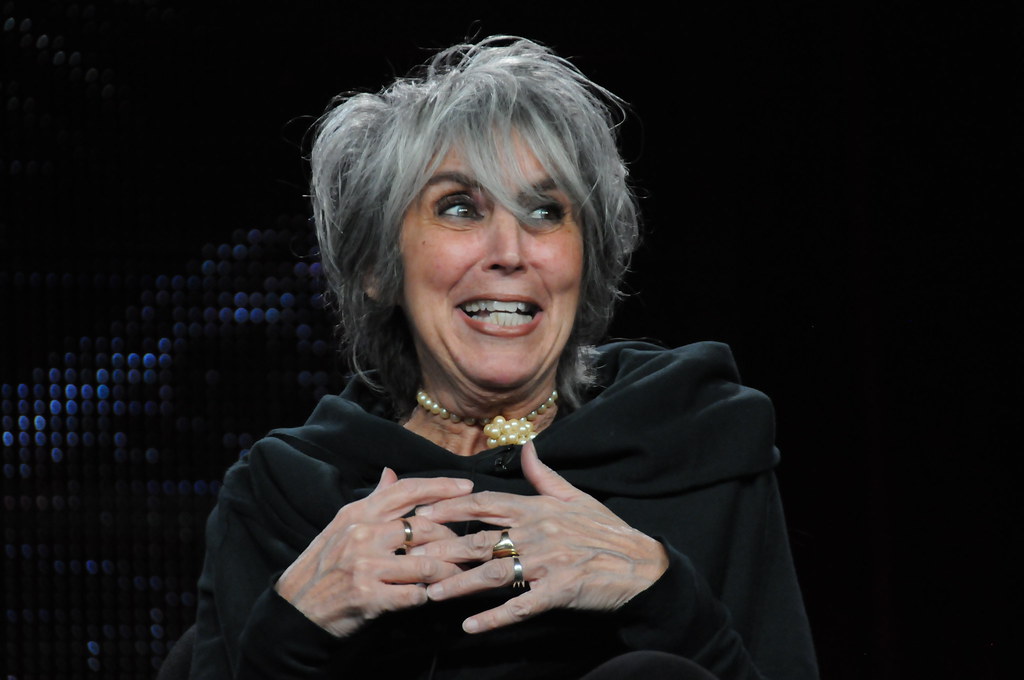
In her interviews with him, his family and colleagues Levin found he’s more complex than his public Everyman-Next-Door, laid-back Dude persona.
“The interesting truth about him is that he’s rather tortured all the time. He says in the film he’s rather reluctant to all of this (film career). I think he came to it obviously through the legacy of his father (the late actor Lloyd Bridges) and his older brother Beau, But he even says he’s a little bit lazy, he’s got a little of the Dude in him, and it’s always kind of hard for him to kind of gear himself up again.”
This “drag me to the party” resistance and ambivalence is how he moves through life. She says some Bridges collaborators, such as Terry Gilliam and John Goodman, speak to his cautious approach.
“He’s not a spontaneous, improvisational actor,” says Levin. “He really needs to know what and where. He has guides who school him in being a junkie or a drunk. He takes that all very seriously and seems to form close relationships with these people who sort of become his models for how to play various parts.
“I think he’s very particular about the kinds of things he chooses. I think he picks films that have some intrigue for him and not necessarily what are going to be the biggest blockbusters. He’s a very individual star. I think he’s really on his own path.”
While Levin enjoyed “amazing access” to Bridges and Co., she found his well-protected veneer hard to penetrate:
“You’ll see in this film there’s a much darker side to Jeff than people realize, and this kind of push-me, pull-you about the acting is really a great revelation. People think he’s easy going about it, and he’s really not. But he doesn’t divulge dark disappointments and things like that. Others say it.”
She says if there are secrets to pry loose, “you gotta be long and deep with him,” adding she didn’t establish a rapport that might have led to such intimacies.
As for Bridges being an American Master, she says, “He’s worked with remarkable directors, he has an extraordinary body of work. He’s an amazing amalgam. He’s an artist on many, many levels.”
Related Articles
- Jeff Bridges looks back on “Lebowski” for “The Dude Abides” (hollywoodnews.com)
- WATCH: Jeff Bridges Almost Told Coen Brothers No On ‘Big Lebowski’ (huffingtonpost.com)
- Jeff Bridges, from The Dude to The Duke (thestar.com)
- Jeff Bridges Previews Debut Album at L.A. Show (musicbusinessheretic.wordpress.com)
- Jeff Bridges Looking to Adapt and Star in ‘The Giver’ (moviefone.com)
Related articles
- Jeff Bridges Previews Debut Album at L.A. Show (musicbusinessheretic.wordpress.com)
- Jeff Bridges Looking to Adapt and Star in ‘The Giver’ (moviefone.com)
Being Dick Cavett

Image by Stewf via Flickr
The recent publication of Dick Cavett‘s new book, Talk Show: Confrontations, Pointed Commentary, and Off-Screen Secrets, is as good enough a reason as any for me to repost some of the Cavett stories I’ve written in the last few years. I’m also using the book’s release as an excuse to post some Cavett material I wrote that hasn’t appeared before on this blog. I’ve always admired this most adroit entertainer and I feel privileged that he’s granted me several interviews. With his new book out, I plan to interview him again. For me and a lot of Cavett admirers he’s never quite gotten the credit he deserves for raising the bar for talk shows, perhaps because almost no one followed his lead in making this television genre a forum for both serious and silly conversation. Cavett never quite caught on with the masses the way his talk-jock contemporaries did, and I’ve always thought it had something to do with his built-in contradiction of being both an egg-head and a stand-up comedian at the same time. The following story for The Reader (www.thereader.com) was based on a face-to-face interview I did with him in Lincoln, Neb. in 2009.

Being Dick Cavett
©by Leo Adam Biga
Originally published in a 2009 issue of The Reader (www.thereader.com)
While Johnny Carson’s ghost didn’t appear, visages of the Late Night King abounded in the lobby of the University of Nebraska-Lincoln’s Temple Building.
Carson’s spirit was invoked during an Aug. 1 morning interview there with fellow Nebraska entertainer, Dick Cavett. That night Cavett did a program in its Howell Theatre recalling his own talk show days. Prompted by friend Ron Hull and excerpts from Cavett television interviews with show biz icons, the program found the urbane one doing what he does best — sharing witty observations.
The Manhattanphile’s appearance raised funds for the Nebraska Repertory Theatre housed in the Temple Building. The circa-1907 structure is purportedly haunted by a former dean. Who’s to say Carson, a UNL grad who cut his early chops there, doesn’t clatter around doing paranormal sketch comedy? His devotion to Nebraska was legendary. Only months before his 2005 passing he donated $5.4 million for renovations to the facility, whose primary academic program bears his name.
The salon-like lobby of the Johnny Carson School of Theatre & Film is filled with Carsonia. A wall displays framed magazines — Time, Life, Look — on whose covers the portrait of J.C., Carson, not Christ, graced. Reminders of his immense fame.
A kiosk features large prints of Carson hosting the Oscars and presiding over The Tonight Show, mugging it up with David Letterman. In one of these blow-ups Carson interviews Cavett, just a pair of Nebraska-boys-made-good-on-network-TV enjoying a moment of comedy nirvana together.
It’s only apt Cavett should do a program at a place that meant so much to Carson. They were friends. Johnny, his senior by some years, made it big first. He hired Cavett as a writer. They remained close even when Cavett turned competitor, though posing no real threat. Cavett was arguably the better interviewer. Carson, the better comic.

They shared a deep affection for Nebraska. Carson starred in an NBC special filmed in his hometown of Norfolk. He donated generously to Norfolk causes. Cavett’s road trips to the Sand Hills remain a favorite pastime. Though not an alum, he’s lent his voice to UNL, and he’s given his time and talent to other in-state institutions.
Looking dapper and fit, Panama hat titled jauntily, Tom Wolfe-style, the always erudite Cavett spoke with The Reader about Carson, his own talk show career, his work as a New York Times columnist/blogger, but mostly comedy. In two-plus hours he did dead-on impressions of Johnny, Fred Allen, Katharine Hepburn, Marlon Brando, Charles Laughton. His grave voice and withering satire, intact. He dropped more names and recounted more anecdotes than Rex Reed has had facelifts. Walking from the UNL campus to his hotel he recreated a W.C. Fields bit.
He’s so ingrained as a talking head Cavett’s comedy resume gets lost: writing for Jack Paar, Carson, Merv Griffin; doing standup at Greenwich Village clubs with Lenny Bruce; befriending Groucho Marx. He hosted more talk shows than Carson had wives. He’s had more material published than any comic of his generation.
On the native smarts comedy requires, Cavett said, “comedy is complete intelligence.” He said the best comics “may not be able to quote Proust (you can bet the Yale-educated Cavett can), but there’s an order of genius there that sets them apart. There aren’t very many stupid, inept, dumb comics. There are ones that aren’t very talented and there are the greatly talented, but the comic gift is a real rare order. It doesn’t qualify you to do anything else but that.”
Good material and talent go a long way, but he concedes intangibles like charisma count, too. He said, “Thousands of comics have wondered why Bob Hope was better than they are. What’s he got? I’ve got gags, too.”
For Cavett, “Lack of any humor is the most mysterious human trait. You wonder what life must be like.” He appreciates the arrogance/courage required to take a bare stage alone with the expectation of making people laugh.
“Oh, the presumption. It’s not so bad if the house isn’t bare but that has happened to me too at a club called the Upstairs at the Duplex in the Village, where many of us so to speak worked for free on Grove Street. A great motherly woman named Jan Wallman ran this upstairs-one-flight little club with about seven tables. Joan Rivers worked there. Rodney Dangerfield, Bob Klein, Linda Lavin. Woody (Allen) worked out some material there early on.”
He knows, too, the agony of bombing and that moment when you realize, “I have walked into the brightest lit part of the room and presumed to entertain and make people laugh and I’m doing apparently the opposite.” A comic in those straits is bound to ask, “What made me do this?” The key is not taking yourself too seriously.
“If you can get amused by it that will save you, and I finally got to that point at The Hungry Eye,” he said. “I knew something was wrong because I’d played there for two weeks and been doing alright and then one night, nothing, zero. The same sound there would be if there was no one seated in the place. Line after line. It was just awful. You could see people at the nearest tables gaping up at you like carp in a pool, not comprehending, not laughing, not moving. And I finally just said, ‘Why don’t you all just get the hell out of here?’ It gave me a wonderful feeling.
“Two, what Lenny Bruce used to call diesel dikes sitting in the front row with their boots up on the stage, one of whose boots I kicked off the stage, taking my life in my hands, got up to leave. And as they got to the door I said, ‘There are no refunds,’ and one of them said, ‘We’ll take a chance.’ And she got a laugh. So they (the audience) were capable of laughing.”
He finished his set sans applause, the only noise the patter of his patent leathers retreating. Inexplicably, he said, “the next show went fine. Same stuff.” For Cavett it’s proof “there is such a thing as a bad audience or a bad something — a gestalt, that makes a room full of unfunnyness, and I don’t think it’s you. It might be something in you. Whatever it is, you’re unaware of its source, not its presence.”
Anxiety is the performer’s companion. It heightens senses. It gets a manic edge on.
“Whether you want it, you’re going to get some,” he said. “I can go into a club and perform without any nerves of any kind now. But if it isn’t there you want a little something, and there are ways you can get it. Like be a little late. Or I found with low grade depression, before diagnosed, not knowing what it was, I would do things like go back and rebrush my hair or put another shirt on. ‘This is dangerous, they’re going to be mad,’ I’d think. ‘But that’s alright somehow.’ I didn’t realize the somehow meant it’s giving me adrenalin that lifted the depressed seratonin level. It raises you a little bit above the level of a normal person standing talking to other normal people. It’s a recent realization. I’ve never told that before.”
Cavett was always struck by how Carson, the consummate showman, was so uptight outside that arena. “I’ve said it before, but he was maybe the most socially uncomfortable man I’ve ever known. At such odds with his skills. There are actors who can play geniuses that aren’t very smart seemingly when you talk to them, but whatever it is is in there and it comes out when they work. I have a sad feeling Johnny was happiest when on stage, out in front of an audience. I don’t know that it’s so sad. Most people are sad a lot of the time, but some don’t ever get the thrill of having an ovation every time they appear.”
“It’s funny for me to think there are people on this earth who have never stood in front of an audience or been in a play or gotten a laugh,” he said.
People who say they nearly die of nerves speaking in public reminds him he once did, too. “I had the added problem of every time I spoke everybody turned and looked at me because of my voice. It was always low. If I heard one more time ‘the little fellow with the big voice’ I thought I’d kick someone in the crotch.”
He said performers most at home on stage dread “having to go back to life. For many of them that means the gin bottle on the dresser in a hotel in Detroit. On stage, god-like. Off-stage, miserable.”
In Cavett’s eyes, Carson was a master craftsman.
“He could do no wrong on stage. I mean in monologue. He perfected that to the point where failure succeeded. If a joke died he made it funnier by doing what’s known in the trade as bomb takes — stepping backwards a foot, loosening his tie…’” Not that Carson didn’t stumble. “He had awkward moments while he was out there. Many of them in the beginning. My God, the talk in the business was this guy isn’t making it, he’s not going to last. It’s hard to think of that now. Merv Griffin began in the daytime the same day as Johnny on The Tonight Show. Merv got all the good reviews. He was the guy they said should have Tonight, and Merv really died when he didn’t get it.”
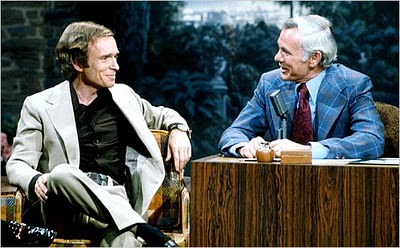
When the mercurial Paar walked off Tonight in ’62 NBC scrambled for a replacement. Griffin “was actually seemingly in line” but the network anointed Carson, then best known as a game show host. In what proved a shrewd move Carson didn’t start right away. Instead, guest hosts filled in during what Cavett refers to as “the summer stock period between Paar and Johnny. People don’t remember that. Everybody and his dog who thought he could host a talk show came out and most of them found out they couldn’t.” Donald O’Connor, Dick Van Dyke, Jackie Leonard, Bob Cummings, Eva Gabor, Groucho. Some were serviceable, others a disaster.
Carson debuted months later to great anticipation and pressure. “At the beginning he was really uncomfortable, drinking a bit I think to ease the pain, and as one of my writer friends said, ‘with a wife on the ledge.’ It was a very, very hard time in his life to have all this happen” said Cavett, “and then he just developed and all this charm came out.”
Off-air is where Carson’s real problems lay. “Many a time I rescued him in the hall from tourists who accidentally cornered him on his way back to the dressing room after the show. They’d made the wrong turn to the elevators and decided to chat up Johnny, and he was just in agony.” The same scene played out at cocktail parties, where Carson hated the banter. It’s one of the ways the two were different. Said Cavett, “I don’t seek it but I don’t mind it. He couldn’t do it and he knew he couldn’t do it and it pained him.”
That vulnerability endeared Carson to Cavett. “I liked him so much. We had such a good thing going, Johnny and I. It dawned on me gradually how much he liked me. I mean, it was fine working for him and we got along well, and when I was doing an act at night he’d ask me how it went, and we’d laugh if a joke bombed. He’d say, ‘Why don’t you change it to this?’ He’d give me a better wording for it. I feel guilty for not seeing him the last 8 or 10 years of his life, though we spent evenings together. The staff couldn’t believe I ate at his house. ‘You were in the house?’ On the phone he was, ‘Richard’ — he always called me Richard, sort of nice — ‘you want to go to the Magic Castle?’ I’d say, ‘Who is this?’ ‘Johnny.’ And I would think somebody imitating him, even though I’d been around him a million times.”
Something Brando once told Cavett — “Because of Nebraska I feel a foolish kinship with you” — applied to Cavett and Carson.
Cavett realized a dream of hosting his own show in ’68 (ABC). In ’69 he went from prime time to late night. A writer supplied a favorite line: “‘Hi, I’m Dick Cavett, I have my own television show, and so all the girls that wouldn’t go out with me in high school — neyeah, neyeah, neyeah, neyeah, neyeah.’ It got one of the biggest laughs. Johnny liked it.”
Getting more than the usual canned ham from guests was a Cavett gift. Solid research helped.
“I often did too much. I’d worry, ‘Oh, God, I’m not going to get to the first, let alone the 12 things I wrote down. Or. ‘I’ve lost the thread again.’ Only to find often the best shows I did had nothing I’d prepared in it. The best advice I ever got, which Jack Paar gave me, was, ‘Kid, don’t ever do an interview, make conversation.’ That’s what Jack did.” A quick wit helps.
At its best TV Talk is a free-flowing seduction. For viewers it’s like peeking in on a private conversation. “Very much so,” he said. “You’d think that can’t be possible because there are lights and bystanders and an audience, and it’s being recorded, and yet I remember often a feeling of breakthrough, almost like clouds clearing. ‘We’re really talking here. I can say anything I want .’”
With superstar celebs like Hepburn, Bette Davis, Robert Mitchum, Orson Welles and his “favorite,” Groucho, Cavett revealed his fandom but grounded it with keen instincts and insights. “That did help. I could see on their faces sometimes, Oh, you knew that about me? I guess I have to confess to a knack of some sort that many people commented about: ‘How did you get me to say those things?’”
He said viewing the boxed-set DVDs of his conversations with Hollywood Greats and Rock Greats reveals “there was a time when nobody plugged anything” on TV. Then everyone became a pimp. “When first it happened it was rare. Then it was joked about,” he said, “and then it got so it was universal — that’s the reason you go on.”
Today’s new social media landscape has him “a bit baffled and bewildered.”
“I have wondered at times what all has changed, what’s so different. It did occur to me the other day looking at the Hollywood Greats DVD — who would be the 15 counterparts today of these people. I might be able to think of three. And that’s not just every generation thinks everything is better in the past than it is now. I know one thing you could start with is the single act that propelled me here — the fact I was able to enter the RCA Building via the 6th Ave. escalators, which were unguarded, and walk up knowing where Paar’s office was, and go to it.”
He not only found Paar but handed him jokes the star used that night on air, netting Cavett a staff writing job. “No career will start that way today,” he said. Then again, some creatives are being discovered via Facebook and YouTube.
In terms of the talk genre, he said, “it doesn’t mean as much to get a big name guest anymore. They’re cheap currency now,” whereas getting Hepburn and Brando “was unthinkable.” He’s dismayed by “how much crap” is on virtually every channel.” He disdains “wretched reality shows” and wonders “what it’s done to the mind or the image people have of themselves that allows them to think they’re still private in ways they’re not anymore.”
Comedy Central is a mixed bag in his opinion. “I like very little of the standup. I don’t see much good stuff. They all are interchangeable to me. They all hold the mike the same and they all say motherfucker the same. You just feel like I may have seen them before or I may not have. And I don’t believe in the old farts of comedy saying ‘we didn’t need to resort to filthy language’ and ‘they don’t even dress well.’ That’s boring, too.”
Cavett’s done “a kind of AARP comedy tour” with Bill Dana, Mort Sahl, Shelley Berman and Dick Gregory. “It was pretty good.” But he’s about more than comedy nostalgia. He enjoys contemporary topical comics Jon Stewart, Stephen Colbert and Bill Maher, about whom he said, “he gives as good as he gets and gets as good as he gives.” He’s fine not having a TV forum anymore: “I’ve lived without it and I got what I wanted mostly I guess in so many ways.” Besides, who needs it when you’re a featured Times’ blogger?
“Yeah, I like that, although it can be penal servitude to meet a deadline.”
His commentaries range from reminiscences to takes on current events/figures. His writing’s smart, acerbic, whimsical, anecdotal. He enjoys the feedback his work elicits. “My God, they’re falling in love with Richard Burton,” he said of reader/viewer reactions to a ditty on the Mad Welshman’s charms. He covers Cheever-Updike to Sarah Palin. “My Palin piece broke the New York Times’ records for distributions, responses, forwarding. The two from that column most quoted about her: ‘She seems to have no first language’ and ‘I felt sorry for John McCain because he aimed low and missed.’ Many, many people extracted those two.”
He said Times Books wants to do a book of the columns.
When his handler came to say our allotted 90 minutes were up, he quipped, “Oh, God, it went by as if it were only 85.” And then, “I’ve got a show tonight but I said everything. Biga has had my best.” Before leaving he asked his picture be taken beside the Cavett-Carson repro. Two Kings of Comedy together again.
Related Articles
- Cavett’s Conversations: ‘When People Simply Talk’ (npr.org)
- Tamar Abrams: Dick Cavett: Get This Man a Show! (huffingtonpost.com)
- ‘Mel Brooks and Dick Cavett Together Again,’ Hour-Long Special Reuniting Comedy Greats Debuts Sept. 9 on HBO (tvbythenumbers.zap2it.com)
- “Looking at the Louds: A video supplement to ‘Cinema Verite’ and ‘An American Family'” and related posts (latimesblogs.latimes.com)
- The First Shall Be Last – Or, Anyway, Second (opinionator.blogs.nytimes.com)
Homecoming always sweet for Dick Cavett, the entertainment legend whose dreams of show biz Success were fired in Nebraska

Image by nick step via Flickr
In his new book, Talk Show: Confrontations, Pointed Commentary, and Off-Screen Secrets, irrepressible Dick Cavett reminds us that though he hasn’t hosted a talk show in a very long time he has much to say about this television genre, one he gave his own distinctive spin to as a writer and host. A wordsmith at heart, his new work also reminds us how gifted he is at turning a phrase. Because Cavett is making the rounds this fall and winter to promote his book, he is very much in the entertainment news again, which is why I am reposting a couple Cavett articles I wrote a few years ago and why I am posting for the first time some other Cavett material I wrote. He’s been very generous with me in terms of granting me ample time for my interviewing him over the years. To be honest, I didn’t even know about this book until a friend mentioned it. Now that I’m onto it, I will request a new interview with him and I know he will be accommodating again. As he likes to say, he’s always a good guest, and in this case, a good interview. The following piece, which traces his career, originally appeared in the New Horizons newspaper in Omaha, Neb.
Homecoming always sweet for Dick Cavett, the entertainment legend whose dreams of show biz success were fired in Nebraska
©by Leo Adam Biga
Originally appeared in the New Horizons
Dick Cavett’s longing to be “under the lights” burned so hot as a boy in post-World War II Nebraska that nothing seemed more enticing than the prospect of far-off glamour in New York. Then, as now, the Big Apple loomed as the center of all things, certainly of show biz, which the young Cavett saw as his future.
“Always the shot of the New York skyline spoke to me where it didn’t to others my age,” the 70-year-old comic and former talk show host said by phone from his historic coastal retreat, Tick Hall, on Montauk, Long Island. The 19th-century, Stanford White-designed home is where Cavett and his late wife Carrie Nye spent time away from the tumult of New York. The house burned down in 1997 and over three years time the couple had it reconstructed to historic specifications, an epic project that is the subject of a documentary, From the Ashes.
The house hasn’t been the same since Nye died from cancer last July. She had a way of filling any room she was in with her bright spirit and hearty, Southern drawl-tinged laugh. She and Cavett were married 42 years.
Today, when not at the beach, he stays at the Manhattan apartment the couple shared. This son of career educators lives a life steeped in culture — books, the theater, films, fine dining. He writes letters and op-ed pieces. His ability to engage in literature, history, gossip, trivia and one-liners sets him apart from some entertainers. Words fascinate him. He loves finding just the right one with which to prick or prod or parry. Exposing grammatical errors is a hobby, nigh-compulsion.
Cavett, the forever puckish wit, was born in Gibbon, Neb. and raised in Grand Island and Lincoln. Precociously bright, he got laughs from an early age, when he’d surprise others with his large vocabulary, double entendres, confident delivery and deep voice. His humor’s never left him, not even in his grief. Since Nye’s death, however, he has grown more reflective than usual about his Nebraska upbringing and the close ties he’s kept here throughout his nearly half-century career.
Nebraska is where he came back only three months after Nye, a noted actress, passed. He headed out alone by car to its far western reaches, a road trip he’s made many times over the years as a kind of pilgrimage. When things get too oppressive back East, Nebraska is his escape. Here, away from the glare, the noise, the crowd, he can unwind and breath under the clear, open, quiet skies.

“Yeah, it is that in a way,” he said, “especially when I do almost my favorite thing in the world to do, which is get in a car and go out into the Sand Hills. I remember one great teacher I had in high school, after I had just been to the Sand Hills, said, ‘Oh, it’s just heaven. Aren’t you glad the tourists haven’t found it?’ A lot of the tourists wouldn’t dig it or get it. But the idea you could take the family car as I did and drive 416 miles on the 4th of July for however many hours and hours it took and see just four other cars on those old roads…,” he said, his golden voice trailing off, choked with the wonder of the memory.
When he’s back, he stops in on old friends like Dannebrog’s Roger Welsch, the folklorist-author, and Lincoln’s Ron Hull, the avuncular Nebraska Educational Television legend. He visits his stepmother, Dorcas, now 90 but still sharp as a whip.
“So I went up to our bedroom where my wife Linda had already gone to bed and said, ‘Uuuuuuuh, Linda…Dick Cavett says he’s going to come visit us sometime. ‘Did he say when?’ she said sleepily. ‘Yeah….in about five minutes.’ She never did forgive me…or Dick…for that one.”
Hull said Cavett’s affinity for Nebraska is “genuine. There’s not a phony bone in his body. He’s a very, very honest person.” Cavett often comes back at Hull’s request to emcee benefits or to lend his famous face and voice to a documentary or spot. “He’s never turned me down,” Hull said admiringly. “He’s a very generous guy. He’s always come through. And he’s always done it pro bono, just as a friend. He’s been a very good friend of Nebraska. That’s one of the things I like about him — he didn’t forget his roots. He is proud of those roots. He never lost touch with that.”
Whether at work in the studio or at play over dinner, Hull said Cavett’s “so much fun to be with. He is curious about everything. He listens. He has this marvelous, retentive mind. He’s so good at words. Don’t ever play Scrabble with him.”
“He is a pleasant soul,” Welsch said. “It’s hard not to like Cavett. His visits here are…definitely not an exercise in royalty visiting the peasants. Yes, he talks about Woody Allen and Mel Brooks…while I talk about my pal Bondo, the auto body repairman, or Dan the plumber, but somehow there isn’t a feeling of inequity. He appreciates the humor I find in ordinary people out here and in turn shows me the ordinary side of the notables in whom he finds his humor. I really don’t consider Dick Cavett to be a famous person who is a friend of mine; to us he is a friend…and oh yes, I guess he’s also famous. Perhaps the best part is that even as a world-famous star and intellect, he is still, through and through, a Nebraskan.”

Roger Welsch
Cavett’s love for the wide open spaces, solitude and history of Nebraska was implanted early on, via road trips his family made out West when he was a boy. Book, film and museum images of Plains Indians fixated him. As an adult he immersed himself more deeply in the land and legacy of its native peoples, familiarizing himself and the nation with the works of John Neihardt, Willa Cather and Mari Sandoz. He’s proud of the remarkable figures Nebraska’s produced and will name, without any prodding, some of the great film, theater, literary and athletic icons from here.
Whenever someone suggests there’s a characteristic that describes a typical Nebraskan, he’s quick to point out that personalities as diverse as William Jennings Bryan, Darryl Zanuck, Fred Astaire, Marlon Brando, Johnny Carson, Malcolm X, Sandy Dennis and Johnny Rodgers emerged from this same terra cotta.
For the book Eye on Cavett he wrote of returning a celeb to his Lincoln High class reunion. He and Welsch were classmates and bandmates, not buds. Cavett suspects Welsch thought he was “one of the fancy people.” Welsch confirms as much, but adds, “I admired him…He was always one of the stars at the talent shows, theater productions, and that kind of thing, and yet he was never an arrogant pain in the ass…just a nice guy who had a lot of talent.” They both coveted luminous Sandy Dennis, another classmate bound for fame, but neither had the guts to ask her out, much less speak to her. Cavett later got to know her in New York.
Nebraska is where Cavett’s heart is. New York’s where the action is. Even as a boy, he felt the pull of that place. How could it not beckon a starstruck kid like him? Especially after he nearly committed to memory the classic book, The Empire City, an anthology of great stories about New York by great writers.
“It’s just wonderful. Every famous writer who ever wrote anything about New York is in there,” he said, “from E.B. White to Groucho (Marx) to F. Scott Fitzgerald and Ben Hecht. And I would read that thing and then read it again. I knew more about New York then, sitting on the glider on the porch reading that book than most New Yorkers did. I could describe Chinatown and how to get to it and around it and in it,” without having been there. In the book Cavett he co-authored with friend Christopher Porterfield the entertainer calls New York “a siren call.” Made all the more alluring by anecdotes of it told by his parents’ friends or the genuine New York actors he shared the stage with one season of summer stock in Lincoln.
For him, the future was a New York or bust deal. He wasn’t sure what path would take him there — “I had no idea how you got there” — but he knew his destiny lay in the crackle and glow of theater marquees, not the scraping of chairs on floors and chalk on backboards. His late parents, and stepmother, were all public school teachers and while he suspects he too would have excelled at it, he would be dissatisfied knowing he’d missed out on his dream.
“I think I could have enjoyed being a teacher a great deal,” he said. “They would have liked me. I would have been funny and all the things you didn’t associate with most teachers.” Like his dad. “My father was always the most popular teacher anyone in Lincoln ever had,” he said. “My father always attracted the most forlorn types…and made them feel better and gave them confidence and all these things. He gave them meaning. He didn’t mean to do that, but it just happened.”
One of those the elder Cavett tried reaching out to was the garbage man on their block, a young, sullen, self-made rebel named Charlie Starkweather, an obscure boy and striking name soon to strike fear on the Great Plains.
Cavett’s “toyed with the idea” of what might have been if he hadn’t left Nebraska. “Would I go nuts? Probably not. But I certainly wouldn’t have had what I wanted and at times got more than enough of later on. Let’s just say I can’t imagine contributing a covered dish to the picnic of the neighborhood,” he said dryly.
As “drawn” to show biz as he was, he said, “I can’t think of ever wanting anything else. It wasn’t as though, If I can’t become a comedian or a magician I’ll become a lawyer or a plumber and I’ll be happy doing that. Noooo…” That didn’t stop some from trying to dissuade him. “I didn’t have any interest in dental college, one of several things — it seems so humorous now — my father tried to interest me in. And of course his pitch was. ‘You’re talented, but you know a lot of people don’t make much of a living in your business, You really ought to think about something that’s going to be steady.’ I just nodded and let it pass.”
Once bit by the bug, no appeal to practicality could change his mind. “Yeah, because in effect you don’t really have any choice,” he said. “The thought of trying to go to law school was not even in question. I didn’t want to have anything to do with it.” The death of his mother from cancer when he was 10 only made him retreat more into the world of make believe. On the whole he counts his childhood a happy one, but the trauma of his mother’s death still stings.
“The worst part of that was not only watching her dying,” he said, “but no other kid I ever heard of lost a parent. Nobody.” He said his wife’s death made him relive the pain of his mother’s death and elicited “the resentment of, Screw this — I have to do it again? That was awful.”
There were also molestations he suffered at the hands of strangers, once at a Lincoln movie theater. He doubts the abuse triggered the depression he struggled with for many years, although he doesn’t discount the possibility.
But mostly he looks back fondly at a solid rearing. While his folks were far from bohemians, they were no squares, either. His mom and dad were intelligent, culturally astute people. As is his stepmother. His dad and step-mom co-founded a high brow social club, the C.A.s, whose name was a closely guarded secret. Critics Anonymous brought together a group of like-minded adults, plus Dick, for celebrations and excoriations of different subjects or themes. Sometimes, a country’s music, food, literature and customs came under scrutiny.
All the talk of exotic places only fueled his fire to see the larger world.
Like the boy who runs away with the circus, Cavett heeded the call of the lights, only gradually, in small measures. While growing up here he did some magic, some acting, some announcing. Even his favorite athletic pursuit, gymnastics, put him out front, under the lights. He studied the great comics, absorbing their stances, their inflections, their timing. His models were as near as Johnny Carson, then a popular magician on the Chautauqua circuit and, later, a dashing television-radio personality in Omaha, and as distant as the greats he glimpsed in the movies or on TV.
He once saw a young Johnny’s Great Carsoni act, and it left an impression. Perhaps, he thought, he could emulate a fellow Nebraskan’s success on stage. And once in awhile one of those bigger-than-life legends, as Bob Hope did, would come to perform in Lincoln or Omaha, giving him a first-person dose of show biz magic.
On those occasions, Cavett would, through sheer pluck, wend his way backstage before and after the show, something he continued doing once he finally made it to New York, becoming a habitue of the club-theater-network TV district, all the better to run into celebs. Just seeing Hope in the flesh was enough to feed his imagination and project himself into that rarefied company.
Besides Hope, long a hero of his, Cavett’s star gazing in Nebraska found him finagling seats and trading backstage banter with the likes of Charles Laughton, Basil Rathbone, Phil Silvers and Spike Jones. Each encounter only intoxicated him more with the idea that he belonged “in that world” with them.
Still, the stars were ethereal enough that even his “wildest dream could not convince me I would one day have Hope as a guest on my own show.” But he did.
After one of those head-in-the-cloud nights in Lincoln, enraptured by the sight of his idols and the exchange of a few words with them, his return to dreary Earth felt like defeat. “To go to school the next day was just murder,” he said. I thought, ‘I belong with them (the stars)’” as they set off by train for the next stop under the lights. Wanderlust ran in the family. His maternal grandfather was a Baptist preacher who immigrated from Wales and evangelized his way across the Great Plains. “My hell-for-leather Uncle Paul, as my father always called him,” was a rover who rode the freight rails. A young Cavett was captivated by their experiences of setting off for distant spots. “Oh, yeah, they had dramatic adventures in faraway places,” he said. “But I didn’t want to be T.E. Lawrence or Frank Buck. I didn’t see myself in jungles or deserts, though I’ve been to both…” He said he was like this character from a long-forgotten novel who startles her parents when they ask — ‘What do you want to be, a nurse or a school teacher?’ — by saying, and my wife used to quote this, ‘I want the fast cars, the bright lights and the men in tuxedos.’” Only substitute women in cocktail dresses for men in tuxes.
Cavett was spotted early on as a talent to be watched, even if he didn’t know exactly what talent might send him on his way. As a teen he acted in and eventually directed, too, a Lincoln Junior League Theater program, Storytime Playhouse, on popular radio station KFOR, the same station Carson used to launch his career. Cavett once did a 15-minute Macbeth.
“One day out on the street I run into Bob Johnson, who was of course this huge celebrity in Lincoln because he was a longtime announcer on KFOR. He did Bob Johnson’s Musical Clock and Bob Johnson’s this-and-that. We were both heading for the studio and he said, ‘Let’s walk around the block,’ as if he was about to bring up something sensitive and didn’t quite know how to. So we made small talk and then he said, ‘You know, Dick, I have a feeling about you — you’re going to get up and out of here the way Johnny did.’ And it was a poignant moment because it was a man in his middle age saying, I’m as far as I’m going to get and I faced up to that, but you and Johnny, well…
“I didn’t know what to make of it. I didn’t know what to say. I kind of hoped he was right, but I didn’t know how Johnny did. I can’t imagine what we said for the last half-block.”
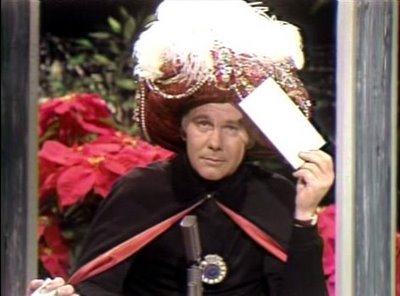
Johnny was of course Johnny Carson. “Johnny was 10-12 years older than I was,” Cavett said. “He was doing his television show (The Squirrel’s Nest) in Omaha and soon going on to New York for various things, He hadn’t utterly ‘made it’ yet, but as far as anyone in Lincoln was concerned he had.” Cavett’s since wondered what might have happened if they had bumped into each other then to discuss their nascent show biz dreams. He’s sure they would have recognized in themselves then what kindred spirits they were.
As it was, they both made it big time, their careers following nearly parallel courses. Cavett was a talent coordinator and writer for Jack Paar’s Tonight Show, the slot Carson, who’d hosted TV game shows and written for Red Skelton, inherited when Paar retired. Carson made Tonight an even more popular and lucrative brand name for NBC. Cavett joined Carson’s staff of writers before getting his own talk show.
“I guess I just always had this sort of pull, as I think he (Carson) must have, to go where the action is. Mingle with Jack Benny and Bob Hope and Lucille Ball and maybe Groucho if you were really lucky.”
Cavett’s opportunity to leave Nebraska for the bright lights came courtesy of a family friend, another older man who saw in him the hunger and potential to excel.
“A friend of my parents by the name of Frank Rice taught at Omaha Central. Frank sort of looked like Vincent Price. He had a Whitney Fellowship, I think it was called, at Yale for a year. He came back and said, ‘Dick should apply at Yale.’ Nobody took this very seriously and Frank insisted. And somehow that came about.”
“I remember Frank saying, ‘You’ll like it at Yale, if you’re lucky enough to get in, because the Shubert Theatre is right across the street from your freshmen campus. Every week or two a new Broadway show comes through on its way to New York.’’ Broadway show? I didn’t even care it would cost me a dollar-forty to sit in the front row of the second balcony.”
This was it — his entree to the glimmer of New York theater and culture. If he could get in. And then one day, as he tells it, he was “on the same glider on the porch that I was probably readingThe Empire City on” when the mailman brought a letter from Yale that said, ‘You have been accepted in the Class of 1954.’ And the whole world just swam for a moment. ‘What will all this mean? God, what could happen from this? It’s hard to say. Damn near anything.’ I walked around in a daze.”
By the time he headed east he was a certified TV junkie, so much so he said that when his family got their first set in the mid-’50s “I did almost nothing but watch it. Sundays, my God, I got out graham crackers and peanut butter and started with ‘Super Circus, live from Chicago, and went all the way through the evening, including Mr. Peepers, What’s My Line?, Ed Sullivan, The Web…I made the mistake of getting a date once on a Saturday night and she did not want to watch Show of Shows, so that was the end of that relationship.
“When I thought of going away to college I wondered, Will they let me watch all my television?”
Yale let him have his catho ray tube fix, although with only one set in the dorm he couldn’t always watch his favorite shows. More importantly, New Haven, Conn. put him within easy reach of where it all happens. With such close access to New York, his idea of a good time was far different than most of his fellow red-blooded Yalies, who had scoring girls on their mind.
“Instead of going to girls schools on the weekends, Wellesley, Smith, Vassar, I went down to New York. I thought, How can you be so dumb as to want to go there when you can go to New York…see a play with the Lunts, Paul Muni or Bette Davis, and sneak into the Jackie Gleason Show and What’s My Line?,” a show he ended up guesting on.
As he did in Lincoln, he gushed to classmates about the stars and shows he saw and that he sometimes talked to. There were more all the time. Now that he was an Ivy Leaguer and a big city sophisticate, he wanted to go home “to parade around” in his Oxford blue shirt and tweed, three-button jacket from Saks and regale everyone with where he’d been and whom he’d seen.
“That was everything I’ve lived for — to come back and cause amazement,” he said. It was also a case of homesickness. But as he found nothing stays the same.
“My first trip from Yale back to Nebraska I couldn’t wait to get to Grand Island and as soon as I got around the corner to see where we used to live, it was gone,” he said. “There was a Safeway there. They had obliterated the Christian church, my best friend Mary Huston’s house, our house, the whole block. And it was one of the most devastating things that’s happened to me. How could they raze this without my permission? A horrible feeling. It hurts me right now.”
He was near finishing up Yale when walking on campus one day in 1957 he heard the news stand jockey hawking papers, Cavett recalled, with “the words ‘murder in Nebraska.” An incredulous Cavett remarked to the man, “It sounded like you said murder in Nebraska.” He confirmed he had. “There in the Journal American, now defunct, in big letters just short of what you put War Declared in, it said, ‘Ghastly Murders, Lincoln, Nebraska.” The headline referred to Charlie Starkweather’s killing spree. It gave Cavett the creeps.
“I don’t know now if I thought, I hope nobody I know was murdered. I guess you wouldn’t necessarily assume it. Had I known and glanced down at the name Starkweather I could have had a horrible moment recalling if my father said, ‘That’s our garbage guy.’ My father said he always seemed like a kind of forlorn kid. He seemed nice enough. My dad made people seem nice enough that weren’t anywhere but in his presence. Though I suppose I doubt if my father was anyone he toyed with as a victim.”
Even that incidental connection to a serial killer was enough for Cavett to closely follow the Starkweather manhunt, capture, trial and eventual execution.

By the time the notorious case became a sensation, Cavett was taking courses at Yale School of Drama and that’s when he met the woman who would become his life partner. Carrie Nye was her theatrical name but also her full first name. When Cavett met her her surname was McGeoy. She was flamboyantly Southern. Brilliant. Funny. Serious about her craft. Independent. Opinionated. An original.
The Greenwood, Miss. native attended Stephens College where, Cavett said, she “probably had the record number of violations there of books not returned, walking on the grass, smoking behind the lockers…”
His reaction upon first setting eyes on her? “I didn’t like her very much…I said ‘God, who the hell is that? She looks affected,’ or something like that to one of the guys at the drama school and he said, ‘But have you met her?’ I said, ‘No.’ When I did I saw what he meant. She was not like anything or anybody I ever met before. No one could ever say, ‘She’s just like Carrie Nye.’”

Dick with Carrie Nye
Their drama mates included, at one time or another, Paul Newman and Julie Harris. Cavett and Nye performed at Yale and in summer stock at Williamstown, Mass. They were soon an item, marrying in 1962. For a time, her career overshadowed his. When things broke for him, they broke big. Working for Paar, Carson, Jerry Lewis. Doing his own standup comedy act. Guesting on panel/game shows. Hosting his own late night network TV show, followed by TV desk-jock stints on PBS, then cable. Prime time specials. Commercials. Voice-overs. Films. Plays. She enjoyed success in regional theater and on Broadway, also taking occasional small and big screen parts. Their marriage survived the ups and downs of their respective careers.
It’s been awhile since Cavett’s had a talk-show gig. He laid to rest any question of whether he’s still “got it” with his 2000-2002 role as the narrator in the Broadway revival of The Rocky Horror Picture Show and his 2006 appearances on Turner Classic Movies, which revived some of his late night ABC shows with Hollywood greats. For a new TCM special he taped with Mel Brooks, Cavett proved his quick wit and verbal acuity are still intact. The Hollywood shows are out on DVD, as is a rock icon collection. A new DVD set featuring him with jazz-blues legends is planned.par
It’s interesting to note that even after all the dreaming he’d done of New York and all the trips he made there from New Haven to cozy up to the stars, Cavett still hadn’t made plans to move there after graduating Yale. He was doing summer stock when, he said, a fellow actor remarked, “‘Well, I guess you’ll be heading for New York, looking for an apartment.’ But to that point I hadn’t thought very far beyond the edge of the season. I really hadn’t thought it out. I figured I’d probably trip back to Nebraska. But as soon as I heard ‘you’ll be going to New York,’ I did.”
Cavett lived the life of a struggling young hopeful, making the rounds in casting offices, taking bit parts here and there, working all kinds of side jobs to keep himself alive. He was a copy boy atTime Magazine when he screwed up the nerve to go to the RCA Building with a batch of jokes he’d written for Paar, the king of late night. His plan? To somehow bump into the Great Man, slip him the material, and be discovered for the brilliant comic mind he is. Amazingly, it all came true.

Jack Paar
He still marvels at “the sheer chance of taking the monologue to Jack Paar,” running into him in a hallway, Paar accepting the envelope containing jokes penned by a unknown, then sitting back in the live studio audience to hear hisone-liners go out over the airwaves from the mouth of a star; and later, backstage being thanked by the star and encouraged to feed him more jokes. It all led to Cavett being hired on staff. The surreal experience was just one of “the phenomenal breaks, coincidences and other such things” that helped launch his career.
Cavett found his niche as a writer. “Once I get an idea I can go with it,” he said. “That was true as a monologue writer. If Jack or Johnny would give a subject, then I could be very fast and, to the irritation of the other writers, the first one to Johnny’s desk. Not that it mattered, because the first was not always the best.” He gets a high from writing that’s akin to the buzz he gets from ab libbing. Some, like old friend Ron Hull, suggest the entertainer could be a serious writer. “Yeah, I’m reasonably certain I could have made a living that way,” Cavett agrees.
While the two never talked about it, Cavett said he and Carson understood they shared a special connection. Like Carson did, Cavett’s given back to his home state.
He recalled one of the rare times the intensely private and supposedly cold Carson invited him out to dinner in L.A.
“That night we were sitting in a booth, just two guys from Nebraska in California, and he described the special (Johnny Goes Home) he’d just done in Norfolk and he said ‘there was this moment when I opened the door at the school building and there were all my teachers.’ And it was astounding because he was moved and he stuttered, and I thought, Oh, if people who think he has a ramrod up his ass and he treats people horribly could see this…He wasn’t a bit embarrassed by the emotion.
“He had a tremendous affection for me, and it took somebody to point it out. ‘Do you notice Johnny’s a different man when you’re on his show?’ one of his staff told me. ‘We wish you’d come on all the time. Johnny’s so easy to get along with when you’re on.’ It almost embarrassed me.”
Johnny’ gone. Cavett’s beloved Carrie Nye, a woman Ron Hull called “a perfect complement” to his friend, for her brilliance, humor and taste, is gone now, too, leaving “a void” no amount of quips can fill.
Given Cavett’s comic bent, her humor may be what he misses most. “The obit man at the Times spoke to me and said, ‘I feel I know your wife a bit,’ because he had talked to her twice on the phone about people who had died she had worked with, like Ruth Gordon. He said, ‘I remember those two conversations as the funnest experiences of my life and I wish I’d recorded them.’” To which Cavett can only concur, saying, “She was just vastly entertaining in the way nobody else was.”
Even in her absence he finds himself thinking of things to amuse her with — “Oh, wait till she hears about this” — or moving things lest she trip. Then he catches himself with the stark realization, “Oh, you’re talking about someone who ain’t there no more.” He recently shared his feelings with writer and friend Calvin Trillin, whose wife Alice died five years ago.
Yes, Dick Cavett is hurting, but he knows he always has Nebraska to return to. Here, amidst the wide expanse of land and sky, and the warm embrace of its people, he knows he’s back home. Back to where his dreams first took hold.
Related Articles
- Tamar Abrams: Dick Cavett: Get This Man a Show! (huffingtonpost.com)
- Dick Cavett’s chat with Mel Brooks may be put on video for posterity (hollywoodnews.com)
- ‘Mel Brooks and Dick Cavett Together Again,’ Hour-Long Special Reuniting Comedy Greats Debuts Sept. 9 on HBO (tvbythenumbers.zap2it.com)
- I Owe William Jennings Bryan an Apology (opinionator.blogs.nytimes.com)
- Pete Duel on Dick Cavett (peteduel.wordpress.com)


 Leo Adam Biga's My Inside Stories