Archive
Talking screenwriting with Hollywood heavyweight Hawk Ostby: Omaha Film Festival panelist counts “Children of Men” and “Iron Man” among credits
Another indication the Omaha Film Festival has arrived as a major regional film event is the high caliber of special guests and panelists it continues to attract. The 2012 version counts actress-writer-director Jaime King (see story on this blog) and screenwriter Hawk Ostby, the subject of this story, among its featured attractions alongside the films themselves. My Q&A with Ostby, who with Mark Fergus has written Children of Men and Iron Man, finds him talking about craft, of course, but also about the persistence it takes to make it as a screenwriter. Go to http://www.omahafilmfestival.org for details about the March 7-11 festival and the appearances by King, Ostby, and others. This blog, by the way, is full of more film stories that might interest you.
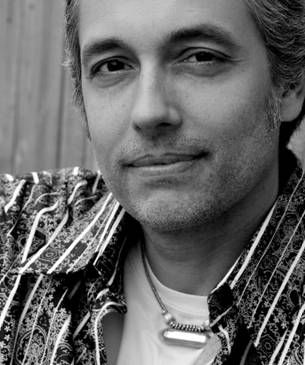
Talking screenwriting with Hollywood heavyweight Hawk Ostby
Omaha Film Festival panelist counts “Children of Men” and “Iron Man” among credits
©by Leo Adam Biga
Appeared in The Reader (www.thereader.com)
Hawk Ostby, one half of the scriptwriting team of Children of Men and Iron Man, will provide an insider’s take on the screenwriting trade at the Omaha Film Festival’s Filmmaking Conference.
Speaking by phone from his Vermont home, Ostby says a big part of making it in the industry is “perseverance and discipline.”
“You really get tested when you start off,” says Ostby, whose writing partner is Mark Fergus. “I was fortunate in that I knew somebody who had a foot in the door, and he said, ‘Look, if you really concentrate for three to five years you’ll be doing what you want to do,’ and I sort of had that tattooed behind my eyelids.
“Three to five years can be a really long time when you’re watching your friends go on to their careers, doing really well, and you’re still tapping away in a sweaty little band box, but then one day it happens. It doesn’t seem so weird or outlandish when somebody calls and says, ‘Hey, we read something of yours and we really like it and we want to try and make it.’ I think in your own mind you fantasize about that moment so often and then when it finally happens it feels right because you’ve done the work.”

Knowing your craft is essential.
“I just was so enamored with the idea of trying to make a living by writing, and I realized I enjoyed it so that it was going to be with me for the rest of my life anyway, so why not knuckle down and really try to learn what it is, what is a story?”
Hollywood seems unattainable but he says he and Fergus prove it’s not.
“Look, I’m not a genius by any means. I just love stories and I stuck with it. It was more like play, and I think if it’s that for you then you’ve got a shot. If you’re trying to get rich or famous, you can do it a lot easier than trying to make it in this business. It’s not really what it’s about. To learn storytelling and all those things it’s a long apprenticeship, at least it was for me. I know there are people who are way more natural who write two scripts and they’re smash hits and they go on to have long careers, but that certainly wasn’t my story, and not Mark’s.”
Collaborators 15 years, Ostby and Fergus play to their respective strengths.
“Mark is very analytical. He can look at a script and say right away, ‘Ah, page 7 is where it goes wrong.’ He’s very clever at those things and I’m not. I’m more instinctual. I’m not sure what’s wrong. I have to take it home to the cave and sort of chew on it. We don’t sit in the same room and fire dialogue back and forth, it’s more of a two-headed thing. We discuss at length the story and how to lay it down, and then Mark will go in, write the outline, sculpt it down to its essence, and then I will take that and do the first draft, and use that as guide for where we want to go. That draft is often written very maniacally and quickly. I don’t stop to edit myself. We used to write and edit at the same time and what happened was we never got the flow of it.”
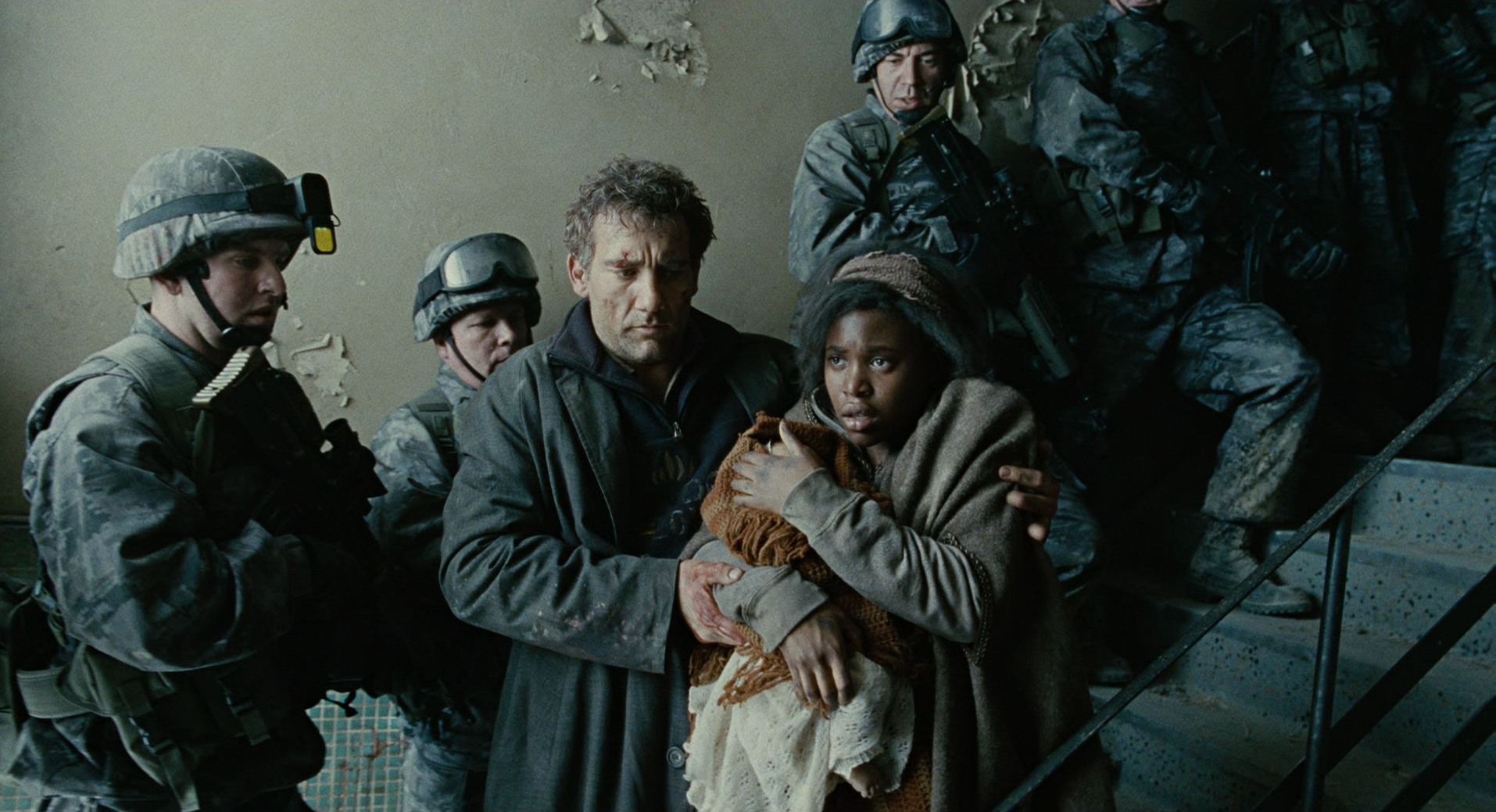
After each makes another pass, he says, “usually we’re left with a couple things he’s holding onto and I’m holding onto and we just sort of argue those out and whoever has the best argument or is able to convince the other is what we go with. Sometimes we find a better solution spitballing things.”
The pair have adapted Philip K.Dick (A Scanner Darkly), a comic book (Iron Man) and an animated film (the forthcoming Akira) but their adaptation of the P.D. James novel Children of Men may have been most instructive.
“If there’s one thing we learned, especially on Children of Men, you can’t always follow the book. It’s just a totally different experience. But if you can capture the feeling of the book then that’s what you’re really aiming for. The book just wasn’t working as a film. What broke it for us is when we came up with this idea that it’s really Casablanca set in a dystopian future, complete with a spiritually bankrupt protagonist who has nothing to live for and then finds something and sacrifices himself for something greater.”
The writers are trying to get a television series and two original feature scripts off the ground this year. One feature puts a twist on the heist genre and the other dramatizes a manhunt in the wilderness.
For details on Ostby’s OFF Filmmaking Conference panels, visit http://www.omahafilmfestival.org.

Related articles
- Model-Turned-Actress Jaime King Comes Home for Screening of Film She Wrote and Directed, ‘Latch Key,’ at the Omaha Film Festival (leoadambiga.wordpress.com)
- Omaha Film Festival Celebrates Seven Years of Growing the Local Film Culture (leoadambiga.wordpress.com)
Alexander Payne delivers graceful Oscar tributes – Winner for Best Adapted Screenplay recognizes Clooney, Hemmings and his mom
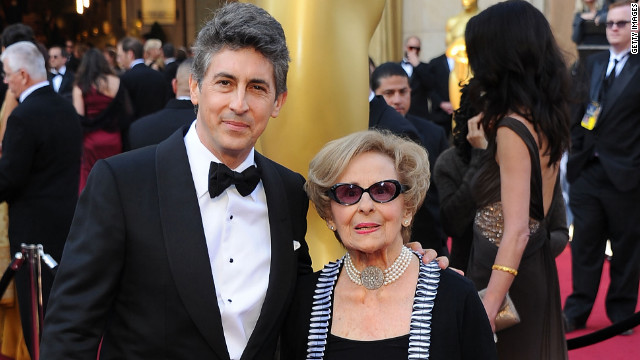
Alexander Payne‘s love affair with the movies began when he was a child in his hometown of Omaha. The nascent cinephile’s frequent filmgoing companion then was his mother, Peggy Payne, who recognized her prodigy of a son expressed far more interest in grown-up films than children’s fare, and she indulged his serious passion by taking him to screenings of art movies. Decades later the world-class filmmaker told the world how much he appreciates what she did for him when he dedicated his Oscar for Best Adapted Screenplay for The Descendants to her. In doing so he said “I love you” in Greek, thus acknowledging his family’s heritage, which he’s extremely proud of. He also singled out one of his producing partner’s, Jim Burke, star George Clooney, and author Kaui Hart Hemmings, whose novel he and fellow Oscar winners Nat Faxon and Jim Rash adapted.
Alexander Payne delivers graceful Oscar tributes – Winner for Best Adapted Screenplay recognizes Clooney, Hemmings and his mom
©by Leo Adam Biga
Published in The Reader (www.thereader.com)
The obvious and not so obvious came into focus when native son Alexander Payne accepted his second Oscar in front of a live audience of his peers and a television viewing audience estimated at 1.2 billion during Sunday’s Academy Awards.
He shared Best Adapted Screenplay for The Descendants with Nat Faxon and Jim Rash, whose mimicking of presenter Angelina Jolie‘s power pose seemingly distracted and peeved Payne as he tried beating the clock with his thank-yous. Always the pro though, he quickly collected himself and offered one of the evening’s best grace notes with this tribute:
“We share this with George Clooney and the rest of the cast for interpreting our screenplay so generously and we also share it in particular with Kaui Hart Hemmings, our beautiful Hawaiian flower, for her novel.”
A radiant Hemmings sat next to the debonair Payne and his date for the evening, his well-coiffed mother Peggy, and it was to her and their shared Greek heritage he made the most moving gesture.
“And on a brief personal note if I may, my mother is here with me from Omaha, hold the applause, and after watching the show a few years ago she made me promise that if I ever won another Oscar I had to dedicate it to her just like Javier Bardem did with his mother (eliciting laughter). So, Mom, this one’s for you. Se agapao poly. (Greek for “I love you very much.”). And thanks for letting me skip nursery school so we could go to the movies. Thanks a lot.”
Payne has sometimes mentioned his mother and father both indulged his early childhood fascination with film, but it was she who took him to see the cutting-edge grown-up movies he preferred over children’s fare.
He could have quipped about her insisting that only her Countryside Village hair stylist attend to her tresses, which meant he had to fly the hairdresser out to L.A.
He could have used the stage to poke Nebraska legislators, as he did six weeks ago in Lincoln, for leverage in trying to get film industry tax credits passed here, lest he have to take his planned Nebraska project to, say, Kansas. He could have tweaked the noses of Paramount suits who gave him a hard time about his insistence in wanting to shoot Nebraska in black-and-white.
That he didn’t show anyone up speaks to his respect for the industry and his desire to not burn bridges. Besides, as he recently told a reporter, “I like the Oscars.” It’s obvious the Oscars like him. The only question is when he when he will take home Best Picture and Best Director awards.
Related articles
- Alexander Payne and Kaui Hart Hemmings on the Symbiosis Behind His Film and Her Novel ‘The Descendants’ and Her Role in Helping Him Get Hawaii Right (leoadambiga.wordpress.com)
- Payne Delivers Another Screen Gem with ‘The Descendants’ and Further Enhances His Cinema Standing (leoadambiga.wordpress.com)
- My Forthcoming Book, ‘Alexander Payne: His Journey in Film,’ Due for a Fall 2012 Release (leoadambiga.wordpress.com)
Two-time Oscar-winner Alexander Payne delivers another screen gem with “The Descendants” and further enhances his cinema standing
UPDATE: Alexander Payne has added to his growing legendaric status by picking up his second Oscar for Best Adapted Screenplay. He, Nat Faxon, and Jim Rash shared the Academy Award for their work on The Descendants. Payne shared the same award with Jim Taylor for their Sideways script. It seems only a matter of time before Payne is recognized with a Best Director Oscar.
Here’s a capsule take on Alexander Payne and The Descendants, the latest in the filmmaker’s seriocomic forays into the existential angst, folly, fragility, and yearning of the human condition. If you’re a fan of Payne, the film, or of cinema in general, then check out the batch of stories on this blog about about him, this picture, his other movies, and a slew of other films and filmmakers from cinema’s past and present.

Two-yime Oscar-winner Alexander Payne delivers another screen gem with “The Descendants” and further enhances his cinema standing
©by Leo Adam Biga
Appeared in Omaha Magazine
Until The Descendants opened to golden reviews last fall, seven years elapsed between feature films for its celebrated writer-director Alexander Payne.
The Omaha native and Creighton Prep grad came of age as a film buff here. He made his first three features (Citizen Ruth, Election, About Schmidt) in his hometown, each moving him up the ranks of elite moviemakers. His surprise 2004 hit, Sideways, took him to Southern California’s wine country. The combination road-buddy picture and unconventional love story confirmed Payne as a film industry leading light, earning him a Best Adapted Screenplay Oscar.
He then busied himself writing-producing films for other directors. When he couldn’t find financing for his own pet project, Downsizing, he made The Descendants. Before shooting it in late 2010 the only directing he did in this period was a segment of Paris, I Love You and the pilot for HBO’s Hung.
The Golden Globes won by Descendants star George Clooney for best dramatic actor and by Payne and producing partners Jim Burke and Jim Taylor for best drama harbors well heading into the Oscars, where the film will be well-represented with five nominations (for Best Picture, Best Director, Best Adapted Screenplay, Best Editing and Best Actor). The three friends share their own production company, Ad Hominem Enterprises, which produced the picture for Fox Searchlight, with whom Ad Hominem has a first-look deal. The pic’s strong showing with critics and award shows is reminiscent of Sideways. Like that film, this one took Payne far from the Midwest – to Hawaii. A decade after working with iconic Jack Nicholson on About Schmidt, Payne teamed with another icon, Clooney.
As land baron attorney Matt King, Clooney is a man in crisis. His wife Liz lies in a coma after a boating accident. After years of indifferent parenting he’s suddenly in charge of his two girls. He’s burdened, too, by the valuable land entrusted to his care by ancestors. When his older daughter Alexandra (Shailene Woodley) reveals her mother’s infidelity, Matt sets off on a journey that begins in retribution but ends in forgiveness. Payne says “two acts of love” are what drew him to adapt the Kaui Hart Hemmings novel.
The story shares in common with Schmidt and Sideways and Payne’s forthcoming Nebraska a beleaguered protagonist trying to mend an unraveling life.
“It’s just the comic archetype Jim Taylor (his producing partner and former co-writer) and I came up with and I’m continuing of the middle-aged guy who’s really unconscious and has a bunch of anguish and frustration in life,” says Payne. “It’s a guy with good intentions but who’s bought the wrong package. I think it’s funny.”
Extracting equal amounts pathos and humor from human folly is what Payne does.
“I’m just always drawn to material that remains human. You don’t need guns and spaceships and great contrivance to have a movie and a meaningful one. I don’t think those elements are necessarily bad – I like movies of every genre, but what I’m drawn to is trying to somehow explore and express and mock the human heart.”
Descendants is being called Payne’s most fully realized work. “I hope so,” he says, adding that any new maturity reflects his more accrued life experience at age 50 and his evolving film craft. Some observers note he seems more comfortable letting tender emotions play out on screen.”Well, that’s what this story called for,” he says. “I mean, it could be a new vein of filmmaking in me or could just be I was serving this particular story as a professional, workman-like director. I have no idea.”
Staying true to his Omaha roots, he attended the movie’s local premiere at Film Streams, where Descendants smashed box office records. Payne enjoys sharing his work at the art cinema whose board he serves on. Before an appreciative crowd of friends and supporters he announced the film was among the highest grossers nationally its first week. By early February its domestic take stands at $66 million-plus, makeing it the top indie flick released in 2011.
Exuding grace and humility, Payne personally greeted audience members before and after the opening night screenings here. In accepting his Golden Globe, Payne deflected praise to cast and crew, to the people of Hawaii and to Hemmings, whose “beautiful gift” of a novel he made his own.
He’s conquered Cannes, Toronto, New York, Hollywood, but he proves he can come home again. Payne, who keeps a condo here, plans shooting the father-son road pic Nebraska in various Panhandle locales come spring. Home is where the heart is and he’s always happy to return where his cinema dreams were first fired.
Related articles
- Alexander Payne Achieves New Heights in ‘The Descendants’ (leoadambiga.wordpress.com)
- Alexander Payne and Kaui Hart Hemmings on the Symbiosis Behind His Film and Her Novel ‘The Descendants’ and Her Role in Helping Him Get Hawaii Right (leoadambiga.wordpress.com)
- Cinematographer Phedon Papamichael, Producer Jim Burke and Actress Shailene Woodley Discuss Working with Alexander Payne on ‘The Descendants’ and Kaui Hart Hemmings Comments on the Adaptation of Her Novel (leoadambiga.wordpress.com)
- From the Archives: Alexander Payne, an Exclusive Interview Following the Success of ‘Sideways’ (leoadambiga.wordpress.com)
- About Payne: Alexander Payne on ‘About Schmidt,’ Jack Nicholson and the Comedy of Deep Focus (leoadambiga.wordpress.com)
- Jim Taylor, the Other Half of Hollywood’s Top Screenwriting Team, Talks About His Work with Alexander Payne (leoadambiga.wordpress.com)
- From the Archives: About ‘About Schmidt’: The Shoot, Editing, Working with Jack and the Film After the Cutting Room Floor (leoadambiga.wordpress.com)
- Payne named filmmaker of the year (bbc.co.uk)
- From the Archives: Conquering Cannes, Alexander Payne’s Triumphant Cannes Film Festival Debut with ‘About Schmidt’ (leoadambiga.wordpress.com)
- From the Archives: Alexander Payne Discusses His New Feature ‘About Schmidt’ Starring Jack Nicholson, Working with the Star, Past Projects and Future Plans (leoadambiga.wordpress.com)
- When Laura Met Alex: Laura Dern & Alexander Payne Get Deep About Collaborating on ‘Citizen Ruth’ and Their Shared Cinema Sensibilities (leoadambiga.wordpress.com)
- Living the Dream: Cinema Maven Rachel Jacobson – the Woman Behind Film Streams (leoadambiga.wordpress.com)
- Joan Micklin Silver’s Classic ‘Hester Street’ Included in National Film Registry (leoadambiga.wordpress.com)
- My Forthcoming Book, ‘Alexander Payne: His Journey in Film,’ Due for a Fall 2012 Release (leoadambiga.wordpress.com)
Alexander Payne and Kaui Hart Hemmings on the symbiosis behind his film and her novel “The Descendants” and how she helped get Hawaii right
Alexander Payne and Kaui Hart Hemmings on the symbiosis behind his film and her novel “The Descendants“ and how she helped get Hawaii right
©by Leo Adam Biga
Published in The Reader (www.thereader.com)
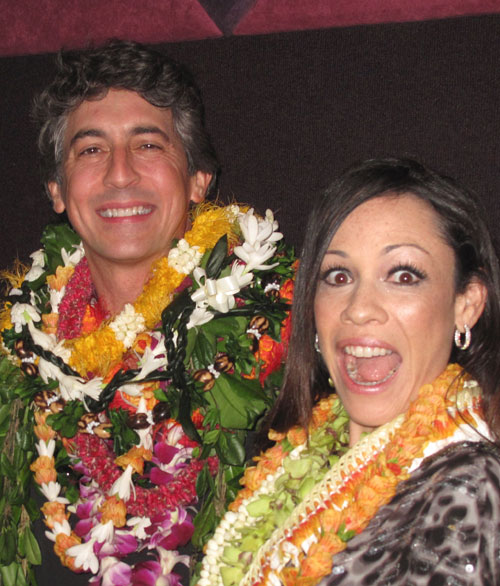
When Alexander Payne‘s turn came to speak in the glow of The Descendants winning best motion picture drama at the Jan. 15 Golden Globes, he made sure to thank the people of Hawaii and author Kaui Hart Hemmings.
He did something few directors do by involving Hemmings, a Hawaii native and resident, in the adaptation, preproduction and production of the George Clooney-starring film. He’s widely credited her vital role in helping him get a fix on the island state’s particular culture, or as much as a mainlander like himself can attain. For all the time he spent researching, writing, prepping and shooting there, mainly in Honolulu, he never lost sight of being a visitor in need of expert advice.
Of course, the well-received 2007 Hemmings novel is the reason there’s a movie at all. He knows golden material when he sees it and he remained true to the book beyond her expectations.
“I’ve had the privilege of seeing Alexander making this film, from location scouting and casting to directing and filming. His attention to the minutiae of Hawaiian life, his humor and restraint, his casting decisions – I felt like I’d be surprised if it wasn’t a good film. Still, I couldn’t prepare myself for how good,” says Hemmings. “It’s a film that sticks with you, teaches you something without being at all didactical. It brings Hawaii to the big screen, something that’s never been done before, in an authentic way. I never insisted on him being faithful to my novel, but he did, and I’m pretty happy about that since it led to results like these.”
His respect for her work and inclusion in his process is why he told a world-wide Globes audience, with some prompting from his Ad Hominem Enterprises producing partner and former co-writer, Jim Taylor, “…thanks to Kaui Hart Hemmings – she gave us a beautiful gift.”
“I don’t need the public thank you but…it sure does please the locals. I spent a lot of time with Alexander, the crew and George, so it was just fun times,” says Hemmings. “I’m a big fan of this movie. I have the privilege of feeling like I contributed to it in some way and so it’s nice to be acknowledged.”
In adhering closely to her tale of a good man negotiating personal upheavals, the film’s struck a responsive chord with critics and audiences…
YOU CAN READ THE REST OF THE STORY IN MY NEW BOOK-
Alexander Payne: HIs Journey in Film – A Reporter’s Perspective 1998-2012
A compilation of my articles about Payne and his work. Now available for pre-ordering.


Related articles
- Cinematographer Phedon Papamichael, Producer Jim Burke and Actress Shailene Woodley Discuss Working with Alexander Payne on ‘The Descendants’ and Kaui Hart Hemmings Comments on the Adaptation of Her Novel (leoadambiga.wordpress.com)
- Alexander Payne Achieves New Heights in ‘The Descendants’ (leoadambiga.wordpress.com)
- The Descendants by Kaui Hart Hemmings – READ THE BOOK FIRST (Drool Over Clooney in the Film Later): (booktopia.com.au)
- Alexander Payne and Kaui Hart Hemmings on the Symbiosis Behind His Film and Her Novel ‘The Descendants’ and Her Role in Helping Him Get Hawaii Right (leoadambiga.wordpress.com)
- Payne Delivers Another Screen Gem with ‘The Descendants’ and Further Enhances His Cinema Standing (leoadambiga.wordpress.com)
- Alexander Payne Delivers Graceful Oscar Tributes – The Winner for Best Adapted Screenplay Recognizes Clooney, Hemmings and His Mom (leoadambiga.wordpress.com)
Related articles
From the Archives: About Payne – Alexander Payne on “About Schmidt,” Jack Nicholson and the comedy of deep focus

From the Archives:
About Payne – Alexander Payne on “About Schmidt,” Jack Nicholson and the comedy of deep focus
©by Leo Adam Biga
Originally published in The Reader (www.thereader.com)
Where Citizen Ruth and Election were accorded the kind of lukewarm studio backing (from Miramax and Paramount/MTV Films, respectively) that idiosyncratic movies get when “the suits” don’t fully endorse or understand them, Schmidt is getting the type of red carpet treatment from New Line Cinema execs that signals they see a potential winner, read — moneymaker, here. And why not?
The film, making its Nebraska premiere December 10 at the new Mary Riepma Ross Media Arts Center (formerly the Mary Riepma Ross Film Theater) in downtown Lincoln, appears to have everything going for it heading into Hollywood’s big ticket winter season, when prestige pictures are positioned at the cineplex for box-office leverage and Academy consideration.
The timing of Schmidt’s release seems right. There’s the snob appeal that comes from boffo Cannes and New York Film Festival screenings of the film this past spring and summer. There’s the raves it received from Stephen Holden in the New York Times, Kenneth Turan in the Los Angeles Times and a slew of other name critics for major media outlets. There’s also serious Oscar talk for Jack Nicholson’s celebrated turn as dour Omaha Everyman Warren Schmidt and for Payne and writing partner Jim Taylor’s sardonic take on middle American mores.
Then there’s the priceless mojo Nicholson’s mystique brings to the Nebraska-made project.
Of course, none of this guarantees Schmidt will do any business, especially in light of the fact Payne’s films have so far fared better in home-market release, where they have time to be discovered and appreciated, than in theaters. That his films appeal to a discriminating audience is logical given his wry, sagacious work, which is really in the realm of social commentary.
Film critic David Denby called Payne and Taylor “perhaps the only true social satirists now working in American movies.” But satire can be a hard pill for filmgoers to swallow. They may feel the sting hits too close to home or they may prefer something lighter to go with their concessions.
According to Dan Ladely, director of the Ross Media Arts Center, Schmidt is “a little bit of a departure from Alexander’s two previous films, which were known for their kind of biting satire. This film is a little bit more nostalgic.” While perhaps gentler, it is, like the others, a painfully honest and ironic examination of how good people lose their way and court despair even amidst the so-called Good Life.
In today’s spoon-fed movie culture, bleak is a hard sell unless accompanied by big action set pieces, and the only thing passing for action in Schmidt is Nicholson’s comic struggle atop a water bed. That scene closes a sequence in which the tight-assed, buttoned-down Schmidt is disgusted by the outrageous new family he inherits via his daughter’s impending wedding.
The son-in-law’s mother, Roberta, is, as deliciously played by Kathy Bates, a brazen woman whom, Payne said, “is the type of person that will say anything to anyone.” At one point she tries seducing Schmidt in a hot tub by “telling him about how sexual she is and how she had her first orgasm in ballet class at age six,” said Payne, delighted with offending every propriety Schmidt holds dear. “Oh, it’s so fun to torture your characters.”
In this scene, as in much of the film, Nicholson’s performance rests more on his facial-physical reactions than words. Indeed, instead of explosions, verbal or otherwise, moviegoers get the implosion that Nicholson’s Warren Schmidt, a retired and widowed Woodmen of the World Life Insurance actuarial, undergoes.
Severed from the twin tethers of job and wife that defined him and held his orderly life together, he begins questioning everything about his existence, including the choices he made. He lets himself go.
The state of his disillusion is captured in the film’s ad campaign in which Schmidt appears as a shell-shocked, disheveled man shadowed by a dark cloud overhead in an otherwise clear blue sky.
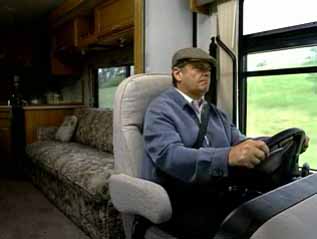
In the throes of this mid-life crisis, he sets off, in a huge, unwieldy motor home that is an apt expression of his desperate inadequacy, on an existential road trip across Nebraska. His destination is Denver, where he heads ostensibly to heal his wounded relationship with his daughter and to save her, as he sees it, from the mistake she is about to make in marrying a frivolous man. Along the way, he conveys his troubles to an odd assortment of people he turns to or rails against in a kind of unfolding nervous breakdown. Unable to express his real feelings to those closest to him, he instead pours out his soul, in writing (and in voice-over), to an African orphan he sponsors, Ndugu, who can’t possibly understand his dilemma.
Regarding Nicholson’s portrayal of a man in crisis, Dan Ladely calls it “probably one of the most subdued performances he’s ever given and maybe one of his best. I’d be really surprised if he doesn’t get nominated for an Oscar. It’s a role where he really stretched himself, and I think probably a lot of the credit for that could be given to Alexander, because Alexander is a director who works well with actors. He gets a lot out of them.”
Directing Nicholson allowed Payne to work with an actor he greatly admires and solidified his own status as a sought-after filmmaker. He found Nicholson to be a consummate professional and supreme artist.
“Nicholson does a lot of work on his character before shooting. Now, a lot of actors do that, but he REALLY does it. To the point where, as he describes it, he’s so in character and so relaxed that if he’s in the middle of a take and one of the movie lights falls or a train goes through or anything, he’ll react to it in character. He won’t break.” Payne said Nicholson doesn’t like a lot of rehearsal “because he believes in cinema as the meeting of the spontaneous and the moment. His attitude is, ‘What if something good happens and the camera wasn’t on?’”
YOU CAN READ THE REST OF THE STORY IN MY NEW BOOK-
Alexander Payne: His Journey in Film, A Reporter’s Perspective 1998-2012
A compilation of my articles about Payne and his work. Now available for pre-ordering.


Related articles
- From the Archives: A Hollywood Dispatch from the set of Alexander Payne’s Sideways – A Rare, Intimate, Inside Look at Payne and His Process (leoadambiga.wordpress.com)
- From the Archives: A Road Trip Sideways – Alexander Payne’s Circuitous Journey to His Wine Country Film Comedy (leoadambiga.wordpress.com)
- From the Archives: Alexander Payne, an Exclusive Interview Following the Success of ‘Sideways’ (leoadambiga.wordpress.com)
- From the Archives: About ‘About Schmidt’: The Shoot, Editing, Working with Jack and the Film After the Cutting Room Floor (leoadambiga.wordpress.com)
- From the Archives: Conquering Cannes, Alexander Payne’s Triumphant Cannes Film Festival Debut with ‘About Schmidt’ (leoadambiga.wordpress.com)
- When Laura Met Alex: Laura Dern & Alexander Payne Get Deep About Collaborating on ‘Citizen Ruth’ and Their Shared Cinema Sensibilities (leoadambiga.wordpress.com)
- Alexander Payne on ‘The Descendants’ (variety.com)
- From the Archives: Alexander Payne Discusses His New Feature ‘About Schmidt’ Starring Jack Nicholson, Working with the Star, Past Projects and Future Plans (leoadambiga.wordpress.com)
- Alexander Payne Achieves New Heights in ‘The Descendants’ (leoadambiga.wordpress.com)
- Omaha’s Film Reckoning Arrives in the Form of Film Streams, the City’s First Full-Fledged Art Cinema (leoadambiga.wordpress.com)
- Payne Delivers Another Screen Gem with ‘The Descendants’ and Further Enhances His Cinema Standing (leoadambiga.wordpress.com)
- Alexander Payne Delivers Graceful Oscar Tributes – The Winner for Best Adapted Screenplay Recognizes Clooney, Hemmings and His Mom (leoadambiga.wordpress.com)
From the Archives: Conquering Cannes – Alexander Payne’s triumphant Cannes Film Festival debut with “About Schmidt”

From the Archives: Conquering Cannes, –Alexander Payne‘s triumphant Cannes Film Festival debut with “About Schmidt”
©by Leo Adam Biga
Originally published in the Omaha Weekly
Press accounts of Alexander Payne’s conquest of the Cannes Film Festival, where his new film About Schmidt created a buzz in the main competition, have largely focused on the film losing out on any awards or on the critical hosannas directed toward him and his star, Jack Nicholson.
But, as Payne noted during a recent Omaha visit, Cannes is a phantasmagorical orgy of the senses that cannot be reduced to mere prizes or plaudits. It is at once an adoring celebration of cinema, a crass commercial venue and a sophisticated cultural showcase. It is where the French bacchanal and bistro sensibilities converge in one grand gesture for that most democratic art form — the movies. Only a satirist like Payne can take the full, surreal measure of Cannes and expose it for all its profundity and profanity.
“I likened it to the body of super model Gisel (Bundchen),” he said, “which is extraordinarily beautiful and draped in the most elegant clothes on the planet, yet, also possesses…bile and all sorts of fetid humors inside of it. The festival is all of those things. I mean, one thing is the elegance — the red carpet, the beautiful tuxes and gowns, the fabulous beach parties and all that stuff. Another thing is the best filmmakers in the world showing work there.
“And still another side is the marketplace, which is like a bazaar, with people talking about how many videocassette units your film’s going to sell in Indonesia. It’s that kind of sordid marketplace that gives cinema its vitality. And you can’t have the cinema body without all of it. So, it’s really like a beautiful woman. It’s extraordinary to look at from the outside, but once you cut it and look inside, you could throw up.”
He said the confluence of glitz, glamour and garishness reminded him of Las Vegas. “It’s all kind of Vegasy. You see really elegant things and you see really tacky things, which I liked. I was in such a good mood, that I just loved everything.”
So, what do you do for an encore when your third feature film makes a splash at the mecca of world cinema? Well, if you’re riding a wave of success like Alexander Payne, your hot new film is next chosen to open the New York Film Festival (NYFF), September 27 through October 13, at Lincoln Center. “It’s an honor,” he said regarding Schmidt’s recently announced selection to open the Big Apple event. “That will keep the awareness of the film afloat. A lot of the New York press and international press and kind of the tastemaker-types will see it, I’m told.”
To be accepted as an opening night feature there, a film must be making its North American premiere, which forced New Line Cinema to decline invitations for Schmidt to play other major festivals on the continent, including those in Toronto and Telluride. No matter. The word-of-mouth momentum attached to Schmidt from its Cannes screenings is so strong that early industry patter is already positioning the film as an award-contending late fall release.
For the filmmaker, Cannes (May 15-26) marked a milestone in a still young career whose sky-is-the-limit ceiling has his work being compared to and his name being mentioned with the most celebrated cinema artists in the world today. An indication of his growing stature is the fact that during a recent Omaha visit he was shadowed by a New York Times reporter preparing a major profile on him. He fully recognizes, too, what Cannes means for his reputation, although the sardonic Payne points out the absurdity attending such puffery.
“It was a huge honor just to be there…and it’s a nice stepping-stone,” he said.. “As far as I’m concerned, it’s bigger than being nominated for an Oscar (he and writing partner Jim Taylor earned Best Adapted Screenplay nods for Election) because it’s international. It’s also really political and full of bullshit to some degree, but what isn’t? But given that reality of the world, it’s still about pure love of cinema, not Hollywood people slapping each other on the back and awarding movies like A Beautiful Mind. Ugh.”
YOU CAN READ THE REST OF THE STORY IN MY NEW BOOK-
Alexander Payne’s Journey in Film: A Reporter’s Perspective, 1998-2012
A compilation of my articles about Payne and his work. Now available for pre-ordering.

Related articles
- From the Archives: About ‘About Schmidt’: The Shoot, Editing, Working with Jack and the Film After the Cutting Room Floor (leoadambiga.wordpress.com)
- From the Archives: Alexander Payne – Portrait of a Young Filmmaker (leoadambiga.wordpress.com)
- From the Archives: A Road Trip Sideways – Alexander Payne’s Circuitous Journey to His Wine Country Film Comedy (leoadambiga.wordpress.com)
- From the Archives: A Hollywood Dispatch from the set of Alexander Payne’s Sideways – A Rare, Intimate, Inside Look at Payne and His Process (leoadambiga.wordpress.com)
- When Laura Met Alex: Laura Dern & Alexander Payne Get Deep About Collaborating on ‘Citizen Ruth’ and Their Shared Cinema Sensibilities (leoadambiga.wordpress.com)
- From the Archives: Alexander Payne, an Exclusive Interview Following the Success of ‘Sideways’ (leoadambiga.wordpress.com)
- Alexander Payne Achieves New Heights in ‘The Descendants’ (leoadambiga.wordpress.com)
- From the Archives: Alexander Payne Discusses His New Feature ‘About Schmidt’ Starring Jack Nicholson, Working with the Star, Past Projects and Future Plans (leoadambiga.wordpress.com)
- Omaha’s Film Reckoning Arrives in the Form of Film Streams, the City’s First Full-Fledged Art Cinema (leoadambiga.wordpress.com)
From the Archives: About “About Schmidt”: The shoot, editing, working with Jack and the film After the cutting room floor

©by Leo Adam Biga
Originally published in the Omaha Weekly
Ever since Omaha native Alexander Payne wrapped shooting on About Schmidt, the hometown movie whose star, Jack Nicholson, caused a summer sensation, the filmmaker has been editing the New Line Cinema pic in obscurity back in Los Angeles.
That’s the way Hollywood works. During production, a movie is a glitzy traveling circus causing heads to turn wherever its caravan of trailers and trucks go and its parade of headliners pitch their tents to perform their magic. It’s the Greatest Show on Earth. Then, once the show disbands, the performers pack up and the circus slips silently out of town. Meanwhile, the ringmaster, a.k.a. the director, holes himself up in an editing suite out of sight to begin the long, unglamorous process of piecing the film together from all the high wire moments captured on celluloid to try and create a dramatically coherent whole.
Whether Schmidt is the breakout film that elevates Payne into the upper echelon of American directors remains to be seen, but it is clearly a project with the requisite star power, studio backing and artistic pedigree to position him into the big time.
An indication of the prestige with which New Line execs regard the movie is their anticipated submission of it to the Cannes Film Festival. Coming fast-on-the-heels of Election, Payne’s critically acclaimed 1999 film that earned he and writing partner Jim Taylor Oscar nominations for Best Adapted Screenplay, Schmidt will be closely watched by Hollywood insiders to see how the director has fared with a bona fide superstar and a mid-major budget at his disposal.
Regardless of what happens, Payne’s unrepentant iconoclasm will probably keep him on the fringe of major studio moviemaking, where he feels more secure anyway. As editing continues on Schmidt, slated for a September 2002 release, Payne is nearing his final cut. The film has already been test previewed on the coast and now it’s just a matter of trimming for time and impact.
While in town over Thanksgiving Payne discussed what kind of film is emerging, his approach to cutting, the shooting process, working with Nicholson and other matters during a conversation at a mid-town coffeehouse, Caffeine Dreams. He arrived fashionably late, out of breath and damp after running eight blocks in a steady drizzle from the brownstone apartment he keeps year-round.
He and editor Kevin Tent, who has cut all of Payne’s features, have been editing since June. They and a small staff work out of a converted house in back of a dentist’s office on Larchmont Street in Los Angeles. Payne and Tent work 10 -hour days, six days a week.
“As with any good creative relationship we have a basic shared sensibility,” Payne said of the collaboration, “but we’re not afraid to disagree, and there’s no ego involved in a disagreement. We’re like partners in the editing phase. He’ll urge me to let go of stuff and to be disciplined.”
By now, Payne has gone over individual takes, scenes and sequences hundreds of times, making successive cuts along the way. What has emerged is essentially the film he set out to make, only with different tempos and tones than he first imagined.
“Rhythmically, it’s come out a little slower than I would have wanted it,” he said. “I think it’s been something hard for me and for those I work with to accept that because of it’s subject matter and for whatever ineffable reason this is a very different film in pacing and feel than the very kinetic and funny Election, which got so much praise. It has, I think, the same sensibility and humor as Election but it’s slower and it lets the drama and emotion play more often than going for the laugh. I think it just called for that. With this one, we don’t go for the snappy edit.”
Even before Schmidt, Payne eschewed the kind of MTV-style of extreme cutting that can detract from story, mood, performance.
“Things are over-covered and over-edited these days for my tastes. There’s many exceptions, of course, but the norm seems to be to cut even though you don’t need to. And, in fact, not only don’t filmmakers need to, their cuts are disruptive to watching performance and getting the story. I like watching performance. My stuff is about getting performance. I like holding within a take as long as possible until you have to cut.”
YOU CAN READ THE REST OF THE STORY IN MY FORTHCOMING BOOK-
Alexander Payne’s Journey in Film: A Reporter’s Perspective, 1998-2012
A compilation of my articles about Payne and his work. Available this fall as an ebook and in select bookstores.

Related articles
- From the Archives: Alexander Payne Discusses His New Feature ‘About Schmidt’ Starring Jack Nicholson, Working with the Star, Past Projects and Future Plans (leoadambiga.wordpress.com)
- From the Archives: Conquering Cannes, Alexander Payne’s Triumphant Cannes Film Festival Debut with ‘About Schmidt’ (leoadambiga.wordpress.com)
- From the Archives: A Hollywood Dispatch from the set of Alexander Payne’s Sideways – A Rare, Intimate, Inside Look at Payne and His Process (leoadambiga.wordpress.com)
- From the Archives: Alexander Payne – Portrait of a Young Filmmaker (leoadambiga.wordpress.com)
- From the Archives: A Road Trip Sideways – Alexander Payne’s Circuitous Journey to His Wine Country Film Comedy (leoadambiga.wordpress.com)
- From the Archives: Alexander Payne, an Exclusive Interview Following the Success of ‘Sideways’ (leoadambiga.wordpress.com)
- Jim Taylor, the Other Half of Hollywood’s Top Screenwriting Team, Talks About His Work with Alexander Payne (leoadambiga.wordpress.com)
- When Laura Met Alex: Laura Dern & Alexander Payne Get Deep About Collaborating on ‘Citizen Ruth’ and Their Shared Cinema Sensibilities (leoadambiga.wordpress.com)
- Alexander Payne Achieves New Heights in ‘The Descendants’ (leoadambiga.wordpress.com)
From the Archives: Alexander Payne discusses “About Schmidt” starring Jack Nicholson, working with the iconic actor, past projects and future plans
From the Archives: Alexander Payne discusses “About Schmidt” starring Jack Nicholson
Working with the iconic actor, past projects and future plans
©by Leo Adam Biga
Originally published in the Omaha Weekly
Citizen Ruth announced him as someone to watch on the independent film scene. Election netted him and his writing partner, Jim Taylor, an Oscar nomination for best adapted screenplay. The commercial success of Meet the Parents, whose script he and Taylor contributed to, led to another high profile hired gun job — a rewrite of Jurassic Park III.
Now, with About Schmidt, which began filming in his hometown of Omaha this week, filmmaker Alexander Payne finds himself playing in a $30 million sandbox in his own backyard and sharing the fun with one of the biggest movie stars ever — Jack Nicholson. It is the culmination of Payne’s steady climb up the Hollywood film ladder the past seven years. It has been quite a journey already for this amiable writer-director with the sharp wit and the killer good looks. And the best still appears ahead of him.
During an exclusive interview he granted to the Omaha Weekly at La Buvette one recent Sunday afternoon in the Old Market (fresh from seeing off his girlfriend at the airport) Payne discussed the genesis and the theme of his new film, his collaboration with Jack, his take on being a rising young filmmaker, his insider views on working in the American movie industry and his past and future projects.
Although About Schmidt gets its title from the 1997 Louis Begley novel, it turns out Payne’s film is only partly inspired by the book and is actually more closely adapted from an earlier, unproduced Payne screenplay called The Coward.
As he explained, “When I first got out of film school 10 years ago I wrote a script for Universal that had the exact same themes as About Schmidt…a guy retiring from a professional career and facing a crisis of alienation and emptiness. Universal didn’t want to make it. I was going to rewrite it and come back to Omaha and try and get it made, and then Jim Taylor and I stumbled on the idea of Citizen Ruth, so I pursued that and put this on the back burner. Then, about three years ago, producers Harry Gittes and Michael Besman sent me the Begley book, which has similar themes, although set in a very different milieu.”
Nicholson, who had read the book, was already interested. Payne first commissioned another writer to adapt the novel but that didn’t pan out. “I didn’t relate very much ultimately to the adaptation and then I turned to Jim Taylor and said, ‘You know that thing I was writing 10 years ago? How would you like to rewrite that with me under the guise of an adaptation for this thing.’” Taylor agreed, and the film About Schmidt was set in motion, with Gittes and Besman as producers.
Taking elements from both the earlier script and the Begley book, the character of Schmidt is now a a retired Woodmen of the World actuary struggling to come to terms with the death of his longtime wife, the uneasy gulf between he and his daughter, his dislike of his daughter’s fiance and the sense that everything he’s built his life around is somehow false. Full of regret and disillusionment, he sees that perhaps life has passed him by. To try and get his head straight, he embarks on a road trip across Nebraska that becomes a funny, existential journey of self-discovery. A kind of Five Easy Pieces meets a geriatric Easy Rider.
“What interested me originally was the idea of taking all of the man’s institutions away from him,” Payne said. “Career. Marriage. Daughter. It’s about him realizing his mistakes and not being able to do anything about them and also seeing his structures stripped away. It’s about suddenly learning that everything you believe is wrong — everything. It asks, ‘Who is a man? Who are we, really?’”
Typical of Payne, he doesn’t offer easy resolutions to the dilemmas and questions he poses, but instead uses these devices (as he used abortion politics and improper student-teacher activities in his first two films) as springboards to thoughtfully and hopefully, humorously explore issues. “I don’t even have the answers to that stuff, nor does the film really, at least ostensibly. But, oh, it’s a total comedy. I hope…you know?”
For Payne, who derives much of his aesthetic from the gutsy, electric cinema of the 1970s, having Nicholson, whose work dominated that decade, anchor the film is priceless. “One thing I like about him appearing in this film is that part of his voice in the ‘70s kind of captured alienation in a way. And this is very much using that icon of alienation, but not as someone who is by nature a rebel, but rather now someone who has played by the rules and is now questioning whether he should have. So, for me, it’s using that iconography of alienation, which is really cool.”
Beyond the cantankerous image he brings, Nicholson bears a larger-than-life mystique born of his dominant position in American cinema these past 30-odd years. “He has done a body of film work,” Payne said. “Certainly, his work in the ‘70s is as cohesive a body of work as any film director’s. He’s been lucky enough to have been offered and been smart enough to have chosen roles that allow him to express his voice as a human being and as an artist. He’s always been attracted to risky parts where he has to expose certain vulnerabilities.”
YOU CAN READ THE REST OF THE STORY IN MY FORTHCOMING BOOK-
Alexander Payne’s Journey in Film: A Reporter’s Perspective, 1998-2012
A compilation of my articles about Payne and his work. Available this fall as an ebook and in select bookstores.


Related articles
- From the Archives: About ‘About Schmidt’: The Shoot, Editing, Working with Jack and the Film After the Cutting Room Floor (leoadambiga.wordpress.com)
- From the Archives: Conquering Cannes, Alexander Payne’s Triumphant Cannes Film Festival Debut with ‘About Schmidt’ (leoadambiga.wordpress.com)
- From the Archives: Alexander Payne – Portrait of a Young Filmmaker (leoadambiga.wordpress.com)
- From the Archives: Alexander Payne, an Exclusive Interview Following the Success of ‘Sideways’ (leoadambiga.wordpress.com)
- From the Archives: A Road Trip Sideways – Alexander Payne’s Circuitous Journey to His Wine Country Film Comedy (leoadambiga.wordpress.com)
- Jim Taylor, the Other Half of Hollywood’s Top Screenwriting Team, Talks About His Work with Alexander Payne (leoadambiga.wordpress.com)
- When Laura Met Alex: Laura Dern & Alexander Payne Get Deep About Collaborating on ‘Citizen Ruth’ and Their Shared Cinema Sensibilities (leoadambiga.wordpress.com)
- Alexander Payne Achieves New Heights in ‘The Descendants’ (leoadambiga.wordpress.com)
Vincent Alston’s indie film debut, “For Love of Amy,” is black and white and love all over
The Omaha indie filmmaking scene is not very active, especially when it comes to features. One of the few homemade feature projects to get made here and nationally distributed is For Love of Amy, a sentimental pic written and produced by its lead actor, Vincent Alston. While not a memorable work, the film’s storytelling is effective and the project is notable for simply defying the odds and being realized on screen and actually netting soome screenings and now a DVD release. My story below was written a couple years ago as the film’s production wound down. Alston attracted name talents in Ted Lange and John Beasley to direct the film and to essay a supporting role, respectively. The picture did attract enough notice to earn Alston the Mid-Atlantic Black Film Festival award for most outstanding first film and I wouldn’t be surprised if Alston is heard from again.
Sometime soon I will be posting a short story I wrote about another filmmaker with Omaha ties, Patrick Coyle, who has made a serious splash with the indie features he’s written and directed. The biggest impact Nebraska filmmakers have made in recent years are by Alexander Payne, whose first three features were made in Omaha and whose next film, Nebraska, will be made in the mostly rural environs of the state’s central-western panhandle region, and Nik Fackler, whose Lovely, Still is finally finding large audiences via cable and DVD. This blog is full of stories about these and other filmmakers with Nebraska ties, including Joan Micklin Silver, Gail Levin, and Charles Fairbanks.

Vincent Alston’s indie film debut, “For Love of Amy,” is black and white and love all over
©by Leo Adam Biga
Originally published in The Reader (www.thereader.com)
On a recent Saturday morning at the University of Nebraska Medical Center director Ted Lange and crew worked efficiently to get their shots for the indie film For Love of Amy. Lensing in Omaha and environs since mid-June, the crew needed few takes. A satisfied Lange would say, “Print it…Movin’ on” and the troops rigged things for the next set-up. Far removed from his Love Boat days, the savvy Lange, bedecked in ball cap, blue jeans and athletic shoes, wore a T-shirt adorned with Laurence Dunbar, the subject of a one-man show he conceived and performs.
Screenwriter-producer-star Vincent Alston of Omaha was a quiet, intense presence on set, where he wore a deep blue suit as Michael. Alston seemed wide-eyed about the whole process, understandable given this is his first film and his ass is on the line three ways. He watched things closely and after takes often drew Lange aside to confer about what approach was best.
The concept behind the film will make you go either, “Ewww” or “Awww.” Michael (Alston) is black and his best friend Ryan is white. The dying Ryan extracts Michael’s promise to be there for Ryan’s 9-year-old daughter, Amy. Ryan dies and his widow suffers a breakdown. In steps Michael. Then a revelation about the child’s birth mother throws your expectations askew.
It reads like a treacly, weepie Lifetime message pic. All the racial, sentimental gravitas could be thoughtful or deadly, depending on how it’s handled.
Audiences must judge if Alston and Lange lift the material above the sweetly banal. Alston has the acting chops to make Michael, the single black man who takes Amy into his life a believable figure. Alston’s impressed on the John Beasley Theater stage and as Malcolm X in the one-act play The Meeting. Still, his debut script arguably reads like many well-intentioned social-humanist dramas you’ve seen.
Lange, who played Isaac on the network television chestnut, Love Boat, is a veteran TV and theater director and the author of 21 plays. The San Francisco resident has directed and starred in a film version of Othello. Scenes from his new play George Washington’s Boy were read at the recent Great Plains Theatre Conference (GPTC). In 2005 he came to Omaha to direct his own play, Four Queens and One Trump, at the JBT. So he has the creds, as he said, to “make this thing work.”
How Alston, a Jersey native, got to this point is a story itself. He worked in corrections back east and when he moved here in the ‘90s. His entree to acting came when, “on a whim,” he took a class. Bitten by the bug, he found his niche in naturalism. He made his living in computers while pursuing his theater passion. He now has his own company, VLA Productions, that creates video-Internet visuals and produces stage works, notably Jeff Stetson’s The Meeting, a work Alston’s now identified with. The piece depicts a hypothetical meeting between Malcolm X and Martin Luther King, Jr.. He staged and starred in a production of it at the GPTC.
Alston’s been writing a few years now, drawing on experiences from his own life. He and his wife Pamela actually care for children not of origin and not of the same race by serving as foster parents. “We’ve had all kinds — Native American, white, biracial, the whole gamut,” he said. Currently they care for two Sudanese youths. Alston and his wife also have a son and daughter of their own.
His Beasley Theater contacts led him to give his script to Lange, who responded to it. “I love the different worlds that are really present side by side in it,” Lange said. “The fact that Michael is black and his best friend is white. The fact that Michael is raising his best friend’s kid. The twist that comes in there at the end about the child’s mother. It does have some nice little turns in it.”
Lange said he also liked the challenge of finding ways to avoid any cliches bound up in the story and in the characters.
“That where your art comes in,” Lange said. “There’s a couple little things we had to tweak. That’s collaboration. That’s Vince saying, ‘Now, Ted, I need this to happen,’ and me saying, ‘Oh, we can do that with just a little bit of this.’ It’s like I told Vince, ‘I’m going to make some suggestions to you. If I can’t tell you why, you go tell me to fuck myself. Don’t do it. But if I tell you something and you ask me why and I give you an answer, you gotta at least give me honest consideration, and that’s how we’ve been working. It’s good.”
Lange said the cast is good enough to avoid playing one-note characters. “We’ve got wonderful actors that can deliver the goods. I’m really excited by the fact we’ve got people who can help me tell the story and can play against the words — start out in one direction and then evolve into this other direction,” he said.
Besides Alston, there’s strong local talent in the cast, including veteran film-TV-theater actor John Beasley in the scene-stealing role of Tate, Tyrone Beasley as X and Lindsay Seim as Kat. Lange was blown away by Omaha actress, Melissa Epps, whom he cast in the role of Claire, ostensibly the heavy of the piece.
Some punch was lost with the late drop out of stage-screen actress Mikole White (She Hate Me), whose role as Jas, Michael’s girlfriend, is being filled by New York actress Joyce Sylvester (Crackin’ Green). The fact that established talent signed on indicates Alston’s script works on the page. The fact there’s a racially mixed cast and crew and the story depicts African American professionals living outside strictly “black Omaha” makes the project fairly unique in local filmmaking circles.
Despite the black-white dynamic that frames the story, Alston insists — and his script bears him out — the film is not about race. Instead, he likes to say it’s a story about “doing the right thing when you don’t know what right is.”
As Lange said, “Ultimately, you know what the right thing to do is, whether it’s profitable or satisfying or all those other things. But sometimes it takes a lot of guts to really do what’s right, and not let your ego, your pride get in the way, and to me that’s what this movie is. Does Michael have the guts to do what’s right?”
Alston got the idea for the story after a party in which a little white girl he didn’t know came up to him and spoke to him “like I was her best friend in the world,” he said. “It was intriguing this child could have this conversation with me and it got me thinking, Could we have that same conversation 10 years hence? Or would society’s prejudices have so impinged on her psyche that those inevitable walls that go up among people who are different prevent it? That was the genesis for it.”
The only racial tension in the film comes in the form of Amy’s maternal grandmother, Claire, who opposes Michael, and from X, a black friend of Michael’s who reminds him of certain realities in America; namely, that a single black man raising a white girl may not fly.
The scene shot at UNMC takes place in a hospital waiting room, where Claire, her husband Frank and their granddaughter Amy keep vigil over Ryan, who’s asked to see Michael. Michael arrives just as Claire expresses her dislike of him to Frank — “I’d sure like to know what in hell makes him so damn special. He’s not even family. I’ve got half a mind to…”. Upon seeing Michael, it’s clear Amy loves her “uncle.” Epps well underplays the antagonistic role of Claire and Grace Bydalek is thankfully unaffected as Amy. Race becomes subtext as much as pretext for the action.
Alston, who’s experienced first hand the politics of race as both a victim of profiling and as a cog in the racially skewed penal system, doesn’t so much concern himself with black-white as human considerations.
“My philosophy is I want to do entertainment that draws on the best in people, not the worst, that challenges people to be better…I think Michael in the film is challenged to be a better person,” he said. “At the end of the day he realizes this isn’t about affirming himself, it’s about a little girl and what’s best for her.”
Alston found himself challenged to heed his better self while a guard at the New Jersey State Home for Boys at Jamesburg (NJ) and working maximum security at the adult Douglas County Correctional Center (Neb.). He didn’t like what the job did to him. “It will jade you,” he said. “Dealing with the worst all day, every day…to see human beings reduced to animals, particularly seeing people who look like me reduced to that, and not even care anymore, and to be proud of it — I had to get out of there. I hit a point where really the bottom dropped out of my life.”
Luckily he had someone looking out for his best interests at Jamesburg.
“My boss and my mentor was a Muslim and he just taught me so many life lessons. He told me, ‘Vince, don’t stay here, this isn’t for you. There’s something greater out there — you just gotta go get it.’
Alston quit. On the advice of a friend who lived in Omaha, he moved here. In need of a job, Alston worked as a guard at the county correctional facility, but when he saw the same thing happening to him again he quit after only a few months. “It was a nightmare,” he said. “It was like, ‘I can’t stay here.’” That decision turned his life around. Within short order he took computer classes at Metro that steered him onto a new career path and he met his future wife.
After transferring to the University of Nebraska at Omaha he took an acting class as an elective and found a whole new passion. “I fell in love with it. It was like a light went on. You hear how people have epiphanies? That was me,” he said. “I remember I did my first monologue and there was a sort of hush in the room. I was leaving and this kid said, ‘People are talking about you.’ I just loved it from then on — that I could get a response from people. It’s interesting because I’m basically an extremely shy person, but you find that stage and I guess it gives you a place to be safe to express yourself.”
His journey to self-realization is not so different than that of Michael’s in the film. “Life is about becoming what you need to become,” Alston said. In Alston’s case, an artist. He found a mentor in UNO theater professor Doug Paterson, with whom he began staging performances of The Meeting. He found another mentor in John Beasley, but not before testing the waters at other theaters.
“Here’s what I found about theater here,” Alston said. “There’s a lot of it, but rarely do they do anything that speaks to my sensibilities. The other thing is, there’s this prevailing belief theater should be bigger than life. The Beasley Theater is the only place I’ve found where I can do the kind of in-the-moment, natural, real emotional response to theater. If you get up there and fake anything, that’s not going to wash with John (Beasley). You’re listening for real, you’re responding emotionally for real. So that’s been a breath of fresh air.”
It didn’t hurt that someone Alston admires so much encouraged him. “John was the first person of his caliber to tell me I could make it as an actor,” Alston said.
Beasley said Alston, who appeared in the JBT production of Jitney, came to him fairly seasoned but unused to laying it all on the line.
“His style is pretty laid back. He’s a protege of Doug (Paterson). Doug’s style and my style differ, though I have respect for what he does,” Beasley said. “Under Ted Lange I’ve seen Vince go inside a little bit more and dig a little deeper to mine some of that gold to bring the character out.”
Beasley’s proud to count Alston as a protege as well. “I’m happy to see he was able to start from nowhere and get this project launched. It’s quite an accomplishment to get your first film made,” Beasley said. “I don’t know what will happen with this film, but I think he’s on his way.”
Alston had been after Beasley for Tate, a wise old janitor at the school Michael teaches at, but the actor held out. It was Lange who got Beasley to give the part another read. “Ted said, ‘Look, Vince has put a lot of work into this character,’ so I took another look at it,” Beasley said. “I’m extremely happy to be a part of this project. I think it’s a good thing for Omaha. I did the movie because Vince asked me and I respect him. I felt I could do no less. I knew it meant a lot to him.”
“The fact that John is doing a role is just huge for us,” Alston confirmed.
Other JBT stalwarts on the For Love of Amy team are: Ty Beasley, who in addition to playing X serves as first assistant director; Amy Laaker as line producer; and Mark O’Leary as location manager.
“It really would have been impossible to do this project without them,” Alston said. “They’ve been with it from day one. You gotta have people committed to seeing the thing through to the end.”
Alston’s four-year odyssey to get the project made has been filled with the usual ups and downs. “In the process you’re running around like mad trying to chase down money,” he said. “You’re always trying to get in front of the next guy. Every day you’re networking with people…presenting business plans, making phone calls.” Once, the film was two weeks from cameras rolling when the financing fell through. “It just throws you for a loop when it happens,” he said. “As frustrating as it was for me, it was more frustrating to tell the cast and crew.”
At his lowest points Alston said he rallies himself with something the great educator Mary McLeod Bethune once said: “’I refused to be discouraged, for neither God nor man could use a discouraged soul.’ That is so heavy,” Alston said.
Whether the film ever sees the light of day is anyone’s guess. Alston hopes it makes the festival circuit and sells theatrically or to television. He’d like to make enough off it to tell more stories on screen. If it does well enough, he muses, maybe “I won’t have to chase the money so hard the next time.”
Related articles
- Screenwriting Adventures of Nebraska Native Jon Bokenkamp (leoadambiga.wordpress.com)
- John Beasley and Sons Make Acting a Family Thing at the John Beasley Theater & Workshop and Beyond (leoadambiga.wordpress.com)
- Tired of Being Tired Leads to a New Start at the John Beasley Theater (leoadambiga.wordpress.com)
- Omaha’s Film Reckoning Arrives in the Form of Film Streams, the City’s First Full-Fledged Art Cinema (leoadambiga.wordpress.com)
- Home Boy Nicholas D’Agosto Makes Good on the Start ‘Election’ Gave Him; Nails Small But Showy Part in New Indie Flick ‘Dirty Girl’ (leoadambiga.wordpress.com)
- From the Archives: Alexander Payne – Portrait of a Young Filmmaker (leoadambiga.wordpress.com)
- When Laura Met Alex: Laura Dern & Alexander Payne Get Deep About Collaborating on ‘Citizen Ruth’ and Their Shared Cinema Sensibilities (leoadambiga.wordpress.com)
Screenwriting adventures of Nebraska native Jon Bokenkamp, author of the scripts “Perfect Stranger” and “Taking Lives'”
If you’re a follower of this blog, then you know I like writing about Nebraskans working in the film industry. If you’re a newbie here, consider yourself warned. The subject of the story that follows, Jon Bokenkamp, is a feature screenwriter with some major cerdits behind him. He’s also directed one feature. Lately, Bokenkamp’s taken a step back from his Hollwyood merry-go-round to return to his hometown, Kearney, Neb., where he is active in restoring the World Theatre. Alexander Payne is probably the biggest name from the state doing his thing in film and you’ll find no shortage of stories by me about the filmmaker on this site. I’ve written extensively about Payne and his work and will continue doing so. But you’ll also find many stories I’ve done about lesser known but no less interesting figures from this place doing noteworthy things in cinema and television, including: Nik Fackler, Joan Micklin Silver, Yolonda Ross, Gabrielle Union, John Beasley, Gail Levin, Charles Fairbanks, Nicholas D’Agosto, Monty Ross, Vince Alston, Swoosie Kurtz. Then there are individuals like Lew Hunter who worked as a producer and writer in Hollywood before becoming a screenwriting guru through his UCLA course and book. Screenwriting 434, and workshops. There’s Click Westin, who churned out scripts for many a forgotten early TV dramatic series and doctored several feature scripts and whose lone produced feature screenplay, Nashville Rebel, starred Waylon Jennings in the itle role. There’s Oscar-winning cinematographer Mauro Fiore, who’s a transplant here. Let’s not forget Oscar-winning editor Mike Hill, the subject of a profile soon to be added here. Future posts will also profile Peter Fonda and Jane Fonda. I would love to get around one day to interviewing-profiling Nick Nolte. The man profiled in this post, Jon Bokenkamp, is not a household name but you’ve likely seen some of his handiwork on screen (Taking Lives or Perfect Stranger).
Screenwriting adventures of Nebraska native Jon Bokenkamp , author of the scripts “Perfect Stranger” and “Taking Lives”
©by Leo Adam Biga
Originally appeared in The Reader (www.thereader.com)
As screenwriter of the Angelina Jolie-Ethan Hawke thriller Taking Lives and with a story-by credit on the new Halle Berry-Bruce Willis suspenser Perfect Stranger, Nebraskan Jon Bokenkamp has defied the odds in Tinsletown.
Besides penning scripts that stars attach themselves to, as both Berry and Diane Lane did with his screenplay Need, a project now going forward with Nicole Kidman and Naomi Watts, he’s directed one feature, Bad Seed, from his own original script Preston Tylk. He’s also directed a feature length documentary (After Sunset) on that faded American movie tradition, the drive-in.
Opening this weekend, Stranger is based on an original story by Bokenkamp. The plot centers on Roe (Berry), a crusading investigative reporter who enters the cyber world of hookups to try and ID the killer of her best friend. A man she develops ambiguous feelings for, Harrison (Willis), may be the killer.

Bokenkamp’s story originally captured the interest of Julia Roberts before she passed, perhaps he speculates because the material was “too dark for America’s Sweetheart.” Then, producers strayed from his version to, as he put it, “shop around” for writers to take it in “a new direction.”
Two new scribes took a stab at it before Todd Komarnicki, who has screenplay credit, finished the final version, including a new ending that reveals an entirely different killer. Berry signed on as the lead and James Foley as director.
The new ending was only added once shooting began. Such changes are par for the course in Hollywood. “These things just evolve so many times,” Bokenkamp said. “It’s only two pages,” he said, “but my God they change the whole color of everything that happened before.” He settled for story-by credit. As the original author, he had a case to “arbitrate” for a screenplay-by credit from the Writer’s Guild, but opted not to make waves.
Besides, he said, “it’s really a muddy way the credits are decided. It’s a really strange process.” So he swallowed his pride. “This was real simple. There was no hollering, which is unusual,” he said.
Another reason he didn’t fight is he felt ambivalent about the film, whose shooting script he’s read. “It’s a good twist, but I don’t feel like it reflects the story I wanted to tell. It ends up becoming a different movie.” The twist, he said, “is not what it’s about.” Despite it all, he said, “I believe in the movie.”


Bokenkamp’s odyssey reprised what happened with Taking Lives and an old project he worked on years ago called WW3.COM (World War III.com), which “has finally risen from the ashes,” he said, “and evolved into Live Free or Die Hard, which is basically Die Hard 4.” His work on it is uncredited.
“It’s funny, I’m finding I’m the guy that generates the idea — I’m not the closer,” he said. “I’m not the guy who can come in with the punch lines and the big-movie-trailer, see-you-in-hell moments. But I’m the guy who gets the bones of it there.”
He may or may not see to fruition his new script, Night and Day, You Are the One, what he calls “kind of a Jacob’s Ladder love story.” He’s developing it for writer-producer Ehren Kruger (The Ring) at Universal and writer-director Mark Pellington (Mothman Prophecies). It’s proof he’s still in the game.
Not so long ago Bokenkamp was just another wannabe leaving behind a stolid life in his hometown of Kearney, Neb. to try his luck in loopy L.A. He was 20 and cheeky enough to be an aspiring director despite only a few Super VHS shorts and two undistinguished years at then-Kearney State College on his resume.
Without knowing a soul, he arrived out West in 1993. This was before Alexander Payne hit it big. Bokenkamp attended USC film school, a feeder for the industry.
He paid his dues in classic starving-Hollywood-hopeful-makes-good fashion. He wrote by day while he parked cars on the Universal lot and waited tables at night. He didn’t have a car for a time. He felt the frustration of being right outside the golden gates, yet no nearer to getting inside them than when back in Kearney.
Adrift in a sun-drenched town that turns a cold shoulder to anyone not remotely a Player, he reached out to the few made-Nebraskans he could find, including Lew Hunter, the UCLA screenwriting guru from Superior, Neb.
His radar next led him to Dan Mirvish, the mercurial filmmaker who finagled an editing suite at Paramount to cut his Omaha, the movie. Bokenkamp did an assistant editor internship on it, working on vintage upright moviolas. It was his first time on a lot other than as a valet.
When Bokenkamp realized Hollywood revolves around the desperate, Byzantine hunt for bankable material, he began writing. He entered a Fade In magazine contest for thriller scripts. Long story short, he won. He got an agent and lawyer and a job doing rewrites for William Friedkin (The French Connection, The Exorcist).
“I’ll never forget showing up to his office at Paramount,” Bokenkamp said. “His assistant had candles burning and the lights were all turned down like there was some kind of seance going on. There were dried flowers hanging everywhere, old pictures on the walls. The place was like a cave. I was really young and Friedkin is a daunting guy. I mean, he won the fucking Oscar…
“We originally met because he was interested in directing my script Preston Tylk. But as the budget got smaller and smaller I started to think to myself — ‘Why am I not directing this?” So I took the script back and eventually made the movie myself, but Friedkin liked my writing and hired me to rewrite Blood Acre…a really smart horror film…I remember we had one awful notes session where he just screamed and screamed about how terrible the script was. I did the two passes…in my contract and they never asked me back. I bumped into him a few years later and I’m not sure he even remembered me, but it was a real lesson in Hollywood.
“Since then, I’ve sort of compared ‘assignment writing’ to being a plumber, meaning, I might get hired to fix the toilet, but if I don’t do my job quickly and really well, they’re going to tell me to get out of the bathroom because they’ve called another plumber. Maybe that guy screws up and they have to call me back. That’s happened. But at the end of the day it’s a job.”

His first feature directing gig, Bad Seed, is a 2000 guy-on-the-run-hires-over-the-hill-private-eye flick starring Luke Wilson and Dennis Farina. The straight-to-video pic didn’t set the world on fire, but it did gain him a rep for thrillers, and you’re nothing in Hollywood if they can’t label you.
“From Bad Seed my niche kind of became small, dark thrillers, told from a single point of view, later from a female perspective,” he said. “I love detective movies. Klute is a favorite of mine. So you kind of build a niche as one thing that can make you a commodity. But I also think before that you have to have something you want to say, which sounds really cliche, but you really have to…
“I also think there’s really something to be said for being collaborative and easy to work with and just not being a prick,” he said. “There’s all these egos in the business and I think one of the things that’s helped me is I really feel I’m pretty easy to get along with. If you want me to try an idea, I’ll try it.”
Not surprisingly, the first-time director was frustrated by the “compromises” Warner Bros. forced on him. “It was a better script than a movie simply because of my inexperience as a director,” he said, “but I learned more those 30 days directing than I did in two years at USC.”
Even if he could direct on his own terms, he’s not sure it’s a good fit. “I would like to direct again,” he said, “but the lifestyle of it doesn’t match the lifestyle I like. I like the lifestyle of writing. It suits my family as well.” He’s married to his high school sweetheart, Kathy. They have two children. The couple gets back often to Nebraska to visit family and friends, staying summers at a cabin they keep near Johnson Lake. “I like sitting in a room writing, going and getting my Subway sandwich and coming back and getting it right on the page as opposed to being up 24 hours a day going crazy, pulling your hair out, wondering, ‘Why isn’t it raining?”
Bad Seed was to have reeked with a rain-soaked film noir ambience but Mother Nature didn’t cooperate and Warners couldn’t wait, so he scrapped the mood to make his days. Such are the concessions first-time directors make.
Since Bad Seed his scripts have mostly focused on kick-ass women.
“The strong female-driven element is something I gravitate to,” he said. “Female-driven movies feel smarter to me and it’s just a way to be different. You get a little more latitude with a female because she’s forced to stand up against the woman-in-the-boys-club type thing. It immediately puts us on her side…in her shoes.”
He said the input of his wife Kathy, a former school teacher, influences his interest in crafting formidable women characters.
“My wife can take a lot of credit for it. I don’t have a writing partner, so at the end of the day when I’m laying in bed staring at the ceiling, still writing, my wife is the one I talk to about it.”
He said Kathy’s been “completely supportive of his career,” even when he struggled those early years and even now when he freaks out between jobs.
“I always feel like I’m going from job to job,” he said. “That’s what’s exciting about it — going from one story to another, learning about something new. That’s the insecurity of it, too. You’re never quite sure where the next paycheck is coming from. And there’s not a 401K plan. The only difference (now) is that the paychecks have become a little bigger and my car is paid for.”
He said making it as a writer requires “an under appreciated scrapper kind of mentality.” He admits he’s not immune to fits of envy or pity. “At times I go, ‘Why am I not the guy writing Jurassic Park IV?’ But that kind of keeping-up-with-the-Jones mentality is something that terrifies me. I can’t put myself there. I just want to do stories that are close to my gut…I want to do the movies that are going to be remembered. I’m not saying any of mine are, but you gotta strive for that or otherwise I think you’re done.”
“One thing that scares me is if it stops. If suddenly people don’t want to work with me for some reason. I don’t know what I would do. I have a hard time imagining anything else. And I’m sure I always will write, whether I’m getting paid for it or not. Believe me, it’s not about the money, because there are a lot easier ways to go make lots more money. It’s just something I kind of have to do….I love to do.”
Related articles
- Jim Taylor, the Other Half of Hollywood’s Top Screenwriting Team, Talks About His Work with Alexander Payne (leoadambiga.wordpress.com)
- Alexander Payne Achieves New Heights in ‘The Descendants’ (leoadambiga.wordpress.com)
- Cinematographer Phedon Papamichael, Producer Jim Burke and Actress Shailene Woodley Discuss Working with Alexander Payne on ‘The Descendants’ and Kaui Hart Hemmings Comments on the Adaptation of Her Novel (leoadambiga.wordpress.com)
- From the Archives: Alexander Payne – Portrait of a Young Filmmaker (leoadambiga.wordpress.com)
- From the Archives: A Hollywood Dispatch from the set of Alexander Payne’s Sideways – A Rare, Intimate, Inside Look at Payne and His Process (leoadambiga.wordpress.com)
- From the Archives: Alexander Payne, an Exclusive Interview Following the Success of ‘Sideways’ (leoadambiga.wordpress.com)
- When Laura Met Alex: Laura Dern & Alexander Payne Get Deep About Collaborating on ‘Citizen Ruth’ and Their Shared Cinema Sensibilities (leoadambiga.wordpress.com)
- Omaha’s Film Reckoning Arrives in the Form of Film Streams, the City’s First Full-Fledged Art Cinema (leoadambiga.wordpress.com)


 Leo Adam Biga's My Inside Stories