Archive
Neal Mosser, A Straight-Shooting Son-of-a-Gun (from my Omaha Black Sports Legends series, Out to Win: The Roots of Greatness)
As a small population state Nebraska turns out precious few athletes who reach the highest level of their sport but there was a golden era when one man, the late Neal Mosser at Technical High School in Omaha, coached a succession of talents who went on to achieve great things as professional athletes. In a span of less than a decade he coached Bob Gibson, Bob Boozer, and Ron Boone in hoops. Mosser commanded great respect from his student-athletes because he didn’t play favorites and he didn’t bow to bigotry. His best players were African-Americans and where some coaches may have been reluctant or dead set against to play an all-black starting five, he wasn’t. In the 1950s and ’60s in an arch conservative and predominantly white state like Nebraska that wasn’t a popular thing to do but he did it anyway. It may have cost his team some wins come state tournament time, too, when officials seemed intent on doing what they could to prevent Tech from winning championships against white squads. One of Mosser’s legendary players, Bob Boozer, died this past spring (2012). This story from about eight years ago appeared as part of a series I did for The Reader (www.thereader.com) on Omaha’s Black Sports Legends called Out to Win: The Roots of Greatnesss. You’ll find other installments from the series on this blog.
Neal Mosser, A Straight-Shooting Son-of-a-Gun (from my Omaha Black Sports Legends series, Out to Win: The Roots of Greatness)
@by Leo Adam Biga
Originally appeared om The Reader (www.thereader.com)
In the days of segregation, the racial divide extended to school sports competition. At Omaha melting pots Technical, North and Central High schools, diversity was a given, even if some students and teachers were slow to accept it. While blacks played alongside whites, an unwritten practice saw to it few athletes of color suited up, regardless of ability. An informal quota system operated then at all levels of sports. From 1948 to 1967 Omaha Tech’s uncompromising head basketball coach Neal Mosser consistently defied the status quo. Under him, Tech had dozens of black hoop stars whose names survive today: Bob Gibson, Bob Boozer, Bill King, Joe Williams, Fred Hare, Ron Boone. A crusty ex-Marine with little use for hypocrisy, Mosser, who played at Purdue and Nebraska, took heat for playing his best players, even if they were all black. Consequently, he saw games openly stolen from his teams, including a couple infamous larcenies at the state tourney in Lincoln.
Gibson, a Creighton University great and Harlem Globetrotters veteran before a Hall of Fame pitching career with the St. Louis Cardinals, said Mosser followed a color-blind standard. “Race just never seemed to be a part of his thinking. He did a lot as far as me going from a young boy to a young man. It was more the way he carried himself than anything else and the respect he had for us as players.”
“Neal Mosser fought a tremendous battle for a lot of us minority kids,” said former player Lonnie McIntosh. “He and Cornie Collin. At that time, you never had five black kids on the basketball court at the same time.” But they did. “Their jobs were on the line, too.” McIntosh said of the two coaches.
Mosser said his ability to relate to minorities stems from growing up in a racially mixed town, Cambridge, Ohio, that straddled the Mason-Dixon line. “Blacks and whites got along pretty good then in Cambridge,” he said. “The glass works factory my dad worked in was integrated. In our church basketball league we played against blacks from the AME church. So, in playing together and in working together, we learned to get along.” As a coach, he applied unprejudiced principles. “If they showed me any promise, I worked with ‘em,” he said. “I enjoyed coaching guys that wanted to be coached. All you had to do was believe in ‘em.”

When the pressure mounted on Mosser to play it safe at Tech, he didn’t back down. “I didn’t take any of their shit,” he said, referring to prep officials, coaches and fans who got on him and his players. He bluntly told bigots where they could go, but asked his players to keep their cool. “I told ‘em, ‘You can’t be thinking about these people that are always on your butt and razzing you and calling you the N-word and everything like that.’ I told them they had to look past that. Right now, they would fight, but they didn’t in those days.” A sign of the unwelcome climate was the time Mosser drove his team back from a game in Hastings and, looking for a place to stay overnight in Lincoln, he had to vouch for his players before a hotel would accommodate them. “So you see how touchy it was,” he said.
Gibson recalls Mosser standing firm. “As a matter of fact, we went to the state tournament in Lincoln my senior year and he started five black players. I give him a lot of credit for that. That night, you could hear a pin drop. And he didn’t give a shit. He just wanted to win.” While the crowd’s “stone silence” didn’t faze Mosser, what happened next did. With the fast-breaking Tech team already frustrated by Fremont High’s slow-down tactics, the referees seemingly conspired to give the edge in the nip-and-tuck stalemate to the Tigers. Observers and participants confirm it was neither the first time nor the last time that teams from Tech and Central got beat with an underhanded assist from referees.
As if he still can’t accept it, Gibson explains how his vastly superior Tech squad got robbed that night. “By the end of the first-half four out of our five starters fouled-out, and within a couple minutes of the second half I fouled out, and I never fouled out. They were cheating us,” he said. “It was that blatant. And Mosser did the same thing Josh (his older brother and first coach) did — he was out in the middle of the floor screaming, and I thought he was going to have a heart attack.” There was nothing Mosser or anyone could do. Tech lost 40-39. The pain of it all made Gibson cry. He said it was the last time he ever shed a tear over a loss.
The same story was repeated in 1955, when Mosser had future collegiate All-American, Olympic Gold Medalist and NBA world champion Bob Boozer in the middle and a talented supporting cast around him.
“We had the state championship taken away from us,” Boozer said. “We played Scottsbluff. We figured we were the better team. I was playing center and I literally had guys hanging on me. The referees wouldn’t call a foul. I’d say, ‘Ref, why don’t you call a foul?,’ and all I heard was, ‘Shut up and play ball.’”
Mosser said Boozer was clearly a target that night. “They beat the hell out of him,” he said. “They about cut his arms off.”
The bad calls didn’t end there. “On one play, my teammate Lonnie McIntosh stole the ball and was dribbling down the sideline when one of their guys stuck his foot out and tripped him,” Boozer said. “There was Lonnie sprawled out on the floor and the referee called traveling and gave the ball to Scottsbluff. We were outraged, but what could we do? If we had really got on the refs we’d have got a technical foul. So, we had to suck it up and just play the best we could and hope we could beat ‘em by knocking in the most shots.” Boozer said Mosser helped him deal with “the sting of racism…Neal was a real disciplinarian. And he used to always tell us that life was not going to be easy. That you’ve got to forge ahead.” That credo was tested when Boozer, a hot recruit his senior year, was rejected by his top choice — the University of Iowa. “Neal showed me a letter Iowa’s head coach wrote telling him he had his quota of black players. Neal said, ‘Bob, these are things you’re going to have to face and you’ve just got to persevere in spite of it.’ It hardens you. It makes you tougher.” The same thing happened before, with Gibson, when Mosser tried getting Indiana to look at his prize player only to have the Hoosiers coach say, “I’ve got enough of ‘em.”
Perhaps the lousiest dirt dealt Tech came in its 1962 finals loss to Lincoln Northeast when the Trojans were leading by five with the ball and a couple minutes left in the game. Tech was called for an offensive foul, but instead of Northeast merely getting possession, they were incorrectly awarded a one-in-one free throw chance, which sent Mosser into a tirade. “The rule had just come in where if you had the ball and committed a foul, then the other team takes it out of bounds. They don’t get to shoot,” said Mosser. “So, when I saw them shooting a one-in-one, I just raised hell and they called a technical on me. Northeast made both free throws, plus the technical. They took the ball out of bounds, threw it back in and scored, and the game was tied without the Goddamned clock even running.”
Worse yet, after regaining the lead with just over a minute to go Tech’s go-to-guy, Joe Williams, was ejected after retaliating to some rough tactics inside. Mosser said, “he had guys hanging all over him and he swung an elbow, and they kicked my star black player out for fighting. Well, it takes two to fight. You don’t just kick one guy out of the game. Oh, yeah, they really screwed us.” Mosser lodged the usual complaints over the controversial calls, which made headlines for weeks. Referees even came out in the paper saying “they called the plays completely wrong,” Mosser said. “They all knew I was right, but they couldn’t do anything about it.” Ironically, Mosser was later put in charge of all officials in Omaha.
Mosser and Tech got a measure of revenge when his 1963 Trojan team, widely viewed as the best in Nebraska prep history, swept to the state title by such big margins that any hanky-panky by officials’ made no difference.
The star of that ‘63 club was Fred Hare, yet little-used reserve Ron Boone earned more lasting fame. Boone cracked the starting lineup as a senior, but he was given no hope of playing major college ball due to his size — 5-8 and 140-pounds. He played a year of juco ball at Clarinda (Iowa) Community College, where his stellar play and dramatic growth spurt saw him blossom into a strapping 6’2” physical specimen with major college prospect etched all over him. Mosser turned Idaho State University head coach Claude Retherford, a teammate and roommate of his at NU, onto Boone. Retherford signed him unseen. The rest is history. Boone developed into a college star and iron man of the ABA and NBA.
It wasn’t the first or last time Mosser looked out for his players. “I did a little bit for every one of ‘em,” he said, “but I did more for Ron Boone than for any other kid I ever had.” Boone appreciates Mosser’s influence. “He was very, very fair. Even after I became a professional, I would go up to Tech and he would let me in the gym to work out.” Over the years, Mosser’s kept in touch with his stars and lesser-knowns and regards former players like Bill King and Bob Gibson as good friends.
Mosser’s influence extended to the playing ops he gave neighborhood kids on the full-size court he built in the back yard of his family’s north Omaha house and the annual basketball school/camp he conducted for promising young talent.
The Mosser hoops legacy continues. Neal’s four sons all played ball. Jerry played for Pops at Tech. All four have coached. Grandson Mitch, a former Nebraska Wesleyan NAIA All-American, is a current assistant men’s hoops coach at UNO.
Related articles
- Closing Installment from My Series Out to Win: The Roots of Greatness, An Exploration of Omaha’s Black Sports Legends (leoadambiga.wordpress.com)
- From My Series Out to Win: The Roots of Greatness, An Exploration of Omaha’s Black Sports Legends (leoadambiga.wordpress.com)
- Making the Case for a Nebraska Black Sports Hall of Fame (leoadambiga.wordpress.com)
- Omaha hoops legend Bob Boozer dies (omaha.com)
- Bob Gibson, Bob Boozer: mutual champs of Omaha (retrosimba.com)
- From the series Out to Win: The Roots of Greatness – Black Women Make Their Mark in Athletics (leoadambiga.wordpress.com)
- Negro Leagues Baseball Museum Exhibits on Display for the College World Series; In Bringing the Shows to Omaha the Great Plains Black History Museum Announces it’s Back (leoadambiga.wordpress.com)
Gender equity in sports has come a long way, baby; Title IX activists-advocates who fought for change see much progress and the need for more
Title IX. This often contentious 1972 federal education act is getting more attention then usual these days because the media is taking a reflective look back on the impact it’s had over its 40 year lifespan. I’m doing the same with this article, which will soon appear in The Reader (www.thereader.com). Because I reside in Omaha, Neb. and The Reader is an Omaha news weekly my story looks at the implications of Title IX and the context that brought it into being from a local perspective, though I certainly address the nationwide effect the legislation’s had. The real interest for me in doing this story was to try and impress upong readers of a certain age that what is easily taken for granted today in terms of the ubiquitious presence of girls and women’s athletics obscures the fact that things were quite different not so very long ago. Younger readers may be surprised to learn that schools, colleges, and universities had to be compelled to cease discrimination on the basis of sex and to give females the same opportunties as males. What seems natural and common sense today wasn’t viewed in that light just a few decades ago. I end my story with a rhetorical question asked by one of my sources, former coach and athletic director Don Leahy, who said, “Why was it ever different?” My story attempts in a small way to explain why and to describe what the journey for women trying to gain equal opportunity in sports looked like.

Gender equity in sports has come a long way, baby;
Title IX activists-advocates who fought for change see much Progress and the need for more
©by Leo Adam Biga
Originally appeared in The Reader (www.thereader.com)
Participants in girls and women’s sports today should be forgiven if they take for granted the bounty of athletic scholarships, competitive opportunities, training facilities and playing venues afforded them.
After all, they’ve never known anything else.
Their predecessors from two generations ago or more, however, faced a much leaner landscape. One where athletic scholarships were unheard of or totaled hundreds, not thousands of dollars. A handful of games once comprised a season. Facilities-venues were shared, borrowed or makeshift.
Until 1972 federal Title IX legislation banned discrimination on the basis of sex, educational institutions offered nothing resembling today’s well-funded athletic programs for females. Schools devoted a fraction of the resources, if anything at all, to girls and women’s sports that they earmarked for boys and men’s sports.
Second class citizen treatment prevailed.
Nebraska women’s basketball coach Connie Yori made her mark at Creighton University, where she played and coached at some 11 different “home” sites because the program didn’t have its own dedicated facility.
“We were gypsies in some ways. We just had to figure out places to play,” she says, adding, “That wasn’t that long ago either.”

The gulf between then and are now is vast.
“I mean everything was different,” she says. “The way we traveled – the coaches and student athletes were driving the vans to the games. We as coaches had to regularly clean the facilities we practiced in. That was the norm, there wasn’t anyone else to do it. There’s countless examples. Opportunities to play, scholarship money, modes of travel, recruiting budgets, operations budgets, staff salaries, you name it, it’s escalated. But college men’s athletics has escalated too, so it’s not just the women.
“When I played college basketball there would maybe be 50 to 100 fans in the stands and now I’m coaching games where there’s sell-outs and ticket scalping is going on, and who would have thought that?”
Creighton, Nebraska and UNO have their own women’s hoops and volleyball facilities.
“That’s just kind of what’s happened across the board in women’s athletics in that institutions are more committed to equity, and as well they should be,” says Yori.
Gaps remain. Salaries for women coaches lag behind those for men. And where men routinely coach female athletes, it’s rare that women coach male athletes.
Still, things are far advanced from when women’s athletics got dismissed or marginalized and the very notion of female student-athletes was anathema to all but a few enlightened administrators and athletics officials.
In that proto-feminist era the so-called “weaker sex” was discouraged from athletics. Girls and women were considered too delicate to play certain, read: male, sports. Besides, it wasn’t feminine or ladylike to compete. Schools routinely said they could not justify women’s programs because they’d never pay for themselves. Consequently, the idea of giving females the same chances as males was met with paternalistic, patronizing objections. This despite the fact virtually all men’s programs lose money and only survive thanks to donations and to subsidies from student fees and revenue producing major sports.
Former Creighton softball coach Mary Higgins bought the rationale until realizing the contradiction
“I just remember thinking, ‘Well of course we don’t have women’s athletics, we can’t make any money, no one will come.’ And then it was like the light went on – ‘Well, wait a minute, the baseball team doesn’t make any money, they don’t have any people in the stands, then how come they have it and we don’t?'”

When people like Higgins began questioning tired old assumptions and asking for their fair share of amenities there was push back, including from men’s coaches protecting their turf.
“Well, you start with the fact that people don’t like change, period,” says former University of Nebraska at Omaha chancellor Del Weber.
With institutional support virtually nonexistent at the collegiate level, the Association for Intercollegiate Athletics for Women evolved into the main national governing-sanctioning body. Meanwhile, the NCAA actively ignored, then opposed inroads made by women. When school presidents and NCAA officials saw the hand writing on the wall and, some argue, the profits to be made from championship events, women’s athletics fell under the NCAA’s aegis in the early 1980s.
The real impetus for change may simply have been demographic. As women became the majority population, more entered college. Today, women account for the majority enrollment at Creighton and UNO.
Where the benefits of athletic competition (improved self-esteem, leadership skills development, higher graduation rates, et cetera) were once anecdotal, they eventually became measurable.
As far as defining moments, says Higgins, “the linchpin for our programs to grow was getting scholarships. Once we had scholarships we could go get the players.” That’s when the real gains occurred.
“The AIAW got things launched and then I think we got more sophisticated with the NCAA and a lot more money became available. It was a positive thing for growth but that was a painful transition.”
UNO associate athletic director Connie Claussen began women’s athletics there in 1969 as volunteer softball coach. She soon added volleyball and basketball. “I didn’t ask anyone, I just did it,” she recalls. All three sports shared the same set of uniforms. The teams practiced and played in a quonset hut. The equipment room was the trunk of her car. There was no budget, only donations scrounged from sympathetic boosters. Similar limitations applied at Creighton. Nebraska enjoyed a decided facilities advantage. For a time small schools could hang with big schools as everyone started from scratch and had no scholarships available.
Even after Title IX passed, says Claussen “it took several years for it really to have an effect on most athletic programs,” and then only with some prodding. In the case of UNO the Chancellor’s and Mayor’s Commissions on the Status of Women brought pressure. Even the U.S. Office of Civil Rights got involved at the behest of parents Mary Ellen Drickey and Howard Rudloff.
“What sticks out in my mind is that in our old gym they had hours set aside for when the women could come in,” says Higgins. “You think about that now and it just sounds ludicrous but that’s just what it was. The women could come in I believe Sunday and Wednesday nights because God forbid they sweat or show any effort.”
Peru State College basketball coach Maurtice Ivy excelled at the high school, collegiate and pro levels but when she was learning the game as a youth in the 1970s there was no exposure to girls or women’s hoops.
“I didn’t really see women playing, and so the person I watched play and I kind of emulated my game after was Dr. J.”

As an Omaha youth Ivy and other inner city girls developed their skills as Hawkettes, the state’s first select basketball team run by the late Forrest Roper. Richard Nared’s Midwest Striders track program impacted generations of girls, including Ivy and her younger sister Mallery, who set several state records. The sisters’ father was among the first local coaches to offer girls the opportunity to play football.
Fastpitch whiz Ron Osborn organized a statewide club softball association as a forum for girls to play in and as a showcase to convince schools they should start their own softball teams.
Today, girls club teams are everywhere.
Grassroots pioneers worked independently of Title IX to bring about change. Ivy thinks of them and graduates like herself as “soldiers” in the women’s athletics movement.
But there’s no mistaking Title IX, whose enforcement has been upheld in countless legal findings, is the bedrock equal opportunity protection upon which girls and women’s athletics rests. By compelling schools receiving federal assistance to uphold gender equity it’s propelled the explosion of women going to college and the exponential growth of girls and women’s athletics. It’s meant a dramatic increase in the infrastructures supporting female student-athletes and a proportionate increase in the number of participants.
“You went from nothing to everything,” is how former UNO and Creighton athletic director and now UNO associate athletic director Don Leahy describes its impact.

“To me, it standardized and normalized athletics,” says Higgins. “Now it’s just expected.”
Institutions found not complying with Title IX are forced to take corrective action under penalty of court-ordered monetary damages.
Nebraska’s been a battleground for some notable Title IX actions, including a 1995 lawsuit brought by Naomi Friston against the Minden Public School District for scheduling girls games at off times compared to boys’ games. Creighton University graduate Kristen Galles, who successfully represented the Friston case, is now one of the nation’s leading Title IX and gender equity attorneys.
Some school districts, colleges, universities and states were more progressive than others early on. For example, where Iowa embraced girls high school athletics decades before Title IX neighboring Nebraska dragged its feet.
Yori, an Iowa girls athletics legend, says, “I feel like I grew up in almost the perfect place during my era to be a female athlete because Iowa was ahead of its time in regards to the support of girls athletics.” She says the late Iowa Girls Athletics Association president, E. Wayne Cooley, “found ways to place girl athletes on a pedestal.”
Not so much in Nebraska.
“When I crossed the river from Iowa to Nebraska during the early 1980s,” Yori says, “I saw a really different climate for girls athletics here. There was definitely a difference in the commitment level. I mean, there just weren’t opportunities. It’s been great to see how much progress we’ve made in Nebraska and now the two states are on level playing fields in my mind.”
At the collegiate level some Nebraska institutions did take the lead, including John F. Kennedy College in Wahoo and Midland University in Fremont, both of which built dominant women’s athletic programs in the ’70s. Recently retired Midland basketball coach Joanne Bracker was an inaugural member of the Women’s Basketball Hall of Fame.
Under Claussen UNO won the 1975 AIAW Women’s College World Series, one of several national titles won by UNO women’s teams. Claussen and CU’s Higgins helped grow college softball, serving on AIAW and NCAA committees and leading their respective schools in hosting more than a dozen CWS championships, which Higgins says was “huge” in legitimizing women’s sports here and beyond.
The late Omaha Softball Association guru Carl Kelly and College World Series Inc. chairman Jack Diesing Sr., along with corporate donors, helped sponsor the women’s tournament.
The start of the 1980s saw NU women’s sports emerge. The volleyball program began its run of excellence under Terry Pettit. Gary Pepin’s track program shined with superstar Merlene Ottey. Angela Beck’s basketball program reached new heights with Maurtice Ivy. NU softball began making noise.

By the early ’90s, a full complement of women’s sports was in place wherever you looked, whether big public schools like NU, smaller private schools like CU or then-Division II UNO.
None of it would have happened without activists pressing the cause of female student athletes. Along the way Title IX and its supporters met resistance, including court challenges.
“I think there’s a lot of women and men who made a huge difference for the young women of this generation,” says Yori. “Connie Claussen and Mary Higgins were very much advocates for change. There were a lot of battles fought – in offices, in meeting rooms, and even legally in courtrooms. There were people that got fired for voicing their opinions and became the sacrificial lambs because of that. There were a lot of people who didn’t want change and didn’t want to give women the opportunity they are now being given.
“You know, we still need to fight for it, but there’s not such a gap as there was.”
Higgins says the trailblazers of modern women’s athletics were “people who just had a burning passion to make this happen. It consumed me, I know it consumed my colleagues. It’s like, ‘We’ll do whatever it takes. We’ll figure it out, we’ll find a way.”
Parents played roles, too, as coaches, administrators, boosters.
“I do think dads and their concern for their daughters had a major impact, and that was absolutely the case at Creighton,” says Higgins. “It wasn’t Title IX telling Creighton they had to do it. Title IX was happening at the same time but our then-assistant athletic director, the late Dan Offenburger, kind of led the charge. He coached our very first softball team. He didn’t have time to do it, we didn’t have any money, we didn’t even have a shoestring. But he got it going because it was the right thing to do. Plus, he had three daughters and he was motivated to create opportunities for them.
“I’m sure there are stories like that all over.”
As near as UNO, where Don Leahy says he supported women’s athletics not only because “I thought it had to be done” but because “I had a daughter who played sports.” There were also a wife and mother to answer to at home.
Leahy says the coaches he worked with at UNO and Creighton “fought diligently for their programs but at the same time they maintained a common sense that made it possible for this thing to develop. We talked and we gradually worked through these things and I think that made a big difference.”
“This stuff did not come easy,” says Del Weber, who approved the early road map for women’s athletics at UNO laid out by Leahy and Claussen and the gender equity program that they and former athletic director Bob Danenhauer devised.
Ramping up meant serious dollars. Leahy says when it became clear accommodating women’s athletics was a new reality “the first thing that came up was – how are we going to pay for this?”

Current Creighton athletic director Bruce Rasmussen, who coached CU’s women’s basketball team, recalls, “We didn’t have enough resources to properly compete just with our mens’ programs and now we had the burden of essentially doubling our athletic department. It was, ‘How do we balance what we can do with what we should do?’ And there was a lot of stress across the country. Women’s athletics completely changed the dynamics of universities and how were they going to support a full athletic department. So there was a lot of tension and trauma going on.”
“And funding it is not just a matter of we’re going to give them x number of dollars,” says Rasmussen, “but it’s facilities, it’s staffing, it’s scholarships, recruiting, traveling, equipment…”
At Creighton as anywhere, says Rasmussen, “we’re asked to provide not only an athletic program but also to be fiscally responsible as a department and as a program. So when it comes to asking for more money, especially when you’re running at a deficit, there’s certainly friction. I think factions of the faculty felt every dollar that went to athletics was a dollar out of their pocket.”
By the ’90s, girls and women’s sports were a given. By the 2000s, they’re as much a part of the culture as boys and men’s sports. Some professional women’s sports leagues flourish. Icons have even emerged: Pat Summit, Lisa Leslie, Florence Griffith-Joyner, the Williams sisters, Jackie Joyner-Kersee, Brittney Griner.
“To turn that around was a seismic shift,” says Higgins.
“In a short time things really have come a long way,” says Claussen, who hastens to add, “But it took a long time to get” the opportunity.
Once spare media coverage has increased to the point that it’s commonplace if still a trickle of what males get.
“Hopefully we’ll continue getting more and more and that’s where the NCAA plays a big part in getting those television contracts,” says Claussen. “All that’s going to help increase the interest.”
The sustainability of athletic programs is an increasingly difficult proposition for schools struggling to keep pace with peers in a competitive arena of ever rising costs.
“At some point women’s athletics has to generate enough money to pay for itself because until it does we’re not going to get where we need to be,” says Rasmussen. “In men’s basketball we wouldn’t have the budget or spend the money on salaries we do if weren’t generating that, and we’ve got to move to the point where on the women’s side we’re generating realistic revenues. And the key to that is having generations of females who played sports, understand the value of sports and are willing to make a commitment to those sports.
“We don’t exist as an athletic department without people making a commitment to us.”
Creighton’s state-of-the-art athletic center and arena for volleyball and women’s basketball resulted from multi-million dollar gifts by donors Wayne and Eileen Ryan and David Sokol. Rasmussen says having coached women’s sports helps him effectively make the case for them when he asks for support.
In 1986 Claussen inaugurated the UNO Women’s Walk, now the Claussen-Leahy Run/Walk, which has raised $4 million-plus for women’s athletics.
NU’s men’s and women programs have some of the best facilities in the U.S. thanks to mega donations.
The strong sisterhood of girls and women’s sports that exists today is built on decades of sacrifice and perseverance. Ivy wants her athletes to know the history. It’s why she says she tells them about “who paved some of the way and the different struggles people had to endure so that we can have.” Yori does the same with her players because she wants them to know “where we come from as a sport.”
“There were groundbreakers and pioneers before us who made a huge impact on the opportunities young people have today,” Yori says. “Women of previous generations were not given opportunities and so it’s neat to see when they are given opportunities how much they can take advantage of that.”
“Why was it ever different?” asked Leahy. Why indeed.
Related articles
- From the series Out to Win: The Roots of Greatness – Black Women Make Their Mark in Athletics (leoadambiga.wordpress.com)
- Sports of The Times: Title IX Has Not Given Black Female Athletes Equal Opportunity (nytimes.com)
- From ESPN’s celebration of Title IX’s 40th: (womenshoopsblog.wordpress.com)
- Don’t call us tomboys anymore (nbcsports.msnbc.com)
- Title IX turns 40 (dailykos.com)
Steve Rosenblatt: A legacy of community service, political ambition and baseball adoration
Rosenblatt is a magical name in Omaha because of the popular mayor who belonged to it, the late Johnny Rosenblatt, who in his day was quite a ballplayer, and because of the municipal stadium whose construction he speerheaded. That stadium was named after him and became home to the College World Series. The subject of this story is his son Steve Rosenblatt, who inherited his father’s love for the game and followed the old man into politics. Fabled Rosenblatt Stadium is no more, replaced by TD Ameritrade Park as host of the CWS. The stadium, the series, and his honor the mayor are more than just tangential memories to Steve, they are lifeblood and legacy.

Steve Rosenblatt, A legacy of community service, political ambition and baseball adoration
©by Leo Adam Biga
Originally appeared in the Jewish Press
Legacy plays a big part in Steve Rosenblatt’s life.
The Omaha native and his wife, the former Ann Hermen, live in Scottsdale, Ariz.
His late father, Johnny Rosenblatt, became an Omaha icon: first as a top amateur baseball player; than as a sponsor of youth athletic teams through the Roberts Dairy company he managed; and finally as a popular Omaha city councilman and mayor. The elder Rosenblatt, who served as mayor from 1954 to 1961, led efforts to build the south Omaha stadium that became the city’s home to professional baseball and to the College World Series.
The city he loved paid tribute to one of its greatest boosters when Omaha Municipal Stadium was renamed Johnny Rosenblatt Stadium in 1964. The venue and the name have become synonymous with the NCAA college baseball championship played continuously at the stadium since 1950.
In a classic case of the apple not falling far from the tree, Steve Rosenblatt was a ballplayer in his own right and served on the Omaha Chamber of Commerce Sports Commission and the Omaha Royals Advisory Board. He followed his father’s footsteps into politics as well, serving two terms on the city council and three terms on the Douglas County Board of Commissioners.
The stadium that’s forever associated with his father played a key role in Steve’s early life. He was a bat boy for the inaugural Omaha Cardinals game played there, a duty he performed the first years the CWS took up residence. He regrets that the facility so closely tied to his family will be razed after the 2010 CWS in line with the planned construction of a new downtown palace slated to host the Series beginning in 2011. But the pragmatic Rosenblatt knows the decision is driven by the bottom line, which trumps nostalgia every time.
Sports and politics are inheritances for Rosenblatt, who is an only child. Just as his father used sports and charisma to forge a political career, the son used his own passion for athletics and way with people to become a player on the local political scene and to find success as an entrepreneur.

Bearing a name that has such major import in Omaha could have been an issue for Rosenblatt, but he didn’t let it be.
“You can take that and make it a burden,” Rosenblatt said, “or you can take it and have it be an asset, and I wished to take that route.”
Comparisons between he and his father were inevitable. “That’s fine, because we weren’t the same. First of all, he was a better ballplayer than me,” he said with his dry wit. “I was a better golfer than he was. Basketball might have been a toss-up, except he played college basketball — I didn’t.”
Growing up, Rosenblatt couldn’t help but notice what made his father a strong mayor and the sacrifices that job entailed.
“I was aware obviously of it and I learned as time went on how he operated and how he did things. Of course it was intriguing. He was a people-person who had an ability to communicate and to have relationships with his constituency and to make the tough decisions and still maintain a tremendous popularity. He had what I would call a broad-based support. He was well liked all over the community and one of the things that contributed to that — and it was what also helped me — was the background he had in athletics. That benefited him as I think it benefited me.
“He was well known as an athlete long before he was well known as a public official and his abilities as an athlete helped to project him into places.”
Rosenblatt said his father epitomized the “It” factor politicos possess. “All the people you see serve in the public sector as elected officials have in my opinion an attribute that goes beyond the norm,” he said, “in that they have the ability to speak and to be received in a fashion that projects themselves as leaders.”
Being an accessible mayor means never really having any down time.
“What was difficult about it was the fact you learned early on there’s a price to be paid as well,” Rosenblatt said, “because obviously with my dad doing what he did he was not going to be with you doing the things you might like to be doing all the time. He had public obligations to take care of as an elected official.”
The level of commitment required to be an effective, responsible public servant was not enough to dissuade Rosenblatt from seeking a seat on the city council and later on the county board. Even with the cachet of his name, his strong base in the business community and a groundswell of support to make a mayoral bid he never seriously considered running for that office. The same for a Congressional seat.
“I really was never interested in it. It was not aspiring to me. I’m as much a people- person as my dad was but at the same time I’m much more private. You cannot in my opinion be an elected official at that level and be as private as I would have liked to be. I want to do the job I was elected to do and when the day is over I want to go to the golf course, be with my family, watch a ballgame. You can’t do that in certain areas because you’ve given up that right and that time by your election to a particular office.”
He said it all comes with the territory.
“Make no mistake about it, when a person is elected to office, even at the city level, the county level, there’s a sacrifice to be made,” he said. “People may not realize it at the time they do get in but they will find out. I found out and I knew how much I wanted to give and how much I didn’t.
“People thought I should have run for mayor. The thing that used to scare me about that thought was I might get elected. Then I’d have to go do it and, you see, I knew too much about what a mayor had to give up and to do to be successful. I could have done it. I think I could have done a good job at it but it was not appealing to me because my (golf) handicap would have gone up.”
He never discussed with his father prospects for a public life nor went to him for political advice.
“Not really,” he said. “I first got elected in ‘73 and he was stricken with Parkinson’s disease in the latter part of the ‘50s, so he was really not able, but he didn’t have to because I learned from him when he was healthy, vigorous and in office, so I’d already got the lessons.”
Even though he never planned for it, Rosenblatt said he always assumed he would gravitate to public service.
“Well, I’d always thought that as a son of a former mayor and as somebody who had learned that life that perhaps some day I might get involved. I knew how to operate, so to speak. Actually, the way it happened is former Mayor Eugene Leahy said to me one day, ‘Steve, you need to run for the city council — we need to get some new blood in there.’ I guess he kind of triggered the desire.”
At the time he declared his candidacy in 1972 Rosenblatt was a salesman with Sterling Distributing Company, an alcoholic beverage distributor. He’d done some college work at the University of Nebraska-Lincoln and the University of Nebraska at Omaha. Only his mind was more on baseball than higher education.
“I was only interested in athletics and still am to this day as a matter of fact. I really did not have the kind of plan that I would hope my kids would have. I was not academically a good student but I think you could say I was more attuned to the practicalities of life. You might say I was street smart…”
A three-year varsity letter-winner at Omaha Central, he tried to play ball at UNL, he said, “but academically I wasn’t taking care of business and physically I was too young to have an opportunity to be successful.”
While school was hardly a home run, his experience trying to cobble together a college baseball career given him priceless insights. He also gained much from his friendship with two coaching legends — Eddie Sutton and the late Rod Dedeaux.
“I’m fortunate to have been very close to two of the greatest coaches in the history of sports.”
Rosenblatt got to know Sutton when the then-Creighton University head basketball coach and his family moved across the street from Steve and his folks. The families remain close to this day. He got to know Dedeaux when the University of Southern California head baseball coach led his powerhouse clubs at the CWS.
“If I’d have known then what I learned from Rod I would have had a chance to have been a better baseball player,” he said, “but at the time I didn’t have that coaching-mentoring.”
The ability to evaluate talent and to weigh options has made Rosenblatt a kind of scout and adviser for promising young athletes, especially Jewish athletes.
“I’m helping kids to try to get situated within athletics. I had a young Jewish kid and his father from Scottsdale, Ariz. go to Omaha to try to help him get set up collegiately. I’m making calls to some baseball people trying to help a young Jewish kid in Omaha who’s a good ballplayer. People call me. People know that I kind of understand. I try to offer guidance to both the parents and the youngsters as to what could be in their best interests. That, to me, is fun.”
Rosenblatt said it’s not an accident he’s drawn to strong, charismatic men like his father. After losing Johnny in 1979 Rosenblatt drew even closer to Dedeaux.
“He also was a people-person and a great communicator,” Rosenblatt said of Dedeaux. “He learned the baseball business from one of the smartest men in the history of the game, a fella named Casey Stengel. That was his mentor. The two games he played in the major leagues Casey Stengel was the manager.”
By the time Rosenblatt owned his own business — a sales and distribution outfit for corrugated package containers better known as boxes — Dedeaux and he were like father and son. They were also business associates.
“He was not only a good friend but one of my biggest customers. He had a trucking company with warehousing and distribution divisions. Multiple operations. It was really big. Make no mistake, he was a baseball person, but he was also a phenomenon in the world of business.”
Rosenblatt parlayed his background in athletics by serving on the Chamber’s Sports Commission, which had a similar agenda as today’s Omaha Sports Commission.
“It was a matter of trying to do the things that make Omaha an attraction for new athletic environments,” he said.
He described his work on the Omaha Royals Advisory Board as “an opportunity for the Royals management to hear from people that are looking at the franchise from perhaps a different standpoint.” He’s still tight with the Royals today. “The general manager of the Royals, Martie Cordaro, is a good friend. I meet with him literally every time I go back to Omaha to talk about what they’re doing and how we can help them be successful.”
Those enduring ties to the Royals keep Rosenblatt informed on the Triple AAA club’s uneasy status in town. Principal owner Alan Stein is in ongoing negotiations with the Omaha Sports Commission and the Metropolitan Entertainment Convention Authority that will determine if the Royals strike a deal to play in the new downtown stadium or go play ball somewhere else. La Vista and Sarpy County are among the Royals’ in-state suitors and Stein indicates out state communities are courting the team as well. Like any good businessman, he’s playing the field.
“Well, I think he has to have that attitude,” Rosenblatt said. “I’ve met with Alan and Martie. I know what they’re thinking is. I’ve offered them my opinion of the situation. It will be interesting to see what develops.”
Steve’s personal connection to Rosenblatt Stadium and to the pro and college baseball tenants that have occupied it rather uneasily in recent years have put him in a Solomon-like position. He loves the CWS and how it’s grown to become a huge event garnering national media coverage. His long association with the Series and his deep affection for the figures who made it special give him a unique perspective. He knows players, coaches, local CWS organizers and NCAA officials.
He sat in on negotiations between the city and the NCAA as a city councilman. “The city was a cooperative partner with the private sector in the production, basically, of the College World Series,” he said. He played a similar oversight role as a county board member.
On the other hand he appreciates what the Royals offer the community and the compromises they’ve made to placate the city and the NCAA and the proverbial 900-pound gorilla that is the CWS. Just as he still talks with Royals officials, he bends the ear of NCAA officials, acting as a kind of intermediary between the two.
It all came to a head when the political hot potato of the new stadium proposed by Mayor Mike Fahey, and subsequently approved by the city council, sealed the fate of Rosenblatt Stadium. The new downtown stadium is being built expressly for the NCAA and the CWS. If the Royals do play there they’d be the ugly step-child who has to accept the leftovers from the favorite son.
Rosenblatt equates a Royals move from Omaha a loss.
“Well, I would because the original concept of the stadium that has Johnny’s name on it was not initially for the College World Series, it was for professional baseball,” he said, “Because of what has transpired with the emergence of the College World Series, it’s now created what I would refer to as an unfriendly situation for professional baseball. There’s no other professional baseball team in America that has a competitor in town called the College World Series. So it’s awkward.”
Even though he now takes an indirect role in such matters, he’s keeping a wary eye on the downtown stadium project, whose estimated $140 million price tag he considers overly optimistic. He predicts it will end up costing $175-$200 million once all the dust settles.
Like many Omahans he’s concerned that if the Royals don’t play at the new stadium and no minor league franchise is secured in their place, the venue will sit empty 50 weeks a year and not be the economic catalyst or anchor for NoDo it’s intended to be. This longtime proponent of a CWS hall of fame said the stadium would be an apt home for it and an Omaha sports hall of fame.
A CWS hall would acknowledge those who’ve excelled as players or coaches or been responsible for the Series’ success. While he doesn’t feel that venue would be much of a year-round draw he sees an Omaha sports museum as a turnstyle magnet “because so many great athletes have come out of Omaha. That would be very interesting, and if you could incorporate the two, that’s a helluva an idea.”
He also has a vested interest in seeing his father’s name live on in the new stadium.
“In my opinion that would be wise and appropriate given the lengthy association that that name has had with college and professional baseball in Omaha. Hopefully the powers that be will have his name connected in some way,” he said.
The stakes are rarely as high as they are with the stadium issue but he makes a practice of using sports as an ice breaker with people.
“Almost everything I’ve done business-wise, athletics has been a tool of taking care of business. My involvement in athletics is an invitation. If I happen to be calling on new customers and if they’re knowledgeable in athletics, then I’m going to get their business, because I can talk it. If they’re interested in the opera and the theater, I’m in trouble. So athletics is a great tool in communicating.”
Athletics and business were not his only finishing schools for a political life. He gained valuable leadership experience as a Nebraska Air National Guardsman and as chairman of the Midlands Chapter of the Multiple Sclerosis Society.
“That was a very rewarding opportunity,” he said. “Hopefully we did some good there. I had learned, of course, with my dad being afflicted with Parkinson’s and my mother being afflicted with rheumatoid arthritis how devastating that can be. Being associated with the Multiple Sclerosis Society gave me an opportunity to contribute and to try to help people…”
Community service motivated his entry into politics.
“You try to get elected in my opinion to help people who perhaps don’t have the ability to help themselves,” he said, “because everybody needs help. Having the ability to collectively help people is the thing that gives you the most pleasure.”
His political life has taught him some lessons. One is to be “leery” of any candidate who makes promises. “The fact of the matter is there’s very little individually they can do because it takes a collective effort to get something done,” he said. Any rhetoric about reducing taxes is just that. “That’s folly,” he said. “They’ll be lucky if they don’t have to raise taxes.”
His action on some issues elicits satisfaction all these years later. One involved the Orpheum Theatre. Omaha’s then-mayor, Ed Zorinsky, wanted it razed. Rosenblatt, a fellow Jew and key ally, went against Zorinsky to side with preservationists who wanted it restored. The conflict came down to a close city council vote.
“The Orpheum Theatre would not be around today if not for Steve Rosenblatt,” he said. “I felt an obligation to the people of the city of Omaha to ensure that it remained for the use down the road. I was the swing vote on that. If that vote goes the other way it’s gone.”
A controversial decision on his council-county board watch was demolishing Jobbers Canyon to make way for the downtown ConAgra campus. “It was an emotional issue,” he said. “I don’t make decisions based on much emotion. I try to make them based on what I think is right.” He said the project “was an absolute must because we as a community could not afford for ConAgra to go to Lincoln or somewhere out in the suburbs — one of the possibilities at the time. It needed to be downtown to be the initial thrust for the redevelopment of that area.”
He encouraged then-mayor Bernie Simon to have the city match a financial commitment the county was making for the project. The city did. He said, “One of the things I had going for me was having been on the city council I retained a great deal of working relationships with people at city hall. The ability to transcend the workings of city and county government was helpful on a variety of projects.”
He credits ex-mayors P.J. Morgan and Hal Daub with driving forward Omaha’s growth by continuing city-county cooperation and public-private sector synergy. Under current Mayor Mike Fahey Omaha’s makeover has been “phenomenal.”
If Rosenblatt and his wife have their way, they’ll eventually live in Omaha half the year. The Rosenblatt name could once again be center stage in the political arena.
Related articles
- Carole Woods Harris Makes a Habit of Breaking Barriers for Black Women in Business and Politics (leoadambiga.wordpress.com)
- Omaha Legends: Greater Omaha Chamber of Commerce Business Hall of Fame Inductees Cut Across a Wide Swath of Endeavors (leoadambiga.wordpress.com)
- Linda Lovgren’s Sterling Career Earns Her Greater Omaha Chamber of Commerce Business Hall of Fame Induction (leoadambiga.wordpress.com)
- Garry Gernandt’s Unexpected Swing Vote Wins Approval of Equal Employment Protection for LGBTs in Omaha; A Lifetime Serving Diverse Constituents Led Him to ‘We’re All in the Human Race’ Decision (leoadambiga.wordpress.com)
- Outward Bound Omaha Uses Experiential Education to Challenge and Inspire Youth (leoadambiga.wordpress.com)
- From the Archives: Peony Park Not Just an Amusement Playground, But a Multi-Use Events Facility (leoadambiga.wordpress.com)
The Last Hurrah for Hoops Wizard Darcy Stracke
Darcy Stracke was one of those small town wonders in the world of sports. By the end of her freshman year in high school she was already a legend in her hometown of Stuart, Neb. for her prodigous talent in volleyball, basketball, and track and she only added to the legend her last three years in high school in Chambers. Neb. By the time she graduated she held a batch of state scoring records in basketball. A playmaking and scoring guard in one, she spurned offers from big schools to play hoops at Division II University of Nebraska-Kearney, where she dominated once again. Then, in a move that upset her fan base, she transfered to the University of Nebraska at Omaha, and promptly made her mark in her only year there. In a strange twist she set the UNK single game scoring record of 43 points against her future teammates at UNO and then when playing for UNO she broke that school’s single game scroring mark with a matching 43 points against, you guessed it, her former teammates at UNK. She was a multiple all-state performer in high school and a three-time All-American in college. She’s in the athletic hall of fame of every school she competed for. I wrote this piece during her final college season in 2000.

The Last Hurrah for Hoops Wizard Darcy Stracke
©by Leo Adam Biga
Originally appeared in the Omaha Weekly
Scene One: Penetration is her game.
Wherever she is with the ball, her first instinct is to take it to the house. Using a crossover dribble, she first measures her opponent. Then, feinting with the ball, her head or both, she jump-stops inside, double-pumps and either banks a shot in off the glass, draws a foul or else dishes off to an open teammate for an assist. What sticks with you is her fearlessness inside and her uncanny knack for weaving through a tangle of bodies to make something happen.
Before some recent struggles, it seemed UNO’s fabulous hoops star, Darcy Stracke, could do no wrong. Time after time, she took over games, racking up points at will and disrupting opposing teams’ offenses. A case in point came in the Mavs’ mid-season 68-50 home win over NCC rival South Dakota. She scored 29 points on 12-of-16 shooting from the field and flashed a variety of take-your-breath-away passes, now-you-see-it-now you-don’t dribbles, pickpocket steals and whirling-dervish drives to the bucket. And all this in only 26 minutes of play.
Afterwards, she stopped by the north bleachers to chat with her star struck fans. There is a definite star quality about Stracke, a 5-foot-7 senior guard whose game intensity belies a quiet off-court demeanor and whose grace-under-pressure endures despite sweaty palms. Among her regular admirers (some sporting her jersey No. 34) are a group from her hometown of Stuart, Neb., including her parents, Marilyn and Del, who have made it to every game but one since her freshman year in high school. She is their small-town-girl-makes-good hoops diva.
That night, Stracke, still dressed in her damp uniform, lingered a long while with the crowd. She seems to savor these moments. Not because she enjoys the attention or adulation (In truth, she’d rather not have all this fuss made about her.), but because she knows the wondrous run she’s been on is finally drawing to a close. For this north-central Nebraska native has enjoyed a legendary athletic career matched by few other Nebraska female athletes. But soon her glory days will be over. The scoring feats, the fancy moves, the late-game heroics relegated to hazy memories or grainy video highlights.
For Stracke, steeped in athletics from an early age (she learned to walk with a basketball) and hooked on competition the way others are on drugs, the thought of not playing (notwithstanding a possible pro stint overseas) is daunting. How could it not be for someone who sleeps with a ball to get “in tune with it”?
“When I step on that court it’s like I’m in another world,” she said. “I get a feeling I can’t get anywhere else. I love that feeling. I don’t feel any aches or pains. It’s just like I’m in a zone. Basketball is probably in my head most of every 24 hours. I watch game films all the time. If basketball’s on TV, I’m going to watch it. If I can get a pick-up game, I’m going to play it. Basketball has always been an outlet for me, so if I’m having a bad day, I always look to basketball to get me out of that funk, even if it means going up to the gym at 10 o’clock at night and shooting. Once I start shooting, everything else is erased.”
More than anything, she’ll miss the competition when she walks away from the game. “I just love to compete.” Then there are the fans who have been there for her all this time. “I have my own little fan section. They expect me to come over and talk. I love the interaction with people after games. It’s those little things I’m going to remember.” Wherever she went the past eight years, her legion of fans followed. They were there at the start, when she led Stuart Public High to the Class D-2 state title as a 14-year-old freshman. Then, after transferring to nearby Chambers Public School, where she played for brother-in-law, John Miller, they saw her spark a 77-game winning streak en route to three more state titles and, in the process, she set the state’s all-time scoring record (boys or girls) with 2,752 points. Along the way she displayed a court savvy beyond her years, anticipating picks, screens and passing lanes for steals and assists and driving the lane for layups.
When she chose nearby Division II powerhouse University of Nebraska-Kearney over several Division I schools, fans kept right on trucking to see how she matched-up at the next level. Just fine, thank you. She broke the school’s single season scoring record (679 points), topped its career steals mark (292), twice led the Lopers’ into the post-season (three times if you count her injury-shortened junior year) and capped off 1998-99 by earning 1st Team All-America honors.
Then the soft-spoken Stracke, 21, surprised everyone last off-season by transferring from UNK (she politely declines discussing why) to UNO for her final year. While rehabbing an injured knee in Kearney over the summer Stracke was deluged with calls, letters and visits from boosters pressuring her to reconsider. The “trauma” all got to be too much. “A lot of people were disappointed I left. I kind of avoided people there for a while, but I stayed because that’s where my friends and family are,” she said. “It was just a better fit here (UNO) for me. I think people who care about me understand it’s something I did for my own happiness.”
Once this season began and the buzz around “the Darcy situation,” as it’s known in Kearney, died down, all was forgiven, and the Stracke bandwagon kept rolling down I-80 as before, only a little farther east, to cheer her on in Omaha, where all she’s done is lead the nation in scoring for much of the year (she is second now with an averages just under 23 points per game) and rejuvenate a program (UNO is 15-10) that had scuffled recently (11-16 last year and 10-17 the year before). Stracke paced the Mavs to a fast start (7-2) and the team held its own in the middle part of the year before slumping down the stretch. Last Saturday’s 74-58 road loss to Northern Colorado dropped the Mavs to 1-4 in their last five games and squashed any remaining hopes of an NCAA regional post-season berth. Stracke, who struggled some herself lately, enjoyed a strong outing with 23 points, 5 boards and 4 steals, although she did have 6 turnovers.
She and her Mavs will try to play spoiler in season-ending road games this weekend versus ranked league foes North Dakota and North Dakota State.
It is a shame her career will end without one last hurrah in the playoffs, especially after her banner junior year ended prematurely when she suffered a complete ACL tear in her right knee during the Rocky Mountain Athletic Conference tourney. And, yes, it seems unfair Omaha hoops fans have had her such a short time. Seeing her go will be tough. Just ask UNO Head Coach Paula Buscher, who took a chance signing her to play for a single year. It was strictly a one-shot deal. No encore season. No promise things might not fizzle for the scoring phenom (they haven’t). No assurance she would recover from her injury (she has). No guarantee her addition might not upset team chemistry (it hasn’t).
“That was the risk that was out there for herself as well as the people recruiting her when she was transferring with one year left,” Buscher said. “We obviously felt and still feel it was a great decision on our part. There was a risk involved, but we felt like with a player of her caliber and her stature, and with the work ethic she brings, that that was a risk we needed to take. Would I love to have her for another two or three years? Oh, heavens, yes. Unfortunately, that’s not the way it works. We knew that going in. A great player’s career always ends too short. I just feel fortunate to have had the opportunity to coach her for one year. I mean, let’s face it, the kid can play. She brings it every night. I think she’s helped develop a different mind-set (winning) and raise expectations with our program, and that’s something we’re looking to carry on.”

Buscher, like UNK Head Coach Amy Stephens before her, knew what she was getting in Stracke all right. She closely followed Stracke’s brilliant prep career and then, while coaching against her in college, saw her her light-up UNO twice, including a 43-point explosion last year. Still, once Buscher got a chance to watch Stracke at work, up close, every day in practice, she realized UNO had gained even more in the bargain than what first met the eye.
“Everyone was aware of her athletic ability and what she could do in games, but the bonus with Darcy was seeing how she trains. From the first day of preseason, all the way throughout every single practice, she’s the first one out there for every sprint, every drill, pushing all the time. Bottom line, she’s a competitor who wants to win. That, more than anything, is what makes her a great player,” Buscher said.
Scene II: Whatever it takes.
A perpetual motion machine on the floor, she never stops competing — regardless of the score. On defense, she creates havoc by hounding ball handlers into errant passes or by swiping lazy dribbles. On offense, she sets the tone by hustling down court, chasing after loose balls and constantly working to get open.
Not a great perimeter shooter, Stracke gets most of her points in or near the paint. Because defenses focus on her, she must often create shots where there are none. Her she-got-game greatness was never more evident than in three early season tests. First, she shook off jitters in a much-anticipated Dec. 1 contest against UNK, when, in a bit of perfect symmetry, she led UNO to an 86-71 victory and, in the process, burned her old mates for a school-record 43 points, the exact total she posted against UNO last year (UNK is having the last laugh, however, as the Lopers are rolling along with a 21-4 mark and high national ranking.).
“Actually, that’s probably the one game I didn’t want to play this year just because I still have a lot of friends on the team there,” Stracke said. “I did want to have a good game, though, because it was against the school I’d been at for three years. And I was a bit more nervous for that game than for others.”
Then, on consecutive nights in mid January, she did something she’s made a habit of during her playing career: hitting buzzer-beaters to defeat Minnesota State-Mankato and St. Cloud State amid a five-game stretch in which she averaged more than 30 points. Ask her what it’s like to have the ball in her hands when the game’s on the line, and how she’s able to deliver the goods, and she answers:
“When it comes down to making free throws at the end or making that game-winning shot, I think, ‘Darcy, you’ve done this tons of times before in the backyard. You can do it again.’ It’s not like I haven’t taken those last-minute shots before. So, I just shoot it with a lot of confidence and play with a lot of confidence. Plus, when I get in those situations I want to do well because I care about my teammates and I know I’d let them down if didn’t make that shot. The feeling after you make it is indescribable. It’s so exciting.”
She fees her success as a clutch performer and multi-faceted player (she leads UNO in scoring and steals and is second in assists) is largely due to all the hard work she’s put in honing her skills, including keeping the neighbors up while shooting past midnight in her backyard. “I may not have as much athletic talent as some players, but what’s been to my advantage is I do put a lot of hours in at the gym, and I think that’s what makes me a better basketball player and what gives me more confidence. I expect the best out of myself.”
In The World According to Darcy Stracke, effort breeds confidence which, in turn, breeds success. “Everything I’ve competed in (she was also a top volleyball, track and softball competitor) I always believed I could win. And, if I didn’t win, I’d go back and make adjustments or try to work on something that was my weakness, and the next time I was going into that competition I wasn’t going to lose.”
She further developed her game by routinely playing against the opposite sex and by challenging older, more experienced, players to one-on-one contests.
“I think it really helps playing against men and boys. It makes you adjust your game because if you don’t you’re going to get your shot blocked or get your pass stolen. Now, when I go against girls in college, I remember to use that extra fake.”
Since entering college she has experienced more losing than she ever did before, and even though it irks her, she long ago came to terms with that and the fact she can’t dominate every game like she did in high school.
“I just hate to lose. Even if its a card game or playing whiffle ball in the backyard. Then, after my teams went 77-0 my last three years in high school, I lost my very first college game. It was really hard because I wasn’t used to losing. But if I’ve learned anything it’s that you’re going to struggle sometimes at the college level. There are lots of ups and downs. The competition is so much better.”
Like many top athletes, she is somewhat obsessive-compulsive preparing for competition. She has game-day rituals she dares not break for fear of throwing her whole rhythm off.
“I have a routine for everything and, if I get out of synch, it just bothers the heck out of me. It ranges all the way from what I eat to when I step on the court to how long I drill in pregame warmups. I mean, it’s to the point where my routine is the same every single second, every single time.”
It’s that kind of attention to detail that’s made her settle for nothing less than being an all-around player. “If I don’t show up in every statistical area, from steals to assists to rebounding to even shooting percentage, I don’t feel like I had a good game. A lot of people look for me as a scorer, but I want to be a complete player because the only way our team is going to get better is if I can be consistent in every category.”
Despite the fact her new team has fallen far short of what her UNK clubs achieved (Kearney went 80-11 her three years there), she has no regrets about leaving such success behind for the mediocrity she found at Omaha. “I knew what I was coming into. I knew they’d (UNO) struggled. But I wanted to come to a program where I could make a difference. I think it’s worked out really well. My teammates have accepted me with open arms. I’m glad I’m here.”
All too aware the clock is fast running out on her playing career, Stracke acknowledges she has been pressing a bit, going a combined 22-of-79 from the field in a five-game stretch before regaining her touch last week (7-of-14 from the field and 8-of-8 from the line) against UNC. Heading into her final collegiate competition, she is poised to earn All-America honors again and owns combined career totals of 2,211 points, 422 rebounds, nearly 400 steals and 373 assists in 114 games.
Sadly, her last hurrah will come far from home. Local hoops fans who missed her in action are the real losers since the next time she (a K-12 physical education major) takes the court again in front of a crowd, will likely be as a coach.
“I love new challenges, If I don’t go over overseas to play ball I’m going to try and be a grad assistant somewhere to get my foot in the door in college coaching. I’m actually pretty excited to see basketball from a coaching standpoint.”
Still, coaching can never replace the thrill playing has given her.
“Basketball’s always been my first love. I’ve always played with a lot of passion. I’ve been struggling a little bit with the fact that I have less than a handful of games left, and then I’m done. I’ve been counting down the games. I’m just going to go out and play like every game is my last because pretty soon it will be.”
Scene III: In synch.
If there is any lasting image of her, it is her streaking down court in transition — her raised arms extended high overhead, her expectant hands just aching to touch the ball once more. You want to yell, ‘Give her the damn ball.’ Give it to her, indeed. The two were made for each other.
Related articles
- Omaha Hoops Legend John C. Johnson: Fierce Determination Tested by Repeated Run-Ins with the Law (leoadambiga.wordpress.com)
- From the series Out to Win: The Roots of Greatness – Black Women Make Their Mark in Athletics (leoadambiga.wordpress.com)
- Making the Case for a Nebraska Black Sports Hall of Fame (leoadambiga.wordpress.com)
Closing installment from my series Out to Win: The Roots of Greatness, An appreciation of Omaha’s Black Sports Legends
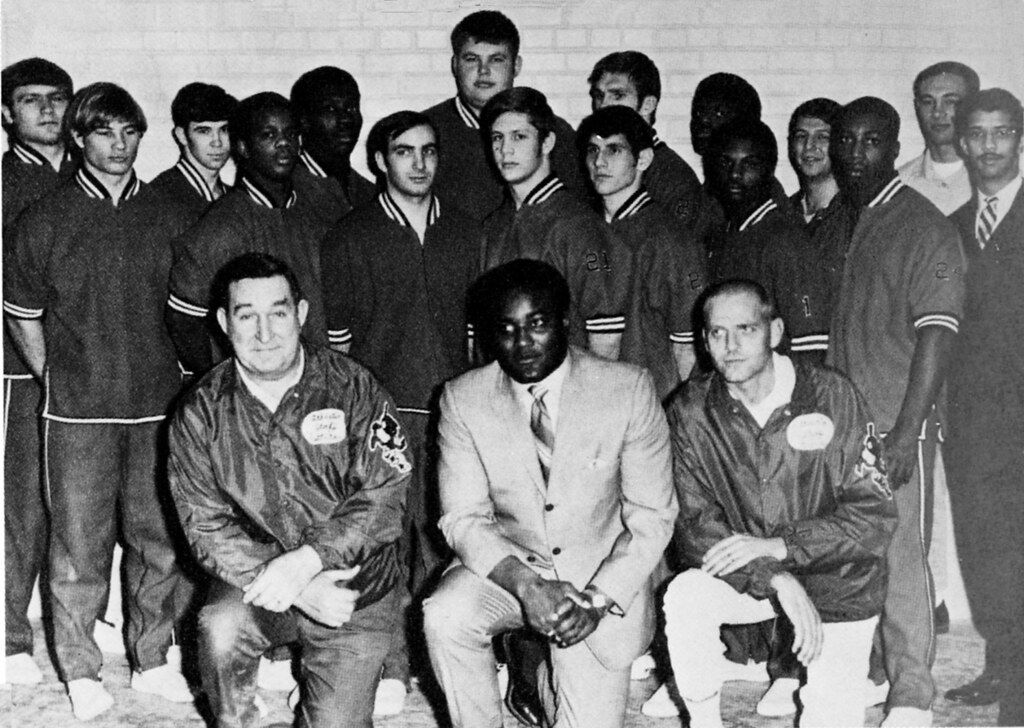
Here is the closing installment from my 2004-2005 series, Out to Win: The Roots of Greatness, An Exploration of Omaha’s Black Sports Legends. In this and in the recently posted opening installment I try laying out the scope of achievements that distinguishes this group of athletes, the way that sports provided advancement opportunities for these individuals that may otherwise have eluded them, and the close-knit cultural and community bonds that enveloped the neighborhoods they grew up in. It was a pleasure doing the series and getting to meet legends Bob Gibson, Bob Boozer, Gale Sayers, Ron Boone, Marlin Briscoe, Johnny Rodgers, et cetera. I learned a lot working on the project, mostly an appreciation for these athletes’ individual and collective achievements. You’ll find most every installment from the series on this blog, including profiles of the athletes and coaches I interviewed for the project. The remaining installments not posted yet soon will be.
Closing installment from my series Out to Win: The Roots of Greatness,
An Appreciation of Omaha’s Black Sports Legends
©by Leo Adam Biga
Originally published in The Reader (www.thereader.com)
Any consideration of Omaha’s inner city athletic renaissance from the 1950s through the 1970s must address how so many accomplished sports figures, including some genuine legends, sprang from such a small place over so short a span of time and why seemingly fewer premier athletes come out of the hood today. As with African-American urban centers elsewhere, Omaha’s inner city core saw black athletes come to the fore, like other minority groups did before them, in using sports as an outlet for self-expression and as a gateway to more opportunity.
As part of an ongoing OWR series exploring Omaha’s Black Sports Legends, this installment looks at the conditions and attitudes that once gave rise to a singular culture of athletic achievement here that is less prevalent in the current feel-good, anything-goes environment of plenty and World Wide Web connectivity.
The legends and fellow ex-jocks interviewed for this series mostly agree on the reasons why smaller numbers of youths these days possess the right stuff. It’s not so much a lack of athletic ability, observers say, but a matter of fewer kids willing to pay the price in an age when sports is not the only option for advancement. The contention is that, on average, kids are neither prepared nor inclined to make the commitment and sacrifice necessary to realize, much less pursue, their athletic potential when less demanding avenues to success abound.
“Kids today are changed — their attitudes about authority and everything else,” says Major League Baseball Hall of Fame pitcher Bob Gibson, an Omaha Tech High grad who grew up in the late’40s-early ‘50s under the stern but steady hand of coaches like his older brother, Josh. “They’re like, I’m not going to let somebody tell me what to do, where we had no problem with that in our day.”

Gibson says coaches like Josh, a bona fide legend on the north side, used to be viewed as an extension of the family, serving, “first of all,” as “a father figure,” or as Clarence Mercer, a top Tech swimmer, puts it, as “a big brother,” providing discipline and direction to that era’s at-risk kids, many from broken homes.
Josh Gibson, along with other strong blacks working as coaches, physical education instructors and youth recreation directors in that era, including Marty Thomas, John Butler, Alice Wilson and Bob Rose, are recalled as superb leaders and builders of young people. All had a hand in shaping Omaha’s sports legends of the hood, but perhaps none more so than Gibson, who, from the 1940s until the 1960s, coached touring baseball-basketball teams out of the North Omaha Y. “Josh was instrumental in training most of these guys. He was into children, and into developing children. He carried a lot of respect. If you cursed or if you didn’t do what he wanted you to do or you didn’t make yourself a better person, than you couldn’t play for him,” says John Nared, a late ‘50s-early ’60s Central High-NU hoops star who played under Gibson on the High Y Monarchs and High Y Travelers. “He didn’t want you running around doing what bad kids did. When you came to the YMCA, you were darn near a model child because Josh knew your mother and father and he kept his finger on the pulse. When you got in trouble at the Y, you got in trouble at home.”
Old-timers note a sea change in the way youths are handled today, especially the lack of discipline that parents and coaches seem unwilling or unable to instill in kids. “You see young girls walking around with their stuff hanging out and boys bagging it with their pants around their ankles. In our time, there were certain things you had to do and it was enforced from your family right on down,” says Milton Moore, a track man at Central in the late ‘50s.
The biggest difference between then and now, says former three-sport Tech star and longtime North Omaha Boys Club coach Lonnie McIntosh, is the disconnected, permissive way youths grow up. Where, in the past, he says, kids could count on a parent or aunt or neighbor always being home, youths today are often on their own, in a latchkey home, isolated in their own little worlds of self-indulgence.
“What’s missing is a sense of family. People living on the same street may not even know each other. Parents may not know who their kids are running with. In our day, we all knew each other. We were a family. We would walk to school together. Although we competed hard against one another, we all pulled for one another. Our parents knew where we were,” McIntosh says.
“There were no discipline problems with young people in those days,” Mercer adds somewhat apocryphally.
Former Central athlete Jim Morrison says there isn’t the cohesion of the past. “The near north side was a community then. The word community means people are of one mind and one accord and they commune together.” “There’s no such thing as a black community anymore,” adds John Nared. “The black community is spread out. Kids are everywhere. Economics plays a part in this. A lot of mothers don’t have husbands and can’t afford to buy their kids the athletic shoes to play hoops or to send their kids to basketball camps. Some of the kids are selling drugs. They don’t want a future. We wanted to make something out of our lives because we didn’t want to disappoint our parents.”

The close communion of days gone by, says Nared, played out in many ways. Young blacks were encouraged to stay on track by an extended, informal support system operating in the hood. “The near north side was a very small community then…so small that everybody knew each other.” In what was the epitome of the it-takes-a-village-to-raise-a-child concept, he says the hood was a community within a community where everybody looked out for everybody else and where, decades before the Million Man March, strong black men took a hand in steering young black males. He fondly recalls a gallery of mentors along North 24th Street.
“Oh, we had a bunch of role models. John Butler, who ran the YMCA. Josh Gibson. Bob Gibson. Bob Boozer. Curtis Evans, who ran the Tuxedo Pool Hall. Hardy “Beans” Meeks, who ran the shoe shine parlor. Mr. (Marcus “Mac”) McGee and Mr. (James) Bailey who ran the Tuxedo Barbershop. All of these guys had influence in my life. All of ‘em. And it wasn’t just about sports. It was about developing me. Mr. Meeks gave a lot of us guys jobs. In the morning, when I’d come around the corner to go to school, these gentlemen would holler out the door, ‘You better go up there and learn something today.’ or ‘When you get done with school, come see me.’
“Let me give you an example. Curtis Evans, who ran the pool hall, would tell me to come by after school. ‘So, I’d…come by, and he’d have a pair of shoes to go to the shoe shine parlor and some shirts to go to the laundry, and he’d give me two dollars. Mr. Bailey used to give me free haircuts…just to talk. ‘How ya doin’ in school? You got some money in your pocket?’ I didn’t realize what they were doing until I got older. They were keeping me out of trouble. Giving me some lunch money so I could go to school and make something of myself. It was about developing young men. They took the time.”
Beyond shopkeepers, wise counsel came from Charles Washington, a reporter-activist with a big heart, and Bobby Fromkin, a flashy lawyer with a taste for the high life. Each sports buff befriended many athletes. Washington opened his humble home, thin wallet and expansive mind to everyone from Ron Boone to Johnny Rodgers, who says he “learned a lot from him about helping the community.” In hanging with Fromkin, Rodgers says he picked-up his sense of “style” and “class.”

Super athletes like Nared got special attention from these wise men who, following the African-American tradition of — “each one, to teach one” — recognized that if these young pups got good grades their athletic talent could take them far — maybe to college. In this way, sports held the promise of rich rewards. “The reason why most blacks in that era played sports is that in school then the counselors talked about what jobs were available for you and they were saying, ‘You’ll be a janitor,’ or something like that. There weren’t too many job opportunities for blacks. And so you started thinking about playing sports as a way to get to college and get a better job,” Nared says.
Growing up at a time when blacks were denied equal rights and afforded few chances, Bob Gibson and his crew saw athletics as a means to an end. “Oh, yeah, because otherwise you didn’t really have a lot to look forward to after you got out of school,” he says. “The only black people you knew of that went anywhere were athletes like Joe Louis and Jackie Robinson or entertainers.” Bob had to look no further than his older brother, Josh, to see how doors were closed to minorities. The holder of a master’s degree in education as well as a sterling reputation as a coach, Josh could still not get on with the Omaha Public Schools as a high school teacher-coach due to prevailing hiring policies then.
“Back in the ‘50s and early ‘60s the racial climate was such we had nothing else to really look forward to except to excel as black athletes,” says Marlin Briscoe, the Omaha South High School grad who made small college All-America at then-Omaha University and went on to be the NFL’s first black quarterback. “We were told, ‘You can’t do anything with your life other than work in the packing house.’ We grew up seeing on TV black people getting hosed down and clubbed and bitten by dogs and not being able to go to school. So, sports became a way to better ourselves and hopefully bypass the packing house and go to college.”


Besides, Nared, says, it wasn’t like there was much else for black youths to do. “Back when we were coming up we didn’t have computers, we didn’t have this, we didn’t have that. The only joy we could have was beating somebody’s ass in sports. One basketball would entertain 10 people. One football would entertain 22 people. It was very competitive, too. In the neighborhood, everybody had talent. We played every day, too. So, you honed in on your talents when you did it every day. That’s why we produced great athletes.”
With the advent of so many more activities and advantages, Gibson says contemporary blacks inhabit a far richer playing ground than he and his buddies ever had, leaving sports only one of many options. “In our time, if you wanted to get ahead and to get away from the ghetto or the projects, you were going to be an athlete, but I don’t know if that’s been the same since then. I think kids’ interests are other places now. There’s all kinds of other stuff to think about and there’s all kinds of other problems they have that we never had. They can do a lot of things that we couldn’t do back then or didn’t even think of doing.”
Milton Moore adds, “It used to be you couldn’t be everything you were, but you could be a baseball player or you could be a football player. Now, you can be anything you want to be. Kids have more opportunities, along with distractions.”
Ron Boone, an Omaha Tech grad who went to become the iron man of pro hoops by playing in all 1,041 games of his combined 13-year ABA-NBA career, finds irony in the fact that with the proliferation of strength training programs and basketball camps “the opportunities to become very good players are better now than they were for us back then,” yet there are fewer guys today who can “flat out play.” He says this seeming contradiction may be explained by less intense competition now than what he experienced back in the day, when everyone with an ounce of game wanted to show their stuff and use it as a steppingstone.
If not for the athletic scholarships they received, many black sports stars of the past would simply not have gone on to college because they were too poor to even try. In the case of Bob Gibson, his talent on the diamond and on the basketball court landed him at Creighton University, where Josh did his graduate work.
By the time Briscoe and company came along in the early ‘60s, they made role models of figures like Gibson and fellow Tech hoops star Bob Boozer, who parlayed their athletic talent into college educations and pro sports careers. “When Boozer went to Kansas State and Gibson to Creighton, that next generation — my generation — started thinking, If I can get good enough…I can get a scholarship to college so I can take care of my mom. That’s the way all of us thought, and it just so happened some of us had the ability to go to the next level.”
Young athletes of the inner city still use sports as an entry to college. The talent pool may or may not be what it was in urban Omaha’s heyday but, if not, than it’s likely because many kids have more than just sports to latch onto now, not because they can’t play. At inner city schools, blacks continue to make up a disproportionately high percentage of the starters in the two major team sports — football and basketball. The one major team sport that’s seen a huge drop-off in participation by blacks is baseball, a near extinct sport in urban America the past few decades due to the high cost of equipment, the lack of playing fields and the perception of the game as a slow, uncool, old-fashioned, tradition-bound bore.
Carl Wright, a football-track athlete at Tech in the ‘50s and a veteran youth coach with the Boys Club and North High, sees good and bad in the kids he still works with today. “There’s a big change in these kids now. I’ll tell a kid, ‘Take a lap,’ and he’ll go, ‘I don’t want to take no lap,’ and he’ll go home and not look back. I’ve seen kids with talent that can never get to practice on time, so I kick them off the team and it doesn’t mean anything to them. They’ve got so much talent, but they don’t exploit it. They don’t use it, and it doesn’t seem to bother them.”
On the other hand, he says, most kids still respond to discipline when it’s applied. “I know one thing, you can tell a kid, no, and he’ll respect you. You just tell him that word, when everybody else is telling him, yes, and they get to feeling, Well, he cares about me, and they start falling into place. There’s really some good kids out there, but they just need guidance. Tough love.”
Tough love. That was the old-school way. A strict training regimen, a heavy dose of fundamentals, a my-way-or-the-highway credo and a close-knit community looking out for kids’ best interests. It worked, too. It still works today, only kids now have more than sports to use as their avenue to success.


Related articles
- Making the Case for a Nebraska Black Sports Hall of Fame (leoadambiga.wordpress.com)
- Omaha Hoops Legend John C. Johnson: Fierce Determination Tested by Repeated Run-Ins with the Law (leoadambiga.wordpress.com)
- From the series Out to Win: The Roots of Greatness – Black Women Make Their Mark in Athletics (leoadambiga.wordpress.com)
- One Peach of a Pitcher: Peaches James Leaves Enduring Legacy in the Circle as a Nebraska Softball Legend (leoadambiga.wordpress.com)
- The Great Migration Comes Home: Deep South Exiles Living in Omaha Participated in the Movement Author Isabel Wilkerson Writes About in Her Book, ‘The Warmth of Other Suns’ (leoadambiga.wordpress.com)
Opening installment from my series Out to Win: The Roots of Greatness, An exploration of Omaha’s Black Sports Legends
Here is the opening installment from my 2004-2005 series, Out to Win: The Roots of Greatness, An Exploration of Omaha’s Black Sports Legends. Look for the closing installment in a separate post. In these two pieces I try laying out the scope of achievements that distinguishes this group of athletes, the way that sports provided advancement opportunities for these individuals that may otherwise have eluded them, and the close-knit cultural and community bonds that enveloped the neighborhoods they grew up in. It was a pleasure doing the series and getting to meet legends Bob Gibson, Bob Boozer, Gale Sayers, Ron Boone, Marlin Briscoe, Johnny Rodgers, et cetera. I learned a lot working on the project, mostly an appreciation for these athletes’ individual and collective achievements. You’ll find most every installment from the series on this blog, including profiles of the athletes and coaches I interviewed for the project. The remaining installments not posted yet soon will be.

Opening installment from my series Out to Win: The Roots of Greatness,
An exploration of Omaha’s Black Sports Legends
©by Leo Adam Biga
Originally published in The Reader (www.thereader.com)
Omaha’s African American community has produced a heritage rich in achievement across many fields, but none more dramatic than in sports, Despite a comparatively small populace, black Omaha rightly claims a legacy of athletic excellence in the form of legends who’ve achieved greatness at many levels, in a variety of sports, over many eras.
These athletes aren’t simply neighborhood or college legends – their legacies loom large. Each is a compelling story in the grand tale of Omaha’s inner city, both north and south. The list includes: Bob Gibson, a major league baseball Hall of Famer. Bob Boozer, a member of Olympic gold medal and NBA championship teams. NFL Hall of Famer Gale Sayers. Marlin Briscoe, the NFL’s first black quarterback. Heisman Trophy winner Johnny Rodgers. Pro hoops “iron man” Ron Boone. Champion wrestling coach Don Benning
“Some phenomenal athletic accomplishments have come out of here, and no one’s ever really tied it all together. It’s a huge story. Not only did these athletes come out of here and play, they lasted a long time and they made significant contributions to a diversity of college and professional sports,” said Briscoe, a Southside product. “I mean, per capita, there’s probably never been this many quality athletes to come out of one neighborhood.”
An astounding concentration of athletic prowess emerged in a few square miles roughly bounded north to south, from Ames Avenue to Lake Street, and east to west from about 16th to 36th. Across town, in south Omaha, a smaller but no less distinguished group came of age.
“You just had a wealth of talent then,” said Lonnie McIntosh, a teammate of Gibson and Boozer at Tech High.
Many inner city athletes resided in public housing projects. Before school desegregation dispersed students citywide, blacks attended one of four public high schools – North, Tech, Central or South. It was a small world.
During a Golden Era from the end of World War II to the mid-1970s, all manner of brilliant talents, including future all-time greats, butted heads and rubbed shoulders on the same playing fields and courts of their youth, pushing each other to new heights. It was a time when youths competed in several sports instead of specializing in one.
“In those days, everybody did everything,” said McIntosh, who participated in football, basketball and track.

Many were friends, schoolmates and neighbors, often living within a few doors or blocks of each other. It was an insular, intense, tight-knit athletic community that formed a year-round training camp, proving ground and mutual admiration society all rolled into one.
“In the inner city, we basically marveled at each other’s abilities. There were a lot of great ballplayers. All the inner city athletes were always playing ball, all day long and all night long,” said Boozer, the best player not in the college hoops hall of fame. “Man, that was a breeding ground. We encouraged each other and rooted for each other. Some of the older athletes worked with young guys like me and showed us different techniques. It was all about making us better ballplayers.”
NFL legend Gale Sayers said, “No doubt about it, we fed off one another. We saw other people doing well and we wanted to do just as well.”
The older legends inspired legends-to-be like Briscoe.
“We’d hear great stories about these guys and their athletic abilities and as young players we wanted to step up to that level,” he said “They were older and successful, and as little kids we looked up to those guys and wanted to emulate them and be a part of the tradition and the reputation that goes with it.”
The impact of the older athletes on the youngsters was considerable.
“When Boozer went to Kansas State and Gibson to Creighton, that next generation – my generation – started thinking, ‘If I can get good enough, I can get a scholarship to college so I can take care of my mom‚’” Briscoe said. “That’s the way all of us thought, and it just so happened some of us had the ability to go to the next level.”

With that next level came a new sense of possibility for younger athletes.
“It got to the point where we didn’t think anything was impossible,” Johnny Rodgers said. “It was all possible. It was almost supposed to happen. We were like, If they did it, we can do it, too. We were all in this thing together.”
In the ’50s and ’60s, two storied tackle football games in the hood, the annual Turkey and Cold Bowls, were contested at Burdette Field over the Thanksgiving and Christmas holidays. Drawing players of all ages, they were no-pads, take-no-prisoners rumbles where adolescent prodigies like Gale Sayers and Johnny Rodgers competed against grown men in an athletic milieu rich with past, present and future stars.
“They let us play ball with them because we were good enough to play,” Rodgers said. “None of us were known nationally then. It really was gratifying as the years went on to see how guys went on and did something.”
When Rodgers gained national prominence, he sensed kids “got the same experience seeing me as I got seeing those legends.”

Among the early legends that Rodgers idolized was Bob Gibson. Gibson gives Omaha a special sports cachét. He’s the real thing — a major league baseball Hall of Famer, World Series hero and Cy Young Award winner. The former St. Louis Cardinal pitcher was among the most dominant hurlers, intense competitors and big game performers who ever played. Jim Morrison, a teammate on the High Y Monarchs coached by Bob’s brother, Josh, recalled how strong Gibson was.
“He threw so hard, we called it a radio ball. You couldn’t see it coming. You just heard it.”
Morrison said Gibson exhibited his famous ferocity early on.
“On the sideline, Bob could be sweet as honey, but when he got on the mound you were in big trouble. I don’t care who you were, you were in big trouble,” he said.
Gibson was also a gifted basketball player, as Boozer, a teammate for a short time at Tech and with the Travelers, attested.
“He was a finer basketball player than baseball player. He could play. He could get up and hang,” Boozer said.
Gibson starred on the court for the hometown Creighton University Bluejays, then played with the Harlem Globetrotters for a year, but it was only after being denied a chance with the NBA that he made baseball his life. Gibson’s all-around athleticism and fierce game face was aided and abetted by his older brother, Josh, a formidable man and coach who groomed many of Omaha’s top athletes from the inner city.
Bob Gibson may be The Man, but Josh was a legend in his own time as a coach of touring youth teams (the Monarchs and Travelers) out of North Omaha’s YMCA.
“He was a terrific coach. If you were anything in athletics, you played for those teams under Josh Gibson,” Boozer said.
Others agreed.
“Josh was the one that guys like myself looked up to,” said Ron Boone. Jim Morrison said Josh had “the ability to elicit the best out of young potential stars. He started with the head down, not the body up. He taught you how to compete by teaching the fundamentals. It’s obvious it worked because his brother went on to be a great, great athlete.”
Josh Gibson is part of a long line of mentors, black and white, who strongly affected inner city athletes. Others included Logan Fontenelle rec center director Marty Thomas, the North O Y’s John Butler, Woodson Center director Alice Wilson, Bryant Center director John Nared and coaches Bob Rose of Howard Kennedy School, Neal Mosser of Tech, Frank Smagacz of Central, Cornie Collin of South, Carl Wright and Lonnie McIntosh of the North O Boys Club, Richard Nared and Co. with the Midwest Striders track program, Forest Roper with the Hawkettes hoops program, Petie Allen with the Omaha Softball Association, and Joe Edmonson of the Exploradories Wrestling Club. Each commanded respect, instilled discipline and taught basics.
Mosser, Tech’s fiery head hoops coach for much of the ‘50s and ‘60s, coached Boozer and Gibson along with such notables as Fred Hare, whom Boone calls “one of the finest high school basketball players you’d ever want to see,” Bill King and Joe Williams. A hard but fair man, Mosser defied bigoted fans and biased officials to play black athletes ahead of whites.
“Neal Mosser fought a tremendous battle for a lot of us minority kids,” McIntosh said. “He and Cornie Collin. At that time, you never had five black kids on the basketball court at the same time.”
But they did, including a famous 1954 Tech-South game when all 10 kids on the court were black.
“Their jobs were on the line, too,” McIntosh said of the two coaches.
Wherever they live, athletes will always hear about a real comer to the local scene. Like when Josh Gibson’s little brother, Bob, began making a name for himself in hoops.
The buzz was, “This kid can really jump, man,” Lonnie McIntosh recalled. “He had to duck his head to dunk.” But nobody could hang like Marion Hudson, an almost mythic-like figure from The Hood who excelled in soccer, baseball, football, basketball and track and field. Former Central High athlete Richard Nared said, “Marion was only 6’0, but he’d jump center, and go up and get it every time. The ref would say, ‘You’re jumping too quick,’ and Marion would respond, ‘No, you need to throw the ball higher.'”
Admirers and challengers go to look over or call out the young studs. Back in the day, the proving grounds for such showcases and showdowns included Kountze Park, Burdette Field, the North O YMCA, the Logan Fontenelle rec center, the Kellom Center and the Woodson Center. Later, the Bryant Center on North 24th became the place to play for anyone with game, Boone said.
“I mean, the who’s-who was there. We had teams from out west come down there to play. There was a lot of competition.”
Black Omaha flourished as a hot bed of talent in football, basketball, baseball and track and field. At a time when blacks had few options other than a high school degree and a minimum-wage job, and even fewer leisure opportunities, athletics provided an escape, an activity, a gateway. In this highly charged arena, youths proved themselves not by gang violence but through athletic competition. Blacks gravitated to sports as a way out and step up. Athletics were even as a mode of rebellion against a system that shackled them. Athletic success allowed minority athletes to say, oh, yes, I can.
“Back in the ‘50s and early ‘60s the racial climate was such we had nothing else to really look forward to except to excel as black athletes,” said Briscoe. “In that era, we didn’t get into sports with that pipe dream of being a professional athlete. Mainly, it was a rite of passage to respect and manhood. We were told, ‘You can’t do anything with your life other than work in the packing house.’ We grew up seeing on TV black people getting hosed down and clubbed and bitten by dogs and not being able to go to school. So sports became a way to better ourselves and hopefully bypass the packing house and go to college.”

Richard Nared, a former track standout at Central, said speed was the main barometer by which athletic ability was gauged.
“Mostly, all the guys had speed. You were chosen that way to play. The guys that were the best and fastest were picked first,” he said.
Toughness counted for something, too, but speed was always the separating factor.
“You had to be able to fight a little bit, too. But, yeah, you had to be fast. You were a second class citizen if you couldn’t run,” Bob Gibson said.
And second class wasn’t good in such a highly competitive community.
“The competition was so strong Bob Boozer did not make the starting five on the freshman basketball team I played on at Tech,” Jim Morrison said.
It was so strong that Gale Sayers was neither the fastest athlete at Central nor at home, owing to older brother Roger, an elite American sprinter who once beat The Human Bullet, Bob Hayes. Their brother, Ron, who played for the NFL’s San Diego Chargers, may also have been faster than Gale.
The competition was so strong that Ron Boone, who went on to a storied college and pro hoops career could not crack Tech’s starting lineup until a senior.
Bob Boozer, remembered today as a sweet-shooting, high-scoring, big-rebounding All-America power forward at Kansas State and a solid journeyman in the NBA, did not start out a polished player. But he holds the rare distinction of winning both Olympic gold as a member of the U.S. squad at the 1960 Rome Games, and an NBA championship ring as 6th man for the 1971 Milwaukee Bucks.
Boozer showed little promise early on. After a prodigious growth spurt of some six inches between his sophomore and junior years in high school, Boozer was an ungainly, timid giant.
“I couldn’t walk, chew gum and cross the street at the same time without tripping,” he said.
Hoping to take advantage of his new height, Boozer enlisted John Nared, a friend and star at arch-rival Central, and Lonnie McIntosh, a teammate at Tech, to help his coordination, conditioning, skills and toughness catch up to his height.
“Lonnie was always a physical fitness buff. He would work me out as far as strength and agility drills,” Boozer recalled. “And John was probably one of the finest athletes to ever come out of Omaha. He was a pure basketball player. John and I would go one-on-one. He was 6’3. Strong as a bull. I couldn’t take him in the paint. I had to do everything from a forward position. And, man, we used to have some battles.”
Boozer dominated Nebraska prep ball the next two years and, in college, led the KSU Wildcats to national glory. When Boozer prepared to enter the NBA with the Cincinnati Royals, he again called-on Nared’s help and credits their one-on-one tussles with teaching him how to play against smaller, quicker foes. The work paid off, too, as Boozer became a 20-point per game scorer and all-star with the Chicago Bulls.
Around the time Boozer made a name for himself in the NBA, Don Benning took over then-Omaha U.’s lowly wrestling program. He was the first black head coach at a predominantly white university. Within a few years, Benning , a North High and UNO grad who competed in football and wrestling, built the program into the perennial power it remains today. He guided his 1969-70 squad to a national NAIA team championship, perhaps the first major team title won by a Nebraska college. His indomitable will led a diverse mix of student-athletes to success while his strong character steered them, in the face of racism, to a higher ground.
After turning down big-time coaching offers, Benning retired from athletics in his early 30s to embark on a career in educational administration with Omaha Public Schools, where he displayed the same leadership and integrity he did as a coach.
The Central High pipeline of prime-time running backs got its start with Roger and Gale Sayers. Of all the Eagle backs that followed, including Joe Orduna, Keith “End Zone” Jones, Leodis Flowers, Calvin Jones, Ahman Green and David Horne, none quite dazzled the way Gale Sayers did. He brandished unparalleled cutting ability as an All-American running back and kick returner at Kansas University and, later, for the Chicago Bears. As a pro, he earned Rookie of the Year, All-Pro and Hall of Fame honors.
Often overlooked was Gale’s older but smaller brother, Roger, perhaps the fastest man ever to come out of the state. For then-Omaha U. he was an explosive halfback-receiver-kick returner, setting several records that still stand, and a scorching sprinter on the track, winning national collegiate and international events. When injuries spoiled his Olympic bid and his size ruled out the NFL, he left athletics for a career in city government and business.

Ron Boone
Ron Boone went from being a short, skinny role player at Tech to a chiseled 6’2 star guard at Idaho State University, where his play brought him to the attention of pro scouts. Picking the brash, upstart ABA over the staid, traditional NBA, Boone established himself as an all-around gamer. He earned the title “iron man” for never missing a single contest in his combined 13-year ABA-NBA career that included a title with the Utah Stars. His endurance was no accident, either, but rather the result of an unprecedented work ethic he still takes great pride in.
Marlin Briscoe was already a pioneer when he made small college All-America as a black quarterback at mostly white Omaha U., but took his trailblazing to a new level as the NFL’s first black QB. Pulled from cornerback duty to assume the signal calling for the Denver Broncos in the last half of his 1968 rookie season, he played big. But the real story is how this consummate athlete responded when, after exhibiting the highly mobile, strong-armed style now standard for today’s black QBs, he never got another chance behind center. Traded to Buffalo, he made himself into a receiver and promptly made All-Pro. After a trade to Miami, he became a key contributor at wideout to the Dolphins two Super Bowl winning teams, including the perfect 17-0 club in 1972. His life after football has been a similar roller-coaster ride, but he’s adapted and survived.
Finally, there is the king of bling-bling, Johnny Rodgers, the flamboyant Nebraska All-American, Heisman Trophy winner and College Football Hall of Fame inductee. Voted Husker Player of the Century and still regarded as one of the most exciting, inventive broken field runners, Rodgers is seemingly all about style, not substance. Yet, in his quiet, private moments, he speaks humbly about the mysteries and burdens of his gift and the disappointment that injuries denied him a chance to strut his best stuff in the NFL.
Other, less famous sports figures had no less great an impact, from old-time football stars like Charles Bryant and Preston Love Jr., to more recent gridiron stars like Junior Bryant and Calvin Jones, right through Ahman Green. In 2003, Green, the former Nebraska All-American and current Green Bay Packers All-Pro, rushed for more yards, 1,883, in a single season, than all but a handful of backs in NFL history, shattering Packers rushing records along the way.
Hoops stars range from John Nared, Bill King, Fred Hare and Joe Williams in the ‘50s and ‘60s to Dennis Forrest, John C. Johnson, Kerry Trotter, Mike McGee, Ron Kellogg, Cedric Hunter, Erick Strickland, Andre Woolridge, Maurtice Ivy and Jessica Haynes in the ‘70s, ‘80s, and ‘90s. After torrid prep careers, King, Nared, Hare and Williams had some college success. The others starred for Division I programs, except for Forrest, who starred at Division II UNO. Ex-NU star Strickland made the NBA, where he’s still active.
The prolific McGee, who set Class A scoring marks at North and topped the University of Michigan’s career scoring chart, played on one of Magic Johnson’s-led Lakers title teams in the ‘80s. Ivy made the WBA. Others, like Woolridge, played in Europe.

Multi-sport greats have included Marion Hudson, Roger Sayers and Mike Green from the ‘60s and Larry Station from the ‘70s, all of whom excelled in football. A Central grad, Hudson attended Dana College in Blair, Neb. where he bloomed into the most honored athlete in school history. He was a hoops star, a record-setting halfback and a premier sprinter, long-jumper and javelin thrower, once outscoring the entire Big Seven at the prestigious Drake Relays.
He was the Lincoln Journal Star’s 1956 State College Athlete of the Year.
Among the best prep track athletes ever are former Central sprinter Terry Williams, Boys Town distance runner Barney Cotton, Holy Name sprinter Mike Thompson, Creighton Prep sprinter/hurdler Randy Brooks and Central’s Ivy.
The elite wrestlers are led by the Olivers. Brothers Archie Ray, Roye and Marshall were state champs at Tech and collegiate All-Americans. Roye was an alternate on the ’84 U.S. Olympic wrestling team. The latest in this family mat dynasty is Archie Ray‚s son Chris, a Creighton Prep senior, who closed out a brilliant career with an unbeaten record and four state individual titles.
Joe Edmonson developed top wrestlers and leaders at his Exploradories Wrestling Club, now the Edmonson Youth Outreach Center. Tech’s Curlee Alexander became a four-time All-American and one-time national champ at UNO and the coach of seven state team championships, including one at Tech, where he coached the Oliver brothers, and the last six at North. And Prep’s Brauman Creighton became a two-time national champ for UNO.
A few black boxers from Omaha made their mark nationally. Lightweight prizefighter Joey Parks once fought a draw with champ Joe Brown. A transplanted Nebraskan via the Air Force, Harley Cooper was a two-time national Golden Gloves champion out of Omaha, first as a heavyweight in 1963 and then as a light heavyweight in 1964. He was slated for the 1964 U.S. Olympic Team as light heavyweight at the Tokyo Games and sparred with the likes of Joe Frazier, when, just before leaving for Japan, a congenital kidney condition got him scratched. Despite offers to turn pro, including an overture from boxing legend Henry Armstrong, Cooper opted to stay in the military. Lamont Kirkland was a hard-hitting terror during a light heavyweight amateur and pro middleweight career in the ’80s.
With the advent of Title IX, girls-women’s athletics took-off in the ‘70s, and top local athletes emerged. Omaha’s black female sports stars have included: Central High and Midland Lutheran College great Cheryl Brooks; Central High and NU basketball legend Maurtice Ivy, a Kodak All-America, WBA MVP and the founder-director of her own 3-on-3 Tournament of Champions; Ivy’s teammate at Central, Jessica Haynes, an impact player at San Diego State and a stint in the WNBA; Maurtice’s little sister, Mallery Ivy Higgs, the most decorated track athlete in Nebraska prep history with 14 gold medals; Northwest High record-setting sprinter Mikaela Perry; Bryan High and University of Arizona hoops star Rashea Bristol, who played pro ball; and NU softball pitching ace Peaches James, a top draftee for a new pro fastpitch league starting play this summer.
The stories of Omaha’s black sports legends contribute to a vital culture and history that demand preservation. This ongoing, 12-part series of profiles is a celebration of an inner city athletic lore that is second to none, and still growing.
Related articles
- Making the Case for a Nebraska Black Sports Hall of Fame (leoadambiga.wordpress.com)
- Omaha Hoops Legend John C. Johnson: Fierce Determination Tested by Repeated Run-Ins with the Law (leoadambiga.wordpress.com)
- From the series Out to Win: The Roots of Greatness – Black Women Make Their Mark in Athletics (leoadambiga.wordpress.com)
- One Peach of a Pitcher: Peaches James Leaves Enduring Legacy in the Circle as a Nebraska Softball Legend (leoadambiga.wordpress.com)
One Peach of a Pitcher: Peaches James Leaves Enduring Legacy in the Circle as a Nebraska Softball Legend
I earlier posted a 2004 story about black women athletes of distinction in Nebraska, and that reminded me of another story I did that year on Peaches James, a hard-throwing softball pitcher whose dominance in the circle helped establish a dynasty at Papillion-La Vista High School and helped lead the University of Nebraska softball program to great success, though short of its ultimate goal of winning the women’s College World Series. James was a good to very good college pitcher her first three years in Lincoln but elevated her game her senior season to become nothing short of great as she earned all sorts of team, conference, and national accolades. My story appeared in The Reader (www.thereader.com) just as her collegiate career came to an end and just as she looked forward to playing professionally. Her pro career didn’t amount to much, but today she’s a fastpitch instructor with an elite sports academy in Illinois.
NOTE: While this story was not officially a part of my extensive 2004-2005 series on Omaha black sports legends, Out to Win: The Roots of Greatness, it appeared just before the start of that series, and so I count it in the mix. You can find most of the installments in that series on this blog, and I’ll soon be adding the remaining installments.
©by Leo Adam Biga
Originally appeared in The Reader (www.thereader.com)
Nebraska softball pitching whiz Peaches James is the epitome of cool on the diamond between her tight braids, sleek shades, silver bling-bling adorned ears and silky smooth delivery of blazing rise balls. She strides the circle with the calm confidence you expect from the ace of the staff. Intense, yet loose, and in complete command out there.
The record-setting James is among the latest African-American athletes from Omaha who’ve made an enduring contribution to the area’s fat sports heritage. But she’s done it in a sport that, at the collegiate level, has had traditionally few black faces.
It’s no coincidence the Top 15 Lady Huskers enjoyed their finest season in a long time in what was their ace’s best year. NU wrapped up the regular season Big 12 title with a pair of one-run wins pitched by James over Texas A & M in early May. Two weekends ago, she got on a roll in the Big 12 tourney. She pitched a 2-1 complete game victory over Texas that saw her strike out 13 Longhorns and then topped that with a perfect game 7-0 win over Oklahoma. On May 15, she was in the circle for a 10-1 win over Baylor and later that same day she threw a 1-0 shutout, with 16 strikeouts, against Missouri to clinch the Huskers’ tourney title. With her four-game performance, she added conference tourney MVP to her Big 12 Pitcher of the Year honors. Then, she led her Huskers to the NCAA Region 5 championship round, posting a 6-0, 12-strikeout win over Leigh and bracketing two wins over Creighton amid a 2-0 loss to top-seed California. NU was eliminated Sunday with another 2-0 loss to the Bears — falling two wins short of the College World Series.
Even with her NU career ended, Peaches has already secured more softball in her future. Last December, she was a second round pick in the inaugural senior draft of the newly formed National Pro Fastpitch league, the latest attempt to market women’s softball. Selected by the Houston Thunder, now known as the Texas Thunder, James will be competing this summer with a who’s-who roster of former college and Olympic stars. NCAA rules prohibited her from negotiating and signing a contract until the season ended. Now that it has, she’s eager to get started. “I’m really excited,” she said. “It will be great competition.”
Then there’s a possible try for the 2008 USA Olympic team. Just like the pros, making the Olympic squad would require taking her game to “a whole different level,” she said. “When you have pitchers like Lisa Fernandez and Jenny Finch, they’re your top, elite athletes. To compete at that level you’ve got to be at the top of your game every game.” Can she? “I’d like to think so.” Cool. Peachy keen.
History repeated itself with James. She was a solid, at times smothering, starting pitcher her first two years of prep ball before going off into the stratosphere her senior season, when she shut down and almost always shut out her foes. Similarly, for NU, she established herself as an outstanding performer her freshman, sophomore and junior seasons, pitching well enough to earn first-team All-Big 12 honors all three years and first-team All-Midwest Region as a junior. Entering the 2004 season, she’d already been on the national Softball Player of the Year watch list and an invitee to the Olympic training center and she ranked among NU’s all-time leaders in wins, shutouts, strikeouts and innings pitched.

But, just like she did before, she ratcheted her game up another notch or two for her swan song, lowering her ERA by nearly half her career average, to 0.70, throwing her second collegiate no-hitter and setting NU single season records for most shutouts (18) and strikeouts (more than 300). Her 37 wins (versus 9 losses) are among the program’s best single season totals. She’s also first in career strikeouts (with more than 900) and second in career wins (98).
“I do see a lot of mirroring from her high school career,” Revelle said. “It seemed like every year in high school she made strides and then she made a leap her senior year. And I feel the same thing in this senior year for her. She’s had a great career for us but this is definitely her signature season.”
James explains her senior success this time around to having been there before. “I think what’s helped me is the experience I’ve gained from my freshman year in college to my senior year now. It’s about building confidence. It’s getting comfortable being out there and playing with your teammates. It’s building trust. It’s all those mental things that make you a better player.”
She first started developing a name for herself at Papillion-La Vista High School, whose dynasty of a softball program she helped maintain. Her prep career came in the middle of the school’s record nine straight state championships, a run of excellence unequaled in Nebraska prep history. But what James did her senior season elevated her and her team’s dominance to new heights. Almost literally unhittable the entire 1999-2000 campaign, she posted a remarkable 0.04 earned run average. In the space of that same season, she pitched 11 no-hitters, including five perfect games. It was the culmination of an unparalled two-year run in which she set about a dozen state records, including marks for most consecutive: wins (31); shut-outs (19); shut-out innings (162 1/3) and no earned runs allowed (257 2/3).
Her brilliance is all the more remarkable given that only six years earlier Mike Govig, her future prep coach, saw her at an indoor clinic where her wild throws soared up to the ceiling while her mother patiently sat on a bucket waiting, in vain, to catch one of those errant tosses. “I did not get it (pitching) right away. Balls would be flying everywhere,” James said. Govig recalls thinking the girl was hopeless.
What he didn’t know then was the size of her heart and strength of her will. With a lot of hard work, James made herself a pitcher the Monarchs rode to titles her sophomore year on. Her progress into a consummate hurler was so advanced that at a summer Topeka, Kansas tournament prior to her senior year she threw seven games in one day, winning six, en route to capping team title-tourney MVP honors.
“The title game got over at two o’clock in the morning, and her last inning was probably her strongest inning of the whole day,” Govig said. “You talk about a workhorse. The legend grew.”
Her dominance and endurance carried through her senior season. As her reputation grew, Govig said frustrated batters often got themselves out. “People were not able to step in the box with a whole lot of confidence. Half the battle was already won. They’d already lost…You could see it their body language.”
James also blossomed into a fine athlete. She competed in volleyball and track. On the diamond, she displayed versatility by playing second base her freshman year and posing the Monarchs best base stealing threat all four years. Govig rates her as one of the best athletes he’s ever coached, while NU head softball coach Rhonda Revelle flat out says, “I’ve not coached a better all-around athlete in this program. She’s physically powerful. She has so many tools.” James holds the best all-sport vertical jump in NU women’s athletics history at 30.5 inches.
The coaches say there’s never been another home-grown softball pitcher who’s carried her dominance from high school into college as James has. “She definitely stands alone,” Govig said. “She’s set the bar very high.”
The work ethic it took to come so far, so quickly, was instilled in James by her parents and coaches, whose preachings about the importance of practice she faithfully followed. “As I got older I had enough discipline to go pitch on my own or go work out on my own,” she said. “It’s like I wanted to do it on my own because I wanted to get better and I wanted to get good.”
Govig, who’s followed James career at NU, said the right-hander has it all. “Some pitchers might just be dominant with a rise ball, but she can throw a drop, a curve, a rise, a change. She can get you out in a bunch of different ways. Her ball movement is very extraordinary.”
Embracing the role of every day starter didn’t come easily for the placid James, whose magnanimous personality made it hard for her to stand out. “It was hard for me at first when we’d play and then I’d find out I was pitching again the next day and the other pitchers were not getting the ball, because I am the type of person that wants everybody to succeed,” she said. Her survival-of-the-fittest showing in Topeka went a long way towards changing her attitude. “Before that I would never have thought I’d be able to pitch and win that many games in one day,” she said. “I guess when you’re put in that situation and you’re put to the test, you really find out what you’re made of and you find out what you can and what you can’t do. It defines who you are and if you’re going to be tough enough to step up to a challenge and succeed at it. I got to where if my coaches said, ‘You’re pitching today,’ then I got in that mindset and that’s the only thing I could worry about if I was going to do my best for the team.”
Despite a solid start to her college career — when she posted 16-7, 22-9 and 23-13 records her first three years — James lacked the fire top pitchers need. “I was like a nice competitor, you know. I would compete, but I wasn’t like gritting my teeth in a I-will-not-lose kind of way. My teammates would always say I was too nice out there. You can be nice off the field, but when you’re on the field that’s the time you need to compete fiercely. And I think I’ve grown more into that to where I’m like: For me to lose, you’re going to have to beat me…I’m not going to beat myself and I’m not going to give into you…you’re going to have to be better than me. Yeah, I think that’s more the demeanor I do have now, and it’s really helped.”
Coach Revelle noticed. “I’ve used the term warrior for Peaches this year,” she said, “as I really think she’s taken on a warrior’s mentality, where she’s virtually unfazed by what goes on around he and just sticks to her game plan.” That nonplussed attitude extended to those times racial slurs were directed her way and to the strange looks she got as one of college softball’s few black pitchers.
Her strong, poised presence in the circle sent a clear message. “Ever since I’ve been a pitcher I’ve known you have to set the tone out there and have that presence,” she said. “You’re like an automatic leader being a pitcher. As I’ve gotten older, I’ve grown more into being a leader out there. I have to set the tone for the rest of my teammates because how I act and how I respond and how I am on the mound is how they’re going to act and respond.”
She also formed a tight relationship with her regular battery mate, catcher Brittney Yolo. “My catcher and our coaches have talked a lot about going two against one. That it’s not just me out there going against the batter, it’s me and my catcher going against that batter. And that, mentally, has helped a lot because I don’t feel like I have to do it myself. I have someone back there that’s going to help me. Especially with her behind the plate, I feel like I do own the batter and I do own part of that batter’s box, and they’re going to have to beat both of us.”
If the Huskers were to go all the way, James would have been the horse her team rode. Prior to the regional, she felt fully capable of carrying the load. “Oh, definitely. I will not be satisfied until the season’s over and we’ve been to the tournament,” she said. “We haven’t been there since my sophomore year, so that’s definitely a goal of mine, and the only way to get there is to keep working and to keep getting better. I can’t be content with anything.” Her coach, too, envisioned Peaches bringing the team all the way home. “She’s been a thoroughbred for us, and we can ride her until the last out of the College World Series, if we make it that far. I think she’s strong enough mentally and physically to endure that,” Revelle said before the start of the regional.
After coming up short, James simply said, “It’s hard.” Although not hit hard by California in the regional losses that ended NU’s season, James, who threw nearly 40 innings in two days, said, “I think physically I wasn’t at my sharpest but…I was giving whatever I had.” Revelle said it’s that kind of gutsy effort that made working with James “a tremendous ride for this coach,” adding: “I’ve never had a pitcher trust me so much. She is a tremendous athlete in her own right, but when you can trust the pitches that are being called and work together like that…Well, if I never have that again, I know I’ve had it once.”
This Peach of a Pitcher is finished at NU, but her legend will long live on there.


Related articles
- In twist of fate, Texas pitcher ties softball’s second-best single game homer mark (sports.yahoo.com)
- USA Softball Says Goodbye To a Legend: Jennie Finch to Retire in August (bleacherreport.com)
Black Women Make Their Mark in Athletics (from my Omaha Black Sports Legends series, Out to Win: The Roots of Greatness)

Black Women Make Their Mark in Athletics (from my Omaha Black Sports Legends series, Out to Win: The Roots of Greatness)
©by Leo Adam Biga
Originally appeared in The Reader (www.thereader.com)
Gender equity got a major boost in 1972 when Congress passed Title IX legislation. Enacted in 1976, the law made it a crime for any educational institution receiving federal money to deny females the same rights as males, including in the field of athletic competition. The effects of Title IX have been far-reaching.
Since Title IX’s passage, female participation in interscholastic-intercollegiate sports has grown from a few hundred thousand annually to millions, U.S. Department of Education figures show. Once rare, female athletic scholarships are now proportionally the same as men’s. The amazing growth in female athletics — from the explosion of girls softball, soccer, swimming, track, volleyball and basketball programs to the birth of professional leagues to the capturing of Olympic gold medals — can be traced to Title IX. The legislation didn’t so much create great female athletes as legitimize them and provide an equal playing ground. It’s in this context Omaha’s black female athletes emerged on a broader stage than before.
Cheryl Brooks-Brown came along when fledgling athletic programs for girls were just evolving in the post-Title IX era. In local hoops circles, she was known for being a bona fide player. She got her game competing with boys on the courts near her home at 25th and Evans and with the Y-based Hawkettes, a select Amateur Athletic Union touring program for school-age girls founded and coached by the late Forrest Roper.
“I guess the ultimate complement for a girl is when you’re told, ‘You play like a guy,’ and I got that quite often,” she said. “I think I was a player that was before my time.” Wider recognition eluded her in an era of scant media exposure and awards for girls athletics. “That’s just the way it was,” she said.
For decades, Nebraska girls hoops was confined to intramural, club or AAU play. In the early ‘70s, the Hawkettes’ Audrey and Kay Boone, sisters of pro legend Ron Boone, were among the first local women to land athletic scholarships — to Federal City College in Washington, D.C. and John F. Kennedy College in Wahoo, Neb., respectively. When, in the mid-’70s, girls hoops was made a prep pilot program, Brooks got to compete her senior year (‘74-’75) for Omaha Central. In a nine-game season, she scored 20-plus points a game for the Eagles. It wasn’t until 1977 the Nebraska School Activities Association sanctioned full girls state championship play.
Brooks got two in-state offers — from UNO and Midland Lutheran College (Fremont, Neb.) She became the first black female to play at Midland, which competed then in the AIAW. Small college town life for a black woman in a sea of white faces presented “growing pains” for her, just as women’s athletics faced its own challenges. For example, she recalls the women’s team having to defer to the men’s team by practicing in the auxiliary gym. “Today, it’s much better, but athletics is still a male-dominated field. The battle’s still on,” she said.
An impact player ranking eighth all-time in scoring at Midland with 1,448 points, Brooks led the Warriors in nine individual categories as a sophomore and earned acclaim as one of the region’s best small college players as a junior. She led the Warriors to a 100-19 record over four years, including a berth in the ‘78 AIAW post-season tourney. She was selected to try out for a U.S. national Olympic qualifying team.
Her coach at Midland, Joanne Bracker, said the 5’9 guard’s “strength was her penetration to the basket. She was very offensive-minded. She had the ability to see the court extremely well. She was probably as good a passer as scorer. She would be competitive in today’s game because of her intense love and appreciation for the game and her understanding of the game. She’s a basketball junkie.”
After college, Brooks coached at Central, but her playing was strictly limited to recreational ball, as women’s pro hoops was still a decade away. The elementary ed grad has taught in the Omaha and Chicago public schools and was an adoption caseworker with the state of Illinois. She’s now back in Omaha, on disability leave, awaiting a kidney transplant. She’s done some recent coaching at the North Omaha Boys and Girls Club and continues working as a personal coach for a promising Omaha Benson player she hopes lands a scholarship, an easier task today than when she played.
“When I coach kids I tell them, ‘You don’t know how good you have it with all the opportunities you have.’ It’s unbelievable.”
By the time Brooks left Midland, a new crop of girl stars arrived, led by Central’s Maurtice Ivy and Jessica Haynes, both of whom were premiere prep and collegiate players. At the head of the class is Ivy, arguably the best female player ever to come out of Nebraska. Her credits include: vying for spots on the U.S. Olympic squad; leading the Nebraska women’s program out of the cellar en route to topping its all-time scoring charts; starring in pro ball in Europe and America; anchoring national title Hoop-It-Up teams; and directing her own 3-on-3 tourney.
For inspiration, Maurtice looked to Cheryl Brooks, whom she followed into the Hawkettes and at Central. A 5’9 swing player, Maurtice combined with Haynes, a 6’0 all-court flash, in leading the Hawkettes to high national age-group rankings and the Eagles to two straight state titles.

From more than 250 college scholarship offers, Ivy selected then-lowly NU. The high-scoring, tough-rebounding playmaker became the first Lady Husker to top 2,000 points while being named first-team all Big 8 her final three years. She closed out a stunning collegiate career with Kodak All-America and Conference Player of the Year honors. As a senior, in 1987-88, she capped NU’s turnaround by leading it to its first NCAA tournament appearance.
Great players are born and made. Ivy earned her chops going head-to-head with boys.
“They were the ones that pushed me. They were the ones that made me,” she said. Her proving grounds were the cement courts at Fontenelle Park, across the street from her childhood home. There, she hooped it up with boys her own age, but didn’t really arrive until the older guys acknowledged her.
“They wouldn’t let me play for years. I had something to prove to them. Then, eventually, as my game improved…I proved it. The fellas were yelling my name to come across the street to the park. Once I got respect from the fellas, I knew I was there.”
Off the playground, her hard court schooling came via two men — the Hawkettes’ Forrest Roper, whom she calls “by far the best coach that ever coached me,” and her father, Tom, a former jock and youth sports coach who coached her in football. “I played middle linebacker for five years with my dad’s Gate City Steelers team,” she said. “He didn’t start me. I had to earn everything I got.” When not on the sidelines, “Pops” was courtside or trackside giving her “pointers and tips.”
Despite also competing in softball and track, basketball was IT. “That’s all I did — from the crack of dawn till the street lights came on,” Maurtice said. “That’s when we had to be inside. That was our clock.” The court was the place she felt most complete. “That’s where I found my peace. I was happy when I was out there. That’s what, as a child, brought me joy,” she added.
Her prowess on the court made her a star but her low-key personality and workmanlike approach tamped down any raging ego or showboat persona.
“I may have expressed myself out there, but I never wanted to tear anybody down,” she said. “I’ve always been pretty grounded. I expressed myself as a fighter…a warrior…a winner…a competitor. I had a blue collar work ethic out there. I did whatever I needed to do to get the W.”
The fire to win that raged inside was stoked by the heat of competition she braved every day. “I grew up around a lot of competitive people and it just challenged me to want to be a complete basketball player. I had people challenging me all the time and, so, either you sink or swim.”
Steeled early-on in the rigors of top-flight competition, Maurtice blossomed into a hoops prodigy. So rapid was her development that, at only 15, she made the U.S. Olympics Festival team and, at 17, she was invited to the 1984 Olympics tryouts in Colorado Springs. She was again invited to the tryouts in ‘88. Although failing in both bids to make the Olympics squad, she regards it as “a wonderful experience.”
“Still hungry for the game” after college, she pursued pro ball, playing two years in Denmark before joining the WBA’s Nebraska Express. In a five-year WBA stint, she twice won league MVP honors and led the Express to the league title in 1996. While her pro career unfolded before the women’s game reached a new level with the WNBA, she’s proud of her career. “I do think I’ve been a pioneer for women’s basketball. I’m always flattered when they compare players coming up now to me.”
Since retiring from the game, Ivy’s remained involved in the community as a mentor, YMCA program director, Head Start administrator and director of her own 3-on-3 Tournament of Champions. She’s also pursuing her master’s degree.
The hoops journey of the former Jessica Haynes (now Jackson) mirrored that of Maurtice Ivy’s before some detours took her away from the game, only to have her make a dramatic comeback. From the time she began playing at age six, she often went to great lengths to play, whether walking through snow drifts to the YMCA or sneaking into the boys club.
“I can honestly say basketball was my first love,” she said. “I’d wake up and I couldn’t wait to get to the gym.”
Another product of the Hawkettes program, she got additional schooling in the game from the boys and men she played with in and out of her own hoops-rich family. Her cousins include former ABA-NBA star Ron Boone and his son Jaron, a former NU and European star.
She recalls her uncles toughening her up in pickup games in which they routinely knocked her down and elbowed her in the ribs, all part of “getting her ready” for the next level. She tagged along with Ivy to the parks, where they found respect from the fellas.
“When they would choose us over some of the other guys to play with them, that was an honor. We were kind of like the pioneers” for women’s hoops,” said Jackson, who dunked by her late teens, although never in a game. LIke Ivy, Jackson was considered among America’s elite women’s players and was selected along with her to compete in the Olympic Sports Festival.
Originally intending to join Ivy at NU, Jackson opted instead for San Diego State University, where she was a first-team all-conference pick in 1986-87. “My strengths were speed and quickness. I was a slasher. I loved to go to the cup,” she said. Haynes, who played at the top of the Aztecs’ 1-3-1 zone, was a ball-hawk defender and fierce rebounder. Despite playing only three seasons, she ranks among the school’s career leaders in points, rebounds, steals and blocks.
Her career was cut short, she said, when harassment allegations she made against a professor were ignored by her coach and, rather than stay in what she felt was an unsupportive atmosphere, she left. She moved with her then-boyfriend to Colorado Springs, where he was stationed in the Air Force.
After the couple married and started a family, any thoughts of using the one year of eligibility she had left faded. But her love for the game didn’t. She played recreational ball and then, in the mid-’90s, earned a late season roster spot with the Portland Power pro franchise of the ABL. That led to a tryout with the L.A. Sparks of the newly formed WNBA. She got cut, but soon landed with the league’s Utah Stars, for whom she wore the same number, 24, as her famous cousin, Ron Boone, who’d played with the Utah Jazz.
To her delight, her game hadn’t eroded in that long layoff from top competition. “It came right back.” When a groin injury sidelined her midseason, she ended up returning to her family. Her last fling with the game found her all set to go play for an Italian pro team. Only she’d have to leave her family behind.
“I was at the airport with my passport and visa. My bags were checked. The reservation agent was searching for a seat for me. And then I looked at my daughter, who had tears streaming down her face, and all of a sudden I said, ‘I can’t go.’ I didn’t. I’m very family-oriented and I really feel in my heart I made the right decision,” she said.
Today, Jackson is the youth sports director at the South Omaha YMCA, where she coaches her daughter’s team, and a voluntary assistant coach at Central High. She hopes to coach at the next level.
In the annals of Nebraska prep track athletes, one name stands alone — Mallery Ivy (Higgs). The younger sister of Maurtice Ivy, Mallery dominated the sprints in the early ‘90s, winning more all-class gold medals — 14 — than anyone else in state track meet history. Her run of success was only slowed when injuries befell her at powerhouse Tennesee. So dominant was Mallery that she never lost an individual high school race she entered. She set numerous invitational and state records. She holds the fastest time in Nebraska history in the 100. She ran on the 400-meter relay team that owns the state’s best mark. The Ivys form an amazing sister act.
“There’s not a lot of siblings that have done what we’ve done,” Mallery said.
“I think there was a mutual respect we had for one another. Mallery is one of the best track athletes to come out of this state,” Maurtice said. “I encouraged her. And the reason I got in track is that Mallery started having some success. I was like, Wow, she’s bringing in way more medals than I am in basketball. And she got in basketball because of me. We didn’t really compete one-on-one. I think we had a couple races, but, to be totally honest, she probably would have beat me, especially in the 100 and 200.”
Three years younger than her sister, Mallery used Maurtice as a measuring stick for her own progress.
“Well, I was the baby, so I always had to follow on behind her footsteps. She was somewhat my drive,” Mallery said, “because if she excelled, I had to excell. If she did it, I had to do it, and do it better. There was not like a rivalry with us. We always wanted each other to do the best we could. We always had each other’s back. But because she held track records, I still had to compete with her times…and I had to beat them.”
For extra incentive, Maurtice made challenge bets with Mallery to best her marks. One year, a steak dinner rode on the outcome. “I was down to my last race, the 400, and she held the record…and I broke that record,” Mallery said. “She still owes me that steak.”
As with Maurtice, Tom Ivy was there for Mallery. He challenged her to races and put her through her paces. She further refined her running with the Midwest Striders, a youth track program that’s turned out many award-winning athletes.
“He was the one who wouldn’t let us let up,” Mallery said of their father. “If he would show up at practice, he would make comments like, ‘You gotta dig down and fight,’ and that made you fight a little bit harder. We couldn’t perform until we heard that voice, and then we were fine. I remember at one of my state meets being in the blocks and thinking, Oh, my God, my daddy’s not here, and then literally hearing his voice, ‘Let’s go ladies,’ just before the start. And I was like, All right, I’m cool.”
Mallery dug the deepest her final two meets when, not long before districts she came down with chicken pox. Badly weakened after sitting out two weeks, she barely qualified for state. A grueling training schedule for state paid off when she gutted out four victories in winning four all-class gold medals.
The Ivy sisters fed off the motivation their family provided. “They always reinforced we could do anything we put our minds to,” Mallery said. “They knew that whatever anybody told us we couldn’t do, we would do it.”
Like her sister, Mallery is community-oriented, only in Atlanta, where she lives with her husband and their two children. She works in an Emory University health care program aimed at preventing HIV, STDS and unplanned pregnancies and contracts with the country to counsel at-risk youths. The owner of her own interior design business, she’s back in school going for an interior design degree.
Many more women athletes of note have made an impact. Just in track and field alone there’s been Juanita Orduna and Kim Sims as well as Angee Henry, the state record holder in the 200-meter dash (24.52 seconds) and Mikaela Perry, the state record holder in the 400-meter dash (55.36 seconds). In hoops, there’s been the Hawkettes’ Deborah Lee and Deborah Bristol and Bryan’s Rita Ramsey, Annie Neal, Marlene Clark and Gail Swanson. More recently, there’s Bryan’s Reshea Bristol and Niokia Toussaint.

Point guard Bristol starred at the University of Arizona. As an All-Pac 10 senior she averaged 15.6 points and 7.5 assists. She led the league in assists and was second in steals. She ranks among UA’s all-time leaders in 12 categories. Drafted by the WNBA’s Charlotte Sting, Bristol later played in Europe.
Now, there’s softball standout Peaches James. The former Papillion-La Vista pitching phenom just concluded her record-setting Husker career and brilliant season-ending senior run by leading NU within two wins of the College World Series. She’s now playing professionally for the Texas Thunder in the newly formed National Pro Fastpitch League.
UPDATE: Since this article appeared more than a decade ago many more black female athletes of distinction have emerged in Nebraska, including Yvonne Turner, Dominique Kelley, Dana Elsasser, Mayme Conroy, Chelsea Mason, Brianna Rollerson. When my article was published the Nebraska Black Sports Hall of Fame didn’t exist and now all of the women featured in the story are inductees there in addition to various school athletic halls of fame.
Related articles
- President Obama Talks Title IX (whitehouse.gov)
- From ESPN’s celebration of Title IX’s 40th: (womenshoopsblog.wordpress.com)
- Making the Case for a Nebraska Black Sports Hall of Fame (leoadambiga.wordpress.com)
- From My Series Out to Win: The Roots of Greatness, An Exploration of Omaha’s Black Sports Legends (leoadambiga.wordpress.com)
- Gender Equity in Sports Has Come a Long Way, Baby; Activists-Advocates Who Fought for Change See Progress and the Need for More (leoadambiga.wordpress.com)
- Lisa Leslie: The First Daughter of Title IX (huffingtonpost.com)
- As Title IX turns 40, legacy goes beyond numbers (cnsnews.com)
Having survived war in Sudan, refugee Akoy Agau discovered hoops in America and the major college recruit is now poised to lead Omaha Central to a third straight state title
2018 UPDATE: Since writing this story about Akoy Agau, the most heavily recruited Nebraska prep baskeball player in years, his collegiate hoops journey has gotten complicated. He started at Lousiville, then transferred to Georgetown, then detoured to SMU and now he’s back at Lousiville. A book about the places that basketball has taken him comes out the end of this year by Omaha native and Central High grad Steve Marantz, who authored a previous book, “The Rhythm Boys of Omaha Central,” that dealt with basketball and social upheaval.
UPDATE: I have no idea if Akoy Agau is even considering Nebraska or Creighton or UNO, but any local hoops fan has to hope that one of the three in-state Division I programs manages to land him. If you saw Agau lead Omaha Central High to the Class A state title against Omaha South the other night then you saw what a difference maker he can be. If you didn’t see him, then all you need to know is that he had 16 points, 13 rebounds and 14 blocks. That’s right, 14. It’s not the first time he’s put up numbers like these in the state tournament and with his senior year to go and Central returning far more than just him it’s a sure thing, barring injury, that he will dominate the tournament again next year. The University of Nebraska needs him the most. The program is mired in medicority and it needs a boost to go along with whoever the new head coach is going to be because it’s going to be players not coaches who turn things around and Agau is the type of player you can build a program around, especially if you surround him with eight or nine other legit prospects. Creighton is of course a rock solid program by comparison but a mid-major like CU is always in a precarious position and it needs him to infuse local talent into a program whose best players come from Iowa and everywhere else but Nebraska. When Antoine Young departs after this season there will not be a single scholarship player from the state left in the program. The fact that Agau is an Omaha Public Schools student and a rare quality big man would help solidify the program over the next five-six years. UNO is the least likely to get him but imagine what Agau’s presence could do in raising the profile of this fledgling D-I program. He could help turn it from a pretender to a contender in a very short time. Chances are, Agau will not stay home but instead take his considerable upside somewhere else. I hope I’m wrong.
Most of my writing these days covers the arts-culture-creative scene but I still jones to do a sports story every now and then, and here’s a new one for The Reader that I am fond of. It profiles Akoy Agau, a 17-year-old junior at Omaha Central High School, where he is both a top student and a major college basketball recruit whose team is heavily favored to win its third consecutive Class A (largest class in Nebraska) state title. Agau is not only very tall at 6’9 he is highly skilled and athletic, which makes him the rare quality big man in these parts. His story takes on another dimension when you add to it the fact that he and his family are Sudanese refugees who were displaced by war in their homeland and he was only introduced to basketball after he came to the States, where he’s adapted remarkably well and progressed his game at an exceedingly fast pace. He has another year of high school ball ahead of him, and then it will be off to play collegiately somewhere. Whether or not he becomes an impact player at that next level is beside the point given how much he’sovercome and how far he’s traveled.
Having survived war in Sudan, refugee Akoy Agau discovered hoops in America and the major college recruit is now poised to lead Omaha Central to a third straight state title
©by Leo Adam Biga
A truncated version of this story was published in The Reader (www.thereader.com)
In this sparsely populated state where basketball’s never fully taken root, the annual hoops crop is slim pickings, especially when it comes to big men. Only rarely does a promising post player emerge on the high school scene here and it’s even rarer for one to do much at the next level.
All of which explains some of the intrigue attending Omaha Central junior Akoy Agau, the intimidating 6’9, 230-pound inside presence for the two-time defending state champion and season-long No. 1 ranked Eagles. Only recently turned 17, he’s still growing physically and adding to an already formidable skill-set. A scary proposition for opponents. An enticing prospect for the many colleges recruiting him.
With five championships in the last six years, Central’s a dynasty program. Success only begets more, as the metro’s best talent now flocks to the old downtown school on the hill. Despite producing many all-state players, Central hasn’t had a really good big man since star-crossed Dwaine Dillard in the late 1960s. Until Agau.
He’s not only tall, he possesses a huge wing-span, can jump and run the floor better than most kids half his size and shows uncanny timing and instincts for blocking shots. Though he must work on his post moves, ball-handling and jumper, he displays a soft touch around the rim, in the lane and outside.
Adding to interest in him is how this South Sudan native, who never heard of basketball in Africa, came to be in Omaha at all, much less play at a high level. He lived with his refugee family in Khartoum, Sudan and in Cairo, Egypt for the first six years of his life owing to civil war and famine in his homeland.
His Christian Dinka family came to the United States. through a church-based NGO, settling outside Baltimore, Maryland in 2002. All his mother, Agaw Makeir, knew about the U.S. was that it was far off. Fears about not knowing English or American ways were eased by assurances that just as missionaries helped them in Africa other good samaritans would help them here.
“We put that in our head and our heart and said, ‘OK, let’s go.’ It was our dream to come here and for our kids to be able to come here and go to school and have clothes and shoes and sleep at night and not worry about the gun and that people are going to attack you in your home,” she says. “It was a very beautiful thing to come here.”
After a year in Maryland the family moved to Omaha, where refugee relatives preceded them. Omaha is where Agau was introduced to basketball. Central coach Eric Behrens first laid eyes on him when the then-14-year old was shooting hoops one summer day at the outdoor court adjoining the Mason Apartments that the Agaus and other Sudanese families resided in. The youth’s size naturally peeked the coach’s curiosity. Behrens got to know him at Norris Middle School, where Agau attended and where Central often practices. As the Norris basketball team would wind up workouts Behrens and Co would arrive. The two formed a bond. Yet Behrens was surprised when Akoy elected to go to Central because most Sudanese student-athletes were opting for Bryan.
Sudanese players have made their mark in the metro since the mid-2000s. Koang Duluony went to Indiana State. Mading Thok is headed to Ball State. But Agau is, as Husker hoops color man and former player and coach Andy Markowski puts it, “the whole package” compared to those earlier “projects.”
Agau’s made most of his considerable progress since 7th grade, when he first got serious about playing. He’s excelled with Team Nebraska select clubs, balling all over the city, often with older players. The last few summers he’s gone to elite AAU camps and tourneys around the nation to hone his game and raise his stock.
Upon meeting him the first thing that impresses you beyond his size is his composure and confidence. Struggling to survive and assimilate gave him life experiences rare for an American teen.
“It was a wild journey,” he says of the his family’s crucible.
He’s sure the journey wizened and toughened him.
“Sudan’s a lot different than here obviously. We had to work for a lot more things. When we needed to get things we had to go a far distance. I didn’t go to school, it was too far away. It was really hard. I think some of my maturity is because I really had to work hard when I wanted things. My parents taught me you have to work for everything you want. It’s just something that’s carried on and helps with everything I do.”
The war in Sudan did more than disrupt life, it claimed the lives of several loved ones. Akoy’s father Madut Agau lost his first wife. Akoy’s mother lost her father and five siblings.
The tranquility and pristine countryside Makeir knew growing up was shattered by conflict. “Then come the war, you could see all the grass and trees burned down and it didn’t look like home no more,” she says. “A lot died there. We saw a lot of people dying. We couldn’t help them.”
The family fled attacking government forces and warring factions. Once, Makeir fled with 3-year-old Akoy on her back an infant in her arms. Months on foot exposed them to danger and death by starvation, disease, wild animals, violence. Years of subsistence living in tent city refugee camps short on food and water gave way to starting over in America, where the family scraped for every dime and depended on the kindness of strangers until Akoy’s father found steady work at the IBP meatpacking plant in Denison, Iowa. The elder Agau stays there during the week, coming home weekends to be with his wife and children.
Having made it out the other side alive, Akoy exhibits a poise beyond his years. As a tall African refugee with a talent for the game, he’s the center of attention wherever he goes but he seems comfortable in his own skin.
“Very mature, very much so,” says his coach, Eric Behrens. “All those things that make you stand out, you can handle it in one of two ways – either you embrace it and you go the extroverted route or you kind of shy away from it and squeak into the corner. It’s hard to be in the middle when you’re a guy that gets a lot of attention like that. He’s definitely embraced it and fits in really well.
“He’s very outgoing. He knows kids from every different social setting. He’s a real popular kid. He’s good with adults, too, Very articulate. He knows how to speak to teachers. He’s like in four honors classes. He’s a really bright kid.”
And he can play a little, too.
Observers rate Agau as the state’s best Division I college basketball prospect, period, since Erick Strickland and Andre Woolridge in the early 1990s. Strickland and Woolridge were small guys though.

Behrens, a standout at Central himself in the early ’90, says, “I think defensively he has to rank among the all-time greats in Nebraska. His offensive game continues to develop but he has a chance to be really good on that end as well.”
The few big men from Nebraska who’ve attracted power conference suitors and made an impact in big-time college hoops include Rich King, Dave Hoppen and Chuck Jura.
“I didn’t get to watch Chuck Jura or Dave Hoppen or guys like that,” says Behrens, “so limiting the conversation to the last 15 or 20 years, Akoy’s as good as anybody since I’ve been around it. I can only think of Matt Hill (Lincoln Southeast / Texas) who would be in the same conversation as far as big guys go.”
Ranked a 4-star, top 100-150 recruit, Agau’s projected as a legit major or mid-major contributor in college at the power forward spot. The fact he’s come so far in such a short time bodes well for his future hoops.
He was barely 15 when he started for Central as a freshman. He was a factor right away but still largely a role player. His profile dramatically rose in the 2010 state finals when he erupted for a monster game versus Norfolk, recording 18 points, 15 rebounds and 9 blocks. His near triple double helped lock up the title and served notice Central would be all but unbeatable with him around.
He didn’t look it, but that big stage freaked him out.
“Well, first of all, that was probably the most nerve wracking game ever. When we were in the locker room Coach Behrens was like, ‘There’s a packed house and probably most of them are for Norfolk.’ I went out ready to warm up, looked up and saw so many people, and I turned around and ran right back to the locker room. I was so nervous, it was the scariest thing. But then once the game started everything was just normal. I basically just played and didn’t think about it.
“And truthfully I didn’t think I had that great of a game. I just went out there and played like I usually do, and then they told me the stats and I couldn’t believe it.”
A year later at state he and his team once again found themselves matched up with Norfolk, only in the semifinals, and this time he got his triple double with a 11-10-10 line. He went on to lead Central to the championship against Bryan.
Norfolk head coach Ben Ries, whose No. 2 ranked Panthers could face Agau and Central again at state this year, says, “He is the most dominating defensive player to compete at our level. His timing, length and athleticism pose a great challenge for every team. What has been impressive is his ability to be unselfish and know his role. When Central combines their athleticism on the perimeter with Akoy’s ability to protect the basket it becomes a struggle to score.”
With Agau and 6’6 Tre’Shawn Thurman choking the paint, contesting any shot launched near the basket, and smaller teammates pressing, Central held foes to a stingy 34 percent field goal mark. In the regular season the Eagles had 153 blocks to their opponents’ 22. They forced 470 turnovers, committing only 309.
At 27-0 entering the 2012 state tournament, Central is the overwhelming favorite to repeat as Class A champs this weekend at the Devaney Center in Lincoln. The Eagles dominated the regular season, winning by an average score of 71 to 45, and its most dominating player by far is Agau. He normally puts up modest stats, averaging about 12 points, 6 rebounds and 2.5 blocks per game. But as anyone who’s ever seen him play will tell you, it’s the intangibles that make him a difference-maker on a remarkably well-balanced squad that pressures foes with quickness, height, leaping ability, a deep bench and effective passing.
They get lots of steals that lead to fastbreak layups and dunks.
Behrens appreciates his big man not being a prima donna.
“He’s a great teammate. For as much attention and for as many Division I scholarship offers as he has he’s very unselfish. He’s really just focused on winning – whatever that takes, and that’s a really nice thing for us coaches and for his teammates to have, and it’s kind of rare.
“And he’s a real leader on the team. He’s really good at knowing when a guy needs a kick in the butt or a pat on the back. Plus, he’s a hard worker, both in the team stuff we do but also in terms of individual skill work he does outside of that, and that’s why he’s got so much better – he works at it, he works very hard at it. And he works hard in the weight room, so he’s gotten a lot stronger.”
On a team without a star, Agau is its MVP. When he fouled out of the regular season finale versus Bellevue East the Chieftans made a run. He sat out the district opener recovering from minor knee surgery and in his absence lowly Northwest played Central even until the Eagles pulled away at the end, among the few times anyone’s hung withthem that long. The lead is usually double digits at the half and the game long decided before the final quarter.
If Agau leads Central as expected to the Class A title, he will be three-fourths of the way toward a goal he set as a 13-year-old.
“It’s a funny story,” he says. “Since middle school I’ve been saying to my friends I’m going to win four state titles. I have this big thing where I would win four state titles and then when I win the fourth title when they interview you on TV after the game that’s when I’ll make my (college) decision public. But I don’t know if it’ll be all that.”
Local fans would love to see him end up a Husker, Bluejay or Maverick, but his offers extend far beyond Nebraska. He’s not hinting which way he’s leaning, though his mother makes no bones about preferring him to stay close to home.
“That’s something we talk about a lot,” she says. “We tell him if he would go to a different state it would be hard for us. Bur if he goes away that will be fine with us, too.”
Her fondest wish for the family’s move to America was for Akoy, her eldest, “to try and help himself for his future” and for all her kids to take advantage of opportunities unavailable in Sudan.
“I always tell them, ‘You guys are blessed to be here, and you should be happy for what you have,’ because what they have – me and their dad we didn’t have that. We didn’t have good school, good home.”
She’s thankful her kids can “focus on school and education.” She’s thankful, too, that Akoy is thriving and setting a good example for his brothers and sisters. “He’s a good big brother. We hope his brother Magay will follow him.” Magay is a very tall and talented freshman at Central.
The fact that Akoy still retains the Dinka language and some Arabic also pleases his mother, who keeps Sudanese cultural traditions alive at home.
There’s a conspiracy of hearts when it comes to Akoy, whose mother counts as allies and advisors Scott Hammer and Coach Behrens. With so many adults looking after his best interests, she says, “we teach him from both sides.”
Agau says his parents “don’t really understand” the sport or the success he’s enjoying, though his mother understands enough to say, “basketball is good for his college.” A family that had no prior exposure to the sport will likely have part of its American Dream realized through it. None of it may have unfolded under different circumstances but as Agau says, “We don’t dwell on what would have happened if we would have stayed back in Sudan, we just focus on being happy where we are now and what we have. We’re very grateful. Being able to go to school and get our education is most important. Getting to play basketball is an extra.”
Still, he’s keenly aware basketball is his ticket to larger opportunities. He’s also aware of the attendant expectations and hype that come with success.
“I can’t really get focused or take too seriously all these things people are saying about me. I just keep focusing on what I’m doing and just keep going to the gym and getting better because, personally, I don’t think I’ve done anything yet. I’m still in high school, there’s the next step of graduating from high school and then going to college. I still have a lot to do.”
That same low-key, taking-care-of-business attitude permeates the Central program. It helps explain why the Eagles have played consistently well, avoiding the lulls that happen when teams take opponents for granted or get too far ahead of themselves or get too full of themselves. It’s why the pressure to live up to being the Nebraska prep version of the high-flying Phi Slamma Jamma hasn’t derailed them.
Typically, Akoy takes it all in stride.
“That pressure is there now because everyone expects us to be good. We’ve been playing really well, so everyone expects us to win the state tournament. We just have to make sure we keep on getting better individually and as a team in order to be able to win state again.”
He has another year of high school ball ahead of him, and then it will be off to play collegiately somewhere. Whether or not he becomes an impact player at that next level is beside the point given how much he’s overcome and how far he’s traveled.
Related articles
- You: Sudan accused of fresh crackdown on Ethiopian opponents (menafn.com)
- Op-Ed Columnist: In Sudan, Seeing Echoes of Darfur (nytimes.com)
- Bombing attacks increase on Sudan border (foxnews.com)
- UNHCR seeks urgent aid for Sudanese refugees (devex.com)
- Omaha Hoops Legend John C. Johnson: Fierce Determination Tested by Repeated Run-Ins with the Law (leoadambiga.wordpress.com)
- From the series Out to Win: The Roots of Greatness – Black Women Make Their Mark in Athletics (leoadambiga.wordpress.com)
The Pit Boxing Club is Old-School Throwback to Boxing Gyms of Yesteryear
If you’ve spent any time poking around this blog or if you’re a sucker for boxing stories, then this piece and several others by me on the blog should satisfy your interests in reading about The Sweet Science. The following story profiles The Pit, one of several Omaha boxing gyms I’ve had occasion to spend time in as a journalist. Owner Paul Anderson is a no-nonsense guy who came up under the tutelage of another no-nonsense figure, the late Kenny Wingo, whose Downtown Boxing Club became the emblem for old-school boxing gyms in the metro. You’ll find on this blog profiles I did of Kenny and the Downtown.
The Pit Boxing Club is Old-School Throwback to Boxing Gyms of Yesteryear
©by Leo Adam Biga
Originally published in Nebraska Sports America
For a young man, Omaha native Paul Anderson takes an Old School attitude toward boxing. The ex-prizefighter’s love for The Sweet Science infuses The Pit Boxing Club, the back-to-basics gym he started a year ago in an old trophy shop at 2104 Military Avenue. The spacious venue caters to amateur fighters, although pros are welcome, too. Anderson, whose missing front teeth and bent nose represent battle scars earned in the ring, opened the gym as an oasis from the new age fitness scene and its trendy aerobics and martial arts. At The Pit, boxing rules.
“Because I love the sport, I want to be pure. I want to stay true to my roots,” said the 35-year-old Marine Corps veteran with tattoos etched on his massive arms. “People have been bugging me that I should have tai bao and boxercize classes, but I consider it line dancing. I like to think I’m a little bit more traditional than that.”
The owner of his own construction firm, Anderson knows well the territory he speaks of, too. Since his discharge from the Corps in 1985 he has rigorously trained in various forms of self-defense. After earning a black belt in karate, he learned the ropes in the square circle, eventually fighting dozens of amateur bouts as both a traditional boxer and kick boxer. He won the 1989 City Golden Gloves and the 1990 state ABF light-heavyweight titles under the tutelage of Kenny Wingo of the Downtown Boxing Club. Then he turned pro, logging a 5-0 record as a pugilist and a 15-1-1 mark as a kick boxer, before a detached retina in his right eye ended his competitive career. Since then he’s coached hundreds of individuals, of all ages and skill levels, at various gyms around town. Fed up with the franchise fitness culture, he sought his own training domain and House of Pain.
“To be honest, I just wanted a place to call my own where I could train the way I like to train and where I didn’t have to listen to anybody’s guff. I would have been happy with an old garage or something with just enough room to put in a ring and heavy bags,” he said. Instead, he got a great deal on a 4,500-square foot site. Every inch is utilized. Right inside the street-level door is a compact ring whose tight confines he prefers because it keeps fighters busy. The long main floor features a dozen or so bags of all shapes and sizes. The basement is outfitted with free weights. The upstairs includes a heavy bag station, an equipment/locker room and a large office from which Anderson and his wife Darla operate things.
Well aware of the unsavory reputation boxing suffers, Anderson is intent on running a user-friendly space free of intimidation. His clients range from beginners to veterans and strictly fitness buffs to hardcore competitors. “People hear the name Pit and they probably think we’re a bunch of thugs, but it’s not like that. I mean, I’ve got some tough guys down here, but I’ve got people from all walks of life. Training with us now are a lawyer, an auto mechanic, a probation officer and a Creighton women’s soccer player. There’s no big egos here. No one really tries to take each other’s head off. We just want to get in the work. We save the hostility for competition,” he said.
To ensure control, he takes a hands-on role with everyone. “When you come in, I’ll work with you,” said Anderson, The Pit’s only coach. “I’ll get you started on the basics – jumping rope, shadow boxing, working the heavy bags, doing speed bag work. After maybe a few weeks, you’ll do a little light sparring. I can look at the physical attributes of a person working out and decipher what techniques are going to work well and what won’t. But I don’t pressure anybody into fighting if they don’t want to. I don’t want people competing unless they’re into it. You’ve got to be into it. I’m not going to put someone in the ring if I think they’re going to get hurt or make a fool of themselves. It takes a certain person to get in there and trade gloves with somebody. It’s not for everybody and, to be honest, I don’t want everybody doing it because if everybody did it, there’d be no mystique about it.”
Kick boxer Undra Eggleston likes the no-bull atmosphere at The Pit. Recently relocated to Omaha from Indiana, the champion amateur now turned pro said, “I visited several gyms. I talked to Paul and I liked what I saw. I liked his commitment. He’s got everything I need and he works with the fighters real well.”

Ever the purist, Anderson draws the line at kick boxing. No grapplers, no belts, no gis allowed. He has fashioned the place after his old stomping grounds, the classic Downtown Boxing Club, whose venerable manager, Kenny Wingo, is a mentor. “Yeah, I love that place,” he said. “I’m trying to model my gym after Kenny’s. I want to keep it a nice, simple boxing club and train some good fighters. Nothing too fancy. No nonsense.” Anderson called Wingo to “ask his blessing” before opening The Pit. “He’s done a lot for me. He’s the one who got me fired up about it (boxing).” Wingo, who helped his protege stage a recent boxing show, sees a kindred spirit in Anderson. “I went into it with the same intensity as he’s going at it. He’s put a lot into that place. He’s a great kid. Boxing has a real friend there.”
Anderson has seen local interest in boxing grow lately after slumping in the ‘90s. “It’s coming back a little bit. We’ve had some pretty good turnouts at smokers and the most recent Gloves tourney.” He hopes one day to build a large enough stable of fighters to enter an entire team in area amateur events. To date, a handful of fighters have competed under The Pit banner, including a 12-year-old who won his first bout. Anderson is currently preparing some adult novices, including a couple heavyweights, for upcoming smokers. He enjoys helping these raw boxers “develop,” adding, “Boxing builds character. You find out a lot about yourself in the ring. I respect anyone who gets in there and does it.”
Outside the competitive arena, he enjoys seeing boxing gain acceptance as a top fitness regimen. “A lot of people are finding that boxing is a great workout.”
The Pit, its name emblazoned in bold lettering on a marquee above the front entrance, is making waves in local boxing circles. Notables Ron Stander and Bruce Strauss have dropped in. Anderson hopes The Pit is one day well-established enough to become a regular stopover for pros, past and present. “I want to have one of the best clubs in the Midwest. I’d like to get bigger. I would like to see pros coming through town train at The Pit. It would be a heckuva feather in my cap if after 20 years here I could look up at a bunch of pictures on the wall of me with Joe Frazier or Evander Holyfield or George Foreman.”
Related articles
- Born Again Ex-Gang Banger and Pugilist, Now Minister, Servando Perales Makes Victory Boxing Club His Mission Church for Saving Youth from the Streets (leoadambiga.wordpress.com)
- Amateur women take to boxing – now an Olympic sport (seattletimes.nwsource.com)
- This Land: The Butcher and the Joe Frazier-Ron Stander Bout – Dan Barry / This Land (nytimes.com)
- Ladies, men’s boxing is a thing of beauty (telegraph.co.uk)
- South Bronx Gym Is Going Down for the Count (cityroom.blogs.nytimes.com)


 Leo Adam Biga's My Inside Stories