According to Burks, “Saying the words of such a powerful writer as August Wilson is like speaking the words of my own Shakespeare because his work is about my people and what we do and what we are as a community. I can relate with that. Not that I can’t with Shakespeare. But I have more ties with these types of characters that we play. In my neighborhood where I was born and raised in Birmingham, Alabama, I saw these same people. I knew these same people.”
Archive
Archive for the ‘Theater’ Category
Catherine Ferguson’s exploration takes her to Verdi’s “Aida” and beyond
August 1, 2010
2 comments

Image via Wikipedia
Opera Omaha has a history of drawing attention for its innovative programming and collaborations. In recent years, the company has caused a splash by commissioning renowned artists outside the opera world to design sets and costumes for productions of classic operas. First, the company had internationally acclaimed ceramicist Jun Kaneko, who lives and works in Omaha, design for Madama Butterfly. Then, the company had noted sculptor and installation artist Catherine Ferguson of Omaha design for Aida. I missed out on an opportunity to write about Kaneko and his Butterfly, and so when the chance came to profile Ferguson and her work on Aida, I leapt at it, and the following article is the result. The article is another example of my plugging into an artist’s passion and expressing that to a general readership. This is the first time the story’s been republished since its original appearance in the New Horizons a couple years ago.
Catherine Ferguson’s exploration takes her to Verdi’s “Aida” and beyond
©by Leo Adam Biga
Originally appeared in the New Horizons
The boundless limits of Omahan Catherine Ferguson’s art may be traced to a childhood that fostered her ever inquisitive nature.
When Opera Omaha commissioned the noted installation artist and sculptor to design the sets and costumes for its new production of Giuseppe Verdi’s Aida she did what she always does for a project — search out every source to inform it.
That meant close studies of the Egyptian collection at the Metropolitan Museum of Art in New York, viewing a King Tut exhibit, reading books, watching productions of Aida and listening to the opera over and over and over again. Her research led her to the primary motif for her designs — a recurring hieroglyph of the blue lotus, actually blue water lily. It’s found in a pillar or column called the djed and in all manner of Egyptian artifacts, from pottery to jewelry to tombs.
“Once you start looking at Egyptian artifacts you find the lotus almost everywhere in different forms,” she said. “It’s just embedded in lots of place. Very stylized.”
The blue lily holds a yellow golden center remindful of the sun, which ties into the myth of an Egyptian King transfigured into a sun god, Ra. She found another deity, Ptah, also associated with the flower. Ferguson said the opening of the lily’s bud during the day, its closing at night and its reopening at dawn symbolized for Egyptians the cycle of birth, death and rebirth. Regeneration. It all fit the structure of Aida, whose first two acts chart the ascendance of the King and future sun god, while the last two acts, what Ferguson calls Verdi’s “lunar acts,” reflect the veil of conflict and tragedy that befall the central characters.
“I thought, well, this is the perfect imagery I’ve been searching for,” she said. With such “ubiquitous” symbols at her disposal, she said, “I just went with it. Amazingly, we don’t know of any other Aida that used the lotus as its central design motif.”
Designing Aida meant many meetings with stage director Sam Helfrich, a collaboration that tested each artist, as it was his first time working with a nontraditional opera designer and Ferguson’s first time designing an opera. Ferguson, a self-described “moderate opera fan,” was somewhat familiar with Aida, having seen previous productions. The “huge challenge and responsibility” of undertaking the design for “this iconic piece,” as she calls it, was both daunting and exhilarating. Two years steeping herself in all things Egyptian and interpreting Verdi’s masterwork is just the kind of pursuit she enjoys.

Catherine Ferguson’s Aida designs for Opera Omaha production
That same sense of wonder is what’s compelled her to travel down the Amazon, visit Mexican ruins, tour the great sites in the Western European capitals, document the gardens of Italy, Japan and China, explore grottoes and immerse herself in the prehistoric earthen effigy mounds of the Midwest. The mounds’ animal-shapes, which she variously describes as “subtle” and “beautiful,” appear in several of her sculptures. “I have a very strong affinity for them,” she said. The elongated Oropendola bird nests she saw in South America show up in her work. The gardens and grottoes she photographed informed her own installations, as they are all “places that capture you for the moment and separate you from all the busyness that’s going on” outside.
She attributes this unquenchable thirst for experiential quests that feed her art to the environment she grew up in, which she said nurtured a desire for “constant exploration” and “lots of freedom to do that.” Born and raised in Sioux City, Iowa, Catherine and her older brother enjoyed an Arcadian youth in the 1950s. Their mother was a housewife trained as a teacher and their father a traveling typewriter salesman who later opened his own typewriter and accessories store.
“Growing up we lived in a neighborhood on the west side of Sioux City — only a couple blocks from open, uncultivated, untilled wild spaces,” she said. “There was a big hill called Mayflower Hill covered with these little purple mayflowers, and with the long prairie grasses on it. We would take cardboard boxes up there and slide down that hill — that’s how long those grasses were. It was fabulous.
“There was a wild plum thicket with bittersweet vine growing all over it. Over the years kids had tunneled into this thicket. There were chambers in the thicket where people played. Every season we were up there for something else. In the summer we were there playing. In the fall there was all the bittersweet to pick. And in the winter we took our sleds up there…We were outside all the time. That was a very wonderful place.”
Ferguson said the thickets and chambers of her youthful idylls “show up in my work a lot.” Her sprawling, multi-layered, organic installations, some filling entire rooms, are sacred sanctuaries filled with symbolic elements. The works often contain hidden, recessed spaces viewers come upon as they walk through them. Natural and synthesized sounds and light sources add more texture. She’s collaborated with composer-electroacoustic musician Mario Verandi on five installations.
Her sculptures, too, express elemental-spiritual dimensions. The sculptures are in a variety of materials. The visceral experience of her works encourages exploration and discovery. Her environments and objects evoke communion with spirit and nature, heaven and earth, themes consistent with an interest of hers — alchemy.
Much of her art is about transformation or transcendence and the interplay of the real with the ethereal in arriving at some purity or truth or harmony, which is a description of alchemy. Creativity, too.
“That stuff is fascinating,” she said. “Alchemy is what artists do all the time. You’re taking scraps of stuff that don’t have any meaning by themselves particularly but then you kind of wash away and get rid of the extra bits…You’re always looking for the core — and that’s what the alchemists were doing. They were looking for the Philosopher’s Stone at the heart, whatever that was.”
She likes how installations break down the elitist barriers of art that imply, she said, that “only certain people can understand it, only certain people can see it. That it’s in museums — it’s walled off.” She also likes the fact installations invite people to literally enter the work itself and, thus, respond to it in ways that are self-reflexive. As she told Joel Geyer in the NET documentary Is it Art?:
“I think with installation work…you’re not learning so much about the artist as possibly about yourself. It’s almost like having a script written but you’re the viewer. You’re also the actor, and it becomes your scene to develop once you’re in there. That’s what I’m shooting for in my work. What more do you want from art than to make you more conscious of yourself and your relationship to others? What more could one ask for? That, in itself, is beautiful.”
Seeking answers to universal questions became a habit instilled in her by the nuns who taught her at the former Rosary College, now Dominican College, in Chicago and by the Jesuits at Creighton University. These educators demanded rigorous analysis and independent thought in the pursuit of shaping the whole person.
“The nuns encouraged us to develop our minds and to express our unique selves. We didn’t use the term feminist but they had the same philosophy about the role of women in society as the feminists espoused later,” she said.
She majored in English and minored in journalism. Art was the furthest thing from her mind. Well, not exactly. While studying in Chicago she became a habitual visitor to the Art Institute. “I’d take the L downtown and just walk around in awe. It was kind of a self-education in art,” she said. When she moved to Omaha to attend Creighton “she was really interested” in art but at that time the school lacked an art department. “I know I would have taken art courses if they had.” She continued her self-education at the Joslyn Art Museum.
Still, she said, “I was not even expecting to ever get into the art world.” There were creative aspects to her early jobs. “My first job was working for WNAX radio station up in Yankton (S.D.),” she said. “It was fun. I was writing commercials…”
She was then engaged to her husband, Terry Ferguson, who was studying at Georgetown Law School in Washington, D.C. Eager to join him, she moved to D.C., where she lived and worked in the mid-1960s. She did public relations for the U.S. Army Map Service, then engaged in satellite mapping of the moon and, she suspects, America’s Cold War enemies. She joined the federal Office of Economic Opportunity in downtown D.C. which put her near some of the capitol city’s finest art venues, including the Corcoran Gallery of Art and the Phillips Collection.
“My work site was in between the two, so on my lunch hour I’d walk to one or the other,” she said. “Then on the weekends we’d often go to the Museum of National Art. We spent a lot of time there.”
By 1967 she and Terry moved back to Omaha, where he worked as a staff lawyer with the Legal Aid Society. He later served with the prestigious Kutak Rock Law Firm and as a senior attorney with Peter Kiewit Sons Inc. before joining the Fraser Stryker Law Firm. He’s also an adjunct professor in the Creighton Law School.
She was pregnant with their first son, George Ferguson, now a filmmaker who occasionally collaborates with his mother on her installations. The couple’s other son, Adrian Ferguson, is an Omaha architect who sometimes assists his mother in setting-up her installations.
While she was more and more inclined toward art, she said her emerging artistic sensibility “wasn’t really an epiphany moment” but more a matter of “backing into it.” She was a young housewife and new mother and to occupy herself she began taking art workshops. One in sculpture. Another in batik.
“The batik seemed at the time the easiest to deal with,” she said, “in that I could work right in my kitchen and I could get everything I needed at the Hinky Dinky. The paraffin and the dye. Old sheets I had at home.”
A phone call in the late ‘60s changed her life.
“One day Ree Schonlau called me and said, ‘I want to get together a group of people to start a craftsmen coop.’”
Schonlau was a potter and then-new University of Nebraska at Omaha art graduate with a vision for establishing what became the Craftsmen Guild in the historic warehouse district south of downtown. The once thriving wholesale produce market was in decline, its early 20th century brick buildings mostly abandoned. Where most people saw decay the Mercer family, who owned property there, and a few other visionaries like Schonlau saw potential.
Ferguson fell in with these bohemian pioneers to help transform the area into an arts-cultural haven known as the Old Market. The Craftsmen Guild, along with the Omaha Magic Theatre and the French Cafe, presaged all that’s followed.
The building Schonlau eyed, at 511 South 11th Street, now houses La Buvette amidst a string of eateries, shops and galleries. Then, however, the Market was mostly vacant. Schonlau, Ferguson, et all, joined forces to turn the vision into reality. They were young, energetic, idealistic. Together they transformed the Greenberg Produce Co. into an arts studio, complete with kilns for firing pottery.
“It was all cold lockers. The windows were all bricked up. We did a lot of manual labor and then other labor was hired,” Ferguson said. “We had a patron, Tom Davis, who helped us with part of that.”
This was the start of a most successful career by a contemporary Nebraska artist. Ferguson’s earned critical accolades and prized commissions. She cleaned up at the recent Omaha Entertainment and Arts Awards. Her work’s widely collected and exhibited. Several of her sculptures adorn prominent public sites, including Totem in front of the W. Dale Clark Library and Sky Fin on the south side of the Qwest Center. Her installations have been showcased at the Joslyn, the Bemis Center for Contemporary Art and the Sheldon Memorial Art Gallery.
Her life as an artist all began with that small coterie of fellow travelers similarly afflicted with the curse or the gift of feeling compelled to make art.
“It was a real good, exciting time,” Ferguson said. “That was my first studio outside the home. It was the first time I ever worked around other artists. Everybody else had a degree in art. They were very encouraging. It was a lot fun. I treasure most the opportunity that time gave me to meet other artists and have a studio in an unconventional milieu, a milieu conducive to experimenting. My studios have all been in locations that had some ‘grittiness’ and that has been helpful to me.”
Her spacious, airy, utilitarian studio the past 25 years is a brick building at 26th and Leavenworth Street, the former Warner Auto Shop. Windows in the renovated space let in lots of natural light. Drawings and mockups for her Aida designs are displayed amid work tables, plants and sculptures. The studio’s situated in an area slowly emerging as an artists’ community.
Ferguson honed her art and deepened her knowledge by attending workshops, reading art books and viewing exhibitions. She said she sought out workshops to cultivate “particular skills I wanted. They were very helpful. They all seemed to come at a good time. I spent some time in Iowa City one summer. The workshop was taught by a man who worked for Jack Lenor Larsen, a fabric designer. The instructor realized that a lot of his artist friends in New York were starting to work with fabric and that interested him and he talked about it a lot.”
Screen-printed fabrics were among the early forms-materials she worked in. She said the young lions of American art at the time, artists like Claes Oldenberg and Robert Rauschenberg, “were all bringing in materials that were nontraditional. Oldenburg’s soft sculptures particularly influenced me.”
This period, Ferguson said, is when she “really started thinking about the difference between craft and art. Certainly that was the time when there was this opening, this shift when the line between craft and art became less distinct. I think the difference, if there is one anymore, is the intention of the maker. A craftsman is very interested in how an object functions and its beauty, and an artist is generally more interested in other qualities such as an idea they want to convey. It’s tricky to distinguish between them these days.”
One of her early works, from the ‘70s, was a meat counter, all sewn in vinyls, with a light inside illuminating various cuts. Hanging above the counter was a stylized profile drawing of a woman that pulled apart in sections, ala a puzzle.
“It was a very feminist statement about fragmentation, about being pulled in lots of different directions and having lots of different roles,” she said.
For a long time Ferguson was reluctant to call herself an artist. When she finally felt comfortable, she said, “it was liberating…empowering.” Despite all her success she still battles doubts and insecurities, sometimes even telling herself, “I’m not going to do this anymore.” She said. “It’s only at the point when I can honestly say to myself, ‘You really don’t have to do this anymore,’ that I can then do it again.” She said these anxiety jags “happen less frequently now. Maybe I finally surrendered. Maybe I kind of expect to be doing this forever.”
As she and her art evolved Ferguson fixed on new directions. Some things remain constant.“ I’m a kinesthetic-type person,” she said. “I like materials. I do like form. I like large forms. I like the interaction of the human body to an object or form.” She loves dance and often draws on dance rhythms-movements in her work.

Catherine Ferguson’s sculpture garden at the Millard South Library
Her penchant for searching out new stimuli and connecting the dots to arrive at new insights has never left her. Every project elicits new creative responses.
“When I’m in a project I’m in a kind of heightened state of alertness — a receptive state,” she said, “and the physical world is more exciting to me.”
Ideas come to her “out of the blue,” sometimes in dreams, “because you’re alert and you’re in a different state,” she said. “You just see things you would normally drive right past. That I think is actually the crux of what keeps me making art.”
She admits she gets bored without some new subject to investigate or thread to unravel. Much of her work in the ‘90s was concept-laden and she’s now actively working to get away from that kind of over-intellectualizing.
“I am actually consciously trying to be unconscious.”
An example of her attempt to be more spontaneous, more instinctual is the set of torso drawings she did during a Bemis Center residency a couple years ago. “I had no idea what I was going to do. I just stepped up to the paper and started drawing. I didn’t think about it. I just jumped in. I’d like to work more and more that way.”
Speculating on the appeal of this approach, she said, “Perhaps after working as a concept-based artist it seems more risky to work intuitively without a preconception, and for that reason the possibility is more and more intriguing.”
That said, she acknowledges “it’ll be hard to suppress” her “research-bent.”
Just as Ferguson’s become a major artist, her old colleague, Ree Schonlau, made her own mark as founder of the Bemis artists colony — now the Bemis Center — in the Old Market, where artists from around the U.S. and the world come for residencies. Among those to do a residency there was the Japanese ceramic master, Jun Kaneko, whom Schonlau married. The couple have converted several buildings in and around the Market into studio, exhibition and storage spaces for his world-renowned work. Their much-anticipated Kaneko Museum is on the way.

Catherine Ferguson sculpture outside the W. Dale Clark Library
Ferguson has remained friends with Schonlau.
“Ree and I have a good connection, not only because of our studio history in the ‘70’s but because her daughters Susan and Troia and my son George have known each other from age 6 from playing in the studios. All these children of Craftsmen’s Guild members went to Central High School and remain good friends today.”
Kaneko is someone she’s gotten to know well over the years. Around the time she got the Aida commission Kaneko was receiving plaudits for his design of Opera Omaha’s Madama Butterfly.
“I’d had many conversations with Jun during his process. He said many times, ‘I never thought it would be this much work.’ So I knew it was lot of work.”
When Aida was offered her, she was taken aback, especially when told Opera Omaha wanted a nontraditional interpretation of a classic work for which, she said, “people have such expectations. People who’ve never seen Aida feel like they’ve seen Aida. It definitely gave me pause and left me without speech,” she said. “I asked for a month to think it over. It was a huge decision to make.”
She consulted a good friend she attended high school with, Denes Striny, who’s made a career as an opera singer, voice coach and director. “I said, ‘Denes, would I be crazy taking on a new and minimal Aida?’ He said, ‘I definitely think you should do it. You can do it.’ He was very encouraging.”
Emboldened, she signed on. Sure enough, Aida stretched her in ways she never imagined. “I haven’t worked this hard for this big a period of time. Two years. Most of my other projects maybe were six months. There were moments when I thought, ‘Huh?’ I mean, I was just terrified. There still are doubts,” she said.
To inspire her designs she listened to recordings of Aida while working. She won’t know for sure how her sets and costumes will be perceived until the April production. “The proof is in the work,” she said.
Perhaps the most taxing aspect of the entire process was the costuming.
“The costumes have so much concept embedded in them. They have to tell so much. They are really storytellers in themselves,” she said. “I had no idea they would take up so much labor trying to differentiate them so that the audience would know who belongs to what group, whether the Egyptians or the Ethiopians, and what their status is within that group.
“I wanted the costumes to have definite shapes you could read from a distance and to be fairly sculptural, too. I tried to keep them simple but not so simple they weren’t interesting.”
Building costumes that met all those demands yet weren’t overly stiff, unwieldy and costly proved a fine line. Selecting the right colors and fabrics took a long time. She made trips to New York to look at fabric swatches but ended up getting the fabrics from a little shop right here in Omaha.

She’s pleased with the finished costumes.
“They’re gorgeous,” she said.
Designing the sets proved more comfortable for Ferguson, who’s used to working on a large scale and using different materials. Even though she’d never worked on an opera, her installations are a kind of “theater.” As she did with the costumes she incorporated hieroglyphic imagery into the temples and columns she designed.
The process entailed many discussions with stage director Sam Helfrich about the story, the characters and how the designs might best express them. The artists didn’t always agree. Whenever their interpretations conflicted she knew, bottomline, “it was his call.” Although she’s cooperated on projects with other artists before her work with Helfrich was something new. “It’s been a true collaboration where there’s been a lot of back and forth and creating things together. My creating things and then his reacting to them.”
Attending to all the details meant traveling to Salt Lake City to see the costume mock-ups, Portland, Ore. to see the sets under construction and New York City to meet with Helfrich and lighting director Robert Weirzel.
The indoor floral show Nature’s Inspiration at Lauritzen Gardens through May 11 keys off Ferguson’s Aida designs. A faux Nile is adorned with tropical plant life and her blue water lily artwork. Adding to the anticipation about Aida, she’s made presentations on her designs. She’s anxious for all the build-up to end and for her sets-costumes to finally breath on stage, in performance, before live audiences.
Aida’s been so time-consuming it forced Ferguson to put many projects on hold. Now that the opera’s being mounted she can resume attending to them.
“I have requests for sculpture commissions and I am eager to do more drawings. Before Aida, I had started working on some smaller sculptures using wax and excelsior that were cast in bronze and I want to explore that medium more. I’ll be working with the torso theme again and drawing but with more color. Aida rekindled my enthusiasm for color.”
Someone she’s bound to work with again is Les Bruning, an Omaha sculptor and foundrer who’s fabricated or cast most of her metal sculptures. “He’s been a mentor and a tremendous resource for me,” she said. “He’s the most generously spirited artist I know.”
Once all the Aida hoopla’s done, she’ll be back working in the quiet solitude she’s accustomed to. Away from the spotlight, she’ll follow her muse wherever it leads.
Related Articles
- A Butterfly that soars in style (theglobeandmail.com)
- Behind the Scenes, Part IV: Event Design (vivanista.com)
- From the mind of Verdi… (operavision.org)
- Top 10 Composers: Hailing Opera’s Shakespeare, and Its Proust (artsbeat.blogs.nytimes.com)
Categories: Art, Catherine Ferguson, Music, Omaha, Opera, Theater, Writing
Aida, Art, Catherine Ferguson, Installation art, Jun Kaneko, Metropolitan Museum of Art, Music, Omaha, Opera, Opera Omaha, Theater
Anyone for classics? Brigit Saint Brigit Theater stages the canon
July 6, 2010
Leave a comment

Image via Wikipedia
Omaha has an unusually strong theater community considering the fact it has few, if any, full-time professional companies. What it does have is several committed theaters doing quality work despite meager resources. One of these is the Brigit Saint Brigit Theater, the focus of this story from about eight years ago. BSM has an ever harder task than most theaters because it is dedicated to staging classics, which means it puts on plays that most audiences have little familiarity with except perhaps the title or the name of the playwright or their reputation. But BSM has been faithful to its mission and always finds a way to survive another season. A long-stated goal of founder Cathy Kurz has been to establish the BSB as a full-fledged professional regional theater, and I’m happy to say that since this article appeared in the Omaha Weekly it’s taken some major steps toward that goal. Other things have changed since then as well, including the theater’s location. But one thing hasn’t — its focus on the classics and its high standards.
Anyone for classics? Brigit Saint Brigit Theatre stages the canon
©by Leo Adam Biga
Originally appeared in the Omaha Weekly
The forte of Omaha’s Brigit Saint Brigit Theatre is its productions of classic plays. Whether Shakespeare, Ibsen, O’Neill, Becket, O’Casey or Williams, you get the genuine article rather than some diluted, spoon-fed, pabulum version. There is such faithfulness to the text that, despite a makeshift theater in Gross Auditorium on the College of St. Mary campus, you are completely transported to the period and context of the piece. This pure, rigorous attention to themes, tones, details, is a tribute to founder and artistic director, Cathy Kurz, who directs most productions, and to technical director, Scott Kurz, her husband, and a dynamic player in what’s become a regular stock company of actors with the theater.
Another key member of the troupe is Amy Kunz, the leading tragedienne among Omaha actresses, who’s essayed such “roles to die for” as Maggie the Cat, Nora in A Doll’s House, Medea, Roxane in Cyrano de Bergerac, Cassandra in The Trojen Women, Hedda Gabler and Blanche Dubois. Kunz, who serves as Brigit’s education director for its many outreach programs, has also directed and created one-woman shows at the theater.
Rounding out the core company is John Durbin (known off-stage as John Jackson), a founding board member and veteran player. Durbin, an Equity stage actor, has, in recent years, lived and worked out of Los Angeles, where he is also a busy film and television actor. For Brigit’s current production of Robert Bolt’s critically-acclaimed A Man for All Seasons — running weekends through September 29 — Durbin has returned to Omaha to play the fetching role of The Common Man. As part of an Equity Artist-in-Residency, he will be commuting here from Los Angeles this fall to appear in and direct a series of Brigit productions.
After years directing plays at nearly every theater venue in Omaha, Cathy Kurz, formerly Wells, formed the Brigit Saint. Brigit — in 1993 — out of frustration. The University of Nebraska-Lincoln graduate, with masters degrees in English and drama, had always been nourished by classic literature and had carved out a niche for herself directing such material, particularly at the Norton Theater, whose namesake, Rudyard Norton, was a classically-trained actor and contemporary of Henry Fonda’s. When the Norton closed, Omaha was left without a venue devoted to the classics and Kurz without a steady employer. She thought for sure another theater would fill the void, but when none did she plunged ahead and formed a new playhouse dedicated to the very material she felt most deeply about.
“I founded the theater in order to be able to work on the kind of material we do — the classics,” she said. “This isn’t a snobbish thing — it’s just my taste — but, to me, if you’re willing to work as hard at this as we do, and most of us do have full-time jobs and come to the theater after work, than it should be more satisfying in terms of challenging one’s self.” And, with that, she gathered around her a group of fellow thespians sharing the same sensibility, including Durbin and Kunz, and launched the Brigit with a production of Henrik Ibsen’s Hedda Gablerat Joslyn Art Museum, where the theater was housed its first two years.
“Trepidation perhaps” is how Kurz described her gut feeling going into that inaugural show. “We didn’t know if anybody would come.” Come they did, first in small numbers, particularly for a first-season rendering of Eugene O’Neill’s A Long Day’s Journey Into Night, but slowly and surely a sufficient audience and contributor base took hold. As Kurz likes to put it, “Once we got rolling, people saw that it’s (classic work) not boring or dusty but that in fact it’s more blooded than watered-down TV or box-office conscious cinema.” Still, arts funding being what it is in Nebraska, the theater is never completely on sure financial footing and is still far away from its goal of having a paid company of actors.
As the very mention of classic theater connotes elitist, dull-as-dirt assumptions, the Brigit is constantly working to overturn such stereotypes. Its reputation for doing heavy drama is something even Cathy Kurz jokes about it when she says, “I’ve tried to bring myself to do The Three Penny Opera, but it’s too grim even for me.” In her role as artistic director, Kurz is smart enough to program a rousing, crowd-pleasing Shakespeare comedy like Much Ado About Nothing — held over to close the 2001-2002 season — because it makes patrons “more likely to come back and try something else” more demanding. This season, her teaser is Beth Henley’s black comedy Crimes of the Heart. One avenue the theater uses to develop a classical following is the Literacy Touring Program in which Amy Kunz and Scott Kurz do residencies and workshops for schools and community groups. The two artists say young people are easily won over. “The first thing to get across is that the classics are fun and interesting,” Kunz said. “We rarely talk at kids. We involve them in learning in an active way. When we present a Shakespeare play they not only study the text, but the class system of the time, the politics, the food, the customs and just things kids find neat like the fact the white-leaded makeup actors wore then slowly ate their skin away.” Scott Kurz, who includes sword-fighting demonstrations in his lessons, said any reservations are soon overcome. “A group of seniors can be a little standoffish when we walk in, but then we do a scene right to them — saying Shakespeare’s words just like we’re talking to them — and we see them get it. By the end, they’re so into it. It’s just the biggest rush. A lot of times we’re fortunate enough to get teachers who integrate the material into their curriculum and bring the kids to see the play, and then they see how cool this stuff is.” At the other end of the spectrum, he said, the theater’s “older patrons often thank us for doing this material. It’s gratifying to know we’re giving them something that maybe they thought they had lost and would never get to see again. We’re giving them a link to the classic literature and quality theater” of their youth.
John Durbin said the Brigit shows courage by presenting work other theaters shy away from and by staying true to playwrights’ vision without taking shortcuts or condescending to the masses. Now 10 years old, the theater has never wavered from its purpose to, as its mission statement reads, “revitalize classic literature by making it come alive through professional quality performance and related educationally-focused programming.”
For Durbin, the theater’s survival, given its lofty pedigree, is an example of just how dogged its leaders have been. “What’s remarkable to me is the tenacity of Cathy in…not letting it die. She never let go of that dream, ever, and it’s really a testament not only to the men and women who have volunteered, but also to her,” he said. “The challenge for that theater is two-fold. It’s not only to mount the plays physically and financially, considering they have so many obstacles in their way, but to make this kind of material accessible to and enjoyable to a contemporary audience in the Midwest. How do you reach out to a community that is fed on football and South Pacific? I think the reason they succeed is they never talk down to their audience… never. It’s almost like they draw a line in the sand with the audience and say, ‘OK, we’re going to do this. And you trust us and you believe in us, because you’ve been around, and we’re going to take you that much further. We’re going to challenge ourselves and we’re going to challenge you. I would say that at its core the Brigit has a passion for literature and a pure love for live theater. I mean, who else but Brigit St. Brigit is going to do Juno and the Paycock? But — you know what? — the amazing thing is, it’s as timely now as when it was written.”
He said the work done there and the integrity brought to it, is what draws him back to perform. “This is really the kind of stuff that interests me…plays that are not done that often in a community theater setting…that have something more to say…and that have stood the test of time. I mean, all hats off to Neal Simon, but I just don’t see The Star-Spangled Girl lasting for the next 200 years. We’re going to mount a production of The Rivals in the spring, and that play is like 500 years old, and it’ll be done in another 500 years.”
Another thing the Brigit is known for is its penchant for Irish plays, which is a natural given the fact founder Cathy Kurz has a deep affinity for Irish literature (“I love the Irish’s gift for humor and turns-of-phrase”), one so deep she named the theater for the mythological St. Brigit of County Kildaire. Each spring the Brigit celebrates its cultural heritage with Irish productions. This season, the selections are, in repertory, Brian Friel’s Dancing at Lughnasa and The Freedom of the City.
Because the Brigit creative team is cut from the same classical cloth and has worked together so intensively for so long, there is a symbiosis among its members in the way they approach rehearsals and the overall creative process. According to Amy Kunz, the working relationship she has with Cathy Kurz, who’s directed her in dozens of productions, and with Scott Kurz, whom she’s often played opposite, “is almost a second language, literally. Cathy can just give me a look and say, ‘Well, you know, if you move to the right, then your interpretation…’ and I’ll say, ‘Yes, I know what you mean.’ It doesn’t take much for all three of us — we’re really all so attuned to each other.” Scott Kurz said one reason he’s worked almost exclusively with the theater since joining it in 1993 is “because of that rapport” the close-knit company cultivates. That kind of intimacy, not to mention the dynamics of a husband and wife working together, could cause problems in some companies, but not the Brigit.
Said Kurz, “I can’t ever remember a time when there was this turbulent production. We all look at the work the same way — that you need to come prepared and that you need to listen. We all agree on these certain things and it makes it easier for new people to jump in. They can see we have a comfort level with each other and share a certain philosophy when it comes to the work.”
Kunz said she forged a similar relationship with fellow artists when a member of the Omaha Theater Company for Young People. Ultimately, she said, it’s an exercise in collaboration. “That’s what the theater is about on any level, really. With each play you work with a group of people to try and honor the playwright and, together, you try to tell the story well. It’s a new experience every time and you don’t know if you’ll make it or not.” She said Cathy Kurz is “very open” to input from her and other actors. “I’m really opinionated, and so is Scott for that matter, about what we’re doing on stage. But it’s always done in the spirit of feeding each other.”
Scott Kurz said, “That’s how things get figured out — you can’t do it any other way, I think.” Cathy Kurz said she enjoys the “give and take” with her casts but she emphasizes the director must be the final arbiter. “You know what you need to have and you hope you can bring people around to seeing it the same way you see it, so you have to remain flexible on the one hand. On the other hand…you’re the interpreter and the voice of the playwright. You’re all the playwright’s got.”
Rehearsals are where, as Scott Kurz describes it, you “find the play” and it is in this process the Brigit’s legendary diligence elevates the company’s work from the merely ordinary to the finely nuanced, right down to the smallest bit or part. In fleshing out a scene during rehearsal, Cathy Kurz attempts to make her directions “as specific” and as rooted in the script as possible. “It all has to come from the text,” she said. “If I see a scene isn’t right, but I don’t know how to fix it, I’m going to keep watching the scene and thinking about it. I never give up on something.” A Man for All Seasons rehearsals stretched into the wee hours leading up to opening night as Kurz and company grappled with an unwieldy scene.
Kunz said she appreciates Kurz as a director because “she tells you exactly what she wants from your character early on. She’s very specific right away and then you have this groundwork to build on. She doesn’t make you stick within this structure. I think it’s a really productive way to work and it saves a lot of time. I’ve worked with a lot of directors who will wait…for weeks for you to ‘find it,’ and then will give you this nebulous kind of direction like, ‘Well, be more this’ or ‘Be more that.’ And then you maybe get it and maybe you don’t.”
Ten years. In that time the Brigit St. Brigit Theater has established a niche for itself. Cathy Kurz feels a paid acting company is still a “realistic” objective but for now she is satisfied the theater has achieved a “consistent level of quality” and “a good foundation.” As Scott Kurz sees it, the theater is on track to realize its goal of being “a professional company. There’s that sense that we’re getting to that point and being able to answer people when they ask ‘What do you do for a living?’ with — ‘I’m in theater.’ And that’s what it’s all about. I don’t know how many times my parents have told me ‘Get a real job.’ My family’s been incredibly supportive but they don’t always understand what I do. My dad says, ‘You work harder than anybody else in the family and you’ve got nothing to show for it.’ And I’m like, ‘That’s not true — I do. I’m working towards something.’ And so it’s really nice to feel we’ve stepped up a notch and we’re getting closer. We just have to keep going and we’ll get there.”
After the 1994-1995 season, the theater moved to the Bellevue University campus, at the invitation of Bellevue drama professors who admired the company’s work. In 1997 the Brigit, searching for an Omaha site, relocated to its present home at the College of St. Mary. It was a case of good timing, as CSM, host of the annual Nebraska Storytelling Festival, was looking to renew its long dormant drama program. “We had a very popular theater major in the ‘60s, and as we worked toward reemphasizing the arts at College of St. Mary,” president Maryanne Stevens, RSM, said, “we wanted to have the presence of a theater company. The presence of a theater on campus makes a statement in terms of the college’s affirmation of the arts and the importance of arts in education. And having the Brigit St. Brigit here has meant a revival of theater studies at the college. A lot of our English classes have integrated the various works that have been performed by the Brigit St. Brigit into their semester’s curriculum and therefore assign reading the play or going to the play…Cathy Kurz actually teaches some classes in theater at the college and has developed a minor in theater.” The Brigit triumvirate of Kurz, husband Scott and Amy Kunz hold adjunct faculty positions at CSM.
But why did CSM feel the Brigit was a good fit there? “Well, because of the kinds of things they do,” Stevens said. “They do classical theater as well as what they call ‘intellectually-twisted theater,’ but it’s all rooted in classic playwrights and I think that brings a level of integrity to an understanding of theater here at the college. Anything in the arts invigorates the core curriculum of the college.”
As far as the Brigit’s continued presence at CSM, there is discussion of an expanded theater space on campus. “Cathy and I have both talked about that,” Stevens said, “because there’s not really a backstage — there aren’t any dressing rooms or things like that — and I wouldn’t be surprised if we see that in the future.” And, as far as what’s in store for theatergoers at the Brigit, Kurz would like someday to tackle O’Neill’s The Iceman Cometh and Chekhov’s The Seagull, two demanding plays rarely performed around here.
Related Articles
- Wendell Pierce to appear in ‘Four’ (variety.com)
- Hanesbrands Theatre in the New Milton Rhodes Center for the Arts Announces 2010-2011 Season (prnewswire.com)
- ‘Much Ado’ kicks off Classic’s ‘Battle of the Sexes’ season (mysanantonio.com)
Categories: Entertainment, Omaha, Playwright, Theater, Writing
Amy Kunz, Brigit St. Brigit Theater, Cathy Kurz, Entertainment, Omaha, Scott Kurz, Theater
Storytelling
July 5, 2010
Leave a comment

Image by San Jose Library via Flickr
The late Nancy Duncan had such a passion for oral storytelling that I felt compelled to write about this form she was a master practitioner of time and again. Nancy was a professional storyteller who was active in various storytelling circles locally, regionally, and nationally. On this same blog you can find my article about Nancy, Her Final Story, which details her use of storytelling to chart her dying process. As time allows I will eventually add to this site an earlier profile I did of Nancy, as well as other articles I did about the storytelling festival she helped organize in Omaha. The following piece is about that storytelling festival and about the art and craft of storytelling itself. I couldn’t have written it without Nancy’s input and expertise. Reading it, you’ll get a sense for her boundless energy and passion. The story originally appeared in the Omaha Weekly, which is no longer with us. Although Nancy is gone, too, her spirit very much lives on.
Storytelling
©by Leo Adam Biga
Originally appeared in the Omaha Weekly
How subversive can you get in this digital-electronic age? Well, consider storytelling festivals, where tellers from near and far gather to recount real-life dramas, chronicle fanciful deeds and spin chilling ghost tales, all without aid of sets, video images, recorded music, computer graphics or special effects. When the yarns start unraveling, an ancient oral tradition is rejoined in an unadorned celebration of the spoken word made story.
More than a diversion for children, storytelling is a traditional art and craft, a communal form of heralding, a personal means of expression and a life-affirming educational/healing tool. Whether told at a fireside, a bedside or a festival, stories tap a deep well of shared human experience.
Once upon a time, telling stories was the primary means for people to interpret and pass-on their heritage. “Everybody used to tell stories, but within each oral society or culture one person was designated to be the story carrier and that person would be someone like Homer who memorized it and kept it all inside of them. That role was primarily given to women, but then, when it became a sacred role, men co-opted it. The priests became the storytellers,” said Nancy Duncan, a storyteller in Omaha, Neb. She is an organizer of the annual Nebraska Storytelling Festival and a Pied Piper for the art form in the state.
With the advent of publishing, storytelling became proprietary. “When stories were oral, they belonged to everybody,” Duncan said, “but then along came the printing press and stories then belonged to authors, so there became this distancing.” Still, the oral tradition flourished in pockets, especially the American South, where Duncan, a native Georgian, grew-up spellbound by her father’s and maternal grandmother’s tales. Today, the oral tradition survives, but only for special occasions, like family reunions or festival, or in designated places, like schools or libraries, or in reconfigured forms, like talk therapy.

The Nebraska Festival, along with similar events in other states, have sprung up amid a general storytelling revival sparked by the success of the National Storytelling Festival in Jonesborough, Tenn. Duncan said there is a demand for these public storytelling forums because people are starved to hear stories again or for the first time. “Some come because they just miss the stories in their lives. It may be they grew up when we didn’t have all these machines do our work and we didn’t have television sap up our time and instead we gathered on our big front porches in the evening to tell stories. Some never had it in their lives and miss it because they know television is not giving them the stories they want to hear. They want to be present in the story — to recognize themselves — because stories celebrate who we are. They validate us. It’s like identity maintenance.”
In an era when so much human exchange occurs in isolated, impersonal ways, Duncan said storytelling provides an intimate and interactive experience that is part organic and part mystical. “You don’t tell stories into the wind. You tell stories to people. Because storytelling is a live process, a story is not frozen. It’s like jazz — it’s still living and being shaped — and the storyteller navigates the story with the audience and changes it depending on what they get back from that audience. The audience makes the story in their minds. They create all the pictures to go with the words, and they get those pictures from their own lives. So, by the end of the evening you have as many different versions of the story as you do people in the room because each person has co-made their own part of the story. And when that happens, it’s very powerful and bonding. It’s like going on a journey together to a different place. It’s sometimes deliciously entertaining and funny. It’s sometimes spiritually intriguing and challenging. It’s sometimes moving and bereft with all the memories that get brought to the story.” When a teller connects with an audience, she said it is practically transcendental. “There are certain stories that take you so deep into an emotion or into an event that they are trance-inducing. The audience goes off with you. You can see it in the way the story flows across their faces. They’re eyes lock-in and their jaws go slack. It’s as though they are dreaming.”
The enduring appeal of storytelling may be rooted deep inside us: “It seems genetically programmed into human beings to think in story. We story everything that happens to us and, if we don’t, we forget it. Storytelling is the most efficient way to think about anything and to not just think about it but to help us understand our experiences. So, in that way, it’s the essence of history. It’s also a very healing process because as we turn our own experiences, including very negative ones, into stories and share those with other people, they share back and their comments shape the way we feel about our lives and a community is created. As we story, we heal the situation or solve the problem. It’s very healthy,” she said.
Since being diagnosed with breast cancer in March Duncan (who had a mastectomy and is now undergoing chemotherapy) has been crafting a story dealing with her illness. “I want it to be a very funny story because breast cancer is very funny, really, and very tragic, but at the same time transformational. I mean, I can feel already changes happening in me because of this. And it’s all based in the community of people out there, like me, with cancer. We have a relationship other people don’t have.” Frankford, Mo. resident Gladys Coggswell, a national teller at the Nebraska Festival, was plagued by nightmares from a childhood assault and only found peace in the stories her great-grandmother and, later, her husband told her. “Stories helped me survive some of the crises in my life by making me feel connected to the world and helping me know I was not alone in my pain,” she said.
In addition to healing qualities, there is anecdotal evidence storytelling is an effective medium for captivating students as learners and readers. Both the International Reading Association and the American Library Association advocate storytelling as educational tools. This spring and summer Nancy Duncan is conducting workshops with Omaha Public Library children’s librarians and media specialists to develop their storytelling skills. A workshop participant, South Omaha Branch Children’s Librarian Linda Garcia, said, “Children’s response” to storytelling “is unbelievable. Once they’ve tasted one or two stories, we get them hooked” on reading. Storyteller Lucille Saunders, a retired Omaha Public Schools teacher and a part-time media specialist today, said, “I’ve discovered that by using the techniques of storytelling — voice, gestures, eye-contact — I can more easily engage students in the lesson. It’s more interesting for them. It gets their attention.”

Not all stories are welcome. Duncan said she is banned from performing in two area school districts by fundamentalist-controlled school boards who fear her sometime storytelling alter ego, Baba Yaga, a cranky but wise witch adapted from Russian literature. “A lot of people are afraid of any stories dealing with the dark side. But the consequences they talk about are important for young people to learn.” To gauge what audiences might accept or reject, she tells test stories. “If they’ll go with me on those stories, they’ll go anywhere.” Duncan, who conducts school residencies, finds some youths today lack the active listening and imagination skills stories demand. She feels these “lost kids” are overweaned on TV. “Their bodies and brains are programmed for something to go either bleep or bloop every two minutes. They’re jittery and wiggly. They look away. They show no affect during the story. They don’t even have the ability to visualize. It’s tragic because if they can’t imagine, how can they make moral choices?” She is encouraged, however, by how well most kids respond, including some budding young tellers now performing in public. Among them is Sarah Peters, 13, a student at Platteview Central Junior High School. Peters, who will be telling at the Nebraska festival for the fifth time, enjoys creating stories based on real-life incidents — like fishing outings turned survival tests by flooding river waters — only embellished a little. What does Peters like best about telling? “I like coming up with stories of my own and knowing when I tell one of my stories to people they can pass that on to other people.”
Duncan said the more emotionally honest a story, the more reverberation it has. For a residency in a Fremont alternative school last year she asked a group of wary students (“thinking rebels”) to listen to personal stories told by adult mentors. To their surprise, she said, “the kids were wiped out by the stories.” Students then had to tell the stories back and find a personal link to their own lives. “This time, the adults were in tears. The kids and adults realized they had a real human connection. They wanted to known each other better.” Unlike reading from a text, storytelling springs from the recesses of the teller. According to Duncan, “If you’re holding up a book and reading from it you are not present in the same way you are telling a story. You’re just processing words and your personality doesn’t come through in the same way it does in storytelling, where who the teller is and how they feel at any moment is in what they’re telling. You can’t separate the teller from the story. That’s why there’s such a wide variety of tellers.”
Among the featured tellers at this weekend’s Nebraska Festival: diminutive Don Doyle, of Mesa, AZ, tells stories from the Celtic tradition; Kentuckian Mary Hamilton draws on folktales from her family’s deep roots in the Blue Grass state; Bill Harley, a Seekonk, MA resident and commentator on NPR’s All Things Considered, is known for his humorous children’s tales and songs; Denver’s Pat Mendoza finds inspiration for his stories and songs in his eclectic adventures as a Vietnam veteran, exp-cop and Kung fu teacher and his Irish-Scottish-Cuban-East Indian background; and Corrine Stavish, of Southfield, Mich., is a noted teller of Jewish folktales. Other scheduled performers include a state senator, a family counselor, a poet laureate, a high school student and several mother-daughter teams. Anyone with a hankering to tell can weave a yarn during the swapping session and anyone wanting pointers can attend workshops and coaching sessions. Perhaps the most popular program is Friday’s 9:30-11:30 p.m. Ghosting on the hillside facing the Administration Building.
As far as Duncan is concerned, “storytelling is the best-kept secret in the world. It’s not just for children. It’s for anyone. We all have valuable stories to share.”
Related Articles
- Tall tales: Meet the storytellers spinning edgy new yarns for the digital age (independent.co.uk)
- Healing with Story: Healing the Storyteller (health-psychology.suite101.com)
- Ten Years of Telling Tales (nytimes.com)
- Creating a Youth Storytelling Community One Kid at a Time (storytellingadventures.blogspot.com)
- Storytelling (sallyjenkins.wordpress.com)
A Woman Under the Influence: Robinlyn Sayers as Hattie McDaniel
July 5, 2010
2 comments
Vivacious Robinlyn Sayers seemingly came out of nowhere to mesmerize Omaha theatergoers with her captivating portray of Hattie McDaniel in a one-woman show at the Blue Barn Theatre. The niece of football legend Gale Sayers and the daughter of the less well known but equally gifted Roger Sayers, Robinlyn was in the process of trying to reinvent herself when I met her. She was already a distinguished medical professional but she also possessed serious chops as a singer and actress and was intrigued with the idea of doing something professionally with those skills, too, perhaps even transforming herself into a full-time performer. The show at the Blue Barn was her Omaha stage debut and after its success she moved to Texas for another medical position. I lost contact with her along the way and now I see she’s working as the chief financial officer for Family Service Center of Galveston County. I trust she still performs now and then, because she’s been blessed with a great gift and it was her desire to heal people not just through health and medical services but through song and theater. My story about her originally appeared in the Omaha City Weekly.
A Woman Under the Influence: Robinlyn Sayers as Hattie McDaniel
©by Leo Adam Biga
Originally published by the Omaha City Weekly
After a diverse medical career that ranged from molecular research to community health, Omahan Robinlyn Sayers, M.D., now applies a form of healing arts, with a capital A, in service of the theater, where she’s found a home for her many dreams and talents. Fresh off a one-woman tour de force portraying the late Academy Award-winning actress Hattie McDaniel in the Blue Barn Theater production of Larry Parr‘s Hi Hat Hattie, for which her singing and acting drew raves, Sayers sees a parallel between what she did in medicine and what she does in drama. That congruence is like the kinship she feels with McDaniel, a kind of alter ego for her.
“I feel like I’m still healing on the stage,” said Sayers, a living-out-loud figure whose juke joint voice drips with honey, gin, sex and smoke and whose round, expressive eyes fill easily with tears. “I always wanted to cure. I never wanted to be somebody to just push a thermometer or check a yeast infection. I never wanted to be that simplistic. Now, it’s so gratifying to go up there for two hours on the stage and make people cry or smile or forget what happened at home. I just want to make people feel inspired, motivated, hopeful. Afterwards, they come to you and they’re so fulfilled. Like this is the best thing in their life. It’s like I’m their wonder drug.”
Sayers herself finds acting such an elixir that she’s put her work in medicine on hiatus to forge a new life in the theater, an arena she plans using to reach people. “I’m going to be very selective in the types of pieces I become involved in,” she said. “I really want to only be involved in things that are both educational and entertaining. They need to have some element of truth to them. They need to convey some sort of a message or theme or issue or be somewhat political.”
That she made her Omaha dramatic debut as Hattie McDaniel, a woman whose story intersects with her own, makes it all seem fated. “It was just God for me to be able to do this show,” Sayers said. “My goodness…there’s so many things that are similar in our lives.” Both are the youngest of Midwest families. Each dreamed of going on stage from an early age. Each married more than once without bearing a child. Like Hattie, Sayers possesses what Blue Barn artistic director Susan Clement-Toberer, who directed her in the play, called “a zest for life and a passion for the work. She’s so intelligent and she has such a desire to tell the story.”
Like Hattie, she’s soldiered on. “I like the struggles and challenges of life,” said Sayers, whose Birth of the Blues rendition is a soul-stirring summation of the black experience. And, like high-living Hattie, she said, “I give the best parties in town.”
Throwing herself into the demanding one-woman show that encompasses 80 pages of dialog and song, Sayers did extensive research on McDaniel and the Jazz Era and spent extra hours working with Toberer on character nuances. “I had to be so focused for that show,” Sayers said. “I had to isolate everybody from my life. I put in six hours a day with Susan (Toberer), not to mention what I did at home. I put a lot into it.” During the February 6 through 29 run Sayers also cultivated some rituals to help her get in character and commune with Hattie’s spirit. For example, before the curtain went up she got in the habit of quickly running through the show backstage and she enlisted the crew, including Toberer and the play’s musical director, Keith Hart, who also played the mute pianist on stage, to pray with her.
“It was all about ushering in Hattie,” Sayers explained. “There were times when we had ushered in so many feelings, it would be scary. I wouldn’t even feel like me. I mean, there were times I felt like I was Hattie McDaniel. There was one night, and it was the last night, when I really, truly felt it. She’d won her Oscar 65 years ago that same day (as brassy Mammy in Gone with the Wind).”
“Even now,” months removed from the show, “I’m not quite separated from her,” said Sayers, adding the experience of getting so close to a figure she admires “was magical for me.” The connection she feels is so acute, she said she likes to think that “if Hattie could have chosen someone to do this role — someone with balls enough to really get her record straight for the fabulous actress and entertainer she was — that I would be the one to do it.”
 She’s likely to get a chance at playing Hattie again if the Blue Barn can secure the rights to the show for an as yet undetermined revival that may go on tour.
Performing has been a dream of Sayers, a native of north Omaha’s Florence area, forever. But until a couple years ago, she’d done little to heed her hunger aside from playing the lead in two Little Theater dramas at Tuskegee University, where she earned a biology degree. Despite scoring successes on stage in college, her drama aspirations were deferred in favor of her burgeoning genetic research career.
She first made a splash in academia when her research won her awards and opportunities to present papers at national conferences. Then, using her bravura persona to get noticed, she landed a job, at age 24, with the National Cancer Institute, a part of the National Institutes of Health in Bethesda, MD. Her NIH stint found her working in the lab of Robert Gallo, the renowned medical scientist who first isolated the AIDS virus. It was the late 1980s, a momentous period in the scientific-medical community’s investigation of AIDS and a heady time for Sayers.
“I was able to get into it (AIDS research) when it was just blowing up,” she said. “All the talents I have and all the things I learned over the years — to be able to isolate and sequence and clone — I got from working with the AIDS virus. I was blessed to be right there when they were just starting to do some really fundamental things in molecular biology. It just opened up a whole bunch of other things for me.”
Sayers has been something of a curiosity in the various labs she’s worked in over the years because she’s an M.D. without a Ph.D. “My expertise as a molecular biologist is just from OST — On the Job Training,” she said, adding there’s a weird gulf between holders of the alphabet soup titles, so much so that Ph.Ds responded to her with incredulity. “They were like, ‘Who do you think you are? We’ve gone to graduate school and defended our dissertations. Why didn’t you go to graduate school?’ And I’d tell ’em, ‘Because I have a million other things I want to do.’ And I didn’t ever want to be just clinical. Never did.”

Hattie McDaniel
Doing cutting edge research appealed to Sayers’ sense of discovery, but since she didn’t want always to be confined to a lab, she went after and got her M.D. from the University of Nebraska-Lincoln. Any acting thoughts were put on hold during medical school, especially when she got married. The marriage didn’t last.
After college, she worked with Boys Town National Research Hospital’s renowned Dominic Cosgrove in exploring Alports Syndrome, an inherited kidney disease that can result in deafness. Then, she and her second husband moved to Texas, where she was a microbiology and immunology research associate at the Baylor College of Medicine. Her days revolved around research, leaving little time for anything else.
“It’s a very consuming life. You’re talking 80 hours a week, seven days a week,” she said. “There’s a tremendous amount of pressure I had to put on my technicians and on myself to pay very close attention to details. In science, you can’t have flaws. Your data has to be statistically significant and reproducible. You spend many hours not sleeping because you’re worried whether your incubation period is going to work out and if the temperature is going to be all right.”
Deferring one dream to pursue another has been the pattern of her life. Acting just had to wait until her passion for research ran its course. “I’m a dreamer. And the thing with me is…I have all these dreams and I know it’s just a matter of time before I knock them all out. I just go for one, and go for the other, and go for the other…and just live.” For a long time, she kept her performing ambition to herself. “A lot of times I’m afraid to share my dreams because people, you know, poison them and get you distracted and make you doubt yourself,” she said.
The youngest child of straight-laced parents, Roger Sayers and Madeline Adams Sayers, she never acted before college, but instead threw herself into her passion for animals — she was forever bringing home stray dogs — and science — she and her brother dissected salamanders and frogs. She worked for local veterinarian Bill Lofton. Her love for animals was so great, she began her Tuskegee studies in animal science, but she changed her mind after a mentor convinced her that as a bright, bold African-American female she could go far in human medicine.
As a kid, she did sing briefly with the Salem Baptist Church youth choir. Otherwise, the Northwest High grad strutted her stuff in cheerleading, gymnastics, swimming and track activities. The fact she found an outlet for self-expression in sports is no accident, as she hails from one of Nebraska’s most prominent athletic families. Her father Roger was a top American sprinter and NAIA football player at then-Omaha University in the early 1960s. Her legendary uncle, Gale, is a member of both the college and pro football halls of fame following All-America and All-Pro careers with Kansas University and the Chicago Bears, respectively.
All her other performing was done privately, before friends and family, or secretly, as when she learned all the lines of a play her siblings appeared in at north Omaha’s old Afro-Academy. She was, she said, “a closet performer.” As she got older, she rarely performed publicly. There were the two plays she starred in in college. Then, while an NU Medical School student, she let her hair down singing a cover of Roberta Flack’s The First Time I Ever Saw Your Face at an on-campus multicultural affairs concert. When an unexpectedly large crowd showed up, she got stage fright. As if the packed house wasn’t bad enough, she was unfamiliar with the lyrics. Then, the canned music went out mid-song, forcing her to finish acapella.
“I went all the way back in the closet,” she said of that performance nightmare.
It wasn’t until moving to Texas she ventured on stage again when, at the prodding of her second husband, who “loved to hear me sing,” she sang at a string of honky tonk karaoke bars. With a penchant for singing country music and overturning people’s stereotypes, she’d go into a black bar and defiantly belt out a Shania Twain hit. “When the twang would start up,” she said, “people would be like,’Wrong song, wrong song,’ and by the end they would be like, ‘Yee-haw.’ We’d have ’em going, and it’d be so great that I’d think, Hey, I might be kinda good.”
Still, she didn’t try out for her first play in Omaha for two years after moving back here in 2001. Her second marriage had ended. She wasn’t ready. “I was down that I couldn’t stick it out like other women and stay married,” she said. As usual, she immersed herself in work, this time at the Charles Drew Health Center, advocating for the homeless and running the center’s chronic disease management program.
Finally, in 2003, she reached a now-or-never point in her drama dreams. “I was like, ‘I have left both of my husbands. I have no children. I’m about to turn 39, so go for it, girl, go for it.'” Without telling a soul, she auditioned for a staging of the Fats Waller revue Ain’t Misbehavin’ at the John Beasley Theater and won a part. Theater founder and guru, John Beasley, the film and TV actor, took her under his wing, telling her, “You∂ve got it” — meaning the acting gift. “She’s definitely got it,” he said. “She has the talent, the presence and the personality.”
She followed up Ain’t Misbehavin‘ with a part in Little Shop of Horrors at the Millenium. It was there she met Keith Hart, who told her she’d be perfect for Hi Hat Hattie, a production of which he’d worked in in Kansas City. He sold the Blue Barn on the play and about “how completely” Sayers “threw herself into a character and a song” and how “tough and gutsy” she was. “I knew Hattie needed to be kind of a tough broad,” Hart said. One thing led to another and the Blue Barn added the play to its season and Sayers won the part in an open audition.
As much as her talent impressed Toberer and Hart, her work ethic may have won them over even more. For the audition and rehearsal process, Sayers steeped herself in all things Hattie. Untrained as an actress, she gave herself over to Toberer’s direction, learning to “link” and “pull” emotions from her own life to serve her character; for certain scenes, she drew on troubled relationsips and disturbing memories of racism. “There was unlimited discovery for me,” she said.
Among the discoveries was a tolerance for things not going according to plan, something “the control freak” struggled with in the tyranny of the lab. “It’s made me, at 39, give myself a break in life,” she said. “The last week of the show, I felt like I was running track again. When you start rockin’ and you own the show, you feel like you’re in the starting blocks again. It’s fun…crazy…exciting. I love it.”
She hopes to “ride” the momentum from Hi Hat as long as it lasts. On John Beasley’s advice, she’s taken the plunge and is seeking regional theater and film gigs in larger markets, the very path he took in launching his career. Now residing in Galveston, Texas, she recently turned heads at a Houston audition where 25 theater directors saw her. “I’m auditioning like crazy. I get great comments every time. I have been using a monologue from Hi Hat Hattie. So Hattie is still helping me.” She’s intent on going after any role that interests her and on avoiding being typecast. If acting doesn’t work out, well, she’s already been back to school preparing for a health administration career and is in the running for a research associate spot. Either way, she said, “This is what I’m supposed to do…inspire people to dream.”
Related Articles
- Hattie McDaniel’s Oscar Missing From Howard U. (harlemworldblog.wordpress.com)
- All Original Open Mic Night at Hatties on the 26th (thevalleyvoice.org)
- The Peril of Racial Memories (theroot.com)
- Which black women won an oscar (wiki.answers.com)
- Do to racism what did Hattie McDaniel have to do in 1939 at the academy awards ceremony (wiki.answers.com)
- Playwright John Guare Talks Shop on Omaha Visit Celebrating His Acclaimed ‘Six Degrees of Separation’ (leoadambiga.wordpress.com)
- Great Plains Theatre Conference Ushers in New Era of Omaha Theater (leoadambiga.wordpress.com)
- Great Plains Theatre Conference Grows in New Directions (leoadambiga.wordpress.com)
- The Night Belongs To Hattie McDaniel [Video] (jezebel.com)
Categories: African-American Culture, Blue Barn Theatre, Entertainment, Gale Sayers, Omaha, Pop culture, Roger Sayers, Theater, Writing
Academy Award, African-American Culture, Blue Barn Theatre, Entertainment, Hattie McDaniel, National Institutes of Health, Omaha, Performing arts, Robert Gallo, Theater
Get your jitney on: August Wilson play “Jitney” at the John Beasley Theater resonates with cast and crew
June 18, 2010
1 comment

Image by macwagen via Flickr
I am drawn to stories with multiple layers and textures, and the following story I did for The Reader (www.thereader.com) is a good example, as it resonates on social, cultural, historical, and artistic levels, among others. The piece uses the production of the August Wilson play Jitney to look at the gypsy cab phenomenon that is the context for the drama and to look at the theater company that put on this production and its founder-director, John Beasley. When I found out that Beasley himself had driven a jitney in his hometown of Omaha, the symmetrey was complete. Beasley has a distinguished track record acting in Wilson plays in regional theater and he is personally responsible for introducing Wilson’s work to Omaha. His company, the John Beasley Theater & Workshop, has performed virtually the entire cycle of Wilson plays and is considered a fine interpreter of the late playwright’s work. Beasley knew Wilson and for the production of Jitney I wrote about here he brought to Omaha two more veterans of Wilson plays in the actors Anthony Chisolm and Willis Burks.
Get your jitney on: August Wilson play “Jitney” at the John Beasley Theater resonates with cast and crew
©by Leo Adam Biga
Originally published in The Reader (www.thereader.com)
Gypsy cabbies are at the heart of a milestone event in Omaha theatrical history unfolding this month at the John Beasley Theatre & Workshop, located in the South Omaha YMCA at 3010 Q Street.
For its current production of celebrated American playwright August Wilson’s drama Jitney, the JBT’s assembled some of the leading interpreters of the two-time Pulitzer Prize winner’s work. Its director, Claude Purdy, is perhaps the dramatist’s foremost collaborator outside famed director Lloyd Richards. Adding luster and weight to the ensemble cast are award-winning regional theatre and Broadway actors Anthony Chisholm and Willis Burks, members of Wilson’s stock company. The actors are joined on-stage by the theatre’s namesake, John Beasley, a Wilson regular who’s worked with Chisholm. In a first, Beasley appears in Jitney with each of his sons, Tyrone and Michael, both of whom he shares intense scenes with.
Boasting four artists closely associated with his signature plays, there’s even talk Wilson may visit Omaha to catch Jitney during its JBT run. Like his Broadway-produced Seven Guitars, Two Trains Running, The Piano Lesson (Pulitzer-winner for best drama), Joe Turner’s Come and Gone, Fences (Pulitzer and Tony Award-winner for best drama) and Ma Rainey’s Black Bottom, Jitney’s set in Pittsburgh, Pa.’s black Hill District. The Wilson “canon,” as Chisholm calls it, is richly evocative of the monumental struggles and triumphs of the African-American experience, from slavery till today, as filtered through the rise and fall of one neighborhood Wilson knew as a child and rediscovered as an adult. It’s the place that nurtured him as an artist and that he’s chosen as a prism for telling The Black American Story.
Wilson has said his Hill plays are about “the unique particulars of black culture…I wanted to place this culture onstage in all its richness and fullness and to demonstrate its ability to sustain us…through profound moments in our history in which the larger society has thought less of us than we have thought of ourselves.”

August Wilson
Jitney is one chapter in this epic story. The circa-1970s drama takes place in a storefront gypsy cab stand amid a decayed inner city landscape reeling from urban renewal. Off-the-books earnings of jitney drivers figure in an underground economy where numbers running, drug dealing and loan sharking go on. Unlike these more unsavory pursuits, jitneys provide a community service — public transportation — that’s lacking or lagging. When events conspire to threaten the livelihood of Jitney’s men, they are angry, then resigned and, finally, moved to take action.
In telling the story, the JBT’s gathered an unusual confluence of talent that president/artistic director John Beasley sees as a step towards his vision of making the two-year-old facility a regional theatre. It’s his hope the JBT continues being a magnet attracting top talent from around the country as well as a training ground and launching pad for local actors, directors, playwrights in pursuing their craft.
Nothing quite like this has happened on the Omaha theatre scene. Touring troupes from the Royal Shakespeare Company and Guthrie Theatre have done residencies. An occasional New York director or actor has come through. But Omaha hasn’t had this many artists of this caliber work in a locally produced play, unless you count opera, since 1955. That’s when two Hollywood-Broadway icons at the peak of their powers, native Nebraskans Henry Fonda and Dorothy McGuire, returned to perform in an Omaha Community Playhouse benefit production of The Country Girl. Henry’s ingenue daughter, Jane, made her debut in that same show.
Now, half-a-century later, the JBT is stamping itself as an important regional presenter of a living master playwright’s work. The New Yorker’s John Lahr has said of Wilson, “No one except perhaps Eugene O’Neill or Tennessee Williams has aimed so high and achieved so much in the American theater.”
Although set in Wilson’s hometown of Pittsburgh, the action reverberates with the wider black experience. For example, John Beasley drove a jitney out of two Omaha stands — Chappie’s Corner and Speedy Delivery – in the late 1960s. “Yeah, those were the days, man,” he said. “We’d go into the jitney stand in the morning and give the owner something like a $6 fee. It’d say ‘Pickup and Delivery’ on the window of the store, but everybody knew what it was. And then when the calls came in you took ‘em in order. Some of us had regular customers. They’d call in and ask for certain guys. ‘You got a car? Yeah, where you going?’ A dollar would carry you most places. You used your own car. Unmarked. I had a little raggedy Ford at the time. I think the farthest west we went was the Crossroads.”
Unregulated cabs have long been a fixture on Omaha’s Near Northside, where they serve a gap left by city sanctioned and state licensed cab companies reluctant to serve residents there. Since the displacement of homes and businesses by the riots and North Freeway construction of the late ‘60s, north Omaha’s high crime rep has made regular cabbies even more leery of taking calls or cruising for fares there. “There’s still jitneys today. Cabs don’t want to come to the north side. It provides a service to people who maybe don’t have cars or don’t have licenses. And as high as gas is going, a lot of poor people can’t afford to drive,” Beasley said.
Jitneys are officially banned, but authorities look the other way because they do fill a need. As Beasley put it, “What are they going to do? Nobody else is serving the neighborhood.” Anyone in north Omaha can tell you where to find one. Postings for their services adorn public bulletin boards. Former University of Nebraska at Omaha public administration professor Peter Suzuki drove a jitney in Omaha in the early ‘70s to research a series of published papers he wrote on the subject. He said drivers of that era were typically young men — as Beasley was then — or retirees looking to make ends meet. Jitney stands, bookie joints and after-hours spots were vital parts of the black community. “That’s why the story resonates with me so much,” Beasley said. “It’s a black experience. A personal experience.”
Partly based on the denizens of a Pittsburgh jitney operation, the play gives voice to a working-class segment of black American culture. Anthony Chisholm said, “It shows how this cab station contributed to the service of the community. It was a lifeblood of the Hill. It gives you a peak into a certain category of lives there that made up the mosaic of the whole. It shows black men in the throes of survival.”

A building in Pittsburgh’s Hill District
Amid their patter, invective and humor is revealed an authentic, vital vignette of inner city street life rarely glimpsed by non-black audiences. But the real power of the words and ideas is they are culturally specific yet universal. Chisholm suggests that with only minor changes the play would work equally well with “white working class” characters. Their lives are similar. “The soul and humanity in these words are in every human being on this planet,” he said. “There’s a lot of humanity in Jitney.”
Guest director Claude Purdy said that above all, he loves “the language” of Wilson. “He’s a poet.” Purdy’s strong ties with Wilson put him on intimate terms with the icon. Their friendship goes back to when they were emerging artists in their shared hometown of Pittsburgh, whose Hill District is the inspiration for the writer’s projected ten-play cycle chronicling 20th century African-American life. It was Purdy who suggested Wilson turn his Black Bart poems into a play and leave Pittsburgh for St. Paul, Minn.’s lively theater scene. Purdy preceded him there to direct at the Penumbra Theatre Company, a black regional theater. It was, indeed, in St. Paul where the largely self-educated Wilson turned playwright. He only found his voice, however, after returning to Pittsburgh and steeping himself in its culture.
Among the venues where Purdy’s mounted Wilson’s work is the American Conservatory Theatre, the L.A. Theatre Center, the Pittsburgh Public Theatre, the Penumbra and the Milwaukee Repertory Theatre. He’s also directed regional-national tours of various Wilson works. Guest actors Anthony Chisholm (Burr Redding on HBO’s Oz, the film Beloved) and Willis Burks (CBS’ Law & Order, the film Sunday) have worked extensively in Wilson plays. They workshopped Jitney with him. They and castmates of the original 2000 New York production won Drama Desk/Obie Awards for best ensemble performance. Jitney won the Drama Critics Circle Award as best play of the year, one of seven Wilson works so honored. Chisholm appears in Wilson’s new play, Gem of the Ocean, opening on Broadway in the fall. Each man considers it “a privilege” to speak Wilson’s words.
“He’s a philosopher and a poet along with being a great storyteller,” Chisholm said. “He writes really deep stuff. His passages are food for thought for everyone. I always recommend anyone take the time to read his plays. If you read O’Neill or Tennessee Williams or Shakespeare or Chekhov, or you’re just in the habit of reading, then his work is a must.”
John Beasley claims his own Wilson connection. The owner of major props in film (Rudy, The Apostle) and TV (Everwood), the Omahan first came to prominence in Wilson plays on Minneapolis, Chicago and Atlanta regional theatre stages.
Under Beasley’s guidance, the JBT is fast becoming an August Wilson showcase. Housed in the site of the defunct Center Stage Theatre, where Beasley honed his own acting chops, the JBT grew out of a kind of rescue mission. In 2002, he reopened the abandoned Center Stage by mounting Wilson’s Tony Award-winning drama Fences, which he directed and starred in. Its success led the Omaha Housing Authority, which oversees the La Fern Williams Center the theatre is part of, to rename the Center Stage in Beasley’s honor. That’s when he and son Tyrone, himself a regional theatre veteran, began taking ownership of the JBT.
Since Fences, the JBT’s presented Ain’t Misbehavin and the Wilson plays Joe Turner’s and Two Trains and Ntozake Shange’s For Colored Girls Who’ve Considered Suicide When the Rainbow is Enuf. It’s no accident Jitney is the fourth Wilson play among the JBT’s six offerings to date. “August Wilson is arguably America’s greatest living playwright,” Beasley said. “His work is always well-received. But I still don’t see theaters around here taking on his plays. I think it’s essential, especially in Omaha where we really don’t have a minority media voice, to have this arena,”.
In Beasley’s eyes, Wilson reveals a story often withheld or obscured. “Basically, he deals with every decade of the 20th century…with blacks migrating from the south to Pittsburgh and what they faced once they got there,” he said. “His characters talk about what happened back down south and touch on some of the reasons they came north. It’s always their stories. The plays deal with the era of urban renewal, when a lot of black businesses and neighborhoods were being boarded-up and blight set in and how, once redevelopment came in, blacks were being forced out. You can see the same pattern here in Omaha. He’s really telling the black American story, but the thing about August’s work is it’s not just the black experience, it’s the human experience, and that’s why I love August.”
Beasley’s elicited the same strong identification from white audiences playing Troy Maxson in Fences as he has playing Willie Loman in Death of a Salesman. “Both are tragic figures who had a dream dashed,” he said. Each craves recognition, affirmation. As Loman says, “attention must be paid.”
Anthony Chisholm
The men in Jitney share similar regrets and rants. They comprise an independent, disparate breed of urban entrepreneurs threatened by encroaching “progress.” Representing a variety of ages and life experiences, they must all hustle to get by. There’s Becker, the weary cab stand owner whose heart has grown cold over the terrible mistake his son Booster made. In his stage debut, KETV photojournalist and Kaleidoscope host/producer Ben Gray plays Becker. Tyrone Beasley essays the estranged Booster. As Turnbo, the resident gossip always messing in other people’s business, John Beasley assumes a role he’s performed many times before. In the part of Youngblood, the upwardly mobile Vietnam vet desperate to escape The Life, is Michael Beasley. The former pro basketball player made his JBT debut last year in Two Trains under the direction of his brother Tyrone.
As Fielding, a former tailor who drinks too much pining for his ex-wife, Anthony Chisholm recreates one of the roles he’s become identified with. Playing Doub, the sardonic Korean War vet, is Omaha actor Vince Alston. Shealy, the good-natured numbers runner, is recreated by Willis Burks. Familiar Omaha actor Kevin Williams appears as Philmore, a frequent customer and the stand’s drunk comic relief. The only female character, Rena, is the distressed wife of Youngblood. She’s played by Iris Perez, a Hot 107.7 FM on-air personality and just one of many talented local actresses the JBT’s developed in its ongoing acting workshops.

Willis Burks
Tensions and jokes abound among the men of Jitney. Personal baggage weighs them down. Their lively exchanges and monologues ring with the authentic African-American vernacular, idiom, patios and sensibility that Wilson could only get from careful observation and listening, something he did haunting the Hill District’s juke joints, bars, diners, clubs, hotels, whore houses, jitney stands and bookie parlors.
Chisholm and Burks have walked with Wilson through those same streets, going to some of those very places and meeting the colorful figures he’s based characters on. They’ve heard the laughter and despair. Wilson is known to write listening to the strains of Bessie Smith and other great black music stylists and his spoken words do echo the plaintive tone, lyrical jive and lift-up-thy-voice testimony of gospel, soul, jazz and the blues. “All of his work has that really nice rhythm about it,” said Beasley. “It’s jazz. That’s how his plays sound to me. I compare him to Shakespeare. It wasn’t until I learned the music of his writing that it really flowed for me. Every word is well chosen for a certain rhythm…for a certain effect.”
The words are often quite funny, too. Burks said he and Chisholm were part of an early tour of Jitney on “the chitlin circuit,” where they played to audiences in broad comic strokes. “It can go in that direction,” he said. “The laughs are there.” It was later brought back to its dramatic roots. The actors also witnessed Wilson expand the play by more than an hour. “It was a different play then from what it is now,” Burks said, adding that whole characters were dropped and others made over. Burks character Shealy became “less fly” and more “respectable.” Chisholm’s Fielding was “rounded out” and given a “back story” drawn from the actor’s tailor-father. Booster was made less “gangsta” and more “educated.”
When the Jitney men learn the surrounding neighborhood is slated for demolition, their cab stand becomes a kind of metaphorical last stand for all they hold dear. In the end, each stands alone, yet together. “What is it about is a tough question to answer because it’s such an ensemble piece. Every character has his own story,” said JBT associate artistic director Tyrone Beasley. “It’s like a slice of life that comes into focus at this critical moment in their lives.”
“That’s what Jitney is, it’s a slice of life,” John Beasley said. “The interesting thing to me is the relationships between each of these individuals and how they eventually pull together for a common goal. Even Turnbo, who’s a pain in the ass. They’ve got a business to save. Like one of ‘em says, ‘Where else can you make $40 a day?’ That was pretty good money in the black community in those days. It was a decent enough way to make a living. It was a necessary business, too.”
What Beasley’s doing with Jitney is part of a stated mission to move his theatre to the next level. “I want to do things not being done by other theatres in town, which is basically plays by and about minorities. I want this to be a regional theatre where established artists can come and work with local artists. What I’m finding is, it’s taking on a life of its own,” he said.
Jitney’s guest artists say they’re down for return engagements and support the JBT’s aim of joining America’s handful of black regional theatres. “In regional theater it’s all about putting it together and making a good ensemble piece. It’s working with people who respect the writer and respect the process. And from what I’ve seen, it’s the same thing here,” said Burks. Chisholm added, “It’s a great opportunity to work your chops.”
Related Articles
- Stephen McKinley Henderson, an August Wilson Stalwart (nytimes.com)
- A Private Jitney for Jeff Koons’ Balloon Dog? (observer.com)
- Millburn Jitney Stop to Stay (maplewood.blogs.nytimes.com)
- Jitney minibuses offer a cheaper option for N.J. passengers, but ride can be risky (nj.com)
- Award-Winning Playwright Lanford Wilson Dies (foxnews.com)
- Anthony Chisholm is in the House at the John Beasley Theater in Omaha (leoadambiga.wordpress.com)
- What Happens to a Dream Deferred? Beasley Theater Revisits Lorraine Hansberry’s ‘A Raisin in the Sun’ (leoadambiga.wordpress.com)
- Crowns: Black Women and Their Hats (leoadambiga.wordpress.com)
Gospel playwright Llana Smith enjoys her Big Mama’s time
June 7, 2010
Leave a comment

Image by Shavar Ross via Flickr
About a decade ago I became reacquainted with a former University of Nebraska at Omaha adjunct professor of photography, Rudy Smith, who was an award-winning photojournalist with the Omaha World-Herald. I was an abject failure as a photography student, but I have managed to fare somewhat better as a freelance writer-reporter. When I began covering aspects of Omaha‘s African-American community with some consistency, Rudy was someone I reached out to as a source and guide. We became friends along the way. I still call on him from time to time to offer me perspective and leads. I’ve gotten to know a bit of Rudy’s personal story, which includes coming out of poverty and making a life and career for himself as the first African-American employed in the Omaha World-Herald newsroom and agitating for social change on the UNO campus and in greater Omaha.
I have also come to know some members of his immediate family, including his wife Llana and their musical theater daughter Quiana or Q as she goes by professionally. Llana is a sweet woman who has her own story of survival and strength. She and and Rudy are devout Christians active in their church, Salem Baptist, where Llana continues a family legacy of writing-directing gospel dramas. She’s lately taken her craft outside Omaha as well. I have tried getting this story published in print publications to no avail. With no further adieu then, this is Llana’s story:
Gospel playwright Llana Smith enjoys her Big Mama’s time
©by Leo Adam Biga
When the spirit moves Llana Smith to write one of her gospel plays, she’s convinced she’s an instrument of the Lord in the burst of creative expression that follows. It’s her hand holding the pen and writing the words on a yellow note pad alright, but she believes a Higher Power guides her.
“I look at it as a gift. It’s not something I can just do. I’ve got to pray about it and kind of see where the Lord is leading me and then I can write,” said the former Llana Jones. “I’ll start writing and things just come. Without really praying about it I can write the messiest play you ever want to see.”
She said she can only be a vessel if she opens herself up “to be used.” It’s why she makes a distinction between an inspired gift and an innate talent. Her work, increasingly performed around the nation, is part of a legacy of faith and art that began with her late mother Pauline Beverly Jones Smith and that now extends to her daughter Quiana Smith.
The family’s long been a fixture at Salem Baptist Church in north Omaha. Pauline led the drama ministry program — writing-directing dramatic interpretations — before Llana succeeded her in the 1980s. For a time, their roles overlapped, with mom handling the adult drama programs and Llana the youth programs.
“My mother really was the one who started all this out,” Smith said. “She was gifted to do what she did and some of what she did she passed on to me.”
Married to photojournalist Rudy Smith, Llana and her mate’s three children grew up at Salem and she enlisted each to perform orations, sketches and songs. The youngest, Quiana, blossomed into a star vocalist/actress. She appeared on Broadway in a revival of Les Miserables. In 2004 Llana recruited Quiana, already a New York stage veteran by then, to take a featured role in an Easter production of her The Crucifixion: Through the Eyes of a Cross Maker at Salem.
Three generations of women expressing their faith. From one to the next to the other each has passed this gift on to her successor and grown it a bit more.

Pauline recognized it in Llana, who recalled her mother once remarked, “How do you come up with all this stuff? I could never have done that.” To which Llana replied, ‘Well, Mom, it just comes, it’s just a gift. You got it.” Pauline corrected her with, “No, I don’t have it like that. You really have the gift.”
“Them were some of the most important words she ever said to me,” Smith said.
Miss Pauline saw the calling in her granddaughter, too. “My mother would always say, ‘Quiana’s going to be the one to take this further — to take this higher.’ Well, sure enough, she has,” Smith said. “Quiana can write, she can direct, she can act and she can SING. She’s taken it all the way to New York. From my mother’s foundation all the way to what Quiana’s doing, it has just expanded to where we never could have imagined. It just went right on down the line.”
Whether writing a drama extracted from the gospels or lifted right from the streets, Smith is well-versed in the material and the territory. The conflict and redemption of gospel plays resonate with her own experience — from her chaotic childhood to the recent home invasion her family suffered.
Born in a Milford, Neb. home for young unwed mothers, Smith knew all about instability and poverty growing up in North O with her largely absentee, unemployed, single mom. Smith said years later Pauline admitted she wasn’t ready to be a mother then. For a long time Smith carried “a real resentment” about her childhood being stolen away. For example, she cared for her younger siblings while Pauline was off “running the streets.” “I did most of the cooking and cleaning and stuff,” Smith said. With so much on her shoulders she fared poorly in school.
She witnessed and endured physical abuse at the hands of her alcoholic step-father and discovered the man she thought was her daddy wasn’t at all. When her biological father entered her life she found out a school bully was actually her half-sister and a best friend was really her cousin.
It was only when the teenaged Llana married Rudy her mother did a “turnabout” and settled down, marrying a man with children she raised as her own. “She did a good job raising those kids. She became the church clerk. She was very well respected,” said Smith, who forgave her mother despite the abandonment she felt. “She ended up being my best friend. Nobody could have told me that.”
Until then, however, the only security Smith could count on was when her Aunt Annie and Uncle Bill gave her refuge or when she was at church. She’s sure what kept her from dropping out of school or getting hooked on drugs or turning tricks — some of the very things that befell classmates of hers — was her faith.
“Oh, definitely, no question about it, I could have went either way if it hadn’t really been for church.” she said. “It was the one basic foundation we had.”
In Rudy, she found a fellow believer. A few years older, he came from similar straits.
“I was poor and he was poor-poor,” she said. “We both knew we wanted more than what we had. We wanted out of this. We didn’t want it for our kids. To me, it was survival. I had to survive because I was looking at my sister and my brother and if they don’t have me well, then, sometimes they wouldn’t have nobody. I had to make it through. I never had any thought of giving up. I did wonder, Why me? But running away and leaving them, it never crossed my mind. We had to survive.”
Her personal journey gives her a real connection to the hard times and plaintive hopes that permeate black music and drama. She’s lived it. It’s why she feels a deep kinship with the black church and its tradition of using music and drama ministry to guide troubled souls from despair to joy.
Hilltop is a play she wrote about the driveby shootings and illicit drug activities plaguing the Hilltop-Pleasantview public housing project in Omaha. The drama looks at the real-life transformation some gangbangers made to leave it all behind.
Gospel plays use well-worn conventions, characters and situations to enact Biblical stories, to portray moments/figures in history or to examine modern social ills. Themes are interpreted through the prism of the black experience and the black church, lending the dramas an earthy yet moralistic tone. Even the more secular, contemporary allegories carry a scripturally-drawn message.
Not unlike an August Wilson play, you’ll find the hustler, the pimp, the addict, the loan shark, the Gs, the barber, the beauty salon operator, the mortician, the minister, the do-gooder, the gossip, the busy-body, the player, the slut, the gay guy, et cetera. Iconic settings are also popular. Smith’s Big Momma’s Prayer opens at a church, her These Walls Must Come Down switches between a beauty shop and a detail shop and her Against All Odds We Made It jumps back and forth from a nail shop to a hoops court.
The drama, typically infused with healthy doses of comedy, music, singing and dancing, revolves around the poor choices people make out of sheer willfulness. A breakup, an extramarital affair, a bad business investment, a drug habit or a resentment sets events in motion. There’s almost always a prodigal son or daughter that’s drifted away and become alienated from the family.
The wayward characters led astray come back into the fold of family and church only after some crucible. The end is almost always a celebration of their return, their atonement, their rebirth. It is affirmation raised to high praise and worship.
At the center of it all is the ubiquitous Big Mama figure who exists in many black families. This matriarch is the rock holding the entire works together.
“She’s just so real to a lot of us,” Smith said.
Aunt Annie was the Big Mama in Smith’s early life before her mother was finally ready to assume that role. Smith’s inherited the crown now.
If it all sounds familiar then it’s probably due to Tyler Perry, the actor-writer-director responsible for introducing Big Mama or Madea to white America through his popular plays and movies. His big screen successes are really just more sophisticated, secularized versions of the gospel plays that first made him a star. Where his plays originally found huge, albeit mostly black, audiences, his movies have found broad mainstream acceptance.
Madea is Perry’s signature character.
“When Madea talks she be talking stuff everybody can relate to,” Smith said. “Stuff that’s going on. Every day stuff. We can relate to any and everything she be saying. That character’s a trip. It’s the truth. One of my mother’s best friends was just like Madea. She smoked that cigarette, she talked from the corner of her mouth, she could cuss you out at the drop of a hat and she packed her knife in her bosom.”
Smith appreciates Perry’s groundbreaking work. “That is my idol…my icon. At the top of my list is to meet this man and to thank him for what he’s done,” she said. She also likes the fact “he attributes a lot of what he does to the Lord.”
Her own work shows gospel plays’ ever widening reach — with dramas produced at churches and at the Rose and Orpheum Theatres. She first made her mark with Black History Month presentations at Salem with actors portraying such figures as Medgar Evers, Harriet Tubman and Marian Anderson. Her mom once played Jean Pittman. A son played Martin Luther King Jr. She enjoys “bringing history to life.”

Her Easter-Christmas dramas grew ever grander. Much of that time she collaborated with Salem’s then-Minister of Music, Jay Terrell, and dance director, Shirley Terrell-Jordan. Smith’s recently stepped back from Salem to create plays outside Nebraska. That’s something not even her mother did, although Pauline’s Your Arms Are Too Short to Box with God did tour the Midwest and South.
At the urging of Terrell, a Gospel Workshop of America presenter and gospel music composer now at Beulahland Bible Church in Macon, Ga., Smith’s taking her gift “outside the walls of the church.” In 2005 her Big Momma’s Prayer was scored and directed by Terrell for a production at a Macon dinner theater. The drama played to packed houses. A couple years later he provided the music for her These Walls, which Smith directed to overflow audiences at Tabernacle Baptist Church in Wichita, Kansas. In 2008 her Against All Odds was a hit at Oakridge Missionary Baptist Church in Kansas City, Kan., where she, Terrell-Jordan and Jay Terrell worked with some 175 teens in dance-music-drama workshops.
Against All Odds took on new meaning for Smith when she wrote and staged the drama in the aftermath of a home invasion in which an intruder bound and gagged her, Rudy and a foster-daughter. Rudy suffered a concussion. A suspect in the incident was recently arrested and brought up on charges.
Smith’s work with Terrell is another way she continues the path her mother began. Doretha Wade was Salem’s music director when Pauline did her drama thing there. The two women collaborated on Your Arms Are Too Short, There’s a Stranger in Town and many other pieces. Wade brought the Salem Inspirational Choir its greatest triumph when she and gospel music legend Rev. James Cleveland directed the choir in recording the Grammy-nominated album My Arms Feel Noways Tired. Smith, an alto, sang in the choir, is on the album and went to the Grammys in L.A.
Terrell’s been a great encourager of Smith’s work and the two enjoy a collaboration similar to what Doretha and Pauline shared. “To see how Doretha and her worked to bring the music and the drama together was a big influence and, lo and behold, Jay and I have become the same,” she said.
Smith and Terrell have discussed holding gospel play workshops around the country. Meanwhile, she staged an elaborate production at Salem this past Easter. There’s talk of reviving a great big gospel show called Shout! that Llana wrote dramatic skits for and that packed The Rose Theatre. It’s all coming fast and furious for this Big Mama.
“This is like a whole new chapter in my life,” she said.
Related Articles
- Gospel revival (bbc.co.uk)
- Black church: A mix of faith, entertainment (cnn.com)
- Quiana Smith’s Dream Time (leoadambiga.wordpress.com)
Categories: African-American Culture, Gospel, Llana Smith, Playwright, Q (Quiana) Smith, Religion, Rudy Smith, Salem Baptist Church, Theater, Writing
African-American Culture, Arts, Broadway, Broadway theatre, Entertainment, Gospel, Llana Smith, New York City, Omaha, Omaha Nebraska, Omaha World-Herald, Playwright, Religion, Salem Baptist Church, Theater, Writing
Doug Marr, Diner Theater and keeping the faith
June 6, 2010
Leave a comment

Image by mistress_f via Flickr
Omaha playwright Doug Marr first made a name for himself when he and some drama cohorts created Diner Theater, the blue collar, workingman’s version of dinner theater. It was an offshoot of the Circle Theatre he helped found. The concept of Diner Theater was just quirky and fun enough and Marr’s plays more than entertaining enough to develop a loyal following. Diner Theater is no more, but Doug’s gone on to write, produce and direct many more plays for many more venues. His wife Laura, a fine actress, has appeared in many of his works. The fact that Doug’s made a living at his art in his hometown speaks to his persistence, talent and imagination. I loved going to his Diner Theater plays in Benson, just a short drive from my then-home, and I somehow always knew I would write about him. I finally did and this profile is the result. It appeared in a short-lived paper called the Omaha Weekly. At the time I did this piece Doug’s Circe Theatre operated out of a church basement in mid-town. Today, it shares space with First United Methodist Church and Urban Abbey.
Doug Marr, Diner Theater and keeping the faith
©by Leo Adam Biga
Originally published in the Omaha Weekly
“One reason why I’m not intrigued by a lot of theater and literature being written today is because the dreams die too early on the page. The writing today is faithless, hopeless and destitute of any soul, and I can’t live in that world. I can’t.”
The words and sentiments belong to Omaha writer Doug Marr, whose life and work have put him on intimate terms with keeping the faith despite steep odds.
His best known creation, Diner Theater, encompasses a body of funny and poignant plays about a gallery of misfits who find surrogate homes in greasy spoon denizens of our collective imaginations. In 1983 Marr was the lone writer among a bunch of dramatic arts acolytes from the University of Nebraska at Omaha longing to bring theater “to the people.” Led by their guru, UNO dramatic arts professor Doug Paterson, the idealistic group planted the seed for what became the Circle Theater company at the wedding reception of Doug and his wife Laura, who had fallen head-over-heels for each other during a UNO production of Marat/Sade, a drama of lunatic asylum inmates enacting a play.
Crazy is what some called Marr when, desperate for a performing space, he and his cohorts settled on Joe & Judy’s Cafe, a real working diner smack dab in the heart of the Benson business district. Inspired is what they called him after he penned the first in a series of plays set in Phil’s, a place where life lessons are dished-up along with the blue plate special. The play launched the Circle in 1984. From the start, a genuine diner meal preceded each show, and thus was born Diner Theater, a charming and inspired concept that attracted a fiercely loyal following among new and veteran theatergoers alike.
More Phil’s plays followed, along with others set in assorted bars, cafes and road houses. Marr, who spent his share of time in working-class dives like the ones he wrote about, found a winning formula with his diner counter dramas, really morality plays infused with his loony humor, heartfelt sentimentality, deep social consciousness and abiding faith.
Back to the Future
Today, with all but the Marrs departed from the Circle, Doug and Laura have gone back to the future by relocating the theater from its diner home the past 17 years to Central Presbyterian Church, 55th and Leavenworth Streets, an unlikely venue until you learn the couple are active members (Doug teaches Sunday School) and the associate pastor, Dwight Williams, is a veteran Circle performer. Instead of Chapel Theater, though, the couple opted to resurrect the Circle name. Why move from the spot where the magic first happened? “It just didn’t feel right there anymore — creatively, spiritually, emotionally. We were ready for a change. We needed to be in a new place. To have a rebirth,” Marr, 47, said from the mid-town brick home he, Laura and their two young children, Dylan and Emma, share.

Publicity still from his play Starkweather
It may surprise some to learn Marr, that wild and crazy theater guy, is a devout Christian but then again he is all about defying expectations. For example, while best know for the Diner Theater cycle, his wide-ranging work includes the acclaimed stage drama Starkweather, whimsical stage adaptations of Mother Goose and Curious George, an historically-based Civil War dramatic feature film script, Ball Hill (which has been optioned) and a pair of mystery novels he’s now writing. He’s done a fair amount of directing for the stage. He’s encouraged new theater talent through a playwrighting competition. There is also his outreach work with special needs groups, school residencies and a new for-profit venture, Dramatic Results.
Life Lessons
A Cheyenne, Wyo. native, he grew up in a middle class family (his father was a high school music teacher and a professional jazz player and his mother worked office jobs) and at age 12 moved with his folks to Omaha. It was at Ralston High School where the avid reader, weaned on the rebellious ‘60s literature of Kerouac, Vonnegut and Heller, first dabbled in writing.
“I had always been in love with the written word. Literature spoke to me on a really deep level. I just liked what writers were telling me and the fact you could take away from literature whatever you wanted,” he said.
He wrote a well-received one-act play as a failing undergrad student at the University of Nebraska-Lincoln. When UNL officials urged him not to return in 1971, he dropped-out. His plan was to earn some money before giving college another try. He went to work for Wilson Meatpacking Co., where he got a gritty education no college could provide. His first job, on the night cleanup crew, found him “catching blood” in the blood pit. After a shackled cow was stunned and its throat slit, it was his task to prop a bucket under the thrashing animal’s head to catch the fountain of blood spurting out. By morning, he stood knee deep amid a river of red. Later, he was “promoted” to cleaning the chitlin machine and its tub full of intestinal worms from butchered hogs. “It was very surreal and very nightmarish at times,” he said of his three-year Wilson ordeal. It was there too he was indoctrinated to union machinations. “I was a young guy brought up with a strong work ethic but there, if you worked too hard, people pulled you aside and threatened you to slow down. So, I basically worked four hours and sat around the other four reading and hiding from the foreman.”
At the end of his shift Marr obeyed tradition by unwinding at South O watering holes, usually Mel’s or the Pork Chop Bar. The idea was to get numb. “The Pork Chop was a scary establishment. It was built sometime around the turn of the century and that was the last time it was cleaned too,” he said. “I remember the day they condemned the moose head over the bar. It was like the place the bartender in It’s A Wonderful Life describes, ‘We serve hard drinks in here for men who want to get drunk fast.’ That was it. You didn’t take your wife or date there. It’s where I had my first experience getting drunk at six in the morning, which was odd. Mel’s was a little nicer.”
It was at these joints Marr was exposed to some of the dreamers, schemers, drifters, losers, lushes and flophouse philosophers who would populate his fiction.
“Some of these guys, when they died, left behind stacks of uncashed checks in their little roominghouses because basically they lived to work and drink,” he said.
In his plays he purposely evokes a more romantic, less dreary image of those blue collar haunts. His lost souls seek not just oblivion but redemption. And, in the person of Phil, unlike real-life bartenders, they find a friend, a confessor, a soulmate. Long before Cheers, Marr portrayed a place where hope springs eternal for patrons and barkeeps who form an extended family. Phil is the head of that family, dysfunctional as it is. “Phil’s a guy who had dreams of having more. Of having a fuller life through material wealth. But what he ends up finding out, as do the people in his diner, is that they have real wealth in their connection to one another. In their friendship and love. They support their dreams even though they realize their dreams are maybe never going to come to fruition,” Marr said.
The allegorical stories have resonated for many. “Doug writes about the common man in a common language. You see a real caring for his fellow man in his plays and he does it with humor and insight” said Nebraska Shakespeare Festival Managing Director Mike Markey, a Circle co-founder and the originator of the character Phil.
Marr’s humanist bordering-on Honeymooners style is evident in this exchange between the whimsical Phil and the pragmatic Rudy regarding the joint’s dreamer of a dish washer, Daryl, from Phil Contemplates Putting a Jukebox in the Diner:
Phil:
“It’s just a phase. He’ll grow out of those comic books in
time.”
Rudy
“He’s 28 years old for God’s sake. His phases should have
been over with a long time ago. He’s going to turn into a
comic book character.”
Phil
“He’ll see the world as it really is soon enough, my friend.
Let him have his odd fantasy or two. Let him escape for
awhile. It never hurt nobody.”
Rudy
Escaping never earned anybody a living. It won’t bring home
the bacon.
Phil
Well, he has a little while before he needs to start worrying
about that.
Archetypes — from wisecracking waitresses to gruff old codgers to homeless vets to beleaguered laborers — abound in Marr’s work. “It’s a real skill to create a true, honest character that is a unique personality as an individual but that also represents a broad range of social type. Doug is really good at that,” said UNO’s Paterson, a Circle co-founder.
Marr acknowledges his work bears the influence of writers who plumbed the depths and eternal hopes of fringe dwellers. The clearest reverberation is with Eugene O’Neill’s The Iceman Cometh and its saloon-full of wash-outs awaiting a deliverance that may never come. The same types abound in John Steinbeck’s Cannery Row and Of Mice and Men, two of Marr’s favorite reads. “Even though they’re dreamers, the guys still have hope and faith. And that’s why these beautiful tragedies are so compelling and touching,” Marr said.
Marr’s grasp of life-on-the-brink despair and coming-out-of-the-dark hope comes from personal experience. After undergoing a risky operation for the removal of a tumor from his spine at a Denver hospital in 1975, he was left paralyzed from the waist down. He was 22. Confined to a wheelchair at first, he worked hard to make himself mobile again and, with the aid of crutches and leg braces, he has since gotten around with surprising facility. Ask him how his disability has impacted him and he’s apt to deflect the question by quipping, “What disability?” or “Nobody wants me to be on their bowling team” or “I get better parking.” After some prodding, he replies, “I think it’s helped me see the world in a truer light, as it really is, with all of its afflictions.” And with all its dreams, he might have added.
“Given what he’s had to deal with in losing the use of his legs, his ability to renegotiate his life in a way that is entirely creative is just extraordinary. Doug can be grim in his work, but he is such a fun and hopeful person,” Paterson said.
The Artist’s Path
After reordering his life Marr gave college a second try at UNO in the mid-70s. He enrolled in the Writer’s Workshop, where he fancied himself more a poet (he got his poetry degree in 1979) than a dramatist. “I was kind of taking the easy way out. I didn’t want to write novels or plays. I thought they were these impossible tasks. I really didn’t start writing plays again until we formed the Circle Theater in 1983, when the other members said, ‘Well, you’re the writer — write us some plays.’ So, I started writing, and I found it wasn’t so impossible. It was very fun. And in writing dialogue between characters I found my voice. It felt right.”
The voice he hit upon is nostalgic for an earlier, simpler, happier time but, in spite of deep lament, an ultimately sanguine expression of the Capraesque kind that views all people, even the discontented, as members of a larger community. Marr, who views theater as a healing process, believes his characters represent the void many people feel today. “I think sometimes people fight for things they don’t have instead of being satisfied with what they do have — human touch, conversation, interaction. They’re part of the integral pattern of the world but they don’t recognize it.” In Back at the Blue Dolphin Saloon an alienated young man cannot face the real demon haunting him. When the man finally breaks down, his sister and saloon friends are there for him.
UNO’s Paterson speculates these very themes are what struck a deep chord with Diner Theater audiences. “My theory is the Diner Theater space was an alternative community for folks hard hit by the recession then. And just like Phil’s provided a family for these alienated characters, I think the audience bought into a feeling of being part of this extended family that found meaning in being together. There’s something about sitting down and eating a meal together that’s a hopeful act, and so I think it was a great metaphor. And I think to this day the whole notion of the Diner Theater remains one of the really fresh inventions in the American theater,” said Paterson, a veteran Diner actor-director.
In Paterson’s view, Marr’s plots also “inventively broke the bounds of where theater is taking place.” In one play, a radio announcer is broadcasting a live on-air talent show from Phil’s when a fire erupts down the block and the announcer, corded mike in hand, rushes out to the street to report on the inferno as real passersby rubberneck to see what the commotion is all about. “That was great fun and it displayed Doug’s really wonderful dramatic imagination,” he said.
For Marr, the whole diner theater experience was “profoundly interesting.” He added, “Early on, when it was a real diner and there were no theater trappings, people got really caught up in it because they were almost like patrons in a cafe watching a real drama unfold. They were an integral part of it. The audience is very important in the collaborative process of theater but even more so when they’re two feet away from what’s going on. It was really unique.”
The plays became a phenomenon here and even in steely New York, where productions were mounted at eateries like the Third Street Grill, the Silver Dollar Cafe and the Hudson Diner. Others were produced in California. The rest is history.
Those early years Marr was a writing machine, penning five or six original plays per season. He was often working on the second half of a play while the first half was in rehearsal. Laura, a distinguished local actress and a member of the professional staff at the Omaha Theater for Young People, starred in most of the early plays. The Marrs soon became Nebraska’s leading theatrical couple. Eventually, even their kids got in on the act — appearing in several plays. While the Circle produced many works outside the Phil’s Diner series, it officially changed names — to the Diner Theater — to make capital of its market niche. And so it remained through a change in ownership, as Joe & Judy’s morphed into Vidlak’s Cafe before the diner finally ceased operations and the theater simply rented space in the building.
Along the way, the founding Circle/Diner gang left to pursue other opportunities. Some, like Amy Kunz and Mike Markey, became leading lights on their own. Eventually, only Doug and Laura remained, as artistic director and executive director, respectively. It became their baby and burden. Ironically, the theater faced competition from a slew of new community theaters (the Blue Barn, the Brigit St. Brigit, the Shelterbelt) whose start was inspired in part by the success of the Circle. By the late-‘90s, with crowds thinning, funding sources eroding (United Arts Omaha’s demise hurt) and Marr’s creative juices flowing elsewhere, the couple sought a new home and mission for their theater. Enter Central Presbyterian Church. Well, actually, its basement.
In February the newly incarnated Circle Theater premiered its first offering at its new digs with 84 Charing Cross Road, co-starring Laura. They followed that play with a Deaf Theater Project production of Plaza Suite. The Circle’s next offering, You Can’t Take It With You, is set for a June 28 through July 15 run. True to its Diner Theater roots, a catered dinner precedes each show.
When invited to assist the Nebraska School for the Deaf with stage productions in the early-’90s Marr found the experience so satisfying he and Laura formed the Deaf Theater Project, which integrates deaf and hearing individuals in plays under the Circle banner. “The Deaf Theater Project literally brings two cultures together — hearing and deaf. We’ve run across many wonderfully talented deaf individuals who are actors and directors.”
The couple are also adherents of “creative dramatics,” a healing-through-arts concept they apply to physically and mentally ill patients, whom they interact with through dramatic skits. “We’ve experienced incredibly positive feedback working with hospital patients. I remember us visiting this one boy, age 8 or 9, who was hooked up to IVs. We were told by staff he might not be up to seeing anyone that day, but we went into his room and made finger puppets and told really silly jokes and he just had a great time. And while we were waiting in the hall to go to another room, this same boy was walking down the hall, rolling his IV-tree beside him, and his mom came up to me and said, ‘You’re the best thing that happened to him today.’ That makes you feel extraordinarily good.”
Asked if his own disability motivates him to work with special needs populations, he replied. “I don’t differentiate between ability and disability. I have not run across any person who was not able to do something. Why should people be excluded from the performing arts because of some cultural difference?” Added Laura, “Doug is great at working with people of different ages and abilities — many with little theater experience — and at making them feel comfortable. I think it’s really hard to do. We share a similar vision for what challenging theater should be, including giving voice and opportunity to people in theater who don’t usually have it.”
The Marrs are also believers in the educational benefits of theater and, with a partner, recently formed a company, Dramatic Results, that finds them applying dramatic techniques to workplace sensitivity-diversity-creativity training.
Even with multiple irons in the fire, Marr is unabashedly not success-driven. He said, “I realize writing is not the most important thing in my life. It’s certainly not as important as my family and my relationship with God.” Between raising kids, mounting plays, finding funding sources and doing volunteer projects, the Marrs are busier and happier than ever.
“We have different things that keep us sustained as artists. That’s what keeps us going. And it’s great fun doing it with someone you love dearly and have grown with over the years. It’s still interesting, It’s still fun. The magic is still there.”
Related Articles
- Resurrecting Teresa Deevy’s Lost Irish Voice (nytimes.com)
- Review: Theatre /verv/ presents a catty world premiere (charlestoncitypaper.com)
- You: First Draft arm of Arlington theater aims to be matchmaker for audiences and new plays (washingtonpost.com)
- Arena Stage in Washington, D.C. Puts Playwrights on the Payroll (slog.thestranger.com)
- What Happens to a Dream Deferred? Beasley Theater Revisits Lorraine Hansberry’s ‘A Raisin in the Sun’ (leoadambiga.wordpress.com)
- Walking Behind to Freedom, A Musical Theater Examination of Race (leoadambiga.wordpress.com)
- Shakespeare on the Green, A Summertime Staple in Omaha (leoadambiga.wordpress.com)
Categories: Authors/Literature, Circle Theater, Diner Theater, Doug Marr, Omaha, Playwright, Pop culture, Storytelling, Theater, Writing
Arts, Circle Theater, Diner Theater, Doug Marr, Drama, Omaha, Playwright, Theatre, Writing
John Beasley: Making his stand
June 6, 2010
2 comments

Image via Wikipedia
It has been my privilege to write about actor-director John Beasley and his John Beasley Theater & Workshop a number of times. This is the first and most extensive piece I have done on him. Most of the other articles have been about productions at his theater, usually August Wilson plays. Look for me to post future Beasley pieces. John has been an actor and storyteller from an early age, but he did not enter professional acting until well into middle-age. He was too busy making a living the ways he knew how and raising his family. He’s like many of those old Hollywood stars and directors who lived rich, full lives before ever stepping foot in Hollywood. It shows in his work on screen and on the stage. If his name is not familiar, his face is. You’ve likely seen him in a film or TV series or two. The theater he was just starting up when this article appeared in the Omaha Weekly has become something of an institution by now. That paper was not so lucky — it no longer exists. John is sure to give us many more fine performances.
This blog also features stories about a Beasley Theater production of August Wilson’s Jitney, with more Beasley related stories to follow.
John Beasley: Making his stand
©by Leo Adam Biga
Originally published in the Omaha Weekly
Noted film and television character actor John Beasley of Omaha brings a reality and gravity to his roles that is more than an expression of his considerable craft, but also a product of the rich life he lived before ever becoming a fixture on the big and small screen.
For years, the solidly-built Beasley studied acting while working at just about anything to support his family. He served a hitch in the Army. He swung a hook as a longshoreman on the Philadelphia waterfront. He bluffed his way into a producing job at a Philly TV station and, later, finagled his way into a news director’s slot at now defunct Omaha radio station, KOWH.
He tried the entrepreneurial thing when he and his brother opened a Philly cheese steak sandwich shop. After finding success in Omaha theater circles in the 1980s, he continued laboring as a clerk and janitor at Union Pacific Railroad and as a machine operator at the now closed Vickers hydraulic manufacturing plant. He viewed it all as a means to an end — an actor’s life. Even though he was 45 by the time he got his first paying acting gig, he did not look upon himself or his situation as a failure, but rather as a-work-in-progress.
“I was content, even when I was a janitor, because I was doing what it is I love to do — the theater,” he said. “There were people who looked down on me and I always said to myself, ‘Well, just wait. I know who I am, and pretty soon you will know who I am.’ I’ve just always felt I could do whatever it is I wanted to do. A lot of times I would do things just to prove to myself I could do them and then, after doing that, I would move on because it didn’t matter anymore.”
Now, only a decade removed from his days as a nameless, blue-collar shift worker, the 58-year-old is a bankable property. Between his role as Chairman of the Joint Chiefs of Staff in the summer blockbuster The Sum of All Fears and his recurring role as the narrator in the new WB series, Everwood, which debuts this fall, Beasley has done the improbable — nearing the “A” list of Hollywood supporting players while living in Omaha, where he was born and raised and has resided virtually his entire life. In addition to his film and TV work, he has established a non-profit foundation that looks to revive the old Center Stage Theater in south Omaha. The actor hopes the newly renamed John Beasley Theater at the Center Stage, located in the LaFern Williams Center, opens its inaugural season in the fall.
It is all quite a leap for a man who, not long ago, cleaned toilets while nurturing his fledgling acting career. Those unfamiliar with Beasley’s background may see his recent prominence as an overnight success story when it is actually the result of a long journey that has given him a reservoir of experiences to draw on for his work. Instead of regretting his relatively late entry into the big leagues of acting, he views his gradual rise up through the ranks as a plus.
“There’s that life experience I have,” he said. “I’ve paid my dues, and I know that. The foundation was already set. I’ve always been content and confident that I could have made it as an actor years ago. But I wasn’t ready at that time to do what it would take. I mean, I had a young family that I was raising, and I love my family. I love the time I spent with them. And if I had started this (career) earlier I would have lost all of that. I have no regrets.”
While making a living always came first, Beasley built a solid base for his stagecraft. A life on stage was almost a birthright for Beasley, who grew up on the near northside immersed in the vivid stories told by his high-achieving family (His father was an electrician and his grandfather an entrepreneur who held interests in a movie theater, taxi stand and restaurant.).

John Beasley
“I’m from a family of storytellers. My uncle Pal (David Triplett) was a great storyteller. He’s a preacher and he would make up stories with characters out of the Bible. He had a character named Nicodemus McDooglesprout. He told stories about his dog Fritz. Kids came from blocks around to hear him. He’d put us in the stories, and if he put one of us in a bad light we’d start crying. As a little kid I always wanted to entertain…acting, singing songs. It’s just a passion. I really enjoy sharing my passion with other people. Sharing emotional moments. Making people cry. Making them laugh. Being able to emote is just a gift God has given me. I guess that’s just part of who I am.”
At Technical High School, the budding athlete came under the influence of drama and speech coach Kenneth Roy, winning awards for his oral interpretation of prose literature and performing in school plays. After three years in the service, he returned to Omaha and enrolled at then-Omaha University, where his focus was more on football (He was a two-way star as a freshman on a squad featuring future NFL great Marlin Briscoe.) than academics. Before dropping out of school, he participated in a couple stage projects there — Readers Theater and the play In White America.
His formal theater training came a few years later when, after living and working in Philadelphia (where he heeded the itch to act again at the Germantown Theater), he came back home and resumed his studies at UNO. He has high praise for the training he received from the dramatic arts staff there, particularly one William Smith, a former UNO instructor whom he is still in contact with today. “Bill taught me how to be an actor. He taught me movement and voice and things I still rely on when I go tackle a role. He got me to the next level.”
It was at a UNO theater workshop conducted by members of the visiting Royal Shakespeare Company that Beasley further honed his skills and gained added affirmation of his talent.
“I wanted to learn more, and the people from the Royal Shakespeare Company took to me. A lady instructor really kind of singled me out. She was having us do poetry readings. Then it was my turn, and so I read my thing and she whispered in my ear, ‘John, black people have soul…I want you to read that again and I want you to read it from here,’ and she put her hand on my stomach. I read it, and the class was just in silence. When I finished, everybody applauded. Right there, I learned to get out of my head and to get into my gut. That was a big learning point for me.” Another instructor was David Suchet (who played the title role in the A&E series Poirot). Suchet also saw something in Beasley and worked with him. “David Suchet taught me what it is to be a professional at what I do. During the workshop he cast me in A Streetcar Named Desire in the role of Mitch, the love interest of Blanche. I was the only black in the cast.”
Beasley said the color-blind casting he found at UNO was an exception for that era of Omaha theater.
“The script didn’t have to say, ‘a black actor,’ for UNO to cast me in a role. David Suchet said, ‘I don’t see why a black couldn’t play anything.’
An emboldened Beasley began auditioning at area community theaters, breaking down some color barriers along the way. He was cast by director Charles Jones as Horatio in an Omaha Community Playhouse production of Hamlet. Then, he and black Omaha actress Margaret Bates began testing the waters together, auditioning for the leads in On Golden Pond — which they did not get — and Come Back Little Sheba — which they did get and for which they received local theater guild nominations for Best Actor (he lost) and Best Actress (she won) in a dramatic play.
He went on to win many traditionally white roles in Omaha-area theater productions, including Willie Loman in Death of a Salesman at the Center Stage, Midge in I’m Not a Rappaport at the Chanticleer Theater in Council Bluffs and Big Julie in Guys and Dolls at the Firehouse Dinner Theater. Other venues were not so accommodating. “A lot of theaters and directors didn’t have the courage to do that,” he said. “Some directors felt if the script didn’t say ‘black,’ they weren’t going to look at you.” As far as opportunities for black actors in Omaha today, he said, “they’re not really great, and never have been to tell you the truth. I will say this for the theater community. If you show the talent, they will accept it and appreciate it, but they’re not going to go out looking for black actors.”
He believes many minority artists eliminate themselves from the running by not trying for non-ethnic specific parts when, in reality, directors may be open to casting minorities.
“A lot of times blacks won’t audition because they think, ‘Well, OK, there’s nothing for me,’ where, with me, I see the parts I want to do, like a Willie Loman or a Horatio, and I go after them.” Because racial stereotypes persist, Beasley makes it a point to infuse his characters with pride. It is something he learned from watching Sidney Poitier’s film performances. “Sidney Poitier brought dignity to everything he played. What that’s meant for me in my acting career is that I have never played a character that did not have dignity. That’s very important to me and I think that’s why I get the roles I do — because I bring a certain amount of dignity to a character.”
His goal for the Beasley Theater is to make it a showcase for minority drama. “I want to get up a production of Blood Knot (the Athol Fugard play about two brothers’ response to South African apartheid), and then do some August Wilson (the American playwright who chronicles black life) and then try to reach out to the large Hispanic community in south Omaha and see what it is they would like done. I don’t think of it as being just ‘a black theater.’ I want to involve the community. I want to do things not being done by other theaters in town, which is basically plays by and about minorities. August Wilson is arguably America’s greatest living playwright. His work is always well-received. But I still don’t see theaters around here taking on his plays. I think it’s essential, especially in Omaha where we really don’t have a minority media voice, to have this arena.”
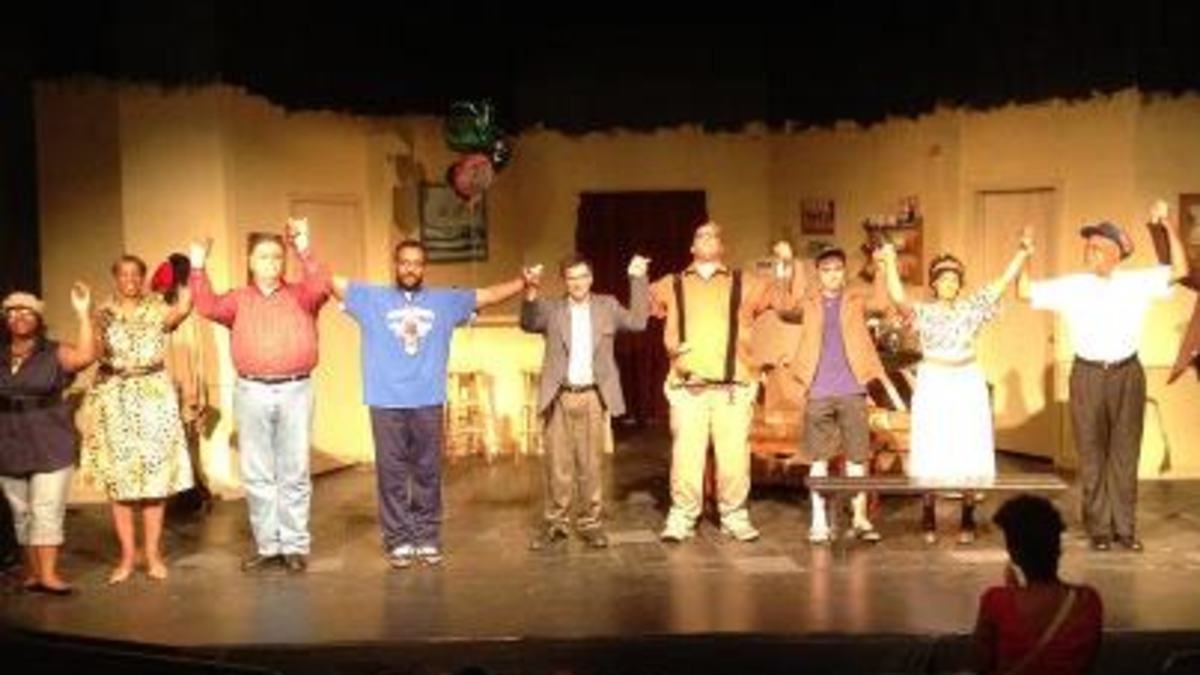 John Beasley Theater & Workshop
Race aside, Beasley made a name for himself on various Omaha stages in the ‘70s and ‘80s. Still, it was not until 1990 he abandoned the 9-to-5 routine and pursued acting as his livelihood. It was a daring thing to do for a middle-aged man with a family and mortgage, but he made the leap anyway. He figured the time was right. His youngest son was in college. He and his wife Judy, a medical secretary at UNMC, had a comfortable life. It was now or never.
“I was very dissatisfied (with the Vickers job), so I quit. I convinced my wife to let me try making it as an actor. She’d been fighting me all along. She didn’t want any part of being married to an actor. I didn’t do it earlier becaue I didn’t want her to suffer being married to a struggling actor,” he said. “But I finally told her, ‘I’m going to Minneapolis, and if I don’t make it in three weeks I’ll be back and I’ll get a normal job.’ She said, ‘OK.’ So, I went out there and within two-and-a-half weeks I was turning down plays.”
After taking the vibrant Minneapolis theater scene by storm, performing at the Mixed Blood Theater, he found success at major Equity theaters in Chicago (the Goodman) and Atlanta (the Alliance). Besides playing great roles in classic works, including Othello, he has shared the stage with notables Roscoe Lee Browne, Eric La Salle and Don Cheadle. As he made his presence known on the regional theater circuit, he helped pay the bills acting in commercials and corporate films.
He was so intent on making it he often undertook grueling road trips that found him driving from Omaha to Chicago to Minneapolis and back home again in a single 24-hour span. In the process, he became a much-in-demand interpreter of Pulitzer Prize-winning playwright August Wilson’s (Troy Maxson in Fences, Mr. West in Two Trains Running, Turnbo in Jitney) characters. Beasley adores the work of Wilson, whom he’s met, and even selected Wilson’s Fences, a story about a bitter father and his estranged son, as the play he reopened the Center Stage Theater with last summer. Beasley both starred-in and directed the production.
“I love August Wilson. Basically, he deals with every decade of the 20th century… with blacks migrating from the south to Pittsburgh (where Wilson is from) and what they faced once they got there. His characters talk about what happened back down south and touch on some of the reasons they came north. It’s always their stories. The plays deal with the era of urban renewal, when a lot of black businesses and neighborhoods were being boarded-up and blight set in and how, once redevelopment came in, blacks were being forced out. You can see the same pattern here in Omaha.
 |
John Beasley as Troy Maxson in Fences
“He’s really telling the black American story, but the thing about August’s work is it’s not just the black experience, it’s the human experience, and that’s why I love August. When I’ve done Fences I’ve had white men and women come up to me after the play with tears in their eyes and say, ‘That was my father.’ I mean, to me, Troy Maxson (the protagonist) is Willie Loman. Both of them are tragic figures who had a dream that was dashed. Troy could never let go of the fact he never got a chance to play major league baseball. That but for the color of his skin he could have been greater than any of them.”
While TV and film commitments limit the stage work he does these days, Beasley said he would still stop drop everything if a juicy part in a Wilson play opened up. For him. Wilson’s work is not only inspirational but instructive.
“August talks about relationships which, when I’m teaching acting workshops, is all I talk about. How we relate to each other. How we deal with each other from the heart. How we overcome obstacles. Because that’s what you have to bring to the table as an actor — that inner feeling. If you know what it feels like inside, then it’s going to come out.” Feelings tapped by a play sometimes cannot be contained within the boundaries of the stage. “I remember doing Willie Loman and how after each performance I’d just break down and cry because, emotionally, it’s such a draining experience. I found myself doing that every night. The same with Troy Maxson — I’d just have to breakdown. I had to get that release.”
He next made waves in episodic TV, including a 1990 role in Oprah Winfrey’s short-lived but much-talked-about series Brewster Place. Soon thereafter he landed his first feature film roles and became a regular TV guest star. He hasn’t stopped working in film and TV since.
He became a known commodity among moviegoers with small but convincing portrayals in the hits The Mighty Ducks and Rudy. He first caught the attention of critics with his strong supporting performance as a retired Southern preacher in Oscar-winner Robert Duvall’s 1998 critically-acclaimed film The Apostle.
He has appeared in other high-profile Hollywood pics (Losing Isaiah, The General’s Daughter) along with indie films (Journeyman). His TV appearances have included spots on Millennium, The Pretender, C.S.I. and Judging Amy and the TNT movie Freedom Song. He has worked with everyone from Duvall and Poitier (on a cable movie remake of To Sir With Love) to John Travolta, Melanie Griffith, Morgan Freeman and Della Reese.
His standing in the industry is such that he turned down a coveted lead role opposite Angela Bassett in John Sayles’ new film Gold Coast for a smaller but bigger-paying turn in The Sum of All Fears. While he rues having given up a lead, something he’s worked hard for, he feels the buzz around Sum, combined with his work on the well-reviewed Everwood, starring Treat Williams, have put him in line for more choice roles. He feels well-served to date by his keen eye for material. “I’ve been very picky about the things I’ve done on stage and I think that’s carried over into films.” He has also been promised a chance to direct episodes of Everwood and hopes to do more directing down the road.
With his career in high gear now, he is weighing buying a house in L.A. for those Tinseltown trips he makes every year. He insists, however, his lifestyle has not changed much from when he was just another middle-class Everyman. “I was never that interested in money, per se. My life has been full without money for a long time and now that I’m earning a little money, I’m not impressed with it still.”
He stays hungry and humble remembering where he came from and how far he has gone to reach his destination. His advice to aspiring actors: “Don’t be afraid to try and to leave your comfort zone.” He offers himself up as proof of how, with enough preparation and poise, an Omaha actor really can conquer Hollywood.
Related Articles
- Black Playwrights Convening, part 2: Isaac Butler reports (timeoutny.com)
- Bloggers cover the Black Playwrights Convening (timeoutny.com)
- Anthony Chisholm is in the House at the John Beasley Theater in Omaha (leoadambiga.wordpress.com)
- What Happens to a Dream Deferred? Beasley Theater Revisits Lorraine Hansberry’s ‘A Raisin in the Sun’ (leoadambiga.wordpress.com)
- Crowns: Black Women and Their Hats (leoadambiga.wordpress.com)
- Back in the Day, Native Omaha Days is Reunion, Homecoming, Heritage Celebration and Party All in One (leoadambiga.wordpress.com)
- Yolonda Ross is a Talent to Watch (leoadambiga.wordpress.com)
Kooky Swoosie: Actress Swoosie Kurtz conquers Broadway, film, television
June 6, 2010
4 comments
It’s always a pleasure to interview a star you have admired. That certainly was the case when I did a phone interview with actress Swoosie Kurtz. The occasion was a Tony nomination for her role in Frozen, a drama co-produced by friends and family in her native Omaha, which if you’ve been reading my article posts you know by now is my hometown and place of residence. She was every bit the fun and funny bright spirit I had come to expect. The Omaha connection extended to her having worked with Alexander Payne on his debut feature, Citizen Ruth, which was shot here. My own career has intersected with Payne, whom I have been covering since he completed that project in the mid-1990s. As I write this, I am about to call Payne to arrange a face-to-face interview with him about his recent shoot of The Descendants in Hawaii, where he just wrapped on Friday. One final Omaha connection involving Swoosie is my having written about the Omaha company that co-produced Frozen and my scripting a documentary that that same company shot and edited. Small world.
My Swoosie piece appeared in The Reader (www.thereader.com).

Kooky Swoosie: Actress Swoosie Kurtz conquers Broadway, film, television
©by Leo Adam Biga
Originally published in The Reader (www.thereader.com)
Frozen
Omaha native Swoosie Kurtz, that sometimes kooky stage, film and television actress with the dizzy name to match, is dead serious about her work. The depth of this consummate artist’s craft is on full display in the current Broadway drama Frozen, in which she plays a mother coming to grips with the void of her missing daughter, whose terrible fate she doesn’t know for 20 years.
The story revolves around the daughter’s disappearance and how this event connects the girl, the mother, the serial killer that took her and the therapist trying to discover what set this tragedy in motion. The theme of child abuse looms large in the killer’s own past and drives him to revisit his horror on others. Brian O’Byrne won a Best Actor Tony for his performance as the killer. Critics are calling Kurtz’s Tony-nominated portrayal of the shattered mother a tour de force.

Brian O’Bryne and Swoosie Kurtz in Frozen
“My character goes through this 20-year journey of having her child taken and not knowing she’s dead. She goes through all the stages — mourning, anger, depression — and, finally, into acceptance, but in a very beautiful way. The second act of the play, particularly, is uplifting and life-affirming and redemptive,” said Kurtz.
Her process is a melding of the interior Method approach that uses emotional exploration and the more classical exterior approach that focuses on body, voice, movement, makeup, et cetera. “What works best for me is a kind of working from the outside in. When I can picture a character — how they sit, how they walk, the kind of clothes they wear — it tells me a lot about the inside of the character. The process is partly intuitive and partly technique. I think a lot of actors starting out today rely too much on the intuitive and the instinctual. You have to learn your craft,” she said in a 1999 Tony Awards Online interview.
Roots
Born in Omaha as the only child to a war hero father and society matron mother, she did part of her growing up here — attending Field Club School — before her family moved west. Her career military father, the late Col. Frank Kurtz, was the most decorated U.S. airman of World War II. She was named after the B-24 bomber he flew, dubbed the Swoose after a Kay Kyser song about a half swan, half goose. Before the war, Col. Kurtz was already famous as a world class platform diver. He won a bronze medal in the 1932 Olympics and competed in the ‘36 Berlin Games.
Her mother, the former Margo Rogers, authored a book, My Rival the Sky, about being the wife of an absent war hero. Margo hailed from an old money Nebraska family headed by her father, Arthur Rogers, a cattle tycoon who headed the Omaha Livestock Commission in the stockyards’ heyday. Kurtz recalls him taking her to the yards, plopping her atop a horse and playfully telling her to “wrangle those cattle. I weighed about 45 pounds, but because he told me to do it, I thought I could. I never questioned it.” Her enterprising grandma, Gigi Rogers (formerly Conant), built three downtown hotels — the Conant, the Sanford and the Henshaw.
Kurtz had one familial tie to show biz. A maternal great uncle, Homer Conant, was a set and costume designer for legendary impresarios Ziegfeld and Shubert in 1920s New York. “So, I’m revisiting the scene of the crime here on Broadway,” she said.
Kurtz stayed with her grandparents in Omaha when her much-traveled parents were away on missions and war bond drives. Of her grandparents, she said, “They were a huge influence on me in my formative years. They were incredible. They had this big country house that my mom grew up in and I partly grew up in. When I was in town doing Citizen Ruth (Alexander Payne’s 1996 film), I went to the house, just to see it, and it brought back amazing memories to revisit it.”
Her father’s many transfers meant frequent moves for her and her family. Being an only child forced her to cultivate her imagination. “I would play different games with myself and become different people and talk to myself in different voices. The characters would talk to each other. Only children have their own way of survival.”
A Eureka Moment
The theater first enchanted her when, as a kid, she attended Broadway plays with her folks. Her earliest stage acting came at Hollywood High. “I was in this drama class at Hollywood High and I did this scene from Dark Victory or some other Bette Davis movie and it was like, Whoah. Something fell into place in that moment and clicked and it was like, I can communicate with people this way better than I can on my own. It was just a eureka moment.” She began formal dramatic studies at the University of Southern California, where her parents graduated, before crossing the pond to complete her training at the London Academy of Music and Dramatic Art. There, she fully immersed herself in acting.
If anything, her Tony-nominated turn in Frozen is a reminder of Kurtz’s versatility and penchant for sinking her teeth into challenging roles. Much of her best-known work has seen her essay women-on-the-edge-of-a-nervous-breakdown in plays by some of the world’s greatest living dramaturgists. Her whimsical, lost souls are tinged with a deep well of sadness and display a sharp wit.
Among her stage triumphs are her turns as Gwen in Lanford Wilson’s The Fifth of July and as Amy John Guare’s The House of Blue Leaves. Her many film portrayals include: a hockey groupie in Slap Shot; the wry hooker in George Roy Hill’s The World According to Garp; the frothy wife in A Shock to the System; the ambitious mother in Stephen Frears’s Dangerous Liaisons; “the world’s laziest woman” in David Byrnes’s True Stories; and a scheming abortion war fanatic in Payne’s Citizen Ruth. For television, there was her Emmy Award-winning portrayal of high society living, cancer surviving Alex in the popular NBC-TV series Sisters and a socialite dying of AIDS in the HBO drama And the Band Played On.
Dangerous Ground
Even though its subject matter put her off, she felt compelled to do Frozen. The play’s executive producer is an Omaha cousin, Thompson Rogers, whose Oberon Properties owns the screen rights. “This play just knocked the breath out of me,” she said. “I hadn’t read anything like this ever. I think the issues of child abuse hit me the hardest. What struck me on my first reading of the play is that the serial killer character of Ralph, who takes my daughter, has been horribly abused as a child. And I firmly believe what the play is hypothesizing is that when children are abused…certain parts of their brain get stunted and the part that has empathy and compassion and remorse simply doesn’t develop in the way that it should.”
Playwright Bryony Lavery’s disarming examination of abuse, trauma, loss, regret, forgiveness and grace drew her in. “Just the sheer poetry of the way this subject is handled,” she said. “It’s a subject we see all the time on television and, so, we think we know all about it, and then this play comes along and presents this in a way that defies any expectation you have.”
She knew Frozen was a must-do project when reading it unnerved her. “When something scares me as much as this play did, I have to do it,” she said. “It’s so dangerous, this piece. It’s so risky. I thought, How are we going to rehearse this play? How the hell do you work on something like this and not just be a wreck? And, actually, we laughed a lot in rehearsal, which sounds really irreverent, but that was the whole key — to be irreverent about the material. Because the audience’s experience of it is very different from ours. We have to do it and go through it and it’s up to them to have the emotional response.”
Kurtz believes in challenging the gods rather than playing it safe. She recalls the time she essayed identical twins in Paula Vogel’s play The Mineola Twins, which not only required her to be two separate people, but to be on stage for all but a few seconds. Again, she asked herself, How am I going to do this? As usual, the motivation of the challenge allowed her to find a way to make it work. That discovery and accomplishment, she said, is what makes the journey into the abyss worthwhile. “And then it’s such a great feeling when you prove to yourself that you can,” she said. “You’re like, You know what? I did it. I took the leap.”
Making real the ultra-sensitive, bereaved, even mad characters she inhabits means muting the obvious comic notes to express the inner beauty. It’s about being nonjudgmental “and also having great compassion for the character,” she said. “I always find I turn a corner in rehearsal when somehow the character moves me.”
She said she learned not to play the fool when the legendary Jerry Zaks, with whom she worked on House of Blue Leaves, gave her “the best piece of direction I ever got. In my mind, I thought, I have to let the audience know right away that this woman, Amy, is a little out of touch with reality. I had this line, ‘Is it light yet?’ And I was doing it kind of spooky, like a strange woman would. And Jerry said, ‘Swoose, you are the happiest, most normal housewife in Queens.’ It was a brilliant thing that resonated through that whole piece and everything I do because people who are on the edge or neurotic or insane think they’re totally normal. And it’s that everydayness or normalcy what is sometimes so shocking.”
Citizen Ruth
If ever a performance has embodied the power of subtlety over histrionics it’s her rendering of Diane Siegler in Citizen Ruth. In this one character, Kurtz plays an arc of extreme types, but believably so within the framework of Diane’s fanaticsm. When we and the title character, Ruth Stoops (Laura Dern) first meet Diane, she appears to be a prim holier-than-thou pro-life advocate. Then, as we and Ruth learn, it turns out Diane’s only posing as a pro-lifer, but in reality is an openly gay pro-choice agitator who’s infiltrated the enemy camp in order to spy and reek carnage on their campaign. Diane’s hilarious “coming out,” complete with removing her dowdy wig and eye glasses to show her true identity and sympathies, is all the funnier and more surprising because Kurtz underplays it so matter-of-factly. “What was so great about that was I got to do play two people,” said Kurtz.

Swoosie Kurtz, Laura Dern, Kelly Preston from Citizen Ruth
She was impressed with fellow Omahan Alexander Payne, who co-wrote Citizen Ruth and made it his feature film directing debut. “He was so grounded and so real in his approach to everything,” she said. “Well, you know, he’s from Omaha. But he is so smart, on so many levels, that I think he sometimes had a plan in mind that we didn’t know about, and we didn’t have to know about it. He had his map in his head very clearly, but he was also very open to experimentation and open to whatever was happening in the moment.
“If we happened to ad-lib something, he was delighted with it and very often would use something. He just came up with these great sort of subversive, out-of-the-box ideas. He’d just throw some curve at us right before the take and it’d be something I would never have thought of in a million years.”
As an example, she recalls a scene in the kitchen at the country house where she and her lover (Kelly Preston), are putting up Ruth Stoops. The phone rings and Kurtz’s Diane Siegler “answers the phone as the lesbian liberal activist and then” — when it turns out the caller’s a pro-lifer — “I put on my (eye) glasses in order to talk to her. And that was Alexander’s idea. And I thought, Oh, my God. What an incredibly bizarre and amazing idea” to have her put her defense/disguise back on.
Payne is equally impressed with her. “I remember her as being so delightful and cooperative and professional. She knows her dialog. She comes prepared. She has good ideas. Highly directable. I mean, she’s a total pro. And she’s funny,” he said.
The film, still unappreciated among general movie audiences, is a favorite of hers. “I’ve never seen a movie like it. It’s just unto itself. It’s an amazing film,” she said.
Feeling the Most Alive on Stage
Kurtz has been nominated for eight Emmys (winning one for Carol and Company) and has stolen scenes in dozens of big and small screen pics, but her stage work is what makes her a living legend. She has two Best Actress Tonys to her credit (for Fifth of July and House of Blue Leaves) in addition to Drama Desk Awards, an Outer Critics Award and an Obie. She moves effortlessly from one medium to another, but the boards is her true calling. It’s where she feels most engaged as an artist.
“An actor on stage has more responsibility than in any other medium,” she said. “You are so much more responsible for what happens out there on the stage. Film is definitely the director’s medium. They shape the film. They take what of your performance they want. They choose what the audience is looking at at any particular point. Your face may not even be on camera at that moment. On stage, you control everything. You control your body, your voice…whether the audience is seeing your profile or the front or back of you. You control how loud you are. You control the timing of everything.
“I’m not sayng film and television are easier by any means, because they’re all enormously challenging, But, ultimately, you are much more accountable in the theater for what happens that night on stage.”
Acting, for Kurtz, feeds her like nothing else. “It’s when I feel most alive,” she said. “I definitely think when I’m acting I’m my true self. You know how in therapy they talk about your true self? I think that joy just comes out. I mean, I was on stage the other night thinking, I’m so happy right now. I’m so alive.” Where real life once seemed boring compared to acting’s hyper intensity, she sees it differently now.
“I’m getting a lot more enjoyment now out of real life. Thank God, because there’s a lot of that around,” she said, unleashing her happy, kooky, bright spirit’s laugh.
Related Articles
- Swoosie Kurtz discusses her new role on ‘Mike & Molly’ (hollywoodnews.com)
- New CBS Series Trailers: Shit My Dad Says, Hawaii 5-O, The Defenders, Blue Bloods and Mike & Molly (geektyrant.com)
- ‘Chuck’ Taps on Fred Willard and Swoosie Kurtz (buddytv.com)
- An Appraisal: Lanford Wilson’s Losers, Beloved by Their Creator (nytimes.com)
- Kevyn Morrow’s Homecoming (leoadambiga.wordpress.com)
- Playwright John Guare Talks Shop on Omaha Visit Celebrating His Acclaimed ‘Six Degrees of Separation’ (leoadambiga.wordpress.com)
- A Q & A with Theater Director Marshall Mason, Who Discusses the Process of Creating Life on Stage (leoadambiga.wordpress.com)
- Playwright/Director Glyn O’Malley, Measuring the Heartbeat of the American Theater (leoadambiga.wordpress.com)
- Omowale Akintunde’s In-Your-Face Race Film for the New Millennium, ‘Wigger,’ Introduces America to a New Cinema Voice (leoadambiga.wordpress.com)
Lauro play “A Piece of My Heart” dramatizes role of women in war zones
May 19, 2010
11 comments

Image by cliff1066™ via Flickr
This is a story I did about a play whose subject matter brought me into contact with some women who fulfilled various capacities during wartime service, whether as nurses or USO performers. The women I interviewed are sort of the real-life equivalents of some of the characters in the play.
The story originally appeared in The Reader (www.thereader.com), and I hope you find the words of the women, fictional and nonfictional alike, as gripping as I did.
Lauro play “A Piece of My Heart” dramatizes role of women in war zones
©by Leo Adam Biga
Originally appeared in The Reader (www.thereader.com)
As U.S. military action in Iraq unfolds, old war stories take on new capital. With women now on the front lines, their wartime roles gain added import. While their presence on the battlefield is new, American women have participated on the sidelines of war — as nurses, clerks, reporters, missionaries, performers — for generations, only their legacy seems lost in the heat of combat.
But since the 1993 dedication of the Vietnam Women’s Memorial in Washington D.C., a bronze sculpture by artist Glenna Goodacre of three fatigue-wearing females comforting an injured soldier, women have begun writing and talking about their wartime service as never before, the fruits of which can be seen in the acclaimed play, A Piece of My Heart, running now through April 27 at the Blue Barn Theatre.
Playwright Shirley Lauro based the characters of her impressionistic drama on interviews with real-life veterans, including those profiled in a book of the same name by Keith Walker. Lauro uses fast-moving vignettes to tell the larger story of American women in Vietnam. The six women characters represent varied backgrounds, roles and attitudes. There are military nurses, from stalwart Martha to sweet young Sissy to flower child Leeann. There’s the aristocratic Red Cross “donut dolly” Whitney. There’s the hard-ass intelligence officer Steele. And the playful, soulful USO trouper MaryJo. Whether sewing sutures, spreading cheer or performing on stage, they are angels of mercy for soldiers trapped in a hellish quagmire.
The women cope with laughter, tears, booze, pot. Some erect “the wall.” Others fool around. The nurses regret not knowing what happens to the boys whose bodies they patch up and spirits they boost. They fear no matter how many lives they save or how many smiles they elicit, they never do enough. Then, when their wartime service is over, they return home as forgotten as their G.I. brothers, wanting to put the war behind them but finding they can’t.

Even though each character tells her own story, they really all speak in one voice about the shared female experience of being thrust into the surreal, carnage of war. Regardless of where they hailed from or did their tour or what job they held or beliefs they espoused, they were all volunteers who elected to go there.
“The common ground we had, which is why I felt so strongly about honoring these women, was that not a single one of us had to be there,” said Diane Carlson Evans, a veteran in-country Army nurse who spearheaded the creation of the women’s memorial. “We were not drafted. We were not conscripted. Nobody put a gun to our head and said, Go to Vietnam and do your duty. We could have stayed home, got our master’s degree, had our kids, played golf and tennis and had a good life. But every one of us — Red Cross, military, USO — said, I want to do my part, and did during a very unpopular war. We didn’t have a lot of support from home, from peers or from our country…We just thought it was the right thing to do.”
Evans, who made remarks before the Blue Barn’s April 5 show, used her appearance to givr tribute to “the diverse contributions women made” in the war. “I am proud of the women I worked with and how hard I saw them work and how they asked for nothing in return. It was always, Do I need to give blood? Or, Can I work an extra shift? It was that always going above and beyond and never complaining because we had a job to do. I saw how these women saved lives at the risk of their own. And I just believe so strongly they deserve credit from a grateful nation. A grateful nation that needs to acknowledge they participated in a really extraordinary way.”
The story of women’s wartime service is, for many of us, unknown. “I’m just so glad this story’s being told because I lived through Vietnam and I didn’t hear nothing about the nurses…not a thing,” said Omaha actress Phyllis Mitchell-Butler, who portrays Steele. “The nurses went through as much as any of the soldiers. They saw the devastation first-hand. I’m just amazed how long they kept themselves together with all that inside them. All they had was what was inside and they had to keep that. They couldn’t let it go.”
In her role as state commander of the Nebraska Council of Vietnam Veterans of America, Dottie Barickman, who served at Offutt Air Force Base in the Vietnam era, has come to appreciate what women did in that war.
“I’ve never walked in their shoes, but I’ve heard their stories and I understand what they mean when they say they sacrificed their youth and their emotions. They were the nurturing ones for a lot of young boys hurting over there. Combat soldiers always mention to me that if they ever saw a nurse it was like Welcome Home, and that is what these women were…a touch of home that took them away from that war zone for a few hours.”
The stories in A Piece of My Heart echo those of thousands of women that served in Nam or nearby environs. Diane Carlson Evans is one of them.
“I was 21…right out of college…and I was assigned first to the 36th Evacuation Hospital in a beautiful place (Vung Tau) right on the South China Sea beach. I didn’t feel the war there as much as I did when I was transferred up north…to Pleiku, in the central highlands jungle near the Cambodian border,” Evans said. “I was with Two Corps supporting the 4th Infantry Division (in the 71st Evacuation Hospital).
“The war was very different there. It was the spring of ‘69…a pretty bad time. The 4th Infantry had something like a 75 percent casualty rate. I was made head nurse in a post-surgical unit where the patients were very sick. We had them on respirators and blood transfusions and chest tubes. It was very hard to see so many young men with such horrific wounds. We had to deal with patients dying on us and, in triage, we had to deal with setting aside dying patients to attend to the most salvageable ones. We blamed ourselves. We carried the guilt. And we were young…and so on our little time off we filled our days in human ways, whether it was playing volleyball or getting drunk or doing drugs or going on dates or falling in love.”

Playwright Shirley Lauro
In addition to the stress of dealing with crushing trauma patient loads, the threat of death was ever near. “Pleiku was not a safe area. We were under attack many times. We got to know the difference between the outgoing artillery and the incoming rockets and mortars that would fly in and hit our hospital, sending shrapnel everywhere. We were not only worrying about our patients — we had concern for our own safety,” said Evans, a Helena, Montana resident.
Since getting the Vietnam women’s memorial installed, Evans, whose efforts to make it a reality took 10 years, has become THE champion for female volunteers in that conflict, focusing her efforts on “encouraging women who served to share their stories…so we can understand what the memorial is all about.”
She helped start a storytelling program at the memorial site and on the web that invites women to speak their piece. She said telling it like it was is “very painful. It takes a lot of courage for women to admit how scared they were some young soldier was going to die on their watch or how they were so tired they could have made a mistake or how they were sexually assaulted or harassed. All of this anger and anguish comes out in the play.”
An admirer of the Lauro work, which had its debut in Philadelphia and has been performed across the country, Evans feels it gets to the heart of women’s Vietnam odyssey. “It does not show our service through rose-colored glasses — that we were all these heroic young women who went off to save the world and wore white halos — but instead it shows we were young women who went to Vietnam and did the very best we could amid all this crazy stuff going on. That’s what makes it very real, very authentic.”
As the war in Iraq rages on the director of the Blue Barn show, Susan Clement-Toberer, feels the conflict lends the play added urgency.
“Knowing that it’s happening now it brings it all very close and deepens everything we’re doing,” she said. “It’s real, just like the stories of these women are all real…taken from a myriad of interviews with different women.”
Cast member Erika Hall, who plays the USO entertainer, said, “You know, before it was important to do this piece, and now like it’s necessary.” Most of the cast and crew are too young to remember the war and therefore have immersed themselves in it via books, articles and tapes and by talking to actual veterans.
“What an interesting learning experience this is for me,” Hall said. “I was born after Vietnam and, you know, you read about it in school but you don’t really understand what they (vets) went through.” In her own research Clement-Toberer said she was surprised to learn “the extremes the women survived. I knew Vietnam was a dirty war, but I just didn’t realize they (the women) saw such extremes so quickly. I understand now why these women went and what they mean by honor…they believed in their country. It’s just a very strong feeling in what is right and what is true and what needs to be told.”
The characters have real-life counterparts in Nebraska. Lincolnite Judy Knopp, a former Army nurse at Camp Zama, Japan, treated G.I.s choppered in from Vietnam; Martel native and longtime Lincoln resident Brenda Allacher toured Nam as a member of the all-girl country-western band The Taylor Sisters; and Marie Menke of Superior, Neb. was a fellow Army nurse with Diane Evans at the 36th evac in Vung Tau, regarded as an in-country R & R site except for the grueling recovery and care that went on there. For vets like these, Vietnam seared into their memories and hearts the best and worst of humanity.
“I joined the Army nurse corps and in six weeks did my basic training at Fort Sam Houston and went straight to Japan…Camp Zama, 35 minutes southeast of Tokyo and an hour by chopper from Saigon. I was charge nurse in the orthopedic ward of a 1,000 bed hospital,” Knopp said. “Back then, we had to make our own IVs and pump our own blood and everything. After the Tet Offensive we were working 12 hour shifts, seven days a week. They used to call us the zombie squad. We didn’t even eat. We went home and slept…then came back. We’d have 30 to 40 evacs a day…20 to 30 surgeries a day, just on my ward. One-half of our cases were dirty wounds…shrapnel wounds or single and multiple amputees. Guys with half their faces blown off. One young man I especially remember…Billy. He was 18. He’d stepped on a land mine and everything was gone from the belly button on down. He was unconscious. We were pumping him full of blood. You wanted to save him but…you wanted him to go, too, because there was no way he could live.
Brenda Allacher
“The guys, they were so young. They used to call me grandma and I was 22. They were all like little brothers. We used to stay up with the guys at night who were crying over having killed women and children. They had a real hard time dealing with what went on over there and the stuff they had to do to survive. A lot of ‘em came back injured and a lot of ‘em we never saw again. We never knew what happened to ‘em. The ones going back to the states we’d iron their uniforms, sew on their patches and go to the chopper to kiss ‘em goodbye. I have very fond memories of the guys and just atrocious memories of the wounds.”
She still regrets how, when her ward was busy, “there was no time for dignity with death…to get patients prepared and stay with ‘em and see ‘em through it. It was like, OK, this one’s dead, clean out the bed…there’s another one coming in.”
A Piece of My Heart cast members marvel at what women like Knopp endured at such a tender age. “They all have stories of their first day…just like in the play where my character takes off a soldier’s boot and his severed foot is in it,” Christine Schwery said. “They were so fragile and so young and yet they survived,” Julie Huff said. “With a lot of alcohol and a lot of drugs,” Schwery chimed in. “Yeah, but they survived and they saved a lot of lives,” Huff added.
Riverdale, Neb. native Marie Menke, then Daake, was a 22-year-old nursing school grad when she got to Nam. Nothing could prepare her for what she saw:
“I was pretty naive about the war. It was very shocking to most of us to see the kinds of wounds and the tragic loss of life,” she said. “It just shouldn’t be. My thoughts about the war didn’t matter because we were there and people were getting hurt and we had an enormous job to do. We were tremendously needed. It was beyond comprehension almost. The nurses did do a lot but most of us downplayed it. We were just there to do our job and to take care of patients and to support them.”
Besides caring for American G.I.s, nurses treated Vietmanese, including children.
An estimated 265,000 American women service in support of the war. U.S. Army estimates place the number in-country between 10,000 and 12,000. Most were nurses, either Army or Marine enlistees or even civilians attached to field hospitals or more rear echelon units. American Red Cross volunteers were so-called “donut dollies” — a sort of comfort girl corps boosting morale with their short-skirts, smiles and care packages. Others were entertainers touring under the auspices of the USO or, like Brenda Allacher, as contract entertainers via private booking agencies that provided minimal security and scant creature comforts.

Blue Barn Theatre’s Susan Clement Toberer
Allacher, then known by her stage name Brenda Allen, got to see a lot of Nam during her three-and-half month tour in ‘69. She has bittersweet memories of her time in Chu Lai, a central coastal area manned by the Americal Division:
“That was one of our favorite places because we had privacy taking a shower. I remember the commanding officer, ‘Big Daddy’ Richardson, said, ‘I’m going to work your butts off, but when you come back at night your favorite food and drink will be sitting in front of you.’ And it was, too. Lobster and blackberry brandy and Cutty Sark scotch. We’d do five and six shows a day for that man,” she said. “The men, they just wouldn’t let us quit and we weren’t about to leave those boys. The guys were just absolutely beautiful. They called me ‘Crazy Legs’…I’d do wild dancing and kick my legs up. They just went bonkers.
“We’d come back exhausted. One night, we’d come back from a show and a few of us were in the officers club drinking when there was a loud CLAP and the building just shook. A G. grabbed me and threw me down under the bar.” It was the start of a prolonged mortar attack. “We took 16 rounds over a period of four or five hours. We just laid there on the floor and got drunk. I was so scared. Around daylight a young man came running in, shouting, ‘They got a nurse at the 312 Surg-Evac,’ which was like a block away.”
The victim, 1st Lt. army nurse Sharon Ann Lane of Canton, Ohio, was the first Army nurse to die under hostile fire in Southeast Asia and one of 68 American women in all — military and civilian — to die in the conflict. The incident shook Allacher to her core.
“What really gets me is it very easily could have been me, and not her.” she said. She recalls happier times there, too, like when the Taylor Sisters did an impromptu show for Nebraska National Guard troops, leading off with “There’s No Place Like Nebraska.” “The tin roof went off on that quonset hut. They just went nuts.” Or when she was secreted away to give a private performance for some special ops forces who, upon her finishing, “lined up and saluted me” she said tearfully. “As I was walking out, the commanding officer placed his Green Beret on my head.” She still has it. “I wouldn’t trade those experiences for anything.”
Allacher and Knopp have made the recognition of women’s work in Vietnam a personal mission. Together eith Evans they are featured in a NETV documentary, Not On the Frontline, that follows their story from the wartime service they rendered to the emotional “culmination” of seeing the women’s memorial dedicated, something Knopp worked for as state coordinator of the project. More recently, Allacher, who describes herself as “a straight shooter…full of piss and vinegar,” was instrumental in bringing A Piece of My Heart to the attention of local theaters. She and her big booming laugh have become fixtures at the Blue Barn.
For Allacher, Knopp and Evans, the stories told in the play and documentary are part of the healing that’s taken place after the war. Acceptance of women’s service has come slowly, even as they have died alongside their veteran brothers from Agent Orange-related illnesses and have suffered from post-traumatic stress disorder.
Evans said there was once resistance to honoring women’s war record because “I don’t think people wanted to look at women as warriors — as soldiers. But women are soldiers, too. We fought just as hard as the men. We just fought with different instruments.” Or, as Judy Knopp puts it, “The guys were on the physical front lines, but we were on the psychological front lines trying to hold it all together. And we did it with a loving heart.”
Related Articles
- Woman who says she was nurse from WWII photo dies (dailycaller.com)
- Honouring nurses (bbc.co.uk)
- What did many American Women hold jobs as (wiki.answers.com)
- Walking Behind to Freedom, A Musical Theater Examination of Race (leoadambiga.wordpress.com)


 Leo Adam Biga's My Inside Stories