Archive
Combat sniper-turned-art photographer Jim Hendrickson on his vagabond life and enigmatic work

Image via Wikipedia
Another of the unforgettable characters I have met in the course of my writing life is the subject of this story for The Reader (www.thereader.com). Jim Hendrickson is a Vietnam combat vet who went from looking through the scope of a rifle as a sniper in-country to looking through the lens of a camera as an art photographer after the war. His story would make a good book or movie, which I can honestly say about a number of people I have profiled through the years. But there is a visceral, cinematic quality to Jim’s story that I think sets it apart and will be readily apparent to you as you read it.
Combat sniper-turned-art photographer Jim Hendrickson on his vagabond life and enigmatic work
©by Leo Adam Biga
Originally appeared in The Reader (www.thereader.com)
Combat sniper-turned-art photographer Jim Hendrickson is one of those odd Omaha Old Market denizens worth knowing. The Vietnam War veteran bears a prosthetic device in place of the right arm that was blown-off in a 1968 rocket attack. His prosthetic ends in pincer-like hooks he uses to handle his camera, which he trains on subjects far removed from violence, including Japanese Butoh dancers. Known by some as “the one-armed photographer,” he is far more than that. He is a fine artist, a wry raconteur and a serious student in the ways of the warrior. Typical of his irreverent wit, he bills himself as — One Hand Clapping Productions.
The Purple Heart recipient well-appreciates the irony of having gone from using a high-powered rifle for delivering death to using a high-speed camera for affirming life. Perhaps it is sweet justice that the sharp eye he once trained on enemy prey is today applied in service of beauty. For Hendrickson, a draftee who hated the war but served his country when called, Vietnam was a crucible he survived and a counterpoint for the life he’s lived since. Although he would prefer forgetting the war, the California native knows the journey he’s taken from Nam to Nebraska has shaped him into a monument of pain and whimsy.

Jim Hendrickson
His pale white face resembles a plaster bust with the unfinished lines, ridges and scars impressed upon it. The right side — shattered by rocket fragments and rebuilt during many operations — has the irregularity of a melted wax figure. His collapsed right eye socket narrows into a slit from which his blue orb searches for a clear field of vision. His massive head, crowned by a blond crew cut, is a heavy, sculptured rectangle that juts above his thick torso ala a Mount Rushmore relief. Despite his appearance, he has a way of melding into the background (at least until his big bass voice erupts) that makes him more spectator than spectacle. This knack for insinuating himself into a scene is something he learned in the Army, first as a guard protecting VIPs and later as a sniper hunting enemy targets. He’s refined this skill of sizing-up and dissecting a subject via intense study of Japanese samurai-sword traditions, part of a fascination he has with Asian culture.
Because his wartime experience forever altered his looks and the way he looks at things, it’s no surprise the images he makes are concerned with revealing primal human emotions. One image captures the anxiety of a newly homeless young pregnant woman smoking a cigarette to ward off the chill and despair on a cold gray day. Another portrays the sadness of an AIDS-stricken gay man resigned to taking the train home to die with his family. Yet another frames the attentive compassion of an old priest adept at making those seeking his counsel feel like they have an unconditional friend.
The close observation demanded by his work is a carryover from Vietnam, where he served two tours of duty. “With sniping, you had to look at the lay of the land. You had to start looking from the widest spectrum and then slowly narrow it down to that one spot and one moment of the kill,” he said. “You got to the point where you forced yourself to look at every detail and now, of course, I’m doing that today when I photograph. I watch the person…how they move, how they hold themselves, how they talk, waiting for that moment to shoot.”
Shooting, of a photographic kind, has fascinated him from childhood, when he snapped pics with an old camera his Merchant Marine father gave him. He continued taking photos during his wartime tours. Classified a Specialist Four wireman attached to B-Battery, 1st Battalion, I-Corp, Hendrickson’s official service record makes no mention of his actual duty. He said the omission is due to the fact his unit participated in black-op incursions from the DMZ to the Delta and into Cambodia and Laos. Some operations, he said, were conducted alongside CIA field agents and amounted to assassinations of suspected Vietcong sympathizers.
As a sniper, he undertook two basic missions. On one, he would try spotting the enemy — usually a VC sniper — from a far-off, concealed position, whereupon he would make “a long bow” shot. “I was attached to field artillery units whose artillery pieces looked like over-sized tanks. The pieces had a telescope inside and what I would do is sit inside this glorified tank and I would rotate the turret looking through the telescope, looking for that one thing that would say where the Vietcong sniper was, whether it was sighting the sniper himself or some kind of movement or just something that didn’t belong there. I’d pop the top hatch off, stand up on a box and then fire my weapon — a bolt-action 30-ought-6 with a 4-power scope — at the object. Sometimes, I’d fire into a bunch of leaves and there’d be nothing there and sometimes there was somebody there.” When the target couldn’t be spotted from afar, he infiltrated the bush, camouflaged and crawling, to “hunt him down.” Finding his adversary before being found out himself meant playing a deadly cat-and-mouse game.


©Images by Jim Hendrickson


“You look at where he’s firing from to get a fix on where he’s holed up and then you come around behind or from the side. You move through the bush as quietly as possible, knowing every step, and even the smell of the soap you wash with, can betray you. I remember at least three times when I thought I was going to die because the guy was too good. It’s kind of a like a chess match in some sense. At some point, somebody makes a mistake and they pay for it. I remember sitting in a concealed location for like three days straight because only a few yards away was my opponent, and he knew where I was. If I had gone out of that location, he would have shot me dead. So, for three days I skulked and sat and waited for a moonless night and then I slipped out, came around behind him — while he was still looking at where I was — and killed him.”
His first kill came on patrol when assigned as a replacement to an infantry unit. “I was the point man about 50 feet ahead of the unit. I heard firing behind me and, so, I turned to run back to where the others were when this figure suddenly popped up in front of me. I just reacted and fired my M-16 right from the hip. I got three shots into the figure as I ran by to rejoin the patrol. The fire fight only lasted two or three minutes, By then, the Vietcong had pulled back. The captain asked us to go out and look for papers on the dead bodies. That first kill turned out to be a young woman of around 16. It was kind of a shock to see that. It taught me something about the resolve the Vietcong had. I mean, they were willing to give up their children for this battle, where we had children trying to evade the draft.”
As unpopular as the war was at home, its controversial conduct in-country produced strife among U.S. ground forces.
“Officers were only in the field for six months,” Hendrickson said, “but enlisted men were stuck out there for a year. We knew more about what was happening in the field than they did. A lot of times you’d get a green guy just out of officers’ school and he’d make some dumb mistake that put you in harm’s way. We had an open rebellion within many units. There was officer’s country and then there was enlisted men’s country.”
In this climate, fragging — the killing of officers by grunts — was a well-known practice. “Oh, yes, fragging happened quite a lot,” he said. “You pulled a grenade pin, threw the grenade over to where the guy was and the fragments killed him.” Hendrickson admits to fragging two CIA agents, whom he claims he took-out in retribution for actions that resulted in the deaths of some buddies. The first time, he said, an agent’s incompetence gave away the position of two fellow snipers, who were picked-off by the enemy. He fragged the culprit with a grenade. The second time, he said, an agent called-in a B-52 strike on an enemy position even though a friendly was still in the area.
“I walked over to the agent’s hootch (bunker), I called him out and I shot three shots into his chest with a .45 automatic. He fell back into the hootch. And just to let everybody know I meant business I threw a grenade into the bunker and it incinerated him. Everybody in that unit just quietly stood and looked at me. I said, ‘If you ever mess with me, you’ll get this.’ Nobody ever made a report. It went down as a mysterious Vietcong action.”
He was early into his second tour when he found himself stationed with a 155-Howitzer artillery unit. “We were on the top of a gentle hill overlooking this valley. I was working the communications switchboard in a bunker. I was on duty at two or three in the morning when I started hearing these thumps outside. I put my head up and I saw explosions around our unit. Well, just then the switchboard starts lighting up.”
In what he said was “a metaphor” for how the war got bogged down in minutiae, officers engaged in absurd chain-of-command proprieties instead of repelling the attack. “Hell, these Albert Einsteins didn’t even know where their own rifles were,” he said, bellowing with laughter. What happened next was no laughing matter. In what was the last time he volunteered for anything, he snuck outside, crossed a clearing and extracted two wounded soldiers trapped inside a radio truck parked next to a burning fuel truck.
“First, I started up the fuel truck, put the self-throttle on, got it moving out of the unit and jumped out. Then I went back and helped the wounded out of their truck and got them back to where the medics were. Then, another guy and I were ‘volunteered’ to put a 60-caliber machine gun on the perimeter fence. We were on the perimeter’s edge…when I saw a great flash. A Russian-made 122-millimeter rocket exploded. The man behind me died instantly. The only thing I remember is the sense of flying.” Hendrickson’s right arm and much of the right side of his face was shredded off.
As he later learned, a battalion of Vietcong over-ran a company of Australians stationed on the other side of the hilltop and attacked his unit “in a human wave.” He said, “They ran right by me, thinking I was dead, probably because of all the blood on me.” The attack was knocked-back enough to allow for his rescue.
“I remember starting to come around as my sergeant yelled at me…I heard an extremely loud ringing noise in my ears. I knew something was extremely wrong with my right arm, but I didn’t know what. I couldn’t really see anything because my eyes were swollen shut from the fragments in my face. About that time the medic came along. They put me on a stretcher and pulled me back to a hold. That’s when I was told my right arm was blown off.
“I was just thankful to be alive at that point. Then, the rockets started coming in again and people were running around getting ready for the next human wave attack. I was lying there with the two guys I’d saved. Then I saw this big bright light in the pitch black. It was a chopper coming in to pick us up. The medics carried us up, threw us in and the pilot took off. As we lifted, I could hear bullets ripping through the chopper. We were taken to the nearest hospital, in Long Binh, about 50 miles away.”
While recuperating, Hendrickson was informed by his captain that of the 100-plus-man strong unit, there were only five survivors – the captain, Hendrickson, along with the two men he saved, plus one other man. “Apparently,” Hendrickson said, “the unit had been hit by a combination of rocket and human wave attacks that night and the day after and were eventually wiped off the earth. Years later, the historians said this was a ‘retreating action’ by the Vietcong. If this was a retreating action, I sure as heck would hate to see it when they were serious and advancing.” He said his fellow survivors are all dead now. “Those are four people whose names should be on that wall in Washington. Unfortunately, they’ll never be recognized as casualties of war, but yet they are casualties OF THE war.”
He spent the next several months in and out of hospitals, including facilities in Japan, before undergoing a series of operations at Letterman Hospital in the Presidio of San Francisco. Afterwards, he said, he entered “a wandering period…trying to find myself.” He made his home in Frisco, becoming a lost soul amid the psychedelic searchers of the Haight-Ashbury district. “I tried to resume a life of somewhat normalness, but it was like a whole separate reality.” He enrolled in City College-San Francisco, where he once again felt out of place.
Disillusioned and directionless, he then came under the guidance of a noted instructor and photographer — the late Morrie Camhi. “Morrie made that connection with me and started me on a pathway of using photography as a kind of therapy. It was a really great relationship that evolved…He became like a second father.” Years of self-discovery followed. Along the way, Hendrickson earned a master of fine arts degree from the San Francisco Art Institute, married a woman with whom he got involved in the anti-war and black power movements and, following years of therapy in storefront VA counseling centers, overcame the alcohol abuse and post-traumatic stress disorder he suffered from after the war. While his marriage did not last, he found success, first as a commercial artist, doing Victoria’s Secret spreads, and later as an art photographer with a special emphasis on dance.

Morrie Camhi
Helping him find himself as an artist and as a man has been an individual he calls “my teacher” — Sensie Gene Takahachi, a Japanese sword master and calligrapher in the samurai tradition. Hendrickson, who has studied in Japan, said his explorations have been an attempt to “find a correlation or justification for what happened to me in Vietnam. I studied the art of war…from the samurai on up to the World War II Zero-pilot. I studied not only the sword, but the man behind the sword. In the Japanese philosophy of the sword it’s how you make the cut that defines the man you are and the man you’re up against.” He said this, along with the minimalist nature of Haiku poetry and calligraphy, has influenced his own work.
“I try to do the same thing in my photography. I try to strip down a subject to the most essential, emotional image I can project.” He has applied this approach to his enigmatic “Haiku” portraits, in which he overlays and transfers multiple Polaroid images of a subject on to rice paper to create a mysterious and ethereal mosaic. While there is a precision to his craft, he has also opened his work up to “more accidents, chaos and play” in order to tap “the child within him.” For him, the act of shooting is a regenerative process. “When I shoot — I empty myself, but everything keeps coming back in,” he said.
A self-described “vagabond” who’s traveled across the U.S. and Europe, he first came to Omaha in 1992 for a residency at the Bemis Center for the Contemporary Arts. A second Bemis residency followed. Finding he “kept always coming back here,” he finally moved to Omaha. An Old Market devotee, he can often be found hanging with the smart set at La Buvette. Feeling the itch to venture again, he recently traveled to Cuba and is planning late summer sojourns to Havana and Paris. Although he’s contemplating leaving Omaha, he’s sure he’ll return here one day. It is all part of his never-ending journey.
“I see photography as a constant journey and one that has no end until the day I can’t pick-up a camera anymore,” he said.
Related Articles
- How Snipers Succeed by Missing Their Targets (theqco.com)
- In the shadow of Vietnam: A close encounter with Karl Marlantes, US marine turned literary giant (independent.co.uk)
- Full Metal Jacket: history unzipped (guardian.co.uk)
- Darpa’s Super Sniper Scopes in Shooters’ Hands by 2011 (wired.com)
- Snipers targeting children in key Libyan city: UN (cbc.ca)
Bill Ramsey, Marine: A Korean War Story
Journalists look for hooks to hang their stories on, and anniversaries of major events are always convenient pegs to use. On the 50th anniversary of the Korean War I profiled the combat experience of Bill Ramsey, an amiable man who made a rich life for himself after the conflict as a husband, father, PR professional, and community volunteer. He has devoted much of his life to veterans affairs, particularly memorializing fallen veterans. He’s also authored a handful of books. He’s still quite active today at age 80. Anyone who survives combat has a story worth repeating, and it was my privilege telling his story in the New Horizons. Now, in conjunction with the 60th anniversary of the Korean War, I offer the story again as a tribute to Ramsey and his fellow servicemen who fought this often forgotten conflict.
Bill Ramsey, Marine: A Korean War Story
©by Leo Adam Biga
Originally published in the New Horizons
Fifty years ago, Americans were piecing their lives back together in the aftermath of World War II when the best and brightest of the nation’s youth were once more sent-off to fight in a distant land. This time the call to arms came in defense of a small Asian nation few Americans were even aware of then — Korea. In June of 1950, Communist North Korean forces (with backing from the Soviet Union and Red China) launched an unprovoked attack on the fledgling democratic republic of South Korea, whose poorly prepared army was soon overrun. With North Korea on the verge of conquering their neighbors to the south, the United States and its Western allies drew a line in the sand against Communist expansionism in the strategically vital Far East and led a United Nations force to check the aggression.
Among those answering the call to service was a tall, strapping 20-year-old Marine reservist from Council Bluffs named Bill Ramsey. His wartime experience there became a crucible that indelibly marked him. “The war will always be the most defining experience in my life,” said Ramsey, 70, whose full postwar years have included careers as a newsman, advertising executive and public relations consultant. He and his wife of 46 years, Pat, raised five children and are grandparents to 14 and great-grandparents to one. This is his Korean War story.
In the fall of 1950, Ramsey was preparing to study journalism at then Omaha University. His plans were put on hold, however, with the outbreak of hostilities overseas. He followed the unfolding drama in newsreel and newspaper accounts, including the U.S. rushing-in army divisions grown soft from occupation duty in defeated Japan. The invaders pushed South Korean and American forces down the Korean peninsula. Ramsey sensed reserves might be recalled to active duty. He was right.
He was assigned a front line unit in the 5th Marine Regiment, 1st Marine Division, Reinforced. He was excited at the prospect of seeing action in a real shooting war, even one misleadingly termed “a police action.” His anticipation was fed not by bravery, but rather heady youthful zeal to be part of the Corps’ glorious tradition. The conflict offered a once-in-a-lifetime opportunity to test himself under fire. After all, he was too young to have fought in his older brother Jack’s war the previous decade. This would be his war. His proving ground. His adventure.
“I wanted to be in the front lines. I didn’t want to go all that way to end up sorting letters in Pusan,” he said. “I was curious to know how I would hold up in action.”
No stirring salute or fanfare saw the Marines off as their Navy attack transport ship, Thomas Jefferson, pulled out of San Diego harbor in March 1951. Ramsey was one of hundreds of young men crammed in the hull. They had been plucked away from factories, offices, schools, homes and families. Ramsey left behind his mother, brother and an aunt (his father died when he was 12). The GIs were going to defend a land they did not know and a people they never met. Their mission lacked the patriotic fervor of WWII. There was no Pearl Harbor to avenge this time. No, this was a freedom fight in a growing global struggle for people’s hearts and minds.

Bill Ramsey
Before ever setting foot on Korean soil, Ramsey smelled it from aboard ship in the Sea of Japan. Nearing Pusan harbor in the far southeastern tip of Korea, the heavy acrid odor of the war-ravaged countryside permeated the air. It was the stink of sulfur (the discharge from spent armaments), excrement (peasant farmers used it as fertilizer in their fields), fire and death. “That all mixed together made for quite a pungent odor,” he said. “It’s a stench that you never forget.”
Ramsey and his Able Company comrades were flown into a staging area near Chunchon in east-central Korea to await transport to the front. The city had sustained heavy damage. “It was pretty well leveled at that point,” he recalls. Standing on a wind-swept tarmac, he saw snaking down a road from the north a convoy of trucks carrying combat-weary GIs being rotated out of the line. These were veterans of the famous Chosin Reservoir Battle who defied all odds, including numerically superior enemy forces, to complete a withdrawal action that featured hand-to-hand combat. Ramsey and his green mates were their replacements.
“I remember when they got off the trucks they looked like zombies. Their faces were covered with a fine white powdery dust and their hands were blackened from the soot of the fires burning everywhere in the country,” Ramsey said. “I thought, ‘God, I’d give anything to have gone through what they’ve gone through and to be going home.” Among the dog-faced vets was a friend, Phil O’Neill, from Council Bluffs. “He tried to tell me what it was like. He didn’t exaggerate or try to make it any scarier than it was. He didn’t fool around or joke. He just gave me some good advice, like keep a low profile and keep your weapon dry.” After seeing and hearing what awaited him, Ramsey felt an overpowering desire to join the departing GIs. “They were going home. That really hurt. I was so envious.”
Ramsey’s unit headed for a position along the central front. Every village and field they passed was scarred and charred. “We drove all night. We could see fires burning. Again, we could smell the countryside,” he said.
Movement was the order of the day in a war of quickly shifting positions along the long and narrow Korean peninsula. “It was a very fluid war. We were moving constantly, sometimes by truck and sometimes marching 20 or 30 miles in a day to the next spot,” he said. Rough mountainous terrain, bad roads and inclement weather — marked by extreme temperatures, torrential rains, floods, snow and ice — made the going tough. “The farther north you go the more mountainous it becomes. You always had to go up a hill or some rocky face. No flat open fields. This was trees and rocks and cliffs. A really difficult place.” While he never had to endure the brutal winter, he described conditions “as miserably cold. And when it rained, which it did a lot, you were soaking wet, cold and knee-deep in mud. You thought you could never get through it, but you kept going.”
When his company first arrived, U.N. forces were striking out in a series of bold counteroffensives. By the summer, the war was bogged down in a stalemate. A single position (invariably a hill) would be taken, lost, and retaken several times. “It was pretty much hill by hill,” Ramsey said. Platoons were like firefighters rushing from one hot zone to another. A hundred yards or less might separate opposing forces. The basic objective was usually capturing or holding a perimeter on one of the endless sharp-edged ridge lines. Upon reaching a position, the Marines set-up machine gun posts and prepared cover by digging fox holes. Not only did the metal shards from incoming mortar and artillery pose threats, but splintered rock made deadly projectiles too. “
You always had to get some protection for yourself from shrapnel,” he said. Sleeping accommodations were standard-issue pup tents or makeshift bunkers (for extended stays). “Most of the time you stayed one night or two nights and then walked to another position, where you’d dig another hole.” The premium was on moving — no matter what. “You have aching feet. A sore back. You’re tired, discouraged. You’re cold, dirty. You’re sick (dysentery, encephalitis, etc.). But you can’t stop. You’re there, you’re on the move and there’s no way out unless a doctor says you just can’t go on and sends you to the rear.”
On rare occasions when his platoon remained in one spot, barbed wire was strung across the perimeter. The men had to be on constant alert for all-out charges or smaller probing raids looking for weaknesses in the line. “A lot of times they were through the position or in the position. They weren’t always stopped at the wire,” Ramsey said. Nightfall was the worst. The enemy preferred attacking then by frontal assault or flanking maneuvers. To keep a sharp defensive perimeter, men took turns sleeping and watching — two hours on and two hours off — through the night. “You never let your guard down. We were always ready,” he said, adding that the last two years of the conflict it got to be “almost like trench warfare.”
His first taste of combat came early in his hitch. His platoon was dug in for the night on some anonymous ridge line, the men extra wary because reconnaissance had spotted enemy massed nearby. “We were told the Chinese were going to be coming in some force. It was pretty hard to sleep anyway, and anticipating my first night under fire made it that much harder. Sure enough, they came that night. I remember a lot of noise. Mortars. Shots. All that firepower. I remember thinking, “I would love to be able to cram myself inside my helmet.” I somehow got through that night. The next morning they brought in some of our killed. They were in ponchos — their feet sticking out. They were carried down the hill.”
Sometimes, a noise from somewhere out in the pitch black warned of encroaching danger. Other times, a fire fight broke loose with no warning at all. “You would hear something or you would sense something. You laid down fire if you heard anything at all out there. Their movements might trigger a flare, which made it easier for you to see them moving but also made it easier for them to see you,” he said. “On occasion, they would purposely make some noise to try and shake you up. They would produce some tinny sound or blare a bugle or just shout out. It was a psychological ploy.” A dreaded eerie sound was the “zzziiippp” made by the infamous Chinese burp gun, an incredibly fast-firing tommy gun-like weapon.
Perhaps the most terrifying action he saw came the night his outfit’s position was nearly overrun. What began as a cold damp day worsened after sunset.
“We got to our positions pretty late that night. It was raining. We dug in as fast as we could. We’d been in quite a few fire fights in the days preceding that. We thought with the weather this might be one of those nights when the enemy didn’t do anything. We were wrong,” he said. “Our machine guns started firing, and when you heard those you knew they were coming. A few of the enemy broke through our position and came right in the camp. I was quite shocked. We’d never had that before. I saw them through flashes of fire. It was very confusing. A real nightmare. We finally pushed them back.”
There were casualties on both sides. Ramsey said the enemy took advantage of the night, the rain and his unit’s complacency. “They knew Americans were not that big on night fighting and that with the bad weather we might be more inclined to worry about staying dry than steeling for attack. I think what happened is somebody in our ranks did let down. That was the only time they got in our camp that way.” He said an enemy breaching the wire could “demoralize” the troops and, if not repelled, result in a much larger breakthrough.
He described “plenty of close calls” on Able Company’s grueling march north across the 38th Parallel to engage the Chinese in the Iron Triangle stronghold. There was the omnipresent threat of mortar and artillery fire. If you stayed in the field long enough, he said, “you could hear the difference in the sound” and distinguish mortars from artillery and what size they were. Where a mortar round or artillery shell whistling high overhead gave men time to find cover, the report of the Chinese mountain gun, which fired shells in a low trajectory, allowed little or no time to hit the dirt. “You heard the report and, BOOM, it was right there. It fired in on like a straight line.” And there was occasionally the danger of friendly fire, especially errant air strikes, raining hell down on you.
Fording the streams that flowed abundantly from the mountains in Korea presented still more hazards. As heavily weighed down as the men were with their poncho, pack, boots, rifle, helmet, and ammunition, one slip in crossing the clear, fast-rushing streams (more like surging rivers) could be fatal. “A few times I felt like I was going under for sure,” Ramsey said. “I wouldn’t have had a chance.” Carrying their rifles overhead to keep them dry, the men were sitting ducks for snipers. “We were exposed,” he said.
Once, he recalls his platoon just making it to the far bank when shots began splaying the shore from the hill above. “We couldn’t see too much because it was fairly steep. We finally did draw fire on this hill.” But when Ramsey got ready to fire his M1 rifle, he got a rude surprise. “I pulled the trigger and nothing happened. That was a terrible feeling. In all that sloshing through the water my weapon must have got wet. I used a wounded buddy’s carbine instead.”
A fire fight Ramsey will never forget erupted when his 1st squad was returning to the lines after completing a mission and saw the point squad ahead of them “get hit” in an ambush of machine gun fire. Several men were cut down in the ensuing action, including 1st’s squad leader and Ramsey’s good friend — Don Hanes. “He was shot in the chest. Another fellow and I went back up this hill to get him. The fire was really intense. I was amazed we weren’t all killed on the spot. We started taking him down and Don looked at us and said, ‘No, no, no, no, no…Just leave me. You’ve got to get out of here. I’m not going to make it.’ He was a brave fellow. He was hurt so badly. Well, we did get him out of there — across an open rice paddy. He was evacuated to a hospital, but it turned out he was mortally wounded. He died later. We had a number of other casualties we carried too. It was a grim day.”
At 20, Ramsey was named temporary squad leader. He already led a four-man fire team. In addition to M1s, the team carried a single Browning Automatic Rifle or BAR. Their mission: flushing out the enemy or scouting enemy lines. Sometimes, they ran sniper patrols. If the enemy was sighted (with the aid of a sniper scope), the team’s job was to “throw some fire in” and try to pick-off or pin down targets. “We wouldn’t necessarily hit them all the time,” he said. Days or weeks might pass without enemy contact. Once, Ramsey came face-to-face with his foe. It happened when taking a hill. He and another Marine surprised a North Korean soldier. “We both fired at him, and he fell dead. We went over to where he was lying on his back. There was a pouch. We opened it and found a photo of a woman and a child. I thought, ‘He’s just like me.’ We had been thinking of the enemy as a bunch of faceless fanatics, and here was a man with a wife and child. It made an impact.”
By November 1951, Ramsey had been in-country eight months. Despite steady combat, he’d escaped unscathed. He hoped his luck held out just a few months more — then his hitch would be up and he’d be back stateside. “You see people dropping everyday. You see friends maimed and killed. You see guys going out of their head. You wonder when your number’s going to come up next. You ask yourself, ‘How can I ever get out of here?’ It’s a sinking feeling,” he said. He feels what keeps men going in such awful conditions “is your intense desire to survive and to see your loved ones again. That kept me driving.”
On the morning of November 17, his fire team “headed out on a routine sniper patrol” down Hill 834. “It was one of our more permanent lines. The hill was a muddy mess. We weren’t out long when one of us tripped a land mine, and a piece of shrapnel caught my right arm.” The impact sent Ramsey skidding face down the hill. “I was in shock, but I knew it was pretty bad because my dungaree jacket was shredded and blood was all over the place.” Metal fragments had severed his ulnar nerve and fractured bones. His mates brought a Navy corpsman to his side. The corpsman applied a bandage and administered a shot of morphine. Ramsey’s buddies then carried him up the hill and down the reverse slope to a small, level clearing. There, a second casualty from down the line was stretchered in — missing a foot. Ramsey recalls an officer giving him a cigarette to drag on and saying, “You got a million dollar wound there, Bill…you’ll probably be going home.” Still, Ramsey worried he might lose his shattered arm, which burned with pain. A helicopter evacuated he and the other casualty to a nearby MASH unit.
Rushed into surgery, Ramsey awoke the next day to the news doctors had saved the arm. Wearing a cast, he was taken (by ambulance) to an Army hospital in the devastated capital of Seoul. “There was nothing standing,” he said. From there, he was flown (on a transport plane stacked with wounded) to an Army hospital in Osaka, Japan, spending days in agony (receiving no treatment as a non-Army patient) before transferred (via train) to a Navy hospital in Yukosuka, where he finally found some relief for the pain and slept for the first time in nine days.
In early December he hopped a four-engine prop bound for the states. He landed at Travis Air Force Base in southern California. His first impulse was to call home. He next reported to Oak Knoll Navy Hospital near Oakland, where he underwent skin grafts and three months of physical therapy. During his rehab, the Purple Heart recipient recalls being torn by two emotions: “I felt sick about leaving and letting my buddies down. But the other side of it was I was really thankful to get out. Eight months there was enough.” His long voyage back ended almost a year to the day his Korean odyssey began. A relieved Ramsey arrived to “the quiet of my wonderful home.” He downed a beer and thanked God the journey was over at last.
Upon his return (he graduated from Creighton University) he was dismayed by the indifference civilians expressed toward the raging conflict. From its start in June 1950 to its conclusion three years later, it never captured the public’s imagination. Many observers feel it came too quickly on the heels of World War II for Americans — then preoccupied with living the good life — to care. Cloaked under the murky misnomer “police action,” it became a shadow war.
President Harry S. Truman summed up the national mood when he called it “that dirty little war.” Its status as “the forgotten war” was sealed when it ended not with victory but an armistice leaving Korea still divided at the 38th Parallel (with a permanent American military presence there to keep the peace.) Lost on many was the fact the true objective — preserving a democratic South Korea — was accomplished. In the larger scheme of things, a free South Korea has emerged as a thriving economic juggernaut while a closed North Korea has withered in poverty. Ramsey saw for himself the economic miracle wrought in South Korea on a 1979 trip there. He met a people grateful for his and his comrades’ sacrifices. Monuments abound in recognition of the U.N. “freedom fighters.”
It is only recently, however, these veterans got their due in America. In 1995 the Korean War Memorial was dedicated in Washington, D.C. (Ramsey was there). In the late ‘70s Ramsey, whose post-war life has been devoted to causes, spearheaded the erection of a joint Korean-Vietnam War monument in Omaha’s Memorial Park. The monument has received a recent refurbishing and the addition of a flower garden. This year, he started a Nebraska chapter of the National Korean War Veterans Association.
For vets who went to hell and back, the war is never far from their thoughts. “I’m proud to have served. We stood fast. We saved the south. I can think of no higher compliment than to be called a freedom fighter,” said Ramsey, who, in 1997, faced a new enemy — prostate cancer. Aggressive treatments have left him cancer free. In August, he attended a reunion of his 1st Marine Division mates. “My admiration continues to grow for the Marines with whom I served,” he said. For their heroic actions there, the division received the rarely bestowed Presidential Unit Citation.
Related Articles
- Editorial: Korean War veterans are due recognition (knoxnews.com)
- Legacy of the Korean War (theworld.org)
- Stunning photo gallery remembers the Korean War (holykaw.alltop.com)
- Veteran laments long wait for Korean War day (cbc.ca)
Chuck Powell: A Berlin Airlift Story

Image via Wikipedia
One of the nice things about a blog like mine is that I can revive or resurrect stories long ago published and forgotten. Here’s a story I did about a man who had a remarkable military service record. His name was Chuck Powell. He passed away recently, and I post his story here as a kind of tribute or memorial. I did the story around an anniversary of the Berlin Airlift, which he participated in as a pilot. He also flew in World War II and in the Korean War. He nearly flew in Vietnam. Powell was a great big old Texican who had a way with words. He was an example to me of never judging a book by its cover. By that I mean he appeared to be one thing from the outside looking in but he was that and so much more. For example, by the time I met him he was pushing 80 and a tenured academic at my alma mater, the University of Nebraska at Omaha, but none of that suggested the many adventures he had experienced far removed from academia, adventures in and out of wartime, that added up to a wild and woolly life.
The profile originally appeared in the New Horizons and I think, like me, you’ll find Powell’s story compelling if for no other reason than all the history his life intersected with.
Chuck Powell: A Berlin Airlift Story
©by Leo Adam Biga
Originally published in the New Horizons
Somehow it’s fitting one-time aviator turned political scientist, gerontology professor, history buff and pundit Chuck Powell holds court from a third-floor office perch on the University of Nebraska at Omaha campus. There, far removed from the din of the crowd, he analyzes trends affecting older Americans, which, at 78, he knows a thing or two about.
On any given week his office, tucked high away in a corner of an old brick mansion, is visited by elected officials from across the political spectrum seeking advice on public policy and legislative matters.
“Most of the so-called issues are perennial. They don’t change. Most of the time people are searching for some magic silver bullet, but there isn’t any. My advice is usually pretty simple,” he says.
Don’t mistake Powell for some ivory tower dweller though. Whether offering sage counsel or merely shooting the bull in his down-home Texas drawl, this high flier and straight shooter draws as much on rich life experience as broad academic study with students and politicos alike.
And, oh, what a life he’s led thus far. During a 30-year military career he saw duty as a Navy combat pilot in the Pacific during World War II, a photo reconnaissance pilot in China and a C-54 jockey in the Berlin Airlift. Later, he flew combat cargo missions in Korea. By the time he retired a Naval officer in 1971 he’d seen action in two wars, plus the largest air transport operation in history, been stationed in nearly every corner of the globe and risen through the ranks from seaman to pilot to commander.
He’s gone on to earn three college degrees, teach in post-secondary education and travel widely for pleasure. Yet, for all his adventures and opinions, he’s rather taciturn talking about himself. Chalk it up to his self-effacing generation and stern east Texas roots. Nothing in his home or office betrays his military career. His wife, Betty Foster, said even friends were surprised to learn he’s a veteran of the 1948-49 airlift, a fact made public last spring when he and fellow veterans were honored in Berlin at a 50th anniversary event. Participating in “Operation Vittles” changed his life.
“There’s a strong feeling of public service among those of us who served in the airlift because it left us with the idea we could do great things without bombing the bejesus out of somebody,” he says.
While he has, until now, been reluctant to discuss his military service, his impressions, especially of the airlift, reveal much about the man and his take on the world and help explain why his advice is so eagerly sought out.
Born along the Texas-Louisiana border, he was reared in Tyler and a series of other small east Texas towns during the Depression. He hardly knew his father and was often separated from his mother. Shuttled back and forth among relatives in a kind of “kid of the month club,” as he jokingly refers to it, he spent much time living with an uncle and aunt — Claiborne Kelsey Powell III, an attorney and Texas political wheel, and his wife Ilsa, a University of Chicago–educated sociologist and Juilliard-trained musician.
One of Powell’s clearest childhood memories is Claiborne taking him to see the inimitable populist Huey Long stumping for a gubernatorial bid in nearby Vernon Parish, La. He recalls it “just like it was yesterday. The guy was so impressive. He was a big man. He had a large head and a full head of hair and wore a white linen suit with a string tie. He’d go, ‘My friends, and I say, you are my friends…’ Yeah, Huey man, he was a hoot.”
Surrounded by Claiborne’s political cronies and exposed to his and Ilsa’s keen wit and elevated tastes in music and books Powell was, without knowing it then, groomed to be a political animal and scholar. He credits his uncle with being “probably the most influential person in my life” and sparking an insatiable inquisitiveness. “I’m a curious person. I’m someone who likes to turn over every rock in sight,” Powell concedes. Betty, a gerontological educator and consultant, adds, “He doesn’t look at the surface of most things. He looks far deeper than most people do. Chuck is always looking at why we do things. He’s very, very bright.”
Searching for some direction early in life, Powell found it in the Navy at the outbreak of World War II. Besides serving his country, the military gave him a proving ground and a passport to new horizons.
“It provided a way out. I could hardly wait to get on the road.”
The sea first took him away. In a series of twists and turns he doesn’t elaborate on, his early wartime Naval service began as a sailor in the Atlantic and ended, improbably, as a fighter pilot in the Pacific. The only thing he shares about his combat flying experience then is: “I heard some gunshots, let’s put it that way, but by the time the war ended the overpowering might of the United States in the Pacific was such that you rarely got an opportunity to even see, let alone shoot at, the enemy.”
After a year’s duty in China he returned home and was assigned to the Military Air Transport Service (MATS). “I was in a Navy four-engine transport squadron that flew out of Washington National. We had nightly, non-stop routes that went from Washington to San Francisco.”
Then, in June 1948, the Soviets blockaded all ground and water routes in and out of West Berlin and Powell and his mates were redeployed to Germany to support the, at first, ragtag airlift of vital supplies into the isolated and beleaguered city. The first supplies were flown in June 25.
Powell’s first missions supported the airlift itself: “We started flying equipment and personnel to Rhein-Main,” a major air base and staging area near Frankfurt. Attached to Air Transport Squadron 8, he found himself thrown in with other airmen originally trained for combat duty. Its skipper, “Jumpin” Joe Clifton of Paducah, Ky., was a decorated fighter pilot.

The start of “Operation Vittles” was inauspicious. Men and material were scarce. The few supplies lifted-in fell woefully short of needs. The whole thing ran on a wing and a prayer. Allied commanders and German officials knew Berliners required a daily minimum 3,720 tons, including coal and food, to ensure their survival, yet Powell says,“there was no evidence they could lift this much tonnage daily. The first day they cobbled together a group of old C-47s and lifted 80 tons. That was 3,620 tons short.
The task, as it began, was very high on optimism and low on reality because Berlin’s huge, about 400 square miles, and we’re talking about supplying a city the size of Philadelphia by air.” All sorts of alternate supply schemes — from armored transport convoys to mass parachute drops — were rejected.
Hindering the early operation was a lack of infrastructure supporting so mammoth an effort.
To meet the supply goals hundreds of C-47s and C-54s had to be brought in from around the world and pipelines laid down from Bremerhaven to Frankfurt to carry fuel. All this — plus devising a schedule that could safely and efficiently load and unload planes, maintain them, get them in the air and keep them flying around-the-clock, in all weather — took months ironing out. Yet, even during this learning curve, the airlift went on, growing larger, more proficient each week. Still, it fell far short of targets as winter closed in, leaving the terrible but quite real prospect of women and children starving or freezing to death.
“The first six months of the airlift were nothing to write home about,” Powell recalls. “The stocks in Berlin were drawn down. All the trees were cut to be used for fuel. We watched that tonnage movement day by day and, intuitively, everybody on the line knew how bad things were headed.”
Historians agree the turning point was the appointment of Maj. Gen. William H. Tunner as commander of the combined American-British airlift task force. He arrived with a proven air transport record, having supplied forces over “The Hump” in India and China during the war. He and his staff brought much needed organization, streamlining things from top to bottom.
The number of flights completed and quantity of tons delivered increased, but when Tunner, “a bird dog” who observed operations first-hand, was on a transport during a gridlock that stacked planes up for hours, he insisted staff devise improved air traffic routes and rules that kept planes in a rhythmic flow The result, a loop dubbed “the bicycle chain,” smoothly fed planes through air corridors in strict three-minute intervals.
“Gen. Tunner was a tremendous leader. He knew you couldn’t turn a bunch of cowboys loose with these airplanes and expect precision. Under him, the airlift became a rigidly controlled operation. You had to fly just precisely, otherwise you were gonna be on the guy ahead of you or the guy behind you,” Powell says.
With so little spacing between planes, there was scarce margin for error, especially at night or in the foul weather that often hampered flying.
“With a guy coming in three minutes behind you, if you missed your first approach you didn’t have enough time to take another shot. You either made it the first time or you went home,” says Powell, who after a few weeks ferrying essentials to support the airlift’s launch, began carrying coal into Berlin’s Tempelhof airport from Rhein-Main (the base in the southern corridor reserved for C-54s). “If everything was going right you could do a turnaround (roundtrip) in four hours. If it wasn’t going right it could take you 24 hours. There were any number of things that could go wrong.”
Rules were one thing, says Powell, but they were often ignored in the face of the dire task at hand. “I can’t speak for anybody but myself but I never carried a load of coal back. There were times in the airplane when you set the glide path and the descent and the first you knew you’d landed is when you hit something.” To work, he explains, the airlift depended on men and machines going beyond the norm in “a max effort.”
“We were flying over manufacturers’ specified weights. Engines were a constant problem. We were wearing these things out. The airplane was actually being asked to do things it wasn’t even built to do, and everybody knew that. In wars and crises things are set aside. You take chances because you don’t have time to sit around and procrastinate. The Soviets were trying to starve the people of Berlin into submission. You got swept up in all this and pretty soon you were doing all you could. The only time I know of when it (the airlift) was shut down was one night when there were some violent thunderstorms. I was in the corridor and man, it was grim that night up there. Just before we were ready to take off at Tempelhof to come back home they shut the thing down for six or seven hours until that storm dissipated.”
Considering the scale of operations, blessedly few planes and lives were lost. During the entire 15-month duration, covering some 277,000 sorties, 24 Allied planes were lost and 48 Allied fliers killed. Another 31 people died on the ground. “I think it’s remarkable that with all the things that were required, we lost so few,” Powell says.
All the more remarkable because aside from the dangers presented by night flying, storms, fog, overtaxed planes and fatigued fliers, there were other risks as well. Take the Tempelhof approach for example.
“Tempelhof was the toughest of all the fields,” he notes, “because you were coming in over a nine-story bombed-out apartment building. You had a tremendous angle on your glide slope.”
Then there was the danger of transporting coal. A plane might blow if enough static electricity built-up and ignited the dust that settled over every nook and cranny. To ventilate planes crews flew with emergency exits off.

“It was noisy,” Powell says, “but you couldn’t argue with it because then you’d be arguing you want to get killed.”
Coal dust posed an added problem by fouling planes’ hydraulics and irritating fliers’ eyes. Powell was legally blind six months and grounded for two due to excess coal dust in his eyes. He says even the most benign loads, if not properly lashed down, could shift in mid-air and compromise flight stability.
“You didn’t want anything rockin’ around loose in the airplane.”
He reserves his highest praise for the Army Quartermaster and flight maintenance crews that kept things running like clockwork. German citizens made up part of the brigade of workers loading and unloading supplies and servicing planes.
“The crews were exceptional. They were absolutely incredible in their ability to perform this work and to perform quickly.”
The operation got so precise that a C-54 could be loaded with 22,000 to 25,000 pounds of supplies, refueled and lift-off — all within 20 minutes.
“It wasn’t going to run unless everybody did their job, and if one part broke down the whole thing broke down.”
He says many civil aviation advances taken for granted now were pioneered then, such as strobe lights lining runways and glowing wands used by grounds crew to steer planes to gates. All this happened in a pressure-cooker environment and the menacing presence of nearby Soviet forces. The Soviets used harassment tactics, including sending fighters to buzz transport planes and ordering ground-based anti-aircraft batteries to fire rounds at the corridors’ edges.
Powell says if the tactics were meant as intimidation, they failed.
“C’mon, we’d all been shot at before, give me a break. The ammunition made for a good fireworks display, but it made no impact. Probably the worst thing they did from my point of view was shine some very high-powered searchlights on the aircraft at night and jam the final control or frequency. You just had to keep driving and hope you made it all right.”
Make no mistake, it was a tense time. The blockade and airlift had put the world on the brink. One false move by either side could have triggered WWIII. Despite the threat, U.S. and British resolve held firm and the Cold War didn’t turn hot. By 1949 it was clear the airlift was succeeding beyond anyone’s wildest dreams. Tunner’s bicycle chain was humming along and with the weather improving that spring he chose Easter Sunday to kick the operation into overdrive. In what became known as The Easter Parade, the airlift’s spacing was dropped to one-minute intervals and in a single 24-hour stretch in April a record 1,390 flights delivered 12,940 tons into Berlin.
“A one-minute separation — that’s pretty close for big overloaded airplanes,” Powell says. “I don’t think we could have cut it any closer. But it was a beautiful day. The weather was ideal. You could see everybody. That made it easier. The Soviets of course were betting the next day would be a huge fall-off but we did something like 8,000 tons. By then we’d hit our stride and we were routinely lifting 8,000 to -9,000 tons a day. It sent a message to Joe Stalin. The next month the Soviets lifted the blockade.”
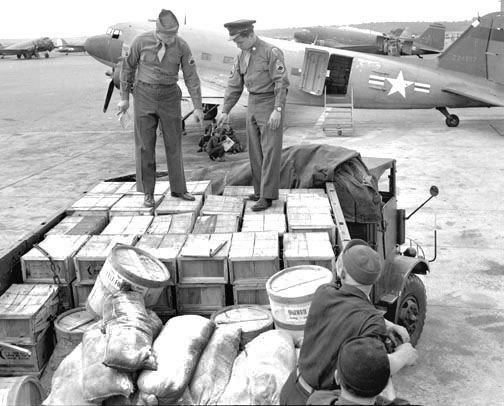
However, the airlift continued months afterward as a buffer against any further Soviet ploy. By operation’s end — September 30, 1949 — more than 2.3 million tons of supplies had been lifted-in and a world crisis averted.
For Powell, its success, along with rebuilding Europe, were America at its best. “We’re an amazing country. Sometimes we have a veritable uncanny propensity to do the right thing. It brought into rather sharp relief just what could be done. In my humble opinion the United States, between 1945 and 1950, could be compared to ancient Greece under Pericles. It as a golden era. We did virtually everything right and you can’t do that without leadership. We were deep in leadership after the war.”
He says the feeling in America then — “that everybody was in this together” — is hard for young people to understand. “Now, we’re so disparate. Everybody’s off doing their own thing. But I still put my faith in the willingness of the American people to do the right thing…given the right leadership.” The airlift’s legacy, he says, is the goodwill it generated. “Civic-minded Germans formed the Berlin Airlift Foundation to take care of the wives and children of the airmen killed in the lift.
When he joined other vets in Berlin last May he spoke with Germans who vividly recalled the airlift. “They all mentioned the omnipresent noise. One lady told us, ‘It didn’t bother us because we knew if the noise continued we would eat.’ He adds the warm outpouring of gratitude got him “a little choked up. We made generations of friends there.” He says if there’s any heroes in all this, it’s “the people of Berlin, because they could have very easily gone to the Soviet sector and been fed and clothed. No question. They were down to 1,200 calories a day but chose to stay and stick it out. These people sought self-determination.”
After the airlift Powell was set to study law when the Korean War erupted. He spent 21 more years in the service, moving from place to place “like a locust.” Posted in France during the ‘60s, he became a certified Francophile — enamored with the nation’s history, culture, people. He’s often returned there.
Along the way he married, raised a family (he has three grown children) and indulged a lifelong search for knowledge by reading and studying. He describes himself then as “a kind of journeyman” scholar. That all changed in 1964 when plans to join an F4 Phantom squadron off the coast of Vietnam were scuttled and he was assigned instead to Offutt Air Force Base.
Here, he finally stayed one place long enough to earn a degree (in business administration from Bellevue University). And here he’s remained. His post-military career saw him remake himself as an authority on public policy and aging issues, earning a master’s in public administration and a Ph.D. in political science. UNO hired him in 1973 to implement training programs under the Older Americans Act.
As a full professor today he teaches courses, advises students and collaborates with colleagues on
articles, surveys and studies. He’s applied the public service mission he took from the airlift to serve political campaigns, advise local and state government and participate in White House conferences on aging. Both his life and work dispel many myths about aging.
“We feel it’s wonderfully appropriate to have a 78-year-old teaching younger people all older people are not alike,” says James Thorson, UNO Department of Gerontology Chairman. “Dr. Powell is an excellent instructor and accomplished researcher. He’s wildly popular with students. He works long hours. He wants to wear out, not rust out, and I respect him for it.”
It was at UNO Powell met Betty. Both were recently divorced. He was teaching, she was doing grad work. They married in 1982. Everyone agrees they make a good match. They travel together and enjoy entertaining at their sprawling Keystone neighborhood home, where he often holes up in a study whose impressive library is stocked with volumes on American history (the presidents, the Civil War) and France. Travel is no idle pursuit for him. He researches destinations and prepares itineraries detailing sites and themes, from architecture to art to vineyards. He got in the habit in the service.
“It permits you to observe how other people do things and to see Americans don’t have a corner on how things are done.”
The couple prove growing older doesn’t necessarily mean slowing down. In typical fashion he and Betty plan ushering in the new millennium under the Eiffel Tower in Paris. “I’m really looking forward to it,” he says. In his office hangs an enlarged photo of the French landmark with an inscription that sums up his ageless sense of wanderlust: “Paris is like a lover. You may leave her, but you will never forget her.” It’s the same way with Chuck Powell: Once you meet him, you never forget him.
Related Articles
- Causes, Reasons and Results of the Berlin Airlift (brighthub.com)
- Trail of the unexpected: Tempelhof Park, Berlin (independent.co.uk)
- James Rodney Ferrell, 90 (kitsapsun.com)
- History: The Berlin Airlift (americanthings.wordpress.com)
- How much supplies did Berlin Airlift receive (wiki.answers.com)
- Candy Bomber: The Story of the Berlin Airlift’s Candy Bomber: The Story of the Berlin Airlift’s “Chocolate Pilot” by Michael O. Tunnell (alleganylibrarycollections.wordpress.com)
Bill Ramsey: A Korean War Story

Image via Wikipedia
Journalists look for hooks to hang their stories on, and anniversaries of major events are always convenient pegs to use. On the 50th anniversary of the Korean War I profiled the combat experience of Bill Ramsey, an amiable man who made a rich life for himself after the conflict as a husband, father, PR professional, and community volunteer. He has devoted much of his life to veterans affairs, particularly memorializing fallen veterans. He’s also authored a handful of books. He’s still quite active today at age 80. Anyone who survives combat has a story worth repeating, and it was my privilege telling his story in the New Horizons. Now, in conjunction with the 60th anniversary of the Korean War, I offer the story again as a tribute to Ramsey and his fellow servicemen who fought this often forgotten conflict.
Bill Ramsey: A Korean War Story
©by Leo Adam Biga
Originally published in the New Horizons
Fifty years ago, Americans were piecing their lives back together in the aftermath of World War II when the best and brightest of the nation’s youth were once more sent-off to fight in a distant land. This time the call to arms came in defense of a small Asian nation few Americans were even aware of then — Korea. In June of 1950, Communist North Korean forces (with backing from the Soviet Union and Red China) launched an unprovoked attack on the fledgling democratic republic of South Korea, whose poorly prepared army was soon overrun. With North Korea on the verge of conquering their neighbors to the south, the United States and its Western allies drew a line in the sand against Communist expansionism in the strategically vital Far East and led a United Nations force to check the aggression.
Among those answering the call to service was a tall, strapping 20-year-old Marine reservist from Council Bluffs named Bill Ramsey. His wartime experience there became a crucible that indelibly marked him. “The war will always be the most defining experience in my life,” said Ramsey, 70, whose full postwar years have included careers as a newsman, advertising executive and public relations consultant. He and his wife of 46 years, Pat, raised five children and are grandparents to 14 and great-grandparents to one. This is his Korean War story.
In the fall of 1950, Ramsey was preparing to study journalism at then Omaha University. His plans were put on hold, however, with the outbreak of hostilities overseas. He followed the unfolding drama in newsreel and newspaper accounts, including the U.S. rushing-in army divisions grown soft from occupation duty in defeated Japan. The invaders pushed South Korean and American forces down the Korean peninsula. Ramsey sensed reserves might be recalled to active duty. He was right.
He was assigned a front line unit in the 5th Marine Regiment, 1st Marine Division, Reinforced. He was excited at the prospect of seeing action in a real shooting war, even one misleadingly termed “a police action.” His anticipation was fed not by bravery, but rather heady youthful zeal to be part of the Corps’ glorious tradition. The conflict offered a once-in-a-lifetime opportunity to test himself under fire. After all, he was too young to have fought in his older brother Jack’s war the previous decade. This would be his war. His proving ground. His adventure.
“I wanted to be in the front lines. I didn’t want to go all that way to end up sorting letters in Pusan,” he said. “I was curious to know how I would hold up in action.”
No stirring salute or fanfare saw the Marines off as their Navy attack transport ship, Thomas Jefferson, pulled out of San Diego harbor in March 1951. Ramsey was one of hundreds of young men crammed in the hull. They had been plucked away from factories, offices, schools, homes and families. Ramsey left behind his mother, brother and an aunt (his father died when he was 12). The GIs were going to defend a land they did not know and a people they never met. Their mission lacked the patriotic fervor of WWII. There was no Pearl Harbor to avenge this time. No, this was a freedom fight in a growing global struggle for people’s hearts and minds.
Before ever setting foot on Korean soil, Ramsey smelled it from aboard ship in the Sea of Japan. Nearing Pusan harbor in the far southeastern tip of Korea, the heavy acrid odor of the war-ravaged countryside permeated the air. It was the stink of sulfur (the discharge from spent armaments), excrement (peasant farmers used it as fertilizer in their fields), fire and death. “That all mixed together made for quite a pungent odor,” he said. “It’s a stench that you never forget.”
Ramsey and his Able Company comrades were flown into a staging area near Chunchon in east-central Korea to await transport to the front. The city had sustained heavy damage. “It was pretty well leveled at that point,” he recalls. Standing on a wind-swept tarmac, he saw snaking down a road from the north a convoy of trucks carrying combat-weary GIs being rotated out of the line. These were veterans of the famous Chosin Reservoir Battle who defied all odds, including numerically superior enemy forces, to complete a withdrawal action that featured hand-to-hand combat. Ramsey and his green mates were their replacements.
“I remember when they got off the trucks they looked like zombies. Their faces were covered with a fine white powdery dust and their hands were blackened from the soot of the fires burning everywhere in the country,” Ramsey said. “I thought, ‘God, I’d give anything to have gone through what they’ve gone through and to be going home.” Among the dog-faced vets was a friend, Phil O’Neill, from Council Bluffs. “He tried to tell me what it was like. He didn’t exaggerate or try to make it any scarier than it was. He didn’t fool around or joke. He just gave me some good advice, like keep a low profile and keep your weapon dry.” After seeing and hearing what awaited him, Ramsey felt an overpowering desire to join the departing GIs. “They were going home. That really hurt. I was so envious.”

Ramsey’s unit headed for a position along the central front. Every village and field they passed was scarred and charred. “We drove all night. We could see fires burning. Again, we could smell the countryside,” he said.
Movement was the order of the day in a war of quickly shifting positions along the long and narrow Korean peninsula. “It was a very fluid war. We were moving constantly, sometimes by truck and sometimes marching 20 or 30 miles in a day to the next spot,” he said. Rough mountainous terrain, bad roads and inclement weather — marked by extreme temperatures, torrential rains, floods, snow and ice — made the going tough. “The farther north you go the more mountainous it becomes. You always had to go up a hill or some rocky face. No flat open fields. This was trees and rocks and cliffs. A really difficult place.” While he never had to endure the brutal winter, he described conditions “as miserably cold. And when it rained, which it did a lot, you were soaking wet, cold and knee-deep in mud. You thought you could never get through it, but you kept going.”
When his company first arrived, U.N. forces were striking out in a series of bold counteroffensives. By the summer, the war was bogged down in a stalemate. A single position (invariably a hill) would be taken, lost, and retaken several times. “It was pretty much hill by hill,” Ramsey said. Platoons were like firefighters rushing from one hot zone to another. A hundred yards or less might separate opposing forces. The basic objective was usually capturing or holding a perimeter on one of the endless sharp-edged ridge lines. Upon reaching a position, the Marines set-up machine gun posts and prepared cover by digging fox holes. Not only did the metal shards from incoming mortar and artillery pose threats, but splintered rock made deadly projectiles too. “
You always had to get some protection for yourself from shrapnel,” he said. Sleeping accommodations were standard-issue pup tents or makeshift bunkers (for extended stays). “Most of the time you stayed one night or two nights and then walked to another position, where you’d dig another hole.” The premium was on moving — no matter what. “You have aching feet. A sore back. You’re tired, discouraged. You’re cold, dirty. You’re sick (dysentery, encephalitis, etc.). But you can’t stop. You’re there, you’re on the move and there’s no way out unless a doctor says you just can’t go on and sends you to the rear.”
On rare occasions when his platoon remained in one spot, barbed wire was strung across the perimeter. The men had to be on constant alert for all-out charges or smaller probing raids looking for weaknesses in the line. “A lot of times they were through the position or in the position. They weren’t always stopped at the wire,” Ramsey said. Nightfall was the worst. The enemy preferred attacking then by frontal assault or flanking maneuvers. To keep a sharp defensive perimeter, men took turns sleeping and watching — two hours on and two hours off — through the night. “You never let your guard down. We were always ready,” he said, adding that the last two years of the conflict it got to be “almost like trench warfare.”
His first taste of combat came early in his hitch. His platoon was dug in for the night on some anonymous ridge line, the men extra wary because reconnaissance had spotted enemy massed nearby. “We were told the Chinese were going to be coming in some force. It was pretty hard to sleep anyway, and anticipating my first night under fire made it that much harder. Sure enough, they came that night. I remember a lot of noise. Mortars. Shots. All that firepower. I remember thinking, “I would love to be able to cram myself inside my helmet.” I somehow got through that night. The next morning they brought in some of our killed. They were in ponchos — their feet sticking out. They were carried down the hill.”
Sometimes, a noise from somewhere out in the pitch black warned of encroaching danger. Other times, a fire fight broke loose with no warning at all. “You would hear something or you would sense something. You laid down fire if you heard anything at all out there. Their movements might trigger a flare, which made it easier for you to see them moving but also made it easier for them to see you,” he said. “On occasion, they would purposely make some noise to try and shake you up. They would produce some tinny sound or blare a bugle or just shout out. It was a psychological ploy.” A dreaded eerie sound was the “zzziiippp” made by the infamous Chinese burp gun, an incredibly fast-firing tommy gun-like weapon.
Perhaps the most terrifying action he saw came the night his outfit’s position was nearly overrun. What began as a cold damp day worsened after sunset.
“We got to our positions pretty late that night. It was raining. We dug in as fast as we could. We’d been in quite a few fire fights in the days preceding that. We thought with the weather this might be one of those nights when the enemy didn’t do anything. We were wrong,” he said. “Our machine guns started firing, and when you heard those you knew they were coming. A few of the enemy broke through our position and came right in the camp. I was quite shocked. We’d never had that before. I saw them through flashes of fire. It was very confusing. A real nightmare. We finally pushed them back.”
There were casualties on both sides. Ramsey said the enemy took advantage of the night, the rain and his unit’s complacency. “They knew Americans were not that big on night fighting and that with the bad weather we might be more inclined to worry about staying dry than steeling for attack. I think what happened is somebody in our ranks did let down. That was the only time they got in our camp that way.” He said an enemy breaching the wire could “demoralize” the troops and, if not repelled, result in a much larger breakthrough.
He described “plenty of close calls” on Able Company’s grueling march north across the 38th Parallel to engage the Chinese in the Iron Triangle stronghold. There was the omnipresent threat of mortar and artillery fire. If you stayed in the field long enough, he said, “you could hear the difference in the sound” and distinguish mortars from artillery and what size they were. Where a mortar round or artillery shell whistling high overhead gave men time to find cover, the report of the Chinese mountain gun, which fired shells in a low trajectory, allowed little or no time to hit the dirt. “You heard the report and, BOOM, it was right there. It fired in on like a straight line.” And there was occasionally the danger of friendly fire, especially errant air strikes, raining hell down on you.
Fording the streams that flowed abundantly from the mountains in Korea presented still more hazards. As heavily weighed down as the men were with their poncho, pack, boots, rifle, helmet, and ammunition, one slip in crossing the clear, fast-rushing streams (more like surging rivers) could be fatal. “A few times I felt like I was going under for sure,” Ramsey said. “I wouldn’t have had a chance.” Carrying their rifles overhead to keep them dry, the men were sitting ducks for snipers. “We were exposed,” he said.

Once, he recalls his platoon just making it to the far bank when shots began splaying the shore from the hill above. “We couldn’t see too much because it was fairly steep. We finally did draw fire on this hill.” But when Ramsey got ready to fire his M1 rifle, he got a rude surprise. “I pulled the trigger and nothing happened. That was a terrible feeling. In all that sloshing through the water my weapon must have got wet. I used a wounded buddy’s carbine instead.”
A fire fight Ramsey will never forget erupted when his 1st squad was returning to the lines after completing a mission and saw the point squad ahead of them “get hit” in an ambush of machine gun fire. Several men were cut down in the ensuing action, including 1st’s squad leader and Ramsey’s good friend — Don Hanes. “He was shot in the chest. Another fellow and I went back up this hill to get him. The fire was really intense. I was amazed we weren’t all killed on the spot. We started taking him down and Don looked at us and said, ‘No, no, no, no, no…Just leave me. You’ve got to get out of here. I’m not going to make it.’ He was a brave fellow. He was hurt so badly. Well, we did get him out of there — across an open rice paddy. He was evacuated to a hospital, but it turned out he was mortally wounded. He died later. We had a number of other casualties we carried too. It was a grim day.”
At 20, Ramsey was named temporary squad leader. He already led a four-man fire team. In addition to M1s, the team carried a single Browning Automatic Rifle or BAR. Their mission: flushing out the enemy or scouting enemy lines. Sometimes, they ran sniper patrols. If the enemy was sighted (with the aid of a sniper scope), the team’s job was to “throw some fire in” and try to pick-off or pin down targets. “We wouldn’t necessarily hit them all the time,” he said. Days or weeks might pass without enemy contact. Once, Ramsey came face-to-face with his foe. It happened when taking a hill. He and another Marine surprised a North Korean soldier. “We both fired at him, and he fell dead. We went over to where he was lying on his back. There was a pouch. We opened it and found a photo of a woman and a child. I thought, ‘He’s just like me.’ We had been thinking of the enemy as a bunch of faceless fanatics, and here was a man with a wife and child. It made an impact.”
By November 1951, Ramsey had been in-country eight months. Despite steady combat, he’d escaped unscathed. He hoped his luck held out just a few months more — then his hitch would be up and he’d be back stateside. “You see people dropping everyday. You see friends maimed and killed. You see guys going out of their head. You wonder when your number’s going to come up next. You ask yourself, ‘How can I ever get out of here?’ It’s a sinking feeling,” he said. He feels what keeps men going in such awful conditions “is your intense desire to survive and to see your loved ones again. That kept me driving.”
On the morning of November 17, his fire team “headed out on a routine sniper patrol” down Hill 834. “It was one of our more permanent lines. The hill was a muddy mess. We weren’t out long when one of us tripped a land mine, and a piece of shrapnel caught my right arm.” The impact sent Ramsey skidding face down the hill. “I was in shock, but I knew it was pretty bad because my dungaree jacket was shredded and blood was all over the place.” Metal fragments had severed his ulnar nerve and fractured bones. His mates brought a Navy corpsman to his side. The corpsman applied a bandage and administered a shot of morphine. Ramsey’s buddies then carried him up the hill and down the reverse slope to a small, level clearing. There, a second casualty from down the line was stretchered in — missing a foot. Ramsey recalls an officer giving him a cigarette to drag on and saying, “You got a million dollar wound there, Bill…you’ll probably be going home.” Still, Ramsey worried he might lose his shattered arm, which burned with pain. A helicopter evacuated he and the other casualty to a nearby MASH unit.
Rushed into surgery, Ramsey awoke the next day to the news doctors had saved the arm. Wearing a cast, he was taken (by ambulance) to an Army hospital in the devastated capital of Seoul. “There was nothing standing,” he said. From there, he was flown (on a transport plane stacked with wounded) to an Army hospital in Osaka, Japan, spending days in agony (receiving no treatment as a non-Army patient) before transferred (via train) to a Navy hospital in Yukosuka, where he finally found some relief for the pain and slept for the first time in nine days.
In early December he hopped a four-engine prop bound for the states. He landed at Travis Air Force Base in southern California. His first impulse was to call home. He next reported to Oak Knoll Navy Hospital near Oakland, where he underwent skin grafts and three months of physical therapy. During his rehab, the Purple Heart recipient recalls being torn by two emotions: “I felt sick about leaving and letting my buddies down. But the other side of it was I was really thankful to get out. Eight months there was enough.” His long voyage back ended almost a year to the day his Korean odyssey began. A relieved Ramsey arrived to “the quiet of my wonderful home.” He downed a beer and thanked God the journey was over at last.
Upon his return (he graduated from Creighton University) he was dismayed by the indifference civilians expressed toward the raging conflict. From its start in June 1950 to its conclusion three years later, it never captured the public’s imagination. Many observers feel it came too quickly on the heels of World War II for Americans — then preoccupied with living the good life — to care. Cloaked under the murky misnomer “police action,” it became a shadow war.

President Harry S. Truman summed up the national mood when he called it “that dirty little war.” Its status as “the forgotten war” was sealed when it ended not with victory but an armistice leaving Korea still divided at the 38th Parallel (with a permanent American military presence there to keep the peace.) Lost on many was the fact the true objective — preserving a democratic South Korea — was accomplished. In the larger scheme of things, a free South Korea has emerged as a thriving economic juggernaut while a closed North Korea has withered in poverty. Ramsey saw for himself the economic miracle wrought in South Korea on a 1979 trip there. He met a people grateful for his and his comrades’ sacrifices. Monuments abound in recognition of the U.N. “freedom fighters.”
It is only recently, however, these veterans got their due in America. In 1995 the Korean War Memorial was dedicated in Washington, D.C. (Ramsey was there). In the late ‘70s Ramsey, whose post-war life has been devoted to causes, spearheaded the erection of a joint Korean-Vietnam War monument in Omaha’s Memorial Park. The monument has received a recent refurbishing and the addition of a flower garden. This year, he started a Nebraska chapter of the National Korean War Veterans Association.
For vets who went to hell and back, the war is never far from their thoughts. “I’m proud to have served. We stood fast. We saved the south. I can think of no higher compliment than to be called a freedom fighter,” said Ramsey, who, in 1997, faced a new enemy — prostate cancer. Aggressive treatments have left him cancer free. In August, he attended a reunion of his 1st Marine Division mates. “My admiration continues to grow for the Marines with whom I served,” he said. For their heroic actions there, the division received the rarely bestowed Presidential Unit Citation.
Related Articles
- Korean War veterans reunite to share memories (knoxnews.com)
- Legacy of the Korean War (theworld.org)
- The Korean War 60 years on: Images from the conflict (independent.co.uk)
Lauro play “A Piece of My Heart” dramatizes role of women in war zones

Image by cliff1066™ via Flickr
This is a story I did about a play whose subject matter brought me into contact with some women who fulfilled various capacities during wartime service, whether as nurses or USO performers. The women I interviewed are sort of the real-life equivalents of some of the characters in the play.
The story originally appeared in The Reader (www.thereader.com), and I hope you find the words of the women, fictional and nonfictional alike, as gripping as I did.
Lauro play “A Piece of My Heart” dramatizes role of women in war zones
©by Leo Adam Biga
Originally appeared in The Reader (www.thereader.com)
As U.S. military action in Iraq unfolds, old war stories take on new capital. With women now on the front lines, their wartime roles gain added import. While their presence on the battlefield is new, American women have participated on the sidelines of war — as nurses, clerks, reporters, missionaries, performers — for generations, only their legacy seems lost in the heat of combat.
But since the 1993 dedication of the Vietnam Women’s Memorial in Washington D.C., a bronze sculpture by artist Glenna Goodacre of three fatigue-wearing females comforting an injured soldier, women have begun writing and talking about their wartime service as never before, the fruits of which can be seen in the acclaimed play, A Piece of My Heart, running now through April 27 at the Blue Barn Theatre.
Playwright Shirley Lauro based the characters of her impressionistic drama on interviews with real-life veterans, including those profiled in a book of the same name by Keith Walker. Lauro uses fast-moving vignettes to tell the larger story of American women in Vietnam. The six women characters represent varied backgrounds, roles and attitudes. There are military nurses, from stalwart Martha to sweet young Sissy to flower child Leeann. There’s the aristocratic Red Cross “donut dolly” Whitney. There’s the hard-ass intelligence officer Steele. And the playful, soulful USO trouper MaryJo. Whether sewing sutures, spreading cheer or performing on stage, they are angels of mercy for soldiers trapped in a hellish quagmire.
The women cope with laughter, tears, booze, pot. Some erect “the wall.” Others fool around. The nurses regret not knowing what happens to the boys whose bodies they patch up and spirits they boost. They fear no matter how many lives they save or how many smiles they elicit, they never do enough. Then, when their wartime service is over, they return home as forgotten as their G.I. brothers, wanting to put the war behind them but finding they can’t.

Even though each character tells her own story, they really all speak in one voice about the shared female experience of being thrust into the surreal, carnage of war. Regardless of where they hailed from or did their tour or what job they held or beliefs they espoused, they were all volunteers who elected to go there.
“The common ground we had, which is why I felt so strongly about honoring these women, was that not a single one of us had to be there,” said Diane Carlson Evans, a veteran in-country Army nurse who spearheaded the creation of the women’s memorial. “We were not drafted. We were not conscripted. Nobody put a gun to our head and said, Go to Vietnam and do your duty. We could have stayed home, got our master’s degree, had our kids, played golf and tennis and had a good life. But every one of us — Red Cross, military, USO — said, I want to do my part, and did during a very unpopular war. We didn’t have a lot of support from home, from peers or from our country…We just thought it was the right thing to do.”
Evans, who made remarks before the Blue Barn’s April 5 show, used her appearance to givr tribute to “the diverse contributions women made” in the war. “I am proud of the women I worked with and how hard I saw them work and how they asked for nothing in return. It was always, Do I need to give blood? Or, Can I work an extra shift? It was that always going above and beyond and never complaining because we had a job to do. I saw how these women saved lives at the risk of their own. And I just believe so strongly they deserve credit from a grateful nation. A grateful nation that needs to acknowledge they participated in a really extraordinary way.”
The story of women’s wartime service is, for many of us, unknown. “I’m just so glad this story’s being told because I lived through Vietnam and I didn’t hear nothing about the nurses…not a thing,” said Omaha actress Phyllis Mitchell-Butler, who portrays Steele. “The nurses went through as much as any of the soldiers. They saw the devastation first-hand. I’m just amazed how long they kept themselves together with all that inside them. All they had was what was inside and they had to keep that. They couldn’t let it go.”
In her role as state commander of the Nebraska Council of Vietnam Veterans of America, Dottie Barickman, who served at Offutt Air Force Base in the Vietnam era, has come to appreciate what women did in that war.
“I’ve never walked in their shoes, but I’ve heard their stories and I understand what they mean when they say they sacrificed their youth and their emotions. They were the nurturing ones for a lot of young boys hurting over there. Combat soldiers always mention to me that if they ever saw a nurse it was like Welcome Home, and that is what these women were…a touch of home that took them away from that war zone for a few hours.”
The stories in A Piece of My Heart echo those of thousands of women that served in Nam or nearby environs. Diane Carlson Evans is one of them.
“I was 21…right out of college…and I was assigned first to the 36th Evacuation Hospital in a beautiful place (Vung Tau) right on the South China Sea beach. I didn’t feel the war there as much as I did when I was transferred up north…to Pleiku, in the central highlands jungle near the Cambodian border,” Evans said. “I was with Two Corps supporting the 4th Infantry Division (in the 71st Evacuation Hospital).
“The war was very different there. It was the spring of ‘69…a pretty bad time. The 4th Infantry had something like a 75 percent casualty rate. I was made head nurse in a post-surgical unit where the patients were very sick. We had them on respirators and blood transfusions and chest tubes. It was very hard to see so many young men with such horrific wounds. We had to deal with patients dying on us and, in triage, we had to deal with setting aside dying patients to attend to the most salvageable ones. We blamed ourselves. We carried the guilt. And we were young…and so on our little time off we filled our days in human ways, whether it was playing volleyball or getting drunk or doing drugs or going on dates or falling in love.”

Playwright Shirley Lauro
In addition to the stress of dealing with crushing trauma patient loads, the threat of death was ever near. “Pleiku was not a safe area. We were under attack many times. We got to know the difference between the outgoing artillery and the incoming rockets and mortars that would fly in and hit our hospital, sending shrapnel everywhere. We were not only worrying about our patients — we had concern for our own safety,” said Evans, a Helena, Montana resident.
Since getting the Vietnam women’s memorial installed, Evans, whose efforts to make it a reality took 10 years, has become THE champion for female volunteers in that conflict, focusing her efforts on “encouraging women who served to share their stories…so we can understand what the memorial is all about.”
She helped start a storytelling program at the memorial site and on the web that invites women to speak their piece. She said telling it like it was is “very painful. It takes a lot of courage for women to admit how scared they were some young soldier was going to die on their watch or how they were so tired they could have made a mistake or how they were sexually assaulted or harassed. All of this anger and anguish comes out in the play.”
An admirer of the Lauro work, which had its debut in Philadelphia and has been performed across the country, Evans feels it gets to the heart of women’s Vietnam odyssey. “It does not show our service through rose-colored glasses — that we were all these heroic young women who went off to save the world and wore white halos — but instead it shows we were young women who went to Vietnam and did the very best we could amid all this crazy stuff going on. That’s what makes it very real, very authentic.”
As the war in Iraq rages on the director of the Blue Barn show, Susan Clement-Toberer, feels the conflict lends the play added urgency.
“Knowing that it’s happening now it brings it all very close and deepens everything we’re doing,” she said. “It’s real, just like the stories of these women are all real…taken from a myriad of interviews with different women.”
Cast member Erika Hall, who plays the USO entertainer, said, “You know, before it was important to do this piece, and now like it’s necessary.” Most of the cast and crew are too young to remember the war and therefore have immersed themselves in it via books, articles and tapes and by talking to actual veterans.
“What an interesting learning experience this is for me,” Hall said. “I was born after Vietnam and, you know, you read about it in school but you don’t really understand what they (vets) went through.” In her own research Clement-Toberer said she was surprised to learn “the extremes the women survived. I knew Vietnam was a dirty war, but I just didn’t realize they (the women) saw such extremes so quickly. I understand now why these women went and what they mean by honor…they believed in their country. It’s just a very strong feeling in what is right and what is true and what needs to be told.”
The characters have real-life counterparts in Nebraska. Lincolnite Judy Knopp, a former Army nurse at Camp Zama, Japan, treated G.I.s choppered in from Vietnam; Martel native and longtime Lincoln resident Brenda Allacher toured Nam as a member of the all-girl country-western band The Taylor Sisters; and Marie Menke of Superior, Neb. was a fellow Army nurse with Diane Evans at the 36th evac in Vung Tau, regarded as an in-country R & R site except for the grueling recovery and care that went on there. For vets like these, Vietnam seared into their memories and hearts the best and worst of humanity.
“I joined the Army nurse corps and in six weeks did my basic training at Fort Sam Houston and went straight to Japan…Camp Zama, 35 minutes southeast of Tokyo and an hour by chopper from Saigon. I was charge nurse in the orthopedic ward of a 1,000 bed hospital,” Knopp said. “Back then, we had to make our own IVs and pump our own blood and everything. After the Tet Offensive we were working 12 hour shifts, seven days a week. They used to call us the zombie squad. We didn’t even eat. We went home and slept…then came back. We’d have 30 to 40 evacs a day…20 to 30 surgeries a day, just on my ward. One-half of our cases were dirty wounds…shrapnel wounds or single and multiple amputees. Guys with half their faces blown off. One young man I especially remember…Billy. He was 18. He’d stepped on a land mine and everything was gone from the belly button on down. He was unconscious. We were pumping him full of blood. You wanted to save him but…you wanted him to go, too, because there was no way he could live.
Brenda Allacher
“The guys, they were so young. They used to call me grandma and I was 22. They were all like little brothers. We used to stay up with the guys at night who were crying over having killed women and children. They had a real hard time dealing with what went on over there and the stuff they had to do to survive. A lot of ‘em came back injured and a lot of ‘em we never saw again. We never knew what happened to ‘em. The ones going back to the states we’d iron their uniforms, sew on their patches and go to the chopper to kiss ‘em goodbye. I have very fond memories of the guys and just atrocious memories of the wounds.”
She still regrets how, when her ward was busy, “there was no time for dignity with death…to get patients prepared and stay with ‘em and see ‘em through it. It was like, OK, this one’s dead, clean out the bed…there’s another one coming in.”
A Piece of My Heart cast members marvel at what women like Knopp endured at such a tender age. “They all have stories of their first day…just like in the play where my character takes off a soldier’s boot and his severed foot is in it,” Christine Schwery said. “They were so fragile and so young and yet they survived,” Julie Huff said. “With a lot of alcohol and a lot of drugs,” Schwery chimed in. “Yeah, but they survived and they saved a lot of lives,” Huff added.
Riverdale, Neb. native Marie Menke, then Daake, was a 22-year-old nursing school grad when she got to Nam. Nothing could prepare her for what she saw:
“I was pretty naive about the war. It was very shocking to most of us to see the kinds of wounds and the tragic loss of life,” she said. “It just shouldn’t be. My thoughts about the war didn’t matter because we were there and people were getting hurt and we had an enormous job to do. We were tremendously needed. It was beyond comprehension almost. The nurses did do a lot but most of us downplayed it. We were just there to do our job and to take care of patients and to support them.”
Besides caring for American G.I.s, nurses treated Vietmanese, including children.
An estimated 265,000 American women service in support of the war. U.S. Army estimates place the number in-country between 10,000 and 12,000. Most were nurses, either Army or Marine enlistees or even civilians attached to field hospitals or more rear echelon units. American Red Cross volunteers were so-called “donut dollies” — a sort of comfort girl corps boosting morale with their short-skirts, smiles and care packages. Others were entertainers touring under the auspices of the USO or, like Brenda Allacher, as contract entertainers via private booking agencies that provided minimal security and scant creature comforts.

Blue Barn Theatre’s Susan Clement Toberer
Allacher, then known by her stage name Brenda Allen, got to see a lot of Nam during her three-and-half month tour in ‘69. She has bittersweet memories of her time in Chu Lai, a central coastal area manned by the Americal Division:
“That was one of our favorite places because we had privacy taking a shower. I remember the commanding officer, ‘Big Daddy’ Richardson, said, ‘I’m going to work your butts off, but when you come back at night your favorite food and drink will be sitting in front of you.’ And it was, too. Lobster and blackberry brandy and Cutty Sark scotch. We’d do five and six shows a day for that man,” she said. “The men, they just wouldn’t let us quit and we weren’t about to leave those boys. The guys were just absolutely beautiful. They called me ‘Crazy Legs’…I’d do wild dancing and kick my legs up. They just went bonkers.
“We’d come back exhausted. One night, we’d come back from a show and a few of us were in the officers club drinking when there was a loud CLAP and the building just shook. A G. grabbed me and threw me down under the bar.” It was the start of a prolonged mortar attack. “We took 16 rounds over a period of four or five hours. We just laid there on the floor and got drunk. I was so scared. Around daylight a young man came running in, shouting, ‘They got a nurse at the 312 Surg-Evac,’ which was like a block away.”
The victim, 1st Lt. army nurse Sharon Ann Lane of Canton, Ohio, was the first Army nurse to die under hostile fire in Southeast Asia and one of 68 American women in all — military and civilian — to die in the conflict. The incident shook Allacher to her core.
“What really gets me is it very easily could have been me, and not her.” she said. She recalls happier times there, too, like when the Taylor Sisters did an impromptu show for Nebraska National Guard troops, leading off with “There’s No Place Like Nebraska.” “The tin roof went off on that quonset hut. They just went nuts.” Or when she was secreted away to give a private performance for some special ops forces who, upon her finishing, “lined up and saluted me” she said tearfully. “As I was walking out, the commanding officer placed his Green Beret on my head.” She still has it. “I wouldn’t trade those experiences for anything.”
Allacher and Knopp have made the recognition of women’s work in Vietnam a personal mission. Together eith Evans they are featured in a NETV documentary, Not On the Frontline, that follows their story from the wartime service they rendered to the emotional “culmination” of seeing the women’s memorial dedicated, something Knopp worked for as state coordinator of the project. More recently, Allacher, who describes herself as “a straight shooter…full of piss and vinegar,” was instrumental in bringing A Piece of My Heart to the attention of local theaters. She and her big booming laugh have become fixtures at the Blue Barn.
For Allacher, Knopp and Evans, the stories told in the play and documentary are part of the healing that’s taken place after the war. Acceptance of women’s service has come slowly, even as they have died alongside their veteran brothers from Agent Orange-related illnesses and have suffered from post-traumatic stress disorder.
Evans said there was once resistance to honoring women’s war record because “I don’t think people wanted to look at women as warriors — as soldiers. But women are soldiers, too. We fought just as hard as the men. We just fought with different instruments.” Or, as Judy Knopp puts it, “The guys were on the physical front lines, but we were on the psychological front lines trying to hold it all together. And we did it with a loving heart.”
Related Articles
- Woman who says she was nurse from WWII photo dies (dailycaller.com)
- Honouring nurses (bbc.co.uk)
- What did many American Women hold jobs as (wiki.answers.com)
- Walking Behind to Freedom, A Musical Theater Examination of Race (leoadambiga.wordpress.com)
Thomas Gouttierre: In Search of a Lost Dream, An American’s Afghan Odyssey

Image via Wikipedia
Thomas Gouttierre’s work with Afghanistan has drawn praise and criticism, moreso the latter as of late given what’s happened there with the war and some of that nation’s top leadership having been befriended and trained by Gouttierre’s Center for Afghanistan Studies at the University of Nebraska at Omaha. The following profile I did on Gouttierre appeared in 1998, long before U.S. involvement there escalated into full military intervention. Regardless of what’s happened since I wrote the piece, the essential core of the story, which is that of Gouttierre’s magnificent obsession with that country and its people, remains the same.
The story originally appeared in The Reader (www.thereader.com).
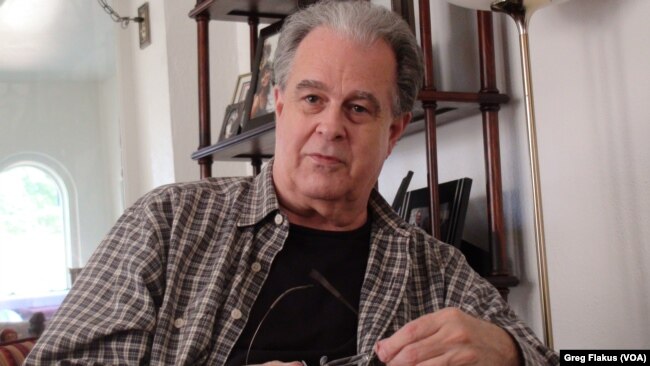
Thomas Gouttierre: In Search of a Lost Dream, An American’s Afghan Odyssey
©by Leo Adam Biga
Originally appeared in The Reader (www.thereader.com)
Like a latter-day Lawrence of Arabia, Omahan Thomas Gouttierre fell under the spell of an enigmatic desert nation as a young man and has been captivated by its Kiplingesque charms ever since.
The enchanting nation is Afghanistan and his rapture with it began while working and living there from 1965 to 1974, first as a Peace Corps volunteer teaching English as a second language, then as a Fulbright fellow and later as executive director of the country’s Fulbright Foundation. His duties included preparing and placing Afghan scholars for graduate studies abroad. During his 10 years there, Gouttierre also coached the Afghan national basketball team. Sharing the adventure with him was his wife and fellow Peace Corps volunteer Marylu. The eldest of the couple’s three sons, Adam, was born there in 1971.
Before his desert sojourn, the Ohio native was a naive, idealistic college graduate with a burning desire to serve his fellow man. When he got his chance half-a-world away, it proved a life transforming experience.
“It’s the place where I kind of grew to a mature person,” he said. “I was there from age 24 to 34 and I learned so much about myself and the rest of the world. It gave me an opportunity to learn well another language, culture and people. I love Afghanistan. It’s people are so admirable. So unique. They have a great sense of humor. They’re very hospitable. They have a great self-assurance and pride.”
But the Afghanistan of his youth is barely recognizable now following 19 years of near uninterrupted carnage resulting from a protracted war with the former Soviet Union and an ongoing civil war. Today, the Muslim state lies in shambles, its institutions in disarray. The bitter irony of it all is that the Afghans themselves have turned the heroic triumph of their victory over the vaunted Soviet military machine into a fratricidal tragedy.
Over the years millions of refugees have fled the country into neighboring Pakistan and Iran or been displaced from their homes and interred in camps across Afghanistan. An entire generation has come to maturity never setting foot in their homeland or never having known peace.
The nation’s downward spiral has left Gouttierre, 57, mourning the loss of the Afghanistan he knew and loved. “In a sense I’ve seen what one might call the end of innocence in Afghanistan,” he said, “because for all its deficiencies, Afghan society – when I was living there – was really a very pleasant place to be. It was a quite stable, secure society. A place where people, despite few resources and trying circumstances, still treated each other with a sense of decency and civility. It was a fantastic country. I loved functioning in that Afghanistan. I really miss that environment. Not to be able to go back to that culture is a real loss.”
Through it all, Gouttierre’s kept intact his ties to the beleaguered Asian nation. In his heart, he’s never really left. The job that took him away in 1974 and that he still holds today – as director of the Center for Afghanistan Studies at the University of Nebraska at Omaha – has kept him in close contact with the country and sent him on fact-finding trips there. He was there only last May, completing a tour of duty as a senior political affairs officer with the United Nations Special Mission to Afghanistan. It was his first trip back since 1993 (before the civil strife began), and what he saw shook him.
“To see the destruction and to learn of the deaths and disappearances of so many friends and associates was very, very sad,” he said from his office on the UNO campus, where he’s also dean of the Office of International Studies and Programs. “Much of the country looks like Berlin and Dresden did after the Second World War, with bombed-out villages and cities. Devastation to the point where almost no family is left unaffected.
“Going back for me was very bittersweet. With every Afghan I met there was such despair about the future of the country. The people are fed up with the war…they so want to return to the way things were. People cried. It was very emotional for me too.”
Everywhere he went he met old friends, who invariably greeted him as “Mr. Tom,” the endearing name he’d earned years before. “In every place I visited I wound up seeing people that I have known for most of my adult life. Individuals that have been here at the University of Nebraska at Omaha – in programs that we’ve sponsored – or people I coached in basketball or people I was instrumental in sending to the U.S. under Fulbright programs or people who taught me Persian and other languages of Afghanistan. So, you know, there’s kind of an extended network there. In fact, it was kind of overwhelming at times.”
Colleague Raheem Yaseer, coordinator of international exchange programs in UNO’s Office of International Studies and Programs, said, “I think he’s received better than any ambassador or any foreign delegation official. He’s in good standing wherever he goes in Afghanistan.”
Yaseer, who supervised Gouttierre in Afghanistan, came to America in 1988 at the urging of Gouttierre, for whom he now works. A political exile, Yaseer is part of a small cohesive Afghan community in Nebraska whose hub is UNO’s Center for Afghanistan Studies. The center, which houses the largest collection of materials on Afghanistan in the Western Hemisphere, provides a link to the Afghans’ shared homeland.
Aside from his fluency in native dialects, his knowledge of Islamic traditions and sensitivity to Afghan culture, Gouttierre also knows many of the principals involved in the current war. It’s the kind of background that gives him instant access and credibility.
“I don’t think there’s any question about that,” Gouttierre said. “The Afghans have a phrase that translates, ‘The first time you meet, you’re friends. The second time you meet, you’re brothers.’ And Afghans really live by that – unless you poison that relationship.”

According to Yaseer, Gouttierre’s “developed a skill for penetrating deep into the culture and traditions of the people and places he visits. He’s able to put everything in a cultural context, which is rare.”
It’s what enables Gouttierre to see the subtle shadings of Afghanistan under its fabled veil of bravado. “When people around the world wonder why the Afghans are still fighting, they don’t realize that a society’s social infrastructure and fabric is very fragile,” said Gouttierre. “They don’t realize what it means to go through a war as devastating as that which the Afghans experienced with the Soviet Union – when well over a million people were killed and much of the traditional resources and strengths of the country were destroyed. When the Soviets left, the Afghans tried to cobble together any kind of government and they were unsuccessful.
“Now they’re trying to put this social-political Humpty-Dumpty back together again, and its just very difficult.”
Under Gouttierre’s leadership the center has been a linchpin in U.S.-U.N. efforts to stabilize and rebuild Afghanistan and has served as a vital conduit between Afghans living inside and outside the country and agencies working on the myriad problems facing it. With nearby Peshawar, Pakistan as a base, the center has operated training and education programs in the embattled country, including a new program training adults in skills needed to work on planned oil and gas pipelines.
Gouttierre himself is a key adviser to the U.S. and world diplomatic community on Afghan matters. He’s served as the American specialist on Afghanistan, Tajikistan and South Asia at meetings of the U.S.-Russian Task Force (Dartmouth Conference) on Regional Conflicts. He’s made presentations on Afghan issues at Congressional hearings and before committees of the British Parliament and the French National Assembly.
And last year he was nominated by the U.S. State Department to serve as the American representative on the U.N. Mission to Afghanistan. “It was quite an honor,” said Gouttierre. “And for me to go back and work among the people again was very appealing and very rewarding.”
The aim of the U.N. mission, whose work continues today, is to engage the combating parties in negotiations toward a just peace settlement. German Norbert Holl, a special representative of the U.N. secretary general to Afghanistan, heads the mission, whose other members are from Russia, Japan, England and France.
On two separate month-long trips to Afghanistan, Gouttierre met with representatives of the various factions and visited strategic sites – all in an effort to help the team assess the political situation. His extensive travels took him the length and breadth of the country and into Pakistan, headquarters for the mission. He talked with people in their homes and offices, he visited bazaars, he viewed dams, irrigation projects and opium fields and traversed deserts and mountains.

Marylu Gouttierre said her husband’s involvement with Afghanistan and commitment to its future stems, in part, from a genuine sense of debt he feels. “He feels a responsibility. It is his second home and those are his people. He’s not only given his heart, but his soul to the country.”
He explains it this way: “Afghanistan has a special place in my professional and personal life and it has had a tremendous impact on my career. It’s been so much an instrument in what I’ve done.”
To fully appreciate his Afghan odyssey, one must review how the once proud, peaceful land he first came to has turned into a despairing, chaotic killing field. The horror began in 1978, when Soviet military forces occupied it to quell uprisings against the puppet socialist regime the USSR had installed in the capital city of Kabul. The Soviets, however, met with stiff resistance from rebel Mujaahideen freedom fighters aligned with various native warlords. Against all odds, the Afghans waged a successful jihad or holy war that eventually ousted the Soviets in 1989, reclaimed their independence and reinforced their image as fierce warriors.
The Afghans, whose history is replete with legendary struggles against invaders, never considered surrender. Said Gouttierre, “The Afghans felt they were going to win from the start. They felt they could stick with it forever. They had a strong belief in their own myth of invincibility…and to everyone’s surprise but their own, they did force the Soviets to leave.”
But the fragile alliance that had held among rival factions during the conflict fell apart amid the instability of the post-war period. “The Soviets left someone in charge who had been their ally in power. That was Najeebullah. His government fell in 1992. That only helped exacerbate things. The cycle of fighting continued as the Afghans who had fought against the Soviet army continued their fight against Najeebullah, who was captured, tried and executed by the Taliban (an Islamic faction) in September of 1996 for his crimes against the Afghans, which were considerable.” Gouttierre knew Najeebullah in very different circumstances before the war, when the future despot was a student of his in a class he taught at a native high school.
After Najeebullah’s fall, a mad scramble for power ensued among the Mujaahideen groups. As Gouttierre explains, “The leaders of these groups had become warlords in their own regions. They kind of got delusions of grandeur about who should be in control of the whole country and they began to struggle against each other.”

In the subsequent fighting, one dominant group emerged – the Taliban, a strict Islamic movement whose forces now command three-quarters of the country, including the capital of Kabul – with all its symbolic and strategic importance. A loose alliance of factions oppose the Taliban.
“As the Taliban (Seekers of Islam) grew in strength, they began intimidating and even fighting some of the minor Mujaahideen commando groups, and to a lot of people’s surprise, they were successful,” said
Gouttierre, whose U.N. assignment included profiling the Taliban. “They are very provincial, very rural – and in their own minds – very traditional Muslims and Afghans. They’re not that philosophically sophisticated in terms of their own religion, but they are very sophisticated in terms of what they understand they want for their society, and they’re able to argue and discourse on it at length without giving any quarter. And they’re willing to go to war over it.
“Each region where they’ve gone, they’ve been aided by the fact that the people living there were disenchanted with those in control. Most of the other groups, unfortunately, lost any credibility they had because of their failure to bring about peace, stability, security and reconstruction. The people were willing to support almost anything that came along.”
The Taliban has drawn wide criticism, internally and externally, for its application of extreme Islamic practices in occupied areas, particularly for placing severe restrictions on women’s education and employment and for imposing harsh penalties on criminals. Gouttierre said while such actions elicit grave concerns from the U.N. and represent major stumbling blocks in the Taliban’s quest for full recognition, the movement has effectively restored order in areas it controls.
“I have to say that in the areas of Afghanistan I traveled to which they control, the Taliban had confiscated all the weapons, removed all the checkpoints people had to pass through, eliminated the extortion that was part of the checkpoints and instilled security and stability,” said Gouttierre. “You could travel anywhere in Kabul without having to be in any way concerned, except for the mines that haven’t been cleared yet.”
Conversely, he said, the Taliban has exhibited brutal politics of intimidation and blatant human rights violations, although other factions have as well. “It’s not a question of who’s good and who’s bad,” he adds. “There’s plenty of blame and credit to be shared on all sides.”


He found the Taliban a compelling bunch. “One of the things I was impressed with is that all of the leaders I met were in some ways victims of the war with the Soviet Union. They all exhibited wounds, and they acquired these wounds heroically carrying out the struggle against the Soviet Union, and I respect them for that. That needs to be taken into account.”
In addition to pushing for a ceasefire between the Taliban and its adversaries, Gouttierre said the U.N. mission consistently makes clear that in order to gain credentialing from the U.N. and support from key institutions like the World Bank, the Taliban must do a better job of protecting basic human rights and ensuring gender equity.
He said the main barrier to reaching a cease fire accord is the Taliban’s nearly unassailable military position, which gives them little reason to make concessions or accept conditions. Another impediment to the peace process is the nation’s rich opium industry, whose interests diverge from those of the U.N. And a major complicating factor is the support being provided the warring factions by competing nations. For example, Pakistan and certain Persian Gulf states are major suppliers of the Taliban, while Iran and Russia are major suppliers of the opposition alliance.
Taliban and opposition leaders did meet together at several U.N. sponsored negotiation sessions. The representatives arrived for the talks accompanied by armed bodyguards, who remained outside during the discussions. The tenor of the meetings surprised Gouttierre. “It was far more cordial than I had anticipated. These men got along remarkably well, in part because they all know each other. That’s not to say there weren’t disagreements. When offended, Afghans can be exceedingly formidable to deal with.”
At Gouttierre’s urging, the mission began holding intimate gatherings at which representatives of the warring parties met informally with U.N. officials over food and drinks and “where translators were not the main medium for communication and where everybody wasn’t on guard all the time.” He hosted several such luncheons and dinners, including ones in Kandahar, Baamiyaan and Kabul. The idea was to create a comfortable mood that encouraged talk and built trust. It worked.
“In diplomatic enterprises often the most effective periods are at the breaks or the receptions, because you’re sometimes able to get people off to the side, where they’re able to say off the record what they can’t say officially. And that’s exactly what happened. Those of us in the U.N. mission got a better sense of who the Taliban are. They’re not irrational. They do have a sense of humor. And they got a better sense of who we are – that we’re not just officials, but that we also have a long-term interest in Afghanistan.”
Gouttierre said the mission has overcome “high skepticism” on the part of Afghans, who recall the U.N. granted Najeebulah asylum despite his being a war criminal. He said the Afghans’ estimation of the mission has moved from distrust to acceptance. And he feels one reason for that is that the present mission has “more clout and recognition than any previous mission to Afghanistan.” Supplying that essential leverage, he said, is the “unstinting support of influential countries like the U.S., France, England, Russia and Japan.”
Despite recent news stories of military inroads made by opposition forces, especially around Kabul, the Taliban remain firmly entrenched. Gouttierre believes that unless a major reversal occurs to change the balance of power, the Taliban will continue calling the shots. If the Taliban eventually consolidate their power and conquer the whole nation, as most observers believe is inevitable, the hope then is that the movement’s leaders will feel more secure in acceding to U.N. pressure.
Gouttierre said that despite the failure to gain a ceasefire thus far, “the fact remains the two sides are meeting with each other, and that’s the first step in any peace process. We don’t have agreements on anything yet, but at least the channels for continuing dialogue have been opened.”
As Gouitterre well knows, the process of binding a nation’s wounds can be frustrating and exhausting. He stays the course though because he wants desperately to recapture the magical Afghanistan that first bewitched him. “I guess one of the things that keeps me at this is that I am ever hopeful that somehow, some way those admirable qualities of Afghan culture which I came to love so much will to some degree be restored. So I keep pursuing that.”
Related Articles
- Afghan president criticizes timeline for U.S. withdrawal (seattletimes.nwsource.com)
- Market bombing in northern Afghanistan town kills 3 police, 2 civilians, wounds 15 (foxnews.com)
- The Challenge of Training Afghan Troops, Police (cbsnews.com)
- An Old Partnership Takes a New Turn: UNO-Kabul University Renew Ties with Journalism Program (leoadambiga.wordpress.com)
- Afghanistan: U.S. Intelligence Failures Led To Civilian Casualties (huffingtonpost.com)
Three old wise men of journalism – Hlavacek, Michaels and Desfor – recall their foreign correspondent careers and reflect on the world today

Image via Wikipedia
As a kid I watched John Hlavacek on a local network television affiliate’s newscasts and documentaries, and as a young man I was aware of him serving on the Omaha City Council, and operating his own travel agency. I vaguely knew that he had been a foreign correspondent. It was only a few years ago though that I met him for the first time and got to know more of his story. He and his late wife Pegge were both reporters in the Golden Age of American journalism. Their life stories of living and working around the world are as amazing as those of the historical events and figures they covered. In the last few years John has had published several books authored by himself and Pegge that recount their adventures. I have also posted the story I wrote about John and Pegge and their adventures, but the following piece is about John and two old reporter friends of his from back in the day. The three men hadn’t seen each other in decades until John arranged for their meeting in Omaha for a panel discussion. I covered the event and wrote this story for The Reader (www.thereader.com).
Three old wise men of journalism – Hlavacek, Michaels and Desfor – recall their foreign correspondent careers and reflect on the world today
©by Leo Adam Biga
Originally appeared in The Reader (www.thereader.com)
They were three young lions of American journalism when they met far from home, a long time ago. John Hlavacek of Carleton College (Minn.) and Jim Michaels of Harvard were green United Press foreign correspondents based in post-World War II India. In wartime Hlavacek trucked medical supplies over the Burma Road for the International Red Cross. Michaels drove an American Field Service ambulance. Each was imprisoned there: Hlavacek for days; Michaels for months. New Yorker Max Desfor covered the war in the South Pacific as an Associated Press photographer.
The paths of these three men crossed in 1946, when their lives-careers intersected with India’s historic bid for independence from British colonial rule. Last spring, they came together for the first time in 60 years with the publication of a book, United Press Invades India, by Hlavacek, an Omaha resident who invited his colleagues to participate in public forums about their intrepid reporting days. The men shared stories and observations during two panel discussions in Omaha.
After being out of touch all that time Hlavacek began the process of reestablishing contact with his old colleagues while working on his memoir. Facts needed checking and where Hlavacek’s memory faltered, he relied on Desfor and Michaels to fill in the blanks. By the time the book was completed, Hlavacek suggested he and his comrades reunite. The men still correspond today.
John Hlavacek
The book that helped bring the old colleagues together was Hlavacek’s second volume of memoirs based on his overseas adventures in India and China, where he taught English in an American mission school in Fenyang as part of the Carleton in China exchange program. Hlavacek now has a third volume of memoirs out, Freelancing in Paradise, that recounts the years he and his wife Pegge, a fellow journalist he met and married in India, filed stories from the Caribbean for national media outlets. He’s also published two books authored by Pegge about her own far flung news career and the couple’s remarkable feat of raising five children while working in India, New York, Jamaica and Omaha.
For Hlavacek and Michaels, now in their late 80s, India began long, distinguished careers in journalism. As bureau chief in Bombay, Hlavacek built up UP’s presence there and under his aegis the news service proved a formidable rival to their bitter rival, the AP. He won what’s now called the Edward R. Murrow Fellowship for study at Columbia University, he covered the Caribbean and after moving with his family in the early 1960s to Omaha, where he was a television news correspondent/commentator, he filed a series of reports from Vietnam on area residents serving in the war.
Michaels got the scoop of a lifetime when he broke the story of Mahatma Gandhi’s assassination in 1948. He joined Forbes Magazine in 1954, was made editor in 1961, a post he held until 1999. He’s credited with turning Forbes into one of the world’s most read financial pubs. A VP today, he can be seen Sundays on Forbes On Fox.
Before India, Desfor already made memorable images: of the Enola Gay crew upon their return from the mission that dropped the atom bomb on Hiroshima; and of the Japanese surrender to the allies on the USS Missouri. Soon after his arrival in India in 1946, he snapped a famous picture of Gandhi and India’s first prime minister, Jawaharlal Nehru, in an unguarded moment of friendship. “You see the interchange, the compatibility, the simpatico. It’s just an enormous moment,” he said. The iconic pic was used as the basis for a popular Indian postage stamp.
Desfor won a Pulitzer Prize for news photos for his work in the Korean War. In all, he shot five wars, many conflicts and much civil strife. He later served as an AP photo executive/editor before retiring in 1979. That same year though he joined US News and World Report as director of photos. He made his 1984 retirement permanent, but he’s till snapping pics, only now with a digital camera. He’s 93.

Max Desfor posed in front of picture taken of himself during the Korean War
These young lions turned wise old men of journalism reunited for panel discussions in Omaha in 2006. They took to their role as pundits well. They spoke about the momentous events they reported on, the way the news biz has changed and how the India and China of today differ from the developing nations they knew then.
Hlavacek said the troika may be the only surviving American journalists to have met Gandhi. While his colleagues minimize Gandhi’s ultimate influence, Desfor said “he had a moral effect” of lasting import. Michaels said by the end Gandhi was “almost irrelevant” for opposing “industrialization or modernity. Had Gandhi lived, he said, “he would have been loved but nobody would have paid attention to his views.”
The ascetic led a huge movement yet was quite approachable. Unlike today’s restrictive climate, the press had unfettered access to major public figures then.
“A journalist’s access to events in those days was so much more intimate than it is today,” Michaels said. “Gandhi was a world figure, yet he had these prayer meetings when he was in Delhi that the public could come to. If you got there early you could sit right up in front and ask him questions. Or, as John (Hlavacek) did, you could go right up to him and ask for an interview. Today, you wouldn’t be able to get through the masses of hired guards, spin meisters, the whole lot.”
“Once, I wanted to interview the number two man in the cabinet of Independent India, Vallabhbhai Patel, a very important figure in Indian independence,” Michaels said. “So, I drove up in my little car to his place, knocked on the door, a servant answers and says, ‘What do you want?’ I say, ‘I’m from the United Press of America — I’d like to interview Vallabhbhai Patel’ He says, ‘Wait a minute,’ takes my card and five minutes later ushers me into the garden, where Patel and I had tea together and I had an interview. That kind of immediacy today simply does not exist.”
When Hlavacek wanted to interview Mohammed Ali Jinnah, a Muslim leader in the free India movement, he simply stopped by his flat. He had similar access to presidents (Nehru, Indira Gandhi), religious leaders (the Dalai Lama), royalty (Aga Kahn) and dictators (Juan Peron of Argentina, Zaldivar Batista of Cuba).
“There are many great stories I had the opportunity to cover,” Hlavacek said. “It was interesting. I had a lot of fun. I had a lot of worries from time to time, too. And you were always in competition. You were always trying to beat someone.”
“It was a wonderful era for being a correspondent,” said Desfor, who with his Speed Graphic made pictures of great personalities that “will live forever in history books. This is what gives me such great pleasure,” he said.
When Michaels arrived at the scene of the estate where Gandhi lay fatally shot, he was among the first there. The grounds were open and he could move freely about to ask questions and make observations. After sending off his first dispatches at a nearby cable office, he returned to find the area cordoned-off by police and a large group of reporters and peasants gathered outside the closed and guarded front gates. The reporters there earlier with him were now inside.
“I thought, Oh, my God, I’m going to get beat on this story. I better do something,” Michaels said. “So I went around the back. I knew the area pretty well. And I climbed through the hedges and, wow, staring me right in the face was an Indian constable. I desperately searched in my wallet for my old Geneva card, which I carried as an ambulance driver during the second world war. I flashed this card, which was very impressive, and he said, ‘OK, sahab.’ So I got in. I saw as they brought Gandhi’s body out on the balcony for the people to see. I saw a famous woman photographer (and correspondent) for Life Magazine, Margaret Bourke-White, thrown out physically when she refused to stop taking pictures.
“I saw all these great Indian leaders sitting around crying. I witnessed Nehru, the first prime minister of India, get up on the wall with tears streaming down his face declaring, ‘The father of our country is dead.’ I witnessed all these scenes.”
The phalanx of competing news groups was far smaller then, too, compared to the unwieldy mobs that descend on news events today.
“The independence of India was one of the great events of the century. It was huge news. Yet it was covered by less than 100 journalists,” Michaels said. “When Hong Kong became independent less than a decade ago, there were 8,000 journalists covering it and the ones that got there had to cover it by watching it on TV. Today, everything is staged. Access to events is tightly controlled.”
In the process, Michaels said, “something is lost between what you read and what happens. The whole nature of the profession has changed — I don’t think necessarily for the better. The news business today belongs more to presenters.” “You have to be an actor,” Hlavacek interjected.” “You have to be a performer,” Michaels agreed, “and what you get is filtered through these presenters.”
Another major difference between then and now is the rate at which news is disseminated. Filing stories from the field in Third World nations once meant getting the news out via mail or cable or teletype, all of which took time. Sometimes just getting from a news event to a dispatch office could take hours of travel. Now, stories can be filed from the most remote or dangerous regions, even war zones, almost instantaneously due to satellite phone lines and the Internet.
“The speed of communication is what’s really changed,” said Hlavacek, who adds “the 24-hour circuit” of news coverage puts hard copy newspapers in a tough spot. “You used to break a story in a special edition. It’s too late now.” Michaels believes the ever growing online info world “is killing newspapers.” To those who worry a point-and-click universe prevents analysis, Hlavacek said, “No, it doesn’t, but this is spot news and it never did. Analysis can come later.” He marvels at “the emergence of the Internet” and is encouraged that “there’s so much information out there. I don’t think you can control it. At least I don’t see that you can.”
The dynamic economies and rising technocracies of India and China have caught the men’s notice. Michaels often goes back to India, where he’s interviewed current prime minister Manmohan Singh. Michaels said India’s ascendancy “is one of the great unheralded revolutions of our time.” He said the planned socialist state under Nehru and his successors resulted in an India that “stagnated from the time of independence right through 1989.” Michaels, who calls Singh “a very impressive man,” credits him with engineering “a revolution from the top” that urged Indian leadership to abandon the old system in favor of “a free enterprise model.” The result, he said, is a “booming” economy. While India prospers, its caste system’s inequities still pervade the society, said Hlavacek, who’s also been back. The India-Pakistan divide, they agree, is one born of religious-political differences.
Last fall Hlavacek visited the mission school in Fenyang, China he taught at under Japanese occupation. On his 10-day China trip he was most impressed by all “the change,” he said. “That’s the difference.” He said while China is still “ostensibly a Communist country, they’re the greatest capitalists in the world.” “They call themselves Communists,” said Michaels, who’s been there, “but everybody winks and nobody really believes that.” The journalists believe China and India will grow as trading partners with each other and with the U.S. as their economies continue to grow. As the world changes at an ever faster rate, Hlavacek said journalism remains “a higher calling.”
For three old men, a lifetime of curiosity has not waned. The world is still their oyster. The news, their metier.
Related Articles
- Journalism veteran Daniel Schorr dies at 93 (cbc.ca)
- ‘Great Soul’: Joseph Lelyveld tells Mahatma Gandhi’s larger-than-life story (seattletimes.nwsource.com)
- Jesuit Photojournalist Don Doll of Creighton University Documents the Global Human Condition One Person, One Image at a Time (leoadambiga.wordpress.com)
- Omaha Address by Cuban Archbishop Jaime Ortega Sounds Hopeful Message that Repression in Cuba is Lifting (leoadambiga.wordpress.com)
- Returning To Society: New community collaboration, research and federal funding fight to hold the costs of criminal recidivism down (leoadambiga.wordpress.com)
The Two Wars of Ben Kuroki

Image via Wikipedia
Somewhere I read something about an old World War II U.S. military veteran receiving an award. The fact that his surname was Japanese caught my attention. When I looked into his story, it became readily apparent his wartime record was nothing short of extraordinary if for no other reason than the overwhelming barriers he had to navigate just to get into the service and then to see action. Ben Kuroki has been much honored in his lifetime and he realizes the recognition he receives always presents a new opportunity to educate the public about duty, sacrifice, the greater good, and fairness.
I first wrote about Ben for the New Horizons newspaper in Omaha. Then I adapted that story for Nebraska Life Magazine, a statewide publication published in Norfolk, Neb. I also wrote a short version of Ben’s story that was picked up by newspapers around the country. The long version here is what appeared in Nebraska Life.
The Two Wars of Ben Kuroki
After Pearl Harbor, Ben Kuroki wanted to fight for his country. But as a Japanese-American, he first had to fight against the prejudice and fear of his fellow Americans. The young sergeant from Hershey, Neb., proved equal to the task.
©by Leo Adam Biga
Originally published in Nebraska Life Magazine.
“I had to fight like hell just for the right to fight for my own country,” said Hershey, Neb., native Ben Kuroki. During World War II, he became one of only a handful of Japanese-Americans to see air combat, and was America’s only Nisei (child of Japanese immigrant parents) to see duty over mainland Japan.
For Kuroki, just being in the U.S. Army Air Corps was an anomaly. At the outset of war, Japanese-American servicemen were kicked out. Young men wanting to enlist encountered roadblocks. Those who enlisted later were mustered out or denied combat assignments. But Kuroki was desperate to prove his loyalty to America, and persisted in the face of racism and red tape. As an aerial gunner, he logged 58 combined missions, 30 on B-24s over Europe (including the legendary Ploesti raid) and 28 more on B-29s over the Pacific.
Between his European and Pacific tours, the war department put Kuroki on a speaking tour. He visited internment camps where many of his fellow Japanese-Americans were being held. He spoke to civic groups, and one of his speeches is said to have turned the tide of West Coast opinion about Japanese-Americans.
Few have faced as much to risk their life for an ungrateful nation. Even now, the 90-year-old retired newspaper editor asks, “Why the hell did I do it? I mean, why did I go to that extent? I was just young. I had no family – no children or wife or anything like that. I was all gung-ho to prove my loyalty.”
A new documentary film about Kuroki, “Most Honorable Son,” premiered in Lincoln in August and will be broadcast on PBS in September. For filmmaker Bill Kubota, who grew up hearing his father tell of Kuroki’s visit to the camp at which he was interned, Kuroki’s story is unique.
“It’s very rare you find one person that can carry a lot of different themes of the war with their own personal experience,” Kubota said. “He saw so many different things… It’s a remarkable story no matter who it is, but throw in the fact he’s basically the first Japanese-American war hero and you have even more of a story. He’s more than a footnote in Japanese-American history. One that needs to be better understood and more heard from. It’s a unique, different story that not only Asian Americans can relate to, but all Americans. That’s why I like this story.”
For years after the war he kept silent about his exploits. The humble Kuroki, like most of his generation, did not want a fuss made about events long past. He married, raised a family and worked as a newspaper publisher-editor, first with the York (Neb.) Republican and then the Williamston (Mich.) Enterprise. He later moved to Calif. where he worked as an editor with the Ventura Star-Free Press.

His story resurfaced with WWII 50th anniversary observances in the 1990s. At the invitation of the Nebraska State Historical Society he cut the ribbon for a new war exhibit. On the anniversary of Pearl Harbor he was the subject of a glowing New York Times editorial. More recently, he’s been feted with honors by the Nebraska Press Association and his alma mater, the University of Nebraska-Lincoln. As a result of all the new-found attention Kuroki and Shige have been invited guests to the White House on several occasions, most recently in May.
One key to what Kuroki calls his “all guts no brains” loyalty is his upbringing. His parents “pounded it into their children to never bring shame to yourself or your family,” he says in the film. “I hated the fact I was born Japanese. I wanted to try and avenge what they (Japan) had done for causing what we considered shame.”
From his home in Camarillo, Calif., where he lives with his wife, Shige, Kuroki added, “But I think in the long run I have to thank my Nebraska upbringing, my Nebraska roots for playing a real credible role in giving me a solid foundation for patriotism. It really was a way of life. Freedom was always something really I had the best of.”
Kuroki came from a poor family of 10 children. His parents emigrated from Japan with scant schooling and speaking no English. His father, Sam, arrived in San Francisco and worked his way west on Union Pacific section crews. The sight of fertile Nebraska land was enough to make the former sash salesman stay and become a farmer.
A small Japanese enclave formed in western Nebraska. Times were hard during the Great Depression and the years of drought, but Ben enjoyed a bucolic American youth, playing sports, hunting with friends and trucking potatoes down south and returning with fresh citrus.
Though accepted by the white majority, the newcomers were always aware they were different. “But at the same time,” Kuroki said, “I never encountered racial prejudice until after Pearl Harbor.”
On December 7, 1941, he was in a North Platte church basement for a meeting of the Japanese American Citizens League, a patriotic group fighting for equality at a time of heightened tensions with Japan. Mike Masaoka from the JACL national office was chairing the meeting when two men entered the hall and, without explanation, said something to Masaoka and led him out.
“Just like that, he was gone. We were just baffled,” Kuroki said, “so we just sort of scattered and by the time we got outside the church someone had a radio and said, ‘My God, Pearl Harbor has been bombed by the Japanese.’ That was a helluva experience for us the way we found out… It really was a traumatic day.”
They soon learned that Masaoka had been arrested by the FBI and jailed in North Platte. “I guess all suspects, so to speak, were taken into custody,” Kuroki said. Masaoka was soon released, but his arrest presaged the restrictive measures soon imposed on all Japanese-Americans. As part of the crackdown, their assets – including bank accounts – were frozen. As hysteria built on the West Coast, Executive Order 9066 forced the evacuation and relocation of individuals and entire families. Homes and jobs were lost, lives disrupted. As the Kurokis lived in the Midwest, they were spared internment.
Soon after Pearl Harbor, Kuroki and his younger brother Fred were surprised when their father urged them to volunteer for the armed services. As Kuroki recalls in the film, their father said, “This is your country, go ahead and fight for it.”
They went to the induction center in North Platte. They passed all the tests but kept waiting for their names to be called. “We knew we were getting the runaround then because all our friends in Hershey were going in right and left,” Kuroki said. The brothers left in frustration. “It was about two weeks later I heard this radio broadcast that the Air Corps was taking enlistments in Grand Island and so I immediately got on the phone and asked the recruiting sergeant if our nationality was any problem, and he said, ‘Hell, no, I get two bucks for everybody I sign up. C’mon down.’ So we drove 150 miles and gave our pledge of allegiance.”
The Omaha World-Herald ran a picture of the two brothers taking their loyalty oaths.
While on the train to Sheppard Field, Texas, for recruit training, the brothers got a taste of things to come. Kuroki recalled how “some smart aleck said, ‘What the hell are those damn Japs doing in the Army?’ That was the first shocker.”
Things were tense in the barracks as well. “I’ll never forget this one loudmouth yelled out, ‘I’m going to kill myself some goddamned Japs.’ I didn’t know whether he was talking about me or the enemy and I just felt like I wanted to crawl in a damn hole and hide.”
But at least the brothers had each other’s back. Then, without warning, Fred was transferred to a ditch-digging engineers outfit.
“My God, I feared for my life then,” Kuroki said.
As Kuroki learned, it was the rare Japanese-American who got in or stuck with the Air Corps – almost all served in the segregated 442nd Infantry Regiment that earned distinction. The brothers corresponded a few times during the war. Fred ended up seeing action in the Battle of the Bulge.
From Sheppard Field, Kuroki went to a clerical school in Fort Logan, Colo., and then to Barksdale Field (La.) where the 93rd Bomber Group, made up of B-24s, was being formed. As a clerk, he got stuck on KP several days and nights.
“I knew damn well they were giving me the shaft,” he said. “But I wasn’t about to complain because I was afraid if I did, the same thing would happen to me that happened to my brother – that I’d get kicked out of the Air Corps in a hurry.”
He took extra precautions. “I wouldn’t dare go near one (a B-24 bomber) because I was afraid somebody would think I’m going to do sabotage. That’s the way it was for me for a whole year. I walked on egg shells worried if I made one wrong move, if I was right or wrong, that would be the end of my career,” he said.
Then his worst fear came to pass. Orders were cut for him to transfer out, which would ground him before he ever got over enemy skies. That’s when he made the first of his pleas for a chance to serve his country in combat. He got a reprieve and went with his unit down to Fort Myers, Fla. – the last stop before England. But after three months training, he once again faced a transfer.
“I figured if I didn’t go with them then I’d be doing KP for the rest of my Army life,” he said. “And so I went in and begged with tears in my eyes to my squadron adjutant, Lt. Charles Brannan, and he said, ‘Kuroki, you’re going with us, and that’s that.’ All these decades later I’m forever grateful… because if it wasn’t for him I probably would never have gotten overseas.”
He made it to England – the great Allied staging area for the war in Europe – but he was still a long ways from getting to fly. He was still a clerk. But after the first bombing missions suffered heavy losses, there were many openings on bomber crews for gunners. Not leaving it to chance, he took his cause directly to his officers.

“I begged them for a chance to become an aerial gunner and they sent me to a two-week English gunnery school. I didn’t even fire a round of ammunition.”
In late ’42, Kuroki got word his outfit was headed to North Africa… and he was going with it. It took beseeching the 93rd’s commander, Ted Timberlake, whose unit came to be called The Flying Circus, before Kuroki got the final go-ahead. He was delighted, even though he had “practically no training.” As he would later tell an audience, “I really learned to shoot the hard way – in combat.”
Training or not, he finally felt the embrace of brother airmen around him.
“Once I got into flying missions with a regular crew and I was with my own guys, the whole world changed,” he said. “On my first mission I was just terrified by the enemy gunfire but I suddenly found peace. I mean, for the first time I felt like I belonged. And by God we flew together as a family after that. It was just unbelievable, the rapport. Of course we all knew we’re risking our lives together and fighting to save each others’ lives.”
One of his crewmates dubbed Kuroki “The Most Honorable Son.” It became the nickname of their B-24.
At the same time, Kuroki was reading accounts of extremists calling for all Japanese-Americans to be confined to concentration camps. Some nativists even suggested Japanese-Americans should be deported to Japan after the war.
But by then, Kuroki’s own battles were more with the enemy than with the military apparatus. His first action came on missions targeting the shipping lines of the “Desert Fox,” Erwin Rommel, whose Panzer tank divisions had caused havoc in North Africa. Kuroki was on missions that hit multiple locations in North Africa and Italy.
Kuroki and his crewmates made it through more than a dozen missions without incident. Then, on a return flight in ’43, their plane ran out of fuel and made an emergency landing in Spanish Morocco. Armed Arab horsemen converged on them. They feared for their lives, but Spanish cavalry rode to their rescue. The Spanish held the crew more as reluctant guests than as prisoners. But Kuroki tried to escape.
“I just had to prove my loyalty,” he says in the film. He was caught.
What ensued next was a limbo of bureaucratic haggling over what to do with the captured airmen. They were taken to Spain, where they were told they might sit out the rest of the war. For a time, it was welcome news for the crew, who stayed in luxurious quarters. But soon they felt they were missing out on the most momentous events of their lifetime.
Finally, the way was cleared for them to rejoin the 93rd, which soon moved to England for missions over Europe. Of all those bombing runs, the August 1, 1943 raid on Ploesti, Rumania, is forever burned in Kuroki’s memory. In a daylight mission, 177 B-24s came in at treetop level against heavily-fortified oil refineries deep in enemy territory. Nearly a third of the bombers failed to return. Hundreds of American lives were lost.
The legend of Kuroki grew when he reached the 25-mission rotation limit and volunteered to fly five more. His closest call came on his 30th trip, over Munster, when flak shattered the top of his plexiglass turret just as he ducked.
On an official leave home in early 1944, Kuroki was put to work winning hearts and minds. At a Santa Monica, Calif., rest/rehab center, he gave interviews and met celebrities. Stories about him appeared in Time magazine and the New York Times.
Then he was invited to speak at San Francisco’s Commonwealth Club. In preparation for the talk, Sgt. Bob Evans asked him to outline his experiences on paper, which Evans translated into the moving speech Kuroki gave. “He did a terrific job,” Kuroki said.

But before making the speech, Kuroki tried getting out of it. He was intimidated by the prospect of speaking before white dignitaries, and feared a hostile reception. A newspaper headline announced his appearance as “Jap to Address S.F. Club,” and the story ran next to others condemning Japanese atrocities during the Bataan Death March. Even the officer escorting Kuroki worried how the audience would react. Kuroki was the first Japanese-American to return to the West Coast since the mass evacuation.
“I realized I had a helluva responsibility,” Kuroki said.
Kuroki’s speech was broadcast on radio throughout California, and received wide news coverage.
“I learned more about democracy, for one thing, than you’ll find in all the books, because I saw it in action,” Kuroki told the audience. “When you live with men under combat conditions for 15 months you begin to understand what brotherhood, equality, tolerance and unselfishness really mean. They’re no longer just words…”
He went on to recount how a crewmate caught a piece of flak in his head on a mission. The co-pilot came back to give him a morphine injection, but Kuroki waved him off, remembering training that taught morphine could be fatal to head injuries at high altitude. The wounded airman recovered.
“What difference did it make” what a man’s ancestry was? “We had a job to do and we did it with a kind of comradeship that was the finest thing…”
He described his “nearly continuous struggle” to be assigned a flight crew. How he “wanted to get into combat more than anything in the world, so I kept after it.” How he was “waging two battles – one against the Axis and one against intolerance of my fellow Americans.” The prejudice he felt in basic training was so bad, he said, “I would rather go through my bombing missions again than face” it.
Reports refer to men crying and to a standing ovation that lasted 10 minutes. Kuroki confirmed this. Even his escort was in tears.
The reaction stunned Kuroki. He didn’t realize what it all meant until a letter from Club doyen Monroe Deutsch, University of California at Berkeley vice president, reached him overseas and reported what a difference the address made in tempering anti-Japanese sentiment.
Filmmaker Bill Kubota’s research convinces him that the address brought the matter “back to the forefront around the time it needed to be.” It helped people realize that “this is an issue they should think about and deal with.” Kubota said the speech is little known to most Japanese-American scholars because the JA community was prevented from hearing the talk; vital evidence for its profound effect is in Kuroki’s own files, not in public archives.
Before Kuroki went back overseas he appeared at internment camps in Idaho, where his visits drew mixed responses – enthusiasm from idealistic young Nisei wanting his autograph, but hostility from bitter older factions.
Kuroki’s ardent American patriotism and virulent anti-Japan rhetoric elicited “hissing and booing from some of those dissidents,” he said. “Some started calling me dirty names. This one leader called me a bullshitter. It got pretty bad. I didn’t take it too well. I figured I’d risked my life for the good of Japanese-Americans.”
Among the young Nisei who idolized Kuroki was Kubota’s father, a teenager who was impressed with the dashing, highly-decorated aerial gunner.
“My dad regards him as a hero, which is how pre-draft age Japanese-Americans saw him,” Kubota said. Because of the personal tie, the film “means more to me because it means more to my father than I had earlier realized.”
Liked or not, Kuroki said of his public relations work that he “felt very much used and I wasn’t cut out for that sort of thing. I got my belly full of it. I wanted to quit.”
Once back overseas, his bid for Pacific air duty was soon stalled. When Monroe Deutsch learned that a regulation stood in Kuroki’s way, he and others pressured top military brass to make an exception. Secretary of War Henry Stimson wrote a letter granting permission.
“They certainly were unusual people to go to bat for me at that time when war hysteria was so bad,” Kuroki said.
Even with his clearance, Kuroki still encountered resistance. Twice federal agents tried to keep him from going on flights – once at Kearney (Neb.) Air Base, and then again at Murtha Field (Calif.), where the agents carried sidearms. Each time he had to dig in his barracks bag to produce the Stimson letter.
“My pilot and bombardier were so damn mad because by this time they figured we were just getting harassed for nothing,” he said.
His B-29 crew flew out of Tinian Island, where their bomber was parked next to Enola Gay, the B-29 that would soon drop the first atomic bomb. Meanwhile, the fire bombings of Japanese cities left a horrible imprint.
While on Tinian, Kuroki could move safely about only in daylight, and then only flanked by crewmates, as “trigger-happy” sentries were liable to shoot anyone resembling the enemy. And after completing 58 missions unscathed, Kuroki was nearly murdered by a fellow American. When a drunken G.I. called Kuroki “a dirty Jap,” Kuroki started for him, but was waylaid by a knife to the head. The severe cut landed him in the hospital for the war’s duration.
“Just a fraction of an inch deeper and I wouldn’t be here talking today,” he said. “And it probably would never have happened if he hadn’t called me a Jap.”
As he says in the film, “That’s what my whole war was about – I didn’t want to be called a Jap.” Not “after all I had been through… the insults and all the things that hurt all the way back even in recruiting days.”
The irony that a fellow American, not the enemy, came closest to killing him was a bitter pill. Yet Kuroki has no regrets about serving his country. As Kubota said, “I think he knows what he did is the right thing and he’s proud he did it.”
“My parents were very proud, especially my father,” said Kuroki, who earned two Distinguished Flying Crosses during the war. “I know my dad was always bragging about me.” Kuroki presented his parents with a portrait of himself by Joseph Cummings Chase, whom the Smithsonian commissioned to do a separate portrait. When he was awarded the Distinguished Service Medal in 2005, Kuroki accepted it in his father’s honor.
Outside of Audie Murphy, Kuroki may have ended the war as the best known enlisted man to have served. Newspapers-magazine told his story during the war and a 1946 book, Boy From Nebraska, by Ralph Martin, told his story in-depth. When the war ended, Kuroki’s battles were finally over. He shipped home.
“For three or four months I did what I considered my ‘59th mission’ – I spoke to various groups under the auspices of the East and West Association, which was financed by (Nobel Prize-winning author) Pearl Buck. I spoke to high schools and Rotary clubs and that sort of thing and I got my fill of that. So I came home to relax and to forget about things.”
Kuroki didn’t know what he was going to do next, only that “I didn’t want to go back to farming. I was just kind of kicking around. Then I got inspired to go see Cal (former O’Neill, Neb., newspaperman Carroll Stewart) and that was the beginning of a new chapter in my life.”
Stewart, who as an Army PR man met Kuroki during the war, inspired Kuroki to study journalism at the University of Nebraska at Lincoln. After a brief stint with a newspaper, Kuroki bought the York Republican, a legal newspaper with a loyal following but hindered by ancient equipment.
He was held in such high esteem that Stewart joined veteran Nebraska newspapermen Emil Reutzel and Jim Cornwell to help Kuroki produce a 48-page first edition called “Operation Democracy.” The man from whom Kuroki purchased the newspaper said he’d never seen competitors band together to aid a rival like that.
“Considering Ben’s triumphs over wartime odds,” Stewart said, the newspapermen put competition aside and “gathered round to aid him.” What also drew people to Kuroki and still does, Stewart said, was “his humility, eagerness and commitment. Kuroki was sincere and modestly consistent to a fault. He placed everyone’s interests above his own.”
Years later, those same men, led by Stewart, spearheaded the push to get Kuroki the Distinguished Service Medal. Stewart also published a booklet, The Most Honorable Son. Kuroki nixed efforts to nominate him for the Medal of Honor, saying, “I didn’t deserve it.”
“That’s the miracle of the thing,” Kuroki said. “Those same people are still going to bat for me and pulling off all these things. It’s really heartwarming. That’s what makes this country so great. Where in the world would that sort of thing happen?”
Related Articles
- California Apologizes for Past Internment of Italian-Americans (immigration.change.org)
- ‘442’ tells of Japanese American WWII soldiers (sfgate.com)
- What if you were a Nisei would you have served in the war (wiki.answers.com)
Kitty Williams finally tells her Holocaust survivor tale
I have been profiling Holocaust survivors for two decades. A survivor in the Omaha metro area who put me off for several years finally agreed to tell me her story last year so that I could share it with the general public. Her name is Kitty Williams and she lives across the Missouri River from Omaha in Council Bluffs, Iowa. I am glad I persisted in getting her story but moreover I’m glad she gifted the world with it. The article appeared in Omaha publication, The Jewish Press.

Image via WikipediaI
This story won a 2009 Nebraska Press Association award in the feature story category. It’s one of a half-dozen or so Holocaust pieces I’ve written to have been so recognized. Using the honor as a hook, The Jewish Press interviewed me for a profile about my life and work as a writer.
My article about Kitty was reprinted in the 2014 book, The Holocaust (Genocide and Persecution) – http://www.amazon.com/The-Holocaust-Genocide-Persecution-Jeff/dp/0737768975 – as part of a series from Greenhaven Press.
Kitty Williams finally tells her Holocaust survivor tale
©by Leo Adam Biga
Originally published in the 2009 Jewish New Year’s edition of the Jewish Press, a publication of the Jewish Federation of Omaha (Neb.)
For the longest time, Holocaust survivor Kitty Williams of Council Bluffs didn’t think her story warranted telling. She considered her suffering insignificant amid the weight of Nazi atrocities. Other tragedies far surpassed her own. Nobody could find hers interesting or edifying. It’d all been said before.
She’s keenly aware that despite the cruelties her Hungarian-Jewish family endured, others endured more, such as a camp mate who lost nearly all her 50-some aunts, uncles, cousins, nephews, nieces. Kitty can still hardly believe she and two sisters survived Auschwitz-Birkenau. Another sister escaped certain demise on the Budapest Death March. Two brothers made it out of forced labor camps.
“Miraculously, six of us lived. We’re an exception. We were very fortunate that as many lived as did,” said the former Katalin Ehrenfeld.
She was made reticent, too, by Holocaust depictions of incalculable losses. To Kitty, 85, her own losses seemed almost trivial by comparison. But how can losing an adored father be minimized? He was her whole world.
Then there was the survivor guilt Kitty felt. Why was I spared? Why should I be singled out for attention? “I had it relatively easy, and that’s why I feel guilty telling you my story,” she told a reporter. This despite imprisonment in ghettos, at Auschwitz-Birkenau and in a forced labor camp. Her father and a brother killed, their home desecrated, her innocence violated. All sacrificed to the machinations of the Final Solution. She’d already lost her mother and a sister to typhus at age 7.

Kitty Williams prays at her mother’s grave
The permutations of her story, when taken together, make it singular: hiding and “passing” to escape capture; accepting Christian neighbors’ kindnesses; falling for a wounded German airman; finding and nursing her sister Magda at Auschwitz-Birkenau; being chosen for a life-saving detail of women laborers at a German munitions factory. After liberation Kitty married an American airman and came to live with him in Council Bluffs. At his request she concealed her heritage. She then experienced her own private holocaust of a failed marriage and a son’s suicide.
Her reluctance persists despite reminders that every survivor’s tale is a vital link to the body of eyewitness testimony that forms the historical record. Only those who actually lived the Shoah can bring history to life and give lie to the deniers. The larger story is not complete unless the smaller individual stories are documented.
As the number of survivors fast dwindles here and around the world, the need to preserve every untold story becomes more urgent. Kitty recognizes that, which is why she first testified for the Survivors of the Shoah Visual History Project. Omahan Ben Nachman interviewed her and her words are now part of the project’s massive archives. But perhaps no one outside her family will ever see that video.
Last May the Omaha World-Herald sketched the bare bones of her story after she met an American liberator at the Heartland Honor Flight reunion. Now, the Jewish Press presents Kitty’s odyssey in its entirety. She may still feel an unworthy subject, but perhaps her story’s publication will validate her travails.
“That’s when we became very scared”
Born in 1924, Kitty grew up in the Eastern Hungarian town of Sarand, near the Rumanian border. She was the second youngest of eight siblings. Their father, Mor Ehrenfeld, was a World War I combat veteran who incurred wounds fighting in the Austro-Hungarian army. However, losing the mother of his children, his beloved wife Anna, cut deeper than any shrapnel.
“It changed everything,” recalled Kitty. “It’s almost like there was a life before my mother that was beautiful and there was a life after my mother died that was sad. Of course, my father took it very hard and really I don’t think he ever recovered from the loss. He did not want to bring a step-mother into our lives. I remember he got us together and said, ‘We’ll make it, somehow we’ll make it.’”Kitty said, “I think most of all of the love that radiated between us is how we made it.”
Her sister Magda, 12 years her senior, became Kitty’s surrogate mother.
The family were the only Jews in the vicinity, except for the Leitners, whom they were not close to prior to the Holocaust, Circumstances would thrust the families together on a harrowing journey. Before the madness, Kitty recalls an idyllic life.
“I have beautiful memories mostly because of my large family. Most of my siblings were very musical and played instruments — that was our entertainment, sitting on the porch, my brothers playing these heartbreaking love songs on the violin. They’re still etched in my memory. We were so close as family, and since socially we really weren’t accepted in town, it was a wonderful feeling.
“We always had a lot of books in our house. We had probably the first radio — a crystal set. We got a newspaper from Budapest every day, although a day old.”
Her father’s 3rd grade education belied wisdom. He ran a general store in town, he dealt in grain, he owned a vineyard. Harvest time marked a communal peasant celebration. “Half the town would come and pick the grapes,” said Kitty. “It was kind of like 4th of July here. It was a get together for a lot of people.”
Kitty said her father was admired for his advanced ag techniques and many skills.
“The school board approached him every year with different parcels of land for him to look at and he would farm these on shares…because he was always able to figure out what was needed, to build it up. The town didn’t have a lawyer and so anytime anybody needed an official paper translated or written they would come to my dad. Besides, he had the most beautiful handwriting. For any advice there would be a knock on the window or on the door of somebody wanting, you know, ‘My child is sick, can I have something from the store?.’”
She said she’s read Who’s Who in Hungary listings praising him as a patriot, citing his WWI service. His community standing helped insulate the family from punitive, restrictive Jewish laws. Even when new, harsher anti-Jewish decrees began being instituted in 1939, she said, “he was always exempted from the Jewish laws until the very end.” Nothing could save the family once German forces occupied Hungary, a noncombatant but complicit ally of the Nazi regime and its master race ideology. Up until then, Hungarian Jews and gypsies largely avoided the mass internments and killings. But as these ethnic minorities discovered to their horror many of Hungary’s Christian leaders and citizens willingly participated in genocide.
The Ehrenfelds and their Jewish brothers and sisters had been duped into a false sense of security. “For us to be able to live amongst Gentiles peacefully it was like paradise,” said Kitty, “but in looking back in our history there were pogroms, we were persecuted.” She could not imagine what lay ahead. There were signs but few could read them. Where once her family “took part in a lot of the town’s activities,” they became isolated, ostracized. The Anti-Semitic enmity could be construed as a dangerous new pogrom or as just the latest wave of Jew bashing.
“The Hungarian radio broadcasts were very biased and so it was always full of good news of German victories. The movie house newsreels only showed all the battles they won,” said Kitty. “Of course they never missed an opportunity for Jew hating. You know, ‘If it wasn’t for the Jews everything would be fine.’ Everything was always the fault of the Jews.”
Even when the family encountered refugees fleeing neighboring countries they didn’t interpret it as a warning their own safety was in jeopardy.
“I remember young Polish and probably Czechoslovakian men knocking on our door saying they were trying to escape, trying to get to Israel, going through Hungary, and of course we always fed them and gave them some supplies. When they were telling us about the atrocities I don’t think we really believed them. The human mind cannot imagine this can happen. It’s an exaggeration, it can’t be true, it just can’t be. Of course, we never heard about the gas chambers. We heard about the shooting and the looting and that kind of stuff, but not the systematic killing of the Jews. We were completely unaware of it. We were so naive.”
By ‘39, the circle of Kitty’s life narrowed. She was 15 and her family was dispersed, her older siblings married and moved away. It was just Kitty and her father. Back home in Sarand and in the nearby city of Debrecen, where Kitty attended high school and her sister Magda lived, things were getting more difficult.
“I was a young girl but I couldn’t get out except maybe for a couple hours a day. You couldn’t travel, you were forbidden to do anything.”
Wearing the Star of David in public became compulsory. Once, when a Gentile girl asked her to go to the movies, Kitty, anxious to leave the house and be a normal teenager again, agreed. “It was like a dream to get out of my almost virtual prison.” The dream turned nightmare. The movie was a virulent German propaganda film, Walking home from the theater in the chill of the afternoon Kitty put on a coat, covering her Yellow Star. Someone must have reported her, as the next day the police came to her home and arrested her. She was taken away and jailed in another town despite the protests and pleadings of her and father.
“I just begged and begged, ‘I have to be with my dad, please let me out,’ but they had no mercy. They kept me in there.”
She got out only after a Gentile woman who once worked for the family walked the 8 kilometers to obtain her release. Kitty suspects her father gave the woman money to bribe officials. Kitty will never know though as the incident “was never discussed.” Kitty’s father had been allowed to keep his store but eventually he was forced to close it. Then, on March 19, 1944, the German Army occupied Hungary.
“I remember I was visiting my sister Magda in Debrecen. She was married and pregnant. I was walking on the street and I saw German troops marching all over. They’d just landed or drove into Hungary. It happened all in one day. They just descended on us. They were everywhere. That’s when we became very scared.”

“Even to go to our death it was torture”
Before long her brothers were nabbed and sent to forced labor camps. Her sister Elizabeth, who lived in the capital city Budapest, was taken prisoner the very day the Germans stormed into Hungary. She ended up in Auschwitz with Kitty and Magda. Another sister, Klari, was forced from her home in Budapest to march with thousands of others. Their supposed destination — Vienna. But standing orders said no Jews were to make it there alive. Stragglers or resistors were shot on the spot. Klari was a comely young woman who, with a girlfriend, drew the attention of a Hungarian guard. He confided they would not survive the march and offered to hide them at his family’s home in Budapest. Klari accepted the offer and lived. Her girlfriend refused and died. Klari ended up a virtual slave but she made it through.
It was awhile before the Germans reached Kitty’s town. She can never forget the mob that came for her in the middle of the night. Rape and murder on their minds.
“The first night we heard…let me put it this way, we had our Kristallnacht. It was a mixture of German and Hungarian hoodlums. They broke every window in the house. My dad got up. The Germans demanded I come out. They wanted me. I was a young girl of not even 19. Fortunately my dad spoke German. He said, ‘I’m so sorry, she’s not here.’ The Hungarians were more demanding.”
Somehow he convinced the thugs she wasn’t there. They left uttering epithets. “I remember spending the night under the bed shaking,” said Kitty, “and from then on I never slept at home.” For a time she hid in the apartment of a Christian family in Debrecen. But the stress of avoiding detection became too much and the family put her out. Kitty wanted to be home anyway. “I didn’t really like this hiding. I wanted to go and be with my dad, to take care of him.” Her law-abiding father also wanted her home. He arranged for her to travel in the wagon of a farmer going to market. Posing as a Gentile, head wrapped in a babushka, she passed.
Back in Sarand, the Ehrenfeld’s Christian neighbor, widower Mihaly Toath, offered to put Kitty up. He didn’t have children of his own and he felt protective of Kitty, his friend Mor’s last child at home. And so for a month she whiled away the daylight hours at home before secreting away to the old man’s tiny place at night. He slept in the one bed and she slept under it, his chickens clucking and pecking all about. She called him “uncle.” The ruse could only buy Kitty and her father so much time.
Kitty’s home was confiscated, the guest bedroom taken over by a wounded German pilot. He stayed two weeks. “We had to take care of him. My father changed his dressing — he had a leg injury — and I fed him.” One thing led to another. “He was a young man and I was a young girl. He wanted to meet me after the war. I remember he gave me a note with his town’s name — Dusseldorf — and his address. He gave us so much encouragement. He kept saying, ‘Don’t worry, it’s going to end, we are losing the war. Everything will be wonderful for you.’ And, of course, that is not how it happened, but it was a nice fantasy — until he was sent home.”
Even after the ghettos, right up through arriving at Auschwitz, she clung to hope they might meet again. “I remember I had this little note I was holding that I finally dropped just before they shaved us and everything, because it was sort of like my security blanket.” Any sense of security she still had was shattered.
In April the roundup of Jews began. Kitty’s large home was designated a ghetto. Mr. and Mrs Leitner and daughter Ica were taken there. The girls became friends. A doctor’s widow, Mrs. Kovacs, was brought there, too. Only part Jewish, she’d lived as a Christian. “She came with all her furs and jewelry and she kept saying, ‘I believe in Jesus Christ, how can this happen to me?’ But, you know, it didn’t matter,” said Kitty. “If they knew you had even an ounce of Jewish blood…”
As insurance, Kitty’s father had a shoemaker fashion false soles in his shoe. Mor stashed some 5,000 pengos in each cavity. A fortune then. “Maybe that’s all he had, I don’t know,” said Kitty. “At any rate I remember my dad saying to me, ‘You know, maybe it will buy you a loaf of bread some day.’”
After two weeks all the occupants were taken to a ghetto in another town, where they joined more Jews. Then in June everyone was trudged off to Nagyvarad, whose factory-works complex of barns with dirt floors became a makeshift camp for some 2,000 prisoners. Men, women, children. Sick and healthy. Rich and poor. That many people crammed into a space not made for human habitation made for “horrible conditions.” She said, “It was a huge place. All the Jews taken from the surrounding towns and small ghettos were concentrated in this one facility. They let us take some food, clothing, supplies along. The food didn’t last very long. We were already starting to be hungry.”
Kitty and Ica were ordered into evacuated outlying ghettos, with an armed guard escort, to forage for food left behind. “That’s how we supplied the camp,” said Kitty. “We went from house to house and picked up food left here and there. The sight of it, it still chills me, because I would see children’s things, a shoe here, a shoe there, toys, furniture, clothes. It looked like they must have been taken in the middle of the night and that they weren’t prepared for it.” She couldn’t shake the scene of quiet lives so violently interrupted.
Weeks passed. Rumors of death camps and gas chambers spread. As did counter rumors the Germans needed the Jews for war labor. Kitty, her father and most others chose to believe their lives were too precious to be snuffed out. They were even hoping the railroad tracks that ran nearby would soon bring a train to transport them to a labor camp. Anything would be better than this, they thought. “You can’t imagine the brutality from the Hungarians,” said Kitty.
It was “a relief” when a train did come for them in August. Relief gave way to dread as they were herded onto the cattle cars in the summer heat. “The horror of that I can’t even…” she said, her voice breaking. “It’s very hard for anybody in the free world to imagine what they did to us. Anything you’ve seen or read, it was much worse. They put us in there on top of each other with no water and a bucket for a toilet. We could never lie down. You couldn’t see out. Total darkness. Just one little hole. And by this time we hardly had any food.”
No one knew the destination. The journey was interminable, impossible, awful. “It seemed to me like it was at least five days,” said Kitty. “I do know you can get there overnight by train.” She refers to Auschwitz-Birkenau, the death camp they were en route to. It’s a trip she’s remade twice in the ensuing years. Getting there that first time was like a slow, agonizing death. “We stopped and slowed down, again and again. It was like torture on purpose, even to go to our death it was torture.”

“It was death and smoke and smell.”
It all had the intended dehumanizing effect. “I know at first there was some modesty left in us,” said Kitty. “We hung up a sheet or something when somebody had to relieve themselves. But after awhile nobody even cared. What surprised me is we didn’t go mad, we were still functioning. I mean, I know there were people dead around me because I know we left bodies in there when we finally got out. But it’s like I didn’t want to even believe it’s happening. It didn’t register.”
At a stop German soldiers replaced the Hungarian guards. An officer announced anyone carrying valuables must surrender them or be subject to execution. Kitty and her father exchanged glances and whispers. What to do? They decided they couldn’t chance it. She said as their drama played out others in the car wrestled with the same dilemma. The deliberations grew animated. Some decried their fellow Jews as hoarders, lashing out, “See, that’s why we’re in the state we’re in — you don’t obey the law.’ Others commented, “You were smart to do it.”
Mor used a tool to wedge his soles off, handing over the money to a pair of young soldiers. “At the next stop,” said Kitty, “the same two soldiers came with buckets of water and big baskets of French bread and they flung the bread into the car, and only our car. Loaf after loaf. Everybody was reaching for it. I know everybody got at least two loaves. My dad was treated like a hero.” The lost fortune “did buy us a loaf of bread,” after all, she said.
The further the train went the more unfamiliar the surroundings appeared. But Mor knew the territory. He recognized they’d crossed into Poland. Then they were there — Auschwitz-Birkenau. “At least we weren’t hungry when we got there,” said Kitty. She would know real hunger and deprivation soon enough.
Kitty, her sisters, her father, the Leitners, the rich widow — they were part of the flood of refugees the Nazis evacuated from Hungary in ‘44, the last major contingent of Jews targeted for death. The war was being lost and what Kitty calls “the killing machine” had to be fed before the advancing Allies arrived.
“We arrived early morning, the sun was just coming up. Nobody spoke to you, everybody yelled, they always yelled. ‘Get out, get out! Leave your luggage, you’ll get it later! Stand in line!’ In the distance I saw this beautiful, tall German officer all in white with several dogs and soldiers around. He was sitting and looking at us, pointing — right, left. I found out later it was Dr. (Josef) Mengele.” The selection separated Kitty from her father. “I went to the right with my friend and her parents and my dad went to the left.” Kitty asked men in striped garb where the others were being taken. The cryptic reply: “You’ll see.” She learned “the striped ones were inmates who had the job of getting us organized. Everything was so organized. The method was so perfect. There were typists, barbers.” Lines and names and counts. Chilling efficiency. Always, guns, whips, clubs at the ready.

Before her father was led away, she recalls embracing him, “looking over and saying something like, ‘See you later.’ Well, later never came. That was the last sight of him I ever had.” She learned he was killed that same day. Her sister Elizabeth, who arrived before, was on a work detail sifting through clothes of those killed in the gas chambers. “It was,” said Kitty, “a plum job. You would give your right arm for it because you were able to go through pockets and find food.” A friend was rifling through a man’s overcoat when she found a wedding picture she recognized as Elizabeth’s. The overcoat belonged to Mor. He’d carried the photo with him. “That’s how Elizabeth knew our father was dead. I have the picture.”
The dead at least were free of degradation. The living had to endure more misery. In Kitty’s experience, the worst brutality was meted out not by Germans but arm-banded kapos, prisoners working for the Nazis.
“They were so hardened by then. They’d been in concentration camps for years and seen so much that they weren’t even like human beings anymore. Whatever beatings I had in the camp were always from a kapo.”
A gray pall hung over this killing zone. “I don’t think a blade of grass ever grew and I don’t think a bird ever flew in Auschwitz. It was the most devastating place. It was death and smoke and smell. When it rained, it was mud. It was unbelievable.
“A reason to live”
Kitty said she was still “in denial” even with the crematoriums going full blast, the flames licking the sky, the stench of human flesh permeating the air. “I didn’t want to face it. I could not believe it.” The kapos didn’t mince words when asked, “When will we see our parents?’ The cold answer: “They’re up in the smoke.”
Stripped, shaved, showered, disinfected, the inmates got mismatched rags as clothes, a metal pan as a pillow. The newly built barrack or lager she and Ica were assigned was within a half-block of a crematorium. The barrack was a windowless barn with a dirt floor. No partitions. Approaching it, she said, “we saw these shaven heads atop walking skeletons. They were inquiring where we were from and did we know so-and-so.” She passed another lager whose inmates “were even in worse shape. They were dark-skinned and there were entire families together.” The identities of these exotics puzzled Kitty until learning they were gypsies.
“The first night was my introduction to seeing somebody dying. Somebody next to me had a diabetic reaction and died.”
Death became numbingly routine. With no bunks, people were “half way on top of each other — a thousand of us in this one huge barrack. We were there a few days and new transports were coming from Hungary almost daily. The Germans were in a rush to kill us. They couldn’t do it fast enough.”
“August 2nd, 1944 we woke-up to this horrible noise, people begging for help. We went outside and saw smoke and flames from the crematorium chimney near us. Next to the crematorium was a ditch and from that direction there were screams and flames going up, the smell of human flesh burning. And that screaming, sometimes I wake up and it comes back to me. It just pierces to your soul.”
When Kitty learned her sister Magda was in camp she managed finding her in another barrack. Magda had been expecting while in the Debrecen ghetto and so Kitty anticipated meeting the newborn, but there was no baby. It died in the ghetto. Unburied. Magda was desolate and weak. Kitty became her caregiver. “I fought for her to get even a drip of water, anything, because she really didn’t have the strength. I moved over to her barrack. They kept track of us but not to the point where it made any difference because people were dying constantly.” Kitty begged Ica to come with her but declined. One day Kitty went to her old barrack to check on Ica and it was empty. The Germans had liquidated it.
Getting Magda back to a semblance of health gave Kitty “a reason to live. We were together.” In mid August the sisters were fortunate to be selected for forced labor. Before boarding the train the Germans made a second cut, eliminating the sick. When a guard noticed Magda’s lactating breasts she was pulled from the line.
“I was just devastated,” said Kitty. “I was sure she would never make it. Neither of us could run back to the other without getting shot. She ended up with a lot worse fate than I did, but she did make it. She died a year ago at 96.”
“We were just happy to get out”
A book written by a camp mate of Kitty’s reveals that male workers had been requested. Either due to lack of able-bodied men or a mix-up, said Kitty, “us girls” ended up in Allendorf, Germany. 1,000 of them. “We were just happy to get out,” she said. By war’s end, virtually all the women survived. Everything about Allendorf was an improvement over Auschwitz. Training in, the cattle cars were far less crowded. Kitty recalls her surprise looking out and seeing ordinary people going about their daily lives. “Life goes on on the outside? Not everybody is like us?”
The women’s quarters were in the woods, the barracks built for free workers and “so it was not unbearable,” said Kitty. The munitions factory was an hour’s walk. “The work was heavy, it wasn’t designed for females. My work was to chisel powder out of dud (undetonated) bombs, shells, grenades. Other people were filling them and putting them on the conveyor belt. The Germans were so desperate for war materials they were remixing, reusing explosives. It was a tremendous operation.”
The workers handled toxic chemicals without protection — no gloves, no masks. The poison made people sick. Hair turned purple. Skin assumed a yellow cast. Shifts lasted 12 hours. The factory operated around the clock. The workers were issued wooden shoes and coming back and forth from the factory to camp the women clopped, clopped on the town’s cobblestone streets.
Supervising were mostly civilian German overseers. Kitty described them as “more neutral” and “not really brutal.” The few guards were mostly women and, she said, they “were particularly cruel. They punished us for just petty things.” One German woman, however, did befriend Kitty and even though they couldn’t speak each other’s language a weakened Kitty was allowed respites from work at a forest hideaway. The German gave her extra food Kitty then shared with camp mates.
The prisoners heard snatches of news about the war’s progress: the Allies landing, the war going badly for Germany. “But we didn’t believe it,” said Kitty. By March ‘45 food was scarce for everyone. In late March the commandant gathered the camp’s entire contingent in a courtyard to announce he and his staff were leaving. The Americans were approaching. The war was over. “He told us, ‘You’re free to go, you’re on your own. Good luck,’” Kitty said. It was a shock. Some survivors followed the commander and his staff. Most hit the road in groups. Kitty was among a group of 20 women who’d shared a room and become like sisters.
“We decided to stick together. We went one direction. We had no idea really. We ate anything we could find — grass, vegetables in the fields, eggs in hen houses. We feared knocking on the doors of German houses. We were afraid of the reception we would get. Once in a while some of us, probably not me, was brave enough to knock. There was hostility from some, generosity from others.”
One day on the road someone in Kitty’s group spied a convoy of U.S. tanks. She took off her white slip, tied it to tree branch and flagged them down. It was April 1, 1945. Mor’s birthday. The G.I.s became the survivors’ liberators. “They showered us with candy and gum. I’d never had chewing gum. The Americans were almost childlike, so good, so unspoiled. They were like angels that dropped down from heaven,” Kitty recalled. She and the others were trucked to the nearest village, whose burgomeister was pressed into putting them up, the villagers ordered to wait on them hand and foot. G.I.s stood guard to prevent reprisals. After a few days the Army decided it wasn’t safe and relocated the women to Fritzlar, a former Luftwaffe air base. The women were offered housing, food, jobs, protection. They readily accepted. For two years Kitty lived and worked there, first as a mess hall waitress, then, having quickly picked up English, as a PBX operator. Affairs and romances between G.I.s and native girls were common. Kitty was not immune.
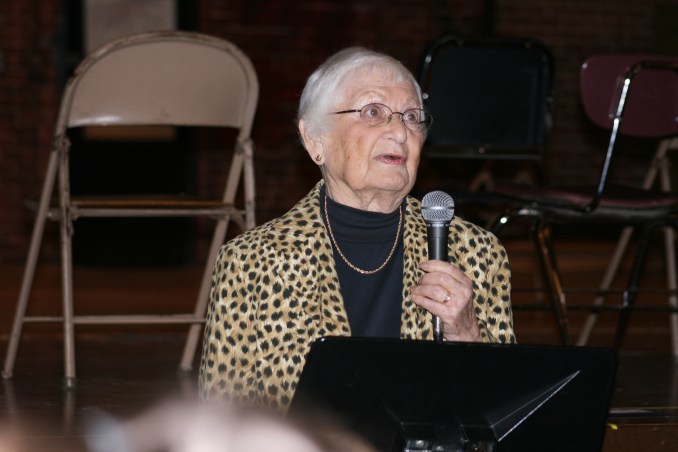
“My holocaust here”
In the post-war limbo of piecing together broken lives, everybody was searching for loved ones in displaced persons camps. Communication and transportation were slow in a region reduced to rubble. Kitty had no desire to return to her hometown. Too painful. An old beau from Hungary who “never stopped looking” found Kitty. “He wanted me,” she said. Once reunited, the engaged couple set marriage plans. She even had a wedding dress made from sheets. But then she called it off. She’d met a WASP American flyer with whom she wanted to make a fresh start in the U.S. “I didn’t want to go back to the past. It was a mistake. I paid a really terrible price to come here. But that was my decision at the time.”
After an epic struggle to send for her, over the Army’s strenuous objections, she met him in New York and they caught a train for Iowa. “On the train he asked me not to ever mention I’m Jewish, not to talk about Auschwitz. He said, ‘My family would not accept you — no reason for you to repeat that. I want you to be treated like everybody else.’ And, you know, he made sense. But it’s very difficult to deny your heritage. For years, because of his family, nobody knew. I can’t say it was all his fault. It was two different worlds. We were worlds apart.”
His drinking further drove a wedge between them. They had three children together. After 12 years they separated. Kitty became a single working mom. She was a bank teller and later trained tellers. Her first-born, Mike, earned a college scholarship, but never used it. Nobody knew it but he was troubled. At 19 he committed suicide. “It was the ‘60s. No father, me working long hours. We were abandoned. I blame myself,” she said. “I expected him (Mike) to be the head of the household and concentrated on the other two kids and didn’t realize he was slipping away. That was my Holocaust here. That had a lot to do with the divorce.”
But life went on. Kitty’s surviving children, Mark and Pamela, earned scholarships to Yale and Grinnell, respectively. Kitty rose to vice president. She finally spoke about her Jewish heritage and survivor past. She met a good man in Bill, her husband of 32 years now. He’s embraced her past. “I’ve had a lot of bad things happen but the good outweighs the bad. Bill’s the best thing that ever happened to me.”
“I am so fortunate in so many ways. Now I’m sort of out of the closet.”
In 1990 Kitty was invited back to Allendorf for a reunion with her fellow camp mates. All expenses paid. She’d sworn never to step foot again in Germany. But this was something she hadn’t counted on — a reunion and reconciliation. She went with family. All told, 333 of the 1,000 women came. She renewed old friendships and made new ones. The Germans’ “kindness and sympathy and regret” struck her. “They rolled out the red carpet. It was like magical. They even had a kosher table and brought in rabbis from Frankfurt. They couldn’t do enough for us. It changed my outlook.” She also visited Auschwitz-Birkenau. She remade the trip in 2000. She returned again this summer with a grand-niece and granddaughter.
She treasures these visits. She’s glad she’s shared her story. The past still haunts her though. “My most vivid memory of Auschwitz is seeing the carts carrying the dead bodies. Whenever I can’t sleep it comes back to me — this image of people in striped uniforms pulling this wagon and throwing the bodies on it. The pile got so high the limbs were hanging out, and nobody knew who they were. We just went on existing. You get used to it, you’re callous, you just think about your own survival. Sometimes I feel like, Was there a life before Auschwitz?”
There was. More importantly, there’s been a life after. A reminder of change is a new museum dedicated to the 1,000 in Stadtallendorf, Germany. All their names inscribed there, Kitty’s included. “It’s a memory forever,” she said. “It’s pretty remarkable.” She especially likes that school kids tour the site. “That’s what’s most outstanding.”
Through it all, Kitty’s never lost her humanity. “I love people — the interaction.” Visit her and this doting Jewish mother will humble you with her warmth and hospitality. She’s amazed by the new life she made for herself in America after everything she knew was gone. Times got tough, sure, but help was always there. “I am so fortunate in so many ways.” She’s even glad her survivor identity is known. “Now I’m sort of out of the closet.”
Related Articles
- Kate Simon: This mute witness to genocide must not be allowed to crumble (independent.co.uk)
- I was 17 and surviving in the wild, but I’d fled humanity at its worst (thejc.com)
- FYI – Holocaust survivors to receive $ 564 million in reparations. (jwitness.wordpress.com)
- Leo Adam Biga’s Survivor-Rescuer Stories Featured on Institute for Holocaust Education Website (leoadambiga.wordpress.com)
- Sisters of the Shoah: Three Survivor Tales, Three Golden Fates, Three Iron Wills (leoadambiga.wordpress.com)
The Artful Dodger: Lou Leviticus survived the Holocaust as an escape artist
The story more or less appeared as it is here in The Reader almost a decade ago. It was later reprinted in The Jewish Press. I have always hoped to share the story with a wider audience.
NOTE: Leviticus has subsequently told his own story in a book he wrote.
|

The Artful Dodger: Lou Leviticus survived the Holocaust as an escape artist
©by Leo Adam Biga
Originally published in The Reader (www.thereader.com) and then reprinted in The Jewish Press
“I’ve been an escape artist all my life.”
The apt words belong to Lincoln, Neb. resident Lou Leviticus, a square-headed terrier of a man who as a youth in his native Holland survived the Holocaust partly due to his talents as an artful dodger. He escaped the Nazis more than once, even when those closest to him were caught and put to death. As an orphan on the run he became one of scores of hidden children in The Netherlands, his survival dependent on a cadre of strangers that cared for him as one of their own.
Today, when telling his saga to young Hebrew students at Temple Israel Synagogue in Omaha, the spoken truth sounds less like glib bravado than it does a solemn proverb. And, like an answered prayer, members of the Dutch underground rescued him. Families working with the underground risked their very lives taking him into their home and shielding him from danger. He regards those that helped him, especially Karel and Rita Brouwer, as his “heroes” and “protectors.”
During his time in hiding Leviticus endured and did some unspeakable things. An archly unsentimental sort, he sheds no tears over what happened. Despite it all, he emerged a life-affirming dynamo. The retired University of Nebraska-Lincoln agricultural engineering professor first came to America in the mid-1950s (by way of Israel, where he resided after the war) to obtain his Ph.D. He married, raised a family, got divorced. He wed his present wife, Rose, a native of Great Britain, in 1982. He became a U.S. citizen four years ago. While at UNL he also headed the Nebraska Power Lab and Tractor Testing Laboratory. Today, he is an agricultural engineering consultant.
Until quite recently he kept his story to himself. That changed when the Survivors of the Shoah Visual History Foundation requested he tell it for the sake of posterity. The Los Angeles-based Foundation, which filmmaker Steven Spielberg formed after completing Schindler’s List, is dedicated to recording and preserving the largest repository of Holocaust survivor stories in the world. Since 1996 the organization has been conducting videotaped interviews with survivors from every corner of the globe. To date, some 50,000 interviews have been cataloged for use by scholars and for dissemination in schools and libraries.
In 1996 Leviticus shared his story with Omahan Ben Nachman, a Holocaust researcher and Shoah-trained interviewer who’s collected dozens of testimonies. Since then, Leviticus has written his memoirs and related his tale to youths at schools and synagogues. Why, after all this time, is he bearing witness now?
“The only reason I do it,” Leviticus said, “is to maybe make somebody think about it and realize how fortunate they are. That they should not take their lives so easily for granted. That they have a little more gratitude for what they have…because what happened then can happen again. It is happening again. Look at Chechnya. Look at Kosovo. Look at the skinheads in this country. There is hatred. People are cruel. And I do now feel it as an obligation, not necessarily to this generation, but to my school buddies, my parents, my grandmother, and to all those people. If I don’t tell their story, what else is left of them except their names in a register?”
  |
|
| Lou Leviticus, professor emeritus and volunteer curator at the Larsen Tractor Museum on East Campus, holds a copy of his recently published memoirs detailing his childhood in the German-occupied Netherlands. His parents were killed at Auschwitz in 1942. Photo by Brett Hampton. |
Because ethnic cleansing seems far removed from the modern American experience, it is easy to distance oneself from such evil. But the truth is no one thinks it can happen to them, ever. That’s exactly how most Dutch Jews felt when Nazi Germany overran their nation in May of 1940. That’s why the only way to understand what happened is to recall the insidious events that systematically isolated Jews from mainstream Dutch life, all because they were deemed “different” and ultimately expendable. How else can one explain a child having to flee and hide to save his own life? Unthinkable, yet it occurred.
In a recent interview with The Reader, Leviticus recalled those years. Speaking from the deck of his comfortable tree-shaded home in Lincoln, the scene could not have been more incongruous with what he described. Despite what eventually transpired, his homeland was a tranquil place before the invasion. Pre-war Holland, after all, was a civilized society. Its large Jewish population enjoyed complete freedom, if not full acceptance. Leviticus and his parents led a privileged life in Amsterdam. As foreign correspondent for a large recycling company, his father, Max, handled relations with foreign clients. An outdoorsman, Max enjoyed long bicycle rides and walks in the countryside. Lou’s mother, Sera, was a socialite and spiritualist who gave bridge parties and hosted seances at the family’s large home.
“My mother was pretty deeply into spiritualism — mediums and seances and astrology — which was very fashionable in those days. I can still see her working with these charts on a table, trying to figure out what the hell was going on in the world. I’ve always wondered about that — if she could see what was going to happen to us or not,” Leviticus said.
As a boy he often joined his mother at Heck’s Cafe, a swank gathering spot for the smart set, where he listened to live band music while she hobnobbed with friends.
Music, especially opera, held young Lou enthralled. He had his own radio and spent endless hours listening to favorite tenors and to detective programs. An avid reader, he fancied the adventure tales of German author Karl May. Despite being undersized, he was athletically adept and belonged to swimming and soccer clubs. A cinema lover, he skipped Hebrew school to catch the latest movies.
His family lived quite close to Anne Frank’s family. A cousin of hers, Paul Frank, was a friend and playmate of Lou’s. Because she was two years older than Lou, he only knew her casually, but recalls her as a “nice girl. She was more mature than me.”
Admittedly “a spoiled brat” doted on by his maternal grandmother, Leviticus lived a carefree life. His parents, who employed a servant, had their every need met.
The family’s idyll ended May 10, 1940 when Germany invaded Holland. The Dutch, who remained neutral during World War I, had felt protected from the brewing storm in Europe despite Germany’s increasingly ugly rhetoric and military incursions. Caught unprepared, Holland’s meager defenses were quickly overwhelmed by the blitzkrieg. The Netherlands capitulated five days after the attack began. Even though he was not quite 9-years-old, Leviticus recalls it all.
“I remember all five days. For us kids it was the greatest adventure in the world. We didn’t see the sickness. We heard people were being killed, but we didn’t see it. We did see German planes in the air and men shooting at them. It was exciting.”
Perhaps his most vivid memory then is the sight of a city under siege at night, its lights darkened and streets emptied owing to the mandated curfew and blackout. As a child, the horror of the invasion was finally brought home when he saw adults around him shattered by the events. His father, a WWI vet, had been called up to serve in the civil defense corps. On May 15, the day the Dutch surrendered, Lou was shocked to find his father sobbing at home. “I can still see him sitting in the side room crying. It was the first time I saw my dad cry. I remember asking him, ‘What’s the matter?’ But he couldn’t talk.”
According to Leviticus, who has researched events leading up to the German conquest and the ensuing terror campaign, much of the Dutch ruling class held pro-Nazi sympathies and as such these Fifth Columnists aided Germany in subduing The Netherlands. Beyond politics or prejudice, he said, the compliant nature of the Dutch people, combined with a meticulous citizen registration system, made it easier for the Nazi regime to exert its will there.
“My feeling is that the Dutch have always been very obedient to authority — any authority. The Germans had the authority and when they installed a Dutch puppet government, that was the government, and therefore they were obeyed. The Dutch also had a population registration system in place unparalleled in its accuracy in Europe. In fact, (Adolph) Eichmann liked it so much he copied it in other countries under Nazi rule. That system should have been destroyed when the Germans occupied The Netherlands, but the people who ran it were so proud of their work and so pro-Nazi they handed it over in full to the Germans, who used it to curtail the activities of Jews and other undesirables.”
He said people were so accustomed to registration few saw danger in its application by occupying forces. “Nobody thought much of it, and so they re-registered.” He added the Germans were “very cunning” in passing decrees that, step by step, cut-off Jews from the general populace. “It started with very little things. In June, Jews were forbidden from being part of the civil defense. In July, they were excluded from the labor draft. Then there was a ban on ritual slaughter. In September, Jews were banned from selling in the regular markets. The Germans never targeted the whole population. Otherwise, that would have probably created unrest. Instead, they targeted sections, making each segment register and abide by restrictive laws. First, it was physicians, then pharmacists, then lawyers. Each week there was a different order affecting some group, and the others said, ‘Well, it’s only them,’ and in the end it was everybody. The noose was tightening, but most people didn’t realize it, and by the time they did it was too late.”
The first anti-Jewish regulation affecting him was a 1941 law banning Jews from all movie theaters except the single Jewish-owned cinema in Amsterdam. “I was an avid moviegoer and the only theater left I could go to soon became too dangerous because there were always Nazi youths waiting outside to cause mischief. We were yelled at, spit on, and so forth. It became impossible to go there unless you were with grown-ups and even then it sometimes got a little bit hairy.” He next felt the sting of anti-Semitism when Jews were forbidden from entering parks and from holding membership in sports clubs. In a cruel display of public humiliation, he was drummed off his soccer team by the coach in front of jeering teammates.
At the same time, the Nazi propaganda machine worked overtime inflaming anti-Semitic fervor. He recalls placards affixed everywhere with slogans like “The Eternal Jew,” “The Dirty Jew” and “Watch Out for the Jew” emblazoned on them. The posters typically depicted grotesque, deformed, horned figures with the Star of David displayed on their chest or forehead. Soon, all Jews — their businesses and residences too — were required to bear the yellow star. “When you got the star you were a marked person,” he said. “Now you couldn’t hide behind your looks. There were always groups of Hitler youths running around terrorizing people. They started making life very difficult. We, as kids, were beaten up — quite severely at times. Grown-ups didn’t interfere. They were afraid. The police seldom intervened.” Schoolmates he counted as friends turned on him, yelling epithets. “I went to school with great trepidation. I took a terrible beating one day and adults stood by laughing. Things got worse and worse, until every aspect of my life was affected. You felt you were an unworthy person. That you didn’t have the right to walk the same streets as other people. It made me feel terrible, awful, angry.”
Schools were finally segregated, which Leviticus viewed as a welcome relief. “We were a pretty intelligent and rowdy bunch and we had a lot of fun in fact. We were all in the same boat. We were all together. That was the best part of it.”
By 1942, people started disappearing. Rumors spread the missing persons were hauled away to camps to be gassed or shot. “Nobody talked about it,” Leviticus said. “Not the teachers, not the parents. They didn’t know how to talk about it. They didn’t want to believe what was happening.” The fear turned personal when his girlfriend, Anita, was arrested along with her mother and sister. “I was very, very heartbroken for a long time because she was really my pal. We did homework together” He later learned she and her family died at Sobidor concentration camp.
As early as 1942 Jewish men were rounded up and taken away. It happened to Leviticus’ father, who ended up in the work camp, Ommen, where men worked clearing forests for agriculture, but in truth awaited transit to concentration camps and certain death. When the elder Leviticus learned of his group’s impending transport, he concealed himself in one of the deep trenches the men dug and escaped at night. Lou has since documented his father was the only prisoner from his work detail to escape alive. While in hiding, Max got word of his escape to Sera, who fled to a prearranged safe house in the country. Lou, in school at the time, was unaware of the unfolding intrigue. His first inkling of it came when an unfamiliar man came there one day with a note from his mother.
“My mother’s note said for me to go with him. The man told me, ‘Your mother’s waiting for you. Don’t worry.” Of course I was worried. I didn’t know what was happening. I had never seen him before, but I knew my mother’s handwriting, so I went. He took me into a hallway, took my coat off, gave me another coat without a star on it, grabbed my hand and we walked away. We went on a train. The train trip was frightening for me. We had to pass German police controls at various stations. By then I had been brainwashed so that I was sure I looked like any of those pictures of the Eternal Jew. I was afraid of anyone who had a uniform or boots or a dark coat on because those things represented Nazis. By then, I didn’t trust anyone any more. I’d lost my trust in the grown-up world.”
The pair passed through police checkpoints without a hitch. They got off at Amersfoort, a town 40 kilometers southeast of Amsterdam, where, it turned out the boy’s mysterious escort, a Mr. Van Der Kieft, was a plain clothes detective. Secretly, he was also a top operative in the Dutch underground movement that provided false identity papers, ration cards and safe havens to fugitives. As Leviticus soon found out, the underground network would be his lifeline. Van Der Kieft took Leviticus by bike to the farmhouse his mother had gone to. His father joined them days later. After two months in hiding, the family had to find refuge elsewhere when the farmer sheltering them demanded more money than they could pay. Leviticus said there were any number of people ready to help then, whether “out of good will or for good money.”
Thanks again to the efforts of the underground, the family was put up at a house in Amersfoort belonging to a coachman, who lived on the ground floor. Lou’s family shared a pair of small rooms on the third floor. Between the two rooms were sliding doors. The back room opened on a veranda with a railing. The family had to be on guard at all times. “We had to keep very quiet during the day and not show ourselves in front of the windows,” he said. “We couldn’t close the curtains then, as that would arouse suspicion in Holland, where there’s little light. When the bell rang at the main door below we would freeze. We could hear the bell, but we couldn’t see who was calling. At night we could become a little more active because then we could close the doors and curtains. But if there were guests we had to sit still. We couldn’t use the toilet then, so we used a chamber pot.”
Father, mother and son passed the time reading and playing board games. “I don’t remember that as being terrible because there was so much to read,” he said.
Then, one October afternoon in 1942, the bell rang and the word “police” was spoken at the bottom of the stairs. Raised voices barked, “Stay where you are. Don’t move.” Leviticus recalls his mother “started crying.” They knew the authorities had come for them. With police bounding up the stairs to the family’s third-floor hideaway, young Lou made a fateful split-second decision and, without a word, clambered to the veranda opening, hopped atop the railing, and jumped. That moment of fear and flight was the last he saw his parents alive.
“Before I jumped the last thing I remember is seeing my dad close the doors behind me. That gave me enough time to get away. My dad didn’t hesitate. It happened so fast. Below me on the ground floor, luckily, was a large awning jutting out. I hit the awning, slid over it, landed on my feet and whew, I was gone. I didn’t look back. I didn’t run either — a good thing, too, because police were out searching the grounds. One policeman probably saw me, but lost me when I climbed over a bunch of fences. I came to a house and climbed up on a rain pipe. I got to another porch, climbed over the railing there and found a big wash tub. I pulled the wash tub over me — it made a helluva racket — but nobody was home.”
He credits his quick actions to “pure self-preservation,” adding, “It was just pure instinct. I don’t know where it came from, except maybe the Karl May stories inspired me not to be caught. I knew what I had to do. I had seen other people being picked up by the police on the street and they never came back, and that wasn’t going to happen to me.” He does not second-guess his fleeing. He only wishes his folks escaped too or at least knew he was safe. “I knew I’d done the right thing because, number one, I’m alive. I’m sorry I couldn’t say goodbye and hug my mother and father. That is my only regret. That, and the fact they suffered and I couldn’t do anything.” His parents, like most of his family, were soon killed.
After eluding the police, he waited until dark, then fumbled his way to the home of a man who was active in the underground. When he arrived there the man’s frightened family explained the head of the house was in hiding. Earlier that day police had cracked down on the local underground cell and come looking for the man, who’d escaped. The family feared the police’s return. Leviticus felt safe for the moment but as he lay in bed that night he overheard the family discussing turning him over to authorities. “When I heard that I decided that wasn’t going to happen. Early the next morning I stole some clothes and food, opened the door, and went on my own to the east.” Fending for himself in a world intent on his destruction, he learned to live by his wits’ end, foraging for food and shelter at local farms. But as a child on his own, he stood little chance for long. After days on the road, he came to the same farm he and his family began their hidden life at.
Fearing the farm was not a secure hideout, Leviticus was relieved when the underground placed him with Karel Brouwer, then a 24-year-old civil servant with a new wife and young child. Neither the first nor the last person Brouwer rescued, Leviticus stayed with him and his family for much of the remainder of the war. “He’s a remarkable man. He took me to his home in Hamersveld. He practically adopted me. He never intended to be a hero, but somehow it was thrust upon him, and he risked everything to feed, shelter and keep me and others out of harm’s way.” Lou still keeps in touch with his “second family.” In a fateful twist, the first refugees Brouwer helped were Lou’s aunt, uncle and maternal grandparents. Through his position in local government, Brouwer’s covert network used the registration system to provide hunted Jews and non-Jews alike with false names and documents. Thus, Lou took on the identity of Rudi Van Der Roest, a Christian boy his own age from Amsterdam. Researcher Ben Nachman said such actions underscore how Holland was rife with contradictions. For example, while a high percentage of its native Jews were murdered, the country’s active underground movement shielded a great number in hiding.
As Rudi, Lou lived the unencumbered life of a non-Jewish child — attending school, playing in parks, traveling freely. Whenever detained, his cover story was that he was away from home due to hardships caused by the war. The deception worked. “Each of us in hiding were stopped and interrogated by the Germans at least once or twice, so we knew how to lie with a straight face. You got very adept at that. Every time you did something to thwart the Nazis it made you feel good.” He enjoyed freedom but guarded what he said and did so as not to compromise his true identity and therefore risk endangering himself, the Brouwers and the underground. “I had to be careful. I couldn’t afford any slips of the tongue, so I couldn’t get close to a lot of people. Whatever I wasn’t told, I didn’t ask. You learned that very quick. I knew the less I knew, the better it was.”
Life with the Brouwers was sweet. “A lot of beautiful things happened during the war,” Leviticus said. “There were times when I forgot the misery. I was extremely lucky to get through that experience, not unscathed exactly, but well-looked after.” He adds that not all hidden children were as lucky as himself. “The Brouwers loved me. They were good to me. In many cases, though, kids were shuttled from place to place and mistreated by their host families.”
As a base for the underground the Brouwer home witnessed many comings and goings. All the activity must have raised suspicions because, in February 1945, the police raided it. The whole family, including Lou, then 14, was home that day. The police found mounds of incriminating evidence — from papers to ration cards to guns. Everyone was interrogated on-site. Crying after being roughed up, Lou regained enough composure to hatch another escape. He explains: “I asked if I could use the toilet, and the police said I could if I left the door open. The toilet was situated behind a stairway, and when the bathroom door was opened it hid another door which led to a side room, which led outside. As soon as I entered the bathroom, I went through the side door and ran.”
He ran all the way to the city hall building, where he knew underground contacts operated. There, he found that Brouwer, who’d also escaped, had arranged for his transport to a new safe house — a farm belonging to Peel Van Den Hengel. It was there he worked and stayed until war’s end. When the Van Den Hengels insisted he be baptized Catholic, he complied. In April 1945, events unfolded at the farm that gave Leviticus a taste of Old Testament revenge. Blood was spilled, lives taken, eye-for-an-eye revenge extracted. It began when two German soldiers arrived to plunderthe farm at gunpoint, ordering Leviticus and his fellow farmhands to load-up food and other supplies. Earlier, one of the soldiers molested a young maiden. Then they went too far, pushing Lou and another farmhand past the breaking point.
“I was cutting silage with a very sharp spade but I wasn’t working fast enough for one of the soldiers. He poked me in the kidneys with his gun, and that hurt. I turned around with that spade and I hit him straight in the throat and opened him up all the way. He sank to his knees. He didn’t utter anything. He bled to death on the spot. The other soldier came running, but didn’t see behind him one of the other boys, who struck him with a pitchfork. There was so much anger in us that we just went bezerk and cut them up into pieces. It’s something you wouldn’t do to a dog. I’m not very proud of it, but I’m not sorry about it. I wanted my revenge.”
After Germany’s unconditional surrender, he returned to live with the Brouwers. Then, much to his dismay, a humanitarian organization enforced a separation by placing him in a Jewish orphanage. “I hated it.” Always the escape artist, he hightailed it out of there and went back to the Brouwers. Upon completing high school, he toured Europe with a jazz band. When a rift caused the group to split-up in Marseilles, Leviticus stayed on. He later took to sea as a merchant seaman, applying his mechanical aptitude to the ship’s engines. In 1951 he made his way to Israel, not out of idealism, but rather the lure of a pretty blonde, whom he followed to a kibbutz in Haifa. Finding communal life too restrictive, he left to study at the Israel Institute of Technology, where he earned an engineering degree.
After obtaining his Ph.D. in the states (at Purdue University) he returned to Israel. He served in two wars against Egypt — in 1957 and in 1973 (The October War). In the latter conflict he was a liaison between the U.S. and Israeli armies, working with the armored division and corps of engineers on the mobility of military vehicles and their off-road conditions. He helped engineer a bridge crossing the Suez Canal. He came to live in the states for good in 1974, joining the UNL faculty in 1975.
Although he downplays it, his wartime experience has haunted him. How could it not? All during the war, and even long after it, he did not know his parents’ fate. “I never was sure, really. I think I really didn’t want to know. I was always hoping they were still alive somewhere,” he said. Only much later did he confirm they were gassed to death at Auschwitz just a few months after their capture. He remains as unforgiving about what was done to his family as he is unrepentant about what he did to prevail. “I’m not very, shall we say, humanitarian in my beliefs. I still adhere to the principle that your best enemy is a dead enemy, which I know is not a very Judeo-Christian thought, but I don’t give a damn — that’s the only way I survived.”
Related Articles
- Jews, Muslims Make Pilgrimage To Auschwitz (huffingtonpost.com)
- ‘American Schindler’ helped 4,000 Jews escape the Nazis (telegraph.co.uk)
- Anne Frank: The Life, The Book, The Afterlife, By Francine Prose (independent.co.uk)
- Sun wins justice on Nazi fiend (thesun.co.uk)
- Leo Adam Biga’s Survivor-Rescuer Stories Featured on Institute for Holocaust Education Website (leoadambiga.wordpress.com)
- Sisters of the Shoah: Three Survivor Tales, Three Golden Fates, Three Iron Wills (leoadambiga.wordpress.com)


 Leo Adam Biga's My Inside Stories